EP4546200A1 - Verfahren, vorrichtung und vorrichtung zur konstruktion eines lokalen flussmodells, medium und fahrzeug - Google Patents
Verfahren, vorrichtung und vorrichtung zur konstruktion eines lokalen flussmodells, medium und fahrzeug Download PDFInfo
- Publication number
- EP4546200A1 EP4546200A1 EP23826360.2A EP23826360A EP4546200A1 EP 4546200 A1 EP4546200 A1 EP 4546200A1 EP 23826360 A EP23826360 A EP 23826360A EP 4546200 A1 EP4546200 A1 EP 4546200A1
- Authority
- EP
- European Patent Office
- Prior art keywords
- coolant
- flow
- model
- target
- characteristic parameter
- Prior art date
- Legal status (The legal status is an assumption and is not a legal conclusion. Google has not performed a legal analysis and makes no representation as to the accuracy of the status listed.)
- Pending
Links
Images

Classifications
-
- G—PHYSICS
- G06—COMPUTING OR CALCULATING; COUNTING
- G06F—ELECTRIC DIGITAL DATA PROCESSING
- G06F30/00—Computer-aided design [CAD]
- G06F30/20—Design optimisation, verification or simulation
- G06F30/27—Design optimisation, verification or simulation using machine learning, e.g. artificial intelligence, neural networks, support vector machines [SVM] or training a model
-
- G—PHYSICS
- G05—CONTROLLING; REGULATING
- G05B—CONTROL OR REGULATING SYSTEMS IN GENERAL; FUNCTIONAL ELEMENTS OF SUCH SYSTEMS; MONITORING OR TESTING ARRANGEMENTS FOR SUCH SYSTEMS OR ELEMENTS
- G05B17/00—Systems involving the use of models or simulators of said systems
- G05B17/02—Systems involving the use of models or simulators of said systems electric
-
- F—MECHANICAL ENGINEERING; LIGHTING; HEATING; WEAPONS; BLASTING
- F01—MACHINES OR ENGINES IN GENERAL; ENGINE PLANTS IN GENERAL; STEAM ENGINES
- F01P—COOLING OF MACHINES OR ENGINES IN GENERAL; COOLING OF INTERNAL-COMBUSTION ENGINES
- F01P11/00—Component parts, details, or accessories not provided for in, or of interest apart from, groups F01P1/00 - F01P9/00
-
- F—MECHANICAL ENGINEERING; LIGHTING; HEATING; WEAPONS; BLASTING
- F01—MACHINES OR ENGINES IN GENERAL; ENGINE PLANTS IN GENERAL; STEAM ENGINES
- F01P—COOLING OF MACHINES OR ENGINES IN GENERAL; COOLING OF INTERNAL-COMBUSTION ENGINES
- F01P7/00—Controlling of coolant flow
- F01P7/14—Controlling of coolant flow the coolant being liquid
-
- G—PHYSICS
- G05—CONTROLLING; REGULATING
- G05D—SYSTEMS FOR CONTROLLING OR REGULATING NON-ELECTRIC VARIABLES
- G05D23/00—Control of temperature
- G05D23/19—Control of temperature characterised by the use of electric means
- G05D23/1917—Control of temperature characterised by the use of electric means using digital means
-
- G—PHYSICS
- G06—COMPUTING OR CALCULATING; COUNTING
- G06F—ELECTRIC DIGITAL DATA PROCESSING
- G06F30/00—Computer-aided design [CAD]
- G06F30/10—Geometric CAD
- G06F30/15—Vehicle, aircraft or watercraft design
-
- F—MECHANICAL ENGINEERING; LIGHTING; HEATING; WEAPONS; BLASTING
- F01—MACHINES OR ENGINES IN GENERAL; ENGINE PLANTS IN GENERAL; STEAM ENGINES
- F01P—COOLING OF MACHINES OR ENGINES IN GENERAL; COOLING OF INTERNAL-COMBUSTION ENGINES
- F01P2025/00—Measuring
- F01P2025/08—Temperature
- F01P2025/52—Heat exchanger temperature
-
- G—PHYSICS
- G06—COMPUTING OR CALCULATING; COUNTING
- G06F—ELECTRIC DIGITAL DATA PROCESSING
- G06F2113/00—Details relating to the application field
- G06F2113/08—Fluids
-
- G—PHYSICS
- G06—COMPUTING OR CALCULATING; COUNTING
- G06F—ELECTRIC DIGITAL DATA PROCESSING
- G06F2119/00—Details relating to the type or aim of the analysis or the optimisation
- G06F2119/08—Thermal analysis or thermal optimisation
Definitions
- the present disclosure belongs to a field of thermal management technologies, and specifically to a method and an apparatus for constructing a local flow model, a device, a medium and a vehicle.
- a thermal management system of an automobile needs to automatically adjust a cooling intensity according to a driving condition and an environmental condition, to maintain corresponding components operating within an optimal temperature range, and particularly to maintain an engine operating within the corresponding optimal temperature range.
- Temperature of coolant in the engine needs to be determined according to a flow of the coolant.
- it is currently predicted by an overall model of the thermal management system of the automobile.
- Such predicted flow of the coolant is an overall flow of the thermal management system, however, heat exchange components in the thermal management system of the automobile are complicated, a local flow of the coolant corresponding to each of the heat exchange components is different from the overall flow of the thermal management system of the automobile. If the overall flow of the thermal management system of the automobile replaces a local flow of the coolant corresponding to a certain heat exchange component in the thermal management system of the automobile, it is not accurate enough.
- a method for constructing a local flow model includes:
- an apparatus for constructing a local flow model includes:
- embodiments of the disclosure provide a device for constructing a local flow model.
- the device includes a processor, a memory and a program or an instruction stored on the memory and executable by the processor, in which when the program or the instruction is executed by the processor, steps of the method for constructing the local flow model in any one embodiment of the disclosure are implemented.
- embodiments of the present disclosure provide a computer-readable storage medium storing a program or an instruction thereon, in which when the program or the instruction is executed by a processor, steps of the method for constructing the local flow model are implemented.
- inventions of the present disclosure provide a vehicle.
- the vehicle includes at least one of:
- embodiments of the present disclosure provide a computer program product including a computer program.
- the computer program is executed by a processor, the method for constructing the local flow model in any one embodiment of the present disclosure is implemented.
- the target physical model corresponding to the thermal management system is obtained based on the acquired first flow data of the thermal management system
- the second flow data of the coolant at the target heat exchange component in the thermal management system is calculated based on the target physical model
- the local flow model for the coolant at the target heat exchange component is obtained by training the preset model according to the second flow data and the corresponding target characteristic parameter for controlling the operation of the thermal management system.
- a local flow model for calculating the local flow of the coolant may be obtained accurately, and further the local flow of the coolant at a target component may be obtained based on the constructed local flow model, which is simple and rapid in calculation, and the obtained local flow of the coolant at the target component is accurate, accuracy and efficiency of the local flow of the coolant at the target component is enhanced.
- FIG. 1 illustrates an overall model of a thermal management system of an automobile.
- a connection line between heat exchange components for example, a battery, a fan heat exchanger, an engine, etc. in FIG. 1
- FIG. 1 may be a flow direction of coolant.
- When determining the flow of the coolant it is predicted by using an overall model of the thermal management system of the automobile.
- Such predicted flow of the coolant is an overall flow of the thermal management system (i.e., an overall flow of the coolant in FIG.
- heat exchange components in the thermal management system of the automobile are complicated, a local flow of the coolant corresponding to each of the heat exchange components (for example, may be a flow of coolant between the battery and the fan heat exchanger in FIG. 1 ) is different from the overall flow of the thermal management system of the automobile. If the overall flow of the thermal management system of the automobile replaces a local flow of coolant corresponding to a certain heat exchange component in the thermal management system of the automobile, it is not accurate enough.
- a method and an apparatus for constructing a local flow model, a device, a medium and a vehicle are provided according to embodiments of the disclosure.
- the method and the apparatus for constructing the local flow model, the device, the medium and the vehicle obtain a target physical model corresponding to the thermal management system based on acquired first flow data of the thermal management system; calculate second flow data of coolant at a target heat exchange component in the thermal management system based on a target physical model; and obtain a local flow model for the coolant at the target heat exchange component by training a preset model according to the second flow data and a corresponding target characteristic parameter for controlling operation of the thermal management system.
- a local flow model for calculating a local flow of the coolant may be obtained accurately, and the local flow of the coolant at a target component may be obtained based on the constructed local flow model, which is simple and rapid in calculation, and the obtained local flow of the coolant at the target component is accurate, accuracy and efficiency of the local flow of the coolant at the target component is enhanced.
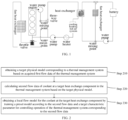
- FIG. 2 is a flowchart illustrating a method for constructing a local flow model according to embodiments of the present disclosure.
- An executive body of the method for constructing the local flow model may be a server. It needs to be noted that, the executive body does not constitute a limitation of the present disclosure.
- the method for constructing the local flow model includes steps 210 to 230.
- a target physical model corresponding to a thermal management system is obtained based on acquired first flow data of the thermal management system.
- step 220 second flow data of coolant at a target heat exchange component in the thermal management system is calculated based on the target physical model.
- a local flow model for the coolant at the target heat exchange component is obtained by training a preset model according to the second flow data and a target characteristic parameter for controlling operation of the thermal management system corresponding to the second flow data.
- the target physical model corresponding to the thermal management system is obtained based on the acquired first flow data of the thermal management system; the second flow data of the coolant at the target heat exchange component in the thermal management system is calculated based on the target physical model; and the local flow model for the coolant at the target heat exchange component is obtained by training the preset model according to the second flow data and the corresponding target characteristic parameter for controlling the operation of the thermal management system.
- the local flow model for calculating the local flow of the coolant may be obtained accurately, and the local flow of the coolant at the target component may be obtained based on the constructed local flow model, which is simple and rapid in calculation, and the obtained local flow of the coolant at the target component is accurate, accuracy and efficiency of the local flow of the coolant at the target component is enhanced.
- a target physical model corresponding to a thermal management system is obtained based on acquired first flow data of the thermal management system.
- the first flow data may be key flow data of the thermal management system acquired during an experimental process, and specifically may be overall flow data of the thermal management system, or may be local flow data of a certain key heat exchange component (for example, a battery or an engine, etc.) in the thermal management system in FIG. 1 .
- a certain key heat exchange component for example, a battery or an engine, etc.
- the target physical model may be a physical model corresponding to the thermal management system model obtained based on acquired the first flow data of the thermal management system.
- step 210 specifically may include:
- the physical model may be an overall physical model of the thermal management system as illustrated in FIG. 1 .
- the model parameters of the physical model may be a water pump pressure rise of the coolant, a pressure drop of a heat exchange environment, a loss of the coolant along a pipe wall used in construction of the physical model.
- an overall physical model corresponding to the thermal management system may be constructed based on the acquired first flow data of the thermal management system.
- the target physical model corresponding to the thermal management system may be obtained by correcting the model parameters of the physical model based on the first flow data.
- model parameters of the physical model may be manually corrected by an engineer or may be automatically corrected in other manners, which is not limited here.
- step 220 second flow data of coolant at a target heat exchange component in the thermal management system is calculated based on the target physical model.
- the target heat exchange component may be a heat exchange component at which the flow of the coolant is to be calculated.
- the target heat exchange component may be the battery, the engine, the heat exchanger, etc. in FIG. 1 .
- the second flow data may be flow data of the coolant at the target heat exchange component calculated based on the target physical model.
- the flow of the coolant of some heat exchange components since the flow of the coolant of some heat exchange components cannot be measured in an experimental process, the flow of the coolant at the heat exchange component is important. And an overall physical model (the target physical model) of the thermal management system may simply calculate the flow of the coolant at the heat exchange component. Therefore, the flow data (the second flow data) of the coolant at the target heat exchange component in the thermal management system may be calculated according to the target physical model. For example, a flow of coolant at the engine may be calculated according to a flow of coolant at the battery in FIG. 1 .
- a local flow model for the coolant at the target heat exchange component is obtained by training a preset model according to the second flow data and a corresponding target characteristic parameter for controlling operation of the thermal management system.
- the target characteristic parameter may be a characteristic parameter for controlling the operation of the thermal management system.
- the target characteristic parameter further may be a characteristic parameter obtained after performing a preset processing on the characteristic parameter for controlling the operation of the thermal management system.
- the preset model may be a preconfigured model.
- the local flow model for the coolant at the target heat exchange component may be obtained after the preset model is trained.
- the preset model may be a neural network model, or may be other model available for predicting the local flow at the target heat exchange component, which will not be limited here.
- the target heat exchange component may be a heat exchange component which is to be predicted the local flow, for example, the battery, the water pump in FIG. 1 , etc.
- the method for constructing the local flow model involved may further include:
- the first characteristic parameter may be a direct characteristic parameter for controlling the operation of the thermal management system, and for example, may be a rotational speed of a water pump, a temperature, a valve opening, a speed of an engine, a torque of the engine, etc.
- the first characteristic parameter includes the rotational speed of the water pump, the temperature, the valve opening, the speed of the engine and the torque of the engine, and the above first characteristic parameters are respectively expanded to obtain associated characteristic parameters of the rotational speed of the water pump including a square of the rotational speed and a 3rd power of the rotational speed.
- the temperature is expanded to obtain associated characteristic parameters of the temperature including a square of the temperature, a 3rd power of the temperature and a 4th power of the temperature.
- the valve opening is expanded to obtain associated characteristic parameters of the valve opening including a square of the valve opening and a 3rd power of the valve opening.
- the speed and the torque of the engine are expanded to obtain associated characteristic parameters of the speed and the torque of the engine including a product of the speed and the torque of the engine, an integral of the product of the speed and the torque of the engine, etc.
- the target characteristic parameter may be a characteristic parameter based on each associated characteristic parameter, and for example, may be a characteristic parameter obtained by performing a preset processing on each associated characteristic parameter.
- the first characteristic parameter for controlling the operation of the thermal management system is obtained; the at least one associated characteristic parameter associated with the first flow data is determined according to the correspondence between the first characteristic parameter and the first flow data; and the target characteristic parameter is determined according to each associated characteristic parameter. Therefore, the target characteristic parameter may be accurately determined, and further the local flow model for the coolant at the target heat exchange component may be accurately constructed.
- determining the target characteristic parameter according to each associated characteristic parameter may include:
- the characteristic screening model may be obtained by learning a relationship between each associated characteristic parameter and a flow value of the coolant in the thermal management system.
- the characteristic screening model may be a generalized regression neural network (GRNN) based on a joint probability distribution.
- An input of the model may be each associated characteristic parameters, and an output of the model may be a flow value of the coolant in the thermal management system.
- GRNN generalized regression neural network
- the predicted flow value may be a flow value corresponding to each associated characteristic parameter predicted based on each associated characteristic parameter by the characteristic screening model after sequentially inputting the associated characteristic parameters into the characteristic screening model, respectively.
- the low flow value may be a flow value less than or equal to a first preset flow threshold value.
- the low flow value may be a lower flow value within a flow range of the coolant.
- the first preset flow threshold may be a preset threshold of the low flow value, for example, a flow range of the coolant is between 500-1000, in which case the low flow value may be between 500-700.
- the first candidate characteristic parameter may be an associated characteristic parameter corresponding to a minimum mean square error among mean square errors between the calculated predicted flow value corresponding to the associated characteristic parameter and the low flow value of the coolant in the thermal management system.
- the high flow value may be a flow value greater than or equal to a second preset flow threshold value.
- the high flow value may be a higher flow value within a flow range of the coolant.
- the second preset flow threshold may be a preset threshold of the high flow value, for example, a flow range of the coolant is between 500-1000, in which case the high flow value may be between 700-1000.
- the second candidate characteristic parameter may be an associated characteristic parameter corresponding to a minimum mean square error among mean square errors between the calculated predicted flow value corresponding to each associated characteristic parameter and the high flow value of the coolant in the thermal management system.
- the associated characteristic parameters have a product of the speed and the torque of the engine, and a square of the rotational speed of the water pump and a 3rd power of the rotational speed of the water pump, all associated characteristic parameters are traversed, that is, the product of the speed and the torque of the engine, and the square of the rotational speed of the water pump and the 3rd power of the rotational speed of the water pump are input into the characteristic screening model, respectively, to obtain a predicted flow value corresponding to the product of the speed and the torque of the engine, a predicted flow value corresponding to the square of the rotational speed of the water pump speed and a predicted flow value corresponding to the 3rd power of the rotational speed of the water pump speed, respectively.
- the predicted flow value corresponding to the product of the speed and the torque of the engine is 550
- the predicted flow value corresponding to the square of the rotational speed of the water pump is 900
- the predicted flow value corresponding to the 3rd power of the rotational speed of the water pump is 950.
- a dependent variable of the characteristic screening model i.e., a flow standard of the output of the characteristic screening model
- mean square errors between 550 and 600, between 900 and 600, between 950 and 600 are calculated respectively, and through compared, it may obtain that the mean square error between 550 and 600 is minimum, in which case the associated characteristic parameter (the product of the speed and the torque of the engine) corresponding to 550 may be taken as the first candidate characteristic parameter.
- the output of the characteristic screening model is replaced with the high flow value, for example, may be 850.
- the product of the speed and the torque of the engine, and the square of the rotational speed of the water pump and the 3rd power of the rotational speed of the water pump are input into the characteristic screening model, respectively, to obtain a predicted flow value corresponding to the product of the speed and the torque of the engine, a predicted flow value corresponding to the square of the rotational speed of the water pump speed and a predicted flow value corresponding to the 3rd power of the rotational speed of the water pump speed respectively.
- the predicted flow value corresponding to the product of the speed and the torque of the engine is 550
- the predicted flow value corresponding to the square of the rotational speed of the water pump is 900
- the predicted flow value corresponding to the 3rd power of the rotational speed of the water pump is 950.
- Mean square errors between 550 and 850, between 900 and 850, between 950 and 850 are calculated respectively, and through compared, it may obtain that the mean square error between 900 and 850 is minimum, in which case the associated characteristic parameter (the square of the rotational speed of the water pump) corresponding to 900 may be taken as the second candidate characteristic parameter.
- the first candidate characteristic parameter and the second candidate characteristic parameter are taken as target characteristic parameters, that is, the product of the speed and the torque of the engine, and the square of the rotational speed of the water pump are taken as final target characteristic parameters.
- the first candidate characteristic parameter and the second candidate characteristic parameter may be ranked from low to high according to mean square errors between the first candidate characteristic parameter, the second candidate characteristic parameter and the flow value of the coolant in the thermal management system, and first N characteristic parameters ranked first are obtained as the final target characteristic parameters.
- first 4 characteristic parameters with a mean square error reduced to 0 are selected as the final target characteristic parameters.
- the target characteristic parameter for constructing the local flow model of the coolant at the target heat exchange component may be selected by screening each associated characteristic parameter using the characteristic screening model, thus, an accurate local flow model of the coolant at the target heat exchange component may be obtained.
- step 230 in order to obtain the accurate local flow model of the coolant at the target heat exchange component, step 230 specifically may include:
- the initial local flow model may be a model obtained by training a preset model using a training sample.
- the second flow data acquired at step 230 and the corresponding target feature parameter for controlling the operation of the thermal management system may be randomly divided into a training set and a test set (specifically, may be divided according to ratios of 85% and 15%), then the preset model is trained using the training sample to obtain at least one initial local flow model for determining the local flow of the coolant at the target heat exchange component, and accuracy of the local flow of the coolant at the target heat exchange component predicted by each initial local flow model is calculated using a k test, and the initial local flow model with the highest accuracy is selected from the at least one initial local flow model according to the accuracy, and the selected initial local flow model with the highest accuracy is tested and verified using the test set to obtain a verification result (that is, whether the initial local flow model with the highest accuracy may accurately predict the local flow at the target heat exchange component). If the verification result is good, the initial local flow model with the highest accuracy may be taken as the local training model for determining the local flow of the coolant at the target heat exchange component, so that the verification result is good.
- the at least one initial local flow model obtained for determining the local flow of the coolant at the target heat exchange component may be tested and verified using the test set, and a test result of each initial local flow model is obtained, an accuracy and a test accuracy of the local flow of the coolant at the target heat exchange component predicted by each of the at least one initial local flow mode are calculated using the k test, a local training model for determining the local flow of the coolant at the target heat exchange component is selected based on the accuracy and the test accuracy, and specifically, the local training model for determining the local flow of the coolant at the target heat exchange component may be selected by combining the accuracy and the test accuracy.
- the preset model is trained using the training sample to obtain at least one initial local flow model for the coolant at the target heat exchange component, and an accuracy of the local flow of the coolant at the target heat exchange component predicted by each initial local flow model is calculated, and the initial local flow model with the highest accuracy is selected from the at least one initial local flow model according to the accuracy, and taken as the local training model for determining the local flow of the coolant at the target heat exchange component, thus, the more accurate local flow model may be obtained.
- the method for constructing the local flow model involved may further include:
- the target characteristic parameter for controlling the operation of the thermal management system may be obtained, then the target characteristic parameter is input into the local flow model to obtain the local flow of the coolant at the target heat exchange component, and the outlet water temperature of the coolant after the target heat exchange component transfers the heat to the coolant may be obtained according to the local flow. Therefore, the outlet water temperature of the coolant after the target heat exchange component transfers the heat to the coolant may be accurately predicted.
- obtaining the outlet water temperature of the coolant after the target heat exchange component transfers the heat to the coolant based on the local flow specifically may include:
- a first heat exchange amount may be a heat exchange amount between the target heat exchange component with the characteristic length and the coolant based on the local flow and the specific heat of the target heat exchange component.
- the relational expression of the temperature of the target heat exchange component and the outlet temperature of the coolant may be a relational expression of the temperature of the target heat exchange component and the outlet temperature of the coolant obtained by integrating the length of the target heat exchange component based on the first heat exchange amount.
- the target heat exchange component causes a change in temperature of the coolant after transferring the heat to the coolant, and a variation in the heat of the coolant (that is, a first heat variation) due to the change in temperature is shown in an equation (1):
- Q m ⁇ ⁇ C p ⁇ dT W
- ⁇ is a local flow of the coolant
- C p is a constant-pressure specific heat of the coolant
- dT W is a change in temperature of the coolant caused after the target heat exchange component with the characteristic length transfers heat to the coolant
- Q is a variation in heat of the coolant (i.e., a first heat variation) due to a change in temperature of the coolant caused after the target heat exchange component with the characteristic length transfers the heat to the coolant.
- the relational expression of exchanging between the target heat exchange component and the coolant is as illustrated in an equation (2), the equation (1) and the equation (2) are combined, and the length of the target heat exchange component is integrated to obtain the relational expression between the temperature of the target heat exchange component and the outlet temperature of the coolant as illustrated in an equation (3).
- T B is a temperature of the target heat exchange component
- T w is a temperature of the coolant
- ⁇ is a heat exchange coefficient between the target heat exchange component and the coolant (the coefficient is a constant)
- L c is a characteristic length of the target heat exchange component, indicating a corresponding heat exchange area per unit length
- x is a length of the target heat exchange component.
- T w , out is an outlet water temperature of the coolant
- T w, out is an inlet water temperature of the coolant
- the outlet water temperature of the coolant after the target heat exchange component transfers the heat to the coolant may be obtained based on the equation (3).
- the outlet water temperature of the coolant after the target heat exchange component transfers the heat to the coolant is solved by the characteristic length of the target heat exchange component. Therefore, a temperature fluctuation of the constructed local flow model when the outlet water temperature is predicted may be avoided, to calibrate the local flow model.
- an execution body may be an apparatus for constructing the local flow model, or a control module for executing the method for constructing the local flow model in the apparatus for constructing the local flow model.
- An apparatus for constructing a local flow model is further provided based on the same invention concept of the method for constructing the local flow model.
- the apparatus for constructing the local flow model according to embodiments of the disclosure is illustrated in combination with FIG. 3 .
- FIG. 3 is a structural diagram illustrating an apparatus for constructing a local flow model according to an example embodiment.
- an apparatus 300 for constructing the local flow model includes a first construction module 310, a calculation module 330, and a first determining module 330.
- the first construction module 310 is configured to obtain a target physical model corresponding to a thermal management system based on acquired first flow data of the thermal management system.
- the calculation module 330 is configured to calculate second flow data of coolant at a target heat exchange component in the thermal management system based on the target physical model.
- the first determining module 330 is configured to obtain a local flow model for the coolant at the target heat exchange component by training a preset model according to second flow data and a target characteristic parameter for controlling operation of the thermal management system corresponding to the second flow data.
- the target physical model corresponding to the thermal management system is obtained by the first construction module based on the acquired first flow data of the thermal management system; the second flow data of the coolant at the target heat exchange component in the thermal management system is calculated by the calculation module based on the target physical model; and the local flow model for the coolant at the target heat exchange component is obtained by the first determining module by training the preset model according to the second flow data and the corresponding target characteristic parameter for controlling the operation of the thermal management system.
- the local flow model for calculating the local flow of the coolant accurately may be obtained, and the local flow of the coolant at the target component may be obtained based on the constructed local flow model, which is simple and rapid in calculation, and the obtained local flow of the coolant at the target component is accurate, accuracy and efficiency of the local flow of the coolant at the target component is enhanced.
- the apparatus for constructing the local flow model involved may further include a first acquiring module, a third determining module, and a fourth determining module.
- the first acquiring module is configured to acquire a first characteristic parameter for controlling the operation of the thermal management system.
- the third determining module is configured to determine at least one associated characteristic parameter associated with the first flow data according to a correspondence between the first characteristic parameter and the first flow data.
- the fourth determining module is configured to determine the target characteristic parameter according to each associated characteristic parameter.
- the fourth determining module is specifically configured to:
- the second determining module 330 may be specifically configured to:
- the apparatus for constructing the local flow model involved may further include a fifth determining module and a sixth determining module.
- the fifth determining module is configured to obtain the local flow of the coolant at the target heat exchange component by inputting the target characteristic parameter into the local flow model.
- the sixth determining module is further configured to obtain an outlet water temperature of the coolant after the target heat exchange component exchanges heat with the coolant based on the local flow.
- the sixth determining module may be specifically configured to:
- the apparatus for constructing the local flow model in embodiments of the disclosure may be configured to perform the method for constructing the local flow model in the method embodiments, and an implementation principle is similar with a technical effect, which will not be repeated here for brevity.
- An electronic device is further provided in embodiments of the disclosure based on the same invention concept.
- FIG. 4 is a structural diagram illustrating an electronic device according to embodiments of the present disclosure. As illustrated in FIG. 4 , the electronic device may include a processor 401 and a memory 402 storing a computer program or instruction.
- the processor 401 may include a central processing unit (CPU), or an application specific integrated circuit (ASIC), or one or more integrated circuits configured to implement embodiments of the present disclosure.
- CPU central processing unit
- ASIC application specific integrated circuit
- the memory 402 may include a mass memory for data or instructions.
- the memory 402 may include a hard disk drive (HDD), a floppy disk drive, a flash memory, an optical disk, a magneto-optical disk, a magnetic tape, or a universal serial bus (USB) drive, or a combination of two or more of the foregoing.
- the memory 402 may include a removable or non-removable (or fixed) medium, where appropriate.
- the memory 402 may be inside or outside an integrated gateway disaster recovery device, where appropriate.
- the memory 402 is a nonvolatile solid-state memory.
- the memory may include a read only memory image (ROM), a random-access memory (RAM), a magnetic disk storage media device, an optical storage media device, a flash memory device, and a storage device of an electrical, optical or other physical/tangible memory.
- the memory includes one or more tangible (non-transitory) computer-readable storage media (e.g., memory devices) encoded with a software including computer-executable instructions, and when the software is executed (e.g., by one or more processors), operations described in the method for constructing the local flow model provided in the above embodiments may be operated.
- the processor 401 implements any one method for determining the local flow model in the forgoing embodiments by reading and executing the computer program instruction stored in the memory 402.
- the electronic device may further include a communication interface 403 and a bus 410. As shown in FIG. 4 , the processor 401, the memory 402, and the communication interface 403 are connected via the bus 410 and complete intercommunication.
- the communication interface 403 is mainly configured to implement communication between each module, device, unit and/or device in embodiments of the present disclosure.
- the bus 410 includes a hardware, a software, or a hardware and a software. Components of the electronic device are coupled to each other.
- the bus may include an accelerated graphics port (AGP) or other graphics bus, an enhanced industry standard architecture (EISA) bus, a front side bus (FSB), a hypertransport (HT) interconnect, an industry standard architecture (ISA) bus, an infiniband interconnect, a low pin count (LPC) bus, a memory bus, a micro channel architecture (MCA) bus, a peripheral component interconnect (PCI) bus, a PCI-Express (PCI-X) bus, a serial advanced technology attachment (SATA) bus, a video electronics standards association local bus (VLB), or other suitable bus, or a combination of two or more of the above.
- the bus 410 may include one or more buses, where appropriate. Although embodiments of the disclosure have been described and illustrated with respect to a particular bus, any suitable bus or interconnect is considered.
- the electronic device may perform the method for constructing the local flow model in embodiments of the disclosure, which further achieves the method for constructing the local flow model described in FIG. 2 .
- the method for constructing the local flow model in the above embodiment may be implemented by providing a readable storage medium in embodiments of the present disclosure.
- the readable storage medium stores a program instruction.
- the program instruction is executed by a processor, any one of the methods for constructing the local flow model in the above embodiments is implemented.
- the method for constructing the local flow model in the above embodiment may be implemented by providing a vehicle in embodiments of the present disclosure.
- the vehicle includes the apparatus for constructing the local flow model, the device for constructing the local flow model, and the computer-readable storage medium in the above embodiments.
- the function block shown in the above structural block diagram may be implemented in a hardware, a software, a firmware, or their combination.
- the function block When implemented in a manner of the hardware, the function block may be, for example, an electronic circuit, an application-specific integrated circuit (ASIC), a suitable firmware, a plug-in, a function card, etc.
- ASIC application-specific integrated circuit
- elements of the disclosure are programs or code segments for performing required tasks.
- the programs or code segments may be stored in machine-readable media or transmitted over transmission media or communication links via data signals carried in a carrier.
- the "machine-readable media" may include any media that may store or transmit information.
- machine-readable media examples include electronic circuits, semiconductor memory devices, ROMs, flash memories, erasable ROMs (EROMs), floppy disks, CD-ROMs, optical disks, hard disks, fiber optic media, radio frequency (RF) links, etc.
- the code segments may be downloaded via a computer network such as internet and intranet.
- example embodiments mentioned in the disclosure describe some methods or systems based on a series of steps or devices.
- the disclosure is not limited to the sequence of the above steps, that is, steps may be performed in the order mentioned in the embodiments, or may be performed in different orders from the sequence in the embodiments, or several steps may be performed simultaneously.
- the processor may be but not limited to the general-purpose processor, the dedicated-purpose computer, a special-purpose processor or a field programmable logic device (FPLA). It may be understood that each box in the flowchart and/or the block diagram, and a combination of boxes in the flowchart and/or the block diagram, may be implemented by a special hardware that performs specified functions or actions, or may be implemented by a combination of a special hardware and a computer instruction.
- FPLA field programmable logic device
- a computer program product including a computer program is provided according to embodiments of the present disclosure.
- the computer program is executed by a processor, the method for constructing the local flow model in any one embodiment of the present disclosure is implemented.
Landscapes
- Engineering & Computer Science (AREA)
- Physics & Mathematics (AREA)
- General Physics & Mathematics (AREA)
- Theoretical Computer Science (AREA)
- Geometry (AREA)
- General Engineering & Computer Science (AREA)
- Automation & Control Theory (AREA)
- Evolutionary Computation (AREA)
- Computer Hardware Design (AREA)
- Mechanical Engineering (AREA)
- Combustion & Propulsion (AREA)
- Chemical & Material Sciences (AREA)
- Mathematical Analysis (AREA)
- Pure & Applied Mathematics (AREA)
- Mathematical Optimization (AREA)
- Aviation & Aerospace Engineering (AREA)
- Computational Mathematics (AREA)
- Artificial Intelligence (AREA)
- Computer Vision & Pattern Recognition (AREA)
- Medical Informatics (AREA)
- Software Systems (AREA)
- Feedback Control In General (AREA)
- Air Conditioning Control Device (AREA)
Applications Claiming Priority (2)
| Application Number | Priority Date | Filing Date | Title |
|---|---|---|---|
| CN202210713385.0A CN117313254A (zh) | 2022-06-22 | 2022-06-22 | 局部流量模型构建方法、装置、设备、介质和车辆 |
| PCT/CN2023/101130 WO2023246712A1 (zh) | 2022-06-22 | 2023-06-19 | 局部流量模型构建方法、装置、设备、介质和车辆 |
Publications (2)
| Publication Number | Publication Date |
|---|---|
| EP4546200A1 true EP4546200A1 (de) | 2025-04-30 |
| EP4546200A4 EP4546200A4 (de) | 2025-11-19 |
Family
ID=89235855
Family Applications (1)
| Application Number | Title | Priority Date | Filing Date |
|---|---|---|---|
| EP23826360.2A Pending EP4546200A4 (de) | 2022-06-22 | 2023-06-19 | Verfahren, vorrichtung und vorrichtung zur konstruktion eines lokalen flussmodells, medium und fahrzeug |
Country Status (4)
| Country | Link |
|---|---|
| US (1) | US20250244733A1 (de) |
| EP (1) | EP4546200A4 (de) |
| CN (1) | CN117313254A (de) |
| WO (1) | WO2023246712A1 (de) |
Families Citing this family (2)
| Publication number | Priority date | Publication date | Assignee | Title |
|---|---|---|---|---|
| CN117631710A (zh) * | 2022-08-10 | 2024-03-01 | 北京罗克维尔斯科技有限公司 | 电机系统的温度控制方法、装置、电子设备及存储介质 |
| CN119227595B (zh) * | 2024-12-03 | 2025-08-22 | 国网浙江省电力有限公司杭州供电公司 | 液流传导的循环式热管理方法和系统 |
Family Cites Families (7)
| Publication number | Priority date | Publication date | Assignee | Title |
|---|---|---|---|---|
| DE102016007320A1 (de) * | 2016-06-16 | 2017-12-21 | Daimler Ag | Verfahren zum Ermitteln wenigstens einer Temperatur eines Kühlmittels für ein Kraftfahrzeug |
| US10423735B2 (en) * | 2016-06-29 | 2019-09-24 | International Business Machines Corporation | Hybrid modeling for a device under test associated with a two-phase cooling system |
| CN112459890A (zh) * | 2019-09-06 | 2021-03-09 | 深圳臻宇新能源动力科技有限公司 | 热管理系统及基于神经网络的热管理方法和装置 |
| CN111814261A (zh) * | 2020-07-29 | 2020-10-23 | 潍柴动力股份有限公司 | 整车冷却特性数据确定方法、装置、设备及可存储介质 |
| CN114154689B (zh) * | 2021-11-18 | 2025-08-26 | 中南大学 | 一种冷水主机单机能耗预测方法、系统及存储介质 |
| CN114239133B (zh) * | 2021-11-26 | 2024-10-08 | 中汽研(天津)汽车工程研究院有限公司 | 混合动力汽车热管理系统一维联合仿真建模方法 |
| CN114282456A (zh) * | 2021-12-23 | 2022-04-05 | 苏州同元软控信息技术有限公司 | 换热器参数虚拟验证优化方法以及装置 |
-
2022
- 2022-06-22 CN CN202210713385.0A patent/CN117313254A/zh active Pending
-
2023
- 2023-06-19 US US18/876,395 patent/US20250244733A1/en active Pending
- 2023-06-19 EP EP23826360.2A patent/EP4546200A4/de active Pending
- 2023-06-19 WO PCT/CN2023/101130 patent/WO2023246712A1/zh not_active Ceased
Also Published As
| Publication number | Publication date |
|---|---|
| WO2023246712A1 (zh) | 2023-12-28 |
| EP4546200A4 (de) | 2025-11-19 |
| CN117313254A (zh) | 2023-12-29 |
| US20250244733A1 (en) | 2025-07-31 |
Similar Documents
| Publication | Publication Date | Title |
|---|---|---|
| EP4546200A1 (de) | Verfahren, vorrichtung und vorrichtung zur konstruktion eines lokalen flussmodells, medium und fahrzeug | |
| CN111125909A (zh) | 一种一维汽车热管理模型的自动化标定方法 | |
| US9195222B2 (en) | Systems and methods for evaluating stability of software code for control systems | |
| CN113158589B (zh) | 一种电池管理系统的仿真模型校准方法以及装置 | |
| EP4546199A1 (de) | Verfahren und vorrichtung zur modellierung eines wärmeverwaltungssystems sowie vorrichtung, medium und fahrzeug | |
| US12307173B2 (en) | Extracting temporal specifications of features for functional compatibility and integration with OEMs | |
| US20260022654A1 (en) | Method and device for predicting temperature of engine cooling system, and medium | |
| CN111565174A (zh) | 车辆质量信息确定模型训练方法及车辆质量信息确定方法 | |
| CN116415403A (zh) | 风力发电机组中大部件的剩余寿命计算方法及相关装置 | |
| CN115234371A (zh) | 车辆发动机热管理诊断方法、装置、设备及存储介质 | |
| US11237931B2 (en) | Method and device for testing a technical system | |
| CN119882344B (zh) | 掩模版图的处理方法、装置、设备、介质及产品 | |
| CN113874866A (zh) | 传感器模型的生成方法和系统、传感器测量方法和系统 | |
| US20220215138A1 (en) | Method for Validating System Parameters of an Energy System, Method for Operating an Energy System, and Energy Management System for an Energy System | |
| CN119723543A (zh) | 仪表读数识别方法、识别装置、电子设备及介质 | |
| US12456065B2 (en) | Method for determining simulation data | |
| CN109005008A (zh) | 保障剩余错误概率的、信道自适应的错误识别码 | |
| US7181374B1 (en) | Qualitative diagnosis system and method | |
| CN118940449A (zh) | 设备剩余使用寿命的预测方法和装置 | |
| CN118885772B (zh) | 基于物理信息神经网络模型的故障检测方法、装置、设备及介质 | |
| CN120045834B (zh) | 自动驾驶系统的失败概率估计方法、装置、设备及介质 | |
| CN118821575A (zh) | 失效模式的预测方法、装置、设备及计算机存储介质 | |
| CN118536628A (zh) | 热管理系统中部件温度预测方法及相关设备 | |
| CN111814949B (zh) | 一种数据标注方法、装置及电子设备 | |
| CN121787304A (zh) | 热管理性能的仿真预测方法及相关设备 |
Legal Events
| Date | Code | Title | Description |
|---|---|---|---|
| STAA | Information on the status of an ep patent application or granted ep patent |
Free format text: STATUS: THE INTERNATIONAL PUBLICATION HAS BEEN MADE |
|
| PUAI | Public reference made under article 153(3) epc to a published international application that has entered the european phase |
Free format text: ORIGINAL CODE: 0009012 |
|
| STAA | Information on the status of an ep patent application or granted ep patent |
Free format text: STATUS: REQUEST FOR EXAMINATION WAS MADE |
|
| 17P | Request for examination filed |
Effective date: 20241227 |
|
| AK | Designated contracting states |
Kind code of ref document: A1 Designated state(s): AL AT BE BG CH CY CZ DE DK EE ES FI FR GB GR HR HU IE IS IT LI LT LU LV MC ME MK MT NL NO PL PT RO RS SE SI SK SM TR |
|
| DAV | Request for validation of the european patent (deleted) | ||
| DAX | Request for extension of the european patent (deleted) | ||
| A4 | Supplementary search report drawn up and despatched |
Effective date: 20251021 |
|
| RIC1 | Information provided on ipc code assigned before grant |
Ipc: G06F 30/17 20200101AFI20251015BHEP Ipc: F01P 7/14 20060101ALI20251015BHEP Ipc: F01P 11/00 20060101ALI20251015BHEP |