EP4548754A1 - Dispositif et procédé de nettoyage pour étable - Google Patents
Dispositif et procédé de nettoyage pour étable Download PDFInfo
- Publication number
- EP4548754A1 EP4548754A1 EP24208774.0A EP24208774A EP4548754A1 EP 4548754 A1 EP4548754 A1 EP 4548754A1 EP 24208774 A EP24208774 A EP 24208774A EP 4548754 A1 EP4548754 A1 EP 4548754A1
- Authority
- EP
- European Patent Office
- Prior art keywords
- cleaning
- manure
- walkway
- data
- animal
- Prior art date
- Legal status (The legal status is an assumption and is not a legal conclusion. Google has not performed a legal analysis and makes no representation as to the accuracy of the status listed.)
- Pending
Links
Images
Classifications
-
- A—HUMAN NECESSITIES
- A01—AGRICULTURE; FORESTRY; ANIMAL HUSBANDRY; HUNTING; TRAPPING; FISHING
- A01K—ANIMAL HUSBANDRY; AVICULTURE; APICULTURE; PISCICULTURE; FISHING; REARING OR BREEDING ANIMALS, NOT OTHERWISE PROVIDED FOR; NEW BREEDS OF ANIMALS
- A01K1/00—Housing animals; Equipment therefor
- A01K1/01—Removal of dung or urine ; Removal of manure from stables
-
- A—HUMAN NECESSITIES
- A01—AGRICULTURE; FORESTRY; ANIMAL HUSBANDRY; HUNTING; TRAPPING; FISHING
- A01K—ANIMAL HUSBANDRY; AVICULTURE; APICULTURE; PISCICULTURE; FISHING; REARING OR BREEDING ANIMALS, NOT OTHERWISE PROVIDED FOR; NEW BREEDS OF ANIMALS
- A01K1/00—Housing animals; Equipment therefor
- A01K1/01—Removal of dung or urine ; Removal of manure from stables
- A01K1/0107—Cat trays; Dog urinals; Toilets for pets
- A01K1/011—Cat trays; Dog urinals; Toilets for pets with means for removing excrement
-
- A—HUMAN NECESSITIES
- A01—AGRICULTURE; FORESTRY; ANIMAL HUSBANDRY; HUNTING; TRAPPING; FISHING
- A01K—ANIMAL HUSBANDRY; AVICULTURE; APICULTURE; PISCICULTURE; FISHING; REARING OR BREEDING ANIMALS, NOT OTHERWISE PROVIDED FOR; NEW BREEDS OF ANIMALS
- A01K1/00—Housing animals; Equipment therefor
- A01K1/01—Removal of dung or urine ; Removal of manure from stables
- A01K1/0132—Removal of dung or urine ; Removal of manure from stables by means of scrapers or the like moving to-and-fro or step-by-step
-
- A—HUMAN NECESSITIES
- A01—AGRICULTURE; FORESTRY; ANIMAL HUSBANDRY; HUNTING; TRAPPING; FISHING
- A01K—ANIMAL HUSBANDRY; AVICULTURE; APICULTURE; PISCICULTURE; FISHING; REARING OR BREEDING ANIMALS, NOT OTHERWISE PROVIDED FOR; NEW BREEDS OF ANIMALS
- A01K29/00—Other apparatus for animal husbandry
- A01K29/005—Monitoring or measuring activity
-
- G—PHYSICS
- G05—CONTROLLING; REGULATING
- G05B—CONTROL OR REGULATING SYSTEMS IN GENERAL; FUNCTIONAL ELEMENTS OF SUCH SYSTEMS; MONITORING OR TESTING ARRANGEMENTS FOR SUCH SYSTEMS OR ELEMENTS
- G05B19/00—Program-control systems
-
- G—PHYSICS
- G05—CONTROLLING; REGULATING
- G05D—SYSTEMS FOR CONTROLLING OR REGULATING NON-ELECTRIC VARIABLES
- G05D1/00—Control of position, course, altitude or attitude of land, water, air or space vehicles, e.g. using automatic pilots
- G05D1/20—Control system inputs
- G05D1/24—Arrangements for determining position or orientation
- G05D1/243—Means capturing signals occurring naturally from the environment, e.g. ambient optical, acoustic, gravitational or magnetic signals
-
- G—PHYSICS
- G05—CONTROLLING; REGULATING
- G05D—SYSTEMS FOR CONTROLLING OR REGULATING NON-ELECTRIC VARIABLES
- G05D1/00—Control of position, course, altitude or attitude of land, water, air or space vehicles, e.g. using automatic pilots
- G05D1/60—Intended control result
- G05D1/617—Safety or protection, e.g. defining protection zones around obstacles or avoiding hazards
- G05D1/622—Obstacle avoidance
-
- G—PHYSICS
- G05—CONTROLLING; REGULATING
- G05D—SYSTEMS FOR CONTROLLING OR REGULATING NON-ELECTRIC VARIABLES
- G05D1/00—Control of position, course, altitude or attitude of land, water, air or space vehicles, e.g. using automatic pilots
- G05D1/60—Intended control result
- G05D1/648—Performing a task within a working area or space, e.g. cleaning
-
- G—PHYSICS
- G05—CONTROLLING; REGULATING
- G05D—SYSTEMS FOR CONTROLLING OR REGULATING NON-ELECTRIC VARIABLES
- G05D2105/00—Specific applications of the controlled vehicles
- G05D2105/10—Specific applications of the controlled vehicles for cleaning, vacuuming or polishing
-
- G—PHYSICS
- G05—CONTROLLING; REGULATING
- G05D—SYSTEMS FOR CONTROLLING OR REGULATING NON-ELECTRIC VARIABLES
- G05D2107/00—Specific environments of the controlled vehicles
- G05D2107/20—Land use
- G05D2107/21—Farming, e.g. fields, pastures or barns
-
- G—PHYSICS
- G05—CONTROLLING; REGULATING
- G05D—SYSTEMS FOR CONTROLLING OR REGULATING NON-ELECTRIC VARIABLES
- G05D2109/00—Types of controlled vehicles
- G05D2109/10—Land vehicles
-
- G—PHYSICS
- G05—CONTROLLING; REGULATING
- G05D—SYSTEMS FOR CONTROLLING OR REGULATING NON-ELECTRIC VARIABLES
- G05D2111/00—Details of signals used for control of position, course, altitude or attitude of land, water, air or space vehicles
- G05D2111/10—Optical signals
-
- G—PHYSICS
- G05—CONTROLLING; REGULATING
- G05D—SYSTEMS FOR CONTROLLING OR REGULATING NON-ELECTRIC VARIABLES
- G05D2111/00—Details of signals used for control of position, course, altitude or attitude of land, water, air or space vehicles
- G05D2111/10—Optical signals
- G05D2111/14—Non-visible signals, e.g. IR or UV signals
Definitions
- the present invention relates to a cleaning device for an animal stable, wherein the animal stable has a walkway and a manure chute, comprising a cleaning slide, a drive for the cleaning slide, at least one sensor for detecting a farm animal in the walkway, and a control device coupled to the sensor, wherein the cleaning slide can be moved by means of the drive along the walkway towards the manure chute and away from the manure chute. Furthermore, the invention relates to a method for cleaning the walkway of an animal stable, wherein the walkway is bordered at one end by a manure chute. Finally, the invention relates to an animal stable with a walkway bordered by a manure chute, wherein a cleaning device is provided for the walkway.
- Walkways in animal stables are often cleaned with motorized cleaning scrapers. As long as no livestock is in the walkway, the cleaning process is automated and does not cause problems. However, since livestock are often present in the walkways, care must be taken during cleaning to ensure that the animals are not harmed by the cleaning scraper. In some stables, cleaning scrapers are used under supervision, and the supervisory staff intervenes in the removal process if a potential hazard arises. Operating the cleaning device in this way is very complex.
- a resistance measurement is usually carried out on the cleaning scraper to determine whether there is only manure and debris in the aisle or whether an animal is present there. If the cleaning scraper encounters an obstacle, the resistance increases. The measured resistance is mass-dependent, so the control system can draw conclusions about the mass of the obstacle. Depending on the resistance, the obstacle can be an animal or manure. The control system stops the cleaning scraper if the high resistance indicates that it is a farm animal. This prevents the farm animal from being pushed into a manure chute at the manure discharge point and injured.
- DE 44 445 08 C1 describes a method for cleaning a walkway in an animal shed, in which a cleaning slider is moved back and forth over the walkway in an electrically controlled manner, whereby if the sliding resistance between the end positions increases, the slider movement is stopped and a cycle of backward and forward movements is initiated.
- DE 44 445 08 C1 The method disclosed significantly reduces the risk of accidents in animal stables.
- the DE 44 445 08 C1 While the described method reduces the risk of injury to livestock, it is not capable of detecting young animals in the aisle.
- the cleaning scraper's sensors cannot correctly identify young animals due to their lower mass compared to adult livestock.
- the livestock may be pushed into a manure chute at the manure discharge point and injured or killed.
- the risk of injury or death is particularly high for newborns, who are not yet sensitive to the movement and nudges of the cleaning scraper.
- the object of the present invention is therefore to provide a cleaning device for an animal stable and a method for cleaning an animal stable in which the risks of killing or injuring a young animal are minimized.
- the invention includes a method in which an electrically driven cleaning scraper is controlled via the manure aisle or walkway.
- a thermal imaging camera captures thermal images of the walkway or areas of the walkway. The evaluation of the thermal imaging camera data allows the current situation in the walkway to be analyzed and suitable measures to be taken.
- the present invention offers an improved solution for cleaning stables, particularly with regard to the safety of young animals in the stable.
- the invention enables more precise detection of animals in the walkway, thereby reducing the risk of injury or death.
- a thermal imaging camera allows such a distinction to be made.
- the thermal imaging camera can be used regardless of the time of day.
- the cleaning device can have at least one further sensor.
- the further sensor can be a sensor for measuring the resistance occurring on the moving cleaning slide, wherein the control device, depending on the resistance If a preset maximum resistance is exceeded, the cleaning slide drive is deactivated. This allows the data from the thermal imaging camera and the sensor to be linked for resistance measurement.
- the second sensor can include a video camera. This allows the data from the thermal imaging camera and the video camera to be linked.
- a combination of a resistance measurement sensor and a video camera can also be used as additional sensors to combine the data from the thermal imaging camera, resistance measurement sensor and video camera.
- the invention includes several steps that minimize the risk of harm to the animals.
- a video camera continuously records images (data) of the walkway or the safety area while the cleaning gate is moved.
- the thermal imaging camera captures thermal images (data) of the area. The simultaneous capture by the thermal imaging camera and video camera enables the control system to comprehensively evaluate the current situation in the walkway.
- the control device can deactivate the drive of the cleaning slide at the latest when the evaluation device detects a farm animal in the security area based on the evaluation of only one sensor (video camera or thermal imaging camera) or both sensors (video camera and thermal imaging camera).
- the collected optical and thermal data are then processed by the evaluation unit, which is programmed with specific information about the expected parameters of livestock and manure quality.
- the evaluation unit compares the sensor data with this preprogrammed information. If a match is found, indicating that an animal is in the danger zone, the cleaning gate drive is automatically deactivated to avoid a collision.
- a key feature of this invention is the ability of the evaluation device not only to react to current data but also to learn adaptively.
- the system can recognize patterns in the monitored data, update its database of farm animal information, and improve the precision of its responses over time. This ability to adapt is particularly advantageous in environments with young or newborn animals that may behave unpredictably.
- the control device has an evaluation device, wherein the evaluation device comprises optical data and thermal data of farm animals, wherein the control device is designed such that it compares the sensor data from the first sensor and the sensor data from the second sensor with one another, wherein if the optical data of farm animals and thermal data of farm animals contained in the programmable evaluation device match the sensor data from the first sensor and the sensor data from the second sensor, the control device stops the drive at the latest when the distance of the cleaning slide from the discharge into the manure channel has fallen below a predetermined distance.
- the evaluation device comprises optical data and thermal data of farm animals
- the control device is designed such that it compares the sensor data from the first sensor and the sensor data from the second sensor with one another, wherein if the optical data of farm animals and thermal data of farm animals contained in the programmable evaluation device match the sensor data from the first sensor and the sensor data from the second sensor, the control device stops the drive at the latest when the distance of the cleaning slide from the discharge into the manure channel has fallen below a predetermined distance.
- the evaluation device can also comprise optical data and/or thermal data from manure, wherein the control device is designed such that it compares the sensor data from the first sensor and the sensor data from the second sensor with each other, wherein if the optical data from manure and/or thermal data from manure comprised in the programmable evaluation device match the sensor data from the first sensor and the sensor data from the second sensor, the control device keeps the drive activated.
- the cleaning process will also stop. This is a safe option that poses no risk of injury to the farm animal.
- this option is disadvantageous if the farm animal is at the beginning of the cleaning section and thus interrupts the cleaning of the walkway, even though there is no risk of injury from the manure discharge.
- the control device only stops the drive when the distance between the cleaning slide and the manure discharge point in the manure channel has fallen below a predetermined distance. The farm animal can then be pushed up to just before the discharge point in the hope that the farm animal will get up and move to the side of its own accord. If this does not happen, the drive stops just before the manure discharge.
- the evaluation device can, for example, comprise a device for machine vision.
- the optical data (the data captured by the video camera) and the thermal data (the data captured by the thermal imaging camera) are analyzed using image processing.
- the evaluation device uses stored data from farm animals. For this purpose, optical data (in particular appearance of farm animals) and thermal data from farm animals (in particular typical surface temperatures of farm animals). If the analysis of the thermal data from the thermal imaging camera shows a temperature on the recorded object that corresponds to the surface temperature of a farm animal, and the analysis of the optical data from the video camera shows an optical image that corresponds to the appearance of a farm animal, the control device takes one of the measures mentioned.
- the control device takes no action and the drive remains activated. In this case, it can be assumed that the thermal imaging camera has only recorded excrement from a farm animal that still has body temperature.
- control device is designed in such a way that, after deactivation of the drive of the cleaning slide, it changes the direction of movement of the cleaning slide and then reactivates the drive of the cleaning slide and allows the cleaning slide to move in the changed direction of movement.
- the control device can be designed in such a way that, after a predeterminable maximum period within which the farm animal is or can be detected in the safety area has been exceeded, it activates the drive and changes the direction of movement of the cleaning slide and allows it to move in a different direction, preferably in the opposite direction.
- control device has an evaluation device, wherein the evaluation device is designed in such a way that it is programmable with information about farm animals, manure quality and a danger zone in the running channel and compares it with data from the sensor or sensors, wherein if the programmed information and the data from the sensor or sensors for a farm animal match, the control device deactivates the drive of the cleaning slider when the farm animal is in the safety zone and the cleaning slider moves towards the farm animal.
- control device is designed in such a way that the deactivation of the drive takes place until the farm animal is released from the Sensors are no longer detecting the animal. This means that the cleaning device remains deactivated until the animal leaves the safety area.
- control device is designed such that, after deactivating the drive, it changes the direction of movement of the cleaning slider and allows it to move in a different direction. This can also be coupled with a waiting time. This means that the control device is designed such that the deactivation of the cleaning slider drive continues until the farm animal is no longer detected by the sensors. After a predeterminable maximum period within which the farm animal can be detected in the safety area has been exceeded, the control device changes the direction of movement of the cleaning slider and activates the drive, allowing it to move in a different direction.
- control device can be designed in such a way that an alarm device is triggered if a maximum duration within which the farm animal remains in the safety zone is exceeded. If the farm animal spends a longer period of time in the danger zone, this could indicate injury to the farm animal.
- an alarm signal could be triggered, for example, acoustic signals, optical signals, and/or radio signals.
- the location of the thermal imaging camera and - if present - the video camera can be freely chosen as long as at least the safety area is visible. This ensures that the safety area is monitored as soon as the cleaning slider moves into or within it.
- the thermal imaging camera and the optional video camera can be attached to the cleaning slider.
- the thermal imaging camera and, if present, the video camera can also be attached to the stable. It is also possible for one of the video camera and thermal imaging camera to be attached to the cleaning slider and the other of the video camera and thermal imaging camera to be attached to the stable.
- the video camera and thermal imaging camera are preferably attached to the stable, whereby the safety area can be recorded with them.
- the control device can have a device for automated machine learning, wherein the device for automated machine learning learns with the data from the sensors.
- An artificial intelligence system for example, can be considered as a device for automated machine learning. Such a system is particularly advantageous when using multiple sensors, as it allows the data from one sensor to be compared with the data from another sensor.
- the cleaning scraper can preferably be a fixed system, meaning it follows a predetermined direction of travel and is guided, for example, via guides on the walls or floor of the stable.
- the cleaning scraper can also be a freely movable, possibly even autonomous vehicle that can freely change its direction of travel and move freely.
- One aspect of the invention provides an animal housing system with a walkway, a manure chute, and a manure chute separating the walkway from the manure chute, wherein a cleaning device of the aforementioned type is provided for the walkway.
- the animal housing system may, of course, also have multiple manure chutes, multiple walkways, and multiple manure chutes, and may include multiple cleaning devices.
- Advantages of the invention include: Increased safety: The invention minimizes the risk of injury or death among animals, especially young animals, by enabling a more precise and adaptive response to obstacles in the walkway.
- the system helps maintain a hygienic environment that contributes to the health and well-being of the animals.
- Adaptability The system's ability to learn from the data collected and adapt its actions accordingly ensures continuous improvement of operating conditions.
- the present invention offers a comprehensive and intelligent solution that both increases the efficiency of stable cleaning and makes a valuable contribution to the protection and care of the animals.
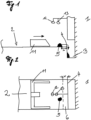
- the animal housing 1 has a walkway 2, a manure channel 3, and a manure discharge 4, which separates the walkway 2 from the manure channel 3. Furthermore, a safety area 6 is shown, which is formed by a predeterminable section of the walkway 2. The safety area 6 extends from the manure discharge 4 on one side and has a length x corresponding to a predeterminable distance from the manure discharge 4, wherein it is also limited by this length x.
- the cleaning device comprises a cleaning slide 11, a drive for the cleaning slide 11, sensors 12, 13 for detecting a farm animal in the walkway 2, and a control device coupled to the sensors 12, 13.
- the cleaning slide 11 is moved along the walkway 2 toward the manure channel 3 (direction of the arrow) and away from the manure channel 4 by means of a drive (not shown).
- the cleaning slide 11 is a connected system that can be moved back and forth along the walkway 2 via a guide (not shown).
- the sensor 13 comprises a thermal imaging camera.
- the control device has an evaluation device, which has thermal data from farm animals, such as the body surface temperature of the farm animals. In adult cattle, the core body temperature is approximately 38 to 39.4 °C; this temperature is similar in calves. Surface temperatures are generally somewhat lower, although they can also vary slightly depending on the season and state of health. As a limit value for the evaluation device, a value of >32 °C, for example, can be selected as indicative for a cattle.
- the evaluation unit can evaluate the thermal data recorded by the thermal imaging camera and compare it with thermal data from livestock included in the evaluation unit. This enables the detection of livestock via the thermal imaging camera.
- the control device deactivates the drive of the cleaning slide 11 at the latest when the evaluation device detects a farm animal in the safety area 6 and the cleaning slide 11 is located in the safety area 6.
- the drive of the cleaning slide 11 can also be deactivated beforehand if the farm animal is located in the safety area 6 but the cleaning slide 11 is not yet there.
- a second sensor 12 which includes a video camera.
- the evaluation device also includes optical data from livestock and manure. To detect livestock, the evaluation device compares the optical data recorded by the video camera with the optical data from livestock stored in the evaluation device. The control device deactivates the drive of the cleaning slide 11 at the latest when the evaluation device detects a livestock in the security area 6 based on the evaluation of the data from the video camera or thermal imaging camera, or both the video camera and thermal imaging camera.
- the drive of the cleaning slider 11 can be deactivated beforehand if the farm animal is in the safety area 6 but the cleaning slider 11 is not yet there.
- the evaluation device includes optical data such as the appearance, shape and color of farm animals.
- the control device is capable of comparing the sensor data from the first sensor 12 and the sensor data from the second sensor 13. If the optical and thermal data from the farm animal contained in the programmable evaluation device match the stored sensor data from the two sensors 12, 13, the control device intervenes in the drive and deactivates it immediately, or deactivates it if the distance of the cleaning slide 11 from the discharge 4 into the manure channel 3 has fallen below the specified distance with length x, i.e., the farm animal is located in the safety zone 6.
- the control device is designed such that, after deactivating the drive, it can change the direction of movement of the cleaning slider 11 and then reactivate the drive and move it in the opposite direction. It is also possible for the cleaning device 10 to wait until the farm animal is no longer detected by the sensors 12, 13 and then continue cleaning in the original direction of movement.
- the direction of movement of the cleaning slider 11 can be changed after a certain time and the cleaning slider 11 can be moved in the opposite direction.
- an alarm signal can be triggered.
- the senor 12 with video camera and the sensor 13 with thermal imaging camera are attached to the stable 1.
- the control system has a device for automated machine learning, which learns independently with the data from the sensors 12, 13 and distinguishes between manure and livestock.
- a device for automated machine learning, which learns independently with the data from the sensors 12, 13 and distinguishes between manure and livestock.
- Such a device may, for example, include the commercially available "Machine Vision" TM program.
- WO 2015/115889 A1 The use of optical or thermal sensors is known. However, these are not used for animal welfare, but rather to guide a farm animal around the lying area of a stable. However, the lying area of a stable is not accessible at all to the cleaning slider 11 according to the invention.
Landscapes
- Life Sciences & Earth Sciences (AREA)
- Environmental Sciences (AREA)
- Engineering & Computer Science (AREA)
- Biodiversity & Conservation Biology (AREA)
- Animal Husbandry (AREA)
- Automation & Control Theory (AREA)
- General Physics & Mathematics (AREA)
- Physics & Mathematics (AREA)
- Zoology (AREA)
- Remote Sensing (AREA)
- Radar, Positioning & Navigation (AREA)
- Aviation & Aerospace Engineering (AREA)
- Biophysics (AREA)
- Housing For Livestock And Birds (AREA)
Applications Claiming Priority (1)
| Application Number | Priority Date | Filing Date | Title |
|---|---|---|---|
| ATA50873/2023A AT527308B1 (de) | 2023-10-31 | 2023-10-31 | Reinigungsvorrichtung für eine Tierstallung |
Publications (1)
| Publication Number | Publication Date |
|---|---|
| EP4548754A1 true EP4548754A1 (fr) | 2025-05-07 |
Family
ID=93283920
Family Applications (1)
| Application Number | Title | Priority Date | Filing Date |
|---|---|---|---|
| EP24208774.0A Pending EP4548754A1 (fr) | 2023-10-31 | 2024-10-24 | Dispositif et procédé de nettoyage pour étable |
Country Status (2)
| Country | Link |
|---|---|
| EP (1) | EP4548754A1 (fr) |
| AT (1) | AT527308B1 (fr) |
Citations (8)
| Publication number | Priority date | Publication date | Assignee | Title |
|---|---|---|---|---|
| DE4444508C1 (de) | 1994-10-08 | 1996-02-29 | Moser Stalleinrichtungen | Verfahren zum Reinigen eines Kot- bzw. Laufganges eines Freilaufstalls sowie Entmistungsanlage |
| EP1152656B1 (fr) * | 1998-12-22 | 2006-07-19 | Jan Sandberg | Dispositif permettant de nettoyer les stalles d'animaux |
| WO2011062481A1 (fr) * | 2009-11-17 | 2011-05-26 | Lely Patent N.V. | Véhicule agricole pouvant se déplacer de manière autonome |
| EP2334169B1 (fr) * | 2008-10-16 | 2013-05-15 | Lely Patent N.V. | Véhicule sans pilote comprenant un dispositif de protection |
| EP2531021B1 (fr) * | 2010-02-05 | 2014-12-31 | DeLaval Holding AB | Dispositif de sécurité pour un racleur d'étable |
| WO2015115889A1 (fr) | 2014-02-03 | 2015-08-06 | Lely Patent N.V. | Procédé et dispositif de nettoyage de box |
| WO2016096240A1 (fr) * | 2014-12-19 | 2016-06-23 | Triodor Arge | Véhicule sans pilote mobile de façon autonome pour nettoyer une surface dans une grange |
| US20190166788A1 (en) * | 2017-02-07 | 2019-06-06 | Energy Americas, LLC | Poultry growing robot |
Family Cites Families (5)
| Publication number | Priority date | Publication date | Assignee | Title |
|---|---|---|---|---|
| SE0901570A1 (sv) * | 2009-12-16 | 2011-06-17 | Carl-Harry Johansson | Utgödslingsanordning |
| CN105794657B (zh) * | 2016-04-13 | 2019-04-02 | 四川化工职业技术学院 | 一种工厂化的智能家畜养殖系统 |
| CN111712130B (zh) * | 2018-02-13 | 2023-04-18 | 利拉伐控股有限公司 | 粪便处理的方法和装置 |
| AT521047B1 (de) * | 2018-09-19 | 2019-10-15 | Schauer Agrotronic Gmbh | Verlagerungsanlage, insbesondere Entmistungsschieber, für einen Stall |
| CN113545296B (zh) * | 2021-07-06 | 2022-05-13 | 张毅 | 一种封闭式畜舍用地下刮粪及自动清粪系统 |
-
2023
- 2023-10-31 AT ATA50873/2023A patent/AT527308B1/de active
-
2024
- 2024-10-24 EP EP24208774.0A patent/EP4548754A1/fr active Pending
Patent Citations (8)
| Publication number | Priority date | Publication date | Assignee | Title |
|---|---|---|---|---|
| DE4444508C1 (de) | 1994-10-08 | 1996-02-29 | Moser Stalleinrichtungen | Verfahren zum Reinigen eines Kot- bzw. Laufganges eines Freilaufstalls sowie Entmistungsanlage |
| EP1152656B1 (fr) * | 1998-12-22 | 2006-07-19 | Jan Sandberg | Dispositif permettant de nettoyer les stalles d'animaux |
| EP2334169B1 (fr) * | 2008-10-16 | 2013-05-15 | Lely Patent N.V. | Véhicule sans pilote comprenant un dispositif de protection |
| WO2011062481A1 (fr) * | 2009-11-17 | 2011-05-26 | Lely Patent N.V. | Véhicule agricole pouvant se déplacer de manière autonome |
| EP2531021B1 (fr) * | 2010-02-05 | 2014-12-31 | DeLaval Holding AB | Dispositif de sécurité pour un racleur d'étable |
| WO2015115889A1 (fr) | 2014-02-03 | 2015-08-06 | Lely Patent N.V. | Procédé et dispositif de nettoyage de box |
| WO2016096240A1 (fr) * | 2014-12-19 | 2016-06-23 | Triodor Arge | Véhicule sans pilote mobile de façon autonome pour nettoyer une surface dans une grange |
| US20190166788A1 (en) * | 2017-02-07 | 2019-06-06 | Energy Americas, LLC | Poultry growing robot |
Also Published As
| Publication number | Publication date |
|---|---|
| AT527308B1 (de) | 2025-01-15 |
| AT527308A4 (de) | 2025-01-15 |
Similar Documents
| Publication | Publication Date | Title |
|---|---|---|
| DE60307693T2 (de) | Anordnung mit einer Vorrichtung zum Füttern von Tieren und einer Vorrichtung zum Durchführen einer tierspezifischen Behandlung an Tieren | |
| DE69524898T2 (de) | Verfahren zum automatischen Melken von Tieren und Vorrichtung zu deren Anwendung | |
| EP3226682B1 (fr) | Procédé d'acquisition d'informations sur un animal de rente | |
| DE69629869T2 (de) | Messeinrichtung für die Aktivität von Tieren | |
| DE69905741T2 (de) | Vorrichtung und verfahren zum automatischen melken und füttern von tieren | |
| DE102007036294A1 (de) | Vorrichtung und ein Verfahren zum Bereitstellen von Informationen über Tiere beim Durchlaufen eines Tierdurchganges | |
| CH688953A5 (de) | Verfahren zum Reinigen eines Kot- oder Laufganges eines Freilaufstalles sowie Entmistungsanlage. | |
| DE69433781T2 (de) | Vorrichtung zum automatischen Melken von Tieren | |
| EP3626052B1 (fr) | Installation de déplacement, en particulier racleur d'enlèvement du fumier, pour une stable | |
| EP3066918B2 (fr) | Dispositif d'orientation d'animaux d'elevage dote d'une assistance optique | |
| DE9321404U1 (de) | Vorrichtung zum automatischen Melken von Tieren | |
| AT527308B1 (de) | Reinigungsvorrichtung für eine Tierstallung | |
| EP3466253A1 (fr) | Dispositif de localisation des objets dans une étable d'animal | |
| WO2018229142A1 (fr) | Détection de l'activité d'un animal de rente | |
| EP1900278A1 (fr) | Dispositif de surveillance et procédé de surveillance pour animaux | |
| DE69624510T2 (de) | Nestanlage für legehenne und verfahren zur brutregelung | |
| DE69717618T2 (de) | Vorrichtung und verfahren zum melken von tieren | |
| DE202012005653U1 (de) | Multifunktionseinheit zur Durchführung von Maßnahmen an Nutztieren | |
| EP1292182B1 (fr) | Procede pour determiner un signal d'activation, notamment un signal d'activation pour induite une phase de post-traite faisant suite a une phase de traite principale | |
| EP2603070B1 (fr) | Dispositif de nettoyage automatisé de stations de traite | |
| DE851566C (de) | Kuekenheim mit in mehreren Stockwerken uebereinander angeordneten Kaefigen | |
| DE69711951T2 (de) | Verfahren zum automatischen Melken von Tieren | |
| EP1312311A1 (fr) | Procédé et appareil pour déterminer l'état de santé des animaux | |
| WO2006133951A1 (fr) | Procede et dispositif pour s'occuper d'animaux | |
| WO2024088479A1 (fr) | Procédé et dispositif d'acquisition et d'analyse automatiques de la représentation de la démarche d'un animal |
Legal Events
| Date | Code | Title | Description |
|---|---|---|---|
| PUAI | Public reference made under article 153(3) epc to a published international application that has entered the european phase |
Free format text: ORIGINAL CODE: 0009012 |
|
| STAA | Information on the status of an ep patent application or granted ep patent |
Free format text: STATUS: THE APPLICATION HAS BEEN PUBLISHED |
|
| AK | Designated contracting states |
Kind code of ref document: A1 Designated state(s): AL AT BE BG CH CY CZ DE DK EE ES FI FR GB GR HR HU IE IS IT LI LT LU LV MC ME MK MT NL NO PL PT RO RS SE SI SK SM TR |
|
| STAA | Information on the status of an ep patent application or granted ep patent |
Free format text: STATUS: REQUEST FOR EXAMINATION WAS MADE |
|
| 17P | Request for examination filed |
Effective date: 20251107 |