EP4549376A2 - Revêtement réfractaire de face chaude de chambre de combustion - Google Patents
Revêtement réfractaire de face chaude de chambre de combustion Download PDFInfo
- Publication number
- EP4549376A2 EP4549376A2 EP25165007.3A EP25165007A EP4549376A2 EP 4549376 A2 EP4549376 A2 EP 4549376A2 EP 25165007 A EP25165007 A EP 25165007A EP 4549376 A2 EP4549376 A2 EP 4549376A2
- Authority
- EP
- European Patent Office
- Prior art keywords
- combustion chamber
- refractory
- refractory lining
- zirconia
- zro
- Prior art date
- Legal status (The legal status is an assumption and is not a legal conclusion. Google has not performed a legal analysis and makes no representation as to the accuracy of the status listed.)
- Pending
Links
Images



Classifications
-
- F—MECHANICAL ENGINEERING; LIGHTING; HEATING; WEAPONS; BLASTING
- F23—COMBUSTION APPARATUS; COMBUSTION PROCESSES
- F23M—CASINGS, LININGS, WALLS OR DOORS SPECIALLY ADAPTED FOR COMBUSTION CHAMBERS, e.g. FIREBRIDGES; DEVICES FOR DEFLECTING AIR, FLAMES OR COMBUSTION PRODUCTS IN COMBUSTION CHAMBERS; SAFETY ARRANGEMENTS SPECIALLY ADAPTED FOR COMBUSTION APPARATUS; DETAILS OF COMBUSTION CHAMBERS, NOT OTHERWISE PROVIDED FOR
- F23M5/00—Casings; Linings; Walls
- F23M5/02—Casings; Linings; Walls characterised by the shape of the bricks or blocks used
-
- C—CHEMISTRY; METALLURGY
- C04—CEMENTS; CONCRETE; ARTIFICIAL STONE; CERAMICS; REFRACTORIES
- C04B—LIME, MAGNESIA; SLAG; CEMENTS; COMPOSITIONS THEREOF, e.g. MORTARS, CONCRETE OR LIKE BUILDING MATERIALS; ARTIFICIAL STONE; CERAMICS; REFRACTORIES; TREATMENT OF NATURAL STONE
- C04B41/00—After-treatment of mortars, concrete, artificial stone or ceramics; Treatment of natural stone
- C04B41/45—Coating or impregnating, e.g. injection in masonry, partial coating of green or fired ceramics, organic coating compositions for adhering together two concrete elements
- C04B41/50—Coating or impregnating, e.g. injection in masonry, partial coating of green or fired ceramics, organic coating compositions for adhering together two concrete elements with inorganic materials
- C04B41/5025—Coating or impregnating, e.g. injection in masonry, partial coating of green or fired ceramics, organic coating compositions for adhering together two concrete elements with inorganic materials with ceramic materials
- C04B41/5042—Zirconium oxides or zirconates; Hafnium oxides or hafnates
-
- B—PERFORMING OPERATIONS; TRANSPORTING
- B01—PHYSICAL OR CHEMICAL PROCESSES OR APPARATUS IN GENERAL
- B01J—CHEMICAL OR PHYSICAL PROCESSES, e.g. CATALYSIS OR COLLOID CHEMISTRY; THEIR RELEVANT APPARATUS
- B01J12/00—Chemical processes in general for reacting gaseous media with gaseous media; Apparatus specially adapted therefor
- B01J12/005—Chemical processes in general for reacting gaseous media with gaseous media; Apparatus specially adapted therefor carried out at high temperatures, e.g. by pyrolysis
-
- B—PERFORMING OPERATIONS; TRANSPORTING
- B01—PHYSICAL OR CHEMICAL PROCESSES OR APPARATUS IN GENERAL
- B01J—CHEMICAL OR PHYSICAL PROCESSES, e.g. CATALYSIS OR COLLOID CHEMISTRY; THEIR RELEVANT APPARATUS
- B01J19/00—Chemical, physical or physico-chemical processes in general; Their relevant apparatus
- B01J19/02—Apparatus characterised by being constructed of material selected for its chemically-resistant properties
-
- C—CHEMISTRY; METALLURGY
- C01—INORGANIC CHEMISTRY
- C01B—NON-METALLIC ELEMENTS; COMPOUNDS THEREOF; METALLOIDS OR COMPOUNDS THEREOF NOT COVERED BY SUBCLASS C01C
- C01B3/00—Hydrogen; Gaseous mixtures containing hydrogen; Separation of hydrogen from mixtures containing it; Purification of hydrogen; Reversible storage of hydrogen
- C01B3/02—Production of hydrogen; Production of gaseous mixtures containing hydrogen
- C01B3/32—Production of hydrogen; Production of gaseous mixtures containing hydrogen by reaction of gaseous or liquid organic compounds with gasifying agents, e.g. water, carbon dioxide or air
- C01B3/34—Production of hydrogen; Production of gaseous mixtures containing hydrogen by reaction of gaseous or liquid organic compounds with gasifying agents, e.g. water, carbon dioxide or air by reaction of hydrocarbons with gasifying agents
- C01B3/36—Production of hydrogen; Production of gaseous mixtures containing hydrogen by reaction of gaseous or liquid organic compounds with gasifying agents, e.g. water, carbon dioxide or air by reaction of hydrocarbons with gasifying agents using oxygen; using mixtures containing oxygen as gasifying agents
-
- C—CHEMISTRY; METALLURGY
- C01—INORGANIC CHEMISTRY
- C01B—NON-METALLIC ELEMENTS; COMPOUNDS THEREOF; METALLOIDS OR COMPOUNDS THEREOF NOT COVERED BY SUBCLASS C01C
- C01B3/00—Hydrogen; Gaseous mixtures containing hydrogen; Separation of hydrogen from mixtures containing it; Purification of hydrogen; Reversible storage of hydrogen
- C01B3/02—Production of hydrogen; Production of gaseous mixtures containing hydrogen
- C01B3/32—Production of hydrogen; Production of gaseous mixtures containing hydrogen by reaction of gaseous or liquid organic compounds with gasifying agents, e.g. water, carbon dioxide or air
- C01B3/34—Production of hydrogen; Production of gaseous mixtures containing hydrogen by reaction of gaseous or liquid organic compounds with gasifying agents, e.g. water, carbon dioxide or air by reaction of hydrocarbons with gasifying agents
- C01B3/38—Production of hydrogen; Production of gaseous mixtures containing hydrogen by reaction of gaseous or liquid organic compounds with gasifying agents, e.g. water, carbon dioxide or air by reaction of hydrocarbons with gasifying agents using catalysts
- C01B3/386—Catalytic partial combustion
-
- C—CHEMISTRY; METALLURGY
- C04—CEMENTS; CONCRETE; ARTIFICIAL STONE; CERAMICS; REFRACTORIES
- C04B—LIME, MAGNESIA; SLAG; CEMENTS; COMPOSITIONS THEREOF, e.g. MORTARS, CONCRETE OR LIKE BUILDING MATERIALS; ARTIFICIAL STONE; CERAMICS; REFRACTORIES; TREATMENT OF NATURAL STONE
- C04B35/00—Shaped ceramic products characterised by their composition; Ceramics compositions; Processing powders of inorganic compounds preparatory to the manufacturing of ceramic products
- C04B35/01—Shaped ceramic products characterised by their composition; Ceramics compositions; Processing powders of inorganic compounds preparatory to the manufacturing of ceramic products based on oxide ceramics
- C04B35/48—Shaped ceramic products characterised by their composition; Ceramics compositions; Processing powders of inorganic compounds preparatory to the manufacturing of ceramic products based on oxide ceramics based on zirconium or hafnium oxides, zirconates, zircon or hafnates
- C04B35/484—Refractories by fusion casting
-
- C—CHEMISTRY; METALLURGY
- C04—CEMENTS; CONCRETE; ARTIFICIAL STONE; CERAMICS; REFRACTORIES
- C04B—LIME, MAGNESIA; SLAG; CEMENTS; COMPOSITIONS THEREOF, e.g. MORTARS, CONCRETE OR LIKE BUILDING MATERIALS; ARTIFICIAL STONE; CERAMICS; REFRACTORIES; TREATMENT OF NATURAL STONE
- C04B35/00—Shaped ceramic products characterised by their composition; Ceramics compositions; Processing powders of inorganic compounds preparatory to the manufacturing of ceramic products
- C04B35/01—Shaped ceramic products characterised by their composition; Ceramics compositions; Processing powders of inorganic compounds preparatory to the manufacturing of ceramic products based on oxide ceramics
- C04B35/48—Shaped ceramic products characterised by their composition; Ceramics compositions; Processing powders of inorganic compounds preparatory to the manufacturing of ceramic products based on oxide ceramics based on zirconium or hafnium oxides, zirconates, zircon or hafnates
- C04B35/486—Fine ceramics
-
- C—CHEMISTRY; METALLURGY
- C04—CEMENTS; CONCRETE; ARTIFICIAL STONE; CERAMICS; REFRACTORIES
- C04B—LIME, MAGNESIA; SLAG; CEMENTS; COMPOSITIONS THEREOF, e.g. MORTARS, CONCRETE OR LIKE BUILDING MATERIALS; ARTIFICIAL STONE; CERAMICS; REFRACTORIES; TREATMENT OF NATURAL STONE
- C04B35/00—Shaped ceramic products characterised by their composition; Ceramics compositions; Processing powders of inorganic compounds preparatory to the manufacturing of ceramic products
- C04B35/01—Shaped ceramic products characterised by their composition; Ceramics compositions; Processing powders of inorganic compounds preparatory to the manufacturing of ceramic products based on oxide ceramics
- C04B35/48—Shaped ceramic products characterised by their composition; Ceramics compositions; Processing powders of inorganic compounds preparatory to the manufacturing of ceramic products based on oxide ceramics based on zirconium or hafnium oxides, zirconates, zircon or hafnates
- C04B35/486—Fine ceramics
- C04B35/488—Composites
- C04B35/4885—Composites with aluminium oxide
-
- C—CHEMISTRY; METALLURGY
- C04—CEMENTS; CONCRETE; ARTIFICIAL STONE; CERAMICS; REFRACTORIES
- C04B—LIME, MAGNESIA; SLAG; CEMENTS; COMPOSITIONS THEREOF, e.g. MORTARS, CONCRETE OR LIKE BUILDING MATERIALS; ARTIFICIAL STONE; CERAMICS; REFRACTORIES; TREATMENT OF NATURAL STONE
- C04B35/00—Shaped ceramic products characterised by their composition; Ceramics compositions; Processing powders of inorganic compounds preparatory to the manufacturing of ceramic products
- C04B35/622—Forming processes; Processing powders of inorganic compounds preparatory to the manufacturing of ceramic products
- C04B35/62222—Forming processes; Processing powders of inorganic compounds preparatory to the manufacturing of ceramic products obtaining ceramic coatings
-
- C—CHEMISTRY; METALLURGY
- C04—CEMENTS; CONCRETE; ARTIFICIAL STONE; CERAMICS; REFRACTORIES
- C04B—LIME, MAGNESIA; SLAG; CEMENTS; COMPOSITIONS THEREOF, e.g. MORTARS, CONCRETE OR LIKE BUILDING MATERIALS; ARTIFICIAL STONE; CERAMICS; REFRACTORIES; TREATMENT OF NATURAL STONE
- C04B35/00—Shaped ceramic products characterised by their composition; Ceramics compositions; Processing powders of inorganic compounds preparatory to the manufacturing of ceramic products
- C04B35/66—Monolithic refractories or refractory mortars, including those whether or not containing clay
-
- C—CHEMISTRY; METALLURGY
- C04—CEMENTS; CONCRETE; ARTIFICIAL STONE; CERAMICS; REFRACTORIES
- C04B—LIME, MAGNESIA; SLAG; CEMENTS; COMPOSITIONS THEREOF, e.g. MORTARS, CONCRETE OR LIKE BUILDING MATERIALS; ARTIFICIAL STONE; CERAMICS; REFRACTORIES; TREATMENT OF NATURAL STONE
- C04B41/00—After-treatment of mortars, concrete, artificial stone or ceramics; Treatment of natural stone
- C04B41/009—After-treatment of mortars, concrete, artificial stone or ceramics; Treatment of natural stone characterised by the material treated
-
- C—CHEMISTRY; METALLURGY
- C04—CEMENTS; CONCRETE; ARTIFICIAL STONE; CERAMICS; REFRACTORIES
- C04B—LIME, MAGNESIA; SLAG; CEMENTS; COMPOSITIONS THEREOF, e.g. MORTARS, CONCRETE OR LIKE BUILDING MATERIALS; ARTIFICIAL STONE; CERAMICS; REFRACTORIES; TREATMENT OF NATURAL STONE
- C04B41/00—After-treatment of mortars, concrete, artificial stone or ceramics; Treatment of natural stone
- C04B41/80—After-treatment of mortars, concrete, artificial stone or ceramics; Treatment of natural stone of only ceramics
- C04B41/81—Coating or impregnation
- C04B41/85—Coating or impregnation with inorganic materials
- C04B41/87—Ceramics
-
- C—CHEMISTRY; METALLURGY
- C10—PETROLEUM, GAS OR COKE INDUSTRIES; TECHNICAL GASES CONTAINING CARBON MONOXIDE; FUELS; LUBRICANTS; PEAT
- C10J—PRODUCTION OF PRODUCER GAS, WATER-GAS, SYNTHESIS GAS FROM SOLID CARBONACEOUS MATERIAL, OR MIXTURES CONTAINING THESE GASES; CARBURETTING AIR OR OTHER GASES
- C10J3/00—Production of combustible gases containing carbon monoxide from solid carbonaceous fuels
- C10J3/72—Other features
-
- F—MECHANICAL ENGINEERING; LIGHTING; HEATING; WEAPONS; BLASTING
- F27—FURNACES; KILNS; OVENS; RETORTS
- F27D—DETAILS OR ACCESSORIES OF FURNACES, KILNS, OVENS OR RETORTS, IN SO FAR AS THEY ARE OF KINDS OCCURRING IN MORE THAN ONE KIND OF FURNACE
- F27D1/00—Casings; Linings; Walls; Roofs
- F27D1/04—Casings; Linings; Walls; Roofs characterised by the form, e.g. shape of the bricks or blocks used
-
- B—PERFORMING OPERATIONS; TRANSPORTING
- B01—PHYSICAL OR CHEMICAL PROCESSES OR APPARATUS IN GENERAL
- B01J—CHEMICAL OR PHYSICAL PROCESSES, e.g. CATALYSIS OR COLLOID CHEMISTRY; THEIR RELEVANT APPARATUS
- B01J2219/00—Chemical, physical or physico-chemical processes in general; Their relevant apparatus
- B01J2219/02—Apparatus characterised by their chemically-resistant properties
- B01J2219/0204—Apparatus characterised by their chemically-resistant properties comprising coatings on the surfaces in direct contact with the reactive components
- B01J2219/0218—Apparatus characterised by their chemically-resistant properties comprising coatings on the surfaces in direct contact with the reactive components of ceramic
-
- C—CHEMISTRY; METALLURGY
- C01—INORGANIC CHEMISTRY
- C01B—NON-METALLIC ELEMENTS; COMPOUNDS THEREOF; METALLOIDS OR COMPOUNDS THEREOF NOT COVERED BY SUBCLASS C01C
- C01B2203/00—Integrated processes for the production of hydrogen or synthesis gas
- C01B2203/02—Processes for making hydrogen or synthesis gas
- C01B2203/025—Processes for making hydrogen or synthesis gas containing a partial oxidation step
- C01B2203/0261—Processes for making hydrogen or synthesis gas containing a partial oxidation step containing a catalytic partial oxidation step [CPO]
-
- C—CHEMISTRY; METALLURGY
- C01—INORGANIC CHEMISTRY
- C01B—NON-METALLIC ELEMENTS; COMPOUNDS THEREOF; METALLOIDS OR COMPOUNDS THEREOF NOT COVERED BY SUBCLASS C01C
- C01B2203/00—Integrated processes for the production of hydrogen or synthesis gas
- C01B2203/12—Feeding the process for making hydrogen or synthesis gas
- C01B2203/1205—Composition of the feed
- C01B2203/1211—Organic compounds or organic mixtures used in the process for making hydrogen or synthesis gas
- C01B2203/1235—Hydrocarbons
-
- C—CHEMISTRY; METALLURGY
- C04—CEMENTS; CONCRETE; ARTIFICIAL STONE; CERAMICS; REFRACTORIES
- C04B—LIME, MAGNESIA; SLAG; CEMENTS; COMPOSITIONS THEREOF, e.g. MORTARS, CONCRETE OR LIKE BUILDING MATERIALS; ARTIFICIAL STONE; CERAMICS; REFRACTORIES; TREATMENT OF NATURAL STONE
- C04B2111/00—Mortars, concrete or artificial stone or mixtures to prepare them, characterised by specific function, property or use
- C04B2111/00241—Physical properties of the materials not provided for elsewhere in C04B2111/00
- C04B2111/0025—Compositions or ingredients of the compositions characterised by the crystal structure
-
- C—CHEMISTRY; METALLURGY
- C04—CEMENTS; CONCRETE; ARTIFICIAL STONE; CERAMICS; REFRACTORIES
- C04B—LIME, MAGNESIA; SLAG; CEMENTS; COMPOSITIONS THEREOF, e.g. MORTARS, CONCRETE OR LIKE BUILDING MATERIALS; ARTIFICIAL STONE; CERAMICS; REFRACTORIES; TREATMENT OF NATURAL STONE
- C04B2235/00—Aspects relating to ceramic starting mixtures or sintered ceramic products
- C04B2235/02—Composition of constituents of the starting material or of secondary phases of the final product
- C04B2235/30—Constituents and secondary phases not being of a fibrous nature
- C04B2235/32—Metal oxides, mixed metal oxides, or oxide-forming salts thereof, e.g. carbonates, nitrates, (oxy)hydroxides, chlorides
- C04B2235/3205—Alkaline earth oxides or oxide forming salts thereof, e.g. beryllium oxide
- C04B2235/3206—Magnesium oxides or oxide-forming salts thereof
-
- C—CHEMISTRY; METALLURGY
- C04—CEMENTS; CONCRETE; ARTIFICIAL STONE; CERAMICS; REFRACTORIES
- C04B—LIME, MAGNESIA; SLAG; CEMENTS; COMPOSITIONS THEREOF, e.g. MORTARS, CONCRETE OR LIKE BUILDING MATERIALS; ARTIFICIAL STONE; CERAMICS; REFRACTORIES; TREATMENT OF NATURAL STONE
- C04B2235/00—Aspects relating to ceramic starting mixtures or sintered ceramic products
- C04B2235/02—Composition of constituents of the starting material or of secondary phases of the final product
- C04B2235/30—Constituents and secondary phases not being of a fibrous nature
- C04B2235/32—Metal oxides, mixed metal oxides, or oxide-forming salts thereof, e.g. carbonates, nitrates, (oxy)hydroxides, chlorides
- C04B2235/3205—Alkaline earth oxides or oxide forming salts thereof, e.g. beryllium oxide
- C04B2235/3208—Calcium oxide or oxide-forming salts thereof, e.g. lime
-
- C—CHEMISTRY; METALLURGY
- C04—CEMENTS; CONCRETE; ARTIFICIAL STONE; CERAMICS; REFRACTORIES
- C04B—LIME, MAGNESIA; SLAG; CEMENTS; COMPOSITIONS THEREOF, e.g. MORTARS, CONCRETE OR LIKE BUILDING MATERIALS; ARTIFICIAL STONE; CERAMICS; REFRACTORIES; TREATMENT OF NATURAL STONE
- C04B2235/00—Aspects relating to ceramic starting mixtures or sintered ceramic products
- C04B2235/02—Composition of constituents of the starting material or of secondary phases of the final product
- C04B2235/30—Constituents and secondary phases not being of a fibrous nature
- C04B2235/32—Metal oxides, mixed metal oxides, or oxide-forming salts thereof, e.g. carbonates, nitrates, (oxy)hydroxides, chlorides
- C04B2235/3217—Aluminum oxide or oxide forming salts thereof, e.g. bauxite, alpha-alumina
-
- C—CHEMISTRY; METALLURGY
- C04—CEMENTS; CONCRETE; ARTIFICIAL STONE; CERAMICS; REFRACTORIES
- C04B—LIME, MAGNESIA; SLAG; CEMENTS; COMPOSITIONS THEREOF, e.g. MORTARS, CONCRETE OR LIKE BUILDING MATERIALS; ARTIFICIAL STONE; CERAMICS; REFRACTORIES; TREATMENT OF NATURAL STONE
- C04B2235/00—Aspects relating to ceramic starting mixtures or sintered ceramic products
- C04B2235/02—Composition of constituents of the starting material or of secondary phases of the final product
- C04B2235/30—Constituents and secondary phases not being of a fibrous nature
- C04B2235/32—Metal oxides, mixed metal oxides, or oxide-forming salts thereof, e.g. carbonates, nitrates, (oxy)hydroxides, chlorides
- C04B2235/3231—Refractory metal oxides, their mixed metal oxides, or oxide-forming salts thereof
- C04B2235/3244—Zirconium oxides, zirconates, hafnium oxides, hafnates, or oxide-forming salts thereof
-
- C—CHEMISTRY; METALLURGY
- C04—CEMENTS; CONCRETE; ARTIFICIAL STONE; CERAMICS; REFRACTORIES
- C04B—LIME, MAGNESIA; SLAG; CEMENTS; COMPOSITIONS THEREOF, e.g. MORTARS, CONCRETE OR LIKE BUILDING MATERIALS; ARTIFICIAL STONE; CERAMICS; REFRACTORIES; TREATMENT OF NATURAL STONE
- C04B2235/00—Aspects relating to ceramic starting mixtures or sintered ceramic products
- C04B2235/02—Composition of constituents of the starting material or of secondary phases of the final product
- C04B2235/30—Constituents and secondary phases not being of a fibrous nature
- C04B2235/32—Metal oxides, mixed metal oxides, or oxide-forming salts thereof, e.g. carbonates, nitrates, (oxy)hydroxides, chlorides
- C04B2235/3231—Refractory metal oxides, their mixed metal oxides, or oxide-forming salts thereof
- C04B2235/3244—Zirconium oxides, zirconates, hafnium oxides, hafnates, or oxide-forming salts thereof
- C04B2235/3246—Stabilised zirconias, e.g. YSZ or cerium stabilised zirconia
-
- C—CHEMISTRY; METALLURGY
- C04—CEMENTS; CONCRETE; ARTIFICIAL STONE; CERAMICS; REFRACTORIES
- C04B—LIME, MAGNESIA; SLAG; CEMENTS; COMPOSITIONS THEREOF, e.g. MORTARS, CONCRETE OR LIKE BUILDING MATERIALS; ARTIFICIAL STONE; CERAMICS; REFRACTORIES; TREATMENT OF NATURAL STONE
- C04B2235/00—Aspects relating to ceramic starting mixtures or sintered ceramic products
- C04B2235/02—Composition of constituents of the starting material or of secondary phases of the final product
- C04B2235/30—Constituents and secondary phases not being of a fibrous nature
- C04B2235/34—Non-metal oxides, non-metal mixed oxides, or salts thereof that form the non-metal oxides upon heating, e.g. carbonates, nitrates, (oxy)hydroxides, chlorides
- C04B2235/3418—Silicon oxide, silicic acids or oxide forming salts thereof, e.g. silica sol, fused silica, silica fume, cristobalite, quartz or flint
-
- C—CHEMISTRY; METALLURGY
- C04—CEMENTS; CONCRETE; ARTIFICIAL STONE; CERAMICS; REFRACTORIES
- C04B—LIME, MAGNESIA; SLAG; CEMENTS; COMPOSITIONS THEREOF, e.g. MORTARS, CONCRETE OR LIKE BUILDING MATERIALS; ARTIFICIAL STONE; CERAMICS; REFRACTORIES; TREATMENT OF NATURAL STONE
- C04B2235/00—Aspects relating to ceramic starting mixtures or sintered ceramic products
- C04B2235/02—Composition of constituents of the starting material or of secondary phases of the final product
- C04B2235/50—Constituents or additives of the starting mixture chosen for their shape or used because of their shape or their physical appearance
- C04B2235/54—Particle size related information
- C04B2235/5418—Particle size related information expressed by the size of the particles or aggregates thereof
- C04B2235/5436—Particle size related information expressed by the size of the particles or aggregates thereof micrometer sized, i.e. from 1 to 100 micron
-
- C—CHEMISTRY; METALLURGY
- C04—CEMENTS; CONCRETE; ARTIFICIAL STONE; CERAMICS; REFRACTORIES
- C04B—LIME, MAGNESIA; SLAG; CEMENTS; COMPOSITIONS THEREOF, e.g. MORTARS, CONCRETE OR LIKE BUILDING MATERIALS; ARTIFICIAL STONE; CERAMICS; REFRACTORIES; TREATMENT OF NATURAL STONE
- C04B2235/00—Aspects relating to ceramic starting mixtures or sintered ceramic products
- C04B2235/60—Aspects relating to the preparation, properties or mechanical treatment of green bodies or pre-forms
- C04B2235/604—Pressing at temperatures other than sintering temperatures
-
- C—CHEMISTRY; METALLURGY
- C04—CEMENTS; CONCRETE; ARTIFICIAL STONE; CERAMICS; REFRACTORIES
- C04B—LIME, MAGNESIA; SLAG; CEMENTS; COMPOSITIONS THEREOF, e.g. MORTARS, CONCRETE OR LIKE BUILDING MATERIALS; ARTIFICIAL STONE; CERAMICS; REFRACTORIES; TREATMENT OF NATURAL STONE
- C04B2235/00—Aspects relating to ceramic starting mixtures or sintered ceramic products
- C04B2235/70—Aspects relating to sintered or melt-casted ceramic products
- C04B2235/72—Products characterised by the absence or the low content of specific components, e.g. alkali metal free alumina ceramics
-
- C—CHEMISTRY; METALLURGY
- C04—CEMENTS; CONCRETE; ARTIFICIAL STONE; CERAMICS; REFRACTORIES
- C04B—LIME, MAGNESIA; SLAG; CEMENTS; COMPOSITIONS THEREOF, e.g. MORTARS, CONCRETE OR LIKE BUILDING MATERIALS; ARTIFICIAL STONE; CERAMICS; REFRACTORIES; TREATMENT OF NATURAL STONE
- C04B2235/00—Aspects relating to ceramic starting mixtures or sintered ceramic products
- C04B2235/70—Aspects relating to sintered or melt-casted ceramic products
- C04B2235/74—Physical characteristics
- C04B2235/76—Crystal structural characteristics, e.g. symmetry
-
- C—CHEMISTRY; METALLURGY
- C04—CEMENTS; CONCRETE; ARTIFICIAL STONE; CERAMICS; REFRACTORIES
- C04B—LIME, MAGNESIA; SLAG; CEMENTS; COMPOSITIONS THEREOF, e.g. MORTARS, CONCRETE OR LIKE BUILDING MATERIALS; ARTIFICIAL STONE; CERAMICS; REFRACTORIES; TREATMENT OF NATURAL STONE
- C04B2235/00—Aspects relating to ceramic starting mixtures or sintered ceramic products
- C04B2235/70—Aspects relating to sintered or melt-casted ceramic products
- C04B2235/74—Physical characteristics
- C04B2235/76—Crystal structural characteristics, e.g. symmetry
- C04B2235/762—Cubic symmetry, e.g. beta-SiC
-
- C—CHEMISTRY; METALLURGY
- C04—CEMENTS; CONCRETE; ARTIFICIAL STONE; CERAMICS; REFRACTORIES
- C04B—LIME, MAGNESIA; SLAG; CEMENTS; COMPOSITIONS THEREOF, e.g. MORTARS, CONCRETE OR LIKE BUILDING MATERIALS; ARTIFICIAL STONE; CERAMICS; REFRACTORIES; TREATMENT OF NATURAL STONE
- C04B2235/00—Aspects relating to ceramic starting mixtures or sintered ceramic products
- C04B2235/70—Aspects relating to sintered or melt-casted ceramic products
- C04B2235/74—Physical characteristics
- C04B2235/76—Crystal structural characteristics, e.g. symmetry
- C04B2235/765—Tetragonal symmetry
-
- C—CHEMISTRY; METALLURGY
- C04—CEMENTS; CONCRETE; ARTIFICIAL STONE; CERAMICS; REFRACTORIES
- C04B—LIME, MAGNESIA; SLAG; CEMENTS; COMPOSITIONS THEREOF, e.g. MORTARS, CONCRETE OR LIKE BUILDING MATERIALS; ARTIFICIAL STONE; CERAMICS; REFRACTORIES; TREATMENT OF NATURAL STONE
- C04B2235/00—Aspects relating to ceramic starting mixtures or sintered ceramic products
- C04B2235/70—Aspects relating to sintered or melt-casted ceramic products
- C04B2235/74—Physical characteristics
- C04B2235/77—Density
-
- C—CHEMISTRY; METALLURGY
- C04—CEMENTS; CONCRETE; ARTIFICIAL STONE; CERAMICS; REFRACTORIES
- C04B—LIME, MAGNESIA; SLAG; CEMENTS; COMPOSITIONS THEREOF, e.g. MORTARS, CONCRETE OR LIKE BUILDING MATERIALS; ARTIFICIAL STONE; CERAMICS; REFRACTORIES; TREATMENT OF NATURAL STONE
- C04B2235/00—Aspects relating to ceramic starting mixtures or sintered ceramic products
- C04B2235/70—Aspects relating to sintered or melt-casted ceramic products
- C04B2235/74—Physical characteristics
- C04B2235/78—Grain sizes and shapes, product microstructures, e.g. acicular grains, equiaxed grains, platelet-structures
- C04B2235/786—Micrometer sized grains, i.e. from 1 to 100 micron
-
- C—CHEMISTRY; METALLURGY
- C04—CEMENTS; CONCRETE; ARTIFICIAL STONE; CERAMICS; REFRACTORIES
- C04B—LIME, MAGNESIA; SLAG; CEMENTS; COMPOSITIONS THEREOF, e.g. MORTARS, CONCRETE OR LIKE BUILDING MATERIALS; ARTIFICIAL STONE; CERAMICS; REFRACTORIES; TREATMENT OF NATURAL STONE
- C04B2235/00—Aspects relating to ceramic starting mixtures or sintered ceramic products
- C04B2235/70—Aspects relating to sintered or melt-casted ceramic products
- C04B2235/96—Properties of ceramic products, e.g. mechanical properties such as strength, toughness, wear resistance
-
- C—CHEMISTRY; METALLURGY
- C04—CEMENTS; CONCRETE; ARTIFICIAL STONE; CERAMICS; REFRACTORIES
- C04B—LIME, MAGNESIA; SLAG; CEMENTS; COMPOSITIONS THEREOF, e.g. MORTARS, CONCRETE OR LIKE BUILDING MATERIALS; ARTIFICIAL STONE; CERAMICS; REFRACTORIES; TREATMENT OF NATURAL STONE
- C04B2235/00—Aspects relating to ceramic starting mixtures or sintered ceramic products
- C04B2235/70—Aspects relating to sintered or melt-casted ceramic products
- C04B2235/96—Properties of ceramic products, e.g. mechanical properties such as strength, toughness, wear resistance
- C04B2235/9607—Thermal properties, e.g. thermal expansion coefficient
-
- C—CHEMISTRY; METALLURGY
- C04—CEMENTS; CONCRETE; ARTIFICIAL STONE; CERAMICS; REFRACTORIES
- C04B—LIME, MAGNESIA; SLAG; CEMENTS; COMPOSITIONS THEREOF, e.g. MORTARS, CONCRETE OR LIKE BUILDING MATERIALS; ARTIFICIAL STONE; CERAMICS; REFRACTORIES; TREATMENT OF NATURAL STONE
- C04B2235/00—Aspects relating to ceramic starting mixtures or sintered ceramic products
- C04B2235/70—Aspects relating to sintered or melt-casted ceramic products
- C04B2235/96—Properties of ceramic products, e.g. mechanical properties such as strength, toughness, wear resistance
- C04B2235/9669—Resistance against chemicals, e.g. against molten glass or molten salts
Definitions
- the present innovation is related to a zirconia based lining material for gasification plants, especially for gasification plants in which synthesis gas (syngas) is produced in a reducing atmosphere in particular refractory material for use in the combustion chamber of a vessel for producing hydrogen and carbon monoxide rich syngas at high temperatures above 1000 °C and at high pressures above 20 bar.
- synthesis gas syngas
- Syngas is a gas mixture consisting primarily of hydrogen and carbon monoxide. It can be produced from a variety of hydrocarbon fuel sources, e. g. natural gas, refinery off-gas, LPG or naphtha, by reaction with steam, air, pure oxygen and/or carbon dioxide at very high temperatures.
- the syngas is the main feedstock for the production of higher value fuels and chemicals such as methanol, ammonia and synthetic fuels.
- the uppermost surface of this partition therefore acts as the bottom lining of the combustion chamber, in which temperatures of up to 1700 °C (mixed gases) and high process pressures of up to 150 bar are prevailing.
- the outlet temperature of the syngas from the catalyst bed is between about 850 °C and 1100 °C.
- reactor pressure vessels are lined on the inside with a multilayer refractory lining which ensures that the temperature of the outer steel shell remains appreciably lower than the temperature of the process gases passing inside the vessels.
- High alumina refractories with an Al 2 O 3 content ⁇ 93 wt. % are traditionally used for the inner wall layer ("hot face").
- These coarse ceramic refractories which typically have low silica and iron content, are dense castables or dense bricks being installed individually or in combination with each other.
- the partition between the combustion zone and the catalytic zone are traditionally also made from a high alumina material.
- the mechanism of Al 2 O 3 -volatilization is formation of gaseous aluminum sub-oxides and/or aluminum hydroxide.
- particular attention must be given to the temperature-dependence of the alumina-volatilization, which is characterized by an exponential growth with increasing temperature above 1200 °C. Therefore, in some cases even very small temperature changes of e.g. ⁇ 5 °C may have a strong impact on the degree of volatilization of alumina material when applied at high temperatures.
- these gaseous aluminous products migrate from the inner lining of the combustion chamber to downstream process stages.
- they condense out which can lead to fouling of downstream equipment or to pressure drop build-up and to various considerable problems which in turn can cause unnecessary treatment operations and substantial costs.
- a plugging of process gas channels or tubes has been observed.
- the gaseous alumina solidifies within the catalyst bed, thereby creating a layer of crystalline deposit onto the catalyst shapes.
- a zirconia (Zr) refractory material for the inner layer of the lining whereby the layer thickness can be adjusted in the range between 100 ⁇ m and 250 mm, preferably between 150 ⁇ m and 160 mm, in order to meet individual application requirements as well as to take into account economic aspects.
- Zr zirconia
- a Zr based refractory lining member comprising one or more Zr-based parts, wherein the Zr-based parts comprise at least 90 wt. %, preferably at least 95 wt. %, of monoclinic ZrO 2 and/or partially stabilized ZrO 2 and/or fully stabilized ZrO 2 , wherein the total content of tetragonal and cubic ZrO 2 amounts to at least 20 wt. %, preferably more than 35 wt. %
- ZrO 2 Compared to Al 2 O 3 , ZrO 2 reveals a well-known higher thermodynamic stability against reduction at temperatures above 1200 °C, which can be equated with a lower affinity to volatilization ( Barin, I.: Thermochemical Data of Pure Substances. Wiley-VCH, 2004. ISBN 3-527-30993-4 ). Despite their higher specific weight, zirconia refractories exhibit a significantly lower thermal conductivity in comparison to the above mentioned dense alumina refractories. Moreover, zirconia refractories exhibit the highest ratio of bulk density to thermal conductivity of all oxidic refractories. This results in additional significant benefits for special areas of the application, which is described later.
- ZrO 2 appears in form of monoclinic (m), tetragonal (t) and cubic (c) crystal modifications.
- the transformation from monoclinic to tetragonal and back takes place at approx. 1150 °C on heating and at approx. 800 °C on cooling.
- This phase transformation is notoriously of significant technical importance because this effects a critical volume change. Therefore, this temperature-dependent transformation would induce large stresses and consequently a critical crack formation at temperature changes, e. g. during the heat treatment as part of the manufacturing as well as during later use.
- Such critical crack formation can be counteracted by a defined insertion of so-called stabilizers in the ZrO 2 crystal lattice, especially calcium oxide (CaO), magnesium oxide (MgO) and/or yttrium oxide (Y 2 O 3 ), and cerium oxide (CeO 2 ).
- Scandium oxide (ScO 3 ) or ytterbium oxide (YbO 3 ) is also used in some cases.
- a very rough subdivision is made between partially and fully stabilized ZrO 2 , which, however, says little about the specific mineralogical composition of the zirconia refractory material.
- the granular zirconia raw materials used for refractory applications do not have a homogenous microstructure. Even within a grain of fully stabilized zirconia, precipitates of tetragonal and monoclinic zirconia may be found which also has to be taken into consideration when formulating and manufacturing a material for a specific application and use. Furthermore, a more or less pronounced change in mineralogical composition of the zirconia raw material used may occur during thermal treatment, depending mainly on formulation and parameters of thermal treatment itself. This has also to be considered when formulating and manufacturing a material.
- the so-called t'-phase is formed by a diffusionless transformation from the cubic phase by rapid quenching and is believed to be non-transformable.
- the t'-phase's quite different morphology is characterized by an extremely fine size of the domains.
- the sum content of tetragonal and cubic phase of the zirconia raw material basis must be calculated high enough to ensure that the total content of tetragonal and cubic ZrO 2 in the final product amounts to at least 20 wt. %, preferably more than 35 wt. %.
- the measured total content of tetragonal and cubic ZrO 2 provides a well-defined distinguishing characteristic of zirconia refractories.
- the total content of tetragonal and cubic zirconia is equated to the degree of stabilization.
- thermal treatment of especially large-volume zirconia- based refractory lining members with Zr-based parts with up to 250 mm thickness is assessed as a challenge. Similar considerations apply to embodiments having a very low thickness, e.g. of less than 10 mm.
- the Zr based refractory lining member according to the invention enables manufacturing and use of Zr-based parts in very thin as well as thick embodiments (e.g. coated and solid bricks/shaped refractories) showing a high resistance to temperature changes, especially when passing through the critical temperature range of approx. 800 °C to 1150 °C.
- the degree of the ZrO 2 stabilization (minimum 20 wt. %) efficiently prevents the spreading of possible locally appearing damages, which in particular are caused by thermally induced mechanical stresses, even within large-volume embodiments.
- Very thin or thin Zr-based parts may be in form of a coating on a shaped refractory such as a high alumina brick or on a casted dense alumina refractory.
- the Zr-based parts may be thick in which case the Zr based refractory lining member may consist of the Zr-based part only such as when the Zr based part itself is a shaped Zr based refractory lining member
- SiO 2 may preferably be used as a sintering additive for production of dense zirconia materials.
- silica as constituent of the bonding phase reveals extremely higher chemical corrosion susceptibility in reducing atmospheres at temperatures above 1000 °C, e. g. compared to alumina. Therefore, in order to avoid an undesired formation of volatile siliceous compounds which may lead to fouling of downstream equipment (i.e. waste heat boilers) or to loosening of the member's microstructure and ultimately to destruction, the silica content of the Zr-based parts may be lower than 2.0 wt. %, especially lower than 1.5 wt. % preferably lower than 0.5 wt. %.
- Zr-based parts of the refractory lining member may contain maximum 6 wt. % of Al 2 O 3 , preferably maximum 3.5 wt. % of Al 2 O 3 such as 2.5 wt. % of Al 2 O 3 .
- Al 2 O 3 may be present in order to increase in an advantageous manner the content of tetragonal ZrO 2 . If a crack is developed due to high stress load, a high stress concentration at the crack tip can cause a transformation from the metastable tetragonal ZrO 2 to the monoclinic one being associated with a volume expansion, which in turn may push back the propagation of the crack.
- this material has proven successful in practical application test under strongly reducing atmosphere, elevated temperatures and high process pressures.
- a noticeable Al 2 O 3 -volatilization has not been determined.
- the Al 2 O 3 content is high, such as above 10 wt. %, the refractory member may lose at least strength which in turn may lead to premature wear.
- the thickness of the Zr-based parts of the zirconia-based refractory lining member is in the range between 100 ⁇ m to 250 mm, preferably between 150 ⁇ m and 160 mm.
- an aspect of the present invention is to provide the zirconia-based refractory lining member with the Zr-based parts as a coating being bonded by thermal treatment at temperatures above 1200 °C with a Al 2 O 3 -based refractory material.
- the process for manufacturing such a coated Zr based refractory lining member comprises the following steps:
- An Al 2 O 3 -based refractory material being an alumina based refractory material comprising at least 40 wt% preferably at least 85 wt % Al 2 O 3 .
- the powder dispersion preferably has a consistency similar to house-paints (viscosity of approx. 2000-6000 mPa ⁇ s) and may be applied by way of conventional techniques within the group: spraying, painting, dipping and casting.
- the coating can be applied several times with the result that an application of a new layer can be performed on both a dried coating as well as onto an already thermal treated one.
- Powder dispersions for coating are known from the prior art, where said dispersions include one or more refractory powdered substances in a conditioned carrier liquid, cf. e.g. EP 1506145 B1 .
- the dispersion comprises a powder or a powder mixture based on ZrO 2 , optionally admixed powdered Al 2 O 3 , whereby the mineralogical composition of the ZrO 2 -carrying ingredients are calculated in such a manner that, the mineralogical composition of the coating according to the invention is obtained after a thermal treatment at a temperature above 1200 °C at close to atmospheric pressures during manufacturing.
- Powdered ZrO 2 already more or less stabilized is preferably used.
- the stabilizing materials are in particular the common oxides such as CaO, MgO, CeO 2 , Y 2 O 3 or mixtures thereof.
- the dispersed powder or powder mixture presents an average grain size in the range of approximately 2.5 ⁇ m to 50 ⁇ m, in particular in the range of 5 ⁇ m to 25 ⁇ m.
- the grain size has an influence on the formation of the coating layer, i.e. larger gain size means a thicker coating layer and smaller grain size results in higher strength.
- the average grain size is larger than 7.5 ⁇ m to achieve a targeted thick coating formation.
- the grain size may be recognizable in the formed coating whereby the average grain size of the obtained coating is in a similar range as in the original powder mixture with approximately 2.5 ⁇ m to 50 ⁇ m, in particular in the range of 5 ⁇ m to 25 ⁇ m.
- the powder or powder mixture is formulated and present in such an amount that after the thermal treatment the mineralogical composition is characterized by that the Zr based parts comprises at least 90 wt. %, preferably at least 95 wt. % of monoclinic ZrO 2 and/or partially stabilized ZrO 2 and/or completely stabilized ZrO 2 , whereby the total content of tetragonal and cubic ZrO 2 is at least 20 wt. %, preferably more than 35 wt. %, the SiO 2 -content is below 2.0 wt. %, especially lower than 1.5 wt. % preferably below 0.5 wt. %.
- the coating of the coated Zr based refractory lining member (thin-layered refractory member) according to the invention is bonded to the alumina refractory substrate, even after being exposed to thermal cycling repeatedly.
- its mineralogical composition ensures that it is possible to produce macroscopically crack-free coating layers which over a large area can be produced with a coating-thickness of at least 100 ⁇ m, preferably more than 150 ⁇ m, especially on surfaces made of alumina refractories as described previously. Desired thicknesses of the coating may be 100 ⁇ m - 800 ⁇ m, such as 150 ⁇ m -500 ⁇ m.
- the mineralogical composition of the Zr based coating on the alumina refractory substrate enables a Zr based refractory lining member which may be ideal for use in e.g. combustion chambers operating at temperatures above 1000 °C and pressures at least partially above 20 bar preferably in a reducing atmosphere, such as a combustion chamber for producing hydrogen and carbon monoxide rich gases.
- the Zr coated refractory linking members may provide an inner lining layer presenting an improved resistance against material volatilization compared to the known refractories made from high alumina, even under thermal cycling.
- the aforementioned coated Zr based refractory lining member (thin-layered zirconia-refractory member) according to the invention is being formed during application "in situ".
- the combination of high temperature and, in particular, high pressure and a reducing atmosphere present in situ provide a stronger compaction which provides an improved adhesion and a decrease in porosity, which in turn results in an additionally improved protective function against Al 2 O 3 -volatilization of the alumina-substrate.
- the "in situ" formation of the thin-layered member may be particularly advantageous in existing vessels, as it provides a simple and economic installation of a protective lining in form of a coating on the already existing alumina refractory lining of the combustion chamber.
- the existing alumina refractory lining can be in form of shaped refractory or in form of a monolithic refractory such as a dense castable.
- the aforementioned thin-layered zirconia-refractory member i.e. a Zr-based refractory lining member with Zr-based part in form of a coating, is being cured by a combination of high temperature and pressure and reducing atmosphere.
- the dispersed powder or powder mixture to form the coating is applied "in situ", where after the Zr-based refractory lining member in a first heating step is heated up to a temperature in the range of 100-500°C or at least 200-300°C at an elevated pressure of 1-20 bar or at least 5-10 bar, forming an adhered coating which is at least resistant to e.g. water before introduction of reactive process gas which may contain steam or in which steam is formed.
- Temperature in the range of 100-500°C or at least 200-300°C at an elevated pressure of 1-20 bar or at least 5-10 bar is above the dew point of water in an inert atmosphere (e.g. nitrogen) which means that no or very low amounts of water/substantially no water is present or formed during the first heating step.
- an inert atmosphere e.g. nitrogen
- the resistance to water is advantageous as the reactive process gas added after the first heating step may be a syngas containing hydrogen and carbon monoxide or a hydrocarbon containing gas but also a hydrocarbon containing gas containing steam in which case the adherence of the coating is particularly important to avoid that the coating is at least partly washed off.
- the coated Zr-based refractory lining member is heated, preferably gradually, to above a minimum of 1000°C, and preferable in the range 1100-1300°C in a reducing reactive process gas comprising hydrogen and carbon monoxide and at elevated pressures of at least 10 bar and preferable at 20 bar or above thereby obtaining a bonded coating (firmly connected coating).
- Heating of the coating of the Zr-based refractory lining member applied "in-situ" to the temperature range of 1100-1300 °C in a reducing atmosphere at elevated pressure will form a surface layer of zirconia being bonded with the Al 2 O 3 -based refractory material of the existing lining. Due to the elevated pressure in the second heating step the bonded and sintered coating obtained comprises at least 90 wt. %, preferably at least 95 wt. % of monoclinic ZrO 2 and/or partially stabilized ZrO 2 and/or completely stabilized ZrO 2 , whereby the total content of tetragonal and cubic ZrO 2 is at least 20 wt. %, preferably more than 35 wt. % even in case of temperatures below 1200°C.
- the gradually increase of temperature may take place through a heating curve that is continuous increasing or stepped or it could be a combination of continuous increasing and step wise increasing.
- the first and second heating step may be carried out as two well defined steps or may be carried out in direct continuation of each other.
- the types of raw material being used for the production of large-volume zirconia- based refractory members with up to 250 mm thickness such as bricks may be the same as for the coated ones. The only difference may merely be the significantly coarser grain size distribution, whereby zirconia is used in the grain size of up to 4 mm.
- the batch composition of raw materials used is calculated in such a manner that the mineralogical composition of the shaped refractory member according to the invention is obtained after the thermal treatment.
- the sum content of tetragonal and cubic phase of the zirconia raw material basis must be calculated high enough to ensure that the total content of tetragonal and cubic ZrO 2 in the final product amounts to at least 20 wt. %, preferably more than 35 wt. % as even a small amount of impurities, for example such as silica or alumina, can lead to a clearly measurable decrease of the sum content of tetragonal (t) and cubic (c) phase in the zirconia raw material used due to firing at elevated temperatures.
- a compaction of the crumbly mixture almost exclusively takes place during shaping, in which the shape of the refractory member is defined, instead of during thermal treatment.
- various well-known processes may be used depending, in particular, on number of pieces to be made and complexity of desired geometric shape ("Handbook of Refractory Materials", op. cit.).
- Preferred shaping processes for thick refractory members such as 20 mm-250 mm are the use of hydraulic presses or manual ramming or casting.
- the particle size of the batch mixture is 0-4 mm, preferably 0-2.5 mm.
- the grain size distribution of the batch mixture is not subject to any restrictions in principle, assuming that shaping of the batch is possible.
- shaped zirconia refractory members are fired at temperatures above 1400 °C, preferably above 1600 °C, such as 1400 - 1800 °C in order to achieve a sufficient strength.
- the cold crushing strength of the fired members determined in accordance with EN 993-5, is above 30 MPa, preferably between 50 MPa and 200 MPa.
- a bulk density between 3.80 g/ cm 3 and 5.40 g/cm 3 , preferably between 4.00 g/cm 3 and 4.80 g/cm 3 , may be achieved. In this case, the bulk density is determined in accordance with EN 993-1.
- Zr based refractory lining members with a thick Zr based part such e.g. where the Zr base refractory lining member is a shaped refractory according to the present invention may be advantageously used in setups where heat transition is an additional critical parameter.
- the temperature at the metallic outside shell of the combustion chamber may reach a material-critical value when lined with dense alumina refractories at the hot face.
- a forced outside cooling would be absolutely necessary.
- the outside temperature may be decreased with increasing thickness of the zirconia layer.
- alumina-volatilization has been found to take place from the catalyst within the uppermost part of the catalyst bed when the catalyst is mainly based on an alumina-based support material.
- the alumina-volatilization may be reduced by installing adequate thick zirconia based refractory lining members in the bottom of the combustion chamber for better heat insulation.
- a very low decrease in temperature may have a strong impact on the degree of volatilization, which may also result in a prolongation of the catalyst runtime.
- shaped zirconia based refractory lining members according to the present invention provide another advantageous feature when being installed in the bottom of the combustion chamber of a vessel operating the catalytic process. Due to their higher bulk density, they are less prone to movement and displacement by the fluid dynamic gas flow in the combustion chamber than dense alumina refractories of the same layer-thickness.
- the present invention provides a versatile Zr based refractory lining member which may be in form of a Zr coated refractory and/or in form of a shaped Zr based refractory lining member.
- the various embodiments provide unprecedented possibilities for solutions for design of linings in e.g. combustion chambers where the different advantageous features of the coated and shaped Zr based refractory lining members may be applied to achieve a highly optimized and specialized inner lining taking into account the reducing atmosphere, elevated temperatures and high process pressures prevailing in the combustion chamber during operation.
- the present invention also relates to a refractory lining in a combustion chamber operating in a reducing atmosphere, comprising one or more of the Zr based refractory lining members described herein.
- Figure 1 is a cross-sectional electro microscopic image showing the structure of a zirconia based refractory lining member in form of a coating on a Al 2 O 3 based refractory material according to the invention (89 times enlarged).
- the fine-grained crack-free coating is approximately 250 ⁇ m to 300 ⁇ m thick and firmly bonded to the coarse-grained alumina refractory.
- a conditioned powder dispersion having a consistency similar to house-paints was applied in a layer of a thickness of approximately 500 ⁇ m by way of spraying onto an untreated surface (approximately 230 mm x 114 mm) of an alumina refractory brick (Al 2 O 3 -content approximately 99.6 wt. %).
- the average grain size of the partially stabilized fused ZrO 2 -powder used was 11.75 ⁇ m (laser diffraction), and the solids content of the powder dispersion was 68 wt. %.
- the coated and dried brick was thermal treated at a temperature well above 1200 °C. Due to the drying and in particular the thermal treatment, the coating was compacted to a total thickness of approximately 250 ⁇ m, which is in an advantageous matter accompanied with the formation of a very high strength, an excellent connection of the coating onto he alumina substrate.
- the macroscopic crack-free coating had a total content of tetragonal and cubic ZrO 2 of 46 wt. %, the measured silica content was 0.20 wt. % and the alumina-content was 3.30 wt. %.
- coated specimens of approximately 65 mm x 45 mm x 20 mm were taken out of the sample, which represents 65 mm x 45 mm of the hot face surface.
- a specimen was heated to a temperature of approximately 950 °C and subsequently quenched in cold water. Even after four further cycles of rapid temperature changes (heating and water quenching), no macroscopically detectable formation of cracks was found.
- a second specimen was treated five times by thermal cycling within a temperature range from room temperature to approximately 1400 °C. The heating and cooling rates were approximately 100 °C/h, as above without detectable damages. No detachment of the coating was observed after repeated cycles of rapid temperature changes i.e. it was found that the coating was bonded to the substrate.
- Example No. 2 and 3 The grain size used in Example No. 2 and 3 was 0-2.5 mm, whereby the grading fraction of less than 63 ⁇ m had an amount of approx. 25 wt.-%.
- a brick of Example No. 2 After firing, the properties of a brick of Example No. 2 were as follows: bulk density of 4.60 g/cm 3 , cold crushing strength of 70 MPa, SiO 2 -content of 0.10 wt. %, Al 2 O 3 -content of 0.31 wt. %, and 87 wt. % of total content of tetragonal and cubic ZrO 2 ; no macroscopically detectable formation of cracks were found.
- a brick sample was also treated five times by thermal cycling within a temperature range from room to approximately 1400 °C without macroscopically detectable crack formation. The heating and cooling rates were about 100 °C/h.
- Zirconia based refractory lining members according to the present invention both the coated and the brick (shaped refractory) embodiment, were successfully demonstrated in the combustion chamber of a vessel for industrial production of syngas using the catalytic process.
- the material was subjected to thermal cycling repeatedly.
- the demonstrated zirconia materials showed themselves to be superior to conventional alumina bricks.
- An up to 85% reduction of the material volatilization was found and the material retained its structural integrity and stability post operation.
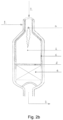
- Figs. 2a and 2b show a combustion chamber in a gasification reactor which may form an integral part of the synthesis gas generation section of plants for production of chemicals such as methanol, ammonia and synthetic fuels.
- the feed is introduced at the top of the gasification unit through line (1) and converted to H 2 and CO in the combustion chamber (b) by the burner (a) with air or oxygen introduced through line (2).
- the synthesis gas product leaves the reformer through an outlet channel line (3).
- the combustion chamber (b) is enclosed by combustion chamber lining comprising wall tiles (c) and a partitioning channel (d) and/or partitioning layer (d) to downstream sections.
- the partitioning to downstream section is in form of a permeable refractory material layer of a hold-down material (d) placed on the top of a fixed bed of catalyst pellets (e) separating the combustion chamber from the underneath situated catalyst bed.
- the uppermost surface of the partitioning (d) act as the bottom lining of the combustion chamber.
- the burner (a) can be a generic shower head burner, but often more complex burners including high degrees of swirl are used. Such burners generate high flow velocities, which can be high enough to move the catalyst pellets. Such movement leads to ball milling of the catalyst resulting in degradation of the catalyst pellets and fouling of the bed with the dust produced.
- the top of the bed is covered with a layer of large pieces of a refractory hold-down material, typically manufactured from a high alumina material, either as a hydraulic presses or a castable refractory material. These materials are much larger than the catalyst pellets and are not affected by the gas movement.
- Figs. 3a and 3b show to embodiments of Zr based refractory members 4 according to the present invention.
- the Zr based refractory member consists of a single Zr based part 5 only. I.e. the Zr based refractory member is shaped refractory in form of a solid brick.
- the Zr based refractory member comprise a Zr based part 5 in form of a coating on a shaped refractory 7 such as an alumina based refractory.
- a refractory lining according to the present invention may comprise solid bricks (shaped refractories) as shown in 3a and/or coated bricks as shown in Fig. 3b .
Landscapes
- Chemical & Material Sciences (AREA)
- Engineering & Computer Science (AREA)
- Ceramic Engineering (AREA)
- Organic Chemistry (AREA)
- Materials Engineering (AREA)
- Structural Engineering (AREA)
- Chemical Kinetics & Catalysis (AREA)
- Manufacturing & Machinery (AREA)
- Inorganic Chemistry (AREA)
- Composite Materials (AREA)
- Combustion & Propulsion (AREA)
- Health & Medical Sciences (AREA)
- General Health & Medical Sciences (AREA)
- General Engineering & Computer Science (AREA)
- Mechanical Engineering (AREA)
- Oil, Petroleum & Natural Gas (AREA)
- Compositions Of Oxide Ceramics (AREA)
- Dispersion Chemistry (AREA)
- Furnace Housings, Linings, Walls, And Ceilings (AREA)
- Ceramic Products (AREA)
- Air Supply (AREA)
Applications Claiming Priority (3)
| Application Number | Priority Date | Filing Date | Title |
|---|---|---|---|
| DKPA201600605A DK201600605A1 (en) | 2016-10-07 | 2016-10-07 | Combustion Chamber Hot Face Refractory Lining |
| EP17781465.4A EP3523265A1 (fr) | 2016-10-07 | 2017-10-09 | Revêtement réfractaire de face chaude de chambre de combustion |
| PCT/EP2017/075641 WO2018065621A1 (fr) | 2016-10-07 | 2017-10-09 | Revêtement réfractaire de face chaude de chambre de combustion |
Related Parent Applications (1)
| Application Number | Title | Priority Date | Filing Date |
|---|---|---|---|
| EP17781465.4A Division EP3523265A1 (fr) | 2016-10-07 | 2017-10-09 | Revêtement réfractaire de face chaude de chambre de combustion |
Publications (2)
| Publication Number | Publication Date |
|---|---|
| EP4549376A2 true EP4549376A2 (fr) | 2025-05-07 |
| EP4549376A3 EP4549376A3 (fr) | 2025-07-30 |
Family
ID=61830710
Family Applications (2)
| Application Number | Title | Priority Date | Filing Date |
|---|---|---|---|
| EP25165007.3A Pending EP4549376A3 (fr) | 2016-10-07 | 2017-10-09 | Revêtement réfractaire de face chaude de chambre de combustion |
| EP17781465.4A Withdrawn EP3523265A1 (fr) | 2016-10-07 | 2017-10-09 | Revêtement réfractaire de face chaude de chambre de combustion |
Family Applications After (1)
| Application Number | Title | Priority Date | Filing Date |
|---|---|---|---|
| EP17781465.4A Withdrawn EP3523265A1 (fr) | 2016-10-07 | 2017-10-09 | Revêtement réfractaire de face chaude de chambre de combustion |
Country Status (12)
| Country | Link |
|---|---|
| US (4) | US20190218151A1 (fr) |
| EP (2) | EP4549376A3 (fr) |
| CN (2) | CN120868464A (fr) |
| AU (1) | AU2017339575B2 (fr) |
| CA (1) | CA3037802A1 (fr) |
| DK (1) | DK201600605A1 (fr) |
| EA (1) | EA038537B1 (fr) |
| MY (1) | MY201250A (fr) |
| SA (1) | SA519401506B1 (fr) |
| UA (1) | UA125588C2 (fr) |
| WO (3) | WO2018065621A1 (fr) |
| ZA (1) | ZA201901787B (fr) |
Families Citing this family (2)
| Publication number | Priority date | Publication date | Assignee | Title |
|---|---|---|---|---|
| WO2023094437A1 (fr) | 2021-11-26 | 2023-06-01 | Topsoe A/S | Produit réfractaire et son utilisation |
| WO2025188964A1 (fr) * | 2024-03-06 | 2025-09-12 | Dimensional Energy, Inc. | Revêtements de barrière environnementale pour procédés et systèmes chimiques |
Citations (5)
| Publication number | Priority date | Publication date | Assignee | Title |
|---|---|---|---|---|
| EP0583211A2 (fr) | 1992-08-13 | 1994-02-16 | Haldor Topsoe A/S | Procédé et réacteur pour la préparation d'un gaz riche en hydrogène et en monoxyde de carbone |
| EP0625481B1 (fr) | 1993-05-17 | 1998-08-19 | Haldor Topsoe A/S | Réformage à la vapeur à haute température |
| EP1506145A1 (fr) | 2002-05-23 | 2005-02-16 | Saint-Gobain Ceramics and Plastics, Inc. | Melange de zircon/zircone utilise pour revetements refractaires et encres |
| WO2012131318A1 (fr) | 2011-03-28 | 2012-10-04 | Johnson Matthey Public Limited Company | Reformage à la vapeur |
| US20140332727A1 (en) | 2005-05-24 | 2014-11-13 | Johnson Matthey Plc | Steam reforming |
Family Cites Families (30)
| Publication number | Priority date | Publication date | Assignee | Title |
|---|---|---|---|---|
| US2854739A (en) | 1954-07-29 | 1958-10-07 | Thompson Prod Inc | Multiple coated molybdenum base article |
| US2906007A (en) | 1956-12-21 | 1959-09-29 | Norton Co | Sintered bearing composition |
| US3175919A (en) * | 1962-06-06 | 1965-03-30 | Harbison Walker Refractories | Zirconia refractory |
| US3519447A (en) * | 1967-08-21 | 1970-07-07 | Corhart Refractories Co | Ceramic refractory |
| US3541193A (en) * | 1967-08-21 | 1970-11-17 | Corhart Refractories Co | Cooling a sintered refractory containing unstabilized zirconia through a disruptive crystal phase inversion |
| DE2307666C3 (de) * | 1973-02-16 | 1980-02-28 | Feldmuehle Ag, 4000 Duesseldorf | Formkörper aus Zirkonoxid |
| JPS591232B2 (ja) * | 1979-09-28 | 1984-01-11 | 住友アルミニウム製錬株式会社 | ジルコニア焼結体の製造方法 |
| DE3037268C2 (de) * | 1980-10-02 | 1984-10-25 | Dynamit Nobel Ag, 5210 Troisdorf | Hochfeuerfeste Trockenstampfmasse auf Basis Zirkoniumdioxid zur Auskleidung von Induktionstiegelöfen und ihre Verwendung |
| US4659680A (en) * | 1984-08-20 | 1987-04-21 | Corning Glass Works | Stabilized zirconia bodies of improved toughness |
| US4975397A (en) * | 1985-04-13 | 1990-12-04 | Feldmuehle Aktiengesellschaft | Sintered molding, a method for producing it and its use |
| CN1014987B (zh) * | 1986-02-03 | 1991-12-04 | 迪迪尔制品公司 | 用氧化镁部分稳定的氧化锆材料及其制备方法 |
| US4835123A (en) * | 1986-02-03 | 1989-05-30 | Didier-Werke Ag | Magnesia partially-stabilized zirconia |
| WO1990015020A2 (fr) * | 1989-06-09 | 1990-12-13 | Worcester Polytechnic Institute | Procede de decomposition en aerosol a temperature elevee et produits obtenus |
| JPH0826860A (ja) * | 1994-07-15 | 1996-01-30 | Mitsubishi Materials Corp | 焼成用治具 |
| US5562998A (en) * | 1994-11-18 | 1996-10-08 | Alliedsignal Inc. | Durable thermal barrier coating |
| US5780178A (en) * | 1996-10-31 | 1998-07-14 | The United States Of America As Represented By The Secretary Of The Navy | Scandia, yttria-stabilized zirconia for ultra-high temperature thermal barrier coatings |
| US6168745B1 (en) * | 1998-11-28 | 2001-01-02 | Materials And Systems Research, Inc. | Method for forming t'-phase zirconia for high temperature applications |
| JP2000343146A (ja) * | 1999-05-31 | 2000-12-12 | Ngk Spark Plug Co Ltd | エッジ付きセラミック部材、リードフレーム製造用打抜パンチ、リードフレームの製造方法及びエッジ付きセラミック部材の製造方法 |
| EP1555252A4 (fr) | 2002-08-30 | 2007-10-24 | Mitsui Mining & Smelting Co | Gabarit de cuisson de composants electroniques |
| US7175687B2 (en) | 2003-05-20 | 2007-02-13 | Exxonmobil Research And Engineering Company | Advanced erosion-corrosion resistant boride cermets |
| JP4549091B2 (ja) * | 2004-03-31 | 2010-09-22 | 三井金属鉱業株式会社 | 電子部品焼成用治具 |
| US20070082131A1 (en) * | 2005-10-07 | 2007-04-12 | Sulzer Metco (Us), Inc. | Optimized high purity coating for high temperature thermal cycling applications |
| CN101925558B (zh) * | 2008-01-30 | 2013-06-19 | 黑崎播磨株式会社 | 氧化锆莫来石耐火原料及板砖 |
| DE102008027882A1 (de) * | 2008-06-11 | 2009-12-17 | Linde Ag | Hochtemperaturreformierung |
| US8399372B2 (en) * | 2009-05-18 | 2013-03-19 | Exxonmobil Chemical Patents Inc. | Stabilized ceramic composition, apparatus and methods of using the same |
| WO2011100527A1 (fr) * | 2010-02-12 | 2011-08-18 | Morgan Advanced Ceramics, Inc. | Procédé de texturation de composants céramiques |
| FR2968000B1 (fr) * | 2010-11-29 | 2013-03-08 | Saint Gobain Ct Recherches | Poudre de zircone yttriee fondue |
| RU2571151C2 (ru) * | 2011-10-10 | 2015-12-20 | 3М Инновейтив Пропертиз Компани | Аэрогели, кальцинированные изделия, изделия с кристаллической структурой и способы их получения |
| EP2975010B1 (fr) * | 2014-07-14 | 2016-08-17 | Refractory Intellectual Property GmbH & Co. KG | Oxyde de zirconium, utilisation d'oxyde de zirconium et procédé de fabrication d'un produit réfractaire |
| US10370298B2 (en) | 2017-04-10 | 2019-08-06 | O'brien Asset Management, Llc | Target tiles for an autothermal reformation/secondary reformation unit |
-
2016
- 2016-10-07 DK DKPA201600605A patent/DK201600605A1/en not_active Application Discontinuation
-
2017
- 2017-10-09 MY MYPI2019001516A patent/MY201250A/en unknown
- 2017-10-09 EP EP25165007.3A patent/EP4549376A3/fr active Pending
- 2017-10-09 WO PCT/EP2017/075641 patent/WO2018065621A1/fr not_active Ceased
- 2017-10-09 WO PCT/EP2017/075638 patent/WO2018065620A1/fr not_active Ceased
- 2017-10-09 CN CN202511056251.6A patent/CN120868464A/zh active Pending
- 2017-10-09 WO PCT/EP2017/075636 patent/WO2018065619A1/fr not_active Ceased
- 2017-10-09 EP EP17781465.4A patent/EP3523265A1/fr not_active Withdrawn
- 2017-10-09 CN CN201780061734.2A patent/CN110023269A/zh active Pending
- 2017-10-09 AU AU2017339575A patent/AU2017339575B2/en active Active
- 2017-10-09 UA UAA201904744A patent/UA125588C2/uk unknown
- 2017-10-09 EA EA201990878A patent/EA038537B1/ru unknown
- 2017-10-09 US US16/332,091 patent/US20190218151A1/en not_active Abandoned
- 2017-10-09 CA CA3037802A patent/CA3037802A1/fr active Pending
-
2019
- 2019-03-22 ZA ZA2019/01787A patent/ZA201901787B/en unknown
- 2019-04-07 SA SA519401506A patent/SA519401506B1/ar unknown
-
2021
- 2021-02-11 US US17/173,355 patent/US11713282B2/en active Active
- 2021-02-11 US US17/173,335 patent/US11795118B2/en active Active
-
2023
- 2023-03-27 US US18/190,469 patent/US12497338B2/en active Active
Patent Citations (5)
| Publication number | Priority date | Publication date | Assignee | Title |
|---|---|---|---|---|
| EP0583211A2 (fr) | 1992-08-13 | 1994-02-16 | Haldor Topsoe A/S | Procédé et réacteur pour la préparation d'un gaz riche en hydrogène et en monoxyde de carbone |
| EP0625481B1 (fr) | 1993-05-17 | 1998-08-19 | Haldor Topsoe A/S | Réformage à la vapeur à haute température |
| EP1506145A1 (fr) | 2002-05-23 | 2005-02-16 | Saint-Gobain Ceramics and Plastics, Inc. | Melange de zircon/zircone utilise pour revetements refractaires et encres |
| US20140332727A1 (en) | 2005-05-24 | 2014-11-13 | Johnson Matthey Plc | Steam reforming |
| WO2012131318A1 (fr) | 2011-03-28 | 2012-10-04 | Johnson Matthey Public Limited Company | Reformage à la vapeur |
Non-Patent Citations (2)
| Title |
|---|
| "Thermochemical Data of Pure Substances", vol. Barin, I, 2004, WILEY-VCH |
| ANANTHAPADMANABHAN, P. V ET AL., JOURNAL OF MATERIAL SCIENCE, vol. 24, 1989, pages 4432 - 4436 |
Also Published As
| Publication number | Publication date |
|---|---|
| WO2018065619A1 (fr) | 2018-04-12 |
| EP3523265A1 (fr) | 2019-08-14 |
| US20210163369A1 (en) | 2021-06-03 |
| US11713282B2 (en) | 2023-08-01 |
| DK201600605A1 (en) | 2018-04-16 |
| CN110023269A (zh) | 2019-07-16 |
| US20230227373A1 (en) | 2023-07-20 |
| EP4549376A3 (fr) | 2025-07-30 |
| SA519401506B1 (ar) | 2023-10-29 |
| CA3037802A1 (fr) | 2018-04-12 |
| AU2017339575B2 (en) | 2022-10-13 |
| CN120868464A (zh) | 2025-10-31 |
| US12497338B2 (en) | 2025-12-16 |
| UA125588C2 (uk) | 2022-04-27 |
| US20190218151A1 (en) | 2019-07-18 |
| EA038537B1 (ru) | 2021-09-13 |
| WO2018065620A1 (fr) | 2018-04-12 |
| ZA201901787B (en) | 2024-06-26 |
| US20210188722A1 (en) | 2021-06-24 |
| EA201990878A1 (ru) | 2019-09-30 |
| MY201250A (en) | 2024-02-13 |
| US11795118B2 (en) | 2023-10-24 |
| WO2018065621A1 (fr) | 2018-04-12 |
| AU2017339575A1 (en) | 2019-04-11 |
Similar Documents
| Publication | Publication Date | Title |
|---|---|---|
| CN102459522B (zh) | 热解反应器材料以及方法 | |
| US12497338B2 (en) | Shaped and fired zirconia refractory material | |
| US8932534B2 (en) | Porous pyrolysis reactor materials and methods | |
| Dana et al. | Refractories of alumina-silica system | |
| CA2729754A1 (fr) | Revetement interne d'un reacteur de gazeification | |
| Si et al. | Effect of Al addition on creep resistance of the fired SiC-MgAl2O4 composite refractories | |
| US20250011240A1 (en) | Refractory product and its use | |
| Raymon et al. | Refractory Lining Materials for Coal Gasifiers: A Literature Review of Reactions Involving High-temperature Gas and Alkali Metal Vapors | |
| Novakovic et al. | Advanced ceramics for use in highly oxidizing and corrosive environments: mullite |
Legal Events
| Date | Code | Title | Description |
|---|---|---|---|
| PUAI | Public reference made under article 153(3) epc to a published international application that has entered the european phase |
Free format text: ORIGINAL CODE: 0009012 |
|
| STAA | Information on the status of an ep patent application or granted ep patent |
Free format text: STATUS: THE APPLICATION HAS BEEN PUBLISHED |
|
| AC | Divisional application: reference to earlier application |
Ref document number: 3523265 Country of ref document: EP Kind code of ref document: P |
|
| AK | Designated contracting states |
Kind code of ref document: A2 Designated state(s): AL AT BE BG CH CY CZ DE DK EE ES FI FR GB GR HR HU IE IS IT LI LT LU LV MC MK MT NL NO PL PT RO RS SE SI SK SM TR |
|
| REG | Reference to a national code |
Ref country code: DE Ref legal event code: R079 Free format text: PREVIOUS MAIN CLASS: C01B0003320000 Ipc: C04B0041000000 |
|
| PUAL | Search report despatched |
Free format text: ORIGINAL CODE: 0009013 |
|
| AK | Designated contracting states |
Kind code of ref document: A3 Designated state(s): AL AT BE BG CH CY CZ DE DK EE ES FI FR GB GR HR HU IE IS IT LI LT LU LV MC MK MT NL NO PL PT RO RS SE SI SK SM TR |
|
| RIC1 | Information provided on ipc code assigned before grant |
Ipc: C04B 41/00 20060101AFI20250625BHEP Ipc: C04B 41/50 20060101ALI20250625BHEP Ipc: C04B 41/87 20060101ALI20250625BHEP Ipc: C04B 35/484 20060101ALI20250625BHEP Ipc: C04B 35/486 20060101ALI20250625BHEP Ipc: C01B 3/36 20060101ALI20250625BHEP Ipc: C04B 111/00 20060101ALN20250625BHEP |
|
| STAA | Information on the status of an ep patent application or granted ep patent |
Free format text: STATUS: REQUEST FOR EXAMINATION WAS MADE |
|
| 17P | Request for examination filed |
Effective date: 20260128 |