EP4552952A1 - Structure de partie avant de véhicule - Google Patents
Structure de partie avant de véhicule Download PDFInfo
- Publication number
- EP4552952A1 EP4552952A1 EP24208457.2A EP24208457A EP4552952A1 EP 4552952 A1 EP4552952 A1 EP 4552952A1 EP 24208457 A EP24208457 A EP 24208457A EP 4552952 A1 EP4552952 A1 EP 4552952A1
- Authority
- EP
- European Patent Office
- Prior art keywords
- vehicle front
- vehicle
- rear direction
- wall portion
- bending
- Prior art date
- Legal status (The legal status is an assumption and is not a legal conclusion. Google has not performed a legal analysis and makes no representation as to the accuracy of the status listed.)
- Pending
Links
Images




Classifications
-
- B—PERFORMING OPERATIONS; TRANSPORTING
- B62—LAND VEHICLES FOR TRAVELLING OTHERWISE THAN ON RAILS
- B62D—MOTOR VEHICLES; TRAILERS
- B62D21/00—Understructures, i.e. chassis frame on which a vehicle body may be mounted
- B62D21/15—Understructures, i.e. chassis frame on which a vehicle body may be mounted having impact absorbing means, e.g. a frame designed to permanently or temporarily change shape or dimension upon impact with another body
- B62D21/152—Front or rear frames
-
- B—PERFORMING OPERATIONS; TRANSPORTING
- B62—LAND VEHICLES FOR TRAVELLING OTHERWISE THAN ON RAILS
- B62D—MOTOR VEHICLES; TRAILERS
- B62D25/00—Superstructure or monocoque structure sub-units; Parts or details thereof not otherwise provided for
- B62D25/08—Front or rear portions
-
- B—PERFORMING OPERATIONS; TRANSPORTING
- B60—VEHICLES IN GENERAL
- B60Y—INDEXING SCHEME RELATING TO ASPECTS CROSS-CUTTING VEHICLE TECHNOLOGY
- B60Y2306/00—Other features of vehicle sub-units
- B60Y2306/01—Reducing damages in case of crash, e.g. by improving battery protection
Definitions
- the present invention relates to a vehicle front part structure.
- a front side member has a closed section formed by an inner front side member and an outer front side member.
- the outer front side member includes a weakened portion to be bent inward in a vehicle width direction when a collision load is input from the front part of the vehicle.
- a reinforcing member having a hat shape that is open to the outer front side member in a plan view is disposed at a location where the reinforcing member faces the weakened portion within the closed section of the front side member. Front and rear flange portions of this reinforcing member are joined to the inner side surface of the outer front side member in the vehicle width direction.
- the front side member In the event of a frontal collision of the vehicle, the front side member is bent inward in the vehicle width direction at a point starting from the weakened portion, and the reinforcing member is deformed within the closed section of the front side member. This deformation of the reinforcing member increases the energy absorption amount of the front side member.
- JP 2016-107872 A there is no means for restricting deformation of the inner front side member. Therefore, in the event of the frontal collision of the vehicle, relative displacement occurs between the inner front side member and the outer front side member in a vehicle front-rear direction. As a result, the way in which the front side member that is a framework member is bent (hereinafter referred to as "bending mode") may be unstable. Therefore, there is room for improvement.
- the present invention provides a vehicle front part structure that can stabilize the bending mode of a framework member in the event of a frontal collision.
- a vehicle front part structure includes: a framework member having a closed section and extending in a vehicle front-rear direction at a front part of a vehicle; a reinforcing member extending in the vehicle front-rear direction within the closed section of the framework member, the reinforcing member including two ends in the vehicle front-rear direction that are attached to a wall portion of the framework member on a first side in an orthogonal direction orthogonal to the vehicle front-rear direction, the reinforcing member being bent to project to a second side in the orthogonal direction at a bending portion provided between the two ends; and a limiting portion configured to limit relative movement of the reinforcing member in the vehicle front-rear direction with respect to a wall portion of the framework member on the second side.
- the reinforcing member extending in the vehicle front-rear direction is provided within the closed section of the framework member extending in the vehicle front-rear direction at the front part of the vehicle.
- the both ends of the reinforcing member in the vehicle front-rear direction are attached to the wall portion of the framework member on the first side in the orthogonal direction orthogonal to the vehicle front-rear direction.
- the reinforcing member is bent to project to the second side in the orthogonal direction at the bending portion provided between the both ends. Therefore, in the event of a frontal collision of the vehicle, the reinforcing member and the framework member are bent to the second side at a point starting from the bending portion. At this time, the relative movement of the reinforcing member in the vehicle front-rear direction with respect to the wall portion of the framework member on the second side is limited by the limiting portion. Thus, the bending mode of the framework member is stabilized.
- the limiting portion may include a recess that is provided at a location on the wall portion on the second side where the recess faces the bending portion, and that recedes to the second side.
- the framework member may include the recess that recedes to the second side at the location on the wall portion on the second side where the recess faces the bending portion of the reinforcing member. Therefore, when the reinforcing member is bent to the second side at a point starting from the bending portion, a peripheral portion of the bending portion of the reinforcing member engages with the recess, thereby limiting the relative movement of the reinforcing member in the vehicle front-rear direction with respect to the wall portion on the second side.
- the reinforcing member may include a projection that is provided at a location where the projection faces the recess in the orthogonal direction, and that projects to the second side.
- the reinforcing member may include the projection that projects to the second side at the location where the projection faces, in the orthogonal direction orthogonal to the vehicle front-rear direction, the recess provided on the wall portion of the framework member on the second side. Therefore, when the reinforcing member is bent, the projection and the recess engage with each other, thereby effectively limiting the relative movement of the reinforcing member in the vehicle front-rear direction with respect to the wall portion on the second side.
- a dimension of the recess in the vehicle front-rear direction may be set larger than a dimension of the projection in the vehicle front-rear direction.
- the limiting portion may include a connecting portion that connects the wall portion on the second side and the bending portion.
- the wall portion of the framework member on the second side and the bending portion of the reinforcing member may be connected at the connecting portion. Therefore, when the reinforcing member is bent, the relative movement of the reinforcing member in the vehicle front-rear direction with respect to the wall portion on the second side can be limited effectively.
- the limiting portion may include: a first limiting portion that is provided on the wall portion on the second side at a location forward of the bending portion in the vehicle front-rear direction, and that projects to the first side; and a second limiting portion that is provided on the wall portion on the second side at a location rearward of the bending portion in the vehicle front-rear direction, and that projects to the first side.
- the first limiting portion and the second limiting portion may be provided on the wall portion of the framework member on the second side.
- the first limiting portion may project to the first side at the location forward of the bending portion of the reinforcing member
- the second limiting portion may project to the first side at the location rearward of the bending portion of the reinforcing member. Therefore, when the reinforcing member is bent, the peripheral portion of the bending portion of the reinforcing member engages with the first limiting portion and the second limiting portion, thereby limiting the relative movement of the reinforcing member in the vehicle front-rear direction with respect to the wall portion on the second side.
- the first limiting portion may include a first inclined surface that is inclined to the second side as the first inclined surface extends to a vehicle rear side
- the second limiting portion may include a second inclined surface that is inclined to the second side as the second inclined surface extends to a vehicle front side
- the first inclined surface of the first limiting portion of the framework member may be inclined to the second side as it extends to the vehicle rear side
- the second inclined surface of the second limiting portion of the framework member may be inclined to the second side as it extends to the vehicle front side. Therefore, when the reinforcing member is bent, the peripheral portion of the bending portion of the reinforcing member slides against the first inclined surface and the second inclined surface, thereby guiding the entry of the peripheral portion of the bending portion into a space between the first limiting portion and the second limiting portion.
- the first limiting portion may be in contact with, from the vehicle front side, a first portion of the reinforcing member forward of the bending portion in the vehicle front-rear direction, or the first limiting portion may be in proximity to the first portion to face the first portion, and the second limiting portion may be in contact with, from the vehicle rear side, a second portion of the reinforcing member rearward of the bending portion in the vehicle front-rear direction, or the second limiting portion may be in proximity to the second portion to face the second portion.
- the first limiting portion of the framework member may be in contact with, from the vehicle front side, the first portion of the reinforcing member forward of the bending portion in the vehicle front-rear direction, or the first limiting portion may be in proximity to the first portion to face the first portion.
- the second limiting portion of the framework member may be in contact with, from the vehicle rear side, the second portion of the reinforcing member rearward of the bending portion in the vehicle front-rear direction, or the second limiting portion may be in proximity to the second portion to face the second portion. Therefore, when the reinforcing member is bent, the relative movement of the reinforcing member in the vehicle front-rear direction with respect to the wall portion of the framework member on the second side is limited at an early stage. As a result, the bending mode of the framework member can be stabilized at an early stage.
- the framework member may include an inner panel including the wall portion on the first side, and an outer panel including the wall portion on the second side and connected to the inner panel.
- the both ends of the reinforcing member in the vehicle front-rear direction are connected to the wall portion of the inner panel on the first side. Therefore, the relative movement of the reinforcing member in the vehicle front-rear direction with respect to the wall portion of the outer panel on the second side is limited by the limiting portion.
- the reinforcing member and the framework member are bent outward in the vehicle width direction at a point starting from the bending portion of the reinforcing member. Therefore, it is easy to secure space for the bending of the reinforcing member and the framework member.
- the bending mode of the framework member in the event of the frontal collision can be stabilized.
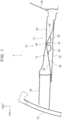
- FIGS. 1 to 8 a vehicle front part structure 10 according to a first embodiment of the present invention will be described with reference to FIGS. 1 to 8 .
- Arrows FR, UP, OUT shown as appropriate in FIGS. 1 to 6 indicate a forward direction (travel direction), an upward direction, and an outer side in a vehicle width direction of a vehicle V to which the vehicle front part structure 10 is applied, respectively.
- a pair of right and left front side members 12 (the left front side member 12 is not shown) is disposed at the front part of the vehicle V to which the vehicle front part structure 10 is applied.
- the right and left front side members 12 include front side member bodies 14 having closed sections and extending in the vehicle front-rear direction on both the right and left sides of the front part of the vehicle V.
- the front side member 12 includes a reinforcement 28 extending in the vehicle front-rear direction within the closed section of the front side member body 14.
- the front side member body 14 is an example of a "framework member” in the present invention, and the reinforcement 28 is an example of a "reinforcing member” in the present invention.
- a crash box 16 is connected to the front end of each of the right and left front side members 12, and a front bumper reinforcement 18 is connected to the front end of each of the right and left crash boxes 16.
- a dash panel 20 is connected to the rear end of each of the right and left front side members 12.
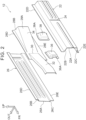
- the front side member body 14 includes an inner panel 22 constituting an inner part of the front side member body 14 in the vehicle width direction, and an outer panel 26 constituting an outer part of the front side member body 14 in the vehicle width direction.
- the inner panel 22 and the outer panel 26 are made of, for example, press-formed steel sheets, and are formed into an elongated shape with their longitudinal direction corresponding to the vehicle front-rear direction.
- the inner panel 22 has a substantially hat-shaped cross section that is open outward in the vehicle width direction when viewed in the vehicle front-rear direction.
- the inner panel 22 includes a vertical wall portion 22A with its thickness direction corresponding to the vehicle width direction, an upper wall portion 22B extending outward in the vehicle width direction from an upper end of the vertical wall portion 22A, a lower wall portion 22C extending outward in the vehicle width direction from a lower end of the vertical wall portion 22A, an upper flange portion 22D extending upward from an outer end of the upper wall portion 22B in the vehicle width direction, and a lower flange portion 22E extending downward from an outer end of the lower wall portion 22C in the vehicle width direction.
- a vertical bead 24 extending in the vehicle up-down direction is formed at the middle of the vertical wall portion 22A in the vehicle front-rear direction (in this case, near the center in the vehicle front-rear direction).
- the vertical bead 24 recedes outward in the vehicle width direction.
- the outer panel 26 has a substantially hat-shaped cross section that is open inward in the vehicle width direction when viewed in the vehicle front-rear direction.
- the outer panel 26 includes a vertical wall portion 26A with its thickness direction corresponding to the vehicle width direction, an upper wall portion 26B extending inward in the vehicle width direction from an upper end of the vertical wall portion 26A, a lower wall portion 26C extending inward in the vehicle width direction from a lower end of the vertical wall portion 26A, an upper flange portion 26D extending upward from an inner end of the upper wall portion 26B in the vehicle width direction, and a lower flange portion 26E extending downward from an inner end of the lower wall portion 26C in the vehicle width direction.
- the “inner side in the vehicle width direction” in the present embodiment is an example of "first side in an orthogonal direction orthogonal to the vehicle front-rear direction” in the present invention
- the “outer side in the vehicle width direction” in the present embodiment is an example of "second side in the orthogonal direction orthogonal to the vehicle front-rear direction” in the present invention.
- the vertical wall portion 22A of the inner panel 22 (i.e., the wall portion of the front side member body 14 on the inner side in the vehicle width direction) is an example of a "wall portion on a first side" in the present invention
- the vertical wall portion 26A of the outer panel 26 i.e., the wall portion of the front side member body 14 on the outer side in the vehicle width direction
- a “wall portion on a second side” in the present invention is an example of a "wall portion on a second side" in the present invention.
- the upper flange portion 22D of the inner panel 22 and the upper flange portion 26D of the outer panel 26 are connected by spot welding etc.
- the lower flange portion 22E of the inner panel 22 and the lower flange portion 26E of the outer panel 26 are connected by spot welding etc.
- the outer panel 26 and the inner panel 22 form a substantially rectangular closed section when viewed in the vehicle front-rear direction.
- the reinforcement 28 is made of, for example, a press-formed steel sheet, and is formed into an elongated shape with its longitudinal direction corresponding to the vehicle front-rear direction.
- the reinforcement 28 includes a vertical wall portion 28A with its thickness direction substantially corresponding to the vehicle width direction, an upper wall portion 28B extending outward in the vehicle width direction from an upper end of the vertical wall portion 28A, a lower wall portion (not shown) extending outward in the vehicle width direction from a lower end of the vertical wall portion 28A, an upper flange portion 28D extending upward from an outer end of the upper wall portion 28B in the vehicle width direction, and a lower flange portion 28E extending downward from an outer end of the lower wall portion in the vehicle width direction.
- the upper flange portion 28D of the reinforcement 28 is sandwiched between the upper flange portion 22D of the inner panel 22 and the upper flange portion 26D of the outer panel 26, and is connected to the upper flange portion 22D and the upper flange portion 26D by spot welding etc.
- the lower flange portion 28E of the reinforcement 28 is sandwiched between the lower flange portion 22E of the inner panel 22 and the lower flange portion 26E of the outer panel 26, and is connected to the lower flange portion 22E and the lower flange portion 26E by spot welding etc.
- Both ends of the vertical wall portion 28A of the reinforcement 28 in the vehicle front-rear direction are attached to the inner panel 22.
- the vertical wall portion 28A of the reinforcement 28 is bent to project outward in the vehicle width direction at a bending portion 30 provided at the middle between the both ends of the vertical wall portion 28A (in this case, near the center in the vehicle front-rear direction).
- a portion forward of the bending portion 30 in the vehicle front-rear direction is a first inclined portion 32 that is inclined inward in the vehicle width direction as it extends to the vehicle front side
- a portion rearward of the bending portion 30 is a second inclined portion 34 that is inclined inward in the vehicle width direction as it extends to the vehicle rear side.
- the bending portion 30 and the vertical bead 24 formed on the vertical wall portion 22A of the inner panel 22 are positionally aligned in the vehicle front-rear direction.
- the disposition of the bending portion 30 is not limited to the above and may be changed as appropriate.
- the bending portion 30 may be disposed on the front end side of the vertical wall portion 28A or on the rear end side of the vertical wall portion 28A.
- the front end of the first inclined portion 32 (i.e., the front end of the vertical wall portion 28A) is laid on the front end of the vertical wall portion 22A of the inner panel 22 from the outer side in the vehicle width direction, and is connected to the front end of the vertical wall portion 22A by spot welding etc.
- the rear end of the second inclined portion 34 (i.e., the rear end of the vertical wall portion 28A) is laid on the rear end of the vertical wall portion 22A of the inner panel 22 from the outer side in the vehicle width direction, and is connected to the rear end of the vertical wall portion 22A by spot welding etc.
- Both the ends of the vertical wall portion 28A in the vehicle front-rear direction may be connected indirectly to the inner panel 22 via another plate-shaped member etc. instead of being connected directly to the inner panel 22.
- a front bulkhead 36 is fixed to an inner surface of the rear end of the first inclined portion 32 in the vehicle width direction
- a rear bulkhead 38 is fixed to an inner surface of the front end of the second inclined portion 34 in the vehicle width direction.
- the front bulkhead 36 and the rear bulkhead 38 are made of, for example, press-formed steel sheets, and their sectional shapes when viewed in the vehicle front-rear direction and in the vehicle up-down direction are substantial hat shapes that are open outward in the vehicle width direction.
- the shapes of the front bulkhead 36 and the rear bulkhead 38 are not limited to those described above and may be changed as appropriate, and may be spherical or rectangular parallelepiped shapes.
- the front bulkhead 36 is disposed near the bending portion 30 of the vertical wall portion 28A and forward of the bending portion 30 in the vehicle front-rear direction, and a flange portion 36A of the front bulkhead 36 is connected to the rear end of the first inclined portion 32 by spot welding etc.
- the rear bulkhead 38 is disposed near the bending portion 30 of the vertical wall portion 28A and rearward of the bending portion 30 in the vehicle front-rear direction, and a flange portion 38A of the rear bulkhead 38 is connected to the front end of the second inclined portion 34 by spot welding etc.
- the front bulkhead 36 and the rear bulkhead 38 face each other with a clearance therebetween in the vehicle front-rear direction.
- the bending portion 30 of the vertical wall portion 28A is laid on the vertical wall portion 26A of the outer panel 26 from the inner side in the vehicle width direction, and is connected to the vertical wall portion 26A by welding etc.
- a connecting portion 40 the bending portion 30 and the vertical wall portion 26A are connected together by one-side welding such as slit arc welding or laser screw welding (LSW) or by bolt fastening.
- the connecting portion 40 is an example of a "limiting portion” in the present invention.
- the connecting portion 40 limits (in this case, restricts) relative movement, in the vehicle front-rear direction, of the reinforcement 28 with respect to the vertical wall portion 26A (an example of the "wall portion on the second side” in the present invention) of the outer panel 26 of the front side member body 14.
- the both ends of the vertical wall portion 28A of the reinforcement 28 in the vehicle front-rear direction are connected to the vertical wall portion 22A of the inner panel 22 as described above. Therefore, when the front side member 12 is assembled, the reinforcement 28 is first attached to the inner panel 22, and then the outer panel 26 is attached to the inner panel 22 and the reinforcement 28. In the case of such assembling order, it is difficult to connect the bending portion 30 of the reinforcement 28 to the vertical wall portion 26A of the outer panel 26 by spot welding. However, it is possible to assemble the front side member 12 in the above assembling order by using the one-side welding, the bolt fastening, etc. described above.
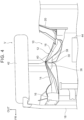
- the crash box 16 is first axially deformed by compression in the vehicle front-rear direction as shown over time in FIGS. 3 to 6 . Then, the front side member 12 is bent outward in the vehicle width direction at points starting from the bending portion 30 of the reinforcement 28 and the vertical bead 24 of the inner panel 22. At the time of bending, the front bulkhead 36 and the rear bulkhead 38 are deformed by being pressed against each other in the vehicle front-rear direction, thereby increasing a deformation load of the front side member 12.
- the connecting portion 40 prevents or suppresses relative movement of the reinforcement 28 with respect to the vertical wall portion 26A of the outer panel 26 in the vehicle front-rear direction.
- reference sign 42 denotes a front wheel of the vehicle V
- reference sign 44 denotes a power unit of the vehicle V.
- the reinforcement 28 extending in the vehicle front-rear direction is provided within the closed section of the front side member body 14 extending in the vehicle front-rear direction at the front part of the vehicle V.
- the both ends of the reinforcement 28 in the vehicle front-rear direction are connected to the vertical wall portion 22A of the inner panel 22 of the front side member body 14.
- the vertical wall portion 28A of the reinforcement 28 is bent to project outward in the vehicle width direction at the bending portion 30 provided between the both ends.
- the centroid axis of the front side member 12 is bent to project outward in the vehicle width direction in a plan view.
- the front side member 12 When the vehicle V has a frontal collision, the front side member 12 is bent outward in the vehicle width direction at a point starting from the bending portion 30. At this time, relative movement, in the vehicle front-rear direction, of the reinforcement 28 with respect to the vertical wall portion 26A of the outer panel 26 of the front side member body 14 is limited by the connecting portion 40 that connects the vertical wall portion 26A and the bending portion 30 of the reinforcement 28. Thus, the bending mode of the front side member 12 in the plan view is stabilized.
- the toughness (i.e., tenacity, resistance to breakage) of the front side member 12 after the bending increases, thereby improving the sustainability of the deformation load from the start of deformation of the front side member 12 to the breakage, and increasing the energy absorption amount.
- a long dashed double-short dashed line diagram shows a relationship between a deformation stroke of the front side member 12 according to the present embodiment and a decelerative acceleration of the vehicle V.
- a continuous line diagram shows a relationship between a deformation stroke of a front side member according to a comparative example and a decelerative acceleration of a vehicle.
- the front side member does not include the connecting portion 40, but the other configuration is the same as that of the present embodiment.
- the drop in the decelerative acceleration of the vehicle V after the bending of the front side member 12 is smaller than that in the comparative example (see the region surrounded by the dashed line in FIG. 7 ).
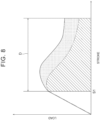
- FIG. 8 a continuous line diagram shows a relationship between the deformation stroke and a deformation load of the front side member 12 according to the present embodiment.
- a long dashed double-short dashed line diagram shows a relationship between the deformation stroke and a deformation load of the front side member according to the comparative example.
- Sl represents a deformation stroke when the front side member 12 and the front side member according to the comparative example each start to bend.
- an arrow D indicates a stretch (i.e., ductility) from the start of bending (i.e., plastic deformation) of each of the front side member 12 and the front side member according to the comparative example to breakage.
- the area of a region surrounded by the continuous line diagram and the horizontal axis indicates the energy absorption amount of the front side member 12
- the area of a region surrounded by the long dashed double-short dashed line diagram and the horizontal axis indicates the energy absorption amount of the front side member according to the comparative example.
- the area of a hatched region indicates the energy absorption amount by the toughness of the front side member according to the comparative example (i.e., the energy absorption amount in the ductile region)
- the area of a hatched and dotted region indicates the energy absorption amount by the toughness of the front side member 12.
- the decrease in the deformation load after the start of plastic deformation of the front side member 12 is small. Therefore, the energy absorption amount increases by an amount corresponding to the dotted region in FIG. 8 compared to the comparative example.
- the vertical wall portion 26A of the outer panel 26 of the front side member body 14 and the bending portion 30 of the reinforcement 28 are connected at the connecting portion 40. Therefore, when the reinforcement 28 is bent, relative movement of the reinforcement 28 with respect to the vertical wall portion 26A in the vehicle front-rear direction can be limited effectively. As a result, the bending mode of the front side member 12 can be stabilized effectively, and the rigidity of the vehicle body under normal conditions can be increased.
- the both ends of the reinforcement 28 in the vehicle front-rear direction are connected to the vertical wall portion 22A of the inner panel 22. Therefore, relative movement of the reinforcement 28 with respect to the vertical wall portion 26A of the outer panel 26 in the vehicle front-rear direction is limited.
- the front side member 12 is bent outward in the vehicle width direction. Therefore, it is easy to secure space for the bending of the reinforcement 28.
- FIG. 9 is a sectional view showing the configuration of a main part of a front part of a vehicle V to which a vehicle front part structure 50 according to a second embodiment of the present invention is applied.
- the front side member 12 includes, instead of the connecting portion 40 in the first embodiment, a first engagement portion 52 provided on the vertical wall portion 26A of the outer panel 26 of the front side member body 14, and a second engagement portion 56 provided on the vertical wall portion 28A of the reinforcement 28.
- the first engagement portion 52 is formed by part of the vertical wall portion 26A, and the second engagement portion 56 is made of, for example, a press-formed steel sheet.
- the first engagement portion 52 faces the bending portion 30 of the vertical wall portion 28A in the vehicle width direction.
- the sectional shapes when viewed in the vehicle front-rear direction and in the vehicle up-down direction are, for example, substantial C-shapes (substantial U-shapes) that are open inward in the vehicle width direction.
- the first engagement portion 52 may be manufactured separately from the outer panel 26 and connected to the vertical wall portion 26A by welding etc.
- the vertical wall portion 26A has an opening at a location where it faces the first engagement portion 52.
- the first engagement portion 52 defines a recess 54 at a location where it faces the bending portion 30.
- the recess 54 recedes outward in the vehicle width direction.
- the second engagement portion 56 is disposed on the outer side of the vertical wall portion 28A in the vehicle width direction to face the bending portion 30 of the vertical wall portion 28A in the vehicle width direction.
- the sectional shapes when viewed in the vehicle front-rear direction and in the vehicle up-down direction are, for example, substantial hat shapes that are open inward in the vehicle width direction.
- a flange portion (reference sign is omitted) on the inner side in the vehicle width direction is connected to the vertical wall portion 28A by spot welding etc.
- the second engagement portion 56 defines a projection 58 at a location where it faces the recess 54. The projection 58 projects outward in the vehicle width direction.
- the dimension of the recess 54 in the vehicle front-rear direction is set larger than the dimension of the projection 58 in the vehicle front-rear direction, and part of the projection 58 is inserted into the recess 54.
- the recess 54 and the projection 58 are an example of the "limiting portion" in the present invention, and have the function of limiting relative movement of the reinforcement 28 with respect to the vertical wall portion 26A of the outer panel 26 in the vehicle front-rear direction to a predetermined range.
- the recess 54 and the projection 58 may be connected by one-side welding, bolt fastening, etc. In the present embodiment, the configurations other than the above are the same as those in the first embodiment.
- the front side member body 14 includes the recess 54 that recedes outward in the vehicle width direction at the location on the vertical wall portion 26A of the outer panel 26 where the recess 54 faces the bending portion 30 of the reinforcement 28. Therefore, when the reinforcement 28 is bent outward in the vehicle width direction at a point starting from the bending portion 30, the recess 54 engages with the peripheral portion of the bending portion 30 of the reinforcement 28 (in this case, the projection 58). Thus, it is possible to limit relative movement of the reinforcement 28 with respect to the vertical wall portion 26A in the vehicle front-rear direction. Accordingly, in the present embodiment, the bending mode of the front side member 12 can be stabilized and the energy absorption amount can be increased basically similarly to the first embodiment.
- the projection 58 that projects outward in the vehicle width direction is provided at the location on the reinforcement 28 where the projection 58 faces the recess 54. Therefore, when the reinforcement 28 is bent, the projection 58 and the recess 54 engage with each other (i.e., the projection 58 is caught in the recess 54), thereby effectively limiting (suppressing) relative movement of the reinforcement 28 with respect to the vertical wall portion 26A in the vehicle front-rear direction.
- the dimension of the recess 54 in the vehicle front-rear direction is set larger than the dimension of the projection 58 in the vehicle front-rear direction. Therefore, when the projection 58 is inserted into the recess 54 under normal conditions, dimensional variations of the members in the vehicle front-rear direction can be absorbed easily.
- the projection 58 is provided on the reinforcement 28, but the present invention is not limited to this, and the projection 58 may be omitted.
- the peripheral portion of the bending portion 30 of the vertical wall portion 28A of the reinforcement 28 enters the recess 54 and engages with the recess 54.
- the bending portion 30 and the recess 54 may be connected by one-side welding, bolt fastening, etc.
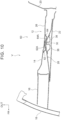
- FIG. 10 is a sectional view showing the configuration of a main part of a front part of a vehicle V to which a vehicle front part structure 60 according to a third embodiment of the present invention is applied.
- the front side member 12 includes, instead of the connecting portion 40 in the first embodiment, a first limiting portion 62 and a second limiting portion 64 fixed to the vertical wall portion 26A of the outer panel 26 of the front side member body 14.
- the first limiting portion 62 and the second limiting portion 64 are an example of the "limiting portion" in the present invention, and have the function of limiting relative movement of the reinforcement 28 with respect to the vertical wall portion 26A of the outer panel 26 in the vehicle front-rear direction to the predetermined range.
- the first limiting portion 62 and the second limiting portion 64 are made of, for example, press-formed steel sheets, and are disposed on the inner side of the vertical wall portion 26A of the outer panel 26 in the vehicle width direction.
- the first limiting portion 62 and the second limiting portion 64 may be integrated with the outer panel 26 (i.e., part of the vertical wall portion 26A may be the first limiting portion 62 and the second limiting portion 64).
- the first limiting portion 62 is disposed forward of the bending portion 30 of the reinforcement 28 in the vehicle front-rear direction to project inward in the vehicle width direction.
- the second limiting portion 64 is disposed rearward of the bending portion 30 in the vehicle front-rear direction to project inward in the vehicle width direction.
- the sectional shape when viewed in the vehicle up-down direction is a substantially triangular shape, and a flange portion (reference sign is omitted) on the outer side in the vehicle width direction is connected to the vertical wall portion 26A by spot welding etc.
- the first limiting portion 62 includes a first inclined surface 62A that is inclined outward in the vehicle width direction as it extends to the vehicle rear side.
- the sectional shape when viewed in the vehicle up-down direction is a substantially triangular shape, and a flange portion (reference sign is omitted) on the outer side in the vehicle width direction is connected to the vertical wall portion 26A by spot welding etc.
- the second limiting portion 64 includes a second inclined surface 64A that is inclined outward in the vehicle width direction as it extends to the vehicle front side.
- the first inclined surface 62A is disposed in contact with the first inclined portion 32 (i.e., a portion forward of the bending portion 30 in the vehicle front-rear direction) of the vertical wall portion 28A of the reinforcement 28 from the vehicle front side, or, the first inclined surface 62A is disposed in proximity to the first inclined portion 32 to face the first inclined portion 32.
- the second inclined surface 64A is in contact with the second inclined portion 34 (i.e., a portion rearward of the bending portion 30 in the vehicle front-rear direction) of the vertical wall portion 28A from the vehicle rear side, or, the second inclined surface 64A is disposed in proximity to the second inclined portion 34 to face the second inclined portion 34.
- the configurations other than the above are the same as those in the first embodiment.
- the first limiting portion 62 and the second limiting portion 64 are provided on the vertical wall portion 26A of the outer panel 26 of the front side member body 14.
- the first limiting portion 62 projects inward in the vehicle width direction at a location forward of the bending portion 30 of the reinforcement 28 in the vehicle front-rear direction
- the second limiting portion 64 projects inward in the vehicle width direction at a location rearward of the bending portion 30 in the vehicle front-rear direction.
- the peripheral portion of the bending portion 30 of the reinforcement 28 engages (comes into contact) with the first limiting portion 62 and the second limiting portion 64, thereby limiting relative movement of the reinforcement 28 with respect to the vertical wall portion 26A in the vehicle front-rear direction. Accordingly, in the present embodiment, the bending mode of the front side member 12 can be stabilized and the energy absorption amount can be increased basically similarly to the first embodiment.
- the first inclined surface 62A of the first limiting portion 62 is inclined outward in the vehicle width direction as it extends to the vehicle rear side
- the second inclined surface 64A of the second limiting portion 64 is inclined outward in the vehicle width direction as it extends to the vehicle front side. Therefore, when the reinforcement 28 is bent at a point starting from the bending portion 30, the peripheral portion of the bending portion 30 of the reinforcement 28 slides against the first inclined surface 62A and the second inclined surface 64A, thereby guiding the entry of the peripheral portion of the bending portion 30 into the space between the first limiting portion 62 and the second limiting portion 64.
- the first limiting portion 62 is in contact with the first inclined portion 32 of the reinforcement 28 from the vehicle front side or is in proximity to the first inclined portion 32 to face the first inclined portion 32
- the second limiting portion 64 is in contact with the second inclined portion 34 of the reinforcement 28 from the vehicle rear side or is in proximity to the second inclined portion 34 to face the second inclined portion 34. Therefore, when the reinforcement 28 is bent at a point starting from the bending portion 30, relative movement of the reinforcement 28 with respect to the vertical wall portion 26A of the outer panel 26 of the front side member body 14 in the vehicle front-rear direction is limited (suppressed) at an early stage. As a result, the bending mode of the front side member 12 can be stabilized at an early stage.
- the “inner side in the vehicle width direction” is “first side in the orthogonal direction orthogonal to the vehicle front-rear direction” in the present invention
- the “outer side in the vehicle width direction” is “second side in the orthogonal direction orthogonal to the vehicle front-rear direction” in the present invention
- the present invention is not limited to this.
- the “vehicle upper side” may be “first side in the orthogonal direction orthogonal to the vehicle front-rear direction” in the present invention
- the “vehicle lower side” may be “second side in the orthogonal direction orthogonal to the vehicle front-rear direction” in the present invention.
Landscapes
- Engineering & Computer Science (AREA)
- Chemical & Material Sciences (AREA)
- Combustion & Propulsion (AREA)
- Transportation (AREA)
- Mechanical Engineering (AREA)
- Body Structure For Vehicles (AREA)
Applications Claiming Priority (1)
| Application Number | Priority Date | Filing Date | Title |
|---|---|---|---|
| JP2023191138A JP7786444B2 (ja) | 2023-11-08 | 2023-11-08 | 車両前部構造 |
Publications (1)
| Publication Number | Publication Date |
|---|---|
| EP4552952A1 true EP4552952A1 (fr) | 2025-05-14 |
Family
ID=93258758
Family Applications (1)
| Application Number | Title | Priority Date | Filing Date |
|---|---|---|---|
| EP24208457.2A Pending EP4552952A1 (fr) | 2023-11-08 | 2024-10-23 | Structure de partie avant de véhicule |
Country Status (5)
| Country | Link |
|---|---|
| US (1) | US20250145224A1 (fr) |
| EP (1) | EP4552952A1 (fr) |
| JP (1) | JP7786444B2 (fr) |
| KR (1) | KR20250067715A (fr) |
| CN (1) | CN119953457A (fr) |
Citations (3)
| Publication number | Priority date | Publication date | Assignee | Title |
|---|---|---|---|---|
| JP2014162347A (ja) * | 2013-02-25 | 2014-09-08 | Toyota Motor Corp | 車体前部構造 |
| JP2016107872A (ja) | 2014-12-08 | 2016-06-20 | トヨタ自動車株式会社 | 車両前部構造 |
| US10773752B2 (en) * | 2017-08-23 | 2020-09-15 | Mazda Motor Corporation | Vehicle-body structure |
Family Cites Families (8)
| Publication number | Priority date | Publication date | Assignee | Title |
|---|---|---|---|---|
| JP2006282106A (ja) | 2005-04-04 | 2006-10-19 | Toyota Motor Corp | 車体骨格の補強構造 |
| JP2007283844A (ja) | 2006-04-14 | 2007-11-01 | Nissan Motor Co Ltd | 車両の後部車体構造 |
| JP5924321B2 (ja) | 2013-08-27 | 2016-05-25 | トヨタ自動車株式会社 | 車両の骨格構造 |
| JP2015151053A (ja) | 2014-02-17 | 2015-08-24 | トヨタ自動車株式会社 | 車両骨格構造 |
| JP6315292B2 (ja) | 2016-02-04 | 2018-04-25 | マツダ株式会社 | 車両のフレーム構造 |
| JP6284056B1 (ja) | 2016-09-13 | 2018-02-28 | マツダ株式会社 | 車両用フレーム構造 |
| JP2023150794A (ja) | 2022-03-31 | 2023-10-16 | 本田技研工業株式会社 | 車両のサイドシル構造 |
| JP2023150793A (ja) | 2022-03-31 | 2023-10-16 | 本田技研工業株式会社 | 車両のサイドシル構造 |
-
2023
- 2023-11-08 JP JP2023191138A patent/JP7786444B2/ja active Active
-
2024
- 2024-10-23 EP EP24208457.2A patent/EP4552952A1/fr active Pending
- 2024-10-24 KR KR1020240146545A patent/KR20250067715A/ko active Pending
- 2024-10-29 US US18/930,509 patent/US20250145224A1/en active Pending
- 2024-11-01 CN CN202411548491.3A patent/CN119953457A/zh active Pending
Patent Citations (3)
| Publication number | Priority date | Publication date | Assignee | Title |
|---|---|---|---|---|
| JP2014162347A (ja) * | 2013-02-25 | 2014-09-08 | Toyota Motor Corp | 車体前部構造 |
| JP2016107872A (ja) | 2014-12-08 | 2016-06-20 | トヨタ自動車株式会社 | 車両前部構造 |
| US10773752B2 (en) * | 2017-08-23 | 2020-09-15 | Mazda Motor Corporation | Vehicle-body structure |
Also Published As
| Publication number | Publication date |
|---|---|
| JP7786444B2 (ja) | 2025-12-16 |
| US20250145224A1 (en) | 2025-05-08 |
| CN119953457A (zh) | 2025-05-09 |
| JP2025078517A (ja) | 2025-05-20 |
| KR20250067715A (ko) | 2025-05-15 |
Similar Documents
| Publication | Publication Date | Title |
|---|---|---|
| CN108116508B (zh) | 车身下部结构 | |
| EP2105373B1 (fr) | Structure à cadre pour véhicule automobile et procédé pour fournir celle-ci | |
| EP2985208B1 (fr) | Structure pour partie avant de véhicule | |
| JP3852445B2 (ja) | メンバー部材の衝撃エネルギー吸収構造 | |
| US10442466B2 (en) | Frame structure of vehicle | |
| JP6559897B2 (ja) | 車体前部構造 | |
| JP6616001B2 (ja) | 車体前部構造 | |
| US10836436B2 (en) | Vehicle body frame structure | |
| CN107792183B (zh) | 车辆的后部车体构造 | |
| US20250178673A1 (en) | Vehicle frame structure | |
| EP4570627A1 (fr) | Structure inférieure de carrosserie de véhicule | |
| CN111152850A (zh) | 车辆的下部车身结构 | |
| CN110884567B (zh) | 车辆的前部车身结构 | |
| EP4552952A1 (fr) | Structure de partie avant de véhicule | |
| US20240067269A1 (en) | Front vehicle-body structure of vehicle | |
| EP2428432B1 (fr) | Châssis antérieur d'un véhicule | |
| EP3604086B1 (fr) | Élément d'absorption de chocs et élément latéral d'automobile | |
| US20250353549A1 (en) | Frame member for vehicle | |
| US20250353550A1 (en) | Front structure of vehicle | |
| KR20250153252A (ko) | 자동차의 서브프레임 구조 | |
| WO2015004516A1 (fr) | Structure avant de véhicule | |
| JP5228013B2 (ja) | 車体前部構造 | |
| JP2022059472A (ja) | 車体骨格材の補強構造 | |
| JP2019084901A (ja) | 自動車の車体構造 |
Legal Events
| Date | Code | Title | Description |
|---|---|---|---|
| PUAI | Public reference made under article 153(3) epc to a published international application that has entered the european phase |
Free format text: ORIGINAL CODE: 0009012 |
|
| STAA | Information on the status of an ep patent application or granted ep patent |
Free format text: STATUS: REQUEST FOR EXAMINATION WAS MADE |
|
| 17P | Request for examination filed |
Effective date: 20241023 |
|
| AK | Designated contracting states |
Kind code of ref document: A1 Designated state(s): AL AT BE BG CH CY CZ DE DK EE ES FI FR GB GR HR HU IE IS IT LI LT LU LV MC ME MK MT NL NO PL PT RO RS SE SI SK SM TR |
|
| GRAP | Despatch of communication of intention to grant a patent |
Free format text: ORIGINAL CODE: EPIDOSNIGR1 |
|
| STAA | Information on the status of an ep patent application or granted ep patent |
Free format text: STATUS: GRANT OF PATENT IS INTENDED |
|
| INTG | Intention to grant announced |
Effective date: 20260121 |