EP4553529A1 - Détermination optimisée de l'angle d'arrivée (aoa) - Google Patents
Détermination optimisée de l'angle d'arrivée (aoa) Download PDFInfo
- Publication number
- EP4553529A1 EP4553529A1 EP24163800.6A EP24163800A EP4553529A1 EP 4553529 A1 EP4553529 A1 EP 4553529A1 EP 24163800 A EP24163800 A EP 24163800A EP 4553529 A1 EP4553529 A1 EP 4553529A1
- Authority
- EP
- European Patent Office
- Prior art keywords
- signal
- cir
- determined
- arrival
- angle
- Prior art date
- Legal status (The legal status is an assumption and is not a legal conclusion. Google has not performed a legal analysis and makes no representation as to the accuracy of the status listed.)
- Pending
Links
Images

Classifications
-
- G—PHYSICS
- G01—MEASURING; TESTING
- G01S—RADIO DIRECTION-FINDING; RADIO NAVIGATION; DETERMINING DISTANCE OR VELOCITY BY USE OF RADIO WAVES; LOCATING OR PRESENCE-DETECTING BY USE OF THE REFLECTION OR RERADIATION OF RADIO WAVES; ANALOGOUS ARRANGEMENTS USING OTHER WAVES
- G01S3/00—Direction-finders for determining the direction from which infrasonic, sonic, ultrasonic or electromagnetic waves, or particle emission, not having a directional significance, are being received
- G01S3/02—Direction-finders for determining the direction from which infrasonic, sonic, ultrasonic or electromagnetic waves, or particle emission, not having a directional significance, are being received using radio waves
- G01S3/14—Systems for determining direction or deviation from predetermined direction
- G01S3/46—Systems for determining direction or deviation from predetermined direction using antennas spaced apart and measuring phase or time difference between signals therefrom, i.e. path-difference systems
- G01S3/48—Systems for determining direction or deviation from predetermined direction using antennas spaced apart and measuring phase or time difference between signals therefrom, i.e. path-difference systems the waves arriving at the antennas being continuous or intermittent and the phase difference of signals derived therefrom being measured
-
- G—PHYSICS
- G01—MEASURING; TESTING
- G01S—RADIO DIRECTION-FINDING; RADIO NAVIGATION; DETERMINING DISTANCE OR VELOCITY BY USE OF RADIO WAVES; LOCATING OR PRESENCE-DETECTING BY USE OF THE REFLECTION OR RERADIATION OF RADIO WAVES; ANALOGOUS ARRANGEMENTS USING OTHER WAVES
- G01S3/00—Direction-finders for determining the direction from which infrasonic, sonic, ultrasonic or electromagnetic waves, or particle emission, not having a directional significance, are being received
- G01S3/02—Direction-finders for determining the direction from which infrasonic, sonic, ultrasonic or electromagnetic waves, or particle emission, not having a directional significance, are being received using radio waves
- G01S3/04—Details
- G01S3/043—Receivers
Definitions
- the invention relates to a method for determining an angle of arrival (AoA) and/or a direction of arrival (DoA) of an electromagnetic wave from a mobile device to a receiving unit, in particular a UWB receiver. Furthermore, the invention relates to a corresponding computer program product, a corresponding control unit, and a corresponding receiving unit, in particular a corresponding UWB receiver, for implementing a corresponding method.
- AoA angle of arrival
- DoA direction of arrival
- a mobile device e.g., a smartphone
- a receiver e.g., via UWB. It may happen that only a single receiver Receives signals from the mobile device. This can happen when other receivers are covered and/or when the signal is weak. In such a case, this receiver can measure the distance to the mobile device. If at least two antennas are arranged at a defined distance (less than ⁇ /2) from each other in this receiver, the phase difference of the signals at the two antennas can be determined. Consequently, the angle of arrival of the signals can be determined from the phase difference. This function can be advantageous for vehicle access systems.
- the midpoint of the first signal path is used to determine the phase difference.
- determining the phase difference at the midpoint of the first signal path can lead to incorrect results when determining the angle of incidence or the direction of arrival.
- CIR channel impulse response
- the present invention provides a method for determining an angle of incidence and/or a direction of arrival of an electromagnetic wave from a mobile device to a receiving unit, in particular to a UWB receiver, having the features of the independent method claim. Furthermore, the invention provides a corresponding computer program product, a corresponding control unit, and a corresponding receiving unit, in particular a corresponding UWB receiver, having the features of the independent claims.
- the present invention provides: A method for determining an angle of incidence and/or a direction of arrival of an electromagnetic wave from a mobile device at a receiving unit, in particular at a UWB receiver.
- the receiving unit has at least two receiving antennas.
- a phase difference between signal responses is determined at the receiving antennas.
- the phase difference be determined at the point(s) in the signal responses that lie before a respective midpoint (M) of a first signal path(s) in the signal responses.
- the signal response within the meaning of the present disclosure may also be referred to as a channel impulse response (CIR for short).
- CIR channel impulse response
- the first signal path or the direct line of sight of the receiver (English “line of sight” or LoS for short), can be referred to as the shortest signal path.
- the invention recognizes that the determination of the phase difference at the midpoint of the first signal path of the signals is not optimal, since reflection paths can form due to metallic parts on the vehicle, which can distort the signal component of the first signal path.
- the invention now proposes that the phase difference in the signal response is not calculated at the midpoint of the first signal path, but at an earlier (preferably as early as possible) point at which the signal response, for example, exceeds a certain or specifically set threshold value.
- the phase difference is determined at the point (or points) of the signal responses that exceed (or exceed) a specific, preferably specifically selected or calculated, threshold value. This makes it possible to determine the phase difference at an earlier point (as soon as possible), namely when the signal response has exceeded the threshold value.
- the threshold value is determined in such a way that the point(s) at which the phase difference is determined occur(s) as early as possible in the signal responses and are already above a noise level (or noise levels). In this way, it can be made possible that the Phase difference can be determined as soon as possible, namely when the signal response can be distinguished from the noise level.
- the threshold value can be determined as a function of an absolute value of a signal response.
- the threshold value can be determined as a function of an absolute value of a real part and/or as a function of an absolute value of an imaginary part of a signal response.
- the threshold value can, for example, be determined such that a large number of values caused by noise are waited for in the signal response (e.g. absolute value of the signal response, which has a real part and an imaginary part and can be viewed as a complex number) at least 2 to 5 ns before the detected midpoint of the first signal path.
- the threshold value can, for example, be selected such that it lies above the noise level.
- a position or point of the signal response can be observed at which the signal curve still runs up to the midpoint of the first signal path.
- the absolute value of the signal response and/or the absolute value of the real part and/or the absolute value of the imaginary part of the signal response can be considered as signals.
- the earlier time point can be selected as the relevant point for determining the phase difference.
- the earlier time point can be selected as the relevant point for the determination.
- the threshold value is determined as a function of two threshold values.
- the threshold value can be determined as a maximum value of two threshold values.
- a first threshold value can be determined as a function of a noise level and a first factor, in particular greater than one.
- a second threshold value can be determined as a function of the first signal path in the signal responses and a second factor, in particular less than one.
- the threshold value In other words, it can be defined as a combination of two differently calculated thresholds, e.g., as a maximum value or the larger of the two thresholds.
- the first threshold can be a threshold that ensures that the signal response is above the noise and that the first signal components of the first signal path are effective.
- a first factor can be defined, which is significantly greater than 1, e.g., 5, by which the noise level is multiplied. For example, a maximum value from numerous absolute values in the noise range can be selected to determine the noise level.
- the second threshold can be a threshold that represents a fraction of the mean or peak of the first signal path of the signal curve.
- the final threshold can be determined from the combination of two thresholds.
- the signal responses at the two receiving antennas can be synchronized, in particular using the respective earlier times as the relevant point for determining the phase difference. If the sampling from the receiving antennas is not exactly synchronous, the signal responses can preferably be synchronized using the earlier time, which, for example, can result in a slight shift along the x-axis. so that the earlier time is exactly on top of each other for both receiving antennas.
- a possible phase offset which may be caused, for example, by the antenna design
- a possible phase offset when determining the phase position for the first receiving antenna and the second receiving antenna, can be taken into account.
- a possible phase offset which may be caused, for example, by the antenna design, can be taken into account.
- the receiving antennas detect and/or output a different first signal path in the signal responses, then the earlier first signal path is preferably used to determine the threshold value. Furthermore, it is conceivable that if the receiving antennas detect and/or output a different first signal path in the signal responses, then the first signal path of a predefined receiving antenna is used to determine the threshold value. This enables a reliable determination despite any signal differences.
- the signal responses are interpolated into a continuous curve using a filter, in particular with a proportion, e.g., one tenth, of a sampling step size of signal responses, preferably using a filter with the property that the point(s) in the signal responses for determining the phase difference remain unchanged.
- a filter can be used with the property that the support points in the interpolated signal remain unchanged.
- the location history of the mobile device is taken into account when determining the angle of incidence and/or the direction of arrival. This can lead to improved results.
- the phase difference can be determined multiple times over a time window, and a result is determined depending on the determined values, e.g., as an average. This enables a reliable determination.
- a signal strength at the first signal path and/or at the location(s) in the signal responses used to determine the phase difference can be taken into account to refine the determination of the angle of incidence and/or the direction of arrival.
- it can be taken into account that the signal strength of the signal response is greater at the receiving antenna that is closer to the mobile device.
- results for determining the angle of incidence and/or the direction of arrival are taken into account when determining the phase difference.
- These results are preferably selected using a machine learning method and/or in particular originate from different receiving units.
- additional information provided such as signal strengths, e.g., in conjunction with the calculated values for the phase difference, can be examined using machine learning methods in order to determine the best possible results from the available data. Training can take place both during development and in the field. In the field, for example, when the vehicle is sold and on the road, the angle of incidence and/or the direction of arrival can then be determined using multilateration - at least whenever possible. Furthermore, only data with a high level of reliability is used.
- a reliability value (confidence level or C for short) is output, which can depend, for example, on a signal strength and/or on the determined angle of incidence and/or the determined direction of arrival.
- results from different receiving units can be taken into account to determine the angle of incidence and/or the direction of arrival.
- results from a receiving unit that has a high, advantageously the highest, reliability value can be taken into account to determine the angle of incidence and/or the direction of arrival.
- the best value can preferably be selected using a machine learning method.
- an associated descriptive reliability value can be calculated and output.
- the calculation of this value can preferably also be improved through additional measurements on the vehicle, for example, if it is known that certain angular positions produce less accurate results.
- Calibration using the reliability value can be carried out in the field, preferably using self-learning. For example, whenever multiple UWB receivers are simultaneously accessible or when multiple UWB receivers can measure distances to the mobile device. Multilateration can then be used to determine the actual location of the mobile device relative to the vehicle.
- the positions of the UWB receivers on the vehicle can also be taken into account in order to improve the results of determining the phase difference or the angle of incidence.
- the present invention provides: A computer program product comprising instructions which, when the computer program product is executed by a The computer can cause the computer to perform a method that can be carried out as described above.
- the computer program product can achieve the same advantages as those described above in connection with the method according to the invention. These advantages are incorporated herein by reference.
- the present invention provides: a control unit (ECU) comprising a computing unit and a memory unit in which a code is stored which, when at least partially executed by the computing unit, carries out a method that can proceed as described above.
- the control unit (ECU) can achieve the same advantages as those described above in connection with the method according to the invention. These advantages are incorporated herein by reference.
- the present invention provides: a receiving unit (100), in particular a UWB receiver, for a vehicle, comprising a control unit (ECU), which can be designed as described above.
- a receiving unit (100) in particular a UWB receiver, for a vehicle, comprising a control unit (ECU), which can be designed as described above.
- ECU control unit
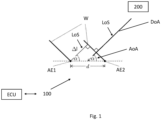
- the invention proposes a method for determining an angle of arrival (AoA) and/or a direction of arrival (DoA) of an electromagnetic wave W from a mobile device 200 at a receiving unit 100, in particular at a UWB receiver, which uses the Fig. 1 and 2 is explained.
- At least two receiving antennas AE1 and AE2 can be provided in the receiving unit 100 or in the UWB receiver.
- the angle of incidence AoA which is Fig. 1 also referred to as ⁇ , can be calculated from a phase difference (phase difference of arrival or PDoA for short) at the two receiving antennas AE1, AE2.
- the invention recognizes that if the receiving unit 100 or the UWB receiver is installed close to metal, e.g., close to a vehicle body, problems may arise in determining the phase difference PDoA or the angle of incidence AoA or the direction of arrival DoA.
- the nearby metal can result in signal paths that are only slightly longer than the first signal path (the "line of sight” or LoS for short) or the direct line of sight of the receiving unit 100 or the UWB receiver, i.e., the shortest signal path.
- Such signal paths can influence the determination of the phase difference PDoA for the shortest signal path or the first signal path LoS (i.e., the interesting or important signal path), which leads to incorrect results when determining the phase difference PDoA and thus negatively impacts the determination of the angle of incidence AoA or the direction of arrival DoA.
- a mobile device 200 e.g., a smartphone, is to be located in relation to the vehicle using the receiving unit 100 or the UWB receiver. It may happen that only a single UWB receiver receives signals from the mobile device 200. This can happen, for example, if other UWB receivers are covered and/or if the signal from the mobile device 200 is weak. In such a case, the UWB receiver can measure the distance to the mobile device 200.
- the phase difference PDoA of the signals at the two receiving antennas AE1, AE2 can be determined.
- the angle of incidence AoA or the direction of arrival DoA of the signals can then be determined from the phase difference PDoA. This function can be advantageous for vehicle access systems.
- phase difference PDoA can also be referred to as phase difference ⁇ and the angle of incidence AoA as angle ⁇ .
- the considered wavefront W arrives at the second receiving antenna AE2 at time t 0 and at the first receiving antenna AE1 at time ( t 0 + ⁇ l / c 0) with the path difference ⁇ l as in Fig. 1
- the center point M or the peak in the first signal path LoS of the signals is used to determine the phase difference PDoA.
- a determination of the phase difference at the first signal path of the signals can lead to incorrect results when determining the angle of incidence AoA or the direction of arrival DoA.
- CIR channel impulse response
- the proposed method enables an improved determination of the angle of arrival AoA and/or the direction of arrival DoA, which has improved accuracy, which enables improved access functions for vehicles, which increases customer comfort and increases trust in the access systems.
- phase difference PDoA is determined at such a point (or points) in the signal responses CIR which is (or are) located before (in terms of time) a respective midpoint M of a first signal path LoS in the signal responses CIR.
- the invention proposes that the phase difference PDoA in the signal response CIR is not calculated at the midpoint M of the first signal path LoS, but at an earlier (preferably as early as possible) point at which the signal response CIR exceeds, for example, a certain or specifically set threshold value S.
- the threshold value S can be determined in such a way that the point or points at which the phase difference PDoA is determined occur as early as possible in the signal responses CIR and are already above a noise level Noise.
- the threshold value S can be determined as a function of an absolute value Abs CIR of a signal response CIR.
- the threshold value S can be determined as a function of an absolute value Abs I of a real part I and/or as a function of an absolute value Abs Q of an imaginary part Q of a signal response CIR.
- the threshold value S can, for example, be determined in such a way that in the signal response CIR (e.g. absolute value Abs CIR of the signal response CIR, which has a real part I and an imaginary part Q and can be regarded as a complex number) a large number of values are waited for at least 2..5 ns before the detected center point M of the first signal path LoS, which are caused by noise.
- CIR e.g. absolute value Abs CIR of the signal response CIR, which has a real part I and an imaginary part Q and can be regarded as a complex number
- the threshold value S can, for example, be chosen so that it lies above the noise level Noise.
- a position or point of the signal response CIR can be considered at which the signal curve still runs up to the midpoint M of the first signal path CIR.
- the absolute value Abs CIR of the signal response CIR and/or the absolute value Abs I of the real part I and/or the absolute value Abs Q of the imaginary part Q of the signal response CIR can be considered as signals (see Fig. 2 ).
- the threshold value S is determined depending on two threshold values S1, S2.
- the threshold value S can be determined as a maximum value max (S1, S2) of two threshold values S1, S2.
- a first threshold value S1 can be determined as a function of a noise level Noise and a first factor F1, in particular greater than one.
- a second threshold value S2 can be determined depending on the first signal path LoS in the signal responses CIR and a second factor F2, in particular less than one.
- the first threshold value S1 can be a threshold that ensures that the signal response CIR is outside the noise Noise and that the first signal components of the first signal path become effective.
- a first factor F1 can be defined, which is significantly greater than 1, e.g., 5, by which the noise level Noise is multiplied. For example, a maximum value of numerous absolute values Abs CIR in the noise range can be selected to determine the noise level Noise.
- the second threshold S2 can be a threshold that represents a fraction of the mean value M or the pick Abs (CIR_Pick) of the first signal path of the signal curve.
- the final threshold S can be determined from the combination of two thresholds S1, S2.
- a possible phase offset can be taken into account, which may be caused, for example, by the antenna design.
- the receiving antennas AE1, AE2 detect and/or output a different first signal path LoS in the signal responses CIR, then the earlier first signal path LoS is preferably used to determine the threshold value S. This allows for a reliable determination despite any signal differences.
- the CIR signal responses are usually sampled at fixed sampling times, e.g., at 1 GHz, and thus raw values are obtained in the respective CIR signal response at time steps, e.g., every 1 ns, it can be advantageous to interpolate these raw values using a filter to form a smooth curve, e.g., with a tenth (or similar) of the actual sampling step size.
- a filter with the property that the sampling points in the interpolated signal remain unchanged is used.
- a location history of the mobile device 200 can be taken into account when determining the angle of incidence AoA and/or the direction of arrival DoA.
- the phase difference PDoA can be determined several times over a time window, and a result can be determined depending on the determined values, e.g. as an average value.
- a signal strength at the first signal path LoS and/or at the location (or locations) in the signal responses CIR used to determine the phase difference PDoA can be taken into account to refine the determination of the angle of arrival AoA and/or the direction of arrival DoA.
- the signal strength of the signal response CIR is greater at the receiving antenna AE1, AE2 that is closer to the mobile device 200.
- phase difference PDoA which are preferably selected using a machine learning method and/or which in particular originate from different receiving units 100.
- output additional information such as signal strengths, e.g., in conjunction with the calculated values for the phase difference PDoA, can be examined using machine learning methods in order to determine the best possible results from the available data. Training can take place both during development and in the field. In the field, for example, when the vehicle is sold and on the road, the angle of incidence AoA and/or the direction of arrival DoA can then be determined - at least whenever possible - using multilateration. In addition, only data material with a high level of reliability is used.
- results from different receiving units 100 can be taken into account to determine the angle of incidence AoA and/or the direction of arrival DoA.
- results of such a receiving unit 100 can be taken into account which have a high, advantageously the highest, reliability value C.
- the best value can be selected using a machine learning method.
- Calibration using the reliability value C can be performed in the field, preferably using self-learning. For example, whenever multiple UWB receivers are simultaneously accessible or when multiple UWB receivers can measure distances to the mobile device. Then, the actual location of the mobile device 200 relative to the vehicle can be determined using multilateration.
- the positions of the UWB receivers on the vehicle can also be taken into account in order to improve the results of determining the phase difference PDoA or the angle of incidence AoA.
- the invention relates to a corresponding computer program product, a corresponding control unit and a corresponding receiving unit 100, in particular a corresponding UWB receiver, for carrying out a corresponding method.
Landscapes
- Physics & Mathematics (AREA)
- Engineering & Computer Science (AREA)
- General Physics & Mathematics (AREA)
- Radar, Positioning & Navigation (AREA)
- Remote Sensing (AREA)
- Position Fixing By Use Of Radio Waves (AREA)
Priority Applications (2)
| Application Number | Priority Date | Filing Date | Title |
|---|---|---|---|
| CN202411571343.3A CN119439038A (zh) | 2023-11-07 | 2024-11-06 | 优化的入射角确定 |
| US18/939,588 US20250147139A1 (en) | 2023-11-07 | 2024-11-07 | OPTIMIZED ANGLE OF ARRIVAL (AoA) DETERMINATION |
Applications Claiming Priority (1)
| Application Number | Priority Date | Filing Date | Title |
|---|---|---|---|
| DE102023130758 | 2023-11-07 |
Publications (1)
| Publication Number | Publication Date |
|---|---|
| EP4553529A1 true EP4553529A1 (fr) | 2025-05-14 |
Family
ID=90366067
Family Applications (1)
| Application Number | Title | Priority Date | Filing Date |
|---|---|---|---|
| EP24163800.6A Pending EP4553529A1 (fr) | 2023-11-07 | 2024-03-15 | Détermination optimisée de l'angle d'arrivée (aoa) |
Country Status (1)
| Country | Link |
|---|---|
| EP (1) | EP4553529A1 (fr) |
Citations (3)
| Publication number | Priority date | Publication date | Assignee | Title |
|---|---|---|---|---|
| US20210373112A1 (en) * | 2020-05-26 | 2021-12-02 | Nxp B.V. | Compensating for crosstalk in determination of an angle of arrival of an electromagnetic wave at a receive antenna |
| US20220390541A1 (en) * | 2021-06-04 | 2022-12-08 | Apple Inc. | Techniques to disambiguate angle of arrival |
| US20220404451A1 (en) * | 2019-11-07 | 2022-12-22 | Fraunhofer-Gesellschaft zur Förderung der angewandten Forschung e.V. | Methods and Apparatuses for Positioning in a Wireless Communications Network |
-
2024
- 2024-03-15 EP EP24163800.6A patent/EP4553529A1/fr active Pending
Patent Citations (3)
| Publication number | Priority date | Publication date | Assignee | Title |
|---|---|---|---|---|
| US20220404451A1 (en) * | 2019-11-07 | 2022-12-22 | Fraunhofer-Gesellschaft zur Förderung der angewandten Forschung e.V. | Methods and Apparatuses for Positioning in a Wireless Communications Network |
| US20210373112A1 (en) * | 2020-05-26 | 2021-12-02 | Nxp B.V. | Compensating for crosstalk in determination of an angle of arrival of an electromagnetic wave at a receive antenna |
| US20220390541A1 (en) * | 2021-06-04 | 2022-12-08 | Apple Inc. | Techniques to disambiguate angle of arrival |
Similar Documents
| Publication | Publication Date | Title |
|---|---|---|
| DE102018132745B4 (de) | Fmcw radar mit störsignalunterdrückung im zeitbereich | |
| WO2002035255A2 (fr) | Procede de traitement de cible adaptatif dans un radar de bord automobile | |
| DE102008054228A1 (de) | Fahrzeugseitige Richtungserkennungsvorrichtung zur genauen Erkennung von Zielkörperrichtungen ungeachtet der Fahrgeschwindigkeit | |
| DE102012021240A1 (de) | Verfahren zum Unterdrücken einer Interferenz in einem Empfangssignal einesRadarsensors eines Kraftfahrzeugs und entsprechende Fahrerassistenzeinrichtung | |
| DE102012021212A1 (de) | Verfahren zur Detektion einer Interferenz in einem Empfangssignal eines Radarsensors, Fahrerassistenzeinrichtung und Kraftfahrzeug | |
| EP4196818B1 (fr) | Procédé et dispositif permettant de déterminer des perturbations de fréquence dans un signal reçu d'un système sar à canaux multiples actif | |
| DE102013203574A1 (de) | Verfahren zur Kompensation von Winkelmessfehlern | |
| DE102020107372A1 (de) | Verfahren zum Betreiben eines Radarsystems | |
| DE2738832C2 (de) | Schaltungsanordnung zur Verschiebung des Ciutterspektrums bei einem Radarempfänger | |
| DE19754220B4 (de) | Verfahren und Vorrichtung zur Erkennung einer bevorstehenden oder möglichen Kollision | |
| DE102013223701A1 (de) | Verfahren und eine Vorrichtung zur Messung einer Relativgeschwindigkeit mittels eines akustischen Sensors | |
| DE602005001113T2 (de) | Verfahren zur Abbildung einer Zielszene mittels Abtastradar | |
| DE3321263A1 (de) | Puls-doppler-radargeraet mit veraenderbarer pulsfolgefrequenz | |
| WO2007115650A1 (fr) | Procédé et dispositif de saisie d'un ou de plusieurs objets dans l'environnement d'un véhicule à moteur | |
| DE102016008390B3 (de) | Detektor für Chirp Impulse mit kurzer Latenzzeit und hoher zeitlicher Präzision | |
| EP0152523B1 (fr) | Procédé pour localiser des émetteurs de signaux avec suppression des interférences | |
| EP4553529A1 (fr) | Détermination optimisée de l'angle d'arrivée (aoa) | |
| DE2733651C3 (de) | Schaltung zur Verbesserung des Auflösungsvermögens einer Impulskompressions-Radaranlage | |
| DE3028225C1 (de) | Radarempfaenger | |
| DE69818054T2 (de) | Verfahren zur mehrdeutigkeitsauflösung der entfernungsmessungen eines radars | |
| EP2589977A1 (fr) | Procédé et dispositif de correction d'une erreur de relèvement systématique | |
| EP2480907B1 (fr) | Procédé et dispositif de localisation de cibles émettant un rayonnement | |
| EP0789252B1 (fr) | Procédé de supression de brouillage dans un radar Doppler d'impulsion | |
| DE4231311C2 (de) | Verfahren zum Bestimmen der Impulsantwort eines Übertragungskanals mit expandierten Impulsen und Einrichtung zur Durchführung dieses Verfahrens | |
| DE102011051969B4 (de) | Radargerät und Verfahren zum Betreiben des Radargerätes |
Legal Events
| Date | Code | Title | Description |
|---|---|---|---|
| PUAI | Public reference made under article 153(3) epc to a published international application that has entered the european phase |
Free format text: ORIGINAL CODE: 0009012 |
|
| STAA | Information on the status of an ep patent application or granted ep patent |
Free format text: STATUS: THE APPLICATION HAS BEEN PUBLISHED |
|
| AK | Designated contracting states |
Kind code of ref document: A1 Designated state(s): AL AT BE BG CH CY CZ DE DK EE ES FI FR GB GR HR HU IE IS IT LI LT LU LV MC ME MK MT NL NO PL PT RO RS SE SI SK SM TR |
|
| STAA | Information on the status of an ep patent application or granted ep patent |
Free format text: STATUS: REQUEST FOR EXAMINATION WAS MADE |
|
| 17P | Request for examination filed |
Effective date: 20250603 |
|
| RAP3 | Party data changed (applicant data changed or rights of an application transferred) |
Owner name: HELLA GMBH & CO. KGAA |