EP4553930A2 - Empilement d'électrodes/séparateur pour un élément de batterie ainsi que procédé de fabrication d'un tel empilement d'électrodes/séparateur - Google Patents
Empilement d'électrodes/séparateur pour un élément de batterie ainsi que procédé de fabrication d'un tel empilement d'électrodes/séparateur Download PDFInfo
- Publication number
- EP4553930A2 EP4553930A2 EP24201507.1A EP24201507A EP4553930A2 EP 4553930 A2 EP4553930 A2 EP 4553930A2 EP 24201507 A EP24201507 A EP 24201507A EP 4553930 A2 EP4553930 A2 EP 4553930A2
- Authority
- EP
- European Patent Office
- Prior art keywords
- electrode
- separator
- laminated composite
- edge
- protection film
- Prior art date
- Legal status (The legal status is an assumption and is not a legal conclusion. Google has not performed a legal analysis and makes no representation as to the accuracy of the status listed.)
- Pending
Links
Images


Classifications
-
- H—ELECTRICITY
- H01—ELECTRIC ELEMENTS
- H01M—PROCESSES OR MEANS, e.g. BATTERIES, FOR THE DIRECT CONVERSION OF CHEMICAL ENERGY INTO ELECTRICAL ENERGY
- H01M50/00—Constructional details or processes of manufacture of the non-active parts of electrochemical cells other than fuel cells, e.g. hybrid cells
- H01M50/40—Separators; Membranes; Diaphragms; Spacing elements inside cells
- H01M50/471—Spacing elements inside cells other than separators, membranes or diaphragms; Manufacturing processes thereof
- H01M50/474—Spacing elements inside cells other than separators, membranes or diaphragms; Manufacturing processes thereof characterised by their position inside the cells
-
- H—ELECTRICITY
- H01—ELECTRIC ELEMENTS
- H01M—PROCESSES OR MEANS, e.g. BATTERIES, FOR THE DIRECT CONVERSION OF CHEMICAL ENERGY INTO ELECTRICAL ENERGY
- H01M10/00—Secondary cells; Manufacture thereof
- H01M10/42—Methods or arrangements for servicing or maintenance of secondary cells or secondary half-cells
- H01M10/4235—Safety or regulating additives or arrangements in electrodes, separators or electrolyte
-
- H—ELECTRICITY
- H01—ELECTRIC ELEMENTS
- H01M—PROCESSES OR MEANS, e.g. BATTERIES, FOR THE DIRECT CONVERSION OF CHEMICAL ENERGY INTO ELECTRICAL ENERGY
- H01M10/00—Secondary cells; Manufacture thereof
- H01M10/04—Construction or manufacture in general
-
- H—ELECTRICITY
- H01—ELECTRIC ELEMENTS
- H01M—PROCESSES OR MEANS, e.g. BATTERIES, FOR THE DIRECT CONVERSION OF CHEMICAL ENERGY INTO ELECTRICAL ENERGY
- H01M10/00—Secondary cells; Manufacture thereof
- H01M10/04—Construction or manufacture in general
- H01M10/0413—Large-sized flat cells or batteries for motive or stationary systems with plate-like electrodes
-
- H—ELECTRICITY
- H01—ELECTRIC ELEMENTS
- H01M—PROCESSES OR MEANS, e.g. BATTERIES, FOR THE DIRECT CONVERSION OF CHEMICAL ENERGY INTO ELECTRICAL ENERGY
- H01M10/00—Secondary cells; Manufacture thereof
- H01M10/04—Construction or manufacture in general
- H01M10/0436—Small-sized flat cells or batteries for portable equipment
-
- H—ELECTRICITY
- H01—ELECTRIC ELEMENTS
- H01M—PROCESSES OR MEANS, e.g. BATTERIES, FOR THE DIRECT CONVERSION OF CHEMICAL ENERGY INTO ELECTRICAL ENERGY
- H01M10/00—Secondary cells; Manufacture thereof
- H01M10/05—Accumulators with non-aqueous electrolyte
- H01M10/052—Li-accumulators
-
- H—ELECTRICITY
- H01—ELECTRIC ELEMENTS
- H01M—PROCESSES OR MEANS, e.g. BATTERIES, FOR THE DIRECT CONVERSION OF CHEMICAL ENERGY INTO ELECTRICAL ENERGY
- H01M10/00—Secondary cells; Manufacture thereof
- H01M10/05—Accumulators with non-aqueous electrolyte
- H01M10/058—Construction or manufacture
- H01M10/0585—Construction or manufacture of accumulators having only flat construction elements, i.e. flat positive electrodes, flat negative electrodes and flat separators
-
- H—ELECTRICITY
- H01—ELECTRIC ELEMENTS
- H01M—PROCESSES OR MEANS, e.g. BATTERIES, FOR THE DIRECT CONVERSION OF CHEMICAL ENERGY INTO ELECTRICAL ENERGY
- H01M4/00—Electrodes
- H01M4/02—Electrodes composed of, or comprising, active material
- H01M4/62—Selection of inactive substances as ingredients for active masses, e.g. binders, fillers
- H01M4/621—Binders
- H01M4/622—Binders being polymers
- H01M4/623—Binders being polymers fluorinated polymers
-
- H—ELECTRICITY
- H01—ELECTRIC ELEMENTS
- H01M—PROCESSES OR MEANS, e.g. BATTERIES, FOR THE DIRECT CONVERSION OF CHEMICAL ENERGY INTO ELECTRICAL ENERGY
- H01M4/00—Electrodes
- H01M4/02—Electrodes composed of, or comprising, active material
- H01M4/64—Carriers or collectors
- H01M4/66—Selection of materials
- H01M4/665—Composites
- H01M4/667—Composites in the form of layers, e.g. coatings
-
- H—ELECTRICITY
- H01—ELECTRIC ELEMENTS
- H01M—PROCESSES OR MEANS, e.g. BATTERIES, FOR THE DIRECT CONVERSION OF CHEMICAL ENERGY INTO ELECTRICAL ENERGY
- H01M4/00—Electrodes
- H01M4/02—Electrodes composed of, or comprising, active material
- H01M4/64—Carriers or collectors
- H01M4/70—Carriers or collectors characterised by shape or form
-
- H—ELECTRICITY
- H01—ELECTRIC ELEMENTS
- H01M—PROCESSES OR MEANS, e.g. BATTERIES, FOR THE DIRECT CONVERSION OF CHEMICAL ENERGY INTO ELECTRICAL ENERGY
- H01M50/00—Constructional details or processes of manufacture of the non-active parts of electrochemical cells other than fuel cells, e.g. hybrid cells
- H01M50/40—Separators; Membranes; Diaphragms; Spacing elements inside cells
- H01M50/46—Separators, membranes or diaphragms characterised by their combination with electrodes
-
- H—ELECTRICITY
- H01—ELECTRIC ELEMENTS
- H01M—PROCESSES OR MEANS, e.g. BATTERIES, FOR THE DIRECT CONVERSION OF CHEMICAL ENERGY INTO ELECTRICAL ENERGY
- H01M50/00—Constructional details or processes of manufacture of the non-active parts of electrochemical cells other than fuel cells, e.g. hybrid cells
- H01M50/40—Separators; Membranes; Diaphragms; Spacing elements inside cells
- H01M50/46—Separators, membranes or diaphragms characterised by their combination with electrodes
- H01M50/461—Separators, membranes or diaphragms characterised by their combination with electrodes with adhesive layers between electrodes and separators
-
- H—ELECTRICITY
- H01—ELECTRIC ELEMENTS
- H01M—PROCESSES OR MEANS, e.g. BATTERIES, FOR THE DIRECT CONVERSION OF CHEMICAL ENERGY INTO ELECTRICAL ENERGY
- H01M50/00—Constructional details or processes of manufacture of the non-active parts of electrochemical cells other than fuel cells, e.g. hybrid cells
- H01M50/40—Separators; Membranes; Diaphragms; Spacing elements inside cells
- H01M50/471—Spacing elements inside cells other than separators, membranes or diaphragms; Manufacturing processes thereof
- H01M50/477—Spacing elements inside cells other than separators, membranes or diaphragms; Manufacturing processes thereof characterised by their shape
-
- H—ELECTRICITY
- H01—ELECTRIC ELEMENTS
- H01M—PROCESSES OR MEANS, e.g. BATTERIES, FOR THE DIRECT CONVERSION OF CHEMICAL ENERGY INTO ELECTRICAL ENERGY
- H01M50/00—Constructional details or processes of manufacture of the non-active parts of electrochemical cells other than fuel cells, e.g. hybrid cells
- H01M50/40—Separators; Membranes; Diaphragms; Spacing elements inside cells
- H01M50/471—Spacing elements inside cells other than separators, membranes or diaphragms; Manufacturing processes thereof
- H01M50/48—Spacing elements inside cells other than separators, membranes or diaphragms; Manufacturing processes thereof characterised by the material
- H01M50/486—Organic material
-
- H—ELECTRICITY
- H01—ELECTRIC ELEMENTS
- H01M—PROCESSES OR MEANS, e.g. BATTERIES, FOR THE DIRECT CONVERSION OF CHEMICAL ENERGY INTO ELECTRICAL ENERGY
- H01M10/00—Secondary cells; Manufacture thereof
- H01M10/04—Construction or manufacture in general
- H01M10/0404—Machines for assembling batteries
-
- Y—GENERAL TAGGING OF NEW TECHNOLOGICAL DEVELOPMENTS; GENERAL TAGGING OF CROSS-SECTIONAL TECHNOLOGIES SPANNING OVER SEVERAL SECTIONS OF THE IPC; TECHNICAL SUBJECTS COVERED BY FORMER USPC CROSS-REFERENCE ART COLLECTIONS [XRACs] AND DIGESTS
- Y02—TECHNOLOGIES OR APPLICATIONS FOR MITIGATION OR ADAPTATION AGAINST CLIMATE CHANGE
- Y02E—REDUCTION OF GREENHOUSE GAS [GHG] EMISSIONS, RELATED TO ENERGY GENERATION, TRANSMISSION OR DISTRIBUTION
- Y02E60/00—Enabling technologies; Technologies with a potential or indirect contribution to GHG emissions mitigation
- Y02E60/10—Energy storage using batteries
-
- Y—GENERAL TAGGING OF NEW TECHNOLOGICAL DEVELOPMENTS; GENERAL TAGGING OF CROSS-SECTIONAL TECHNOLOGIES SPANNING OVER SEVERAL SECTIONS OF THE IPC; TECHNICAL SUBJECTS COVERED BY FORMER USPC CROSS-REFERENCE ART COLLECTIONS [XRACs] AND DIGESTS
- Y02—TECHNOLOGIES OR APPLICATIONS FOR MITIGATION OR ADAPTATION AGAINST CLIMATE CHANGE
- Y02P—CLIMATE CHANGE MITIGATION TECHNOLOGIES IN THE PRODUCTION OR PROCESSING OF GOODS
- Y02P70/00—Climate change mitigation technologies in the production process for final industrial or consumer products
- Y02P70/50—Manufacturing or production processes characterised by the final manufactured product
Definitions
- the invention relates to an electrode/separator stack for a battery cell according to the preamble of claim 1 and to a method for producing such an electrode/separator stack according to the preamble of claim 10.
- Such an electrode/separator stack can be manufactured by single-sheet stacking.
- single-sheet stacking the placement accuracy of the electrode and separator sheets in the electrode/separator stack is of great importance for the safety and performance of the battery cell.
- the electrochemical performance of the battery cell decreases more quickly with less electrode coverage during operation.
- incorrect sheet placement can lead to direct contact between the anode and cathode, which can trigger a short circuit and battery cell failure.
- the anode in the electrode/separator stack can, for example, be larger all around (e.g., 1.5 mm) than the cathode, and the separator can be larger than the anode by an allowance (e.g., 1.5 mm).
- the aforementioned single-sheet stacking is carried out using complex handling equipment. These receive their coordinates based on image processing, in which the position of each deposited electrode/separator sheet is optically recorded and evaluated after each sheet deposit to determine the depositing accuracy.
- a battery cell which has an inner element having a first main surface, a second main surface, a first side surface, a second side surface, a first end surface, and a second end surface. Furthermore, a first inner electrode extending to the first end surface, a second electrode extending to the second end surface, a separator layer arranged between the first and second electrodes, and an electrolytic solution are provided. Furthermore, the first electrode is arranged on the first end surface and the second electrode is arranged on the second end surface. The first electrode, the second electrode, and the separator layer are joined together to form a one-piece composite.
- An electrode stack is known that is provided with an electrically insulating coating on at least one sheet edge. This coating is applied from the liquid phase and extends over the entire height of the electrode stack.
- JP 5375263 B2 A manufacturing method and apparatus for a high-performance battery is known in which a plurality of laminates consisting of an electrode and a separator are formed.
- the object of the invention is to provide an electrode/separator stack and a method for producing such an electrode/separator stack, in which the stacking process can be carried out in a simpler manufacturing process and with greater deposition accuracy compared to the prior art.
- the invention is based on an electrode/separator stack for a battery cell, which is composed of at least one electrode, in particular a cathode, and a counter electrode, in particular anode.
- the electrode is a component of a laminated composite in which a separator is laminated to each side of the electrode.
- the two separators project beyond the electrode at the edge with a projection.
- an edge gap between the two separator projections is preferably completely filled with an edge protection film.
- the edge protection film can have the same material thickness as the electrode, viewed in the thickness direction of the laminated composite. In this way, the corners and edges of the electrode are protected from external mechanical stresses by means of the edge protection film.
- the edge protection film can be is carried out, provide a dimensionally stable contact surface that enables damage-free transverse displacement of the electrode in the electrode/separator stack. Furthermore, the edge protection film acts as electrical insulation, which helps increase the electrical safety of the battery cell.
- the electrode/separator stack according to the invention can be manufactured in the manner of a single-sheet stacking, in which the laminated composite and the counter electrode are stacked on top of each other as individual sheets.
- each of the separators can have an adhesion layer, which allows the separators to be laminated to the electrode in a lamination process, forming the laminated composite.
- the two separators and the intermediate electrode are already joined together to form a single unit before the stacking process, thereby increasing the stacking accuracy in the electrode/separator stack compared to an electrode/separator stack in which the electrodes are stacked as individual sheets.
- the electrode and/or the counter electrode are constructed from a substrate film. This is coated on one or both sides with an electrode active material.
- the active material comprises a binder, in particular a polymer binder, preferably PVDF.
- a binder in particular a polymer binder, preferably PVDF.
- both the active material binder and the edge protection film, and, if applicable, also the adhesion layer are made of the same material. This means that both the adhesion layer and the edge protection film have the same material structure as the active material binder. This ensures the resistance of the edge protection film to the electrolyte. Furthermore, it is guaranteed that the material pairing between the edge protection film and the active material binder is electrochemically stable or resistant.
- the laminated composite consisting of the two separators and the intermediate electrode, can be provided as a rectangular, flat blank.
- the substrate film of the electrode can be extended laterally outwards beyond the separator edges with a conductor tab.
- the edge-side gap filled with the edge protection film can run continuously at least along the blank side facing away from the conductor tab side and along the two blank sides of the laminated composite that are perpendicular to the conductor tab side.
- No edge protection film is provided on the conductor tab side itself so that the conductor tab from This prevents thickening (caused by the edge protection film) at the level of the conductor lug, which would then become noticeable later. It is therefore advantageous if the edge protection film is only present on three of the four sides of the cut to prevent any thickening.
- the counterelectrode can preferably be dimensioned larger than the electrode by a certain amount, for example, 1 to 3 mm.
- the counterelectrode and the separators can preferably be manufactured as congruent sheet blanks. This means that the counterelectrode—with the exception of its conductor lug—has the same area and contour as the separator, so that the corners and edges of the counterelectrode can be aligned in the stacking direction with the corners and edges of the separators.
- a method for manufacturing the electrode/separator stack can be divided into a stacking process and a subsequent alignment process.
- the laminated composite consisting of separators and electrode, as well as the counterelectrode, are stacked one on top of the other in the manner of a single-sheet stack.
- the laminated composite and the counterelectrode can be aligned in the stacking direction. Due to the provision of the edge protection film according to the invention, the laminated composite is dimensionally stable, whereby a damage-free position correction of the laminated composite transverse to the stacking direction can be carried out.
- Such a dimensionally stable laminated composite also offers the adjacent counterelectrode a stable counterhold or support base, whereby a position correction of the counterelectrode can be carried out without damage.
- at least one transverse stop in particular a slide, can be used in the alignment process.
- the cross stop can be used to correct the position of a stack component that is offset transversely to the stacking direction, i.e. the laminated composite or the counter electrode, i.e. to align it in alignment with the other stack components.
- the edge protection film can be applied to the laminated composite in any suitable manner.
- the edge protection film can be applied to the laminated composite in a coating process in which a viscous starting component of the edge protection film is applied directly into the edge gap of the laminated composite.
- the edge protection film can also be applied as separate component, i.e. as a solid phase material (e.g. foil, adhesive film).
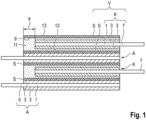
- FIG. 1 A finished electrode/separator stack for a battery cell is shown. This comprises, in the stacking direction, an anode A, a cathode K, and another anode A and a cathode K, each with separators S arranged between them.
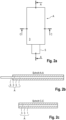
- the anode A is in the Figures 2a to 2c Each is indicated individually. Accordingly, the anode A is a rectangular sheet consisting of a substrate foil 1. This is coated on both sides with active material 3. The substrate foil 1 is extended outward on one rectangular side by an anode conductor lug 5.
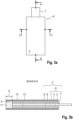
- the cathode K is according to the Figures 3a to 3c also a rectangular sheet blank, which is constructed from a substrate foil 1 coated on both sides with active material 3.
- the substrate foil 1 of the cathode K is extended on one rectangular side with a cathode conductor lug 7.
- the cathode K is according to the Figures 3a to 3c Before performing a stacking process, the cathode K is not provided as a single sheet. Rather, the cathode K, together with the separators S, is part of a laminated composite V, in which the separators S are laminated to the cathode K on both sides under pressure and heat.
- the anode A is dimensioned larger than the cathode K by a circumferential allowance a of, for example, 1 to 3 mm. This allows an overlap of the anode A and the cathode K despite deposition inaccuracies.
- the separators S and the anode A are realized as congruent sheet blanks; this means that the separators S and the anode A have the same area and the same contour with the exception of the anode conductor lug 5, so that in the electrode/separator stack ( Figure 1 ) the corners and edges of the anodes A are aligned in the stacking direction with the corners and edges of the separators S.
- the two separators S project beyond the cathode K by a projection identical to the allowance a. This creates an edge gap 9 that is delimited by the separator projections a and the cathode K.
- the edge gap 9 is completely filled with an edge protection film 11. This has the same material thickness as the cathode K, viewed in the thickness direction of the laminated composite V.
- the two separators S are each formed with an adhesion layer 13, with the aid of which the separators S are laminated to the cathode K in a lamination process under pressure and heat, resulting in the laminated composite V.
- the edge protection film 11 provides mechanical protection for the corners and edges of the laminated composite V. Furthermore, the edge protection film 11 acts as an electrical insulator, preventing direct contact between the anode A and the cathode K. Furthermore, the edge protection film 11 increases the dimensional stability of the laminated composite V at its corners and edges.
- the edge protection film 11 is made of a polymer material. To avoid an unfavorable material pairing between the active material binder, i.e., PVDF, and the edge protection film 11, the edge protection film 11 is also made of PVDF. This also ensures chemical resistance to the electrolyte in the battery cell. It should be emphasized that the invention is not limited to an edge protection film 11 made of PVDF; rather, the edge protection film 11 can also be made of other suitable materials instead of PVDF.
- the electrode/separator stack ( Figure 1 ) is carried out in a stacking process and a subsequent alignment process ( Figures 4 and 5 ).
- the stacking process the laminated composite V and the anode A are stacked alternately on top of each other.
- the alignment process ( Figures 4 and 5 ) a position correction, in which the stack components, i.e. the laminated composite V and the anode A, can be aligned with the other stack components using a slider 15.
- the alignment can also be achieved via gravity and thus be self-centering.
- the alignment function can also be accomplished using a vibrating plate with fixed stops.
- the alignment force F acting on the electrode/separator stack transversely to the stacking direction by means of the slider 15 can, if necessary, also be applied under the effect of gravity.
- stacking accuracy can be achieved independently of image processing and handling devices.
- Stacking accuracy is raised to a high level using cost-effective technology (i.e., slider 15).
- stacking accuracy can be adjusted after the stacking process, i.e., during the alignment process.
Landscapes
- Chemical & Material Sciences (AREA)
- Chemical Kinetics & Catalysis (AREA)
- Electrochemistry (AREA)
- General Chemical & Material Sciences (AREA)
- Engineering & Computer Science (AREA)
- Manufacturing & Machinery (AREA)
- Composite Materials (AREA)
- Materials Engineering (AREA)
- Secondary Cells (AREA)
- Cell Separators (AREA)
- Connection Of Batteries Or Terminals (AREA)
- Battery Electrode And Active Subsutance (AREA)
Applications Claiming Priority (1)
| Application Number | Priority Date | Filing Date | Title |
|---|---|---|---|
| DE102023211038.5A DE102023211038A1 (de) | 2023-11-08 | 2023-11-08 | Elektroden-/Separatorstapel für eine Batteriezelle sowie Verfahren zur Herstellung eines solchen Elektroden-/Separatorstapels |
Publications (2)
| Publication Number | Publication Date |
|---|---|
| EP4553930A2 true EP4553930A2 (fr) | 2025-05-14 |
| EP4553930A3 EP4553930A3 (fr) | 2025-06-25 |
Family
ID=92894693
Family Applications (1)
| Application Number | Title | Priority Date | Filing Date |
|---|---|---|---|
| EP24201507.1A Pending EP4553930A3 (fr) | 2023-11-08 | 2024-09-20 | Empilement d'électrodes/séparateur pour un élément de batterie ainsi que procédé de fabrication d'un tel empilement d'électrodes/séparateur |
Country Status (6)
| Country | Link |
|---|---|
| US (1) | US20250149611A1 (fr) |
| EP (1) | EP4553930A3 (fr) |
| KR (1) | KR20250067705A (fr) |
| CN (1) | CN120016094A (fr) |
| CA (1) | CA3251993A1 (fr) |
| DE (1) | DE102023211038A1 (fr) |
Citations (3)
| Publication number | Priority date | Publication date | Assignee | Title |
|---|---|---|---|---|
| JP5375263B2 (ja) | 2009-03-30 | 2013-12-25 | 日産自動車株式会社 | 電池の製造方法および製造装置 |
| DE102016217397A1 (de) | 2016-09-13 | 2018-03-15 | Robert Bosch Gmbh | Elektrodenstapel mit Randbeschichtung |
| US20220148821A1 (en) | 2019-08-06 | 2022-05-12 | Murata Manufacturing Co., Ltd. | Electricity storage device |
Family Cites Families (4)
| Publication number | Priority date | Publication date | Assignee | Title |
|---|---|---|---|---|
| JPS5762371U (fr) * | 1980-09-30 | 1982-04-13 | ||
| KR101168651B1 (ko) * | 2010-06-21 | 2012-07-26 | 주식회사 루트제이드 | 포케팅 전극체, 이를 포함하는 전극 조립체 및 이를 이용한 리튬 이차전지 |
| EP2988356A1 (fr) * | 2014-08-18 | 2016-02-24 | Manz AG | Procédé et dispositif de fabrication d'un élément galvanique et élément galvanique |
| JP2018152236A (ja) * | 2017-03-13 | 2018-09-27 | リチウム エナジー アンド パワー ゲゼルシャフト ミット ベシュレンクテル ハフッング ウント コンパニー コマンディトゲゼルシャフトLithium Energy and Power GmbH & Co. KG | 袋詰正極板、積層電極体及び蓄電素子 |
-
2023
- 2023-11-08 DE DE102023211038.5A patent/DE102023211038A1/de active Pending
-
2024
- 2024-09-20 EP EP24201507.1A patent/EP4553930A3/fr active Pending
- 2024-10-17 KR KR1020240142286A patent/KR20250067705A/ko active Pending
- 2024-11-04 CA CA3251993A patent/CA3251993A1/fr active Pending
- 2024-11-05 CN CN202411565878.XA patent/CN120016094A/zh active Pending
- 2024-11-08 US US18/940,892 patent/US20250149611A1/en active Pending
Patent Citations (3)
| Publication number | Priority date | Publication date | Assignee | Title |
|---|---|---|---|---|
| JP5375263B2 (ja) | 2009-03-30 | 2013-12-25 | 日産自動車株式会社 | 電池の製造方法および製造装置 |
| DE102016217397A1 (de) | 2016-09-13 | 2018-03-15 | Robert Bosch Gmbh | Elektrodenstapel mit Randbeschichtung |
| US20220148821A1 (en) | 2019-08-06 | 2022-05-12 | Murata Manufacturing Co., Ltd. | Electricity storage device |
Also Published As
| Publication number | Publication date |
|---|---|
| CN120016094A (zh) | 2025-05-16 |
| KR20250067705A (ko) | 2025-05-15 |
| DE102023211038A1 (de) | 2025-05-08 |
| CA3251993A1 (fr) | 2025-10-30 |
| US20250149611A1 (en) | 2025-05-08 |
| JP2025078617A (ja) | 2025-05-20 |
| EP4553930A3 (fr) | 2025-06-25 |
Similar Documents
| Publication | Publication Date | Title |
|---|---|---|
| EP3069404B1 (fr) | Ensemble d'électrodes, procédé pour sa fabrication et pile électrochimique | |
| EP2705556B1 (fr) | Procédé et dispositif de fabrication d'enroulements d'électrode | |
| DE112015000370T5 (de) | Elektrochemischer Mehrzellenspeicher und Verfahren dafür | |
| EP3878030B1 (fr) | Méthode de production d'un dispositif de cathode, méthode de production d'une cathode composite et batterie | |
| WO2022106235A1 (fr) | Procédé de fabrication d'un ensemble membrane-électrode et ensemble membrane-électrode pour une pile à combustible | |
| EP3300141B1 (fr) | Procédé de fabrication d'un empilement d' électrodes pour une batterie et batterie | |
| DE112019005977B4 (de) | Festkörperbatterie | |
| DE102012005229B4 (de) | Verfahren zum Herstellen einer Batteriezelle und Batteriezelle | |
| DE102018106953A1 (de) | Stapelbatterie | |
| EP2988356A1 (fr) | Procédé et dispositif de fabrication d'un élément galvanique et élément galvanique | |
| DE102023211038A1 (de) | Elektroden-/Separatorstapel für eine Batteriezelle sowie Verfahren zur Herstellung eines solchen Elektroden-/Separatorstapels | |
| DE102016215666A1 (de) | Elektrodenanordnung für Lithium-basierte galvanische Zellen und Verfahren zu deren Herstellung | |
| WO2024046830A1 (fr) | Empilement de piles pour un élément de batterie | |
| EP3930037B1 (fr) | Dispositif de stockage d énergie et procédé de fabrication d'un dispositif de stockage d énergie | |
| DE102019206124A1 (de) | Verfahren und Vorrichtung zur Herstellung von Elektroden für eine Lithium-Ionen-Batterie | |
| EP3573154A1 (fr) | Procédé de fabrication d'un empilement d'électrodes pour une unité d'accumulateur d'énergie électrique ainsi que dispositif de transport correspondant | |
| EP1240653A1 (fr) | Procede pour produire une structure multicouche reguliere notamment pour des condensateurs electriques a double couche, et dispositif correspondant | |
| WO2012079705A1 (fr) | Procédé et système de fabrication d'objets en forme de feuille ou de plaque | |
| EP4423834A1 (fr) | Procédé et machine de fabrication d'empilement de cellules de l'industrie de production de cellules énergétiques | |
| EP4393021A1 (fr) | Procédé de fabrication d'un empilement de feuilles d'électrode, et dispositif de coupe, élément d'espacement et dispositif de coupe transversale pour celui-ci | |
| WO2021136622A1 (fr) | Film pour système de film, système de film mea avec système de film, empilement de piles à combustible avec système de film mea et procédé de production d'un système de film mea | |
| DE102020116945B4 (de) | Energiespeicher und Verfahren zur Herstellung eines Energiespeichers | |
| DE102020116946A1 (de) | Energiespeicher und Verfahren zur Herstellung eines Energiespeichers | |
| DE102016213135A1 (de) | Verfahren und Montagesystem zur Herstellung von Elektrodenstapeln | |
| DE102020114893A1 (de) | Elektrochemische Zelle und elektrochemisches System |
Legal Events
| Date | Code | Title | Description |
|---|---|---|---|
| PUAI | Public reference made under article 153(3) epc to a published international application that has entered the european phase |
Free format text: ORIGINAL CODE: 0009012 |
|
| STAA | Information on the status of an ep patent application or granted ep patent |
Free format text: STATUS: THE APPLICATION HAS BEEN PUBLISHED |
|
| AK | Designated contracting states |
Kind code of ref document: A2 Designated state(s): AL AT BE BG CH CY CZ DE DK EE ES FI FR GB GR HR HU IE IS IT LI LT LU LV MC ME MK MT NL NO PL PT RO RS SE SI SK SM TR |
|
| PUAL | Search report despatched |
Free format text: ORIGINAL CODE: 0009013 |
|
| AK | Designated contracting states |
Kind code of ref document: A3 Designated state(s): AL AT BE BG CH CY CZ DE DK EE ES FI FR GB GR HR HU IE IS IT LI LT LU LV MC ME MK MT NL NO PL PT RO RS SE SI SK SM TR |
|
| RIC1 | Information provided on ipc code assigned before grant |
Ipc: H01M 10/0585 20100101ALN20250522BHEP Ipc: H01M 50/486 20210101ALI20250522BHEP Ipc: H01M 50/477 20210101ALI20250522BHEP Ipc: H01M 50/474 20210101ALI20250522BHEP Ipc: H01M 50/46 20210101ALI20250522BHEP Ipc: H01M 10/04 20060101ALI20250522BHEP Ipc: H01M 4/62 20060101AFI20250522BHEP |
|
| STAA | Information on the status of an ep patent application or granted ep patent |
Free format text: STATUS: REQUEST FOR EXAMINATION WAS MADE |
|
| 17P | Request for examination filed |
Effective date: 20251104 |