EP4554105A1 - Procédé de transmission de livre de codes, appareil et support de stockage - Google Patents
Procédé de transmission de livre de codes, appareil et support de stockage Download PDFInfo
- Publication number
- EP4554105A1 EP4554105A1 EP23834628.2A EP23834628A EP4554105A1 EP 4554105 A1 EP4554105 A1 EP 4554105A1 EP 23834628 A EP23834628 A EP 23834628A EP 4554105 A1 EP4554105 A1 EP 4554105A1
- Authority
- EP
- European Patent Office
- Prior art keywords
- codeword
- identifier
- network device
- terminal
- indicator
- Prior art date
- Legal status (The legal status is an assumption and is not a legal conclusion. Google has not performed a legal analysis and makes no representation as to the accuracy of the status listed.)
- Pending
Links
Images


Classifications
-
- H—ELECTRICITY
- H04—ELECTRIC COMMUNICATION TECHNIQUE
- H04B—TRANSMISSION
- H04B7/00—Radio transmission systems, i.e. using radiation field
- H04B7/02—Diversity systems; Multi-antenna system, i.e. transmission or reception using multiple antennas
- H04B7/04—Diversity systems; Multi-antenna system, i.e. transmission or reception using multiple antennas using two or more spaced independent antennas
- H04B7/06—Diversity systems; Multi-antenna system, i.e. transmission or reception using multiple antennas using two or more spaced independent antennas at the transmitting station
-
- H—ELECTRICITY
- H04—ELECTRIC COMMUNICATION TECHNIQUE
- H04B—TRANSMISSION
- H04B7/00—Radio transmission systems, i.e. using radiation field
- H04B7/02—Diversity systems; Multi-antenna system, i.e. transmission or reception using multiple antennas
- H04B7/04—Diversity systems; Multi-antenna system, i.e. transmission or reception using multiple antennas using two or more spaced independent antennas
- H04B7/04013—Intelligent reflective surfaces
- H04B7/04026—Intelligent reflective surfaces with codebook-based beamforming
-
- H—ELECTRICITY
- H04—ELECTRIC COMMUNICATION TECHNIQUE
- H04B—TRANSMISSION
- H04B17/00—Monitoring; Testing
- H04B17/30—Monitoring; Testing of propagation channels
- H04B17/309—Measuring or estimating channel quality parameters
-
- H—ELECTRICITY
- H04—ELECTRIC COMMUNICATION TECHNIQUE
- H04B—TRANSMISSION
- H04B7/00—Radio transmission systems, i.e. using radiation field
- H04B7/02—Diversity systems; Multi-antenna system, i.e. transmission or reception using multiple antennas
- H04B7/04—Diversity systems; Multi-antenna system, i.e. transmission or reception using multiple antennas using two or more spaced independent antennas
- H04B7/04013—Intelligent reflective surfaces
-
- H—ELECTRICITY
- H04—ELECTRIC COMMUNICATION TECHNIQUE
- H04B—TRANSMISSION
- H04B7/00—Radio transmission systems, i.e. using radiation field
- H04B7/02—Diversity systems; Multi-antenna system, i.e. transmission or reception using multiple antennas
- H04B7/04—Diversity systems; Multi-antenna system, i.e. transmission or reception using multiple antennas using two or more spaced independent antennas
- H04B7/06—Diversity systems; Multi-antenna system, i.e. transmission or reception using multiple antennas using two or more spaced independent antennas at the transmitting station
- H04B7/0613—Diversity systems; Multi-antenna system, i.e. transmission or reception using multiple antennas using two or more spaced independent antennas at the transmitting station using simultaneous transmission
- H04B7/0615—Diversity systems; Multi-antenna system, i.e. transmission or reception using multiple antennas using two or more spaced independent antennas at the transmitting station using simultaneous transmission of weighted versions of same signal
- H04B7/0617—Diversity systems; Multi-antenna system, i.e. transmission or reception using multiple antennas using two or more spaced independent antennas at the transmitting station using simultaneous transmission of weighted versions of same signal for beam forming
-
- H—ELECTRICITY
- H04—ELECTRIC COMMUNICATION TECHNIQUE
- H04B—TRANSMISSION
- H04B7/00—Radio transmission systems, i.e. using radiation field
- H04B7/02—Diversity systems; Multi-antenna system, i.e. transmission or reception using multiple antennas
- H04B7/04—Diversity systems; Multi-antenna system, i.e. transmission or reception using multiple antennas using two or more spaced independent antennas
- H04B7/06—Diversity systems; Multi-antenna system, i.e. transmission or reception using multiple antennas using two or more spaced independent antennas at the transmitting station
- H04B7/0613—Diversity systems; Multi-antenna system, i.e. transmission or reception using multiple antennas using two or more spaced independent antennas at the transmitting station using simultaneous transmission
- H04B7/0615—Diversity systems; Multi-antenna system, i.e. transmission or reception using multiple antennas using two or more spaced independent antennas at the transmitting station using simultaneous transmission of weighted versions of same signal
- H04B7/0619—Diversity systems; Multi-antenna system, i.e. transmission or reception using multiple antennas using two or more spaced independent antennas at the transmitting station using simultaneous transmission of weighted versions of same signal using feedback from receiving side
- H04B7/0621—Feedback content
- H04B7/0626—Channel coefficients, e.g. channel state information [CSI]
-
- H—ELECTRICITY
- H04—ELECTRIC COMMUNICATION TECHNIQUE
- H04B—TRANSMISSION
- H04B7/00—Radio transmission systems, i.e. using radiation field
- H04B7/02—Diversity systems; Multi-antenna system, i.e. transmission or reception using multiple antennas
- H04B7/04—Diversity systems; Multi-antenna system, i.e. transmission or reception using multiple antennas using two or more spaced independent antennas
- H04B7/06—Diversity systems; Multi-antenna system, i.e. transmission or reception using multiple antennas using two or more spaced independent antennas at the transmitting station
- H04B7/0613—Diversity systems; Multi-antenna system, i.e. transmission or reception using multiple antennas using two or more spaced independent antennas at the transmitting station using simultaneous transmission
- H04B7/0615—Diversity systems; Multi-antenna system, i.e. transmission or reception using multiple antennas using two or more spaced independent antennas at the transmitting station using simultaneous transmission of weighted versions of same signal
- H04B7/0619—Diversity systems; Multi-antenna system, i.e. transmission or reception using multiple antennas using two or more spaced independent antennas at the transmitting station using simultaneous transmission of weighted versions of same signal using feedback from receiving side
- H04B7/0621—Feedback content
- H04B7/0632—Channel quality parameters, e.g. channel quality indicator [CQI]
-
- H—ELECTRICITY
- H04—ELECTRIC COMMUNICATION TECHNIQUE
- H04B—TRANSMISSION
- H04B7/00—Radio transmission systems, i.e. using radiation field
- H04B7/02—Diversity systems; Multi-antenna system, i.e. transmission or reception using multiple antennas
- H04B7/04—Diversity systems; Multi-antenna system, i.e. transmission or reception using multiple antennas using two or more spaced independent antennas
- H04B7/06—Diversity systems; Multi-antenna system, i.e. transmission or reception using multiple antennas using two or more spaced independent antennas at the transmitting station
- H04B7/0613—Diversity systems; Multi-antenna system, i.e. transmission or reception using multiple antennas using two or more spaced independent antennas at the transmitting station using simultaneous transmission
- H04B7/0615—Diversity systems; Multi-antenna system, i.e. transmission or reception using multiple antennas using two or more spaced independent antennas at the transmitting station using simultaneous transmission of weighted versions of same signal
- H04B7/0619—Diversity systems; Multi-antenna system, i.e. transmission or reception using multiple antennas using two or more spaced independent antennas at the transmitting station using simultaneous transmission of weighted versions of same signal using feedback from receiving side
- H04B7/0636—Feedback format
- H04B7/0639—Using selective indices, e.g. of a codebook, e.g. pre-distortion matrix index [PMI] or for beam selection
Definitions
- the present application relates to the field of communications, and in particular, to methods and apparatuses for codeword transmission, and storage mediums.
- a codeword feedback-based beamforming technology is widely used in the 4th generation mobile communication (4G)/5th generation mobile communication (5G) networks.
- a reconfigurable intelligent meta-surface for coverage enhancement
- beamforming by the RIS in addition to beamforming by a base station, beamforming by the RIS also needs to be considered.
- the beamforming by the RIS is controlled by the base station.
- a traditional codeword feedback-based beamforming technology only supports feeding back a beamforming codeword for the base station, and cannot feedback a beamforming codeword for the RIS, resulting in the base station being unable to use the RIS for enhancing coverage.
- embodiments of the present application provide methods and apparatuses for codeword transmission, and storage mediums.
- An embodiment of the present application provides a method for codeword transmission, performed by a terminal, including:
- the codeword indicator includes one or more of the following:
- determining the first codeword and the second codeword based on the measurement signal and the codeword indicator includes:
- determining the first codeword and the second codeword based on the measurement signal and the codeword indicator includes:
- determining the first codeword and the second codeword based on the measurement signal and the codeword indicator includes:
- determining the first codeword and the second codeword based on the measurement signal and the codeword indicator includes:
- determining the first codeword and the second codeword based on the measurement signal and the codeword indicator includes:
- transmitting the first codeword and the second codeword to the network device includes: transmitting an identifier of the first codeword and an identifier of the second codeword to the network device in a fixed overhead way.
- transmitting the first codeword and the second codeword to the network device includes: transmitting an index of a codeword pair consisting of the first codeword and the second codeword to the network device in a fixed overhead way.
- transmitting the first codeword and the second codeword to the network device includes: transmitting an identifier of the first codeword and an identifier of the second codeword to the network device in a segmented codeword transmission way.
- transmitting the identifier of the first codeword and the identifier of the second codeword to the network device in the segmented codeword transmission way includes:
- a transmission time interval of the second segment is longer than a transmission time interval of the first segment.
- the configuration message further includes a first flag bit, where the first flag bit is used to characterize a codeword type corresponding to an identifier included in the codeword indicator.
- the configuration message further includes a second flag bit, where the second flag bit is used to characterize a quantity of identifiers included in the codeword indicator.
- the configuration message further includes a codeword feedback resource identifier, where the codeword feedback resource identifier is used to characterize a resource for the terminal to perform codeword feedback.
- An embodiment of the present application further provides a method for codeword transmission, performed by a network device, including:
- receiving the first codeword and the second codeword transmitted from the terminal includes: receiving an identifier of the first codeword and an identifier of the second codeword transmitted from the terminal in a fixed overhead way.
- receiving the first codeword and the second codeword transmitted from the terminal includes: receiving an index of a codeword pair consisting of the first codeword and the second codeword transmitted from the terminal in a fixed overhead way.
- receiving the first codeword and the second codeword transmitted from the terminal includes: receiving an identifier of the first codeword and an identifier of the second codeword transmitted from the terminal in a segmented codeword transmission way.
- receiving the identifier of the first codeword and the identifier of the second codeword transmitted from the terminal in the segmented codeword transmission way includes:
- a reception time interval for the second segment is longer than a reception time interval for the first segment.
- the configuration message further includes a first flag bit, where the first flag bit is used to characterize a codeword type corresponding to an identifier included in the codeword indicator.
- the configuration message further includes a second flag bit, where the second flag bit is used to characterize a quantity of identifiers included in the codeword indicator.
- the configuration message further includes a codeword feedback resource identifier, where the codeword feedback resource identifier is used to characterize a resource for the terminal to perform codeword feedback.
- An embodiment of the present application further provides a terminal, including a memory, a transceiver and a processor, where the memory is used for storing a computer program, the transceiver is used for receiving and transmitting data under control of the processor, and the processor is used for reading a computer program in the memory and performing the following operations of:
- the codeword indicator includes one or more of the following:
- determining the first codeword and the second codeword based on the measurement signal and the codeword indicator includes:
- determining the first codeword and the second codeword based on the measurement signal and the codeword indicator includes:
- determining the first codeword and the second codeword based on the measurement signal and the codeword indicator includes:
- determining the first codeword and the second codeword based on the measurement signal and the codeword indicator includes:
- determining the first codeword and the second codeword based on the measurement signal and the codeword indicator includes:
- transmitting the first codeword and the second codeword to the network device includes: transmitting an identifier of the first codeword and an identifier of the second codeword to the network device in a fixed overhead way.
- transmitting the first codeword and the second codeword to the network device includes: transmitting an index of a codeword pair consisting of the first codeword and the second codeword to the network device in a fixed overhead way.
- transmitting the first codeword and the second codeword to the network device includes: transmitting an identifier of the first codeword and an identifier of the second codeword to the network device in a segmented codeword transmission way.
- transmitting the identifier of the first codeword and the identifier of the second codeword to the network device in the segmented codeword transmission way includes:
- a transmission time interval of the second segment is longer than a transmission time interval of the first segment.
- the configuration message further includes a first flag bit, where the first flag bit is used to characterize a codeword type corresponding to an identifier included in the codeword indicator.
- the configuration message further includes a second flag bit, where the second flag bit is used to characterize a quantity of identifiers included in the codeword indicator.
- the configuration message further includes a codeword feedback resource identifier, where the codeword feedback resource identifier is used to characterize a resource for the terminal to perform codeword feedback.
- An embodiment of the present application further provides a network device, including a memory, a transceiver and a processor, where the memory is used for storing a computer program, the transceiver is used for receiving and transmitting data under control of the processor, and the processor is used for reading a computer program in the memory and performing the following operations of:
- receiving the first codeword and the second codeword transmitted from the terminal includes: receiving an identifier of the first codeword and an identifier of the second codeword transmitted from the terminal in a fixed overhead way.
- receiving the first codeword and the second codeword transmitted from the terminal includes: receiving an index of a codeword pair consisting of the first codeword and the second codeword transmitted from the terminal in a fixed overhead way.
- receiving the first codeword and the second codeword transmitted from the terminal includes: receiving an identifier of the first codeword and an identifier of the second codeword transmitted from the terminal in a segmented codeword transmission way.
- receiving the identifier of the first codeword and the identifier of the second codeword transmitted from the terminal in the segmented codeword transmission way includes:
- a reception time interval for the second segment is longer than a reception time interval for the first segment.
- the configuration message further includes a first flag bit, where the first flag bit is used to characterize a codeword type corresponding to an identifier included in the codeword indicator; or
- An embodiment of the present application further provides an apparatus for codeword transmission, including:
- the codeword indicator includes one or more of the following:
- the first determining module is specifically used for: in case of receiving a group of configuration messages transmitted from the network device, and a codeword indicator in the configuration message including the second identifier, determining the second codeword based on the second identifier; and determining a first codeword based on a first set and a channel measurement result corresponding to the measurement signal, where the first set is a beamforming codebook used by the network device.
- the first determining module is specifically used for: in case of receiving a group of configuration messages transmitted from the network device, and a codeword indicator in the configuration message including the index of the identifier pair consisting of the first identifier and the second identifier, determining the third codeword and the fourth codeword based on the index;
- the first determining module is specifically used for: in case of receiving a group of configuration messages transmitted from the network device, determining a codeword indicated by the codeword indicator based on a codeword indicator in the configuration message;
- the first determining module is specifically used for: in case of receiving multiple groups of configuration messages transmitted from the network device, and a codeword indicator in each group of configuration messages including the first identifier and the second identifier, determining a third codeword and a fourth codeword corresponding to each group of configuration messages based on a first identifier and a second identifier in each group of configuration messages; and determining the first codeword and the second codeword based on channel measurement results respectively corresponding to measurement signals in the multiple groups of configuration messages and third codewords and fourth codewords respectively corresponding to the multiple groups of configuration messages.
- the first determining module is specifically used for: in case of receiving multiple groups of configuration messages transmitted from the network device, and a codeword indicators in each group of configuration messages including the index of the identifier pair consisting of the first identifier and the second identifier, determining a third codeword and a fourth codeword corresponding to each group of configuration messages based on the index of the identifier pair consisting of a first identifier and a second identifier in each group of configuration messages; and determining the first codeword and the second codeword based on channel measurement results respectively corresponding to measurement signals in the multiple groups of configuration messages and third codewords and fourth codewords respectively corresponding to the multiple groups of configuration messages.
- the first transmitting module is specifically used for: transmitting an identifier of the first codeword and an identifier of the second codeword to the network device in a fixed overhead way.
- the first transmitting module is specifically used for: transmitting an index of a codeword pair consisting of the first codeword and the second codeword to the network device in a fixed overhead way.
- the first transmitting module is specifically used for: transmitting an identifier of the first codeword and an identifier of the second codeword to the network device in a segmented codeword transmission way.
- the first transmitting module is specifically used for: transmitting the identifier of the second codeword and an identifier length of the first codeword to the network device as a first segment; and transmitting the identifier of the first codeword to the network device as a second segment.
- a transmission time interval of the second segment is longer than a transmission time interval of the first segment.
- the configuration message further includes a first flag bit, where the first flag bit is used to characterize a codeword type corresponding to an identifier included in the codeword indicator.
- the configuration message further includes a second flag bit, where the second flag bit is used to characterize a quantity of identifiers included in the codeword indicator.
- the configuration message further includes a codeword feedback resource identifier, where the codeword feedback resource identifier is used to characterize a resource for the terminal to perform codeword feedback.
- An embodiment of the present application further provides an apparatus for codeword transmission, including:
- the second receiving module is specifically used for: receiving an identifier of the first codeword and an identifier of the second codeword transmitted from the terminal in a fixed overhead way.
- the second receiving module is specifically used for: receiving an index of a codeword pair consisting of the first codeword and the second codeword transmitted from the terminal in a fixed overhead way.
- the second receiving module is specifically used for: receiving an identifier of the first codeword and an identifier of the second codeword transmitted from the terminal in a segmented codeword transmission way.
- the second receiving module is specifically used for: receiving a first segment transmitted from the terminal, where the first segment is the identifier of the second codeword and an identifier length of the first codeword; and receiving a second segment transmitted from the terminal, where the second segment is the identifier of the first codeword.
- a reception time interval for the second segment is longer than a reception time interval for the first segment.
- the configuration message further includes a first flag bit, where the first flag bit is used to characterize a codeword type corresponding to an identifier included in the codeword indicator.
- the configuration message further includes a second flag bit, where the second flag bit is used to characterize a quantity of identifiers included in the codeword indicator.
- the configuration message further includes a codeword feedback resource identifier, where the codeword feedback resource identifier is used to characterize a resource for the terminal to perform codeword feedback.
- An embodiment of the present application further provides a processor-readable storage medium, where the processor-readable storage medium stores a computer program, and the computer program is used to cause a processor to perform the methods for codeword transmission as described above.
- An embodiment of the present application further provides a computer-readable storage medium, where the computer-readable storage medium stores a computer program, and the computer program is used to cause a computer to perform the methods for codeword transmission as described above.
- An embodiment of the present application further provides a communication device-readable storage medium, where the communication device-readable storage medium stores a computer program, and the computer program is used to cause a communication device to perform the methods for codeword transmission as described above.
- An embodiment of the present application further provides a chip product-readable storage medium, where the chip product-readable storage medium stores a computer program, and the computer program is used to cause a chip product to perform the methods for codeword transmission as described above.
- the network device determines the beamforming codeword used by itself and the beamforming codeword used by the RIS based on the first codeword and the second codeword, thereby improving a signal quality by using an RIS-based wireless communication system.
- a base station In a reconfigurable intelligent meta-surface (RIS)-based wireless communication link, three entities exist: a base station, an RIS, and a terminal/user equipment (UE).
- RIS reconfigurable intelligent meta-surface
- a high-frequency band carrier propagation has large loss.
- the base station needs to perform beamforming to increase a coverage of a wireless signal.
- the RIS needs to perform secondary beamforming on the signal transmitted from the base station to resist path loss.
- a base station In order to use the RIS to provide a better service performance for UE by an RIS-based wireless communication system, a base station needs to adjust the RIS while performing beamforming, so that the RIS may perform secondary beamforming (phase control) on the signal transmitted from the base station as needed to obtain a beamforming gain. Whether it is the beamforming by the base station or the phase control by the RIS, the beamforming gain depends on the obtained channel information.
- the RIS can be used to perform secondary beamforming for the UE to resist path loss and improve signal quality.
- the terminal needs to feed back not only a beamforming codeword for the base station, but also a beamforming codeword at the RIS.
- a traditional codeword feedback-based beamforming technology only supports feeding back a beamforming codeword for the base station, and the beamforming codeword for the base station is beamforming codeword information for the base station pointing to the RIS or the UE, and the beamforming codeword at the RIS cannot be determined.
- the present application provides a method for codeword transmission.
- a configuration message transmitted from a network device is received, and a first codeword for determining a beamforming codeword used by the network device and a second codeword for determining a beamforming codeword used by the RIS are fed back to the network device based on a measurement signal and a codeword indicator in the configuration message, thereby improving the signal quality by using an RIS-based wireless communication system.
- a procedure for digital-analog hybrid beamforming in the related art is as follows.
- Step 1 analog beamforming is determined.
- Step 2 a base station transmits a reference signal.
- Step 3 a UE receives the reference signal transmitted from the base station for measurement, and feeds back channel information/beam information to the base station.
- Step 4 the base station receives the information fed back by the UE and determines a digital precoding based on the information reported by the UE.
- one type is a codeword-based precoding scheme
- the other type is a non-codeword precoding scheme
- a codeword-based precoding scheme uses a codeword to feed back channel information (channel state information (CSI)).
- channel information channel state information (CSI)
- CSI channel state information
- the new radio defines two types of CSI feedback methods: one type is a Type I CSI feedback method with normal precision, which has a normal precision spatial resolution and uses a codeword-based precoding matrix indicator (PMI) for feedback; the other type is an enhanced Type II CSI feedback method with a high precision spatial resolution.
- a Type I CSI feedback method with normal precision which has a normal precision spatial resolution and uses a codeword-based precoding matrix indicator (PMI) for feedback
- PMI codeword-based precoding matrix indicator
- W W 1 W 2 , where W 1 is a first-level codeword, and describes long-term and broadband characteristics; and W 2 is a second-level codeword, describes short-term and subband characteristics, is composed of weighted column selection vectors, and is used for beam selection (in case that L > 4) and phase adjustment.
- DFT discrete Fourier transform
- W 2 In the high-precision Type II codeword, a role of W 2 is to linearly merge the DFT beams in W 1 . Elements in W 2 are complex numbers, which are fed back in a form of amplitude and phase.
- the NR supports periodic, semi-periodic and aperiodic CSI reporting.
- CSI information is divide into multiple parts, each part is reported independently, and the complete CSI can only be obtained by reporting at multiple subframes. This method has poor robustness and complex design.
- the NR adopts two CSI information reporting methods.
- Undivided CSI information padded with zeros in this method, the feedback overhead is ensured to be constant in all cases by padding with zeros. A quantity of padded zeros is determined by the difference between maximum feedback overhead and actual CSI feedback overhead under a feedback parameter configured by the base station. This method is used for Type I CSI feedback.
- the CSI information is divided into two parts.
- a quantity of bits of the first part (part1) is constant, and a quantity of bits of the second part (part2) can be determined by the content of the first part.
- the composition of part1 and part2 is different for different codeword types.
- Type I CSI part1 includes a rank indication (RI), a CSI-RS resource indicator (CRI) and a channel quality indicator (CQI) for the first codeword; and part2 includes a layer indicator (LI) and a PMI, and further includes a CQI for the second codeword in case that RI is greater than 4.
- RI rank indication
- CQI channel quality indicator
- LI layer indicator
- PMI PMI
- Type II CSI part1 includes a RI, a CQI and a quantity of non-zero bandwidth amplitude coefficients per layer; and part2 includes an LI and a PMI.
- a quantity of bits of CSI information feedback is also related to the quantity of non-zero bandwidth amplitude coefficients per layer, which is further included in part 1.
- FIG. 1 is a first schematic flowchart of a method for codeword transmission according to an embodiment of the present application.
- an embodiment of the present application provides a method for codeword transmission, which may be performed by a terminal, such as a mobile phone, etc.
- the method includes the following steps.
- Step 101 receiving a configuration message transmitted from a network device, where the configuration message includes a measurement signal and a codeword indicator.
- the terminal receives the configuration message transmitted from the network device, where the configuration message may be one or more groups, and each group of configuration messages includes the measurement signal and the codeword indicator.
- the measurement signal may be a channel state information-reference signal (CSI-RS), and the codeword indicator may be an identifier or an index.
- CSI-RS channel state information-reference signal
- Step 102 determining a first codeword and a second codeword based on the measurement signal and the codeword indicator, where the first codeword is used to determine a beamforming codeword used by the network device, and the second codeword is used to determine a beamforming codeword used by a reconfigurable intelligent meta-surface (RIS).
- RIS reconfigurable intelligent meta-surface
- the terminal and the network device both know the beamforming codebook used by the network device (i.e., a first set) and the beamforming codebook used by the RIS (i.e., the second set).
- the codeword indicated by the codeword indicator can be determined from the beamforming codebook based on the codeword indicator.
- the terminal After receiving the measurement signal, the terminal measures the measurement signal to obtain a channel measurement result.
- the channel measurement result may be a measurement result that can determine a channel state, such as a reference signal receiving power (RSRP) and a signal to interference plus noise ratio (SINR).
- RSRP reference signal receiving power
- SINR signal to interference plus noise ratio
- the terminal selects one or more channel measurement results from the channel measurement results based on a preset rule, and determines the first codeword and the second codeword based on the indicated codeword corresponding to the selected one or more channel measurement results.
- the first codeword is for the network device to determine the beamforming codeword used by itself
- the second codeword is for the network device to determine the beamforming codeword used by the RIS.
- the preset rule may be a first preset rule and a second preset rule.
- the first preset rule includes selecting a channel measurement result and a codeword whose 2-norm is greater than or equal to a 2-norm of a threshold, or selecting a channel measurement result and a codeword whose value of 2-norm ranks in the top n, where n is a positive integer greater than or equal to 1.
- the second preset rule includes selecting a channel measurement result with the largest channel measurement result or a channel measurement result whose value ranks in the top m, where m is a positive integer greater than or equal to 1.
- Step 103 transmitting the first codeword and the second codeword to the network device.
- the terminal transmits the determined first codeword and the determined second codeword to the network device.
- the network device performs secondary calculation based on the first codeword and the second codeword transmitted from one or more terminals, and selects a codeword that better meets scheduling requirements for beamforming for itself and the RIS.
- the network device determines the beamforming codeword used by itself and the beamforming codeword used by the RIS based on the first codeword and the second codeword, thereby improving a signal quality by using an RIS-based wireless communication system.
- the codeword indicator includes one or more of the following:
- the beamforming codeword used by the network device itself is the third codeword
- the beamforming codeword used by the RIS is the fourth codeword
- the identifier corresponding to the third codeword is the first identifier
- the identifier corresponding to the fourth codeword is the second identifier
- an index corresponding to a codeword pair of the third codeword and the fourth codeword is the index of the identifier pair consisting of the first identifier and the second identifier.
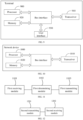
- FIG. 2 is a first schematic diagram of codewords respectively used by a base station and a terminal at different moments according to an embodiment of the present application.
- the base station uses codeword 1 and the RIS uses codeword 2; at moment 2, the base station uses codeword 1 and the RIS uses codeword 3; and at moment 3, the base station uses codeword 1 and the RIS uses codeword 4.
- FIG. 3 is a second schematic diagram of codewords respectively used by a base station and a terminal at different moments according to an embodiment of the present application.
- the base station uses codeword 1 and the RIS uses codeword 2; at moment 2, the base station uses codeword 3 and the RIS uses codeword 2; and at moment 3, the base station uses codeword 4 and the RIS uses codeword 2.
- the base station uses only one codeword and the RIS uses only one codeword; and at different moment, the codewords used by the base station can be the same and the codewords used by the RIS can be the same.
- the codeword indicator in the configuration message may include one or more of the second identifier, the first identifier and the second identifier, and the index of the identifier pair consisting of the first identifier and the second identifier.
- indicators of the beamforming codeword used by the network device and/or the beamforming codeword used by the RIS is included in the codeword indicator when transmitting the configuration message, which is beneficial for the terminal to determine the first codeword and the second codeword based on the codeword indicator.
- determining the first codeword and the second codeword based on the measurement signal and the codeword indicator includes:
- the terminal receives a group of configuration messages transmitted from the network device, and the codeword indicator in the configuration message includes the second identifier.
- the terminal and the network device both know a codeword identifier correspondence table.
- the terminal determines the fourth codeword from the codeword identifier correspondence table based on the second identifier, and directly uses the fourth codeword as the second codeword.
- the terminal measures the received measurement signal to obtain the channel measurement result. 2-norms of the channel measurement result and each codeword in the first set are calculated respectively, and one or more codewords selected based on the first preset rule are taken as the first codeword.
- the selected codeword is a codeword covering an entire channel range of the network device-RIS-UE.
- the channel measurement result is H , and there are codewords ⁇ 1 , ⁇ 2 and ⁇ 3 in the first set.
- ⁇ H ⁇ 1 ⁇ 2 , ⁇ H ⁇ 2 ⁇ 2 and ⁇ H ⁇ 3 ⁇ 2 are calculated respectively.
- a threshold A is set, a 2-norm greater than or equal to the threshold A is selected. In case that ⁇ H ⁇ 2 ⁇ 2 is greater than the threshold A, codeword ⁇ 2 is taken as the first codeword.
- the terminal determines the second codeword through the second identifier included in the codeword indicator, and determines the first codeword based on the channel measurement result corresponding to the measurement signal and 2-norms of each codeword in the first set, which is beneficial for the network device to determine the beamforming codeword used by itself and the beamforming codeword used by the RIS, thereby improving the signal quality by using the RIS-based wireless communication system.
- determining the first codeword and the second codeword based on the measurement signal and the codeword indicator includes:
- the terminal receives a group of configuration messages transmitted from the network device, and the codeword indicator in the configuration message includes the index of the identifier pair consisting of the first identifier and the second identifier.
- Both the terminal and the network device know an identifier pair index table and the codeword identifier correspondence table.
- the terminal first determines the identifier pair consisting of the first identifier and the second identifier based on the index of the identifier pair consisting of the first identifier and the second identifier; then determines the first identifier and the second identifier based on the identifier pair consisting of the first identifier and the second identifier; and finally determines the third codeword based on the first identifier, and determines the fourth codeword based on the second identifier.
- the terminal directly takes the fourth codeword as the second codeword.
- the terminal After determining the third codeword, the terminal searches for a neighbor codeword adjacent to the third codeword within a given range.
- the terminal measures the received measurement signal and obtains a channel measurement result.
- the channel measurement result and 2-norms of the third codeword and the neighbor codeword are calculated respectively.
- One or more codewords selected based on the first preset rule are taken as the first codeword.
- the channel measurement result is H
- the third codeword is ⁇ 0
- the fourth codeword is ⁇ 0
- ⁇ H ⁇ 0 ⁇ 2 is calculated.
- the neighbor codeword is a codeword that covers the neighbor area with the beamforming codeword used by the network device under the premise that the beamforming codeword used by the RIS remains unchanged.
- a neighbor codeword adjacent to the third codeword ⁇ 0 is searched within a given range.
- the third codeword ⁇ 0 has four neighbor codewords, namely ⁇ A , ⁇ B , ⁇ C and ⁇ D , ⁇ H ⁇ A ⁇ 2 , ⁇ H ⁇ B ⁇ 2 , ⁇ H ⁇ C ⁇ 2 and ⁇ H ⁇ D ⁇ 2 are calculated respectively and compared with ⁇ H ⁇ 0 ⁇ 2 .
- Comparison results are as follows: H ⁇ A 2 > H ⁇ B 2 > H ⁇ 0 2 > H ⁇ C 2 > H ⁇ D 2 .
- the preset rule is to select the top two 2-norms in terms of 2-norm value, ⁇ H ⁇ A ⁇ 2 and ⁇ H ⁇ B ⁇ 2 are selected, and ⁇ A and ⁇ B are taken as the first codeword.
- determining the first codeword and the second codeword based on the measurement signal and the codeword indicator includes:
- the terminal receives a group of configuration messages transmitted from the network device, measures the measurement signal in the configuration message, and obtains the channel measurement result.
- the channel measurement result is the measurement result of the channel of the network device-RIS-UE.
- the terminal divides the channel measurement result, and the bilinear generalized approximate message passing algorithm may be used for dividing the channel measurement result.
- FIG. 4 is a schematic diagram of dividing a channel measurement result according to an embodiment of the present application.
- the terminal divides the channel measurement result H to obtain H 1 and H 2 .
- H 1 and H 2 it is necessary to determine which divided result is the channel measurement result corresponding to the channel from the network device to the RIS and which divided result is the channel measurement result corresponding to the channel from the RIS to the terminal.
- H 1 is determined to be the channel measurement result corresponding to the channel from the network device to the RIS
- H 2 is determined to be the channel measurement result corresponding to the channel from the RIS to the terminal.
- the fourth codeword ⁇ 0 is determined based on the second identifier, ⁇ H 1 ⁇ 0 ⁇ 2 and ⁇ H 2 ⁇ 0 ⁇ 2 are calculated respectively, and values of the two are compared.
- ⁇ H 1 ⁇ 0 ⁇ 2 is greater than ⁇ H 2 ⁇ 0 ⁇ 2
- H 1 is determined to be the channel measurement result corresponding to the channel from the RIS to the terminal
- H 2 is determined to be the channel measurement result corresponding to the channel from the network device to the RIS.
- the third codeword ⁇ 0 and the fourth codeword ⁇ 0 are determined based on the first identifier and the second identifier, and ⁇ H 1 ⁇ 0 ⁇ 2 , ⁇ H 2 ⁇ 0 ⁇ 2 , ⁇ H 1 ⁇ 0 ⁇ 2 and ⁇ H 2 ⁇ 0 ⁇ 2 are calculated respectively, and values of the four are compared.
- H 1 is determined to be the channel measurement result corresponding to the channel from the network device to the RIS
- H 2 is determined to be the channel measurement result corresponding to the channel from the RIS to the terminal.
- H 1 is determined to be the channel measurement result corresponding to the channel from the RIS to the terminal
- H 2 is determined to be the channel measurement result corresponding to the channel from the network device to the RIS.
- the third codeword ⁇ 0 and the fourth codeword ⁇ 0 are determined based on the index of the identifier pair consisting of the first identifier and the second identifier, and ⁇ H 1 ⁇ 0 ⁇ 2 , ⁇ H 2 ⁇ 0 ⁇ 2 , ⁇ H 1 ⁇ 0 ⁇ 2 and ⁇ H 2 ⁇ 0 ⁇ 2 are calculated respectively, and the values of the four are compared.
- H 1 is determined to be the channel measurement result corresponding to the channel from the network device to the RIS
- H 2 is determined to be the channel measurement result corresponding to the channel from the RIS to the terminal.
- H 1 is determined to be the channel measurement result corresponding to the channel from the RIS to the terminal
- H 2 is determined to be the channel measurement result corresponding to the channel from the network device to the RIS.
- the 2-norm of the channel measurement result corresponding to the channel from the network device to the RIS with the codeword in the first set are calculated, one or more 2-norms are selected based on the first preset rule, and the codeword corresponding to the selected one or more 2-norms is determined as the first codeword.
- the 2-norm of the channel measurement result corresponding to the channel from the RIS to the terminal with the codeword in the second set are calculated, one or more 2-norms are selected based on the first preset rule, and the codeword corresponding to the selected one or more 2-norms is determined as the second codeword.
- the terminal divides the channel measurement result, determines the channel measurement result corresponding to the channel from the network device to the RIS and the channel measurement result corresponding to the channel from the RIS to the terminal based on the codeword indicated by the codeword indicator and the divided result, and determine the first codeword and the second codeword in conjunction with the first set and the second set, which is beneficial for the network device to determine the beamforming codeword used by itself and the beamforming codeword used by the RIS, thereby improving the signal quality using the RIS-based wireless communication system.
- determining the first codeword and the second codeword based on the measurement signal and the codeword indicator includes:
- the terminal receives multiple groups of configuration messages transmitted from the network device, and the codeword indicator in each group of configuration messages includes the first identifier and the second identifier.
- the terminal determines the beamforming codeword used by the network device and the beamforming codeword used by the RIS when the network device transmits each group of configuration messages, that is, determines the third codewords and the fourth codewords corresponding to each group of configuration messages.
- the terminal measures the measurement signals in the received multiple groups of configuration messages, obtains the channel measurement results corresponding to the multiple groups of configuration messages respectively, selects one or more channel measurement results based on the second preset rule, and determines the first codeword and the second codeword base on a configuration message group corresponding to the selected channel measurement result and the third codeword and the fourth codeword corresponding to the configuration message group.
- the terminal receives M groups of configuration messages, obtains M channel measurement results, and selects the top two channel measurement results in terms of value based on the second preset rule.
- H j and H k are the top two channel measurement results among the M channel measurement results
- the third codeword corresponding to the j-th group of configuration messages and the third codeword corresponding to the k-th group of configuration messages are taken as the first codeword
- the fourth codeword corresponding to the j-th group of configuration messages and the fourth codeword corresponding to the k-th group of configuration messages are taken as the second codeword.
- the terminal determines the third codeword and the fourth codeword corresponding to each group of configuration messages based on the first identifier and the second identifier in each group of configuration messages, selects the channel measurement results corresponding to the measurement signals in the multiple groups of configuration messages, and determines the first codeword and the second codeword based on the configuration message group corresponding to the selected channel measurement results and the third codewords and the fourth codewords corresponding to the configuration message groups, which is beneficial for the network device to determine the beamforming codeword used by itself and the beamforming codeword used by the RIS, thereby improving the signal quality by using the RIS-based wireless communication system.
- determining the first codeword and the second codeword based on the measurement signal and the codeword indicator includes:
- the terminal receives multiple groups of configuration messages transmitted from the network device.
- the codeword indicator in each group of configuration messages includes the index of the identifier pair consisting of the first identifier and the second identifier.
- the terminal Based on the index of the identifier pair consisting of the first identifier and the second identifier in each group of configuration messages, the terminal first determines the identifier pair consisting of the first identifier and the second identifier corresponding to each group of configuration messages, then determines the first identifier and the second identifier corresponding to each group of configuration messages, and finally determines the third codeword and the fourth codeword corresponding to each group of configuration messages.
- the terminal measures the measurement signals in the received multiple groups of configuration messages, obtains the channel measurement results corresponding to the multiple groups of configuration messages, selects one or more channel measurement results based on the second preset rule, and determines the first codeword and the second codeword base on a configuration message group corresponding to the selected channel measurement result and the third codeword and the fourth codeword corresponding to the configuration message group.
- the terminal determines the third codeword and the fourth codeword corresponding to each group of configuration messages based on the index of the identifier pair consisting of the first identifier and the second identifier in each group of configuration messages, selects the channel measurement results corresponding to the measurement signals in the multiple groups of configuration messages, and determines the first codeword and the second codeword based on the configuration message group corresponding to the selected channel measurement results and the third codeword and the fourth codeword corresponding to the configuration message group, which is beneficial for the network device to determine the beamforming codeword used by itself and the beamforming codeword used by the RIS, thereby improving the signal quality by using the RIS-based wireless communication system.
- transmitting the first codeword and the second codeword to the network device includes: transmitting an identifier of the first codeword and an identifier of the second codeword to the network device in a fixed overhead way.
- the terminal transmits the identifier of the first codeword and the identifier of the second codeword to the network device in a fixed overhead way.
- the network device can obtain the first codeword and the second codeword based on the codeword identifier correspondence table.
- FIG. 5 is a schematic diagram of transmitting a fixed overhead codeword according to an embodiment of the present application.
- the network device can indicate that a feedback resource length of the first codeword is A and a feedback resource length of the second codeword is B.
- the first codeword identifier is fixed to occupy overhead of A bits
- the second codeword identifier is fixed to occupy overhead of B bits.
- the terminal transmits the first codeword identifier and the second codeword identifier together to the network device.
- the zero padding method can be high-bit zero padding or low-bit zero padding.
- A is 4 bits. In case that 10 is padded with zeros in high bits, it may be 0010. In case that 10 is padded with zeros in low bits, it may be 1000.
- the terminal transmits the first codeword identifier and the second codeword identifier to the network device in a fixed overhead way, which is beneficial for the network device to simultaneously obtain the first codeword and the second codeword.
- transmitting the first codeword and the second codeword to the network device includes: transmitting an index of a codeword pair consisting of the first codeword and the second codeword to the network device in a fixed overhead way.
- the terminal and the network device know an index table of the codeword pair consisting of the codewords in the first set and the second set. After determining the first codeword and the second codeword, the terminal transmits the index of the codeword pair consisting of the first codeword and the second codeword to the network device in a fixed overhead way. After receiving the index of the codeword pair consisting of the first codeword and the second codeword, the network device can obtain the first codeword and the second codeword based on the index table of the codeword pair.
- the terminal transmits the index of the codeword pair consisting of the first codeword and the second codeword to the network device in a fixed overhead way, which is beneficial for the network device to simultaneously obtain the first codeword and the second codeword.
- transmitting the first codeword and the second codeword to the network device includes: transmitting an identifier of the first codeword and an identifier of the second codeword to the network device in a segmented codeword transmission way.
- FIG. 6 is a schematic diagram of transmitting a segmented codeword according to an embodiment of the present application.
- segmented codeword transmission is to divide the codeword to be fed back into several segments for transmission.
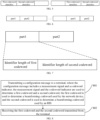
- the terminal transmits the identifier of the first codeword and the identifier of the second codeword to the network device through part1 and part2 respectively in a segmented codeword transmission way.
- the unpadded position is filled with zeros, and the zero padding method can be high-bit zero padding or low-bit zero padding.
- Part2 follows part1 and feeds back the identifier of the first codeword. In case that overhead exists, the overhead is the actual overhead of the identifier of the first codeword; and otherwise, it is 0.
- the terminal transmits the identifier of the first codeword and the identifier of the second codeword to the network device in a segmented codeword transmission way, which is beneficial for the network device to obtain the first codeword and the second codeword in segments.
- transmitting the identifier of the first codeword and the identifier of the second codeword to the network device in the segmented codeword transmission way includes:
- FIG. 7 is a schematic diagram of a codeword format for transmitting a segmented codeword according to an embodiment of the present application.
- the terminal uses part1 (first segment) to feed back the identifier of the second codeword and the identifier length of the first codeword to the network device.
- the identifier length of the first codeword is used to indicate whether there is a subsequent part2 and a bit length of part2.
- the feedback overhead of part1 is fixed.
- the terminal uses part2 (second segment) to feed back the identifier of the first codeword to the network device.
- the feedback overhead of part2 is not fixed. It can be chosen whether to feedback part2 based on requirements.
- a first case is that the identifier of the first codeword is not fed back, and the length of part2 is 0.
- a second case is that the identifier of a short first codeword is fed back, and the length of part2 is a, where a is greater than 0, and the short first codeword is the codeword of the network device covering the current RIS.
- a third case is that the identifier of a medium-length first codeword is fed back, and the length of part2 is b, where b is greater than a, and the medium-length first codeword is a set of all codewords of the network device.
- a fourth case is that the identifier of a long first codeword is fed back, and the length of part2 is c+b, where c is an identifier length of a codeword of a neighbor cell, and the long first codeword includes the codeword of the neighbor cell in addition to all codebooks of the network device.
- part2 length identifiers are defined: 00 indicates that the length of part2 is 0; 01 indicates the identifier length of the short first codeword; 10 indicates the length identifier of the medium-length first codeword; and 11 indicates the length identifier of the long first codeword.
- the length identifier of the short first codeword is defined as 2, and there are four first codewords covering the current RIS.
- the identifiers of the four first codewords are 10, 20, 30 and 40 respectively.
- Part 1 contains "01” and "0100...101", where "01” is the identifier length of the short first codeword and "0100...101” is the identifier of the second codeword.
- Part2 contains "40", where "40" is the identifier of the first codeword.
- the first codeword is still divided into two levels.
- the first level is composed of DFT codewords to describe long-term and broadband characteristics; and the second level describes short-term and sub-band characteristics, and is composed of weighted column selection vectors for beam selection and phase adjustment.
- the identifier of the first codeword in part2 is also divided into two levels.
- a transmission time interval of the second segment is longer than a transmission time interval of the first segment.
- the beamforming codeword between the network device and the RIS may not change, and the terminal may transmit only part1 to the network device without transmitting part2, where part1 contains the identifier of the second codeword, and the identifier length of the first codeword is 0; and during the feedback of the first codeword, the beamforming codeword between the network and the RIS may change, and the terminal needs to transmit part1 and part2 to the network device, so that the transmission time interval of the second segment is longer than the transmission time interval of the first segment.
- the codeword feedback can be periodic, semi-periodic or non-periodic.
- a feedback period of the first codeword is R times of a feedback period of the second codeword, where R is a positive integer.
- the transmission time interval of part2 is longer than the transmission time interval of part1, which is beneficial for reducing signaling overhead.
- the terminal can determine which feedback method to use for codeword feedback based on the measurement result, and add a flag bit to the feedback information to inform the network device which method to use for feedback.
- the configuration message further includes a first flag bit, where the first flag bit is used to characterize a codeword type corresponding to an identifier included in the codeword indicator.
- the configuration message transmitted from the network device and received by the terminal further includes the first flag bit, where the first flag bit is used to characterize the codeword type corresponding to the identifier included in the codeword indicator, and the codeword type includes the beamforming codeword used by the network device and the beamforming codeword used by the RIS.
- the first flag bit being 1 characterizes that the identifier in the codeword indicator is the identifier of the beamforming codeword used by the network device; and the first flag bit being 0 indicates that the identifier in the codeword indicator is the identifier of the beamforming codeword used by the RIS.
- the configuration message further includes a second flag bit, where the second flag bit is used to characterize a quantity of identifiers included in the codeword indicator.
- the configuration message transmitted from the network device and received by the terminal further includes the second flag bit, where the second flag bit is used to characterize the quantity of identifiers included in the codeword indicator.
- the second flag bit being 0 characterizes that the quantity of identifiers included in the codeword indicator is 1; and the second flag bit being 1 characterizes that the quantity of identifiers included in the codeword indicator is 2.
- the configuration message further includes a codeword feedback resource identifier, where the codeword feedback resource identifier is used to characterize a resource for the terminal to perform codeword feedback.
- the configuration message transmitted from the network device and received by the terminal further includes the codeword feedback resource identifier, where the codeword feedback resource identifier is used to characterize the resource for the terminal to perform codeword feedback.
- the terminal needs to feed back the first codeword and/or the second codeword to the network device on the resource corresponding to the codeword feedback resource identifier.
- the network device by characterizing the resource for the terminal to perform codeword feedback through the codeword feedback resource identifier, it is beneficial for the network device to receive the first codeword and the second codeword.
- FIG. 8 is a second schematic flowchart of a method for codeword transmission according to an embodiment of the present application. As shown in FIG. 8 , an embodiment of the present application further provides a method for codeword transmission, which may be performed by a network device, such as a base station, etc. The method includes the following steps.
- Step 801 transmitting a configuration message to a terminal, where the configuration message includes a measurement signal and a codeword indicator, the measurement signal and the codeword indicator are used to determine a first codeword and a second codeword, the first codeword is used to determine a beamforming codeword used by the network device, and the second codeword is used to determine a beamforming codeword used by a reconfigurable intelligent meta-surface (RIS).
- the configuration message includes a measurement signal and a codeword indicator
- the measurement signal and the codeword indicator are used to determine a first codeword and a second codeword
- the first codeword is used to determine a beamforming codeword used by the network device
- the second codeword is used to determine a beamforming codeword used by a reconfigurable intelligent meta-surface (RIS).
- RIS reconfigurable intelligent meta-surface
- the network device transmits the configuration message to the terminal through the RIS.
- the measurement signal may be a channel state information-reference signal (CSI-RS), and the codeword indicator may be an identifier or an index.
- CSI-RS channel state information-reference signal
- the terminal and the network device both know the beamforming codebook used by the network device (i.e., a first set) and the beamforming codebook used by the RIS (i.e., the second set).
- the codeword indicated by the codeword indicator can be determined from the beamforming codebook based on the codeword indicator.
- the terminal measures the received measurement signal to obtain the channel measurement result, selects one or more channel measurement results from the channel measurement results based on a preset rule, and determines the first codeword and the second codeword based on the indicated codeword corresponding to the selected one or more channel measurement results.
- the first codeword is for the network device to determine the beamforming codeword used by itself
- the second codeword is for the network device to determine the beamforming codeword used by the RIS.
- Step 802 receiving the first codeword and the second codeword transmitted from the terminal.
- the network device receives the first codeword and the second codeword transmitted from one or more terminals, performs secondary calculation based on the received first codeword and the second codeword, and selects a codeword that better meets scheduling requirements for beamforming for itself and the RIS.
- the terminal determines the first codeword and the second codeword based on the measurement signal and the codeword indicator in the configuration message.
- the network device determines the beamforming codeword used by itself and the beamforming codeword used by the RIS based on the first codeword and the second codeword determined by the terminal, thereby improving a signal quality by using an RIS-based wireless communication system.
- receiving the first codeword and the second codeword transmitted from the terminal includes: receiving an identifier of the first codeword and an identifier of the second codeword transmitted from the terminal in a fixed overhead way.
- the network device receives the identifier of the first codeword and the identifier of the second codeword transmitted from the terminal in a fixed overhead way.
- the network device After receiving the identifier of the first codeword and the identifier of the second codeword, the network device can obtain the first codeword and the second codeword based on a codeword identifier correspondence table.
- the network device can indicate that a feedback resource length of the first codeword is A and a feedback resource length of the second codeword is B.
- the first codeword identifier is fixed to occupy overhead of A bits
- the second codeword identifier is fixed to occupy overhead of B bits.
- the terminal transmits the first codeword identifier and the second codeword identifier together to the network device.
- the zero padding method can be high-bit zero padding or low-bit zero padding.
- the network device receives the first codeword identifier and the second codeword identifier transmitted from the terminal in a fixed overhead way, which is beneficial for simultaneously obtaining the first codeword and the second codeword identifier.
- receiving the first codeword and the second codeword transmitted from the terminal includes: receiving an index of a codeword pair consisting of the first codeword and the second codeword transmitted from the terminal in a fixed overhead way.
- the network device receives the index of the codeword pair consisting of the first codeword and the second codeword transmitted from the terminal in a fixed overhead way.
- the network device After receiving the index of the codeword pair consisting of the first codeword and the second codeword, the network device can obtain the first codeword and the second codeword based on the index table of the codeword pair.
- the network device receives the index of the codeword pair consisting of the first codeword and the second codeword transmitted from the terminal in a fixed overhead way, which is beneficial for simultaneously obtaining the first codeword and the second codeword.
- receiving the first codeword and the second codeword transmitted from the terminal includes: receiving an identifier of the first codeword and an identifier of the second codeword transmitted from the terminal in a segmented codeword transmission way.
- segmented codeword transmission is to divide the codeword to be fed back into several segments for transmission.
- the network device receives the identifier of the first codeword and the identifier of the second codeword through part1 and part2 respectively.
- the unpadded position is padded with zeros, and the zero padding method can be high-bit zero padding or low-bit zero padding.
- Part2 follows part1 and feeds back the identifier of the first codeword. In case that overhead exists, the overhead is the actual overhead of the identifier of the first codeword; and otherwise, it is 0.
- the network device receives part1 and part2 fed back by the terminal in segments, first decodes the content of part1, then decodes the content of part2, thereby obtaining the identifier of the first codeword and the identifier of the second codeword, and obtains the first codeword and the second codeword based on the identifier of the first codeword and the identifier of the second codeword.
- the network device receives the identifier of the first codeword and the identifier of the second codeword transmitted from the terminal in a segmented codeword transmission way, which is beneficial for obtaining the first codeword and the second codeword in segments.
- receiving the identifier of the first codeword and the identifier of the second codeword transmitted from the terminal in the segmented codeword transmission way includes:
- the network device receives part1 (first segment) transmitted from the terminal, and obtains the identifier of the second codeword and the identifier length of the first codeword from part1.
- the feedback overhead of part1 is fixed.
- the network device receives part2 (second segment) transmitted from the terminal, and obtains the identifier of the first codeword from part2.
- the feedback overhead of part2 is not fixed. It can be chosen whether to feedback part2 based on requirements.
- the network device obtains the identifier of the second codeword and the identifier length of the first codeword through part1, and obtains the identifier of the first codeword through part2, which is beneficial for obtaining the first codeword and the second codeword in segments.
- a reception time interval for the second segment is longer than a reception time interval for the first segment.
- the beamforming codeword between the network device and the RIS may not change, and the network device may only require the terminal to transmit part1 without transmitting part2, where part1 contains the identifier of the second codeword, and the identifier length of the first codeword is 0; and during the feedback of the first codeword, the beamforming codeword between the network and the RIS may change, and the network device requires the terminal to transmit part1 and part2, so that the transmission time interval of the second segment is longer than the transmission time interval of the first segment.
- the codeword feedback can be periodic, semi-periodic or non-periodic.
- a feedback period of the first codeword is R times of a feedback period of the second codeword, where R is a positive integer.
- the transmission time interval of part2 is longer than the transmission time interval of part1, which is beneficial for reducing signaling overhead.
- the configuration message further includes a first flag bit, where the first flag bit is used to characterize a codeword type corresponding to an identifier included in the codeword indicator.
- the configuration message transmitted from the network device to the terminal further includes the first flag bit, where the first flag bit is used to characterize the codeword type corresponding to the identifier included in the codeword indicator, and the codeword type includes the beamforming codeword used by the network device and the beamforming codeword used by the RIS.
- the first flag bit being 1 characterizes that the identifier in the codeword indicator is the identifier of the beamforming codeword used by the network device; and the first flag bit being 0 indicates that the identifier in the codeword indicator is the identifier of the beamforming codeword used by the RIS.
- the configuration message further includes a second flag bit, where the second flag bit is used to characterize a quantity of identifiers included in the codeword indicator.
- the configuration message transmitted from the network device to the terminal further includes the second flag bit, where the second flag bit is used to characterize the quantity of identifiers included in the codeword indicator.
- the second flag bit being 0 characterizes that the quantity of identifiers included in the codeword indicator is 1; and the second flag bit being 1 characterizes that the quantity of identifiers included in the codeword indicator is 2.
- the configuration message further includes a codeword feedback resource identifier, where the codeword feedback resource identifier is used to characterize a resource for the terminal to perform codeword feedback.
- the configuration message transmitted from the network device to the terminal further includes the codeword feedback resource identifier, where the codeword feedback resource identifier is used to characterize the resource for the terminal to perform codeword feedback.
- the terminal needs to feed back the first codeword and/or the second codeword to the network device on the resource corresponding to the codeword feedback resource identifier.
- the network device by characterizing the resource for the terminal to perform codeword feedback through the codeword feedback resource identifier, it is beneficial for the network device to receive the first codeword and the second codeword.
- FIG. 9 is a schematic structural diagram of a terminal according to an embodiment of the present application.
- the terminal includes a memory 920, a transceiver 900, and a processor 910, where the memory 920 is used for storing a computer program, the transceiver 900 is used for receiving and transmitting data under control of the processor 910, and the processor 910 is used for reading a computer program in the memory 920 and performing the following operations of:
- a bus architecture may include any number of interconnected buses and bridges, which are linked together through various circuits of one or more processors represented by the processor 910 and one or more memories represented by the memory 920.
- the bus architecture may also link together various other circuits, such as peripherals, voltage regulators, and power management circuits, etc., which are well known in the art, and therefore are not further described in the present application.
- a bus interface provides an interface.
- the transceiver 900 may include multiple elements, i.e., including a transmitter and a receiver, units for providing communication with various other devices over transmission media including wireless channels, wired channels, fiber optic cables, and the like.
- a user interface 930 may be an interface capable of externally or internally connecting required devices, and the connected devices include but are not limited to a small keypad, a display, a speaker, a microphone, a joystick, and the like.
- the processor 910 is responsible for managing the bus architecture and general processing, and the memory 920 may store data used by the processor 910 when performing operations.
- the processor 910 may be a central processing unit (CPU), an application specific integrated circuit (ASIC), a field programmable gate array (FPGA), or a complex programmable logic device (CPLD), and the processor may also adopt a multi-core architecture.
- CPU central processing unit
- ASIC application specific integrated circuit
- FPGA field programmable gate array
- CPLD complex programmable logic device
- the processor calls a computer program stored in the memory to perform any of the methods provided by the embodiments of the present application based on an obtained executable instruction.
- the processor and the memory can also be arranged physically separately.
- the codeword indicator includes one or more of the following:
- determining the first codeword and the second codeword based on the measurement signal and the codeword indicator includes:
- determining the first codeword and the second codeword based on the measurement signal and the codeword indicator includes:
- determining the first codeword and the second codeword based on the measurement signal and the codeword indicator includes:
- determining the first codeword and the second codeword based on the measurement signal and the codeword indicator includes:
- determining the first codeword and the second codeword based on the measurement signal and the codeword indicator includes:
- transmitting the first codeword and the second codeword to the network device includes: transmitting an identifier of the first codeword and an identifier of the second codeword to the network device in a fixed overhead way.
- transmitting the first codeword and the second codeword to the network device includes: transmitting an index of a codeword pair consisting of the first codeword and the second codeword to the network device in a fixed overhead way.
- transmitting the first codeword and the second codeword to the network device includes: transmitting an identifier of the first codeword and an identifier of the second codeword to the network device in a segmented codeword transmission way.
- transmitting the identifier of the first codeword and the identifier of the second codeword to the network device in the segmented codeword transmission way includes:
- a transmission time interval of the second segment is longer than a transmission time interval of the first segment.
- the configuration message further includes a first flag bit, where the first flag bit is used to characterize a codeword type corresponding to an identifier included in the codeword indicator.
- the configuration message further includes a second flag bit, where the second flag bit is used to characterize a quantity of identifiers included in the codeword indicator.
- the configuration message further includes a codeword feedback resource identifier, where the codeword feedback resource identifier is used to characterize a resource for the terminal to perform codeword feedback.
- FIG. 10 is a schematic structural diagram of a network device according to an embodiment of the present application.
- the network device includes a memory 1020, a transceiver 1000 and a processor 1010, where the memory 1020 is used for storing a computer program, the transceiver 1000 is used for receiving and transmitting data under control of the processor 1010, and the processor 1010 is used for reading a computer program in the memory 1020 and performing the following operations.
- the transceiver 1000 is used for transmitting and receiving data under control of the processor 1010.
- a bus architecture may include any number of interconnected buses and bridges, which are linked together through various circuits of one or more processors represented by the processor 1010 and one or more memories represented by the memory 1020.
- the bus architecture may also link together various other circuits, such as peripherals, voltage regulators, and power management circuits, etc., which are well known in the art, and therefore are not further described in the present application.
- a bus interface provides an interface.
- the transceiver 1000 may include multiple elements, i.e., including a transmitter and a receiver, units for providing communication with various other devices over transmission media including wireless channels, wired channels, fiber optic cables, and the like.
- the processor 1010 is responsible for managing the bus architecture and general processing, and the memory 1020 may store data used by the processor 1010 when performing operations.
- the processor 1010 may be a central processing unit (CPU), an application specific integrated circuit (ASIC), a field programmable gate array (FPGA) or a complex programmable logic device (CPLD), and the processor may also adopt a multi-core architecture.
- CPU central processing unit
- ASIC application specific integrated circuit
- FPGA field programmable gate array
- CPLD complex programmable logic device
- receiving the first codeword and the second codeword transmitted from the terminal includes: receiving an identifier of the first codeword and an identifier of the second codeword transmitted from the terminal in a fixed overhead way.
- receiving the first codeword and the second codeword transmitted from the terminal includes: receiving an index of a codeword pair consisting of the first codeword and the second codeword transmitted from the terminal in a fixed overhead way.
- receiving the first codeword and the second codeword transmitted from the terminal includes: receiving an identifier of the first codeword and an identifier of the second codeword transmitted from the terminal in a segmented codeword transmission way.
- receiving the identifier of the first codeword and the identifier of the second codeword transmitted from the terminal in the segmented codeword transmission way includes:
- a reception time interval for the second segment is longer than a reception time interval for the first segment.
- the configuration message further includes a first flag bit, where the first flag bit is used to characterize a codeword type corresponding to an identifier included in the codeword indicator.
- the configuration message further includes a second flag bit, where the second flag bit is used to characterize a quantity of identifiers included in the codeword indicator.
- the configuration message further includes a codeword feedback resource identifier, where the codeword feedback resource identifier is used to characterize a resource for the terminal to perform codeword feedback.
- the above-mentioned network device provided by the embodiments of the present application can implement all the method steps in the above-mentioned method embodiments performed by the network device and may achieve the same technical effect.
- the parts and beneficial effects of this embodiment that are the same as those of the method embodiments are not described in detail.
- FIG. 11 is a first schematic structural diagram of an apparatus for codeword transmission according to an embodiment of the present application. As shown in FIG. 11 , an embodiment of the present application further provides an apparatus for codeword transmission, including: a first receiving module 1101, a first determining module 1102 and a first transmitting module 1103.
- the first receiving module 1101 is used for receiving a configuration message transmitted from a network device, where the configuration message includes a measurement signal and a codeword indicator.
- the first determining module 1102 is used for determining a first codeword and a second codeword based on the measurement signal and the codeword indicator, where the first codeword is used to determine a beamforming codeword used by the network device, and the second codeword is used to determine a beamforming codeword used by a reconfigurable intelligent meta-surface (RIS).
- RIS reconfigurable intelligent meta-surface
- the first transmitting module 1103 is used for transmitting the first codeword and the second codeword to the network device.
- the codeword indicator includes one or more of the following:
- the first determining module 1102 is specifically used for: in case of receiving a group of configuration messages transmitted from the network device, and a codeword indicator in the configuration message including the second identifier, determining the second codeword based on the second identifier; and determining a first codeword based on a first set and a channel measurement result corresponding to the measurement signal, where the first set is a beamforming codebook used by the network device.
- the first determining module 1102 is specifically used for: in case of receiving a group of configuration messages transmitted from the network device, and a codeword indicator in the configuration message including the index of the identifier pair consisting of the first identifier and the second identifier, determining the third codeword and the fourth codeword based on the index;
- the first determining module 1102 is specifically used for: in case of receiving a group of configuration messages transmitted from the network device, determining a codeword indicated by the codeword indicator based on a codeword indicator in the configuration message;
- the first determining module 1102 is specifically used for: in case of receiving multiple groups of configuration messages transmitted from the network device, and a codeword indicator in each group of configuration messages including the first identifier and the second identifier, determining a third codeword and a fourth codeword corresponding to each group of configuration messages based on a first identifier and a second identifier in each group of configuration messages; and determining the first codeword and the second codeword based on channel measurement results respectively corresponding to measurement signals in the multiple groups of configuration messages and third codewords and fourth codewords respectively corresponding to the multiple groups of configuration messages.
- the first determining module 1102 is specifically used for: in case of receiving multiple groups of configuration messages transmitted from the network device, and a codeword indicator in each group of configuration messages including the index of the identifier pair consisting of the first identifier and the second identifier, determining a third codeword and a fourth codeword corresponding to each group of configuration messages based on the index of the identifier pair consisting of a first identifier and a second identifier in each group of configuration messages; and determining the first codeword and the second codeword based on channel measurement results respectively corresponding to measurement signals in the multiple groups of configuration messages and third codewords and fourth codewords respectively corresponding to the multiple groups of configuration messages.
- the first transmitting module 1103 is specifically used for: transmitting an identifier of the first codeword and an identifier of the second codeword to the network device in a fixed overhead way.
- the first transmitting module 1103 is specifically used for: transmitting an index of a codeword pair consisting of the first codeword and the second codeword to the network device in a fixed overhead way.
- the first transmitting module 1103 is specifically used for: transmitting an identifier of the first codeword and an identifier of the second codeword to the network device in a segmented codeword transmission way.
- the first transmitting module 1103 is specifically used for: transmitting the identifier of the second codeword and an identifier length of the first codeword to the network device as a first segment; and transmitting the identifier of the first codeword to the network device as a second segment.
- a transmission time interval of the second segment is longer than a transmission time interval of the first segment.
- the configuration message further includes a first flag bit, where the first flag bit is used to characterize a codeword type corresponding to an identifier included in the codeword indicator.
- the configuration message further includes a second flag bit, where the second flag bit is used to characterize a quantity of identifiers included in the codeword indicator.
- the configuration message further includes a codeword feedback resource identifier, where the codeword feedback resource identifier is used to characterize a resource for the terminal to perform codeword feedback.
- the apparatus for codeword transmission provided by the embodiments of the present application can implement all the method steps in the above-mentioned method embodiments performed by a terminal and may achieve the same technical effect.
- the parts and beneficial effects of this embodiment that are the same as those of the method embodiments are not described in detail.
- FIG. 12 is a second schematic structural diagram of an apparatus for codeword transmission according to an embodiment of the present application. As shown in FIG. 12 , an embodiment of the present application further provides an apparatus for codeword transmission, including: a second transmitting module 1201 and a second receiving module 1202.
- the second transmitting module 1201 is used for transmitting a configuration message to a terminal, where the configuration message includes a measurement signal and a codeword indicator, the measurement signal and the codeword indicator are used to determine a first codeword and a second codeword, the first codeword is used to determine a beamforming codeword used by a network device, and the second codeword is used to determine a beamforming codeword used by a reconfigurable intelligent meta-surface (RIS).
- RIS reconfigurable intelligent meta-surface
- the second receiving module 1202 is used for receiving the first codeword and the second codeword transmitted from the terminal.
- the second receiving module 1202 is specifically used for: receiving an identifier of the first codeword and an identifier of the second codeword transmitted from the terminal in a fixed overhead way.
- the second receiving module 1202 is specifically used for: receiving an index of a codeword pair consisting of the first codeword and the second codeword transmitted from the terminal in a fixed overhead way.
- the second receiving module 1202 is specifically used for: receiving an identifier of the first codeword and an identifier of the second codeword transmitted from the terminal in a segmented codeword transmission way.
- the second receiving module 1202 is specifically used for: receiving a first segment transmitted from the terminal, where the first segment is the identifier of the second codeword and an identifier length of the first codeword; and receiving a second segment transmitted from the terminal, where the second segment is the identifier of the first codeword.
- a reception time interval for the second segment is longer than a reception time interval for the first segment.
- the configuration message further includes a first flag bit, where the first flag bit is used to characterize a codeword type corresponding to an identifier included in the codeword indicator.
- the configuration message further includes a second flag bit, where the second flag bit is used to characterize a quantity of identifiers included in the codeword indicator.
- the configuration message further includes a codeword feedback resource identifier, where the codeword feedback resource identifier is used to characterize a resource for the terminal to perform codeword feedback.
- the apparatus for codeword transmission provided by the embodiment of the present application can implement all the method steps in the above-mentioned method embodiments performed by a network device and may achieve the same technical effect.
- the parts and beneficial effects of this embodiment that are the same as those of the method embodiments are not described in detail.
- the division of units in the embodiments of the present application is schematic, and is only a logical function division, and there may be other division manners in actual implementation.
- the functional units in the various embodiments of the present application may be integrated into one processing unit, or each unit may exist alone physically, or two or more units may be integrated into one unit.
- the above-mentioned integrated unit may be implemented in the form of hardware or software functional unit.
- the integrated unit may be stored in a processor-readable storage medium.
- the solutions of the present application in essence or a part of the solutions that contributes to the related art, or all or part of the solutions, may be embodied in the form of a software product, which is stored in a storage medium, including several instructions to cause a computer device (which may be a personal computer, server, or network device, etc.) or a processor to perform all or part of the steps of the methods described in the respective embodiments of the present application.
- the storage medium described above includes various media that may store program codes such as a U disk, a mobile hard disk, a read-only memory (ROM), a random access memory (RAM), a magnetic disk, or a compact disk.
- an embodiment of the present application further provides a processor-readable storage medium, where the processor-readable storage medium stores a computer program, and the computer program is used to cause a processor to perform the methods provided by the above embodiments, including:
- the processor-readable storage medium may be any available medium or data storage device that may be accessed by the processor, including but not limited to, a magnetic storage (e.g., a floppy disk, a hard disk, a magnetic tape, a magneto-optical disk (MO), etc.), an optical memory (such as CD, DVD, BD, HVD, etc.), and a semiconductor memory (such as ROM, EPROM, EEPROM, a non-volatile memory (NAND FLASH), a solid-state drive (SSD)), etc.
- a magnetic storage e.g., a floppy disk, a hard disk, a magnetic tape, a magneto-optical disk (MO), etc.
- an optical memory such as CD, DVD, BD, HVD, etc.
- semiconductor memory such as ROM, EPROM, EEPROM, a non-volatile memory (NAND FLASH), a solid-state drive (SSD)
- first, second, etc. in the description and claims of the present application are used to distinguish similar objects, and are not used to describe a specific order or sequence. It should be understood that the terms used in this mode may be interchangeable where appropriate, so that the embodiments of the present application can be implemented in an order other than those illustrated or described here, and the objects distinguished by "first” and “second” are generally of the same type, and the quantity of objects is not limited, for example, the first object can be one or more.
- the term "and/or” describes a related relationship of associated objects, and indicates that there may be three kinds of relationships.
- a and/or B may represent that A exists alone, A and B exist simultaneously, and B exists alone.
- Character "/” generally indicates that the associated objects have an "or” relationship.
- the term “multiple” refers to two or more, and other quantifiers are similar.
- “determine B based on A” means that the factor A should be considered when determining B. It is not limited to “B can be determined based on A alone", but should further include: “determine B based on A and C", “determine B based on A, C and E", “determine C based on A, and further determine B based on C", etc. In addition, it can further include taking A as a condition for determining B, for example, "when A meets the first condition, use the first method to determine B"; for example, "when A meets the second condition, determine B", etc.; for another example, "when A meets the third condition, determine B based on the first parameter", etc. Of course, it can also be a condition that takes A as a factor for determining B, for example, "when A meets the first condition, use the first method to determine C, and further determine B based on C", etc.
- the applicable systems may include a global system of mobile communication (GSM) system, a code division multiple access (CDMA) system, a wideband code division multiple access (WCDMA) general packet radio service (GPRS) system, a long term evolution (LTE) system, an LTE frequency division duplex (FDD) system, an LTE time division duplex (TDD) system, a long term evolution advanced (LTE-A) system, a universal mobile telecommunication system (UMTS), a worldwide interoperability for microwave access (WiMAX) system, a 5G new radio (NR) system, etc.
- GSM global system of mobile communication
- CDMA code division multiple access
- WCDMA wideband code division multiple access
- GPRS general packet radio service
- LTE long term evolution
- FDD LTE frequency division duplex
- TDD LTE time division duplex
- LTE-A long term evolution advanced
- UMTS universal mobile telecommunication system
- WiMAX worldwide interoperability for microwave access
- NR 5G new radio
- the terminal device involved in the embodiments of the present application may be a device that provides voice and/or data connectivity to a user, a handheld device with a wireless connection function, or other processing devices connected to a wireless modem.
- the names of terminal devices may also be different.
- the terminal device may be called a user equipment (UE).
- UE user equipment
- a wireless terminal device may communicate with one or more core networks (CN) via a radio access network (RAN).
- CN core networks
- RAN radio access network
- the wireless terminal device may be a mobile terminal device, such as a mobile phone (or a "cellular" phone) and a computer with a mobile terminal device.
- the wireless terminal device may also be referred to as a system, a subscriber unit, a subscriber station, a mobile station, a mobile, a remote station, an access point, a remote terminal device, an access terminal device, a user terminal device, a user agent, or a user device, which is not limited in the embodiments of the present application.
- the network device involved in the embodiments of the present application may be a base station.
- the base station may include multiple cells that provide services to a terminal.
- the base station may also be referred to as an access point, or may be a device in an access network that communicates with a wireless terminal device through one or more sectors on an air interface, or other names.
- the network device may be used to interchange received air frames with Internet Protocol (IP) packets, and serve as a router between the wireless terminal device and the rest of the access network, where the rest of the access network may include an IP communication network.
- IP Internet Protocol
- the network device may also coordinate the attribute management of the air interface.
- the network device involved in the embodiments of the present application may be a base transceiver station (BTS) in the global system for mobile communications (GSM) or code division multiple access (CDMA), or a network device (node B) in wide-band code division multiple access (WCDMA), or an evolutional network device (eNB or e-NodeB) in the long term evolution (LTE) system, a 5G base station (gNB) in the 5G network architecture (next generation system), or a home evolved node B (HeNB), a relay node, a home base station (femto), a pico base station (pico), etc., which is not limited in the embodiments of the present application.
- the network device may include a centralized unit (CU) node and a distributed unit (DU) node, and the centralized unit and the distributed unit may also be arranged geographically separately.
- Network devices and terminal devices may each use one or more antennas for multi-input multi-output (MIMO) transmission.
- the MIMO transmission may be single user MIMO (SU-MIMO) or multi user MIMO (MU-MIMO).
- MIMO transmission may be 2D-MIMO, 3D-MIMO, FD-MIMO or massive-MIMO, or may be diversity transmission, precoding transmission or beamforming transmission, etc.
- embodiments of the present application may be provided as a method, a system, or a computer program product. Accordingly, the present application may take the form of an entirely hardware embodiment, an entirely software embodiment, or an embodiment combining software and hardware aspects. Furthermore, the present application may take the form of a computer program product embodied on one or more computer-usable storage media having computer-usable program code embodied therein, including but not limited to disk storage, optical storage, and the like.
- processor-executable instructions may also be stored in a processor-readable memory capable of directing a computer or other programmable data processing apparatus to operate in a particular manner, and the instructions stored in the processor-readable memory may result in a manufacture including instruction means, the instruction means may perform the functions specified in one or more flows of the flowchart and/or one or more blocks of the block diagram.
- processor-executable instructions may also be loaded onto a computer or other programmable data processing device to cause a series of operational steps to be performed on the computer or other programmable device to produce a computer-implemented process and instructions performed on the computer or other programmable devices provide steps for performing the functions specified in one or more flows of the flowchart and/or one or more blocks of the block diagram.
Landscapes
- Engineering & Computer Science (AREA)
- Computer Networks & Wireless Communication (AREA)
- Signal Processing (AREA)
- Physics & Mathematics (AREA)
- Mathematical Physics (AREA)
- Quality & Reliability (AREA)
- Electromagnetism (AREA)
- Mobile Radio Communication Systems (AREA)
- Data Exchanges In Wide-Area Networks (AREA)
Applications Claiming Priority (2)
| Application Number | Priority Date | Filing Date | Title |
|---|---|---|---|
| CN202210794260.5A CN117394890A (zh) | 2022-07-05 | 2022-07-05 | 码本传输方法、装置及存储介质 |
| PCT/CN2023/101358 WO2024007854A1 (fr) | 2022-07-05 | 2023-06-20 | Procédé de transmission de livre de codes, appareil et support de stockage |
Publications (1)
| Publication Number | Publication Date |
|---|---|
| EP4554105A1 true EP4554105A1 (fr) | 2025-05-14 |
Family
ID=89454190
Family Applications (1)
| Application Number | Title | Priority Date | Filing Date |
|---|---|---|---|
| EP23834628.2A Pending EP4554105A1 (fr) | 2022-07-05 | 2023-06-20 | Procédé de transmission de livre de codes, appareil et support de stockage |
Country Status (4)
| Country | Link |
|---|---|
| US (1) | US20260005732A1 (fr) |
| EP (1) | EP4554105A1 (fr) |
| CN (1) | CN117394890A (fr) |
| WO (1) | WO2024007854A1 (fr) |
Family Cites Families (5)
| Publication number | Priority date | Publication date | Assignee | Title |
|---|---|---|---|---|
| EP3579451A1 (fr) * | 2014-01-09 | 2019-12-11 | Huawei Technologies Co., Ltd. | Procédé et appareil de détermination d'ensemble de matrices de précodage et procédé et appareil d'envoi d'informations d'indication de paramètre |
| US11764888B2 (en) * | 2019-06-07 | 2023-09-19 | Qualcomm Incorporated | Beam characterization |
| KR102195232B1 (ko) * | 2019-07-05 | 2020-12-24 | 숭실대학교산학협력단 | 무선 전력 전송 시스템 및 이의 빔포밍 가중치 추정 방법 |
| CN114126055B (zh) * | 2020-08-28 | 2025-02-18 | 大唐移动通信设备有限公司 | 波束指示方法、网络设备、终端、装置及存储介质 |
| CN114465699B (zh) * | 2020-11-09 | 2024-03-26 | 上海朗帛通信技术有限公司 | 一种被用于无线通信的用户设备、基站中的方法和装置 |
-
2022
- 2022-07-05 CN CN202210794260.5A patent/CN117394890A/zh active Pending
-
2023
- 2023-06-20 US US18/881,269 patent/US20260005732A1/en active Pending
- 2023-06-20 WO PCT/CN2023/101358 patent/WO2024007854A1/fr not_active Ceased
- 2023-06-20 EP EP23834628.2A patent/EP4554105A1/fr active Pending
Also Published As
| Publication number | Publication date |
|---|---|
| WO2024007854A1 (fr) | 2024-01-11 |
| CN117394890A (zh) | 2024-01-12 |
| US20260005732A1 (en) | 2026-01-01 |
Similar Documents
| Publication | Publication Date | Title |
|---|---|---|
| CN116939839A (zh) | 传输处理方法、网络设备、终端、装置及存储介质 | |
| EP4518174A1 (fr) | Procédé et appareil de détermination d'informations | |
| EP4044446A1 (fr) | Procédé et appareil de détermination d'informations de canaux | |
| CN116980096A (zh) | 信息传输方法、装置、终端、网络侧设备及介质 | |
| EP4597864A1 (fr) | Procédé de rapport d'informations d'état de canal, terminal et dispositif de réseau | |
| EP4572206A1 (fr) | Procédé et appareil de détermination de port de signal dmrs, dispositif, et support de stockage | |
| EP4518223A1 (fr) | Procédé de rapport d'informations csi, terminal, dispositif de réseau, appareil et support de stockage | |
| EP4554105A1 (fr) | Procédé de transmission de livre de codes, appareil et support de stockage | |
| EP4383891A1 (fr) | Procédé et appareil d'indication de ressource, terminal, dispositif côté réseau et support de stockage | |
| WO2024066900A1 (fr) | Procédé de transmission en liaison montante, terminal, dispositif réseau, appareil et support de stockage | |
| CN115175228B (zh) | 信息上报方法、网络侧配置方法、装置、设备及存储介质 | |
| CN114501569B (zh) | 数据传输方法、装置、终端及网络侧设备 | |
| CN114070519B (zh) | 信息传输方法、装置及存储介质 | |
| KR20240021298A (ko) | 채널 상태 정보 송신 방법, 수신 방법 및 장치 | |
| CN118784024A (zh) | 码本指示方法、装置及存储介质 | |
| EP4598199A1 (fr) | Procédé de détermination d'informations, appareil, terminal et dispositif réseau | |
| EP4668645A1 (fr) | Procédé et appareil de transmission de signal, et support de stockage | |
| CN115189837B (zh) | 端口指示信息上报方法及终端 | |
| EP4572162A1 (fr) | Procédé et appareil de transmission de paramètres de livre de codes, et support de stockage | |
| EP4572210A1 (fr) | Procédé de rapport d'information d'état de canal (csi), dispositif terminal, périphérique de réseau et support de stockage | |
| CN118784142A (zh) | Csi上报方法、装置、终端及网络设备 | |
| CN119277437A (zh) | 测量上报方法、终端、网络设备、装置及存储介质 | |
| WO2024067346A1 (fr) | Procédé et appareil de transmission d'informations, et support de stockage | |
| WO2025166682A1 (fr) | Procédé et appareil d'envoi d'informations de configuration, procédé et appareil de réception d'informations de configuration, et système de communication | |
| CN119485373A (zh) | Csi报告的发送和接收方法、装置及存储介质 |
Legal Events
| Date | Code | Title | Description |
|---|---|---|---|
| STAA | Information on the status of an ep patent application or granted ep patent |
Free format text: STATUS: THE INTERNATIONAL PUBLICATION HAS BEEN MADE |
|
| PUAI | Public reference made under article 153(3) epc to a published international application that has entered the european phase |
Free format text: ORIGINAL CODE: 0009012 |
|
| STAA | Information on the status of an ep patent application or granted ep patent |
Free format text: STATUS: REQUEST FOR EXAMINATION WAS MADE |
|
| 17P | Request for examination filed |
Effective date: 20250110 |
|
| AK | Designated contracting states |
Kind code of ref document: A1 Designated state(s): AL AT BE BG CH CY CZ DE DK EE ES FI FR GB GR HR HU IE IS IT LI LT LU LV MC ME MK MT NL NO PL PT RO RS SE SI SK SM TR |
|
| DAV | Request for validation of the european patent (deleted) | ||
| DAX | Request for extension of the european patent (deleted) |