EP4556854A2 - Sensormodul und damit ausgestattetes wasserfahrzeug - Google Patents
Sensormodul und damit ausgestattetes wasserfahrzeug Download PDFInfo
- Publication number
- EP4556854A2 EP4556854A2 EP24203142.5A EP24203142A EP4556854A2 EP 4556854 A2 EP4556854 A2 EP 4556854A2 EP 24203142 A EP24203142 A EP 24203142A EP 4556854 A2 EP4556854 A2 EP 4556854A2
- Authority
- EP
- European Patent Office
- Prior art keywords
- sensor
- base
- sensor module
- sensors
- casing
- Prior art date
- Legal status (The legal status is an assumption and is not a legal conclusion. Google has not performed a legal analysis and makes no representation as to the accuracy of the status listed.)
- Pending
Links
Images





Classifications
-
- B—PERFORMING OPERATIONS; TRANSPORTING
- B63—SHIPS OR OTHER WATERBORNE VESSELS; RELATED EQUIPMENT
- B63B—SHIPS OR OTHER WATERBORNE VESSELS; EQUIPMENT FOR SHIPPING
- B63B79/00—Monitoring properties or operating parameters of vessels in operation
- B63B79/10—Monitoring properties or operating parameters of vessels in operation using sensors, e.g. pressure sensors, strain gauges or accelerometers
-
- B—PERFORMING OPERATIONS; TRANSPORTING
- B63—SHIPS OR OTHER WATERBORNE VESSELS; RELATED EQUIPMENT
- B63B—SHIPS OR OTHER WATERBORNE VESSELS; EQUIPMENT FOR SHIPPING
- B63B79/00—Monitoring properties or operating parameters of vessels in operation
- B63B79/40—Monitoring properties or operating parameters of vessels in operation for controlling the operation of vessels, e.g. monitoring their speed, routing or maintenance schedules
-
- G—PHYSICS
- G01—MEASURING; TESTING
- G01C—MEASURING DISTANCES, LEVELS OR BEARINGS; SURVEYING; NAVIGATION; GYROSCOPIC INSTRUMENTS; PHOTOGRAMMETRY OR VIDEOGRAMMETRY
- G01C21/00—Navigation; Navigational instruments not provided for in groups G01C1/00 - G01C19/00
- G01C21/10—Navigation; Navigational instruments not provided for in groups G01C1/00 - G01C19/00 by using measurements of speed or acceleration
- G01C21/12—Navigation; Navigational instruments not provided for in groups G01C1/00 - G01C19/00 by using measurements of speed or acceleration executed aboard the object being navigated; Dead reckoning
- G01C21/16—Navigation; Navigational instruments not provided for in groups G01C1/00 - G01C19/00 by using measurements of speed or acceleration executed aboard the object being navigated; Dead reckoning by integrating acceleration or speed, i.e. inertial navigation
- G01C21/165—Navigation; Navigational instruments not provided for in groups G01C1/00 - G01C19/00 by using measurements of speed or acceleration executed aboard the object being navigated; Dead reckoning by integrating acceleration or speed, i.e. inertial navigation combined with non-inertial navigation instruments
- G01C21/1652—Navigation; Navigational instruments not provided for in groups G01C1/00 - G01C19/00 by using measurements of speed or acceleration executed aboard the object being navigated; Dead reckoning by integrating acceleration or speed, i.e. inertial navigation combined with non-inertial navigation instruments with ranging devices, e.g. LIDAR or RADAR
-
- G—PHYSICS
- G01—MEASURING; TESTING
- G01C—MEASURING DISTANCES, LEVELS OR BEARINGS; SURVEYING; NAVIGATION; GYROSCOPIC INSTRUMENTS; PHOTOGRAMMETRY OR VIDEOGRAMMETRY
- G01C21/00—Navigation; Navigational instruments not provided for in groups G01C1/00 - G01C19/00
- G01C21/10—Navigation; Navigational instruments not provided for in groups G01C1/00 - G01C19/00 by using measurements of speed or acceleration
- G01C21/12—Navigation; Navigational instruments not provided for in groups G01C1/00 - G01C19/00 by using measurements of speed or acceleration executed aboard the object being navigated; Dead reckoning
- G01C21/16—Navigation; Navigational instruments not provided for in groups G01C1/00 - G01C19/00 by using measurements of speed or acceleration executed aboard the object being navigated; Dead reckoning by integrating acceleration or speed, i.e. inertial navigation
- G01C21/165—Navigation; Navigational instruments not provided for in groups G01C1/00 - G01C19/00 by using measurements of speed or acceleration executed aboard the object being navigated; Dead reckoning by integrating acceleration or speed, i.e. inertial navigation combined with non-inertial navigation instruments
- G01C21/1656—Navigation; Navigational instruments not provided for in groups G01C1/00 - G01C19/00 by using measurements of speed or acceleration executed aboard the object being navigated; Dead reckoning by integrating acceleration or speed, i.e. inertial navigation combined with non-inertial navigation instruments with passive imaging devices, e.g. cameras
-
- G—PHYSICS
- G01—MEASURING; TESTING
- G01C—MEASURING DISTANCES, LEVELS OR BEARINGS; SURVEYING; NAVIGATION; GYROSCOPIC INSTRUMENTS; PHOTOGRAMMETRY OR VIDEOGRAMMETRY
- G01C21/00—Navigation; Navigational instruments not provided for in groups G01C1/00 - G01C19/00
- G01C21/10—Navigation; Navigational instruments not provided for in groups G01C1/00 - G01C19/00 by using measurements of speed or acceleration
- G01C21/12—Navigation; Navigational instruments not provided for in groups G01C1/00 - G01C19/00 by using measurements of speed or acceleration executed aboard the object being navigated; Dead reckoning
- G01C21/16—Navigation; Navigational instruments not provided for in groups G01C1/00 - G01C19/00 by using measurements of speed or acceleration executed aboard the object being navigated; Dead reckoning by integrating acceleration or speed, i.e. inertial navigation
- G01C21/166—Mechanical, construction or arrangement details of inertial navigation systems
-
- G—PHYSICS
- G01—MEASURING; TESTING
- G01C—MEASURING DISTANCES, LEVELS OR BEARINGS; SURVEYING; NAVIGATION; GYROSCOPIC INSTRUMENTS; PHOTOGRAMMETRY OR VIDEOGRAMMETRY
- G01C21/00—Navigation; Navigational instruments not provided for in groups G01C1/00 - G01C19/00
- G01C21/20—Instruments for performing navigational calculations
- G01C21/203—Instruments for performing navigational calculations specially adapted for water-borne vessels
-
- G—PHYSICS
- G01—MEASURING; TESTING
- G01S—RADIO DIRECTION-FINDING; RADIO NAVIGATION; DETERMINING DISTANCE OR VELOCITY BY USE OF RADIO WAVES; LOCATING OR PRESENCE-DETECTING BY USE OF THE REFLECTION OR RERADIATION OF RADIO WAVES; ANALOGOUS ARRANGEMENTS USING OTHER WAVES
- G01S17/00—Systems using the reflection or reradiation of electromagnetic waves other than radio waves, e.g. lidar systems
- G01S17/86—Combinations of lidar systems with systems other than lidar, radar or sonar, e.g. with direction finders
-
- G—PHYSICS
- G01—MEASURING; TESTING
- G01S—RADIO DIRECTION-FINDING; RADIO NAVIGATION; DETERMINING DISTANCE OR VELOCITY BY USE OF RADIO WAVES; LOCATING OR PRESENCE-DETECTING BY USE OF THE REFLECTION OR RERADIATION OF RADIO WAVES; ANALOGOUS ARRANGEMENTS USING OTHER WAVES
- G01S17/00—Systems using the reflection or reradiation of electromagnetic waves other than radio waves, e.g. lidar systems
- G01S17/88—Lidar systems specially adapted for specific applications
- G01S17/89—Lidar systems specially adapted for specific applications for mapping or imaging
-
- G—PHYSICS
- G01—MEASURING; TESTING
- G01S—RADIO DIRECTION-FINDING; RADIO NAVIGATION; DETERMINING DISTANCE OR VELOCITY BY USE OF RADIO WAVES; LOCATING OR PRESENCE-DETECTING BY USE OF THE REFLECTION OR RERADIATION OF RADIO WAVES; ANALOGOUS ARRANGEMENTS USING OTHER WAVES
- G01S17/00—Systems using the reflection or reradiation of electromagnetic waves other than radio waves, e.g. lidar systems
- G01S17/88—Lidar systems specially adapted for specific applications
- G01S17/93—Lidar systems specially adapted for specific applications for anti-collision purposes
-
- G—PHYSICS
- G01—MEASURING; TESTING
- G01S—RADIO DIRECTION-FINDING; RADIO NAVIGATION; DETERMINING DISTANCE OR VELOCITY BY USE OF RADIO WAVES; LOCATING OR PRESENCE-DETECTING BY USE OF THE REFLECTION OR RERADIATION OF RADIO WAVES; ANALOGOUS ARRANGEMENTS USING OTHER WAVES
- G01S7/00—Details of systems according to groups G01S13/00, G01S15/00, G01S17/00
- G01S7/48—Details of systems according to groups G01S13/00, G01S15/00, G01S17/00 of systems according to group G01S17/00
- G01S7/481—Constructional features, e.g. arrangements of optical elements
- G01S7/4811—Constructional features, e.g. arrangements of optical elements common to transmitter and receiver
- G01S7/4813—Housing arrangements
-
- H—ELECTRICITY
- H04—ELECTRIC COMMUNICATION TECHNIQUE
- H04N—PICTORIAL COMMUNICATION, e.g. TELEVISION
- H04N23/00—Cameras or camera modules comprising electronic image sensors; Control thereof
- H04N23/10—Cameras or camera modules comprising electronic image sensors; Control thereof for generating image signals from different wavelengths
- H04N23/13—Cameras or camera modules comprising electronic image sensors; Control thereof for generating image signals from different wavelengths with multiple sensors
-
- H—ELECTRICITY
- H04—ELECTRIC COMMUNICATION TECHNIQUE
- H04N—PICTORIAL COMMUNICATION, e.g. TELEVISION
- H04N23/00—Cameras or camera modules comprising electronic image sensors; Control thereof
- H04N23/50—Constructional details
- H04N23/51—Housings
-
- B—PERFORMING OPERATIONS; TRANSPORTING
- B63—SHIPS OR OTHER WATERBORNE VESSELS; RELATED EQUIPMENT
- B63B—SHIPS OR OTHER WATERBORNE VESSELS; EQUIPMENT FOR SHIPPING
- B63B49/00—Arrangements of nautical instruments or navigational aids
Definitions
- the present disclosure relates to a sensor module including a plurality of sensors and to a marine vessel.
- FR2907629 discloses a sensor arrangement in which a camera is attached to a support plate, an azimuth sensor is attached to an upper plate provided above the camera, and the upper plate is fixed to the support plate.
- Patent Document 1 FR2907629
- FR2907629 since the sensors are fixed to two or more different plates, an assembly error may occur between the respective components, and a large assembly error may occur between the plurality of sensors. Specifically, in the configuration of FR2907629 , an assembly error between the azimuth sensor and the upper plate, an assembly error between the camera and the support plate, and an assembly error between the upper plate and the support plate occur concurrently. Consequently, the configuration of FR2907629 involves a large assembly error between the azimuth sensor and the camera, and the relative positional relationship between the azimuth sensor and the camera may significantly change due to the influence of the large assembly error. Furthermore, such a large error leads to the need for measurement of the distance between the sensors and the need for a calibration system, which is laborious.
- a first aspect of the present disclosure is directed to a sensor module (1) for shipboard use, the sensor module being detachably mountable to a marine vessel (100, 101) and including: a base (50); a casing (30) that covers the base (50); a first sensor (S11, S12, S13, S14) provided on an upper surface of the base (50); and a second sensor (S21, S22, S23, S24, S25, S26) provided on a lower surface of the base (50).
- the first sensor (S11, S12, S13, S14) is heavier in weight than the second sensor (S21, S22, S23, S24, S25, S26), and an upper portion of the second sensor (S21, S22, S23, S24, S25, S26) is fixed to the lower surface of the base (50).
- the second sensor (S21, S22, S23, S24, S25, S26) is an imager.
- the first sensor (S11, S12, S13, S14) includes a plurality of first sensors
- the second sensor(S21, S22, S23, S24, S25, S26) includes a plurality of second sensors
- at least part of the first sensors (S11, S12, S13, S14) and at least part of the second sensors (S21, S22, S23, S24, S25, S26) are arranged axisymmetrically with respect to a virtual line segment extending in a length direction of a marine vessel (100, 101) to which the sensor module (1) is to be mounted and passing through a center of the base (50) in the top view.
- the first sensor (S11, S12, S13, S14) and the second sensor (S21, S22, S23, S24, S25, S26) are arranged at positions where the first and second sensors do not overlap with each other in a top view.
- the sensor module includes at least one first ventilation portion (21ba, 21ca, 22ba, 22ca) that allows for ventilation on a side wall of the casing.
- the first ventilation portion (21ba, 21ca, 22ba, 22ca) is provided in a recess (21b, 21c, 22b, 22c) that is a portion of the side wall recessed toward an interior of the casing (30).
- the recess (21b, 21c, 22b, 22c) is arranged below the base (50), at a position where the recess (21b, 21c, 22b, 22c) partially overlaps with the base (50) in a top view.
- At least one of the first sensor (S11, S12, S13, S14) or the second sensor (S21, S22, S23, S24, S25, S26) is provided on a front portion of the base (50), the front portion corresponding to a front in a front-rear direction of a marine vessel (100, 101) to which the sensor module (1) is to be mounted, the sensor module including on the side wall of the casing, a second ventilation portion (11, 12, 13, 14) that allows for ventilation, the second ventilation portion (11, 12, 13, 14) being arranged at a position opposite to the at least one of the first sensor (S11, S12, S13, S14) or the second sensor (S21, S22, S23, S24, S25, S26) arranged on the front portion.
- the first sensor (S11, S12, S13, S14) includes a plurality of first sensors that are arranged on a circumference in a top view
- the second ventilation portion (11, 12, 13, 14) includes a plurality of second ventilation portions that are arranged opposite to the plurality of first sensors (S11, S12, S13, S14), respectively
- the at least one first ventilation portion (21ba, 21ca, 22ba, 22ca) includes a plurality of first ventilation portions that are arranged on the circumference on which the plurality of first sensors (S11, S12, S13, S14) are arranged in the top view, and are disposed at positions substantially opposite to the plurality of second ventilation portions (11, 12, 13, 14).
- the second ventilation portion (11, 12, 13, 14) includes: an external opening (14a) that opens at a surface of the side wall of the casing (30); an internal opening (14b) that opens more inside the casing (30) than the external opening (14a); an opening side surface (14c) that connects the external opening (14a) to the internal opening (14b) and extends substantially in an up-down direction; and an opening bottom surface (14d) that connects the external opening (14a) to the internal opening (14b) and extends in a direction inclined upward from the external opening (14a) toward the internal opening (14b).
- the first sensor (S11, S12, S13, S14) is a light detection and ranging (LIDAR) sensor.
- LIDAR light detection and ranging
- a strut (40) that is attached to the base (50), and has a strut through hole (41a, 42a, 43a, 44a) penetrating through an interior of the strut (40).
- the base (50) has a through hole (51a) penetrating through the upper surface and the lower surface of the base (50), and the through hole (51a) and the strut through hole (41a, 42a, 43a, 44a) communicate with each other.
- the casing (30) includes an upper casing part (10) arranged above the base (50), and a lower casing part (20) arranged below the base (50).
- An interior of the casing (30) includes an upper chamber (UC) surrounded by the base (50) and the upper casing part (10), and a lower chamber (LC) surrounded by the base (50) and the lower casing part (20).
- the base (50) has a communication hole (51b, 51c, 51d, 51e) through which the upper chamber (UC) communicates with the lower chamber (LC), the communication hole being formed separately from the through hole (51a).
- an inertial measurement unit is provided as a third sensor (S31) on the upper surface of the base (50), and at least one of a plurality of the first sensor (S11, S12, S13, S14) is spaced apart from the third sensor on a virtual line segment extending in a length direction of the marine vessel (100, 101) and passing through a center of the base (50) in a top view.
- the lower casing part (20) has a drain hole (20a) through which the strut (40) penetrates and which opens with a gap between an edge of the drain hole (20a) and the strut (40).
- a relay that relays an electrical connection to at least one of the first sensor (S11, S12, S13, S14) or the second sensor (S21, S22, S23, S24, S25, S26) is arranged on the base (50).
- An eighteenth aspect of the present disclosure is directed to a marine vessel (100, 101) equipped with the sensor module (1) according to any one of the first to seventeenth aspects.
- the present disclosure provides the sensor module capable of reducing an assembly error between the plurality of sensors.
- FIG. 1 is a perspective view illustrating a marine vessel 100 including a sensor module 1 according to the present disclosure.
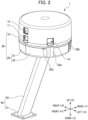
- FIG. 2 illustrates the sensor module 1 as viewed obliquely from the front upper side.
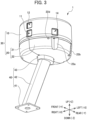
- FIG. 3 illustrates the sensor module 1 as viewed obliquely from the front lower side.
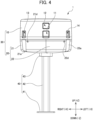
- FIG. 4 is a front view of the sensor module 1.
- FIG. 5 is a left side view of the sensor module 1.
- FIG. 6 is a rear view of the sensor module 1.
- FIG. 7 is a bottom view of the sensor module 1.
- orthogonal coordinates of X, Y, and Z axes are shown for convenience of description. The coordinates are set with reference to the front-rear direction of the marine vessel 100 and the horizontal direction.
- the X direction corresponds to the left-right direction of the marine vessel 100
- the Y direction corresponds to the front-rear direction of the marine vessel 100
- the Z direction corresponds to the up-down direction of the marine vessel 100.
- the front and rear are represented by “+Y” and “-Y”, respectively
- the left and right are represented by “-X” and “+X”, respectively
- the up and down are represented by "+Z” and "-Z”, respectively.
- the orientation and the like of each component will be described based on the coordinates, or using the words corresponding to the coordinates, namely, the front, rear, up, down, left, and right.
- the sensor module 1 is installed, for example, on the top of a roof of the marine vessel 100 such as a boat, as illustrated in FIG. 1 .
- the installation position of the sensor module 1 is not limited to the top of the roof, but is preferably a position that is less susceptible to the influence of an on-board structure, a person, and the like.
- the sensor module 1 includes a casing 30 and a strut 40.
- the casing 30 includes an upper casing part 10 and a lower casing part 20, and covers a base 50 (to be described later) and various sensors attached to the base 50.
- the casing 30 overall has a substantially cylindrical shape, but the shape of the casing 30 may be changed as appropriate to, for example, a tubular shape with the hexagonal or octagonal top and bottom surfaces.
- the upper casing part 10 is provided above the base 50 (toward the +Z side), and defines an upper chamber UC that is a space surrounded by the base 50 and the upper casing part 10.
- the upper casing part 10 may be formed of, for example, a resin molding.
- the lower casing part 20 is provided below the base 50, and defines a lower chamber LC that is a space surrounded by the base 50 and the lower casing part 20.
- the lower casing part 20 in order to enable attachment and detachment of the lower casing part 20 in a state in which the strut 40 is attached to the base 50, the lower casing part 20 is composed of two components, namely, a first lower casing component 21 and a second lower casing component 22.
- FIG. 8 is a diagram illustrating a state in which the casing 30 has been removed, as viewed obliquely from the front upper side.
- FIG. 9 is a top view illustrating the state in which the casing 30 has been removed.
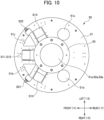
- FIG. 10 is a bottom view of the base 50 having various sensors attached thereto.
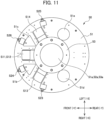
- FIG. 11 is a bottom view of the base 50 having the various sensors attached thereto, and illustrates a modification of second sensors.
- FIG. 12 illustrates the base 50 and the strut 40 as viewed obliquely from the front lower side.
- FIG. 13 illustrates the base 50as viewed obliquely from the front lower side.
- FIGS. 12 and 13 illustrate second sensors S21 and S22 attached to the lower surface of the base body 51, as well.
- FIG. 14 is a top view illustrating an arrangement of the sensors.
- the upper casing part 10 the base 50, and the strut 40 are omitted.
- the base 50 having the various sensors attached thereto is provided in a space covered by the casing 30.
- the base 50 includes a base body 51, a cylindrical part 52 provided on a lower side the base body 51, and a flange part 53 provided on a lower side of the cylindrical part 52.
- Each of the base body 51, the cylindrical part 52, and the flange part 53 may be made of metal, and the base body 51, the cylindrical part 52, and the flange part 53 may be connected to each other by welding, for example.
- the base body 51 has a substantially disk plate shape.
- the base body 51 has, at the center thereof, a through hole 51a penetrating through the upper surface and the lower surface of the base 50.
- the cylindrical part 52 has a substantially cylindrical shape, and has therein a through hole 52a.
- the flange part 53 extends outward in a collar shape from a lower end of the cylindrical part 52, and has a through hole 53a that opens at the center thereof.
- the through hole 51a, the through hole 52a, and the through hole 53a communicate with each other.
- the strut 40 is attached to a lower side of the flange part 53 of the base 50.
- the strut 40 includes a mounting part 41, a strut body 42 extending upward with respect to the mounting part 41, an elliptical tubular part 43 attached to an upper side of the strut body 42, and a flange part 44 attached to an upper side of the elliptical tubular part 43.
- Each of the mounting part 41, the strut body 42, the elliptical tubular part 43, and the flange part 44 may be made of metal, and the mounting part 41, the strut body 42, the elliptical tubular part 43, and the flange part 44 may be connected to each other by welding, for example.
- the mounting part 41 has a rectangular flat plate shape when viewed from below, and has a strut through hole 41a opening at the center thereof.
- the mounting part 41 is detachably attached to a roof or the like of the marine vessel using screws or the like.
- the strut body 42 has a columnar shape, extends substantially in the up-down direction, and has therein a strut through hole 42a penetrating through the strut body 42 in the up-down direction.
- the elliptical tubular part 43 has a substantially elliptical tubular shape, and has therein a strut through hole 43a penetrating through the elliptical tubular part 43 in the up-down direction.
- the flange part 44 extends outward in a collar shape from an upper end of the elliptical tubular part 43, has a strut through hole 44a opening substantially at the center thereof.
- the strut through hole 41a, the strut through hole 42a, the strut through hole 43a, and the strut through hole 44a communicate with each other.
- the flange part 44 is fixed to the flange part 53 of the base 50 using screws or the like.
- the strut through hole 44a of the strut 40 communicates with the through hole 53a of the base 50.
- a space is formed which continues from the upper surface of the base 50 to a lower end of the strut 40.
- First sensors S11, S12, S13, and S14, a third sensor S31, and relays 61 and 62 are fixed to the upper surface of the base 50.
- the first sensors S11, S12, S13, and S14 are all light detection and ranging (LIDAR) sensors.
- the first sensors S11 and S12 are oriented in the front direction (+Y direction) of the marine vessel, and the first sensor S11 is disposed on top of the first sensor S12.
- the first sensor S13 is oriented substantially 60 degrees diagonally to the right.
- the first sensor S14 is oriented substantially 60 degrees diagonally to the left.
- the third sensor S31 of the present embodiment is an inertial measurement unit (IMU).
- the third sensor S31 extends in the length direction of the marine vessel 100 and is arranged on a virtual line segment L0 (see FIGS. 9 and 14 ) passing through the center of the base 50, while being spaced apart from the first sensors in a top view. This arrangement makes it possible to reduce the calculation cost of calculating a motion state of the marine vessel by combining the first sensors S11 to S14 and the third sensor S31.
- the relays 61 and 62 relay signals from the first sensors S11 to S14, second sensors S21 and S22 (to be described later), the third sensor S31, and the like. That is, the signals from the sensors are inputted to the relays 61 and 62 via wiring (not shown).
- the relays transmit the signals to the controller (not shown) of the marine vessel 100 through the interior of the above-described strut 40 by way of wiring different from the wiring from the sensors. With this configuration, even if the wiring from the sensors is short, it can be used for the sensor module 1.
- the second sensors S21 and S22 are provided on the lower surface of the base body 51.
- the second sensor S21 is oriented substantially 45 degrees diagonally to the right.
- the second sensor S22 is oriented substantially 45 degrees diagonally to the left.
- the second sensors S21 and S22 of the present embodiment are cameras (imagers) each including an imaging element and a lens.
- second sensors S23, S24, S25 and S26 having specifications different from those of the second sensors S21 and S22 may be disposed instead of the second sensors S21 and S22.
- the second sensors S21 and S22 may be cameras having a wider angle of view than the second sensors S23, S24, S25, and S26.
- a different lower casing part 20 having apertures positionally corresponding to the second sensors S23, S24, S25, and S26 is used, although the different lower casing part 20 is not shown.
- the second sensors S21 and S22 are mainly described, but the description of the second sensors S21 and S22 applies to the case where the second sensors S23, S24, S25, and S26 are used.
- the first sensors S11 to S14, the second sensors S21 and S22, and the third sensor S31 are all fixed to the base body 51. For this reason, mounting errors of the sensors can be reduced at the time of manufacturing, in comparison with the conventional configuration in which the sensors are fixed to different base members, thereby enabling improvement of the mounting accuracy. Furthermore, making only the base 50 have sufficient rigidity allows for preventing the sensors from deviating from the relative positions, so that the casing 30 can be made of a material having low rigidity such as a resin component. The sensors having a small mounting error at the time of manufacturing can be put in use thereafter for automatic navigation, etc. without need for measuring the positions of the sensors or the need for calibration.
- the first sensors S11, S12, S13, and S14 are heavier in weight than the second sensors S21 and S22. For this reason, in the present embodiment, the first sensors S11, S12, S13, S14, which are heavier in weight than the second sensors S21 and S22, and the third sensor S31 are arranged and stably held on the upper surface of the base body 51, and upper portions of the second sensors S21 and S22, which are relatively light in weight, are fixed to the lower surface of the base body 51.
- This arrangement in which the sensors are not in contact with the bottom surface of the casing 30, makes it possible to prevent the sensors from being immersed in water even in case of ingress of water into the casing 30.
- the second sensors S21 and S22 having a relatively light weight are attached to the lower surface of the base body 51, a simple attachment structure can be used for the second sensors S21 and S22. Furthermore, the base body 51 entirely covers the upper portions of the second sensors S21 and S22 and thereby functions as an eave to block sunlight. As a result, the second sensors S21 and S22 can easily obtain good photographing results, and erroneous recognition, identification errors, and the like can be reduced.
- the first sensors S11, S12, S13 and S14 and the second sensors S21 and S22 are arranged axisymmetrically with respect to the virtual line segment L0 (see FIGS. 9 and 14 ), which extends in the length direction (Y direction) of the marine vessel 100 and passes through the center of the base 50 in the top view.
- L0 the virtual line segment
- the first sensors S11, S12, S13, and S14 and the second sensors S21 and S22 are arranged at positions where the first and second sensors do not overlap with each other. This arrangement makes it possible to avoid interference between bolts and the like for attaching the sensors to the base body 51, and removes an impediment to attaching the sensors in a pitch direction (circumferential direction in the top view).
- the base body 51 has, separately from the through hole 51a described above, communication holes 51b, 51c, 51d, and 51e through which the upper chamber UC communicates with the lower chamber LC. Due to the communication holes 51b, 51c, 51d and 51e, the wiring of the second sensors S21 and S22 arranged in the lower chamber LC can be inserted into the through hole 51a or connected to the relays 61 and 62.
- the communication holes 51b, 51c, 51d, and 51e further have a function of allowing air to flow between first ventilation portions 21ba, 21ca, 22ba, and 22ca and second ventilation portions 11, 12, 13, and 14, which will be described later.
- FIG. 15 illustrates the upper casing part 10 as viewed obliquely from the front upper side.
- FIG. 16 illustrates, at an enlarged scale, the vicinity of the second ventilation portion 14 of the sensor module 1.
- FIG. 17 illustrates the lower casing part 20 as viewed obliquely from the front upper side.
- FIG. 18 illustrates the first lower casing component 21 as viewed obliquely from the front upper side.
- the second ventilation portions 11, 12, 13, and 14 are provided on the side wall of the upper casing part 10 at positions opposite to the first sensors S11, S12, S13, and S14, respectively.
- the second ventilation portions 11, 12, 13, and 14 have a function as apertures through which the first sensors S11, S12, S13, and S14 perform sensing, and a function of ventilation for cooling the first sensors S11, S12, S13, and S14. Accordingly, a gap is provided between the second ventilation portions 11, 12, 13, and 14 and the first sensors S11, S12, S13, and S14, respectively.
- the second ventilation portion 14 includes an external opening 14a, an internal opening 14b, an opening side surface 14c, and an opening bottom surface 14d.
- the external opening 14a opens at the surface of the side wall of the upper casing part 10.
- the internal opening 14b opens more inside the upper casing part 10 than the external opening 14a.
- the opening side surface 14c connects the external opening 14a to the internal opening 14b, and extends substantially in the up-down direction.
- the opening bottom surface 14d connects the external opening 14a to the internal opening 14b, and extends in a direction inclined upward from the external opening 14a toward the internal opening 14b.
- the second ventilation portions 12 and 13 have the same or similar configuration to that of the second ventilation portion 14.
- the lower casing part 20 is composed of two components, i.e., the first lower casing component 21 and the second lower casing component 22, and is detachably attachable to the base 50.
- the first lower casing component 21 has recesses 21a, 21b, and 21c
- the second lower casing component 22 has recesses 22a, 22b, and 22c (see, for example, FIG. 7 ).
- the recesses 21a, 21b, 21c, 22a, 22b, and 22c are formed by recessing portions of the side wall of the first lower casing component 21 or the second lower casing component 22 toward the interior of the lower casing part 20, are positioned below the base body 51, and are arranged at positions where the recesses partially overlap with the base body 51 in a top view. Ceiling surfaces of the recesses 21a, 21b, 21c, 22a, 22b, and 22c each overlap with the base body 51, and screws are fastened in the overlapping portions, whereby the first lower casing component 21, the second lower casing component 22, the base body 51, and the upper casing part 10 are fixed together.
- the first lower casing component 21 and the second lower casing component 22 have second sensor apertures 21d and 22d, respectively at positions corresponding to the second sensors S21 and S22.
- the second sensor apertures 21d and 22d of the present embodiment are openings of a size necessary for the second sensors S21 and S22 to photograph.
- the lower casing part 20 has, in the lower surface thereof, a drain hole 20a having an elliptical shape similar to the perimetrical shape of the elliptical tubular part 43 of the strut 40.
- the perimetrical shape of the drain hole 20a is slightly larger than the perimetrical shape of the elliptical tubular part 43, and a gap is formed between the edge of the drain hole 20a and the elliptical tubular part 43 (see FIG. 7 ).
- This gap has a function of draining water, and in case of ingress of water into the interior of the casing 30, water is automatically drained through the gap.
- a drain hole may be formed at a different position.
- the first ventilation portions 21ba, 21ca, 22ba, and 22ca that allow for ventilation between the interior and the exterior are provided on the side walls of the recesses 21b, 21c, 22b and 22c, which are provided in a rear portion.
- the first ventilation portions 21ba, 21ca, 22ba, and 22ca, which are provided on the side wall of the casing 30, constitute a ventilation structure that makes it unlikely for rainwater to ingress from above.
- the recesses 21b, 21c, 22b, and 22c each have the ceiling portion that is formed by the first lower casing component 21 or the second lower casing component 22 and the base body 51, it is possible to prevent the recesses 21b, 21c, 22b, and 22c from getting wet with water coming from above.
- the first ventilation portions 21ba, 21ca, 22ba, and 22ca are provided on the circumference on which the first sensors S11, S12, S13, and S14, are arranged, and are arranged at positions substantially opposite to the second ventilation portions 11, 12, 13, and 14.
- the first ventilation portion 21ba is substantially opposite to the second ventilation portion 14
- the first ventilation portions 21ca and 22ca are substantially opposite to the second ventilation portions 11 and 12
- the first ventilation portion 22ba is substantially opposite to the second ventilation portion 13.
- the positions of the first ventilation portions 21ba, 21ca, 22ba, and 22ca and the positions of the second ventilation portions 11, 12, 13, and 14, are indicated by the respective reference signs in parentheses.
- the communication holes 51b, 51c, 51d, and 51e allow air to flow between the first ventilation portions 21ba, 21ca, 22ba, and 22ca and the second ventilation portions 11, 12, 13, and 14. Due to this arrangement of the ventilation portions, the sensor module 1 of the present embodiment has air passages formed in the casing 30, thereby making it possible to efficiently cool the sensors, in particular, the first sensors S11, S12, S13, and S14. Furthermore, since the arrangement of the ventilation portions allows wind to easily pass through, generation of abnormal sound due to the wind can be reduced even when it is very windy.
- the sensor module 1 of the present embodiment can be used, for example, for automatic navigation of the marine vessel 100.
- FIG. 19 is a flowchart illustrating an outline of automatic navigation control of the marine vessel 100.
- step (hereinafter abbreviated as S) the automatic navigation mode is started.
- S2 the outside is recognized. The recognition of the outside is performed by mainly using the first sensors S11, S12, S13, S14, the second sensors S21, S22, and the like installed in the sensor module 1.
- S3 a destination is determined.
- the destination may be, for example, a specific position of a pier at which the marine vessel is going to arrive.
- automatic navigation is performed in S4.
- the first sensors S11, S12, S13, S14, the second sensors S21, S22, the third sensor S31, and the like installed in the sensor module 1 are used, and information from a global positioning system (GPS) sensor or the like (not shown) is additionally used.
- GPS global positioning system
- the sensor module 1 of the present embodiment since all the sensors are arranged on the base body 51, assembly errors between the plurality of sensors can be reduced, thereby eliminating the need for measuring the distances between the sensors and the need for a system for calibration.
- a sensor module for shipboard use, detachably mountable to a marine vessel includes a base; a casing that covers the base; a first sensor provided on an upper surface of the base; and a second sensor provided on a lower surface of the base.
Landscapes
- Engineering & Computer Science (AREA)
- Radar, Positioning & Navigation (AREA)
- Remote Sensing (AREA)
- Physics & Mathematics (AREA)
- General Physics & Mathematics (AREA)
- Computer Networks & Wireless Communication (AREA)
- Electromagnetism (AREA)
- Automation & Control Theory (AREA)
- Chemical & Material Sciences (AREA)
- Combustion & Propulsion (AREA)
- Mechanical Engineering (AREA)
- Ocean & Marine Engineering (AREA)
- Multimedia (AREA)
- Signal Processing (AREA)
- Testing Or Calibration Of Command Recording Devices (AREA)
Applications Claiming Priority (1)
| Application Number | Priority Date | Filing Date | Title |
|---|---|---|---|
| US18/476,346 US12503203B2 (en) | 2023-09-28 | 2023-09-28 | Sensor module, and marine vessel |
Publications (2)
| Publication Number | Publication Date |
|---|---|
| EP4556854A2 true EP4556854A2 (de) | 2025-05-21 |
| EP4556854A3 EP4556854A3 (de) | 2025-08-27 |
Family
ID=92925767
Family Applications (1)
| Application Number | Title | Priority Date | Filing Date |
|---|---|---|---|
| EP24203142.5A Pending EP4556854A3 (de) | 2023-09-28 | 2024-09-27 | Sensormodul und damit ausgestattetes wasserfahrzeug |
Country Status (2)
| Country | Link |
|---|---|
| US (1) | US12503203B2 (de) |
| EP (1) | EP4556854A3 (de) |
Families Citing this family (1)
| Publication number | Priority date | Publication date | Assignee | Title |
|---|---|---|---|---|
| USD1046632S1 (en) * | 2020-03-02 | 2024-10-15 | Waymo Llc | Sensor assembly |
Citations (1)
| Publication number | Priority date | Publication date | Assignee | Title |
|---|---|---|---|---|
| FR2907629A1 (fr) | 2006-10-19 | 2008-04-25 | Eca Sa | Systeme d'observation et de transmission d'images notamment pour drone naval de surface, et drone naval associe |
Family Cites Families (9)
| Publication number | Priority date | Publication date | Assignee | Title |
|---|---|---|---|---|
| EP2798314B1 (de) | 2011-12-30 | 2017-09-20 | Thales | Stabilisierte plattform |
| CN204832514U (zh) | 2015-07-20 | 2015-12-02 | 北京数字绿土科技有限公司 | 一体化多传感器激光雷达扫描系统 |
| US10757320B2 (en) | 2017-12-28 | 2020-08-25 | Waymo Llc | Multiple operating modes to expand dynamic range |
| US10589723B1 (en) | 2018-09-21 | 2020-03-17 | Ford Global Technologies, Llc | Imaging system |
| US20200215988A1 (en) | 2019-01-07 | 2020-07-09 | Valeo North America, Inc. | Lightweight structural module on the roof of a vehicle |
| US11099039B2 (en) * | 2019-08-28 | 2021-08-24 | Ford Global Technologies, Llc | Sensor assembly |
| US11262641B2 (en) * | 2019-12-13 | 2022-03-01 | Pony Ai Inc. | Overheating protection for sensor housing |
| US12015836B2 (en) * | 2020-11-10 | 2024-06-18 | Deere & Company | Work vehicle perception systems and front modules |
| US11800085B2 (en) * | 2021-07-22 | 2023-10-24 | Argo AI, LLC | Motorized mounting device for positioning an optical element within a field-of-view of an optical sensor and method of use |
-
2023
- 2023-09-28 US US18/476,346 patent/US12503203B2/en active Active
-
2024
- 2024-09-27 EP EP24203142.5A patent/EP4556854A3/de active Pending
Patent Citations (1)
| Publication number | Priority date | Publication date | Assignee | Title |
|---|---|---|---|---|
| FR2907629A1 (fr) | 2006-10-19 | 2008-04-25 | Eca Sa | Systeme d'observation et de transmission d'images notamment pour drone naval de surface, et drone naval associe |
Also Published As
| Publication number | Publication date |
|---|---|
| EP4556854A3 (de) | 2025-08-27 |
| US12503203B2 (en) | 2025-12-23 |
| US20250108893A1 (en) | 2025-04-03 |
Similar Documents
| Publication | Publication Date | Title |
|---|---|---|
| US9544476B2 (en) | Omnidirectional camera | |
| US10908678B2 (en) | Video and image chart fusion systems and methods | |
| US10942028B2 (en) | Video sensor fusion and model based virtual and augmented reality systems and methods | |
| US12211265B2 (en) | Water non-water segmentation systems and methods | |
| US10983206B2 (en) | Low cost high precision GNSS systems and methods | |
| EP4556854A2 (de) | Sensormodul und damit ausgestattetes wasserfahrzeug | |
| US10261176B2 (en) | Rotating attitude heading reference systems and methods | |
| US20190251356A1 (en) | Augmented reality labels systems and methods | |
| US20210003693A1 (en) | Adaptive doppler radar systems and methods | |
| CN113079698B (zh) | 进行航空器的飞行控制的控制装置、及控制方法 | |
| US12392887B2 (en) | Enhanced doppler radar systems and methods | |
| US20200047861A1 (en) | Sensor system for maritime vessels | |
| CN114739389B (zh) | 一种深海作业型缆控潜器水下导航装置及其使用方法 | |
| US12444187B2 (en) | Radar and colocated camera systems and methods | |
| WO2018076535A1 (zh) | 无人飞行器及电池仓组件与电池仓 | |
| US20100245660A1 (en) | Camera | |
| Osterloh et al. | MONSUN II-towards autonomous underwater swarms for environmental monitoring | |
| CN115290069B (zh) | 多源异构传感器数据融合与协同感知手持移动平台 | |
| CN216313220U (zh) | 摄像模组 | |
| CN216012264U (zh) | 一种标定工装 | |
| CN216354760U (zh) | 车载天线及车尾门 | |
| CN223072404U (zh) | 传感器集成支架及无人车 | |
| CN219821772U (zh) | 一种光电吊舱的可见光机芯机构及其光电吊舱 | |
| JPH11341487A (ja) | 監視カメラ装置 | |
| CN223610876U (zh) | 一种车载高精度视觉组合导航设备 |
Legal Events
| Date | Code | Title | Description |
|---|---|---|---|
| PUAI | Public reference made under article 153(3) epc to a published international application that has entered the european phase |
Free format text: ORIGINAL CODE: 0009012 |
|
| STAA | Information on the status of an ep patent application or granted ep patent |
Free format text: STATUS: REQUEST FOR EXAMINATION WAS MADE |
|
| 17P | Request for examination filed |
Effective date: 20240927 |
|
| AK | Designated contracting states |
Kind code of ref document: A2 Designated state(s): AL AT BE BG CH CY CZ DE DK EE ES FI FR GB GR HR HU IE IS IT LI LT LU LV MC ME MK MT NL NO PL PT RO RS SE SI SK SM TR |
|
| RAP3 | Party data changed (applicant data changed or rights of an application transferred) |
Owner name: HONDA MOTOR CO., LTD. |
|
| PUAL | Search report despatched |
Free format text: ORIGINAL CODE: 0009013 |
|
| AK | Designated contracting states |
Kind code of ref document: A3 Designated state(s): AL AT BE BG CH CY CZ DE DK EE ES FI FR GB GR HR HU IE IS IT LI LT LU LV MC ME MK MT NL NO PL PT RO RS SE SI SK SM TR |
|
| RIC1 | Information provided on ipc code assigned before grant |
Ipc: G01C 21/16 20060101AFI20250723BHEP Ipc: G01C 21/20 20060101ALI20250723BHEP Ipc: G01S 7/481 20060101ALI20250723BHEP Ipc: G01S 17/86 20200101ALI20250723BHEP Ipc: G01S 17/93 20200101ALI20250723BHEP Ipc: G01S 17/89 20200101ALI20250723BHEP Ipc: F16M 11/00 20060101ALI20250723BHEP Ipc: F16M 13/00 20060101ALI20250723BHEP Ipc: G12B 9/00 20060101ALI20250723BHEP Ipc: B63B 79/40 20200101ALI20250723BHEP Ipc: B63B 79/10 20200101ALI20250723BHEP Ipc: B63B 49/00 20060101ALI20250723BHEP |
|
| STAA | Information on the status of an ep patent application or granted ep patent |
Free format text: STATUS: EXAMINATION IS IN PROGRESS |