EP4557526A1 - Leistungsanschlussmodul zum klemmen eines elektrischen kabelabschlusses durch ein blatt, dessen mindestens ein verformbares teil zur bildung eines anschlussblockteils einer verbindungsanordnung bildet - Google Patents
Leistungsanschlussmodul zum klemmen eines elektrischen kabelabschlusses durch ein blatt, dessen mindestens ein verformbares teil zur bildung eines anschlussblockteils einer verbindungsanordnung bildet Download PDFInfo
- Publication number
- EP4557526A1 EP4557526A1 EP24212921.1A EP24212921A EP4557526A1 EP 4557526 A1 EP4557526 A1 EP 4557526A1 EP 24212921 A EP24212921 A EP 24212921A EP 4557526 A1 EP4557526 A1 EP 4557526A1
- Authority
- EP
- European Patent Office
- Prior art keywords
- blade
- contact
- electrical
- connection module
- clamping
- Prior art date
- Legal status (The legal status is an assumption and is not a legal conclusion. Google has not performed a legal analysis and makes no representation as to the accuracy of the status listed.)
- Granted
Links
Images







Classifications
-
- H—ELECTRICITY
- H01—ELECTRIC ELEMENTS
- H01R—ELECTRICALLY-CONDUCTIVE CONNECTIONS; STRUCTURAL ASSOCIATIONS OF A PLURALITY OF MUTUALLY-INSULATED ELECTRICAL CONNECTING ELEMENTS; COUPLING DEVICES; CURRENT COLLECTORS
- H01R4/00—Electrically-conductive connections between two or more conductive members in direct contact, i.e. touching one another; Means for effecting or maintaining such contact; Electrically-conductive connections having two or more spaced connecting locations for conductors and using contact members penetrating insulation
- H01R4/28—Clamped connections, spring connections
- H01R4/48—Clamped connections, spring connections utilising a spring, clip, or other resilient member
- H01R4/489—Clamped connections, spring connections utilising a spring, clip, or other resilient member spring force increased by screw, cam, wedge, or other fastening means
-
- H—ELECTRICITY
- H01—ELECTRIC ELEMENTS
- H01R—ELECTRICALLY-CONDUCTIVE CONNECTIONS; STRUCTURAL ASSOCIATIONS OF A PLURALITY OF MUTUALLY-INSULATED ELECTRICAL CONNECTING ELEMENTS; COUPLING DEVICES; CURRENT COLLECTORS
- H01R4/00—Electrically-conductive connections between two or more conductive members in direct contact, i.e. touching one another; Means for effecting or maintaining such contact; Electrically-conductive connections having two or more spaced connecting locations for conductors and using contact members penetrating insulation
- H01R4/28—Clamped connections, spring connections
- H01R4/48—Clamped connections, spring connections utilising a spring, clip, or other resilient member
- H01R4/4809—Clamped connections, spring connections utilising a spring, clip, or other resilient member using a leaf spring to bias the conductor toward the busbar
- H01R4/4828—Spring-activating arrangements mounted on or integrally formed with the spring housing
- H01R4/483—Pivoting arrangements, e.g. lever pushing on the spring
-
- H—ELECTRICITY
- H02—GENERATION; CONVERSION OR DISTRIBUTION OF ELECTRIC POWER
- H02G—INSTALLATION OF ELECTRIC CABLES OR LINES, OR OF COMBINED OPTICAL AND ELECTRIC CABLES OR LINES
- H02G15/00—Cable fittings
- H02G15/08—Cable junctions
- H02G15/10—Cable junctions protected by boxes, e.g. by distribution, connection or junction boxes
-
- H—ELECTRICITY
- H01—ELECTRIC ELEMENTS
- H01R—ELECTRICALLY-CONDUCTIVE CONNECTIONS; STRUCTURAL ASSOCIATIONS OF A PLURALITY OF MUTUALLY-INSULATED ELECTRICAL CONNECTING ELEMENTS; COUPLING DEVICES; CURRENT COLLECTORS
- H01R13/00—Details of coupling devices of the kinds covered by groups H01R12/70 or H01R24/00 - H01R33/00
- H01R13/40—Securing contact members in or to a base or case; Insulating of contact members
-
- H—ELECTRICITY
- H01—ELECTRIC ELEMENTS
- H01R—ELECTRICALLY-CONDUCTIVE CONNECTIONS; STRUCTURAL ASSOCIATIONS OF A PLURALITY OF MUTUALLY-INSULATED ELECTRICAL CONNECTING ELEMENTS; COUPLING DEVICES; CURRENT COLLECTORS
- H01R13/00—Details of coupling devices of the kinds covered by groups H01R12/70 or H01R24/00 - H01R33/00
- H01R13/62—Means for facilitating engagement or disengagement of coupling parts or for holding them in engagement
- H01R13/639—Additional means for holding or locking coupling parts together, after engagement, e.g. separate keylock, retainer strap
-
- H—ELECTRICITY
- H01—ELECTRIC ELEMENTS
- H01R—ELECTRICALLY-CONDUCTIVE CONNECTIONS; STRUCTURAL ASSOCIATIONS OF A PLURALITY OF MUTUALLY-INSULATED ELECTRICAL CONNECTING ELEMENTS; COUPLING DEVICES; CURRENT COLLECTORS
- H01R9/00—Structural associations of a plurality of mutually-insulated electrical connecting elements, e.g. terminal strips or terminal blocks; Terminals or binding posts mounted upon a base or in a case; Bases therefor
- H01R9/22—Bases, e.g. strip, block, panel
- H01R9/24—Terminal blocks
- H01R9/2416—Means for guiding or retaining wires or cables connected to terminal blocks
-
- H—ELECTRICITY
- H02—GENERATION; CONVERSION OR DISTRIBUTION OF ELECTRIC POWER
- H02G—INSTALLATION OF ELECTRIC CABLES OR LINES, OR OF COMBINED OPTICAL AND ELECTRIC CABLES OR LINES
- H02G15/00—Cable fittings
- H02G15/007—Devices for relieving mechanical stress
-
- H—ELECTRICITY
- H02—GENERATION; CONVERSION OR DISTRIBUTION OF ELECTRIC POWER
- H02G—INSTALLATION OF ELECTRIC CABLES OR LINES, OR OF COMBINED OPTICAL AND ELECTRIC CABLES OR LINES
- H02G3/00—Installations of electric cables or lines or protective tubing therefor in or on buildings, equivalent structures or vehicles
- H02G3/02—Details
- H02G3/08—Distribution boxes; Connection or junction boxes
-
- H—ELECTRICITY
- H01—ELECTRIC ELEMENTS
- H01R—ELECTRICALLY-CONDUCTIVE CONNECTIONS; STRUCTURAL ASSOCIATIONS OF A PLURALITY OF MUTUALLY-INSULATED ELECTRICAL CONNECTING ELEMENTS; COUPLING DEVICES; CURRENT COLLECTORS
- H01R11/00—Individual connecting elements providing two or more spaced connecting locations for conductive members which are, or may be, thereby interconnected, e.g. end pieces for wires or cables supported by the wire or cable and having means for facilitating electrical connection to some other wire, terminal, or conductive member, blocks of binding posts
- H01R11/03—Individual connecting elements providing two or more spaced connecting locations for conductive members which are, or may be, thereby interconnected, e.g. end pieces for wires or cables supported by the wire or cable and having means for facilitating electrical connection to some other wire, terminal, or conductive member, blocks of binding posts characterised by the relationship between the connecting locations
- H01R11/09—Individual connecting elements providing two or more spaced connecting locations for conductive members which are, or may be, thereby interconnected, e.g. end pieces for wires or cables supported by the wire or cable and having means for facilitating electrical connection to some other wire, terminal, or conductive member, blocks of binding posts characterised by the relationship between the connecting locations the connecting locations being identical
-
- H—ELECTRICITY
- H01—ELECTRIC ELEMENTS
- H01R—ELECTRICALLY-CONDUCTIVE CONNECTIONS; STRUCTURAL ASSOCIATIONS OF A PLURALITY OF MUTUALLY-INSULATED ELECTRICAL CONNECTING ELEMENTS; COUPLING DEVICES; CURRENT COLLECTORS
- H01R13/00—Details of coupling devices of the kinds covered by groups H01R12/70 or H01R24/00 - H01R33/00
- H01R13/02—Contact members
- H01R13/10—Sockets for co-operation with pins or blades
- H01R13/11—Resilient sockets
- H01R13/111—Resilient sockets co-operating with pins having a circular transverse section
-
- H—ELECTRICITY
- H01—ELECTRIC ELEMENTS
- H01R—ELECTRICALLY-CONDUCTIVE CONNECTIONS; STRUCTURAL ASSOCIATIONS OF A PLURALITY OF MUTUALLY-INSULATED ELECTRICAL CONNECTING ELEMENTS; COUPLING DEVICES; CURRENT COLLECTORS
- H01R2101/00—One pole
-
- H—ELECTRICITY
- H01—ELECTRIC ELEMENTS
- H01R—ELECTRICALLY-CONDUCTIVE CONNECTIONS; STRUCTURAL ASSOCIATIONS OF A PLURALITY OF MUTUALLY-INSULATED ELECTRICAL CONNECTING ELEMENTS; COUPLING DEVICES; CURRENT COLLECTORS
- H01R4/00—Electrically-conductive connections between two or more conductive members in direct contact, i.e. touching one another; Means for effecting or maintaining such contact; Electrically-conductive connections having two or more spaced connecting locations for conductors and using contact members penetrating insulation
- H01R4/28—Clamped connections, spring connections
- H01R4/38—Clamped connections, spring connections utilising a clamping member acted on by screw or nut
- H01R4/40—Pivotable clamping member
Definitions
- the present invention relates to the field of electrical power connectors.
- terminal block is meant here and within the scope of the present invention, a device for ensuring electrical continuity between a cable and another part of an installation.
- a terminal block also known as a connection terminal or screw terminal, is an electrically insulated module that fixes together two or more electrical wires/cables, intended to be electrically connected to each other, and comprises an insulating support and at least one clamping component for fixing the wires/cables.
- contact is meant here and within the framework of the present invention, an element made of electrically conductive material to allow the electric current to pass.
- the invention can be implemented in any other application which requires a power connection, in particular several hundred amperes and/or volts and particularly a large number of electrical cables/wires between them in a junction zone.
- One of the aircraft wiring operations is to electrically connect a large number of power cables/wires together.
- This operation is usually implemented using a screw terminal block, fixed to the structure of the aircraft, and into which the plurality of electrical cables/wires are inserted and then fixed by clamping.
- FIG. 1 An example of such an existing terminal block, generally designated by the reference 1, which is designed to connect two or more electrical cables 2 equipped with terminals 20 at their ends by a screw-nut system.
- This terminal block 1 firstly comprises an electrically insulating support 10 in which terminal screws 11 are fixed, each of which, with a nut 12, forms a screw-nut system for tightening the terminals 20 equipping the cables 2.
- a washer in particular an electrically conductive one, 13, of the corrugated washer type, is provided for each screw-nut system.
- An electrically conductive bar 14 is crossed by each terminal screw 11. This bar 14 forms a bearing surface for the cable lugs 20 and thus constitutes an electrical shunt between the cables 2 to be electrically connected.
- This plate 14 is optional and each screw 11 is electrically independent. Alternatively, the plate 14 may extend only over a portion of the length and electrically connect only a portion of the screws.
- the support 10 is fixed to an aircraft structure S by column screws 15.
- a cover 16 held by the column screws 15 forms a protective cover for the screw-nut systems 11, 12.
- terminal block 1 Since terminal block 1 is not waterproof, an additional cover commonly called an "umbrella" is fixed to the structure of the aircraft, above the terminal block to prevent condensed moisture from dripping directly onto the cables 2 connected in the terminal block.
- the terminals 20 must be perfectly oriented to be threaded around the terminal screws 11 for a satisfactory electrical connection. This usually involves an operator having to untwist the cables 2.
- the number of parts to be managed is significant, with, in addition, a high risk of loss of parts which therefore induces a risk of foreign bodies, or mechanical debris (FOD acronym for "Foreign Object Damage”) which can cause damage, which we absolutely seek to avoid in the aeronautics field.
- the insulating support 10 is usually fixed on the ceiling side in the structure of an aircraft. This may mean that the terminals installed on the screws 11 do not stay in place until a nut 12 has also been installed. In other words, there is no function of pre-holding the terminals in position on the screws.
- a screw terminal block requires that the cables not be energized to avoid electrical risks for the operators responsible for the electrical connection. These risks cannot be completely ruled out during tests to verify proper operation.
- the 20 lugs may need to be oriented at 180°, which is not very compatible with power cables that are rigid, typically with a diameter of the order of AWG 000 (unit of measurement "American Wire Gauge"), or 10.4 mm.
- screw terminals do not allow for modularity because the number of cables 2 that can be connected in a single terminal block is fixed.
- THE patent US10998649B2 discloses a terminal block in which, after its insertion into a cavity of a body, an electrical cable conductor is clamped between a fixed blade and a movable and deformable blade, actuated by a rotary lever directly by an operator.
- This solution is not directly adaptable to a cable termination.
- the clamping force is reduced.
- the actuation space of the rotary lever is also significant, requiring good accessibility for the operator's hand. However, such access is far from being possible in an aeronautical environment. Detection of the correct insertion of the cable is also not achieved.
- CN211404771U also discloses a terminal block in which the clamping of a cable conductor is achieved by deformation of a contact blade by means of a pressure screw.
- connection assembly which provides greater modularity, facilitates installation, particularly in areas with restricted access and/or for a large number of electrical wires/cables to be connected, and protects the operators responsible for the connection against electrical risks.
- the invention aims to meet all or part of this need.
- the invention essentially consists of a module for a terminal block connection assembly with a body provided with a cavity in which, after having been inserted, a cable termination contact is clamped between a fixed part and a transversely deformable part in contact with a blade, the clamping being carried out from the outside by a tool and by means of a clamping mechanism with a cam and force transmission part, or with a lever, housed in the body of the module.
- the cam clamping mechanism ensures the individual clamping of a termination contact in order to guarantee the desired electrical continuity with significant effort and in a reduced footprint within the module, the body of which is small.
- the force transmission part is configured to be able to be inserted into a transverse groove of the termination contact in order to indicate the correct positioning (insertion) of the contact in the cavity.
- the force transmission part abuts against a part of the contact, preferably cylindrical, which does not allow the actuation of the clamping mechanism.
- the force transmission part prevents any sliding of the contact between the sheets.
- a locking device allows the mechanism to be locked in the deformed position of the blade and therefore in the contact clamping configuration for the desired electrical continuity.
- the blade(s) are shaped to constitute at least two, advantageously three areas of direct linear or surface support with the contact of the electrical termination in the deformed position of the second blade.
- linear or surface support zones are distributed angularly, preferably regularly, at the periphery of the contact.
- three linear support zones are arranged substantially at 120° from each other.
- the module comprises a single blade with a cross-section on the X axis, substantially U-shaped.
- the clamping mechanism advantageously comprises a lever pivotally mounted in the body and accessible from the outside so as to deform at least one of the two branches of the U and thus bring it from its rest position to its deformed position.
- the module comprises at least one first blade, electrically conductive, housed in the cavity and rigid, and at least one second blade, electrically conductive, housed in the cavity and comprising at least one elastically deformable part between the rest position and the deformed position.
- the interface part may comprise an interface imprint with the tool, preferably a hollow hexagonal imprint.
- the body of the module and/or the interface part comprises at least one visual indicator arranged so as to be visible to an operator to indicate to him the position of the correct tightening of the contact of the electrical termination.
- the body of the module and/or the interface part may thus comprise, as a visual indicator, an area of visible color.
- the force transmission part comprises a locking portion adapted to be inserted, during the translation of said part, into a peripheral groove of the electrical termination contact and thus lock the latter in the body, preferably before or simultaneously with tightening the contact.
- the termination contact is locked in a correct insertion position before the tightening force is applied to it.
- the locking portion has a shape complementary to that of the peripheral groove of the contact of the electrical termination.
- the second blade is mounted free in the first blade at one of its ends, and free at the other of its ends.
- the clamping cam is mounted in rotation between two branches of the first blade. This improves the absorption of mechanical forces, particularly in temperature-sensitive environments.
- the force transmission part further comprises a return portion for returning the second blade to its rest position, when loosening after unlocking the contact.
- the body comprises an opening facing the cavity, provided internally with at least one protrusion or a plurality of longitudinal straight grooves, preferably regularly distributed angularly, each adapted to be respectively received between two adjacent ribs of the sleeve of the electrical cable termination, or to receive a straight groove formed around the sleeve.
- the protrusion(s) or grooves of the sleeve of the termination allow the torsional forces of the cable to be taken up on the body of the module. In addition, they make it possible to prevent rotation of the contact by sliding, once tightened in the connection module.
- the module comprises a device for locking/unlocking the clamping mechanism, when the clamping cam is in its rotation position corresponding to the deformed position of the second blade.
- the wall when the part is in its locking position, the wall projects inside an opening, and when the part is in its unlocking position, said wall is set back from the inside of the opening, the wall being adapted to fit into a transverse groove of the sleeve of the electrical termination and thus lock the latter in the body, preferably after or simultaneously with tightening the contact.
- the first blade comprises a portion extending outside the body and adapted to be electrically connected by soldering or screwing to a busbar.
- the electrical connection module can also be dedicated to a connection between harnesses, i.e. between at least two separate electrical cable terminations.
- the invention also relates to a terminal block connection assembly, comprising a plurality of modules of identical or different dimensions with cavities of identical or different dimensions for housing electrical terminations of identical or different dimensions.
- the invention finally relates to a structure, in particular an aircraft structure, comprising at least one electrical connection module as described previously and/or at least one terminal block connection assembly as described above, preferably fixed to a support rail, itself intended to be fixed to the structure.
- This electrical connection module 3 comprises two bodies 30, preferably identical or symmetrical, fixed to each other.
- the fixing means between the two bodies 30 are not shown but they may be screws/nuts passing right through the bodies.
- Each body 30 is electrically insulating with a longitudinal axis X, and intended to house, clamp, lock and connect at least one termination 4 of an electric cable 2.
- This electric cable 2 comprises an outer sheath 20 surrounding an electric conductor 21.
- each body 30 comprises a cavity 31 within it and the two cavities 31, preferably of the same size, are opposite each other in each of which a termination 4 of electric cable 2 is inserted, tightened and locked, as explained below.
- An electrical cable termination 4 with a central axis X1, comprises an electrically insulating sleeve 40 and a cylindrically shaped electrical contact 41 crimped onto an electrical cable 2, inserted and fixed in particular by snap-fastening, inside the sleeve 40.
- the sleeve 40 comprises on its outer periphery straight grooves 42 which extend around the central axis X1 over part of the length of the sleeve.
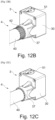
- the cylindrical contact 41 is provided with a peripheral groove 43 which allows the detection of the correct insertion and the locking of the contact 41 in the cavity 31 of a body 30, as explained below.
- a first electrically conductive blade 32 is housed fixedly or with very little play to facilitate mounting in each cavity 31 and re-centering of the termination contact after tightening against the blade.
- this first blade 32 of general U-shaped section, is common to the cavities 31 of the two bodies 30.
- a second blade 33 preferably electrically conductive, is also housed in each cavity 31.
- This second blade 33 is elastically deformable between a rest position in which it defines with the first blade 32 a space suitable for allowing the insertion, along the X axis, of the contact 41 of the electrical cable termination 4, and a deformed position in which it clamps with the first blade, transversely to the X axis, the contact of the electrical cable termination so as to establish electrical continuity between the contact 41 and the first and second blades 32 and 33.
- the module 3 integrates a tightening mechanism 5 in each body 30, accessible from the outside and actuated by a tool which makes it possible to provide a significant tightening force.
- This mechanism 5 comprises a force transmission part 50 housed in the body 30, an interface part 51 with a tool, mounted freely in rotation in a housing 34 of the body and adapted to be rotated by the tool, and a clamping cam 52, integral or made integrally with the interface part 51.
- the blades 32 and 33 are advantageously shaped to constitute three direct linear support zones, arranged substantially at 120° to one another, as symbolized by the arrows, with the contact 41 in the deformed position of the second blade 33.
- the three angularly distributed direct linear support zones make it possible to balance the contact and to stabilize it mechanically in the connection module.
- the second blade 33 is mounted free in the first blade 32 at one of its ends 330, and free at the other of its ends 331 ( figures 5 , 6A, 6B ).
- the clamping cam 52 is mounted in rotation between two branches 320, 321 of the first blade 32 ( figures 5 , 6A, 6B ).
- the clamping cam 52 is mounted in rotation between two branches 320, 321 of the first blade 32 ( figures 5 , 6A, 6B ).
- An advantageous variant consists of producing the force transmission part 50 with a locking portion 53 adapted to be inserted, during the translation of the part 50, into the peripheral groove 43 of the contact 41 of the electrical termination 4 and thus lock the latter in the body, preferably before or simultaneously with the tightening of the contact.
- this locking portion 53 preferably has a shape complementary to that of the peripheral groove 43 of the contact 41.
- the interface part 51 may comprise an interface imprint 54 with the tool, preferably a hollow hexagonal imprint.
- An operator can thus use a usual, external tool such as a hexagonal wrench.
- the body of the module 30 comprises at least one visual indicator 35, 36 and the interface part 51 also comprises at least one visual indicator 55.
- These visual indicators 35, 36, 55 in particular each in the form of an area of visible color, are arranged on the upper face of the body so as to be visible to an operator to indicate to him the position of the correct tightening of the contact 41 of the electrical termination.
- an indicator 55 of the interface part 51 in the form of a colored arrow, is positioned opposite an indicator 35 of the body, of a first color, for example green when tightening is carried out and opposite an indicator 36, of a second color, in a position of complete loosening of the contact, which corresponds to the rest position of the blade 33.
- the force transmission part 50 may also comprise a return portion 56 which is attached to the free end of the blade 33.
- this return portion 56 covers in some way this free end of the blade 33.
- this return portion 56 exerts traction on the free end of the blade 33 and returns it from its deformed position ( Figure 9A ) to its resting position ( Figure 9B ).
- This electrical connection module 3' comprises an electrically insulating body 30 intended to house, clamp, lock and connect a termination 4 of an electrical cable 2, as already described.
- the module 3' comprises a single blade 33' whose cross section is substantially U-shaped, which is housed in the cavity 31 of the module.
- One of the branches 330 of the U is rigid and fixed, the other of the branches 331 being able to be deformed to approach the fixed branch 330.
- the clamping mechanism 5' here consists of a single lever pivotally mounted around the fixed branch 330 while being accessible from outside the body 30.
- a part of the module body 30 and an electrical cable termination 4 can be produced so as to block the latter from rotating once its contact is inserted into a cavity 31.
- the body 30 comprises a tubular extension with an opening 38 facing the cavity 31, which is internally provided with a plurality of longitudinal straight grooves 39, preferably regularly distributed angularly, and which are each adapted to receive a straight groove 42 formed around the sleeve 40 of the electrical cable termination 4.
- the grooves 42 allow the torsional forces of the cable 2 to be taken up on the body of the module 3 and also prevent the rotation of the contact 41 by sliding, once inserted and tightened in the connection module 3.
- the grooves 42 are preferably slightly angularly spaced from each other, which allows the contact 41 to be inserted into the body 30 of the module, without having to index it in rotation beforehand.
- a waterproof connection variant can be envisaged between the contact(s) 41 of termination 4 and the module body(ies) 30.
- this variant may for example consist of implanting at least one O-ring 44 on the free end of the sleeve 40, at the interface with the body 30, and at least one annular cable gland 45 mounted in the other end of the sleeve 40 at the interface with the cable 2.
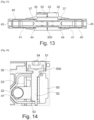
- an O-ring 500 can be provided arranged around the interface part 51, in its housing ( figure 14 ).
- connection modules according to the invention allow different connection configurations between electrical harnesses with electrical cable termination 4.
- a single module 3 may comprise two bodies 30, preferably identical or symmetrical, aligned opposite each other and fixed to each other. This allows an electrical connection with a single input and output.
- FIG. 15 We can also consider a 3" connection module with two 30 bodies arranged side by side, electrically connecting two cable terminations arriving on the same side of the module ( Figure 15 ).
- a single first blade 32 and a second blade 33 are housed in the cavities 31.
- the single blade 33 comprises two parts deformable independently of each other with a cam clamping mechanism 51 and electrically connected to each other, so as to provide an electrical shunt between the two electrical cable terminations 4 when they are individually inserted into the cavities.
- the two bodies 30 can be fixed to each other or made entirely from a single piece.
- This variant with side-by-side module bodies can, for example, be implemented on the same side of a panel.
- THE figures 16 to 18 illustrate a variant with one electrical input E and three electrical outputs S with an electrical shunt made inside the bodies 30 of a 3" connection module according to the first mode.
- the 3"' module comprises two bodies 30 aligned and fixed together, each of the bodies 30 internally comprising two cavities 31 extending parallel to the longitudinal axis (X) of the module.
- Each contact 41 is clamped by means of a clamping mechanism 5 independent of the others.
- the first blade 32 is common to the cavities 31 of the two bodies 30.
- two second blades 33 independent of each other are housed in the cavities 31 and electrically connected to each other, so as to create a shunt electrical between the four electrical cable terminations 4 when individually inserted into the cavities.
- a holding spacer 301 can be provided.
- FIG. 18 An alternative way to make the electrical shunt is shown in figure 18 : the shunt is made only by the first blade 32, the deformable blades 33 being electrically insulated from each other.
- connection module may consist of two aligned and fixed bodies 30 each comprising two cavities 31, but without shunting the two electrical lines.
- the two electrical lines pass through the connection module electrically independently of each other.
- the module comprises two first fixed blades 32 independent and electrically insulated from each other, and at least one second deformable blade 33 per electrical line, insulated between each electrical line.
- FIG. 20 An alternative embodiment of the second blade 33 is shown in figure 20 : it is possible to provide for producing a single blade 33 in the form of a single piece which can be housed in two cavities 31 facing one another, with parts 333 elastically deformable independently of one another, for example by creating one or more openings of material 334 between them.
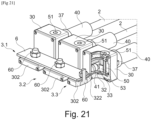
- connection modules is a connection of several terminations 4 of electrical cable 2 to a busbar or connection bar.
- each body 30 of the modules comprises a single cavity 31 in which a contact 41 of a termination 4 of an electric cable 2 is inserted and clamped.
- Each of the first blades 32 includes an extension portion 322 which extends outside the body 30.
- Each body 30 comprises an extension 302 of straight parallelepiped shape, which supports a portion 322 of a blade 32.
- the parallel electrical connection between the different blades 32 and therefore between the electrical terminations 4 is made by a common busbar 6 which is fixed by means of a screw/nut 60 in the extension portion 322 of each blade 32. It is of course possible to envisage, instead of the screws/nuts 60, fixing by welding to the busbar.
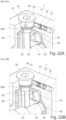
- This pin 71 with the spring 72 are housed inside the body 30 so that, in the deformed position of the second blade 33, the pin 71 is inserted into the hole 70 with the spring exerting a return force on the pin ( Figure 22B ).
- the spring 760 pushes the interface part 51 upwards outward from the body 30, the pin 76 of which is housed in a vertical groove provided in the body.
- the pin 76 is housed in the vertical groove of the body, the rotation of the interface part 51 and the cam 52 is blocked.
- FIGS. 26 and 26A show a connection module according to another embodiment of the invention with two bodies 30 fixed together, each intended to house a contact 41 of an electrical cable termination 4.
- a device 8 is provided for locking/unlocking the clamping mechanism 5, once the contact 41 is in the inserted position in a cavity 31 of a body 30.
- the device 8 also allows the detection of the insertion in the correct longitudinal position of a termination in the housing.
- the bodies 30 are furthermore fixed to a support rail 9 itself fixed to a structure, such as an aircraft structure.
- the sleeve 41 comprises a peripheral groove 46.
- the locking and securing device of this lock 8 firstly comprises a plate 80 preferably fixed by screwing onto the body 30.
- An interface part 81 is mounted to rotate freely in a housing of the body 30.
- This part 81 is a cylindrical part provided with a flat and thus forms a cam.
- This cam 81 can be rotated by a tool, by the presence of an imprint which can be usual.
- the interface part 81 is held in the housing of the body 30 by the plate 80.
- a locking part 82, 83 is mounted in translation in the body 30 between a locking position in which a wall 83 of the part which extends transversely to the longitudinal axis X projects inside the opening 38 and an unlocking position in which said wall 83 is set back from the inside of the opening 38.
- a contact 40 can therefore be inserted freely inside the body 30 to be housed in the cavity 31, since the sleeve 40 can slide freely inside the opening 38, without interfering with the locking part 82, 83, set back from the inside of the opening 38.
- the locking wall 83 can translate from its unlocking position to its locking position in a groove 84 provided for this purpose in the body 30, and this by pressing on another wall 82 of the locking part, in the extension of the wall 83.
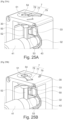
- the wall 83 further comprises at least one visual indicator 85.
- This visual indicator 85 in particular in the form of an area of visible color, is arranged on the outer face of the wall 83 so as to be visible to an operator to indicate to him the locking or unlocking position of the sleeve 40 and therefore of the contact 41 of the electrical termination 4.
- the indicator 85 of the wall 83 in the form of a colored zone, is positioned outside the body 30, when the wall 83 is set back from the opening 38 and therefore in the unlocking position and is no longer visible from the outside, in the projecting position inside the opening 38 and therefore in the locking position of the sleeve 40 by the wall 83.
- the plate 80 may include one or more visual indicators, in particular in the form of engravings or padlock markings to visually indicate the rotational position of the cam 81 as explained below.
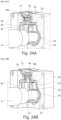
- the cam 81 is in a position for locking the wall 82 of the locking part.
- the locking position of the wall 82 by the cam 81 indicates in itself that the clamping mechanism 5 is in the partially or fully open/released position.
- This locking position can be visually indicated to an operator by a visual indicator on the plate. This can be an indicator showing an open padlock.
- the part 82, 83 is therefore in its unlocked position, i.e. the wall 83 is set back from the inside of the opening 38.
- the wall 83 does not protrude inside the opening 38 and therefore a contact 41 can be inserted there to be housed in the cavity 31 of the body 30.
- the wall 83 does not obstruct the passage diameter of the sleeve 40.
- the insertion and locking of contact 41 are as follows.
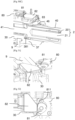
- the contact 41 is inserted by an operator into the opening 38 and into the cavity 31 with the cam 81 and the part 82, 83 in the position of the figure 29 , until there is an alignment along the X axis, or in other words a facing, of the groove 46 of the sleeve with the groove 84 ( Figure 30A ).
- a skirt 381 may be provided at the front end of the sleeve 40, which comes into axial abutment against a surface at the bottom of the opening 38. In this position, the cylindrical part 810 of the cam 81 blocks any translation towards the inside of the part 82, 83.
- the operator can rotate the cam 81 to a stop position which can be indicated by a visual indicator on the plate 80, for example by a closed padlock ( Figure 30B ).
- the rotation of the interface part 81 causes the clamping mechanism 5 to move, bringing the blade 33 into its deformed position for clamping the contact 41, via the translation of the force transmission part 50.
- its flat 811 is opposite a straight part of the wall 82.
- the contact 41 is clamped by the blade(s) 32, 33 in at least two zones of direct linear or surface support.
- the operator then presses on the wall 82, as symbolized by the arrow in Figure 30C , which brings the wall 83 into the locking position in which it is inserted into the groove 46 of the sleeve 40 ( Figure 30C ).
- the visual indicator 85 is then no longer visible from the outside, which indicates to the operator the correct locking position of the part 82, 83.
- the locking of the part 82, 83 also indicates to the operator that the sleeve 40 has been previously inserted in its correct longitudinal position in the opening 38. In other words, the locking of the part 82, 83 allows the detection of the insertion of the termination 4 in its correct longitudinal position in the module, after tightening of the contact 41 by the blades 32, 33.
- the locking of the clamping mechanism 5 is further secured because the flat 811 of the cam is opposite a straight portion of the wall 82 ( figure 31 ).
- Modules of different dimensions can be provided with a different number of cavities to accommodate 4 different sized electrical cable terminations.
- connection module in a support rail 9, as shown in the embodiment of figures 26 to 32 .
- a connection module can be provided with a single blade, at least one part of which is elastically deformable, or with a rigid blade and a deformable blade.
- cam clamping mechanism is described in relation to the first mode with a rigid blade and an elastically deformable blade while the pivoting lever clamping mechanism is described in relation to a single blade with a U-shaped section, one can also envisage a pivoting lever for the deformation of the blade clamping the contact with a rigid blade and a clamping cam to bring the branches of the single U-shaped blade closer together.
- the deformable blade 33 is electrically conductive.
- An electrically insulating blade can also be considered.
- one or more protrusions 380 may be provided, for example made by molding, projecting inside the body 30, in particular inside the opening 38 to prevent rotation of the sleeve 40 and therefore of the contact 41 by sliding, once tightened in the connection module.
- a protrusion 380 may take the form of a molded internal longitudinal rib/groove, which may be inserted between the ribs 42 of the sleeve.
- a protrusion 380 may also take the form of a cylindrical metal pin inserted through the wall 37 of the body 30, perpendicular to the axis X.
Landscapes
- Engineering & Computer Science (AREA)
- Architecture (AREA)
- Civil Engineering (AREA)
- Structural Engineering (AREA)
- Details Of Connecting Devices For Male And Female Coupling (AREA)
- Connector Housings Or Holding Contact Members (AREA)
Applications Claiming Priority (1)
| Application Number | Priority Date | Filing Date | Title |
|---|---|---|---|
| FR2312553A FR3155650A1 (fr) | 2023-11-16 | 2023-11-16 | Module de connexion de puissance, à serrage d’une terminaison de câble électrique par une lame dont au moins une partie déformable destiné à constituer une partie d’un bornier d’un ensemble de connexion. |
Publications (3)
| Publication Number | Publication Date |
|---|---|
| EP4557526A1 true EP4557526A1 (de) | 2025-05-21 |
| EP4557526C0 EP4557526C0 (de) | 2025-12-17 |
| EP4557526B1 EP4557526B1 (de) | 2025-12-17 |
Family
ID=90637451
Family Applications (1)
| Application Number | Title | Priority Date | Filing Date |
|---|---|---|---|
| EP24212921.1A Active EP4557526B1 (de) | 2023-11-16 | 2024-11-14 | Leistungsanschlussmodul zum klemmen eines elektrischen kabelabschlusses durch ein blatt, dessen mindestens ein verformbares teil zur bildung eines anschlussblockteils einer verbindungsanordnung bildet |
Country Status (5)
| Country | Link |
|---|---|
| US (1) | US20250167467A1 (de) |
| EP (1) | EP4557526B1 (de) |
| CN (1) | CN120016219A (de) |
| ES (1) | ES3065463T3 (de) |
| FR (1) | FR3155650A1 (de) |
Citations (6)
| Publication number | Priority date | Publication date | Assignee | Title |
|---|---|---|---|---|
| FR1241495A (fr) * | 1959-11-24 | 1960-09-16 | Camloc Fastener Corp | Collier de serrage pour fils et analogues |
| US3474389A (en) * | 1968-04-12 | 1969-10-21 | Hideo Nagano | Electric connector |
| GB2321790A (en) * | 1997-01-30 | 1998-08-05 | Contactum Ltd | A cam operated clamping terminal |
| CN211404771U (zh) | 2020-02-25 | 2020-09-01 | 广东纳特康电子股份有限公司 | 限位压线式端子台连接器 |
| EP3758165A1 (de) | 2019-06-26 | 2020-12-30 | Radiall | Anschlussmodul, anschlusseinheit mit klemmleiste mit einer vielzahl von solchen anschlussmodulen und luftfahrzeugstruktur mit solcher anschlusseinheit |
| US10998649B2 (en) | 2017-02-27 | 2021-05-04 | Phoenix Contact Gmbh & Co. Kg | Spring-force connection and round plug-in connector with a large number of spring-force connections |
-
2023
- 2023-11-16 FR FR2312553A patent/FR3155650A1/fr active Pending
-
2024
- 2024-11-12 US US18/945,040 patent/US20250167467A1/en active Pending
- 2024-11-14 ES ES24212921T patent/ES3065463T3/es active Active
- 2024-11-14 EP EP24212921.1A patent/EP4557526B1/de active Active
- 2024-11-15 CN CN202411633742.8A patent/CN120016219A/zh active Pending
Patent Citations (6)
| Publication number | Priority date | Publication date | Assignee | Title |
|---|---|---|---|---|
| FR1241495A (fr) * | 1959-11-24 | 1960-09-16 | Camloc Fastener Corp | Collier de serrage pour fils et analogues |
| US3474389A (en) * | 1968-04-12 | 1969-10-21 | Hideo Nagano | Electric connector |
| GB2321790A (en) * | 1997-01-30 | 1998-08-05 | Contactum Ltd | A cam operated clamping terminal |
| US10998649B2 (en) | 2017-02-27 | 2021-05-04 | Phoenix Contact Gmbh & Co. Kg | Spring-force connection and round plug-in connector with a large number of spring-force connections |
| EP3758165A1 (de) | 2019-06-26 | 2020-12-30 | Radiall | Anschlussmodul, anschlusseinheit mit klemmleiste mit einer vielzahl von solchen anschlussmodulen und luftfahrzeugstruktur mit solcher anschlusseinheit |
| CN211404771U (zh) | 2020-02-25 | 2020-09-01 | 广东纳特康电子股份有限公司 | 限位压线式端子台连接器 |
Also Published As
| Publication number | Publication date |
|---|---|
| US20250167467A1 (en) | 2025-05-22 |
| FR3155650A1 (fr) | 2025-05-23 |
| EP4557526C0 (de) | 2025-12-17 |
| CN120016219A (zh) | 2025-05-16 |
| ES3065463T3 (en) | 2026-05-06 |
| EP4557526B1 (de) | 2025-12-17 |
Similar Documents
| Publication | Publication Date | Title |
|---|---|---|
| EP3758154B1 (de) | Stromanschlussmodul mit verriegelungs-/entriegelungssystem der stromkabelenden in dem modul, klemmleiste, die eine vielzahl von unabhängigen anschlussmodulen umfasst | |
| EP3758161B1 (de) | Elektrische verbindungsbaugruppe, klemmleiste und flugzeugstruktur | |
| EP1553661A1 (de) | Elektrische Anschlussvorrichtung zur Schaffung eines Metallisierungspunkt, Trägerl mit einer solchen Anschlussvorrichtung und mit einem solchen Träger augerustetes Flugzeug | |
| EP3758165B1 (de) | Anschlussmodul, anschlusseinheit mit klemmleiste mit einer vielzahl von solchen anschlussmodulen und luftfahrzeugstruktur mit solcher anschlusseinheit | |
| FR2703840A1 (fr) | Connecteur électrique pourvu d'une pluralité de modules de connexion disposés en lignes et colonnes. | |
| EP3323170B1 (de) | Frei verschiebbare elektrische verbindungsvorrichtung mit schutz gegen schäden durch fremdkörper | |
| EP3879639B1 (de) | Steckverbinder mit einem im gehäuse drehbar montierten und durch ein werkzeug betätigbaren zwischenstück zum schieben eines verriegelungsdeckels auf einen komplementären steckverbinder | |
| EP4557528B1 (de) | Kraftlose kupplungsleistungskontaktbaugruppe, leistungsanschlussmodul mit einer solchen baugruppe zum klemmen eines stromkabelabschlusses | |
| EP4557526B1 (de) | Leistungsanschlussmodul zum klemmen eines elektrischen kabelabschlusses durch ein blatt, dessen mindestens ein verformbares teil zur bildung eines anschlussblockteils einer verbindungsanordnung bildet | |
| FR3025947A1 (fr) | Corps isolant pour connecteur debrochable | |
| EP3409084B1 (de) | Kabelbaumanschlussplatte | |
| EP2728674B1 (de) | System zum Anschließen einer Anschlussbuchse auf einem elektronischen Gehäuse, und Montageverfahren dieses Systems | |
| WO2013088052A1 (fr) | Systeme de liaison equipotentielle pour panneau | |
| EP2366189B1 (de) | Busbar-muffe mit einem dem verbinder gewidmeten orientierungsmässig justierbaren schutzgehäuse | |
| EP2518831B1 (de) | Anschlussmuffe für elektrische Kabel | |
| EP0637045A1 (de) | Elektrische Verbindungsvorrichtung, insbesondere für Hochstromdurchgang | |
| EP2190275A1 (de) | Gehäuse für ein elektronisches Modul zur Steuerung einer Maschine | |
| FR2998723A1 (fr) | Systeme d'ancrage pour cable electrique isole, comportant une pince d'ancrage et un connecteur pour relier electriquement le cable electrique isole a la pince d'ancrage | |
| FR2726401A1 (fr) | Dispositif de raccordement electrique pour un accessoire amovible de vehicule automobile | |
| FR2608850A1 (fr) | Boitier de raccordement pour cables electriques | |
| EP4154360B1 (de) | Verbesserte fool-beständige vorrichtung, elektrische verbindungsanordnung mit der verbesserten fool-beständigen vorrichtung und zugehöriges montageverfahren | |
| EP0720250A1 (de) | Kraftfahrzeugantenne und Anpassungsvorrichtung mit aktiver Impedanz für eine solche Antenne | |
| FR3167774A1 (fr) | Connecteur destiné à la connexion électrique de pôles d’un câble principal de transport d’énergie électrique à des câbles dérivés | |
| FR3040546A1 (fr) | Dispositif de connexion pour plot de batterie | |
| EP0268502B1 (de) | Klammerförmiges Kabelendstück für Zündverteilerdeckel |
Legal Events
| Date | Code | Title | Description |
|---|---|---|---|
| PUAI | Public reference made under article 153(3) epc to a published international application that has entered the european phase |
Free format text: ORIGINAL CODE: 0009012 |
|
| STAA | Information on the status of an ep patent application or granted ep patent |
Free format text: STATUS: REQUEST FOR EXAMINATION WAS MADE |
|
| 17P | Request for examination filed |
Effective date: 20241114 |
|
| AK | Designated contracting states |
Kind code of ref document: A1 Designated state(s): AL AT BE BG CH CY CZ DE DK EE ES FI FR GB GR HR HU IE IS IT LI LT LU LV MC ME MK MT NL NO PL PT RO RS SE SI SK SM TR |
|
| GRAP | Despatch of communication of intention to grant a patent |
Free format text: ORIGINAL CODE: EPIDOSNIGR1 |
|
| STAA | Information on the status of an ep patent application or granted ep patent |
Free format text: STATUS: GRANT OF PATENT IS INTENDED |
|
| RIC1 | Information provided on ipc code assigned before grant |
Ipc: H01R 4/48 20060101AFI20250918BHEP |
|
| INTG | Intention to grant announced |
Effective date: 20251001 |
|
| GRAS | Grant fee paid |
Free format text: ORIGINAL CODE: EPIDOSNIGR3 |
|
| GRAA | (expected) grant |
Free format text: ORIGINAL CODE: 0009210 |
|
| STAA | Information on the status of an ep patent application or granted ep patent |
Free format text: STATUS: THE PATENT HAS BEEN GRANTED |
|
| AK | Designated contracting states |
Kind code of ref document: B1 Designated state(s): AL AT BE BG CH CY CZ DE DK EE ES FI FR GB GR HR HU IE IS IT LI LT LU LV MC ME MK MT NL NO PL PT RO RS SE SI SK SM TR |
|
| REG | Reference to a national code |
Ref country code: CH Ref legal event code: F10 Free format text: ST27 STATUS EVENT CODE: U-0-0-F10-F00 (AS PROVIDED BY THE NATIONAL OFFICE) Effective date: 20251217 Ref country code: GB Ref legal event code: FG4D Free format text: NOT ENGLISH |
|
| REG | Reference to a national code |
Ref country code: DE Ref legal event code: R096 Ref document number: 602024001741 Country of ref document: DE |
|
| U01 | Request for unitary effect filed |
Effective date: 20260108 |
|
| U07 | Unitary effect registered |
Designated state(s): AT BE BG DE DK EE FI FR IT LT LU LV MT NL PT RO SE SI Effective date: 20260115 |
|
| PG25 | Lapsed in a contracting state [announced via postgrant information from national office to epo] |
Ref country code: NO Free format text: LAPSE BECAUSE OF FAILURE TO SUBMIT A TRANSLATION OF THE DESCRIPTION OR TO PAY THE FEE WITHIN THE PRESCRIBED TIME-LIMIT Effective date: 20260317 |
|
| PG25 | Lapsed in a contracting state [announced via postgrant information from national office to epo] |
Ref country code: HR Free format text: LAPSE BECAUSE OF FAILURE TO SUBMIT A TRANSLATION OF THE DESCRIPTION OR TO PAY THE FEE WITHIN THE PRESCRIBED TIME-LIMIT Effective date: 20251217 |
|
| PG25 | Lapsed in a contracting state [announced via postgrant information from national office to epo] |
Ref country code: RS Free format text: LAPSE BECAUSE OF FAILURE TO SUBMIT A TRANSLATION OF THE DESCRIPTION OR TO PAY THE FEE WITHIN THE PRESCRIBED TIME-LIMIT Effective date: 20260317 |
|
| REG | Reference to a national code |
Ref country code: ES Ref legal event code: FG2A Ref document number: 3065463 Country of ref document: ES Kind code of ref document: T3 Effective date: 20260506 |
|
| PG25 | Lapsed in a contracting state [announced via postgrant information from national office to epo] |
Ref country code: SM Free format text: LAPSE BECAUSE OF FAILURE TO SUBMIT A TRANSLATION OF THE DESCRIPTION OR TO PAY THE FEE WITHIN THE PRESCRIBED TIME-LIMIT Effective date: 20251217 |
|
| PG25 | Lapsed in a contracting state [announced via postgrant information from national office to epo] |
Ref country code: PL Free format text: LAPSE BECAUSE OF FAILURE TO SUBMIT A TRANSLATION OF THE DESCRIPTION OR TO PAY THE FEE WITHIN THE PRESCRIBED TIME-LIMIT Effective date: 20251217 |
|
| PG25 | Lapsed in a contracting state [announced via postgrant information from national office to epo] |
Ref country code: IS Free format text: LAPSE BECAUSE OF FAILURE TO SUBMIT A TRANSLATION OF THE DESCRIPTION OR TO PAY THE FEE WITHIN THE PRESCRIBED TIME-LIMIT Effective date: 20260417 |
|
| PG25 | Lapsed in a contracting state [announced via postgrant information from national office to epo] |
Ref country code: CZ Free format text: LAPSE BECAUSE OF FAILURE TO SUBMIT A TRANSLATION OF THE DESCRIPTION OR TO PAY THE FEE WITHIN THE PRESCRIBED TIME-LIMIT Effective date: 20251217 |
|
| PG25 | Lapsed in a contracting state [announced via postgrant information from national office to epo] |
Ref country code: SK Free format text: LAPSE BECAUSE OF FAILURE TO SUBMIT A TRANSLATION OF THE DESCRIPTION OR TO PAY THE FEE WITHIN THE PRESCRIBED TIME-LIMIT Effective date: 20251217 |