EP4559567A1 - Hohlfasermembran und plasmatrennverfahren - Google Patents
Hohlfasermembran und plasmatrennverfahren Download PDFInfo
- Publication number
- EP4559567A1 EP4559567A1 EP23842957.5A EP23842957A EP4559567A1 EP 4559567 A1 EP4559567 A1 EP 4559567A1 EP 23842957 A EP23842957 A EP 23842957A EP 4559567 A1 EP4559567 A1 EP 4559567A1
- Authority
- EP
- European Patent Office
- Prior art keywords
- hollow fiber
- fiber membrane
- pore size
- solvent
- cross
- Prior art date
- Legal status (The legal status is an assumption and is not a legal conclusion. Google has not performed a legal analysis and makes no representation as to the accuracy of the status listed.)
- Pending
Links
Images



Classifications
-
- A—HUMAN NECESSITIES
- A61—MEDICAL OR VETERINARY SCIENCE; HYGIENE
- A61M—DEVICES FOR INTRODUCING MEDIA INTO, OR ONTO, THE BODY; DEVICES FOR TRANSDUCING BODY MEDIA OR FOR TAKING MEDIA FROM THE BODY; DEVICES FOR PRODUCING OR ENDING SLEEP OR STUPOR
- A61M1/00—Suction or pumping devices for medical purposes; Devices for carrying-off, for treatment of, or for carrying-over, body-liquids; Drainage systems
- A61M1/34—Filtering material out of the blood by passing it through a membrane, i.e. hemofiltration or diafiltration
- A61M1/3496—Plasmapheresis; Leucopheresis; Lymphopheresis
-
- B—PERFORMING OPERATIONS; TRANSPORTING
- B01—PHYSICAL OR CHEMICAL PROCESSES OR APPARATUS IN GENERAL
- B01D—SEPARATION
- B01D69/00—Semi-permeable membranes for separation processes or apparatus characterised by their form, structure or properties; Manufacturing processes specially adapted therefor
- B01D69/02—Semi-permeable membranes for separation processes or apparatus characterised by their form, structure or properties; Manufacturing processes specially adapted therefor characterised by their properties
-
- B—PERFORMING OPERATIONS; TRANSPORTING
- B01—PHYSICAL OR CHEMICAL PROCESSES OR APPARATUS IN GENERAL
- B01D—SEPARATION
- B01D69/00—Semi-permeable membranes for separation processes or apparatus characterised by their form, structure or properties; Manufacturing processes specially adapted therefor
- B01D69/08—Hollow fibre membranes
-
- B—PERFORMING OPERATIONS; TRANSPORTING
- B01—PHYSICAL OR CHEMICAL PROCESSES OR APPARATUS IN GENERAL
- B01D—SEPARATION
- B01D71/00—Semi-permeable membranes for separation processes or apparatus characterised by the material; Manufacturing processes specially adapted therefor
- B01D71/06—Organic material
- B01D71/44—Polymers obtained by reactions only involving carbon-to-carbon unsaturated bonds, not provided for in a single one of groups B01D71/26-B01D71/42
- B01D71/441—Polyvinylpyrrolidone
-
- B—PERFORMING OPERATIONS; TRANSPORTING
- B01—PHYSICAL OR CHEMICAL PROCESSES OR APPARATUS IN GENERAL
- B01D—SEPARATION
- B01D71/00—Semi-permeable membranes for separation processes or apparatus characterised by the material; Manufacturing processes specially adapted therefor
- B01D71/06—Organic material
- B01D71/66—Polymers having sulfur in the main chain, with or without nitrogen, oxygen or carbon only
- B01D71/68—Polysulfones; Polyethersulfones
-
- A—HUMAN NECESSITIES
- A61—MEDICAL OR VETERINARY SCIENCE; HYGIENE
- A61M—DEVICES FOR INTRODUCING MEDIA INTO, OR ONTO, THE BODY; DEVICES FOR TRANSDUCING BODY MEDIA OR FOR TAKING MEDIA FROM THE BODY; DEVICES FOR PRODUCING OR ENDING SLEEP OR STUPOR
- A61M1/00—Suction or pumping devices for medical purposes; Devices for carrying-off, for treatment of, or for carrying-over, body-liquids; Drainage systems
- A61M1/14—Dialysis systems; Artificial kidneys; Blood oxygenators ; Reciprocating systems for treatment of body fluids, e.g. single needle systems for hemofiltration or pheresis
- A61M1/16—Dialysis systems; Artificial kidneys; Blood oxygenators ; Reciprocating systems for treatment of body fluids, e.g. single needle systems for hemofiltration or pheresis with membranes
- A61M1/1621—Constructional aspects thereof
-
- B—PERFORMING OPERATIONS; TRANSPORTING
- B01—PHYSICAL OR CHEMICAL PROCESSES OR APPARATUS IN GENERAL
- B01D—SEPARATION
- B01D2323/00—Details relating to membrane preparation
- B01D2323/15—Use of additives
- B01D2323/218—Additive materials
- B01D2323/2182—Organic additives
- B01D2323/21839—Polymeric additives
- B01D2323/2187—Polyvinylpyrolidone
-
- B—PERFORMING OPERATIONS; TRANSPORTING
- B01—PHYSICAL OR CHEMICAL PROCESSES OR APPARATUS IN GENERAL
- B01D—SEPARATION
- B01D2325/00—Details relating to properties of membranes
- B01D2325/02—Details relating to pores or porosity of the membranes
-
- B—PERFORMING OPERATIONS; TRANSPORTING
- B01—PHYSICAL OR CHEMICAL PROCESSES OR APPARATUS IN GENERAL
- B01D—SEPARATION
- B01D2325/00—Details relating to properties of membranes
- B01D2325/02—Details relating to pores or porosity of the membranes
- B01D2325/021—Pore shapes
- B01D2325/0214—Tapered pores
-
- B—PERFORMING OPERATIONS; TRANSPORTING
- B01—PHYSICAL OR CHEMICAL PROCESSES OR APPARATUS IN GENERAL
- B01D—SEPARATION
- B01D2325/00—Details relating to properties of membranes
- B01D2325/02—Details relating to pores or porosity of the membranes
- B01D2325/0283—Pore size
- B01D2325/02834—Pore size more than 0.1 and up to 1 µm
Definitions
- the present invention relates to a hollow fiber membrane and a plasmapheresis method.
- apheresis treatment is a procedure to remove disease-causing substances and excess water from blood or body-cavity fluid taken from patients by means of such principles as dialysis, filtration, and adsorption and then return them back into the body of the patients.
- plasmapheresis therapy is known, which is a therapy to separate blood that is taken from patients who suffer from hepatic failure, blood diseases, autoimmune diseases, and the like, into blood cells/platelets and plasma by means of a hollow fiber membrane, discard plasma that contains disease-causing substances (such as IgG and cytokines), and supply freshly-frozen plasma and the like.
- PTL 1 Japanese Patent No. 5290168
- PTL 2 International Patent Laying-Open No. WO 2020/203716
- a hollow fiber membrane such as a hollow fiber membrane made of polyethersulfone, for example
- Other known materials suitable for hollow fiber membranes for plasmapheresis and the like include polyethylene, for example.
- a hollow fiber membrane of this type (a hollow fiber membrane made of polyethersulfone) is used for plasmapheresis, clogging of the hollow fiber membrane tends to occur, so there has been a demand for a hollow fiber membrane that can be used in a continuous and stable manner with less clogging.
- the present invention aims at reducing clogging of a hollow fiber membrane when the hollow fiber membrane is used in plasmapheresis.
- the present invention makes it possible to reduce clogging of a hollow fiber membrane made of polyethersulfone when the hollow fiber membrane is used in plasmapheresis.
- a hollow fiber membrane according to the present embodiment contains polyethersulfone.
- the ratio of polyethersulfone to the materials of the hollow fiber membrane is preferably 90 mass% or more, more preferably 93 mass% or more, further preferably 95 mass% or more.
- the hollow fiber membrane may be solely composed of polyethersulfone.
- Polyethersulfone is a compound that contains a structural unit represented by a formula (1) below.
- the polyethersulfone may be, for example, Ultrason (registered trademark) E2020P, E6020P manufactured by BASF, or SUMIKAEXCEL (registered trademark) 3600P, 4100P, 4800P, 5200P, 7600P manufactured by Sumitomo Chemical, or the like, and preferably, it is E6020P, 4800P, or 5200P. These may be used singly or in combination.
- the hollow fiber membrane according to the present embodiment may further contain a vinylpyrrolidone-based polymer.
- the vinylpyrrolidone-based polymer allows for reducing adsorption of blood components such as platelets and proteins to the hollow fiber membrane.
- the vinylpyrrolidone-based polymer refers to a polymer composed of monomers that contain at least N-vinylpyrrolidone.
- the vinylpyrrolidone-based polymer preferably contains a structural unit represented by a formula (2) below.
- the vinylpyrrolidone-based polymer may be Kollidon (registered trademark) 30, 90, or Luvitec (registered trademark) K30, K80, K85, K90, VA64, each of which is commercially available from BASF. These may be used singly or in combination.
- the content rate of the vinylpyrrolidone-based polymer to the entire hollow fiber membrane is preferably from 1 to 10 mass%, more preferably from 1.5 to 5 mass%.
- the hollow fiber membrane according to the present embodiment has a structure that is non-uniform in a thickness direction (an asymmetric structure).
- examples of the hollow fiber membrane having an asymmetric structure include a hollow fiber membrane in which the density, porosity, cross-sectional aperture ratio, and/or the like varies in the thickness direction.
- the average pore size at the inner surface side in a cross section is larger than the average pore size at the outer surface side.
- the hollow fiber membrane according to the present embodiment has a structure which is dense on the outer surface side and less dense on the inner surface side.
- the gradient index of the hollow fiber membrane is 2.00 or more.
- the gradient index refers to the ratio of the average pore size at the inner surface side in a cross section of the hollow fiber membrane to the average pore size at the outer surface side.
- the average pore size and the gradient index can be measured by methods described below in Examples.
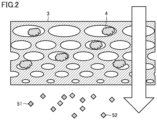
- a hollow fiber membrane 3 in plasmapheresis using a hollow fiber membrane 3, from the pushed side (the upper side in Fig. 2 ; the inner surface side of the hollow fiber membrane), plasma from blood permeates through hollow fiber membrane 3.
- the components of the plasma such as albumin, fibrinogen, autoimmune antibodies IgG and IgM, and cytokines which can be disease-causing substances
- smaller components 51, 52 such as cytokines
- larger components 4 such as IgG and IgM
- the most-frequent pore size in a cross section of the hollow fiber membrane according to the present embodiment is preferably 0.090 ⁇ m or more. Moreover, the most-frequent pore size is preferably 0.5 ⁇ m or less, more preferably 0.3 ⁇ m or less.
- the most-frequent pore size can be measured by a method described below in Examples.
- the inner diameter of the hollow fiber membrane is preferably from 150 ⁇ m to 400 ⁇ m, more preferably from 200 ⁇ m to 350 ⁇ m.
- the thickness of the hollow fiber membrane is preferably from 50 to 200 ⁇ m, more preferably from 60 to 150 ⁇ m.
- the membrane thickness can be calculated by "((Outer diameter)-(Inner diameter))/2".
- the hollow fiber membrane (a membrane of the hollow fiber type) is preferably made of a semipermeable membrane.
- the hollow rate of the hollow fiber membrane is preferably from 15 to 60%, more preferably from 20 to 50%.
- the hollow rate is the proportion of the area of hollow portions in a transverse section of the hollow fiber membrane, and it is represented by "(Cross-sectional area of hollow portions)/((Cross-sectional area of membrane portion)+(Cross-sectional area of hollow portions)) ⁇ 100 (%)".
- the hollow fiber membrane according to the present embodiment can be suitably used for separating biological materials and the like that tend to cause clogging (plasmapheresis, etc.), for example.
- Plasma is the liquid component of blood, a component other than cell components such as blood cells (leucocytes and erythrocytes) and platelets.
- Plasma contains water, proteins, inorganic salts, sugars, lipids, nitrogen compounds, and the like, and it also contains albumin, fibrinogen, IgG, cytokines, and the like.
- a method of producing the hollow fiber membrane according to the present embodiment is, for example, the method described below.
- a method of producing the above-mentioned hollow fiber membrane comprising:
- a spinning dope 10a and an internal liquid 10b are discharged through a double-tube nozzle 11 via an air gap 20 into a coagulation liquid 21, allowing the spinning dope to become coagulated in coagulation liquid 21, and then the coagulated spinning dope is pulled out from coagulation liquid 21 to obtain hollow fiber membrane 3.
- the pulling-out of the hollow fiber membrane, etc. is performed with the use of in-liquid guides 12, 13 and rollers 14, 15, 16, for example.
- hollow fiber membrane 3 is immersed in a water bath 22 and then taken up on a take-up apparatus 23, for example.
- Nozzle 11 has a double-tube form, and comprises an outer tube and an inner tube provided on the inner side of the outer tube.
- the spinning dope is discharged through the gap (a slit) between the outer tube and the inner tube, and the internal liquid is discharged from inside of the inner tube.
- the inner diameter of the outer tube is preferably from 500 to 1500 ⁇ m, more preferably from 600 to 1200 ⁇ m.
- the outer diameter of the inner tube is preferably from 150 to 700 ⁇ m, more preferably from 150 to 600 ⁇ m.
- the outer diameter of the inner tube is preferably approximately the same as the inner diameter of the hollow fiber membrane.
- the discharge linear speed of the spinning dope is determined by dividing the discharged amount of the spinning dope by the slit cross-sectional area, [ ⁇ (a/2) 2 - ⁇ (b/2) 2 ], which is determined from the inner diameter (a) of the outer tube and the outer diameter (b) of the inner tube (see the equation below).
- Discharge linear speed of spinning dope [m/min] (Discharged amount of spinning dope)/(Slit cross-sectional area)
- the discharged amount of the spinning dope is preferably from 1.0 to 5.0 cc/min, more preferably from 1.5 to 4.0 cc/min.
- the take-up speed is the rotational speed of roller 14 provided at the outlet of the coagulation bath (the surface speed) (see Fig. 1 ).
- the nozzle draft ratio which is the ratio of the discharge linear speed to the take-up speed ((Take-up speed)/(Discharge linear speed)), is preferably from 1.5 to 6.5, more preferably from 2.0 to 6.0. In this way, by setting the discharge linear speed of the spinning dope higher than the take-up speed, it is possible to achieve the characteristic membrane structure of the hollow fiber according to the present invention.
- the straight-line distance of air gap 20 (the distance between the tip of nozzle 11 and the liquid level of coagulation liquid 21) is preferably from 10 to 200 mm, more preferably from 10 to 100 mm.
- the hollow fiber membrane obtained by the spinning step may be further subjected to a step of rinsing with pure water (a water rinse step).
- a water rinse step water is made to flow preferably in the opposite direction to the direction of the movement of the hollow fiber membrane (a countercurrent), but it may be made to flow in the same direction as the direction of the movement of the hollow fiber membrane (a parallel current).
- Spinning dope 10a contains the above-mentioned resin raw material containing polyethersulfone, a solvent, and a non-solvent, for example.
- the temperature of the spinning dope in nozzle 11 (the set temperature) is preferably from 50 to 110°C, more preferably from 60 to 100°C.
- the concentration of polyethersulfone in the spinning dope is preferably from 10 to 30 mass%, more preferably from 10 to 25 mass%.
- concentration of polyethersulfone is preferably from 10 to 30 mass%, more preferably from 10 to 25 mass%.
- concentration of polyethersulfone is too low, the strength of the hollow fiber membrane may become too low.
- concentration of polyethersulfone is too high, the viscosity of the spinning dope may become too high and make it difficult to perform spinning.
- the concentration of the vinylpyrrolidone-based polymer in the spinning dope is preferably from 3 to 20 mass%, more preferably from 5 to 15 mass%.
- concentration of the vinylpyrrolidone-based polymer is too low, during plasmapheresis, proteins and the like in the blood tend to become deposited to cause clogging, which may accelerate over-time degradation of performance.
- concentration of the vinylpyrrolidone-based polymer is too high, the viscosity of the spinning dope may become too high and make it difficult to perform spinning.
- the solvent is a liquid in which polyethersulfone is soluble.
- the solvent is preferably a polar solvent, preferably soluble in water.
- the polar solvent is preferably an aprotic polar solvent. Examples of the aprotic polar solvent include N-methylpyrrolidone (NMP), dimethylformamide (DMF), dimethylacetamide (DMA), dimethyl sulfoxide (DMSO), acetonitrile, and the like.
- the non-solvent is a liquid (except water) in which polyethersulfone is insoluble.
- the non-solvent may be glycol ester, glycerol, and/or alcohol, for example, and it is preferably glycol ester.
- glycol ester include ethylene glycol, triethylene glycol (TEG), polyethylene glycol (such as polyethylene glycol 200 and polyethylene glycol 400), propylene glycol, and the like.
- the ratio of the amount of the solvent (S) to that of the non-solvent (NS) is preferably from 35/65 to 55/45, more preferably from 40/60 to 50/50.
- the S/NS ratio of the spinning dope is too low, dissolution of polyethersulfone becomes unstable, which may impair spinning stability and/or make it impossible to obtain an asymmetric structure suitable for the purpose of use intended by the present invention.
- the S/NS ratio is high, a hollow fiber membrane with an asymmetric structure may not be obtained and/or spinning stability may be impaired.
- the spinning dope may further contain water.
- the order to add the materials and the method for mixing them are not particularly limited.
- the internal liquid contains water.
- the content rate of water in the internal liquid is preferably from 10 to 30 mass%, more preferably from 15 to 25 mass%.
- the internal liquid may contain a solvent, a non-solvent, and/or the like.
- the non-solvent include ethylene glycol, triethylene glycol (TEG), polyethylene glycol 200 or 400, glycerol, propylene glycol, and the like.
- the solvent include N-methylpyrrolidone (NMP), dimethylacetamide, dimethylformamide, dimethyl sulfoxide, and the like.
- the concentration of the components, except water, contained in the internal liquid (such as the solvent and/or the non-solvent) (the internal liquid concentration ratio) to be higher than the concentration of the coagulation liquid.
- the internal liquid concentration is preferably from 70 to 90 mass%, more preferably from 75 to 85 mass%.
- the nozzle draft ratio is preferably from 1.5 to 6.5, more preferably from 2.0 to 6.0.
- the temperature of the spinning dope may be set to be different from that of the internal liquid.
- the coagulation liquid preferably contains a solvent and a non-solvent (except water).
- the coagulation liquid may further contain water.
- the total proportion of the solvent and the non-solvent in the coagulation liquid (the concentration of the coagulation liquid, the CB concentration) is preferably from 60 to 90 mass%, more preferably from 65 to 90 mass%.
- the ratio of the amount of the solvent to that of the non-solvent in the coagulation liquid is from 40/60 to 50/50, for example.
- the temperature of the coagulation liquid is preferably from 30 to 80°C, more preferably from 40 to 70°C.
- a hollow fiber membrane according to Example 1 was produced. Specific conditions and the like are as follows.
- PES manufactured by BASF, 6020P
- PVP manufactured by BASF, Kollidon (registered trademark) K30
- NMP N-methylpyrrolidone
- TOG triethylene glycol
- the total concentration of the solvent and the non-solvent in the internal liquid (IL) (the internal liquid concentration, the IL concentration) is 84 mass%.
- the total concentration of the solvent and the non-solvent in the coagulation liquid (CB) (the CB concentration) is 58 mass%.
- a bundle of the hollow fiber membranes obtained by the above-mentioned steps was cut into a certain length, wrapped in gauze, and then rinsed with RO water at 80°C, followed by drying at 60°C with a hot-air dryer.
- the inner diameter of the hollow fiber membranes thus obtained was 300 ⁇ m, and the thickness thereof (the membrane thickness) was 75 ⁇ m.
- the membrane inner diameter and the membrane thickness were measured by the methods described below.
- a proper number of the hollow fiber membranes are drawn through a hole (diameter, 3 mm) that is made in the center of a slide glass, in a way that the hollow fiber membranes will not slide out of the hole, followed by cutting the hollow fiber membranes with a razor along the top face and the bottom face of the slide glass to obtain hollow fiber membrane cross section samples.
- a projector Nekon PROFILE PROJECTOR V-12
- the inner diameter and the outer diameter of the hollow fiber membranes are measured.
- the dimensions of the outer surface of the hollow fiber membrane in both the X-X direction and the Y-Y direction are measured, and the arithmetic mean of them is defined as the outer diameter of the one hollow fiber membrane cross section.
- the dimensions of the hollow portion in both the X-X direction and the Y-Y direction are measured, and the arithmetic mean of them is defined as the inner diameter of the one hollow fiber membrane cross section. This measurement is carried out for ten cross sections, and the average values are defined as the inner diameter and the outer diameter, respectively.
- the membrane thickness (the average value) is calculated by "((Outer diameter)-(Inner diameter))/2", based on the results of measurement of the inner diameter and the inner diameter of each hollow fiber membrane (the average values).
- FIG. 6 an SEM image of a cross section of the hollow fiber membrane according to Comparative Example 1 is shown.
- This hollow fiber membrane bundle was inserted into a tubular polycarbonate vessel having a round tubular shape, and both ends were hardened with a urethane potting agent. The end portions were cut off, and thereby a module that was open at both ends was obtained.
- the number of the hollow fiber membranes was determined as appropriate.
- ports were provided for allowing fluid perfusion outside the hollow fiber membranes, and, also, to both ends of the tubular vessel, headers were attached for allowing fluid perfusion inside the hollow fiber membranes.
- Plasmaflo manufactured by Asahi Kasei Medical Co., Ltd.
- Plasmaflo manufactured by Asahi Kasei Medical Co., Ltd.
- the hollow fiber membrane used in Plasmaflo is a hollow fiber membrane made of hydrophobic polyethylene, and the surface (the outer surface) is coated with ethylene vinyl alcohol copolymer.
- the inner diameter of the hollow fiber membrane is 250 ⁇ m, and the thickness thereof is 50 ⁇ m.
- a scanning electron microscope (SEM) image of a hollow fiber membrane used in Plasmaflo is shown in Fig. 5 .
- an image of a cross section of each hollow fiber membrane is captured with the use of a scanning electron microscope (SEM) at a magnification of 10000 times.
- SEM scanning electron microscope
- a measurement region was defined for each of the inner surface side of the hollow fiber membrane (see Fig. 4(b) ) and the outer surface side thereof (see Fig. 4(c) ), which stretched 5 ⁇ m in the membrane thickness direction (from the inner surface) and 10 ⁇ m in the direction perpendicular to the membrane thickness direction.
- the threshold value was increased sequentially by five percentage points, and at each threshold value, pores were counted. Based on the results, the threshold value that yielded the greatest pore count was identified. Based on the threshold value thus identified, the above-mentioned binarization was carried out.
- the gradient index was calculated from the value of the average pore size at the inner surface side (see Fig. 4(b) ) and the outer surface side (see Fig. 4(c) ) in cross sections of the hollow fiber membranes (see Fig. 4(a) ), by the following equation.
- Gradient index (Average pore size at inner surface side in cross sections of hollow fiber membranes)/(Average pore size at outer surface side in cross sections of hollow fiber membranes)
- the average pore size was measured.
- perfluoropolyester under the trade name of "Galwick" was used. From the results of the average pore size measurement thus obtained, average pore size distribution was determined, which is given in Fig. 7 , and the average pore size value with the highest distribution (with the highest pore distribution density) was defined as the most-frequent pore size (see Fig. 7 ).
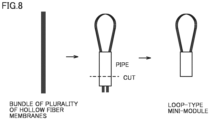
- the loop-type mini-module was completely immersed in a sufficient amount of 2-propanol (hereinafter abbreviated as iPA) for 3 minutes to let iPA permeate throughout the inner hollow parts and the membrane wall parts.
- iPA 2-propanol
- the loop-type mini-module was connected to a nitrogen line whose sleeve was equipped with a pressure gauge for allowing monitoring of the applied pressure, followed by pressure application.
- the point was recorded as the bubble point P [Pa].
- the measurement was carried out three times for each sample, and the average of the measured values of the bubble point was defined as the bubble point of the sample.
- the largest pore size was calculated from the bubble point (P [bar]) measured with iPA.
- TMP Transmembrane Pressure
- TMP transmembrane pressure
- Retention of fibrinogen sieving coefficient is an index of the change between 30 minutes after the start of the circulation and 180 minutes after the start of the circulation, and can be calculated by (SCFib after 30 minutes from start of circulation)/(SCFib after 180 minutes from start of circulation). For example, when 100% of fibrinogen permeates through the membrane, the fibrinogen sieving coefficient is 1.
- Target value Membrane raw material Membrane inner diameter ( ⁇ m) Membrane thickness ( ⁇ m) Nozzle draft ratio IL concentration (%) CB concentration (%) AG length (mm) Spinning rate (m/min) Ex. 1 PES/PVP 300 75 4.05 84 58 30 15 Ex. 2 PES/PVP 300 90 3.57 84 58 100 15 Ex.
- TMP transmembrane pressure
- the fibrinogen sieving coefficient greatly drops after the start.
- the hollow fiber membrane according to Examples 1 to 4 which has a gradient index of 2.00 or more and a most-frequent pore size of 0.090 ⁇ m or more a substantial decrease of the fibrinogen sieving coefficient was not observed.
- a decrease of the fibrinogen sieving coefficient was not observed at the start.
- 10a spinning dope 10b internal liquid, 11 nozzle, 12, 13 in-liquid guide, 14, 15, 16 roller, 20 air gap, 21 coagulation liquid, 22 water bath, 23 take-up apparatus, 3 hollow fiber membrane, 4 larger component, 51, 52 smaller component.
Landscapes
- Chemical & Material Sciences (AREA)
- Chemical Kinetics & Catalysis (AREA)
- Health & Medical Sciences (AREA)
- Heart & Thoracic Surgery (AREA)
- Vascular Medicine (AREA)
- Engineering & Computer Science (AREA)
- Anesthesiology (AREA)
- Biomedical Technology (AREA)
- Hematology (AREA)
- Life Sciences & Earth Sciences (AREA)
- Animal Behavior & Ethology (AREA)
- General Health & Medical Sciences (AREA)
- Public Health (AREA)
- Veterinary Medicine (AREA)
- Separation Using Semi-Permeable Membranes (AREA)
- External Artificial Organs (AREA)
Applications Claiming Priority (2)
| Application Number | Priority Date | Filing Date | Title |
|---|---|---|---|
| JP2022115694A JP2024013535A (ja) | 2022-07-20 | 2022-07-20 | 中空糸膜および血漿分離方法 |
| PCT/JP2023/026206 WO2024019034A1 (ja) | 2022-07-20 | 2023-07-18 | 中空糸膜および血漿分離方法 |
Publications (1)
| Publication Number | Publication Date |
|---|---|
| EP4559567A1 true EP4559567A1 (de) | 2025-05-28 |
Family
ID=89617660
Family Applications (1)
| Application Number | Title | Priority Date | Filing Date |
|---|---|---|---|
| EP23842957.5A Pending EP4559567A1 (de) | 2022-07-20 | 2023-07-18 | Hohlfasermembran und plasmatrennverfahren |
Country Status (5)
| Country | Link |
|---|---|
| US (1) | US20260034516A1 (de) |
| EP (1) | EP4559567A1 (de) |
| JP (1) | JP2024013535A (de) |
| CN (1) | CN119585039A (de) |
| WO (1) | WO2024019034A1 (de) |
Family Cites Families (4)
| Publication number | Priority date | Publication date | Assignee | Title |
|---|---|---|---|---|
| ES2342097T3 (es) | 2006-07-07 | 2010-07-01 | Gambro Lundia Ab | Membrana de separacion de plasma. |
| CA2959291C (en) * | 2014-08-25 | 2020-10-27 | Asahi Kasei Medical Co., Ltd. | Porous membrane with gradient asymmetric structure |
| WO2020203716A1 (ja) | 2019-03-29 | 2020-10-08 | 旭化成メディカル株式会社 | 多孔質膜 |
| JP2020121299A (ja) * | 2019-09-06 | 2020-08-13 | 旭化成メディカル株式会社 | ウイルスの濃縮方法 |
-
2022
- 2022-07-20 JP JP2022115694A patent/JP2024013535A/ja active Pending
-
2023
- 2023-07-18 CN CN202380054675.1A patent/CN119585039A/zh active Pending
- 2023-07-18 EP EP23842957.5A patent/EP4559567A1/de active Pending
- 2023-07-18 US US18/995,375 patent/US20260034516A1/en active Pending
- 2023-07-18 WO PCT/JP2023/026206 patent/WO2024019034A1/ja not_active Ceased
Also Published As
| Publication number | Publication date |
|---|---|
| JP2024013535A (ja) | 2024-02-01 |
| WO2024019034A1 (ja) | 2024-01-25 |
| CN119585039A (zh) | 2025-03-07 |
| US20260034516A1 (en) | 2026-02-05 |
Similar Documents
| Publication | Publication Date | Title |
|---|---|---|
| CN101578129B (zh) | 中空纤维膜及其制备方法 | |
| CN110290858B (zh) | 具有改进的分离效率的中空纤维膜和具有改进的分离效率的中空纤维膜的制造 | |
| EP1547628B1 (de) | Plasma-reinigungsmembran und plasma-reinigungssystem | |
| US6432309B1 (en) | Polysulfone-base hollow-fiber hemocathartic membrane and processes for the production thereof | |
| US9993777B2 (en) | Porous membrane, blood purifying module incorporating porous membrane, and method for producing porous membrane | |
| ES2342097T3 (es) | Membrana de separacion de plasma. | |
| CN100457242C (zh) | 改良的除去中分子的透析膜 | |
| EP1685862B1 (de) | Hohlfasermembran zur blutreinigung und diese enthaltendes blutreinigungsgerät | |
| CN102131564A (zh) | 扩散和/或过滤装置 | |
| EP0842694A1 (de) | Hohlgarnmembran verwendet zur reinigung von blut und blutreiniger | |
| US6632359B1 (en) | Blood purifying apparatus | |
| EP4613364A1 (de) | Doppelschichtige hohlfasermembran für die hämodialyse und verfahren zur herstellung davon | |
| JP4873665B2 (ja) | 血液浄化用中空糸膜 | |
| EP3520886B1 (de) | Trennmembranmodul | |
| EP4371589A1 (de) | Halbdurchlässige membran | |
| US20260034516A1 (en) | Hollow fiber membrane and plasmapheresis method | |
| EP3520883B1 (de) | Modul zum konzentrieren von inkubierten thrombozyten und verfahren zur herstellung einer thrombozytenzubereitung damit | |
| JP3424810B2 (ja) | 高性能血液浄化膜 | |
| JP7131038B2 (ja) | 腹水濾過用の中空糸膜 | |
| JPH11104235A (ja) | ポリスルホン系中空糸型人工腎臓およびその製造法 | |
| EP4635611A1 (de) | Poröse membran und reinigungsverfahren | |
| JP5226587B2 (ja) | 高性能血液浄化器 | |
| EP4650039A1 (de) | Semipermeable membran und semipermeables membranmodul | |
| JP2007054470A (ja) | 血液浄化用中空糸膜およびその製造方法 | |
| KR20010073727A (ko) | 혈액투석용 폴리설폰계 중공사막 |
Legal Events
| Date | Code | Title | Description |
|---|---|---|---|
| STAA | Information on the status of an ep patent application or granted ep patent |
Free format text: STATUS: THE INTERNATIONAL PUBLICATION HAS BEEN MADE |
|
| PUAI | Public reference made under article 153(3) epc to a published international application that has entered the european phase |
Free format text: ORIGINAL CODE: 0009012 |
|
| STAA | Information on the status of an ep patent application or granted ep patent |
Free format text: STATUS: REQUEST FOR EXAMINATION WAS MADE |
|
| 17P | Request for examination filed |
Effective date: 20250215 |
|
| AK | Designated contracting states |
Kind code of ref document: A1 Designated state(s): AL AT BE BG CH CY CZ DE DK EE ES FI FR GB GR HR HU IE IS IT LI LT LU LV MC ME MK MT NL NO PL PT RO RS SE SI SK SM TR |
|
| DAV | Request for validation of the european patent (deleted) | ||
| DAX | Request for extension of the european patent (deleted) |