EP4559870A1 - Procédé et installation de production d'un produit contenant de l'hydrogène - Google Patents
Procédé et installation de production d'un produit contenant de l'hydrogène Download PDFInfo
- Publication number
- EP4559870A1 EP4559870A1 EP23020513.0A EP23020513A EP4559870A1 EP 4559870 A1 EP4559870 A1 EP 4559870A1 EP 23020513 A EP23020513 A EP 23020513A EP 4559870 A1 EP4559870 A1 EP 4559870A1
- Authority
- EP
- European Patent Office
- Prior art keywords
- reactor
- ammonia
- ghr
- hydrogen
- gas
- Prior art date
- Legal status (The legal status is an assumption and is not a legal conclusion. Google has not performed a legal analysis and makes no representation as to the accuracy of the status listed.)
- Withdrawn
Links
Images

Classifications
-
- C—CHEMISTRY; METALLURGY
- C01—INORGANIC CHEMISTRY
- C01B—NON-METALLIC ELEMENTS; COMPOUNDS THEREOF; METALLOIDS OR COMPOUNDS THEREOF NOT COVERED BY SUBCLASS C01C
- C01B3/00—Hydrogen; Gaseous mixtures containing hydrogen; Separation of hydrogen from mixtures containing it; Purification of hydrogen; Reversible storage of hydrogen
- C01B3/02—Production of hydrogen; Production of gaseous mixtures containing hydrogen
- C01B3/04—Production of hydrogen; Production of gaseous mixtures containing hydrogen by decomposition of inorganic compounds
- C01B3/047—Decomposition of ammonia
-
- C—CHEMISTRY; METALLURGY
- C01—INORGANIC CHEMISTRY
- C01B—NON-METALLIC ELEMENTS; COMPOUNDS THEREOF; METALLOIDS OR COMPOUNDS THEREOF NOT COVERED BY SUBCLASS C01C
- C01B2203/00—Integrated processes for the production of hydrogen or synthesis gas
- C01B2203/02—Processes for making hydrogen or synthesis gas
- C01B2203/0205—Processes for making hydrogen or synthesis gas containing a reforming step
- C01B2203/0227—Processes for making hydrogen or synthesis gas containing a reforming step containing a catalytic reforming step
- C01B2203/0244—Processes for making hydrogen or synthesis gas containing a reforming step containing a catalytic reforming step the reforming step being an autothermal reforming step, e.g. secondary reforming processes
-
- C—CHEMISTRY; METALLURGY
- C01—INORGANIC CHEMISTRY
- C01B—NON-METALLIC ELEMENTS; COMPOUNDS THEREOF; METALLOIDS OR COMPOUNDS THEREOF NOT COVERED BY SUBCLASS C01C
- C01B2203/00—Integrated processes for the production of hydrogen or synthesis gas
- C01B2203/02—Processes for making hydrogen or synthesis gas
- C01B2203/025—Processes for making hydrogen or synthesis gas containing a partial oxidation step
- C01B2203/0255—Processes for making hydrogen or synthesis gas containing a partial oxidation step containing a non-catalytic partial oxidation step
-
- C—CHEMISTRY; METALLURGY
- C01—INORGANIC CHEMISTRY
- C01B—NON-METALLIC ELEMENTS; COMPOUNDS THEREOF; METALLOIDS OR COMPOUNDS THEREOF NOT COVERED BY SUBCLASS C01C
- C01B2203/00—Integrated processes for the production of hydrogen or synthesis gas
- C01B2203/02—Processes for making hydrogen or synthesis gas
- C01B2203/0266—Processes for making hydrogen or synthesis gas containing a decomposition step
- C01B2203/0277—Processes for making hydrogen or synthesis gas containing a decomposition step containing a catalytic decomposition step
-
- C—CHEMISTRY; METALLURGY
- C01—INORGANIC CHEMISTRY
- C01B—NON-METALLIC ELEMENTS; COMPOUNDS THEREOF; METALLOIDS OR COMPOUNDS THEREOF NOT COVERED BY SUBCLASS C01C
- C01B2203/00—Integrated processes for the production of hydrogen or synthesis gas
- C01B2203/04—Integrated processes for the production of hydrogen or synthesis gas containing a purification step for the hydrogen or the synthesis gas
- C01B2203/042—Purification by adsorption on solids
- C01B2203/043—Regenerative adsorption process in two or more beds, one for adsorption, the other for regeneration
-
- C—CHEMISTRY; METALLURGY
- C01—INORGANIC CHEMISTRY
- C01B—NON-METALLIC ELEMENTS; COMPOUNDS THEREOF; METALLOIDS OR COMPOUNDS THEREOF NOT COVERED BY SUBCLASS C01C
- C01B2203/00—Integrated processes for the production of hydrogen or synthesis gas
- C01B2203/10—Catalysts for performing the hydrogen forming reactions
- C01B2203/1041—Composition of the catalyst
- C01B2203/1047—Group VIII metal catalysts
- C01B2203/1052—Nickel or cobalt catalysts
-
- C—CHEMISTRY; METALLURGY
- C01—INORGANIC CHEMISTRY
- C01B—NON-METALLIC ELEMENTS; COMPOUNDS THEREOF; METALLOIDS OR COMPOUNDS THEREOF NOT COVERED BY SUBCLASS C01C
- C01B2203/00—Integrated processes for the production of hydrogen or synthesis gas
- C01B2203/14—Details of the flowsheet
- C01B2203/141—At least two reforming, decomposition or partial oxidation steps in parallel
-
- C—CHEMISTRY; METALLURGY
- C01—INORGANIC CHEMISTRY
- C01B—NON-METALLIC ELEMENTS; COMPOUNDS THEREOF; METALLOIDS OR COMPOUNDS THEREOF NOT COVERED BY SUBCLASS C01C
- C01B2203/00—Integrated processes for the production of hydrogen or synthesis gas
- C01B2203/14—Details of the flowsheet
- C01B2203/142—At least two reforming, decomposition or partial oxidation steps in series
Definitions
- the invention relates to a process and a plant for producing a hydrogen-containing product, wherein an ammonia-containing feed is reacted in a cracking device to obtain a cracked gas containing unreacted ammonia as well as hydrogen and nitrogen, from which the hydrogen-containing product is produced.
- Ammonia can be catalytically cracked into nitrogen and hydrogen according to the reaction 2 NH 3 ⁇ N 2 + 3 H 2 .
- the cracking reaction is endothermic and is favored by low pressure and high temperature. However, higher pressures are desirable to avoid the need for a hydrogen compressor or at least reduce compression effort.
- the fission products hydrogen and nitrogen can be provided as a mixture, or the hydrogen can be purified.
- a hydrogen-nitrogen mixture is also referred to as forming gas. Further use of the hydrogen or hydrogen-nitrogen mixture, for example, in a gas turbine coupled to a generator, is also possible. In all cases that may correspond to embodiments of the invention, hydrogen is thus obtained from ammonia.
- the "obtaining a hydrogen-containing product" in the sense understood here does not exclude the extraction of a hydrogen-containing gas mixture, other products such as nitrogen, and/or subsequent use. For reasons of clarity, reference is made below primarily to a (substantially pure) hydrogen product.
- Corresponding process concepts can include a cracking reactor (also called an ammonia cracker) similar to a steam reformer, to which pressure swing adsorption is assigned for hydrogen purification.
- a cracking reactor also called an ammonia cracker
- pressure swing adsorption is assigned for hydrogen purification.
- EP 4 112 539 A1 and the EP 4 112 540 A1 whose contents are included here in full.
- a fission reactor may comprise a furnace containing reaction tubes filled with catalyst material, as well as a waste heat recovery system.
- the furnace may be heated by one or more fuel-fired burners that provide energy for the endothermic fission of the ammonia flowing through the reaction tubes.
- an autothermally operated reactor such as an autothermal reformer (ATR) or a partial oxidation reactor (POX) for ammonia cracking instead of an allothermal cracking reactor based on a steam reformer.
- ATR autothermal reformer
- POX partial oxidation reactor
- the heat of the fission gas which typically contains hydrogen, nitrogen, unreacted ammonia, and steam, and which leaves the fission reactor at a very high temperature, must be harnessed for energy for economic reasons. Using this heat to produce steam is not practical, as ammonia fission is carried out without significant steam consumption, meaning that the produced steam could only be exported for a small credit.
- the present invention has the object of improving corresponding processes and plants for obtaining a hydrogen product using an ammonia-containing feedstock and, in particular, of making them more efficient.
- the inventive proposal envisages the use of a cracking device for ammonia cracking, which comprises an autothermally operable cracking reactor (AT reactor) connected in parallel or in series with a gas-fired reformer (GHR).
- the autothermally operable cracking reactor is preferably designed as an ATR or POX and is connected to the GHR at least on the output side.
- the second reaction is limited by the thermodynamic equilibrium state.
- the exit temperature of the cracked gas (AT cracked gas) produced in an AT reactor is usually above 900°C, especially above 1000°C or 1100°C.
- the heat content of this cracked gas can, in principle, be used to generate steam. However, since ammonia cracking is normally carried out without the addition of steam, the generated steam could only be exported, with little economic benefit. However, if the outlet of the autothermally operated reactor is connected to a GHR, the heat of the AT cracked gas can be used for the reactions taking place within the GHR.
- the ammonia-containing feedstock can be pure ammonia.
- the ammonia-containing feedstock is so-called “technical-grade ammonia,” which can contain up to 0.5% water by weight. This type of technical-grade ammonia is transported worldwide in tankers and via pipelines and can therefore be supplied in large quantities.
- an AT reactor such as an ATR or a POX
- part of the ammonia is burned with oxygen to generate the heat required for ammonia decomposition.
- a POX all reactions proceed as homogeneous processes without the use of a catalyst. Gas-phase reactions take place (typically at temperatures between 1200°C and 1400°C).
- an oxidant air, oxygen, or mixtures thereof
- the ammonia are fed into the reactor via a burner lance.
- an oxidant is reacted with ammonia in a gas space. Unreacted ammonia is then decomposed in a downstream catalyst bed using the heat generated by ammonia oxidation.
- the hot AT cracking gas to operate the GHR, which is also preferably used for ammonia cracking, its heat can be used much more effectively and economically than for steam generation. This significantly increases the cold gas efficiency of the process, defined as the quotient of the chemical energy content of the products and the chemical energy content of the reactants.
- the GHR is arranged parallel to the AT reactor, with a first portion of the ammonia-containing feed being fed to the AT reactor and a second portion to the GHR.
- ammonia is cracked and a cracked gas is produced.
- the AT cracked gas obtained in the AT reactor at a temperature of more than 900°C is fed to the GHR, where it provides the heat required for ammonia cracking, is cooled in the process, and is combined with the cracked gas obtained with catalytic support in the GHR (GHR cracked gas). Since the GHR has an inlet for the ammonia-containing feed and the hot AT cracked gas, as well as an outlet for the combined cracked gases, it is referred to as a 3-stream GHR.
- a so-called 4-stream GHR is used, which is connected in series with the autothermally operated reactor.
- the entire amount of ammonia-containing feed is fed to the GHR, where it is converted with catalytic support at a first cracking temperature into a GHR cracking gas, which, in addition to hydrogen and nitrogen, also contains a significant proportion of unreacted ammonia.
- the GHR cracking gas is then passed on to the AT reactor, in which the majority of the ammonia contained is converted at a higher second cracking temperature.
- the ammonia generated in the AT reactor at a temperature of more than The AT cracking gas obtained at temperatures above 900°C is then fed to the GHR for heating, from which it leaves again after cooling.
- Both process variants have the advantage over the state-of-the-art technology that less oxygen is required for ammonia cracking and less of the ammonia used is oxidized to water. Furthermore, less or even no steam needs to be generated and exported to cool the cracked gas.
- the use of a three-stream GHR allows for a simpler plant design and lower process costs. In contrast, the use of a four-stream GHR achieves a higher hydrogen yield.
- oxygen is supplied to the AT reactor in the form of pure oxygen, air or a mixture of pure oxygen and air.
- an ATR used to carry out the process is designed with a nickel-based catalyst.
- Both a 3-stream and a 4-stream GHR can be implemented with any catalyst suitable for ammonia cracking, either currently available on the market or still under development.
- the cracking reaction in the GHR is preferably carried out with the support of a catalyst based on nickel or a bimetal, or an element from the platinum group consisting of ruthenium, rhodium, palladium, osmium, iridium, and platinum.
- Catalysts based on iron or a member of the platinum group are particularly advantageous, as ammonia cracking with these catalysts can be carried out at lower temperatures, thus requiring less heat to be supplied to the GHR.
- the cracked gas or a portion thereof is preferably subjected to pressure swing adsorption to obtain a product fraction that is enriched in hydrogen and depleted in nitrogen and ammonia compared to the cracked gas, and a residual gas that is depleted in hydrogen and enriched in nitrogen and ammonia compared to the cracked gas.
- pressure swing adsorption is not absolutely necessary. In this case, it may be sufficient to simply separate water and ammonia from the cracked gas.
- the product fraction can consist, in particular, of more than 75%, 80%, 90%, 95%, 98%, 99%, 99.5%, 99.9%, or 99.99% hydrogen and, accordingly, contain 0.01 to 25% of other gas components.
- the residual gas can, in particular, consist of 0 to 10% ammonia and otherwise contain nitrogen, hydrogen, and water.
- Pressure swing adsorption used in the proposed process can be carried out in any manner known from the prior art, with the product fraction in pressure swing adsorption being formed at a pressure level that corresponds to or is slightly lower than the feed pressure into pressure swing adsorption.
- This means that the product fraction in pressure swing adsorption is formed during the adsorption cycle of one or more adsorber vessels, with hydrogen, in particular, representing a non-adsorbing component.
- the residual gas in contrast, represents the gas mixture with the previously adsorbed components formed at a lower pressure during the desorption cycle.
- the ammonia feed is vaporized and superheated in a pretreatment unit to obtain a superheated ammonia feed.
- a residual gas resulting from the treatment of the cracked gas, or a portion thereof can be combusted to provide the heat supplied to the pretreatment unit.
- heat from the cracked gas can be transferred to the ammonia feed or a portion thereof by means of a heat exchanger.
- the transferred heat can be used for the evaporation and/or superheating of the ammonia feed in the pretreatment unit.
- the ammonia is superheated with the aid of the cracked gas heat to a temperature that is no more than 50 K below that of the hot cracked gas.
- the AT reactor can be operated at a reactor outlet temperature of 800 to 1100 °C, in particular at a reactor outlet temperature of 900 to 1000 °C.
- the AT reactor can also be operated at an absolute reaction pressure of between 1 and 70 bar, in particular between 20 and 60 bar.
- reaction pressures are particularly advantageous so that the hydrogen produced can be released as a product with little or no compression. Achieving appropriate reaction pressures is all the easier because the pressure of the ammonia-containing feedstock, which is usually in liquid form, can be increased with little energy expenditure. To achieve a sufficiently high, economically viable conversion rate of the ammonia used under these conditions, it is advantageous to use the specified reaction temperatures or reactor outlet temperatures.
- the ammonia cracking is carried out without adding steam to the ammonia-containing feed. This allows the water content in the cracked gas and the associated separation effort to be reduced. Furthermore, the investment and operating costs of a corresponding plant are reduced by eliminating the need for a separate steam system.
- a proposed plant for producing a hydrogen-containing product is designed to convert an ammonia-containing feedstock into a fission reactor to obtain a fission gas containing unreacted ammonia, hydrogen, and nitrogen.
- the plant is designed in such a way that the fission device comprises an AT reactor which is fluidly connected to a GHR.
- Different embodiments of the invention may include, comprise, consist of, or consist essentially of other useful combinations of the described elements, components, features, parts, steps, means, etc., even if such combinations are not specifically described herein.
- the disclosure may encompass other inventions that are not currently claimed but that may be claimed in the future, particularly if they are encompassed within the scope of the independent claims.
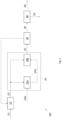
- Figure 1 a method or system according to an embodiment of the present invention is illustrated as a block diagram and designated overall by 100.
- an ammonia-containing feed 1 is supplied, for example, from a tank, pressurized if necessary by means of a pump, and vaporized and superheated in a pretreatment unit 10.
- the vaporized and superheated ammonia-containing feed 2 is fed to the cracking device 20, which comprises an autothermally operated reactor (AT reactor) 20a of the autothermal reformer or partial oxidation reactor type and a gas-fired reformer (GHR) 20b, which is designed as a three-stream GHR.
- the AT reactor 20a is connected in parallel with the GHR 20b, i.e., the ammonia-containing feed 2 is distributed between both reactors.
- the outlet of the AT reactor 20a is connected to the GHR 20b in such a way that it is heated by the heat of the fission gas 2a generated in the AT reactor 20a (AT fission gas).
- the fission gas generated by the GHR 20b (GHR fission gas) and the AT fission gas cooled in the GHR 20b are mixed together and withdrawn from the fission device 20 as fission gas 3.
- the fission gas 3 typically contains a certain amount of unconverted ammonia, since thermodynamic equilibrium requires conversion at high temperature and low pressure. However, under technically relevant conditions, the conversion is carried out at elevated pressure and limited temperature.
- the oxygen required for the reaction taking place in the AT reactor 20a is supplied by an oxidizing agent 2b, which is pure oxygen or a mixture of pure oxygen and air.
- Heat is extracted from the hot cracked gas 3 in the heat exchanger 30 to obtain cooled cracked gas 4, which is used in the pretreatment unit 10 to evaporate and superheat the ammonia-containing feed 1.
- the heat transfer is indicated by a dash-dot line.
- the cooled cracked gas 4 is separated by means of a treatment 40, in particular by pressure swing adsorption, into a hydrogen-containing product fraction 6 and a residual gas 5, which is used in the Pretreatment unit 10 is burned to generate heat for the processing of the ammonia-containing feed 1.
- FIG. 2 a method or a system according to a further embodiment of the present invention is illustrated as a block diagram and designated overall by 100.
- the AT reactor 20a is not directly supplied with the ammonia-containing feed 1 or the vaporized and superheated ammonia-containing feed 2, but only the GHR 20b, which is designed as a 4-stream GHR. This partially cracks the ammonia-containing feed 2 and supplies the AT reactor 20a with the GHR cracking gas 2c.
- the ammonia present in the GHR cracking gas is cracked using oxygen 2b, producing a hot AT cracking gas 2a, which is used to heat the GHR 20b.
- the thus cooled AT cracking gas 2a is subsequently withdrawn as cracking gas 3 from the gas-heated reformer 20b.
Landscapes
- Chemical & Material Sciences (AREA)
- Organic Chemistry (AREA)
- Health & Medical Sciences (AREA)
- General Health & Medical Sciences (AREA)
- Engineering & Computer Science (AREA)
- Combustion & Propulsion (AREA)
- Inorganic Chemistry (AREA)
- Hydrogen, Water And Hydrids (AREA)
Priority Applications (1)
| Application Number | Priority Date | Filing Date | Title |
|---|---|---|---|
| EP23020513.0A EP4559870A1 (fr) | 2023-11-21 | 2023-11-21 | Procédé et installation de production d'un produit contenant de l'hydrogène |
Applications Claiming Priority (1)
| Application Number | Priority Date | Filing Date | Title |
|---|---|---|---|
| EP23020513.0A EP4559870A1 (fr) | 2023-11-21 | 2023-11-21 | Procédé et installation de production d'un produit contenant de l'hydrogène |
Publications (1)
| Publication Number | Publication Date |
|---|---|
| EP4559870A1 true EP4559870A1 (fr) | 2025-05-28 |
Family
ID=88923698
Family Applications (1)
| Application Number | Title | Priority Date | Filing Date |
|---|---|---|---|
| EP23020513.0A Withdrawn EP4559870A1 (fr) | 2023-11-21 | 2023-11-21 | Procédé et installation de production d'un produit contenant de l'hydrogène |
Country Status (1)
| Country | Link |
|---|---|
| EP (1) | EP4559870A1 (fr) |
Citations (5)
| Publication number | Priority date | Publication date | Assignee | Title |
|---|---|---|---|---|
| CN105771812A (zh) * | 2010-01-19 | 2016-07-20 | 赫多特普索化工设备公司 | 重整烃的方法 |
| EP4112539A1 (fr) | 2021-06-30 | 2023-01-04 | Linde GmbH | Procédé et dispositif de production d'hydrogène à partir d'ammoniac |
| EP4112540A1 (fr) | 2021-06-30 | 2023-01-04 | Linde GmbH | Procédé et dispositif de production d'hydrogène à partir d'ammoniac |
| EP4201873A1 (fr) * | 2021-12-21 | 2023-06-28 | L'Air Liquide, Société Anonyme pour l'Etude et l'Exploitation des Procédés Georges Claude | Procédé et appareil pour générer un produit riche en hydrogène |
| CN117069056A (zh) * | 2023-08-16 | 2023-11-17 | 福州大学 | 一种自热式氨分解反应系统及制氢方法 |
-
2023
- 2023-11-21 EP EP23020513.0A patent/EP4559870A1/fr not_active Withdrawn
Patent Citations (5)
| Publication number | Priority date | Publication date | Assignee | Title |
|---|---|---|---|---|
| CN105771812A (zh) * | 2010-01-19 | 2016-07-20 | 赫多特普索化工设备公司 | 重整烃的方法 |
| EP4112539A1 (fr) | 2021-06-30 | 2023-01-04 | Linde GmbH | Procédé et dispositif de production d'hydrogène à partir d'ammoniac |
| EP4112540A1 (fr) | 2021-06-30 | 2023-01-04 | Linde GmbH | Procédé et dispositif de production d'hydrogène à partir d'ammoniac |
| EP4201873A1 (fr) * | 2021-12-21 | 2023-06-28 | L'Air Liquide, Société Anonyme pour l'Etude et l'Exploitation des Procédés Georges Claude | Procédé et appareil pour générer un produit riche en hydrogène |
| CN117069056A (zh) * | 2023-08-16 | 2023-11-17 | 福州大学 | 一种自热式氨分解反应系统及制氢方法 |
Non-Patent Citations (1)
| Title |
|---|
| D. SIMA ET AL., INT. J. HYDROGEN ENERGY, vol. 45, 2020, pages 9342 - 9352 |
Similar Documents
| Publication | Publication Date | Title |
|---|---|---|
| EP4363372A1 (fr) | Procédé et appareil de production d'hydrogène à partir d'ammoniac | |
| DE69200267T2 (de) | Verfahren zur autothermen Dampf-Reformierung. | |
| WO2005012166A1 (fr) | Procede pour produire de l'hydrogene a partir d'un gaz contenant du methane, en particulier a partir de gaz naturel, et dispositif pour la mise en oeuvre de ce procede | |
| DE102017204208A1 (de) | Verfahren und Anlage zur Erzeugung und Aufbereitung eines Synthesegasgemisches | |
| EP3967654A1 (fr) | Procédé et installation de production d'hydrogène par reformage à la vapeur et par électrolyse à haute température | |
| DE3133764A1 (de) | Verfahren zur herstellung von wasserstoff- und stickstoffhaltigen gasen | |
| EP2758338B1 (fr) | Procédé de fabrication de gaz de synthèse | |
| EP4559870A1 (fr) | Procédé et installation de production d'un produit contenant de l'hydrogène | |
| CH616602A5 (fr) | ||
| WO2018141519A9 (fr) | Procédé de traitement d'un flux de gaz de synthèse | |
| DE2705141A1 (de) | Verfahren und vorrichtung zur durchfuehrung einer stark exothermen katalytisch beschleunigten chemischen reaktion | |
| EP4324786A1 (fr) | Procédé et installation pour la préparation de gaz de synthèse et pour la production de méthanol | |
| EP4212502A1 (fr) | Procédé et installation de synthèse de méthanol | |
| EP1717198A2 (fr) | Procédé et dispositif de reformage à haute température | |
| EP4534475A1 (fr) | Procédé et installation pour obtenir un produit contenant de l'hydrogène en utilisant de l'ammoniac | |
| EP4566987A1 (fr) | Procédé et installation de décomposition d'ammoniac en utilisant de l'ammoniac | |
| DE10051563A1 (de) | Verfahren zur Gewinnung von Wasserstoff aus Kohlenwasserstoff | |
| LU103148B1 (de) | Verfahren und Anlage zur Synthese von Methanol | |
| EP4656592A1 (fr) | Procédé et installation de production d'un produit contenant de l'hydrogène | |
| EP4635904A1 (fr) | Procédé et installation de production d'un produit contenant de l'hydrogène en utilisant de l'ammoniac | |
| EP4474342A1 (fr) | Procédé et installation de production d'un produit contenant de l'hydrogène | |
| EP4549374A1 (fr) | Procédé et installation de production d'un produit contenant de l'hydrogène en utilisant de l'ammoniac | |
| EP4653391A1 (fr) | Procédé et installation de production d'un produit contenant de l'hydrogène en utilisant de l'ammoniac | |
| EP3860946B1 (fr) | Procédé et dispositif pour la génération de produits gazeux en utilisant un convertisseur catalytique | |
| EP4574749A1 (fr) | Procédé et installation de production d'un produit à base d'hydrogène |
Legal Events
| Date | Code | Title | Description |
|---|---|---|---|
| PUAI | Public reference made under article 153(3) epc to a published international application that has entered the european phase |
Free format text: ORIGINAL CODE: 0009012 |
|
| STAA | Information on the status of an ep patent application or granted ep patent |
Free format text: STATUS: THE APPLICATION HAS BEEN PUBLISHED |
|
| AK | Designated contracting states |
Kind code of ref document: A1 Designated state(s): AL AT BE BG CH CY CZ DE DK EE ES FI FR GB GR HR HU IE IS IT LI LT LU LV MC ME MK MT NL NO PL PT RO RS SE SI SK SM TR |
|
| STAA | Information on the status of an ep patent application or granted ep patent |
Free format text: STATUS: THE APPLICATION IS DEEMED TO BE WITHDRAWN |
|
| 18D | Application deemed to be withdrawn |
Effective date: 20251129 |