EP4574749A1 - Procédé et installation de production d'un produit à base d'hydrogène - Google Patents
Procédé et installation de production d'un produit à base d'hydrogène Download PDFInfo
- Publication number
- EP4574749A1 EP4574749A1 EP23020559.3A EP23020559A EP4574749A1 EP 4574749 A1 EP4574749 A1 EP 4574749A1 EP 23020559 A EP23020559 A EP 23020559A EP 4574749 A1 EP4574749 A1 EP 4574749A1
- Authority
- EP
- European Patent Office
- Prior art keywords
- ammonia
- gas
- hydrogen
- cracking
- cracking furnace
- Prior art date
- Legal status (The legal status is an assumption and is not a legal conclusion. Google has not performed a legal analysis and makes no representation as to the accuracy of the status listed.)
- Pending
Links
Images
Classifications
-
- C—CHEMISTRY; METALLURGY
- C01—INORGANIC CHEMISTRY
- C01B—NON-METALLIC ELEMENTS; COMPOUNDS THEREOF; METALLOIDS OR COMPOUNDS THEREOF NOT COVERED BY SUBCLASS C01C
- C01B3/00—Hydrogen; Gaseous mixtures containing hydrogen; Separation of hydrogen from mixtures containing it; Purification of hydrogen; Reversible storage of hydrogen
- C01B3/02—Production of hydrogen; Production of gaseous mixtures containing hydrogen
- C01B3/04—Production of hydrogen; Production of gaseous mixtures containing hydrogen by decomposition of inorganic compounds
- C01B3/047—Decomposition of ammonia
-
- B—PERFORMING OPERATIONS; TRANSPORTING
- B01—PHYSICAL OR CHEMICAL PROCESSES OR APPARATUS IN GENERAL
- B01D—SEPARATION
- B01D53/00—Separation of gases or vapours; Recovering vapours of volatile solvents from gases; Chemical or biological purification of waste gases, e.g. engine exhaust gases, smoke, fumes, flue gases, aerosols
- B01D53/02—Separation of gases or vapours; Recovering vapours of volatile solvents from gases; Chemical or biological purification of waste gases, e.g. engine exhaust gases, smoke, fumes, flue gases, aerosols by adsorption, e.g. preparative gas chromatography
- B01D53/04—Separation of gases or vapours; Recovering vapours of volatile solvents from gases; Chemical or biological purification of waste gases, e.g. engine exhaust gases, smoke, fumes, flue gases, aerosols by adsorption, e.g. preparative gas chromatography with stationary adsorbents
- B01D53/047—Pressure swing adsorption
-
- C—CHEMISTRY; METALLURGY
- C01—INORGANIC CHEMISTRY
- C01B—NON-METALLIC ELEMENTS; COMPOUNDS THEREOF; METALLOIDS OR COMPOUNDS THEREOF NOT COVERED BY SUBCLASS C01C
- C01B3/00—Hydrogen; Gaseous mixtures containing hydrogen; Separation of hydrogen from mixtures containing it; Purification of hydrogen; Reversible storage of hydrogen
- C01B3/50—Separation of hydrogen or hydrogen-containing gases from gaseous mixtures, e.g. purification
- C01B3/508—Separation of hydrogen or hydrogen-containing gases from gaseous mixtures, e.g. purification by using hydrogen storage media
-
- C—CHEMISTRY; METALLURGY
- C25—ELECTROLYTIC OR ELECTROPHORETIC PROCESSES; APPARATUS THEREFOR
- C25B—ELECTROLYTIC OR ELECTROPHORETIC PROCESSES FOR THE PRODUCTION OF COMPOUNDS OR NON-METALS; APPARATUS THEREFOR
- C25B1/00—Electrolytic production of inorganic compounds or non-metals
- C25B1/01—Products
- C25B1/02—Hydrogen or oxygen
- C25B1/04—Hydrogen or oxygen by electrolysis of water
- C25B1/042—Hydrogen or oxygen by electrolysis of water by electrolysis of steam
-
- C—CHEMISTRY; METALLURGY
- C01—INORGANIC CHEMISTRY
- C01B—NON-METALLIC ELEMENTS; COMPOUNDS THEREOF; METALLOIDS OR COMPOUNDS THEREOF NOT COVERED BY SUBCLASS C01C
- C01B2203/00—Integrated processes for the production of hydrogen or synthesis gas
- C01B2203/02—Processes for making hydrogen or synthesis gas
- C01B2203/0266—Processes for making hydrogen or synthesis gas containing a decomposition step
- C01B2203/0277—Processes for making hydrogen or synthesis gas containing a decomposition step containing a catalytic decomposition step
-
- C—CHEMISTRY; METALLURGY
- C01—INORGANIC CHEMISTRY
- C01B—NON-METALLIC ELEMENTS; COMPOUNDS THEREOF; METALLOIDS OR COMPOUNDS THEREOF NOT COVERED BY SUBCLASS C01C
- C01B2203/00—Integrated processes for the production of hydrogen or synthesis gas
- C01B2203/04—Integrated processes for the production of hydrogen or synthesis gas containing a purification step for the hydrogen or the synthesis gas
- C01B2203/042—Purification by adsorption on solids
- C01B2203/043—Regenerative adsorption process in two or more beds, one for adsorption, the other for regeneration
-
- C—CHEMISTRY; METALLURGY
- C01—INORGANIC CHEMISTRY
- C01B—NON-METALLIC ELEMENTS; COMPOUNDS THEREOF; METALLOIDS OR COMPOUNDS THEREOF NOT COVERED BY SUBCLASS C01C
- C01B2203/00—Integrated processes for the production of hydrogen or synthesis gas
- C01B2203/08—Methods of heating or cooling
- C01B2203/0805—Methods of heating the process for making hydrogen or synthesis gas
- C01B2203/0811—Methods of heating the process for making hydrogen or synthesis gas by combustion of fuel
- C01B2203/0827—Methods of heating the process for making hydrogen or synthesis gas by combustion of fuel at least part of the fuel being a recycle stream
-
- C—CHEMISTRY; METALLURGY
- C01—INORGANIC CHEMISTRY
- C01B—NON-METALLIC ELEMENTS; COMPOUNDS THEREOF; METALLOIDS OR COMPOUNDS THEREOF NOT COVERED BY SUBCLASS C01C
- C01B2203/00—Integrated processes for the production of hydrogen or synthesis gas
- C01B2203/14—Details of the flowsheet
- C01B2203/142—At least two reforming, decomposition or partial oxidation steps in series
Definitions
- the present invention relates to a process and a plant for producing a hydrogen product from ammonia.
- Ammonia cleavage is the catalytic decomposition of two ammonia molecules into one nitrogen molecule and three hydrogen molecules. Ammonia cleavage is endothermic, with the reaction rate depending on temperature, pressure, and the catalyst used.
- Ammonia splitting can be used as part of a hydrogen storage technology, whereby hydrogen is processed into ammonia, for example, using the industrially established Haber-Bosch process.
- This ammonia is significantly easier to store and transport than hydrogen or natural gas or methane from other sources.
- the existing synthesis and transport infrastructure for ammonia is technologically mature and safe.
- a first portion of a provided ammonia is superheated and fed into a cracking feed of a burner-fired cracking furnace arrangement in order to produce, with catalytic support, to be converted into a cracked gas containing hydrogen, nitrogen and ammonia, at least a portion of which is fed to a separation device in which a hydrogen fraction and a residual gas enriched in nitrogen compared to the cracked gas and containing hydrogen and ammonia are obtained, at least a portion of which is used together with a second portion of the ammonia provided to fire the cracking furnace arrangement.
- the resulting residual gas which can be used as fuel, is at a low pressure.
- the residual gas used as fuel could be preheated using heat exchangers, but this would result in a pressure loss that reduces the burner inlet pressure. To compensate for this pressure loss, it would be possible to increase the residual gas pressure, which, however, would reduce the efficiency of pressure swing adsorption.
- One embodiment of the proposed method provides for superheating using heat from a flue gas generated during operation of one or at least one of the several burners and/or using heat from the cracked gas or a portion thereof.
- Superheating can thus be carried out using established components already present for superheating the cracking insert. Only the heat exchange surface in a flue gas and/or cracked gas stream may need to be enlarged. Any combination of heat utilization from flue gas and cracked gas is possible, with heat exchangers arranged serially and/or in parallel in the corresponding streams being able to be used.
- One embodiment of the proposed process provides that the second part of the ammonia provided comprises a proportion of 10 to 25% of a total amount of the first and second portions of the ammonia provided.
- One embodiment of the proposed process provides for pressure swing adsorption to be carried out in the separation device, with the residual gas and the hydrogen fraction being formed using pressure swing adsorption.
- Embodiments of the proposed process have the particular advantage that the residual gas from pressure swing adsorption does not need to be further reduced in pressure.
- One embodiment of the proposed method provides that one or at least one of the several burners is or are operated using an oxidizer gas that is enriched in oxygen compared to air. Since the oxidizer gas has a lower nitrogen content than air, both the fuel required to heat the cracking furnace arrangement and the amount of flue gas generated are reduced.
- One embodiment of the proposed process provides for the oxidizer gas, or a portion thereof, to be provided using electrolysis. This allows additional hydrogen to be produced.
- One embodiment of the proposed process provides for the electrolysis to be carried out using a solid oxide electrolyzer. This allows the oxidizer gas to be provided at an elevated temperature and eliminates the need for further heating.
- the proposed plant for producing a hydrogen product is designed to be fed with ammonia, to feed a first portion of the ammonia into a cracking feed of a cracking furnace arrangement fired by one or more burners, to catalytically convert at least a portion of the ammonia of the cracking feed in the cracking furnace arrangement, to withdraw from the cracking furnace arrangement a cracking gas containing hydrogen, nitrogen, and unreacted ammonia of the cracking feed, to feed the cracking gas or a portion thereof to a separation device, to withdraw from the separation device a combustible residual gas enriched in nitrogen compared to the cracking gas and containing a portion of the hydrogen and the unreacted ammonia, and to withdraw from the separation device a hydrogen fraction used to provide the hydrogen product, supplying the residual gas or a portion thereof to the one or at least one of the plurality of burners, and supplying a second portion of the ammonia to the one or at least one of the plurality of burners as additional fuel.
- the proposed plant is designed to subject the second part of the ammonia to superheating before it is fed to one or at least one of the several burners as additional fuel.
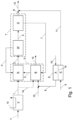
- Figure 1 illustrates a method according to a proposed embodiment.
- the flue gases generated by the burner(s) B can only transfer a small portion of their sensible heat to the cracking tubes R, so they leave the combustion chamber at a high temperature and with a large amount of residual heat.
- the hot flue gases, as well as the hot cracking gas flowing from the cracking tubes R are used to preheat the cracking insert 1 and burner air, and, if necessary, to generate steam.
- the proposed designs also include appropriate heating and superheating of ammonia as a fuel.
- ammonia cracking is preferably carried out at pressures between 10 and 40 bar. This is made easier by the fact that the pressure of the feedstock, which usually contains liquid ammonia, can be increased with little energy expenditure. To ensure that a sufficiently high, economically viable conversion rate of the ammonia used is achieved under these conditions, ammonia, it is particularly advantageous to operate the ammonia splitting at temperatures between 500 and 1000 °C.
Landscapes
- Chemical & Material Sciences (AREA)
- Organic Chemistry (AREA)
- Engineering & Computer Science (AREA)
- Chemical Kinetics & Catalysis (AREA)
- Inorganic Chemistry (AREA)
- Combustion & Propulsion (AREA)
- Electrochemistry (AREA)
- Materials Engineering (AREA)
- Metallurgy (AREA)
- Analytical Chemistry (AREA)
- General Chemical & Material Sciences (AREA)
- Oil, Petroleum & Natural Gas (AREA)
- Health & Medical Sciences (AREA)
- General Health & Medical Sciences (AREA)
- Hydrogen, Water And Hydrids (AREA)
Priority Applications (1)
| Application Number | Priority Date | Filing Date | Title |
|---|---|---|---|
| EP23020559.3A EP4574749A1 (fr) | 2023-12-19 | 2023-12-19 | Procédé et installation de production d'un produit à base d'hydrogène |
Applications Claiming Priority (1)
| Application Number | Priority Date | Filing Date | Title |
|---|---|---|---|
| EP23020559.3A EP4574749A1 (fr) | 2023-12-19 | 2023-12-19 | Procédé et installation de production d'un produit à base d'hydrogène |
Publications (1)
| Publication Number | Publication Date |
|---|---|
| EP4574749A1 true EP4574749A1 (fr) | 2025-06-25 |
Family
ID=89224541
Family Applications (1)
| Application Number | Title | Priority Date | Filing Date |
|---|---|---|---|
| EP23020559.3A Pending EP4574749A1 (fr) | 2023-12-19 | 2023-12-19 | Procédé et installation de production d'un produit à base d'hydrogène |
Country Status (1)
| Country | Link |
|---|---|
| EP (1) | EP4574749A1 (fr) |
Citations (4)
| Publication number | Priority date | Publication date | Assignee | Title |
|---|---|---|---|---|
| WO2021257944A9 (fr) * | 2020-06-18 | 2022-04-14 | Air Products And Chemicals, Inc. | Craquage d'ammoniac pour de l'hydrogène vert |
| WO2022189560A1 (fr) * | 2021-03-11 | 2022-09-15 | Topsoe A/S | Méthode et système de production d'hydrogène à partir de craquage d'ammoniac |
| EP4112539A1 (fr) | 2021-06-30 | 2023-01-04 | Linde GmbH | Procédé et dispositif de production d'hydrogène à partir d'ammoniac |
| DE102022200903A1 (de) * | 2022-01-27 | 2023-07-27 | Thyssenkrupp Ag | Verfahren und Anlage zur Herstellung von Wasserstoff aus Ammoniak |
-
2023
- 2023-12-19 EP EP23020559.3A patent/EP4574749A1/fr active Pending
Patent Citations (4)
| Publication number | Priority date | Publication date | Assignee | Title |
|---|---|---|---|---|
| WO2021257944A9 (fr) * | 2020-06-18 | 2022-04-14 | Air Products And Chemicals, Inc. | Craquage d'ammoniac pour de l'hydrogène vert |
| WO2022189560A1 (fr) * | 2021-03-11 | 2022-09-15 | Topsoe A/S | Méthode et système de production d'hydrogène à partir de craquage d'ammoniac |
| EP4112539A1 (fr) | 2021-06-30 | 2023-01-04 | Linde GmbH | Procédé et dispositif de production d'hydrogène à partir d'ammoniac |
| DE102022200903A1 (de) * | 2022-01-27 | 2023-07-27 | Thyssenkrupp Ag | Verfahren und Anlage zur Herstellung von Wasserstoff aus Ammoniak |
Non-Patent Citations (1)
| Title |
|---|
| A.O. ONI ET AL.: "Comparative assessment of blue hydrogen from steam methane reforming, autothermal reforming, and natural gas decomposition technologies for natural gas-producing regions", ENERGY CONVERSION AND MANAGEMENT, vol. 254, 2022, pages 115245 |
Similar Documents
| Publication | Publication Date | Title |
|---|---|---|
| EP4363372A1 (fr) | Procédé et appareil de production d'hydrogène à partir d'ammoniac | |
| EP4363371A1 (fr) | Procédé et dispositif de production d'hydrogène à partir d'ammoniac | |
| DE1417796C3 (de) | Verfahren zur Herstellung eines wasserstoffreichen Gases | |
| EP4097045B1 (fr) | Méthode et installation de production d'hydrogène | |
| DE69407858T2 (de) | Stripping von Fuselöl | |
| WO2023144335A1 (fr) | Procédé et installation de production d'hydrogène à partir d'ammoniac | |
| WO2010020358A2 (fr) | Cascade de réacteurs à plusieurs étages pour produire du gaz de synthèse sans formation de suie | |
| EP3967654A1 (fr) | Procédé et installation de production d'hydrogène par reformage à la vapeur et par électrolyse à haute température | |
| EP4574749A1 (fr) | Procédé et installation de production d'un produit à base d'hydrogène | |
| DE69204188T2 (de) | Gewinnung elektrischer Energie. | |
| EP3898504B1 (fr) | Procédé de fabrication d'hydrogène, de monoxyde de carbone et d'un produit contenant du carbone | |
| EP4590650A1 (fr) | Procédé et système pour produire une ou plusieurs oléfines | |
| WO2024032928A1 (fr) | Méthode et système d'obtention d'un produit contenant de l'hydrogène à l'aide d'ammoniac | |
| EP4334242B1 (fr) | Procédé de synthèse d'ammoniac et installation de production d'ammoniac | |
| BE1030221A1 (de) | Verfahren und Anlage zur Herstellung von Wasserstoff aus Ammoniak | |
| EP0300151B2 (fr) | Procédé de préparation d'ammoniac à partir de gaz naturel | |
| EP4635904A1 (fr) | Procédé et installation de production d'un produit contenant de l'hydrogène en utilisant de l'ammoniac | |
| LU103225B1 (de) | Grüner Wasserstoff, Synthesegas und Rauchgas mit vermindertem Stickstoffgehalt zur Synthese von Ammoniak und Harnstoff | |
| EP4474342A1 (fr) | Procédé et installation de production d'un produit contenant de l'hydrogène | |
| EP4392361B1 (fr) | Synthèse d'ammoniac avec de l'hydrogène neutre de co2 | |
| EP4501842A1 (fr) | Procédé et installation de production d'hydrogène | |
| EP4553039A1 (fr) | Procédé de production de gaz de synthèse et de production de méthanol | |
| EP4686698A1 (fr) | Procédé et installation de fabrication d'un produit de procédé ainsi que procédé de transformation d'une telle installation | |
| EP4534475A1 (fr) | Procédé et installation pour obtenir un produit contenant de l'hydrogène en utilisant de l'ammoniac | |
| WO2025103631A1 (fr) | Procédé et installation de production de méthanol |
Legal Events
| Date | Code | Title | Description |
|---|---|---|---|
| PUAI | Public reference made under article 153(3) epc to a published international application that has entered the european phase |
Free format text: ORIGINAL CODE: 0009012 |
|
| STAA | Information on the status of an ep patent application or granted ep patent |
Free format text: STATUS: THE APPLICATION HAS BEEN PUBLISHED |
|
| AK | Designated contracting states |
Kind code of ref document: A1 Designated state(s): AL AT BE BG CH CY CZ DE DK EE ES FI FR GB GR HR HU IE IS IT LI LT LU LV MC ME MK MT NL NO PL PT RO RS SE SI SK SM TR |
|
| STAA | Information on the status of an ep patent application or granted ep patent |
Free format text: STATUS: THE APPLICATION IS DEEMED TO BE WITHDRAWN |