EP4561111A1 - Lautsprecher und elektronische vorrichtung - Google Patents
Lautsprecher und elektronische vorrichtung Download PDFInfo
- Publication number
- EP4561111A1 EP4561111A1 EP23848943.9A EP23848943A EP4561111A1 EP 4561111 A1 EP4561111 A1 EP 4561111A1 EP 23848943 A EP23848943 A EP 23848943A EP 4561111 A1 EP4561111 A1 EP 4561111A1
- Authority
- EP
- European Patent Office
- Prior art keywords
- housing
- energy director
- cavity
- speaker
- hollow sphere
- Prior art date
- Legal status (The legal status is an assumption and is not a legal conclusion. Google has not performed a legal analysis and makes no representation as to the accuracy of the status listed.)
- Pending
Links
Images



Classifications
-
- H—ELECTRICITY
- H04—ELECTRIC COMMUNICATION TECHNIQUE
- H04R—LOUDSPEAKERS, MICROPHONES, GRAMOPHONE PICK-UPS OR LIKE ACOUSTIC ELECTROMECHANICAL TRANSDUCERS; ELECTRIC HEARING AIDS; PUBLIC ADDRESS SYSTEMS
- H04R9/00—Transducers of moving-coil, moving-strip, or moving-wire type
- H04R9/06—Loudspeakers
-
- H—ELECTRICITY
- H04—ELECTRIC COMMUNICATION TECHNIQUE
- H04R—LOUDSPEAKERS, MICROPHONES, GRAMOPHONE PICK-UPS OR LIKE ACOUSTIC ELECTROMECHANICAL TRANSDUCERS; ELECTRIC HEARING AIDS; PUBLIC ADDRESS SYSTEMS
- H04R1/00—Details of transducers, loudspeakers or microphones
- H04R1/02—Casings; Cabinets ; Supports therefor; Mountings therein
- H04R1/021—Casings; Cabinets ; Supports therefor; Mountings therein incorporating only one transducer
-
- H—ELECTRICITY
- H04—ELECTRIC COMMUNICATION TECHNIQUE
- H04R—LOUDSPEAKERS, MICROPHONES, GRAMOPHONE PICK-UPS OR LIKE ACOUSTIC ELECTROMECHANICAL TRANSDUCERS; ELECTRIC HEARING AIDS; PUBLIC ADDRESS SYSTEMS
- H04R1/00—Details of transducers, loudspeakers or microphones
- H04R1/20—Arrangements for obtaining desired frequency or directional characteristics
- H04R1/22—Arrangements for obtaining desired frequency or directional characteristics for obtaining desired frequency characteristic only
- H04R1/28—Transducer mountings or enclosures modified by provision of mechanical or acoustic impedances, e.g. resonator, damping means
- H04R1/2869—Reduction of undesired resonances, i.e. standing waves within enclosure, or of undesired vibrations, i.e. of the enclosure itself
- H04R1/2884—Reduction of undesired resonances, i.e. standing waves within enclosure, or of undesired vibrations, i.e. of the enclosure itself by means of the enclosure structure, i.e. strengthening or shape of the enclosure
- H04R1/2888—Reduction of undesired resonances, i.e. standing waves within enclosure, or of undesired vibrations, i.e. of the enclosure itself by means of the enclosure structure, i.e. strengthening or shape of the enclosure for loudspeaker transducers
-
- H—ELECTRICITY
- H04—ELECTRIC COMMUNICATION TECHNIQUE
- H04R—LOUDSPEAKERS, MICROPHONES, GRAMOPHONE PICK-UPS OR LIKE ACOUSTIC ELECTROMECHANICAL TRANSDUCERS; ELECTRIC HEARING AIDS; PUBLIC ADDRESS SYSTEMS
- H04R9/00—Transducers of moving-coil, moving-strip, or moving-wire type
- H04R9/02—Details
-
- H—ELECTRICITY
- H04—ELECTRIC COMMUNICATION TECHNIQUE
- H04R—LOUDSPEAKERS, MICROPHONES, GRAMOPHONE PICK-UPS OR LIKE ACOUSTIC ELECTROMECHANICAL TRANSDUCERS; ELECTRIC HEARING AIDS; PUBLIC ADDRESS SYSTEMS
- H04R2201/00—Details of transducers, loudspeakers or microphones covered by H04R1/00 but not provided for in any of its subgroups
- H04R2201/02—Details casings, cabinets or mounting therein for transducers covered by H04R1/02 but not provided for in any of its subgroups
- H04R2201/029—Manufacturing aspects of enclosures transducers
-
- H—ELECTRICITY
- H04—ELECTRIC COMMUNICATION TECHNIQUE
- H04R—LOUDSPEAKERS, MICROPHONES, GRAMOPHONE PICK-UPS OR LIKE ACOUSTIC ELECTROMECHANICAL TRANSDUCERS; ELECTRIC HEARING AIDS; PUBLIC ADDRESS SYSTEMS
- H04R2400/00—Loudspeakers
- H04R2400/11—Aspects regarding the frame of loudspeaker transducers
-
- H—ELECTRICITY
- H04—ELECTRIC COMMUNICATION TECHNIQUE
- H04R—LOUDSPEAKERS, MICROPHONES, GRAMOPHONE PICK-UPS OR LIKE ACOUSTIC ELECTROMECHANICAL TRANSDUCERS; ELECTRIC HEARING AIDS; PUBLIC ADDRESS SYSTEMS
- H04R2499/00—Aspects covered by H04R or H04S not otherwise provided for in their subgroups
- H04R2499/10—General applications
- H04R2499/11—Transducers incorporated or for use in hand-held devices, e.g. mobile phones, PDA's, camera's
Definitions
- This application belongs to the field of electronic device technologies, and in particular, relates to a speaker and an electronic device.
- the speaker includes a housing and a speaker unit, where the speaker unit is a core component configured to form an outgoing sound, and the housing is configured to provide a sound cavity for the speaker unit, to implement corresponding acoustic performance.
- the housing of the speaker is formed by welding two parts of the housing.
- a material of the housing in the speaker is usually prepared by using plastic particles.
- the plastic particles are made of a polymer composite material composed of PC (polycarbonate) and glass fibers.
- a density of the plastic particles formed by the polymer composite material is relatively large, resulting in relatively large mass of a prepared housing.
- a housing material prepared by using the polymer composite material composed of the PC (polycarbonate) and the glass fibers cannot meet a current requirement for reducing a weight of an electronic device.
- this application provides a speaker and an electronic device.
- this application provides a speaker, including: a first housing, where a sound outlet channel is disposed on the first housing; a second housing, where the second housing is snap-fit connected to the first housing, to form a first cavity; and a speaker unit, where the speaker unit is disposed in the first cavity, and after the speaker unit is connected to the first housing, the first cavity is divided into a front cavity and a rear cavity, where the front cavity is connected to the sound outlet channel, and the rear cavity is a sealed cavity; and raw material components of the first housing and the second housing include 50-90 wt% of a polymer composite material and 10-50 wt% of a hollow sphere material in terms of mass percentage.
- an energy director is disposed on the second housing, and when used for welding, the energy director forms a surface contact with the first housing; and when the second housing is subjected to high-frequency vibration, the energy director and the first housing rub against each other on a contact surface to generate heat, so that the first housing and the second housing are welded together.
- this application may be compatible with different characteristics of a plurality of types of polymer materials, for example, a crystalline polymer material and a semi-crystalline polymer material, so that the speaker provided in this embodiment of this application can meet a reduction requirement of the speaker and can ensure welding reliability.
- a cross section of the energy director is trapezoidal, rectangular, or W-shaped.
- the contact area between the energy director and the first housing is increased. In this way, in the welding process, more energy can be generated, to ensure welding reliability.
- an outer surface of the energy director is roughened.
- a surface roughening processing manner is not limited in this application.
- a concave-convex texture may be disposed on the outer surface of the energy director.
- concave-convex particles may be disposed on the outer surface of the energy director.
- an overflow groove is disposed along a periphery of the energy director on the second housing, and the overflow groove is configured to accommodate a molten material overflowing after the energy director is melted.
- the polymer composite material includes 80-100 wt% of a polymer material and 0-20 wt% of a fiber material.
- the polymer material has excellent performance in terms of mechanical performance, insulation performance, heat insulation performance, and the like.
- the fiber material can enhance strength of the first housing. Therefore, the polymer composite material formed through combination of the polymer material and the fiber material can ensure that the first housing and the second housing that are prepared have good physical performance.
- the polymer material is selected from at least one of PA, PC, ABS, or PET
- the fiber material is selected from at least one of glass fiber, aramid fiber, carbon fiber, silicon carbide, or carbon nanotubes.
- the raw material components of the first housing and the second housing include 77 wt% of the PA, 3 wt% of the glass fiber, and 20 wt% of the hollow sphere material.
- the raw material components of the first housing and the second housing include 40 wt% of the PA, 10 wt% of the glass fiber, and 50 wt% of the hollow sphere material.
- the raw material components of the first housing and the second housing include 81 wt% of the PA, 9 wt% of the glass fiber, and 10 wt% of the hollow sphere material.
- the hollow sphere material has a particle diameter of 2-130 ⁇ m and a density of 0.2-0.6 g/cm3.
- the hollow sphere material is selected from at least one of silicon dioxide, aluminum oxide, zirconium oxide, titanium dioxide, ferroferric oxide, zinc oxide, carbon nanotubes, graphene, low-carbon steel, 316 stainless steel, 304 stainless steel, pure iron, or polystyrene.
- this application further provides an electronic device.
- the electronic device includes the speaker according to any one of the first aspect.
- the electronic device that uses the speaker provided in this application can reduce the weight by 7%.
- the speaker and the electronic device provided in this application to meet a weight reduction requirement, 10-50 wt% of the hollow sphere material is added to the raw material components of the first housing and the second housing, so that the densities of the first housing and the second housing can be reduced, thereby reducing the weights of the first housing and the second housing.
- 10-50 wt% of the hollow sphere material is added to the raw material components of the first housing and the second housing, so that the densities of the first housing and the second housing can be reduced, thereby reducing the weights of the first housing and the second housing.
- a crystalline polymer material and a semi-crystalline polymer material in embodiments of this application, by changing the shape of the energy director, the contact area between the energy director and the first housing is increased. In this way, in the welding process, more energy can be generated, to ensure welding reliability. That is, the speaker provided in the embodiments of this application can meet a reduction requirement of the speaker and can ensure welding reliability.
- the speaker includes a housing and a speaker unit, where the speaker unit is a core component configured to form an outgoing sound, and the housing is configured to provide a sound cavity for the speaker unit, to implement corresponding acoustic performance.
- the housing of the speaker is formed by welding two parts of the housing.
- FIG. 1 is a schematic diagram of an overall structure of a speaker according to an embodiment of this application.
- FIG. 2 is a schematic diagram of an exploded structure of a speaker according to an embodiment of this application.
- the speaker includes a first housing 100, a second housing 200, and a speaker unit 300.
- FIG. 3A is a sectional view of a speaker in an A1-A1 direction according to an embodiment of this application.
- a first cavity 400 is formed.
- the speaker unit 300 is located in the first cavity 400.
- the speaker unit 300 includes an upper surface 310 facing the first housing 100 and a lower surface 320 facing the second housing.
- the first cavity 400 is divided into a front cavity 410 and a rear cavity 420.
- the upper surface 310 of the speaker unit 300 and the first housing 100 enclose the front cavity 410; and the first housing 100, the second housing 200, the lower surface 320 of the speaker unit 300, and a side surface enclose the rear cavity 420.
- the speaker unit 300 and the first housing 100 may be bonded and sealed through adhesive dispensing, and the first housing 100 and the second housing 200 may be sealed and connected by welding.
- FIG. 3B is a sectional view of a speaker in an A2-A2 direction according to an embodiment of this application.
- a protrusion 120 protruding in a direction away from the second housing 200 is disposed on the first housing 100
- a sound outlet channel 110 is disposed on a side surface of the protrusion 120
- the sound outlet channel 110 is connected to the front cavity 410 but is not connected to the rear cavity 420.
- An arrow direction in FIG. 3B is a sound outlet direction.
- the sound outlet channel 110 may be connected to a sound outlet hole on a frame of an electronic device. Therefore, the sound may be further exported outside the electronic device, so that the sound can be received by a user.
- the rear cavity 420 is a sealed cavity. Because a sound wave generated by the upper surface 310 of the speaker unit 300 is 180° different from that generated by the lower surface 320, if the rear cavity 420 is an unsealed cavity, the sound wave generated by the upper surface 310 and the sound wave generated by the lower surface 320 enable the sound to disappear due to phase difference interference. Therefore, the rear cavity 420 is designed as a sealed cavity, to cancel the phase difference interference.
- a connection region between the first housing 100 and the second housing 200 is located in the rear cavity 420.
- the rear cavity 420 is required to be a sealed cavity. Therefore, in this application, the connection region between the first housing 100 and the second housing 200 is required to be of a sealed connection, to avoid a problem of sound leakage.
- a material of the first housing 100 and a material of the second housing 200 are a polymer composite material composed of PC (polycarbonate) and glass fibers.
- PC polycarbonate
- a density of plastic particles formed by the polymer composite material is relatively large, resulting in relatively large mass of the first housing 100 and the second housing 200 that are prepared. Therefore, a requirement for reducing a weight of the electronic device cannot be met.
- this embodiment of this application provides a speaker.
- a weight of a formed speaker is relatively reduced, and the requirement for reducing the weight of the electronic device is met.
- raw material components of the first housing 100 and those of the second housing 200 are the same.
- the following uses the first housing 100 as an example to describe the raw material components of the housing.
- the raw material components of the first housing 100 include a polymer composite material and a hollow sphere material.
- a mass percentage (wt%) of the polymer composite material in the raw material component is 50-90 wt%
- a mass percentage of the hollow sphere material in the raw material component is 10-50 wt%.
- a value of each component described above includes an upper limit value, a lower limit value, and any value between the upper limit value and the lower limit value.
- the value of the polymer composite material is 50-90 wt%, and specifically includes 50 wt%, 90 wt%, and any value between 50 wt% and 90 wt%.
- the value of the polymer composite material may be 60 wt%, 65 wt%, 70 wt%, 75 wt%, 80 wt%, or 85 wt%.
- the value of the hollow sphere material is 10-50 wt%, and specifically includes 10 wt%, 50 wt%, and any value between 10 wt% and 50 wt%.
- the value of the hollow sphere material may be 15 wt%, 20 wt%, 25 wt%, 30 wt%, 35 wt%, or 40 wt%.
- the hollow sphere material is added to the raw material components of the first housing 100, so that a density of the first housing 100 can be reduced, thereby reducing a weight of the first housing 100.
- the polymer composite material can ensure that the raw material components have a good processing molding property, and ensure mechanical properties of the first housing 100, such as tensile strength, elongation at break, bending strength, and bending modulus.
- the polymer composite material may use two composite materials: a polymer material and a fiber material.
- the polymer material has excellent performance in terms of mechanical performance, insulation performance, heat insulation performance, and the like.
- the fiber material can enhance strength of the first housing 100.
- a mass percentage of the polymer material in the polymer composite material is 80-100 wt%, and a mass percentage of the fiber material in the polymer composite material is 0-20 wt%.
- a value of each component described above includes an upper limit value, a lower limit value, and any value between the upper limit value and the lower limit value.
- the value of the polymer material is 80-100 wt%, and specifically includes 80 wt%, 100 wt%, and any value between 80 wt% and 100 wt%.
- the value of the polymer material may be 85 wt%, 90 wt%, or 95 wt%.
- the value of the fiber material is 0-20 wt%, and specifically includes 0 wt%, 20 wt%, and any value between 0 wt% and 20 wt%.
- the value of the fiber material may be 0.5 wt%, 5 wt%, 10 wt%, or 15 wt%.
- the polymer material may be selected from at least one of PA, PC, ABS, or PET.
- the fiber material is selected from at least one of glass fiber, aramid fiber, carbon fiber, silicon carbide, or carbon nanotubes.
- the hollow sphere material is added to the raw material components, to reduce densities of the first housing 100 and the second housing 200, thereby achieving an effect of reducing the weight of the speaker.
- a diameter of the hollow sphere material particle may be 2-130 ⁇ m, and a density of the hollow sphere material may be 0.2-0.6 g/cm 3 .
- a type of the hollow sphere material is not limited.
- the hollow sphere material may be selected from any one or more of a ceramic material, a carbon material, a metal material, or a polymer material.
- the hollow sphere material may be selected from at least one of silicon dioxide, aluminum oxide, zirconium oxide, titanium dioxide, ferroferric oxide, zinc oxide, carbon nanotubes, graphene, low-carbon steel, 316 stainless steel, 304 stainless steel, pure iron, or polystyrene.
- particle diameters of hollow sphere materials mixed into the raw material components may be the same or may be different.
- the raw material components include hollow sphere materials of two particle diameters: a particle diameter of one hollow sphere material is 2 ⁇ m, and a particle diameter of the other hollow sphere material is 10 ⁇ m.
- the raw material components include a hollow sphere material of one particle diameter, and the diameter of the hollow sphere material particle is 13 ⁇ m.
- types of the hollow sphere materials mixed into the raw material components may be the same or may be different.
- the raw material components include three types of hollow sphere materials.
- the first type of hollow sphere material is silicon dioxide
- the second type of hollow sphere material is carbon nanotubes
- the third type of hollow sphere material is low-carbon steel.
- the raw material components include a hollow sphere material of one type, and the type of the hollow sphere material is aluminum oxide.
- FIG. 4 is a flowchart of a preparation method for a housing according to an embodiment of this application. As shown in FIG. 4 , an embodiment of this application provides a preparation method for a housing.
- the preparation method may include the following steps: Step S1: Prepare a raw material based on the following proportions, where raw material components include 50-90 wt% of a polymer composite material and 10-50 wt% of a hollow sphere material.
- Step S2 After the raw material components are evenly mixed, form plastic particles through a granulation process.
- Step S3 Separately prepare a first housing 100 and a second housing 200 by using the prepared plastic particles through an injection molding process or a molding process.
- an embodiment of this application further provides a preparation method for a housing.
- raw material components provided in this embodiment of this application are weighed based on proportions, where the raw material components include 50-90 wt% of a polymer composite material and 10-50 wt% of a hollow sphere material.
- the raw material components include 50-90 wt% of a polymer composite material and 10-50 wt% of a hollow sphere material.
- plastic particles are formed through a granulation process.
- a first housing 100 and a second housing 200 are separately prepared by using the prepared plastic particles through an injection molding process or a molding process.
- the first housing 100 and the second housing 200 may be separately directly prepared through the injection molding process or the molding process. This is not limited in this application.
- Embodiment 1 In terms of mass percentage, the raw material components for preparing the first housing 100 and the second housing 200 include: 77 wt% of PA, 3 wt% of glass fiber, and 20 wt% of a hollow sphere material.
- Embodiment 2 In terms of mass percentage, the raw material components for preparing the first housing 100 and the second housing 200 include: 40 wt% of PA, 10 wt% of glass fiber, and 50 wt% of a hollow sphere material.
- Embodiment 3 In terms of mass percentage, the raw material components for preparing the first housing 100 and the second housing 200 include: 81 wt% of PA, 9 wt% of glass fiber, and 10 wt% of a hollow sphere material.
- the first housing 100 and the second housing 200 in this application are conducive to weight reduction, and have good physical performance such as tensile strength, elongation at break, bending strength, and bending modulus
- the first housing 100 and the second housing 200 are prepared by the applicants based on component proportions shown in Embodiment 1-Embodiment 3 and a comparative example in Table 1, according to the preparation method for a housing provided above.
- the raw material components of the first housing 100 and the second housing 200 are the same, and performance of the prepared first housing 100 and that of the prepared second housing 200 are also the same. Therefore, a performance test is performed on only the prepared first housing 100 in this application. For a test result of the performance test performed on the first housing 100, refer to Table 1.
- the density of the first housing 100 prepared based on the proportions of the raw material components in Embodiment 1 to Embodiment 3 is less than that of the first housing 100 prepared based on the proportions of the raw material components in the comparative example 1. That is, in this embodiment of this application, the hollow sphere material may be added to the raw material components, to reduce the weight of the prepared first housing 100. Specifically, the weight of the first housing 100 prepared according to Embodiment 1 may be reduced by 27% relative to that of the first housing prepared according to the comparative example 1. The weight of the entire electronic device using the first housing and the second housing that are prepared according to Embodiment 1 may be reduced by 7% relative to that of the entire electronic device using the first housing 100 and the second housing 200 that are prepared according to the comparative example 1.
- the first housing 100 prepared based on the proportions of the raw material components in Embodiment 1 to Embodiment 3 has good physical performance such as tensile strength, elongation at break, bending strength, and bending modulus. In this way, the prepared first housing 100 can meet a requirement for application in the electronic device.
- connection region between the first housing 100 and the second housing 200 is located in the rear cavity 420.
- the rear cavity 420 is required to be a sealed cavity. Therefore, in this application, the connection region between the first housing 100 and the second housing 200 is required to be of a sealed connection, to avoid a problem of sound leakage.
- a specific manner for the sealed connection between the first housing 100 and the second housing 200 is not limited during implementation of this application.
- the first housing 100 and the second housing 200 may be connected by welding, such as ultrasonic welding, hot air welding, or hot plate welding.
- Ultrasonic welding is used as an example. Ultrasonic welding means melting a material at a joint by using high-frequency vibration energy, and then cooling and solidifying the molten material, to connect the first housing 100 to the second housing 200.
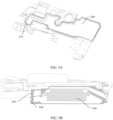
- FIG. 5A is a schematic diagram of a structure of a second housing 200 according to an embodiment of this application.
- FIG. 5B is a sectional view of a second housing 200 according to an embodiment of this application.
- an energy director 510 is pre-disposed on a first housing 100 or the second housing 200 when the first housing 100 and the second housing 200 are connected by using ultrasonic welding.
- the first housing 100 and the second housing 200 may be connected by melting the energy director.
- the energy director 510 may be disposed in a region that is at an edge of the second housing 200 and that is used to connect to the first housing 100, and is an annular distribution closed around the edge of the second housing 200.
- a cross section of the energy director 510 is triangular, and a width of the cross section of the energy director gradually decreases in a direction of approaching the first housing 100.
- the energy director 510 on the second housing 200 is in contact alignment with a connection position corresponding to the first housing 100, and after the contact alignment, the energy director 510 on the second housing 200 and the first housing 100 form a line contact.
- the second housing 200 is subjected to high-frequency vibration energy, and the energy director 510 and the first housing 100 generate heat by rubbing against each other to melt a material, and then are welded together.
- the triangular energy director 510 is mainly applicable to a case in which raw material components include a crystalline polymer material.
- the raw material components of the first housing 100 and the second housing 200 include PC. Because PC is a crystalline material, energy required by PC in the ultrasonic welding process is relatively small. In this way, even if the triangular energy director 510 is used, welding reliability can be ensured.
- the raw material components of the first housing 100 and the second housing 200 include a semi-crystalline polymer material such as PA, the semi-crystalline polymer material needs more energy than the crystalline polymer material in the ultrasonic welding process. If the triangular energy director 510 is still used, because the triangular energy director 510 is in a line contact with the first housing 100, and a contact area is small, a welding crack may occur, which causes a gas leakage problem.
- a structure of the energy director 510 is further improved in this application.
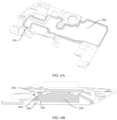
- FIG. 6A is a schematic diagram of a structure of another second housing 200 according to an embodiment of this application.
- FIG. 6B is a sectional view of another second housing 200 according to an embodiment of this application.
- a circle of frustum-shaped energy director 520 is disposed in a region that is of the second housing 200 and that is used to connect to the first housing 100.
- a cross section of the energy director 520 is trapezoidal, and a width of the cross section of the energy director gradually decreases in a direction of approaching the first housing 100.
- the energy director 520 on the second housing 200 is in contact alignment with a connection position corresponding to the first housing 100, and after the contact alignment, the energy director 510 on the second housing 200 and the first housing 100 form a surface contact.
- the second housing 200 is subjected to high-frequency vibration energy, and the energy director 520 and the first housing 100 are in full contact and generate heat by rubbing against each other, and then are welded together.
- an energy director 510 with a triangular cross section is improved to the energy director 520 with a trapezoidal cross section, to increase a contact area between the energy director 510 and the first housing 100.
- a rubbing area between the energy director 520 and the first housing 100 may be increased in a welding process, thereby generating more energy, to ensure welding reliability.
- FIG. 6C is a locally enlarged view of M in FIG. 6B .
- a width of a region that is in the first housing 100 and that is used to connect to the second housing 200 is L1
- a width of contact between the energy director 520 and the first housing 100 is L2.
- the width L2 may be designed to 10%-100% of the width L1.
- roughening processing may be further performed on an outer surface of the energy director 510 or the energy director 520, to increase roughness of the outer surface of the energy director 510 or the energy director 520.
- the energy director 510 or the energy director 520 with increased surface roughness is more conducive to generating heat by rubbing against the first housing 100, and then is welded together with the first housing.
- a surface roughening processing manner is not limited in this application.
- a concave-convex texture may be disposed on the outer surface of the energy director 510 or the energy director 520.
- concave-convex particles may be disposed on the outer surface of the energy director 510 or the energy director 520.
- an interference volume of the trapezoidal energy director 520 is increased compared with that of the triangular energy director 510.
- a molten material formed after the energy director is melted easily overflows to a surface of the second housing 200, and affects an appearance of the second housing 200. Therefore, as shown in FIG. 6B , in this application, an overflow groove 600 is disposed along a periphery of the energy director 520 on the second housing 200.
- the energy director 520 with a trapezoidal cross section is used as an example for description, which does not indicate a limitation on a structure of the energy director 520, provided that a contact area between the energy director 520 and the first housing 100 is increased.
- the cross section of the energy director 520 in this embodiment of this application may be rectangular, W-shaped, or another regular or irregular shape.
- the speaker provided in the embodiments of this application to meet the weight reduction requirement, 10-50 wt% of the hollow sphere material is added to the raw material components of the first housing 100 and the second housing 200, so that the densities of the first housing 100 and the second housing 200 can be reduced, thereby reducing the weights of the first housing 100 and the second housing 200.
- 10-50 wt% of the hollow sphere material is added to the raw material components of the first housing 100 and the second housing 200, so that the densities of the first housing 100 and the second housing 200 can be reduced, thereby reducing the weights of the first housing 100 and the second housing 200.
- a crystalline polymer material and a semi-crystalline polymer material in the embodiments of this application, by changing the shape of the energy director, the contact area between the energy director and the first housing 100 is increased. In this way, in the welding process, more energy can be generated, to ensure welding reliability. That is, the speaker provided in the embodiments of this application can meet a reduction requirement of the speaker and can ensure welding reliability.
- An embodiment of this application further provides an electronic device.
- the electronic device includes the speaker provided in the embodiments of this application.
- the electronic device in this embodiment of this application may be any terminal device that has a speaker, such as a personal computer, a tablet, a mobile phone, a band, or a watch.
- an orientation relationship or a position relationship indicated by terms “upper”, “lower”, “inside”, “outside”, “front”, “rear”, “left”, and “right” is an orientation relationship or a position relationship based on an operating state of this application, and is merely for ease of describing this application and simplifying the description, rather than indicating or implying that a specified apparatus or element necessarily has a specific orientation or is constructed and operated in a specific orientation. Therefore, the terms should not be construed as a limitation on this application.
Landscapes
- Physics & Mathematics (AREA)
- Engineering & Computer Science (AREA)
- Acoustics & Sound (AREA)
- Signal Processing (AREA)
- Health & Medical Sciences (AREA)
- Otolaryngology (AREA)
- Details Of Audible-Bandwidth Transducers (AREA)
- Casings For Electric Apparatus (AREA)
Applications Claiming Priority (2)
| Application Number | Priority Date | Filing Date | Title |
|---|---|---|---|
| CN202210914268.0A CN115623395B (zh) | 2022-08-01 | 2022-08-01 | 一种扬声器及电子设备 |
| PCT/CN2023/091074 WO2024027232A1 (zh) | 2022-08-01 | 2023-04-27 | 一种扬声器及电子设备 |
Publications (2)
| Publication Number | Publication Date |
|---|---|
| EP4561111A1 true EP4561111A1 (de) | 2025-05-28 |
| EP4561111A4 EP4561111A4 (de) | 2025-10-22 |
Family
ID=84856650
Family Applications (1)
| Application Number | Title | Priority Date | Filing Date |
|---|---|---|---|
| EP23848943.9A Pending EP4561111A4 (de) | 2022-08-01 | 2023-04-27 | Lautsprecher und elektronische vorrichtung |
Country Status (3)
| Country | Link |
|---|---|
| EP (1) | EP4561111A4 (de) |
| CN (3) | CN117499846B (de) |
| WO (1) | WO2024027232A1 (de) |
Families Citing this family (1)
| Publication number | Priority date | Publication date | Assignee | Title |
|---|---|---|---|---|
| CN117499846B (zh) * | 2022-08-01 | 2025-02-28 | 荣耀终端股份有限公司 | 一种扬声器及电子设备 |
Family Cites Families (18)
| Publication number | Priority date | Publication date | Assignee | Title |
|---|---|---|---|---|
| US5046104A (en) * | 1989-11-30 | 1991-09-03 | Cambridge Soundworks, Inc. | Loudspeaker system |
| EP1731553B1 (de) * | 2004-02-27 | 2019-02-20 | Toray Industries, Inc. | Epoxidharzzusammensetzung für kohlefaserverstärkten verbundwerkstoff, prepreg, integrierter formkörper, flächengebilde aus faserverstärktem verbundwerkstoff und schrank für elektrische/elektronische geräte |
| JP4258510B2 (ja) * | 2005-09-26 | 2009-04-30 | オンキヨー株式会社 | 音響機器周辺部品 |
| JP5052850B2 (ja) * | 2006-09-21 | 2012-10-17 | 豊達電機(香港)有限公司 | スピーカキャビネットの超音波溶着接合方法、およびそれによって作製されたスピーカキャビネット |
| AT508943B1 (de) * | 2009-10-01 | 2011-05-15 | Karl Dr Vorlicek | Lautsprechergehäuseelemente und lautsprechergehäuse |
| CN103686550B (zh) * | 2013-11-18 | 2017-09-29 | 歌尔股份有限公司 | 扬声器模组 |
| JP6746449B2 (ja) * | 2016-09-21 | 2020-08-26 | 東レプラスチック精工株式会社 | スピーカー用部品およびその製造方法、並びにスピーカー |
| CN206524960U (zh) * | 2017-01-20 | 2017-09-26 | 瑞声科技(新加坡)有限公司 | 发声器及电子设备 |
| CN107820171B (zh) * | 2017-10-23 | 2020-02-18 | 上海润欣科技股份有限公司 | 扬声器模组 |
| CN208029078U (zh) * | 2018-02-01 | 2018-10-30 | 瑞声科技(新加坡)有限公司 | 扬声器箱 |
| CN207968934U (zh) * | 2018-02-01 | 2018-10-12 | 瑞声科技(新加坡)有限公司 | 扬声器箱 |
| CN209201268U (zh) * | 2018-12-27 | 2019-08-02 | 瑞声光电科技(常州)有限公司 | 扬声器箱 |
| WO2021127691A1 (en) * | 2019-12-17 | 2021-06-24 | Google Llc | Engineered surface finish of plastic part having a microbead surface coating |
| CN212367514U (zh) * | 2020-05-21 | 2021-01-15 | 瑞声科技(新加坡)有限公司 | 扬声器模组 |
| CN114381037B (zh) * | 2020-10-16 | 2023-05-12 | 中国科学院理化技术研究所 | 具有三层球壳结构的复合型中空微球及其制备方法和应用 |
| CN113173335A (zh) * | 2021-04-14 | 2021-07-27 | 深圳市固源塑胶制品有限公司 | 一种半球形导能筋的超声焊接结构 |
| CN114806034A (zh) * | 2022-04-29 | 2022-07-29 | 歌尔股份有限公司 | 用于发声装置的壳体和发声装置 |
| CN117499846B (zh) * | 2022-08-01 | 2025-02-28 | 荣耀终端股份有限公司 | 一种扬声器及电子设备 |
-
2022
- 2022-08-01 CN CN202311467917.8A patent/CN117499846B/zh active Active
- 2022-08-01 CN CN202210914268.0A patent/CN115623395B/zh active Active
-
2023
- 2023-04-27 WO PCT/CN2023/091074 patent/WO2024027232A1/zh not_active Ceased
- 2023-04-27 CN CN202380054845.6A patent/CN119522579A/zh active Pending
- 2023-04-27 EP EP23848943.9A patent/EP4561111A4/de active Pending
Also Published As
| Publication number | Publication date |
|---|---|
| WO2024027232A1 (zh) | 2024-02-08 |
| CN115623395B (zh) | 2023-10-20 |
| EP4561111A4 (de) | 2025-10-22 |
| CN115623395A (zh) | 2023-01-17 |
| CN117499846A (zh) | 2024-02-02 |
| CN119522579A (zh) | 2025-02-25 |
| CN117499846B (zh) | 2025-02-28 |
Similar Documents
| Publication | Publication Date | Title |
|---|---|---|
| TWI781970B (zh) | 一體成形體及其製造方法 | |
| EP4561111A1 (de) | Lautsprecher und elektronische vorrichtung | |
| JP6167537B2 (ja) | 繊維強化プラスチック成形品の製造方法および一体成形品の製造方法 | |
| JPH07123197B2 (ja) | 電磁シールドおよびその製造方法 | |
| JP2013075447A (ja) | 複合積層板および複合積層板を用いた一体成形品ならびにそれらの製造方法 | |
| US20210067852A1 (en) | Loudspeaker module and electronic device | |
| CN204948344U (zh) | 扬声器振膜及扬声器 | |
| CN207460510U (zh) | 一种扬声器模组 | |
| CN105554657A (zh) | 扬声器模组和扬声器模组的成型方法 | |
| JP2011093213A (ja) | 繊維強化プラスチック製電子機器筐体の製造方法 | |
| EP3923601B1 (de) | Schwingungskomponente, lautsprecher und elektronische vorrichtung | |
| US20220256266A1 (en) | Sound producing device and electronic product | |
| JP2008130630A (ja) | 電磁波シールドシート | |
| WO2024140461A1 (zh) | 转轴组件及折叠屏设备 | |
| WO2024067420A1 (zh) | 电子设备、电子设备的辅料及电子设备的壳体组件 | |
| CN223828584U (zh) | 一种防摩擦异响的胶框结构、电池及电子设备 | |
| CN208675524U (zh) | 一种发声装置单体及发声装置模组 | |
| JP2000286565A (ja) | 電子機器用筺体 | |
| JP4138080B2 (ja) | 電磁波シールドシート,該電磁波シールドシートの製造方法,及び該電磁波シールドシートの使用方法 | |
| CN223463118U (zh) | 一种宽音频通道的电子设备 | |
| JPH1169483A (ja) | スピーカー用振動板 | |
| JPH11163589A (ja) | 電磁シールド用複合体及びその製造方法 | |
| TW200428928A (en) | Housing of portable electronic equipment and method of making the same | |
| CN207219203U (zh) | 一种电子设备 | |
| CN204465829U (zh) | 一种振膜组件及应用该种振膜组件的受话器 |
Legal Events
| Date | Code | Title | Description |
|---|---|---|---|
| STAA | Information on the status of an ep patent application or granted ep patent |
Free format text: STATUS: THE INTERNATIONAL PUBLICATION HAS BEEN MADE |
|
| PUAI | Public reference made under article 153(3) epc to a published international application that has entered the european phase |
Free format text: ORIGINAL CODE: 0009012 |
|
| STAA | Information on the status of an ep patent application or granted ep patent |
Free format text: STATUS: REQUEST FOR EXAMINATION WAS MADE |
|
| 17P | Request for examination filed |
Effective date: 20250218 |
|
| AK | Designated contracting states |
Kind code of ref document: A1 Designated state(s): AL AT BE BG CH CY CZ DE DK EE ES FI FR GB GR HR HU IE IS IT LI LT LU LV MC ME MK MT NL NO PL PT RO RS SE SI SK SM TR |
|
| A4 | Supplementary search report drawn up and despatched |
Effective date: 20250918 |
|
| RIC1 | Information provided on ipc code assigned before grant |
Ipc: H04R 9/06 20060101AFI20250912BHEP Ipc: H04R 1/02 20060101ALI20250912BHEP Ipc: H04R 1/28 20060101ALI20250912BHEP Ipc: H04R 9/02 20060101ALI20250912BHEP Ipc: C08K 7/28 20060101ALN20250912BHEP |
|
| DAV | Request for validation of the european patent (deleted) | ||
| DAX | Request for extension of the european patent (deleted) |