EP4563312A1 - Verfahren zur herstellung von verbundwerkstoffen aus zellulosefasern - Google Patents
Verfahren zur herstellung von verbundwerkstoffen aus zellulosefasern Download PDFInfo
- Publication number
- EP4563312A1 EP4563312A1 EP24215332.8A EP24215332A EP4563312A1 EP 4563312 A1 EP4563312 A1 EP 4563312A1 EP 24215332 A EP24215332 A EP 24215332A EP 4563312 A1 EP4563312 A1 EP 4563312A1
- Authority
- EP
- European Patent Office
- Prior art keywords
- fibers
- process according
- cellulosic fibers
- cellulosic
- mixing device
- Prior art date
- Legal status (The legal status is an assumption and is not a legal conclusion. Google has not performed a legal analysis and makes no representation as to the accuracy of the status listed.)
- Pending
Links
Images


Classifications
-
- B—PERFORMING OPERATIONS; TRANSPORTING
- B29—WORKING OF PLASTICS; WORKING OF SUBSTANCES IN A PLASTIC STATE IN GENERAL
- B29B—PREPARATION OR PRETREATMENT OF THE MATERIAL TO BE SHAPED; MAKING GRANULES OR PREFORMS; RECOVERY OF PLASTICS OR OTHER CONSTITUENTS OF WASTE MATERIAL CONTAINING PLASTICS
- B29B9/00—Making granules
- B29B9/12—Making granules characterised by structure or composition
- B29B9/14—Making granules characterised by structure or composition fibre-reinforced
-
- C—CHEMISTRY; METALLURGY
- C08—ORGANIC MACROMOLECULAR COMPOUNDS; THEIR PREPARATION OR CHEMICAL WORKING-UP; COMPOSITIONS BASED THEREON
- C08L—COMPOSITIONS OF MACROMOLECULAR COMPOUNDS
- C08L1/00—Compositions of cellulose, modified cellulose or cellulose derivatives
- C08L1/02—Cellulose; Modified cellulose
-
- B—PERFORMING OPERATIONS; TRANSPORTING
- B29—WORKING OF PLASTICS; WORKING OF SUBSTANCES IN A PLASTIC STATE IN GENERAL
- B29B—PREPARATION OR PRETREATMENT OF THE MATERIAL TO BE SHAPED; MAKING GRANULES OR PREFORMS; RECOVERY OF PLASTICS OR OTHER CONSTITUENTS OF WASTE MATERIAL CONTAINING PLASTICS
- B29B7/00—Mixing; Kneading
- B29B7/02—Mixing; Kneading non-continuous, with mechanical mixing or kneading devices, i.e. batch type
- B29B7/22—Component parts, details or accessories; Auxiliary operations
- B29B7/28—Component parts, details or accessories; Auxiliary operations for measuring, controlling or regulating, e.g. viscosity control
- B29B7/283—Component parts, details or accessories; Auxiliary operations for measuring, controlling or regulating, e.g. viscosity control measuring data of the driving system, e.g. torque, speed, power
-
- B—PERFORMING OPERATIONS; TRANSPORTING
- B29—WORKING OF PLASTICS; WORKING OF SUBSTANCES IN A PLASTIC STATE IN GENERAL
- B29B—PREPARATION OR PRETREATMENT OF THE MATERIAL TO BE SHAPED; MAKING GRANULES OR PREFORMS; RECOVERY OF PLASTICS OR OTHER CONSTITUENTS OF WASTE MATERIAL CONTAINING PLASTICS
- B29B7/00—Mixing; Kneading
- B29B7/02—Mixing; Kneading non-continuous, with mechanical mixing or kneading devices, i.e. batch type
- B29B7/22—Component parts, details or accessories; Auxiliary operations
- B29B7/28—Component parts, details or accessories; Auxiliary operations for measuring, controlling or regulating, e.g. viscosity control
- B29B7/286—Component parts, details or accessories; Auxiliary operations for measuring, controlling or regulating, e.g. viscosity control measuring properties of the mixture, e.g. temperature, density
-
- B—PERFORMING OPERATIONS; TRANSPORTING
- B29—WORKING OF PLASTICS; WORKING OF SUBSTANCES IN A PLASTIC STATE IN GENERAL
- B29B—PREPARATION OR PRETREATMENT OF THE MATERIAL TO BE SHAPED; MAKING GRANULES OR PREFORMS; RECOVERY OF PLASTICS OR OTHER CONSTITUENTS OF WASTE MATERIAL CONTAINING PLASTICS
- B29B7/00—Mixing; Kneading
- B29B7/30—Mixing; Kneading continuous, with mechanical mixing or kneading devices
- B29B7/34—Mixing; Kneading continuous, with mechanical mixing or kneading devices with movable mixing or kneading devices
- B29B7/38—Mixing; Kneading continuous, with mechanical mixing or kneading devices with movable mixing or kneading devices rotary
- B29B7/46—Mixing; Kneading continuous, with mechanical mixing or kneading devices with movable mixing or kneading devices rotary with more than one shaft
- B29B7/48—Mixing; Kneading continuous, with mechanical mixing or kneading devices with movable mixing or kneading devices rotary with more than one shaft with intermeshing devices, e.g. screws
-
- B—PERFORMING OPERATIONS; TRANSPORTING
- B29—WORKING OF PLASTICS; WORKING OF SUBSTANCES IN A PLASTIC STATE IN GENERAL
- B29B—PREPARATION OR PRETREATMENT OF THE MATERIAL TO BE SHAPED; MAKING GRANULES OR PREFORMS; RECOVERY OF PLASTICS OR OTHER CONSTITUENTS OF WASTE MATERIAL CONTAINING PLASTICS
- B29B7/00—Mixing; Kneading
- B29B7/80—Component parts, details or accessories; Auxiliary operations
- B29B7/82—Heating or cooling
- B29B7/823—Temperature control
-
- B—PERFORMING OPERATIONS; TRANSPORTING
- B29—WORKING OF PLASTICS; WORKING OF SUBSTANCES IN A PLASTIC STATE IN GENERAL
- B29B—PREPARATION OR PRETREATMENT OF THE MATERIAL TO BE SHAPED; MAKING GRANULES OR PREFORMS; RECOVERY OF PLASTICS OR OTHER CONSTITUENTS OF WASTE MATERIAL CONTAINING PLASTICS
- B29B7/00—Mixing; Kneading
- B29B7/80—Component parts, details or accessories; Auxiliary operations
- B29B7/88—Adding charges, i.e. additives
- B29B7/90—Fillers or reinforcements, e.g. fibres
-
- C—CHEMISTRY; METALLURGY
- C08—ORGANIC MACROMOLECULAR COMPOUNDS; THEIR PREPARATION OR CHEMICAL WORKING-UP; COMPOSITIONS BASED THEREON
- C08J—WORKING-UP; GENERAL PROCESSES OF COMPOUNDING; AFTER-TREATMENT NOT COVERED BY SUBCLASSES C08B, C08C, C08F, C08G or C08H
- C08J3/00—Processes of treating or compounding macromolecular substances
- C08J3/12—Powdering or granulating
-
- B—PERFORMING OPERATIONS; TRANSPORTING
- B29—WORKING OF PLASTICS; WORKING OF SUBSTANCES IN A PLASTIC STATE IN GENERAL
- B29B—PREPARATION OR PRETREATMENT OF THE MATERIAL TO BE SHAPED; MAKING GRANULES OR PREFORMS; RECOVERY OF PLASTICS OR OTHER CONSTITUENTS OF WASTE MATERIAL CONTAINING PLASTICS
- B29B7/00—Mixing; Kneading
- B29B7/80—Component parts, details or accessories; Auxiliary operations
- B29B7/88—Adding charges, i.e. additives
- B29B7/90—Fillers or reinforcements, e.g. fibres
- B29B7/905—Fillers or reinforcements, e.g. fibres with means for pretreatment of the charges or fibres
-
- B—PERFORMING OPERATIONS; TRANSPORTING
- B29—WORKING OF PLASTICS; WORKING OF SUBSTANCES IN A PLASTIC STATE IN GENERAL
- B29K—INDEXING SCHEME ASSOCIATED WITH SUBCLASSES B29B, B29C OR B29D, RELATING TO MOULDING MATERIALS OR TO MATERIALS FOR MOULDS, REINFORCEMENTS, FILLERS OR PREFORMED PARTS, e.g. INSERTS
- B29K2105/00—Condition, form or state of moulded material or of the material to be shaped
- B29K2105/06—Condition, form or state of moulded material or of the material to be shaped containing reinforcements, fillers or inserts
-
- B—PERFORMING OPERATIONS; TRANSPORTING
- B29—WORKING OF PLASTICS; WORKING OF SUBSTANCES IN A PLASTIC STATE IN GENERAL
- B29K—INDEXING SCHEME ASSOCIATED WITH SUBCLASSES B29B, B29C OR B29D, RELATING TO MOULDING MATERIALS OR TO MATERIALS FOR MOULDS, REINFORCEMENTS, FILLERS OR PREFORMED PARTS, e.g. INSERTS
- B29K2201/00—Use of cellulose, modified cellulose or cellulose derivatives, e.g. viscose, as reinforcement
-
- B—PERFORMING OPERATIONS; TRANSPORTING
- B29—WORKING OF PLASTICS; WORKING OF SUBSTANCES IN A PLASTIC STATE IN GENERAL
- B29K—INDEXING SCHEME ASSOCIATED WITH SUBCLASSES B29B, B29C OR B29D, RELATING TO MOULDING MATERIALS OR TO MATERIALS FOR MOULDS, REINFORCEMENTS, FILLERS OR PREFORMED PARTS, e.g. INSERTS
- B29K2401/00—Use of cellulose, modified cellulose or cellulose derivatives, e.g. viscose, as filler
-
- B—PERFORMING OPERATIONS; TRANSPORTING
- B29—WORKING OF PLASTICS; WORKING OF SUBSTANCES IN A PLASTIC STATE IN GENERAL
- B29K—INDEXING SCHEME ASSOCIATED WITH SUBCLASSES B29B, B29C OR B29D, RELATING TO MOULDING MATERIALS OR TO MATERIALS FOR MOULDS, REINFORCEMENTS, FILLERS OR PREFORMED PARTS, e.g. INSERTS
- B29K2511/00—Use of natural products or their composites, not provided for in groups B29K2401/00 - B29K2509/00, as filler
- B29K2511/10—Natural fibres, e.g. wool or cotton
Definitions
- the present invention relates to a process for producing composites from cellulose fibers.
- Natural fibers that is, fibers obtained from (or produced by) animals and plants, are increasingly used in composite production to replace synthetic fibers and/or to reduce the use of petrochemical-based matrices in such composites. Their high abundance, low production cost, renewability, and compostability are appealing characteristics that contribute to the growing use of natural fibers in composite production.
- cellulosic fibers derived from plants, trees, or bacteria have gained prominence in this field.
- EP3377562B1 discloses a method of producing a composite product from natural fibers and thermoplastic polymers.
- the invention comprises the use of wood fibers obtained through various processes, including refiner pulp (RMP), thermomechanical pulp (TMP), and chemi-thermomechanical pulp (CTMP).
- RMP refiner pulp
- TMP thermomechanical pulp
- CMP chemi-thermomechanical pulp
- the fibers are introduced from the blowline or the housing of a refiner into a flash tube dryer, separated from humid air in a cyclone, compacted in a compactor to increase the bulk density and finally introduced into a compounder and mixed with at least one thermoplastic polymer to form granules, ready for further processing in plastic industry equipment.
- the described method relies on the compaction step within a compactor, achieving a specific bulk density ranging from 100 to 350 kg/m 3 .
- This compacting step facilitates fiber feeding through all stages, ensuring a continuous process.
- the fiber pulps used in EP3377562B1 do not undergo any mechanical treatment to reduce cellulosic fiber dimensions.
- EP3377562B1 does not report any specific configuration or integration of process steps aimed at additional advantages such as reducing raw material waste, improving energy efficiency, or enhancing subsequent material processing.
- EP2890538B1 describes a method of producing a composite product from natural fibers and thermoplastic polymers.
- the fibrous materials include cellulosic pulps obtained from mechanical and/or chemical processing of wood. According to the described process, at the stage where the fibers contact the thermoplastic polymer matrix, the fibrous material must have a bulk density of 300 kg/m 3 , ensuring a compression ratio of less than 4. Additionally, the lignin content of the fibrous material should be less than 1 wt.%. Using fibrous materials with these properties prevents fiber adhesion, thereby enhancing their contact and dispersion within the polymer matrix.
- EP2890538B1 does not detail specific configurations of the various process steps for producing composites with regards to, for example, the sequence of different steps and equipment speed profiles and temperatures in such a way that simultaneously reduces raw material waste, improves energy efficiency, and optimizes subsequent composite material processing.
- EP2814657B1 describes a method for producing a composite using polymeric matrices and cellulosic fibers obtained from wood pulping processes, particularly chemical pulping.
- the key feature of this patent lies in the design of the mixing device, such as a single-screw extruder, where the exit area of the mixing device is reduced by 40 to 60% when compared to its cross-sectional area. This reduction in the exit area increases the temperature within the device, facilitating the dispersion of fibers within the polymeric matrix.
- EP3386703B1 describes a method for producing a precursor material for the manufacture of a composite material granulate.
- This precursor material is also made from polymers and cellulosic fibers, using a process that promotes a better fiber dispersion in the final extruded composite material. This is accomplished through a final step of the process, occurring after the fibers have been mixed with the polymer, the temperature has been raised above the polymer's melting point, and the rotational speed of the mixing equipment has been adjusted, and where the precursor material is ground on a comminuting device while its temperature decreases. This process breaks larger agglomerates and coalesces smaller ones, resulting in a narrower particle size distribution in the obtained material.
- the fibers used in EP3386703B1 do not undergo any mechanical treatment to reduce their dimensions before mixing with the polymer.
- EP3353234B1 refers to a method for producing a foamed composite material from cellulosic fibers and a copolymer composition.
- This copolymer composition is crucial for forming the invention's copolymer.
- These copolymers contain anhydride groups that, under heat and pressure, react with the hydroxyl groups of the cellulosic fibers to produce a blowing agent as a byproduct, enabling the formation of the foamed composite material, which can subsequently be molded or extruded.
- the present invention relates to a process for producing composites from cellulosic fibers comprising the steps of:
- cellulosic fibers are selected from fibers obtained from washers present in the fiber line of a pulp production unit with moisture contents between 90-98% and subsequently dried until obtaining a moisture content between 4-15% and/or selected from residual cellulosic fibers from a cellulosic production or processing unit.
- drying of cellulosic fibers is carried out in equipment selected from the group consisting of flash dryers, ring dryers, rotary drums dryers and drying presses used in the industrial production of cellulosic pulps.
- cellulosic fibers are selected from bleached eucalyptus kraft pulp.
- the fibers to be mechanically treated in step b) are found in the form of powder, flakes, sheets or webs, granules, yarns, fabrics, bales, or pulp.
- the milling equipment of step b) is selected from the group consisting of knife mills, hammer mills, ball mills and mills equipped with mesh screens of predefined dimensions.
- the heating means of step c) and e) are heating jackets.
- the heating jacket is heated by an electrical resistance or by a thermal fluid and/or through heat exchange with secondary heat sources such as exhaust gases from biomass thermal boilers, natural gas cogeneration and black liquor recovery boilers.
- the rotating means in the mixing device are propellers having a plurality of blades sized to induce 3 stages, namely a bottom scraper propeller to create a vortex and lift the material, one or more intermediate propellers to induce fluidity and agitation and an additional propeller to force the circulation of material from the periphery of the equipment to the center.
- the extruder in step l), and in addition to the material obtained in steps j) and k), the extruder is additionally fed with a masterbatch comprising at least one thermoplastic polymer and at least one additive.
- the thermoplastic polymers are selected from the group consisting of polyolefins, polyamides, polyesters, polyurethanes, polyvinyl esters, polystyrenes, thermoplastic starches, thermoplastic elastomers, acrylics, cellulose derivatives and copolymers of acrylates, acrylonitrile, ethylene and butadiene, virgin and/or recycled, and mixtures thereof.
- the additives are selected from the group consisting of plasticizers, compatibilizers, impact modifiers, chain extenders, flame retardants, antimicrobial agents, UV stabilizers, lubricants, mineral fillers, dyes, pigments and mixtures thereof.
- the final product obtained in step l) is in the form of granules.
- the present invention provides a process for producing composites from cellulosic fibers, as described in this patent application and Claim 1, whose configuration specification and integrated nature of the different steps characterizing this process, such as the sequence of the steps and the speed and temperature profiles of the associated equipment, enable, simultaneously, a reduction in raw material waste, an improvement on energy efficiency, and enhanced subsequent processing and quality of the resulting composite material.
- Processing of the fibers according to the different steps characterizing this process results in increased fibers density, which maximizes the fiber incorporation capacity in the extrusion process without compromising the productivity of the equipment. It also achieves better fiber dispersion within the polymeric matrix, reduced moisture uptake, improved compatibility, and increased contact points between additives, thermoplastic polymers, and fibers.
- cellulosic fibers refer to fibers derived from wood, plants, or bacteria, such as bacterial cellulose.
- cellulosic fibers originate from mechanically and/or chemically treated pulp.
- mechanical pulp refers to cellulosic pulp produced through mechanical processes that separate and defibrate wood to form pulp.
- chemical pre-treatments may also be included.
- Mechanical pulps are thus designated based on their production method and weather pre-treatments are included or not, as mechanical pulp, thermomechanical pulp (TMP), chemi-mechanical pulp (CMP), and chemi-thermomechanical pulp (CTMP).
- thermomechanical pulp refers to pulp obtained through mechanical means with a pre-treatment at elevated temperatures and pressures
- chemi-mechanical and chemi-thermomechanical pulps refer to pulps obtained through mechanical processes preceded by chemical pre-treatments.
- chemical pulp refers to cellulosic pulp produced exclusively through any chemical process that dissolves lignin in the wood to release the fibers from the matrix.
- Kraft refers to the Kraft cooking process, or sulfate cooking process. This chemical process involves cooking wood in a cooking liquor typically composed of sodium hydroxide and sodium sulfide, at temperatures ranging from 140 to 180 °C.
- bleached pulp refers to pulp produced through wood cooking processes and further subjected to a bleaching step.
- the bleaching step aims to continue the delignification of the wood, initiated during cooking, through the action of oxidizing agents such as oxygen, chlorine dioxide, and hydrogen peroxide. Conversely, unbleached pulp does not undergo any bleaching step after cooking.
- bleached eucalyptus Kraft pulp refers to cellulosic pulp obtained through the Kraft cooking process of eucalyptus wood. The pulp resulting from the cooking process is further bleached.
- residual fibers refer to fibers that are by-products of the production and/or transformation of cellulosic materials.
- residual fibers may include, but are not limited to, sawdust from wood cutting, woodchips, and dust from the production of printing and writing papers, hygiene products, and packaging papers.
- thermoplastic polymer refers to polymeric compounds that soften and melt upon heating, flowing as a viscous liquid, and solidify again upon cooling. This is a physical, reversible transformation.
- virgin and/or recycled thermoplastic polymers and their blends can be selected, such as: polyolefins, including but not limited to, polyethylene (PE), polypropylene (PP), polybutylene (PB); polystyrenes, including but not limited to, polystyrene (PS); polyamides, including but not limited to: polycaprolactam (nylon 6), polyundecanamide (nylon 11), poly(hexamethylene adipamide) (nylon 6,6), polylaurolactam (nylon 12); polyesters, including but not limited to, polyethylene terephthalate (PET), polylactic acid (PLA), polyhydroxyalkanoates (PHA), polyhydroxybutyrate (PHB), polycaprolactone (PCL), polybutylene succinate (PBS), poly(butylene adipate-co-terephthalate) (PBAT); polyurethanes, including but not limited to, polyurethane (PU); polyvinyl esters, including but not limited to, polyvinyl
- thermoplastic polymer can be used in the form of pellets, granules, flakes, or powder. It may additionally comprise additives or any other additional component useful in the process of the present invention.
- a thermal fluid refers to a substance used in industrial activities involving heat transfer, capable of reaching extreme temperatures (high or low) without undergoing a change in its physical state.
- exhaust gases from thermal boilers refer to gases originating from the combustion chambers of thermal boilers, which can serve as a secondary heat source.
- natural gas cogeneration consists of the simultaneous production of two or more forms of energy from a single fuel, in this case, natural gas.
- the energy produced can serve as a secondary heat source.
- black liquor refers to the by-product resulting from the chemical cooking of wood for pulp and paper production. It is burned in industrial pulp production units to generate energy, which can be used as a secondary heat source.
- a masterbatch refers to a concentrated mixture of additives and/or polymers used to impart additional properties to the final product.
- the word masterbatch is commonly used in the relevant technical field.
- plasticizers refer to chemical substances, generally of low molecular weight, used to reduce the rigidity of a material, increase its flexibility, malleability, deformability, and mobility.
- plasticizers may include, but are not limited to, epoxidized or maleinized vegetable oils, citrate esters, triacetin, and polyols.
- compatibilizers refer to chemical substances or chemically modified polymers used to improve interfacial adhesion and stabilize the interface between polymeric matrices and reinforcements.
- compatibilizers may include, but are not limited to, polymers, copolymers, and/or oligomers grafted with maleic anhydride, epoxidized or maleinized vegetable oils, and surfactants.
- impact modifiers refer to chemical substances used to enhance the impact resistance of a final product by absorbing and dissipating energy upon impact.
- impact modifiers may include, but are not limited to, thermoplastic elastomers, lactic acid esters, core-shell particles (i.e., micro or nanoparticles with solid, liquid, or gaseous cores encapsulated in protective solid shells), and polymers, copolymers, and their blends, such as, but not limited to, high-impact polystyrene (HIPS), acrylonitrile-butadiene-styrene (ABS), polybutylene succinate (PBS), styrene/butadiene and styrene/ethylene copolymers, and linear, branched, and cyclic olefin copolymers.
- HIPS high-impact polystyrene
- ABS acrylonitrile-butadiene-styrene
- PBS polybutylene succinate
- chain extenders refer to molecules with reactive groups that react with the ends of polymer chains to increase their molecular weight.
- chain extenders may include, but are not limited to, copolymers of styrene and glycidyl methacrylate, high molecular weight acrylics, and styrene-acrylic-epoxy oligomers/polymers.
- fire retardants refer to chemical substances that reduce the risk of ignition and delay the spread of flames when exposed to a heat source or fire.
- flame retardants may include, but are not limited to, phosphorus compounds such as phosphoric acid, tributyl phosphate, triallyl phosphate, ammonium polyphosphate, diammonium phosphate, and melamine cyanurate, as well as silica, silanes, silicates, metal oxides, and halogenated compounds based on chlorine and bromine.
- antimicrobial agents refer to chemical substances used to confer resistance to microorganisms.
- antimicrobial agents may include, but are not limited to, calcium, copper, zinc, sodium, potassium, or barium carbonates; silicates; sulfates; halides; quaternary ammonium compounds; phenolic compounds; zinc pyrithione; isothiazolinone; thiabendazole; zinc oxide nanoparticles; silver nanoparticles; and copper nanoparticles.
- UV stabilizers refer to chemical substances that help minimize the effects of UV radiation on materials, preventing discoloration and surface breakdown of the material.
- UV stabilizers may include, but are not limited to, carbon black, titanium dioxide, hydroxybenzophenones, 2-(2-hydroxyphenyl)-2H-benzotriazoles, benzotriazoles, acrylates, malonates, and hindered amine light stabilizers (HALS).
- HALS hindered amine light stabilizers
- lubricants refer to chemical substances introduced to reduce friction and/or wear rate. They can be internal lubricants, which act by reducing friction between molecules and improving flow, or external lubricants, which act by reducing macroscopic friction between the polymer and the metal of the equipment in contact. Lubricants improve the material's fluidity during processing and reduce equipment wear.
- lubricants may include, but are not limited to, mineral oils, waxes, polyols, modified fatty acid esters, and silicone oils.
- mineral fillers refer to inorganic substances introduced to reduce the amount of polymer matrix and/or to confer improved properties to the materials.
- mineral fillers may include, but are not limited to, calcium carbonate, marble powder, talc, quartz, clay, and asbestos.
- dyes and pigments refer to natural or synthetic substances used to impart color to materials.
- dyes and pigments may include, but are not limited to, inorganic pigments such as titanium dioxide, zinc oxide, zinc chromate, cadmium sulfides, chromium oxide, sodium aluminum silicate; and organic pigments such as carbon black, phthalocyanines, azo and diazo compounds, quinacridone, perylene, isoindoline, anthraquinones, and thioindigo.
- flash dryers and ring dryers in the context of the present invention, refer to industrial equipment that brings a substance into contact with streams of dry air to promote its drying.
- washers such as drum washers and presses refer to industrial equipment that facilitates the contact of a substance with water to remove impurities.
- the VICAT softening temperature describes the temperature at which a flat-pointed needle penetrates the sample surface to a predefined depth when subjected to a standardized load. It is determined according to ISO 306 or ASTM D15-5 - Vicat Softening Temperature.
- melting temperature is the average value of the temperature range in which, during heating, the crystalline regions of the polymer transition to a viscous flow state.
- the moisture content of fibers can be determined using a moisture analyzer (RADWAG MA 50/1.X2.IC.A) by drying the fibers at 105 °C until the mass variation is less than 1 mg/120s.
- the densities of thermoplastic polymers and the final biocomposite can be determined according to ISO 1183 - Method B.
- the average fiber lengths can be determined by the following steps: preparation of 100-200 mL suspensions containing 0.1 g of fibers in dry content and introducing these suspensions into an L&W Fiber Tester Plus - code 912 plus equipment, which determines the average fiber lengths through automated optical analysis.
- the speed of the tip of the rotating means refers to the ratio between the distance traveled by the extremity of the mixing elements and the time it takes to cover that distance.
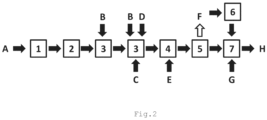
- the material was transferred into a cylindrical cooling drum (3) equipped with a water-cooling system at 15 °C (D) and kept there until the mixture temperature reached 50 °C.
- the resulting material was then discharged into a vibrating sieve with a 5 mm mesh (4).
- the rejected material (E) was ground in a grinder equipped with a sieve of the same size (5).
- the material was transferred into a cylindrical cooling drum (4) equipped with a water-cooling system at 15 °C (E) and kept there until the mixture temperature reached 50 °C.
- the resulting material was then discharged into a vibrating sieve with a 5 mm mesh (5).
- the rejected material (F) was ground in a grinder equipped with a sieve of the same size (6).
- the precursor material described above was processed using a Krauss Maffei ZE42 (7) twin-screw, co-rotating, intermeshing extruder fed via conventional feeders.
- a masterbatch (G) was added.
- the precursor material maintained the feeder operating at full capacity, without any decline in its feeding capacity. This enabled a successful large-scale industrial extrusion.
- the process required low specific energy, ranging from 0.12 to 0.18 kWh/kg. Significant energy savings were achieved during the process, combined with excellent material processability.
- granules containing approximately 40 wt.% cellulose fiber (H) were obtained.
- the material was transferred into a cylindrical cooling drum (4) equipped with a water-cooling system at 25 °C (E) and kept there until the mixture temperature reached 80 °C.
- the resulting material was then discharged into a vibrating sieve with a 3 mm mesh (5).
- the rejected material (F) was ground in a knife mill equipped with a sieve of the same size (6).
- the precursor material described above was processed using a Krauss Maffei ZE42 (7) twin-screw, co-rotating, intermeshing extruder fed via conventional feeders.
- a masterbatch (G) was added.
- the precursor material maintained the feeder operating at full capacity, without any decline in its feeding capacity. This enabled a successful large-scale industrial extrusion, resulting in the final composite material (H).
- this material was transferred into a cylindrical cooling drum (3) equipped with a water-cooling system at 25 °C (E) and kept there until the mixture temperature reached 80 °C.
- the resulting material was then discharged into a vibrating sieve with a 6 mm mesh (4).
- the rejected material (F) was ground in a knife mill equipped with a sieve of the same size (5).
- the precursor material described above was processed using a Krauss Maffei ZE42 (6) twin-screw, co-rotating, intermeshing extruder fed via conventional feeders.
- a masterbatch (G) was added.
- the precursor material maintained the feeder operating at full capacity, without any decline in its feeding capacity. This enabled a successful large-scale industrial extrusion, resulting in the final composite material (H).
Landscapes
- Engineering & Computer Science (AREA)
- Mechanical Engineering (AREA)
- Chemical & Material Sciences (AREA)
- Health & Medical Sciences (AREA)
- Chemical Kinetics & Catalysis (AREA)
- Medicinal Chemistry (AREA)
- Polymers & Plastics (AREA)
- Organic Chemistry (AREA)
- Compositions Of Macromolecular Compounds (AREA)
- Artificial Filaments (AREA)
Applications Claiming Priority (1)
| Application Number | Priority Date | Filing Date | Title |
|---|---|---|---|
| PT119080A PT119080A (pt) | 2023-11-29 | 2023-11-29 | Processo de produção de compósitos a partir de fibras celulósicas |
Publications (1)
| Publication Number | Publication Date |
|---|---|
| EP4563312A1 true EP4563312A1 (de) | 2025-06-04 |
Family
ID=95652819
Family Applications (1)
| Application Number | Title | Priority Date | Filing Date |
|---|---|---|---|
| EP24215332.8A Pending EP4563312A1 (de) | 2023-11-29 | 2024-11-26 | Verfahren zur herstellung von verbundwerkstoffen aus zellulosefasern |
Country Status (2)
| Country | Link |
|---|---|
| EP (1) | EP4563312A1 (de) |
| PT (1) | PT119080A (de) |
Citations (11)
| Publication number | Priority date | Publication date | Assignee | Title |
|---|---|---|---|---|
| US5738935A (en) * | 1993-08-30 | 1998-04-14 | Formtech Enterprises, Inc. | Process to make a composite of controllable porosity |
| JP2009001597A (ja) * | 2007-05-23 | 2009-01-08 | Daicel Polymer Ltd | セルロース繊維含有熱可塑性樹脂組成物の製造方法 |
| US20090181207A1 (en) * | 2008-01-11 | 2009-07-16 | Nova Chemicals Inc. | Method of making cellulosic filled thermoplastic composites of an anhydride containing copolymer |
| EP2511323A1 (de) * | 2011-04-12 | 2012-10-17 | Södra Skogsägarna Ekonomiska Förening | Verbundwerkstoff und Verfahren zur Herstellung eines solchen Verbundwerkstoffs |
| WO2015193533A1 (en) * | 2014-06-18 | 2015-12-23 | Upm-Kymmene Corporation | A method to provide composite comprising a desiccating process agent and composites thereof |
| EP2890538B1 (de) | 2012-08-28 | 2019-03-06 | UPM-Kymmene Corporation | Verfahren zur herstellung eines verbundwerkstoffprodukts enthaltend ein organisches natürliches fasermaterial |
| EP2814657B1 (de) | 2012-02-14 | 2019-12-25 | International Paper Company | Verfahren zur herstellung einer polymerzusammensetzung |
| EP3386703B1 (de) | 2015-12-07 | 2020-08-19 | SAPPI Netherlands Services B.V. | Verfahren zur herstellung eines vorläufermaterials |
| EP3377562B1 (de) | 2015-11-17 | 2023-01-11 | Stora Enso Oyj | Verfahren zur herstellung von faser-polymer-verbundwerkstoffen |
| US20230078455A1 (en) * | 2017-01-18 | 2023-03-16 | Tetra Laval Holdings & Finance S.A. | Melt-processed material with high cellulose fiber content |
| EP3353234B1 (de) | 2015-09-21 | 2023-05-10 | Stora Enso Oyj | Verbundprodukt und verfahren zur herstellung des produkts |
-
2023
- 2023-11-29 PT PT119080A patent/PT119080A/pt unknown
-
2024
- 2024-11-26 EP EP24215332.8A patent/EP4563312A1/de active Pending
Patent Citations (11)
| Publication number | Priority date | Publication date | Assignee | Title |
|---|---|---|---|---|
| US5738935A (en) * | 1993-08-30 | 1998-04-14 | Formtech Enterprises, Inc. | Process to make a composite of controllable porosity |
| JP2009001597A (ja) * | 2007-05-23 | 2009-01-08 | Daicel Polymer Ltd | セルロース繊維含有熱可塑性樹脂組成物の製造方法 |
| US20090181207A1 (en) * | 2008-01-11 | 2009-07-16 | Nova Chemicals Inc. | Method of making cellulosic filled thermoplastic composites of an anhydride containing copolymer |
| EP2511323A1 (de) * | 2011-04-12 | 2012-10-17 | Södra Skogsägarna Ekonomiska Förening | Verbundwerkstoff und Verfahren zur Herstellung eines solchen Verbundwerkstoffs |
| EP2814657B1 (de) | 2012-02-14 | 2019-12-25 | International Paper Company | Verfahren zur herstellung einer polymerzusammensetzung |
| EP2890538B1 (de) | 2012-08-28 | 2019-03-06 | UPM-Kymmene Corporation | Verfahren zur herstellung eines verbundwerkstoffprodukts enthaltend ein organisches natürliches fasermaterial |
| WO2015193533A1 (en) * | 2014-06-18 | 2015-12-23 | Upm-Kymmene Corporation | A method to provide composite comprising a desiccating process agent and composites thereof |
| EP3353234B1 (de) | 2015-09-21 | 2023-05-10 | Stora Enso Oyj | Verbundprodukt und verfahren zur herstellung des produkts |
| EP3377562B1 (de) | 2015-11-17 | 2023-01-11 | Stora Enso Oyj | Verfahren zur herstellung von faser-polymer-verbundwerkstoffen |
| EP3386703B1 (de) | 2015-12-07 | 2020-08-19 | SAPPI Netherlands Services B.V. | Verfahren zur herstellung eines vorläufermaterials |
| US20230078455A1 (en) * | 2017-01-18 | 2023-03-16 | Tetra Laval Holdings & Finance S.A. | Melt-processed material with high cellulose fiber content |
Also Published As
| Publication number | Publication date |
|---|---|
| PT119080A (pt) | 2025-05-29 |
Similar Documents
| Publication | Publication Date | Title |
|---|---|---|
| JP7305718B2 (ja) | 木材パルプを含むセルロース複合材料および同セルロース複合材料を製造するプロセス | |
| EP3998311A1 (de) | Biologisch abbaubares produkt und verfahren zu seiner herstellung | |
| JP6902514B2 (ja) | セルロース・アルミニウム分散ポリエチレン樹脂複合材、これを用いたペレット及び成形体、並びにこれらの製造方法 | |
| CN101914294B (zh) | 一种仿纸生物降解树脂及制备方法 | |
| JP6979983B2 (ja) | セルロース・アルミニウム分散ポリエチレン樹脂複合材、これを用いたペレット及び成形体、並びにこれらの製造方法 | |
| EP2508263B1 (de) | Verfahren zum Verdichten eines Fasermaterials | |
| US12065782B2 (en) | Systems and methods for dewatering and drying nanocellulose | |
| CN107141603A (zh) | 一种可降解环保材料及其制备方法 | |
| EP2681270A2 (de) | Verfahren zur herstellung eines wärmeformbaren plastifizierten verbundmaterials mit cellulosefasern und formbaren polymeren | |
| EP2994279B1 (de) | Verfahren zur herstellung eines verbundmaterials | |
| JP7434871B2 (ja) | 成形用組成物及び成形体 | |
| JP7491026B2 (ja) | 成形用組成物及び成形体 | |
| Oliveira et al. | Characterization of cellulose nano/microfibril reinforced polypropylene composites processed via solid‐state shear pulverization | |
| US12559598B2 (en) | Processes and systems for making particulate masterbatches, and compositions obtained therefrom | |
| EP3386703B1 (de) | Verfahren zur herstellung eines vorläufermaterials | |
| Zhang et al. | Characteristics of undeinked, alkaline deinked, and neutral deinked old newspaper fibers reinforced recycled polypropylene composites | |
| CN102079850A (zh) | 一种增强增韧聚乳酸全降解包装材料及其制备方法 | |
| US20240400772A1 (en) | Cellulosic composite | |
| US20240400773A1 (en) | Cellulosic composite | |
| Chang et al. | Effect of Hot-Compressed Water Treatment of Bamboo Fiber on the Properties of Polypropylene/Bamboo Fiber Composite. | |
| US9334397B2 (en) | Thermoplastic composite material | |
| CN110894344A (zh) | 一种造纸废弃物改性的抗菌可降解垃圾袋及其制备方法 | |
| JP7689532B2 (ja) | 成形用樹脂材料およびその製造方法 | |
| Nlandu et al. | Durability, mechanical recycling and environmental impacts of poly-lactic acid (PLA) based natural fiber reinforced composites: Effect of reactive agents and fiber surface treatment | |
| US20240392079A1 (en) | Method for producing mixed composition |
Legal Events
| Date | Code | Title | Description |
|---|---|---|---|
| PUAI | Public reference made under article 153(3) epc to a published international application that has entered the european phase |
Free format text: ORIGINAL CODE: 0009012 |
|
| STAA | Information on the status of an ep patent application or granted ep patent |
Free format text: STATUS: THE APPLICATION HAS BEEN PUBLISHED |
|
| AK | Designated contracting states |
Kind code of ref document: A1 Designated state(s): AL AT BE BG CH CY CZ DE DK EE ES FI FR GB GR HR HU IE IS IT LI LT LU LV MC ME MK MT NL NO PL PT RO RS SE SI SK SM TR |
|
| STAA | Information on the status of an ep patent application or granted ep patent |
Free format text: STATUS: REQUEST FOR EXAMINATION WAS MADE |
|
| 17P | Request for examination filed |
Effective date: 20251111 |
|
| GRAP | Despatch of communication of intention to grant a patent |
Free format text: ORIGINAL CODE: EPIDOSNIGR1 |
|
| STAA | Information on the status of an ep patent application or granted ep patent |
Free format text: STATUS: GRANT OF PATENT IS INTENDED |
|
| INTG | Intention to grant announced |
Effective date: 20260120 |
|
| RIN1 | Information on inventor provided before grant (corrected) |
Inventor name: DE PASCOAL NETO, CARLOS Inventor name: MIGUEL RICARDO GASPAR, ALEXANDRE Inventor name: ASSUMPCAO BICALHO, LUCIANA Inventor name: AFONSO VALENTE, BRUNO FILIPE |
|
| GRAS | Grant fee paid |
Free format text: ORIGINAL CODE: EPIDOSNIGR3 |
|
| GRAA | (expected) grant |
Free format text: ORIGINAL CODE: 0009210 |
|
| STAA | Information on the status of an ep patent application or granted ep patent |
Free format text: STATUS: THE PATENT HAS BEEN GRANTED |