EP4564322A1 - Station d'acceptation de paquets et procédé de distribution d'envois de paquets et/ou de lettres - Google Patents
Station d'acceptation de paquets et procédé de distribution d'envois de paquets et/ou de lettres Download PDFInfo
- Publication number
- EP4564322A1 EP4564322A1 EP24210900.7A EP24210900A EP4564322A1 EP 4564322 A1 EP4564322 A1 EP 4564322A1 EP 24210900 A EP24210900 A EP 24210900A EP 4564322 A1 EP4564322 A1 EP 4564322A1
- Authority
- EP
- European Patent Office
- Prior art keywords
- parcel
- letters
- parcels
- acceptance station
- storage
- Prior art date
- Legal status (The legal status is an assumption and is not a legal conclusion. Google has not performed a legal analysis and makes no representation as to the accuracy of the status listed.)
- Pending
Links
Images

Classifications
-
- G—PHYSICS
- G07—CHECKING-DEVICES
- G07F—COIN-FREED OR LIKE APPARATUS
- G07F17/00—Coin-freed apparatus for hiring articles; Coin-freed facilities or services
- G07F17/10—Coin-freed apparatus for hiring articles; Coin-freed facilities or services for means for safe-keeping of property, left temporarily, e.g. by fastening the property
- G07F17/12—Coin-freed apparatus for hiring articles; Coin-freed facilities or services for means for safe-keeping of property, left temporarily, e.g. by fastening the property comprising lockable containers, e.g. for accepting clothes to be cleaned
- G07F17/13—Coin-freed apparatus for hiring articles; Coin-freed facilities or services for means for safe-keeping of property, left temporarily, e.g. by fastening the property comprising lockable containers, e.g. for accepting clothes to be cleaned the containers being a postal pick-up locker
-
- A—HUMAN NECESSITIES
- A47—FURNITURE; DOMESTIC ARTICLES OR APPLIANCES; COFFEE MILLS; SPICE MILLS; SUCTION CLEANERS IN GENERAL
- A47G—HOUSEHOLD OR TABLE EQUIPMENT
- A47G29/00—Supports, holders, or containers for household use, not provided for in groups A47G1/00-A47G27/00 or A47G33/00
- A47G29/14—Deposit receptacles for food, e.g. breakfast, milk, or large parcels; Similar receptacles for food or large parcels with appliances for preventing unauthorised removal of the deposited articles, i.e. food or large parcels
- A47G29/141—Deposit receptacles for food, e.g. breakfast, milk, or large parcels; Similar receptacles for food or large parcels with appliances for preventing unauthorised removal of the deposited articles, i.e. food or large parcels comprising electronically controlled locking means
-
- A—HUMAN NECESSITIES
- A47—FURNITURE; DOMESTIC ARTICLES OR APPLIANCES; COFFEE MILLS; SPICE MILLS; SUCTION CLEANERS IN GENERAL
- A47G—HOUSEHOLD OR TABLE EQUIPMENT
- A47G29/00—Supports, holders, or containers for household use, not provided for in groups A47G1/00-A47G27/00 or A47G33/00
- A47G29/14—Deposit receptacles for food, e.g. breakfast, milk, or large parcels; Similar receptacles for food or large parcels with appliances for preventing unauthorised removal of the deposited articles, i.e. food or large parcels
- A47G29/141—Deposit receptacles for food, e.g. breakfast, milk, or large parcels; Similar receptacles for food or large parcels with appliances for preventing unauthorised removal of the deposited articles, i.e. food or large parcels comprising electronically controlled locking means
- A47G2029/145—Deposit receptacles for food, e.g. breakfast, milk, or large parcels; Similar receptacles for food or large parcels with appliances for preventing unauthorised removal of the deposited articles, i.e. food or large parcels comprising electronically controlled locking means the receptacle comprising means for identifying a deposit; Deposits carrying identification means, e.g. a bar code
Definitions
- the present invention relates to a parcel acceptance station with a housing, wherein a storage space with at least one storage area for receiving parcels and/or letters is arranged in the housing.
- the parcels and/or letters are in particular parcels.
- the parcel acceptance station also comprises an input lock for inputting the parcels and/or letters and a transport device for transporting the parcels and/or letters from the input lock to the storage space.
- the present invention relates to a method for delivering parcels and/or letters to one or more recipients at a delivery address, wherein a parcel acceptance station is set up at the delivery address and all parcels and/or letters addressed to the recipient(s) are transferred by a deliverer to an input lock of the parcel acceptance station.
- the parcels and/or letters are stored in a storage space of the parcel acceptance station.
- Postal machines with a multitude of individual lockers are known. These machines allow recipients who, for example, are not at their address during the delivery period to pick up their parcels and/or letters on occasion. Authorized recipients receive a code that opens the corresponding locker at the postal machine. For private individuals, and especially individual recipients, such machines can simplify the delivery process for parcels and/or letters.
- the present invention addresses problems related to the delivery of parcels and/or letters. especially to commercial enterprises, which typically have a large number of different recipients located at a common delivery address. It has recently become apparent that the established methods of delivering parcels and/or letters are vulnerable to, for example, emergency situations in the healthcare system. Proper delivery to commercial enterprises without interpersonal contact that poses a risk of infection is difficult. Equally difficult, for example, is delivery to buildings under construction that do not yet have a goods reception area or mailboxes. The risk of lost parcels and/or letters is particularly high here.
- the object of the present invention is therefore to provide a parcel acceptance station and a method for delivering parcels and/or letters which eliminate the aforementioned disadvantages of known devices and methods.
- the proposed parcel acceptance station comprises a housing, wherein a storage space with at least one storage area for receiving parcels and/or letters, in particular parcels, is arranged in the housing. Furthermore, the housing comprises an input lock for inputting parcels and/or letters and a transport device for transporting parcels and/or letters from the Entry gate to the storage room. According to the invention, the parcel acceptance station is characterized by an access in the housing that allows an authorized user to enter the storage room.
- the storage room offers space in particular for a large number of parcels and/or letters, whereby the parcel acceptance station according to the invention primarily represents a solution for accepting parcels.
- letters can also be processed by the parcel acceptance station, in practice they can usually be received by corresponding mailboxes.
- Parcels and/or letters can be stored in the storage room, protected from theft and the effects of the weather, until they are removed from the parcel acceptance station.
- the storage room is accordingly closed off, in particular from the outside.
- the at least one storage area serves, in particular, to ensure orderly storage and better accessibility of the parcels and/or letters.
- the storage room can, in particular, comprise several storage areas.
- the storage areas can, for example, be arranged one above the other.
- the dimensions of the storage areas can, for example, correspond to typical parcel sizes.
- the input lock is used in particular for the automated acceptance of parcels and/or letters.
- the corresponding parcel and/or letter is handed over to the input lock by a delivery person.
- the parcel and/or letter can then be automatically transported by the transport device from the input lock to the storage room and from there to the at least one storage area.
- the input lock is used in particular exclusively for the acceptance of parcels and/or letters.
- the removal of parcels and/or letters from the parcel acceptance station takes place when an authorized person enters the parcel acceptance station, who can then remove the parcels and/or letters located in the storage room and distribute them to the authorized recipients.
- the parcel acceptance station is compatible with a goods acceptance area, as is common in a commercial business.
- a goods acceptance employee can remove the parcels and/or letters from the parcel acceptance station and distribute them to the recipients in the business. This eliminates the time-consuming task of removing items individually from postal lockers.
- the parcels and/or letters are not limited to the size of the lockers.
- the storage area(s) can, in principle, be of any size.
- the access can be formed by a door in the housing that allows a person to enter the storage room of the parcel acceptance station.
- the access can be locked, for example, by a locking device, in particular an electronic one.
- the authorized person can, in particular, have a key of any design to open the locking device when needed.
- This key can, for example, be a code that is entered into a corresponding input field on the locking device.
- the key can also be formed, for example, by a corresponding transponder, by a physical key that interacts with a corresponding lock, or by a corresponding access authorization that is defined, for example, in a smartphone app.
- the parcel acceptance station can, for example, be rented out by a suitable provider.
- the tenant could be, for example, a commercial enterprise.
- the group of authorized persons granted access to the parcel acceptance station's storage space can be determined.
- the housing is made of a container, especially a shipping container.
- Containers are relatively inexpensive and can be easily transported, as many freight vehicles are designed to transport containers.
- An initially empty container can be easily converted into the parcel acceptance station according to the invention.
- the container offers, in particular, sufficient storage space for the described parcel and/or letter shipments.
- the housing is formed by a shipping container, the container can, for example, comply with ISO standard 668. Typical dimensions of such a container are, for example, a width of 8 feet, a height of 8 feet, and a length of either 20 feet or 40 feet.
- the usually existing container doors can, for example, be retained as access to the storage room, with a locking device being added in particular, which grants access to the storage room only to authorized persons.
- the storage space comprises a passageway that connects the access and the at least one storage area.
- the passageway serves to enable the authorized person to reach the storage areas for parcels and/or letters and to enable the person to pick up the parcels and/or letters and transport them out of the parcel acceptance station. If the storage areas for the parcels and/or letters are arranged, for example, on interior walls of the housing, the passageway can run centrally between the storage areas, for example in the longitudinal direction of the parcel acceptance station.
- the passageway is characterized in that a person can move freely along the passageway.
- the at least one storage area and/or the transport device is designed, at least in sections, as a conveyor element, in particular as a roller conveyor.
- Any device capable of transporting parcels and/or letters in at least one direction can be considered as a conveyor element.
- the conveyor element can be actively driven.
- the conveyor element can also For example, gravity can be used to transport parcels and/or letters.
- a conveyor belt can also be used as a conveying element.
- the parcels and/or letters can be easily transported along the conveying element.
- the storage area(s) can be designed to be particularly low-maintenance and cost-effective.
- the storage area(s) can, for example, be designed with a slight incline so that the parcels and/or letters move independently along the incline.
- the transport device can, for example, comprise an actively driven roller conveyor or a conveyor belt.
- the at least one storage area is continuous and preferably extends substantially over the entire length of the storage space.
- the parcel acceptance station can accommodate long parcels and/or letters. Since the parcels and/or letters are removed by one person, there is no need to subdivide the storage area or areas into individual sections, which, for example, contain parcels and/or letters from a specific recipient. The authorized person assigns the individual parcels and/or letters to the corresponding recipients. If the storage areas are formed by the previously described roller conveyor, the parcels and/or letters line up automatically along the roller conveyor and follow gravity. This, in turn, contributes to the simple and efficient design of the storage area of the parcel acceptance station.
- the storage space comprises several storage areas, which are preferably arranged one above the other and/or on opposite sides of the passage.
- a large number of parcels and/or letters can be stored efficiently and space-savingly in the storage space.
- the intervals between emptying the parcel acceptance station by authorized persons can also be increased without the storage capacity of the parcel acceptance station being exhausted.
- three storage areas can be arranged one above the other on the interior walls of the storage room. These storage areas arranged one above the other can be located on either side of the previously described passageway. In total, this results in, for example, six storage areas that can be easily reached by an authorized person via the passageway.
- the height of the storage areas can, for example, be in a range of 70-80 cm.
- the width of the storage areas can, for example, be in a range of 65-75 cm. In particular, the width of the storage areas is 70 cm.
- a display and/or a scanner is arranged on the housing in the area of the input gate.
- the display which is designed, for example, in the form of a display, can in particular give a delivery person instructions on how the delivery process can be completed automatically with the parcel acceptance station.
- the scanner can in particular scan a barcode or an address on the parcel and/or letter. This makes it possible to check whether delivery to the parcel acceptance station is correct for the respective parcel and/or letter. A proper scan carried out in this way can be a prerequisite for acceptance of the parcel and/or letter by the parcel acceptance station.
- the display can, for example, display information about the recipient of the parcel and/or letter, which the delivery person can also use to verify the correct delivery of the parcel and/or letter.
- the scanner can be designed as a barcode scanner or as a camera.
- the display can, for example, also be designed as a touch-sensitive display, in particular as a touchscreen.
- the display can also be used, for example, for maintenance work at the parcel acceptance station.
- the input opening or the roller shutter of the input opening can, for example, open after a previously described scan of a barcode or an address on the parcel and/or letter. Only then is acceptance of the parcel and/or letter by the parcel acceptance station possible.
- any other closure for the input opening is of course conceivable.
- the input gate includes a detection device for the parcel and/or letter consignment.
- This can be used, for example, to determine whether the parcel and/or letter consignment is damaged. In this case, for example, acceptance of the parcel and/or letter consignment can be refused or a complaint can be filed with the delivery service.
- a message can also be sent to the recipient of the parcel and/or letter consignment with information about the damage to the parcel and/or letter consignment.
- the detection device can detect a barcode or an address field on the parcel and/or letter consignment in order to verify correct delivery of the parcel and/or letter consignment. If the delivery address does not match the current address of the parcel acceptance station, acceptance of the parcel and/or letter consignment can be refused.
- One detection means is arranged, in particular, in an imaginary extension of the input opening in order to detect the parcels and/or letters from the front.
- Two of the detection means can be arranged to the side of the input opening to detect the sides and possibly the surface of the parcel and/or letter items.
- a detection means can be arranged below the transport device to detect the underside of the parcel and/or letter items.
- the parcel acceptance station includes a partition wall that separates the storage room from the entry lock, with the partition wall being designed, in particular, as a roller shutter or sectional door.
- the partition wall can be used to deny access to the entry lock to persons authorized to remove parcels and/or letters.
- the entry lock may contain sensitive equipment for the distribution and transport of parcels and/or letters. Therefore, it should only be entered by trained personnel. Since, for example, when renting out the parcel acceptance station, the tenant generally does not have the necessary technical knowledge, it is advantageous if the entry lock cannot be easily entered.
- the partition wall is designed as a roller shutter or sectional door, the roller shutter or sectional door can, for example, be raised automatically when parcels and/or letters are transported from the entry lock to the storage room. Once the transport process is complete, the roller shutter or sectional door can be lowered again accordingly to close access to the entry lock. For maintenance work, the roller shutter or sectional door can be raised manually by trained personnel so that entry to the entry gate is possible.
- the partition wall can, in particular, have a passage door.
- the passage door serves, for example, to provide trained personnel with access to the entry lock.
- the trained personnel have, for example, a key to open the passage door.
- Access to the As already described, an entry gate can be useful for maintenance work.
- the entry gate can also include a control system for the parcel acceptance station.
- the control system can, for example, control the display device, the scanner, the detection device, the transport device, the distribution device, the lock for the entry opening, the roller shutter, and/or the access.
- a rigid partition in the case of a rigid partition, it can also comprise one or more openings through which the parcel and/or letter consignments can be transported from the entry gate into the storage area.
- the parcel and/or letter consignments can, in particular, be transported through the openings by the transport device.
- the height and width of the openings can, in particular, correspond to the height and width of the storage areas.
- the number of openings can, in particular, correspond to the number of storage areas. For example, a rigid partition has six such openings.
- the parcel acceptance station can be connected to the mobile phone network, for example, via an appropriate interface. This allows communication via the Internet, for example to receive data about future parcel and/or letter deliveries or to send information to the recipients of parcel and/or letter deliveries. Access to the storage room of the parcel acceptance station can also be controlled via the Internet.
- the parcel acceptance station can also include a satellite navigation module, whereby the location of the parcel acceptance station can be determined at any time. A parcel and/or letter can thus be sent to the parcel acceptance station, for example, by providing the correct position data. This can be particularly useful for construction sites that may not yet have a proper address.
- the proposed method is used to deliver parcels and/or letters to one or more recipients at a delivery address.
- the method comprises setting up a parcel acceptance station at the delivery address, with all parcels and/or letters addressed to the recipient(s) being transferred by a delivery person to an input gate of the parcel acceptance station.
- the parcels and/or letters are then stored in a storage room of the parcel acceptance station.
- a person authorized by the recipient(s) is granted access to the storage room, and the parcels and/or letters are removed from the storage room by the authorized person and delivered to the recipient(s).
- the method facilitates the automated delivery of parcels and/or letters, particularly to recipients in commercial establishments. Personal interaction between the delivery person and the recipient is eliminated by the method. This can be particularly advantageous in the event of a global health emergency, as in the recent past. Furthermore, receipt of parcels and/or letters by the parcel acceptance station can be automatically checked and confirmed. The parcels and/or letters can be securely stored in a storage room at the parcel acceptance station until they are picked up by an authorized person.
- the method is compatible with a commonly existing goods acceptance area in a commercial establishment.
- the method also allows deliveries, for example, to buildings and facilities under construction.
- the method is particularly suitable for operating the previously described parcel acceptance station.
- the described features of the parcel acceptance station can be present individually or in any combination. The advantages described in the context of the parcel acceptance station are also realized by the method.
- the previously described process sequences can also supplement the method according to the invention.
- the parcel acceptance station can, for example, be rented or leased from an operator.
- the operator sets up and operates the parcel acceptance station at a specific location on behalf of the tenant.
- the tenant pays a specific amount at regular intervals, possibly variable in relation to the number of parcels received.
- the circle of authorized persons permitted to enter the storage space of the parcel acceptance station can, for example, be determined by the tenant when the parcel acceptance station is put into operation. Of course, the circle of authorized persons can also be expanded or restricted subsequently. Cooperation between the tenant and the operator may be necessary for this. However, it is also conceivable that the parcel acceptance station can be operated solely by the tenant using appropriate software.
- the parcel acceptance station is connected to the Internet in particular to receive corresponding commands and to send messages about announced or received parcels and/or letters, as well as their status. It is conceivable that the delivery person could be encouraged to use the parcel acceptance station through a corresponding bonus system. For example, the delivery person can be credited with a certain amount of money upon a successful delivery.
- the parcel acceptance station can integrate with common and widespread bonus systems in retail.
- the parcel acceptance station can, for example, be equipped with a card reader for cards from a corresponding bonus system.
- the condition of the parcel and/or letter shipments in the entry gate is recorded by a recording device.
- a recording device can be used to determine in particular the condition in which the parcel and/or letter shipments are handed over to the parcel acceptance station. Damage to the parcel and/or letter shipments, for example, can be recorded immediately, which, for example, prevents the parcel and/or letter shipments from being accepted. can be refused.
- the parcel and/or letter consignments can, for example, be excluded from the input lock again.
- a corresponding error message can, for example, be displayed on a display device at the parcel acceptance station.
- Automated complaints can also be sent to the delivery service, for example. Images from the recording device can also be saved and used accordingly for later complaints.
- the recording device can also determine the size of the parcel and/or letter consignments. This makes it possible to determine whether the size is compatible with the size of a storage area in the storage room of the parcel acceptance station, or which storage area in the storage room still has sufficient capacity for the parcel and/or letter consignment. This makes it possible to control the storage area to which a specific parcel and/or letter consignment is sent by a distribution device at the parcel acceptance station.
- the storage areas can, as described above, be designed, for example, as a conveyor element, in particular as a roller conveyor.
- the parcel and/or letter shipments can then be lined up automatically, for example, by gravity. Sorting of the parcel and/or letter shipments in the storage area is not necessary, as the parcel and/or letter shipments are removed by a person who can assign them accordingly.
- parcel and/or letter shipments can, for example, be distributed evenly among the various storage areas. It is also conceivable for the parcel acceptance station to have sensors that detect the fill level of the various storage areas. If the capacity of a particular storage area is exhausted, additional parcel and/or letter shipments should be distributed to other storage areas.
- the regularity of mail removal can also be recorded and evaluated. This can, for example, be used to create automated messages recommending an increase or decrease in the regularity of mail removal. Processes in a commercial operation relating to goods acceptance can potentially be optimized in this way. Recording can be carried out, for example, by an additional camera on a housing of the parcel acceptance station or within the storage room. The unlocking of an electronic locking device can also be recorded. An individual unlocking key can be used to determine which of the authorized persons has been granted access to the storage room.
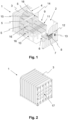
- Figure 1 shows a sectional isometric view of a parcel acceptance station 1 in the area of an input lock 2.
- the parcel acceptance station 1 is enclosed by a housing 3, wherein the housing 3 comprises a storage space 4 with at least one storage area 5 for receiving parcels and/or letters.
- the parcel acceptance station 1 also has a transport device 6.
- the storage space 4 has a total of six storage areas 5 for the parcels and/or letters.
- the storage areas 5 are designed as roller conveyors.
- the transport device 6 also comprises several roller conveyors.
- the entry gate 2 comprises an entry opening 7 on an outer wall of the housing 3, through which a deliverer can enter parcels and/or letters into the parcel acceptance station 1.
- the entry opening 7 can be closed by a roller shutter 8.
- the entry opening 7 opens, for example, only when a delivery attempt by a delivery person actually takes place.
- the input opening 7 is connected to a section of the transport device 6. This allows a parcel and/or letter consignment to be transported from the input opening 7 into the interior of the input lock 2.
- the parcel acceptance station 1 comprises a distribution device 9 designed to assign the parcels and/or letters to one of the storage areas 5.
- the distribution device 9 comprises a height-adjustable table 10 for moving the roller conveyors to the various heights of the storage areas 5.
- An input parcel and/or letter is first brought by the section of the transport device 6 onto the central roller conveyor of the distribution device 9.
- the central roller conveyor is connected to the lateral roller conveyors by means of a displacement device 11.
- the distribution device 9 comprises, for example, several drives (not shown), in particular for driving the height-adjustable table 10, the roller conveyors, and the displacement device 11.
- the distribution device 9 is a component of the transport device 6.
- a display means 12 is also arranged.
- the display means 12 is designed as a display.
- Information about the delivery process for example, the correct insertion of parcels and/or letters into the input opening 7, can be displayed via the display means 12, in particular to a deliverer.
- the display means 12 can also be designed to be touch-sensitive. Inputs can be made, in particular, by the delivery person. In this way, a delivery attempt can be initiated, for example, by touching it.
- the display means 12 can also be used, in particular, to output error information in the event of a failed delivery attempt. An error can be output, for example, if the parcel and/or letter is damaged.
- a scanner 13 is also arranged in the area of the input opening 7 and the display means 12, for example, to detect a barcode or other inscription on a parcel and/or letter.
- the first step of a delivery attempt can, for example, consist of scanning the barcode of the parcel and/or letter to check whether the respective recipient is assigned to the parcel acceptance station 1. If this is the case, the roller shutter 8 can open, for example, allowing the deliverer to insert the parcel and/or letter into the input opening 7.
- the housing 3 of the parcel acceptance station 1 is designed as a shipping container. This allows the parcel acceptance station 1 to be transported particularly easily between different locations.
- a shipping container can also be easily equipped with the features of the parcel acceptance station 1.
- the storage room 4 and the entry lock 2 are separated from each other, for example, by a partition wall 14.
- the partition wall 14 comprises, for example, a lockable access door 15.
- the partition wall 14 has openings 16 for the individual storage areas 5, so that the parcel and/or letter mail can be transported from the transport device 6 in the input lock 2 to the individual storage areas 5.
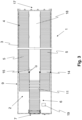
- FIG. 2 shows an isometric view of an end of the parcel acceptance station 1 opposite the input lock 2.
- the parcel acceptance station 1 is characterized by this access 17.
- the access 17 is formed by the doors of the shipping container. An authorized person can open this access 17 to enter the storage room 4 and remove the parcels and/or letters stored therein. The parcels and/or letters can be brought by the authorized person, for example, to a goods receiving area of a commercial establishment.
- the access 17 is locked, for example, by an electronic locking mechanism (not shown).
- Authorized persons for example, have a corresponding access code with which they can open the access 17. Due to the previously described partition 14 with the normally locked access door 15, only authorized persons can enter the storage room 4 and thus have access to the storage areas containing the parcels and/or letters.
- the access 17 can, for example, be designed such that it closes again after a certain period of time, thus preventing unauthorized entry into the storage room 4.
- the access 17 encompasses an entire front side of the parcel acceptance station 1. However, it can of course also be designed smaller so that a person can easily enter the storage room 4 and leave again with parcels and/or letters.
- Figure 3 shows a sectional top view of the parcel acceptance station 1.
- the input lock 2 is shown on the left side.
- the storage room 4 On the right side is the storage room 4 with the storage areas 5.
- the storage areas 5 extend essentially over the entire length of the storage room 4.
- the storage areas 5 can, for example, be designed with a slight slope so that the parcels and/or letters collect along the storage areas 5 due to gravity.
- the storage areas 5 are not divided into individual sections, but are designed as a continuous line.
- the storage room 4 includes a passage 18 connecting the access 17 and the storage areas 5.
- An authorized person located in the passage 18 has easy access to the parcels and/or letters arranged in the storage areas 5.
- the storage areas 5 are easily accessible through the passage 18 along the entire length of the storage room 4.
- the storage areas 5 are arranged on both sides of the passage 18, with three storage areas 5 each arranged on an inner wall of the housing 3.
- the width of the passage 18 essentially corresponds to the width of the storage areas 5.
- the input gate 2 also comprises a detection means 19 for the parcels and/or letters.
- the detection means 19 serves, for example, to detect the condition of the parcels and/or letters after they have been inserted into the input opening 7.
- the detection means 19 can in particular be designed as a camera. If the condition of the entered parcel and/or letter does not meet expectations, it can, for example, be returned to the delivery person from the input opening 7. Images of the detection means 19 can also be stored and/or forwarded to the recipient of the parcel and/or letter. An automated complaint can possibly be sent to the delivery service.
- the input gate 2 can also comprise several detection means 19 in order to For example, parcels and/or letters can be captured from different perspectives. Data printed on the parcel and/or letter can also be captured using the capture device 19.
- Figure 4 shows a second embodiment of a parcel acceptance station 1 according to the invention in an isometric view.
- the housing 3 is shown partially transparent here in order to clarify the internal features of the parcel acceptance station 1.
- the input lock 2 has two input openings 7, each assigned to a side of the parcel acceptance station 1.
- the distribution device 9 here comprises two parallel conveyor elements, which are designed here as a conveyor belt or as a belt.
- the conveyor elements are each assigned to one of the input openings 7.
- the conveyor elements are part of the transport device 6, which transports the parcels and/or letters from the input lock 2 to the storage space 4.
- the distribution device 9 comprises, as before, a height-adjustable table 10 on which the conveyor elements are arranged.
- the partition wall 14 is designed as a roller door.
- the roller door can be raised.
- the roller door can also provide access to the entry gate 2 during maintenance work by trained personnel. Otherwise, the roller door blocks access to the entry gate 2.
- the storage areas 5 are designed as roller conveyors as before, but in this example, they are arranged at uneven heights. Smaller parcel and/or letter shipments, for example, can be stored in the upper storage areas 5. Larger parcel and/or letter shipments, for example, are arranged in the lower storage area 5. By storing the large parcel and/or letter shipments in the lower storage area 5, the parcel acceptance station 1 can operate in a particularly energy-efficient manner.
- the parcel acceptance station 1 has additional storage areas 5 in the storage room 4, which are designed as collection containers.
- the collection containers are arranged, for example, such that even the smallest parcels and/or letters can fall into the collection containers through a gap between the distribution device 9 and the storage areas 5.
- the parcel acceptance station 1 has two forklift shoes 20, by means of which the parcel acceptance station 1 can be safely lifted, in particular by a forklift. Furthermore, the parcel acceptance station 1 has a power connection 21 on its housing 3, which is designed in particular as a high-voltage connection. To improve safety, the power connection 21 can be recessed and arranged in particular at an upper end of the parcel acceptance station 1.
Landscapes
- Engineering & Computer Science (AREA)
- Food Science & Technology (AREA)
- Physics & Mathematics (AREA)
- General Physics & Mathematics (AREA)
- Supports Or Holders For Household Use (AREA)
Applications Claiming Priority (1)
| Application Number | Priority Date | Filing Date | Title |
|---|---|---|---|
| DE102023133220.1A DE102023133220A1 (de) | 2023-11-28 | 2023-11-28 | Paketannahmestation sowie Verfahren zum Zustellen von Paket- und/oder Briefsendungen |
Publications (1)
| Publication Number | Publication Date |
|---|---|
| EP4564322A1 true EP4564322A1 (fr) | 2025-06-04 |
Family
ID=93430737
Family Applications (1)
| Application Number | Title | Priority Date | Filing Date |
|---|---|---|---|
| EP24210900.7A Pending EP4564322A1 (fr) | 2023-11-28 | 2024-11-05 | Station d'acceptation de paquets et procédé de distribution d'envois de paquets et/ou de lettres |
Country Status (2)
| Country | Link |
|---|---|
| EP (1) | EP4564322A1 (fr) |
| DE (1) | DE102023133220A1 (fr) |
Citations (1)
| Publication number | Priority date | Publication date | Assignee | Title |
|---|---|---|---|---|
| EP1970868A1 (fr) * | 2007-03-16 | 2008-09-17 | Nobab GmbH | Dispositif et procédé destinés au stockage automatique de marchandises au détail |
Family Cites Families (2)
| Publication number | Priority date | Publication date | Assignee | Title |
|---|---|---|---|---|
| DE102006034757B4 (de) * | 2006-07-24 | 2009-09-10 | Nobab Gmbh | Vorrichtung und Verfahren zum automatisierten Ein- und Auslagern von Gegenständen |
| DE102021113522A1 (de) * | 2021-05-26 | 2022-12-01 | BJK MUC UG (haftungsbeschränkt) | Lagereinrichtung und Verfahren zum Ein-, Aus und/oder Umlagern von Gegenständen, Verfahren, Steuer- und/oder Regeleinrichtung sowie Lagersystem |
-
2023
- 2023-11-28 DE DE102023133220.1A patent/DE102023133220A1/de active Pending
-
2024
- 2024-11-05 EP EP24210900.7A patent/EP4564322A1/fr active Pending
Patent Citations (1)
| Publication number | Priority date | Publication date | Assignee | Title |
|---|---|---|---|---|
| EP1970868A1 (fr) * | 2007-03-16 | 2008-09-17 | Nobab GmbH | Dispositif et procédé destinés au stockage automatique de marchandises au détail |
Also Published As
| Publication number | Publication date |
|---|---|
| DE102023133220A1 (de) | 2025-05-28 |
Similar Documents
| Publication | Publication Date | Title |
|---|---|---|
| DE19927251C2 (de) | Vorrichtung zum Handhaben von Stückgütern | |
| EP1408802B1 (fr) | Dispositif electronique de casiers pour colis et procede de fonctionnement associe | |
| EP0821518B1 (fr) | Dispositif de transfert et dispositif de distribution | |
| DE102004027721B4 (de) | Verfahren zur Einstellung und Abholung von Retourensendungen an einer elektronischen Paketfachanlage | |
| DE102004005647B4 (de) | Verfahren zum Deponieren von Sendungen in einer elektronischen Schließfachanlage | |
| EP2745982B1 (fr) | Système de production | |
| WO2003019425A1 (fr) | Systeme d'entreposage intermediaire de marchandises identifiees et procede de transfert de marchandises commandees | |
| EP3768624A1 (fr) | Système de production | |
| DE102017200151B4 (de) | Betriebsverfahren für ein Kraftfahrzeug zur Beförderung einer Person, Kraftfahrzeug | |
| WO2012069327A1 (fr) | Procédé et système de préparation de commandes | |
| EP4046108B1 (fr) | Système et procédé pour le transport de marchandises | |
| EP2923341A1 (fr) | Procédé et dispositif de traitement de documents de valeur | |
| EP2044580A1 (fr) | Dispositif et procédé pour le stockage et le destockage automatisé d'objets | |
| EP1400932A1 (fr) | Procédé et dispositif de stockage et d'extraction automatique d'articles individuels | |
| DE1802700A1 (de) | Automatische Artikelbearbeitungs- und Aufbewahrungsanlage | |
| EP0386073B1 (fr) | Systeme de stationnement | |
| EP4564322A1 (fr) | Station d'acceptation de paquets et procédé de distribution d'envois de paquets et/ou de lettres | |
| DE19540855C2 (de) | Verfahren zum automatisierten Betrieb einer Lagereinrichtung | |
| EP3438023B1 (fr) | Dispositif et procédé de préparation des commandes permettant de transférer des compositions médicamenteuses | |
| WO2009018995A1 (fr) | Installation à compartiments à fermeture, système logistique et procédé d'utilisation de l'installation à compartiments à fermeture | |
| EP1814809A1 (fr) | Procede et dispositif pour verifier le chargement d'un dispositif de transport contenant des marchandises | |
| EP4255809A1 (fr) | Système de commande de sécurité et procédé de commande de sécurité | |
| EP2460743B1 (fr) | Zone de transfert pour le transfert de palettes de marchandises | |
| DE102022205210A1 (de) | Förderverfahren und Fördervorrichtung für Waren mehrerer Aufträge | |
| EP1139306A2 (fr) | Système de vente pour gazs |
Legal Events
| Date | Code | Title | Description |
|---|---|---|---|
| PUAI | Public reference made under article 153(3) epc to a published international application that has entered the european phase |
Free format text: ORIGINAL CODE: 0009012 |
|
| STAA | Information on the status of an ep patent application or granted ep patent |
Free format text: STATUS: THE APPLICATION HAS BEEN PUBLISHED |
|
| AK | Designated contracting states |
Kind code of ref document: A1 Designated state(s): AL AT BE BG CH CY CZ DE DK EE ES FI FR GB GR HR HU IE IS IT LI LT LU LV MC ME MK MT NL NO PL PT RO RS SE SI SK SM TR |
|
| STAA | Information on the status of an ep patent application or granted ep patent |
Free format text: STATUS: REQUEST FOR EXAMINATION WAS MADE |
|
| 17P | Request for examination filed |
Effective date: 20251202 |