EP4564748A1 - Gestion de multidiffusion basée sur une adresse de contrôle d'accès au support - Google Patents
Gestion de multidiffusion basée sur une adresse de contrôle d'accès au support Download PDFInfo
- Publication number
- EP4564748A1 EP4564748A1 EP24213942.6A EP24213942A EP4564748A1 EP 4564748 A1 EP4564748 A1 EP 4564748A1 EP 24213942 A EP24213942 A EP 24213942A EP 4564748 A1 EP4564748 A1 EP 4564748A1
- Authority
- EP
- European Patent Office
- Prior art keywords
- host device
- network
- network device
- multicast
- multicast group
- Prior art date
- Legal status (The legal status is an assumption and is not a legal conclusion. Google has not performed a legal analysis and makes no representation as to the accuracy of the status listed.)
- Withdrawn
Links
Images



Classifications
-
- H—ELECTRICITY
- H04—ELECTRIC COMMUNICATION TECHNIQUE
- H04L—TRANSMISSION OF DIGITAL INFORMATION, e.g. TELEGRAPHIC COMMUNICATION
- H04L12/00—Data switching networks
- H04L12/02—Details
- H04L12/16—Arrangements for providing special services to substations
- H04L12/18—Arrangements for providing special services to substations for broadcast or conference, e.g. multicast
- H04L12/185—Arrangements for providing special services to substations for broadcast or conference, e.g. multicast with management of multicast group membership
-
- H—ELECTRICITY
- H04—ELECTRIC COMMUNICATION TECHNIQUE
- H04L—TRANSMISSION OF DIGITAL INFORMATION, e.g. TELEGRAPHIC COMMUNICATION
- H04L45/00—Routing or path finding of packets in data switching networks
- H04L45/16—Multipoint routing
-
- H—ELECTRICITY
- H04—ELECTRIC COMMUNICATION TECHNIQUE
- H04L—TRANSMISSION OF DIGITAL INFORMATION, e.g. TELEGRAPHIC COMMUNICATION
- H04L12/00—Data switching networks
- H04L12/02—Details
- H04L12/16—Arrangements for providing special services to substations
- H04L12/18—Arrangements for providing special services to substations for broadcast or conference, e.g. multicast
- H04L12/1886—Arrangements for providing special services to substations for broadcast or conference, e.g. multicast with traffic restrictions for efficiency improvement, e.g. involving subnets or subdomains
-
- H—ELECTRICITY
- H04—ELECTRIC COMMUNICATION TECHNIQUE
- H04L—TRANSMISSION OF DIGITAL INFORMATION, e.g. TELEGRAPHIC COMMUNICATION
- H04L45/00—Routing or path finding of packets in data switching networks
- H04L45/74—Address processing for routing
-
- H—ELECTRICITY
- H04—ELECTRIC COMMUNICATION TECHNIQUE
- H04L—TRANSMISSION OF DIGITAL INFORMATION, e.g. TELEGRAPHIC COMMUNICATION
- H04L45/00—Routing or path finding of packets in data switching networks
- H04L45/76—Routing in software-defined topologies, e.g. routing between virtual machines
-
- H—ELECTRICITY
- H04—ELECTRIC COMMUNICATION TECHNIQUE
- H04L—TRANSMISSION OF DIGITAL INFORMATION, e.g. TELEGRAPHIC COMMUNICATION
- H04L61/00—Network arrangements, protocols or services for addressing or naming
- H04L61/50—Address allocation
- H04L61/5069—Address allocation for group communication, multicast communication or broadcast communication
-
- H—ELECTRICITY
- H04—ELECTRIC COMMUNICATION TECHNIQUE
- H04L—TRANSMISSION OF DIGITAL INFORMATION, e.g. TELEGRAPHIC COMMUNICATION
- H04L2101/00—Indexing scheme associated with group H04L61/00
- H04L2101/60—Types of network addresses
- H04L2101/618—Details of network addresses
- H04L2101/622—Layer-2 addresses, e.g. medium access control [MAC] addresses
Definitions
- Multicasting generally refers to the delivery of data to a group of destinations. Multicast data may be transmitted once over each link of the network, which may conserve bandwidth. Data may be replicated when the path to the destinations splits between multiple links. Networks may use routers, switches, and other network devices for receiving and forwarding multicast data. Such network devices may receive and/or forward multicast packets through interfaces (e.g., ports).
- the method may include receiving, by a first network device, a media access control (MAC) advertisement route message indicating that a second network device has discovered a MAC address of a host device.
- the method may include deleting, by the first network device, one or more multicast group memberships associated with the host device.
- MAC media access control
- the method may include discovering, by a network device of a network, a MAC address of a host device, associated with an attachment circuit, that has moved to the network device from another network device of the network.
- the method may include transmitting, by the network device, based on discovering the MAC address of the host device that has moved to the network device from the other network device, over the attachment circuit, a general membership query.
- the first network device may include one or more memories and one or more processors.
- the one or more processors may be to receive a MAC advertisement route message indicating that a second network device has discovered a MAC address of a host device.
- the one or more processors may be to delete one or more multicast group memberships associated with the host device.
- a multicast source may transmit multicast data in the form of a multicast stream.
- the multicast stream may include multicast packets, each containing a multicast data payload and a header.
- the multicast data payload may be a piece of data from the multicast stream requested by a host device.
- the header may provide information including network addresses of a multicast source and a multicast group address subscribed to by the host device.
- the multicast stream may be defined as a group of multicast packets that make up the data being multicast for a particular multicast source and/or multicast group.
- a multicast source may transmit a multicast stream to a first provider edge device of a network fabric.
- the network fabric e.g., one or more network devices in the network fabric
- a second provider edge device may receive the multicast stream and forward the multicast stream to a host device (e.g., an internet group management protocol (IGMP) host device).
- IGMP internet group management protocol
- the network fabric may be an Ethernet virtual private network (EVPN) fabric
- the provider edge devices may include respective EVPN databases that store EVPN routes for the EVPN fabric.
- Each provider edge device may maintain multicast forwarding states for respective multicast streams.
- the multicast forwarding state in a routing device may be notated as (S,G) or (*,G).
- S,G the S may refer to a unicast internet protocol (IP) address of the multicast source for the multicast stream
- the G may refer to the multicast group IP address for which S is the multicast source.
- the asterisk (*) in the (*,G) notation may be a wildcard indicating that the multicast forwarding state applies to any multicast source for the multicast group IP address.
- the provider edge devices may use IGMP snooping techniques to forward the multicast stream.
- IGMP snooping techniques may enable a provider edge device to monitor IGMP traffic from one or more host devices and determine which (if any) of the one or more host devices are to receive the multicast stream as determined using the IGMP traffic. For example, the provider edge device may snoop an IGMP membership report indicating that the host device is to join the multicast group for the multicast stream.
- the provider edge devices may include respective IGMP snooping databases that store multicast information (e.g., the (S,G) for the multicast stream, the interface on which the IGMP traffic was received, or the like).
- the provider edge devices may use selective multicast Ethernet tag (SMET) forwarding techniques to forward the multicast stream.
- SMET forwarding techniques may enable a provider edge device to selectively forward multicast traffic based on the presence or absence of one or more host devices that are to receive the multicast stream.
- the second provider edge device may perform IGMP snooping on IGMP traffic from the host device and advertise an EVPN type 6 SMET route to the first provide edge, enabling the first provider edge device to forward multicast traffic to the second provider edge device (e.g., to only the second provider edge device) based on the EVPN type 6 SMET route.
- Deploying IGMP snooping techniques and SMET forwarding techniques in the EVPN fabric may provide the optimized forwarding path(s) for the multicast stream.
- the second provider edge device may advertise, to the remaining provider edge devices, that the host device is connected to the second provider edge device. For example, the second provider edge device may transmit a MAC advertisement route message identifying the host device by the MAC address of the host device. For example, the second provider edge device may advertise an EVPN type 2 route, which may indicate the location of the host device (as identified by the MAC address of the host device). The EVPN type 2 route may be assigned a sequence number (SN), such as SN1.
- SN sequence number
- the provider edge devices may include respective MAC forwarding tables that associate MAC addresses with corresponding provider edge devices. For example, in response to receiving the MAC advertisement route message from the second provider edge device, the remaining provider edge devices may update the MAC forwarding tables to associate the MAC address of the host device with the second provider edge device.
- the host device may be mobile (e.g., the host device may move (e.g., migrate) from behind one provider edge device to behind another provider edge device). In some cases, the host device may move to a third provider edge device.
- the third provider edge device may detect the host device and advertise, to the remaining provider edge devices, that the host device is connected to the third provider edge device. For example, the third provider edge device may advertise an EVPN type 2 route with a higher SN than SN1, such as SN2. Based on SN2 being higher than SN1, the remaining provider edge devices may update the MAC forwarding tables to associate the MAC address of the host device with third provider edge device (rather than the second provider edge device).
- the third provider edge device may snoop an IGMP membership report transmitted from the host device. Based on the IGMP membership report, the third provider edge device may create a multicast forwarding state for the multicast flow and advertise an EVPN type 6 SMET route to the first provider edge device. The EVPN type 6 SMET route may cause the multicast stream to be transmitted to the third provider edge device. As a result, the third provider edge device may receive the multicast stream and forward the multicast stream to the host device.
- the host device may not transmit an IGMP group leave message to the second provider edge device because the host device is not aware that the host device has moved from the second provider edge device to the third provider edge device.
- An IGMP group leave message if received by the second provider edge device, may prompt the second provider edge device to transmit a group-specific membership query downstream, determine whether any host devices that are to receive the multicast stream are still connected to the second provider edge device, and, if not, delete the EVPN type 6 SMET route.
- the host device may not be aware that the host device has moved from the second provider edge device to the third provider edge device because the host device may communicate with the provider edge devices over the same access LAN (e.g., as emulated by the EVPN fabric). After moving from the second provider edge device to the access LAN of the third provider edge device, the host device can no longer transmit an IGMP group leave message to the second provider edge device. As a result, the host device may move seamlessly across provider edge devices, continually refreshing IGMP reports because the host device is to receive the multicast stream.
- Updating the MAC forwarding tables to reflect the movement of the host device to the third provider edge device does not prevent the second provider edge device from receiving and forwarding the multicast stream because MAC forwarding tables may be consulted for unicast transmissions, not for multicast transmissions.
- the second provider edge device may continue to receive and forward the multicast stream for an extended period of time. For example, the second provider edge device may not clean the multicast forwarding state of the multicast stream until a join timeout timer expires (e.g., 210 seconds). For example, if the join timeout timer is 210 seconds, then the second provider edge device may continue to receive and forward the multicast stream for up to 210 seconds after the host device moves from the second provider edge device.
- a join timeout timer e.g., 210 seconds
- the first provider edge device may forward multicast traffic to the second provider edge device, and the second provider edge device may forward the multicast traffic toward an access LAN of the second provider edge device.
- the first and second provider edge devices may forward the multicast traffic even if the second provider edge device no longer has any host device that is to receive the multicast stream.
- IGMP snooping techniques and SMET forwarding techniques are ineffective to prevent such forwarding.
- the multicast traffic forwarded by the first and second provider edge devices may consume packet processing resources. For example, packet processing resources on one or more provider edge devices, the EVPN fabric, and/or access interface may generate the multicast traffic by replicating multicast packets. Additionally, or alternatively, the multicast traffic forwarded by the first and second provider edge devices may consume bandwidth. For example, the multicast traffic may consume bandwidth on the EVPN fabric and the access interface. For example, the bandwidth (e.g., quantity of channels) of the access interface can be limited. As a result, the multicast traffic may impact overall user experience by consuming bandwidth that could otherwise be occupied by other multicast traffic that is being forwarded to a host device. In scenarios where multiple host devices regularly move across provider edge devices (e.g., resulting in unnecessary forwarding of large flows of multicast traffic), consumption of packet processing resources and bandwidth further increases.
- the host device may not transmit an IGMP membership report (e.g., an IGMP join request) to the third provider edge device (e.g., via an attachment circuit (AC)) in a timely manner.
- an IGMP membership report e.g., an IGMP join request
- the third provider edge device creates a multicast forwarding state and advertises EVPN type 6 SMET route to attract the multicast stream after snooping an IGMP membership report transmitting by the host device.
- the host device may transmit the IGMP membership report infrequently (e.g., approximately once every sixty seconds). As a result, the host device may experience a delay (e.g., up to approximately sixty seconds) after moving to the provider edge device before receiving the multicast stream.
- MLD multicast listener discovery
- provider edge devices may track host device mobility using a MAC address of the host device. For example, a provider edge device from which the host device moved may delete one or more multicast group memberships and/or transmit a SMET route withdraw message in response to receiving a MAC advertisement route message.
- a provider edge device to which the host device moved may transmit a general membership query in response to determining that the host device moved to the provider edge device. For example, the provider edge device may determine that the host device moved to the provider edge device by discovering the MAC address of the host device.
- the provider edge device from which the host device moved may quickly stop forwarding the multicast traffic, which may reduce packet processing resources and bandwidth consumption.
- the provider edge device from which the host device moved may quickly stop receiving the multicast traffic, which may further reduce packet processing resources and bandwidth consumption.
- the provider edge device to which the host device moved may reduce the delay before the provider edge device can begin receiving the multicast traffic and forwarding the multicast traffic to the host device.
- Fig. 1 is a diagram of an example implementation 100 associated with MAC-address-based multicast handling.
- example implementation 100 includes a multicast source device, a plurality of network devices (including a first network device and a second network device) of a network, and a host device.
- the multicast source may be any suitable source of a multicast stream.
- the network devices may be provider edge devices associated with the network, and the network may be an EVPN that includes an EVPN fabric.
- the provider edge devices may be associated with the EVPN in that the provider edge devices are located at the edge of the EVPN.
- the network devices may be configured for IGMP snooping techniques and/or SMET forwarding techniques.
- the host device may be any suitable mobile host device, such as a virtual machine (VM), a handheld host device, an IP television (IPTV) host device, an IP version 6 (IPv6) host device, and/or the like. These devices are described in more detail below in connection with Figs. 2-4 .
- VM virtual machine
- IPTV IP television
- IPv6 IP version 6
- the host device may connect to the first network device.
- the first network device may identify a MAC address of the host device and create a multicast forwarding state associated with the host device (e.g., if such a multicast forwarding state has not yet been created).
- the multicast forwarding state may be associated with the host device in that the multicast forwarding state represents a multicast stream that the host device is to receive.
- the first network device may use IGMP snooping techniques and/or SMET forwarding techniques.
- the first network device may use IGMP snooping techniques to snoop an IGMP report and identify the MAC address of the host device from the IGMP report.
- the first network device may identify a source MAC address of the IGMP report as the MAC address of the host device.
- the first network devices may also use IGMP snooping techniques may also be used to create the multicast forwarding state associated with the host device.
- the first network device may use SMET forwarding techniques to begin receiving a multicast stream corresponding to the multicast forwarding state.
- the first network device may advertise an EVPN type 6 SMET route that causes the multicast stream to be forwarded to the first network device.
- the first network may receive the multicast stream from the multicast source.
- the multicast source may transmit the multicast stream to one of the network devices, which in turn forwards the multicast stream to the network, and the network may forward the multicast stream to one or more other network devices including the first network device.
- the first network device may receive the multicast stream from the network and forward the multicast stream to the host device via an AC over an access network between the first network device and the host device.
- Explicit tracking may or may not be enabled on the first network device. If explicit tracking is enabled, then the first network device may explicitly track multicast parameters in a database associated with IGMP snooping with explicit tracking.
- the database associated with IGMP snooping with explicit tracking may be local to the first network device.
- the database associated with IGMP snooping with explicit tracking may also be referred to as an "IGMP snooping database.”
- the first network device may store, in an entry of the database associated with IGMP (or MLD) snooping with explicit tracking, the MAC address of the host device, one or more multicast group memberships associated with the host device, and an AC of the first network device (e.g., an interface from which the multicast stream is transmitted to the host device).
- the database associated with IGMP snooping with explicit tracking may store (e.g., add, append, or the like) the MAC address of the host device.
- each entry in the database associated with IGMP snooping with explicit tracking may include a MAC address of a host device.
- the first network device may store the MAC address, the one or more multicast group memberships, and the AC based on identifying an association of the one or more multicast group memberships with the host device. For example, the first network device may store the MAC address, the one or more multicast group memberships, and the AC in response to determining that the one or more multicast group memberships are associated with the host device.
- the one or more multicast group memberships may be associated with the host device in that the host device may have joined the one or more multicast group memberships.
- the first network device may remove the explicit tracking entry for the host device (e.g., the explicit tracking may be based on the MAC address of the host device).
- the host device may move from the first network device to the second network device.
- the host device may move from the AC of the first network device to the AC of the second network device.
- the host device may disassociate with the AC of the first network device and associate with the AC of the second network device.
- the second network device may discover the MAC address of the host device.
- the host device may be associated with an AC (e.g., the AC of the second network device).
- the second network device may discover the MAC address of the host device using IGMP snooping techniques.
- the second network device use IGMP snooping techniques to snoop an IGMP report transmitted from the host device and identify the MAC address of the host device from the IGMP report.
- the second network device may identify a source MAC address of the IGMP report as the MAC address of the host device.
- the second network device may transmit, based on discovering the MAC address of the host device, over the AC (e.g., the AC of the second network device), a general membership query. For example, discovering the MAC address may trigger an IGMP snooping module on the second network device to issue an IGMP general query on the AC.
- the AC e.g., the AC of the second network device
- the second network device may receive a membership report associated with the host device.
- the membership report may be an IGMP membership report solicited on the AC by the membership report.
- the second network device may receive the membership report based on (e.g., in response to) the general membership query.
- the membership report may be associated with the host device in that the membership report may indicate that the host device is to receive the multicast stream.
- the second network device may update a group membership database based on the membership report (e.g., the second network device may update the group membership database accordingly).
- the second network device may update a membership associated with the host device.
- the membership may be an IGMP membership.
- the membership may be associated with the host device in that the host device is to receive the multicast stream by virtue of the membership.
- the second network device may transmit, based on the membership report, a SMET route advertise message.
- the second network device may advertise an EVPN type 6 SMET route that causes the multicast stream to be forwarded to the second network device.
- the SMET route advertise message may enable the second network device to attract multicast traffic for the host device (e.g., the multicast stream).
- the first network device may receive a MAC advertisement route message.
- the first network device may receive the MAC advertisement route message, via the network, from the second network device.
- the MAC advertisement route message may indicate that the second network device has discovered the MAC address of the host device.
- the MAC advertisement route message may be part of a MAC (and/or VM) mobility mechanism used to indicate MAC mobility of the host device.
- the MAC advertisement route message may include the MAC address of the host device.
- the first network device may delete the one or more multicast group memberships associated with the host device.
- the MAC advertisement route message may trigger an IGMP snooping module on the first network device to delete (e.g., clean up, flush, or the like) the corresponding one or more multicast group memberships.
- the first network may delete the one or more multicast group memberships by deleting the entry from the database associated with IGMP snooping with explicit tracking.
- the IGMP snooping module may clean up the one or more multicast group memberships in the database in response to the MAC advertisement route message.
- the first network device may identify the MAC address of the host device from the MAC advertisement route message and delete any entries in the database that contain the MAC address of the host device. Thus, the first network device may stop forwarding the multicast stream over the AC.
- the first network device may transmit a group-specific membership query for a multicast group membership of the one or more multicast group memberships associated with the host device.
- a group-specific membership query for a multicast group membership of the one or more multicast group memberships associated with the host device.
- Such aspects may be employed in scenarios where explicit tracking is not enabled, or where explicit tracking is enabled but the database does not include an entry that contains the MAC address of the host device.
- the MAC advertisement route message may trigger the IGMP snooping module to issue an IGMP group-specific query for all memberships on the AC where the host device was previously connected.
- the first network device may determine that a response to the group-specific membership query has not been received. For example, the first network device may not receive any IGMP membership report in response to the group-specific membership query. No response being received may indicate that there are no host devices on the AC of the first network device that are to receive the multicast stream. Accordingly, based on determining that the response to the group-specific membership query has not been received, the first network device may delete the multicast group membership. Thus, the first network device may clean up stale memberships on the AC, and the first network device may stop forwarding the multicast stream over the AC.
- the first network device may transmit a SMET route withdraw message.
- the SMET route withdraw message may withdraw the EVPN type 6 SMET route that caused the multicast stream to be forwarded to the first network device.
- the first network device may transmit the SMET route withdraw message to the network, and the network may forward the SMET route withdraw message to the network device connected to the multicast source.
- the first network device may withdraw the EVPN type 6 SMET route, and the network device connected to the multicast source may stop forwarding the multicast stream to the first network device.
- the first network device may delete the one or more multicast group memberships associated with the host device using an IP address of the host device. For example, in an explicit tracking scenario, the first network device may, in response to detecting a MAC move, use the IP address of the host device to remove the entry. For example, when using IGMP (or MLD) explicit tracking, upon detecting a MAC move, the first network device may remove the explicit tracking entry for the host device (e.g., the explicit tracking may be based on the IP address of the host device).
- IGMP or MLD
- the techniques described herein may apply in other contexts, such as MLD.
- the general query transmitted by the second network device based on discovering the MAC address of the host device may be an MLD-based general membership query (e.g., an MLD general query).
- the one or more multicast group memberships deleted by the first network device based on the MAC advertisement route message may be one or more MLD-based multicast group memberships.
- operations 110-140 may be performed in any suitable order.
- Deleting the one or more multicast group memberships based on the MAC advertisement route message may enable the first network device to quickly cease forwarding the multicast traffic, which may reduce packet processing resources and/or bandwidth consumption. For example, deleting the one or more multicast group memberships based on the MAC advertisement route message increase bandwidth for other multicast streams for other host devices. Deleting the one or more multicast group memberships based on the MAC advertisement route message may enable the first network device to cease forwarding the multicast traffic in a lightweight manner (e.g., in a manner that involves little memory and/or processing resources). As a result, for example, techniques described herein may be implemented on network devices with low memory and/or processing capacity, such as network devices in spine-leaf architectures.
- Transmitting the SMET route withdraw message based on deleting the one or more multicast group memberships may enable the first network device to quickly cease receiving the multicast stream, which may further reduce packet processing resources and bandwidth consumption. For example, packet processing resources and bandwidth consumption may be reduced on network devices in the network.
- Transmitting the general membership query based on discovering the MAC address of the host device may enable the second network device to reduce the delay before the second network device can begin receiving the multicast stream and forwarding the multicast stream to the host device. For example, transmitting the general membership query may enable the second network device to quickly create a multicast forwarding state for the host device and advertise a SMET route advertise message to receive the multicast stream on behalf of the host device.
- Fig. 1 is provided as an example. Other examples may differ from what is described with regard to Fig. 1 .
- the number and arrangement of devices shown in Fig. 1 are provided as an example. In practice, there may be additional devices, fewer devices, different devices, or differently arranged devices than those shown in Fig. 1 .
- two or more devices shown in Fig. 1 may be implemented within a single device, or a single device shown in Fig. 1 may be implemented as multiple, distributed devices.
- a set of devices (e.g., one or more devices) shown in Fig. 1 may perform one or more functions described as being performed by another set of devices shown in Fig. 1 .
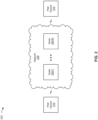
- Fig. 2 is a diagram of an example environment 200 in which systems and/or methods described herein may be implemented.
- environment 200 may include one or more peer devices 210, a group of nodes 220 (shown as node 220-1 through node 220-N), and a network 230.
- Devices of environment 200 may interconnect via wired connections, wireless connections, or a combination of wired and wireless connections.
- Peer device 210 includes one or more devices capable of receiving and/or providing network traffic.
- peer device 210 may include a traffic transfer device, such as a router, a gateway, a switch, a firewall, a hub, a bridge, a reverse proxy, a server (e.g., a proxy server, a server executing a virtual machine, etc.), a security device, an intrusion detection device, a load balancer, or a similar type of device.
- peer device 210 may include an endpoint device that is a source or a destination for network traffic.
- peer device 210 may include a computer or a similar type of device.
- Peer device 210 may receive network traffic from and/or may provide network traffic (e.g., payload packets) to other peer devices 210 via network 230 (e.g., by routing payload packets using node(s) 220 as an intermediary).
- peer device 210 may include an edge device that is located at an edge of one or more networks.
- peer device 210 receive network traffic from and/or may provide network traffic (e.g., payload packets) to devices external to network 230.
- Node 220 includes one or more devices capable of receiving, processing, storing, routing, and/or providing traffic (e.g., a payload packet, a file, etc.) in a manner described herein.
- node 220 may include a router, such as a label switching router (LSR), a label edge router (LER), an ingress router, an egress router, a provider router (e.g., a provider edge router, a provider core router, etc.), a virtual router, or another type of router.
- LSR label switching router
- LER label edge router
- an ingress router egress router
- a provider router e.g., a provider edge router, a provider core router, etc.
- virtual router e.g., a virtual router, or another type of router.
- node 220 may include a gateway, a switch, a firewall, a hub, a bridge, a reverse proxy, a server (e.g., a proxy server, a cloud server, a data center server, etc.), a load balancer, and/or a similar device.
- a server e.g., a proxy server, a cloud server, a data center server, etc.
- load balancer e.g., a load balancer, and/or a similar device.
- node 220 may be a physical device implemented within a housing, such as a chassis. In some implementations, node 220 may be a virtual device implemented by one or more computer devices of a cloud computing environment or a data center.
- node 220 may be configured with one or more segment translation tables. In some implementations, node 220 may receive a payload packet from peer device 210. In some implementations, node 220 may encapsulate the payload packet using a compressed routing header (CRH) and may route the IP payload packet to another node 220, using one or more techniques described elsewhere herein. In some implementations, node 220 may be an edge node in network 230. In some implementations, node 220 may be an intermediary node in network 230 (i.e., a node between two or more edge nodes).
- CRC compressed routing header
- Network 230 includes one or more wired and/or wireless networks.
- network 230 may include a cellular network (e.g., a fifth generation (5G) network, a fourth generation (4G) network, such as a long-term evolution (LTE) network, a third generation (3G) network, a code division multiple access (CDMA) network, a public land mobile network (PLMN), a LAN, a wide area network (WAN), a metropolitan area network (MAN), a telephone network (e.g., the Public Switched Telephone Network (PSTN)), a private network, an ad hoc network, an intranet, the Internet, a fiber optic-based network, a cloud computing network, or the like, and/or a combination of these or other types of networks.
- 5G fifth generation
- 4G fourth generation
- LTE long-term evolution
- 3G third generation
- CDMA code division multiple access
- PLMN public land mobile network
- LAN local area network
- WAN wide area network
- MAN metropolitan
- the number and arrangement of devices and networks shown in Fig. 2 are provided as one or more examples. In practice, there may be additional devices and/or networks, fewer devices and/or networks, different devices and/or networks, or differently arranged devices and/or networks than those shown in Fig. 2 . Furthermore, two or more devices shown in Fig. 2 may be implemented within a single device, or a single device shown in Fig. 2 may be implemented as multiple, distributed devices. Additionally, or alternatively, a set of devices (e.g., one or more devices) of environment 200 may perform one or more functions described as being performed by another set of devices of environment 200.
- Fig. 3 is a diagram of example components of a device 300 associated with handling multicast traffic based on a MAC address of a host device.
- the device 300 may correspond to the peer device 210 and/or the node 220.
- the peer device 210 and/or the node 220 may include one or more devices 300 and/or one or more components of the device 300.
- the device 300 may include a bus 310, a processor 320, a memory 330, an input component 340, an output component 350, and/or a communication component 360.
- the bus 310 may include one or more components that enable wired and/or wireless communication among the components of the device 300.
- the bus 310 may couple together two or more components of Fig. 3 , such as via operative coupling, communicative coupling, electronic coupling, and/or electric coupling.
- the bus 310 may include an electrical connection (e.g., a wire, a trace, and/or a lead) and/or a wireless bus.
- the processor 320 may include a central processing unit, a graphics processing unit, a microprocessor, a controller, a microcontroller, a digital signal processor, a field-programmable gate array, an application-specific integrated circuit, and/or another type of processing component.
- the processor 320 may be implemented in hardware, firmware, or a combination of hardware and software.
- the processor 320 may include one or more processors capable of being programmed to perform one or more operations or processes described elsewhere herein.
- the memory 330 may include volatile and/or nonvolatile memory.
- the memory 330 may include random access memory (RAM), read only memory (ROM), a hard disk drive, and/or another type of memory (e.g., a flash memory, a magnetic memory, and/or an optical memory).
- the memory 330 may include internal memory (e.g., RAM, ROM, or a hard disk drive) and/or removable memory (e.g., removable via a universal serial bus connection).
- the memory 330 may be a non-transitory computer-readable medium.
- the memory 330 may store information, one or more instructions, and/or software (e.g., one or more software applications) related to the operation of the device 300.
- the memory 330 may include one or more memories that are coupled (e.g., communicatively coupled) to one or more processors (e.g., processor 320), such as via the bus 310. Communicative coupling between a processor 320 and a memory 330 may enable the processor 320 to read and/or process information stored in the memory 330 and/or to store information in the memory 330.
- the input component 340 may enable the device 300 to receive input, such as user input and/or sensed input.
- the input component 340 may include a touch screen, a keyboard, a keypad, a mouse, a button, a microphone, a switch, a sensor, a global positioning system sensor, a global navigation satellite system sensor, an accelerometer, a gyroscope, and/or an actuator.
- the output component 350 may enable the device 300 to provide output, such as via a display, a speaker, and/or a light-emitting diode.
- the communication component 360 may enable the device 300 to communicate with other devices via a wired connection and/or a wireless connection.
- the communication component 360 may include a receiver, a transmitter, a transceiver, a modem, a network interface card, and/or an antenna.
- the device 300 may perform one or more operations or processes described herein.
- a non-transitory computer-readable medium e.g., memory 330
- the processor 320 may execute the set of instructions to perform one or more operations or processes described herein.
- execution of the set of instructions, by one or more processors 320 causes the one or more processors 320 and/or the device 300 to perform one or more operations or processes described herein.
- hardwired circuitry may be used instead of or in combination with the instructions to perform one or more operations or processes described herein.
- the processor 320 may be configured to perform one or more operations or processes described herein.
- implementations described herein are not limited to any specific combination of hardware circuitry and software.
- the number and arrangement of components shown in Fig. 3 are provided as an example.
- the device 300 may include additional components, fewer components, different components, or differently arranged components than those shown in Fig. 3 .
- a set of components (e.g., one or more components) of the device 300 may perform one or more functions described as being performed by another set of components of the device 300.
- Fig. 4 is a diagram of example components of a device 400 associated with handling multicast traffic based on a MAC address of a host device.
- Device 400 may correspond to the peer device 210 and/or the node 220.
- the peer device 210 and/or the node 220 may include one or more devices 400 and/or one or more components of device 400. As shown in Fig.
- device 400 may include one or more input components 410-1 through 410-B (B > 1) (hereinafter referred to collectively as input components 410, and individually as input component 410), a switching component 420, one or more output components 430-1 through 430-C (C ⁇ 1) (hereinafter referred to collectively as output components 430, and individually as output component 430), and a controller 440.
- Input component 410 may be one or more points of attachment for physical links and may be one or more points of entry for incoming traffic, such as packets. Input component 410 may process incoming traffic, such as by performing data link layer encapsulation or decapsulation. In some implementations, input component 410 may transmit and/or receive packets. In some implementations, input component 410 may include an input line card that includes one or more packet processing components (e.g., in the form of integrated circuits), such as one or more interface cards (IFCs), packet forwarding components, line card controller components, input ports, processors, memories, and/or input queues. In some implementations, device 400 may include one or more input components 410.
- packet processing components e.g., in the form of integrated circuits
- IFCs interface cards
- packet forwarding components line card controller components
- input ports e.g., processors, memories, and/or input queues.
- device 400 may include one or more input components 410.
- Switching component 420 may interconnect input components 410 with output components 430.
- switching component 420 may be implemented via one or more crossbars, via busses, and/or with shared memories.
- the shared memories may act as temporary buffers to store packets from input components 410 before the packets are eventually scheduled for delivery to output components 430.
- switching component 420 may enable input components 410, output components 430, and/or controller 440 to communicate with one another.
- Output component 430 may store packets and may schedule packets for transmission on output physical links. Output component 430 may support data link layer encapsulation or decapsulation, and/or a variety of higher-level protocols. In some implementations, output component 430 may transmit packets and/or receive packets. In some implementations, output component 430 may include an output line card that includes one or more packet processing components (e.g., in the form of integrated circuits), such as one or more IFCs, packet forwarding components, line card controller components, output ports, processors, memories, and/or output queues. In some implementations, device 400 may include one or more output components 430. In some implementations, input component 410 and output component 430 may be implemented by the same set of components (e.g., and input/output component may be a combination of input component 410 and output component 430).
- packet processing components e.g., in the form of integrated circuits
- IFCs packet forwarding components
- line card controller components e.g., packet forwarding components
- Controller 440 includes a processor in the form of, for example, a central processing unit (CPU), a graphics processing unit (GPU), an accelerated processing unit (APU), a microprocessor, a microcontroller, a digital signal processor (DSP), a field-programmable gate array (FPGA), an application-specific integrated circuit (ASIC), and/or another type of processor.
- the processor is implemented in hardware, firmware, or a combination of hardware and software.
- controller 440 may include one or more processors that can be programmed to perform a function.
- controller 440 may include a RAM, a ROM, and/or another type of dynamic or static storage device (e.g., a flash memory, a magnetic memory, an optical memory, etc.) that stores information and/or instructions for use by controller 440.
- a RAM random access memory
- ROM read-only memory
- static storage device e.g., a flash memory, a magnetic memory, an optical memory, etc.
- controller 440 may communicate with other devices, networks, and/or systems connected to device 400 to exchange information regarding network topology. Controller 440 may create routing tables based on the network topology information, may create forwarding tables based on the routing tables, and may forward the forwarding tables to input components 410 and/or output components 430. Input components 410 and/or output components 430 may use the forwarding tables to perform route lookups for incoming and/or outgoing packets.
- Controller 440 may perform one or more processes described herein. Controller 440 may perform these processes in response to executing software instructions stored by a non-transitory computer-readable medium.
- a computer-readable medium may be a non-transitory memory device.
- a memory device includes memory space within a single physical storage device or memory space spread across multiple physical storage devices. Additionally, or alternatively, a computer-readable medium can include transient media such as carrier waves and transmission media.
- Software instructions may be read into a memory and/or storage component associated with controller 440 from another computer-readable medium or from another device via a communication interface. When executed, software instructions stored in a memory and/or storage component associated with controller 440 may cause controller 440 to perform one or more processes described herein. Additionally, or alternatively, hardwired circuitry may be used in place of or in combination with software instructions to perform one or more processes described herein. Thus, implementations described herein are not limited to any specific combination of hardware circuitry and software.
- device 400 may include additional components, fewer components, different components, or differently arranged components than those shown in Fig. 4 . Additionally, or alternatively, a set of components (e.g., one or more components) of device 400 may perform one or more functions described as being performed by another set of components of device 400.
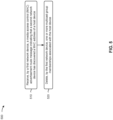
- Fig. 5 is a flowchart of an example process 500 associated with handling of multicast traffic based on a MAC address of a host device.
- one or more process blocks of Fig. 5 are performed by a first network device (e.g., the first network device of Fig. 1 ).
- one or more process blocks of Fig. 5 are performed by another device or a group of devices separate from or including the first network device, such as a peer device (e.g., peer device 210 and/or a node (e.g., node 220).
- a peer device e.g., peer device 210 and/or a node (e.g., node 220).
- a node e.g., node 220
- 5 may be performed by one or more components of device 300, such as processor 320, memory 330, input component 340, output component 350, and/or communication component 360, and/or one or more components of device 400, such as input component 410, switching component 420, output component 430, and/or controller 440.
- process 500 may include deleting one or more multicast group memberships associated with the host device (block 520).
- the first network device may delete one or more multicast group memberships associated with the host device, as described above.
- Process 500 may include additional implementations, such as any single implementation or any combination of implementations described below and/or in connection with one or more other processes described elsewhere herein.
- process 500 includes storing, by the first network device, based on identifying an association of the one or more multicast group memberships with the host device, the MAC address, the one or more multicast group memberships associated with the host device, and an AC of the first network device in an entry of a database associated with IGMP or MLD snooping with explicit tracking.
- deleting the one or more multicast group memberships associated with the host device includes deleting the entry from the database.
- process 500 includes transmitting, by the first network device, based on receiving the MAC advertisement route message, a group-specific membership query for a multicast group membership of the one or more multicast group memberships associated with the host device.
- process 500 includes determining that a response to the group-specific membership query has not been received, and deleting the one or more multicast group memberships associated with the host device includes deleting the one or more multicast group memberships associated with the host device based on determining that the response to the group-specific membership query has not been received.
- deleting the one or more multicast group memberships associated with the host device includes deleting the one or more multicast group memberships associated with the host device using an IP address of the host device.
- the first network device is a first provider edge device associated with an EVPN
- the second network device is a second provider edge device associated with the EVPN
- the host device is a virtual machine.
- process 500 includes additional blocks, fewer blocks, different blocks, or differently arranged blocks than those depicted in Fig. 5 . Additionally, or alternatively, two or more of the blocks of process 500 may be performed in parallel.
- a network device of a network which may discover a media access control (MAC) address of a host device, associated with an attachment circuit, that has moved to the network device from another network device of the network.
- the network device may transmit, based on discovering the MAC address of the host device that has moved to the network device from the other network device, over the attachment circuit, a general membership query.
- another network device may receive a media access control (MAC) advertisement route message indicating that the network device has discovered the MAC address of the host device.
- the other network device may delete one or more multicast group memberships associated with the host device.
- MAC media access control
- traffic or content may include a set of packets.
- a packet may refer to a communication structure for communicating information, such as a protocol data unit (PDU), a service data unit (SDU), a network packet, a datagram, a segment, a message, a block, a frame (e.g., an Ethernet frame), a portion of any of the above, and/or another type of formatted or unformatted unit of data capable of being transmitted via a network.
- PDU protocol data unit
- SDU service data unit
- network packet e.g., a packet datagram, a segment, a message, a block, a frame (e.g., an Ethernet frame), a portion of any of the above, and/or another type of formatted or unformatted unit of data capable of being transmitted via a network.
- the term "component” is intended to be broadly construed as hardware, firmware, or a combination of hardware and software. It will be apparent that systems and/or methods described herein may be implemented in different forms of hardware, firmware, and/or a combination of hardware and software. The actual specialized control hardware or software code used to implement these systems and/or methods is not limiting of the implementations. Thus, the operation and behavior of the systems and/or methods are described herein without reference to specific software code - it being understood that software and hardware can be used to implement the systems and/or methods based on the description herein.
- a, b, or c is intended to cover a, b, c, a-b, a-c, b-c, and a-b-c, as well as any combination with multiple of the same item.
- processors or “one or more processors” (or another device or component, such as “a controller” or “one or more controllers”) is described or claimed (within a single claim or across multiple claims) as performing multiple operations or being configured to perform multiple operations, this language is intended to broadly cover a variety of processor architectures and environments.
- first processor and “second processor” or other language that differentiates processors in the claims
- this language is intended to cover a single processor performing or being configured to perform all of the operations, a group of processors collectively performing or being configured to perform all of the operations, a first processor performing or being configured to perform a first operation and a second processor performing or being configured to perform a second operation, or any combination of processors performing or being configured to perform the operations.
- the terms “has,” “have,” “having,” or the like are intended to be open-ended terms. Further, the phrase “based on” is intended to mean “based, at least in part, on” unless explicitly stated otherwise. Also, as used herein, the term “or” is intended to be inclusive when used in a series and may be used interchangeably with “and/or,” unless explicitly stated otherwise (e.g., if used in combination with “either” or “only one of').
Landscapes
- Engineering & Computer Science (AREA)
- Computer Networks & Wireless Communication (AREA)
- Signal Processing (AREA)
- Data Exchanges In Wide-Area Networks (AREA)
Applications Claiming Priority (1)
| Application Number | Priority Date | Filing Date | Title |
|---|---|---|---|
| US18/524,744 US20250184171A1 (en) | 2023-11-30 | 2023-11-30 | Multicast handling based on media access control address |
Publications (1)
| Publication Number | Publication Date |
|---|---|
| EP4564748A1 true EP4564748A1 (fr) | 2025-06-04 |
Family
ID=93590929
Family Applications (1)
| Application Number | Title | Priority Date | Filing Date |
|---|---|---|---|
| EP24213942.6A Withdrawn EP4564748A1 (fr) | 2023-11-30 | 2024-11-19 | Gestion de multidiffusion basée sur une adresse de contrôle d'accès au support |
Country Status (3)
| Country | Link |
|---|---|
| US (1) | US20250184171A1 (fr) |
| EP (1) | EP4564748A1 (fr) |
| CN (1) | CN120075128A (fr) |
Citations (3)
| Publication number | Priority date | Publication date | Assignee | Title |
|---|---|---|---|---|
| US20130021942A1 (en) * | 2011-07-18 | 2013-01-24 | Cisco Technology, Inc. | Granular Control of Multicast Delivery Services for Layer-2 Interconnect Solutions |
| US10382332B2 (en) * | 2017-05-12 | 2019-08-13 | Juniper Networks, Inc. | Route signaling and convergence in EVPN of port extenders |
| US11323279B1 (en) * | 2021-03-09 | 2022-05-03 | Juniper Networks, Inc. | Internet group management protocol host mobility in ethernet virtual private network multicast networks |
Family Cites Families (3)
| Publication number | Priority date | Publication date | Assignee | Title |
|---|---|---|---|---|
| US20070168555A1 (en) * | 2006-01-18 | 2007-07-19 | Dorenbosch Jheroen P | Efficient multicast call setup method and system |
| US11316797B2 (en) * | 2018-07-24 | 2022-04-26 | Vmware, Inc. | Queue filter configuration for multicast packet handling |
| US20240314060A1 (en) * | 2023-03-13 | 2024-09-19 | Cisco Technology, Inc. | Mobility enhancement for interconnected ethernet virtual private networks |
-
2023
- 2023-11-30 US US18/524,744 patent/US20250184171A1/en active Pending
-
2024
- 2024-11-19 EP EP24213942.6A patent/EP4564748A1/fr not_active Withdrawn
- 2024-11-29 CN CN202411741879.5A patent/CN120075128A/zh active Pending
Patent Citations (3)
| Publication number | Priority date | Publication date | Assignee | Title |
|---|---|---|---|---|
| US20130021942A1 (en) * | 2011-07-18 | 2013-01-24 | Cisco Technology, Inc. | Granular Control of Multicast Delivery Services for Layer-2 Interconnect Solutions |
| US10382332B2 (en) * | 2017-05-12 | 2019-08-13 | Juniper Networks, Inc. | Route signaling and convergence in EVPN of port extenders |
| US11323279B1 (en) * | 2021-03-09 | 2022-05-03 | Juniper Networks, Inc. | Internet group management protocol host mobility in ethernet virtual private network multicast networks |
Also Published As
| Publication number | Publication date |
|---|---|
| CN120075128A (zh) | 2025-05-30 |
| US20250184171A1 (en) | 2025-06-05 |
Similar Documents
| Publication | Publication Date | Title |
|---|---|---|
| US12021657B1 (en) | Fast convergence for MAC mobility | |
| US10181999B2 (en) | Optimizing information related to a route and/or a next hop for multicast traffic | |
| US11381501B2 (en) | Coordinating pseudowire connection characteristics and multi-homed provider edge device capabtilities | |
| WO2014154087A1 (fr) | Passerelle et sa méthode de transfert de données | |
| CN110278155B (zh) | 用于具有多归属和局部偏置的辅助复制的方法和设备 | |
| US12418480B1 (en) | Point-to-multipoint transport chain | |
| US10476774B2 (en) | Selective transmission of bidirectional forwarding detection (BFD) messages for verifying multicast connectivity | |
| US10887122B1 (en) | Dynamically providing traffic via various packet forwarding techniques | |
| EP4564748A1 (fr) | Gestion de multidiffusion basée sur une adresse de contrôle d'accès au support | |
| US11252074B2 (en) | Detection of multihoming misconfiguration | |
| US11032093B2 (en) | Multicast group membership management | |
| EP4307618A1 (fr) | Désignation d'un flux de multidiffusion primaire et d'un flux de multidiffusion de secours pour trafic multidiffusion | |
| US12513078B2 (en) | Bit index explicit replication (BIER) advertising with a route distinguisher | |
| US11379279B2 (en) | Netlink asynchronous notifications for native and third party application in distributed network systems | |
| US12519715B2 (en) | Inter-subnet multicast traffic forwarding using supplemental bridge domain (SBD) | |
| US20250286821A1 (en) | Dynamic multipath load balancing | |
| US20240305557A1 (en) | Systems and methods for service interworking | |
| EP4429188A1 (fr) | Systèmes et procédés d'interfonctionnement de services | |
| EP4373036A1 (fr) | Transfert de trafic multidiffusion inter-sous-réseau à l'aide d'un domaine de pont supplémentaire (sbd) | |
| US12609893B1 (en) | Passing metadata associated with a packet within a userspace of a network device | |
| US20250202824A1 (en) | Dynamic load-balancing | |
| US20240031285A1 (en) | Advertising non-vpn routes with a route distinguisher and a route target |
Legal Events
| Date | Code | Title | Description |
|---|---|---|---|
| PUAI | Public reference made under article 153(3) epc to a published international application that has entered the european phase |
Free format text: ORIGINAL CODE: 0009012 |
|
| STAA | Information on the status of an ep patent application or granted ep patent |
Free format text: STATUS: THE APPLICATION HAS BEEN PUBLISHED |
|
| AK | Designated contracting states |
Kind code of ref document: A1 Designated state(s): AL AT BE BG CH CY CZ DE DK EE ES FI FR GB GR HR HU IE IS IT LI LT LU LV MC ME MK MT NL NO PL PT RO RS SE SI SK SM TR |
|
| STAA | Information on the status of an ep patent application or granted ep patent |
Free format text: STATUS: THE APPLICATION IS DEEMED TO BE WITHDRAWN |
|
| 18D | Application deemed to be withdrawn |
Effective date: 20251205 |