EP4570073A1 - Procédé de fabrication sans microfiltration d'une crème culinaire et d'un crémeur - Google Patents
Procédé de fabrication sans microfiltration d'une crème culinaire et d'un crémeur Download PDFInfo
- Publication number
- EP4570073A1 EP4570073A1 EP23215474.0A EP23215474A EP4570073A1 EP 4570073 A1 EP4570073 A1 EP 4570073A1 EP 23215474 A EP23215474 A EP 23215474A EP 4570073 A1 EP4570073 A1 EP 4570073A1
- Authority
- EP
- European Patent Office
- Prior art keywords
- milk
- volume
- cream
- culinary
- emulsifying
- Prior art date
- Legal status (The legal status is an assumption and is not a legal conclusion. Google has not performed a legal analysis and makes no representation as to the accuracy of the status listed.)
- Pending
Links
Images

Classifications
-
- A—HUMAN NECESSITIES
- A23—FOODS OR FOODSTUFFS; TREATMENT THEREOF, NOT COVERED BY OTHER CLASSES
- A23C—DAIRY PRODUCTS, e.g. MILK, BUTTER OR CHEESE; MILK OR CHEESE SUBSTITUTES; PREPARATION THEREOF
- A23C13/00—Cream; Cream preparations; Making thereof
- A23C13/12—Cream preparations
- A23C13/14—Cream preparations containing milk products or non-fat milk components
-
- A—HUMAN NECESSITIES
- A23—FOODS OR FOODSTUFFS; TREATMENT THEREOF, NOT COVERED BY OTHER CLASSES
- A23C—DAIRY PRODUCTS, e.g. MILK, BUTTER OR CHEESE; MILK OR CHEESE SUBSTITUTES; PREPARATION THEREOF
- A23C11/00—Milk substitutes, e.g. coffee whitener compositions
- A23C11/02—Milk substitutes, e.g. coffee whitener compositions containing at least one non-milk component as source of fats or proteins
- A23C11/04—Milk substitutes, e.g. coffee whitener compositions containing at least one non-milk component as source of fats or proteins containing non-milk fats but no non-milk proteins
-
- A—HUMAN NECESSITIES
- A23—FOODS OR FOODSTUFFS; TREATMENT THEREOF, NOT COVERED BY OTHER CLASSES
- A23C—DAIRY PRODUCTS, e.g. MILK, BUTTER OR CHEESE; MILK OR CHEESE SUBSTITUTES; PREPARATION THEREOF
- A23C9/00—Milk preparations; Milk powder or milk powder preparations
- A23C9/14—Milk preparations; Milk powder or milk powder preparations in which the chemical composition of the milk is modified by non-chemical treatment
- A23C9/142—Milk preparations; Milk powder or milk powder preparations in which the chemical composition of the milk is modified by non-chemical treatment by dialysis, reverse osmosis or ultrafiltration
- A23C9/1422—Milk preparations; Milk powder or milk powder preparations in which the chemical composition of the milk is modified by non-chemical treatment by dialysis, reverse osmosis or ultrafiltration by ultrafiltration, microfiltration or diafiltration of milk, e.g. for separating protein and lactose; Treatment of the UF permeate
-
- A—HUMAN NECESSITIES
- A23—FOODS OR FOODSTUFFS; TREATMENT THEREOF, NOT COVERED BY OTHER CLASSES
- A23L—FOODS, FOODSTUFFS OR NON-ALCOHOLIC BEVERAGES, NOT OTHERWISE PROVIDED FOR; PREPARATION OR TREATMENT THEREOF
- A23L9/00—Puddings; Cream substitutes; Preparation or treatment thereof
- A23L9/20—Cream substitutes
- A23L9/22—Cream substitutes containing non-milk fats but no proteins other than milk proteins
-
- A—HUMAN NECESSITIES
- A23—FOODS OR FOODSTUFFS; TREATMENT THEREOF, NOT COVERED BY OTHER CLASSES
- A23C—DAIRY PRODUCTS, e.g. MILK, BUTTER OR CHEESE; MILK OR CHEESE SUBSTITUTES; PREPARATION THEREOF
- A23C2210/00—Physical treatment of dairy products
- A23C2210/25—Separating and blending
- A23C2210/254—Cream is separated from milk, one of the fractions is treated and at least part of the cream is remixed with the milk
Definitions
- Culinary cream means an animal or dairy cream, a vegetable cream, obtained from vegetable fats, vegetable oil, a mixture of dairy fat and vegetable fat, in particular whipped cream.
- creamer we mean a mixture of fats, proteins and exogenous agents, in the form of powder or liquid such as an emulsion of oil and water mixed with an emulsifying protein additive.
- Cream to take this example, comprises one of the major components of whole milk, fat, and is obtained by skimming it in a cream separator-centrifuge, sometimes by decantation.
- dairy creams and namely the sterilized creams, are distinguished from acid or matured creams obtained after lactic fermentation and which are viscous and thick and do not need emulsifying proteins for their stabilization. These acid creams are for specific uses.
- Dairy creams and namely the sterilized creams, require emulsifying proteins for their stabilization.
- dairy cream there are different types. In addition to raw cream, we can cite pasteurized cream, UHT cream, liquid cream, heavy cream, fresh cream, whipped cream, whipped cream, cream with a protected designation of origin (PDO), sour cream.
- UHT cream pasteurized cream
- UHT cream liquid cream
- heavy cream fresh cream
- whipped cream whipped cream
- cream with a protected designation of origin PDO
- sour cream sour cream.
- Dairy creams can have multiple and varied uses:
- caseinates have been used for this purpose, in particular sodium caseinates, the particularity of which is to have a high emulsifying power.
- Caseinates are produced in two particularly chemical steps.
- the first step is a sudden acidification of hot skimmed milk, for example with hydrochloric acid (HCL), resulting in precipitation of proteins, in particular caseins.
- HCL hydrochloric acid
- the second step is a neutralization, generally liquid, of the acid caseins, often with sodium hydroxide (NaOH).
- NaOH sodium hydroxide
- the emulsifying power is based on amphoteric molecules with a hydrophilic end, placed at the interface of the emulsion with the aqueous phase, and a hydrophobic end, placed at the interface of the emulsion with the fat.
- An imperfect emulsion is namely due to the fact that the layer covering the fat is not continuous, leaves uncovered areas, which causes creaming, that is to say a rise to the surface of fat because of its low density (0.9 kg / l).
- an almost perfect emulsion corresponds to a fat coverage of 100%, or almost, and also to an excessively reduced size of the fat globules, which, moreover, promotes long-term stability of about six months, all the more acquired as the covering layer is thin.
- Milk contains, roughly, 80% of caseins and 20% of other proteins, the caseins having the shape of micelles.
- the professionals of the culinary creams and creamers had suggested to subject the milk to molecular sieving, or membrane filtration, first by ultrafiltration, in order to concentrate the proteins, and, then, by microfiltration, in order to concentrate the micellar caseins and eliminate most of the other proteins and, namely, the serum proteins (immunoglobulins, serum albumins, ).
- micellar caseins (about 95,5%) which is used for manufacturing rather good culinary creams and creamers.
- Ultrafiltration is a membrane separation process distinguishing from the microfiltration just by the size of the particles that can pass through.
- the size for the ultrafiltration is between 1 and 100 nm.
- the size is between 1 and 20 ⁇ m.
- milk protein isolates (MPI) related idea does involve a beautiful inventive step.
- the invention relates to a process for manufacturing a culinary cream or a creamer according to one of claims 1-21.
- the invention of the present application relates first to a process for manufacturing an element of the group comprising a culinary cream and a creamer, in which one takes a first volume of a compound of group comprising at least cream from milk, a vegetable fat in the liquid state and water, the compound of the first volume is mixed with an emulsifying additive and said element is obtained, process characterized by the fact that one takes a second volume of milk which contains caseins, the second volume of milk is subjected to a chemical treatment to solubilize the mineral elements of the caseins and to a filtration without any microfiltration to obtain emulsifying milk proteins, then the compound of the first volume is mixed with the emulsifying milk proteins from the second volume of milk treated and filtered to obtain said element.
- the process of the invention which preferably uses cow's milk, therefore comprises only natural steps.
- the concentrate of proteins obtained by filtration without microfiltration it has the same emulsifying properties as caseinates.
- the chemical treatment of the second volume of milk consists in extracting the calcium from the casein micelles by acidification of the milk, with natural acids, for example by carbon dioxide (CO2) and possibly by the phosphoric acids and also other organic acids, or by calcium chelating agents.
- natural acids for example by carbon dioxide (CO2)
- CO2 carbon dioxide
- phosphoric acids and also other organic acids or by calcium chelating agents.
- the milk salts originally found in the micelles are solubilized.
- the milk demineralizes, the salts leave the proteins and a new protein concentrate is obtained from which a large part of the calcium has left in the filtration permeate.
- the chemical treatment it is possible to reduce the caseins of the second volume of milk into micelles of less than 200 nm in diameter and to alter their molecular structure and make it more flexible in order to present a greater covering power.
- Chemical treatment but only called chemical, has little to do with the chemical treatment used to manufacture caseinates, as presented above.
- the chemical treatment step of the present application may consist in only adding small amounts of acid since the structure of the proteins is greatly preserved in order to precisely be able to filter them.
- Another advantage of the invention of the present application lies here in the ability, due to the conservation of the casein structure, to be able to produce again milk from the cream obtained, which is impossible with caseinates, the structure of the proteins being then changed in an irreversible way.
- a culinary cream according to the process of the invention, one takes a first said volume of vegetable fat in the liquid state and water, one takes a third volume of milk which has been skimmed and cream is obtained, the said first volume of vegetable fat and water and the cream are mixed with an emulsifying additive and culinary cream is obtained, process characterized by the fact that one takes said second volume of milk which contains caseins, the said second volume of milk is subjected to a chemical treatment to solubilize the mineral elements of the caseins and to a filtration without any microfiltration to obtain emulsifying milk proteins, then the said first volume of vegetable fat in the liquid state and water and the cream obtained from said third volume of milk are mixed with the emulsifying milk proteins from the said second volume of treated and filtered milk to obtain the culinary cream.
- a creamer to manufacture a creamer, according to the implementation of the general process of the invention, one takes a said first volume of liquid vegetable fat and water, it is mixed with an emulsifying protein additive and the creamer is obtained, process characterized by the fact that one emulsifies the first volume of liquid vegetable fat and water to get an emulsion, one takes a said second volume of milk which contains caseins, the said second volume of milk is subjected to a chemical treatment to solubilize the mineral elements of the caseins and to a filtration without any microfiltration to obtain emulsifying milk proteins, then the said first volume of the liquid vegetable fat and water emulsion is mixed with the emulsifying milk proteins from the said second volume of milk treated and filtered to obtain the creamer.
- a creamer could be a liquid, a powder and also frozen.
- Emulsifying the first volume of liquid vegetable fat and water enables to get fine droplets of fat. This is obtained by a strong mixing step, by means, for instance, of a high shearing turbine.
- the chemical treatment can be carried out using acid and/or chelating agents, or any other food chemical means such as phosphate salts, citrate salts or Glucono Delta Lactone.
- the volume of transformed milk can be subjected to a chemical treatment before, during or after the filtration.
- Skimmed milk can, according to the invention, be pasteurized.
- the volume of milk treated and filtered, to be mixed with a compound of said group can be skimmed totally or partially. In that last case, part of the fat originally within the milk remains in the composition to be filtered.
- the retentate or concentrate, after vacuum evaporation of the retentate, or the dairy protein powder contains a non-negligible amount of fat for the final fat standardization of the whipped cream or the creamer.
- the milk to be subjected to the filtration can be subjected to a heat treatment from 72 °C up to 142 °C at various steps of the process and its protein ratio can also be modified at various steps of the process.
- Said group, out of which said first volume of one of its compounds is taken, in another implementation of the process, can also include synthetic emulsifying agents, gums, structuring elements and other additives.
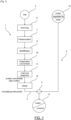
- this diagram represents the block diagram of the steps of a particular implementation of the process of the invention, this diagram comprises two branches, one 1, that of the milk to be treated and filtered, and the other one 2, branch 1 being more detailed than branch 2.
- Branch 2 starts from one of the compounds of group 15 comprising here cream from milk, vegetable fat and water, and a mixture of them.
- the group 15 could comprise other compounds such as synthetic emulsifying agents, gums, structuring elements and even other additives.
- Branch 1 starting from milk 5, comprises the characteristic steps of the process of the invention which apply regardless of the starting compound of branch 2.
- Branch 1 of the milk makes it possible, at the end, to obtain emulsifying milk proteins 3 which are mixed (4), as an emulsifying additive, with a first volume of the starting compound of branch 2 to obtain the culinary cream or the creamer.
- the mixture can be heat treated, particularly by an UHT (ultra high temperature) treatment.
- UHT ultra high temperature
- the milk from tank 5, in this implementation, is skimmed 6.
- the raw cream produced by skimming can be one of said starting compounds from branch 2 when one wants to make dairy cream.
- skimmed milk is then pasteurized 7, then subjected to an ultrafiltration 8 which produces a milk protein retentate.
- the two skimming and pasteurization steps could be inverted and even merged.
- the milk protein retentate is then subjected to evaporation or concentration under vacuum 10, to get a concentrate subjected to a chemical treatment 11 to particularly extract the calcium from the casein micelles but also improve the functionality of the other proteins with casein micelles.
- This chemical treatment could be carried out before filtration.
- this chemical treatment could be undertaken before or after the filtration step, or even during this filtration step and even at the start.
- This chemical treatment is intended to produce a concentrate with a high content of emulsifying milk proteins which, after drying 12, will be mixed, in powder form, with the starting compound of branch 2 of the process, to finally obtain the culinary cream or the creamer with high emulsifying power and without caseinates that was wanted to be manufactured 13.
- the emulsifying proteins could be used as a liquid, without any need of drying.
- the drying step is of interest in case of time lapsed between the treatment and filtration of the milk and the use of the powder, because of warehousing or transport. Then, for the use of it, the powder is rehydrated.
- the chemical treatment can be carried out using acid, chelating agents or by both at the same time, or salts, agents such as Glucono Delta Lactose.
- the transformed milk can advantageously be subjected to a slight neutralization.
- this milk could be partially or totally skimmed, depending on how the question of fat has to be taken care of.
- the milk of branch 1 could also be modified to modify its mineral composition, as explained in the preamble portion of the instant specification.
- the protein ratio of the milk could be modified and, this, at a step before pasteurization 7, a step before vacuum evaporation 10 and steps before or after the chemical treatment 11.
- Milk of tank 16, or milk 16 is skimmed 17 to obtain cream 18, that is directly mixed 4 with the emulsifying milk proteins 3 together with the first volume of the starting compound of branch 2, at just a single mixing step of the process.
- the benefit of this last implementation is to avoid to mix, as a first step, the compounds of tank 15 of branch 2.
- skimmed milk 19, obtained by the skimming step 7 of branch 20 could be added to the skimmed milk obtained by the skimmed milk obtained by the skimming step 6 of branch 1.
- the heat treatment could be carried out at the pasteurization step 7, at a step after the ultrafiltration 8 and at steps before or after the chemical treatment 11, particularly within the range [72°C - 142°C] during a couple of seconds.
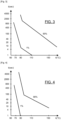
- FIG. 2 and Fig. 3 illustrating a heat treatment of a skimmed milk
- these diagrams have been drawn up by analysing the proteins of the milk one by one, as examples here, the proteins alphalactalbumine and betalactoglobuline. This has been achieved, for instance, by chromatography and electrophoresis.
- the two graphs are defined by an horizontal abscissa axis of the temperature ⁇ , in Celsius degrees, and a vertical ordinate axis of the time duration t, in seconds.
- Denaturation is the modification of the initial molecular structure of the proteins.
- the object of the denaturation is to modify the functions, the power of the proteins for substituting the caseinates.
- the emulsifying milk proteins As a powder, as illustrated in Figure 1 ; it is however possible to use them also in a liquid state to mix them with the cream.
- the cream When starting, in the second branch 2, with liquid vegetable fat, for example vegetable oil and cream, the cream then comes from a volume of milk called third volume of milk, the volume of milk with which it is started in the first branch 1 remaining the said "second volume".
- liquid vegetable fat for example vegetable oil and cream
- the culinary cream or the creamer After having obtained the culinary cream or the creamer, they can be pasteurized or sterilized.
- the chemical treatment of milk can be carried out by Glucono Delta Lactose which is transformed into gluconic acid in an aqueous medium.
- the salts found in the casein micelles are thus solubilized.
- the chemical treatment of milk can also be carried out by salts of phosphates, citrates or their combination.
- the size and volumic mass of the casein micelles are reduced. More particularly, they are reduced from micelles of 200 nm in diameter and the molecular structure of these caseins is altered to increase their covering power. It is even possible to reduce the micelles to the state of monomers and reduce their volumic mass to a few tens of 10 7 g/mole.
- the cream obtained from the skimming machine generally comprises about 40% of fat. By standardization, it could be reduced to 30% of fat. However, those transforming these creams may also reduce them to 30, 25, 20, 15 and even 12% of fat by addition of skimmed milk or because the additions within the formulations lead to a reduction of the rate of fat (due to the dilution with the addition of the other compounds).
- the retentate, or concentrate, or the produced milk protein powder contains fat in a non-negligible quantity to be taken into account for the final fat standardization of the whipping cream or the creamer.
- Fat already within the milk proteins will just be a complement when producing the whipping cream or the creamer.
- a microfiltration is achieved with different modules and provides roughly over 90% of caseins, if pure cow's milk is filtered. Now, if the pure cow's milk is processed in such a way that the microfiltration be less efficient to concentrate micellar caseins, and so keeping more whey proteins, such a microfiltration should be considered as an ultrafiltration.
- the polarization layer can be modified in modifying the pressure and the flow rate of the product to be filtered.
- such a microfiltration looks like an ultrafiltration.
Landscapes
- Engineering & Computer Science (AREA)
- Life Sciences & Earth Sciences (AREA)
- Chemical & Material Sciences (AREA)
- Food Science & Technology (AREA)
- Polymers & Plastics (AREA)
- Health & Medical Sciences (AREA)
- Nutrition Science (AREA)
- Water Supply & Treatment (AREA)
- Dairy Products (AREA)
Priority Applications (2)
| Application Number | Priority Date | Filing Date | Title |
|---|---|---|---|
| EP23215474.0A EP4570073A1 (fr) | 2023-12-11 | 2023-12-11 | Procédé de fabrication sans microfiltration d'une crème culinaire et d'un crémeur |
| PCT/EP2024/084643 WO2025125030A1 (fr) | 2023-12-11 | 2024-12-04 | Procédé de production d'une crème culinaire et d'un colorant à café sans microfiltration |
Applications Claiming Priority (1)
| Application Number | Priority Date | Filing Date | Title |
|---|---|---|---|
| EP23215474.0A EP4570073A1 (fr) | 2023-12-11 | 2023-12-11 | Procédé de fabrication sans microfiltration d'une crème culinaire et d'un crémeur |
Publications (1)
| Publication Number | Publication Date |
|---|---|
| EP4570073A1 true EP4570073A1 (fr) | 2025-06-18 |
Family
ID=89168075
Family Applications (1)
| Application Number | Title | Priority Date | Filing Date |
|---|---|---|---|
| EP23215474.0A Pending EP4570073A1 (fr) | 2023-12-11 | 2023-12-11 | Procédé de fabrication sans microfiltration d'une crème culinaire et d'un crémeur |
Country Status (2)
| Country | Link |
|---|---|
| EP (1) | EP4570073A1 (fr) |
| WO (1) | WO2025125030A1 (fr) |
Citations (4)
| Publication number | Priority date | Publication date | Assignee | Title |
|---|---|---|---|---|
| US20160374360A1 (en) * | 2015-06-29 | 2016-12-29 | Leprino Foods Company | Micellar casein for corree creamers and other dairy products |
| US20180271111A1 (en) * | 2014-08-21 | 2018-09-27 | Perfect Day, Inc. | Compositions comprising a casein and methods of producing the same |
| WO2022147094A1 (fr) * | 2020-12-29 | 2022-07-07 | Whitewave Services, Inc. | Colorant à café à base de lait à faible teneur en glucides |
| US20220346397A1 (en) * | 2019-06-19 | 2022-11-03 | Fonterra Co-Operative Group Limited | Dairy product and process |
-
2023
- 2023-12-11 EP EP23215474.0A patent/EP4570073A1/fr active Pending
-
2024
- 2024-12-04 WO PCT/EP2024/084643 patent/WO2025125030A1/fr active Pending
Patent Citations (4)
| Publication number | Priority date | Publication date | Assignee | Title |
|---|---|---|---|---|
| US20180271111A1 (en) * | 2014-08-21 | 2018-09-27 | Perfect Day, Inc. | Compositions comprising a casein and methods of producing the same |
| US20160374360A1 (en) * | 2015-06-29 | 2016-12-29 | Leprino Foods Company | Micellar casein for corree creamers and other dairy products |
| US20220346397A1 (en) * | 2019-06-19 | 2022-11-03 | Fonterra Co-Operative Group Limited | Dairy product and process |
| WO2022147094A1 (fr) * | 2020-12-29 | 2022-07-07 | Whitewave Services, Inc. | Colorant à café à base de lait à faible teneur en glucides |
Non-Patent Citations (3)
| Title |
|---|
| DATABASE GNPD [online] MINTEL; 11 August 2023 (2023-08-11), ANONYMOUS: "Coffee Creamer Powder", XP093165713, retrieved from https://www.gnpd.com/sinatra/recordpage/11029830/ Database accession no. 11029830 * |
| DATABASE GNPD [online] MINTEL; 5 October 2022 (2022-10-05), ANONYMOUS: "Organic Fresh Whipping Cream", XP093041293, retrieved from https://www.gnpd.com/sinatra/recordpage/9954114/ Database accession no. 9954114 * |
| LAZZARO FANNY ET AL: "Gradual disaggregation of the casein micelle improves its emulsifying capacity and decreases the stability of dairy emulsions", FOOD HYDROCOLLOIDS, ELSEVIER BV, NL, vol. 63, 28 August 2016 (2016-08-28), pages 189 - 200, XP029811739, ISSN: 0268-005X, DOI: 10.1016/J.FOODHYD.2016.08.037 * |
Also Published As
| Publication number | Publication date |
|---|---|
| WO2025125030A1 (fr) | 2025-06-19 |
Similar Documents
| Publication | Publication Date | Title |
|---|---|---|
| EP1677613B1 (fr) | Stabilisateurs utiles dans la production d'une pate a tartiner a faible teneur en gras | |
| McDonough et al. | Composition and properties of whey protein concentrates from ultrafiltration | |
| KR100227762B1 (ko) | 무지 크림 치즈 제품 및 그의 제조 방법 | |
| US4018752A (en) | Ultrafiltration process for the recovery of proteins from milk | |
| DE60010940T2 (de) | Verfahren zum Zugeben von Molkeprotein in Käse | |
| US5494696A (en) | Partially denatured whey protein product | |
| US4188411A (en) | Method of preparing a protein-enriched unripened cheese composition | |
| US5064660A (en) | Method of making ultra low-fat cheese and resulting products | |
| JP7575609B2 (ja) | クリームチーズの製造方法 | |
| IE54657B1 (en) | A process for increasing the capacity of systems for membrane filtration of milk or milk products | |
| US4978553A (en) | Method of making low-fat butter or margarine spread and resulting product | |
| JPH03251143A (ja) | 牛乳脂肪球皮膜の製造法 | |
| EP0603981B1 (fr) | Procédé de préparation d'une émulsion dont la viscosité est ajustable; l'émulsion ainsi préparée et aliment obtenu en utilisant cette émulsion | |
| JPH09238614A (ja) | ホエーの調製方法 | |
| EP4570073A1 (fr) | Procédé de fabrication sans microfiltration d'une crème culinaire et d'un crémeur | |
| US4375485A (en) | Process for preparing whipping cream and whipping cream products | |
| DE60115201T2 (de) | Verfahren zum Zugeben von Molkeprotein in Lebensmittel | |
| US2119614A (en) | Process for preparing a useful milk serum or whey product | |
| JP2025508557A (ja) | クリームチーズの製造方法 | |
| EP0390947B1 (fr) | Procédé de préparation de beurre ou margarine à faible teneur en matière grasses et produit ainsi obtenu | |
| EP4312572A1 (fr) | Nouveau concentré de globule gras du lait, procédé de production et produits alimentaires le contenant | |
| JP2003213290A (ja) | 二重乳化油脂組成物およびその製造法 | |
| AU773344B2 (en) | Reduced fat whey protein concentrate and method of manufacture | |
| WO2024126358A1 (fr) | Procédé de fabrication d'une crème culinaire et d'un succédané de crème | |
| KR101559448B1 (ko) | 커피 크리머용 우유 단백질의 제조방법 및 이를 이용한 커피 크리머 제조방법 |
Legal Events
| Date | Code | Title | Description |
|---|---|---|---|
| PUAI | Public reference made under article 153(3) epc to a published international application that has entered the european phase |
Free format text: ORIGINAL CODE: 0009012 |
|
| STAA | Information on the status of an ep patent application or granted ep patent |
Free format text: STATUS: REQUEST FOR EXAMINATION WAS MADE |
|
| 17P | Request for examination filed |
Effective date: 20241107 |
|
| AK | Designated contracting states |
Kind code of ref document: A1 Designated state(s): AL AT BE BG CH CY CZ DE DK EE ES FI FR GB GR HR HU IE IS IT LI LT LU LV MC ME MK MT NL NO PL PT RO RS SE SI SK SM TR |