EP4570509A1 - Schichtbildungsverfahren, basismaterialregenerationsverfahren und drucksachenherstellungsverfahren - Google Patents
Schichtbildungsverfahren, basismaterialregenerationsverfahren und drucksachenherstellungsverfahren Download PDFInfo
- Publication number
- EP4570509A1 EP4570509A1 EP23865236.6A EP23865236A EP4570509A1 EP 4570509 A1 EP4570509 A1 EP 4570509A1 EP 23865236 A EP23865236 A EP 23865236A EP 4570509 A1 EP4570509 A1 EP 4570509A1
- Authority
- EP
- European Patent Office
- Prior art keywords
- substrate
- aqueous composition
- coating layer
- printing
- formation method
- Prior art date
- Legal status (The legal status is an assumption and is not a legal conclusion. Google has not performed a legal analysis and makes no representation as to the accuracy of the status listed.)
- Pending
Links
Images


Classifications
-
- B—PERFORMING OPERATIONS; TRANSPORTING
- B41—PRINTING; LINING MACHINES; TYPEWRITERS; STAMPS
- B41M—PRINTING, DUPLICATING, MARKING, OR COPYING PROCESSES; COLOUR PRINTING
- B41M5/00—Duplicating or marking methods; Sheet materials for use therein
- B41M5/0011—Pre-treatment or treatment during printing of the recording material, e.g. heating, irradiating
-
- B—PERFORMING OPERATIONS; TRANSPORTING
- B41—PRINTING; LINING MACHINES; TYPEWRITERS; STAMPS
- B41M—PRINTING, DUPLICATING, MARKING, OR COPYING PROCESSES; COLOUR PRINTING
- B41M3/00—Printing processes to produce particular kinds of printed work, e.g. patterns
- B41M3/006—Patterns of chemical products used for a specific purpose, e.g. pesticides, perfumes, adhesive patterns; use of microencapsulated material; Printing on smoking articles
-
- B—PERFORMING OPERATIONS; TRANSPORTING
- B41—PRINTING; LINING MACHINES; TYPEWRITERS; STAMPS
- B41M—PRINTING, DUPLICATING, MARKING, OR COPYING PROCESSES; COLOUR PRINTING
- B41M5/00—Duplicating or marking methods; Sheet materials for use therein
- B41M5/0023—Digital printing methods characterised by the inks used
-
- B—PERFORMING OPERATIONS; TRANSPORTING
- B41—PRINTING; LINING MACHINES; TYPEWRITERS; STAMPS
- B41M—PRINTING, DUPLICATING, MARKING, OR COPYING PROCESSES; COLOUR PRINTING
- B41M7/00—After-treatment of prints, e.g. heating, irradiating, setting of the ink, protection of the printed stock
- B41M7/0081—After-treatment of prints, e.g. heating, irradiating, setting of the ink, protection of the printed stock using electromagnetic radiation or waves, e.g. ultraviolet radiation, electron beams
-
- B—PERFORMING OPERATIONS; TRANSPORTING
- B41—PRINTING; LINING MACHINES; TYPEWRITERS; STAMPS
- B41M—PRINTING, DUPLICATING, MARKING, OR COPYING PROCESSES; COLOUR PRINTING
- B41M5/00—Duplicating or marking methods; Sheet materials for use therein
- B41M5/50—Recording sheets characterised by the coating used to improve ink, dye or pigment receptivity, e.g. for ink-jet or thermal dye transfer recording
- B41M5/52—Macromolecular coatings
-
- B—PERFORMING OPERATIONS; TRANSPORTING
- B41—PRINTING; LINING MACHINES; TYPEWRITERS; STAMPS
- B41M—PRINTING, DUPLICATING, MARKING, OR COPYING PROCESSES; COLOUR PRINTING
- B41M5/00—Duplicating or marking methods; Sheet materials for use therein
- B41M5/50—Recording sheets characterised by the coating used to improve ink, dye or pigment receptivity, e.g. for ink-jet or thermal dye transfer recording
- B41M5/52—Macromolecular coatings
- B41M5/5209—Coatings prepared by radiation-curing, e.g. using photopolymerisable compositions
-
- B—PERFORMING OPERATIONS; TRANSPORTING
- B41—PRINTING; LINING MACHINES; TYPEWRITERS; STAMPS
- B41M—PRINTING, DUPLICATING, MARKING, OR COPYING PROCESSES; COLOUR PRINTING
- B41M7/00—After-treatment of prints, e.g. heating, irradiating, setting of the ink, protection of the printed stock
- B41M7/0009—Obliterating the printed matter; Non-destructive removal of the ink pattern, e.g. for repetitive use of the support
Definitions
- the present invention relates to a layer formation method for forming a peelable coating layer on a substrate, a substrate regeneration method, and a printed matter production method.
- Such a plastic product that has been subjected to printing or the like is often discarded rather than reused.
- the plastic product breaks down in seawater and becomes microplastics.
- the microplastics are concentrated in the bodies of the marine organisms. At this time, there is concern that when humans ingest such marine organisms as food, it could have an adverse influence on human health.
- Such an issue is not limited to plastics, and may also be an issue with other substrates that have been subjected to printing.
- a recording medium forming method in Patent Literature 1 includes a step of forming, on a surface of a transparent recording medium, a removable film including an adhesive layer containing an ultraviolet-curable component and a substrate layer, and a step of forming an image on a surface of the substrate layer of the removable film.
- a recording medium forming method in the case of reusing the transparent recording medium, an operator irradiates the removable film with ultraviolet light to cure the removable film, thereby decreasing an adhesion force of the removable film to the transparent recording medium, and removing the removable film from the transparent recording medium.
- Patent Literature 1 JP2000-98648A
- the adhesive layer of the removable film is composed of an oil-based composition, adhesion between the transparent recording medium made of a transparent resin film and the adhesive layer is high.
- the adhesive layer is difficult to remove from the transparent recording medium even when irradiated with ultraviolet light during the recycling process. Even when the adhesive layer can be removed from the transparent recording medium, erosion of an adhesive layer component to the transparent recording medium can cause a change in properties of the substrate, and therefore, there is a concern that the transparent recording medium is not able to be reused.
- An object of the present invention is to provide a layer formation method, a substrate regeneration method, and a printed matter production method that can easily enable reuse of a substrate and that reduce risks to people and the environment.
- the ultraviolet curing agent is present in the coating layer formed on the substrate, an operator can irradiate the coating layer with ultraviolet light to cure the layer. As a result, an adhesion force of the layer to the substrate decreases, and therefore, the operator can peel off the layer from the substrate and reuse the substrate. Since the peelable coating layer is a layer made from an aqueous composition, the risks to people and the environment can be reduced. Moreover, even in the case where the coating layer is formed on a substrate such as a plastic, adhesion between the coating layer and the substrate can be appropriately controlled, and excessive adhesion can be reduced.
- the layer can be easily peeled off from the substrate by irradiating the layer with ultraviolet light. Therefore, the substrate can be easily reused.
- a change in properties of the substrate is prevented, reusability of the substrate after the layer is peeled off from the substrate can be improved. Therefore, printing can be performed on a wide variety of substrates, including plastics, and the recyclability after printing can be improved.
- the aqueous composition may be ejected onto the substrate by an inkjet head.
- the coating layer can be easily formed on the substrate.
- the coating layer may be a printing layer.
- the printing layer is formed by forming the coating layer on the substrate, an extra coating layer can be reduced.
- the coating layer can be formed locally, traces of the aqueous composition can be reduced.
- the aqueous composition may be an aqueous ink containing a coloring material.
- the application step may be a printing step of applying or ejecting the aqueous ink onto the substrate.
- the application step plays a role of executing printing using the aqueous ink. Therefore, since an image is formed by forming the coating layer on the substrate, the printing is easier than a case where a step of forming an image is carried out after a step of forming a coating layer on a surface of a substrate.
- the aqueous composition is peeled off from the substrate by irradiation with ultraviolet light, thereby playing a role of removing an aqueous ink from the substrate. Therefore, it is possible to provide a layer formation method that is environmentally friendly and that enables the substrate to be recycled while having a shortened printing time.
- the above layer formation method may further include a printing step of ejecting or applying a printing ink onto the coating layer obtained by application or ejection onto the substrate.
- the drying step may be executed after the printing step or between the application step and the printing step.
- the aqueous composition plays a role of a base for printing using a printing ink in the printing step.
- the aqueous composition is peeled off from the substrate together with a printing ink layer by irradiation with ultraviolet light, thereby playing a role of removing the printing ink layer from the substrate. Therefore, it is possible to provide a layer formation method that is environmentally friendly and that enables the substrate to be recycled.
- the drying step may be a step of drying the aqueous composition applied or ejected onto the substrate in the application step at a temperature in a range of 50°C to 220°C.
- the adhesion of the aqueous composition to the substrate can be improved.
- the drying step may be a step of drying the aqueous composition applied or ejected onto the substrate in the application step at a temperature in a range of 50°C to 150°C.
- a film forming property of a resin component in the aqueous composition is improved, the adhesion to the substrate is appropriately controlled, and a curing performance of an ultraviolet curing component can be maintained. Therefore, peelability of a layer made from the aqueous composition can be improved during the subsequent recycling process.
- the aqueous composition may contain a photopolymerization initiator and a polymerizable compound as the ultraviolet curing agent.
- the photopolymerization initiator and the polymerizable compound may be in a state of being dissolved in the water.
- the photopolymerization initiator and the polymerizable compound are in a state of being dissolved in the water, risks to people and the environment can be reduced than a case of using an oil-based ultraviolet curing agent not soluble in water.
- the aqueous composition may contain a resin component for forming the layer.
- the aqueous composition may be in an emulsion state where the resin component is dispersed in the water.
- the resin component is likely to be uniformly fixed to the substrate.
- the substrate may be a non-permeable substrate.
- the resin component in the aqueous composition is prevented from permeating the substrate. Therefore, in a recycling process for a printed matter formed by using the above layer formation method, the coating layer can be easily removed by irradiating the printed matter with ultraviolet light.
- the substrate may be a transparent substrate.
- the resin component in the aqueous composition is prevented from permeating the transparent substrate. Therefore, in the recycling process for the printed matter formed by using the above layer formation method, the coating layer can be easily removed by irradiating the printed matter with ultraviolet light.
- a substrate regeneration method includes an irradiation step of irradiating the coating layer formed by using the above layer formation method with ultraviolet light having a peak wavelength in a range of 200 nm to 400 nm.
- the adhesion force of the coating layer to the substrate decreases, and therefore the coating layer can be easily peeled off from the substrate. Therefore, the substrate can be easily recycled.
- damage to the substrate during the recycling process can be prevented, and the number of times the substrate can be regenerated can be increased.
- a substrate regeneration method includes: an irradiation step of irradiating the coating layer formed by using the above layer formation method with ultraviolet light having a peak wavelength in a range of 350 nm to 400 nm.
- the adhesion force of the coating layer to the substrate decreases, and therefore the coating layer can be easily peeled off from the substrate. Therefore, the substrate can be easily recycled.
- the damage to the substrate during the recycling process can be prevented, and the number of times the substrate can be regenerated can be increased.
- a surface of the substrate on which the coating layer is formed may be irradiated with the ultraviolet light.
- the ultraviolet curing agent in the film makes it easier to cure the film, the peelability of the film from the substrate can be improved.
- a back surface of the substrate opposite to a surface of the substrate on which the coating layer is formed may be irradiated with the ultraviolet light.
- the ultraviolet curing agent present in the film can cure the film while deterioration of the surface of the substrate on which the coating layer is formed is prevented.
- a printed matter production method includes: an application step of applying or ejecting an aqueous composition containing an ultraviolet curing agent and water onto a substrate; and a drying step of drying the aqueous composition applied or ejected onto the substrate, in which a printing layer, which is peelable from the substrate, is formed on the substrate using the aqueous composition.
- the ultraviolet curing agent is present in the printing layer formed on the substrate, an operator can irradiate the printing layer with ultraviolet light to cure the printing layer. As a result, an adhesion force of the printing layer to the substrate decreases, and therefore, the operator can peel off the printing layer from the substrate and reuse the substrate. Since the peelable printing layer is made from an aqueous composition, the risks to people and the environment can be reduced. Moreover, even in the case where the printing layer is formed on a substrate such as a plastic, adhesion between the printing layer and the substrate can be appropriately controlled, and excessive adhesion can be reduced.
- the printing layer can be easily peeled off from the substrate by irradiating the printing layer with ultraviolet light. Therefore, the substrate can be easily reused.
- a change in properties of the substrate can be prevented, reusability of the substrate after the printing layer is peeled off from the substrate can be improved. Therefore, printing can be performed on a wide variety of substrates, including plastics, and the recyclability after printing can be improved.
- a peelable printing layer is formed on the substrate using the aqueous composition containing an ultraviolet curing agent and water
- a peelable printing layer is formed on the substrate using the aqueous composition containing an ultraviolet curing agent and water
- the aqueous composition may contain a photopolymerization initiator and a polymerizable compound as the ultraviolet curing agent.
- the photopolymerization initiator and the polymerizable compound may be in a state of being dissolved in the water.
- the photopolymerization initiator and the polymerizable compound are in a state of being dissolved in the water, risks to people and the environment can be reduced than a case of using an oil-based ultraviolet curing agent not soluble in water.
- the aqueous composition may contain a resin component, and may be in an emulsion state where the resin component is dispersed in the water.
- the resin component is likely to be uniformly fixed to the substrate.
- the substrate may be a transparent non-permeable substrate.
- the aqueous composition can be prevented from permeating the transparent substrate during the printing process, and the aqueous composition can be easily removed by irradiating the printed matter produced by using the printed matter production method with ultraviolet light in the subsequent recycling process.
- the layer formation method, the substrate regeneration method, and the printed matter production method according to the present invention can easily enable reuse of the substrate, can improve the reusability of the substrate, and can reduce the risks to people and the environment.
- the present embodiment is merely one embodiment of the present invention, and it is needless to say that the embodiment can be modified without changing the gist of the present invention.
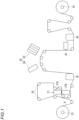
- an image recording apparatus 10 to be used in a layer formation method and a printed matter production method includes, in a housing (not shown), a supply roll 23, a plurality of conveying shafts 26, a web cleaner 27, a tension controller 28, a recording unit 29, a heater 35, a tension controller 36, and a rewinder 24.
- the image recording apparatus 10 records an image on a sheet 6.
- the sheet 6 is an example of a substrate.
- the sheet 6 is a sheet cut to a predetermined dimension.
- the sheet 6 is a transparent non-permeable substrate.
- the non-permeable substrate is a substrate that has a surface having low water permeability.
- the non-permeable substrate refers to a substrate having a water absorption amount of 10 mL/m 2 or less from the start of contact to 30 msec 1/2 in a Bristow method.
- the "non-permeable or low-permeable” may refer to a water absorption rate of less than 0.5% in 24 hours measured in accordance with ASTM D570.
- the "non-permeable” may refer to a water absorption rate of less than 0.2%, and the “low-permeable” may refer to a water absorption rate of 0.2% or more and less than 0.5%.
- the unit “%" of the water absorption rate is based on mass.
- a material of the transparent non-permeable substrate include plastics (for example, a polypropylene, a polyethylene, a polyethylene terephthalate, a polyvinyl chloride resin, and a polycarbonate).
- the transparent non-permeable substrate is suitably in the form of a film or a plate. Note that, the non-permeable substrate may not be transparent.
- the sheet 6 may be a permeable substrate.
- the sheet 6 may be one drawn from a roll in which the sheet is wound in a cylindrical shape, or may be of a fanfold type.
- the permeable substrate include plain paper and coated paper.
- the "coated paper” refers to, for example, one obtained by applying a coating agent to plain paper made from pulp, such as high-grade printing paper or medium-grade printing paper to improve smoothness, whiteness, glossiness, and the like. Specific examples thereof include high-quality coated paper and medium-quality coated paper.
- the supply roll 23 is located at a lower portion of the housing.
- the sheet 6 is wound around the supply roll 23.
- the supply roll 23 is rotated by a motor (not shown).
- the rotating supply roll 23 feeds the sheet 6 onto the plurality of conveying shafts 26.
- the plurality of conveying shafts 26 are rotated by a motor (not shown).
- the plurality of rotating conveying shafts 26 convey the sheet 6 fed out from the supply roll 23.
- the web cleaner 27 is located upstream of the recording unit 29 in a conveying direction of the sheet 6.
- the web cleaner 27 includes a rubber roller 27A and an adhesive roller 27B.
- the web cleaner 27 captures dust adhering to the sheet 6 with the rubber roller 27A and transfers the dust to the adhesive roller 27B, thereby cleaning the sheet 6.
- the tension controller 28 is located upstream of the recording unit 29 in the conveying direction of the sheet 6.
- the tension controller 28 adjusts a tension applied to the sheet 6.
- the recording unit 29 includes a printing head 34 (an example of an inkjet head) and a printing head 33.
- the printing head 34 is located downstream of the tension controller 28 in the conveying direction of the sheet 6.
- the printing head 34 may be a so-called serial head, or a so-called line head.
- the printing head 34 has a flow path therein through which an aqueous composition to be described later flows.
- the flow path is in communication with a tank through a tube. That is, the aqueous composition stored in the tank is supplied to the printing head 34 through the tube.
- the printing head 33 is located downstream of the printing head 34 in the conveying direction of the sheet 6.
- the printing head 33 includes inkjet heads for four colors: cyan, magenta, yellow, and black.
- the heater 35 is located downstream of the printing head 33 in the conveying direction of the sheet 6.
- the heater 35 is a so-called halogen heater.
- the heater 35 includes a halogen lamp, which is a heating element that emits infrared light, a reflective plate, and a housing. Through openings in the housing, heat from the halogen lamp and the reflective plate is radiated to the outside or is blocked.
- the heater 35 heats at least one of the sheet 6 passing near the heater 35 and the aqueous composition adhering to the sheet 6.
- the heater 35 heats both the sheet 6 and the aqueous composition.
- a resin component in the aqueous composition to be described later, softens and forms a film on the sheet 6.
- the sheet 6 and the resin component passing near the heater 35 are cooled, and thereby the resin component is solidified. Accordingly, the resin component is fixed to the sheet 6.
- the heater 35 is not limited to a halogen heater, as long as it is capable of heating the sheet 6 or the aqueous composition.
- the heater 35 may be a carbon heater, a dryer, an oven, a belt conveyor oven, or the like.
- the tension controller 36 is located downstream of the heater 35 in the conveying direction of the sheet 6.
- the tension controller 36 adjusts a tension applied to the sheet 6.
- the rewinder 24 is located at the most downstream side of the conveying path.
- the rewinder 24 winds up the sheet 6 conveyed by the plurality of conveying shafts 26.
- the aqueous composition contains an ultraviolet curing agent, a resin component, a coloring material, an organic solvent, a surfactant, and water.
- the aqueous composition is an aqueous ink in which an ultraviolet curing agent, a resin component, a coloring material, and an organic solvent are dissolved in water.
- the ultraviolet curing agent contains a photopolymerization initiator and a polymerizable compound.
- the photopolymerization initiator is a water-soluble compound that causes a polymerization reaction of a polymerizable compound when irradiated with ultraviolet light.
- the photopolymerization initiator is in a state of being dissolved in water.
- the state where the photopolymerization initiator is dissolved in water refers to a state where 1 wt% or more of the photopolymerization initiator is dissolved in 100 g of water.
- Examples of the photopolymerization initiator include lithium phenyl-2,4,6-trimethylbenzoylphosphinate.
- photopolymerization initiator examples include 1-[4-(2-hydroxyethoxy)-phenyl]-2-hydroxy-2-methyl-1-propan-1-one, 2-hydroxy-2-methyl-1-phenyl-propan-1-one, a hydroxyalkylphenone-based initiator, an acetophenone-based initiator, a benzophenone-based initiator, a benzoin-based initiator, a benzoin ether-based initiator, an aminoalkylphenone-based initiator, a xanthone-based initiator, and an oxime-based initiator.
- Examples of the hydroxyalkylphenone-based initiator include 1-hydroxycyclohexyl phenyl ketone and 1-(4-isopropylphenyl)-2-hydroxy-2-methylpropan-1-one.
- Examples of the acetophenone-based initiator include acetophenone, 2,2-diethoxyacetophenone, and p-dimethylaminoacetophenone.
- Examples of the benzophenone-based initiator include benzophenone, 2-chlorobenzophenone, p,p'-dichlorobenzophenone, p,p'-bisdiethylaminobenzophenone, and Michler's ketone.
- benzoin-based initiator and the benzoin ether-based initiator examples include benzoin, benzoin methyl ether, benzoin ethyl ether, benzoin isopropyl ether, benzoin n-propyl ether, benzoin isobutyl ether, and benzoin n-butyl ether.
- a solid content of the photopolymerization initiator in a total amount of ink is, for example, preferably in a range of 0.1 wt% or more and 10.0 wt% or less, more preferably in a range of 0.5 wt% or more and 5.0 wt% or less, and particularly preferably in a range of 0.8 wt% or more and 2.5 wt% or less.
- the polymerizable compound is a water-soluble compound that undergoes a polymerization reaction due to a photopolymerization initiator when irradiated with ultraviolet light.
- the polymerizable compound is in a state of being dissolved in water.
- the state where the polymerizable compound is dissolved in water refers to a state where 1 wt% or more of the polymerizable compound is dissolved in 100 g of water.
- polymerizable compound examples include N,N'-1,2-ethanediylbis ⁇ N-[2-(acryloylamino)ethyl]acrylamide ⁇ , N,N'-(((2-acrylamido-2((3-(buta-1,3-diene-2-ylamino)propoxy-1,3-diyl)bis(oxy))bis(propane-3,1-diyl))diacrylamide, N,N-bis(2-acrylamidoethyl)acrylamide, and N,N'- ⁇ oxybis(2,1-ethanediyloxy-3,1-propanediyl) ⁇ bisacrylamide.
- a solid content of the polymerizable compound in the total amount of ink is, for example, preferably in a range of 1.0 wt% or more and 40.0 wt% or less, more preferably in a range of 2.5 wt% or more and 40.0 wt% or less, and particularly preferably in a range of 5.0 wt% or more and 40 wt% or less.
- the resin component for example, a commercially available product can be used.
- the resin component may contain, for example, styrene and vinyl chloride as a monomer.
- the resin component may be in a state of being dissolved in the aqueous composition or the aqueous composition may be in an emulsion state where the resin component is dispersed as resin particles.
- These resin components may be used alone or in combination of two or more kinds thereof.
- the resin component examples include an acrylic resin, a maleic acid-based ester resin, a vinyl acetate-based resin, a carbonate-based resin, a polycarbonate-based resin, a styrene-based resin, an ethylene-based resin, a polyethylene-based resin, a propylene-based resin, a polypropylene-based resin, a urethane-based resin, a polyurethane-based resin, a polyester-based resin, and a copolymer resin thereof.
- a resin having a glass transition temperature (Tg) in a range of, for example, -30°C or higher and 200°C or lower is used.
- the glass transition temperature (Tg) is more preferably -30°C or higher and 180°C or lower, and still more preferably -30°C or higher and 150°C or lower.
- a commercially available product may be used as the emulsion.
- the commercially available product include "SUPERFLEX (registered trademark) 870" (Tg: 71°C) and “SUPERFLEX (registered trademark) 150" (Tg: 40°C) manufactured by DKS Co., Ltd., "Mowinyl (registered trademark) 6760" (Tg: -28°C) and “Mowinyl (registered trademark) DM774" (Tg: 33°C) manufactured by Japan Coating Resin co., ltd., "POLYZOL (registered trademark) AP-3270N” (Tg: 27°C) manufactured by Showa Denko Materials co., Ltd., and "HILOS-X (registered trademark) KE-1062” (Tg: 112°C) and "HILOS-X (registered trademark) QE-1042” (Tg: 69°C) manufactured by SEIKO PMC CORPORATION.
- the resin component has an average particle diameter, for example, in a range of 30 nm or more and 200 nm or less.
- the average particle diameter can be measured as an arithmetic mean diameter using, for example, a dynamic light scattering particle size distribution analyzer "LB-550" manufactured by Horiba, Ltd.
- a content (R) of the resin component in the total amount of ink is, for example, preferably in a range of 0.1 wt% or more and 30 wt% or less, more preferably in a range of 0.5 wt% or more and 20 wt% or less, and particularly preferably in a range of 1.0 wt% or more and 15.0 wt% or less.
- the resin component may be used alone or in combination of two or more kinds thereof.
- the coloring material is, for example, a pigment that can be dispersed in water by using a resin for pigment dispersion (a resin dispersant).
- a resin for pigment dispersion a resin dispersant
- examples of the coloring material include carbon black, an inorganic pigment, and an organic pigment.
- examples of the carbon black include furnace black, lamp black, acetylene black, and channel black.
- examples of the inorganic pigment include titanium oxide, an iron oxide-based inorganic pigment, and a carbon black-based inorganic pigment.
- organic pigment examples include: azo pigments such as azo lake, an insoluble azo pigment, a condensed azo pigment, and a chelate azo pigment; polycyclic pigments such as a phthalocyanine pigment, a perylene and perinone pigment, an anthraquinone pigment, a quinacridone pigment, a dioxazine pigment, a thioindigo pigment, an isoindolinone pigment, and a quinophthalone pigment; dye lake pigments such as a basic dye lake pigment and an acid dye lake pigment; nitro pigments; nitroso pigments; and aniline black daylight fluorescent pigments.
- azo pigments such as azo lake, an insoluble azo pigment, a condensed azo pigment, and a chelate azo pigment
- polycyclic pigments such as a phthalocyanine pigment, a perylene and perinone pigment, an anthraquinone pigment, a quinacridone pigment, a dioxazin
- a solid content of the coloring material in the total amount of ink is not particularly limited, and can be appropriately determined depending on, for example, a desired optical density or chroma.
- the solid content of the coloring material is, for example, preferably in a range of 0.1 wt% or more and 20.0 wt% or less, and more preferably in a range of 1.0 wt% or more and 15.0 wt% or less.
- the solid content of the coloring material is the weight of the pigment alone, and does not include the weight of the resin component.
- the coloring material may be used alone or in combination of two or more kinds thereof.
- the organic solvent is a solvent uniformly mixed with water when mixed in a ratio of 1:1.
- the organic solvent is not particularly limited, and any solvent can be used.
- examples of the organic solvent include propylene glycol, ethylene glycol, 1,2-butanediol, propylene glycol propyl ether, dipropylene glycol propyl ether, diethylene glycol monobutyl ether, and 1,6-hexanediol. Propylene glycol or 1,2-butanediol is preferred.
- Examples of other organic solvents include: alkyl alcohols having 1 to 4 carbon atoms, such as methyl alcohol, ethyl alcohol, n-propyl alcohol, isopropyl alcohol, n-butyl alcohol, sec-butyl alcohol, and tert-butyl alcohol; alkylene glycols containing an alkylene group having 2 to 6 carbon atoms, such as ethylene glycol, propylene glycol, butylene glycol, triethylene glycol, 1,2,6-hexanetriol, thiodiglycol, hexylene glycol, and diethylene glycol; lower alkyl ethers of alkylene glycols such as glycerin, ethylene glycol monomethyl (or ethyl, propyl, butyl) ether, diethylene glycol monomethyl (or ethyl, propyl, butyl) ether, triethylene glycol monomethyl (or ethyl, propyl, butyl, hexyl) ether
- a content of the organic solvent in the total amount of ink is, for example, preferably in a range of 1 wt% or more and 70 wt% or less, and more preferably in a range of 3 wt% or more and 50 wt% or less.
- the water is preferably ion exchange water or pure water.
- a content of the water in the total amount of ink is, for example, preferably in a range of 15 wt% or more and 95 wt% or less, and more preferably in a range of 25 wt% or more and 85 wt% or less.
- the content of the water may be, for example, the balance except for other components.
- the aqueous composition may further contain an additive known in the related art as necessary.
- the additive include a surfactant, a pH adjuster, a viscosity adjuster, a surface tension adjuster, a preservative, an antifungal agent, a leveling agent, an antifoaming agent, a light stabilizer, an antioxidant, a nozzle drying inhibitor, a polymer component such as an emulsion, and a dye.
- the surfactant may further include a nonionic surfactant.
- a nonionic surfactant for example, a commercially available product may be used.
- Examples of the commercially available product include “OLFINE (registered trademark) E1010", “OLFINE (registered trademark) E1006", and “OLFINE (registered trademark) E1004", which are manufactured by Nissin Chemical co., ltd.
- a content of the nonionic surfactant in the total amount of ink is, for example, 5 wt% or less, 3 wt% or less, or 0.1 wt% to 2 wt%.
- Examples of the viscosity adjuster include polyvinyl alcohol, cellulose, and a water-soluble resin.
- the aqueous composition can be prepared by uniformly mixing, for example, the ultraviolet curing agent, the resin component, the coloring material, the organic solvent, the water, and other additives if necessary by using a method known in the related art, and removing insoluble matters using a filter or the like.
- the aqueous composition is ejected onto the sheet 6.
- a printing step of ejecting the aqueous composition as droplets from the printing head 34 toward an upper surface 6a of the sheet 6 whose tension has been adjusted by the tension controller 28 is executed. Accordingly, a coating layer is formed on the upper surface 6a of the sheet 6.
- the aqueous composition may be applied to the sheet 6.
- the drying step is executed.
- the aqueous composition ejected onto the sheet 6 is dried.
- both the sheet 6 and the aqueous composition passing below openings in the heater 35 are dried by radiant heat from the heater 35.
- a drying temperature is in a range of 40°C to 230°C.
- the drying temperature is more preferably in a range of 50°C to 220°C.
- the drying temperature is particularly preferably in a range of 50°C to 150°C.
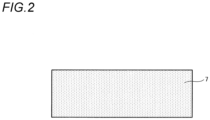
- a coating layer 7 (an example of a printing layer) including a transparent clear layer made from the resin component and the coloring material is fixed on the upper surface 6a of the sheet 6.
- the coating layer 7 contains the ultraviolet curing agent. Note that, the drying step may be omitted. In FIG. 2 , the sheet 6 is omitted for simplification of illustration.
- the "printing” means reproducing characters, pictures, photographs, and the like by selectively applying or ejecting an ink.
- the “printing” includes not only so-called ink jet printing but also screen printing or the like.
- the “printing layer” refers to a layer formed by selectively applying or ejecting an ink.
- the substrate regeneration method is carried out when recycling the sheet 6 after the printed matter 9 is produced by using the layer formation method and the printed matter production method.
- an irradiation step is carried out.
- the upper surface 6a (an example of a surface) of the sheet 6 on which the coating layer 7 is formed is irradiated with ultraviolet light.
- a lower surface 6b (an example of a back surface) of the sheet 6 opposite to the upper surface 6a may be irradiated with ultraviolet light. Accordingly, the coating layer 7 can be cured by using the ultraviolet curing agent present in the coating layer 7 while preventing the deterioration of the upper surface 6a of the sheet 6 on which the coating layer 7 is formed.
- the ultraviolet light for irradiation onto the upper surface 6a of the sheet 6 has a peak wavelength in a range of 200 nm to 400 nm.
- the peak wavelength of the ultraviolet light is more preferably in a range of 300 nm to 400 nm.
- the peak wavelength of the ultraviolet light is particularly preferably in a range of 350 nm to 400 nm.
- the ultraviolet irradiation device for emitting the ultraviolet light is not particularly limited as long as it can emit ultraviolet light having a specific wavelength.
- Examples of the ultraviolet irradiation device include one including a light source such as a metal halide lamp, a high pressure mercury lamp, an extra-high pressure mercury lamp, a deep ultraviolet lamp, an ultraviolet laser, a xenon lamp, and a UV-LED (ultraviolet light emitting diode).
- the ultraviolet irradiation device is preferably one including a UV-LED light source from the viewpoint of power consumption.
- the ultraviolet curing agent is present in the coating layer 7 formed on the upper surface 6a of the sheet 6, an operator can irradiate the coating layer 7 with ultraviolet light to cure the coating layer 7. As a result, the adhesion force of the coating layer 7 to the sheet 6 decreases, and therefore, the operator can peel off the coating layer 7 from the sheet 6 and reuse the sheet 6. Since the peelable coating layer 7 is a coating layer 7 made from an aqueous composition, the risks to people and the environment can be reduced. Moreover, even in the case where the coating layer 7 is formed on the sheet 6 such as a plastic, adhesion between the coating layer 7 and the sheet 6 can be appropriately controlled, and excessive adhesion can be reduced.
- the coating layer 7 can be easily peeled off from the sheet 6 by irradiating the coating layer 7 with ultraviolet light. Therefore, the sheet 6 can be easily reused.
- a change in properties of the sheet 6 can be prevented, reusability of the sheet 6 after the coating layer 7 is peeled off from the sheet 6 can be improved. Therefore, printing can be performed on a wide variety of substrates, including plastics, and the recyclability after printing can be improved.
- the coating layer 7 can be easily formed on the sheet 6.
- a printing layer is formed by forming the coating layer 7 on the sheet 6, an extra coating layer can be reduced.
- the coating layer can be formed locally, traces of the aqueous composition can be reduced.
- the drying step of drying the aqueous composition is carried out after the application step of ejecting the aqueous composition onto the sheet 6, the aqueous composition is easily fixed to the sheet 6. Therefore, the adhesion of the aqueous composition to the sheet 6 is high.
- the application step plays a role of executing printing using the aqueous ink. Therefore, since an image is formed by forming the coating layer 7 on the sheet 6, the printing is easier than a case where a printing step of forming an image is carried out after steps including the application step and the drying step.
- the aqueous composition is peeled off from the sheet 6 by irradiation with ultraviolet light, thereby playing a role of removing an aqueous ink from the substrate. Therefore, it is possible to provide a layer formation method that is environmentally friendly and that enables the substrate to be recycled while having a shortened printing time.
- the aqueous composition plays a role of a base for printing using the printing ink in the printing step.
- the aqueous composition is peeled off from the substrate together with a printing ink layer by irradiation with ultraviolet light, thereby playing a role of removing the printing ink layer from the substrate. Therefore, it is possible to provide a layer formation method that is environmentally friendly and that enables the substrate to be recycled.
- the photopolymerization initiator and the polymerizable compound are in a state of being dissolved in the water, the risks to people and the environment are reduced than a case of using an oil-based ultraviolet curing agent not soluble in water.
- the aqueous composition is in an emulsion state in which the resin component is dispersed in water, when the aqueous composition is dried in the drying step, the resin component is easily uniformly fixed to the sheet 6.
- the coating layer 7 can be easily removed by irradiating the printed matter with ultraviolet light.
- the sheet 6 is a transparent substrate, when the application step is executed, the resin component in the aqueous composition is prevented from permeating the sheet 6. Therefore, in the recycling process for the printed matter produced by using the layer formation method and the printed matter production method, the coating layer 7 can be easily removed by irradiating the printed matter with ultraviolet light.
- the resin component in the layer formation method and the printed matter production method, in the case where the aqueous composition ejected onto the sheet 6 in the application step is dried at a temperature in the range of 50°C to 220°C in the drying step, since the resin component forms a film and adheres to the sheet 6, the resin component has high adhesion to the sheet 6.
- the aqueous composition ejected onto the sheet 6 in the application step is dried at a temperature in the range of 50°C to 150°C in the drying step, a film forming property of the resin component in the aqueous composition is improved, the adhesion to the substrate is appropriately controlled, and a curing performance of an ultraviolet curing component can be maintained in the drying step. Therefore, the adhesion of the coating layer 7 to the sheet 6 is high, and the coating layer 7 has high peelability during the recycling process after the printed matter is produced by using the layer formation method and the printed matter production method.
- the coating layer 7 on the upper surface 6a of the sheet 6 is cured by using the ultraviolet curing agent present in the coating layer 7.
- the adhesion force of the coating layer 7 to the sheet 6 decreases, and the coating layer 7 is easily peeled off from the sheet 6. Therefore, the sheet 6 can be easily recycled.
- the ultraviolet light emitted onto the sheet 6 has a peak wavelength closer to visible light, damage to the sheet 6 is prevented. Compared to a known method of recycling the sheet 6 using a physical method or a chemical method, the damage to the sheet 6 during the recycling process can be prevented, and the number of times the sheet 6 can be regenerated can be increased.
- the coating layer 7 since the surface of the sheet 6 on which the coating layer 7 is formed is irradiated with ultraviolet light in the irradiation step, the coating layer 7 is easily cured by using the ultraviolet curing agent present in the coating layer 7. Therefore, the coating layer 7 has high peelability from the sheet 6.
- the printing step of ejecting the aqueous composition as droplets from the printing head 34 toward the upper surface 6a of the sheet 6 is executed.
- a printing step of ejecting a printing ink onto the coating layer may be further executed.
- the printing ink is ejected from the printing head 33 onto the coating layer, and the aqueous ink serves as a base for the printing using the printing ink.
- the printing ink is not particularly limited as long as an image can be formed on the coating layer.
- the drying step may be executed after the first printing step or may be executed after the second printing step.
- the drying step may be executed both after the first printing step and after the second printing step.
- the drying step may be executed after the aqueous composition is applied or ejected, and then the printing step may be executed.
- the drying step may be executed after the execution of the printing step after the aqueous composition is applied or ejected, or the drying step may be executed after the aqueous composition is applied or ejected, then the printing step may be executed, and the drying step may be executed again.
- the aqueous composition contains a coloring material, but the coloring material may be omitted.
- a transparent coating layer made from a resin component is formed on the sheet 6 in the application step.
- a printing step of ejecting the printing ink onto the coating layer may be executed.
- the aqueous composition plays a role of a base for the printing using the printing ink.
- a coloring material layer 11 made from a coloring material contained in the printing ink is formed on an upper surface 12a of a transparent coating layer 12 free of the coloring material.
- a printing layer is formed by the coating layer 12 and the coloring material layer 11. Note that, in FIG. 4 , the sheet 6 is omitted for simplification of illustration.
- the aqueous composition used was one containing 1.0 wt% of lithium phenyl-2,4,6-trimethylbenzoylphosphinate as a photopolymerization initiator, 5.0 wt% of N,N'-1,2-ethanediylbis ⁇ N-[2-(acryloylamino)ethyl]acrylamide ⁇ as a polymerizable compound, 5.0 wt% of Mowinyl 6760 as a resin component, 10.0 wt% of propylene glycol as an organic solvent, and ion exchange water as a solvent, being the balance.
- the drying temperature in the drying step was set to 90°C. In the irradiation step, irradiation with ultraviolet light was carried out.
- the aqueous composition further contains 5.0 wt% of a carbon black pigment dispersion liquid as a coloring material and 0.5 wt% of OLFINE E1010 as a surfactant.
- the carbon black pigment dispersion liquid was prepared as follows. First, 40 g of carbon black "#2650" manufactured by Mitsubishi Chemical Corporation was mixed with 200 g of ion exchange water, followed by pulverization in a bead mill. A carboxy group agent was added thereto, followed by heating and stirring, and an oxidation treatment was carried out. Next, the obtained liquid was washed several times with a solvent, poured into water, washed again with water, and then filtered through a filter to obtain a carbon black pigment dispersion liquid.
- Example 3 It is different from Example 1 in that a black ink (LC3139 manufactured by Brother Industries, Ltd.) is used.
- a black ink LC3139 manufactured by Brother Industries, Ltd.
- Example 3 after the application step of applying the aqueous composition onto a sheet (substrate), a printing step of applying a black ink as a printing ink onto the coating layer was executed. Note that, the aqueous composition used was the same as that in Example 1.
- Example 1 It is different from Example 1 in that the drying temperature in the drying step was set to 50°C. Other conditions are the same as those in Example 1.
- Example 4 It is different from Example 4 in that the drying temperature in the drying step was set to 60°C. Other conditions are the same as those in Example 4.
- Example 4 It is different from Example 4 in that the drying temperature in the drying step was set to 120°C. Other conditions are the same as those in Example 4.
- Example 4 It is different from Example 4 in that the drying temperature in the drying step was set to 150°C. Other conditions are the same as those in Example 4.
- Example 2 It is the same as Example 1, except that the irradiation step was not carried out.
- aqueous composition further contains 5.0 wt% of carbon black as the coloring material and that the aqueous composition further contains 0.5 wt% of OLFINE E1010 as the surfactant.
- the balance is ion exchange water.
- Other conditions are the same as those in Comparative Example 1.
- Example 1 It is different from Example 1 in that plain paper for printing (Multi-paper Super White+ manufactured by ASKUL Corporation) was used as the sheet 6. Other conditions are the same as those in Example 1.
- the coating layer formed on the sheet using the aqueous composition was tested for fixability and peelability.
- the aqueous composition was dropped onto the upper surface of the sheet using a dropper in an amount of 50 mg/cm 2 , and in the drying step, the aqueous composition on the upper surface of the sheet was dried at a predetermined drying temperature for 3 hours, to form a coating layer made from the aqueous composition on the upper surface of the sheet.
- a fixability test was carried out, in which an adhesive tape was attached to the surface of the coating layer on the sheet and the adhesive tape was peeled off from the coating layer.
- the sheet used was a PET film.
- the sheet used was plain paper for printing (Multi-paper Super White+ manufactured by ASKUL Corporation).
- the adhesive tape used was a cellophane tape [Cellulose Tape (registered trademark) CT-12 (manufactured by NICHIBAN Co., Ltd.)].
- the fixability of the coating layer to the sheet was evaluated according to the following evaluation criteria.
- the sheet was irradiated with ultraviolet light for 10 seconds from an ultraviolet irradiation device at a distance of 100 mm.
- the ultraviolet irradiation device used was a UV-LED light [printing UV-LED series E075Z HC (manufactured by Ushio Inc.), 395 nm]. Thereafter, a peel test was carried out under the following two conditions.
- Condition 1 An adhesive tape was attached to the surface of the sheet and the coating layer after the irradiation with ultraviolet light, and the adhesive tape was peeled off from the coating layer.
- Condition 2 The sheet and the coating layer after the irradiation with ultraviolet light were folded in half and then returned to the original state, then an adhesive tape was attached to the surface of the sheet and the coating layer, and the adhesive tape was peeled off from the coating layer. Note that, when the sheet and the coating layer were folded in half under the condition 2, cracks are generated in the coating layer, and thus the peelability can be improved.
- the adhesive tape used was a cellophane tape [Cellulose Tape (registered trademark) CT-12 (manufactured by NICHIBAN Co., Ltd)]. The peelability of the coating layer to the sheet was evaluated according to the following evaluation criteria.
- Example 4 peeling occurred and therefore the evaluation was B. This is thought to be because the drying temperature in Example 4 was 50°C, which is lower than the other Examples and Comparative Examples 1 and 2, so that the film forming property of the resin component and the adhesion of the resin component to the upper surface of the sheet was lower than those in Examples 1 to 3 and 5 to 7 and Comparative Examples 1 and 2.
- the evaluation for the fixability is A and the evaluation for the peelability is A.
- a drying temperature in the range of 50°C to 150°C is a sufficient drying temperature from the viewpoint of fixability, a coating film is formed and the adhesion can be ensured, and in recycling, the coating layer can be easily peeled off from the sheet by irradiating the coating layer with UV light, allowing the sheet to be recycled.
Landscapes
- Toxicology (AREA)
- Physics & Mathematics (AREA)
- Health & Medical Sciences (AREA)
- Electromagnetism (AREA)
- General Health & Medical Sciences (AREA)
- Chemical & Material Sciences (AREA)
- Chemical Kinetics & Catalysis (AREA)
- General Chemical & Material Sciences (AREA)
- Pest Control & Pesticides (AREA)
- Life Sciences & Earth Sciences (AREA)
- Ink Jet Recording Methods And Recording Media Thereof (AREA)
- Application Of Or Painting With Fluid Materials (AREA)
- Ink Jet (AREA)
Applications Claiming Priority (2)
| Application Number | Priority Date | Filing Date | Title |
|---|---|---|---|
| JP2022145524A JP2024040883A (ja) | 2022-09-13 | 2022-09-13 | 層形成方法、基材再生方法、及び印刷物製造方法 |
| PCT/JP2023/030684 WO2024057879A1 (ja) | 2022-09-13 | 2023-08-25 | 層形成方法、基材再生方法、及び印刷物製造方法 |
Publications (1)
| Publication Number | Publication Date |
|---|---|
| EP4570509A1 true EP4570509A1 (de) | 2025-06-18 |
Family
ID=90274983
Family Applications (1)
| Application Number | Title | Priority Date | Filing Date |
|---|---|---|---|
| EP23865236.6A Pending EP4570509A1 (de) | 2022-09-13 | 2023-08-25 | Schichtbildungsverfahren, basismaterialregenerationsverfahren und drucksachenherstellungsverfahren |
Country Status (4)
| Country | Link |
|---|---|
| US (1) | US20250206055A1 (de) |
| EP (1) | EP4570509A1 (de) |
| JP (1) | JP2024040883A (de) |
| WO (1) | WO2024057879A1 (de) |
Family Cites Families (6)
| Publication number | Priority date | Publication date | Assignee | Title |
|---|---|---|---|---|
| JPH0734041A (ja) * | 1993-07-22 | 1995-02-03 | Sekisui Chem Co Ltd | 粘着シート |
| JPH0939420A (ja) * | 1995-07-25 | 1997-02-10 | Fuji Photo Film Co Ltd | 保護層付与材料 |
| JP2000098648A (ja) * | 1998-09-28 | 2000-04-07 | Canon Inc | 記録媒体、画像形成方法、記録媒体再生方法および画像形成装置、記録媒体再生装置 |
| JP2002129120A (ja) * | 2000-10-23 | 2002-05-09 | Konishi Co Ltd | リサイクル型水性接着剤組成物 |
| JP2002187269A (ja) * | 2000-12-22 | 2002-07-02 | Canon Inc | インクジェット記録方法、インクジェット記録装置、被記録媒体、及び冊子 |
| JP5803728B2 (ja) * | 2011-03-17 | 2015-11-04 | 東洋インキScホールディングス株式会社 | 水性再剥離型粘着剤および再剥離型粘着シート |
-
2022
- 2022-09-13 JP JP2022145524A patent/JP2024040883A/ja active Pending
-
2023
- 2023-08-25 WO PCT/JP2023/030684 patent/WO2024057879A1/ja not_active Ceased
- 2023-08-25 EP EP23865236.6A patent/EP4570509A1/de active Pending
-
2025
- 2025-03-12 US US19/077,439 patent/US20250206055A1/en active Pending
Also Published As
| Publication number | Publication date |
|---|---|
| JP2024040883A (ja) | 2024-03-26 |
| WO2024057879A1 (ja) | 2024-03-21 |
| US20250206055A1 (en) | 2025-06-26 |
Similar Documents
| Publication | Publication Date | Title |
|---|---|---|
| JP4898618B2 (ja) | インクジェット記録方法 | |
| JP3969750B2 (ja) | インクジェット記録用インクセット、それを用いたインクジェット記録方法および記録装置 | |
| JP5187000B2 (ja) | インクジェット記録装置及びインクジェット記録方法 | |
| JP2003292855A (ja) | インクジェット記録用インクおよび画像形成方法 | |
| JP2003342503A (ja) | インクジェット記録用ブラックインクおよび画像形成方法 | |
| US7396122B2 (en) | Image recording device | |
| JP2002187918A (ja) | 水性光硬化型樹脂組成物、水性インク、インクカートリッジ、記録ユニット、インクジェット記録装置及び光重合開始剤 | |
| JP7275467B2 (ja) | インク、インクの製造方法、印刷方法及び印刷装置 | |
| JP2012179825A (ja) | インクジェット記録方法 | |
| JPH07224241A (ja) | インク、及びこれを用いるインクジェット記録方法と機器 | |
| CN104797665A (zh) | 光固化型喷墨印刷用油墨组合物以及印刷物 | |
| JP6414200B2 (ja) | 活性光線硬化型インクジェットマゼンタインクおよびインクジェット記録方法 | |
| US20250206971A1 (en) | Aqueous composition and printed matter | |
| CN104650651A (zh) | 喷墨记录用油墨组合物 | |
| JPWO2006129530A1 (ja) | 紫外線硬化型インクジェットインク、インクジェット記録方法及びインクジェット記録装置 | |
| JP5193740B2 (ja) | インクジェット記録方法及びインクジェット記録装置 | |
| JP2003237217A (ja) | インクジェット記録装置及びインクジェット記録方法 | |
| JP4737259B2 (ja) | インクジェット記録方法、前処理液、インクセット | |
| US20250206055A1 (en) | Layer formation method, substrate regeneration method, and printed matter production method | |
| WO2004104118A1 (ja) | インクジェット記録用インク、インクジェット記録方法および記録物ならびにインクジェット記録装置 | |
| JP2002274004A (ja) | 画像形成方法及びインク組成物 | |
| JP2007321034A (ja) | 紫外線硬化型インクジェット記録用インク組成物 | |
| JP4903529B2 (ja) | インクジェット記録方法及びインクジェット記録装置 | |
| JP2018083352A (ja) | インクジェット記録方法およびインクジェット記録装置 | |
| US20250282166A1 (en) | Layer formation method, substrate regeneration method, and printed matter production method |
Legal Events
| Date | Code | Title | Description |
|---|---|---|---|
| STAA | Information on the status of an ep patent application or granted ep patent |
Free format text: STATUS: THE INTERNATIONAL PUBLICATION HAS BEEN MADE |
|
| PUAI | Public reference made under article 153(3) epc to a published international application that has entered the european phase |
Free format text: ORIGINAL CODE: 0009012 |
|
| STAA | Information on the status of an ep patent application or granted ep patent |
Free format text: STATUS: REQUEST FOR EXAMINATION WAS MADE |
|
| 17P | Request for examination filed |
Effective date: 20250311 |
|
| AK | Designated contracting states |
Kind code of ref document: A1 Designated state(s): AL AT BE BG CH CY CZ DE DK EE ES FI FR GB GR HR HU IE IS IT LI LT LU LV MC ME MK MT NL NO PL PT RO RS SE SI SK SM TR |
|
| P01 | Opt-out of the competence of the unified patent court (upc) registered |
Free format text: CASE NUMBER: UPC_APP_1383_4570509/2025 Effective date: 20250730 |
|
| DAV | Request for validation of the european patent (deleted) | ||
| DAX | Request for extension of the european patent (deleted) |