EP4570862A1 - Flocons d'al2o3 - Google Patents
Flocons d'al2o3 Download PDFInfo
- Publication number
- EP4570862A1 EP4570862A1 EP24219035.3A EP24219035A EP4570862A1 EP 4570862 A1 EP4570862 A1 EP 4570862A1 EP 24219035 A EP24219035 A EP 24219035A EP 4570862 A1 EP4570862 A1 EP 4570862A1
- Authority
- EP
- European Patent Office
- Prior art keywords
- tio
- flake
- flakes
- sio
- coated
- Prior art date
- Legal status (The legal status is an assumption and is not a legal conclusion. Google has not performed a legal analysis and makes no representation as to the accuracy of the status listed.)
- Pending
Links
Images
Classifications
-
- C—CHEMISTRY; METALLURGY
- C09—DYES; PAINTS; POLISHES; NATURAL RESINS; ADHESIVES; COMPOSITIONS NOT OTHERWISE PROVIDED FOR; APPLICATIONS OF MATERIALS NOT OTHERWISE PROVIDED FOR
- C09C—TREATMENT OF INORGANIC MATERIALS, OTHER THAN FIBROUS FILLERS, TO ENHANCE THEIR PIGMENTING OR FILLING PROPERTIES ; PREPARATION OF CARBON BLACK ; PREPARATION OF INORGANIC MATERIALS WHICH ARE NO SINGLE CHEMICAL COMPOUNDS AND WHICH ARE MAINLY USED AS PIGMENTS OR FILLERS
- C09C1/00—Treatment of specific inorganic materials other than fibrous fillers; Preparation of carbon black
- C09C1/0015—Pigments exhibiting interference colours, e.g. transparent platelets of appropriate thinness or flaky substrates, e.g. mica, bearing appropriate thin transparent coatings
- C09C1/0018—Pigments exhibiting interference colours, e.g. transparent platelets of appropriate thinness or flaky substrates, e.g. mica, bearing appropriate thin transparent coatings uncoated and unlayered plate-like particles
-
- A—HUMAN NECESSITIES
- A61—MEDICAL OR VETERINARY SCIENCE; HYGIENE
- A61K—PREPARATIONS FOR MEDICAL, DENTAL OR TOILETRY PURPOSES
- A61K8/00—Cosmetics or similar toiletry preparations
- A61K8/18—Cosmetics or similar toiletry preparations characterised by the composition
- A61K8/19—Cosmetics or similar toiletry preparations characterised by the composition containing inorganic ingredients
-
- C—CHEMISTRY; METALLURGY
- C01—INORGANIC CHEMISTRY
- C01F—COMPOUNDS OF THE METALS BERYLLIUM, MAGNESIUM, ALUMINIUM, CALCIUM, STRONTIUM, BARIUM, RADIUM, THORIUM, OR OF THE RARE-EARTH METALS
- C01F7/00—Compounds of aluminium
- C01F7/02—Aluminium oxide; Aluminium hydroxide; Aluminates
-
- C—CHEMISTRY; METALLURGY
- C09—DYES; PAINTS; POLISHES; NATURAL RESINS; ADHESIVES; COMPOSITIONS NOT OTHERWISE PROVIDED FOR; APPLICATIONS OF MATERIALS NOT OTHERWISE PROVIDED FOR
- C09C—TREATMENT OF INORGANIC MATERIALS, OTHER THAN FIBROUS FILLERS, TO ENHANCE THEIR PIGMENTING OR FILLING PROPERTIES ; PREPARATION OF CARBON BLACK ; PREPARATION OF INORGANIC MATERIALS WHICH ARE NO SINGLE CHEMICAL COMPOUNDS AND WHICH ARE MAINLY USED AS PIGMENTS OR FILLERS
- C09C1/00—Treatment of specific inorganic materials other than fibrous fillers; Preparation of carbon black
- C09C1/0015—Pigments exhibiting interference colours, e.g. transparent platelets of appropriate thinness or flaky substrates, e.g. mica, bearing appropriate thin transparent coatings
-
- C—CHEMISTRY; METALLURGY
- C09—DYES; PAINTS; POLISHES; NATURAL RESINS; ADHESIVES; COMPOSITIONS NOT OTHERWISE PROVIDED FOR; APPLICATIONS OF MATERIALS NOT OTHERWISE PROVIDED FOR
- C09C—TREATMENT OF INORGANIC MATERIALS, OTHER THAN FIBROUS FILLERS, TO ENHANCE THEIR PIGMENTING OR FILLING PROPERTIES ; PREPARATION OF CARBON BLACK ; PREPARATION OF INORGANIC MATERIALS WHICH ARE NO SINGLE CHEMICAL COMPOUNDS AND WHICH ARE MAINLY USED AS PIGMENTS OR FILLERS
- C09C1/00—Treatment of specific inorganic materials other than fibrous fillers; Preparation of carbon black
- C09C1/0015—Pigments exhibiting interference colours, e.g. transparent platelets of appropriate thinness or flaky substrates, e.g. mica, bearing appropriate thin transparent coatings
- C09C1/0021—Pigments exhibiting interference colours, e.g. transparent platelets of appropriate thinness or flaky substrates, e.g. mica, bearing appropriate thin transparent coatings comprising a core coated with only one layer having a high or low refractive index
-
- C—CHEMISTRY; METALLURGY
- C09—DYES; PAINTS; POLISHES; NATURAL RESINS; ADHESIVES; COMPOSITIONS NOT OTHERWISE PROVIDED FOR; APPLICATIONS OF MATERIALS NOT OTHERWISE PROVIDED FOR
- C09C—TREATMENT OF INORGANIC MATERIALS, OTHER THAN FIBROUS FILLERS, TO ENHANCE THEIR PIGMENTING OR FILLING PROPERTIES ; PREPARATION OF CARBON BLACK ; PREPARATION OF INORGANIC MATERIALS WHICH ARE NO SINGLE CHEMICAL COMPOUNDS AND WHICH ARE MAINLY USED AS PIGMENTS OR FILLERS
- C09C1/00—Treatment of specific inorganic materials other than fibrous fillers; Preparation of carbon black
- C09C1/0015—Pigments exhibiting interference colours, e.g. transparent platelets of appropriate thinness or flaky substrates, e.g. mica, bearing appropriate thin transparent coatings
- C09C1/0024—Pigments exhibiting interference colours, e.g. transparent platelets of appropriate thinness or flaky substrates, e.g. mica, bearing appropriate thin transparent coatings comprising a stack of coating layers with alternating high and low refractive indices, wherein the first coating layer on the core surface has the high refractive index
-
- C—CHEMISTRY; METALLURGY
- C09—DYES; PAINTS; POLISHES; NATURAL RESINS; ADHESIVES; COMPOSITIONS NOT OTHERWISE PROVIDED FOR; APPLICATIONS OF MATERIALS NOT OTHERWISE PROVIDED FOR
- C09C—TREATMENT OF INORGANIC MATERIALS, OTHER THAN FIBROUS FILLERS, TO ENHANCE THEIR PIGMENTING OR FILLING PROPERTIES ; PREPARATION OF CARBON BLACK ; PREPARATION OF INORGANIC MATERIALS WHICH ARE NO SINGLE CHEMICAL COMPOUNDS AND WHICH ARE MAINLY USED AS PIGMENTS OR FILLERS
- C09C1/00—Treatment of specific inorganic materials other than fibrous fillers; Preparation of carbon black
- C09C1/0015—Pigments exhibiting interference colours, e.g. transparent platelets of appropriate thinness or flaky substrates, e.g. mica, bearing appropriate thin transparent coatings
- C09C1/0024—Pigments exhibiting interference colours, e.g. transparent platelets of appropriate thinness or flaky substrates, e.g. mica, bearing appropriate thin transparent coatings comprising a stack of coating layers with alternating high and low refractive indices, wherein the first coating layer on the core surface has the high refractive index
- C09C1/003—Pigments exhibiting interference colours, e.g. transparent platelets of appropriate thinness or flaky substrates, e.g. mica, bearing appropriate thin transparent coatings comprising a stack of coating layers with alternating high and low refractive indices, wherein the first coating layer on the core surface has the high refractive index comprising at least one light-absorbing layer
- C09C1/0039—Pigments exhibiting interference colours, e.g. transparent platelets of appropriate thinness or flaky substrates, e.g. mica, bearing appropriate thin transparent coatings comprising a stack of coating layers with alternating high and low refractive indices, wherein the first coating layer on the core surface has the high refractive index comprising at least one light-absorbing layer consisting of at least one coloured inorganic material
-
- C—CHEMISTRY; METALLURGY
- C09—DYES; PAINTS; POLISHES; NATURAL RESINS; ADHESIVES; COMPOSITIONS NOT OTHERWISE PROVIDED FOR; APPLICATIONS OF MATERIALS NOT OTHERWISE PROVIDED FOR
- C09C—TREATMENT OF INORGANIC MATERIALS, OTHER THAN FIBROUS FILLERS, TO ENHANCE THEIR PIGMENTING OR FILLING PROPERTIES ; PREPARATION OF CARBON BLACK ; PREPARATION OF INORGANIC MATERIALS WHICH ARE NO SINGLE CHEMICAL COMPOUNDS AND WHICH ARE MAINLY USED AS PIGMENTS OR FILLERS
- C09C1/00—Treatment of specific inorganic materials other than fibrous fillers; Preparation of carbon black
- C09C1/0015—Pigments exhibiting interference colours, e.g. transparent platelets of appropriate thinness or flaky substrates, e.g. mica, bearing appropriate thin transparent coatings
- C09C1/0051—Pigments exhibiting interference colours, e.g. transparent platelets of appropriate thinness or flaky substrates, e.g. mica, bearing appropriate thin transparent coatings comprising a stack of coating layers with alternating low and high refractive indices, wherein the first coating layer on the core surface has the low refractive index
-
- C—CHEMISTRY; METALLURGY
- C09—DYES; PAINTS; POLISHES; NATURAL RESINS; ADHESIVES; COMPOSITIONS NOT OTHERWISE PROVIDED FOR; APPLICATIONS OF MATERIALS NOT OTHERWISE PROVIDED FOR
- C09C—TREATMENT OF INORGANIC MATERIALS, OTHER THAN FIBROUS FILLERS, TO ENHANCE THEIR PIGMENTING OR FILLING PROPERTIES ; PREPARATION OF CARBON BLACK ; PREPARATION OF INORGANIC MATERIALS WHICH ARE NO SINGLE CHEMICAL COMPOUNDS AND WHICH ARE MAINLY USED AS PIGMENTS OR FILLERS
- C09C1/00—Treatment of specific inorganic materials other than fibrous fillers; Preparation of carbon black
- C09C1/0015—Pigments exhibiting interference colours, e.g. transparent platelets of appropriate thinness or flaky substrates, e.g. mica, bearing appropriate thin transparent coatings
- C09C1/0051—Pigments exhibiting interference colours, e.g. transparent platelets of appropriate thinness or flaky substrates, e.g. mica, bearing appropriate thin transparent coatings comprising a stack of coating layers with alternating low and high refractive indices, wherein the first coating layer on the core surface has the low refractive index
- C09C1/0057—Pigments exhibiting interference colours, e.g. transparent platelets of appropriate thinness or flaky substrates, e.g. mica, bearing appropriate thin transparent coatings comprising a stack of coating layers with alternating low and high refractive indices, wherein the first coating layer on the core surface has the low refractive index comprising at least one light-absorbing layer
- C09C1/0066—Pigments exhibiting interference colours, e.g. transparent platelets of appropriate thinness or flaky substrates, e.g. mica, bearing appropriate thin transparent coatings comprising a stack of coating layers with alternating low and high refractive indices, wherein the first coating layer on the core surface has the low refractive index comprising at least one light-absorbing layer consisting of at least one coloured inorganic material
-
- C—CHEMISTRY; METALLURGY
- C09—DYES; PAINTS; POLISHES; NATURAL RESINS; ADHESIVES; COMPOSITIONS NOT OTHERWISE PROVIDED FOR; APPLICATIONS OF MATERIALS NOT OTHERWISE PROVIDED FOR
- C09D—COATING COMPOSITIONS, e.g. PAINTS, VARNISHES OR LACQUERS; FILLING PASTES; CHEMICAL PAINT OR INK REMOVERS; INKS; CORRECTING FLUIDS; WOODSTAINS; PASTES OR SOLIDS FOR COLOURING OR PRINTING; USE OF MATERIALS THEREFOR
- C09D11/00—Inks
- C09D11/02—Printing inks
- C09D11/03—Printing inks characterised by features other than the chemical nature of the binder
- C09D11/037—Printing inks characterised by features other than the chemical nature of the binder characterised by the pigment
-
- C—CHEMISTRY; METALLURGY
- C09—DYES; PAINTS; POLISHES; NATURAL RESINS; ADHESIVES; COMPOSITIONS NOT OTHERWISE PROVIDED FOR; APPLICATIONS OF MATERIALS NOT OTHERWISE PROVIDED FOR
- C09D—COATING COMPOSITIONS, e.g. PAINTS, VARNISHES OR LACQUERS; FILLING PASTES; CHEMICAL PAINT OR INK REMOVERS; INKS; CORRECTING FLUIDS; WOODSTAINS; PASTES OR SOLIDS FOR COLOURING OR PRINTING; USE OF MATERIALS THEREFOR
- C09D5/00—Coating compositions, e.g. paints, varnishes or lacquers, characterised by their physical nature or the effects produced; Filling pastes
- C09D5/36—Pearl essence, e.g. coatings containing platelet-like pigments for pearl lustre
-
- C—CHEMISTRY; METALLURGY
- C09—DYES; PAINTS; POLISHES; NATURAL RESINS; ADHESIVES; COMPOSITIONS NOT OTHERWISE PROVIDED FOR; APPLICATIONS OF MATERIALS NOT OTHERWISE PROVIDED FOR
- C09D—COATING COMPOSITIONS, e.g. PAINTS, VARNISHES OR LACQUERS; FILLING PASTES; CHEMICAL PAINT OR INK REMOVERS; INKS; CORRECTING FLUIDS; WOODSTAINS; PASTES OR SOLIDS FOR COLOURING OR PRINTING; USE OF MATERIALS THEREFOR
- C09D7/00—Features of coating compositions, not provided for in group C09D5/00; Processes for incorporating ingredients in coating compositions
- C09D7/40—Additives
- C09D7/60—Additives non-macromolecular
- C09D7/61—Additives non-macromolecular inorganic
- C09D7/62—Additives non-macromolecular inorganic modified by treatment with other compounds
-
- C—CHEMISTRY; METALLURGY
- C09—DYES; PAINTS; POLISHES; NATURAL RESINS; ADHESIVES; COMPOSITIONS NOT OTHERWISE PROVIDED FOR; APPLICATIONS OF MATERIALS NOT OTHERWISE PROVIDED FOR
- C09D—COATING COMPOSITIONS, e.g. PAINTS, VARNISHES OR LACQUERS; FILLING PASTES; CHEMICAL PAINT OR INK REMOVERS; INKS; CORRECTING FLUIDS; WOODSTAINS; PASTES OR SOLIDS FOR COLOURING OR PRINTING; USE OF MATERIALS THEREFOR
- C09D7/00—Features of coating compositions, not provided for in group C09D5/00; Processes for incorporating ingredients in coating compositions
- C09D7/40—Additives
- C09D7/70—Additives characterised by shape, e.g. fibres, flakes or microspheres
-
- C—CHEMISTRY; METALLURGY
- C01—INORGANIC CHEMISTRY
- C01P—INDEXING SCHEME RELATING TO STRUCTURAL AND PHYSICAL ASPECTS OF SOLID INORGANIC COMPOUNDS
- C01P2002/00—Crystal-structural characteristics
- C01P2002/50—Solid solutions
- C01P2002/52—Solid solutions containing elements as dopants
-
- C—CHEMISTRY; METALLURGY
- C01—INORGANIC CHEMISTRY
- C01P—INDEXING SCHEME RELATING TO STRUCTURAL AND PHYSICAL ASPECTS OF SOLID INORGANIC COMPOUNDS
- C01P2004/00—Particle morphology
- C01P2004/20—Particle morphology extending in two dimensions, e.g. plate-like
- C01P2004/24—Nanoplates, i.e. plate-like particles with a thickness from 1-100 nanometer
-
- C—CHEMISTRY; METALLURGY
- C01—INORGANIC CHEMISTRY
- C01P—INDEXING SCHEME RELATING TO STRUCTURAL AND PHYSICAL ASPECTS OF SOLID INORGANIC COMPOUNDS
- C01P2004/00—Particle morphology
- C01P2004/54—Particles characterised by their aspect ratio, i.e. the ratio of sizes in the longest to the shortest dimension
-
- C—CHEMISTRY; METALLURGY
- C01—INORGANIC CHEMISTRY
- C01P—INDEXING SCHEME RELATING TO STRUCTURAL AND PHYSICAL ASPECTS OF SOLID INORGANIC COMPOUNDS
- C01P2004/00—Particle morphology
- C01P2004/60—Particles characterised by their size
- C01P2004/61—Micrometer sized, i.e. from 1-100 micrometer
-
- C—CHEMISTRY; METALLURGY
- C08—ORGANIC MACROMOLECULAR COMPOUNDS; THEIR PREPARATION OR CHEMICAL WORKING-UP; COMPOSITIONS BASED THEREON
- C08K—Use of inorganic or non-macromolecular organic substances as compounding ingredients
- C08K9/00—Use of pretreated ingredients
- C08K9/02—Ingredients treated with inorganic substances
-
- C—CHEMISTRY; METALLURGY
- C09—DYES; PAINTS; POLISHES; NATURAL RESINS; ADHESIVES; COMPOSITIONS NOT OTHERWISE PROVIDED FOR; APPLICATIONS OF MATERIALS NOT OTHERWISE PROVIDED FOR
- C09C—TREATMENT OF INORGANIC MATERIALS, OTHER THAN FIBROUS FILLERS, TO ENHANCE THEIR PIGMENTING OR FILLING PROPERTIES ; PREPARATION OF CARBON BLACK ; PREPARATION OF INORGANIC MATERIALS WHICH ARE NO SINGLE CHEMICAL COMPOUNDS AND WHICH ARE MAINLY USED AS PIGMENTS OR FILLERS
- C09C2200/00—Compositional and structural details of pigments exhibiting interference colours
- C09C2200/10—Interference pigments characterized by the core material
- C09C2200/1004—Interference pigments characterized by the core material the core comprising at least one inorganic oxide, e.g. Al2O3, TiO2 or SiO2
-
- C—CHEMISTRY; METALLURGY
- C09—DYES; PAINTS; POLISHES; NATURAL RESINS; ADHESIVES; COMPOSITIONS NOT OTHERWISE PROVIDED FOR; APPLICATIONS OF MATERIALS NOT OTHERWISE PROVIDED FOR
- C09C—TREATMENT OF INORGANIC MATERIALS, OTHER THAN FIBROUS FILLERS, TO ENHANCE THEIR PIGMENTING OR FILLING PROPERTIES ; PREPARATION OF CARBON BLACK ; PREPARATION OF INORGANIC MATERIALS WHICH ARE NO SINGLE CHEMICAL COMPOUNDS AND WHICH ARE MAINLY USED AS PIGMENTS OR FILLERS
- C09C2200/00—Compositional and structural details of pigments exhibiting interference colours
- C09C2200/30—Interference pigments characterised by the thickness of the core or layers thereon or by the total thickness of the final pigment particle
- C09C2200/301—Thickness of the core
-
- C—CHEMISTRY; METALLURGY
- C09—DYES; PAINTS; POLISHES; NATURAL RESINS; ADHESIVES; COMPOSITIONS NOT OTHERWISE PROVIDED FOR; APPLICATIONS OF MATERIALS NOT OTHERWISE PROVIDED FOR
- C09C—TREATMENT OF INORGANIC MATERIALS, OTHER THAN FIBROUS FILLERS, TO ENHANCE THEIR PIGMENTING OR FILLING PROPERTIES ; PREPARATION OF CARBON BLACK ; PREPARATION OF INORGANIC MATERIALS WHICH ARE NO SINGLE CHEMICAL COMPOUNDS AND WHICH ARE MAINLY USED AS PIGMENTS OR FILLERS
- C09C2200/00—Compositional and structural details of pigments exhibiting interference colours
- C09C2200/30—Interference pigments characterised by the thickness of the core or layers thereon or by the total thickness of the final pigment particle
- C09C2200/302—Thickness of a layer with high refractive material
-
- C—CHEMISTRY; METALLURGY
- C09—DYES; PAINTS; POLISHES; NATURAL RESINS; ADHESIVES; COMPOSITIONS NOT OTHERWISE PROVIDED FOR; APPLICATIONS OF MATERIALS NOT OTHERWISE PROVIDED FOR
- C09C—TREATMENT OF INORGANIC MATERIALS, OTHER THAN FIBROUS FILLERS, TO ENHANCE THEIR PIGMENTING OR FILLING PROPERTIES ; PREPARATION OF CARBON BLACK ; PREPARATION OF INORGANIC MATERIALS WHICH ARE NO SINGLE CHEMICAL COMPOUNDS AND WHICH ARE MAINLY USED AS PIGMENTS OR FILLERS
- C09C2200/00—Compositional and structural details of pigments exhibiting interference colours
- C09C2200/30—Interference pigments characterised by the thickness of the core or layers thereon or by the total thickness of the final pigment particle
- C09C2200/303—Thickness of a layer with low refractive material
-
- C—CHEMISTRY; METALLURGY
- C09—DYES; PAINTS; POLISHES; NATURAL RESINS; ADHESIVES; COMPOSITIONS NOT OTHERWISE PROVIDED FOR; APPLICATIONS OF MATERIALS NOT OTHERWISE PROVIDED FOR
- C09C—TREATMENT OF INORGANIC MATERIALS, OTHER THAN FIBROUS FILLERS, TO ENHANCE THEIR PIGMENTING OR FILLING PROPERTIES ; PREPARATION OF CARBON BLACK ; PREPARATION OF INORGANIC MATERIALS WHICH ARE NO SINGLE CHEMICAL COMPOUNDS AND WHICH ARE MAINLY USED AS PIGMENTS OR FILLERS
- C09C2200/00—Compositional and structural details of pigments exhibiting interference colours
- C09C2200/30—Interference pigments characterised by the thickness of the core or layers thereon or by the total thickness of the final pigment particle
- C09C2200/305—Thickness of intermediate layers within the stack
-
- C—CHEMISTRY; METALLURGY
- C09—DYES; PAINTS; POLISHES; NATURAL RESINS; ADHESIVES; COMPOSITIONS NOT OTHERWISE PROVIDED FOR; APPLICATIONS OF MATERIALS NOT OTHERWISE PROVIDED FOR
- C09C—TREATMENT OF INORGANIC MATERIALS, OTHER THAN FIBROUS FILLERS, TO ENHANCE THEIR PIGMENTING OR FILLING PROPERTIES ; PREPARATION OF CARBON BLACK ; PREPARATION OF INORGANIC MATERIALS WHICH ARE NO SINGLE CHEMICAL COMPOUNDS AND WHICH ARE MAINLY USED AS PIGMENTS OR FILLERS
- C09C2200/00—Compositional and structural details of pigments exhibiting interference colours
- C09C2200/30—Interference pigments characterised by the thickness of the core or layers thereon or by the total thickness of the final pigment particle
- C09C2200/308—Total thickness of the pigment particle
-
- C—CHEMISTRY; METALLURGY
- C09—DYES; PAINTS; POLISHES; NATURAL RESINS; ADHESIVES; COMPOSITIONS NOT OTHERWISE PROVIDED FOR; APPLICATIONS OF MATERIALS NOT OTHERWISE PROVIDED FOR
- C09C—TREATMENT OF INORGANIC MATERIALS, OTHER THAN FIBROUS FILLERS, TO ENHANCE THEIR PIGMENTING OR FILLING PROPERTIES ; PREPARATION OF CARBON BLACK ; PREPARATION OF INORGANIC MATERIALS WHICH ARE NO SINGLE CHEMICAL COMPOUNDS AND WHICH ARE MAINLY USED AS PIGMENTS OR FILLERS
- C09C2210/00—Special effects or uses of interference pigments
-
- C—CHEMISTRY; METALLURGY
- C09—DYES; PAINTS; POLISHES; NATURAL RESINS; ADHESIVES; COMPOSITIONS NOT OTHERWISE PROVIDED FOR; APPLICATIONS OF MATERIALS NOT OTHERWISE PROVIDED FOR
- C09C—TREATMENT OF INORGANIC MATERIALS, OTHER THAN FIBROUS FILLERS, TO ENHANCE THEIR PIGMENTING OR FILLING PROPERTIES ; PREPARATION OF CARBON BLACK ; PREPARATION OF INORGANIC MATERIALS WHICH ARE NO SINGLE CHEMICAL COMPOUNDS AND WHICH ARE MAINLY USED AS PIGMENTS OR FILLERS
- C09C2210/00—Special effects or uses of interference pigments
- C09C2210/10—Optical properties in the IR-range, e.g. camouflage pigments
-
- C—CHEMISTRY; METALLURGY
- C09—DYES; PAINTS; POLISHES; NATURAL RESINS; ADHESIVES; COMPOSITIONS NOT OTHERWISE PROVIDED FOR; APPLICATIONS OF MATERIALS NOT OTHERWISE PROVIDED FOR
- C09C—TREATMENT OF INORGANIC MATERIALS, OTHER THAN FIBROUS FILLERS, TO ENHANCE THEIR PIGMENTING OR FILLING PROPERTIES ; PREPARATION OF CARBON BLACK ; PREPARATION OF INORGANIC MATERIALS WHICH ARE NO SINGLE CHEMICAL COMPOUNDS AND WHICH ARE MAINLY USED AS PIGMENTS OR FILLERS
- C09C2210/00—Special effects or uses of interference pigments
- C09C2210/20—Optical properties in the UV-range
-
- C—CHEMISTRY; METALLURGY
- C09—DYES; PAINTS; POLISHES; NATURAL RESINS; ADHESIVES; COMPOSITIONS NOT OTHERWISE PROVIDED FOR; APPLICATIONS OF MATERIALS NOT OTHERWISE PROVIDED FOR
- C09C—TREATMENT OF INORGANIC MATERIALS, OTHER THAN FIBROUS FILLERS, TO ENHANCE THEIR PIGMENTING OR FILLING PROPERTIES ; PREPARATION OF CARBON BLACK ; PREPARATION OF INORGANIC MATERIALS WHICH ARE NO SINGLE CHEMICAL COMPOUNDS AND WHICH ARE MAINLY USED AS PIGMENTS OR FILLERS
- C09C2220/00—Methods of preparing the interference pigments
- C09C2220/10—Wet methods, e.g. co-precipitation
Definitions
- the present invention relates to defined Al 2 O 3 flakes and pearlescent pigments with a superior flip flop effect which are based on defined Al 2 O 3 flakes and to the use thereof in paints, industrial coatings, automotive coatings, printing inks, cosmetic formulations and in particular as transparent substrate for effect pigments.
- Imparting a pearlescent luster, metallic luster, color flop or multicolor effect can be achieved by using pearlescent pigments based on natural or synthetic transparent flakes like mica.
- the key factors of a substrate suitable as a base substrate for an effect pigment are the particle size, shape, surface property, refractive index and the like. Since large and small particles have different proportions of reflection and transmission of light on the particle surface, uniformness in particle size is essential for a vivid and uniform color of the final effect pigment. Also, the particle size greatly affects the coloration of the pearlescent pigment because it is closely related with the wavelength of the light. That is, the smaller the particle size, the larger the surface area, thereby increasing the coloration and enhancing reflectivity, and offering a more vivid color.
- the alumina flakes with the properties of the alumina flakes as such and of effect pigments based on alumina flakes can be increased by using alumina flakes with precisely defined dimensions and particle size and thickness distribution.
- Especially the optical properties of the alumina flakes and the effect pigments based on alumina flakes can be influenced by altering the particle size distribution.
- ⁇ -Al 2 O 3 in the form of hexagonal flakes having a particle diameter greater than 10 ⁇ m and an aspect ratio (particle diameter/thickness) of 5-10 is known from the Japanese Patent Publication No. 111239/1982 .
- the Japanese Patent Publication No. 72572/1991 discloses ⁇ -Al 2 O 3 in the form of flakes having an average particle diameter of 0.5-3 ⁇ m.
- JP 39362/1992 describes Al 2 O 3 in the form of fine platy particles of a hexagonal crystal system with the plane perpendicular to the c axis grown into a plate.
- Al 2 O 3 flakes composed of aluminum oxide (as a major constituent) and of titanium dioxide (as a minor constituent) are disclosed in U.S. 5,702,519 .
- the Al 2 O 3 flakes have an average particle diameter of about 5-60 ⁇ m, a thickness less than 1 ⁇ m, and an aspect ratio of > 20.
- Glitter pigments like pearlescent pigments based on alumina flakes are well known in the literature for example EP 2 799 387 , EP 2 799 388 , WO 2006/101306 , WO 2008/026860 A1 and are commercially available under the trademarks Xirallic ® from Merck KGaA and Adamas ® from CQV.
- Al 2 O 3 flakes of the prior art have the disadvantages that they do not have sufficient thinness morphology and the required uniformity of their thickness distribution.
- the objective of the present invention is to provide alumina flakes with high smoothness, high and deep glossiness, and good hiding power which show a superior flip flop effect when coated with at least one layer, for example a metal oxide layer.
- alumina flakes as such and pearlescent pigments with a superior flip flop effect based on very thin alumina flakes can be obtained by using alumina flakes having a precisely defined particle size and thickness distribution.
- optical properties of the alumina flakes and the effect pigments based on the alumina flakes are influenced by the particle thickness distribution of the alumina flakes.
- the coated Al 2 O 3 flakes according to the present invention show in particular increased chroma, higher luster, lower haze and excellent finishing and at the same time a high chemical stability and high smoothness due to a less graininess.
- the alumina flakes according to the invention are used, in particular, as substrates for effect pigments, especially for the use in industrial applications, plastics, automotive coatings including refinishing and cosmetics.
- they can also be employed in all formulations where coated or uncoated alumina flakes are usually employed, such as, for example, in inks, coatings, preferably automotive coatings, plastics, cosmetic formulations and as substrate for effect pigments.
- the Al 2 O 3 flakes of this invention have a particle size distribution characterized by a Gaussian distribution in which the volume size fractions are distributed as follows:
- the D 10 value of the alumina flakes according to the present invention is ⁇ 9.5, preferably ⁇ 9.0.
- the particle size distribution D 50 is also known as the median diameter or the medium value of the particle size distribution, it is the value of the particle diameter at 50 % in the cumulative distribution and is one of the important parameters characterizing the particle size of the Al 2 O 3 flakes.
- the D 90 value indicates the maximum longitudinal dimensions of the Al 2 O 3 flakes, as determined again by means of laser granulometry in the form of sphere equivalents, which 90 % of the particles attain at maximum, or fall below, out of the entirety of all Al 2 O 3 particles.
- the D 10 value indicates the value of the longitudinal dimension of the Al 2 O 3 flakes, as determined by means of laser granulometry in the form of the sphere equivalent, which 10 % of the flakes attain at most, or fall below, out of the entirety of all the Al 2 O 3 flakes.
- the Al 2 O 3 flakes according to the present invention have a standard deviation of thickness distribution of less than 100, preferably less than 70 and in particular less than 50.
- the average thickness is determined on the basis of a cured paint film in which the Al 2 O 3 flakes are oriented substantially plane-parallel to the substrate.
- a transverse section of the cured paint film is examined under a scanning electron microscope (SEM), the thickness of 100 Al 2 O 3 flakes being ascertained and statistically averaged.
- the desired size and thickness distribution can be obtained by suitable classification of the flakes, such as by classifying through selected screens and the like.
- the Al 2 O 3 flakes according to the invention have a thickness of 40-130 greater than 40 %.
- the Al 2 O 3 flakes according to the invention preferably have an aspect ratio (diameter/thickness ratio) of 70-300, in particular of 120-250.
- the Al 2 O 3 flakes of the present invention are ⁇ -Al 2 O 3 flakes.
- the Al 2 O 3 flakes can be prepared by methods known per se, as described in the literature.
- the Al 2 O 3 flakes are prepared starting from an aqueous aluminum salt solution by precipitation with an aqueous alkali carbonate solution.
- An alkali metal salt like sodium or potassium sulphate and phosphoric acid or and phosphate as and optionally at least one dopant, for example a titanium, zirconium, silica, indium, tin, zinc, tungsten, molybdenum or indium compound are added to the starting solution.
- the precipitation step is followed by drying (evaporation, dehydration by heating), and molten salt treatment including the following steps:
- alkali metal salts which function as mineralizer, include sodium sulfate, potassium sulfate, lithium sulfate, magnesium sulfate, sodium chloride and potassium chloride.
- the phosphoric compound is preferably selected from phosphoric acid, phosphates, diphosphoric acid, sodium phosphate, ammonium phosphate dibasic and potassium phosphate.
- the amount of one or more phosphorous compound(s) is preferably 0.05-2 wt.% based on the alumina flakes.
- the preferred example of the pH controlling agent for the precipitation is ammonia, sodium hydroxide, potassium hydroxide, sodium carbonate, potassium carbonate and combinations thereof.
- the dopant is preferably selected from the following group of compounds: TiO 2 , ZrO 2 , SiO 2 , In 2 O 3 , SnO 2 , WO 3 , MoOs, ZnO and combinations thereof.
- the Al 2 O 3 flakes according to the present invention are highly suitable as substrate in the preparation of effect pigments.
- they are preferably coated with at least one high refractive index layer, like a layer of metal oxide, such as, for example, TiO 2 , ZrO 2 , SnO 2 , ZnO, Ce 2 O 3 , Fe 2 O 3 , Fe 3 O 4 , FeTiOs, Cr 2 O 3 , CoO, Co 3 O 4 , VO 2 , V 2 O 3 , NiO, furthermore of titanium suboxides (TiO 2 partially reduced with oxidation states from ⁇ 4 to 2, such as the lower oxides TisOs, Ti 2 O 3 , TiO), titanium oxynitrides, FeO(OH), thin semitransparent metal layers, for example comprising Al, Fe, Cr, Ag, Au, Pt or Pd, or combinations thereof.
- metal oxide such as, for example, TiO 2 , ZrO 2 , SnO 2 , ZnO, Ce 2
- the TiO 2 layer may be in the rutile or anatase modification.
- the highest quality and gloss and at the same time the most stable effect pigments are obtained when the TiO 2 is in the rutile modification.
- an additive can be used which is able to direct the TiO 2 into the rutile modification.
- Useful rutile directors are disclosed in the U.S. 4,038,099 and U.S. 5,433,779 and EP 0 271 767 .
- a preferred rutile director is SnO 2 .
- Preferred effect pigments based on Al 2 O 3 flakes are coated with one or more layers of metal oxides, preferably with one metal-oxide layer only, in particular with TiO 2 , Fe 2 O 3 , Fe 3 O 4 , SnO 2 , ZrO 2 or Cr 2 O 3 .
- metal oxides preferably with one metal-oxide layer only, in particular with TiO 2 , Fe 2 O 3 , Fe 3 O 4 , SnO 2 , ZrO 2 or Cr 2 O 3 .
- each high-refractive-index layer depends on the desired interference color.
- the thickness of each layer on the surface of the Al 2 O 3 flakes is preferably 20-400 nm, preferably 30-300 nm, in particular 30-200 nm.
- the number of layers on the surface of the Al 2 O 3 flakes is preferably one or two, furthermore three, four, five, six or seven layers.
- interference packages consisting of high- and low-refractive-index layers on the surface of the Al 2 O 3 flakes result in effect pigments having increased gloss and a further increased interference color or superior flip flop effect.
- Suitable colorless low-refractive-index materials for coating are preferably metal oxides or the corresponding oxide hydrates, such as, for example, SiO 2 , Al 2 O 3 , AIO(OH), B 2 O 3 , compounds such as MgF 2 or a mixture of the said metal oxides.
- the interference system is, in particular, a TiO 2 -SiO 2 -TiO 2 layer sequence.
- the effect pigments according to the invention may also have a semitransparent metal layer as outer layer. Coatings of this type are known, for example, from DE 38 25 702 A1 .
- the metal layers are preferably chromium or aluminum layers having layer thicknesses of 5-25 nm.
- Al 2 O 3 flakes can also be coated with one or more layers of a metal or metal alloy selected e.g. from chromium, nickel, silver, bismuth, copper, tin, or hastelloy.
- a metal or metal alloy selected e.g. from chromium, nickel, silver, bismuth, copper, tin, or hastelloy.
- Al 2 O 3 flakes coated with a metal sulfide are coated with sulfides e.g. of tungsten, molybdenum, cerium, lanthanum or rare earth elements.
- the effect pigments based on Al 2 O 3 flakes can be finally coated with an organic dye as a top coat, preferably with Prussian Blue or Carmine Red.
- Particularly preferred effect pigments based on the Al 2 O 3 flakes according to the invention have the following layer sequence(s):
- the TiO 2 layer(s) in the preferred embodiments mentioned above can be in the rutile or anatase modification.
- the Al 2 O 3 flakes mentioned above in the preferred embodiments can be doped or undoped.
- coating or "layer” is taken to mean the complete enveloping of the Al 2 O 3 flakes according to the invention.
- the effect pigments based on doped or undoped Al 2 O 3 flakes preferably consist of 40-90 wt.% of Al 2 O 3 flakes and 10-60 wt.% of the coating based on the total pigment.
- the Al 2 O 3 flakes can be coated by wet chemical coating, by CVD or PVD processes.
- the coating of the Al 2 O 3 flakes with one or more layers, preferably one or more metal oxide layers, is preferably carried out by wet-chemical methods, it being possible to use the wet-chemical coating methods developed for the preparation of pearlescent pigments. Methods of this type are described, for example, in DE 14 67 468 , DE 19 59 988 , DE 20 09 566 , DE 22 14 545 , DE 22 15 191 , DE 22 44 298 , DE 23 13 331 , DE 15 22 572 , DE 31 37 808 , DE 31 37 809 , DE 31 51 343 , DE 31 51 354 , DE 31 51 355 , DE 32 11 602 , DE 32 35 017 or also in further patent documents and other publications known to the person skilled in the art.
- the Al 2 O 3 flakes are suspended in water, and one or more hydrolysable metal salts are added at a pH which is suitable for hydrolysis, which is selected in such a way that the metal oxides or metal-oxide hydrates are precipitated directly onto the flakes without secondary precipitations occurring.
- the pH is usually kept constant by simultaneous metered addition of a base and/or acid.
- the pigments are subsequently separated off, washed and dried at 50-150 °C for 6-18 h and calcined for 0.5-3 h, where the calcination temperature can be optimized with respect to the respective coating present. In general, the calcination temperatures are 500 - 1000 °C, preferably 600 - 900 °C. If desired, the pigments can be separated off after application of individual coatings, dried and optionally calcined and then re-suspended again for the application of the further layers.
- the application of a SiO 2 layer to the Al 2 O 3 flake and/or to the already coated Al 2 O 3 flake is generally carried out by addition of a potassium or sodium water-glass solution at a suitable pH.
- the coating can also be carried out in a fluidized-bed reactor by gas-phase coating, it being possible to use, for example, the methods proposed in EP 0 045 851 and EP 0 106 235 for the preparation of pearlescent pigments correspondingly.
- the hue and chroma of the effect pigment based on Al 2 O 3 flakes according to the invention can be varied in very broad limits through the different choice of the coating amounts or the layer thicknesses resulting therefrom. Fine tuning for a certain hue and or chroma can be achieved beyond the pure choice of amount by approaching the desired color under visual or measurement technology control.
- Suitable post-coatings or post-treatments are, for example, the processes described in 22 15 191 C2, DE-A 31 51 354 , DE-A 32 35 017 or DE-A 33 34 598 .
- This post-coating further increases the chemical and photochemical stability or simplifies the handling of the pigment, in particular the incorporation into various media.
- functional coatings of Al 2 O 3 or SiO 2 ,ZrO 2 or mixtures thereof it is possible, for example, for functional coatings of Al 2 O 3 or SiO 2 ,ZrO 2 or mixtures thereof.
- the protective layer can contain an organic or mixtures thereof to be applied to the pigment surface.
- organic post-coatings are possible, for example with silanes, as described, for example, in EP 0090259 , EP 0 634 459 , WO 99/57204 , WO 96/32446 , WO 99/57204 , U.S. 5,759,255 , U.S. 5,571,851 , WO 01/92425 or in J.J. Ponjeé, Philips Technical Review, Vol. 44, No. 3, 81 ff . and P.H. Harding J.C. Berg, J. Adhesion Sci. Technol. Vol. 11 No. 4, pp. 471-493 .
- Preferred metal oxides present in the post-treatment or protective layer are Al 2 O 3 , SiO 2 , ZrO 2 and/or Ce 2 O 3 .
- the protective layer can contain an organic component in particular selected from organic coupling agents, organofunctional silanes, amino compounds, organic phosphorus compounds.
- Suitable coupling reagents are for example, organosilanes, organoaluminates, organotitanates and/or zirconates.
- the coupling agents are preferably organosilanes.
- organosilanes are propyltrimethoxysilane, propyltriethoxysilane, isobutyltrimethoxysilane, n-octyltrimethoxysilane, i-octyltrimethoxysilane, n-octyltriethoxysilane, n-decyltrimethoxysilane, dodecyltrimethoxysilane, hexadecyltrimethoxysilane, vinyltrimethoxysilane, preferably n-octyltrimethoxysilane and n-octyltriethoxysilane.
- Suitable oligomeric, alcohol-free organosilane hydrolysates are, inter alia, the products marketed under the trade name Dynasylan ® Hydrosil by Evonik Industries, such as, for example, Dynasylan ® Hydrosil 2926, Dynasylan ® Hydrosil 2909, Dynasylan ® Hydrosil 2907, Dynasylan ® Hydrosil 2781, Dynasylan ® Hydrosil 2776, Dynasylan ® Hydrosil 2627.
- oligomeric vinylsilane and also aminosilane hydrolysate is suitable as organic coating.
- Functionalized organosilanes are, for example, 3-aminopropyltrimethoxysilane (AMMO), 3-methacryloxytrimethoxysilane (DAMO), 3-glycidyloxypropyltrimethoxysilane (GLYMO), beta-(3,4-epoxycyclohexyl)ethyltrimethoxysilane, gamma-isocyanatopropyltrimethoxysilane, 1,3-bis(3-glycidoxypropyl)-1,1,3,3,-tetramethyldisiloxane, ureidopropyltriethoxysilane, preferably 3-aminopropyltrimethoxysilane, 3-methacryloxytrimethoxysilane, 3-glycidyloxypropyl-trimethoxysilane, beta-(3,4-epoxycyclohexyl)ethyltrimethoxysilane, gamma-isocyanatoprop
- polymeric silane systems are described in WO 98/13426 and are marketed, for example, by Evonik Industries under the trade name Dynasylan ® Hydrosil.
- the amount of organic coating can be between 0.2 and 5% by weight, based on the effect pigment, preferably 0.5 to 2% by weight.
- Suitable coupling agents are among others zirconium aluminates of the following structure: in which
- Suitable coupling reagents are metal acid esters of the following structure M n (OR) y wherein
- metal acid esters for example acrylate functional and methacrylamide-functional titanates and methacrylamide-functional zirconates are commercially available.
- the proportion of the total amount of effect pigment made up by the protective layer on surface of the coated Al 2 O 3 flakes is 2 to 20 wt.%, preferably 2 to 10 wt.% and in particular 2 to 5 wt.%.
- the composition of a very preferred protective layer as such contains 0.2 - 2 wt.% of a rare earth metal oxide, preferably Ce 2 O 3 , 0.2 - 2 wt. % of SiO 2 and 0.2 - 4 wt.% of Al 2 O 3 and/or ZrO 2 and 1 - 10 wt.% of an organic component.
- the organic component is a coupling agent.
- the protective layer consists of 0.4 -1.5 wt.% of Ce 2 O 3 , 0.4 -1 wt. % of SiO 2 and 0.5 - 2.5 wt.% of Al 2 O 3 and/or ZrO 2 and 2 - 5 wt.% of the coupling agent.
- the protective coating on the effect pigments according to the invention is prepared by methods known to the skilled person.
- the effect pigments are pre-treated by wet chemical coating.
- the effect pigments according to the invention have a specific surface area of ⁇ 10m 2 /g, preferably ⁇ 7 m 2 /g, measured by the BET method (DIN ISO 9277: 2003-05).
- the Al 2 O 3 flakes and the effect pigments based on Al 2 O 3 flakes according to the invention are compatible with a multiplicity of color systems, preferably from the area of paints, automotive coatings, industrial coatings, and printing inks and cosmetic formulations.
- a multiplicity of binders in particular water-soluble grades, as sold, for example, by BASF, Marabu, Pröll, Sericol, Hartmann, Gebr. Schmidt, Sicpa, Aarberg, Siegberg, GSB-Wahl, Follmann, Ruco or Coates Screen INKS GmbH, is suitable.
- the printing inks can be water-based or solvent-based.
- the pigments are furthermore also suitable for the laser marking of paper and plastics and for applications in the agricultural sector, for example for greenhouse sheeting, and, for example, for the coloring of tent awnings.
- the Al 2 O 3 flakes and the effect pigments according to the present invention can also advantageously be used in blends with organic dyes, organic pigments or other pigments, such as, for example, transparent and opaque white, colored and black pigments, and with flake-form iron oxides, holographic pigments, LCPs (liquid crystal polymers) and conventional transparent, colored and black luster pigments based on metal oxide-coated mica and SiO 2 flakes, etc.
- organic dyes, organic pigments or other pigments such as, for example, transparent and opaque white, colored and black pigments, and with flake-form iron oxides, holographic pigments, LCPs (liquid crystal polymers) and conventional transparent, colored and black luster pigments based on metal oxide-coated mica and SiO 2 flakes, etc.
- the Al 2 O 3 flakes and effect pigments based on Al 2 O 3 flakes according to the invention can be mixed in any ratio with commercially available pigments and fillers.
- Fillers which may be mentioned are, for example, natural and synthetic mica, nylon powder, pure or filled melamine resins, talc, SiO 2 , glasses, kaolin, oxides or hydroxides of aluminum, magnesium, calcium or zinc, BiOCI, barium sulfate, calcium sulfate, calcium carbonate, magnesium carbonate, carbon, and physical or chemical combinations of these substances.
- particle shape of the filler It can be, for example, flake-form, spherical or needle-shaped in accordance with requirements.
- the Al 2 O 3 flakes and effect pigments based on Al 2 O 3 flakes according to the invention are simple and easy to handle.
- the Al 2 O 3 flakes and the effect pigments based on Al 2 O 3 flakes can be incorporated into the system in which it is used by simple stirring. Laborious milling and dispersing of the Al 2 O 3 flakes and the effect pigments is not necessary.
- the effect pigments based on Al 2 O 3 flakes according to the invention can be used for pigmenting coating materials, printing inks, plastics, agricultural films, button pastes, for the coating of seed, for the coloring of food, coatings of medicaments or cosmetic formulations.
- the concentration of the Al 2 O 3 flakes and the effect pigments in the system in which it is to be used for pigmenting is generally between 0.01 and 50 % by weight, preferably between 0.1 and 5 % by weight, based on the overall solids content of the system. This concentration is generally dependent on the specific application.
- the Al 2 O 3 flakes and effect pigments according to the invention are employed in amounts of 0.5-10 % by weight.
- the effect pigments according to the invention have the advantage that the desired color and gloss is obtained by a single-layer coating (one-coat systems or as a base coat in a two-coat system).
- the invention likewise provides pigment preparations containing coated or uncoated Al 2 O 3 flakes according to the present invention and further effect pigments, binders and, if desired, additives, the said preparations being in the form of substantially solvent-free, free-flowing granules.
- Such granules contain up to 95 % by weight of the effect pigment according to the invention.
- a pigment preparation in which the Al 2 O 3 flakes and the effect pigments based on Al 2 O 3 flakes according to the invention is pasted up with a binder and with water and/or an organic solvent, with or without additives, and the paste is subsequently dried and brought into a compact particulate form, e.g. granules, pellets, briquettes, a masterbatch or tablets, is particularly suitable as a precursor for printing inks.
- the invention thus also relates to the use of coated Al 2 O 3 flakes or uncoated Al 2 O 3 flakes in formulations from the areas of paints, glaze compositions, coatings, automobile coatings, automotive finishing, industrial coatings, paints, powder coatings, printing inks, security printing inks, plastics, ceramic materials, cosmetics.
- the coated and uncoated Al 2 O 3 flakes can furthermore be employed in glasses, in paper, in paper coating, in toners for electrophotographic printing processes, in seed, in greenhouse sheeting and tarpaulins, in thermally conductive, self-supporting, electrically insulating, flexible sheets for the insulation of machines or devices, as absorber in the laser marking of paper and plastics, as absorber in the laser welding of plastics, in pigment pastes with water, organic and/or aqueous solvents, in pigment preparations and dry preparations, such as, for example, granules, for example in clear coats in the industrial and automobile sectors, in sunscreens, as filler, in particular in automobile coatings and automotive refinishing, for LIDAR and RADAR applications.
- coated alumina means alumina flakes according to Claim 1 which are coated on the surface with one or more layers as mentioned above.
- the alumina flakes according to Claim 1 are suitable as substrates for effect pigments.
- Example 1 TiO 2 coated alumina flakes
- Example 1a Alumina flakes preparing process
- aqueous solutions (a) and (b) are added simultaneously to 550 ml of deionized water with stirring at a constant rate over about 15 minutes, in such a manner that the solutes in the solution (a) are approximately equivalent to the solutes in the solution (b). Stirring is continued for additional 15 minutes.
- Example 1b TiO 2 coating process on alumina flakes
- Example 1a 20 g alumina flakes of Example 1a are suspended in 400 ml of deionized water. To the resulting suspension (kept at about 65 °C) is added a solution containing 125 g of TiCl 4 per liter. Simultaneously a 10 % solution of NaOH is added to keep the pH at 2.1. The addition of the TiCl 4 solution is stopped when the resulting product takes on a silvery color. The suspending solids are filtered off, washed with water, and dried. Finally, the dried solids are calcined at 850 °C for 30 minutes to give a whitish and a little glossy pearlescent pigment. The obtained effect pigments show a superior flip flop effect which is represented by the Flop Index: 6.0.
- 100 g of alumina flakes coated with TiO 2 according to Example 1b are suspended in 1000 ml of deionized water.
- a 10 % solution of HCl is added to keep the pH at 7.
- 100 ml of a solution containing 6.5 g aluminum sulfate (Al 2 (SO4) 3 *18 H 2 O) is added during 90 min to the suspension while keeping the pH to 7with 10 % NaOH.
- the surface-treated effect pigment shows a good humidity resistance due to remaining photoactivity.
- Example 1d Sprayed panel paint process
- a base coat paint for automobiles is prepared according to the following formulation.
- the above acrylic-melamine resin system (100 pbw) is incorporated with 20 pbw of the flaky aluminum oxide (Example 1a) or pearlescent pigment obtained in Example 1b.
- the resulting compound is diluted with a thinner so that the resulting paint has an adequate consistency for spraying. (12-15 seconds, Ford cup #4) This paint is applied to a substrate by spraying to form a base coat layer.
- top coated layer is coated further with a colorless top clear coat paint, which is prepared according to the following formulation.
- top claer coat system > "Acrydic ® 44-179" 14 pbw "Superbekkamine ® L117-60” 6 pbw Toluene 4 pbw MIBK 4 pbw Butyl cellosolve 3 pbw
- the top coating is exposed to air at 40 °C for 30 minutes and then cured at 135 °C for 30 minutes.
- Example 2 TiO 2 coated alumina flakes
- the preparation of the alumina flakes is conducted according to Example 1a but the amount of anhydrous sodium sulfate is 429.4 g.
- the obtained alumina flakes have an average particle diameter greater than 15.1 ⁇ m and 93 % fraction of particle thickness is in the range of 40-130 nm
- the TiO 2 coating process on alumina flakes is conducted according to Example 1b.
- the obtained effect pigments show a superior flip flop effect which is represented by the Flop Index: 6.6.
- the sprayed panel paint process is conducted according to Example 1d.
- Example 3 TiO 2 coated alumina flakes
- An alkali solution is prepared by dissolving 318.7g of sodium carbonate (Na 2 CO 3 ) and 2.7 g of sodium phosphate ((NaPO 3 ) 6 ) in 896.5 ml of distilled water at 65 °C.
- the aluminum sulfate mixture solution is titrated with the alkali solution at a rate of 20 ml/min, while stirring, to pH 6.8.
- a gel mixture of pseudo-boehmite and flux is obtained. Then, the gel mixture is aged at 90 °C for 20 hrs, distilled under vacuum at 60 °C and dried at 110 °C for 20 hrs.
- the resulting solution is evaporated to dryness.
- the resulting solids are heated at approximately 1150 °C for 5 hours. Water is added to the heat-treated product to dissolve free sulfate. Insoluble solids are filtered off, washed with water, and finally dried. Thus, there is obtained the desired flaky aluminum oxide.
- the obtained alumina flakes have an average particle diameter greater than 16.5 ⁇ m and a 45 % fraction of particle thickness of 40-130 nm.
- the TiO 2 coating process on alumina flakes is conducted according to Example 1b.
- the obtained effect pigments show a superior flip flop effect which is represented by the Flop Index: 4.3.
- the sprayed panel paint process is conducted according to Example 1d.
- Example 4 TiO 2 coated alumina flakes
- the alumina flakes are prepared according to Example 1a but the amount of a 35 % zinc sulfate (ZnSO 4 ⁇ 7H 2 O) solution is 23.9 g.
- the obtained alumina flakes have an average particle diameter greater than 18.3 ⁇ m and a 42 % fraction of particle thickness of 40-130 nm.
- the TiO 2 coating process on alumina flakes is conducted according to Example 1b.
- the obtained effect pigments show a superior flip flop effect which is represented by the Flop Index: 4.5.
- the sprayed panel paint process is conducted according to Example 1d.
- Example 5 TiO 2 coated alumina flakes
- Homogeneous mixture solution is prepared by mixing 423.2 g of aluminum sulfate (Al 2 (SO 4 ) 3 ⁇ 18 H 2 O), 326.8 g of sodium sulfate (Na 2 SO 4 ), 265.3 g of potassium sulfate (K 2 SO 4 ), 3.0 g of 34 % zinc sulfate (ZnSO 4 ⁇ 7H 2 O) aqueous solution and 1.0 g of 17 % tin sulfate (SnSO 4 ⁇ 7H 2 O) aqueous solution in a reactor (5 l) containing 1,200 ml of purified water at 65 °C.
- Al 2 (SO 4 ) 3 ⁇ 18 H 2 O 326.8 g of sodium sulfate (Na 2 SO 4 ), 265.3 g of potassium sulfate (K 2 SO 4 ), 3.0 g of 34 % zinc sulfate (ZnSO 4 ⁇ 7H 2 O) aqueous solution
- Alkaline solution is prepared by dissolving 204.6g of sodium carbonate (Na 2 CO 3 ) and 1.7 g of sodium phosphate ((NaPO 3 ) 6 ) in 568.4 ml of distilled water at 65 °C.
- a gel mixed with pseudo-boehmite and flux is prepared by the titration of the aluminum sulfate mixture solution (65 °C) while stirring with the alkaline solution at the rate of 25 ml/min to adjust the final pH to 6.8.
- the mixed gel is aged at 90 °C for 20 hours, vacuum-distilled at 60 °C, and dried at 110 °C for 20 hours.
- the resulting solution is evaporated to dryness.
- the resulting solids are heated at approximately 1000 °C for 5 hours. Water is added to the heat-treated product to dissolve free sulfate. Insoluble solids are filtered off, washed with water, and finally dried. Thus, there is obtained the desired flaky aluminum oxide.
- the obtained alumina flakes have an average particle diameter of greater than 16.0 ⁇ m and a 52 % fraction of particle thickness of 40-130 nm.
- the TiO 2 coating process on alumina flakes is conducted according to Example 1b.
- the obtained effect pigments show a superior flip flop effect which is represented by the Flop Index: 5.2.
- the sprayed panel paint process is conducted according to Example 1d.
- Example 6 TiO 2 coated alumina flakes
- Example 6 is prepared according to Example 1a but the amount of a 35 % zinc sulfate (ZnSO 4 ⁇ 7H 2 O) solution is 23.9 g.
- the obtained alumina flakes have an average particle diameter greater than 15.5 ⁇ m and a 58 % fraction of particle thickness of 40-130 nm.
- the TiO 2 coating process on alumina flakes is conducted according to Example 1b.
- the obtained effect pigments show a superior flip flop effect which is represented by the Flop Index: 5.4.
- the sprayed panel paint process is conducted according to Example 1d.
- Comparative Example 1 TiO 2 coated alumina flakes
- aqueous solution (a) In 1200 ml of deionized water are dissolved 596.8 g of aluminum sulfate 18-hydrate and 253.4 g of anhydrous sodium sulfate, by heating up to about 75 °C. To the resulting solution is added 1.6 g of 34.4 % solution of titanyl sulfate. The resulting solution is designated as the aqueous solution (a).
- aqueous solution (b) In 550 ml of deionized water are dissolved 4.9 g of sodium tertiary phosphate 12-hydrate and 287.7 g of sodium carbonate. The resulting solution is designated as the aqueous solution (b).
- aqueous solutions (a) and (b) are added simultaneously to 500 ml of deionized water with stirring at a constant rate over about 15 minutes, in such a manner that the solutes in the solution (a) are approximately equivalent to the solutes in the solution (b). Stirring is continued for additional 15 minutes.
- the resulting solution is evaporated to dryness.
- the resulting solids are heated at approximately 1000 °C for 5 hours. Water is added to the heat-treated product to dissolve free sulfate. Insoluble solids are filtered off, washed with water, and finally dried and alumina oxide flakes are obtained.
- the obtained alumina flakes have an average particle diameter greater than 12.2 ⁇ m and a 78 % fraction of particle thickness of 40-130 nm.
- the TiO 2 coating process on alumina flakes is conducted according to Example 1b.
- the obtained effect pigments do not show any significant flip flop effect.
- Flop Index is only 3.7.
- the sprayed panel paint process is conducted according to Example 1d.
- Comparative Example 2 TiO 2 coated alumina flakes
- aqueous solution (a) In 1200 ml of deionized water are dissolved 596.8 g of aluminum sulfate 18-hydrate, 111.4 g of anhydrous sodium sulfate, and 177.5 g of potassium sulfate, by heating up to about 75 °C. To the resulting solution is added 5.3 g of 34.4 % solution of titanyl sulfate. The resulting solution is designated as the aqueous solution (a).
- aqueous solution (b) In 550 ml of deionized water are dissolved 2.4 g of sodium tertiary phosphate 12-hydrate and 287.7 g of sodium carbonate. The resulting solution is designated as the aqueous solution (b).
- aqueous solutions (a) and (b) are added simultaneously to 500 ml of deionized water with stirring at a constant rate over about 15 minutes, in such a manner that the solutes in the solution (a) are approximately equivalent to the solutes in the solution (b). Stirring is continued for additional 15 minutes.
- the resulting solution is evaporated to dryness.
- the resulting solids are heated at approximately 1200 °C for 5 hours. Water is added to the heat-treated product to dissolve free sulfate. Insoluble solids are filtered off, washed with water, and finally dried and alumina flakes are obtained.
- the obtained alumina flakes have an average particle diameter greater than 19.7 ⁇ m and 2 % fraction of particle thickness between 40-130nm.
- the TiO 2 coating process on alumina flakes is conducted according to Example 1b.
- the obtained effect pigments do not show a significant flip flop effect.
- Flop index is only 3.1.
- the sprayed panel paint process is conducted according to Example 1d.
- aqueous solution (a) In 1200 ml of deionized water are dissolved 223.8 g of aluminum sulfate 18-hydrate and 334.3g of anhydrous sodium sulfate, by heating up to about 75°C. The resulting solution is designated as the aqueous solution (a).
- aqueous solution (b) In 550 ml of deionized water are dissolved 107.9 g of sodium carbonate. The resulting solution is designated as the aqueous solution (b).
- aqueous solutions (a) and (b) are added simultaneously to 500 ml of deionized water with stirring at a constant rate over about 15 minutes, in such a manner that the solutes in the solution (a) are approximately equivalent to the solutes in the solution (b). Stirring is continued for additional 15 minutes.
- the resulting solution is evaporated to dryness.
- the resulting solids are heated at approximately 1000°C for 5 hours. Water is added to the heat-treated product to dissolve free sulfate. Insoluble solids are filtered off, washed with water, and finally dried and alumina flakes are obtained.
- the alumina flakes have an average particle diameter greater than 13.0 ⁇ m and 22 % fraction of particle thickness of 40-130 nm.
- the TiO 2 coating process on alumina flakes is conducted according to Example 1b.
- the obtained effect pigments show little or no flip flop effect.
- Flop index is only 1.9.
- Example 1d The sprayed panel paint process is conducted according to Example 1d.
- Table 1 Color effects of the effect pigments according to Examples Examples Alumina flakes Sprayed panels Particle Size D50 Thickness 40-130 nm L* 15° Sparkle Grade (SG) value Flop Index (FI) ⁇ m % Ex.1 14.3 89% 127.1 3.9 6.0 Ex. 2 15.1 93% 131.5 4.2 6.6 Ex. 3 16.5 45% 125.1 5.1 4.3 Ex.4 18.3 42% 124.3 6.4 4.5 Ex. 5 16.0 52% 125.4 4.9 5.2 Ex. 6 15.5 58% 125.9 4.8 5.4 Comp.Ex.1 12.2 78% 120.1 2.8 3.7 Comp.Ex.2 19.7 2% 122.5 7.4 3.1 Comp.Ex.3 10.3 22% 90.7 1.1 1.9
- L*(15°) This value means the lightness which is measured with BYK-mac i(*). At this angle(15°),this value mainly indicates the luster. The higher the value, the higher the luster.
- Sparkle Grade This value mainly indicates their glitter effect. The higher the value, the higher the glitter effect. This value is measured with BYK-mac i.
- Flop Index This value mainly indicates their flip-flop effect. The higher the value, the higher the flip flop effect. This value is measured with BYK-mac i.
- BYK-mac i Spectrophotometer of color and effect measurement of metallics and pearls. (BYK Additives & Instruments)
- Table 1 shows that the effect pigments based on alumina flakes according to the present invention show a much higher luster combined with a much higher color flip flop.
- the effect pigments based on the inventive alumina flakes show a relatively low glitter effect compared to their particle size:
- the effect pigments according to the present invention show a Flop Index of > 4 which means the relative change in brightness seen between around the reflection angle and around the recession angle, i.e., the greater the amount of change, the greater the sense of flop (color change with viewing angle).
- Flop Index measures the change in brightness of a metallic color when it is tilted at all angles in the field of view. It scales the change in brightness when the metallic color is tilted at all angles in the field
- D 50 of the alumina flakes is evaluated by using Malvern MS3000.
- alumina flake slurry 0.01 g/l of the alumina flake slurry is prepared, and 0.1 ml of this slurry is dropped onto a flat substrate like a silicon wafer.
- the substrate is dried and cut to adequate size.
- the substrate is set with almost vertically tilted angle on the base of SEM (Scanning electronic microscope) and the thickness of the alumina flake is determined.
- the thickness of more than 100 alumina flakes is measured for the calculation of the thickness distribution.
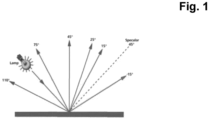
- L* value at 15° in Figure 1 is measured with spectrophotometer BYK-mac i.
- BYK-mac i uses a very bright LED to illuminate the sample surface at three angles of 15° / 45° / 75° and takes an image with a vertically arranged CCD chip. Then, to calculate this image with the light brightness parameter, it is analyzed by an image analysis algorithm using a brightness level histogram, and it is analyzed in two dimensions to improve the identification accuracy. The calculated value is expressed numerically as the Sparkle area (Sa value) and the Sparkle intensity (Si value) at each angle.)
- FI 2.69 ⁇ L * 15 ° ⁇ L * 110 ° L * 45 ° 0.86 1.11
Landscapes
- Chemical & Material Sciences (AREA)
- Organic Chemistry (AREA)
- Life Sciences & Earth Sciences (AREA)
- Engineering & Computer Science (AREA)
- Materials Engineering (AREA)
- Wood Science & Technology (AREA)
- Inorganic Chemistry (AREA)
- Health & Medical Sciences (AREA)
- Geology (AREA)
- Birds (AREA)
- General Chemical & Material Sciences (AREA)
- Chemical Kinetics & Catalysis (AREA)
- Epidemiology (AREA)
- Animal Behavior & Ethology (AREA)
- General Health & Medical Sciences (AREA)
- Public Health (AREA)
- Veterinary Medicine (AREA)
- Pigments, Carbon Blacks, Or Wood Stains (AREA)
- Paints Or Removers (AREA)
- Compounds Of Alkaline-Earth Elements, Aluminum Or Rare-Earth Metals (AREA)
Applications Claiming Priority (1)
| Application Number | Priority Date | Filing Date | Title |
|---|---|---|---|
| EP23215984 | 2023-12-12 |
Publications (1)
| Publication Number | Publication Date |
|---|---|
| EP4570862A1 true EP4570862A1 (fr) | 2025-06-18 |
Family
ID=89222342
Family Applications (1)
| Application Number | Title | Priority Date | Filing Date |
|---|---|---|---|
| EP24219035.3A Pending EP4570862A1 (fr) | 2023-12-12 | 2024-12-11 | Flocons d'al2o3 |
Country Status (6)
| Country | Link |
|---|---|
| US (1) | US20250188293A1 (fr) |
| EP (1) | EP4570862A1 (fr) |
| JP (1) | JP2025093901A (fr) |
| KR (1) | KR20250090223A (fr) |
| CN (1) | CN120137422A (fr) |
| MX (1) | MX2024014395A (fr) |
Citations (41)
| Publication number | Priority date | Publication date | Assignee | Title |
|---|---|---|---|---|
| DE1467468A1 (de) | 1961-06-28 | 1968-12-12 | Du Pont | Glimmerschuppenpigment |
| DE1522572A1 (de) | 1967-03-23 | 1969-09-18 | Marcus Cantarano | Verfahren und Vorrichtung zum photoelektrischen Herstellen von Reproduktionen |
| DE1959988A1 (de) | 1969-11-29 | 1971-06-16 | Ford Werke Ag | Fahrzeugtuer mit Seitenschutz,insbesondere fuer Personenkraftwagen |
| DE2009566B1 (de) | 1970-02-28 | 1971-11-11 | Merck Patent Gmbh | Verfahren zur Herstellung von Titandioxid- bzw. Titandioxidaquatüberzügen |
| DE2214545A1 (de) | 1971-03-26 | 1972-10-05 | E.I. Du Pont De Nemours And Co., Wilmington, Del. (V.St.A.) | Perlmuttpigmente und deren Herstellung |
| DE2215191A1 (de) | 1971-03-30 | 1972-10-12 | E I du Pont de Nemours and Co , Wilmington, Del (V St A) | Verbesserte Pigmente |
| DE2244298A1 (de) | 1972-09-09 | 1974-03-28 | Merck Patent Gmbh | Perlglanzpigmente und verfahren zu ihrer herstellung |
| DE2313331A1 (de) | 1973-03-17 | 1974-09-19 | Merck Patent Gmbh | Eisenhaltige glimmerschuppenpigmente |
| US4038099A (en) | 1971-08-30 | 1977-07-26 | The Mearl Corporation | Rutile-coated mica nacreous pigments and process for the preparation thereof |
| EP0045851A1 (fr) | 1980-08-08 | 1982-02-17 | BASF Aktiengesellschaft | Procédé pour la fabrication de pigments micacés en forme d'écailles recouvertes d'oxydes métalliques et leur utilisation |
| JPS57111239U (fr) | 1980-12-27 | 1982-07-09 | ||
| DE3137808A1 (de) | 1981-09-23 | 1983-03-31 | Merck Patent Gmbh, 6100 Darmstadt | Perlglanzpigmente mit verbesserter lichtechtheit, verfahren zur herstellung und verwendung |
| DE3137809A1 (de) | 1981-09-23 | 1983-03-31 | Merck Patent Gmbh, 6100 Darmstadt | "perlglanzpigmente, ihre herstellung und ihre verwendung" |
| DE3151355A1 (de) | 1981-12-24 | 1983-07-07 | Merck Patent Gmbh, 6100 Darmstadt | "perlglanzpigmente mit verbesserter lichtbestaendigkeit, ihre herstellung und verwendung" |
| DE3151343A1 (de) | 1981-12-24 | 1983-07-07 | Merck Patent Gmbh, 6100 Darmstadt | Perlglanzpigmente mit verbesserter lichtbestaendigkeit, ihre herstellung und ihre verwendung |
| DE3151354A1 (de) | 1981-12-24 | 1983-07-07 | Merck Patent Gmbh, 6100 Darmstadt | Perlglanzpigmente, verfahren zu ihrer herstellung und ihre verwendung |
| EP0090259A1 (fr) | 1982-03-26 | 1983-10-05 | MERCK PATENT GmbH | Procédé d'hydrophobisation de pigments nacrés |
| DE3211602A1 (de) | 1982-03-30 | 1983-10-13 | Merck Patent Gmbh, 6100 Darmstadt | Verfahren zur herstellung von perlglanzpigmenten mit verbesserten glanzeigenschaften |
| DE3235017A1 (de) | 1982-09-22 | 1984-03-22 | Merck Patent Gmbh, 6100 Darmstadt | Perlglanzpigmente |
| EP0106235A1 (fr) | 1982-10-08 | 1984-04-25 | BASF Aktiengesellschaft | Procédé de préparation de pigments à effet de nacre recouverts d'oxyde métallique |
| DE3334598A1 (de) | 1983-09-24 | 1985-04-18 | Merck Patent Gmbh | Witterungsbestaendige perlglanzpigmente |
| EP0271767A1 (fr) | 1986-12-13 | 1988-06-22 | MERCK PATENT GmbH | Procédé de préparation de pigments micacés revêtus de rutile |
| DE3825702A1 (de) | 1988-07-28 | 1990-02-01 | Michael Huber Muenchen Gmbh Fa | Goniochromatische pigmente, verfahren zu deren herstellung und deren verwendung zur herstellung von sicherheits- und effektfarben |
| JPH0372572U (fr) | 1990-10-23 | 1991-07-22 | ||
| JPH0439362U (fr) | 1990-07-26 | 1992-04-03 | ||
| EP0634459A2 (fr) | 1993-07-16 | 1995-01-18 | MERCK PATENT GmbH | Formulations |
| US5433779A (en) | 1993-12-06 | 1995-07-18 | The Mearl Corporation | Rutile titanium dioxide coated micaceous pigments formed without tin |
| WO1996032446A1 (fr) | 1995-04-10 | 1996-10-17 | Merck Patent Gmbh | Agent de traitement de surface, pigment de type plaquette a surface traitee et leurs procedes de fabrication |
| US5571851A (en) | 1994-01-28 | 1996-11-05 | J.M. Huber Corporation | Reinforcing fillers for plastics systems |
| US5702519A (en) | 1995-09-14 | 1997-12-30 | Merck Patent Gesellschaft Mit Ceschrankter Haftung | Flaky aluminum oxide and pearlescent pigment, and production thereof |
| WO1998013426A1 (fr) | 1996-09-27 | 1998-04-02 | Merck Patent Gmbh | Pigments nacres modifies pour systemes de vernis a l'eau |
| US5759255A (en) | 1996-02-07 | 1998-06-02 | Engelhard Corporation | Pearlescent pigment for exterior use |
| WO1999057204A1 (fr) | 1998-05-06 | 1999-11-11 | Eckart-Werke Standard Bronzepulver-Werke Carl-Eckart Gmbh & Co. | Pigments a effet recouverts d'auxiliaires d'orientation reactifs |
| WO2001092425A2 (fr) | 2000-05-26 | 2001-12-06 | Engelhard Corporation | Films en polymere composite hydroxyde-organique a metal lie sur substrats de particules |
| WO2006101306A1 (fr) | 2005-03-25 | 2006-09-28 | Korea Research Institute Of Chemical Technology | Cristaux d'alumine alpha floconneux et leur procede de preparation |
| WO2008026860A1 (fr) | 2006-08-28 | 2008-03-06 | Korea Research Institute Of Chemical Technology | Cristaux d'alpha-alumine lamellaires à facteur de forme élevé et procédé de préparation |
| US20140322536A1 (en) * | 2013-04-30 | 2014-10-30 | Merck Patent Gmbh | Alpha-alumina flakes |
| EP2799387A1 (fr) | 2013-04-30 | 2014-11-05 | Linde Material Handling GmbH | Chariot de manutention doté d'un toit protège-conducteur |
| EP2799388A1 (fr) | 2013-04-30 | 2014-11-05 | STILL GmbH | Chariot de manutention doté d'un dispositif de levage |
| US20190169439A1 (en) * | 2016-02-23 | 2019-06-06 | Merck Patent Gmbh | Effect pigments |
| US20190338135A1 (en) * | 2018-05-04 | 2019-11-07 | Merck Patent Gmbh | Ceramic colours |
-
2024
- 2024-11-21 MX MX2024014395A patent/MX2024014395A/es unknown
- 2024-12-11 CN CN202411816126.6A patent/CN120137422A/zh active Pending
- 2024-12-11 EP EP24219035.3A patent/EP4570862A1/fr active Pending
- 2024-12-11 KR KR1020240183628A patent/KR20250090223A/ko active Pending
- 2024-12-11 JP JP2024216868A patent/JP2025093901A/ja active Pending
- 2024-12-11 US US18/977,443 patent/US20250188293A1/en active Pending
Patent Citations (42)
| Publication number | Priority date | Publication date | Assignee | Title |
|---|---|---|---|---|
| DE1467468A1 (de) | 1961-06-28 | 1968-12-12 | Du Pont | Glimmerschuppenpigment |
| DE1522572A1 (de) | 1967-03-23 | 1969-09-18 | Marcus Cantarano | Verfahren und Vorrichtung zum photoelektrischen Herstellen von Reproduktionen |
| DE1959988A1 (de) | 1969-11-29 | 1971-06-16 | Ford Werke Ag | Fahrzeugtuer mit Seitenschutz,insbesondere fuer Personenkraftwagen |
| DE2009566B1 (de) | 1970-02-28 | 1971-11-11 | Merck Patent Gmbh | Verfahren zur Herstellung von Titandioxid- bzw. Titandioxidaquatüberzügen |
| DE2214545A1 (de) | 1971-03-26 | 1972-10-05 | E.I. Du Pont De Nemours And Co., Wilmington, Del. (V.St.A.) | Perlmuttpigmente und deren Herstellung |
| DE2215191A1 (de) | 1971-03-30 | 1972-10-12 | E I du Pont de Nemours and Co , Wilmington, Del (V St A) | Verbesserte Pigmente |
| US4038099A (en) | 1971-08-30 | 1977-07-26 | The Mearl Corporation | Rutile-coated mica nacreous pigments and process for the preparation thereof |
| DE2244298A1 (de) | 1972-09-09 | 1974-03-28 | Merck Patent Gmbh | Perlglanzpigmente und verfahren zu ihrer herstellung |
| DE2313331A1 (de) | 1973-03-17 | 1974-09-19 | Merck Patent Gmbh | Eisenhaltige glimmerschuppenpigmente |
| EP0045851A1 (fr) | 1980-08-08 | 1982-02-17 | BASF Aktiengesellschaft | Procédé pour la fabrication de pigments micacés en forme d'écailles recouvertes d'oxydes métalliques et leur utilisation |
| JPS57111239U (fr) | 1980-12-27 | 1982-07-09 | ||
| DE3137808A1 (de) | 1981-09-23 | 1983-03-31 | Merck Patent Gmbh, 6100 Darmstadt | Perlglanzpigmente mit verbesserter lichtechtheit, verfahren zur herstellung und verwendung |
| DE3137809A1 (de) | 1981-09-23 | 1983-03-31 | Merck Patent Gmbh, 6100 Darmstadt | "perlglanzpigmente, ihre herstellung und ihre verwendung" |
| DE3151355A1 (de) | 1981-12-24 | 1983-07-07 | Merck Patent Gmbh, 6100 Darmstadt | "perlglanzpigmente mit verbesserter lichtbestaendigkeit, ihre herstellung und verwendung" |
| DE3151343A1 (de) | 1981-12-24 | 1983-07-07 | Merck Patent Gmbh, 6100 Darmstadt | Perlglanzpigmente mit verbesserter lichtbestaendigkeit, ihre herstellung und ihre verwendung |
| DE3151354A1 (de) | 1981-12-24 | 1983-07-07 | Merck Patent Gmbh, 6100 Darmstadt | Perlglanzpigmente, verfahren zu ihrer herstellung und ihre verwendung |
| EP0090259A1 (fr) | 1982-03-26 | 1983-10-05 | MERCK PATENT GmbH | Procédé d'hydrophobisation de pigments nacrés |
| DE3211602A1 (de) | 1982-03-30 | 1983-10-13 | Merck Patent Gmbh, 6100 Darmstadt | Verfahren zur herstellung von perlglanzpigmenten mit verbesserten glanzeigenschaften |
| DE3235017A1 (de) | 1982-09-22 | 1984-03-22 | Merck Patent Gmbh, 6100 Darmstadt | Perlglanzpigmente |
| EP0106235A1 (fr) | 1982-10-08 | 1984-04-25 | BASF Aktiengesellschaft | Procédé de préparation de pigments à effet de nacre recouverts d'oxyde métallique |
| DE3334598A1 (de) | 1983-09-24 | 1985-04-18 | Merck Patent Gmbh | Witterungsbestaendige perlglanzpigmente |
| EP0271767A1 (fr) | 1986-12-13 | 1988-06-22 | MERCK PATENT GmbH | Procédé de préparation de pigments micacés revêtus de rutile |
| DE3825702A1 (de) | 1988-07-28 | 1990-02-01 | Michael Huber Muenchen Gmbh Fa | Goniochromatische pigmente, verfahren zu deren herstellung und deren verwendung zur herstellung von sicherheits- und effektfarben |
| JPH0439362U (fr) | 1990-07-26 | 1992-04-03 | ||
| JPH0372572U (fr) | 1990-10-23 | 1991-07-22 | ||
| EP0634459A2 (fr) | 1993-07-16 | 1995-01-18 | MERCK PATENT GmbH | Formulations |
| US5433779A (en) | 1993-12-06 | 1995-07-18 | The Mearl Corporation | Rutile titanium dioxide coated micaceous pigments formed without tin |
| US5571851A (en) | 1994-01-28 | 1996-11-05 | J.M. Huber Corporation | Reinforcing fillers for plastics systems |
| WO1996032446A1 (fr) | 1995-04-10 | 1996-10-17 | Merck Patent Gmbh | Agent de traitement de surface, pigment de type plaquette a surface traitee et leurs procedes de fabrication |
| US5702519A (en) | 1995-09-14 | 1997-12-30 | Merck Patent Gesellschaft Mit Ceschrankter Haftung | Flaky aluminum oxide and pearlescent pigment, and production thereof |
| US5759255A (en) | 1996-02-07 | 1998-06-02 | Engelhard Corporation | Pearlescent pigment for exterior use |
| WO1998013426A1 (fr) | 1996-09-27 | 1998-04-02 | Merck Patent Gmbh | Pigments nacres modifies pour systemes de vernis a l'eau |
| WO1999057204A1 (fr) | 1998-05-06 | 1999-11-11 | Eckart-Werke Standard Bronzepulver-Werke Carl-Eckart Gmbh & Co. | Pigments a effet recouverts d'auxiliaires d'orientation reactifs |
| WO2001092425A2 (fr) | 2000-05-26 | 2001-12-06 | Engelhard Corporation | Films en polymere composite hydroxyde-organique a metal lie sur substrats de particules |
| WO2006101306A1 (fr) | 2005-03-25 | 2006-09-28 | Korea Research Institute Of Chemical Technology | Cristaux d'alumine alpha floconneux et leur procede de preparation |
| US20090186225A1 (en) * | 2005-03-25 | 2009-07-23 | Jung Min Lee | Flaky Alpha-Alumina Crystal and a Method of Its Preparation |
| WO2008026860A1 (fr) | 2006-08-28 | 2008-03-06 | Korea Research Institute Of Chemical Technology | Cristaux d'alpha-alumine lamellaires à facteur de forme élevé et procédé de préparation |
| US20140322536A1 (en) * | 2013-04-30 | 2014-10-30 | Merck Patent Gmbh | Alpha-alumina flakes |
| EP2799387A1 (fr) | 2013-04-30 | 2014-11-05 | Linde Material Handling GmbH | Chariot de manutention doté d'un toit protège-conducteur |
| EP2799388A1 (fr) | 2013-04-30 | 2014-11-05 | STILL GmbH | Chariot de manutention doté d'un dispositif de levage |
| US20190169439A1 (en) * | 2016-02-23 | 2019-06-06 | Merck Patent Gmbh | Effect pigments |
| US20190338135A1 (en) * | 2018-05-04 | 2019-11-07 | Merck Patent Gmbh | Ceramic colours |
Non-Patent Citations (3)
| Title |
|---|
| J.J. PONJEÉ, PHILIPS TECHNICAL REVIEW, vol. 44, no. 3, pages 81 |
| no. 13822-56-5 |
| P.H. HARDINGJ.C. BERG, J. ADHESION SCI. TECHNOL., vol. 11, no. 4, pages 471 - 493 |
Also Published As
| Publication number | Publication date |
|---|---|
| US20250188293A1 (en) | 2025-06-12 |
| CN120137422A (zh) | 2025-06-13 |
| JP2025093901A (ja) | 2025-06-24 |
| MX2024014395A (es) | 2025-07-01 |
| KR20250090223A (ko) | 2025-06-19 |
Similar Documents
| Publication | Publication Date | Title |
|---|---|---|
| US11891541B2 (en) | Alpha-alumina flakes | |
| KR102375756B1 (ko) | α-알루미나 플레이크 | |
| US11479681B2 (en) | Effect pigments | |
| US20250188293A1 (en) | Al2o3 flakes |
Legal Events
| Date | Code | Title | Description |
|---|---|---|---|
| PUAI | Public reference made under article 153(3) epc to a published international application that has entered the european phase |
Free format text: ORIGINAL CODE: 0009012 |
|
| STAA | Information on the status of an ep patent application or granted ep patent |
Free format text: STATUS: REQUEST FOR EXAMINATION WAS MADE |
|
| 17P | Request for examination filed |
Effective date: 20241211 |
|
| AK | Designated contracting states |
Kind code of ref document: A1 Designated state(s): AL AT BE BG CH CY CZ DE DK EE ES FI FR GB GR HR HU IE IS IT LI LT LU LV MC ME MK MT NL NO PL PT RO RS SE SI SK SM TR |
|
| RAP1 | Party data changed (applicant data changed or rights of an application transferred) |
Owner name: SUSONITY COMMERCIAL GMBH |