EP4570931A1 - Verfahren zur rückgewinnungvon metallen aus akkumulatoren und batterien - Google Patents
Verfahren zur rückgewinnungvon metallen aus akkumulatoren und batterien Download PDFInfo
- Publication number
- EP4570931A1 EP4570931A1 EP24218940.5A EP24218940A EP4570931A1 EP 4570931 A1 EP4570931 A1 EP 4570931A1 EP 24218940 A EP24218940 A EP 24218940A EP 4570931 A1 EP4570931 A1 EP 4570931A1
- Authority
- EP
- European Patent Office
- Prior art keywords
- lithium
- iron
- recovery
- leaching
- batteries
- Prior art date
- Legal status (The legal status is an assumption and is not a legal conclusion. Google has not performed a legal analysis and makes no representation as to the accuracy of the status listed.)
- Pending
Links
Images




Classifications
-
- C—CHEMISTRY; METALLURGY
- C22—METALLURGY; FERROUS OR NON-FERROUS ALLOYS; TREATMENT OF ALLOYS OR NON-FERROUS METALS
- C22B—PRODUCTION AND REFINING OF METALS; PRETREATMENT OF RAW MATERIALS
- C22B3/00—Extraction of metal compounds from ores or concentrates by wet processes
- C22B3/04—Extraction of metal compounds from ores or concentrates by wet processes by leaching
- C22B3/16—Extraction of metal compounds from ores or concentrates by wet processes by leaching in organic solutions
- C22B3/1608—Leaching with acyclic or carbocyclic agents
- C22B3/1616—Leaching with acyclic or carbocyclic agents of a single type
- C22B3/165—Leaching with acyclic or carbocyclic agents of a single type with organic acids
-
- C—CHEMISTRY; METALLURGY
- C01—INORGANIC CHEMISTRY
- C01D—COMPOUNDS OF ALKALI METALS, i.e. LITHIUM, SODIUM, POTASSIUM, RUBIDIUM, CAESIUM, OR FRANCIUM
- C01D15/00—Lithium compounds
- C01D15/08—Carbonates; Bicarbonates
-
- C—CHEMISTRY; METALLURGY
- C22—METALLURGY; FERROUS OR NON-FERROUS ALLOYS; TREATMENT OF ALLOYS OR NON-FERROUS METALS
- C22B—PRODUCTION AND REFINING OF METALS; PRETREATMENT OF RAW MATERIALS
- C22B21/00—Obtaining aluminium
- C22B21/0015—Obtaining aluminium by wet processes
- C22B21/0023—Obtaining aluminium by wet processes from waste materials
-
- C—CHEMISTRY; METALLURGY
- C22—METALLURGY; FERROUS OR NON-FERROUS ALLOYS; TREATMENT OF ALLOYS OR NON-FERROUS METALS
- C22B—PRODUCTION AND REFINING OF METALS; PRETREATMENT OF RAW MATERIALS
- C22B26/00—Obtaining alkali, alkaline earth metals or magnesium
- C22B26/10—Obtaining alkali metals
- C22B26/12—Obtaining lithium
-
- C—CHEMISTRY; METALLURGY
- C22—METALLURGY; FERROUS OR NON-FERROUS ALLOYS; TREATMENT OF ALLOYS OR NON-FERROUS METALS
- C22B—PRODUCTION AND REFINING OF METALS; PRETREATMENT OF RAW MATERIALS
- C22B3/00—Extraction of metal compounds from ores or concentrates by wet processes
- C22B3/20—Treatment or purification of solutions, e.g. obtained by leaching
- C22B3/44—Treatment or purification of solutions, e.g. obtained by leaching by chemical processes
-
- C—CHEMISTRY; METALLURGY
- C22—METALLURGY; FERROUS OR NON-FERROUS ALLOYS; TREATMENT OF ALLOYS OR NON-FERROUS METALS
- C22B—PRODUCTION AND REFINING OF METALS; PRETREATMENT OF RAW MATERIALS
- C22B7/00—Working up raw materials other than ores, e.g. scrap, to produce non-ferrous metals and compounds thereof; Methods of a general interest or applied to the winning of more than two metals
- C22B7/005—Separation by a physical processing technique only, e.g. by mechanical breaking
-
- C—CHEMISTRY; METALLURGY
- C22—METALLURGY; FERROUS OR NON-FERROUS ALLOYS; TREATMENT OF ALLOYS OR NON-FERROUS METALS
- C22B—PRODUCTION AND REFINING OF METALS; PRETREATMENT OF RAW MATERIALS
- C22B7/00—Working up raw materials other than ores, e.g. scrap, to produce non-ferrous metals and compounds thereof; Methods of a general interest or applied to the winning of more than two metals
- C22B7/006—Wet processes
- C22B7/007—Wet processes by acid leaching
-
- Y—GENERAL TAGGING OF NEW TECHNOLOGICAL DEVELOPMENTS; GENERAL TAGGING OF CROSS-SECTIONAL TECHNOLOGIES SPANNING OVER SEVERAL SECTIONS OF THE IPC; TECHNICAL SUBJECTS COVERED BY FORMER USPC CROSS-REFERENCE ART COLLECTIONS [XRACs] AND DIGESTS
- Y02—TECHNOLOGIES OR APPLICATIONS FOR MITIGATION OR ADAPTATION AGAINST CLIMATE CHANGE
- Y02P—CLIMATE CHANGE MITIGATION TECHNOLOGIES IN THE PRODUCTION OR PROCESSING OF GOODS
- Y02P10/00—Technologies related to metal processing
- Y02P10/20—Recycling
-
- Y—GENERAL TAGGING OF NEW TECHNOLOGICAL DEVELOPMENTS; GENERAL TAGGING OF CROSS-SECTIONAL TECHNOLOGIES SPANNING OVER SEVERAL SECTIONS OF THE IPC; TECHNICAL SUBJECTS COVERED BY FORMER USPC CROSS-REFERENCE ART COLLECTIONS [XRACs] AND DIGESTS
- Y02—TECHNOLOGIES OR APPLICATIONS FOR MITIGATION OR ADAPTATION AGAINST CLIMATE CHANGE
- Y02W—CLIMATE CHANGE MITIGATION TECHNOLOGIES RELATED TO WASTEWATER TREATMENT OR WASTE MANAGEMENT
- Y02W30/00—Technologies for solid waste management
- Y02W30/50—Reuse, recycling or recovery technologies
- Y02W30/84—Recycling of batteries or fuel cells
Definitions
- This invention relates to a process for the recovery of materials from accumulators and batteries, often referred to hereinafter only as batteries, preferably from used batteries, and more preferably from used lithium batteries.
- Alessandro Volta cells, batteries and accumulators have notably evolved. These are basically electrochemical systems which provide for converting the internal energy of a chemical system into electrical energy, which can be delivered as direct current at a certain voltage. Rectifiers and transformers then provide for also obtaining alternating current and for having a current with the desired voltage.
- a battery comprises a reduction system and an oxidation system, and these two reactions together bring about the passage of electrons and, consequently, the passage of electrical current.
- the reverse reactions take place, restoring practically identical concentrations of the initial species.
- the useful lifetime depends on the species used in the accumulator, the number of recharges carried out and how the accumulator is used. When the accumulator should be replaced also depends on factors such as the minimum reasonable duration (range) of the accumulator itself for the particular application it is used for.
- Lithium is an alkaline metal, with an oxidation-reduction potential of -3.045 volts, hence the metal is highly reducing and the thermodynamically favoured species is the Li + ion.
- LiFePO 4 lithium iron phosphate
- This material has proven to be safer than others, greatly reducing the risk of fire, even in the event of a short circuit.
- these types of accumulators can be recharged a much higher number of times than other known systems (10,000 recharging cycles can take place before the end of useful life).
- this is a material with high environmental compatibility: it is obtained as a natural mineral, can be used without adding nickel or cobalt to the accumulator and, by giving up cobalt, does not require the use of a material that involves some labour exploitation problems in how it is extracted.
- Li et al., Waste Management, 2019, 85, 437-444 illustrates a method in which citric acid is added to the grinding phase of waste batteries and accumulators, followed by a leaching phase with hydrogen peroxide leading to the complete dissolution of lithium (>99%) which can then be recovered.
- the remaining iron in the scrap is dissolved by a subsequent passing into water.
- the water containing iron is then treated with sodium hydroxide to obtain iron hydroxide which is then recovered.
- This method requires a grinding phase with related energy consumption.
- hydrogen peroxide has a relatively high price and consideration must be given as to how to use the iron hydroxide.
- Zhang et al., Waste Management, 2023, 157, 1-7 describes a process of leaching and ion exchange.
- Leaching is carried out by treating waste batteries with sulphuric acid, oxalic acid and citric acid. Iron and lithium dissolve (more than 85% of the complex of two ions is recovered). Next, the lithium is recovered with ion exchange resins, with a separation efficiency of more than 90%.
- the ion exchange step requires a concentration of less than 30 ppm, so highly diluted solutions with a relatively large amount of water must be used.
- Hu et al., ACS Sustainable Chemistry & Engineering, 2022, 10(35), 11606-11616 refers to leaching with a mixture of sulphuric and citric acids, at 50°C for three hours.
- lithium and iron are removed in quantities of around 95% of the total, there is no separation from aluminium, which remains together with lithium and iron for 70%.
- CO 2 is added, which helps to remove aluminium.
- lithium is lost due to the formation of LiAl 2 (OH) 7 .H 2 O.
- Li et al., CSEE Journal of Power and Energy Systems, 2018, 4(2), 219-225 describe the use of oxalic acid for the recovery of lithium.
- Aluminium is separated from lithium iron phosphate by adding N-methylpyrrolidone at 100°C for one hour.
- the mixture of lithium iron phosphate and polyvinylidene fluoride is calcined at 400°C for one hour to remove the polyvinylidene fluoride.
- a powder is obtained which is leached with oxalic acid to dissolve the lithium, while iron oxalate precipitates during the same leaching. Disadvantages of this process are the need to use N-methylpyrrolidone and the manual separation of aluminium foils.
- a process which involves the following steps: 1) heat a mixture of the material to be recycled, hydrogen peroxide and sodium chlorate with water to 40-80°C; 2) lower the pH of the resulting solution to a value ranging between 1 and 2 by adding hydrochloric acid or sulphuric acid; 3) filter to remove the residue; 4) raise the pH to a value ranging between 11 and 13 with alkalis and filter the solution obtained; 5) add sodium carbonate at a temperature between 80°C and 95°C, separating out the precipitated lithium carbonate.
- the process described here does not involve the recovery of iron and aluminium, which are thus lost.
- CN 116 130 821 describes equipment that dissolves the material to be recovered by pressure leaching. Leaching and filtration take place simultaneously. However, there is no information on the process parameters and reagents and their concentrations.
- WO 2019/215 583 refers to a hydrometallurgical process, aimed at recovering precious metals in used permanent magnets, particularly neodymium.
- CN 116 750 740 describes a method for recycling lithium iron phosphate batteries which includes steps of discharging, disassembling, crushing and sorting batteries, to obtain lithium iron phosphate powder. This powder is roasted and mixed with an acid to leach it. Iron powder is added to the leached liquid to precipitate copper. Adjusting the pH allows the aluminium to precipitate. A further pH adjustment enables the precursor of lithium iron phosphate to be obtained. The electrode material is obtained again by drying, adding a carbon source and roasting the resulting product.
- the prior art does not provide for a simple and effective method for recovering metals from lithium iron phosphate, mainly because of the quantities, which are small in themselves.
- the problem underlying the invention is to propose a way to recover metallic materials present in used batteries which overcomes the drawbacks mentioned and which provides for effectively separating the metals from the lithium iron phosphate.
- This aim is achieved by a process for the recovery of metals from accumulators and batteries, comprising a leaching step, an iron recovery step, a lithium recovery step and an aluminium recovery step, wherein a leaching step with citric acid is provided, and the subsequent iron recovery is carried out by adding oxalic acid to the solution resulting from the leaching, there being at the end of the leaching step a suspension made up of a solution of lithium citrate and citric acid and a solid made up of a precipitate of iron oxalate, characterised in that the liquid exiting the iron recovery step is split into two flows, one directed towards the lithium recovery step, and the other recycled to the leaching step.
- the subclaims describe preferred fetures of the invention.
- the leaching phase takes place with the addition of citric acid, separating iron and lithium from the crushed battery residues.
- the leaching step takes place at a temperature between 20°C and 80°C.
- leaching takes place at room temperature.
- the leaching temperature can range from 30°C to 80°C.
- the concentration of citric acid in the leaching step ranges from 0.5 M to 3 M.
- the process for the recovery of metals is carried out on lithium iron phosphate batteries (LFP cathodes).
- LFP cathodes lithium iron phosphate batteries
- the process for the recovery of metals is carried out on lithium manganese iron phosphate batteries (LMFP cathodes).
- LMFP cathodes lithium manganese iron phosphate batteries
- the lithium recovery step takes place by the addition of a solution containing carbonate ions.
- the carbonate ions are added in the form of sodium carbonate.
- the carbonate ions are added to the solution for the recovery in the form of an aqueous solution.
- the carbonate ions are added to the solution in the form of solid material to be dissolved.
- aluminium is recovered by calcination and subsequent sieving.
- the lithium recovery step is preceded by a step for removing excess oxalate ions from the solution.
- this removal of oxalate ions takes place by the addition of an ammonia solution to the solution.
- the ammonium oxalate produced by the removal of oxalate ions is washed with methanol and then filtered.
- the residue of the washing is made to evaporate, to remove impurities that remain in the residue.
- the methanol which is evaporated, according to a preferred embodiment, is recycled to the washing phase.
- batteries to be subjected to the process according the present invention undergo pretreatments.
- paper and/or plastic parts are removed from the batteries.
- the batteries are crushed.
- the batteries are crushed in a ball mill, with a circular saw or with a roller mill.
- the batteries are shredded to a size ranging between 0.5x0.5 cm to 5x5 cm.
- the sieving in the aluminium recovery step separates out iron oxide powder and aluminium flakes, the latter being retained by the sieve.
- the filtration steps required in various process steps are carried out at a reduced pressure.
- said steps are conducted under vacuum.
- Figure 1 shows a general diagram thereof.
- the material to be treated is introduced into the process by the feed 1 and is sent to the first step 2 of leaching.
- a recirculation flow 3 also arrives.
- the step 2 is shown in more detail, although still in a schematic way, in Figure 2 .
- the two feeds 1 and 4 enter a leaching reactor 5.
- a flow 6 exits the reactor 5 and goes to a filtration step 7.
- a line 8 also enters the filtration step 7.
- the solid that remains in the filter is one of the products 9, while the filtered liquid leaves by a line 10 which, as shown in Figure 1 , undergoes the step 11 of the process.
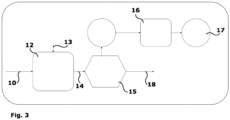
- the step 11 is illustrated in Figure 3 .
- the feed 10 supplies a reactor 12, supplied not only by the line 10 but also by a line 13.
- a line 14 exits the reactor 12 and feeds a filtration device 15.
- the solid material obtained following the filtration in the device 15 is fed to an oven 16, from which the product 17 exits.
- the filtered liquid exits by the line 18, which is split into lines 3 and 19.
- the line 19 is subjected to the step 20 of the process.
- the step 20 is illustrated in Figure 4 .
- the line 19 and another line 21 feed a reactor 22, from which a line 23 exits.
- a filtered liquid is recovered from the filtration device 24 and sent to a reactor 25, from which a solid product 26 is recovered.
- the solid 26 recovered from the filtration device 24 exits by a line 27 which feeds a washing tank 28, which is fed also by a second line 29.
- the liquid obtained after washing exits into a line 30 and is fed into a filtration device 31, from which there exit a solid product 32 and a liquid transported in a line 33.
- the line 33 feeds an evaporator 34, from which impurities 36 and a liquid 37 are separated, which liquid 37 is recycled to the washing tank 28.
- the process step 39 is described in detail in Figure 5 .
- the residual material from the step 2 is fed via the feed 38 to an oven 40.
- the material leaving the oven is subjected to a sieving step 41, from which two different solids, 42 and 43, exit.
- the solid 43 joins the product 17 and the solid 42 forms the product 44.
- the batteries and accumulators to be disposed of undergo a series of pretreatments, such as the removal of foreign substances (for example, plastic or paper labels, connecting wires, splices etc.), to prevent undesired reactions.
- pretreatments such as the removal of foreign substances (for example, plastic or paper labels, connecting wires, splices etc.), to prevent undesired reactions.
- they are crushed, preferably in a size ranging from 0.5x0.5 cm to 5x5 cm (so that they are small enough to give better results in the leaching and to avoid pieces that are too small from being drawn by the flows of solutions going to steps of the process where the residues must not go) and the product of this crushing is fed by the feed 1 to the reactor 5.
- the feed 4 supplies the reactor 5, in which leaching takes place, with a citric acid solution.
- the quantity of liquid with respect to solid is between 5 l/kg and 30 l/kg, preferably between 10 l/kg and 25 l/kg, so that iron and lithium can be efficiently removed from the crushed parts.
- a particularly preferred value is 20 l/kg.
- the concentration of the citric acid solution ranges between 0.5 M and 3.0 M, preferably between 1 M and 2.5 M. A preferred value is 2.5 M.
- the concentration of the citric acid solution is adjusted by adding citric acid in distilled water.
- the leaching time varies between a minimum of 15 minutes and a maximum of 3 hours, preferably between a minimum of 30 minutes and a maximum of 2 hours, a preferred value being 60 minutes, which forms a good compromise between a good removal and a reasonably short reaction time.
- a stirred reactor is preferred, with a stirring speed of 150 rpm to 500 rpm, preferably 200 rpm to 450 rpm, with a preferred value of 300 rpm, so as to optimise the dissolution of lithium and iron.
- the temperature is not critical, but the reaction preferably takes place at a temperature between 20°C and 80°C, preferably between 60°C and 80°C. However, the most preferred is at room temperature, so as to discourage the aluminium from dissolving too.
- the product leaving the reactor 5 is fed, through the flow 6, to the filtration step 7, where this product is washed with water from the line 8 to increase the recovery of metal and is preferably filtered under vacuum.
- this product is washed with water from the line 8 to increase the recovery of metal and is preferably filtered under vacuum.
- the washing phase preferably 20% to 100% by weight of water is added, preferably about 30% by weight.
- the solution containing lithium and iron ions, and possibly aluminium ions, passes to the step 11 via the line 10, while the residual solid material is recovered as product 9 and is made to exit by the line 38.
- the line 10 feeds the solution obtained from the leaching in the reactor 5 to a reactor 12, to which, according to the present invention, oxalic acid is fed from the line 13.
- the oxalic acid reacts with the iron citrate, according to the following reaction: Fe 3 (C 6 H 5 O 7 ) 2 + 3C 2 H 2 O 4 ---> 3FeC 2 O 4 + 2C 6 H 8 O 7 (2) thus separating the iron, which precipitates, from the lithium.
- the quantity of oxalic acid to be used can be calculated on the basis of the molarity of the iron citrate in solution. Normally, a concentration from 0.4 to 1.5 times the iron concentration is required; preferably, equimolar quantities of iron and oxalic acid are used.
- the reaction preferably takes place at a temperature between 25°C and 95°C, depending on the type of battery at the outset. Since an increase in temperature does not improve the precipitation, it is advantageous to operate at room temperature.
- the reaction or residence time ranges between 15 minutes and 2 hours, preferably between 30 minutes and 1.5 hours, with a preferred value of 60 minutes.
- a suspension is obtained consisting of a solution of lithium citrate and citric acid and a solid consisting of a precipitate of iron oxalate, taking into account that solubility at room temperature of the iron oxalate is less than 1 g/l while that of lithium citrate is about 66 g/l.
- the suspension is made to exit the reactor 12 and, via the line 14, passes to the filtration device 15.
- the solution mainly containing lithium citrate, which is recovered, exits through the line 18 which splits into the recirculation flow 3, which is recycled to the step 2 to increase the concentration of lithium in the solution, and a line 19, which leads to the next step 20 of lithium recovery.
- the solid is collected and sent to the oven 16, where it is calcined at 350°C for 60 minutes, to convert it into iron oxide, which forms the product 17.
- the solution carried by the line 19 is fed to the reactor 22, which is also fed an ammonia solution by the line 21, so as to remove excess oxalate ions still contained in the solution.
- the reaction product exits by a line 23 and is fed to the filtration device 24.
- the solid exiting by the line 27 from the device 24 is washed with methanol, fed by the line 29, so as to remove any impurities.
- the methanol fed by the line 29 is added in a quantity ranging between 3 l/kg and 10 l/kg of solid, preferably between 4 l/kg and 10 l/kg, a preferred value being 5 l/kg.
- Ammonium oxalate is insoluble in methanol, therefore the material exiting the washing step 28 via the line 30 is subjected to a filtration step in the filtration device 31.
- the solid recovered as a solid product 32 is ammonium oxalate.
- the liquid which exits via the line 33 is fed to an evaporator 34 which removes the impurities 36 that remain after evaporation, while the recovered methanol is recycled to the line 29.
- the ammonium oxalate in 32 is dried at a temperature of 80°C for 12 hours, so as to have a saleable product.
- the liquid filtered by the device 24 is sent into the reactor 25, where sodium carbonate is added to it, in order to obtain lithium carbonate (Li 2 CO 3 ) which precipitates and is recovered as product in 26. Therefore, said lithium recovery step 20 occurs in the presence of carbonate ions.
- said carbonate ions are added as sodium carbonate, given that it is a widely and cheaply available reagent.
- the quantity of sodium carbonate to be fed into the reactor 25 is calculated.
- 50% to 150% by weight with regard to the stoichiometric weight is added.
- the addition is in stoichiometric quantity. It is mixed at a temperature between 50°C and 100°C, preferably between 60°C and 95°C, the preferred value being 90°C, so that complete ion exchange is achieved without the risk of boiling the solution.
- the solid residue of the step 2 arrives, as already seen, via the line 38 to the oven 40 which starts the aluminium recovery step 39 of the process.
- Said aluminium recovery step 39 occurs through calcination and sieving.
- the solid material is subjected to a treatment at a temperature ranging between 400°C and 800°C, preferably between 500°C and 650°C, the preferred value being 600°C, for 1 hour.
- the polyvinylidene fluoride is also removed from the solid.
- iron oxide is formed during the treatment in the oven 40.
- the solid material is then passed to sieves 41, where iron oxide (43) in powder form and aluminium foils (42) are separated out.
- the iron oxide 43 is combined with the produced iron oxide 17, while the aluminium is recovered in 44.
- the process according to the present invention provides for effectively separating the metals present in lithium batteries and accumulators, with high purity levels.
- Ammonium oxalate which is obtained as a by-product is a useful raw material for various industrial processes and therefore adds value to the process.
- the main products of the process are Li 2 CO 3 with a certain quantity of phosphorus, and they can be reused to produce new LFP batteries, and a mixture of iron phosphate (and possibly manganese) to be reused for batteries or other applications.
- lithium battery cathodes 100 g were collected and crushed into 2x2 cm pieces. Metals were contained in the cathode in the following percentages by weight: Iron 27.2%, lithium 3.7% and aluminium 13.6%.
- the resulting solution contained 1.2 g/l iron, 6.8 g/l lithium and 32 ppm aluminium.
- the solid iron oxalate collected from all the repeated steps, was gathered, dried in an oven and calcined in a muffle at 350°C for 60 minutes.
- the resulting powder contained 99.2% by weight of iron oxide, 0.5% by weight of lithium and less than 0.1% by weight of aluminium and phosphorus.
- Ammonia was added to the solution until the pH of the solution was brought to 9.5, hence resulting in precipitation of ammonium oxalate.
- the solution was then filtered, removing this oxalate from it.
- the oxalate was washed with methanol, removing impurities from it.
- the solid residue from the leaching steps was dried and calcined, obtaining aluminium at 98.7%, with 0.8% iron and 0.3% lithium.
Landscapes
- Chemical & Material Sciences (AREA)
- Engineering & Computer Science (AREA)
- Materials Engineering (AREA)
- Organic Chemistry (AREA)
- Manufacturing & Machinery (AREA)
- Metallurgy (AREA)
- Mechanical Engineering (AREA)
- Environmental & Geological Engineering (AREA)
- Geology (AREA)
- General Life Sciences & Earth Sciences (AREA)
- Life Sciences & Earth Sciences (AREA)
- Geochemistry & Mineralogy (AREA)
- Chemical Kinetics & Catalysis (AREA)
- General Chemical & Material Sciences (AREA)
- Inorganic Chemistry (AREA)
- Manufacture And Refinement Of Metals (AREA)
Applications Claiming Priority (1)
| Application Number | Priority Date | Filing Date | Title |
|---|---|---|---|
| IT202300026502 | 2023-12-12 |
Publications (1)
| Publication Number | Publication Date |
|---|---|
| EP4570931A1 true EP4570931A1 (de) | 2025-06-18 |
Family
ID=89897603
Family Applications (1)
| Application Number | Title | Priority Date | Filing Date |
|---|---|---|---|
| EP24218940.5A Pending EP4570931A1 (de) | 2023-12-12 | 2024-12-11 | Verfahren zur rückgewinnungvon metallen aus akkumulatoren und batterien |
Country Status (1)
| Country | Link |
|---|---|
| EP (1) | EP4570931A1 (de) |
Cited By (1)
| Publication number | Priority date | Publication date | Assignee | Title |
|---|---|---|---|---|
| CN121725902A (zh) * | 2026-02-12 | 2026-03-24 | 浙江工业大学 | 退役动力电池热解过程杂化氟的靶向干预及智能调控方法 |
Citations (5)
| Publication number | Priority date | Publication date | Assignee | Title |
|---|---|---|---|---|
| WO2019215583A1 (en) | 2018-05-08 | 2019-11-14 | Università Degli Studi Dell'aquila | Hydrometallurgical method for the treatment of permanent magnets |
| CN114865129A (zh) | 2022-04-11 | 2022-08-05 | 河南鑫再生新材料科技有限公司 | 一种湿法回收退役磷酸铁锂电池粉提锂制备碳酸锂的方法 |
| US11509000B2 (en) | 2019-04-15 | 2022-11-22 | Northvolt Ab | Process for the recovery of cathode materials in the recycling of batteries by removing aluminum and iron |
| CN116130821A (zh) | 2023-04-04 | 2023-05-16 | 沧州彩客锂能有限公司 | 一种磷酸铁锂电池湿法回收处理装置及其使用方法 |
| CN116750740A (zh) | 2023-05-24 | 2023-09-15 | 湖北金泉新材料有限公司 | 一种废旧磷酸铁锂电池回收处理的方法 |
-
2024
- 2024-12-11 EP EP24218940.5A patent/EP4570931A1/de active Pending
Patent Citations (5)
| Publication number | Priority date | Publication date | Assignee | Title |
|---|---|---|---|---|
| WO2019215583A1 (en) | 2018-05-08 | 2019-11-14 | Università Degli Studi Dell'aquila | Hydrometallurgical method for the treatment of permanent magnets |
| US11509000B2 (en) | 2019-04-15 | 2022-11-22 | Northvolt Ab | Process for the recovery of cathode materials in the recycling of batteries by removing aluminum and iron |
| CN114865129A (zh) | 2022-04-11 | 2022-08-05 | 河南鑫再生新材料科技有限公司 | 一种湿法回收退役磷酸铁锂电池粉提锂制备碳酸锂的方法 |
| CN116130821A (zh) | 2023-04-04 | 2023-05-16 | 沧州彩客锂能有限公司 | 一种磷酸铁锂电池湿法回收处理装置及其使用方法 |
| CN116750740A (zh) | 2023-05-24 | 2023-09-15 | 湖北金泉新材料有限公司 | 一种废旧磷酸铁锂电池回收处理的方法 |
Non-Patent Citations (5)
| Title |
|---|
| HU ET AL., ACS SUSTAINABLE CHEMISTRY & ENGINEERING, vol. 10, no. 35, 2022, pages 11606 - 11616 |
| LI ET AL., CSEE JOURNAL OF POWER AND ENERGY SYSTEMS, vol. 4, no. 2, 2018, pages 219 - 225 |
| LI ET AL., WASTE MANAGEMENT, vol. 85, 2019, pages 437 - 444 |
| LI LI ET AL: "A facile recovery process for cathodes from spent lithium iron phosphate batteries by using oxalic acid", CSEE JOURNAL OF POWER AND ENERGY SYSTEMS, vol. 4, no. 2, 18 June 2018 (2018-06-18), pages 219 - 225, XP055981283, ISSN: 2096-0042, DOI: 10.17775/CSEEJPES.2016.01880 * |
| ZHANG ET AL., WASTE MANAGEMENT, vol. 157, 2023, pages 1 - 7 |
Cited By (1)
| Publication number | Priority date | Publication date | Assignee | Title |
|---|---|---|---|---|
| CN121725902A (zh) * | 2026-02-12 | 2026-03-24 | 浙江工业大学 | 退役动力电池热解过程杂化氟的靶向干预及智能调控方法 |
Similar Documents
| Publication | Publication Date | Title |
|---|---|---|
| US12243993B2 (en) | Processing method of positive electrode active substance waste of lithium ion secondary battery | |
| CN110475879B (zh) | 锂离子电池废料的处理方法 | |
| JP7609802B2 (ja) | Li-含有出発物質から金属を回収する方法 | |
| US20230104094A1 (en) | A method for processing lithium iron phosphate batteries | |
| KR102829860B1 (ko) | 금속 혼합 용액의 제조 방법 및, 혼합 금속염의 제조 방법 | |
| JP2023063319A (ja) | リチウムイオン電池廃棄物の処理方法および、硫酸塩の製造方法 | |
| FI3517641T4 (fi) | Menetelmä litiumakkujen hyötykäyttöä varten | |
| CN109097581A (zh) | 废旧镍钴锰锂离子电池中有价金属的回收方法 | |
| JP2022552492A (ja) | Liイオン電池のリサイクル方法 | |
| AU2023350690B2 (en) | Recycling of electronic waste to recover lithium | |
| US20240283044A1 (en) | Process for Recycling Battery Materials By Way of Hydrometallurgical Treatment | |
| CN109004307A (zh) | 废旧镍钴锰锂离子电池中有价金属的回收装置 | |
| EP4570931A1 (de) | Verfahren zur rückgewinnungvon metallen aus akkumulatoren und batterien | |
| US20240183005A1 (en) | Method for dissolving a positive electrode material | |
| WO2022101930A1 (en) | Process for recovery of metals and carbon powder from spent lithium ion batteries | |
| WO2023188489A1 (ja) | 金属浸出方法及び金属回収方法 | |
| JP7349592B1 (ja) | 金属浸出方法及び金属回収方法 | |
| US20250070290A1 (en) | Impurity control in lithium-ion battery recycling | |
| EP4695427A1 (de) | Verfahren zur rückgewinnung von metallen aus e-abfällen | |
| WO2025032494A1 (en) | A process for production of titanium dioxide from anode material of spent lithium titanate batteries | |
| WO2025099984A1 (ja) | 金属回収方法 | |
| CN119968472A (zh) | 用于从黑色物质中再循环氢氧化铝的方法 |
Legal Events
| Date | Code | Title | Description |
|---|---|---|---|
| PUAI | Public reference made under article 153(3) epc to a published international application that has entered the european phase |
Free format text: ORIGINAL CODE: 0009012 |
|
| STAA | Information on the status of an ep patent application or granted ep patent |
Free format text: STATUS: THE APPLICATION HAS BEEN PUBLISHED |
|
| STAA | Information on the status of an ep patent application or granted ep patent |
Free format text: STATUS: REQUEST FOR EXAMINATION WAS MADE |
|
| AK | Designated contracting states |
Kind code of ref document: A1 Designated state(s): AL AT BE BG CH CY CZ DE DK EE ES FI FR GB GR HR HU IE IS IT LI LT LU LV MC ME MK MT NL NO PL PT RO RS SE SI SK SM TR |
|
| 17P | Request for examination filed |
Effective date: 20250603 |