EP4571013A1 - Baguette d'étanchéité en plâtre - Google Patents
Baguette d'étanchéité en plâtre Download PDFInfo
- Publication number
- EP4571013A1 EP4571013A1 EP24219368.8A EP24219368A EP4571013A1 EP 4571013 A1 EP4571013 A1 EP 4571013A1 EP 24219368 A EP24219368 A EP 24219368A EP 4571013 A1 EP4571013 A1 EP 4571013A1
- Authority
- EP
- European Patent Office
- Prior art keywords
- profile
- base
- leg
- plaster
- additional
- Prior art date
- Legal status (The legal status is an assumption and is not a legal conclusion. Google has not performed a legal analysis and makes no representation as to the accuracy of the status listed.)
- Pending
Links
Images


Classifications
-
- E—FIXED CONSTRUCTIONS
- E04—BUILDING
- E04F—FINISHING WORK ON BUILDINGS, e.g. STAIRS, FLOORS
- E04F13/00—Coverings or linings, e.g. for walls or ceilings
- E04F13/02—Coverings or linings, e.g. for walls or ceilings of plastic materials hardening after applying, e.g. plaster
- E04F13/04—Bases for plaster
- E04F13/06—Edge-protecting borders
-
- E—FIXED CONSTRUCTIONS
- E04—BUILDING
- E04F—FINISHING WORK ON BUILDINGS, e.g. STAIRS, FLOORS
- E04F13/00—Coverings or linings, e.g. for walls or ceilings
- E04F13/02—Coverings or linings, e.g. for walls or ceilings of plastic materials hardening after applying, e.g. plaster
- E04F13/04—Bases for plaster
- E04F13/06—Edge-protecting borders
- E04F13/068—Edge-protecting borders combined with mesh material or the like to allow plaster to bond therewith
-
- E—FIXED CONSTRUCTIONS
- E06—DOORS, WINDOWS, SHUTTERS, OR ROLLER BLINDS IN GENERAL; LADDERS
- E06B—FIXED OR MOVABLE CLOSURES FOR OPENINGS IN BUILDINGS, VEHICLES, FENCES OR LIKE ENCLOSURES IN GENERAL, e.g. DOORS, WINDOWS, BLINDS, GATES
- E06B1/00—Border constructions of openings in walls, floors, or ceilings; Frames to be rigidly mounted in such openings
- E06B1/62—Tightening or covering joints between the border of openings and the frame or between contiguous frames
-
- E—FIXED CONSTRUCTIONS
- E06—DOORS, WINDOWS, SHUTTERS, OR ROLLER BLINDS IN GENERAL; LADDERS
- E06B—FIXED OR MOVABLE CLOSURES FOR OPENINGS IN BUILDINGS, VEHICLES, FENCES OR LIKE ENCLOSURES IN GENERAL, e.g. DOORS, WINDOWS, BLINDS, GATES
- E06B1/00—Border constructions of openings in walls, floors, or ceilings; Frames to be rigidly mounted in such openings
- E06B1/62—Tightening or covering joints between the border of openings and the frame or between contiguous frames
- E06B2001/624—Tightening or covering joints between the border of openings and the frame or between contiguous frames with parts to be embedded in the stucco layer or otherwise linked to this layer
Definitions
- the invention relates to a plaster sealing strip for the structural connection of a building element, in particular a window, a door, a roller shutter box or the like, to a building wall.
- Plaster sealing strips are generally used to seal joints formed between a building element and parts of a structure, such as a building wall, for example, between the frame of a window or door and the adjoining masonry. Plaster sealing strips of the type mentioned above are also used at transitions between differently designed wall or facade sections, such as at the transition point between wood paneling and a plastered facade. Accordingly, facade elements, wall cladding elements, panels, and the like also constitute building elements within the meaning of the present disclosure. Apart from their sealing effect, plaster sealing strips ensure a visually appealing finish to a layer of plaster applied to the building wall.
- the plaster sealing strip can be inserted at least partially into this joint.
- it is also advantageous to at least partially plaster the plaster sealing strip into the building wall i.e., to embed it in a layer of plaster applied to a wall surface of the building wall.
- the building wall can be formed by monolithic masonry.
- the building wall can also be designed as a thermal insulation composite system. be designed so that the plaster sealing strip is attached to the thermal insulation of the building wall and plastered in. To secure the plaster sealing strip, it is advisable to provide structures on the plaster sealing strip that enable stable plastering.
- the building wall is made of monolithic masonry
- it can be expedient to often use (ultra-)lightweight renders for plastering which are applied relatively thickly and additionally provided with a full-surface mesh filler before a finishing render can be applied.
- These layers can collectively be regarded as an additional render layer, with a reinforcing mesh advantageously being embedded in the additional render layer, particularly in the lowest of the additional render layers mentioned.
- Conventional plaster sealing strips are not specifically designed for such thick-layer render systems. In particular, conventional plaster sealing strips do not offer any support for applying one or more further render layers to a comparatively thick base render layer.
- the plaster sealing strip according to the invention for the structural connection of a building element, in particular a window or a door, to a building wall comprises a base profile and an additional profile.
- the base profile and the additional profile are designed separately, i.e., as two fundamentally independent components, in particular manufactured separately from one another.
- the plaster sealing strip is therefore designed in at least two parts.
- the plaster sealing strip can consist of the base profile and the additional profile, thus not comprising any further separate components.
- the base profile has a profile body extending in a first longitudinal direction, which comprises a base leg oriented along a base direction for fastening to the structural element and/or to the building wall, and a plaster leg for plastering into a base plaster layer on the building wall, wherein the plaster leg protrudes from the base leg in a normal direction oriented at least substantially perpendicular to the base direction.
- Both the base direction and the normal direction are preferably orthogonal to the aforementioned first longitudinal direction.
- the base leg and the plaster leg can, in particular, have an at least substantially constant thickness along their respective course, relative to the cross-section of the profile body of the base profile.
- This thickness can, for example, be at least 0.5 cm, in particular at least 0.8 cm, and/or at most 1.5 cm, in particular at most 1.2 cm.
- the base leg and the plaster leg can each be formed by one or more flat sections of the profile body, each of which has a straight course relative to the cross-section of the profile body.
- the plaster leg can be formed entirely by a single flat section, so that its cross-section has an at least substantially continuous straight course. Since the plaster leg in the normal direction from the base leg, it can extend entirely along this normal direction.
- the base leg serves for attachment to the building element and/or the building wall in that the base profile is designed to be attached to the building element and/or the building wall via the base leg.
- the base leg is connected at least to the building element, whereby this connection can in particular comprise gluing.
- the base leg can also be connected to both the building element and the building wall simultaneously.
- the connection can be force-locked - exclusively or in addition to another type of connection, such as gluing - namely by clamping at least part of the base leg between the building element and the building wall.
- the plastering leg of the base profile is intended for plastering onto the building wall in that the base profile is designed so that it is arranged with its plastering leg on the building wall (in particular with the plastering leg parallel to the building wall) and the plastering leg is then plastered into the aforementioned base plaster layer on the building wall so that the plastering leg is embedded in the base plaster layer.
- the plastering leg also contributes to the attachment of the plaster sealing strip to the building wall.
- the plastering leg is usually plastered in later than the attachment of the base leg to the building element and/or the building wall.
- the plastering leg preferably has a plurality of passages through which the plaster can penetrate the plastering leg during plastering.
- the adhesion of the plaster to the plaster leg can be improved by the plaster leg having, at least on one side, preferably on both sides, a surface profile that improves the adhesion of the plaster, for example in the form of ribs, notches and/or knobs.
- the fact that the base leg is aligned along the base direction can mean, in particular, that the base leg has its greatest extent in the base direction transverse to the first longitudinal direction and/or that it runs largely or predominantly at least substantially parallel to the base direction.
- the base leg can extend, for example, over a length of at least 10 cm, in particular at least 12 cm, preferably at least 15 cm.
- the base profile can, in particular, be designed to be plastered onto the building wall with its plaster leg in such a way that the base direction points at least substantially perpendicularly away from the building wall.
- the cleaning leg is angled relative to the base leg, as it protrudes from the base leg in the aforementioned normal direction, which is at least substantially perpendicular to the insertion direction.
- the cleaning leg can extend, for example, over a length of at least 15 cm, in particular at least 20 cm, preferably at least 25 cm. Furthermore, it is preferred that the cleaning leg be longer than the base leg.
- the profile body of the base profile is preferably formed as a single piece.
- the base leg and the plaster leg of this profile body are not formed separately from one another, but rather form different sections of the profile body based solely on their respective structure, in particular their respective spatial configuration, and their respective function.
- the profile body can be manufactured as a whole by extrusion. If the profile body is formed from several different materials, it can in particular be manufactured by coextrusion.
- the base leg and the plaster leg of the profile body preferably comprise the same material and merge directly into one another.
- the additional profile has a profile body extending in a second longitudinal direction, which comprises a plaster leg for plastering in an additional plaster layer on the base plaster layer.
- first longitudinal direction and second longitudinal direction serves merely to distinguish them conceptually and is intended neither to imply an order or hierarchy nor to imply that the first longitudinal direction and the second longitudinal direction must necessarily be different from one another. However, they do not have to be similar to one another either.
- the base profile and the additional profile are not coupled to one another, the spatial orientation of the first longitudinal direction and the second longitudinal direction relative to one another is indeterminate.
- the cleaning leg of the additional profile can be aligned along a direction orthogonal to the second longitudinal direction.
- the cleaning leg can extend, for example, over a length of at least 15 cm, in particular at least 20 cm, preferably at least 25 cm.
- the cleaning leg can, in particular, have an at least substantially constant thickness along its respective course, relative to the cross-section of the profile body of the additional profile. This thickness can, for example, be at least 0.5 cm, in particular at least 0.8 cm, and/or at most 1.5 cm, in particular at most 1.2 cm.
- the cleaning leg can be formed by one or more flat sections of the profile body, each of which has a straight course relative to the cross-section of the profile body. In particular, the cleaning leg can be formed entirely by a single flat section, so that its cross-section is at least substantially continuously straight.
- the plaster leg of the additional profile is intended for plastering on the base plaster layer, as the additional profile is designed so that it can be
- the plaster leg is arranged on the base plaster layer, into which the plaster leg of the base profile is already plastered (in particular parallel to the base plaster layer), and the plaster leg of the additional profile is then plastered into the additional plaster layer on the base plaster layer, so that the plaster leg of the additional profile is embedded in the additional plaster layer.
- the additional plaster layer can be designed as a finishing plaster layer, to which no further plaster layers are applied. However, it can also be provided that an additional finishing plaster is applied to the additional plaster layer.
- the plaster leg of the additional profile preferably has a plurality of passages through which the plaster can penetrate the plaster leg during plastering.
- the adhesion of the plaster to the plaster leg can be improved by the plaster leg having a surface profile on at least one side, preferably on both sides, which improves the plaster's grip, for example in the form of ribs, notches and/or knobs.
- the plastering leg of the additional profile can be designed essentially identically to the plastering leg of the base profile.
- the plastering leg of the base profile and the plastering leg of the additional profile can be designed identically, for example, with regard to their external shape, dimensions, material, surface structure, and/or the arrangement of passages through the respective plastering leg.
- the profile body of the additional profile is preferably formed in one piece, so that in particular the plaster leg is not formed separately from the remaining profile body, but merely forms a section of the profile body that is different from other sections of the profile body due to its structure, in particular due to its spatial course, as well as its function.
- the profile body of the additional profile can, for example, be produced as a whole by extrusion or, if it consists of several different materials, be manufactured by coextrusion.
- the plaster leg preferably comprises the same material as the remaining profile body and merges directly into the remaining profile body, in particular into the cover leg of the profile body of the additional profile described below.
- the profile body of the base profile and the profile body of the additional profile can each have an at least substantially constant cross-section. Deviations from the constant cross-section can be limited, in particular, to at least parts of the respective profile body having passages and/or a surface profiling to improve plaster adhesion.
- the respective profile body can extend over several meters.
- the profile body of the base profile and the profile body of the additional profile can each have a length of approximately 2.5 m or approximately 3 m.
- the profile bodies can each be made of a plastic or a metal, for example a sheet metal, as material; preferably, the profile bodies are made of plastic, such as PVC, in particular rigid PVC.
- the invention provides that the basic profile (in particular the base leg of the basic profile) has a coupling extension and the additional profile (in particular the plaster leg of the additional profile) has a coupling receptacle or, conversely, that the basic profile (in particular the base leg of the basic profile) has a coupling receptacle and the additional profile (in particular the plaster leg of the additional profile) has a coupling extension.
- the basic profile has both a coupling extension and a coupling receptacle and/or the additional profile has both a coupling extension and a coupling receptacle.
- all of these cases are not limited to just one coupling extension or just one coupling receptacle. Rather, the basic profile and the Additional profiles may also have several coupling extensions and/or several coupling receptacles.
- the number of coupling extensions and the number of coupling receptacles are the same, so that a corresponding number of pairings can be formed, each consisting of one coupling extension and one coupling receptacle (including the pairing consisting of the aforementioned one coupling extension and the aforementioned one coupling receptacle), wherein the coupling extension and the coupling receptacle of a respective pairing are provided on different profiles.
- the coupling extension is provided on the basic profile and the coupling receptacle on the additional profile, or the coupling extension is provided on the additional profile and the coupling receptacle on the basic profile.
- the features described below for one coupling extension and one coupling receptacle preferably also apply to the further coupling extensions and further coupling receptacles, in particular to the coupling extension and the coupling receptacle of each further pairing consisting of one coupling extension and one coupling receptacle.
- one is formed on the base leg of the basic profile and the other on the plaster leg of the additional profile.
- the base profile and the additional profile are designed to be coupled to one another by inserting the coupling extension into the coupling receptacle in such a way that the cleaning leg of the base profile and the cleaning leg of the additional profile are arranged at a distance from one another and are aligned at least substantially parallel to one another.
- the plaster sealing strip is brought into a coupled state in which the plaster legs of the two profiles are then arranged at a distance from one another and are aligned at least substantially parallel to one another.
- the base profile and the additional profile are held straight and in particular exclusively by the aforementioned coupling in a defined alignment to one another (apart from possible play), in which the plaster legs are aligned at least substantially parallel to one another.
- the deviation from an exactly parallel alignment is at most 15°, more preferably at most 10°, in particular at most 5°.
- the coupling extension When inserted into the coupling receptacle, the coupling extension can snap into the coupling receptacle, as explained in more detail below.
- the coupling extension and the coupling receptacle can be designed in such a way that the coupling extension, once inserted into the coupling receptacle, can no longer be removed from the coupling receptacle (at least not without damaging at least part of the plaster sealing strip), so that the coupling of the base profile and the additional profile is irreversible.
- the coupling extension can be removed from the coupling receptacle again after insertion into the coupling receptacle, if necessary by applying a certain force to overcome any locking effect.
- the coupling extension and the coupling receptacle each preferably extend along the first longitudinal direction or the second longitudinal direction (depending on which profile they are provided), in particular over the entire length of the respective profile.
- the coupling extension can, for example, be designed as an elongated web section, wherein the web section is preferably continuous in the respective longitudinal direction, but can in principle also have interruptions.
- the coupling receptacle can, for example, be designed as an elongated groove into which the web section can be inserted in order to couple the base profile and the additional profile to one another.
- the groove is also preferably continuous in the respective longitudinal direction, but can in principle also have interruptions.
- the depth of the groove can at least essentially correspond to the height of the web section.
- the first longitudinal direction in which the base profile extends and the second longitudinal direction in which the additional profile extends are preferably parallel to one another, with this alignment advantageously resulting automatically from the coupling by inserting the coupling extension into the coupling receptacle. It is therefore not necessary to precisely align the additional profile on the building wall.
- the coupling extension is preferably inserted into the coupling receptacle in a direction perpendicular to the longitudinal directions, which is in particular aligned parallel to the aforementioned base direction or perpendicular to the aforementioned normal direction. Due to the parallel alignment of the plaster legs in the coupled state, both the plaster leg of the base profile and the plaster leg of the additional profile can extend along the normal direction in the coupled state.
- the distance between the plaster leg of the base profile and the plaster leg of the additional profile in the coupled state is preferably at least 5 cm, more preferably at least 10 cm, in particular at least 15 cm. This distance makes it possible to apply a Apply a base coat of plaster of appropriate thickness and only then couple the additional profile to the base profile.
- the coupling allows the plaster leg of the additional profile to be at least substantially flush with the base coat of plaster. If, however, the additional profile were connected to the base profile from the outset, it would hinder the application of the base coat of plaster (particularly if it is covered with a reinforcing mesh). Due to this coupling, the additional profile, unlike the base profile, does not need to be carefully aligned to the building wall, as precise alignment of the additional profile results directly from the coupling to the already aligned base profile.
- an additional plaster layer can be applied to the base plaster layer, into which the plaster leg of the additional profile is embedded. This allows both the plastering of the building wall with the base plaster layer and the plastering with the additional plaster layer to be supported by one of the two aforementioned profiles of the plaster sealing strip. Depending on the spacing of the plaster legs when coupled, the base plaster layer can be comparatively thick.
- the base leg of the base profile comprises a spacer section that extends along the base direction from an end near the building to an end far from the building (opposite the end near the building with respect to the base direction).
- the plaster leg of the base profile protrudes from the base leg (in the normal direction) at the end near the building, and the coupling extension or the coupling receptacle of the base profile is arranged at the end far from the building.
- the coupling extension or the coupling receptacle is preferably arranged on a side of the base leg that faces in the direction opposite to the normal direction.
- the coupling extension or the coupling receptacle and the plaster leg of the base profile, which protrudes in the normal direction are then arranged not only at opposite ends of the spacer section of the base leg, but also on opposite sides of the base leg.
- the designations of the ends of the distance section as “near the building” and “far from the building” primarily serve to conceptually distinguish between the two ends. Whether they are actually “near the building” or “far from the building” depends, of course, on whether the plaster sealing strip is positioned on the building wall. However, the plaster sealing strip is designed to be positioned on the building wall, particularly with the base direction perpendicular to the building wall, in such a way that the end of the distance section closest to the building is closer to the building wall than the end of the distance section far from the building.
- the spacer section preferably has a length of at least 5 cm, more preferably at least 10 cm, in particular at least 12 cm, along the base direction.
- the length can be approximately 15 cm.
- the spacer section can be designed as a flat section and have an at least substantially continuously straight cross-section parallel to the base direction.
- the spacer section can in particular correspond to that part of the base leg that connects the cleaning leg of the base profile to the coupling extension or the coupling receptacle of the base profile.
- the spacer section can also correspond to the entire base leg.
- the profile body of the base profile comprises a limiting section that protrudes from the base leg at the end of the spacer section remote from the building in the normal direction.
- the limiting section thus protrudes from the base leg in the same direction as the plaster leg and is at a distance from the plaster leg defined by the length of the spacer section.
- the limiting section define the level to which the base plaster layer should extend from the building wall.
- the boundary section can serve as a marker and also as a removal aid for applying the base plaster layer to the building wall in a suitable thickness.
- the boundary section is preferably (with regard to its extension along the normal direction) considerably shorter than the plaster leg of the base profile.
- the length of the boundary section along the normal direction can correspond to a maximum of one third, preferably a maximum of one quarter, in particular a maximum of one fifth, of the length of the plaster leg along the normal direction.
- the boundary section can have a length of a maximum of 8 cm, preferably a maximum of 6 cm, in particular a maximum of 5 cm.
- the base profile has a tear-off tab which is connected to the base leg via a predetermined breaking point, wherein the coupling extension or the coupling receptacle of the base profile (depending on which of these is provided on the base profile) is arranged relative to the predetermined breaking point in a direction opposite to the normal direction, preferably also in a direction opposite to the base direction.
- the tear-off tab preferably extends along the base direction, in particular at least substantially in direct extension of the base leg or at least of the aforementioned spacer section of the base leg.
- the predetermined breaking point via which the tear-off tab is connected to the base leg, can in particular be arranged at the aforementioned end of the spacer section remote from the building.
- the predetermined breaking point can, for example, be formed by a section of reduced thickness, which, due to the smaller material, has reduced stability compared to the base leg and the tear-off tab.
- the predetermined breaking point can be made of a different, in particular softer, material (e.g., soft PVC) than the tear-off tab and the base leg.
- the base profile can be manufactured by coextrusion.
- the aforementioned arrangement of the coupling extension or coupling receptacle relative to the predetermined breaking point makes it possible, in particular, for the coupling extension or coupling receptacle to be concealed by the tear-off tab when viewed in a direction opposite to the normal direction, preferably also when viewed in a direction with portions both opposite to the normal direction and opposite to the base direction.
- the tear-off tab not only protects the respective structural element during the application of the base plaster layer, but also the coupling extension or coupling receptacle from contamination by the plaster.
- the coupling of the additional profile to the base profile can be hindered by the tear-off tab.
- the tear-off tab can be arranged in such a way that it must be severed from the base profile along the predetermined breaking point before the coupling extension can be inserted into the coupling receptacle in order to couple the base profile and the additional profile to one another.
- the plaster leg of the additional profile has a rear side on which the coupling extension or the coupling receptacle (depending on which of these is provided on the additional profile) is formed, and a front side opposite thereto (i.e. to the rear side), wherein the profile body of the additional profile comprises a cover leg which protrudes from the front side of the plaster leg of the additional profile.
- the cover leg preferably protrudes from the plaster leg at one of two ends of a longitudinal extension of the plaster leg of the additional profile (parallel to the normal direction in the coupled state), in particular from the end at which the coupling extension or the coupling receptacle is arranged closer. Furthermore, the cover leg preferably protrudes at least substantially perpendicularly from the plaster leg.
- the additional profile can therefore have an L-shape at least substantially (in particular only apart from the coupling extension or the coupling receptacle). In principle, however, the cover leg can also be aligned obliquely, in which case the plaster leg and the cover leg preferably meet at an obtuse angle.
- the length of the cover leg along the direction in which it protrudes from the plaster leg can, for example, correspond to at most one third, preferably at most one quarter, in particular at most one fifth, of the length of the plaster leg of the additional profile.
- the cover leg can have a length of at most 8 cm, preferably at most 6 cm, in particular at most 5 cm.
- the cover leg of the additional profile can serve to laterally delimit the additional plaster layer, particularly towards the building element.
- the plaster sealing strip is preferably designed so that, when the base profile and the additional profile are coupled together and the plaster sealing strip is mounted on the building wall and the building element, a joint remains between the cover leg and the building element (for the purpose of compensating movement between the building wall and the building element).
- a free end of the cover leg (pointing away from the plaster leg) can also serve as a plaster removal edge for applying the additional plaster layer and/or for applying a finishing coat applied to the additional plaster layer.
- the additional profile has a tear-off tab that is connected to the cover leg via a predetermined breaking point.
- the tear-off tab preferably extends along the same direction as the cover leg. In the coupled state, this direction can in particular correspond to the base direction.
- the tear-off tab can also be a direct extension of the cover leg of the additional profile.
- the tear-off tab of the additional profile can be used, in particular, to protect the building element from contamination by plaster during the application of the additional plaster layer and to prevent plaster from entering the aforementioned joint between the cover leg and the building element.
- the predetermined breaking point via which the tear-off tab is connected to the cover leg, can be arranged, in particular, at the aforementioned free end of the cover leg.
- the predetermined breaking point can, for example, be formed by a section of reduced thickness, which, due to the thinner material, has reduced stability compared to the cover leg and the tear-off tab.
- the predetermined breaking point can comprise a different, in particular softer, material (e.g., soft PVC) than the tear-off tab and the cover leg.
- the additional profile can be manufactured by coextrusion.
- a reinforcing mesh is attached to the plastering leg of the additional profile, extending beyond the plastering leg of the additional profile.
- the reinforcing mesh preferably extends in the normal direction beyond the plastering leg of the additional profile.
- a reinforcing mesh can also be attached to the plastering leg of the base profile, extending in the normal direction beyond the plastering leg of the base profile.
- only the plastering leg of the additional profile has a reinforcing mesh.
- the reinforcing mesh supports reliable embedding of the additional profile in the additional plaster layer. Furthermore, it may be advisable, especially when using an (ultra-)lightweight plaster for the base plaster layer, to provide the base plaster layer with a full-surface mesh filler by plastering a reinforcement in the form of one or more reinforcing meshes into the additional plaster layer over the entire plastered surface.
- the reinforcement mesh attached to the plaster leg The reinforcing mesh attached to the additional profile can form at least part of this reinforcement.
- the base leg of the base profile has a fastening surface that points in the direction opposite to the normal direction.
- This surface can in particular be a side surface of the aforementioned spacer section of the base leg.
- the side surface is at least substantially flat (in particular apart from any surface structure that may be provided), i.e., lies in a plane, wherein this plane can in particular be aligned parallel to the base direction and to the first longitudinal direction.
- the fastening surface can serve to connect the base profile to the component in order to fasten and/or support the base profile to the component and/or to seal a gap between the fastening surface and the component.
- one or more fastening means for fastening the base profile to the structural element and/or one or more sealing means for sealing an intermediate space between the base profile and the structural element are provided on the fastening surface of the base leg. Said fastening may also be limited to supporting the base profile on the structural element.
- the fastening means can be designed in particular as means for an adhesive connection and for this purpose, for example, comprise one or more, in particular double-sided, adhesive tapes, preferably foam adhesive tapes.
- the fastening means can comprise a first adhesive tape, which is adhesively connected on the one hand to the fastening surface and on the other hand to a, preferably at least substantially planar, in particular strip-shaped, intermediate profile, and a second adhesive tape, which is adhesively connected on the one hand to the intermediate profile and on the other hand for the adhesive connection to the component.
- the first adhesive tape and the second adhesive tape are each preferably foam adhesive tapes.
- the intermediate profile can be configured similarly to a leg of the base profile or the additional profile, in particular have a similar thickness and/or be made of a similar material, in particular a plastic, for example PVC.
- a sealing membrane can also extend between the fastening surface and the aforementioned intermediate profile, which is preferably arranged in the base direction relative to the first adhesive tape (and thus further away from the building wall than the first adhesive tape) and whose length from the fastening surface to the intermediate profile is greater than the thickness of the first adhesive tape, wherein the first adhesive tape is preferably designed, with regard to the respective adhesive force, to detach from the fastening surface or the intermediate profile more quickly than the second adhesive tape detaches from the intermediate profile or the building element.
- the sealing means may also comprise a pre-compressed or compressible joint sealing tape (so-called compri-tape).
- a joint sealing tape is typically designed to to expand during or after installation in order to seal the space into which it is inserted (in this case the space between the fastening surface of the base leg of the base profile and the building element).
- the joint sealing tape can be provided with an adhesive layer on one or both sides in order to be adhesively connected or at least connectable to the fastening surface on the one hand and, if appropriate, to be adhesively connected to the building element on the other.
- the plaster sealing strip is glued to the building element via the joint sealing tape during installation.
- the joint sealing tape can also contribute to the non-positive fastening of the base profile to the building element simply by expanding.
- the joint sealing tape can serve both as a sealant and as a fastening means.
- the fastening means preferably also comprise at least one adhesive tape, in particular foam adhesive tape.
- fasteners and/or sealants need to be provided on the plaster sealing strip from the outset.
- one or more fasteners or at least some of the fasteners and/or one or more sealants or at least some of the sealants can also be added subsequently. This applies in particular to joint sealing tape.
- a free space is provided on the fastening surface of the base leg for receiving one or more fastening means for fastening the base profile to the component and/or one or more sealing means for sealing an intermediate space between the base profile and the component.
- This free space can be formed in particular by the base profile having at least one support section which projects from the fastening surface in the opposite direction to the normal direction, so that the fastening surface cannot be brought closer than a certain distance defined by the length of the support section. A defined minimum distance can be approximated to the component, thus inevitably leaving the aforementioned free space between the fastening surface and the component.
- This free space is then limited laterally, particularly opposite to the base direction, by the support section.
- the coupling extension or the coupling receptacle preferably directly borders the free space.
- the free space can, in particular, serve to accommodate a joint sealing tape of the type mentioned.
- the joint sealing tape can be inserted into the free space in a compressed state, particularly after the base profile has been arranged on the building wall and, if necessary, fastened to the building element via a fastener.
- the base profile is preferably already plastered into the base plaster layer with its plaster leg; however, this is not absolutely necessary.
- the joint sealing tape can expand to seal the gap between the fastening surface and the building element.
- the joint sealing tape can also be arranged on the fastening surface from the outset, in particular before the base profile has been arranged on the building element and, if necessary, fastened.
- the base profile can initially be held in a pre-compressed state (e.g., by an enveloping film) and only released for expansion after the base profile has been fastened to the building wall and/or the building element (e.g., by cutting through or dissolving the film).
- a pre-compressed state e.g., by an enveloping film
- only released for expansion after the base profile has been fastened to the building wall and/or the building element (e.g., by cutting through or dissolving the film).
- locking means are provided on the coupling receptacle and on the coupling extension, wherein the locking means of the coupling receptacle (ie the locking means provided on the coupling receptacle) and the locking means of the coupling extension (ie the locking means provided on the coupling extension) when inserting the coupling extension into the coupling receptacle are mutually aligned with respect to the direction of insertion engage behind, so that the base profile and the additional profile are positively secured against loosening from one another by the engagement behind.
- the coupling extension can have at least a substantially circular cross-section at its tip, and the coupling receptacle can have a C-shape in cross-section, the inner diameter of which corresponds at least substantially to the outer diameter of said circular shape.
- the ends of the C-shape must therefore be temporarily widened and then (when the circular shape is fully incorporated into the C-shape) engage behind the C-shape with respect to the direction of insertion, so that the coupling extension is positively secured in the coupling receptacle.
- the locking means can, for example, comprise at least one locking projection (on the coupling extension or the coupling receptacle) and at least one locking recess (on the respective other of these two coupling elements), wherein the locking projection is elastic in such a way that it is deflected when the coupling extension is inserted into the coupling receptacle and, at the latest, after the coupling extension has been fully inserted into the coupling receptacle, engages in the locking recess in a resilient manner.
- This engagement occurs in particular in a direction transverse to the direction of insertion and, in this respect, corresponds to the aforementioned engagement behind the coupling extension with respect to the direction of insertion, which then positively secures the coupling extension against leaving the coupling receptacle opposite to the direction of insertion.
- the locking projection can be designed in particular as a locking tongue or in the manner of a barb or a pawl.
- the locking recess can be designed essentially complementary to the locking projection.
- several locking recesses are provided, which are designed in the manner of a toothing, wherein the locking projection engages successively in each of these partial recesses upon insertion of the coupling extension into the coupling receptacle. In this way, the coupling extension can be secured at several different insertion depths in the coupling receptacle, similar to a cable tie.
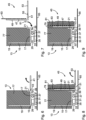
- the figures show various embodiments of plaster sealing strips 11 according to the invention for connecting a building element to a building wall, each in cross section.
- the plaster sealing strips 11 extend along a first or second longitudinal direction L 1 , L 2 running perpendicular to the plane of the image and have the cross section shown at least essentially over their entire longitudinal extent. Elements of different embodiments that correspond to one another are identified by the same reference numeral.
- Fig. 1 shows a base profile 13 of this plaster sealing strip 11, which comprises a profile body 15 extending along the first longitudinal direction L 1 , which in turn has a base leg 17, a plaster leg 19 and a limiting section 21.
- the base leg 17 extends with an at least substantially straight course along a base direction B, which is oriented perpendicular to the first longitudinal direction L 1.
- a spacer section 23 of the base leg 17 extends from an end 25 near the building to an end 27 far from the building, wherein the spacer section 23 corresponds to the entire base leg 17 in the first embodiment.
- the plaster leg 19 protrudes from the base leg 17 in a normal direction N oriented perpendicular to the base direction B and to the first longitudinal extension L 1 , while the boundary section 21 at the end 27 remote from the building also protrudes from the base leg 17 in the normal direction N.
- the length of the plaster leg 19 (along the normal direction N) is greater than the length of the base leg 23 (along the base direction B), while the length of the boundary section 21 (along the normal direction N) is less than the length of the base leg 23 (along the base direction B).
- the base profile 13 is a flat, at least substantially strip-shaped intermediate profile 31, which is aligned parallel to the base direction B.
- a first side surface of the intermediate profile 31 is connected to the fastening surface 29 via a first adhesive tape 33; a second adhesive tape 35 is adhered to a second side surface of the intermediate profile 31 opposite the first side surface, via which the intermediate profile 31 can be adhered to the respective component.
- the first adhesive tape 33 and the second adhesive tape 35 are each foam adhesive tapes. While the second adhesive tape 35 extends essentially over the entire extent of the intermediate profile 31 along the base direction B, the extent of the first adhesive tape 33 along the base direction B is shorter; in particular, it is less than half the extent of the intermediate profile 31 along the base direction B. As a result, there is a free space between the fastening surface 29 and the intermediate profile 31, which, with respect to the base direction B, lies between the first adhesive tape 33 and the end 27 of the spacer section 23 of the base leg 17 remote from the building.
- a membrane 37 Spanning this free space is a membrane 37, which is connected on the one hand to the fastening surface 29 and on the other hand to the intermediate profile 31, and whose cross-sectional length is greater than the thickness (extension along the normal direction N) of the first adhesive tape 33.
- the first adhesive tape 33 Due to the smaller extension along the base direction B and/or due to the formation of the respective adhesive connection, the first adhesive tape 33 has a lower adhesive force than the second adhesive tape 35. If the profile body 15 of the base profile 13 should move away from the respective component, for example for thermal reasons, the connection between the fastening surface 29 and the intermediate profile 31 is released, while the connection between the intermediate profile 31 and the component remains intact. However, the fastening surface 29 and the intermediate profile 31 then advantageously remain are still connected to each other via the membrane 37, so that the joint between the base profile 13 and the structural element remains sealed. In this way, the plaster sealing strip 11 allows for movement compensation while still providing reliable sealing.
- a coupling receptacle 39 of the base profile 13 is formed at the end 27 of the spacer section 23 of the base leg 17 remote from the building.
- This coupling receptacle 39 is essentially designed as a groove that extends along the first longitudinal direction L 1 and, in the first embodiment, has a C-shaped cross-section.
- the coupling receptacle 39 is formed on the side of the fastening surface 29 and is open in the base direction B (pointing away from the end 25 near the building).
- the base profile 13 further comprises a tear-off tab 41, which is connected to the end 27 of the spacer section 23 of the base leg 17 remote from the building via a predetermined breaking point 43 and is aligned parallel to the base direction B, so that it is arranged in direct extension of the base leg 17. Along the predetermined breaking point 43, the tear-off tab 41 can be separated from the profile body 15 of the base profile 13.
- the coupling receptacle 39 serves to couple the base profile 13 with a Fig. 2 separately shown additional profile 45.
- This additional profile 45 comprises a profile body 47 which extends in the second longitudinal direction L 2 , which in the coupled state of the plaster sealing strip 11 (ie when the base profile 13 and the additional profile 45 are coupled together; see e.g. Fig. 4 ) coincides with the first longitudinal direction L 1 .
- the profile body 47 of the additional profile 45 comprises a plaster leg 49, which is basically similar to the plaster leg 19 of the basic profile 13 and extends with at least a substantially straight course along a second Longitudinal direction L 2 extends vertically. In the coupled state of the plaster sealing strip 11, this direction corresponds to the aforementioned normal direction N.
- the profile body 47 of the additional profile 45 comprises a cover leg 51, which in the first embodiment protrudes perpendicularly from one end of the plaster leg 49.
- the cover leg 51 protrudes from the plaster leg 49 in the base direction B.
- the length of the cover leg 51 is significantly shorter than that of the plaster leg 49 of the additional profile 45.
- the additional profile 45 also has a tear-off tab 53, which is connected via a predetermined breaking point 55 to the cover leg 51, namely to an end of the cover leg 51 spaced from the cleaning leg 49.
- the tear-off tab 53 is arranged in direct extension of the cover leg 51 and, in the coupled state, is therefore aligned parallel to the base direction B.
- the tear-off tab 53 can be separated from the profile body 47 of the additional profile 45 along the predetermined breaking point 55.
- the covering leg 51 protrudes from a front side 57 of the plaster leg 49 of the additional profile 45.
- a coupling extension 61 is formed, which is at least substantially perpendicular to the plaster leg 49.
- the coupling extension 61 is designed as a web protruding from the rear side 59, the free end of which has a circular, thickened cross-section. As a result, this free end of the coupling extension 61 is at least substantially complementary to the C-shape of the coupling receptacle 39.
- the diameter of the circular shape is slightly larger than the opening of the C-shape, so that the opening is temporarily widened when the coupling extension 61 is inserted into the coupling receptacle 39 and, after insertion, engages behind the circular shape. In this way, the coupling extension 61 snaps into the coupling receptacle. 39 and is thus positively secured against leaving the coupling receptacle 39.
- the toothing is in each case so asymmetrical that when an attempt is made to pull the coupling extension 61 out of the coupling receptacle 39 in the opposite direction to the direction in which it was inserted into the coupling receptacle 39, the tooth flanks of the internal toothing of the coupling receptacle 39, which are oriented perpendicular to this direction, and the tooth flanks of the external toothing of the coupling extension 61, which are also oriented perpendicular to this direction, are pressed flat against each other and thereby block removal of the coupling extension 61 from the coupling receptacle 39.
- an irreversible coupling can be achieved by this type of design of the coupling receptacle 39 and the coupling extension 61, whereas the coupling of the first embodiment can also be released again.
- Fig. 4 are these in Fig. 1 shown basic profile 13 and the one in Fig. 2 shown additional profile 45 of the first embodiment of a plaster sealing strip 11 according to the invention in the coupled state. If the base profile 13 has the tear-off tab 41 as in the first embodiment, this must be used to couple the base profile 13 with the additional profile 45 by inserting the coupling extension 61 into the coupling receptacle 39 must first be separated from the profile body 15 at the predetermined breaking point 43. The tear-off tab 41 is then no longer part of the base profile 13 and therefore in Fig. 4 also not shown.
- the first longitudinal direction L 1 and the second longitudinal direction L 2 coincide; moreover, the cleaning leg 19 of the base profile 13 and the cleaning leg 49 of the additional profile 45 are then arranged at a distance from one another (with the length of the spacer section 23 at least substantially specifying the distance) and aligned parallel to one another.
- the cleaning leg 49 of the additional profile 45 then extends, like the cleaning leg 19 of the base profile 13, along the normal direction N, and the cover leg 51 of the additional profile 45 extends, like the base leg 17 of the base profile 13, along the base direction B.
- a reinforcing mesh 63 can be seen, which is arranged parallel to the plastering leg 49 of the additional profile 45 and projects beyond the plastering leg 49 parallel to the extension of the plastering leg 49 along the normal direction N.
- the reinforcing mesh 63 can generally only be arranged on the plastering leg 49 of the additional profile 45 after the coupling of the base profile 13 to the additional profile 45. Preferably, however, it is already firmly connected to the plastering leg 49 of the additional profile 45 from the outset and is thus part of the additional profile 45.
- the Fig. 5 shows a second embodiment of a plaster sealing strip 11 according to the invention, which differs from the first embodiment primarily in the structure of the base profile 13 and its attachment to the respective structural element 65; the additional profile 45 of the second embodiment, however, is at least substantially identical to the additional profile 45 of the first embodiment.
- the base leg 17 extends with a support section 67 beyond the building-proximate end 25 of the spacer section 23, at which the plaster leg 19 protrudes from the base leg 17.
- the support section 67 protrudes from the fastening surface 29 opposite the normal direction N and then merges into a contact section 69, which in turn is aligned parallel to the base direction B.
- An adhesive tape 71 is provided on the contact section 69, via which the base profile 13 can be adhered to the building element 65.
- a free space 73 inevitably remains between the fastening surface 29 and the structural element 65.
- a pre-compressed joint sealing tape 75 can be inserted into this free space 73, which can expand in the free space 73 and thus largely fill it. Should the adhesive tape 71 become detached from the base profile 13 or the structural element 65 due to a movement, in particular due to thermal factors, of the base profile 13 relative to the structural element 65, the joint sealing tape 75 can continue to fill the space between the fastening surface 29 and the structural element 65 by further expanding and thus reliably seal it.
- Fig. 6 to 9 Different states of the plaster sealing strip 11 are shown, which illustrate the process according to which a plaster sealing strip 11 according to the invention can be used for the structural connection of a building element to a building wall. This process is shown in the Fig. 6 to 9 shown as an example for the first embodiment; however, it also applies, where applicable, to other embodiments.
- the base profile 13 is attached to the building element 65 by being glued to the building element 65 (via the first adhesive tape 33 and the intermediate profile 31) with the second adhesive tape 35
- the base profile 13 was arranged such that its plaster leg 19 was arranged parallel to the building wall at a short distance (for example, a few centimeters) from the building wall (not shown), between which and the building element 65 the building structure connection is to be established.
- the plaster leg 19 was then plastered into a base plaster layer 77 on the building wall.
- a base plaster layer 77 was therefore applied to the building wall, surrounding the plaster leg 19 of the base profile 13, so that the plaster leg 19 is embedded (near the building wall) in the base plaster layer 77.
- the application of the base plaster layer 77 can be made easier in particular by the fact that the plaster leg 19 has a plurality of passages through which the plaster can penetrate.
- the base plaster layer 77 extends in a direction perpendicular to the building wall from the building wall to the boundary section 21 of the base profile 13, which serves as a marker and, if necessary, also as a removal aid for applying the base plaster layer 77 to the building wall.
- the tear-off tab 41 prevents plaster from getting onto the building element 65 or into the area between the base leg 17 of the base profile 13 and the building element 65 when the base plaster layer 77 is applied.
- a cover film can also be adhered to the tear-off tab 41.
- the coupling receptacle 39 formed on the base profile 13 is also protected from contamination by plaster by the tear-off tab 41.
- the tear-off tab 41 can be separated from the profile body 15 of the base profile 13 at the predetermined breaking point 43 (see arrow in Fig. 6 ).
- the coupling receptacle 39 is accessible, so that the coupling extension 61 of the additional profile 45 can be inserted into the coupling receptacle 39 and thus the additional profile 45 can be coupled to the base profile 13 (see arrow in Fig. 7 ).
- the plaster leg 49 of the additional profile 45 is in the then existing In the coupled state, the plaster sealing strip 11 is aligned parallel to the plaster leg 19 of the base profile 13 and arranged at a small distance (for example less than 1 cm) from the surface of the base plaster layer 77.
- a reinforcing mesh 63 is attached to the plaster leg 49 of the additional profile 45, which extends beyond the plaster leg 49 and thereby at least substantially along the surface of the base plaster layer 77. If the entire surface of the base plaster layer 77 is not covered by the reinforcing mesh 63 provided on the additional profile 45, a separate reinforcing mesh can additionally be arranged on the surface of the base plaster layer 77.
- the plaster leg 49 of the additional profile 45 is plastered into an additional plaster layer 79 on the base plaster layer 77.
- An additional plaster layer 79 has therefore been applied to the base plaster layer 77, surrounding the plaster leg 49 of the additional profile 45, so that the plaster leg 49, including the reinforcement mesh 63 provided on it and, if applicable, one or more further reinforcement meshes, is embedded in the additional plaster layer 79.
- a finishing plaster layer 81 has also been applied as part of the additional plaster layer 79 or on the additional plaster layer 79. Overall, the applied plaster extends in a direction perpendicular to the building wall up to the free end of the covering leg 51 of the additional profile 45.
- the tear-off tab 53 of the additional profile 45 also prevents plaster from reaching the structural element 65 or the area between the cover leg 51 of the additional profile 45 and the structural element 65 when applying the additional plaster layer 79 (including the top coat 81 if necessary).
- a cover film can also be glued onto the tear-off tab 53.
- the tear-off tab 53 can then be separated from the profile body 47 of the additional profile 45 along the predetermined breaking point 55 (see arrow in Fig. 8 ).
- the installation of the plaster sealing strip 11, including the plastering, is then complete. This state is shown in Fig. 9 shown.
- the two-part design of the plaster sealing strip 11 and the type of coupling of the base profile 13 and the additional profile 45 with parallel and spaced arrangement of their two plaster legs 19, 49 facilitate the application of a comparatively thick base plaster layer 77, in particular made of an (ultra-) lightweight plaster, as well as the application of an additional plaster layer 79 which stabilizes the base plaster layer 77 and is preferably provided with a reinforcing mesh 63 for this purpose.
- the plaster sealing strip 11 can simultaneously enable movement compensation and reliable sealing of the joint between the plaster layers 77, 79, 81 and the building wall 63.
Landscapes
- Engineering & Computer Science (AREA)
- Architecture (AREA)
- Civil Engineering (AREA)
- Structural Engineering (AREA)
- Finishing Walls (AREA)
Applications Claiming Priority (1)
| Application Number | Priority Date | Filing Date | Title |
|---|---|---|---|
| DE102023135176.1A DE102023135176A1 (de) | 2023-12-14 | 2023-12-14 | Anputzdichtleiste |
Publications (1)
| Publication Number | Publication Date |
|---|---|
| EP4571013A1 true EP4571013A1 (fr) | 2025-06-18 |
Family
ID=93922879
Family Applications (1)
| Application Number | Title | Priority Date | Filing Date |
|---|---|---|---|
| EP24219368.8A Pending EP4571013A1 (fr) | 2023-12-14 | 2024-12-12 | Baguette d'étanchéité en plâtre |
Country Status (2)
| Country | Link |
|---|---|
| EP (1) | EP4571013A1 (fr) |
| DE (1) | DE102023135176A1 (fr) |
Citations (1)
| Publication number | Priority date | Publication date | Assignee | Title |
|---|---|---|---|---|
| DE29822615U1 (de) * | 1998-11-11 | 2000-03-30 | Lorentz, Doris, 66333 Völklingen | System für Sockelleiste und Dehnfuge |
Family Cites Families (4)
| Publication number | Priority date | Publication date | Assignee | Title |
|---|---|---|---|---|
| DE29924216U1 (de) * | 1998-11-11 | 2002-08-14 | Lorentz, Doris, 66333 Völklingen | Randleiste für Wanddeckungen |
| AT8398U1 (de) * | 2005-06-23 | 2006-07-15 | Peter Kassmannhuber | Zweiteiliges laibungsanschlussprofil |
| DE102011004764A1 (de) * | 2011-02-25 | 2012-08-30 | August Braun | Anputzleiste sowie Bauwerksecke mit Anputzleiste |
| AT519110B1 (de) * | 2017-04-28 | 2018-04-15 | AF Tec Beteiligungs GmbH | Anschlussprofil für an putz angrenzende bauteile |
-
2023
- 2023-12-14 DE DE102023135176.1A patent/DE102023135176A1/de active Pending
-
2024
- 2024-12-12 EP EP24219368.8A patent/EP4571013A1/fr active Pending
Patent Citations (1)
| Publication number | Priority date | Publication date | Assignee | Title |
|---|---|---|---|---|
| DE29822615U1 (de) * | 1998-11-11 | 2000-03-30 | Lorentz, Doris, 66333 Völklingen | System für Sockelleiste und Dehnfuge |
Also Published As
| Publication number | Publication date |
|---|---|
| DE102023135176A1 (de) | 2025-06-18 |
Similar Documents
| Publication | Publication Date | Title |
|---|---|---|
| DE20008712U1 (de) | Profilleiste zum Abdichten einer Bewegungsfuge zwischen einem Bauteil und einer Putzschicht | |
| DE102011102968B4 (de) | Haltevorrichtung und Verfahren zur Montage einer solchen | |
| DE20011013U1 (de) | Laibungsanschlußprofil | |
| EP2492429B3 (fr) | Bande de crépissage ainsi qu'angles de construction dotés d'une bande de crépissage | |
| EP3009577B1 (fr) | Bande d'etancheite | |
| DE202013101783U1 (de) | Wärmegedämmtes Aussteifungselement für einen Rollladenkasten und Rolladenkasten | |
| DE202013011085U1 (de) | Anputzleiste, Leiste und Abschlussschiene | |
| EP4571013A1 (fr) | Baguette d'étanchéité en plâtre | |
| EP2708674B1 (fr) | Bande de crépissage et baguette d'angle pour enduit | |
| EP3992407B1 (fr) | Élément isolant | |
| EP3848549B1 (fr) | Baguette de limitation de crépi ainsi que transition de bâtiment pourvu de limitation de crépi | |
| EP1956174B1 (fr) | Rail de profilé destiné au positionnement d'un élément de fixation et procédé de fabrication d'une unité de vitrification multiple | |
| AT8398U1 (de) | Zweiteiliges laibungsanschlussprofil | |
| DE29620179U1 (de) | Stoßprofil für Fenstereinbindungen | |
| EP2770134A1 (fr) | Système de profilé pour une façade de bâtiment | |
| DE9315679U1 (de) | Fugenverschluß | |
| DE102004008831B4 (de) | Profil zum Abdecken von Dämmschichten | |
| DE2808328A1 (de) | Umsetzbares wandelement und in zweischalenbauweise daraus hergestelltes trennwandelement | |
| EP3587701B1 (fr) | Agencement de profilé de plâtre pour étanchéifier un joint | |
| EP4194638B1 (fr) | Baguette d'étanchéité en plâtre | |
| EP1548197A1 (fr) | Dispositif et procédé pour l'étanchéification de joints de constructions, en particulier pour des joints d'expansion de façade | |
| DE202012007784U1 (de) | Zargenkonstruktion | |
| EP3832050B1 (fr) | Profilé de finition | |
| DE10145052B4 (de) | Satz von Innenfutterprofilleisten | |
| DE102018113031A1 (de) | Dachrandabschlussprofil sowie Verfahren zum Verlegen einer Dachabdeckbahn |
Legal Events
| Date | Code | Title | Description |
|---|---|---|---|
| PUAI | Public reference made under article 153(3) epc to a published international application that has entered the european phase |
Free format text: ORIGINAL CODE: 0009012 |
|
| STAA | Information on the status of an ep patent application or granted ep patent |
Free format text: STATUS: THE APPLICATION HAS BEEN PUBLISHED |
|
| AK | Designated contracting states |
Kind code of ref document: A1 Designated state(s): AL AT BE BG CH CY CZ DE DK EE ES FI FR GB GR HR HU IE IS IT LI LT LU LV MC ME MK MT NL NO PL PT RO RS SE SI SK SM TR |
|
| P01 | Opt-out of the competence of the unified patent court (upc) registered |
Free format text: CASE NUMBER: APP_30419/2025 Effective date: 20250625 |
|
| STAA | Information on the status of an ep patent application or granted ep patent |
Free format text: STATUS: REQUEST FOR EXAMINATION WAS MADE |
|
| 17P | Request for examination filed |
Effective date: 20251126 |
|
| GRAP | Despatch of communication of intention to grant a patent |
Free format text: ORIGINAL CODE: EPIDOSNIGR1 |
|
| STAA | Information on the status of an ep patent application or granted ep patent |
Free format text: STATUS: GRANT OF PATENT IS INTENDED |
|
| INTG | Intention to grant announced |
Effective date: 20260202 |
|
| RIC1 | Information provided on ipc code assigned before grant |
Ipc: E04F 13/06 20060101AFI20260123BHEP |