EP4574188A1 - Récipient d'application médicale comprenant un corps de seringue pré-remplissable - Google Patents
Récipient d'application médicale comprenant un corps de seringue pré-remplissable Download PDFInfo
- Publication number
- EP4574188A1 EP4574188A1 EP23219998.4A EP23219998A EP4574188A1 EP 4574188 A1 EP4574188 A1 EP 4574188A1 EP 23219998 A EP23219998 A EP 23219998A EP 4574188 A1 EP4574188 A1 EP 4574188A1
- Authority
- EP
- European Patent Office
- Prior art keywords
- syringe body
- proximal
- medical application
- application vessel
- sealing means
- Prior art date
- Legal status (The legal status is an assumption and is not a legal conclusion. Google has not performed a legal analysis and makes no representation as to the accuracy of the status listed.)
- Pending
Links
Images




Classifications
-
- A—HUMAN NECESSITIES
- A61—MEDICAL OR VETERINARY SCIENCE; HYGIENE
- A61M—DEVICES FOR INTRODUCING MEDIA INTO, OR ONTO, THE BODY; DEVICES FOR TRANSDUCING BODY MEDIA OR FOR TAKING MEDIA FROM THE BODY; DEVICES FOR PRODUCING OR ENDING SLEEP OR STUPOR
- A61M5/00—Devices for bringing media into the body in a subcutaneous, intra-vascular or intramuscular way; Accessories therefor, e.g. filling or cleaning devices, arm-rests
- A61M5/178—Syringes
-
- A—HUMAN NECESSITIES
- A61—MEDICAL OR VETERINARY SCIENCE; HYGIENE
- A61J—CONTAINERS SPECIALLY ADAPTED FOR MEDICAL OR PHARMACEUTICAL PURPOSES; DEVICES OR METHODS SPECIALLY ADAPTED FOR BRINGING PHARMACEUTICAL PRODUCTS INTO PARTICULAR PHYSICAL OR ADMINISTERING FORMS; DEVICES FOR ADMINISTERING FOOD OR MEDICINES ORALLY; BABY COMFORTERS; DEVICES FOR RECEIVING SPITTLE
- A61J1/00—Containers specially adapted for medical or pharmaceutical purposes
- A61J1/14—Details; Accessories therefor
- A61J1/1406—Septums, pierceable membranes
-
- A—HUMAN NECESSITIES
- A61—MEDICAL OR VETERINARY SCIENCE; HYGIENE
- A61J—CONTAINERS SPECIALLY ADAPTED FOR MEDICAL OR PHARMACEUTICAL PURPOSES; DEVICES OR METHODS SPECIALLY ADAPTED FOR BRINGING PHARMACEUTICAL PRODUCTS INTO PARTICULAR PHYSICAL OR ADMINISTERING FORMS; DEVICES FOR ADMINISTERING FOOD OR MEDICINES ORALLY; BABY COMFORTERS; DEVICES FOR RECEIVING SPITTLE
- A61J1/00—Containers specially adapted for medical or pharmaceutical purposes
- A61J1/14—Details; Accessories therefor
- A61J1/1412—Containers with closing means, e.g. caps
- A61J1/1431—Permanent type, e.g. welded or glued
-
- A—HUMAN NECESSITIES
- A61—MEDICAL OR VETERINARY SCIENCE; HYGIENE
- A61M—DEVICES FOR INTRODUCING MEDIA INTO, OR ONTO, THE BODY; DEVICES FOR TRANSDUCING BODY MEDIA OR FOR TAKING MEDIA FROM THE BODY; DEVICES FOR PRODUCING OR ENDING SLEEP OR STUPOR
- A61M5/00—Devices for bringing media into the body in a subcutaneous, intra-vascular or intramuscular way; Accessories therefor, e.g. filling or cleaning devices, arm-rests
- A61M5/178—Syringes
- A61M5/31—Details
- A61M5/3129—Syringe barrels
- A61M5/3135—Syringe barrels characterised by constructional features of the proximal end
-
- A—HUMAN NECESSITIES
- A61—MEDICAL OR VETERINARY SCIENCE; HYGIENE
- A61J—CONTAINERS SPECIALLY ADAPTED FOR MEDICAL OR PHARMACEUTICAL PURPOSES; DEVICES OR METHODS SPECIALLY ADAPTED FOR BRINGING PHARMACEUTICAL PRODUCTS INTO PARTICULAR PHYSICAL OR ADMINISTERING FORMS; DEVICES FOR ADMINISTERING FOOD OR MEDICINES ORALLY; BABY COMFORTERS; DEVICES FOR RECEIVING SPITTLE
- A61J1/00—Containers specially adapted for medical or pharmaceutical purposes
- A61J1/05—Containers specially adapted for medical or pharmaceutical purposes for collecting, storing or administering blood, plasma or medical fluids ; Infusion or perfusion containers
- A61J1/06—Ampoules or carpules
- A61J1/062—Carpules
-
- A—HUMAN NECESSITIES
- A61—MEDICAL OR VETERINARY SCIENCE; HYGIENE
- A61J—CONTAINERS SPECIALLY ADAPTED FOR MEDICAL OR PHARMACEUTICAL PURPOSES; DEVICES OR METHODS SPECIALLY ADAPTED FOR BRINGING PHARMACEUTICAL PRODUCTS INTO PARTICULAR PHYSICAL OR ADMINISTERING FORMS; DEVICES FOR ADMINISTERING FOOD OR MEDICINES ORALLY; BABY COMFORTERS; DEVICES FOR RECEIVING SPITTLE
- A61J1/00—Containers specially adapted for medical or pharmaceutical purposes
- A61J1/14—Details; Accessories therefor
- A61J1/20—Arrangements for transferring or mixing fluids, e.g. from vial to syringe
- A61J1/2003—Accessories used in combination with means for transfer or mixing of fluids, e.g. for activating fluid flow, separating fluids, filtering fluid or venting
- A61J1/2006—Piercing means
- A61J1/201—Piercing means having one piercing end
-
- A—HUMAN NECESSITIES
- A61—MEDICAL OR VETERINARY SCIENCE; HYGIENE
- A61M—DEVICES FOR INTRODUCING MEDIA INTO, OR ONTO, THE BODY; DEVICES FOR TRANSDUCING BODY MEDIA OR FOR TAKING MEDIA FROM THE BODY; DEVICES FOR PRODUCING OR ENDING SLEEP OR STUPOR
- A61M5/00—Devices for bringing media into the body in a subcutaneous, intra-vascular or intramuscular way; Accessories therefor, e.g. filling or cleaning devices, arm-rests
- A61M5/178—Syringes
- A61M5/31—Details
- A61M2005/3101—Leak prevention means for proximal end of syringes, i.e. syringe end opposite to needle mounting end
-
- A—HUMAN NECESSITIES
- A61—MEDICAL OR VETERINARY SCIENCE; HYGIENE
- A61M—DEVICES FOR INTRODUCING MEDIA INTO, OR ONTO, THE BODY; DEVICES FOR TRANSDUCING BODY MEDIA OR FOR TAKING MEDIA FROM THE BODY; DEVICES FOR PRODUCING OR ENDING SLEEP OR STUPOR
- A61M5/00—Devices for bringing media into the body in a subcutaneous, intra-vascular or intramuscular way; Accessories therefor, e.g. filling or cleaning devices, arm-rests
- A61M5/178—Syringes
- A61M5/31—Details
- A61M2005/3103—Leak prevention means for distal end of syringes, i.e. syringe end for mounting a needle
-
- A—HUMAN NECESSITIES
- A61—MEDICAL OR VETERINARY SCIENCE; HYGIENE
- A61M—DEVICES FOR INTRODUCING MEDIA INTO, OR ONTO, THE BODY; DEVICES FOR TRANSDUCING BODY MEDIA OR FOR TAKING MEDIA FROM THE BODY; DEVICES FOR PRODUCING OR ENDING SLEEP OR STUPOR
- A61M5/00—Devices for bringing media into the body in a subcutaneous, intra-vascular or intramuscular way; Accessories therefor, e.g. filling or cleaning devices, arm-rests
- A61M5/178—Syringes
- A61M5/31—Details
- A61M2005/3103—Leak prevention means for distal end of syringes, i.e. syringe end for mounting a needle
- A61M2005/3104—Caps for syringes without needle
-
- A—HUMAN NECESSITIES
- A61—MEDICAL OR VETERINARY SCIENCE; HYGIENE
- A61M—DEVICES FOR INTRODUCING MEDIA INTO, OR ONTO, THE BODY; DEVICES FOR TRANSDUCING BODY MEDIA OR FOR TAKING MEDIA FROM THE BODY; DEVICES FOR PRODUCING OR ENDING SLEEP OR STUPOR
- A61M5/00—Devices for bringing media into the body in a subcutaneous, intra-vascular or intramuscular way; Accessories therefor, e.g. filling or cleaning devices, arm-rests
- A61M5/178—Syringes
- A61M5/31—Details
- A61M2005/3117—Means preventing contamination of the medicament compartment of a syringe
-
- A—HUMAN NECESSITIES
- A61—MEDICAL OR VETERINARY SCIENCE; HYGIENE
- A61M—DEVICES FOR INTRODUCING MEDIA INTO, OR ONTO, THE BODY; DEVICES FOR TRANSDUCING BODY MEDIA OR FOR TAKING MEDIA FROM THE BODY; DEVICES FOR PRODUCING OR ENDING SLEEP OR STUPOR
- A61M5/00—Devices for bringing media into the body in a subcutaneous, intra-vascular or intramuscular way; Accessories therefor, e.g. filling or cleaning devices, arm-rests
- A61M5/178—Syringes
- A61M5/31—Details
- A61M2005/3117—Means preventing contamination of the medicament compartment of a syringe
- A61M2005/3118—Means preventing contamination of the medicament compartment of a syringe via the distal end of a syringe, i.e. syringe end for mounting a needle cannula
-
- A—HUMAN NECESSITIES
- A61—MEDICAL OR VETERINARY SCIENCE; HYGIENE
- A61M—DEVICES FOR INTRODUCING MEDIA INTO, OR ONTO, THE BODY; DEVICES FOR TRANSDUCING BODY MEDIA OR FOR TAKING MEDIA FROM THE BODY; DEVICES FOR PRODUCING OR ENDING SLEEP OR STUPOR
- A61M5/00—Devices for bringing media into the body in a subcutaneous, intra-vascular or intramuscular way; Accessories therefor, e.g. filling or cleaning devices, arm-rests
- A61M5/178—Syringes
- A61M5/31—Details
- A61M2005/3117—Means preventing contamination of the medicament compartment of a syringe
- A61M2005/3118—Means preventing contamination of the medicament compartment of a syringe via the distal end of a syringe, i.e. syringe end for mounting a needle cannula
- A61M2005/312—Means preventing contamination of the medicament compartment of a syringe via the distal end of a syringe, i.e. syringe end for mounting a needle cannula comprising sealing means, e.g. severable caps, to be removed prior to injection by, e.g. tearing or twisting
-
- A—HUMAN NECESSITIES
- A61—MEDICAL OR VETERINARY SCIENCE; HYGIENE
- A61M—DEVICES FOR INTRODUCING MEDIA INTO, OR ONTO, THE BODY; DEVICES FOR TRANSDUCING BODY MEDIA OR FOR TAKING MEDIA FROM THE BODY; DEVICES FOR PRODUCING OR ENDING SLEEP OR STUPOR
- A61M5/00—Devices for bringing media into the body in a subcutaneous, intra-vascular or intramuscular way; Accessories therefor, e.g. filling or cleaning devices, arm-rests
- A61M5/178—Syringes
- A61M5/31—Details
- A61M2005/3117—Means preventing contamination of the medicament compartment of a syringe
- A61M2005/3121—Means preventing contamination of the medicament compartment of a syringe via the proximal end of a syringe, i.e. syringe end opposite to needle cannula mounting end
-
- A—HUMAN NECESSITIES
- A61—MEDICAL OR VETERINARY SCIENCE; HYGIENE
- A61M—DEVICES FOR INTRODUCING MEDIA INTO, OR ONTO, THE BODY; DEVICES FOR TRANSDUCING BODY MEDIA OR FOR TAKING MEDIA FROM THE BODY; DEVICES FOR PRODUCING OR ENDING SLEEP OR STUPOR
- A61M5/00—Devices for bringing media into the body in a subcutaneous, intra-vascular or intramuscular way; Accessories therefor, e.g. filling or cleaning devices, arm-rests
- A61M5/002—Packages specially adapted therefor, e.g. for syringes or needles, kits for diabetics
-
- A—HUMAN NECESSITIES
- A61—MEDICAL OR VETERINARY SCIENCE; HYGIENE
- A61M—DEVICES FOR INTRODUCING MEDIA INTO, OR ONTO, THE BODY; DEVICES FOR TRANSDUCING BODY MEDIA OR FOR TAKING MEDIA FROM THE BODY; DEVICES FOR PRODUCING OR ENDING SLEEP OR STUPOR
- A61M5/00—Devices for bringing media into the body in a subcutaneous, intra-vascular or intramuscular way; Accessories therefor, e.g. filling or cleaning devices, arm-rests
- A61M5/178—Syringes
- A61M5/31—Details
- A61M5/315—Pistons; Piston-rods; Guiding, blocking or restricting the movement of the rod or piston; Appliances on the rod for facilitating dosing ; Dosing mechanisms
- A61M5/31511—Piston or piston-rod constructions, e.g. connection of piston with piston-rod
- A61M5/31513—Piston constructions to improve sealing or sliding
-
- A—HUMAN NECESSITIES
- A61—MEDICAL OR VETERINARY SCIENCE; HYGIENE
- A61M—DEVICES FOR INTRODUCING MEDIA INTO, OR ONTO, THE BODY; DEVICES FOR TRANSDUCING BODY MEDIA OR FOR TAKING MEDIA FROM THE BODY; DEVICES FOR PRODUCING OR ENDING SLEEP OR STUPOR
- A61M5/00—Devices for bringing media into the body in a subcutaneous, intra-vascular or intramuscular way; Accessories therefor, e.g. filling or cleaning devices, arm-rests
- A61M5/50—Devices for bringing media into the body in a subcutaneous, intra-vascular or intramuscular way; Accessories therefor, e.g. filling or cleaning devices, arm-rests having means for preventing re-use, or for indicating if defective, used, tampered with or unsterile
- A61M5/5086—Devices for bringing media into the body in a subcutaneous, intra-vascular or intramuscular way; Accessories therefor, e.g. filling or cleaning devices, arm-rests having means for preventing re-use, or for indicating if defective, used, tampered with or unsterile for indicating if defective, used, tampered with or unsterile
Definitions
- the present disclosure relates to a medical application vessel having a syringe body that can be at least partially prefilled with a substance for injecting the substance into a living being.
- a medical application vessel having a syringe body that can be at least partially prefilled with a substance for injecting the substance into a living being.
- it concerns prefillable or prefilled medical syringe systems.
- Prefilled medical syringes have the advantage that medical personnel do not have to draw the substance to be injected from an ampoule before injection, but are available to medical personnel ready for use. Prefilled syringes are therefore delivered prefilled to medical personnel. Such syringes are described, for example, in ISO 11040. EP 2 900 301 B1 For example, a prefilled syringe is also known. A technical challenge for prefilled syringes, however, is that they must store medications and medical devices safely over an extended period of time. A storage period of at least three years should be guaranteed, during which the contained substance is safely stored in the prefilled syringe.
- the possible storage time of a substance depends significantly on the barrier properties of the syringe, the materials used for the syringe body and closure, and the sensitivity and quantity of the substance contained in the syringe.
- the loss of water vapor or solvent liquid can change the concentration of a medicinal agent within the substance.
- the pH value of the substance could change due to the migration of carbon dioxide into the syringe material.
- penetrating oxygen could damage a medicinal agent.
- the object of the present disclosure to provide a biocompatible medical application vessel with improved barrier properties.
- the barrier properties are to be improved to such an extent that the medical application vessel can be prefilled with substances that previously could not be stored in prefilled syringes, especially not in small quantities.
- a medical application vessel is provided with a syringe body that can be at least partially prefilled with a substance for injecting the substance into a living being, wherein the syringe body extends from a proximal end of the syringe body to a distal end of the syringe body and defines a first internal volume into which the substance can be prefilled, wherein an injection needle or an injection tube is connected or connectable to the distal end of the syringe body, wherein the first internal volume is delimited on the proximal side by a plug that can be moved towards the distal end, wherein the plug has a piston rod receptacle on the proximal side for a piston rod that is separate from the plug, wherein a proximal sealing means that can be removed manually and/or pierced by means of the piston rod is arranged proximal to the plug and seals a second internal volume on the proximal side that is formed axially between the proximal side that
- distal and proximal refer to the person handling the application container, i.e., the medical personnel, and not to the living being into which the substance is injected.
- the idea of the invention is therefore to store the substance in a first internal volume and to provide a second internal volume proximal to the stopper, which is sealed by the proximal sealant.
- the substance is separated from the environment on the proximal side by both the stopper and the proximal sealant, so that both the stopper and the proximal sealant together represent a proximal barrier.
- the stopper can be made of a material with a lower barrier effect, but which is biocompatible with substances that previously could not be stored in prefilled syringes.
- the proximal sealant does not need to be able to slide freely within the syringe body, so a material with better barrier properties can be used instead.
- the interaction of plug and proximal sealant not only increases the overall barrier effect in the proximal direction, but also creates the possibility of using different materials for the plug and the proximal sealant in order to meet the respective requirements.
- a liquid silicone rubber (LSR) can be used for the plug, so that no silicone oil is required to lubricate the plug.
- the proximal sealant can, for example, consist of a material of the same or similar type as the syringe barrel, e.g. a cyclo-olefin polymer (COP).
- the proximal sealant can comprise an aluminum layer or, more generally, a metallized film.
- the present invention only relates to medical application vessels that have a prefillable or prefilled syringe body.
- Application vessels that must be drawn with the substance from an ampoule by the medical personnel themselves are not covered by the present invention. Therefore, when reference is made herein to a "prefillable" syringe body, this refers to a syringe body that is suitable and intended to be at least partially prefilled with a substance.
- a manufacturer of the application vessels delivers them unfilled to a company that prefills the application vessels with the substance and then delivers them to the medical personnel as a prefilled application vessel.
- the syringe body can be filled with the substance from the proximal or distal side of the syringe body.
- the syringe body can be at least partially prefilled with the substance, so that the substance is in the first internal volume
- the invention is directed to the product as supplied to medical personnel.
- the application vessel can have a proximal-facing annular surface to which the proximal sealant is applied in the form of a sealing film that can be removed manually and/or pierced by the piston rod.
- the cost of a sealing film and its application to a proximal-facing annular surface is particularly simple and inexpensive compared to high-quality plug coatings or alternative sealants.
- a connection for the injection needle or injection tube in the form of a Luer or Luer-Lock connector can be provided at the distal end of the syringe body.
- This is useful so that the medical application vessel can be connected to a variety of common injection needles or injection tubes via a standardized Luer or Luer-Lock connector.
- the Luer or Luer-Lock connector on the application vessel is male, and the corresponding Luer or Luer-Lock connector on the injection needle or injection tube is female.
- Other standardized or customized connectors are also possible.
- the syringe body can be sealed or closed on the distal side with a distal sealant, whereby the distal sealant can be pierced by the injection needle or the injection tube.
- a distal sealant can close the first internal volume on the distal side, so that the distal sealant is in direct contact with the prefilled substance.
- the distal sealant can have a proximally facing surface that is biocompatible with the prefilled substance.
- the distal sealant can be applied in the form of a film to a distal end face of the Luer or Luer-Lock connector of the application vessel.
- the distal sealant can be coated on the proximal side with a layer that delimits the first internal volume on the distal side.
- the layer is made of the same material as the syringe body, preferably a cycloolefin polymer (COP) or a polypropylene (PP).
- COP cycloolefin polymer
- PP polypropylene
- the proximal sealant can be coated on the distal side with a layer that delimits the second internal volume on the proximal side.
- the layer is made of the same material as the syringe body, preferably a cycloolefin polymer (COP) or polypropylene (PP). This ensures biocompatibility with the substance in the event that parts of the substance diffuse through the stopper into the second internal volume.
- COP cycloolefin polymer
- PP polypropylene
- the syringe body can be made of glass and/or a plastic, preferably a cycloolefin polymer (COP) or polypropylene (PP).
- a plastic preferably a cycloolefin polymer (COP) or polypropylene (PP).
- COP cycloolefin polymer
- PP polypropylene
- the proximal sealant can be welded and/or bonded and/or force-fitted and/or positively connected to a proximal-facing annular surface of the application vessel.
- This is advantageous for securely sealing the second internal volume with the proximal sealant.
- a hot melt adhesive or other adhesive can be used to adhere the proximal sealant.
- a force-fitting and/or form-fitting connection can be achieved, for example, by embossing the proximal sealant into the proximal-facing annular surface.
- the proximal sealant can be pressed under spring preload onto a proximal-facing annular surface of the application vessel by means of a gripping aid and/or a backstop mounted at the proximal end of the syringe body.
- a gripping aid and/or a backstop mounted at the proximal end of the syringe body.
- the mounted gripping aid and/or backstop preferably has a central opening to allow the plunger rod to be pushed through.
- the second internal volume located axially between the proximal sealant and the plug can be filled with a gas other than air.
- a gas other than air This can be useful, for example, if an oxygen-sensitive substance is or will be prefilled, which could be damaged by an oxygen content in the second internal volume if oxygen from it escapes through the plug into the first
- the second internal volume is therefore preferably filled with a gas with reduced oxygen content or completely without oxygen.
- the second internal volume can be under vacuum or negative pressure.
- the proximal sealant can be printed on the proximal side with substance filling data and/or a unique device identification (UDI).
- the data can include, for example, the type, quantity, and/or components of the substance.
- the data includes a filling date and/or a best-before date.
- the data and/or the UDI can be printed in an alphanumeric and/or machine-readable format, for example, as a barcode or QR code.
- the proximal sealant can serve as a visible quality seal. This allows users to immediately see whether the proximal sealant itself and/or the sealing connection with the syringe body is damaged.
- the plug can be coated, at least on its periphery, with a liquid silicone resin (LSR), which is in sliding contact with the syringe body and is preferably elastic at temperatures above -100°C.
- LSR liquid silicone resin
- the plug can be in sliding contact with the syringe body without any silicone oil and without a lubricating coating.
- This is particularly advantageous for small-volume application vessels, for example, in the Ophthalmology, where even the smallest amounts of silicone oil or another lubricant would have a harmful effect on the substance, or would be permanently visible in the patient's eye, for example.
- the syringe body can be formed in one piece, and a proximal end face of the syringe body can form a proximal-facing annular surface to which the proximal sealing agent is sealingly applied in the form of a sealing film that can be removed manually and/or pierced by the piston rod.
- a proximal end face of the syringe body can form a proximal-facing annular surface to which the proximal sealing agent is sealingly applied in the form of a sealing film that can be removed manually and/or pierced by the piston rod.
- the syringe body can be formed from at least two syringe body parts that can be connected or are connected to one another, wherein the syringe body parts have at least one distal syringe body part and one proximal syringe body part, wherein the first volume is substantially enclosed by the distal syringe body part and the second internal volume is substantially enclosed by the proximal syringe body part.
- the distal syringe body part can form a main part of the syringe body and the proximal syringe body part a head part of the syringe body.
- the two syringe body parts preferably comprise the same material, but can also comprise different materials.
- the syringe body parts can be welded to one another and/or connected by a material fit and/or a force fit and/or a form fit. For example, they can be screwed and/or glued to one another.
- the proximal syringe body part can form a pre-assembled unit with the proximal sealant, in which the proximal sealant sits sealingly on a proximal-facing annular surface of the proximal syringe body part, wherein the pre-assembled unit with connectable or connected to the distal syringe body section filled with the substance.
- This can be advantageous for the manufacturing process if it is easier to connect the pre-assembled unit to the filled distal syringe body section than to apply the proximal sealant to the filled syringe body.
- the pre-assembled unit can then be pre-assembled outside the filling environment under less stringent environmental conditions.
- the distal syringe body section can be axially longer than the proximal syringe body section, preferably several times longer. This is useful to ensure the application vessel is not longer than necessary, since the second internal volume can be designed much smaller than the first internal volume, the size of which is essentially determined by the amount of substance to be prefilled in the application vessel.
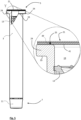
- Fig. 1 shows an embodiment of a medical application vessel 1 according to the invention, which has a syringe body 3 that is suitable and intended to be at least partially prefilled with a substance in order to inject the substance into a living being, for example, a patient.
- the substance can be, for example, a flowable medium containing a medicinal agent.
- the syringe body 3 extends from a proximal end 5 of the syringe body 3 of the application vessel 1 to a distal end 7 of the syringe body 3 of the application vessel 1 and defines a first internal volume 9 into which the substance can be prefilled.
- the proximal end 5 is arranged at the top in each of the figures, and the distal end 7 is arranged at the bottom.
- distal and proximal refer to the person using the application vessel 1 and not to the living being into which the prefilled substance is injected.
- the application vessel 1 is thus held by an operator at the proximal end 5 of the syringe body 3, and an injection needle or an injection tube (see Fig. 11a,b ) can be connected.
- an injection needle or an injection tube can be connected to the application vessel 1, Fig. 1
- a distal-side cap 11 is first removed in order to create a distal-side Luer or Luer-Lock connection (see Fig. 10a , b ) to be released.
- the syringe body 3 of the application vessel 1 is in the Fig. 1
- the syringe is molded in one piece from a plastic material comprising a chloro-olefin polymer (COP).
- the first internal volume 9 defined by the syringe body 3 of the application vessel 1 has the shape of an elongated cylinder with a preferably circular cross-section.
- the first internal volume 9 is limited by a plug 13 which can be moved towards the distal end 7.
- the plug 13 has, at least on its circumference, a liquid silicone rubber (liquid silicone resin, LSR) which is free of silicone oil and anti-friction coating.
- LSR liquid silicone resin
- the second internal volume 19 is much shorter than the first internal volume 9 and is not prefilled with the substance.
- the second internal volume 19 can be filled with air or, preferably, with a gas other than air.
- the plug 13 seals the second internal volume 19 and thus separates the second internal volume 19 from the first internal volume 9.
- the proximal side i.e. in Fig. 1 from above, the second internal volume 19 is sealed by a proximal sealing means 21.
- the proximal sealing means 21 is manually removable and/or pierced by means of the piston rod 17.
- the proximal sealing means 21 is a manually removable sealing film which, at least on the distal side, i.e., toward the second internal volume 19, has a layer made of the same material as the syringe body 3, i.e., a cycloolefin polymer (COP).
- COP cycloolefin polymer
- the sealing film 21 protrudes laterally on at least one side with a grip tab 23 so that a user can easily grasp it with a tweezer grip of the thumb and index finger and peel off the sealing film 21.
- the syringe body 3 has a collar 24 at its proximal end 5, which forms a proximally facing annular surface 25.
- the sealing film 21 is here welded or glued to the annular surface 25 in a circumferentially sealing manner.
- Fig. 2 is shown how the proximal sealant 21 is pierced with a piston rod 17.
- the piercing of the proximal sealant with the piston rod 17 can be provided in addition to the manual removal of the proximal sealant 21 or as an alternative thereto.
- the piston rod 17 can be supplied together with the medical application vessel 1 as a separate accessory or can already be in the possession of the user.
- the piston rod 17 can be reused for several application vessels 1 if necessary.
- the piston rod 17 must fit the application vessel 1, i.e., be designed to be sufficiently long in order to be able to move the stopper 13 all the way to the distal end of the first internal volume 9 in order to be able to press out the entire contents of the first internal volume 9 during injection.
- a distal end 27 of the piston rod 17 is designed to complement the piston rod receptacle 15 of the plug 13.
- the distal end 27 of the piston rod 17 has a coarse external thread with a few turns, wherein the external thread fits exactly into the internal thread of the piston rod receptacle 15 of the plug 13.
- the piston rod 17 can therefore be screwed into the plug 13 before the plug 13 is moved axially by the piston rod 17. If the plug 13 is sufficiently elastic, the distal end 27 of the piston rod 17 can, if necessary, simply be pressed axially into the piston rod 15 without the need for screwing.
- a thumb pressure surface 31 is formed, onto which a user can press with their thumb.
- the collar 24 forms a finger pull surface 33 surrounding the syringe body 3 and pointing distally, which a user can grip under with their index and middle fingers.
- proximal sealant 21 In Fig. 5 An embodiment of the proximal sealant 21 is shown, in which the proximal sealant 21 consists of a laminate with multiple layers.
- at least one layer of the laminate is an aluminum layer 39, which has a particularly high barrier effect.
- the laminate of the proximal sealant 21 has a layer 41 made of a chloro-olefin polymer (COP), wherein the COP layer 41 adjoins the second internal volume 19 to provide biocompatibility with the prefilled substance if it diffuses at least partially through the plug 13 into the second internal volume 19.
- COP chloro-olefin polymer
- Fig. 6 shows an embodiment with a gripping aid 43 mounted on the proximal end 5 of the syringe body 3, i.e. on the collar 24.
- the gripping aid 43 serves, on the one hand, to provide a larger finger-pulling surface 33' than the relatively small finger-pulling surface 33 of the collar 24 of the syringe body 3.
- the gripping aid 43 here encompasses the collar 24 of the syringe body 3 with slight elastic deformation and is thereby resiliently pressed onto the proximal-facing annular surface 25 of the collar 24 pre-tensioned and thus presses the proximal sealant 21 from above, i.e. distally, onto the annular surface 25. This mechanically secures the sealing connection between the proximal sealant 21 and the collar 24.
- FIG. 8 An embodiment of the syringe body 3 is shown, which is formed from two interconnected syringe body parts 3a,b.
- a distal syringe body part 3a forms a main part of the syringe body 3, which encloses the first internal volume 9 and also defines the distal end 7 of the syringe body 3.
- a proximal syringe body part 3b forms a head part of the syringe body 3 and essentially encloses the second internal volume 19 and forms the collar 24 with the proximally facing annular surface 25 at the proximal end 5 of the syringe body 3.
- the two syringe body parts 3a,b are in the Fig.
- the proximal sealant 21 can form a preassembled unit together with the proximal syringe body part 3b.
- the distal syringe body part 3a can be prefilled with the substance, and then the preassembled unit comprising the proximal syringe body part 3b and the proximal sealant 21 can be welded and/or glued together at the joint seam 47. This can be advantageous from a production point of view, since special environmental conditions must prevail when filling the syringe body 3.
- Fig. 9 An embodiment is shown in which the syringe body 3 is also constructed in several parts, with the syringe body parts 3a,b being screwed together.
- a seal and/or adhesive bond can be provided between the syringe body parts 3a,b in addition to the force-locking and form-locking connection of the screw connection.
- a bond-free screw connection can be advantageous, for example, if bonding is not possible under the harsh environmental conditions at the filling site.
- Fig. 10a ,b show the distal end 7 of the application vessel 1 in more detail.
- the distal end 7 of the application vessel 1 is here for the embodiment according to Fig. 9 shown, but can be used in any embodiment.
- the distal end 7 of the syringe body 3 forms a connection for an injection needle or an injection tube (see Fig. 11a,b ) in the form of a Luer or Luer-Lock connector 51.
- the distal end 7 of the syringe body 3 is sealed with a distal sealant 53.
- the distal sealant 53 can be designed in the same way as the proximal sealant 21, namely as a manually peelable and/or pierceable sealing film.
- the distal sealant 43 can, analogous to the proximal sealant 21, have a grip bottle 55, which projects laterally and can be grasped by an operator to pull off the distal sealant 53.
- the piston rod 17 is not used to pierce the distal sealant 53, but rather an injection needle or an injection tube (see Fig. 11a,b ).
- the distal sealant 53 is welded and/or glued to the syringe body 3 in a manner analogous to the proximal sealant 21, in order to seal the first internal volume 9 on the distal side.
- the distal sealant 53 is mechanically secured by the screwed-on cap 11, which is removed before attaching an injection needle or injection tube.
- Fig. 11a shows an exemplary injection needle 57 with a female Luer connector 59, which can be connected to the Luer or Luer-Lock connector 51 of the application vessel 1.
- the injection needle 57 here has a cannula 61, which extends into the female Luer connector 59 of the injection needle 57, so that the cannula 61 can pierce the distal sealant 53 of the application vessel 1.
- the injection tube 63 according to Fig. 11b has a substantially identical female Luer connector 59 as the injection needle 57 according to Fig. 11a , so that the injection tube 63 can alternatively also be connected to the application vessel 1.
- a cannula 61 is also provided in the female Luer connector 59 of the injection tube 63, with which the distal sealant 53 can be pierced.
Landscapes
- Health & Medical Sciences (AREA)
- Veterinary Medicine (AREA)
- Life Sciences & Earth Sciences (AREA)
- Animal Behavior & Ethology (AREA)
- General Health & Medical Sciences (AREA)
- Public Health (AREA)
- Pharmacology & Pharmacy (AREA)
- Vascular Medicine (AREA)
- Engineering & Computer Science (AREA)
- Anesthesiology (AREA)
- Biomedical Technology (AREA)
- Heart & Thoracic Surgery (AREA)
- Hematology (AREA)
- Infusion, Injection, And Reservoir Apparatuses (AREA)
Priority Applications (2)
| Application Number | Priority Date | Filing Date | Title |
|---|---|---|---|
| EP23219998.4A EP4574188A1 (fr) | 2023-12-22 | 2023-12-22 | Récipient d'application médicale comprenant un corps de seringue pré-remplissable |
| PCT/EP2024/086869 WO2025132405A2 (fr) | 2023-12-22 | 2024-12-17 | Récipient d'application médical doté d'un corps de seringue pouvant être prérempli |
Applications Claiming Priority (1)
| Application Number | Priority Date | Filing Date | Title |
|---|---|---|---|
| EP23219998.4A EP4574188A1 (fr) | 2023-12-22 | 2023-12-22 | Récipient d'application médicale comprenant un corps de seringue pré-remplissable |
Publications (1)
| Publication Number | Publication Date |
|---|---|
| EP4574188A1 true EP4574188A1 (fr) | 2025-06-25 |
Family
ID=89322279
Family Applications (1)
| Application Number | Title | Priority Date | Filing Date |
|---|---|---|---|
| EP23219998.4A Pending EP4574188A1 (fr) | 2023-12-22 | 2023-12-22 | Récipient d'application médicale comprenant un corps de seringue pré-remplissable |
Country Status (2)
| Country | Link |
|---|---|
| EP (1) | EP4574188A1 (fr) |
| WO (1) | WO2025132405A2 (fr) |
Citations (11)
| Publication number | Priority date | Publication date | Assignee | Title |
|---|---|---|---|---|
| US3366113A (en) * | 1964-09-14 | 1968-01-30 | American Home Prod | Tamper-proof hypodermic-syringe cartridge unit and method of making |
| WO2008151480A1 (fr) * | 2007-06-11 | 2008-12-18 | Dongguan Injection Rubber Industrial Co., Ltd | Piston de seringue |
| US20120130318A1 (en) * | 2009-06-24 | 2012-05-24 | Oval Medical Technolgies Limited | pre-filled syringe or autoinjector |
| WO2012115022A1 (fr) * | 2011-02-21 | 2012-08-30 | 三井化学株式会社 | Dispositif et kit de mélange de trois composants |
| US8679068B2 (en) * | 2009-07-10 | 2014-03-25 | Oval Medical Technologies Limited | Pre-filled syringe including an oxygen absorber |
| US8814823B2 (en) * | 2004-10-25 | 2014-08-26 | Pharma Consult Ges.M.B.H. & Co Nfg Kg | Method and devices for lyophilizing, reconstituting, and administering a reconstituted agent |
| US20150083626A1 (en) * | 2013-09-23 | 2015-03-26 | Brent Dallman | Medicinal vial holder with enlarged surface area |
| EP2900301B1 (fr) | 2012-09-26 | 2016-09-14 | Transcoject GmbH | Seringue préremplie |
| US20210178072A1 (en) * | 2016-06-15 | 2021-06-17 | True Concepts Medical Technologies, Llc | Syringe systems and methods for multi-stage fluid delivery |
| WO2022254007A1 (fr) * | 2021-06-03 | 2022-12-08 | Becton Dickinson France | Procédé de fabrication de système d'huile à faible teneur en silicone pour dispositif d'injection médical |
| JP2023027111A (ja) * | 2017-05-16 | 2023-03-01 | フェッター ファルマ-フェルティグング ゲーエムベーハー ウント コンパニー カーゲー | エンドプラグを有する薬剤容器、薬剤容器のエンドプラグを固定するためのプラグ固定部品の使用及びプラグ固定部品 |
-
2023
- 2023-12-22 EP EP23219998.4A patent/EP4574188A1/fr active Pending
-
2024
- 2024-12-17 WO PCT/EP2024/086869 patent/WO2025132405A2/fr active Pending
Patent Citations (11)
| Publication number | Priority date | Publication date | Assignee | Title |
|---|---|---|---|---|
| US3366113A (en) * | 1964-09-14 | 1968-01-30 | American Home Prod | Tamper-proof hypodermic-syringe cartridge unit and method of making |
| US8814823B2 (en) * | 2004-10-25 | 2014-08-26 | Pharma Consult Ges.M.B.H. & Co Nfg Kg | Method and devices for lyophilizing, reconstituting, and administering a reconstituted agent |
| WO2008151480A1 (fr) * | 2007-06-11 | 2008-12-18 | Dongguan Injection Rubber Industrial Co., Ltd | Piston de seringue |
| US20120130318A1 (en) * | 2009-06-24 | 2012-05-24 | Oval Medical Technolgies Limited | pre-filled syringe or autoinjector |
| US8679068B2 (en) * | 2009-07-10 | 2014-03-25 | Oval Medical Technologies Limited | Pre-filled syringe including an oxygen absorber |
| WO2012115022A1 (fr) * | 2011-02-21 | 2012-08-30 | 三井化学株式会社 | Dispositif et kit de mélange de trois composants |
| EP2900301B1 (fr) | 2012-09-26 | 2016-09-14 | Transcoject GmbH | Seringue préremplie |
| US20150083626A1 (en) * | 2013-09-23 | 2015-03-26 | Brent Dallman | Medicinal vial holder with enlarged surface area |
| US20210178072A1 (en) * | 2016-06-15 | 2021-06-17 | True Concepts Medical Technologies, Llc | Syringe systems and methods for multi-stage fluid delivery |
| JP2023027111A (ja) * | 2017-05-16 | 2023-03-01 | フェッター ファルマ-フェルティグング ゲーエムベーハー ウント コンパニー カーゲー | エンドプラグを有する薬剤容器、薬剤容器のエンドプラグを固定するためのプラグ固定部品の使用及びプラグ固定部品 |
| WO2022254007A1 (fr) * | 2021-06-03 | 2022-12-08 | Becton Dickinson France | Procédé de fabrication de système d'huile à faible teneur en silicone pour dispositif d'injection médical |
Also Published As
| Publication number | Publication date |
|---|---|
| WO2025132405A2 (fr) | 2025-06-26 |
| WO2025132405A3 (fr) | 2025-08-14 |
Similar Documents
| Publication | Publication Date | Title |
|---|---|---|
| DE69726530T2 (de) | Abdichtende Schutzbarriere für eine Spritze | |
| DE69903266T2 (de) | Flüssigkeitstransfervorrichtung für phiole und verfahren | |
| DE60019446T2 (de) | Flüssigkeitstransferset für phiolen und andere medizinische behälter | |
| DE2719815C2 (fr) | ||
| DE60102517T2 (de) | Hypodermische Spritze mit selektiv zurückziehbarer Nadel | |
| DE3885018T2 (de) | Injektionsspritze. | |
| DE69633297T2 (de) | Kupplungssystem für eine sicherheitskanüle | |
| DE69723633T2 (de) | Übertragungsvorrichtung mit einem spritzlosen Ventil für Arzneimittelbehälter | |
| DE69410905T2 (de) | Aus Kartusche und Nadel bestehende Einheit mit rückziehbarer Nadel | |
| DE102008025011B4 (de) | Ampulle mit Ampullenhalterung | |
| DE68922508T2 (de) | Verfahren zum herstellung einer Kunststoffampulle. | |
| EP1820485B1 (fr) | Système et dispositif pour extraire des médicaments | |
| DE69827434T2 (de) | Verfahren zum Befüllen von Spritzen | |
| DE60020479T2 (de) | Spritze mit zurückziehbarer Nadel | |
| EP1566195B1 (fr) | Dispositif pour le stockage, le transport et l'administration d'un liquide preferablement medical | |
| EP0584396A1 (fr) | Raccord pour disconnecter et reconnecter l'écoulement d'un fluide | |
| DE3346351A1 (de) | Pharmazeutischer stopfen, kolben od. dgl. und verfahren zum herstellen von pharmazeutischen stopfen, kolben od. dgl. | |
| WO2006125747A1 (fr) | Contenant dote d'une aiguille creuse | |
| EP3750574B1 (fr) | Système de transfert de liquide et composants associés | |
| DE102011112516B4 (de) | Gebinde mit einem Behälter zur Aufnahme einer Flüssigkeit und einer Flüssigkeitsentnahmeeinrichtung | |
| EP4574188A1 (fr) | Récipient d'application médicale comprenant un corps de seringue pré-remplissable | |
| DE102007015010A1 (de) | System zum Enthalten und/oder Vorbereiten eines injizierbaren Produkts, das eine Flüssigkeit und eine pharmazeutische Zusammenfassung enthält | |
| DE2715093A1 (de) | Kompakte injektionsspritze | |
| DE19604113C2 (de) | Einkammer-Transfersystem für Wirksubstanzen, und der daraus fertig montierte Transferbehälter | |
| EP4311534A1 (fr) | Système de fermeture pour un récipient à médicaments, ainsi que récipient à médicaments doté d'un système de fermeture |
Legal Events
| Date | Code | Title | Description |
|---|---|---|---|
| PUAI | Public reference made under article 153(3) epc to a published international application that has entered the european phase |
Free format text: ORIGINAL CODE: 0009012 |
|
| STAA | Information on the status of an ep patent application or granted ep patent |
Free format text: STATUS: THE APPLICATION HAS BEEN PUBLISHED |
|
| AK | Designated contracting states |
Kind code of ref document: A1 Designated state(s): AL AT BE BG CH CY CZ DE DK EE ES FI FR GB GR HR HU IE IS IT LI LT LU LV MC ME MK MT NL NO PL PT RO RS SE SI SK SM TR |
|
| STAA | Information on the status of an ep patent application or granted ep patent |
Free format text: STATUS: THE APPLICATION IS DEEMED TO BE WITHDRAWN |