EP4574800A1 - Métallisation et support avec métallisation - Google Patents
Métallisation et support avec métallisation Download PDFInfo
- Publication number
- EP4574800A1 EP4574800A1 EP24216459.8A EP24216459A EP4574800A1 EP 4574800 A1 EP4574800 A1 EP 4574800A1 EP 24216459 A EP24216459 A EP 24216459A EP 4574800 A1 EP4574800 A1 EP 4574800A1
- Authority
- EP
- European Patent Office
- Prior art keywords
- layer
- carrier
- gpa
- conductor
- metallization
- Prior art date
- Legal status (The legal status is an assumption and is not a legal conclusion. Google has not performed a legal analysis and makes no representation as to the accuracy of the status listed.)
- Pending
Links
Images
Classifications
-
- H—ELECTRICITY
- H10—SEMICONDUCTOR DEVICES; ELECTRIC SOLID-STATE DEVICES NOT OTHERWISE PROVIDED FOR
- H10N—ELECTRIC SOLID-STATE DEVICES NOT OTHERWISE PROVIDED FOR
- H10N30/00—Piezoelectric or electrostrictive devices
- H10N30/80—Constructional details
- H10N30/87—Electrodes or interconnections, e.g. leads or terminals
- H10N30/872—Interconnections, e.g. connection electrodes of multilayer piezoelectric or electrostrictive devices
-
- C—CHEMISTRY; METALLURGY
- C04—CEMENTS; CONCRETE; ARTIFICIAL STONE; CERAMICS; REFRACTORIES
- C04B—LIME, MAGNESIA; SLAG; CEMENTS; COMPOSITIONS THEREOF, e.g. MORTARS, CONCRETE OR LIKE BUILDING MATERIALS; ARTIFICIAL STONE; CERAMICS; REFRACTORIES; TREATMENT OF NATURAL STONE
- C04B37/00—Joining burned ceramic articles with other burned ceramic articles or other articles by heating
- C04B37/02—Joining burned ceramic articles with other burned ceramic articles or other articles by heating with metallic articles
- C04B37/023—Joining burned ceramic articles with other burned ceramic articles or other articles by heating with metallic articles characterised by the interlayer used
- C04B37/026—Joining burned ceramic articles with other burned ceramic articles or other articles by heating with metallic articles characterised by the interlayer used consisting of metals or metal salts
-
- C—CHEMISTRY; METALLURGY
- C23—COATING METALLIC MATERIAL; COATING MATERIAL WITH METALLIC MATERIAL; CHEMICAL SURFACE TREATMENT; DIFFUSION TREATMENT OF METALLIC MATERIAL; COATING BY VACUUM EVAPORATION, BY SPUTTERING, BY ION IMPLANTATION OR BY CHEMICAL VAPOUR DEPOSITION, IN GENERAL; INHIBITING CORROSION OF METALLIC MATERIAL OR INCRUSTATION IN GENERAL
- C23C—COATING METALLIC MATERIAL; COATING MATERIAL WITH METALLIC MATERIAL; SURFACE TREATMENT OF METALLIC MATERIAL BY DIFFUSION INTO THE SURFACE, BY CHEMICAL CONVERSION OR SUBSTITUTION; COATING BY VACUUM EVAPORATION, BY SPUTTERING, BY ION IMPLANTATION OR BY CHEMICAL VAPOUR DEPOSITION, IN GENERAL
- C23C14/00—Coating by vacuum evaporation, by sputtering or by ion implantation of the coating forming material
- C23C14/06—Coating by vacuum evaporation, by sputtering or by ion implantation of the coating forming material characterised by the coating material
- C23C14/14—Metallic material, boron or silicon
- C23C14/18—Metallic material, boron or silicon on other inorganic substrates
- C23C14/185—Metallic material, boron or silicon on other inorganic substrates by cathodic sputtering
-
- C—CHEMISTRY; METALLURGY
- C04—CEMENTS; CONCRETE; ARTIFICIAL STONE; CERAMICS; REFRACTORIES
- C04B—LIME, MAGNESIA; SLAG; CEMENTS; COMPOSITIONS THEREOF, e.g. MORTARS, CONCRETE OR LIKE BUILDING MATERIALS; ARTIFICIAL STONE; CERAMICS; REFRACTORIES; TREATMENT OF NATURAL STONE
- C04B41/00—After-treatment of mortars, concrete, artificial stone or ceramics; Treatment of natural stone
- C04B41/009—After-treatment of mortars, concrete, artificial stone or ceramics; Treatment of natural stone characterised by the material treated
-
- C—CHEMISTRY; METALLURGY
- C04—CEMENTS; CONCRETE; ARTIFICIAL STONE; CERAMICS; REFRACTORIES
- C04B—LIME, MAGNESIA; SLAG; CEMENTS; COMPOSITIONS THEREOF, e.g. MORTARS, CONCRETE OR LIKE BUILDING MATERIALS; ARTIFICIAL STONE; CERAMICS; REFRACTORIES; TREATMENT OF NATURAL STONE
- C04B41/00—After-treatment of mortars, concrete, artificial stone or ceramics; Treatment of natural stone
- C04B41/45—Coating or impregnating, e.g. injection in masonry, partial coating of green or fired ceramics, organic coating compositions for adhering together two concrete elements
- C04B41/52—Multiple coating or impregnating multiple coating or impregnating with the same composition or with compositions only differing in the concentration of the constituents, is classified as single coating or impregnation
-
- C—CHEMISTRY; METALLURGY
- C04—CEMENTS; CONCRETE; ARTIFICIAL STONE; CERAMICS; REFRACTORIES
- C04B—LIME, MAGNESIA; SLAG; CEMENTS; COMPOSITIONS THEREOF, e.g. MORTARS, CONCRETE OR LIKE BUILDING MATERIALS; ARTIFICIAL STONE; CERAMICS; REFRACTORIES; TREATMENT OF NATURAL STONE
- C04B41/00—After-treatment of mortars, concrete, artificial stone or ceramics; Treatment of natural stone
- C04B41/80—After-treatment of mortars, concrete, artificial stone or ceramics; Treatment of natural stone of only ceramics
- C04B41/81—Coating or impregnation
- C04B41/85—Coating or impregnation with inorganic materials
- C04B41/88—Metals
-
- C—CHEMISTRY; METALLURGY
- C04—CEMENTS; CONCRETE; ARTIFICIAL STONE; CERAMICS; REFRACTORIES
- C04B—LIME, MAGNESIA; SLAG; CEMENTS; COMPOSITIONS THEREOF, e.g. MORTARS, CONCRETE OR LIKE BUILDING MATERIALS; ARTIFICIAL STONE; CERAMICS; REFRACTORIES; TREATMENT OF NATURAL STONE
- C04B41/00—After-treatment of mortars, concrete, artificial stone or ceramics; Treatment of natural stone
- C04B41/80—After-treatment of mortars, concrete, artificial stone or ceramics; Treatment of natural stone of only ceramics
- C04B41/81—Coating or impregnation
- C04B41/89—Coating or impregnation for obtaining at least two superposed coatings having different compositions
-
- C—CHEMISTRY; METALLURGY
- C23—COATING METALLIC MATERIAL; COATING MATERIAL WITH METALLIC MATERIAL; CHEMICAL SURFACE TREATMENT; DIFFUSION TREATMENT OF METALLIC MATERIAL; COATING BY VACUUM EVAPORATION, BY SPUTTERING, BY ION IMPLANTATION OR BY CHEMICAL VAPOUR DEPOSITION, IN GENERAL; INHIBITING CORROSION OF METALLIC MATERIAL OR INCRUSTATION IN GENERAL
- C23C—COATING METALLIC MATERIAL; COATING MATERIAL WITH METALLIC MATERIAL; SURFACE TREATMENT OF METALLIC MATERIAL BY DIFFUSION INTO THE SURFACE, BY CHEMICAL CONVERSION OR SUBSTITUTION; COATING BY VACUUM EVAPORATION, BY SPUTTERING, BY ION IMPLANTATION OR BY CHEMICAL VAPOUR DEPOSITION, IN GENERAL
- C23C14/00—Coating by vacuum evaporation, by sputtering or by ion implantation of the coating forming material
- C23C14/22—Coating by vacuum evaporation, by sputtering or by ion implantation of the coating forming material characterised by the process of coating
- C23C14/34—Sputtering
- C23C14/35—Sputtering by application of a magnetic field, e.g. magnetron sputtering
-
- G—PHYSICS
- G01—MEASURING; TESTING
- G01L—MEASURING FORCE, STRESS, TORQUE, WORK, MECHANICAL POWER, MECHANICAL EFFICIENCY, OR FLUID PRESSURE
- G01L1/00—Measuring force or stress, in general
- G01L1/16—Measuring force or stress, in general using properties of piezoelectric devices
-
- H—ELECTRICITY
- H01—ELECTRIC ELEMENTS
- H01B—CABLES; CONDUCTORS; INSULATORS; SELECTION OF MATERIALS FOR THEIR CONDUCTIVE, INSULATING OR DIELECTRIC PROPERTIES
- H01B1/00—Conductors or conductive bodies characterised by the conductive materials; Selection of materials as conductors
- H01B1/02—Conductors or conductive bodies characterised by the conductive materials; Selection of materials as conductors mainly consisting of metals or alloys
-
- H—ELECTRICITY
- H05—ELECTRIC TECHNIQUES NOT OTHERWISE PROVIDED FOR
- H05K—PRINTED CIRCUITS; CASINGS OR CONSTRUCTIONAL DETAILS OF ELECTRIC APPARATUS; MANUFACTURE OF ASSEMBLAGES OF ELECTRICAL COMPONENTS
- H05K1/00—Printed circuits
- H05K1/02—Details
- H05K1/03—Use of materials for the substrate
- H05K1/0306—Inorganic insulating substrates, e.g. ceramic, glass
-
- C—CHEMISTRY; METALLURGY
- C04—CEMENTS; CONCRETE; ARTIFICIAL STONE; CERAMICS; REFRACTORIES
- C04B—LIME, MAGNESIA; SLAG; CEMENTS; COMPOSITIONS THEREOF, e.g. MORTARS, CONCRETE OR LIKE BUILDING MATERIALS; ARTIFICIAL STONE; CERAMICS; REFRACTORIES; TREATMENT OF NATURAL STONE
- C04B2237/00—Aspects relating to ceramic laminates or to joining of ceramic articles with other articles by heating
- C04B2237/02—Aspects relating to interlayers, e.g. used to join ceramic articles with other articles by heating
- C04B2237/12—Metallic interlayers
- C04B2237/124—Metallic interlayers based on copper
-
- C—CHEMISTRY; METALLURGY
- C04—CEMENTS; CONCRETE; ARTIFICIAL STONE; CERAMICS; REFRACTORIES
- C04B—LIME, MAGNESIA; SLAG; CEMENTS; COMPOSITIONS THEREOF, e.g. MORTARS, CONCRETE OR LIKE BUILDING MATERIALS; ARTIFICIAL STONE; CERAMICS; REFRACTORIES; TREATMENT OF NATURAL STONE
- C04B2237/00—Aspects relating to ceramic laminates or to joining of ceramic articles with other articles by heating
- C04B2237/30—Composition of layers of ceramic laminates or of ceramic or metallic articles to be joined by heating, e.g. Si substrates
- C04B2237/32—Ceramic
- C04B2237/34—Oxidic
-
- C—CHEMISTRY; METALLURGY
- C04—CEMENTS; CONCRETE; ARTIFICIAL STONE; CERAMICS; REFRACTORIES
- C04B—LIME, MAGNESIA; SLAG; CEMENTS; COMPOSITIONS THEREOF, e.g. MORTARS, CONCRETE OR LIKE BUILDING MATERIALS; ARTIFICIAL STONE; CERAMICS; REFRACTORIES; TREATMENT OF NATURAL STONE
- C04B2237/00—Aspects relating to ceramic laminates or to joining of ceramic articles with other articles by heating
- C04B2237/30—Composition of layers of ceramic laminates or of ceramic or metallic articles to be joined by heating, e.g. Si substrates
- C04B2237/40—Metallic
- C04B2237/408—Noble metals, e.g. palladium, platina or silver
Definitions
- the invention relates to a metallization comprising a first layer and a second layer, and a carrier, for example an oxide ceramic, with metallization with improved resistance.
- Oxide ceramics are used as carriers, also known as substrates, in a wide variety of applications, for example as insulators, substrates in printed circuit boards or as measuring elements.
- substrates are often metallized. This is often intended to conduct electrical charges.
- Such metallization can be used as a conductor, as an electrode, or as protection against static charge on otherwise electrically insulating surfaces.
- the metallization covers at least a portion of an oxide ceramic surface.
- refractory metals and precious metals are typically used for the metallization of oxide ceramics such as quartz, gallium phosphate, or langasite.
- the refractory metal layer serves as an adhesion promoter layer, as its high oxygen affinity enables good adhesion to the oxide ceramics.
- the precious metal layer provides good electrical conductivity and/or bondability of the layer.
- Refractory metals are understood to be elements of transition group 4 (titanium, zirconium, and hafnium), transition group 5 (vanadium, niobium, and tantalum), or transition group 6 (chromium, molybdenum, and tungsten).
- precious metals are understood to be gold, platinum, iridium, palladium, osmium, ruthenium, rhodium, and silver.
- Bondability exists when a conductor, for example a bonding wire made of gold or aluminum, can be bonded using common bonding technologies such as wire bonding, also known as ultrasonic bonding or thermosonic bonding, to create a material-to-material connection, also called contacting, between a layer and the conductor.
- wire bonding also known as ultrasonic bonding or thermosonic bonding
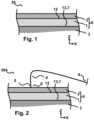
- the second layer 2 is made of at least 90 wt.% of a precious metal. This has the advantage that the second layer 2 is corrosion-resistant and thus has a high chemical resistance. In addition, the high proportion of precious metal gives the second layer 2 a high conductivity and is thus suitable as an electrode for charge conduction and for contacting by a conductor 4, as exemplified in Fig. 2 to Fig. 6 shown..
- the first layer 1 is made of transition metals and/or metals and/or semimetals in all embodiments.
- the first layer 1 is ultrasound-damping.
- Ultrasound-damping refers to a reduction in the intensity of sound waves that pass through the ultrasound-damping layer. This has the advantage of reducing the mechanical stress on the carrier 3 caused by vibrations, such as ultrasound. This advantageously reduces the mechanical stress on the carrier 3 caused by mechanical oscillations, such as those that occur during wire bonding.
- oxide-ceramic carriers 3 the adhesive strength of a materially bonded connection between conductor 9 and second layer 2 is increased after wire bonding.
- the first layer 1 has a mechanical loss coefficient of at least 10 -4 .
- the loss coefficient is a factor according to « On the Engineering Properties of Materials», MF Ashby, Acta metall. Vol. 37, No. 5, pp. 1273-1293, (1989 ), which is referred to as the loss coefficient or damping coefficient ⁇ (small Greek letter eta).
- the loss factor is equal to the tangent of the loss angle and equal to the ratio of the loss modulus to the storage modulus and is therefore unitless.
- the loss factor is inversely proportional to the Young's modulus of a material such as an alloy or a metal.
- the modulus of elasticity of a material refers to a macroscopic body, also referred to in the technical literature as a solid sample, of the material and is determined according to DIN EN ISO 6892-1 and/or DIN EN ISO 6892-2.
- the loss factor is determined as in « A Comprehensive Report on Ultrasonic Attenuation of Engineering Materials, Including Metals, Ceramics, Polymers, Fiber-Reinforced Composites, Wood, and Rocks", Kanji Ono, Appl. Sci., 10, 2230 (2020 ) described.
- the first layer 1 has a loss factor of at least 10 -4 and additionally a layer thickness between approximately 500 nm (nanometers) to approximately 4 ⁇ m (micrometers). It has been shown that layers with a smaller layer thickness do not achieve adequate mechanical damping of a mechanical vibration introduced into the second layer 2 by the first layer 1, thus preventing damage to the carrier. On the other hand, an excessively high layer thickness of the first layer above 4 ⁇ m leads to a reduction in adhesion due to the residual stresses in the layer. This can lead to flaking of the layer.
- the first layer 1 also has a loss factor of at least 10 -4 for mechanical vibrations with a frequency between 20 kHz and 200 kHz, preferably between 40 kHz and 160 kHz. This is advantageous since wire bonding is usually carried out in the frequency range between 20 kHz and 200 kHz, with most Commercial wire bonding devices currently operate at a frequency between 40 kHz and 160 kHz.
- the first layer 1 also has a modulus of elasticity between 60 GPa and 130 GPa; preferably between 80 GPa and 100 GPa. This is advantageous because the stresses generated by ultrasound cause the layer to expand less. This is known from Hooke's law, since an elongation is equal to a stress divided by the modulus of elasticity. The risk of damage to the first layer 1 itself due to mechanical stress, for example, due to ultrasonic vibrations acting on the first layer, is thus reduced.
- the first layer 1 consists of a metal or an alloy that has a negative standard enthalpy of formation for the oxide of the respective metal or alloy in the temperature range up to 350°C. This has the advantage that the first layer 1 has increased adhesion to the carrier 3 compared to a layer made of an alloy with a neutral or positive standard enthalpy of formation for the oxide.
- a negative standard enthalpy of formation meant a negative Gibbs energy of oxidation in the Ellingham diagram.
- the standard enthalpy of formation is determined on a macroscopic solid of the layer material, also called a bulk sample.
- the standard enthalpy of formation is determined according to DIN 51007-1 using calorimetry and Hess's law of constant heat summation, also known as Hess's law.
- the first layer 1 is made of bronze.
- Bronze also called bronze alloy, is a copper alloy.
- the metallization 6 in its various embodiments is particularly suitable for systems 36 when the carrier 3 is an oxide ceramic.
- the coefficient of thermal expansion refers to the thermal linear expansion coefficient of the coating material or the oxide ceramic as a macroscopic solid, also called a bulk sample.
- the coefficient of thermal expansion is determined according to DIN 51045-1 using a dilatometer.
- the coefficient of thermal expansion or linear expansion coefficient for short, is also synonymously referred to as the coefficient of thermal expansion.
- the first layer 1 is designed as an adhesion promoter for the carrier surface 7 and is firmly bonded to the carrier surface 7.
- the first layer 1 is thus both ultrasonic-damping and an adhesion promoter between the second layer 2 and the carrier 3. This is advantageous because it provides good contactability of the system with a conductor 9 and the stability of this contact between the conductor 9 and the second layer 2. This avoids damage to the carrier 3 and also ensures good adhesion of the second layer 2 to the carrier 3.
- the second layer 2 preferably has a layer thickness between 20 nm and 300 nm.
- the second layer 2 is suitable for contacting a conductor 9 by wire bonding and exhibits good electrical conductivity even at layer thicknesses of 20 nm.
- Layer thicknesses above 300 nm should be avoided for cost reasons.
- mechanical stresses between the first layer 1 and the second layer 2 can increase in the event of different thermal expansion coefficients.
- the second layer 2 exhibits unfavorable residual stress.
- the second layer 2 particularly advantageously has high mechanical resistance. This advantageously protects the first layer 1 against environmental influences, for example, scratch-causing mechanical stress.
- the second layer 2 has a modulus of elasticity greater than 150 GPa.
- Platinum or platinum alloys are particularly suitable as the material for the second layer 2. Platinum and platinum alloys have high scratch resistance. High scratch resistance is achieved with a Mohs hardness > 3.
- the second layer 2 preferably has a Mohs hardness > 3.
- Gold has a Mohs hardness of approximately 2.5 and is therefore not considered scratch-resistant.
- Platinum has a Mohs hardness of 3.4 and is therefore scratch-resistant, as are platinum alloys with a Mohs hardness > 3.
- the first layer 1 is a bronze alloy comprising copper, tin, and nickel; wherein the first layer (1) preferably comprises 84.5 wt.% to 87.5 wt.% copper, 11 wt.% to 13 wt.% tin, 1.5 wt.% to 2.5 wt.% nickel. Particularly preferably, the first layer 1 comprises a maximum of 16 wt.% elements other than copper, tin, and nickel.
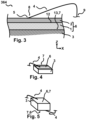
- a carrier 3 with metallization 6 is often contacted with a conductor, as in the Fig. 2 and Fig. 3 shown by way of example.
- a carrier 3 contacted in this way is referred to as a contacted system 364.
- a contacted system 364 comprises a carrier 3, at least one metallization 6 and at least one conductor 4.
- the conductor 4 has a first conductor end 8 and a second conductor end 9.
- the first conductor end 8 is integrally connected to the second layer 2.
- the second layer 2 has good bondability. with the conductor 4.
- a conductor 4 is, for example, a bonding wire, preferably a bonding wire made of gold or a bonding wire made of aluminum.
- the conductor 4 is in a contacted system 364 with the second layer 2 preferably with a ball bond 5, as in Fig. 2 indicated, or a Wedge-Bond 5, as in Fig. 3 indicated, materially connected.
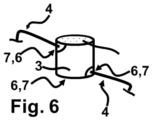
- Fig. 4 to 6 show some exemplary embodiments of a contacted system 364.
- the embodiments are not limited to the exemplary embodiments shown.
- other partial coverings of a carrier surface 7 or other geometric configurations of a carrier are also conceivable.
- only one or two contacts through a conductor 4 are shown by way of example.
- multiple contacts through multiple conductors 4 are also possible.
- Fig. 4 shows a cuboid carrier 3.
- One of the surfaces is partially covered as carrier surface 7 with a strip-shaped metallization 6, which is shown as a dotted area.
- the metallization 6 is connected to a conductor 4 at a first conductor end 8 (in Fig. 4 to 6 not shown for the sake of clarity, in Fig. 2 and 3 shown) with a connection 5.
- the conductor is here, as in the Fig. 2 to 6 , with any length, which is indicated by the curved break edge.
- the second conductor end is not shown.
- the expert can determine the metallization analogous to the embodiment of the Fig. 4 also designed as conductor tracks on a carrier 3.
- Fig. 5 is an embodiment in which the upper surface and the lower surface of a cuboid-shaped carrier 3 are each covered in their entirety with a metallization 6.
- Each metallization 6 is integrally connected to a conductor 4 at a first conductor end 8 via a connection 5.
- This embodiment can be used, for example, as a piezoelectric measuring element with the piezoelectric transverse effect, wherein piezoelectric charges can be dissipated by means of the metallization 6 when a lateral force is applied to the cuboid-shaped carrier 3.
- the respective second ends 9 of the conductor (not shown) are usually electrically connected to a charge amplifier or an impedance converter (both not shown).
- the person skilled in the art can also design an edge region of the upper and lower surfaces without metallization to avoid lateral contact (not shown).
Landscapes
- Chemical & Material Sciences (AREA)
- Engineering & Computer Science (AREA)
- Ceramic Engineering (AREA)
- Organic Chemistry (AREA)
- Materials Engineering (AREA)
- Structural Engineering (AREA)
- Inorganic Chemistry (AREA)
- Chemical Kinetics & Catalysis (AREA)
- Mechanical Engineering (AREA)
- Metallurgy (AREA)
- General Physics & Mathematics (AREA)
- Microelectronics & Electronic Packaging (AREA)
- Physics & Mathematics (AREA)
- Wire Bonding (AREA)
- Ceramic Products (AREA)
Applications Claiming Priority (1)
| Application Number | Priority Date | Filing Date | Title |
|---|---|---|---|
| EP23217418 | 2023-12-18 |
Publications (1)
| Publication Number | Publication Date |
|---|---|
| EP4574800A1 true EP4574800A1 (fr) | 2025-06-25 |
Family
ID=89223781
Family Applications (1)
| Application Number | Title | Priority Date | Filing Date |
|---|---|---|---|
| EP24216459.8A Pending EP4574800A1 (fr) | 2023-12-18 | 2024-11-29 | Métallisation et support avec métallisation |
Country Status (4)
| Country | Link |
|---|---|
| US (1) | US20250234786A1 (fr) |
| EP (1) | EP4574800A1 (fr) |
| JP (1) | JP2025097293A (fr) |
| CN (1) | CN120174307A (fr) |
Citations (5)
| Publication number | Priority date | Publication date | Assignee | Title |
|---|---|---|---|---|
| US3179826A (en) * | 1961-09-14 | 1965-04-20 | Trott Winfield James | Piezolelectric assembly |
| DE19945267C1 (de) * | 1999-09-21 | 2001-04-19 | Bosch Gmbh Robert | Verfahren zur Anbringung von flächigen Außenelektroden auf einem piezokeramischen Vielschichtaktor |
| EP2013597A1 (fr) | 2006-05-04 | 2009-01-14 | Kistler Holding AG | Élément de mesure piézoélectrique à effet transversal, et capteur équipé de cet élément de mesure |
| EP2029988A2 (fr) | 2006-06-14 | 2009-03-04 | Kistler Holding AG | Mesure de la force transversale |
| US20170151755A1 (en) * | 2015-12-01 | 2017-06-01 | Materion Corporation | Metal-on-ceramic substrates |
Family Cites Families (6)
| Publication number | Priority date | Publication date | Assignee | Title |
|---|---|---|---|---|
| JP2720457B2 (ja) * | 1988-06-03 | 1998-03-04 | セイコーエプソン株式会社 | インクジェットヘッドの製造方法 |
| JP2000158648A (ja) * | 1998-11-27 | 2000-06-13 | Matsushita Electric Ind Co Ltd | インクジェット式記録ヘッド |
| JP2002093934A (ja) * | 2000-09-14 | 2002-03-29 | Kyocera Corp | セラミック多層配線基板および半導体装置 |
| JP2012094670A (ja) * | 2010-10-27 | 2012-05-17 | Tdk Corp | 電子部品 |
| JP2014033508A (ja) * | 2012-08-01 | 2014-02-20 | Mitsumi Electric Co Ltd | 発電素子 |
| JP6786796B2 (ja) * | 2015-12-18 | 2020-11-18 | セイコーエプソン株式会社 | 電子デバイス、電子デバイスの製造方法、電子機器および移動体 |
-
2024
- 2024-11-29 EP EP24216459.8A patent/EP4574800A1/fr active Pending
- 2024-12-03 JP JP2024210579A patent/JP2025097293A/ja active Pending
- 2024-12-17 US US18/983,940 patent/US20250234786A1/en active Pending
- 2024-12-17 CN CN202411862757.1A patent/CN120174307A/zh active Pending
Patent Citations (5)
| Publication number | Priority date | Publication date | Assignee | Title |
|---|---|---|---|---|
| US3179826A (en) * | 1961-09-14 | 1965-04-20 | Trott Winfield James | Piezolelectric assembly |
| DE19945267C1 (de) * | 1999-09-21 | 2001-04-19 | Bosch Gmbh Robert | Verfahren zur Anbringung von flächigen Außenelektroden auf einem piezokeramischen Vielschichtaktor |
| EP2013597A1 (fr) | 2006-05-04 | 2009-01-14 | Kistler Holding AG | Élément de mesure piézoélectrique à effet transversal, et capteur équipé de cet élément de mesure |
| EP2029988A2 (fr) | 2006-06-14 | 2009-03-04 | Kistler Holding AG | Mesure de la force transversale |
| US20170151755A1 (en) * | 2015-12-01 | 2017-06-01 | Materion Corporation | Metal-on-ceramic substrates |
Non-Patent Citations (1)
| Title |
|---|
| M. F. ASHBY: "On the Engineering Properties of Materials", ACTA METALL, vol. 37, no. 5, 1989, pages 1273 - 1293, XP024026288, DOI: 10.1016/0001-6160(89)90158-2 |
Also Published As
| Publication number | Publication date |
|---|---|
| CN120174307A (zh) | 2025-06-20 |
| JP2025097293A (ja) | 2025-06-30 |
| US20250234786A1 (en) | 2025-07-17 |
Similar Documents
| Publication | Publication Date | Title |
|---|---|---|
| EP1560011B1 (fr) | Jauge de contrainte avec protection contre l'humidité au moyen d'une couche inorganique inhomogène sur une couche polymère d'égalisation (ORMOCER) et un arrangement de fentes | |
| EP2232600B1 (fr) | Composant multicouche piézoélectrique | |
| EP1535035B1 (fr) | Systeme de protection contre l'humidite pour un transducteur electromecanique | |
| WO2003043188A1 (fr) | Resonateur baw et filtre baw passives | |
| EP1476907B1 (fr) | Actionneur piezo-electrique a electrode externe structuree | |
| EP2917712A2 (fr) | Capteur de température et procede de production d'un capteur de température | |
| DE102007058873A1 (de) | Piezoelektrisches Bauteil mit Außenkontaktierung, die eine Gasphasen-Abscheidung aufweist, Verfahren zum Herstellen des Bauteils und Verwendung des Bauteils | |
| WO2021122036A1 (fr) | Matériau de soudure, procédé de fabrication d'un tel matériau de soudure et utilisation d'un tel matériau de soudure pour relier une couche métallique à une couche céramique | |
| DE3823347A1 (de) | Leistungs-halbleiterelement | |
| EP2191483B1 (fr) | Composant électrique multicouche | |
| EP2501517B1 (fr) | Compsant piézoélectrique contenant un produit à brasser pour brasser un électrode externe | |
| EP1332522B1 (fr) | Actionneur piezo-electrique | |
| EP4574800A1 (fr) | Métallisation et support avec métallisation | |
| DE102020118857A1 (de) | Vielschichtkondensator | |
| EP0358040B1 (fr) | Couche de surface conductrice | |
| DE102010054970B4 (de) | Vorrichtung zum Wandeln einer Dehnung und/oder Stauchung in ein elektrisches Signal, insbesondere Dehnungsmessfolie | |
| EP2436050B1 (fr) | Composant piézoélectrique à couches multiples | |
| EP1903321B1 (fr) | Dispositif semi-conducteur | |
| EP2232599A1 (fr) | Composant multicouche piézoélectrique | |
| EP2054951B1 (fr) | Composant piézoélectrique | |
| EP2901504B1 (fr) | Composant électrique et procédé d'établissement d'une mise en contact électrique d'un composant électrique | |
| DE112022000089T5 (de) | Element zur erzeugung elektrischer energie aus vibration | |
| DE102010042969A1 (de) | Piezoelektrisches Bauteil mit Kontaktierung | |
| WO2008142081A2 (fr) | Composant comprenant des surfaces de connexion pouvant être chargées mécaniquement | |
| DE112021003070T5 (de) | Wälzlagerhaltereinheit |
Legal Events
| Date | Code | Title | Description |
|---|---|---|---|
| PUAI | Public reference made under article 153(3) epc to a published international application that has entered the european phase |
Free format text: ORIGINAL CODE: 0009012 |
|
| STAA | Information on the status of an ep patent application or granted ep patent |
Free format text: STATUS: THE APPLICATION HAS BEEN PUBLISHED |
|
| AK | Designated contracting states |
Kind code of ref document: A1 Designated state(s): AL AT BE BG CH CY CZ DE DK EE ES FI FR GB GR HR HU IE IS IT LI LT LU LV MC ME MK MT NL NO PL PT RO RS SE SI SK SM TR |
|
| STAA | Information on the status of an ep patent application or granted ep patent |
Free format text: STATUS: REQUEST FOR EXAMINATION WAS MADE |
|
| 17P | Request for examination filed |
Effective date: 20251225 |