EP4575009A1 - Verfahren zur herstellung eines kornorientierten elektromagnetischen stahlblechs und induktionsheizer - Google Patents
Verfahren zur herstellung eines kornorientierten elektromagnetischen stahlblechs und induktionsheizer Download PDFInfo
- Publication number
- EP4575009A1 EP4575009A1 EP23863165.9A EP23863165A EP4575009A1 EP 4575009 A1 EP4575009 A1 EP 4575009A1 EP 23863165 A EP23863165 A EP 23863165A EP 4575009 A1 EP4575009 A1 EP 4575009A1
- Authority
- EP
- European Patent Office
- Prior art keywords
- mass
- invention example
- steel sheet
- less
- rolling
- Prior art date
- Legal status (The legal status is an assumption and is not a legal conclusion. Google has not performed a legal analysis and makes no representation as to the accuracy of the status listed.)
- Pending
Links
Images


Classifications
-
- C—CHEMISTRY; METALLURGY
- C22—METALLURGY; FERROUS OR NON-FERROUS ALLOYS; TREATMENT OF ALLOYS OR NON-FERROUS METALS
- C22C—ALLOYS
- C22C38/00—Ferrous alloys, e.g. steel alloys
- C22C38/60—Ferrous alloys, e.g. steel alloys containing lead, selenium, tellurium, or antimony, or more than 0.04% by weight of sulfur
-
- C—CHEMISTRY; METALLURGY
- C21—METALLURGY OF IRON
- C21D—MODIFYING THE PHYSICAL STRUCTURE OF FERROUS METALS; GENERAL DEVICES FOR HEAT TREATMENT OF FERROUS OR NON-FERROUS METALS OR ALLOYS; MAKING METAL MALLEABLE, e.g. BY DECARBURISATION OR TEMPERING
- C21D3/00—Diffusion processes for extraction of non-metals; Furnaces therefor
- C21D3/02—Extraction of non-metals
- C21D3/04—Decarburising
-
- C—CHEMISTRY; METALLURGY
- C21—METALLURGY OF IRON
- C21D—MODIFYING THE PHYSICAL STRUCTURE OF FERROUS METALS; GENERAL DEVICES FOR HEAT TREATMENT OF FERROUS OR NON-FERROUS METALS OR ALLOYS; MAKING METAL MALLEABLE, e.g. BY DECARBURISATION OR TEMPERING
- C21D6/00—Heat treatment of ferrous alloys
- C21D6/001—Heat treatment of ferrous alloys containing Ni
-
- C—CHEMISTRY; METALLURGY
- C21—METALLURGY OF IRON
- C21D—MODIFYING THE PHYSICAL STRUCTURE OF FERROUS METALS; GENERAL DEVICES FOR HEAT TREATMENT OF FERROUS OR NON-FERROUS METALS OR ALLOYS; MAKING METAL MALLEABLE, e.g. BY DECARBURISATION OR TEMPERING
- C21D6/00—Heat treatment of ferrous alloys
- C21D6/002—Heat treatment of ferrous alloys containing Cr
-
- C—CHEMISTRY; METALLURGY
- C21—METALLURGY OF IRON
- C21D—MODIFYING THE PHYSICAL STRUCTURE OF FERROUS METALS; GENERAL DEVICES FOR HEAT TREATMENT OF FERROUS OR NON-FERROUS METALS OR ALLOYS; MAKING METAL MALLEABLE, e.g. BY DECARBURISATION OR TEMPERING
- C21D6/00—Heat treatment of ferrous alloys
- C21D6/004—Heat treatment of ferrous alloys containing Cr and Ni
-
- C—CHEMISTRY; METALLURGY
- C21—METALLURGY OF IRON
- C21D—MODIFYING THE PHYSICAL STRUCTURE OF FERROUS METALS; GENERAL DEVICES FOR HEAT TREATMENT OF FERROUS OR NON-FERROUS METALS OR ALLOYS; MAKING METAL MALLEABLE, e.g. BY DECARBURISATION OR TEMPERING
- C21D6/00—Heat treatment of ferrous alloys
- C21D6/005—Heat treatment of ferrous alloys containing Mn
-
- C—CHEMISTRY; METALLURGY
- C21—METALLURGY OF IRON
- C21D—MODIFYING THE PHYSICAL STRUCTURE OF FERROUS METALS; GENERAL DEVICES FOR HEAT TREATMENT OF FERROUS OR NON-FERROUS METALS OR ALLOYS; MAKING METAL MALLEABLE, e.g. BY DECARBURISATION OR TEMPERING
- C21D6/00—Heat treatment of ferrous alloys
- C21D6/008—Heat treatment of ferrous alloys containing Si
-
- C—CHEMISTRY; METALLURGY
- C21—METALLURGY OF IRON
- C21D—MODIFYING THE PHYSICAL STRUCTURE OF FERROUS METALS; GENERAL DEVICES FOR HEAT TREATMENT OF FERROUS OR NON-FERROUS METALS OR ALLOYS; MAKING METAL MALLEABLE, e.g. BY DECARBURISATION OR TEMPERING
- C21D8/00—Modifying the physical properties of ferrous metals or ferrous alloys by deformation combined with, or followed by, heat treatment
- C21D8/12—Modifying the physical properties of ferrous metals or ferrous alloys by deformation combined with, or followed by, heat treatment during manufacturing of articles with special electromagnetic properties
-
- C—CHEMISTRY; METALLURGY
- C21—METALLURGY OF IRON
- C21D—MODIFYING THE PHYSICAL STRUCTURE OF FERROUS METALS; GENERAL DEVICES FOR HEAT TREATMENT OF FERROUS OR NON-FERROUS METALS OR ALLOYS; MAKING METAL MALLEABLE, e.g. BY DECARBURISATION OR TEMPERING
- C21D8/00—Modifying the physical properties of ferrous metals or ferrous alloys by deformation combined with, or followed by, heat treatment
- C21D8/12—Modifying the physical properties of ferrous metals or ferrous alloys by deformation combined with, or followed by, heat treatment during manufacturing of articles with special electromagnetic properties
- C21D8/1216—Modifying the physical properties of ferrous metals or ferrous alloys by deformation combined with, or followed by, heat treatment during manufacturing of articles with special electromagnetic properties characterised by the working steps
- C21D8/1222—Hot rolling
-
- C—CHEMISTRY; METALLURGY
- C21—METALLURGY OF IRON
- C21D—MODIFYING THE PHYSICAL STRUCTURE OF FERROUS METALS; GENERAL DEVICES FOR HEAT TREATMENT OF FERROUS OR NON-FERROUS METALS OR ALLOYS; MAKING METAL MALLEABLE, e.g. BY DECARBURISATION OR TEMPERING
- C21D8/00—Modifying the physical properties of ferrous metals or ferrous alloys by deformation combined with, or followed by, heat treatment
- C21D8/12—Modifying the physical properties of ferrous metals or ferrous alloys by deformation combined with, or followed by, heat treatment during manufacturing of articles with special electromagnetic properties
- C21D8/1216—Modifying the physical properties of ferrous metals or ferrous alloys by deformation combined with, or followed by, heat treatment during manufacturing of articles with special electromagnetic properties characterised by the working steps
- C21D8/1233—Cold rolling
-
- C—CHEMISTRY; METALLURGY
- C21—METALLURGY OF IRON
- C21D—MODIFYING THE PHYSICAL STRUCTURE OF FERROUS METALS; GENERAL DEVICES FOR HEAT TREATMENT OF FERROUS OR NON-FERROUS METALS OR ALLOYS; MAKING METAL MALLEABLE, e.g. BY DECARBURISATION OR TEMPERING
- C21D8/00—Modifying the physical properties of ferrous metals or ferrous alloys by deformation combined with, or followed by, heat treatment
- C21D8/12—Modifying the physical properties of ferrous metals or ferrous alloys by deformation combined with, or followed by, heat treatment during manufacturing of articles with special electromagnetic properties
- C21D8/1244—Modifying the physical properties of ferrous metals or ferrous alloys by deformation combined with, or followed by, heat treatment during manufacturing of articles with special electromagnetic properties characterised by the heat treatment
- C21D8/1255—Modifying the physical properties of ferrous metals or ferrous alloys by deformation combined with, or followed by, heat treatment during manufacturing of articles with special electromagnetic properties characterised by the heat treatment with diffusion of elements, e.g. decarburising, nitriding
-
- C—CHEMISTRY; METALLURGY
- C21—METALLURGY OF IRON
- C21D—MODIFYING THE PHYSICAL STRUCTURE OF FERROUS METALS; GENERAL DEVICES FOR HEAT TREATMENT OF FERROUS OR NON-FERROUS METALS OR ALLOYS; MAKING METAL MALLEABLE, e.g. BY DECARBURISATION OR TEMPERING
- C21D8/00—Modifying the physical properties of ferrous metals or ferrous alloys by deformation combined with, or followed by, heat treatment
- C21D8/12—Modifying the physical properties of ferrous metals or ferrous alloys by deformation combined with, or followed by, heat treatment during manufacturing of articles with special electromagnetic properties
- C21D8/1244—Modifying the physical properties of ferrous metals or ferrous alloys by deformation combined with, or followed by, heat treatment during manufacturing of articles with special electromagnetic properties characterised by the heat treatment
- C21D8/1261—Modifying the physical properties of ferrous metals or ferrous alloys by deformation combined with, or followed by, heat treatment during manufacturing of articles with special electromagnetic properties characterised by the heat treatment following hot rolling
-
- C—CHEMISTRY; METALLURGY
- C21—METALLURGY OF IRON
- C21D—MODIFYING THE PHYSICAL STRUCTURE OF FERROUS METALS; GENERAL DEVICES FOR HEAT TREATMENT OF FERROUS OR NON-FERROUS METALS OR ALLOYS; MAKING METAL MALLEABLE, e.g. BY DECARBURISATION OR TEMPERING
- C21D8/00—Modifying the physical properties of ferrous metals or ferrous alloys by deformation combined with, or followed by, heat treatment
- C21D8/12—Modifying the physical properties of ferrous metals or ferrous alloys by deformation combined with, or followed by, heat treatment during manufacturing of articles with special electromagnetic properties
- C21D8/1277—Modifying the physical properties of ferrous metals or ferrous alloys by deformation combined with, or followed by, heat treatment during manufacturing of articles with special electromagnetic properties involving a particular surface treatment
- C21D8/1283—Application of a separating or insulating coating
-
- C—CHEMISTRY; METALLURGY
- C21—METALLURGY OF IRON
- C21D—MODIFYING THE PHYSICAL STRUCTURE OF FERROUS METALS; GENERAL DEVICES FOR HEAT TREATMENT OF FERROUS OR NON-FERROUS METALS OR ALLOYS; MAKING METAL MALLEABLE, e.g. BY DECARBURISATION OR TEMPERING
- C21D9/00—Heat treatment, e.g. annealing, hardening, quenching or tempering, adapted for particular articles; Furnaces therefor
- C21D9/46—Heat treatment, e.g. annealing, hardening, quenching or tempering, adapted for particular articles; Furnaces therefor for sheet metals
-
- C—CHEMISTRY; METALLURGY
- C22—METALLURGY; FERROUS OR NON-FERROUS ALLOYS; TREATMENT OF ALLOYS OR NON-FERROUS METALS
- C22C—ALLOYS
- C22C38/00—Ferrous alloys, e.g. steel alloys
- C22C38/001—Ferrous alloys, e.g. steel alloys containing N
-
- C—CHEMISTRY; METALLURGY
- C22—METALLURGY; FERROUS OR NON-FERROUS ALLOYS; TREATMENT OF ALLOYS OR NON-FERROUS METALS
- C22C—ALLOYS
- C22C38/00—Ferrous alloys, e.g. steel alloys
- C22C38/002—Ferrous alloys, e.g. steel alloys containing In, Mg, or other elements not provided for in one single group C22C38/001 - C22C38/60
-
- C—CHEMISTRY; METALLURGY
- C22—METALLURGY; FERROUS OR NON-FERROUS ALLOYS; TREATMENT OF ALLOYS OR NON-FERROUS METALS
- C22C—ALLOYS
- C22C38/00—Ferrous alloys, e.g. steel alloys
- C22C38/004—Very low carbon steels, i.e. having a carbon content of less than 0,01%
-
- C—CHEMISTRY; METALLURGY
- C22—METALLURGY; FERROUS OR NON-FERROUS ALLOYS; TREATMENT OF ALLOYS OR NON-FERROUS METALS
- C22C—ALLOYS
- C22C38/00—Ferrous alloys, e.g. steel alloys
- C22C38/008—Ferrous alloys, e.g. steel alloys containing tin
-
- C—CHEMISTRY; METALLURGY
- C22—METALLURGY; FERROUS OR NON-FERROUS ALLOYS; TREATMENT OF ALLOYS OR NON-FERROUS METALS
- C22C—ALLOYS
- C22C38/00—Ferrous alloys, e.g. steel alloys
- C22C38/02—Ferrous alloys, e.g. steel alloys containing silicon
-
- C—CHEMISTRY; METALLURGY
- C22—METALLURGY; FERROUS OR NON-FERROUS ALLOYS; TREATMENT OF ALLOYS OR NON-FERROUS METALS
- C22C—ALLOYS
- C22C38/00—Ferrous alloys, e.g. steel alloys
- C22C38/04—Ferrous alloys, e.g. steel alloys containing manganese
-
- C—CHEMISTRY; METALLURGY
- C22—METALLURGY; FERROUS OR NON-FERROUS ALLOYS; TREATMENT OF ALLOYS OR NON-FERROUS METALS
- C22C—ALLOYS
- C22C38/00—Ferrous alloys, e.g. steel alloys
- C22C38/06—Ferrous alloys, e.g. steel alloys containing aluminium
-
- C—CHEMISTRY; METALLURGY
- C22—METALLURGY; FERROUS OR NON-FERROUS ALLOYS; TREATMENT OF ALLOYS OR NON-FERROUS METALS
- C22C—ALLOYS
- C22C38/00—Ferrous alloys, e.g. steel alloys
- C22C38/08—Ferrous alloys, e.g. steel alloys containing nickel
-
- C—CHEMISTRY; METALLURGY
- C22—METALLURGY; FERROUS OR NON-FERROUS ALLOYS; TREATMENT OF ALLOYS OR NON-FERROUS METALS
- C22C—ALLOYS
- C22C38/00—Ferrous alloys, e.g. steel alloys
- C22C38/12—Ferrous alloys, e.g. steel alloys containing tungsten, tantalum, molybdenum, vanadium, or niobium
-
- C—CHEMISTRY; METALLURGY
- C22—METALLURGY; FERROUS OR NON-FERROUS ALLOYS; TREATMENT OF ALLOYS OR NON-FERROUS METALS
- C22C—ALLOYS
- C22C38/00—Ferrous alloys, e.g. steel alloys
- C22C38/16—Ferrous alloys, e.g. steel alloys containing copper
-
- C—CHEMISTRY; METALLURGY
- C22—METALLURGY; FERROUS OR NON-FERROUS ALLOYS; TREATMENT OF ALLOYS OR NON-FERROUS METALS
- C22C—ALLOYS
- C22C38/00—Ferrous alloys, e.g. steel alloys
- C22C38/18—Ferrous alloys, e.g. steel alloys containing chromium
- C22C38/20—Ferrous alloys, e.g. steel alloys containing chromium with copper
-
- C—CHEMISTRY; METALLURGY
- C22—METALLURGY; FERROUS OR NON-FERROUS ALLOYS; TREATMENT OF ALLOYS OR NON-FERROUS METALS
- C22C—ALLOYS
- C22C38/00—Ferrous alloys, e.g. steel alloys
- C22C38/18—Ferrous alloys, e.g. steel alloys containing chromium
- C22C38/22—Ferrous alloys, e.g. steel alloys containing chromium with molybdenum or tungsten
-
- C—CHEMISTRY; METALLURGY
- C22—METALLURGY; FERROUS OR NON-FERROUS ALLOYS; TREATMENT OF ALLOYS OR NON-FERROUS METALS
- C22C—ALLOYS
- C22C38/00—Ferrous alloys, e.g. steel alloys
- C22C38/18—Ferrous alloys, e.g. steel alloys containing chromium
- C22C38/32—Ferrous alloys, e.g. steel alloys containing chromium with boron
-
- C—CHEMISTRY; METALLURGY
- C22—METALLURGY; FERROUS OR NON-FERROUS ALLOYS; TREATMENT OF ALLOYS OR NON-FERROUS METALS
- C22C—ALLOYS
- C22C38/00—Ferrous alloys, e.g. steel alloys
- C22C38/18—Ferrous alloys, e.g. steel alloys containing chromium
- C22C38/34—Ferrous alloys, e.g. steel alloys containing chromium with more than 1.5% by weight of silicon
-
- C—CHEMISTRY; METALLURGY
- C22—METALLURGY; FERROUS OR NON-FERROUS ALLOYS; TREATMENT OF ALLOYS OR NON-FERROUS METALS
- C22C—ALLOYS
- C22C38/00—Ferrous alloys, e.g. steel alloys
- C22C38/18—Ferrous alloys, e.g. steel alloys containing chromium
- C22C38/40—Ferrous alloys, e.g. steel alloys containing chromium with nickel
- C22C38/42—Ferrous alloys, e.g. steel alloys containing chromium with nickel with copper
-
- H—ELECTRICITY
- H01—ELECTRIC ELEMENTS
- H01F—MAGNETS; INDUCTANCES; TRANSFORMERS; SELECTION OF MATERIALS FOR THEIR MAGNETIC PROPERTIES
- H01F1/00—Magnets or magnetic bodies characterised by the magnetic materials therefor; Selection of materials for their magnetic properties
- H01F1/01—Magnets or magnetic bodies characterised by the magnetic materials therefor; Selection of materials for their magnetic properties of inorganic materials
- H01F1/03—Magnets or magnetic bodies characterised by the magnetic materials therefor; Selection of materials for their magnetic properties of inorganic materials characterised by their coercivity
- H01F1/12—Magnets or magnetic bodies characterised by the magnetic materials therefor; Selection of materials for their magnetic properties of inorganic materials characterised by their coercivity of soft-magnetic materials
- H01F1/14—Magnets or magnetic bodies characterised by the magnetic materials therefor; Selection of materials for their magnetic properties of inorganic materials characterised by their coercivity of soft-magnetic materials metals or alloys
- H01F1/147—Alloys characterised by their composition
-
- H—ELECTRICITY
- H01—ELECTRIC ELEMENTS
- H01F—MAGNETS; INDUCTANCES; TRANSFORMERS; SELECTION OF MATERIALS FOR THEIR MAGNETIC PROPERTIES
- H01F1/00—Magnets or magnetic bodies characterised by the magnetic materials therefor; Selection of materials for their magnetic properties
- H01F1/01—Magnets or magnetic bodies characterised by the magnetic materials therefor; Selection of materials for their magnetic properties of inorganic materials
- H01F1/03—Magnets or magnetic bodies characterised by the magnetic materials therefor; Selection of materials for their magnetic properties of inorganic materials characterised by their coercivity
- H01F1/12—Magnets or magnetic bodies characterised by the magnetic materials therefor; Selection of materials for their magnetic properties of inorganic materials characterised by their coercivity of soft-magnetic materials
- H01F1/14—Magnets or magnetic bodies characterised by the magnetic materials therefor; Selection of materials for their magnetic properties of inorganic materials characterised by their coercivity of soft-magnetic materials metals or alloys
- H01F1/147—Alloys characterised by their composition
- H01F1/14766—Fe-Si based alloys
- H01F1/14775—Fe-Si based alloys in the form of sheets
-
- H—ELECTRICITY
- H01—ELECTRIC ELEMENTS
- H01F—MAGNETS; INDUCTANCES; TRANSFORMERS; SELECTION OF MATERIALS FOR THEIR MAGNETIC PROPERTIES
- H01F1/00—Magnets or magnetic bodies characterised by the magnetic materials therefor; Selection of materials for their magnetic properties
- H01F1/01—Magnets or magnetic bodies characterised by the magnetic materials therefor; Selection of materials for their magnetic properties of inorganic materials
- H01F1/03—Magnets or magnetic bodies characterised by the magnetic materials therefor; Selection of materials for their magnetic properties of inorganic materials characterised by their coercivity
- H01F1/12—Magnets or magnetic bodies characterised by the magnetic materials therefor; Selection of materials for their magnetic properties of inorganic materials characterised by their coercivity of soft-magnetic materials
- H01F1/14—Magnets or magnetic bodies characterised by the magnetic materials therefor; Selection of materials for their magnetic properties of inorganic materials characterised by their coercivity of soft-magnetic materials metals or alloys
- H01F1/147—Alloys characterised by their composition
- H01F1/14766—Fe-Si based alloys
- H01F1/14775—Fe-Si based alloys in the form of sheets
- H01F1/14783—Fe-Si based alloys in the form of sheets with insulating coating
-
- H—ELECTRICITY
- H01—ELECTRIC ELEMENTS
- H01F—MAGNETS; INDUCTANCES; TRANSFORMERS; SELECTION OF MATERIALS FOR THEIR MAGNETIC PROPERTIES
- H01F1/00—Magnets or magnetic bodies characterised by the magnetic materials therefor; Selection of materials for their magnetic properties
- H01F1/01—Magnets or magnetic bodies characterised by the magnetic materials therefor; Selection of materials for their magnetic properties of inorganic materials
- H01F1/03—Magnets or magnetic bodies characterised by the magnetic materials therefor; Selection of materials for their magnetic properties of inorganic materials characterised by their coercivity
- H01F1/12—Magnets or magnetic bodies characterised by the magnetic materials therefor; Selection of materials for their magnetic properties of inorganic materials characterised by their coercivity of soft-magnetic materials
- H01F1/14—Magnets or magnetic bodies characterised by the magnetic materials therefor; Selection of materials for their magnetic properties of inorganic materials characterised by their coercivity of soft-magnetic materials metals or alloys
- H01F1/147—Alloys characterised by their composition
- H01F1/14766—Fe-Si based alloys
- H01F1/14791—Fe-Si-Al based alloys, e.g. Sendust
-
- H—ELECTRICITY
- H01—ELECTRIC ELEMENTS
- H01F—MAGNETS; INDUCTANCES; TRANSFORMERS; SELECTION OF MATERIALS FOR THEIR MAGNETIC PROPERTIES
- H01F1/00—Magnets or magnetic bodies characterised by the magnetic materials therefor; Selection of materials for their magnetic properties
- H01F1/01—Magnets or magnetic bodies characterised by the magnetic materials therefor; Selection of materials for their magnetic properties of inorganic materials
- H01F1/03—Magnets or magnetic bodies characterised by the magnetic materials therefor; Selection of materials for their magnetic properties of inorganic materials characterised by their coercivity
- H01F1/12—Magnets or magnetic bodies characterised by the magnetic materials therefor; Selection of materials for their magnetic properties of inorganic materials characterised by their coercivity of soft-magnetic materials
- H01F1/14—Magnets or magnetic bodies characterised by the magnetic materials therefor; Selection of materials for their magnetic properties of inorganic materials characterised by their coercivity of soft-magnetic materials metals or alloys
- H01F1/16—Magnets or magnetic bodies characterised by the magnetic materials therefor; Selection of materials for their magnetic properties of inorganic materials characterised by their coercivity of soft-magnetic materials metals or alloys in the form of sheets
-
- H—ELECTRICITY
- H05—ELECTRIC TECHNIQUES NOT OTHERWISE PROVIDED FOR
- H05B—ELECTRIC HEATING; ELECTRIC LIGHT SOURCES NOT OTHERWISE PROVIDED FOR; CIRCUIT ARRANGEMENTS FOR ELECTRIC LIGHT SOURCES, IN GENERAL
- H05B6/00—Heating by electric, magnetic or electromagnetic fields
- H05B6/02—Induction heating
- H05B6/10—Induction heating apparatus, other than furnaces, for specific applications
- H05B6/101—Induction heating apparatus, other than furnaces, for specific applications for local heating of metal pieces
- H05B6/103—Induction heating apparatus, other than furnaces, for specific applications for local heating of metal pieces multiple metal pieces successively being moved close to the inductor
- H05B6/104—Induction heating apparatus, other than furnaces, for specific applications for local heating of metal pieces multiple metal pieces successively being moved close to the inductor metal pieces being elongated like wires or bands
-
- H—ELECTRICITY
- H05—ELECTRIC TECHNIQUES NOT OTHERWISE PROVIDED FOR
- H05B—ELECTRIC HEATING; ELECTRIC LIGHT SOURCES NOT OTHERWISE PROVIDED FOR; CIRCUIT ARRANGEMENTS FOR ELECTRIC LIGHT SOURCES, IN GENERAL
- H05B6/00—Heating by electric, magnetic or electromagnetic fields
- H05B6/02—Induction heating
- H05B6/36—Coil arrangements
- H05B6/362—Coil arrangements with flat coil conductors
-
- C—CHEMISTRY; METALLURGY
- C21—METALLURGY OF IRON
- C21D—MODIFYING THE PHYSICAL STRUCTURE OF FERROUS METALS; GENERAL DEVICES FOR HEAT TREATMENT OF FERROUS OR NON-FERROUS METALS OR ALLOYS; MAKING METAL MALLEABLE, e.g. BY DECARBURISATION OR TEMPERING
- C21D1/00—General methods or devices for heat treatment, e.g. annealing, hardening, quenching or tempering
- C21D1/34—Methods of heating
- C21D1/42—Induction heating
-
- C—CHEMISTRY; METALLURGY
- C21—METALLURGY OF IRON
- C21D—MODIFYING THE PHYSICAL STRUCTURE OF FERROUS METALS; GENERAL DEVICES FOR HEAT TREATMENT OF FERROUS OR NON-FERROUS METALS OR ALLOYS; MAKING METAL MALLEABLE, e.g. BY DECARBURISATION OR TEMPERING
- C21D2201/00—Treatment for obtaining particular effects
- C21D2201/05—Grain orientation
-
- C—CHEMISTRY; METALLURGY
- C21—METALLURGY OF IRON
- C21D—MODIFYING THE PHYSICAL STRUCTURE OF FERROUS METALS; GENERAL DEVICES FOR HEAT TREATMENT OF FERROUS OR NON-FERROUS METALS OR ALLOYS; MAKING METAL MALLEABLE, e.g. BY DECARBURISATION OR TEMPERING
- C21D8/00—Modifying the physical properties of ferrous metals or ferrous alloys by deformation combined with, or followed by, heat treatment
- C21D8/12—Modifying the physical properties of ferrous metals or ferrous alloys by deformation combined with, or followed by, heat treatment during manufacturing of articles with special electromagnetic properties
- C21D8/1244—Modifying the physical properties of ferrous metals or ferrous alloys by deformation combined with, or followed by, heat treatment during manufacturing of articles with special electromagnetic properties characterised by the heat treatment
- C21D8/1266—Modifying the physical properties of ferrous metals or ferrous alloys by deformation combined with, or followed by, heat treatment during manufacturing of articles with special electromagnetic properties characterised by the heat treatment between cold rolling steps
-
- C—CHEMISTRY; METALLURGY
- C21—METALLURGY OF IRON
- C21D—MODIFYING THE PHYSICAL STRUCTURE OF FERROUS METALS; GENERAL DEVICES FOR HEAT TREATMENT OF FERROUS OR NON-FERROUS METALS OR ALLOYS; MAKING METAL MALLEABLE, e.g. BY DECARBURISATION OR TEMPERING
- C21D8/00—Modifying the physical properties of ferrous metals or ferrous alloys by deformation combined with, or followed by, heat treatment
- C21D8/12—Modifying the physical properties of ferrous metals or ferrous alloys by deformation combined with, or followed by, heat treatment during manufacturing of articles with special electromagnetic properties
- C21D8/1244—Modifying the physical properties of ferrous metals or ferrous alloys by deformation combined with, or followed by, heat treatment during manufacturing of articles with special electromagnetic properties characterised by the heat treatment
- C21D8/1272—Final recrystallisation annealing
-
- C—CHEMISTRY; METALLURGY
- C22—METALLURGY; FERROUS OR NON-FERROUS ALLOYS; TREATMENT OF ALLOYS OR NON-FERROUS METALS
- C22C—ALLOYS
- C22C2202/00—Physical properties
- C22C2202/02—Magnetic
-
- Y—GENERAL TAGGING OF NEW TECHNOLOGICAL DEVELOPMENTS; GENERAL TAGGING OF CROSS-SECTIONAL TECHNOLOGIES SPANNING OVER SEVERAL SECTIONS OF THE IPC; TECHNICAL SUBJECTS COVERED BY FORMER USPC CROSS-REFERENCE ART COLLECTIONS [XRACs] AND DIGESTS
- Y02—TECHNOLOGIES OR APPLICATIONS FOR MITIGATION OR ADAPTATION AGAINST CLIMATE CHANGE
- Y02P—CLIMATE CHANGE MITIGATION TECHNOLOGIES IN THE PRODUCTION OR PROCESSING OF GOODS
- Y02P10/00—Technologies related to metal processing
- Y02P10/25—Process efficiency
Definitions
- the present invention relates to a method for producing a grain-oriented electrical steel sheet, and an induction heating device for decarburization annealing used in such a production method.
- Patent Literature 1 discloses a method of performing aging treatment by subjecting a cold-rolled sheet, which is being cold-rolled, to heat treatment at a low temperature.
- Patent Literature 2 discloses a method of setting the cooling rate during hot-band annealing to 30°C/s or more or setting the cooling rate during intermediate annealing performed before cold rolling to obtain the final thickness (final cold-rolling step) to 30°C/s or more, and further performing aging treatment between rolling passes two or more times by holding a steel sheet at a temperature of 150 to 300°C for 2 minutes or longer during the final cold-rolling step.
- Patent Literature 3 discloses a technology for subjecting a steel sheet during cold-rolling to warm rolling by increasing the temperature of the steel sheet so as to utilize dynamic strain aging for immediately pinning a dislocation, which has been introduced through the rolling, by means of C and N.
- Each of the technologies of Patent Literatures 1 to 3 above is directed to increasing the temperature of a steel sheet to an appropriate temperature before or during cold rolling, or between consecutive passes of cold rolling, thereby promoting the diffusion of dissolved carbon (C) and nitrogen (N) to pin a dislocation introduced by cold rolling, and thus suppressing the movement of the dislocation so as to promote the shear deformation in the subsequent rolling step and thus improve the rolled texture.
- This is based on the view that the nuclei of Goss-oriented grains in a primary recrystallization texture appear from shear bands introduced into a processed texture having a ⁇ 111 ⁇ 112> orientation. Applying such technologies can introduce a large number of shear bands into the ⁇ 111 ⁇ 112> work texture and thus form a large number of Goss-oriented grains in the primary recrystallization texture.
- Patent Literature 4 discloses a method of rapidly heating a steel sheet during a heating step of decarburization annealing. Such a technology is intended to suppress the development of a ⁇ -fiber texture( ⁇ 111 ⁇ //ND), which would be preferentially formed at a typical heating rate, by heating a steel sheet from room temperature to a temperature around the recrystallization temperature in a short time using, for example, electric heating or induction heating and thus promote the generation of Goss-oriented grains as the nuclei of secondary recrystallized grains.
- Patent Literature 5 discloses a method of rapidly heating a steel sheet at an average heating rate of 50°C/s or more in the temperature range of 550 to 700°C during a heating step of decarburization annealing, and also performing temperature maintaining treatment by reducing the heating rate to 10°C/s or less for 1 to 10 seconds in any of temperature ranges between 250 and 550°C.
- Such a technology is intended to promote the recovery of the ⁇ 111 ⁇ work texture by holding a steel sheet at a temperature of 250 to 550°C, which corresponds to the recovery temperature range, for a short time, and thus suppressing recrystallization and relatively increasing the proportion of Goss-oriented grains present.
- the present invention has been made in view of the above problems of the conventional technologies, and it is an object of the present invention to propose a method for producing a grain-oriented electrical steel sheet that can solve the foregoing problems and can stably produce a grain-oriented electrical steel sheet with excellent magnetic properties, and also provide an induction heating device for decarburization annealing for use in such a production method.
- the inventors have focused on the conditions of the aging performed during the cold-rolling step disclosed in each of Patent Literatures 1 to 3 above and the conditions of the temperature maintaining treatment performed during the rapid heating of the decarburization annealing disclosed in Patent Literature 5 above and have conducted concentrated studies on a method for forming Goss-oriented grains and ⁇ 111 ⁇ 112> oriented grains of a matrix in a primary recrystallization texture in a well-balanced manner and with high frequency. Consequently, the inventors have developed the present invention by finding that the above problems can be solved by optimizing the conditions of aging performed in the final cold-rolling step and also by optimizing the conditions of temperature maintaining treatment performed during rapid heating in a heating step of decarburization annealing.
- the present invention based on the above findings proposes a method for producing a grain-oriented electrical steel sheet, including
- the steel material used in the method for producing a grain-oriented electrical steel sheet of the present invention further contains, in addition to the component composition, at least one element selected from the group consisting of Sb: 0.500 mass% or less, Cu: 1.50 mass% or less, P: 0.500 mass% or less, Cr: 1.50 mass% or less, Ni: 1.500 mass% or less, Sn: 0.50 mass% or less, Nb: 0.0100 mass% or less, Mo: 0.50 mass% or less, B: 0.0070 mass% or less, and Bi: 0.0500 mass% or less.
- the rapid heating in the decarburization annealing is performed using a transverse induction heating device.
- a grain-oriented electrical steel sheet with excellent magnetic properties can be stably produced, which greatly contributes to achieving energy saving in an electrical device.
- the inventors have conducted the following experiments to examine the heating conditions of decarburization annealing for forming Goss-oriented grains and ⁇ 111 ⁇ 112> oriented grains of a matrix in the texture of a steel sheet, which has undergone primary recrystallization, in a well-balanced manner and with high frequency.
- a steel slab which had a component composition containing no inhibitor-forming component, specifically, containing C: 0.035 mass%, Si: 3.4 mass%, Mn: 0.05 mass%, Al: 0.0086 mass%, N: 0.0050 mass%, S: 0.0031 mass%, and Se: 0.0031 mass%, with the balance being Fe and unavoidable impurities, was heated to 1210°C, and was then hot-rolled so that a hot-rolled sheet with a thickness of 2.0 mm was obtained.
- a component composition containing no inhibitor-forming component specifically, containing C: 0.035 mass%, Si: 3.4 mass%, Mn: 0.05 mass%, Al: 0.0086 mass%, N: 0.0050 mass%, S: 0.0031 mass%, and Se: 0.0031 mass%, with the balance being Fe and unavoidable impurities
- each of test pieces obtained from the hot-rolled sheet was subjected to hot-band annealing at 1000°C for 60 seconds, and was then subjected to cold rolling once using a five-stand tandem rolling mill so that a cold-rolled sheet with a final thickness (thickness of the product sheet) of 0.20 mm was obtained.
- the third pass was performed as warm rolling with the temperature of the steel sheet on the entry side increased to 200°C.
- the cold-rolled sheet was subjected to decarburization annealing, which also serves as primary recrystallization annealing, at a soaking temperature of 840°C for a soaking time of 100 seconds.
- decarburization annealing which also serves as primary recrystallization annealing, at a soaking temperature of 840°C for a soaking time of 100 seconds.
- the average heating rate was varied in the temperature range of 400°C to 750°C, and for some of the test pieces, the heating rate was temporarily reduced under the conditions shown in Table 1 at a time point when the temperature of the steel sheet reached 600°C.
- an annealing separating agent mainly composed of MgO was applied to the surface of the steel sheet subjected to the decarburization annealing, and then, finishing annealing was performed to cause secondary recrystallization.
- unreacted portions of the annealing separating agent were removed from the surface of the steel sheet subjected to the finishing annealing.
- an insulation coating solution containing phosphate, chromate, and colloidal silica in a mass ratio of 3:1:2 was applied to the surface of the steel sheet, and then, flattening annealing was performed at 800°C for 30 seconds to bake the coating and shape the steel sheet at the same time so as to obtain a product sheet.
- Table 1 shows that the iron loss W 17/50 is reduced to 0.87 W/kg or less under the conditions that rapid heating is performed at an average heating rate of 250°C/s or more in the temperature range of 400°C to 750°C during the heating step of the decarburization annealing, and the heating rate is temporarily reduced during the rapid heating.
- the iron loss value of 0.87 W/kg is the reference value of the present invention for determining whether the iron loss properties of a grain-oriented electrical steel sheet with a thickness of 0.20 mm are acceptable. The reference value depends on the sheet thickness, and becomes larger as the sheet thickness increases.
- the inventors have conducted the following experiments to examine the influence of the average heating rate of the rapid heating during the heating step of the decarburization annealing as well as the heating rate reduced during the rapid heating on the iron loss properties.
- the cold-rolled sheet produced in ⁇ Experiment 1> above was subjected to decarburization annealing, which also serves as primary recrystallization annealing, at a soaking temperature of 840°C for a soaking time of 100 seconds.
- decarburization annealing which also serves as primary recrystallization annealing
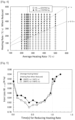
- the average heating rate was varied in the range of 200 to 500°C/s in the temperature range of 400°C to 750°C during a heating step of the decarburization annealing, and when the temperature of the steel sheet has reached 600°C, the heating rate was varied in the range of 25 to 500°C/s for 0.50 seconds.
- an annealing separating agent was applied to the steel sheet after the decarburization annealing, as in ⁇ Experiment 1> above, and then finishing annealing and flattening annealing were performed to obtain a product sheet. Then, an Epstein test piece was obtained from the product sheet to measure the iron loss W 17/50 .
- Fig. 1 shows the measurement results as the relationship between the average heating rate in the temperature range of 400°C to 750°C, the heating rate reduced for 0.50 seconds, and the iron loss W 17/50 .
- the result indicated by “ ⁇ ” shows that the iron loss W 17/50 is equal to the reference value of 0.87 W/kg or less (which means superior iron loss), while the result indicated by " ⁇ ” shows that the iron loss W 17/50 is more than the reference value of 0.87 W/kg (which means inferior iron loss).
- Fig. 1 shows that the iron loss W 17/50 was reduced to the reference value of 0.87 W/kg or less under the following conditions: the average heating rate in the temperature range of 400°C to 750°C was set to 250°C/s or more, and the heating rate for the steel sheet was reduced to 2/3 of the average heating rate or less in the temperature range of 400 to 750°C when the temperature of the steel sheet has reached 600°C.
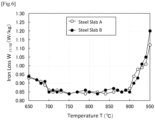
- the inventors have conducted the following experiments to examine the time for reducing the heating rate required to reduce iron loss during the heating step of the decarburization annealing.
- an annealing separating agent was applied to the steel sheet subjected to the decarburization annealing, as in ⁇ Experiment 1> above, and then finishing annealing and flattening annealing were performed to obtain a product sheet. Then, an Epstein test piece was obtained from the product sheet to measure the iron loss W 17/50 .
- Fig. 2 shows the measurement results; by setting the time during which the heating rate is reduced, to 0.10 seconds or more but less than 1.00 seconds, the iron loss W 17/50 is as low as the reference value of 0.87 W/kg or less.
- the steel material used in the present invention is not limited to a particular material as long as it has a known component composition for a grain-oriented electrical steel sheet.
- the steel material preferably contains C, Si, and Mn in the following ranges from a perspective of stably producing a grain-oriented electrical steel sheet with excellent magnetic properties.
- the content of C is an element for forming austenite and is a useful element for increasing the maximum fraction of the y phase to obtain a fine texture of a slab.
- the content of C is less than 0.01 mass%, the fraction of the y phase decreases, making it difficult to obtain a sufficiently fine texture of a slab.
- the content of C exceeds 0.10 mass%, it is difficult to reduce the content of C to 0.0050 mass% or less at which magnetic aging does not occur even by decarburization annealing.
- the content of C is preferably set in the range of 0.01 to 0.10 mass%. More preferably, the content of C is set in the range of 0.02 to 0.08 mass%.
- Si is an effective element for increasing the specific resistance of steel, and thus reducing iron loss.
- the content of Si is less than 2.0 mass%, such an effect of reducing iron loss cannot be fully achieved.
- the content of Si is over 4.5 mass%, workability significantly decreases, making it difficult to produce an intended steel sheet through rolling. Accordingly, the content of Si is preferably set in the range of 2.0 to 4.5 mass%. More preferably, the content of Si is set in the range of 2.5 to 4.0 mass%.
- Mn is an element needed to improve hot workability.
- the content of Mn is less than 0.01 mass%, such an effect of improving hot workability cannot be fully achieved.
- the content of Mn is over 0.50 mass%, a primary recrystallization texture degrades, which in turn may make it difficult to obtain a secondary recrystallization texture highly oriented in the Goss orientation.
- the content of Mn is preferably set in the range of 0.01 to 0.50 mass%. More preferably, the content of Mn is set in the range of 0.03 to 0.30 mass%.
- the steel material used in the present invention further preferably contains, when AlN is used as inhibitors for causing secondary recrystallization during the finishing annealing, Al: 0.0100 to 0.0400 mass% and N: 0.0050 to 0.0120 mass% as inhibitor-forming elements, in addition to C, Si, and Mn described above.
- AlN 0.0100 to 0.0400 mass%
- N 0.0050 to 0.0120 mass% as inhibitor-forming elements, in addition to C, Si, and Mn described above.
- the total content of at least one of S and Se is preferably set in the range of 0.01 to 0.05 mass%.
- the total content of S and Se is less than the above lower limit, it is difficult to fully obtain the effect of the inhibitors.
- the total content of S and Se is over the above upper limit, the resulting precipitates are unevenly dispersed. Thus, it is still difficult to fully obtain the effect of the inhibitors.
- the following ranges are preferable: Al: less than 0.0100 mass%, N: 0.0050 mass% or less, S: 0.0070 mass% or less, and Se: 0.0070 mass% or less.
- the steel material used in the present invention may further contain, in addition to the above components, at least one element selected from the group consisting of Sb: 0.500 mass% or less, Cu: 1.50 mass% or less, P: 0.500 mass% or less, Cr: 1.50 mass% or less, Ni: 1.500 mass% or less, Sn: 0.50 mass% or less, Nb: 0.0100 mass% or less, Mo: 0.50 mass% or less, B: 0.0070 mass% or less, and Bi: 0.0500 mass% or less.
- Sb 0.500 mass% or less
- Cu: 1.50 mass% or less P: 0.500 mass% or less
- Cr 1.50 mass% or less
- Sn: 0.50 mass% or less Sn: 0.50 mass% or less
- Nb 0.0100 mass% or less
- Mo 0.50 mass% or less
- B 0.0070 mass% or less
- Bi 0.0500 mass% or less.
- the use of such an element in the above range can achieve the effect of improving magnetic properties without hindering the development of secondary recrystallized grains.
- the following ranges are preferable: Sb: 0.005 mass% or more, Cu: 0.01 mass% or more, P: 0.005 mass% or more, Cr: 0.01 mass% or more, Ni: 0.005 mass% or more, Sn: 0.01 mass% or more, Nb: 0.0005 mass% or more, Mo: 0.01 mass% or more, B: 0.0010 mass% or more, and Bi: 0.0005 mass% or more.
- the steel material used in the present invention contains the above components, with the balance being Fe and unavoidable impurities.
- a steel material (slab) used for the grain-oriented electrical steel sheet of the present invention is preferably produced by preparing steel with a component composition adjusted to satisfy the above ranges by subjecting molten steel obtained with a converter or an electric furnace, for example, to a commonly known refining process, such as vacuum degassing, for performing secondary refining, and then subjecting the steel to a commonly known continuous casting process or ingot making-blooming process, for example.
- the steel material is heated to a predetermined temperature and then hot-rolled to obtain a hot-rolled sheet.
- the heating temperature for the slab is preferably about 1050°C or higher from a perspective of securing hot rollability.
- the heating temperature for the slab is preferably about 1200°C or higher from a perspective of dissolving the inhibitor-forming component in the steel.
- the upper limit of the heating temperature is not specified.
- the heating temperature higher than 1450°C is too close to the melting temperature of the steel, making it difficult to maintain the shape of the slab or increasing scale loss.
- the heating temperature is preferably set to 1450°C or lower.
- the other conditions of the hot rolling may be set to commonly known conditions, and are not specified.
- the rolling reduction in the final cold-rolling step is not specified but is preferably set in the range of 60% to 95% inclusive from a perspective of improving the primary recrystallization texture.
- the rolling reduction is less than 60%, the ⁇ 111 ⁇ 112> oriented grains and the like in the primary recrystallization texture do not develop sufficiently. This makes Goss-oriented grains less likely to grow through secondary recrystallization.
- the rolling reduction is more than 95%, the steel sheet becomes difficult to be cold-rolled due to work hardening.
- the final thickness (product sheet thickness) is preferably set in the range of 0.1 to 1.0 mm.
- productivity decreases, and further, the rigidity of the steel sheet completed as the product sheet is extremely low. In such a case, the sheet is difficult to handle while it is machined into an iron core of a transformer. Meanwhile, when the final thickness exceeds 1.0 mm, an eddy current loss increases, resulting in increased iron loss, which is unfavorable.
Landscapes
- Chemical & Material Sciences (AREA)
- Engineering & Computer Science (AREA)
- Organic Chemistry (AREA)
- Materials Engineering (AREA)
- Mechanical Engineering (AREA)
- Metallurgy (AREA)
- Physics & Mathematics (AREA)
- Thermal Sciences (AREA)
- Crystallography & Structural Chemistry (AREA)
- Electromagnetism (AREA)
- Manufacturing & Machinery (AREA)
- Power Engineering (AREA)
- Dispersion Chemistry (AREA)
- Manufacturing Of Steel Electrode Plates (AREA)
- Soft Magnetic Materials (AREA)
Applications Claiming Priority (2)
| Application Number | Priority Date | Filing Date | Title |
|---|---|---|---|
| JP2022141254 | 2022-09-06 | ||
| PCT/JP2023/032312 WO2024053627A1 (ja) | 2022-09-06 | 2023-09-05 | 方向性電磁鋼板の製造方法および誘導加熱装置 |
Publications (2)
| Publication Number | Publication Date |
|---|---|
| EP4575009A1 true EP4575009A1 (de) | 2025-06-25 |
| EP4575009A4 EP4575009A4 (de) | 2026-03-25 |
Family
ID=90191276
Family Applications (1)
| Application Number | Title | Priority Date | Filing Date |
|---|---|---|---|
| EP23863165.9A Pending EP4575009A4 (de) | 2022-09-06 | 2023-09-05 | Verfahren zur herstellung eines kornorientierten elektromagnetischen stahlblechs und induktionsheizer |
Country Status (6)
| Country | Link |
|---|---|
| US (1) | US20260085372A1 (de) |
| EP (1) | EP4575009A4 (de) |
| JP (1) | JP7786566B2 (de) |
| KR (1) | KR20250058758A (de) |
| CN (1) | CN119790168A (de) |
| WO (1) | WO2024053627A1 (de) |
Families Citing this family (1)
| Publication number | Priority date | Publication date | Assignee | Title |
|---|---|---|---|---|
| WO2025005025A1 (ja) * | 2023-06-29 | 2025-01-02 | Jfeスチール株式会社 | 方向性電磁鋼板の製造方法および誘導加熱装置 |
Family Cites Families (18)
| Publication number | Priority date | Publication date | Assignee | Title |
|---|---|---|---|---|
| BE789262A (fr) | 1971-09-27 | 1973-01-15 | Nippon Steel Corp | Procede de formation d'un film isolant sur un feuillard d'acierau silicium oriente |
| JPS5413846B2 (de) | 1973-06-18 | 1979-06-02 | ||
| JPS5652117B2 (de) | 1973-11-17 | 1981-12-10 | ||
| JPS5844744B2 (ja) | 1979-11-22 | 1983-10-05 | 川崎製鉄株式会社 | 方向性珪素鋼板にクロム酸化物を含まない張力付加型の上塗り絶縁被膜を形成する方法 |
| JPH01215925A (ja) | 1988-02-25 | 1989-08-29 | Nippon Steel Corp | 一方向性電磁鋼板の冷間圧延方法 |
| US4898626A (en) * | 1988-03-25 | 1990-02-06 | Armco Advanced Materials Corporation | Ultra-rapid heat treatment of grain oriented electrical steel |
| JPH04160114A (ja) | 1990-10-23 | 1992-06-03 | Nippon Steel Corp | 磁気特性の優れた一方向性電磁鋼板の製造方法 |
| JPH08253816A (ja) | 1995-03-15 | 1996-10-01 | Nippon Steel Corp | 超高磁束密度一方向性電磁鋼板の製造方法 |
| JP4612082B2 (ja) | 1998-08-07 | 2011-01-12 | 株式会社平和 | パチンコ機の賞球払出装置 |
| JP2001215925A (ja) | 2000-01-31 | 2001-08-10 | Matsushita Graphic Communication Systems Inc | 画像記録装置 |
| JP2004160114A (ja) | 2002-11-12 | 2004-06-10 | Masafumi Igawa | 動体視力トレーニングマシン |
| US20080246362A1 (en) * | 2003-06-12 | 2008-10-09 | Hirzel Andrew D | Radial airgap, transverse flux machine |
| JP5526609B2 (ja) * | 2009-06-05 | 2014-06-18 | 新日鐵住金株式会社 | 磁束密度の良好な方向性電磁鋼板の製造方法 |
| JP5854234B2 (ja) | 2013-02-14 | 2016-02-09 | Jfeスチール株式会社 | 方向性電磁鋼板の製造方法 |
| KR20140131496A (ko) * | 2014-10-20 | 2014-11-13 | 주식회사 포스코 | 방향성 전기강판의 제조방법 |
| JP6888603B2 (ja) * | 2018-11-30 | 2021-06-16 | Jfeスチール株式会社 | 方向性電磁鋼板の製造方法 |
| CN113195753B (zh) * | 2019-01-08 | 2024-04-30 | 日本制铁株式会社 | 方向性电磁钢板的制造方法及方向性电磁钢板 |
| KR102521243B1 (ko) * | 2019-04-25 | 2023-04-14 | 닛폰세이테츠 가부시키가이샤 | 권철심 및 그 제조 방법 |
-
2023
- 2023-09-05 US US19/108,898 patent/US20260085372A1/en active Pending
- 2023-09-05 WO PCT/JP2023/032312 patent/WO2024053627A1/ja not_active Ceased
- 2023-09-05 CN CN202380063531.2A patent/CN119790168A/zh active Pending
- 2023-09-05 KR KR1020257010439A patent/KR20250058758A/ko active Pending
- 2023-09-05 JP JP2024515036A patent/JP7786566B2/ja active Active
- 2023-09-05 EP EP23863165.9A patent/EP4575009A4/de active Pending
Also Published As
| Publication number | Publication date |
|---|---|
| US20260085372A1 (en) | 2026-03-26 |
| WO2024053627A1 (ja) | 2024-03-14 |
| EP4575009A4 (de) | 2026-03-25 |
| JP7786566B2 (ja) | 2025-12-16 |
| KR20250058758A (ko) | 2025-04-30 |
| CN119790168A (zh) | 2025-04-08 |
| JPWO2024053627A1 (de) | 2024-03-14 |
Similar Documents
| Publication | Publication Date | Title |
|---|---|---|
| JP7392849B2 (ja) | 方向性電磁鋼板の製造方法および電磁鋼板製造用圧延設備 | |
| EP3733895B1 (de) | Kornorientiertes elektrostahlblech mit niedrigem eisenverlust und herstellungsverfahren dafür | |
| KR102503902B1 (ko) | 방향성 전기 강판의 제조 방법 및 냉간 압연 설비 | |
| EP4474492A1 (de) | Verfahren zur herstellung eines kornorientierten elektromagnetischen stahlblechs | |
| JP6950723B2 (ja) | 方向性電磁鋼板の製造方法 | |
| US20260085372A1 (en) | Method for producing grain-oriented electrical steel sheet, and induction heating device | |
| JP3392664B2 (ja) | 極めて低い鉄損をもつ一方向性電磁鋼板の製造方法 | |
| EP4575010A1 (de) | Verfahren zur herstellung eines kornorientierten elektromagnetischen stahlblechs und induktionsheizer | |
| JP3392579B2 (ja) | 極めて低い鉄損をもつ一方向性電磁鋼板の製造方法 | |
| EP4317472A1 (de) | Verfahren zur herstellung eines kornorientierten elektromagnetischen stahlblechs | |
| EP4729639A1 (de) | Verfahren zur herstellung eines orientierten elektromagnetischen stahlblechs und induktionsheizvorrichtung | |
| EP4729640A1 (de) | Verfahren zur herstellung eines kornorientierten elektrischen stahlblechs und induktionsheizvorrichtung | |
| EP4317471A1 (de) | Herstellungsverfahren für kornorientiertes elektrostahlblech | |
| KR102921681B1 (ko) | 방향성 전기 강판의 제조 방법 | |
| JP2014173103A (ja) | 方向性電磁鋼板の製造方法 | |
| JP3392695B2 (ja) | 極めて優れた鉄損特性を有する一方向性電磁鋼板の製造方法 | |
| JPH0762437A (ja) | 極めて低い鉄損をもつ一方向性電磁鋼板の製造方法 | |
| WO2025154576A1 (ja) | 方向性電磁鋼板の冷間圧延方法および製造方法ならびに冷間圧延設備列 | |
| JP2025151626A (ja) | 方向性電磁鋼板の製造方法 | |
| JP2025151642A (ja) | 方向性電磁鋼板の製造方法 | |
| JP2023116341A (ja) | 方向性電磁鋼板の製造方法 | |
| JPH10287926A (ja) | 極低鉄損特性を有する方向性電磁鋼板の製造方法 |
Legal Events
| Date | Code | Title | Description |
|---|---|---|---|
| STAA | Information on the status of an ep patent application or granted ep patent |
Free format text: STATUS: THE INTERNATIONAL PUBLICATION HAS BEEN MADE |
|
| PUAI | Public reference made under article 153(3) epc to a published international application that has entered the european phase |
Free format text: ORIGINAL CODE: 0009012 |
|
| STAA | Information on the status of an ep patent application or granted ep patent |
Free format text: STATUS: REQUEST FOR EXAMINATION WAS MADE |
|
| 17P | Request for examination filed |
Effective date: 20250317 |
|
| AK | Designated contracting states |
Kind code of ref document: A1 Designated state(s): AL AT BE BG CH CY CZ DE DK EE ES FI FR GB GR HR HU IE IS IT LI LT LU LV MC ME MK MT NL NO PL PT RO RS SE SI SK SM TR |
|
| DAV | Request for validation of the european patent (deleted) | ||
| DAX | Request for extension of the european patent (deleted) | ||
| REG | Reference to a national code |
Ref country code: DE Ref legal event code: R079 Free format text: PREVIOUS MAIN CLASS: C21D0008120000 Ipc: C21D0003040000 |
|
| A4 | Supplementary search report drawn up and despatched |
Effective date: 20260220 |
|
| RIC1 | Information provided on ipc code assigned before grant |
Ipc: C21D 3/04 20060101AFI20260216BHEP Ipc: C21D 8/12 20060101ALI20260216BHEP Ipc: C22C 38/00 20060101ALI20260216BHEP Ipc: C22C 38/60 20060101ALI20260216BHEP Ipc: C21D 6/00 20060101ALI20260216BHEP Ipc: C21D 8/1244 20260101ALI20260216BHEP Ipc: C21D 9/46 20060101ALI20260216BHEP Ipc: C21D 8/1216 20260101ALI20260216BHEP Ipc: C22C 38/02 20060101ALI20260216BHEP Ipc: C22C 38/04 20060101ALI20260216BHEP Ipc: C22C 38/06 20060101ALI20260216BHEP Ipc: C22C 38/08 20060101ALI20260216BHEP Ipc: C22C 38/12 20060101ALI20260216BHEP Ipc: C22C 38/16 20060101ALI20260216BHEP Ipc: C22C 38/20 20060101ALI20260216BHEP Ipc: C22C 38/22 20060101ALI20260216BHEP Ipc: C22C 38/32 20060101ALI20260216BHEP Ipc: C22C 38/34 20060101ALI20260216BHEP Ipc: H01F 1/147 20060101ALI20260216BHEP Ipc: H01F 1/16 20060101ALI20260216BHEP Ipc: H05B 6/10 20060101ALI20260216BHEP Ipc: C21D 1/42 20060101ALN20260216BHEP |