EP4575486A1 - Procédé de surveillance d'un état de fonctionnement d'au moins un appareil ménager et système de surveillance - Google Patents
Procédé de surveillance d'un état de fonctionnement d'au moins un appareil ménager et système de surveillance Download PDFInfo
- Publication number
- EP4575486A1 EP4575486A1 EP23219806.9A EP23219806A EP4575486A1 EP 4575486 A1 EP4575486 A1 EP 4575486A1 EP 23219806 A EP23219806 A EP 23219806A EP 4575486 A1 EP4575486 A1 EP 4575486A1
- Authority
- EP
- European Patent Office
- Prior art keywords
- acoustic signal
- household appliance
- data set
- information
- household
- Prior art date
- Legal status (The legal status is an assumption and is not a legal conclusion. Google has not performed a legal analysis and makes no representation as to the accuracy of the status listed.)
- Pending
Links
Images


Classifications
-
- G—PHYSICS
- G01—MEASURING; TESTING
- G01H—MEASUREMENT OF MECHANICAL VIBRATIONS OR ULTRASONIC, SONIC OR INFRASONIC WAVES
- G01H3/00—Measuring characteristics of vibrations by using a detector in a fluid
- G01H3/04—Frequency
- G01H3/08—Analysing frequencies present in complex vibrations, e.g. comparing harmonics present
-
- G—PHYSICS
- G05—CONTROLLING; REGULATING
- G05B—CONTROL OR REGULATING SYSTEMS IN GENERAL; FUNCTIONAL ELEMENTS OF SUCH SYSTEMS; MONITORING OR TESTING ARRANGEMENTS FOR SUCH SYSTEMS OR ELEMENTS
- G05B15/00—Systems controlled by a computer
- G05B15/02—Systems controlled by a computer electric
-
- G—PHYSICS
- G01—MEASURING; TESTING
- G01N—INVESTIGATING OR ANALYSING MATERIALS BY DETERMINING THEIR CHEMICAL OR PHYSICAL PROPERTIES
- G01N29/00—Investigating or analysing materials by the use of ultrasonic, sonic or infrasonic waves; Visualisation of the interior of objects by transmitting ultrasonic or sonic waves through the object
- G01N29/14—Investigating or analysing materials by the use of ultrasonic, sonic or infrasonic waves; Visualisation of the interior of objects by transmitting ultrasonic or sonic waves through the object using acoustic emission techniques
-
- G—PHYSICS
- G01—MEASURING; TESTING
- G01M—TESTING STATIC OR DYNAMIC BALANCE OF MACHINES OR STRUCTURES; TESTING OF STRUCTURES OR APPARATUS, NOT OTHERWISE PROVIDED FOR
- G01M99/00—Subject matter not provided for in other groups of this subclass
- G01M99/005—Testing of complete machines, e.g. washing-machines or mobile phones
-
- G—PHYSICS
- G01—MEASURING; TESTING
- G01N—INVESTIGATING OR ANALYSING MATERIALS BY DETERMINING THEIR CHEMICAL OR PHYSICAL PROPERTIES
- G01N29/00—Investigating or analysing materials by the use of ultrasonic, sonic or infrasonic waves; Visualisation of the interior of objects by transmitting ultrasonic or sonic waves through the object
- G01N29/04—Analysing solids
- G01N29/06—Visualisation of the interior, e.g. acoustic microscopy
- G01N29/0654—Imaging
-
- G—PHYSICS
- G01—MEASURING; TESTING
- G01N—INVESTIGATING OR ANALYSING MATERIALS BY DETERMINING THEIR CHEMICAL OR PHYSICAL PROPERTIES
- G01N29/00—Investigating or analysing materials by the use of ultrasonic, sonic or infrasonic waves; Visualisation of the interior of objects by transmitting ultrasonic or sonic waves through the object
- G01N29/44—Processing the detected response signal, e.g. electronic circuits specially adapted therefor
- G01N29/4409—Processing the detected response signal, e.g. electronic circuits specially adapted therefor by comparison
- G01N29/4436—Processing the detected response signal, e.g. electronic circuits specially adapted therefor by comparison with a reference signal
-
- G—PHYSICS
- G01—MEASURING; TESTING
- G01N—INVESTIGATING OR ANALYSING MATERIALS BY DETERMINING THEIR CHEMICAL OR PHYSICAL PROPERTIES
- G01N29/00—Investigating or analysing materials by the use of ultrasonic, sonic or infrasonic waves; Visualisation of the interior of objects by transmitting ultrasonic or sonic waves through the object
- G01N29/44—Processing the detected response signal, e.g. electronic circuits specially adapted therefor
- G01N29/46—Processing the detected response signal, e.g. electronic circuits specially adapted therefor by spectral analysis, e.g. Fourier analysis or wavelet analysis
-
- G—PHYSICS
- G01—MEASURING; TESTING
- G01S—RADIO DIRECTION-FINDING; RADIO NAVIGATION; DETERMINING DISTANCE OR VELOCITY BY USE OF RADIO WAVES; LOCATING OR PRESENCE-DETECTING BY USE OF THE REFLECTION OR RERADIATION OF RADIO WAVES; ANALOGOUS ARRANGEMENTS USING OTHER WAVES
- G01S5/00—Position-fixing by co-ordinating two or more direction or position line determinations; Position-fixing by co-ordinating two or more distance determinations
- G01S5/18—Position-fixing by co-ordinating two or more direction or position line determinations; Position-fixing by co-ordinating two or more distance determinations using ultrasonic, sonic or infrasonic waves
- G01S5/26—Position of receiver fixed by co-ordinating a plurality of position lines defined by path-difference measurements
-
- G—PHYSICS
- G05—CONTROLLING; REGULATING
- G05B—CONTROL OR REGULATING SYSTEMS IN GENERAL; FUNCTIONAL ELEMENTS OF SUCH SYSTEMS; MONITORING OR TESTING ARRANGEMENTS FOR SUCH SYSTEMS OR ELEMENTS
- G05B19/00—Program-control systems
- G05B19/02—Program-control systems electric
- G05B19/418—Total factory control, i.e. centrally controlling a plurality of machines, e.g. direct or distributed numerical control [DNC], flexible manufacturing systems [FMS], integrated manufacturing systems [IMS] or computer integrated manufacturing [CIM]
-
- G—PHYSICS
- G01—MEASURING; TESTING
- G01N—INVESTIGATING OR ANALYSING MATERIALS BY DETERMINING THEIR CHEMICAL OR PHYSICAL PROPERTIES
- G01N2291/00—Indexing codes associated with group G01N29/00
- G01N2291/01—Indexing codes associated with the measuring variable
- G01N2291/011—Velocity or travel time
-
- G—PHYSICS
- G01—MEASURING; TESTING
- G01N—INVESTIGATING OR ANALYSING MATERIALS BY DETERMINING THEIR CHEMICAL OR PHYSICAL PROPERTIES
- G01N2291/00—Indexing codes associated with group G01N29/00
- G01N2291/01—Indexing codes associated with the measuring variable
- G01N2291/015—Attenuation, scattering
-
- G—PHYSICS
- G01—MEASURING; TESTING
- G01N—INVESTIGATING OR ANALYSING MATERIALS BY DETERMINING THEIR CHEMICAL OR PHYSICAL PROPERTIES
- G01N2291/00—Indexing codes associated with group G01N29/00
- G01N2291/02—Indexing codes associated with the analysed material
- G01N2291/025—Change of phase or condition
- G01N2291/0258—Structural degradation, e.g. fatigue of composites, ageing of oils
-
- G—PHYSICS
- G05—CONTROLLING; REGULATING
- G05B—CONTROL OR REGULATING SYSTEMS IN GENERAL; FUNCTIONAL ELEMENTS OF SUCH SYSTEMS; MONITORING OR TESTING ARRANGEMENTS FOR SUCH SYSTEMS OR ELEMENTS
- G05B2219/00—Program-control systems
- G05B2219/20—Pc systems
- G05B2219/26—Pc applications
- G05B2219/2642—Domotique, domestic, home control, automation, smart house
Definitions
- the invention relates to a method having the features of independent patent claim 1, a monitoring system having the features of independent patent claim 13, a computer program product having the features of independent patent claim 15 and further to a computer-readable storage medium and a data carrier signal.
- cleaning robots especially robot vacuum cleaners, or conventional vacuum cleaners are used for floor cleaning, kitchen appliances and ovens for food preparation, washing machines and dryers for textile cleaning, and dishwashers for dishwashing.
- the functional condition of household appliances can be affected by incorrect operation and/or signs of aging or wear.
- a vacuum cleaner can be operated by a user without a vacuum cleaner bag being inserted.
- a food processor can also be operated without a tool required for operation, in particular a knife, being inserted into the machine.
- a faulty functional condition of the household appliance in question arises from incorrect operation by a user.
- the result desired by the user with regard to operation of the household appliance is subsequently not achieved or not achieved to a sufficient quality.
- Household appliances are also subject to aging or wear mechanisms during operation.
- a tool of a food processor in particular a knife
- a vacuum cleaner can also decrease due to an increasingly full filter bag during regular use of the vacuum cleaner.
- Mechanical components such as bearings can also be affected by wear and tear, which can subsequently lead to increased energy consumption of the household appliance and/or annoying operating noises. If a faulty functional condition is not detected early on, this can also cause consequential damage if the household appliance in question is continued to be used, which further impairs the safe and reliable operation of the household appliance in question.
- the object of the invention is to provide a method for monitoring a functional state, in particular a functional status, of at least one household appliance, a monitoring system, a computer program product, a computer-readable storage medium, and a data carrier signal, each of which enables an improved and/or simplified determination of a functional state of a household appliance within a household environment.
- a method for monitoring the functional status of at least one household appliance located in a household environment is provided.
- the monitoring is carried out by a monitoring system comprising at least one monitoring unit.
- an acoustic signal from the household environment is received by the monitoring unit.
- the acoustic signal can be received, for example, by at least one receiving unit of the monitoring unit.
- the acoustic signal is evaluated and an evaluation data set is provided as the result of this evaluation.
- the evaluation of the acoustic signal can be performed at least partially by the monitoring unit. Additionally or alternatively, the evaluation of the acoustic signal can be performed at least partially by a central server.
- a household appliance in the household environment is identified as the source (emitter) of the acoustic signal, and a device data set is provided.
- the device data set is characteristic or specific to the household appliance identified as the source of the acoustic signal.
- the identification and/or provision of the device data set can be performed, in particular, by an identification unit of the monitoring unit and/or a central computer.
- device data relating to at least one household appliance can be stored on at least one household appliance and/or at least one monitoring unit and/or at least one central server.
- a functional status in particular a current one, of the household appliance identified as the source of the acoustic signal is determined.
- the functional status can preferably be determined by a status determination unit of the monitoring unit and/or a central computer.
- the method according to the invention offers the advantage that acoustic signals emitted by household appliances in a household environment can be centrally received and processed by a monitoring unit or forwarded for further processing. Based on the evaluation of the acoustic signals, a specific household appliance in the household environment can be identified as the source of the acoustic signal and its status can be determined. In particular, this can reduce the hardware and/or software required for individual household appliances to perform functional status monitoring, since status monitoring is carried out centrally by one or more monitoring units.
- a functional state of a household appliance should be understood as a condition that is characteristic of whether a household appliance can be operated without errors. If a faulty functional state exists, this is characteristic of the household appliance not being able to operate without errors. The presence of a faulty functional state does not fundamentally rule out the operation of the household appliance. In other words, not every faulty operating state must immediately result in a failure of the household appliance.
- a faulty functional state can manifest itself, for example, in increased and/or changed noise emissions, increased energy consumption, a loss of at least one performance parameter, e.g. suction power, of the household appliance, a reduced quality of the work results achievable by the household appliance, or even at least a temporary failure of the household appliance.
- the acoustic signal can be evaluated at least partially by the monitoring unit. Additionally or alternatively, the acoustic signal can be evaluated at least partially by a central server. A combined evaluation of the acoustic signal, partly by the monitoring unit and partly by the central computer, can also be provided. The evaluation data sets generated during the respective evaluations can then, for example, be combined into a single evaluation data set. Evaluation within the monitoring unit, in particular by at least one evaluation unit, offers the advantage that a result can be provided to the monitoring unit quickly and regardless of connection quality (e.g., with regard to the Internet or a mobile network). Evaluation of the acoustic signal in a central computer offers the advantage that computing capacity for performing complex computing operations can be centralized. This allows the design of the monitoring unit to be made more compact and cost-effective.
- a specified frequency range can be isolated from the acoustic signal. For example, it may be known that a household appliance predominantly emits sound in a specific frequency spectrum during operation. A different frequency range may be known for another household appliance. Accordingly, the respective frequency spectra can be used for bandpass filtering to remove interfering frequency components from the acoustic signal in preparation for further analysis.
- Performing a frequency analysis allows the transfer of a, particularly filtered, acoustic signal from the spatial domain to the frequency domain, as well as the provision of a frequency spectrum of the signal that is characteristic of the frequency components contained in the signal.
- a simplified comparison of the acoustic signal to known acoustic signals can be performed.
- a simple comparison with known data can be performed to reliably determine the functional status of a household appliance.
- a determined sound pressure level of the acoustic signal is compared with a reference sound pressure level. If the sound pressure level of the acoustic signal corresponds to the reference sound pressure level, i.e. is equal to it, or is lower than the reference sound pressure level, it can be provided that the acoustic signal is ignored. Ignoring the acoustic signal should be understood here as meaning that the method with regard to the processing of this acoustic signal is aborted, meaning no further evaluation is carried out and no household appliance is identified or a functional status determined on the basis of the acoustic signal. This has the advantage that background noise in the household environment can be masked out with regard to the present method.
- Background noise can, for example, be noises that are emitted outside the household environment and penetrate into it, e.g. traffic noise. This is because such background noise is often quieter than the operation of household appliances within the household environment.
- a distance and/or a direction of a point of origin of the acoustic signal relative to the monitoring unit is determined and preferably provided as part of localization information in the evaluation data set. Determining localization information has the advantage that the point of origin of the acoustic signal can be compared with known positions in the household environment. This can simplify or support the identification of a household appliance in the household environment. For example, only household appliances located in the vicinity of the point of origin can be considered as potential sources of the acoustic signal.
- a point of origin of the acoustic signal is to be understood as the location at which the acoustic signal was emitted, in particular by a household appliance, preferably in the household environment.
- the determination of the localization information enables improved interpretation of the acoustic signal with regard to determining the functional status of a household appliance in the household environment.
- the distance between the source of the acoustic signal and the monitoring unit can influence the characteristics of the acoustic signal received in the monitoring unit. This influence can be used to increase the reliability of determining the functional status by knowing the localization information.
- At least one monitoring unit in particular at least one receiving unit of at least one monitoring unit, can have at least two receiving components for receiving the acoustic signal in the monitoring unit.
- the at least two monitoring components can preferably be arranged spatially spaced from one another in or on the monitoring unit. More than two receiving components, in particular at least three or at least four receiving components, can be included.
- At least one receiving component can be designed as a microphone.
- a propagation time difference of the acoustic signal with respect to its reception by at least two receiving components can preferably be evaluated.
- a propagation time difference is understood to mean the time delay of the reception of the acoustic signal in the respective Receiving components can be understood. This allows the direction and distance of the acoustic signal's origin relative to the monitoring unit to be determined in a simple and cost-effective manner, particularly through acoustic triangulation.
- the origin can be entered into the surrounding map, especially in real time. For example, if the surrounding map is displayed to a user, the position of the origin can be recognized by that user.
- the origin can be entered repeatedly. In other words, whenever an origin has been determined, it can be entered into the surrounding map or updated within the surrounding map.
- the user By entering the position of the source and/or at least one household appliance on a map of the surrounding area, the user can be visually shown where the acoustic signal originates. This makes it easy to provide or receive assistance to the user in identifying a household appliance as the source of the acoustic signal in the household environment.
- a household environment is to be understood here as a spatially limited household.
- a household environment can be an apartment or a house.
- a household environment can preferably comprise at least one room or several rooms, in particular living rooms.
- An environment map is further to be understood as a, in particular parameterized, image of the household environment.
- the environment map can preferably comprise a spatial division of the household environment. Additionally or alternatively, the environment map can comprise the position of at least one monitoring unit in the household environment.
- the method can include determining an environmental map of the household environment.
- the environmental map can be determined at least partially by at least one household appliance.
- the household environment can be traversed by a robot vacuum cleaner and recorded or parameterized using measurement technology.
- the environmental map can be determined at least partially by at least one monitoring unit.
- the monitoring unit can emit sound signals into the household environment, and reflections of these sound signals (echoes) can be evaluated in order to identify boundaries of the household environment or their distance from the monitoring unit.
- At least one shading element can preferably be designed as a wall.
- the wall can preferably be an interior wall in the household environment.
- At least one shading element can also be designed as a piece of furniture, in particular as a cupboard.
- at least one piece of shading information can comprise at least one piece of material information, wherein the material information is characteristic of a material of the shading element.
- a wall in the household environment can be a drywall or a brick wall. Since different materials influence the characteristics of the acoustic signal in different ways, this can further increase the reliability of determining the functional state.
- the localization information is compared with the surrounding map of the household environment.
- a comparison should be understood, in particular, as a check to determine whether the reception of the acoustic signal by the monitoring unit is influenced by a shading element.
- a check is carried out to determine whether the acoustic signal must pass through or penetrate at least one shading element before reaching the monitoring unit.
- the environmental map preferably includes the position and/or size and/or material information of at least one shading element and a position of the monitoring unit in the household environment.
- the localization information it can be checked whether or not the acoustic signal is obscured by at least one shading element with respect to reception of the acoustic signal in the monitoring unit. This makes it easy to determine which shading elements in the household environment need to be considered with respect to changes in a characteristic of the acoustic signal.
- shading of the acoustic signal by a shading element with regard to the reception of the acoustic signal in the monitoring unit is to be understood as meaning that the acoustic signal must penetrate or pass through the shading element before it reaches the monitoring unit.
- Determining floor covering information enables improved interpretation of the acoustic signal with regard to determining the functional status of a household appliance in the household environment.
- Different floor coverings in the household environment can influence the characteristics of the acoustic signal emitted by the household appliance. For example, the noise generated by a vacuum cleaner on carpeted flooring differs from the noise generated by the vacuum cleaner during operation on a tiled or wooden floor. This influence can be used to increase the reliability of determining the functional status by knowing the floor covering information.
- the localization information is compared with the surrounding map of the household environment.
- a comparison should be understood in particular as a check to determine which floor covering is present at the position within the household environment identified as the origin of the acoustic signal.
- the environment map preferably includes information about a floor covering in at least one area or at at least one location within the household environment, as well as a position of the monitoring unit within the household environment.
- the environmental map preferably comprises a position of at least one household appliance and a position of the monitoring unit in the household environment.
- a household appliance determined on the basis of the localization information, it can be queried whether it is currently in operation or has recently been in operation. In this way, for example, a household appliance can be additionally verified as the source of the acoustic signal.
- a user input can, for example, be made via the monitoring unit and/or a mobile device of the monitoring system.
- an operating request is transmitted from a monitoring unit or a central server to a household appliance.
- a group of household appliances may have been identified as possible sources of the acoustic signal. This can happen in particular if several household appliances are located in close proximity in the household environment.
- the household appliances in question can transmit operating information to the central server or the monitoring unit.
- the operating information is characteristic of whether the household appliance was in operation at the time the acoustic signal was received in the monitoring unit. If the household appliance was not in operation, it can be excluded as a potential source of the acoustic signal.
- a model identifier as a parameter should be characteristic of a specific type of household appliance.
- the model identifier can thus be used to unambiguously determine the type or model of the household appliance identified as the source of the acoustic signal.
- An operating history of the household appliance as a parameter can preferably be at least characteristic of the previous operating hours of a household appliance.
- a maintenance history as a parameter can preferably be at least characteristic of at least one maintenance performed on the household appliance.
- a damage history as a parameter can preferably be at least characteristic of past or existing damage to the household appliance.
- An age of the household appliance and/or an operating history of the household appliance and/or a maintenance history and/or a damage history as parameters allows an improved interpretation of the acoustic signal with regard to the determination of a
- the functional status of a household appliance in the household environment For example, signs of aging or damage can influence the characteristics of the acoustic signal emitted by the household appliance. Maintenance and repairs can at least partially compensate for this influence. A precise knowledge of the aforementioned aspects can therefore be used to more reliably determine the functional status of the household appliance.
- a device knowledge base thereby establishes a functional relationship between the device data set and/or the evaluation data set on the one hand and at least one comparison frequency spectrum and/or at least one comparison sound pressure level and/or at least one psychoacoustic comparison parameter on the other hand.
- at least the device data set and the evaluation data set in particular the information or parameters contained in the evaluation data set and/or device data set, are used as input parameters of the device knowledge base.
- the device knowledge base provides at least one comparison frequency spectrum and/or at least one comparison sound pressure level as output parameters.
- a corresponding psychoacoustic comparison quantity is provided for each psychoacoustic quantity of the acoustic signal recorded or contained in the psychoacoustic information.
- the device knowledge base can comprise a database in which at least one comparison frequency spectrum, in particular a plurality of comparison frequency spectra, and/or at least one comparison sound pressure level, in particular a plurality of comparison sound pressure levels, is/are stored.
- the comparison frequency spectra and/or comparison sound pressure levels can be stored as a function of various input parameters. In this way, suitable comparison frequency spectra or comparison sound pressure levels can be provided in response to variable input parameters.
- comparison frequency spectra and/or comparison sound pressure levels for various household appliances are stored in the device knowledge base, each for variable distances between the household appliance and a receiver of an acoustic signal emitted by the household appliance and/or variable shading states of the household appliance and/or different floor coverings on which the household appliance is operated and/or different age groups of the household appliance.
- a frequency deviation between the frequency spectrum of the, in particular filtered, acoustic signal can be determined.
- the frequency deviation can preferably be characteristic of an amplitude deviation between the reference frequency spectrum and the frequency spectrum of the acoustic signal.
- a sound pressure level deviation can be determined based on a reference sound pressure level.
- the functional state of the household appliance can also be determined depending on at least one frequency deviation and/or at least one amplitude deviation.
- the functional state of the household appliance can be determined and/or provided by a state knowledge base at least depending on at least one frequency deviation and/or at least one control deviation.
- the state knowledge base represents a functional relationship between a control deviation and/or frequency deviation and at least one potential error state of at least one household appliance, in particular of a household appliance type.
- at least one frequency deviation and/or at least one level deviation are used as input parameters of the state knowledge base.
- the state knowledge base provides a functional state of the household appliance as output parameters.
- the device data set and/or localization data set can also be used as input parameters for the state knowledge base, or the functional state can further be determined depending on the device data set and/or localization data set.
- the desired functional state can be specified for a specific household appliance type.
- the information contained in the device data set and/or localization data set can influence the characteristics of a frequency or level deviation.
- the state knowledge base can comprise a database in which at least one frequency deviation and/or level deviation is stored for at least one functional state, in particular a plurality of functional states, of at least one household appliance. Based on a comparison of a determined level deviation or frequency deviation with the level or frequency deviations contained in the state knowledge base, a functional state of the household appliance can thus be determined. Additionally or alternatively, the state knowledge base can comprise at least one neural network, wherein in particular the neural network forms the functional relationship between a level deviation and/or frequency deviation and at least one potential fault state of at least one household appliance, in particular of a household appliance type. The state knowledge base can also comprise several neural networks, wherein in particular each neural network is characteristic of a specific household appliance type.
- a specific functional state can be specified or taught to the neural network based on a device data set and/or evaluation data set and/or a frequency deviation and/or a control deviation.
- a device data set training can be specified for a specific household appliance type, or additional parameters such as the age of the household appliance or its operating history can be taken into account during training.
- additional aspects such as the distance of the household appliance, shading of the household appliance, or the existing floor covering can be taken into account during training.
- faulty operation of a household appliance can be characterized, for example, by a full vacuum cleaner bag.
- the appliance is essentially undamaged and still functional. Cleaning with the appliance in question will nevertheless not produce the desired results.
- the absence of at least one accessory can, for example, be the absence of a vacuum cleaner bag in relation to a vacuum cleaner.
- the absence of an accessory can, for example, be the absence of a tool, in particular a knife.
- a wear condition can, for example, be a wear condition of a motor, in particular a drive motor, fan, loudspeaker, or another accessory of the household appliance (e.g., a blade on a food processor or a brush on a vacuum cleaner). Accordingly, based on the wear condition, it can be determined whether and when maintenance measures are required on the household appliance in question.
- a wear condition of a motor in particular a drive motor, fan, loudspeaker, or another accessory of the household appliance (e.g., a blade on a food processor or a brush on a vacuum cleaner).
- the device knowledge base and the status knowledge base can preferably be configured as a combined knowledge base as parameters. At least one knowledge base as a parameter can be stored and reused on a data storage device, in particular a non-volatile data storage device.
- This provides the advantage of allowing users of the monitoring system to be notified early on of any malfunctions in individual household appliances. This allows the user to initiate appropriate measures to procure spare parts, perform maintenance, or ensure proper operation, effectively preventing consequential damage to the household appliances.
- the above object is further achieved by a monitoring system according to the invention for monitoring a functional state of at least one household appliance according to the second aspect of the present invention.
- the monitoring system comprises at least one monitoring unit, wherein the monitoring system is preferably operated according to a method according to the first aspect of the present invention, in particular according to a method according to one of claims 1 to 11.
- At least one display unit can preferably comprise at least one, in particular touch-sensitive, display, wherein information can be displayed to a user, in particular via the display.
- a map of the household environment can be displayed by at least one display of the display unit.
- Household appliances located in the household environment and/or events, such as the origin of an acoustic signal, can also be displayed on the map.
- the use of a touch-sensitive display can achieve the advantage that inputs from a user on the monitoring unit can be received by the display unit.
- positions on the map of the environment can be marked by a user.
- instructions and/or questions can be displayed to the user, to which the user can react or answer by making appropriate inputs.
- Fig. 2 further shows a schematic view of an environment map 16 of a household environment 12.
- the household environment 12 comprises three rooms.
- Various household appliances 11 and a monitoring system 10 are arranged in the household environment 12, wherein the monitoring system 10 comprises at least one monitoring unit 13.
- At least one household appliance 11 emits an acoustic signal S within the household environment 12.
- the acoustic signal S propagates from the position of the household appliance 11 in the household environment 12, which thus forms the origin U of the acoustic signal S, towards the monitoring unit 13 and can be received by the latter.
- the acoustic signal S In order to reach the monitoring unit 13, the acoustic signal S must penetrate a wall, which thus acts as a shading element 15 with respect to reception of the acoustic signal S by the monitoring unit 13.
- Fig. 4 shows a schematic view of an acoustic triangulation for determining a direction and/or a distance of the origin U of the acoustic signal S relative to the monitoring unit 13.
- the size relationships are shown purely schematically (as in other figures). It can be seen that the monitoring unit 13 comprises a receiving unit 19, wherein the receiving unit 19 has at least two
- Receiving components 19.1 which are arranged spatially spaced from one another. Accordingly, the propagation time differences of the acoustic signal S can be used to determine the direction from which the acoustic signal S has reached the respective receiving components 19.1, knowing the positional displacement between the receiving units 19.1. The intersection point of these directions emanating from the receiving components 19.1 forms the origin U of the acoustic signal S. This is schematically shown by the Fig. 4 indicated by the dotted triangle.
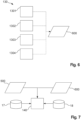
- a household appliance 11 can be identified as the source of the acoustic signal S and accordingly a Household appliance-specific device data record 600 can be provided, which is Fig. 6 shown by the dashed lines.
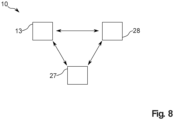
- Fig. 8 further shows a schematic view of a monitoring system 10, comprising at least one monitoring unit 13, at least one central computer 27, and at least one mobile device 28, wherein said components can be at least temporarily connected to a communication link, in particular a bidirectional one. This allows data and information to be exchanged between the central computer 27, the mobile device 28, and the monitoring unit 13.
Landscapes
- Physics & Mathematics (AREA)
- General Physics & Mathematics (AREA)
- Engineering & Computer Science (AREA)
- Health & Medical Sciences (AREA)
- Immunology (AREA)
- Pathology (AREA)
- General Health & Medical Sciences (AREA)
- Biochemistry (AREA)
- Analytical Chemistry (AREA)
- Chemical & Material Sciences (AREA)
- Life Sciences & Earth Sciences (AREA)
- Signal Processing (AREA)
- General Engineering & Computer Science (AREA)
- Acoustics & Sound (AREA)
- Automation & Control Theory (AREA)
- Remote Sensing (AREA)
- Radar, Positioning & Navigation (AREA)
- Quality & Reliability (AREA)
- Manufacturing & Machinery (AREA)
- Mathematical Physics (AREA)
- Spectroscopy & Molecular Physics (AREA)
- Measurement Of Mechanical Vibrations Or Ultrasonic Waves (AREA)
- Emergency Alarm Devices (AREA)
Priority Applications (3)
| Application Number | Priority Date | Filing Date | Title |
|---|---|---|---|
| EP23219806.9A EP4575486A1 (fr) | 2023-12-22 | 2023-12-22 | Procédé de surveillance d'un état de fonctionnement d'au moins un appareil ménager et système de surveillance |
| CN202411800273.4A CN120196000A (zh) | 2023-12-22 | 2024-12-09 | 用于监测至少一个家电设备的功能状态的方法和监测系统 |
| US18/988,040 US20250207972A1 (en) | 2023-12-22 | 2024-12-19 | Method for Monitoring a Functional State of at Least One Household Appliance and Monitoring System |
Applications Claiming Priority (1)
| Application Number | Priority Date | Filing Date | Title |
|---|---|---|---|
| EP23219806.9A EP4575486A1 (fr) | 2023-12-22 | 2023-12-22 | Procédé de surveillance d'un état de fonctionnement d'au moins un appareil ménager et système de surveillance |
Publications (2)
| Publication Number | Publication Date |
|---|---|
| EP4575486A1 true EP4575486A1 (fr) | 2025-06-25 |
| EP4575486A9 EP4575486A9 (fr) | 2025-11-26 |
Family
ID=89321642
Family Applications (1)
| Application Number | Title | Priority Date | Filing Date |
|---|---|---|---|
| EP23219806.9A Pending EP4575486A1 (fr) | 2023-12-22 | 2023-12-22 | Procédé de surveillance d'un état de fonctionnement d'au moins un appareil ménager et système de surveillance |
Country Status (3)
| Country | Link |
|---|---|
| US (1) | US20250207972A1 (fr) |
| EP (1) | EP4575486A1 (fr) |
| CN (1) | CN120196000A (fr) |
Citations (4)
| Publication number | Priority date | Publication date | Assignee | Title |
|---|---|---|---|---|
| DE102005019377A1 (de) * | 2005-04-26 | 2006-11-09 | Siemens Ag | Verfahren und Gerät zur Fernüberwachung |
| US20100269522A1 (en) * | 2007-05-29 | 2010-10-28 | Marcos Guilherme Schwarz | System and method of diagnosis through detection of mechanical waves in refrigeration systems and/or household appliances |
| EP3047340B1 (fr) * | 2013-09-16 | 2018-10-10 | BSH Hausgeräte GmbH | Système, module d'adaptation et procédé de surveillance d'un état de fonctionnement en cours d'un appareil ménager commandé par programme |
| KR20190098105A (ko) * | 2019-08-02 | 2019-08-21 | 엘지전자 주식회사 | 스마트 홈 감시 장치 및 방법 |
-
2023
- 2023-12-22 EP EP23219806.9A patent/EP4575486A1/fr active Pending
-
2024
- 2024-12-09 CN CN202411800273.4A patent/CN120196000A/zh active Pending
- 2024-12-19 US US18/988,040 patent/US20250207972A1/en active Pending
Patent Citations (4)
| Publication number | Priority date | Publication date | Assignee | Title |
|---|---|---|---|---|
| DE102005019377A1 (de) * | 2005-04-26 | 2006-11-09 | Siemens Ag | Verfahren und Gerät zur Fernüberwachung |
| US20100269522A1 (en) * | 2007-05-29 | 2010-10-28 | Marcos Guilherme Schwarz | System and method of diagnosis through detection of mechanical waves in refrigeration systems and/or household appliances |
| EP3047340B1 (fr) * | 2013-09-16 | 2018-10-10 | BSH Hausgeräte GmbH | Système, module d'adaptation et procédé de surveillance d'un état de fonctionnement en cours d'un appareil ménager commandé par programme |
| KR20190098105A (ko) * | 2019-08-02 | 2019-08-21 | 엘지전자 주식회사 | 스마트 홈 감시 장치 및 방법 |
Also Published As
| Publication number | Publication date |
|---|---|
| EP4575486A9 (fr) | 2025-11-26 |
| US20250207972A1 (en) | 2025-06-26 |
| CN120196000A (zh) | 2025-06-24 |
Similar Documents
| Publication | Publication Date | Title |
|---|---|---|
| EP2996007B1 (fr) | Procede destine au fonctionnement d'un systeme d'appareil menager | |
| EP2898382B1 (fr) | Robot et procédé d'inspection autonome ou de traitement de surface | |
| DE102010019328A1 (de) | Nachbarschaftspaarbildung | |
| DE112013003702T5 (de) | System und Verfahren zur Verwendung einer persönlichen elektronischen Vorrichtung zum drahtlosen Verbinden eines Ferndiagnostikstandorts mit einem Hausgerät zur Problembeseitigung | |
| EP2932340B1 (fr) | Analyse d'un bruit émis par un appareil électroménager | |
| DE102007033248A1 (de) | Reifendruck-Überwachungssystem zum Assoziieren von Reifendruck-Überwachungssensoren mit Radpositionen an einem Fahrzeug | |
| EP3449792A1 (fr) | Appareil de nettoyage du sol et son procédé de fonctionnement | |
| EP2288932B1 (fr) | Procédé et appareil pour estimer la distance plus probable entre objets | |
| EP4575486A1 (fr) | Procédé de surveillance d'un état de fonctionnement d'au moins un appareil ménager et système de surveillance | |
| EP3848770B1 (fr) | Procédé de fonctionnement d'un système pourvu de deux appareils de traitement du sol autonome et système destiné à la mise en oeuvre d'un tel procédé | |
| WO2018184833A1 (fr) | Système et procédé de surveillance d'état et/ou de diagnostic d'erreur | |
| DE112015000172T5 (de) | Detektionsverfahren zum Verbessern der Auflösung einer Flächen-Array-Sonde | |
| EP2988280B1 (fr) | Dispositif et procede de reglage du volume d'un bip sonore destine a signaler un etat d'un appareil menager et appareil menager | |
| EP3959498B1 (fr) | Analyse acoustique d'un état d'une machine | |
| DE102018131748A1 (de) | Verfahren und Überwachungssystem zur akustischen Überwachung einer mobilen Landmaschine | |
| DE102020114222A1 (de) | Antrieb für eine elektrische Anwendung und Verfahren zur Aufrechterhaltung und Feinabstimmung des Antriebs | |
| WO2005036206A1 (fr) | Procede de detection d'un obstacle dans la zone de detection d'un dispositif de detection | |
| DE102008044122A1 (de) | Haushaltsgerät mit einer Informationsausgabeeinheit und einer Empfangseinheit | |
| DE102015107531B4 (de) | Schallverstärkungssystem-Übertragungsfunktionskalibrierung | |
| EP4057165B1 (fr) | Commande d'assistance vocale | |
| DE102022211782A1 (de) | Haushaltsgerät umfassend eine steuereinrichtung und einen sensor sowie verfahren zu seinem betrieb | |
| EP1599967B1 (fr) | Procede et systeme pour determiner et eventuellement evaluer des derangements et/ou des blocages au niveau de la communication avec des appareils menagers | |
| DE102013219053A1 (de) | Verfahren zum Bereitstellen einer graphischen Benutzeroberfläche für einen Benutzer eines Haushaltsgeräts mittels eines tragbaren Kommunikationsendgeräts, Computerprogrammprodukt und tragbares Kommunikationsendgerät | |
| EP3625665A1 (fr) | Commande d'un appareil ménager accessible | |
| BE1032012B1 (de) | Haushaltsgerätesystem eines Raumes |
Legal Events
| Date | Code | Title | Description |
|---|---|---|---|
| PUAI | Public reference made under article 153(3) epc to a published international application that has entered the european phase |
Free format text: ORIGINAL CODE: 0009012 |
|
| STAA | Information on the status of an ep patent application or granted ep patent |
Free format text: STATUS: THE APPLICATION HAS BEEN PUBLISHED |
|
| AK | Designated contracting states |
Kind code of ref document: A1 Designated state(s): AL AT BE BG CH CY CZ DE DK EE ES FI FR GB GR HR HU IE IS IT LI LT LU LV MC ME MK MT NL NO PL PT RO RS SE SI SK SM TR |
|
| STAA | Information on the status of an ep patent application or granted ep patent |
Free format text: STATUS: REQUEST FOR EXAMINATION WAS MADE |
|
| 17P | Request for examination filed |
Effective date: 20250716 |