EP4575501A1 - Immuntestverfahren und reagenz - Google Patents
Immuntestverfahren und reagenz Download PDFInfo
- Publication number
- EP4575501A1 EP4575501A1 EP23854897.8A EP23854897A EP4575501A1 EP 4575501 A1 EP4575501 A1 EP 4575501A1 EP 23854897 A EP23854897 A EP 23854897A EP 4575501 A1 EP4575501 A1 EP 4575501A1
- Authority
- EP
- European Patent Office
- Prior art keywords
- polyoxyethylene
- ether
- reagent
- surfactant
- assay
- Prior art date
- Legal status (The legal status is an assumption and is not a legal conclusion. Google has not performed a legal analysis and makes no representation as to the accuracy of the status listed.)
- Pending
Links
Images
Classifications
-
- G—PHYSICS
- G01—MEASURING; TESTING
- G01N—INVESTIGATING OR ANALYSING MATERIALS BY DETERMINING THEIR CHEMICAL OR PHYSICAL PROPERTIES
- G01N33/00—Investigating or analysing materials by specific methods not covered by groups G01N1/00 - G01N31/00
- G01N33/48—Biological material, e.g. blood, urine; Haemocytometers
- G01N33/50—Chemical analysis of biological material, e.g. blood, urine; Testing involving biospecific ligand binding methods; Immunological testing
- G01N33/53—Immunoassay; Biospecific binding assay; Materials therefor
- G01N33/5306—Improving reaction conditions, e.g. reduction of non-specific binding, promotion of specific binding
-
- G—PHYSICS
- G01—MEASURING; TESTING
- G01N—INVESTIGATING OR ANALYSING MATERIALS BY DETERMINING THEIR CHEMICAL OR PHYSICAL PROPERTIES
- G01N33/00—Investigating or analysing materials by specific methods not covered by groups G01N1/00 - G01N31/00
- G01N33/48—Biological material, e.g. blood, urine; Haemocytometers
- G01N33/50—Chemical analysis of biological material, e.g. blood, urine; Testing involving biospecific ligand binding methods; Immunological testing
- G01N33/53—Immunoassay; Biospecific binding assay; Materials therefor
- G01N33/536—Immunoassay; Biospecific binding assay; Materials therefor with immune complex formed in liquid phase
- G01N33/537—Immunoassay; Biospecific binding assay; Materials therefor with immune complex formed in liquid phase with separation of immune complex from unbound antigen or antibody
- G01N33/5375—Immunoassay; Biospecific binding assay; Materials therefor with immune complex formed in liquid phase with separation of immune complex from unbound antigen or antibody by changing the physical or chemical properties of the medium or immunochemicals, e.g. temperature, density, pH, partitioning
-
- G—PHYSICS
- G01—MEASURING; TESTING
- G01N—INVESTIGATING OR ANALYSING MATERIALS BY DETERMINING THEIR CHEMICAL OR PHYSICAL PROPERTIES
- G01N33/00—Investigating or analysing materials by specific methods not covered by groups G01N1/00 - G01N31/00
- G01N33/48—Biological material, e.g. blood, urine; Haemocytometers
- G01N33/50—Chemical analysis of biological material, e.g. blood, urine; Testing involving biospecific ligand binding methods; Immunological testing
- G01N33/53—Immunoassay; Biospecific binding assay; Materials therefor
- G01N33/543—Immunoassay; Biospecific binding assay; Materials therefor with an insoluble carrier for immobilising immunochemicals
- G01N33/54313—Immunoassay; Biospecific binding assay; Materials therefor with an insoluble carrier for immobilising immunochemicals the carrier being characterised by its particulate form
-
- G—PHYSICS
- G01—MEASURING; TESTING
- G01N—INVESTIGATING OR ANALYSING MATERIALS BY DETERMINING THEIR CHEMICAL OR PHYSICAL PROPERTIES
- G01N33/00—Investigating or analysing materials by specific methods not covered by groups G01N1/00 - G01N31/00
- G01N33/48—Biological material, e.g. blood, urine; Haemocytometers
- G01N33/50—Chemical analysis of biological material, e.g. blood, urine; Testing involving biospecific ligand binding methods; Immunological testing
- G01N33/53—Immunoassay; Biospecific binding assay; Materials therefor
- G01N33/543—Immunoassay; Biospecific binding assay; Materials therefor with an insoluble carrier for immobilising immunochemicals
- G01N33/54393—Improving reaction conditions or stability, e.g. by coating or irradiation of surface, by reduction of non-specific binding, by promotion of specific binding
Definitions
- the present invention relates to: an immunoassay method; a reagent therefor; and a method using the reagent.
- the present invention can be applied to an immunological assay method using any antigen-antibody reaction. That is, the present invention can, for example, be applied to an immunodiffusion method, an immunoturbidimetry method, an immunonephelometry method, a hemagglutination method, a latex method, an enzyme immunoassay method (EIA method), radioimmunoassay method (RIA method), an immunochromatography method, etc.
- EIA method enzyme immunoassay method
- RIA method radioimmunoassay method
- an immunochromatography method etc.
- the greatest effects are exhibited in the immunoturbidimetry method, the immunonephelometry method, and agglutination methods such as the hemagglutination method and the latex agglutination method.
- an automatic analyzer is a biochemical examination automatic analyzer which can be applied in an immunoassay method, and employs a mechanism in which a reagent is dispensed to a reaction tank via a tube using a continuous dispensing method. That is, the automatic analyzer comprises a means for disposing a reagent inside the analyzer or outside the analyzer, wherein the reagent passes through a tube and is continuously dispensed to the inside of a reaction tank provided to the analyzer.
- antigens or antibodies are measured by optically capturing agglutinated clumps formed by measurement-target antibodies or measurement-target antigens binding to an antigen- or antibody-sensitized carrier in a reaction tank. That is, the degree of agglutination of the carrier particles is measured by irradiating a light in the range from visible light to near-infrared onto an agglutinated clump and detecting a change in light absorbance or a change in scattered light intensity.
- measurement methods at that time include a one point method, a two point method, a three point method, and a rate method, etc.
- the method according to the present invention can be applied to any measurement method.
- the degree of agglutination As an index to determine the quantity of a measurement-target antigen or a measurement-target antibody in the testing sample.
- the order in which the first reagent and the second reagent are added is not limited but it is preferable for the first reagent to be dispensed prior to the second reagent or for the first reagent and the second reagent to be dispensed simultaneously.
- a buffer solution is an example of the first reagent, and a stabilizing reagent, a protecting reagent, etc., may also be included.
- the second reagent include the particles described above which have sensitized antibodies or antigens specifically binding to the antigen or antibody that is the measurement target.
- a stabilizing reagent, a protecting reagent, etc., may also be included.
- the method for sensitizing the carrier with an antibody or an antigen is not particularly limited but should be in accordance with publicly-known methods.
- an antigen or antibody may be physically adsorbed to the carrier or may be chemically bonded thereto. More specifically, for example, by mixing an antibody or antigen with the carrier and then warming and shaking for one to two hours at 30-37°C, the carrier can be sensitized with an antibody.
- the amount of the antigen or antibody to be sensitized on the carrier can be set, as appropriate, in accordance with the particle size of the carrier used.
- non-sensitized sections on the carrier surface are preferably blocked with bovine serum albumin, human serum albumin, rabbit serum albumin, or ovalbumin, etc.
- a carrier that has been sensitized with an antibody or antigen is preferably held as a medium dispersion liquid until the carrier is to be reacted with a testing sample.
- a phosphate buffer solution or a glycine buffer solution, etc. can be used as a medium.
- Bovine serum albumin, gelatin, gum arabic, etc. may also be added to the medium as needed.
- An antigen or antibody in a testing sample can be detected by reacting an antibody- or antigen-sensitized carrier prepared in the manner described above with the testing sample and determining the reactivity between the sensitized antibodies or antigens and the antigen or antibody in the testing sample from the presence or absence of agglutination or the degree thereof.
- detecting involves adding and mixing several tens of ⁇ L to several hundreds of ⁇ L of a physiological saline solution or a suitable buffer solution to several ⁇ L to several tens of ⁇ L of a testing sample in a suitable reaction container, incubating for several minutes, then adding several tens of ⁇ L to several hundreds of ⁇ L of sensitized particles having antibodies or antigens bound thereto, and incubating for several minutes.
- a suitable measurement wavelength for example, 570 nm
- a suitable buffer solution is a buffer solution with a pH of 5.0-10 and examples thereof include phosphate buffer solutions, boric acid buffer solutions, and tris buffer solutions, etc.
- the testing sample handled by the immunoassay method according to the present invention is not particularly limited but is preferably a biological sample in which the effect of the present invention, namely, suppressing the influence of interfering substances, can be exhibited significantly.
- bodily fluids such as blood, blood serum, blood plasma, urine, feces, saliva, tissue fluid, spinal fluid, swabs, etc., or dilutions thereof are preferred, with blood, blood serum, and blood plasma or dilutions thereof being further preferred.
- the measurement target that is, the substance to be measured, in the immunoassay method according to the present invention is not limited to a particular substance, and may be a protein, sugar, or other compound present in a biological sample, and may also be a substance with a biological origin. Further, the measurement target may be a composite of the foregoing, for example, a pathogenic microorganism such as bacteria or a virus, etc., or may be a biological substance in a living organism or a substance in the environment.
- a surfactant is present in the reaction system at the time of the antigen-antibody reaction.
- a surfactant is used at a concentration at which the surface tension in an aqueous solution is 50 mN/m or more.
- a surfactant having a surface tension in a 1.0% aqueous solution of 50 mN/m or more is used. That is, a surfactant having a surface tension in a 1.0% aqueous solution of 50 mN/m or more is to be used at a concentration at which the surface tension in an aqueous solution is 50 mN/m or more.
- the surfactant is also a surfactant having a surface tension of 50 mN/m or more in a concentration equal to or greater than a critical micelle concentration (cmc).
- concentration of a surfactant solution When the concentration of a surfactant solution is increased, the surface tension of the surfactant solution gradually decreases and is eventually kept constant even if the concentration is increased. At that time, adsorption to an interface is saturated in the surfactant and aggregates called micelles are formed. The concentration at which micelles are formed is called the critical micelle concentration.
- the critical micelle concentration and the surface tension have inherent values due to the surfactant.
- the surface tension in a solution with a higher concentration is 50 mN/m.
- the surfactant used in the present invention may be an anionic surfactant, a cationic surfactant, a non-ionic surfactant, or an amphoteric surfactant, but is preferably a non-ionic surfactant.
- non-ionic surfactant used in the method according to the present invention include, specifically, at least one surfactant selected from the group consisting of polyoxyethylene myristyl ether, polyoxyethylene distyrenated phenyl ether, polyoxyethylene lauryl ether, polyoxyethylene cetyl ether, polyoxyethylene stearyl ether, polyoxyethylene oleyl ether, polyoxyethylene alkyl ether, polyoxyethylene octyl dodecyl ether, polyoxyethylene alkylene alkyl ether, polyoxyethylene tribenzyl phenyl ether, polyoxyethylene polyoxypropylene glycol, polyoxyethylene glyceryl ether, and polyoxyethylene diglyceryl ether, but is not limited thereto.
- polyoxyethylene myristyl ether or polyoxyethylene distyrenated phenyl ether is preferred.
- the surfactant used in the present invention preferably has, in the reaction liquid at the time of a reaction, a concentration at which the surface tension in an aqueous solution is 50 mN/m. Specifically, said concentration is preferably approximately 0.001-10 w/v% and more preferably 0.01-1 w/v%, but is not particularly limited to the foregoing values.
- the surface tension of the surfactant solution can, for example, be measured by the Young-Laplace method (curve-fitting method).
- the Young-Laplace method calculates surface tension by using image processing to fit the Young-Laplace equation from values of a profile shape and density differences of droplets formed by a needle tip. Measuring using the Young-Laplace method can be performed by using a contact angle meter.
- a DropMaster DMo-902, DMo-702m DMo-602, DMo-502, Dmo-901, DMo-701, DMo-601, or DMo-501 may be used as the contact angle meter.
- the surfactant may be included in any reagent solution used in an immunoassay method and may be added to the reaction liquid when measurement is performed. When there is one reagent solution used, the surfactant may be included in the reagent solution at the concentration described above, and when a plurality of reagent solutions are used, the surfactant may be included in the reagent solutions so that surfactant in the reaction liquid at the time of an antigen-antibody reaction is the concentration described above.
- agglutination method which is the above agglutination method that uses a first reagent and a second reagent, wherein 110 ⁇ L of the first reagent including a buffer solution is mixed with 8.8 ⁇ L of a specimen, which is a testing sample, incubated for several minutes before adding and mixing 55 ⁇ L of latex particles sensitized with an antigen, and then measuring an agglutination reaction as an amount of change in light absorbance
- the surfactant should be added to the first reagent so as to be 0.05% or more and preferably 0.1% or more. Amounts to be added can be determined, as appropriate, for each surfactant.
- improving the stability of a immunoassay reagent includes: suppressing a capability decrease of the immunoassay reagent and improving stability by adding the above surfactant to the immunoassay reagent; and including the surfactant in the reaction liquid at the time of a reaction and recovering, to the same level as that immediately after preparation, the capability of an immunoassay reagent in which capability decreased during storage after being prepared.
- an immunoassay reagent in which capability decreased during storage after being prepared indicates a reagent such as a latex particle, etc., having an antigen or antibody bonded thereto, wherein the reactivity of the reagent decreased during storage.
- a reagent such as a latex particle, etc.
- the reactivity of the latex particles may decrease and measurement values may decrease.
- measurement values can be recovered by adding a surfactant to the reaction liquid during a reaction and it is possible to obtain measurement values with a stability the same as that when a reagent is used immediately after being prepared. That is, a capability decrease in the assay reagent can be recovered.
- a first reagent including the above surfactant should be mixed with a second reagent including latex particles. Further, when a first reagent that does not include a surfactant is mixed with a second reagent including latex particles, the above surfactant may be added as a third reagent.
- the method of the present invention it is possible to obtain measurement values of the same level as those immediately after preparation even for a reagent stored for at least one month, preferably at least two months, more preferably three months, more preferably four months, more preferably five months, more preferably at least six months, more preferably at least 12 months, more preferably at least 24 months, and more preferably at least 36 months after being prepared.
- the present invention further provides an assay reagent including at least one surfactant having a surface tension in a 1.0% aqueous solution of 50 mN/m or more.
- the present invention also includes an immunoassay kit including the assay reagent.
- the immunoassay kit includes, separately, particles which are sensitized with antigens or antibodies, and may further include a positive control, a negative control, an instruction booklet, etc.
- Emulgen A-500 and Emulgen 4085 reached the critical micelle concentration at a concentration of approximately 0.05%, and the surface tension of both when the critical micelle concentration was reached was 50 mN/m or more.
- Emulgen LS-110 reached the critical micelle concentration at a concentration of 0.05%, and the surface tension at said concentration is 35 mN/m, and thus, less than 50 mN/m.
- a first reagent A was prepared by adding polyoxyethylene distyrenated phenyl ether (product name "Emulgen A-500, commercially available from Kao Corporation) to a liquid obtained by adding bovine serum albumin to a buffer solution (tris, pH 8.0) (Example 1).
- first reagents B and C were prepared by adding polyoxyethylene alkylene alkyl ether (product name "Emulgen LS-110", commercially available from Kao Corporation) and Emulgen A-500 or polyoxyethylene myristyl ether (product name "Emulgen 4085", commercially available from Kao Corporation).
- a first reagent D was prepared by adding only Emulgen LS-110.
- Example First reagent Additive (concentration) Example 1 A + 0.1% polyoxyethylene distyrenated phenyl ether
- Example 2 B + 0.01% polyoxyethylene alkylene alkyl ether + 0.1% polyoxyethylene distyrenated phenyl ether
- Example 3 C + 0.01% polyoxyethylene alkylene alkyl ether + 0.1% polyoxyethylene myristyl ether Comparative
- Example 1 D + 0.01% polyoxyethylene alkylene alkyl ether
- an assay reagent was prepared by an immunoagglutination method as described below.
- Sensitized particles obtained by supporting 3.9 mg of Treponema pallidum antigens with respect to 1 mL of a polystyrene latex suspension were suspended so as to be 0.095% in a buffer solution (Bis-Tris, pH 6.0) to prepare a second reagent.
- a Hitachi 7180 automatic analyzer was used to perform automatic measurement by an endpoint method.
- HEPES buffer bovine serum albumin, sodium chloride, anti-Treponema pallidum antibody, pH 7.4
- the second reagent was stored at 37°C. After being stored at 37°C for 21 days, a calibration curve was created using a standard solution, and the anti-Treponema pallidum antibody concentration in each specimen was calculated.
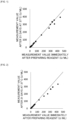
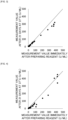
- Table 3 shows the averages of the variation rates in 30 specimens measured using: the first reagents A-D and the second reagent immediately after being prepared; and the first reagents A-D and the second reagent after being stored at 37°C for 21 days.
- Examples 1-3 demonstrated stable specimen measurement values compared to Comparative Example 1. As such, it was demonstrated that by adding a surfactant having a surface tension in a 1.0% aqueous solution of 50 mN/m or more to an aqueous solution at a concentration such that the surface tension thereof is 50 mN/m or more, the stability of an immunoassay reagent improves.
- Example 1 A 100%
Landscapes
- Health & Medical Sciences (AREA)
- Immunology (AREA)
- Life Sciences & Earth Sciences (AREA)
- Engineering & Computer Science (AREA)
- Chemical & Material Sciences (AREA)
- Molecular Biology (AREA)
- Biomedical Technology (AREA)
- Hematology (AREA)
- Urology & Nephrology (AREA)
- Biotechnology (AREA)
- Biochemistry (AREA)
- Cell Biology (AREA)
- Food Science & Technology (AREA)
- Medicinal Chemistry (AREA)
- Physics & Mathematics (AREA)
- Analytical Chemistry (AREA)
- Microbiology (AREA)
- General Health & Medical Sciences (AREA)
- General Physics & Mathematics (AREA)
- Pathology (AREA)
- Chemical Kinetics & Catalysis (AREA)
- Investigating Or Analysing Biological Materials (AREA)
- Measuring Or Testing Involving Enzymes Or Micro-Organisms (AREA)
Applications Claiming Priority (2)
| Application Number | Priority Date | Filing Date | Title |
|---|---|---|---|
| JP2022130544 | 2022-08-18 | ||
| PCT/JP2023/029553 WO2024038863A1 (ja) | 2022-08-18 | 2023-08-16 | 免疫分析方法及び試薬 |
Publications (2)
| Publication Number | Publication Date |
|---|---|
| EP4575501A1 true EP4575501A1 (de) | 2025-06-25 |
| EP4575501A4 EP4575501A4 (de) | 2025-12-03 |
Family
ID=89941815
Family Applications (1)
| Application Number | Title | Priority Date | Filing Date |
|---|---|---|---|
| EP23854897.8A Pending EP4575501A4 (de) | 2022-08-18 | 2023-08-16 | Immuntestverfahren und reagenz |
Country Status (3)
| Country | Link |
|---|---|
| EP (1) | EP4575501A4 (de) |
| JP (1) | JPWO2024038863A1 (de) |
| WO (1) | WO2024038863A1 (de) |
Family Cites Families (8)
| Publication number | Priority date | Publication date | Assignee | Title |
|---|---|---|---|---|
| JP2588174B2 (ja) | 1986-09-08 | 1997-03-05 | 三菱化学株式会社 | 抗原−抗体反応の測定法 |
| JPH09171018A (ja) * | 1995-12-19 | 1997-06-30 | Tokuyama Corp | 免疫学的凝集反応試薬の製造方法 |
| JP2005281316A (ja) * | 2002-06-13 | 2005-10-13 | Canon Inc | 免疫学的測定方法、免疫学的測定用試薬及びその製造方法 |
| KR101665999B1 (ko) * | 2008-08-22 | 2016-10-13 | 덴카 세이켄 가부시키가이샤 | 시스타틴 c 흡착 억제제 |
| JP5883645B2 (ja) * | 2011-12-28 | 2016-03-15 | デンカ生研株式会社 | 気泡吸着抑制方法 |
| WO2017090103A1 (ja) * | 2015-11-25 | 2017-06-01 | デンカ生研株式会社 | 免疫分析方法及び試薬キット |
| TWI842764B (zh) * | 2018-11-09 | 2024-05-21 | 日商積水醫療股份有限公司 | 抑制以自動分析裝置進行的免疫測定中之異常檢測的方法、檢測方法、免疫測定試劑、及免疫測定試劑套組 |
| KR20240019075A (ko) * | 2021-06-07 | 2024-02-14 | 덴카 주식회사 | 분변 검체의 검사 방법 및 그것을 위한 이뮤노크로마토그래피 시험편 |
-
2023
- 2023-08-16 EP EP23854897.8A patent/EP4575501A4/de active Pending
- 2023-08-16 JP JP2024541559A patent/JPWO2024038863A1/ja active Pending
- 2023-08-16 WO PCT/JP2023/029553 patent/WO2024038863A1/ja not_active Ceased
Also Published As
| Publication number | Publication date |
|---|---|
| JPWO2024038863A1 (de) | 2024-02-22 |
| WO2024038863A1 (ja) | 2024-02-22 |
| EP4575501A4 (de) | 2025-12-03 |
Similar Documents
| Publication | Publication Date | Title |
|---|---|---|
| CN102759631B (zh) | 一种定量检测降钙素原pct的胶乳增强免疫比浊试剂盒 | |
| AU2014226173B2 (en) | Method and device for combined detection of viral and bacterial infections | |
| EP0064274B1 (de) | Verfahren zur Bestimmung von Antigen-Antikörper-Reaktionen und Reagens hierfür | |
| CN108152512A (zh) | 肝素结合蛋白检测试剂盒及其制备方法 | |
| DK174032B1 (da) | Sæt samt fremgangsmåde til immunometrisk dosering, der kan anvendes på hele celler | |
| CN109100516A (zh) | 一种检测巨细胞病毒IgG抗体化学发光免疫分析测定试剂盒及其制备方法 | |
| CN202916286U (zh) | 一种定量检测降钙素原pct的胶乳增强免疫比浊试剂盒 | |
| KR101894106B1 (ko) | 측정계외 성분에 의한 간섭을 감소시키는 방법 | |
| CN101310186B (zh) | 测定抗原的方法和用于其的试剂盒 | |
| NO149864B (no) | Immunologisk reagens. | |
| CN101046479B (zh) | 不含目标蛋白质人血清基体物质的制备方法 | |
| CN108445218A (zh) | 联合检测crp、pct和saa的试剂盒及其制备方法 | |
| EP4575501A1 (de) | Immuntestverfahren und reagenz | |
| US20220091117A1 (en) | Sensor Device | |
| JPH03251764A (ja) | 緩衝化洗浄組成物および試験キットならびに使用方法 | |
| EP2187214A1 (de) | Verfahren zum messen von ligand-rezeptor-bindung hemmender aktivität | |
| US20140011190A1 (en) | Method for performing a rapid test | |
| CN110456044B (zh) | 一种用于前列腺炎检测的试剂盒 | |
| EP1497652B1 (de) | Verfahren, system und kit zum nachweis eines analyten in einer probe | |
| JP4524446B2 (ja) | 糖脂質抗原の活性化剤及び活性化方法、並びに試料中の抗糖脂質抗体の測定方法及び測定試薬キット | |
| JP3618797B2 (ja) | 免疫測定法 | |
| JPH0448265A (ja) | 免疫測定法 | |
| JP2019002871A (ja) | 抗ガングリオシド抗体測定方法、抗ガングリオシド抗体測定試薬キット、洗浄液及び抗ガングリオシド抗体測定における感度の向上方法 | |
| JP3968287B2 (ja) | 免疫分析方法 | |
| JP2022161884A (ja) | 自動分析装置の測定値の正確性を向上させる方法 |
Legal Events
| Date | Code | Title | Description |
|---|---|---|---|
| STAA | Information on the status of an ep patent application or granted ep patent |
Free format text: STATUS: THE INTERNATIONAL PUBLICATION HAS BEEN MADE |
|
| PUAI | Public reference made under article 153(3) epc to a published international application that has entered the european phase |
Free format text: ORIGINAL CODE: 0009012 |
|
| STAA | Information on the status of an ep patent application or granted ep patent |
Free format text: STATUS: REQUEST FOR EXAMINATION WAS MADE |
|
| 17P | Request for examination filed |
Effective date: 20250312 |
|
| AK | Designated contracting states |
Kind code of ref document: A1 Designated state(s): AL AT BE BG CH CY CZ DE DK EE ES FI FR GB GR HR HU IE IS IT LI LT LU LV MC ME MK MT NL NO PL PT RO RS SE SI SK SM TR |
|
| DAV | Request for validation of the european patent (deleted) | ||
| DAX | Request for extension of the european patent (deleted) | ||
| A4 | Supplementary search report drawn up and despatched |
Effective date: 20251031 |
|
| RIC1 | Information provided on ipc code assigned before grant |
Ipc: G01N 33/531 20060101AFI20251027BHEP Ipc: G01N 33/543 20060101ALI20251027BHEP Ipc: G01N 33/545 20060101ALI20251027BHEP Ipc: G01N 33/53 20060101ALI20251027BHEP Ipc: G01N 33/537 20060101ALI20251027BHEP |