EP4576873A1 - Verfahren, vorrichtung und system zur kommunikationsressourcenverwaltung und speichermedium - Google Patents
Verfahren, vorrichtung und system zur kommunikationsressourcenverwaltung und speichermedium Download PDFInfo
- Publication number
- EP4576873A1 EP4576873A1 EP23862014.0A EP23862014A EP4576873A1 EP 4576873 A1 EP4576873 A1 EP 4576873A1 EP 23862014 A EP23862014 A EP 23862014A EP 4576873 A1 EP4576873 A1 EP 4576873A1
- Authority
- EP
- European Patent Office
- Prior art keywords
- terminal device
- group
- qos parameter
- data
- parameter set
- Prior art date
- Legal status (The legal status is an assumption and is not a legal conclusion. Google has not performed a legal analysis and makes no representation as to the accuracy of the status listed.)
- Pending
Links
Images




Classifications
-
- H—ELECTRICITY
- H04—ELECTRIC COMMUNICATION TECHNIQUE
- H04W—WIRELESS COMMUNICATION NETWORKS
- H04W76/00—Connection management
- H04W76/10—Connection setup
-
- H—ELECTRICITY
- H04—ELECTRIC COMMUNICATION TECHNIQUE
- H04W—WIRELESS COMMUNICATION NETWORKS
- H04W12/00—Security arrangements; Authentication; Protecting privacy or anonymity
- H04W12/06—Authentication
-
- H—ELECTRICITY
- H04—ELECTRIC COMMUNICATION TECHNIQUE
- H04L—TRANSMISSION OF DIGITAL INFORMATION, e.g. TELEGRAPHIC COMMUNICATION
- H04L41/00—Arrangements for maintenance, administration or management of data switching networks, e.g. of packet switching networks
- H04L41/08—Configuration management of networks or network elements
- H04L41/0893—Assignment of logical groups to network elements
-
- H—ELECTRICITY
- H04—ELECTRIC COMMUNICATION TECHNIQUE
- H04L—TRANSMISSION OF DIGITAL INFORMATION, e.g. TELEGRAPHIC COMMUNICATION
- H04L41/00—Arrangements for maintenance, administration or management of data switching networks, e.g. of packet switching networks
- H04L41/08—Configuration management of networks or network elements
- H04L41/0894—Policy-based network configuration management
-
- H—ELECTRICITY
- H04—ELECTRIC COMMUNICATION TECHNIQUE
- H04L—TRANSMISSION OF DIGITAL INFORMATION, e.g. TELEGRAPHIC COMMUNICATION
- H04L47/00—Traffic control in data switching networks
- H04L47/10—Flow control; Congestion control
- H04L47/20—Traffic policing
-
- H—ELECTRICITY
- H04—ELECTRIC COMMUNICATION TECHNIQUE
- H04W—WIRELESS COMMUNICATION NETWORKS
- H04W28/00—Network traffic management; Network resource management
- H04W28/02—Traffic management, e.g. flow control or congestion control
- H04W28/0268—Traffic management, e.g. flow control or congestion control using specific QoS parameters for wireless networks, e.g. QoS class identifier [QCI] or guaranteed bit rate [GBR]
-
- H—ELECTRICITY
- H04—ELECTRIC COMMUNICATION TECHNIQUE
- H04W—WIRELESS COMMUNICATION NETWORKS
- H04W28/00—Network traffic management; Network resource management
- H04W28/16—Central resource management; Negotiation of resources or communication parameters, e.g. negotiating bandwidth or QoS [Quality of Service]
- H04W28/24—Negotiating SLA [Service Level Agreement]; Negotiating QoS [Quality of Service]
-
- H—ELECTRICITY
- H04—ELECTRIC COMMUNICATION TECHNIQUE
- H04W—WIRELESS COMMUNICATION NETWORKS
- H04W8/00—Network data management
- H04W8/18—Processing of user or subscriber data, e.g. subscribed services, user preferences or user profiles; Transfer of user or subscriber data
- H04W8/186—Processing of subscriber group data
-
- H—ELECTRICITY
- H04—ELECTRIC COMMUNICATION TECHNIQUE
- H04W—WIRELESS COMMUNICATION NETWORKS
- H04W76/00—Connection management
- H04W76/10—Connection setup
- H04W76/12—Setup of transport tunnels
-
- H—ELECTRICITY
- H04—ELECTRIC COMMUNICATION TECHNIQUE
- H04W—WIRELESS COMMUNICATION NETWORKS
- H04W8/00—Network data management
- H04W8/26—Network addressing or numbering for mobility support
Definitions
- This application relates to the communication field, and specifically, to a resource management method and a communication apparatus.
- a 5th generation (5th generation, 5G) local area network (local area network, 5G LAN) service is a service provided by a current 5G network, and is mainly applied to home communication, enterprise office, factory manufacturing, the internet of vehicles, power grid reconstruction, public security organs, and the like.
- the service can provide private communication of an internet protocol type or a non-IP type (for example, an Ethernet type) for two or more terminals in a group of terminals.
- devices in a factory may form a group, and the devices in the group may send an Ethernet data packet to each other.
- office devices such as mobile phones, computers, or notebook computers
- employees in a department of an enterprise may form a group, and send an IP data packet to each other.
- QoS Quality of Service
- QoS configuration usually needs to be performed on a user equipment to ensure quality of service of a network.
- an application management function network element AF separately sends a corresponding configuration request to a network function exposure network element, to separately perform QoS configuration on a PDU session of a single user equipment. Therefore, efficiency is low.
- Embodiments of this application provide a communication resource management method, an apparatus, and a related device.
- a data connection session can be configured for at least one terminal device in a terminal device group.
- an embodiment of this application provides a communication resource management method, applied to a session management function entity.
- the method includes: receiving a group identifier of a terminal device group to which a first terminal device belongs, and a data network identity and network slice assistance information of a data connection session of the first terminal device; receiving, from a data management network element, a data network identity and network slice assistance information that correspond to the group identifier and first indication information, where the first indication information indicates to obtain, from an authentication server, a quality of service QoS parameter set applied to the terminal device group, and the QoS parameter set includes at least one QoS parameter applied to the terminal device group; determining that the data network identity and the network slice assistance information of the data connection session of the first terminal device are respectively the same as the data network identity and the network slice assistance information of the terminal device group; sending a first authentication request message to the authentication server based on the first indication information, where the first authentication request message includes the data network identity and the network slice assistance information of the terminal device group; obtaining a first
- the corresponding policy control rule is obtained based on the QoS parameter set, and the policy rule is applied to the data connection session, so that a first network element can obtain at least one quality of service QoS flow used for the terminal device group at a time. This reduces signaling exchange and saves a network resource.
- the first indication information further includes an address of the authentication server. It can be learned that the QoS parameter set may be obtained from the authentication server.
- the data network identity and the network slice assistance information of the data connection session of the first terminal device are received from the first terminal device; and the group identifier of the terminal device group is received from the data management network element.
- the obtaining a policy control rule set based on the QoS parameter set includes: sending a second request message to a policy control function entity, where the second request message includes the QoS parameter set; and receiving a second response message sent by the policy control function entity, where the second response message includes the policy control rule set.
- the QoS parameter is at least one of the following parameters: a priority of a session transmission packet, a packet size, a delay, a maximum rate, a guaranteed rate, a packet error rate, a periodicity, a clock domain, packet arrival time, time to live, or silent time.
- an embodiment of this application provides a second communication resource management method, applied to a data management network element entity.
- the method includes: receiving a configuration request message sent by an application function network element, where the configuration request message includes a group identifier of a terminal device group to which a first terminal device belongs, and a data network identity and network slice assistance information of the terminal device group and first indication information, the first indication information indicates to obtain, from an authentication server, a quality of service QoS parameter set applied to the terminal device group, and the QoS parameter set includes at least one QoS parameter applied to the terminal device group; receiving the group identifier sent by a session management network element; and indexing the data network identity and the network slice assistance information of the terminal device group based on the group identifier, and sending the data network identity and the network slice assistance information of the terminal device group and the first indication information to the session management network element.
- the data management network element entity obtains information related to the QoS parameter set, and sends the information related to the QoS parameter set to the session management network element, so that the session management network element can obtain the information related to the QoS parameter set by using one message, to reduce signaling exchange.
- the first indication information further includes an address of the authentication server.
- the QoS parameter is at least one of the following parameters: a priority of a session transmission packet, a packet size, a delay, a maximum rate, a guaranteed rate, a packet error rate, a periodicity, a clock domain, packet arrival time, time to live, or silent time.
- an embodiment of this application provides a communication resource management method, including: A data management function entity receives a configuration request message sent by an application function network element, where the configuration request message includes a group identifier of a terminal device group to which a first terminal device belongs, and a data network identity and network slice assistance information of the terminal device group and first indication information, the first indication information indicates to obtain, from an authentication server, a quality of service QoS parameter set applied to the terminal device group, and the QoS parameter set includes at least one QoS parameter applied to the terminal device group.
- the data management function entity receives the group identifier sent by a session management network element.
- the data management function entity indexes the data network identity and the network slice assistance information of the terminal device group based on the group identifier, and sends the data network identity and the network slice assistance information of the terminal device group and the first indication information to a session management function entity.
- the session management function entity receives the data network identity and the network slice assistance information of the terminal device group and the first indication information from the data management function entity.
- the session management function entity determines that a data network identity and network slice assistance information of a data connection session of the first terminal device are respectively the same as the data network identity and the network slice assistance information of the terminal device group, and sends a first authentication request message to the authentication server based on the first indication information, where the first authentication request message includes the data network identity and the network slice assistance information of the terminal device group.
- the session management function entity obtains a first authentication response message from the authentication server, where the first authentication response message includes the QoS parameter set of the terminal device group.
- the session management function entity obtains a policy control rule set based on the QoS parameter set, where the policy control rule set includes at least one policy control rule.
- the session management function entity binds the policy control rule set to a QoS flow of the data connection session of the first terminal device.
- the first indication information further includes an address of the authentication server.
- the session management function entity receives the data network identity and the network slice assistance information of the data connection session of the first terminal device from the first terminal device.
- that the session management function entity obtains a policy control rule set based on the QoS parameter set includes: sending a second request message to a policy control function entity, where the second request message includes the QoS parameter set; and receiving a second response message sent by the policy control function entity, where the second response message includes the policy control rule set.
- the QoS parameter is at least one of the following parameters: a priority of a session transmission packet, a packet size, a delay, a maximum rate, a guaranteed rate, a packet error rate, a periodicity, a clock domain, packet arrival time, time to live, or silent time.
- an embodiment of this application provides a communication apparatus.
- the communication apparatus may be a device or a chip or a circuit disposed in the device.
- the communication apparatus includes a module configured to perform the communication resource management method provided in any one of the possible designs of the first aspect.
- an embodiment of this application provides a communication apparatus.
- the communication apparatus may be a device or a chip or a circuit disposed in the device.
- the communication apparatus includes a module configured to perform the communication resource management method provided in any one of the possible designs of the second aspect.
- an embodiment of this application provides a communication apparatus.
- the communication apparatus includes a processor, and the processor is configured to execute instructions stored in a memory, to enable the communication apparatus to perform the communication resource management method provided in any one of the possible designs of the first aspect or the second aspect.
- an embodiment of this application provides a computer program or a computer program product, including code or instructions.
- the code or the instructions are run on a computer, the computer is enabled to perform the method in any one of the possible implementations of the first aspect and the second aspect.
- 5th generation (5th generation, 5G) mobile communication system (referred to as a 5G system (5G system, 5GS) for short)
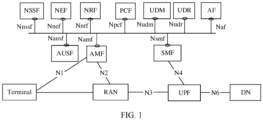
- FIG. 1 is a diagram of a non-roaming architecture of the 5GS.
- the 5GS includes an access network (access network, AN) and a core network (core network, CN), and may further include a terminal.
- access network access network
- core network core network
- the terminal may be a terminal having a receiving and sending function, or may be a chip or a chip system that may be disposed in the terminal.
- the terminal may also be referred to as a user equipment (user equipment, UE), an access terminal, a subscriber unit (subscriber unit), a subscriber station, a mobile station (mobile station, MS), a remote station, a remote terminal, mobile equipment, a user terminal, a terminal, a wireless communication device, a user agent, or a user apparatus.
- the terminal in embodiments of this application may be a mobile phone (mobile phone), a cellular phone (cellular phone), a smartphone (smart-phone), a tablet computer (Pad), a wireless data card, a personal digital assistant (personal digital assistant, PDA) computer, a wireless modem (modem), a handheld device (handset), a laptop computer (laptop computer), a machine type communication (machine type communication, MTC) terminal, a computer having a wireless transceiver function, a virtual reality (virtual reality, VR) terminal, an augmented reality (augmented reality, AR) terminal, a wireless terminal in industrial control (industrial control), a wireless terminal in self driving (self driving), a wireless terminal in telemedicine (remote medical), a wireless terminal in a smart grid (smart grid), a wireless terminal in transportation safety (transportation safety), a wireless terminal in a smart city (smart city), a wireless terminal in a smart home (smart home), a vehicle-mounted terminal, a road side unit (road side
- the foregoing AN is for implementing an access-related function, may provide a network access function for an authorized user in a specific area, and can determine transmission links with different quality based on a user level, a service requirement, and the like, to perform transmission of user data.
- the AN forwards a control signal and the user data between the terminal and the CN.
- the AN may include an access network device, or may be referred to as a radio access network (radio access network, RAN) device.
- the CN is mainly responsible for maintaining subscription data of a mobile network, and provides functions such as session management, mobility management, policy management, and security authentication for the terminal.
- the CN mainly includes the following network elements: a user plane function (user plane function, UPF) network element, an authentication server function (authentication server function, AUSF) network element, an access and mobility management function (access and mobility management function, AMF) network element, a session management function (session management function, SMF) network element, a network slice selection function (network slice selection function, NSSF) network element, a network exposure function (network exposure function, NEF) network element, a network function repository function (NF repository function, NRF) network element, a policy control function (policy control function, PCF) network element, a unified data management (unified data management, UDM) network element, a unified data repository (unified data repository, UDR), and an application function (application function, AF).
- UPF user plane function
- UPF authentication server function
- AMF access and mobility management function
- AMF access and mobility management function
- SMF session management function
- NSSF network slice selection function
- NEF network exposure function
- NEF network exposure function
- a UE accesses a 5G network via a RAN device, and the UE communicates with the AMF network element through an N1 interface (N1 for short).
- the RAN network element communicates with the AMF network element through an N2 interface (N2 for short).
- the RAN network element communicates with the UPF network element through an N3 interface (N3 for short).
- the SMF communicates with the UPF network element through an N4 interface (N4 for short), and the UPF network element accesses a data network (data network, DN) through an N6 interface (N6 for short).
- control plane functions such as the AUSF network element, the AMF network element, the SMF network element, the NSSF network element, the NEF network element, the NRF network element, the PCF network element, the UDM network element, the UDR network element, or the AF shown in (a) in FIG. 1 interact with each other through a service-based interface.
- a service-based interface exhibited by the AUSF network element is Nausf
- a service-based interface exhibited by the AMF network element is Namf
- a service-based interface exhibited by the SMF network element is Nsmf
- a service-based interface exhibited by the NSSF is Nnssf
- a service-based interface exhibited by the NEF network element is Nnef
- a service-based interface exhibited by the NRF network element is Nnrf
- a service-based interface exhibited by the PCF network element is Npcf
- a service-based interface exhibited by the UDM network element is Nudm
- a service-based interface exhibited by the UDR network element is Nudr
- a service-based interface exhibited by the AF is Naf.
- the RAN device may be a device that provides access for the terminal.
- the RAN device may include a next-generation mobile communication system, for example, a 6G access network device such as a 6G base station.
- the network device may alternatively be named in another manner, which falls within the protection scope of embodiments of this application. This is not limited in this application.
- the RAN device may include a gNB in 5G, for example, a new radio (new radio, NR) system, or one or a group (including a plurality of antenna panels) of antenna panels of a base station in 5G, or may be a network node that forms a gNB, a transmission point (transmission and reception point, TRP, or transmission point, TP), or a transmission measurement function (transmission measurement function, TMF), for example, a baseband unit (building baseband unit, BBU), a central unit (central unit, CU) or a distributed unit (distributed unit, DU), an RSU having a base station function, a wired access gateway, or a 5G core network element.
- a gNB in 5G for example, a new radio (new radio, NR) system, or one or a group (including a plurality of antenna panels) of antenna panels of a base station in 5G, or may be a network node that forms a gNB, a transmission point
- the RAN device may include an access point (access point, AP) in a wireless fidelity (wireless fidelity, Wi-Fi) system, a wireless relay node, a wireless backhaul node, macro base stations in various forms, a micro base station (also referred to as a small cell), a relay station, an access point, a wearable device, a vehicle-mounted device, or the like.
- access point access point, AP
- wireless fidelity wireless fidelity
- Wi-Fi wireless fidelity
- a wireless relay node wireless backhaul node
- macro base stations in various forms
- a micro base station also referred to as a small cell
- a relay station an access point
- a wearable device a vehicle-mounted device, or the like.
- the UPF network element is mainly responsible for user data processing (forwarding, receiving, charging, and the like).
- the UPF network element may receive user data from a data network (data network, DN), and forward the user data to the terminal via the access network device.
- the UPF network element may alternatively receive the user data from the terminal via the access network device, and forward the user data to the DN.
- the DN network element is an operator network that provides a data transmission service for a user, for example, an internet protocol (internet protocol, IP) multi-media service (IP multi-media service, IMS), and an internet (internet).
- IP internet protocol
- IMS internet multi-media service
- the DN may be an external network of an operator, or may be a network controlled by an operator, and is configured to provide a service for the terminal device.
- the AUSF network element is mainly configured to perform security authentication on the terminal.
- the AMF network element is mainly for mobility management in the mobile network, for example, user location update, registration of a user to a network, and user handover.
- the SMF network element is mainly for session management in the mobile network, for example, session establishment, modification, and release.
- a specific function is, for example, allocating an internet protocol (internet protocol, IP) address to a user, or selecting a UPF network element that provides a data packet forwarding function.
- IP internet protocol
- the PCF network element mainly supports providing a unified policy framework to control network behavior, and providing a policy rule for a control layer network function, and is responsible for obtaining policy-related subscription information of the user.
- the PCF network element may provide a policy such as a quality of service (quality of service, QoS) policy or a slice selection policy to the AMF network element and the SMF network element.
- QoS quality of service
- the NSSF network element is mainly configured to select a network slice for the terminal.
- the NEF network element is mainly for capability supporting and event exposure.
- the UDM network element is mainly configured to store user data, for example, subscription data and authentication/authorization data.
- the UDR network element is mainly configured to store structured data.
- Stored content includes subscription data, policy data, externally exposed structured data, and application-related data.
- the AF mainly supports interaction with the CN to provide a service, for example, affecting a data routing decision-making and a policy control function, or providing some third-party services for a network side.
- the 5G network may further include an access device, a user plane function (user plane function, UPF) network element, an authentication server function (AUSF) network element, a network slice selection function (NSSF) network element, a network exposure function (NEF) network element, a network function repository function (network exposure function Repository Function, NRF) network element, a unified data management (Unified Data Management, UDM) network element, an application function (application function, AF) network element, and the like.
- UPF user plane function
- AUSF authentication server function
- NSF network slice selection function
- NRF network exposure function
- NRF network exposure function
- NRF network exposure function Repository Function
- a UE may establish a data connection session (for example, a protocol data unit (protocol data unit, PDU) session (session)) with a UPF network element.
- the PDU session is used as an example for description in the following to describe methods.
- a QoS flow (flow) is a minimum granularity for QoS differentiation.
- the QoS flow may be a QoS flow that supports guaranteed flow bit rate (guaranteed bit rate, GBR) QoS, namely, a GBR QoS flow, or a QoS flow that supports non-guaranteed flow bit rate (non-guaranteed bit rate, non-GBR) QoS, namely, a non-GBR QoS flow.
- GBR guaranteed flow bit rate
- non-guaranteed bit rate non-guaranteed bit rate
- One PDU session may include a plurality of QoS flows. For example, a maximum of 64 QoS flows are supported. Each QoS flow has a corresponding QoS flow identifier (QoS flow ID, QFI), to distinguish between different QoS flows. User plane service flows with a same QFI may be mapped to a same QoS flow, so that a same service forwarding processing mode (for example, scheduling) may be for processing the user plane service flows.
- One PDU session may correspond to a plurality of radio bearers (radio bearers, RBs) on an air interface, and one radio bearer may include one or more QoS flows, in other words, carry one or more QoS flows.
- radio bearers radio bearers
- QoS configuration is at a QoS flow level, that is, the configuration is performed at a granularity of the QoS flow.
- a feature of the QoS flow may be represented by some parameters.
- An SMF network element preconfigures, establishes, or modifies a corresponding QoS flow by configuring these parameters. For example, for a QoS flow, these parameters include a QoS profile (QoS profile) on a RAN device side, a QoS rule (QoS rule) on a UE side, and an uplink packet detection rule (packet detection rule, PDR) and a downlink PDR on a UPF network side.
- QoS profile QoS profile
- QoS rule QoS rule
- PDR uplink packet detection rule
- the 5G LAN service is a service provided by a 5G network.
- the service can provide private communication of an IP type or a non-IP type (Ethernet type) for two or more UEs in a group of UEs.
- the 5G LAN service is mainly for home communication, enterprise office, factory manufacturing, an internet of vehicles, power grid reconstruction, public security organs, and the like.
- a UE in a group of UEs joins the group because of a service requirement or a dedicated attribute.
- the UE in the group may communicate with each other by using the 5G LAN service. For example, devices in a factory form a group, and the devices in the group may send an Ethernet data packet to each other. Office devices (mobile phones, computers, or notebook computers) of employees in a department of an enterprise form a group, and send an IP data packet to each other. If two UEs are not in a same group, the two UEs cannot communicate with each other.
- FIG. 2 is a diagram of a user plane architecture of an existing 5G LAN service.
- a terminal establishes a session to a UPF network element that provides the 5G LAN service, to access the UPF network element that provides the 5G LAN service.
- the UPF network element that provides the 5G LAN service may interconnect with an existing LAN in a data network through N6, for example, communicate with a personal computer (personal computer, PC) in the LAN.
- the UPF network element that provides the 5G LAN service may associate sessions of different terminals through an internal connection between UPF network elements, to implement private communication. This is not specifically limited in this embodiment of this application.
- a third party may flexibly perform dynamic VN group subscription management through a capability exposure platform.
- a QoS flow is configured for a PDU session corresponding to each terminal device in a VN group
- an AF needs to separately send a parameter configuration message to configure the PDU session of each terminal device one by one.
- This resource configuration management manner has low efficiency and high signaling overheads. Therefore, how to efficiently configure a management resource for a PDU session corresponding to a terminal device in a terminal device group becomes a problem that needs to be resolved.
- a wireless fidelity (wireless fidelity, Wi-Fi) system a vehicle-to-everything (vehicle-to-everything, V2X) communication system, a device-to-device (device-to-device, D2D) communication system, an internet of vehicles communication system, a 4th generation (4th generation, 4G) mobile communication system such as a long term evolution (long term evolution, LTE) system and a worldwide interoperability for microwave access (worldwide interoperability for microwave access, WiMAX) communication system, a 5th generation (5th generation, 5G) mobile communication system such as a new radio (new radio, NR) system, and a future communication system such as a 6th generation (6th generation, 6G) mobile communication system.
- a wireless fidelity wireless fidelity
- V2X vehicle-to-everything
- D2D device-to-device
- an internet of vehicles communication system a 4th generation (4th generation, 4G) mobile communication system such as a long term evolution (long
- example or “for example” are for representing giving an example, an illustration, or a description. Any embodiment or design scheme described as an “example” in this application should not be explained as being more preferred or having more advantages than another embodiment or design scheme. Exactly, the term “example” is for presenting a concept in a specific manner.
- a terminal device group includes a plurality of terminal devices.
- the terminal device group may be a group of terminal devices that can enjoy a consistency service provided by an application network element, or may be a group of all terminal devices located in a specified area.
- the terminal device group may be a 5G VN or another type of terminal device group, for example, a temporary terminal device group or a dynamic terminal device group (a terminal device group in which members need to be dynamically managed). This is not specifically limited.
- a QoS parameter set includes at least one QoS parameter applied to a terminal device group. It should be noted that the QoS parameter set herein is at a group granularity, that is, each terminal device group corresponds to one QoS parameter set.
- a policy control rule set includes at least one policy control rule that is also referred to as a PCC rule.
- a plurality of PCC rules are associated with one QoS flow.
- a data connection session is an association (association) between a user equipment and a user plane data gateway, and is for providing a connection service for communication between the user equipment and an accessed network or between the user equipment and another user equipment.
- a creation process of the data connection session may be initiated by the user equipment, and a removal process of the data connection session may be initiated by the user equipment, or may be initiated by another network device.
- the data connection session is also sometimes referred to as a "data session” or a "session” for short.
- the data connection session may be an IP-CAN (IP-connectivity access network, IP-connectivity access network) session or a protocol data unit session (protocol data unit session, PDU session) defined in the 3GPP standard specification, or may be a session in another form. This is not limited in embodiments of this application.
- the data connection session may be a protocol data unit session applicable to a 5G network, or may be another session applicable to another network. This is not limited in embodiments of this application.
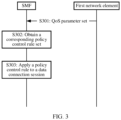
- FIG. 3 is a schematic flowchart of a communication resource management method according to an embodiment of this application.
- the communication resource management method is applied to a scenario in which session management resources are configured for terminal devices belonging to a same terminal device group.
- An SMF obtains a quality of service QoS parameter set from a first network element, where the QoS parameter set includes at least one QoS parameter applied to a terminal device group.
- the first network element is an AF
- the QoS parameter set is obtained from the AF
- the first network element is a UDM
- the QoS parameter set is obtained from the UDM.
- the SMF obtains the QoS parameter set from the first network element; and when terminal devices in the terminal device group separately establish PDU sessions, the SMF does not need to obtain, from the AF or another network element in a plurality of batches, QoS parameters corresponding to the terminal devices, so that signaling exchange is reduced.
- the SMF obtains a corresponding policy control rule set based on the QoS parameter set, where the policy control rule set includes at least one policy control rule.
- the SMF sends a second request message to a PCF, where the second request message includes the QoS parameter set.
- the SMF receives a first response message sent by the PCF, where the first response message includes the policy control rule set.
- the SMF binds the policy control rule to a QoS flow of the data connection session of the terminal device.
- the SMF determines, based on an obtained group DNN and slice identifier, and a DNN and a slice identifier that correspond to the data connection session of the terminal device, that the data connection session is for internal communication of the terminal device group.
- the group slice identifier is for identifying a slice instance corresponding to the terminal device group.
- the SMF obtains the QoS parameter set corresponding to the terminal device group, and a QoS parameter corresponding to a single terminal device does not need to be separately obtained. This helps simplify signaling exchange and reduce consumption of a network resource.
- FIG. 4 is a schematic flowchart of a resource configuration management method according to an embodiment of this application.
- a UDM receives a configuration request message sent by an application function network element AF, where the configuration request message includes a group identifier (group identifier #1) of a terminal device group to which a first terminal device (terminal device #1) belongs, a data network identity (group DNN #1) and network slice assistance information (group S-NSSAI #1) that correspond to the group identifier, and first indication information.
- group identifier #1 group identifier of a terminal device group to which a first terminal device (terminal device #1) belongs
- group DNN #1 data network identity
- group S-NSSAI #1 network slice assistance information
- the first indication information indicates to obtain, from an authentication server, a quality of service QoS parameter set applied to the terminal device group, and the QoS parameter set includes at least one QoS parameter applied to the terminal device group.
- the SMF receives a data network identity and network slice assistance information from a data connection session of the terminal device.
- the UE establishes a PDU session request, where the PDU session request carries a data network identity DNN and network slice assistance information S-NSSAI of a PDU session of the UE.
- the SMF may obtain a terminal device identifier from an AMF.
- the SMF obtains the group identifier #1 of the terminal device group to which the first terminal device belongs.
- the UDM stores a subscription data packet of the UE, where the subscription data packet includes the group identifier of the terminal device group to which the first terminal device belongs.
- the SMF obtains, from the UDM based on the terminal device identifier, the group identifier (group identifier #1) of the terminal device group to which the first terminal device belongs.
- the SMF sends, to the UDM, the group identifier #1 of the terminal device group to which the first terminal device belongs.
- S315 The UDM indexes, based on the group identifier, the data network identity (group DNN) and the network slice assistance information (group S-NSSAI) that correspond to the group identifier.
- the UDM sends, to the SMF, the data network identity (group DNN) and the network slice assistance identifier (group S-NSSAI) that correspond to the group identifier and the first indication information.
- the SMF receives the group DNN, the group S-NSSAI, and the first indication information from the UDM.
- the SMF determines that the data network identity of the data connection session of the terminal device is the same as the data network identity corresponding to the group identifier, and the network slice assistance information of the data connection session of the terminal device is the same as the network slice assistance information corresponding to the group identifier.
- the SMF determines that the DNN #1 of the terminal device is the same as the group DNN #1 of the terminal device group, and the S-NSSAI #1 of the terminal device is the same as the group S-NSSAI #1 of the terminal device group. Therefore, it is determined that the terminal device belongs to the terminal device group, and the data connection session of the terminal device is for internal communication of the terminal device group to which the terminal device belongs.
- the SMF sends a first authentication request message to the authentication server based on the first indication information.
- the first authentication request message includes the data network identity and the network slice assistance information that correspond to the group identifier.
- the authentication server sends a first authentication response message to the SMF.
- the first authentication response message includes the QoS parameter set of the terminal device group.
- a mapping relationship between the QoS parameter set and the data network identity (group DNN#1) and the network slice assistance information (group S-NSSAI#1) that correspond to the group identifier is configured on the authentication server.
- the authentication server indexes the corresponding QoS parameter set based on the received group DNN #1 and group S-NSSAI #1. In this way, the QoS parameter set corresponding to the terminal device group is obtained.
- the QoS parameter set includes the QoS parameter applied to the terminal device group.
- the QoS parameter set includes at least one of the following parameters: a priority of a session transmission packet, a packet size, a delay, a maximum rate, a guaranteed rate, a packet error rate, a periodicity, a clock domain, packet arrival time, time to live, or silent time.
- the SMF obtains a policy control rule set based on the QoS parameter set.
- the policy control rule set includes at least one policy control rule.
- the SMF sends the QoS parameter set to a PCF, and the PCF obtains the corresponding policy control rule set based on the QoS parameter set, and then sends the policy control rule set to the SMF.
- the SMF binds the policy control rule set to a QoS flow of the data connection session of the first terminal device.
- the SMF obtains the QoS parameter set corresponding to the terminal device group, and a QoS parameter corresponding to a single terminal device does not need to be separately obtained. This helps simplify signaling exchange and reduce consumption of a network resource.
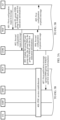
- FIG. 5A and FIG. 5B is a schematic flowchart of a resource configuration management method according to an embodiment of this application.
- An application function network element AF sends a first configuration request message to a network function exposure network element NEF.
- the AF is configured to provide a specific service.
- the AF may be a service server.
- the AF may be a game server or a video server.
- the first configuration request message is for sending a configuration message related to a service requirement.
- the first configuration request message is for requesting to create/update/delete a terminal device group.
- the first configuration request message is an Nnef_ParameterProvision_Create/Update/Delete request.
- the first configuration request message is for sending a related parameter needed for creating or updating the PDU session of the terminal device group.
- a first parameter configuration request message includes a group identifier (Group ID) of a terminal device group to which a first terminal device belongs, a data network identity (group DNN) and network slice assistance information (group S-NSSAI) that correspond to the group identifier and first indication information.
- Group ID group identifier
- group DNN data network identity
- group S-NSSAI network slice assistance information
- the group identifier (Group ID) is for identifying the terminal device group, and each terminal device group corresponds to a respective group identifier.
- a group identifier #1 is for identifying a first terminal device group #1, and a first terminal device #1 belongs to the first terminal device group #1.
- a group identifier group ID #2 is for identifying a second terminal device group.
- the group network slice assistance information (Group S-NSSAI) is for identifying a slice corresponding to the terminal device group.
- the group network slice assistance information is also referred to as a group slice identifier.
- a network slice corresponding to at least one terminal device in the terminal device group is associated by using the group slice identifier.
- group S-NSSAI #1 is for identifying a slice identifier corresponding to a first terminal device group, in other words, the group S-NSSAI #1 identifies a slice in the first terminal device group.
- the first indication information indicates that the terminal device group has a corresponding QoS parameter set.
- the first indication information further includes address information of a DN-AAA server, and the first indication information indicates to obtain, from an authentication server (for example, the DN-AAA server), a quality of service QoS parameter set applied to the terminal device group.
- the QoS parameter set is the QoS parameter set corresponding to the terminal device group, and includes at least one QoS parameter applied to the terminal device group.
- the QoS parameter set is a QoS parameter at a group granularity.
- the QoS parameter set corresponding to the terminal device group includes a QoS parameter #1
- the QoS parameter #1 is applied to a PDU session corresponding to one of terminal devices in the terminal device group.
- the QoS parameter set corresponding to the terminal device group includes a QoS parameter #2. Both the terminal device #1 and a terminal device #2 belong to the terminal device group, and the QoS parameter #2 is applied to the terminal device #1 and the terminal device #2.
- the first parameter configuration request message further includes a group data network identity (Group data network name, Group DNN), also referred to as a group data network identity or a group DNN.
- the group DNN is for identifying a group data network identity of a data network corresponding to the terminal device group, and a PDU session corresponding to at least one terminal device in the terminal device group is associated by using the group DNN.
- a group DNN #1 is for identifying a data network corresponding to the group ID #1 of the first terminal device group, and each terminal device in the first terminal device group belongs to the data network.
- the group identifier #1 corresponds to a group data network identity #1 and a group slice identifier #1.
- the NEF receives the first configuration request message, and sends a second configuration request message to a UDM.
- the UDM receives the second configuration request message.
- the second configuration request message is for sending a parameter carried in the first configuration request message, for example, the parameter carried in the first configuration request message in step S401.
- the second configuration request message is an Nnef_ParameterProvision_Create/Update/Delete request.
- the UDM determines, based on the received second configuration request message, whether to update the group identifier (Group ID) and group subscription data, where the group subscription data includes the group network slice assistance information (group S-NSSAI) and the first indication information.
- the first indication information is the first indication information carried in the second configuration request message, that is, indicates that the terminal device group has the corresponding QoS parameter set.
- the first indication information further includes the address information of the DN-AAA server.
- the UDM compares the information carried in the received second configuration request message with locally stored information to determine whether the information stored in the UDM is updated.
- the information carried in the second configuration request message includes at least one of the following data: the group identifier, the group slice identifier, and the first indication information.
- the UDM When determining that the group identifier and the group subscription data are updated, the UDM sends a first notification message to an SMF, in other words, performs step S407.
- the UDM sends a second configuration response message in response to a second parameter configuration request message to the NEF, where the second configuration response message is for feeding back a parameter configuration result of the second parameter configuration request message to the NEF, that is, a parameter configuration success or failure.
- the parameter configuration result is the success.
- S405 The NEF sends a first configuration response message in response to the first parameter configuration request message to the AF, where the first configuration response message is for feeding back an execution result of the first configuration request message to the AF.
- S406 The UE establishes a PDU session.
- the UE may access a network and initiate a session request.
- the SMF may establish a corresponding data connection session, for example, the PDU session, for the UE, to ensure normal communication of user plane data.
- the UE To establish the PDU session, the UE generates a PDU session identifier, and the UE initiates, by sending a NAS message including a PDU session establishment request in an N1 SM container, a PDU session establishment procedure requested by the UE.
- the UE sends a PDU session identifier (PDU session ID), a PDU session DNN, PDU session slice S-NSSAI, and a PDU session request type corresponding to the PDU session establishment request.
- PDU session ID PDU session ID
- PDU session DNN PDU session DNN
- PDU session slice S-NSSAI PDU session request type
- the PDU session request type indicates an "initial request”.
- the PDU session request type indicates an "existing PDU session”.
- the SMF receives the first notification message from the UDM.
- the SMF receives the first notification message from the UDM, where the first notification message includes the first indication information, and the first indication information indicates to obtain, from the authentication server, the quality of service QoS parameter set applied to the terminal device group.
- the first notification message further includes the group DNN and the group S-NSSAI.
- the SMF obtains a terminal device identifier from an AMF, and sends the terminal device identifier to the UDM.
- the UDM stores a subscription data packet of the terminal device and a group subscription data packet of the terminal device.
- the UDM determines, based on the terminal device identifier, the group identifier of the terminal device group to which the terminal device belongs, and then the UDM indexes, based on the group identifier, the group DNN and the group S-NSSAI that correspond to the group identifier.
- the SMF sends an obtaining message to the UDM to obtain data information stored in the UDM.
- the UDM sends, to the SMF in response to the message, the indication information obtained in step S403.
- the SMF obtains the indication information, and the indication information indicates to obtain the QoS parameter set.
- the UDM sends the first notification message to the SMF, where the first notification message carries the group identifier and the group subscription data.
- the group subscription data includes the group DNN, the group S-NSSAI, and the first indication information.
- the first notification message is Nudm_SDM_get. It may be understood that when the UE establishes the PDU session, the SMF sends a subscription message to the UDM, and the subscription message is for subscribing to update information of the UDM.
- the SMF sends a subscription message to the UDM.
- the UDM sends updated data information to the SMF in response to the subscription message.
- the UDM sends the first notification message to the SMF, where the first notification message carries the first indication information, the group slice identifier, and the group data network identity, and the first indication information indicates to obtain the QoS parameter set.
- the indication information includes an address of the DN-AAA server.
- the UDM sends the first notification message to the SMF, where the first notification message carries the group DNN, the group S-NSSAI, and the first indication information.
- the SMF determines that a data connection session of the terminal device is for internal communication of the terminal device group to which the terminal device belongs.
- the SMF determines, based on the received group DNN and group S-NSSAI, that a slice identifier corresponding to the data connection session of the terminal device is the same as the group S-NSSAI, and a data network identity of the data connection session of the terminal device is the same as the group DNN of the terminal device. If the slice identifier corresponding to the data connection session of the terminal device is the same as the group slice identifier, it is determined that the PDU session of the UE is for the internal communication of the terminal device group to which the terminal device belongs, and subsequent steps are triggered. If the slice identifier corresponding to the data connection session of the terminal device is different from the group slice identifier, it indicates that the PDU session of the terminal device is not for the internal communication of the terminal device group to which the terminal device belongs.
- the SMF determines, based on the first notification message from the UDM, that the PDU session of the UE is for the internal communication of the terminal device group to which the UE belongs.
- the first notification message carries the group slice identifier and the group DNN.
- the SMF determines that a DNN and a slice identifier (S-NSSAI) that correspond to the PDU session of the terminal device are respectively the same as the group DNN and the group slice identifier, and triggers step S409.
- S-NSSAI slice identifier
- the first notification message further includes the first indication information and the group identifier of the terminal device group, and the first indication information indicates to obtain the QoS parameter set.
- the first indication information further includes the address of the DN-AAA server.
- the first notification message is SDM _Notification.
- the SMF sends a first request message to a DN-AAA server based on the first indication information.
- the DNN and the slice identifier that correspond to the PDU session of the terminal device are obtained when the SMF establishes the PDU session for the UE. This is not limited herein in the present invention.
- the SMF sends the first request message to the authentication server.
- the authentication server receives the first request message from the SMF.
- the authentication server is the DN-AAA server.
- the SMF sends the first request message to the DN-AAA server based on the indication information, where the first request message is for requesting to obtain the QoS parameter set.
- the first request message includes at least one or a combination of the following group-granularity parameters: a group identifier, a group slice identifier, and a group DNN.
- the first request message further includes second indication information, and the second indication information indicates to obtain the QoS parameter set.
- the first request message is a first authentication request message.
- the DN-AAA server sends a first response message in response to the first request message to the SMF.
- the SMF receives the first response message from the DN-AAA server.
- a mapping relationship between one of the following group-granularity parameters and a QoS parameter set is preconfigured on the DN-AAA server, and the group-granularity parameter includes the group identifier, the group slice identifier, or the group DNN.
- the DN-AAA server indexes, based on the group-granularity parameter carried in the first request message, a QoS parameter set corresponding to the group-granularity parameter, to obtain the QoS parameter set corresponding to the terminal device group.
- the DN-AAA server sends the first response message to the SMF, where the first response message carries the QoS parameter set.
- the SMF obtains the QoS parameter set corresponding to the terminal device group.
- a mapping relationship between a group DNN, a group slice identifier, and a QoS parameter set is preconfigured on the DN-AAA server.
- the DN-AAA server obtains the corresponding QoS parameter set based on the group slice identifier.
- the group DNN and the group slice identifier are the group DNN #1 and the S-NSSAI #1
- the corresponding QoS parameter set is the QoS parameter #1.
- the first request message carries the group DNN, the group slice identifier, and the indication information.
- the DN-AAA server obtains, based on the group DNN and the group slice identifier, a QoS parameter set corresponding to the group DNN and the group slice identifier, and sends the first response message to the SMF in response to the first request message, where the first response message carries the QoS parameter set corresponding to the group DNN and the group slice identifier.
- a mapping relationship between a group identifier and a QoS parameter set is preconfigured on the DN-AAA server.
- the DN-AAA server obtains the corresponding QoS parameter set based on the group identifier.
- the group identifier is the group ID #1
- the corresponding QoS parameter set is the QoS parameter #1.
- the first request message carries the group identifier and the indication information.
- the DN-AAA server obtains, based on the group identifier, the QoS parameter set corresponding to the group identifier, and sends the first response message to the SMF in response to the first request message, where the first response message carries the QoS parameter set corresponding to the group identifier.
- the QoS parameter set includes a QoS parameter applied to the terminal device group.
- the QoS parameter set includes at least one of the following parameters: a priority of a session transmission packet, a packet size, a delay, a maximum rate, a guaranteed rate, a packet error rate, a periodicity, a clock domain, packet arrival time, time to live, or silent time.
- the DN-AAA server configures corresponding QoS parameter sets for the terminal device group based on different service requirements. For example, in a factory workshop, the DN-AAA server configures a same bandwidth, a same packet loss rate, and a same packet transmission delay for all production devices in the workshop. In this scenario, all the production devices in the workshop may be considered as a terminal device group, and a corresponding QoS parameter set includes a bandwidth, a packet loss rate, and a packet transmission delay.
- the DN-AAA server indexes, based on the group DNN and the group slice identifier, the QoS parameter set corresponding to the group DNN and the group slice identifier, and sends the first response message in response to the first request message to the SMF, where the first response message carries the QoS parameter set.
- the first response message is a first authentication response message.
- the first response message is a response message for secondary authentication.
- the SMF When a 1 st terminal device in the terminal device group establishes a PDU session, the SMF performs steps S409 and S410 to obtain the group DNN, the group slice identifier, and the QoS parameter set.
- the SMF stores the group DNN, the group slice identifier, and the QoS parameter set. In this way, when another terminal device in the terminal device group establishes a PDU session, the another terminal device may locally obtain the QoS parameter set from the SMF, without requesting to obtain the QoS parameter set from the DN-AAA server, to further reduce signaling exchange.
- the SMF sends a second request message to a PCF, where the second request message includes the QoS parameter set.
- the PCF receives the second request message from the SMF. In this way, the PCF obtains the QoS parameter set.
- the second request message is a message for invoking an SM policy association service.
- the PCF obtains a corresponding policy control rule set based on the QoS parameter set, where the policy control rule set includes at least one policy control rule.
- the PCF stores a table of a mapping relationship between a QoS parameter set and a policy control rule set.
- the PCF queries the table of the mapping relationship by using the QoS parameter set to obtain a corresponding control policy rule that is also referred to as a PCC rule.
- Table 1 is the table of the mapping relationship between the QoS parameter set and the policy control rule set according to this embodiment of this application.
- Table 1 Table of a mapping relationship between a QoS parameter set and a policy control rule set QoS parameter set Policy control rule set QoS parameter #1 PCC #1 QoS parameter #1 and QoS parameter #2 PCC #2 QoS parameter #1, QoS parameter #2, and QoS parameter #3 PCC #3 and PCC #4
- Table 1 merely provides an example of the table of the mapping relationship.
- the PCC rule includes one or a combination of the following parameters: a 5G quality identity (5G quality identity, 5QI), an allocation and retention priority (assign and retain priorities, ARP), a guaranteed flow bit rate (guaranteed flow bit rate, GFBR), a maximum flow bit rate (maximum flow bit rate, MFBR), a maximum packet loss rate (maximum packet loss rate, MPLR), and a reflective QoS attribute (reflective QoS attribute, RQA).
- 5G quality identity 5G quality identity, 5QI
- ARP allocation and retention priority
- GFBR guaranteed flow bit rate
- MFBR maximum flow bit rate
- MPLR maximum packet loss rate
- RQA reflective QoS attribute
- the PCF sends a second response message in response to the second request message to the SMF, where the second response message includes the policy control rule set.
- the SMF receives the second response message including the policy control rule set from the PCF, to obtain the policy control rule set.
- the SMF binds the policy control rule set to at least one QoS flow in the data connection session.
- the PCC rule is associated with the QoS flow in the PDU session.
- one PDU session corresponds to a plurality of QoS flows, and a plurality of PCC rules may be associated with one QoS flow.
- the SMF determines whether a QoS parameter in the QoS flow is the same as a QoS parameter in the PCC rule. If such a QoS flow does not exist, the SMF determines a QoS parameter of a new QoS flow by using a parameter in the PCC rule, and establishes the new QoS flow based on the QoS parameter. In this case, the PCC rule is bound to the new QoS flow. If a QoS flow with the same QoS parameter exists, the SMF maps the PCC rule to the existing QoS flow based on the QoS parameter and a service requirement.
- the SMF binds the PCC rule to the QoS flow in the data connection session based on the QoS and the service requirement. For each PCC rule bound to the QoS flow, if the PCC rule is used, the SMF generates a QoS rule based on the PCC rule, and provides the QoS rule together with an addition operation for the terminal device.
- the QoS rule includes a QFI, a data packet filter set, and a priority that are associated with the QoS flow.
- the QoS rule also includes a QoS rule identifier, and the identifier is unique in the PDU session and is generated by the SMF.
- binding is merely an example description, and may be replaced with any other possible description, for example, “mapping” or “corresponding”. This is not specifically limited herein.
- FIG. 6 is a schematic flowchart of another resource configuration management method according to an embodiment of this application.
- An application function network element AF sends the first configuration request message to a network function exposure network element NEF.
- a difference from the embodiment shown in FIG. 4 lies in that the first configuration request message includes the following related parameters: a group identifier (Group ID), a group DNN, group network slice assistance information (Group S-NSSAI), and the QoS parameter set.
- the QoS parameter set is a QoS parameter set corresponding to the group identifier or the group DNN and the group network slice assistance information.
- S502 The NEF receives the first configuration request message, and sends a second configuration request message to a UDM.
- the UDM receives the second configuration request message.
- a difference between this step and S402 lies in that the second configuration request message includes a QoS parameter set.
- the UDM determines, based on the received second configuration request message, whether to update the group identifier, the group DNN, the group network slice assistance information, and the QoS parameter set.
- the UDM sends a second configuration response message in response to a second parameter configuration request message to the NEF, where the second configuration response message is for feeding back a parameter configuration result of the second parameter configuration request message to the NEF.
- the NEF sends a first configuration response message in response to the first parameter configuration request message to the AF, where the first configuration response message is for feeding back an execution result of the first configuration request message to the AF.
- S506 A UE establishes a PDU session.
- step S406 For specific implementation of this step, refer to step S406. Details are not described herein again.
- S507 An SMF receives the QoS parameter set from the UDM.
- the SMF receives a first notification message from the UDM, where the first notification message includes the group DNN, the group S-NSSAI, and the QoS parameter set.
- the SMF sends an obtaining message to the UDM to obtain data information stored in the UDM.
- the UDM sends, to the SMF in response to the message, the QoS parameter set obtained in step S503, so that the SMF obtains the QoS parameter set.
- the UDM sends the first notification message to the SMF, where the first notification message carries the group DNN, the group S-NSSAI, and the QoS parameter set.
- the first notification message is SMD_get.
- the UE has established the corresponding PDU session.
- the SMF sends a subscription message to the UDM.
- the UDM After determining that the UDM updates the group identifier and the QoS parameter set, the UDM sends an updated group identifier and an updated QoS parameter set to the SMF in response to the subscription message.
- the UDM sends the first notification message to the SMF, where the first notification message carries the group DNN, the group S-NSSAI, and the QoS parameter set.
- the SMF determines that a data connection session of the terminal device is for internal communication of a terminal device group to which the terminal device belongs.
- the SMF determines, based on the received group slice identifier, that a DNN and a slice identifier that correspond to the data connection session of the terminal device are the same as the group DNN and the group slice identifier. If the DNN and the slice identifier that correspond to the data connection session of the terminal device are the same as the group DNN and the group slice identifier, it is determined that the PDU session of the UE is for the internal communication of the terminal device group of the UE, and subsequent steps are triggered. If the DNN and the slice identifier that correspond to the data connection session of the terminal device are different from the DNN and the group slice identifier, it indicates that the PDU session of the UE is not for the internal communication of the terminal device group of the UE.
- the SMF determines, based on the first notification message from the UDM, that the PDU session of the terminal device is for the internal communication of the terminal device group to which the terminal device belongs.
- the first notification message carries the group DNN.
- the SMF determines that the DNN and the slice identifier (S-NSSAI) that correspond to the PDU session of the terminal device are the same as the group DNN and the group S-NSSAI, and triggers step S509.
- S-NSSAI slice identifier
- the SMF sends a request message #1 to a PCF, where the request message #1 includes the QoS parameter set.
- the PCF receives the request message #1 from the SMF.
- the PCF obtains a corresponding policy control rule set based on the QoS parameter set.
- the PCF sends a response message #1 in response to the request message #1 to the SMF, where the response message #1 includes the policy control rule set.
- the SMF receives the response message #1 from the PCF.
- S512 The SMF applies the policy control rule set to the data connection session.
- FIG. 7 is a schematic flowchart of another resource configuration management method according to an embodiment of this application.
- the DM _Update message carries the group identifier, the group DNN, the group slice identifier, and a QoS parameter set.
- FIG. 8 shows a communication apparatus according to an embodiment, configured to implement the method performed by the SMF in embodiments shown in FIG. 3 to FIG. 7 .
- the communication apparatus 700 includes a transceiver unit 710 and a processing unit 720.
- the transceiver unit 710 is configured to obtain a quality of service QoS parameter set from a first network element.
- the processing unit 720 is configured to determine that a data connection session of a terminal device is for internal communication of a terminal device group to which the terminal device belongs; obtain a corresponding policy control rule set based on the QoS parameter set, where the policy control rule set includes at least one policy control rule; and apply the policy control rule to the data connection session.
- related functions implemented by the units in FIG. 8 may be implemented by using a transceiver, a processor, and a memory.
- FIG. 9 is a diagram of a session management function network element according to an embodiment of this application.
- the session management function network element may be a device (for example, a chip) that can perform the communication resource management method provided in embodiments of this application.
- the session management function network element may include a transceiver 801, at least one processor 802, and a memory 803.
- the transceiver 801, the processor 802, and the memory 803 may be connected to each other through one or more communication buses, or may be connected to each other in another manner.
- the transceiver 801 may be configured to send data or receive data. It may be understood that the transceiver 801 is a general term, and may include a receiver and a transmitter.
- the processor 802 may be configured to process data of the session management function network element.
- the processor 802 may include one or more processors.
- the processor 802 may be one or more central processing units (central processing units, CPUs), one or more network processors (network processors, NPs), one or more hardware chips, or any combination thereof.
- CPUs central processing units
- NPs network processors
- the processor 802 is one CPU, the CPU may be a single-core CPU, or may be a multi-core CPU.
- the memory 803 is configured to store program code and the like.
- the memory 803 may include a volatile memory (volatile memory), for example, a random access memory (random access memory, RAM).
- the memory 803 may further include a non-volatile memory (non-volatile memory), for example, a read-only memory (read-only memory, ROM), a flash memory (flash memory), a hard disk drive (hard disk drive, HDD), or a solid-state drive (solid-state drive, SSD).
- the memory 803 may further include a combination of the foregoing types of memories.
- the processor 802 and the memory 803 may be coupled through an interface, or may be integrated together. This is not limited in this embodiment.
- the transceiver 801 and the processor 802 may be configured to perform the communication resource management method provided in embodiments of this application. Specific implementations are as follows: The transceiver 801 is configured to obtain a quality of service QoS parameter set from a first network element, where the QoS parameter set includes at least one QoS parameter applied to a terminal device group.
- the processor 802 is configured to determine that a data connection session of a terminal device is for internal communication of a terminal device group to which the terminal device belongs; obtain a corresponding policy control rule set based on the QoS parameter set, where the policy control rule set includes at least one policy control rule; and apply the policy control rule to the data connection session.
- FIG. 10 is a diagram of another communication apparatus according to an embodiment of this application.
- the communication apparatus shown in FIG. 10 is configured to implement the method performed by the UDM in the foregoing embodiment.
- the communication apparatus 900 includes a transceiver unit 910 and a processing unit 920.
- the processing unit 920 obtains information related to a QoS parameter set by using the transceiver unit 910, where the QoS parameter set includes at least one QoS parameter shared by a group of terminal devices.
- the processing unit 920 sends the information related to the QoS parameter set to a session management network element by using the transceiver unit 910, where the information related to the QoS parameter set is the QoS parameter set or indication information that indicates the QoS parameter set.
- related functions implemented by the units in FIG. 10 may be implemented by using a transceiver, a processor, and a memory.
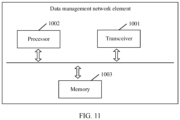
- the transceiver 1001 may be configured to send data or receive data. It may be understood that the transceiver 1001 is a general term, and may include a receiver and a transmitter.
- the foregoing storage medium includes any medium that can store program code, such as a USB flash drive, a removable hard disk drive, a read-only memory (read-only memory, ROM), a random access memory (random access memory, RAM), a magnetic disk, or an optical disc.
- program code such as a USB flash drive, a removable hard disk drive, a read-only memory (read-only memory, ROM), a random access memory (random access memory, RAM), a magnetic disk, or an optical disc.
Landscapes
- Engineering & Computer Science (AREA)
- Computer Networks & Wireless Communication (AREA)
- Signal Processing (AREA)
- Computer Security & Cryptography (AREA)
- Quality & Reliability (AREA)
- Databases & Information Systems (AREA)
- Mobile Radio Communication Systems (AREA)
Applications Claiming Priority (2)
| Application Number | Priority Date | Filing Date | Title |
|---|---|---|---|
| CN202211094057.3A CN117676916A (zh) | 2022-09-08 | 2022-09-08 | 通信资源管理方法、装置、系统及存储介质 |
| PCT/CN2023/104059 WO2024051313A1 (zh) | 2022-09-08 | 2023-06-29 | 通信资源管理方法、装置、系统及存储介质 |
Publications (2)
| Publication Number | Publication Date |
|---|---|
| EP4576873A1 true EP4576873A1 (de) | 2025-06-25 |
| EP4576873A4 EP4576873A4 (de) | 2025-12-10 |
Family
ID=90075908
Family Applications (1)
| Application Number | Title | Priority Date | Filing Date |
|---|---|---|---|
| EP23862014.0A Pending EP4576873A4 (de) | 2022-09-08 | 2023-06-29 | Verfahren, vorrichtung und system zur kommunikationsressourcenverwaltung und speichermedium |
Country Status (5)
| Country | Link |
|---|---|
| US (1) | US20250203448A1 (de) |
| EP (1) | EP4576873A4 (de) |
| JP (1) | JP2025530225A (de) |
| CN (1) | CN117676916A (de) |
| WO (1) | WO2024051313A1 (de) |
Families Citing this family (6)
| Publication number | Priority date | Publication date | Assignee | Title |
|---|---|---|---|---|
| CN120659040A (zh) * | 2024-03-15 | 2025-09-16 | 中兴通讯股份有限公司 | 一种信息传输方法、装置及存储介质 |
| CN120730258A (zh) * | 2024-03-28 | 2025-09-30 | 中兴通讯股份有限公司 | 权益管理方法、装置及存储介质 |
| CN120786463A (zh) * | 2024-04-03 | 2025-10-14 | 华为技术有限公司 | 通信方法、通信装置及通信系统 |
| CN118524447B (zh) * | 2024-07-24 | 2024-12-27 | 中国电信股份有限公司 | 业务控制方法、装置、设备、介质和产品 |
| CN119211378B (zh) * | 2024-11-27 | 2025-03-25 | 浙江晨泰科技股份有限公司 | 一种与南向设备、台区终端、主站进行通讯服务的辅助终端及方法 |
| CN120321811B (zh) * | 2025-06-10 | 2026-04-21 | 国网湖北省电力有限公司信息通信公司 | 一种结合5G和ZigBee的FTU管控方法和系统 |
Family Cites Families (5)
| Publication number | Priority date | Publication date | Assignee | Title |
|---|---|---|---|---|
| US11382145B2 (en) * | 2018-08-06 | 2022-07-05 | Huawei Technologies Co., Ltd. | Systems and methods to support group communications |
| US11678252B2 (en) * | 2018-10-05 | 2023-06-13 | Huawei Technologies Co., Ltd. | Quality of service information notification to user equipment, users, and application server |
| US20210105196A1 (en) * | 2019-10-04 | 2021-04-08 | Huawei Technologies Co., Ltd. | Support group communications with shared downlink data |
| KR102895779B1 (ko) * | 2020-01-06 | 2025-12-04 | 삼성전자 주식회사 | 이동통신 네트워크에서 단일 응용에 복수의 가상 네트워크를 제공하는 방법 및 장치 |
| KR20230069712A (ko) * | 2021-11-12 | 2023-05-19 | 삼성전자주식회사 | 무선 통신 시스템에서 서비스 품질에 따른 데이터 전송 방법 및 장치 |
-
2022
- 2022-09-08 CN CN202211094057.3A patent/CN117676916A/zh active Pending
-
2023
- 2023-06-29 EP EP23862014.0A patent/EP4576873A4/de active Pending
- 2023-06-29 JP JP2025514357A patent/JP2025530225A/ja active Pending
- 2023-06-29 WO PCT/CN2023/104059 patent/WO2024051313A1/zh not_active Ceased
-
2025
- 2025-03-07 US US19/073,356 patent/US20250203448A1/en active Pending
Also Published As
| Publication number | Publication date |
|---|---|
| EP4576873A4 (de) | 2025-12-10 |
| JP2025530225A (ja) | 2025-09-11 |
| US20250203448A1 (en) | 2025-06-19 |
| WO2024051313A1 (zh) | 2024-03-14 |
| CN117676916A (zh) | 2024-03-08 |
Similar Documents
| Publication | Publication Date | Title |
|---|---|---|
| EP4576873A1 (de) | Verfahren, vorrichtung und system zur kommunikationsressourcenverwaltung und speichermedium | |
| US12375889B2 (en) | Communication method, device, and system for obtaining data corresponding to a group to which a terminal device belongs | |
| EP3709707B1 (de) | Verfahren und vorrichtung zur aktualisierung von slice-informationen | |
| US20230029714A1 (en) | Authorization method, policy control function device, and access and mobility management function device | |
| EP4072071A1 (de) | Slice-steuerungsverfahren und -vorrichtung | |
| WO2020063317A1 (zh) | 一种通信方法及装置 | |
| CN111867057B (zh) | 通信方法、装置和系统 | |
| EP4391599B1 (de) | Verfahren und vorrichtung zur kommunikation zwischen vorrichtungen | |
| CN112752253B (zh) | 消息传输方法及装置 | |
| EP4401465A1 (de) | Kommunikationsverfahren, -vorrichtung und -system | |
| CN117337554A (zh) | 规则生成方法、网元 | |
| KR20240060670A (ko) | 통신 방법 및 장치 | |
| US20260122699A1 (en) | Session management method and apparatus | |
| EP4262244A1 (de) | Verfahren und vorrichtung zur bestimmung eines mec-zugangspunktes | |
| EP4024940A1 (de) | Kommunikationsverfahren und -vorrichtung | |
| WO2026066338A1 (zh) | 通信方法及装置 | |
| EP4068820A1 (de) | Kommunikationsverfahren und kommunikationsvorrichtung | |
| EP4539417A1 (de) | Verfahren, vorrichtung und system für netzwerk-slice-subskription | |
| EP4550853A1 (de) | Kommunikationsverfahren und -vorrichtung sowie speichermedium | |
| WO2022027529A1 (zh) | 一种切片认证的方法及装置 | |
| WO2024032041A1 (zh) | 通信方法和通信装置 | |
| CN116866844A (zh) | 通信方法及装置 | |
| EP4462900A1 (de) | Kommunikationsverfahren und kommunikationsvorrichtung | |
| EP4618521A1 (de) | Kommunikationsverfahren und kommunikationsvorrichtung | |
| US20260129430A1 (en) | Communication method and device |
Legal Events
| Date | Code | Title | Description |
|---|---|---|---|
| STAA | Information on the status of an ep patent application or granted ep patent |
Free format text: STATUS: THE INTERNATIONAL PUBLICATION HAS BEEN MADE |
|
| PUAI | Public reference made under article 153(3) epc to a published international application that has entered the european phase |
Free format text: ORIGINAL CODE: 0009012 |
|
| STAA | Information on the status of an ep patent application or granted ep patent |
Free format text: STATUS: REQUEST FOR EXAMINATION WAS MADE |
|
| 17P | Request for examination filed |
Effective date: 20250319 |
|
| AK | Designated contracting states |
Kind code of ref document: A1 Designated state(s): AL AT BE BG CH CY CZ DE DK EE ES FI FR GB GR HR HU IE IS IT LI LT LU LV MC ME MK MT NL NO PL PT RO RS SE SI SK SM TR |
|
| A4 | Supplementary search report drawn up and despatched |
Effective date: 20251106 |
|
| RIC1 | Information provided on ipc code assigned before grant |
Ipc: H04W 28/24 20090101AFI20251031BHEP Ipc: H04L 41/0893 20220101ALI20251031BHEP Ipc: H04L 41/0894 20220101ALI20251031BHEP Ipc: H04W 76/10 20180101ALI20251031BHEP Ipc: H04W 28/02 20090101ALI20251031BHEP Ipc: H04L 47/20 20220101ALI20251031BHEP Ipc: H04W 12/06 20210101ALI20251031BHEP Ipc: H04W 8/18 20090101ALI20251031BHEP Ipc: H04W 8/26 20090101ALI20251031BHEP |
|
| DAV | Request for validation of the european patent (deleted) | ||
| DAX | Request for extension of the european patent (deleted) |