EP4579681A2 - Langfristiger, kontinuierlicher, drahtloser, intraoraler monitor - Google Patents
Langfristiger, kontinuierlicher, drahtloser, intraoraler monitor Download PDFInfo
- Publication number
- EP4579681A2 EP4579681A2 EP25177270.3A EP25177270A EP4579681A2 EP 4579681 A2 EP4579681 A2 EP 4579681A2 EP 25177270 A EP25177270 A EP 25177270A EP 4579681 A2 EP4579681 A2 EP 4579681A2
- Authority
- EP
- European Patent Office
- Prior art keywords
- wearable
- subject
- sensor
- measurement data
- oral cavity
- Prior art date
- Legal status (The legal status is an assumption and is not a legal conclusion. Google has not performed a legal analysis and makes no representation as to the accuracy of the status listed.)
- Pending
Links
Images



Classifications
-
- A—HUMAN NECESSITIES
- A61—MEDICAL OR VETERINARY SCIENCE; HYGIENE
- A61B—DIAGNOSIS; SURGERY; IDENTIFICATION
- A61B5/00—Measuring for diagnostic purposes; Identification of persons
- A61B5/05—Detecting, measuring or recording for diagnosis by means of electric currents or magnetic fields; Measuring using microwaves or radio waves
- A61B5/053—Measuring electrical impedance or conductance of a portion of the body
- A61B5/0534—Measuring electrical impedance or conductance of a portion of the body for testing vitality of teeth
-
- A—HUMAN NECESSITIES
- A61—MEDICAL OR VETERINARY SCIENCE; HYGIENE
- A61B—DIAGNOSIS; SURGERY; IDENTIFICATION
- A61B5/00—Measuring for diagnostic purposes; Identification of persons
- A61B5/0002—Remote monitoring of patients using telemetry, e.g. transmission of vital signals via a communication network
- A61B5/0015—Remote monitoring of patients using telemetry, e.g. transmission of vital signals via a communication network characterised by features of the telemetry system
- A61B5/002—Monitoring the patient using a local or closed circuit, e.g. in a room or building
-
- A—HUMAN NECESSITIES
- A61—MEDICAL OR VETERINARY SCIENCE; HYGIENE
- A61B—DIAGNOSIS; SURGERY; IDENTIFICATION
- A61B5/00—Measuring for diagnostic purposes; Identification of persons
- A61B5/0002—Remote monitoring of patients using telemetry, e.g. transmission of vital signals via a communication network
- A61B5/0015—Remote monitoring of patients using telemetry, e.g. transmission of vital signals via a communication network characterised by features of the telemetry system
- A61B5/0022—Monitoring a patient using a global network, e.g. telephone networks, internet
-
- A—HUMAN NECESSITIES
- A61—MEDICAL OR VETERINARY SCIENCE; HYGIENE
- A61B—DIAGNOSIS; SURGERY; IDENTIFICATION
- A61B5/00—Measuring for diagnostic purposes; Identification of persons
- A61B5/145—Measuring characteristics of blood in vivo, e.g. gas concentration or pH-value ; Measuring characteristics of body fluids or tissues, e.g. interstitial fluid or cerebral tissue
- A61B5/14507—Measuring characteristics of blood in vivo, e.g. gas concentration or pH-value ; Measuring characteristics of body fluids or tissues, e.g. interstitial fluid or cerebral tissue specially adapted for measuring characteristics of body fluids other than blood
-
- A—HUMAN NECESSITIES
- A61—MEDICAL OR VETERINARY SCIENCE; HYGIENE
- A61B—DIAGNOSIS; SURGERY; IDENTIFICATION
- A61B5/00—Measuring for diagnostic purposes; Identification of persons
- A61B5/145—Measuring characteristics of blood in vivo, e.g. gas concentration or pH-value ; Measuring characteristics of body fluids or tissues, e.g. interstitial fluid or cerebral tissue
- A61B5/14539—Measuring characteristics of blood in vivo, e.g. gas concentration or pH-value ; Measuring characteristics of body fluids or tissues, e.g. interstitial fluid or cerebral tissue for measuring pH
-
- A—HUMAN NECESSITIES
- A61—MEDICAL OR VETERINARY SCIENCE; HYGIENE
- A61B—DIAGNOSIS; SURGERY; IDENTIFICATION
- A61B5/00—Measuring for diagnostic purposes; Identification of persons
- A61B5/145—Measuring characteristics of blood in vivo, e.g. gas concentration or pH-value ; Measuring characteristics of body fluids or tissues, e.g. interstitial fluid or cerebral tissue
- A61B5/1468—Measuring characteristics of blood in vivo, e.g. gas concentration or pH-value ; Measuring characteristics of body fluids or tissues, e.g. interstitial fluid or cerebral tissue using chemical or electrochemical methods, e.g. by polarographic means
-
- A—HUMAN NECESSITIES
- A61—MEDICAL OR VETERINARY SCIENCE; HYGIENE
- A61B—DIAGNOSIS; SURGERY; IDENTIFICATION
- A61B5/00—Measuring for diagnostic purposes; Identification of persons
- A61B5/145—Measuring characteristics of blood in vivo, e.g. gas concentration or pH-value ; Measuring characteristics of body fluids or tissues, e.g. interstitial fluid or cerebral tissue
- A61B5/1468—Measuring characteristics of blood in vivo, e.g. gas concentration or pH-value ; Measuring characteristics of body fluids or tissues, e.g. interstitial fluid or cerebral tissue using chemical or electrochemical methods, e.g. by polarographic means
- A61B5/1473—Measuring characteristics of blood in vivo, e.g. gas concentration or pH-value ; Measuring characteristics of body fluids or tissues, e.g. interstitial fluid or cerebral tissue using chemical or electrochemical methods, e.g. by polarographic means invasive, e.g. introduced into the body by a catheter
-
- A—HUMAN NECESSITIES
- A61—MEDICAL OR VETERINARY SCIENCE; HYGIENE
- A61B—DIAGNOSIS; SURGERY; IDENTIFICATION
- A61B5/00—Measuring for diagnostic purposes; Identification of persons
- A61B5/42—Detecting, measuring or recording for evaluating the gastrointestinal, the endocrine or the exocrine systems
- A61B5/4261—Evaluating exocrine secretion production
- A61B5/4277—Evaluating exocrine secretion production saliva secretion
-
- A—HUMAN NECESSITIES
- A61—MEDICAL OR VETERINARY SCIENCE; HYGIENE
- A61B—DIAGNOSIS; SURGERY; IDENTIFICATION
- A61B5/00—Measuring for diagnostic purposes; Identification of persons
- A61B5/68—Arrangements of detecting, measuring or recording means, e.g. sensors, in relation to patient
- A61B5/6801—Arrangements of detecting, measuring or recording means, e.g. sensors, in relation to patient specially adapted to be attached to or worn on the body surface
- A61B5/6813—Specially adapted to be attached to a specific body part
- A61B5/6814—Head
- A61B5/682—Mouth, e.g., oral cavity; tongue; Lips; Teeth
-
- A—HUMAN NECESSITIES
- A61—MEDICAL OR VETERINARY SCIENCE; HYGIENE
- A61B—DIAGNOSIS; SURGERY; IDENTIFICATION
- A61B5/00—Measuring for diagnostic purposes; Identification of persons
- A61B5/68—Arrangements of detecting, measuring or recording means, e.g. sensors, in relation to patient
- A61B5/6801—Arrangements of detecting, measuring or recording means, e.g. sensors, in relation to patient specially adapted to be attached to or worn on the body surface
- A61B5/683—Means for maintaining contact with the body
- A61B5/6831—Straps, bands or harnesses
-
- A—HUMAN NECESSITIES
- A61—MEDICAL OR VETERINARY SCIENCE; HYGIENE
- A61B—DIAGNOSIS; SURGERY; IDENTIFICATION
- A61B5/00—Measuring for diagnostic purposes; Identification of persons
- A61B5/68—Arrangements of detecting, measuring or recording means, e.g. sensors, in relation to patient
- A61B5/6846—Arrangements of detecting, measuring or recording means, e.g. sensors, in relation to patient specially adapted to be brought in contact with an internal body part, i.e. invasive
- A61B5/6879—Means for maintaining contact with the body
- A61B5/6882—Anchoring means
-
- A—HUMAN NECESSITIES
- A61—MEDICAL OR VETERINARY SCIENCE; HYGIENE
- A61B—DIAGNOSIS; SURGERY; IDENTIFICATION
- A61B5/00—Measuring for diagnostic purposes; Identification of persons
- A61B5/72—Signal processing specially adapted for physiological signals or for diagnostic purposes
- A61B5/7271—Specific aspects of physiological measurement analysis
- A61B5/7282—Event detection, e.g. detecting unique waveforms indicative of a medical condition
-
- A—HUMAN NECESSITIES
- A61—MEDICAL OR VETERINARY SCIENCE; HYGIENE
- A61B—DIAGNOSIS; SURGERY; IDENTIFICATION
- A61B5/00—Measuring for diagnostic purposes; Identification of persons
- A61B5/74—Details of notification to user or communication with user or patient; User input means
- A61B5/742—Details of notification to user or communication with user or patient; User input means using visual displays
-
- A—HUMAN NECESSITIES
- A61—MEDICAL OR VETERINARY SCIENCE; HYGIENE
- A61B—DIAGNOSIS; SURGERY; IDENTIFICATION
- A61B5/00—Measuring for diagnostic purposes; Identification of persons
- A61B5/74—Details of notification to user or communication with user or patient; User input means
- A61B5/746—Alarms related to a physiological condition, e.g. details of setting alarm thresholds or avoiding false alarms
-
- G—PHYSICS
- G01—MEASURING; TESTING
- G01N—INVESTIGATING OR ANALYSING MATERIALS BY DETERMINING THEIR CHEMICAL OR PHYSICAL PROPERTIES
- G01N27/00—Investigating or analysing materials by the use of electric, electrochemical, or magnetic means
- G01N27/26—Investigating or analysing materials by the use of electric, electrochemical, or magnetic means by investigating electrochemical variables; by using electrolysis or electrophoresis
- G01N27/403—Cells and electrode assemblies
- G01N27/414—Ion-sensitive or chemical field-effect transistors, i.e. ISFETS or CHEMFETS
-
- G—PHYSICS
- G16—INFORMATION AND COMMUNICATION TECHNOLOGY [ICT] SPECIALLY ADAPTED FOR SPECIFIC APPLICATION FIELDS
- G16H—HEALTHCARE INFORMATICS, i.e. INFORMATION AND COMMUNICATION TECHNOLOGY [ICT] SPECIALLY ADAPTED FOR THE HANDLING OR PROCESSING OF MEDICAL OR HEALTHCARE DATA
- G16H40/00—ICT specially adapted for the management or administration of healthcare resources or facilities; ICT specially adapted for the management or operation of medical equipment or devices
- G16H40/60—ICT specially adapted for the management or administration of healthcare resources or facilities; ICT specially adapted for the management or operation of medical equipment or devices for the operation of medical equipment or devices
- G16H40/63—ICT specially adapted for the management or administration of healthcare resources or facilities; ICT specially adapted for the management or operation of medical equipment or devices for the operation of medical equipment or devices for local operation
-
- G—PHYSICS
- G16—INFORMATION AND COMMUNICATION TECHNOLOGY [ICT] SPECIALLY ADAPTED FOR SPECIFIC APPLICATION FIELDS
- G16H—HEALTHCARE INFORMATICS, i.e. INFORMATION AND COMMUNICATION TECHNOLOGY [ICT] SPECIALLY ADAPTED FOR THE HANDLING OR PROCESSING OF MEDICAL OR HEALTHCARE DATA
- G16H40/00—ICT specially adapted for the management or administration of healthcare resources or facilities; ICT specially adapted for the management or operation of medical equipment or devices
- G16H40/60—ICT specially adapted for the management or administration of healthcare resources or facilities; ICT specially adapted for the management or operation of medical equipment or devices for the operation of medical equipment or devices
- G16H40/67—ICT specially adapted for the management or administration of healthcare resources or facilities; ICT specially adapted for the management or operation of medical equipment or devices for the operation of medical equipment or devices for remote operation
-
- A—HUMAN NECESSITIES
- A61—MEDICAL OR VETERINARY SCIENCE; HYGIENE
- A61B—DIAGNOSIS; SURGERY; IDENTIFICATION
- A61B5/00—Measuring for diagnostic purposes; Identification of persons
- A61B5/01—Measuring temperature of body parts ; Diagnostic temperature sensing, e.g. for malignant or inflamed tissue
-
- A—HUMAN NECESSITIES
- A61—MEDICAL OR VETERINARY SCIENCE; HYGIENE
- A61B—DIAGNOSIS; SURGERY; IDENTIFICATION
- A61B5/00—Measuring for diagnostic purposes; Identification of persons
- A61B5/48—Other medical applications
- A61B5/4848—Monitoring or testing the effects of treatment, e.g. of medication
-
- A—HUMAN NECESSITIES
- A61—MEDICAL OR VETERINARY SCIENCE; HYGIENE
- A61B—DIAGNOSIS; SURGERY; IDENTIFICATION
- A61B5/00—Measuring for diagnostic purposes; Identification of persons
- A61B5/68—Arrangements of detecting, measuring or recording means, e.g. sensors, in relation to patient
- A61B5/6801—Arrangements of detecting, measuring or recording means, e.g. sensors, in relation to patient specially adapted to be attached to or worn on the body surface
- A61B5/683—Means for maintaining contact with the body
- A61B5/6839—Anchoring means, e.g. barbs
-
- G—PHYSICS
- G16—INFORMATION AND COMMUNICATION TECHNOLOGY [ICT] SPECIALLY ADAPTED FOR SPECIFIC APPLICATION FIELDS
- G16H—HEALTHCARE INFORMATICS, i.e. INFORMATION AND COMMUNICATION TECHNOLOGY [ICT] SPECIALLY ADAPTED FOR THE HANDLING OR PROCESSING OF MEDICAL OR HEALTHCARE DATA
- G16H50/00—ICT specially adapted for medical diagnosis, medical simulation or medical data mining; ICT specially adapted for detecting, monitoring or modelling epidemics or pandemics
- G16H50/20—ICT specially adapted for medical diagnosis, medical simulation or medical data mining; ICT specially adapted for detecting, monitoring or modelling epidemics or pandemics for computer-aided diagnosis, e.g. based on medical expert systems
-
- G—PHYSICS
- G16—INFORMATION AND COMMUNICATION TECHNOLOGY [ICT] SPECIALLY ADAPTED FOR SPECIFIC APPLICATION FIELDS
- G16H—HEALTHCARE INFORMATICS, i.e. INFORMATION AND COMMUNICATION TECHNOLOGY [ICT] SPECIALLY ADAPTED FOR THE HANDLING OR PROCESSING OF MEDICAL OR HEALTHCARE DATA
- G16H50/00—ICT specially adapted for medical diagnosis, medical simulation or medical data mining; ICT specially adapted for detecting, monitoring or modelling epidemics or pandemics
- G16H50/30—ICT specially adapted for medical diagnosis, medical simulation or medical data mining; ICT specially adapted for detecting, monitoring or modelling epidemics or pandemics for calculating health indices; for individual health risk assessment
-
- Y—GENERAL TAGGING OF NEW TECHNOLOGICAL DEVELOPMENTS; GENERAL TAGGING OF CROSS-SECTIONAL TECHNOLOGIES SPANNING OVER SEVERAL SECTIONS OF THE IPC; TECHNICAL SUBJECTS COVERED BY FORMER USPC CROSS-REFERENCE ART COLLECTIONS [XRACs] AND DIGESTS
- Y02—TECHNOLOGIES OR APPLICATIONS FOR MITIGATION OR ADAPTATION AGAINST CLIMATE CHANGE
- Y02A—TECHNOLOGIES FOR ADAPTATION TO CLIMATE CHANGE
- Y02A90/00—Technologies having an indirect contribution to adaptation to climate change
- Y02A90/10—Information and communication technologies [ICT] supporting adaptation to climate change, e.g. for weather forecasting or climate simulation
Definitions
- the wearable intraoral sensor also comprises a housing unit sealably coupled to the molar band, thereby enclosing the sensor unit inside the housing unit.
- the housing unit also comprises a proton exchange membrane configured to conduct protons into the sensor unit.
- the system also comprises a receiving device external to the oral cavity of the subject and configured to receive the pH measurement data wirelessly transmitted from the wearable intraoral sensor.
- the molar band is configured as an antenna operably connected to the wireless transmission unit.
- the wearable intraoral sensor is configured to wirelessly transmit the data signal at intervals for at least one day, one week, one month, two months, three months, or six months.
- the wearable intraoral sensor is configured to continually measure pH in the oral cavity for at least one week, one month, two months, three months, or six months.
- the receiving device is a smart device.
- the smart device is a smart phone, a smart watch, a tablet, smart home device (e.g., an Amazon Echo TM or other device using Amazon Alexa TM , a Google Home TM device, or an Apple Home Pod TM or other device using Apple's Siri TM ) or a computer.
- the smart device is an iPhone or Android device.
- the receiving device comprises a display.
- the system further comprises an application installed on the receiving device or smart device.
- the application is configured to receive the pH measurement data.
- the application is configured to manipulate the pH measurement data.
- the application is configured to display the pH measurement data or a manipulation thereof.
- the application is configured to display the pH measurement data or manipulation thereof in graphical form.
- the application is configured to receive subject identifying information, location information, device type information, or a combination thereof.
- the application is configured to send subject data to a third party.
- the subject data comprises pH measurement data, subject identifying information, location information, device type, or a combination thereof.
- the application is configured to mask or remove subject-identifying information prior.
- the application is configured to display an alert comprising a message about the development of caries disease or the risk of development of caries disease.
- the application is configured to display an advice message comprising suggestions to treat caries disease or inhibit the development of caries disease.
- system further comprises criteria for diagnosing caries disease or the risk of development of caries disease. In further embodiments, the system further comprises criteria for diagnosing a disorder or the risk of development of a disorder.
- the wearable intraoral sensor for continually measuring pH in an oral cavity of a subject.
- the wearable intraoral sensor comprises a molar band sized to fit around a molar in an oral cavity of a subject.
- the wearable intraoral sensor also comprises a sensor unit or module coupled to the molar band.
- the sensor unit or module comprises a transducer configured to measure pH in an oral cavity and transduce the pH measurement to a data signal suitable for transmission.
- the sensor unit or module also comprises a data transmission unit operably connected to the transducer and configured to wirelessly transmit the data signal.
- the sensor unit or module also comprises a power source operably connected to the transducer and the data transmission unit.
- the wearable intraoral sensor also comprises a housing unit sealably coupled to the molar band, thereby sealing the sensor unit inside the housing unit.
- the wearable intraoral sensor also comprises a proton exchange membrane configured to conduct protons into the sensor unit.
- the housing unit comprises the proton exchange membrane.
- the sensor unit or module comprises the proton exchange membrane.
- the wearable intraoral sensor is configured to continually measure pH in the oral cavity and to wirelessly transmit the data signal at intervals for a least one day.
- the molar band is configured as an antenna operably connected to the wireless transmission unit.
- the wearable intraoral sensor further comprises memory configured to store pH measurement data.
- the wearable intraoral sensor is configured to wirelessly transmit the data signal at intervals for at least one day, one week, one month, two months, three months, or six months.
- the wearable intraoral sensor wirelessly transmits via Bluetooth technology.
- the wearable intraoral sensor wirelessly transmits via a wireless local area network (WLAN), Wi-Fi (wireless fidelity), ZigBee, near-field communication (NFC), ANT, Thread, Zigbee, WiMAX, WWAN, MANET, PAN, Wireless Hart, Z-Wave, MESH, UWB, IrDA, Cellular, Peer-To-Peer, and 802.11 variants.
- the wearable intraoral sensor wirelessly transmits via frequencies ranging from sub-sonic to ultraviolet.
- the wearable oral sensor wirelessly transmits using modulation methods including, but not limited to, OOK, AM, FM, SSB, FSK, PSK, GFSK, and MSK. In still further embodiments, the wearable oral sensor wirelessly transmits using Near Field, Mid Field, or Far Field magnetic and or electric field radiation.
- the data signal further comprises instructions executable by a processor in a mobile device to send the data to an application installed on the mobile device.
- the method comprises installing a wearable intraoral sensor around a molar in a subject's oral cavity.
- the wearable intraoral sensor comprises a molar band sized to fit around the molar; a sensor module coupled to the molar band and comprising a transducer, a data unit, a power source operably coupled to the data unit, and a proton exchange membrane.
- the wearable intraoral sensor also comprises a housing unit containing a portion of the sensor module and coupled to the molar band.
- the wearable intraoral sensor is configured to continually measure pH in the oral cavity for at least one day.
- the method also comprises continually measuring pH in the subject's oral cavity for at least one day, thereby generating pH measurement data.
- the method also comprises wirelessly transmitting the pH measurement data from the molar band at intervals.
- the molar band is configured as an antenna operably connected to the wireless transmission unit.
- the transducer comprises an ISFET sensor.
- the method further comprises orienting the proton exchange membrane or sensor unit buccally in the oral cavity of the subject.
- the method further comprises wirelessly transmitting the data signal at intervals for at least one day, one week, one month, two months, three months, or six months. In some embodiments, the method comprises continually measuring pH in the oral cavity of the subject for at least one week, one month, two months, three months, or six months.
- the data signal is wirelessly transmitted once per minute. In some embodiments, the data signal is wirelessly transmitted once every five minutes. In other embodiments, the data signal is wirelessly transmitted once every ten minutes. In still other embodiments, the data signal is wirelessly transmitted between once every minute and once every 30 minutes. In further embodiments, the data signal is wirelessly transmitted immediately after the data signal is generated.
- the method further comprises wirelessly transmitting the pH measurement data from the molar band at intervals to a receiving device.
- the receiving device is a smart device.
- the smart device is a smart phone, a smart watch, a tablet, smart home device (e.g., an Amazon Echo TM or other device using Amazon Alexa TM , a Google Home TM device, or an Apple Home Pod TM or other device using Apple's Siri TM ) or a computer.
- the smart device is an iPhone or Android device.
- the method further comprises configuring the receiving device to receive the pH measurement data from the molar band.
- configuring a receiving device to receive the pH measurement data from the molar band comprises installing an application on the receiving device or smart device.
- the method further comprises transmitting subject data from the receiving device or smart device to a third party. In certain embodiments, the method further comprises transmitting subject data to a doctor, dentist, medical office, dental office, parent of the subject, relative, insurance agency, or an insurance office. In other embodiments, the method further comprises transmitting subject data from the receiving device or smart device to a research office. In still other embodiments, the method further comprises comprising syncing data from the wearable intraoral sensor and the receiving device.
- the wearable intraoral sensor comprises a molar band; a sensor module coupled to the molar band and comprising a transducer, a wireless transmission unit, a power supply operably connected to the wireless transmission unit and the transducer, and a proton exchange membrane; and a housing unit containing the sensor module and coupled to the molar band and enclosing the sensor unit.
- the method comprises selecting a molar in the oral cavity of the subject.
- the method comprises selecting or sizing the wearable intraoral sensor to fit around the selected molar.
- the method further comprises syncing or connecting the wearable intraoral sensor to an application installed on the mobile device. In still further embodiments, the method further comprises adding identifying information of the subject to the application.
- a further aspect of this disclosure is directed to a method of diagnosing caries disease or the risk of developing caries disease in a subject.
- the method comprises installing a wearable intraoral sensor of this disclosure around a molar in the subject's oral cavity and syncing or connecting the wearable intraoral sensor with a receiving device.
- the method comprises syncing or connecting a wearable intraoral sensor installed around a molar in the oral cavity of a subject with a receiving device.
- the method also comprises measuring pH in the subject's oral cavity for at least one day, thereby generating pH measurement data.
- the method also comprises receiving the pH measurement data in an application on the receiving device.
- the method comprises comparing the pH measurement data to criteria for caries disease, wherein caries disease is diagnosed, or the risk of caries disease is diagnosed, when the pH measurement data meets the criteria.
- the molar band is configured as an antenna operably coupled to the wireless transmission unit.
- the transducer comprises an ISFET sensor.
- the method further comprises orienting the sensor unit or proton exchange membrane buccally in the oral cavity of the subject.
- the method also comprises wirelessly transmitting the pH measurement data to a receiving device.
- the pH measurement data is transmitted wirelessly at intervals.
- the interval is one minute.
- the interval is 5 minutes.
- the interval is five minutes.
- the interval is ten minutes.
- the interval is from 1 to 30 minutes.
- the method comprises wirelessly transmitting pH measurement data immediately after the data signal is generated.
- the method comprises wirelessly transmitting the data signal at a specified time.
- the method comprises wirelessly transmitting the data signal once per millisecond.
- the method comprises wirelessly transmitting the data signal when the power source has a threshold level of power.
- the method comprises wirelessly transmitting the data signal at intervals for at least one day, one week, one month, two months, three months, or six months.
- the method comprises continually measuring pH in the oral cavity for at least one week, one month, two months, three months, or six months.
- the pH measurement data is transmitted wirelessly via Bluetooth technology.
- the pH in the subject's oral cavity is measured for at least one week. In certain embodiments, the pH in the subject's oral cavity is measured for at least one month.
- the method further comprises identifying a time period that pH in the oral cavity was below a set value on a plurality of days.
- the set value is pH 5.5.
- the method further comprises orienting a sensor unit or proton exchange membrane of the wearable intraoral sensor buccally in the oral cavity of the sensor.
- the method comprises wirelessly transmitting the pH measurement data to the receiving device.
- the pH measurement data is transmitted wirelessly at intervals. In some embodiments, the interval is one minute. In certain embodiments, the interval is 5 minutes. In some embodiments, the interval is five minutes. In other embodiments, the interval is ten minutes. In still other embodiments, the interval is from 1 to 30 minutes.
- the pH measurement data is wirelessly transmitted immediately after the data signal is generated. In some embodiments, the method comprises wirelessly transmitting the data signal once per millisecond. In some embodiments, the method comprises wirelessly transmitting the data signal when the power source has a threshold level of power.
- the method further comprises wirelessly transmitting the data signal at intervals for at least one day, one week, one month, two months, three months, or six months. In some embodiments, the method comprises continually measuring pH in the oral cavity of the subject for at least one week, one month, two months, three months, or six months.
- the pH measurement data is transmitted wirelessly via Bluetooth technology.
- pH in the subject's oral cavity is measured for at least one week. In certain embodiments, pH in the subject's oral cavity is measured for at least one month. In further embodiments, the method further comprises identifying a time of day that pH in the oral cavity was below a set value on a plurality of days. In some embodiments, the set value is pH 5.5. In some embodiments, the method further comprises drawing inferences from the identified time periods related to the lifestyle, or health or habits of the subject.
- the method further comprises displaying the pH measurement data or a manipulation thereof on a display of the mobile device.
- the pH measurement data or manipulation thereof is displayed in graphical form.
- the method further comprises sending the pH measurement data to a third party.
- the third party is a doctor, dentist, medical office, dental office, parent of the subject, relative, insurance agency, an insurance office, or a research office.
- the method further comprises adding the pH measurement data to a medical record of the subject.
- the method further comprises sending the pH measurement data to a research institution.
- the method further comprises sending the pH measurement data to a corporation.
- the method further comprises removing or masking subject identifying information.
- the method further comprises removing or encrypting subject identifying information.
- removing or encrypting subject identifying information and subject data complies with applicable medical industry standards (e.g., such steps are HIPAA compliant).
- the message comprises information about the development of caries disease or the risk of development of caries disease.
- the method comprises displaying an advice message comprising suggestions to treat caries disease or inhibit the development of caries disease.
- Another aspect of this disclosure is directed to a method of diagnosing a disorder or the potential for development of a disorder in a subject.
- the method comprises syncing or connecting a wearable intraoral sensor of this disclosure, installed around a molar in the subject's oral cavity, with a receiving device.
- the method comprises measuring an analyte in the subject's oral cavity for at least one day, thereby generating analyte measurement data.
- the method also comprises receiving the analyte measurement data in an application on the receiving device and comparing the analyte measurement data to criteria for a disorder.
- a disorder is diagnosed or the potential for a disorder is diagnosed when the analyte measurement data meets the criteria for a disorder.
- the disorder is selected from the group consisting of caries disease, periodontal disease, gastroesophageal reflux disease (GERD), heart disease, and, osteoporosis, metabolic acidosis, metabolic alkalosis, and kidney disease.
- Caries leads to poor oral health which has been shown to be related to cardiovascular disease and diabetes.
- the transducer comprises an ISFET sensor.
- the method further comprises orienting the sensor unit or proton exchange membrane of the wearable intraoral sensor buccally in the oral cavity of the subject.
- the method comprises wirelessly transmitting the analyte measurement data to a receiving device. In some embodiments, the method comprises wirelessly transmitting the analyte measurement data at intervals. In certain embodiments, the intervals are minutes. In certain embodiments, the interval is 5 minutes. In some embodiments, the interval is five minutes. In other embodiments, the interval is ten minutes. In still other embodiments, the interval is from1 to 30 minutes. In yet other embodiments, the method comprises wirelessly transmitting analyte measurement data immediately after the data signal is generated. In some embodiments, the method comprises wirelessly transmitting the analyte measurement data once per millisecond.
- the method comprises wirelessly transmitting the analyte measurement data when the power source has a threshold level of power. In further embodiments, the method further comprises wirelessly transmitting the analyte measurement data at intervals for at least one day, one week, one month, two months, three months, or six months.
- the analyte measurement data is transmitted wirelessly via Bluetooth technology.
- the analyte is measured for at least one week. In further embodiments, the analyte is measured for at least one month.
- the method further comprises displaying an advice message on the display, wherein the advice message comprises suggested corrective action to treat the disorder or inhibit the development of the disorder.
- the present disclosure provides an Ion Selective Field Effect Transistor (ISFET) based pH sensor that may be comfortably inserted into the user's mouth, worn for extended periods of time ( e.g., months), is biocompatible with the oral environment, has the capability to wirelessly transmit pH measurements, is unaffected from most other dynamic oral variables, and resists biofilm growth.
- the sensor's components are attached to a molar band and include an encased ISFET transducer and power and transmission electronics including an RF chip, voltage divider circuit, and analog to digital converter.
- the described sensor is worn on one tooth and is easily installed and removed.
- the sensor of this disclosure overcomes many long felt but unsolved challenges including pH specificity, accuracy, size, sensing lifetime, biocompatibility, comfort, effort-free data collection, patient non-compliance, and power requirements.
- the disclosure provides wearable intraoral sensors for non-invasive continual measurement and long-term use in a subject's oral cavity and wireless transmission of measurement data.
- the disclosure provides a biosensor transducer fit for measuring pH values for extended periods of time ( e.g., months) in complex oral environments.
- the sensor can measure analytes or other variables in an oral environment.
- the main design considerations for this sensor include the sensor's specificity and accuracy, size, sensing lifetime, biocompatibility, comfort, and power requirements.
- the wearable intraoral sensor transduces and transmits pH values, while accounting for other changing variables such as salivary flow rate, tissue contact, temperature, salivary turbidity, salivary viscosity, ionic strengths, and jaw movements.
- the accuracy of the pH measurements is comparable to the accuracy of conventional pH sensors like glass membrane sensors.
- the transducer and other components should be small enough to fit on the side of a tooth.
- the sensor is able to maintain its accuracy for a period of months and does not experience significant fouling due to mineral or food deposition or bacterial growth.
- the sensor is comfortable for the user to wear long term, which involves optimizing the sensor-gum interface, sensor-cheek interface, and ensuring the sensor does not occlude or alter the user's bite.
- the operational power requirements of the wearable intraoral sensor are small enough to be feasibly powered by a mechanism that can also fit onto a tooth. Finally, the wearable intraoral sensors do not require subject action, thereby eliminating or reducing the potential for subject non-compliance.
- the term “about” means +/- 10% of a stated value.
- the term “subject” means a human or an animal. In some embodiments, a subject is a mammal. Exemplary animals include mouse, rat, rabbit, guinea pig, dog, cat, horse, cow, pig, monkey, chimpanzee, baboon, rhesus monkey, sheep, and goat.
- the terms “disorder”, “disease”, and “condition” are used interchangeably for a condition in a subject.
- the terms “smart device” and “mobile device” are used interchangeably to mean any portable computing device comprising a processor and a display.
- mobile device and smart devices include, but are not limited to, mobile phones, smart phones, smart watches, tablets, and laptops.
- One aspect of this disclosure provides a wearable intraoral sensor for continually measuring pH or one or more analytes or temperature, or a combination thereof, in an oral cavity in a subject for a time period of at least one day.
- the wearable intraoral sensor comprises a dental installation.
- the dental installation is a molar band sized to fit around a molar in an oral cavity of a subject.
- the wearable intraoral sensor also comprises a sensor unit coupled to the dental installation and comprising a transducer configured to measure pH or temperature or one or more analytes, or a combination thereof, in an oral cavity in a subject and transduce the measurement data to a data signal suitable for transmission; a data transmission unit operably connected to the transducer and configured to wirelessly transmit the data signal; and a power source operably connected to the transducer and the data transmission unit.
- the sensor unit comprises a transducer enclosure enclosing the transducer and comprising a semi-permeable membrane configured to allow desired molecules to enter the transducer enclosure.
- the sensor unit comprises a transducer enclosure enclosing the transducer and comprising a proton exchange membrane configured to allow protons to enter the transducer enclosure.
- the wearable intraoral sensor also comprises a housing unit sealably coupled to the dental installation. The housing unit is configured to seal the electronics inside the housing unit.
- the transducer enclosure can be part of the sensor unit or the housing unit.
- the housing unit comprises a transducer enclosure enclosing the transducer and comprising a semi-permeable membrane configured to allow desired molecules to enter the transducer enclosure.
- the housing unit comprises a transducer enclosure enclosing the transducer and comprising a proton exchange membrane configured to allow protons to contact the transducer.
- the housing unit sealably couples to the dental installation and seals the electronics inside ( i.e., at least the transducer, data transmission unit, and power source). In certain embodiments, the housing unit sealably couples around a whole molar band or to a portion of a molar band.
- the housing unit comprises a semi-permeable membrane configured to allow protons or desired molecules or ions to enter the sensor unit.
- the housing unit and sensor unit are combined into one unit so that the sensor unit and housing unit are not separate.
- the electronics of the sensor unit are integrated into the housing unit.
- the semi-permeable membrane is a proton exchange membrane configured to conduct protons into the sensor unit.
- the wearable intraoral sensor is configured to continually measure or detect pH or temperature or one or more analytes, or a combination thereof, in the oral cavity and wirelessly transmit the data signal for a least one day.
- the dental installation is a molar band sized to fit around a molar in an oral cavity of a mammal.
- Molar bands have numerous advantages over other dental devices. For one, they are non-invasive. Two, most dentists have experience installing molar bands. Three, molar bands do not interfere with occlusion in a subject's oral cavity. Four, molar bands do not need to be custom-made for each subject prior to being installed.
- the dental installation is a dental crown (also called a "dental cap”).
- the dental installation is a dental implant, bridge, dentures, orthodontic temporary anchorage device (TAD), a removable dental prosthesis, a removable dental appliance including, but not limited to, Herbst appliance, Activator, Bionator, twin block appliance, Pendulum appliance, Forus TM Fatigue Resistant Device, Hyrax appliance, Haas appliance, Hawley-type removable appliance with jackscrew, Quad-helix, W-arch, transpalatal arch, Nance appliance, Lower lingual arch, and an aligners (e.g., Invisalign TM ).
- the wearable intraoral sensor measures pH in an oral cavity of a subject. Periods of elevated acidity occur on the span of tens of minutes and can indicate why and when teeth are decaying.
- Existing devices are incapable of continually measure acidity data for extended time periods, which is critical for monitoring acid attacks and preventing caries.
- Existing devices e.g., mouthguards, retainers
- mouthguards, retainers are too large to wear in the mouth throughout the day, require effort from the user to operate or maintain which reduces compliance and completeness of data, have short sensor lifetimes, and/or have inadequate durability to survive oral conditions.
- the wearable intraoral sensor measures or detects one or more analytes in an oral cavity of a subject.
- the analyte is avian influenza virus, hepatitis B marker HBsAg, cancer marker AFP, human thyroid stimulating hormone, interleukin 8 (IL-8), tumor necrosis factor (TNF- ⁇ ), cancer biomarker CYFRA21-1, prostate cancer biomarker PSA, carcinoembryonic antigen (CEA), cardiac troponin I (cTnI), C-reactive protein (CRP), prostate cancer biomarker osteopontin (OPN), interleukin-6 (IL-6), cortisol, lyme disease antigen, Alzheimer biomarker amyloid- ⁇ , chondroitin sulfate proteoglycan 4, pancreatic cancer biomarker, carbohydrate antigen 19-9 (CA 19-9), prostate specific antigen/1-antichymotrypsin (PSA-ACT) complex, breast cancer biomarkers human epidermal growth factor receptor
- the analyte is an analyte detectable in saliva.
- the analyte is a hormone such as cortisol, androgens, testosterone, estriol, estrogen, progesterone, aldosterone, DHEAS.
- the analyte is an antibody such as IgG, IgA, sIgA, IgM.
- the analyte is a growth factor such as EGF, NGF, VEGF, IGF.
- the analyte is selected from cytokines and chemokines such as IL-1 beta,IL-8, IL-6, MCP-1, CX3CL1, GRO-1 alpha, troponin I, TNF alpha.
- the analyte is selected from nucleic acids such as human DNA, microbial DNA, mRNA, siRNA, micro RNA (miR-125a and miR-200a).
- the analyte is a protein detectable in saliva.
- the analyte is a drug, including, but not limited to, drugs of abuse, ethanol, therapeutic drugs, anticonvulsants, antipyretic/analgesics, anti-neoplastic agents, anti-bacterial agents, bronchodilators, and cotinine. Additional analytes that can be measured or detected are described in Malamud D, Saliva As A Diagnostic Fluid, Dent Clin North Am. 2011 Jan;55(1):159-78 (accessed here: https://www.ncbi.nlm.nih.gov/pubmed/21094724 ).
- the analyte is selected from analytes that are consumed during eating and drinking.
- These analytes include nutritional macromolecules such as carbohydrates, proteins, and fats; allergens such as shellfish, peanuts, gluten, etc.; and toxins such as heavy metals, mercury, etc.
- the wearable intraoral sensor measures temperature in the oral cavity of a subject. In still further embodiments, the wearable intraoral sensor measures a combination of pH, temperature, and/or one or more analytes in an oral cavity of a subject.
- the wearable intraoral sensor is configured to measure or detect pH, temperature, one or more analytes, or a combination thereof, in an oral cavity of a subject for at least one week. In other embodiments, the wearable intraoral sensor is configured to measure or detect pH, temperature, one or more analytes, or a combination thereof, in an oral cavity of a subject for at least one week. In further embodiments, the wearable intraoral sensor is configured to measure or detect pH, temperature, one or more analytes, or a combination thereof, in an oral cavity of a subject for a defined time period. In still further embodiments, the wearable intraoral sensor is configured to measure or detect pH, temperature, one or more analytes, or a combination thereof, in an oral cavity of a subject for a time period ranging from one day to six months.
- the wearable intraoral sensors of this disclosure take a user's comfort into account.
- a user's comfort while using the intraoral sensor is determined by several factors.
- the intraoral sensor should not noticeably interfere with user's occlusion (bite), speaking, or swallowing.
- the intraoral sensor should not protrude above the bottom molar or below the top molar, as this would create a noticeable interference with the user's occlusion.
- the intraoral sensor's surface should not cause discomfort to the surrounding tissues of the gum, cheek, or tongue.
- the wearable intraoral sensors of this disclosure comprise a smooth outer surface free from pockets or rough or jagged spots.
- the electronics are coated with a smooth material, which is resistant to degradation in the mouth.
- the wearable intraoral sensor comprises a sensor unit coupled to the dental installation, e.g., a molar band, dental crown, dental implant, bridge, dentures, orthodontic anchor, and/or any dental prosthesis.
- a sensor unit coupled to the dental installation, e.g., a molar band, dental crown, dental implant, bridge, dentures, orthodontic anchor, and/or any dental prosthesis.
- the molar band is configured to act as an antenna. This is accomplished through use of an impedance matching circuit from the SOC's radio transceiver to the metallic or semi-metallic structure of the molar band.
- an impedance matching circuit from the SOC's radio transceiver to the metallic or semi-metallic structure of the molar band.
- RF instrumentation such as a Vector Network Analyzer (VNA)
- VNA Vector Network Analyzer
- the components comprising the impedance matching circuit are adjusted in combination to cause resonance at the frequency of interest and thereby provide the optimal transfer of RF energy either flowing outwards towards the antenna or inwards toward the RF transceiver.
- this adjustment process must be performed in situ, it can be facilitated through use of external RF instrumentation which measures the radiated field strength from the device.
- Systems for continually monitoring pH in an oral cavity of a subject.
- Systems comprise a wearable intraoral sensor, as described herein, installed in an oral cavity of a subject.
- Systems also comprise a receiving device external to the oral cavity of the subject and configured to receive measurement data wirelessly transmitted from the wearable intraoral sensor.
- the receiving device is a mobile device.
- the smart device is a smart phone, a smart watch, a tablet, or a computer.
- the smart device is an iPhone or Android phone.
- the receiving device comprises a display.
- the receiving device comprises a display. In certain embodiments, the receiving device is configured to display the measurement data, or a manipulation thereof, on a display. In still further embodiments, the receiving device is configured to display the measurement data, or a manipulation thereof, in graphical form on a display. In certain embodiments, the receiving device is configured to display the measurement data, or a manipulation thereof, in graphical form on a display and update the measurement data, or manipulation thereof, in real-time, as measurement data are generated.
- the systems further comprise an application installed on the receiving device for manipulating the measurement data.
- the application comprises a user interface configured to interact with a user.
- the application is configured to display measurement data, or a manipulation thereof.
- the application is configured to display measurement data, or a manipulation thereof, in graphical form.
- the application is configured to display an alert or play an audible alert or cause the receiving device to vibrate, or a combination thereof, when measurement data meet certain criteria.
- the application is configured to determine whether measurement data meet criteria for a disorder or the potential development of a disorder.
- the application is configured to display an alert or play an audible alert or both when measurement data match threshold criteria.
- the pH data is measured within a range of pH 2.0 to pH 10.0, and the threshold pH is set at pH 5.5.
- the application displays an alert or plays an audible alert or both.
- the specified periods of time can range in duration. For example, minimum duration can be set for a time ranging from two minutes to 120 minutes.
- macronutrient data is measured.
- the macronutrient data is consumed grams of protein, carbohydrates, fats, and/or calories.
- the application is configured to play an audible alert or display a message alerting the subject when specific dietary thresholds are met or approached ( e.g.. 2000 calories, 100 grams of fat).
- allergen data is measured by presence of potential allergen-related molecules.
- the application is configured to play an audible alert and/or display a message alert when a potential allergen has been detected or has attained minimum concentration levels (e.g., concentration of peanut proteins increased from 10ppm to 30ppm).
- the criteria comprise criteria for diagnosing caries disease, HIV, viral and bacterial pathogens including herpes, hepatitis, HIV, HPV, influenza, polio, E. coli, Myobacterium tuberculosis, Helicobacter pylori, Treponema pallidum, candida albicans, toxoplasma gondii, and schistosoma mansoni , cardiovascular disease (CVD), oral squamous cell carcinoma (OSCC), oral infection, hyperglycemia, hypertension, renal disease, stress, pain, periodontal disease, type 1 and type 2 diabetes, Lupus Erythematosis, oropharyngeal candidiasis (OPC), Scleroderma, Sjogren's syndrome, lymphoma, prostate cancer, breast cancer and tongue cancer.
- CVD cardiovascular disease
- OSCC oral squamous cell carcinoma
- OPC Lupus Erythematosis
- Scleroderma Sjogren's syndrome
- lymphoma
- the criteria are customized depending on variables specific to the subject. In some embodiments, the criteria comprise subject-specific risk factors.
- the receiving device is also configured to send measurement data to a receiving server. In certain embodiments, the receiving device is also configured to send subject identifying information to a receiving server.
- the system further comprises a receiving server configured to receive measurement data from the receiving device.
- the receiving server is configured to determine whether measurement data indicates the development or potential development of a disorder in the subject.
- the receiving server comprises criteria for determining whether measurement data indicates the development or potential development of a disorder in a subject.
- the receiving server is operably linked to one or more databases or one or more additional servers or a combination thereof for determining whether measurement data indicates the development or potential development of a disorder in the subject.
- the receiving server is configured to send a message to the receiving device.
- the message comprises information related to the development or potential development of a disorder in the subject.
- the message comprises instructions for the application to display an alert on the display of the receiving device or to play an audible alert or both.
- the criteria are criteria for diagnosing caries disease or the potential for development of caries disease.
- the criteria are customized depending on variables specific to the subject. In some embodiments, the criteria comprise subject-specific risk factors.
- the wearable intraoral sensor is configured to transmit the measurement data from the wearable intraoral sensor at intermittent intervals.
- the measurement data is wirelessly transmitted once per minute.
- the measurement data is wirelessly transmitted once every five minutes.
- the measurement data is wirelessly transmitted once every ten minutes.
- the data measurement data is wirelessly transmitted between once every minute and once every 30 minutes.
- the measurement data is wirelessly transmitted immediately after the data signal is generated.
- Another aspect of this disclosure provides methods of diagnosing a disorder in a subject, comprising installing a wearable intraoral sensor as described herein.
- the method comprises measuring or detecting or monitoring pH, temperature, one or more analytes, or a combination thereof, in an oral cavity of a subject for at least one day, thereby generating measurement data.
- the method comprises wirelessly transmitting the measurement data to a receiving device. In some embodiments, the wireless transmitting requires no human effort and is continual.
- the method also comprises receiving the measurement data in the receiving device.
- the method also comprises comparing the measurement data to criteria for a disorder, wherein a disorder is diagnosed when the measurement data matches the criteria for a disorder. In certain embodiments, the criteria can be customized depending on variables specific to the subject. In some embodiments, the method does not require any action by the subject.
- the method comprises measuring or detecting or monitoring pH, temperature, one or more analytes, or a combination thereof, in an oral cavity of a subject for at least one week. In other embodiments, the method comprises measuring or detecting or monitoring pH, temperature, one or more analytes, or a combination thereof, in an oral cavity of a subject for at least one week. In further embodiments, the method comprises measuring or detecting or monitoring pH, temperature, one or more analytes, or a combination thereof, in an oral cavity of a subject for a defined time period. In still further embodiments, the method comprises measuring or detecting or monitoring pH, temperature, one or more analytes, or a combination thereof, in an oral cavity of a subject for a time period ranging from one day to six months.
- the disorder is caries disease. In other embodiments, the disorder is GERD. In still other embodiments, the disorder is heart disease. In some embodiments, the disorder is hypoglycemia, hyperglycemia, hormonal imbalance, HIV, a large number of viral and bacterial pathogens including herpes, hepatitis, HIV, HPV, influenza, polio, E.
- CVD cardiovascular disease
- OSCC oral squamous cell carcinoma
- OPC oral infection
- hyperglycemia hypertension
- renal disease stress, pain, periodontal disease
- type 1 and type 2 diabetes type 1 and type 2 diabetes
- Lupus Erythematosis oropharyngeal candidiasis (OPC)
- Scleroderma Sjogren's syndrome
- lymphoma prostate cancer, breast cancer or tongue cancer.
- the method also comprises wirelessly transmitting the measurement data from the wearable intraoral sensor at intermittent intervals.
- the measurement data is wirelessly transmitted once per minute.
- the measurement data is wirelessly transmitted once every five minutes.
- the measurement data is wirelessly transmitted once every ten minutes.
- the data measurement data is wirelessly transmitted between once every minute and once every 30 minutes.
- the measurement data is wirelessly transmitted immediately after the data signal is generated.
- the method further comprises wirelessly transmitting the measurement data at intermittent intervals. In further embodiments, the method comprises wirelessly transmitting measurement data at intermittent intervals to a receiving device.
- the receiving device is a smart device. In certain embodiments, the smart device is a smart phone, a smart watch, a tablet, or a computer. In still further embodiments the smart device is an iPhone or Android phone.
- the method further comprises configuring the receiving device or smart device to receive the measurement data. In certain embodiments, configuring a receiving device or smart device to receive the measurement data comprises installing an application on the receiving device or smart device.
- the method further comprises identifying a time period that the pH measured in the oral cavity was below a threshold value on a plurality of days. In some embodiments, the method further comprises identifying patterns of pH measured falling below a threshold value.
- the methods further comprise sending measurement data to a dental office or medical office. In other embodiments, the method further comprises sending subject identifying information to a dental office or medical office. In still further embodiments, the methods further comprise adding measurement data to a medical record of the subject. In yet further embodiments, the methods further comprises sending measurement data to a research institution or to a corporation. In additional embodiments, the method further comprises removing or masking subject identifying information.
- the method further comprises receiving the measurement data in an application on the mobile device.
- pH is measured. In other embodiments, temperature is measured. In further embodiments, an analyte is measured.
- the time period is at least one week. In further embodiments, the time period is at least one month. In still further embodiments, the time period ranges from one day to six months.
- the disorder is caries disease. In other embodiments, the disorder is another disorder described in this disclosure.
- the criteria comprise measured pH data at or below 5.5. In certain embodiments, the criteria comprise measured pH data at or below 5.5 for a specified duration. In still further embodiments, the criteria comprise risk factors specific to the subject.
- the measurement data is wirelessly transmitted once per minute. In some embodiments, the measurement data is wirelessly transmitted once every five minutes. In other embodiments, the measurement data is wirelessly transmitted once every ten minutes. In still other embodiments, the data measurement data is wirelessly transmitted between once every minute and once every 30 minutes. In further embodiments, the measurement data is wirelessly transmitted immediately after the data signal is generated.
- the method further comprises displaying a message on the display of the receiving device, wherein the message comprises suggested corrective action.
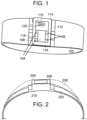
- FIG. 1 depicts an embodiment of a sensor unit of a wearable intraoral sensor mounted on metal molar band 102.
- Source electrodes 104 and drain electrodes 106 are to the left and the right of the semiconductor 108.
- the gate voltage is set by reference electrode 110.
- the transducer is mounted on insulating material 112 on molar band 102 and is contained within sensor unit 114.
- Transducer enclosure 114 protects the semiconducting channel (e.g., graphene or doped silicon) from tissue contact, microorganisms, or other particles.
- Transducer enclosure 114 is sealed from the mouth via proton exchange membrane (PEM) 116, which allows protons to cross the membrane and affect the gate voltage of the transducer.
- PEM proton exchange membrane
- Electrodes 104 and 106 are supplied voltages by a microcontroller, and the source drain current is sent through analog frequency filters into the analog input of the transmission unit (not shown), also contained in transducer enclosure 114.
- FIG. 2 depicts a perspective view of a wearable intraoral sensor's sensor unit, showing molar band 202 and proton exchange membrane 204 on sensor unit 206.
- Proton exchange membrane 204 allows protons selectively diffuse to the sensing electronics inside transducer enclosure 206.
- Transducer enclosure 206 contains a transducer (not shown) which is mounted on insulating material 210 on molar band 202.
- Housing unit 208 is shown in phantom to illustrate how housing unit 208 couples to molar band 202 and encloses transducer enclosure 206.
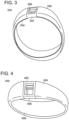
- FIG. 3 is a perspective view of wearable intraoral sensor 300 with transducer enclosure 302 coupled to molar band 304 and enclosed by housing unit 306.
- Proton exchange membrane 308 allows protons to enter transducer enclosure 302.
- FIG. 4 shows another perspective view of wearable intraoral sensor 400 with enclosed electronics for power, transmission, and transducing.
- the transducer is enclosed within transducer enclosure 406 exposed to the saliva via proton exchange membrane 402.
- the electronics are enclosed within transducer enclosure 406.
- the transducer, wireless transmission unit, and power source are enclosed in transducer enclosure 406 which is on molar band 408.
- Housing unit 404 is coupled to molar band 408.
- transducer enclosure 406 and housing unit 404 are not separate components but a unitary piece configured to couple to molar band 408 and seal the electronics inside.
- transducer enclosure 406 and housing unit 404 are separate components.
- there is minimal material on the molar band interproximally, and the sensing, power, and transmission elements are positioned to protrude lingually and buccally.
- FIG. 5 is a perspective view of wearable intraoral sensor 500 installed in an oral cavity.
- Wearable intraoral sensor 500 is installed around molar 507 with surrounding teeth 508 and 509.
- Proton exchange membrane 501 is oriented buccally so it can be exposed to saliva pooling between molar 507, teeth 508, 509, gum 5011, and a cheek (not shown).
- Transducer enclosure 502 houses the transducer (not shown), and housing unit 505 houses the other electronics.
- conditioning circuitry is inside wearable intraoral sensor 500 at or near location 503 to be near the transducer on the buccal side of molar band 506.
- FIG. 6 is a top view of wearable intraoral sensor 600 installed in an oral cavity.
- Wearable intraoral sensor 600 is installed around molar 6010 between surrounding teeth 603 and 604.
- the transducer enclosure 606 is oriented buccally so it can be exposed to saliva pooling between gum 602 and a cheek (not shown).
- Transducer enclosure 606 houses the transducer (not shown).
- Other electronics are enclosed within housing unit 607 houses.
- conditioning circuitry within wearable intraoral sensor 600 is located at or near location 605 to be near the transducer on the buccal side of the molar band.
- the transmission, powering, and data storage electronics within wearable intraoral sensor 600 are located at or near location 609 so they are oriented lingually towards tongue 601.
- Housing unit 607 tapers at location 608 between interproximal teeth 610 and 604, in order to cause minimal noticeability in the mouth.
- FIG. 8 is a side perspective view of wearable intraoral sensor 800 installed around a molar in an oral cavity.
- Wearable intraoral sensor 800 is installed around molar 806 between surrounding teeth 807 and 808.
- Transducer enclosure 805 is oriented buccally so it can be exposed to saliva pooling between gum 803 and cheek 802.
- Transducer enclosure 805 houses the transducer.
- Housing unit 804 houses the other circuitry.
- the conditioning circuitry is located near the transducer (not shown) that is inside transducer enclosure 805 on the buccal side of the molar band.
- the transmission, powering, and data storage electronics are oriented lingually towards the tongue 801.
- Housing 804 tapers at location 809 between interproximal teeth 808 and 806 in order to cause minimal noticeability in the mouth.
- FIG. 9 depicts a perspective view of a wearable intraoral sensor installed in the oral cavity of a human.
- Wearable intraoral sensor is installed around molar 908 between surrounding teeth 904 and 905.
- Transducer enclosure 906 is oriented buccally so it can be exposed to saliva pooling between gum 902 and cheek 903.
- Transducer enclosure 906 houses the transducer (not shown).
- Housing unit 9010 houses the other circuitry.
- the conditioning circuitry is oriented near the transducer contained in transducer enclosure 906 on the buccal side of the wearable intraoral sensor.
- the transmission, powering, and data storage electronics are located within wearable intraoral sensor at or near location 909 and oriented lingually towards the tongue 901.
- Housing unit 9010 tapers at location 907 between interproximal teeth 908 and 905, in order to cause minimal noticeability in the mouth.
- FIG. 9B depicts a side view of the wearable intraoral sensor in typodont 917, an anatomical model of a mouth, installed around molar 915.
- FIG. 9B shows adjacent tooth 916 and opposing tooth 914. The view shows how the wearable intraoral sensor does not protrude above the top of molar 915, and does not occlude the bite with opposing tooth 914.
- Transducer enclosure 913 is oriented buccally so it can be exposed to saliva pooling between gum 912 and cheek (not shown).
- Transducer enclosure 913 houses the transducer.
- Housing unit 911 houses the other circuitry.
- the conditioning circuitry is oriented near the transducer contained with transducer enclosure 913 on the buccal side of the wearable intraoral sensor.
- the transmission, powering, and data storage electronics are oriented lingually towards the tongue. Housing unit 911 tapers between interproximal tooth 916 and molar 915 in order to cause minimal noticeability in the mouth.
- FIG. 10A shows an example of an alert displayed on a mobile device when pH measurement data meet a critical threshold.
- FIG. 10B shows a depiction of pH data displayed on a mobile device.
- FIG. 10C depicts a display of data showing the time changing electrical output of the wearable intraoral sensor, corresponding to changes measured in salivary pH.
- FIG. 11 is a graphical representation of the current through the ISFET channel (I) as a function of time (min).
- ISFET ISFET channel
- pH buffers made with standard international union of pure and applied chemistry (IUPAC) recipes. Initially the ISFET is exposed to a 10mM NaCl solution. The solution is replaced with buffers of varying pH, starting with a pH of approximately 1 and ending with a pH of approximately 12.5. The solution is replaced roughly every 5 minutes, and the current output is continually measured using a data acquisition device.
- IUPAC international union of pure and applied chemistry
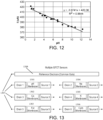
- FIG. 12 is a graphical representation of the calibration curve observed from a pH ISFET.
- the figure shows the current through the ISFET channel (I) as a function of the pH of the solution being measured.
- FIG. 13 is a depiction of an array of multiple ISFET sensors sensitive to different analytes that can be included on a single wearable intraoral sensor to sense a multitude of different analytes.
- multiple ISFET sensors are installed on the supporting printed circuit board (PCB) to measure a multiplicity of analytes or parameters.
- PCB printed circuit board
- the six ISFETs shown in FIG 13 each utilize a different membrane over the semiconducting channel that displays specificity towards specific analytes.
- ISFET 1301 has a membrane specific to protons
- ISFET 1302 has a membrane specific to calcium ions
- ISFET 1303 has a membrane specific toward fat molecules
- ISFET 1304 has a membrane specific to sodium ions
- ISFET 1305 has a membrane specific to potassium ions
- ISFET 1306 has a membrane specific toward carbohydrate molecules.
- Current and voltage is supplied to the ISFETs via the drain electrodes (Drain 1-6) via printed traces 1307 on the printed circuit board (Drains 2, 4, and 6 are not shown connected but would be connected).
- the drain electrodes may be constructed from an array of conductive pads plated with gold, silver, platinum, etc.
- the ISFETs gate voltage may be set by a common reference electrode 1308, supplied a voltage via trace 1307.
- the source and drain pads would be connected to the signal processing circuitry using copper (or other) PCB traces which can be routed on the top, bottom or through one or more layers of the PCB.
- FIG. 14 depicts an exemplary block diagram for an embodiment of a wearable intraoral sensor.
- the wearable intraoral sensor comprises a molar band and various electronics which are mounted upon, or soldered to, a printed circuit board (PCB).
- PCB printed circuit board
- the PCB material used can be of one or more layers of laminated fiberglass commonly referred to as "FR4".
- the SOC (System on Chip) integrated circuit chip combines the functionality of a microcontroller and a radio transceiver into a single small package. Alternatively, the functionality of the SOC is implemented with a separate microcontroller and radio transceiver.
- the SOC sub-parts/modules/peripheral can include, but are not limited to, microcontroller, non-volatile memory, volatile memory, analog to digital converters (A/D), power conditioning circuitry and radio transceiver.
- the microcontroller can be, for example, an 8Bit or other type, running at 64MHz or other speed, and is based upon an ARM processor or other manufacturer.
- Non-volatile memory is used to store application software which controls the operation of the wearable oral sensor.
- the wearable intraoral sensor is low power consumption, particularly whilst in “Sleep” or “Stand-By” mode. In one embodiment, the SOC requires only 0.3 microamps (0.3uA) whilst in “Sleep” mode providing for an extended period between battery or super-capacitor charging cycles and/or a minimum of charging pulses from energy harvesting methods.
- the "front-end" or inputs to the SOC is the A/D module.
- the power supply module functions to optimize current requirements drawn from an external battery and/or super-capacitor for maximum efficiency. This may include controlling a "switching" DC/DC using "Buck” methods when the battery/super capacitor voltage is higher than needed for SOC operation, or in "Boost” mode when it is lower than required. It may also disengage these Buck or Boost modes of DC/DC switching, when the input voltage is at nominal levels.
- the radio transceiver module functions as both a receiver and transmitter which is the interface between the SOC and the external RF components and antenna. For transmission, it encodes data from the SOC and modulates a radio carrier according to the signaling protocol required. For receiving, it demodulates the incoming radio carrier signal, decodes it into data and sends it to the SOC.
- This radio transceiver may implement, but are not limited to Bluetooth, ZigBee, or WiFi protocols, and may operate over a variety of frequencies including but not limited to, 5GHz, 2.45GHz, 915MHz, 433.920MHz or other, and, employ a variety of modulation methods including, but not limited to OOK, AM, FM, SSB, FSK, PSK, GFSK, and MSK.
- the functionality of the "radio" transceiver can be expanded upon to include, but are not limited to Near Field, Mid Field, and Far Field electric or magnetic communications.
- the ISFET consists of source and drain electrodes connected by a semiconducting channel, a gate electrode separated from the channel via an electrolyte solution, and an analyte-specific membrane deposited over the gate.
- the drain current passing through the channel is a function of the intrinsic properties of the ISFET, the bias voltages applied to the three ISFET electrodes, and the ionic potential of the electrolyte solution.
- CVCC constant voltage constant current
- One or more operational amplifiers (OP-AMPs) integrated circuit chips (IC) function to transduce the microvolt and or microampere level signal changes across the ISFET drain and source channel which are dependent upon the molecule being sensed and the semiconductor (graphene, silicon, cheese, etc.,) employed.
- the OP-AMP functions a buffer between the ISFET and the input to the SOC's A/D module.
- One or more OP-AMPs may be employed for amplification and or to adjust the output voltage or current to the parameters acceptable of the A/D module.
Landscapes
- Health & Medical Sciences (AREA)
- Life Sciences & Earth Sciences (AREA)
- Engineering & Computer Science (AREA)
- Physics & Mathematics (AREA)
- Biomedical Technology (AREA)
- General Health & Medical Sciences (AREA)
- Public Health (AREA)
- Medical Informatics (AREA)
- Molecular Biology (AREA)
- Pathology (AREA)
- Heart & Thoracic Surgery (AREA)
- Surgery (AREA)
- Animal Behavior & Ethology (AREA)
- Biophysics (AREA)
- Veterinary Medicine (AREA)
- Optics & Photonics (AREA)
- Chemical & Material Sciences (AREA)
- Chemical Kinetics & Catalysis (AREA)
- Physiology (AREA)
- General Chemical & Material Sciences (AREA)
- Computer Networks & Wireless Communication (AREA)
- Business, Economics & Management (AREA)
- General Business, Economics & Management (AREA)
- Epidemiology (AREA)
- Primary Health Care (AREA)
- Oral & Maxillofacial Surgery (AREA)
- Dentistry (AREA)
- Computer Vision & Pattern Recognition (AREA)
- Electrochemistry (AREA)
- Artificial Intelligence (AREA)
- Endocrinology (AREA)
- Psychiatry (AREA)
- Signal Processing (AREA)
- Microelectronics & Electronic Packaging (AREA)
- Gastroenterology & Hepatology (AREA)
- Analytical Chemistry (AREA)
- Biochemistry (AREA)
- General Physics & Mathematics (AREA)
- Immunology (AREA)
- Nuclear Medicine, Radiotherapy & Molecular Imaging (AREA)
Applications Claiming Priority (3)
| Application Number | Priority Date | Filing Date | Title |
|---|---|---|---|
| US201862619427P | 2018-01-19 | 2018-01-19 | |
| PCT/US2019/014630 WO2019144155A1 (en) | 2018-01-19 | 2019-01-22 | Long-term, continual, wireless, intraoral monitor |
| EP19740972.5A EP3740155B1 (de) | 2018-01-19 | 2019-01-22 | Langfristiger, kontinuierlicher, drahtloser, intraoraler monitor |
Related Parent Applications (2)
| Application Number | Title | Priority Date | Filing Date |
|---|---|---|---|
| EP19740972.5A Division EP3740155B1 (de) | 2018-01-19 | 2019-01-22 | Langfristiger, kontinuierlicher, drahtloser, intraoraler monitor |
| EP19740972.5A Division-Into EP3740155B1 (de) | 2018-01-19 | 2019-01-22 | Langfristiger, kontinuierlicher, drahtloser, intraoraler monitor |
Publications (2)
| Publication Number | Publication Date |
|---|---|
| EP4579681A2 true EP4579681A2 (de) | 2025-07-02 |
| EP4579681A3 EP4579681A3 (de) | 2025-10-01 |
Family
ID=67299582
Family Applications (2)
| Application Number | Title | Priority Date | Filing Date |
|---|---|---|---|
| EP25177270.3A Pending EP4579681A3 (de) | 2018-01-19 | 2019-01-22 | Langfristiger, kontinuierlicher, drahtloser, intraoraler monitor |
| EP19740972.5A Active EP3740155B1 (de) | 2018-01-19 | 2019-01-22 | Langfristiger, kontinuierlicher, drahtloser, intraoraler monitor |
Family Applications After (1)
| Application Number | Title | Priority Date | Filing Date |
|---|---|---|---|
| EP19740972.5A Active EP3740155B1 (de) | 2018-01-19 | 2019-01-22 | Langfristiger, kontinuierlicher, drahtloser, intraoraler monitor |
Country Status (5)
| Country | Link |
|---|---|
| US (2) | US11638535B2 (de) |
| EP (2) | EP4579681A3 (de) |
| AU (2) | AU2019209538B2 (de) |
| CA (1) | CA3089070A1 (de) |
| WO (1) | WO2019144155A1 (de) |
Families Citing this family (19)
| Publication number | Priority date | Publication date | Assignee | Title |
|---|---|---|---|---|
| US11529213B2 (en) * | 2016-05-30 | 2022-12-20 | David Akselrod | Backscatter device-based dental imaging apparatus |
| US11389277B2 (en) | 2016-07-18 | 2022-07-19 | David Akselrod | Material property monitoring using backscatter devices |
| US11419703B2 (en) | 2017-01-27 | 2022-08-23 | David Akselrod | Orthodontic braces and feet orthotics with backscatter based sensors |
| NL2020696B1 (en) * | 2018-03-30 | 2019-10-07 | Nightbalance B V | Mandibular advancement device with spaced apart sets of electrical components |
| CN114444643B (zh) * | 2019-04-17 | 2024-08-06 | 苹果公司 | 无线可定位标签 |
| US12383043B2 (en) * | 2019-04-30 | 2025-08-12 | Smylio Inc. | Oral appliance holder |
| DE102019123572A1 (de) * | 2019-09-03 | 2021-03-04 | Umut Baysal | Verfahren zur Überwachung eines Mundhygienezustandes und Überwachungssystem für die Überwachung eines Mundhygienezustandes |
| GB201913208D0 (en) | 2019-09-12 | 2019-10-30 | King S College London | Devices and methods for the detection of pathological tooth erosion |
| CA3157134A1 (en) | 2019-11-07 | 2021-05-14 | Renjith MENON | Saliva collection and testing system |
| DE102019130817A1 (de) * | 2019-11-14 | 2021-05-20 | Umut Baysal | Vorrichtung zur Überwachung eines Mundhygienezustandes und Verfahren zur Herstellung einer Vorrichtung zur Überwachung eines Mundhygienezustandes |
| US12514685B2 (en) | 2019-12-13 | 2026-01-06 | David Akselrod | Orthodontic braces and feet orthotics with backscatter based sensors |
| WO2021155285A1 (en) * | 2020-01-29 | 2021-08-05 | UCHU Biosensors, Inc. | Systems for measuring patient physiologic parameters |
| JP7645049B2 (ja) | 2020-03-13 | 2025-03-13 | セイコーグループ株式会社 | 口腔内センシングシステム、及び口腔内センシング方法 |
| US20210353180A1 (en) * | 2020-05-14 | 2021-11-18 | Cydent LLC | System and method for smart dental unit |
| CN112545683B (zh) * | 2020-12-28 | 2025-03-18 | 四川大学 | 一种用于牙齿矫治器的佩戴信息采集监测处理微系统 |
| EP4039172A1 (de) * | 2021-02-03 | 2022-08-10 | Ivoclar Vivadent AG | Dentales sensorsystem zur befestigung eines dentalsensors |
| EP4356398A4 (de) | 2021-06-14 | 2025-04-16 | Preh Holding, LLC | Verbundenes körperoberflächenpflegemodul |
| US20230200743A1 (en) * | 2021-12-23 | 2023-06-29 | Micron Technology, Inc. | Apparatus and method for differentiating between symptoms of heart attack and gerd |
| CN116725531A (zh) * | 2023-07-10 | 2023-09-12 | 温州医科大学附属第一医院 | 一种非侵入式可穿戴唾液传感器及其制备方法 |
Family Cites Families (30)
| Publication number | Priority date | Publication date | Assignee | Title |
|---|---|---|---|---|
| US4319578A (en) * | 1979-10-09 | 1982-03-16 | General Mills, Inc. | Micro pH electrode assembly for wire transmission |
| US4629424A (en) | 1984-08-30 | 1986-12-16 | Integrated Ionics, Inc. | Intraoral ambient sensing device |
| JPH10328212A (ja) | 1997-06-02 | 1998-12-15 | Hideyuki Takeuchi | 歯科用プローブおよび歯科用診断装置 |
| US6239705B1 (en) | 2000-04-19 | 2001-05-29 | Jeffrey Glen | Intra oral electronic tracking device |
| US6607387B2 (en) | 2000-10-30 | 2003-08-19 | Healthetech, Inc. | Sensor system for diagnosing dental conditions |
| US20040158194A1 (en) | 2003-02-06 | 2004-08-12 | Wolff Andy And Beiski Ben Z. | Oral devices and methods for controlled drug release |
| EP1765150A2 (de) * | 2004-05-27 | 2007-03-28 | Ben Beiski | Intraorales gerät und verfahren für die blut- und speichelüberwachung & -messung |
| US8899976B2 (en) * | 2004-09-24 | 2014-12-02 | Align Technology, Inc. | Release agent receptacle |
| US20070106138A1 (en) * | 2005-05-26 | 2007-05-10 | Beiski Ben Z | Intraoral apparatus for non-invasive blood and saliva monitoring & sensing |
| JP2007064796A (ja) * | 2005-08-31 | 2007-03-15 | Hirosaki Univ | 口腔内の物理/化学量測定センサ、口腔内の物理/化学量測定システム、口腔内の物理/化学量測定方法、および、口腔内の物理/化学量測定センサの製造方法。 |
| US20070083094A1 (en) * | 2005-10-11 | 2007-04-12 | Colburn Joel C | Medical sensor and technique for using the same |
| US20110172826A1 (en) * | 2005-12-14 | 2011-07-14 | Amodei Dario G | Device including altered microorganisms, and methods and systems of use |
| BRPI0709249A2 (pt) | 2006-03-28 | 2011-07-12 | Matsushita Electric Works Ltd | aparelho ortodÈntico |
| US20070282226A1 (en) | 2006-06-05 | 2007-12-06 | Longley William H | Apparatuses, Systems and Methods for Monitoring Conditions in an Oral Cavity |
| US20090281433A1 (en) * | 2008-05-07 | 2009-11-12 | Sonitus Medical, Inc. | Systems and methods for pulmonary monitoring and treatment |
| US20110179851A1 (en) | 2010-01-22 | 2011-07-28 | X2Impact, Inc. | Mouth guard formation methods |
| WO2011117357A2 (en) | 2010-03-24 | 2011-09-29 | Tautgirdas Ruzgas | Flexible biofuel cell, device and method |
| US20140210640A1 (en) * | 2011-06-10 | 2014-07-31 | Aliphcom | Data-capable band management in an integrated application and network communication data environment |
| CN202311935U (zh) | 2011-11-29 | 2012-07-11 | 彭家旺 | 可测试口腔酸碱度的牙刷 |
| WO2015069377A1 (en) | 2013-11-07 | 2015-05-14 | A.T. Still University | Color matching for health management |
| US9504425B2 (en) * | 2013-12-16 | 2016-11-29 | Verily Life Sciences Llc | Method of location coordination via wireless protocol between multiple devices |
| WO2015112638A1 (en) * | 2014-01-21 | 2015-07-30 | The Regents Of The University Of California | Salivary biosensors and biofuel cells |
| US20160015321A1 (en) * | 2014-07-15 | 2016-01-21 | A. T. Still University | Oral health monitoring and management |
| US20160367188A1 (en) * | 2015-06-17 | 2016-12-22 | Bela Malik | Oral sensor alerting and communication system and developers' tool kit |
| US10603137B2 (en) | 2015-08-31 | 2020-03-31 | Ormco Corporation | Orthodontic aligners and devices, methods, systems, and computer programs utilizing same |
| US9757065B1 (en) * | 2016-04-06 | 2017-09-12 | At&T Intellectual Property I, L.P. | Connected dental device |
| EP3471599B1 (de) | 2016-06-17 | 2025-11-19 | Align Technology, Inc. | Intraorale geräte mit sensor |
| US20180085059A1 (en) | 2016-09-29 | 2018-03-29 | Jin Kyun LEE | Wearable apparatus attaching on tooth and the sensing device fixing at tooth |
| US10639134B2 (en) | 2017-06-26 | 2020-05-05 | Align Technology, Inc. | Biosensor performance indicator for intraoral appliances |
| WO2021155285A1 (en) | 2020-01-29 | 2021-08-05 | UCHU Biosensors, Inc. | Systems for measuring patient physiologic parameters |
-
2019
- 2019-01-22 EP EP25177270.3A patent/EP4579681A3/de active Pending
- 2019-01-22 US US16/254,501 patent/US11638535B2/en active Active
- 2019-01-22 EP EP19740972.5A patent/EP3740155B1/de active Active
- 2019-01-22 WO PCT/US2019/014630 patent/WO2019144155A1/en not_active Ceased
- 2019-01-22 CA CA3089070A patent/CA3089070A1/en active Pending
- 2019-01-22 AU AU2019209538A patent/AU2019209538B2/en active Active
-
2023
- 2023-03-17 US US18/185,879 patent/US20240057886A1/en active Pending
-
2025
- 2025-05-15 AU AU2025203531A patent/AU2025203531A1/en not_active Withdrawn
Non-Patent Citations (4)
| Title |
|---|
| ANA CAROLINA: "Recent Trends in Field-Effect Transistors-Based Immunosensors", CHEMOSENSORS, 20 April 2016 (2016-04-20), Retrieved from the Internet <URL:http://www.mdpi.com:8080/2227-9040/4/4/20/pdf> |
| LERNER: "Detecting Lyme disease using antibody-functionalized single-walled carbon nanotube transistors", BIOSENS BIOELECTRON, vol. 45, 15 July 2013 (2013-07-15), pages 163 - 7, XP055294099, Retrieved from the Internet <URL:https://www.ncbi.nlm.nih.gov/pubmed/23475141> DOI: 10.1016/j.bios.2013.01.035 |
| MALAMUD D, SALIVA AS A DIAGNOSTIC FLUID, DENT CLIN NORTH AM, vol. 55, no. 1, January 2011 (2011-01-01), pages 159 - 78, Retrieved from the Internet <URL:https://www.ncbi.nlm.nih.gov/pubmed/21094724> |
| TORSI: "Organic field-effect transistors sensors: a tutorial review", CHEM SOC REV, vol. 42, no. 22, 21 November 2013 (2013-11-21), pages 8612 - 28, Retrieved from the Internet <URL:https://www.ncbi.nlm.nih.gov/pubmed/24018860> |
Also Published As
| Publication number | Publication date |
|---|---|
| US20190223751A1 (en) | 2019-07-25 |
| US20240057886A1 (en) | 2024-02-22 |
| CA3089070A1 (en) | 2019-07-25 |
| AU2019209538A1 (en) | 2020-09-03 |
| EP4579681A3 (de) | 2025-10-01 |
| AU2019209538B2 (en) | 2025-02-20 |
| EP3740155A4 (de) | 2021-11-03 |
| US11638535B2 (en) | 2023-05-02 |
| WO2019144155A1 (en) | 2019-07-25 |
| EP3740155A1 (de) | 2020-11-25 |
| AU2025203531A1 (en) | 2025-06-05 |
| EP3740155B1 (de) | 2025-07-02 |
Similar Documents
| Publication | Publication Date | Title |
|---|---|---|
| US20240057886A1 (en) | Long-term, continual, wireless, intraoral monitor | |
| US20230030704A1 (en) | Systems for measuring patient physiologic parameters | |
| US12310752B2 (en) | Systems for measuring patient physiologic parameters | |
| CN107518952B (zh) | 利用感测的口内器具 | |
| US4629424A (en) | Intraoral ambient sensing device | |
| CN113616362A (zh) | 利用感测的口内器具 | |
| AU2008260278A1 (en) | Apparatuses, systems and methods for determining compliant use of an oral appliance | |
| CN111407451A (zh) | 牙齿咬合力测量装置以及口腔佩戴装置 | |
| WO2007143624A2 (en) | Apparatuses, systems and methods for confirming use of an oral appliance | |
| CN108524027B (zh) | 一种检测3d打印种植牙咬合力的传感系统及方法 | |
| CN107865663A (zh) | 牙齿附着用可穿戴式设备和牙齿固定用感应设备 | |
| US20210128273A1 (en) | Orthodontic elastic monitoring methods and devices | |
| JP2005192938A (ja) | 口腔内健康状態分析方法および口腔内健康状態分析システム | |
| HK40042170B (en) | Long-term, continual, wireless, intraoral monitor | |
| HK40042170A (en) | Long-term, continual, wireless, intraoral monitor | |
| CN114305352A (zh) | 活体监视装置 | |
| KR20080094139A (ko) | 구강 내 산도 측정을 위한 무선 pH 원격측정장치 | |
| US20250222646A1 (en) | Intraoral monitor and methods of manufacture | |
| CN212699215U (zh) | 牙齿咬合力测量装置以及口腔佩戴装置 | |
| JP2022057582A (ja) | 口腔内モニタリング装置 | |
| Martinez et al. | Polymeric piezoelectric sensors and remote communication for detection of bruxism | |
| Li et al. | Current Status and Future Perspectives of Wearable Technologies for Oral Health in Clinical Applications | |
| PULFER et al. | Continuous real-time pH monitoring with an intraoral sensor wearable: A clinical pilot trial | |
| CN114305327A (zh) | 活体监视装置 | |
| Al-Hamad et al. | Integration of an Implantable Biosensor within a Traditional Oral Bite Guard for Bruxism Detection: An In Vitro Study |
Legal Events
| Date | Code | Title | Description |
|---|---|---|---|
| PUAI | Public reference made under article 153(3) epc to a published international application that has entered the european phase |
Free format text: ORIGINAL CODE: 0009012 |
|
| STAA | Information on the status of an ep patent application or granted ep patent |
Free format text: STATUS: THE APPLICATION HAS BEEN PUBLISHED |
|
| AC | Divisional application: reference to earlier application |
Ref document number: 3740155 Country of ref document: EP Kind code of ref document: P |
|
| AK | Designated contracting states |
Kind code of ref document: A2 Designated state(s): AL AT BE BG CH CY CZ DE DK EE ES FI FR GB GR HR HU IE IS IT LI LT LU LV MC MK MT NL NO PL PT RO RS SE SI SK SM TR |
|
| REG | Reference to a national code |
Ref country code: DE Ref legal event code: R079 Free format text: PREVIOUS MAIN CLASS: G16H0040670000 Ipc: A61C0019040000 |
|
| PUAL | Search report despatched |
Free format text: ORIGINAL CODE: 0009013 |
|
| AK | Designated contracting states |
Kind code of ref document: A3 Designated state(s): AL AT BE BG CH CY CZ DE DK EE ES FI FR GB GR HR HU IE IS IT LI LT LU LV MC MK MT NL NO PL PT RO RS SE SI SK SM TR |
|
| RIC1 | Information provided on ipc code assigned before grant |
Ipc: A61C 19/04 20060101AFI20250827BHEP Ipc: A61C 19/05 20060101ALI20250827BHEP Ipc: G16H 50/20 20180101ALI20250827BHEP Ipc: G16H 50/30 20180101ALI20250827BHEP Ipc: A61B 5/00 20060101ALI20250827BHEP Ipc: G01N 27/414 20060101ALI20250827BHEP Ipc: A61B 5/01 20060101ALI20250827BHEP Ipc: A61B 5/145 20060101ALI20250827BHEP Ipc: A61B 5/1468 20060101ALI20250827BHEP Ipc: G16H 40/63 20180101ALI20250827BHEP Ipc: G16H 40/67 20180101ALI20250827BHEP |
|
| STAA | Information on the status of an ep patent application or granted ep patent |
Free format text: STATUS: REQUEST FOR EXAMINATION WAS MADE |