EP4579706A1 - Condensateur à électrolyte solide et procédé de production - Google Patents
Condensateur à électrolyte solide et procédé de production Download PDFInfo
- Publication number
- EP4579706A1 EP4579706A1 EP23865616.9A EP23865616A EP4579706A1 EP 4579706 A1 EP4579706 A1 EP 4579706A1 EP 23865616 A EP23865616 A EP 23865616A EP 4579706 A1 EP4579706 A1 EP 4579706A1
- Authority
- EP
- European Patent Office
- Prior art keywords
- foil
- cathode
- cathode foil
- acid
- solid electrolytic
- Prior art date
- Legal status (The legal status is an assumption and is not a legal conclusion. Google has not performed a legal analysis and makes no representation as to the accuracy of the status listed.)
- Pending
Links
Images


Classifications
-
- H—ELECTRICITY
- H01—ELECTRIC ELEMENTS
- H01G—CAPACITORS; CAPACITORS, RECTIFIERS, DETECTORS, SWITCHING DEVICES, LIGHT-SENSITIVE OR TEMPERATURE-SENSITIVE DEVICES OF THE ELECTROLYTIC TYPE
- H01G9/00—Electrolytic capacitors, rectifiers, detectors, switching devices, light-sensitive or temperature-sensitive devices; Processes of their manufacture
- H01G9/004—Details
- H01G9/04—Electrodes or formation of dielectric layers thereon
- H01G9/048—Electrodes or formation of dielectric layers thereon characterised by their structure
-
- H—ELECTRICITY
- H01—ELECTRIC ELEMENTS
- H01G—CAPACITORS; CAPACITORS, RECTIFIERS, DETECTORS, SWITCHING DEVICES, LIGHT-SENSITIVE OR TEMPERATURE-SENSITIVE DEVICES OF THE ELECTROLYTIC TYPE
- H01G9/00—Electrolytic capacitors, rectifiers, detectors, switching devices, light-sensitive or temperature-sensitive devices; Processes of their manufacture
- H01G9/0029—Processes of manufacture
-
- H—ELECTRICITY
- H01—ELECTRIC ELEMENTS
- H01G—CAPACITORS; CAPACITORS, RECTIFIERS, DETECTORS, SWITCHING DEVICES, LIGHT-SENSITIVE OR TEMPERATURE-SENSITIVE DEVICES OF THE ELECTROLYTIC TYPE
- H01G9/00—Electrolytic capacitors, rectifiers, detectors, switching devices, light-sensitive or temperature-sensitive devices; Processes of their manufacture
-
- H—ELECTRICITY
- H01—ELECTRIC ELEMENTS
- H01G—CAPACITORS; CAPACITORS, RECTIFIERS, DETECTORS, SWITCHING DEVICES, LIGHT-SENSITIVE OR TEMPERATURE-SENSITIVE DEVICES OF THE ELECTROLYTIC TYPE
- H01G9/00—Electrolytic capacitors, rectifiers, detectors, switching devices, light-sensitive or temperature-sensitive devices; Processes of their manufacture
- H01G9/004—Details
- H01G9/04—Electrodes or formation of dielectric layers thereon
- H01G9/042—Electrodes or formation of dielectric layers thereon characterised by the material
- H01G9/0425—Electrodes or formation of dielectric layers thereon characterised by the material specially adapted for cathode
-
- H—ELECTRICITY
- H01—ELECTRIC ELEMENTS
- H01G—CAPACITORS; CAPACITORS, RECTIFIERS, DETECTORS, SWITCHING DEVICES, LIGHT-SENSITIVE OR TEMPERATURE-SENSITIVE DEVICES OF THE ELECTROLYTIC TYPE
- H01G9/00—Electrolytic capacitors, rectifiers, detectors, switching devices, light-sensitive or temperature-sensitive devices; Processes of their manufacture
- H01G9/004—Details
- H01G9/04—Electrodes or formation of dielectric layers thereon
- H01G9/048—Electrodes or formation of dielectric layers thereon characterised by their structure
- H01G9/055—Etched foil electrodes
-
- H—ELECTRICITY
- H01—ELECTRIC ELEMENTS
- H01G—CAPACITORS; CAPACITORS, RECTIFIERS, DETECTORS, SWITCHING DEVICES, LIGHT-SENSITIVE OR TEMPERATURE-SENSITIVE DEVICES OF THE ELECTROLYTIC TYPE
- H01G9/00—Electrolytic capacitors, rectifiers, detectors, switching devices, light-sensitive or temperature-sensitive devices; Processes of their manufacture
- H01G9/004—Details
- H01G9/14—Structural combinations or circuits for modifying, or compensating for, electric characteristics of electrolytic capacitors
-
- H—ELECTRICITY
- H01—ELECTRIC ELEMENTS
- H01G—CAPACITORS; CAPACITORS, RECTIFIERS, DETECTORS, SWITCHING DEVICES, LIGHT-SENSITIVE OR TEMPERATURE-SENSITIVE DEVICES OF THE ELECTROLYTIC TYPE
- H01G9/00—Electrolytic capacitors, rectifiers, detectors, switching devices, light-sensitive or temperature-sensitive devices; Processes of their manufacture
- H01G9/145—Liquid electrolytic capacitors
-
- H—ELECTRICITY
- H01—ELECTRIC ELEMENTS
- H01G—CAPACITORS; CAPACITORS, RECTIFIERS, DETECTORS, SWITCHING DEVICES, LIGHT-SENSITIVE OR TEMPERATURE-SENSITIVE DEVICES OF THE ELECTROLYTIC TYPE
- H01G9/00—Electrolytic capacitors, rectifiers, detectors, switching devices, light-sensitive or temperature-sensitive devices; Processes of their manufacture
- H01G9/0029—Processes of manufacture
- H01G9/0036—Formation of the solid electrolyte layer
-
- H—ELECTRICITY
- H01—ELECTRIC ELEMENTS
- H01G—CAPACITORS; CAPACITORS, RECTIFIERS, DETECTORS, SWITCHING DEVICES, LIGHT-SENSITIVE OR TEMPERATURE-SENSITIVE DEVICES OF THE ELECTROLYTIC TYPE
- H01G9/00—Electrolytic capacitors, rectifiers, detectors, switching devices, light-sensitive or temperature-sensitive devices; Processes of their manufacture
- H01G9/004—Details
- H01G9/022—Electrolytes; Absorbents
- H01G9/025—Solid electrolytes
- H01G9/028—Organic semiconducting electrolytes, e.g. TCNQ
-
- H—ELECTRICITY
- H01—ELECTRIC ELEMENTS
- H01G—CAPACITORS; CAPACITORS, RECTIFIERS, DETECTORS, SWITCHING DEVICES, LIGHT-SENSITIVE OR TEMPERATURE-SENSITIVE DEVICES OF THE ELECTROLYTIC TYPE
- H01G9/00—Electrolytic capacitors, rectifiers, detectors, switching devices, light-sensitive or temperature-sensitive devices; Processes of their manufacture
- H01G9/004—Details
- H01G9/022—Electrolytes; Absorbents
- H01G9/035—Liquid electrolytes, e.g. impregnating materials
-
- H—ELECTRICITY
- H01—ELECTRIC ELEMENTS
- H01G—CAPACITORS; CAPACITORS, RECTIFIERS, DETECTORS, SWITCHING DEVICES, LIGHT-SENSITIVE OR TEMPERATURE-SENSITIVE DEVICES OF THE ELECTROLYTIC TYPE
- H01G9/00—Electrolytic capacitors, rectifiers, detectors, switching devices, light-sensitive or temperature-sensitive devices; Processes of their manufacture
- H01G9/15—Solid electrolytic capacitors
-
- H—ELECTRICITY
- H01—ELECTRIC ELEMENTS
- H01G—CAPACITORS; CAPACITORS, RECTIFIERS, DETECTORS, SWITCHING DEVICES, LIGHT-SENSITIVE OR TEMPERATURE-SENSITIVE DEVICES OF THE ELECTROLYTIC TYPE
- H01G9/00—Electrolytic capacitors, rectifiers, detectors, switching devices, light-sensitive or temperature-sensitive devices; Processes of their manufacture
- H01G9/15—Solid electrolytic capacitors
- H01G9/151—Solid electrolytic capacitors with wound foil electrodes
Definitions
- the present disclosure relates to a solid electrolytic capacitor and a manufacturing method thereof, that contains conductive polymers in an electrolyte and that gains the capacitance by the dielectric polarization of dielectric oxide film, and stores and discharges electric charge.
- a solid electrolytic capacitor is a passive element that stores and discharges electric charge according to capacitance.
- the solid electrolytic capacitor includes valve action metal, such as tantalum or aluminum, as an anode body and a cathode body. Dielectric film is formed on a surface of the anode body. An electrolyte layer intervenes between the anode body and the cathode body. The electrolyte layer adheres to at least the dielectric film of the anode body and acts as a true electrode.
- Conductive polymers may be used as a solid electrolyte.
- the solid electrolyte capacitor including the conductive polymer as the electrolyte has properties such as small size, large capacity, low equivalent series resistance, easy to chip, and suitable for surface mount. Therefore, the solid electrolytic capacitor including the conductive polymer as the electrolyte is essential for downsizing, higher functionality, and cost reduction of electronic devices.
- PEDOT poly(3,4-ethylenedioxythiophene)
- the solid electrolytic capacitor is regarded as a capacitor in which the capacitance of the anode body and the capacitance of the cathode body are connected in series.
- the capacitance of the solid electrolytic capacitor becomes equal to the capacitance of the anode body, so that the capacitance of the solid electrolytic capacitor is further improved.
- a metal nitride layer is formed on a surface of cathode foil by vapor-depositing metal nitrides on the surface of cathode foil to conduct the metal nitrides and the valve action metal of the cathode foil (for example, refer Patent Document 1).
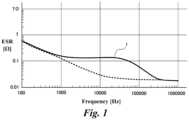
- Fig. 1 is a logarithmic graph indicating the relationship between the ESR and the frequency. As indicated by the dotted line in the logarithmic graph of Fig. 1 , ideally, the ESR in the capacitive region before the self-resonant frequency decreases slowly as the frequency increases. The decrease in ESR relative to the frequency slow down at higher frequency band. The relationship between the ESR and the frequency flattens by the self-resonant frequency.
- the bump region 1 significantly appears when various condition is added in the premise that the conductive layer and the conductive polymer is present on the cathode foil.
- the present disclosure has been proposed to address the above problems, and an objective is to provide a solid electrolytic capacitor with low ESR even when a conductive layer is formed on cathode foil, and the manufacturing method thereof.
- a resistance Rp is produced in the cathode body when the conductive layer and the conductive polymer contact with each other, and theoretically, this resistance Rp produces the bump region 1 in the relationship between the ESR and the frequency, increasing the ESR in the capacitive region including the 100 kHz band except below 1 kHz.
- the inventors have found that by generating capacitance Cp in parallel with the resistance Rp, the bump region 1 decreases, and in particular, when the capacitance Cp is 20 ⁇ F/cm 2 or more, the decrease in the bump region 1 affects the 100 kHz band to reduce the ESR.
- a solid electrolytic capacitor of the present embodiment is based on this discovery, and includes: an anode body formed of valve action metal and having dielectric film; a cathode body including cathode foil formed of valve action metal and a conductive layer formed on the cathode foil; and an electrolyte layer intervening between the anode body and the cathode body and including a conductive polymer which contacts to at least the conductive layer, in which the cathode foil has foil capacity of 20 ⁇ F/cm 2 or more.
- the cathode foil may have an etching layer formed by etching pits and a dielectric film formed on a surface of the cathode foil.
- Foil capacity of the cathode foil may be 20 ⁇ F/cm 2 or more in accordance with an enlargement ratio of the cathode foil by the etching layer, and thickness of the dielectric film.
- All or a part of the etching pits may have a region where the conductive layer does not contact at a deep portion thereof. In the region where the conductive layer does not contact, the conductive polymer and the cathode foil may contact instead.
- the bump region 1 in the relationship between the ESR and the frequency increases and becomes significant. Then, when the foil capacity of the cathode foil is 20 ⁇ F/cm 2 in the presence of the uncontacted region, the decrease in the bump region 1 effectively affects the 100 kHz band and the ESR significantly decreases.
- the conductive layer may be at least a vapor-deposited layer contacting the cathode foil.
- the conductive layer may contain titanium carbide.
- the combination of the conductive layer containing titanium carbide and the cathode foil with the foil capacity of 20 ⁇ F/cm 2 largely reduces the ESR.
- the electrolyte layer may be formed so that solution of the conductive polymer or the conductive polymer in dispersion is attached thereto.
- the bump region 1 in the relationship between the ESR and the frequency increases and becomes significant.
- the foil capacity of the cathode foil is 20 ⁇ F/cm 2 in the presence of the uncontacted region, the decrease in the bump region 1 effectively affects the 100 kHz band and the ESR significantly decreases.
- the cathode foil may have the foil capacity of 250 ⁇ F/cm 2 . Furthermore, when the enlargement ratio of the etching layer is such that the foil capacity of the 500 ⁇ F/cm2 is produced, the risk the increase in the ESR due to the weakening of the cathode foil offsetting the decrease in the bump region 1 is reduced.
- the electrolyte layer may include electrolytic solution.
- the bump region 1 is smaller than when the electrolytic solution is not present, and by making the foil capacity of the cathode foil to be 20 ⁇ F/cm 2 , low ESR can be easily achieved.
- the electrolytic solution may contain ethylene glycol of 25 wt% or more relative to a total solvent of said electrolytic solution.
- the solvent of the electrolytic solution may be formed by both ⁇ -butyrolactone and sulfolane.
- a manufacturing method of a solid electrolytic capacitor of the present embodiment includes: a cathode body formation process of forming a cathode body by forming a conductive layer on cathode foil formed of valve action metal and with foil capacity of 20 ⁇ F/cm 2 and an electrolyte layer formation process of forming an electrolyte layer intervening between an anode body having dielectric film and the cathode body, and including a conductive polymer which contacts to at least the conductive layer.
- the ESR of the solid electrolytic capacitor with the cathode body on which the conductive layer is formed can be suppressed low.
- a solid electrolytic capacitor is a passive element that gains the capacitance by the dielectric polarization of dielectric film and stores and discharges electric charge.
- the solid electrolytic capacitor includes an anode body in which dielectric film is formed on a surface thereof, and a cathode body.
- the anode body and the cathode body are arranged to face each other.
- a separator is intervened between the anode body and the cathode body to prevent short-circuit of the anode body and the cathode body.
- the anode body and the cathode body have a strip foil shape, for example, and are wound so that they are rounded in the strip longitudinal direction via the separator.
- An electrolyte layer adheres to at least a part of the dielectric film of the anode body and intervenes between the anode body and the cathode body.
- the electrolyte layer includes conductive polymers.
- the conductive polymer is a self-doped conjugated polymer doped by intramolecular dopants or a conjugated polymer doped by external dopant molecules. Since the conductive polymer is arranged in series between the dielectric film and the cathode body, the capacitance at the anode side is produced by the anode body, the dielectric film, and the conductive polymer.
- the conjugated polymer is obtained by chemical oxidative polymerization or electrolytic oxidative polymerization of monomers with a n-conjugated double bond or derivatives thereof.
- Known polymers may be used for the conjugated polymer without limitation.
- the conjugated polymer may be polypyrrole, polythiophene, polyfuran, polyaniline, polyacetylene, polyphenylene, polyphenylenevinylene, polyacene, and polythiophenevinylene, etc. These conjugated polymers may be used in single or in combination of two or more, and may further be a copolymer of two or more types of monomers.
- conjugated polymers formed by polymerizing thiophene or derivatives thereof are preferable, and conjugated polymers in which 3,4-ethylenedioxythiophene (that is, 2,3-dihydrothieno[3,4-b][1,4]dioxin), 3-alkylthiophene, 3-alkoxythiophene, 3-alkyl-4-alkoxythiophene, 3,4-alkylthiophene, 3,4-alkoxythiophene, or derivatives thereof are polymerized are preferable.
- 3,4-ethylenedioxythiophene that is, 2,3-dihydrothieno[3,4-b][1,4]dioxin
- 3-alkylthiophene 3-alkoxythiophene
- 3-alkyl-4-alkoxythiophene 3-alkyl-4-alkoxythiophene
- 3,4-alkylthiophene, 3,4-alkoxythiophene, or derivatives thereof are polymerized
- the thiophene derivatives may preferably be compounds selected from thiophene with substituents at 3-position and 4-position, and the 3-position and 4-position substituents of the thiophene ring may form a ring together with the 3-position and 4-position carbon. It is preferable that the carbon number of an alkyl group and an alkoxy group is 1 to 16.
- a polymer of 3,4-ethylenedioxythiophene which is called EDOT that is, poly(3,4-ethylenedioxythiophene) which is called PEDOT is preferable.
- substituents may be added to 3,4-ethylenedioxythiophene.
- alkylated ethylenedioxythiophene to which an alkyl group with carbon number of 1 to 5 is added as a substituent may be used.
- alkylated ethylenedioxythiophene may be methylated ethylenedioxythiophene (that is, 2-methyl-2,3-dihydro-thieno[3,4-b][1,4]dioxin), ethylated ethylenedioxythiophene (that is, 2-ethyl-2,3-dihydro-thieno[3,4-b][1,4]dioxin), butylated ethylenedioxythiophene (that is, 2-butyl-2,3-dihydro-thieno[3,4-b][1,4]dioxin), and 2-alkyl-3,4-ethylenedioxythiophene may be used.
- methylated ethylenedioxythiophene that is, 2-methyl-2,3-dihydro-thieno[3,4-b][1,4]dioxin
- ethylated ethylenedioxythiophene that is, 2-ethyl-2,3-
- the dopant or the external dopant molecule is an acceptor that easily accepts electrons in the conjugated polymer or a donor that easily donates electrons to the conjugated polymer, so that the conductive polymer exhibits high conductivity.
- known dopants may be used without limitation.
- the dopant may be used in single or in combination of two or more. Also, the dopant may be polymers or monomers.
- the dopant may be inorganic acid such as polyanions, boric acid, nitric acid, and phosphoric acid, and organic acid such as acetic acid, oxalic acid, citric acid, tartaric acid, squaric acid, logisonic acid, croconic acid, salicylic acid, p-toluenesulfonic acid, 1,2-dihydroxy-3,5-benzenedisulfonic acid, methanesulfonic acid, trifluoromethanesulfonic acid, borodisalicylic acid, bisoxalate borate acid, sulfonylimide acid, dodecylbenzenesulfonic acid, propylnaphthalenesulfonic acid, and butylnaphthalenesulfonic acid.
- organic acid such as acetic acid, oxalic acid, citric acid, tartaric acid, squaric acid, logisonic acid, croconic acid, salicylic acid, p
- the polyanion may be polymers consisting of only component units with anion groups or polymers consisting of component units with anion groups and component units without anion groups, and may be substituted or unsubstituted polyalkylene, substituted or unsubstituted polyalkenylene, substituted or unsubstituted polyimide, substituted or unsubstituted polyamide, and substituted or unsubstituted polyester.
- the polyanion may be polyvinyl sulfonic acid, polystyrene sulfonic acid, polyaryl sulfonic acid, polyacrylic sulfonic acid, polymethacrylic sulfonic acid, poly(2-acrylamide-2-methylpropane sulfonic acid), polyisoprene sulfonic acid, polyacrylic acid, polymethacrylic acid, and polymaleic acid, etc.
- the conductive polymer also contacts the cathode body.
- the cathode body includes cathode foil and a conductive layer.
- the conductive layer is laminated on one surface or both surface of the cathode foil and is located at the outermost surface of the cathode body.
- the resistance Rp is produced at the cathode-body side. It is assumed that this resistance Rp is the contact resistance between the conductive polymer and the conductive layer, the volume resistance, and the contact resistance between the conductive layer and the cathode foil, but it is not limited thereto.
- the resistance Rp of the cathode body produces a bump region 1 in the relationship between the ESR and the frequency. That is, the ESR is increased in the capacitive region including the 100 kHz band except below 1 kHz.
- the capacitance Cp is produced together with this resistance Rp, the bump in the bump region 1 can be suppressed. Therefore, the capacitance Cp is also produced at the cathode-body side.
- the capacitance Cp at the cathode-body side is not asymptoted to infinity, and the capacitance of the solid electrolytic capacitor is the synthesized capacitance of the anode side and the cathode side.
- a surface of the cathode foil is enlarged by an etching layer formed by many pits and the dielectric film is formed thereon.
- This cathode foil is a long foil body formed of elongated valve action metal.
- the valve action metal is aluminum, tantalum, niobium, niobium oxide, titanium, hafnium, zirconium, zinc, tungsten, bismuth, and antimony, etc.
- the purity of the cathode body is desirably 99% or more, and impurities such as silicon, iron, copper, magnesium, and zinc may be included.
- the etching layer is formed by tunnel-shaped pits or spongy pits.
- the tunnel-shaped etching pits are holes dug in the thickness direction of the foil.
- the tunnel-shaped pits may be formed in a length that penetrates through the foil or a length that does not reach the center of the foil.
- the tunnel-shaped etching pits are formed by applying DC current on the anode body in aqueous acidic solution in which halogen ions are present, such as hydrochloric acid.
- the tunnel-shaped etching pits are enlarged by applying DC current on the cathode body in aqueous acidic solution such as nitric acid.
- the spongy pits make an enlarged surface layer a spongy layer with a series of fine spatial air gaps.
- the spongy etching pits are formed by applying AC current on the cathode body in aqueous acidic solution in which halogen ions are present, such as hydrochloric acid.
- the dielectric film is formed on the uneven surface of the etching layer.
- the dielectric film is oxide film formed on the uneven surface layer of the enlarged surface layer, and for example, when the cathode foil is formed of aluminum, it is an aluminum oxide layer obtained by oxidizing the uneven surface layer of the enlarged surface layer.
- voltage is applied on the cathode foil in chemical conversion solution.
- the chemical conversion solution is solution without halogen ions, and for example is phosphoric acid-based chemical conversion solution such as ammonium diphosphate, boric acid-based chemical conversion solution such as ammonium borate, and adipic acid-based chemical conversion solution such as ammonium adipate, etc.
- the dielectric film is oxide particles other than the cathode foil, and may be formed on the uneven surface of the etching layer using vapor phase deposition method or liquid phase deposition method.
- the vapor phase deposition method may be chemical vapor deposition (CVD) and physical vapor deposition (PVD), and the liquid phase deposition method may be plating and coating.
- the foil capacity of the cathode foil is 20 ⁇ F/cm 2 .
- the foil capacity is the capacitance of the cathode foil.
- the foil capacity of the cathode foil is measured by cutting out two test pieces of predefined area from the cathode foil, immersing the test pieces in capacitance measurement solution in a glass measurement tank with the test pieces facing each other, and doubling the value measured using the capacitance meter.
- the predefined area is 1cm 2
- the capacitance measurement solution is aqueous solution of ammonium adipate at 30°C
- the capacitance meter is a LCR meter
- the AC amplitude is 0.5 Vms and the measurement frequency is 120 Hz.
- the foil capacity of the cathode foil becomes larger, the bump region starts to disappear from the lower frequency level, and the ESR starts to become lower from the lower frequency level.
- the foil capacity of the cathode foil is preferably 500 ⁇ F/cm 2 or less and is more preferably 250 ⁇ F/cm 2 .
- the bump of the bump region 1 is already corrected to be close to the ideal ESR curve in the foil capacity less than 250 ⁇ F/cm 2 , and in particular, the decrease in the ESR is sufficient in the 100 kHz band.
- the carbon powder may be natural plant tissue such as coconut shell, synthetic resin such as phenol, activated carbon made from fossil fuel such as coal, coke, pitch, and the like, carbon black such as Ketjen black, acetylene black, and channel black, carbon nanohorn, amorphous carbon, natural graphite, artificial graphite, graphitized Ketjen black, mesoporous carbon, etc.
- the fibrous carbon is carbon nanotube or carbon nanofiber, etc.
- the carbon nanotube may be single-walled carbon nanotube with a single layer of a graphene sheet, or multi-walled carbon nanotube (MWCNT) in which two or more layers of graphene sheets are curled up on a same axis and a tube wall forms multiple layers.
- MWCNT multi-walled carbon nanotube
- the inorganic substance contained in the conductive layer is preferably titanium carbide which is a carbide of titanium.
- titanium carbide which is a carbide of titanium.
- the vacuum arc vapor-deposition voltage is applied to source material in a vacuum chamber to melt and evaporate the source material, and the evaporated material is reacted with reaction gas, to form film of the source material reacted with the reaction gas on the cathode foil.
- the sputtering vapor-deposition a target is placed, plasma is produced under an environment in which reaction gas is filled, and the source material is beaten out from the target and is reacted with the reaction gas, to form film of the source material reacted with the reaction gas on the cathode foil.
- Fig. 2 is a schematic diagram illustrating a cross-section of the cathode body. As illustrated in Fig. 2 , it is preferable to produce an uncontacted region 22, which is a region that does not contact a conductive layer region 31 which is a region of the conductive layer, that is, a region that is uncontact, in a deep portion of all or a part of the pits 21 of the etching layer. In the pits 21, cathode-side dielectric film 33 is also formed on the uncontacted region 22. Particles of the conductive polymer enters in the uncontacted region 22 instead of the conductive layer region 31, a conductive polymer region 32, which is a region of the conductive polymer, contacts the cathode-side dielectric film 33.
- the conductive layer so that the conductive layer region 31 does not block the pit 21 to enable the conductive polymer and the electrolytic solution to enter the pit 21.
- the particle diameter or density of the inorganic substance or inorganic compound is adjusted so that pores between the inorganic substance or inorganic compound forming the conductive layer becomes larger than the conductive polymer or the electrolyte.
- the conductive layer based on the vapor-deposition method.
- the spongy pits 21 with complicated pore shapes make the particles of the inorganic substance or inorganic compound further difficult to reach the deep portion of the etching layer.
- the diameter of the spongy etching pit 21 is preferably equivalent to or smaller than the inorganic substance or inorganic compound and is preferably 1 ⁇ m or less.
- the diameter of the spongy pit 21 is further preferably 50 to 300 nm. This further reduces the possibility for the inorganic substance or inorganic compound to reach the deepest portion of the spongy pit.
- the uncontacted region 22 which is the region that does not contact the conductive layer region 31 can be produced in the deep portion of all or a part of the pits 21 of the etching layer, certain effect can be achieved, and the formation method of the conductive layer is not limited to the vapor-deposition.
- Such a solid electrolytic capacitor is manufactured as follows. That is, the anode body and the cathode body are produced by an anode body formation process and a cathode body formation method. respectively.
- the strip-shaped anode body and cathode body are wound via a separator therebetween to produce a cylindrical wound body formed by the anode foil, the cathode foil, and the separator.
- a capacitor element is produced by attaching the conductive polymer in the wound body.
- the capacitor element is inserted in a cylindrical outer casing with a bottom, and an opened end of the outer casing is sealed by a crimping process using a sealing body. Then, the aging process is performed to complete the manufacture of the solid electrolytic capacitor.
- the suitable embodiment will include the cathode body with the foil capacity of 20 ⁇ F/cm 2 or more.
- the conductive polymer solution is liquid in which particles or powder of the conductive polymer is dispersed or dissolved.
- the conductive polymer is produced by chemical polymerization or electrolytic polymerization.
- solution containing monomers that are monomer units of the conductive polymer and an oxidizing agent are mixed and polymerized.
- the oxidizing agent may be any known compounds that release dopants, may be trivalent iron salt such as iron (III) p-toluene sulfonate, iron (III) naphthalene sulfonate, and iron (III) anthraquinone sulfonate, or peroxodisulfate salt such as peroxiodisulfuric acid, ammonium peroxodisulfate, and sodium peroxodisulfate, and may be used in single or in combination of two or more.
- the polymerization temperature the temperature is generally in the range of 10 to 200 °C.
- the polymerization time is generally in the range of 10 minutes to 30 hours.
- the support electrolyte contains at least one type of compound selected from a group consisting of borodisalicylic acid and borodisalicylic acid salt.
- the salt may be alkali metal salt such as lithium salt, sodium salt, and potassium salt, ammonium salt, alkyl ammonium salt such as ethyl ammonium salt and butyl ammonium salt, dialkyl ammonium salt such as diethyl ammonium salt and dibutyl ammonium salt, trialkyl ammonium salt such as triethyl ammonium salt and tributyl ammonium salt, and tetraalkyl ammonium salt such as tetraethyl ammonium salt and tetrabutyl ammonium salt.
- alkali metal salt such as lithium salt, sodium salt, and potassium salt
- ammonium salt alkyl ammonium salt such as ethyl ammonium salt and butyl ammonium salt
- dialkyl ammonium salt such as diethyl ammonium salt and dibutyl ammonium salt
- trialkyl ammonium salt such as triethyl ammonium salt and tributyl ammoni
- potential of 1.0 to 1.5 V is suitable for a reference electrode
- current of 1 to 10000 ⁇ A/cm 2 is suitable
- potential sweep method it is suitable to sweep the range of 0 to 1.5 V for a reference electrode at a rate of 5 to 200 mV/second.
- the temperature is generally in the range of 10 to 60 °C.
- the polymerization time is generally in the range of 10 minutes to 30 hours.
- the solvent to add the monomer and the oxidizing agent or the support electrolyte is not particularly limited if the solvent can dissolve the desired amount of the monomers and the support electrolyte and does not affect the electrolytic polymerization.
- the solvent may be water, methanol, ethanol, isopropanol, butanol, ethylene glycol, acetonitrile, butyronitorile, acetone, methylethylketone, tetrahydrofuran, 1,4-dioxan, ⁇ -butyrolactone, methyl acetate, ethyl acetate, methyl benzoate, ethyl benzoate, ehtylene carbonate, propylene carbonate, nitromethane, nitrobenzene, sulfolane, and dimethyl sulfolane.
- These solvents may be used in single or in combination of two or more.
- the conductive polymer solution is prepared by purifying the solution after the chemical polymerization or electrolytic polymerization using ultrafiltration, cation exchange, and anion exchange, removing residual monomers and impurities, and dispersing or dissolving the conductive polymer in the solution.
- the solvent of the conductive polymer solution be any solvent if the conductive polymer disperses or dissolves thereto, and water, or the mixture of water and organic solvents is preferable.
- the organic solvent of the conductive polymer dispersion may be polar solvents, alcohol, esters, hydrocarbon, carbonate compounds, ether compounds, chain ethers, heterocyclic compounds, and nitrile compounds, etc.
- the polar solvent may be N-methyl-2-pyrrolidone, N,N-dimethylformamide, N,N-dimethylacetoamide, and dimethylsulfoxide.
- the alcohol may be methanol, ethanol, propanol, and butanol, etc.
- the ester may be ethyl acetate, propyl acetate, and butyl acetate, etc.
- the hydrocarbon may be hexane, heptane, benzene, toluene, and xylene, etc.
- the carbonate compound may be ethylene carbonate and propylene carbonate, etc.
- the ether compound may be dioxane, diethylether, etc.
- the chain ether may be ethylene glycol alkyl ether, propylene glycol alkyl ether, polyethylene glycol dialkyl ether, and polypropylene glycol alkyl ether, etc.
- the heterocyclic compound may be 3-methyl-2-oxazolidinone, etc.
- the nitrile compound may be acetonitrile, glutaronitrile, methoxyacetonitrile, propionitrile, and benzonitrile, etc.
- the pH of the conductive polymer solution is adjusted, and polyhydric alcohol and various additives may be added as necessary.
- the pH adjuster may be ammonia water, sodium hydroxide, primary amines, secondary amines, and tertiary amines.
- the polyhydric alcohol may be sorbitol, ethylene glycol, diethylene glycol, triethylene glycol, polyoxyethylene glycol, glycerin, polyglycerin, polyoxyethylene glycerin, xylitol, erythritol, mannitol, dipentaerythritol, pentaerythritol, or combination of two or more.
- the additive may be organic binders, surfactant, dispersant, defoamer, coupling agent, antioxidant, and UV absorber, etc.
- the temperature environment in the drying process is 40 to 200 °C, and the drying time is 3 to 180 minutes.
- the drying process may be repeated for multiple times.
- the drying process may be performed under the depressurized environment, for example, under the pressure of 5 to 100 kPa.
- the drying process may be divided into pre-drying and main-drying.
- the conductive polymer solution may be applied by droplet or by spraying other than the immersion.
- the conductive polymer may be formed in the electrolytic capacitor by immersing the wound body in the solution of the monomers that are the monomer units of the conductive polymer and the oxidizing agent or the support electrolyte for polymerization reaction.
- the electrolytic solution may be added to the electrolyte layer.
- the electrolyte layer is formed of the conductive polymer and the electrolytic solution, and the electrolytic solution is filled to fill voids between the dielectric film and the conductive polymer.
- the electrolytic solution is mixed solution in which a solute is dissolved in a solvent, and additives are added as necessary.
- the electrolytic solution may only contain the solvent and does not contain the solute, or may be the mixture solution of the solvent and the additive.
- the solvent of the electrolytic solution may be a protic organic polar solvent or an aprotic organic polar solvent, and may be used in single or in combination of two or more.
- the solute of the electrolytic solution contains anion components and cation components.
- the solute is organic acid salt, inorganic acid salt, or salt of composite compound of organic acid and inorganic acid, and may be used in single or in combination of two or more. Acid that is the anion and base that is the cation may be separately added to the solvent.
- the protic organic polar solvent that is the solvent may be monohydric alcohol, polyhydric alcohol, and oxyalcohol compound, etc.
- the monohydric alcohol may be ethanol, propanol, butanol, pentanol, hexanol, cyclobutanol, cyclopentanol, cyclohexanol, and benzyl alcohol, etc.
- the polyhydric alcohol and the oxyalcohol compound may be ethylene glycol, propylene glycol, glycerin, polyglycerin, methyl cellosolve, ethyl cellosolve, methoxypropylene glycol, dimethoxypropanol, and alkylene oxide adducts of polyhydric alcohol such as polyethylene glycol and polyoxyethylene glycerin, etc.
- the aprotic organic polar solvent that is the solvent may be sulfones, amides, lactones, cyclic amides, nitriles, and sulfoxides, etc.
- the sulfone may be dimethyl sulfone, ethylmethyl sulfone, diethyl sulfone, sulfolane, 3-methyl sulfolane, and 2,4-dimethyl sulfolane, etc.
- the amide may be N-methylformamide, N,N-dimethylformamide, N-ethylformamide, N,N-diethylformamide, N-methylacetamide, N,N-dimethylacetamide, N-ethylacetamide, N,N-diethylacetamide, and hexamethylphosphoricamide, etc.
- the lactone and the cyclic amide may be ⁇ -butyrolactone, ⁇ -valerolactone, ⁇ -valerolactone, N-methyl-2-pyrrolidone, ethylene carbonate, propylene carbonate, butylene carbonate, and isobutylene carbonate, etc.
- the nitrile may be acetonitrile, 3-methoxypropionitrile, and glutaronitrile, etc.
- the sulfoxide may be dimethyl sulfoxide, etc.
- the solvent is preferably ethylene glycol and glycerin.
- Ethylene glycol and glycerin cause a change in the high-order structure of the conductive polymer, and the conductive polymer has the excellent initial ESR property and excellent high-temperature property.
- the adhesion of the conductive polymer and the conductive layer is improved and the capacity drawing effect of the cathode foil is improved, resulting in the excellent initial ESR property.
- ethylene glycol is present in the solvent in an amount of 25 wt% or more. If ethylene glycol is present in the solvent in an amount of 25 wt% or more, the solvent may contain other solvents such as ⁇ -butyrolactone or sulfolane.
- the solvent When ⁇ -butyrolactone or sulfolane is used as the solvent, it is preferable to form the solvent with ⁇ -butyrolactone and sulfolane, rather than forming the solvent only with ⁇ -butyrolactone or sulfolane.
- the solvent with ⁇ -butyrolactone and sulfolane rather than forming the solvent only with ⁇ -butyrolactone or sulfolane, the ESR of the solid electrolytic capacitor is reduced.
- the organic acid that becomes the anion component as the solute may be carboxylic acid such as oxalic acid, succinic acid, glutaric acid, pimelic acid, suberic acid, sebacic acid, phthalic acid, isophthalic acid, terephthalic acid, maleic acid, adipic acid, benzoic acid, toluyl acid, enanthic acids, malonic acids, 1,6-decandicarboxylic acid, 1,7-octanedicarboxylic acid, azelaic acid, undecanedioic acid, dodecanedioic acid, tridecanedioic acid, t-butyladipic acid, 11-vinyl-8-octadecenedioic acid, resolcinic acid, fluorochloric acid, gallic acid, gentisic acid, protocatechuic acid, pyrocatechuic acid, trimellitic acid, and pyromellitic acid, phenols, and
- the inorganic acid may be boric acid, phosphoric acid, phosphorus acid, hypophosphorous acid, carbonic acid, and silicic acid, etc.
- the composite compound of organic acid and inorganic acid may be borodisalicylic acid, borodioxalic acid, borodiglycolic acid, borodimalonic acid, borodisuccinic acid, borodiadipic acid, borodiazelaic acid, borodibenzoic acid, borodimaleic acid, borodilactic acid, borodimalic acid, boroditartric acid, borodicitric acid, borodiphthalic acid, borodi(2-hydroxy) isobutyric acid, borodiresorcinic acid, borodimethylsalicylic acid, borodinaftoeic acid, borodimandelic acid, and borodi(3-hydroxy) propionic acid, etc.
- the primary amine may be methylamine, ethylamine, propylamine, and the like
- the secondary amines may be dimethylamine, diethylamine, ethylmethylamine and dibutylamine, and the like
- the tertiary amines may be trimethylamine, triethylamine, tributylamine, ethyldimethylamine, ethyldiisopropylamine, and the like.
- the additives may be alkylene oxide adducts of polyhydric alcohol such as polyethylene glycol and polyoxyglycerin, complex compounds of boric acid and polysaccharides (mannit, sorbit, etc.), complex compounds of boric acid and polyhydric alcohol, borate esters, nitro compounds (o-nitrobenzoic acid, m-nitrobenzoic acid, p-nitrobenzoic acid, o-nitrophenol, m-nitrophenol, p-nitrophenol, p-nitrobenzylalcohol etc.), and phosphate esters, etc. These may be used in single or in combination of two or more.
- the addition amount of the additive is not particularly limited, but is preferably added in an amount that does not give adverse effect the properties of the solid electrolytic capacitor, such as 30 wt% or less of the electrolytic solution.
- the anode body is an elongated foil body formed of valve action metal, and the purity thereof is desirably 99.9 % or more.
- An enlarged surface layer is formed on one or both surface of the foil of the anode body.
- the enlarged surface layer may be a sintered layer in which powder of valve action metal is sintered or a vapor-deposited layer in which particles of valve action metal are vapor-deposited, other than the etching layer.
- the sintering and vapor-deposition method may be atomic layer deposition, vapor-deposition, and powder sintering lamination modeling.
- the enlarged surface layer may be a porous structure formed by voids between dense powder bodies or particles, other than tunnel-shaped pits or spongy pits.
- the dielectric film is formed on the uneven surface of the enlarged surface layer of the anode body by chemical conversion treatment, vapor phase deposition method or liquid phase deposition method.
- the separator includes cellulose such as kraft, Manila hemp, esparto, hemp, rayon, and mixed papers thereof, polyester resin such as polyethylene terephthalate, polybutylene terephthalate, polyethylene naphthalate, and derivatives thereof, polytetrafluoroethylene resin, polyvinylidene fluoride resin, vinylon resin, polyamide resin such as aliphatic polyamide, semi-aromatic polyamide, and total aromatic polyamide, polyimide resin, polyethylene resin, polypropylene resin, trimethylpentene resin, polyphenylene sulfide resin, acrylic resin, polyvinyl alcohol resin and the like, and the resin may be used in single or in mixture. However, the separator may be excluded if short-circuit between the anode body and the cathode body is prevented and the conductive polymer and the electrolytic solution is held.
- polyester resin such as polyethylene terephthalate, polybutylene terephthalate, polyethylene naphthalate, and derivatives thereof, poly
- the solid electrolytic capacitor may be a laminated type in which the electrolyte layer and the cathode body are laminated on cathode body in a flat plate.
- a capacitor element is sealed by covering the capacitor element by laminate film or by molding, dip coating, or printing resin such as heat-resistant resin and insulation resin.
- the ESR in the capacitive region before the self-resonant frequency decreases slowly as the frequency increases.
- the decrease in the ESR relative to the frequency slows down at higher frequency band.
- the relationship between the ESR and the frequency flattens by the self-resonant frequency.
- the relationship between the ESR and the frequency changes, and the bump region 1 is produced.
- the decrease in the ESR relative to the frequency slows down at the frequency band of 1 kHz or more.
- the relationship between the ESR and the frequency becomes close to flat at the frequency band far lower than the self-resonant frequency. After this substantially-flat region, the decrease in ESR relative to the frequency steepens, and the decrease in ESR relative to the frequency slows down and flattens by the self-resonant frequency again.
- the bump region 1 significantly appears when the uncontacted region 22 which is a region where the conductive layer and the deep portion of all or a part of the etching pits do not contact with each other. That is, the decrease in the ESR significantly slows down, and the flat region of the ESR becomes long. Furthermore, the bump region 1 significantly appears when the electrolyte layer of the conductive polymer is formed using the conductive polymer solution. Furthermore, the bump region 1 significantly appears in the solid electrolytic capacitor that does not use the electrolytic solution.
- ] of the impedance of the cathode foil in the capacitive region before the self-resonant frequency decreases in proportion to the frequency.
- the decrease in the ESR which has slowed down due to the occurrence of the bump region 1 can be made larger. That is, the bump region 1 can be eliminated. Accordingly, the ESR till the self-resonant frequency can be entirely reduced.
- Anode foil was elongated strip-shaped aluminum foil with the thickness of 110 ⁇ m. Surfaces of the anode foil were enlarged by AC etching. In the formation of the enlarged surface layer of the anode foil, AC current was applied to the aluminum foil in aqueous solution containing hydrochloric acid to form spongy etching pits. Chemical conversion treatment was performed on the anode body to form dielectric film on the surface of the anode foil.
- Cathode foil was elongated strip-shaped aluminum foil with the thickness of 50 ⁇ m.
- the etching layer was also formed on the cathode foil and the dielectric film was formed on an uneven surface of the etching layer, to achieve the foil capacity of 10 to 250 ⁇ F/cm 2 in accordance with each solid electrolytic capacitor.
- AC current was applied to the aluminum foil in aqueous solution containing hydrochloric acid to form the etching layer formed by the spongy etching pits.
- Titanium carbide TiC was laminated as the conductive layer on each cathode foil.
- TiC with the thickness of 110 nm was laminated on the cathode foil by vacuum arc vapor-deposition. Furthermore, TiC was laminated such that an uncontacted region 22 is formed in the deep portion of the pits 21.
- the cathode foil was immersed in acidic aqueous solution with hydrochloric acid as the main electrolyte to enlarge both surfaces of the aluminum foil.
- the chemical conversion treatment of the cathode foil after chlorine attached in the AC etching process was removed using phosphoric acid aqueous solution, voltage in accordance with the thickness of the dielectric film was applied in aqueous solution of ammonium dihydrogenphosphate.
- the anode body and the cathode body were laminated via a separator with the strip direction of the bodies being the same, and were wound so that the strip-longitudinal direction of the bodies were rounded, forming the wound body.
- the separators in the examples 1 to 5 and the comparative example 1 were manila-hemp based.
- the separators in the reference examples 1 and 2 were special nylon fiber. Current with current with current density of 2.5 mA/cm 2 was conducted to the produced wound body in aqueous solution of ammonium dihydrogenphosphate with temperature of 90 °C, and was maintained for 15 minutes after the chemical conversion voltage reached 56 V.
- the wound bodies of the examples 1 to 5 and the comparative example 1 were impregnated with the conductive polymer solution to attach the conductive polymer.
- the conductive polymer solution poly(3,4-ethylenedioxythiphene) doped with polystyrene sulfonic acid (PSS) (PEDOT/PSS) was dispersed in water.
- PEDOT/PSS was added in a ratio of 1.2 wt% relative to the total conductive polymer solution.
- Ethylene glycol was added to the conductive polymer solution in a ratio of 10 wt% relative to the total conductive polymer solution.
- the wound body was impregnated with the conductive polymer solution for 5 minutes in the pressurized environment at room temperature. The impregnation process was performed twice. After each impregnation process, the wound body was placed still in the temperature environment of 150 °C for 30 minutes to dry the wound body.
- the conductive polymer produced by chemical polymerization was attached to the wound bodies of the reference examples 1 and 2.
- the wound body was immersed in the mixture solution to which monomers of 3,4-ethylenedioxythiophene and iron (III) p-toluenesulfonate as an oxidant that releases dopants were added, to cause the polymerization reaction.
- the polymerization temperature was 150 °C, and the polymerization time was 30 minutes.
- the wound body on which the conductive polymer was attached was further impregnated with the electrolytic solution.
- the electrolytic solution was prepared by adding ammonium azelaate to ethylene glycol. The electrolytic solution was not used together in the solid electrolytic capacitors of the reference examples 1 and 2.
- each produced capacitor element was housed in an cylindrical outer casing, and an opening of the outer casing was sealed with a sealing body. Voltage was applied on each solid electrolytic capacitor to perform aging process.
- the solid electrolytic capacitors with diameter of 6.3 mm, height of 6.1 mm, rated voltage of 35 WV, and rated capacity of 56 ⁇ F were produced.
- the reference examples 1 and 2 the solid electrolytic capacitors with rated voltage of 25 WV, and rated capacity of 47 ⁇ F were produced.
- the ESR of the examples 1 to 5, the comparative example 1, and the reference examples 1 and 2 was measured.
- the ESR was measured by connecting terminals of the LCR meter to the anode body and the cathode body with ambient temperature of 20 °C and measurement frequency of 100 kHz as the measurement condition.
- the results are shown in the below table 1.
- the measurement result of the ESR are shown in the below table 1 with the foil capacity of each cathode foil. Note that, two test pieces of predefined area were cut out from the cathode foil and were immersed in capacitance measurement solution in a glass measurement tank with the pieces facing each other, and the foil capacity of each cathode foil were obtained by doubling the value measured using the capacitance meter.
- the predefined area was 1cm 2
- the capacitance measurement solution was aqueous solution of ammonium adipate at 30 ° C
- the capacitance meter was a LCR meter
- the AC amplitude was 0.5 Vms and the measurement frequency was 120 Hz.
- the ESR of the solid electrolytic capacitors of the examples 1 to 5 was suppressed lower than that of the comparative example 1.
- the foil capacity of the cathode foil of the solid electrolytic capacitors of the examples 1 to 5 was 20 ⁇ F/cm 2 or more.
- the ESR was decreased to a minimum.
- the examples and the reference examples it was observed that the ESR reduction effect by making the foil capacity of the cathode foil to be 20 ⁇ F/cm 2 or more was significant in the solid electrolytic capacitor to which the conductive polymer had been attached using the conductive polymer solution.
- the solid electrolytic capacitors of the examples 6 and 7 were produced as follows.
- the examples 6 and 7 were different from the examples 1 to 5 in that the electrolytic solution was used not together.
- the solid electrolytic capacitors of the examples 6 and 7 were produced with the same structure, the same composition, the same manufacturing method, and the same condition as that of the example, except that the electrolytic solution was not used together.
- the foil capacity of the cathode foil of the example 6 was 150 ⁇ F/cm 2
- the foil capacity of the example 7 was 20 ⁇ F/cm 2 .
- the bump region 1 had occurred in the range of 1 kHz or more, including 100 kHz. Regarding this bump region 1, there was less bump in the logarithmic graph G2 than the logarithmic graph G1. That is, it was observed that the bump region 1 was eliminated and the ESR decreased as the foil capacity Cp of the cathode foil became larger.
- the foil capacity of the cathode foil of the example 8 was 250 ⁇ F/cm 2
- the foil capacity of the cathode foil of the example 9 was 150 ⁇ F/cm 2
- the foil capacity of the cathode foil of the example 10 was 50 ⁇ F/cm 2
- the foil capacity of the cathode foil of the example 11 was 40 ⁇ F/cm 2
- the foil capacity of the cathode foil of the example 12 was 20 ⁇ F/cm 2
- the foil capacity of the cathode foil of the comparative example 2 was 10 ⁇ F/cm 2 .
- the ESR of the examples 8 to 12 and the comparative example 2 was measured.
- the measurement method and the measured condition of the ESR was the same as the example 1.
- the measurement result of the ESR are shown in the below table 3 with the foil capacity of each cathode foil.
- the plot with white dots indicates TiC series and the plot with black dots indicates the TiN series.
- Solid Electrolytic capacitors of the examples 13 to 37 and the comparative examples 3 to 7 were produced.
- the solvent in the examples 13 to 37 and the comparative examples 3 to 7 were different from those in the series of the examples 1 to 5 and the comparative example 1.
- ethylene glycol was used for all amount of the solvent of the electrolytic solution.
- the solvent was formed of 25 wt% of ethylene glycol and 75 wt% of ⁇ -butyrolactone.
- the solvent was formed of 10 wt% of ethylene glycol and 90 wt% of ⁇ -butyrolactone.
- ⁇ -butyrolactone was used for all amount of the of the electrolytic solution.
- the solvent is formed of 50 wt% of ⁇ -butyrolactone and 50 wt% of sulfolane.
- sulfolane was used for all amount of the solvent of the electrolytic solution.
- the foil capacity of the cathode foil was different in the examples 13 to 17 and the comparative example 3.
- the foil capacity of the cathode foil of the example 13 was 250 ⁇ F/cm 2
- the foil capacity of the cathode foil of the example 14 was 150 ⁇ F/cm 2
- the foil capacity of the cathode foil of the example 15 was 50 ⁇ F/cm 2
- the foil capacity of the cathode foil of the example 16 was 40 ⁇ F/cm 2
- the foil capacity of the cathode foil of the example 17 was 20 ⁇ F/cm 2 .
- the foil capacity of the cathode foil of the comparative example 3 was 10 ⁇ F/cm 2 .
- the foil capacity of the cathode foil was different in the examples 18 to 22 and the comparative example 4.
- the foil capacity of the cathode foil of the example 18 was 250 ⁇ F/cm 2
- the foil capacity of the cathode foil of the example 19 was 150 ⁇ F/cm 2
- the foil capacity of the cathode foil of the example 20 was 50 ⁇ F/cm 2
- the foil capacity of the cathode foil of the example 21 was 40 ⁇ F/cm 2
- the foil capacity of the cathode foil of the example 22 was 20 ⁇ F/cm 2
- the foil capacity of the cathode foil of the comparative example 4 was 10 ⁇ F/cm 2 .
- the foil capacity of the cathode foil was different in the examples 23 to 27 and the comparative example 5.
- the foil capacity of the cathode foil of the example 23 was 250 ⁇ F/cm 2
- the foil capacity of the cathode foil of the example 24 was 150 ⁇ F/cm 2
- the foil capacity of the cathode foil of the example 25 was 50 ⁇ F/cm 2
- the foil capacity of the cathode foil of the example 26 was 40 ⁇ F/cm 2
- the foil capacity of the cathode foil of the example 27 was 20 ⁇ F/cm 2 .
- the foil capacity of the cathode foil of the comparative example 5 was 10 ⁇ F/cm 2 .
- the foil capacity of the cathode foil was different in the examples 28 to 32 and the comparative example 6.
- the foil capacity of the cathode foil of the example 28 was 250 ⁇ F/cm 2
- the foil capacity of the cathode foil of the example 29 was 150 ⁇ F/cm 2
- the foil capacity of the cathode foil of the example 30 was 50 ⁇ F/cm 2
- the foil capacity of the cathode foil of the example 31 was 40 ⁇ F/cm 2
- the foil capacity of the cathode foil of the example 32 was 20 ⁇ F/cm 2 .
- the foil capacity of the cathode foil of the comparative example 6 was 10 ⁇ F/cm 2 .
- the foil capacity of the cathode foil was different in the examples 33 to 37 and the comparative example 7.
- the foil capacity of the cathode foil of the example 33 was 250 ⁇ F/cm 2
- the foil capacity of the cathode foil of the example 34 was 150 ⁇ F/cm 2
- the foil capacity of the cathode foil of the example 35 was 50 ⁇ F/cm 2
- the foil capacity of the cathode foil of the example 36 was 40 ⁇ F/cm 2
- the foil capacity of the cathode foil of the example 37 was 20 ⁇ F/cm 2 .
- the foil capacity of the cathode foil of the comparative example 7 was 10 ⁇ F/cm 2 .
- the solid electrolytic capacitors of the examples 13 to 37 were produced with the same structure, the same composition, the same manufacturing method, and the same condition as that of the example 1, except for the type of the solvent of the electrolytic solution.
- the ESR of the examples 13 to 37 and the comparative examples 3 to 7 was measured.
- the measurement method and the measured condition of the ESR was the same as the example 1.
- the measurement result of the ESR are shown in the below table 4 to 8 with the foil capacity of each cathode foil.
- EG is ethylene glycol
- BL is ⁇ -butyrolactone
- TMS is sulfolane.
- the value in the brackets after the solvent species are the weight percent concentration in the solvent.
- the ESR of the solid electrolytic capacitor was 0.03 ⁇ when the foil capacity of the cathode foil was 20 ⁇ F/cm 2 , and was 0.024 ⁇ when the foil capacity of the cathode foil was 50 ⁇ F/cm 2 or more. As shown in the tables 1 and 4 to 8, it can be seen that these ESR are one step lower than those of the examples 18 to 27 when the foil capacity of the cathode foil was equivalent.
- ethylene glycol of 25 wt% or more was contained in the solvent of the electrolytic solution. By this, it was observed that the ESR became better when ethylene glycol was contained in the amount of 25 wt% or more relative to the total solvent of the electrolytic solution.
- the ESR of the examples 28 to 32 was one step lower than those of the examples 23 to 27 and 33 to 37.
- the solvent of the electrolytic solution was formed by both ⁇ -butyrolactone and sulfolane.
- the ESR of the solid electrolytic capacitor could be reduced by forming the solvent with both ⁇ -butyrolactone and sulfolane rather than forming the solvent only with ⁇ -butyrolactone or sulfolane.
Landscapes
- Engineering & Computer Science (AREA)
- Power Engineering (AREA)
- Microelectronics & Electronic Packaging (AREA)
- Chemical & Material Sciences (AREA)
- Chemical Kinetics & Catalysis (AREA)
- Electrochemistry (AREA)
- Materials Engineering (AREA)
- Manufacturing & Machinery (AREA)
- Polyoxymethylene Polymers And Polymers With Carbon-To-Carbon Bonds (AREA)
- Compositions Of Macromolecular Compounds (AREA)
Applications Claiming Priority (2)
| Application Number | Priority Date | Filing Date | Title |
|---|---|---|---|
| JP2022148259 | 2022-09-16 | ||
| PCT/JP2023/033684 WO2024058267A1 (fr) | 2022-09-16 | 2023-09-15 | Condensateur à électrolyte solide et procédé de production |
Publications (2)
| Publication Number | Publication Date |
|---|---|
| EP4579706A1 true EP4579706A1 (fr) | 2025-07-02 |
| EP4579706A4 EP4579706A4 (fr) | 2025-11-26 |
Family
ID=90275300
Family Applications (1)
| Application Number | Title | Priority Date | Filing Date |
|---|---|---|---|
| EP23865616.9A Pending EP4579706A4 (fr) | 2022-09-16 | 2023-09-15 | Condensateur à électrolyte solide et procédé de production |
Country Status (7)
| Country | Link |
|---|---|
| US (1) | US20260112547A1 (fr) |
| EP (1) | EP4579706A4 (fr) |
| JP (2) | JP7501814B1 (fr) |
| KR (1) | KR20250073165A (fr) |
| CN (1) | CN119790478A (fr) |
| TW (1) | TW202414465A (fr) |
| WO (1) | WO2024058267A1 (fr) |
Family Cites Families (8)
| Publication number | Priority date | Publication date | Assignee | Title |
|---|---|---|---|---|
| JPS5226466A (en) * | 1975-08-25 | 1977-02-28 | Hitachi Condenser | Electrolytic capacitor |
| JPS59167009A (ja) | 1983-03-11 | 1984-09-20 | 昭和アルミニウム株式会社 | 電解コンデンサ用電極材料の製造方法 |
| JP4062787B2 (ja) | 1998-09-30 | 2008-03-19 | 日本ケミコン株式会社 | 固体電解コンデンサとその製造方法 |
| EP1137019B1 (fr) * | 1998-09-30 | 2007-07-11 | Nippon Chemi-Con Corporation | Condensateur a electrolyte solide et procede de fabrication |
| CN107533923B (zh) | 2015-04-28 | 2019-08-30 | 松下知识产权经营株式会社 | 电解电容器 |
| JP2019068006A (ja) * | 2017-10-04 | 2019-04-25 | 日本ケミコン株式会社 | 電解コンデンサ |
| JP7245990B2 (ja) * | 2018-03-30 | 2023-03-27 | パナソニックIpマネジメント株式会社 | 電解コンデンサの製造方法 |
| HUE069423T2 (hu) * | 2019-12-17 | 2025-03-28 | Nippon Chemicon | Szilárd elektrolitikus kondenzátor és annak gyártási eljárása |
-
2023
- 2023-09-15 EP EP23865616.9A patent/EP4579706A4/fr active Pending
- 2023-09-15 WO PCT/JP2023/033684 patent/WO2024058267A1/fr not_active Ceased
- 2023-09-15 TW TW112135320A patent/TW202414465A/zh unknown
- 2023-09-15 US US19/111,479 patent/US20260112547A1/en active Pending
- 2023-09-15 CN CN202380062669.0A patent/CN119790478A/zh active Pending
- 2023-09-15 KR KR1020257012078A patent/KR20250073165A/ko active Pending
- 2023-09-15 JP JP2024503410A patent/JP7501814B1/ja active Active
-
2024
- 2024-05-20 JP JP2024081827A patent/JP2024105650A/ja active Pending
Also Published As
| Publication number | Publication date |
|---|---|
| EP4579706A4 (fr) | 2025-11-26 |
| CN119790478A (zh) | 2025-04-08 |
| TW202414465A (zh) | 2024-04-01 |
| JP2024105650A (ja) | 2024-08-06 |
| US20260112547A1 (en) | 2026-04-23 |
| KR20250073165A (ko) | 2025-05-27 |
| JPWO2024058267A1 (fr) | 2024-03-21 |
| JP7501814B1 (ja) | 2024-06-18 |
| WO2024058267A1 (fr) | 2024-03-21 |
Similar Documents
| Publication | Publication Date | Title |
|---|---|---|
| US11450485B2 (en) | Solid electrolytic capacitor | |
| EP3855463A1 (fr) | Condensateur à électrolyte solide | |
| EP4336527A1 (fr) | Condensateur électrolytique, corps d'électrode négative et procédé de fabrication de condensateur électrolytique | |
| EP4333004A1 (fr) | Condensateur électrolytique, corps d'électrode négative et procédé de production d'un condensateur électrolytique | |
| EP4579706A1 (fr) | Condensateur à électrolyte solide et procédé de production | |
| WO2025070417A1 (fr) | Condensateur à électrolyte solide et procédé de fabrication | |
| EP4386797A1 (fr) | Condensateur à électrolyte solide et son procédé de fabrication | |
| WO2024143420A1 (fr) | Condensateur à électrolyte solide et procédé de fabrication | |
| EP4383296A1 (fr) | Condensateur à électrolyte solide et procédé de fabrication | |
| US20260112543A1 (en) | Solid electrolytic capacitor, and manufacturing method | |
| US20260106085A1 (en) | Solid electrolytic capacitor and method for producing same | |
| JP7509337B1 (ja) | 固体電解コンデンサ及び製造方法 | |
| EP4383294A1 (fr) | Électrolyte solide, condensateur à électrolyte solide, dispersion de polymère électroconducteur, procédé de production d'un électrolyte solide et procédé de production d'une dispersion de polymère électroconducteur | |
| EP4583132A1 (fr) | Condensateur à électrolyte solide | |
| US20260128237A1 (en) | Solid electrolytic capacitor | |
| WO2025178113A1 (fr) | Condensateur à électrolyte solide et son procédé de fabrication | |
| WO2025047740A1 (fr) | Corps d'électrode positive de condensateur électrolytique solide, condensateur électrolytique solide, procédé de fabrication de corps d'électrode positive de condensateur électrolytique solide et procédé de fabrication de condensateur électrolytique solide | |
| WO2023171618A1 (fr) | Solution électrolytique pour condensateur électrolytique solide et condensateur électrolytique solide | |
| TW202414467A (zh) | 固體電解電容器及製造方法 | |
| WO2024181509A1 (fr) | Condensateur à électrolyte solide et procédé de fabrication | |
| WO2024029603A1 (fr) | Condensateur électrolytique et procédé de fabrication | |
| JP2024093013A (ja) | 固体電解コンデンサ | |
| WO2025063070A1 (fr) | Condensateur à électrolyte solide et procédé de fabrication | |
| US20250046527A1 (en) | Electrolytic capacitor | |
| WO2025169890A1 (fr) | Condensateur électrolytique et procédé de fabrication |
Legal Events
| Date | Code | Title | Description |
|---|---|---|---|
| STAA | Information on the status of an ep patent application or granted ep patent |
Free format text: STATUS: THE INTERNATIONAL PUBLICATION HAS BEEN MADE |
|
| PUAI | Public reference made under article 153(3) epc to a published international application that has entered the european phase |
Free format text: ORIGINAL CODE: 0009012 |
|
| STAA | Information on the status of an ep patent application or granted ep patent |
Free format text: STATUS: REQUEST FOR EXAMINATION WAS MADE |
|
| 17P | Request for examination filed |
Effective date: 20250328 |
|
| AK | Designated contracting states |
Kind code of ref document: A1 Designated state(s): AL AT BE BG CH CY CZ DE DK EE ES FI FR GB GR HR HU IE IS IT LI LT LU LV MC ME MK MT NL NO PL PT RO RS SE SI SK SM TR |
|
| A4 | Supplementary search report drawn up and despatched |
Effective date: 20251028 |
|
| RIC1 | Information provided on ipc code assigned before grant |
Ipc: H01G 9/055 20060101AFI20251022BHEP Ipc: H01G 9/00 20060101ALI20251022BHEP Ipc: H01G 9/048 20060101ALI20251022BHEP Ipc: H01G 9/14 20060101ALI20251022BHEP Ipc: H01G 9/15 20060101ALI20251022BHEP Ipc: H01G 9/042 20060101ALI20251022BHEP Ipc: H01G 9/145 20060101ALI20251022BHEP Ipc: H01G 9/035 20060101ALN20251022BHEP Ipc: H01G 9/028 20060101ALN20251022BHEP |
|
| DAV | Request for validation of the european patent (deleted) | ||
| DAX | Request for extension of the european patent (deleted) |