EP4580228A1 - Kommunikationsverfahren und -vorrichtung - Google Patents
Kommunikationsverfahren und -vorrichtung Download PDFInfo
- Publication number
- EP4580228A1 EP4580228A1 EP23870286.4A EP23870286A EP4580228A1 EP 4580228 A1 EP4580228 A1 EP 4580228A1 EP 23870286 A EP23870286 A EP 23870286A EP 4580228 A1 EP4580228 A1 EP 4580228A1
- Authority
- EP
- European Patent Office
- Prior art keywords
- terminal
- information
- network device
- epc
- identification code
- Prior art date
- Legal status (The legal status is an assumption and is not a legal conclusion. Google has not performed a legal analysis and makes no representation as to the accuracy of the status listed.)
- Pending
Links
Images




Classifications
-
- H—ELECTRICITY
- H04—ELECTRIC COMMUNICATION TECHNIQUE
- H04W—WIRELESS COMMUNICATION NETWORKS
- H04W8/00—Network data management
- H04W8/18—Processing of user or subscriber data, e.g. subscribed services, user preferences or user profiles; Transfer of user or subscriber data
- H04W8/20—Transfer of user or subscriber data
- H04W8/205—Transfer to or from user equipment or user record carrier
-
- H—ELECTRICITY
- H04—ELECTRIC COMMUNICATION TECHNIQUE
- H04L—TRANSMISSION OF DIGITAL INFORMATION, e.g. TELEGRAPHIC COMMUNICATION
- H04L41/00—Arrangements for maintenance, administration or management of data switching networks, e.g. of packet switching networks
- H04L41/08—Configuration management of networks or network elements
- H04L41/0803—Configuration setting
- H04L41/0806—Configuration setting for initial configuration or provisioning, e.g. plug-and-play
-
- H—ELECTRICITY
- H04—ELECTRIC COMMUNICATION TECHNIQUE
- H04W—WIRELESS COMMUNICATION NETWORKS
- H04W12/00—Security arrangements; Authentication; Protecting privacy or anonymity
- H04W12/04—Key management, e.g. using generic bootstrapping architecture [GBA]
- H04W12/043—Key management, e.g. using generic bootstrapping architecture [GBA] using a trusted network node as an anchor
- H04W12/0433—Key management protocols
-
- H—ELECTRICITY
- H04—ELECTRIC COMMUNICATION TECHNIQUE
- H04W—WIRELESS COMMUNICATION NETWORKS
- H04W12/00—Security arrangements; Authentication; Protecting privacy or anonymity
- H04W12/06—Authentication
-
- H—ELECTRICITY
- H04—ELECTRIC COMMUNICATION TECHNIQUE
- H04W—WIRELESS COMMUNICATION NETWORKS
- H04W12/00—Security arrangements; Authentication; Protecting privacy or anonymity
- H04W12/30—Security of mobile devices; Security of mobile applications
- H04W12/35—Protecting application or service provisioning, e.g. securing SIM application provisioning
-
- H—ELECTRICITY
- H04—ELECTRIC COMMUNICATION TECHNIQUE
- H04W—WIRELESS COMMUNICATION NETWORKS
- H04W4/00—Services specially adapted for wireless communication networks; Facilities therefor
- H04W4/02—Services making use of location information
- H04W4/029—Location-based management or tracking services
-
- H—ELECTRICITY
- H04—ELECTRIC COMMUNICATION TECHNIQUE
- H04W—WIRELESS COMMUNICATION NETWORKS
- H04W4/00—Services specially adapted for wireless communication networks; Facilities therefor
- H04W4/50—Service provisioning or reconfiguring
-
- H—ELECTRICITY
- H04—ELECTRIC COMMUNICATION TECHNIQUE
- H04W—WIRELESS COMMUNICATION NETWORKS
- H04W8/00—Network data management
- H04W8/18—Processing of user or subscriber data, e.g. subscribed services, user preferences or user profiles; Transfer of user or subscriber data
-
- H—ELECTRICITY
- H04—ELECTRIC COMMUNICATION TECHNIQUE
- H04W—WIRELESS COMMUNICATION NETWORKS
- H04W8/00—Network data management
- H04W8/18—Processing of user or subscriber data, e.g. subscribed services, user preferences or user profiles; Transfer of user or subscriber data
- H04W8/183—Processing at user equipment or user record carrier
-
- H—ELECTRICITY
- H04—ELECTRIC COMMUNICATION TECHNIQUE
- H04W—WIRELESS COMMUNICATION NETWORKS
- H04W8/00—Network data management
- H04W8/18—Processing of user or subscriber data, e.g. subscribed services, user preferences or user profiles; Transfer of user or subscriber data
- H04W8/20—Transfer of user or subscriber data
-
- H—ELECTRICITY
- H04—ELECTRIC COMMUNICATION TECHNIQUE
- H04W—WIRELESS COMMUNICATION NETWORKS
- H04W8/00—Network data management
- H04W8/22—Processing or transfer of terminal data, e.g. status or physical capabilities
-
- H—ELECTRICITY
- H04—ELECTRIC COMMUNICATION TECHNIQUE
- H04W—WIRELESS COMMUNICATION NETWORKS
- H04W8/00—Network data management
- H04W8/22—Processing or transfer of terminal data, e.g. status or physical capabilities
- H04W8/24—Transfer of terminal data
- H04W8/245—Transfer of terminal data from a network towards a terminal
-
- H—ELECTRICITY
- H04—ELECTRIC COMMUNICATION TECHNIQUE
- H04W—WIRELESS COMMUNICATION NETWORKS
- H04W8/00—Network data management
- H04W8/26—Network addressing or numbering for mobility support
-
- H—ELECTRICITY
- H04—ELECTRIC COMMUNICATION TECHNIQUE
- H04W—WIRELESS COMMUNICATION NETWORKS
- H04W88/00—Devices specially adapted for wireless communication networks, e.g. terminals, base stations or access point devices
- H04W88/02—Terminal devices
-
- H—ELECTRICITY
- H04—ELECTRIC COMMUNICATION TECHNIQUE
- H04W—WIRELESS COMMUNICATION NETWORKS
- H04W88/00—Devices specially adapted for wireless communication networks, e.g. terminals, base stations or access point devices
- H04W88/18—Service support devices; Network management devices
-
- H—ELECTRICITY
- H04—ELECTRIC COMMUNICATION TECHNIQUE
- H04W—WIRELESS COMMUNICATION NETWORKS
- H04W12/00—Security arrangements; Authentication; Protecting privacy or anonymity
- H04W12/04—Key management, e.g. using generic bootstrapping architecture [GBA]
- H04W12/041—Key generation or derivation
-
- H—ELECTRICITY
- H04—ELECTRIC COMMUNICATION TECHNIQUE
- H04W—WIRELESS COMMUNICATION NETWORKS
- H04W12/00—Security arrangements; Authentication; Protecting privacy or anonymity
- H04W12/40—Security arrangements using identity modules
- H04W12/47—Security arrangements using identity modules using near field communication [NFC] or radio frequency identification [RFID] modules
-
- H—ELECTRICITY
- H04—ELECTRIC COMMUNICATION TECHNIQUE
- H04W—WIRELESS COMMUNICATION NETWORKS
- H04W12/00—Security arrangements; Authentication; Protecting privacy or anonymity
- H04W12/60—Context-dependent security
- H04W12/69—Identity-dependent
- H04W12/72—Subscriber identity
-
- H—ELECTRICITY
- H04—ELECTRIC COMMUNICATION TECHNIQUE
- H04W—WIRELESS COMMUNICATION NETWORKS
- H04W4/00—Services specially adapted for wireless communication networks; Facilities therefor
- H04W4/80—Services using short range communication, e.g. near-field communication [NFC], radio-frequency identification [RFID] or low energy communication
-
- H—ELECTRICITY
- H04—ELECTRIC COMMUNICATION TECHNIQUE
- H04W—WIRELESS COMMUNICATION NETWORKS
- H04W84/00—Network topologies
- H04W84/02—Hierarchically pre-organised networks, e.g. paging networks, cellular networks, WLAN [Wireless Local Area Network] or WLL [Wireless Local Loop]
- H04W84/04—Large scale networks; Deep hierarchical networks
- H04W84/042—Public Land Mobile systems, e.g. cellular systems
Definitions
- a passive internet of things terminal for example, a tag
- the excitation is generally from a card reader/writer.
- a function of a reader/writer may be integrated into an access network device, and a tag is excited by using a radio air interface technology.
- the enterprise may manage the purchased tags together.
- an enterprise may authorize an operator to manage tags purchased by the enterprise together.
- an operator manages tags.
- the operator identification code further includes one or more of the following: a first electronic product code (electronic product code, EPC), an enterprise code allocated to the first terminal, and a unique identification code that is of the first terminal in the operator device and that is mapped from the first electronic product code EPC, where the first EPC is allocated by the operator device, or the first EPC is from the requester.
- EPC electronic product code
- the operator identification code includes the information, so that the operator identification code can replace a function of an EPC.
- the TMF sends, to the UDM, indication information for obtaining the key of the first terminal or obtains the information about the key storage network element.
- the UDM learns, through the NRF, of the information about the key storage network element, and sends the information about the key storage network element to the TMF.
- the second information further includes third location information for storing the first key.
- a communication method may be performed by a core network device, or may be a component used in the core network device, for example, a chip or a processor.
- the following uses an example in which the method is performed by the core network device for description.
- the core network device receives fourth information from a requester, where the fourth information indicates a first terminal; then sends fifth information to an access network device, where the fifth information indicates to search for the first terminal; and then receives a first EPC allocated to the first terminal; and requests, based on the first EPC, to obtain an operator identification code allocated to the first terminal.
- the core network device receives the operator identification code allocated to the first terminal, and the core network device triggers authentication between the first terminal and an operator device based on the operator identification code.
- a capability of the first terminal is reporting the EPC by default.
- the first terminal may actively send the first EPC allocated to the first terminal.
- the core network device may request, based on the first EPC of the first terminal, the operator identification code allocated to the first terminal. Further, the authentication is performed on the terminal based on the operator identification code, so that an operator manages the terminal.
- a communication method may be performed by a core network device, or may be a component used in the core network device, for example, a chip or a processor.
- the following uses an example in which the method is performed by the core network device for description.
- the core network device receives fourth information from a requester, where the fourth information indicates a first terminal; then, the core network device sends fifth information to an access network device, where the fifth information indicates to search for the first terminal and request to obtain an operator identification code allocated to the first terminal; then, the core network device receives the operator identification code allocated to the first terminal; and further, the core network device triggers the first terminal to perform authentication with an operator device based on the operator identification code.
- a capability of the first terminal is reporting the EPC by default.
- the first terminal may actively send the first EPC allocated to the first terminal.
- the access network device indicates the first terminal to send the operator identification code allocated to the first terminal.
- the first terminal may send the operator identification code allocated to the first terminal.
- the authentication is performed on the terminal based on the operator identification code, so that an operator manages the terminal.
- a communication method may be performed by a core network device, or may be a component used in the core network device, for example, a chip or a processor.
- the following uses an example in which the method is performed by the core network device for description.
- the core network device receives fourth information from a requester, where the fourth information indicates the first terminal; and then the core network device sends fifth information to an access network device, where the fifth information indicates to search for the first terminal.
- the core network device receives an operator identification code allocated to the first terminal.
- the core network device triggers the first terminal to perform authentication with an operator device based on the operator identification code.
- the fourth information includes information about the requester, and the requester manages the first terminal; and before the core network device sends the fifth information to the access network device, the core network device determines, based on the information about the requester, a public land mobile network identifier PLMN ID allocated to the first terminal, where the fifth information includes the allocated PLMN ID.
- the PLMN ID is used to match the terminal to be searched for.
- the core network device determines, based on the information about the requester, an enterprise identifier allocated to the first terminal, where the fifth information further includes the allocated enterprise identifier.
- the PLMN ID and the enterprise identifier are used to match the terminal to be searched for.
- the enterprise identifier is an enterprise code allocated to the first terminal; or the enterprise identifier is a service identifier in a CompanyPrefix in an electronic product code EPC memory bank of the first terminal.
- the first terminal before the first terminal receives the second information from the second core network device, the first terminal accesses an access network device; and sends a default electronic product code EPC of the first terminal to the second core network device through the access network device.
- the chip system may further include an input/output interface (which may also be referred to as a communication interface).
- the input/output interface is configured to: output a signal processed by the processor, or receive a signal input into the processor.
- the input/output interface may perform a sending action or a receiving action in any one of the aspects and the possible implementations of the aspects. Specifically, the output interface performs the sending action, and the input interface performs the receiving action.
- a computer-readable storage medium is provided, and is configured to store a computer program.
- the computer program includes instructions for implementing a function in any one of the aspects and the possible implementations of the aspects.
- a computer-readable storage medium is provided, and is configured to store a computer program.
- the computer program When executed by a computer, the computer may be enabled to perform the method according to any one of the foregoing aspects and the possible implementations of the foregoing aspects.
- a communication system includes a core network device that performs the method according to any one of the second aspect and the possible implementations of the second aspect, and a first terminal that communicates with the core network device.
- the communication system further includes a requester that communicates with the core network device.
- a communication system includes a core network device that performs the method according to any one of the third aspect and the possible implementations of the third aspect, and a first terminal that communicates with the core network device.
- the communication system further includes a requester that communicates with the core network device.
- a communication system includes a core network device that performs the method according to any one of the fourth aspect and the possible implementations of the fourth aspect, and a first terminal that communicates with the core network device.
- the communication system further includes a requester that communicates with the core network device.
- a communication method provided in this application may be applied to various communication systems, for example, an internet of things (internet of things, IoT), a passive internet of things (passive IoT, P-IoT; or ambient IoT, A-IoT), a semi-passive internet of things (semi-passive IoT), a semi-active internet of things (semi-active IoT), an active internet of things (active IoT), a narrowband internet of things (narrowband internet of things, NB-IoT), a long term evolution (long term evolution, LTE) system, a 5th generation (5th generation, 5G) communication system, a hybrid architecture of LTE and 5G, or a new communication system emerging in 6G or future communication development.
- the communication system may be a machine to machine (machine to machine, M2M) network, a machine type communication (machine type communication, MTC) network, or another network.
- FIG. 1a is a diagram of a possible communication system applicable to an embodiment of this application.
- the communication system includes a terminal device, an access network device, a core network device, and a requester.
- the requester may perform an operation on the terminal device (for example, a tag), and the operation includes but is not limited to obtaining information about the terminal device, an inventory operation (or referred to as a stocktaking operation), a read operation, a write operation, an invalidation operation, a kill operation, and the like.
- the requester sends an operation instruction through the core network device.
- the core network device indicates the access network device to initiate random access to the terminal device. After the terminal device successfully performs the random access, the access network device sends or forwards, to the terminal device, information about an operation that needs to be performed.
- the core network device indicates a second terminal device to initiate random access to a first terminal device. After the terminal device successfully performs the random access, the second terminal device sends or forwards, to the first terminal device, information about an operation that needs to be performed.
- the terminal device obtains corresponding information or sends corresponding information based on the received information about the operation. For example, when the operation is an inventory operation, the terminal device sends identification information of the terminal device; when the operation is a read operation, the terminal device sends data information stored in a memory bank of the terminal device; or when the operation is a write operation, the terminal device stores, in a memory bank of the terminal device, data information that needs to be written.
- the access network device sends, to the core network device, information from the terminal device, and the core network device sends the information to the requester.
- the terminal device may be a terminal device in an internet of things technology, and includes but is not limited to a passive terminal device, a semi-passive terminal device, a semi-active terminal device, an active terminal device, a low-power consumption terminal device, a zero-power consumption terminal device, a passive (passive) terminal device, an active (active) terminal device, and the like.
- the terminal device may be a cellular phone, a cordless phone, a session initiation protocol (session initiation protocol, SIP) phone, a wireless local loop (wireless local loop, WLL) station, a personal digital assistant (personal digital assistant, PDA), a handheld device having a wireless communication function, a computing device, another processing device connected to a wireless modem, a vehicle-mounted device, a wearable device, a terminal device in a 5G network, a terminal device in a future evolved public land mobile communication network (public land mobile network, PLMN) or a non-terrestrial network (non-terrestrial network, NTN), or the like.
- SIP session initiation protocol
- WLL wireless local loop
- PDA personal digital assistant
- PDA personal digital assistant
- the access network device is configured to connect the terminal device to a wireless network.
- the access network device may be a base station (base station), a pole site, an indoor base station (for example, a Lampsite), a home base station (for example, a home NB), a micro base station, an integrated access and backhaul (integrated access and backhaul, IAB) node, a mobile base station, a radio access network, a radio access network device, an evolved NodeB (evolved NodeB, eNodeB) in an LTE system or an LTE-advanced (LTE-Advanced, LTE-A) system, a next generation NodeB (next generation NodeB, gNB) in a 5G communication system, a transmission reception point (transmission reception point, TRP), a baseband unit (baseband unit, BBU), a Wi-Fi access point (access point, AP), a base station in a future mobile communication system, an access node in a Wi-Fi system
- a user plane network element is responsible for forwarding and reception of user data in the terminal device.
- the user plane network element may receive user data from a data network, and transmit the user data to the terminal device through the access network device.
- the user plane network element may also receive user data from the terminal device through the access network device, and forward the user data to the data network.
- a transmission resource and a scheduling function, in the user plane network element, that serves the terminal device are managed and controlled by the SMF network element.
- the user plane network element may be a user plane function (user plane function, UPF) network element.
- UPF user plane function
- the user plane network element may still be a UPF network element, or may have another name. This is not limited in this application.
- a data management network element is configured for generation of authentication credentials, user identification handling (for example, storage and management of permanent user identifiers), access control, subscription data management, and the like.
- the data management network element may be a unified data management (unified data management, UDM) network element.
- the unified data management may still be a UDM network element, or may have another name. This is not limited in this application.
- a policy control network element mainly supports providing a unified policy framework to govern network behavior and providing a policy rule to a control layer network function, and is responsible for obtaining user subscription information related to a policy decision.
- the policy control network element may be a policy and charging rules function (policy and charging rules function, PCRF) network element.
- policy control network element may be a policy control function (policy control function, PCF) network element.
- policy control network element may still be a PCF network element, or may have another name. This is not limited in this application.
- a network repository network element may be configured to provide a network element discovery function and provide, based on a request from another network element, network element information corresponding to a network element type.
- the NRF further provides a network element management service, for example, network element registration, update, and deregistration, and network element status subscription and push.
- the network repository network element may be a network repository function (network repository function, NRF) network element.
- NRF network repository function
- the network repository network element may still be an NRF network element, or may have another name. This is not limited in this application.
- a network exposure network element is a control plane network element provided by an operator.
- the network exposure network element securely exposes an external interface of an operator network to a third party, and may be configured to securely expose services and capabilities that are provided by a 3rd generation partnership project (3rd generation partnership project, 3GPP) network function device, and the like.
- 3rd generation partnership project 3rd generation partnership project, 3GPP
- the network exposure network element may be used as a relay for communication between the session management network element and the third-party network element.
- the network exposure network element may translate identification information of a subscriber and identification information of the third-party network element.
- the network exposure network element when the network exposure network element sends a subscription permanent identifier (subscription permanent identifier, SUPI) of a subscriber from an operator network to a third party, the SUPI may be translated into an external identity (identity, ID) corresponding to the SUPI.
- ID an external identity
- the network exposure network element when sending the external ID (a network element ID of the third party) to the operator network, the network exposure network element may translate the external ID into the SUPI.
- the network exposure function network element may be a network exposure function (network exposure function, NEF) network element.
- NEF network exposure function
- the network exposure function network element may still be an NEF network element, or may have another name. This is not limited in this application.
- a network data analytics network element may collect data from each network function (network function, NF), for example, the policy control network element, the session management network element, the user plane network element, the access management network element, and an application function network element (through a network capability exposure function network element), and perform analysis and prediction.
- network function network function
- the network data analytics network element may be a network data analytics function (network data analytics function, NWDAF).
- NWDAF network data analytics function
- the network exposure function network element may still be an NWDAF network element, or may have another name. This is not limited in this application.
- a unified data repository network element is responsible for storing structured data information, including subscription information, policy information, and network data or service data defined in a standard format.
- the unified data repository network element may be a unified data repository (unified data repository, UDR).
- the network exposure function network element may still be an UDR network element, or may have another name. This is not limited in this application.
- An authentication server function is a functional entity used by a network to perform authentication on a UE, is used by the network to verify whether the UE is authentic, and may support access service authentication defined in a 3GPP framework and authentication of a non-3GPP access network.
- the NSSAAF may request address information of the AAA server from a domain name server (domain name server, DNS) based on domain information, obtain the address information of the AAA server from the DNS server, and then send a received message to the AAA server.
- DNS domain name server
- the NSSAAF may further be configured to: support for access to a standalone non-public network using credentials (credentials) from a credentials holder (credentials holder, CH) using an AAA server, or using credentials (credentials) from a default credentials server (default credentials server, DCS) using an AAA server. If the credentials holder or the default credentials server is from a third party, the NSSAAF may communicate with the AAA server via an AAA proxy (AAA proxy).
- AAA proxy AAA proxy
- the foregoing network elements or functions may be network elements in a hardware device, software functions running on dedicated hardware, or virtualized functions instantiated on a platform (for example, a cloud platform).
- the network element may also be referred to as a "device”, an "entity”, or the like.
- One or more services may be obtained through division into the foregoing network elements or functions. Further, a service that exists independently of a network function may occur. In this application, an instance of the function, an instance of the service included in the function, or an instance of the service that exists independently of the network function may be referred to as a service instance.
- FIG. 1a is merely an example of an applicable network architecture, and an actually applied network architecture may include more or fewer network elements than those in FIG. 1a .
- names of the foregoing used network elements may change while functions of the network elements may remain the same in a future communication system.
- FIG. 1b is a diagram of a structure of a communication system applicable to this application.
- a tag management function TMF has a direct connection interface to a UDM, an access network device, an NEF, or an AF for message exchanging.
- a dashed box and a dashed line represent an optional network element or an optional connection.
- the reserved (reserved) memory bank is used to store a password or passwords required for functions of a kill (kill) command and/or an access (access) command.
- the EPC memory bank identifies an EPC to which a tag is attached, including a StoredCRC, a StoredPC, an EPC, and an extended XPC.
- the EPC uniquely identifies an object. From a perspective of an upper-layer application, the EPC is in a uniform resource identifier (uniform resource identifier, URI) format is stored in the tag as a binary code.
- the URI format includes urn:epc:id:scheme:component1.component2....
- Different EPC schemes are named by using schemes. Specific forms of component1, component2, and a remaining part of the EPC carried in the EPC scheme depend on a to-be-used EPC scheme.
- the EPC further includes control information, and the control information is used by a card reader to control a card reading procedure.
- a plurality of EPC schemes are defined in an existing EPC tag data standard (TAG data standard, TDS), and URI formats of different schemes are different.
- TAG data standard TSGTIN
- a corresponding URI format is as follows: urn: epc:id: sgtin: CompanyPrefix.ItemRefAndIndicator.SerialNumber.
- a corresponding URI format is as follows: urn: epc:id: sgln: Company Prefix.LocationReference.Extension.
- the TID memory bank stores a tag and vendor-specific data, such as a tag manufacturer identifier, a tag type identifier, and a tag capability.
- the user memory bank is an optional extended area that allows storage of user-specific data.
- "at least one” means one or more, and "a plurality of” means two or more.
- the term “and/or” describes an association relationship between associated objects, and represents that three relationships may exist.
- a and/or B may represent the following cases: Only A exists, both A and B exist, and only B exists, where A and B may be singular or plural.
- the character "/” generally indicates an "or” relationship between the associated objects. At least one of the following items (pieces) or a similar expression thereof indicates any combination of these items, including a single item (piece) or any combination of a plurality of items (pieces).
- At least one item (piece) of a, b, or c may represent: a, b, c, a and b, a and c, b and c, or a, b, and c, where a, b, and c may be singular or plural.
- a requester (which may be understood as an enterprise or a third party) may manage tags together. For example, the requester performs authentication on a tag by using an electronic product code EPC in the tag. In an implementable scenario, an operator manages tags together.
- EPC electronic product code
- a default EPC is already stored in an EPC memory bank. It may be understood that the default EPC is stored by a manufacturer for the terminal. Default EPCs of a plurality of terminals manufactured by a manufacturer are usually the same.
- a requester (the requester may be understood as an enterprise or a third party) may perform a procedure of storing (the storing may be understood as printing or writing) an EPC (the EPC may be understood as an EPC for terminal management, but not a default EPC, and the EPC is usually allocated by the requester to the terminal) in an EPC memory bank of the terminal, to overwrite the default EPC stored in the EPC memory bank.
- the requester may manage terminals together by using EPCs allocated by the requester to the terminals. The requester allocates different EPCs to different terminals.
- the allocated EPC may uniquely identify a terminal.
- an EPC stored in an EPC memory bank in the terminal purchased by the operator may be a default EPC stored by the manufacturer for the terminal (in other words, a requester has not performed a procedure of storing, in the terminal, an EPC allocated by the requester to the terminal), or may be an EPC allocated by a requester to the terminal (in other words, the requester has performed a procedure of storing, in the terminal, the EPC allocated by the requester to the terminal).
- the operator identification code includes a public land mobile network identifier PLMN ID, and the PLMN ID may be a combination of a mobile country code (mobile country code, MCC) and a mobile network code (mobile network code, MNC).
- the operator identification code further includes an enterprise-level identification code or an EPC-level identification code.
- the operator identification code may further include one or more of the following: an EPC for terminal management (which may uniquely identify a terminal), an enterprise code allocated to the terminal (the enterprise code may be replaced with an application code or a service code), and a unique identification code that is of the terminal in an operator device and that is mapped from the EPC for terminal management.
- the EPC for terminal management is allocated by the operator device or allocated by the requester.
- the service code allocated by the operator device may be considered as an enterprise-level identification code.
- the EPC for terminal management may be considered as an EPC-level identifier.
- the unique identification code that is of the terminal in the operator device and that is mapped from the EPC for terminal management may be considered as an EPC-level identification code.
- one enterprise has a plurality of departments, different departments manage different terminals, a same enterprise code may be allocated to terminals in a same department, and different enterprise codes may be allocated to terminals in different departments. In this way, differentiated inventory may be performed on terminals by using a department as a unit. Certainly, a same enterprise code may also be allocated to terminals managed by the enterprise, so that full inventory of the enterprise may be performed.
- An enterprise code may uniquely identify an enterprise or a department of an enterprise.
- different terminals may provide different services, for example, a gas service, a water fee service, a traffic service, an electric vehicle service, and an automobile service.
- a same identification code (for example, referred to as an application code or a service code) may be allocated to terminals that provide a same service, and different identification codes (for example, referred to as application codes or service codes) may be allocated to terminals that provide different services.
- differentiated inventory may be performed on terminals by using a service as a unit.
- a difference between a default EPC and an EPC for terminal management includes:
- the default EPC is an EPC that is stored before a terminal is delivered, and is stored by a manufacturer for the terminal; the EPC for terminal management is allocated by an operator device or a requester to a terminal after the terminal is delivered; and the EPC for terminal management may uniquely identify the terminal.
- the EPC for terminal management may uniquely identify the terminal.
- only a requester allocates an EPC for terminal management to a terminal.
- an operator device or a requester may allocate an EPC for terminal management to a terminal.
- the operator identification code may be stored in any one of the following memory banks of the terminal: a reserved memory bank, an EPC memory bank, a TID memory bank, and a user memory bank.
- Format 1 The EPC is extended, and a new EPC scheme is added. It is defined as follows: The new EPC scheme includes an MNC and an MCC, and optionally, further includes an enterprise-level identification code or an EPC-level identification code.
- a corresponding URI format is as follows: urn: epc:id: sgtin: CompanyPrefix.ItemRefAndIndicator.SerialNumber.
- EPC schemes are different in different application scenarios. Each EPC scheme is extended. It is defined as follows: An extended EPC scheme includes an MNC and an MCC, and optionally, further includes an enterprise-level identification code or an EPC-level identification code. The extended EPC scheme is similar to the foregoing described URI format corresponding to the new EPC scheme added in embodiments of this application.
- the operator identification code is written into a non-EPC memory bank.
- the non-EPC memory bank is the reserved memory bank, the TID memory bank, the user memory bank, or another memory bank extended in the terminal.
- a format of the operator identification code may be: an extended SUPI-like format based on a serialized TID (serialized TID, TID), where the extended SUPI-like format based on the STID is as follows: ⁇ STID>.mnc ⁇ MNC>.mcc ⁇ MCC>.3gppnetwork.org.
- the STID may uniquely identify a tag.
- the operator identification code is written into the non-EPC memory bank and does not occupy the EPC memory bank.
- An enterprise may customize EPC memory bank allocation for different application scenarios in the enterprise, for example, object type classification of different parts.
- the EPC memory bank may be used for verification on network access of the EPC for terminal management, and the like.
- the operator may perform authentication based on the operator identification code, where the authentication may also be understood as STID-based authentication, and the enterprise may perform authentication based on the EPC in the EPC memory bank.
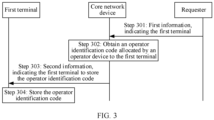
- Step 301 The requester sends first information to the core network device, where the first information indicates the first terminal.
- the requester does not indicate, to the core network device, the EPC that is for terminal management and that corresponds to each of the one or more terminals (including the first terminal) indicated by the first information, but an operator allocates an EPC code to the one or more terminals indicated by the first information.
- the requester may indicate a key requirement to the core network device, and the core network device may allocate the key to the terminal based on the key requirement.
- the first information further indicates a key requirement.
- the key requirement indicates that the one or more terminals indicated by the first information share one or more keys, indicates that the one or more terminals indicated by the first information respectively correspond to different keys, or indicates that terminals of a same type in the one or more terminals indicated by the first information share one or more keys, and terminals of different types respectively correspond to different keys.
- the core network device may determine, based on the first information, the one or more terminals (including the first terminal) to which the operator identification code needs to be allocated, to obtain the operator identification code allocated by the operator device to the one or more terminals.
- the operator device allocates different operator identification codes to different terminals, and an operator identification code may uniquely identify a terminal.
- the operator device and the core network device may be a same device, or may be different devices. If the operator device and the core network device are the same device, a process in which the core network device obtains the operator identification code allocated by the operator device to the one or more terminals includes: The core network device allocates the operator identification code to the one or more terminals, or the core network device selects the corresponding operator identification code for the one or more terminals from a prestored operator identification code. If the operator device and the core network device are not the same device, a process in which the core network device obtains the operator identification code allocated by the operator device to the one or more terminals includes: The core network device receives the operator identification code of the one or more terminals from the operator device.
- a process in which the core network device obtains the EPC that is for terminal management and that is allocated by the operator device to the one or more terminals includes: The core network device receives, from the operator device, the EPC for terminal management for the one or more terminals.
- Step 303 The core network device sends second information to the first terminal, where the second information indicates the first terminal to store the operator identification code.
- the first terminal receives the second information from the core network device.
- the second information indicates the first terminal to store the operator identification code.
- the second information includes the operator identification code allocated to the first terminal.
- the second information is a write command.
- the operator identification code is stored at a default storage location in the terminal, and the core network device does not need to indicate a storage location of the operator identification code to the terminal, so that signaling overheads can be reduced.
- the core network device may indicate the storage location of the operator identification code to the terminal.
- the second information indicates the first terminal to store the operator identification code
- the second information further includes first location information for storing the operator identification code.
- the first location information indicates a memory bank, for example, an EPC memory bank, a reserved memory bank, a TID memory bank, or a user memory bank.
- Storage locations that are for storing operator identification codes and that are indicated by the core network device to a plurality of terminals may be the same; or storage locations that are for storing operator identification codes and that are indicated by the core network device to terminals of a same type may be the same, and storage locations that are for storing operator identification codes and that are indicated by the core network device to terminals of different types may be different.
- designing may be performed based on different requirements. This is not limited in this application.
- the EPC memory bank of the terminal stores the default EPC stored by a manufacturer for the terminal or does not store the default EPC (in other words, the requester has not performed a procedure of storing, in the terminal, the EPC allocated by the requester to the terminal).
- the EPC for terminal management may also be stored in the terminal, and a procedure of storing the EPC for terminal management in the terminal does not need to be separately performed, so that signaling exchanging is reduced.
- the second information indicates the first terminal to store the operator identification code
- the second information further indicates the first terminal to store a first electronic product code EPC corresponding to the first terminal, where the first EPC may be allocated by the operator device to the first terminal, or the first EPC is from the requester.
- the first EPC is an EPC that is for terminal management and that is allocated by the operator device or the requester to the first terminal, and the first EPC uniquely identifies the first terminal.
- the EPC for terminal management is stored at a default storage location in the terminal, and the core network device does not need to indicate a storage location of the EPC to the terminal, so that signaling overheads are reduced.
- the second information indicates the first terminal to store the operator identification code
- the second information further indicates the first terminal to store the key.
- the second information includes the key allocated to the first terminal.
- the key is stored at a default storage location in the terminal, and the core network device does not need to indicate a storage location of the key to the terminal, so that signaling overheads can be reduced.
- the core network device may indicate the storage location of the key to the terminal.
- the second information further includes third location information for storing the key.
- the third location information indicates a memory bank, for example, the EPC memory bank, the reserved memory bank, the TID memory bank, or the user memory bank.
- Storage locations that are for storing keys and that are indicated by the core network device to a plurality of terminals may be the same; or storage locations that are for storing keys and that are indicated by the core network device to terminals of a same type may be the same, and storage locations that are for storing keys and that are indicated by the core network device to terminals of different types may be different.
- designing may be performed based on different requirements. This is not limited in this application.
- Step 304 The first terminal stores the operator identification code.
- the first terminal stores the operator identification code
- the first terminal stores the operator identification code at the default storage location
- the second information includes the first location information for storing the operator identification code allocated to the first terminal
- the first terminal stores, at a first storage location corresponding to the first location information, the operator identification code allocated to the first terminal.
- the storage location corresponding to the first location information may include a storage location of the EPC in the terminal in the conventional technology.
- the operator identification code may be stored at the storage location of the EPC, and the operator identification code may replace a function of the EPC, and the EPC does not need to be stored in the terminal. If the default EPC is stored at the storage location of the EPC, the operator identification code may overwrite the default EPC.
- the first terminal may further store the first EPC.
- the first EPC is allocated by the operator device or the requester.
- the first EPC may overwrite the default EPC.
- the first terminal stores the first EPC
- the first terminal stores the first EPC at the default storage location
- the second information includes the second location information for storing the first EPC
- the first terminal stores the first EPC at a second storage location corresponding to the second location information.
- the second location information indicates the EPC memory bank. If the default EPC is stored at the storage location of the EPC, the first EPC may overwrite the default EPC.
- the operator identification code allocated by the operator device to the terminal is stored in the terminal, and the operator may manage the terminal based on the operator identification code.
- the terminal further stores the EPC that is for terminal management and that is allocated by the operator device or the requester to the terminal, and the operator device or the requester may manage the terminal based on the EPC for terminal management.
- the first terminal may further store the key.
- the key may be allocated by the operator device or the requester to the first terminal.
- the first terminal stores the key, for example, the first terminal stores the key at the default storage location; or for another example, the second information includes the third location information for storing the key allocated to the first terminal, and the first terminal stores, at a third storage location corresponding to the third location information, the key allocated to the first terminal.
- the terminal stores the key allocated by the operator device or the requester to the terminal, and the operator device or the requester may perform authentication on the terminal based on the key.
- the first core network device is, for example, an AMF, a UDM, a TMF, an AUSF, an NSSAAF, an SMF, a UPF, a PCF, an NEF, or a UDR
- the second core network device is, for example, an AMF, a UDM, a TMF, an AUSF, an NSSAAF, an SMF, a UPF, a PCF, an NEF, or a UDR.
- the first core network device may directly communicate with the second core network device, or may communicate with the second core network device through another core network device.
- the first core network device may directly communicate with the requester, or may communicate with the requester through another core network device.
- the second core network device may directly communicate with the terminal/access network device, or may communicate with the terminal/access network device through another core network device.
- the following describes a communication procedure when the first core network device and the second core network device are different core network devices.
- Step 301 may be replaced with the following:
- the requester sends the first information to the first core network device, and correspondingly, the first core network device receives the first information from the requester.
- Step 302 may be replaced with the following:
- the first core network device obtains the operator identification code allocated by the operator device to the first terminal.
- the first core network device sends first indication information to the second core network device, where the first indication information indicates to write the corresponding operator identification code into the one or more terminals (including the first terminal).
- the second core network device receives the first indication information from the first core network device.
- the first indication information may be a request for writing the operator identification code into a blank tag.
- the first indication information On a basis that the first indication information indicates to write the corresponding operator identification code into the one or more terminals (including the first terminal), further optionally, the first indication information further includes the first location information for storing the operator identification code.
- the first indication information indicates to write the corresponding operator identification code into the one or more terminals (including the first terminal).
- the first indication information further indicates to write the corresponding EPC for terminal management (the EPC for managing the first terminal is referred to as the first EPC) into the one or more terminals (including the first terminal), where the EPC for terminal management (including the first EPC) is allocated by the operator device to the first terminal; or the EPC for terminal management (including the first EPC) is from the requester.
- the first indication information includes an association relationship between the operator identification code and the EPC for terminal management, and the operator identification code and the EPC for terminal management that are allocated to each terminal may be determined based on the association relationship.
- the first indication information may be a request for writing the operator identification code and the EPC into a blank tag.
- the first indication information further indicates to write the corresponding first EPC into the one or more terminals (including the first terminal), further optionally, the first indication information further includes the second location information for storing the EPC for terminal management (including the first EPC).
- the first indication information indicates to write the corresponding operator identification code into the one or more terminals (including the first terminal).
- the first indication information further indicates to write the corresponding key into the one or more terminals (including the first terminal).
- the key is allocated by the operator device to the first terminal, or the key is from the requester.
- the first indication information includes an association relationship between the operator identification code and the key, and the operator identification code and the key that are allocated to each terminal may be determined based on the association relationship.
- the first indication information may be a request for writing the operator identification code and the key into a blank tag.
- the first indication information indicates to write the corresponding operator identification code, the EPC for terminal management, and the key into the one or more terminals (including the first terminal).
- the first indication information includes the association relationship between the operator identification code, the EPC for terminal management, and the key.
- the operator identification code allocated to each terminal, the EPC for terminal management, and the key may be determined based on the association relationship.
- the first indication information may be a request for writing the operator identification code, the EPC for terminal management, and the key into a blank tag.
- the first indication information may further indicate the key requirement.
- the first indication information includes a default EPC range
- the default EPC range includes the default EPC of the first terminal.
- the second core network device determines, based on the default EPC range, that an operator identification code needs to be allocated to a terminal whose default EPC belongs to the default EPC range.
- the first indication information includes one or more default EPCs
- the one or more default EPCs include the default EPC of the first terminal.
- the second core network device determines, based on the one or more default EPCs, that an operator identification code needs to be allocated to a terminal whose default EPC belongs to the one or more default EPCs.
- the first indication information includes one or more target TID types, and the TID of the first terminal belongs to the target TID type.
- the second core network device determines, based on the one or more target TID types, that an operator identification code needs to be allocated to a terminal whose TID type belongs to the one or more target TID types.
- the first indication information includes one or both of the following: the tag identifier TID type of the first terminal, and the default electronic product code EPC of the first terminal.
- the second core network device may determine the first terminal based on the information included in the first indication information, and certainly may further determine another terminal.
- the first indication information may further include a service range.
- the service range is used to query the access network device.
- Step 303 may be replaced with the following:
- the second core network device sends the second information to the first terminal.
- the first terminal After the first terminal accesses the access network device, the first terminal sends the default EPC of the first terminal to the core network device (or the second core network device) through the access network device.
- the core network device receives the default EPC from the first terminal. Further, the core network device (or the second core network device) sends the second information to the first terminal.
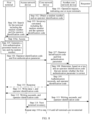
- step 401 For a process of step 401, refer to the process of step 301. Details are not described again.
- the UDM may further obtain the key allocated by the operator device to the one or more terminals (including the first terminal), where keys corresponding to different terminals may be different or may be the same.
- step 302 the core network device obtains the key allocated by the operator device to the one or more terminals (including the first terminal).
- the UDM may check whether the key corresponding to the one or more terminals is locally stored. If the key is stored, the UDM may directly use the key. If the key is not locally stored, the UDM requests, from an NRF, information (such as address information) about a key storage network element. A network element that stores key information registers with the NRF. Therefore, the NRF knows the network element that stores the key information.
- the NRF sends, to the UDM, the information about the key storage network element.
- the UDM receives the information that is about the key storage network element and that is sent by the NRF.
- the network element is, for example, a UDR or an AUSF.
- the UDM requests, from the key storage network element and based on the information about the network element, the key that corresponds to the one or more terminals and that is indicated by the first information. For example, the UDM sends a request message to the key storage network element, where the request message is used to request one or more keys.
- the request message may further indicate a key requirement, and the key storage network element allocates the corresponding key to the one or more terminals based on the key requirement.
- the request message may further indicate a default EPC code range and/or TID type.
- the key storage network element sends, to the UDM, the key corresponding to the one or more terminals.
- the UDM receives the key that corresponds to the one or more terminals and that is sent by the key storage network element.
- both the operator identification code and the key may be obtained from the key storage network element.
- the UDM sends a request message to the key storage network element, where the request message is used to request the operator identification code and the key that correspond to the one or more terminals.
- the key storage network element sends, to the UDM, the operator identification code and the key that correspond to each of the one or more terminals.
- the UDM receives the operator identification code and the key that correspond to each of the one or more terminals and that are sent by the key storage network element.
- the UDM For each terminal indicated by the first information from the AF, the UDM stores a mapping relationship between an operator identification code and a key that are allocated to the terminal. Further, optionally, for each terminal indicated by the first information from the AF, the UDM stores a mapping relationship between an operator identification code, an EPC for terminal management, and a key that are allocated to the terminal.
- the TMF receives the first indication information from the UDM.
- the first indication information further includes first location information for storing the operator identification code.
- the first indication information further indicates to write the corresponding EPC for terminal management into the one or more terminals (including the first terminal). Further, optionally, the first indication information further includes second location information for storing the EPC for terminal management (including a first EPC).
- the first indication information further indicates to write the corresponding key into the one or more terminals (including the first terminal). Further, optionally, the first indication information further includes the third location information for storing the key. Further, optionally, the first indication information further includes a key requirement.
- step 403 For a process of step 403, refer to the foregoing described process in which the first core network device sends the first indication information to the second core network device. Details are not described again.
- an operator identification code writing procedure may be separately performed for terminals of different types; or operator identification code writing procedures may be simultaneously performed for terminals of a plurality of types.
- a procedure of writing an EPC for terminal managements may be performed separately; or for terminals of a plurality of types, procedures of writing EPCs for terminal management may be simultaneously performed.
- a key writing procedure may be separately performed for terminals of different types, or key writing procedures may be simultaneously performed for terminals of a plurality of types.
- Step 404 The TMF determines an access network device based on a service range.
- the TMF stores an association relationship between the operator identification code and the EPC for terminal management.
- the TMF stores an association relationship between the operator identification code and the key.
- the TMF stores an association relationship between the operator identification code, the EPC for terminal management, and the key.
- Step 405 The TMF sends third information to the access network device determined in step 404, where the third information indicates to search for the one or more terminals (including the first terminal).
- the access network device receives the third information from the TMF.
- step 405 For a process of step 405, refer to the foregoing described process in which the second core network device sends the third information to the access network device. Details are not described again.
- Step 406 The access network device searches for the one or more terminals (including the first terminal) based on the third information.
- Terminal searching may also be understood as terminal selection or terminal filtering.
- step 406 refer to the foregoing process in which the access network device searches for the one or more terminals (including the first terminal) based on the third information.
- the access network device sends radio frequency information to a terminal in a coverage area of the access network device based on the third information, to provide an excitation signal for the terminal in the coverage area of the access network device, so that the terminal sends a signal to the access network device.
- the access network device performs a selection operation on the terminal in the coverage area, to select the one or more terminals by performing the selection operation. Further, the access network device sends a query command to the selected one or more terminals (including the first terminal), to search for the one or more terminals (including the first terminal).
- step 407 For a process of step 407, refer to the foregoing described process in which the first terminal in the one or more found terminals accesses the access network device.
- the query command sent by the access network device to the one or more terminals includes the TID type of the one or more terminals or the default EPC of the one or more terminals.
- the one or more terminals may match the TID type in the query command with a TID type of the terminal, or match the default EPC in the query command with a default EPC of the terminal, and initiate a random access procedure after the matching succeeds.
- the one or more terminals may match the TID type in the query command with the TOD type of the terminal, or match the default EPC in the query command with the default EPC of the terminal, and initiate a random access procedure after the matching succeeds.
- the first terminal may alternatively first initiate a random access procedure. After random access succeeds, before step 408, the first terminal matches the information in the query command with information of the first terminal. After the matching succeeds, step 408 is performed.
- Step 408 The first terminal sends a request message to the access network device.
- the access network device receives the request message from the first terminal.
- the request message includes a default EPC of the first terminal.
- the request message may be a registration request message, an access request message, a request message used for the access network device, or a request message used for network registration.
- a name of the request message is not limited in this application.
- the request message may be a non-access stratum (non-access stratum, NAS) message or a non-NAS message.
- Step 409 The access network device transparently transmits the request message to the TMF.
- Step 410 The TMF sends a response message to the first terminal.
- the first terminal receives the response message from the TMF.
- the response message may be a registration accept message, indication information indicating that access of the first terminal succeeds, an access success message, a response message for successful network access, or a response message for successful network registration.
- a name of the response message is not limited in this application.
- the TMF transparently transmits the response message to the first terminal through the access network device.
- Step 411 The TMF sends second information to the first terminal, where the second information indicates the first terminal to store the operator identification code.
- the first terminal may further store the first EPC allocated to the first terminal.
- Step 417 The UDM sends the write complete indication information to the AF.
- the indication information may indicate that one or more of the operator identification code, the EPC for terminal management, and the key are written.
- Writing complete may be replaced with writing success, inventory complete, subscription success, printing success, or the like.
- step 417 includes one or more of the following items allocated to the one or more (including the first terminal): an EPC code (an EPC for terminal management but not the default EPC) range, the operator identification code, and the key.
- EPC code an EPC for terminal management but not the default EPC
- the UDM when the UDM receives the first information from the AF, where the first information indicates to allocate the key to the one or more terminals (including the first terminal), and the first information does not include the key corresponding to each of the one or more terminals (including the first terminal), in step 403a of the example in FIG. 4 , after learning, through the NRF, of the key storage network element, the UDM obtains, from the key storage network element, the key corresponding to the one or more terminals (including the first terminal), and sends the key corresponding to the one or more terminals to the TMF.
- the UDM indicates that the TMF needs to print a key for the one or more terminals. Then, the TMF learns, through the NRF, of the information about the key storage network element. Then, the TMF obtains, based on the information about the key storage network element, the key corresponding to the one or more terminals (including the first terminal) from the key storage network element.
- the TMF obtains, from the key storage network element, the key corresponding to the one or more terminals (including the first terminal).
- the key storage network element there are a plurality of implementations.
- the TMF obtains, from the key storage network element, the key corresponding to the one or more terminals (including the first terminal).
- the key storage network element obtains, from the key storage network element, the key corresponding to the one or more terminals (including the first terminal). This manner may be understood as that, before any one of the one or more terminals is found, keys corresponding to the one or more terminals (including the first terminal) are obtained in batches from the key storage network element.
- the TMF obtains, from the key storage network element, the key corresponding to the one or more terminals (including the first terminal).
- the TMF obtains, from the key storage network element, the key corresponding to the one or more terminals (including the first terminal).
- This manner may be understood as that, when a 1 st terminal (namely, the first terminal) in the one or more terminals is found, keys corresponding to the one or more terminals (including the first terminal) are obtained in batches from the key storage network element.
- the TMF obtains, from the key storage network element, the key corresponding to the first terminal.
- This manner may be understood as that, when any terminal is found, a key corresponding to the terminal is found from the key storage network element.
- the first core network device is the UDM
- the first core network device may alternatively be an NEF.
- the first core network device may alternatively be an NEF.
- the operator identification code, the EPC for terminal management, and the key may be written into the one or more terminals in one procedure; the operator identification code, the EPC for terminal management, and the key may be written into the one or more terminals in three procedures; or any two of the operator identification code, the EPC for terminal management, and the key may be written into the one or more terminals in one procedure, and the remaining one of the operator identification code, the EPC for terminal management, and the key may be written into the one or more terminals in another procedure.
- an operator may manage the terminal based on the operator identification code.
- the operator or the requester may manage the terminal based on the EPC for terminal management (all EPCs described in the following examples are EPCs used for terminal management, but are not default EPCs).
- a first core network device a core network device that communicates with a requester
- a second core network device a core network device that communicates with a terminal/an access network device
- the first core network device and the second core network device are collectively referred to as a core network device
- the first core network device and the second core network device are the same, and the first core network device and the second core network device are referred to as a core network device for short is used for description.
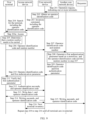
- FIG. 5 is a possible flowchart of communication in which an operator manages a terminal according to an embodiment of this application.
- a capability of a first terminal is reporting an EPC by default.
- the first terminal may actively send a first EPC allocated to the first terminal.
- a core network device may request, based on the first EPC of the first terminal, an operator identification code allocated to the first terminal.
- Step 501 A requester sends fourth information to the core network device, where the fourth information indicates one or more terminals (including the first terminal).
- the core network device receives the fourth information from the requester.
- the fourth information may indicate the first terminal in one or more of the following manners:
- the fourth information includes an EPC range, and the EPC range includes the first EPC of the first terminal.
- the fourth information may be understood as an EPC range that needs to be managed and that is sent by the requester to the core network device.
- the core network device determines, based on the EPC range, that a terminal whose EPC belongs to the EPC range needs to be managed.
- the fourth information includes one or more EPCs, and the one or more EPCs include the first EPC of the first terminal.
- the fourth information may be understood as one or more EPCs that need to be managed and that are indicated by the requester to the core network device.
- the core network device determines, based on the one or more EPCs, that a terminal whose EPC belongs to the one or more EPCs needs to be managed.
- the fourth information includes one or more target TID types, and a TID of the first terminal belongs to the target TID type.
- the fourth information may be understood as one or more target TID types that need to be managed and that is indicated by the requester to the core network device.
- the core network device determines, based on the one or more target TID types, that a terminal whose TID type belongs to the one or more target TID types needs to be managed.
- the fourth information includes information about the requester.
- the information about the requester may indicate the EPC range or the one or more EPCs corresponding to (or managed by) the requester.
- the EPC range or the one or more EPCs corresponding to (or managed by) the requester include the first EPC of the first terminal.
- the core network device may determine, based on the information about the requester, a terminal whose EPC belongs to the EPC range or the one or more EPCs corresponding to (or managed by) the requester needs to be managed.
- step 301 For the information about the requester, refer to the descriptions in step 301. Details are not described again.
- the EPC range or the one or more EPCs corresponding to (or managed by) the requester may be stored or configured on the core network device, or may be stored or configured on another core network device.
- the core network device may send the information about the requester to another core network device, and the another core network device obtains, based on the information about the requester, the EPC range or the one or more EPCs corresponding to (or managed by) the requester, and sends the EPC range or the one or more EPCs to the core network device.
- the another core network device may include a core network device such as a UDM, a UDR, an AUSF, an NEF, a PCF, an SMF, a TMF, or an NSSAAF.
- the fourth information includes one or more of the following: a tag identifier TID type of the first terminal, the first electronic product code EPC of the first terminal, and the information about the requester.
- the core network device may determine the first terminal based on the first information, and certainly may further determine another terminal.
- the first information may indicate to perform a first operation on the one or more terminals (including the first terminal).
- the first operation may be an operation of obtaining an identifier of the first terminal (which may also be referred to as an inventory operation, a stocktaking operation, or inventory), a read operation, a write operation, a delete operation, an encrypt operation, an access operation, a block write operation, a block erase operation, a kill operation, or the like.
- the first information includes information about the first operation, and the information about the first operation indicates the first operation. Further, optionally, the first information further includes an operation parameter corresponding to the first operation.
- an operation parameter corresponding to a read operation may include a read memory bank, a start byte address of the read memory bank, a quantity of bytes of the read memory bank, and the like.
- An operation parameter corresponding to a write operation may include a write memory bank, a start byte of the read memory bank, and written data.
- the operation of obtaining the identifier of the first terminal (which may also be referred to as an inventory operation, a stocktaking operation, or inventory) may not be carried in the first information. For example, when the first information does not include the first operation, it may indicate that the first information is used to obtain the identifier of the first terminal.
- the fourth information may further include a service range.
- the service range includes target area information A, where the target area information A indicates an area corresponding to one or more terminals to which an operator identification code needs to be allocated.
- the target area information A may be a geographical location, a municipal location, or 3GPP location information (such as a tracking area (tracking area, TA) list or a cell list) corresponding to the one or more terminals to which the operator identification code needs to be allocated.
- the service range is used to query the access network device.
- Step 502 The core network device sends fifth information to the access network device, where the fifth information indicates to search for the one or more terminals (including the first terminal).
- the access network device receives the fifth information from the core network device.
- the fifth information may further indicate to search for another terminal.
- the access network device may determine, based on the fifth information, the one or more terminals that need to be searched for, where the one or more terminals that need to be searched for include the first terminal.
- the fifth information may be referred to as an inventory request or an inventory request.
- the fifth information may indicate the first terminal in one or more of the following manners.
- the fifth information includes the EPC range, and the EPC range includes the EPC of the first terminal.
- the access network device determines, based on the EPC range, that a terminal whose EPC belongs to the EPC range needs to be searched for.
- the enterprise identifier is an enterprise code, an application code, or a service code allocated by an operator device to the first terminal (refer to step 402); or the enterprise identifier is a service identifier in a CompanyPrefix in an EPC memory bank of the one or more terminals (including the first terminal).
- the enterprise identifier may also be replaced with a service identifier or an application identifier. It may be understood that the enterprise identifier, the application identifier, and the service identifier may uniquely identify a type of terminal.
- a definition of "type" may be flexible. For example, an enterprise is a type, a department or several departments of an enterprise is/are a type, a service is a type, and several services are a type. Names of the enterprise identifier, the application identifier, and the service identifier should not limit the scenario.
- the EPC when the fifth information includes the PLMN ID and the enterprise identifier, the EPC may be optional. When no EPC is included, it may be understood that the fifth information indicates to search for all EPCs managed by an enterprise corresponding to the enterprise identifier. When the EPC is included, it may be understood that the fifth information indicates to search for an EPC that matches the EPC included in the fifth information and that is in an EPC managed by an enterprise corresponding to the enterprise identifier.
- the fifth information includes one or more of the following: the tag identifier TID type of the first terminal, the first EPC of the first terminal, the operator identification code associated with the first EPC of the first terminal, a PLMN ID allocated to the first terminal, and an enterprise identifier allocated to the first terminal.
- the access network device may determine the first terminal based on the fifth information, and certainly may further determine another terminal.
- Step 503 The access network device searches for the one or more terminals (including the first terminal) based on the fifth information.
- Terminal searching may also be understood as terminal selection or terminal filtering.
- the query command sent by the access network device to the one or more terminals includes one or more of the following: a TID type of the one or more terminals, an EPC of the one or more terminals, the operator identification code associated with the EPC of the one or more terminals, the PLMN ID allocated to the one or more terminals, and the enterprise identifier allocated to the one or more terminals.
- a process in which the first terminal in the one or more found terminals accesses the access network device includes: The one or more terminals initiate a random access procedure after receiving the query command, where one terminal (namely, the first terminal) successfully performs random access, in other words, accesses the access network device.
- the random access procedure may be as follows: After receiving the query command, the one or more terminals separately send a random number to the access network device, and the access network device may correctly receive a random number, and feed back the correctly received random number to the terminal. The terminal that sends the random number determines that random access succeeds.
- the query command sent by the access network device to the one or more terminals includes one or more of the following: the TID type of the one or more terminals, the EPC of the one or more terminals, the operator identification code associated with the EPC of the one or more terminals, the PLMN ID allocated to the one or more terminals, and the enterprise identifier allocated to the one or more terminals.
- the terminal may match information in the query command with information of the terminal. After the matching succeeds, the terminal initiates a random access procedure (for example, sends a random number to the access network device).
- the first terminal may alternatively first initiate a random access procedure. After random access succeeds, before step 505, the first terminal matches the information in the query command with information of the first terminal. After the matching succeeds, step 505 is performed.
- the first terminal may actively send, to the core network device through the access network device, the first EPC allocated to the first terminal.
- that the first terminal sends, to the core network device, the first EPC allocated to the first terminal includes: The first terminal sends a request message to the core network device through the access network device, where the request message includes the first EPC allocated to the first terminal.
- the access network device transparently transmits the request message.
- the request message may be a registration request message, an access request message, a request message used for the access network device, or a request message used for network registration. A name of the request message is not limited in this application.
- the request message may be a non-access stratum (non-access stratum, NAS) message or a non-NAS message.
- Step 506 The core network device may determine, based on the first EPC and subscription information of the first terminal, that an operator or the requester needs to perform authentication on the first EPC, and then perform step 507.
- the core network device may not need to perform step 507.
- the subscription information includes information about whether the authentication needs to be performed on the EPC.
- Step 506 is an optional step, and may not be performed.
- Step 507 The core network device triggers authentication between the first terminal and the operator device or the requester based on the first EPC. Step 507 is an optional step, and may not be performed.
- Step 508 The core network device may determine that the first EPC is associated with the operator identification code, and then perform step 509.
- step 509 may not be performed.
- the TMF stores an association relationship between the operator identification code and the EPC for terminal management.
- Step 508 is an optional step, and may not be performed.
- Step 509 The core network device requests, from the first terminal based on the first EPC, to obtain the operator identification code allocated to the first terminal.
- the first terminal receives the request that is from the core network device and that is for requesting, from the first terminal based on the first EPC, to obtain the operator identification code allocated to the first terminal.
- the core network device sends, to the first terminal, a request for obtaining the operator identification code allocated to the first terminal.
- the first terminal receives, from the core network device, the request for obtaining the operator identification code allocated to the first terminal, where the request includes the EPC of the first terminal.
- step 506, step 507, step 508, and step 509 is not limited.
- Step 510 The first terminal sends, to the core network device, the operator identification code allocated to the first terminal.
- the core network device receives the operator identification code allocated to the first terminal.
- Step 511 The core network device may determine, based on the operator identification code and the subscription information of the first terminal, that the operator needs to perform authentication on the operator identification code.
- the subscription information includes information about whether the authentication needs to be performed on the operator identification code.
- Step 511 is an optional step, and may not be performed.
- Step 512 The core network device triggers authentication between the first terminal and the operator device based on the operator identification code.
- the authentication based on the operator identification code may be understood as follows: In an authentication procedure between the terminal and the operator device, a parameter (a random number, a check value, and ciphertext information) used for the authentication and the operator identification code are in a same message. In this way, it may be determined that the authentication is performed for the terminal identified by the operator identification code. Alternatively, the terminal is first determined as a unique terminal based on the operator identification code. In an authentication procedure, even if a message carrying an authentication parameter (a random number, a check value, and ciphertext information) does not carry the operator identification code, it may be determined that the authentication is performed for the terminal identified by the operator identification code.
- Step 601 A requester sends fourth information to a core network device, where the fourth information indicates one or more terminals (including the first terminal).
- the core network device receives the fourth information from the requester.
- step 601 For a process of step 601, refer to the process of step 501. Details are not described again.
- Step 602 The core network device sends fifth information to the access network device, where the fifth information indicates to search for the one or more terminals (including the first terminal) and request to obtain an operator identification code allocated to the one or more terminals (including the first terminal).
- the access network device receives the fifth information from the core network device.
- the fifth information may indicate, by using a specific information format, to request to obtain the operator identification code allocated to the one or more terminals (including the first terminal), or the fifth information includes indication information for requesting to obtain the operator identification code, so as to indicate, to the access network device, to request to obtain the operator identification code allocated to the one or more terminals (including the first terminal).
- the indication information for requesting to obtain the operator identification code may occupy one bit or more bits, and a value of the bit indicates to request to obtain the operator identification code. For example, when a value of one bit at a specific location is extended or the value of the bit is set to 1, it indicates to obtain the operator identification code is obtained; and when the value of the bit at the location is 0 or is set to 0, it indicates not to obtain the operator identification code.
- the indication information for requesting to obtain the operator identification code may be considered as a mark for SUPI replication or a mark for SUPI-like replication.
- the core network device may determine that an operator needs to perform authentication on the one or more terminals.
- the fifth information may indicate to request to obtain the operator identification code allocated to the first terminal. If the operator does not need to perform the authentication, the fifth information may not indicate to request to obtain the operator identification code allocated to the first terminal.
- Step 603 The access network device searches for the one or more terminals (including the first terminal) based on the fifth information, and indicates the one or more terminals (including the first terminal) to send the operator identification code allocated to the terminal.
- Terminal searching may also be understood as terminal selection or terminal filtering.
- the indication information for sending the operator identification code may occupy one bit or even more bits, and a value of the bit indicates to request to obtain the operator identification code. For example, when the value of the bit at the location is 1 or set to 1, it indicates to obtain the operator identification code; and when the value or the value is set to 0, it indicates not to obtain the operator identification code.
- Step 604 The first terminal in the one or more found terminals accesses the access network device.
- step 604 For a process of step 604, refer to the descriptions of step 504. Details are not described again.
- the core network device receives the operator identification code and the first EPC that are allocated to the first terminal.
- the capability of the first terminal is reporting the EPC by default. After accessing the access network device (for example, the random access succeeds), the first terminal may actively send the first EPC allocated to the first terminal. In a process of searching for the first terminal, the access network device indicates the first terminal to send the operator identification code allocated to the first terminal. In this way, after accessing the access network device (for example, the random access succeeds), the first terminal may send the operator identification code allocated to the first terminal.
- that the first terminal sends, to the core network device, the operator identification code and the first EPC that are allocated to the first terminal includes: The first terminal sends a request message to the core network device through the access network device, where the request message includes the operator identification code and the first EPC that are allocated to the first terminal.
- the access network device transparently transmits the request message.
- the request message may be a registration request message, an access request message, a request message used for the access network device, or a request message used for network registration. A name of the request message is not limited in this application.
- the request message may be a non-access stratum (non-access stratum, NAS) message or a non-NAS message.
- Step 606 The core network device may determine, based on the operator identification code and subscription information of the first terminal, that the operator needs to perform authentication on the operator identification code.
- the subscription information includes information about whether the authentication needs to be performed on the operator identification code.
- Step 606 is an optional step, and may not be performed.
- Step 607 The core network device triggers authentication between the first terminal and an operator device based on the operator identification code.
- step 607 For a process of step 607, refer to the process of step 512. Details are not described again.
- Step 608 The core network device may determine, based on the first EPC and the subscription information of the first terminal, that the operator or the requester needs to perform authentication on the first EPC, and then perform step 609.
- the core network device may not need to perform step 600.
- the subscription information includes information about whether the authentication needs to be performed on the EPC.
- Step 609 The core network device triggers authentication between the first terminal and the operator device or the requester based on the first EPC of the first terminal.
- Step 609 is an optional step, and may not be performed.
- step 606, step 607, step 608, and step 609 is not limited.
- FIG. 7 is a possible flowchart in which an operator manages a terminal according to an embodiment of this application.
- a capability of a first terminal is reporting an operator identification code by default. After accessing an access network device (for example, random access succeeds), the first terminal may actively send an operator identification code allocated to the first terminal.
- Step 701 A requester sends fourth information to a core network device, where the fourth information indicates the first terminal.
- the core network device receives the fourth information from the requester.
- step 701 refer to the descriptions of step 501. Details are not described again.
- Step 702 The core network device sends fifth information to an access network device, where the fifth information indicates to search for one or more terminals (including the first terminal).
- the access network device receives the fifth information from the core network device.
- step 702 refer to the descriptions of step 502. Details are not described again.
- Step 703 The access network device searches for the one or more terminals (including the first terminal) based on the fifth information.
- step 703 refer to the descriptions of step 503. Details are not described again.
- Step 704 The first terminal in the one or more found terminals accesses the access network device.
- step 704 For a process of step 704, refer to the descriptions of step 504. Details are not described again.
- Step 705 The first terminal sends, to the core network device, the operator identification code allocated to the first terminal.
- the core network device receives the operator identification code allocated to the first terminal.
- that the first terminal sends, to the core network device, the operator identification code allocated to the first terminal includes: The first terminal sends a request message to the core network device through the access network device, where the request message includes the operator identification code allocated to the first terminal.
- the access network device transparently transmits the request message.
- the request message may be a registration request message, an access request message, a request message used for the access network device, or a request message used for network registration. A name of the request message is not limited in this application.
- the request message may be a non-access stratum (non-access stratum, NAS) message or a non-NAS message.
- Step 706 The core network device may determine, based on the operator identification code and subscription information of the first terminal, that an operator needs to perform authentication on the operator identification code.
- the subscription information includes information about whether the authentication needs to be performed on the operator identification code.
- Step 706 is an optional step, and may not be performed.
- Step 707 The core network device triggers authentication between the first terminal and an operator device based on the operator identification code.
- step 707 For a process of step 707, refer to the process of step 512. Details are not described again.
- a first EPC allocated to the first terminal may be further received in step 705.
- a manner of obtaining the EPC may include: Manner 1: After the operator identification code allocated to the first terminal is obtained, the first terminal receives the request that is from the core network device and that is for requesting, from the first terminal based on the operator identification code, to obtain the first EPC allocated to the first terminal.
- the core network device sends, to the first terminal, a request for obtaining the first EPC allocated to the first terminal.
- the first terminal receives, from the core network device, the request for obtaining the first EPC allocated to the first terminal, where the request includes the operator identification code of the first terminal.
- step 702 the fifth information sent by the core network device to the access network device indicates to search for the one or more terminals (including the first terminal), and further indicates to request to obtain an EPC allocated to the one or more terminals (including the first terminal).
- the fifth information may indicate, by using a specific information format, to request to obtain the EPC allocated to the one or more terminals (including the first terminal), or the fifth information includes indication information for requesting to obtain the EPC, so as to indicate, to the access network device, to request to obtain the EPC allocated to the one or more terminals (including the first terminal).
- the indication information for requesting to obtain the EPC may be a mark for EPC replication.
- step 708 may be performed: The core network device may determine, based on the first EPC and the subscription information of the first terminal, that the operator or the requester needs to perform authentication on the first EPC, and then perform step 709. If the authentication does not need to be performed, step 709 may not be performed. Step 708 is an optional step, and may not be performed.
- Step 709 The core network device may trigger authentication between the first terminal and the operator device or the requester based on the first EPC.
- step 706, step 707, step 708, and step 709 is not limited.
- a first operation is one or more of a read operation, a write operation, a delete operation, an encrypt operation, an access operation, a block write operation, a block erase operation, or a kill operation.
- the core network device may further perform the first operation on the first terminal.
- the core network device may send a response message to the first terminal.
- the first terminal receives the response message from the core network device.
- the response message may be a registration accept message, indication information indicating that access of the first terminal succeeds, an access success message, a response message for successful network access, or a response message for successful network registration.
- a name of the response message is not limited in this application.
- the core network device transparently transmits the response message to the first terminal through the access network device.
- the core network device may further send, to the access network device, indication information for next terminal inventory.
- the access network device receives, from the core network device, the indication information for the next terminal inventory. Inventory may be understood as managing a next terminal, or performing the first operation on the next terminal.
- step 503 to step 512 may be repeatedly performed.
- step 603 to step 609 may be repeatedly performed.
- step 703 to step 709 may be repeatedly performed.
- the access network device may send, to the core network device, inventory complete indication information.
- the core network device may send an inventory result to the requester.
- first core network device and a second core network device are different core network devices
- information is exchanged between the first core network device and the second core network device.
- FIG. 5 , FIG. 6 , and FIG. 7 the following describes a communication procedure when the first core network device and the second core network device are different core network devices.
- Step 501, step 601, and step 701 may be replaced with that the requester sends the fourth information to the first core network device, and correspondingly, the first core network device receives the fourth information from the requester.
- Step 502, step 601, and step 701 may be replaced with that the second core network device sends the fifth information to the access network device, and correspondingly, the second core network device receives the fifth information from the requester.
- the first core network device sends second indication information to the second core network device, where the second indication information indicates the one or more terminals.
- the second core network device receives the second indication information from the first core network device.
- the core network device is the first core network device when communicating with the first terminal or the access network device, and the core network device is the second core network device when communicating with the requester.
- the core network device is the first core network device when communicating with the first terminal or the access network device
- the core network device is the second core network device when communicating with the requester.
- FIG. 8 is a schematic flowchart in which a network performs authentication on a terminal based on a key.
- Step 101 A requester (for example, an AF) sends an operation request to a core network device (for example, a TMF), where the operation request indicates one or more terminals (including a first terminal).
- a core network device for example, a TMF
- the core network device receives the operation request from the requester.
- Step 102 If the core network device (for example, the TMF) determines that operator-side authentication needs to be performed on the one or more terminals indicated in the operation request, the core network device obtains a random number and an operator identification code that are required for the authentication.
- the core network device for example, the TMF
- the access network device receives the inventory command from the core network device (for example, the TMF).
- the core network device for example, the TMF.
- the access network device may send the random numbers to the corresponding terminals in a search process.
- the first terminal may send a first EPC or an operator identification code of the first terminal to the access network device, and the access network device identifies the first terminal based on the first EPC or the operator identification code, and sends, to the first terminal, a random number corresponding to the first terminal.
- Step 105 The first terminal generates a first authentication parameter based on a pre-printed key and the received random number.
- Step 106 The first terminal sends a request message to the core network device (for example, the TMF) through the access network device.
- the core network device for example, the TMF
- the request message may be a registration request message, an access request message, a request message used for the access network device, or a request message used for network registration.
- a name of the request message is not limited in this application.
- the request message may be a non-access stratum (non-access stratum, NAS) message or a non-NAS message.
- Step 107 The core network device (for example, the TMF) sends an authentication request message to another core network device (for example, a UDR or an AUSF).
- another core network device for example, a UDR or an AUSF.
- the authentication request message includes the operator identification code and the first authentication parameter from the first terminal in step 106.
- Step 108 The another core network device determines, based on the operator identification code and the key that are stored for the first terminal, whether the first authentication parameter is correct.
- the another core network device stores an association relationship between an operator identification code and a key, and the another core network device may find, based on the operator identification code of the first terminal in step 107, the key associated with the operator identification code of the first terminal.
- Step 109 The another core network device sends, to the core network device, indication information indicating that the network successfully authenticates the first terminal.
- the another core network device sends, to the core network device, indication information indicating that the network fails to authenticate the first terminal.
- the core network device receives, from the another core network device, the indication information indicating that the network fails to authenticate the first terminal.
- a message flag bit may be set to indicate whether the authentication succeeds. For example, if the message flag bit is set to 1, it indicates that the network successfully authenticates the first terminal; or if the message flag bit is set to 0, it indicates that the network fails to authenticate the first terminal.
- the indication information indicating that the network successfully authenticates the first terminal or the indication information indicating that the network fails to authenticate the first terminal includes the operator identification code of the first terminal, and the first terminal is identified by using the operator identification code of the first terminal.
- the core network device sends a response message to the first terminal.
- the first terminal receives the response message from the core network device.
- the response message may be a registration accept message, indication information indicating that access of the first terminal succeeds, an access success message, a response message for successful network access, or a response message for successful network registration.
- a name of the response message is not limited in this application.
- the core network device transparently transmits the response message to the first terminal through the access network device.
- the network completes the authentication on the first terminal. If the network successfully authenticates the first terminal, the core network device (for example, the TMF) may write the data 1 into the first terminal based on the operation request in step 101. If the network fails to authenticate the first terminal, a subsequent process is not performed.
- the core network device for example, the TMF
- Step 111 The core network device (for example, the TMF) sends, to the first terminal, indication information for writing the data 1.
- the core network device for example, the TMF
- the indication information includes the operator identification code of the first terminal.
- the core network device transparently transmits the indication information to the first terminal through the access network device.
- Step 112 The first terminal sends writing success indication information to the core network device (for example, the TMF).
- the core network device for example, the TMF.
- the indication information includes the operator identification code of the first terminal.
- Step 113 The core network device (for example, the TMF) sends the writing success indication information to the requester (for example, the AF).
- the requester for example, the AF
- a sequence of step 113 and step 114 is not limited.
- Step 801 A first requester (which may be understood as a first enterprise) sends an inventory request to a core network device, where the inventory request includes an EPC range or one or more EPCs.
- the core network device receives the inventory request from the first requester.
- the core network device may verify, by using subscription information of an enterprise stored in the core network device or another core network device, whether the EPC in the inventory request belongs to the EPC range registered by the first requester.
- the core network device determines that the EPC in the inventory request belongs to an EPC range registered by (or subscribed to, or managed by) a second requester (which may be understood as a second enterprise).
- Step 803 The core network device sends inventory reject indication information to the first requester.
- the inventory reject indication information may be understood as alarm information or information indicating no query.
- the inventory reject indication information carries a cause.
- the cause is that the EPC in the inventory request does not belong to the EPC range registered by the first requester.
- step 801 in FIG. 10 refer to step 501 in FIG. 5 , step 601 in FIG. 6 , and step 701 in FIG. 7 .
- the inventory request may be understood as the fourth information in step 501, step 601, and step 701, where the fourth information includes the EPC range or the one or more EPCs. Other details are not described again.
- the inventory request may include an EPC range managed by the second enterprise, or an EPC of the one or more terminals, to indicate the one or more terminals managed by the second requester.
- Step 902 The core network device may determine, based on information about the first requester, a public land mobile network identifier PLMN ID and an enterprise identifier that are allocated to the terminal.
- the enterprise identifier determined based on the information about the first requester is an identifier of the first enterprise.
- Step 903 The core network device sends an inventory command to the access network device, where the inventory command includes the PLMN ID and the identifier of the first enterprise that are determined in step 902, and an EPC registered by the second enterprise in step 901.
- Terminal searching may also be understood as terminal selection or terminal filtering.
- Terminal searching may also be understood as terminal selection or terminal filtering.
- a query command sent by the access network device to the one or more terminals includes the PLMN ID, the identifier of the first enterprise, and the EPC registered by the second enterprise.
- Step 905 The first terminal in the one or more found terminals accesses the access network device.
- Step 904 and step 905 are repeatedly performed, and the access network device always cannot receive a reply from the terminal.
- the access network device sends, to the core network device, inventory complete indication information.
- the core network device sends an inventory result to the first requester, where the inventory result may be empty.
- the apparatus may be divided into functional modules based on the foregoing method examples.
- the apparatus may be divided into functional modules corresponding to functions, or two or more functions may be integrated into one module.
- These modules may be implemented in a form of hardware, or may be implemented in a form of a software functional module. It should be noted that, in embodiments of this application, module division is an example, and is merely logical function division. In a specific implementation, another division manner may be used.
- FIG. 12 provides a diagram of a structure of a communication apparatus 1000.
- the communication apparatus 1000 may include one or more of the following: a processing module 1010, a receiving module 1020a, a sending module 1020b, and a storage module 1030.
- the processing module 1010 may be separately connected to the storage module 1030, the receiving module 1020a, and the sending module 1020b.
- the storage module 1030 may also be connected to the receiving module 1020a and the sending module 1020b.
- the receiving module 1020a and the sending module 1020b may alternatively be integrated together, and are defined as a transceiver module.
- the communication apparatus 1000 may be a core network device, or may be a chip or a functional unit used in the core network device.
- the communication apparatus 1000 has any function of the core network device in the foregoing method.
- the communication apparatus 1000 can perform the steps performed by the core network device in the methods in FIG. 2 to FIG. 11 .
- the receiving module 1020a may perform a receiving action performed by the core network device in the foregoing method embodiments.
- the sending module 1020b may perform a sending action performed by the core network device in the foregoing method embodiments.
- the processing module 1010 may perform an action other than the sending action and the receiving action in the actions performed by the core network device in the foregoing method embodiments.
- the receiving module 1020a is configured to receive first information from a requester, where the first information indicates a first terminal; the processing module 1010 is configured to obtain an operator identification code allocated by an operator device to the first terminal; and the sending module 1020b is configured to send second information to the first terminal, where the second information indicates the first terminal to store the operator identification code.
- the operator identification code includes a public land mobile network identifier PLMN ID.
- the operator identification code further includes one or more of the following: a first electronic product code EPC, an enterprise code allocated to the first terminal, and a unique identification code that is of the first terminal in the operator device and that is mapped from the first electronic product code EPC, where the first EPC is allocated by the operator device, or the first EPC is from the requester.
- the second information further includes first location information for storing the operator identification code.
Landscapes
- Engineering & Computer Science (AREA)
- Computer Networks & Wireless Communication (AREA)
- Signal Processing (AREA)
- Databases & Information Systems (AREA)
- Computer Security & Cryptography (AREA)
- Mobile Radio Communication Systems (AREA)
Applications Claiming Priority (3)
| Application Number | Priority Date | Filing Date | Title |
|---|---|---|---|
| CN202211230880 | 2022-09-30 | ||
| CN202211585353.3A CN117812577A (zh) | 2022-09-30 | 2022-12-09 | 一种通信方法及装置 |
| PCT/CN2023/118063 WO2024067047A1 (zh) | 2022-09-30 | 2023-09-11 | 一种通信方法及装置 |
Publications (2)
| Publication Number | Publication Date |
|---|---|
| EP4580228A1 true EP4580228A1 (de) | 2025-07-02 |
| EP4580228A4 EP4580228A4 (de) | 2025-12-10 |
Family
ID=90428530
Family Applications (1)
| Application Number | Title | Priority Date | Filing Date |
|---|---|---|---|
| EP23870286.4A Pending EP4580228A4 (de) | 2022-09-30 | 2023-09-11 | Kommunikationsverfahren und -vorrichtung |
Country Status (5)
| Country | Link |
|---|---|
| US (1) | US20250227458A1 (de) |
| EP (1) | EP4580228A4 (de) |
| JP (1) | JP2025532156A (de) |
| CN (1) | CN117812577A (de) |
| WO (1) | WO2024067047A1 (de) |
Families Citing this family (4)
| Publication number | Priority date | Publication date | Assignee | Title |
|---|---|---|---|---|
| CN120786336A (zh) * | 2024-04-03 | 2025-10-14 | 华为技术有限公司 | 一种通信方法及装置 |
| CN120980571A (zh) * | 2024-05-16 | 2025-11-18 | 维沃移动通信有限公司 | 无线通信方法、装置及设备 |
| CN121815455A (zh) * | 2024-09-29 | 2026-04-07 | 荣耀终端股份有限公司 | 通信方法、装置、系统、存储介质及程序产品 |
| CN121772039A (zh) * | 2024-09-30 | 2026-03-31 | 维沃移动通信有限公司 | 行为执行方法、装置、通信设备及可读存储介质 |
Family Cites Families (6)
| Publication number | Priority date | Publication date | Assignee | Title |
|---|---|---|---|---|
| FR2825548B1 (fr) * | 2001-06-01 | 2003-08-29 | Sagem | Procede de desactivation d'une fonction de verrouillage logique dans un terminal mobile |
| KR20060032806A (ko) * | 2004-10-13 | 2006-04-18 | 주식회사 인프라밸리 | 전자상품코드가 부여된 휴대형 단말기용 rfid 태그 및이를 이용하여 과금 서비스를 제공하는 방법 |
| JP7441051B2 (ja) * | 2020-01-16 | 2024-02-29 | キヤノン株式会社 | 通信システム、管理装置およびそれらの制御方法 |
| CN111314902A (zh) * | 2020-02-10 | 2020-06-19 | 上海果通通信科技股份有限公司 | 一种车联网终端参数自适应配置方法和装置 |
| WO2022141498A1 (zh) * | 2020-12-31 | 2022-07-07 | 华为技术有限公司 | 一种计费方法、装置和系统 |
| CN121794969A (zh) * | 2023-09-28 | 2026-04-03 | 华为技术有限公司 | 用于基于组的蜂窝环境IoT设备和服务管理的系统和方法 |
-
2022
- 2022-12-09 CN CN202211585353.3A patent/CN117812577A/zh active Pending
-
2023
- 2023-09-11 EP EP23870286.4A patent/EP4580228A4/de active Pending
- 2023-09-11 JP JP2025517515A patent/JP2025532156A/ja active Pending
- 2023-09-11 WO PCT/CN2023/118063 patent/WO2024067047A1/zh not_active Ceased
-
2025
- 2025-03-25 US US19/089,197 patent/US20250227458A1/en active Pending
Also Published As
| Publication number | Publication date |
|---|---|
| EP4580228A4 (de) | 2025-12-10 |
| WO2024067047A1 (zh) | 2024-04-04 |
| US20250227458A1 (en) | 2025-07-10 |
| CN117812577A (zh) | 2024-04-02 |
| JP2025532156A (ja) | 2025-09-29 |
Similar Documents
| Publication | Publication Date | Title |
|---|---|---|
| EP4580228A1 (de) | Kommunikationsverfahren und -vorrichtung | |
| CN116567780B (zh) | 终端管理方法和核心网设备 | |
| US12418587B2 (en) | Packet transmission method and related apparatus | |
| US20250227603A1 (en) | Communication method and communication apparatus | |
| WO2019136044A1 (en) | Managing network enrollment and redirection for internet-of-things and like devices | |
| US20090217038A1 (en) | Methods and Apparatus for Locating a Device Registration Server in a Wireless Network | |
| CN117793733A (zh) | 一种通信方法及装置 | |
| EP4539517A1 (de) | Kommunikationsverfahren und -vorrichtung | |
| US20240388905A1 (en) | Communication Method and Apparatus, Readable Storage Medium, and Chip System | |
| TW201204105A (en) | Methods and apparatus to authenticate requests for network capabilities for connecting to an access network | |
| EP4580119A1 (de) | Kommunikationsverfahren und -vorrichtung | |
| EP4629676A1 (de) | Kommunikationsverfahren und kommunikationsvorrichtung | |
| CN117412302A (zh) | 通信方法和通信装置 | |
| JP7428265B2 (ja) | 通信端末及びその方法 | |
| CN117376916A (zh) | 一种信息写入方法及装置 | |
| EP4576892A1 (de) | Kommunikationsverfahren und -vorrichtung | |
| US20250301390A1 (en) | Method for transmitting information of electronic tags, and device | |
| WO2024217251A1 (zh) | 通信方法和通信装置 | |
| WO2025237039A1 (zh) | 通信方法及相关装置 | |
| WO2025124169A1 (zh) | 通信方法和装置 | |
| CN118829017A (zh) | 一种通信方法及装置 | |
| CN120786367A (zh) | 通信方法和通信装置 |
Legal Events
| Date | Code | Title | Description |
|---|---|---|---|
| STAA | Information on the status of an ep patent application or granted ep patent |
Free format text: STATUS: THE INTERNATIONAL PUBLICATION HAS BEEN MADE |
|
| PUAI | Public reference made under article 153(3) epc to a published international application that has entered the european phase |
Free format text: ORIGINAL CODE: 0009012 |
|
| STAA | Information on the status of an ep patent application or granted ep patent |
Free format text: STATUS: REQUEST FOR EXAMINATION WAS MADE |
|
| 17P | Request for examination filed |
Effective date: 20250324 |
|
| AK | Designated contracting states |
Kind code of ref document: A1 Designated state(s): AL AT BE BG CH CY CZ DE DK EE ES FI FR GB GR HR HU IE IS IT LI LT LU LV MC ME MK MT NL NO PL PT RO RS SE SI SK SM TR |
|
| REG | Reference to a national code |
Ref country code: DE Ref legal event code: R079 Free format text: PREVIOUS MAIN CLASS: H04W0008180000 Ipc: H04W0008240000 |
|
| A4 | Supplementary search report drawn up and despatched |
Effective date: 20251110 |
|
| RIC1 | Information provided on ipc code assigned before grant |
Ipc: H04W 8/24 20090101AFI20251104BHEP Ipc: H04W 8/18 20090101ALI20251104BHEP Ipc: H04W 8/20 20090101ALI20251104BHEP Ipc: H04W 8/22 20090101ALI20251104BHEP Ipc: H04W 8/26 20090101ALI20251104BHEP Ipc: H04L 41/0803 20220101ALI20251104BHEP Ipc: H04L 41/0806 20220101ALI20251104BHEP Ipc: H04W 4/50 20180101ALI20251104BHEP Ipc: H04W 12/06 20210101ALI20251104BHEP Ipc: H04W 88/02 20090101ALI20251104BHEP Ipc: H04W 88/18 20090101ALI20251104BHEP Ipc: H04W 4/80 20180101ALN20251104BHEP Ipc: H04W 84/04 20090101ALN20251104BHEP Ipc: H04W 12/04 20210101ALN20251104BHEP |
|
| DAV | Request for validation of the european patent (deleted) | ||
| DAX | Request for extension of the european patent (deleted) |