EP4582093A1 - Composition améliorant les chances de conception de ruminants - Google Patents
Composition améliorant les chances de conception de ruminants Download PDFInfo
- Publication number
- EP4582093A1 EP4582093A1 EP23860555.4A EP23860555A EP4582093A1 EP 4582093 A1 EP4582093 A1 EP 4582093A1 EP 23860555 A EP23860555 A EP 23860555A EP 4582093 A1 EP4582093 A1 EP 4582093A1
- Authority
- EP
- European Patent Office
- Prior art keywords
- conception
- chance
- ruminant
- improving composition
- peptide
- Prior art date
- Legal status (The legal status is an assumption and is not a legal conclusion. Google has not performed a legal analysis and makes no representation as to the accuracy of the status listed.)
- Pending
Links
Images



Classifications
-
- A—HUMAN NECESSITIES
- A61—MEDICAL OR VETERINARY SCIENCE; HYGIENE
- A61P—SPECIFIC THERAPEUTIC ACTIVITY OF CHEMICAL COMPOUNDS OR MEDICINAL PREPARATIONS
- A61P15/00—Drugs for genital or sexual disorders; Contraceptives
- A61P15/08—Drugs for genital or sexual disorders; Contraceptives for gonadal disorders or for enhancing fertility, e.g. inducers of ovulation or of spermatogenesis
-
- A—HUMAN NECESSITIES
- A61—MEDICAL OR VETERINARY SCIENCE; HYGIENE
- A61K—PREPARATIONS FOR MEDICAL, DENTAL OR TOILETRY PURPOSES
- A61K38/00—Medicinal preparations containing peptides
- A61K38/16—Peptides having more than 20 amino acids; Gastrins; Somatostatins; Melanotropins; Derivatives thereof
- A61K38/17—Peptides having more than 20 amino acids; Gastrins; Somatostatins; Melanotropins; Derivatives thereof from animals; from humans
- A61K38/19—Cytokines; Lymphokines; Interferons
Definitions
- the present invention relates to compositions for improving conception chance in ruminants such as cows.
- a decrease in the conception chance of dairy cows is directly linked to a decrease in milk production, and is therefore one of the main causes of deteriorating farm management.
- the cows that do not become pregnant despite repeated breeding are called repeat breeder (RB) cows.
- RB cows are causing significant economic losses in dairy management due to the significant delay in pregnancy due to repeated breeding.
- the biggest obstacle in countermeasures for RB cattle is that the cause of non-conception is not clear, and identifying the abnormalities that lead to non-conception will lead to countermeasures [sic.].
- EGF epidermal growth factor
- Approximately 70% of RB cows have abnormal endometrial EGF concentration profiles. Specifically, an abnormality was observed in which the increase in concentration seen on days 2 to 4 and days 13 to 14 after estrus disappeared or decreased. Cows with endometrial EGF concentrations less than 4.7 ng/g of tissue weight on the third day after estrus have low conception rates. (Non-patent Literatures 1 and 2).
- Non-patent Literature 2 By resolving this abnormality in the endometrial EGF concentration profile, conception chance is also improved (Non-patent Literature 2). EGF is thought to be directly linked to decreased conception chance because of its involvement in embryo development and the mechanism by which the mother recognizes the presence of the embryo. With the exception of countermeasures against bacterial infections of the uterus, which are common in cattle, resolution of the abnormal endometrial EGF concentration profile is currently the only method to improve conception chance in RB cattle that targets the uterus.
- the therapeutic treatment in combination with hormonal formulations, has been used as a method of normalizing abnormalities in the endometrial EGF concentration profile, but a new option with stable efficacy and available for the treatment of non-conception in cattle is expected. It has been empirically known that mating RB cows that do not become pregnant even after repeated artificial inseminations with bulls (natural mating) results in a high conception rate. Therefore, administering the protein contained in the seminal serum, which is a liquid component of the seminal fluid, to the RB cow normalized the EGF concentration in the endometrium, and also improved conception chance (Non-patent Literature 3). The effect was due to osteopontin (OPN) contained in seminal plasma (Non-patent Literatures 4).
- RB cows with an abnormal endometrial EGF concentration profile and who do not conceive after repeated breeding accounts for 5 to 6% of all dairy cows.
- approximately 25% of the cows showed an abnormal endometrial EGF concentration profile similar to that of the RB cows at 60 days after delivery, which is the time of the start of the next breeding after delivery.
- Postpartum cows also include cows other than dairy cows such as beef cattle.
- the present invention provides: a conception chance-improving composition for normalization of endometrial EGF concentration profile and improving the conception chance of ruminants such as cows; and a method for improving the conception chance of ruminants such as cows, using said composition.
- the present inventors found that administering a peptide containing the integrin binding domain (SVAYGLK: SEQ ID NO: 1) in bovine OPN to RB cattle, similar to the recombinant protein of OPN, normalized the endometrial EGF concentration profile and improving conception chance; and administering a peptide containing the integrin-binding domain and the full-length bovine OPN protein also improved the conception chance of postpartum cows, thereby completing the present invention.
- SVAYGLK SEQ ID NO: 1
- the present invention provides a ruminant conception chance-improving composition, a method for improving the conception chance according to ruminants, and a straw for artificial insemination.
- the present invention it is possible to normalize the endometrial EGF concentration profile and improve the conception chance of ruminants with abnormal endometrial EGF concentration profiles or postpartum ruminants.
- X 1 to X 2 (where X 1 and X 2 are real numbers that satisfy X 1 ⁇ X 2 )" means "X 1 or greater and X 2 or less”.
- OPN osteopontin
- Bovine osteopontin collectively refers to OPNs derived from various tissues of the cow (serum, milk, urine, blood, bone tissue, etc.).
- the OPNs include the various isoforms obtained by selective splicing, and also include post-translational modification of the OPNs. Post-translational modifications include phosphorylation, glycosylation, methylation, acetylation, nitrosylation, ubiquitination, and the like.
- OPNs also include recombinant proteins, not only natural (generated in the body of an animal) OPNs.
- osteopontin protein mutant or “osteopontin mutant” refer to a protein in which one or more of the amino acids constituting a protein of osteopontin are replaced, deleted, or added, unless otherwise stated.
- amino acids are deleted in polypeptides (proteins) or peptides” refers to the loss (removal) of a portion of amino acid residues constituting a polypeptide or peptide.
- normalization of the endometrial EGF concentration profile means that the periodic increase in the concentration of EGF in the endometrium seen in normal ruminants is confirmed in the ruminants that had an abnormal endometrial EGF concentration profile.
- this refers to the periodic increases in the concentration of EGF, which are observed on days 2 to 4 and days 13 to 14 after estrus, observed in cows with abnormal endometrial EGF concentration profiles, similar to that of normal cows.
- a cow with low conception chance refers to "a cow that has no detectable abnormalities in its reproductive organs or estrus cycle, but is difficult to become pregnant.”
- RB cow refers to "a cow that has no detectable abnormalities in its reproductive organs or estrus cycle, but has not become pregnant even after three or more inseminations.” The diagnosis is usually made around 150 days after delivery.
- the conception chance-improving composition of this embodiment contains a peptide or polypeptide comprising an integrin binding motif, the SVAYGLK motif (SEQ ID NO: 1).
- the SVAYGLK motif is a domain present in the OPN and is involved in resolving an endometrial EGF concentration profile abnormality by the OPN.
- the active ingredient of the conception chance-improving composition of this embodiment includes a partial protein (or it may be a partial peptide) of a protein consisting of amino acid sequence represented by SEQ ID NO: 4 and consisting of an amino acid sequence having a sequence identity of 80% or more, preferably 90% or more and less than 100%, more preferably 95% or more and less than 100%, and still more preferably 98% or more and less than 100%.
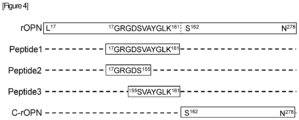
- it contains the amino acid sequence represented by SEQ ID NO: 2 (GRGDSVAYGLK) and has the ability to normalize the endometrial EGF concentration profile and improve conception chance.
- Sequence identity (homology) between amino acid sequences is calculated by aligning the two amino acid sequences with gaps at the sites of insertion and deletion so that the number of corresponding amino acid residues is maximized, and then calculating the ratio of matching amino acid residues to the total amino acid sequence excluding gaps in the resulting alignment.
- Sequence identity between amino acid sequences can be determined using various homology search software known in the art. For example, the sequence identity value of an amino acid sequence can be obtained by calculation based on an alignment obtained using the known homology search software BLASTP.
- modification of the N-terminal and C-terminal amino acid residues is also preferred.
- the charge of the N-terminus and C-terminus of the synthetic peptide it is possible to have properties equivalent to those of the natural peptide. Therefore, when the active ingredient of the conception chance-improving composition of the present embodiment is a synthetic peptide, the charge at the terminal can be removed by acetylating the N-terminus or amidizing the C-terminus.
- the active ingredient of the conception chance-improving composition of the present embodiment is a peptide
- it can be easily synthesized using a commonly used peptide synthesis technique and is also economically efficient.
- the active ingredient of the conception chance-improving composition of the present embodiment is a protein
- it can be easily produced by using a widely used expression system such as [when producing] E. coli.
- the conception chance-improving composition of this embodiment When the conception chance-improving composition of this embodiment is administered to a ruminant having an abnormal endometrial EGF concentration profile, the epidermal growth factor concentration profile in the endometrium is normalized after administration for a period of one cycle of estrus.
- the period for one cycle of estrus varies depending on the variety of cows, but it is approximately 20 to 30 days, and most are 21 days.
- the ruminant to which the conception chance-improving composition according to this embodiment is administered may be a ruminant whose estrus or ovulation is artificially induced by hormone administration, etc., or may be a ruminant that has a natural estrus cycle. Administration to ruminants that have a natural estrus cycle also improves the conception rate of natural breeding.
- the conception chance-improving composition of this embodiment is preferably applied to ruminants that are artificially inseminated.
- administration of the conception chance-improving composition of this embodiment may be performed before, after, and at the same time as the artificial insemination.
- the administration of the conception chance-improving composition in this embodiment is performed, for example, within a period of up to 5 days, preferably 4 days, more preferably 3 days, even more preferably 2 days, even more preferably 1 day after artificial insemination, starting from 5 days before artificial insemination, preferably 4 days before, more preferably 3 days before, even more preferably 2 days before, even more preferably 1 day before.
- the ruminant to which the conception chance-improving composition of the present embodiment is administered may be a naturally mated ruminant.
- conception chance can also be improved by administering the drug between the estrus day and the one day before and after the estrus day.
- the ruminant to which the conception chance-improving composition of the present embodiment is administered may be a ruminant to which a fertilized egg is implanted.
- the conception chance-improving composition of this embodiment can improve the conception rate of the fertilized egg to be transplanted.
- the scheduled pre-transplant estrus date and the period before and after it e.g., from 5 days before estrus date to 5 days after estrus date
- by administering the conception chance-improving composition of this embodiment it is possible to improve the conception rate of transplanted fertilized eggs.
- the conception chance-improving composition of this embodiment can be administered to a ruminant having an endometrial EGF concentration profile abnormality to resolve or reduce the abnormality, thereby improving the conception rate.
- the conception chance-improving composition according to the present embodiments can be extensively administered to ruminants in need of improved conception chance, particularly to ruminants that have had an abnormal endometrial EGF concentration profile.
- the ruminant to which the conception chance-improving composition of the present embodiment is administered are not specifically limited, and may be any of the ruminants, such as cows, goats, sheep, deer, giraffes, etc.
- the ruminant to which the conception chance-improving composition of the present embodiment is administered is preferably a cow, goat, or sheep, and particularly preferably a cow.
- the conception chance-improving composition of the present embodiment is preferably used for dairy cows in which improvement in conception chance is particularly desired.
- the conception chance-improving composition of the present embodiment is preferably used, for example, in cows with low conception chance, and is particularly preferably administered to RB cows.
- the composition for conception chance improvement of the present embodiment is preferably administered to a cow whose epidermal growth factor concentration in the endometrium, which is observed in normal conception cows on days 2-4 from estrus, has disappeared or decreased, i.e., a cow with an abnormal endometrial EGF concentration profile, and in particular, more preferably to a cow whose epidermal growth factor concentration in the endometrium on the third day after estrus is less than 4.7 ng/g per tissue weight.
- the conception chance-improving composition according to the present embodiment can normalize the EGF concentration profile in the endometrium from after administration to one cycle of estrus, and thus, by administering the conception chance-improving composition of the present embodiment to a ruminant after delivery, improvement in conception rate can be expected.
- the number of days after delivery is preferably within the period from the number of days equivalent to two estrous cycles to the number of days equivalent to five estrous cycles; the number of days after delivery is more preferably within the period from the number of days equivalent to two estrus cycles to the number of days equivalent to four cycles; the number of days after delivery is even more preferably within the period from the number of days equivalent to 2.5 estrus cycles to the number of days equivalent to 4 cycles; and the number of days after delivery is further even more preferably within the period from the number of days equivalent to 2.5 estrus cycles to the number of days equivalent to 3.5 cycles.
- the conception chance-improving composition of this embodiment is administered preferably within the period of 40 to 100 days after delivery, more preferably within the period of 40 to 90 days, even more preferably within the period of 40 to 80 days, and further even more preferably, the conception chance-improving composition of this embodiment is administered within the period of 45 to 80 days.
- the conception chance-improving composition in the present embodiment be administered to a cow within a period of 50 to 80 days after delivery, preferably within a period of 60 to 80 days, and more preferably within a period of 60 to 70 days.
- the method for administering the conception chance-improving composition of the present embodiment to the vaginal fornix of the ruminant's vagina or its vicinity can be performed in the same manner as semen administration in artificial insemination.
- the conception chance-improving composition of this embodiment can be prepared as a solution [that can be] dissolve or dilute as a solution that can be administered to ruminants, and this can be injected into the vagina using a catheter syringe for artificial insemination.
- Solutions that can be administered to ruminants include solutions that can be administered to the vagina, cervix, and uterus of the ruminants, which include water, buffer, semen of the ruminants, or a solution containing appropriate and pharmaceutically acceptable additives that can be administered to the vagina, cervix, and uterus of the ruminant.
- the buffer is not particularly limited as long as it can be safely administered to the vagina of ruminants, and examples include PBS (phosphate buffered saline) and physiological saline.
- PBS phosphate buffered saline
- physiological saline phosphate buffered saline
- additive those similar to those listed above can be used, and additives that are well tolerated in the vagina and endometrium are preferred.
- the amount of liquid of the solution of the conception chance-improving composition in this embodiment to be injected into the vaginal portion of the ruminants, used for one treatment is preferably 0.1 to 20 mL. 2 to 20 mL is more preferable, 5 to 20 mL is even more preferable, 10 to 20 mL is even more preferred, and 10 to 15 mL is particularly preferred. If the amount is within the above range, by administering it deep into the vagina, a small amount of peptide can stimulate a wide range of receptors and produce effects. In particular, since the volume of ejaculated semen in a cow's natural state is 2 to 10 mL, in the case of a cow, it is particularly preferable to administer the ejaculate in a volume within the above range.
- the amount of active ingredient of the conception chance-improving composition of the present embodiment in the solution may be sufficient to normalize the endometrial EGF concentration profile and improve the conception rate, for example, the concentration of the peptide or polypeptide of the active ingredient may be 40 nmol or more per treatment solution, preferably 50 nmol or more, more preferably 100 nmol or more, even more preferably 200 nmol or more, and further even more preferably 320 nmol or more.
- the upper limit of the concentration of the peptide or polypeptide of the active ingredient per treatment solution is not specifically limited, and can be, for example, 2400 nmol or less, preferably 2000 nmol or less, and more preferably 1600 nmol or less.
- the conception chance-improving composition of the present embodiment can be more easily administered into the vagina of a ruminant.
- the conception chance-improving composition of the present embodiment to be filled into an artificial insemination straw is a solution in which the peptide or polypeptide of the active ingredient is dissolved in 0.1 to 20 mL of a solution that can be administered to ruminants.
- the solution that can be administered to ruminants can be the same as the one listed above, and the amount of the solution that dissolves the active ingredient is preferably 2 to 20 mL, more preferably 5 to 20 mL, even more preferably 10 to 20 mL, and further even more preferably 10 to 15 mL.
- the use of artificial insemination seminal fluid as the solution or portion thereof results in an artificial insemination straw capable of performing both administration of the conception chance-improving composition and artificial insemination in this embodiment.
- cows subjected to the subsequent experiments were Holstein-type, postnatally lactated cows reared on commercial farms in the Hokkaido area of Japan (order of birth: 2-6 cows, age: 3-9 years, milk yield: >9500 kg/305 days of fatcorrected milk). Cows that had problems requiring at least three veterinarian consultations at the time of delivery and during delivery were excluded from the study.
- the tissue samples were shredded, 1 M acetic acid (5 mL/g of tissue), homogenized in ice cooled, and the homogenate was centrifuged. The supernatant after centrifugation was collected and stored, and the remaining pellets were homogenized again and centrifuged to collect the supernatant. The first and second supernatants were combined and concentrated. The resulting concentrated samples were applied to a Sephadex G-50 column (manufactured by Amasham Biosciences) and eluted with 10 mM PBS (pH 7.2) to perform the size fractionation. Fractions containing more than 10k protein were combined into one sample, freeze-dried, and stored at -80 °C. Frozen samples were dissolved and reconstituted in PBS on the day of the EGF assay.
- the PCR product was purified using a "QIAEX II Gel Extraction Kit” (manufactured by Qiagen) and then inserted into the Ndel-Hind III site of plasmid pET - 28a (manufactured by Merck Millipore) using SLiCE (Seamless Ligation Cloning Extract).
- the resulting plasmid vector was named SPP1/pET-28a.
- the vector produces a recombinant protein comprising an amino acid sequence from a plasmid vector comprising a histidine tag (MGSSHHHHHSSGLVPRGSHM: SEQ ID NO: 7) on the N-terminal side of the predicted mature protein region of the OPN (17-278 region of SEQ ID NO:4).
- the cows with normal EGF concentration profiles exhibited a higher conception rate than the cows with abnormal profiles.
- the conception rate in each group was higher in the 320 to 1600 nmol treated group for peptide 1 and the 1600 nmol treated group for peptide 3 than in the control PBS treated group, as in the rOPN treated group.
- the overall conception rate in the 1600 nmol treated group for peptide 2 and the 320 nmol treated group for peptide 3 was about halfway between the PBS treated group and the rOPN treated group.
- the 320 nmol peptide 2 treated group and the C-rOPN treated group had similar conception rates to the PBS treated group.
- peptide 4 As peptide 4, a peptide (SEQ ID NO: 8) in which the fourth D (aspartic acid) of peptide 1 was replaced with E (glutamic acid) was used. This amino acid substitution mutation changes the RGD motif to an RGE sequence that does not have integrin binding activity. Peptide 4 was synthesized in the form of trifluoroacetate (manufactured by Peptide Institute, Inc.), and a peptide sample was prepared in the same manner as peptide 1.
- Treatment with OPN was performed in the same manner as Example 1.
- Table 4 shows the measurement results of the normalization rate of the endometrial EGF concetration and EGF concentration profile in each treatment group. As shown in Table 4, normalization rates were higher in the groups treated with peptide 1 or 3 than in the PBS treatment group. In particular, in the 320 to 1600 nmol treated group for peptide 1 and the 1600 nmol treated group for peptide 3, as in the rOPN treated group, the normalization rate of the endometrial EGF concentration and the EGF concentration profile were significantly higher than in the control PBS treated group. On the other hand, in the peptide 2 treatment group, no improvement in endometrial EGF concentration or normalization of EGF concentration profile was observed.
- peptide 1 or peptide 3 normalizes the endometrial EGF concentration profile, similar to administration of rOPN; this effect is demonstrated by peptide 1 at a lower concentration than peptide 3; and peptide 3 (i.e., the SVAYGLK motif) is the minimum functional unit of OPN's ability to normalize the endometrial EGF concentration profile.
- OPN treatment was performed at the initial insemination 60-70 days after delivery. Of the test cows, only artificial insemination was performed in 52 cows (untreated group), and rOPN (16 nmol) was given in 54 cows (rOPN treatment group). Endometrial EGF concentration was measured on the third day from the artificial insemination date. Pregnancy test was performed by transrectal ultrasound examination between 30 and 35 days after the day of artificial insemination.
- Table 6 shows the measurement results of the endometrial EGF concentration, normalization rate, and conception rate in each treatment group. The results showed that in the rOPN-treated group, the endometrial EGF concentration was higher than in the untreated group, and the normalization rate was improved, and the conception rate was also improved.
Landscapes
- Health & Medical Sciences (AREA)
- Life Sciences & Earth Sciences (AREA)
- Animal Behavior & Ethology (AREA)
- Reproductive Health (AREA)
- Chemical & Material Sciences (AREA)
- Engineering & Computer Science (AREA)
- Bioinformatics & Cheminformatics (AREA)
- Veterinary Medicine (AREA)
- Medicinal Chemistry (AREA)
- Public Health (AREA)
- General Health & Medical Sciences (AREA)
- Pharmacology & Pharmacy (AREA)
- Organic Chemistry (AREA)
- Proteomics, Peptides & Aminoacids (AREA)
- Epidemiology (AREA)
- Immunology (AREA)
- Gynecology & Obstetrics (AREA)
- Endocrinology (AREA)
- Pregnancy & Childbirth (AREA)
- Gastroenterology & Hepatology (AREA)
- Chemical Kinetics & Catalysis (AREA)
- General Chemical & Material Sciences (AREA)
- Nuclear Medicine, Radiotherapy & Molecular Imaging (AREA)
- Zoology (AREA)
- Medicines That Contain Protein Lipid Enzymes And Other Medicines (AREA)
Applications Claiming Priority (2)
| Application Number | Priority Date | Filing Date | Title |
|---|---|---|---|
| US202263403303P | 2022-09-02 | 2022-09-02 | |
| PCT/JP2023/032160 WO2024048795A1 (fr) | 2022-09-02 | 2023-09-01 | Composition améliorant les chances de conception de ruminants |
Publications (1)
| Publication Number | Publication Date |
|---|---|
| EP4582093A1 true EP4582093A1 (fr) | 2025-07-09 |
Family
ID=90097979
Family Applications (1)
| Application Number | Title | Priority Date | Filing Date |
|---|---|---|---|
| EP23860555.4A Pending EP4582093A1 (fr) | 2022-09-02 | 2023-09-01 | Composition améliorant les chances de conception de ruminants |
Country Status (3)
| Country | Link |
|---|---|
| EP (1) | EP4582093A1 (fr) |
| JP (1) | JPWO2024048795A1 (fr) |
| WO (1) | WO2024048795A1 (fr) |
Family Cites Families (2)
| Publication number | Priority date | Publication date | Assignee | Title |
|---|---|---|---|---|
| US20150190460A1 (en) * | 2012-07-20 | 2015-07-09 | Forsyth Dental Infirmary For Children (D/B/A The Forsyth Institute) | Osteopontin peptide fragments for use in suppression or prevention of tumor growth |
| CN108948176B (zh) * | 2018-05-21 | 2021-07-20 | 杭州璞湃科技有限公司 | 一种骨桥蛋白特征肽及其应用 |
-
2023
- 2023-09-01 EP EP23860555.4A patent/EP4582093A1/fr active Pending
- 2023-09-01 JP JP2024544612A patent/JPWO2024048795A1/ja active Pending
- 2023-09-01 WO PCT/JP2023/032160 patent/WO2024048795A1/fr not_active Ceased
Also Published As
| Publication number | Publication date |
|---|---|
| JPWO2024048795A1 (fr) | 2024-03-07 |
| WO2024048795A1 (fr) | 2024-03-07 |
Similar Documents
| Publication | Publication Date | Title |
|---|---|---|
| JP2796388B2 (ja) | G−csfの精製方法 | |
| MX2008015657A (es) | Polipeptidos de factor de crecimiento similares a insulina estabilizados. | |
| EA030000B1 (ru) | Способ стимуляции развития зрелого ооцита | |
| US20090305947A1 (en) | Livestock management for improved reproductive efficiency | |
| US5908829A (en) | Use of MCP-1 for inducing ripening of the cervix | |
| EP2560669B2 (fr) | Peptide de caséine utilisé pour traiter des infections utérines | |
| ES2693697T3 (es) | Actividad de la hormona folículo estimulante equina recombinante | |
| JP2007529410A (ja) | 子宮内膜症を治療又は防止するためのペプチド | |
| EP4582093A1 (fr) | Composition améliorant les chances de conception de ruminants | |
| Munro et al. | The use of progesterone administered intravaginally and pregnant mare serum gonadotrophin given by injection in controlled breeding programs in beef and dairy cattle | |
| CN117982628B (zh) | 瘦素在制备预防和/或治疗子痫前期的药物中的应用 | |
| WO1997007813A1 (fr) | Agent de fecondite | |
| PL154182B1 (en) | Fastening handle | |
| CN101516400A (zh) | 以生长素释放肽及其衍生物或作用于GHS-R1a的物质作为有效成分的脊髓神经修复促进治疗剂 | |
| El-Zarkouny et al. | Effects of short-term feeding of MGA combined with GnRH and PGF2α on reproduction of beef cows | |
| Cosentino et al. | Ovarian activity in dairy Saanen goats subjected to a short-term ovulation induction protocol and a single injection of lecirelin (GnRH analog) given 28 h or 34 h after progestin pre-treatment | |
| RU2259820C1 (ru) | Препарат для лечения и профилактики послеродового эндометрита у коров и метрит-мастит-агалактии у свиноматок | |
| Bleach et al. | Effect of administration of a novel recombinant bovine interferon on length of oestrous cycle in cattle | |
| US20250042967A1 (en) | mRNA TREATMENT TO INDUCE EXPRESSION OF RELAXIN FOR REPRODUCTIVE APPLICATIONS | |
| JP3181459B2 (ja) | 牛の過剰排卵誘起方法 | |
| CN111565736A (zh) | 猪g-csf变体和其用途 | |
| Crudeli et al. | Efficacy of different protocols of ovulation synchronization and resynchronization in Argentinian buffalo herds | |
| CN109125307B (zh) | 一种克罗米酚-多肽复合物、药物制剂及其制备方法和应用 | |
| ES2358245T3 (es) | Lh para su uso en el mantenimiento de uno o más embarazos mediante la inducción de la formación de un cuerpo lúteo accesorio. | |
| Min | Identification of relaxin-target tissues and target cells in the pig |
Legal Events
| Date | Code | Title | Description |
|---|---|---|---|
| STAA | Information on the status of an ep patent application or granted ep patent |
Free format text: STATUS: THE INTERNATIONAL PUBLICATION HAS BEEN MADE |
|
| PUAI | Public reference made under article 153(3) epc to a published international application that has entered the european phase |
Free format text: ORIGINAL CODE: 0009012 |
|
| STAA | Information on the status of an ep patent application or granted ep patent |
Free format text: STATUS: REQUEST FOR EXAMINATION WAS MADE |
|
| 17P | Request for examination filed |
Effective date: 20250312 |
|
| AK | Designated contracting states |
Kind code of ref document: A1 Designated state(s): AL AT BE BG CH CY CZ DE DK EE ES FI FR GB GR HR HU IE IS IT LI LT LU LV MC ME MK MT NL NO PL PT RO RS SE SI SK SM TR |
|
| DAV | Request for validation of the european patent (deleted) | ||
| DAX | Request for extension of the european patent (deleted) |