EP4582119A2 - Neurochirurgische vorrichtung - Google Patents
Neurochirurgische vorrichtung Download PDFInfo
- Publication number
- EP4582119A2 EP4582119A2 EP25178009.4A EP25178009A EP4582119A2 EP 4582119 A2 EP4582119 A2 EP 4582119A2 EP 25178009 A EP25178009 A EP 25178009A EP 4582119 A2 EP4582119 A2 EP 4582119A2
- Authority
- EP
- European Patent Office
- Prior art keywords
- guide tube
- cannula
- brain
- membrane
- probe
- Prior art date
- Legal status (The legal status is an assumption and is not a legal conclusion. Google has not performed a legal analysis and makes no representation as to the accuracy of the status listed.)
- Pending
Links
Images





Classifications
-
- A—HUMAN NECESSITIES
- A61—MEDICAL OR VETERINARY SCIENCE; HYGIENE
- A61B—DIAGNOSIS; SURGERY; IDENTIFICATION
- A61B90/00—Instruments, implements or accessories specially adapted for surgery or diagnosis and not covered by any of the groups A61B1/00 - A61B50/00, e.g. for luxation treatment or for protecting wound edges
- A61B90/10—Instruments, implements or accessories specially adapted for surgery or diagnosis and not covered by any of the groups A61B1/00 - A61B50/00, e.g. for luxation treatment or for protecting wound edges for stereotaxic surgery, e.g. frame-based stereotaxis
- A61B90/11—Instruments, implements or accessories specially adapted for surgery or diagnosis and not covered by any of the groups A61B1/00 - A61B50/00, e.g. for luxation treatment or for protecting wound edges for stereotaxic surgery, e.g. frame-based stereotaxis with guides for needles or instruments, e.g. arcuate slides or ball joints
-
- A—HUMAN NECESSITIES
- A61—MEDICAL OR VETERINARY SCIENCE; HYGIENE
- A61B—DIAGNOSIS; SURGERY; IDENTIFICATION
- A61B90/00—Instruments, implements or accessories specially adapted for surgery or diagnosis and not covered by any of the groups A61B1/00 - A61B50/00, e.g. for luxation treatment or for protecting wound edges
- A61B90/06—Measuring instruments not otherwise provided for
-
- A—HUMAN NECESSITIES
- A61—MEDICAL OR VETERINARY SCIENCE; HYGIENE
- A61B—DIAGNOSIS; SURGERY; IDENTIFICATION
- A61B90/00—Instruments, implements or accessories specially adapted for surgery or diagnosis and not covered by any of the groups A61B1/00 - A61B50/00, e.g. for luxation treatment or for protecting wound edges
- A61B90/10—Instruments, implements or accessories specially adapted for surgery or diagnosis and not covered by any of the groups A61B1/00 - A61B50/00, e.g. for luxation treatment or for protecting wound edges for stereotaxic surgery, e.g. frame-based stereotaxis
-
- A—HUMAN NECESSITIES
- A61—MEDICAL OR VETERINARY SCIENCE; HYGIENE
- A61M—DEVICES FOR INTRODUCING MEDIA INTO, OR ONTO, THE BODY; DEVICES FOR TRANSDUCING BODY MEDIA OR FOR TAKING MEDIA FROM THE BODY; DEVICES FOR PRODUCING OR ENDING SLEEP OR STUPOR
- A61M25/00—Catheters; Hollow probes
- A61M25/0009—Making of catheters or other medical or surgical tubes
- A61M25/0015—Making lateral openings in a catheter tube, e.g. holes, slits, ports, piercings of guidewire ports; Methods for processing the holes, e.g. smoothing the edges
-
- A—HUMAN NECESSITIES
- A61—MEDICAL OR VETERINARY SCIENCE; HYGIENE
- A61M—DEVICES FOR INTRODUCING MEDIA INTO, OR ONTO, THE BODY; DEVICES FOR TRANSDUCING BODY MEDIA OR FOR TAKING MEDIA FROM THE BODY; DEVICES FOR PRODUCING OR ENDING SLEEP OR STUPOR
- A61M39/00—Tubes, tube connectors, tube couplings, valves, access sites or the like, specially adapted for medical use
- A61M39/02—Access sites
- A61M39/0247—Semi-permanent or permanent transcutaneous or percutaneous access sites to the inside of the body
-
- A—HUMAN NECESSITIES
- A61—MEDICAL OR VETERINARY SCIENCE; HYGIENE
- A61M—DEVICES FOR INTRODUCING MEDIA INTO, OR ONTO, THE BODY; DEVICES FOR TRANSDUCING BODY MEDIA OR FOR TAKING MEDIA FROM THE BODY; DEVICES FOR PRODUCING OR ENDING SLEEP OR STUPOR
- A61M39/00—Tubes, tube connectors, tube couplings, valves, access sites or the like, specially adapted for medical use
- A61M39/10—Tube connectors; Tube couplings
-
- A—HUMAN NECESSITIES
- A61—MEDICAL OR VETERINARY SCIENCE; HYGIENE
- A61M—DEVICES FOR INTRODUCING MEDIA INTO, OR ONTO, THE BODY; DEVICES FOR TRANSDUCING BODY MEDIA OR FOR TAKING MEDIA FROM THE BODY; DEVICES FOR PRODUCING OR ENDING SLEEP OR STUPOR
- A61M5/00—Devices for bringing media into the body in a subcutaneous, intra-vascular or intramuscular way; Accessories therefor, e.g. filling or cleaning devices, arm-rests
- A61M5/14—Infusion devices, e.g. infusing by gravity; Blood infusion; Accessories therefor
- A61M5/1413—Modular systems comprising interconnecting elements
-
- A—HUMAN NECESSITIES
- A61—MEDICAL OR VETERINARY SCIENCE; HYGIENE
- A61M—DEVICES FOR INTRODUCING MEDIA INTO, OR ONTO, THE BODY; DEVICES FOR TRANSDUCING BODY MEDIA OR FOR TAKING MEDIA FROM THE BODY; DEVICES FOR PRODUCING OR ENDING SLEEP OR STUPOR
- A61M5/00—Devices for bringing media into the body in a subcutaneous, intra-vascular or intramuscular way; Accessories therefor, e.g. filling or cleaning devices, arm-rests
- A61M5/14—Infusion devices, e.g. infusing by gravity; Blood infusion; Accessories therefor
- A61M5/142—Pressure infusion, e.g. using pumps
- A61M5/14244—Pressure infusion, e.g. using pumps adapted to be carried by the patient, e.g. portable on the body
-
- A—HUMAN NECESSITIES
- A61—MEDICAL OR VETERINARY SCIENCE; HYGIENE
- A61M—DEVICES FOR INTRODUCING MEDIA INTO, OR ONTO, THE BODY; DEVICES FOR TRANSDUCING BODY MEDIA OR FOR TAKING MEDIA FROM THE BODY; DEVICES FOR PRODUCING OR ENDING SLEEP OR STUPOR
- A61M5/00—Devices for bringing media into the body in a subcutaneous, intra-vascular or intramuscular way; Accessories therefor, e.g. filling or cleaning devices, arm-rests
- A61M5/14—Infusion devices, e.g. infusing by gravity; Blood infusion; Accessories therefor
- A61M5/142—Pressure infusion, e.g. using pumps
- A61M5/145—Pressure infusion, e.g. using pumps using pressurised reservoirs, e.g. pressurised by means of pistons
- A61M5/1452—Pressure infusion, e.g. using pumps using pressurised reservoirs, e.g. pressurised by means of pistons pressurised by means of pistons
- A61M5/14526—Pressure infusion, e.g. using pumps using pressurised reservoirs, e.g. pressurised by means of pistons pressurised by means of pistons the piston being actuated by fluid pressure
-
- A—HUMAN NECESSITIES
- A61—MEDICAL OR VETERINARY SCIENCE; HYGIENE
- A61M—DEVICES FOR INTRODUCING MEDIA INTO, OR ONTO, THE BODY; DEVICES FOR TRANSDUCING BODY MEDIA OR FOR TAKING MEDIA FROM THE BODY; DEVICES FOR PRODUCING OR ENDING SLEEP OR STUPOR
- A61M5/00—Devices for bringing media into the body in a subcutaneous, intra-vascular or intramuscular way; Accessories therefor, e.g. filling or cleaning devices, arm-rests
- A61M5/14—Infusion devices, e.g. infusing by gravity; Blood infusion; Accessories therefor
- A61M5/162—Needle sets, i.e. connections by puncture between reservoir and tube ; Connections between reservoir and tube
-
- A—HUMAN NECESSITIES
- A61—MEDICAL OR VETERINARY SCIENCE; HYGIENE
- A61M—DEVICES FOR INTRODUCING MEDIA INTO, OR ONTO, THE BODY; DEVICES FOR TRANSDUCING BODY MEDIA OR FOR TAKING MEDIA FROM THE BODY; DEVICES FOR PRODUCING OR ENDING SLEEP OR STUPOR
- A61M5/00—Devices for bringing media into the body in a subcutaneous, intra-vascular or intramuscular way; Accessories therefor, e.g. filling or cleaning devices, arm-rests
- A61M5/14—Infusion devices, e.g. infusing by gravity; Blood infusion; Accessories therefor
- A61M5/168—Means for controlling media flow to the body or for metering media to the body, e.g. drip meters, counters ; Monitoring media flow to the body
- A61M5/16877—Adjusting flow; Devices for setting a flow rate
- A61M5/16881—Regulating valves
-
- A—HUMAN NECESSITIES
- A61—MEDICAL OR VETERINARY SCIENCE; HYGIENE
- A61M—DEVICES FOR INTRODUCING MEDIA INTO, OR ONTO, THE BODY; DEVICES FOR TRANSDUCING BODY MEDIA OR FOR TAKING MEDIA FROM THE BODY; DEVICES FOR PRODUCING OR ENDING SLEEP OR STUPOR
- A61M5/00—Devices for bringing media into the body in a subcutaneous, intra-vascular or intramuscular way; Accessories therefor, e.g. filling or cleaning devices, arm-rests
- A61M5/178—Syringes
-
- A—HUMAN NECESSITIES
- A61—MEDICAL OR VETERINARY SCIENCE; HYGIENE
- A61M—DEVICES FOR INTRODUCING MEDIA INTO, OR ONTO, THE BODY; DEVICES FOR TRANSDUCING BODY MEDIA OR FOR TAKING MEDIA FROM THE BODY; DEVICES FOR PRODUCING OR ENDING SLEEP OR STUPOR
- A61M5/00—Devices for bringing media into the body in a subcutaneous, intra-vascular or intramuscular way; Accessories therefor, e.g. filling or cleaning devices, arm-rests
- A61M5/178—Syringes
- A61M5/19—Syringes having more than one chamber, e.g. including a manifold coupling two parallelly aligned syringes through separate channels to a common discharge assembly
-
- A—HUMAN NECESSITIES
- A61—MEDICAL OR VETERINARY SCIENCE; HYGIENE
- A61M—DEVICES FOR INTRODUCING MEDIA INTO, OR ONTO, THE BODY; DEVICES FOR TRANSDUCING BODY MEDIA OR FOR TAKING MEDIA FROM THE BODY; DEVICES FOR PRODUCING OR ENDING SLEEP OR STUPOR
- A61M5/00—Devices for bringing media into the body in a subcutaneous, intra-vascular or intramuscular way; Accessories therefor, e.g. filling or cleaning devices, arm-rests
- A61M5/178—Syringes
- A61M5/31—Details
- A61M5/32—Needles; Details of needles pertaining to their connection with syringe or hub; Accessories for bringing the needle into, or holding the needle on, the body; Devices for protection of needles
- A61M5/3293—Needles; Details of needles pertaining to their connection with syringe or hub; Accessories for bringing the needle into, or holding the needle on, the body; Devices for protection of needles characterised by features of the needle hub
-
- A—HUMAN NECESSITIES
- A61—MEDICAL OR VETERINARY SCIENCE; HYGIENE
- A61M—DEVICES FOR INTRODUCING MEDIA INTO, OR ONTO, THE BODY; DEVICES FOR TRANSDUCING BODY MEDIA OR FOR TAKING MEDIA FROM THE BODY; DEVICES FOR PRODUCING OR ENDING SLEEP OR STUPOR
- A61M5/00—Devices for bringing media into the body in a subcutaneous, intra-vascular or intramuscular way; Accessories therefor, e.g. filling or cleaning devices, arm-rests
- A61M5/36—Devices for bringing media into the body in a subcutaneous, intra-vascular or intramuscular way; Accessories therefor, e.g. filling or cleaning devices, arm-rests with means for eliminating or preventing injection or infusion of air into body
- A61M5/38—Devices for bringing media into the body in a subcutaneous, intra-vascular or intramuscular way; Accessories therefor, e.g. filling or cleaning devices, arm-rests with means for eliminating or preventing injection or infusion of air into body using hydrophilic or hydrophobic filters
- A61M5/385—Devices for bringing media into the body in a subcutaneous, intra-vascular or intramuscular way; Accessories therefor, e.g. filling or cleaning devices, arm-rests with means for eliminating or preventing injection or infusion of air into body using hydrophilic or hydrophobic filters using hydrophobic filters
-
- A—HUMAN NECESSITIES
- A61—MEDICAL OR VETERINARY SCIENCE; HYGIENE
- A61B—DIAGNOSIS; SURGERY; IDENTIFICATION
- A61B17/00—Surgical instruments, devices or methods
- A61B17/32—Surgical cutting instruments
- A61B2017/320056—Tunnelers
-
- A—HUMAN NECESSITIES
- A61—MEDICAL OR VETERINARY SCIENCE; HYGIENE
- A61B—DIAGNOSIS; SURGERY; IDENTIFICATION
- A61B17/00—Surgical instruments, devices or methods
- A61B17/34—Trocars; Puncturing needles
- A61B17/3417—Details of tips or shafts, e.g. grooves, expandable, bendable; Multiple coaxial sliding cannulas, e.g. for dilating
- A61B2017/3454—Details of tips
-
- A—HUMAN NECESSITIES
- A61—MEDICAL OR VETERINARY SCIENCE; HYGIENE
- A61B—DIAGNOSIS; SURGERY; IDENTIFICATION
- A61B17/00—Surgical instruments, devices or methods
- A61B17/34—Trocars; Puncturing needles
- A61B17/3417—Details of tips or shafts, e.g. grooves, expandable, bendable; Multiple coaxial sliding cannulas, e.g. for dilating
- A61B2017/3454—Details of tips
- A61B2017/3456—Details of tips blunt
-
- A—HUMAN NECESSITIES
- A61—MEDICAL OR VETERINARY SCIENCE; HYGIENE
- A61B—DIAGNOSIS; SURGERY; IDENTIFICATION
- A61B90/00—Instruments, implements or accessories specially adapted for surgery or diagnosis and not covered by any of the groups A61B1/00 - A61B50/00, e.g. for luxation treatment or for protecting wound edges
- A61B90/03—Automatic limiting or abutting means, e.g. for safety
- A61B2090/033—Abutting means, stops, e.g. abutting on tissue or skin
- A61B2090/034—Abutting means, stops, e.g. abutting on tissue or skin abutting on parts of the device itself
-
- A—HUMAN NECESSITIES
- A61—MEDICAL OR VETERINARY SCIENCE; HYGIENE
- A61B—DIAGNOSIS; SURGERY; IDENTIFICATION
- A61B90/00—Instruments, implements or accessories specially adapted for surgery or diagnosis and not covered by any of the groups A61B1/00 - A61B50/00, e.g. for luxation treatment or for protecting wound edges
- A61B90/06—Measuring instruments not otherwise provided for
- A61B2090/062—Measuring instruments not otherwise provided for penetration depth
-
- A—HUMAN NECESSITIES
- A61—MEDICAL OR VETERINARY SCIENCE; HYGIENE
- A61B—DIAGNOSIS; SURGERY; IDENTIFICATION
- A61B90/00—Instruments, implements or accessories specially adapted for surgery or diagnosis and not covered by any of the groups A61B1/00 - A61B50/00, e.g. for luxation treatment or for protecting wound edges
- A61B90/08—Accessories or related features not otherwise provided for
- A61B2090/0801—Prevention of accidental cutting or pricking
- A61B2090/08021—Prevention of accidental cutting or pricking of the patient or his organs
-
- A—HUMAN NECESSITIES
- A61—MEDICAL OR VETERINARY SCIENCE; HYGIENE
- A61B—DIAGNOSIS; SURGERY; IDENTIFICATION
- A61B90/00—Instruments, implements or accessories specially adapted for surgery or diagnosis and not covered by any of the groups A61B1/00 - A61B50/00, e.g. for luxation treatment or for protecting wound edges
- A61B90/08—Accessories or related features not otherwise provided for
- A61B2090/0807—Indication means
-
- A—HUMAN NECESSITIES
- A61—MEDICAL OR VETERINARY SCIENCE; HYGIENE
- A61B—DIAGNOSIS; SURGERY; IDENTIFICATION
- A61B90/00—Instruments, implements or accessories specially adapted for surgery or diagnosis and not covered by any of the groups A61B1/00 - A61B50/00, e.g. for luxation treatment or for protecting wound edges
- A61B90/08—Accessories or related features not otherwise provided for
- A61B2090/0807—Indication means
- A61B2090/0811—Indication means for the position of a particular part of an instrument with respect to the rest of the instrument, e.g. position of the anvil of a stapling instrument
-
- A—HUMAN NECESSITIES
- A61—MEDICAL OR VETERINARY SCIENCE; HYGIENE
- A61B—DIAGNOSIS; SURGERY; IDENTIFICATION
- A61B90/00—Instruments, implements or accessories specially adapted for surgery or diagnosis and not covered by any of the groups A61B1/00 - A61B50/00, e.g. for luxation treatment or for protecting wound edges
- A61B90/10—Instruments, implements or accessories specially adapted for surgery or diagnosis and not covered by any of the groups A61B1/00 - A61B50/00, e.g. for luxation treatment or for protecting wound edges for stereotaxic surgery, e.g. frame-based stereotaxis
- A61B2090/103—Cranial plugs for access to brain
-
- A—HUMAN NECESSITIES
- A61—MEDICAL OR VETERINARY SCIENCE; HYGIENE
- A61J—CONTAINERS SPECIALLY ADAPTED FOR MEDICAL OR PHARMACEUTICAL PURPOSES; DEVICES OR METHODS SPECIALLY ADAPTED FOR BRINGING PHARMACEUTICAL PRODUCTS INTO PARTICULAR PHYSICAL OR ADMINISTERING FORMS; DEVICES FOR ADMINISTERING FOOD OR MEDICINES ORALLY; BABY COMFORTERS; DEVICES FOR RECEIVING SPITTLE
- A61J1/00—Containers specially adapted for medical or pharmaceutical purposes
- A61J1/05—Containers specially adapted for medical or pharmaceutical purposes for collecting, storing or administering blood, plasma or medical fluids ; Infusion or perfusion containers
- A61J1/06—Ampoules or carpules
- A61J1/062—Carpules
-
- A—HUMAN NECESSITIES
- A61—MEDICAL OR VETERINARY SCIENCE; HYGIENE
- A61M—DEVICES FOR INTRODUCING MEDIA INTO, OR ONTO, THE BODY; DEVICES FOR TRANSDUCING BODY MEDIA OR FOR TAKING MEDIA FROM THE BODY; DEVICES FOR PRODUCING OR ENDING SLEEP OR STUPOR
- A61M25/00—Catheters; Hollow probes
- A61M25/0043—Catheters; Hollow probes characterised by structural features
- A61M25/0045—Catheters; Hollow probes characterised by structural features multi-layered, e.g. coated
- A61M2025/0046—Coatings for improving slidability
-
- A—HUMAN NECESSITIES
- A61—MEDICAL OR VETERINARY SCIENCE; HYGIENE
- A61M—DEVICES FOR INTRODUCING MEDIA INTO, OR ONTO, THE BODY; DEVICES FOR TRANSDUCING BODY MEDIA OR FOR TAKING MEDIA FROM THE BODY; DEVICES FOR PRODUCING OR ENDING SLEEP OR STUPOR
- A61M25/00—Catheters; Hollow probes
- A61M25/0043—Catheters; Hollow probes characterised by structural features
- A61M2025/006—Catheters; Hollow probes characterised by structural features having a special surface topography or special surface properties, e.g. roughened or knurled surface
-
- A—HUMAN NECESSITIES
- A61—MEDICAL OR VETERINARY SCIENCE; HYGIENE
- A61M—DEVICES FOR INTRODUCING MEDIA INTO, OR ONTO, THE BODY; DEVICES FOR TRANSDUCING BODY MEDIA OR FOR TAKING MEDIA FROM THE BODY; DEVICES FOR PRODUCING OR ENDING SLEEP OR STUPOR
- A61M25/00—Catheters; Hollow probes
- A61M25/01—Introducing, guiding, advancing, emplacing or holding catheters
- A61M25/06—Body-piercing guide needles or the like
- A61M25/0662—Guide tubes
- A61M2025/0681—Systems with catheter and outer tubing, e.g. sheath, sleeve or guide tube
-
- A—HUMAN NECESSITIES
- A61—MEDICAL OR VETERINARY SCIENCE; HYGIENE
- A61M—DEVICES FOR INTRODUCING MEDIA INTO, OR ONTO, THE BODY; DEVICES FOR TRANSDUCING BODY MEDIA OR FOR TAKING MEDIA FROM THE BODY; DEVICES FOR PRODUCING OR ENDING SLEEP OR STUPOR
- A61M39/00—Tubes, tube connectors, tube couplings, valves, access sites or the like, specially adapted for medical use
- A61M39/02—Access sites
- A61M2039/0205—Access sites for injecting media
-
- A—HUMAN NECESSITIES
- A61—MEDICAL OR VETERINARY SCIENCE; HYGIENE
- A61M—DEVICES FOR INTRODUCING MEDIA INTO, OR ONTO, THE BODY; DEVICES FOR TRANSDUCING BODY MEDIA OR FOR TAKING MEDIA FROM THE BODY; DEVICES FOR PRODUCING OR ENDING SLEEP OR STUPOR
- A61M39/00—Tubes, tube connectors, tube couplings, valves, access sites or the like, specially adapted for medical use
- A61M39/02—Access sites
- A61M39/0247—Semi-permanent or permanent transcutaneous or percutaneous access sites to the inside of the body
- A61M2039/025—Semi-permanent or permanent transcutaneous or percutaneous access sites to the inside of the body through bones or teeth, e.g. through the skull
-
- A—HUMAN NECESSITIES
- A61—MEDICAL OR VETERINARY SCIENCE; HYGIENE
- A61M—DEVICES FOR INTRODUCING MEDIA INTO, OR ONTO, THE BODY; DEVICES FOR TRANSDUCING BODY MEDIA OR FOR TAKING MEDIA FROM THE BODY; DEVICES FOR PRODUCING OR ENDING SLEEP OR STUPOR
- A61M39/00—Tubes, tube connectors, tube couplings, valves, access sites or the like, specially adapted for medical use
- A61M39/02—Access sites
- A61M39/0247—Semi-permanent or permanent transcutaneous or percutaneous access sites to the inside of the body
- A61M2039/0282—Semi-permanent or permanent transcutaneous or percutaneous access sites to the inside of the body with implanted tubes connected to the port
-
- A—HUMAN NECESSITIES
- A61—MEDICAL OR VETERINARY SCIENCE; HYGIENE
- A61M—DEVICES FOR INTRODUCING MEDIA INTO, OR ONTO, THE BODY; DEVICES FOR TRANSDUCING BODY MEDIA OR FOR TAKING MEDIA FROM THE BODY; DEVICES FOR PRODUCING OR ENDING SLEEP OR STUPOR
- A61M2205/00—General characteristics of the apparatus
- A61M2205/58—Means for facilitating use, e.g. by people with impaired vision
- A61M2205/583—Means for facilitating use, e.g. by people with impaired vision by visual feedback
-
- A—HUMAN NECESSITIES
- A61—MEDICAL OR VETERINARY SCIENCE; HYGIENE
- A61M—DEVICES FOR INTRODUCING MEDIA INTO, OR ONTO, THE BODY; DEVICES FOR TRANSDUCING BODY MEDIA OR FOR TAKING MEDIA FROM THE BODY; DEVICES FOR PRODUCING OR ENDING SLEEP OR STUPOR
- A61M2205/00—General characteristics of the apparatus
- A61M2205/75—General characteristics of the apparatus with filters
- A61M2205/7527—General characteristics of the apparatus with filters liquophilic, hydrophilic
-
- A—HUMAN NECESSITIES
- A61—MEDICAL OR VETERINARY SCIENCE; HYGIENE
- A61M—DEVICES FOR INTRODUCING MEDIA INTO, OR ONTO, THE BODY; DEVICES FOR TRANSDUCING BODY MEDIA OR FOR TAKING MEDIA FROM THE BODY; DEVICES FOR PRODUCING OR ENDING SLEEP OR STUPOR
- A61M2207/00—Methods of manufacture, assembly or production
Definitions
- the present invention relates to apparatus for use in neurosurgery. Particularly, the invention relates to an apparatus used to deliver therapeutic agents by infusion directly into the brain parenchyma.
- CED cannulas typically have an abrupt change in diameter (a 'step') towards the distal end.
- the distal end of the cannula may be of less than 1mm in diameter for a short length to the extreme end, with a step up to a diameter of 1.5 to 2.5 mm for the remainder of the cannula.
- the small diameter distal end if inserted atraumatically creates a tissue seal around the cannula, minimising reflux along the interface. The change in diameter at the step compresses tissue on insertion into the brain and further resists reflux.
- the design of the reflux resistant step differs between CED cannulas.
- the cannula described in EP 1482851B1 and US patent application 2010/0217228 A1 provide a single step
- WO2007024841A2 provides a cannula with a plurality of steps
- WO2014-016591 has a recessed step.
- a cannula In addition to the step design the length that a cannula extends beyond the step, to its extreme distal end, is an important determinant of both the volume and shape of distribution of infusate into brain tissue.
- a short-stepped cannula i.e. a cannula with only a short length of smaller diameter
- Vd volume of distribution
- the Vd becomes larger and more ovoid, then cylindrical and then pear shaped with a bulbous distal end.
- CNS central nervous system
- the majority of targets for treating CNS (central nervous system) diseases by CED require several cannulas to be implanted to achieve the desired coverage of infusate into brain tissue.
- the desired target volume and shape has been defined from MRI images, the number and orientation of cannulas required to fill the volume are determined by understanding the likely distribution shape and volume that can be achieved with the cannulas being deployed. It is also important to confirm that the infused therapy has covered the prescribed treatment volume with MRI imaging either during or immediately following the infusion.
- rigid cannulas are used they are fixed in a stereotactic frame whilst the infusion is carried out. In such arrangements the stereotactic frame needs to be MRI compatible and have a low profile to fit in the imaging coil.
- additional cannula placements and infusions are required after completion of the first. Thus such procedures are relatively lengthy and can expose the patient to increased risks from prolonged anaesthesia and immobilisation.
- the flexible cannula has a proximal hub and is cut to a desired length for insertion to a target point in the brain.
- the cannula's hub acts as a stop when it engages with a proximal head on the guide tube that is fixed in the skull. The cannula extends beyond the guide tube and the step thus created by the change in diameter from the cannula to the guide tube provides resistance to reflux of infusate.
- a profiled hole is made in the skull along the selected trajectory, guided by a stereo guide or image guided robot.
- a probe is then passed through the hole to the planned distal end of the guide tube and then withdrawn, leaving a track in brain tissue.
- the guide tube, cut to length, is placed over a delivery probe such that the rounded tip of the probe extends just beyond its distal end.
- the guide tube is inserted down the pre-made track until the head on its proximal end press fits into the formed hole in the skull.
- the probe is now advanced to the planned position of the cannula target and then withdrawn leaving a track through the tissue that is contiguous with the bore of the guide tube.
- the cannula connected to an infusion pump and delivering infusate at a low flow rate is inserted down the guide tube and through the pre-formed track in the tissue.
- the slow infusion through the cannula prevents coring of tissue during its transit.
- a therapeutic fluid is delivered through the cannula's distal port it will follow the path of least resistance and flow back along the cannula-tissue interface before meeting the region of tissue compressed by the distal end of the guide tube.
- the localised pressure on the interface acts to inhibit reflux and the infusate is then preferentially driven radially into the tissue.
- the devices described above have potential disadvantages.
- the method of insertion can cause micro trauma to the tissues, creating a low resistance path for infusate which impairs reflux control at the guide tube- tissue interface.
- the cut edges of its distal end may tend to shear the tissue creating a circumferential column of fragmented tissue.
- the force required to push fit the head of the guide tube into the pre formed hole in the skull is also transferred to the distal end of the guide tube, which may add to the localised tissue trauma in the region of the step.
- EP3119310B1 describes a guide tube with an internal profile configured to provide a fluid return path for carrying any fluid displaced from within the guide tube during insertion of a catheter. Such a path may also conduct and vent air during catheter insertion.
- a profile with internal channels of sufficient size to facilitate air venting increases the overall dimensions of the guide tube.
- a wider diameter guide tube may cause more trauma on insertion.
- Narrow channels between the guide tube and cannula may be liable to obstruction of air flow by the presence of liquid, due to surface tension.
- International Patent Application WO2014/016591A1 discloses a recessed step arrangement, wherein the guide tube comprises an internal recess that compresses tissue therein.
- the internal recess provides a step feature that is intended to provide more effective compression of tissue to limit the flow of infusate along the cannula-tissue interface.
- the guide tube cores a portion of brain tissue on insertion. The local tissue trauma could result in neurological deficits if in an eloquent part of the brain or may cause haemorrhage.
- a guide tube may comprise an inner tube of a stiffer material (such as perforated PEEK) overlaid with an outer layer of a porous resiliently deformable material (such as electrospun PTFE or polyurethane).
- the inner tube may have an over-mould on its proximal end to create a flare or stop to limit its depth of insertion and facilitate its fixation in a guide hub in the skull.
- the axial force applied to the guide tube may compress the deformable portion so that the guide tube's column strength is sufficient to deliver it to the desired target.
- the distal end of the guide tube will remain fixed at its location in the brain target even though there may be relative movement of the cannula. Relative movement of the cannula may augment reflux around the cannula.
- the reflux will be confined to the target volume because the step created by the distal end of the guide tube, that is the primary control of reflux, will be relatively fixed at its brain target.
- a guide tube probe employed may have two steps. One engages the top of the inner tube to apply an insertion force, the other engages the extreme end of the proximal portion and can be positioned to compress the proximal portion, typically only slightly e.g., by 1-3mm if the proximal portion is about 1 to 1.5 cm long. This compression on insertion provides a slight preload to the proximal portion, so it can lengthen readily if the skull to brain distance lengthens.
- the guide tube may be provided as part of a package.
- the package may comprise the guide tube and a packaging tube, wherein the guide tube is provided within the packaging tube.
- the packaging tube may have a stiffness that is greater than that of the outer layer of the guide tube. The packaging tube holds the guide tube in place and reduces its tendancy to deform when a cutting force is applied, ensuring a clean axial cut of the distal end of the guide tube.
- the packaging tube also reduces direct handling of the outer surface of the guide tube before implantation, thereby reducing the chance of contamination of the guide tube, for example with pathogens.
- the package may further comprise a stylet within the through-bore of the guide tube. The stylet further reduces deformation of the guide tube during cutting.
- the guide tube is inserted into the brain down a premade track.
- the premade track is conventionally made with a round tipped relatively rigid probe.
- a probe inserted into the brain has to first pass through the pia, the tough outer membrane covering the cortex. This is not easily achieved with a blunt tip which will tend to displace the brain before it traumatically breaches the cortical surface.
- a blunt probe passes to its target the brain will tend to deform around the probe depending on the compliance of the tissue it is passing through. This in turn depends on whether it is grey or white matter and the orientation of the white matter tracts of an individual's brain.
- the probe can deviate from the planned trajectory leading to a targeting error.
- the present invention provides a probe for insertion into tissue comprising a rod having a rounded or conical distal end provided with an axially extending, narrower diameter spike having an extreme end for dissecting tissue.
- the axially projecting narrower diameter spike may be provided with a rounded extreme end.
- the axially projecting narrower diameter spike may taper from the rounded distal end of the rod to the extreme end of the spike.
- the probe can be used for insertion of cannulas into brain tissue but other uses and use in other tissue types is also contemplated. For example, when inserting of DBS (Deep Brain Stimulation) or recording electrodes.
- DBS Deep Brain Stimulation
- the probe can be used in preparing a track (in brain tissue) for the guide tube of the first aspect of the invention.
- the spike on the probe may typically be the same or a slightly smaller diameter than the cannula being employed.
- the probe may be provided as part of a kit for convection enhanced delivery of an infusate to the brain parenchyma, that constitutes a fifth aspect of the invention.
- the kit may include a probe for insertion into tissue to create a track for a cannula, for example as discussed immediately above, a guide tube, an associated guide tube probe and, where the guide tube is not fitted with an enlarged proximal end for fitting to a burr hole, a guide hub.
- the invention provides a cannula for insertion through a guide tube into the brain, to deliver an infusate to a target brain volume.
- the cannula may be provided as part of the above-mentioned kit for convection enhanced delivery of an infusate to the brain parenchyma.
- the cannula Once the cannula is fitted through the guide tube, it can be used for delivery of infusate to the brain. It is important that air not be delivered into the brain through the cannula, and to reduce this risk, the cannula may comprise a bubble vent.
- the bubble vent is preferably provided at a proximal end of the cannula.
- the bubble vent is configured to prevent gas from entering the cannula.
- the bubble vent mitigates the risk of bubbles entering the brain if they have come out of solution in the infusate or have been entrained in the infusate during the connection and/or disconnection of a delivery system that is used to deliver the infusate to the cannula, such as a dispenser, infusion line, and/or pump. Bubbles infused into brain tissue can tear the tissue and disrupt distribution of the therapeutic fluid/infusate.
- the bubble vent may be permanently joined to and/or integrally formed with the cannula, which further reduces the chance of bubbles being entrained during connection of the cannula to the delivery system.
- the bubble vent may additionally or alternatively be configured to prevent pathogens (for example micro-organisms such as bacteria) from entering the cannula. This reduces the risk of intracranial infections occurring due to the treatment.
- the bubble vent may comprise a low volume bubble filter, for example made from expanded polytetrafluoroethylene (ePTFE).
- the bubble filter may have a hydrophobic (optionally superhydrophobic), gas permeable, microporous structure configured to remove bubbles from the flowing therapeutic fluid/infusate.
- the bubble filter may be effective to remove bubbles at flow rates of less than or equal to 30 ⁇ l/min.
- the bubble vent may further comprise a filter guard.
- the filter guard may comprise a distribution of a plurality of perforations (small holes) that facilitate degassing the fluid/infusate as it flows through the bubble vent to the cannula.
- the filter guard may also guard/protect the bubble filter against damage. The combination of the bubble filter and the filter guard facilitates dispersion of entrained air/bubbles from the fluid flow before the fluid passes into the cannula.
- the bubble vent may comprise a retaining cap, which connects with the filter guard to complete the assembly of the bubble vent and to contain the bubble filter within the bubble vent.
- the retaining cap may include a septum stopper, which provides a sealed unit until the septum is pierced by a hollow needle to provide fluid connection to the cannula.
- the septum stopper may be retained under compression by a septum cap.
- the retaining cap and filter guard may be joined by a snap fit connection. However, alternative arrangements could be used to join them together, for example a threaded connection, welded connection, glued connection etc.
- the bubble vent incorporating the bubble filter reduces the risk of air being delivered e.g. to the brain with the fluid containing therapeutic agent/infusate. It will be appreciated fluid containing air/bubbles will be space occupying and therefore is capable of stretching and tearing brain tissue whilst also disrupting delivery/distribution of the therapeutic agent/infusate.
- the bubble vent can also act to filter out pathogens, including bacteria and other microorganisms from the fluid.
- the spiked end of the probe can dissect tissue with reduced trauma as it is inserted, creating a reduced resistance pathway for the rounded or conical end which dilates the tissue to the larger diameter of the rod.
- the probe may have a diameter of 1.2mm or less.
- the spike may be 4 to 5mm long and may have a taper from 0.6 or 0.5 mm to 0.3mm or 0.2mm at its extreme distal end.
- the spike may have a taper from 0.5mm down to 0.3mm at its extreme distal end.
- the track produced in brain tissue will tend to be of a slightly smaller diameter, for example 1.1mm after removal of the probe.
- the probe may be made from hardened stainless steel or tungsten carbide.
- the spike of the probe can provide a proximal track for a cannula inserted into tissue beyond the end of the guide tube in the usual way.
- the present invention also provides methods of surgery making use of the apparatus described herein.
- the present invention provides a surgical method for convection enhanced delivery of an infusate to the brain parenchyma, the method comprising:
- the creation of the track for the cannula may be created by:
- each one of the guide tube, guide tube probe, probe for creating a track for the cannula and the cannula may include any of the features described herein with respect to the other aspects of the invention.
- the infusate may carry any suitable therapeutic agent, imaging agent or diagnostic agent that can be delivered into the brain tissue via a suitable biologically inert fluid.
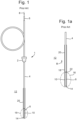
- Fig 1 shows a prior art neurosurgical assembly 1 comprising an enlarged head 2, at the proximal end of a guide tube 4 and a cannula 6 that extends from a source of infusate 8 through the guide tube 4 to a distal end 10.
- the enlarged head 2 is secured in a burr hole (not shown) in the skull of a patient and the distal end of the cannula 10 is positioned within brain tissue 12 so as to deliver infusate from the extreme distal end 14 of the cannula 6 into a target volume of brain tissue as suggested by dashed line ellipse 16.
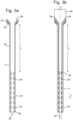
- the inner perforated PEEK layer does not extend the whole length of the guide tube 4.
- An upper portion (proximal portion 38) of the guide tube 4 is not lined. This portion of the guide tube is resiliently extendible and compressible in the axial direction.
- the unlined proximal portion has a length L. This length may be relatively short, for example of the order of 1 to 1.5cm, designed in use to span the distance from a patient's skull to the surface of the brain.
- FIG 3a Also shown in figure 3a are an ePTFE washer 40 and a PEEK washer 42 to aid sealing to a seat in a guide hub (not shown in this figure).
- the washers 40, 42 may also help to create a fluid and gas seal between the guide hub and the guide tube 4.
- Figure 3b shows the arrangement of figure 3a but being inserted into the brain as suggested by arrow I. insertion is carried out with the aid of two coaxially arranged probes.
- a central probe 44 passes through the through bore 30 and extends below the distal portion 18 of guide tube 4.
- An outer probe 46 fits around central probe 44 and has a step 34 for engaging with flared guide tube end 28. Outer probe 46 also has a step 48 for engaging with the upper end of liner tube 26.
- the length L of the unlined proximal portion of guide tube 4 is shortened (compressed) as the distance between steps 34 and 48 is less than the uncompressed length L.
- a single probe including both steps 34 and 48 in its outer profile and passing down through the whole length of throughbore 30 could be employed.
- Figure 4a shows the end 58 of a hardened stainless steel probe 60.
- the end 58 is rounded ('bullet nosed') in shape and has a projecting spike 62 in the form of a rod tapering from rounded end 58 to the extreme distal end 64 of the spike 62.
- An alternative end 58 with a conical shape is shown in figure 4b .
- the extreme end 64 of the spike is itself rounded.
- the probes find use in dissecting tissue to form a track, for example to form a track through brain tissue prior to inserting guide tubes such as those discussed above and shown in figures 1 to 3 .
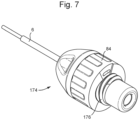
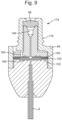
- Fig. 5 shows a proximal end of a cannula 6 comprising a bubble vent 74 provided at the proximal end of the cannula 6.
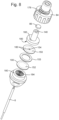
- the configuration and component parts of the bubble vent 74 are described below and illustrated in Fig. 6 .
- the bubble vent 74 mitigates the risk of bubbles entering the brain if they have come out of solution in the infusate or have been entrained in the infusate during the connection and/or disconnection of a delivery system that is used to deliver the infusate to the cannula 6, such as a dispenser, infusion line, and/or pump.
- the bubble vent 74 is preferably provided integrally with the cannula 6, as shown in Fig.
- the bubble filter 82 is a low volume bubble filter made from expanded polytetrafluoroethylene (ePTFE), which has a super-hydrophobic, gas permeable, microporous structure configured to remove bubbles from the flowing therapeutic fluid.
- ePTFE expanded polytetrafluoroethylene
- the bubble filter 82 is effective to remove bubbles at flow rates of less than or equal to 30 ⁇ l/min.
- the filter 82 is contained in the perforated filter guard 80 and in the illustrated example the bubble filter 82 is received over a hollow post 85 and is retained by a retainer ring 83A to the hollow post 85, which is positioned concentric to the filter guard 80.
- the filter guard 80 is a hollow shell that includes a distribution of a plurality of perforations (small holes) 87 around the shell wall.
- the perforations 87 facilitate degassing the fluid as it flows through the bubble filter 82 from the delivery system to the cannula 6.
- the filter guard 80 as the name suggests also guards/protects the filter 82 against damage.
- the combination of the bubble filter 82 and the filter guard 80 facilitates dispersion of entrained air/bubbles from the dispenser fluid flow before the fluid passes into the cannula 6.
- Fig. 12 shows components of a kit for convection enhanced delivery of an infusate to the brain parenchyma.
- the components include the guide hub 50, the guide tube 4, the cannula 6, and the threaded stop 70 which is screwed into the guide hub 50.
Landscapes
- Health & Medical Sciences (AREA)
- Life Sciences & Earth Sciences (AREA)
- Heart & Thoracic Surgery (AREA)
- Veterinary Medicine (AREA)
- Engineering & Computer Science (AREA)
- Biomedical Technology (AREA)
- Animal Behavior & Ethology (AREA)
- General Health & Medical Sciences (AREA)
- Public Health (AREA)
- Anesthesiology (AREA)
- Hematology (AREA)
- Vascular Medicine (AREA)
- Surgery (AREA)
- Medical Informatics (AREA)
- Molecular Biology (AREA)
- Nuclear Medicine, Radiotherapy & Molecular Imaging (AREA)
- Oral & Maxillofacial Surgery (AREA)
- Pathology (AREA)
- Fluid Mechanics (AREA)
- Pulmonology (AREA)
- Physics & Mathematics (AREA)
- Biophysics (AREA)
- Emergency Medicine (AREA)
- Gastroenterology & Hepatology (AREA)
- Surgical Instruments (AREA)
- Infusion, Injection, And Reservoir Apparatuses (AREA)
- Materials For Medical Uses (AREA)
- Prostheses (AREA)
- Finger-Pressure Massage (AREA)
- Media Introduction/Drainage Providing Device (AREA)
Applications Claiming Priority (5)
| Application Number | Priority Date | Filing Date | Title |
|---|---|---|---|
| GBGB2106203.9A GB202106203D0 (en) | 2021-04-30 | 2021-04-30 | Variable dose therapeutic agent dispenser |
| GBGB2106210.4A GB202106210D0 (en) | 2021-04-30 | 2021-04-30 | Implantable guide device |
| GBGB2106224.5A GB202106224D0 (en) | 2021-04-30 | 2021-04-30 | Neurosurgical device |
| PCT/GB2022/051101 WO2022229659A1 (en) | 2021-04-30 | 2022-04-29 | Neurosurgical device |
| EP22721111.7A EP4329648B1 (de) | 2021-04-30 | 2022-04-29 | Neurochirurgische vorrichtung |
Related Parent Applications (2)
| Application Number | Title | Priority Date | Filing Date |
|---|---|---|---|
| EP22721111.7A Division EP4329648B1 (de) | 2021-04-30 | 2022-04-29 | Neurochirurgische vorrichtung |
| EP22721111.7A Division-Into EP4329648B1 (de) | 2021-04-30 | 2022-04-29 | Neurochirurgische vorrichtung |
Publications (2)
| Publication Number | Publication Date |
|---|---|
| EP4582119A2 true EP4582119A2 (de) | 2025-07-09 |
| EP4582119A3 EP4582119A3 (de) | 2025-09-03 |
Family
ID=81454810
Family Applications (5)
| Application Number | Title | Priority Date | Filing Date |
|---|---|---|---|
| EP22721111.7A Active EP4329648B1 (de) | 2021-04-30 | 2022-04-29 | Neurochirurgische vorrichtung |
| EP22720493.0A Active EP4329647B1 (de) | 2021-04-30 | 2022-04-29 | Implantierbare führungsvorrichtung |
| EP25193194.5A Pending EP4616882A3 (de) | 2021-04-30 | 2022-04-29 | Implantierbare führungsvorrichtung |
| EP22720492.2A Pending EP4329646A1 (de) | 2021-04-30 | 2022-04-29 | Spender für therapeutische mittel mit variabler dosis |
| EP25178009.4A Pending EP4582119A3 (de) | 2021-04-30 | 2022-04-29 | Neurochirurgische vorrichtung |
Family Applications Before (4)
| Application Number | Title | Priority Date | Filing Date |
|---|---|---|---|
| EP22721111.7A Active EP4329648B1 (de) | 2021-04-30 | 2022-04-29 | Neurochirurgische vorrichtung |
| EP22720493.0A Active EP4329647B1 (de) | 2021-04-30 | 2022-04-29 | Implantierbare führungsvorrichtung |
| EP25193194.5A Pending EP4616882A3 (de) | 2021-04-30 | 2022-04-29 | Implantierbare führungsvorrichtung |
| EP22720492.2A Pending EP4329646A1 (de) | 2021-04-30 | 2022-04-29 | Spender für therapeutische mittel mit variabler dosis |
Country Status (6)
| Country | Link |
|---|---|
| US (3) | US20240216664A1 (de) |
| EP (5) | EP4329648B1 (de) |
| JP (3) | JP2024516427A (de) |
| AU (2) | AU2022267049A1 (de) |
| CA (3) | CA3216982A1 (de) |
| WO (3) | WO2022229662A1 (de) |
Families Citing this family (4)
| Publication number | Priority date | Publication date | Assignee | Title |
|---|---|---|---|---|
| KR102705613B1 (ko) * | 2022-08-02 | 2024-09-11 | 가톨릭대학교 산학협력단 | 공기주입방지를 위한 필터부가 구비된 의료용 바늘 유닛 |
| DE102024102999A1 (de) * | 2024-02-02 | 2025-08-07 | Acandis Gmbh | Liner für einen medizinischen Katheter; Medizinischer Katheter mit einem Liner; Verfahren zur Herstellung eines Liners für einen medizinischen Katheter |
| DE102024102998A1 (de) * | 2024-02-02 | 2025-08-07 | Acandis Gmbh | Katheterliner umfassend oder bestehend aus Polyaryletherketon |
| GB202406765D0 (en) | 2024-05-14 | 2024-06-26 | Neurochase Tech Limited | Apparatus and method for intracranial device insertion and skull fixation |
Citations (6)
| Publication number | Priority date | Publication date | Assignee | Title |
|---|---|---|---|---|
| WO2007024841A2 (en) | 2005-08-23 | 2007-03-01 | The Regents Of The University Of California | Reflux resistant cannula and system for chronic delivery of therapeutic agents using convection-enhanced delivery |
| EP1482851B1 (de) | 2002-03-12 | 2008-12-10 | Renishaw plc | Katheter und fürungshülse für intracerebrale anwendungen |
| US20100217228A1 (en) | 2007-05-17 | 2010-08-26 | Medgenesis Therapeutix, Inc. | Convection-Enhanced Delivery Catheter with Removable Stiffening Member and Method for Using Same |
| WO2014016591A1 (en) | 2012-07-24 | 2014-01-30 | Renishaw Plc | Neurosurgical apparatus and methods |
| EP3119310B1 (de) | 2014-03-20 | 2018-05-02 | Renishaw PLC | Neurochirurgische vorrichtung |
| EP2819739B1 (de) | 2012-02-28 | 2018-06-27 | Renishaw Plc. | Neurochirurgische vorrichtung |
Family Cites Families (54)
| Publication number | Priority date | Publication date | Assignee | Title |
|---|---|---|---|---|
| US2017276A (en) * | 1933-05-31 | 1935-10-15 | Adolph E Ericson | Hypodermic syringe-air operated |
| US3885297A (en) * | 1971-11-11 | 1975-05-27 | Mpl Inc | Method of assembling glass tube and thermoplastic resin finger grip and nose sleeve syringe body |
| US4113097A (en) * | 1976-08-09 | 1978-09-12 | Diagnostic Isotopes Incorporated | Ampule capable of being autoclaved |
| US4629451A (en) * | 1985-09-23 | 1986-12-16 | Victory Engineering Corp. | Stereotaxic array plug |
| CA1285441C (en) * | 1987-03-17 | 1991-07-02 | Roy D. Mcnaughton | Mcnaughton syringe shield type b |
| US5569236A (en) * | 1989-06-16 | 1996-10-29 | Science Incorporated | Fluid delivery apparatus |
| US5116345A (en) * | 1990-11-28 | 1992-05-26 | Ohio Medical Instrument Co., Inc. | Stereotactically implanting an intracranial device |
| US5536413A (en) * | 1990-12-03 | 1996-07-16 | Pall Corporation | Method for treating a parenteral emulsion-containing medicament fluid |
| FR2678837A1 (fr) * | 1991-07-08 | 1993-01-15 | Baxter Int | Dispositif d'injection de precision. |
| GB9310085D0 (en) * | 1993-05-17 | 1993-06-30 | Reynolds David L | Syringe |
| GB9524880D0 (en) * | 1995-12-05 | 1996-02-07 | Smiths Industries Plc | Fluid administration apparatus |
| US5865842A (en) * | 1996-08-29 | 1999-02-02 | Medtronic, Inc. | System and method for anchoring brain stimulation lead or catheter |
| CH691285A5 (fr) * | 1997-02-05 | 2001-06-29 | Mathieu Assal | Dispositif de rattrapage d'un tendon rompu. |
| US5993425A (en) * | 1998-04-15 | 1999-11-30 | Science Incorporated | Fluid dispenser with reservoir fill assembly |
| US6475222B1 (en) * | 1998-11-06 | 2002-11-05 | St. Jude Medical Atg, Inc. | Minimally invasive revascularization apparatus and methods |
| GB9928248D0 (en) | 1999-12-01 | 2000-01-26 | Gill Steven S | An implantable guide tube for neurosurgery |
| US6569129B1 (en) * | 2000-09-13 | 2003-05-27 | Mayo Foundation For Medical Education And Research | Biological revascularization |
| US6830564B2 (en) * | 2002-01-24 | 2004-12-14 | Robin Scott Gray | Syringe and method of using |
| DE10208668A1 (de) * | 2002-02-28 | 2003-09-18 | Forschungszentrum Juelich Gmbh | Durchflusszelle sowie Verfahren zur Abtrennung von trägerfreien Radionukliden und deren radiochemische Umsetzung |
| US6780115B2 (en) * | 2002-06-07 | 2004-08-24 | Arthrex, Inc. | Method and system for intraoperatively revising the length of fracture fixation screws |
| US7604658B2 (en) * | 2004-05-04 | 2009-10-20 | Codman & Shurtleff, Inc. | Multiple lumen sensor attachment |
| US8152477B2 (en) * | 2005-11-23 | 2012-04-10 | Eksigent Technologies, Llc | Electrokinetic pump designs and drug delivery systems |
| EP2015846A2 (de) * | 2006-04-24 | 2009-01-21 | Ekos Corporation | Ultraschalltherapiesystem |
| US20080119782A1 (en) * | 2006-10-25 | 2008-05-22 | Steinman Christopher P | Method for delivering solutions to a patient |
| US8337425B2 (en) * | 2008-02-05 | 2012-12-25 | Bridgepoint Medical, Inc. | Endovascular device with a tissue piercing distal probe and associated methods |
| US8182540B2 (en) * | 2008-03-28 | 2012-05-22 | National Cheng Kung University | Skull endosseous implant |
| KR101134279B1 (ko) * | 2009-02-09 | 2012-04-10 | (주)이화프레지니우스카비 | 필터장치 및 이를 구비한 주사액 주입장치 |
| WO2011022618A1 (en) * | 2009-08-21 | 2011-02-24 | Becton Dickinson France Sas | Pre-filled active vial having integral plunger assembly |
| WO2011066340A1 (en) * | 2009-11-24 | 2011-06-03 | University Of Florida Research Foundation, Inc. | Apparatus and methods for blocking needle and cannula tracts |
| GB201002370D0 (en) * | 2010-02-12 | 2010-03-31 | Renishaw Ireland Ltd | Percutaneous drug delivery apparatus |
| EP2563430A2 (de) * | 2010-04-30 | 2013-03-06 | Bayer Pharma Aktiengesellschaft | Verdrängungsinjektion |
| US20130310767A1 (en) * | 2010-11-16 | 2013-11-21 | C2C Developement, LLC | Seal tip catheter devices or methods |
| ITMI20111621A1 (it) * | 2011-09-08 | 2013-03-09 | Gvs Spa | Filtro per infusioni medicali a riempimento ottimizzato |
| GB201202093D0 (en) | 2012-02-07 | 2012-03-21 | Renishaw Ireland Ltd | Drug storage apparatus |
| ITMI20120663A1 (it) * | 2012-04-20 | 2013-10-21 | Promev S R L | Dispositivo di supporto e guida di uno strumento chirurgico, in particolare per neurochirurgia |
| US8974414B2 (en) * | 2013-02-13 | 2015-03-10 | Becton, Dickinson And Company | IV drip chamber with filter and bottom reservoir |
| CN203107833U (zh) * | 2013-03-06 | 2013-08-07 | 陆永会 | 自动排气止液滴斗 |
| US9498574B2 (en) * | 2013-03-15 | 2016-11-22 | Carefusion 303, Inc. | Infusion system with dual-chambered reservoir |
| WO2014149357A1 (en) * | 2013-03-22 | 2014-09-25 | Amgen Inc. | Injector and method of assembly |
| JP2015015988A (ja) * | 2013-07-09 | 2015-01-29 | テルモ株式会社 | 医療用器具 |
| KR101535350B1 (ko) * | 2013-09-10 | 2015-07-09 | 김용무 | 내부 필터를 구비한 모세관 장치 및 이를 구비한 주사액 주입장치 |
| JP6301104B2 (ja) * | 2013-10-28 | 2018-03-28 | テルモ株式会社 | 液体投与具 |
| CN107106838B (zh) * | 2014-11-09 | 2020-12-25 | 森索医疗实验有限公司 | 电极引线 |
| US9833564B2 (en) * | 2014-11-25 | 2017-12-05 | Medtronic Minimed, Inc. | Fluid conduit assembly with air venting features |
| KR101631969B1 (ko) * | 2015-04-30 | 2016-07-01 | (주)와이유엔메디칼 | 에어벤트필터를 구비한 니들프리 포트 |
| US10357280B2 (en) * | 2015-04-30 | 2019-07-23 | Nico Corporation | Navigating introducer for tissue access system |
| EP3405125B1 (de) * | 2016-01-20 | 2025-07-16 | AGBM Technologies Ltd | Nadelführungen |
| ES2966151T3 (es) * | 2016-01-27 | 2024-04-18 | Carefusion 303 Inc | Dispositivo de infusión intermitente |
| WO2017180950A1 (en) * | 2016-04-15 | 2017-10-19 | Stryker European Holdings I, Llc | Cannula lock with a brake that rotates and anchors that deploy into the bone against which the cannula lock is set |
| JP2020520704A (ja) * | 2017-05-19 | 2020-07-16 | ポレックス コーポレーション | 親水性焼結多孔質プラスチックまたは親水性多孔質繊維エアストップフィルターを含む注入デバイス |
| US11090437B2 (en) * | 2017-09-06 | 2021-08-17 | Patrick Lynch | Device for therapeutic delivery of medical fluid |
| KR102223085B1 (ko) * | 2017-11-01 | 2021-03-04 | 사회복지법인 삼성생명공익재단 | 뇌내 약물 주입 장치 및 뇌내 약물 주입 방법 |
| CN111655206B (zh) * | 2017-11-21 | 2022-10-14 | 弗赛特影像4股份有限公司 | 用于可扩展端口递送系统的流体交换装置及使用方法 |
| WO2022010820A1 (en) * | 2020-07-07 | 2022-01-13 | The General Hospital Corporation | Devices and method for facilitating placement of sutures in a surgical procedure |
-
2022
- 2022-04-29 JP JP2023566842A patent/JP2024516427A/ja active Pending
- 2022-04-29 US US18/288,748 patent/US20240216664A1/en active Pending
- 2022-04-29 JP JP2023566953A patent/JP2024517777A/ja active Pending
- 2022-04-29 EP EP22721111.7A patent/EP4329648B1/de active Active
- 2022-04-29 EP EP22720493.0A patent/EP4329647B1/de active Active
- 2022-04-29 AU AU2022267049A patent/AU2022267049A1/en active Pending
- 2022-04-29 CA CA3216982A patent/CA3216982A1/en active Pending
- 2022-04-29 CA CA3216973A patent/CA3216973A1/en active Pending
- 2022-04-29 US US18/288,676 patent/US20240238512A1/en active Pending
- 2022-04-29 WO PCT/GB2022/051104 patent/WO2022229662A1/en not_active Ceased
- 2022-04-29 AU AU2022267845A patent/AU2022267845A1/en active Pending
- 2022-04-29 EP EP25193194.5A patent/EP4616882A3/de active Pending
- 2022-04-29 US US18/288,775 patent/US20240207010A1/en active Pending
- 2022-04-29 EP EP22720492.2A patent/EP4329646A1/de active Pending
- 2022-04-29 EP EP25178009.4A patent/EP4582119A3/de active Pending
- 2022-04-29 WO PCT/GB2022/051101 patent/WO2022229659A1/en not_active Ceased
- 2022-04-29 JP JP2023566954A patent/JP2024517778A/ja active Pending
- 2022-04-29 WO PCT/GB2022/051102 patent/WO2022229660A1/en not_active Ceased
- 2022-04-29 CA CA3216983A patent/CA3216983A1/en active Pending
Patent Citations (6)
| Publication number | Priority date | Publication date | Assignee | Title |
|---|---|---|---|---|
| EP1482851B1 (de) | 2002-03-12 | 2008-12-10 | Renishaw plc | Katheter und fürungshülse für intracerebrale anwendungen |
| WO2007024841A2 (en) | 2005-08-23 | 2007-03-01 | The Regents Of The University Of California | Reflux resistant cannula and system for chronic delivery of therapeutic agents using convection-enhanced delivery |
| US20100217228A1 (en) | 2007-05-17 | 2010-08-26 | Medgenesis Therapeutix, Inc. | Convection-Enhanced Delivery Catheter with Removable Stiffening Member and Method for Using Same |
| EP2819739B1 (de) | 2012-02-28 | 2018-06-27 | Renishaw Plc. | Neurochirurgische vorrichtung |
| WO2014016591A1 (en) | 2012-07-24 | 2014-01-30 | Renishaw Plc | Neurosurgical apparatus and methods |
| EP3119310B1 (de) | 2014-03-20 | 2018-05-02 | Renishaw PLC | Neurochirurgische vorrichtung |
Also Published As
| Publication number | Publication date |
|---|---|
| AU2022267049A1 (en) | 2023-11-09 |
| EP4582119A3 (de) | 2025-09-03 |
| EP4329646A1 (de) | 2024-03-06 |
| US20240216664A1 (en) | 2024-07-04 |
| WO2022229662A1 (en) | 2022-11-03 |
| CA3216983A1 (en) | 2022-11-03 |
| EP4329647A1 (de) | 2024-03-06 |
| EP4329648A1 (de) | 2024-03-06 |
| CA3216973A1 (en) | 2022-11-03 |
| US20240207010A1 (en) | 2024-06-27 |
| EP4616882A3 (de) | 2025-11-05 |
| AU2022267845A1 (en) | 2023-11-09 |
| CA3216982A1 (en) | 2022-11-03 |
| JP2024517777A (ja) | 2024-04-23 |
| EP4329647B1 (de) | 2025-09-10 |
| EP4329647C0 (de) | 2025-09-10 |
| JP2024517778A (ja) | 2024-04-23 |
| EP4329648C0 (de) | 2025-08-27 |
| WO2022229660A1 (en) | 2022-11-03 |
| JP2024516427A (ja) | 2024-04-15 |
| WO2022229659A1 (en) | 2022-11-03 |
| EP4329648B1 (de) | 2025-08-27 |
| EP4616882A2 (de) | 2025-09-17 |
| US20240238512A1 (en) | 2024-07-18 |
Similar Documents
| Publication | Publication Date | Title |
|---|---|---|
| EP4329648B1 (de) | Neurochirurgische vorrichtung | |
| EP1712252B1 (de) | Multikathetervorrichtung zum Einsetzen | |
| US9717887B2 (en) | Catheter assembly blood control device and related methods | |
| JP6298146B2 (ja) | 移送装置弁 | |
| EP2237826B1 (de) | Infusionskatheteranordnung mit verringertem rückfluss | |
| JP4755271B2 (ja) | 薬剤を均等に送達させるためのカテーテル | |
| US8062262B2 (en) | Extravascular system in-line venting | |
| EP2436412A1 (de) | Sprinklerkanüle | |
| JP2008537684A (ja) | 内耳およびその他の組織へ治療薬および/またはその他の薬剤を送達するための装置および方法 | |
| IL292768A (en) | Bleed stop valve for sheath assembly | |
| JP5248556B2 (ja) | 薬剤を均等に送達させるためのカテーテル | |
| EP4608487A1 (de) | Neurochirurgischer führungsdraht | |
| WO2018225331A1 (ja) | カテーテル | |
| WO2024236279A1 (en) | Neurosurgical device | |
| BRPI0410351B1 (pt) | Cateter for the distribution of a fluid to an anatomical region |
Legal Events
| Date | Code | Title | Description |
|---|---|---|---|
| PUAI | Public reference made under article 153(3) epc to a published international application that has entered the european phase |
Free format text: ORIGINAL CODE: 0009012 |
|
| STAA | Information on the status of an ep patent application or granted ep patent |
Free format text: STATUS: THE APPLICATION HAS BEEN PUBLISHED |
|
| AC | Divisional application: reference to earlier application |
Ref document number: 4329648 Country of ref document: EP Kind code of ref document: P |
|
| AK | Designated contracting states |
Kind code of ref document: A2 Designated state(s): AL AT BE BG CH CY CZ DE DK EE ES FI FR GB GR HR HU IE IS IT LI LT LU LV MC MK MT NL NO PL PT RO RS SE SI SK SM TR |
|
| REG | Reference to a national code |
Ref country code: DE Ref legal event code: R079 Free format text: PREVIOUS MAIN CLASS: A61M0005145000 Ipc: A61B0017340000 |
|
| PUAL | Search report despatched |
Free format text: ORIGINAL CODE: 0009013 |
|
| AK | Designated contracting states |
Kind code of ref document: A3 Designated state(s): AL AT BE BG CH CY CZ DE DK EE ES FI FR GB GR HR HU IE IS IT LI LT LU LV MC MK MT NL NO PL PT RO RS SE SI SK SM TR |
|
| RIC1 | Information provided on ipc code assigned before grant |
Ipc: A61B 17/34 20060101AFI20250728BHEP Ipc: A61B 90/11 20160101ALI20250728BHEP Ipc: A61B 90/00 20160101ALI20250728BHEP Ipc: A61B 90/10 20160101ALI20250728BHEP Ipc: A61M 5/38 20060101ALI20250728BHEP Ipc: A61M 5/14 20060101ALI20250728BHEP Ipc: A61M 5/178 20060101ALI20250728BHEP Ipc: A61M 5/32 20060101ALI20250728BHEP Ipc: A61M 5/19 20060101ALI20250728BHEP Ipc: A61M 5/145 20060101ALN20250728BHEP Ipc: A61M 5/142 20060101ALN20250728BHEP Ipc: A61B 17/32 20060101ALN20250728BHEP Ipc: A61J 1/06 20060101ALN20250728BHEP Ipc: A61M 39/10 20060101ALN20250728BHEP |
|
| STAA | Information on the status of an ep patent application or granted ep patent |
Free format text: STATUS: REQUEST FOR EXAMINATION WAS MADE |
|
| 17P | Request for examination filed |
Effective date: 20260302 |