EP4582188A1 - Vergasung von wiedergewonnenem russ - Google Patents
Vergasung von wiedergewonnenem russ Download PDFInfo
- Publication number
- EP4582188A1 EP4582188A1 EP24192597.3A EP24192597A EP4582188A1 EP 4582188 A1 EP4582188 A1 EP 4582188A1 EP 24192597 A EP24192597 A EP 24192597A EP 4582188 A1 EP4582188 A1 EP 4582188A1
- Authority
- EP
- European Patent Office
- Prior art keywords
- carbon black
- recovered
- recovered carbon
- particle size
- content
- Prior art date
- Legal status (The legal status is an assumption and is not a legal conclusion. Google has not performed a legal analysis and makes no representation as to the accuracy of the status listed.)
- Pending
Links
Images



Classifications
-
- C—CHEMISTRY; METALLURGY
- C09—DYES; PAINTS; POLISHES; NATURAL RESINS; ADHESIVES; COMPOSITIONS NOT OTHERWISE PROVIDED FOR; APPLICATIONS OF MATERIALS NOT OTHERWISE PROVIDED FOR
- C09C—TREATMENT OF INORGANIC MATERIALS, OTHER THAN FIBROUS FILLERS, TO ENHANCE THEIR PIGMENTING OR FILLING PROPERTIES ; PREPARATION OF CARBON BLACK ; PREPARATION OF INORGANIC MATERIALS WHICH ARE NO SINGLE CHEMICAL COMPOUNDS AND WHICH ARE MAINLY USED AS PIGMENTS OR FILLERS
- C09C1/00—Treatment of specific inorganic materials other than fibrous fillers; Preparation of carbon black
- C09C1/44—Carbon
- C09C1/48—Carbon black
-
- B—PERFORMING OPERATIONS; TRANSPORTING
- B03—SEPARATION OF SOLID MATERIALS USING LIQUIDS OR USING PNEUMATIC TABLES OR JIGS; MAGNETIC OR ELECTROSTATIC SEPARATION OF SOLID MATERIALS FROM SOLID MATERIALS OR FLUIDS; SEPARATION BY HIGH-VOLTAGE ELECTRIC FIELDS
- B03D—FLOTATION; DIFFERENTIAL SEDIMENTATION
- B03D1/00—Flotation
- B03D1/02—Froth-flotation processes
- B03D1/023—Carrier flotation; Flotation of a carrier material to which the target material attaches
-
- B—PERFORMING OPERATIONS; TRANSPORTING
- B03—SEPARATION OF SOLID MATERIALS USING LIQUIDS OR USING PNEUMATIC TABLES OR JIGS; MAGNETIC OR ELECTROSTATIC SEPARATION OF SOLID MATERIALS FROM SOLID MATERIALS OR FLUIDS; SEPARATION BY HIGH-VOLTAGE ELECTRIC FIELDS
- B03D—FLOTATION; DIFFERENTIAL SEDIMENTATION
- B03D1/00—Flotation
- B03D1/14—Flotation machines
- B03D1/16—Flotation machines with impellers; Subaeration machines
-
- B—PERFORMING OPERATIONS; TRANSPORTING
- B03—SEPARATION OF SOLID MATERIALS USING LIQUIDS OR USING PNEUMATIC TABLES OR JIGS; MAGNETIC OR ELECTROSTATIC SEPARATION OF SOLID MATERIALS FROM SOLID MATERIALS OR FLUIDS; SEPARATION BY HIGH-VOLTAGE ELECTRIC FIELDS
- B03D—FLOTATION; DIFFERENTIAL SEDIMENTATION
- B03D1/00—Flotation
- B03D1/14—Flotation machines
- B03D1/24—Pneumatic
-
- C—CHEMISTRY; METALLURGY
- C09—DYES; PAINTS; POLISHES; NATURAL RESINS; ADHESIVES; COMPOSITIONS NOT OTHERWISE PROVIDED FOR; APPLICATIONS OF MATERIALS NOT OTHERWISE PROVIDED FOR
- C09C—TREATMENT OF INORGANIC MATERIALS, OTHER THAN FIBROUS FILLERS, TO ENHANCE THEIR PIGMENTING OR FILLING PROPERTIES ; PREPARATION OF CARBON BLACK ; PREPARATION OF INORGANIC MATERIALS WHICH ARE NO SINGLE CHEMICAL COMPOUNDS AND WHICH ARE MAINLY USED AS PIGMENTS OR FILLERS
- C09C1/00—Treatment of specific inorganic materials other than fibrous fillers; Preparation of carbon black
- C09C1/44—Carbon
- C09C1/48—Carbon black
- C09C1/482—Preparation from used rubber products, e.g. tyres
-
- C—CHEMISTRY; METALLURGY
- C09—DYES; PAINTS; POLISHES; NATURAL RESINS; ADHESIVES; COMPOSITIONS NOT OTHERWISE PROVIDED FOR; APPLICATIONS OF MATERIALS NOT OTHERWISE PROVIDED FOR
- C09C—TREATMENT OF INORGANIC MATERIALS, OTHER THAN FIBROUS FILLERS, TO ENHANCE THEIR PIGMENTING OR FILLING PROPERTIES ; PREPARATION OF CARBON BLACK ; PREPARATION OF INORGANIC MATERIALS WHICH ARE NO SINGLE CHEMICAL COMPOUNDS AND WHICH ARE MAINLY USED AS PIGMENTS OR FILLERS
- C09C1/00—Treatment of specific inorganic materials other than fibrous fillers; Preparation of carbon black
- C09C1/44—Carbon
- C09C1/48—Carbon black
- C09C1/50—Furnace black ; Preparation thereof
-
- C—CHEMISTRY; METALLURGY
- C10—PETROLEUM, GAS OR COKE INDUSTRIES; TECHNICAL GASES CONTAINING CARBON MONOXIDE; FUELS; LUBRICANTS; PEAT
- C10B—DESTRUCTIVE DISTILLATION OF CARBONACEOUS MATERIALS FOR PRODUCTION OF GAS, COKE, TAR, OR SIMILAR MATERIALS
- C10B19/00—Heating of coke ovens by electrical means
-
- C—CHEMISTRY; METALLURGY
- C10—PETROLEUM, GAS OR COKE INDUSTRIES; TECHNICAL GASES CONTAINING CARBON MONOXIDE; FUELS; LUBRICANTS; PEAT
- C10B—DESTRUCTIVE DISTILLATION OF CARBONACEOUS MATERIALS FOR PRODUCTION OF GAS, COKE, TAR, OR SIMILAR MATERIALS
- C10B49/00—Destructive distillation of solid carbonaceous materials by direct heating with heat-carrying agents including the partial combustion of the solid material to be treated
- C10B49/02—Destructive distillation of solid carbonaceous materials by direct heating with heat-carrying agents including the partial combustion of the solid material to be treated with hot gases or vapours, e.g. hot gases obtained by partial combustion of the charge
-
- C—CHEMISTRY; METALLURGY
- C10—PETROLEUM, GAS OR COKE INDUSTRIES; TECHNICAL GASES CONTAINING CARBON MONOXIDE; FUELS; LUBRICANTS; PEAT
- C10B—DESTRUCTIVE DISTILLATION OF CARBONACEOUS MATERIALS FOR PRODUCTION OF GAS, COKE, TAR, OR SIMILAR MATERIALS
- C10B53/00—Destructive distillation, specially adapted for particular solid raw materials or solid raw materials in special form
- C10B53/07—Destructive distillation, specially adapted for particular solid raw materials or solid raw materials in special form of solid raw materials consisting of synthetic polymeric materials, e.g. tyres
-
- C—CHEMISTRY; METALLURGY
- C10—PETROLEUM, GAS OR COKE INDUSTRIES; TECHNICAL GASES CONTAINING CARBON MONOXIDE; FUELS; LUBRICANTS; PEAT
- C10B—DESTRUCTIVE DISTILLATION OF CARBONACEOUS MATERIALS FOR PRODUCTION OF GAS, COKE, TAR, OR SIMILAR MATERIALS
- C10B7/00—Coke ovens with mechanical conveying means for the raw material inside the oven
- C10B7/02—Coke ovens with mechanical conveying means for the raw material inside the oven with rotary scraping devices
-
- C—CHEMISTRY; METALLURGY
- C10—PETROLEUM, GAS OR COKE INDUSTRIES; TECHNICAL GASES CONTAINING CARBON MONOXIDE; FUELS; LUBRICANTS; PEAT
- C10J—PRODUCTION OF PRODUCER GAS, WATER-GAS, SYNTHESIS GAS FROM SOLID CARBONACEOUS MATERIAL, OR MIXTURES CONTAINING THESE GASES; CARBURETTING AIR OR OTHER GASES
- C10J3/00—Production of combustible gases containing carbon monoxide from solid carbonaceous fuels
-
- C—CHEMISTRY; METALLURGY
- C10—PETROLEUM, GAS OR COKE INDUSTRIES; TECHNICAL GASES CONTAINING CARBON MONOXIDE; FUELS; LUBRICANTS; PEAT
- C10J—PRODUCTION OF PRODUCER GAS, WATER-GAS, SYNTHESIS GAS FROM SOLID CARBONACEOUS MATERIAL, OR MIXTURES CONTAINING THESE GASES; CARBURETTING AIR OR OTHER GASES
- C10J3/00—Production of combustible gases containing carbon monoxide from solid carbonaceous fuels
- C10J3/58—Production of combustible gases containing carbon monoxide from solid carbonaceous fuels combined with pre-distillation of the fuel
- C10J3/60—Processes
- C10J3/62—Processes with separate withdrawal of the distillation products
-
- F—MECHANICAL ENGINEERING; LIGHTING; HEATING; WEAPONS; BLASTING
- F27—FURNACES; KILNS; OVENS; RETORTS
- F27B—FURNACES, KILNS, OVENS OR RETORTS IN GENERAL; OPEN SINTERING OR LIKE APPARATUS
- F27B9/00—Furnaces through which the charge is moved mechanically, e.g. of tunnel type; Similar furnaces in which the charge moves by gravity
- F27B9/14—Furnaces through which the charge is moved mechanically, e.g. of tunnel type; Similar furnaces in which the charge moves by gravity characterised by the path of the charge during treatment; characterised by the means by which the charge is moved during treatment
- F27B9/142—Furnaces through which the charge is moved mechanically, e.g. of tunnel type; Similar furnaces in which the charge moves by gravity characterised by the path of the charge during treatment; characterised by the means by which the charge is moved during treatment the charge moving along a vertical axis
-
- B—PERFORMING OPERATIONS; TRANSPORTING
- B01—PHYSICAL OR CHEMICAL PROCESSES OR APPARATUS IN GENERAL
- B01D—SEPARATION
- B01D11/00—Solvent extraction
- B01D11/02—Solvent extraction of solids
- B01D11/0288—Applications, solvents
-
- B—PERFORMING OPERATIONS; TRANSPORTING
- B03—SEPARATION OF SOLID MATERIALS USING LIQUIDS OR USING PNEUMATIC TABLES OR JIGS; MAGNETIC OR ELECTROSTATIC SEPARATION OF SOLID MATERIALS FROM SOLID MATERIALS OR FLUIDS; SEPARATION BY HIGH-VOLTAGE ELECTRIC FIELDS
- B03D—FLOTATION; DIFFERENTIAL SEDIMENTATION
- B03D2203/00—Specified materials treated by the flotation agents; Specified applications
- B03D2203/02—Ores
- B03D2203/04—Non-sulfide ores
- B03D2203/08—Coal ores, fly ash or soot
-
- C—CHEMISTRY; METALLURGY
- C10—PETROLEUM, GAS OR COKE INDUSTRIES; TECHNICAL GASES CONTAINING CARBON MONOXIDE; FUELS; LUBRICANTS; PEAT
- C10J—PRODUCTION OF PRODUCER GAS, WATER-GAS, SYNTHESIS GAS FROM SOLID CARBONACEOUS MATERIAL, OR MIXTURES CONTAINING THESE GASES; CARBURETTING AIR OR OTHER GASES
- C10J2300/00—Details of gasification processes
- C10J2300/09—Details of the feed, e.g. feeding of spent catalyst, inert gas or halogens
- C10J2300/0913—Carbonaceous raw material
- C10J2300/094—Char
-
- C—CHEMISTRY; METALLURGY
- C10—PETROLEUM, GAS OR COKE INDUSTRIES; TECHNICAL GASES CONTAINING CARBON MONOXIDE; FUELS; LUBRICANTS; PEAT
- C10J—PRODUCTION OF PRODUCER GAS, WATER-GAS, SYNTHESIS GAS FROM SOLID CARBONACEOUS MATERIAL, OR MIXTURES CONTAINING THESE GASES; CARBURETTING AIR OR OTHER GASES
- C10J2300/00—Details of gasification processes
- C10J2300/09—Details of the feed, e.g. feeding of spent catalyst, inert gas or halogens
- C10J2300/0953—Gasifying agents
- C10J2300/0973—Water
- C10J2300/0976—Water as steam
-
- C—CHEMISTRY; METALLURGY
- C10—PETROLEUM, GAS OR COKE INDUSTRIES; TECHNICAL GASES CONTAINING CARBON MONOXIDE; FUELS; LUBRICANTS; PEAT
- C10J—PRODUCTION OF PRODUCER GAS, WATER-GAS, SYNTHESIS GAS FROM SOLID CARBONACEOUS MATERIAL, OR MIXTURES CONTAINING THESE GASES; CARBURETTING AIR OR OTHER GASES
- C10J2300/00—Details of gasification processes
- C10J2300/12—Heating the gasifier
- C10J2300/1223—Heating the gasifier by burners
-
- C—CHEMISTRY; METALLURGY
- C10—PETROLEUM, GAS OR COKE INDUSTRIES; TECHNICAL GASES CONTAINING CARBON MONOXIDE; FUELS; LUBRICANTS; PEAT
- C10J—PRODUCTION OF PRODUCER GAS, WATER-GAS, SYNTHESIS GAS FROM SOLID CARBONACEOUS MATERIAL, OR MIXTURES CONTAINING THESE GASES; CARBURETTING AIR OR OTHER GASES
- C10J2300/00—Details of gasification processes
- C10J2300/12—Heating the gasifier
- C10J2300/1253—Heating the gasifier by injecting hot gas
-
- C—CHEMISTRY; METALLURGY
- C10—PETROLEUM, GAS OR COKE INDUSTRIES; TECHNICAL GASES CONTAINING CARBON MONOXIDE; FUELS; LUBRICANTS; PEAT
- C10J—PRODUCTION OF PRODUCER GAS, WATER-GAS, SYNTHESIS GAS FROM SOLID CARBONACEOUS MATERIAL, OR MIXTURES CONTAINING THESE GASES; CARBURETTING AIR OR OTHER GASES
- C10J2300/00—Details of gasification processes
- C10J2300/18—Details of the gasification process, e.g. loops, autothermal operation
- C10J2300/1853—Steam reforming, i.e. injection of steam only
Definitions
- Carbon blacks have numerous uses such as a reinforcing agent or filler for the rubber and tire industries. Moreover, carbon black has seen increased use in other areas such as coloring agents and reprographic toners for copying machines. The various applications of carbon black necessitate a diverse range of carbon black characteristics such as particle size, structure, yield, surface area, and stain.
- Recycled blacks are carbon blacks typically obtained from end-of-life products containing carbon black, such as scrap tires (waste tires), and obtained by recycling processes. Production of recycled blacks typically involves 1 to 3 processes. Firstly, a pyrolysis step is deployed to decompose organic components such as rubbers or plastics. Secondly, an optional demineralization step is deployed to dissolve inorganic additives or impurities. Thirdly, the resulting material is milled to produce a controlled particle size distribution.
- Tire pyrolysis of end-of-life products containing carbon black is usually carried out at low temperatures and produces a liquid, gaseous and solid fraction. The liquid fraction can then be used to produce new or virgin carbon black in an entrained flow reactor such as a furnace reactor.
- US 2002/0117388 A1 relates to the pyrolysis of waste rubber materials, including scrap tires.
- the obtained carbon black is generally referred to as "recovered carbon black" (rCB).
- rCB is a complex mixture resulting from the compounds used in pyrolysis.
- the compounds used in the pyrolysis process may contain various components (i.e. ash) other than carbon black, such as inorganic additives and fillers (e.g., zinc oxide, silicon oxide, sulphur compounds and calcium carbonate) and traces of steel.
- inorganic additives and fillers e.g., zinc oxide, silicon oxide, sulphur compounds and calcium carbonate
- rCB is generally poor compared to carbon black produced from e.g. a standard hydrocarbon feedstock such as oil. Accordingly, it is desired to provide a method in which the rCB is treated.
- a method for the treatment of recovered carbon black comprising, (A) providing recovered carbon black and gasification of the recovered carbon black at a temperature of 730 °C to 950 °C, (B) subjecting the recovered carbon black of step (A) after the gasification to an aqueous flotation slurry, (C) treating the recovered carbon black in the aqueous flotation slurry by flotation, (D) separating the concentrate comprising the treated carbon black and the flotation tailings.
- a rubber article comprising carbon black comprising coke is provided, wherein the rubber article has an abrasion of less than 120 mm 3 , measured at 23 °C DIN ISO 4649:2014-03, 10 N.
- any numerical range recited herein is intended to include all subranges subsumed therein.
- a range of "1 to 10" is intended to include any and all sub-ranges between and including the recited minimum value of 1 and the recited maximum value of 10, that is, all subranges beginning with a minimum value equal to or greater than 1 and ending with a maximum value equal to or less than 10, and all subranges in between, e.g., 1 to 6.3, or 5.5 to 10, or 2.7 to 6.1.
- rubber articles refers to articles composed of rubber, e.g., composed of at least 40 wt.-% of rubber, based on the total weight of the rubber article.
- rubber articles include, but are not limited to, tires, conveyer belts, gaskets, such as door gaskets, drive belts, floor mats, shoe soles, belts, cable sheaths, hoses, and the like.
- Preferred rubber articles include tires.
- the term "rubber” includes both natural and synthetic rubbers or mixtures thereof. Natural rubber (polyisoprene) may be obtained from rubber trees (Helvea brasiliensis), guayule, and dandelion.
- recovered carbon black (rCB) in comparison to virgin carbon black (vCB) - comprises ash (ash components) that is typically embedded in the carbon of the rCB, attached to the carbon of the rCB, attached on the surface of the carbon of the rCB, and/or associated in the carbon of the rCB.
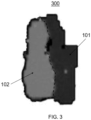
- ash or the ash components can be seen in figures 1 to 3 .
- Ash typically comprise metal, metal compounds, silicon, oxygen, sulphur and/or silica, preferably metal comprises zinc, silicon, calcium, cobalt, manganese, potassium, aluminium, and/or iron.
- the ash content is typically determined according to ASTM D 1506-15 at 550 °C, 16 h.
- the specific rCB particles and the ash components are generally not present as separate components so that a rCB mixture generally not comprise merely a distinct silica particle and a distinct carbon black particle.
- Virgin carbon black is usually carbon black that is not derived (or recovered) from the pyrolysis of a particulate carbon-black containing feedstock, such as rubber granulate, plastic granulate, and/or biomass-based granulate, preferably rubber granulate.
- Virgin carbon black is usually obtained from a furnace process, gas black process, acetylene black process, thermal black process or lamp black process by utilizing a fuel oil feedstock, or a feedstock that does not comprise carbon black. Thus, no carbon black that is generally present in a feedstock is recovered to produce virgin carbon black.
- a frothless system for the flotation or a froth system.
- a reflux flotation cell RLC
- a reflux flotation cell from FLSmidth A/S, Denmark can be used.
- the flotation is a froth flotation.
- the treatment of step (C) is carried out in a froth flotation device, such as mechanical froth flotation device, pneumatic froth flotation device, expansion froth flotation device and/or reverse-flotation unit.
- step (C) comprises the formation of bubbles and the carbon black of the recovered carbon black (or the recovered carbon black) is attached to the bubbles.
- the gasification of the recovered carbon black comprising coke can be done at a temperature of 730 °C to 950 °C to selectively reduce the coke content with respect to the carbon black content of the recovered carbon black.
- the gasification can be carried out at a temperature of 730 °C to 910 °C, preferably 730 °C to 900 °C, more preferably 740 to 890 °C, even more preferably 740 °C to 860 °C, and most preferably 790 to 850 °C.
- the gasification can be carried out by subjecting the recovered carbon black with a gas comprising 20 to 100 mol-% H 2 O and/or CO 2 , preferably 30 to 100 mol-% H 2 O and/or CO 2 , more preferably 40 to 90 mol-% H 2 O and/or CO 2 , most preferably 50 to 80 mol-% H 2 O and/or CO 2 , based on the total number of moles of the gas.
- a gas comprising 20 to 100 mol-% H 2 O and/or CO 2 , preferably 30 to 100 mol-% H 2 O and/or CO 2 , more preferably 40 to 90 mol-% H 2 O and/or CO 2 , most preferably 50 to 80 mol-% H 2 O and/or CO 2 , based on the total number of moles of the gas.
- the gasification can be carried out by subjecting the recovered carbon black with steam comprising 20 to 100 mol-% H 2 O, preferably 30 to 100 mol-% H 2 O, more preferably 40 to 90 mol-% H 2 O, most preferably 50 to 80 mol-% H 2 O, based on the total number of moles of the steam.
- the gasification can be carried out by subjecting the recovered carbon black with a gas comprising 20 to 100 mol-% CO 2 , preferably 30 to 100 mol-% CO 2 , more preferably 40 to 90 mol-% CO 2 , most preferably 50 to 80 mol-% CO 2 , based on the total number of moles of the steam.
- the gasification atmosphere in which the recovered carbon black is treated can comprise 20 to 100 mol-% H 2 O and/or CO 2 , preferably 30 to 100 mol-% H 2 O and/or CO 2 , more preferably 40 to 90 mol-% H 2 O and/or CO 2 , most preferably 50 to 80 mol-% H 2 O and/or CO 2 , based on the total number of moles of the gasification atmosphere in which the recovered carbon black is treated.
- the gasification atmosphere which in the recovered carbon black is treated can comprise 20 to 100 mol-% CO 2 , preferably 30 to 100 mol-% CO 2 , more preferably 40 to 90 mol-% CO 2 , most preferably 50 to 80 mol-% CO 2 , based on the total number of moles of the gasification atmosphere in which the recovered carbon black is treated.
- the recovered carbon black can be heated to the required temperature for the gasification by using a burner _(or at least one burner), preferably the fuel for the burner is hydrogen or natural gas, preferably hydrogen.
- the burner _(or at least one burner) for the gasification can be a hydrogen burner _(or at least one hydrogen burner).
- a hydrogen burner only produces water that can directly be used for the gasification. Accordingly, it may not be necessary to provide steam or additionally water for the gasification. In other words, no water and/or CO 2 is (additionally) is subjected to a reactor for the gasification.
- the obtained carbon black comprises a lower coke content compared to the recovered carbon black.
- a low coke content is particularly preferred since carbon black having a low coke content performs better as a filler in rubber articles, such as tires. For instance, the tensile strength, the tear resistance and/or the max loss factor tan(d) is improved.
- the recovered carbon black can be derived from the pyrolysis of rubber granulate, plastic granulate, and/or biomass-based granulate, preferably rubber granulate.
- the recovered carbon black can be derived from the pyrolysis of a tire, preferably a pneumatic tire, a tire tread, a tire belt, a tire belt reinforcement, a tire carcass, a tire carcass reinforcement, a tire sidewall, tire inner liner, tire apex, tire shoulder, tire hump strip, tire chafer, a tire bead filler.
- the recovered carbon black can be derived from the pyrolysis of a cable sheath, a tube, a drive belt, a conveyor belt, a roll covering, a shoe sole, a hose, a sealing member, a profile, a damping element, a coating or a colored or printed article.
- the pyrolysis and gasification can be carried out as a continuous process.
- the pyrolysis and gasification are carried out in a multi-layered pyrolysis reactor, such as a multiple hearth furnace.
- a multi-layered pyrolysis reactor the pyrolysis is generally performed in the pyrolysis zone of the reactor and the gasification is performed in the gasification zone of the reactor. Accordingly, the entire process is a continuous process wherein the material after the pyrolysis is subjected directly to the gasification, i.e. both processes are carried out in one reactor.
- the reactor is usually configured that the material is subjected to the pyrolysis and then, to the gasification.
- the pyrolysis zone can be the zone in which the heating unit heats the material on each hearth to 360 to 740 °C (preferably 360 to 710 °C), and/or gasification zone can be the zone in which the burner(s) heat(s) the material on each hearth to 730 to 950 °C. As mentioned above, it is desired that the gasification zone is below the pyrolysis zone.
- the uppermost hearth can define the pyrolysis zone, preferably in which the electrical heating unit heats the material on each hearth to 360 to 740 °C (preferably 360 to 710 °C).
- the two uppermost hearths can define the pyrolysis zone, preferably in which the electrical heating unit heats the material on each hearth to 360 to 740 °C (preferably 360 to 710 °C).
- the three uppermost hearths can define the pyrolysis zone, preferably in which the electrical heating unit heats the material on each hearth to 360 to 740 °C (preferably 360 to 710 °C).
- Each burner for each hearth in the gasification zone can be an oxy-fuel burner.
- the method can further comprise the step, providing rubber granulate and pyrolyzing the rubber granulate to obtain recovered carbon black.
- the recovered carbon black can then be used for the gasification in step (A).
- Both the pyrolyzing and the gasification in step (A) can be carried out in a multi-layered pyrolysis reactor, such as a multiple hearth furnace.
- the required H 2 O for the gasification as well as the required heat can be provided by at least one oxy-fuel burner.
- the fuel for the oxy-fuel burner can be methane and the oxy-fuel burner is subjected with oxygen.
- the fuel for the oxy-fuel burner can be hydrogen and the oxy-fuel burner is subjected with oxygen.
- the oxy-fuel burner can be subjected with oxygen.
- the oxy-fuel burner can be subjected with pure oxygen.
- the pure oxygen contains less nitrogen than atmospheric air.
- the oxy-fuel burner can be subjected with oxygen having a nitrogen content from 0 to 2 mol-% N 2 , preferably 0 to 1 mol-% N 2 , more preferably 0.001 to 0.5 mol-% N 2 , and most preferably 0.01 to 0.1 mol-% N 2 , based on the total number of moles of the oxygen supplied to the oxy-fuel burner. It is desired that no nitrogen gas is subjected to the oxy-fuel burner.
- the gasification atmosphere in which the recovered carbon black is treated can be substantially free of N 2 , more preferably free of N 2 .
- the gasification atmosphere in which the recovered carbon black is treated can comprise 0 to 2 mol-% N 2 , preferably 0 to 1 mol-% N 2 , more preferably 0.001 to 0.5 mol-% N 2 , and most preferably 0.01 to 0.1 mol-% N 2 , based on the total number of moles of the gasification atmosphere in which the recovered carbon black is treated.
- the gasification zone in which the recovered carbon black is treated is preferably substantially free of N 2 , more preferably free of N 2 .
- the gasification zone in which the recovered carbon black is treated can comprise 0 to 2 mol-% N 2 , preferably 0 to 1 mol-% N 2 , more preferably 0.001 to 0.5 mol-% N 2 , and most preferably 0.01 to 0.1 mol-% N 2 , based on the total number of moles of the atmosphere in the gasification zone in which the recovered carbon black is treated.
- the burner such as oxy-fuel burner, can have a fuel flow rate from 1 to 2000 Nm 3 /h, preferably 10 to 1500 Nm 3 /h, more preferably 10 to 1000 Nm 3 /h, and most preferably 10 to 600 Nm 3 /h (Nm 3 is a volume at defined state: Pressure: 101325 Pa and temperature: 0°C).
- the oxy-fuel burner can not only utilize oxygen (O 2 ), such as pure oxygen, (in addition to the fuel) but also optionally air.
- oxygen such as pure oxygen
- the oxy-fuel burner can switch between air and oxygen (such as pure oxygen) operation.
- the oxy-fuel burner generally comprises means, such an air conduit, to supply air to the oxy-fuel burner.
- the oxy-fuel burner generally comprises means, such an air conduit, to supply air to the oxy-fuel burner in addition to means, such an oxygen conduit, to supply oxygen to the oxy-fuel burner.
- the air operation can reduce the concentration of H 2 O in the gasification zone if necessary, to slow down the rate of gasification if necessary.
- the oxy-fuel burner utilizes oxygen (O 2 ), such as pure oxygen, (in addition to the fuel) and optionally utilizes air.
- oxygen such as pure oxygen
- the oxy-fuel burner can be supplied with oxygen (O 2 ) as well as air.
- the oxy-fuel burner can be supplied with N 2 in addition to oxygen.
- the oxy-fuel burner can continuously increase the supply with air in addition to oxygen in order to adjust the concentration of N 2 and O 2 .
- the oxy-fuel burner can comprise an oxygen conduit and an air conduit and means to mix oxygen and air that is supplied to the oxy-fuel burner.
- the volume ratio of oxygen to air can be 1000 to 0.001, preferably 500 to 1, more preferably 200 to 10, and most preferably 100 to 20.
- the oxy-fuel burner can continuously increase the supply with nitrogen in addition to oxygen in order to adjust the concentration of N 2 and O 2 .
- the oxy-fuel burner can comprise an oxygen conduit and an nitrogen conduit and means to mix oxygen and nitrogen that is supplied to the oxy-fuel burner.
- the molar ratio of oxygen to nitrogen can be 1000 to 0.001, preferably 500 to 1, more preferably 200 to 10, and most preferably 100 to 20.
- the resulting mixture can have a nitrogen content from 1 to 75 mol-% N 2 , preferably 5 to 60 mol-% N 2 , more preferably 10 to 40 mol-% N 2 , and most preferably 15 to 30 mol-% N 2 , based on the total number of moles of the resulting mixture supplied to the oxy-fuel burner. Accordingly, after mixing oxygen with air, the resulting mixture can have an oxygen content from 25 to 99 mol-% O 2 , preferably 40 to 95 mol-% O 2 , more preferably 60 to 90 mol-% O 2 , and most preferably 70 to 85 mol-% O 2 , based on the total number of moles of the resulting mixture supplied to the oxy-fuel burner.
- the oxy-fuel burner can be supplied with a gas comprising oxygen and nitrogen, wherein the oxygen content is between 25 to 99 mol-% O 2 , preferably 40 to 95 mol-% O 2 , more preferably 60 to 90 mol-% O 2 , and most preferably 70 to 85 mol-% O 2 , based on the total number of moles of the gas supplied to the oxy-fuel burner.
- the gasification atmosphere in which the recovered carbon black is treated can comprise 1 to 75 mol-% N 2 , preferably 5 to 60 mol-% N 2 , more preferably 10 to 40 mol-% N 2 , and most preferably 15 to 30 mol-% N 2 , based on the total number of moles of the gasification atmosphere in which the recovered carbon black is treated.
- the gasification zone in which the recovered carbon black is treated can comprise 1 to 75 mol-% N 2 , preferably 5 to 60 mol-% N 2 , more preferably 10 to 40 mol-% N 2 , and most preferably 15 to 30 mol-% N 2 , based on the total number of moles of the atmosphere in the gasification zone in which the recovered carbon black is treated.
- the recovered carbon black according to step (A) can be milled before subjecting to an aqueous flotation slurry.
- the particle size is not specifically limited and non-milled rCB can be utilized.
- At least 70 wt.-%, preferably at least 80 wt.-%, more preferably at least 90 wt.-%, most preferably at least 98 wt.-%, of the recovered carbon black has a particle size of more than 2 mm, wherein the particle size is measured according to ASTM D 1511-12 (2017).
- At least 50 wt.-%, preferably at least 60 wt.-%, more preferably at least 70 wt.-%, most preferably at least 80 wt.-%, of the recovered carbon black has a particle size of more than 1 to 2 mm, wherein the particle size is measured according to ASTM D 1511-12 (2017).
- At least 50 wt.-%, preferably at least 60 wt.-%, more preferably at least 70 wt.-%, most preferably at least 80 wt.-%, of the recovered carbon black, preferably before milling, has a particle size of more than 2 to 2.8 mm, wherein the particle size is measured according to ASTM D 1511-12 (2017) using an additional U.S. Standard Sieves or equivalent, conforming to Specification ASTM E11, Sieve No. 7, having openings of 2800 ⁇ m.
- the sieves shall be 25 mm in height and 200 mm in diameter.
- Sieve No. 10 has openings of 2000 ⁇ m (i.e. 2 mm) so that particles having a particle size of 2000 ⁇ m or less are not present on the sieve. Since Sieve No. 7 retains all particles having a particle size of more than 2.8 mm, the weight percentage of the particle fraction having a particle size of more than 2 to 2.8 mm can be easily determined.
- the (i) volume average particle size x50 of the recovered carbon black can be from 50 to 800 ⁇ m preferably 80 to 500 ⁇ m, more preferably 100 to 400 ⁇ m, and most preferably 130 to 250 ⁇ m, wherein the volume average particle size is preferably measured as described in the specification by dry measurement using laser diffraction, and/or (ii) the volume average particle size x90 of the recovered carbon black can be from 50 to 400 ⁇ m preferably 80 to 350 ⁇ m, more preferably 110 to 300 ⁇ m, and most preferably 140 to 240 ⁇ m, wherein the volume average particle size is preferably measured as described in the specification by dry measurement using laser diffraction, and/or (iii) the volume average particle size x95 of the recovered carbon black can be from 80 to 300 ⁇ m preferably 100 to 350 ⁇ m, more preferably 120 to 300 ⁇ m, and most preferably 180 to 250 ⁇ m, wherein the volume average particle size is preferably measured as described in the specification by dry measurement using laser diffraction, and
- the (i) volume average particle size x50 of the recovered carbon black can be from 40 to 400 ⁇ m preferably 50 to 300 ⁇ m, more preferably 60 to 200 ⁇ m, and most preferably 80 to 200 ⁇ m, wherein the volume average particle size is preferably measured as described in the specification by dry measurement using laser diffraction, and/or (ii) the volume average particle size x90 of the recovered carbon black can be from 40 to 300 ⁇ m preferably 80 to 250 ⁇ m, more preferably 120 to 200 ⁇ m, and most preferably 150 to 190 ⁇ m, wherein the volume average particle size is preferably measured as described in the specification by dry measurement using laser diffraction, and/or (iii) the volume average particle size x95 of the recovered carbon black can be from 70 to 250 ⁇ m preferably 80 to 200 ⁇ m, more preferably 90 to 190 ⁇ m, and most preferably 90 to 180 ⁇ m, wherein the volume average particle size is preferably measured as described in the specification by dry measurement using laser diffraction,
- the particle size distribution can be determined by dry measurement with the measurement system from Sympatec GmbH (Germany) consisting of VIBRI: conveyor unit (by vibration); RODOS: compressed air dispersion; and HELOS BR: measuring unit, laser diffraction.
- VIBRI conveyor unit (by vibration); RODOS: compressed air dispersion; and HELOS BR: measuring unit, laser diffraction.
- VIBRI conveyor unit (by vibration); RODOS: compressed air dispersion; and HELOS BR: measuring unit, laser diffraction.
- VIBRI conveyor unit (by vibration);
- RODOS compressed air dispersion
- HELOS BR measuring unit, laser diffraction
- the obscuration range is controlled by the feeding rate with automatic adjustment and the hopper gap in the range of 5-15% using an integral factor of 0.2.
- the dispersing air pressure is set to 3 bar.
- Reported values volume distribution
- the recovered carbon black can comprise 1 to 50 wt.-% coke, preferably 5 to 40 wt.-% coke, more preferably 6 to 35 wt.-% coke, and most preferably 10 to 30 wt.-% coke, based on the total weight of the recovered carbon black.
- the recovered carbon black can have a BET surface area determined according to ASTM D6556-17 in a range from 15 to 500 m 2 /g, preferably from 30 to 300 m 2 /g, more preferably from 40 to 250 m 2 /g, even more preferably from 50 to 200 m 2 /g, most preferably from 60 to 150 m 2 /g.
- the recovered carbon black can have a compressed oil absorption number (COAN) measured according to ASTM D3493-16 in a range from 30 to 200 mL/100 g, preferably from 40 to 150 mL/100 g, more preferably from 50 to 120 mL/100 g, even more preferably from 55 to 110 mL/100 g, most preferably from 60 to 90 mL/100 g.
- COAN compressed oil absorption number
- the recovered carbon black can have (a) a BET surface area determined according to ASTM D6556-17 in a range from 40 to 100 m 2 /g, preferably from 50 to 80 m 2 /g, more preferably 55 to 70 m 2 /g, and a compressed oil absorption number (COAN) measured according to ASTM D3493-16 in a range from 30 to 200 mL/100 g, preferably from 40 to 150 mL/100 g, more preferably from 50 to 120 mL/100 g, even more preferably from 55 to 110 mL/100 g, most preferably from 60 to 90 mL/100 g, and/or (b) a BET surface area determined according to ASTM D6556-17 in a range from 10 to 100 m 2 /g, preferably from 20 to 90 m 2 /g, more preferably 25 to 80 m 2 /g, and a compressed oil absorption number (COAN) measured according to ASTM D3493-16 in a range from 30 to 200
- the recovered carbon black can have a statistical thickness surface area (STSA) determined according to ASTM D6556-17 in a range from 15 to 500 m 2 /g, preferably from 20 to 400 m 2 /g, more preferably from 30 to 300 m 2 /g, even more preferably from 40 to 200 m 2 /g, most preferably from 50 to 150 m 2 /g.
- STSA statistical thickness surface area
- the recovered carbon black can have a volatile content measured at 950°C of 0.5 to 20 wt.-%, such as 1 to 10 wt.-%, 1.5 to 10 wt.-%, 1 to 5 wt.-%, 2 to 10 wt.-%, 2 to 15 wt.-%, 2.5 to 10 wt.-%, 3 to 7 wt.-%, or 3.5 to 7 wt.-%.
- the volatile content can be measured as described in the specification.
- the recovered carbon black (i) has a transmittance of at least 20 %, preferably at least 30 %, more preferably at least 40 %, even more preferably at least 60 %, most preferably at least 80 % wherein the transmittance at 425 nm in toluene is measured according to ASTM D 1618-18 against toluene, and/or (ii) has a transmittance of at least 20 %, preferably at least 30 %, more preferably at least 40 %, even more preferably at least 60 %, most preferably at least 80 % wherein the transmittance at 355 nm in toluene is measured according to ASTM D 1618-18 against toluene, wherein the transmittance is measured at 355 nm instead of 425 nm, and/or (iii) has a transmittance of at least 20 %, preferably at least 30 %, more preferably at least 40 %, even more preferably at least 60 %, most
- the recovered carbon black comprises ash, wherein ash comprise metal, metal compounds, silicon, oxygen, sulphur and/or silica, preferably metal comprises zinc, silicon, calcium, cobalt, manganese, potassium, aluminium, and/or iron.
- ash components are typically residues of a particulate carbon black-containing feedstock after the pyrolysis. Waste tires often comprise the aforementioned components as additives or catalysts.
- the aforementioned components negatively affect the properties of the recovered carbon black as well as the properties of a rubber articles, such as a tire, comprising said recovered carbon black. Accordingly, it is intended to lower the ash content by selectively removing the ash components. Particularly, it is desired to remove zinc or zinc compounds and/or silicon, such as silica.
- the recovered carbon black can have an ash content in a range of from 5 to 30 wt.-%, preferably from 8 to 25 wt.-%, more preferably from 11 to 22 wt.-%, most preferably from 15 to 20 wt.-%, wherein the wt.-% is based on the total weight of the recovered carbon black and wherein the ash content is determined according to ASTM D 1506-15 at 550 °C, 16 h.
- ash is embedded in the carbon black of the recovered carbon black, attached to the carbon black of the recovered carbon black, attached on the surface of the carbon black of the recovered carbon black, and/or associated in the carbon black of the recovered carbon black.
- ash is embedded in the carbon of the recovered carbon black, attached to the carbon of the recovered carbon black, attached on the surface of the carbon of the recovered carbon black, and/or associated in the carbon of the recovered carbon black.
- the recovered carbon black can comprise zinc, preferably zinc oxide.
- the recovered carbon black can have a zinc content in a range of from 2.0 to 6.0 wt.-%, preferably from 2.5 to 5.5 wt.-%, more preferably from 3.0 to 5.0 wt.-%, most preferably from 3.5 to 4.5 wt.-%, wherein the zinc content is based on the total weight of the recovered carbon black and wherein the zinc content is preferably determined according to Inductively Coupled Plasma Optical Emission Spectrometry (ICP-OES), more preferably the zinc content is determined as described in the specification.
- ICP-OES Inductively Coupled Plasma Optical Emission Spectrometry
- the analysis of the Si content was conducted using an ICP-OES (iCAP 6300) from Thermo Fisher (USA) and a microwave (turboWAVE inert) from MLS Mikrowellen-Labor-Systeme GmbH (Germany).
- ICP-OES ICP-OES
- a microwave turboWAVE inert
- MLS Mikrowellen-Labor-Systeme GmbH Germany
- a combination of concentrated nitric acid ( ⁇ 65 %) and concentrated hydrofluoric acid ( ⁇ 49%) (usually in a volume ratio of 1:1) with microwave treatment was used to completely digest the sample with microwave treatment.
- the digested sample is diluted with distilled water to a suitable concentration.
- the sample was measured with ICP-OES, whereby the device is equipped with a sample introduction kit suitable for HF.
- silicon can be measured with two wavelengths of 288.158 nm and 251.611 nm, preferably measured at 288.158 nm.
- a standard such as a commercial standard solution (1,000 g/L Si in nitric acid (1 mol/L) with 2wt.-% HF commercially available from Bernd kraft GmbH (Germany) is measured for calibration.
- the ash obtained according to ASTM D 1506-15 at 550 °C, 16 h is used for the analysis of the Si content.
- Silica (or silicon in form of silica) can be embedded in the carbon black of the recovered carbon black, attached to the carbon black of the recovered carbon black, attached on the surface of the carbon black of the recovered carbon black, and/or associated in the carbon black of the recovered carbon black.
- Silica (or silicon in form of silica) can be embedded in the carbon of the recovered carbon black, attached to the carbon of the recovered carbon black, attached on the surface of the carbon of the recovered carbon black, and/or associated in the carbon of the recovered carbon black.
- the recovered carbon black can have an oxygen content in a range of from 1.0 to 3.0 wt.-%, preferably from 1.5 to 3.0 wt.-%, more preferably from 1.5 to 2.5 wt.-%, wherein the wt.-% is based on the total weight of the recovered carbon black and wherein the oxygen content is determined by elemental analysis as described in the specification.
- the recovered carbon black can (i) comprise at least 50 wt.-% carbon black, preferably at least 60 wt.-% carbon black, more preferably at least 70 wt.-% carbon black, even more preferably at least 80 wt.-% carbon black, and most preferably at least 90 wt.-% carbon black, based on the total weight of the recovered carbon black, and/or can (ii) comprise 50 to 95 wt.-% carbon black, preferably 50 to 90 wt.-% carbon black, more preferably 65 to 87 wt.-% carbon black, more preferably 70 to 85 wt.-% carbon black, and most preferably 75 to 80 wt.-% carbon black, based on the total weight of the recovered carbon black.
- the recovered carbon black can have a C (carbon) content of at least 50 wt.-%, preferably at least 50 to 80 wt.-%, more preferably 55 to 75 wt.-%, even more preferably 60 wt.-% to 72 wt.-%, and most preferably 62 to 70 wt.-%, wherein the wt.-% is based on the total weight of the recovered carbon black and wherein the carbon content is determined by elemental analysis as described in the specification.
- the gasification was carried out in a fluidized bed reactor.
- the setup comprises a vertically arranged tube made of Inconel having a length of 1,500 mm and inner diameter of 108 mm defining the reactor chamber.
- the Inconel tube is enclosed on its outer surface along the long axis by insulation and heating modules made from in total eight Fibrothal semishells (each having a power of 2,500 W), forming four heating zones.
- a gas flow is introduced at the bottom end of the tube from a connected gas supply system.
- the first heating zone from the bottom end of the tube is used for heating up the gas flow to the desired temperature, the remaining heating zones are for treating material filled into the reactor chamber at the desired temperature.
- the collector/collector mixture is added to the water/rCB dispersion. This dispersion is stirred for a further minute to allow the collector molecules and the solid particles to collide.
- the frother methyl isobutyl carbinol (MIBC) is then added to the slurry and stirred for a further two minutes.
- Conditioning is now complete and the agitator speed is set to the process speed.
- the air supply is now opened and adjusted and the separation process begins. For a period of ten minutes, the foam is continuously skimmed off the slurry using a small scoop until the foam takes on a light color. At the end of the ten minutes, the air supply is closed, the rotor is switched off and the process ends. The concentrate and the slurry are then carefully poured into two different containers.
- the concentrate and slurry fractions are first vacuum-filtered separately.
- the filter cake is then dried at 110°C in a drying oven. The duration of drying depends on the mass to be dried.
- the dried samples are then weighed and compared to the initial weight in order to determine the yields.
- the selectivity of the process is estimated by determining the ash content according to ASTM D 1506-15 at 550 °C, 16 h.
- the ash content of recovered carbon blacks could be beneficially reduced by flotation. Accordingly, the obtained treated carbon black can be beneficially used for the manufacturing of rubber articles such as tires.
- the rubber granulate was derived from waste tires and comprises synthetic rubber (SBR) and natural rubber (NR).
- SBR synthetic rubber
- NR natural rubber
- the rubber granulate 1 comprises carbon black.
- the rubber granulate 1 was transported on a conveyor belt and then fed into a 36 inch multiple hearth furnace having six hearths (floors) from above via a double flap.
- both the temperature and the residence time of the rubber granulate 1 on the respective floor could be set.
- the temperature could be regulated using natural gas burners.
- Each floor was equipped with its own burner.
- the dwell time could be set via the modification of the number of baffles on the rotating arms and the shaft rotation speed. Said configuration was adapted according to Table 5. This results in different residence times of the used granulate on the different levels. The fewer arms there are, the longer the retention time.
- the different levels can be operated with varying gas atmospheres.
- Example 1B Air / Nm 3 /h 102 NG / Nm 3 /h 11.48 Steam flow / kg h -1 10 Production Rate kg/h 7.15 Feeding rate kg/ h 24.5 Pyrolysis Yield / wt.-% 43 De-coking Yield / wt.-% 69 Total solid Yield / wt.-% 30 Calc. removed carbon / wt.-% 31
- the pyrolysis yield is the yield after the pyrolysis in the first two hearths.
- the gasification process was omitted and the yield after the pyrolysis was noted.
- the de-coking yield is the yield after the gasification based on the feedstock subjected to the gasification. It is believed that the coke present in the feedstock has a higher reactivity compared to carbon black. If the temperature during the gasification is below 950 °C, the coke is selectivity converted instead of the carbon black. At higher temperatures, the selectivity decreases.
- the ash content for the carbon black after the gasification in the MHF is higher than for the two commercial rCBs. This is due to the fact that additional steam and a treatment at higher temperatures was used in the MHF in order to de-coke the material. This causes some of the carbon to react with the steam to form carbon monoxide. Consequently, a reduced carbon content results in a higher ash content.
- the carbon black obtained from the tests in the MHF has higher transmission values than two commercial rCBs. It can therefore be concluded that the carbon black produced in the reactor is loaded with fewer organic, toluene extractable contaminants (such as aliphatics and small aromatics), than the two commercial rCBs.
- the gasification additionally improves the microporosity of the carbon black.
- the gasification of the coke causes a more microporous surface, which is anticipated to improve in rubber application processes by increasing the polymer-filler interaction potential.
- Adsorption and desorption isotherms for CO 2 at 273 K were collected between the pressure range (P/P0) of 0.05 and 1 on a Quantachrome Autosorb iQ3 Gas Sorption Analyser (Software: Model 7 ASiQWin Version: 5.21). Briefly, 0.4 g of carbon sample was placed in a de-gassed sample cell and was de-gassed at 300 degrees Celsius under vacuum to remove adsorbed gases and moisture from the sample surface. The degassed sample was re-weighed and loaded onto the analysis station, where it was exposed to a further degas step under helium, followed by gaseous CO 2 at close to condensation temperatures (273 K) within the pressure range of 0.01 - 1 bar.
Landscapes
- Chemical & Material Sciences (AREA)
- Engineering & Computer Science (AREA)
- Oil, Petroleum & Natural Gas (AREA)
- Organic Chemistry (AREA)
- Materials Engineering (AREA)
- Combustion & Propulsion (AREA)
- Biotechnology (AREA)
- Life Sciences & Earth Sciences (AREA)
- General Engineering & Computer Science (AREA)
- Chemical Kinetics & Catalysis (AREA)
- General Chemical & Material Sciences (AREA)
- Mechanical Engineering (AREA)
- Pigments, Carbon Blacks, Or Wood Stains (AREA)
- Separation, Recovery Or Treatment Of Waste Materials Containing Plastics (AREA)
Priority Applications (7)
| Application Number | Priority Date | Filing Date | Title |
|---|---|---|---|
| PCT/EP2025/050039 WO2025146453A1 (en) | 2024-01-05 | 2025-01-02 | Gasification of recovered carbon black |
| PCT/EP2025/050040 WO2025146454A1 (en) | 2024-01-05 | 2025-01-02 | Carbon black production from rubber in a multiple hearth pyrolysis and gasification furnace |
| PCT/EP2025/050043 WO2025146455A1 (en) | 2024-01-05 | 2025-01-02 | Pyrolysis and gasification of rubber granulate |
| PCT/EP2025/050035 WO2025146450A1 (en) | 2024-01-05 | 2025-01-02 | Gasification and flotation of carbon black |
| PCT/EP2025/050045 WO2025146457A1 (en) | 2024-01-05 | 2025-01-02 | Flotation of recovered carbon black |
| PCT/EP2025/050038 WO2025146452A1 (en) | 2024-01-05 | 2025-01-02 | Air classifying of recovered carbon black |
| PCT/EP2025/050036 WO2025146451A1 (en) | 2024-01-05 | 2025-01-02 | Pyrolysis in a multiple hearth furnace |
Applications Claiming Priority (7)
| Application Number | Priority Date | Filing Date | Title |
|---|---|---|---|
| EP24150490.1A EP4582186A1 (de) | 2024-01-05 | 2024-01-05 | Vergasung und flotation von russ |
| EP24150495.0A EP4582376A1 (de) | 2024-01-05 | 2024-01-05 | Vergasung von wiedergewonnenem russ |
| EP24150491.9A EP4582187A1 (de) | 2024-01-05 | 2024-01-05 | Flotation von wiedergewonnenem russ |
| EP24150494.3A EP4582494A1 (de) | 2024-01-05 | 2024-01-05 | Pyrolyse in einem mehrherdofen |
| EP24150493.5A EP4582493A1 (de) | 2024-01-05 | 2024-01-05 | Luftklassierung von wiedergewonnenem russ |
| EP24150498.4A EP4582377A1 (de) | 2024-01-05 | 2024-01-05 | Pyrolyse und vergasung von kautschukgranulat |
| EP24150497.6A EP4582511A1 (de) | 2024-01-05 | 2024-01-05 | Kautschuk-russ herstellung in einem pyrolyse und vergasung mehretagenofen |
Publications (1)
| Publication Number | Publication Date |
|---|---|
| EP4582188A1 true EP4582188A1 (de) | 2025-07-09 |
Family
ID=92042823
Family Applications (3)
| Application Number | Title | Priority Date | Filing Date |
|---|---|---|---|
| EP24192597.3A Pending EP4582188A1 (de) | 2024-01-05 | 2024-08-02 | Vergasung von wiedergewonnenem russ |
| EP24192594.0A Pending EP4582512A1 (de) | 2024-01-05 | 2024-08-02 | Herstellung von kautschukruss durch pyrolyse und und vergasung von kautschuk in einem etagenofen |
| EP24192586.6A Pending EP4582378A1 (de) | 2024-01-05 | 2024-08-02 | Vergasung von wiedergewonnenem russ |
Family Applications After (2)
| Application Number | Title | Priority Date | Filing Date |
|---|---|---|---|
| EP24192594.0A Pending EP4582512A1 (de) | 2024-01-05 | 2024-08-02 | Herstellung von kautschukruss durch pyrolyse und und vergasung von kautschuk in einem etagenofen |
| EP24192586.6A Pending EP4582378A1 (de) | 2024-01-05 | 2024-08-02 | Vergasung von wiedergewonnenem russ |
Country Status (1)
| Country | Link |
|---|---|
| EP (3) | EP4582188A1 (de) |
Citations (9)
| Publication number | Priority date | Publication date | Assignee | Title |
|---|---|---|---|---|
| US4915825A (en) * | 1989-05-19 | 1990-04-10 | Nalco Chemical Company | Process for coal flotation using 4-methyl cyclohexane methanol frothers |
| DE19917975C2 (de) | 1999-04-21 | 2001-06-28 | Degussa | Verfahren zur Bestimmung der Dispersion eines Füllstoffes in einem Polymer |
| US20020117388A1 (en) | 2000-09-29 | 2002-08-29 | Denison Gilbert W. | Apparatus and method for recovering marketable products from scrap rubber |
| US20100292383A1 (en) * | 2007-10-09 | 2010-11-18 | Cbp Carbon Industries, Inc. | Elastomer composition with reclaimed filler materials |
| KR101161116B1 (ko) * | 2010-10-22 | 2012-06-28 | 주식회사 미네월드 | 바텀 애쉬의 분리 정제를 이용한 고품위 탄소정탄 및 회재의 제조방법 |
| CN109135838A (zh) * | 2018-09-25 | 2019-01-04 | 深圳瑞科天启科技有限公司 | 一种水煤浆循环气化系统及方法 |
| CN209685694U (zh) * | 2018-12-17 | 2019-11-26 | 陕西延长石油(集团)有限责任公司 | 一种废轮胎流化床快速液化与炭黑气化一体化系统 |
| CN110776938A (zh) * | 2019-09-29 | 2020-02-11 | 中原环资科技有限公司 | 一种热解碳提纯工艺方法 |
| CN112194171A (zh) * | 2020-09-01 | 2021-01-08 | 珠海格力绿色再生资源有限公司 | 一种降低裂解炭黑灰分和回收有益组分的新工艺 |
Family Cites Families (6)
| Publication number | Priority date | Publication date | Assignee | Title |
|---|---|---|---|---|
| DE102006007458B4 (de) * | 2006-02-17 | 2010-07-08 | Native Power Solutions Gmbh & Co. Kg | Verfahren und Vorrichtung zum Vergasen von kohlenstoffhaltigem Material sowie Vorrichtung zur Erzeugung von elektrischer Energie |
| US8888961B2 (en) * | 2009-10-14 | 2014-11-18 | Reklaim, Inc. | Pyrolysis process and products |
| HU231341B1 (hu) * | 2019-03-29 | 2023-01-28 | Mol Magyar Olaj- És Gázipari Nyilvánosan Működő Részvénytársaság | Eljárás hidrogénben gazdag gázkeverék előállítására |
| KR102153241B1 (ko) * | 2019-12-19 | 2020-09-07 | 금오공과대학교 산학협력단 | 마이크로 다공극 할로우 카본블랙 및 이의 제조방법 |
| CN111306934A (zh) * | 2020-04-10 | 2020-06-19 | 绍兴合源环境科技有限公司 | 一种炉盘加热外热式多膛炉 |
| FR3132857B1 (fr) * | 2022-02-22 | 2024-05-03 | Igneo Ip Llc | Procédé de traitement autothermique de matériaux contenant un mélange de matières plastiques et de matières métalliques |
-
2024
- 2024-08-02 EP EP24192597.3A patent/EP4582188A1/de active Pending
- 2024-08-02 EP EP24192594.0A patent/EP4582512A1/de active Pending
- 2024-08-02 EP EP24192586.6A patent/EP4582378A1/de active Pending
Patent Citations (9)
| Publication number | Priority date | Publication date | Assignee | Title |
|---|---|---|---|---|
| US4915825A (en) * | 1989-05-19 | 1990-04-10 | Nalco Chemical Company | Process for coal flotation using 4-methyl cyclohexane methanol frothers |
| DE19917975C2 (de) | 1999-04-21 | 2001-06-28 | Degussa | Verfahren zur Bestimmung der Dispersion eines Füllstoffes in einem Polymer |
| US20020117388A1 (en) | 2000-09-29 | 2002-08-29 | Denison Gilbert W. | Apparatus and method for recovering marketable products from scrap rubber |
| US20100292383A1 (en) * | 2007-10-09 | 2010-11-18 | Cbp Carbon Industries, Inc. | Elastomer composition with reclaimed filler materials |
| KR101161116B1 (ko) * | 2010-10-22 | 2012-06-28 | 주식회사 미네월드 | 바텀 애쉬의 분리 정제를 이용한 고품위 탄소정탄 및 회재의 제조방법 |
| CN109135838A (zh) * | 2018-09-25 | 2019-01-04 | 深圳瑞科天启科技有限公司 | 一种水煤浆循环气化系统及方法 |
| CN209685694U (zh) * | 2018-12-17 | 2019-11-26 | 陕西延长石油(集团)有限责任公司 | 一种废轮胎流化床快速液化与炭黑气化一体化系统 |
| CN110776938A (zh) * | 2019-09-29 | 2020-02-11 | 中原环资科技有限公司 | 一种热解碳提纯工艺方法 |
| CN112194171A (zh) * | 2020-09-01 | 2021-01-08 | 珠海格力绿色再生资源有限公司 | 一种降低裂解炭黑灰分和回收有益组分的新工艺 |
Non-Patent Citations (3)
| Title |
|---|
| A. WEHMEIER: "Minster University of Applied Sciences", 1998, article "Entwicklung eines Verfahrens zur Charakterisierung der Füllstoffdispersion in Gummimischungen mittels einer Oberflachentopographie" |
| COSTA SEBASTIÃO M. R. ET AL: "Production and Upgrading of Recovered Carbon Black from the Pyrolysis of End-of-Life Tires", MATERIALS, vol. 15, no. 6, 9 March 2022 (2022-03-09), pages 2030, XP093080229, DOI: 10.3390/ma15062030 * |
| J.-B. DONNET ET AL.: "Carbon Black:Science and Technology", DEGUSSA GMBH, article "Filler Dispersion Analysis by Topography Measurements" |
Also Published As
| Publication number | Publication date |
|---|---|
| EP4582512A1 (de) | 2025-07-09 |
| EP4582378A1 (de) | 2025-07-09 |
Similar Documents
| Publication | Publication Date | Title |
|---|---|---|
| EP2794766B1 (de) | Verfahren zur gewinnung eines russschwarzpulvers durch pyrolyse von gummiabfällen, so gewonnenes russschwarzpulver und verwendung | |
| CA2619592C (en) | Treated filler and process for producing | |
| KR101709842B1 (ko) | 처리된 충전제, 그를 함유하는 조성물, 및 그로부터 제조된 제품 | |
| EP3960491A1 (de) | Festes russmaterial, seine herstellung und zusammensetzungen und gegenstände damit | |
| EP4582511A1 (de) | Kautschuk-russ herstellung in einem pyrolyse und vergasung mehretagenofen | |
| EP4582188A1 (de) | Vergasung von wiedergewonnenem russ | |
| EP4582186A1 (de) | Vergasung und flotation von russ | |
| EP4582187A1 (de) | Flotation von wiedergewonnenem russ | |
| WO2025146450A1 (en) | Gasification and flotation of carbon black | |
| EP4582493A1 (de) | Luftklassierung von wiedergewonnenem russ | |
| EP4428203A1 (de) | Russ aus teilchenförmigen einsatzstoffen | |
| Malinova | EFFECT OF MODIFIED PYROLYSIS CARBON ON THE PROPERTIES OF ELASTOMER COMPOSITES BASED ON STYRENE-BUTADIENE RUBBER. | |
| EP4582376A1 (de) | Vergasung von wiedergewonnenem russ | |
| US12304823B2 (en) | Precipitated silica and process for its manufacture | |
| WO2026012894A1 (en) | Determination of micro grit | |
| EP4674916A1 (de) | Rückgewinnung von zinkoxid aus zinkhaltigen kohlenstoffhaltigen materialien | |
| WO2026008602A1 (en) | Carbon black | |
| CN120418356A (zh) | 从废轮胎中回收并预先纯化的活化的热解炭黑及其在橡胶工业用复合物(例如新轮胎或新技术制品的组件)生产中的应用 | |
| WO2025237761A1 (en) | Functionalized carbon black and use thereof in vulcanizable rubber compositions | |
| WO2024184384A1 (en) | Feeding and mixing device | |
| JP2024079282A (ja) | リサイクルカーボンブラック、ゴム組成物及びタイヤ |
Legal Events
| Date | Code | Title | Description |
|---|---|---|---|
| PUAI | Public reference made under article 153(3) epc to a published international application that has entered the european phase |
Free format text: ORIGINAL CODE: 0009012 |
|
| STAA | Information on the status of an ep patent application or granted ep patent |
Free format text: STATUS: THE APPLICATION HAS BEEN PUBLISHED |
|
| AK | Designated contracting states |
Kind code of ref document: A1 Designated state(s): AL AT BE BG CH CY CZ DE DK EE ES FI FR GB GR HR HU IE IS IT LI LT LU LV MC ME MK MT NL NO PL PT RO RS SE SI SK SM TR |
|
| RAP1 | Party data changed (applicant data changed or rights of an application transferred) |
Owner name: ORION ENGINEERED CARBONS IP GMBH & CO. KG |
|
| STAA | Information on the status of an ep patent application or granted ep patent |
Free format text: STATUS: REQUEST FOR EXAMINATION WAS MADE |
|
| 17P | Request for examination filed |
Effective date: 20260108 |