EP4583228A1 - Festelektrolytmembran und feststoffbatterie damit - Google Patents
Festelektrolytmembran und feststoffbatterie damit Download PDFInfo
- Publication number
- EP4583228A1 EP4583228A1 EP24852147.8A EP24852147A EP4583228A1 EP 4583228 A1 EP4583228 A1 EP 4583228A1 EP 24852147 A EP24852147 A EP 24852147A EP 4583228 A1 EP4583228 A1 EP 4583228A1
- Authority
- EP
- European Patent Office
- Prior art keywords
- solid electrolyte
- solid
- binder
- weight
- electrolyte film
- Prior art date
- Legal status (The legal status is an assumption and is not a legal conclusion. Google has not performed a legal analysis and makes no representation as to the accuracy of the status listed.)
- Pending
Links
Images

Classifications
-
- H—ELECTRICITY
- H01—ELECTRIC ELEMENTS
- H01M—PROCESSES OR MEANS, e.g. BATTERIES, FOR THE DIRECT CONVERSION OF CHEMICAL ENERGY INTO ELECTRICAL ENERGY
- H01M10/00—Secondary cells; Manufacture thereof
- H01M10/05—Accumulators with non-aqueous electrolyte
- H01M10/056—Accumulators with non-aqueous electrolyte characterised by the materials used as electrolytes, e.g. mixed inorganic/organic electrolytes
- H01M10/0561—Accumulators with non-aqueous electrolyte characterised by the materials used as electrolytes, e.g. mixed inorganic/organic electrolytes the electrolyte being constituted of inorganic materials only
- H01M10/0562—Solid materials
-
- H—ELECTRICITY
- H01—ELECTRIC ELEMENTS
- H01M—PROCESSES OR MEANS, e.g. BATTERIES, FOR THE DIRECT CONVERSION OF CHEMICAL ENERGY INTO ELECTRICAL ENERGY
- H01M10/00—Secondary cells; Manufacture thereof
- H01M10/05—Accumulators with non-aqueous electrolyte
- H01M10/052—Li-accumulators
-
- H—ELECTRICITY
- H01—ELECTRIC ELEMENTS
- H01M—PROCESSES OR MEANS, e.g. BATTERIES, FOR THE DIRECT CONVERSION OF CHEMICAL ENERGY INTO ELECTRICAL ENERGY
- H01M50/00—Constructional details or processes of manufacture of the non-active parts of electrochemical cells other than fuel cells, e.g. hybrid cells
- H01M50/40—Separators; Membranes; Diaphragms; Spacing elements inside cells
- H01M50/403—Manufacturing processes of separators, membranes or diaphragms
-
- H—ELECTRICITY
- H01—ELECTRIC ELEMENTS
- H01M—PROCESSES OR MEANS, e.g. BATTERIES, FOR THE DIRECT CONVERSION OF CHEMICAL ENERGY INTO ELECTRICAL ENERGY
- H01M50/00—Constructional details or processes of manufacture of the non-active parts of electrochemical cells other than fuel cells, e.g. hybrid cells
- H01M50/40—Separators; Membranes; Diaphragms; Spacing elements inside cells
- H01M50/409—Separators, membranes or diaphragms characterised by the material
- H01M50/411—Organic material
- H01M50/414—Synthetic resins, e.g. thermoplastics or thermosetting resins
- H01M50/417—Polyolefins
-
- H—ELECTRICITY
- H01—ELECTRIC ELEMENTS
- H01M—PROCESSES OR MEANS, e.g. BATTERIES, FOR THE DIRECT CONVERSION OF CHEMICAL ENERGY INTO ELECTRICAL ENERGY
- H01M50/00—Constructional details or processes of manufacture of the non-active parts of electrochemical cells other than fuel cells, e.g. hybrid cells
- H01M50/40—Separators; Membranes; Diaphragms; Spacing elements inside cells
- H01M50/409—Separators, membranes or diaphragms characterised by the material
- H01M50/411—Organic material
- H01M50/414—Synthetic resins, e.g. thermoplastics or thermosetting resins
- H01M50/42—Acrylic resins
-
- H—ELECTRICITY
- H01—ELECTRIC ELEMENTS
- H01M—PROCESSES OR MEANS, e.g. BATTERIES, FOR THE DIRECT CONVERSION OF CHEMICAL ENERGY INTO ELECTRICAL ENERGY
- H01M50/00—Constructional details or processes of manufacture of the non-active parts of electrochemical cells other than fuel cells, e.g. hybrid cells
- H01M50/40—Separators; Membranes; Diaphragms; Spacing elements inside cells
- H01M50/409—Separators, membranes or diaphragms characterised by the material
- H01M50/431—Inorganic material
- H01M50/434—Ceramics
-
- H—ELECTRICITY
- H01—ELECTRIC ELEMENTS
- H01M—PROCESSES OR MEANS, e.g. BATTERIES, FOR THE DIRECT CONVERSION OF CHEMICAL ENERGY INTO ELECTRICAL ENERGY
- H01M50/00—Constructional details or processes of manufacture of the non-active parts of electrochemical cells other than fuel cells, e.g. hybrid cells
- H01M50/40—Separators; Membranes; Diaphragms; Spacing elements inside cells
- H01M50/409—Separators, membranes or diaphragms characterised by the material
- H01M50/443—Particulate material
-
- H—ELECTRICITY
- H01—ELECTRIC ELEMENTS
- H01M—PROCESSES OR MEANS, e.g. BATTERIES, FOR THE DIRECT CONVERSION OF CHEMICAL ENERGY INTO ELECTRICAL ENERGY
- H01M50/00—Constructional details or processes of manufacture of the non-active parts of electrochemical cells other than fuel cells, e.g. hybrid cells
- H01M50/40—Separators; Membranes; Diaphragms; Spacing elements inside cells
- H01M50/409—Separators, membranes or diaphragms characterised by the material
- H01M50/446—Composite material consisting of a mixture of organic and inorganic materials
-
- H—ELECTRICITY
- H01—ELECTRIC ELEMENTS
- H01M—PROCESSES OR MEANS, e.g. BATTERIES, FOR THE DIRECT CONVERSION OF CHEMICAL ENERGY INTO ELECTRICAL ENERGY
- H01M2300/00—Electrolytes
- H01M2300/0017—Non-aqueous electrolytes
- H01M2300/0065—Solid electrolytes
- H01M2300/0068—Solid electrolytes inorganic
- H01M2300/008—Halides
-
- Y—GENERAL TAGGING OF NEW TECHNOLOGICAL DEVELOPMENTS; GENERAL TAGGING OF CROSS-SECTIONAL TECHNOLOGIES SPANNING OVER SEVERAL SECTIONS OF THE IPC; TECHNICAL SUBJECTS COVERED BY FORMER USPC CROSS-REFERENCE ART COLLECTIONS [XRACs] AND DIGESTS
- Y02—TECHNOLOGIES OR APPLICATIONS FOR MITIGATION OR ADAPTATION AGAINST CLIMATE CHANGE
- Y02E—REDUCTION OF GREENHOUSE GAS [GHG] EMISSIONS, RELATED TO ENERGY GENERATION, TRANSMISSION OR DISTRIBUTION
- Y02E60/00—Enabling technologies; Technologies with a potential or indirect contribution to GHG emissions mitigation
- Y02E60/10—Energy storage using batteries
Definitions
- the present invention relates to a solid electrolyte film and an all-solid-state battery comprising same.
- a secondary battery is a device that converts external electrical energy into chemical energy, stores it, and generates electricity when needed. It is also called a rechargeable battery because it can be recharged multiple times.
- Common secondary batteries include lead-acid batteries, nickel-cadmium batteries (NiCd), nickel-metal hydride batteries (NiMH), and lithium secondary batteries. Secondary batteries offer both economic and environmental benefits over primary batteries, which are used once and discarded.
- lithium secondary batteries are manufactured by mounting an electrode assembly consisting of a negative electrode, a positive electrode, and a separator inside a cylindrical or angular metal can, or a pouch-like case of aluminum laminated sheet, and injecting an electrolyte into the electrode assembly.
- lithium secondary batteries require a cylindrical, angular, or pouch-like case with a certain amount of space, which limits the development of various types of portable devices. Therefore, a new type of lithium secondary battery that is easy to shape is needed.
- an electrolyte for lithium secondary batteries an electrolyte with excellent ionic conductivity and no leakage is required.
- liquid electrolyte in which lithium salts are dissolved in non-aqueous organic solvents has been used for lithium secondary batteries.
- this liquid electrolyte is not only prone to electrode material degradation and volatilization of organic solvents, but also to combustion or explosion due to the increase in ambient temperature and the temperature of the battery itself, and to leakage, making it difficult to realize various types of highly safe lithium secondary batteries.
- all-solid-state batteries utilizing a solid electrolyte have the advantage of eliminating organic solvents, which allows for safe and simple electrode assemblies.
- all-solid-state batteries have limitations since their actual energy density and power output do not match those of lithium secondary batteries using conventional liquid electrolytes. All-solid-state batteries are bulky and heavy compared to conventional lithium secondary batteries due to the presence of an electrolyte film containing a solid electrolyte between the positive electrode and negative electrode, resulting in lower energy density per volume and energy density per weight. Thinning the electrolyte film to prevent this can cause a short circuit between the positive electrode and negative electrode.
- Solid electrolyte films for all-solid-state batteries are highly dependent on the properties of the binder material, from the dispersibility of the electrolyte particles to the manufacturability of the solid electrolyte film or the charging and discharging characteristics of the battery. Therefore, it is necessary to develop a solid electrolyte film for all-solid-state batteries that not only has excellent ionic conductivity but also flexibility.
- Patent reference 1 Korean Patent Laid-open Publication No. 10-2021-0082575
- a solid electrolyte film with improved ionic conductivity and flexibility can be prepared by adjusting the content of acrylic binder and nitrile butadiene rubber (NBR) binder as a binder, and completed the present invention.
- NBR nitrile butadiene rubber
- the present invention aims to provide a solid electrolyte film for all-solid-state batteries with excellent ionic conductivity and flexibility.
- a solid electrolyte film for all-solid-state batteries comprises a solid electrolyte and a binder, wherein the binder comprises an acrylate-based binder and an NBR-based binder.
- the solid electrolyte film for all-solid-state batteries may comprise an acrylate-based binder in an amount of at least 25% by weight and less than 75% by weight based on the total weight of the binder.
- the solid electrolyte film for all-solid-state batteries may comprise an NBR-based binder in an amount of 75% by weight or less and greater than 25% by weight based on the total weight of the binder.
- the acrylate-based binder in the solid electrolyte film for all-solid-state batteries, may be an alkyl acrylate-based binder.
- the solid electrolyte film for all-solid-state batteries may comprise an acrylate monomer, wherein the alkyl acrylate-based binder is selected from the group consisting of alkyl (meth)acrylate, alkyl acrylate, hydroxyl alkylacrylate, epoxy (meth)acrylate, and combinations thereof.
- the solid electrolyte film for all-solid-state batteries may comprise at least one of a sulfide-based solid electrolyte, a polymer-based solid electrolyte, and an oxide-based solid electrolyte.
- the solid electrolyte film for all-solid-state batteries may have a thickness of 10 ⁇ m to 200 ⁇ m.
- the solid electrolyte film for all-solid-state batteries may be a free-standing film.
- the solid electrolyte film for all-solid-state batteries may have an ionic conductivity of 1.0 mS/cm to 10 mS/cm.
- an all-solid-state battery comprises a positive electrode, a negative electrode, and a solid electrolyte film interposed therebetween, wherein the solid electrolyte film is a solid electrolyte film according to the present invention.
- the solid electrolyte film for all-solid-state batteries of the present invention includes an acrylate-based binder and a nitrile butadiene rubber-based binder as a binder, and can exhibit excellent effects of ionic conductivity and flexibility by adjusting the content of the binders.
- lithium secondary batteries have been used in small applications such as cell phones and laptops, they have recently expanded into medium and large applications such as electric vehicles and energy storage. In this case, unlike the smaller ones, the operating environment is harsher and more batteries need to be used, so they need to have stability with good performance.
- lithium secondary batteries use liquid electrolytes in which lithium salts are dissolved in organic solvents, and the organic solvents contained in the liquid electrolyte are volatile and flammable, posing a potential risk of ignition and explosion, and leakage can occur, resulting in a lack of long-term reliability.
- the manufacturing of thin solid electrolyte film is essential to realize the high energy density of all-solid-state batteries.
- the solid electrolyte film is prepared by applying a slurry comprising a solid electrolyte in the form of particles and a binder onto a release film, drying it, and removing the release film, and depending on the nature of the binder, the dispersibility of the solid electrolyte, the manufacturability of the solid electrolyte film, and even the charging and discharging characteristics of the all-solid-state battery can be different.
- the present invention seeks to provide a solid electrolyte film for all-solid-state batteries that has excellent ionic conductivity by minimizing ionic conductivity degradation and has excellent flexibility to facilitate the manufacture of all-solid-state batteries.
- a solid electrolyte film for all-solid-state batteries includes a solid electrolyte and a binder, wherein the binder may include an acrylate-based binder and an NBR-based binder.
- the solid electrolyte may comprise at least one selected from the group consisting of a sulfide-based solid electrolyte, a polymer-based solid electrolyte, and an oxide-based solid electrolyte, preferably a sulfide-based solid electrolyte.
- the solid electrolyte may be in the form of particles.
- the sulfide-based solid electrolyte contains sulfur (S) and exhibits ionic conductivity of a metal belonging to Group 1 or 2 of the periodic table, and it may include a Li-P-S-based glass or a Li-P-S-based glass-ceramic.
- the sulfide-based solid electrolyte may include at least one selected from the group consisting of Li 6 PS 5 Cl, Li 6 PS 5 Br, Li 6 PS 5 I, Li 2 S-P 2 S 5 , Li 2 S-LiI-P 2 S 5 , Li 2 S-LiI-Li 2 O-P 2 S 5 , Li 2 S-LiBr-P 2 S 5 , Li 2 S-Li 2 O-P 2 S 5 , Li 2 S-Li 3 PO 4 -P 2 S 5 , Li 2 S-P 2 S 5 -P 2 S 5 , Li 2 S-P 2 S 5 -SiS 2 , Li 2 S-P 2 S 5 -SnS, Li 2 S-P 2 S 5 -Al 2 S 3 , Li 2 S-GeS 2 and Li 2 S-GeS 2 -ZnS, and preferably include at least one selected from the group consisting of Li 6 PS 5 Cl, Li 6 PS 5 Br and Li 6 PS 5 I.
- the Li 6 PS 5 Cl, Li 6 PS 5 Br and Li 6 PS 5 I may be argyrodite type solid electrolytes. Furthermore, the sulfide-based solid electrolyte may be doped with trace elements, for example, Li 6 PS 5 Cl additionally doped with bromine (Br).
- the polymeric solid electrolyte is a composite of a lithium salt and a polymeric resin, that is, a polymeric electrolyte material in the form formed by the addition of a polymeric resin to a solvated lithium salt, and may exhibit an ionic conductivity of about 1x10 -7 S/cm or more, preferably about 1x10 -5 S/cm or more.
- Non-limiting examples of the polymeric resin include polyether-based polymers, polycarbonate-based polymers, acrylate-based polymers, polysiloxane-based polymers, phosphazene-based polymers, polyethylene derivatives, alkylene oxide derivatives such as polyethylene oxide, phosphate ester polymers, poly agitation lysines, polyester sulfides, polyvinyl alcohols, polyvinylidene fluorides, and polymers comprising ionic dissociating groups, and may include one or more thereof.
- the polymeric electrolyte may be a polymeric resin, for example, a branched copolymer, a comb-like polymer, and a cross-linked polymeric resin copolymerized with an amorphous polymer such as PMMA, polycarbonate, polysiloxane (PDMS), and/or phosphazene as a comonomer in a poly ethylene oxide (PEO) main chain, and may include one or more thereof.
- a polymeric resin for example, a branched copolymer, a comb-like polymer, and a cross-linked polymeric resin copolymerized with an amorphous polymer such as PMMA, polycarbonate, polysiloxane (PDMS), and/or phosphazene as a comonomer in a poly ethylene oxide (PEO) main chain, and may include one or more thereof.
- the lithium salt is an ionizable lithium salt, which can be expressed as Li + X - .
- the anions of these lithium salts are not specifically limited, but may include, for example, F - , Cl - , Br - , I - , NO 3 - , N(CN) 2 - , BF 4 - , ClO 4 - , PF 6 - , (CF 3 ) 2 PF 4 - , (CF 3 ) 3 PF 3 - , (CF 3 ) 4 PF 2 - , (CF 3 ) 5 PF - , (CF 3 ) 6 P - , CF 3 SO 3 - , CF 3 CF 2 SO 3 - , (CF 3 SO 2 ) 2 N - , (FSO 2 ) 2 N - , CF 3 CF 2 (CF 3 ) 2 CO - , (CF 3 SO 2 ) 2 CH - , (SF 5
- the oxide-based solid electrolyte may comprise oxygen (O) and have the ionic conductivity of a metal belonging to Group 1 or 2 of the periodic table.
- it may include at least one selected from LLTO-based compounds, Li 6 La 2 CaTa 2 O 12 , Li 6 La 2 ANb 2 O 12 (wherein A is Ca or Sr), Li 2 Nd 3 TeSbO 12 , Li 3 BO 2.5 N 0.5 , Li 9 SiAlO 8 , LAGP-based compounds, LATP-based compounds, Li1 +x Ti 2-x Al x Si y (PO 4 ) 3-y (wherein 0 ⁇ x ⁇ 1, and 0 ⁇ y ⁇ 1), LiAl x Zr 2-x (PO 4 ) 3 (wherein 0 ⁇ x ⁇ 1, and 0 ⁇ y ⁇ 1), LiTi x Zr 2-x (PO 4 ) 3 (wherein 0 ⁇ x ⁇ 1, and 0 ⁇ y ⁇ 1), LISICON-based compounds, LIPON-based compounds, perovskite-based compounds, LI
- the binder may include an acrylate-based binder and a nitrile butadiene rubber-based (NBR) binder.
- NBR nitrile butadiene rubber-based
- an acrylate is a substance produced by the esterification reaction of acrylic acid with an alcohol, and may include, for example, methyl acrylate, ethyl acrylate, and the like.
- the acrylate-based binder of the present invention may include two or more acrylate monomers, such as polyester acrylate.
- the acrylate-based binder of the present invention may include alkyl (meth)acrylate monomers and epoxy (meth)acrylate monomers such as glycidyl (meth)acrylate.
- nitrile butadiene rubber refers to a binder comprising a copolymer of acrylonitrile and butadiene.
- the NBR-based binders used in the present invention may be those known in the art.
- the content of the acrylate-based binder may be at least 25% by weight and less than 75% by weight based on the total weight of the binder. More specifically, the content of the acrylate-based binder may be 25% by weight or more, 30% by weight or more, 35% by weight or more, 40% by weight or more, 45% by weight or more, or 50% by weight or more, or less than 75% by weight, 70% by weight or less, 65% by weight or less, 60% by weight or less, 55% by weight or less, or 50% by weight or less, based on the total weight of the binder.
- the content of the acrylate-based binder is less than 25% by weight, there is a problem that the ionic conductivity of the solid electrolyte film is rapidly reduced, and when the content of the acrylate-based binder is 75% by weight or more, there is a problem that the flexibility of the solid electrolyte film is significantly reduced due to the relatively small content of the NBR-based binder.
- the content of the NBR-based binder may be less than or equal to 75% by weight and greater than 25% by weight, based on the total weight of the binder. More specifically, the content of the NBR-based binder may be 75% by weight or less, 70 % by weight or less, 65% by weight or less, 60% by weight or less, 55% by weight or less, or 50% by weight or less, or greater than 25% by weight , 30% by weight or more, 35% by weight or more, 40% by weight or more, 45% by weight or more, or 50% by weight or more, based on the total weight of the binder.
- the content of the NBR-based binder is 25% by weight or less, there is a problem that the flexibility of the solid electrolyte film is significantly reduced, and when the content of the NBR-based binder is more than 75% by weight, there is a problem that the ionic conductivity of the solid electrolyte film is rapidly reduced due to a relatively small content of acrylate-based binder.
- the solid electrolyte may be comprised in an amount of 95 to 99.5% by weight, and the binder may be comprised in an amount of 0.5 to 5% by weight.
- a solid electrolyte film for all-solid-state batteries can be prepared that can be maintained in the form of a film while minimizing the content of binder that acts as a resistance to ionic conductivity.
- the solid electrolyte film for all-solid-state batteries may be a free-standing (also known as "self-supporting") film.
- the free-standing film means a film that maintains its shape without a support.
- the solid electrolyte film for all-solid-state batteries in the form of a free-standing film can be used in the manufacturing process of all-solid-state batteries without any external support components.
- the thickness of the solid electrolyte film for all-solid-state batteries may be 10 ⁇ m to 200 ⁇ m, preferably 50 ⁇ m to 100 ⁇ m. With the above thickness, it can be applied to all-solid-state batteries and has excellent ionic conductivity and flexibility.
- the ionic conductivity of the solid electrolyte film for all-solid-state batteries may be 1.0 mS/cm to 10.0 mS/cm.
- the ionic conductivity of the solid electrolyte film for all-solid-state batteries may be 1.0 mS/cm or more, 1.1 mS/cm or more, 1.2 mS/cm or more, 1.3 mS/cm or more, 1.4 mS/cm or more, 1.5 mS/cm or more, 1.6 mS/cm or more, 1.7 mS/cm or more, 1.8 mS/cm or more, 1.9 mS/cm or more, 2.0 mS/cm or more, or 10.0 mS/cm or less, 9.5 mS/cm or less, 9.0 mS/cm or less, 8.5 mS/cm or less, 8.0 mS/cm or less, 7.5 mS/cm or less, 7.0
- an all-solid-state battery includes a positive electrode, a negative electrode, and a solid electrolyte film interposed therebetween, wherein the solid electrolyte film may be the solid electrolyte film of the present invention described above.
- the all-solid-state battery is a lithium secondary battery, wherein the positive electrode or the negative electrode is not limited, and it may be a lithium-air battery, a lithium-oxide battery, a lithium-sulfur battery, or a lithium metal battery.
- the positive electrode may comprise a positive electrode current collector and a positive electrode active material applied to one side or both sides of the positive electrode current collector.
- the positive electrode current collector is intended for the support of the positive electrode active material and is not particularly limited as long as it has good conductivity and is electrochemically stable in the voltage range of the lithium secondary battery.
- the positive electrode current collector may be any metal selected from the group consisting of copper, aluminum, stainless steel, titanium, silver, palladium, nickel, alloys thereof, and combinations thereof, wherein the stainless steel may be surface treated with carbon, nickel, titanium, or silver, and the alloy may preferably be an aluminum-cadmium alloy, but may also be a non-conductive polymer whose surface is treated with calcined carbon or a conductive material, or a conductive polymer.
- the positive electrode current collector can form microscopic irregularities on its surface to strengthen the binding force with the positive electrode active material, and various forms can be used, such as films, sheets, foils, meshes, nets, porous bodies, foams, non-woven bodies, etc.
- the positive electrode active material may comprise a positive electrode active material and optionally a conductive material and a binder.
- the positive electrode active material may vary depending on the type of all-solid-state battery.
- the positive electrode active material may include, but not limited to, a layered compound such as lithium cobalt oxide (LiCoO 2 ), or lithium nickel oxide (LiNiO 2 ), or a compound substituted with one or more transition metals; a lithium manganese oxide such as Li 1+x Mn 2-x O 4 (wherein 0 ⁇ x ⁇ 0.33), LiMnO 3 , LiMn 2 O 3 , or LiMnO 2 ; a lithium copper oxide (Li 2 CuO 2 ); a vanadium oxide, such as LiV 3 O 3 , V 2 O 5 , or Cu 2 V 2 O 7 ; Ni site-type lithium nickel compound represented by LiNi 1-x M x O 2 (wherein M is Co, Mn, Al, Cu, Fe, Mg, B or Ga; and 0.01 ⁇ x ⁇ 0.3); a lithium manganese complex oxide represented by LiMn 2-x M x O 2 (wherein M is
- the conductive material is a material that electrically connects the electrolyte and the positive electrode active material and serves as a pathway for electrons to move from the current collector to the positive electrode active material, and can be used without restriction as long as it does not cause chemical changes in the lithium secondary battery and has porosity and conductivity.
- porous carbon-based materials wherein carbon-based material includes carbon black, graphite, graphene, activated carbon, and carbon fiber; and metallic fibers such as metal mesh; metallic powders such as copper, silver, nickel, or aluminum; or organic conductive materials such as polyphenylene derivatives can be used as the conductive material.
- the conductive materials may be used alone or in combination.
- Acetylene Black from Chevron Chemical Company or Gulf Oil Company
- Ketjen Black EC from Armak Company
- Vulcan XC-72 from Cabot Company
- Super P from MMM
- examples may include acetylene black, carbon black, and graphite.
- the positive electrode may further comprise a binder, wherein the binder further increases the cohesion between the components comprised of the positive electrode, or between the components and the current collector, and any binder known in the art may be used.
- the binder may be one or a mixture or copolymer of two or more selected from the group consisting of a fluoroplastic binder comprising polyvinylidenefluoride (PVdF) or polytetrafluoroethylene (PTFE); a rubber-based binder comprising styrene butadiene rubber (SBR), acrylonitrile-butadiene rubber, or styrene-isoprene rubber; a cellulosic binder, including carboxyl methyl cellulose (CMC), starch, hydroxypropyl cellulose, and regenerated cellulose; a polyalcoholic binder; a polyolefin binder, including polyethylene or polypropylene; a polyimide binder; a polyester binder; and a silane binder.
- a fluoroplastic binder comprising polyvinylidenefluoride (PVdF) or polytetrafluoroethylene (PTFE)
- SBR styrene but
- the negative electrode may comprise a negative electrode current collector and a negative electrode active material located on the negative electrode current collector. Further, the negative electrode, like the positive electrode, may comprise a conductive material and a binder as desired.
- the negative electrode current collector, conductive material, and binder are as described above.
- the negative electrode active material can be any material that can reversibly intercalate or deintercalate lithium ions (Li+), and any material that can react with lithium ions to reversibly form lithium-containing compounds.
- the negative electrode active material may include, but not limited to, one or more carbonaceous materials selected from the group consisting of crystalline artificial graphite, crystalline natural graphite, amorphous hard carbon, low crystalline soft carbon, carbon black, acetylene black, ketjen black, super-P, graphene, and fibrous carbon, Si-based materials, Li x Fe 2 O 3 (wherein 0 ⁇ x ⁇ 1), Li x WO 2 (wherein 0 ⁇ x ⁇ 1), Sn x Me 1-x Me' y O z (wherein Me is Mn, Fe, Pb or Ge; Me' is Al, B, P, Si; elements of Group 1, 2 or 3 of the periodic table; halogen; 0 ⁇ x ⁇ 1; 1 ⁇ y ⁇ 3; and 1 ⁇ z ⁇ 8) and other metal complex oxides; lithium metals; lithium alloys; silicon-based alloys; tin-based alloys; metal oxides such as SnO, SnO 2 , PbO, PbO 2 , Pb
- the preparation of the all-solid-state battery is not particularly limited by the present invention, and known methods may be used.
- a solid electrolyte film is placed between the positive electrode and the negative electrode, which is then compression molded to assemble the cell.
- the assembled cell is installed in the outer material and sealed by heating compression or the like.
- Exterior materials include laminated packs of aluminum or stainless steel, and cylindrical or square metallic containers.
- the electrodes of the positive electrode and negative electrode are prepared via a slurry coating process in which the electrodes are prepared in the form of a slurry composition comprising a respective electrode active material, a solvent, and a binder, coated, and then dried.
- the method of coating the electrode slurry on the current collector may include a method of distributing the electrode slurry on the current collector and uniformly dispersing it using a doctor blade, die casting, comma coating, or screen printing.
- the electrode slurry can be molded on a separate substrate and then bonded to the current collector by pressing or lamination methods.
- the thickness of the final coating can be controlled by adjusting the concentration of the slurry solution or the number of coats.
- the drying process is the removal of solvent and moisture from the slurry in order to dry the slurry coated on the metal current collector, which can vary depending on the solvent used. For example, it is performed in a vacuum oven at 50 to 200°C. Drying methods include, for example, drying by warm air, hot air, low humidity air, vacuum drying, irradiation with (far) infrared or electromagnetic radiation.
- the drying time is not specifically specified, but typically ranges 30 seconds to 24 hours.
- the process may further comprise a cooling process, the cooling process may comprise slow cooling to room temperature to ensure that the recrystallized organization of the binder is well formed.
- a rolling process can be performed, in which the electrode is passed between two heated rolls and compressed to the desired thickness.
- the rolling process is not particularly limited in the present invention, and known rolling processes can be used. For example, it is performed by passing the electrode between rotating rolls or using a flatbed press.
- the shape of the all-solid-state battery is not particularly limited and can be cylindrical, stacked, coin-shaped, or otherwise.
- a binder solution was prepared by dissolving the binder polymer in an isobutyl isobutyrate solvent, and then a slurry was prepared by adding argyrodite (Li 6 PS 5 Cl) as a solid electrolyte, the binder solution and isobutyl isobutyrate as an additional solvent into a container, and mixing them.
- argyrodite Li 6 PS 5 Cl
- PET Polyethylene terephthalate
- the solid electrolyte film for all-solid-state batteries comprised 98% by weight of argyrodite and 2% by weight of a binder polymer, based on the total weight of the solid electrolyte film.
- the binder polymer comprised 50% by weight of acrylate and 50% by weight of nitrile butadiene rubber (NBR).
- NBR nitrile butadiene rubber
- the acrylate binder used a mixture of 50% by weight of butyl acrylate and 50% by weight of ethyl acrylate.
- the thickness of the solid electrolyte film for all-solid-state batteries was 100 ⁇ m.
- the solid electrolyte film was prepared in the same manner as that prepared in Example 1, except that the binder polymer used 75% by weight of acrylate and 25% by weight of NBR.
- the solid electrolyte film was prepared in the same manner as that prepared in Example 1, except that the binder polymer used 50% by weight of NBR and 50% by weight of styrene ethylene butylene styrene (SEBS).
- the binder polymer used 50% by weight of NBR and 50% by weight of styrene ethylene butylene styrene (SEBS).
- the solid electrolyte film was prepared in the same manner as that prepared in Example 1, except that the binder polymer used 50% by weight of NBR and 50% by weight of cyanoacrylate (CA).
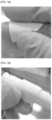
- FIG. 1a is a diagram illustrating the flexibility of the solid electrolyte film for all-solid-state batteries according to Example 1
- FIG. 1b is a diagram illustrating the flexibility of the solid electrolyte film for all-solid-state batteries according to Example 2.
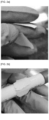
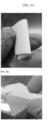
- FIG. 2a is a diagram illustrating the flexibility of the solid electrolyte film for all-solid-state batteries according to Comparative Example 1
- FIG. 2b is a diagram illustrating the flexibility of the solid electrolyte film for all-solid-state batteries according to Comparative Example 2
- FIG. 2c is a diagram illustrating the flexibility of the solid electrolyte film for all-solid-state batteries according to Comparative Example 3
- FIG. 2d is a diagram illustrating the flexibility of the solid electrolyte film for all-solid-state batteries according to Comparative Example 4
- FIG. 2e is a diagram illustrating the flexibility of the solid electrolyte film for all-solid-state batteries according to Comparative Example 5
- FIG. 2f is a diagram illustrating the flexibility of the solid electrolyte film for all-solid-state batteries according to Comparative Example 6.
- the ionic conductivity was measured by placing aluminum foil on the top and bottom surfaces of the solid electrolyte film for all-solid-state batteries, assembling a jig cell, and pressurizing it to 360 MPa.
- Examples 1 and 2 which include at least 25 % by weight but less than 75% by weight of acrylate and 75% by weight or less and more than 25% by weight of NBR as binder polymers, exhibited excellent ionic conductivity and, at the same time, excellent flexibility without cracking.
- Comparative Example 1 which includes 100% by weight of acrylate of the total weight of the binder polymer, has better ionic conductivity than Examples 1 and 2, but was found to be cracked and inflexible.
- Comparative Example 2 comprising 75% by weight of acrylate and 25% by weight of NBR, relative to the total weight of the binder polymer, was found to have better ionic conductivity than Examples 1 and 2, but was not found flexible due to cracking.
- Comparative Example 3 includes 100% by weight of NBR of the total weight of the binder polymer, and was found to have good flexibility but lower ionic conductivity than Examples 1 and 2.
- Comparative Example 4 which includes 50% by weight of NBR and 50% by weight of poly-imide (PI) of the total weight of the binder polymer, was found to have good ionic conductivity but was found to be cracked and inflexible.
- PI poly-imide
- Comparative Example 5 comprising 50% by weight of NBR and 50% by weight of styrene ethylene butylene styrene (SEBS) based on the total weight of the binder polymer, was found to have good flexibility, but lower ionic conductivity than Examples 1 and 2.
- SEBS styrene ethylene butylene styrene
- Comparative Example 6 which includes 50% by weight of NBR and 50% by weight of cyanoacrylate (CA) by total weight of the binder polymer, was found to have good ionic conductivity but was found to be cracked and inflexible.
- CA cyanoacrylate
- a solid electrolyte film for all-solid-state batteries comprising at least 25% by weight but less than 75% by weight of acrylate and 75% by weight or less and more than 25% by weight of NBR, relative to the total weight of the binder polymer, has excellent ionic conductivity and flexibility.
- solid electrolyte films for all-solid-state batteries using NBR and alkyl acrylate-based binders as binder polymers have better ionic conductivity and flexibility.
Landscapes
- Chemical & Material Sciences (AREA)
- Chemical Kinetics & Catalysis (AREA)
- General Chemical & Material Sciences (AREA)
- Electrochemistry (AREA)
- Engineering & Computer Science (AREA)
- Inorganic Chemistry (AREA)
- Manufacturing & Machinery (AREA)
- Materials Engineering (AREA)
- Composite Materials (AREA)
- Ceramic Engineering (AREA)
- Physics & Mathematics (AREA)
- Condensed Matter Physics & Semiconductors (AREA)
- General Physics & Mathematics (AREA)
- Secondary Cells (AREA)
Applications Claiming Priority (3)
| Application Number | Priority Date | Filing Date | Title |
|---|---|---|---|
| KR20230102139 | 2023-08-04 | ||
| KR1020240098513A KR20250021085A (ko) | 2023-08-04 | 2024-07-25 | 고체 전해질막 및 이를 포함하는 전고체 전지 |
| PCT/KR2024/010939 WO2025033791A1 (ko) | 2023-08-04 | 2024-07-26 | 고체 전해질막 및 이를 포함하는 전고체 전지 |
Publications (2)
| Publication Number | Publication Date |
|---|---|
| EP4583228A1 true EP4583228A1 (de) | 2025-07-09 |
| EP4583228A4 EP4583228A4 (de) | 2026-03-11 |
Family
ID=94534879
Family Applications (1)
| Application Number | Title | Priority Date | Filing Date |
|---|---|---|---|
| EP24852147.8A Pending EP4583228A4 (de) | 2023-08-04 | 2024-07-26 | Festelektrolytmembran und feststoffbatterie damit |
Country Status (4)
| Country | Link |
|---|---|
| EP (1) | EP4583228A4 (de) |
| JP (1) | JP2025538442A (de) |
| CN (1) | CN120019521A (de) |
| WO (1) | WO2025033791A1 (de) |
Family Cites Families (10)
| Publication number | Priority date | Publication date | Assignee | Title |
|---|---|---|---|---|
| JP6262503B2 (ja) * | 2013-11-26 | 2018-01-17 | 三星電子株式会社Samsung Electronics Co.,Ltd. | 全固体二次電池および全固体二次電池の製造方法 |
| KR20180072944A (ko) * | 2016-12-22 | 2018-07-02 | 한국전기연구원 | 황화물계 고체전해질을 포함하는 고체전해질층 및 양극복합체층의 제조방법 및 이를 포함하는 전고체전지 |
| KR102621697B1 (ko) * | 2018-08-16 | 2024-01-04 | 현대자동차주식회사 | 전고체 전지용 바인더 용액, 이를 포함하는 전극 슬러리 및 이를 사용한 전고체 전지의 제조방법 |
| CN112640179B (zh) * | 2018-09-11 | 2024-09-13 | 麦克赛尔株式会社 | 固体电解质片及全固体锂二次电池 |
| JP7654977B2 (ja) * | 2018-12-28 | 2025-04-02 | 日本ゼオン株式会社 | 全固体二次電池用バインダー組成物 |
| JP7364359B2 (ja) * | 2019-05-28 | 2023-10-18 | トヨタ自動車株式会社 | 全固体電池及びその製造方法 |
| KR20210082575A (ko) | 2019-12-26 | 2021-07-06 | 현대자동차주식회사 | 리튬 이온 전도성이 있는 전고체 전지용 바인더 용액 및 이를 포함하는 전극 슬러리 |
| WO2022249933A1 (ja) * | 2021-05-27 | 2022-12-01 | 日本ゼオン株式会社 | 全固体二次電池用バインダー組成物、全固体二次電池用スラリー組成物、全固体二次電池用機能層、および全固体二次電池 |
| KR102885242B1 (ko) | 2021-12-30 | 2025-11-12 | 주식회사 케이티앤지 | 흡연물품용 시트의 제조방법 |
| KR20240098513A (ko) | 2022-12-21 | 2024-06-28 | 주식회사 포스코 | 연신율 및 구멍확장성이 우수한 초고강도 강판 및 그 제조방법 |
-
2024
- 2024-07-26 CN CN202480004354.5A patent/CN120019521A/zh active Pending
- 2024-07-26 WO PCT/KR2024/010939 patent/WO2025033791A1/ko active Pending
- 2024-07-26 EP EP24852147.8A patent/EP4583228A4/de active Pending
- 2024-07-26 JP JP2025528543A patent/JP2025538442A/ja active Pending
Also Published As
| Publication number | Publication date |
|---|---|
| CN120019521A (zh) | 2025-05-16 |
| WO2025033791A1 (ko) | 2025-02-13 |
| JP2025538442A (ja) | 2025-11-28 |
| EP4583228A4 (de) | 2026-03-11 |
Similar Documents
| Publication | Publication Date | Title |
|---|---|---|
| CN108780915B (zh) | 具有在正极上形成的锂金属的锂二次电池及其制造方法 | |
| WO2017141735A1 (ja) | 固体電解質組成物、全固体二次電池用電極シートおよび全固体二次電池、並びに、全固体二次電池用電極シートおよび全固体二次電池の製造方法 | |
| KR102700980B1 (ko) | 고분자 고체 전해질 및 이를 포함하는 전고체 전지 | |
| CN106233515A (zh) | 电极及其制造方法、电池以及电子装置 | |
| JP7733112B2 (ja) | 固体電解質膜及びこれを含む全固体電池 | |
| KR102917432B1 (ko) | 전고체 전지 및 이의 제조방법 | |
| JP2017168388A (ja) | リチウムイオン電池 | |
| KR20230091531A (ko) | 고체 전해질막 및 이를 포함하는 전고체 전지 | |
| US20260018667A1 (en) | Solid electrolyte composition, and solid electrolyte membrane and all-solid-state battery comprising same | |
| EP4583228A1 (de) | Festelektrolytmembran und feststoffbatterie damit | |
| EP4418393A1 (de) | Festelektrolytmembran und feststoffbatterie damit | |
| KR20240177760A (ko) | 전고체 전지 및 이의 제조방법 | |
| US20260018660A1 (en) | Solid electrolyte membrane and all-solid-state battery comprising same | |
| KR20250021085A (ko) | 고체 전해질막 및 이를 포함하는 전고체 전지 | |
| KR20220061439A (ko) | 다공성 집전체를 포함하는 바이폴라 전고체전지 | |
| EP4521483A1 (de) | Anode für festkörperbatterie und festkörperbatterie damit | |
| KR102962594B1 (ko) | 전고체 전지용 음극 및 이를 포함하는 전고체 전지 | |
| KR20250058361A (ko) | 고체 전해질 조성물, 이를 포함하는 고체 전해질막 및 전고체 전지 | |
| EP4664576A1 (de) | Festkörperbatteriepresssystem | |
| US20250149641A1 (en) | All-solid-state battery and manufacturing method therefor | |
| KR20260016073A (ko) | 전고체 전지용 양극 및 이를 포함하는 전고체 전지 |
Legal Events
| Date | Code | Title | Description |
|---|---|---|---|
| STAA | Information on the status of an ep patent application or granted ep patent |
Free format text: STATUS: THE INTERNATIONAL PUBLICATION HAS BEEN MADE |
|
| PUAI | Public reference made under article 153(3) epc to a published international application that has entered the european phase |
Free format text: ORIGINAL CODE: 0009012 |
|
| STAA | Information on the status of an ep patent application or granted ep patent |
Free format text: STATUS: REQUEST FOR EXAMINATION WAS MADE |
|
| 17P | Request for examination filed |
Effective date: 20250403 |
|
| AK | Designated contracting states |
Kind code of ref document: A1 Designated state(s): AL AT BE BG CH CY CZ DE DK EE ES FI FR GB GR HR HU IE IS IT LI LT LU LV MC ME MK MT NL NO PL PT RO RS SE SI SK SM TR |
|
| A4 | Supplementary search report drawn up and despatched |
Effective date: 20260205 |
|
| RIC1 | Information provided on ipc code assigned before grant |
Ipc: H01M 10/0562 20100101AFI20260130BHEP Ipc: H01M 10/052 20100101ALI20260130BHEP Ipc: H01M 50/403 20210101ALI20260130BHEP Ipc: H01M 50/417 20210101ALI20260130BHEP Ipc: H01M 50/42 20210101ALI20260130BHEP Ipc: H01M 50/434 20210101ALI20260130BHEP Ipc: H01M 50/443 20210101ALI20260130BHEP Ipc: H01M 50/446 20210101ALI20260130BHEP |