EP4583563A1 - Kommunikationsverfahren und -vorrichtung - Google Patents
Kommunikationsverfahren und -vorrichtung Download PDFInfo
- Publication number
- EP4583563A1 EP4583563A1 EP23870642.8A EP23870642A EP4583563A1 EP 4583563 A1 EP4583563 A1 EP 4583563A1 EP 23870642 A EP23870642 A EP 23870642A EP 4583563 A1 EP4583563 A1 EP 4583563A1
- Authority
- EP
- European Patent Office
- Prior art keywords
- identifier
- terminal device
- data
- radio bearer
- entity
- Prior art date
- Legal status (The legal status is an assumption and is not a legal conclusion. Google has not performed a legal analysis and makes no representation as to the accuracy of the status listed.)
- Pending
Links
Images


Classifications
-
- H—ELECTRICITY
- H04—ELECTRIC COMMUNICATION TECHNIQUE
- H04W—WIRELESS COMMUNICATION NETWORKS
- H04W76/00—Connection management
- H04W76/10—Connection setup
- H04W76/11—Allocation or use of connection identifiers
-
- H—ELECTRICITY
- H04—ELECTRIC COMMUNICATION TECHNIQUE
- H04W—WIRELESS COMMUNICATION NETWORKS
- H04W36/00—Hand-off or reselection arrangements
- H04W36/0005—Control or signalling for completing the hand-off
- H04W36/0055—Transmission or use of information for re-establishing the radio link
-
- H—ELECTRICITY
- H04—ELECTRIC COMMUNICATION TECHNIQUE
- H04W—WIRELESS COMMUNICATION NETWORKS
- H04W72/00—Local resource management
- H04W72/40—Resource management for direct mode communication, e.g. D2D or sidelink
-
- H—ELECTRICITY
- H04—ELECTRIC COMMUNICATION TECHNIQUE
- H04W—WIRELESS COMMUNICATION NETWORKS
- H04W72/00—Local resource management
- H04W72/20—Control channels or signalling for resource management
- H04W72/25—Control channels or signalling for resource management between terminals via a wireless link, e.g. sidelink
-
- H—ELECTRICITY
- H04—ELECTRIC COMMUNICATION TECHNIQUE
- H04W—WIRELESS COMMUNICATION NETWORKS
- H04W76/00—Connection management
- H04W76/10—Connection setup
- H04W76/14—Direct-mode setup
-
- H—ELECTRICITY
- H04—ELECTRIC COMMUNICATION TECHNIQUE
- H04W—WIRELESS COMMUNICATION NETWORKS
- H04W88/00—Devices specially adapted for wireless communication networks, e.g. terminals, base stations or access point devices
- H04W88/02—Terminal devices
- H04W88/04—Terminal devices adapted for relaying to or from another terminal or user
-
- H—ELECTRICITY
- H04—ELECTRIC COMMUNICATION TECHNIQUE
- H04W—WIRELESS COMMUNICATION NETWORKS
- H04W92/00—Interfaces specially adapted for wireless communication networks
- H04W92/16—Interfaces between hierarchically similar devices
- H04W92/18—Interfaces between hierarchically similar devices between terminal devices
Definitions
- This application relates to the field of communication technologies, and in particular, to a communication method and apparatus.
- a sidelink relay adaptation protocol (sidelink relay adaptation protocol, SRAP) layer may be added between a radio link control (radio link control, RLC) layer and a packet data convergence protocol (packet data convergence protocol, PDCP) layer to support bearer multiplexing and demultiplexing functions.
- RLC radio link control
- PDCP packet data convergence protocol
- the SRAP layer is used to support multiplexing different bearers onto one bearer or splitting one bearer into different bearers.
- a network device may be assisted by a relay UE.
- the network device may determine a bearer identifier (Bearer ID), and configure a mapping relationship between a bearer identifier and an RLC channel for the relay UE and the remote UE by using an SRAP configuration, so that when communication between the remote UE and the network device is assisted by the relay UE, the bearer multiplexing and demultiplexing functions of the SRAP layer are implemented based on the mapping relationship.
- SRAP bearer identifier
- a transmitter UE and a receiver UE may be assisted by a relay UE.
- a relay UE there may be no network device involving, and therefore a mapping relationship between a bearer identifier and an RLC channel cannot be determined, and the bearer multiplexing and demultiplexing functions of the SRAP layer cannot be implemented.
- Embodiments of this application provide a communication method and apparatus, to implement bearer multiplexing and demultiplexing functions of a sidelink relay adaptation protocol SRAP layer in a user equipment-to-network U2U relay scenario.
- Embodiments of this application provide a communication method and apparatus, to implement a bearer mapping function of a sidelink relay adaptation protocol SRAP layer in a user equipment-to-network U2U relay scenario.
- an embodiment of this application provides a communication method.
- the method may include: A first terminal device determines a first identifier based on sidelink radio bearer SLRB configuration information, where the SLRB configuration information indicates an SLRB between the first terminal device and a second terminal device, the first identifier is a radio bearer identifier, and the radio bearer identifier indicates a radio bearer between the first terminal device and the second terminal device.
- the first terminal device sends first information to a relay terminal device, and sends the first information to the second terminal device via the relay terminal device, where the first information includes one or more first identifiers and SLRB configuration information associated with the first identifier, and different first identifiers are associated with different SLRB configuration information.
- the first terminal device may determine the radio bearer identifier, and send an association relationship between the radio bearer identifier and the SLRB configuration information to the relay terminal device and the second terminal device, so that when performing data transmission, the first terminal device, the relay terminal device, or the second terminal device can correctly complete data delivery based on the association relationship, implementing a bearer mapping function of an SRAP layer.
- that the first terminal device determines the first identifier based on the SLRB configuration information includes:
- the SLRB configuration information includes a PC5 configuration index; and the first terminal device determines the radio bearer identifier based on the PC5 configuration index.
- that the first terminal device determines the radio bearer identifier based on the PC5 configuration index includes: The first terminal device determines the radio bearer identifier based on a quantity of PC5 configuration indexes, where a quantity of radio bearer identifiers is equal to the quantity of PC5 configuration indexes, a value of a 1 st radio bearer identifier is a first value, and a difference between two adjacent radio bearer identifiers is a second value; or the first terminal device determines the radio bearer identifier based on five least significant bits of the PC5 configuration index; or the first terminal device determines a result of performing a modulo operation on the PC5 configuration index and 32 as the radio bearer identifier.
- the first terminal device may determine the radio bearer identifier based on the PC5 configuration index, to provide a plurality of feasible solutions for the first terminal device to determine the radio bearer identifier.
- the method further includes: The first terminal device determines a sum of a value of the first identifier associated with the second SLRB configuration information and a third value as the first identifier associated with the second SLRB configuration information; or the first terminal device determines a difference between the value of the first identifier associated with the second SLRB configuration information and the third value as the first identifier associated with the second SLRB configuration information; or the first terminal device determines a value that is in a value set and that is not associated with SLRB configuration information as the first identifier associated with the second SLRB configuration information.
- the first terminal device may process the same first identifier, so that the first identifier is in one-to-one correspondence with the SLRB configuration information.
- the first identifier is five bits; or the first identifier is six bits.
- the first identifier may be five bits or six bits.
- the first terminal device may reuse an SRAP header format in a U2N relay scenario.
- the first information further includes first indication information, where the first indication information indicates that the radio bearer identifier is a signaling radio bearer identifier, or the first indication information indicates that the radio bearer identifier is a data radio bearer identifier.
- the radio bearer identifier is a data radio bearer identifier; or if the value of the radio bearer identifier belongs to a second set, the radio bearer identifier is a signaling radio bearer identifier.
- a sidelink relay adaptation protocol SRAP entity of the first terminal device receives first data from a packet data convergence protocol PDCP entity of the first terminal device.
- the SRAP entity of the first terminal device determines, based on the SLRB configuration information, a first identifier associated with the PDCP entity of the first terminal device, where the first identifier is the radio bearer identifier, or the first identifier is a PC5 configuration index, or the first identifier is a logical channel identifier.
- the first terminal device determines the first mapping relationship based on a transmission requirement between the first terminal device and the relay terminal device.
- a first sidelink relay adaptation protocol SRAP entity of the relay terminal device receives second data from the first terminal device, where the second data includes first data, a first identifier, and a first local identifier; the first local identifier indicates the second terminal device; and the first identifier is the radio bearer identifier, or the first identifier is a PC5 configuration index, or the first identifier is a logical channel identifier.
- the first SRAP entity of the relay terminal device sends the second data to a second SRAP entity of the relay terminal device.
- the first SRAP entity of the relay terminal device may transparently transmit the second data to the second SRAP entity of the relay terminal device without performing any processing.
- the second SRAP entity of the relay terminal device may send, based on the second mapping relationship associated with the first terminal device, the second data to the second terminal device by using the relay RLC bearer indicated by the second mapping relationship, to ensure correct data delivery and implement bearer mapping of the SRAP.
- a first SRAP entity of the relay terminal device receives second data from the first terminal device, where the second data includes first data, a first identifier, and a first local identifier; the first local identifier indicates the second terminal device; and the first identifier is the radio bearer identifier, or the first identifier is a PC5 configuration index, or the first identifier is a logical channel identifier.
- the second SRAP entity of the relay terminal device sends, based on a second mapping relationship associated with the first terminal device, sixth data to the second terminal device by using a relay RLC bearer associated with both the first identifier and the first local identifier, where the second mapping relationship includes a mapping relationship among the first identifier, the first local identifier, and the relay RLC bearer; and the sixth data includes the first data, the first identifier, and the local identifier.
- the first SRAP entity of the relay terminal device may remove an SRAP header of the second data, to obtain the first data, and deliver the first data to the second SRAP entity of the relay terminal device.
- the first SRAP entity of the relay terminal device may further parse the SRAP header of the second data to obtain the first identifier and the first local identifier, and indicate the first identifier and the first local identifier to the second SRAP entity of the relay terminal device.
- the first SRAP entity of the relay terminal device may further send, to the second SRAP entity of the relay terminal device, the second local identifier that indicates the first terminal device, and the second SRAP entity of the relay terminal device may include the second local identifier in the sixth data, to indicate, to the second terminal device, that a source terminal device of the first data is the first terminal device.
- the second SRAP entity of the relay terminal device receives third data from the second terminal device, where the third data includes fourth data, a first identifier, and the second local identifier; the second local identifier indicates the first terminal device; and the first identifier is the radio bearer identifier, or the first identifier is a PC5 configuration index, or the first identifier is a logical channel identifier.
- the second SRAP entity of the relay terminal device sends the third data to the first SRAP entity of the relay terminal device.
- the second SRAP entity of the relay terminal device may transparently transmit the third data to the first SRAP entity of the relay terminal device without performing any processing.
- the first SRAP entity of the relay terminal device may send, based on the third mapping relationship associated with the second terminal device, the third data to the first terminal device by using the relay RLC bearer indicated by the third mapping relationship, to ensure correct data delivery and implement bearer mapping of the SRAP.
- the second SRAP entity of the relay terminal device receives third data from the second terminal device, where the third data includes fourth data, a first identifier, and the second local identifier; the second local identifier indicates the first terminal device; and the first identifier is the radio bearer identifier, or the first identifier is a PC5 configuration index, or the first identifier is a logical channel identifier.
- the second SRAP entity of the relay terminal device sends the fourth data, the first identifier, and a local identifier to the first SRAP entity of the relay terminal device, where the local identifier includes one or more of the following: the first local identifier and the second local identifier; and the second local identifier indicates the first terminal device.
- the first SRAP entity of the relay terminal device sends, based on a third mapping relationship associated with the second terminal device, fifth data to the first terminal device by using a relay RLC bearer associated with both the first identifier and the second local identifier, where the third mapping relationship includes a mapping relationship among the first identifier, the second local identifier, and the relay RLC bearer; and the fifth data includes the fourth data, the first identifier, and the local identifier.
- the second SRAP entity of the relay terminal device may remove an SRAP header of the third data, to obtain the fourth data, and deliver the fourth data to the first SRAP entity of the relay terminal device.
- the second SRAP entity of the relay terminal device may further parse the SRAP header of the third data to obtain the first identifier and the second local identifier, and indicate the first identifier and the second local identifier to the first SRAP entity of the relay terminal device.
- the second SRAP entity of the relay terminal device may further send, to the first SRAP entity of the relay terminal device, the first local identifier that indicates the second terminal device, and the first SRAP entity of the relay terminal device may include the first local identifier in the fifth data, to indicate, to the first terminal device, that a source terminal device of the fourth data is the second terminal device.
- the relay terminal device determines the third mapping relationship based on a transmission requirement between the relay terminal device and the first terminal device.
- the relay terminal device receives, from the first terminal device, the first local identifier and a layer-2 identifier that is of the second terminal device and that is associated with the first local identifier; or the relay terminal device receives, from the second terminal device, the second local identifier and a layer-2 identifier that is of the first terminal device and that is associated with the second local identifier.
- the first terminal device sends, to the relay terminal device, the first local identifier and the layer-2 identifier that is of the second terminal device and that is associated with the first local identifier, so that when receiving data including the first local identifier, the relay terminal device can determine that the data is sent to the second terminal device.
- the second terminal device sends, to the relay terminal device, the second local identifier and the layer-2 identifier that is of the first terminal device and that is associated with the second local identifier, so that when receiving data including the second local identifier, the relay terminal device can determine that the data is sent to the first terminal device.
- an embodiment of this application provides a communication method.
- the method may include: A second terminal device receives first information from a first terminal device via a relay terminal device, where the first information includes one or more first identifiers and sidelink radio bearer SLRB configuration information associated with the first identifier, different first identifiers are associated with different SLRB configuration information, the SLRB configuration information indicates an SLRB between the first terminal device and the second terminal device, the first identifier is a radio bearer identifier, and the radio bearer identifier indicates a radio bearer between the first terminal device and the second terminal device.
- the second terminal device determines an association relationship between the first identifier and the SLRB configuration information based on the first information.
- the first terminal device may determine the radio bearer identifier, and send an association relationship between the radio bearer identifier and the SLRB configuration information to the relay terminal device and the second terminal device, so that when performing data transmission, the first terminal device, the relay terminal device, or the second terminal device can correctly complete data delivery based on the association relationship, implementing a bearer mapping function of an SRAP layer.
- the first identifier is five bits; or the first identifier is six bits.
- the first identifier may be five bits or six bits.
- an SRAP header format in a U2N relay scenario may be reused.
- the first information further includes first indication information, where the first indication information indicates that the radio bearer identifier is a signaling radio bearer identifier, or the first indication information indicates that the radio bearer identifier is a data radio bearer identifier.
- the radio bearer identifier is a data radio bearer identifier; or if the value of the radio bearer identifier belongs to a second set, the radio bearer identifier is a signaling radio bearer identifier.
- a signaling radio bearer identifier and a data radio bearer identifier may be distinguished by using the first indication information, or a signaling radio bearer identifier and a data radio bearer identifier may be distinguished by using values. This provides a plurality of feasible solutions for distinguishing between a signaling radio bearer identifier and a data radio bearer identifier.
- a sidelink relay adaptation protocol SRAP entity of the second terminal device receives second data from the relay terminal device, where the second data includes first data, a first identifier, and a first local identifier; the first local identifier indicates the second terminal device; and the first identifier is the radio bearer identifier, or the first identifier is a PC5 configuration index, or the first identifier is a logical channel identifier.
- the SRAP entity of the second terminal device determines, based on the SLRB configuration information, a packet data convergence protocol PDCP entity associated with the first identifier.
- the SRAP entity of the second terminal device sends the first data to the PDCP entity that is in the second terminal device and that is associated with the first identifier.
- the SRAP entity of the second terminal device receives sixth data from the relay terminal device, where the sixth data includes first data, a first identifier, and a local identifier; the local identifier includes one or more of the following: a first local identifier and a second local identifier; the first local identifier indicates the second terminal device; the second local identifier indicates the first terminal device; and the first identifier is the radio bearer identifier, or the first identifier is a PC5 configuration index, or the first identifier is a logical channel identifier.
- the SRAP entity of the second terminal device determines, based on the SLRB configuration information, a PDCP entity associated with the first identifier.
- the SRAP entity of the second terminal device sends the first data to the PDCP entity that is in the second terminal device and that is associated with the first identifier.
- the second terminal device determines, based on the second local identifier, that a source terminal device of the first data is the first terminal device.
- the second terminal device sends, to the relay terminal device, the second local identifier and the layer-2 identifier that is of the first terminal device and that is associated with the second local identifier, so that when receiving data including the second local identifier, the relay terminal device can determine that the data is sent to the first terminal device.
- an embodiment of this application provides a communication apparatus.
- the communication apparatus may be used in the first terminal device in the first aspect or the possible designs of the first aspect, to implement a function performed by the first terminal device.
- the communication apparatus may be the first terminal device, or may be a chip, a system-on-chip, or the like of the first terminal device.
- the communication apparatus may perform, by hardware or by hardware executing corresponding software, the function performed by the first terminal device.
- the hardware or the software includes one or more modules corresponding to the foregoing function, for example, a transceiver module and a processing module.
- the processing module is configured to determine a first identifier based on sidelink radio bearer SLRB configuration information, where the SLRB configuration information indicates an SLRB between the first terminal device and a second terminal device, the first identifier is a radio bearer identifier, and the radio bearer identifier indicates a radio bearer between the first terminal device and the second terminal device.
- the transceiver module is configured to send first information to a relay terminal device, and the transceiver module is further configured to send the first information to the second terminal device via the relay terminal device, where the first information includes one or more first identifiers and SLRB configuration information associated with the first identifier, and different first identifiers are associated with different SLRB configuration information.
- the SLRB configuration information includes a PC5 configuration index
- the processing module is specifically configured to determine the radio bearer identifier based on the PC5 configuration index.
- the processing module is specifically configured to determine the radio bearer identifier based on a quantity of PC5 configuration indexes, where a quantity of radio bearer identifiers is equal to the quantity of PC5 configuration indexes, a value of a 1 st radio bearer identifier is a first value, and a difference between two adjacent radio bearer identifiers is a second value; or the processing module is specifically configured to determine the radio bearer identifier based on five least significant bits of the PC5 configuration index; or the processing module is specifically configured to determine a result of performing a modulo operation on the PC5 configuration index and 32 as the radio bearer identifier.
- the first identifier is five bits; or the first identifier is six bits.
- the first information further includes first indication information, where the first indication information indicates that the radio bearer identifier is a signaling radio bearer identifier, or the first indication information indicates that the radio bearer identifier is a data radio bearer identifier.
- the radio bearer identifier is a data radio bearer identifier; or if the value of the radio bearer identifier belongs to a second set, the radio bearer identifier is a signaling radio bearer identifier.
- the transceiver module is further configured to receive, by an SRAP entity, first data from a PDCP entity.
- the processing module is configured to determine, by the SRAP entity based on the SLRB configuration information, a first identifier associated with the PDCP entity, where the first identifier is the radio bearer identifier, or the first identifier is a PC5 configuration index, or the first identifier is a logical channel identifier.
- the processing module is further configured to determine the first mapping relationship based on a transmission requirement between the first terminal device and the relay terminal device.
- the processing module is further configured to send, to the relay terminal device, the first local identifier and a layer-2 identifier that is of the second terminal device and that is associated with the first local identifier.
- the transceiver module is further configured to receive, by the SRAP entity, third data from the relay terminal device, where the third data includes fourth data, a first identifier, and a second local identifier; the second local identifier indicates the first terminal device; and the first identifier is the radio bearer identifier, or the first identifier is a PC5 configuration index, or the first identifier is a logical channel identifier.
- the processing module is further configured to determine, by the SRAP entity based on the SLRB configuration information, the PDCP entity associated with the first identifier.
- the transceiver module is further configured to send, by the SRAP entity, the fourth data to the PDCP entity that is in the first terminal device and that is associated with the first identifier.
- the transceiver module is further configured to receive, by the SRAP entity, fifth data from the relay terminal device, where the fifth data includes fourth data, a first identifier, and a local identifier; the local identifier includes one or more of the following: the first local identifier and a second local identifier; the first local identifier indicates the second terminal device; the second local identifier indicates the first terminal device; and the first identifier is the radio bearer identifier, or the first identifier is a PC5 configuration index, or the first identifier is a logical channel identifier.
- the processing module is further configured to determine, by the SRAP entity based on the SLRB configuration information, the PDCP entity associated with the first identifier.
- the transceiver module is further configured to send, by the SRAP entity, fourth data to the PDCP entity that is in the first terminal device and that is associated with the first identifier.
- the processing module is further configured to determine, based on the first local identifier, that a source terminal device of the fourth data is the second terminal device.
- modules in the fourth aspect or the possible designs of the fourth aspect can perform the corresponding functions in the method examples in the first aspect.
- the modules in the fourth aspect or the possible designs of the fourth aspect can perform the corresponding functions in the method examples in the first aspect.
- the first identifier is five bits; or the first identifier is six bits.
- the transceiver module is further configured to receive, by a first SRAP entity, second data from the first terminal device, where the second data includes first data, a first identifier, and a first local identifier; the first local identifier indicates the second terminal device; and the first identifier is the radio bearer identifier, or the first identifier is a PC5 configuration index, or the first identifier is a logical channel identifier.
- the transceiver module is further configured to send, by the first SRAP entity, the second data to a second SRAP entity.
- the transceiver module is further configured to send, by the second SRAP entity, based on a second mapping relationship associated with the first terminal device, the second data to the second terminal device by using a relay radio link control RLC bearer associated with both the first identifier and the first local identifier, where the second mapping relationship includes a mapping relationship among the first identifier, the first local identifier, and the relay RLC bearer.
- the transceiver module is further configured to receive, by a first SRAP entity, second data from the first terminal device, where the second data includes first data, a first identifier, and a first local identifier; the first local identifier indicates the second terminal device; and the first identifier is the radio bearer identifier, or the first identifier is a PC5 configuration index, or the first identifier is a logical channel identifier.
- the transceiver module is further configured to send, by the first SRAP entity, the first data, the first identifier, and a local identifier to a second SRAP entity, where the local identifier includes one or more of the following: the first local identifier and a second local identifier; and the second local identifier indicates the first terminal device.
- the transceiver module is further configured to send, by the second SRAP entity based on a second mapping relationship associated with the first terminal device, sixth data to the second terminal device by using a relay RLC bearer associated with both the first identifier and the first local identifier, where the second mapping relationship includes a mapping relationship among the first identifier, the first local identifier, and the relay RLC bearer; and the sixth data includes the first data, the first identifier, and the local identifier.
- the processing module is configured to determine the second mapping relationship based on a transmission requirement between the relay terminal device and the second terminal device.
- the transceiver module is further configured to receive, by the second SRAP entity, third data from the second terminal device, where the third data includes fourth data, a first identifier, and the second local identifier; the second local identifier indicates the first terminal device; and the first identifier is the radio bearer identifier, or the first identifier is a PC5 configuration index, or the first identifier is a logical channel identifier.
- the transceiver module is further configured to send, by the second SRAP entity, the third data to the first SRAP entity.
- the transceiver module is further configured to send, by the first SRAP entity based on a third mapping relationship associated with the second terminal device, the third data to the first terminal device by using a relay RLC bearer associated with both the first identifier and the second local identifier, where the third mapping relationship includes a mapping relationship among the first identifier, the second local identifier, and the relay RLC bearer.
- the transceiver module is further configured to receive, by the second SRAP entity, third data from the second terminal device, where the third data includes fourth data, a first identifier, and the second local identifier; the second local identifier indicates the first terminal device; and the first identifier is the radio bearer identifier, or the first identifier is a PC5 configuration index, or the first identifier is a logical channel identifier.
- the transceiver module is further configured to send, by the second SRAP entity, the fourth data, the first identifier, and a local identifier to the first SRAP entity, where the local identifier includes one or more of the following: the first local identifier and the second local identifier; and the second local identifier indicates the first terminal device.
- the transceiver module is further configured to send, by the first SRAP entity based on a third mapping relationship associated with the second terminal device, fifth data to the first terminal device by using a relay RLC bearer associated with both the first identifier and the second local identifier, where the third mapping relationship includes a mapping relationship among the first identifier, the second local identifier, and the relay RLC bearer; and the fifth data includes the fourth data, the first identifier, and the local identifier.
- the processing module is further configured to determine the third mapping relationship based on a transmission requirement between the relay terminal device and the first terminal device.
- the transceiver module is further configured to receive, from the first terminal device, the first local identifier and a layer-2 identifier that is of the second terminal device and that is associated with the first local identifier; or the transceiver module is further configured to receive, from the second terminal device, the second local identifier and a layer-2 identifier that is of the first terminal device and that is associated with the second local identifier.
- modules in the fifth aspect or the possible designs of the fifth aspect can perform the corresponding functions in the method examples in the second aspect.
- the modules in the fifth aspect or the possible designs of the fifth aspect can perform the corresponding functions in the method examples in the second aspect.
- the processing module is further configured to determine, based on the second local identifier, that a source terminal device of the first data is the first terminal device.
- the transceiver module is further configured to receive, by the SRAP entity, fourth data from the PDCP entity of the second terminal device.
- the processing module is further configured to determine, by the SRAP entity based on the SLRB configuration information, the first identifier associated with the PDCP entity of the second terminal device, where the first identifier is the radio bearer identifier, or the first identifier is a PC5 configuration index, or the first identifier is a logical channel identifier.
- the transceiver module is further configured to send, based on a fourth mapping relationship, third data to the relay terminal device by using a second RLC bearer associated with both the first identifier and the second local identifier, where the second local identifier indicates the first terminal device; the fourth mapping relationship includes a mapping relationship among the first identifier, the second local identifier, and the second RLC bearer; and the third data includes the fourth data, the first identifier, and the second local identifier.
- the processing module is further configured to determine the fourth mapping relationship based on a transmission requirement between the second terminal device and the relay terminal device.
- modules in the sixth aspect or the possible designs of the sixth aspect can perform the corresponding functions in the method examples in the third aspect.
- the modules in the sixth aspect or the possible designs of the sixth aspect can perform the corresponding functions in the method examples in the third aspect.
- the communication apparatus further includes one or more communication interfaces, the one or more communication interfaces are coupled to the one or more processors, and the one or more communication interfaces are configured to communicate with a module other than the communication apparatus.
- an embodiment of this application provides a communication apparatus.
- the communication apparatus includes an input/output interface and a logic circuit.
- the input/output interface is configured to input and/or output information.
- the logic circuit is configured to perform the communication method according to any one of the first aspect to the third aspect, to perform processing based on information and/or generate information.
- an embodiment of this application provides a computer-readable storage medium.
- the computer-readable storage medium stores computer instructions or a program.
- the communication method according to any one of the first aspect to the third aspect is performed.
- an embodiment of this application provides a computer program product including computer instructions.
- the computer program product is run on a computer, the communication method according to any one of the first aspect to the third aspect is performed.
- an embodiment of this application provides a computer program.
- the computer program When the computer program is run on a computer, the communication method according to any one of the first aspect to the third aspect is performed.
- a communication system may include the first terminal device according to the fourth aspect, the relay terminal device according to the fifth aspect, and the second terminal device according to the sixth aspect.
- Sidelink (sidelink, SL) communication In a wireless communication system, data communication may be performed between terminal devices via a network device, or communication between terminal devices may be directly performed without using a network device.
- a link between terminal devices may be referred to as a sidelink
- an interface between terminal devices may be referred to as a PC5 interface (in other words, an interface corresponding to an SL is referred to as a PC5 interface), which is similar to a Uu interface between a terminal device and a network device.
- the protocol stack may include a control plane protocol stack and a user plane protocol stack.
- the control plane protocol stack may include a radio resource control (radio resource control, RRC) layer, a packet data convergence protocol (packet data convergence protocol, PDCP) layer, a radio link control (radio link control, RLC) layer, a media access control (media access control, MAC) layer, and a physical (physical, PHY) layer.
- RRC radio resource control
- PDCP packet data convergence protocol
- RLC radio link control
- media access control media access control
- MAC media access control
- V2X vehicle-to-everything
- V2X vehicle-to-everything
- each vehicle is a terminal device, and data transmission may be directly performed between terminal devices through an SL without using a network device, to effectively reduce a communication delay.
- SL communication may support broadcast communication, unicast communication, and multicast communication.
- the broadcast communication is similar to system information broadcast by a base station.
- a terminal device may send data of a broadcast service without encryption. Any other terminal device interested in the broadcast service within an effective reception scope may receive the data of the broadcast service.
- the unicast communication is similar to data communication performed after an RRC connection is established between a terminal device and a base station.
- a unicast connection first needs to be established between two terminal devices before data communication is performed between the two terminal devices based on a negotiated identifier.
- the data may be encrypted or may not be encrypted.
- the unicast communication can be performed only between two terminal devices that establish a unicast connection.
- the multicast communication refers to communication between all terminal devices in a communication group, and any terminal device in the group can receive and send data of a multicast service.
- one time of unicast communication on an SL corresponds to a pair of a source layer-2 identifier (source layer-2 identifier, Source L2 ID) and a destination layer-2 identifier (destination layer-2 identifier, Destination L2 ID).
- a subheader of each SL media access control protocol data unit includes the source L2 ID and the destination L2 ID, so that data is transmitted to a correct receiving end.
- Radio bearer is a general term of a series of protocol entities and configurations allocated by a base station to a terminal device, is a service that is provided by a layer-2 (layer-2, L2) and that is used for transmission of user data between the terminal device and the base station, and includes a series of resources allocated by a PDCP protocol entity, an RLC protocol entity, a MAC protocol entity, and a PHY.
- Radio bearers may be classified into a data radio bearer (data radio bearer, DRB) and a signaling radio bearer (signaling radio bearer, SRB).
- the DRB is used to carry data
- the SRB is used to carry a signaling message.
- radio bearers are referred to as SL radio bearers (sidelink radio bearers, SLRBs), including an SL DRB and an SL SRB.
- RLC bearer refers to a protocol entity and a configuration below an RLC layer, is a lower layer part of a radio bearer, and includes a series of resources such as an RLC protocol entity and a logical channel.
- RLC bearers may be classified into a Uu RLC bearer and a PC5 RLC bearer.
- the Uu RLC bearer is an RLC bearer on a Uu link (or a Uu interface)
- the PC5 RLC bearer is an RLC bearer on an SL link (or a PC5 interface).
- a sidelink relay adaptation protocol (sidelink relay adaptation protocol, SRAP) layer is added between an RLC layer and the PDCP layer.
- the SRAP layer is mainly used for bearer multiplexing and demultiplexing, that is, the SRAP layer may support multiplexing different bearers onto one bearer or splitting one bearer into different bearers.
- a local identifier may be allocated to each target UE.
- the local identifier is used only in an adaptation protocol layer, and the local identifier may be carried in a data packet routing process to indicate the target UE to which the data belongs.
- Device-to-device (device-to-device, D2D) technology The D2D technology is introduced in a long term evolution (Long Term Evolution, LTE) release 12 (release 12, R12) communication system.
- R12 D2D communication is mainly oriented to public safety (public safety), and includes two parts: R12 D2D communication and R12 D2D discovery. As shown in FIG. 4 , R12 D2D communication is oriented to public safety and supports multicast communication (one-to-many D2D communication), and R12 D2D discovery supports simple commercial broadcast (for example, advertisement broadcast).
- the R12 D2D technology is further enhanced in LTE R13.
- LTE R13 D2D communication is used for public safety, but supports unicast communication (one-to-one), and supports user equipment-to-network (UE-to-network, U2N) relay (relay) communication to improve coverage.
- a transmitter UE in a connected mode may report a quality of service (quality of service, QoS) information list to a base station by using a sidelink user equipment information (sidelink UE information, SUI) message.
- the QoS information list may include identification information of each PC5 QoS flow (PC5 QoS flow identifier, PFI) and a corresponding QoS parameter.
- the base station performs SLRB bearer configuration for the UE based on the QoS information reported by the transmitter UE.
- the bearer configuration may meet the QoS parameter.
- an SLRB configuration index is SLRB-Uu-ConfigIndex, which identifies RB configuration information on a network side and has a size of nine bits.
- SLRB-Uu-ConfigIndex and the corresponding RB configuration are specific to a UE.
- the base station may further deliver an SL bearer configuration to the UE by using an RRC reconfiguration (RRCReconfiguration) message.
- RRCReconfiguration RRC reconfiguration
- Specific content may be included in an SL configuration dedicated NR information element IE (SL-ConfigDedicatedNR).
- the base station may configure an SLRB of the UE by using SL-ConfigDedicatedNR, including bearers at a PDCP layer and above the PDCP layer and bearers at a PC5 RLC layer and below the PC5 RLC layer.
- an SRAP layer is introduced, and a base station determines a bearer identifier (bearer ID).
- an SRAP header may include a bearer identifier and a UE local identifier (UE ID), and a size of the bearer identifier may be five bits.
- SL communication security protection Multicast and broadcast security is ensured by an application layer.
- Unicast communication supports security protection at an access stratum (access stratum, AS) (including security protection at one or more of an RRC layer, an SDAP layer, a PDCP layer, an RLC layer, a MAC layer, and a PHY layer).
- AS access stratum
- Security protection at the AS includes integrity protection and encryption protection, and corresponding algorithms and parameters for integrity protection and encryption protection are negotiated at an upper layer in a unicast establishment process shown in FIG. 6 (corresponding to a message 2 and a message 3 in FIG. 6 ).
- the upper layer for example, a PC5-S layer or a V2X layer
- input parameters of a security algorithm of the AS include four parameters: a key (KEY, for example, an NR PC5 integrity key (NR PC5 integrity key, NRPIK)), a count (COUNT), a bearer (BEARER), and a direction (DIRECTION).
- KY for example, an NR PC5 integrity key (NR PC5 integrity key, NRPIK)
- COUNT count
- BEARER bearer
- DIRECTION direction
- BEARER is defined as five least significant bits of an LCID (LSB 5 bits of LCID) for an SL
- BEARER is defined as RB identity-1 for a Uu, that is, the bearer identifier is subtracted by 1.
- the PDCP entity may perform security protection based on each input parameter corresponding to the PDCP entity and a corresponding algorithm.
- a BEARER parameter corresponding to a PDCP entity is determined based on an LCID corresponding to an LCH corresponding to the PDCP entity, or may be determined based on an LCID corresponding to an LCH configuration associated with a PDCP entity configuration corresponding to the PDCP entity.
- the SRAP layer also needs to support bearer multiplexing and demultiplexing functions.
- R16 when the base station configures SLRB configuration information for the UE, neither an end-to-end bearer identifier used between UEs nor an SRAP configuration is included.
- R17 includes a bearer identifier, the bearer identifier is determined by the base station and configured for the UE.
- communication between a transmitter UE and a receiver UE may be assisted by a relay UE.
- a first terminal device may determine a first identifier based on SLRB configuration information, and send, to a relay terminal device and a second terminal device, first information including one or more first identifiers and SLRB configuration information associated with the first identifier.
- the SLRB configuration information indicates an SLRB between the first terminal device and the second terminal device.
- the first identifier is a radio bearer identifier.
- the radio bearer identifier indicates a radio bearer between the first terminal device and the second terminal device. Different first identifiers are associated with different SLRB configuration information.
- the first terminal device may determine the radio bearer identifier, and send an association relationship between the radio bearer identifier and the SLRB configuration information to the relay terminal device and the second terminal device, so that when performing data transmission, the first terminal device, the relay terminal device, or the second terminal device can correctly complete data delivery based on the association relationship, implementing bearer multiplexing and demultiplexing functions of an SRAP layer.
- the communication method provided in embodiments of this application may be applied to any communication system.
- the communication system may be a 3rd generation partnership project (3rd generation partnership project, 3GPP) communication system, for example, an LTE communication system, or may be a 5G mobile communication system, an NR communication system, or a new radio vehicle-to-everything (vehicle-to-everything, NR V2X) system.
- 3rd generation partnership project 3rd generation partnership project, 3GPP
- 3GPP 3rd generation partnership project
- the communication system shown in FIG. 7 further includes a network device.
- the terminal device and the network device in this embodiment of this application each may be one or more chips, or may be a system-on-chip (system-on-chip, SoC), or the like.
- FIG. 7 is merely an example diagram, and a quantity of devices included in FIG. 7 is not limited.
- the communication system may further include another device. Names of the devices and of links in FIG. 7 are not limited.
- the devices and the links may have other names. This is not limited.
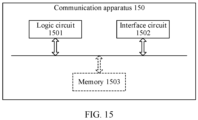
- the communication apparatus 800 includes a plurality of processors.
- the communication apparatus 800 may further include a processor 807 in addition to the processor 801 in FIG. 8 .
- the communication apparatus 800 further includes an output device 805 and an input device 806.
- the input device 806 is a device like a keyboard, a mouse, a microphone, or a joystick
- the output device 805 is a device like a display or a speaker (speaker).
- the communication apparatus 800 may be a desktop computer, a portable computer, a network server, a mobile phone, a tablet computer, a wireless terminal, an embedded device, a chip system, or a device having a structure similar to that in FIG. 8 .
- the composition structure shown in FIG. 8 does not constitute a limitation on the communication apparatus.
- the communication apparatus may include more or fewer components than those shown in the figure, or some components may be combined, or different component arrangements may be used.
- Processing performed by a single execution body may alternatively be performed by a plurality of execution bodies. These execution bodies may be logically and/or physically separated. This is not limited.
- FIG. 9 is a flowchart of a communication method according to an embodiment of this application. As shown in FIG. 9 , the method may include the following steps.
- Step 901 The first terminal device determines a first identifier based on SLRB configuration information.
- the SLRB configuration information may indicate an SLRB between the first terminal device and the second terminal device.
- the first identifier may be a radio bearer identifier, and the radio bearer identifier may indicate a radio bearer between the first terminal device and the second terminal device.
- the first identifier may be a PC5 configuration index.
- the first identifier may be a logical channel identifier.
- the SLRB configuration information may include one or more of the following: SDAP configuration information, PDCP configuration information, SRAP configuration information, RLC configuration information, MAC configuration information, and PHY configuration information.
- the first terminal device may be a source terminal device or a target terminal device based on different data transmission directions.
- the terminal device has different transmit/receive configurations based on different data transmission directions between the source terminal device and the target terminal device.
- the source terminal device is a data sender (or described as a transmitter terminal device or a first terminal device)
- the source terminal device may determine the first identifier and the corresponding SLRB configuration information, and send the first identifier and the corresponding SLRB configuration information to the relay terminal device and the target terminal device (or described as a receiver terminal device or a second terminal device).
- the first terminal device may determine the first identifier based on the SLRB configuration information by using any one of the following three possible designs:
- the first identifier is a radio bearer identifier
- the SLRB configuration information may include a PC5 configuration index
- the first terminal device may determine the radio bearer identifier based on the PC5 configuration index.
- the PC5 configuration index may indicate end-to-end (end-to-end, E2E) SLRB configuration information between the first terminal device and the second terminal device, and a length of the PC5 configuration index is nine bits.
- the first terminal device may determine the radio bearer identifier based on a quantity of PC5 configuration indexes.
- a quantity of radio bearer identifiers is equal to the quantity of PC5 configuration indexes, a value of a 1 st radio bearer identifier is a first value, and a difference between two adjacent radio bearer identifiers is a second value.
- the radio bearer identifier may be increased by 1 starting from 1, and the radio bearer identifier is in one-to-one correspondence with the PC5 configuration index.
- the first terminal device may determine the radio bearer identifier based on five least significant bits of the PC5 configuration index.
- the first terminal device may determine a result of performing a modulo operation on the PC5 configuration index and 32 as the radio bearer identifier.
- the first terminal device may determine a remainder of the PC5 configuration index modulo 32 as the radio bearer identifier, or the first terminal device may determine a value obtaining by adding 1 to the remainder of the PC5 configuration index modulo 32 as the radio bearer identifier.
- the first identifier is a PC5 configuration index
- the SLRB configuration information may include the PC5 configuration index
- the first terminal device may determine the PC5 configuration index as the first identifier based on the SLRB configuration information.
- the PC5 configuration index is nine bits
- the first identifier may be nine bits of the PC5 configuration index, or may be five least significant bits of the PC5 configuration index. This is not limited.
- the first identifier is a logical channel identifier
- the SLRB configuration information may include the logical channel identifier
- the first terminal device may determine the logical channel identifier as the first identifier based on the SLRB configuration information.
- the logical channel identifier is six bits, and the first identifier may be six bits of the logical channel identifier, or may be five least significant bits of the logical channel identifier. This is not limited.
- the first terminal device may adjust, in any one of the following three manners, the first identifier associated with the second SLRB configuration information, so that the first identifier associated with the second SLRB configuration information is different from the first identifier associated with the first SLRB configuration information:
- the third value may be 1, 2, or a specific third value.
- the third value may be customized by the first terminal device, or may be preset. This is not limited.
- the first terminal device determines a value that is in a value set and that is not associated with SLRB configuration information as the first identifier associated with the second SLRB configuration information.
- the first terminal device may sequentially select, in an order of values, values that are in the value set and that are not associated with SLRB configuration information, and determine the values as the first identifiers associated with the second SLRB configuration information.
- the first identifier when the first identifier is the radio bearer identifier, the first identifier may be five bits or six bits; when the first identifier is the PC5 configuration index, the first identifier may be nine bits or five bits; or when the first identifier is the logical channel identifier, the first identifier may be five bits or six bits.
- the first terminal device when sending data to the second terminal device via the relay terminal device, may include the first identifier in the SRAP header.
- the first terminal device may reuse an SRAP header format in an R17 U2N relay scenario.
- the SRAP header may include a first identifier and a local identifier.
- the radio bearer identifier may include a data radio bearer identifier (DRB ID) and a signaling radio bearer identifier (SRB ID).
- DRB ID data radio bearer identifier
- SRB ID signaling radio bearer identifier
- a value of the signaling radio bearer identifier may be 0 to 3
- a value of the data radio bearer identifier may be 1 to 32.
- the value of the signaling radio bearer identifier and the value of the data radio bearer identifier may be set to a same value, or may be set to different values.
- the value of the signaling radio bearer identifier and the value of the data radio bearer identifier may be set to a same value (for example, the data includes some values in 0 to 3) is used.
- a logical channel in the following manner 1 may be used for differentiation, or first indication information in the following manner 2 may be used for differentiation.
- a specific RLC channel (or described as a logical channel) may be used for transmission.
- terminal devices including the relay terminal device and the second terminal device) that receive the data may have the following two determining logics:
- the first indication information indicates that the radio bearer identifier is the signaling radio bearer identifier, or the first indication information indicates that the radio bearer identifier is the data radio bearer identifier.
- the first indication information is one bit.
- a value of the first indication information may be set to 0 to indicate that the radio bearer identifier is the signaling radio bearer identifier, and the value of the first indication information is set to 1 to indicate that the radio bearer identifier is the data radio bearer identifier.
- the value of the signaling radio bearer identifier and the value of the data radio bearer identifier may be set to different values.
- the terminal device that receives the data may directly distinguish, by using the value of the radio bearer identifier, whether the radio bearer identifier is the data radio bearer identifier or the signaling radio bearer identifier.
- the radio bearer identifier is the data radio bearer identifier; or if the value of the radio bearer identifier belongs to a second set, the radio bearer identifier is the signaling radio bearer identifier.
- the data radio bearer identifier may occupy a maximum of five bits, there is no space left for allocating the value of the signaling radio bearer identifier. In this case, there may be the following two possible implementations.
- a quantity of values of the signaling radio bearer identifier is less than or equal to 4, and a quantity of values of the data radio bearer identifier is less than or equal to 32.
- Implementation 2 When determining the value of the radio bearer identifier, the first terminal device controls a total quantity of values of the control signaling radio bearer identifier and the data radio bearer identifier not to exceed five bits (in other words, the total quantity is less than or equal to 32), where a quantity of values of the signaling radio bearer identifier is less than or equal to 4, and a quantity of values of the data radio bearer identifier is less than or equal to 28.
- Step 903 The first terminal device sends the first information to the second terminal device via the relay terminal device, and correspondingly, the second terminal device receives the first information from the first terminal device via the relay terminal device.
- the first terminal device includes the first information in the SL-RRC message, and sends the SL-RRC message to the second terminal device via the relay terminal device.
- the second information may include one or more first identifiers and first configuration information associated with the first identifier, and different first identifiers are associated with different first configuration information.
- the third information may include one or more first identifiers and second configuration information associated with the first identifier, and different first identifiers are associated with different second configuration information.
- the first configuration information may include one or more of the following: SRAP configuration information, RLC configuration information, MAC configuration information, and PHY configuration information.
- the first configuration information may include configuration information of an SRAP layer and a layer below the SRAP layer in the SLRB configuration information.
- the second configuration information may include one or more of the following: SDAP configuration information and PDCP configuration information.
- the second configuration information may include configuration information of a layer above the SRAP layer in the SLRB configuration information.
- the first terminal device may directly send the second information to the relay terminal device, and the relay terminal device determines an association relationship between the first identifier and the first configuration information based on the second information.
- the first terminal device may send the third information to the second terminal device via the relay terminal device. In other words, the first terminal device sends the third information to the relay terminal device, and the relay terminal device sends the third information to the second terminal device.
- the first terminal device sends the second information to the relay terminal device by using an SL-RRC message.
- the first terminal device includes the third information in the SL-RRC message, and sends the SL-RRC message to the second terminal device via the relay terminal device.
- the second information further includes first indication information.
- the third information further includes first indication information.
- the first indication information indicates that the radio bearer identifier is a signaling radio bearer identifier, or the first indication information indicates that the radio bearer identifier is a data radio bearer identifier.
- the relay terminal device and the second terminal device may distinguish between the data radio bearer identifier and the signaling radio bearer identifier based on the first indication information.
- the first terminal device may send the first information to the relay terminal device and send the third information to the second terminal device.
- the first information may include one or more first identifiers and SLRB configuration information associated with the first identifier, and different first identifiers are associated with different SLRB configuration information.
- the third information may include one or more first identifiers and second configuration information associated with the first identifier, and different first identifiers are associated with different second configuration information.
- the SLRB configuration information may include one or more of the following: SDAP configuration information, PDCP configuration information, SRAP configuration information, RLC configuration information, MAC configuration information, and PHY configuration information.
- the second configuration information may include one or more of the following: SDAP configuration information and PDCP configuration information.
- the second configuration information may include configuration information of a layer above the SRAP layer in the SLRB configuration information.
- the first terminal device when the first terminal device sends the third information to the second terminal device, in a possible design, the first terminal device sends the third information to the relay terminal device, and the relay terminal device sends the third information to the second terminal device. In another possible design, the first terminal device sends the first information to the relay terminal device, and the relay terminal device determines the third information based on the first information, and sends the third information to the second terminal device.
- the first terminal device can correctly complete data delivery based on the first identifier and the SLRB configuration information associated with the first identifier
- the relay terminal device can also correctly complete data delivery based on the first identifier and the SLRB configuration information/first configuration information associated with the first identifier
- the second terminal device can also correctly complete data delivery based on the first identifier and the SLRB configuration information/second configuration information associated with the first identifier, implementing the bearer multiplexing and demultiplexing functions of the SRAP layer.
- the following uses the first identifier and the SLRB configuration information associated with the first identifier as an example. As shown in FIG. 11A and FIG. 11B , during data transmission, the first terminal device, the relay terminal device, and the second terminal device can correctly complete data delivery based on the first identifier and the SLRB configuration information associated with the first identifier, implementing the bearer multiplexing and demultiplexing functions of the SRAP layer.
- FIG. 11A and FIG. 11B show a communication method according to an embodiment of this application.
- a data transmission process is described in detail by using an example in which a first terminal device sends first data to a second terminal device via a relay terminal device.
- the method may include the following steps.
- Step 1101 A PDCP entity of the first terminal device sends the first data to an SRAP entity of the first terminal device, and correspondingly, the SRAP entity of the first terminal device receives the first data from the PDCP entity of the first terminal device.
- the SRAP entity of the first terminal device may receive a PDCP PDU (namely, the first data) from an upper-layer PDCP entity, and each PDCP entity may correspond to a radio bearer of a second terminal device.
- the first terminal device includes an SDAP entity 1, an SDAP entity 2, a PDCP entity 1, and a PDCP entity 2.
- the SDAP entity 1 and the PDCP entity 1 may correspond to a radio bearer of a second terminal device 1
- the SDAP entity 2 and the PDCP entity 2 may correspond to a radio bearer of a second terminal device 2.
- the SRAP entity of the first terminal device may receive, from the PDCP entity 1 of the first terminal device, first data 1 that needs to be sent to the second terminal device 1, and receive, from the PDCP entity 2 of the first terminal device, first data 2 that needs to be sent to the second terminal device 2.
- Step 1102 The SRAP entity of the first terminal device determines, based on SLRB configuration information, a first identifier associated with the PDCP entity of the first terminal device.
- the first identifier may be a radio bearer identifier, or the first identifier may be a PC5 configuration index, or the first identifier may be a logical channel identifier.
- the SLRB configuration information may include a PDCP configuration.
- the SRAP entity of the first terminal device may determine, based on the SLRB configuration information and the PDCP entity corresponding to the first data, the first identifier associated with the PDCP entity.
- Step 1103 The first terminal device sends second data to the relay terminal device based on a first mapping relationship by using a first RLC bearer associated with both the first identifier and a first local identifier.
- the first local identifier indicates the second terminal device.
- the first mapping relationship includes a mapping relationship among the first identifier, the first local identifier, and the first RLC bearer.
- the second data includes the first data, the first identifier, and the first local identifier.
- the SRAP entity of the first terminal device may include the first local identifier and the first identifier in an added SRAP header when constructing an SRAP PDU (namely, the second data), that is, may include, in the SRAP header, an identifier (namely, the first local identifier) of the second terminal device to which the PDCP entity belongs and the first identifier, to map bearers of different second terminal devices to corresponding first RLC bearers based on the first mapping relationship, that is, to deliver the second data to the corresponding first RLC bearer, and send the second data to the relay terminal device by using the first RLC bearer.
- the first terminal device determines the first mapping relationship based on a transmission requirement between the first terminal device and the relay terminal device.
- the transmission requirement may include a QoS requirement between the first terminal device and the relay terminal device, for example, may include a transmission delay requirement and a transmission rate requirement. This is not limited.
- the first terminal device sends, to the relay terminal device, the first local identifier and a layer-2 identifier that is of the second terminal device and that is associated with the first local identifier, so that after receiving the second data, the relay terminal device determines, based on the first local identifier, a specific second terminal device that receives the first data.
- the first RLC bearer of the first terminal device may deliver the second data to a MAC entity of the first terminal device, and the MAC entity of the first terminal device sends the second data to the relay terminal device through a physical layer.
- the second data may include the first data, the first identifier, and the first local identifier.
- a MAC entity of the relay terminal device may receive, through a physical layer, the second data sent by the first terminal device, and deliver the second data to a relay RLC bearer of the relay terminal device.
- a relay RLC entity of the relay terminal device delivers the second data to the first SRAP entity of the relay terminal device.
- the relay RLC bearer is an RLC bearer that is in the relay terminal device and that is associated with the first RLC bearer of the first terminal device.
- the second data received by the first SRAP entity of the relay terminal device may be an RLC SDU or an SRAP PDU. This is not limited.
- Step 1105 The first SRAP entity of the relay terminal device sends the second data to a second SRAP entity of the relay terminal device, and correspondingly, the second SRAP entity of the relay terminal device receives the second data sent by the first SRAP entity of the relay terminal device.
- the first SRAP entity of the relay terminal device may transparently transmit the received second data to the second SRAP entity of the relay terminal device without performing additional processing.
- Step 1106 The second SRAP entity of the relay terminal device sends, based on a second mapping relationship associated with the first terminal device, the second data to the second terminal device by using a relay RLC bearer associated with both the first identifier and the first local identifier.
- the second mapping relationship may include a mapping relationship among the first identifier, the first local identifier, and the relay RLC bearer.
- the relay RLC bearer is an RLC bearer that is in the relay terminal device and that is associated with a second RLC bearer of the second terminal device.
- the second SRAP entity of the relay terminal device may deliver the second data to the relay RLC bearer associated with both the first identifier and the first local identifier, the relay RLC bearer delivers the second data to the MAC entity of the relay terminal device, and the MAC entity of the relay terminal device sends the second data to the second terminal device through the physical layer.
- the third mapping relationship may include a mapping relationship among the first identifier, a second local identifier, and the relay RLC bearer.
- the second local identifier may indicate the first terminal device.
- Step 1112 The SRAP entity of the second terminal device sends the first data to the PDCP entity that is in the second terminal device and that is associated with the first identifier.
- the first identifier may be a radio bearer identifier, or the first identifier may be a PC5 configuration index, or the first identifier may be a logical channel identifier.
- Step 1304 A second SRAP entity of the relay terminal device receives the third data from the second terminal device.
- a MAC entity of the relay terminal device may receive, through a physical layer, the third data sent by the second terminal device, and deliver the third data to a relay RLC bearer of the relay terminal device.
- a relay RLC entity of the relay terminal device delivers the third data to the second SRAP entity of the relay terminal device.
- the relay RLC bearer is an RLC bearer that is in the relay terminal device and that is associated with a second RLC bearer of the second terminal device.
- the third data received by the second SRAP entity of the relay terminal device may be an RLC SDU or an SRAP PDU. This is not limited.
- Step 1305 The second SRAP entity of the relay terminal device sends the third data to a first SRAP entity of the relay terminal device.
- the second SRAP entity of the relay terminal device may transparently transmit the received third data to the first SRAP entity of the relay terminal device without performing additional processing.
- Step 1306 The first SRAP entity of the relay terminal device sends, based on a third mapping relationship associated with the second terminal device, the third data to the first terminal device by using a relay RLC bearer associated with both the first identifier and the second local identifier.
- the third mapping relationship includes a mapping relationship among the first identifier, the second local identifier, and the relay RLC bearer.
- the relay RLC bearer is an RLC bearer that is in the relay terminal device and that is associated with a first RLC bearer of the first terminal device.
- the first SRAP entity of the relay terminal device may deliver the third data to the relay RLC bearer associated with both the first identifier and the second local identifier, the relay RLC bearer delivers the third data to the MAC entity of the relay terminal device, and the MAC entity of the relay terminal device sends the third data to the first terminal device through the physical layer.
- the relay terminal device may store two sets of SRAP layer sending configurations based on different data transmission directions. After receiving data, the relay terminal device may first determine whether the data is from the first terminal device or the second terminal device, and then determine a set of configurations to be used. To be specific, if the data is from the first terminal device, the data is sent to the second terminal device by using the second mapping relationship associated with the first terminal device; or if the data is from the second terminal device, the data is sent to the first terminal device by using a third mapping relationship associated with the second terminal device.
- the relay terminal device determines the third mapping relationship based on a transmission requirement between the relay terminal device and the first terminal device.
- the transmission requirement may include a QoS requirement between the relay terminal device and the first terminal device, for example, may include a transmission delay requirement and a transmission rate requirement. This is not limited.
- the third mapping relationship may alternatively be determined by a serving base station of the relay terminal device based on the transmission requirement between the relay terminal device and the first terminal device. This is not limited.
- the relay terminal device receives, from the first terminal device, the first local identifier and a layer-2 identifier that is of the second terminal device and that is associated with the first local identifier; or the relay terminal device receives, from the second terminal device, the second local identifier and a layer-2 identifier that is of the first terminal device and that is associated with the second local identifier.
- Step 1307 An SRAP entity of the first terminal device receives the third data from the relay terminal device.
- the third data includes the fourth data, the first identifier, and the second local identifier.
- a MAC entity of the first terminal device may receive, through a physical layer, the third data sent by the relay terminal device, and deliver the third data to the first RLC bearer of the first terminal device.
- a first RLC entity of the first terminal device delivers the third data to the SRAP entity of the first terminal device.
- the first RLC bearer is an RLC bearer that is in the first terminal device and that is associated with the relay RLC bearer of the relay terminal device.
- the third data received by the SRAP entity of the first terminal device may be an RLC SDU or an SRAP PDU. This is not limited.
- Step 1308 The second SRAP entity of the relay terminal device sends the fourth data, the first identifier, and a local identifier to the first SRAP entity of the relay terminal device.
- the local identifier includes one or more of the following: the first local identifier and the second local identifier, and the second local identifier indicates the first terminal device.
- the second SRAP entity of the relay terminal device may remove an SRAP header of the third data, to obtain the fourth data, and deliver the fourth data to the first SRAP entity of the relay terminal device.
- the second SRAP entity of the relay terminal device may further parse the SRAP header of the third data to obtain the first identifier and the second local identifier, and indicate the first identifier and the second local identifier to the first SRAP entity of the relay terminal device.
- the second SRAP entity of the relay terminal device sends, to the first SRAP entity of the relay terminal device, the first local identifier that indicates the second terminal device, to indicate that a source terminal device of the fourth data is the second terminal device.
- Step 1309 The first SRAP entity of the relay terminal device sends, based on the third mapping relationship associated with the second terminal device, fifth data to the first terminal device by using the relay RLC bearer associated with both the first identifier and the second local identifier.
- the third mapping relationship includes a mapping relationship among the first identifier, the second local identifier, and the relay RLC bearer; and the fifth data includes the fourth data, the first identifier, and the local identifier.
- the first SRAP entity of the relay terminal device may include the local identifier and the first identifier in an added SRAP header when constructing an SRAP PDU (namely, the fifth data), and map bearers of different first terminal devices to corresponding relay RLC bearers based on the third mapping relationship, that is, deliver the fifth data to the corresponding relay RLC bearer, and send the fifth data to the first terminal device by using the relay RLC bearer.
- the first SRAP entity of the relay terminal device may include the second local identifier in the fifth data, to indicate that the fourth data is sent to the first terminal device, or the first SRAP entity of the relay terminal device may include the first local identifier in the fifth data, to indicate that a source terminal device of the fourth data is the second terminal device.
- the first local identifier may be carried in the fifth data, to indicate a specific second terminal device that is the source terminal device of the fourth data.
- Step 1310 The SRAP entity of the first terminal device receives the fifth data from the relay terminal device.
- the fifth data includes the fourth data, the first identifier, and the local identifier.
- the MAC entity of the first terminal device may receive, through the physical layer, the fifth data sent by the relay terminal device, and deliver the fifth data to the first RLC bearer of the first terminal device.
- the first RLC entity of the first terminal device delivers the fifth data to the SRAP entity of the first terminal device.
- an execution body may perform some or all of the steps in embodiments of this application. These steps or operations are merely examples. In embodiments of this application, other operations or variations of various operations may be further performed. In addition, the steps may be performed in a sequence different from a sequence presented in embodiments of this application, and not all operations in embodiments of this application need to be performed.
- the communication apparatus 140 may include a transceiver module 1401 and a processing module 1402.
- the communication apparatus 140 may be a communication device, or may be a chip used in a communication device, or another combined device or component that has a function of the communication apparatus.
- the transceiver module 1401 may be a transceiver.
- the transceiver may include an antenna, a radio frequency circuit, and the like.
- the processing module 1402 may be a processor (or a processing circuit), for example, a baseband processor.
- the baseband processor may include one or more CPUs.
- the transceiver module 1401 may be a radio frequency unit, and the processing module 1402 may be a processor (or a processing circuit), for example, a baseband processor.
- the transceiver module 1401 may be an input/output interface of a chip (for example, a baseband chip); and the processing module 1402 may be a processor (or a processing circuit) of the chip system, and may include one or more central processing units.
- the computer-readable storage medium may alternatively be an external storage device of the foregoing terminal, for example, a plug-in hard disk drive, a smart media card (smart media card, SMC), a secure digital (secure digital, SD) card, and a flash card (flash card) that are configured on the foregoing terminal. Further, the computer-readable storage medium may further include both an internal storage unit and an external storage device of the foregoing terminal.
- the computer-readable storage medium is configured to store the computer program and other programs and data required by the foregoing terminal.
- the computer-readable storage medium may be further configured to temporarily store data that has been output or is to be output.
- a process, a method, a system, a product, or a device that includes a series of steps or units is not limited to the listed steps or units, but optionally further includes an unlisted step or unit, or optionally further includes another inherent step or unit of the process, the method, the product, or the device.
- At least one (item) means one or more.
- a plurality of means two or more.
- At least two (items) means two, three, or more.
- “And/Or” is used to describe an association relationship between associated objects, and indicates that three relationships may exist. For example, “A and/or B” may represent three cases: Only A exists, only B exists, and both A and B exist, where A and B may be singular or plural.
- the character “/” generally indicates an “or” relationship between the associated objects.
- At least one of the following items (pieces) or a similar expression thereof means any combination of these items, including any combination of singular items (pieces) or plural items (pieces).
- At least one of a, b, or c may indicate a, b, c, a and b, a and c, b and c, or a, b, and c, where a, b, and c may be singular or plural.
- Both "when” and “if” mean that corresponding processing is performed in an objective situation, are not intended to limit time, do not require a determining action during implementation, and do not mean any other limitation.
- example or “for example” is used to represent giving an example, an illustration, or a description. Any embodiment or design scheme described as an “example” or “for example” in embodiments of this application should not be explained as being more preferred or having more advantages than another embodiment or design scheme. Exactly, use of the terms such as “example” or “for example” is intended to present a related concept in a specific manner for ease of understanding.
- the disclosed apparatuses and methods may be implemented in other manners.
- the described apparatus embodiments are merely examples.
- division into the modules or units is merely logical function division. There may be another division manner during actual implementation.
- a plurality of units or components may be combined or integrated into another apparatus, or some features may be ignored or not performed.
- the displayed or discussed mutual couplings or direct couplings or communication connections may be implemented by using some interfaces.
- the indirect couplings or communication connections between the apparatuses or units may be implemented in electronic, mechanical, or other forms.
- the units described as separate parts may or may not be physically separate, and parts displayed as units may be one or more physical units, may be located in one place, or may be distributed on different places. Some or all of the units may be selected based on actual requirements to achieve the objectives of the solutions of embodiments.
- functional units in embodiments of this application may be integrated into one processing unit, each of the units may exist alone physically, or two or more units are integrated into one unit.
- the integrated unit may be implemented in a form of hardware, or may be implemented in a form of a software functional unit.
- the integrated unit When the integrated unit is implemented in the form of a software functional unit and sold or used as an independent product, the integrated unit may be stored in a readable storage medium. Based on such understanding, the technical solutions of embodiments of this application essentially or all or some of the technical solutions may be implemented in the form of a software product.
- the software product is stored in a storage medium and includes several instructions for instructing a device (which may be a single-chip microcomputer, a chip or the like) or a processor (processor) to perform all or some of the steps of the methods described in embodiments of this application.
- the foregoing storage medium includes any medium that can store program code, such as a USB flash drive, a removable hard disk, a ROM, a RAM, a magnetic disk, or an optical disc.
Landscapes
- Engineering & Computer Science (AREA)
- Computer Networks & Wireless Communication (AREA)
- Signal Processing (AREA)
- Mobile Radio Communication Systems (AREA)
Applications Claiming Priority (2)
| Application Number | Priority Date | Filing Date | Title |
|---|---|---|---|
| CN202211203377.8A CN117793740A (zh) | 2022-09-29 | 2022-09-29 | 通信方法及装置 |
| PCT/CN2023/120800 WO2024067411A1 (zh) | 2022-09-29 | 2023-09-22 | 通信方法及装置 |
Publications (2)
| Publication Number | Publication Date |
|---|---|
| EP4583563A1 true EP4583563A1 (de) | 2025-07-09 |
| EP4583563A4 EP4583563A4 (de) | 2025-12-17 |
Family
ID=90385657
Family Applications (1)
| Application Number | Title | Priority Date | Filing Date |
|---|---|---|---|
| EP23870642.8A Pending EP4583563A4 (de) | 2022-09-29 | 2023-09-22 | Kommunikationsverfahren und -vorrichtung |
Country Status (4)
| Country | Link |
|---|---|
| US (1) | US20250227729A1 (de) |
| EP (1) | EP4583563A4 (de) |
| CN (1) | CN117793740A (de) |
| WO (1) | WO2024067411A1 (de) |
Family Cites Families (7)
| Publication number | Priority date | Publication date | Assignee | Title |
|---|---|---|---|---|
| CN103369498B (zh) * | 2012-03-31 | 2016-08-31 | 上海贝尔股份有限公司 | 在无线接入设备和用户设备中管理数据承载的方法 |
| CN113079585B (zh) * | 2020-01-03 | 2023-02-21 | 大唐移动通信设备有限公司 | 一种信息处理方法及终端 |
| WO2021138756A1 (en) * | 2020-01-06 | 2021-07-15 | Mediatek Singapore Pte. Ltd. | Methods and apparatus of traffic forwarding for sidelink relay |
| WO2021138868A1 (en) * | 2020-01-09 | 2021-07-15 | Mediatek Singapore Pte. Ltd. | Methods and apparatus of sidelink configuration and traffic forwarding for layer-2 ue-to-ue relay |
| CN113891292B (zh) * | 2020-07-01 | 2024-01-12 | 华硕电脑股份有限公司 | 无线通信系统中建立用于ue间中继通信的侧链路无线电承载的方法和设备 |
| EP4233464A4 (de) * | 2020-10-22 | 2024-10-09 | Apple Inc. | Schicht-2-benutzergerät zur weiterleitung von benutzergerätdaten |
| CN119922647A (zh) * | 2020-12-14 | 2025-05-02 | 维沃移动通信有限公司 | 远端终端业务识别方法、装置、设备及存储介质 |
-
2022
- 2022-09-29 CN CN202211203377.8A patent/CN117793740A/zh active Pending
-
2023
- 2023-09-22 WO PCT/CN2023/120800 patent/WO2024067411A1/zh not_active Ceased
- 2023-09-22 EP EP23870642.8A patent/EP4583563A4/de active Pending
-
2025
- 2025-03-28 US US19/093,795 patent/US20250227729A1/en active Pending
Also Published As
| Publication number | Publication date |
|---|---|
| WO2024067411A1 (zh) | 2024-04-04 |
| EP4583563A4 (de) | 2025-12-17 |
| CN117793740A (zh) | 2024-03-29 |
| US20250227729A1 (en) | 2025-07-10 |
Similar Documents
| Publication | Publication Date | Title |
|---|---|---|
| US20230261826A1 (en) | Communication method and apparatus | |
| EP3952398B1 (de) | Funkträgerkonfigurierungsverfahren, -vorrichtung und -system | |
| WO2022017348A1 (zh) | 侧行链路信令无线承载配置的方法和通信装置 | |
| EP4351192A1 (de) | Relaiskommunikationsverfahren, -vorrichtung und -system | |
| EP4369844A1 (de) | Kommunikationsverfahren, -vorrichtung und -system | |
| EP3629538B1 (de) | Kommunikationsverfahren und -vorrichtung | |
| CN113727300A (zh) | 旁链路通信方法及设备 | |
| EP4564924A1 (de) | Kommunikationsverfahren, kommunikationsvorrichtung und kommunikationssystem | |
| WO2022205234A1 (zh) | 一种通信方法及装置 | |
| EP4576871A1 (de) | Kommunikationsverfahren und kommunikationsvorrichtung | |
| US20250008371A1 (en) | Communication method and apparatus, and storage medium | |
| WO2020221071A1 (zh) | 一种无线承载的管理方法、装置及系统 | |
| US12574710B2 (en) | Communication method, communication apparatus, and computer-readable storage medium | |
| EP4210431A1 (de) | Kommunikationsverfahren und -vorrichtung | |
| WO2022141332A1 (zh) | 一种通信方法及装置 | |
| US20250142672A1 (en) | Communication method and apparatus | |
| EP4583563A1 (de) | Kommunikationsverfahren und -vorrichtung | |
| WO2021213014A1 (zh) | 一种通信方法及装置 | |
| WO2024093729A1 (zh) | 通信方法及装置 | |
| WO2025137893A1 (zh) | 无线通信的方法及通信设备 | |
| CN107734555B (zh) | 数据收发通道、数据传输方法及装置 | |
| US20260032752A1 (en) | Communication method and communication apparatus | |
| WO2025139601A1 (zh) | 通信方法、装置及系统 | |
| WO2025167697A1 (zh) | 一种通信方法及装置 | |
| WO2025030523A1 (zh) | 无线通信的方法和通信设备 |
Legal Events
| Date | Code | Title | Description |
|---|---|---|---|
| STAA | Information on the status of an ep patent application or granted ep patent |
Free format text: STATUS: THE INTERNATIONAL PUBLICATION HAS BEEN MADE |
|
| PUAI | Public reference made under article 153(3) epc to a published international application that has entered the european phase |
Free format text: ORIGINAL CODE: 0009012 |
|
| STAA | Information on the status of an ep patent application or granted ep patent |
Free format text: STATUS: REQUEST FOR EXAMINATION WAS MADE |
|
| 17P | Request for examination filed |
Effective date: 20250403 |
|
| AK | Designated contracting states |
Kind code of ref document: A1 Designated state(s): AL AT BE BG CH CY CZ DE DK EE ES FI FR GB GR HR HU IE IS IT LI LT LU LV MC ME MK MT NL NO PL PT RO RS SE SI SK SM TR |
|
| REG | Reference to a national code |
Ref country code: DE Ref legal event code: R079 Free format text: PREVIOUS MAIN CLASS: H04W0024020000 Ipc: H04W0076110000 |
|
| A4 | Supplementary search report drawn up and despatched |
Effective date: 20251114 |
|
| RIC1 | Information provided on ipc code assigned before grant |
Ipc: H04W 76/11 20180101AFI20251110BHEP Ipc: H04W 76/14 20180101ALI20251110BHEP Ipc: H04W 88/04 20090101ALN20251110BHEP Ipc: H04W 92/18 20090101ALN20251110BHEP |
|
| DAV | Request for validation of the european patent (deleted) | ||
| DAX | Request for extension of the european patent (deleted) |