ES2701258T3 - Process for the purification of (hydro) fluoroalkenes - Google Patents
Process for the purification of (hydro) fluoroalkenes Download PDFInfo
- Publication number
- ES2701258T3 ES2701258T3 ES15173457T ES15173457T ES2701258T3 ES 2701258 T3 ES2701258 T3 ES 2701258T3 ES 15173457 T ES15173457 T ES 15173457T ES 15173457 T ES15173457 T ES 15173457T ES 2701258 T3 ES2701258 T3 ES 2701258T3
- Authority
- ES
- Spain
- Prior art keywords
- hydro
- fluoroalkene
- process according
- composition
- compounds
- Prior art date
- Legal status (The legal status is an assumption and is not a legal conclusion. Google has not performed a legal analysis and makes no representation as to the accuracy of the status listed.)
- Active
Links
- ZZUFCTLCJUWOSV-UHFFFAOYSA-N furosemide Chemical compound C1=C(Cl)C(S(=O)(=O)N)=CC(C(O)=O)=C1NCC1=CC=CO1 ZZUFCTLCJUWOSV-UHFFFAOYSA-N 0.000 title claims abstract description 69
- 238000000034 method Methods 0.000 title claims abstract description 55
- 238000000746 purification Methods 0.000 title claims description 12
- OKTJSMMVPCPJKN-UHFFFAOYSA-N Carbon Chemical compound [C] OKTJSMMVPCPJKN-UHFFFAOYSA-N 0.000 claims abstract description 87
- 239000003463 adsorbent Substances 0.000 claims abstract description 56
- 239000000203 mixture Substances 0.000 claims abstract description 48
- 150000001875 compounds Chemical class 0.000 claims abstract description 47
- FXRLMCRCYDHQFW-UHFFFAOYSA-N 2,3,3,3-tetrafluoropropene Chemical compound FC(=C)C(F)(F)F FXRLMCRCYDHQFW-UHFFFAOYSA-N 0.000 claims abstract description 38
- 229910052782 aluminium Inorganic materials 0.000 claims abstract description 27
- XAGFODPZIPBFFR-UHFFFAOYSA-N aluminium Chemical compound [Al] XAGFODPZIPBFFR-UHFFFAOYSA-N 0.000 claims abstract description 26
- -1 alkali metal salt Chemical class 0.000 claims description 26
- HNPSIPDUKPIQMN-UHFFFAOYSA-N dioxosilane;oxo(oxoalumanyloxy)alumane Chemical compound O=[Si]=O.O=[Al]O[Al]=O HNPSIPDUKPIQMN-UHFFFAOYSA-N 0.000 claims description 16
- 239000010457 zeolite Substances 0.000 claims description 16
- PNEYBMLMFCGWSK-UHFFFAOYSA-N aluminium oxide Inorganic materials [O-2].[O-2].[O-2].[Al+3].[Al+3] PNEYBMLMFCGWSK-UHFFFAOYSA-N 0.000 claims description 15
- 229910021536 Zeolite Inorganic materials 0.000 claims description 11
- 239000002585 base Substances 0.000 claims description 11
- 239000011148 porous material Substances 0.000 claims description 11
- 239000002808 molecular sieve Substances 0.000 claims description 7
- URGAHOPLAPQHLN-UHFFFAOYSA-N sodium aluminosilicate Chemical compound [Na+].[Al+3].[O-][Si]([O-])=O.[O-][Si]([O-])=O URGAHOPLAPQHLN-UHFFFAOYSA-N 0.000 claims description 7
- 229910052751 metal Inorganic materials 0.000 claims description 6
- 239000002184 metal Substances 0.000 claims description 6
- 239000000654 additive Substances 0.000 claims description 5
- 229910000323 aluminium silicate Inorganic materials 0.000 claims description 5
- 229910052783 alkali metal Inorganic materials 0.000 claims description 4
- 150000002736 metal compounds Chemical class 0.000 claims description 2
- 230000000996 additive effect Effects 0.000 claims 2
- IJGRMHOSHXDMSA-UHFFFAOYSA-N Atomic nitrogen Chemical compound N#N IJGRMHOSHXDMSA-UHFFFAOYSA-N 0.000 description 14
- 229910052799 carbon Inorganic materials 0.000 description 14
- 239000012535 impurity Substances 0.000 description 13
- FDMFUZHCIRHGRG-UHFFFAOYSA-N 3,3,3-trifluoroprop-1-ene Chemical compound FC(F)(F)C=C FDMFUZHCIRHGRG-UHFFFAOYSA-N 0.000 description 7
- 238000004458 analytical method Methods 0.000 description 7
- 229910052757 nitrogen Inorganic materials 0.000 description 7
- 238000001179 sorption measurement Methods 0.000 description 7
- KWYUFKZDYYNOTN-UHFFFAOYSA-M Potassium hydroxide Chemical compound [OH-].[K+] KWYUFKZDYYNOTN-UHFFFAOYSA-M 0.000 description 6
- 239000003610 charcoal Substances 0.000 description 6
- 238000004821 distillation Methods 0.000 description 6
- NLKNQRATVPKPDG-UHFFFAOYSA-M potassium iodide Chemical compound [K+].[I-] NLKNQRATVPKPDG-UHFFFAOYSA-M 0.000 description 6
- 239000000047 product Substances 0.000 description 6
- NDMMKOCNFSTXRU-UHFFFAOYSA-N 1,1,2,3,3-pentafluoroprop-1-ene Chemical class FC(F)C(F)=C(F)F NDMMKOCNFSTXRU-UHFFFAOYSA-N 0.000 description 5
- PRDFNJUWGIQQBW-UHFFFAOYSA-N 3,3,3-trifluoroprop-1-yne Chemical compound FC(F)(F)C#C PRDFNJUWGIQQBW-UHFFFAOYSA-N 0.000 description 5
- 238000009835 boiling Methods 0.000 description 5
- 125000004435 hydrogen atom Chemical group [H]* 0.000 description 5
- 241000894007 species Species 0.000 description 5
- 239000002156 adsorbate Substances 0.000 description 4
- 125000004432 carbon atom Chemical group C* 0.000 description 4
- 238000004519 manufacturing process Methods 0.000 description 4
- 239000000463 material Substances 0.000 description 4
- 150000002739 metals Chemical class 0.000 description 4
- BWHMMNNQKKPAPP-UHFFFAOYSA-L potassium carbonate Chemical compound [K+].[K+].[O-]C([O-])=O BWHMMNNQKKPAPP-UHFFFAOYSA-L 0.000 description 4
- CDOOAUSHHFGWSA-OWOJBTEDSA-N (e)-1,3,3,3-tetrafluoroprop-1-ene Chemical compound F\C=C\C(F)(F)F CDOOAUSHHFGWSA-OWOJBTEDSA-N 0.000 description 3
- 239000002253 acid Substances 0.000 description 3
- 239000003245 coal Substances 0.000 description 3
- 230000008030 elimination Effects 0.000 description 3
- 238000003379 elimination reaction Methods 0.000 description 3
- 238000002474 experimental method Methods 0.000 description 3
- 125000001153 fluoro group Chemical group F* 0.000 description 3
- XLYOFNOQVPJJNP-UHFFFAOYSA-M hydroxide Chemical compound [OH-] XLYOFNOQVPJJNP-UHFFFAOYSA-M 0.000 description 3
- 239000007791 liquid phase Substances 0.000 description 3
- 230000000717 retained effect Effects 0.000 description 3
- 150000003839 salts Chemical class 0.000 description 3
- XLYOFNOQVPJJNP-UHFFFAOYSA-N water Substances O XLYOFNOQVPJJNP-UHFFFAOYSA-N 0.000 description 3
- DMUPYMORYHFFCT-UPHRSURJSA-N (z)-1,2,3,3,3-pentafluoroprop-1-ene Chemical compound F\C=C(/F)C(F)(F)F DMUPYMORYHFFCT-UPHRSURJSA-N 0.000 description 2
- QAERDLQYXMEHEB-UHFFFAOYSA-N 1,1,3,3,3-pentafluoroprop-1-ene Chemical compound FC(F)=CC(F)(F)F QAERDLQYXMEHEB-UHFFFAOYSA-N 0.000 description 2
- DDMOUSALMHHKOS-UHFFFAOYSA-N 1,2-dichloro-1,1,2,2-tetrafluoroethane Chemical compound FC(F)(Cl)C(F)(F)Cl DDMOUSALMHHKOS-UHFFFAOYSA-N 0.000 description 2
- 235000013162 Cocos nucifera Nutrition 0.000 description 2
- 244000060011 Cocos nucifera Species 0.000 description 2
- PXGOKWXKJXAPGV-UHFFFAOYSA-N Fluorine Chemical compound FF PXGOKWXKJXAPGV-UHFFFAOYSA-N 0.000 description 2
- UFHFLCQGNIYNRP-UHFFFAOYSA-N Hydrogen Chemical compound [H][H] UFHFLCQGNIYNRP-UHFFFAOYSA-N 0.000 description 2
- 230000002378 acidificating effect Effects 0.000 description 2
- 238000003965 capillary gas chromatography Methods 0.000 description 2
- 150000005323 carbonate salts Chemical class 0.000 description 2
- 238000006243 chemical reaction Methods 0.000 description 2
- KYKAJFCTULSVSH-UHFFFAOYSA-N chloro(fluoro)methane Chemical compound F[C]Cl KYKAJFCTULSVSH-UHFFFAOYSA-N 0.000 description 2
- AFYPFACVUDMOHA-UHFFFAOYSA-N chlorotrifluoromethane Chemical compound FC(F)(F)Cl AFYPFACVUDMOHA-UHFFFAOYSA-N 0.000 description 2
- 238000010924 continuous production Methods 0.000 description 2
- PXBRQCKWGAHEHS-UHFFFAOYSA-N dichlorodifluoromethane Chemical compound FC(F)(Cl)Cl PXBRQCKWGAHEHS-UHFFFAOYSA-N 0.000 description 2
- 235000019404 dichlorodifluoromethane Nutrition 0.000 description 2
- 239000002019 doping agent Substances 0.000 description 2
- 238000001704 evaporation Methods 0.000 description 2
- 239000011737 fluorine Substances 0.000 description 2
- 229910052731 fluorine Inorganic materials 0.000 description 2
- 239000007789 gas Substances 0.000 description 2
- 238000002290 gas chromatography-mass spectrometry Methods 0.000 description 2
- 150000008282 halocarbons Chemical class 0.000 description 2
- 238000010438 heat treatment Methods 0.000 description 2
- 239000001257 hydrogen Substances 0.000 description 2
- 229910052739 hydrogen Inorganic materials 0.000 description 2
- 239000000178 monomer Substances 0.000 description 2
- 238000006116 polymerization reaction Methods 0.000 description 2
- 229910052700 potassium Inorganic materials 0.000 description 2
- 229910000027 potassium carbonate Inorganic materials 0.000 description 2
- 238000005057 refrigeration Methods 0.000 description 2
- 229910052708 sodium Inorganic materials 0.000 description 2
- 239000011734 sodium Substances 0.000 description 2
- 239000000758 substrate Substances 0.000 description 2
- 231100000331 toxic Toxicity 0.000 description 2
- 230000002588 toxic effect Effects 0.000 description 2
- CYRMSUTZVYGINF-UHFFFAOYSA-N trichlorofluoromethane Chemical compound FC(Cl)(Cl)Cl CYRMSUTZVYGINF-UHFFFAOYSA-N 0.000 description 2
- 239000012808 vapor phase Substances 0.000 description 2
- 229910052727 yttrium Inorganic materials 0.000 description 2
- ZUAQTIHDWIHCSV-UPHRSURJSA-N (z)-1,2,3,3-tetrafluoroprop-1-ene Chemical compound F\C=C(/F)C(F)F ZUAQTIHDWIHCSV-UPHRSURJSA-N 0.000 description 1
- PGJHURKAWUJHLJ-UHFFFAOYSA-N 1,1,2,3-tetrafluoroprop-1-ene Chemical compound FCC(F)=C(F)F PGJHURKAWUJHLJ-UHFFFAOYSA-N 0.000 description 1
- BNYODXFAOQCIIO-UHFFFAOYSA-N 1,1,3,3-tetrafluoroprop-1-ene Chemical compound FC(F)C=C(F)F BNYODXFAOQCIIO-UHFFFAOYSA-N 0.000 description 1
- BQCIDUSAKPWEOX-UHFFFAOYSA-N 1,1-Difluoroethene Chemical compound FC(F)=C BQCIDUSAKPWEOX-UHFFFAOYSA-N 0.000 description 1
- TXHNVFGQJAAUNB-UHFFFAOYSA-N 1,2,3-trifluoroprop-1-ene Chemical compound FCC(F)=CF TXHNVFGQJAAUNB-UHFFFAOYSA-N 0.000 description 1
- FFTOUVYEKNGDCM-UHFFFAOYSA-N 1,3,3-trifluoroprop-1-ene Chemical compound FC=CC(F)F FFTOUVYEKNGDCM-UHFFFAOYSA-N 0.000 description 1
- FPBWSPZHCJXUBL-UHFFFAOYSA-N 1-chloro-1-fluoroethene Chemical compound FC(Cl)=C FPBWSPZHCJXUBL-UHFFFAOYSA-N 0.000 description 1
- VJGCZWVJDRIHNC-UHFFFAOYSA-N 1-fluoroprop-1-ene Chemical compound CC=CF VJGCZWVJDRIHNC-UHFFFAOYSA-N 0.000 description 1
- JMRIJKGIVGYIAD-UHFFFAOYSA-N 2,3,3-trifluoroprop-1-ene Chemical compound FC(F)C(F)=C JMRIJKGIVGYIAD-UHFFFAOYSA-N 0.000 description 1
- BVKZGUZCCUSVTD-UHFFFAOYSA-L Carbonate Chemical compound [O-]C([O-])=O BVKZGUZCCUSVTD-UHFFFAOYSA-L 0.000 description 1
- XWCDCDSDNJVCLO-UHFFFAOYSA-N Chlorofluoromethane Chemical compound FCCl XWCDCDSDNJVCLO-UHFFFAOYSA-N 0.000 description 1
- 239000004338 Dichlorodifluoromethane Substances 0.000 description 1
- PMZURENOXWZQFD-UHFFFAOYSA-L Sodium Sulfate Chemical compound [Na+].[Na+].[O-]S([O-])(=O)=O PMZURENOXWZQFD-UHFFFAOYSA-L 0.000 description 1
- 230000003213 activating effect Effects 0.000 description 1
- 229910001854 alkali hydroxide Inorganic materials 0.000 description 1
- 229910001508 alkali metal halide Inorganic materials 0.000 description 1
- 150000008045 alkali metal halides Chemical class 0.000 description 1
- 150000008044 alkali metal hydroxides Chemical class 0.000 description 1
- 150000001340 alkali metals Chemical class 0.000 description 1
- 229910052784 alkaline earth metal Inorganic materials 0.000 description 1
- 150000001342 alkaline earth metals Chemical class 0.000 description 1
- 150000001336 alkenes Chemical class 0.000 description 1
- 150000001412 amines Chemical class 0.000 description 1
- 229910052787 antimony Inorganic materials 0.000 description 1
- 238000007664 blowing Methods 0.000 description 1
- 239000006227 byproduct Substances 0.000 description 1
- 239000003575 carbonaceous material Substances 0.000 description 1
- 229910052804 chromium Inorganic materials 0.000 description 1
- 238000004140 cleaning Methods 0.000 description 1
- 238000009833 condensation Methods 0.000 description 1
- 230000005494 condensation Effects 0.000 description 1
- 239000000356 contaminant Substances 0.000 description 1
- 229910052802 copper Inorganic materials 0.000 description 1
- 238000000354 decomposition reaction Methods 0.000 description 1
- 230000007812 deficiency Effects 0.000 description 1
- 230000001627 detrimental effect Effects 0.000 description 1
- 229940087091 dichlorotetrafluoroethane Drugs 0.000 description 1
- 238000001035 drying Methods 0.000 description 1
- 230000000694 effects Effects 0.000 description 1
- 230000008020 evaporation Effects 0.000 description 1
- 239000012530 fluid Substances 0.000 description 1
- 239000006260 foam Substances 0.000 description 1
- 229910052737 gold Inorganic materials 0.000 description 1
- 239000008187 granular material Substances 0.000 description 1
- 150000004820 halides Chemical class 0.000 description 1
- 229910052736 halogen Inorganic materials 0.000 description 1
- 125000005843 halogen group Chemical group 0.000 description 1
- 150000002367 halogens Chemical class 0.000 description 1
- 229910000856 hastalloy Inorganic materials 0.000 description 1
- 239000010903 husk Substances 0.000 description 1
- 229930195733 hydrocarbon Natural products 0.000 description 1
- 150000002430 hydrocarbons Chemical class 0.000 description 1
- 238000005470 impregnation Methods 0.000 description 1
- 230000003993 interaction Effects 0.000 description 1
- 229910052742 iron Inorganic materials 0.000 description 1
- 230000001788 irregular Effects 0.000 description 1
- 238000011068 loading method Methods 0.000 description 1
- 229910052748 manganese Inorganic materials 0.000 description 1
- 238000002156 mixing Methods 0.000 description 1
- 239000003607 modifier Substances 0.000 description 1
- 229910052750 molybdenum Inorganic materials 0.000 description 1
- 229910052759 nickel Inorganic materials 0.000 description 1
- JRZJOMJEPLMPRA-UHFFFAOYSA-N olefin Natural products CCCCCCCC=C JRZJOMJEPLMPRA-UHFFFAOYSA-N 0.000 description 1
- 229910052763 palladium Inorganic materials 0.000 description 1
- 239000008188 pellet Substances 0.000 description 1
- 238000005191 phase separation Methods 0.000 description 1
- 230000000704 physical effect Effects 0.000 description 1
- 238000001020 plasma etching Methods 0.000 description 1
- 239000003380 propellant Substances 0.000 description 1
- 238000005086 pumping Methods 0.000 description 1
- 239000003507 refrigerant Substances 0.000 description 1
- 230000008929 regeneration Effects 0.000 description 1
- 238000011069 regeneration method Methods 0.000 description 1
- 229910052703 rhodium Inorganic materials 0.000 description 1
- 229910052707 ruthenium Inorganic materials 0.000 description 1
- 229920006395 saturated elastomer Polymers 0.000 description 1
- 238000007086 side reaction Methods 0.000 description 1
- 150000004760 silicates Chemical class 0.000 description 1
- ODZPKZBBUMBTMG-UHFFFAOYSA-N sodium amide Chemical compound [NH2-].[Na+] ODZPKZBBUMBTMG-UHFFFAOYSA-N 0.000 description 1
- 229910052938 sodium sulfate Inorganic materials 0.000 description 1
- 235000011152 sodium sulphate Nutrition 0.000 description 1
- 239000007787 solid Substances 0.000 description 1
- 239000002904 solvent Substances 0.000 description 1
- 238000003860 storage Methods 0.000 description 1
- 239000000126 substance Substances 0.000 description 1
- 229910052715 tantalum Inorganic materials 0.000 description 1
- 229910052718 tin Inorganic materials 0.000 description 1
- 229910052719 titanium Inorganic materials 0.000 description 1
- 231100000167 toxic agent Toxicity 0.000 description 1
- 229910052723 transition metal Inorganic materials 0.000 description 1
- 150000003624 transition metals Chemical class 0.000 description 1
- 229940029284 trichlorofluoromethane Drugs 0.000 description 1
- 238000005406 washing Methods 0.000 description 1
- 239000002023 wood Substances 0.000 description 1
- 229910052725 zinc Inorganic materials 0.000 description 1
Classifications
-
- C—CHEMISTRY; METALLURGY
- C07—ORGANIC CHEMISTRY
- C07C—ACYCLIC OR CARBOCYCLIC COMPOUNDS
- C07C17/00—Preparation of halogenated hydrocarbons
- C07C17/38—Separation; Purification; Stabilisation; Use of additives
- C07C17/389—Separation; Purification; Stabilisation; Use of additives by adsorption on solids
-
- C—CHEMISTRY; METALLURGY
- C07—ORGANIC CHEMISTRY
- C07B—GENERAL METHODS OF ORGANIC CHEMISTRY; APPARATUS THEREFOR
- C07B63/00—Purification; Separation; Stabilisation; Use of additives
-
- C—CHEMISTRY; METALLURGY
- C07—ORGANIC CHEMISTRY
- C07C—ACYCLIC OR CARBOCYCLIC COMPOUNDS
- C07C17/00—Preparation of halogenated hydrocarbons
- C07C17/23—Preparation of halogenated hydrocarbons by dehalogenation
-
- C—CHEMISTRY; METALLURGY
- C07—ORGANIC CHEMISTRY
- C07C—ACYCLIC OR CARBOCYCLIC COMPOUNDS
- C07C17/00—Preparation of halogenated hydrocarbons
- C07C17/093—Preparation of halogenated hydrocarbons by replacement by halogens
- C07C17/20—Preparation of halogenated hydrocarbons by replacement by halogens of halogen atoms by other halogen atoms
- C07C17/202—Preparation of halogenated hydrocarbons by replacement by halogens of halogen atoms by other halogen atoms two or more compounds being involved in the reaction
- C07C17/206—Preparation of halogenated hydrocarbons by replacement by halogens of halogen atoms by other halogen atoms two or more compounds being involved in the reaction the other compound being HX
-
- C—CHEMISTRY; METALLURGY
- C07—ORGANIC CHEMISTRY
- C07C—ACYCLIC OR CARBOCYCLIC COMPOUNDS
- C07C17/00—Preparation of halogenated hydrocarbons
- C07C17/25—Preparation of halogenated hydrocarbons by splitting-off hydrogen halides from halogenated hydrocarbons
-
- C—CHEMISTRY; METALLURGY
- C07—ORGANIC CHEMISTRY
- C07C—ACYCLIC OR CARBOCYCLIC COMPOUNDS
- C07C17/00—Preparation of halogenated hydrocarbons
- C07C17/38—Separation; Purification; Stabilisation; Use of additives
- C07C17/383—Separation; Purification; Stabilisation; Use of additives by distillation
Landscapes
- Chemical & Material Sciences (AREA)
- Organic Chemistry (AREA)
- Organic Low-Molecular-Weight Compounds And Preparation Thereof (AREA)
- Solid-Sorbent Or Filter-Aiding Compositions (AREA)
Abstract
Un proceso para eliminar uno o más compuestos de (hidro)fluoroalquenos no deseados que contienen un resto =CHF o un resto =CF2 de una composición que comprende el o cada (hidro)fluoroalqueno y 2,3,3,3-tetrafluoropropeno (R-1234yf) no deseados, comprendiendo el proceso poner en contacto la composición con un adsorbente que contiene aluminio, carbón activado o una mezcla de los mismos, en el que el o cada compuesto de (hidro)fluoroalqueno no deseado está presente en una cantidad de 0,1 a 1000 ppm, basado en el peso de la composición que comprende el R-1234yf y uno o más compuestos de (hidro)fluoroalquenos no deseados.A process for removing one or more unwanted (hydro) fluoroalkene compounds containing a residue = CHF or a residue = CF2 of a composition comprising the or each (hydro) fluoroalkene and 2,3,3,3-tetrafluoropropene (R -1234 and f) undesired, the process comprising contacting the composition with an adsorbent containing aluminum, activated carbon or a mixture thereof, in which the or each unwanted (hydro) fluoroalkene compound is present in an amount of 0.1 to 1000 ppm, based on the weight of the composition comprising R-1234yf and one or more unwanted (hydro) fluoroalkene compounds.
Description
DESCRIPCIÓNDESCRIPTION
Proceso para la purificación de (hidro)fluoroalquenosProcess for the purification of (hydro) fluoroalkenes
La invención se refiere a un proceso para la purificación de 2,3,3,3-tetrafluoropropeno (R-1234yf).The invention relates to a process for the purification of 2,3,3,3-tetrafluoropropene (R-1234yf).
El listado o la discusión de información de antecedentes o de un documento aparentemente publicado con anterioridad en la presente memoria descriptiva no debe considerarse necesariamente un reconocimiento de que la información o el documento es parte del estado de la técnica o del conocimiento común general.The listing or discussion of background information or of a document apparently published previously in this specification should not necessarily be considered an acknowledgment that the information or document is part of the state of the art or of general common knowledge.
Los (hidro)fluoroalquenos se consideran cada vez más como fluidos de trabajo en aplicaciones tales como refrigeración, bombeo de calor, soplado de espumas, extintores/retardantes del fuego, propulsores y solvencia (por ejemplo en limpieza y grabado de plasma). Los procesos usados para la producción de (hidrofluoroalquenos pueden llevar a la generación de subproductos tóxicos y/o de otro modo no deseables. La presencia de pequeñas cantidades de impurezas pude no ser perjudicial para las propiedades físicas aparentes del producto de (hidro)fluoroalqueno y para algunas aplicaciones su eliminación no es necesaria. Sin embargo, algunas aplicaciones requieren niveles de impurezas muy bajos, y muchas de ellas son difíciles de eliminar de los (hidro)fluoroalquenos por medios reconocidos. (Hydro) fluoroalkenes are increasingly considered as working fluids in applications such as refrigeration, heat pumping, foam blowing, fire extinguishers / retarders, propellants and solvency (for example in cleaning and plasma etching). The processes used for the production of (hydrofluoroalkenes) can lead to the generation of toxic and / or otherwise undesirable byproducts.The presence of small amounts of impurities may not be detrimental to the apparent physical properties of the (hydro) fluoroalkene product and for some applications, their removal is not necessary, however, some applications require very low levels of impurities, and many of them are difficult to remove from (hydro) fluoroalkenes by recognized means.
Por ejemplo, las impurezas se eliminan con frecuencia de los (hidro)fluoroalquenos mediante destilación, pero este método de eliminación es difícil si el punto de ebullición de la impureza está próximo al del (hidro)fluoroalqueno o si las interacciones entre sustancias asocian compuestos con puntos de ebullición por lo demás diferentes (por ejemplo azeótropos). Además, incluso después de la destilación, es posible que permanezcan pequeñas cantidades de impurezas no deseables.For example, impurities are frequently removed from (hydro) fluoroalkenes by distillation, but this method of elimination is difficult if the boiling point of the impurity is close to that of (hydro) fluoroalkene or if the interactions between substances associate compounds with otherwise different boiling points (eg azeotropes). In addition, even after distillation, small amounts of undesirable impurities may remain.
El 3,3,3-trifluoropropeno (R-1243zf) es un ejemplo de un (hidro)fluoroalqueno. Se cree que el R-1243zf se usa en aplicaciones tales como la refrigeración. El R-1243zf disponible en el mercado contiene muchas impurezas, incluyendo las especies altamente tóxicas 1,2,3,3,3-pentafluoropropeno (R-1225ye), 1,1,3,3,3-pentafluoropropeno (R-1225zc), y las especies clorofluorocarbonadas: clorofluorometano (R-31), clorofluoroeteno (R-1131), triclorofluorometano (R-11), diclorodifluorometano (R-12), clorotrifluorometano (R-13), y diclorotetrafluoroetano (R-114) que dañan el medioambiente. La destilación es de uso limitado en la purificación del R-1243zf ya que es difícil eliminar todas las impurezas usando esta técnica. Por ejemplo, el R-1225zc (punto de ebullición de -25,82 °C) es muy difícil de eliminar del R-1243zf (punto de ebullición de -25,19 °C) mediante destilación. El documento US 2.917.556 desvela un proceso para la purificación de fluoruro de vinilideno usando silicatos de alúmina.3,3,3-Trifluoropropene (R-1243zf) is an example of a (hydro) fluoroalkene. It is believed that R-1243zf is used in applications such as refrigeration. The R-1243zf available in the market contains many impurities, including the highly toxic species 1,2,3,3,3-pentafluoropropene (R-1225ye), 1,1,3,3,3-pentafluoropropene (R-1225zc) , and the chlorofluorocarbon species: chlorofluoromethane (R-31), chlorofluoroethene (R-1131), trichlorofluoromethane (R-11), dichlorodifluoromethane (R-12), chlorotrifluoromethane (R-13), and dichlorotetrafluoroethane (R-114) that damage environment. Distillation is of limited use in the purification of R-1243zf since it is difficult to remove all impurities using this technique. For example, R-1225zc (boiling point of -25.82 ° C) is very difficult to remove from R-1243zf (boiling point of -25.19 ° C) by distillation. US 2,917,556 discloses a process for the purification of vinylidene fluoride using alumina silicates.
En resumen, existe la necesidad de un método mejorado para purificar 2,3,3,3-tetrafluoropropeno (R-1234yf).In summary, there is a need for an improved method for purifying 2,3,3,3-tetrafluoropropene (R-1234yf).
Los presentes inventores han descubierto de modo sorprendente que un adsorbente que contiene aluminio, carbón activado, o una mezcla de los mismos, es eficaz para eliminar uno o más compuestos de (hidro)halocarbonos no deseados que contiene 2,3,3,3-tetrafluoropropeno (R-1234yf).The present inventors have surprisingly discovered that an adsorbent containing aluminum, activated carbon, or a mixture thereof, is effective to remove one or more undesirable (hydro) halocarbon compounds containing 2,3,3,3- tetrafluoropropene (R-1234yf).
Así, pues, la presente invención aborda las anteriores y otras deficiencias mediante la provisión de un proceso para eliminar uno o más (hidro)fluoroalquenos no deseados que contienen un resto =CHF o un =CF2 de una composición que comprende el o cada (hidro)fluoroalqueno no deseado y 2,3,3,3-tetrafluoropropeno (R-1234yf), el proceso comprende poner en contacto la composición con un adsorbente que contiene aluminio, carbón activado o una mezcla de los mismos,Thus, the present invention addresses the above and other deficiencies by providing a process for removing one or more undesired (hydro) fluoroalkenes containing a moiety = CHF or a = CF 2 of a composition comprising one or each ( hydro) fluoroalkene and 2,3,3,3-tetrafluoropropene (R-1234yf), the process comprises contacting the composition with an adsorbent containing aluminum, activated carbon or a mixture thereof,
en el que él o cada compuesto de (hidro)fluoroalqueno no deseado está presente en una cantidad de 0,1 a 1000 ppm, basado en el peso de la composición que comprende el R-1234yf y uno o más compuestos de (hidro)fluoroalqueno no deseados.wherein he or each undesired (hydro) fluoroalkene compound is present in an amount of 0.1 to 1000 ppm, based on the weight of the composition comprising R-1234yf and one or more (hydro) fluoroalkene compounds not wanted.
También se describe en el presente documento un proceso para eliminar uno o más compuestos de (hidro)halocarbonos no deseados de un (hidro)fluoroalqueno, que comprende el proceso poner en contacto una composición que comprende el (hidro)fluoroalqueno y uno o más compuestos de (hidro)halocarbonados no deseados con un aluminio que contiene adsorbente, carbón activado, o una mezcla de ellos.Also described herein is a process for removing one or more undesired (hydro) halocarbon compounds from a (hydro) fluoroalkene, which comprises contacting a composition comprising the (hydro) fluoroalkene and one or more compounds of undesired (hydro) halocarbons with an aluminum containing adsorbent, activated carbon, or a mixture thereof.
Con el término "(hidro)fluoroalquenos" los presentes inventores se refieren a compuestos insaturados de cadena lineal o ramificada que contienen átomos de flúor y, opcionalmente, de hidrógeno además de átomos de carbono. Por tanto, el término incluye perfluoroalquenos así como hidrofluoroalquenos los cuales contienen tanto átomos de flúor como de hidrógeno además de átomos carbono. Los hidrofluoroalquenos son un grupo preferente de los (hidro)fluoroalquenos. Ejemplos preferentes de (hidro)fluoroalquenos incluyen (hidro)fluoroalquenos C2-10 y, en particular, (hidro)fluoroalquenos C3-7. En una realización, el (hidro)fluoroalqueno es un hidrofluoroalqueno C3-7 que contiene sustituyentes de hidrógeno y de flúor.By the term "(hydro) fluoroalkenes" the present inventors refer to straight or branched chain unsaturated compounds containing fluorine and, optionally, hydrogen atoms in addition to carbon atoms. Thus, the term includes perfluoroalkenes as well as hydrofluoroalkenes which contain both fluorine and hydrogen atoms in addition to carbon atoms. Hydrofluoroalkenes are a preferred group of (hydro) fluoroalkenes. Preferred examples of (hydro) fluoroalkenes include (hydro) fluoroalkenes C 2-10 and, in particular, (hydro) fluoroalkenes C 3-7 . In one embodiment, the (hydro) fluoroalkene is a C 3-7 hydrofluoroalkene containing hydrogen and fluorine substituents.
En una realización preferente, el (hidro)fluoroalqueno es un (hidro)fluoropropeno. Ejemplos de (hidro)fluoropropenos que se pueden purificar mediante el proceso de la invención incluyen aquellos que contienen 0, 1, 2, 3, 4 o 5 sustituyentes de hidrógeno y 1, 2, 3, 4, 5 o 6 sustituyentes de flúor. (Hidro)fluoropropenos preferentes son hidrofluoropropenos que tienen de 3 a 5 átomos de flúor (y, por tanto, de 1 a 3 átomos de hidrógeno). En otros términos, los hidrofluoropropenos preferentes son trifluoropropenos, tetrafluoropropenos y pentafluoropropenos, en particular, trifluoropropenos y tetrafluoropropenos.In a preferred embodiment, the (hydro) fluoroalkene is a (hydro) fluoropropene. Examples of (hydro) fluoropropenes that can be purified by the process of the invention include those containing 0, 1, 2, 3, 4 or 5 hydrogen substituents and 1, 2, 3, 4, 5 or 6 fluorine substituents. (Hydro) preferred fluoropropenes are hydrofluoropropenes having from 3 to 5 fluorine atoms (and, hence, from 1 to 3 hydrogen atoms). In other terms, the preferred hydrofluoropropenes are trifluoropropenes, tetrafluoropropenes and pentafluoropropenes, in particular, trifluoropropenes and tetrafluoropropenes.
Ejemplos de trifluoropropenos adecuados incluyen, si bien no se limitan a los mismos, 3,3,3-trifluoropropeno (CF3¿H=CH2, conocido también como R-1243zf), 2,3,3-trifluoropropeno (CF2HCF=CH2), 1,2,3-trifluoropropeno (CFH2CF=CHF) y 1,3,3-trifluoropropeno (CF2HCH=CHF).Examples of suitable trifluoropropenes include, but are not limited to, 3,3,3-trifluoropropene (CF 3 H = CH 2, also known as R-1243zf), 2,3,3-trifluoropropene (CF 2 HCF = CH 2 ), 1,2,3-trifluoropropene (CFH 2 CF = CHF) and 1,3,3-trifluoropropene (CF 2 HCH = CHF).
Ejemplos de tetrafluoropropenos adecuados incluyen 2,3,3,3-tetrafluoropropeno (CF3CF=CH2, conocido también como R1234yf), 1,3,3,3-tetrafluoropropeno (E/Z-h Fc =CHCF3 , conocido también como R-1234ze), 1,2,3,3-tetrafluoropropeno (HFC=CFCF2H), 1,1,3,3-tetrafluoropropeno (F2C=CHCF2H) y 1,1,2,3-tetrafluoropropeno (F2C=CFCH2F).Examples of suitable tetrafluoropropenes include 2,3,3,3-tetrafluoropropene (CF3CF = CH2, also known as R1234yf), 1,3,3,3-tetrafluoropropene (E / Zh Fc = CHCF 3 , also known as R-1234ze) , 1,2,3,3-tetrafluoropropene (HFC = CFCF 2 H), 1,1,3,3-tetrafluoropropene (F 2 C = CHCF 2 H) and 1,1,2,3-tetrafluoropropene (F2C = CFCH2F ).
Ejemplos de pentafluoropropenos adecuados incluyen 1,2,3,3,3-pentafluoropropeno (E/Z-HFC=CFCF3, conocido también como R-1225ye), 1,1,3,3,3-pentafluoropropeno (F2C=CHCF3, conocido también como R-1225zc) y 1,1,2,3,3-pentafluoropropeno (F2C=CFCF2H).Examples of suitable pentafluoropropenes include 1,2,3,3,3-pentafluoropropene (E / Z-HFC = CFCF3, also known as R-1225ye), 1,1,3,3,3-pentafluoropropene (F2C = CHCF3, known also as R-1225zc) and 1,1,2,3,3-pentafluoropropene (F 2 C = CFCF 2 H).
Con el término "compuestos de (hidro)halocarbonos no deseados" los presentes inventores quieren indicar cualquier compuesto saturado o insaturado, de cadena lineal o ramificada, que contiene átomos de halógeno y, opcionalmente, de hidrógeno, además de átomos de carbono, el cual es deseable eliminar del (hidro)fluoroalqueno que se está purificando. Así pues, el término incluye perhalocarbonos al igual que hidrocarbonos que contienen tanto átomos de hidrógeno como de halógeno además de átomos de carbono. Normalmente, esto incluye (hidro)fluoroalcanos, (hidro)fluoroalquinos, (hidro)fluoroalquinos y especies de (hidro)clorofluorocarbono (CFC), tales como (hidro)clorofluoroalcanos, (hidro)clorofluoroalquenos e (hidro)clorofluoroalquinos.With the term "undesired (hydro) halocarbon compounds" the present inventors mean any saturated or unsaturated, straight or branched chain compound containing halogen and, optionally, hydrogen atoms, in addition to carbon atoms, which it is desirable to remove the (hydro) fluoroalkene which is being purified. Thus, the term includes perhalocarbons as well as hydrocarbons containing both hydrogen and halogen atoms in addition to carbon atoms. Typically, this includes (hydro) fluoroalkanes, (hydro) fluoroalkynes, (hydro) fluoroalkynes and (hydro) chlorofluorocarbon (CFC) species, such as (hydro) chlorofluoroalkanes, (hydro) chlorofluoroalkenes and (hydro) chlorofluoroalkynes.
Los compuestos de (hidro)halocarbonos no deseados descritos anteriormente incluyen (hidro)fluoroalquenos. El experto en la materia entendería que ciertos (hidro)fluoroalquenos no deseados pueden estar presentes en una composición que contiene un (hidro)fluoroalqueno deseado. Ejemplos de tales (hidro)fluoroalquenos no deseados incluyen aquellos que contienen un grupo = CHF o = CF2.The undesired (hydro) halocarbon compounds described above include (hydro) fluoroalkenes. The person skilled in the art would understand that certain undesired (hydro) fluoroalkenes can be present in a composition containing a desired (hydro) fluoroalkene. Examples of such undesired (hydro) fluoroalkenes include those containing a group = CHF or = CF 2 .
Los presentes inventores han descubierto inesperadamente que un adsorbente que contiene aluminio, carbón activado, o una mezcla de los mismos, es eficaz para eliminar (hidro)fluoroalquenos que contienen un resto =CF2 de una composición que contiene un hidrofluoroalqueno deseado que no contiene un resto =CHF o =CF2 (especialmente =CF2) de una composición que contiene 2,3,3,3-tetrafluoropropeno (R-1234yf).The present inventors have unexpectedly discovered that an adsorbent containing aluminum, activated carbon, or a mixture thereof, is effective to remove (hydro) fluoroalkenes containing a residue = CF 2 of a composition containing a desired hydrofluoroalkene which does not contain a rest = CHF or = CF 2 (especially = CF 2 ) of a composition containing 2,3,3,3-tetrafluoropropene (R-1234yf).
A modo de ejemplo, si el experto intenta purificar un trifluoropropeno particular (por ejemplo, el R-1243zf), ese trifluoropropeno puede estar contaminado con otros (hidro)fluoroalquenos, tales como tetrafluoropropenos o pentafluoropropenos. Tal como se ha indicado anteriormente, el R-1225ye y el R-1225zc son impurezas normales en el R-1243zf disponible en el mercado. Usando un adsorbente que contiene aluminio y/o carbón activado, tal (hidro)fluoroalqueno no deseado se puede eliminar de una composición que contiene un hidrofluoroalqueno deseado mediante el proceso de la invención. De acuerdo con esto, en una realización, el hidrofluoroalqueno deseado (por ejemplo, hidrofluoropropeno) que es purificado mediante el proceso de la invención no es (i) un pentafluoropropeno, tal como R-1225ye, R-1225zc, o F2C=CFCF2H (por ejemplo, R-1225zc); o (ii) un (hidro)fluoroalqueno que contiene un resto =CF2.By way of example, if the skilled person attempts to purify a particular trifluoropropene (e.g., R-1243zf), that trifluoropropene may be contaminated with other (hydro) fluoroalkenes, such as tetrafluoropropenes or pentafluoropropenes. As indicated above, R-1225ye and R-1225zc are normal impurities in commercially available R-1243zf. Using an adsorbent containing aluminum and / or activated carbon, such undesired (hydro) fluoroalkene can be removed from a composition containing a desired hydrofluoroalkene by the process of the invention. Accordingly, in one embodiment, the desired hydrofluoroalkene (e.g., hydrofluoropropene) that is purified by the process of the invention is not (i) a pentafluoropropene, such as R-1225ye, R-1225zc, or F 2 C = CFCF 2 H (for example, R-1225zc); or (ii) a (hydro) fluoroalkene containing a residue = CF 2 .
También se describe en el presente documento un proceso eficaz en la eliminación de los hidrohalocarbonos R-1225zc, R-31 y/o R133a no deseados de una composición que comprende el (hidro)fluoroalqueno R-1243zf deseado. Also described herein is an effective process in the removal of the unwanted hydrocarboncarbons R-1225zc, R-31 and / or R133a from a composition comprising the desired (hydro) fluoroalkene R-1243zf.
También se describe en el presente documento un proceso eficaz en la eliminación de (hidro)halocarbono trifluorometilacetileno (TFMA) de una composición que comprende el (hidro)fluoroalqueno R-1234ze.An effective process in the removal of (hydro) halocarbon trifluoromethylacetylene (TFMA) from a composition comprising the (hydro) fluoroalkene R-1234ze is also described herein.
El adsorbente que contiene aluminio o el carbón activado pueden ser porosos o no porosos, aunque preferentemente son porosos.The adsorbent containing aluminum or the activated carbon may be porous or non-porous, but preferably porous.
Un adsorbente que contiene aluminio preferente para su uso en los procesos de acuerdo con la invención es una alúmina o un sustrato que contiene alúmina. De forma ventajosa, el sustrato es poroso. Se puede encontrar más información sobre las diversas formas cristalinas de la alúmina en Acta. Cryst., 1991, B47, 617.A preferred aluminum-containing adsorbent for use in the processes according to the invention is an alumina or a substrate containing alumina. Advantageously, the substrate is porous. More information on the various crystalline forms of alumina can be found in Acta. Cryst., 1991, B47, 617.
Los adsorbentes que contienen aluminio preferentes (por ejemplo alúmina) para su uso de acuerdo con la invención tendrán una funcionalidad que facilite su combinación con los compuestos que elimina el adsorbente. Ejemplos de tal funcionalidad incluyen la acidez o la basicidad, que pueden ser naturaleza tipo Lewis o tipo Bronsted, la cual facilitará su combinación con los compuestos que elimina el adsorbente. La acidez o la basicidad pueden ser modificadas de una forma bien conocida por los expertos en la materia mediante el uso de modificadores tales como el sulfato de sodio. Ejemplos de adsorbentes que contienen aluminio con una funcionalidad ácida o básica incluyen eta alúmina, que es ácida, y alúmina AL0104, que es básica.The preferred aluminum-containing adsorbents (for example alumina) for use according to the invention will have a functionality that facilitates their combination with the compounds that the adsorbent removes. Examples of such functionality include acidity or basicity, which may be Lewis type or Bronsted type, which will facilitate its combination with the compounds that removes the adsorbent. The acidity or basicity can be modified in a manner well known to those skilled in the art by the use of modifiers such as sodium sulfate. Examples of adsorbents containing aluminum with an acidic or basic functionality include eta alumina, which is acidic, and alumina AL0104, which is basic.
Los tamices moleculares de aluminosilicato (zeolitas) son un grupo adicional preferente de adsorbente que contiene aluminio que se puede usar en la presente invención. Normalmente, las zeolitas tienen poros con aberturas que son lo suficientemente grandes como para permitir que entren los compuestos deseados y no deseados en el interior de la zeolita, por medio de lo cual quedan retenidos los compuestos no deseados. De acuerdo con esto, son preferentes las zeolitas con poros que tienen aberturas que tienen un tamaño a lo largo de su dimensión mayor en el intervalo de 3 A a 12 A.The aluminosilicate molecular sieves (zeolites) are a preferred additional group of adsorbent containing aluminum that can be used in the present invention. Normally, the zeolites have pores with openings that are large enough to allow the desired and unwanted compounds to enter the interior of the zeolite, whereby unwanted compounds are retained. Accordingly, zeolites with pores having openings having a size along their largest dimension in the range of 3 A to 12 A are preferred.
Las zeolitas preferentes tienen una abertura de poro que es lo suficientemente grande como para permitir que entren los compuestos no deseados en el interior de la zeolita, por medio de lo cual quedan retenidos los compuestos no deseados a la vez que se impide entrar al compuesto deseado en el interior de la zeolita. Tales zeolitas tienen normalmente aberturas que tienen un tamaño a lo largo de su dimensión mayor en el intervalo de 3 A a 12 A, preferentemente de 3 A a 10 A o de 4 A a 12 A. Particularmente preferentes son aquellos tamices moleculares que tienen poros con aberturas que tienen un tamaño a lo largo de su dimensión mayor en el intervalo de 4 A a 10 A, tal como de 4 A a 8 A (por ejemplo, de 4 A a 5 A) y pueden incluir zeolita Y, Y ultraestable (Y desaluminada), zeolita beta, zeolita X, zeolita A y zeolita ZSM-5, AW-500.Preferred zeolites have a pore opening that is large enough to allow unwanted compounds to enter the interior of the zeolite, whereby unwanted compounds are retained while preventing the desired compound from entering. inside the zeolite. Such zeolites normally have openings having a size along their largest dimension in the range of 3 A to 12 A, preferably 3 A to 10 A or 4 A to 12 A. Particularly preferred are those molecular sieves having pores with openings that have a size along their largest dimension in the range of 4 A to 10 A, such as 4 A to 8 A (e.g., 4 A to 5 A) and may include Y, Y ultra-stable Y (And dealuminated), zeolite beta, zeolite X, zeolite A and zeolite ZSM-5, AW-500.
Con el término "abertura" en este contexto los presentes inventores se refieren a la boca del poro por la que entra el compuesto no deseado en el cuerpo del poro, en el cual puede ser retenido. Las aberturas a los poros pueden tener forma elíptica, esencialmente circular o incluso una forma irregular, aunque por lo general tendrán forma elíptica o esencialmente circular. Cuando las aberturas de los poros son esencialmente circulares, deben tener un diámetro de una amplitud de 3 A a lo largo de su dimensión menor. Estas pueden seguir siendo eficaces en la adsorción de compuestos siempre que el tamaño de las aberturas a lo largo de su dimensión mayor esté en el intervalo de 3 A a 12 A. Cuando el adsorbente tiene poros con aberturas con forma elíptica, las cuales tienen menos de 3 A a lo largo de su dimensión menor, estas pueden seguir siendo eficaces en la adsorción de compuestos siempre que el tamaño de las aberturas a lo largo de su dimensión mayor esté en el intervalo de 3 A a 12 A.With the term "opening" in this context the present inventors refer to the mouth of the pore through which the undesired compound enters the body of the pore, in which it can be retained. The openings to the pores can have an elliptical shape, essentially circular or even an irregular shape, although they will generally have an elliptical or essentially circular shape. When the pore openings are essentially circular, they must have a diameter of an amplitude of 3 A along their smallest dimension. These can still be effective in the adsorption of compounds as long as the size of the openings along their largest dimension is in the range of 3 A to 12 A. When the adsorbent has pores with elliptical-shaped openings, which have less These can continue to be effective in the adsorption of compounds as long as the size of the openings along their largest dimension is in the range of 3 A to 12 A.
En "carbón activado" los presentes inventores incluyen cualquier carbón con un área superficial relativamente elevada tal como de aproximadamente 50 a aproximadamente 3000 m2 o de aproximadamente 100 a aproximadamente 2000 m2 (por ejemplo, de aproximadamente 200 a aproximadamente 1500 m2 o de aproximadamente 300 a aproximadamente 1000 m2). El carbón activado puede proceder de cualquier material carbonáceo, tal como carbón (por ejemplo, carbón vegetal), cáscaras de nuez (por ejemplo, coco) y madera. Se puede usar cualquier forma de carbón activado, tal como carbón activado en polvo, granulado, extruido y en pellas.In "activated carbon" the present inventors include any carbon with a relatively high surface area such as from about 50 to about 3000 m2 or from about 100 to about 2000 m2 (e.g., from about 200 to about 1500 m2 or about 300 a approximately 1000 m2). Activated carbon can come from any carbonaceous material, such as coal (for example, charcoal), nutshells (for example, coconut) and wood. Any form of activated carbon, such as activated carbon powder, granulate, extruded and pellets can be used.
Es preferente el carbón activado que se ha modificado (por ejemplo, impregnado) mediante aditivos que modifican la funcionalidad del carbón activado y facilitan su combinación con los compuestos que se desean eliminar. Ejemplos de aditivos adecuados incluyen metales o compuestos metálicos, y bases.Activated carbon that has been modified (for example, impregnated) is preferred by additives that modify the functionality of activated carbon and facilitate its combination with the compounds that are to be eliminated. Examples of suitable additives include metals or metal compounds, and bases.
Los metales normales incluyen metales de transición, metales alcalinos o metales alcalino-térreos, o sales de los mismos. Ejemplos de metales adecuados incluyen Na, K, Cr, Mn, Au, Fe, Cu, Zn, Sn, Ta, Ti, Sb, Al, Co, Ni, Mo, Ru, Rh, Pd y/o Pt y/o un compuesto (por ejemplo, un haluro, hidróxido, carbonato) de uno o más de estos metales. Las sales de metales alcalinos (por ejemplo, Na o K) son actualmente un grupo preferido de aditivos para el carbón activado, tales como sales haluro, hidróxido o carbonato de metales alcalinos. Las sales hidróxido o carbonato de metales alcalinos son bases. Se puede usar cualquier otra base adecuada, incluyendo aminas (por ejemplo, amida de sodio).Normal metals include transition metals, alkali metals or alkaline earth metals, or salts thereof. Examples of suitable metals include Na, K, Cr, Mn, Au, Fe, Cu, Zn, Sn, Ta, Ti, Sb, Al, Co, Ni, Mo, Ru, Rh, Pd and / or Pt and / or a compound (e.g., a halide, hydroxide, carbonate) of one or more of these metals. Alkali metal salts (eg, Na or K) are currently a preferred group of additives for activated carbon, such as alkali metal halide, hydroxide or carbonate salts. The alkali metal hydroxide or carbonate salts are bases. Any other suitable base can be used, including amines (e.g., sodium amide).
El carbón activado impregnado se puede preparar mediante cualquier medio conocido en la técnica, por ejemplo, mediante inmersión del carbón en una solución de la sal o sales deseadas y evaporación del disolvente.The impregnated activated carbon can be prepared by any means known in the art, for example, by immersing the carbon in a solution of the desired salt or salts and evaporating the solvent.
Ejemplos de carbones activados adecuados disponibles en el mercado incluyen aquellos disponibles en Chemviron Carbon, tales como carbón 207C, carbón ST1X, carbón 209M y carbón 207EA. El carbón ST1X es el actualmente preferente. No obstante, se puede usar con la invención cualquier carbón activado, siempre que este sea tratado y usado tal como se describe en el presente documento.Examples of suitable activated carbons available in the market include those available in Chemviron Carbon, such as 207C carbon, ST1X carbon, 209M carbon and 207EA carbon. The ST1X coal is currently the preferred one. However, any activated carbon can be used with the invention, provided it is treated and used as described herein.
De forma ventajosa, se usa una combinación de un adsorbente que contiene aluminio y carbón activado en el proceso de la invención, particularmente cuando cada uno por separado es eficaz en la eliminación de compuestos no deseados de una composición que contiene también 2,3,3,3-tetrafluoropropeno (R-1234yf). Ejemplos de combinaciones preferentes de adsorbente que contiene aluminio y carbón activado incluyen zeolita y carbón activado y adsorbente que contiene aluminio y carbón activado impregnado.Advantageously, a combination of an adsorbent containing aluminum and activated carbon in the process of the invention is used, particularly when each separately is effective in removing unwanted compounds from a composition also containing 2,3,3. , 3-tetrafluoropropene (R-1234yf). Examples of preferred combinations of adsorbent containing aluminum and activated carbon include zeolite and activated carbon and adsorbent containing aluminum and impregnated activated carbon.
La invención se puede aplicar a cualquier composición que contiene R-1234yf del cual se desea eliminar uno o más compuestos de (hidro)fluoroalquenos de acuerdo con la reivindicación 1. Por ejemplo, la composición puede ser una corriente de producto procedente de un proceso de producción de R-1234yf. De acuerdo con esto, el proceso de la invención puede ser una etapa de purificación en un proceso de producción de R-1234yf.The invention can be applied to any composition containing R-1234yf from which it is desired to remove one or more (hydro) fluoroalkene compounds according to claim 1. For example, the composition can be a product stream from a process of production of R-1234yf. Accordingly, the process of the invention can be a purification step in a production process of R-1234yf.
El proceso de la invención puede ser una de varias etapas de purificación en un proceso de producción de R-1234yf. Por ejemplo, el proceso de la invención se puede combinar con una o más etapas de destilación, condensación, o separación de fases y/o mediante lavado con agua o una base acuosa. The process of the invention may be one of several purification steps in a production process of R-1234yf. For example, the process of the invention can be combined with one or more stages of distillation, condensation, or phase separation and / or by washing with water or an aqueous base.
El proceso de la invención requiere que la composición (por ejemplo, la corriente de producto) esté en fase líquida o de vapor. Es preferente ponerla en contacto en fase líquida.The process of the invention requires that the composition (e.g., the product stream) be in the liquid or vapor phase. It is preferable to put it in contact in liquid phase.
El procesamiento con un lecho estacionario del adsorbente se aplicará normalmente a procesos continuos. La composición (por ejemplo, la corriente de producto) se pasa sobre o a través del lecho estacionario que comprende el adsorbente que contiene aluminio, el carbón activado, o una mezcla de los mismos.Processing with a stationary bed of the adsorbent will normally be applied to continuous processes. The composition (e.g., product stream) is passed over or through the stationary bed comprising the aluminum-containing adsorbent, the activated carbon, or a mixture thereof.
El adsorbente que contiene aluminio, el carbón activado, o una mezcla de los mismos normalmente se trata previamente antes de su uso mediante calentamiento en una corriente de gas seco, tal como aire seco o nitrógeno seco. Este proceso tiene el efecto de activar el adsorbente que contiene aluminio, el carbón activado, o una mezcla de los mismos. Las temperaturas normales para el pretratamiento están en el intervalo de aproximadamente 100 a aproximadamente 400 °C (por ejemplo, de aproximadamente 100 a aproximadamente 300 °C).The aluminum-containing adsorbent, the activated carbon, or a mixture thereof is normally pre-treated before use by heating in a stream of dry gas, such as dry air or dry nitrogen. This process has the effect of activating the adsorbent containing aluminum, the activated carbon, or a mixture thereof. The normal temperatures for the pretreatment are in the range of about 100 to about 400 ° C (for example, from about 100 to about 300 ° C).
El proceso de la invención se puede operar de manera discontinua o continua, aunque es preferente de manera continua. En cada caso, durante la operación del proceso, la capacidad de adsorción del adsorbente que contiene aluminio, el carbón activado o una mezcla de los mismos, se reduce gradualmente a medida que los poros son ocupados con el uno o más compuestos de (hidro)halocarbonos no deseados. Al final, la capacidad del adsorbente que contiene aluminio, carbón activado o una mezcla de los mismos, para adsorber el compuesto o compuestos no deseados se verá sustancialmente alterada, etapa en la que debe ser regenerado. La regeneración se efectúa normalmente mediante calentamiento del adsorbente que contiene aluminio, carbón activado o una mezcla de los mismos, en una corriente de gas seco, tal como aire seco o nitrógeno seco, a una temperatura en el intervalo de aproximadamente 100 a aproximadamente 400 °C, tal como de aproximadamente 100 a aproximadamente 300 °C (por ejemplo, de aproximadamente 100 a aproximadamente 200 °C), y a una presión en el intervalo de aproximadamente 0,1 MPa (1 bar) a aproximadamente 3,0 MPa (30 bar) (por ejemplo, de aproximadamente 0,5 MPa (5 bar) a aproximadamente 1,5 MPa (15 bar).The process of the invention can be operated discontinuously or continuously, although it is preferably continuous. In each case, during the operation of the process, the adsorption capacity of the adsorbent containing aluminum, the activated carbon or a mixture thereof, is gradually reduced as the pores are occupied with the one or more compounds of (hydro) unwanted halocarbons. In the end, the capacity of the adsorbent containing aluminum, activated carbon or a mixture thereof, to adsorb the undesired compound or compounds will be substantially altered, at which stage it must be regenerated. Regeneration is usually effected by heating the adsorbent containing aluminum, activated carbon or a mixture thereof, in a stream of dry gas, such as dry air or dry nitrogen, at a temperature in the range of about 100 to about 400 °. C, such as from about 100 to about 300 ° C (for example, from about 100 to about 200 ° C), and at a pressure in the range of about 0.1 MPa (1 bar) to about 3.0 MPa (30 bar) (e.g., from about 0.5 MPa (5 bar) to about 1.5 MPa (15 bar).
El proceso de la invención se lleva a cabo normalmente a una temperatura en el intervalo de -50 °C a 200 °C, preferentemente de aproximadamente 0 °C a aproximadamente 100 °C, tal como de aproximadamente 10 a aproximadamente 50 °C. Este intervalo de temperaturas se aplica a la temperatura del interior del recipiente de purificación.The process of the invention is usually carried out at a temperature in the range of -50 ° C to 200 ° C, preferably from about 0 ° C to about 100 ° C, such as from about 10 to about 50 ° C. This temperature range is applied to the temperature inside the purification vessel.
Los (hidro)fluoroalquenos contienen un doble enlace que es susceptible de reaccionar particularmente con el adsorbente que contiene aluminio y/o el carbón activado que contienen una funcionalidad reactiva (por ejemplo, ácido, base, metal, etc.). Por ejemplo, determinados (hidro)fluoroalquenos son conocidos por ser monómeros, y se podría esperar, por tanto, que se polimericen en presencia de tales adsorbentes. Los presentes inventores han descubierto que los (hidro)fluoroalquenos son sorprendentemente estables en presencia de adsorbentes que contienen aluminio y/o carbón activado. Esto puede ser debido en parte a las condiciones suaves (por ejemplo, la temperatura) en la que el proceso de la invención se lleva a cabo.The (hydro) fluoroalkenes contain a double bond that is capable of reacting particularly with the aluminum-containing adsorbent and / or the activated carbon containing a reactive functionality (eg, acid, base, metal, etc.). For example, certain (hydro) fluoroalkenes are known to be monomers, and it could be expected, therefore, that they will polymerize in the presence of such adsorbents. The present inventors have discovered that (hydro) fluoroalkenes are surprisingly stable in the presence of adsorbents containing aluminum and / or activated carbon. This may be due in part to the mild conditions (eg, temperature) in which the process of the invention is carried out.
Las presiones de operación normales del proceso de la invención son de aproximadamente 0,1 MPa (1 bar) a aproximadamente 3,0 MPa (30 bar), tal como de aproximadamente 0,1 MPa (1 bar) a aproximadamente 2,0 MPa (20 bar), preferentemente de aproximadamente 0,5 MPa (5 bar) a aproximadamente 1,5 MPa (15 bar).The normal operating pressures of the process of the invention are from about 0.1 MPa (1 bar) to about 3.0 MPa (30 bar), such as from about 0.1 MPa (1 bar) to about 2.0 MPa (20 bar), preferably from about 0.5 MPa (5 bar) to about 1.5 MPa (15 bar).
En el proceso (discontinuo) de la invención, el adsorbente que contiene aluminio, carbón activado o una mezcla de los mismos, se usa normalmente en una cantidad de aproximadamente un 0,1 a aproximadamente un 100 % en peso, tal como de aproximadamente un 1 o un 5 a aproximadamente un 50 % en peso, preferentemente de aproximadamente un 10 a aproximadamente un 50 % en peso, basado en el peso de la composición que comprende el 2,3,3,3-tetrafluoropropeno (R-1234yf) y uno o más compuestos no deseados.In the (batch) process of the invention, the adsorbent containing aluminum, activated carbon or a mixture thereof, is normally used in an amount of about 0.1 to about 100% by weight, such as about 1 or 5 to about 50% by weight, preferably from about 10 to about 50% by weight, based on the weight of the composition comprising 2,3,3,3-tetrafluoropropene (R-1234yf) and one or more unwanted compounds.
En el proceso continuo de la invención, la velocidad de alimentación normal de la composición (por ejemplo, la corriente de producto) que comprende el 2,3,3,3-tetrafluoropropeno (R-1234yf) y uno o más compuestos no deseados, con respecto al adsorbente que contiene aluminio, carbón activado o una mezcla de los mismos, es tal que en la fase líquida el tiempo de contacto del adsorbato con el adsorbente es de aproximadamente 0,1 a 24 horas, preferentemente de aproximadamente 1 a 8 horas. En un modo de operación preferente, el adsorbato se recicla continuamente a través del lecho de adsorbente hasta que el nivel de compuestos no deseados se ha reducido lo suficiente. Cuando se usa el contacto con una fase de vapor, el tiempo de contacto del adsorbato con el adsorbente es de aproximadamente 0,001 a 4 horas, preferentemente de aproximadamente 0,01 a 0,5 horas. En un modo de operación preferente, el adsorbato se recicla continuamente a través del lecho de adsorbente hasta que el nivel de compuestos no deseados se ha reducido lo suficiente.In the continuous process of the invention, the normal feed rate of the composition (e.g., product stream) comprising the 2,3,3,3-tetrafluoropropene (R-1234yf) and one or more undesired compounds, with respect to the adsorbent containing aluminum, activated carbon or a mixture thereof, it is such that in the liquid phase the contact time of the adsorbate with the adsorbent is from about 0.1 to 24 hours, preferably from about 1 to 8 hours . In a preferred mode of operation, the adsorbate is continuously recycled through the adsorbent bed until the level of undesired compounds has been sufficiently reduced. When contact with a vapor phase is used, the contact time of the adsorbate with the adsorbent is from about 0.001 to 4 hours, preferably from about 0.01 to 0.5 hours. In a preferred mode of operation, the adsorbate is continuously recycled through the adsorbent bed until the level of undesired compounds has been sufficiently reduced.
La invención es particularmente adecuada para eliminar niveles relativamente bajos del compuesto o compuestos de (hidro)halocarbonos de la composición (por ejemplo, la corriente de producto) que contiene el 2,3,3,3-tetrafluoropropeno (R-1234yf) que se está purificando. Niveles normales son de 0,1 a 1000 ppm, tales como de 0,1 a 500 ppm, preferentemente de aproximadamente 1 a aproximadamente 100 ppm.The invention is particularly suitable for removing relatively low levels of the (hydro) halocarbon compound (s) from the composition (e.g., the product stream) containing the 2,3,3,3-tetrafluoropropene (R-1234yf) which is is purifying. Normal levels are from 0.1 to 1000 ppm, such as from 0.1 to 500 ppm, preferably from about 1 to about 100 ppm.
El proceso de la invención elimina al menos una porción del compuesto o compuestos de (hidro)halocarbonos no deseados presentes en la composición que comprende el 2,3,3,3-tetrafluoropropeno (R-1234yf) deseado.The process of the invention eliminates at least a portion of the (hydro) halocarbon compound (s) not desired present in the composition comprising the desired 2,3,3,3-tetrafluoropropene (R-1234yf).
Preferentemente, la invención elimina al menos un 50 %, un 60 %, un 70 % o un 80 % del compuesto o compuestos no deseados presentes en la composición que comprende el 2,3,3,3-tetrafluoropropeno (R-1234yf) deseado.Preferably, the invention eliminates at least 50%, 60%, 70% or 80% of the undesirable compound or compounds present in the composition comprising the desired 2,3,3,3-tetrafluoropropene (R-1234yf). .
Más preferentemente, la composición elimina al menos un 90 %, un 95 % o incluso un 99 % del compuesto o compuestos no deseados presentes en la composición que comprende el 2,3,3,3-tetrafluoropropeno (R-1234yf) deseado.More preferably, the composition eliminates at least 90%, 95% or even 99% of the undesirable compound or compounds present in the composition comprising the desired 2,3,3,3-tetrafluoropropene (R-1234yf).
Tras la purificación mediante el proceso de la invención, el nivel del compuesto o compuestos no deseados en la composición que comprende el R-1234yf será normalmente de no detectable (mediante técnicas actualmente disponibles, tales como la cromatografía de gases en columna capilar) hasta 10 ppm, tal como de aproximadamente 0,01 ppm a aproximadamente 5 ppm, preferentemente de no detectable a aproximadamente 1 ppm.After purification by the process of the invention, the level of the undesirable compound or compounds in the composition comprising R-1234yf will normally be undetectable (by currently available techniques, such as capillary column gas chromatography) up to 10. ppm, such as from about 0.01 ppm to about 5 ppm, preferably not detectable at about 1 ppm.
La invención se ilustra mediante los siguientes ejemplos no limitantes.The invention is illustrated by the following non-limiting examples.
Ejemplo de referencia 1Reference example 1
Se investigó una gama de adsorbentes para determinar su eficacia en la eliminación de los compuestos objetivo R-1225zc y trifluorometilacetileno (TFMA) del R-1243zf. Se preparó una muestra de R-1243zf dopada con 400 ppm p/p de TFMA y 765 ppm p/p de R-1225zc. Se trataron después 50 g de este R-1243zf con 5 g de adsorbente en un tubo a presión sellado a temperatura ambiente. Se tomaron muestras para su análisis mediante GC capilar al cabo de 20 minutos y, en algunos casos, al cabo de 16 horas de puesta en contacto del R-1243zfy con el adsorbente. Se investigaron los siguientes adsorbentes:A range of adsorbents was investigated to determine their effectiveness in removing the objective compounds R-1225zc and trifluoromethylacetylene (TFMA) from R-1243zf. A sample of R-1243zf doped with 400 ppm w / w of TFMA and 765 ppm w / w of R-1225zc was prepared. 50 g of this R-1243zf were then treated with 5 g of adsorbent in a sealed pressure tube at room temperature. Samples were taken for analysis by capillary GC after 20 minutes and, in some cases, after 16 hours of contacting the R-1243zfy with the adsorbent. The following adsorbents were investigated:
Eta alúmina de BASF - una forma ácida de alúmina activadaBASF's Eta alumina - an acid form of activated alumina
Carbón 207EA activado de ChemvironActivated Charcoal 207EA from Chemviron
10 % de hidróxido potásico sobre carbón 207EA activado de Chemviron10% potassium hydroxide on activated 207EA carbon from Chemviron
10 % de carbonato potásico sobre carbón 207EA activado de Chemviron10% potassium carbonate on charcoal 207EA activated from Chemviron
10 % de yoduro potásico sobre carbón 207EA activado de Chemviron10% potassium iodide on charcoal 207EA activated from Chemviron
10 % de hidróxido potásico y 10 % de yoduro potásico sobre carbón 207EA activado de Chemviron Chemviron ST1x - un carbón activado que comprende 207EA impregnado con varias especies incluyendo una o varias bases.10% potassium hydroxide and 10% potassium iodide on activated 207EA carbon from Chemviron Chemviron ST1x - an activated carbon comprising 207EA impregnated with several species including one or more bases.
Las muestras dopadas de 207EA se prepararon mediante impregnación acuosa. El dopante o dopantes (1 g) se disolvieron en 100 g de agua y se añadieron 10 g de 207EA. Tras la mezcla, se eliminó el agua al vacío para dar un sólido no consolidado.The doped samples of 207EA were prepared by aqueous impregnation. The dopant or dopants (1 g) were dissolved in 100 g of water and 10 g of 207EA were added. After mixing, the water was removed under vacuum to give an unconsolidated solid.
Antes de su uso, todos los adsorbentes se activaron previamente a 250-300 °C en un horno purgado con nitrógeno durante un mínimo de 16 horas.Before use, all adsorbents were previously activated at 250-300 ° C in a furnace purged with nitrogen for a minimum of 16 hours.
Los resultados se presentan en la Tabla siguiente:The results are presented in the following Table:
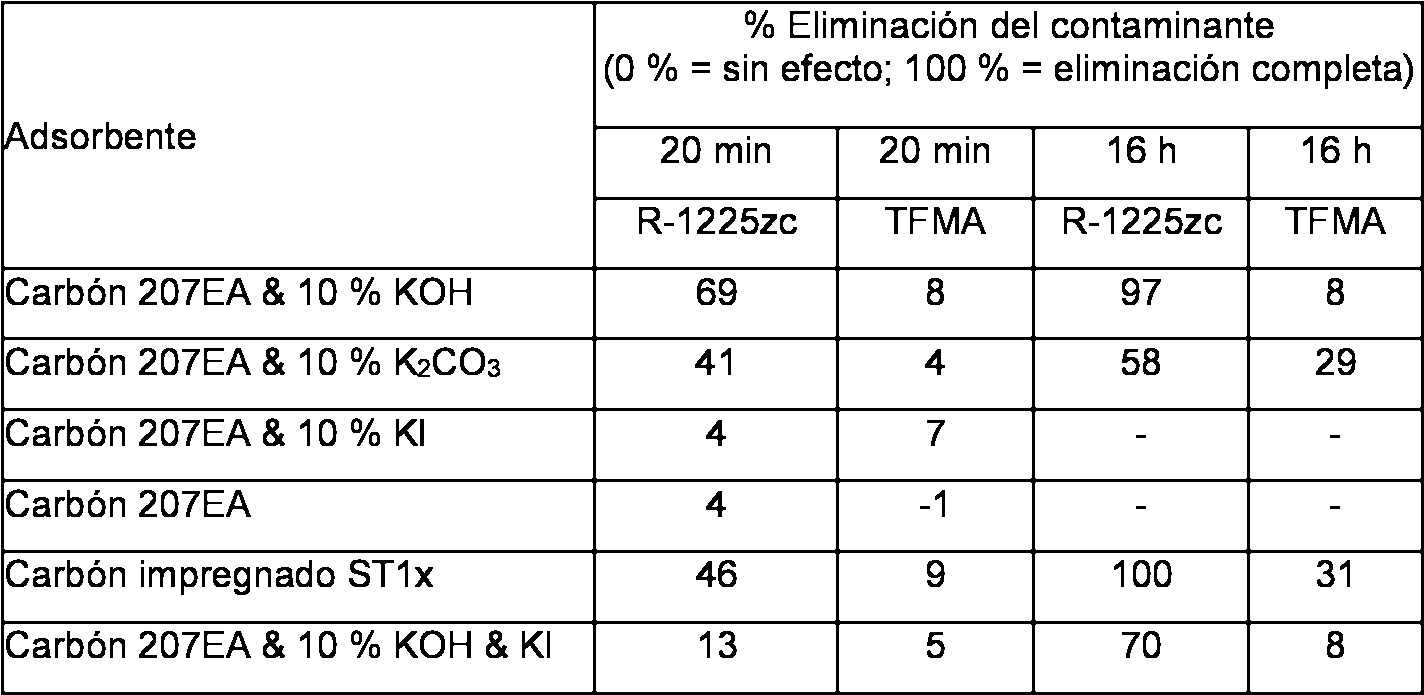
Eta alúmina 
Todos los adsorbentes investigados mostraron su utilidad en la eliminación del R-1225zc, del TFMA o de ambos del R-1243zf. Sin embargo, los adsorbentes más eficaces fueron aquellos dopados con una base, ya sea hidróxido o carbonato potásico, incluyendo el carbón ST1x.All the adsorbents investigated showed their utility in the elimination of R-1225zc, TFMA or both of R-1243zf. However, the most effective adsorbents were those doped with a base, either hydroxide or potassium carbonate, including ST1x carbon.
Ejemplo 2Example 2
Se obtuvo una muestra de R-1243zf disponible en el mercado (esta se puede obtener de Apollo Scientific, por ejemplo) y se analizó mediante GC capilar-MS. Se encontró que este R-1243zf contenía, entre otras, las siguientes impurezas:A sample of commercially available R-1243zf was obtained (this can be obtained from Apollo Scientific, for example) and analyzed by capillary GC-MS. It was found that this R-1243zf contained, among others, the following impurities:

El R-1225zc, el R-31 y el R-133a son compuestos tóxicos y se consideró deseable eliminarlos del R-1243zf antes de su uso, por ejemplo, como refrigerante. Incluso en el caso en el que las diferencias del punto de ebullición hacían posible la separación de algunos de estos componentes del R-1243zf mediante destilación, los bajos niveles significaban que tal proceso consumía mucha energía y era ineficaz. Por tanto, se buscó un medio alternativo para eliminar estas impurezas, particularmente el R-1225zc, el R-31 y el R-133a del 1243zf. Para este fin, se realizaron una serie de experimentos en los que se ensayó la eficacia de una gama de materiales adsorbentes en la eliminación de los tres compuestos objetivo, el R-1225zc, el R-31 y el R-133a, del R1243zf.R-1225zc, R-31 and R-133a are toxic compounds and it was considered desirable to remove them from R-1243zf before use, for example, as a refrigerant. Even in the case where differences in boiling point made it possible to separate some of these components from R-1243zf by distillation, the low levels meant that such a process consumed a lot of energy and was ineffective. Therefore, an alternative means was sought to eliminate these impurities, particularly R-1225zc, R-31 and R-133a of 1243zf. For this purpose, a series of experiments were carried out in which the effectiveness of a range of adsorbent materials in the elimination of the three objective compounds, R-1225zc, R-31 and R-133a, from R1243zf was tested.
La gama de adsorbentes investigados comprendía:The range of adsorbents investigated included:
Eta alúmina de BASF - una forma ácida de alúmina activadaBASF's Eta alumina - an acid form of activated alumina
Carbón 207c activado de Chemviron - derivado de cáscaras de cocoActivated 207c charcoal from Chemviron - derived from coconut husks
Carbón 209M activado de ChemvironCharcoal 209M activated from Chemviron
Carbón 207EA activado de ChemvironActivated Charcoal 207EA from Chemviron
Chemviron ST1x - un carbón activado que comprende 207EA impregnado con varias especies incluyendo una o varias bases.Chemviron ST1x - an activated carbon comprising 207EA impregnated with several species including one or more bases.
Carbón 209M activado de ChemvironCharcoal 209M activated from Chemviron
Tamiz molecular 13-X - un aluminosilicato o zeolita13-X molecular sieve - an aluminosilicate or zeolite
AW500 - Un aluminosilicato o zeolita estable al ácidoAW500 - An acid-stable aluminosilicate or zeolite
Alúmina AL0104 de BASF - una forma básica de alúminaAlumina AL0104 from BASF - a basic form of alumina
Los adsorbentes basados en carbono se activaron previamente a 200 °C en un flujo de nitrógeno durante 16 horas antes de su uso y los adsorbentes inorgánicos se activaron a 300 °C en un flujo de nitrógeno también durante 16 horas. Se evaluó después la eficacia de cada uno de los adsorbentes mediante tratamiento de aprox. 100 g de R-1243zf con 2-4 g de cada adsorbente en un sistema de recirculación en el que el R-1243zf se bombeó continuamente a través del lecho de adsorbente durante 16 horas a temperatura ambiente. Tras el periodo de tratamiento, se tomó una muestra pequeña del R-1243zf para su análisis mediante CG-MS. El análisis del R-1243zf tratado se comparó con el R-1243zf sin tratar (véase la tabla anterior para las cantidades de impurezas) en la tabla siguiente. The carbon-based adsorbents were previously activated at 200 ° C in a nitrogen flow for 16 hours before use and the inorganic adsorbents were activated at 300 ° C in a nitrogen flow also for 16 hours. The effectiveness of each of the adsorbents was then evaluated by treatment of approx. 100 g of R-1243zf with 2-4 g of each adsorbent in a recirculation system in which R-1243zf was pumped continuously through the adsorbent bed for 16 hours at room temperature. After the treatment period, a small sample of R-1243zf was taken for analysis by GC-MS. The analysis of the treated R-1243zf was compared to the untreated R-1243zf (see the table above for the amounts of impurities) in the following table.

Todos los adsorbentes ensayados eran eficaces en la eliminación de al menos un contaminante. Sin embargo, para los tres compuestos objetivo, el R-1225zc, el R-31 y el R-133a, el carbón activado ST1x impregnado con base y el tamiz molecular AW500 eran particularmente eficaces.All tested adsorbents were effective in removing at least one contaminant. However, for the three target compounds, R-1225zc, R-31 and R-133a, ST1x activated carbon impregnated with base and the AW500 molecular sieve were particularly effective.
Ejemplo 3Example 3
El R-1243zf se había usado previamente como monómero y, como olefina, podría esperarse razonablemente que fuera susceptible a la polimerización o a otras reacciones, particularmente cuando se pusiera en contacto con superficies reactivas presentes en muchos de los adsorbentes usados en el proceso de la invención. Esto limitaría seriamente la aplicabilidad comercial de la presente invención. Por tanto, los presentes inventores trataron de investigar si estaba asociado algún proceso de reacción a la purificación mediante adsorción del R-1243zf poniéndolo en contacto con adsorbentes tales como el carbón ST1 y AW500.R-1243zf had previously been used as a monomer and, as an olefin, could reasonably be expected to be susceptible to polymerization or other reactions, particularly when contacted with reactive surfaces present in many of the adsorbents used in the process of the invention . This would severely limit the commercial applicability of the present invention. Therefore, the present inventors tried to investigate whether any reaction process to the purification was associated by adsorption of R-1243zf by contacting it with adsorbents such as carbon ST1 and AW500.
Las muestras de carbón ST1X y AW500 se trataron previamente a 200-300 °C en un flujo de nitrógeno durante 16 horas antes de su uso. Se tomaron después muestras de 20 g, y se pesaron con precisión y se añadieron a un autoclave Hastelloy limpio y seco de 300 ml, bien por separado o bien conjuntamente. El autoclave se selló, se purgó con nitrógeno y se ensayó la presión. El autoclave se cargó después con R-1243zf. A continuación el autoclave y su contenido se calentaron a 80 °C o a 120 °C durante un periodo de 24 horas. Al final de cada experimento, se recuperó el R-1243zf para su análisis. El adsorbente también se recuperó y después del secado a 105 °C se volvió a pesar. Los resultados se presentan en las Tablas siguientes.The ST1X and AW500 carbon samples were pretreated at 200-300 ° C in a nitrogen flow for 16 hours before use. Samples of 20 g were then taken, and weighed accurately and added to a clean and dry 300 ml Hastelloy autoclave, either separately or together. The autoclave was sealed, purged with nitrogen and the pressure was tested. The autoclave was then charged with R-1243zf. The autoclave and its contents were then heated to 80 ° C or 120 ° C for a period of 24 hours. At the end of each experiment, R-1243zf was recovered for analysis. The adsorbent was also recovered and after drying at 105 ° C it was reweighed. The results are presented in the following Tables.
Al final de cada experimento, el R-1243zf estaba visualmente sin modificar. No quedaban residuos tras la evaporación del R-1243zf después de cada ensayo. Los análisis detallados revelaban que los adsorbentes ST1X y AW500 por separado o, particularmente, combinados seguían siendo eficaces en las condiciones de estos ensayos. Además, no había evidencia de ninguna reacción secundaria no deseable incluyendo polimerizaciones o descomposiciones. Por tanto, estos adsorbentes, por separado y combinados, demostraron que eran adecuados para la purificación de, por ejemplo, el R-1243zf a escala comercial. At the end of each experiment, the R-1243zf was visually unmodified. No residue remained after the evaporation of R-1243zf after each test. Detailed analyzes revealed that ST1X and AW500 adsorbents separately or, particularly, combined were still effective under the conditions of these tests. In addition, there was no evidence of any undesirable side reactions including polymerizations or decompositions. Therefore, these adsorbents, separately and in combination, showed that they were suitable for the purification of, for example, R-1243zf on a commercial scale.

120 °C120 ° C
Masa del material Cambio de Cambio Masa del material Cambio de Cambio ensayado/ masa / g en pes ensayado/ masa / g en peso Tamiz molecular 20,0274 0,2066 1,54 20,0975 - 0,1143 - 0,57 AW 500 20,081 0,1498 1,94 20,0589 - 0,0940 - 0,47 Carbón ST1X 20,0156 0,3912 1,95 20,127 0,6425 3,19Mass of material Change of Change Mass of material Change of Change tested / mass / g in tested weight / mass / g in weight Molecular sieve 20.0274 0.2066 1.54 20.0975 - 0.1143 - 0.57 AW 500 20,081 0.1498 1.94 20.0589 - 0.0940 - 0.47 Coal ST1X 20.0156 0.3912 1.95 20.127 0.6425 3.19
20,0086 0,3562 1,78 20,0141 0,8135 4,06 50/50 20,0225 0,4457 2,22 20,0337 - 0,1499 - 0,75 AW500 / ST1X


Ejemplo 4Example 4
El proceso de la invención se operó a escala comercial para eliminar impurezas traza de un lote de 180 kg de R-1243zf. Se cargó un lecho de adsorción de 85 litros con 19,5 kg de carbón ST1X y 19,5 kg del tamiz molecular AW500. El equipo se selló y se evacuó para eliminar el aire. Los recipientes de alimentación (volumen total de 270 litros) se cargaron con aprox. 180 kg de R-1243zf disponible en el mercado. Este material contenía impurezas similares a niveles similares a aquellas especificadas en el ejemplo 2.The process of the invention was operated on a commercial scale to remove trace impurities from a batch of 180 kg of R-1243zf. An 85-liter adsorption bed was charged with 19.5 kg of ST1X carbon and 19.5 kg of the AW500 molecular sieve. The equipment was sealed and evacuated to eliminate air. The feeding vessels (total volume of 270 liters) were loaded with approx. 180 kg of R-1243zf available in the market. This material contained similar impurities at levels similar to those specified in example 2.
El R-1243zf bruto se bombeó después desde los recipientes de alimentación a través de los lechos de adsorción y de nuevo a los recipientes de alimentación a temperatura ambiente. El R-1243zf cargado se recirculó de este modo a través del lecho de adsorción durante un periodo de 5 horas. Al cabo de este periodo, el R-1243zf se bombeó a un recipiente receptor en el que se pudo recuperar para su almacenamiento y análisis. Tras el análisis cada carga de 180 kg se dividió en lotes de 60 kg. Se descubrió que la carga de adsorbente era capaz de procesar al menos 360 kg de R-1243zf. El análisis de tres lotes de 60 kg de R-1243zf procesado de este modo se presenta en la tabla siguiente.The crude R-1243zf was then pumped from the feed vessels through the adsorption beds and back to the feed vessels at room temperature. The charged R-1243zf was recirculated in this way through the adsorption bed for a period of 5 hours. At the end of this period, R-1243zf was pumped into a recipient vessel in which it could be recovered for storage and analysis. After the analysis, each load of 180 kg was divided into batches of 60 kg. It was discovered that the adsorbent loading was capable of processing at least 360 kg of R-1243zf. The analysis of three batches of 60 kg of R-1243zf processed in this way is presented in the following table.

Claims (13)
Applications Claiming Priority (1)
| Application Number | Priority Date | Filing Date | Title |
|---|---|---|---|
| GBGB0918069.6A GB0918069D0 (en) | 2009-10-15 | 2009-10-15 | Process |
Publications (1)
| Publication Number | Publication Date |
|---|---|
| ES2701258T3 true ES2701258T3 (en) | 2019-02-21 |
Family
ID=41462387
Family Applications (4)
| Application Number | Title | Priority Date | Filing Date |
|---|---|---|---|
| ES15173448.0T Active ES2617050T3 (en) | 2009-10-15 | 2010-10-08 | Process for the purification of (hydro) fluoroalkenes |
| ES10774248T Active ES2784741T3 (en) | 2009-10-15 | 2010-10-08 | Process for the purification of (hydro) fluoroalkenes |
| ES16205166.8T Active ES2675739T3 (en) | 2009-10-15 | 2010-10-08 | Process for the purification of (hydro) fluoroalkenes |
| ES15173457T Active ES2701258T3 (en) | 2009-10-15 | 2010-10-08 | Process for the purification of (hydro) fluoroalkenes |
Family Applications Before (3)
| Application Number | Title | Priority Date | Filing Date |
|---|---|---|---|
| ES15173448.0T Active ES2617050T3 (en) | 2009-10-15 | 2010-10-08 | Process for the purification of (hydro) fluoroalkenes |
| ES10774248T Active ES2784741T3 (en) | 2009-10-15 | 2010-10-08 | Process for the purification of (hydro) fluoroalkenes |
| ES16205166.8T Active ES2675739T3 (en) | 2009-10-15 | 2010-10-08 | Process for the purification of (hydro) fluoroalkenes |
Country Status (16)
| Country | Link |
|---|---|
| US (4) | US9012703B2 (en) |
| EP (5) | EP2952499B1 (en) |
| JP (4) | JP6067375B2 (en) |
| KR (4) | KR101773859B1 (en) |
| CN (3) | CN104591953B (en) |
| AU (1) | AU2010308156C1 (en) |
| BR (1) | BR112012008855B1 (en) |
| CA (1) | CA2776356A1 (en) |
| ES (4) | ES2617050T3 (en) |
| GB (1) | GB0918069D0 (en) |
| IN (1) | IN2012DN03033A (en) |
| MX (3) | MX2012004110A (en) |
| RU (3) | RU2015101087A (en) |
| TR (2) | TR201809693T4 (en) |
| WO (1) | WO2011045559A1 (en) |
| ZA (1) | ZA201202453B (en) |
Families Citing this family (39)
| Publication number | Priority date | Publication date | Assignee | Title |
|---|---|---|---|---|
| GB0611742D0 (en) * | 2006-06-14 | 2006-07-26 | Ineos Fluor Holdings Ltd | Desiccants for fluids |
| GB0918069D0 (en) * | 2009-10-15 | 2009-12-02 | Ineos Fluor Holdings Ltd | Process |
| HUE047698T2 (en) | 2009-12-22 | 2020-05-28 | Chemours Co Fc Llc | Compositions comprising 2,3,3,3-tetrafluoropropene and 2,3-dichloro-3,3-difluoropropene |
| GB2492847A (en) * | 2011-07-15 | 2013-01-16 | Mexichem Amanco Holding Sa | A process for reducing TFMA content in R-1234 |
| JP5899974B2 (en) * | 2012-02-02 | 2016-04-06 | セントラル硝子株式会社 | (E) Process for producing 1-chloro-3,3,3-trifluoropropene |
| WO2013151070A1 (en) * | 2012-04-03 | 2013-10-10 | 旭硝子株式会社 | Method for purifying fluoroolefin, and method for producing fluoroolefin |
| KR20150021551A (en) * | 2012-06-06 | 2015-03-02 | 이 아이 듀폰 디 네모아 앤드 캄파니 | PROCESS FOR THE REDUCTION OF RfCCX IMPURITIES IN FLUOROOLEFINS |
| JP6107466B2 (en) * | 2012-06-28 | 2017-04-05 | セントラル硝子株式会社 | Method for purifying trans-1,3,3,3-tetrafluoropropene |
| ES2940562T3 (en) * | 2013-03-13 | 2023-05-09 | Arkema Inc | Methods for Purifying and Stabilizing Hydrofluoroolefins and Hydrochlorofluoroolefins |
| PL2970058T3 (en) * | 2013-03-15 | 2024-05-06 | Honeywell International Inc. | METHOD OF REMOVING HALOGENATED ETHYLENE CONSTITUTING A CONTAMINANT FROM A MIXTURE OF FLUOROOLEFINES |
| US10995047B2 (en) | 2013-03-15 | 2021-05-04 | The Chemours Company Fc, Llc | Process for the reduction of RƒC≡CX impurities in fluoroolefins |
| US9334206B2 (en) | 2013-03-15 | 2016-05-10 | Honeywell International Inc. | Integrated process to produce 2,3,3,3-tetrafluoropropene |
| US20150259267A1 (en) | 2014-03-14 | 2015-09-17 | E.I. Du Pont De Nemours And Company | PROCESS FOR THE REDUCTION OF RfC=CX IMPURITIES IN FLUOROOLEFINS |
| CN105431399B (en) * | 2013-03-15 | 2017-12-26 | 得凯莫斯公司弗罗里达有限公司 | Method for reducing alkyne impurities in fluoroolefins |
| GB201410174D0 (en) * | 2014-06-09 | 2014-07-23 | Mexichem Amanco Holding Sa | Process |
| FR3023286B1 (en) * | 2014-07-02 | 2018-02-16 | Arkema France | PROCESS FOR THE PRODUCTION OF TETRAFLUOROPROPENE |
| EP3187478B1 (en) * | 2014-08-25 | 2020-03-04 | AGC Inc. | Method for producing hydrofluoroolefin |
| PL3241879T3 (en) * | 2014-09-25 | 2020-12-14 | Daikin Industries, Ltd. | Composition comprising hfc and hfo |
| JP6028825B2 (en) * | 2015-03-31 | 2016-11-24 | ダイキン工業株式会社 | Composition containing hydrofluoroolefin compound |
| EP3339281B1 (en) * | 2015-08-17 | 2020-08-05 | Daikin Industries, Ltd. | Method for purifying halogenated unsaturated carbon compounds |
| US9938213B2 (en) * | 2015-08-19 | 2018-04-10 | Honeywell International Inc. | Methods for removing acidic impurities from halogenated propenes |
| US10005705B2 (en) | 2015-11-12 | 2018-06-26 | Honeywell International Inc. | Process for the production of fluorinated cyclobutane |
| KR102830918B1 (en) * | 2016-11-02 | 2025-07-04 | 허니웰 인터내셔날 인코포레이티드 | Process for reducing 3,3,3-trifluoropropyne in 2,3,3,3-tetrafluoropropene |
| CN109937196B (en) * | 2016-11-15 | 2022-08-16 | Agc株式会社 | Method for producing 1-chloro-2, 3, 3-trifluoropropene |
| JP6323540B1 (en) * | 2016-11-28 | 2018-05-16 | セントラル硝子株式会社 | Dry etching composition and dry etching method |
| GB201701099D0 (en) | 2017-01-23 | 2017-03-08 | Mexichem Fluor Sa De Cv | Process |
| CN119118781A (en) | 2018-06-06 | 2024-12-13 | 霍尼韦尔国际公司 | Process for the dehydrochlorination of HCFC-244bb to produce HFO-1234yf |
| JP2021535205A (en) | 2018-08-24 | 2021-12-16 | ハネウェル・インターナショナル・インコーポレーテッドHoneywell International Inc. | Treatment method for producing trifluoroiodomethane and trifluoroacetyl iodide |
| US10941091B2 (en) * | 2018-12-03 | 2021-03-09 | Honeywell International Inc. | Processes for producing high-purity trifluoroiodomethane |
| CN113272402B (en) | 2018-12-21 | 2024-06-04 | 霍尼韦尔国际公司 | Azeotrope or azeotrope-like compositions of 1, 2-trifluoro-1-trifluoromethyl cyclobutane (TFMCB) and uses thereof |
| US11554956B2 (en) | 2019-04-16 | 2023-01-17 | Honeywell International Inc. | Integrated process and catalysts for manufacturing hydrogen iodide from hydrogen and iodine |
| WO2020225911A1 (en) * | 2019-05-09 | 2020-11-12 | 日新電機株式会社 | Insulating gas adsorbent and gas-insulated power equipment |
| JP7282719B2 (en) * | 2019-08-20 | 2023-05-29 | 国立研究開発法人産業技術総合研究所 | Activated carbon adsorbing per- and polyfluoroalkyl compounds |
| CN114302769B (en) | 2019-08-20 | 2024-03-19 | 二村化学株式会社 | Activated carbon to adsorb per- and polyfluoroalkyl compounds |
| US12358796B2 (en) * | 2019-08-30 | 2025-07-15 | Resonac Corporation | Method for producing fluorine gas |
| WO2021049605A1 (en) * | 2019-09-12 | 2021-03-18 | 関東電化工業株式会社 | Method for purifying fluoroolefin having =cf2 or =chf structure, high purity fluoroolefin, and manufacturing method therefor |
| JP7576789B2 (en) * | 2020-09-30 | 2024-11-01 | 国立研究開発法人産業技術総合研究所 | Neutral per- and polyfluoroalkyl compound-adsorbing activated carbon and method for analyzing neutral per- and polyfluoroalkyl compounds in water samples |
| CN116323525A (en) * | 2020-10-02 | 2023-06-23 | 索尔维公司 | Process for purifying fluorinated olefins in the gas phase |
| WO2025174928A1 (en) * | 2024-02-16 | 2025-08-21 | The Chemours Company Fc, Llc | Purification of 2,3,3,3-tetrafluoropropene |
Family Cites Families (30)
| Publication number | Priority date | Publication date | Assignee | Title |
|---|---|---|---|---|
| US1540446A (en) | 1920-01-28 | 1925-06-02 | Baltimore Gas Engineering Corp | Aluminum gellike absorbent and process for making same |
| US2917556A (en) * | 1958-06-09 | 1959-12-15 | Du Pont | Process for separating vinylidene fluoride from vinyl fluoride |
| GB1052555A (en) * | 1963-05-31 | |||
| JPS6440507A (en) | 1987-08-06 | 1989-02-10 | Asahi Chemical Ind | Production of fluorine-containing polymer |
| JP2542394B2 (en) * | 1987-08-06 | 1996-10-09 | イー・アイ・デユポン・ドウ・ヌムール・アンド・カンパニー | Hexafluoropropylene purification method |
| CA2138376A1 (en) * | 1992-06-19 | 1994-01-06 | Toan P. Vo | Activated carbon by treatment of lignites with potassium and/or sodium hydroxide or salts and adsorption therewith |
| CA2098513C (en) | 1993-06-16 | 2000-10-24 | Septimus Hsien-Chai Liang | Organic amine impregnated activated carbon |
| WO1997049479A1 (en) * | 1996-06-26 | 1997-12-31 | Cs-Gmbh Halbleiter- Und Solartechnologie | Method of removing, from a stream of gas, fluorinated compounds which contribute to destruction of the ozone layer and/or changes in climate, and use of the method |
| US5705719A (en) | 1996-08-01 | 1998-01-06 | E. I. Du Pont De Nemours And Company | Selective removal of perfluoroisobutylene from streams of halogenated hydrocarbons |
| US6274782B1 (en) | 1997-04-16 | 2001-08-14 | Showa Denko K.K. | Method for purifying hexafluoroethane |
| GB0010614D0 (en) * | 2000-05-04 | 2000-06-21 | Ici Plc | Removal of (hydro)haloalkene impurities from product streams |
| US7084315B2 (en) * | 2000-05-04 | 2006-08-01 | Ineos Fluor Holdings Limited | Removal of (hydro)haloalkene impurities from product streams |
| JP2002154996A (en) | 2000-11-17 | 2002-05-28 | Asahi Glass Co Ltd | Fluorine-containing unsaturated compound, its production method and its use |
| US6544319B1 (en) | 2002-01-16 | 2003-04-08 | Air Products And Chemicals, Inc. | Purification of hexafluoro-1,3-butadiene |
| JP2003335712A (en) | 2002-05-21 | 2003-11-28 | Tosoh F-Tech Inc | Method for purifying olefin compound having fluorine- containing organic group |
| KR100839063B1 (en) * | 2003-11-10 | 2008-06-19 | 쇼와 덴코 가부시키가이샤 | Method for Purifying 1,1-Difluoroethane |
| US7897823B2 (en) | 2004-10-29 | 2011-03-01 | E. I. Du Pont De Nemours And Company | Process for production of azeotrope compositions comprising hydrofluoroolefin and hydrogen fluoride and uses of said azeotrope compositions in separation processes |
| JP2006156539A (en) | 2004-11-26 | 2006-06-15 | National Institute Of Advanced Industrial & Technology | Plasma reaction gas |
| RU2399607C2 (en) | 2006-04-03 | 2010-09-20 | Е.И.Дюпон Де Немур Энд Компани | Selectively reacting olefins containing terminal cf2 group in mixture |
| JP4693811B2 (en) * | 2006-06-13 | 2011-06-01 | セントラル硝子株式会社 | Method for producing 1,3,3,3-tetrafluoropropene |
| GB0611742D0 (en) | 2006-06-14 | 2006-07-26 | Ineos Fluor Holdings Ltd | Desiccants for fluids |
| JP5132555B2 (en) | 2006-06-30 | 2013-01-30 | 昭和電工株式会社 | Method for producing high purity hexafluoropropylene and cleaning gas |
| US7597744B2 (en) | 2006-07-12 | 2009-10-06 | Honeywell International Inc. | Use of molecular sieves for the removal of HFC-23 from fluorocarbon products |
| US20080110883A1 (en) | 2006-11-13 | 2008-05-15 | Vetter Douglas J | Trash can cleaning lid |
| US20080110833A1 (en) * | 2006-11-14 | 2008-05-15 | Samuels George J | Iodine removal with activated carbon |
| JP2010531897A (en) * | 2007-06-27 | 2010-09-30 | アーケマ・インコーポレイテッド | Two-step process for producing hydrofluoroolefins |
| US20110009678A1 (en) * | 2007-09-13 | 2011-01-13 | Arkema Inc. | Compositions containing a combination of z and e stereoisomers of hydrofluoroolefins |
| FR2933402B1 (en) | 2008-07-03 | 2010-07-30 | Arkema France | PROCESS FOR PURIFYING 2,3,3,3-TETRAFLUORO-1-PROPENE (HFO1234YF) |
| JP5187212B2 (en) * | 2009-02-03 | 2013-04-24 | セントラル硝子株式会社 | Method for producing 1,3,3,3-tetrafluoropropene |
| GB0918069D0 (en) | 2009-10-15 | 2009-12-02 | Ineos Fluor Holdings Ltd | Process |
-
2009
- 2009-10-15 GB GBGB0918069.6A patent/GB0918069D0/en not_active Ceased
-
2010
- 2010-10-08 EP EP15173448.0A patent/EP2952499B1/en active Active
- 2010-10-08 EP EP20154929.2A patent/EP3693354A1/en active Pending
- 2010-10-08 CN CN201510018678.7A patent/CN104591953B/en active Active
- 2010-10-08 EP EP15173457.1A patent/EP2952500B1/en not_active Revoked
- 2010-10-08 JP JP2012533686A patent/JP6067375B2/en active Active
- 2010-10-08 WO PCT/GB2010/001879 patent/WO2011045559A1/en not_active Ceased
- 2010-10-08 CN CN201410490002.3A patent/CN104370688B/en active Active
- 2010-10-08 ES ES15173448.0T patent/ES2617050T3/en active Active
- 2010-10-08 MX MX2012004110A patent/MX2012004110A/en unknown
- 2010-10-08 KR KR1020157036894A patent/KR101773859B1/en active Active
- 2010-10-08 KR KR1020157036886A patent/KR101721598B1/en active Active
- 2010-10-08 EP EP16205166.8A patent/EP3159328B1/en not_active Revoked
- 2010-10-08 ES ES10774248T patent/ES2784741T3/en active Active
- 2010-10-08 ES ES16205166.8T patent/ES2675739T3/en active Active
- 2010-10-08 CN CN201080046052.2A patent/CN102695692B/en active Active
- 2010-10-08 MX MX2015014965A patent/MX390193B/en unknown
- 2010-10-08 KR KR1020127012162A patent/KR101698073B1/en active Active
- 2010-10-08 EP EP10774248.8A patent/EP2488475B1/en active Active
- 2010-10-08 BR BR112012008855-6A patent/BR112012008855B1/en active IP Right Grant
- 2010-10-08 AU AU2010308156A patent/AU2010308156C1/en not_active Ceased
- 2010-10-08 KR KR1020177000996A patent/KR101827917B1/en active Active
- 2010-10-08 RU RU2015101087/04A patent/RU2015101087A/en not_active Application Discontinuation
- 2010-10-08 MX MX2015014964A patent/MX375689B/en unknown
- 2010-10-08 TR TR2018/09693T patent/TR201809693T4/en unknown
- 2010-10-08 US US13/502,278 patent/US9012703B2/en active Active
- 2010-10-08 CA CA2776356A patent/CA2776356A1/en not_active Abandoned
- 2010-10-08 RU RU2012119735/04A patent/RU2012119735A/en not_active Application Discontinuation
- 2010-10-08 ES ES15173457T patent/ES2701258T3/en active Active
- 2010-10-08 TR TR2018/18613T patent/TR201818613T4/en unknown
- 2010-10-08 IN IN3033DEN2012 patent/IN2012DN03033A/en unknown
-
2012
- 2012-04-04 ZA ZA2012/02453A patent/ZA201202453B/en unknown
-
2015
- 2015-01-15 RU RU2015101083A patent/RU2015101083A/en not_active Application Discontinuation
- 2015-03-19 US US14/662,465 patent/US9309176B2/en active Active
- 2015-05-13 JP JP2015098467A patent/JP6074454B2/en active Active
- 2015-05-13 JP JP2015098466A patent/JP6100828B2/en active Active
-
2016
- 2016-01-04 US US14/986,802 patent/US9624148B2/en active Active
-
2017
- 2017-01-05 JP JP2017000722A patent/JP2017095488A/en active Pending
- 2017-01-17 US US15/407,871 patent/US9790152B2/en active Active
Also Published As
Similar Documents
| Publication | Publication Date | Title |
|---|---|---|
| ES2701258T3 (en) | Process for the purification of (hydro) fluoroalkenes | |
| AU2013204796B2 (en) | Process for purifying (hydro) fluoroalkenes |