ES2701498T3 - Phenyltetrahydroisoquinoline compound substituted with heteroaryl - Google Patents
Phenyltetrahydroisoquinoline compound substituted with heteroaryl Download PDFInfo
- Publication number
- ES2701498T3 ES2701498T3 ES15825310T ES15825310T ES2701498T3 ES 2701498 T3 ES2701498 T3 ES 2701498T3 ES 15825310 T ES15825310 T ES 15825310T ES 15825310 T ES15825310 T ES 15825310T ES 2701498 T3 ES2701498 T3 ES 2701498T3
- Authority
- ES
- Spain
- Prior art keywords
- compound
- formula
- ethoxy
- methyl
- dichloro
- Prior art date
- Legal status (The legal status is an assumption and is not a legal conclusion. Google has not performed a legal analysis and makes no representation as to the accuracy of the status listed.)
- Active
Links
- 0 CCCC*1CCCCC1 Chemical compound CCCC*1CCCCC1 0.000 description 14
- QARVLSVVCXYDNA-UHFFFAOYSA-N Brc1ccccc1 Chemical compound Brc1ccccc1 QARVLSVVCXYDNA-UHFFFAOYSA-N 0.000 description 1
- UEXCJVNBTNXOEH-UHFFFAOYSA-N C#Cc1ccccc1 Chemical compound C#Cc1ccccc1 UEXCJVNBTNXOEH-UHFFFAOYSA-N 0.000 description 1
- MVPURQHOPLQYNX-UHFFFAOYSA-N CCCC1=C(C(C)C)C=C[I](=C)=C1 Chemical compound CCCC1=C(C(C)C)C=C[I](=C)=C1 MVPURQHOPLQYNX-UHFFFAOYSA-N 0.000 description 1
- RXLCBJWALFFXPG-SANMLTNESA-N CCNCCOCCOCCOCCNC1=[I][IH]C(c2cccc([C@H](CN(C)C3)c4c3c(Cl)cc(O)c4)c2)=CN=C1 Chemical compound CCNCCOCCOCCOCCNC1=[I][IH]C(c2cccc([C@H](CN(C)C3)c4c3c(Cl)cc(O)c4)c2)=CN=C1 RXLCBJWALFFXPG-SANMLTNESA-N 0.000 description 1
- MUTRTBATPPTUOZ-YIPJDBQISA-N CN(CCO)/C=C(/c1ccccc1)\N=N Chemical compound CN(CCO)/C=C(/c1ccccc1)\N=N MUTRTBATPPTUOZ-YIPJDBQISA-N 0.000 description 1
- RSIBXOWWNUQOHH-CTNGQTDRSA-N NCCOCCOCCOCCNC(CC[C@H]([C@@H](C(NCCOCCOCCOCCI)=O)O)O)=O Chemical compound NCCOCCOCCOCCNC(CC[C@H]([C@@H](C(NCCOCCOCCOCCI)=O)O)O)=O RSIBXOWWNUQOHH-CTNGQTDRSA-N 0.000 description 1
Classifications
-
- A—HUMAN NECESSITIES
- A61—MEDICAL OR VETERINARY SCIENCE; HYGIENE
- A61K—PREPARATIONS FOR MEDICAL, DENTAL OR TOILETRY PURPOSES
- A61K31/00—Medicinal preparations containing organic active ingredients
- A61K31/33—Heterocyclic compounds
- A61K31/395—Heterocyclic compounds having nitrogen as a ring hetero atom, e.g. guanethidine or rifamycins
- A61K31/435—Heterocyclic compounds having nitrogen as a ring hetero atom, e.g. guanethidine or rifamycins having six-membered rings with one nitrogen as the only ring hetero atom
- A61K31/47—Quinolines; Isoquinolines
- A61K31/472—Non-condensed isoquinolines, e.g. papaverine
- A61K31/4725—Non-condensed isoquinolines, e.g. papaverine containing further heterocyclic rings
-
- A—HUMAN NECESSITIES
- A61—MEDICAL OR VETERINARY SCIENCE; HYGIENE
- A61K—PREPARATIONS FOR MEDICAL, DENTAL OR TOILETRY PURPOSES
- A61K31/00—Medicinal preparations containing organic active ingredients
- A61K31/33—Heterocyclic compounds
- A61K31/395—Heterocyclic compounds having nitrogen as a ring hetero atom, e.g. guanethidine or rifamycins
- A61K31/495—Heterocyclic compounds having nitrogen as a ring hetero atom, e.g. guanethidine or rifamycins having six-membered rings with two or more nitrogen atoms as the only ring heteroatoms, e.g. piperazine or tetrazines
- A61K31/50—Pyridazines; Hydrogenated pyridazines
- A61K31/501—Pyridazines; Hydrogenated pyridazines not condensed and containing further heterocyclic rings
-
- A—HUMAN NECESSITIES
- A61—MEDICAL OR VETERINARY SCIENCE; HYGIENE
- A61K—PREPARATIONS FOR MEDICAL, DENTAL OR TOILETRY PURPOSES
- A61K31/00—Medicinal preparations containing organic active ingredients
- A61K31/33—Heterocyclic compounds
- A61K31/395—Heterocyclic compounds having nitrogen as a ring hetero atom, e.g. guanethidine or rifamycins
- A61K31/495—Heterocyclic compounds having nitrogen as a ring hetero atom, e.g. guanethidine or rifamycins having six-membered rings with two or more nitrogen atoms as the only ring heteroatoms, e.g. piperazine or tetrazines
- A61K31/505—Pyrimidines; Hydrogenated pyrimidines, e.g. trimethoprim
- A61K31/506—Pyrimidines; Hydrogenated pyrimidines, e.g. trimethoprim not condensed and containing further heterocyclic rings
-
- A—HUMAN NECESSITIES
- A61—MEDICAL OR VETERINARY SCIENCE; HYGIENE
- A61P—SPECIFIC THERAPEUTIC ACTIVITY OF CHEMICAL COMPOUNDS OR MEDICINAL PREPARATIONS
- A61P1/00—Drugs for disorders of the alimentary tract or the digestive system
-
- A—HUMAN NECESSITIES
- A61—MEDICAL OR VETERINARY SCIENCE; HYGIENE
- A61P—SPECIFIC THERAPEUTIC ACTIVITY OF CHEMICAL COMPOUNDS OR MEDICINAL PREPARATIONS
- A61P1/00—Drugs for disorders of the alimentary tract or the digestive system
- A61P1/10—Laxatives
-
- A—HUMAN NECESSITIES
- A61—MEDICAL OR VETERINARY SCIENCE; HYGIENE
- A61P—SPECIFIC THERAPEUTIC ACTIVITY OF CHEMICAL COMPOUNDS OR MEDICINAL PREPARATIONS
- A61P13/00—Drugs for disorders of the urinary system
-
- A—HUMAN NECESSITIES
- A61—MEDICAL OR VETERINARY SCIENCE; HYGIENE
- A61P—SPECIFIC THERAPEUTIC ACTIVITY OF CHEMICAL COMPOUNDS OR MEDICINAL PREPARATIONS
- A61P13/00—Drugs for disorders of the urinary system
- A61P13/12—Drugs for disorders of the urinary system of the kidneys
-
- A—HUMAN NECESSITIES
- A61—MEDICAL OR VETERINARY SCIENCE; HYGIENE
- A61P—SPECIFIC THERAPEUTIC ACTIVITY OF CHEMICAL COMPOUNDS OR MEDICINAL PREPARATIONS
- A61P19/00—Drugs for skeletal disorders
-
- A—HUMAN NECESSITIES
- A61—MEDICAL OR VETERINARY SCIENCE; HYGIENE
- A61P—SPECIFIC THERAPEUTIC ACTIVITY OF CHEMICAL COMPOUNDS OR MEDICINAL PREPARATIONS
- A61P43/00—Drugs for specific purposes, not provided for in groups A61P1/00-A61P41/00
-
- A—HUMAN NECESSITIES
- A61—MEDICAL OR VETERINARY SCIENCE; HYGIENE
- A61P—SPECIFIC THERAPEUTIC ACTIVITY OF CHEMICAL COMPOUNDS OR MEDICINAL PREPARATIONS
- A61P7/00—Drugs for disorders of the blood or the extracellular fluid
-
- A—HUMAN NECESSITIES
- A61—MEDICAL OR VETERINARY SCIENCE; HYGIENE
- A61P—SPECIFIC THERAPEUTIC ACTIVITY OF CHEMICAL COMPOUNDS OR MEDICINAL PREPARATIONS
- A61P9/00—Drugs for disorders of the cardiovascular system
- A61P9/12—Antihypertensives
-
- C—CHEMISTRY; METALLURGY
- C07—ORGANIC CHEMISTRY
- C07D—HETEROCYCLIC COMPOUNDS
- C07D401/00—Heterocyclic compounds containing two or more hetero rings, having nitrogen atoms as the only ring hetero atoms, at least one ring being a six-membered ring with only one nitrogen atom
- C07D401/02—Heterocyclic compounds containing two or more hetero rings, having nitrogen atoms as the only ring hetero atoms, at least one ring being a six-membered ring with only one nitrogen atom containing two hetero rings
- C07D401/10—Heterocyclic compounds containing two or more hetero rings, having nitrogen atoms as the only ring hetero atoms, at least one ring being a six-membered ring with only one nitrogen atom containing two hetero rings linked by a carbon chain containing aromatic rings
-
- C—CHEMISTRY; METALLURGY
- C07—ORGANIC CHEMISTRY
- C07D—HETEROCYCLIC COMPOUNDS
- C07D401/00—Heterocyclic compounds containing two or more hetero rings, having nitrogen atoms as the only ring hetero atoms, at least one ring being a six-membered ring with only one nitrogen atom
- C07D401/14—Heterocyclic compounds containing two or more hetero rings, having nitrogen atoms as the only ring hetero atoms, at least one ring being a six-membered ring with only one nitrogen atom containing three or more hetero rings
-
- C—CHEMISTRY; METALLURGY
- C07—ORGANIC CHEMISTRY
- C07D—HETEROCYCLIC COMPOUNDS
- C07D403/00—Heterocyclic compounds containing two or more hetero rings, having nitrogen atoms as the only ring hetero atoms, not provided for by group C07D401/00
- C07D403/14—Heterocyclic compounds containing two or more hetero rings, having nitrogen atoms as the only ring hetero atoms, not provided for by group C07D401/00 containing three or more hetero rings
-
- C—CHEMISTRY; METALLURGY
- C07—ORGANIC CHEMISTRY
- C07D—HETEROCYCLIC COMPOUNDS
- C07D405/00—Heterocyclic compounds containing both one or more hetero rings having oxygen atoms as the only ring hetero atoms, and one or more rings having nitrogen as the only ring hetero atom
- C07D405/02—Heterocyclic compounds containing both one or more hetero rings having oxygen atoms as the only ring hetero atoms, and one or more rings having nitrogen as the only ring hetero atom containing two hetero rings
- C07D405/10—Heterocyclic compounds containing both one or more hetero rings having oxygen atoms as the only ring hetero atoms, and one or more rings having nitrogen as the only ring hetero atom containing two hetero rings linked by a carbon chain containing aromatic rings
-
- C—CHEMISTRY; METALLURGY
- C07—ORGANIC CHEMISTRY
- C07D—HETEROCYCLIC COMPOUNDS
- C07D413/00—Heterocyclic compounds containing two or more hetero rings, at least one ring having nitrogen and oxygen atoms as the only ring hetero atoms
- C07D413/02—Heterocyclic compounds containing two or more hetero rings, at least one ring having nitrogen and oxygen atoms as the only ring hetero atoms containing two hetero rings
- C07D413/10—Heterocyclic compounds containing two or more hetero rings, at least one ring having nitrogen and oxygen atoms as the only ring hetero atoms containing two hetero rings linked by a carbon chain containing aromatic rings
-
- C—CHEMISTRY; METALLURGY
- C07—ORGANIC CHEMISTRY
- C07D—HETEROCYCLIC COMPOUNDS
- C07D413/00—Heterocyclic compounds containing two or more hetero rings, at least one ring having nitrogen and oxygen atoms as the only ring hetero atoms
- C07D413/14—Heterocyclic compounds containing two or more hetero rings, at least one ring having nitrogen and oxygen atoms as the only ring hetero atoms containing three or more hetero rings
-
- C—CHEMISTRY; METALLURGY
- C07—ORGANIC CHEMISTRY
- C07D—HETEROCYCLIC COMPOUNDS
- C07D417/00—Heterocyclic compounds containing two or more hetero rings, at least one ring having nitrogen and sulfur atoms as the only ring hetero atoms, not provided for by group C07D415/00
- C07D417/02—Heterocyclic compounds containing two or more hetero rings, at least one ring having nitrogen and sulfur atoms as the only ring hetero atoms, not provided for by group C07D415/00 containing two hetero rings
- C07D417/10—Heterocyclic compounds containing two or more hetero rings, at least one ring having nitrogen and sulfur atoms as the only ring hetero atoms, not provided for by group C07D415/00 containing two hetero rings linked by a carbon chain containing aromatic rings
Landscapes
- Chemical & Material Sciences (AREA)
- Organic Chemistry (AREA)
- Health & Medical Sciences (AREA)
- Veterinary Medicine (AREA)
- Public Health (AREA)
- General Health & Medical Sciences (AREA)
- Animal Behavior & Ethology (AREA)
- Life Sciences & Earth Sciences (AREA)
- Medicinal Chemistry (AREA)
- Pharmacology & Pharmacy (AREA)
- Chemical Kinetics & Catalysis (AREA)
- Nuclear Medicine, Radiotherapy & Molecular Imaging (AREA)
- General Chemical & Material Sciences (AREA)
- Bioinformatics & Cheminformatics (AREA)
- Engineering & Computer Science (AREA)
- Epidemiology (AREA)
- Urology & Nephrology (AREA)
- Cardiology (AREA)
- Heart & Thoracic Surgery (AREA)
- Diabetes (AREA)
- Hematology (AREA)
- Physical Education & Sports Medicine (AREA)
- Pharmaceuticals Containing Other Organic And Inorganic Compounds (AREA)
- Plural Heterocyclic Compounds (AREA)
Abstract
Un compuesto representado por la siguiente fórmula [1] o una sal farmacéuticamente aceptable del mismo: **Fórmula** en donde A representa una estructura representada por la siguiente fórmula [2]: **Fórmula** en donde R11 y R12 son iguales o diferentes y cada uno representa un átomo de hidrógeno o un átomo de halógeno, R2 representa un átomo de hidrógeno o alquilo C1-C6 el anillo E representa pirrol, furano, pirazol, imidazol, isoxazol, oxazol, isotiazol, triazol, oxadiazol, tetrazol, piridina, piridazina, pirimidina o pirazina, R31 y R32 son iguales o diferentes y cada uno representa un átomo de hidrógeno, ciano, alquilo C1-C6, alcoxi C1-C6, o monoalquil(C1-C6)amino, y W representa un enlace sencillo, la fórmula -NH-, la fórmula -O- o la fórmula -CONH-, e Y representa un átomo de hidrógeno o cualquier estructura de las siguientes fórmulas [3']: **Fórmula** en donde Z1 representa cualquier estructura del siguiente grupo de fórmulas [4']: **Fórmula** Z3 representa una estructura de la siguiente fórmula [4-a]: **Fórmula** L2, L2', L2", y L2" son iguales o diferentes y cada uno representa cualquier estructura del siguiente grupo de fórmulas [5]: **Fórmula** y A', A" y A'" representan la misma estructura que la estructura representada por A.A compound represented by the following formula [1] or a pharmaceutically acceptable salt thereof: ** Formula ** wherein A represents a structure represented by the following formula [2]: ** Formula ** wherein R11 and R12 are the same or different and each represents a hydrogen atom or a halogen atom, R 2 represents a hydrogen atom or C 1 -C 6 alkyl ring E represents pyrrole, furan, pyrazole, imidazole, isoxazole, oxazole, isothiazole, triazole, oxadiazole, tetrazole , pyridine, pyridazine, pyrimidine or pyrazine, R31 and R32 are the same or different and each represents a hydrogen atom, cyano, C1-C6 alkyl, C1-C6 alkoxy, or (C1-C6) monoalkyl amino, and W represents a single bond, the formula -NH-, the formula -O- or the formula -CONH-, and Y represents a hydrogen atom or any structure of the following formulas [3 ']: ** Formula ** wherein Z1 represents any structure of the following group of formulas [4 ']: ** Formula ** Z3 represents u A structure of the following formula [4-a]: ** Formula ** L2, L2 ', L2 ", and L2" are the same or different and each represents any structure of the following group of formulas [5]: ** Formula ** and A ', A "and A'" represent the same structure as the structure represented by A.
Description
DESCRIPCIÓNDESCRIPTION
Compuesto de feniltetrahidroisoquinolina sustituido con heteroariloPhenyltetrahydroisoquinoline compound substituted with heteroaryl
Campo técnicoTechnical field
La presente invención se refiere a un nuevo compuesto que tiene un efecto inhibidor del intercambiador 3 de Na+/H+ (intercambiador 3 de sodio-hidrógeno; en lo sucesivo, también denominado "NHE3") y un medicamento que lo comprende como ingrediente activo.The present invention relates to a novel compound having an inhibitory effect on Na + / H + exchanger 3 (sodium-hydrogen exchanger 3, hereinafter also referred to as "NHE3") and a medicament comprising it as an active ingredient.
Técnica anteriorPrevious technique
El estreñimiento se refiere a una afección que tiene una disminución de la frecuencia de deposiciones y la cantidad de deposiciones y que implica dolor o dificultad en la excreción fecal. La frecuencia del estreñimiento es presumiblemente creciente debido al cambio en dieta, al ejercicio inadecuado, a la vida social estresante debido a muchas restricciones de tiempo y al envejecimiento de la sociedad.Constipation refers to a condition that has a decrease in the frequency of bowel movements and the amount of bowel movements and that involves pain or difficulty in fecal excretion. The frequency of constipation is presumably increasing due to the change in diet, inadequate exercise, stressful social life due to many time constraints and the aging of society.
Los alimentos ingeridos se digieren en el estómago y el intestino delgado, y los nutrientes se absorben principalmente en el intestino delgado. A continuación, el contenido intestinal no digerido se envían desde el intestino delgado al intestino grueso. En el intestino grueso, el contenido se solidifica mientras se absorbe el agua y el contenido resultante se desplaza hacia el ano mediante peristalsis para llegar al colon sigmoide de manera que se retengan las heces. Al ingresar las heces retenidas en el recto mediante un movimiento de contracción llamado peristalsis de masa, las paredes rectales se expanden. Este estímulo se transfiere al centro de defecación de la columna vertebral, lo que da como resultado un reflejo de defecación que causa la laxitud del esfínter anal y la contracción rectal. Al mismo tiempo, el cerebro reconoce la necesidad de defecar y la presión abdominal aumenta voluntariamente para defecar. Sin embargo, el estreñimiento se produce cuando la función autónoma, la función motora o la función refleja de defecación del tracto gastrointestinal inferior disminuye debido al envejecimiento, el cambio en la dieta, el ejercicio inadecuado, etc., o cuando se induce la absorción excesiva de agua, la reduce la secreción de líquido intestinal, etc., en el tracto intestinal.Ingested foods are digested in the stomach and small intestine, and nutrients are absorbed mainly in the small intestine. Next, the undigested intestinal contents are sent from the small intestine to the large intestine. In the large intestine, the content solidifies while the water is absorbed and the resulting content is displaced to the anus by peristalsis to reach the sigmoid colon so that the stool is retained. By inserting the stool retained in the rectum by a contraction movement called mass peristalsis, the rectal walls expand. This stimulus is transferred to the defecation center of the spine, which results in a defecation reflex that causes anal sphincter laxity and rectal contraction. At the same time, the brain recognizes the need to defecate and abdominal pressure increases voluntarily to defecate. However, constipation occurs when the autonomic function, motor function or reflex function of defecation of the lower gastrointestinal tract decreases due to aging, change in diet, inadequate exercise, etc., or when excessive absorption is induced of water, it reduces the secretion of intestinal fluid, etc., in the intestinal tract.
Una gran cantidad de pacientes con estreñimiento a menudo realizan un tratamiento de autocuidado con fármacos de venta libre, medicina popular o similares, ya que el estreñimiento, aunque con incomodidad, no causa problemas graves a la vida diaria. Sin embargo, el estreñimiento incurre en la reducción de la CDV así como en enfermedad generalizada. En el caso de que el estreñimiento se presente como un síntoma parcial de una enfermedad sistémica, se señala la importancia del tratamiento de la misma.A large number of patients with constipation often perform a self-care treatment with over-the-counter drugs, folk medicine or similar, since constipation, although uncomfortable, does not cause serious problems to daily life. However, constipation incurs reduction of QOL as well as generalized disease. In the case that constipation is presented as a partial symptom of a systemic disease, the importance of the treatment of it is pointed out.
El estreñimiento se divide en estreñimiento orgánico y estreñimiento funcional según su causa. El estreñimiento orgánico es el estreñimiento que se produce debido a la obstrucción del tracto gastrointestinal atribuido a pólipos colónicos, cáncer colorrectal o similares. Por otro lado, el estreñimiento funcional se clasifica en estreñimiento inducido por fármacos, estreñimiento sintomático y estreñimiento idiopático crónico. El estreñimiento inducido por fármacos es el estreñimiento causado por un fármaco, tal como un opioide, que disminuye la motilidad intestinal. El estreñimiento sintomático es el estreñimiento que se produce de manera secundaria debido a una enfermedad diferente a la gastrointestinal. El estreñimiento idiopático crónico es el estreñimiento que se produce con más frecuencia entre los casos de estreñimiento funcional. El estreñimiento idiopático crónico se produce debido al estrés o al cambio en el entorno alimentario.Constipation is divided into organic constipation and functional constipation according to its cause. Organic constipation is constipation that occurs due to obstruction of the gastrointestinal tract attributed to colonic polyps, colorectal cancer or the like. On the other hand, functional constipation is classified as drug-induced constipation, symptomatic constipation, and chronic idiopathic constipation. Drug-induced constipation is constipation caused by a drug, such as an opioid, that decreases intestinal motility. Symptomatic constipation is constipation that occurs secondarily due to a disease other than gastrointestinal. Chronic idiopathic constipation is constipation that occurs most frequently among cases of functional constipation. Chronic idiopathic constipation occurs due to stress or change in the food environment.
El síndrome del intestino irritable con estreñimiento (SII-E) es el estreñimiento que tiene síntomas digestivos persistentes compuestos principalmente por dolor abdominal o malestar abdominal y movimientos intestinales anormales sin cambios orgánicos en el tracto gastrointestinal. Algunos de los pacientes con estreñimiento funcional también son diagnosticados de SII-E.Irritable bowel syndrome with constipation (IBS-E) is constipation that has persistent digestive symptoms composed mainly of abdominal pain or abdominal discomfort and abnormal bowel movements without organic changes in the gastrointestinal tract. Some of the patients with functional constipation are also diagnosed with IBS-C.
Los ejemplos de fármacos para el estreñimiento incluyen: laxantes osmóticos clasificados en laxantes salinos, tales como el óxido de magnesio o laxantes azucarados, tales como la lactulosa; laxantes formadores de volumen, tales como policarbófilo cálcico; laxantes estimulantes tales como senósido y picosulfato de sodio; y laxantes emolientes tales como dioctilsulfosuccinato de sodio. También se utiliza un agonista del receptor de serotonina 4 (5-HT4), tal como prucaloprida, un agonista del canal de cloruro de tipo 2 (ClC-2), tal como lubiprostona, o similares.Examples of drugs for constipation include: osmotic laxatives classified in saline laxatives, such as magnesium oxide or sugar-laxatives, such as lactulose; volume forming laxatives, such as calcium polycarbophil; stimulant laxatives such as sennoside and sodium picosulfate; and emollient laxatives such as sodium dioctyl sulfosuccinate. A serotonin 4 (5-HT4) receptor agonist is also used, such as prucalopride, a type 2 chloride channel agonist (ClC-2), such as lubiprostone, or the like.
Para la medicación del estreñimiento, en primer lugar se utiliza un laxante salino o un laxante formador de volumen. El laxante salino óxido de magnesio requiere atención a la hipermagnesemia en personas de edad avanzada o con lesión renal o similar. El policarbofilo de calcio laxante de formación de volumen actúa de manera suave y requiere tiempo para ejercer sus efectos. Si estos fármacos son insuficientes, se utiliza un laxante estimulante. Sin embargo, el laxante estimulante se vuelve adictivo por el uso a largo plazo y causa atrofia del plexo entérico y deterioro en la laxitud del intestino grueso, aunque este laxante actúa sobre el plexo entérico y mejora la peristalsis. Su uso está limitado a la cantidad mínima durante el período mínimo.For the medication of constipation, first a saline laxative or a volume-forming laxative is used. Magnesium oxide saline laxative requires attention to hypermagnesemia in elderly people or with kidney injury or similar. The calcium polycarbophil laxative of volume formation acts smoothly and requires time to exert its effects. If these drugs are insufficient, a stimulant laxative is used. However, the stimulant laxative becomes addictive for long-term use and causes atrophy of the enteric plexus and deterioration in the laxity of the large intestine, although this laxative acts on the enteric plexus and improves peristalsis. Its use is limited to the minimum amount during the minimum period.
La lubiprostona, que ha sido aprobada en los últimos años, manifiesta náuseas o vómitos como un efecto adverso. Este fármaco también requiere una administración cuidadosa en pacientes con disfunción renal grave.Lubiprostone, which has been approved in recent years, manifests nausea or vomiting as an adverse effect. This drug also requires careful administration in patients with severe renal dysfunction.
Por lo tanto, los fármacos terapéuticos existentes para el estreñimiento aún no son perfectos en términos de seguridad y eficacia, y los fármacos no son todos altamente satisfactorios según los informes (Bibliografía No Relacionada con Patentes 1 y 2). Existe una demanda para el desarrollo de un fármaco terapéutico más seguro y eficaz para el estreñimiento. Tal fármaco se considera beneficioso para muchos pacientes con estreñimiento crónico. Therefore, the existing therapeutic drugs for constipation are still not perfect in terms of safety and efficacy, and the drugs are not all highly satisfactory according to reports (Bibliography Not Related to Patents 1 and 2). There is a demand for the development of a safer and more effective therapeutic drug for constipation. Such a drug is considered beneficial for many patients with chronic constipation.
El jugo digestivo secretado en el tracto gastrointestinal es rico en sodio. Este sodio es reabsorbido por el tracto gastrointestinal para mantener la homeostasis del sodio en el organismo. Específicamente, el tracto gastrointestinal absorbe 9 L de líquidos corporales y aproximadamente 800 mmoles de sodio, de los cuales 7,5 L de líquidos corporales y 650 mmoles de sodio se obtienen a partir del jugo digestivo, y los 1,5 L restantes de líquidos corporales y 150 mmoles de sodio se obtienen a partir de vía oral (Bibliografía No Relacionada con Patentes 3). El tracto gastrointestinal absorbe casi toda la cantidad de sodio, y la cantidad de sodio excretada en las heces es de aproximadamente 5 mmoles.The digestive juice secreted in the gastrointestinal tract is rich in sodium. This sodium is reabsorbed by the gastrointestinal tract to maintain sodium homeostasis in the body. Specifically, the gastrointestinal tract absorbs 9 L of body fluids and approximately 800 mmoles of sodium, of which 7.5 L of body fluids and 650 mmol of sodium are obtained from digestive juice, and the remaining 1.5 L of liquids corporal and 150 mmoles of sodium are obtained from the oral route (Bibliography Not Related to Patents 3). The gastrointestinal tract absorbs almost the entire amount of sodium, and the amount of sodium excreted in the faeces is approximately 5 mmol.
Un mecanismo principal para esta reabsorción de sodio es el transporte electroneutro y el transporte electrogénico (Bibliografía No Relacionada con Patentes 4). El transporte electroneutro está mediado principalmente por el NHE3 expresado en el intestino delgado y el colon proximal. Por ejemplo, aproximadamente la mitad de la absorción de sodio en el yeyuno se obtiene a partir de NHE3 (Bibliografía No Relacionada con Patentes 5). El transporte electrogénico está mediado por el canal de sodio epitelial ENac en el colon distal.A primary mechanism for this sodium reabsorption is electroneutro transport and electrogenic transport (Bibliography Not Related to Patents 4). The electroneutro transport is mediated mainly by the NHE3 expressed in the small intestine and the proximal colon. For example, approximately half of the absorption of sodium in the jejunum is obtained from NHE3 (Bibliography Not Related to Patents 5). Electrogenic transport is mediated by the epithelial sodium channel ENac in the distal colon.
Una sustancia que inhibe la actividad de NHE3 en el tracto intestinal (en adelante, denominada sustancia inhibidora de NHE3) permite que el sodio se retenga en el tracto intestinal al suprimir la absorción intestinal de sodio. El sodio retenido extrae el agua por presión osmótica y por lo tanto suaviza los contenidos intestinales. Por lo tanto, la sustancia inhibidora de NHE3 se considera útil como fármaco terapéutico para el estreñimiento crónico, SII-E o estreñimiento inducido por fármacos (Bibliografía No Relacionada con Patentes 6 y 7).A substance that inhibits the activity of NHE3 in the intestinal tract (hereinafter referred to as the NHE3 inhibitory substance) allows sodium to be retained in the intestinal tract by suppressing intestinal sodium absorption. The retained sodium extracts the water by osmotic pressure and therefore softens the intestinal contents. Therefore, the NHE3 inhibiting substance is considered useful as a therapeutic drug for chronic constipation, IBS-E or drug-induced constipation (Bibliography Not Related to Patents 6 and 7).
La sustancia inhibidora de NHE3 también permite que el sodio se excrete en las heces al suprimir la absorción intestinal de sodio. Por lo tanto, se considera que la sustancia inhibidora de NHE3 también es útil como un fármaco que imita la restricción de sal.The inhibitory substance of NHE3 also allows sodium to be excreted in the stool by suppressing the intestinal absorption of sodium. Therefore, it is considered that the NHE3 inhibiting substance is also useful as a drug that mimics the salt restriction.
Un fármaco antihipertensivo, tal como un antagonista del receptor de angiotensina o un inhibidor de la enzima conversora de angiotensina, se utiliza como un fármaco terapéutico existente para la hipertensión o un fármaco terapéutico para la nefropatía. Sin embargo, los efectos de estos fármacos no son suficientes. Aunque se sabe que la restricción de sal en la dieta es beneficiosa para la prevención y el tratamiento de estas enfermedades, es difícil cumplir continuamente con la restricción de sal en la vida moderna. Mientras tanto, se ha informado de que la sustancia inhibidora de NHE3 que imita la restricción de sal disminuye la presión sanguínea en ratas y adicionalmente disminuye la presión sanguínea más fuertemente por el uso combinado con un inhibidor de la enzima conversora de angiotensina (Bibliografía No Relacionada con Patentes 6). Por lo tanto, se considera que la sustancia inhibidora de NHE3 ejerce efectos terapéuticos en monoterapia y terapia combinada con un fármaco antihipertensivo existente.An antihypertensive drug, such as an angiotensin receptor antagonist or an angiotensin converting enzyme inhibitor, is used as an existing therapeutic drug for hypertension or a therapeutic drug for nephropathy. However, the effects of these drugs are not enough. Although it is known that the restriction of salt in the diet is beneficial for the prevention and treatment of these diseases, it is difficult to continuously comply with the salt restriction in modern life. Meanwhile, it has been reported that the NHE3 inhibiting substance that mimics the salt restriction lowers blood pressure in rats and additionally lowers blood pressure more strongly by the combined use with an angiotensin converting enzyme inhibitor (Unrelated Bibliography with Patents 6). Therefore, the inhibitory substance of NHE3 is considered to exert therapeutic effects in monotherapy and combined therapy with an existing antihypertensive drug.
En este caso, los pacientes con insuficiencia renal con disfunciones renales graves no pueden excretar suficientemente el sodio y los líquidos corporales redundantes en la orina. Además, la eficacia de un diurético también desaparece. Por lo tanto, los pacientes deben recibir hemodiálisis varias veces a la semana. El aumento de peso corporal y la elevación de la presión arterial se producen debido a la retención de líquidos corporales entre las sesiones de diálisis, y la reducción de la presión arterial se produce a través de la mejora de la retención de líquidos corporales mediante la operación de diálisis. Dicha elevación y reducción de la presión arterial causada por la retención repetida de líquidos corporales y la eliminación de agua dialítica afectan adversamente las funciones cardíacas de los pacientes con insuficiencia renal y causan el riesgo de desarrollar una enfermedad cardíaca y un peor pronóstico. Por lo tanto, se exige una restricción estricta de sal y privación de agua en los pacientes con insuficiencia renal para reducir las variaciones en la presión arterial. Sin embargo, es difícil cumplir con este régimen debido a su rigor. Se ha informado que la sustancia inhibidora de NHE3 mejora la excreción de sodio en las heces en ratas, inhibe la retención de líquidos corporales y previene la cardiomegalia (Bibliografía No Relacionada con Patentes 7).In this case, patients with renal failure with severe renal dysfunction can not sufficiently excrete sodium and redundant body fluids in the urine. In addition, the effectiveness of a diuretic also disappears. Therefore, patients should receive hemodialysis several times a week. The increase of corporal weight and the elevation of the arterial pressure take place due to the retention of corporal liquids between the dialysis sessions, and the reduction of the arterial pressure takes place through the improvement of the retention of corporal liquids by means of the operation of dialysis. Such elevation and reduction of blood pressure caused by the repeated retention of body fluids and the elimination of dialytic water adversely affect the cardiac functions of patients with renal insufficiency and cause the risk of developing heart disease and a worse prognosis. Therefore, strict restriction of salt and water deprivation is required in patients with renal insufficiency to reduce variations in blood pressure. However, it is difficult to comply with this regime due to its rigor. It has been reported that the inhibitory substance of NHE3 improves the excretion of sodium in the stool in rats, inhibits the retention of body fluids and prevents cardiomegaly (Bibliography Not Related to Patents 7).
Por lo tanto, la sustancia inhibidora de NHE3 también se considera útil como fármaco para reducir el riesgo de desarrollar enfermedades cardíacas en pacientes con insuficiencia renal. Therefore, the inhibiting substance of NHE3 is also considered useful as a drug to reduce the risk of developing heart diseases in patients with renal insufficiency.
Mientras tanto, se ha informado de que cierto tipo de sustancia inhibidora de NHE3 no solo inhibe la absorción intestinal de sodio, sino que también inhibe la absorción de fósforo y aumenta la excreción de fósforo en las heces (Bibliografía Relacionada con Patentes 24 y Bibliografía No Relacionada con Patentes 8). Se ha informado adicionalmente de que cierto tipo de sustancia inhibidora de NHE3 reduce la concentración de fósforo en la sangre mediante la administración a ratas con insuficiencia renal.Meanwhile, it has been reported that a certain type of NHE3 inhibiting substance not only inhibits the intestinal absorption of sodium, but also inhibits the absorption of phosphorus and increases the excretion of phosphorus in feces (Bibliography Related to Patents 24 and Bibliography No Related to Patents 8). It has further been reported that a certain type of NHE3 inhibiting substance reduces the concentration of phosphorus in the blood by administration to rats with renal insufficiency.
El metabolismo del fósforo se mantiene por dos efectos principales, la absorción y la excreción en el intestino delgado y el riñón. Se ingieren aproximadamente 1,2 g/día de fósforo, 1/3 (aproximadamente 0,4 g) de los cuales se excreta en las heces y los 2/3 restantes (aproximadamente 0,8 g) se absorben (Bibliografía No Relacionada con Patentes 9). Adicionalmente, aproximadamente 0,8 g/día de fósforo se excreta en la orina. El jugo digestivo también contiene fósforo, que se excreta en las heces. También en el organismo, el fósforo se mantiene en equilibrio entre el hueso y la sangre.The metabolism of phosphorus is maintained by two main effects, absorption and excretion in the small intestine and kidney. Approximately 1.2 g / day of phosphorus are ingested, 1/3 (approximately 0.4 g) of which is excreted in the faeces and the remaining 2/3 (approximately 0.8 g) are absorbed (Bibliography Not Related to Patents 9). Additionally, approximately 0.8 g / day of phosphorus is excreted in the urine. The digestive juice also contains phosphorus, which is excreted in the feces. Also in the body, phosphorus remains in balance between bone and blood.
En este caso, los pacientes con insuficiencia renal con disfunciones renales graves no pueden excretar aproximadamente 0,8 g/día de fósforo. Por lo tanto, sus concentraciones de fósforo en la sangre se elevan causando hiperfosfatemia. En la hiperfosfatemia, se producen funciones anormales del hueso o de la glándula paratiroides, que causan osteoporosis o hiperparatiroidismo. Además, los depósitos de fósforo en los vasos sanguíneos, junto con el calcio, calcifican los vasos sanguíneos. Por lo tanto, el riesgo de desarrollar enfermedad cardiovascular es mayor.In this case, patients with renal failure with severe renal dysfunction can not excrete approximately 0.8 g / day of phosphorus. Therefore, their phosphorus concentrations in the blood rise causing hyperphosphatemia. In hyperphosphatemia, abnormal functions of the parathyroid bone or gland occur, causing osteoporosis or hyperparathyroidism. In addition, deposits of phosphorus in blood vessels, along with calcium, calcify blood vessels. Therefore, the risk of developing cardiovascular disease is greater.
La guía de la Sociedad Japonesa para la Terapia de Diálisis, "Clinical Practice Guideline for the Management of Chronic Kidney Disease-Mineral and Bone Disorder", ha informado de que el metabolismo mineral desordenado en la enfermedad renal crónica influye en gran medida no solo en las anomalías óseas o de la glándula paratiroides sino también en el pronóstico de vida a través de la calcificación vascular o similar, y ha propuesto tal trastorno combinado como trastornos minerales y óseos en la enfermedad renal crónica (en lo sucesivo, también denominado CKD-MBD) (Bibliografía No Relacionada con Patentes 10). La guía CKD-MBD señala que, en particular, la hiperfosfatemia causa funciones anormales del hueso o de la glándula paratiroides, agrava la calcificación vascular, aumenta el riesgo de desarrollar osteoporosis o enfermedad cardiovascular, y en gran medida influye en el pronóstico de vida. La guía recomienda además el control de la hiperfosfatemia mediante cura como una prioridad. Para pacientes con insuficiencia renal, el fósforo en la sangre se elimina mediante diálisis. Sin embargo, es imposible mantener la concentración de fósforo en la sangre en un intervalo normal solo con diálisis. Por lo tanto, se utiliza un aglutinante de fosfato que sirve como fármaco terapéutico para la hiperfosfatemia como segundo mejor enfoque. El aglutinante de fosfato es un fármaco que mejora la excreción de fósforo al unirse al fósforo en el tracto intestinal y moverse en este estado unido hacia las heces. Tal fármaco, aunque tiene un efecto fiable de reducción de la concentración de fósforo en sangre, tiene una gran carga de medicación con una dosis diaria de varios gramos. Las cargas de fármacos perjudican significativamente la observancia para los pacientes en diálisis que originalmente se vieron obligados a restringir el consumo de agua y necesitan tomar una gran cantidad de comprimidos. El aglutinante de fosfato se clasifica en aglutinantes de fosfato poliméricos y de tipo que contiene metal, cada uno de los cuales presenta problemas. El aglutinante de fosfato que contiene metal presenta preocupaciones sobre la seguridad a largo plazo debido a la carga de metal. Asimismo, el aglomerante polimérico de fosfato se hincha en el tracto intestinal y, por lo tanto, causa con frecuencia síntomas gastrointestinales como estreñimiento o distensión abdominal.The guide of the Japanese Society for Dialysis Therapy, "Clinical Practice Guideline for the Management of Chronic Kidney Disease-Mineral and Bone Disorder," has reported that disordered mineral metabolism in chronic kidney disease greatly influences not only bony or parathyroid gland abnormalities but also in the prognosis of life through vascular calcification or the like, and has proposed such combined disorder as mineral and bone disorders in chronic kidney disease (hereinafter referred to as CKD-MBD) ) (Bibliography Not Related to Patents 10). The CKD-MBD guide points out that, in particular, hyperphosphatemia causes abnormal functions of the bone or parathyroid gland, aggravates vascular calcification, increases the risk of developing osteoporosis or cardiovascular disease, and greatly influences the prognosis of life. The guide also recommends the control of hyperphosphatemia by cure as a priority. For patients with renal insufficiency, phosphorus in the blood is eliminated by dialysis. However, it is impossible to maintain the concentration of phosphorus in the blood in a normal range only with dialysis. Therefore, a phosphate binder that serves as a therapeutic drug for hyperphosphatemia is used as the second best approach. Phosphate binder is a drug that improves the excretion of phosphorus by binding phosphorus in the intestinal tract and moving in this state bound to the stool. Such a drug, although it has a reliable effect of reducing the concentration of phosphorus in blood, has a large load of medication with a daily dose of several grams. Drug loads significantly impair compliance for dialysis patients who were originally forced to restrict water intake and need to take a large number of tablets. The phosphate binder is classified into polymeric and metal-containing phosphate binders, each of which presents problems. The metal-containing phosphate binder has concerns about long-term safety due to metal loading. Also, the polymeric phosphate binder swells in the intestinal tract and, therefore, frequently causes gastrointestinal symptoms such as constipation or abdominal distension.
Por lo tanto, se desea un fármaco mejorado en términos de seguridad y comodidad y que tenga una buena observancia como nuevo fármaco terapéutico para la hiperfosfatemia.Therefore, an improved drug is desired in terms of safety and comfort and that it has a good observance as a new therapeutic drug for hyperphosphatemia.
La sustancia inhibidora de NHE3 no contiene un metal ni es un polímero y, por lo tanto, está libre de las reacciones adversas específicas para el aglutinante de fosfato descrito anteriormente. Además, la sustancia inhibidora de NHE3 probablemente puede reducir una dosis en comparación con el aglutinante de fosfato. Por lo tanto, la sustancia inhibidora de NHE3 se considera útil como fármaco terapéutico para la hiperfosfatemia mejorado en términos de seguridad y comodidad y con una buena adherencia. Además, la sustancia inhibidora de NHE3 que se puede utilizar durante un largo período se considera útil como fármaco que mejora la CKD-MBD.The NHE3 inhibiting substance does not contain a metal or is a polymer and, therefore, is free of the specific adverse reactions for the phosphate binder described above. In addition, the NHE3 inhibiting substance can probably reduce a dose compared to the phosphate binder. Therefore, the inhibitory substance of NHE3 is considered useful as a therapeutic drug for hyperphosphatemia improved in terms of safety and comfort and with good adhesion. In addition, the NHE3 inhibiting substance that can be used over a long period is considered useful as a drug that improves CKD-MBD.
Se exige restricción de agua en pacientes con insuficiencia renal para no agravar la retención de líquidos corporales. Por lo tanto, el contenido de agua en el tracto intestinal se reduce. Los pacientes con insuficiencia renal también tienen riesgo de hiperpotasemia. Por lo tanto, se impone al mismo la restricción de la ingesta de verduras para restringir la ingesta de potasio. Debido a la restricción de la ingesta de agua y vegetales, los pacientes con insuficiencia renal desarrollan estreñimiento con alta frecuencia. Se considera que la sustancia inhibidora de NHE3 también tiene un efecto de mejora sobre el estreñimiento específico para pacientes con insuficiencia renal.Water restriction is required in patients with renal insufficiency in order not to aggravate the retention of body fluids. Therefore, the water content in the intestinal tract is reduced. Patients with kidney failure are also at risk for hyperkalemia. Therefore, it restricts the intake of vegetables to restrict the intake of potassium. Due to the restriction of water and vegetable intake, patients with kidney failure develop constipation with high frequency. It is considered that the inhibiting substance of NHE3 also has an effect of improvement on specific constipation for patients with renal insufficiency.
Por lo tanto, la sustancia inhibidora de NHE3 sirve como un fármaco capaz de tratar la hiperfosfatemia y la CKD MBD en pacientes con insuficiencia renal, un fármaco capaz de mitigar la retención de líquidos corporales y un fármaco capaz de mejorar incluso el estreñimiento en pacientes con insuficiencia renal, y se espera como un fármaco muy útil que mejora ampliamente la CDV de los pacientes con insuficiencia renal.Therefore, the inhibitory substance of NHE3 serves as a drug capable of treating hyperphosphatemia and CKD MBD in patients with renal insufficiency, a drug capable of mitigating the retention of body fluids and a drug capable of improving even constipation in patients with renal insufficiency, and is expected as a very useful drug that greatly improves the QOL of patients with renal insufficiency.
La retención de líquidos corporales también se produce en pacientes con insuficiencia cardíaca. Esta retención de líquidos corporales agrava aún más las funciones cardíacas. En general, se utiliza un diurético en el tratamiento de la insuficiencia cardíaca. Sin embargo, el diurético puede exhibir una eficacia atenuada para pacientes con reducción de la función renal y causar anomalías de potasio. La sustancia inhibidora de NHE3 puede permitir que los líquidos corporales se eliminen en las heces, independientemente de las funciones renales. Por lo tanto, la sustancia inhibidora de NHE3 se considera útil como un nuevo fármaco terapéutico para la insuficiencia cardíaca.The retention of body fluids also occurs in patients with heart failure. This retention of body fluids further aggravates cardiac functions. In general, a diuretic is used in the treatment of heart failure. However, the diuretic may exhibit attenuated efficacy for patients with reduced renal function and cause potassium abnormalities. The inhibitory substance of NHE3 can allow the body fluids to be eliminated in the stool, independently of the renal functions. Therefore, the inhibitory substance of NHE3 is considered useful as a new therapeutic drug for heart failure.
Además, la retención de líquidos corporales también se produce en pacientes con cirrosis hepática. Además, por ejemplo, un agonista de PPAR, que es útil en el tratamiento de la diabetes mellitus tipo 2, también causa retención de líquidos corporales inducida por fármacos. Se considera que la sustancia inhibidora de NHE3 también es capaz de mitigar dicha retención de líquidos corporales.In addition, body fluid retention also occurs in patients with liver cirrhosis. In addition, for example, a PPAR agonist, which is useful in the treatment of type 2 diabetes mellitus, also causes drug-induced body fluid retention. It is considered that the inhibiting substance of NHE3 is also capable of mitigating said retention of body fluids.
Los derivados de acilguanidina (Bibliografía Relacionada con Patentes 1), los derivados de amidina (Bibliografía Relacionada con Patentes 2 y 3), los derivados de guanidina (Bibliografía Relacionada con Patentes 4 a 6), los derivados de tetrahidroisoquinolina (Bibliografía Relacionada con Patentes 7 a 14), los derivados de 2-aminoimidazolidina o 2-aminoimidazol (Bibliografía Relacionada con Patentes 15 a 19), los derivados de aminodihidroisoquinolina (Bibliografía Relacionada con Patentes 20 y 21), los derivados de aminoindano (Bibliografía Relacionada con Patentes 22 y 23), y similares se han descrito como compuestos que inhiben NHE3. No obstante, no se ha descrito ningún compuesto que tenga la estructura de la presente invención.The acylguanidine derivatives (Patent Related Literature 1), the amidine derivatives (Patent References 2 and 3), the guanidine derivatives (Patent References 4 to 6), the tetrahydroisoquinoline derivatives (Patent References 7 to 14), 2-aminoimidazolidine or 2-aminoimidazole derivatives (Patent References 15 to 19), aminodihydroisoquinoline derivatives (Patent References 20 and 21), aminoindane derivatives (Patent References 22 and 23) ), and the like have been described as compounds that inhibit NHE3. However, no compound having the structure of the present invention has been described.
Se ha informado de que cierto tipo de compuesto inhibidor de NHE3 tiene un efecto inhibidor de la absorción de fósforo. No obstante, este efecto no ha sido referido en cuanto a un compuesto que tiene la estructura de la presente invención (Bibliografía Relacionada con Patentes 24 y Bibliografía No Relacionada con Patentes 8).It has been reported that a certain type of NHE3 inhibitor compound has an inhibitory effect on phosphorus absorption. However, this effect has not been referred as to a compound having the structure of the present invention (Bibliography Related to Patents 24 and Bibliography Not Related to Patents 8).
Bibliografía de la técnica anteriorBibliography of the prior art
Bibliografía relacionada con patentesBibliography related to patents
[Bibliografía Relacionada con Patentes 1] documento WO97/24113[Bibliography Related to Patents 1] document WO97 / 24113
[Bibliografía Relacionada con Patentes 2] documento WO2001/021582[Bibliography Related to Patents 2] document WO2001 / 021582
[Bibliografía Relacionada con Patentes 3] documento WO2001/072742[Bibliography Related to Patents 3] document WO2001 / 072742
[Bibliografía Relacionada con Patentes 4] documento WO2001/0791866[Bibliography Related to Patents 4] document WO2001 / 0791866
[Bibliografía Relacionada con Patentes 5] documento WO2003/051866[Bibliography Related to Patents 5] document WO2003 / 051866
[Bibliografía Relacionada con Patentes 6] documento WO2003/055490[Bibliography Related to Patents 6] document WO2003 / 055490
[Bibliografía Relacionada con Patentes 7] documento WO2003/048129[Bibliography Related to Patents 7] document WO2003 / 048129
[Bibliografía Relacionada con Patentes 8] documento WO2003/055880[Bibliography Related to Patents 8] document WO2003 / 055880
[Bibliografía Relacionada con Patentes 9] documento WO2004/085404[Bibliography Related to Patents 9] document WO2004 / 085404
[Bibliografía Relacionada con Patentes 10] documento WO2006/032372[Bibliography Related to Patents 10] document WO2006 / 032372
[Bibliografía Relacionada con Patentes 11 ] documento WO2006/074813[Bibliography Related to Patents 11] document WO2006 / 074813
[Bibliografía Relacionada con Patentes 12] documento WO2007/033773[Bibliography Related to Patents 12] document WO2007 / 033773
[Bibliografía Relacionada con Patentes 13] documento WO2010/078449[Bibliography Related to Patents 13] document WO2010 / 078449
[Bibliografía Relacionada con Patentes 14] documento WO2014/029984[Bibliography Related to Patents 14] document WO2014 / 029984
[Bibliografía Relacionada con Patentes 15] documento WO2003/053434[Bibliography Related to Patents 15] document WO2003 / 053434
[Bibliografía Relacionada con Patentes 16] documento WO2003/101984[Bibliography Related to Patents 16] document WO2003 / 101984
[Bibliografía Relacionada con Patentes 17] documento WO2004/069806[Bibliography Related to Patents 17] document WO2004 / 069806
[Bibliografía Relacionada con Patentes 18] documento WO2004/069811[Bibliography Related to Patents 18] document WO2004 / 069811
[Bibliografía Relacionada con Patentes 19] documento WO2005/026173[Bibliography Related to Patents 19] document WO2005 / 026173
[Bibliografía Relacionada con Patentes 20] documento WO2007/107245[Bibliography Related to Patents 20] document WO2007 / 107245
[Bibliografía Relacionada con Patentes 21] documento WO2007/107246[Bibliography Related to Patents 21] document WO2007 / 107246
[Bibliografía Relacionada con Patentes 22] documento WO2010/025856[Bibliography Related to Patents 22] document WO2010 / 025856
[Bibliografía Relacionada con Patentes 23] documento WO2014/029983[Bibliography Related to Patents 23] document WO2014 / 029983
[Bibliografía Relacionada con Patentes 24] documento WO2014/169094[Bibliography Related to Patents 24] document WO2014 / 169094
Bibliografía No Relacionada con PatentesBibliography Not Related to Patents
[Bibliografía Relacionada con Patentes 1] Alimentary Pharmacology and Therapeutics, 37, 137-145, 2013[Bibliography Related to Patents 1] Alimentary Pharmacology and Therapeutics, 37, 137-145, 2013
[Bibliografía Relacionada con Patentes 2] Alimentary Pharmacology and Therapeutics, 25, 599-608, 2007[Bibliography Related to Patents 2] Alimentary Pharmacology and Therapeutics, 25, 599-608, 2007
[Bibliografía Relacionada con Patentes 3] Annual Review of Physiology, 67, 411-443, 2005 [Bibliography Related to Patents 3] Annual Review of Physiology, 67, 411-443, 2005
[Bibliografía Relacionada con Patentes 4] Journal of physiology and pharmacology, 57, 7, 51-79, 2006 [Bibliografía Relacionada con Patentes 5] American Journal of Physiology-Gastrointestinal and Liver Physiology, 282, G776-G784, 2002[Bibliography Related to Patents 4] Journal of physiology and pharmacology, 57, 7, 51-79, 2006 [Bibliography Related to Patents 5] American Journal of Physiology-Gastrointestinal and Liver Physiology, 282, G776-G784, 2002
[Bibliografía Relacionada con Patentes 6] Hypertension, 60, 1560-1567, 2012[Bibliography Related to Patents 6] Hypertension, 60, 1560-1567, 2012
[Bibliografía Relacionada con Patentes 7] Science Translational Medicine, 6, 227ra36, 1-6, 2014 [Bibliografía Relacionada con Patentes 8] Journal of the American Society of Nephrology, 26, 5, 1138-1149, 2015[Patent Related Literature 7] Science Translational Medicine, 6, 227ra36, 1-6, 2014 [Patent-Related Bibliography 8] Journal of the American Society of Nephrology, 26, 5, 1138-1149, 2015
[Bibliografía Relacionada con Patentes 9] Toseki Ryoho (dialysis therapy in English) Next VIII, 2012 [Bibliografía Relacionada con Patentes 10] Journal of Japanese Society for Dialysis Therapy, 45, 4, 301 -356,2012[Patent-Related Bibliography 9] Toseki Ryoho (dialysis therapy in English) Next VIII, 2012 [Bibliography Related to Patents 10] Journal of Japanese Society for Dialysis Therapy, 45, 4, 301 -356,2012
Compendio de la invenciónCompendium of the invention
Problemas a resolver por la invenciónProblems to solve by the invention
Un objeto de la presente invención es proporcionar un compuesto que tenga un excelente efecto inhibidor de NHE3.An object of the present invention is to provide a compound having an excellent inhibitory effect of NHE3.
Medios para resolver los problemasMeans to solve problems
Los autores de la presente invención han realizado estudios diligentes para lograr el objetivo y, en consecuencia, encontraron que un compuesto representado por la fórmula [1] que se presenta a continuación tiene un excelente efecto inhibidor de NHE3.The authors of the present invention have carried out diligent studies to achieve the objective and, consequently, they found that a compound represented by the formula [1] presented below has an excellent inhibitory effect of NHE3.
Específicamente, la presente invención proporcionaSpecifically, the present invention provides
(1) un compuesto representado por la siguiente fórmula [1] o una sal farmacéuticamente aceptable del mismo: [Fórmula 1](1) a compound represented by the following formula [1] or a pharmaceutically acceptable salt thereof: [Formula 1]
A-Y [1]A-Y [1]
en dondewhere
A representa una estructura representada por la siguiente fórmula [2]:A represents a structure represented by the following formula [2]:
[Fórmula 2][Formula 2]

en dondewhere
R 11 y R 12 son iguales o diferentes y cada uno representa un átomo de hidrógeno o un átomo de halógeno,R 11 and R 12 are the same or different and each represents a hydrogen atom or a halogen atom,
R2 representa un átomo de hidrógeno o alquilo C1-C6 R2 represents a hydrogen atom or C 1 -C 6 alkyl
el anillo E representa pirrol, furano, pirazol, imidazol, isoxazol, oxazol, isotiazol, triazol, oxadiazol, tetrazol, piridina, piridazina, pirimidina o pirazina,ring E represents pyrrole, furan, pyrazole, imidazole, isoxazole, oxazole, isothiazole, triazole, oxadiazole, tetrazole, pyridine, pyridazine, pyrimidine or pyrazine,
R31 y R32 son iguales o diferentes y cada uno representa un átomo de hidrógeno, ciano, alquilo Ci-C6, alcoxi C1-C6, o monoalquil(C1-C6)amino, yR31 and R32 are the same or different and each represents a hydrogen atom, cyano, C1-C6 alkyl, C1-C6 alkoxy, or (C1-C6) monoalkyl amino, and
W representa un enlace sencillo, la fórmula -NH-, la fórmula -O- o la fórmula -CONH-, eW represents a single bond, the formula -NH-, the formula -O- or the formula -CONH-, and
Y representa un átomo de hidrógeno o cualquier estructura de las siguientes fórmulas [3']: Y represents a hydrogen atom or any structure of the following formulas [3 ']:
[Fórmula 3][Formula 3]

en dondewhere
Z1 representa cualquier estructura del siguiente grupo de fórmulas [4']:Z1 represents any structure of the following group of formulas [4 ']:
[Fórmula 4][Formula 4]

Z3 representa una estructura de la siguiente fórmula [4-a]: Z3 represents a structure of the following formula [4-a]:
[Fórmula 5][Formula 5]

L2, L2', L2", y L2"' son iguales o diferentes y cada uno representa cualquier estructura del siguiente grupo de fórmulas [5]:L2, L2 ', L2 ", and L2"' are the same or different and each represents any structure of the following group of formulas [5]:

yY
A', A" y A'" representan la misma estructura que la estructura representada por A.A ', A "and A'" represent the same structure as the structure represented by A.
Un aspecto alternativo de la presente invención proporcionaAn alternative aspect of the present invention provides
(2) el compuesto de acuerdo con (1) o una sal farmacéuticamente aceptable del mismo, en donde Y es un átomo de hidrógeno o una estructura representada por la siguiente fórmula [3]:(2) the compound according to (1) or a pharmaceutically acceptable salt thereof, wherein Y is a hydrogen atom or a structure represented by the following formula [3]:
[Fórmula 7][Formula 7]
-|-l2-z1.l2'-a '- | -l2-z1.l2'-a '
2 [3]2. 3]
en dondewhere
Z1 es cualquier estructura del siguiente grupo de fórmulas [4]: Z1 is any structure of the following group of formulas [4]:
[Fórmula 8][Formula 8]

yL2 y L 2 ' son iguales y son cualquier estructura del siguiente grupo de fórmulas [5]: and L 2 and L 2 'are the same and are any structure of the following group of formulas [5]:
[Fórmula 9][Formula 9]

yY
A' es la misma estructura que la estructura representada por A.A 'is the same structure as the structure represented by A.
Un aspecto alternativo de la presente invención proporcionaAn alternative aspect of the present invention provides
(3) el compuesto de acuerdo con (1) o (2) o una sal farmacéuticamente aceptable del mismo, en donde Y es una estructura representada por la siguiente fórmula [3]:(3) the compound according to (1) or (2) or a pharmaceutically acceptable salt thereof, wherein And it is a structure represented by the following formula [3]:
[Fórmula 10][Formula 10]
-|-l2-z1.l2'-a '- | -l2-z1.l2'-a '
2 [3]2. 3]
en dondewhere
L2, L2', Z1 y A' son como se definieron anteriormente.L2, L2 ', Z1 and A' are as defined above.
Un aspecto alternativo de la presente invención proporcionaAn alternative aspect of the present invention provides
(4) el compuesto de acuerdo con cualquiera de (1) a (3) o una sal farmacéuticamente aceptable del mismo, en donde(4) the compound according to any one of (1) to (3) or a pharmaceutically acceptable salt thereof, wherein
Z es cualquier estructura del siguiente grupo de fórmulas [6]:Z is any structure of the following group of formulas [6]:
[Fórmula 11][Formula 11]

Un aspecto alternativo de la presente invención proporcionaAn alternative aspect of the present invention provides
(5) el compuesto de acuerdo con (4) o una sal farmacéuticamente aceptable del mismo, en donde(5) the compound according to (4) or a pharmaceutically acceptable salt thereof, wherein
La estructura representada por la fórmula [2] es una estructura de la siguiente fórmula [7]:The structure represented by the formula [2] is a structure of the following formula [7]:
[Fórmula 12][Formula 12]

en dondewhere
el anillo E y W son como se definieron anteriormente.Ring E and W are as defined above.
Un aspecto alternativo de la presente invención proporcionaAn alternative aspect of the present invention provides
(6) el compuesto de acuerdo con el apartado (5) o una sal farmacéuticamente aceptable del mismo, en donde en la fórmula [7], la estructura representada por la siguiente fórmula [8] es cualquier estructura del siguiente grupo de fórmulas [9]:(6) the compound according to section (5) or a pharmaceutically acceptable salt thereof, wherein in the formula [7], the structure represented by the following formula [8] is any structure of the following group of formulas [9] ]:
[Fórmula 13][Formula 13]

[Fórmula 14] [Formula 14]

Un aspecto alternativo de la presente invención proporcionaAn alternative aspect of the present invention provides
(7) el compuesto de acuerdo con el apartado (1) o una sal farmacéuticamente aceptable del mismo, en donde El compuesto está representado por la siguiente fórmula [16]:(7) the compound according to section (1) or a pharmaceutically acceptable salt thereof, wherein the compound is represented by the following formula [16]:
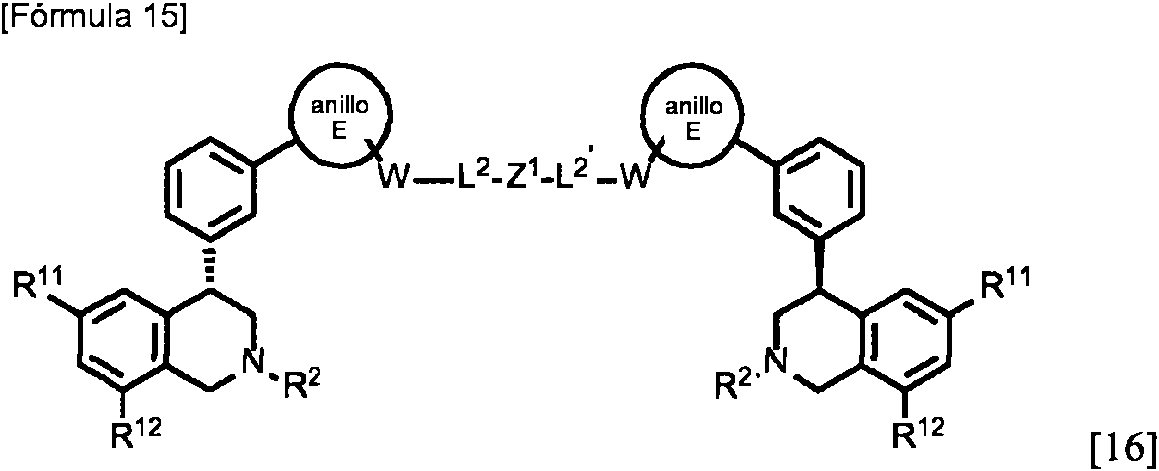
en dondewhere
cada uno de R11 y R12 es un átomo de halógeno,each of R11 and R12 is a halogen atom,
R2 es alquilo Ci-C6R2 is Ci-C6 alkyl
el anillo E es pirazol, imidazol, triazol, tetrazol, piridina, piridazina o pirimidina,ring E is pyrazole, imidazole, triazole, tetrazole, pyridine, pyridazine or pyrimidine,
W es un enlace sencillo, la fórmula -NH-, la fórmula -O- o la fórmula - CONH-,W is a simple bond, the formula -NH-, the formula -O- or the formula - CONH-,
Z1 es cualquier estructura del siguiente grupo de fórmulas [17]:Z1 is any structure of the following group of formulas [17]:
[Fórmula 16][Formula 16]

cada uno de L2 y L2' es cualquier estructura del siguiente grupo de fórmulas [5]:each of L2 and L2 'is any structure of the following group of formulas [5]:
[Fórmula 17] [Formula 17]
[Formula 17][Formula 17]

Un aspecto alternativo de la presente invención proporcionaAn alternative aspect of the present invention provides
(8) el compuesto de acuerdo con el apartado (7) o una sal farmacéuticamente aceptable del mismo, en donde cada uno de R11 y R12 es un átomo de cloro,(8) the compound according to section (7) or a pharmaceutically acceptable salt thereof, wherein each of R11 and R12 is a chlorine atom,
R2 es metilo,R2 is methyl,
el anillo E es triazol, tetrazol, piridina, piridazina o pirimidina,the ring E is triazole, tetrazole, pyridine, pyridazine or pyrimidine,
W es un enlace sencillo, la fórmula -NH-, o la fórmula -CONH-, yW is a simple bond, the formula -NH-, or the formula -CONH-, and
Z1 es cualquier estructura del siguiente grupo de fórmulas [17']:Z1 is any structure of the following group of formulas [17 ']:
[Fórmula 18][Formula 18]

Un aspecto alternativo de la presente invención proporcionaAn alternative aspect of the present invention provides
(9) el compuesto de acuerdo con el apartado (8) o una sal farmacéuticamente aceptable del mismo, en donde en la fórmula [16], la estructura representada por la siguiente fórmula [8] es cualquier estructura del siguiente grupo de fórmulas [18]:(9) the compound according to section (8) or a pharmaceutically acceptable salt thereof, wherein in formula [16], the structure represented by the following formula [8] is any structure of the following group of formulas [18] ]:
[Fórmula 19][Formula 19]

[Fórmula 20][Formula 20]

Un aspecto alternativo de la presente invención proporcionaAn alternative aspect of the present invention provides
(10) el compuesto de acuerdo con el apartado (1) o (7) o una sal farmacéuticamente aceptable del mismo que se muestra a continuación: (10) the compound according to section (1) or (7) or a pharmaceutically acceptable salt thereof as shown below:
[Fórmula 22] [Formula 22]

Un aspecto alternativo de la presente invención proporcionaAn alternative aspect of the present invention provides
(11) un medicamento que comprende un compuesto de acuerdo con cualquiera de (1) a (10) o una sal farmacéuticamente aceptable del mismo como ingrediente activo.(11) a medicament comprising a compound according to any one of (1) to (10) or a pharmaceutically acceptable salt thereof as an active ingredient.
Un aspecto alternativo de la presente invención proporcionaAn alternative aspect of the present invention provides
(12) el compuesto de acuerdo con cualquiera de (1) a (10) o una sal farmacéuticamente aceptable del mismo para uso como inhibidor de NHE3.(12) the compound according to any one of (1) to (10) or a pharmaceutically acceptable salt thereof for use as an NHE3 inhibitor.
Un aspecto alternativo de la presente invención proporcionaAn alternative aspect of the present invention provides
(13) el compuesto de acuerdo con cualquiera de (1) a (10) o una sal farmacéuticamente aceptable del mismo para uso como promotor de secreción intestinal de agua.(13) the compound according to any of (1) to (10) or a pharmaceutically acceptable salt thereof for use as a water intestinal secretion promoter.
Un aspecto alternativo de la presente invención proporcionaAn alternative aspect of the present invention provides
(14) el compuesto de acuerdo con cualquiera de (1) a (10) o una sal farmacéuticamente aceptable del mismo para uso como fármaco profiláctico o terapéutico para el estreñimiento.(14) the compound according to any one of (1) to (10) or a pharmaceutically acceptable salt thereof for use as a prophylactic or therapeutic drug for constipation.
Un aspecto alternativo de la presente invención proporcionaAn alternative aspect of the present invention provides
(15) el compuesto de acuerdo con cualquiera de (1) a (10) o una sal farmacéuticamente aceptable del mismo para uso como inhibidor de la absorción de sodio.(15) the compound according to any of (1) to (10) or a pharmaceutically acceptable salt thereof for use as an inhibitor of sodium absorption.
Un aspecto alternativo de la presente invención proporcionaAn alternative aspect of the present invention provides
(16) el compuesto de acuerdo con cualquiera de (1) a (10) o una sal farmacéuticamente aceptable del mismo para uso como un fármaco profiláctico o terapéutico para la hipertensión.(16) the compound according to any of (1) to (10) or a pharmaceutically acceptable salt thereof for use as a prophylactic or therapeutic drug for hypertension.
Un aspecto alternativo de la presente invención proporcionaAn alternative aspect of the present invention provides
(17) el compuesto de acuerdo con cualquiera de (1) a (10) o una sal farmacéuticamente aceptable del mismo para uso como fármaco profiláctico o terapéutico para la nefropatía.(17) the compound according to any one of (1) to (10) or a pharmaceutically acceptable salt thereof for use as a prophylactic or therapeutic drug for nephropathy.
Un aspecto alternativo de la presente invención proporcionaAn alternative aspect of the present invention provides
(18) el compuesto de acuerdo con cualquiera de (1) a (10) o una sal farmacéuticamente aceptable del mismo para uso como fármaco profiláctico o terapéutico para la retención de líquidos corporales.(18) the compound according to any of (1) to (10) or a pharmaceutically acceptable salt thereof for use as a prophylactic or therapeutic agent for retention of body fluids.
Un aspecto alternativo de la presente invención proporcionaAn alternative aspect of the present invention provides
(19) el compuesto de acuerdo con cualquiera de (1) a (10) o una sal farmacéuticamente aceptable del mismo para uso como inhibidor de la absorción de fósforo.(19) the compound according to any of (1) to (10) or a pharmaceutically acceptable salt thereof for use as an inhibitor of phosphorus absorption.
Un aspecto alternativo de la presente invención proporcionaAn alternative aspect of the present invention provides
(20) el compuesto de acuerdo con cualquiera de (1) a (10) o una sal farmacéuticamente aceptable del mismo para uso como fármaco profiláctico o terapéutico para la hiperfosfatemia.(20) the compound according to any of (1) to (10) or a pharmaceutically acceptable salt thereof for use as a prophylactic or therapeutic drug for hyperphosphatemia.
Un aspecto alternativo de la presente invención proporcionaAn alternative aspect of the present invention provides
(21) el compuesto de acuerdo con cualquiera de (1) a (10) o una sal farmacéuticamente aceptable del mismo para uso como fármaco profiláctico o terapéutico para la CKD-MBD.(21) the compound according to any of (1) to (10) or a pharmaceutically acceptable salt thereof for use as a prophylactic or therapeutic drug for CKD-MBD.
Efecto ventajoso de la invenciónAdvantageous effect of the invention
La presente invención puede proporcionar un compuesto que tiene un excelente efecto inhibidor de NHE3.The present invention can provide a compound that has an excellent inhibitory effect of NHE3.
El compuesto de la presente invención tiene un efecto inhibidor de NHE3. Un medicamento que comprende el compuesto de la presente invención como ingrediente activo puede servir como un medicamento eficaz para la prevención o el tratamiento del estreñimiento, la hipertensión, la nefropatía, la retención de líquidos corporales derivada de insuficiencia renal y la retención de líquidos corporales causada por insuficiencia cardíaca, cirrosis hepática, o las fármacos.The compound of the present invention has an inhibitory effect of NHE3. A medicament comprising the compound of the present invention as an active ingredient can serve as an effective medicament for the prevention or treatment of constipation, hypertension, nephropathy, retention of body fluids derived from renal insufficiency and retention of body fluids caused for heart failure, liver cirrhosis, or drugs.
Algunos compuestos de la presente invención tienen un efecto inhibidor de la absorción de fósforo. Un medicamento que comprende cualquiera de estos compuestos como ingrediente activo puede servir como medicamento eficaz para la prevención o tratamiento de la hiperfosfatemia y la CKD-MBD.Some compounds of the present invention have an inhibitory effect on phosphorus absorption. A medicament comprising any of these compounds as an active ingredient can serve as an effective medicament for the prevention or treatment of hyperphosphatemia and CKD-MBD.
Realizaciones para llevar a cabo la invención.Embodiments to carry out the invention.
La presente invención proporciona un compuesto representado por la fórmula [1] o una sal farmacéuticamente aceptable del mismo que tiene un excelente efecto inhibidor de NHE3.The present invention provides a compound represented by the formula [1] or a pharmaceutically acceptable salt thereof having an excellent NHE3 inhibitory effect.
De aquí en adelante, el compuesto de la presente invención se describirá con más detalle. Sin embargo, la presente invención no está particularmente limitada por las realizaciones.Hereinafter, the compound of the present invention will be described in more detail. However, the present invention is not particularly limited by the embodiments.
El "átomo de halógeno" se refiere a un átomo de flúor, un átomo de cloro, un átomo de bromo o un átomo de yodo. El "alquilo C1-C6" se refiere a alquilo lineal o ramificado que tiene 1 a 6 átomos de carbono. Los ejemplos de los mismos incluyen metilo, etilo, n-propilo, isopropilo, n-butilo, isobutilo, sec-butilo, terc-butilo, n-pentilo, isopentilo, neopentilo, 2-metilbutilo, n-hexilo e isohexilo.The "halogen atom" refers to a fluorine atom, a chlorine atom, a bromine atom or an iodine atom. "C 1 -C 6 alkyl " refers to straight or branched alkyl having 1 to 6 carbon atoms. Examples thereof include methyl, ethyl, n-propyl, isopropyl, n-butyl, isobutyl, sec-butyl, tert-butyl, n-pentyl, isopentyl, neopentyl, 2-methylbutyl, n-hexyl and isohexyl.
El "alcoxi C1-C6" se refiere a alcoxi lineal o ramificado que tiene de 1 a 6 átomos de carbono. Los ejemplos incluyen metoxi, etoxi, n-propoxi, isopropoxi, n-butoxi, isobutoxi, sec-butoxi, terc-butoxi, n-pentiloxi, isopentiloxi, neopentiloxi, 2-metilbutoxi, n-hexiloxi e isohexiloxi. "C 1 -C 6 alkoxy " refers to straight or branched alkoxy having from 1 to 6 carbon atoms. Examples include methoxy, ethoxy, n-propoxy, isopropoxy, n-butoxy, isobutoxy, sec-butoxy, tert-butoxy, n-pentyloxy, isopentyloxy, neopentyloxy, 2-methylbutoxy, n-hexyloxy and isohexyloxy.
El "monoalquil(C1-C6)amino" se refiere a amino que tiene un "alquilo C1-C6" descrito anteriormente como sustituyente. Los ejemplos incluyen metilamino, etilamino, n-propilamino, isopropilamino, n-butilamino, isobutilamino, sec-butilamino, terc-butilamino, n-pentilamino, isopentilamino, neopentilamino, 2-metilbutilamino, n-pentilamino, e isohexilamino. The "(C 1 -C 6 ) monoalkyl amino" refers to amino having a "C 1 -C 6 alkyl " described above as a substituent. Examples include methylamino, ethylamino, n-propylamino, isopropylamino, n-butylamino, isobutylamino, sec-butylamino, tert-butylamino, n-pentylamino, isopentylamino, neopentylamino, 2-methylbutylamino, n-pentylamino, and isohexylamino.
Una forma preferida del compuesto de la presente invención es la siguiente.A preferred form of the compound of the present invention is the following.
R11 es preferiblemente un átomo de halógeno, más preferiblemente un átomo de cloro.R11 is preferably a halogen atom, more preferably a chlorine atom.
R12 es preferiblemente un átomo de halógeno, más preferiblemente un átomo de cloro.R12 is preferably a halogen atom, more preferably a chlorine atom.
R2 es preferiblemente alquilo C1-C6, más preferiblemente metilo. R 2 is preferably C 1 -C 6 alkyl , more preferably methyl.
El anillo E es preferiblemente pirazol, imidazol, triazol, tetrazol, piridina, piridazina, pirimidina o pirazina.Ring E is preferably pyrazole, imidazole, triazole, tetrazole, pyridine, pyridazine, pyrimidine or pyrazine.
A este respecto, R31 es preferiblemente un átomo de hidrógeno, y R32 es preferiblemente un átomo de hidrógeno. In this regard, R31 is preferably a hydrogen atom, and R32 is preferably a hydrogen atom.
A este respecto, W es preferiblemente un enlace sencillo o la fórmula -NH-.In this regard, W is preferably a single bond or the formula -NH-.
El anillo E es más preferiblemente triazol, tetrazol o pirimidina.Ring E is more preferably triazole, tetrazole or pyrimidine.
A este respecto, R31 es preferiblemente un átomo de hidrógeno, y R32 es preferiblemente un átomo de hidrógeno. A este respecto, W es preferiblemente un enlace sencillo o la fórmula -NH-.In this regard, R31 is preferably a hydrogen atom, and R32 is preferably a hydrogen atom. In this regard, W is preferably a single bond or the formula -NH-.
El anillo E es adicionalmente preferiblemente triazol o tetrazol.The ring E is additionally preferably triazole or tetrazole.
A este respecto, R31 es preferiblemente un átomo de hidrógeno, y R32 es preferiblemente un átomo de hidrógeno. A este respecto, W es preferiblemente un enlace sencillo.In this regard, R31 is preferably a hydrogen atom, and R32 is preferably a hydrogen atom. In this regard, W is preferably a single bond.
A este respecto, el anillo E y W (estructura representada por la siguiente fórmula [8] en la fórmula [7]) constituye de manera particularmente preferible cualquier estructura del siguiente grupo de fórmulas [10]:In this regard, the ring E and W (structure represented by the following formula [8] in the formula [7]) is particularly preferably any structure of the following group of formulas [10]:
[Fórmula 23][Formula 23]

Alternativamente, el anillo E es adicionalmente preferiblemente pirimidina.Alternatively, the ring E is additionally preferably pyrimidine.
A este respecto, R31 es preferiblemente un átomo de hidrógeno, y R32 es preferiblemente un átomo de hidrógeno. A este respecto, W es preferiblemente la fórmula -NH-.In this regard, R31 is preferably a hydrogen atom, and R32 is preferably a hydrogen atom. In this regard, W is preferably the formula -NH-.
A este respecto, el anillo E y W (estructura representada por la siguiente fórmula [8] en la fórmula [7]) constituye de manera particularmente preferible una estructura de la siguiente fórmula [11]:In this regard, the ring E and W (structure represented by the following formula [8] in the formula [7]) is particularly preferably a structure of the following formula [11]:
[Fórmula 25][Formula 25]

[Fórmula 26][Formula 26]

Y es preferiblemente una estructura representada por la siguiente fórmula [3]:And it is preferably a structure represented by the following formula [3]:
[Fórmula 27][Formula 27]
-|-L- | -L 2two -Z-Z 1one .L.L 2 two - a- to
* ' [3]* ' [3]
En esta fórmula,In this formula,
Z1 es preferiblemente cualquier estructura del siguiente grupo de fórmulas [6]: Z1 is preferably any structure of the following group of formulas [6]:
[Fórmula 28][Formula 28]

Cada uno de L2 y L2' es preferiblemente cualquier estructura del siguiente grupo de fórmulas [5]:Each of L2 and L2 'is preferably any structure of the following group of formulas [5]:
[Fórmula 29][Formula 29]

Otra forma preferida del compuesto de la presente invención es la siguiente.Another preferred form of the compound of the present invention is as follows.
R11 es preferiblemente un átomo de halógeno, más preferiblemente un átomo de cloro.R11 is preferably a halogen atom, more preferably a chlorine atom.
R12 es preferiblemente un átomo de halógeno, más preferiblemente un átomo de cloro.R12 is preferably a halogen atom, more preferably a chlorine atom.
R2 es preferiblemente alquilo C1-C6, más preferiblemente metilo. R 2 is preferably C 1 -C 6 alkyl , more preferably methyl.
El anillo E es preferiblemente pirazol, imidazol, triazol, tetrazol, piridina, piridazina o pirimidina.Ring E is preferably pyrazole, imidazole, triazole, tetrazole, pyridine, pyridazine or pyrimidine.
A este respecto, R31 es preferiblemente un átomo de hidrógeno, y R32 es preferiblemente un átomo de hidrógeno. A este respecto, W es preferiblemente un enlace sencillo, la fórmula -NH-, o la fórmula -CONH-.In this regard, R31 is preferably a hydrogen atom, and R32 is preferably a hydrogen atom. In this regard, W is preferably a single bond, the formula -NH-, or the formula -CONH-.
El anillo E es más preferiblemente triazol, tetrazol, piridina, piridazina o pirimidina.Ring E is more preferably triazole, tetrazole, pyridine, pyridazine or pyrimidine.
A este respecto, R31 es preferiblemente un átomo de hidrógeno, y R32 es preferiblemente un átomo de hidrógeno. A este respecto, W es preferiblemente un enlace sencillo, la fórmula -NH-, o la fórmula -CONH-.In this regard, R31 is preferably a hydrogen atom, and R32 is preferably a hydrogen atom. In this regard, W is preferably a single bond, the formula -NH-, or the formula -CONH-.
El anillo E es adicionalmente preferiblemente triazol o tetrazol.The ring E is additionally preferably triazole or tetrazole.
A este respecto, R31 es preferiblemente un átomo de hidrógeno, y R32 es preferiblemente un átomo de hidrógeno. A este respecto, W es preferiblemente un enlace sencillo.In this regard, R31 is preferably a hydrogen atom, and R32 is preferably a hydrogen atom. In this regard, W is preferably a single bond.
A este respecto, el anillo E y W (estructura representada por la siguiente fórmula [8] en la fórmula [7]) constituye de manera particularmente preferible cualquier estructura del siguiente grupo de fórmulas [19]: In this regard, the ring E and W (structure represented by the following formula [8] in the formula [7]) is particularly preferably any structure of the following group of formulas [19]:
[Fórmula 30][Formula 30]

Alternativamente, el anillo E es adicionalmente preferiblemente piridina, piridazina o pirimidina.Alternatively, the ring E is additionally preferably pyridine, pyridazine or pyrimidine.
A este respecto, R31 es preferiblemente un átomo de hidrógeno, y R32 es preferiblemente un átomo de hidrógeno. A este respecto, W es preferiblemente la fórmula -NH- o la fórmula -CONH-.In this regard, R31 is preferably a hydrogen atom, and R32 is preferably a hydrogen atom. In this regard, W is preferably the formula -NH- or the formula -CONH-.
A este respecto, el anillo E y W (estructura representada por la siguiente fórmula [8] en la fórmula [7]) constituye de manera particularmente preferible una estructura de la siguiente fórmula [20]:In this regard, the ring E and W (structure represented by the following formula [8] in the formula [7]) is particularly preferably a structure of the following formula [20]:
[Fórmula 32][Formula 32]

Y es preferiblemente una estructura representada por la siguiente fórmula [3]:And it is preferably a structure represented by the following formula [3]:
[Fórmula 34][Formula 34]

En esta fórmula,In this formula,
Z1 es preferiblemente cualquier estructura del siguiente grupo de fórmulas [17]: Z1 is preferably any structure of the following group of formulas [17]:
[Fórmula 35][Formula 35]

Z1 es más preferiblemente cualquier estructura del siguiente grupo de fórmulas [17']:Z1 is more preferably any structure of the following group of formulas [17 ']:
[Fórmula 36][Formula 36]

Cada uno de l2 y L2' es preferiblemente cualquier estructura del siguiente grupo de fórmulas [5]:Each of l2 and L2 'is preferably any structure of the following group of formulas [5]:
[Fórmula 37][Formula 37]
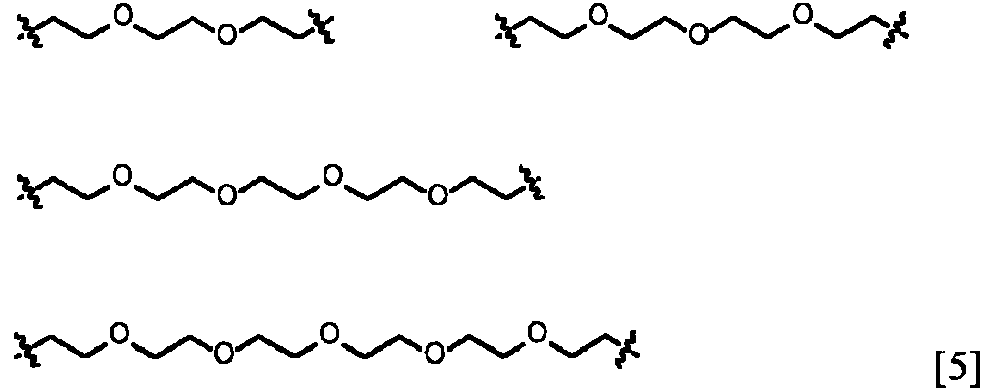
Una forma preferida del compuesto de la presente invención es un compuesto representado por la siguiente fórmula [1-a] o una sal farmacéuticamente aceptable del mismo: A preferred form of the compound of the present invention is a compound represented by the following formula [1-a] or a pharmaceutically acceptable salt thereof:
[Fórmula 38][Formula 38]

En esta fórmula, formas preferidas de anillo E, W, Z1, L2, y L2' son como se describe anteriormente.In this formula, preferred ring forms E, W, Z1, L2, and L2 'are as described above.
En un aspecto más preferido,In a more preferred aspect,
el anillo E es triazol, tetrazol o pirimidina.the E ring is triazole, tetrazole or pyrimidine.
A este respecto, W es preferiblemente un enlace sencillo o la fórmula -NH-.In this regard, W is preferably a single bond or the formula -NH-.
En otro aspecto preferido,In another preferred aspect,
el anillo E es triazol o tetrazol.the E ring is triazole or tetrazole.
A este respecto, W es preferiblemente un enlace sencillo.In this regard, W is preferably a single bond.
En un aspecto particularmente preferido,In a particularly preferred aspect,
la estructura representada por la siguiente fórmula [8] en la fórmula [1-a] es cualquier estructura del siguiente grupo de fórmulas [10]:the structure represented by the following formula [8] in the formula [1-a] is any structure of the following group of formulas [10]:
[Fórmula 39][Formula 39]

En un aspecto alternativo adicional preferido,In a further preferred alternative aspect,
el anillo E es pirimidina.ring E is pyrimidine.
A este respecto, W es preferiblemente la fórmula -NH-.In this regard, W is preferably the formula -NH-.
Z1 Es una estructura de la siguiente fórmula [12]:Z1 It is a structure of the following formula [12]:
[Fórmula 41][Formula 41]

L2 y L2' son iguales y son cualquier estructura del siguiente grupo de fórmulas [13]:L2 and L2 'are the same and are any structure of the following group of formulas [13]:
[Fórmula 42][Formula 42]

En un aspecto particularmente preferido,In a particularly preferred aspect,
La estructura representada por la siguiente fórmula [8] en la fórmula [1-a] es una estructura de la siguiente fórmula [11]: The structure represented by the following formula [8] in the formula [1-a] is a structure of the following formula [11]:
[Fórmula 43][Formula 43]

[Fórmula 44][Formula 44]

Una forma alternativa preferida del compuesto de la presente invención es un compuesto representado por la siguiente fórmula [1-a] o una sal farmacéuticamente aceptable del mismo:A preferred alternative form of the compound of the present invention is a compound represented by the following formula [1-a] or a pharmaceutically acceptable salt thereof:
[Fórmula 45][Formula 45]

En esta fórmula, formas preferidas de anillo E, W, Z1, L2, y L2' son como se describe anteriormente.In this formula, preferred ring forms E, W, Z1, L2, and L2 'are as described above.
En un aspecto más preferido,In a more preferred aspect,
el anillo E es triazol, tetrazol, piridina, piridazina o pirimidina.Ring E is triazole, tetrazole, pyridine, pyridazine or pyrimidine.
A este respecto, W es preferiblemente un enlace sencillo, la fórmula -NH-, o la fórmula -CONH-.In this regard, W is preferably a single bond, the formula -NH-, or the formula -CONH-.
En otro aspecto preferido,In another preferred aspect,
el anillo E es triazol o tetrazol.the E ring is triazole or tetrazole.
A este respecto, W es preferiblemente un enlace sencillo.In this regard, W is preferably a single bond.
Z1 es preferiblemente una estructura de la siguiente fórmula [17']:Z1 is preferably a structure of the following formula [17 ']:
[Fórmula 46][Formula 46]
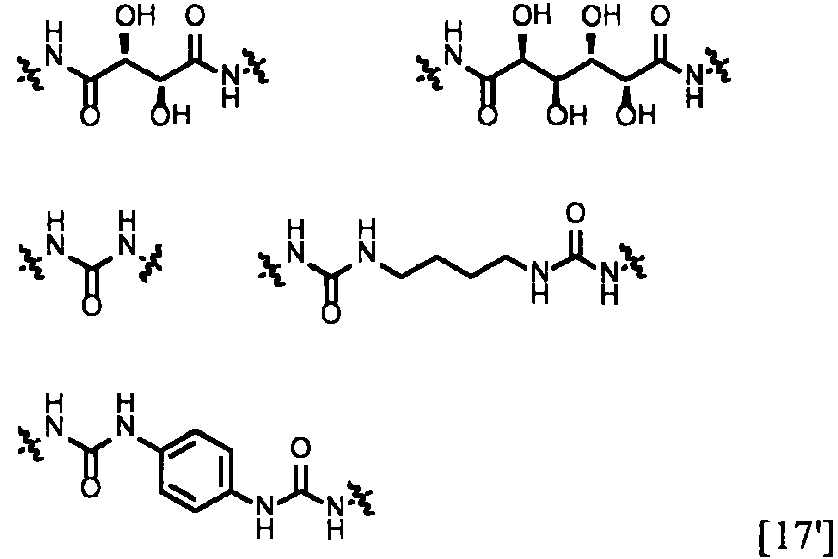
Preferiblemente, L2 y L2' son iguales y son cualquier estructura del siguiente grupo de fórmulas [5]: Preferably, L2 and L2 'are the same and are any structure of the following group of formulas [5]:
[Fórmula 47][Formula 47]

En un aspecto particularmente preferido,In a particularly preferred aspect,
la estructura representada por la siguiente fórmula [8] en la fórmula [1-a] es cualquier estructura del siguiente grupo de fórmulas [19]:the structure represented by the following formula [8] in the formula [1-a] is any structure of the following group of formulas [19]:
[Fórmula 48][Formula 48]

En un aspecto alternativo adicional preferido,In a further preferred alternative aspect,
el anillo E es piridina, piridazina o pirimidina.ring E is pyridine, pyridazine or pyrimidine.
A este respecto, W es preferiblemente la fórmula -NH- o la fórmula -CONH-.In this regard, W is preferably the formula -NH- or the formula -CONH-.
Z1 Es preferiblemente una estructura de la siguiente fórmula [21]:Z1 is preferably a structure of the following formula [21]:
[Fórmula 50][Formula 50]

L2 y L2'son iguales y son cualquier estructura del siguiente grupo de fórmulas [22]:L2 and L2'are the same and are any structure of the following group of formulas [22]:
[Fórmula 51] [Formula 51]

En un aspecto particularmente preferido,In a particularly preferred aspect,
La estructura representada por la siguiente fórmula [8] en la fórmula [1-a] es una estructura de la siguiente fórmula [23]:The structure represented by the following formula [8] in the formula [1-a] is a structure of the following formula [23]:
[Fórmula 52][Formula 52]

El compuesto de la presente invención es un compuesto de feniltetrahidroisoquinolina sustituido con heteroarilo. El compuesto de la presente invención puede ser una sal farmacéuticamente aceptable del mismo (en lo sucesivo, denominado apropiadamente el "compuesto de la presente invención").The compound of the present invention is a phenyltetrahydroisoquinoline compound substituted with heteroaryl. The compound of the present invention may be a pharmaceutically acceptable salt thereof (hereinafter, appropriately referred to as the "compound of the present invention").
Los ejemplos de la sal farmacéuticamente aceptable incluyen: sales de adición de ácido que incluyen sales de ácidos minerales tales como hidrocloruro, hidrobromuro, hidroyoduro, fosfato, sulfato y nitrato, sulfonatos tales como metanosulfonato, etanosulfonato, bencenosulfonato, p-toluenosulfonato y trifluorometanosulfonato y ácidos orgánicos tales como oxalato, tartrato, citrato, maleato, succinato, acetato, trifluoroacetato, benzoato, mandelato, ascorbato, lactato, gluconato y malato; sales de aminoácidos tales como sal de glicina, sal de lisina, sal de arginina, sal de ornitina, glutarato y aspartato; sales inorgánicas tales como sal de litio, sal de sodio, sal de potasio, sal de calcio y sal de magnesio; y sales con bases orgánicas, como sal de amonio, sal de trietilamina, sal de diisopropilamina y sal de ciclohexilamina. La sal incluye sales hidratos.Examples of the pharmaceutically acceptable salt include: acid addition salts including salts of mineral acids such as hydrochloride, hydrobromide, hydroiodide, phosphate, sulfate and nitrate, sulfonates such as methanesulfonate, ethanesulfonate, benzenesulfonate, p-toluenesulfonate and trifluoromethanesulfonate and acids organic compounds such as oxalate, tartrate, citrate, maleate, succinate, acetate, trifluoroacetate, benzoate, mandelate, ascorbate, lactate, gluconate and malate; salts of amino acids such as glycine salt, lysine salt, arginine salt, ornithine salt, glutarate and aspartate; inorganic salts such as lithium salt, sodium salt, potassium salt, calcium salt and magnesium salt; and salts with organic bases, such as ammonium salt, triethylamine salt, diisopropylamine salt and cyclohexylamine salt. Salt includes hydrate salts.
El compuesto de la presente invención puede tener un centro quiral. En este caso, existen diversos isómeros ópticos. Por lo tanto, el compuesto de la presente invención puede existir como formas separadas ópticamente activas (R) y (S) y como un racemato o una mezcla (RS). Asimismo, un compuesto que tiene dos o más centros quirales puede existir adicionalmente como diastereómeros basados en cada isomerismo óptico. El compuesto de la presente invención también incluye mezclas que contienen todas estas formas en proporciones arbitrarias. Por ejemplo, los diastereómeros pueden resolverse mediante un método bien conocido por los expertos en la técnica, por ejemplo, un método de cristalización fraccionada. Además, se pueden obtener formas ópticamente activas mediante un enfoque químico orgánico bien conocido para este propósito. El compuesto de la presente invención puede tener isómeros geométricos tales como formas cis y trans. El compuesto de la presente invención tiene además tautomería, y existen diversos tautómeros. El compuesto de la presente invención también incluye estos isómeros y mezclas que contienen estos isómeros en proporciones arbitrarias.The compound of the present invention may have a chiral center. In this case, there are various optical isomers. Therefore, the compound of the present invention can exist as separate optically active forms (R) and (S) and as a racemate or a mixture (RS). Likewise, a compound having two or more chiral centers may additionally exist as diastereomers based on each optical isomerism. The compound of the present invention also includes mixtures containing all these forms in arbitrary proportions. For example, the diastereomers can be resolved by a method well known to those skilled in the art, for example, a fractional crystallization method. In addition, optically active forms can be obtained by a well-known organic chemical approach for this purpose. The compound of the present invention can have geometric isomers such as cis and trans forms. The compound of the present invention also has tautomerism, and various tautomers exist. The compound of the present invention also includes these isomers and mixtures containing these isomers in arbitrary proportions.
Cuando el compuesto de la presente invención o la sal del mismo forma un hidrato o un solvato, este hidrato o solvato también se incluye en el alcance del compuesto de la presente invención o la sal del mismo.When the compound of the present invention or the salt thereof forms a hydrate or a solvate, this hydrate or solvate is also included within the scope of the compound of the present invention or the salt thereof.
El compuesto de la presente invención tiene un efecto inhibidor de NHE3. El compuesto de la presente invención permite que el sodio se retenga en el tracto intestinal y extrae el agua. El compuesto de la presente invención puede resolver el estreñimiento suavizando los contenidos intestinales. En este contexto, el estreñimiento abarca el estreñimiento orgánico, el estreñimiento medicinal, el estreñimiento sintomático y otros casos de estreñimiento. The compound of the present invention has an inhibitory effect of NHE3. The compound of the present invention allows sodium to be retained in the intestinal tract and the water extracted. The compound of the present invention can resolve constipation by softening intestinal contents. In this context, constipation includes organic constipation, medicinal constipation, symptomatic constipation and other cases of constipation.
El compuesto de la presente invención también se puede utilizar combinado con un fármaco terapéutico existente para el estreñimiento que tiene un mecanismo de acción distinto del efecto inhibidor de NHE3, o un fármaco en desarrollo. Se puede esperar que el uso combinado del compuesto de la presente invención con un fármaco adicional ejerza efectos farmacológicos más fuertes que los efectos obtenidos con cada fármaco solo.The compound of the present invention can also be used in combination with an existing therapeutic drug for constipation that has a mechanism of action other than the inhibitory effect of NHE3, or a drug in development. The combined use of the compound of the present invention with a drug can be expected Additional drug exert stronger pharmacological effects than the effects obtained with each drug alone.
Los ejemplos del fármaco terapéutico existente para el estreñimiento que se puede utilizar combinado pueden incluir: laxantes osmóticos clasificados en laxantes salinos, tales como óxido de magnesio o laxantes azucarados, tales como lactulosa; laxantes formadores de volumen, tales como policarbófilo cálcico; laxantes estimulantes tales como senósido y picosulfato de sodio; laxantes emolientes tales como dioctilsulfosuccinato de sodio; agonistas del receptor de serotonina 4 (5-HT4) tales como mosaprida; y agonistas del canal de cloruro de tipo 2 (ClC-2), tales como lubiprostona.Examples of the existing therapeutic drug for constipation that may be used in combination may include: osmotic laxatives classified in saline laxatives, such as magnesium oxide or sugar-laxatives, such as lactulose; volume forming laxatives, such as calcium polycarbophil; stimulant laxatives such as sennoside and sodium picosulfate; emollient laxatives such as sodium dioctyl sulfosuccinate; serotonin 4 (5-HT4) receptor agonists such as mosapride; and type 2 chloride channel agonists (ClC-2), such as lubiprostone.
Los ejemplos del fármaco en desarrollo que se puede utilizar combinado pueden incluir: agonistas del receptor de guanilato ciclasa tales como linaclotida; antagonistas de receptores opioides tales como metilnaltrexona; Sustancias inhibidoras de IBAT tales como elobixibat; Sustancias inhibidoras de SGLT1 tales como KWA-0711; agonistas del receptor de serotonina 4 (5-HT4) tales como DSP-6952; y agonistas de GPR38 tales como DS-3801.Examples of the developing drug that can be used in combination may include: guanylate cyclase receptor agonists such as linaclotide; opioid receptor antagonists such as methylnaltrexone; IBAT inhibiting substances such as theobixibat; Inhibitory substances of SGLT1 such as KWA-0711; serotonin 4 (5-HT4) receptor agonists such as DSP-6952; and GPR38 agonists such as DS-3801.
El compuesto de la presente invención es capaz de prevenir o tratar la hipertensión inhibiendo la absorción intestinal de sodio y permitiendo que el sodio se excrete en las heces. En este contexto, la hipertensión abarca la hipertensión esencial, la hipertensión secundaria y la hipertensión sensible a la sal. El compuesto de la presente invención también se considera útil como un fármaco que imita la restricción de sal.The compound of the present invention is capable of preventing or treating hypertension by inhibiting the intestinal absorption of sodium and allowing sodium to be excreted in the stool. In this context, hypertension includes essential hypertension, secondary hypertension and salt sensitive hypertension. The compound of the present invention is also considered useful as a drug that mimics the salt restriction.
El compuesto de la presente invención es capaz de prevenir o tratar la nefropatía inhibiendo la absorción intestinal de sodio. En este contexto, la nefropatía abarca nefropatía diabética, glomerulonefritis, nefroesclerosis y enfermedad renal poliquística.The compound of the present invention is capable of preventing or treating nephropathy by inhibiting the intestinal absorption of sodium. In this context, nephropathy includes diabetic nephropathy, glomerulonephritis, nephrosclerosis and polycystic kidney disease.
El compuesto de la presente invención es capaz de prevenir o tratar la retención de líquidos corporales ya que el compuesto inhibe la absorción intestinal de sodio y aumenta la excreción de sodio y la excreción de líquidos corporales en las heces. En este contexto, la retención de líquidos corporales abarca la retención de líquidos corporales causada por insuficiencia renal, retención de líquidos corporales causada por insuficiencia cardíaca, retención de líquidos corporales causada por cirrosis hepática y retención de líquidos corporales causada por fármacos.The compound of the present invention is capable of preventing or treating the retention of body fluids since the compound inhibits the intestinal absorption of sodium and increases the excretion of sodium and the excretion of body fluids in the feces. In this context, body fluid retention includes body fluid retention caused by kidney failure, retention of body fluids caused by heart failure, retention of body fluids caused by liver cirrhosis and retention of body fluids caused by drugs.
Por lo tanto, el compuesto de la presente invención también se puede utilizar combinado con un fármaco terapéutico existente para la hipertensión, la nefropatía o el mejoramiento de la retención de líquidos corporales, o un fármaco en desarrollo, que tenga un mecanismo de acción distinto del efecto inhibidor de NHE3. Se puede esperar que el uso combinado del compuesto de la presente invención con un fármaco adicional ejerza efectos farmacológicos más fuertes que los efectos obtenidos con cada fármaco solo.Therefore, the compound of the present invention can also be used in combination with an existing therapeutic drug for hypertension, nephropathy or the improvement of body fluid retention, or a drug in development, having a mechanism of action other than that of the drug. inhibitory effect of NHE3. It can be expected that the combined use of the compound of the present invention with an additional drug exerts pharmacological effects stronger than the effects obtained with each drug alone.
Los ejemplos del fármaco terapéutico existente para la hipertensión, el fármaco terapéutico para la nefropatía, el fármaco terapéutico para la insuficiencia cardíaca o el fármaco que mejora la retención de líquidos corporales que se puede utilizar combinado pueden incluir: antagonistas del receptor de angiotensina II, tales como candesartán; inhibidores de la enzima conversora de angiotensina, tales como lisinopril; antagonistas del receptor de aldosterona tales como eplerenona; inhibidores de renina, tales como aliskiren; antagonistas de los canales de calcio tales como amlodipino; diuréticos tales como diuréticos tiazídicos y diuréticos del asa; bloqueadores a y p tales como carvedilol; y bloqueadores de canales de K tales como amiodarona.Examples of the existing therapeutic drug for hypertension, the therapeutic drug for nephropathy, the therapeutic drug for heart failure or the drug that improves retention of body fluids that can be used in combination may include: angiotensin II receptor antagonists, such like candesartan; angiotensin converting enzyme inhibitors, such as lisinopril; aldosterone receptor antagonists such as eplerenone; renin inhibitors, such as aliskiren; calcium channel antagonists such as amlodipine; diuretics such as thiazide diuretics and loop diuretics; blockers a and p such as carvedilol; and K-channel blockers such as amiodarone.
Los ejemplos del fármaco en desarrollo que se puede utilizar combinado pueden incluir: antagonistas del receptor de endotelina tales como atrasentano; Inhibidores de PKC tales como ruboxistaurina; antagonistas del receptor CCR2 tales como BMS-741672; antagonistas del receptor de aldosterona tales como BAY-94-8862; antagonistas del receptor de urotensina tales como ACT-058362; inhibidores de fosfodiesterasa tales como PF-489791; Inhibidores de NEP/ECE tales como daglutril; anticuerpos contra TGF beta tales como LY-2382770; inhibidores de la reacción de glicación tales como aminoguanidina; activadores de Keapl-Nrf2 tales como bardoxolona metilo; Inhibidores de VAP-1 tales como ASP-8232; inhibidores de la aldosterona sintasa; inhibidores de la tripsina intestinal; antagonistas del receptor de LPA; inhibidores de epóxido hidrolasa; y antagonistas del receptor EP4.Examples of the developing drug that can be used in combination may include: endothelin receptor antagonists such as atrasentan; PKC inhibitors such as ruboxistaurin; CCR2 receptor antagonists such as BMS-741672; Aldosterone receptor antagonists such as BAY-94-8862; urotensin receptor antagonists such as ACT-058362; phosphodiesterase inhibitors such as PF-489791; NEP / ECE inhibitors such as daglutril; antibodies against TGF beta such as LY-2382770; inhibitors of the glycation reaction such as aminoguanidine; Keapl-Nrf2 activators such as bardoxolone methyl; VAP-1 inhibitors such as ASP-8232; inhibitors of aldosterone synthase; intestinal trypsin inhibitors; LPA receptor antagonists; epoxide hydrolase inhibitors; and EP4 receptor antagonists.
Se espera adicionalmente que el compuesto de la presente invención inhiba la progresión de la nefropatía diabética combinado con un fármaco terapéutico para la diabetes mellitus o un fármaco en desarrollo.It is further expected that the compound of the present invention inhibits the progression of diabetic nephropathy combined with a therapeutic drug for diabetes mellitus or a drug in development.
Los ejemplos del fármaco terapéutico para la diabetes mellitus que se puede utilizar combinado pueden incluir: preparaciones de insulina; inhibidores de a-glucosidasa tales como acarbosa; Inhibidores de SGLT2 tales como luseogliflozina; fármacos de biguanida tales como metformina; secretagogos de insulina tales como mitiglinida; inhibidores de dipeptidil peptidasa IV tales como sitagliptina; agonistas del receptor de GLP-1 tales como liraglutida; agonistas de PPARy tales como pioglitazona; e inhibidores de aldosa reductasa, tales como epalrestat. Examples of the therapeutic drug for diabetes mellitus that can be used in combination may include: insulin preparations; a-glucosidase inhibitors such as acarbose; Inhibitors of SGLT2 such as luseogliflozin; biguanide drugs such as metformin; insulin secretagogues such as mitiglinide; inhibitors of dipeptidyl peptidase IV such as sitagliptin; GLP-1 receptor agonists such as liraglutide; PPAR agonists and such as pioglitazone; and aldose reductase inhibitors, such as epalrestat.
Los ejemplos del fármaco en desarrollo que se puede utilizar combinado pueden incluir: activadores de glucoquinasa tales como PF-04937319; antagonistas del receptor de glucagón tales como MK-0893; agonistas del receptor de GLP-1 tales como TTP054; agonistas de amilina tales como pramlintida; inhibidores de 11 beta-HSD1 tales como INCB-13739; agonistas del receptor GPR40 tales como tAk-875; Inhibidores de ACC tales como PSN-821; agonistas del receptor GPR119 tales como PSN-821; agonistas del receptor GPR120 tales como LC-540449; agonistas del receptor TGR5 tales como SB-756050; inhibidores de la aldosa reductasa, tales como ranirestat; sustancias inhibidoras de SGLT1 tales como KWA-0711; y agonistas del receptor de adiponectina.Examples of the developing drug that can be used in combination may include: glucokinase activators such as PF-04937319; glucagon receptor antagonists such as MK-0893; GLP-1 receptor agonists such as TTP054; amylin agonists such as pramlintide; 11 beta-HSD1 inhibitors such as INCB-13739; GPR40 receptor agonists such as tAk-875; ACC inhibitors such as PSN-821; GPR119 receptor agonists such as PSN-821; GPR120 receptor agonists such as LC-540449; TGR5 receptor agonists such as SB-756050; aldose reductase inhibitors, such as ranirestat; SGLT1 inhibitory substances such as KWA-0711; and adiponectin receptor agonists.
Además, el compuesto de la presente invención inhibe la absorción intestinal de fósforo y permite que el fósforo se excrete en las heces. Por lo tanto, el compuesto de la presente invención se considera también útil como un fármaco terapéutico para la hiperfosfatemia.In addition, the compound of the present invention inhibits the intestinal absorption of phosphorus and allows phosphorus to be excreted in the faeces. Therefore, the compound of the present invention is also considered useful as a therapeutic drug for hyperphosphatemia.
El compuesto de la presente invención es capaz de prevenir o tratar la CKD-MBD mediante la inhibición de la absorción intestinal de fósforo. En este contexto, la CKD-MBD abarca hiperfosfatemia, hipercalcemia, hiperparatiroidismo, calcificación vascular y osteoporosis causada por un metabolismo óseo anormal.The compound of the present invention is capable of preventing or treating CKD-MBD by inhibiting the intestinal absorption of phosphorus. In this context, CKD-MBD includes hyperphosphatemia, hypercalcemia, hyperparathyroidism, vascular calcification and osteoporosis caused by an abnormal bone metabolism.
Por lo tanto, el compuesto de la presente invención también se puede utilizar combinado con un fármaco terapéutico existente o un fármaco en desarrollo para la CKD-MBD que tiene un mecanismo de acción distinto del efecto inhibidor de NHE3. Se puede esperar que el uso combinado del compuesto de la presente invención con un fármaco adicional ejerza efectos farmacológicos más fuertes que los efectos obtenidos con cada fármaco solo.Therefore, the compound of the present invention can also be used in combination with an existing therapeutic drug or a drug in development for CKD-MBD that has a mechanism of action other than the inhibitory effect of NHE3. It can be expected that the combined use of the compound of the present invention with an additional drug exerts pharmacological effects stronger than the effects obtained with each drug alone.
Los ejemplos del fármaco terapéutico existente para CKD-MBD que se puede utilizar combinado pueden incluir: aglutinantes de fosfato tales como carbonato de calcio, hidrocloruro de sevelámero, bixalómero, carbonato de lantano y citrato férrico; fármacos terapéuticos para el hiperparatiroidismo, tales como cinacalcet y falecalcitriol; y fármacos terapéuticos para la osteoporosis, incluyendo preparaciones de bisfosfonato tales como ibandronato de sodio.Examples of the existing therapeutic drug for CKD-MBD which may be used in combination may include: phosphate binders such as calcium carbonate, sevelamer hydrochloride, bixalomer, lanthanum carbonate and ferric citrate; therapeutic drugs for hyperparathyroidism, such as cinacalcet and falecalcitriol; and therapeutic drugs for osteoporosis, including bisphosphonate preparations such as ibandronate sodium.
Los ejemplos del fármaco terapéutico para CKD-MBD en desarrollo que se puede utilizar combinado pueden incluir: aglutinantes de fosfato tales como PA21; y fármacos terapéuticos para el hiperparatiroidismo tales como ONO-5163 y KHK7580.Examples of the therapeutic drug for developing CKD-MBD that can be used in combination may include: phosphate binders such as PA21; and therapeutic drugs for hyperparathyroidism such as ONO-5163 and KHK7580.
El compuesto de la presente invención se puede administrar solo o junto con un aditivo farmacéuticamente aceptable.The compound of the present invention can be administered alone or together with a pharmaceutically acceptable additive.
Con el fin de utilizar el compuesto de la presente invención como un fármaco, el fármaco puede estar en cualquier forma de una composición sólida, una composición líquida y otras composiciones, y la óptima se selecciona de acuerdo con la necesidad. El fármaco de la presente invención se puede producir mezclando el compuesto de la presente invención con un aditivo farmacéuticamente aceptable. Específicamente, el compuesto de la presente invención se puede preparar en comprimidos, píldoras, cápsulas, gránulos, espolvoreables, polvos, soluciones, emulsiones, suspensiones, inyecciones o similares de acuerdo con una técnica de formulación comúnmente utilizada añadiendo un excipiente o un diluyente comúnmente utilizado y, si fuera necesario, un aglutinante, un disgregante, un lubricante, un agente de recubrimiento, un agente de recubrimiento azucarado, un agente de ajuste de pH, un solubilizante o un disolvente acuoso o no acuoso, etc., generalmente utilizados. Los ejemplos del aditivo pueden incluir agua, lactosa, dextrosa, fructosa, sacarosa, sorbitol, manitol, polietilenglicol, propilenglicol, almidón, almidón de maíz, goma, gelatina, alginato, silicato de calcio, fosfato de calcio, celulosa, jarabe acuoso, metilcelulosa, polivinilpirrolidona, p-hidroxibenzoato de alquilo, talco, ácido esteárico, estearato de magnesio, agar, pectina, goma arábiga, glicerina, aceite de sésamo, aceite de oliva, aceite de soja, manteca de cacao, etilenglicol, hidroxipropilcelulosa de baja viscosidad (HPC-L), microcristalina celulosa, carboximetilcelulosa (CMC), carboximetilcelulosa sódica (CMC-Na) y otros aditivos comúnmente utilizados.In order to use the compound of the present invention as a drug, the drug can be in any form of a solid composition, a liquid composition and other compositions, and the optimum is selected according to the need. The drug of the present invention can be produced by mixing the compound of the present invention with a pharmaceutically acceptable additive. Specifically, the compound of the present invention can be prepared in tablets, pills, capsules, granules, dusts, powders, solutions, emulsions, suspensions, injections or the like according to a commonly used formulation technique by adding a commonly used excipient or diluent. and, if necessary, a binder, a disintegrant, a lubricant, a coating agent, a sugar coating agent, a pH adjusting agent, a solubilizer or an aqueous or non-aqueous solvent, etc., generally used. Examples of the additive may include water, lactose, dextrose, fructose, sucrose, sorbitol, mannitol, polyethylene glycol, propylene glycol, starch, corn starch, gum, gelatin, alginate, calcium silicate, calcium phosphate, cellulose, aqueous syrup, methyl cellulose , polyvinylpyrrolidone, alkyl p-hydroxybenzoate, talc, stearic acid, magnesium stearate, agar, pectin, gum arabic, glycerin, sesame oil, olive oil, soybean oil, cocoa butter, ethylene glycol, low viscosity hydroxypropylcellulose ( HPC-L), microcrystalline cellulose, carboxymethylcellulose (CMC), sodium carboxymethylcellulose (CMC-Na) and other additives commonly used.
Asimismo, el compuesto de la presente invención puede formar, para una preparación, un compuesto de clatrato con a, p o Y-ciclodextrina o ciclodextrina metilada, etc.Also, the compound of the present invention can form, for a preparation, a clathrate compound with a, p or Y-cyclodextrin or methylated cyclodextrin, etc.
El fármaco de acuerdo con la presente invención puede estar en forma de una preparación única (fármaco combinado) del compuesto de la presente invención y el compuesto mencionado anteriormente que puede utilizarse combinado con el mismo, o dos o más preparaciones formuladas por separado a partir de estos compuestos. En el caso de las dos o más preparaciones formuladas por separado a partir de estos compuestos, las preparaciones individuales se pueden administrar al mismo tiempo o a un intervalo de tiempo dado. Las dos o más preparaciones también se pueden administrar a sus respectivos diferentes números de dosis por día. Además, las dos o más preparaciones también se pueden administrar a través de diferentes rutas.The drug according to the present invention can be in the form of a single preparation (combined drug) of the compound of the present invention and the aforementioned compound that can be used in combination therewith, or two or more preparations formulated separately from these compounds. In the case of the two or more preparations formulated separately from these compounds, the individual preparations can be administered at the same time or at a given time interval. The two or more preparations can also be administered at their respective different dose numbers per day. In addition, the two or more preparations can also be administered through different routes.
Cuando el fármaco de acuerdo con la presente invención se produce en forma de dos preparaciones diferentes, es muy probable que estas preparaciones se administren al mismo tiempo o en un intervalo muy corto. Por lo tanto, es preferible que un documento tal como un prospecto de un fármaco disponible comercialmente o un folleto de ventas indique que estas preparaciones se utilizan combinadas.When the drug according to the present invention is produced in the form of two different preparations, it is very likely that these preparations are administered at the same time or in a very short interval. Therefore it is Preferably, a document such as a commercially available drug leaflet or sales brochure indicates that these preparations are used in combination.
Los ejemplos de producción de las preparaciones del compuesto de la presente invención se mostrarán a continuación.The production examples of the preparations of the compound of the present invention will be shown below.
Ejemplo de formulación 1Formulation example 1
Se producen gránulos que contienen los siguientes componentes.Granules are produced that contain the following components.
Componentes: el compuesto representado por la fórmula [1] o su sal farmacéuticamente aceptable, lactosa, almidón de maíz, y HPC-L.Components: the compound represented by the formula [1] or its pharmaceutically acceptable salt, lactose, corn starch, and HPC-L.
El compuesto representado por la fórmula [1] o la sal farmacéuticamente aceptable del mismo y la lactosa se tamizan. El almidón de maíz se tamiza. Estos componentes se mezclan en un mezclador. Se agrega una solución acuosa de HPC-L al polvo mezclado, y la mezcla se amasa, se granula (granulación por extrusión) y a continuación se seca. Los gránulos secos obtenidos se tamizan a través de un tamiz vibratorio para obtener gránulos.The compound represented by the formula [1] or the pharmaceutically acceptable salt thereof and the lactose are screened. The corn starch is sifted. These components are mixed in a mixer. An aqueous solution of HPC-L is added to the mixed powder, and the mixture is kneaded, granulated (extrusion granulation) and then dried. The obtained dry granules are screened through a vibrating screen to obtain granules.
Ejemplo de formulación 2Formulation example 2
Se producen polvos para encapsulación que contienen los siguientes componentes.Powders are produced for encapsulation containing the following components.
Componentes: el compuesto representado por la fórmula [1] o su sal farmacéuticamente aceptable, lactosa, almidón de maíz y estearato de magnesio.Components: the compound represented by the formula [1] or its pharmaceutically acceptable salt, lactose, corn starch and magnesium stearate.
El compuesto representado por la fórmula [1] o la sal farmacéuticamente aceptable del mismo y la lactosa se tamizan. El almidón de maíz se tamiza. Estos componentes se mezclan con estearato de magnesio en un mezclador para obtener polvos. Los polvos obtenidos pueden ser encapsulados.The compound represented by the formula [1] or the pharmaceutically acceptable salt thereof and the lactose are screened. The corn starch is sifted. These components are mixed with magnesium stearate in a mixer to obtain powders. The powders obtained can be encapsulated.
Ejemplo de formulación 3Formulation example 3
Se producen gránulos para encapsulación que contienen los siguientes componentes.Granules are produced for encapsulation which contain the following components.
Componentes: el compuesto representado por la fórmula [1] o su sal farmacéuticamente aceptable, lactosa, almidón de maíz y HPC-L.Components: the compound represented by the formula [1] or its pharmaceutically acceptable salt, lactose, corn starch and HPC-L.
El compuesto representado por la fórmula [1] o la sal farmacéuticamente aceptable del mismo y la lactosa se tamizan. El almidón de maíz se tamiza. Estos componentes se mezclan en un mezclador. Se añade una solución acuosa de HPC-L al polvo mezclado, y la mezcla se amasa, se granula y a continuación se seca. Los gránulos secos obtenidos se tamizan a través de un tamiz vibratorio y se regulan por tamaño para obtener gránulos. Los gránulos obtenidos pueden ser encapsulados.The compound represented by the formula [1] or the pharmaceutically acceptable salt thereof and the lactose are screened. The corn starch is sifted. These components are mixed in a mixer. An aqueous solution of HPC-L is added to the mixed powder, and the mixture is kneaded, granulated and then dried. The obtained dry granules are screened through a vibrating screen and are regulated by size to obtain granules. The obtained granules can be encapsulated.
Ejemplo de formulación 4Formulation example 4
Se producen comprimidos que contienen los siguientes componentes.Tablets containing the following components are produced.
Componentes: el compuesto representado por la fórmula [1] o su sal farmacéuticamente aceptable, lactosa, celulosa microcristalina, estearato de magnesio y CMC-Na.Components: the compound represented by the formula [1] or its pharmaceutically acceptable salt, lactose, microcrystalline cellulose, magnesium stearate and CMC-Na.
El compuesto representado por la fórmula [1] o su sal farmacéuticamente aceptable, la lactosa, la celulosa microcristalina y la CMC-Na se tamizan y se mezclan. Se añade estearato de magnesio al polvo mezclado para obtener un polvo mezclado para preparaciones. Este polvo mezclado se comprime directamente para obtener comprimidos.The compound represented by the formula [1] or its pharmaceutically acceptable salt, the lactose, the microcrystalline cellulose and the CMC-Na are screened and mixed. Magnesium stearate is added to the mixed powder to obtain a mixed powder for preparations. This mixed powder is compressed directly to obtain tablets.
Cuando el compuesto de la presente invención se utiliza como un inhibidor de NHE3 o similar, el compuesto de la presente invención se puede administrar por vía oral tal cual. Alternativamente, un agente que comprende el compuesto de la presente invención como ingrediente activo se puede administrar por vía oral.When the compound of the present invention is used as an inhibitor of NHE3 or the like, the compound of the present invention can be administered orally as is. Alternatively, an agent comprising the compound of the present invention as an active ingredient can be administered orally.
Cuando el compuesto de la presente invención se utiliza como un inhibidor de la absorción de fósforo o similar, el compuesto de la presente invención se puede administrar por vía oral tal cual. Alternativamente, un agente que comprende el compuesto de la presente invención como ingrediente activo se puede administrar por vía oral. When the compound of the present invention is used as an inhibitor of phosphorus absorption or the like, the compound of the present invention can be administered orally as is. Alternatively, an agent comprising the compound of the present invention as an active ingredient can be administered orally.
La dosis del compuesto de la presente invención difiere dependiendo de un receptor, una vía de administración, una enfermedad diana, síntomas, etc. Por ejemplo, una dosis para administración oral a un paciente adulto con anemia suele ser de 0,1 mg a 1000 mg, preferiblemente 1 mg a 200 mg, y esta cantidad es deseablemente administrada de una a tres veces al día, o una vez cada dos o tres días.The dose of the compound of the present invention differs depending on a receptor, a route of administration, a target disease, symptoms, etc. For example, a dose for oral administration to an adult patient with anemia is usually 0.1 mg to 1000 mg, preferably 1 mg to 200 mg, and this amount is desirably administered one to three times a day, or once every two or three days.
El compuesto de la presente invención se puede sintetizar mediante los métodos que se muestran a continuación. Los métodos de producción descritos a continuación se proporcionan como ejemplos de métodos de producción generales y no limitan los métodos para producir el compuesto de la presente invención.The compound of the present invention can be synthesized by the methods shown below. The production methods described below are provided as examples of general production methods and do not limit the methods for producing the compound of the present invention.
El compuesto de la presente invención se puede sintetizar mediante el uso de un método conocido per se en el campo químico, o un método similar al mismo que implique uno o dos o más procedimientos. Los ejemplos de tal método incluyen los métodos descritos en ORGANIC FUNCTIONAL GROUP PREPARATIOnS, 2a edición, ACADEMIC PRESS, INC., 1986, Comprehensive Organic Transformations, VCH Publishers Inc., 1989, and Basics and Experiments of Peptide Synthesis, Maruzen Publishing Co., Ltd., 1985.The compound of the present invention can be synthesized by using a method known per se in the chemical field, or a method similar thereto that involves one or two or more processes. Examples of such a method include the methods described in ORGANIC FUNCTIONAL GROUP PREPARATIOnS, 2nd edition, ACADEMIC PRESS, INC., 1986, Comprehensive Organic Transformations, VCH Publishers Inc., 1989, and Basics and Experiments of Peptide Synthesis, Maruzen Publishing Co., Ltd., 1985.
Para la síntesis del compuesto de la presente invención, se pueden llevar a cabo métodos apropiados para proteger y desproteger un grupo funcional contenido en una sustancia de partida o un intermedio, etc., de acuerdo con métodos bien conocidos por los expertos en la técnica, por ejemplo, los métodos descritos en Protective Groups in Organic Synthesis, John Wiley and Sons, Inc., 2006 de Greene.For the synthesis of the compound of the present invention, appropriate methods can be carried out to protect and deprotect a functional group contained in a starting substance or an intermediate, etc., according to methods well known to those skilled in the art, for example, the methods described in Protective Groups in Organic Synthesis, John Wiley and Sons, Inc., 2006 by Greene.
Los métodos generales para producir el compuesto de la presente invención se muestran en los esquemas 1 a 18. Los métodos de producción descritos a continuación se proporcionan como ejemplos de métodos generales para producir compuestos que ocupan la gran mayoría de los ejemplos, y no limitan los métodos para producir el compuesto de la presente invención. El compuesto de la presente invención también se puede producir mediante el uso de un método bien conocido por los expertos en la técnica, tal como cambiar los órdenes de las etapas, llevar a cabo una reacción con un grupo hidroxi o un grupo amino provisto de un grupo protector y realizar desprotección en una etapa posterior, o cambiar R2, R11, R12, el anillo E, G2, G3, G4, ZA, Z , X1, Z1 y W sin apartarse de la presente invención añadiendo una nueva etapa durante el curso de cada etapa.The general methods for producing the compound of the present invention are shown in schemes 1 to 18. The production methods described below are provided as examples of general methods for producing compounds that occupy the vast majority of examples, and do not limit the methods for producing the compound of the present invention. The compound of the present invention can also be produced by the use of a method well known to those skilled in the art, such as changing the orders of the steps, carrying out a reaction with a hydroxy group or an amino group provided with a protecting group and performing deprotection at a later stage, or changing R2, R11, R12, ring E, G2, G3, G4, ZA, Z, X1, Z1 and W without departing from the present invention by adding a new step during the course of each stage.
En estos métodos de producción generales, la "reacción de acoplamiento de Sonogashira" significa una reacción a través de la cual, un compuesto haluro de arilo o un compuesto haluro de heteroarilo y un compuesto de acetileno se acoplan utilizando un catalizador de paladio y un catalizador de cobre en presencia de una base tal como trietilamina o N,N-diisopropiletilamina a una temperatura de 20°C a 200°C en un disolvente inerte.In these general production methods, the "Sonogashira coupling reaction" means a reaction through which an aryl halide compound or a heteroaryl halide compound and an acetylene compound are coupled using a palladium catalyst and a catalyst of copper in the presence of a base such as triethylamine or N, N-diisopropylethylamine at a temperature of 20 ° C to 200 ° C in an inert solvent.
Los ejemplos del catalizador de paladio para uso en la "reacción de acoplamiento de Sonogashira" incluyen catalizadores de paladio generalmente conocidos por los expertos en la técnica, tales como tetrakis(trifenilfosfina)paladio (0), tris(dibencilidenacetona)dipaladio (0) y bis(trifenilfosfina)dicloropaladio(II). Los ejemplos del catalizador de cobre incluyen catalizadores de cobre generalmente conocidos por los expertos en la técnica, tales como yoduro de cobre (I), bromuro de cobre (I) y cloruro de cobre (I).Examples of the palladium catalyst for use in the "Sonogashira coupling reaction" include palladium catalysts generally known to those skilled in the art, such as tetrakis (triphenylphosphine) palladium (0), tris (dibenzylidene ketone) dipalladium (0) and bis (triphenylphosphine) dichloropalladium (II). Examples of the copper catalyst include copper catalysts generally known to those skilled in the art, such as copper (I) iodide, copper (I) bromide and copper (I) chloride.
En estos métodos de producción generales, la "cicloadición de Huisgen" significa una reacción a través de la cual, por ejemplo, un compuesto de azida y un compuesto de alquino se someten a cicloadición dipolar [3 2] en presencia de un catalizador de cobre, en presencia o ausencia de una base, y en presencia o ausencia de ascorbato de sodio a una temperatura de 20°C a 160°C en un disolvente inerte.In these general production methods, "Huisgen cycloaddition" means a reaction through which, for example, an azide compound and an alkyne compound are subjected to dipolar cycloaddition [3 2] in the presence of a copper catalyst , in the presence or absence of a base, and in the presence or absence of sodium ascorbate at a temperature of 20 ° C to 160 ° C in an inert solvent.
Los ejemplos del catalizador de cobre para uso en la "cicloadición de Huisgen" incluyen catalizadores de cobre generalmente conocidos por los expertos en la técnica, tales como yoduro de cobre (I), bromuro de cobre (I) y sulfato de cobre (II).Examples of the copper catalyst for use in the "Huisgen cycloaddition" include copper catalysts generally known to those skilled in the art, such as copper (I) iodide, copper (I) bromide and copper (II) sulfate. .
En estos métodos generales de producción, la "reacción de acoplamiento de Suzuki" significa una reacción a través de la cual, por ejemplo, un compuesto haluro de vinilo, un compuesto haluro de arilo o un compuesto haluro de heteroarilo y un compuesto de aril boro o un compuesto de heteroaril boro se acoplan en el presencia de un catalizador de paladio y una base tal como carbonato de potasio o carbonato de sodio a una temperatura de 20°C a 160°C en un disolvente inerte.In these general production methods, the "Suzuki coupling reaction" means a reaction through which, for example, a vinyl halide compound, an aryl halide compound or a heteroaryl halide compound and an aryl boron compound or a heteroaryl boron compound are coupled in the presence of a palladium catalyst and a base such as potassium carbonate or sodium carbonate at a temperature of 20 ° C to 160 ° C in an inert solvent.
Los ejemplos del catalizador de paladio para su uso en la "reacción de acoplamiento de Suzuki" incluyen catalizadores de paladio generalmente conocidos por los expertos en la técnica, tales como tetrakis(trifenilfosfina)paladio(0), bis(dibencilidenacetona)paladio(0), tris(dibencilidenacetona)dipaladio(0), bis(trifenilfosfina)dicloropaladio(II), bis(trifenilfosfina)-diacetato de paladio(II) y un complejo de [1,1'-bis(difenilfosfino)ferroceno]dicloropaladio(II)-diclorometano (1:1). Alternativamente, se puede generar un catalizador de paladio(0) en un sistema que utilice acetato de paladio(II) o paladio-carbón activo y trifenilfosfina en presencia de una base y utilizar en la reacción. Examples of the palladium catalyst for use in the "Suzuki coupling reaction" include palladium catalysts generally known to those skilled in the art, such as tetrakis (triphenylphosphine) palladium (0), bis (dibenzylidene ketone) palladium (0) , tris (dibenzylideneacetone) dipalladium (0), bis (triphenylphosphine) dichloropalladium (II), bis (triphenylphosphine) -dialytate palladium (II) and a complex of [1,1'-bis (diphenylphosphino) ferrocene] dichloropalladium (II) -dichloromethane (1: 1). Alternatively, a palladium (0) catalyst can be generated in a system using palladium (II) acetate or palladium-active carbon and triphenylphosphine in the presence of a base and used in the reaction.
Los Compuestos (1-a), (2-a), (3-a), (3-b), (3-c), (3-e), (5-b), (6-a), (7-a), (7-b), (8-a), (8-b), (8-c), (10-a), (10-b), (10-d), (10-j), (11 -a), (11-g), (12-a), (12-b), (13-b), (14-a), (16-c) y (18-a) que sirven como sustancias de partida para su uso en los métodos de síntesis generales que se proporcionan a continuación se pueden obtener como compuestos disponibles comercialmente, compuestos conocidos en la técnica o compuestos sintetizados a partir de compuestos fácilmente disponibles mediante el uso de diversos enfoques de síntesis orgánica generalmente conocidos por los expertos en la técnica.Compounds (1-a), (2-a), (3-a), (3-b), (3-c), (3-e), (5-b), (6-a), (7-a), (7-b), (8-a), (8-b), (8-c), (10-a), (10-b), (10-d), (10 -j), (11 -a), (11-g), (12-a), (12-b), (13-b), (14-a), (16-c) and (18-a) ) which serve as starting substances for use in the general synthetic methods provided below can be obtained as commercially available compounds, compounds known in the art or compounds synthesized from readily available compounds by the use of various protein-based approaches. organic synthesis generally known to those skilled in the art.
Esquema 1: Método para sinterizar un compuesto (1-b) o (1-c) a partir del compuesto (1-a)Scheme 1: Method for sintering a compound (1-b) or (1-c) from the compound (1-a)
[Fórmula 54][Formula 54]

En el esquema, R2, R11 y R12 son como se definieron anteriormente.In the scheme, R2, R11 and R12 are as defined above.
Etapa (1-1):Stage (1-1):
Método para producir el compuesto (1-b) o el compuesto (1-c): El compuesto (1-b) o el compuesto (1-c) se pueden obtener con alta pureza óptica por resolución óptica del compuesto (1-a) utilizando HPLC preparativa quiral o similares.Method for producing the compound (1-b) or the compound (1-c): The compound (1-b) or the compound (1-c) can be obtained with high optical purity by optical resolution of the compound (1-a) ) using chiral preparative HPLC or the like.
Esquema 2: Método para sintetizar el compuesto (2-c) a partir del compuesto (1-b)Scheme 2: Method for synthesizing the compound (2-c) from the compound (1-b)

En el esquema, R2, R11 y R12 son como se definieron anteriormente, y G1 representa un grupo protector para el grupo acetileno.In the scheme, R2, R11 and R12 are as defined above, and G1 represents a protecting group for the acetylene group.
Etapa (2-1):Stage (2-1):
Método para producir el compuesto (2-b): El compuesto (2-b) se puede producir a través de la "reacción de acoplamiento de Sonogashira" del compuesto (1-b) y el compuesto (2-a).Method for producing the compound (2-b): The compound (2-b) can be produced through the "Sonogashira coupling reaction" of the compound (1-b) and the compound (2-a).
Etapa (2-2):Stage (2-2):
Método para producir el compuesto (2-c): El compuesto (2-c) se puede producir a través de la reacción de desprotección del compuesto (2-b) como un sustrato utilizando carbonato de potasio o fluoruro de tetrabutilamonio, etc., a una temperatura de 0°C a 80°C en un disolvente inerte.Method for producing the compound (2-c): The compound (2-c) can be produced through the deprotection reaction of the compound (2-b) as a substrate using potassium carbonate or tetrabutylammonium fluoride, etc., at a temperature of 0 ° C to 80 ° C in an inert solvent.
Esquema 3: Método para sintetizar el compuesto (3-f) a partir del compuesto (1-b) o (3-d) Scheme 3: Method for synthesizing the compound (3-f) from the compound (1-b) or (3-d)
[Fórmula 56][Formula 56]

a 2 11 12 31 R 32En el esquem , R , R , R , R , y el anillo E son como se definieron anteriormente, y Hal representa un atomo de halógeno.a 2 11 12 31 R 32 In the schematic, R, R, R, R, and the ring E are as defined above, and Hal represents a halogen atom.
Etapa (3-1):Stage (3-1):
Método para producir el compuesto (3-f): El compuesto (3-f) se puede producir a través de la "reacción de acoplamiento de Suzuki" del compuesto (1-b) y el compuesto (3-a).Method for producing the compound (3-f): The compound (3-f) can be produced through the "Suzuki coupling reaction" of the compound (1-b) and the compound (3-a).
Etapa (3-2):Stage (3-2):
Método diferente para producir el compuesto (3-f): El compuesto (3-f) se puede producir a través de la "reacción de acoplamiento de Suzuki" del compuesto (1-b) y el compuesto (3-b).Different method to produce the compound (3-f): The compound (3-f) can be produced through the "Suzuki coupling reaction" of the compound (1-b) and the compound (3-b).
Etapa (3-3):Stage (3-3):
Método diferente para producir el compuesto (3-f): El compuesto (3-f) se puede producir a través de la reacción de acoplamiento del compuesto (1-b) y el compuesto (3-c) utilizando un catalizador de paladio(0) tal como tetrakis(trifenilfosfina)paladio (0) a una temperatura de 20°C a 160°C en un disolvente inerte.Different method to produce the compound (3-f): The compound (3-f) can be produced through the coupling reaction of the compound (1-b) and the compound (3-c) using a palladium catalyst ( 0) such as tetrakis (triphenylphosphine) palladium (0) at a temperature of 20 ° C to 160 ° C in an inert solvent.
Etapa (3-4):Stage (3-4):
Método para producir compuesto (3-d): El compuesto (3-d) se puede producir a través de la reacción del compuesto (1-b) como sustrato con bis(pinacolato)diboro en presencia de un catalizador de paladio tal como complejo de [1,1'-bis(difenilfosfino)ferroceno]dicloropaladio(N)-diclorometano (1:1) y una base tal como acetato de potasio a una temperatura de 20°C a 160°C en un disolvente inerte.Method for producing compound (3-d): The compound (3-d) can be produced through the reaction of the compound (1-b) as a substrate with bis (pinacolato) diboro in the presence of a palladium catalyst such as complex of [1,1'-bis (diphenylphosphino) ferrocene] dichloropalladium (N) -dichloromethane (1: 1) and a base such as potassium acetate at a temperature of 20 ° C to 160 ° C in an inert solvent.
Etapa (3-5):Stage (3-5):
Método diferente para producir el compuesto (3-f): El compuesto (3-f) se puede producir a través de la "reacción de acoplamiento de Suzuki" del compuesto (3-d) y el compuesto (3-e).Different method to produce the compound (3-f): The compound (3-f) can be produced through the "Suzuki coupling reaction" of the compound (3-d) and the compound (3-e).
Esquema 4: Método para sintetizar el compuesto (4-b) a partir del compuesto (1-b) Scheme 4: Method for synthesizing the compound (4-b) from the compound (1-b)

En el esquema, R2, R11 y R12 son como se definieron anteriormente. In the scheme, R2, R 11 and R 12 are as defined above.
Etapa (4-1):Stage (4-1):
Método para producir el compuesto (4-a): El compuesto (4-a) se puede producir a través de la reacción del compuesto (1-b) como sustrato con dicianuro de cinc en presencia de un catalizador de paladio(0) tal como tetrakis(trifenilfosfina)paladio(0) a una temperatura de 20°C a 160°C en un disolvente inerte.Method for producing the compound (4-a): The compound (4-a) can be produced through the reaction of the compound ( 1- b) as a substrate with zinc dicyanide in the presence of a palladium ( 0 ) catalyst as tetrakis (triphenylphosphine) palladium (0) at a temperature of 20 ° C to 160 ° C in an inert solvent.
Etapa (4-2):Stage (4-2):
Método para producir el compuesto (4-b): El compuesto (4-b) se puede producir a través de la reacción del compuesto (4-a) como sustrato con una azida como la azida de sodio en presencia de una sal de ácido inorgánico de la amina como cloruro de amonio o hidrocloruro de trietilamina a una temperatura de 20°C a 150°C en un disolvente inerte.Method for producing the compound (4-b): The compound (4-b) can be produced through the reaction of the compound (4-a) as a substrate with an azide such as sodium azide in the presence of an acid salt of the amine such as ammonium chloride or triethylamine hydrochloride at a temperature of 20 ° C to 150 ° C in an inert solvent.
Esquema 5: Método para sintetizar el compuesto (5-c) a partir del compuesto (4-a) [Fórmula 58]Scheme 5: Method for synthesizing the compound (5-c) from the compound (4-a) [Formula 58]

En el esquema, R 2 , R 11 y R 12 son como se definieron anteriormente, y G2 representa un grupo alquilo C1-6. In the scheme, R 2 , R 11 and R 12 are as defined above, and G 2 represents a C 1-6 alkyl group .
Etapa (5-1):Stage (5-1):
Método para producir el compuesto (5-a): El compuesto (5-a) se puede producir a través de la reacción del compuesto (4-a) como sustrato con hidroxilamina a una temperatura de 20°C a 80°C en un disolvente inerte.Method for producing the compound (5-a): The compound (5-a) can be produced through the reaction of the compound (4-a) as a substrate with hydroxylamine at a temperature of 20 ° C to 80 ° C in a inert solvent.
Etapa (5-2):Stage (5-2):
Método para producir el compuesto (5-c): El compuesto (5-c) se puede producir a través de la reacción del compuesto (5-a) como sustrato con el compuesto (5-b) en presencia de una base tal como trietilamina o N,N-diisopropiletilamina a una temperatura de 0°C a 160°C en un disolvente inerte. Method for producing the compound (5-c): The compound (5-c) can be produced through the reaction of the compound (5-a) as a substrate with the compound (5-b) in the presence of a base such as triethylamine or N, N- diisopropylethylamine at a temperature of 0 ° C to 160 ° C in an inert solvent.
Esquema 6 : Método para sintetizar el compuesto (6-b) a partir del compuesto (2-c) [Fórmula 59] Scheme 6 : Method for synthesizing the compound ( 6 -b) from the compound (2-c) [Formula 59]

En el esquema, R2, R11 y R12 son como se definieron anteriormente, y G2 representa un grupo alquilo C1-6.In the scheme, R2, R11 and R12 are as defined above, and G2 represents a C1-6 alkyl group.
Etapa (6-1):Stage (6-1):
Método para producir el compuesto (6-b): El compuesto (6-b) se puede producir a través de la reacción del compuesto (2-c) como sustrato con el compuesto (6-a) en presencia de isocianato de fenilo y una base tal como trietilamina o N,N-diisopropiletilamina a una temperatura de 20°C a 100°C en un disolvente inerte.Method for producing the compound (6-b): The compound (6-b) can be produced through the reaction of the compound (2-c) as a substrate with the compound (6-a) in the presence of phenyl isocyanate and a base such as triethylamine or N, N-diisopropylethylamine at a temperature of 20 ° C to 100 ° C in an inert solvent.
Esquema 7: Método para sintetizar el compuesto (7-d) a partir del compuesto (7-a) [Fórmula 60]Scheme 7: Method for synthesizing the compound (7-d) from the compound (7-a) [Formula 60]

En el esquema, n representa un número entero de 2 a 5, y ZA representa cualquier estructura representada por el siguiente grupo de fórmulas [14]:In the scheme, n represents an integer from 2 to 5, and ZA represents any structure represented by the following group of formulas [14]:
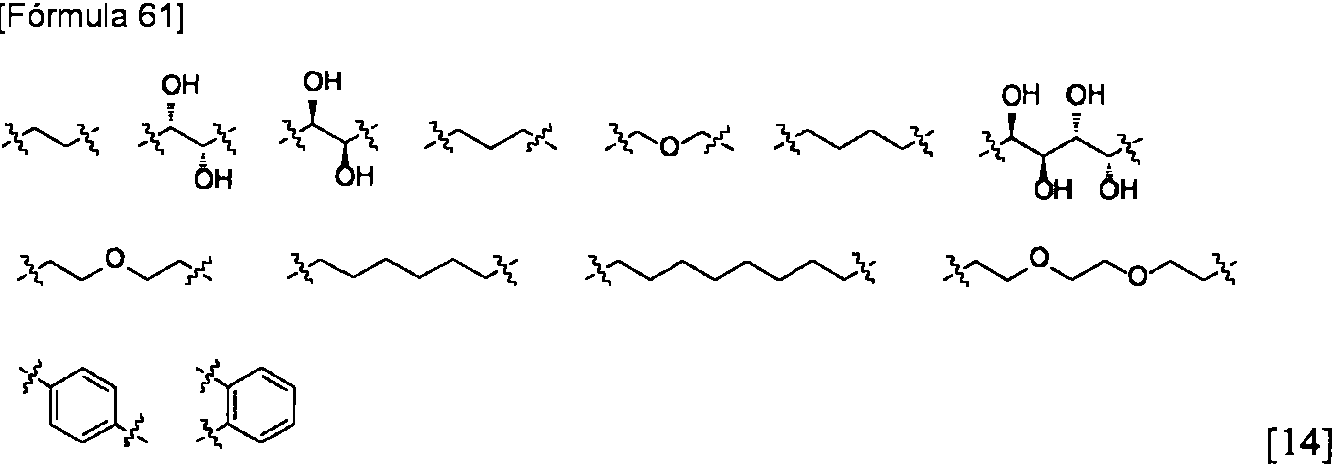
Etapa (7-1):Stage (7-1):
Método para producir el compuesto (7-c): El compuesto (7-c) se puede producir a través de la reacción del compuesto (7-a) como sustrato con el compuesto (7-b) en presencia o ausencia de una base como la trietilamina o N,N-diisopropiletilamina a una temperatura de 0°C a 100°C en un disolvente inerte.Method for producing the compound (7-c): The compound (7-c) can be produced through the reaction of the compound (7-a) as a substrate with the compound (7-b) in the presence or absence of a base such as triethylamine or N, N-diisopropylethylamine at a temperature of 0 ° C to 100 ° C in an inert solvent.
Etapa (7-2):Stage (7-2):
Método para producir el compuesto (7-d): El compuesto (7-d) se puede producir por acción de trifenilfosfina y agua sobre el compuesto (7-b) como sustrato a una temperatura de 0°C a 80°C en un inerte disolvente, o por la acción de paladio sobre carbón activo o similar sobre el mismo en presencia o ausencia de un ácido en una atmósfera de hidrógeno o bajo hidrógeno presurizado.Method for producing the compound (7-d): The compound (7-d) can be produced by the action of triphenylphosphine and water on the compound (7-b) as a substrate at a temperature of 0 ° C to 80 ° C in a inert solvent, or by the action of palladium on active carbon or the like thereon in the presence or absence of an acid in a hydrogen atmosphere or under pressurized hydrogen.
Esquema 8: Método para sintetizar el compuesto (8-d) a partir del compuesto (7-a) Scheme 8: Method for synthesizing the compound (8-d) from the compound (7-a)
[Fórmula 62][Formula 62]
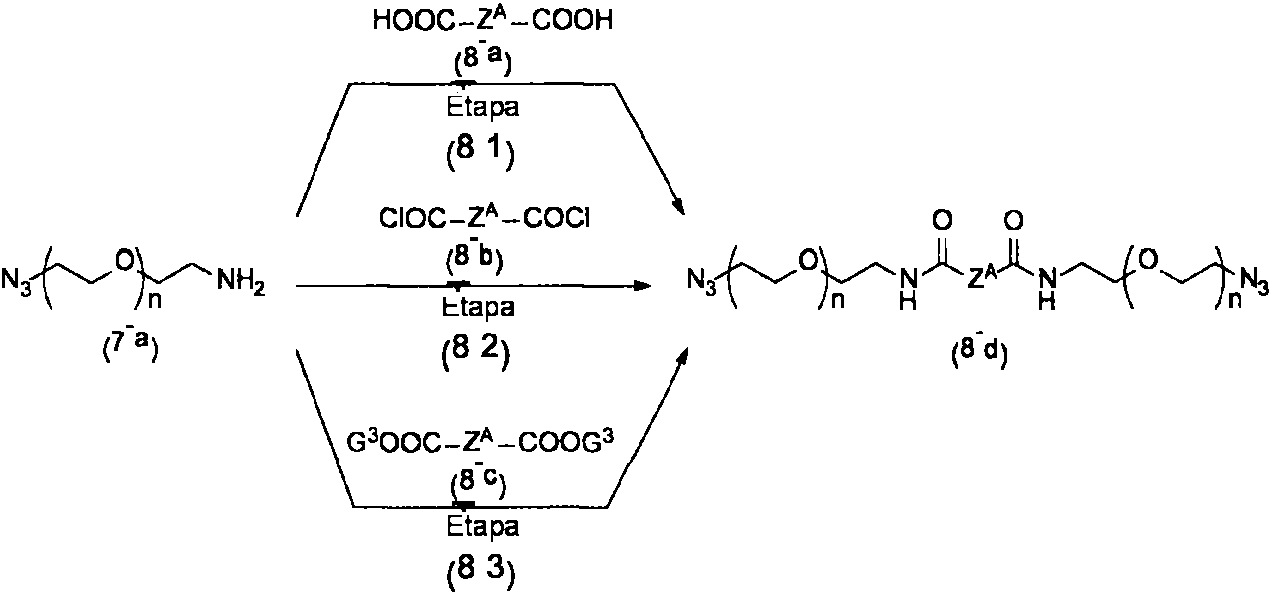
En el esquema, G3 representa un grupo protector para el grupo carboxi, y n y ZA son como se definieron anteriormente.In the scheme, G3 represents a protecting group for the carboxy group, and n and ZA are as defined above.
Etapa (8-1):Stage (8-1):
Método para producir el compuesto (8-d): El compuesto (8-d) se puede producir a través de la reacción del compuesto (7-a) como sustrato con el compuesto (8-a) en presencia de un agente de condensación deshidratante tal como diversas carbodiimidas, azida de ácido difenilfosfórico, sal de benzotriazol-1-iloxi-trisdimetilaminofosfonio o hidrocloruro de 4-(4,6-dimetoxi-1,3,5-triazin-2-il)-4-metilmorfolina y en presencia o ausencia de una base tal como trietilamina o N,N-diisopropiletilamina a una temperatura de 0°C a 80°C en un disolvente inerte.Method for producing the compound (8-d): The compound (8-d) can be produced through the reaction of the compound (7-a) as a substrate with the compound (8-a) in the presence of a condensing agent dehydrating agent such as various carbodiimides, diphenylphosphoric acid azide, benzotriazol-1-yloxy-trisdimethylaminophosphonium salt or 4- (4,6-dimethoxy-1,3,5-triazin-2-yl) -4-methylmorpholine hydrochloride and in presence or absence of a base such as triethylamine or N, N-diisopropylethylamine at a temperature of 0 ° C to 80 ° C in an inert solvent.
Etapa (8-2):Stage (8-2):
Método diferente para producir el compuesto (8-d): El compuesto (8-d) se puede producir a través de la reacción del compuesto (7-a) como sustrato con el compuesto (8-b) en presencia de una base tal como trietilamina o N,N-diisopropiletilamina a una temperatura de 0°C a 80°C en un disolvente inerte.Different method to produce the compound (8-d): The compound (8-d) can be produced through the reaction of the compound (7-a) as a substrate with the compound (8-b) in the presence of a base such as triethylamine or N, N-diisopropylethylamine at a temperature of 0 ° C to 80 ° C in an inert solvent.
Etapa (8-3):Stage (8-3):
Método diferente para producir el compuesto (8-d): El compuesto (8-d) se puede producir a través de la reacción del compuesto (7-a) como sustrato con el compuesto (8-c) en presencia o ausencia de una base tal como trietilamina o N,N-diisopropiletilamina a una temperatura de 0°C a 80°C en un disolvente inerte.Different method to produce the compound (8-d): The compound (8-d) can be produced through the reaction of the compound (7-a) as a substrate with the compound (8-c) in the presence or absence of a base such as triethylamine or N, N-diisopropylethylamine at a temperature of 0 ° C to 80 ° C in an inert solvent.
Esquema 9: Método para sintetizar el compuesto (9-d) a partir del compuesto (2-c)Scheme 9: Method for synthesizing the compound (9-d) from the compound (2-c)
[Fórmula 63][Formula 63]

En el esquema, R2, R11, R12 y n son los definidos anteriormente.In the scheme, R2, R11, R12 and n are those defined above.
Etapa (9-1):Stage (9-1):
Método para producir el compuesto (9-a): El compuesto (9-a) se puede producir a través de la "cicloadición de Huisgen" del compuesto (2-c) y el compuesto (7-a).Method for producing the compound (9-a): The compound (9-a) can be produced through the "Huisgen cycloaddition" of the compound (2-c) and the compound (7-a).
Esquema 10: Método para sintetizar el compuesto (10-i) a partir del compuesto (10-a) Scheme 10: Method for synthesizing the compound (10-i) from the compound (10-a)
[Fórmula 64][Formula 64]

En el esquema, R 2 , 1 R 1 , 1 R 2 , el anillo E y n son como se definieron anteriormente, Hal 1 y 2 Hal son iguales o diferentes y cada uno representa un átomo de halógeno, y G4 representa un grupo protector para el grupo amino. Etapa (10-1):In the scheme, R 2 , 1 R 1 , 1 R 2 , the ring E and n are as defined above, Hal 1 and 2 Hal are the same or different and each represents a halogen atom, and G 4 represents a protective group for the amino group. Stage (10-1):
Método para producir el compuesto (10-c): el compuesto (10-c) se puede producir a través de la reacción del compuesto (10-a) como sustrato con el compuesto (10-b) en presencia o ausencia de una base como la trietilamina , N,N-diisopropiletilamina o carbonato de potasio a una temperatura de 20°C a 180°C en un disolvente inerte.Method for producing the compound (10-c): the compound (10-c) can be produced through the reaction of the compound (10-a) as a substrate with the compound (10-b) in the presence or absence of a base such as triethylamine, N, N-diisopropylethylamine or potassium carbonate at a temperature of 20 ° C to 180 ° C in an inert solvent.
Etapa (10-2):Stage (10-2):
Método para producir el compuesto (10-e): El compuesto (10-e) se puede producir a través de la reacción del compuesto (10-a) como sustrato con el compuesto (10-d) mediante la misma operación que en la etapa (10-1).). Etapa (10-3):Method for producing the compound (10-e): The compound (10-e) can be produced through the reaction of the compound (10-a) as a substrate with the compound (10-d) by the same operation as in the stage (10-1).). Stage (10-3):
Método para producir el compuesto (10-f): El compuesto (10-f) se puede producir mediante la acción de trifenilfosfina y agua sobre el compuesto (10-e) como sustrato a una temperatura de 0°C a 80°C en un disolvente inerte.Method for producing the compound (10-f): The compound (10-f) can be produced by the action of triphenylphosphine and water on the compound (10-e) as a substrate at a temperature of 0 ° C to 80 ° C in an inert solvent.
Etapa (10-4):Stage (10-4):
Diferentes métodos para producir el compuesto (10-c): El compuesto (10-c) se puede producir mediante la protección de un grupo amino en el compuesto (10-f) como sustrato utilizando dicarbonato de di-terc-butilo o similar a una temperatura de 0°C a 80°C en un disolvente inerte. Different methods for producing the compound (10-c): The compound (10-c) can be produced by protecting an amino group in the compound (10-f) as a substrate using di-tert-butyl dicarbonate or the like a temperature of 0 ° C to 80 ° C in an inert solvent.
Etapa (10-5):Stage (10-5):
Método para producir el compuesto (10-g): El compuesto (10-g) se puede producir a través de la "reacción de acoplamiento de Suzuki" del compuesto (10-c) y el compuesto (3-d).Method for producing the compound (10-g): The compound (10-g) can be produced through the "Suzuki coupling reaction" of the compound (10-c) and the compound (3-d).
Etapa (10-6):Stage (10-6):
Método para producir el compuesto (10-h): El compuesto (10-h) se puede producir a través de la "reacción de acoplamiento de Suzuki" del compuesto (10-a) y el compuesto (3-d).Method for producing the compound (10-h): The compound (10-h) can be produced through the "Suzuki coupling reaction" of the compound (10-a) and the compound (3-d).
Etapa (10-7):Stage (10-7):
Método diferente para producir el compuesto (10-g): El compuesto (10-g) se puede producir a través de la reacción del compuesto (10-h) como sustrato con el compuesto (10-b) mediante la misma operación que en la etapa (10-g) 1). Etapa (10-8):Different method to produce the compound (10-g): The compound (10-g) can be produced through the reaction of the compound (10-h) as substrate with the compound (10-b) by the same operation as in the stage (10-g) 1). Stage (10-8):
Método para producir el compuesto (10-i): El compuesto (10-i) se puede producir a través de la reacción de desprotección del compuesto (10-g) como un sustrato utilizando un ácido tal como ácido clorhídrico, ácido bromhídrico o ácido trifluoroacético a una temperatura de 20°C a 100°C en un disolvente inerte, o a través de la reacción de desprotección del mismo utilizando carbón activo con paladio o similar en presencia o ausencia de un ácido en una atmósfera de hidrógeno o bajo hidrógeno presurizado.Method for producing the compound (10-i): The compound (10-i) can be produced through the deprotection reaction of the compound (10-g) as a substrate using an acid such as hydrochloric acid, hydrobromic acid or acid trifluoroacetic at a temperature of 20 ° C to 100 ° C in an inert solvent, or through the deprotection reaction thereof using activated carbon with palladium or the like in the presence or absence of an acid in a hydrogen atmosphere or under pressurized hydrogen.
Etapa (10-9):Stage (10-9):
Método diferente para producir el compuesto (10-i): El compuesto (10-i) se puede producir a través de la reacción del compuesto (10-h) como sustrato con el compuesto (10-j) mediante la misma operación que en la etapa (10-1).Different method to produce the compound (10-i): The compound (10-i) can be produced through the reaction of the compound (10-h) as a substrate with the compound (10-j) by the same operation as in the stage (10-1).
Esquema 11: Método para sintetizar el compuesto (11-f) a partir del compuesto (10-a) Scheme 11: Method for synthesizing the compound (11-f) from the compound (10-a)
[Fórmula 65][Formula 65]

En el esquema, R 2 , 1 R 1 , 1 R 2 , el anillo E, Hall, Hal2, n y G 4 son como se definieron anteriormente.In the scheme, R 2 , 1 R 1 , 1 R 2 , the ring E, Hall, Hal 2, n and G 4 are as defined above.
Etapa (11-1):Stage (11-1):
Método para producir el compuesto (11-b): El compuesto (11-b) se puede producir a través de la reacción del compuesto (10-a) como sustrato con el compuesto (11 -a) en presencia de una base tal como terc-butóxido de potasio a una temperatura de 0°C a 60°C en un disolvente inerte.Method for producing the compound (11-b): The compound (11-b) can be produced through the reaction of the compound (10-a) as a substrate with the compound (11-a) in the presence of a base such as potassium tert-butoxide at a temperature of 0 ° C to 60 ° C in an inert solvent.
Etapa (11-2):Stage (11-2):
Método para producir el compuesto (11-c): El compuesto (11-c) se puede producir con el compuesto (11-b) como sustrato mediante la misma operación que en la etapa (10-3).Method for producing the compound (11-c): The compound (11-c) can be produced with the compound (11-b) as a substrate by the same operation as in the step (10-3).
Etapa (11-3):Stage (11-3):
Método para producir el compuesto (11-d): El compuesto (11-d) se puede producir mediante la protección de un grupo amino en el compuesto (11-c) como sustrato que utiliza dicarbonato de di-terc-butilo o similar a una temperatura de 0°C a 80°C en un solvente inerte.Method for producing the compound (11-d): The compound (11-d) can be produced by protecting an amino group in the compound (11-c) as a substrate using di-tert-butyl dicarbonate or the like a temperature of 0 ° C to 80 ° C in an inert solvent.
Etapa (11-4): Stage (11-4):
Método para producir el compuesto (11-e): El compuesto (11-e) se puede producir a través de la "reacción de acoplamiento de Suzuki" del compuesto (11-d) y el compuesto (3-d).Method for producing the compound (11-e): The compound (11-e) can be produced through the "Suzuki coupling reaction" of the compound (11-d) and the compound (3-d).
Etapa (11-5):Stage (11-5):
Método para producir el compuesto (11-f): El compuesto (11-f) se puede producir con el compuesto (11-e) como sustrato mediante la misma operación que en la etapa (10-8).Method for producing the compound (11-f): The compound (11-f) can be produced with the compound (11-e) as a substrate by the same operation as in step (10-8).
Etapa (11-6):Stage (11-6):
Método para producir el compuesto (11-h): El compuesto (11-h) se puede producir a través de la reacción del compuesto (10-a) como sustrato con el compuesto (11-g) en presencia de una base tal como hidruro de sodio a una temperatura de 0°C a 100°C en un disolvente inerte.Method for producing the compound (11-h): The compound (11-h) can be produced through the reaction of the compound (10-a) as a substrate with the compound (11-g) in the presence of a base such as Sodium hydride at a temperature of 0 ° C to 100 ° C in an inert solvent.
Etapa (11-7):Stage (11-7):
Método para producir el compuesto (11 -i): El compuesto (11 -i) se puede producir a través de la "reacción de acoplamiento de Suzuki" del compuesto (11-h) y el compuesto (3-d).Method for producing the compound (11 -i): The compound (11 -i) can be produced through the "Suzuki coupling reaction" of the compound (11-h) and the compound (3-d).
Etapa (11-8):Stage (11-8):
Diferentes métodos para producir el compuesto (11-f): El compuesto (11-f) se puede producir a través de la reacción de desprotección del compuesto (11 -i) como sustrato que utiliza hidracina o similar a una temperatura de 20°C a 100°C en un disolvente inerte.Different methods for producing the compound (11-f): The compound (11-f) can be produced through the deprotection reaction of the compound (11 -i) as a substrate using hydrazine or the like at a temperature of 20 ° C. at 100 ° C in an inert solvent.
Esquema 12: Método para sintetizar el compuesto (12-f) a partir del compuesto (12-a) [Fórmula 66]Scheme 12: Method for synthesizing the compound (12-f) from the compound (12-a) [Formula 66]

En el esquema, R 2 , 1 R 1 , 1 R 2 , n, Hal1, Hal2, y G 4 son como se definieron anteriormente, y X 1 son iguales o diferentes y cada uno representa la fórmula -CH- o un átomo de nitrógeno.In the scheme, R 2 , 1 R 1 , 1 R 2 , n, Hal 1, Hal 2, and G 4 are as defined above, and X 1 is the same or different and each represents the formula -CH- or an atom of nitrogen.
Etapa (12-1):Stage (12-1):
Método para producir el compuesto (12-c): El compuesto (12-c) se puede producir a través de la reacción del compuesto (12-a) como sustrato con el compuesto (12-b) en presencia de una base como el carbonato de potasio y en presencia o ausencia de yoduro de tetrabutilamonio a una temperatura de 0°C a 160°C en un disolvente inerte. Etapa (12-2): Method for producing the compound (12-c): The compound (12-c) can be produced through the reaction of the compound (12-a) as a substrate with the compound (12-b) in the presence of a base such as potassium carbonate and in the presence or absence of tetrabutylammonium iodide at a temperature of 0 ° C to 160 ° C in an inert solvent. Stage (12-2):
Método para producir el compuesto (12-d): El compuesto (12-d) se puede producir a través de la "reacción de acoplamiento de Suzuki" del compuesto (12-c) y el compuesto (3-d).Method for producing the compound (12-d): The compound (12-d) can be produced through the "Suzuki coupling reaction" of the compound (12-c) and the compound (3-d).
Etapa (12-3):Stage (12-3):
Método diferente para producir el compuesto (12-d): El compuesto (12-d) se puede producir a través de la reacción del compuesto (12-a) como sustrato con el compuesto (12-e) en presencia de una base tal como carbonato de potasio y en presencia o ausencia de yoduro de tetrabutilamonio a una temperatura de 0°C a 160°C en un disolvente inerte.Different method to produce the compound (12-d): The compound (12-d) can be produced through the reaction of the compound (12-a) as a substrate with the compound (12-e) in the presence of a base such as potassium carbonate and in the presence or absence of tetrabutylammonium iodide at a temperature of 0 ° C to 160 ° C in an inert solvent.
Etapa (12-4):Stage (12-4):
Método para producir el compuesto (12-f): El compuesto (12-f) se puede producir con el compuesto (12-d) como sustrato mediante la misma operación que en la etapa (10-8).Method for producing the compound (12-f): The compound (12-f) can be produced with the compound (12-d) as a substrate by the same operation as in step (10-8).
Esquema 13: Método para sintetizar el compuesto (13-e) a partir del compuesto (4-a)Scheme 13: Method for synthesizing the compound (13-e) from the compound (4-a)
[Fórmula 67][Formula 67]
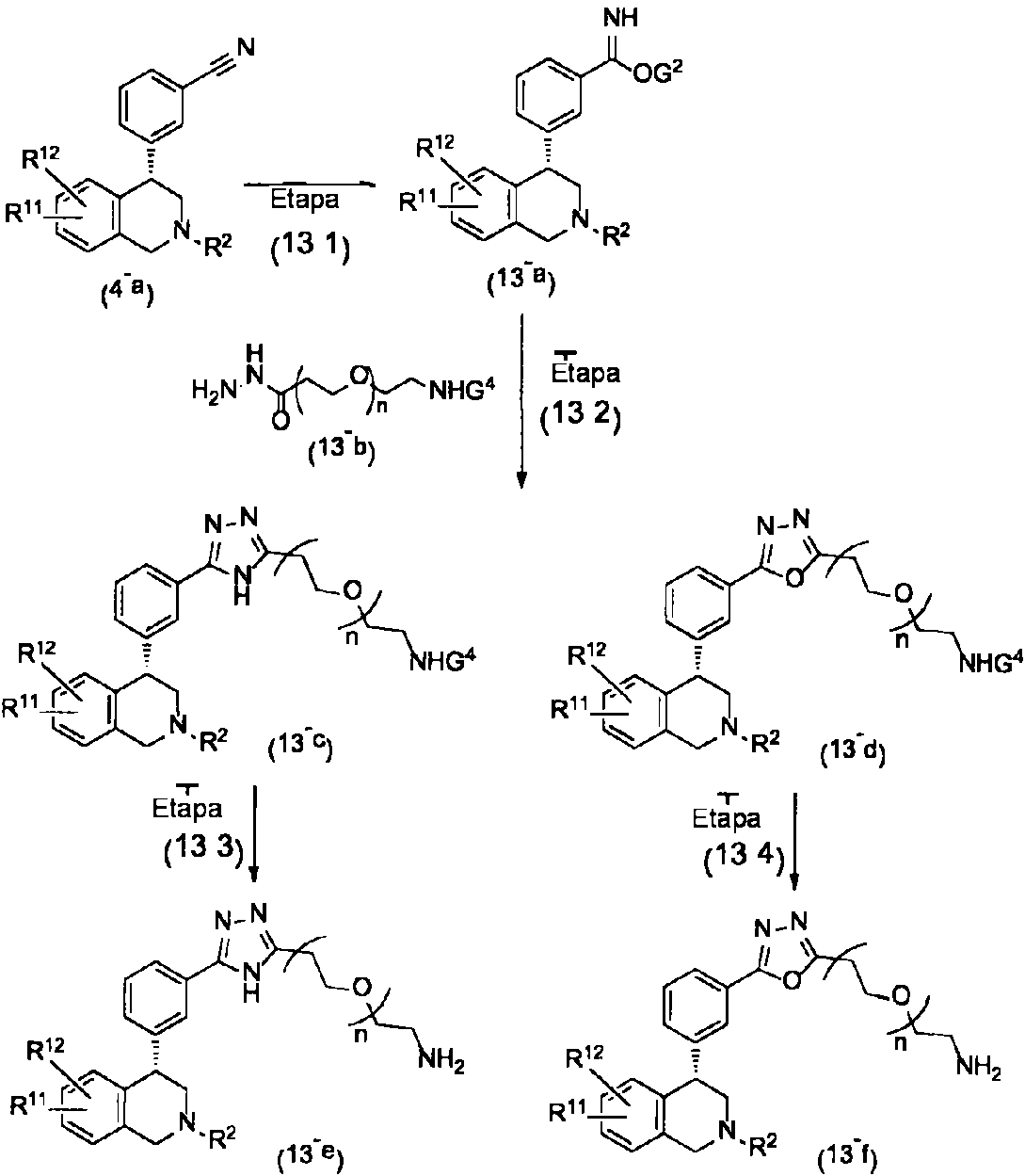
En el esquema, R 2 , R 11 , R 12 , n, G 2 y G 4 son como se definieron anteriormente.In the scheme, R 2 , R 11 , R 12 , n, G 2 and G 4 are as defined above.
Etapa (13-1):Stage (13-1):
Método para producir el compuesto (13-a): El compuesto (13-a) se puede producir mediante la acción de un alcóxido de metal alcalino tal como metóxido de sodio, un ácido como ácido clorhídrico o cloruro de acetilo, etc., sobre el compuesto (4-a) como sustrato a una temperatura de 0°C a 80°C en un alcohol disolvente tal como metanol o etanol.Method for producing the compound (13-a): The compound (13-a) can be produced by the action of an alkali metal alkoxide such as sodium methoxide, an acid such as hydrochloric acid or acetyl chloride, etc., on the compound (4-a) as a substrate at a temperature of 0 ° C to 80 ° C in a solvent alcohol such as methanol or ethanol.
Etapa (13-2):Stage (13-2):
Método para producir el compuesto (13-c) o el compuesto (13-d): El compuesto (13-c) o el compuesto (13-d) se pueden producir a través de la reacción del compuesto (13-a) como sustrato con el compuesto (13-b) a una temperatura de 20°C a 160°C en un disolvente inerte. Cada compuesto obtenido se puede aislar mediante resolución utilizando cromatografía en columna de gel de sílice, HPLC o similares.Method for producing the compound (13-c) or the compound (13-d): The compound (13-c) or the compound (13-d) is they can produce through the reaction of the compound (13-a) as a substrate with the compound (13-b) at a temperature of 20 ° C to 160 ° C in an inert solvent. Each compound obtained can be isolated by resolution using silica gel column chromatography, HPLC or the like.
Etapa (13-3):Stage (13-3):
Método para producir el compuesto (13-e): El compuesto (12-f) se puede producir con el compuesto (13-c) como sustrato mediante la misma operación que en la etapa (10-8).Method for producing the compound (13-e): The compound (12-f) can be produced with the compound (13-c) as a substrate by the same operation as in step (10-8).
Etapa (13-4):Stage (13-4):
Método para producir el compuesto (13-f): El compuesto (13-f) se puede producir con el compuesto (13-d) como sustrato mediante la misma operación que en la etapa (10-8).Method for producing the compound (13-f): The compound (13-f) can be produced with the compound (13-d) as a substrate by the same operation as in the step (10-8).
Esquema 14: Método para sintetizar el compuesto (14-e) a partir del compuesto (14-a) [Fórmula 68]Scheme 14: Method for synthesizing the compound (14-e) from the compound (14-a) [Formula 68]
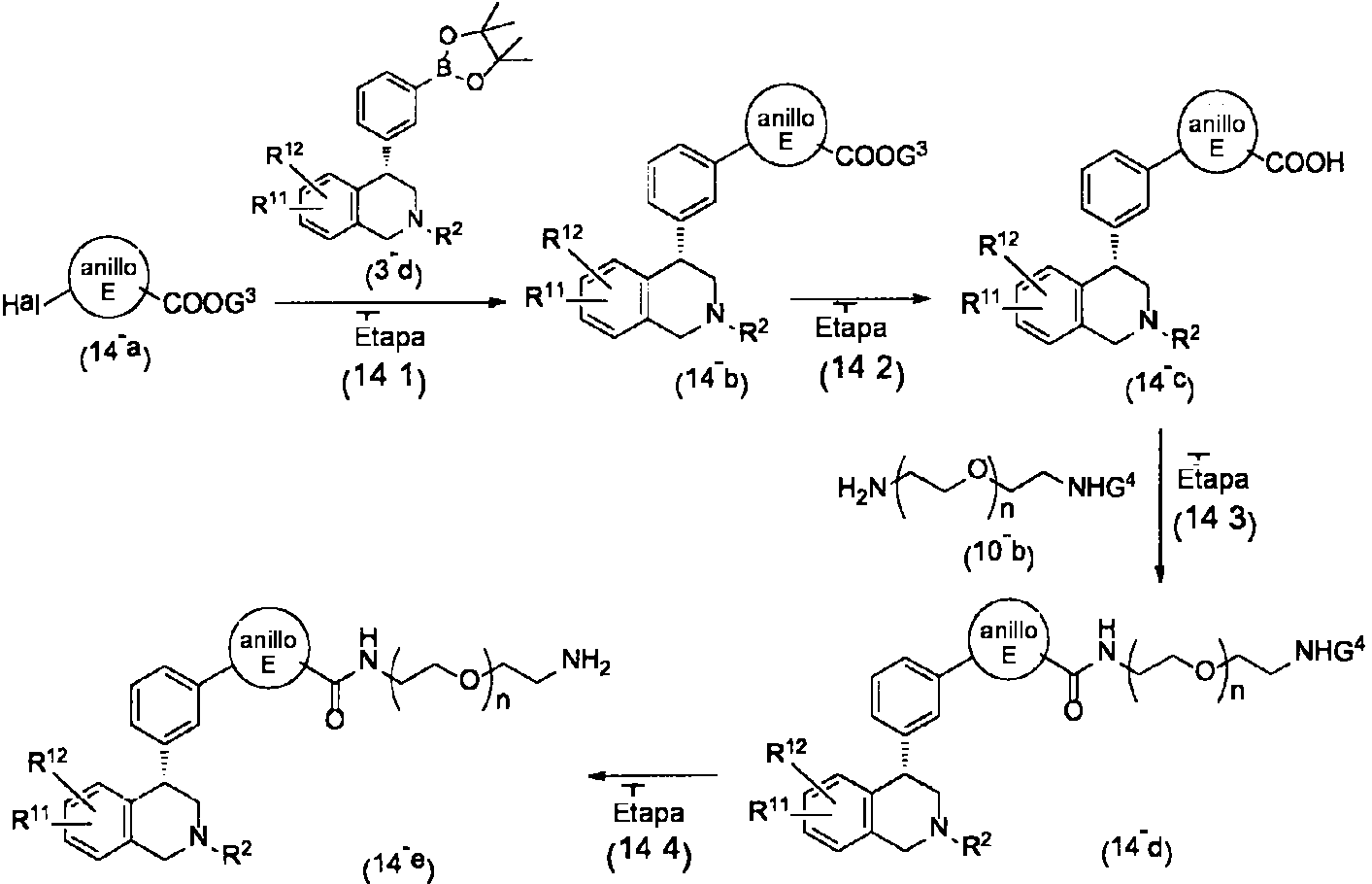
1 y o En el esquema, y 11 R , R , R , el anillo E, Hal, G , G a y n son los definidos anteriormente. 1 yo In the scheme, and 11 R, R, R, the ring E, Hal, G, G a and n are defined above.
Etapa (14-1):Stage (14-1):
Método para producir el compuesto (14-b): El compuesto (14-b) se puede producir a través de la "reacción de acoplamiento de Suzuki" del compuesto (14-a) y el compuesto (3-d).Method for producing the compound (14-b): The compound (14-b) can be produced through the "Suzuki coupling reaction" of the compound (14-a) and the compound (3-d).
Etapa (14-2):Stage (14-2):
Método para producir el compuesto (14-c): El compuesto (14-c) se puede producir por acción de hidróxido de litio o hidróxido de sodio, etc., sobre el compuesto (14-b) como sustrato a una temperatura de 0°C a 100°C en un disolvente inerte.Method for producing the compound (14-c): The compound (14-c) can be produced by the action of lithium hydroxide or sodium hydroxide, etc., on the compound (14-b) as a substrate at a temperature of 0. ° C at 100 ° C in an inert solvent.
Etapa (14-3):Stage (14-3):
Método diferente para producir el compuesto (14-d): El compuesto (14-d) se puede producir a través de la reacción del compuesto (14-c) como sustrato con el compuesto (10-b) mediante la misma operación que en la etapa (8-1). Etapa (14-4):Different method to produce the compound (14-d): The compound (14-d) can be produced through the reaction of the compound (14-c) as a substrate with the compound (10-b) by the same operation as in the stage (8-1). Stage (14-4):
El compuesto (14-e) se puede producir con el compuesto (14-d) como sustrato mediante la misma operación que en la etapa (10-8). The compound (14-e) can be produced with the compound (14-d) as a substrate by the same operation as in step (10-8).
Esquema 15: Método para sintetizar el compuesto (15-b) a partir del compuesto (15-a) [Fórmula 69]Scheme 15: Method for synthesizing the compound (15-b) from the compound (15-a) [Formula 69]

En el esquema, Z 1 , R 2 , R 11 , R 12 y n son los definidos anteriormente.In the scheme, Z 1 , R 2 , R 11 , R 12 and n are those defined above.
Etapa (15-1):Stage (15-1):
Método para producir el compuesto (15-b): El compuesto (15-b) se puede producir a través de la "cicloadición de Huisgen" del compuesto (15-a) y el compuesto (2-c).Method for producing the compound (15-b): The compound (15-b) can be produced through the "Huisgen cycloaddition" of the compound (15-a) and the compound (2-c).
Esquema 16: Método para sintetizar el compuesto (16-b) a partir del compuesto (16-a) [Fórmula 70]Scheme 16: Method for synthesizing the compound (16-b) from the compound (16-a) [Formula 70]

2 1 1 1 2 AEn el esquema, R , R , R , el anillo E, W, n, y Z son como se definieron anteriormente. 2 1 1 1 2 A In the scheme, R, R, R, the ring E, W, n, and Z are as defined above.
Etapa (16-1):Stage (16-1):
Método para producir el compuesto (16-b): El compuesto (16-b) se puede producir a través de la reacción del compuesto (16-a) como sustrato con el compuesto (7-b) mediante la misma operación que en la etapa (7-1).Method for producing the compound (16-b): The compound (16-b) can be produced through the reaction of the compound (16-a) as a substrate with the compound (7-b) by the same operation as in the stage (7-1).
Método para producir el compuesto (16-d): El compuesto (16-d) se puede producir a través de la reacción del compuesto (16-a) como sustrato con el compuesto (16-c) en presencia o ausencia de una base tal como trietilamina. o N,N-diisopropiletilamina a una temperatura de 0°C a 160°C en un disolvente inerte.Method for producing the compound (16-d): The compound (16-d) can be produced through the reaction of the compound ( 16 -a) as a substrate with the compound (16-c) in the presence or absence of a base such as triethylamine. or N, N-diisopropylethylamine at a temperature of 0 ° C to 160 ° C in an inert solvent.
Método diferente para producir el compuesto (16-b): El compuesto (16-b) se puede producir a través de la reacción del compuesto (16-d) como sustrato con el compuesto (16-e) en presencia o ausencia de una base tal como trietilamina o N,N-diisopropiletilamina a una temperatura de 0°C a 160°C en un disolvente inerte. Different method to produce the compound (16-b): The compound (16-b) can be produced through the reaction of the compound (16-d) as a substrate with the compound (16-e) in the presence or absence of a base such as triethylamine or N, N-diisopropylethylamine at a temperature of 0 ° C to 160 ° C in an inert solvent.
Esquema 17: Método para sintetizar el compuesto (17-a) a partir del compuesto (16-a)Scheme 17: Method for synthesizing the compound (17-a) from the compound (16-a)

En el es , 1 R 1 , 1 R 2 , el anillo E, W, n, Z A , y G 3quema, R 2 son como se definieron anteriormente.In the es, 1 R 1 , 1 R 2 , the ring E, W, n, Z A , and G 3 burn, R 2 are as defined above.
Etapa (17-1):Stage (17-1):
Método para producir el compuesto (17-a): El compuesto (17-a) se puede producir a través de la reacción del compuesto (16-a) como sustrato con el compuesto (8-a) mediante la misma operación que en la etapa (8-1). Method for producing the compound (17-a): The compound (17-a) can be produced through the reaction of the compound ( 16 -a) as a substrate with the compound (8-a) by the same operation as in the stage (8-1).
Etapa (17-2):Stage (17-2):
Método diferente para producir el compuesto (17-a): El compuesto (17-a) se puede producir a través de la reacción del compuesto (16-a) como sustrato con el compuesto (8-b) mediante la misma operación que en la etapa (8-2). Etapa (17-3):Different method to produce the compound (17-a): The compound (17-a) can be produced through the reaction of the compound (16-a) as a substrate with the compound (8-b) by the same operation as in the stage (8-2). Stage (17-3):
Método diferente para producir el compuesto (17-a): El compuesto (17-a) se puede producir a través de la reacción del compuesto (16-a) como sustrato con el compuesto (8-c) mediante la misma operación que en la etapa (8-3). Different method to produce the compound (17-a): The compound (17-a) can be produced through the reaction of the compound (16-a) as a substrate with the compound (8-c) by the same operation as in the stage (8-3).
Esquema 18: Método para sintetizar el compuesto (18-c) a partir del compuesto (18-a)Scheme 18: Method for synthesizing the compound (18-c) from the compound (18-a)
[Fórmula 72][Formula 72]
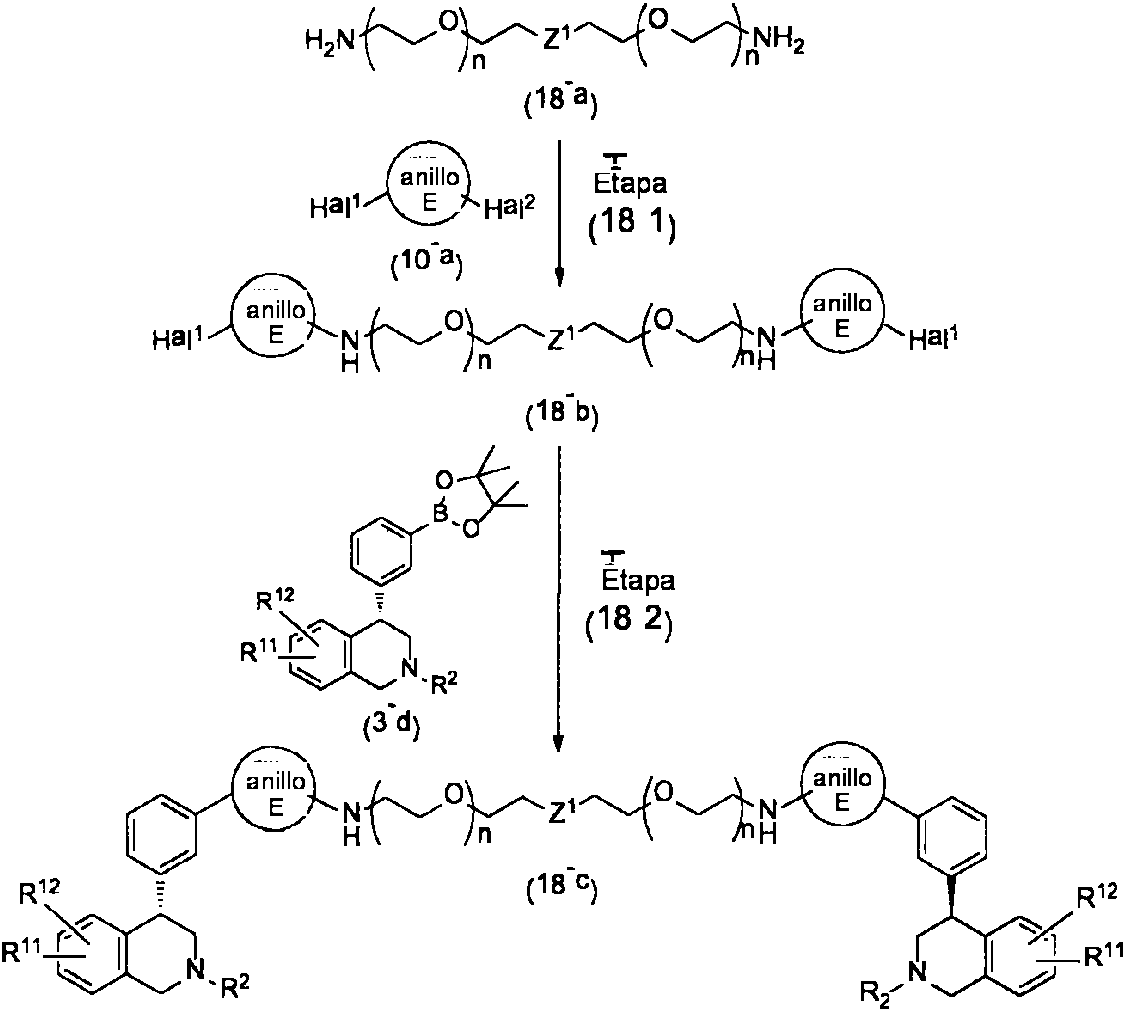
En el esquema, n, z1, Hall, Hal2, el anillo E, R 2 , R 11 y R 12 son como se definieron anteriormente.In the scheme, n, z1, Hall, Hal2, the ring E, R 2 , R 11 and R 12 are as defined above.
Etapa (18-1):Stage (18-1):
Método para producir el compuesto (18-b): El compuesto (18-b) se puede producir a través de la reacción del compuesto (18-a) como sustrato con el compuesto (10-a) mediante la misma operación que en la etapa (10-1). Method for producing the compound (18-b): The compound (18-b) can be produced through the reaction of the compound ( 18 -a) as a substrate with the compound (10-a) by the same operation as in the stage (10-1).
Etapa (18-2):Stage (18-2):
Método para producir el compuesto (18-c): El compuesto (18-c) se puede producir a través de la "reacción de acoplamiento de Suzuki" del compuesto (18-b) y el compuesto (3-d).Method for producing the compound (18-c): The compound (18-c) can be produced through the "Suzuki coupling reaction" of the compound (18-b) and the compound (3-d).

En el esquema, n, R 2 , 1 R 1 y 1 R 2 son como se definieron anteriormente, n 2 representa 4 y Z B representa una estructura representada por la siguiente fórmula [15]: In the scheme, n, R 2 , 1 R 1 and 1 R 2 are as defined above, n 2 represents 4 and Z B represents a structure represented by the following formula [15]:
[Fórmula 74][Formula 74]

Etapa (19-1):Stage (19-1):
Método para producir el compuesto (19-b): El compuesto (19-b) se puede producir a través de la reacción del compuesto (7-a) como sustrato con el compuesto (19-a) mediante la misma operación que en la etapa (8-1).Method for producing the compound (19-b): The compound (19-b) can be produced through the reaction of the compound (7-a) as a substrate with the compound (19-a) by the same operation as in the stage (8-1).
Etapa (19-2):Stage (19-2):
Método para producir el compuesto (19-c): El compuesto (19-c) se puede producir a través de la "cicloadición de Huisgen" del compuesto (19-b) y el compuesto (2-c).Method for producing the compound (19-c): The compound (19-c) can be produced through the "Huisgen cycloaddition" of the compound (19-b) and the compound (2-c).
La temperatura de reacción en los métodos generales para producir el compuesto de la presente invención es de -78°C a 250°C, preferiblemente de -20°C a 80°C. El tiempo de reacción es de 5 minutos a 3 días, preferiblemente de 30 minutos a 18 horas. Estos métodos de producción pueden llevarse a cabo a presión normal, a presión incrementada, bajo radiación de microondas, etc.The reaction temperature in the general methods for producing the compound of the present invention is from -78 ° C to 250 ° C, preferably from -20 ° C to 80 ° C. The reaction time is from 5 minutes to 3 days, preferably from 30 minutes to 18 hours. These production methods can be carried out at normal pressure, at increased pressure, under microwave radiation, etc.
La base, el ácido y el disolvente inerte descritos en los métodos generales para producir el compuesto de la presente invención se describirán más específicamente, pero no se limitan a los ejemplos siguientes. Además, se describirá específicamente un enfoque de aislamiento que se puede utilizar, pero no se limita a los ejemplos siguientes.The base, the acid and the inert solvent described in the general methods for producing the compound of the present invention will be described more specifically, but are not limited to the following examples. In addition, an isolation approach that can be used will be specifically described, but is not limited to the following examples.
Los ejemplos de la "base" incluyen: bases inorgánicas tales como hidruros de metales alcalinos o alcalinotérreos (hidruro de litio, hidruro de sodio, hidruro de potasio, hidruro de calcio, etc.), amiduros de metales alcalinos o alcalinotérreos (amiduro de litio, amiduro de sodio, diisopropilamiduro de litio, diciclohexilamiduro de litio, hexametildisilazida de litio, hexametildisilazida de potasio, etc.), hidróxidos de metales alcalinos o alcalinotérreos (hidróxido de sodio, hidróxido de potasio, hidróxido de litio, hidróxido de bario, etc.), carbonatos de metales alcalinos o metales alcalino o de metales alcalinotérreos, carbonato de potasio, carbonato de calcio, carbonato de cesio, etc.), bicarbonatos de metales alcalinos (bicarbonato de sodio, bicarbonato de potasio, etc.) y fosfatos de metales alcalinos o alcalinotérreos (fosfato tripotásico, etc.); alcóxidos C1-C15 de metales alcalinos o de metales alcalinotérreos (metóxido de sodio, etóxido de sodio, terc-butóxido de potasio, etc.); aminas (trietilamina, N,N-diisopropiletilamina, N-metilmorfolina, etc.); y compuestos heterocíclicos alcalinos (piridina, 4-dimetilaminopiridina, DBU (1,8-diazabiciclo[5,4,0]undec-7-eno), d Bn (1,5-diazabiciclo[4,3,0]non-5-eno), imidazol, 2,6-lutidina, etc.).Examples of the "base" include: inorganic bases such as alkali metal or alkaline earth metal hydrides (lithium hydride, sodium hydride, potassium hydride, calcium hydride, etc.), alkali metal or alkaline earth metal amidides (lithium amide) , sodium amide, lithium diisopropylamide, lithium dicyclohexylamide, lithium hexamethyldisilazide, potassium hexamethyldisilazide, etc.), alkali or alkaline earth metal hydroxides (sodium hydroxide, potassium hydroxide, lithium hydroxide, barium hydroxide, etc.). ), carbonates of alkali metals or alkali metals or alkaline earth metals, potassium carbonate, calcium carbonate, cesium carbonate, etc.), alkali metal bicarbonates (sodium bicarbonate, potassium bicarbonate, etc.) and metal phosphates alkaline or alkaline earth (tripotassium phosphate, etc.); C 1 -C 15 alkoxides of alkali metals or alkaline earth metals (sodium methoxide, sodium ethoxide, potassium tert-butoxide, etc.); amines (triethylamine, N, N-diisopropylethylamine, N-methylmorpholine, etc.); and alkali heterocyclic compounds (pyridine, 4-dimethylaminopyridine, DBU (1,8-diazabicyclo [5.4.0] undec-7-ene), d Bn (1,5-diazabicyclo [4.3.0] non-5 -eno), imidazole, 2,6-lutidine, etc.).
Los ejemplos del "ácido" incluyen ácidos inorgánicos (ácido clorhídrico, ácido bromhídrico, ácido sulfúrico, ácido nítrico, ácido fosfórico, etc.), ácidos orgánicos (ácido p-toluensulfónico, ácido metanosulfónico, ácido trifluoroacético, ácido fórmico, ácido acético, ácido canfosulfónico, etc.), y ácidos de Lewis(trifluoruro de boro, tribromuro de boro, cloruro de aluminio, triflato de escandio, triflato de iterbio, etc.).Examples of the "acid" include inorganic acids (hydrochloric acid, hydrobromic acid, sulfuric acid, nitric acid, phosphoric acid, etc.), organic acids (p-toluenesulfonic acid, methanesulfonic acid, trifluoroacetic acid, formic acid, acetic acid, acid camphorsulfonic, etc.), and Lewis acids (boron trifluoride, boron tribromide, aluminum chloride, scandium triflate, ytterbium triflate, etc.).
El "disolvente inerte" no está particularmente limitado siempre que el disolvente no inhiba la reacción y disuelva el material de partida en cierta medida. Sus ejemplos incluyen nitrilos disolventes, amidas disolventes, disolventes halocarbonados, éteres disolventes, disolventes aromáticos, disolventes hidrocarbonados, ésteres disolventes, alcoholes disolventes, sulfóxidos disolventes y agua. Se pueden utilizar dos o más de estos disolventes como una mezcla en una proporción arbitraria.The "inert solvent" is not particularly limited as long as the solvent does not inhibit the reaction and dissolve the starting material to some extent. Examples thereof include nitrile solvents, solvent amides, halocarbon solvents, solvent ethers, aromatic solvents, hydrocarbon solvents, solvent esters, solvent alcohols, solvent sulfoxides and water. Two or more of these solvents can be used as a mixture in an arbitrary ratio.
Los ejemplos de los nitrilos disolvente de incluyen acetonitrilo y propionitrilo. Los ejemplos de las amidas disolventes incluyen N,N-dimetilformamida (de aquí en adelante, también abreviada como Dm F), N,N-dimetilacetamida y N-metilpirrolidona. Los ejemplos de los disolventes halocarbonados incluyen diclorometano, cloroformo, 1,2-dicloroetano y tetracloruro de carbono. Los ejemplos de los éteres disolventes incluyen éter dietílico (de aquí en adelante, también abreviado como "éter"), tetrahidrofurano (de aquí en adelante, también abreviado como THF), 1,4-dioxano y 1,2-dimetoxietano. Los ejemplos de los disolventes aromáticos incluyen benceno, tolueno, xileno y piridina. Los ejemplos de los disolventes hidrocarbonados incluyen pentano, hexano, heptano y ciclohexano. Los ejemplos de los ésteres disolventes incluyen acetato de etilo y formiato de etilo. Los ejemplos de los alcoholes disolventes incluyen metanol, etanol, alcohol isopropílico, alcohol terc-butílico y etilenglicol. Los ejemplos de los sulfóxidos disolventes incluyen dimetilsulfóxido (en lo sucesivo, también abreviado como DMSO).Examples of solvent nitriles include acetonitrile and propionitrile. Examples of the solvent amides include N, N-dimethylformamide (hereinafter also abbreviated as Dm F), N, N-dimethylacetamide and N-methylpyrrolidone. Examples of halocarbon solvents include dichloromethane, chloroform, 1,2-dichloroethane and carbon tetrachloride. Examples of the solvent ethers include diethyl ether (hereinafter also abbreviated as "ether"), tetrahydrofuran (hereinafter also abbreviated as THF), 1,4-dioxane and 1,2-dimethoxyethane. Examples of the aromatic solvents include benzene, toluene, xylene and pyridine. Examples of the hydrocarbon solvents include pentane, hexane, heptane and cyclohexane. Examples of the solvent esters include ethyl acetate and ethyl formate. Examples of the solvent alcohols include methanol, ethanol, isopropyl alcohol, tert-butyl alcohol and ethylene glycol. Examples of the solvent sulfoxides include dimethyl sulfoxide (hereinafter also abbreviated as DMSO).
Los compuestos obtenidos mediante los métodos de producción descritos anteriormente se pueden aislar y purificar mediante un método conocido en la técnica, por ejemplo, extracción con disolventes, conversión de líquidos, disolución, cristalización, recristalización o diversas técnicas de cromatografía.The compounds obtained by the production methods described above can be isolated and purified by a method known in the art, for example, solvent extraction, liquid conversion, dissolution, crystallization, recrystallization or various chromatography techniques.
Los grupos protectores que se pueden utilizar para los compuestos en la producción general del compuesto de la presente invención se describirán a continuación, pero no se limitan a los ejemplos siguientes. Se puede seleccionar cualquiera de los otros grupos protectores apropiados.The protecting groups that can be used for the compounds in the general production of the compound of the present invention will be described below, but are not limited to the following examples. Any of the other appropriate protecting groups can be selected.
Los ejemplos del grupo protector para amino incluyen acilo C1-C6 (formilo, acetilo, propionilo, etc.), alcoxi(C2-C15)carbonilo (metoxicarbonilo, etoxicarbonilo, terc-butoxicarbonilo, benciloxicarbonilo, 9-fluorenilmetiloxicarbonilo), arilcarbonilo (benzoilo, etc.), tritilo, ftaloilo, N,N-dimetilaminometileno, sililo sustituido (trimetilsililo, trietilsililo, dimetilfenilsililo, terc-butildietilsililo, terc-butildifenilsililo, etc.) y alquenilo C2-C6 (1-alilo, etc.), que se utilizan generalmente en la síntesis de péptidos. Cada uno de estos grupos puede estar sustituido con uno o más sustituyentes seleccionados entre un átomo de halógeno, alcoxi C1-C6 (metoxi, etoxi, propoxi, etc.) y nitro. Examples of the protective group for amino include C 1 -C 6 acyl (formyl, acetyl, propionyl, etc.), ( C 2 -C 15) alkoxycarbonyl (methoxycarbonyl, ethoxycarbonyl, tert-butoxycarbonyl, benzyloxycarbonyl, 9-fluorenylmethyloxycarbonyl), arylcarbonyl ( benzoyl, etc.), trityl, phthaloyl, N, N-dimethylaminomethylene, substituted silyl (trimethylsilyl, triethylsilyl, dimethylphenylsilyl, tert-butyldiethylsilyl, tert-butyldiphenylsilyl, etc.) and C2-C6 alkenyl (1-allyl, etc.), which are generally used in the synthesis of peptides. Each of these groups can be substituted with one or more substituents selected from a halogen atom, C 1 -C 6 alkoxy (methoxy, ethoxy, propoxy, etc.) and nitro.
Los ejemplos del grupo protector para carboxi incluyen alquilo C1-C6 (metilo, etilo, terc-butilo, etc.), aralquilo C7-C20 (bencilo, tritilo, etc.), fenilo, sililo sustituido (trimetilsililo, trietilsililo, dimetilfenilsililo, terc-butildimetilsililo, tercbutildietilsililo, terc-butildifenilsililo, etc.), y alquenilo C2-C6 (1-alilo, etc.). Cada uno de estos grupos puede estar sustituido por uno o más sustituyentes seleccionados entre un átomo de halógeno, alcoxi C1-C6 (metoxi, etoxi, propoxi, etc.) y nitro. Examples of the protective group for carboxy include C 1 -C 6 alkyl (methyl, ethyl, tert-butyl, etc.), C 7 -C 20 aralkyl (benzyl, trityl, etc.), phenyl, substituted silyl (trimethylsilyl, triethylsilyl, dimethylphenylsilyl , tert-butyldimethylsilyl, tert-butyldiethylsilyl, tert-butyldiphenylsilyl, etc.), and C2-C6 alkenyl (1-allyl, etc.). Each of these groups can be substituted by one or more substituents selected from a halogen atom, C 1 -C 6 alkoxy (methoxy, ethoxy, propoxy, etc.) and nitro.
Los ejemplos del grupo protector para hidroxi incluyen alquilo C1-C6 (metilo, etilo, terc-butilo, etc.), aralquilo C7-C20 (bencilo, tritilo, etc.), fenilo, sililo sustituido (trimetilsililo, trietilsililo, dimetilfenilsililo, terc-butildimetilsililo, terc-butildietilsililo, terc-butildifenilsililo, etc.), alquenilo C2-C6 (1-alilo, etc.), acilo C1-C6 (formilo, acetilo, propionilo, etc.), alcoxi(C2-C15)carbonilo (metoxicarbonilo, etoxicarbonilo, terc-butoxicarbonilo, benciloxicarbonilo, 9-fluorenilmetiloxicarbonilo, etc.), arilcarbonilo (benzoílo, etc.), 2-tetrahidropiranilo y 2-tetrahidrofurilo. Cada uno de estos grupos puede estar sustituido por uno o más sustituyentes seleccionados de un átomo de halógeno, alcoxi C1-C6 (metoxi, etoxi, propoxi, etc.) y nitro. Examples of the protecting group for hydroxy include C 1 -C 6 alkyl (methyl, ethyl, tert-butyl, etc.), C 7 -C 20 aralkyl (benzyl, trityl, etc.), phenyl, substituted silyl (trimethylsilyl, triethylsilyl, dimethylphenylsilyl , tert-butyldimethylsilyl, tert- butyldiethylsilyl, tert-butyldiphenylsilyl, etc.), C2-C6 alkenyl (1-allyl, etc.), C 1 -C 6 acyl (formyl, acetyl, propionyl, etc.), alkoxy (C 2 -C15) carbonyl (methoxycarbonyl, ethoxycarbonyl, tert-butoxycarbonyl, benzyloxycarbonyl, 9-fluorenylmethyloxycarbonyl, etc.), arylcarbonyl (benzoyl, etc.), 2-tetrahydropyranyl and 2-tetrahydrofuryl. Each of these groups can be substituted by one or more substituents selected from a halogen atom, C 1 -C 6 alkoxy (methoxy, ethoxy, propoxy, etc.) and nitro.
El carbonilo se puede proteger, por ejemplo, formando acetal cíclico (1,3-dioxano, 1,3-dioxolano, etc.) o acetal no cíclico (dialquil(C1-C6)acetal (dimetilacetal, dietilacetal, etc.)). The carbonyl can be protected, for example, by forming cyclic acetal (1,3-dioxane, 1,3-dioxolane, etc.) or non- cyclic acetal (dialkyl (C 1 -C 6 ) acetal (dimethylacetal, diethylacetal, etc.) ).
La presente invención se describirá con más detalle a continuación con referencia a los Ejemplos de Referencia, los Ejemplos, los Ejemplos de Ensayo y los Ejemplos de Formulación. Sin embargo, no se pretende que la presente invención esté limitada por estos ejemplos, y pueden realizarse diversos cambios o modificaciones sin apartarse del alcance de la presente invención.The present invention will be described in more detail below with reference to the Reference Examples, the Examples, the Test Examples and the Formulation Examples. However, it is not intended that the present invention be limited by these examples, and various changes or modifications may be made without departing from the scope of the present invention.
La presente invención se describirá con más detalle a continuación con referencia a los Ejemplos de Referencia, los Ejemplos y los Ejemplos de Ensayo. Sin embargo, no se pretende que la presente invención esté limitada por estos ejemplos, y pueden realizarse diversos cambios o modificaciones sin apartarse del alcance de la presente invención. Los espectros de RMN (resonancia magnética nuclear) se midieron a temperatura ambiente a 200 MHz (GEMINI 2000/200, Varian Instruments) 300 MHz (INOVA 300, Varian Instruments, JEOL JNM-ECP300, JEOL Ltd. o JEOL JNM-ECX 300, JEOL Ltd.), 500 MHz (JEOL ECA 500 o JEOL JNM-ECP 500, JEOL Ltd.), o 600 MHz (JEOL JNM-ECA 600, JEOL Ltd.). Los valores de desplazamiento químico en la presente memoria descriptiva se indicaron en valores de partes por millón (ó) con respecto a un patrón interno (tetrametilsilano).The present invention will be described in more detail below with reference to Reference Examples, Examples and Test Examples. However, it is not intended that the present invention be limited by these examples, and various changes or modifications may be made without departing from the scope of the present invention. The NMR spectra (nuclear magnetic resonance) were measured at room temperature at 200 MHz (GEMINI 2000/200, Varian Instruments) 300 MHz (INOVA 300, Varian Instruments, JEOL JNM-ECP300, JEOL Ltd. or JEOL JNM-ECX 300, JEOL Ltd.), 500 MHz (JEOL ECA 500 or JEOL JNM-ECP 500, JEOL Ltd.), or 600 MHz (JEOL JNM-ECA 600, JEOL Ltd.). The values of chemical shift in the present specification were indicated in values of parts per million (or) with respect to an internal standard (tetramethylsilane).
Los espectros de masas se midieron con Waters Micromass ZQ (ESI: ionización por electronebulización), Detector Waters Acquity SQ (ESI: ionización por electronebulización), Thermo SCIENTIFIC LTQ XL (ESI: ionización por electronebulización), espectrómetro de masas Micromass GCT (EI: ionización electrónica), Shimadzu LCMS-2010EV espectrómetro de masas (ESI: ionización por electronebulización/APCI: ionización química a presión atmosférica dual), espectrómetro de masas Shimadzu LCMS-IT-TOF (ESI: ionización por electronebulización/APCI: ionización química a presión atmosférica dual), Thermo Fisher Scientific LCQ Deca XP (ESI: ionización por electronebulización), o Agilent Technologies Quadrupole LC/MS 6130 (ESI: ionización por electronebulización/APCI: ionización química a presión atmosférica dual).Mass spectra were measured with Waters Micromass ZQ (ESI: ionization by electrospray), Waters Acquity SQ detector (ESI: ionization by electrospray), Thermo SCIENTIFIC LTQ XL (ESI: ionization by electrospray), mass spectrometer Micromass GCT (EI: electronic ionization), Shimadzu LCMS-2010EV mass spectrometer (ESI: ionization by electrospray / APCI: chemical ionization at dual atmospheric pressure), Shimadzu mass spectrometer LCMS-IT-TOF (ESI: ionization by electrospray / APCI: chemical ionization under pressure atmospheric dual), Thermo Fisher Scientific LCQ Deca XP (ESI: ionization by electrospray), or Agilent Technologies Quadrupole LC / MS 6130 (ESI: ionization by electrospray / APCI: chemical ionization at dual atmospheric pressure).
El grado de progresión de cada reacción se midió mediante el uso de TLC (Merck KGaA "Gel de Sílice 60, F254" o Fuji Silysia Chemical Ltd. "CHROMATOREX TLC Placas NH"), HPLC de fase inversa o LC-MS.The degree of progression of each reaction was measured by the use of TLC (Merck KGaA "Silica Gel 60, F254" or Fuji Silysia Chemical Ltd. "CHROMATOREX TLC NH Plates"), reverse phase HPLC or LC-MS.
En la cromatografía en columna de gel de sílice se utilizó "Gel de sílice 60" Merck KGaA, "Gel de sílice PSQ60" Fuji Silysia Chemical Ltd., "Gel de sílice 60" o "Gel de sílice 60N "Kanto Chemical Co., Inc., "CHROMATOREX NH" Fuji Silysia Chemical Ltd., o una columna empaquetada (columna YAMAZEN Hi-Flash (TM), Purif Pack MORITEX, Purif Pack-NH MORITEX, Cartucho SNAP KP-Sil Biotage (marca registrada), Cartucho SnAp KP-NH de Biotage (marca registrada), Cartucho SNAP HP-Sphere de Biotage (marca registrada), o Cartucho ZIP (TM) Biotage (marca registrada).In silica gel column chromatography, "Silica gel 60" Merck KGaA, "Silica gel PSQ60" Fuji Silysia Chemical Ltd., "Silica gel 60" or "Silica gel 60N" Kanto Chemical Co., were used. Inc., "CHROMATOREX NH" Fuji Silysia Chemical Ltd., or a packed column (YAMAZEN Hi-Flash (TM) column, MORITEX Purif Pack, MORITEX Purif Pack-NH, KAP-Sil Biotage SNAP Cartridge (registered trademark), Cartridge S n A p KP-NH from Biotage (brand registered), HP-Sphere SNAP Cartridge from Biotage (registered trademark), or ZIP (TM) Biotage Cartridge (registered trademark).
Como columna de HPLC preparativa se utilizó Prep C18OBD(TM) 5 gm (DI 30 mm, longitud 50 mm) de SunFire(TM), Triart C185 gm (50 x 30 mm) de YMC-Actus, CHIRALc El OD-H 5 gm (DI 20 mm, longitud 250 mm) de Daicel Corporation, Inertsil OdS-35 gm (DI 20 mm, longitud 250 mm) de GL Science Inc., CHIRALPAK IA 5 gm (DI 20 mm, longitud 250 mm) de Daicel Corporation, CHIRALPAK IB 5 gm (DI 20 mm, longitud 250 mm) de Daicel Corporation, o CHIRALPAK iE 5 gm (DI 20 mm, longitud 250 mm) de Daicel Corporation.As a preparative HPLC column, Prep C18OBD (TM) 5 gm (DI 30 mm, length 50 mm) was used from SunFire (TM), Triart C185 gm (50 x 30 mm) from YMC-Actus, CHIRALc OD-H 5 gm (DI 20 mm, length 250 mm) from Daicel Corporation, Inertsil O d S-35 gm (DI 20 mm, length 250 mm) from GL Science Inc., CHIRALPAK IA 5 gm (DI 20 mm, length 250 mm) from Daicel Corporation, CHIRALPAK IB 5 gm (DI 20 mm, length 250 mm) from Daicel Corporation, or CHIRALPAK iE 5 gm (DI 20 mm, length 250 mm) from Daicel Corporation.
En la LC preparativa-MS se utilizó Agilent Technologies Quadrupole LC/MS 6130 (Waters XBridge(TM) Prep C185 gm OBD(Tm) (DI 19 mm, longitud 100 mm), o YMC-Actus Triart C185 gm (50 x 30 mm)). In the preparative LC-MS Agilent Technologies Quadrupole LC / MS 6130 (Waters XBridge (TM) Prep C185 gm OBD (Tm) (DI 19 mm, length 100 mm), or YMC-Actus Triart C 18 5 gm (50 x 30 mm)).
Ejemplo de Referencia 1-1 (4S)-4-(3-bromofenil)-6,8-dicloro-2-metil-1,2,3,4-tetrahidroisoquinolinaReference Example 1-1 (4S) -4- (3-bromophenyl) -6,8-dichloro-2-methyl-1,2,3,4-tetrahydroisoquinoline
[Fórmula 75][Formula 75]

La 4-(3-Bromofenil)-6,8-dicloro-2-metil-1,2,3,4-tetrahidroisoquinolina (20 mg, descrita en el folleto del documento WO2003/048129) se dividió en cuatro porciones (5 mg cada una) y se resolvió mediante HPLC preparativa quiral (CHIRALPAK IA 5 gm (DI 20 mm, longitud 250 mm), hexano:2-propanol = 10:90, 5,0 mL/min, 254 nm). Una fracción eluida en un tiempo de retención posterior (tiempo de retención: aproximadamente 22 min) se concentró para obtener el compuesto del título (6,0 mg, 100% de ee) en forma de una sustancia oleosa incolora.4- (3-Bromophenyl) -6,8-dichloro-2-methyl-1,2,3,4-tetrahydroisoquinoline (20 mg, described in the brochure of WO2003 / 048129) was divided into four portions (5 mg each) and resolved by chiral preparative HPLC (CHIRALPAK IA 5 gm (DI 20 mm, length 250 mm), hexane: 2-propanol = 10:90, 5.0 mL / min, 254 nm). A fraction eluted in a subsequent retention time (retention time: approximately 22 min) was concentrated to obtain the title compound (6.0 mg, 100% ee) as a colorless oily substance.
Tiempo de retención LC-MS 0,647 minRetention time LC-MS 0.647 min
CL: Agilent 1290CL: Agilent 1290
EM ESI/APCI: Agilent 6130ESI / APCI EM: Agilent 6130
Columna: Waters Acquity CSH C181,7 um, 2,1x50 mmColumn: Waters Acquity CSH C181.7 um, 2.1x50 mm
Disolvente: H2O: CH3CN (ácido fórmico al 0,1%) Solvent: H 2 O: CH 3 CN (0.1% formic acid)
Gradiente: 0,8 mL/min, 0 min (80:20) ^ 1,2-1,4 min (1:99)Gradient: 0.8 mL / min, 0 min (80:20) ^ 1.2-1.4 min (1:99)
EM (+): 372 [M+H]+.MS (+): 372 [M + H] +.
Tiempo de retención de HPLC quiral 2,780 minChiral HPLC retention time 2,780 min
Columna: CHIRALPAK IA 3 um, 4,6x150 mmColumn: CHIRALPAK IA 3 um, 4.6x150 mm
Disolvente: hexano:2-propanol = 10:90, 1 mL/min.Solvent: hexane: 2-propanol = 10:90, 1 mL / min.
Ejemplo de Referencia 1-2 Monoetanol monohidrato de (2S,3S)-(+)-dibenzoil-D-tartrato de (4S)-4-(3-bromofenil)-6,8-dicloro-2-metil-1,2,3,4-tetrahidroisoquinolinaReference Example 1-2 (2S, 3S) - (+) - dibenzoyl-D-tartrate (4S) -4- (3-bromophenyl) -6,8-dichloro-2-methyl-1,2-monoethanol monohydrate , 3,4-tetrahydroisoquinoline
Una solución de 4-(3-bromofenil)-6,8-dicloro-2-metil-1,2,3,4-tetrahidroisoquinolina (68 g, descrita en el folleto del documento WO2003/048129) en etanol (1,4 L) se calentó a 40°C. Se añadieron ácido (2S,3S)-(+)-dibenzoil-D-tartárico (65 g) y agua (68 mL), y la mezcla se calentó a 72°C, a continuación se dejó enfriar y se agitó. En el momento en que la mezcla se dejó enfriar a 40 a 50°C, se añadieron cristales de siembra. El sistema de reacción se enfrió con hielo y la materia insoluble se filtró y se lavó con etanol enfriado con hielo para obtener el compuesto del título (55 g, 38%, 99,5% ee) en forma de un sólido incoloro.A solution of 4- (3-bromophenyl) -6,8-dichloro-2-methyl-1,2,3,4-tetrahydroisoquinoline (68 g, described in the brochure of WO2003 / 048129) in ethanol (1.4 L) was heated to 40 ° C. (2S, 3S) - (+) - dibenzoyl-D-tartaric acid (65 g) and water (68 mL) were added, and the mixture was heated to 72 ° C, then allowed to cool and stirred. At the time when the mixture was allowed to cool to 40 to 50 ° C, seed crystals were added. The reaction system was cooled with ice and the insoluble matter was filtered and washed with ice-cold ethanol to obtain the title compound (55 g, 38%, 99.5% ee) as a colorless solid.
RMN H1 (300 MHz, CD3OD) 5 ppm 1,17 (t, J = 7,0Hz, 3H), 2,87 (s, 3H), 3,13-3,26 (m, 1H), 3,46-3,54 (m, 1H), 3,55 3,65 (m, 2H), 4,05-4,17 (m, 1H), 4,37-4,54 (m, 2H), 4,83-4,91 (m, 2H), 5,87-5,93 (m, 2H), 6,64-6,70 (m, 1H), 7,10 7,18 (m , 1H), 7,28 (t, J = 7,8Hz, 1H), 7,37-7,43 (m, 2H), 7,45-7,53 (m, 5H), 7,57-7,67 (m, 2H), 8,06-8,15 (m, 4H)). EM (+): 372 [M+H]+. NMR H1 (300 MHz, CD 3 OD) 5 ppm 1.17 (t, J = 7.0 Hz, 3 H), 2.87 (s, 3 H), 3.13-3.26 (m, 1 H), 3 , 46-3.54 (m, 1H), 3.55 3.65 (m, 2H), 4.05-4.17 (m, 1H), 4.37-4.54 (m, 2H), 4.83-4.91 (m, 2H), 5.87-5.93 (m, 2H), 6.64-6.70 (m, 1H), 7.10, 7.18 (m, 1H) , 7.28 (t, J = 7.8 Hz, 1H), 7.37-7.43 (m, 2H), 7.45-7.53 (m, 5H), 7.57-7.67 ( m, 2H), 8.06-8.15 (m, 4H)). MS (+): 372 [M + H] +.
Ejemplo de Referencia 2-1 (4S)-6,8-Dicloro-4-(3-etinilfenil)-2-metil-1,2,3,4-tetrahidroisoquinolina Reference Example 2-1 (4S) -6,8-Dichloro-4- (3-ethynylphenyl) -2-methyl-1,2,3,4-tetrahydroisoquinoline
[Fórmula 76][Formula 76]

(1) A una solución de (4S)-4-(3-bromofenil)-6,8-dicloro-2-metil-1,2,3,4-tetrahidroisoquinolina (0,20 g) obtenida en el Ejemplo de Referencia 1-1 en acetonitrilo (2,0 mL) y trietilamina (2,3 mL), se le añadieron yoduro cobre (1) (5,1 mg), bis(trifenilfosfina) dicloropaladio(II) (19 mg) y trimetilsililacetileno (0,12 mL) y la mezcla se agitó durante 1 hora bajo irradiación de microondas (Biotage 60, 100°C). La solución de reacción se filtró a través de Celite (marca registrada), y a continuación, el producto se concentró a presión reducida. El residuo obtenido se purificó mediante cromatografía en columna de gel de sílice (Cartucho SNAP HP-Sphere de Biotage (marca registrada), hexano:acetato de etilo = 100:0 ^ 70:30) para obtener (4S)-6,8-dicloro-2-metil-4-{3-[(trimetilsilil)etinil]fenil}-1,2,3,4-tetrahidroisoquinolina (0,13 g, 59%) en forma de una sustancia oleosa de color pardo.(1) To a solution of (4S) -4- (3-bromophenyl) -6,8-dichloro-2-methyl-1,2,3,4-tetrahydroisoquinoline (0.20 g) obtained in the Reference Example 1-1 in acetonitrile (2.0 mL) and triethylamine (2.3 mL) were added iodide copper (1) (5.1 mg), bis (triphenylphosphine) dichloropalladium (II) (19 mg) and trimethylsilylacetylene ( 0.12 mL) and the mixture was stirred for 1 hour under microwave irradiation (Biotage 60 , 100 ° C). The reaction solution was filtered through Celite (trademark), and then, the product was concentrated under reduced pressure. The obtained residue was purified by silica gel column chromatography (SNAP HP-Sphere cartridge from Biotage (trademark), hexane: ethyl acetate = 100: 0 ^ 70:30) to obtain (4S) -6,8- dichloro-2-methyl-4- {3 - [(trimethylsilyl) ethynyl] phenyl} -1,2,3,4-tetrahydroisoquinoline (0.13 g, 59%) as a brown oily substance.
Tiempo de retención LC-MS 0,935 minRetention time LC-MS 0.935 min
CL: Agilent 1290CL: Agilent 1290
EM ESI/APCI: Agilent 6130ESI / APCI EM: Agilent 6130
Columna: Waters Acquity CSH C181,7 um, 2,1x50 mmColumn: Waters Acquity CSH C181.7 um, 2.1x50 mm
Disolvente: H2O:CH3Cn (ácido fórmico al 0,1%) Solvent: H 2 O: CH 3 Cn ( 0 , 1 % formic acid )
Gradiente: 0,8 mL/min, 0 min (80:20) ^ 1,2-1,4 min (1:99)Gradient: 0.8 mL / min, 0 min (80:20) ^ 1.2-1.4 min (1:99)
EM (+): 388 [M+H]+.MS (+): 388 [M + H] +.
(2) A una solución de (4S)-6,8-dicloro-2-metil-4-{3-[(trimetilsilil)etinil]fenil}-1,2,3,4-tetrahidroisoquinolina (0,13 g) en metanol (3,8 mL), se le añadió carbonato de potasio (0,18 g) enfriando con hielo, y la mezcla se agitó a temperatura ambiente durante 1 hora. Se añadió agua a la solución de reacción, seguido de extracción con acetato de etilo. La capa orgánica se secó sobre sulfato de magnesio anhidro y se filtró, y a continuación, el producto filtrado se concentró a presión reducida. El residuo obtenido se purificó mediante cromatografía en columna de gel de sílice (Cartucho SNAP KP-NH de Biotage (marca registrada), hexano:acetato de etilo = 100:0 ^ 80:20) para obtener el compuesto del título (83 mg, 82%) en forma de una sustancia oleosa de color pardo.(2) To a solution of (4S) -6,8-dichloro-2-methyl-4- {3 - [(trimethylsilyl) ethynyl] phenyl} -1,2,3,4-tetrahydroisoquinoline (0.13 g) in methanol (3.8 mL), potassium carbonate (0.18 g) was added under cooling with ice, and the mixture was stirred at room temperature for 1 hour. Water was added to the reaction solution, followed by extraction with ethyl acetate. The organic layer was dried over anhydrous magnesium sulfate and filtered, and then, the filtrate was concentrated under reduced pressure. The obtained residue was purified by silica gel column chromatography (SNAP KP-NH cartridge from Biotage (trademark), hexane: ethyl acetate = 100: 0 ^ 80:20) to obtain the title compound (83 mg, 82%) in the form of a brown oily substance.
Tiempo de retención LC-MS 0,635 minRetention time LC-MS 0.635 min
CL: Agilent 1290CL: Agilent 1290
EM ESI/APCI: Agilent 6130ESI / APCI EM: Agilent 6130
Columna: Waters Acquity CSH C181,7 um, 2,1x50 mmColumn: Waters Acquity CSH C181.7 um, 2.1x50 mm
Disolvente: H2O:CH3Cn (ácido fórmico al 0,1%) Solvent: H 2 O: CH 3 Cn ( 0 , 1 % formic acid )
Gradiente: 0,8 mL/min, 0 min (80:20) ^ 1,2-1,4 min (1:99)Gradient: 0.8 mL / min, 0 min (80:20) ^ 1.2-1.4 min (1:99)
EM (+): 316 [M+H]+.MS (+): 316 [M + H] +.
Ejemplo de Referencia 2-2 Hidrocloruro de (4S)-6,8-dicloro-4-(3-etinilfenil)-2-metil-1,2,3,4-tetrahidroisoquinolina Reference Example 2-2 (4S) -6,8-dichloro-4- (3-ethynylphenyl) -2-methyl-1,2,3,4-tetrahydroisoquinoline hydrochloride
La (4S)-6,8-dicloro-4-(3-etinilfenil)-2-metil-1,2,3,4-tetrahidroisoquinolina obtenida en el Ejemplo de Referencia 2-1 se disolvió en etanol. A la solución, se le añadieron 4 moles/L de cloruro de hidrógeno en 1,4-dioxano, y el disolvente se eliminó mediante destilación a presión reducida para obtener el compuesto del título (0,17 g) en forma de un sólido incoloro.The (4S) -6,8-dichloro-4- (3-ethynylphenyl) -2-methyl-1,2,3,4-tetrahydroisoquinoline obtained in Reference Example 2-1 was dissolved in ethanol. To the solution, 4 mol / L of hydrogen chloride in 1,4-dioxane was added, and the solvent was removed by distillation under reduced pressure to obtain the title compound (0.17 g) as a colorless solid. .
Tiempo de retención LC-MS 0,635 minRetention time LC-MS 0.635 min
CL: Agilent 1290CL: Agilent 1290
EM ESI/APCI: Agilent 6130ESI / APCI EM: Agilent 6130
Columna: Waters Acquity CSH C181,7 um, 2,1x50 mmColumn: Waters Acquity CSH C181.7 um, 2.1x50 mm
Disolvente: H2O:CH3Cn (ácido fórmico al 0,1%) Solvent: H 2 O: CH 3 Cn ( 0 , 1 % formic acid )
Gradiente: 0,8 mL/min, 0 min (80:20) ^ 1,2-1,4 min (1:99)Gradient: 0.8 mL / min, 0 min (80:20) ^ 1.2-1.4 min (1:99)
EM (+): 316 [M+H]+.MS (+): 316 [M + H] +.
Ejemplo de Referencia 3-16,8-Dicloro-2-metil-4-[3-(4,4,5,5-tetrametil-1,3,2-dioxaborolan-2-il)fenil]-1,2,3,4-tetrahidroisoquinolina Reference Example 3-16,8-Dichloro-2-methyl-4- [3- (4,4,5,5-tetramethyl-1,3,2-dioxaborolan-2-yl) phenyl] -1,2, 3,4-tetrahydroisoquinoline

A una solución de 4-(3-bromofenil)-6,8-dicloro-2-metil-1,2,3,4-tetrahidroisoquinolina (0,50 g, descrita en el folleto del documento WO2003/048129) (0,50 g) en 1,4-dioxano (5,0 mL), se le añadieron bis(pinacolato)diboro (0,51 g), un complejo de [1,1'-bis(difenilfosfino)ferroceno]dicloropaladio(N)-diclorometano (1:1) (0,11 g) y acetato de potasio (0,26 g) a temperatura ambiente en una atmósfera de gas nitrógeno, y la mezcla se agitó a 90°C durante 6 horas. La solución de reacción se dejó enfriar y a continuación se le añadió agua, seguido de extracción con acetato de etilo. La capa orgánica se secó sobre sulfato de magnesio anhidro y se filtró a través de Celite (marca registrada), y a continuación, el producto se concentró a presión reducida. El residuo obtenido se purificó mediante cromatografía en columna de gel de sílice (Cartucho SNAP HP-Sphere de Biotage (marca registrada), hexano:acetato de etilo = 100:0 ^ 50:50) para obtener el compuesto del título (0,35 g, 53%) en forma de una sustancia oleosa de color pardo.To a solution of 4- (3-bromophenyl) -6,8-dichloro-2-methyl-1,2,3,4-tetrahydroisoquinoline (0.50 g, described in the brochure of WO2003 / 048129) (0, 50 g) in 1,4-dioxane (5.0 mL), was added bis (pinacolato) diboro (0.51 g), a complex of [1,1'-bis (diphenylphosphino) ferrocene] dichloropalladium (N) Dichloromethane (1: 1) (0.11 g) and potassium acetate (0.26 g) at room temperature under a nitrogen gas atmosphere, and the mixture was stirred at 90 ° C for 6 hours. The reaction solution was allowed to cool and then water was added, followed by extraction with ethyl acetate. The organic layer was dried over anhydrous magnesium sulfate and filtered through Celite (trademark), and then the product was concentrated under reduced pressure. The residue obtained was purified by silica gel column chromatography (SNAP HP-Sphere cartridge from Biotage (trademark), hexane: ethyl acetate = 100: 0 ^ 50:50) to obtain the title compound (0.35 g, 53%) in the form of a brown oily substance.
RMN H1 (300 MHz, CDCls) 5 ppm 1,36 (s, 12H), 2,49 (s, 3H), 2,59 (dd, J = 11,5, 9,5Hz, 1H), 3,02-3,09 (m, 1H), 3,44 3,52 (m, 1H), 3,94 (d, J = 16,0Hz, 1H), 4,25-4,33 (m, 1H), 6,72-6,77 (m, 1H), 7,15-7,23 (m, 2H), 7,28-7,35 (m, 1H), 7,63 (s , 1H), 7,73 (dt, J = 7,3, 1,2Hz, 1H).H1 NMR (300 MHz, CDCls) 5 ppm 1.36 (s, 12H), 2.49 (s, 3H), 2.59 (dd, J = 11.5, 9.5Hz, 1H), 3.02 -3.09 (m, 1H), 3.44 3.52 (m, 1H), 3.94 (d, J = 16.0Hz, 1H), 4.25-4.33 (m, 1H), 6.72-6.77 (m, 1H), 7.15-7.23 (m, 2H), 7.28-7.35 (m, 1H), 7.63 (s, 1H), 7, 73 (dt, J = 7.3, 1.2 Hz, 1H).
EM (+): 418 [M+H]+.MS (+): 418 [M + H] +.
Ejemplo de Referencia 3-2 (4S)-6,8-Dicloro-2-metil-4-[3-(4,4,5,5-tetrametil-1,3,2-dioxaborolan-2-il)fenil]-1,2,3,4-tetrahidroisoquinolinaReference Example 3-2 (4S) -6,8-Dichloro-2-methyl-4- [3- (4,4,5,5-tetramethyl-1,3,2-dioxaborolan-2-yl) phenyl] -1,2,3,4-tetrahydroisoquinoline
[Fórmula 78][Formula 78]

Una suspensión de (4S)-4-(3-bromofenil)-6,8-dicloro-2-metil-1,2,3,4-tetrahidroisoquinolina (0,66 g) obtenida en el Ejemplo de Referencia 1-1, bis(pinacolato)diboro (0,67 g), acetato de potasio (0,35 g) y un complejo de [1,1'-bis(difenilfosfino)ferroceno]dicloropaladio(N)-diclorometano (1:1) (0,14 g) en 1,4-dioxano (8,8 mL) se agitó a 80°C durante 12 horas en una atmósfera de gas argón. Se añadió agua a la solución de reacción. A continuación, la mezcla de reacción se secó sobre sulfato de magnesio anhidro y se filtró, y a continuación, el disolvente se eliminó mediante destilación a presión reducida. El residuo obtenido se purificó mediante cromatografía en columna de gel de sílice (Cartucho SnAp HP-Sphere de Biotage (marca registrada), hexano:acetato de etilo = 100:0 ^ 70:30) y se purificó adicionalmente mediante cromatografía en columna de gel de sílice (Cartucho SNAP HP-Sphere de Biotage (marca registrada), hexano:acetato de etilo = 99: 1 ^ 50:50) para obtener el compuesto del título (0,15 g, 20%) en forma de una sustancia amorfa incolora.A suspension of (4S) -4- (3-bromophenyl) -6,8-dichloro-2-methyl-1,2,3,4-tetrahydroisoquinoline (0.66 g) obtained in Reference Example 1-1, bis (pinacolato) diboro (0.67 g), potassium acetate (0.35 g) and a complex of [1,1'-bis (diphenylphosphino) ferrocene] dichloropalladium (N) -dichloromethane (1: 1) (0 , 14 g) in 1,4-dioxane (8.8 mL) was stirred at 80 ° C for 12 hours in an atmosphere of argon gas. Water was added to the reaction solution. Then, the reaction mixture was dried over anhydrous magnesium sulfate and filtered, and then, the solvent was removed by distillation under reduced pressure. The obtained residue was purified by silica gel column chromatography (SnAp HP-Sphere cartridge from Biotage (trademark), hexane: ethyl acetate = 100: 0 ^ 70:30) and further purified by gel column chromatography of silica (SNAP cartridge HP-Sphere from Biotage (trademark), hexane: ethyl acetate = 99: 1 ^ 50:50) to obtain the title compound (0.15 g, 20%) as an amorphous substance colorless
RMN H1 (300 MHz, CDCls) 5 ppm 1,36 (s, 12H), 2,48 (s, 3H), 2,52-2,63 (m, 1H), 2,96-3,06 (m, 1H), 3,42-3,53 (m, 1H), 3,82-3,94 (m, 1H), 4,22-4,33 (m, 1H), 6,73-6,78 (m, 1H), 7,15-7,23 (m, 2H), 7,28-7,35 (m, 1H), 7,62-7,66 (m, 1H), 7,69- 7,75 (m, 1H).NMR H1 (300 MHz, CDCls) 5 ppm 1.36 (s, 12H), 2.48 (s, 3H), 2.52-2.63 (m, 1H), 2.96-3.06 (m , 1H), 3.42-3.53 (m, 1H), 3.82-3.94 (m, 1H), 4.22-4.33 (m, 1H), 6.73-6.78 (m, 1H), 7.15-7.23 (m, 2H), 7.28-7.35 (m, 1H), 7.62-7.66 (m, 1H), 7.69-7 75 (m, 1H).
EM (+): 418 [M+H]+.MS (+): 418 [M + H] +.
Ejemplo de Referencia 3-3 Hidrocloruro de (4S)-6,8-dicloro-2-metil-4-[3-(4,4,5,5-tetrametil-1,3,2-dioxaborolan-2-il)fenil]-1,2,3,4-tetrahidroisoquinolinaReference Example 3-3 (4S) -6,8-Dichloro-2-methyl-4- [3- (4,4,5,5-tetramethyl-1,3,2-dioxaborolan-2-yl) hydrochloride) phenyl] -1,2,3,4-tetrahydroisoquinoline
A ((4S)-6,8-dicloro-2-metil-4-[3-(4,4,5,5-tetrametil-1,3,2-dioxaborolan-2-il)fenil]-1,2,3,4-tetrahidroisoquinolina (25 mg) obtenida en el Ejemplo de Referencia 3-2, se le añadieron 4 moles/L de cloruro de hidrógeno en acetato de etilo (0,20 mL) y la mezcla se agitó a temperatura ambiente durante 13 horas. La materia se recogió mediante filtración para obtener el compuesto del título (22 mg) en forma de un sólido incoloro.A ((4S) -6,8-dichloro-2-methyl-4- [3- (4,4,5,5-tetramethyl-1,3,2-dioxaborolan-2-yl) phenyl] -1.2 , 3,4-tetrahydroisoquinoline (25 mg) obtained in Reference Example 3-2, was added 4 moles / L of hydrogen chloride in ethyl acetate (0.20 mL) and the mixture was stirred at room temperature during 13 hours The material was collected by filtration to obtain the title compound (22 mg) as a colorless solid.
RMN H1 (300 MHz, DMSO-d6) 5 ppm 1,29 (s, 12H), 2,96 (s, 3H), 3,46-3,64 (m, 1H), 3,65-3,86 (m, 1H), 4,25-4,51 (m, 1H), 4,51-4,63 (m, 1H), 4,63-4,83 (m, 1H), 6,71 (s ancho, 1H), 7,35-7,51 (m, 2H), 7,55 (s ancho, 1H), 7,61-7,76 (m, 2H), 11,32 (s ancho, 1H).NMR H1 (300 MHz, DMSO-d6) 5 ppm 1.29 (s, 12H), 2.96 (s, 3H), 3.46-3.64 (m, 1H), 3.65-3.86 (m, 1H), 4.25-4.51 (m, 1H), 4.51-4.63 (m, 1H), 4.63-4.83 (m, 1H), 6.71 (broad s, 1H), 7.35-7.51 (m, 2H) ), 7.55 (broad s, 1H), 7.61-7.76 (m, 2H), 11.32 (broad s, 1H).
EM (+): 418 [M+H]+.MS (+): 418 [M + H] +.
Ejemplo de Referencia 4-13-[(4S)-6,8-Didoro-2-metil-1,2,3,4-tetrahidroisoquinolin-4-il] benzonitriloReference Example 4-13 - [(4S) -6,8-Didoo-2-methyl-1,2,3,4-tetrahydroisoquinolin-4-yl] benzonitrile
[Fórmula 79][Formula 79]

A una solución de (4S)-4-(3-bromofenil)-6,8-dicloro-2-metil-1,2,3,4-tetrahidroisoquinolina (0,50 g) obtenida en el Ejemplo de Referencia 1-1 en N,N-dimetilformamida (5,0 mL), se le añadieron dicianuro de cinc (0,40 g) y tetrakis(trifenilfosfina)paladio(0) (0,31 g) a temperatura ambiente en una atmósfera de gas nitrógeno, y la mezcla se agitó a 100°C durante 5 horas. Se añadió agua a la solución de reacción, seguido de extracción con acetato de etilo. La capa orgánica se secó sobre sulfato de magnesio anhidro y se filtró, y a continuación, el producto filtrado se concentró a presión reducida. El residuo obtenido se purificó mediante cromatografía en columna de gel de sílice (Cartucho s Na P HP-Sphere de Biotage (marca registrada), hexano:acetato de etilo = 100:0 ^ 30:70) para obtener el compuesto del título (0,40 g, 94%) en forma de una sustancia oleosa de color amarillo pálido.To a solution of (4S) -4- (3-bromophenyl) -6,8-dichloro-2-methyl-1,2,3,4-tetrahydroisoquinoline (0.50 g) obtained in Reference Example 1-1 in N, N-dimethylformamide (5.0 mL), zinc dicyanide (0.40 g) and tetrakis (triphenylphosphine) palladium (0) (0.31 g) were added at room temperature under an atmosphere of nitrogen gas, and the mixture was stirred at 100 ° C for 5 hours. Water was added to the reaction solution, followed by extraction with ethyl acetate. The organic layer was dried over anhydrous magnesium sulfate and filtered, and then the filtrate was concentrated under reduced pressure. The residue obtained was purified by column chromatography on silica gel (cartridge s P N HP-Sphere Biotage (TM), hexane: ethyl acetate = 100: 0 ^ 30:70) to obtain the title compound ( 0.40 g, 94%) in the form of a pale yellow oily substance.
Tiempo de retención LC-MS 0,553 minRetention time LC-MS 0,553 min
CL: Agilent 1290CL: Agilent 1290
EM ESI/APCI: Agilent 6130ESI / APCI EM: Agilent 6130
Columna: Waters Acquity CSH C181,7 um, 2,1x50 mmColumn: Waters Acquity CSH C181.7 um, 2.1x50 mm
Disolvente: H2O:CH3Cn (ácido fórmico al 0,1%) Solvent: H 2 O: CH 3 Cn ( 0 , 1 % formic acid )
Gradiente: 0,8 mL/min, 0 min (80:20) ^ 1,2-1,4 min (1:99)Gradient: 0.8 mL / min, 0 min (80:20) ^ 1.2-1.4 min (1:99)
EM (+): 317 [M+H]+.MS (+): 317 [M + H] +.
Ejemplo de Referencia 5-1 1,1'-Butano-1,4-diilbis(3-{2-[2-(2-azidoetoxi)etoxi]etil}urea)Reference Example 5-1 1,1'-Butane-1,4-diylbis (3- {2- [2- (2-azidoethoxy) ethoxy] ethyl} urea)
[Fórmula 80][Formula 80]

A una solución de 2-[2-(2-azidoetoxi)etoxi]etanamina (0,50 g) en 1,2-dicloroetano (10 mL), se le añadieron trietilamina (0,60 g) y 1,4-diisocianatobutano (0,20 g), y la mezcla se agitó durante la noche a temperatura ambiente. La solución de reacción se concentró a presión reducida y, a continuación, el residuo obtenido se purificó mediante cromatografía en columna de gel de sílice (Cartucho SNAP HP-Sphere de Biotage (marca registrada), cloroformo:metanol = 100:0 ^ 80:20) para obtener el compuesto del título (0,52 g, 37%) en forma de un sólido incoloro.To a solution of 2- [2- (2-azidoethoxy) ethoxy] ethanamine (0.50 g) in 1,2-dichloroethane (10 mL), triethylamine (0.60 g) and 1,4-diisocyanatobutane were added. ( 0.20 g), and the mixture was stirred overnight at room temperature. The reaction solution was concentrated under reduced pressure and then the obtained residue was purified by silica gel column chromatography (HPOT Sphere Cartridge from Biotage (registered trademark), chloroform: methanol = 100: 0 ^ 80: 20) to obtain the title compound (0.52 g, 37%) as a colorless solid.
Tiempo de retención LC-MS 0,588 minRetention time LC-MS 0,588 min
CL: Agilent 1290CL: Agilent 1290
EM ESI/APCI: Agilent 6130ESI / APCI EM: Agilent 6130
Columna: Waters Acquity CSH C181,7 um, 2,1x50 mmColumn: Waters Acquity CSH C181.7 um, 2.1x50 mm
Disolvente: H2O:CH3Cn (ácido fórmico al 0,1%) Solvent: H 2 O: CH 3 Cn ( 0 , 1 % formic acid )
Gradiente: 0,8 mL/min, 0 min (80:20) 1,2-1,4 min (1:99)Gradient: 0.8 mL / min, 0 min (80:20) 1.2-1.4 min (1:99)
EM (+): 489 [M+H]+.MS (+): 489 [M + H] +.
Ejemplo de Referencia 5-21,1'-Butano-1,4-diilbis[3-(2-{2-[2-(2-azidoetoxi)etoxi]etoxi}etil)urea]Reference Example 5-21,1'-Butane-1,4-diylbis [3- (2- {2- [2- (2-azidoethoxy) ethoxy] ethoxy} ethyl) urea]
[Fórmula 81] [Formula 81]
A una solución de 2-(2-(2-(2-azidoetoxi)etoxi)etoxi)etanamina (0,50 g) en cloroformo (7,5 mL), se le añadió trietilamina (0,79 mL) enfriando con hielo, a continuación se añadió gota a gota una solución de 1,4-diisocianatobutano (0,15 mL) en cloroformo (7,5 mL) a temperatura ambiente, y la mezcla se agitó a temperatura ambiente durante 10 minutos. La solución de reacción se concentró a presión reducida y, a continuación, el residuo obtenido se purificó mediante cromatografía en columna sobre gel de sílice (Cartucho SNAP HP-Sphere de Biotage (marca registrada), cloroformo:metanol = 100:0 ^ 90:10) para obtener el compuesto del título (0,50 g, 76%) en forma de un sólido incoloro.To a solution of 2- (2- (2- (2-azidoethoxy) ethoxy) ethoxy) ethanamine (0.50 g) in chloroform (7.5 mL), triethylamine (0.79 mL) was added under ice cooling , then a solution of 1,4-diisocyanatobutane (0.15 mL) in chloroform (7.5 mL) was added dropwise at room temperature, and the mixture was stirred at room temperature for 10 minutes. The reaction solution was concentrated under reduced pressure, and then the residue obtained was purified by column chromatography on silica gel (SNAP HP-Sphere cartridge from Biotage (registered trademark), chloroform: methanol = 100: 0 ^ 90: 10) to obtain the title compound (0.50 g, 76%) as a colorless solid.
RMN H1 (300 MHz, CDCl3) ó ppm 1,43-1,58 (m, 4H), 3,15-3,23 (m, 4H), 3,32-3,45 (m, 8H), 3,52-3,58 (m, 4H), 3,62 3,72 (m, 20H), 5,10- 5,25 (m, 4H).1 H NMR (300 MHz, CDCl 3) or ppm 1.43-1.58 (m, 4H), 3.15-3.23 (m, 4H), 3.32-3.45 (m, 8 H) , 3.52-3.58 (m, 4H), 3.62 3.72 (m, 20H), 5.10-5.25 (m, 4H).
EM (+): 577 [M+H]+.MS (+): 577 [M + H] +.
Ejemplo de Referencia 5-31,1'-Benceno-1,4-diilbis(3-{2-[2-(2-azidoetoxi)etoxi]etil}urea)Reference Example 5-31,1'-Benzene-1,4-diylbis (3- {2- [2- (2-azidoethoxy) ethoxy] ethyl} urea)
[Fórmula 82][Formula 82]

El compuesto del título (0,16 g, 55%) se obtuvo en forma de un sólido incoloro sustancialmente a través de la misma reacción que en el Ejemplo de Referencia 5-1, excepto que se utilizó 1,4-diisocianatobenceno en lugar de 1,4-diisocianatobutano.The title compound (0.16 g, 55%) was obtained as a colorless solid substantially through the same reaction as in Reference Example 5-1, except that 1,4-diisocyanatobenzene was used instead of 1,4-diisocyanatobutane.
Tiempo de retención LC-MS 0,679 minRetention time LC-MS 0.679 min
CL: Agilent 1290CL: Agilent 1290
EM ESI/APCI: Agilent 6130ESI / APCI EM: Agilent 6130
Columna: Waters Acquity CSH C181,7 um, 2,1x50 mmColumn: Waters Acquity CSH C181.7 um, 2.1x50 mm
Disolvente: H2O:CH3Cn (ácido fórmico al 0,1%) Solvent: H 2 O: CH 3 Cn ( 0 , 1 % formic acid )
Gradiente: 0,8 mL/min, 0 min (80:20) ^ 1,2-1,4 min (1:99)Gradient: 0.8 mL / min, 0 min (80:20) ^ 1.2-1.4 min (1:99)
EM (+): 509 [M+H]+.MS (+): 509 [M + H] +.
Ejemplo de Referencia 5-41,1'-[Carbonilbis(iminoetano-2,1-diil)]bis[3-(2-{2-[2-(2-azidoetoxi)etoxi]etoxi}etil)urea]Reference Example 5-41.1 '- [Carbonylbis (iminoethane-2,1-diyl)] bis [3- (2- {2- [2- (2-azidoethoxy) ethoxy] ethoxy} ethyl) urea]
[Fórmula 83][Formula 83]

(1) A una solución de 1,1'-carbonildiimidazol (1,6 g) en tetrahidrofurano (10 mL), se le añadió (2-aminoetil)carbamato de terc-butilo (3,2 g) y la mezcla se agitó a temperatura ambiente durante 3 horas. Se añadió agua a la solución de reacción, seguido de extracción con cloroformo. La capa orgánica se secó sobre sulfato de sodio y se filtró, y a continuación, el producto filtrado se concentró a presión reducida. Al residuo obtenido, se le añadió una pequeña cantidad de cloroformo, a continuación se añadió acetato de etilo y la materia insoluble se recogió mediante filtración para obtener [carbonilbis(iminoetano-2 ,1-diil)]biscarbamato de di-terc-butilo (1,6 g) en forma de una sustancia amorfa incolora. (1) To a solution of 1,1'-carbonyldiimidazole (1.6 g) in tetrahydrofuran (10 mL), tert-butyl (2-aminoethyl) carbamate (3.2 g) was added and the mixture was stirred at room temperature for 3 hours. Water was added to the reaction solution, followed by extraction with chloroform. The organic layer was dried over sodium sulfate and filtered, and then the filtrate was concentrated under reduced pressure. To the obtained residue, a small amount of chloroform was added, then ethyl acetate was added and the insoluble matter was collected by filtration to obtain [carbonylbis (iminoethane- 2 , 1- diyl)] di-tert-butyl biscarbamate ( 1.6 g) in the form of a colorless amorphous substance.
Tiempo de retención LC-MS 0,728 minRetention time LC-MS 0,728 min
CL: Agilent 1290CL: Agilent 1290
EM ESI/APCI: Agilent 6130ESI / APCI EM: Agilent 6130
Columna: Waters Acquity CSH C181,7 um, 2,1x50 mmColumn: Waters Acquity CSH C181.7 um, 2.1x50 mm
Disolvente: H2O:CH3Cn (ácido fórmico al 0,1%) Solvent: H 2 O: CH 3 Cn ( 0 , 1 % formic acid )
Gradiente: 0,8 mL/min, 0 min (80:20) 1,2-1,4 min (1:99)Gradient: 0.8 mL / min, 0 min (80:20) 1.2-1.4 min (1:99)
EM (+): 347 [M+H]+.MS (+): 347 [M + H] +.
(2) A [carbonilbis(iminoetano-2,1-diil)]biscarbamato de di-terc-butilo (1,4 g), se le añadió una solución de 4 moles/L de cloruro de hidrógeno en 1,4-dioxano (5,0 mL), y la mezcla se agitó a temperatura ambiente durante 1 hora. A continuación, se añadió 1,4-dioxano (5,0 mL) y la mezcla se agitó a temperatura ambiente durante 16 horas. La materia insoluble se recogió mediante filtración y se lavó con cloroformo para obtener hidrocloruro de 1,3-bis(2-aminoetil)urea (0,70 g, 80%) en forma de una sustancia amorfa incolora. (2) To [di (tert-butyl) bis (carbonylbis (iminoethane-2,1-diyl)] biscarbamate (1.4 g), a solution of 4 mol / L hydrogen chloride in 1,4-dioxane was added. (5.0 mL), and the mixture was stirred at room temperature for 1 hour. Then, 1,4-dioxane (5.0 mL) was added and the mixture was stirred at room temperature for 16 hours. The insoluble matter was collected by filtration and washed with chloroform to obtain 1,3-bis (2-aminoethyl) urea hydrochloride (0.70 g, 80%) as a colorless amorphous substance.
Tiempo de retención LC-MS 0,230 minLC-MS retention time 0.230 min
CL: Agilent 1290CL: Agilent 1290
EM ESI/APCI: Agilent 6130ESI / APCI EM: Agilent 6130
Columna: Waters Acquity CSH C181,7 um, 2,1x50 mmColumn: Waters Acquity CSH C181.7 um, 2.1x50 mm
Disolvente: H2O:CH3Cn (ácido fórmico al 0,1%) Solvent: H 2 O: CH 3 Cn (0.1% formic acid)
Gradiente: 0,8 mL/min, 0 min (80:20) ^ 1,2-1,4 min (1:99)Gradient: 0.8 mL / min, 0 min (80:20) ^ 1.2-1.4 min (1:99)
EM (+): 147 [M+H]+.MS (+): 147 [M + H] +.
(3) A una solución de 2-{2-[2-(2-azidoetoxi)etoxi]etoxi}etanamina (0,93 g) en cloroformo (10 mL), se le añadieron trietilamina (0,85 mL) y clorocarbonato de 4-nitrofenilo (0,82 g), y la mezcla se agitó a 0°C durante 30 minutos. Se añadió agua a la solución de reacción, seguido de extracción con cloroformo. La capa orgánica se secó sobre sulfato de sodio y se filtró, y a continuación, el producto filtrado se concentró a presión reducida. El residuo obtenido se purificó mediante cromatografía en columna de gel de sílice (Cartucho SNAP HP-Sphere de Biotage (marca registrada), hexano:acetato de etilo = 95:5 ^ 0:100) para obtener (2-{2-[2-(2-azidoetoxi)etoxi]etoxi}etil)carbamato de 4-nitrofenilo (0,90 g, 55%) en forma de una sustancia oleosa incolora. Tiempo de retención LC-MS 0,868 min(3) To a solution of 2- {2- [2- (2-azidoethoxy) ethoxy] ethoxy} ethanamine (0.93 g) in chloroform (10 mL), triethylamine (0.85 mL) and chlorocarbonate were added. of 4-nitrophenyl (0.82 g), and the mixture was stirred at 0 ° C for 30 minutes. Water was added to the reaction solution, followed by extraction with chloroform. The organic layer was dried over sodium sulfate and filtered, and then, the filtrate was concentrated under reduced pressure. The obtained residue was purified by silica gel column chromatography (SNAP HP-Sphere cartridge from Biotage (trademark), hexane: ethyl acetate = 95: 5 ^ 0: 100) to obtain (2- {2- [2 4-Nitrophenyl (2-azidoethoxy) ethoxy] ethoxy} ethyl) carbamate (0.90 g, 55%) in the form of a colorless oily substance. Retention time LC-MS 0.868 min
CL: Agilent 1290CL: Agilent 1290
EM ESI/APCI: Agilent 6130ESI / APCI EM: Agilent 6130
Columna: Waters Acquity CSH C181,7 um, 2,1x50 mmColumn: Waters Acquity CSH C181.7 um, 2.1x50 mm
Disolvente: H2O:CH3Cn (ácido fórmico al 0,1%) Solvent: H 2 O: CH 3 Cn ( 0 , 1 % formic acid )
Gradiente: 0,8 mL/min, 0 min (80:20) ^ 1,2-1,4 min (1:99)Gradient: 0.8 mL / min, 0 min (80:20) ^ 1.2-1.4 min (1:99)
EM (+): 384 [M+H]+.MS (+): 384 [M + H] +.
(4) A una solución de (2-{2-[2-(2-azidoetoxi)etoxi]etoxi}etil)carbamato de 4-nitrofenil (0,89 g) en cloroformo (4,0 mL), se le añadieron trietilamina (0,32 mL) e hidrocloruro de 1,3-bis(2-aminoetil)urea (0,25 g) y la mezcla se agitó a temperatura ambiente durante 30 minutos. A continuación, se añadió N,N-dimetilformamida (4,0 mL) y la mezcla se agitó a 60°C durante 2 horas. Se añadió acetato de etilo (20 mL) a la solución de reacción, y la mezcla se agitó durante 30 minutos enfriando con hielo. A continuación, la materia insoluble se recogió mediante filtración para obtener el compuesto del título (0,55 g, 75%) en forma de una sustancia amorfa incolora.(4) To a solution of 4-nitrophenyl (2- (2- [2- (2-azidoethoxy) ethoxy] ethoxy} ethyl) carbamate (0.89 g) in chloroform (4.0 mL) was added. triethylamine (0.32 mL) and 1,3-bis (2-aminoethyl) urea hydrochloride (0.25 g) and the mixture was stirred at room temperature for 30 minutes. Next, N, N-dimethylformamide (4.0 mL) was added and the mixture was stirred at 60 ° C for 2 hours. Ethyl acetate (20 mL) was added to the reaction solution, and the mixture was stirred for 30 minutes under ice cooling. Then, the insoluble matter was collected by filtration to obtain the title compound (0.55 g, 75%) as a colorless amorphous substance.
Tiempo de retención LC-MS 0,580 minLC-MS retention time 0.580 min
CL: Agilent 1290CL: Agilent 1290
EM ESI/APCI: Agilent 6130ESI / APCI EM: Agilent 6130
Columna: Waters Acquity CSH C181,7 um, 2,1x50 mmColumn: Waters Acquity CSH C181.7 um, 2.1x50 mm
Disolvente: H2O:CH3Cn (ácido fórmico al 0,1%) Solvent: H 2 O: CH 3 Cn ( 0 , 1 % formic acid )
Gradiente: 0,8 mL/min, 0 min (80:20) ^ 1,2-1,4 min (1:99)Gradient: 0.8 mL / min, 0 min (80:20) ^ 1.2-1.4 min (1:99)
EM (+): 635 [M+H]+.MS (+): 635 [M + H] +.
Ejemplo de Referencia 6-1 N,N'-Bis{2-[2-(2-azidoetoxi)etoxi]etil}butanodiamidaReference Example 6-1 N, N'-Bis {2- [2- (2-azidoethoxy) ethoxy] ethyl} butanediamide
[Fórmula 84][Formula 84]

A una solución de 2-[2-(2-azidoetoxi)etoxi]etanamina (0,20 g) en N,N-dimetilformamida (10 mL), se le añadieron ácido butanodioico (68 mg), hexafluorofosfato de O-(7-azabenzotriazol-1-il)-N,N,N',N'-tetrametiluronio (0,87 g) y trietilamina (0,12 g) y la mezcla se agitó durante la noche a temperatura ambiente. La solución de reacción se purificó mediante lC-MS preparativa (LC (Agilent 1260), ESIMS (6130 Quadrupole, ESI), columna (YMC-Actus Triart 5 pm C18 50 x 30 mm), fase móvil (ácido fórmico al 0,1% en H2O:ácido fórmico al 0 ,1% en CH3CN = 90:10 ^ 20:80 ^ 5:95), 50 mL/min.) para obtener el compuesto del título (0,16 g, 65%) en forma de una sustancia oleosa incolora. Tiempo de retención LC-MS 0,583 minTo a solution of 2- [2- (2-azidoethoxy) ethoxy] ethanamine (0.20 g) in N, N-dimethylformamide (10 mL), butanedioic acid (68 mg), O- hexafluorophosphate (7 mg), was added. azabenzotriazol-1-yl) -N, N, N ', N'-tetramethyluronium (0.87 g) and triethylamine (0.12 g) and the mixture was stirred overnight at room temperature. The reaction solution was purified by preparative lC-MS (LC (Agilent 1260), ESIMS (6130 Quadrupole, ESI), column (YMC-Actus Triart 5 pm C18 50 x 30 mm), mobile phase (formic acid 0.1 % in H 2 O: 0 , 1 % formic acid in CH 3 CN = 90:10 ^ 20:80 ^ 5:95), 50 mL / min.) to obtain the title compound (0.16 g, 65%) in the form of a colorless oily substance. Retention time LC-MS 0,583 min
CL: Agilent 1290CL: Agilent 1290
EM ESI/APCI: Agilent 6130ESI / APCI EM: Agilent 6130
Columna: Waters Acquity CSH C181,7 um, 2,1x50 mmColumn: Waters Acquity CSH C181.7 um, 2.1x50 mm
Disolvente: H20 :CH3Cn (ácido fórmico al 0,1%) Solvent: H 20 : CH 3 Cn ( 0 , 1 % formic acid )
Gradiente: 0,8 mL/min, 0 min (80:20) ^ 1,2-1,4 min (1:99) Gradient: 0.8 mL / min, 0 min (80:20) ^ 1.2-1.4 min (1:99)
EM (+): 431 [M+H]+.MS (+): 431 [M + H] +.
Ejemplo de Referencia 6-21-Azido-N-{2-[2-(2-azidoetoxi)etoxi]etil}-10-oxo-3,6,12-trioxa-9-azatetradecan-14-amida [Fórmula 85]Reference Example 6-21-Azido-N- {2- [2- (2-azidoethoxy) ethoxy] ethyl} -10-oxo-3,6,12-trioxa-9-azatetradecan-14-amide [Formula 85]

El compuesto del título (0,15 g, 61%) se obtuvo en forma de una sustancia oleosa incolora sustancialmente a través de la misma reacción que en el Ejemplo de Referencia 6-1, excepto que se utilizó ácido 2,2'-oxidiacético en lugar de ácido butanodioico.The title compound (0.15 g, 61%) was obtained as a colorless oily substance substantially through the same reaction as in Reference Example 6-1, except that 2,2'-oxydiacetic acid was used instead of butanedioic acid.
Tiempo de retención LC-MS 0,601 minRetention time LC-MS 0.601 min
CL: Agilent 1290CL: Agilent 1290
EM ESI/APCI: Agilent 6130ESI / APCI EM: Agilent 6130
Columna: Waters Acquity CSH C181,7 um, 2,1x50 mmColumn: Waters Acquity CSH C181.7 um, 2.1x50 mm
Disolvente: H2O:CH3Cn (ácido fórmico al 0,1%) Solvent: H 2 O: CH 3 Cn ( 0 , 1 % formic acid )
Gradiente: 0,8 mL/min, 0 min (80:20) 1,2-1,4 min (1:99)Gradient: 0.8 mL / min, 0 min (80:20) 1.2-1.4 min (1:99)
EM (+): 447 [M+H]+.MS (+): 447 [M + H] +.
Ejemplo de Referencia 6-3 (2R,3R)-N,N'-Bis{2-[2-(2-azidoetoxi)etoxi]etil}-2,3-dihidroxibutanodiamidaReference Example 6-3 (2R, 3R) -N, N'-Bis {2- [2- (2-azidoethoxy) ethoxy] ethyl} -2,3-dihydroxybutanediamide
[Fórmula 86][Formula 86]

El compuesto del título (0,15 g, 56%) se obtuvo en forma de una sustancia oleosa incolora sustancialmente a través de la misma reacción que en el Ejemplo de Referencia 6-1, excepto que se utilizó ácido L-(+)-tartárico en lugar de ácido butanodioico.The title compound (0.15 g, 56%) was obtained as a colorless oily substance substantially through the same reaction as in Reference Example 6-1, except that L - (+) - acid was used. tartaric instead of butanedioic acid.
Tiempo de retención de LC-MS 0,512 minLC-MS retention time 0.512 min
CL: Agilent 1290CL: Agilent 1290
EM ESI/APCI: Agilent 6130ESI / APCI EM: Agilent 6130
Columna: Waters Acquity CSH C181,7 um, 2,1x50 mmColumn: Waters Acquity CSH C181.7 um, 2.1x50 mm
Disolvente: H2O:CH3Cn (ácido fórmico al 0,1%) Solvent: H 2 O: CH 3 Cn (0.1% formic acid)
Gradiente: 0,8 mL/min, 0 min (80:20) 1,2-1,4 min (1:99)Gradient: 0.8 mL / min, 0 min (80:20) 1.2-1.4 min (1:99)
EM (+): 463 [M+H]+.MS (+): 463 [M + H] +.
Ejemplo de Referencia 6-4 (2R,3S,4R,5S)-N,N'-Bis{2-[2-(2-azidoetoxi)etoxi]etil}-2,3,4,5-tetrahidroxihexanodiamida [Fórmula 87]Reference Example 6-4 (2R, 3S, 4R, 5S) -N, N'-Bis {2- [2- (2-azidoethoxy) ethoxy] ethyl} -2,3,4,5-tetrahydroxyhexanodiamide [Formula 87 ]

A una solución de D-galactarato de 1,6-dimetilo (0,25 g, descrito en el folleto del documento WO2014/002039) en metanol (5,0 mL), se le añadieron 2-[2-(2-azidoetoxi)etanamina]etanamina (0,46 g) y N,N-diisopropiletilamina (0,46 g) y la mezcla se agitó durante 6 horas calentando a reflujo. La solución de reacción se concentró a presión reducida y el residuo obtenido se purificó mediante LC-MS preparativa (LC (Agilent 1260), ESIMS (6130 Quadrupole, ESI), columna (YMC-Actus Triart 5 pm C18 50 x 30 mm), fase móvil (ácido fórmico al 0,1% en H2O:ácido fórmico al 0,1% en CH3c N = 95:5 50:50 ^ 5:95), 50 mL/min.) para obtener el compuesto del título (0,25 g, 46%) en forma de un sólido incoloro.To a solution of 1,6-dimethyl D-galactarate (0.25 g, described in the brochure of WO2014 / 002039) in methanol (5.0 mL), 2- [2- (2-azidoethoxy ethanamine] ethanamine (0.46 g) and N, N-diisopropylethylamine (0.46 g) and the mixture was stirred for 6 hours under reflux. The reaction solution was concentrated under reduced pressure and the residue obtained was purified by preparative LC-MS (LC (Agilent 1260), ESIMS (6130 Quadrupole, ESI), column (YMC-Actus Triart 5 pm C18 50 x 30 mm), mobile phase (0.1% formic acid in H 2 O: 0.1% formic acid in CH 3 c N = 95: 5 50:50 ^ 5:95), 50 mL / min.) to obtain the compound of the title (0.25 g, 46%) as a colorless solid.
Tiempo de retención LC-MS 0,823 minRetention time LC-MS 0.823 min
CL: Agilent 1290CL: Agilent 1290
EM ESI/APCI: Agilent 6130ESI / APCI EM: Agilent 6130
Columna: Waters Acquity CSH C181,7 um, 2,1x50 mmColumn: Waters Acquity CSH C181.7 um, 2.1x50 mm
Disolvente: H20 :CH3Cn (ácido fórmico al 0,1%) Solvent: H 20 : CH 3 Cn ( 0 , 1 % formic acid )
Gradiente: 0,8 mL/min, 0 min (95:5) ^ 1,2 min (50:50)Gradient: 0.8 mL / min, 0 min (95: 5) ^ 1.2 min (50:50)
1,0 mL/min, ^ 1,38 min (3:97)1.0 mL / min, ^ 1.38 min (3:97)
EM (+): 523 [M+H]+.MS (+): 523 [M + H] +.
Ejemplo de Referencia 6-5 (2R,3S,4R,5S)-N,N'-Bis(2-{2-[2-(2-azidoetoxi)etoxi]etoxi}etil)-2,3,4,5-tetrahidroxihexanodiamidaReference Example 6-5 (2R, 3S, 4R, 5S) -N, N'-Bis (2- {2- [2- (2-azidoethoxy) ethoxy] ethoxy} ethyl) -2,3,4,5 -tetrahydroxyhexanodiamide
[Fórmula 88][Formula 88]

A una solución de D-galactarato de 1,6-dimetilo (0,50 g, descrito en el folleto del documento WO2014/002039) en metanol (5,0 mL), se le añadieron 2-{2-[2-(2-azidoetoxi)etoxi]etoxi}etanamina (1,1 g) y N,N-diisopropiletilamina (0,92 g), y la mezcla se agitó durante 6 horas de calentamiento a reflujo. La solución de reacción se concentró a presión reducida y el residuo obtenido se purificó mediante LC-MS preparativa (LC (Agilent 1260), ESIMS (6130 Quadrupole, ESI), columna (YMC-Actus Triart 5 qm C18 50 x 30 mm), fase móvil (ácido fórmico al 0,1% en H2O:ácido fórmico al 0,1% en CH3c N = 95:5 ^ 50:50 ^ 5:95), 50 mL/min.) para obtener el compuesto del título (0,85 g, 66%) en forma de un sólido incoloro.To a solution of 1,6-dimethyl D-galactarate (0.50 g, described in the brochure of WO2014 / 002039) in methanol (5.0 mL), 2- {2- [2- ( 2-azidoethoxy) ethoxy] ethoxy} ethanamine (1.1 g) and N, N-diisopropylethylamine (0.92 g), and the mixture was stirred for 6 hours at reflux. The reaction solution was concentrated under reduced pressure and the obtained residue was purified by preparative LC-MS (LC (Agilent 1260), ESIMS (6130 Quadrupole, ESI), column (YMC-Actus Triart 5 qm C18 50 x 30 mm), mobile phase (0.1% formic acid in H 2 O: formic acid 0, 1% in CH 3 c N = 95: 5 ^ ^ 50:50 5:95)., 50 mL / min) to obtain compound of the title (0.85 g, 66 %) as a colorless solid.
Tiempo de retención LC-MS 0,934 minRetention time LC-MS 0.934 min
CL: Agilent 1290CL: Agilent 1290
EM ESI/APCI: Agilent 6130ESI / APCI EM: Agilent 6130
Columna: Waters Acquity CSH C181,7 um, 2,1x50 mmColumn: Waters Acquity CSH C181.7 um, 2.1x50 mm
Disolvente: H20:CH3Cn (ácido fórmico al 0,1%) Solvent: H 2 0: CH 3 Cn (0.1% formic acid)
Gradiente: 0,8 mL/min, 0 min (95:5) ^ 1,2 min (50:50)Gradient: 0.8 mL / min, 0 min (95: 5) ^ 1.2 min (50:50)
1,0 mL/min, ^ 1,38 min (3:97)1.0 mL / min, ^ 1.38 min (3:97)
EM (+): 611 [M+H]+.MS (+): 611 [M + H] +.
Ejemplo de Referencia 6-61-Azido-N-(2-{2-[2-(2-azidoetoxi)etoxi]etoxi}etil)-15,18-bis(1-azido-13-oxo-3,6,9-trioxa-12-azatetradecan-14-il)-13-oxo-3,6,9-trioxa-12,15,18-triazaicosan-20-amida Reference Example 6-6 1-Azido-N- (2- {2- [2- (2-azidoethoxy) ethoxy] ethoxy} ethyl) -15,18-bis (1-azido-13-oxo-3,6 , 9-trioxa-12- azatetradecan-14-yl) -13-oxo-3,6,9-trioxa-12,15,18-triazaicosan-20-amide
[Fórmula 89][Formula 89]

A una solución de ácido 2,2',2",2"'-(etano-1,2-diildinitrilo)tetraacético (0,17 g) y 2-{2-[2-(2-azidoetoxi)etoxi]etoxi]etanamina (0,17 g) en N,N-dimetilformamida (5,0 mL), se le añadieron 2-{2-[2-(2-azidoetoxi)etoxi]etoxi}etanamina (0,50 g), hexafluorofosfato de O-(7-azabenzotriazol-1-il)-N,N,N',N'-tetrametiluronio (1,1 g) y N,N-diisopropiletilamina (0,50 mL) y la mezcla se agitó durante la noche a temperatura ambiente. La solución de reacción se purificó mediante Hp Lc preparativa de fase inversa (columna (YMC-Actus Triart 5 qm C18 50 x 30 mm), fase móvil (ácido trifluoroacético al 0,1% en H2O:ácido trifluoroacético al 0,1% en MeCN = 90:10 ^ 20:80 ^ 5:95, 40 mL/min.) para obtener el compuesto del título (0,38 g, 61%) en forma de una sustancia oleosa incolora.To a solution of 2,2 ', 2 ", 2"' - (ethane-1,2-diildinitrile) tetraacetic acid (0.17 g) and 2- {2- [2- (2- azidoethoxy) ethoxy] ethoxy ] ethanamine (0.17 g) in N, N-dimethylformamide (5.0 mL), was added 2 - { 2 - [ 2 - ( 2-azidoethoxy) ethoxy] ethoxy} ethanamine (0.50 g), hexafluorophosphate of O- (7-azabenzotriazol-1-yl) -N, N, N ', N'-tetramethyluronium (1.1 g) and N, N-diisopropylethylamine (0.50 mL) and the mixture was stirred overnight at room temperature. The reaction solution was purified by preparative reverse phase Hp Lc (column (YMC-Actus Triart 5 qm C18 50 x 30 mm), mobile phase (0.1% trifluoroacetic acid in H 2 O: trifluoroacetic acid 0.1 % in MeCN = 90:10 ^ 20:80 ^ 5:95, 40 mL / min.) to obtain the title compound (0.38 g, 61%) as a colorless oily substance.
Tiempo de retención LC-MS 1,200 minRetention time LC-MS 1,200 min
CL: Agilent 1290CL: Agilent 1290
EM ESI/APCI: Agilent 6130ESI / APCI EM: Agilent 6130
Columna: Waters Acquity CSH C181,7 um, 2,1x50 mmColumn: Waters Acquity CSH C181.7 um, 2.1x50 mm
Disolvente: H20 :CH3Cn (ácido fórmico al 0,1%) Solvent: H 20 : CH 3 Cn ( 0 , 1 % formic acid )
Gradiente: 0,8 mL/min, 0 min (95:5) ^ 1,2 min (50:50)Gradient: 0.8 mL / min, 0 min (95: 5) ^ 1.2 min (50:50)
1,0 mL/min, ^ 1,38 min (3:97)1.0 mL / min, ^ 1.38 min (3:97)
EM (+): 1094 [M+H]+.MS (+): 1094 [M + H] +.
Ejemplo de Referencia 7-1 2-(2-{2-[2-(4-{3-[(4S)-6,8-Dicloro-2-metil-1,2,3,4-tetrahidroisoquinolin-4-il]fenil}-1H-1,2,3-triazol-1-il)etoxi]etoxi}etoxi)etanamina Reference Example 7-1 2- (2- {2- [2- (4- {3 - [(4S) -6,8-Dichloro-2-methyl-1,2,3,4-tetrahydroisoquinolin-4- yl] phenyl} -1H-1,2,3- triazol - 1 -yl) ethoxy] ethoxy} ethoxy) ethanamine
[Fórmula 90][Formula 90]

Una solución de hidrocloruro de (4S)-6,8-dicloro-4-(3-etinilfenil)-2-metil-1,2,3,4-tetrahidroisoquinolina (50 mg) obtenida en el Ejemplo de Referencia 2-2, 2-(2-(2-(2-azidoetoxi)etoxi)etoxi)etanamina (31 mg), sulfato de cobre (2,0 mg) y ascorbato de sodio (6,0 mg) en una mezcla disolvente de etanol (2,0 mL) agua (0,5 mL) se agitó durante la noche a temperatura ambiente. La solución de reacción se purificó mediante HPLC preparativa de fase inversa (columna (YMC-Actus Triart 5 gm C18 50 x 30 mm), fase móvil (ácido trifluoroacético al 0,1% en H2Ü:ácido trifluoroacético al 0,1% en MeCN = 90:10 ^ 20:80 5:95, 40 mL/min.) y se purificó adicionalmente mediante cromatografía en columna de gel de sílice (Cartucho SNAP KP-NH de Biotage (marca registrada), cloroformo:metanol = 100:0 ^ 90:10) para obtener el compuesto del título (40 mg, 53%) en forma de una sustancia oleosa incolora.A solution of (4S) -6,8-dichloro-4- (3-ethynylphenyl) -2-methyl-1,2,3,4-tetrahydroisoquinoline hydrochloride (50 mg) obtained in Reference Example 2-2, 2- (2- (2- (2-azidoethoxy) ethoxy) ethoxy) ethanamine (31 mg), copper sulfate (2.0 mg) and sodium ascorbate (6.0 mg) in a solvent mixture of ethanol (2 mg). , 0 mL) water (0.5 mL) was stirred overnight at room temperature. The reaction solution was purified by preparative reverse phase HPLC (column (YMC-Actus Triart 5 gm C18 50 x 30 mm), mobile phase (0.1% trifluoroacetic acid in H 2 Ü: trifluoroacetic acid 0, 1% in MeCN = 90:10 ^ 20:80 5:95, 40 mL / min.) and further purified by silica gel column chromatography (SNAP KP-NH Cartridge from Biotage (registered trademark), chloroform: methanol = 100 : 0 ^ 90:10) to obtain the title compound (40 mg, 53%) as a colorless oily substance.
Tiempo de retención LC-MS 0,769 minRetention time LC-MS 0.769 min
CL: Agilent 1290CL: Agilent 1290
EM ESI/APCI: Agilent 6130ESI / APCI EM: Agilent 6130
Columna: Waters Acquity CSH C181,7 um, 2,1x50 mmColumn: Waters Acquity CSH C181.7 um, 2.1x50 mm
Disolvente: H2Ü :C ^C n (ácido fórmico al 0,1%) Solvent: H 2 Ü: C ^ C n (0.1% formic acid)
Gradiente: 0,8 mL/min, 0 min (95:5) 1,2 min (50:50)Gradient: 0.8 mL / min, 0 min (95: 5) 1.2 min (50:50)
1,0 mL/min, ^ 1,38 min (3:97)1.0 mL / min, ^ 1.38 min (3:97)
EM (+): 534 [M+H]+.MS (+): 534 [M + H] +.
Ejemplo de Referencia 7-2 14-(4-{3-[(4S)-6,8-Dicloro-2-metil-1,2,3,4-tetrahidroisoquinolin-4-il]fenil}-1H-1,2,3-triazol-1-il)-3,6,9,12-tetraoxatetradecan-1-aminaReference Example 7-2 14- (4- {3 - [(4S) -6,8-Dichloro-2-methyl-1,2,3,4-tetrahydroisoquinolin-4-yl] phenyl} -1H-1, 2,3-triazol-1-yl) -3,6,9,12-tetraoxatetradecan-1-amine
[Fórmula 91][Formula 91]

(1) A una solución de 3,6,9,12-tetraoxatetradecano-1,14-diol (2,0 g) en cloroformo (20 mL), se le añadió cloruro de p-toluenosulfonilo (3,2 g), y a continuación, se añadió lentamente hidróxido de potasio (3,8 g) enfriando con hielo. La mezcla se agitó durante 3 horas enfriando con hielo y a continuación se añadió agua a la solución de reacción, seguido de extracción con cloroformo. La capa orgánica se secó sobre sulfato de magnesio anhidro y se filtró, y a continuación el producto se concentró a presión reducida para obtener 3,6,9,12-tetraoxatetradecano-1,14-diilbis(4-metilbencenosulfonato) (4,7 g) en forma de una sustancia oleosa de color amarillo pálido.(1) To a solution of 3,6,9,12-tetraoxatetradecane-1,14-diol (2.0 g) in chloroform (20 mL), p-toluenesulfonyl chloride (3.2 g) was added, and then potassium hydroxide (3.8 g) was slowly added under ice cooling. The mixture was stirred for 3 hours under ice cooling and then water was added to the reaction solution, followed by extraction with chloroform. The organic layer was dried over anhydrous magnesium sulfate and filtered, and then the product was concentrated under reduced pressure to obtain 3,6,9,12-tetraoxatetradecane-1,14-diilbis (4-methylbenzenesulfonate) (4.7 g ) in the form of a pale yellow oily substance.
RMN H1 (300 MHz, CDCls) 5 ppm 2,45 (s, 6H), 3,50-3,65 (m, 12H), 3,66-3,72 (m, 4H), 4,11-4,19 (m, 4H), 7,30-7,38 (m, 4H), 7,74-7,84 (m, 4H).1 H-NMR (300 MHz, CDCls) 5 ppm 2.45 (s, 6 H), 3.50-3.65 (m, 12H), 3.66-3.72 (m, 4H), 4.11 -4.19 (m, 4H), 7.30-7.38 (m, 4H), 7.74-7.84 (m, 4H).
EM (+): 547 [M+H]+.MS (+): 547 [M + H] +.
(2) A una solución de 3,6,9,12-tetraoxatetradecano-1,14-diilbis(4-metilbencenosulfonato) (4,7 g) en N,N-dimetilformamida (40 mL), se le añadieron yoduro de tetrabutilamonio (0,31 g) y azida sódica (2,2 g) y la mezcla se agitó a 80°C durante 3 horas. La solución de reacción se dejó enfriar y, a continuación, el disolvente se eliminó mediante destilación a presión reducida. Se añadió éter dietílico al residuo obtenido y la mezcla se agitó a temperatura ambiente durante 15 minutos. La materia insoluble se separó mediante filtración y el producto se concentró a presión reducida. El residuo obtenido se purificó mediante cromatografía en columna de gel de sílice (Cartucho SNAP HP-Sphere de Biotage (marca registrada), hexano:acetato de etilo = 75:25 ^ 10:90) para obtener 1,14-diazido-3,6,9,12-tetraoxatetradecano (1,7 g, 71% (2 etapas)) en forma de una sustancia oleosa de color amarillo pálido. ( 2 ) To a solution of 3,6,9,12-tetraoxatetradecane-1,14-diilbis (4-methylbenzenesulfonate) (4.7 g) in N, N- dimethylformamide (40 mL), tetrabutylammonium iodide was added. (0.31 g) and sodium azide (2.2 g) and the mixture was stirred at 80 ° C for 3 hours. The reaction solution was allowed to cool and then the solvent was removed by distillation under reduced pressure. Diethyl ether was added to the obtained residue and the mixture was stirred at room temperature for 15 minutes. The insoluble matter was separated by filtration and the product was concentrated under reduced pressure. The obtained residue was purified by column chromatography on silica gel (SNAP cartridge HP-Sphere from Biotage (trademark), hexane: ethyl acetate = 75:25 ^ 10:90) to obtain 1,14-diazido-3,6,9,12- tetraoxatetradecane (1.7 g, 71% (2 steps)) in the form of a pale yellow oily substance.
RMN H1 (300 MHz, CDCh) 5 ppm 3,39 (t, J = 5,1Hz, 4H), 3,64-3,71 (m, 16H). EM (+): 311 [M Na]+.1 H-NMR (300 MHz, CDCh) 5 ppm 3.39 (t, J = 5.1 Hz, 4H), 3.64-3.71 (m, 16H). MS (+): 311 [M Na] +.
(3) A una solución de 1,14-diazido-3,6,9,12-tetraoxatetradecano (1,7 g) en éter dietílico (10 mL), se le añadieron tetrahidrofurano (1 mL) y 1 moles/L de ácido clorhídrico (15 mL) enfriando con hielo. A continuación, se añadió una solución de trifenilfosfina (1,6 g) en éter dietílico (5,0 mL) y la mezcla se agitó a temperatura ambiente durante 30 horas. La capa orgánica se retiró y la capa acuosa se lavó con éter dietílico. El pH de la capa acuosa se ajustó a 14 mediante la adición de hidróxido de sodio, seguido de extracción con cloroformo. La capa orgánica se secó sobre sulfato de magnesio anhidro y se filtró, y a continuación, el producto filtrado se concentró a presión reducida para obtener 14-azido-3,6,9,12-tetraoxatetradecan-1-amina (1,3 g, 85%) en forma de sustancia oleosa incolora.(3) To a solution of 1,14-diazido-3,6,9,12-tetraoxatetradecane (1.7 g) in diethyl ether (10 mL), tetrahydrofuran (1 mL) and 1 mol / L were added. hydrochloric acid (15 mL) cooling with ice. Next, a solution of triphenylphosphine (1.6 g) in diethyl ether (5.0 mL) was added and the mixture was stirred at room temperature for 30 hours. The organic layer was removed and the aqueous layer was washed with diethyl ether. The pH of the aqueous layer was adjusted to 14 by the addition of sodium hydroxide, followed by extraction with chloroform. The organic layer was dried over anhydrous magnesium sulfate and filtered, and then, the filtrate was concentrated under reduced pressure to obtain 14-azido-3,6,9,12-tetraoxatetradecan-1-amine (1.3 g, 85%) in the form of a colorless oily substance.
RMN H1 (300 MHz, CDCh) 5 ppm 2,87 (t, J = 5,2Hz, 2H), 3,39 (t, J = 5,2Hz, 2H), 3,48-3,54 (m, 2H), 3,58-3,72 (m, 14H).NMR H1 (300 MHz, CDCh) 5 ppm 2.87 (t, J = 5.2 Hz, 2H), 3.39 (t, J = 5.2 Hz, 2H), 3.48-3.54 (m, 2H), 3.58-3.72 (m, 14H).
EM (+):263 [M+H]+.MS (+): 263 [M + H] +.
(4) El compuesto del título (98 mg, 30%) se obtuvo en forma de una sustancia oleosa incolora sustancialmente a través de la misma reacción que en el Ejemplo de Referencia 7-1, excepto que se utilizó 14-azido-3,6,9,12-tetraoxatetradecan-1-amina. en lugar de 2-(2-(2-(2-azidoetoxi)etoxi)etoxi)etanamina.(4) The title compound (98 mg, 30%) was obtained as a colorless oily substance substantially through the same reaction as in Reference Example 7-1, except that 14-azido-3 was used, 6,9,12-tetraoxatetradecan-1-amine. instead of 2- (2- (2- (2-azidoethoxy) ethoxy) ethoxy) ethanamine.
RMN H1 (300 MHz, CDCh) 5 ppm 2,48 (s, 3H), 2,63 (dd, J = 11,5, 8,5Hz, 1H), 2,84 (t, J = 5,3Hz, 2H), 3,02 (dd, J = 11,5, 5,3Hz, 1H), 3,42-3,69 (m, 15H), 3,84 (d, J = 15,7Hz, 1H), 3,88-3,96 (m, 2H), 4,21-4,32 (m, 1H), 4,55-4,63 (m, 2H), 6,81 (dd, J = 2,0, 0,9Hz, 1H), 7,10 (dt, J = 7,7, 1,4Hz, 1H), 7,22 (dd, J = 2,0, 0,9Hz, 1H), 7,36 (t, J = 7,7Hz, 1H), 7,68 (dt, J = 7,7, 1,4Hz, 1H), 7,74 (t, J = 1,4Hz, 1H), 7,99 (s, 1H).NMR H1 (300 MHz, CDCh) 5 ppm 2.48 (s, 3H), 2.63 (dd, J = 11.5, 8.5Hz, 1H), 2.84 (t, J = 5.3Hz, 2H), 3.02 (dd, J = 11.5, 5.3Hz, 1H), 3.42-3.69 (m, 15H), 3.84 (d, J = 15.7Hz, 1H), 3.88-3.96 (m, 2H), 4.21-4.32 (m, 1H), 4.55-4.63 (m, 2H), 6.81 (dd, J = 2.0 , 0.9Hz, 1H), 7.10 (dt, J = 7.7, 1.4Hz, 1H), 7.22 (dd, J = 2.0, 0.9Hz, 1H), 7.36 ( t, J = 7.7 Hz, 1H), 7.68 (dt, J = 7.7, 1.4Hz, 1H), 7.74 (t, J = 1.4Hz, 1H), 7.99 (s) , 1 HOUR).
EM (+): 578 [M+H]+.MS (+): 578 [M + H] +.
Ejemplo de Referencia 7-317-(4-{3-[(4S)-6,8-Dicloro-2-metil-1,2,3,4-tetrahidroisoquinolin-4-il]fenil}-1H-1,2,3-triazol-1-il)-3,6,9,12,15-pentaoxaheptadecan-1-aminaReference Example 7-317- (4- {3 - [(4S) -6,8-Dichloro-2-methyl-1,2,3,4-tetrahydroisoquinolin-4-yl] phenyl} -1H-1,2 , 3-triazol-1-yl) -3,6,9,12,15-pentaoxaheptadecan-1-amine
[Fórmula 92][Formula 92]

El compuesto del título (0,13 g, 28% (4 etapas)) se obtuvo en forma de una sustancia oleosa incolora sustancialmente a través de la misma reacción que en el Ejemplo de Referencia 7-2(1)(2)(3)(4), excepto que se utilizó 3,6,9,12,15-pentaoxaheptadecano-1,17-diol en lugar de 3,6,9,12-tetraoxatetradecano-1,14-diol.The title compound (0.13 g, 28% (4 steps)) was obtained as a colorless oily substance substantially through the same reaction as in Reference Example 7-2 (1) (2) (3 ) (4), except that 3,6,9,12,15-pentaoxaheptadecane-1,17-diol was used instead of 3,6,9,12-tetraoxatetradecane-1,14-diol.
RMN H1 (300 MHz, CDCh) 5 ppm 2,48 (s, 3H), 2,63 (dd, J = 11,7, 8,5Hz, 1H), 2,84 (t, J = 5,3Hz, 2H), 3,03 (dd, J = 11,7, 4,7Hz, 1H), 3,43-3,70 (m, 19H), 3,84 (d, J = 16,0Hz, 1H), 3,88-3,95 (m, 2H), 4,21-4,33 (m, 1H), 4,54-4,63 (m, 2H), 6,81 (d, J = 1,1Hz, 1H), 7,10 (d, J = 7,7Hz, 1H), 7,19-7,25 (m, 1H), 7,36 (t, J = 7,7Hz, 1H), 7,68 (dt, J = 7,7 , 1,4Hz, 1H), 7,72-7,76 (m, 1H), 7,99 (s, 1H).NMR H1 (300 MHz, CDCh) 5 ppm 2.48 (s, 3H), 2.63 (dd, J = 11.7, 8.5Hz, 1H), 2.84 (t, J = 5.3Hz, 2H), 3.03 (dd, J = 11.7, 4.7Hz, 1H), 3.43-3.70 (m, 19H), 3.84 (d, J = 16.0Hz, 1H), 3.88-3.95 (m, 2H), 4.21-4.33 (m, 1H), 4.54-4.63 (m, 2H), 6.81 (d, J = 1.1Hz) , 1H), 7.10 (d, J = 7.7Hz, 1H), 7.19-7.25 (m, 1H), 7.36 (t, J = 7.7Hz, 1H), 7.68 (dt, J = 7.7, 1.4Hz, 1H), 7.72-7.76 (m, 1H), 7.99 (s, 1H).
EM (+): 622 [M+H]+.MS (+): 622 [M + H] +.
Ejemplo de Referencia 7-4 (2R,3R)-N,N'-Bis(14-azido-3,6,9,12-tetraoxatetradec-1-il)-2,3-dihidroxibutanodiamida Reference Example 7-4 (2R, 3R) -N, N'-Bis (14-azido-3,6,9,12-tetraoxatetradec-1-yl) -2,3-dihydroxybutanediimide
[Fórmula 93][Formula 93]

A 14-azido-3,6,9,12-tetraoxatetradecan-1-amina (0,30 g) obtenida en el Ejemplo de Referencia 7-2(3) y N,N-diisopropiletilamina (0,20 mL) en metanol (6,0 mL), se le añadió (+)-L-tartrato de dimetilo (82 mg) y la mezcla se agitó a 60°C durante 48 horas. La solución de reacción se dejó enfriar a temperatura ambiente y a continuación se concentró a presión reducida. Se añadió 1 mol/L de ácido clorhídrico al residuo obtenido, seguido de extracción con cloroformo. La capa orgánica se pasó a través de un separador de fases Biotage (marca registrada), y a continuación, el producto se concentró a presión reducida para obtener el compuesto del título (0,12 g) en forma de una sustancia oleosa amarillo. A 14-azido-3,6,9,12-tetraoxatetradecan-1-amine (0.30 g) obtained in Reference Example 7-2 (3) and N, N-diisopropylethylamine (0.20 mL) in methanol (6.0 mL), dimethyl (+) - L-tartrate (82 mg) was added and the mixture was stirred at 60 ° C for 48 hours. The reaction solution was allowed to cool to room temperature and then concentrated under reduced pressure. 1 mol / L hydrochloric acid was added to the obtained residue, followed by extraction with chloroform. The organic layer was passed through a Biotage phase separator (trademark), and then, the product was concentrated under reduced pressure to obtain the title compound (0.12 g) as a yellow oily substance.
Tiempo de retención LC-MS 1,097 minRetention time LC-MS 1,097 min
CL: Agilent 1290CL: Agilent 1290
EM ESI/APCI: Agilent 6130ESI / APCI EM: Agilent 6130
Columna: Waters Acquity CSH C181,7 um, 2,1x50 mmColumn: Waters Acquity CSH C181.7 um, 2.1x50 mm
Disolvente: H2O:CH3Cn (ácido fórmico al 0,1%) Solvent: H 2 O: CH 3 Cn (0.1% formic acid)
Gradiente: 0,8 mL/min, 0 min (95:5) 1,2 min (50:50)Gradient: 0.8 mL / min, 0 min (95: 5) 1.2 min (50:50)
1,0 mL/min, ^ 1,38 min (3:97)1.0 mL / min, ^ 1.38 min (3:97)
EM (+): 639 [M+H]+.MS (+): 639 [M + H] +.
Ejemplo de Referencia 7-5 (2R,3R)-N,N'-Bis(17-azido-3,6,9,12,15-pentaoxaheptadec-1-il)-2,3-dihidroxibutanodiamidaReference Example 7-5 (2R, 3R) -N, N'-Bis (17-azido-3,6,9,12,15-pentaoxaheptadec-1-yl) -2,3-dihydroxybutanediimide
[Fórmula 94][Formula 94]

El compuesto del título (0,19 g, 51%) se obtuvo en forma de una sustancia oleosa de color amarillo pálido sustancialmente a través de la misma reacción que en el Ejemplo de Referencia 7-4, excepto que se utilizó 17-azido-3,6,9,12,15-pentaoxaheptadecan-1-amina obtenida en el Ejemplo de Referencia 7-3(3) en lugar de 14-azido-3,6,9,12-tetraoxatetradecan-1-amina obtenida en el Ejemplo de Referencia 7-2(3).The title compound (0.19 g, 51%) was obtained as a pale yellow oily substance substantially through the same reaction as in Reference Example 7-4, except that 17-azido was used. 3,6,9,12,15-pentaoxaheptadecan-1-amine obtained in Reference Example 7-3 (3) instead of 14-azido-3,6,9,12-tetraoxatetradecan-1-amine obtained in the Reference Example 7-2 (3).
Tiempo de retención de LC-MS 1,144 minLC-MS retention time 1,144 min
CL: Agilent 1290CL: Agilent 1290
EM ESI/APCI: Agilent 6130ESI / APCI EM: Agilent 6130
Columna: Waters Acquity CSH C181,7 um, 2,1x50 mmColumn: Waters Acquity CSH C181.7 um, 2.1x50 mm
Disolvente: H2O:CHsCn (ácido fórmico al 0,1%) Solvent: H 2 O: CHsCn (0.1% formic acid)
Gradiente: 0,8 mL/min, 0 min (95:5) ^ 1,2 min (50:50)Gradient: 0.8 mL / min, 0 min (95: 5) ^ 1.2 min (50:50)
1,0 mL/min, 1,38 min (3:97)1.0 mL / min, 1.38 min (3:97)
EM (+): 727 [M+H]+.MS (+): 727 [M + H] +.
Ejemplo de Referencia 7-6 (2R,3S,4R,5S)-N,N'-Bis(14-azido-3,6,9,12-tetraoxatetradec-1-il)-2,3,4,5-tetrahidroxihexanodiamidaReference Example 7-6 (2R, 3S, 4R, 5S) -N, N'-Bis (14-azido-3,6,9,12-tetraoxatetradec-1-yl) -2,3,4,5- tetrahydroxyhexanodiamide
[Fórmula 95][Formula 95]

El compuesto del título (0,20 g, 63%) se obtuvo en forma de un sólido incoloro sustancialmente a través de la misma reacción que en el Ejemplo de Referencia 6-4, excepto que se utilizó 14-azido-3,6,9,12-tetraoxatetradecan-1-amina obtenida en la Referencia el Ejemplo 7-2 (3) en lugar de 2-[2-(2-azidoetoxi)etoxi]etanamina.The title compound (0.20 g, 63%) was obtained as a colorless solid substantially through the same reaction as in Reference Example 6-4, except that 14-azido-3,6 was used, 9,12-tetraoxatetradecan-1-amine obtained in Reference Example 7-2 (3) in place of 2- [2- (2-azidoethoxy) ethoxy] ethanamine.
Tiempo de retención LC-MS 1,012 minRetention time LC-MS 1,012 min
CL: Agilent 1290CL: Agilent 1290
EM ESI/APCI: Agilent 6130ESI / APCI EM: Agilent 6130
Columna: Waters Acquity CSH C181,7 um, 2,1x50 mmColumn: Waters Acquity CSH C181.7 um, 2.1x50 mm
Disolvente: H2O:CHsCn (ácido fórmico al 0,1%) Solvent: H 2 O: CHsCn (0.1% formic acid)
Gradiente: 0,8 mL/min, 0 min (95:5) ^ 1,2 min (50:50)Gradient: 0.8 mL / min, 0 min (95: 5) ^ 1.2 min (50:50)
1,0 mL/min, ^ 1,38 min (3:97)1.0 mL / min, ^ 1.38 min (3:97)
EM (+): 699 [M+H]+.MS (+): 699 [M + H] +.
Ejemplo de Referencia 7-7 (2R,3S,4R,5S)-N,N'-Bis(17-azido-3,6,9,12,15-pentaoxaheptadec-1-il)-2,3,4,5-tetrahidroxihexanodiamida Reference Example 7-7 (2R, 3S, 4R, 5S) -N, N'-Bis (17-azido-3,6,9,12,15-pentaoxaheptadec-1-yl) -2,3,4, 5-tetrahydroxyhexanodiamide
[Fórmula 96][Formula 96]

El compuesto del título (0,25 g, 61%) se obtuvo en forma de un sólido incoloro sustancialmente a través de la misma reacción que en el Ejemplo de Referencia 6-4, excepto que se utilizó 17-azido-3,6,9,12,15-pentaoxaheptadecan-1-amina obtenida en el Ejemplo de Referencia 7-3(3) se utilizó en lugar de 2-[2-(2-azidoetoxi)etoxi]etanamina.The title compound (0.25 g, 61%) was obtained as a colorless solid substantially through the same reaction as in Reference Example 6-4, except that 17-azido-3,6 was used, 9,12,15-pentaoxaheptadecan-1-amine obtained in Reference Example 7-3 (3) was used in place of 2- [2- (2-azidoethoxy) ethoxy] ethanamine.
Tiempo de retención lC-MS 1,066 minRetention time l C-MS 1,066 min
CL: Agilent 1290CL: Agilent 1290
EM ESI/APCI: Agilent 6130ESI / APCI EM: Agilent 6130
Columna: Waters Acquity CSH C181,7 um, 2,1x50 mmColumn: Waters Acquity CSH C181.7 um, 2.1x50 mm
Disolvente: H2O:CH3Cn (ácido fórmico al 0,1%) Solvent: H 2 O: CH 3 Cn (0.1% formic acid)
Gradiente: 0,8 mL/min, 0 min (95:5) ^ 1,2 min (50:50)Gradient: 0.8 mL / min, 0 min (95: 5) ^ 1.2 min (50:50)
1,0 mL/min, ^ 1,38 min (3:97)1.0 mL / min, ^ 1.38 min (3:97)
EM (+): 787 [M+H]+.MS (+): 787 [M + H] +.
Ejemplo de Referencia 8-14-Bromo-N-metilpiridin-2-aminaReference Example 8-14-Bromo-N-methylpyridin-2-amine
[Fórmula 97][Formula 97]

A 4-bromo-2-fluoropiridina (0,50 g), se le añadió una solución de 2,0 moles/L de metilamina en tetrahidrofurano (7,1 mL) y la mezcla se agitó durante 1 hora con irradiación de microondas (Biotage 60, 150°C). La solución de reacción se concentró, y a continuación, el residuo obtenido se purificó mediante cromatografía en columna sobre gel de sílice (MORITEX Purif Pack-NH, hexano:acetato de etilo = 99: 1 ^ 60:40) para obtener el compuesto del título (0,49 g, 93%) en forma de un sólido incoloro.To 4-bromo-2-fluoropyridine (0.50 g), a solution of 2.0 mol / L methylamine in tetrahydrofuran (7.1 mL) was added and the mixture was stirred for 1 hour with microwave irradiation ( Biotage 60, 150 ° C). The reaction solution was concentrated, and then, the residue obtained was purified by column chromatography on silica gel (MORITEX Purif Pack-NH, hexane: ethyl acetate = 99: 1 ^ 60:40) to obtain the title compound (0.49 g, 93%) as a colorless solid.
RMN H1 (300 MHz, CDCls) 5 ppm 2,91 (d, J = 5,1Hz, 3H), 6,56 (d, J = 1,6Hz, 1H), 6,73 (dd, J = 5,4, 1,6Hz, 1H), 7,90 (d, J = 5,4Hz, 1H).1 H-NMR (300 MHz, CDCls) 5 ppm 2.91 (d, J = 5.1 Hz, 3H), 6.56 (d, J = 1.6 Hz, 1H), 6.73 (dd, J = 5.4, 1, 6 Hz, 1H), 7.90 (d, J = 5.4Hz, 1H).
EM (+): 187 [M+H]+.MS (+): 187 [M + H] +.
Ejemplo de Referencia 8-26-cloro-N-metilpirimidin-4-aminaReference Example 8-26-chloro-N-methylpyrimidin-4-amine
[Fórmula 98][Formula 98]
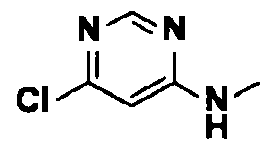
A una solución de 4,6-dicloropirimidina (0,50 g) en tetrahidrofurano (0,84 mL), se le añadió trietilamina (0,94 mL), a continuación se añadió gota a gota una solución de metilamina 2,0 moles en tetrahidrofurano (1,7 mL), enfriando con hielo y la mezcla se agitó a temperatura ambiente durante 23 horas. La solución de reacción se concentró y, a continuación, el residuo obtenido se purificó mediante cromatografía en columna sobre gel de sílice (MORITEX Purif Pack-NH, cloroformo) para obtener el compuesto del título (0,45 g, 93%) en forma de un sólido incoloro.To a solution of 4,6-dichloropyrimidine (0.50 g) in tetrahydrofuran (0.84 mL), triethylamine (0.94 mL) was added thereto, then a solution of methylamine 2.0 mol was added dropwise. in tetrahydrofuran (1.7 mL), cooling with ice and the mixture was stirred at room temperature for 23 hours. The reaction solution was concentrated and then the residue obtained was purified by column chromatography on silica gel (MORITEX Purif Pack-NH, chloroform) to obtain the title compound (0.45 g, 93%) as of a colorless solid.
RMN H1 (300 MHz, CDCls) 5 ppm 2,96 (d, J = 5,0Hz, 3H), 6,35 (s, 1H), 8,35 (s, 1H). EM (+): 144 [M+H]+. 1 H-NMR (300 MHz, CDCls) 5 ppm 2.96 (d, J = 5.0 Hz, 3 H), 6.35 (s, 1 H), 8.35 (s, 1 H). MS (+): 144 [M + H] +.
Ejemplo de Referencia 8-3 Trifluoroacetato de N-{2-[2-(2-aminoetoxi)etoxi]etil}-6-{3-[(4S)-6,8-dicloro-2-metil-1,2,3,4-tetrahidroisoquinolin-4-il]fenil}pirimidin-4-aminaReference Example 8-3 N- {2- [2- (2-Aminoethoxy) ethoxy] ethyl} -6- {3 - [(4S) -6,8-dichloro-2-methyl-1,2 trifluoroacetate, 3,4-tetrahydroisoquinolin-4-yl] phenyl} pyrimidin-4-amine
[Fórmula 99] [Formula 99]

(1) A una solución de 4,6-dicloropirimidina (0,60 g) en tetrahidrofurano (10 mL), se le añadió trietilamina (0,56 mL), a continuación se añadió en pequeñas porciones una suspensión de {2-[2-(2-(2-aminoetoxi)etoxi]etil}carbamato de terc-butilo (0,50 g) en tetrahidrofurano (15 mL), y la mezcla se agitó a temperatura ambiente durante 20 horas. La mezcla de reacción se agitó adicionalmente a 60°C durante 5 horas. La solución de reacción se dejó enfriar y a continuación se concentró a presión reducida. Se añadió agua al residuo obtenido, seguido de extracción con acetato de etilo. La capa orgánica se secó sobre sulfato de magnesio anhidro y se filtró, y a continuación, el producto filtrado se concentró a presión reducida. El residuo obtenido se purificó mediante cromatografía en columna de gel de sílice (Cartucho SNAP HP-Sphere de Biotage (marca registrada), cloroformo:metanol = 100:0 ^ 92: 8) para obtener [2-(2-{2-[(6-cloropirimidin-4-il)amino]etoxi}etoxi)etil]carbamato de terc-butilo (0,59 g, 41%) en forma de una sustancia oleosa incolora. RMN H1 (300 MHz, CDCh) ó ppm 1,45 (s, 9H), 3,22-3,76 (m, 12H), 6,39 (s, 1H), 8,35 (s, 1H).(1) To a solution of 4,6-dichloropyrimidine (0.60 g) in tetrahydrofuran (10 mL), triethylamine (0.56 mL) was added, then a suspension of {2- [ 2- (2- (2-Aminoethoxy) ethoxy] ethyl} tert-butyl carbamate (0.50 g) in tetrahydrofuran (15 mL), and the mixture was stirred at room temperature for 20 hours. additionally at 60 ° C for 5 hours, the reaction solution was allowed to cool and then concentrated under reduced pressure, water was added to the obtained residue, followed by extraction with ethyl acetate.The organic layer was dried over anhydrous magnesium sulfate and filtered, and then the filtrate was concentrated under reduced pressure The residue obtained was purified by silica gel column chromatography (HPOT Sphere Cartridge from Biotage (registered trademark), chloroform: methanol = 100: 0 ^ 92 : 8) to obtain [2- (2- {2 - [(6-chloropyrimidin-4-yl) amino] ethoxy} ethoxy) ethyl ] tert-butyl carbamate (0.59 g, 41%) as a colorless oily substance. NMR H1 (300 MHz, CDCh) or ppm 1.45 (s, 9H), 3.22-3.76 (m, 12H), 6.39 (s, 1H), 8.35 (s, 1H).
EM (+): 361 [M+H]+.MS (+): 361 [M + H] +.
(2) A una suspensión de hidrocloruro de (4S)-6,8-dicloro-2-metil-4-[3-(4,4,5,5-tetrametil-1,3,2-dioxaborolan-2-il)fenil]-1,2,3,4-tetrahidroisoquinolina (0,25 g) obtenido en el Ejemplo de Referencia 3-3, [2-(2-{2-[(6-cloropirimidin-4-il)amino]etoxi}etoxi)etil]carbamato de terc-butilo (0,20 g) y tetrakis(trifenilfosfina)paladio(0) (32 mg) en 1,4-dioxano (8,0 mL), se le añadió una solución acuosa saturada de bicarbonato de sodio (1,4 mL) en una atmósfera de gas argón, y la mezcla se agitó durante 12 horas calentando a reflujo. La solución de reacción se dejó enfriar y, a continuación, la materia insoluble se separó mediante filtración. El producto filtrado obtenido se purificó mediante HPLC preparativa de fase inversa (columna (YMC-Actus Triart 5 gm C18 50 x 30 mm), fase móvil (ácido trifluoroacético al 0,1% en H2Ü:ácido trifluoroacético al 0,1% en MeCN = 90:10 ^ 20:80 ^ 5:95, 40 mL/min.) para obtener trifluoroacetato de [2-(2-{2-[(6-{3-[(4S)-6,8-dicloro-2-metil-1,2,3,4-tetrahidroisoquinolin-4-il]fenil}pirimidin-4-il)amino]etoxi}etoxi)etil]carbamato de terc-butilo (0,28 g) en forma de una sustancia amorfa incolora.(2) To a suspension of (4S) -6,8-dichloro-2-methyl-4- [3- (4,4,5,5-tetramethyl-1,3,2-dioxaborolan-2-yl) hydrochloride. ) phenyl] -1,2,3,4-tetrahydroisoquinoline (0.25 g) obtained in Reference Example 3-3, [2- (2- {2 - [(6-chloropyrimidin-4-yl) amino] tetobutyl ethoxy} ethoxy) ethyl] carbamate (0.20 g) and tetrakis (triphenylphosphine) palladium (0) (32 mg) in 1,4-dioxane (8.0 mL), a saturated aqueous solution was added of sodium bicarbonate (1.4 mL) in an argon gas atmosphere, and the mixture was stirred for 12 hours under reflux heating. The reaction solution was allowed to cool and then the insoluble matter was removed by filtration. The obtained filtrate was purified by preparative reverse phase HPLC (column (YMC-Actus Triart 5 gm C18 50 x 30 mm), mobile phase (0.1% trifluoroacetic acid in H 2 O : 0.1% trifluoroacetic acid) in MeCN = 90:10 ^ 20:80 ^ 5:95, 40 mL / min.) to obtain trifluoroacetate of [2- (2- {2 - [(6- {3 - [(4S) -6.8- tert-butyl dichloro-2-methyl-1,2,3,4-tetrahydroisoquinolin-4-yl] phenyl} pyrimidin-4-yl) amino] ethoxy} ethoxy) ethyl] carbamate (0.28 g) in the form of a colorless amorphous substance.
RMN H1 (300 MHz, CD3OD) 5 ppm 1,41 (s, 9H), 3,12-3,25 (m, 5H), 3,44-3,97 (m, 12H), 4,45-4,56 (m, 1H), 4,73-4,84 (m, 2H), 6,85-6,92 (m, 1H), 6,98-7,08 (m, 1H), 7,53-7,61 (m, 2H), 7,65-7,91 (m, 3H), 8,65-8,75 (m, 1H). NMR H1 (300 MHz, CD 3 OD) 5 ppm 1.41 (s, 9H), 3.12-3.25 (m, 5H), 3.44-3.97 (m, 12H), 4.45 -4.56 (m, 1H), 4.73-4.84 (m, 2H), 6.85-6.92 (m, 1H), 6.98-7.08 (m, 1H), 7 , 53-7.61 (m, 2H), 7.65-7.91 (m, 3H), 8.65-8.75 (m, 1H).
EM (+): 616 [M+H]+.MS (+): 616 [M + H] +.
(3) A una solución de trifluoroacetato de [2-(2-{2-[(6-{3-[(4S)-6,8-dicloro-2-metil-1,2,3,4-tetrahidroisoquinolin-4-il-fenil}pirimidin-4-il)amino]etoxi}etoxi)etil]carbamato de terc-butilo (0,28 g) en 1,2-dicloroetano (15 mL), se le añadió ácido trifluoroacético (5,0 mL) y la mezcla se agitó a temperatura ambiente durante 2 horas. La solución de reacción se concentró a presión reducida, seguido de azeotropía con metanol. El disolvente se eliminó mediante destilación a presión reducida para obtener el compuesto del título (0,33 g) en forma de una sustancia amorfa incolora.(3) To a solution of [2- (2- {2 - [(6- {3 - [(4S) -6,8-dichloro-2-methyl-1,2,3,4-tetrahydroisoquinoline-) trifluoroacetate. 4-ylphenyl} pyrimidin-4-yl) amino] ethoxy} ethoxy) ethyl] tert-butyl carbamate (0.28 g) in 1,2-dichloroethane (15 mL), trifluoroacetic acid (5, 0 mL) and the mixture was stirred at room temperature for 2 hours. The reaction solution was concentrated under reduced pressure, followed by azeotropy with methanol. The solvent was removed by distillation under reduced pressure to obtain the title compound (0.33 g) as a colorless amorphous substance.
RMN H1 (600 MHz, CD3OD) 5 ppm 3,04-3,15 (m, 5H), 3,57-3,91 (m, 12H), 4,41-4,51 (m, 1H), 4,69-4,78 (m, 2H), 6,80-6,89 (m, 1H), 6,96 -7,07 (m, 1H), 7,47-7,57 (m, 2H), 7,62-7,69 (m, 1H), 7,70-7,88 (m, 2H), 8,59-8,71 (m, 1H). NMR H1 (600 MHz, CD 3 OD) 5 ppm 3.04-3.15 (m, 5H), 3.57-3.91 (m, 12H), 4.41-4.51 (m, 1H) , 4.69-4.78 (m, 2H), 6.80-6.89 (m, 1H), 6.96-7.07 (m, 1H), 7.47-7.57 (m, 2H), 7.62-7.69 (m, 1H), 7.70-7.88 (m, 2H), 8.59-8.71 (m, 1H).
EM (+): 516 [M+H]+.MS (+): 516 [M + H] +.
Ejemplo de Referencia 8-4 N-{2-[2-(2-Aminoetoxi)etoxi]etil}-6-{3-[(4S)-6,8-dicloro-2-metil-1,2,3,4-tetrahidroisoquinolin-4-il]fenilpirazin-2-aminaReference Example 8-4 N- {2- [2- (2-Aminoethoxy) ethoxy] ethyl} -6- {3 - [(4S) -6,8-dichloro-2-methyl-1,2,3, 4-tetrahydroisoquinolin-4-yl] phenylpyrazine-2-amine
(1) Una solución de 2,6-dicloropirazina (0,30 g), {2-[2-(2-aminoetoxi)etoxi]etil}carbamato terc-butilo (0,50 g) y trietilamina (0,62 mL) en N,N-dimetilformamida (15 mL) se agitó a 80°C durante 4 horas. La solución de reacción se dejó enfriar y a continuación se añadió agua, seguido de extracción con acetato de etilo. La capa orgánica se lavó con solución salina saturada, a continuación se secó sobre sulfato de magnesio anhidro y se filtró, y a continuación, el producto filtrado se concentró a presión reducida. El residuo obtenido se purificó mediante cromatografía en columna de gel de sílice (Cartucho SNAP HP-Sphere de Biotage (marca registrada), cloroformo:metanol = 100:0 ^ 80:20) y se purificó adicionalmente mediante cromatografía en columna de gel de sílice (Biotage (marca registrada) Cartucho SNAP HP-Sphere, hexano:acetato de etilo = 92: 8 ^ 34:66) para obtener [2-(2-{2-[(6-cloropirazin-2-il)amino]etoxi}etoxi)etil)carbamato de terc-butilo (0,29 g, 40%) en forma de una sustancia oleosa incolora.(1) A solution of 2,6-dichloropyrazine (0.30 g), {2- [2- (2-aminoethoxy) ethoxy] ethyl} carbamate tert-butyl (0.50 g) and triethylamine (0.62 mL) ) in N, N-dimethylformamide (15 mL) was stirred at 80 ° C for 4 hours. The reaction solution was allowed to cool and then water was added, followed by extraction with ethyl acetate. The organic layer was washed with saturated saline solution, then dried over anhydrous magnesium sulfate and filtered, and then, the filtrate was concentrated under reduced pressure. The obtained residue was purified by silica gel column chromatography (SNAP HP-Sphere cartridge from Biotage (trademark), chloroform: methanol = 100: 0 ^ 80:20) and further purified by silica gel column chromatography (Biotage (registered trademark) HP-Sphere SNAP cartridge, hexane: ethyl acetate = 92: 8 ^ 34:66) to obtain [2- (2- {2 - [(6-chloropyrazin-2-yl) amino] ethoxy } tert-butyl ethoxy) ethyl carbamate (0.29 g, 40%) as a colorless oily substance.
RMN H1 (300 MHz, CDCh) 5 ppm 1,45 (s, 9H), 3,20-3,45 (m, 2H), 3,53-3,71 (m, 10H), 5,00-5,10 (m, 1H), 5,34-5,46 (m, 1H), 7,67-7,88 (m, 2H).NMR H1 (300 MHz, CDCh) 5 ppm 1.45 (s, 9H), 3.20-3.45 (m, 2H), 3.53-3.71 (m, 10H), 5.00-5 , 10 (m, 1H), 5.34-5.46 (m, 1H), 7.67-7.88 (m, 2H).
EM (+): 361 [M+H]+.MS (+): 361 [M + H] +.
(2) A una solución de (4S)-6,8-dicloro-2-metil-4-[3-(4,4,5,5-tetrametil-1,3,2-dioxaborolan-2-il)fenil]-1,2,3,4-tetrahidroisoquinolina (0,16 g) obtenida en el Ejemplo de Referencia 3-2 y [2-(2-{2-[(6-cloropirazin-2-il)amino]etoxi}etoxi)etil]carbamato de terc-butilo (0,25 g) en 1,4-dioxano (7,5 mL), se le añadieron una solución de bicarbonato de sodio (0,16 g) en agua (2,5 mL) y tetrakis(trifenilfosfina)paladio(0) (22 mg) en una atmósfera de gas nitrógeno, y la mezcla se agitó a 110°C durante 12 horas. La solución de reacción se concentró a presión reducida y, a continuación, el residuo se purificó mediante HPLC preparativa de fase inversa (columna (YMC-Actus Triart 5 pm C18 50 x 30 mm), fase móvil (ácido trifluoroacético al 0,1% en H2Ü:ácido trifluoroacético al 0,1% en MeCN = 97:3 ^ 30:70 ^ 5:95, 40 mL/min.) para obtener trifluoroacetato de [2-(2-{2-[(6-{3-[(4S)-6,8-dicloro-2-metil-1,2,3,4-tetrahidroisoquinolin-4-il]fenil}pirazin-2-il)aminoletoxi}etoxi)etil]carbamato de terc-butilo (0,25 g) en forma de una sustancia oleosa de color amarillo. RMN H1 (300 MHz, CDCla) 6 ppm 1,43 (s ancho, 9H), 3,06 (s, 3H), 3,21-3,89 (m, 16H), 3,99-4,24 (m, 1H), 4,65-4,89 (m, 2H), 6,79-6,86 (m, 1H), 7,32 (d, J = 7,7Hz, 1H), 7,36-7,39 (m, 1H), 7,53 (t, J = 7,7Hz, 1H), 7,76 (s, 1H), 7,89 (d, J = 7,7Hz, 1H), 8,10 (s, 1H), 8,21 (s, 1H).(2) To a solution of (4S) -6,8-dichloro-2-methyl-4- [3- (4,4,5,5-tetramethyl-1,3,2-dioxaborolan-2-yl) phenyl ] -1,2,3,4-tetrahydroisoquinoline (0.16 g) obtained in Reference Example 3-2 and [2- (2- {2 - [(6-chloropyrazin-2-yl) amino] ethoxy} Ethoxy) ethyl] tert-butyl carbamate (0.25 g) in 1,4-dioxane (7.5 mL), a solution of sodium bicarbonate (0.16 g) in water (2.5 mL) was added. ) and tetrakis (triphenylphosphine) palladium (0) (22 mg) under an atmosphere of nitrogen gas, and the mixture was stirred at 110 ° C for 12 hours. The reaction solution was concentrated under reduced pressure and then the residue was purified by reverse phase preparative HPLC (column (YMC-Actus Triart 5 pm C18 50 x 30 mm), mobile phase (0.1% trifluoroacetic acid in H 2 Ü: 0.1% trifluoroacetic acid in MeCN = 97: 3 ^ 30:70 ^ 5:95, 40 mL / min.) to obtain trifluoroacetate of [2- (2- {2 - [(6- {3 - [(4S) -6,8-Dichloro-2-methyl-1,2,3,4-tetrahydroisoquinolin-4-yl] phenyl} pyrazin-2-yl) aminooxyloxy} ethoxy) ethyl] carbamate ter butyl (0.25 g) in the form of a yellow oily substance H1NMR (300 MHz, CDCla) 6 ppm 1.43 (broad s, 9H), 3.06 (s, 3H), 3.21- 3.89 (m, 16H), 3.99-4.24 (m, 1H), 4.65-4.89 (m, 2H), 6.79-6.86 (m, 1H), 7, 32 (d, J = 7.7 Hz, 1H), 7.36-7.39 (m, 1H), 7.53 (t, J = 7.7Hz, 1H), 7.76 (s, 1H), 7.89 (d, J = 7.7 Hz, 1H), 8.10 (s, 1H), 8.21 (s, 1H).
EM (+): 616 [M+H]+.MS (+): 616 [M + H] +.
(3) A una solución de trifluoroacetato de [2-(2-{2-[(6-{3-[(4S)-6,8-dicloro-2-metil-1,2,3,4-tetrahidroisoquinolin-4-il]fenil}pirazin-2-il)amino]etoxi}etoxi)etil]carbamato de terc-butilo (0,29 g) en 1,2-dicloroetano (3,0 mL), se le añadió ácido trifluoroacético (1,0 mL) enfriando con hielo, y la mezcla se agitó a temperatura ambiente durante 1 hora. La solución de reacción se concentró a presión reducida y el residuo obtenido se purificó mediante cromatografía en columna de gel de sílice (Cartucho SNAP KP-NH de Biotage (marca registrada), cloroformo:metanol = 100:0 ^ 80:20) para obtener el compuesto del título (0,18 g, 78% (2 etapas) en forma de una sustancia oleosa incolora.(3) To a solution of [2- (2- {2 - [(6- {3 - [(4S) -6,8-dichloro-2-methyl-1,2,3,4-tetrahydroisoquinoline-) trifluoroacetate. 4-yl] phenyl} pyrazin-2-yl) amino] ethoxy} ethoxy) ethyl] tert-butyl carbamate (0.29 g) in 1,2-dichloroethane (3.0 mL), trifluoroacetic acid ( 1.0 mL) under ice cooling, and the mixture was stirred at room temperature for 1 hour. The reaction solution was concentrated under reduced pressure and the residue obtained was purified by silica gel column chromatography (SNAP KP-NH cartridge from Biotage (registered trademark), chloroform: methanol = 100: 0 ^ 80:20) to obtain the title compound (0.18 g, 78% (2 steps) as a colorless oily substance.
RMN H1 (600 MHz, CD3OD) 6 ppm 2,50 (s, 3H), 2,66-2,71 (m, 1H), 2,76 (t, J = 5,4Hz, 2H), 3,07-3,12 (m, 1H), 3,50 (t, J = 5,4Hz, 2H), 3,58 (d, J = 16,10Hz, 1H), 3,60-3,71 (m, 8H), 3,88 (d, J = 16,10Hz, 1H), 4,37-4,41 (m, 1H), 6,85 (m, 1H)), 7,25 (d, J = 7,8Hz, 1H), 7,30-7,38 (m, 1H), 7,44 (t, J = 7,8Hz, 1H), 7,81 (s, 1H), 7,86 (s, 1H), 7,92 (d, J = 7,8Hz, 1H), 8,13 (s, 1H). NMR H1 (600 MHz, CD 3 OD) 6 ppm 2.50 (s, 3H), 2.66-2.71 (m, 1H), 2.76 (t, J = 5.4Hz, 2H), 3 , 07-3.12 (m, 1H), 3.50 (t, J = 5.4Hz, 2H), 3.58 (d, J = 16.10Hz, 1H), 3.60-3.71 ( m, 8 H), 3.88 (d, J = 16.10Hz, 1H), 4.37-4.41 (m, 1H), 6.85 (m, 1H)), 7.25 (d, J = 7.8Hz, 1H), 7.30-7.38 (m, 1H), 7.44 (t, J = 7.8Hz, 1H), 7.81 (s, 1H), 7.86 ( s, 1H), 7.92 (d, J = 7.8Hz, 1H), 8.13 (s, 1H).
EM (+): 516 [M+H]+.MS (+): 516 [M + H] +.
Ejemplo de Referencia 8-5 Ditrifluoroacetato de N-{2-[2-(2-aminoetoxi)etoxi]etil}-5-{3-[(4S)-6,8-dicloro-2-metil-1,2,3,4-tetrahidroisoquinolin-4-il]fenil}pirimidin-2-aminaReference Example 8-5 N- {2- [2- (2-Aminoethoxy) ethoxy] ethyl} -5- {3 - [(4S) -6,8-dichloro-2-methyl-1,2-ditrifluoroacetate, 3,4-tetrahydroisoquinolin-4-yl] phenyl} pyrimidin-2-amine
(1) A una solución de {2-[2-(2-aminoetoxi)etoxi]etil}carbamato de terc-butilo (0,40 g) en dimetilsulfóxido (5,0 mL), se le añadieron carbonato de potasio (0,45 g) y 2,5-dibromopirimidina (0,38 g), y la mezcla se agitó a 100°C durante 2 horas. Se añadió agua a la solución de reacción, seguido de extracción con acetato de etilo. La capa orgánica se secó sobre sulfato de magnesio anhidro y se filtró, y a continuación, el producto filtrado se concentró a presión reducida. El residuo obtenido se purificó mediante cromatografía en columna de gel de sílice (Cartucho SNAP HP-Sphere de Biotage (marca registrada), hexano:acetato de etilo = 100:0 ^ 20:80) para obtener [2-(2-{2-[(5-bromopirimidin-2-il)amino]etoxi}etoxi)etil]carbamato de terc-butilo (0,51 g, 78%) en forma de una sustancia amorfa incolora.(1) To a solution of tert-butyl {2- [2- (2-aminoethoxy) ethoxy] ethyl} carbamate (0.40 g) in dimethylsulfoxide (5.0 mL), potassium carbonate (0%) was added. , 45 g) and 2,5-dibromopyrimidine (0.38 g), and the mixture was stirred at 100 ° C for 2 hours. Water was added to the reaction solution, followed by extraction with ethyl acetate. The organic layer was dried over anhydrous magnesium sulfate and filtered, and then, the filtrate was concentrated under reduced pressure. The residue obtained was purified by silica gel column chromatography (SNAP HP-Sphere cartridge from Biotage (trademark), hexane: ethyl acetate = 100: 0 ^ 20:80) to obtain [2- (2- {2 - [(5-Bromopyrimidin-2-yl) amino] ethoxy} ethoxy) ethyl] tert-butyl carbamate (0.51 g, 78%) as a colorless amorphous substance.
Tiempo de retención LC-MS 0,928 minRetention time LC-MS 0.928 min
CL: Agilent 1290CL: Agilent 1290
EM ESI/APCI: Agilent 6130ESI / APCI EM: Agilent 6130
Columna: Waters Acquity CSH C181,7 um, 2,1x50 mmColumn: Waters Acquity CSH C181.7 um, 2.1x50 mm
Disolvente: H20 :CHsCn (ácido fórmico al 0,1%) Solvent: H 20 : CHsCn (0.1% formic acid)
Gradiente: 0,8 mL/min, 0 min (80:20) ^ 1,2-1,4 min (1:99)Gradient: 0.8 mL / min, 0 min (80:20) ^ 1.2-1.4 min (1:99)
EM (+): 405 [M+H]+.MS (+): 405 [M + H] +.
(2) El compuesto del título (0,10 g) se obtuvo en forma de una sustancia amorfa incolora sustancialmente a través de la misma reacción que en el Ejemplo de Referencia 8-3(2)(3), excepto que se utilizó [2-(2-{2-[(5-bromopirimidin-2-il)amino]etoxi}etoxi)etil]carbamato de terc-butilo en lugar de [2-(2-{2-[(6-cloropirimidin-4-il)amino]etoxi}etoxi)etil)carbamato de terc-butil obtenido en el Ejemplo de Referencia 8-3(1).(2) The title compound (0.10 g) was obtained in the form of a colorless amorphous substance substantially through the same reaction as in Reference Example 8-3 (2) (3), except that [ 2- (2- {2 - [(5-bromopyrimidin-2-yl) amino] ethoxy} ethoxy) ethyl] tert-butyl carbamate in place of [2- (2- {2 - [(6-chloropyrimidin-4) tert-butyl-amino) ethoxy} ethoxy) ethyl) carbamate obtained in Reference Example 8-3 (1).
Tiempo de retención LC-MS 0,294 minRetention time LC-MS 0.294 min
CL: Agilent 1290CL: Agilent 1290
EM ESI/APCI: Agilent 6130ESI / APCI EM: Agilent 6130
Columna: Waters Acquity CSH C181,7 um, 2,1x50 mmColumn: Waters Acquity CSH C181.7 um, 2.1x50 mm
Disolvente: H20 :CHsCn (ácido fórmico al 0,1%) Solvent: H 20 : CHsCn (0.1% formic acid)
Gradiente: 0,8 mL/min, 0 min (80:20) ^ 1,2-1,4 min (1:99)Gradient: 0.8 mL / min, 0 min (80:20) ^ 1.2-1.4 min (1:99)
EM (+): 516 [M+H]+. MS (+): 516 [M + H] +.
Ejemplo de Referencia 8-6 trifluoroacetato de N-{2-[2-(2-aminoetoxi)etoxi]etil}-4-[3-(6,8-dicloro-2-metil-1,2,3,4-tetrahidroisoquinolin-4-il)fenil]piridin-2-aminaReference Example 8-6 N- {2- [2- (2-Aminoethoxy) ethoxy] ethyl} -4- [3- (6,8-dichloro-2-methyl-1,2,3,4- trifluoroacetate tetrahydroisoquinolin-4-yl) phenyl] pyridin-2-amine
El compuesto del título (40 mg) se obtuvo en forma de una sustancia amorfa incolora sustancialmente a través de la misma reacción que en el Ejemplo de Referencia 8-3(1)(2)(3), excepto que se utilizó 4-bromo-2-fluoropiridina en lugar de 4,6-dicloropirimidina y la 6,8-dicloro-2-metil-4-[3-(4,4,5,5-tetrametil-1,3,2-dioxaborolan-2-il)fenil]-1,2, 3,4-tetrahidroisoquinolina obtenida en el Ejemplo de Referencia 3-1 se utilizó en lugar de hidrocloruro de (4S)-6,8-dicloro-2-metil-4-[3-(4,4,5,5-tetrametil-1,3,2-dioxaborolan-2-il)fenil]-1,2,3,4-tetrahidroisoquinolina obtenido en el Ejemplo de Referencia 3-3.The title compound (40 mg) was obtained in the form of a colorless amorphous substance substantially through the same reaction as in Reference Example 8-3 (1) (2) (3), except that 4-bromine was used -2-fluoropyridine instead of 4,6-dichloropyrimidine and 6,8-dichloro-2-methyl-4- [3- (4,4,5,5-tetramethyl-1,3,2-dioxaborolan-2- il) phenyl] -1,2, 3,4-tetrahydroisoquinoline obtained in Reference Example 3-1 was used in place of (4S) -6,8-dichloro-2-methyl-4- [3- ( 4,4,5,5-tetramethyl-1,3,2-dioxaborolan-2-yl) phenyl] -1,2,3,4-tetrahydroisoquinoline obtained in Reference Example 3-3.
RMN H1 (300 MHz, CD3OD) 6 ppm 3,06-3,13 (m, 2H), 3,17 (s, 3H), 3,60-3,83 (m, 11H), 3,85-3,95 (m, 1H), 4,46-4,58 (m, 1H), 4,73-4,87 (m, 2H), 6,82-6,89 (m, 1H), 7,18-7,25 (m, 1H), 7,32-7,38 (m, 1H), 7,43-7,49 (m, 1H), 7,50-7,54 (m, 1H) , 7,59-7,67 (m, 1H), 7,71-7,76 (m, 1H), 7,78-7,85 (m, 1H), 7,88-7,94 (m, 1H). NMR H1 (300 MHz, CD 3 OD) 6 ppm 3.06-3.13 (m, 2H), 3.17 (s, 3H), 3.60-3.83 (m, 11H), 3.85 -3.95 (m, 1H), 4.46-4.58 (m, 1H), 4.73-4.87 (m, 2H), 6.82-6.89 (m, 1H), 7 , 18-7.25 (m, 1H), 7.32-7.38 (m, 1H), 7.43-7.49 (m, 1H), 7.50-7.54 (m, 1H) , 7.59-7.67 (m, 1H), 7.71-7.76 (m, 1H), 7.78-7.85 (m, 1H), 7.88-7.94 (m, 1 HOUR).
EM (+): 515 [M+H]+.MS (+): 515 [M + H] +.
Ejemplo de Referencia 8-7 Trifluoroacetato de N-{2-[2-(2-aminoetoxi)etoxi]etil}-4-{3-[(4S)-6,8-dicloro-2-metil-1,2,3,4-tetrahidroisoquinolin-4-il]fenil}piridin-2-aminaReference Example 8-7 N- {2- [2- (2-Aminoethoxy) ethoxy] ethyl} -4- {3 - [(4S) -6,8-dichloro-2-methyl-1,2 trifluoroacetate, 3,4-tetrahydroisoquinolin-4-yl] phenyl} pyridin-2-amine
El compuesto del título (0,34 g) se obtuvo en forma de una sustancia oleosa incolora sustancialmente a través de la misma reacción que en el Ejemplo de Referencia 8-3(1)(2)(3), excepto que se utilizó 4-bromo-2-fluoropiridina en lugar de 4, 6-dicloropirimidina.The title compound (0.34 g) was obtained as a colorless oily substance substantially through the same reaction as in Reference Example 8-3 (1) (2) (3), except that 4 -bromo-2-fluoropyridine instead of 4,6-dichloropyrimidine.
RMN H1 (300 MHz, CD3OD) 6 ppm 3,06-3,13 (m, 2H), 3,16 (s, 3H), 3,60-3,75 (m, 9H), 3,75-3,82 (m, 2H), 3,85-3,96 (m, 1H), 4,46-4,57 (m, 1H), 4,72-4,83 (m, 2H), 6,84-6,90 (m, 1H), 7,18-7,24 (m, 1H), 7,31-7,35 (m, 1H), 7,43-7,49 (m, 1H) , 7,53-7,56 (m, 1H), 7,59-7,67 (m, 1H), 7,70-7,74 (m, 1H), 7,79-7,85 (m, 1H), 7,88-7,93 (m, 2H). NMR H1 (300 MHz, CD 3 OD) 6 ppm 3.06-3.13 (m, 2H), 3.16 (s, 3H), 3.60-3.75 (m, 9H), 3.75 -3.82 (m, 2H), 3.85-3.96 (m, 1H), 4.46-4.57 (m, 1H), 4.72-4.83 (m, 2H), 6 , 84-6.90 (m, 1H), 7.18-7.24 (m, 1H), 7.31-7.35 (m, 1H), 7.43-7.49 (m, 1H) , 7.53-7.56 (m, 1H), 7.59-7.67 (m, 1H), 7.70-7.74 (m, 1H), 7.79-7.85 (m, 1H), 7.88-7.93 (m, 2H).
EM (+): 515 [M+H]+.MS (+): 515 [M + H] +.
Ejemplo de Referencia 8-8 Trifluoroacetato de N-{2-[2-(2-aminoetoxi)etoxi]etil}-6-{3-[(4S)-6,8-dicloro-2-metil-1,2,3,4-tetrahidroisoquinolin-4-il]fenil}piridazin-4-aminaReference Example 8-8 N- {2- [2- (2-Aminoethoxy) ethoxy] ethyl} -6- {3 - [(4S) -6,8-dichloro-2-methyl-1,2 trifluoroacetate, 3,4-tetrahydroisoquinolin-4-yl] phenyl} pyridazin-4-amine
El compuesto del título (0,18 g) se obtuvo en forma de una sustancia oleosa de color pardo sustancialmente a través de la misma reacción que en el Ejemplo de Referencia 8-5(1)(2), excepto que se utilizó 3,5-dibromopiridazina en lugar de 2,5-dibromopirimidina.The title compound (0.18 g) was obtained as a brown oily substance substantially through the same reaction as in Reference Example 8-5 (1) (2), except that 3 was used, 5-dibromopyridazine instead of 2,5-dibromopyrimidine.
RMN H1 (300 MHz, CDCh) 6 ppm 1,45 (s ancho, 9H), 2,49 (s, 3H), 2,61-2,71 (m, 1H), 2,87-3,20 (m, 1H), 3,25-3,90 (m, 14H), 4,27-4,41 (m, 1H), 4,95 (s ancho, 1H), 5,06 (s ancho, 1H), 6,67-7,01 (m, 2H), 7,12-7,26 (m, 2H), 7,42 (t, J = 7,7Hz, 1H), 7,81 (d, J = 7,7Hz, 1H), 7,88-7,96 (m, 1H), 8,53-8,70 (m, 1H).NMR H1 (300 MHz, CDCh) 6 ppm 1.45 (broad s, 9H), 2.49 (s, 3H), 2.61-2.71 (m, 1H), 2.87-3.20 ( m, 1H), 3.25-3.90 (m, 14H), 4.27-4.41 (m, 1H), 4.95 (broad s, 1H), 5.06 (broad s, 1H) , 6.67-7.01 (m, 2H), 7.12-7.26 (m, 2H), 7.42 (t, J = 7.7Hz, 1H), 7.81 (d, J = 7.7 Hz, 1H), 7.88-7.96 (m, 1H), 8.53-8.70 (m, 1H).
EM (+): 616 [M+H]+.MS (+): 616 [M + H] +.
(2) El compuesto del título (0,18 g, cuant.) se obtuvo en forma de una sustancia oleosa de color pardo sustancialmente a través de la misma reacción que en el Ejemplo de Referencia 8-3(3), excepto que se utilizó [2-(2-{2-[(6-{3-[(4S)-6,8-dicloro-2-metil-1,2,3,4-tetrahidroisoquinolin-4-il]fenil}piridazin-4-il)amino]etoxi}etoxi)etil]carbamato de terc-butilo en lugar de [2-(2-{2-[(6-{3-[(4S)-6,8-dicloro-2-metil-1,2,3,4-tetrahidroisoquinolin-4-il]fenil}pirimidin-4-il)amino]etoxi}etoxi)etil]carbamato de terc-butilo obtenido en el Ejemplo de Referencia 8-3(2).(2) The title compound (0.18 g, quant.) Was obtained as a brown oily substance substantially through the same reaction as in Reference Example 8-3 (3), except that used [2- (2- {2 - [(6- {3 - [(4S) -6,8-dichloro-2-methyl-1,2,3,4-tetrahydroisoquinolin-4-yl] phenyl} pyridazin- 4-yl) amino] ethoxy} ethoxy) ethyl] tert-butyl carbamate in place of [2- (2- {2 - [(6- {3 - [(4S) -6,8-dichloro-2-methyl] <Tb> <3> -3,3-tetrahydroisoquinolin-4-yl] phenyl} pyrimidin-4-yl) amino] ethoxy} ethoxy) ethyl] tert-butyl carbamate obtained in Reference Example 8-3 (2).
RMN H1 (600 MHz, CD3OD) 6 ppm 3,07-3,14 (m, 2H), 3,19 (s, 3H), 3,63-3,75 (m, 10H), 3,75-3,83 (m, 4H), 3,86-3,98 (m, 1H), 4,44-4,58 (m, 1H), 4,76-4,90 (m, 3H), 6,89 (s, 1H), 7,33-7,40 (m, 1H), 7,49-7,57 (m, 1H), 7,59 (d, J = 7,8Hz, 1H), 7,72 (t, J = 7,8Hz, 1H), 7,85 (s, 1H), 7,88 (d, J = 7,8Hz, 1H), 8,49-8,82 (m, 1H). NMR H1 (600 MHz, CD 3 OD) 6 ppm 3.07-3.14 (m, 2H), 3.19 (s, 3H), 3.63-3.75 (m, 10H), 3.75 -3.83 (m, 4H), 3.86-3.98 (m, 1H), 4.44-4.58 (m, 1H), 4.76-4.90 (m, 3H), 6 , 89 (s, 1H), 7.33-7.40 (m, 1H), 7.49-7.57 (m, 1H), 7.59 (d, J = 7.8Hz, 1H), 7 , 72 (t, J = 7.8Hz, 1H), 7.85 (s, 1H), 7.88 (d, J = 7.8Hz, 1H), 8.49-8.82 (m, 1H) .
EM (+): 516 [M+H]+MS (+): 516 [M + H] +
Ejemplo de Referencia 8-9 N-(2-{2-[2-(2-Aminoetoxi)etoxi]etoxi}etil)-6-{3-[(4S)-6,8-dicloro-2-metil-1,2,3,4-tetrahidroisoquinolin-4-il]fenil}pirimidin-4-amina 12Reference Example 8-9 N- (2- {2- [2- (2-Aminoethoxy) ethoxy] ethoxy} ethyl) -6- {3 - [(4S) -6,8-dichloro-2-methyl-1 2,3,4-tetrahydroisoquinolin-4-yl] phenyl} pyrimidin-4-amine 12
(1) A una solución de 2-{2-[2-(2-azidoetoxi)etoxi]etoxi}etanamina (2,8 g) en N,N-dimetilformamida (24 mL), se le añadió dicarbonato de di-terc-butilo (2,8 g), y la mezcla se agitó a temperatura ambiente durante 2 horas. La solución de reacción se concentró a presión reducida y el residuo obtenido se purificó mediante cromatografía en columna de gel de sílice (Cartucho SNAP HP-Sphere de Biotage (marca registrada), hexano:acetato de etilo = 98:2 ^ 30:70) para obtener (2-{2-[2-(2-azidoetoxi)etoxi]etoxi}etil)carbamato de tercbutilo (4,2 g) en forma de una sustancia oleosa incolora.(1) To a solution of 2- {2- [2- (2-azidoethoxy) ethoxy] ethoxy} ethanamine (2.8 g) in N, N-dimethylformamide (24 mL), di-tert-dicarbonate was added. -butyl (2.8 g), and the mixture was stirred at room temperature for 2 hours. The reaction solution was concentrated under reduced pressure and the residue obtained was purified by silica gel column chromatography (SNAP cartridge HP-Sphere from Biotage (trademark), hexane: ethyl acetate = 98: 2 ^ 30:70) to obtain (2- {2- [2- (2-azidoethoxy) ethoxy] ethoxy} ethyl) tert-butyl carbamate (4.2 g) as a colorless oily substance.
RMN H1 (300 MHz, CDCh) 6 ppm 1,45 (s, 9H), 3,26-3,37 (m, 2H), 3,36-3,44 (m, 2H), 3,50-3,59 (m, 2H), 3,59 3,73 (m, 10H), 5,02 (s ancho, 1H).NMR H1 (300 MHz, CDCh) 6 ppm 1.45 (s, 9H), 3.26-3.37 (m, 2H), 3.36-3.44 (m, 2H), 3.50-3 , 59 (m, 2H), 3.59 3.73 (m, 10H), 5.02 (broad s, 1H).
EM (+): 341 [M Na]+.MS (+): 341 [M Na] +.
(2) A una solución de (2-{2-[2-(2-azidoetoxi)etoxi]etoxi}etil)carbamato de terc-butilo (4,2 g) en tetrahidrofurano (35 mL), se le añadió trifenilfosfina (3,7 g) y la mezcla se agitó a temperatura ambiente durante 2 horas. Se añadió agua (10 mL) a la solución de reacción y la mezcla se agitó a temperatura ambiente durante 45 minutos y a 60°C durante 2 horas. La solución de reacción se dejó enfriar y a continuación se concentró a presión reducida, y el residuo obtenido se purificó mediante cromatografía en columna sobre gel de sílice (Cartucho SNAP KP-NH de Biotage (marca registrada), cloroformo:acetato de etilo = 100:0 ^ 0:100). El disolvente se eliminó mediante destilación a presión reducida. A continuación, se añadió agua al residuo obtenido, y la mezcla se lavó con tolueno. La capa acuosa se concentró a presión reducida para obtener (2-{2-[2-(2-aminoetoxi)etoxi]etoxi}etil)carbamato de terc-butilo (3,1 g, 84% (2 etapas)) en forma de una sustancia oleosa incolora. .(2) To a solution of tert-butyl (2- {2- [2- (2-azidoethoxy) ethoxy] ethoxy} ethyl) carbamate (4.2 g) in tetrahydrofuran (35 mL), triphenylphosphine ( 3.7 g) and the mixture was stirred at room temperature for 2 hours. Water (10 mL) was added to the reaction solution and the mixture was stirred at room temperature for 45 minutes and at 60 ° C for 2 hours. The reaction solution was allowed to cool and then concentrated under reduced pressure, and the residue obtained was purified by column chromatography on silica gel (SNAP KP-NH cartridge from Biotage (registered trademark), chloroform: ethyl acetate = 100: 0 ^ 0: 100). The solvent was removed by distillation under reduced pressure. Then, water was added to the obtained residue, and the mixture was washed with toluene. The aqueous layer was concentrated under reduced pressure to obtain tert-butyl (2- {2- [2- (2-aminoethoxy) ethoxy] ethoxy} ethyl) carbamate (3.1 g, 84% (2 steps)) in the form of a colorless oily substance. .
RMN H1 (300 MHz, CDCh) 6 ppm 1,45 (s, 9H), 2,84-2,91 (m, 2H), 3,25-3,37 (m, 2H), 3,48-3,58 (m, 4H), 3,59 3,70 (m, 8H), 5,25 (s ancho, 1H). 1 H-NMR (300 MHz, CDCh) 6 ppm 1.45 (s, 9H), 2.84-2.91 (m, 2H), 3.25-3.37 (m, 2H), 3.48- 3.58 (m, 4H), 3.59 3.70 (m, 8 H), 5.25 (broad s, 1H).
EM (+):293 [M+H]+.MS (+): 293 [M + H] +.
(3) A una solución de 4,6-dicloropirimidina (0,20 g) y (2-{2-[2-(2-aminoetoxi)etoxi]etoxi}etil)carbamato de tercbutilo (0,36 g) en acetonitrilo (7,4 mL), se le añadió carbonato de potasio (0,20 g) y la mezcla se agitó a 80°C durante 17 horas. La solución de reacción se dejó enfriar y a continuación se concentró a presión reducida, y el residuo obtenido se purificó mediante cromatografía en columna sobre gel de sílice (Cartucho SNAP HP-Sphere de Biotage (marca registrada), cloroformo:metanol = 100:0 ^ 88:12) para obtener {2-[2-(2-{2-[(6-cloropirimidin-4-il)amino]etoxi}etoxi)etoxi]etil]carbamato de terc-butilo (0,51 g, cuantitativo) en forma de una sustancia oleosa de color amarillo.(3) To a solution of 4,6-dichloropyrimidine (0.20 g) and tertbutyl (2- {2- [2- (2-aminoethoxy) ethoxy] ethoxy} ethyl) carbamate (0.36 g) in acetonitrile (7.4 mL), potassium carbonate (0.20 g) was added and the mixture was stirred at 80 ° C for 17 hours. The reaction solution was allowed to cool and then concentrated under reduced pressure, and the residue obtained was purified by column chromatography on silica gel (HPOT Sphere Cartridge from Biotage (registered trademark), chloroform: methanol = 100: 0 ^ 88:12) to obtain {2- [2- (2- {2 - [(6-chloropyrimidin-4-yl) amino] ethoxy} ethoxy) ethoxy] ethyl] tert-butyl carbamate (0.51 g, quantitative ) in the form of an oily yellow substance.
RMN H1 (300 MHz, CDCla) 6 ppm 1,44 (s, 9H), 3,20-3,40 (m, 2H), 3,44-3,75 (m, 14H), 6,42 (s, 1H), 8,34 (s, 1H). 1 H NMR (300 MHz, CDCla) 6 ppm 1.44 (s, 9H), 3.20-3.40 (m, 2H), 3.44-3.75 (m, 14H), 6.42 ( s, 1 H), 8.34 (s, 1 H).
EM (+): 405 [M+H]+.MS (+): 405 [M + H] +.
(4) El tifluoroacetato {2-[2-(2-{2-[(6-{3-[(4S)-6,8-dicloro-2-metil-1,2,3,4-tetrahidroisoquinolin-4-il]]fenil}pirimidin-4-il)amino]etoxi}etoxi)etoxi]etil}carbamato de terc-butilo (0,17 g) se obtuvo en forma de una sustancia oleosa incolora sustancialmente a través de la misma reacción que en el Ejemplo de Referencia 8-3(2), excepto que se utilizó {2-[2-(2-{2-[(6-cloropirimidin-4-il)amino]etoxi}etoxi)etoxi]etil}carbamato de terc-butilo en lugar de [2-(2-{2-[(6-cloropirimidin-4-il)amino]etoxi}etoxi)etil]carbamato de terc-butilo obtenido en el Ejemplo de Referencia 8-3(1).(4) Tifluoroacetate {2- [2- (2- {2 - [(6- {3 - [(4S) -6,8-dichloro-2-methyl-1,2,3,4-tetrahydroisoquinolin-4 tert-butyl carbamic acid (lyl]] phenyl} pyrimidin-4-yl) amino] ethoxy} ethoxy) ethoxy] ethyl} carbamate (0.17 g) was obtained in the form of a colorless oily substance substantially through the same reaction as in Reference Example 8-3 (2), except that {2- [2- (2- {2 - [(6-chloropyrimidin-4-yl) amino] ethoxy} ethoxy) ethoxy] ethyl} carbamate was used. tert-butyl in place of tert-butyl [2- (2- {2 - [(6-chloropyrimidin-4-yl) amino] ethoxy} ethoxy) ethyl] carbamate obtained in Reference Example 8-3 (1) .
Tiempo de retención LC-MS 0,547 minRetention time LC-MS 0,547 min
CL: Agilent 1290CL: Agilent 1290
EM ESI/APCI: Agilent 6130ESI / APCI EM: Agilent 6130
Columna: Waters Acquity CSH C181,7 um, 2,1x50 mmColumn: Waters Acquity CSH C181.7 um, 2.1x50 mm
Disolvente: H20 :C ^C n (ácido fórmico al 0,1%) Solvent: H 20 : C ^ C n (0.1% formic acid)
Gradiente: 0,8 mL/min, 0 min (80:20) ^ 1,2-1,4 min (1:99)Gradient: 0.8 mL / min, 0 min (80:20) ^ 1.2-1.4 min (1:99)
EM (+): 660 [M+H]+.MS (+): 660 [M + H] +.
(5) El compuesto del título (0,11 g, 40% (2 etapas)) se obtuvo en forma de una sustancia oleosa incolora sustancialmente a través de la misma reacción que en el Ejemplo de Referencia 8-4(3), excepto que se utilizó {2-[2-(2-{2-[(6-{3-[(4S)-6,8-dicloro-2-metil-1,2,3,4-tetrahidroisoquinolin-4-il]fenil}pirimidin-4-il)amino]etoxi}etoxi)etoxi]etil}carbamato de terc-butilo en lugar de trifluoroacetato de [2-(2-{2-[(6-{3-[(4S)-6,8-dicloro-2-metil-1,2,3,4-tetrahidroisoquinolin-4-il]fenil}pirazin-2-il)amino]etoxi}etoxi)etil]carbamato de terc-butilo obtenido en el Ejemplo de Referencia 8-4(2).(5) The title compound (0.11 g, 40% (2 steps)) was obtained as a colorless oily substance substantially through the same reaction as in Reference Example 8-4 (3), except that {2- [2- (2- {2 - [(6- {3 - [(4S) -6,8-dichloro-2-methyl-1,2,3,4-tetrahydroisoquinolin-4-yl was used ] phenyl} pyrimidin-4-yl) amino] ethoxy} ethoxy) ethoxy] ethyl} tert-butyl carbamate in place of [2- (2- {2 - [(6- {3 - [(4S)] -trifluoroacetate 6,8-Dichloro-2-methyl-1,2,3,4-tetrahydroisoquinolin-4-yl] phenyl} pyrazin-2-yl) amino] ethoxy} ethoxy) ethyl] tert-butyl carbamate obtained in the Example of Reference 8-4 (2).
RMN H1 (300 MHz, CDCla) 6 ppm 2,46 (s, 3H), 2,56-2,67 (m, 1H), 2,81-2,90 (m, 2H), 2,94-3,06 (m, 1H), 3,47 3,57 (m, 3H), 3,58-3,73 (m, 12H), 3,76-3,86 (m, 1H), 4,25-4,36 (m, 1H), 6,28 (s ancho, 1H), 6,70-6,77 (m, 1H), 6,78-6,83 (m, 1H), 7,16-7,24 (m, 2H), 7,39 (t, J = 7,6Hz, 1H), 7,78-7,87 (m, 2H), 8,64 (d, J = 1,1Hz, 1H). EM (+): 560 [M+H]+.1 H NMR (300 MHz, CDCla) 6 ppm 2.46 (s, 3H), 2.56-2.67 (m, 1H), 2.81-2.90 (m, 2H), 2.94- 3.06 (m, 1H), 3.47, 3.57 (m, 3H), 3.58-3.73 (m, 12H), 3.76-3.86 (m, 1H), 4.25 -4.36 (m, 1H), 6.28 (broad s, 1H), 6.70-6.77 (m, 1H), 6.78-6.83 (m, 1H), 7.16- 7.24 (m, 2H), 7.39 (t, J = 7.6Hz, 1H), 7.78-7.87 (m, 2H), 8.64 (d, J = 1.1Hz, 1H ). MS (+): 560 [M + H] +.
Ejemplo de Referencia 8-10 N-(2-{2-[2-(2-Aminoetoxi)etoxi]etoxi}etil)-6-{3-[(4S)-6,8-dicloro-2-metil-1,2,3,4-tetrahidroisoquinolin-4-il]fenil}piridazin-4-amina 12Reference Example 8-10 N- (2- {2- [2- (2-Aminoethoxy) ethoxy] ethoxy} ethyl) -6- {3 - [(4S) -6,8-dichloro-2-methyl-1 2,3,4-tetrahydroisoquinolin-4-yl] phenyl} pyridazin-4-amine 12
(1) Se obtuvo {2-[2-(2-{2-[(6-bromopiridazin-4-il)amino]etoxi}etoxi)etoxi]etil]carbamato de terc-butilo (0,28 g, 50%) en forma de una sustancia oleosa de color pardo sustancialmente a través de la misma reacción que en el Ejemplo de Referencia 8-5(1) excepto que se utilizó 3,5-dibromopiridazina en lugar de 2,5-dibromopirimidina y se utilizó (2-{2-[2-(2-aminoetoxi)etoxi]etoxi}etil)carbamato de terc-butilo obtenido en el Ejemplo de Referencia 8-9(2) en lugar de {2-[2-(2-aminoetoxi)etoxi]etil}carbamato de terc-butilo.(1) {2- [2- (2- {2 - [(6-Bromopyridazin-4-yl) amino] ethoxy} ethoxy) ethoxy] ethyl] tert-butyl carbamate (0.28 g, 50%) ) in the form of a brown oily substance substantially through the same reaction as in Reference Example 8-5 (1) except that 3,5-dibromopyridazine was used in place of 2,5- dibromopyrimidine and was used ( 2 - { 2 - [ 2 - ( 2- aminoethoxy) ethoxy] ethoxy} ethyl) tert-butyl carbamate obtained in Reference Example 8-9 (2) instead of {2- [2- (2-aminoethoxy) ethoxy] ethyl} tert-butyl carbamate.
RMN H1 (300 MHz, CDCh) 6 ppm 1,45 (s, 9H), 3,21-3,70 (m, 16H), 5,26 (s ancho, 1H), 5,44 (s ancho, 1H), 6,59-6,75 (m, 1H), 8,50- 8,62 (m, 1H).1 H-NMR (300 MHz, CDCh) 6 ppm 1.45 (s, 9H), 3.21-3.70 (m, 16H), 5.26 (broad s, 1H), 5.44 (broad s, 1H), 6.59-6.75 (m, 1H), 8.50- 8.62 (m, 1H).
EM (+): 449, 451 [M+H]+.MS (+): 449, 451 [M + H] +.
MS (-): 447, 449 [M-H] -.MS (-): 447, 449 [M-H] -.
(2) El compuesto del título (34 mg, 13% (2 etapas)) se obtuvo en forma de una sustancia oleosa incolora sustancialmente a través de la misma reacción que en el Ejemplo de Referencia 8-4(2)(3), excepto que se utilizó {2-[2-(2-{2-[(6-bromopiridazin-4-il)amino]etoxi}etoxi)etoxi]etil]carbamato de terc-butilo en lugar de [2-(2-{2-[(6-cloropirazin-2)-il)amino]etoxi}etoxi)etil]carbamato de terc-butilo obtenido en el Ejemplo de Referencia 8-4(1). „(2) The title compound (34 mg, 13% (2 steps)) was obtained as a colorless oily substance substantially through the same reaction as in Reference Example 8-4 (2) (3), except that {2- [2- (2- {2 - [(6-bromopyridazin-4-yl) amino] ethoxy} ethoxy) ethoxy] ethyl] tert-butyl carbamate was used in place of [2- (2- {2 - [(6-chloropyrazin-2) -yl) amino] ethoxy} ethoxy) ethyl] tert-butyl carbamate obtained in Reference Example 8-4 (1). "
RMN H1 (300 MHz, CD3OD) 6 ppm 2,50 (s, 3H), 2,63-2,86 (m, 3H), 3,05-3,17 (m, 1H), 3,44-3,74 (m, 15H), 3,86-3,94 (m, 1H), 4,35-4,46 (m, 1H), 6,85 (s, 1H), 7,05 (d, J = 3,4Hz, 1H), 7,25-7,35 (m, 2H), 7,44-7,53 (m, 1H), 7,74-7,85 (m, 2H)), 8,53 (d, J = 3,4 Hz, 1H).1 H-NMR (300 MHz, CD 3 OD) 6 ppm 2.50 (s, 3H), 2.63-2.86 (m, 3H), 3.05-3.17 (m, 1H), 3, 44-3.74 (m, 15H), 3.86-3.94 (m, 1H), 4.35-4.46 (m, 1H), 6.85 (s, 1H), 7.05 (d, J = 3.4Hz, 1H), 7.25-7.35 (m, 2H), 7.44-7.53 (m, 1H), 7.74-7.85 (m, 2H)), 8.53 (d, J = 3, 4 Hz, 1H).
EM (+): 560 [M+H]+.MS (+): 560 [M + H] +.
Ejemplo de Referencia 8-11 N-(2-{2-[2-(2-Aminoetoxi)etoxi]etoxi}etil)-6-{3-[(4S)-6,8-dicloro-2-metil-1,2,3,4-tetrahidroisoquinolin-4-il]fenil}pirazin-2-aminaReference Example 8-11 N- (2- {2- [2- (2-Aminoethoxy) ethoxy] ethoxy} ethyl) -6- {3 - [(4S) -6,8-dichloro-2-methyl-1 , 2,3,4-tetrahydroisoquinolin-4-yl] phenyl} pyrazin-2-amine
El compuesto del título (0,14 g, 27% (3 etapas)) se obtuvo en forma de una sustancia oleosa incolora sustancialmente a través de la misma reacción que en el Ejemplo de Referencia 8-4 (1) (2) (3), excepto que se utilizó 2,6-dicloropirazina en lugar de 4,6-dicloropirimidina, y se utilizó 2-{2-[2-(2-aminoetoxi)etoxi]etoxi}etil)carbamato de terc-butilo obtenido en el Ejemplo de Referencia 8-9(2) en lugar de 2-[2-(2-aminoetoxi)etoxi]etil}carbamato de tercbutilo.The title compound (0.14 g, 27% (3 steps)) was obtained as a colorless oily substance substantially through the same reaction as in Reference Example 8-4 (1) (2) (3 ), except that 2,6-dichloropyrazine was used instead of 4,6-dichloropyrimidine, and tert-butyl 2- {2- [2- (2-aminoethoxy) ethoxy] ethoxy} ethyl) carbamate obtained in the Reference Example 8-9 (2) in place of tertbutyl 2- [2- (2-aminoethoxy) ethoxy] ethyl} carbamate.
RMN H1 (300 MHz, CDCls) 5 ppm 2,46-2,51 (m, 3H), 2,55-2,75 (m, 1H), 2,84-2,92 (m, 2H), 2,98-3,08 (m, 1H), 3,50 3,60 (m, 3H), 3,61- 3,77 (m, 12H), 3,77-3,85 (m, 1H), 4,25-4,37 (m, 1H), 5,68 (m, 1H), 6,83-6,87 (m, 1H), 7,14-7,21 (m, 1H), 7,21-7,26 (m, 1H), 7,32-7,52 (m, 1H), 7,78-7,83 (m, 1H), 7,83-7,93 (m, 2H), 8,22 (s, 1H).NMR H1 (300 MHz, CDCls) 5 ppm 2.46-2.51 (m, 3H), 2.55-2.75 (m, 1H), 2.84-2.92 (m, 2H), 2 , 98-3.08 (m, 1H), 3.50 3.60 (m, 3H), 3.61-3.77 (m, 12H), 3.77-3.85 (m, 1H), 4.25-4.37 (m, 1H), 5.68 (m, 1H), 6.83-6.87 (m, 1H), 7.14-7.21 (m, 1H), 7, 21-7.26 (m, 1H), 7.32-7.52 (m, 1H), 7.78-7.83 (m, 1H), 7.83-7.93 (m, 2H), 8.22 (s, 1H).
EM (+): 560 [M+H]+.MS (+): 560 [M + H] +.
Las estructuras de los Ejemplos de referencia 8-4 a 8-11 se muestran en la Tabla 1-1 a continuación.The structures of Reference Examples 8-4 to 8-11 are shown in Table 1-1 below.
[Tabla 1-1][Table 1-1]
Ejemplo de Referencia 8-4 Ejemplo de Referencia 8-5Reference Example 8-4 Reference Example 8-5

Ejemplo de Referencia 8-6 Ejemplo de Referencia 8-7Reference Example 8-6 Reference Example 8-7

Ejemplo de Referencia 8-8 Ejemplo de Referencia 8-9Reference Example 8-8 Reference Example 8-9

Ejemplo de Referencia 8-10 Ejemplo de Referencia 8-11 Reference Example 8-10 Reference Example 8-11

Ejemplo de Referencia 9-1 N-(2-{2-[2-(2-Aminoetoxi)etoxi]etoxi}etil)-5-{3-[(4S)-6,8-dicloro-2-metil-1,2,3,4-tetrahidroisoquinolin-4-il]fenil}pirimidin-2-aminaReference Example 9-1 N- (2- {2- [2- (2-Aminoethoxy) ethoxy] ethoxy} ethyl) -5- {3 - [(4S) -6,8-dichloro-2-methyl-1 2,3,4-tetrahydroisoquinolin-4-yl] phenyl} pyrimidin-2-amine

(1) A una solución de 2-{2-[2-(2-azidoetoxi)etoxi]etoxi}etanamina (1,5 g) en dimetilsulfóxido (80 mL), se le añadieron 2,5-dibromopirimidina (1,7 g) y carbonato de potasio (1,9 g) y la mezcla se agitó a 100°C durante 3 horas. Se añadió agua a la solución de reacción, seguido de extracción con acetato de etilo. La capa orgánica se secó sobre sulfato de magnesio anhidro y se filtró, y a continuación, el producto filtrado se concentró a presión reducida. El residuo obtenido se purificó mediante cromatografía en columna de gel de sílice (Cartucho SNAP HP-Sphere de Biotage (marca registrada), hexano:acetato de etilo = 100:0 ^ 0:100) para obtener N-(2-{2-[2-(2)-azidoetoxi)etoxi]etoxi}etil)-5-bromopirimidin-2-amina (2,1 g, 81%).(1) To a solution of 2- {2- [2- (2-azidoethoxy) ethoxy] ethoxy} ethanamine (1.5 g) in dimethylsulfoxide (80 mL), was added 2,5-dibromopyrimidine (1.7 g) and potassium carbonate (1.9 g) and the mixture was stirred at 100 ° C for 3 hours. Water was added to the reaction solution, followed by extraction with ethyl acetate. The organic layer was dried over anhydrous magnesium sulfate and filtered, and then, the filtrate was concentrated under reduced pressure. The residue obtained was purified by silica gel column chromatography (SNAP HP-Sphere cartridge from Biotage (trademark), hexane: ethyl acetate = 100: 0 ^ 0: 100) to obtain N- (2- {2- [2- (2) -azidoethoxy) ethoxy] ethoxy} ethyl) -5-bromopyrimidin-2-amine (2.1 g, 81%).
Tiempo de retención LC-MS 0,849 minRetention time LC-MS 0.849 min
CL: Agilent 1290CL: Agilent 1290
EM ESI/APCI: Agilent 6130ESI / APCI EM: Agilent 6130
Columna: Waters Acquity CSH C181,7 um, 2,1x50 mmColumn: Waters Acquity CSH C181.7 um, 2.1x50 mm
Disolvente: H2O:CH3Cn (ácido fórmico al 0,1%) Solvent: H 2 O: CH 3 Cn ( 0 , 1 % formic acid )
Gradiente: 0,8 mL/min, 0 min (80:20) ^ 1,2-1,4 min (1:99)Gradient: 0.8 mL / min, 0 min (80:20) ^ 1.2-1.4 min (1:99)
EM (+): 375, 377 [M+H]+.MS (+): 375, 377 [M + H] +.
(2) A una solución de (N-(2-{2-[2-(2-azidoetoxi)etoxi]etoxi}etil)-5-bromopirimidin-2-amina (1,8 g) en una mezcla disolvente de tetrahidrofurano (42 mL)-agua (8,3 mL), se le añadió trifenilfosfina (1,2 g) y la mezcla se agitó a temperatura ambiente durante 6 horas, se añadió dicarbonato de di-terc-butilo (1,9 g) a la solución de reacción y la mezcla se agitó durante la noche a temperatura ambiente. Se añadió agua a la solución de reacción, seguido de extracción con acetato de etilo. La capa orgánica se secó sobre sulfato de magnesio anhidro y se filtró, y a continuación, el producto filtrado se concentró a presión reducida. El residuo obtenido se purificó mediante cromatografía en columna de gel de sílice. (Cartucho SNAP HP-Sphere de Biotage (marca registrada), hexano:acetato de etilo = 100:0 ^ 0:100) para obtener N-(2-{2-[2-(2-azidoetoxi)etoxi]etoxi}etil)- 5-bromopirimidin-2-amina (1,1 g, 57%). (2) To a solution of (N- (2- {2- [2- (2-azidoethoxy) ethoxy] ethoxy} ethyl) -5-bromopyrimidin-2-amine (1.8 g) in a solvent mixture of tetrahydrofuran (42 mL) -water (8.3 mL), triphenylphosphine ( 1.2 g) was added and the mixture was stirred at room temperature for 6 hours, di-tert-butyl dicarbonate (1.9 g) was added. to the reaction solution and the mixture was stirred overnight at room temperature, water was added to the reaction solution, followed by extraction with ethyl acetate.The organic layer was dried over anhydrous magnesium sulfate and filtered, and then the filtrate was concentrated under reduced pressure The residue obtained was purified by silica gel column chromatography (SNAP HP-Sphere cartridge from Biotage (registered trademark), hexane: ethyl acetate = 100: 0 ^ 0: 100 ) to obtain N- (2- {2- [2- (2-azidoethoxy) ethoxy] ethoxy} ethyl) -5-bromopyrimidin-2-amine (1.1 g, 57%).
Tiempo de retención LC-MS 0,929 minRetention time LC-MS 0.929 min
CL: Agilent 1290CL: Agilent 1290
EM ESI/APCI: Agilent 6130ESI / APCI EM: Agilent 6130
Columna: Waters Acquity CSH C181,7 um, 2,1x50 mmColumn: Waters Acquity CSH C181.7 um, 2.1x50 mm
Disolvente: H2O:CH3Cn (ácido fórmico al 0,1%) Solvent: H 2 O: CH 3 Cn ( 0 , 1 % formic acid )
Gradiente: 0,8 mL/min, 0 min (80:20) ^ 1,2-1,4 min (1:99)Gradient: 0.8 mL / min, 0 min (80:20) ^ 1.2-1.4 min (1:99)
EM (+): 449, 451 [M+H]+.MS (+): 449, 451 [M + H] +.
(3) El compuesto del título (0,27 g, 33% (2 etapas)) se obtuvo en forma de una sustancia oleosa de color amarillo pálido a través de la misma reacción que en el Ejemplo de Referencia 8-4(2)(3), excepto que se utilizó ({2-[2-(2-{2-[(5-bromopirimidin-2-il)amino]etoxi}etoxi)etoxi]etil]carbamato de terc-butilo en lugar de [2-(2-{2-[(6-cloropirazin)-2-il)amino]etoxi}etoxi)etil]carbamato de terc-butilo obtenido en el Ejemplo de Referencia 8-4(1).(3) The title compound (0.27 g, 33% (2 steps)) was obtained as a pale yellow oily substance through the same reaction as in Reference Example 8-4 (2) (3), except that ({2- [2- (2- {2 - [(5-bromopyrimidin-2-yl) amino] ethoxy} ethoxy) ethoxy] ethyl] tert-butyl carbamate was used instead of [ 2- (2- {2 - [(6-chloropyrazin) -2-yl) amino] ethoxy} ethoxy) ethyl] tert-butyl carbamate obtained in Reference Example 8-4 (1).
Tiempo de retención LC-MS 0,358 min Retention time LC-MS 0.358 min
CL: Agilent 1290CL: Agilent 1290
EM ESI/APCI: Agilent 6130ESI / APCI EM: Agilent 6130
Columna: Waters Acquity CSH C181,7 um, 2,1x50 mmColumn: Waters Acquity CSH C181.7 um, 2.1x50 mm
Disolvente: H2O:CH3Cn (ácido fórmico al 0,1%) Solvent: H 2 O: CH 3 Cn (0.1% formic acid)
Gradiente: 0,8 mL/min, 0 min (80:20) ^ 1,2-1,4 min (1:99)Gradient: 0.8 mL / min, 0 min (80:20) ^ 1.2-1.4 min (1:99)
EM (+): 560 [M+H]+.MS (+): 560 [M + H] +.
Ejemplo de Referencia 10-1 Trifluoroacetato de N-{2-[2-(2-aminoetoxi)etoxi]etil)-5-{3-[(4S)-6,8-dicloro-2-metil-1,2,3,4-tetrahidroisoquinolin-4-il]fenil}piridin-2-aminaReference Example 10-1 N- {2- [2- (2-Aminoethoxy) ethoxy] ethyl) -5- {3 - [(4S) -6,8-dichloro-2-methyl-1,2, trifluoroacetate, 3,4-tetrahydroisoquinolin-4-yl] phenyl} pyridin-2-amine

(1) A una suspensión de (4S)-4-(3-bromofenil)-6,8-dicloro-2-metil-1,2,3,4-tetrahidroisoquinolina (0,15 g) obtenida en el Ejemplo de Referencia 1-1, ácido (6-fluoropiridin-3-il)borónico (0,12 g) y tetrakis(trifenilfosfina)paladio(0) (46 mg) en 1,4-dioxano (20 mL), se le añadió una solución acuosa saturada de bicarbonato de sodio (1,0 mL), y la mezcla se agitó a 100°C durante 2 horas. Se añadió agua a la solución de reacción, seguido de extracción con acetato de etilo. La capa orgánica se secó sobre sulfato de magnesio anhidro y se filtró, y a continuación, el producto filtrado se concentró a presión reducida. El residuo obtenido se purificó mediante cromatografía en columna de gel de sílice (Cartucho SNAP HP-Sphere de Biotage (marca registrada), hexano:acetato de etilo = 88:12 ^ 0:100) para obtener (4S)-6,8-dicloro-4-[3-(6-fluoropiridin-3-il)fenil]-2-metil-1,2,3,4-tetrahidroisoquinolina (0,14 g, 88%) en forma de una sustancia oleosa de color pardo.(1) To a suspension of (4S) -4- (3-bromophenyl) -6,8-dichloro-2-methyl-1,2,3,4-tetrahydroisoquinoline (0.15 g) obtained in the Reference Example 1-1, acid (6-fluoropyridin-3-yl) boronic acid (0.12 g) and tetrakis (triphenylphosphine) palladium (0) (46 mg) in 1,4-dioxane (20 mL), a solution was added aqueous saturated sodium bicarbonate (1.0 mL), and the mixture was stirred at 100 ° C for 2 hours. Water was added to the reaction solution, followed by extraction with ethyl acetate. The organic layer was dried over anhydrous magnesium sulfate and filtered, and then the filtrate was concentrated under reduced pressure. The residue obtained was purified by silica gel column chromatography (SNAP HP-Sphere cartridge from Biotage (trademark), hexane: ethyl acetate = 88:12 ^ 0: 100) to obtain (4S) -6,8- dichloro-4- [3- (6- fluoropyridin-3-yl) phenyl] -2-methyl-1,2,3,4-tetrahydroisoquinoline (0.14 g, 88 %) as a brown oily substance .
Tiempo de retención LC-MS 0,661 minRetention time LC-MS 0.691 min
CL: Agilent 1290CL: Agilent 1290
EM ESI/APCI: Agilent 6130ESI / APCI EM: Agilent 6130
Columna: Waters Acquity CSH C181,7 um, 2,1x50 mmColumn: Waters Acquity CSH C181.7 um, 2.1x50 mm
Disolvente: H2O:CH3Cn (ácido fórmico al 0,1%) Solvent: H 2 O: CH 3 Cn ( 0 , 1 % formic acid )
Gradiente: 0,8 mL/min, 0 min (80:20) ^ 1,2-1,4 min (1:99)Gradient: 0.8 mL / min, 0 min (80:20) ^ 1.2-1.4 min (1:99)
EM (+): 387 [M+H]+.MS (+): 387 [M + H] +.
(2) Una mezcla de (4S)-6,8-dicloro-4-[3-(6-fluoropiridin-3-il)fenil]-2-metil-1,2,3,4-tetrahidroisoquinolina (0,14 g) y {2-[2-(2-aminoetoxi)etoxi]etil}carbamato de terc-butilo (0,90 g) se agitó durante 4 horas con irradiación de microondas (Biotage 60, 130°C). Se añadió agua a la solución de reacción, seguido de extracción con acetato de etilo. La capa orgánica se secó sobre sulfato de magnesio anhidro y se filtró, y a continuación, el producto filtrado se concentró a presión reducida. El residuo obtenido se purificó mediante cromatografía en columna de gel de sílice (Cartucho SNAP HP-Sphere de Biotage (marca registrada), cloroformo:metanol = 98:2 ^ 80:20) para obtener [2-(2-{2-[(5-{3-[(4S)-6,8-dicloro-2-metil-1,2,3,4-tetrahidroisoquinolin-4-il]fenil}piridin-2-il)amino]etoxi}etoxi)etil]carbamato de terc-butilo (0,17 g, 75%) en forma de una sustancia oleosa de color pardo claro. ( 2 ) A mixture of (4S) -6,8-dichloro-4- [3- (6-fluoropyridin-3-yl) phenyl] -2-methyl-1,2,3,4-tetrahydroisoquinoline (0.14) g) and {2- [2- (2-aminoethoxy) ethoxy] ethyl} tert-butyl carbamate (0.90 g) was stirred for 4 hours with microwave irradiation (Biotage 60, 130 ° C). Water was added to the reaction solution, followed by extraction with ethyl acetate. The organic layer was dried over anhydrous magnesium sulfate and filtered, and then the filtrate was concentrated under reduced pressure. The residue obtained was purified by silica gel column chromatography (SNAP HP-Sphere cartridge from Biotage (registered trademark), chloroform: methanol = 98: 2 ^ 80:20) to obtain [2- (2- {2- [ (5- {3 - [(4S) -6,8-Dichloro-2-methyl-1,2,3,4-tetrahydroisoquinolin-4-yl] phenyl} pyridin-2-yl) amino] ethoxy} ethoxy) ethyl ] tert-butyl carbamate (0.17 g, 75%) in the form of a light brown oily substance.
Tiempo de retención LC-MS 0,520 minLC-MS retention time 0.520 min
CL: Agilent 1290CL: Agilent 1290
EM ESI/APCI: Agilent 6130ESI / APCI EM: Agilent 6130
Columna: Waters Acquity CSH C181,7 um, 2,1x50 mmColumn: Waters Acquity CSH C181.7 um, 2.1x50 mm
Disolvente: H2O:CH3Cn (ácido fórmico al 0,1%) Solvent: H 2 O: CH 3 Cn ( 0 , 1 % formic acid )
Gradiente: 0,8 mL/min, 0 min (80:20) ^ 1,2-1,4 min (1:99)Gradient: 0.8 mL / min, 0 min (80:20) ^ 1.2-1.4 min (1:99)
EM (+): 615 [M+H]+.MS (+): 615 [M + H] +.
(3) El compuesto del título (0,27 g) se obtuvo en forma de una sustancia oleosa de color pardo sustancialmente a través de la misma reacción que en el Ejemplo de Referencia 8-3 (3), excepto que se utilizó [2-(2-{2-[(5-{3-[(4S)-6,8-dicloro-2-metil-1,2,3,4-tetrahidroisoquinolin-4-il]fenil}piridin-2-il)amino]etoxi}etoxi)etil]carbamato de terc-butilo en lugar de trifluoroacetato de [2-(2-{2-[(6-{3-[(4S)-6,8-dicloro 2-metil-1,2,3,4-tetrahidroisoquinolin-4-il]fenil}pirimidin-4-il)amino]etoxi}etoxi)etil]carbamato de terc-butilo obtenido en el Ejemplo de Referencia 8-3(2).(3) The title compound (0.27 g) was obtained as a brown oily substance substantially through the same reaction as in Reference Example 8-3 (3), except that [2] - (2- {2 - [(5- {3 - [(4S) -6,8-dichloro-2-methyl-1,2,3,4-tetrahydroisoquinolin-4-yl] phenyl} pyridin-2-yl ) tert-butyl amino] ethoxy} ethoxy) ethyl] carbamate instead of trifluoroacetate [2- (2- {2 - [(6- {3 - [(4S) -6,8-dichloro-2-methyl-1,2,3,4-tetrahydroisoquinolin-4-yl] phenyl} pyrimidin-4- il) amino] ethoxy} ethoxy) ethyl] tert-butyl carbamate obtained in Reference Example 8-3 (2).
Tiempo de retención LC-MS 0,568 minRetention time LC-MS 0,568 min
CL: Agilent 1290CL: Agilent 1290
EM ESI/APCI: Agilent 6130ESI / APCI EM: Agilent 6130
Columna: Waters Acquity CSH C181,7 um, 2,1x50 mmColumn: Waters Acquity CSH C181.7 um, 2.1x50 mm
Disolvente: H2O:CH3Cn (ácido fórmico al 0,1%)Solvent: H2O: CH3C n (0.1% formic acid)
Gradiente: 0,8 mL/min, 0 min (95:5) ^ 1,2 min (50:50)Gradient: 0.8 mL / min, 0 min (95: 5) ^ 1.2 min (50:50)
1,0 mL/min, ^ 1,38 min (3:97)1.0 mL / min, ^ 1.38 min (3:97)
EM (+): 515 [M+H]+.MS (+): 515 [M + H] +.
Ejemplo de Referencia 10-2 N-(2-{2-[2-(2-Aminoetoxi)etoxi]etoxi}etil)-5-{3-[(4S)-6,8-dicloro-2-metil-1,2,3,4-tetrahidroisoquinolin-4-il]fenil}piridin-2-aminaReference Example 10-2 N- (2- {2- [2- (2-Aminoethoxy) ethoxy] ethoxy} ethyl) -5- {3 - [(4S) -6,8-dichloro-2-methyl-1 , 2,3,4-tetrahydroisoquinolin-4-yl] phenyl} pyridin-2-amine

Se llevó a cabo sustancialmente la misma reacción que en el Ejemplo de Referencia 10-1 (2)(3), excepto que se utilizó (2-{2-[2-(2-aminoetoxi)etoxi]etoxi}etil)carbamato de terc-butilo obtenido en el Ejemplo de Referencia 8-9(2) en lugar de {2-[2-(2-aminoetoxi)etoxi]etil}carbamato de terc-butilo. El producto de reacción se purificó mediante cromatografía en columna de gel de sílice (Biotage (marca registrada) SNAP Cartucho SNAP Cartucho KP-NH, cloroformo:metanol = 100:0 ^ 95:5) para obtener el compuesto del título (60 mg, 60% (2 etapas))) en forma de una sustancia oleosa amarillo.The same reaction as in Reference Example 10-1 (2) (3) was carried out, except that (2- {2- [2- (2-aminoethoxy) ethoxy] ethoxy} ethyl) carbamate was used. tert-butyl obtained in Reference Example 8-9 (2) in place of tert-butyl {2- [2- (2-aminoethoxy) ethoxy] ethyl} carbamate. The reaction product was purified by silica gel column chromatography (Biotage (trademark) SNAP Cartridge SNAP Cartridge KP-NH, chloroform: methanol = 100: 0 ^ 95: 5) to obtain the title compound (60 mg, 60% (2 stages))) in the form of a yellow oily substance.
Tiempo de retención LC-MS 0,594 minRetention time LC-MS 0.594 min
CL: Agilent 1290CL: Agilent 1290
EM ESI/APCI: Agilent 6130ESI / APCI EM: Agilent 6130
Columna: Waters Acquity CSH C181,7 um, 2,1x50 mmColumn: Waters Acquity CSH C181.7 um, 2.1x50 mm
Disolvente: H2O:CH3Cn (ácido fórmico al 0,1%)Solvent: H2O: CH3C n (0.1% formic acid)
Gradiente: 0,8 mL/min, 0 min (95:5) ^ 1,2 min (50:50)Gradient: 0.8 mL / min, 0 min (95: 5) ^ 1.2 min (50:50)
1,0 mL/min, ^ 1,38 min (3:97)1.0 mL / min, ^ 1.38 min (3:97)
EM (+): 559 [M+H]+.MS (+): 559 [M + H] +.
Ejemplo de Referencia 10-3 N-{2-[2-(2-Aminoetoxi)etoxi]etil}-5-{3-[(4S)-6,8-dicloro-2-metil-1,2,3,4-tetrahidroisoquinolin-4-il]fenil}piridazin-3-aminaReference Example 10-3 N- {2- [2- (2-Aminoethoxy) ethoxy] ethyl} -5- {3 - [(4S) -6,8-dichloro-2-methyl-1,2,3, 4-tetrahydroisoquinolin-4-yl] phenyl} pyridazin-3-amine
[Fórmula 103][Formula 103]

(1) A una solución de (4S)-6,8-dicloro-2-metil-4-[3-(4,4,5,5-tetrametil-1,3,2-dioxaborolan-2-il)fenil]-1,2,3,4-tetrahidroisoquinolina (0,48 g) obtenida en el Ejemplo de Referencia 3-2 y 3,5-dicloropiridazina (0,22 g) en 1,4-dioxano (18 mL), se le añadió una solución de carbonato de sodio (0,46 g) en agua (6,0 mL) y tetrakis(trifenilfosfina)paladio(0) (63 mg) en una atmósfera de gas argón, y la mezcla se agitó durante 15 horas calentando a reflujo. La solución de reacción se concentró a presión reducida. A continuación, se añadió acetato de etilo al residuo obtenido, y la mezcla se filtró a través de Celite (marca registrada). El producto filtrado se concentró a presión reducida. El residuo obtenido se purificó mediante HPLC preparativa de fase inversa (columna (YMC-Actus Triart 5 pm C1850 x 30 mm), fase móvil (ácido trifluoroacético al 0,1% en H2O:ácido trifluoroacético al 0,1% en MeCN = 97:3 ^ 30:70 ^ 5:95, 40 mL/min) y se purificó adicionalmente mediante cromatografía en columna de gel de sílice (Cartucho SNAP KP-n H de Biotage (marca registrada), hexano:etilo acetato = 100:0 ^ 80:20) para obtener (4S)-6,8-dicloro-4-[3-(6-cloropiridazin-4-il)fenil]-2-metil-1,2,3,4-tetrahidroisoquinolina (0,37 g, 83%) en forma de una sustancia oleosa de color amarillo pálido.(1) To a solution of (4S) -6,8-dichloro-2-methyl-4- [3- (4,4,5,5-tetramethyl-1,3,2-dioxaborolan-2-yl) phenyl ] -1,2,3,4-tetrahydroisoquinoline (0.48 g) obtained in Reference Example 3-2 and 3,5-dichloropyridazine (0.22 g) in 1,4-dioxane (18 mL), added a solution of sodium carbonate (0.46 g) in water (6.0 mL) and tetrakis (triphenylphosphine) palladium (0) (63 mg) in an argon gas atmosphere, and the mixture was stirred for 15 hours heating at reflux. The reaction solution was concentrated under reduced pressure. Then, ethyl acetate was added to the obtained residue, and the mixture was filtered through Celite (registered trademark). The The filtered product was concentrated under reduced pressure. The obtained residue was purified by preparative reverse phase HPLC (column (YMC-Actus Triart 5 pm C1850 x 30 mm), mobile phase (0.1% trifluoroacetic acid in H2O: 0.1% trifluoroacetic acid in MeCN = 97 : 3 ^ 30:70 ^ 5:95, 40 mL / min) and further purified by silica gel column chromatography (Biotage SNAP KP- n Cartridge (trademark), hexane: ethyl acetate = 100: 0 ^ 80:20) to obtain (4S) -6,8-dichloro-4- [3- (6-chloropyridazin-4-yl) phenyl] -2-methyl-1,2,3,4-tetrahydroisoquinoline (0, 37 g, 83%) in the form of a pale yellow oily substance.
RMN H1 (600 MHz, CDCls) ó ppm 2,49 (s, 3H), 2,65-2,70 (m, 1H), 2,97-3,09 (m, 1H), 3,59 (d, J = 16,1 Hz, 1H), 3,81 (d, J = 16,1 Hz, 1H), 4,27-4,41 (m, 1H), 6,80-6,84 (m, 1H), 7,24-7,26 (m, 1H), 7,33 (d, J = 7,7Hz, 1H), 7,49 (t, J = 7,7Hz, 1H), 7,86 (d, J = 2,3Hz, 1H), 7,91 (d, J = 7,7Hz, 1H), 7,97 (s, 1H), 9,16 (d, J = 2,3Hz, 1H).NMR H1 (600 MHz, CDCls) or ppm 2.49 (s, 3H), 2.65-2.70 (m, 1H), 2.97-3.09 (m, 1H), 3.59 (d , J = 16.1 Hz, 1H), 3.81 (d, J = 16.1 Hz, 1H), 4.27-4.41 (m, 1H), 6.80-6.84 (m, 1H), 7.24-7.26 (m, 1H), 7.33 (d, J = 7.7Hz, 1H), 7.49 (t, J = 7.7Hz, 1H), 7.86 ( d, J = 2.3Hz, 1H), 7.91 (d, J = 7.7Hz, 1H), 7.97 (s, 1H), 9.16 (d, J = 2.3Hz, 1H).
EM (+): 404 [M+H]+.MS (+): 404 [M + H] +.
(2) Una solución de (4S)-6,8-dicloro-4-[3-(6-cloropiridazin-4-il)fenil]-2-metil-1,2,3,4-tetrahidroisoquinolina (0,14 g) y 2,2'-[etano-1,2-diilbis(oxi)]dietanamina (0,52 mL) en 1,4-dioxano (4,0 mL) se agitó a una temperatura exterior de 150°C durante 4 horas y a 120°C durante 19 horas. La solución de reacción se concentró a presión reducida y, a continuación, el residuo obtenido se purificó mediante HPLC preparativa de fase inversa (columna (YMC-Actus Triart 5 pm C18 50 x 30 mm), fase móvil (ácido fórmico al 0,1% en H2O:ácido fórmico al 0,1% en MeCN = 95:5 ^ 80:20 ^ 50:50 ^ 5:95, 40 mL/min) y se purificó adicionalmente mediante cromatografía en columna de gel de sílice (MORITEX Purif Pack-NH, cloroformo:metanol = 100:0 ^ 80:20) para obtener el compuesto del título (0,12 g, 64%) en forma de una sustancia oleosa incolora.(2) A solution of (4S) -6,8-dichloro-4- [3- (6-chloropyridazin-4-yl) phenyl] -2-methyl-1,2,3,4-tetrahydroisoquinoline (0.14) g) and 2,2 '- [ethane-1,2-diylbis (oxy)] diethanamine (0.52 mL) in 1,4-dioxane (4.0 mL) was stirred at an outside temperature of 150 ° C during 4 hours and at 120 ° C for 19 hours. The reaction solution was concentrated under reduced pressure and then the residue obtained was purified by preparative reverse phase HPLC (column (YMC-Actus Triart 5 pm C18 50 x 30 mm), mobile phase (formic acid 0.1 % in H 2 O: 0.1% formic acid in MeCN = 95: 5 ^ 80:20 ^ 50:50 ^ 5:95, 40 mL / min) and further purified by silica gel column chromatography ( MORITEX Purif Pack-NH, chloroform: methanol = 100: 0 ^ 80:20) to obtain the title compound (0.12 g, 64%) as a colorless oily substance.
Tiempo de retención LC-MS 0,477 minRetention time LC-MS 0.477 min
CL: Agilent 1290CL: Agilent 1290
EM ESI/APCI: Agilent 6130ESI / APCI EM: Agilent 6130
Columna: Waters Acquity CSH C181,7 um, 2,1x50 mmColumn: Waters Acquity CSH C181.7 um, 2.1x50 mm
Disolvente: H20 :CH3Cn (ácido fórmico al 0,1%) Solvent: H 20 : CH 3 Cn (0.1% formic acid)
Gradiente: 0,8 mL/min, 0 min (95:5) ^ 1,2 min (50:50)Gradient: 0.8 mL / min, 0 min (95: 5) ^ 1.2 min (50:50)
1,0 mL/min, ^ 1,38 min (3:97)1.0 mL / min, ^ 1.38 min (3:97)
EM (+): 516 [M+H]+.MS (+): 516 [M + H] +.
Ejemplo de Referencia 10-4 N-(2-{2-[2-(2-Aminoetoxi)etoxi]etoxi}etil)-5-{3-[(4S)-6,8-dicloro-2-metil-1,2,3,4-tetrahidroisoquinolin-4-il]fenil}piridazin-3-aminaReference Example 10-4 N- (2- {2- [2- (2-Aminoethoxy) ethoxy] ethoxy} ethyl) -5- {3 - [(4S) -6,8-dichloro-2-methyl-1 , 2,3,4-tetrahydroisoquinolin-4-yl] phenyl} pyridazin-3-amine
[Fórmula 104][Formula 104]

El compuesto del título (71 mg, 59%) se obtuvo en forma de una sustancia oleosa incolora sustancialmente a través de la misma reacción que en el Ejemplo de Referencia 10-3 (2), excepto que se utilizó 2,2'-[oxibis(etano-2,1-diiloxi)]dietanamina en lugar de 2,2'-[etano-1,2-diilbis(oxi)] dietanamina.The title compound (71 mg, 59%) was obtained as a colorless oily substance substantially through the same reaction as in Reference Example 10-3 (2), except that 2,2 '- [ oxybis (ethane-2,1-diyloxy)] diethanamine instead of 2,2 '- [ethane-1,2-diylbis (oxy)] diethanamine.
RMN H1 (300 MHz, CDCls) 5 ppm 2,48 (s, 3H), 2,60-2,70 (m, 1H), 2,86-2,92 (m, 2H), 2,99-3,08 (m, 1H), 3,37-3,57 (m, 5H), 3,61-3,79 (m, 10H), 3,79-3,88 (m, 1H), 4,29-4,37 (m, 1H), 6,22 (s ancho, 1H), 6,78 (d, J = 2,7Hz, 1H), 6,81 6,85 (m , 1H), 7,18-7,25 (m, 2H), 7,41 (t, J = 7,6Hz, 1H), 7,80 (d, J = 7,6Hz, 1H), 7,88-7,92 (m, 1H), 8,61 (d, J = 2,7Hz, 1H).NMR H1 (300 MHz, CDCls) 5 ppm 2.48 (s, 3H), 2.60-2.70 (m, 1H), 2.86-2.92 (m, 2H), 2.99-3 , 08 (m, 1H), 3.37-3.57 (m, 5H), 3.61-3.79 (m, 10H), 3.79-3.88 (m, 1H), 4.29 -4.37 (m, 1H), 6.22 (broad s, 1H), 6.78 (d, J = 2.7Hz, 1H), 6.81 6.85 (m, 1H), 7.18 -7.25 (m, 2H), 7.41 (t, J = 7.6Hz, 1H), 7.80 (d, J = 7.6Hz, 1H), 7.88-7.92 (m, 1H), 8.61 (d, J = 2.7 Hz, 1H).
EM (+): 560 [M+H]+.MS (+): 560 [M + H] +.
Ejemplo de Referencia 11-1 2-(2-{2-[(6-{3-[(4S)-6,8-Dicloro-2-metil-1,2,3,4-tetrahidroisoquinolin-4-il]fenilo}pirimidin-4-il)oxi]etoxi}etoxi)etanaminaReference Example 11-1 2- (2- {2 - [(6- {3 - [(4S) -6,8-Dichloro-2-methyl-1,2,3,4-tetrahydroisoquinolin-4-yl] phenyl} pyrimidin-4-yl) oxy] ethoxy} ethoxy) ethanamine
[Fórmula 105] [Formula 105]

(1) A una solución de 2-[2-(2-cloroetoxi)etoxi]etanol (1,0 g) en N,N-dimetilformamida (35 mL), se le añadió ftalimiduro de potasio (6,0 g) y la mezcla se agitó a 100°C. Durante 18 horas. La solución de reacción se dejó enfriar y, a continuación, la materia insoluble se separó mediante filtración y se lavó con acetato de etilo. Los productos filtrados se concentraron a presión reducida. Se añadió agua al residuo obtenido, seguido de extracción con cloroformo. La capa orgánica se secó sobre sulfato de magnesio anhidro y se filtró, y a continuación, el producto filtrado se concentró a presión reducida para obtener 2-{2-[2-(2-hidroxietoxi)etoxi]etil}-1H-isoindol-1,3(2H)-diona (8,3 g) en forma de una sustancia oleosa de color amarillo pálido.(1) To a solution of 2- [2- (2-chloroethoxy) ethoxy] ethanol (1.0 g) in N, N-dimethylformamide (35 mL), potassium phthalimide (6.0 g) was added and The mixture was stirred at 100 ° C. During 18 hours. The reaction solution was allowed to cool and then the insoluble matter was separated by filtration and washed with ethyl acetate. The filtered products were concentrated under reduced pressure. Water was added to the obtained residue, followed by extraction with chloroform. The organic layer was dried over anhydrous magnesium sulfate and filtered, and then the filtrate was concentrated under reduced pressure to obtain 2- {2- [2- (2-hydroxyethoxy) ethoxy] ethyl} -1H-isoindol-1. , 3 (2H) -dione (8.3 g) in the form of a pale yellow oily substance.
RMN H1 (300 MHz, CDCfe) ó ppm 3,51-3,57 (m, 2H), 3,59-3,71 (m, 6H), 3,73-3,80 (m, 2H), 3,89-3,95 (m, 2H), 7,70-7,74 (m, 2H), 7,84-7,88 (m, 2H).NMR H1 (300 MHz, CDCfe) or ppm 3.51-3.57 (m, 2H), 3.59-3.71 (m, 6H), 3.73-3.80 (m, 2H), 3 , 89-3.95 (m, 2H), 7.70-7.74 (m, 2H), 7.84-7.88 (m, 2H).
EM (+):280 [M+H]+.MS (+): 280 [M + H] +.
(2) A una solución de 2-{2-[2-(2-hidroxietoxi)etoxi]etil}-1H-isoindol-1,3(2H)-diona (0,16 g) en 1,4-dioxano (3,0 mL), se le añadió hidruro sodio (pureza: 55%, 28 mg) enfriando con hielo, y la mezcla se agitó a temperatura ambiente durante 25 minutos. Se añadió 4,6-dicloropirimidina (0,10 g) en pequeñas porciones a la solución de reacción, y la mezcla se agitó a 80°C durante 10 horas. Se añadió decahidrato de sulfato sódico enfriando con hielo. La materia insoluble se separó mediante filtración y el producto se concentró a presión reducida. El residuo obtenido se purificó mediante cromatografía en columna de gel de sílice (Cartucho SNAP HP-Sphere de Biotage (marca registrada), cloroformo:metanol = 100:0 — 94: 6) y se purificó adicionalmente mediante cromatografía en columna de gel de sílice (Biotage (marca registrada) Cartucho SNAP HP-Sphere, hexano:acetato de etilo = 99: 1 —> 50:50 — 25:75) para obtener 2-[2-(2-{2-[(6-cloropirimidin-4-il)oxi]etoxi}etoxi)etil]-1H-isoindol-1,3(2H)-diona (75 mg, 33%) en forma de un sólido incoloro.(2) To a solution of 2- {2- [2- (2-hydroxyethoxy) ethoxy] ethyl} -1H-isoindole-1,3 (2H) -dione (0.16 g) in 1,4-dioxane ( 3.0 mL), sodium hydride (purity: 55%, 28 mg) was added under cooling with ice, and the mixture was stirred at room temperature for 25 minutes. 4,6-Dichloropyrimidine (0.10 g) was added in small portions to the reaction solution, and the mixture was stirred at 80 ° C for 10 hours. Sodium sulfate decahydrate was added under cooling with ice. The insoluble matter was separated by filtration and the product was concentrated under reduced pressure. The residue obtained was purified by silica gel column chromatography (SNAP HP-Sphere cartridge from Biotage (registered trademark), chloroform: methanol = 100: 0-94: 6) and further purified by silica gel column chromatography. (Biotage (registered trademark) HP-Sphere SNAP cartridge, hexane: ethyl acetate = 99: 1 -> 50:50 - 25:75) to obtain 2- [2- (2- {2 - [(6-chloropyrimidin- 4-yl) oxy] ethoxy} ethoxy) ethyl] -1H-isoindole-1,3 (2H) -dione (75 mg, 33%) as a colorless solid.
RMN H1 (600 MHz, CDCls) 5 ppm 3,54-3,59 (m, 4H), 3,66 (t, J = 5,8Hz, 2H), 3,68-3,71 (m, 2H), 3,82 (t, J = 5,8Hz, 2H), 4,35-4,41 (m , 2H), 6,69 (d, J = 0,8Hz, 1H), 7,59-7,66 (m, 2H), 7,71-7,77 (m, 2H), 8,45 (s, 1H). EM (+): 392 [M+H]+.H1 NMR (600 MHz, CDCls) 5 ppm 3.54-3.59 (m, 4H), 3.66 (t, J = 5.8Hz, 2H), 3.68-3.71 (m, 2H) , 3.82 (t, J = 5.8Hz, 2H), 4.35-4.41 (m, 2H), 6.69 (d, J = 0.8Hz, 1H), 7.59-7, 66 (m, 2H), 7.71-7.77 (m, 2H), 8.45 (s, 1H). MS (+): 392 [M + H] +.
(3) La {2-[2-(2-{2-[(6-{3-[(4S)-6,8-Dicloro-2-metil-1,2,3,4-tetrahidroisoquinolin-4-il]fenil}pirimidin-4-il) oxi]etoxi}etoxi)etil]-1H-isoindol-1,3 (2H)-diona (0,57 g, 60%) se obtuvo en forma de una sustancia amorfa de color amarillo pálido sustancialmente a través de la misma reacción que en el Ejemplo de Referencia 8-3(2) excepto que se utilizó 2-[2-(2-{2-[(6-cloropirimidin-4-il)oxi]etoxi}etoxi)etil]-1H-isoindol-1,3(2H)-diona en lugar de [2-(2-{2-[(6-cloropirimidin-4-il)amino]etoxi}etoxi)etil]carbamato de terc-butilo obtenido en el Ejemplo de Referencia 8-3(1).(3) The {2- [2- (2- {2 - [(6- {3 - [(4S) -6,8-Dichloro-2-methyl-1,2,3,4-tetrahydroisoquinolin-4- il] phenyl} pyrimidin-4-yl) oxy] ethoxy} ethoxy) ethyl] -1H-isoindole-1,3 (2H) -dione (0.57 g, 60%) was obtained as an amorphous colored substance pale yellow substantially through the same reaction as in Reference Example 8-3 (2) except that 2- [2- (2- {2 - [(6-chloropyrimidin-4-yl) oxy] ethoxy} was used. ethoxy) ethyl] -1H-isoindole-1,3 (2H) -dione in place of [2- (2- {2 - [(6-chloropyrimidin-4-yl) amino] ethoxy} ethoxy) ethyl] carbamate tert. -butyl obtained in Reference Example 8-3 (1).
RMN H1 (300 MHz, CDCls) 5 ppm 2,48 (s, 3H), 2,58-2,69 (m, 1H), 2,98-3,08 (m, 1H), 3,49-3,71 (m, 5H), 3,72 3,87 (m, 5H), 3,87-3,94 (m, 2H), 4,28-4,37 (m, 1H), 4,46-4,53 (m, 2H), 6,78-6,81 (m, 1H), 7,12 (d, J = 1,1Hz, 1H), 7,21-7,29 (m, 2H), 7,40-7,47 (m, 1H), 7,65-7,69 (m, 2H), 7,79-7,83 (m, 2H), 7,86-7,93 (m, 2H), 8,80 (d, J = 1,1Hz, 1H).NMR H1 (300 MHz, CDCls) 5 ppm 2.48 (s, 3H), 2.58-2.69 (m, 1H), 2.98-3.08 (m, 1H), 3.49-3 , 71 (m, 5H), 3.72 3.87 (m, 5H), 3.87-3.94 (m, 2H), 4.28-4.37 (m, 1H), 4.46- 4.53 (m, 2H), 6.78-6.81 (m, 1H), 7.12 (d, J = 1.1Hz, 1H), 7.21-7.29 (m, 2H), 7.40-7.47 (m, 1H), 7.65-7.69 (m, 2H), 7.79-7.83 (m, 2H), 7.86-7.93 (m, 2H) ), 8.80 (d, J = 1.1 Hz, 1H).
EM (+): 647 [M+H]+.MS (+): 647 [M + H] +.
(4) A una solución de {2-[2-(2-{2-[(6-{3-[(4S)-6,8-dicloro-2-metil-1,2,3,4-tetrahidroisoquinolin-4- il]fenil}pirimidin-4-il)oxi]etoxi}etoxi)etil]-1H-isoindol-1,3(2H)-diona (0,57 g) en etanol (21 mL), se le añadio monohidrato de hidrazina (2,1 mL), y la mezcla se agitó a 80°C durante 2 horas. La solución de reacción se dejó enfriar y, a continuación, la materia insoluble se separó mediante filtración y se lavó con éter dietílico. Los productos filtrados se concentraron a presión reducida y la capa acuosa residual se sometió a extracción con cloroformo. La capa orgánica se secó sobre sulfato de magnesio anhidro y se filtró, y a continuación, el producto filtrado se concentró a presión reducida. El residuo obtenido se purificó mediante cromatografía en columna de gel de sílice (MORITEX Purif Pack-NH, acetato de etilo:metanol = 100:0 — 95:5) y se purificó adicionalmente mediante cromatografía en columna de gel de sílice (Biotage (marca registrada) Cartucho SNAP HP-Sphere, cloroformo:metanol = 99: 1 — 91: 9 — 80:20 — 50:50 — 75:25) para obtener el compuesto del título (0,34 g, 74%) en forma de una sustancia oleosa de color pardo claro.(4) To a solution of {2- [2- (2- {2 - [(6- {3 - [(4S) -6,8-dichloro-2-methyl-1,2,3,4-tetrahydroisoquinolin 4-yl] phenyl} pyrimidin-4-yl) oxy] ethoxy} ethoxy) ethyl] -1H-isoindole-1,3 (2H) -dione (0.57 g) in ethanol (21 mL), was added Hydrazine monohydrate (2.1 mL), and the mixture was stirred at 80 ° C for 2 hours. The reaction solution was allowed to cool and then the insoluble matter was separated by filtration and washed with diethyl ether. The filtered products were concentrated under reduced pressure and the residual aqueous layer was subjected to extraction with chloroform. The organic layer was dried over anhydrous magnesium sulfate and filtered, and then, the filtrate was concentrated under reduced pressure. The obtained residue was purified by silica gel column chromatography (MORITEX Purif Pack-NH, ethyl acetate: methanol = 100: 0-95: 5) and further purified by silica gel column chromatography (Biotage (brand recorded) HP-Sphere SNAP cartridge, chloroform: methanol = 99: 1-91: 9-80: 20-50:50-75:25) to obtain the title compound (0.34 g, 74%) in the form of an oily substance of light brown color.
RMN H1 (300 MHz, CDCh) 5 ppm 2,48 (s, 3H), 2,58-2,68 (m, 1H), 2,84-2,92 (m, 2H), 2,97-3,07 (m, 1H), 3,48 3,61 (m, 3H), 3,63-3,69 (m, 2H), 3,70-3,76 (m, 2H), 3,77-3,86 (m, 1H), 3,86-3,92 (m, 2H), 4,27-4,36 (m, 1H), 4,55-4,63 (m, 2H), 6,77-6,82 (m, 1H), 7,14 (d, J = 1,1Hz, 1H), 7,21-7,29 (m, 2H), 7,39-7,48 (m, 1H), 7,85-7,93 (m, 2H), 8,81 (d, J = 1,1Hz, 1H).NMR H1 (300 MHz, CDCh) 5 ppm 2.48 (s, 3H), 2.58-2.68 (m, 1H), 2.84-2.92 (m, 2H), 2.97-3 , 07 (m, 1H), 3.48 3.61 (m, 3H), 3.63-3.69 (m, 2H), 3.70-3.76 (m, 2H), 3.77- 3.86 (m, 1H), 3.86-3.92 (m, 2H), 4.27-4.36 (m, 1H), 4.55-4.63 (m, 2H), 6, 77-6.82 (m, 1H), 7.14 (d, J = 1.1Hz, 1H), 7.21-7.29 (m, 2H), 7.39-7.48 (m, 1H) ), 7.85-7.93 (m, 2H), 8.81 (d, J = 1.1 Hz, 1H).
EM (+): 517 [M+H]+. MS (+): 517 [M + H] +.
Ejemplo de Referencia 11-2 2-[2-(2-{2-[(6-{3-[(4S)-6,8-Dicloro-2-metil-1,2,3,4-tetrahidroisoquinolin-4-il]fenil}pirimidin-4-il)oxi]etoxi}etoxi)etoxi]etanaminaReference Example 11-2 2- [2- (2- {2 - [(6- {3 - [(4S) -6,8-Dichloro-2-methyl-1,2,3,4-tetrahydroisoquinolin-4 -yl] phenyl} pyrimidin-4-yl) oxy] ethoxy} ethoxy) ethoxy] ethanamine

(1) A una solución de 4,6-dicloropirimidina (0,20 g) en tetrahidrofurano (3,9 mL), se le añadió una solución de 2-{2-[2-(2-azidoetoxi)etoxi]etoxi}etanol (0,29 g) en tetrahidrofurano (1,5 mL)), a continuación se añadió tercbutóxido de potasio (0,14 g) en pequeñas porciones enfriando con hielo, y la mezcla se agitó a la misma temperatura que antes durante 1 hora y 15 minutos. Se añadió agua a la solución de reacción, seguido de extracción con acetato de etilo. La capa orgánica se secó sobre sulfato de magnesio anhidro y se filtró, y a continuación, el producto filtrado se concentró a presión reducida. El residuo obtenido se purificó mediante cromatografía en columna de gel de sílice (Cartucho SNAP HP-Sphere de Biotage (marca registrada), hexano:acetato de etilo = 100:0 ^ 50:50) para obtener 4-(2-{2-[2-(2)-azidoetoxi)etoxi]etoxi}etoxi)-6-cloropirimidina (0,39 g, 86%) en forma de una sustancia oleosa incolora.(1) To a solution of 4,6-dichloropyrimidine (0.20 g) in tetrahydrofuran (3.9 mL), was added a solution of 2- {2- [2- (2-azidoethoxy) ethoxy] ethoxy} Ethanol (0.29 g) in tetrahydrofuran (1.5 mL)), then potassium tert-butoxide (0.14 g) was added in small portions under ice-cooling, and the mixture was stirred at the same temperature as before for 1 hour. hour and 15 minutes. Water was added to the reaction solution, followed by extraction with ethyl acetate. The organic layer was dried over anhydrous magnesium sulfate and filtered, and then, the filtrate was concentrated under reduced pressure. The residue obtained was purified by silica gel column chromatography (SNAP HP-Sphere cartridge from Biotage (trademark), hexane: ethyl acetate = 100: 0 ^ 50:50) to obtain 4- (2- {2- [2- (2) -azidoethoxy) ethoxy] ethoxy} ethoxy) -6-chloropyrimidine (0.39 g, 86%) as a colorless oily substance.
RMN H1 (300 MHz, CDCh) 5 ppm 3,33-3,45 (m, 2H), 3,59-3,76 (m, 10H), 3,79-3,90 (m, 2H), 4,51-4,60 (m, 2H), 6,79-6,85 (m, 1H), 8,56 (d, J = 0,8 Hz, 1H).NMR H1 (300 MHz, CDCh) 5 ppm 3.33-3.45 (m, 2H), 3.59-3.76 (m, 10H), 3.79-3.90 (m, 2H), 4 , 51-4.60 (m, 2H), 6.79-6.85 (m, 1H), 8.56 (d, J = 0.8 Hz, 1H).
EM (+): 332 [M+H]+.MS (+): 332 [M + H] +.
(2) Se obtuvo {2-[2-(2-{2-[(6-cloropirimidin-4-il)oxi]etoxi}etoxi)etoxi]etil]carbamato de terc-butilo (1,6 g, 92%) en forma de una sustancia oleosa incolora sustancialmente a través de la misma reacción que en el Ejemplo de Referencia 9-1(2) excepto que se utilizó 4-(2-{2-[2-(2-azidoetoxi)etoxi]etoxi}etoxi)-6-cloropirimidina en lugar de (N-(2-{2-[2-(2-azidoetoxi)etoxi]etoxi}etil)-5-bromopirimidin-2-amina.(2) {2- [2- (2- {2 - [(6-chloropyrimidin-4-yl) oxy] ethoxy} ethoxy) ethoxy] ethyl] tert-butyl carbamate was obtained (1.6 g, 92% ) in the form of a colorless oily substance substantially through the same reaction as in Reference Example 9-1 (2) except that 4- (2- {2- [2- (2-azidoethoxy) ethoxy] ethoxy was used } ethoxy) -6-chloropyrimidine in place of (N- (2- {2- [2- (2-azidoethoxy) ethoxy] ethoxy} ethyl) -5-bromopyrimidin-2-amine.
RMN H1 (300 MHz, CDCls) 5 ppm 1,44 (s, 9H), 3,31 (q, J = 5,2Hz, 2H), 3,50-3,57 (m, 2H), 3,58-3,74 (m, 8H), 3,82-3,88 (m, 2H), 4,51 -4,62 (m, 2H), 5,06 (s ancho, 1H), 6,82 (d, J = 0,9 Hz, 1H), 8,56 (d, J = 0,9 Hz, 1H). EM (+): 406 [M+H]+.NMR H1 (300 MHz, CDCls) 5 ppm 1.44 (s, 9H), 3.31 (q, J = 5.2 Hz, 2H), 3.50-3.57 (m, 2H), 3.58 -3.74 (m, 8H), 3.82-3.88 (m, 2H), 4.51 -4.62 (m, 2H), 5.06 (broad s, 1H), 6.82 ( d, J = 0.9 Hz, 1H), 8.56 (d, J = 0.9 Hz, 1H). MS (+): 406 [M + H] +.
(3) A una solución de hidrocloruro de (4S)-6,8-dicloro-2-metil-4-[3-(4,4,5,5-tetrametil-1,3,2-dioxaborolan-2-il)fenil]-1,2,3,4-tetrahidroisoquinolina (1,2 g) obtenido en el Ejemplo de Referencia 3-3 en una mezcla disolvente de 1,4-dioxano (16 mL)-agua (4,0 mL), se le añadió carbonato de potasio (2,1 g) en una atmósfera de gas nitrógeno, y la mezcla se agitó a temperatura ambiente durante 10 minutos. A continuación, se añadieron a esto {2-[2-(2-{2-[(6-cloropirimidin-4-il)oxi]etoxi}etoxi)etoxi]etil}carbamato de terc-butilo (1,6 g) y tetrakis(trifenilfosfina)paladio(0) (0,31 g), y la mezcla se agitó a 95°C durante 16 horas. La solución de reacción se concentró a presión reducida y, a continuación, el residuo obtenido se purificó mediante cromatografía en columna sobre gel de sílice (Biotage (marca registrada) Cartucho SNAP HP-Sphere, hexano:acetato de etilo = 85:15 ^ 0:100) y se purificó adicionalmente mediante cromatografía en columna de gel de sílice (Cartucho SNAP KP-NH de Biotage (marca registrada), hexano:acetato de etilo = 92: 8 ^ 65:35) para obtener ({2-[2-(2-{2-[(6-{3-[(4S)-6,8-dicloro-2-metil-1,2,3,4-tetrahidroisoquinolin-4-il]fenil}pirimidin-4-il)oxi]etoxi}etoxi)etoxi]etil}carbamato de terc-butilo (1,2 g, 69%) en forma de una sustancia oleosa incolora. RMN H1 (300 MHz, CDCls) 5 ppm 1,43 (s, 9H), 2,48 (s, 3H), 2,63 (dd, J = 11,8, 8,1Hz, 1H), 3,01 (dd, J = 11,8, 5,4Hz, 1H), 3,31 (m, 2H), 3,50-3,56 (m, 2H), 3,57-3,85 (m, 10H), 3,85-3,93 (m, 2H), 4,26-4,36 (m, 1H), 4,55 4,63 (m, 2H), 5,06 (br .s., 1H), 6,80 (s, 1H), 7,13 (d, J = 0,6Hz, 1H), 7,24 (m, J = 2,2Hz, 2H), 7,43 (t, J = 7,6Hz, 1H), 7,85-7,92 (m, 2H), 8,81 (d, J = 0,6Hz, 1H).(3) To a solution of (4S) -6,8-dichloro-2-methyl-4- [3- (4,4,5,5-tetramethyl-1,3,2-dioxaborolan-2-yl hydrochloride. ) phenyl] -1,2,3,4-tetrahydroisoquinoline (1.2 g) obtained in Reference Example 3-3 in a solvent mixture of 1,4-dioxane (16 mL) -water (4.0 mL) , potassium carbonate (2.1 g) was added under a nitrogen gas atmosphere, and the mixture was stirred at room temperature for 10 minutes. Then, {2- {2- (2 - [(6-chloropyrimidin-4-yl) oxy] ethoxy} ethoxy) ethoxy] ethyl} tert-butyl carbamate (1.6 g) was added thereto. and tetrakis (triphenylphosphine) palladium (0) (0.31 g), and the mixture was stirred at 95 ° C for 16 hours. The reaction solution was concentrated under reduced pressure, and then the residue obtained was purified by column chromatography on silica gel (Biotage (trademark) HP-Sphere SNAP cartridge, hexane: ethyl acetate = 85:15 ^ 0. : 100) and further purified by silica gel column chromatography (SNAP KP-NH cartridge from Biotage (trademark), hexane: ethyl acetate = 92: 8 ^ 65:35) to obtain ({2- [2 - (2- {2 - [(6- {3 - [(4S) -6,8-dichloro-2-methyl-1,2,3,4-tetrahydroisoquinolin-4-yl] phenyl} pyrimidin-4-yl ) tert-butyl oxy-] ethoxy} ethoxy) ethoxy] ethyl} carbamate (1.2 g, 69%) as a colorless oily substance H-NMR (300 MHz, CDCls) 5 ppm 1.43 (s, 9H) ), 2.48 (s, 3H), 2.63 (dd, J = 11.8, 8.1Hz, 1H), 3.01 (dd, J = 11.8, 5.4Hz, 1H), 3 , 31 (m, 2H), 3.50-3.56 (m, 2H), 3.57-3.85 (m, 10H), 3.85-3.93 (m, 2H), 4.26 -4.36 (m, 1H), 4.55 4.63 (m, 2H), 5.06 (br .s., 1H), 6.80 (s, 1H), 7.13 (d, J = 0.6Hz, 1H), 7.24 (m, J = 2.2Hz, 2H), 7.43 (t, J = 7.6Hz, 1 H), 7.85-7.92 (m, 2H), 8.81 (d, J = 0.6Hz, 1H).
EM (+): 661 [M+H]+.MS (+): 661 [M + H] +.
(4) El compuesto del título (1,0 g, 97%) se obtuvo en forma de una sustancia oleosa incolora sustancialmente a través de la misma reacción que en el Ejemplo de Referencia 8-4(3), excepto que se utilizó ({2-[2-(2-{2-[(6-{3-[(4S)-6,8-dicloro-2-metil-1,2,3,4-tetrahidroisoquinolin-4-il]fenil}pirimidin-4-il)oxi]etoxi}etoxi)etoxi]etil}carbamato de terc-butilo en lugar de trifluoroacetato de [2-(2-{2-[(6-{3-[(4S)-6,8-dicloro-2-metil-1,2,3,4 tetrahidroisoquinolin-4-il]fenil}pirazin-2-il)amino]etoxi}etoxi)etil]carbamato de terc-butilo obtenido en el Ejemplo de Referencia 8-4(2).(4) The title compound (1.0 g, 97%) was obtained as a colorless oily substance substantially through the same reaction as in Reference Example 8-4 (3), except that it was used ( {2- [2- (2- {2 - [(6- {3 - [(4S) -6,8-dichloro-2-methyl-1,2,3,4-tetrahydroisoquinolin-4-yl] phenyl} pyrimidin-4-yl) oxy] ethoxy} ethoxy) ethoxy] ethyl} tert-butyl carbamate in place of [2- (2- {2 - [(6- {3 - [(4S) -6.8) trifluoroacetate] 3-methyl-1,2,3,4-tetrahydroisoquinolin-4-yl] phenyl} pyrazin-2-yl) amino] ethoxy} ethoxy) ethyl] tert-butyl carbamate obtained in Reference Example 8-4 (two).
RMN H1 (300 MHz, CDCh) 5 ppm 2,48 (s, 3H), 2,63 (dd, J = 11,5, 8,1Hz, 1H), 2,86 (t, J = 5,2Hz, 2H), 3,01 (dd, J = 11,5, 5,4Hz, 1H), 3,45-3,76 (m, 11H), 3,81 (d, J = 16,3Hz, 1H), 3,85-3,92 (m, 2H), 4,23-4,38 (m, 1H), 4,53-4,66 (m, 2H), 6,80 (d, J = 1,2Hz, 1H), 7,14 (d, J = 1,1Hz, 1H), 7,21-7,26 (m, 2H), 7,43 (t, J = 7,6Hz, 1H), 7,84-7,94 (m, 2H), 8,81 (d, J = 1,1Hz, 1H).NMR H1 (300 MHz, CDCh) 5 ppm 2.48 (s, 3 H), 2.63 (dd, J = 11.5, 8.1 Hz, 1 H), 2.86 (t, J = 5.2 Hz, 2H), 3.01 (dd, J = 11.5, 5.4Hz, 1H), 3.45-3.76 (m, 11H), 3.81 (d, J = 16.3Hz, 1H), 3.85-3.92 (m, 2H), 4.23-4.38 (m, 1H), 4.53-4.66 (m, 2H), 6.80 (d, J = 1.2Hz , 1H), 7.14 (d, J = 1.1Hz, 1H), 7.21-7.26 (m, 2H), 7.43 (t, J = 7.6Hz, 1H), 7.84 -7.94 (m, 2H), 8.81 (d, J = 1.1 Hz, 1H).
EM (+): 561 [M+H]+.MS (+): 561 [M + H] +.
Ejemplo de Referencia 12-12-{2-[2-(4-{3-[(4S)-6,8-Dicloro-2-metil-1,2,3,4-tetrahidroisoquinolin-4-il]fenil}-1H-pirazol-1 il)etoxi]etoxi}etanaminaReference Example 12-12- {2- [2- (4- {3 - [(4S) -6,8-Dichloro-2-methyl-1,2,3,4-tetrahydroisoquinolin-4-yl] phenyl} -1H- pyrazol-1-yl) ethoxy] ethoxy} ethanamine

(1) A una solución de {2-[2-(2-hidroxietoxi)etoxi]etil}carbamato de terc-butilo (1,0 g) en tetrahidrofurano (20 mL), se le añadieron trifenilfosfina (2,1 g) y tetrabromuro de carbono (2,7 g), y la mezcla se agitó a temperatura ambiente durante 1 día. La solución de reacción se filtró a través de Celite (marca registrada) y a continuación se lavó con éter dietílico, y a continuación, los productos filtrados se concentraron a presión reducida. El residuo obtenido se purificó mediante cromatografía en columna de gel de sílice (Cartucho SNAP HP-Sphere de Biotage (marca registrada), hexano:acetato de etilo = 100:0 ^ 50:50) para obtener {2-[2-(2-bromoetoxi)etoxi]etil}carbamato de terc-butilo (1,0 g, 80%) en forma de una sustancia oleosa incolora.(1) To a solution of tert-butyl {2- [2- (2-hydroxyethoxy) ethoxy] ethyl} carbamate (1.0 g) in tetrahydrofuran (20 mL), triphenylphosphine (2.1 g) was added. and carbon tetrabromide (2.7 g), and the mixture was stirred at room temperature for 1 day. The reaction solution was filtered through Celite (registered trademark) and then washed with diethyl ether, and then, the filtered products were concentrated under reduced pressure. The obtained residue was purified by silica gel column chromatography (SNAP HP-Sphere cartridge from Biotage (trademark), hexane: ethyl acetate = 100: 0 ^ 50:50) to obtain {2- [2- (2 -bromoethoxy) ethoxy] ethyl} tert-butyl carbamate (1.0 g, 80%) as a colorless oily substance.
RMN H1 (300 MHz, CDCls) 5 ppm 1,45 (s, 9H), 3,28-3,36 (m, 2H), 3,45-3,51 (m, 2H), 3,53-3,58 (m, 2H), 3,62 3,69 (m, 4H), 3,78-3,86 (m, 2H), 5,01 (s ancho, 1H).H1 NMR (300 MHz, CDCls) 5 ppm 1.45 (s, 9H), 3.28-3.36 (m, 2H), 3.45-3.51 (m, 2H), 3.53-3 , 58 (m, 2H), 3.62 3.69 (m, 4H), 3.78-3.86 (m, 2H), 5.01 (broad s, 1H).
(2) Una solución de (4S)-6,8-dicloro-2-metil-4-[3-(1H-pirazol-4-il)fenil]-1,2,3,4-tetrahidroisoquinolina (0,11 g) obtenida en el Ejemplo 1-4 mencionado más adelante, {2-[2-(2-bromoetoxi)etoxi]etil]carbamato de terc-butilo (0,15 g), carbonato de potasio (76 mg) y yoduro de tetrabutilamonio (11 mg) en 1,4-dioxano (1,1 mL) se agitó a 60°C durante 1 día. La solución de reacción se dejó enfriar y a continuación se le añadió agua, seguido de extracción con acetato de etilo. La capa orgánica se secó sobre sulfato de magnesio anhidro y se filtró, y a continuación, el producto filtrado se concentró a presión reducida. El residuo obtenido se purificó mediante cromatografía en columna de gel de sílice (Cartucho SNAP KP-NH de Biotage (marca registrada), hexano:acetato de etilo = 100:0 ^ 70:30) para obtener (2-{2-[2-(4-{3-[(4S)-6,8-dicloro-2-metil-1,2,3,4-tetrahidroisoquinolin-4-il]fenil}-1H-pirazol-1-il)etoxi]etoxi}etil)carbamato de terc-butilo (85 mg, 47%) en forma de una sustancia oleosa incolora.(2) A solution of (4S) -6,8-dichloro-2-methyl-4- [3- (1H-pyrazol-4-yl) phenyl] -1,2,3,4-tetrahydroisoquinoline (0.11) g) obtained in Example 1-4 mentioned below, tert-butyl {2- [2- (2-bromoethoxy) ethoxy] ethyl] carbamate (0.15 g), potassium carbonate (76 mg) and sodium iodide tetrabutylammonium (11 mg) in 1,4-dioxane (1.1 mL) was stirred at 60 ° C for 1 day. The reaction solution was allowed to cool and then water was added, followed by extraction with ethyl acetate. The organic layer was dried over anhydrous magnesium sulfate and filtered, and then, the filtrate was concentrated under reduced pressure. The residue obtained was purified by silica gel column chromatography (SNAP KP-NH cartridge from Biotage (trademark), hexane: ethyl acetate = 100: 0 ^ 70:30) to obtain (2- {2- [2 - (4- {3 - [(4S) -6,8-dichloro-2-methyl-1,2,3,4-tetrahydroisoquinolin-4-yl] phenyl} -1H-pyrazol-1-yl) ethoxy] ethoxy } ethyl) tert-butyl carbamate (85 mg, 47%) as a colorless oily substance.
RMN H1 (300 MHz, CDCls) 5 ppm 1,43 (s, 9H), 2,49 (s, 3H), 2,60 (dd, J = 11,5, 8,7Hz, 1H), 3,02 (dd, J = 11,5, 5,9Hz, 1H), 3,24-3,77 (m , 9H), 3,81-3,92 (m, 3H), 4,20-4,27 (m, 1H), 4,33 (t, J = 5,4Hz, 2H), 5,02 (s ancho, 1H), 6,81-6,83 (m, 1H), 6,99 (d, J = 7,6Hz, 1H), 7,22-7,41 (m, 4H), 7,74 (s, 1H), 7,76 (s, 1H).NMR H1 (300 MHz, CDCls) 5 ppm 1.43 (s, 9H), 2.49 (s, 3H), 2.60 (dd, J = 11.5, 8.7Hz, 1H), 3.02 (dd, J = 11.5, 5.9Hz, 1H), 3.24-3.77 (m, 9H), 3.81-3.92 (m, 3H), 4.20-4.27 ( m, 1H), 4.33 (t, J = 5.4Hz, 2H), 5.02 (broad s, 1H), 6.81-6.83 (m, 1H), 6.99 (d, J = 7.6Hz, 1H), 7.22-7.41 (m, 4H), 7.74 (s, 1H), 7.76 (s, 1H).
EM (+): 589 [M+H]+.MS (+): 589 [M + H] +.
(3) El compuesto del título (52 mg, 74%) se obtuvo en forma de una sustancia oleosa de color pardo sustancialmente a través de la misma reacción que en el Ejemplo de Referencia 8-4(3), excepto que se utilizó (2-{2-[2-(4-{3-[(4S)-6,8-dicloro-2-metil-1,2,3,4-tetrahidroisoquinolin-4-il]fenil}-1H-pirazol-1-il)etoxi]etoxi}etil)carbamato de terc-butilo en lugar de trifluoroacetato de [2-(2-{2-[(6-{3-[(4S)-6,8-dicloro-2-metil-1,2,3,4-tetrahidroisoquinolin-4-il]fenil}pirazin-2-il)amino]etoxi}etoxi)etil]carbamato de terc-butilo obtenido en el Ejemplo de Referencia 8-4(2).(3) The title compound (52 mg, 74%) was obtained as a brown oily substance substantially through the same reaction as in Reference Example 8-4 (3), except that it was used ( 2- {2- [2- (4- {3 - [(4S) -6,8-dichloro-2-methyl-1,2,3,4-tetrahydroisoquinolin-4-yl] phenyl} -1H-pyrazole- 1-yl) ethoxy] ethoxy} ethyl) tert-butyl carbamate in place of [2- (2- {2 - [(6- {3 - [(4S) -6,8-dichloro-2-methyl) trifluoroacetate] Tert-butyl -1,2,3,4-tetrahydroisoquinolin-4-yl] phenyl} pyrazin-2-yl) amino] ethoxy} ethoxy) ethyl] carbamate obtained in Reference Example 8-4 (2).
Tiempo de retención LC-MS 0,736 minRetention time LC-MS 0.736 min
CL: Agilent 1290CL: Agilent 1290
EM ESI/APCI: Agilent 6130ESI / APCI EM: Agilent 6130
Columna: Waters Acquity CSH C181,7 um, 2,1x50 mmColumn: Waters Acquity CSH C181.7 um, 2.1x50 mm
Disolvente: H2O:CH3Cn (ácido fórmico al 0,1%)Solvent: H2O: CH3C n (0.1% formic acid)
Gradiente: 0,8 mL/min, 0 min (95:5) ^ 1,2 min (50:50)Gradient: 0.8 mL / min, 0 min (95: 5) ^ 1.2 min (50:50)
1,0 mL/min, ^ 1,38 min (3:97)1.0 mL / min, ^ 1.38 min (3:97)
EM (+): 489 [M+H]+.MS (+): 489 [M + H] +.
Ejemplo de Referencia 12-2 Trifluoroacetato de 2-{2-[2-(5-{3-[(4S)-6,8-dicloro-2-metil-1,2,3,4-tetrahidroisoquinolin-4-il]fenil}-2H-tetrazol-2-il)etoxi]etoxi}etanamina Reference Example 12-2 2- {2- [2- (5- {3 - [(4S) -6,8-Dichloro-2-methyl-1,2,3,4-tetrahydroisoquinolin-4-yl trifluoroacetate ] phenyl} -2H-tetrazol-2-yl) ethoxy] ethoxy} ethanamine

(1) Se obtuvo (2-{2-[2-(5-{3-[(4S)-6,8-dicloro-2-metil-1,2,3,4-tetrahidroisoquinolin-4-il]fenil}-2H-tetrazol-2-il)etoxi]etoxi}etil)carbamato de terc-butilo (0,24 g, 70%) en forma de una sustancia oleosa de color amarillo pálido sustancialmente a través de la misma reacción que en el Ejemplo de Referencia 12-1 (2), excepto que se utilizó la (4S)-6,8-dicloro-2-metil-4-[3-(2H-tetrazol-5-il)fenil]-1,2,3,4-tetrahidroisoquinolina obtenida en el Ejemplo 2-1 en lugar de (4S)-6,8-dicloro-2-metil-4-[3-(1H-pirazol-4-il)fenil]-1,2,3,4-tetrahidroisoquinolina obtenida en el Ejemplo 1-4 mencionado más adelante.(1) (2- {2- [2- (5- {3 - [(4S) -6,8-dichloro-2-methyl-1,2,3,4-tetrahydroisoquinolin-4-yl] phenyl was obtained } -2H-tetrazol-2-yl) ethoxy] ethoxy} ethyl) tert-butyl carbamate (0.24 g, 70%) in the form of a pale yellow oily substance substantially through the same reaction as in the Reference Example 12-1 (2), except that (4S) -6,8-dichloro-2-methyl-4- [3- (2H-tetrazol-5-yl) phenyl] -1,2 was used, 3,4-tetrahydroisoquinoline obtained in Example 2-1 in place of (4S) -6,8-dichloro-2-methyl-4- [3- (1H-pyrazol-4-yl) phenyl] -1,2, 3,4-tetrahydroisoquinoline obtained in Example 1-4 mentioned below.
RMN H1 (300 MHz, CDCls) 5 ppm 1,42 (s, 9H), 2,49 (s, 3H), 2,65 (dd, J = 11,7, 8,4Hz, 1H), 3,03 (dd, J = 11,7, 5,6Hz, 1H), 3,20-3,34 (m , 2H), 3,43-3,66 (m, 7H), 3,83 (d, J = 15,9Hz, 1H), 4,11 (t, J = 5,7 Hz, 2H), 4,26-4,36 (m, 1H), 4,85 (t, J = 5,7Hz, 2H), 6,80 (d, J = 1,1Hz, 1H), 7,22-7,30 (m, 2H), 7,44 (t, J = 7,8 Hz, 1H), 7,98 (t, J = 1,4 Hz, 1H), 8,06 (dt, J = 7,8, 1,4Hz, 1H).NMR H1 (300 MHz, CDCls) 5 ppm 1.42 (s, 9H), 2.49 (s, 3H), 2.65 (dd, J = 11.7, 8.4Hz, 1H), 3.03 (dd, J = 11.7, 5.6Hz, 1H), 3.20-3.34 (m, 2H), 3.43-3.66 (m, 7H), 3.83 (d, J = 15.9Hz, 1H), 4.11 (t, J = 5.7 Hz, 2H), 4.26-4.36 (m, 1H), 4.85 (t, J = 5.7Hz, 2H) , 6.80 (d, J = 1.1 Hz, 1H), 7.22-7.30 (m, 2H), 7.44 (t, J = 7.8 Hz, 1H), 7.98 (t , J = 1.4 Hz, 1H), 8.06 (dt, J = 7.8, 1.4Hz, 1H).
EM (+): 591 [M+H]+.MS (+): 591 [M + H] +.
(2) El compuesto del título (0,34 g) se obtuvo en forma de una sustancia oleosa de color amarillo pálido sustancialmente a través de la misma reacción que en el Ejemplo de Referencia 8-3(3), excepto que se utilizó (2-{2-[2-(5-{3-[(4S)-6,8-dicloro-2-metil-1,2,3,4-tetrahidroisoquinolin-4-il]fenil}-2H-tetrazol-2-il)etoxi]etoxi}etil)carbamato de terc-butilo en lugar de [2-(2-{2-[(6-{3-[(4S)-6,8-dicloro-2-metil-1,2,3,4-tetrahidroisoquinolin-4-il]fenilo}pirimidin-4-il)amino]etoxi}etoxi)etil]carbamato de terc-butilo obtenido en el Ejemplo de Referencia 8-3(2).(2) The title compound (0.34 g) was obtained in the form of a pale yellow oily substance substantially through the same reaction as in Reference Example 8-3 (3), except that it was used ( 2- {2- [2- (5- {3 - [(4S) -6,8-dichloro-2-methyl-1,2,3,4-tetrahydroisoquinolin-4-yl] phenyl} -2H-tetrazole- 2-yl) ethoxy] ethoxy} ethyl) tert-butyl carbamate in place of [2- (2- {2 - [(6- {3 - [(4S) -6,8-dichloro-2-methyl-1 Tert-butyl, 2,3,4-tetrahydroisoquinolin-4-yl] phenyl} pyrimidin-4-yl) amino] ethoxy} ethoxy) ethyl] carbamate obtained in Reference Example 8-3 (2).
Tiempo de retención LC-MS 0,720 minLC-MS retention time 0.720 min
CL: Agilent 1290CL: Agilent 1290
EM ESI/APCI: Agilent 6130ESI / APCI EM: Agilent 6130
Columna: Waters Acquity CSH C181,7 um, 2,1x50 mmColumn: Waters Acquity CSH C181.7 um, 2.1x50 mm
Disolvente: H2O:CH3Cn (ácido fórmico al 0,1%)Solvent: H2O: CH3Cn (0.1% formic acid)
Gradiente: 0,8 mL/min, 0 min (95:5) ^ 1,2 min (50:50)Gradient: 0.8 mL / min, 0 min (95: 5) ^ 1.2 min (50:50)
1,0 mL/min, ^ 1,38 min (3:97)1.0 mL / min, ^ 1.38 min (3:97)
EM (+): 491 [M+H]+.MS (+): 491 [M + H] +.
Ejemplo de Referencia 12-3 14-(5-{3-[(4S)-6,8-Dicloro-2-metil-1,2,3,4-tetrahidroisoquinolin-4-il]fenil}-2H-tetrazol-2-il)-3,6,9,12-tetraoxatetradecan-1-aminaReference Example 12-3 14- (5- {3 - [(4S) -6,8-Dichloro-2-methyl-1,2,3,4-tetrahydroisoquinolin-4-yl] phenyl} -2H-tetrazole- 2-yl) -3,6,9,12-tetraoxatetradecan-1-amine
[Fórmula 109][Formula 109]

(1) A una solución de 3,6,9,12-tetraoxatetradecano-1,14-diol (15 g) en tetrahidrofurano (50 mL), se le añadió cloruro de metanosulfonilo (1,2 mL), a continuación se añadió gota a gota una solución de trietilamina (2,2 mL) en tetrahidrofurano (25 mL) enfriando con hielo, y la mezcla se agitó a temperatura ambiente durante 12 horas. El disolvente se eliminó mediante destilación a presión reducida. Al residuo obtenido, se le añadió etanol (75 mL), a continuación se añadió azida de sodio (5,1 g) y la mezcla se agitó durante 3 horas calentando a reflujo. La solución de reacción se dejó enfriar y a continuación se concentró a presión reducida. Se añadió agua al residuo obtenido, seguido de extracción con cloroformo. La capa orgánica se secó sobre sulfato de magnesio anhidro y se filtró, y a continuación, el producto filtrado se concentró a presión reducida para obtener 14-azido-3,6,9,12-tetraoxatetradecan-1-ol (5,5 g) en forma de una sustancia oleosa de color rojo claro.(1) To a solution of 3,6,9,12-tetraoxatetradecane-1,14-diol (15 g) in tetrahydrofuran (50 mL), methanesulfonyl chloride (1.2 mL) was added, then added dropwise a solution of triethylamine (2.2 mL) in tetrahydrofuran (25 mL) under ice cooling, and the mixture was stirred at room temperature for 12 hours. The solvent was removed by distillation under reduced pressure. To the obtained residue, ethanol (75 mL) was added, then sodium azide (5.1 g) was added and the mixture was stirred for 3 hours under reflux. The reaction solution was allowed to cool and then concentrated under reduced pressure. Water was added to the obtained residue, followed by extraction with chloroform. The organic layer was dried over anhydrous magnesium sulfate and filtered, and then the filtrate was concentrated under reduced pressure to obtain 14-azido-3,6,9,12-tetraoxatetradecan-1-ol (5.5 g) in the form of an oily substance of light red color.
RMN H1 (300 MHz, CDCls) 5 ppm 3,39 (t, J = 5,1Hz, 2H), 3,56-3,77 (m, 18H). EM (+):264 [M+H]+. H1 NMR (300 MHz, CDCls) 5 ppm 3.39 (t, J = 5.1 Hz, 2H), 3.56-3.77 (m, 18H). MS (+): 264 [M + H] +.
(2) A una solución de 14-azido-3,6,9,12-tetraoxatetradecan-1-ol (5,5 g) en tetrahidrofurano (60 mL), se añadió trifenilfosfina (4,3 g) y la mezcla se agitó a temperatura ambiente durante 5 minutos. A continuación, se añadió agua (6,0 mL) y la mezcla se agitó a temperatura ambiente durante 5 horas. Se añadieron dicarbonato de di-terc-butilo (4,3 g) y tetrahidrofurano (1,5 mL) a la solución de reacción, y la mezcla se agitó a temperatura ambiente durante 66 horas. El disolvente se eliminó mediante destilación a presión reducida y, a continuación, el residuo obtenido se purificó mediante cromatografía en columna sobre gel de sílice (Cartucho SNAP HP-Sphere de Biotage (marca registrada), cloroformo:metanol = 100:0 ^ 85:15) para obtener terc. Butil (14-hidroxi-3,6,9,12-tetraoxatetradec-1-il)carbamato (3,3 g) en forma de una sustancia oleosa de color amarillo pálido.(2) To a solution of 14-azido-3,6,9,12-tetraoxatetradecan-1-ol (5.5 g) in tetrahydrofuran (60 mL), triphenylphosphine (4.3 g) was added and the mixture was stirred at room temperature for 5 minutes. Then, water (6.0 mL) was added and the mixture was stirred at room temperature for 5 hours. Di-tert-butyl dicarbonate (4.3 g) and tetrahydrofuran (1.5 mL) were added to the reaction solution, and the mixture was stirred at room temperature for 66 hours. The solvent was removed by distillation under reduced pressure, and then the residue obtained was purified by column chromatography on silica gel (SNAP HP-Sphere cartridge from Biotage (registered trademark), chloroform: methanol = 100: 0 ^ 85: 15) to obtain tert. Butyl (14-hydroxy-3,6,9,12-tetraoxatetradec-1-yl) carbamate (3.3 g) in the form of a pale yellow oily substance.
RMN H1 (300 MHz, CDCh) ó ppm 1,45 (s, 9H), 3,32 (q, J = 5,1Hz, 2H), 3,50-3,57 (m, 2H), 3,59-3,81 (m, 16H). EM (+): 360 [M Na]+.NMR H1 (300 MHz, CDCh) or ppm 1.45 (s, 9H), 3.32 (q, J = 5.1Hz, 2H), 3.50-3.57 (m, 2H), 3.59 -3.81 (m, 16H). MS (+): 360 [M Na] +.
(3) Se obtuvo (14-bromo-3,6,9,12-tetraoxatetradec-1-il)carbamato de terc-butilo (1,1 g, 60%) en forma de una sustancia oleosa incolora sustancialmente a través de la misma reacción que en el Ejemplo de Referencia 12-1(1) excepto que se utilizó (14-hidroxi-3,6,9,12-tetraoxatetradec-1-il)carbamato de terc-butilo en lugar de {2-[2-(2-hidroxietoxi)etoxi]etil]carbamato de terc-butilo.(3) Tert-butyl (14-bromo-3,6,9,12-tetraoxatetradec-1-yl) carbamate (1.1 g, 60%) was obtained in the form of a colorless oily substance substantially through the same reaction as in Reference Example 12-1 (1) except that tert-butyl (14-hydroxy-3,6,9,12-tetraoxatetradec-1-yl) carbamate was used instead of {2- [2 - tert-Butyl (2-hydroxyethoxy) ethoxy] ethyl] carbamate.
RMN H1 (300 MHz, CDCls) 5 ppm 1,45 (s, 9H), 3,31 (q, J = 5,3Hz, 2H), 3,44-3,51 (m, 2H), 3,51-3,57 (m, 2H), 3,59-3,71 (m, 12H), 3,77 -3,85 (m, 2H).NMR H1 (300 MHz, CDCls) 5 ppm 1.45 (s, 9H), 3.31 (q, J = 5.3Hz, 2H), 3.44-3.51 (m, 2H), 3.51 -3.57 (m, 2H), 3.59-3.71 (m, 12H), 3.77 -3.85 (m, 2H).
EM (+): 422 [M Na]+.MS (+): 422 [M Na] +.
(4) El compuesto del título (0,13 g, 36% (2 etapas)) se obtuvo en forma de una sustancia oleosa incolora sustancialmente a través de la misma reacción que en el Ejemplo de Referencia 12-1 (2)(3), excepto que se utilizó (4S)-6,8-dicloro-2-metil-4-[3-(2H-tetrazol-5-il)fenil]-1,2,3,4-tetrahidroisoquinolina obtenida en el Ejemplo 2-1 en lugar de (4S)-6,8-dicloro-2-metil-4-[3-(1H-pirazol-4-il)fenil]-1,2,3,4-tetrahidroisoquinolina obtenida en el Ejemplo 1-4 mencionado más adelante, y se utilizó (14-bromo-3) Se usó 6,9,12-tetraoxatetradec-1-il)carbamato de terc-butilo en lugar de {2-[2-(2-bromoetoxi)etoxi]etil}carbamato de terc-butil obtenido en el Ejemplo de Referencia 12-1(1).(4) The title compound (0.13 g, 36% (2 steps)) was obtained as a colorless oily substance substantially through the same reaction as in Reference Example 12-1 (2) (3) ), except that (4S) -6,8-dichloro-2-methyl-4- [3- (2H-tetrazol-5-yl) phenyl] -1,2,3,4-tetrahydroisoquinoline obtained in the Example was used 2-1 in place of (4S) -6,8-dichloro-2-methyl-4- [3- (1H-pyrazol-4-yl) phenyl] -1,2,3,4-tetrahydroisoquinoline obtained in Example 1-4 mentioned below, and was used (14-bromo-3) Tert-butyl 6,9,12-tetraoxatetradec-1-yl) carbamate was used in place of {2- [2- (2-bromoethoxy) ethoxy] ethyl} tert-butyl carbamate obtained in Reference Example 12-1 (1).
RMN H1 (300 MHz, CDCls) 5 ppm 2,48 (s, 3H), 2,64 (dd, J = 11,6, 8,3Hz, 1H), 2,86 (t, J = 5,2Hz, 2H), 2,97 3,08 (m, 1H), 3,47-3,53 (m , 2H), 3,56-3,68 (m, 13H), 3,83 (d, J = 16,0Hz, 1H), 4,06-4,15 (m, 2H), 4,26-4,34 (m, 1H), 4,84 (t, J = 5,6 Hz, 2H), 6,80 (dd, J = 2,1, 1,0Hz, 1H), 7,21-7,29 (m, 2H), 7,44 (t, J = 7,7Hz, 1H), 7,98 (t, J = 1,7Hz, 1H), 8,05 (dt, J = 7,7, 1,7Hz, 1H).NMR H1 (300 MHz, CDCls) 5 ppm 2.48 (s, 3H), 2.64 (dd, J = 11.6, 8.3Hz, 1H), 2.86 (t, J = 5.2Hz, 2H), 2.97 3.08 (m, 1H), 3.47-3.53 (m, 2H), 3.56-3.68 (m, 13H), 3.83 (d, J = 16 , 0Hz, 1H), 4.06-4.15 (m, 2H), 4.26-4.34 (m, 1H), 4.84 (t, J = 5.6 Hz, 2H), 6, 80 (dd, J = 2.1, 1.0Hz, 1H), 7.21-7.29 (m, 2H), 7.44 (t, J = 7.7Hz, 1H), 7.98 (t , J = 1.7Hz, 1H), 8.05 (dt, J = 7.7, 1.7Hz, 1H).
EM (+): 579 [M+H]+.MS (+): 579 [M + H] +.
Ejemplo de Referencia 12-4 2-(2-{2-[2-(5-{3-[(4S)-6,8-Dicloro-2-metil-1,2,3,4-tetrahidroisoquinolin-4-il]fenil}-2H-tetrazol-2-il)etoxi]etoxi}etoxi)etanamina 123Reference Example 12-4 2- (2- {2- [2- (5- {3 - [(4S) -6,8-Dichloro-2-methyl-1,2,3,4-tetrahydroisoquinolin-4- il] phenyl} -2H-tetrazol-2-yl) ethoxy] ethoxy} ethoxy) ethanamine 123
[Fórmula 110][Formula 110]

(1) Se obtuvo (2-{2-[2-(2-hidroxietoxi)etoxi]etoxi}etil)carbamato de terc-butilo (2,4 g, 90%) en forma de una sustancia oleosa incolora sustancialmente a través de la misma reacción que en el Ejemplo de Referencia 12-3(2) excepto que se utilizó 2-{2-[2-(2-azidoetoxi)etoxi]etoxi}etanol en lugar de 14-azido-3,6,9,12-tetraoxatetradecan-1-ol obtenido en el Ejemplo de Referencia 12-3(1).(1) (2- {2- [2- (2-hydroxyethoxy) ethoxy] ethoxy} ethyl) carbamic acid tert-butyl ester (2.4 g, 90%) was obtained as a colorless oily substance substantially through the same reaction as in Reference Example 12-3 (2) except that 2- {2- [2- (2-azidoethoxy) ethoxy] ethoxy} ethanol was used instead of 14-azido-3,6,9, 12-tetraoxatetradecan-1-ol obtained in Reference Example 12-3 (1).
RMN H1 (300 MHz, CDCh) 5 ppm 1,45 (s, 9H), 3,32 (q, J = 4,9Hz, 2H), 3,51-3,57 (m, 2H), 3,59-3,77 (m, 12H). EM (+): 316 [M Na]+.NMR H1 (300 MHz, CDCh) 5 ppm 1.45 (s, 9H), 3.32 (q, J = 4.9 Hz, 2H), 3.51-3.57 (m, 2H), 3.59 -3.77 (m, 12H). MS (+): 316 [M Na] +.
(2) Se obtuvo (2-{2-[2-(2-bromoetoxi)etoxi]etoxi}etil)carbamato de terc-butilo (2,2 g, 74%) en forma de una sustancia oleosa incolora sustancialmente a través de la misma reacción que en el Ejemplo de Referencia 12-1(1) excepto que se utilizó (2-{2-[2-(2-hidroxietoxi)etoxi]etoxi}etil)carbamato de terc-butilo en lugar de {2-[2-(2-hidroxietoxi)etoxi]etil}carbamato de terc-butilo.(2) (2- {2- [2- (2-bromoethoxy) ethoxy] ethoxy} ethyl) carbamic acid tert-butyl ester (2.2 g, 74%) was obtained as a colorless oily substance substantially through the same reaction as in Reference Example 12-1 (1) except that (2- {2- [2- (2-hydroxyethoxy) ethoxy] ethoxy} ethyl) tert-butyl carbamate was used instead of {2- [2- (2-hydroxyethoxy) ethoxy] ethyl} tert-butyl carbamate.
RMN H1 (300 MHz, CDCh) 5 ppm 1,45 (s, 9H), 3,32 (q, J = 5,3Hz, 2H), 3,44-3,51 (m, 2H), 3,52-3,58 (m, 2H), 3,59-3,73 (m, 8H), 3,82 (t, J = 6,3Hz, 2H).NMR H1 (300 MHz, CDCh) 5 ppm 1.45 (s, 9H), 3.32 (q, J = 5.3Hz, 2H), 3.44-3.51 (m, 2H), 3.52 -3.58 (m, 2H), 3.59-3.73 (m, 8H), 3.82 (t, J = 6.3 Hz, 2H).
EM (+): 378 [M Na]+.MS (+): 378 [M Na] +.
(3) El compuesto del título (0,42 g) se obtuvo en forma de una sustancia amorfa de color amarillo pálido sustancialmente a través de la misma reacción que en el Ejemplo de Referencia 12-1 (2)(3), excepto que se utilizó (4S)-6,8-dicloro-2-metil-4-[3-(2H-tetrazol-5-il)fenil]-1,2,3,4-tetrahidroisoquinolina obtenida en el Ejemplo 2-1 en lugar de (4S)-6,8-dicloro-2-metil-4-[3-(1H-pirazol-4-il)fenil]-1,2,3,4-tetrahidroisoquinolina obtenida en el Ejemplo 1-4 que se menciona más adelante, y se utilizó (2-{2-[2-(2-bromoetoxi)etoxi]etoxi}etil)carbamato de terc-butilo en lugar de {2-[2-(2-bromoetoxi)etoxi]etil}carbamato de terc-butilo obtenido en el Ejemplo de Referencia 12-1(1).(3) The title compound (0.42 g) was obtained as a pale yellow amorphous substance substantially through the same reaction as in Reference Example 12-1 (2) (3), except that (4S) -6,8-dichloro-2-methyl-4- [3- (2H-tetrazol-5-yl) phenyl] -1,2,3,4-tetrahydroisoquinoline obtained in Example 2-1 in place of (4S) -6,8-dichloro-2-methyl-4- [3- (1H-pyrazol-4-yl) phenyl] -1,2,3,4-tetrahydroisoquinoline obtained in the Example 1-4 mentioned below, and (2- {2- [2- (2-bromoethoxy) ethoxy] ethoxy} ethyl) tert-butyl carbamate was used in place of {2- [2- (2- tert-butyl bromoethoxy) ethoxy] ethyl} carbamate obtained in Reference Example 12-1 (1).
RMN H1 (300 MHz, CDCl3) 5 ppm 2,48 (s, 3H), 2,64 (dd, J = 11,6, 8,3Hz, 1H), 2,84 (t, J = 5,2Hz, 2H), 3,02 (dd, J = 11,6, 5,7Hz, 1H), 3,47 (t, J = 5,2Hz, 2H), 3,51-3,68 (m, 9H), 3,83 (d, J = 16,2Hz, 1H), 4,07-4,15 (m, 2H), 4,27-4,35 (m, 1H) , 4,84 (t, J = 5,7Hz, 2H), 6,80 (d, J = 1,1Hz, 1H), 7,23-7,28 (m, 2H), 7,44 (t, J = 7,7Hz, 1H), 7,98 (t, J = 1,7Hz, 1H), 8,02-8,09 (m, 1H).NMR H1 (300 MHz, CDCl3) 5 ppm 2.48 (s, 3 H), 2.64 (dd, J = 11.6, 8.3 Hz, 1 H), 2.84 (t, J = 5.2 Hz, 2H), 3.02 (dd, J = 11.6, 5.7Hz, 1H), 3.47 (t, J = 5.2Hz, 2H), 3.51-3.68 (m, 9H), 3.83 (d, J = 16.2Hz, 1H), 4.07-4.15 (m, 2H), 4.27-4.35 (m, 1H), 4.84 (t, J = 5 , 7Hz, 2H), 6.80 (d, J = 1.1Hz, 1H), 7.23-7.28 (m, 2H), 7.44 (t, J = 7.7Hz, 1H), 7 , 98 (t, J = 1.7 Hz, 1H), 8.02-8.09 (m, 1H).
EM (+): 535 [M+H]+.MS (+): 535 [M + H] +.
Ejemplo de Referencia 13-1 2-{2-[2-(4-{3-[(4S)-6,8-Dicloro-2-metil-1,2,3,4-tetrahidroisoquinolin-4-il]fenil}-1H-imidazol-1 -il)etoxi]etoxi}etanaminaReference Example 13-1 2- {2- [2- (4- {3 - [(4S) -6,8-Dichloro-2-methyl-1,2,3,4-tetrahydroisoquinolin-4-yl] phenyl } -1H-imidazol-1-yl) ethoxy] ethoxy} ethanamine

(1) A una solución de 4-yodo-1H-imidazol (0,24 g) en N,N-dimetilformamida (5,0 mL), se le añadieron carbonato de potasio (0,34 g) y {2-[2-(2 bromoetoxi)etoxi]etil}carbamato de terc-butilo (0,42 g) obtenido en el Ejemplo de Referencia 12-1(1), y la mezcla se agitó a 100°C durante 3 horas. Se añadió agua a la solución de reacción, seguido de extracción con acetato de etilo. La capa orgánica se secó sobre sulfato de magnesio anhidro y se filtró, y a continuación, el producto filtrado se concentró a presión reducida. El residuo obtenido se purificó mediante cromatografía en columna de gel de sílice (Cartucho SNAP HP-Sphere de Biotage (marca registrada), hexano:acetato de etilo = 100:0 ^ 0:100) para obtener (2-{2-[2-(4-yodo-1H-imidazol-1-il)etoxi]etoxi}etil)carbamato de terc-butilo (0,34 g, 65%).(1) To a solution of 4-iodo-1H-imidazole (0.24 g) in N, N-dimethylformamide (5.0 mL) was added potassium carbonate (0.34 g) and {2- [ 2- (2-bromoethoxy) ethoxy] ethyl} tert-butyl carbamate (0.42 g) obtained in Reference Example 12-1 (1), and the mixture was stirred at 100 ° C for 3 hours. Water was added to the reaction solution, followed by extraction with ethyl acetate. The organic layer was dried over anhydrous magnesium sulfate and filtered, and then, the filtrate was concentrated under reduced pressure. The obtained residue was purified by silica gel column chromatography (SNAP HP-Sphere cartridge from Biotage (trademark), hexane: ethyl acetate = 100: 0 ^ 0: 100) to obtain (2- {2- [2 - tert -butyl (4-iodo-1H-imidazol-1-yl) ethoxy] ethoxy} ethyl) carbamate (0.34 g, 65%).
Tiempo de retención LC-MS 1,005 minRetention time LC-MS 1,005 min
CL: Agilent 1290CL: Agilent 1290
EM ESI/APCI: Agilent 6130ESI / APCI EM: Agilent 6130
Columna: Waters Acquity CSH C181,7 um, 2,1x50 mmColumn: Waters Acquity CSH C181.7 um, 2.1x50 mm
Disolvente: H2O:CH3Cn (ácido fórmico al 0,1%)Solvent: H2O: CH3Cn (0.1% formic acid)
Gradiente: 0,8 mL/min, 0 min (95:5) ^ 1,2 min (50:50)Gradient: 0.8 mL / min, 0 min (95: 5) ^ 1.2 min (50:50)
1.0 mL/min, ^ 1,38 min (3:97)1.0 mL / min, ^ 1.38 min (3:97)
EM (+): 426 [M+H]+.MS (+): 426 [M + H] +.
(2) A una solución de (4S)-6,8-dicloro-2-metil-4-[3-(4,4,5,5-tetrametil-1,3,2-dioxaborolan-2-il)fenil]-1,2,3,4-tetrahidroisoquinolina (60 mg) obtenida en el Ejemplo de Referencia 3-2 en una mezcla disolvente de 1,4-dioxano (4,2 mL)-agua (0,83 mL), se le añadieron (2-{2-[2-(4-yodo-1H-imidazol-1-il)etoxi]etoxi}etil)carbamato de terc-butilo (73 mg), tetrakis(trifenilfosfina)paladio(0) (17 mg) y carbonato de potasio (59 mg) en una atmósfera de gas nitrógeno, y la mezcla se agitó a 100°C durante 2 horas. Se añadió agua a la solución de reacción, seguido de extracción con acetato de etilo. La capa orgánica se secó sobre sulfato de magnesio anhidro y se filtró, y a continuación, el producto filtrado se concentró a presión reducida. El residuo obtenido se purificó mediante cromatografía en columna de gel de sílice (Cartucho SNAP HP-Sphere de Biotage (marca registrada), cloroformo:metanol = 100:0 ^ 90:10) para obtener ((2-{2-[2-(4-{3-[(4S)-6,8-dicloro-2-metil-1,2,3,4-tetrahidroisoquinolin-4-il]fenil}-1H-imidazol-1-il)etoxi]etoxi}etilo)carbamato de terc-butilo (36 mg, 43%). Tiempo de retención LC-MS 0,873 min(2) To a solution of (4S) -6,8-dichloro-2-methyl-4- [3- (4,4,5,5-tetramethyl-1,3,2-dioxaborolan-2-yl) phenyl ] -1,2,3,4-tetrahydroisoquinoline (60 mg) obtained in Reference Example 3-2 in a solvent mixture of 1,4-dioxane (4.2 mL) -water (0.83 mL), they added (2- {2- [2- (4-iodo-1H-imidazol-1-yl) ethoxy] ethoxy} ethyl) tert-butyl carbamate (73 mg), tetrakis (triphenylphosphine) palladium (0) (17 mg) and potassium carbonate (59 mg) in a nitrogen gas atmosphere, and the mixture was stirred at 100 ° C for 2 hours. Water was added to the reaction solution, followed by extraction with ethyl acetate. The organic layer was dried over anhydrous magnesium sulfate and filtered, and then, the filtrate was concentrated under reduced pressure. The obtained residue was purified by silica gel column chromatography (SNAP HP-Sphere cartridge from Biotage (trademark), chloroform: methanol = 100: 0 ^ 90:10) to obtain ((2- {2- [2- (4- {3 - [(4S) -6,8-dichloro-2-methyl-1,2,3,4-tetrahydroisoquinolin-4-yl] phenyl} -1H-imidazol-1-yl) ethoxy] ethoxy} ethyl) tert-butyl carbamate (36 mg, 43%) LC-MS retention time 0.873 min
CL: Agilent 1290CL: Agilent 1290
EM ESI/APCI: Agilent 6130ESI / APCI EM: Agilent 6130
Columna: Waters Acquity CSH C181,7 um, 2,1x50 mmColumn: Waters Acquity CSH C181.7 um, 2.1x50 mm
Disolvente: H2O:CH3Cn (ácido fórmico al 0,1%) Solvent: H 2 O: CH 3 CN (0.1% formic acid)
Gradiente: 0,8 mL/min, O min (95:5) ^ 1,2 min (50:50)Gradient: 0.8 mL / min, O min (95: 5) ^ 1.2 min (50:50)
1.0 mL/min, ^ 1,38 min (3:97)1.0 mL / min, ^ 1.38 min (3:97)
EM (+): 589 [M+H]+.3MS (+): 589 [M + H] + .3
(3) El compuesto del título (30 mg, 100%) se obtuvo en forma de una sustancia oleosa de color amarillo pálido sustancialmente a través de la misma reacción que en el Ejemplo de Referencia 8-4(3), excepto que se utilizó {((2-{2-[2-(4-{3-[(4S)-6,8-dicloro-2-metil-1,2,3,4-tetrahidroisoquinolin-4-il]fenil}-1H-imidazol-1-il)etoxi]etoxi}etil)carbamato de terc-butilo en lugar de trifluoroacetato de [2-(2-{2-[(6-{3-[(4S)-6,8-dicloro-2-metil-1,2,3,4-tetrahidroisoquinolin- 4-il]fenil}pirazin-2-il)amino]etoxi}etoxi)etil]carbamato terc-butilo obtenido en el Ejemplo de Referencia 8-4(2).(3) The title compound (30 mg, 100%) was obtained in the form of a pale yellow oily substance substantially through the same reaction as in Reference Example 8-4 (3), except that it was used {((2- {2- [2- (4- {3 - [(4S) -6,8-dichloro-2-methyl-1,2,3,4-tetrahydroisoquinolin-4-yl] phenyl} -1H tert-butyl-imidazol-1-yl) ethoxy] ethoxy} ethyl) carbamate in place of [2- (2- {2 - [(6- {3 - [(4S) -6,8-dichloro-) trifluoroacetate] 2-Methyl-1,2,3,4-tetrahydroisoquinolin-4-yl] phenyl} pyrazin-2-yl) amino] ethoxy} ethoxy) ethyl] carbamate tert-butyl obtained in Reference Example 8-4 (2) .
Tiempo de retención LC-MS 0,357 minRetention time LC-MS 0.357 min
CL: Agilent 1290CL: Agilent 1290
EM ESI/APCI: Agilent 6130ESI / APCI EM: Agilent 6130
Columna: Waters Acquity CSH C181,7 um, 2,1x50 mmColumn: Waters Acquity CSH C181.7 um, 2.1x50 mm
Disolvente: H2O:CH3Cn (ácido fórmico al 0,1%)Solvent: H2O: CH3C n (0.1% formic acid)
Gradiente: 0,8 mL/min, O min (95:5) ^ 1,2 min (50:50)Gradient: 0.8 mL / min, O min (95: 5) ^ 1.2 min (50:50)
1,0 mL/min, ^ 1,38 min (3:97)1.0 mL / min, ^ 1.38 min (3:97)
EM (+): 489 [M+H]+.MS (+): 489 [M + H] +.
Ejemplo de Referencia 14-1 2-{2-[2-(5-{3-[(4S)-6,8-Dicloro-2-metil-1,2,3,4-tetrahidroisoquinolin-4-il]fenil}-4H-1,2,4-triazol-3-il)etoxi]etoxi}etanaminaReference Example 14-1 2- {2- [2- (5- {3 - [(4S) -6,8-Dichloro-2-methyl-1,2,3,4-tetrahydroisoquinolin-4-yl] phenyl } -4H-1,2,4-triazol-3-yl) ethoxy] ethoxy} ethanamine

(1) A una solución de [2-(2-hidroxietoxi)etil]carbamato de terc-butilo (5,0 g) en 1,4-dioxano (15 mL), se le añadió acrilato de terc-butilo (7,1 mL), a continuación se añadió una solución acuosa de hidróxido potasio al 60% (0,57 mL), y la mezcla se agitó a temperatura ambiente durante 1 día. Se añadió agua a la solución de reacción, seguido de extracción con cloroformo. La capa orgánica se lavó con solución salina saturada, a continuación se secó sobre sulfato de magnesio anhidro y se filtró, y a continuación, el producto filtrado se concentró a presión reducida. El residuo obtenido se purificó mediante cromatografía en columna de gel de sílice (Cartucho SNAP HP-Sphere de Biotage (marca registrada), hexano:acetato de etilo = 100:0 ^ 40:60) para obtener 2,2-dimetil-4-oxo- 3,8,11-trioxa-5-azatetradecan-14-ato de terc-butilo (5,0 g, 62%) en forma de una sustancia oleosa incolora.(1) To a solution of tert-butyl [2- (2-hydroxyethoxy) ethyl] carbamate (5.0 g) in 1,4-dioxane (15 mL), tert-butyl acrylate (7, 1 mL), then an aqueous 60% potassium hydroxide solution (0.57 mL) was added, and the mixture was stirred at room temperature for 1 day. Water was added to the reaction solution, followed by extraction with chloroform. The organic layer was washed with saturated saline solution, then dried over anhydrous magnesium sulfate and filtered, and then, the filtrate was concentrated under reduced pressure. The obtained residue was purified by silica gel column chromatography (SNAP HP-Sphere cartridge from Biotage (trademark), hexane: ethyl acetate = 100: 0 ^ 40:60) to obtain 2,2-dimethyl-4- oxo-3,8,11-trioxa-5-azatetradecan-14-tert-butyl ester (5.0 g, 62%) as a colorless oily substance.
RMN H1 (300 MHz, CDCls) 5 ppm 1,42-1,48 (m, 18H), 2,52 (t, J = 6,5Hz, 2H), 3,27-3,35 (m, 2H), 3,51-3,56 (m, 2H), 3,60 (s, 4H), 3,72 (t, J = 6,5Hz, 2H), 4,81-5,17 (m, 1H).NMR H1 (300 MHz, CDCls) 5 ppm 1.42-1.48 (m, 18H), 2.52 (t, J = 6.5Hz, 2H), 3.27-3.35 (m, 2H) , 3.51-3.56 (m, 2H), 3.60 (s, 4H), 3.72 (t, J = 6.5Hz, 2H), 4.81-5.17 (m, 1H) .
(2) A una solución de 2,2-dimetil-4-oxo-3,8,11-trioxa-5-azatetradecan-14-ato de terc-butilo (5,0 g) en cloroformo (25 mL), se le añadió ácido trifluoroacético (25 mL) enfriando con hielo, y la mezcla se agitó a temperatura ambiente durante 4 horas. La solución de reacción se concentró a presión reducida, seguido de azeotropía con cloroformo. El disolvente se eliminó mediante destilación a presión reducida para obtener trifluoroacetato de ácido 3-[2-(2-aminoetoxi)etoxi]propanoico (4,3 g) en forma de una sustancia oleosa de color pardo.(2) To a solution of tert-butyl 2,2-dimethyl-4-oxo-3,8,11-trioxa-5-azatetradecan-14-ato (5.0 g) in chloroform (25 mL), he added trifluoroacetic acid (25 mL) under ice-cooling, and the mixture was stirred at room temperature for 4 hours. The reaction solution was concentrated under reduced pressure, followed by azeotropy with chloroform. The solvent was distilled off under reduced pressure to obtain 3- [2- (2-aminoethoxy) ethoxy] propanoic acid trifluoroacetate (4.3 g) as a brown oily substance.
Tiempo de retención LC-MS 0,208 minRetention time LC-MS 0.208 min
CL: Agilent 1290CL: Agilent 1290
EM ESI/APCI: Agilent 6130ESI / APCI EM: Agilent 6130
Columna: Waters Acquity CSH C181,7 um, 2,1x50 mmColumn: Waters Acquity CSH C181.7 um, 2.1x50 mm
Disolvente: H2O:CHsCn (ácido fórmico al 0,1%) Solvent: H 2 O: CHsCn (0.1% formic acid)
Gradiente: 0,8 mL/min, O min (95:5) ^ 1,2 min (50:50)Gradient: 0.8 mL / min, O min (95: 5) ^ 1.2 min (50:50)
1,0 mL/min, ^ 1,38 min (3:97)1.0 mL / min, ^ 1.38 min (3:97)
EM (+): 178 [M+H]+.MS (+): 178 [M + H] +.
MS (-): 176 [M-H] -.MS (-): 176 [M-H] -.
(3) A una solución de trifluoroacetato de ácido 3-[2-(2-aminoetoxi)etoxi]propanoico (3,3 g) en agua (17 mL), se le añadió una solución de bicarbonato de sodio saturado (2,4 g) y cloroformiato de bencilo (1,6 mL) en 1,4-dioxano (5,0 mL) en un baño de agua y la mezcla se agitó a temperatura ambiente durante 1 día. La solución de reacción se concentró a presión reducida, y a continuación, se añadió 1 mol/L de ácido clorhídrico al residuo, seguido de extracción con acetato de etilo. La capa orgánica se secó sobre sulfato de magnesio anhidro y se filtró, y a continuación, el producto filtrado se concentró a presión reducida para obtener ácido 3-oxo-1-fenil-2,7,10-trioxa-4-azatridecan-13-oico (3,5 g, 98% (2 etapas) en forma de una sustancia oleosa de color amarillo pálido.(3) To a solution of 3- [2- (2-aminoethoxy) ethoxy] propanoic acid trifluoroacetate (3.3 g) in water (17 mL), a solution of saturated sodium bicarbonate (2.4 g) was added. g) and benzyl chloroformate (1.6 mL) in 1,4-dioxane (5.0 mL) in a water bath and the mixture was stirred at room temperature for 1 day. The reaction solution was concentrated under reduced pressure, then 1 mol / L hydrochloric acid was added to the residue, followed by extraction with ethyl acetate. The organic layer was dried over anhydrous magnesium sulfate and filtered, and then the filtrate was concentrated under reduced pressure to obtain 3-oxo-1-phenyl-2,7,10-trioxa-4-azatridecan-13- acid. oic acid (3.5 g, 98% (2 stages) in the form of an oily substance of pale yellow color.
RMN H1 (300 MHz, DIVISOR) 6 ppm 2,44 (t, J = 6,4Hz, 2H), 3,10-3,17 (m, 2H), 3,38-3,43 (m, 2H), 3,46-3,50 (m, 4H), 3,57-3,62 (m, 2H) , 5,01 (s, 2H), 7,28-7,37 (m, 5H).H1 NMR (300 MHz, DIVIDER) 6 ppm 2.44 (t, J = 6.4Hz, 2H), 3.10-3.17 (m, 2H), 3.38-3.43 (m, 2H) , 3.46-3.50 (m, 4H), 3.57-3.62 (m, 2H), 5.01 (s, 2H), 7.28-7.37 (m, 5H).
EM (+): 312 [M+H]+.MS (+): 312 [M + H] +.
MS (-): 310 [M-H] '.MS (-): 310 [M-H] '.
(4) Una solución de ácido 3-oxo-1-fenil-2,7,10-trioxa-4-azatridecan-13-oico (3,5 g), carbazato de terc-butilo (2,2 g), hidrocloruro de 1-etil-3-(3-dimetilaminopropil)carbodiimida (3,2 g), monohidrato de 1-hidroxibenzotriazol (2,6 g) y trietilamina (2,4 mL) en cloroformo (35 mL) se agitó a temperatura ambiente durante 1 día. Se añadió agua a la solución de reacción, seguido de extracción con cloroformo. La capa orgánica se secó sobre sulfato de magnesio anhidro y se filtró, y a continuación, el producto filtrado se concentró a presión reducida. El residuo obtenido se purificó mediante cromatografía en columna de gel de sílice (Cartucho SNAP HP-Sphere de Biotage (marca registrada), cloroformo:metanol = 100:0 ^ 90:10) para obtener 4,14-dioxo-16-fenil-7,10,15-trioxa-2,3,13-triazahexadecan-1-oato de terc-butilo (2,1 g, 44%) en forma de una sustancia oleosa incolora.(4) A solution of 3-oxo-1-phenyl-2,7,10-trioxa-4-azatridecan-13-oic acid (3.5 g), tert-butyl carbazate (2.2 g), hydrochloride of 1-ethyl-3- (3-dimethylaminopropyl) carbodiimide (3.2 g), 1-hydroxybenzotriazole monohydrate (2.6 g) and triethylamine (2.4 mL) in chloroform (35 mL) was stirred at room temperature for 1 day. Water was added to the reaction solution, followed by extraction with chloroform. The organic layer was dried over anhydrous magnesium sulfate and filtered, and then, the filtrate was concentrated under reduced pressure. The obtained residue was purified by silica gel column chromatography (SNAP HP-Sphere cartridge from Biotage (registered trademark), chloroform: methanol = 100: 0 ^ 90:10) to obtain 4,14-dioxo-16-phenyl- 7,10,15-Trioxa-2,3,13-triazahexadecan-1-tert-butyl oleate (2.1 g, 44%) as a colorless oily substance.
Tiempo de retención LC-MS 0,789 minRetention time LC-MS 0.789 min
CL: Agilent 1290CL: Agilent 1290
EM ESI/APCI: Agilent 6130ESI / APCI EM: Agilent 6130
Columna: Waters Acquity CSH C181,7 um, 2,1x50 mmColumn: Waters Acquity CSH C181.7 um, 2.1x50 mm
Disolvente: H20:CHsCn (ácido fórmico al 0,1%)Solvent: H20: CH s C n (0.1% formic acid)
Gradiente: 0,8 mL/min, 0 min (80:20) ^ 1,2-1,4 min (1:99)Gradient: 0.8 mL / min, 0 min (80:20) ^ 1.2-1.4 min (1:99)
MS (-): 424 [M-H] -.MS (-): 424 [M-H] -.
(5) A una solución de 4,14-dioxo-16-fenil-7,10,15-trioxa-2,3,13-triazahexadecan-1-oato de terc-butilo (2,1 g) en cloroformo (11 mL), se añadió ácido trifluoroacético (11 mL) enfriando con hielo y la mezcla se agitó a temperatura ambiente durante 2 horas. La solución de reacción se concentró a presión reducida y, a continuación, el residuo obtenido se purificó mediante cromatografía en columna sobre gel de sílice (Cartucho SNAP KP-NH de Biotage (marca registrada), cloroformo:metanol = 100:0 ^ 90:10) para obtener {2-[2-(3-hidrazinil-3-oxopropoxi)etoxi]etil}carbamato de bencilo (1,2 g, 72%) en forma de una sustancia amorfa incolora.(5) To a solution of tert-butyl 4,14-dioxo-16-phenyl-7,10,15-trioxa-2,3,13-triazahexadecan-1-oate (2.1 g) in chloroform (11). mL), trifluoroacetic acid (11 mL) was added under cooling with ice and the mixture was stirred at room temperature for 2 hours. The reaction solution was concentrated under reduced pressure, and then, the residue obtained was purified by column chromatography on silica gel (SNAP KP-NH Cartridge from Biotage (registered trademark), chloroform: methanol = 100: 0 ^ 90: 10) to obtain {2- [2- (3-hydrazinyl-3-oxopropoxy) ethoxy] ethyl} benzyl carbamate (1.2 g, 72%) as a colorless amorphous substance.
RMN H1 (300 MHz, CDCla) 6 ppm 2,47-2,52 (m, 2H), 3,39-3,44 (m, 2H), 3,56-3,70 (m, 8H), 4,99-5,14 (m, 2H), 6,81-7,00 (m, 1H), 7,31- 7,41 (m, 5H), 8,22 (s ancho, 1 H).NMR H1 (300 MHz, CDCla) 6 ppm 2.47-2.52 (m, 2H), 3.39-3.44 (m, 2H), 3.56-3.70 (m, 8H), 4 , 99-5.14 (m, 2H), 6.81-7.00 (m, 1H), 7.31-7.41 (m, 5H), 8.22 (broad s, 1H).
EM (+): 326 [M+H]+.MS (+): 326 [M + H] +.
(6) A una solución de 3-[(4S)-6,8-dicloro-2-metil-1,2,3,4-tetrahidroisoquinolin-4-il]benzonitrilo (0,60 g) obtenida en el Ejemplo de Referencia 4-1 en etanol (6,0 mL), se le añadió gota a gota cloruro de acetilo (4,8 mL) enfriando con hielo en una atmósfera de gas nitrógeno, y la mezcla se agitó a temperatura ambiente durante 1 día en condiciones selladas. Se añadió lentamente una solución acuosa saturada de bicarbonato de sodio enfriando con hielo, seguido de extracción con acetato de etilo. La capa orgánica se secó sobre sulfato de magnesio anhidro y se filtró, y a continuación, el producto filtrado se concentró a presión reducida para obtener 3-[(4S)-6,8-dicloro-2-metil-1,2,3,4-tetrahidroisoquinolin-4-il]bencenocarboximidato de etilo (0,63 g, 91%) en forma de una sustancia oleosa de color amarillo.(6) To a solution of 3 - [(4S) -6,8-dichloro-2-methyl-1,2,3,4-tetrahydroisoquinolin-4-yl] benzonitrile (0.60 g) obtained in the Example of Reference 4-1 in ethanol (6.0 mL), acetyl chloride (4.8 mL) was added dropwise while cooling with ice under an atmosphere of nitrogen gas, and the mixture was stirred at room temperature for 1 day at room temperature. sealed conditions. A saturated aqueous solution of sodium bicarbonate was slowly added under ice-cooling, followed by extraction with ethyl acetate. The organic layer was dried over anhydrous magnesium sulfate and filtered, and then, the filtrate was concentrated under reduced pressure to obtain 3 - [(4S) -6,8-dichloro-2-methyl-1,2,3, Ethyl 4-tetrahydroisoquinolin-4-yl] benzenecarboximidate (0.63 g, 91%) as a yellow oily substance.
Tiempo de retención LC-MS 0,645 minRetention time LC-MS 0.645 min
CL: Agilent 1290CL: Agilent 1290
EM ESI/APCI: Agilent 6130ESI / APCI EM: Agilent 6130
Columna: Waters Acquity CSH C181,7 um, 2,1x50 mmColumn: Waters Acquity CSH C181.7 um, 2.1x50 mm
Disolvente: H20:CHsCn (ácido fórmico al 0,1%)Solvent: H20: CH s C n (0.1% formic acid)
Gradiente: 0,8 mL/min, O min (95:5) ^ 1,2 min (50:50)Gradient: 0.8 mL / min, O min (95: 5) ^ 1.2 min (50:50)
1,0 mL/min, ^ 1,38 min (3:97)1.0 mL / min, ^ 1.38 min (3:97)
EM (+): 363 [M+H]+.MS (+): 363 [M + H] +.
(7) Una solución de {2-[2-(3-hidrazinil-3-oxopropoxi)etoxi]etil]carbamato de bencilo (0,33 g) y 3-[(4S)-6,8-dicloro-2-metil-1,2,3,4-tetrahidroisoquinolin-4-il]bencenocarboximidato de etilo (0,31 g) en ácido acético (3,1 mL) se agitó durante 2 horas calentando a reflujo. La solución de reacción se concentró y, a continuación, el residuo obtenido se purificó mediante cromatografía en columna de gel de sílice (Cartucho SNAP HP-Sphere de Biotage (marca registrada), cloroformo:metanol = 100:0 ^ 90:10) y a continuación se purificó mediante cromatografía en columna de gel de sílice (Cartucho SNAP KP-NH de Biotage (marca registrada), hexano:acetato de etilo = 100:0 ^ 0:100) para obtener (2-{2-[2-(5-{3-[(4S)-6,8-dicloro-2-metil-1,2,3,4-tetrahidroisoquinolin-4-il]fenil}-4H-1,2,4-triazol-3-il)etoxi]etoxi}etil)carbamato de bencilo (0,35 g, 66%) en forma de una sustancia oleosa amarillo pálido. Asimismo, se obtuvo (2-{2-[2-(5-{3-[(4S)-6,8-dicloro-2-metil-1,2,3,4-tetrahidroisoquinolin-4-il]fenil}-1,3,4-oxadiazol-2-il)etoxi]etoxi}etil)carbamato de bencilo (0,16 g, 30%) en forma de una sustancia oleosa de color amarillo pálido.(7) A solution of benzyl {2- [2- (3-hydrazinyl-3-oxopropoxy) ethoxy] ethyl] carbamate (0.33 g) and 3 - [(4S) -6,8-dichloro-2- ethyl methyl-1,2,3,4-tetrahydroisoquinolin-4-yl] benzenecarboximidate (0.31 g) in acetic acid (3.1 mL) was stirred for 2 hours under reflux. The reaction solution was concentrated and then the residue obtained was purified by silica gel column chromatography (HPOT Sphere Cartridge from Biotage (registered trademark), chloroform: methanol = 100: 0 ^ 90:10) and Then it was purified by silica gel column chromatography (SNAP KP-NH cartridge from Biotage (trademark), hexane: ethyl acetate = 100: 0 ^ 0: 100) to obtain (2- {2- [2- ( 5- {3 - [(4S) -6,8-dichloro-2-methyl-1,2,3,4-tetrahydroisoquinolin-4-yl] phenyl} -4 H-1,2,4-triazol-3-yl ) ethoxy] ethoxy} ethyl) benzyl carbamate (0.35 g, 66%) as a pale yellow oily substance. Likewise, (2- {2- [2- (5- {3 - [(4S) -6,8-dichloro-2-methyl-1,2,3,4-tetrahydroisoquinolin-4-yl] phenyl} was obtained. Benzyl-1,3-oxadiazol-2-yl) ethoxy] ethoxy} ethyl) carbamate (0.16 g, 30%) as an oily colored substance pale yellow.
(7)-1: (2-{2-[2-(5-{3-[(4S)-6,8-Dicloro-2-metil-1,2,3,4-tetrahidroisoquinolin-4-il]fenil}-4H-1,2,4-triazol-3-il)etoxi]etoxi}etil)carbamato bencilo(7) -1: (2- {2- [2- (5- {3 - [(4S) -6,8-Dichloro-2-methyl-1,2,3,4-tetrahydroisoquinolin-4-yl] phenyl} -4H-1,2,4-triazol-3-yl) ethoxy] ethoxy} ethyl) carbamate benzyl
Tiempo de retención de LC-MS 1,171 minRetention time of LC-MS 1,171 min
CL: Agilent 1290CL: Agilent 1290
EM ESI/APCI: Agilent 6130ESI / APCI EM: Agilent 6130
Columna: Waters Acquity CSH C181,7 um, 2,1x50 mmColumn: Waters Acquity CSH C181.7 um, 2.1x50 mm
Disolvente: H2O:CH3Cn (ácido fórmico al 0,1%)Solvent: H2O: CH3C n (0.1% formic acid)
Gradiente: 0,8 mL/min, O min (95:5) ^ 1,2 min (50:50)Gradient: 0.8 mL / min, O min (95: 5) ^ 1.2 min (50:50)
1.0 mL/min, ^ 1,38 min (3:97)1.0 mL / min, ^ 1.38 min (3:97)
EM (+): 624 [M+H]+.MS (+): 624 [M + H] +.
MS (-): 622 [M-H] -.MS (-): 622 [M-H] -.
(7)-2: (2-{2-[2-(5-{3-[(4S)-6,8-Dicloro-2-metil-1,2,3,4-tetrahidroisoquinolin-4-il]fenil}-1,3,4-oxadiazol-2-il)etoxi]etoxi}etil)carbamato de bencilo(7) -2: (2- {2- [2- (5- {3 - [(4S) -6,8-Dichloro-2-methyl-1,2,3,4-tetrahydroisoquinolin-4-yl] benzyl phenyl} -1,3,4-oxadiazol-2-yl) ethoxy] ethoxy} ethyl) carbamate
Tiempo de retención LC-MS 1,219 minRetention time LC-MS 1,219 min
CL: Agilent 1290CL: Agilent 1290
EM ESI/APCI: Agilent 6130ESI / APCI EM: Agilent 6130
Columna: Waters Acquity CSH C181,7 um, 2,1x50 mmColumn: Waters Acquity CSH C181.7 um, 2.1x50 mm
Disolvente: H2O:CHsCn (ácido fórmico al 0,1%) Solvent: H 2 O: CHsCn (0.1% formic acid)
Gradiente: 0,8 mL/min, O min (95:5) ^ 1,2 min (50:50)Gradient: 0.8 mL / min, O min (95: 5) ^ 1.2 min (50:50)
1.0 mL/min, ^ 1,38 min (3:97)1.0 mL / min, ^ 1.38 min (3:97)
EM (+): 625 [M+H]+.MS (+): 625 [M + H] +.
(8) A una solución de (2-{2-[2-(5-{3-[(4S)-6,8-dicloro-2-metil-1,2,3,4-tetrahidroisoquinolin-4-il]fenil}-4H-1,2,4-triazol-3-il)etoxi]etoxi}etil)carbamato de bencilo (0,35 g) en metanol (11 mL), se le añadió carbón activo al paladio al 10% (35 mg) en una atmósfera de gas nitrógeno, y la mezcla se agitó a temperatura ambiente durante 1 día en una atmósfera de gas hidrógeno. El 10% de carbón activo de paladio se separó mediante filtración a través de Celite (marca registrada) y se lavó con cloroformo, y a continuación, los productos filtrados se concentraron a presión reducida. El residuo obtenido se purificó mediante cromatografía en columna de gel de sílice (Cartucho SNAP KP-NH de Biotage (marca registrada), hexano:acetato de etilo = 100:0 ^ 98:2) para obtener el compuesto del título (0,12 g, 44%) en forma de una sustancia amorfa incolora. RMN H1 (300 MHz, CDCls) 5 ppm 2,48 (s, 3H), 2,62 (dd, J = 11,5, 8,9Hz, 1H), 3,02-3,19 (m, 5H), 3,45-3,72 (m, 7H), 3,83-3,90 (m, 3H) , 4,24-4,34 (m, 1H), 6,78-6,82 (m, 1H), 7,06-7,14 (m, 1H), 7,18-7,22 (m, 1H), 7,36 (t, J = 7,7Hz, 1H), 7,89 -7,95 (m, 1H), 7,97-8,03 (m, 1H).(8) To a solution of (2- {2- [2- (5- {3 - [(4S) -6,8-dichloro-2-methyl-1,2,3,4-tetrahydroisoquinolin-4-yl) ] phenyl} -4H-1,2,4-triazol-3-yl) ethoxy] ethoxy} ethyl) benzyl carbamate (0.35 g) in methanol (11 mL), active carbon was added to palladium 10% (35 mg) in an atmosphere of nitrogen gas, and the mixture was stirred at room temperature for 1 day in an atmosphere of hydrogen gas. 10% of palladium active carbon was separated by filtration through Celite (registered trademark) and washed with chloroform, and then, the filtered products were concentrated under reduced pressure. The obtained residue was purified by silica gel column chromatography (SNAP KP-NH cartridge from Biotage (trademark), hexane: ethyl acetate = 100: 0 ^ 98: 2) to obtain the title compound (0.12 g, 44%) in the form of a colorless amorphous substance. NMR H1 (300 MHz, CDCls) 5 ppm 2.48 (s, 3H), 2.62 (dd, J = 11.5, 8.9Hz, 1H), 3.02-3.19 (m, 5H) , 3.45-3.72 (m, 7H), 3.83-3.90 (m, 3H), 4.24-4.34 (m, 1H), 6.78-6.82 (m, 1H), 7.06-7.14 (m, 1H), 7.18-7.22 (m, 1H), 7.36 (t, J = 7.7Hz, 1H), 7.89-7, 95 (m, 1H), 7.97-8.03 (m, 1H).
EM (+): 490 [M+H]+.MS (+): 490 [M + H] +.
MS (-): 488 [M-H] -.MS (-): 488 [M-H] -.
Ejemplo de Referencia 14-2 2-{2-[2-(5-{3-[(4S)-6,8-Dicloro-2-metil-1,2,3,4-tetrahidroisoquinolin-4-il]fenil}-1,3,4-oxadiazol-2-il)etoxi]etoxi}etanaminaReference Example 14-2 2- {2- [2- (5- {3 - [(4S) -6,8-Dichloro-2-methyl-1,2,3,4-tetrahydroisoquinolin-4-yl] phenyl } -1,3,4-oxadiazol-2-yl) ethoxy] ethoxy} ethanamine

El compuesto del título (47 mg, 38%) se obtuvo en forma de una sustancia oleosa de color amarillo pálido sustancialmente a través de la misma reacción que en el Ejemplo de Referencia 14-1 (8), excepto que se utilizó (2-{2-[2-(5-{3-[[4S)-6,8-dicloro-2-metil-1,2,3,4-tetrahidroisoquinolin-4-il]fenil}-1,3,4-oxadiazol-2-il)etoxi]etoxi}etil)carbamato de bencilo obtenido en el Ejemplo de Referencia 14-1 (7)-2 en lugar de (2-{2-[2-(5-{3-[(4S)-6,8-dicloro-2-metil-1,2,3,4-tetrahidroisoquinolin-4-il]fenil}-4H-1,2,4-triazol-3-il)etoxi]etoxi}etil)carbamato de bencilo obtenido en el Ejemplo de Referencia 14-1 (7)-1.The title compound (47 mg, 38%) was obtained in the form of a pale yellow oily substance substantially through the same reaction as in Reference Example 14-1 (8), except that (2-) {2- [2- (5- {3 - [[4S) -6,8-dichloro-2-methyl-1,2,3,4-tetrahydroisoquinolin-4-yl] phenyl} -1,3,4- benzyl oxadiazol-2-yl) ethoxy] ethoxy} ethyl) carbamate obtained in Reference Example 14-1 (7) -2 instead of (2- {2- [2- (5- {3 - [(4S ) -6,8-dichloro-2-methyl-1,2,3,4-tetrahydroisoquinolin-4-yl] phenyl} -4H-1,2,4-triazol-3-yl) ethoxy] ethoxy} ethyl) carbamate of benzyl obtained in Reference Example 14-1 (7) -1.
Tiempo de retención LC-MS 0,676 min Retention time LC-MS 0.676 min
CL: Agilent 1290CL: Agilent 1290
EM ESI/APCI: Agilent 6130ESI / APCI EM: Agilent 6130
Columna: Waters Acquity CSH C181,7 um, 2,1x50 mmColumn: Waters Acquity CSH C181.7 um, 2.1x50 mm
Disolvente: H2O:CH3Cn (ácido fórmico al 0,1%) Solvent: H 2 O: CH 3 Cn (0.1% formic acid)
Gradiente: 0,8 mL/min, O min (95:5) ^ 1,2 min (50:50)Gradient: 0.8 mL / min, O min (95: 5) ^ 1.2 min (50:50)
1,0 mL/min, ^ 1,38 min (3:97)1.0 mL / min, ^ 1.38 min (3:97)
EM (+): 491 [M+H]+.MS (+): 491 [M + H] +.
Ejemplo de Referencia 14-32-(2-{2-[2-(5-{3-[(4S)-6,8-Dicloro-2-metil-1,2,3,4-tetrahidroisoquinolin-4-il]fenil}-4H-1,2,4-triazol-3-il)etoxi]etoxi}etoxi)etanaminaReference Example 14-32- (2- {2- [2- (5- {3 - [(4S) -6,8-Dichloro-2-methyl-1,2,3,4-tetrahydroisoquinolin-4-yl ] phenyl} -4H-1,2,4-triazol-3-yl) ethoxy] ethoxy} ethoxy) ethanamine

(1) A una suspensión de 3-{2-[2-(2-aminoetoxi)etoxi]etoxi}propanoato de terc-butilo (1,5 g) en agua (7,5 mL), se le añadió una solución de bicarbonato de sodio saturado (1,1 g) y cloroformiato de bencilo (0,76 mL) en 1,4-dioxano (7,5 mL) en un baño de agua, y la mezcla se agitó a temperatura ambiente durante 1 día. La solución de reacción se concentró a presión reducida y a continuación se añadió agua al residuo, seguido de extracción con acetato de etilo. La capa orgánica se secó sobre sulfato de magnesio anhidro y se filtró, y a continuación, el producto filtrado se concentró a presión reducida. El residuo obtenido se purificó mediante cromatografía en columna de gel de sílice (Cartucho SNAP HP-Sphere de Biotage (marca registrada), cloroformo:metanol = 100:0 ^ 90:10) para obtener 3-oxo-1-fenil-2,7,10,13-tetraoxa-4-azahexadecan-16-oato de terc-butilo (2,1 g, 92%) en forma de una sustancia oleosa incolora.(1) To a suspension of tert-butyl 3- {2- [2- (2-aminoethoxy) ethoxy] ethoxy} propanoate (1.5 g) in water (7.5 mL) was added a solution of saturated sodium bicarbonate (1.1 g) and benzyl chloroformate (0.76 mL) in 1,4-dioxane (7.5 mL) in a water bath, and the mixture was stirred at room temperature for 1 day. The reaction solution was concentrated under reduced pressure and then water was added to the residue, followed by extraction with ethyl acetate. The organic layer was dried over anhydrous magnesium sulfate and filtered, and then, the filtrate was concentrated under reduced pressure. The residue obtained was purified by silica gel column chromatography (SNAP HP-Sphere cartridge from Biotage (registered trademark), chloroform: methanol = 100: 0 ^ 90:10) to obtain 3-oxo-1-phenyl-2, 7,10,13-Tetraoxa-4-azahexadecan-16-tert-butyl odoate (2.1 g, 92%) as a colorless oily substance.
RMN H1 (300 MHz, CDCls) 5 ppm 1,44 (s, 9H), 2,48 (t, J = 6,5Hz, 2H), 3,33-3,42 (m, 2H), 3,51-3,63 (m, 10H), 3,67-3,73 (m, 2H), 5,10 (s, 2H), 5,28-5,39 (m, 1H), 7,31-7,40 (m, 5H).NMR H1 (300 MHz, CDCls) 5 ppm 1.44 (s, 9H), 2.48 (t, J = 6.5Hz, 2H), 3.33-3.42 (m, 2H), 3.51 -3.63 (m, 10H), 3.67-3.73 (m, 2H), 5.10 (s, 2H), 5.28-5.39 (m, 1H), 7.31-7 , 40 (m, 5H).
(2) A una solución de 3-oxo-1-fenil-2,7,10,13-tetraoxa-4-azahexadecan-16-oato de terc-butilo (2,1 g) en 1,4-dioxano (10 mL), se le añadió una solución de 4 mol/L de cloruro de hidrógeno en 1,4-dioxano (10 mL) y la mezcla se agitó a temperatura ambiente durante 1 día. La solución de reacción se concentró a presión reducida y a continuación esto estuvo seguido de azeotropía con cloroformo. El disolvente se eliminó mediante destilación a presión reducida para obtener ácido 3-oxo-1-fenil-2,7,10,13-tetraoxa-4-azahexadecan-16-oico (1,8 g, 99%) en forma de una sustancia oleosa incolora.(2) To a solution of tert-butyl 3-oxo-1-phenyl-2,7,10,13-tetraoxa-4-azahexadecan-16-oate (2.1 g) in 1,4-dioxane (10). mL), a solution of 4 mol / L of hydrogen chloride in 1,4-dioxane (10 mL) was added and the mixture was stirred at room temperature for 1 day. The reaction solution was concentrated under reduced pressure and then this was followed by azeotropy with chloroform. The solvent was removed by distillation under reduced pressure to obtain 3-oxo-1-phenyl-2,7,10,13-tetraoxa-4-azahexadecane-16-oic acid (1.8 g, 99%) as a oily colorless substance.
RMN H1 (300 MHz, CDCls) 5 ppm 2,59 (t, J = 5,9Hz, 2H), 3,36-3,77 (m, 14H), 5,07-5,14 (m, 2H), 7,34-7,38 (m, 5H).H1 NMR (300 MHz, CDCls) 5 ppm 2.59 (t, J = 5.9Hz, 2H), 3.36-3.77 (m, 14H), 5.07-5.14 (m, 2H) , 7.34-7.38 (m, 5H).
EM (+): 356 [M+H]+.MS (+): 356 [M + H] +.
MS (-): 354 [M-H] -.MS (-): 354 [M-H] -.
(3) El compuesto del título (0,11 g, 18% (4 etapas)) se obtuvo en forma de una sustancia amorfa incolora sustancialmente a través de la misma reacción que en el Ejemplo de Referencia 14-1 (4)(5)(7)(8), excepto que se utilizó ácido 3-oxo-1-fenil-2,7,10,13-tetraoxa-4-azahexadecan-16-oico en lugar de ácido 3-oxo-1-fenil-2,7,10-trioxa-4-azatridecan-13-oico obtenido en el Ejemplo de Referencia 14-1(3).(3) The title compound (0.11 g, 18% (4 steps)) was obtained as a colorless amorphous substance substantially through the same reaction as in Reference Example 14-1 (4) (5). ) (7) (8), except that 3-oxo-1-phenyl-2,7,10,13-tetraoxa-4-azahexadecan-16-oic acid was used instead of 3-oxo-1-phenyl- 2,7,10-trioxa-4-azatridecan-13-oico obtained in Reference Example 14-1 (3).
RMN H1 (300 MHz, CDCh) 5 ppm 2,46-2,49 (m, 3H), 2,63 (dd, J = 11,5, 9,0Hz, 1H), 2,88-2,94 (m, 2H), 2,98 3,08 (m, 1H), 3,14 (t, J = 5,4Hz, 2H), 3,50-3,85 (m, 14H), 4,27-4,34 (m, 1H), 6,79-6,82 (m, 1H), 7,09-7,15 (m, 1H), 7,21 (dd, J = 2,0, 0,8Hz, 1H), 7,36 (t, J = 7,6Hz, 1H), 7,89-7,94 (m, 1H), 7,98-8,04 (m, 1H).NMR H1 (300 MHz, CDCh) 5 ppm 2.46-2.49 (m, 3H), 2.63 (dd, J = 11.5, 9.0 Hz, 1H), 2.88-2.94 ( m, 2H), 2.98 3.08 (m, 1H), 3.14 (t, J = 5.4Hz, 2H), 3.50-3.85 (m, 14H), 4.27-4 , 34 (m, 1H), 6.79-6.82 (m, 1H), 7.09-7.15 (m, 1H), 7.21 (dd, J = 2.0, 0.8Hz, 1H), 7.36 (t, J = 7.6Hz, 1H), 7.89-7.94 (m, 1H), 7.98-8.04 (m, 1H).
EM (+): 534 [M+H]+.MS (+): 534 [M + H] +.
MS (-): 532 [M-H] -.MS (-): 532 [M-H] -.
Ejemplo de Referencia 15-1 N-{2-[2-(2-Aminoetoxi)etoxi]etil}-5-{3-[(4S)-6,8-dicloro-2-metil-1,2,3,4-tetrahidroisoquinolin-4-il]fenil}piridin-2-carboxamidaReference Example 15-1 N- {2- [2- (2-Aminoethoxy) ethoxy] ethyl} -5- {3 - [(4S) -6,8-dichloro-2-methyl-1,2,3, 4-tetrahydroisoquinolin-4-yl] phenyl} pyridine-2-carboxamide
[Fórmula 115] [Formula 115]

(1) Se obtuvo 5-{3-[(4S)-6,8-dicloro-2-metil-1,2,3,4-tetrahidroisoquinolin-4-il]fenil}piridin-2-carboxilato de metilo (90 mg, 62%) en forma de una sustancia oleosa incolora sustancialmente a través de la misma reacción que en el Ejemplo de Referencia 10-1 (1), excepto que se utilizó ácido [6-(metoxicarbonil)piridin-3-il]borónico en lugar de ácido (6-fluoropiridin-3-il)borónico.(1) methyl 5- {3 - [(4S) -6,8-dichloro-2-methyl-1,2,3,4-tetrahydroisoquinolin-4-yl] phenyl} pyridine-2-carboxylate was obtained (90) mg, 62%) in the form of a colorless oily substance substantially through the same reaction as in Reference Example 10-1 (1), except that [6- (methoxycarbonyl) pyridin-3-yl] boronic acid was used instead of (6-fluoropyridin-3-yl) boronic acid.
Tiempo de retención LC-MS 0,606 minRetention time LC-MS 0.606 min
CL: Agilent 1290CL: Agilent 1290
EM ESI/APCI: Agilent 6130ESI / APCI EM: Agilent 6130
Columna: Waters Acquity CSH C181,7 um, 2,1x50 mmColumn: Waters Acquity CSH C181.7 um, 2.1x50 mm
Disolvente: H2O:CH3Cn (ácido fórmico al 0,1%)Solvent: H2O: CH3C n (0.1% formic acid)
Gradiente: 0,8 mL/min, 0 min (80:20) ^ 1,2-1,4 min (1:99)Gradient: 0.8 mL / min, 0 min (80:20) ^ 1.2-1.4 min (1:99)
EM (+): 427 [M+H]+.MS (+): 427 [M + H] +.
(2) A una solución de 5-{3-[(4S)-6,8-dicloro-2-metil-1,2,3,4-tetrahidroisoquinolin-4-il]fenil}piridin-2-carboxilato de metilo (90 mg) en una mezcla disolvente de tetrahidrofurano (3,0 mL) y agua (1,0 mL), se le añadió monohidrato de hidróxido de litio (18 mg) y la mezcla se agitó a temperatura ambiente durante 1 hora. La solución de reacción se concentró a presión reducida para obtener 5-{3-[(4S)-6,8-dicloro-2-metil-1,2,3,4-tetrahidroisoquinolin-4-il]fenil}piridin-2-carboxilato de litio (88 mg) en forma de un sólido de color amarillo pálido.(2) To a solution of methyl 5- {3 - [(4S) -6,8-dichloro-2-methyl-1,2,3,4-tetrahydroisoquinolin-4-yl] phenyl} pyridine-2-carboxylate (90 mg) in a solvent mixture of tetrahydrofuran (3.0 mL) and water (1.0 mL), was added lithium hydroxide monohydrate (18 mg) and the mixture was stirred at room temperature for 1 hour. The reaction solution was concentrated under reduced pressure to obtain 5- {3 - [(4S) -6,8-dichloro-2-methyl-1,2,3,4-tetrahydroisoquinolin-4-yl] phenyl} pyridin-2 -lithium carboxylate (88 mg) in the form of a pale yellow solid.
Tiempo de retención LC-MS 0,882 minLC-MS retention time 0.882 min
CL: Agilent 1290CL: Agilent 1290
EM ESI/APCI: Agilent 6130ESI / APCI EM: Agilent 6130
Columna: Waters Acquity CSH C181,7 um, 2,1x50 mmColumn: Waters Acquity CSH C181.7 um, 2.1x50 mm
Disolvente: H2O:CH3Cn (ácido fórmico al 0,1%)Solvent: H2O: CH3C n (0.1% formic acid)
Gradiente: 0,8 mL/min, 0 min (95:5) ^ 1,2 min (50:50)Gradient: 0.8 mL / min, 0 min (95: 5) ^ 1.2 min (50:50)
1.0 mL/min, ^ 1,38 min (3:97)1.0 mL / min, ^ 1.38 min (3:97)
EM (+): 413 [M+H]+.MS (+): 413 [M + H] +.
(3) A una solución de 5-{3-[(4S)-6,8-dicloro-2-metil-1,2,3,4-tetrahidroisoquinolin-4-il]fenil}piridin-2-carboxilato de litio (88 mg) en N,N-dimetilformamida (2,0 mL), se le añadieron {2-[2-(2-aminoetoxi)etoxi]etil]etil}carbamato de terc-butilo (80 mg), hexafluorofosfato de O-(7-azabenzotriazol-1-il)-N,N,N',N'-tetrametiluronio (0,13 g) y N,N-diisopropiletilamina (45 mg) y la mezcla se agitó durante la noche a temperatura ambiente. La solución de reacción se purificó mediante HPlC preparativa de fase inversa (columna (YMC-Actus Triart 5 pm C1850 x 30 mm), fase móvil (ácido trifluoroacético al 0,1% en H2O:ácido trifluoroacético al 0,1% en MeCN = 90:10 ^ 20:80 ^ 5:95, 40 mL/min.) para obtener {2-[2-(2-{[(5-{3-[(4S)-6,8-dicloro-2-metil-1,2,3,4-tetrahidroisoquinolin-4-il]fenil}piridin-2-il)carbonil]amino}etoxi)etoxi]etil}carbamato de t-butilo (0,14 g) en forma de una sustancia oleosa de color pardo claro.(3) To a solution of lithium 5- {3 - [(4S) -6,8-dichloro-2-methyl-1,2,3,4-tetrahydroisoquinolin-4-yl] phenyl} pyridine-2-carboxylate (88 mg) in N, N-dimethylformamide (2.0 mL), tert-butyl {2- [2- (2-aminoethoxy) ethoxy] ethyl] ethyl} carbamate (80 mg), O-hexafluorophosphate, was added. - (7-azabenzotriazol-1-yl) -N, N, N ', N'-tetramethyluronium (0.13 g) and N, N-diisopropylethylamine (45 mg) and the mixture was stirred overnight at room temperature. The reaction solution was purified by reverse phase preparative HPlC (column (YMC-Actus Triart 5 pm C1850 x 30 mm), mobile phase (0.1% trifluoroacetic acid in H 2 O: 0.1% trifluoroacetic acid in MeCN = 90:10 ^ 20:80 ^ 5:95, 40 mL / min.) To obtain {2- [2- (2 - {[(5- {3 - [(4S) -6,8-dichloro- 2-Methyl-1,2,3,4-tetrahydroisoquinolin-4-yl] phenyl} pyridin-2-yl) carbonyl] amino} ethoxy) ethoxy] ethyl} t-butyl carbamate (0.14 g) in the form of an oily substance of light brown color.
Tiempo de retención LC-MS 1,275 minRetention time LC-MS 1,275 min
CL: Agilent 1290CL: Agilent 1290
EM ESI/APCI: Agilent 6130ESI / APCI EM: Agilent 6130
Columna: Waters Acquity CSH C181,7 um, 2,1x50 mmColumn: Waters Acquity CSH C181.7 um, 2.1x50 mm
Disolvente: H20:CH3Cn (ácido fórmico al 0,1%)Solvent: H20: CH3C n (0.1% formic acid)
Gradiente: 0,8 mL/min, 0 min (95:5) ^ 1,2 min (50:50)Gradient: 0.8 mL / min, 0 min (95: 5) ^ 1.2 min (50:50)
1.0 mL/min, ^ 1,38 min (3:97)1.0 mL / min, ^ 1.38 min (3:97)
EM (+): 643 [M+H]+.MS (+): 643 [M + H] +.
(4) El compuesto del título (25 mg, 22% (3 etapas)) se obtuvo en forma de una sustancia oleosa incolora sustancialmente a través de la misma reacción que en el Ejemplo de Referencia 8-4(3), excepto que se utilizó {2-[2-(2-{[(5-{3-[(4S)-6,8-dicloro-2-metil-1,2,3,4-tetrahidroisoquinolin-4-il]fenil}piridin-2 (4) The title compound (25 mg, 22% (3 steps)) was obtained as a colorless oily substance substantially through the same reaction as in Reference Example 8-4 (3), except that used {2- [2- (2 - {[(5- {3 - [(4S) -6,8-dichloro-2-methyl-1,2,3,4-tetrahydroisoquinolin-4-yl] phenyl} pyridine- two
il)carbonil]amino}etoxi)etoxi]etil}carbamato de terc-butilo en lugar de trifluoroacetato de [2-(2-{2-[(6-{3-[(4S)-6,8-dicloro-2-metil-1,2,3,4-tetrahidroisoquinolin-4-il]fenil}pirazin-2-il)amino]etoxi}etoxi)etil]carbamato de tercbutilo obtenido en el Ejemplo de Referencia 8-4(2).il) carbonyl] amino} ethoxy) ethoxy] ethyl} tert-butyl carbamate in place of [2- (2- {2 - [(6- {3 - [(4S) -6,8-dichloro-2-trifluoroacetate] tert-butyl-methyl-1,2,3,4-tetrahydroisoquinolin-4-yl] phenyl} pyrazin-2-yl) amino] ethoxy} ethoxy) ethyl] carbamate obtained in Reference Example 8-4 (2).
Tiempo de retención LC-MS 0,793 minRetention time LC-MS 0.793 min
CL: Agilent 1290CL: Agilent 1290
EM ESI/APCI: Agilent 6130ESI / APCI EM: Agilent 6130
Columna: Waters Acquity CSH C181,7 um, 2,1x50 mmColumn: Waters Acquity CSH C181.7 um, 2.1x50 mm
Disolvente: H2O:CH3Cn (ácido fórmico al 0,1%)Solvent: H2O: CH3Cn (0.1% formic acid)
Gradiente: 0,8 mL/min, 0 min (95:5) ^ 1,2 min (50:50)Gradient: 0.8 mL / min, 0 min (95: 5) ^ 1.2 min (50:50)
1,0 mL/min, ^ 1,38 min (3:97)1.0 mL / min, ^ 1.38 min (3:97)
EM (+): 543 [M+H]+.MS (+): 543 [M + H] +.
Ejemplo de Referencia 16-1 [2-(2-{2-[2-(4-{3-[(4S)-6,8-Dicloro-2-metil-1,2,3,4-tetrahidroisoquinolin-4-il]fenil}-1H-1,2,3-triazol-1-il)etoxi]etoxi}etoxi)etil]carbamato de 4-nitrofeniloReference Example 16-1 [2- (2- {2- [2- (4- {3 - [(4S) -6,8-Dichloro-2-methyl-1,2,3,4-tetrahydroisoquinolin-4 4-Nitrophenyl-4-nitrophenyl-4-nitrophenyl-4-nitrophenyl-ethyl] carbamic acid -yl] phenyl} -1H-1,2,3-triazol-1-yl) ethoxy] ethoxy} ethoxy) ethyl] carbamate
[Fórmula 116][Formula 116]

A una solución de cloroformiato de 4-nitrofenilo (0,10 g) en cloroformo (2,0 mL), se le añadió 2-(2-{2-[2-(4-{3-[(4S)-6,8-dicloro-2-metil-1,2,3,4-tetrahidroisoquinolin-4-il]fenil}-1H-1,2,3-triazol-1 -il)etoxi]etoxi}etoxi)etanamina (0,22 g) obtenida en el Ejemplo de Referencia 7-1, a continuación se añadió trietilamina (86 pL) y la mezcla se agitó durante la noche a temperatura ambiente. La solución de reacción se purificó mediante cromatografía en columna de gel de sílice (Cartucho SNAP HP-Sphere de Biotage (marca registrada), hexano:acetato de etilo = 90:10 ^ 0:100 ^ acetona) para obtener el compuesto del título (0,18 g, 63%) en forma de una sustancia oleosa incolora.To a solution of 4-nitrophenyl chloroformate (0.10 g) in chloroform (2.0 mL), 2- (2- {2- [2- (4- {3 - [(4S) -6) was added. , 8-dichloro-2-methyl-1,2,3,4-tetrahydroisoquinolin-4-yl] phenyl} -1H-1,2,3-triazol-1-yl) ethoxy] ethoxy} ethoxy) ethanamine (0, 22 g) obtained in Reference Example 7-1, then triethylamine (86 pL) was added and the mixture was stirred overnight at room temperature. The reaction solution was purified by silica gel column chromatography (SNAP HP-Sphere cartridge from Biotage (trademark), hexane: ethyl acetate = 90:10 ^ 0: 100 ^ acetone) to obtain the title compound ( 0.18 g, 63%) in the form of a colorless oily substance.
Tiempo de retención LC-MS 1,235 minRetention time LC-MS 1,235 min
CL: Agilent 1290CL: Agilent 1290
EM ESI/APCI: Agilent 6130ESI / APCI EM: Agilent 6130
Columna: Waters Acquity CSH C181,7 um, 2,1x50 mmColumn: Waters Acquity CSH C181.7 um, 2.1x50 mm
Disolvente: H20:CHsCn (ácido fórmico al 0,1%)Solvent: H20: CHsCn (0.1% formic acid)
Gradiente: 0,8 mL/min, 0 min (95:5) ^ 1,2 min (50:50)Gradient: 0.8 mL / min, 0 min (95: 5) ^ 1.2 min (50:50)
1,0 mL/min, ^ 1,38 min (3:97)1.0 mL / min, ^ 1.38 min (3:97)
EM (+): 699 [M+H]+.MS (+): 699 [M + H] +.
Ejemplo de Referencia 17-1 Hidrocloruro de 1,1'-butano-1,4-diilbis[3-(2-aminoetil)urea]Reference Example 17-1 1,1'-Butane-1,4-diylbis [3- (2-aminoethyl) urea hydrochloride]
[Fórmula 117][Formula 117]

(1) A una solución de (2-aminoetil)carbamato de terc-butilo (0,69 g) en cloroformo (10 mL), se le añadió 1,4-diisocianatobutano (0,30 g). La mezcla se agitó a temperatura ambiente durante 1 hora, y a continuación, la materia insoluble se recogió mediante filtración y se lavó con cloroformo para obtener (4,11-dioxo-3,5,10,12-tetraazatetradecano-1,14-diil)biscarbamato de di-terc-butilo (0,81 g, 82%) en forma de un sólido incoloro. RMN H1 (300 MHz, CD3OD) 5 ppm 1,33-1,56 (m, 22H) 3,02-3,24 (m, 12H). (1) To a solution of tert-butyl (2-aminoethyl) carbamate (0.69 g) in chloroform (10 mL), 1,4-diisocyanatobutane (0.30 g) was added thereto. The mixture was stirred at room temperature for 1 hour, and then the insoluble matter was collected by filtration and washed with chloroform to obtain (4,11-dioxo-3,5,10,12-tetraazatetradecane-1,14-diil) ) di-tert-butyl biscarbamate (0.81 g, 82%) as a colorless solid. NMR H1 (300 MHz, CD 3 OD) 5 ppm 1.33-1.56 (m, 22H) 3.02-3.24 (m, 12H).
(2) A una solución de (4,11-dioxo-3,5,10,12-tetraazatetradecano-1,14-diil)biscarbamato de di-terc-butilo (0,40 g) en metanol (10 mL), se le añadió una solución de 4 moles/L de cloruro de hidrógeno en 1,4-dioxano (0,9 mL) y la mezcla se agitó a temperatura ambiente durante 6 horas. La solución de reacción se concentró a presión reducida. A continuación, se añadieron metanol, cloroformo y tetrahidrofurano al residuo, y la mezcla se agitó a temperatura ambiente. La materia insoluble se recogió mediante filtración para obtener el compuesto del título (0,20 g, 88%) en forma de un sólido incoloro. RMN H1 (300 MHz, CD3OD) 5 ppm 1,41 1,60 (m, 4H) 2,96-3,05 (m, 4H) 3,08-3,19 (m, 4H) 3,33-3,42 (m, 4H).(2) To a solution of di-tert-butyl (4,11-dioxo-3,5,10,12-tetraazatetradecane-1,14-diyl) biscarbamate (0.40 g) in methanol (10 mL), a solution of 4 mol / L hydrogen chloride in 1,4-dioxane (0.9 mL) was added and the mixture was stirred at room temperature for 6 hours. The reaction solution was concentrated under reduced pressure. Next, methanol, chloroform and tetrahydrofuran were added to the residue, and the mixture was stirred at room temperature. Insoluble matter was collected by filtration to obtain the title compound (0.20 g, 88%) as a colorless solid. NMR H1 (300 MHz, CD3OD) 5 ppm 1.41 1.60 (m, 4H) 2.96-3.05 (m, 4H) 3.08-3.19 (m, 4H) 3.33-3 , 42 (m, 4H).
Ejemplo 1-1 (4S)-6,8-Dicloro-2-metil-4-[3-(piridin-4-il)fenil]-1,2,3,4-tetrahidroisoquinolinaExample 1-1 (4S) -6,8-Dichloro-2-methyl-4- [3- (pyridin-4-yl) phenyl] -1,2,3,4-tetrahydroisoquinoline
[Fórmula 118][Formula 118]

A una suspensión de (4S)-4-(3-bromofenil)-6,8-dicloro-2-metil-1,2,3,4-tetrahidroisoquinolina (50 mg) obtenida en el Ejemplo de Referencia 1-1, tetrakis(trifenilfosfina)paladio(0) (7,8 mg) y ácido piridin-4-ilborónico (25 mg) en etanol (1,5 mL), se le añadió una solución acuosa saturada de bicarbonato de sodio (0,30 mL) en una atmósfera de gas argón, y la mezcla se agitó durante 4 horas calentando a reflujo. Se añadió sulfato de magnesio anhidro a la solución de reacción, y la mezcla se filtró. A continuación, el producto se concentró a presión reducida. El residuo obtenido se purificó mediante cromatografía en columna de gel de sílice (Cartucho SNAP HP-Sphere de Biotage (marca registrada), cloroformo:metanol = 100:0 ^ 90:10) para obtener el compuesto del título (34 mg, 68%) en forma de una sustancia amorfa de color amarillo).To a suspension of (4S) -4- (3-bromophenyl) -6,8-dichloro-2-methyl-1,2,3,4-tetrahydroisoquinoline (50 mg) obtained in Reference Example 1-1, tetrakis (triphenylphosphine) palladium (0) (7.8 mg) and pyridin-4-ylboronic acid (25 mg) in ethanol (1.5 mL), a saturated aqueous solution of sodium bicarbonate (0.30 mL) was added. in an argon gas atmosphere, and the mixture was stirred for 4 hours under reflux. Anhydrous magnesium sulfate was added to the reaction solution, and the mixture was filtered. Then, the product was concentrated under reduced pressure. The residue obtained was purified by silica gel column chromatography (SNAP HP-Sphere cartridge from Biotage (trademark), chloroform: methanol = 100: 0 ^ 90:10) to obtain the title compound (34 mg, 68% ) in the form of a yellow amorphous substance).
RMN H1 (300 MHz, CDCls) 5 ppm 2,49 (s, 3H), 2,57-2,68 (m, 1H), 2,95-3,06 (m, 1H), 3,52-3,62 (m, 1H), 3,74-3,85 (m, 1H), 4,24-4,35 (m, 1H), 6,83 (d, J = 1,2Hz, 1H), 7,21-7,27 (m, 2H), 7,40-7,51 (m, 4H), 7,51-7,57 (m, 1H), 8,61 8,69 (m, 2H).NMR H1 (300 MHz, CDCls) 5 ppm 2.49 (s, 3H), 2.57-2.68 (m, 1H), 2.95-3.06 (m, 1H), 3.52-3 , 62 (m, 1H), 3.74-3.85 (m, 1H), 4.24-4.35 (m, 1H), 6.83 (d, J = 1.2Hz, 1H), 7 , 21-7.27 (m, 2H), 7.40-7.51 (m, 4H), 7.51-7.57 (m, 1H), 8.61-8.69 (m, 2H).
EM (+): 369 [M+H]+MS (+): 369 [M + H] +
Ejemplo 1-2 Trifluoroacetato de (4S)-6,8-dicloro-2-metil-4-[3-(piridin-3-il)fenil]-1,2,3,4-tetrahidroisoquinolinaExample 1-2 (4S) -6,8-Dichloro-2-methyl-4- [3- (pyridin-3-yl) phenyl] -1,2,3,4-tetrahydroisoquinoline trifluoroacetate
A una suspensión de (4S)-4-(3-bromofenil)-6,8-dicloro-2-metil-1,2,3,4-tetrahidroisoquinolina (50 mg) obtenida en el Ejemplo de Referencia 1-1, tetrakis(trifenilfosfina)paladio(0) (7,8 mg) y ácido piridin-3-ilborónico (25 mg) en etanol (1,5 mL), se le añadió una solución acuosa saturada de bicarbonato de sodio (0,30 mL) en una atmósfera de gas argón, y la mezcla se agitó durante 4 horas calentando a reflujo. Se añadió sulfato de magnesio anhidro a la solución de reacción, y la mezcla se filtró. A continuación, el producto se concentró a presión reducida. El residuo obtenido se purificó mediante HPLC preparativa de fase inversa (columna (YMC-Actus Triart 5 pm C1850 x 30 mm), fase móvil (ácido fórmico al 0,1% en H2O:ácido fórmico al 0,1% en MeCN = 95:5 ^ 80:20 ^ 50:50 ^ 5:95, 40 mL/min.) para obtener el compuesto del título (32 mg) en forma de una sustancia oleosa incolora.To a suspension of (4S) -4- (3-bromophenyl) -6,8-dichloro-2-methyl-1,2,3,4-tetrahydroisoquinoline (50 mg) obtained in Reference Example 1-1, tetrakis (triphenylphosphine) palladium (0) (7.8 mg) and pyridin-3-ylboronic acid (25 mg) in ethanol (1.5 mL), a saturated aqueous solution of sodium bicarbonate (0.30 mL) was added. in an argon gas atmosphere, and the mixture was stirred for 4 hours under reflux. Anhydrous magnesium sulfate was added to the reaction solution, and the mixture was filtered. Then, the product was concentrated under reduced pressure. The obtained residue was purified by preparative reverse phase HPLC (column (YMC-Actus Triart 5 pm C1850 x 30 mm), mobile phase (0.1% formic acid in H 2 O: 0.1% formic acid in MeCN) = 95: 5 ^ 80:20 ^ 50:50 ^ 5:95, 40 mL / min.) To obtain the title compound (32 mg) as a colorless oily substance.
RMN H1 (300 MHz, CD3OD) 5 ppm 3,18 (s, 3H), 3,64-3,78 (m, 1H), 3,85-3,99 (m, 1H), 4,46-4,59 (m, 1H), 4,73-4,90 (m, 2H), 6,87-6,92 (m, 1H), 7,42-7,49 (m, 1H), 7,50-7,55 (m, 1H), 7,62-7,70 (m, 1H), 7,74-7,79 (m, 1H), 7,82-7,88 (m, 1H) , 8,11 (dd, J = 8,2, 5,7Hz, 1H), 8,79-8,90 (m, 2H), 9,18 (d, J = 1,6Hz, 1H). NMR H1 (300 MHz, CD 3 OD) 5 ppm 3.18 (s, 3H), 3.64-3.78 (m, 1H), 3.85-3.99 (m, 1H), 4.46 -4.59 (m, 1H), 4.73-4.90 (m, 2H), 6.87-6.92 (m, 1H), 7.42-7.49 (m, 1H), 7 , 50-7.55 (m, 1H), 7.62-7.70 (m, 1H), 7.74-7.79 (m, 1H), 7.82-7.88 (m, 1H) , 8.11 (dd, J = 8.2, 5.7Hz, 1H), 8.79-8.90 (m, 2H), 9.18 (d, J = 1.6Hz, 1H).
EM (+): 369 [M+H]+.MS (+): 369 [M + H] +.
Ejemplo 1-3 (4S)-6,8-Dicloro-2-metil-4-[3-(1H-pirazol-3-il)fenil]-1,2,3,4-tetrahidroisoquinolinaExample 1-3 (4S) -6,8-Dichloro-2-methyl-4- [3- (1H-pyrazol-3-yl) phenyl] -1,2,3,4-tetrahydroisoquinoline
(1) A una solución de monoetanol monohidrato de (2S,3S)-(+)-dibenzoil-D-tartrato de (4S)-4-(3-bromofenil)-6,8-dicloro-2-metil-1,2,3,4-tetrahidroisoquinolina (0,10 g) obtenido en el Ejemplo de Referencia 1-2 en una mezcla disolvente de 1,4-dioxano (8,0 mL)-agua (2,0 mL), se le añadieron 1-(tetrahidro-2H-piran-2-il)-5-(4,4,5,5-tetrametil-1,3,2-dioxaborolan-2-il)-1H-pirazol (57 mg), cloro[2-(diciclohexilfosfino)-3,6-dimetoxi-2'-4'-6'-tri-i-propil-1,1 '-bifenil][2-(2-aminoetil)fenil]paladio(II) (10 mg) y terc-butóxido de sodio (60 mg) en una atmósfera de gas nitrógeno, y la mezcla se agitó a 100°C durante 1 hora. Se añadió agua a la solución de reacción, seguido de extracción con acetato de etilo. La capa orgánica se secó sobre sulfato de magnesio anhidro y se filtró, y a continuación, el producto filtrado se concentró a presión reducida. El residuo obtenido se purificó mediante cromatografía en columna de gel de sílice (Cartucho SNAP HP-Sphere de Biotage (marca registrada), hexano:acetato de etilo = 100:0 ^ 0:100) para obtener (4S)-6,8-dicloro-2-metil-4-{3-[1-(tetrahidro-2H-piran-2-il)-1H-pirazol-5-il]fenil}-1,2,3,4-tetrahidroisoquinolina (10 mg, 16%) en forma de una sustancia oleosa incolora.(1) To a solution of (2S, 3S) - (+) - dibenzoyl-D-tartrate monohydrate monohydrate (4S) -4- (3-bromophenyl) -6,8-dichloro-2-methyl-1, 2,3,4-tetrahydroisoquinoline (0.10 g) obtained in Reference Example 1-2 in a solvent mixture of 1,4-dioxane (8.0 mL) -water (2.0 mL), was added 1- (Tetrahydro-2H-pyran-2-yl) -5- (4,4,5,5-tetramethyl-1,3,2-dioxaborolan-2-yl) -1H-pyrazole (57 mg), chlorine [ 2- (dicyclohexylphosphino) -3,6-dimethoxy-2'-4'-6'-tri-i-propyl-1,1'-biphenyl] [2- (2-aminoethyl) phenyl] palladium (II) (10) mg) and sodium tert-butoxide (60 mg) in an atmosphere of nitrogen gas, and the mixture was stirred at 100 ° C for 1 hour. Water was added to the reaction solution, followed by extraction with ethyl acetate. The organic layer was dried over anhydrous magnesium sulfate and filtered, and then, the filtrate was concentrated under reduced pressure. The obtained residue was purified by silica gel column chromatography (SNAP HP-Sphere cartridge from Biotage (trademark), hexane: ethyl acetate = 100: 0 ^ 0: 100) to obtain (4S) -6,8- dichloro-2-methyl-4- {3- [1- (tetrahydro-2H-pyran-2-yl) -1H-pyrazol-5-yl] phenyl} -1,2,3,4-tetrahydroisoquinoline (10 mg, 16%) in the form of a colorless oily substance.
Tiempo de retención LC-MS 0,661 minRetention time LC-MS 0.691 min
CL: Agilent 1290CL: Agilent 1290
EM ESI/APCI: Agilent 6130ESI / APCI EM: Agilent 6130
Columna: Waters Acquity CSH C181,7 um, 2,1x50 mm Column: Waters Acquity CSH C181.7 um, 2.1x50 mm
Disolvente: H2O:CH3CN (ácido fórmico al 0,1%) Solvent: H 2 O: CH 3 CN (0.1% formic acid)
Gradiente: 0,8 mL/min, 0 min (80:20) ^ 1,2-1,4 min (1:99)Gradient: 0.8 mL / min, 0 min (80:20) ^ 1.2-1.4 min (1:99)
EM (+): 442 [M+H]+.MS (+): 442 [M + H] +.
(2) A una solución de (4S)-6,8-dicloro-2-metil-4-{3-[1-(tetrahidro-2H-piran-2-il)-1H-pirazol-5-il]fenil}-1,2,3,4-tetrahidroisoquinolina (10 mg) en una mezcla disolvente de metanol (1,6 mL)-agua (0,40 mL), se le añadió ácido trifluoroacético (1,0 mL) y la mezcla se agitó a temperatura ambiente durante 1 hora. La solución de reacción se concentró a presión reducida y el residuo obtenido se purificó mediante cromatografía en columna de gel de sílice (Cartucho SNAP KP-NH de Biotage (marca registrada), hexano:acetato de etilo = 100:0 ^ 0:100) para obtener el compuesto del título (0,30 mg, 4,0%) en forma de una sustancia amorfa incolora. Tiempo de retención LC-MS 0,541 min(2) To a solution of (4S) -6,8-dichloro-2-methyl-4- {3- [1- (tetrahydro-2 H -pyran-2-yl) -1H-pyrazol-5-yl] phenyl } -1,2,3,4-tetrahydroisoquinoline (10 mg) in a solvent mixture of methanol (1.6 mL) -water (0.40 mL), trifluoroacetic acid (1.0 mL) was added and the mixture it was stirred at room temperature for 1 hour. The reaction solution was concentrated under reduced pressure and the residue obtained was purified by silica gel column chromatography (SNAP KP-NH cartridge from Biotage (trademark), hexane: ethyl acetate = 100: 0 ^ 0: 100) to obtain the title compound (0.30 mg, 4.0%) as a colorless amorphous substance. Retention time LC-MS 0,541 min
CL: Agilent 1290CL: Agilent 1290
EM ESI/APCI: Agilent 6130ESI / APCI EM: Agilent 6130
Columna: Waters Acquity CSH C181,7 um, 2,1x50 mmColumn: Waters Acquity CSH C181.7 um, 2.1x50 mm
Disolvente: H2O:CHsCn (ácido fórmico al 0,1%) Solvent: H 2 O: CHsCn (0.1% formic acid)
Gradiente: 0,8 mL/min, 0 min (80:20) ^ 1,2-1,4 min (1:99)Gradient: 0.8 mL / min, 0 min (80:20) ^ 1.2-1.4 min (1:99)
EM (+): 358 [M+H]+.MS (+): 358 [M + H] +.
Ejemplo 1-4 Trifluoroacetato de (4S)-6,8-dicloro-2-metil-4-[3-(1H-pirazol-4-il)fenil]-1,2,3,4-tetrahidroisoquinolina (1) A una solución de (4S)-4-(3-bromofenil)-6,8-dicloro-2-metil-1,2,3,4-tetrahidroisoquinolina (0,50 g) obtenida en el Ejemplo de Referencia 1-1 en una mezcla disolvente de 1,4-dioxano (10 mL)-agua (2,5 mL), se le añadieron 4-(4,4,5,5-tetrametil-1,3,2-dioxaborolan-2-il)-1H-pirazol-1-carboxilato de terc-butilo (0,59 g), tris(dibencilidenacetona)dipaladio(0) (0,12 g), tri(2-furil)fosfina (0,19 g) y carbonato de cesio (0,88 g) en una atmósfera de nitrógeno-gas, y la mezcla se agitó a 90°C durante 5 horas. Se añadió agua a la solución de reacción, seguido de extracción con acetato de etilo. La capa orgánica se secó sobre sulfato de magnesio anhidro y se filtró, y a continuación, el producto filtrado se concentró a presión reducida. El residuo obtenido se purificó mediante cromatografía en columna de gel de sílice (Cartucho SNAP HP-Sphere de Biotage (marca registrada), hexano:acetato de etilo = 100:0 ^ 5:95) para obtener 4-{3-[(4S)-6,8-dicloro-2-metil-1,2,3,4-tetrahidroisoquinolin-4-il]fenil}-1H-pirazol-1 -carboxilato de terc-butilo (0,42 g, 68%) en forma de una sustancia oleosa incolora.Example 1-4 (4S) -6,8-Dichloro-2-methyl-4- [3- (1H-pyrazol-4-yl) phenyl] -1,2,3,4-tetrahydroisoquinoline (1) A trifluoroacetate a solution of (4S) -4- (3-bromophenyl) -6,8-dichloro-2-methyl-1,2,3,4-tetrahydroisoquinoline (0.50 g) obtained in Reference Example 1-1 in a solvent mixture of 1,4-dioxane (10 mL) -water (2.5 mL), was added 4- (4,4,5,5-tetramethyl-1,3,2-dioxaborolan-2-yl) 1 H-pyrazole-1-carboxylic acid tert-butyl ester (0.59 g), tris (dibenzylideneacetone) dipalladium (0) (0.12 g), tri (2-furyl) phosphine (0.19 g) and carbonate cesium (0.88 g) in a nitrogen-gas atmosphere, and the mixture was stirred at 90 ° C for 5 hours. Water was added to the reaction solution, followed by extraction with ethyl acetate. The organic layer was dried over anhydrous magnesium sulfate and filtered, and then, the filtrate was concentrated under reduced pressure. The obtained residue was purified by silica gel column chromatography (HPOT Sphere Cartridge HP-Sphere from Biotage (trademark), hexane: ethyl acetate = 100: 0 ^ 5:95) to obtain 4- {3 - [(4S ) -6,8-dichloro-2-methyl-1,2,3,4-tetrahydroisoquinolin-4-yl] phenyl} -1H-pyrazole-1-tert-butylcarboxylate (0.42 g, 68%) in form of a colorless oily substance.
Tiempo de retención LC-MS 0,740 minRetention time LC-MS 0.740 min
CL: Agilent 1290CL: Agilent 1290
EM ESI/APCI: Agilent 6130ESI / APCI EM: Agilent 6130
Columna: Waters Acquity CSH C181,7 um, 2,1x50 mmColumn: Waters Acquity CSH C181.7 um, 2.1x50 mm
Disolvente: H2O:CHsCn (ácido fórmico al 0,1%) Solvent: H 2 O: CHsCn (0.1% formic acid)
Gradiente: 0,8 mL/min, 0 min (80:20) ^ 1,2-1,4 min (1:99)Gradient: 0.8 mL / min, 0 min (80:20) ^ 1.2-1.4 min (1:99)
EM (+): 458 [M+H]+.MS (+): 458 [M + H] +.
(2) A una solución de 4-{3-[(4S)-6,8-dicloro-2-metil-1,2,3,4-tetrahidroisoquinolin-4-il]fenil}-1H-pirazol-1-carboxilato de terc-butilo (0,42 g) en cloroformo (2,1 mL), se le añadió ácido trifluoroacético (2,1 mL) enfriando con hielo, y la mezcla se agitó a temperatura ambiente durante 2 horas. La solución de reacción se concentró a presión reducida, seguido de azeotropía con cloroformo. El disolvente se eliminó mediante destilación a presión reducida para obtener el compuesto del título (0,42 g) en forma de una sustancia oleosa de color negro.(2) To a solution of 4- {3 - [(4S) -6,8-dichloro-2-methyl-1,2,3,4-tetrahydroisoquinolin-4-yl] phenyl} -1H-pyrazole-1- tert-butyl carboxylate (0.42 g) in chloroform (2.1 mL), trifluoroacetic acid (2.1 mL) was added under cooling with ice, and the mixture was stirred at room temperature for 2 hours. The reaction solution was concentrated under reduced pressure, followed by azeotropy with chloroform. The solvent was removed by distillation under reduced pressure to obtain the title compound (0.42 g) as a black oily substance.
Tiempo de retención de LC-MS 0,514 minLC-MS retention time 0.514 min
CL: Agilent 1290CL: Agilent 1290
EM ESI/APCI: Agilent 6130ESI / APCI EM: Agilent 6130
Columna: Waters Acquity CSH C181,7 um, 2,1x50 mmColumn: Waters Acquity CSH C181.7 um, 2.1x50 mm
Disolvente: H2O:CHsCn (ácido fórmico al 0,1%) Solvent: H 2 O: CHsCn (0.1% formic acid)
Gradiente: 0,8 mL/min, 0 min (80:20) ^ 1,2-1,4 min (1:99)Gradient: 0.8 mL / min, 0 min (80:20) ^ 1.2-1.4 min (1:99)
EM (+): 358 [M+H]+.MS (+): 358 [M + H] +.
Ejemplo 1-5 Trifluoroacetato de (4S)-6,8-dicloro-2-metil-4-[3-(6-metilpiridazin-4-il)fenil]-1,2,3,4-tetrahidroisoquinolina El compuesto del título (28 mg) se obtuvo en forma de una sustancia amorfa de color amarilla sustancialmente a través de la misma reacción que en el Ejemplo 1-2, excepto que se utilizó 3-metil-5-(4,4,5,5-tetrametil-1,3,2-dioxaborolan-2-il)piridazina en lugar de ácido piridin-3-ilborónico.EXAMPLE 1-5 (4S) -6,8-Dichloro-2-methyl-4- [3- (6-methylpyridazin-4-yl) phenyl] -1,2,3,4-tetrahydroisoquinoline trifluoroacetate The title compound (28 mg) was obtained as a yellow amorphous substance substantially through the same reaction as in Example 1-2, except that 3-methyl-5- (4,4,5,5-tetramethyl) was used. -1,3,2-dioxaborolan-2-yl) pyridazine in place of pyridin-3-ylboronic acid.
RMN H1 (300 MHz, CD3OD) ó ppm 2,85 (s, 3H), 3,17 (s, 3H), 3,65-3,79 (m, 1H), 3,87-3,99 (m, 1H), 4,45-4,59 (m, 1H), 4,74-4,89 (m , 2H), 6,85-6,92 (m, 1H), 7,49-7,58 (m, 2H), 7,65-7,75 (m, 1H), 7,90-7,96 (m, 1H), 7,97-8,05 (m, 1H), 8,36 -8,42 (m, 1H), 9,56-9,63 (m, 1H). NMR H1 (300 MHz, CD 3 OD) or ppm 2.85 (s, 3H), 3.17 (s, 3H), 3.65-3.79 (m, 1H), 3.87-3.99 (m, 1H), 4.45-4.59 (m, 1H), 4.74-4.89 (m, 2H), 6.85-6.92 (m, 1H), 7.49-7.58 (m, 2H), 7.65-7.75 ( m, 1H), 7.90-7.96 (m, 1H), 7.97-8.05 (m, 1H), 8.36-8.42 (m, 1H), 9.56-9, 63 (m, 1H).
EM (+): 384 [M+H]+.MS (+): 384 [M + H] +.
Ejemplo 1-6 Trifluoroacetato de (4S)-6,8-dicloro-2-metil-4-[3-(piridin-2-il)fenil]-1,2,3,4-tetrahidroisoquinolina Una solución de (4S)-4-(3-bromofenil)-6,8-dicloro-2-metil-1,2,3,4-tetrahidroisoquinolina (50 mg) obtenida en el Ejemplo de Referencia 1-1, tetrakis(trifenilfosfina)paladio(0) (7,8 mg) y 2-(tributilestanil)piridina (74 mg) en 1,4-dioxano (1,5 mL) se agitó a 100°C durante 15 horas en una atmósfera de gas argón. La solución de reacción se dejó enfriar y a continuación se purificó mediante HPLC preparativa de fase inversa (columna (YMC-Actus Triart 5 pm C18 50 x 30 mm), fase móvil (ácido trifluoroacético al 0,1% en H2Ü:ácido trifluoroacético al 0,1% en MeCN = 90:10 ^ 20:80 ^ 5:95, 40 mL/min.) para obtener el compuesto del título (65 mg) en forma de una sustancia oleosa de color amarillo pálido.Example 1-6 (4S) -6,8-Dichloro-2-methyl-4- [3- (pyridin-2-yl) phenyl] -1,2,3,4-tetrahydroisoquinoline trifluoroacetate A solution of (4S) -4- (3-bromophenyl) -6,8-dichloro-2-methyl-1,2,3,4-tetrahydroisoquinoline (50 mg) obtained in Reference Example 1-1, tetrakis (triphenylphosphine) palladium (0) (7.8 mg) and 2- (tributylstannyl) pyridine (74 mg) in 1,4-dioxane (1.5 mL) was stirred at 100 ° C for 15 hours in an atmosphere of argon gas. The reaction solution was allowed to cool and then purified by reverse phase preparative HPLC (column (YMC-Actus Triart 5 pm C18 50 x 30 mm), mobile phase (0.1% trifluoroacetic acid in H 2 O : trifluoroacetic acid 0.1% in MeCN = 90:10 ^ 20:80 ^ 5:95, 40 mL / min.) to obtain the title compound (65 mg) as a pale yellow oily substance.
RMN H1 (300 MHz, CD3OD) 6 ppm 3,17 (s, 3H), 3,63-3,76 (m, 1H), 3,87-3,97 (m, 1H), 4,47-4,58 (m, 1H), 4,72-4,86 (m, 2H), 6,90-6,95 (m, 1H), 7,46-7,51 (m, 1H), 7,53-7,57 (m, 1H), 7,63-7,70 (m, 1H), 7,70-7,76 (m, 1H), 7,86-7,91 (m, 1H) , 7,94-8,00 (m, 1H), 8,11-8,17 (m, 1H), 8,26-8,35 (m, 1H), 8,72-8,78 (m, 1H). NMR H1 (300 MHz, CD 3 OD) 6 ppm 3.17 (s, 3H), 3.63-3.76 (m, 1H), 3.87-3.97 (m, 1H), 4.47 -4.58 (m, 1H), 4.72-4.86 (m, 2H), 6.90-6.95 (m, 1H), 7.46-7.51 (m, 1H), 7 , 53-7.57 (m, 1H), 7.63-7.70 (m, 1H), 7.70-7.76 (m, 1H), 7.86-7.91 (m, 1H) , 7.94-8.00 (m, 1H), 8.11-8.17 (m, 1H), 8.26-8.35 (m, 1H), 8.72-8.78 (m, 1 HOUR).
EM (+): 369 [M+H]+.MS (+): 369 [M + H] +.
Ejemplo 1-74-{3-[(4S)-6,8-Dicloro-2-metil-1,2,3,4-tetrahidroisoquinolin-4-il]fenil}piridin-2-carbonitriloExample 1-74- {3 - [(4S) -6,8-Dichloro-2-methyl-1,2,3,4-tetrahydroisoquinolin-4-yl] phenyl} pyridine-2-carbonitrile
El compuesto del título (8,5 mg, 16%) se obtuvo en forma de una sustancia amorfa de color amarillo pálido sustancialmente a través de la misma reacción que en el Ejemplo 1-1, excepto que se utilizó 4-(4,4,5,5-tetrametil-1,3,2-dioxaborolan-2-il)piridin-2-carbonitrilo en lugar de ácido piridin-4-ilborónico.The title compound (8.5 mg, 16%) was obtained as a pale yellow amorphous substance substantially through the same reaction as in Example 1-1, except that 4- (4.4 , 5,5-tetramethyl-1,3,2-dioxaborolan-2-yl) pyridine-2-carbonitrile in place of pyridin-4-ylboronic acid.
RMN H1 (300 MHz, CDCla) 6 ppm 2,49 (s, 3H), 2,61-2,70 (m, 1H), 2,95-3,04 (m, 1H), 3,58-3,68 (m, 1H), 3,70-3,80 (m, 1H), 4,25-4,33 (m, 1H), 6,78-6,82 (m, 1H), 7,25-7,27 (m, 1H), 7,30-7,35 (m, 1H), 7,42-7,56 (m, 3H), 7,65-7,71 (m, 1H), 7,85-7,90 (m, 1H), 8,74 (dd, J = 5,1, 0,8Hz, 1H).NMR H1 (300 MHz, CDCla) 6 ppm 2.49 (s, 3H), 2.61-2.70 (m, 1H), 2.95-3.04 (m, 1H), 3.58-3 , 68 (m, 1H), 3.70-3.80 (m, 1H), 4.25-4.33 (m, 1H), 6.78-6.82 (m, 1H), 7.25 -7.27 (m, 1H), 7.30-7.35 (m, 1H), 7.42-7.56 (m, 3H), 7.65-7.71 (m, 1H), 7 , 85-7.90 (m, 1H), 8.74 (dd, J = 5.1, 0.8Hz, 1H).
EM (+): 394 [M+H]+.MS (+): 394 [M + H] +.
Ejemplo 1-86,8-Dicloro-2-metil-4-[3-(1-metil-1H-1,2,3-triazol-4-il)fenil]-1,2,3,4-tetrahidroisoquinolinaExample 1-86,8-Dichloro-2-methyl-4- [3- (1-methyl-1 H-1,2,3-triazol-4-yl) phenyl] -1,2,3,4-tetrahydroisoquinoline
A una solución de 6,8-dicloro-2-metil-4-[3-(4,4,5,5-tetrametil-1,3,2-dioxaborolan-2-il)fenil]-1,2,3,4-tetrahidroisoquinolina (50 mg) obtenida en el Ejemplo de Referencia 3-1 en una mezcla disolvente de dioxano (1,0 mL)-agua (0,25 mL), se le añadieron 4-bromo-1-metiltriazol (23 mg), tri(2-furil)fosfina (17 mg), carbonato de cesio (78 mg) y tris(dibencilidenacetona)dipaladio(0) (11 mg) en una atmósfera de nitrógeno-gas, y la mezcla se agitó a 90°C durante 5 horas. La solución de reacción se dejó enfriar y a continuación se añadió agua, seguido de extracción con acetato de etilo. La capa orgánica se secó sobre sulfato de magnesio anhidro y se filtró, y a continuación, el producto filtrado se concentró a presión reducida. El residuo obtenido se purificó mediante cromatografía en columna de gel de sílice (Cartucho SNAp HP-Sphere de Biotage (marca registrada), hexano:acetato de etilo = 100:0 ^ 5:95) para obtener el compuesto del título (12 mg, rendimiento:23%) en forma de una sustancia amorfa de color de color pardo claro.To a solution of 6,8-dichloro-2-methyl-4- [3- (4,4,5,5-tetramethyl-1,3,2-dioxaborolan-2-yl) phenyl] -1,2,3 , 4-tetrahydroisoquinoline (50 mg) obtained in Reference Example 3-1 in a solvent mixture of dioxane (1.0 mL) -water (0.25 mL), was added 4-bromo-1-methyltriazole (23 mg), tri (2-furyl) phosphine (17 mg), cesium carbonate (78 mg) and tris (dibenzylidene ketone) dipalladium (0) (11 mg) in a nitrogen-gas atmosphere, and the mixture was stirred at 90 ° C for 5 hours. The reaction solution was allowed to cool and then water was added, followed by extraction with ethyl acetate. The organic layer was dried over anhydrous magnesium sulfate and filtered, and then, the filtrate was concentrated under reduced pressure. The obtained residue was purified by silica gel column chromatography (SNAp HP-Sphere cartridge from Biotage (trademark), hexane: ethyl acetate = 100: 0 ^ 5:95) to obtain the title compound (12 mg, yield: 23%) in the form of an amorphous substance of light brown color.
RMN H1 (300 MHz, CDCla) 6 ppm 2,48 (s, 3H), 2,63 (dd, J = 11,0, 8,5Hz, 1H), 3,03 (dd, J = 11,0, 4,9Hz, 1H), 3,52 (d, J = 15,7Hz, 1H), 3,84 (d, J = 15,7Hz, 1H), 4,15 (s, 3H), 4,25-4,32 (m, 1H), 6,80-6,83 (m, 1H), 7,08-7,15 (m, 1H), 7,23 (d, J = 2,0Hz, 1H), 7,33-7,40 (m, 1H), 7,60-7,80 (m, 3H).NMR H1 (300 MHz, CDCla) 6 ppm 2.48 (s, 3H), 2.63 (dd, J = 11.0, 8.5Hz, 1H), 3.03 (dd, J = 11.0, 4.9 Hz, 1H), 3.52 (d, J = 15.7Hz, 1H), 3.84 (d, J = 15.7Hz, 1H), 4.15 (s, 3H), 4.25- 4.32 (m, 1H), 6.80-6.83 (m, 1H), 7.08-7.15 (m, 1H), 7.23 (d, J = 2.0Hz, 1H), 7.33-7.40 (m, 1H), 7.60-7.80 (m, 3H).
EM (+): 373 [M+H]+.MS (+): 373 [M + H] +.
Ejemplo 1-9 Trifluoroacetato de 4-{3-[(4S)-6,8-Dicloro-2-metil-1,2,3,4-tetrahidroisoquinolin-4-il]fenil}-N-metilpiridin-2-aminaExample 1-9 4- {3 - [(4S) -6,8-Dichloro-2-methyl-1,2,3,4-tetrahydroisoquinolin-4-yl] phenyl} -N-methylpyridin-2-amine trifluoroacetate
Una suspensión de (4S)-6,8-dicloro-2-metil-4-[3-(4,4,5,5-tetrametil-1,3,2-dioxaborolan-2-il)fenil]-1,2,3,4-tetrahidroisoquinolina (40 mg) obtenida en el Ejemplo de Referencia 3-2, 4-bromo-N-metilpiridin-2-amina (36 mg) obtenida en el Ejemplo de Referencia 8-1, tetrakis(trifenilfosfina)paladio(0) (5,6 mg) y una solución acuosa saturada de bicarbonato de sodio (0,96 mL) en 1,4-dioxano (4,8 mL) se agitó durante 3,5 horas con calentamiento a reflujo en una atmósfera de gas nitrógeno. La solución de reacción se purificó mediante HPLC preparativa de fase inversa (columna (YMC-Actus Triart 5 pm C18 50 x 30 mm), fase móvil (ácido trifluoroacético al 0,1% en H2O:ácido trifluoroacético al 0,1% en MeCN = 90:10 ^ 20:80 ^ 5:95, 40 mL/min.) para obtener el compuesto del título (39 mg) en forma de una sustancia amorfa incolora.A suspension of (4S) -6,8-dichloro-2-methyl-4- [3- (4,4,5,5-tetramethyl-1,3,2-dioxaborolan-2-yl) phenyl] -1, 2,3,4-tetrahydroisoquinoline (40 mg) obtained in Reference Example 3-2, 4-bromo-N-methylpyridin-2-amine (36 mg) obtained in Reference Example 8-1, tetrakis (triphenylphosphine) Palladium (0) (5.6 mg) and a saturated aqueous solution of sodium bicarbonate (0.96 mL) in 1,4-dioxane (4.8 mL) was stirred for 3.5 hours with heating under reflux in a Nitrogen gas atmosphere. The reaction solution was purified by preparative reverse phase HPLC (column (YMC-Actus Triart 5 pm C18 50 x 30 mm), mobile phase (0.1% trifluoroacetic acid in H 2 O: 0.1% trifluoroacetic acid) in MeCN = 90:10 ^ 20:80 ^ 5:95, 40 mL / min.) to obtain the title compound (39 mg) as a colorless amorphous substance.
RMN H1 (300 MHz, CD3OD) 6 ppm 3,08 (s, 3H), 3,17 (s, 3H), 3,63-3,76 (m, 1H), 3,85-3,96 (m, 1H), 4,46-4,58 (m, 1H), 4,73-4,87 (m , 2H), 6,83-6,90 (m, 1H), 7,17-7,23 (m, 1H), 7,24-7,28 (m, 1H), 7,43-7,49 (m, 1H), 7,50-7,55 (m, 1H), 7,59 -7,67 (m, 1H), 7,71-7,76 (m, 1H), 7,79-7,85 (m, 1H), 7,87-7,92 (m, 1H). NMR H1 (300 MHz, CD 3 OD) 6 ppm 3.08 (s, 3H), 3.17 (s, 3H), 3.63-3.76 (m, 1H), 3.85-3.96 (m, 1H), 4.46-4.58 (m, 1H), 4.73-4.87 (m, 2H), 6.83-6.90 (m, 1H), 7.17-7 , 23 (m, 1H), 7.24-7.28 (m, 1H), 7.43-7.49 (m, 1H), 7.50-7.55 (m, 1H), 7.59 -7.67 (m, 1H), 7.71-7.76 (m, 1H), 7.79-7.85 (m, 1H), 7.87-7.92 (m, 1H).
EM (+): 398 [M+H]+.MS (+): 398 [M + H] +.
Ejemplo 1-10 Trifluoroacetato de (4S)-6,8-dicloro-2-metil-4-[3-(pirimidin-5-il)fenil]-1,2,3,4-tetrahidroisoquinolina El compuesto del título (45 mg) se obtuvo en forma de una sustancia amorfa incolora sustancialmente a través de la misma reacción que en el Ejemplo 1-9, excepto que se utilizó (4S)-4-(3-bromofenil)-6,8-dicloro-2-metil-1,2,3,4-tetrahidroisoquinolina obtenida en el Ejemplo de Referencia 1-1 en lugar de (4S)-6,8-dicloro-2-metil-4-[3-(4,4,5,5-tetrametil-1,3,2-dioxaborolan-2-il)fenil]-1,2,3,4-tetrahidroisoquinolina obtenido en el Ejemplo de Referencia 3-2, y se utilizó ácido pirimidin-5-ilborónico en lugar de 4-bromo-N-metilpiridin-2-amina obtenida en el Ejemplo de Referencia 8-1.Example 1-10 (4S) -6,8-Dichloro-2-methyl-4- [3- (pyrimidin-5-yl) phenyl] -1,2,3,4-tetrahydroisoquinoline trifluoroacetate The title compound (45 mg) was obtained in the form of a colorless amorphous substance substantially through the same reaction as in Example 1-9, except that (4S) -4- (3-bromophenyl) -6 was used, 8-dichloro-2-methyl-1,2,3,4-tetrahydroisoquinoline obtained in Reference Example 1-1 in place of (4S) -6,8-dichloro-2-methyl-4- [3- (4 , 4,5,5-tetramethyl-1,3,2-dioxaborolan-2-yl) phenyl] -1,2,3,4-tetrahydroisoquinoline obtained in Reference Example 3-2, and pyrimidin-5 acid was used -boronic acid instead of 4-bromo-N-methylpyridin-2-amine obtained in Reference Example 8-1.
RMN H1 (300 MHz, CD3OD) 6 ppm 3,18 (s, 3H), 3,63-3,77 (m, 1H), 3,87-3,98 (m, 1H), 4,45-4,58 (m, 1H), 4,71-4,88 (m, 2H), 6,88-6,94 (m, 1H), 7,36-7,42 (m, 1H), 7,49-7,53 (m, 1H), 7,58-7,66 (m, 1H), 7,67-7,70 (m, 1H), 7,74-7,79 (m, 1H) , 9,08 (s, 2H), 9,15 (s, 1H). NMR H1 (300 MHz, CD 3 OD) 6 ppm 3.18 (s, 3H), 3.63-3.77 (m, 1H), 3.87-3.98 (m, 1H), 4.45 -4.58 (m, 1H), 4.71-4.88 (m, 2H), 6.88-6.94 (m, 1H), 7.36-7.42 (m, 1H), 7 , 49-7.53 (m, 1H), 7.58-7.66 (m, 1H), 7.67-7.70 (m, 1H), 7.74-7.79 (m, 1H) , 9.08 (s, 2H), 9.15 (s, 1H).
EM (+): 370 [M+H]+.MS (+): 370 [M + H] +.
Ejemplo 1-11 Trifluoroacetato de (4S)-6,8-dicloro-4-[3-(2-metoxipiridin-4-il)fenil]-2-metil-1,2,3,4-tetrahidroisoquinolina El compuesto del título (41 mg) se obtuvo en forma de una sustancia amorfa incolora sustancialmente a través de la misma reacción que en el Ejemplo 1-9, excepto que se utilizó (4S)-4-(3-bromofenil)-6,8-dicloro-2-metil-1,2,3,4-tetrahidroisoquinolina obtenida en el Ejemplo de Referencia 1-1 en lugar de (4S)-6,8-dicloro-2-metil-4-[3-(4,4,5,5-tetrametil-1,3,2-dioxaborolan-2-il)fenil]-1,2,3,4-tetrahidroisoquinolina obtenida en el Ejemplo de Referencia 3-2, y se utilizó ácido (2-metoxipiridin-4-il) borónico en lugar de 4-bromo-N-metilpiridin-2-amina obtenida en el Ejemplo de Referencia 8-1.Example 1-11 (4S) -6,8-Dichloro-4- [3- (2-methoxypyridin-4-yl) phenyl] -2-methyl-1,2,3,4-tetrahydroisoquinoline trifluoroacetate The title compound (41 mg) was obtained in the form of a colorless amorphous substance substantially through the same reaction as in Example 1-9, except that (4S) -4- (3-bromophenyl) -6,8-dichloro- 2-methyl-1,2,3,4-tetrahydroisoquinoline obtained in Reference Example 1-1 in place of (4S) -6,8-dichloro-2-methyl-4- [3- (4,4,5 , 5-tetramethyl-1,3,2-dioxaborolan-2-yl) phenyl] -1,2,3,4-tetrahydroisoquinoline obtained in Reference Example 3-2, and (2-methoxypyridin-4) acid was used il) boronic instead of 4-bromo-N-methylpyridin-2-amine obtained in Reference Example 8-1.
RMN H1 (300 MHz, CD3OD) 6 ppm 3,17 (s, 3H), 3,63-3,76 (m, 1H), 3,86-3,96 (m, 1H), 4,06 (s, 3H), 4,46-4,58 (m, 1H), 4,72-4,87 (m , 2H), 6,86-6,92 (m, 1H), 7,26-7,31 (m, 1H), 7,35-7,44 (m, 2H), 7,50-7,54 (m, 1H), 7,55-7,64 (m, 1H), 7,70 -7,75 (m, 1H), 7,78-7,84 (m, 1H), 8,21-8,26 (m, 1H). NMR H1 (300 MHz, CD 3 OD) 6 ppm 3.17 (s, 3H), 3.63-3.76 (m, 1H), 3.86-3.96 (m, 1H), 4.06 (s, 3H), 4.46-4.58 (m, 1H), 4.72-4.87 (m, 2H), 6.86-6.92 (m, 1H), 7.26-7 , 31 (m, 1H), 7.35-7.44 (m, 2H), 7.50-7.54 (m, 1H), 7.55-7.64 (m, 1H), 7.70 -7.75 (m, 1H), 7.78-7.84 (m, 1H), 8.21-8.26 (m, 1H).
EM (+): 399 [M+H]+.MS (+): 399 [M + H] +.
Ejemplo 1-12 Trifluoroacetato de (4S)-6,8-Dicloro-4-[3-(2-etilpiridin-4-il)fenil]-2-metil-1,2,3,4-tetrahidroisoquinolina El compuesto del título (25 mg) se obtuvo en forma de una sustancia amorfa de color amarillo sustancialmente a través de la misma reacción que en el Ejemplo 1-9, excepto que se utilizó (4S)-4-(3-bromofenil)-6,8-dicloro-2-metil-1,2,3,4-tetrahidroisoquinolina obtenida en el Ejemplo de Referencia 1-1 en lugar de (4S)-6,8-dicloro-2-metil-4-[3-(4,4,5,5-tetrametil-1,3,2-dioxaborolan-2-il)fenil]-1,2,3,4-tetrahidroisoquinolina obtenida en el Ejemplo de Referencia 3 2, y se utilizó 2-etil-4-(4,4,5,5-tetrametil-1,3,2-dioxaborolan-2-il)piridina en lugar de 4-bromo-N-metilpiridin-2-amina obtenida en el Ejemplo de Referencia 8-1.Example 1-12 (4S) -6,8-Dichloro-4- [3- (2-ethylpyridin-4-yl) phenyl] -2-methyl-1,2,3,4-tetrahydroisoquinoline trifluoroacetate The title compound (25 mg) was obtained in the form of a yellow amorphous substance substantially through the same reaction as in Example 1-9, except that (4S) -4- (3-bromophenyl) -6,8- was used. dichloro-2-methyl-1,2,3,4-tetrahydroisoquinoline obtained in Reference Example 1-1 in place of (4S) -6,8-dichloro-2-methyl-4- [3- (4,4 , 5,5-tetramethyl-1,3,2-dioxaborolan-2-yl) phenyl] -1,2,3,4-tetrahydroisoquinoline obtained in Reference Example 3 2, and 2-ethyl-4- ( 4,4,5,5-tetramethyl-1,3,2-dioxaborolan-2-yl) pyridine in place of 4-bromo-N-methylpyridin-2-amine obtained in Reference Example 8-1.
RMN H1 (300 MHz, CD3OD) 6 ppm 1,47 (t, J = 7,6Hz, 3H), 3,09-3,17 (m, 2H), 3,17 (s, 3H), 3,65-3,79 (m, 1H), 3,88 4,00 (m, 1H), 4,46-4,58 (m, 1H), 4,75-4,89 (m, 2H), 6,84-6,92 (m, 1H), 7,50-7,57 (m, 2H), 7,65-7,74 (m, 1H), 7,90 7,95 (m , 1H), 7,97-8,04 (m, 1H), 8,17-8,23 (m, 1H), 8,24-8,29 (m, 1H), 8,69-8,75 (m, 1H). H1 NMR (300 MHz, CD 3 OD) 6 ppm 1.47 (t, J = 7.6Hz, 3H), 3.09-3.17 (m, 2H), 3.17 (s, 3H), 3 , 65-3.79 (m, 1H), 3.88 4.00 (m, 1H), 4.46-4.58 (m, 1H), 4.75-4.89 (m, 2H), 6.84-6.92 (m, 1H), 7.50-7.57 (m, 2H), 7.65-7.74 (m, 1H), 7.90 7.95 (m, 1H) , 7.97-8.04 (m, 1H), 8.17-8.23 (m, 1H), 8.24-8.29 (m, 1H), 8.69-8.75 (m, 1 HOUR).
EM (+): 397 [M+H]+.MS (+): 397 [M + H] +.
Ejemplo 1-13 Trifluoroacetato de (4S)-6,8-dicloro-4-[3-(6-metoxipirimidin-4-il)fenil]-2-metil-1,2,3,4-tetrahidroisoquinolinaExample 1-13 (4S) -6,8-Dichloro-4- [3- (6-methoxypyrimidin-4-yl) phenyl] -2-methyl-1,2,3,4-tetrahydroisoquinoline trifluoroacetate
El compuesto del título (2,6 mg) se obtuvo en forma de una sustancia amorfa incolora sustancialmente a través de la misma reacción que en el Ejemplo 1-9, excepto que se utilizó 4-cloro-6-metoxipirimidina en lugar de 4-bromo-N-metilpiridin-2-amina obtenida en el Ejemplo de Referencia 8-1.The title compound (2.6 mg) was obtained as a colorless amorphous substance substantially through the same reaction as in Example 1-9, except that 4-chloro-6-methoxypyrimidine was used instead of 4- bromo-N-methylpyridin-2-amine obtained in Reference Example 8-1.
RMN H1 (300 MHz, CD3OD) 6 ppm 3,16 (s, 3H), 3,60-3,75 (m, 1H), 3,85-3,95 (m, 1H), 4,38 (s, 3H), 4,46-4,59 (m, 1H), 4,65-4,80 (m , 2H), 6,86-6,94 (m, 1H), 7,32-7,36 (m, 1H), 7,39-7,46 (m, 1H), 7,53-7,56 (m, 1H), 7,56-7,63 (m, 1H), 7,96 -8,01 (m, 1H), 8,04-8,10 (m, 1H), 8,79 (d, J = 1,1Hz, 1H). NMR H1 (300 MHz, CD 3 OD) 6 ppm 3.16 (s, 3H), 3.60-3.75 (m, 1H), 3.85-3.95 (m, 1H), 4.38 (s, 3H), 4.46-4.59 (m, 1H), 4.65-4.80 (m, 2H), 6.86-6.94 (m, 1H), 7.32-7 , 36 (m, 1H), 7.39-7.46 (m, 1H), 7.53-7.56 (m, 1H), 7.56-7.63 (m, 1H), 7.96 -8.01 (m, 1H), 8.04-8.10 (m, 1H), 8.79 (d, J = 1.1Hz, 1H).
EM (+): 400 [M+H]+.MS (+): 400 [M + H] +.
Ejemplo 1-14 Trifluoroacetato de (4S)-6,8-dicloro-2-metil-4-[3-(pirazin-2-il)fenil]-1,2,3,4-tetrahidroisoquinolina El compuesto del título (11 mg) se obtuvo en forma de una sustancia oleosa de color amarillo pálido sustancialmente a través de la misma reacción que en el Ejemplo 1-6, excepto que se utilizó 2-(tributilestanil)pirazina en lugar de 2-(tributilestannanil)piridina.Example 1-14 (4S) -6,8-Dichloro-2-methyl-4- [3- (pyrazin-2-yl) phenyl] -1,2,3,4-tetrahydroisoquinoline trifluoroacetate The title compound (11) mg) was obtained in the form of a pale yellow oily substance substantially through the same reaction as in Example 1-6, except that 2- (tributylstannyl) pyrazine was used in place of 2- (tributylstannanyl) pyridine.
RMN H1 (300 MHz, CD3OD) 6 ppm 3,17 (s, 3H), 3,62-3,76 (m, 1H), 3,86-3,98 (m, 1H), 4,46-4,59 (m, 1H), 4,70-4,84 (m, 2H), 6,88-6,95 (m, 1H), 7,37-7,45 (m, 1H), 7,51-7,56 (m, 1H), 7,57-7,66 (m, 1H), 8,00-8,05 (m, 1H), 8,08-8,15 (m, 1H) , 8,54-8,60 (m, 1H), 8,66-8,71 (m, 1H), 9,11-9,17 (m, 1H). NMR H1 (300 MHz, CD 3 OD) 6 ppm 3.17 (s, 3H), 3.62-3.76 (m, 1H), 3.86-3.98 (m, 1H), 4.46 -4.59 (m, 1H), 4.70-4.84 (m, 2H), 6.88-6.95 (m, 1H), 7.37-7.45 (m, 1H), 7 , 51-7.56 (m, 1H), 7.57-7.66 (m, 1H), 8.00-8.05 (m, 1H), 8.08-8.15 (m, 1H) , 8.54-8.60 (m, 1H), 8.66-8.71 (m, 1H), 9.11-9.17 (m, 1H).
EM (+): 370 [M+H]+.MS (+): 370 [M + H] +.
Ejemplo 1-15 Trifluoroacetato de 6-{3-[(4S)-6,8-dicloro-2-metil-1,2,3,4-tetrahidroisoquinolin-4-il]fenil}-N-metilpirimidin-4-amina Example 1-15 6- {3 - [(4S) -6,8-Dichloro-2-methyl-1,2,3,4-tetrahydroisoquinolin-4-yl] phenyl} -N-methylpyrimidin-4-amine trifluoroacetate
El compuesto del título (49 mg) se obtuvo en forma de una sustancia amorfa de color amarillo pálido sustancialmente a través de la misma reacción que en el Ejemplo 1-9, excepto que se utilizó 6-cloro-N-metilpirimidin-4-amina obtenida en el Ejemplo de Referencia 8-2 en lugar de 4-bromo-N-metilpiridin-2-amina obtenida en el Ejemplo de Referencia 8-1.The title compound (49 mg) was obtained as a pale yellow amorphous substance substantially through the same reaction as in Example 1-9, except that 6-chloro-N-methylpyrimidin-4-amine was used. obtained in Reference Example 8-2 in place of 4-bromo-N-methylpyridin-2-amine obtained in Reference Example 8-1.
RMN H1 (300 MHz, CD3OD) 6 ppm 3,09-3,21 (m, 6H), 3,60-3,77 (m, 1H), 3,85-3,98 (m, 1H), 4,43-4,58 (m, 1H), 4,71 4,87 (m, 2H), 6,87 (s, 1H), 6,97-7,12 (m, 1H), 7,50-7,62 (m, 2H), 7,64-8,00 (m, 3H), 8,55-8,77 (m, 1H). NMR H1 (300 MHz, CD 3 OD) 6 ppm 3.09-3.21 (m, 6H), 3.60-3.77 (m, 1H), 3.85-3.98 (m, 1H) , 4.43-4.58 (m, 1H), 4.71 4.87 (m, 2H), 6.87 (s, 1H), 6.97-7.12 (m, 1H), 7, 50-7.62 (m, 2H), 7.64-8.00 (m, 3H), 8.55-8.77 (m, 1H).
EM (+): 399 [M+H]+.MS (+): 399 [M + H] +.
Ejemplo 1-16 Trifluoroacetato de (4S)-6,8-dicloro-2-metil-4-[3-(pirimidin-2-il)fenil]-1,2,3,4-tetrahidroisoquinolina El compuesto del título (11 mg) se obtuvo en forma de una sustancia amorfa incolora sustancialmente a través de la misma reacción que en el Ejemplo 1-6, excepto que se utilizó 2-(tributilestanil) pirimidina en lugar de 2-(tributilestannanil)piridina.Example 1-16 (4S) -6,8-Dichloro-2-methyl-4- [3- (pyrimidin-2-yl) phenyl] -1,2,3,4-tetrahydroisoquinoline trifluoroacetate The title compound (11 mg) was obtained in the form of a colorless amorphous substance substantially through the same reaction as in Example 1-6, except that 2- (tributylstannyl) pyrimidine was used in place of 2- (tributylstannanyl) pyridine.
RMN H1 (300 MHz, CD3OD) 6 ppm 3,16 (s, 3H), 3,61-3,74 (m, 1H), 3,85-3,96 (m, 1H), 4,47-4,59 (m, 1H), 4,68-4,80 (m, 2H), 6,89-6,95 (m, 1H), 7,36-7,41 (m, 1H), 7,41-7,46 (m, 1H), 7,53-7,55 (m, 1H), 7,56-7,63 (m, 1H), 8,28-8,32 (m, 1H) , 8,39-8,47 (m, 1H), 8,84 (s, 1H), 8,86 (s, 1H). NMR H1 (300 MHz, CD 3 OD) 6 ppm 3.16 (s, 3H), 3.61-3.74 (m, 1H), 3.85-3.96 (m, 1H), 4.47 -4.59 (m, 1H), 4.68-4.80 (m, 2H), 6.89-6.95 (m, 1H), 7.36-7.41 (m, 1H), 7 , 41-7.46 (m, 1H), 7.53-7.55 (m, 1H), 7.56-7.63 (m, 1H), 8.28-8.32 (m, 1H) , 8.39-8.47 (m, 1H), 8.84 (s, 1H), 8.86 (s, 1H).
EM (+): 370 [M+H]+.MS (+): 370 [M + H] +.
Ejemplo 1-17 Trifluoroacetato de (4S)-6,8-dicloro-2-metil-4-[3-(piridazin-4-il)fenil]-1,2,3,4-tetrahidroisoquinolina El compuesto del título (22 mg) se obtuvo en forma de una sustancia amorfa de color de color pardo claro sustancialmente a través de la misma reacción que en el Ejemplo 1-6, excepto que se utilizó 4-(tributilestanil)piridazina en lugar de 2-(tributilestannanil)piridina, y se utilizó monoetanol monohidrato de (2S,3S)-(+)-dibenzoil-D-tartrato de (4S)-4-(3-bromofenil)-6,8-dicloro-2-metil-1,2,3,4-tetrahidroisoquinolina obtenido en el Ejemplo de Referencia 1-2 en lugar de (4S)-4-(3-bromofenil)-6,8-dicloro-2-metil-1,2,3,4-tetrahidroisoquinolina obtenida en el Ejemplo de Referencia 1-1.Example 1-17 (4S) -6,8-Dichloro-2-methyl-4- [3- (pyridazin-4-yl) phenyl] -1,2,3,4-tetrahydroisoquinoline trifluoroacetate The title compound (22 mg) was obtained in the form of an amorphous substance of light brown color substantially through the same reaction as in Example 1-6, except that 4- (tributylstannyl) pyridazine was used in place of 2- (tributylstannanyl) pyridine , and (2S, 3S) - (+) - dibenzoyl-D-tartrate (4S) -4- (3-bromophenyl) -6,8-dichloro-2-methyl-1,2,3 monoethanol monohydrate was used , 4-tetrahydroisoquinoline obtained in Reference Example 1-2 in place of (4S) -4- (3-bromophenyl) -6,8-dichloro-2-methyl-1,2,3,4-tetrahydroisoquinoline obtained in the Reference Example 1-1.
RMN H1 (300 MHz, CD3OD) 6 ppm 3,18 (s, 3H), 3,64-3,77 (m, 1H), 3,87-3,98 (m, 1H), 4,44-4,59 (m, 1H), 4,75-4,87 (m, 2H), 6,87-6,93 (m, 1H), 7,45-7,51 (m, 1H), 7,52-7,55 (m, 1H), 7,63-7,71 (m, 1H), 7,84-7,89 (m, 1H), 7,92-7,97 (m, 1H) , 8,17-8,23 (m, 1H), 9,29-9,35 (m, 1H), 9,62-9,67 (m, 1H). NMR H1 (300 MHz, CD 3 OD) 6 ppm 3.18 (s, 3H), 3.64-3.77 (m, 1H), 3.87-3.98 (m, 1H), 4.44 -4.59 (m, 1H), 4.75-4.87 (m, 2H), 6.87-6.93 (m, 1H), 7.45-7.51 (m, 1H), 7 , 52-7.55 (m, 1H), 7.63-7.71 (m, 1H), 7.84-7.89 (m, 1H), 7.92-7.97 (m, 1H) , 8.17-8.23 (m, 1H), 9.29-9.35 (m, 1H), 9.62-9.67 (m, 1H).
EM (+): 370 [M+H]+.MS (+): 370 [M + H] +.
Ejemplo 1-18 (4S)-6,8-Dicloro-2-metil-4-[3-(1-metil-1H-imidazol-4-il)fenil]-1,2,3,4-tetrahidroisoquinolinaExample 1-18 (4S) -6,8-Dichloro-2-methyl-4- [3- (1-methyl-1H-imidazol-4-yl) phenyl] -1,2,3,4-tetrahydroisoquinoline
A una solución de (4S)-6,8-dicloro-2-metil-4-[3-(4,4,5,5-tetrametil-1,3,2-dioxaborolan-2-il)fenil]-1,2,3,4-tetrahidroisoquinolina (50 mg) obtenida en el Ejemplo de Referencia 3-2 en dioxano (1,0 mL) y agua (0,25 mL), se le añadieron 4-bromo-1-metil-1H-imidazol (14 mg), tri(2-furil)fosfina (17 mg), carbonato de cesio (78 mg) y tris(dibencilidenacetona)dipaladio(0) (11 mg) en una atmósfera de gas nitrógeno, y la mezcla se agitó a 90°C durante 1 día. La solución de reacción se dejó enfriar y a continuación se le añadió agua, seguido de extracción con acetato de etilo. La capa orgánica se secó sobre sulfato de magnesio anhidro y se filtró, y a continuación, el producto filtrado se concentró a presión reducida. El residuo obtenido se purificó mediante LC-MS preparativa (LC (Agilent 1260), ESIMS (6130 Quadrupole, ESI), columna (YMC-Actus Triart 5 pm C18 50 x 30 mm), fase móvil (ácido fórmico al 0,1% en H2O:ácido fórmico al 0,1% en CH3CN = 95:5 ^ 50:50 ^ 5:95), 50 mL/min.) para obtener el compuesto del título (3,6 mg, rendimiento: 6,7%) en forma de una sustancia oleosa incolora.To a solution of (4S) -6,8-dichloro-2-methyl-4- [3- (4,4,5,5-tetramethyl-1,3,2-dioxaborolan-2-yl) phenyl] -1 , 2,3,4-tetrahydroisoquinoline (50 mg) obtained in Reference Example 3-2 in dioxane (1.0 mL) and water (0.25 mL), was added 4-bromo-1-methyl-1H Imidazole (14 mg), tri (2-furyl) phosphine (17 mg), cesium carbonate (78 mg) and tris (dibenzylidene ketone) dipalladium (0) (11 mg) under a nitrogen gas atmosphere, and the mixture stirred at 90 ° C for 1 day. The reaction solution was allowed to cool and then water was added, followed by extraction with ethyl acetate. The organic layer was dried over anhydrous magnesium sulfate and filtered, and then the filtrate was concentrated under reduced pressure. The obtained residue was purified by preparative LC-MS (LC (Agilent 1260), ESIMS (6130 Quadrupole, ESI), column (YMC-Actus Triart 5 pm C18 50 x 30 mm), mobile phase ( 0.1% formic acid) in H 2 O: 0.1% formic acid in CH 3 CN = 95: 5 ^ 50:50 ^ 5:95), 50 mL / min.) to obtain the title compound (3.6 mg, yield: 6.7%) in the form of a colorless oily substance.
RMN H1 (300 MHz, CD3OD) 6 ppm 2,60 (s, 3H), 2,80 (dd, J = 11,8, 9,8Hz, 1H), 3,17-3,26 (m, 1H), 3,62-3,71 (m, 1H), 3,76 (s, 3H), 4,01-4,12 (m, 1H), 4,37 (dd, J = 9,8, 5,8Hz, 1H), 6,79-6,83 (m, 1H), 7,07 (d, J = 7,6Hz, 1H), 7,31-7,38 (m, 2H), 7,46 (s, 1H), 7,54-7,69 (m, 3H). NMR H1 (300 MHz, CD 3 OD) 6 ppm 2.60 (s, 3H), 2.80 (dd, J = 11.8, 9.8Hz, 1H), 3.17-3.26 (m, 1H), 3.62-3.71 (m, 1H), 3.76 (s, 3H), 4.01-4.12 (m, 1H), 4.37 (dd, J = 9.8, 5.8Hz, 1H), 6.79-6.83 (m, 1H), 7.07 (d, J = 7.6Hz, 1H), 7.31-7.38 (m, 2H), 7, 46 (s, 1H), 7.54-7.69 (m, 3H).
EM (+): 372 [M+H]+.MS (+): 372 [M + H] +.
Ejemplo 1-19 Hidrocloruro de (4S)-6,8-dicloro-2-metil-4-[3-(3-metil-1,2-tiazol-5-il)fenil]-1,2,3,4-tetrahidroisoquinolina A una solución de hidrocloruro de (4S)-6,8-dicloro-2-metil-4-[3-(4,4,5,5-tetrametil-1,3,2-dioxaborolan-2-il)fenil]-1,2,3,4-tetrahidroisoquinolina (50 mg) obtenida en el Ejemplo de Referencia 3-3 en dioxano (1,0 mL) y agua (0,25 mL), se le añadieron 3-bromo-5-metil-isotiazol (24 mg), tri(2)-furil)fosfina (17 mg), carbonato de cesio (78 mg) y tris(dibencilidenacetona)dipaladio(0) (11 mg) en una atmósfera de gas nitrógeno, y la mezcla se agitó a 90°C durante 5 horas. La solución de reacción se dejó enfriar y a continuación se le añadió agua, seguido de extracción con acetato de etilo. La capa orgánica se secó sobre sulfato de magnesio anhidro y se filtró, y a continuación, el producto filtrado se concentró a presión reducida. El residuo obtenido se purificó mediante cromatografía en columna de gel de sílice (Cartucho SNAp HP-Sphere de Biotage (marca registrada), hexano:acetato de etilo = 100:0 ^ 10:90). A la sustancia oleosa de color amarillo obtenida (30 mg), se le añadieron acetato de etilo (1,5 mL) y 4 moles/L de cloruro de hidrógeno en acetato de etilo (0,5 mL), y el disolvente se eliminó mediante destilación a presión reducida para obtener el compuesto del título (31 mg, rendimiento: 55%) en forma de un sólido de color pardo claro.Example 1-19 (4S) -6,8-Dichloro-2-methyl-4- [3- (3-methyl-1,2-thiazol-5-yl) phenyl] -1,2,3,4 Hydrochloride -tetrahydroisoquinoline To a solution of (4S) -6,8-dichloro-2-methyl-4- [3- (4,4,5,5-tetramethyl-1,3,2-dioxaborolan-2-yl) hydrochloride) phenyl] -1,2,3,4-tetrahydroisoquinoline (50 mg) obtained in Reference Example 3-3 in dioxane (1.0 mL) and water (0.25 mL), 3-bromo-5 was added -methyl-isothiazole (24 mg), tri (2) -furyl) phosphine (17 mg), cesium carbonate (78 mg) and tris (dibenzylidene ketone) dipalladium (0) (11 mg) in an atmosphere of nitrogen gas, and the mixture was stirred at 90 ° C for 5 hours. The reaction solution was allowed to cool and then water was added, followed by extraction with ethyl acetate. The organic layer was dried over anhydrous magnesium sulfate and filtered, and then the filtrate was concentrated under reduced pressure. The obtained residue was purified by silica gel column chromatography (SNA p Cartridge HP-Sphere from Biotage (trademark), hexane: ethyl acetate = 100: 0 ^ 10:90). To the yellow oily substance obtained (30 mg), ethyl acetate (1.5 mL) and 4 mol / L hydrogen chloride in ethyl acetate (0.5 mL) were added, and the solvent was removed by distillation under reduced pressure to obtain the title compound (31 mg, yield: 55%) as a light brown solid.
RMN H1 (300 MHz, CD3OD) 6 ppm 2,50 (s, 3H), 3,17 (s, 3H), 3,57-3,70 (m, 1H), 3,86-3,96 (m, 1H), 4,40-4,53 (m, 1H), 4,62-4,84 (m , 2H), 6,87 (s., 1H), 7,28-7,37 (m, 1H), 7,45 (s, 1H), 7,50-7,59 (m, 2H), 7,63 (s, 1H), 7,71 (d, J = 7,8Hz, 1H). NMR H1 (300 MHz, CD 3 OD) 6 ppm 2.50 (s, 3H), 3.17 (s, 3H), 3.57-3.70 (m, 1H), 3.86-3.96 (m, 1H), 4.40-4.53 (m, 1H), 4.62-4.84 (m, 2H), 6.87 (s., 1H), 7.28-7.37 (m, 1H), 7.45 (s, 1H), 7, 50-7.59 (m, 2H), 7.63 (s, 1H), 7.71 (d, J = 7.8Hz, 1H).
EM (+): 389 [M+H]+.MS (+): 389 [M + H] +.
Ejemplo 1-20 Hidrocloruro de (4S)-6,8-dicloro-2-metil-4-[3-(piridazin-3-il)fenil]-1,2,3,4-tetrahidroisoquinolinaExample 1-20 (4S) -6,8-Dichloro-2-methyl-4- [3- (pyridazin-3-yl) phenyl] -1,2,3,4-tetrahydroisoquinoline hydrochloride
A una solución de (4S)-6,8-dicloro-2-metil-4-[3-(4,4,5,5-tetrametil-1,3,2-dioxaborolan-2-il)fenil]-1,2,3,4-tetrahidroisoquinolina (30 mg) obtenida en el Ejemplo de Referencia 3-2 e hidrobromuro de 3-bromopiridazina (25 mg) en 1,2-dimetoxietano (2,0 mL), se le añadieron tetrakis(trifenilfosfina)paladio(0) (12 mg) y una solución acuosa de bicarbonato de sodio de 2 moles/L (0,12 mL) en una atmósfera de gas nitrógeno, y la mezcla se agitó durante 1 hora con irradiación de microondas (Biotage 60, 120°C). La solución de reacción se dejó enfriar y a continuación se filtró a través de Celite (marca registrada), y el producto se concentró a presión reducida. El residuo obtenido se purificó mediante cromatografía en columna de gel de sílice (Cartucho SNAP HP-Sphere de Biotage (marca registrada), hexano:acetato de etilo = 80:20 ^ 0:100 ^ cloroformo:metanol = 100:0 ^ 80:20), y el residuo obtenido se purificó adicionalmente mediante cromatografía en columna de gel de sílice (Cartucho SNAP KP-NH de Biotage (marca registrada), hexano:acetato de etilo = 88:12 ^ 0:100). El disolvente se eliminó mediante destilación a presión reducida. Al residuo obtenido, se añadió acetato de etilo (0,1 mL), a continuación se le añadieron gota a gota 4 moles/L de cloruro de hidrógeno en acetato de etilo (0,1 mL) y la mezcla se agitó a temperatura ambiente durante 15 minutos. A continuación, el disolvente se eliminó mediante destilación a presión reducida para obtener el compuesto del título (2,4 mg) en forma de un sólido amarillo pálido.To a solution of (4S) -6,8-dichloro-2-methyl-4- [3- (4,4,5,5-tetramethyl-1,3,2-dioxaborolan-2-yl) phenyl] -1 , 2,3,4-tetrahydroisoquinoline (30 mg) obtained in Reference Example 3-2 and hydrobromide of 3-bromopyridazine (25 mg) in 1,2-dimethoxyethane (2.0 mL), tetrakis (triphenylphosphine) were added ) palladium (0) (12 mg) and an aqueous solution of sodium bicarbonate of 2 mol / L (0.12 mL) in an atmosphere of nitrogen gas, and the mixture was stirred for 1 hour with microwave irradiation (Biotage 60 , 120 ° C). The reaction solution was allowed to cool and then filtered through Celite (trademark), and the product was concentrated under reduced pressure. The residue obtained was purified by silica gel column chromatography (SNAP HP-Sphere cartridge from Biotage (trademark), hexane: ethyl acetate = 80:20 ^ 0: 100 ^ chloroform: methanol = 100: 0 ^ 80: 20), and the obtained residue was further purified by silica gel column chromatography (SNAP KP-NH cartridge from Biotage (trademark), hexane: ethyl acetate = 88:12 ^ 0: 100). The solvent was removed by distillation under reduced pressure. To the obtained residue, ethyl acetate (0.1 mL) was added, then 4 mol / L of hydrogen chloride in ethyl acetate (0.1 mL) was added dropwise and the mixture was stirred at room temperature during 15 minutes. The solvent was then removed by distillation under reduced pressure to obtain the title compound (2.4 mg) as a pale yellow solid.
RMN H1 (600 MHz, CD3OD) 6 ppm 3,19 (s ancho, 3H), 3,27-3,34 (m, 2H), 3,68-3,83 (m, 1H), 3,84-4,00 (m, 1H), 4,45-4,61 (m, 1H), 6,88 (s ancho, 1H), 7,55 (s ancho, 1H), 7,58-7,65 (m, 1H), 7,67-7,79 (m, 1H), 8,08-8,25 (m, 2H), 8,38-8,55 (m, 1H), 8,86-9,02 (m, 1H), 9,54 (s ancho, 1H). NMR H1 (600 MHz, CD 3 OD) 6 ppm 3.19 (broad s, 3H), 3.27-3.34 (m, 2H), 3.68-3.83 (m, 1H), 3, 84-4.00 (m, 1H), 4.45-4.61 (m, 1H), 6.88 (broad s, 1H), 7.55 (broad s, 1H), 7.58-7, 65 (m, 1H), 7.67-7.79 (m, 1H), 8.08-8.25 (m, 2H), 8.38-8.55 (m, 1H), 8.86- 9.02 (m, 1H), 9.54 (broad s, 1H).
EM (+): 370 [M+H]+.MS (+): 370 [M + H] +.
Ejemplo 1-21 (4S)-6,8-Dicloro-2-metil-4-[3-(1H-pirrol-2-il)fenil]-1,2,3,4-tetrahidroisoquinolinaExample 1-21 (4S) -6,8-Dichloro-2-methyl-4- [3- (1 H -pyrrol-2-yl) phenyl] -1,2,3,4-tetrahydroisoquinoline
(1) Se obtuvo 2-{3-[(4S)-6,8-dicloro-2-metil-1,2,3,4-tetrahidroisoquinolin-4-il]fenil}-1H-pirrol-1-carboxilato de terc-butilo (54 mg), 58%) en forma de una sustancia amorfa de color amarillo pálido sustancialmente a través de la misma reacción que en el Ejemplo 1-1, excepto que se utilizó ácido [1-(terc-butoxicarbonil)-1H-pirrol-2-il]borónico en lugar de ácido piridin-4-ilborónico.(1) 2- {3 - [(4S) -6,8-dichloro-2-methyl-1,2,3,4-tetrahydroisoquinolin-4-yl] phenyl} -1H-pyrrole-1-carboxylate was obtained from tert-butyl (54 mg), 58%) in the form of a pale yellow amorphous substance substantially through the same reaction as in Example 1-1, except that [1- (tert-butoxycarbonyl) - 1H-pyrrol-2-yl] boronic acid instead of pyridin-4-ylboronic acid.
RMN H1 (300 MHz, CDCh) 6 ppm 1,35 (s, 9H), 2,48 (s, 3H), 2,60 (dd, J = 11,5, 8,5Hz, 1H), 3,02 (dd, J = 11,5, 5,4Hz, 1H), 3,48 (d, J = 16,3Hz, 1H), 3,83 (d, J = 16,3Hz, 1H), 4,23 (s ancho, 1H), 6,13-6,19 (m, 1H), 6,19 6,24 (m, 1H), 6,85 (s , 1H), 7,10 (d, J = 7,3Hz, 1H), 7,15 (s, 1H), 7,20-7,26 (m, 2H), 7,28 (d, J = 7,5Hz, 1H), 7,33 (dd, J = 3,2, 1,8Hz, 1H).NMR H1 (300 MHz, CDCh) 6 ppm 1.35 (s, 9H), 2.48 (s, 3H), 2.60 (dd, J = 11.5, 8.5Hz, 1H), 3.02 (dd, J = 11.5, 5.4Hz, 1H), 3.48 (d, J = 16.3Hz, 1H), 3.83 (d, J = 16.3Hz, 1H), 4.23 ( s wide, 1H), 6.13-6.19 (m, 1H), 6.19 6.24 (m, 1H), 6.85 (s, 1H), 7.10 (d, J = 7, 3Hz, 1H), 7.15 (s, 1H), 7.20-7.26 (m, 2H), 7.28 (d, J = 7.5Hz, 1H), 7.33 (dd, J = 3.2, 1.8Hz, 1H).
EM (+): 457 [M+H]+.MS (+): 457 [M + H] +.
(2) A una solución de 2-{3-[(4S)-6,8-dicloro-2-metil-1,2,3,4-tetrahidroisoquinolin-4-il]fenil}-1H-pirrol-1-carboxilato de terc-butilo (42 mg) en 1,2-dicloroetano (1,8 mL), se le añadió ácido trifluoroacético (0,9 mL) y la mezcla se agitó a temperatura ambiente durante 30 minutos. A la solución de reacción, se le añadió agua y se añadió lentamente una solución acuosa saturada de carbonato de sodio, seguido de extracción con acetato de etilo. La capa orgánica se lavó con una solución acuosa saturada de carbonato de sodio y solución salina saturada, se secó sobre sulfato de sodio anhidro y se filtró, y a continuación, el producto filtrado se concentró a presión reducida. El residuo obtenido se purificó mediante cromatografía en columna de gel de sílice (Cartucho SNAP HP-Sphere de Biotage (marca registrada), hexano:acetato de etilo = 88:12 ^ 9:91) para obtener el compuesto del título (16 mg, 48%) en forma de una sustancia amorfa incolora.(2) To a solution of 2- {3 - [(4S) -6,8-dichloro-2-methyl-1,2,3,4-tetrahydroisoquinolin-4-yl] phenyl} -1H-pyrrole-1- tert-butyl carboxylate (42 mg) in 1,2-dichloroethane (1.8 mL), trifluoroacetic acid (0.9 mL) was added thereto and the mixture was stirred at room temperature for 30 minutes. To the reaction solution, water was added and a saturated aqueous sodium carbonate solution was slowly added, followed by extraction with ethyl acetate. The organic layer was washed with a saturated aqueous solution of sodium carbonate and saturated saline, dried over anhydrous sodium sulfate and filtered, and then, the filtrate was concentrated under reduced pressure. The residue obtained was purified by silica gel column chromatography (SNAP HP-Sphere cartridge from Biotage (trademark), hexane: ethyl acetate = 88:12 ^ 9:91) to obtain the title compound (16 mg, 48%) in the form of a colorless amorphous substance.
RMN H1 (600 MHz, CDCla) 6 ppm 2,50 (s, 3H), 2,63 (s ancho, 1H), 3,02 (s ancho, 1H), 3,55 (d, J = 15,7Hz, 1H), 3,84 (d, J = 16,1Hz , 1H), 4,25 (s ancho, 1H), 6,25-6,33 (m, 1H), 6,47-6,54 (m, 1H), 6,82 (s, 1H), 6,84 6,89 (m, 1H), 6,99 (d, J = 7,8Hz, 1H), 7,24 (d, J = 1,7Hz, 1H), 7,27 (s ancho, 1H), 7,31 (t, J = 7,6Hz, 1H), 7,39 (d, J = 7,8Hz, 1H), 8,46 (s ancho, 1H).NMR H1 (600 MHz, CDCla) 6 ppm 2.50 (s, 3H), 2.63 (s broad, 1H), 3.02 (s wide, 1H), 3.55 (d, J = 15.7Hz , 1H), 3.84 (d, J = 16.1Hz, 1H), 4.25 (broad s, 1H), 6.25-6.33 (m, 1H), 6.47-6.54 ( m, 1H), 6.82 (s, 1H), 6.84 6.89 (m, 1H), 6.99 (d, J = 7.8Hz, 1H), 7.24 (d, J = 1 , 7Hz, 1H), 7.27 (broad s, 1H), 7.31 (t, J = 7.6Hz, 1H), 7.39 (d, J = 7.8Hz, 1H), 8.46 ( s wide, 1H).
EM (+): 357 [M+H]+.MS (+): 357 [M + H] +.
Ejemplo 1-22 Hidrocloruro de (4S)-6,8-dicloro-2-metil-4-[3-(1,3-oxazol-2-il)fenil]-1,2,3,4-tetrahidroisoquinolina Example 1-22 (4S) -6,8-Dichloro-2-methyl-4- [3- (1,3-oxazol-2-yl) phenyl] -1,2,3,4-tetrahydroisoquinoline hydrochloride
El compuesto del título (6,6 mg, 13%) se obtuvo en forma de un sólido incoloro sustancialmente a través de la misma reacción que en el Ejemplo 1-6, excepto que se utilizó 2-(tributilestanil)-1,3-oxazol en lugar de 2-(tributilestannanil)piridina.The title compound (6.6 mg, 13%) was obtained as a colorless solid substantially through the same reaction as in Example 1-6, except that 2- (tributylstannyl) -1,3- was used. oxazole instead of 2- (tributylstannanyl) pyridine.
Tiempo de retención LC-MS 0,581 minRetention time LC-MS 0,581 min
CL: Agilent 1290CL: Agilent 1290
EM ESI/APCI: Agilent 6130ESI / APCI EM: Agilent 6130
Columna: Waters Acquity CSH C181,7 um, 2,1x50 mmColumn: Waters Acquity CSH C181.7 um, 2.1x50 mm
Disolvente: H20:C ^C n (ácido fórmico al 0,1%) Solvent: H20: C ^ C n (0.1% formic acid)
Gradiente: 0,8 mL/min, 0 min (80:20) ^ 1,2-1,4 min (1:99)Gradient: 0.8 mL / min, 0 min (80:20) ^ 1.2-1.4 min (1:99)
EM (+): 359 [M+H]+.MS (+): 359 [M + H] +.
Ejemplo 1-23 (4S)-6,8-Dicloro-4-[3-(furan-2-il)fenil]-2-metil-1,2,3,4-tetrahidroisoquinolinaExample 1-23 (4S) -6,8-Dichloro-4- [3- (furan-2-yl) phenyl] -2-methyl-1,2,3,4-tetrahydroisoquinoline
El compuesto del título (28 mg, 58%) se obtuvo en forma de una sustancia amorfa incolora sustancialmente a través de la misma reacción que en el Ejemplo 1-6, excepto que se utilizó tributil(furan-2-il)estannano en lugar de 2-(tributilestannanil)piridina.The title compound (28 mg, 58%) was obtained in the form of a colorless amorphous substance substantially through the same reaction as in Example 1-6, except that tributyl (furan-2-yl) stannane was used instead of 2- (tributylstannanyl) pyridine.
RMN H1 (300 MHz, CDCla) 6 ppm 2,37-2,53 (m, 3H), 2,60 (dd, J = 11,6, 8,6Hz, 1H), 2,95-3,10 (m, 1H), 3,44-3,58 (m, 1H), 3,84 (d, J = 16,2Hz, 1H), 4,17-4,34 (m, 1H), 6,47 (dd, J = 3,3, 1,8Hz, 1H), 6,64 (dd, J = 3,3, 0,7Hz, 1H), 6,81 (d, J = 0,9) Hz, 1H), 7,03 (dt, J = 7,7, 1,4Hz, 1H), 7,23 (d, J = 2,2Hz, 1H), 7,32 (t, J = 7,7Hz, 1H), 7,43-7,52 (m, 2H), 7,53-7,61 (m, 1H).NMR H1 (300 MHz, CDCla) 6 ppm 2.37-2.53 (m, 3H), 2.60 (dd, J = 11.6, 8.6Hz, 1H), 2.95-3.10 ( m, 1H), 3.44-3.58 (m, 1H), 3.84 (d, J = 16.2Hz, 1H), 4.17-4.34 (m, 1H), 6.47 ( dd, J = 3.3, 1.8Hz, 1H), 6.64 (dd, J = 3.3, 0.7Hz, 1H), 6.81 (d, J = 0.9) Hz, 1H) , 7.03 (dt, J = 7.7, 1.4Hz, 1H), 7.23 (d, J = 2.2Hz, 1H), 7.32 (t, J = 7.7Hz, 1H), 7.43-7.52 (m, 2H), 7.53-7.61 (m, 1H).
EM (+): 358 [M+H]+.MS (+): 358 [M + H] +.
Las estructuras de los Ejemplos 1-2 a 1-23 se muestran en las Tablas 2-1 y 2-2 a continuación. The structures of Examples 1-2 through 1-23 are shown in Tables 2-1 and 2-2 below.
[Tabla 2-1][Table 2-1]
Ejemplo 1-2 Ejemplo 1-3 Ejemplo 1-4 Ejemplo 1-5Example 1-2 Example 1-3 Example 1-4 Example 1-5

Ejemplo 1-6 Ejemplo 1-7 Ejemplo 1-8 Ejemplo 1-9Example 1-6 Example 1-7 Example 1-8 Example 1-9

[Tabla 2-2][Table 2-2]
Ejemplo 1-10 Ejemplo 1-11 Ejemplo 1-12 Ejemplo 1-13Example 1-10 Example 1-11 Example 1-12 Example 1-13

Ejemplo 1-14 Ejemplo 1-15 Ejemplo 1-16 Ejemplo 1-17 Ejemplo 1-18 Ejemplo 1-19 Ejemplo 1-20 Ejemplo 1-21Example 1-14 Example 1-15 Example 1-16 Example 1-17 Example 1-18 Example 1-19 Example 1-20 Example 1-21

Ejemplo 2-1 (4S)-6,8-Dicloro-2-metil-4-[3-(2H-tetrazol-5-il)fenil]-1,2,3,4-tetrahidroisoquinolinaExample 2-1 (4S) -6,8-Dichloro-2-methyl-4- [3- (2H-tetrazol-5-yl) phenyl] -1,2,3,4-tetrahydroisoquinoline
[Fórmula 119][Formula 119]

A una solución de 3-[(4S)-6,8-dicloro-2-metil-1,2,3,4-tetrahidroisoquinolin-4-il]benzonitrilo (1,3 g) obtenida en el Ejemplo de Referencia 4-1 en N,N-dimetilformamida (20 mL), se le añadieron cloruro de amonio (0,77 g) y azida sódica (0,93 g), y la mezcla se agitó a 100°C durante 17 horas. Se añadió agua a la solución de reacción, seguido de extracción con cloroformo. La capa orgánica se secó sobre sulfato de magnesio anhidro y se filtró, y a continuación, el producto filtrado se concentró a presión reducida. El residuo obtenido se purificó mediante cromatografía en columna de gel de sílice (cartucho de SNAP HP-Sphere, Biotage (marca registrada), cloroformo:metanol = 95:5 ^ 40:60) para obtener el compuesto del título (1,1 g, 73%) en forma de una sustancia amorfa de color pardo claro.To a solution of 3 - [(4S) -6,8-dichloro-2-methyl-1,2,3,4-tetrahydroisoquinolin-4-yl] benzonitrile (1.3 g) obtained in Reference Example 4- 1 in N, N-dimethylformamide (20 mL), ammonium chloride (0.77 g) and sodium azide (0.93 g) were added, and the mixture was stirred at 100 ° C for 17 hours. Water was added to the reaction solution, followed by extraction with chloroform. The organic layer was dried over anhydrous magnesium sulfate and filtered, and then, the filtrate was concentrated under reduced pressure. The obtained residue was purified by silica gel column chromatography (SNAP cartridge HP-Sphere, Biotage (trademark), chloroform: methanol = 95: 5 ^ 40:60) to obtain the title compound (1.1 g , 73%) in the form of a light brown amorphous substance.
RMN H1 (300 MHz, CD3OD) 5 ppm 2,75 (s, 3H), 2,92-3,05 (m, 1H), 3,38 (dd, J = 11,2, 5,1Hz, 1H), 3,88 (d, J = 16,2Hz, 1H), 4,25 (d, J = 16,5Hz, 1H), 4,83-4,97 (m, 1H), 6,82 (d, J = 1,2Hz, 1H), 7,13-7,30 (m, 2H), 7,44 (t, J = 7,8Hz, 1H), 8,10 (d, J = 7,8Hz, 1H), 8,23 (s, 1H). NMR H1 (300 MHz, CD 3 OD) 5 ppm 2.75 (s, 3H), 2.92-3.05 (m, 1H), 3.38 (dd, J = 11.2, 5.1Hz, 1H), 3.88 (d, J = 16.2Hz, 1H), 4.25 (d, J = 16.5Hz, 1H), 4.83-4.97 (m, 1H), 6.82 ( d, J = 1.2Hz, 1H), 7.13-7.30 (m, 2H), 7.44 (t, J = 7.8Hz, 1H), 8.10 (d, J = 7.8Hz , 1H), 8.23 (s, 1H).
EM (+): 360 [M+H]+.MS (+): 360 [M + H] +.
Ejemplo 3-1 Hidrocloruro de (4S)-6,8-dicloro-2-metil-4-[3-(3-metil-1H-1,2,4-triazol-5-il)fenil]-1,2,3,4-tetrahidroisoquinolinaExample 3-1 (4S) -6,8-Dichloro-2-methyl-4- [3- (3-methyl-1H-1,2,4-triazol-5-yl) phenyl] -1,2-Hydrochloride , 3,4-tetrahydroisoquinoline
[Fórmula 120] [Formula 120]
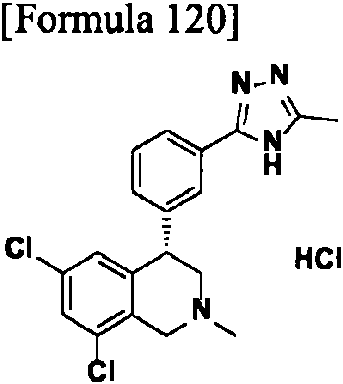
A una suspensión de 3-[(4S)-6,8-dicloro-2-metil-1,2,3,4-tetrahidroisoquinolin-4-il]benzonitrilo (50 mg) obtenida en el Ejemplo de Referencia 4-1 en metanol (0,50 mL), se le añadió metóxido de sodio (solución al 28% en metanol, 17 mg) enfriando con hielo, y la mezcla se agitó a temperatura ambiente durante 3 días. La solución de reacción se concentró. Se añadieron ácido acético (0,50 mL) y acetohidracida (14 mg) al residuo obtenido, y la mezcla se agitó durante 2 horas calentando a reflujo. La solución de reacción se dejó enfriar y a continuación se concentró a presión reducida. Se añadió una solución acuosa saturada de bicarbonato de sodio al residuo obtenido, seguido de extracción con acetato de etilo. La capa orgánica se secó sobre sulfato de magnesio anhidro y se filtró, y a continuación, el producto filtrado se concentró a presión reducida. El residuo obtenido se purificó mediante cromatografía en columna de gel de sílice (Cartucho SNAP HP-Sphere de Biotage (marca registrada), cloroformo:metanol = 100:0 ^ 90:10). A la sustancia oleosa incolora obtenida (4,0 mg), se le añadieron acetato de etilo (1,5 mL) y 4 moles/L de cloruro de hidrógeno en acetato de etilo (0,5 mL), y el disolvente se eliminó mediante destilación a presión reducida para obtener el compuesto del título (4,1 mg) en forma de un sólido incoloro. RMN H1 (300 MHz, CD3OD) 5 ppm 2,72 (s, 3H), 3,18 (s, 3H), 3,59-3,79 (m, 1H), 3,93 (dd, J = 11,8, 6,1Hz, 1H), 4,47-4,65 (m, 1H), 4,76-4,86 (m, 2H), 6,88 (s ancho, 1H), 7,52-7,60 (m, 2H), 7,68 (t, J = 7,8Hz, 1H), 7,94-8,05 (m, 2H).To a suspension of 3 - [(4S) -6,8-dichloro-2-methyl-1,2,3,4-tetrahydroisoquinolin-4-yl] benzonitrile (50 mg) obtained in Reference Example 4-1 in methanol (0.50 mL), sodium methoxide (28% solution in methanol, 17 mg) was added under cooling with ice, and the mixture was stirred at room temperature for 3 days. The reaction solution was concentrated. Acetic acid (0.50 mL) and acetohydrazide (14 mg) were added to the obtained residue, and the mixture was stirred for 2 hours under reflux. The reaction solution was allowed to cool and then concentrated under reduced pressure. A saturated aqueous solution of sodium bicarbonate was added to the obtained residue, followed by extraction with ethyl acetate. The organic layer was dried over anhydrous magnesium sulfate and filtered, and then the filtrate was concentrated under reduced pressure. The obtained residue was purified by silica gel column chromatography (SNAP cartridge HP-Sphere from Biotage (registered trademark), chloroform: methanol = 100: 0 ^ 90:10). To the obtained colorless oily substance (4.0 mg), ethyl acetate (1.5 mL) and 4 mol / L hydrogen chloride in ethyl acetate (0.5 mL) were added, and the solvent was removed by distillation under reduced pressure to obtain the title compound (4.1 mg) as a colorless solid. NMR H1 (300 MHz, CD 3 OD) 5 ppm 2.72 (s, 3H), 3.18 (s, 3H), 3.59-3.79 (m, 1H), 3.93 (dd, J = 11.8, 6.1 Hz, 1H), 4.47-4.65 (m, 1H), 4.76-4.86 (m, 2H), 6.88 (broad s, 1H), 7, 52-7.60 (m, 2H), 7.68 (t, J = 7.8Hz, 1H), 7.94-8.05 (m, 2H).
EM (+): 373 [M+H]+.MS (+): 373 [M + H] +.
MS (-): 371 [M-H] -.MS (-): 371 [M-H] -.
Ejemplo 4-1 Hidrocloruro de (4S)-6,8-Dicloro-2-metil-4-[3-(5-metil-1,2,4-oxadiazol-3-il)fenil]-1,2,3,4-tetrahidroisoquinolinaExample 4-1 (4S) -6,8-Dichloro-2-methyl-4- [3- (5-methyl-1,2,4-oxadiazol-3-yl) phenyl] -1,2,3 Hydrochloride , 4-tetrahydroisoquinoline
[Fórmula 121][Formula 121]

A una suspensión de 3-[(4S)-6,8-dicloro-2-metil-1,2,3,4-tetrahidroisoquinolin-4-il]benzonitrilo (50 mg) obtenida en el Ejemplo de Referencia 4-1 en metanol (0,50 mL), se le añadió hidroxilamina (solución acuosa al 50%, 34 mg) enfriando con hielo, y la mezcla se agitó a temperatura ambiente durante 3 días. La solución de reacción se concentró. Se añadió cloroformo (0,50 mL) al residuo obtenido, a continuación se le añadieron trietilamina (33 pL) y cloruro de acetilo (13 pL) enfriando con hielo, y la mezcla se agitó a temperatura ambiente durante 2 horas y a 60°C durante 4 horas. El disolvente se eliminó mediante destilación a presión reducida. Se añadió N,N-dimetilformamida (0,50 mL) al residuo y la mezcla se agitó a 100°C durante 5 horas. La solución de reacción se dejó enfriar y a continuación se le añadió agua, seguido de extracción con acetato de etilo. La capa orgánica se secó sobre sulfato de magnesio anhidro y se filtró, y a continuación, el producto filtrado se concentró a presión reducida. El residuo obtenido se purificó mediante cromatografía en columna de gel de sílice (Cartucho SNAP HP-Sphere de Biotage (marca registrada), hexano:acetato de etilo = 100:0 ^ 30:70). A la sustancia oleosa amarilla obtenida (9,1 mg), se le añadieron acetato de etilo (1,5 mL) y 4 moles/L de cloruro de hidrógeno en acetato de etilo (0,5 mL), y el disolvente se eliminó mediante destilación a presión reducida para obtener el compuesto del título (9,3). mg) en forma de un sólido de color amarillo.To a suspension of 3 - [(4S) -6,8-dichloro-2-methyl-1,2,3,4-tetrahydroisoquinolin-4-yl] benzonitrile (50 mg) obtained in Reference Example 4-1 in methanol (0.50 mL), hydroxylamine (50% aqueous solution, 34 mg) was added under cooling with ice, and the mixture was stirred at room temperature for 3 days. The reaction solution was concentrated. Chloroform (0.50 mL) was added to the obtained residue, then triethylamine (33 pL) and acetyl chloride (13 pL) were added under cooling with ice, and the mixture was stirred at room temperature for 2 hours and at 60 ° C. During 4 hours. The solvent was removed by distillation under reduced pressure. N, N-dimethylformamide (0.50 mL) was added to the residue and the mixture was stirred at 100 ° C for 5 hours. The reaction solution was allowed to cool and then water was added, followed by extraction with ethyl acetate. The organic layer was dried over anhydrous magnesium sulfate and filtered, and then, the filtrate was concentrated under reduced pressure. The obtained residue was purified by silica gel column chromatography (SNAP HP-Sphere cartridge from Biotage (trademark), hexane: ethyl acetate = 100: 0 ^ 30:70). To the obtained yellow oily substance (9.1 mg), ethyl acetate (1.5 mL) and 4 mol / L hydrogen chloride in ethyl acetate (0.5 mL) were added, and the solvent was removed by distillation under reduced pressure to obtain the title compound (9.3). mg) in the form of a yellow solid.
RMN H1 (300 MHz, CD3OD) 5 ppm 2,65 (s, 3H), 3,16 (s, 3H), 3,55-3,72 (m, 1H), 3,86-3,96 (m, 1H), 4,43-4,55 (m, 1H), 4,68-4,85 (m , 2H), 6,84-6,92 (m, 1H), 7,44-7,64 (m, 3H), 7,96 (s, 1H), 8,04-8,12 (m, 1H). NMR H1 (300 MHz, CD 3 OD) 5 ppm 2.65 (s, 3H), 3.16 (s, 3H), 3.55-3.72 (m, 1H), 3.86-3.96 (m, 1H), 4.43-4.55 (m, 1H), 4.68-4.85 (m, 2H), 6.84-6.92 (m, 1H), 7.44-7 , 64 (m, 3H), 7.96 (s, 1H), 8.04-8.12 (m, 1H).
EM (+): 374 [M+H]+.MS (+): 374 [M + H] +.
Ejemplo 5-1 Hidrocloruro de (4S)-6,8-dicloro-2-metil-4-[3-(3-metil-1,2-oxazol-5-il)fenil]-1,2,3,4-tetrahidroisoquinolina Example 5-1 (4S) -6,8-Dichloro-2-methyl-4- [3- (3-methyl-1,2-oxazol-5-yl) phenyl] -1,2,3,4 Hydrochloride -tetrahydroisoquinoline
[Fórmula 122] [Formula 122]

A una solución de (4S)-6,8-dicloro-4-(3-etinilfenil)-2-metil-1,2,3,4-tetrahidroisoquinolina (90 mg) obtenida en el Ejemplo de Referencia 2-1, isocianatobenceno (0,19 mL), y nitroetano (20 pL) en tolueno (2,0 mL), se le añadió trietilamina (2,6 pL) y la mezcla se agitó a 80°C durante 12 horas. La solución de reacción se dejó enfriar. A continuación, se le añadió agua y la mezcla se agitó durante 50 minutos. La materia insoluble se separó mediante filtración y el producto se concentró a presión reducida. El residuo obtenido se purificó mediante cromatografía en columna de gel de sílice (Cartucho SnAp HP-Sphere de Biotage (marca registrada), hexano:acetato de etilo = 100:0 ^ 50:50). El disolvente se eliminó mediante destilación a presión reducida, y el residuo obtenido se disolvió en acetato de etilo (0,5 mL). A la solución, se le añadieron gota a gota 4 moles/L de cloruro de hidrógeno en acetato de etilo (0,5 mL) enfriando con hielo, y la mezcla se agitó durante 15 minutos. A continuación, el disolvente se eliminó mediante destilación a presión reducida para obtener el compuesto del título (49 mg, 42%) en forma de una sustancia amorfa de color de color pardo claro.To a solution of (4S) -6,8-dichloro-4- (3-ethynylphenyl) -2-methyl-1,2,3,4-tetrahydroisoquinoline (90 mg) obtained in Reference Example 2-1, isocyanatobenzene (0.19 mL), and nitroethane (20 pL) in toluene (2.0 mL), triethylamine (2.6 pL) was added and the mixture was stirred at 80 ° C for 12 hours. The reaction solution was allowed to cool. Then, water was added and the mixture was stirred for 50 minutes. The insoluble matter was separated by filtration and the product was concentrated under reduced pressure. The obtained residue was purified by silica gel column chromatography (SnAp HP-Sphere Cartridge from Biotage (trademark), hexane: ethyl acetate = 100: 0 ^ 50:50). The solvent was removed by distillation under reduced pressure, and the residue obtained was dissolved in ethyl acetate (0.5 mL). To the solution, 4 mol / L of hydrogen chloride in ethyl acetate (0.5 mL) was added dropwise under ice-cooling, and the mixture was stirred for 15 minutes. The solvent was then removed by distillation under reduced pressure to obtain the title compound (49 mg, 42%) as an amorphous substance of light brown color.
RMN H1 (600 MHz, DIVISOR) 5 ppm 2,28 (s, 3H), 2,98 (s ancho, 3H), 3,51-3,69 (m, 1H), 3,69-3,88 (m, 1H), 4,31 4,48 (m, 1H), 4,53-4,70 (m, 1H), 4,70-4,80 (m, 1H), 6,78 (s ancho, 1H), 6,91 (s, 1H), 7,39 (d, J = 8,0Hz, 1H), 7,57 (t, J = 8,0Hz, 1H), 7,68 (s ancho, 1H), 7,76 (s, 1H), 7,83 (d, J = 8,0Hz, 1H), 11,22 (s ancho, 1H).H1 NMR (600 MHz, DIVIDER) 5 ppm 2.28 (s, 3H), 2.98 (broad s, 3H), 3.51-3.69 (m, 1H), 3.69-3.88 ( m, 1H), 4.31 4.48 (m, 1H), 4.53-4.70 (m, 1H), 4.70-4.80 (m, 1H), 6.78 (s broad, 1H), 6.91 (s, 1H), 7.39 (d, J = 8.0Hz, 1H), 7.57 (t, J = 8.0Hz, 1H), 7.68 (s wide, 1H) ), 7.76 (s, 1H), 7.83 (d, J = 8.0 Hz, 1H), 11.22 (s broad, 1H).
EM (+): 373 [M+H]+MS (+): 373 [M + H] +
Ejemplo 6-1 1,1'-Butano-1,4-diilbis[3-(2-{2-[2-(4-{3-[(4S)-6,8-dicloro-2-metil-{1,2,3,4-tetrahidroisoquinolin-4-il]fenil}-1H-1,2,3-triazol-1-il)etoxi]etoxi l}etil)urea]Example 6-1 1,1'-Butane-1,4-diylbis [3- (2- {2- [2- (4- {3 - [(4S) -6,8-dichloro-2-methyl- { 1,2,3,4-tetrahydroisoquinolin-4-yl] phenyl} -1H-1,2,3-triazol-1-yl) ethoxy] ethoxy l} ethyl) urea]
[Fórmula 123][Formula 123]
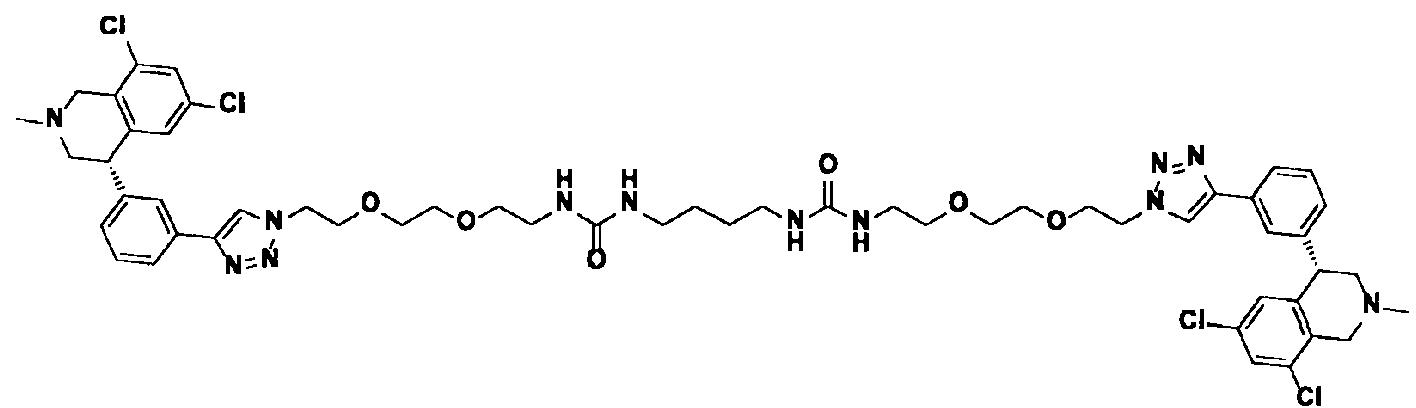
A una solución de (4S)-6,8-dicloro-4-(3-etinilfenil)-2-metil-1,2,3,4-tetrahidroisoquinolina (70 mg) obtenida en el Ejemplo de Referencia 2-1 en una mezcla disolvente de terc-butanol (3,3 mL)-agua (1,7 mL), se le añadieron 1,1'-butano-1,4-diilbis(3-{2-[2-(2-azidoetoxi)etoxi]etil}urea) (43 mg) obtenida en el Ejemplo de Referencia 5-1, sulfato de cobre (1,1 mg) y ascorbato de sodio (8,8 mg), y la mezcla se agitó a temperatura ambiente durante 3 horas. La solución de reacción se concentró a presión reducida y el residuo obtenido se purificó mediante cromatografía en columna de gel de sílice (Cartucho SNAP KP-NH de Biotage (marca registrada), cloroformo:metanol = 100:0 ^ 80:20) para obtener el compuesto del título (65 mg, 52%) en forma de una sustancia amorfa incolora.To a solution of (4S) -6,8-dichloro-4- (3-ethynylphenyl) -2-methyl-1,2,3,4-tetrahydroisoquinoline (70 mg) obtained in Reference Example 2-1 in one Solvent mixture of tert-butanol (3.3 mL) -water (1.7 mL), 1,1'-butane-1,4-diylbis (3- {2- [2- (2-azidoethoxy) was added. ethoxy] ethyl} urea) (43 mg) obtained in Reference Example 5-1, copper sulfate (1.1 mg) and sodium ascorbate (8.8 mg), and the mixture was stirred at room temperature for 3 hours. hours. The reaction solution was concentrated under reduced pressure and the residue obtained was purified by silica gel column chromatography (SNAP KP-NH cartridge from Biotage (registered trademark), chloroform: methanol = 100: 0 ^ 80:20) to obtain the title compound (65 mg, 52%) as a colorless amorphous substance.
Tiempo de retención LC-MS 0,548 minLC-MS retention time 0.548 min
CL: Agilent 1290CL: Agilent 1290
EM ESI/APCI: Agilent 6130ESI / APCI EM: Agilent 6130
Columna: Waters Acquity CSH C181,7 um, 2,1x50 mmColumn: Waters Acquity CSH C181.7 um, 2.1x50 mm
Disolvente: H20:CH3Cn (ácido fórmico al 0,1%)Solvent: H20: CH3Cn (0.1% formic acid)
Gradiente: 0,8 mL/min, 0 min (80:20) ^ 1,2-1,4 min (1:99)Gradient: 0.8 mL / min, 0 min (80:20) ^ 1.2-1.4 min (1:99)
EM (+): 1121 [M+H]+.MS (+): 1121 [M + H] +.
Ejemplo 6-2 Hidrocloruro de 1,1'-butano-1,4-diilbis{3-[2-(2-{2-[2-(4-{3-[(4S)-6,8-dicloro-2-metil-1-1H-1,2,3-triazol-1-il)etoxi]etoxi}etoxi)etil]urea}Example 6-2 1,1'-Butane-1,4-diylbis hydrochloride {3- [2- (2- {2- [2- (4- {3 - [(4S) -6,8-dichloro- 2-methyl-1-1H-1,2,3-triazol-1-yl) ethoxy] ethoxy} ethoxy) ethyl] urea}
A una solución de hidrocloruro de (4S)-6,8-dicloro-4-(3-etinilfenil)-2-metil-1,2,3,4-tetrahidroisoquinolina (0,30 g) obtenida en el Ejemplo de Referencia 2-2 en una mezcla disolvente de terc-butanol (4,0 mL)-agua (1,0 mL), se le añadieron 1,1'-butano-1,4-diilbis[3-(2-{2-[2-(2-azidoetoxi)etoxi]etoxi}etil)urea] (0,25 g) obtenida en el Ejemplo de Referencia 5-2, sulfato de cobre (21 mg) y ascorbato de sodio (33 mg), y la mezcla se agitó a temperatura ambiente durante 3 horas. A continuación, la mezcla de reacción se agitó durante 2 días calentando a reflujo. La solución de reacción se concentró a presión reducida y el residuo obtenido se purificó mediante cromatografía en columna de gel de sílice (Cartucho SNAP KP-NH de Biotage (marca registrada), cloroformo:metanol = 100:0 ^ 70:30). El disolvente se eliminó mediante destilación a presión reducida. El residuo obtenido se purificó mediante LC-MS preparativa (LC (Agilent 1260), ESIMS (6130 Quadrupole, ESI), columna (YMC-Actus Triart 5 pm C1850 x 30 mm), fase móvil (ácido fórmico al 0,1% en H2Ü:ácido fórmico al 0,1% en CH3CN = 90:10 ^ 80:20 ^ 5:95), 50 mL/min.). El disolvente se eliminó mediante destilación a presión reducida, y el residuo obtenido se purificó mediante cromatografía en columna sobre gel de sílice (Cartucho SNAP KP-NH de Biotage (marca registrada), cloroformo:metanol = 100:0 ^ 70:30). El disolvente se eliminó mediante destilación a presión reducida, y el residuo obtenido se disolvió en etanol. A la solución, se le añadieron 4 moles/L de cloruro de hidrógeno en 1,4-dioxano (0,20 mL) y el disolvente se eliminó mediante destilación a presión reducida para obtener el compuesto del título (78 mg) en forma de una sustancia amorfa incolora.To a solution of (4S) -6,8-dichloro-4- (3-ethynylphenyl) -2-methyl-1,2,3,4-tetrahydroisoquinoline hydrochloride (0.30 g) obtained in Reference Example 2 -2 in a solvent mixture of tert-butanol (4.0 mL) -water (1.0 mL), was added 1,1'-butane-1,4-diylbis [3- (2- {2- [ 2- (2-azidoethoxy) ethoxy] ethoxy} ethyl) urea] (0.25 g) obtained in the Example of Reference 5-2, copper sulfate (21 mg) and sodium ascorbate (33 mg), and the mixture was stirred at room temperature for 3 hours. Then, the reaction mixture was stirred for 2 days by heating to reflux. The reaction solution was concentrated under reduced pressure and the obtained residue was purified by silica gel column chromatography (SNAP KP-NH cartridge from Biotage (trademark), chloroform: methanol = 100: 0 ^ 70:30). The solvent was removed by distillation under reduced pressure. The obtained residue was purified by preparative LC-MS (LC (Agilent 1260), ESIMS (6130 Quadrupole, ESI), column (YMC-Actus Triart 5 pm C1850 x 30 mm), mobile phase ( 0.1% formic acid in H 2 Ü: 0.1% formic acid in CH 3 CN = 90:10 ^ 80:20 ^ 5:95), 50 mL / min.). The solvent was removed by distillation under reduced pressure, and the obtained residue was purified by column chromatography on silica gel (SNAP KP-NH cartridge from Biotage (registered trademark), chloroform: methanol = 100: 0 ^ 70:30). The solvent was removed by distillation under reduced pressure, and the residue obtained was dissolved in ethanol. To the solution, 4 mol / L of hydrogen chloride in 1,4-dioxane (0.20 mL) was added and the solvent was removed by distillation under reduced pressure to obtain the title compound (78 mg) in the form of a colorless amorphous substance.
Tiempo de retención LC-MS 0,555 minRetention time LC-MS 0.555 min
CL: Agilent 1290CL: Agilent 1290
EM ESI/APCI: Agilent 6130ESI / APCI EM: Agilent 6130
Columna: Waters Acquity CSH C181,7 um, 2,1x50 mmColumn: Waters Acquity CSH C181.7 um, 2.1x50 mm
Disolvente: H20 :CHsCn (ácido fórmico al 0,1%) Solvent: H 20 : CHsCn (0.1% formic acid)
Gradiente: 0,8 mL/min, 0 min (80:20) ^ 1,2-1,4 min (1:99)Gradient: 0.8 mL / min, 0 min (80:20) ^ 1.2-1.4 min (1:99)
EM (+): 1209 [M+H]+, 1231 [M Na]+.MS (+): 1209 [M + H] +, 1231 [M Na] +.
Ejemplo 6-3 Hidrocloruro de N,N'-bis(2-{2-[2-(4-{3-[(4S)-6,8-dicloro-2-metil-1,2,3,4-tetrahidroisoquinolin-4-il]fenil}-1H-1,2,3-triazol-1-il)etoxi]etoxi}etil)butanodiamidaExample 6-3 N, N'-bis (2- {2- [2- (4- {3 - [(4S) -6,8-dichloro-2-methyl-1,2,3,4- hydrochloride tetrahydroisoquinolin-4-yl] phenyl} -1H-1,2,3-triazol-1-yl) ethoxy] ethoxy} ethyl) butanediimide
El compuesto del título (7,0 mg) se obtuvo en forma de una sustancia amorfa incolora sustancialmente a través de la misma reacción que en el Ejemplo 6-2, excepto que se utilizó N,N'-bis{2-[2-(2-azidoetoxi)etoxi]etil}butanodiamida obtenida en el Ejemplo de Referencia 6-1 en lugar de 1,1 '-butano-1,4-diilbis[3-(2-{2-[2-(2-azidoetoxi)etoxi]etoxi}etil)urea] obtenida en la Referencia Ejemplo 5-2.The title compound (7.0 mg) was obtained in the form of a colorless amorphous substance substantially through the same reaction as in Example 6-2, except that N, N'-bis {2- [2- (2-azidoethoxy) ethoxy] ethyl} butanediamide obtained in Reference Example 6-1 in place of 1,1'-butane-1,4-diylbis [3- (2- {2- [2- (2-azidoethoxy ) ethoxy] ethoxy} ethyl) urea] obtained in Reference Example 5-2.
Tiempo de retención LC-MS 0,542 minRetention time LC-MS 0,542 min
CL: Agilent 1290CL: Agilent 1290
EM ESI/APCI: Agilent 6130ESI / APCI EM: Agilent 6130
Columna: Waters Acquity CSH C181,7 um, 2,1x50 mmColumn: Waters Acquity CSH C181.7 um, 2.1x50 mm
Disolvente: H20 :CHsCn (ácido fórmico al 0,1%) Solvent: H 20 : CHsCn (0.1% formic acid)
Gradiente: 0,8 mL/min, 0 min (80:20) ^ 1,2-1,4 min (1:99)Gradient: 0.8 mL / min, 0 min (80:20) ^ 1.2-1.4 min (1:99)
EM (+): 1063 [M+H]+.MS (+): 1063 [M + H] +.
Ejemplo 6-4 Hidrocloruro de 1-(4-{3-[(4S)-6,8-dicloro-2-metil-1,2,3,4-tetrahidroisoquinolin-4-il]fenil}-1H-1,2,3-triazol-1-il)-N-(2-{2-[2-(4-{3-[(4S)-6,8-dicloro-2-metil-1,2,3,4-tetrahidroisoquinolin-4-il]fenil}-1H-1,2,3-triazol-1-il)etoxi]etoxi}etil)-10-oxo-3,6,12-trioxa-9-azatetradecan-14-amidaExample 6-4 1- (4- {3 - [(4S) -6,8-Dichloro-2-methyl-1,2,3,4-tetrahydroisoquinolin-4-yl] phenyl} -1H-1 hydrochloride 2,3-triazol-1-yl) -N- (2- {2- [2- (4- {3 - [(4S) -6,8-dichloro-2-methyl-1,2,3,4 -tetrahydroisoquinolin-4-yl] phenyl} -1H-1,2,3-triazol-1-yl) ethoxy] ethoxy} ethyl) -10-oxo-3,6,12-trioxa-9-azatetradecan-14-amide
El compuesto del título (33 mg) se obtuvo en forma de una sustancia amorfa incolora sustancialmente a través de la misma reacción que en el Ejemplo 6-2, excepto que se utilizó 1-azido-N-{2-[2-(2-azidoetoxi)etoxi]etil}-10-oxo-3,6,12-trioxa-9-azatetradecan-14-amida obtenida en el Ejemplo de Referencia 6-2 en lugar de 1,1 '-butano-1,4-diilbis[3-(2-{2-[2-(2-azidoetoxi)etoxi]etoxi}etil)urea] obtenida en el Ejemplo de Referencia 5-2.The title compound (33 mg) was obtained as a colorless amorphous substance substantially through the same reaction as in Example 6-2, except that 1-azido-N- {2- [2- (2 -zidoethoxy) ethoxy] ethyl} -10-oxo-3,6,12-trioxa-9-azatetradecan-14-amide obtained in Reference Example 6-2 instead of 1,1'-butane-1,4- diylbis [3- (2- {2- [2- (2-azidoethoxy) ethoxy] ethoxy} ethyl) urea] obtained in Reference Example 5-2.
Tiempo de retención de LC-MS 1,027 minRetention time of LC-MS 1,027 min
CL: Agilent 1290CL: Agilent 1290
EM ESI/APCI: Agilent 6130ESI / APCI EM: Agilent 6130
Columna: Waters Acquity CSH C181,7 um, 2,1x50 mmColumn: Waters Acquity CSH C181.7 um, 2.1x50 mm
Disolvente: H20 :CHsCn (ácido fórmico al 0,1%) Solvent: H 20 : CHsCn (0.1% formic acid)
Gradiente: 0,8 mL/min, 0 min (95:5) ^ 1,2 min (50:50)Gradient: 0.8 mL / min, 0 min (95: 5) ^ 1.2 min (50:50)
1,0 mL/min, ^ 1,38 min (3:97)1.0 mL / min, ^ 1.38 min (3:97)
EM (+): 1079 [M+H]+.MS (+): 1079 [M + H] +.
Ejemplo 6-5 Hidrocloruro de 1,1'-benceno-1,4-diilbis[3-(2-{2-[2-(4-{3-[(4S)-6,8-dicloro-2-metil-1,2,3,4-tetrahidroisoquinolin-4-il]fenil}-1H-1,2,3-triazol-1-il)etoxi]etoxi}etil)urea]Example 6-5 1,1'-Benzene-1,4-diylbis [3- (2- {2- [2- (4- {3 - [(4S) -6,8-dichloro-2-methyl) hydrochloride -1,2,3,4-tetrahydroisoquinolin-4-yl] phenyl} -1H-1,2,3-triazol-1-yl) ethoxy] ethoxy} ethyl) urea]
El compuesto del título (41 mg) se obtuvo en forma de una sustancia amorfa incolora sustancialmente a través de la misma reacción que en el Ejemplo 6-2, excepto que se utilizó 1,1'-benceno-1,4-diilbis(3-{2-[2-(2-azidoetoxi)etoxi]etil}urea) obtenida en el Ejemplo de Referencia 5-3 en lugar de 1, 1 '-butano-1,4-diilbis[3-(2-{2-[2-(2azidoetoxi)etoxi ]etoxi}etil)urea] obtenida en el Ejemplo de Referencia 5-2.The title compound (41 mg) was obtained in the form of a colorless amorphous substance substantially through the same reaction as in Example 6-2, except that 1,1'-benzene-1,4-diylbis (3 - {2- [2- (2-azidoethoxy) ethoxy] ethyl} urea) obtained in Reference Example 5-3 instead of 1.1 '-butane-1,4-diylbis [3- (2- {2- [2- (2azidoethoxy) ethoxy] ethoxy} ethyl) urea] obtained in Reference Example 5-2.
Tiempo de retención LC-MS 1,069 minRetention time LC-MS 1,069 min
CL: Agilent 1290CL: Agilent 1290
EM ESI/APCI: Agilent 6130ESI / APCI EM: Agilent 6130
Columna: Waters Acquity CSH C181,7 um, 2,1x50 mmColumn: Waters Acquity CSH C181.7 um, 2.1x50 mm
Disolvente: H2O:CH3Cn (ácido fórmico al 0,1%) Solvent: H 2 O: CH 3 Cn (0.1% formic acid)
Gradiente: 0,8 mL/min, 0 min (95:5) ^ 1,2 min (50:50)Gradient: 0.8 mL / min, 0 min (95: 5) ^ 1.2 min (50:50)
1.0 mL/min, ^ 1,38 min (3:97)1.0 mL / min, ^ 1.38 min (3:97)
EM (+): 1141 [M+H]+.MS (+): 1141 [M + H] +.
Ejemplo 6-6 Hidrocloruro de (2R,3R)-N,N'-bis(2-{2-[2-(4-{3-[(4S)-6,8-dicloro-2-metil-1,2,3,4-tetrahidroisoquinolin-4-il]fenil}-1H-1,2,3-triazol-1-il)etoxi]etoxi}etil)-2,3-dihidroxibutanodiamidaExample 6-6 (2R, 3R) -N, N'-bis (2- {2- [2- (4- {3 - [(4S) -6,8-dichloro-2-methyl-1) hydrochloride 2,3,4-tetrahydroisoquinolin-4-yl] phenyl} -1H-1,2,3-triazol-1-yl) ethoxy] ethoxy} ethyl) -2,3-dihydroxybutanediimide
El compuesto del título (20 mg) se obtuvo en forma de una sustancia amorfa incolora sustancialmente a través de la misma reacción que en el Ejemplo 6-2, excepto que se utilizó (2R,3R)-N,N'-bis{2-[2-(2-azidoetoxi)etoxi]etil}-2,3-dihidroxibutanodiamida obtenida en el Ejemplo de Referencia 6-3 en lugar de 1,1 '-butano-1,4-diilbis[3-(2-{2-[2-(2-azidoetoxi)etoxi]etoxi}etil)urea] obtenida en el Ejemplo de Referencia 5-2.The title compound (20 mg) was obtained as a colorless amorphous substance substantially through the same reaction as in Example 6-2, except that (2R, 3R) -N, N'-bis (2) was used. - [2- (2-azidoethoxy) ethoxy] ethyl} -2,3-dihydroxybutanediamide obtained in Reference Example 6-3 in place of 1,1'-butane-1,4-diylbis [3- (2- { 2- [2- (2-azidoethoxy) ethoxy] ethoxy} ethyl) urea] obtained in Reference Example 5-2.
Tiempo de retención LC-MS 1,008 minRetention time LC-MS 1,008 min
CL: Agilent 1290CL: Agilent 1290
EM ESI/APCI: Agilent 6130ESI / APCI EM: Agilent 6130
Columna: Waters Acquity CSH C181,7 um, 2,1x50 mmColumn: Waters Acquity CSH C181.7 um, 2.1x50 mm
Disolvente: H2O:CHsCn (ácido fórmico al 0,1%) Solvent: H 2 O: CHsCn (0.1% formic acid)
Gradiente: 0,8 mL/min, 0 min (95:5) ^ 1,2 min (50:50)Gradient: 0.8 mL / min, 0 min (95: 5) ^ 1.2 min (50:50)
1.0 mL/min, ^ 1,38 min (3:97)1.0 mL / min, ^ 1.38 min (3:97)
EM (+): 1095 [M+H]+.MS (+): 1095 [M + H] +.
Ejemplo 6-7 Hidrocloruro de (2R,3S,4R,5S)-N,N'-bis(2-{2-[2-(4-{3-[(4S)-6,8-dicloro-2-metil-1,2,3,4-tetrahidroisoquinolin-4-il]fenil}-1H-1,2,3-triazol-1-il)etoxi]etoxi}etil)-2,3,4,5-tetrahidroxihexanodiamidaExample 6-7 (2R, 3S, 4R, 5S) -N, N'-bis (2- {2- [2- (4- {3 - [(4S) -6,8-dichloro-2-) hydrochloride methyl-1,2,3,4-tetrahydroisoquinolin-4-yl] phenyl} -1H-1,2,3-triazol-1-yl) ethoxy] ethoxy} ethyl) -2,3,4,5-tetrahydroxyhexanodiamide
A una solución de (2R,3S,4R,5S)-N,N'-bis{2-[2-(2-azidoetoxi)etoxi]etil}-2,3,4,5-tetrahidroxihexanodiamida (74 mg) obtenida en el Ejemplo de Referencia 6-4 en una mezcla disolvente de terc-butanol (8,0 mL)-agua (2,0 mL), se le añadieron hidrocloruro de (4S)-6,8-dicloro-4-(3-etinilfenil)-2-metil-1,2,3,4-tetrahidroisoquinolina (0,10 g) obtenido en el Ejemplo de Referencia 2-2, sulfato de cobre (7,1 mg), ascorbato de sodio (11 mg) y trietilamina (0,40 mL) y la mezcla se agitó a temperatura ambiente durante 3 horas. La solución de reacción se concentró a presión reducida y el residuo obtenido se purificó mediante cromatografía en columna de gel de sílice (Cartucho SNAP KP-NH de Biotage (marca registrada), cloroformo:metanol = 100:0 ^ 70:30). El disolvente se eliminó mediante destilación a presión reducida. El residuo obtenido se disolvió en etanol. A la solución, se le añadieron 4 moles/L de cloruro de hidrógeno en 1,4-dioxano (0,20 mL) y el disolvente se eliminó mediante destilación a presión reducida para obtener el compuesto del título (0,15 g) en forma de una sustancia amorfa de color verde pálido.To a solution of (2R, 3S, 4R, 5S) -N, N'-bis {2- [2- (2-azidoethoxy) ethoxy] ethyl} -2,3,4,5-tetrahydroxyhexanodiamide (74 mg) obtained in Reference Example 6-4 in a solvent mixture of tert-butanol (8.0 mL) -water (2.0 mL), (4S) -6,8-dichloro-4- (3-hydrochloride was added. ethynylphenyl) -2-methyl-1,2,3,4-tetrahydroisoquinoline (0.10 g) obtained in Reference Example 2-2, copper sulfate (7.1 mg), sodium ascorbate (11 mg) and triethylamine (0.40 mL) and the mixture was stirred at room temperature for 3 hours. The reaction solution was concentrated under reduced pressure and the obtained residue was purified by silica gel column chromatography (SNAP KP-NH cartridge from Biotage (trademark), chloroform: methanol = 100: 0 ^ 70:30). The solvent was removed by distillation under reduced pressure. The residue obtained was dissolved in ethanol. To the solution, 4 mol / L hydrogen chloride in 1,4-dioxane (0.20 mL) was added and the solvent was removed by distillation under reduced pressure to obtain the title compound (0.15 g) in form of a pale green amorphous substance.
Tiempo de retención LC-MS 0,976 minRetention time LC-MS 0.976 min
CL: Agilent 1290CL: Agilent 1290
EM ESI/APCI: Agilent 6130ESI / APCI EM: Agilent 6130
Columna: Waters Acquity CSH C181,7 um, 2,1x50 mmColumn: Waters Acquity CSH C181.7 um, 2.1x50 mm
Disolvente: H2O:CHsCn (ácido fórmico al 0,1%) Solvent: H 2 O: CHsCn (0.1% formic acid)
Gradiente: 0,8 mL/min, 0 min (95:5) ^ 1,2 min (50:50)Gradient: 0.8 mL / min, 0 min (95: 5) ^ 1.2 min (50:50)
1.0 mL/min, ^ 1,38 min (3:97)1.0 mL / min, ^ 1.38 min (3:97)
EM (+): 1155 [M+H]+.MS (+): 1155 [M + H] +.
Ejemplo 6-8 Hidrocloruro de (2R,3S,4R,5S)-N,N'-bis[2-(2-{2-[2-(4-{3-[(4S)-6,8-dicloro-2-metil-1,2,3,4-tetrahidroisoquinolin-4-il]fenil}-1H-1,2,3-triazol-1-il)etoxi]etoxi}etoxi)etil]-2,3,4,5 tetrahidroxihexanodiamidaExample 6-8 (2R, 3S, 4R, 5S) -N, N'-bis [2- (2- {2- [2- (4- {3 - [(4S) -6,8-dichloro) hydrochloride -2-methyl-1,2,3,4-tetrahydroisoquinolin-4-yl] phenyl} -1H-1,2,3-triazol-1-yl) ethoxy] ethoxy} ethoxy) ethyl] -2,3,4 , 5-tetrahydroxyhexanodiamide
A una solución de (2R,3S,4R,5S)-N,N'-bis(2-{2-[2-(2-azidoetoxi)etoxi]etoxi}etil)-2,3,4,5-tetrahidroxihexanodiamida (87 mg) obtenida en el Ejemplo de Referencia 6-5 en una mezcla disolvente de terc-butanol (8,0 mL)-agua (2,0 mL), se le añadió hidrocloruro de (4S)-6,8-dicloro-4-(3-etinilfenil)-2-metil-1,2,3,4-tetrahidroisoquinolina (0,10 g) obtenido en el Ejemplo de Referencia 2-2, sulfato de cobre (7,1 mg), ascorbato de sodio (11 mg) y trietilamina (0,40 mL), y la mezcla se agitó a temperatura ambiente durante 3 horas. La solución de reacción se concentró a presión reducida y el residuo obtenido se purificó mediante cromatografía en columna de gel de sílice (Cartucho SNAP KP-NH de Biotage (marca registrada), cloroformo:metanol = 100:0 ^ 70:30). El disolvente se eliminó mediante destilación a presión reducida. El residuo obtenido se disolvió en etanol. A la solución, se le añadieron 4 moles/L de cloruro de hidrógeno en 1,4-dioxano (0,20 mL) y el disolvente se eliminó mediante destilación a presión reducida para obtener el compuesto del título (0,14 g) en forma de una sustancia amorfa de color verde pálido.To a solution of (2R, 3S, 4R, 5S) -N, N'-bis (2- {2- [2- (2-azidoethoxy) ethoxy] ethoxy} ethyl) -2,3,4,5-tetrahydroxyhexanodiamide (87 mg) obtained in Reference Example 6-5 in a solvent mixture of tert-butanol (8.0 mL) -water (2.0 mL), (4S) -6,8-dichlorohydrochloride was added. -4- (3-ethynylphenyl) -2-methyl-1,2,3,4-tetrahydroisoquinoline (0.10 g) obtained in Reference Example 2-2, copper sulfate (7.1 mg), ascorbate sodium (11 mg) and triethylamine (0.40 mL), and the mixture was stirred at room temperature for 3 hours. The reaction solution was concentrated under reduced pressure and the obtained residue was purified by silica gel column chromatography (SNAP KP-NH cartridge from Biotage (trademark), chloroform: methanol = 100: 0 ^ 70:30). The solvent was removed by distillation under reduced pressure. The residue obtained was dissolved in ethanol. To the solution, 4 mol / L chloride of Hydrogen in 1,4-dioxane (0.20 mL) and the solvent was distilled off under reduced pressure to obtain the title compound (0.14 g) as a pale green amorphous substance.
Tiempo de retención de LC-MS 1,016 minRetention time of LC-MS 1,016 min
CL: Agilent 1290CL: Agilent 1290
EM ESI/APCI: Agilent 6130ESI / APCI EM: Agilent 6130
Columna: Waters Acquity CSH C181,7 um, 2,1x50 mmColumn: Waters Acquity CSH C181.7 um, 2.1x50 mm
Disolvente: H2O:CH3Cn (ácido fórmico al 0,1%) Solvent: H 2 O: CH 3 Cn (0.1% formic acid)
Gradiente: 0,8 mL/min, 0 min (95:5) ^ 1,2 min (50:50)Gradient: 0.8 mL / min, 0 min (95: 5) ^ 1.2 min (50:50)
1.0 mL/min, ^ 1,38 min (3:97)1.0 mL / min, ^ 1.38 min (3:97)
EM (+): 1243 [M+H]+.MS (+): 1243 [M + H] +.
Ejemplo 6-9 Hidrocloruro de (2R,3R)-N,N'-bis[14-(4-{3-[(4S)-6,8-dicloro-2-metil-1,2,3,4-tetrahidroisoquinolin-4-il]fenil}-1H-1,2,3-triazol-1-il)-3,6,9,12-tetraoxatetradec-1-il]-2,3-dihidroxibutanodiamidaExample 6-9 (2R, 3R) -N, N'-bis [14- (4- {3 - [(4S) -6,8-dichloro-2-methyl-1,2,3,4- hydrochloride tetrahydroisoquinolin-4-yl] phenyl} -1H-1,2,3-triazol-1-yl) -3,6,9,12-tetraoxatetradec-1-yl] -2,3-dihydroxybutanediimide
A una solución hidrocloruro de (4S)-6,8-dicloro-4-(3-etinilfenil)-2-metil-1,2,3,4-tetrahidroisoquinolina (0,13 g) obtenida en el Ejemplo de Referencia 2-2, sulfato de cobre (2,8 mg), ascorbato de sodio (7,1 mg) y N,N-diisopropiletilamina (0,18 mL) en una mezcla disolvente de etanol (6,4 mL)-agua (1,6 mL), se le añadió una solución de (2R,3R)-N,N'-bis(14-azido-3,6,9,12-tetraoxatetradec-1-il)-2,3-dihidroxibutanodiamida (0,11 g) obtenida en el Ejemplo de Referencia 7-4 en una mezcla disolvente de etanol (1,6 mL)-agua (0,4 mL), y la mezcla se agitó a temperatura ambiente durante 22 horas. A continuación, se añadieron sulfato de cobre (2,8 mg) y ascorbato de sodio (7,1 mg), y la mezcla se agitó a temperatura ambiente durante 24 horas. La solución de reacción se concentró a presión reducida y el residuo obtenido se purificó mediante HPLC preparativa de fase inversa (columna (YMC-Actus Triart 5 pm C18 50 x 30 mm), fase móvil (ácido fórmico al 0,1% en H2O:ácido fórmico al 0,1% en MeCN = 95:5 ^ 80:20 ^ 50:50 ^ 5:95, 40 mL/min). El disolvente se eliminó mediante destilación a presión reducida, y el residuo obtenido se purificó mediante cromatografía en columna sobre gel de sílice (Cartucho SNAP KP-Nh de Biotage (marca registrada), cloroformo:metanol = 98:2 ^ 85:15). El disolvente se eliminó mediante destilación a presión reducida. Se añadieron etanol (3,0 mL) y 4 moles/L de cloruro de hidrógeno en acetato de etilo (24 pl) al residuo obtenido (30 mg) y la mezcla se agitó a temperatura ambiente durante 15 minutos. El disolvente se eliminó mediante destilación a presión reducida. Se añadió éter dietílico al residuo obtenido. Después de la pulverización, se eliminó el sobrenadante. El residuo obtenido se concentró a presión reducida para obtener el compuesto del título (33 mg, 14%) en forma de una sustancia amorfa incolora.To a solution of (4S) -6,8-dichloro-4- (3-ethynylphenyl) -2-methyl-1,2,3,4-tetrahydroisoquinoline hydrochloride (0.13 g) obtained in Reference Example 2- 2, copper sulfate (2.8 mg), sodium ascorbate (7.1 mg) and N, N-diisopropylethylamine (0.18 mL) in a solvent mixture of ethanol (6.4 mL) -water (1, 6 mL), a solution of (2R, 3R) -N, N'-bis (14-azido-3,6,9,12-tetraoxatetradec-1-yl) -2,3-dihydroxybutanediamide (0, 11 g) obtained in Reference Example 7-4 in a solvent mixture of ethanol (1.6 mL) -water (0.4 mL), and the mixture was stirred at room temperature for 22 hours. Then, copper sulfate (2.8 mg) and sodium ascorbate (7.1 mg) were added, and the mixture was stirred at room temperature for 24 hours. The reaction solution was concentrated under reduced pressure and the obtained residue was purified by reverse phase preparative HPLC (column (YMC-Actus Triart 5 pm C18 50 x 30 mm), mobile phase (0.1% formic acid in H 2) O: 0.1% formic acid in MeCN = 95: 5 ^ 80:20 ^ 50:50 ^ 5:95, 40 mL / min.) The solvent was removed by distillation under reduced pressure, and the residue obtained was purified by column chromatography on silica gel (SNAP KP-N h cartridge from Biotage (trademark), chloroform: methanol = 98: 2 ^ 85:15) The solvent was removed by distillation under reduced pressure. , 0 mL) and 4 mol / L of hydrogen chloride in ethyl acetate (24 pl) to the obtained residue (30 mg) and the mixture was stirred at room temperature for 15 minutes.The solvent was distilled off under reduced pressure. Diethyl ether was added to the obtained residue, after the pulverization, the supernatant was removed. or obtained was concentrated under reduced pressure to obtain the title compound (33 mg, 14%) as a colorless amorphous substance.
Tiempo de retención LC-MS 1,041 minRetention time LC-MS 1,041 min
CL: Agilent 1290CL: Agilent 1290
EM ESI/APCI: Agilent 6130ESI / APCI EM: Agilent 6130
Columna: Waters Acquity CSH C181,7 um, 2,1x50 mmColumn: Waters Acquity CSH C181.7 um, 2.1x50 mm
Disolvente: H20:CHsCn (ácido fórmico al 0,1%)Solvent: H20: CH s C n (0.1% formic acid)
Gradiente: 0,8 mL/min, 0 min (95:5) ^ 1,2 min (50:50)Gradient: 0.8 mL / min, 0 min (95: 5) ^ 1.2 min (50:50)
1.0 mL/min, ^ 1,38 min (3:97)1.0 mL / min, ^ 1.38 min (3:97)
EM (+): 1271 [M+H]+.MS (+): 1271 [M + H] +.
Ejemplo 6-10 Hidrocloruro de (2R,3R)-N,N'-Bis[17-(4-{3-[(4S)-6,8-dicloro-2-metil-1,2,3,4-tetrahidroisoquinolin-4-il]fenil}-1H-1,2,3-triazol-1-il)-3,6,9,12,15-pentaoxaheptadec-1-il]-2,3-dihidroxibutanodiamidaExample 6-10 (2R, 3R) -N, N'-Bis [17- (4- {3 - [(4S) -6,8-dichloro-2-methyl-1,2,3,4- hydrochloride tetrahydroisoquinolin-4-yl] phenyl} -1H-1,2,3-triazol-1-yl) -3,6,9,12,15-pentaoxaheptadec-1-yl] -2,3-dihydroxybutanediimide
El compuesto del título (37 mg, 9,9%) se obtuvo en forma de una sustancia amorfa incolora sustancialmente a través de la misma reacción que en el Ejemplo 6-9, excepto que se utilizó (2R,3R)-N,N'-bis(17-azido-3,6,9,12,15-pentaoxaheptadec-1-il)-2,3-dihidroxibutanodiamida obtenida en el Ejemplo de Referencia 7-5 en lugar de (2R,3R)-N,N'-bis(14-azido-3,6,9,12-tetraoxatetradec-1-il)-2,3-dihidroxibutanodiamida obtenida en el Ejemplo de Referencia 7 4.The title compound (37 mg, 9.9%) was obtained as a colorless amorphous substance substantially through the same reaction as in Example 6-9, except that (2R, 3R) -N, N was used. '-bis (17-azido-3,6,9,12,15-pentaoxaheptadec-1-yl) -2,3-dihydroxybutanediamide obtained in Reference Example 7-5 instead of (2R, 3R) -N, N'-bis (14-azido-3,6,9,12-tetraoxatetradec-1-yl) -2,3-dihydroxybutanediamine obtained in Reference Example 7 4.
Tiempo de retención de LC-MS 1,059 minLC-MS retention time 1,059 min
CL: Agilent 1290CL: Agilent 1290
EM ESI/APCI: Agilent 6130ESI / APCI EM: Agilent 6130
Columna: Waters Acquity CSH C181,7 um, 2,1x50 mmColumn: Waters Acquity CSH C181.7 um, 2.1x50 mm
Disolvente: H20:CHsCn (ácido fórmico al 0,1%)Solvent: H20: CH s C n (0.1% formic acid)
Gradiente: 0,8 mL/min, 0 min (95:5) ^ 1,2 min (50:50)Gradient: 0.8 mL / min, 0 min (95: 5) ^ 1.2 min (50:50)
1.0 mL/min, ^ 1,38 min (3:97)1.0 mL / min, ^ 1.38 min (3:97)
EM (+): 1360 [M+H]+.MS (+): 1360 [M + H] +.
Ejemplo 6-11 Hidrocloruro de (2R,3S,4R,5S)-N,N'-bis[14-(4-{3-[(4S)-6,8-dicloro-2-metil-1,2,3,4-tetrahidroisoquinolin-4-il]fenil}-1H-1,2,3-triazol-1-il)-3,6,9,12-tetraoxatetradec-1-il]-2,3,4,5-tetrahidroxihexanodiamida Example 6-11 (2R, 3S, 4R, 5S) -N, N'-bis [14- (4- {3 - [(4S) -6,8-dichloro-2-methyl-1,2, hydrochloride 3,4-tetrahydroisoquinolin-4-yl] phenyl} -1H-1,2,3-triazol-1-yl) -3,6,9,12-tetraoxatetradec-1-yl] -2,3,4,5 -tetrahydroxyhexanodiamide
El compuesto del título (72 mg, 19%) se obtuvo en forma de una sustancia amorfa incolora sustancialmente a través de la misma reacción que en el Ejemplo 6-9, excepto que se utilizó (2R,3S,4R,5S)-N,N'-bis(14-azido)-3,6,9,12-tetraoxatetradec-1-il)-2,3,4,5-tetrahidroxihexanodiamida obtenida en el Ejemplo de Referencia 7-6 en lugar de (2R;3R)-N,N'-bis(14-azido-3,6,9,12-tetraoxatetradec-1-il)-2,3-dihidroxibutanodiamida obtenida en el Ejemplo de Referencia 7-4.The title compound (72 mg, 19%) was obtained as a colorless amorphous substance substantially through the same reaction as in Example 6-9, except that (2R, 3S, 4R, 5S) -N was used. , N'-bis (14-azido) -3,6,9,12-tetraoxatetradec-1-yl) -2,3,4,5-tetrahydroxyhexanodiamide obtained in Reference Example 7-6 instead of (2R; 3R) -N, N'-bis (14-azido-3,6,9,12-tetraoxatetradec-1-yl) -2,3-dihydroxybutanediamine obtained in Reference Example 7-4.
Tiempo de retención de LC-MS 1,022 minLC-MS retention time 1,022 min
CL: Agilent 1290CL: Agilent 1290
EM ESI/APCI: Agilent 6130ESI / APCI EM: Agilent 6130
Columna: Waters Acquity CSH C181,7 um, 2,1x50 mmColumn: Waters Acquity CSH C181.7 um, 2.1x50 mm
Disolvente: H2O:CHsCn (ácido fórmico al 0,1%) Solvent: H 2 O: CHsCn (0.1% formic acid)
Gradiente: 0,8 mL/min, 0 min (95:5) ^ 1,2 min (50:50)Gradient: 0.8 mL / min, 0 min (95: 5) ^ 1.2 min (50:50)
1.0 mL/min, ^ 1,38 min (3:97)1.0 mL / min, ^ 1.38 min (3:97)
MS (-): 1329 [M-H] '.MS (-): 1329 [M-H] '.
Ejemplo 6-12 Hidrocloruro de (2R,3S,4R,5S)-N-[17-(4-{3-[(4R)-6,8-dicloro-2-metil-1,2,3,4-tetrahidroisoquinolin-4-il]fenil}-1H-1,2,3-triazol-1-il)-3,6,9,12,15-pentaoxaheptadec-1-il]-N'-[17-(4-{3-[[4S)-6,8-dicloro-2-metil-1,2,3,4-tetrahidroisoquinolin-4-il]fenil}-1H-1,2,3-triazol-1-il)-3,6,9,12,15-pentaoxaheptadec-1-il]-2,3,4,5-tetrahidroxihexanodiamidaExample 6-12 (2R, 3S, 4R, 5S) -N- [17- (4- {3 - [(4R) -6,8-dichloro-2-methyl-1,2,3,4- hydrochloride tetrahydroisoquinolin-4-yl] phenyl} -1H-1,2,3-triazol-1-yl) -3,6,9,12,15-pentaoxaheptadec-1-yl] -N '- [17- (4- {3 - [[4S) -6,8-dichloro-2-methyl-1,2,3,4-tetrahydroisoquinolin-4-yl] phenyl} -1H-1,2,3-triazol-1-yl) - 3,6,9,12,15-pentaoxaheptadec-1-yl] -2,3,4,5-tetrahydroxyhexanodiamide
El compuesto del título (85 mg, 19%) se obtuvo en forma de una sustancia amorfa incolora sustancialmente a través de la misma reacción que en el Ejemplo 6-9, excepto que se utilizó (2R,3S,4R,5S)-N,N'-bis(17-azido)-3,6,9,12,15-pentaoxaheptadec-1-il)-2,3,4,5-tetrahidroxihexanodiamida obtenida en el Ejemplo de Referencia 7-7 en lugar de (2R,3R)-N,N'-bis(14-azido-3,6,9,12-tetraoxatetradec-1-il)-2,3-dihidroxibutanodiamida obtenida en el Ejemplo de Referencia 7-4.The title compound (85 mg, 19%) was obtained as a colorless amorphous substance substantially through the same reaction as in Example 6-9, except that (2R, 3S, 4R, 5S) -N was used. , N'-bis (17-azido) -3,6,9,12,15-pentaoxaheptadec-1-yl) -2,3,4,5-tetrahydroxyhexanodiamide obtained in Reference Example 7-7 instead of ( 2R, 3R) -N, N'-bis (14-azido-3,6,9,12-tetraoxatetradec-1-yl) -2,3-dihydroxybutanediamide obtained in Reference Example 7-4.
Tiempo de retención LC-MS 1,037 minRetention time LC-MS 1,037 min
CL: Agilent 1290CL: Agilent 1290
EM ESI/APCI: Agilent 6130ESI / APCI EM: Agilent 6130
Columna: Waters Acquity CSH C181,7 um, 2,1x50 mmColumn: Waters Acquity CSH C181.7 um, 2.1x50 mm
Disolvente: H2O:CHsCn (ácido fórmico al 0,1%) Solvent: H 2 O: CHsCn (0.1% formic acid)
Gradiente: 0,8 mL/min, 0 min (95:5) ^ 1,2 min (50:50)Gradient: 0.8 mL / min, 0 min (95: 5) ^ 1.2 min (50:50)
1.0 mL/min, ^ 1,38 min (3:97)1.0 mL / min, ^ 1.38 min (3:97)
EM (+): 1420 [M+H]+.MS (+): 1420 [M + H] +.
Ejemplo 6-13 Hidrocloruro de 1,1'-[carbonilbis(iminoetano-2,1-diil)]bis{3-[2-(2-{2-[2-(4-{3-[(4S)-6,8-dicloro-2-metil-1,2,3,4-tetrahidroisoquinolin-4-il]fenil}-1H-1,2,3-triazol-1-il)etoxi]etoxi}etoxi)etiI]urea}Example 6-13 1,1 '- [Carbonylbis (iminoethane-2,1-diyl)] bis hydrochloride {3- [2- (2- {2- [2- (4- {3 - [(4S) - 6,8-Dichloro-2-methyl-1,2,3,4-tetrahydroisoquinolin-4-yl] phenyl} -1H-1,2,3-triazol-1-yl) ethoxy] ethoxy} ethoxy) etiI] urea }
A una solución de hidrocloruro de (4S)-6,8-dicloro-4-(3-etinilfenil)-2-metil-1,2,3,4-tetrahidroisoquinolina (0,12 g) obtenida en el Ejemplo de Referencia 2-2 en una mezcla disolvente de etanol (6,0 mL)-agua (1,5 mL), se le añadió bicarbonato de sodio (30 mg) y la mezcla se agitó durante 10 minutos en una atmósfera de gas nitrógeno. A continuación, se añadieron 1,1'-[carbonilbis(iminoetano-2,1-diil)]bis[3-(2-{2-[2-(2-azidoetoxi)etoxi]etoxi}etil)urea] (0,10 g) obtenida en el Ejemplo de Referencia 5-4, sulfato de cobre (2,6 mg) y ascorbato de sodio (7,0 mg), y la mezcla se agitó a 50°C durante 3 horas. La solución de reacción se concentró a presión reducida y el residuo obtenido se purificó mediante cromatografía en columna de gel de sílice (Cartucho s Na P KP-NH de Biotage (marca registrada), cloroformo:metanol = 100:0 ^ 60:40). El disolvente se eliminó mediante destilación a presión reducida. Al residuo obtenido, se le añadió 1,4-dioxano (2,0 mL), a continuación se añadieron 4 moles/L de cloruro de hidrógeno en 1,4-dioxano (0,88 mL) y la mezcla se agitó. El disolvente se eliminó mediante destilación a presión reducida, y el residuo obtenido se disolvió en una pequeña cantidad de metanol. A la solución, se le añadió a continuación acetato de etilo. La suspensión obtenida se concentró a presión reducida para obtener el compuesto del título (0,10 g, 49%) en forma de una sustancia amorfa incolora.To a solution of (4S) -6,8-dichloro-4- (3-ethynylphenyl) -2-methyl-1,2,3,4-tetrahydroisoquinoline hydrochloride (0.12 g) obtained in Reference Example 2 -2 in a solvent mixture of ethanol (6.0 mL) -water (1.5 mL), sodium bicarbonate (30 mg) was added and the mixture was stirred for 10 minutes in a nitrogen gas atmosphere. Next, 1,1 '- [carbonylbis (iminoethane-2,1-diyl)] bis [3- (2- {2- [2- (2-azidoethoxy) ethoxy] ethoxy} ethyl) urea] (0) was added. , 10 g) obtained in Reference Example 5-4, copper sulfate (2.6 mg) and sodium ascorbate (7.0 mg), and the mixture was stirred at 50 ° C for 3 hours. The reaction solution was concentrated under reduced pressure and the obtained residue was purified by silica gel column chromatography (Cartridge s Na P KP-NH from Biotage (trademark), chloroform: methanol = 100: 0 ^ 60:40) . The solvent was removed by distillation under reduced pressure. To the obtained residue, 1,4-dioxane (2.0 mL) was added, then 4 mol / L of hydrogen chloride in 1,4-dioxane (0.88 mL) was added and the mixture was stirred. The solvent was removed by distillation under reduced pressure, and the residue obtained was dissolved in a small amount of methanol. To the solution, ethyl acetate was then added. The suspension obtained was concentrated under reduced pressure to obtain the title compound (0.10 g, 49%) as a colorless amorphous substance.
Tiempo de retención LC-MS 0,561 minRetention time LC-MS 0,561 min
CL: Agilent 1290CL: Agilent 1290
EM ESI/APCI: Agilent 6130ESI / APCI EM: Agilent 6130
Columna: Waters Acquity CSH C181,7 um, 2,1x50 mmColumn: Waters Acquity CSH C181.7 um, 2.1x50 mm
Disolvente: H20:CHsCn (ácido fórmico al 0,1%)Solvent: H20: CHsCn (0.1% formic acid)
Gradiente: 0,8 mL/min, 0 min (80:20) ^ 1,2-1,4 min (1:99)Gradient: 0.8 mL / min, 0 min (80:20) ^ 1.2-1.4 min (1:99)
EM (+): 1267 [M+H]+.MS (+): 1267 [M + H] +.
Las estructuras de los Ejemplos 6-2 a 6-13 se muestran en las Tablas 3-1 y 3-2 a continuación. The structures of Examples 6-2 through 6-13 are shown in Tables 3-1 and 3-2 below.
Ejemplos 6-2 a 6-13Examples 6-2 to 6-13

[Tabla 3-1][Table 3-1]
Ejemplo L2, L2' Z1Example L2, L2 'Z1

6 - 5 H H ,6 - 5 H H,
A ^ \ / 0\ - ^ 0/ x A ' J H U H O r VA ^ \ / 0 \ - ^ 0 / x A 'J H U H O r V

Ejemplo L2, L2' Z1Example L2, L2 'Z1
OH OH 0OH OH 0
^ Y O T OH r ÓH V '^ Y O T OH r ÓH V '
6 - 8 OH OH O 6 - 8 OH OH O

[Tabla 3-2][Table 3-2]
Ejemplo L2, L2' Z1Example L2, L2 'Z1
6 - 96 - 9

6 - 106 - 10

6 - 116 - 11

6 - 126 - 12

6 - 136 - 13

y r'jvHT X H /O U V || IL /s H X X H and r'jvHT X H / OU V || IL / s H X X H
Ejemplo 7-1 Hidrocloruro de 1,1'-butano-1,4-diilbis{3-[14-(4-{3-[(4S)-6,8-dicloro-2-metil-1,2,3,4-tetrahidroisoquinolin-4-il]fenil}-1H-1,2,3-triazol-1-il)-3,6,9,12-tetraoxatetradec-1-il]urea} Example 7-1 1,1'-Butane-1,4-diylbis hydrochloride {3- [14- (4- {3 - [(4S) -6,8-dichloro-2-methyl-1,2,3 , 4-tetrahydroisoquinolin-4-yl] phenyl} -1H-1,2,3-triazol-1-yl) -3,6,9,12-tetraoxatetradec-1-yl] urea}
[Fórmula 125][Formula 125]

A una solución de 14-(4-{3-[(4S)-6,8-dicloro-2-metil-1,2,3,4-tetrahidroisoquinolin-4-il]fenil}-1H-1,2,3-triazol-1-il)-3,6,9,12-tetraoxatetradecan-1-amina (98 mg) obtenida en el Ejemplo de Referencia 7-2 en 1,2-dicloroetano (8,0 mL), se le añadió una solución de 1,4-diisocianatobutano en 1,2-dicloroetano (0,05 moles/L, 1,5 mL) y la mezcla se agitó a temperatura ambiente durante 10 minutos. A continuación, se añadió una solución de 1,4-diisocianatobutano en 1,2-dicloroetano (0,05 moles/L, 0,20 mL) y la mezcla se agitó a temperatura ambiente durante 10 minutos. La solución de reacción se concentró, y a continuación, el residuo obtenido se purificó mediante HPLC preparativa de fase inversa (columna (YMC-Actus Triart 5 qm C18 50 x 30 mm), fase móvil (ácido fórmico al 0,1% en H2Ü:ácido fórmico al 0,1% en MeCN = 95:5 ^ 80:20 ^ 50:50 ^ 5:95, 40 mL/min). El disolvente se eliminó mediante destilación a presión reducida, y el residuo obtenido se purificó mediante cromatografía en columna sobre gel de sílice (Cartucho SNAP KP-NH de Biotage (marca registrada), cloroformo:metanol = 99: 1 ^ 85:15). El disolvente se eliminó mediante destilación a presión reducida. Se añadieron etanol (3,0 mL) y 4 moles/L de cloruro de hidrógeno en acetato de etilo (62 ql) al residuo obtenido (80 mg) y la mezcla se agitó a temperatura ambiente durante 15 minutos. El disolvente se eliminó mediante destilación a presión reducida, y se añadió éter dietílico al residuo obtenido. Después de la pulverización, se eliminó el sobrenadante. El residuo obtenido se concentró a presión reducida para obtener el compuesto del título (80 mg) en forma de una sustancia amorfa incolora.To a solution of 14- (4- {3 - [(4S) -6,8-dichloro-2-methyl-1,2,3,4-tetrahydroisoquinolin-4-yl] phenyl} -1H-1,2, 3-triazol-1-yl) -3,6,9,12-tetraoxatetradecan-1-amine (98 mg) obtained in Reference Example 7-2 in 1,2-dichloroethane (8.0 mL), was added a solution of 1,4-diisocyanatobutane in 1,2-dichloroethane (0.05 mol / L, 1.5 mL) and the mixture was stirred at room temperature for 10 minutes. Next, a solution of 1,4-diisocyanatobutane in 1,2-dichloroethane (0.05 mol / L, 0.20 mL) was added and the mixture was stirred at room temperature for 10 minutes. The reaction solution was concentrated, and then, the residue obtained was purified by preparative reverse phase HPLC (column (YMC-Actus Triart 5 qm C18 50 x 30 mm), mobile phase (0.1% formic acid in H 2). Ü: 0.1% formic acid in MeCN = 95: 5 ^ 80:20 ^ 50:50 ^ 5:95, 40 mL / min.) The solvent was removed by distillation under reduced pressure, and the residue obtained was purified by column chromatography on silica gel (SNAP KP-NH cartridge from Biotage (trademark), chloroform: methanol = 99: 1 ^ 85:15) The solvent was removed by distillation under reduced pressure Ethanol (3, 0 mL) and 4 mol / L of hydrogen chloride in ethyl acetate (62 μl) to the residue obtained (80 mg) and the mixture was stirred at room temperature for 15 minutes.The solvent was distilled off under reduced pressure, and Diethyl ether was added to the obtained residue, After the pulverization, the supernatant was removed. or obtained was concentrated under reduced pressure to obtain the title compound (80 mg) as a colorless amorphous substance.
Tiempo de retención LC-MS 1,078 minRetention time LC-MS 1,078 min
CL: Agilent 1290CL: Agilent 1290
EM ESI/APCI: Agilent 6130ESI / APCI EM: Agilent 6130
Columna: Waters Acquity CSH C181,7 um, 2,1x50 mmColumn: Waters Acquity CSH C181.7 um, 2.1x50 mm
Disolvente: H20:CH3Cn (ácido fórmico al 0,1%)Solvent: H20: CH3C n (0.1% formic acid)
Gradiente: 0,8 mL/min, 0 min (95:5) ^ 1,2 min (50:50)Gradient: 0.8 mL / min, 0 min (95: 5) ^ 1.2 min (50:50)
1.0 mL/min, ^ 1,38 min (3:97)1.0 mL / min, ^ 1.38 min (3:97)
EM (+): 1297 [M+H]+.MS (+): 1297 [M + H] +.
Ejemplo 7-2 Tetrahidrocloruro de 1,1'-butano-1,4-diilbis{3-[2-(2-{2-[(6-{3-[(4S)-6,8-dicloro-2-metil-1,2,3,4-tetrahidroisoquinolin-4-il]fenil}pirimidin-4-il)amino]etoxi}etoxi)etil]urea}Example 7-2 1,1'-Butane-1,4-diylbis-tetrahydrochloride {3- [2- (2- {2 - [(6- {3 - [(4S) -6,8-dichloro-2- methyl-1,2,3,4-tetrahydroisoquinolin-4-yl] phenyl} pyrimidin-4-yl) amino] ethoxy} ethoxy) ethyl] urea}
A una solución de trifluoroacetato de N-{2-[2-(2-aminoetoxi)etoxi]etil}-6-{3-[(4S)-6,8-dicloro-2-metil-1,2,3,4-tetrahidroisoquinolin-4-il]fenil}pirimidin-4-amina (0,12 g) obtenida en el Ejemplo de Referencia 8-3 en 1,2-dicloroetano (10 mL), se le añadió trietilamina (0,17 mL), a continuación se añadió gota a gota una solución de 1,4-diisocianatobutano (8,0 mg) en 1,2-dicloroetano (4,0 mL) y la mezcla se agitó a temperatura ambiente durante 15 minutos. La solución de reacción se concentró a presión reducida y, a continuación, el residuo se purificó mediante HPLC preparativa de fase inversa (columna (YMC-Actus Triart 5 qm C18 50 x 30 mm), fase móvil (ácido trifluoroacético al 0,1% en H2Ü:ácido trifluoroacético al 0,1% en MeCN = 97: 3 ^ 30:70 ^ 5:95, 40 mL/min) y se purifico adicionalmente mediante cromatografía en columna de gel de sílice (MÜRITEX Purif Pack-NH). El disolvente se eliminó mediante destilación a presión reducida. Se añadieron etanol (1,5 mL) y 2 moles/L de ácido clorhídrico (0,13 mL) al residuo obtenido (49 mg) y a continuación se eliminó el disolvente mediante destilación a presión reducida para obtener el compuesto del título (55 mg, 61%) en forma de una sustancia amorfa de color amarillo pálido.To a solution of N- {2- [2- (2-aminoethoxy) ethoxy] ethyl} -6- {3 - [(4S) -6,8-dichloro-2-methyl-1,2,3 trifluoroacetate, 4-tetrahydroisoquinolin-4-yl] phenyl} pyrimidin-4-amine (0.12 g) obtained in Reference Example 8-3 in 1,2-dichloroethane (10 mL), triethylamine (0.17 mL) was added. ), then a solution of 1,4-diisocyanatobutane (8.0 mg) in 1,2-dichloroethane (4.0 mL) was added dropwise and the mixture was stirred at room temperature for 15 minutes. The reaction solution was concentrated under reduced pressure and then the residue was purified by reverse phase preparative HPLC (column (YMC-Actus Triart 5 qm C18 50 x 30 mm), mobile phase ( 0.1% trifluoroacetic acid in H 2 Ü: 0.1% trifluoroacetic acid in MeCN = 97: 3 ^ 30:70 ^ 5:95, 40 mL / min) and further purified by silica gel column chromatography (MÜRITEX Purif Pack-NH The solvent was removed by distillation under reduced pressure Ethanol (1.5 mL) and 2 mol / L hydrochloric acid (0.13 mL) were added to the obtained residue (49 mg) and then the solvent was removed by distillation. at reduced pressure to obtain the title compound (55 mg, 61%) as a pale yellow amorphous substance.
Tiempo de retención LC-MS 0,851 minRetention time LC-MS 0.851 min
CL: Agilent 1290CL: Agilent 1290
EM ESI/APCI: Agilent 6130ESI / APCI EM: Agilent 6130
Columna: Waters Acquity CSH C181,7 um, 2,1x50 mmColumn: Waters Acquity CSH C181.7 um, 2.1x50 mm
Disolvente: H2ü :CH3Cn (ácido fórmico al 0,1%)Solvent: H2u: CH3Cn (0.1% formic acid)
Gradiente: 0,8 mL/min, 0 min (95:5) ^ 1,2 min (50:50)Gradient: 0.8 mL / min, 0 min (95: 5) ^ 1.2 min (50:50)
1.0 mL/min, ^ 1,38 min (3:97)1.0 mL / min, ^ 1.38 min (3:97)
EM (+): 1173 [M+H]+.MS (+): 1173 [M + H] +.
Ejemplo 7-3 Hidrocloruro de 1,1'-butano-1,4-diilbis{3-[2-(2-{2-[(5-{3-[(4S)-6,8-dicloro-2-metil-1,2,3,4-tetrahidroisoquinolin-4-il]fenil}pirimidin-2-il)amino]etoxi}etoxi)etil]urea} Example 7-3 1,1'-Butane-1,4-diylbis hydrochloride {3- [2- (2- {2 - [(5- {3 - [(4S) -6,8-dichloro-2- methyl-1,2,3,4-tetrahydroisoquinolin-4-yl] phenyl} pyrimidin-2-yl) amino] ethoxy} ethoxy) ethyl] urea}
El compuesto del título (32 mg) se obtuvo en forma de una sustancia amorfa de color amarillo pálido sustancialmente a través de la misma reacción que en el Ejemplo 7-2, excepto que se utilizo trifluoroacetato de N-{2-[2-(2-aminoetoxi)etoxi]etil}-5-{3-[(4S)-6,8-dicloro-2-metil-1,2,3,4-tetrahidroisoquinolin-4-il]fenil}pirimidin-2-amina obtenido en el Ejemplo de Referencia 8-5 en lugar de trifluoroacetato de N-{2-[2-(2-aminoetoxi)etoxi]etil}-6-{3-[(4S)-6,8-dicloro-2-metil-1,2,3,4-tetrahidroisoquinolin-4-il]fenil}pirimidin-4-amina obtenido en el Ejemplo de Referencia 8-3.The title compound (32 mg) was obtained as a pale yellow amorphous substance substantially through the same reaction as in Example 7-2, except that N- {2- [2- (N-trifluoroacetate was used. 2-aminoethoxy) ethoxy] ethyl} -5- {3 - [(4S) -6,8-dichloro-2-methyl-1,2,3,4-tetrahydroisoquinolin-4-yl] phenyl} pyrimidin-2-amine obtained in Reference Example 8-5 in place of N- {2- [2- (2-aminoethoxy) ethoxy] ethyl} -6- {3 - [(4S) -6,8-dichloro-2-trifluoroacetate] methyl-1,2,3,4-tetrahydroisoquinolin-4-yl] phenyl} pyrimidin-4-amine obtained in Reference Example 8-3.
Tiempo de retención LC-MS 1,103 minRetention time LC-MS 1.103 min
CL: Agilent 1290CL: Agilent 1290
EM ESI/APCI: Agilent 6130ESI / APCI EM: Agilent 6130
Columna: Waters Acquity CSH C181,7 um, 2,1x50 mmColumn: Waters Acquity CSH C181.7 um, 2.1x50 mm
Disolvente: H2O:CHsCn (ácido fórmico al 0,1%) Solvent: H 2 O: CHsCn (0.1% formic acid)
Gradiente: 0,8 mL/min, 0 min (95:5) ^ 1,2 min (50:50)Gradient: 0.8 mL / min, 0 min (95: 5) ^ 1.2 min (50:50)
1.0 mL/min, ^ 1,38 min (3:97)1.0 mL / min, ^ 1.38 min (3:97)
EM (+): 1173 [M+H]+.MS (+): 1173 [M + H] +.
Ejemplo 7-4 Pentahidrocloruro de 1,1'-butano-1,4-diilbis{3-[2-(2-{2-[(4-{3-[(4S)-6,8-dicloro-2-metil-1,2,3,4-tetrahidroisoquinolin-4-il]fenil}piridin-2-il)amino]etoxi}etoxi)etil]urea}Example 7-4 1,1'-Butane-1,4-diylbis pentahydrochloride {3- [2- (2- {2 - [(4- {3 - [(4S) -6,8-dichloro-2- methyl-1,2,3,4-tetrahydroisoquinolin-4-yl] phenyl} pyridin-2-yl) amino] ethoxy} ethoxy) ethyl] urea}
El compuesto del título (62 mg) se obtuvo en forma de una sustancia amorfa incolora sustancialmente a través de la misma reacción que en el Ejemplo 7-2, excepto que se utilizó trifluoroacetato de N-{2-[2-(2-aminoetoxi)etoxi]etil}-4-{3-[(4S)-6,8-dicloro-2-metil-1,2,3,4-tetrahidroisoquinolin-4-il]fenil}piridin-2-amina obtenido en el Ejemplo de Referencia 8-7 en lugar de trifluoroacetato de N-{2-[2-(2-aminoetoxi)etoxi]etil}-6-{3-[(4S)-6,8-dicloro-2-metil-1,2,3,4-tetrahidroisoquinolin-4-il]fenil}pirimidin-4-amina obtenido en el Ejemplo de Referencia 8-3.The title compound (62 mg) was obtained as a colorless amorphous substance substantially through the same reaction as in Example 7-2, except that N- {2- [2- (2-aminoethoxy) trifluoroacetate was used. ) ethoxy] ethyl} -4- {3 - [(4S) -6,8-dichloro-2-methyl-1,2,3,4-tetrahydroisoquinolin-4-yl] phenyl} pyridin-2-amine obtained in the Reference Example 8-7 in place of N- {2- [2- (2-aminoethoxy) ethoxy] ethyl} -6- {3 - [(4S) -6,8-dichloro-2-methyl-1-trifluoroacetate] , 2,3,4-tetrahydroisoquinolin-4-yl] phenyl} pyrimidin-4-amine obtained in Reference Example 8-3.
Tiempo de retención LC-MS 0,806 minRetention time LC-MS 0.806 min
CL: Agilent 1290CL: Agilent 1290
EM ESI/APCI: Agilent 6130ESI / APCI EM: Agilent 6130
Columna: Waters Acquity CSH C181,7 um, 2,1x50 mmColumn: Waters Acquity CSH C181.7 um, 2.1x50 mm
Disolvente: H2O:CHsCn (ácido fórmico al 0,1%) Solvent: H 2 O: CHsCn (0.1% formic acid)
Gradiente: 0,8 mL/min, 0 min (95:5) ^ 1,2 min (50:50)Gradient: 0.8 mL / min, 0 min (95: 5) ^ 1.2 min (50:50)
1.0 mL/min, ^ 1,38 min (3:97)1.0 mL / min, ^ 1.38 min (3:97)
EM (+): 1171 [M+H]+.MS (+): 1171 [M + H] +.
Ejemplo 7-5 Diformiato de 1,r-butano-1,4-diilbis[3-(2-{2-[2-(4-{3-[(4S)-6,8-dicloro-2-metil-1,2,3,4-tetrahidroisoquinolin-4-il]fenil}-1H-pirazol-1-il)etoxi]etoxi}etil)urea]Example 7-5 Diformate of 1, r-butane-1,4-diylbis [3- (2- {2- [2- (4- {3 - [(4S) -6,8-dichloro-2-methyl- 1,2,3,4-tetrahydroisoquinolin-4-yl] phenyl} -1H-pyrazol-1-yl) ethoxy] ethoxy} ethyl) urea]
El compuesto del título (3,1 mg, 5,1%) se obtuvo en forma de una sustancia oleosa incolora sustancialmente a través de la misma reacción que en el Ejemplo 7-1 (sin llevar a cabo la operación de formación de hidrocloruro), excepto que se utilizó 2-{2-[2-(4-{3-[(4S)-6,8-dicloro-2-metil-1,2,3,4-tetrahidroisoquinolin-4-il]fenil}-1H-pirazol-1-il)etoxi]etoxi]etanamina obtenida en el Ejemplo de Referencia 12-1 en lugar de 14-(4-{3-[(4S)-6,8-dicloro-2-metil-1,2,3,4-tetrahidroisoquinolin-4-il]fenil}-1H-1,2,3-triazol-1-il)-3,6,9,12-tetraoxatetradecan-1-amina obtenida en el Ejemplo de Referencia 7-2.The title compound (3.1 mg, 5.1%) was obtained as a colorless oily substance substantially through the same reaction as in Example 7-1 (without carrying out the hydrochloride formation step) , except that 2- {2- [2- (4- {3 - [(4S) -6,8-dichloro-2-methyl-1,2,3,4-tetrahydroisoquinolin-4-yl] phenyl} was used. -1H-pyrazol-1-yl) ethoxy] ethoxy] ethanamine obtained in Reference Example 12-1 instead of 14- (4- {3 - [(4S) -6,8-dichloro-2-methyl-1 , 2,3,4-tetrahydroisoquinolin-4-yl] phenyl} -1H-1,2,3-triazol-1-yl) -3,6,9,12-tetraoxatetradecan-1-amine obtained in the Reference Example 7-2.
Tiempo de retención LC-MS 1,083 minRetention time LC-MS 1,083 min
CL: Agilent 1290CL: Agilent 1290
EM ESI/APCI: Agilent 6130ESI / APCI EM: Agilent 6130
Columna: Waters Acquity CSH C181,7 um, 2,1x50 mmColumn: Waters Acquity CSH C181.7 um, 2.1x50 mm
Disolvente: H2O:CHsCn (ácido fórmico al 0,1%) Solvent: H 2 O: CHsCn (0.1% formic acid)
Gradiente: 0,8 mL/min, 0 min (95:5) ^ 1,2 min (50:50)Gradient: 0.8 mL / min, 0 min (95: 5) ^ 1.2 min (50:50)
1.0 mL/min, ^ 1,38 min (3:97)1.0 mL / min, ^ 1.38 min (3:97)
EM (+): 1119 [M+H]+.MS (+): 1119 [M + H] +.
Ejemplo 7-6 Pentahidrocloruro de 1,1'-butano-1,4-diilbis{3-[2-(2-{2-[(6-{3-[(4S)-6,8-dicloro-2-metil-1,2,3,4-tetrahidroisoquinolin-4-il]fenil}piridazin-4-il)amino]etoxi}etoxi)etil]urea}Example 7-6 1,1'-Butane-1,4-diylbis pentahydrochloride {3- [2- (2- {2 - [(6- {3 - [(4S) -6,8-dichloro-2- methyl-1,2,3,4-tetrahydroisoquinolin-4-yl] phenyl} pyridazin-4-yl) amino] ethoxy} ethoxy) ethyl] urea}
El compuesto del título (34 mg, 22%) se obtuvo en forma de una sustancia amorfa de color amarillo pálido sustancialmente a través de la misma reacción que en el Ejemplo 7-2, excepto que se utilizó trifluoroacetato de N-{2-[2-(2-aminoetoxi)etoxi]etil}-6-{3-[(4S)-6,8-dicloro-2-metil-1,2,3,4-tetrahidroisoquinolin-4-il]fenil}piridazin-4-amina obtenido en el Ejemplo de Referencia 8-8 en lugar de trifluoroacetato de N-{2-[2-(2-aminoetoxi)etoxi]etil}-6-{3-[(4S)-6,8-dicloro-2-metil-1,2,3,4-tetrahidroisoquinolin-4-il]fenil}pirimidin-4-amina obtenido en el Ejemplo de Referencia 8-3. Tiempo de retención LC-MS 0,748 min The title compound (34 mg, 22%) was obtained as a pale yellow amorphous substance substantially through the same reaction as in Example 7-2, except that N- {2- [trifluoroacetate] was used. 2- (2-Aminoethoxy) ethoxy] ethyl} -6- {3 - [(4S) -6,8-dichloro-2-methyl-1,2,3,4-tetrahydroisoquinolin-4-yl] phenyl} pyridazin- 4-amine obtained in Reference Example 8-8 in place of N- {2- [2- (2-aminoethoxy) ethoxy] ethyl} -6- {3 - [(4S) -6,8-dichloro) trifluoroacetate -2-methyl-1,2,3,4-tetrahydroisoquinolin-4-yl] phenyl} pyrimidin-4-amine obtained in Reference Example 8-3. Retention time LC-MS 0,748 min
CL: Agilent 1290CL: Agilent 1290
EM ESI/APCI: Agilent 6130ESI / APCI EM: Agilent 6130
Columna: Waters Acquity CSH C181,7 um, 2,1x50 mmColumn: Waters Acquity CSH C181.7 um, 2.1x50 mm
Disolvente: H2O:CH3Cn (ácido fórmico al 0,1%) Solvent: H 2 O: CH 3 Cn (0.1% formic acid)
Gradiente: 0,8 mL/min, 0 min (95:5) ^ 1,2 min (50:50)Gradient: 0.8 mL / min, 0 min (95: 5) ^ 1.2 min (50:50)
1.0 mL/min, ^ 1,38 min (3:97)1.0 mL / min, ^ 1.38 min (3:97)
EM (+): 1173 [M+H]+.MS (+): 1173 [M + H] +.
Ejemplo 7-71,1'-Butano-1,4-diilbis{3-[2-(2-{2-[(5-{3-[(4S)-6,8-dicloro-2-metil-1,2,3,4-tetrahidroisoquinolin-4-il]fenil}piridin-2-il)amino]etoxi}etoxi)etil]urea}Example 7-71,1'-Butane-1,4-diylbis {3- [2- (2- {2 - [(5- {3 - [(4S) -6,8-dichloro-2-methyl-1 , 2,3,4-tetrahydroisoquinolin-4-yl] phenyl} pyridin-2-yl) amino] ethoxy} ethoxy) ethyl] urea}
El compuesto del título (4,0 mg, 13%) se obtuvo en forma de un sólido de color pardo claro sustancialmente a través de la misma reacción que en el Ejemplo 7-2 (sin llevar a cabo la operación de formación de hidrocloruro), excepto que se utilizó trifluoroacetato de N-{2-[2-(2-aminoetoxi)etoxi]etil}-5-{3-[(4S)-6,8-dicloro-2-metil-1,2,3,4-tetrahidroisoquinolin-4-il]fenil}piridin-2-amina obtenido en el Ejemplo de Referencia 10-1 en lugar de trifluoroacetato de N-{2-[2-(2-aminoetoxi)etoxi]etil}-6-{3-[(4S)-6,8-dicloro-2-metil-1,2,3,4-tetrahidroisoquinolin-4-il]fenil}pirimidin-4-amina obtenido en el Ejemplo de Referencia 8-3.The title compound (4.0 mg, 13%) was obtained as a light brown solid substantially through the same reaction as in Example 7-2 (without carrying out the hydrochloride formation step) , except that N- {2- [2- (2-aminoethoxy) ethoxy] ethyl} -5- {3 - [(4S) -6,8-dichloro-2-methyl-1,2,3 trifluoroacetate was used , 4-tetrahydroisoquinolin-4-yl] phenyl} pyridin-2-amine obtained in Reference Example 10-1 in place of N- {2- [2- (2-aminoethoxy) ethoxy] ethyl} -6- trifluoroacetate {3 - [(4S) -6,8-Dichloro-2-methyl-1,2,3,4-tetrahydroisoquinolin-4-yl] phenyl} pyrimidin-4-amine obtained in Reference Example 8-3.
Tiempo de retención lC-MS 0,829 minRetention time lC-MS 0.829 min
CL: Agilent 1290CL: Agilent 1290
EM ESI/APCI: Agilent 6130ESI / APCI EM: Agilent 6130
Columna: Waters Acquity CSH C181,7 um, 2,1x50 mmColumn: Waters Acquity CSH C181.7 um, 2.1x50 mm
Disolvente: H2O:CHsCn (ácido fórmico al 0,1%) Solvent: H 2 O: CHsCn (0.1% formic acid)
Gradiente: 0,8 mL/min, 0 min (95:5) ^ 1,2 min (50:50)Gradient: 0.8 mL / min, 0 min (95: 5) ^ 1.2 min (50:50)
1.0 mL/min, ^ 1,38 min (3:97)1.0 mL / min, ^ 1.38 min (3:97)
EM (+): 1171 [M+H]+.MS (+): 1171 [M + H] +.
Ejemplo 7-81,1'-Benceno-1,4-diilbis{3-[2-(2-{2-[(5-{3-[(4S)-6,8-dicloro-2-metil-1,2,3,4-tetrahidroisoquinolin-4-il]fenil}piridin-2-il)amino]etoxi}etoxi)etil]urea}Example 7-81,1'-Benzene-1,4-diylbis {3- [2- (2- {2 - [(5- {3 - [(4S) -6,8-dichloro-2-methyl-1 , 2,3,4-tetrahydroisoquinolin-4-yl] phenyl} pyridin-2-yl) amino] ethoxy} ethoxy) ethyl] urea}
El compuesto del título (4,0 mg, 13%) se obtuvo en forma de un sólido de color pardo claro sustancialmente a través de la misma reacción que en el Ejemplo 7-2 (sin llevar a cabo la operación de formación de hidrocloruro), excepto que se utilizó trifluoroacetato de N-{2-[2-(2-aminoetoxi)etoxi]etil}-5-{3-[(4S)-6,8-dicloro-2-metil-1,2,3,4-tetrahidroisoquinolin-4-il]fenil}piridin-2-amina obtenido en el Ejemplo de Referencia 10-1 en lugar de trifluoroacetato de N-{2-[2-(2-aminoetoxi)etoxi]etil}-6-{3-[(4S)-6,8-dicloro-2-metil-1,2,3,4-tetrahidroisoquinolin-4-il]fenil}pirimidin-4-amina obtenido en el Ejemplo de Referencia 8-3, y se utilizó 1,4-diisocianatobenceno en lugar de 1,4-diisocianatobutano.The title compound (4.0 mg, 13%) was obtained as a light brown solid substantially through the same reaction as in Example 7-2 (without carrying out the hydrochloride formation step) , except that N- {2- [2- (2-aminoethoxy) ethoxy] ethyl} -5- {3 - [(4S) -6,8-dichloro-2-methyl-1,2,3 trifluoroacetate was used , 4-tetrahydroisoquinolin-4-yl] phenyl} pyridin-2-amine obtained in Reference Example 10-1 in place of N- {2- [2- (2-aminoethoxy) ethoxy] ethyl} -6- trifluoroacetate {3 - [(4S) -6,8-dichloro-2-methyl-1,2,3,4-tetrahydroisoquinolin-4-yl] phenyl} pyrimidin-4-amine obtained in Reference Example 8-3, and 1,4-diisocyanatobenzene was used instead of 1,4-diisocyanatobutane.
Tiempo de retención LC-MS 0,845 minRetention time LC-MS 0.845 min
CL: Agilent 1290CL: Agilent 1290
EM ESI/APCI: Agilent 6130ESI / APCI EM: Agilent 6130
Columna: Waters Acquity CSH C181,7 um, 2,1x50 mmColumn: Waters Acquity CSH C181.7 um, 2.1x50 mm
Disolvente: H2O:CHsCn (ácido fórmico al 0,1%) Solvent: H 2 O: CHsCn (0.1% formic acid)
Gradiente: 0,8 mL/min, 0 min (95:5) ^ - 1,2 min (50:50)Gradient: 0.8 mL / min, 0 min (95: 5) ^ - 1.2 min (50:50)
1.0 mL/min, ^ 1,38 min (3:97)1.0 mL / min, ^ 1.38 min (3:97)
EM (+): 1191 [M+H]+.MS (+): 1191 [M + H] +.
Ejemplo 7-9 Hidrocloruro de 1,1'-butano-1,4-diilbis[3-(2-{2-[2-(5-{3-[(4S)-6,8-dicloro-2-metil-1,2,3,4-tetrahidroisoquinolin-4-il]fenil}-2H-tetrazol-2-il)etoxi]etoxi}etil)urea]Example 7-9 1,1'-Butane-1,4-diylbis [3- (2- {2- [2- (5- {3 - [(4S) -6,8-dichloro-2-methyl) hydrochloride -1,2,3,4-tetrahydroisoquinolin-4-yl] phenyl} -2H-tetrazol-2-yl) ethoxy] ethoxy} ethyl) urea]
El compuesto del título (62 mg) se obtuvo en forma de un sólido incoloro sustancialmente a través de la misma reacción que en el Ejemplo 7-2, excepto que se utilizó trifluoroacetato de 2-{2-[2-(5-{3-[(4S)-6,8-dicloro-2-metil-1,2,3,4-tetrahidroisoquinolin-4-il]fenil}-2H-tetrazol-2-il)etoxi]etoxi}etanamina obtenido en el Ejemplo de Referencia 12 2 en lugar de trifluoroacetato de N-{2-[2-(2-aminoetoxi)etoxi]etil}-6-{3-[(4S)-6,8-dicloro-2-metil-1,2,3,4-tetrahidroisoquinolin-4-il]fenil}pirimidin-4-amina obtenido en el Ejemplo de Referencia 8-3.The title compound (62 mg) was obtained as a colorless solid substantially through the same reaction as in Example 7-2, except that 2- {2- [2- (5- {3-trifluoroacetate was used. - [(4S) -6,8-dichloro-2-methyl-1,2,3,4-tetrahydroisoquinolin-4-yl] phenyl} -2H-tetrazol-2-yl) ethoxy] ethoxy} ethanamine obtained in Example of Reference 12 2 in place of N- {2- [2- (2-aminoethoxy) ethoxy] ethyl} -6- {3 - [(4S) -6,8-dichloro-2-methyl-1,2 trifluoroacetate , 3,4-tetrahydroisoquinolin-4-yl] phenyl} pyrimidin-4-amine obtained in Reference Example 8-3.
Tiempo de retención LC-MS 1,099 minRetention time LC-MS 1,099 min
CL: Agilent 1290CL: Agilent 1290
EM ESI/APCI: Agilent 6130ESI / APCI EM: Agilent 6130
Columna: Waters Acquity CSH C181,7 um, 2,1x50 mmColumn: Waters Acquity CSH C181.7 um, 2.1x50 mm
Disolvente: H2O:CHsCn (ácido fórmico al 0,1%) Solvent: H 2 O: CHsCn (0.1% formic acid)
Gradiente: 0,8 mL/min, 0 min (95:5) ^ 1,2 min (50:50)Gradient: 0.8 mL / min, 0 min (95: 5) ^ 1.2 min (50:50)
1.0 mL/min, ^ 1,38 min (3:97)1.0 mL / min, ^ 1.38 min (3:97)
EM (+): 1123 [M+H]+.MS (+): 1123 [M + H] +.
Ejemplo 7-10 Hidrocloruro de 1,1'-benceno-1,4-diilbis[3-(2-{2-[2-(5-{3-[(4S)-6,8-dicloro-2-metil-1,2,3,4-tetrahidroisoquinolin-4-il]fenil}-2H-tetrazol-2-il)etoxi]etoxi}etil)urea]Example 7-10 1,1'-Benzene-1,4-diylbis [3- (2- {2- [2- (5- {3 - [(4S) -6,8-dichloro-2-methyl) hydrochloride -1,2,3,4-tetrahydroisoquinolin-4-yl] phenyl} -2H-tetrazol-2-yl) ethoxy] ethoxy} ethyl) urea]
El compuesto del título (17 mg) se obtuvo en forma de un sólido incoloro sustancialmente a través de la misma reacción que en el Ejemplo 7-2, excepto que se utilizó trifluoroacetato de 2-{2-[2-(5-{3-[(4S)-6,8-dicloro-2-metil-1.2.3.4- tetrahidroisoquinolin-4-il]fenil}-2H-tetrazol-2-il)etoxi]etoxi}etanamina obtenido en el Ejemplo de Referencia 12 2 en lugar de trifluoroacetato de N-{2-[2-(2-aminoetoxi)etoxi]etil}-6-{3-[(4S)-6,8-dicloro-2-metil-1,2,3,4-tetrahidroisoquinolin-4-il]fenil}pirimidin-4-amina obtenido en el Ejemplo de Referencia 8-3, y se utilizó 1,4-diisocianatobenceno en lugar de 1,4-diisocianatobutano.The title compound (17 mg) was obtained as a colorless solid substantially through the same reaction as in Example 7-2, except that 2- {2- [2- (5- {3-trifluoroacetate was used. - [(4S) -6,8-dichloro-2-methyl-1.2.3.4-tetrahydroisoquinolin-4-yl] phenyl} -2H-tetrazol-2-yl) ethoxy] ethoxy} ethanamine obtained in Reference Example 12 2 instead of N- {2- [2- (2-aminoethoxy) ethoxy] ethyl} -6- {3 - [(4S) -6,8-dichloro-2-methyl-1,2,3,4 trifluoroacetate -tetrahydroisoquinolin-4-yl] phenyl} pyrimidin-4-amine obtained in Reference Example 8-3, and 1,4-diisocyanatobenzene was used in place of 1,4-diisocyanatobutane.
Tiempo de retención LC-MS 1,135 minRetention time LC-MS 1,135 min
CL: Agilent 1290CL: Agilent 1290
EM ESI/APCI: Agilent 6130ESI / APCI EM: Agilent 6130
Columna: Waters Acquity CSH C181,7 um, 2,1x50 mmColumn: Waters Acquity CSH C181.7 um, 2.1x50 mm
Disolvente: H2O:CHsCn (ácido fórmico al 0,1%) Solvent: H 2 O: CHsCn (0.1% formic acid)
Gradiente: 0,8 mL/min, 0 min (95:5) ^ 1,2 min (50:50)Gradient: 0.8 mL / min, 0 min (95: 5) ^ 1.2 min (50:50)
1.0 mL/min, ^ 1,38 min (3:97)1.0 mL / min, ^ 1.38 min (3:97)
EM (+): 1143 [M+H]+.MS (+): 1143 [M + H] +.
Ejemplo 7-11 Trifluoroacetato de 1,1'-benceno-1,4-diilbis{3-[2-(2-{2-[(6-{3-[(4S)-6,8-dicloro-2-metil-1,2,3,4-tetrahidroisoquinolin-4-il]fenil}pirimidin-4-il)oxi]etoxi}etoxi)etil]urea}Example 7-11 1,1'-Benzene-1,4-diylbis trifluoroacetate {3- [2- (2- {2 - [(6- {3 - [(4S) -6,8-dichloro-2- methyl-1,2,3,4-tetrahydroisoquinolin-4-yl] phenyl} pyrimidin-4-yl) oxy] ethoxy} ethoxy) ethyl] urea}
El compuesto del título (2,2 mg) se obtuvo en forma de una sustancia amorfa de color amarillo pálido sustancialmente a través de la misma reacción que en el Ejemplo 7-2 (sin llevar a cabo la operación de formación de hidrocloruro), excepto que se utilizó trifluoroacetato de 2-(2-{2-[(6-{3-[(4S)-6,8-dicloro-2-metil-1,2,3,4-tetrahidroisoquinolin-4-il]fenil}pirimidin-4-il)oxi]etoxi}etoxi)etanamina obtenido en el Ejemplo de Referencia 11-1 en lugar de trifluoroacetato de N-{2-[2-(2-aminoetoxi)etoxi]etil}-6-{3-[(4S)-6,8-dicloro-2-metil-1,2,3,4-tetrahidroisoquinolin-4-il]fenil}pirimidin-4-amina obtenido en el Ejemplo de Referencia 8-3, y se utilizó 1,4-diisocianatobenceno en lugar de 1.4- diisocianatobutano.The title compound (2.2 mg) was obtained as a pale yellow amorphous substance substantially through the same reaction as in Example 7-2 (without carrying out the hydrochloride formation step), except that 2- (2- {2 - [(6- {3 - [(4S) -6,8-dichloro-2-methyl-1,2,3,4-tetrahydroisoquinolin-4-yl] phenyl trifluoroacetate was used } pyrimidin-4-yl) oxy] ethoxy} ethoxy) ethanamine obtained in Reference Example 11-1 in place of N- {2- [2- (2-aminoethoxy) ethoxy] ethyl} -6- {3} trifluoroacetate - [(4S) -6,8-dichloro-2-methyl-1,2,3,4-tetrahydroisoquinolin-4-yl] phenyl} pyrimidin-4-amine obtained in Reference Example 8-3, and was used 1,4-diisocyanatobenzene instead of 1,4-diisocyanatobutane.
Tiempo de retención LC-MS 0,642 minRetention time LC-MS 0.642 min
CL: Agilent 1290CL: Agilent 1290
EM ESI/APCI: Agilent 6130ESI / APCI EM: Agilent 6130
Columna: Waters Acquity CSH C181,7 um, 2,1x50 mmColumn: Waters Acquity CSH C181.7 um, 2.1x50 mm
Disolvente: H2O:CHsCn (ácido fórmico al 0,1%) Solvent: H 2 O: CHsCn (0.1% formic acid)
Gradiente: 0,8 mL/min, 0 min (80:20) ^ 1,2-1,4 min (1:99)Gradient: 0.8 mL / min, 0 min (80:20) ^ 1.2-1.4 min (1:99)
EM (+): 1195 [M+H]+.MS (+): 1195 [M + H] +.
Ejemplo 7-12 Tetrahidrocloruro de 1,1'-butano-1,4-diilbis{3-[2-(2-{2-[(6-{3-[(4S)-6,8-dicloro-2-metil-1,2,3,4-tetrahidroisoquinolin-4-il]fenil}pirimidin-4-il)oxi]etoxi}etoxi)etil]urea}Example 7-12 1,1'-Butane-1,4-diylbis-tetrahydrochloride {3- [2- (2- {2 - [(6- {3 - [(4S) -6,8-dichloro-2- methyl-1,2,3,4-tetrahydroisoquinolin-4-yl] phenyl} pyrimidin-4-yl) oxy] ethoxy} ethoxy) ethyl] urea}
El compuesto del título (15 mg, 60%) se obtuvo en forma de una sustancia amorfa incolora sustancialmente a través de la misma reacción que en el Ejemplo 7-2, excepto que se utilizó trifluoroacetato de 2-(2-{2-[(6-{3-[(4S)-6,8-dicloro-2-metil-1,2,3,4-tetrahidroisoquinolin-4-il]fenil}pirimidin-4-il)oxi]etoxi}etoxi)etanamina obtenido en el Ejemplo de Referencia 11-1 en lugar de trifluoroacetato de N-{2-[2-(2-aminoetoxi)etoxi]etil}-6-{3-[(4S)-6,8-dicloro-2-metil-1,2,3,4-tetrahidroisoquinolin-4-il]fenil}pirimidin-4-amina obtenido en el Ejemplo de Referencia 8-3.The title compound (15 mg, 60%) was obtained in the form of a colorless amorphous substance substantially through the same reaction as in Example 7-2, except that trifluoroacetate of 2- (2- {2- [ (6- {3 - [(4S) -6,8-dichloro-2-methyl-1,2,3,4-tetrahydroisoquinolin-4-yl] phenyl} pyrimidin-4-yl) oxy] ethoxy} ethoxy) ethanamine obtained in Reference Example 11-1 in place of N- {2- [2- (2-aminoethoxy) ethoxy] ethyl} -6- {3 - [(4S) -6,8-dichloro-2-trifluoroacetate] methyl-1,2,3,4-tetrahydroisoquinolin-4-yl] phenyl} pyrimidin-4-amine obtained in Reference Example 8-3.
Tiempo de retención de LC-Ms 1,143 minRetention time of LC-Ms 1,143 min
CL: Agilent 1290CL: Agilent 1290
EM ESI/APCI: Agilent 6130ESI / APCI EM: Agilent 6130
Columna: Waters Acquity CSH C181,7 um, 2,1x50 mmColumn: Waters Acquity CSH C181.7 um, 2.1x50 mm
Disolvente: H2O:CHsCn (ácido fórmico al 0,1%) Solvent: H 2 O: CHsCn (0.1% formic acid)
Gradiente: 0,8 mL/min, 0 min (95:5) ^ 1,2 min (50:50)Gradient: 0.8 mL / min, 0 min (95: 5) ^ 1.2 min (50:50)
1.0 mL/min, ^ 1,38 min (3:97)1.0 mL / min, ^ 1.38 min (3:97)
EM (+): 1175 [M+H]+.MS (+): 1175 [M + H] +.
Ejemplo 7-13 Tetrahidrocloruro de 1,1'-butano-1,4-diilbis{3-[2-(2-{2-[(5-{3-[(4S)-6,8-dicloro-2-metil-1,2,3,4-tetrahidroisoquinolin-4-il]fenil}piridazin-3-il)amino]etoxi}etoxi)etil]urea} Example 7-13 1,1'-Butane-1,4-diylbis-tetrahydrochloride {3- [2- (2- {2 - [(5- {3 - [(4S) -6,8-dichloro-2- methyl-1,2,3,4-tetrahydroisoquinolin-4-yl] phenyl} pyridazin-3-yl) amino] ethoxy} ethoxy) ethyl] urea}
El compuesto del título (25 mg, 46%) se obtuvo en forma de una sustancia amorfa incolora sustancialmente a través de la misma reacción que en el Ejemplo 7-1 excepto que se utilizó N-{2-[2-(2-aminoetoxi)etoxi]etil}-5-{3-[(4S)-6,8-dicloro-2-metil-1,2,3,4-tetrahidroisoquinolin-4-il]fenil}piridazin-3-amina obtenida en el Ejemplo de Referencia 10-3 en lugar de 14-(4-{3-[(4S)-6,8-dicloro-2-metil-1,2,3,4-tetrahidroisoquinolin-4-il]fenil}-1H-1,2,3-triazol-1-il)-3,6,9,12-tetraoxatetradecan-1-amina obtenida en el Ejemplo de Referencia 7-2.The title compound (25 mg, 46%) was obtained as a colorless amorphous substance substantially through the same reaction as in Example 7-1 except that N- {2- [2- (2-aminoethoxy ) ethoxy] ethyl} -5- {3 - [(4S) -6,8-dichloro-2-methyl-1,2,3,4-tetrahydroisoquinolin-4-yl] phenyl} pyridazin-3-amine obtained in the Reference Example 10-3 instead of 14- (4- {3 - [(4S) -6,8-dichloro-2-methyl-1,2,3,4-tetrahydroisoquinolin-4-yl] phenyl} -1H -1,2,3-triazol-1-yl) -3,6,9,12-tetraoxatetradecan-1-amine obtained in Reference Example 7-2.
Tiempo de retención LC-MS 0,744 minRetention time LC-MS 0,744 min
CL: Agilent 1290CL: Agilent 1290
EM ESI/APCI: Agilent 6130ESI / APCI EM: Agilent 6130
Columna: Waters Acquity CSH C181,7 um, 2,1x50 mmColumn: Waters Acquity CSH C181.7 um, 2.1x50 mm
Disolvente: H2O:CHsCn (ácido fórmico al 0,1%) Solvent: H 2 O: CHsCn (0.1% formic acid)
Gradiente: 0,8 mL/min, 0 min (95:5) ^ 1,2 min (50:50)Gradient: 0.8 mL / min, 0 min (95: 5) ^ 1.2 min (50:50)
1.0 mL/min, ^ 1,38 min (3:97)1.0 mL / min, ^ 1.38 min (3:97)
EM (+): 1173 [M+H]+.MS (+): 1173 [M + H] +.
Ejemplo 7-14 Trifluoroacetato de 1,1'-benceno-1,4-diilbis{3-[2-(2-{2-[(6-{3-[(4S)-6,8-dicloro-2-metil-1,2,3,4-tetrahidroisoquinolin-4-il]fenil}pirimidin-4-il)amino]etoxi}etoxi)etil]urea}Example 7-14 1,1'-Benzene-1,4-diylbis trifluoroacetate {3- [2- (2- {2 - [(6- {3 - [(4S) -6,8-dichloro-2- methyl-1,2,3,4-tetrahydroisoquinolin-4-yl] phenyl} pyrimidin-4-yl) amino] ethoxy} ethoxy) ethyl] urea}
El compuesto del título (11 mg) se obtuvo en forma de una sustancia amorfa de color amarillo pálido sustancialmente a través de la misma reacción que en el Ejemplo 7-2 (sin llevar a cabo la operación de formación de hidrocloruro), excepto que se utilizó 1,4-diisocianatobenceno en lugar de 1,4-diisocianatobutano.The title compound (11 mg) was obtained as a pale yellow amorphous substance substantially through the same reaction as in Example 7-2 (without carrying out the hydrochloride formation step), except that used 1,4-diisocyanatobenzene instead of 1,4-diisocyanatobutane.
Tiempo de retención LC-MS 0,870 minRetention time LC-MS 0.870 min
CL: Agilent 1290CL: Agilent 1290
EM ESI/APCI: Agilent 6130ESI / APCI EM: Agilent 6130
Columna: Waters Acquity CSH C181,7 um, 2,1x50 mmColumn: Waters Acquity CSH C181.7 um, 2.1x50 mm
Disolvente: H2O:CHsCn (ácido fórmico al 0,1%) Solvent: H 2 O: CHsCn (0.1% formic acid)
Gradiente: 0,8 mL/min, 0 min (95:5) ^ 1,2 min (50:50)Gradient: 0.8 mL / min, 0 min (95: 5) ^ 1.2 min (50:50)
1.0 mL/min, ^ 1,38 min (3:97)1.0 mL / min, ^ 1.38 min (3:97)
EM (+): 1193 [M+H]+.MS (+): 1193 [M + H] +.
Ejemplo 7-15 Hidrocloruro de 1,r-butano-1,4-diilbis[3-(2-{2-[2-(4-{3-[(4S)-6,8-dicloro-2-metil-1,2,3,4-tetrahidroisoquinolin-4-il]fenil}-1H-imidazol-1-il)etoxi]etoxi}etil)urea]EXAMPLE 7-15 Hydrochloride of 1, r-butane-1,4-diylbis [3- (2- {2- [2- (4- {3 - [(4S) -6,8-dichloro-2-methyl- 1,2,3,4-tetrahydroisoquinolin-4-yl] phenyl} -1H-imidazol-1-yl) ethoxy] ethoxy} ethyl) urea]
El compuesto del título (15 mg) se obtuvo en forma de una sustancia amorfa incolora sustancialmente a través de la misma reacción que en el Ejemplo 7-1, excepto que se utilizó 2-{2-[2-(4-{3-[(4S)-6,8-dicloro-2-metil-1,2,3,4-tetrahidroisoquinolin-4-il]fenil}-1H-imidazol-1-il)etoxi]etoxi}etanamina obtenida en el Ejemplo de Referencia 13-1 en lugar de 14-(4-{3-[(4S)-6,8-dicloro-2-metil-1,2,3,4-tetrahidroisoquinolin-4-il]fenil}-1H-1,2,3-triazol-1-il)-3,6,9,12-tetraoxatetradecan-1-amina obtenida en el Ejemplo de Referencia 7-2.The title compound (15 mg) was obtained as a colorless amorphous substance substantially through the same reaction as in Example 7-1, except that 2- {2- [2- (4- {3- [(4S) -6,8-dichloro-2-methyl-1,2,3,4-tetrahydroisoquinolin-4-yl] phenyl} -1H-imidazol-1-yl) ethoxy] ethoxy} ethanamine obtained in the Example of Reference 13-1 in place of 14- (4- {3 - [(4S) -6,8-dichloro-2-methyl-1,2,3,4-tetrahydroisoquinolin-4-yl] phenyl} -1H-1 , 2,3-triazol-1-yl) -3,6,9,12-tetraoxatetradecan-1-amine obtained in Reference Example 7-2.
Tiempo de retención de LC-MS 0,717 minLC-MS retention time 0.717 min
CL: Agilent 1290CL: Agilent 1290
EM ESI/APCI: Agilent 6130ESI / APCI EM: Agilent 6130
Columna: Waters Acquity CSH C181,7 um, 2,1x50 mmColumn: Waters Acquity CSH C181.7 um, 2.1x50 mm
Disolvente: H2O:CHsCn (ácido fórmico al 0,1%) Solvent: H 2 O: CHsCn (0.1% formic acid)
Gradiente: 0,8 mL/min, 0 min (95:5) ^ 1,2 min (50:50)Gradient: 0.8 mL / min, 0 min (95: 5) ^ 1.2 min (50:50)
1.0 mL/min, ^ 1,38 min (3:97)1.0 mL / min, ^ 1.38 min (3:97)
EM (+): 1119 [M+H]+.MS (+): 1119 [M + H] +.
Ejemplo 7-16 Hidrocloruro de 1,1'-benceno-1,4-diilbis(3-{2-[2-(2-{2-[(6-{3-[(4S)-6,8-dicloro-2-metil-1,2,3,4-tetrahidroisoquinolin-4-il]fenil}pirimidin-4-il)amino]etoxi}etoxi)etoxi]etil}urea)Example 7-16 1,1'-Benzene-1,4-diylbis hydrochloride (3- {2- [2- (2- {2 - [(6- {3 - [(4S) -6,8-dichloro) -2-methyl-1,2,3,4-tetrahydroisoquinolin-4-yl] phenyl} pyrimidin-4-yl) amino] ethoxy} ethoxy) ethoxy] ethyl} urea)
El compuesto del título (42 mg) se obtuvo en forma de una sustancia amorfa de color amarillo pálido sustancialmente a través de la misma reacción que en el Ejemplo 7-1, excepto que se utilizó N-(2-{2-[2-(2-aminoetoxi)etoxi]etoxi}etil)-6-{3-[(4S)-6,8-dicloro-2-metil-1,2,3,4-tetrahidroisoquinolin-4-il]fenil}pirimidin-4-amina obtenida en el Ejemplo de Referencia 8-9 en lugar de 14-(4-{3-[(4S)-6,8-dicloro-2-metil-1,2,3,4-tetrahidroisoquinolin-4-il]fenil}-1H-1,2,3-triazol-1-il)-3,6,9,12-tetraoxatetradecan-1-amina obtenida en el Ejemplo de Referencia 7-2, y se utilizó 1,4-diisocianatobenceno en lugar de 1,4-diisocianatobutano.The title compound (42 mg) was obtained as a pale yellow amorphous substance substantially through the same reaction as in Example 7-1, except that N- (2- {2- [2- (2-aminoethoxy) ethoxy] ethoxy} ethyl) -6- {3 - [(4S) -6,8-dichloro-2-methyl-1,2,3,4-tetrahydroisoquinolin-4-yl] phenyl} pyrimidine- 4-amine obtained in Reference Example 8-9 instead of 14- (4- {3 - [(4S) -6,8-dichloro-2-methyl-1,2,3,4-tetrahydroisoquinolin-4-) il] phenyl} -1H-1,2,3-triazol-1-yl) -3,6,9,12-tetraoxatetradecan-1-amine obtained in Reference Example 7-2, and 1,4- diisocyanatobenzene instead of 1,4-diisocyanatobutane.
Tiempo de retención LC-MS 0,890 minRetention time LC-MS 0.890 min
CL: Agilent 1290 CL: Agilent 1290
EM ESI/APCI: Agilent 6130ESI / APCI EM: Agilent 6130
Columna: Waters Acquity CSH C181,7 um, 2,1x50 mmColumn: Waters Acquity CSH C181.7 um, 2.1x50 mm
Disolvente: H2O:CH3Cn (ácido fórmico al 0,1%) Solvent: H 2 O: CH 3 Cn (0.1% formic acid)
Gradiente: 0,8 mL/min, 0 min (95:5) ^ 1,2 min (50:50)Gradient: 0.8 mL / min, 0 min (95: 5) ^ 1.2 min (50:50)
1.0 mL/min, ^ 1,38 min (3:97)1.0 mL / min, ^ 1.38 min (3:97)
EM (+): 1281 [M+H]+.MS (+): 1281 [M + H] +.
Ejemplo 7-17 Hidrocloruro de 1,r-butano-1,4-diilbis(3-{2-[2-(2-{2-[(5-{3-[(4S)-6,8-dicloro-2-metil-1,2,3,4-tetrahidroisoquinolin-4-il]fenil}piridin-2-il)amino]etoxi}etoxi)etoxi]etil}urea)EXAMPLE 7-17 Hydrochloride of 1, r-butane-1,4-diilbis (3- {2- [2- (2- {2 - [(5- {3 - [(4S) -6,8-dichloro- 2-methyl-1,2,3,4-tetrahydroisoquinolin-4-yl] phenyl} pyridin-2-yl) amino] ethoxy} ethoxy) ethoxy] ethyl} urea)
El compuesto del título (14 mg) se obtuvo en forma de un sólido incoloro sustancialmente a través de la misma reacción que en el Ejemplo 7-1, excepto que se utilizó N-(2-{2-[2-(2-aminoetoxi)etoxi]etoxi}etil)-5-{3-[(4S)-6,8-dicloro-2-metil-1,2,3,4-tetrahidroisoquinolin-4-il]fenil}piridin-2-amina obtenida en el Ejemplo de Referencia 10-2 en lugar de 14-(4-{3-[(4S)-6,8-dicloro-2-metil-1,2,3,4-tetrahidroisoquinolin-4-il]fenil}-1H-1,2,3-triazol-1-il)-3,6,9,12-tetraoxatetradecan-1-amina obtenida en el Ejemplo de Referencia 7-2.The title compound (14 mg) was obtained as a colorless solid substantially through the same reaction as in Example 7-1, except that N- (2- {2- [2- (2-aminoethoxy ) ethoxy] ethoxy} ethyl) -5- {3 - [(4S) -6,8-dichloro-2-methyl-1,2,3,4-tetrahydroisoquinolin-4-yl] phenyl} pyridin-2-amine obtained in Reference Example 10-2 instead of 14- (4- {3 - [(4S) -6,8-dichloro-2-methyl-1,2,3,4-tetrahydroisoquinolin-4-yl] phenyl} -1H-1,2,3-triazol-1-yl) -3,6,9,12-tetraoxatetradecan-1-amine obtained in Reference Example 7-2.
Tiempo de retención LC-MS 0,845 minRetention time LC-MS 0.845 min
CL: Agilent 1290CL: Agilent 1290
EM ESI/APCI: Agilent 6130ESI / APCI EM: Agilent 6130
Columna: Waters Acquity CSH C181,7 um, 2,1x50 mmColumn: Waters Acquity CSH C181.7 um, 2.1x50 mm
Disolvente: H2O:CHsCn (ácido fórmico al 0,1%) Solvent: H 2 O: CHsCn (0.1% formic acid)
Gradiente: 0,8 mL/min, 0 min (95:5) ^ 1,2 min (50:50)Gradient: 0.8 mL / min, 0 min (95: 5) ^ 1.2 min (50:50)
1.0 mL/min, ^ 1,38 min (3:97)1.0 mL / min, ^ 1.38 min (3:97)
EM (+): 1260 [M+H]+.MS (+): 1260 [M + H] +.
Ejemplo 7-18 Hidrocloruro de N,N'-(10,17-dioxo-3,6,21,24-tetraoxa-9,11,16,18-tetraazahexacosano-1,26-diil)bis(5-{3-[(4S)-6,8-dicloro-2-metil-1,2,3,4-tetrahidroisoquinolin-4-il]fenil}piridin-2-carboxamida)Example 7-18 N, N '- (10,17-dioxo-3,6,21,24-tetraoxa-9,11,16,18-tetraazahexacosane-1,26-diyl) bis (5- {3-hydroquinide - [(4S) -6,8-dichloro-2-methyl-1,2,3,4-tetrahydroisoquinolin-4-yl] phenyl} pyridine-2-carboxamide)
El compuesto del título (26 mg) se obtuvo en forma de un sólido incoloro sustancialmente a través de la misma reacción que en el Ejemplo 7-1, excepto que se utilizó N-{2-[2-(2-aminoetoxi)etoxi]etil}-5-{3-[(4S)-6,8-dicloro-2-metil-1,2,3,4-tetrahidroisoquinolin-4-il]fenil}piridin-2-carboxamida obtenida en el Ejemplo de Referencia 15-1 en lugar de 14-(4-{3-[(4S)-6,8-dicloro-2-metil-1,2,3,4-tetrahidroisoquinolin-4-il]fenil}-1H-1,2,3-triazol-1-il)-3,6,9,12-tetraoxatetradecan-1-amina obtenida en el Ejemplo de Referencia 7-2.The title compound (26 mg) was obtained as a colorless solid substantially through the same reaction as in Example 7-1, except that N- {2- [2- (2-aminoethoxy) ethoxy] was used. ethyl} -5- {3 - [(4S) -6,8-dichloro-2-methyl-1,2,3,4-tetrahydroisoquinolin-4-yl] phenyl} pyridine-2-carboxamide obtained in the Reference Example 15-1 instead of 14- (4- {3 - [(4S) -6,8-dichloro-2-methyl-1,2,3,4-tetrahydroisoquinolin-4-yl] phenyl} -1H-1, 2,3-triazol-1-yl) -3,6,9,12-tetraoxatetradecan-1-amine obtained in Reference Example 7-2.
Tiempo de retención LC-MS 1,132 minRetention time LC-MS 1,132 min
CL: Agilent 1290CL: Agilent 1290
EM ESI/APCI: Agilent 6130ESI / APCI EM: Agilent 6130
Columna: Waters Acquity CSH C181,7 um, 2,1x50 mmColumn: Waters Acquity CSH C181.7 um, 2.1x50 mm
Disolvente: H2O:CHsCn (ácido fórmico al 0,1%) Solvent: H 2 O: CHsCn (0.1% formic acid)
Gradiente: 0,8 mL/min, 0 min (95:5) ^ 1,2 min (50:50)Gradient: 0.8 mL / min, 0 min (95: 5) ^ 1.2 min (50:50)
1.0 mL/min, ^ 1,38 min (3:97)1.0 mL / min, ^ 1.38 min (3:97)
EM (+): 1227 [M+H]+.MS (+): 1227 [M + H] +.
Ejemplo 7-19 Hexahidrocloruro de 1,r-butano-1,4-diilbis(3-{2-[2-(2-{2-[(6-{3-[(4S)-6,8-dicloro-2])-metil-1,2,3,4-tetrahidroisoquinolin-4-il]fenil}piridazin-4-il)amino]etoxi}etoxi)etoxi]etil}urea)Example 7-19 Hexahydrochloride of 1, r-butane-1,4-diylbis (3- {2- [2- (2- {2 - [(6- {3 - [(4S) -6,8-dichloro- 2]) - methyl-1,2,3,4-tetrahydroisoquinolin-4-yl] phenyl} pyridazin-4-yl) amino] ethoxy} ethoxy) ethoxy] ethyl} urea)
El compuesto del título (34 mg, 76%) se obtuvo en forma de una sustancia amorfa incolora sustancialmente a través de la misma reacción que en el Ejemplo 7-1, excepto que se utilizó N-(2-{2-[2-(2-aminoetoxi)etoxi]etoxi}etil)-6-{3-[(4S)-6,8-dicloro-2-metil-1,2,3,4-tetrahidroisoquinolin-4-il]fenil}piridazin-4-amina obtenida en el Ejemplo de Referencia 8-10 en lugar de 14-(4-{3-[(4S)-6,8-dicloro-2-metil-1,2,3,4-tetrahidroisoquinolin-4-il]fenil}-1H-1,2,3-triazol-1-il)-3,6,9,12-tetraoxatetradecan-1-amina obtenida en el Ejemplo de Referencia 7-2.The title compound (34 mg, 76%) was obtained as a colorless amorphous substance substantially through the same reaction as in Example 7-1, except that N- (2- {2- [2- (2-aminoethoxy) ethoxy] ethoxy} ethyl) -6- {3 - [(4S) -6,8-dichloro-2-methyl-1,2,3,4-tetrahydroisoquinolin-4-yl] phenyl} pyridazin- 4-amine obtained in Reference Example 8-10 instead of 14- (4- {3 - [(4S) -6,8-dichloro-2-methyl-1,2,3,4-tetrahydroisoquinolin-4-) il] phenyl} -1H-1,2,3-triazol-1-yl) -3,6,9,12-tetraoxatetradecan-1-amine obtained in Reference Example 7-2.
Tiempo de retención LC-MS 0,771 minRetention time LC-MS 0,771 min
CL: Agilent 1290CL: Agilent 1290
EM ESI/APCI: Agilent 6130ESI / APCI EM: Agilent 6130
Columna: Waters Acquity CSH C181,7 um, 2,1x50 mmColumn: Waters Acquity CSH C181.7 um, 2.1x50 mm
Disolvente: H2O:CHsCn (ácido fórmico al 0,1%) Solvent: H 2 O: CHsCn (0.1% formic acid)
Gradiente: 0,8 mL/min, 0 min (95:5) ^ 1,2 min (50:50)Gradient: 0.8 mL / min, 0 min (95: 5) ^ 1.2 min (50:50)
1.0 mL/min, ^ 1,38 min (3:97)1.0 mL / min, ^ 1.38 min (3:97)
EM (+): 1262 [M+H]+.MS (+): 1262 [M + H] +.
Ejemplo 7-20 Pentahidrocloruro de 1,1'-butano-1,4-diilbis{3-[2-(2-{2-[(6-{3-[(4S)-6,8-dicloro-2-metil-1,2,3,4 tetrahidroisoquinolin-4-il]fenil}pirazin-2-il)amino]etoxi}etoxi)etil]urea}Example 7-20 Pentahydrochloride 1,1'-butane-1,4-diylbis {3- [2- (2- {2 - [(6- {3 - [(4S) -6,8-dichloro-2-methyl-1,2, 3,4-tetrahydroisoquinolin-4-yl] phenyl} pyrazin-2-yl) amino] ethoxy} ethoxy) ethyl] urea}
El compuesto del título (48 mg, 69%) se obtuvo en forma de una sustancia amorfa de color amarillo sustancialmente a través de la misma reacción que en el Ejemplo 7-1, excepto que se utilizó N-{2-[2-(2-aminoetoxi)etoxi]etil}-6-{3-[(4S)-6,8-dicloro-2-metil-1,2,3,4-tetrahidroisoquinolin-4-il]fenil}pirazin-2-amina obtenida en el Ejemplo de Referencia 8-4 en lugar de 14-(4-{3-[(4S)-6,8-dicloro-2-metil-1,2,3,4-tetrahidroisoquinolin-4-il]fenil}-1H-1,2,3-triazol 1-il)-3,6,9,12-tetraoxatetradecan-1-amina obtenida en el Ejemplo de Referencia 7-2.The title compound (48 mg, 69%) was obtained as a yellow amorphous substance substantially through the same reaction as in Example 7-1, except that N- {2- [2- ( 2-aminoethoxy) ethoxy] ethyl} -6- {3 - [(4S) -6,8-dichloro-2-methyl-1,2,3,4-tetrahydroisoquinolin-4-yl] phenyl} pyrazin-2-amine obtained in Reference Example 8-4 instead of 14- (4- {3 - [(4S) -6,8-dichloro-2-methyl-1,2,3,4-tetrahydroisoquinolin-4-yl] phenyl } -1H-1,2,3-triazol-1-yl) -3,6,9,12-tetraoxatetradecan-1-amine obtained in Reference Example 7-2.
Tiempo de retención de LC-MS 1,114 minRetention time of LC-MS 1,114 min
CL: Agilent 1290CL: Agilent 1290
EM ESI/APCI: Agilent 6130ESI / APCI EM: Agilent 6130
Columna: Waters Acquity CSH C181,7 um, 2,1x50 mmColumn: Waters Acquity CSH C181.7 um, 2.1x50 mm
Disolvente: H2O:CHsCn (ácido fórmico al 0,1%) Solvent: H 2 O: CHsCn (0.1% formic acid)
Gradiente: 0,8 mL/min, 0 min (95:5) ^ 1,2 min (50:50)Gradient: 0.8 mL / min, 0 min (95: 5) ^ 1.2 min (50:50)
1.0 mL/min, ^ 1,38 min (3:97)1.0 mL / min, ^ 1.38 min (3:97)
EM (+): 1173 [M+H]+.MS (+): 1173 [M + H] +.
Ejemplo 7-21 Diformiato de 1,1'-butano-1,4-diilbis[3-(2-{2-[2-(5-{3-[(4S)-6,8-dicloro-2-metil-1,2,3,4-tetrahidroisoquinolin-4-il]fenil}-4H-1,2,4-triazol-3-il)etoxi]etoxi}etil)urea]Example 7-21 Diformate 1,1'-butane-1,4-di-bis [3- (2- {2- [2- (5- {3 - [(4S) -6,8-dichloro-2-methyl] -1,2,3,4-tetrahydroisoquinolin-4-yl] phenyl} -4 H-1,2,4-triazol-3-yl) ethoxy] ethoxy} ethyl) urea]
A una solución de 2-{2-[2-(5-{3-[(4S)-6,8-dicloro-2-metil-1,2,3,4-tetrahidroisoquinolin-4-il]fenil}-4H-1,2,4-triazol-3-il)etoxi]etoxi}etanamina (30 mg) obtenida en el Ejemplo de Referencia 14-1 en cloroformo (0,6 mL), se le añadió lentamente gota a gota una solución de 1,4-diisocianatobutano (3,9 pl) en cloroformo (0,6 mL) y la mezcla se agitó a temperatura ambiente durante 2 horas. La solución de reacción se concentró a presión reducida y, a continuación, el residuo obtenido se purificó mediante LC-MS preparativa (LC (Agilent 1260), ESIMS (6130 Quadrupole, ESI), columna (YMC-Actus Triart 5 pm C18 50 x 30 mm), fase móvil (ácido fórmico al 0,1% en H2O:ácido fórmico al 0,1% en CH3CN = 95:5 ^ 50:50 ^ 5:95), 50 mL/min.) para obtener el compuesto del título (4,5 mg, 13%) en forma de una sustancia amorfa incolora.To a solution of 2- {2- [2- (5- {3 - [(4S) -6,8-dichloro-2-methyl-1,2,3,4-tetrahydroisoquinolin-4-yl] phenyl} - 4H-1,2,4-triazol-3-yl) ethoxy] ethoxy} ethanamine (30 mg) obtained in Reference Example 14-1 in chloroform (0.6 mL), a solution was slowly added dropwise of 1,4-diisocyanatobutane (3.9 pL) in chloroform (0.6 mL) and the mixture was stirred at room temperature for 2 hours. The reaction solution was concentrated under reduced pressure, and then, the obtained residue was purified by preparative LC-MS (LC (Agilent 1260), ESIMS (6130 Quadrupole, ESI), column (YMC-Actus Triart 5 pm C18 50 x 30 mm), mobile phase (0.1% formic acid in H 2 O: 0.1% formic acid in CH 3 CN = 95: 5 ^ 50:50 ^ 5:95), 50 mL / min.) to obtain the title compound (4.5 mg, 13%) as a colorless amorphous substance.
Tiempo de retención LC-MS 0,973 minRetention time LC-MS 0.973 min
CL: Agilent 1290CL: Agilent 1290
EM ESI/APCI: Agilent 6130ESI / APCI EM: Agilent 6130
Columna: Waters Acquity CSH C181,7 um, 2,1x50 mmColumn: Waters Acquity CSH C181.7 um, 2.1x50 mm
Disolvente: H20:CHsCn (ácido fórmico al 0,1%)Solvent: H20: CH s C n (0.1% formic acid)
Gradiente: 0,8 mL/min, 0 min (95:5) ^ 1,2 min (50:50)Gradient: 0.8 mL / min, 0 min (95: 5) ^ 1.2 min (50:50)
1.0 mL/min, ^ 1,38 min (3:97)1.0 mL / min, ^ 1.38 min (3:97)
EM (+): 1121 [M+H]+.MS (+): 1121 [M + H] +.
Ejemplo 7-22 Diformiato de 1,1'-butano-1,4-diilbis{3-[2-(2-{2-[2-(5-{3-[(4S)-6,8-dicloro-2-metil-1,2,3,4-tetrahidroisoquinolin-4-il]fenil}-4H-1,2,4-triazol-3-il)etoxi]etoxi}etoxi)etil]urea}Example 7-22 Diformate 1,1'-butane-1,4-diylbis {3- [2- (2- {2- [2- (5- {3 - [(4S) -6,8-dichloro- 2-methyl-1,2,3,4-tetrahydroisoquinolin-4-yl] phenyl} -4H-1,2,4-triazol-3-yl) ethoxy] ethoxy} ethoxy) ethyl] urea}
El compuesto del título (16 mg, 44%) se obtuvo en forma de una sustancia amorfa incolora sustancialmente a través de la misma reacción que en el Ejemplo 7-21, excepto que se utilizó 2-(2-{2-[2-(5-{3-[(4S)-6,8-dicloro-2-metil-1,2,3,4-tetrahidroisoquinolin-4-il]fenil}-4H-1,2,4-triazol-3-il)etoxi]etoxi}etoxi)etanamina obtenida en el Ejemplo de Referencia 14-3 en lugar de 2-{2-[2-(5-{3-[(4S)-6,8-dicloro-2-metil-1,2,3,4-tetrahidroisoquinolin-4-il]fenil}-4H-1,2,4-triazol-3-il)etoxi]etoxi}etanamina obtenida en el Ejemplo de Referencia 14-1.The title compound (16 mg, 44%) was obtained as a colorless amorphous substance substantially through the same reaction as in Example 7-21, except that 2- (2- {2- [2- (5- {3 - [(4S) -6,8-dichloro-2-methyl-1,2,3,4-tetrahydroisoquinolin-4-yl] phenyl} -4 H-1,2,4-triazole-3- il) ethoxy] ethoxy} ethoxy) ethanamine obtained in Reference Example 14-3 instead of 2- {2- [2- (5- {3 - [(4S) -6,8-dichloro-2-methyl- 1,2,3,4-tetrahydroisoquinolin-4-yl] phenyl} -4H-1,2,4-triazol-3-yl) ethoxy] ethoxy} ethanamine obtained in Reference Example 14-1.
Tiempo de retención LC-MS 0,989 minRetention time LC-MS 0.989 min
CL: Agilent 1290CL: Agilent 1290
EM ESI/APCI: Agilent 6130ESI / APCI EM: Agilent 6130
Columna: Waters Acquity CSH C181,7 um, 2,1x50 mmColumn: Waters Acquity CSH C181.7 um, 2.1x50 mm
Disolvente: H20:CHsCn (ácido fórmico al 0,1%)Solvent: H20: CHsCn (0.1% formic acid)
Gradiente: 0,8 mL/min, 0 min (95:5) ^ 1,2 min (50:50)Gradient: 0.8 mL / min, 0 min (95: 5) ^ 1.2 min (50:50)
1.0 mL/min, ^ 1,38 min (3:97)1.0 mL / min, ^ 1.38 min (3:97)
EM (+): 1209 [M+H]+.MS (+): 1209 [M + H] +.
MS (-): 1207 [M-H] '.MS (-): 1207 [M-H] '.
Ejemplo 7-23 Tetraformiato de 1,1'-butano-1,4-diilbis[3-(2-{2-[2-(5-{3-[(4S)-6,8-dicloro-2-metil-1,2,3,4-tetrahidroisoquinolin-4-il]fenil}-1,3,4-oxadiazol-2-il)etoxi]etoxi}etil)urea]Example 7-23 Tetraformiate 1,1'-butane-1,4-di-bis [3- (2- {2- [2- (5- {3 - [(4S) -6,8-dichloro-2-methyl] -1,2,3,4-tetrahydroisoquinolin-4-yl] phenyl} -1,3,4-oxadiazol-2-yl) ethoxy] ethoxy} ethyl) urea]
El compuesto del título (9,3 mg, 15%) se obtuvo en forma de una sustancia amorfa incolora sustancialmente a través de la misma reacción que en el Ejemplo 7-21, excepto que se utilizó 2-{2-[2-(5-{3-[(4S)-6,8-dicloro-2-metil-1,2,3,4tetrahidroisoquinolin-4-il]fenil}-1,3,4-oxadiazol-2-il)etoxi]etoxi}etanamina obtenida en el Ejemplo de Referencia 14-2 en lugar de 2-{2-[2-(5-{3-[(4S)-6,8-dicloro-2-metil-1,2,3,4-tetrahidroisoquinolin-4-il]fenil}-4H-1,2,4-triazol-3-il)etoxi]etoxi}etanamina obtenida en el Ejemplo de Referencia 14-1.The title compound (9.3 mg, 15%) was obtained in the form of a colorless amorphous substance substantially through the same reaction as in Example 7-21, except that it was used 2- {2- [2- (5- {3 - [(4S) -6,8-dichloro-2-methyl-1,2,3,4-tetrahydroisoquinolin-4-yl] phenyl} -1,3,4- oxadiazol-2-yl) ethoxy] ethoxy} ethanamine obtained in Reference Example 14-2 instead of 2- {2- [2- (5- {3 - [(4S) -6,8-dichloro-2- methyl-1,2,3,4-tetrahydroisoquinolin-4-yl] phenyl} -4H-1,2,4-triazol-3-yl) ethoxy] ethoxy} ethanamine obtained in Reference Example 14-1.
Tiempo de retención LC-MS 1,030 minRetention time LC-MS 1,030 min
CL: Agilent 1290CL: Agilent 1290
EM ESI/APCI: Agilent 6130ESI / APCI EM: Agilent 6130
Columna: Waters Acquity CSH C181,7 um, 2,1x50 mmColumn: Waters Acquity CSH C181.7 um, 2.1x50 mm
Disolvente: H2O:CHsCn (ácido fórmico al 0,1%) Solvent: H 2 O: CHsCn (0.1% formic acid)
Gradiente: 0,8 mL/min, 0 min (95:5) ^ 1,2 min (50:50)Gradient: 0.8 mL / min, 0 min (95: 5) ^ 1.2 min (50:50)
1.0 mL/min, ^ 1,38 min (3:97)1.0 mL / min, ^ 1.38 min (3:97)
EM (+): 1123 [M+H]+.MS (+): 1123 [M + H] +.
Ejemplo 7-24 Hidrocloruro de 1,1'-benceno-1,4-diilbis{3-[2-(2-{2-[2-(4-{3-[(4S)-6,8-dicloro-2-metil-1,2,3,4-tetrahidroisoquinolin-4-il]fenil}-1H-1,2,3-triazol-1-il)etoxi]etoxi}etoxi)etil]urea}Example 7-24 1,1'-Benzene-1,4-diylbis hydrochloride {3- [2- (2- {2- [2- (4- {3 - [(4S) -6,8-dichloro- 2-methyl-1,2,3,4-tetrahydroisoquinolin-4-yl] phenyl} -1H-1,2,3-triazol-1-yl) ethoxy] ethoxy} ethoxy) ethyl] urea}
A una solución de 2-(2-{2-[2-(4-{3-[(4S)-6,8-dicloro-2-metil-1,2,3,4-tetrahidroisoquinolin-4-il]fenil}-1H-1,2,3-triazol-1-il)etoxi]etoxi}etoxi)etanamina (40 mg) obtenida en el Ejemplo de Referencia 7-1 en cloroformo (1,0 mL), se le añadió 1.4- diisocianatobenceno (4,8 mg), y la mezcla se agitó durante la noche a temperatura ambiente. La solución de reacción se concentró, y a continuación, el residuo obtenido se purificó mediante TLC preparativa (Fuji Silysia Chemical Ltd. "Placas n H de 0,25 mm CHROMATOREX TLC", cloroformo:metanol = 40:1). El disolvente se eliminó mediante destilación a presión reducida, y a continuación, el residuo obtenido se disolvió en metanol. A la solución, se le añadió una solución de 4 moles/L de cloruro de hidrógeno en 1,4-dioxano, y a continuación, el disolvente se eliminó mediante destilación a presión reducida para obtener el compuesto del título (25 mg) en forma de un sólido incoloro.To a solution of 2- (2- {2- [2- (4- {3 - [(4S) -6,8-dichloro-2-methyl-1,2,3,4-tetrahydroisoquinolin-4-yl] phenyl} -1H-1,2,3-triazol-1-yl) ethoxy] ethoxy} ethoxy) ethanamine (40 mg) obtained in Reference Example 7-1 in chloroform (1.0 mL), 1.4 was added - diisocyanatobenzene (4.8 mg), and the mixture was stirred overnight at room temperature. The reaction solution was concentrated, and then, the obtained residue was purified by preparative TLC (Fuji Silysia Chemical Ltd. "0.25 mm n H plates CHROMATOREX TLC", chloroform: methanol = 40: 1). The solvent was removed by distillation under reduced pressure, and then, the residue obtained was dissolved in methanol. To the solution, a solution of 4 mol / L of hydrogen chloride in 1,4-dioxane was added, and then, the solvent was removed by distillation under reduced pressure to obtain the title compound (25 mg) in the form of a colorless solid.
Tiempo de retención LC-MS 1,066 minRetention time LC-MS 1,066 min
CL: Agilent 1290CL: Agilent 1290
EM ESI/APCI: Agilent 6130ESI / APCI EM: Agilent 6130
Columna: Waters Acquity CSH C181,7 um, 2,1x50 mmColumn: Waters Acquity CSH C181.7 um, 2.1x50 mm
Disolvente: H2O:CHsCn (ácido fórmico al 0,1%) Solvent: H 2 O: CHsCn (0.1% formic acid)
Gradiente: 0,8 mL/min, 0 min (95:5) ^ 1,2 min (50:50)Gradient: 0.8 mL / min, 0 min (95: 5) ^ 1.2 min (50:50)
1.0 mL/min, ^ 1,38 min (3:97)1.0 mL / min, ^ 1.38 min (3:97)
EM (+): 1229 [M+H]+.MS (+): 1229 [M + H] +.
Ejemplo 7-25 Hidrocloruro de 1,1'-benceno-1,4-diilbis(3-{2-[2-(2-{2-[(6-{3-[(4S)-6,8-dicloro-2-metil-1,2,3,4-tetrahidroisoquinolin-4-il]fenil}pirimidin-4-il)oxi]etoxi}etoxi)etoxi]etil}urea)Example 7-25 1,1'-Benzene-1,4-diylbis hydrochloride (3- {2- [2- (2- {2 - [(6- {3 - [(4S)) -6,8-dichloro -2-methyl-1,2,3,4-tetrahydroisoquinolin-4-yl] phenyl} pyrimidin-4-yl) oxy] ethoxy} ethoxy) ethoxy] ethyl} urea)
El compuesto del título (32 mg) se obtuvo en forma de una sustancia amorfa de color amarillo pálido sustancialmente a través de la misma reacción que en el Ejemplo 7-1, excepto que se utilizó 2-[2-(2-{2-[(6-{3-[(4S)-6,8-dicloro-2-metil-1.2.3.4- tetrahidroisoquinolin-4-il]fenil}pirimidin-4-il)oxi]etoxi}etoxi)etoxi]etanamina obtenida en el Ejemplo de Referencia 11-2 en lugar de 14-(4-{3-[(4S)-6,8-dicloro-2-metil-1,2,3,4-tetrahidroisoquinolin-4-il]fenil}-1H-1,2,3-triazol-1-il)-3,6,9,12-tetraoxatetradecan-1-amina obtenida en el Ejemplo de Referencia 7-2, y se utilizó 1,4-diisocianatobenceno en lugar de 1,4-diisocianatobutano.The title compound (32 mg) was obtained as a pale yellow amorphous substance substantially through the same reaction as in Example 7-1, except that 2- [2- (2- {2- [(6- {3 - [(4S) -6,8-Dichloro-2-methyl-1.2.3.4-tetrahydroisoquinolin-4-yl] phenyl} pyrimidin-4-yl) oxy] ethoxy} ethoxy) ethoxy] ethanamine obtained in Reference Example 11-2 instead of 14- (4- {3 - [(4S) -6,8-dichloro-2-methyl-1,2,3,4-tetrahydroisoquinolin-4-yl] phenyl} -1H-1,2,3-triazol-1-yl) -3,6,9,12-tetraoxatetradecan-1-amine obtained in Reference Example 7-2, and 1,4-diisocyanatobenzene was used instead of 1,4-diisocyanatobutane.
Tiempo de retención LC-MS 0,680 minRetention time LC-MS 0.680 min
CL: Agilent 1290CL: Agilent 1290
EM ESI/APCI: Agilent 6130ESI / APCI EM: Agilent 6130
Columna: Waters Acquity CSH C181,7 um, 2,1x50 mmColumn: Waters Acquity CSH C181.7 um, 2.1x50 mm
Disolvente: H2O:CHsCn (ácido fórmico al 0,1%) Solvent: H 2 O: CHsCn (0.1% formic acid)
Gradiente: 0,8 mL/min, 0 min (80:20) ^ 1,2-1,4 min (1:99)Gradient: 0.8 mL / min, 0 min (80:20) ^ 1.2-1.4 min (1:99)
EM (+): 1283 [M+H]+.MS (+): 1283 [M + H] +.
Ejemplo 7-26 Hidrocloruro de 1,1'-[etano-1,2-diilbis(oxietano-2,1-diil)]bis{3-[2-(2-{2-[2-(4-{3-[(4S)-6,8-dicloro-2-metil-1.2.3.4- tetrahidroisoquinolin-4-il]fenil}-1H-1,2,3-triazol-1-il)etoxi]etoxi}etoxi)etil]urea}Example 7-26 1,1 '- [Ethane-1,2-diylbis (oxyethane-2,1-diyl)] bis hydrochloride {3- [2- (2- {2- [2- (4- {3 - [(4S) -6,8-Dichloro-2-methyl-1,2,3,4-tetrahydroisoquinolin-4-yl] phenyl} -1 H-1,2,3-triazol-1-yl) ethoxy] ethoxy} ethoxy) ethyl ]urea}
A una solución de [2-(2-{2-[2-(4-{3-[(4S)-6,8-dicloro-2-metil-1,2,3,4-tetrahidroisoquinolin-4-il]fenil}-1H-1,2,3-triazol-1-il)etoxi]etoxi}etoxi)etil]carbamato de 4-nitrofenilo (42 mg) obtenido en el Ejemplo de Referencia 16-1 en una mezcla disolvente de cloroformo (1,2 mL)-trietilamina (7,8 pL), se le añadieron trietilamina (17 pL) y una solución de 2,2'-[etano-1,2-diilbis(oxi)]dietanamina en cloroformo (0,5 moles/L, 48 pL) y la mezcla se agitó a 80°C durante 3 horas. La solución de reacción se concentró a presión reducida y el residuo obtenido se purificó mediante TLC preparativa (Fuji Silysia Chemical Ltd. "Placas NH de 0,25 mm CHROMATOREX TLC", cloroformo:metanol = 40:1). El disolvente se eliminó mediante destilación a presión reducida, y a continuación, el residuo obtenido se disolvió en metanol. A la solución, se le añadió una solución de 4 moles/L de cloruro de hidrógeno en 1,4-dioxano, y a continuación, el disolvente se eliminó mediante destilación a presión reducida para obtener el compuesto del título (15 mg) en forma de una sustancia amorfa incolora.To a solution of [2- (2- {2- [2- (4- {3 - [(4S) -6,8-dichloro-2-methyl-1,2,3,4-tetrahydroisoquinolin-4-yl] ] phenyl} -1H-1,2,3-triazol-1-yl) ethoxy] ethoxy} ethoxy) ethyl] carbamate 4-nitrophenyl (42 mg) obtained in Reference Example 16-1 in a solvent mixture of chloroform (1.2 mL) -trietylamine (7.8 pL), triethylamine (17 pL) and a solution of 2,2 '- [ethane-1,2-diylbis (oxy)] diethamine in chloroform (0, 5 moles / L, 48 pL) and the mixture was stirred at 80 ° C for 3 hours. The reaction solution was concentrated under reduced pressure and the residue obtained was purified by preparative TLC (Fuji Silysia Chemical Ltd. "0.25 mm NH plates CHROMATOREX TLC", chloroform: methanol = 40: 1). The solvent it was removed by distillation under reduced pressure, and then, the obtained residue was dissolved in methanol. To the solution, a solution of 4 mol / L of hydrogen chloride in 1,4-dioxane was added, and then, the solvent was removed by distillation under reduced pressure to obtain the title compound (15 mg) in the form of a colorless amorphous substance.
Tiempo de retención de LC-MS 1,036 minLC-MS retention time 1,036 min
CL: Agilent 1290CL: Agilent 1290
EM ESI/APCI: Agilent 6130ESI / APCI EM: Agilent 6130
Columna: Waters Acquity CSH C181,7 um, 2,1x50 mmColumn: Waters Acquity CSH C181.7 um, 2.1x50 mm
Disolvente: H2O:CH3Cn (ácido fórmico al 0,1%) Solvent: H 2 O: CH 3 Cn (0.1% formic acid)
Gradiente: 0,8 mL/min, 0 min (95:5) ^ 1,2 min (50:50)Gradient: 0.8 mL / min, 0 min (95: 5) ^ 1.2 min (50:50)
1.0 mL/min, ^ 1,38 min (3:97)1.0 mL / min, ^ 1.38 min (3:97)
EM (+): 1291 [M Na]+.MS (+): 1291 [M Na] +.
Ejemplo 7-27 Hidrocloruro de 1,r-hexano-1,6-diilbis{3-[2-(2-{2-[2-(4-{3-[(4S)-6,8-dicloro-2-metil-1,2,3,4-tetrahidroisoquinolin-4-il]fenil}-1H-1,2,3-triazol-1-il)etoxi]etoxi}etoxi)etil]urea}Example 7-27 Hydrochloride of 1, r-hexane-1,6-diylbis {3- [2- (2- {2- [2- (4- {3 - [(4S) -6,8-dichloro-2 -methyl-1,2,3,4-tetrahydroisoquinolin-4-yl] phenyl} -1H-1,2,3-triazol-1-yl) ethoxy] ethoxy} ethoxy) ethyl] urea}
El compuesto del título (11 mg) se obtuvo en forma de una sustancia amorfa incolora sustancialmente a través de la misma reacción que en el Ejemplo 7-1, excepto que se utilizó 1,6-diisocianatohexano en lugar de 1,4-diisocianatobutano.The title compound (11 mg) was obtained as a colorless amorphous substance substantially through the same reaction as in Example 7-1, except that 1,6-diisocyanatohexane was used in place of 1,4-diisocyanatobutane.
Tiempo de retención de LC-MS 1,088 minRetention time of LC-MS 1,088 min
CL: Agilent 1290CL: Agilent 1290
EM ESI/APCI: Agilent 6130ESI / APCI EM: Agilent 6130
Columna: Waters Acquity CSH C181,7 um, 2,1x50 mmColumn: Waters Acquity CSH C181.7 um, 2.1x50 mm
Disolvente: H2O:CHsCn (ácido fórmico al 0,1%) Solvent: H 2 O: CHsCn (0.1% formic acid)
Gradiente: 0,8 mL/min, 0 min (95:5) ^ 1,2 min (50:50)Gradient: 0.8 mL / min, 0 min (95: 5) ^ 1.2 min (50:50)
1.0 mL/min, ^ 1,38 min (3:97)1.0 mL / min, ^ 1.38 min (3:97)
EM (+): 1237 [M+H]+.MS (+): 1237 [M + H] +.
Ejemplo 7-28 Hidrocloruro de 1,r-octano-1,8-diilbis{3-[2-(2-{2-[2-(4-{3-[(4S)-6,8-dicloro-2-metil-1,2,3,4-tetrahidroisoquinolin-4-il]fenil}-1H-1,2,3-triazol-1 -il)etoxi]etoxi}etoxi)etil]urea}Example 7-28 Hydrochloride of 1, r-octane-1,8-diylbis {3- [2- (2- {2- [2- (4- {3 - [(4S) -6,8-dichloro-2 -methyl-1,2,3,4-tetrahydroisoquinolin-4-yl] phenyl} -1H-1,2,3-triazol-1-yl) ethoxy] ethoxy} ethoxy) ethyl] urea}
El compuesto del título (20 mg) se obtuvo en forma de una sustancia amorfa incolora sustancialmente a través de la misma reacción que en el Ejemplo 7-1, excepto que se utilizó 1,8-diisocianatooctano en lugar de 1,4-diisocianatobutano.The title compound (20 mg) was obtained as a colorless amorphous substance substantially through the same reaction as in Example 7-1, except that 1,8-diisocyanatoctane was used in place of 1,4-diisocyanatobutane.
Tiempo de retención LC-MS 1,139 minRetention time LC-MS 1,139 min
CL: Agilent 1290CL: Agilent 1290
EM ESI/APCI: Agilent 6130ESI / APCI EM: Agilent 6130
Columna: Waters Acquity CSH C181,7 um, 2,1x50 mmColumn: Waters Acquity CSH C181.7 um, 2.1x50 mm
Disolvente: H2O:CHsCn (ácido fórmico al 0,1%) Solvent: H 2 O: CHsCn (0.1% formic acid)
Gradiente: 0,8 mL/min, 0 min (95:5) ^ 1,2 min (50:50)Gradient: 0.8 mL / min, 0 min (95: 5) ^ 1.2 min (50:50)
1.0 mL/min, ^ 1,38 min (3:97)1.0 mL / min, ^ 1.38 min (3:97)
EM (+): 1265 [M+H]+.MS (+): 1265 [M + H] +.
Ejemplo 7-29 Hidrocloruro de 1,1'-butano-1,4-diilbis{3-[14-(5-{3-[(4S)-6,8-dicloro-2-metil-1,2,3,4-tetrahidroisoquinolin-4-il]fenil}-2H-tetrazol-2-il)-3,6,9,12-tetraoxatetradec-1-il]urea}Example 7-29 1,1'-Butane-1,4-diylbis hydrochloride {3- [14- (5- {3 - [(4S) -6,8-dichloro-2-methyl-1,2,3 , 4-tetrahydroisoquinolin-4-yl] phenyl} -2H-tetrazol-2-yl) -3,6,9,12-tetraoxatetradec-1-yl] urea}
El compuesto del título (60 mg) se obtuvo en forma de una sustancia amorfa incolora sustancialmente a través de la misma reacción que en el Ejemplo 7-1, excepto que se utilizó 14-(5-{3-[(4S)-6,8-dicloro-2-metil-1,2,3,4-tetrahidroisoquinolin-4-il]fenil}-2H-tetrazol-2-il)-3,6,9,12-tetraoxatetradecan-1-amina obtenida en el Ejemplo de Referencia 12-3 en lugar de 14-(4-{3-[(4S)-6,8-dicloro-2-metil-1,2,3,4-tetrahidroisoquinolin-4-il]fenil}-1H-1,2,3-triazol 1-il)-3,6,9,12-tetraoxatetradecan-1-amina obtenida en el Ejemplo de Referencia 7-2.The title compound (60 mg) was obtained as a colorless amorphous substance substantially through the same reaction as in Example 7-1, except that 14- (5- {3 - [(4S) -6 was used. , 8-dichloro-2-methyl-1,2,3,4-tetrahydroisoquinolin-4-yl] phenyl} -2H-tetrazol-2-yl) -3,6,9,12-tetraoxatetradecan-1-amine obtained in Reference Example 12-3 instead of 14- (4- {3 - [(4S) -6,8-dichloro-2-methyl-1,2,3,4-tetrahydroisoquinolin-4-yl] phenyl} - 1H-1,2,3-triazol-1-yl) -3,6,9,12-tetraoxatetradecan-1-amine obtained in Reference Example 7-2.
Tiempo de retención LC-MS 1,153 minLC-MS retention time 1,153 min
CL: Agilent 1290CL: Agilent 1290
EM ESI/APCI: Agilent 6130ESI / APCI EM: Agilent 6130
Columna: Waters Acquity CSH C181,7 um, 2,1x50 mmColumn: Waters Acquity CSH C181.7 um, 2.1x50 mm
Disolvente: H2O:CHsCn (ácido fórmico al 0,1%) Solvent: H 2 O: CHsCn (0.1% formic acid)
Gradiente: 0,8 mL/min, 0 min (95:5) ^ 1,2 min (50:50)Gradient: 0.8 mL / min, 0 min (95: 5) ^ 1.2 min (50:50)
1.0 mL/min, ^ 1,38 min (3:97) 1.0 mL / min, ^ 1.38 min (3:97)
EM (+): 1299 [M+H]+.MS (+): 1299 [M + H] +.
Ejemplo 7-30 Hidrocloruro de 1,1'-butano-1,4-diilbis{3-[2-(2-{2-[2-(5-{3-[(4S)-6,8-dicloro-2-metil-1,2,3,4-tetrahidroisoquinolin-4-il]fenil}-2H-tetrazol-2-il)etoxi]etoxi}etoxi)etil]urea}EXAMPLE 7-30 1,1'-Butane-1,4-diylbis hydrochloride {3- [2- (2- {2- [2- (5- {3 - [(4S) -6,8-dichloro- 2-methyl-1,2,3,4-tetrahydroisoquinolin-4-yl] phenyl} -2H-tetrazol-2-yl) ethoxy] ethoxy} ethoxy) ethyl] urea}
El compuesto del título (0,22 g) se obtuvo en forma de una sustancia oleosa incolora sustancialmente a través de la misma reacción que en el Ejemplo 7-1, excepto que se utilizó 2-(2-{2-[2-(5-{3-[(4S)-6,8-dicloro-2-metil-1,2,3,4-tetrahidroisoquinolin-4-il]fenil}-2H-tetrazol-2-il)etoxi]etoxi}etoxi)etanamina obtenida en el Ejemplo de Referencia 12-4. en lugar de 14-(4-{3-[(4S)-6,8-dicloro-2-metil-1,2,3,4-tetrahidroisoquinolin-4-il]fenil}-1H-1,2,3-triazol-1 -il)-3,6,9,12-tetraoxatetradecan-1-amina obtenida en el Ejemplo de Referencia 7-2.The title compound (0.22 g) was obtained as a colorless oily substance substantially through the same reaction as in Example 7-1, except that 2- (2- {2- [2- ( 5- {3 - [(4S) -6,8-Dichloro-2-methyl-1,2,3,4-tetrahydroisoquinolin-4-yl] phenyl} -2H-tetrazol-2-yl) ethoxy] ethoxy} ethoxy ) ethanamine obtained in Reference Example 12-4. instead of 14- (4- {3 - [(4S) -6,8-dichloro-2-methyl-1,2,3,4-tetrahydroisoquinolin-4-yl] phenyl} -1H-1,2,3 -triazol-1 -yl) -3,6,9,12-tetraoxatetradecan-1-amine obtained in Reference Example 7-2.
Tiempo de retención LC-MS 1,138 minRetention time LC-MS 1,138 min
CL: Agilent 1290CL: Agilent 1290
EM ESI/APCI: Agilent 6130ESI / APCI EM: Agilent 6130
Columna: Waters Acquity CSH C181,7 um, 2,1x50 mmColumn: Waters Acquity CSH C181.7 um, 2.1x50 mm
Disolvente: H2O:CHsCn (ácido fórmico al 0,1%) Solvent: H 2 O: CHsCn (0.1% formic acid)
Gradiente: 0,8 mL/min, 0 min (95:5) ^ 1,2 min (50:50)Gradient: 0.8 mL / min, 0 min (95: 5) ^ 1.2 min (50:50)
1.0 mL/min, ^ 1,38 min (3:97)1.0 mL / min, ^ 1.38 min (3:97)
EM (+): 1211 [M+H]+.MS (+): 1211 [M + H] +.
Ejemplo 7-31 Hidrocloruro de 1,1'-butano-1,4-diilbis(3-{2-[2-(2-{2-[(6-{3-[(4S)-6,8-dicloro-2-metil-1,2,3,4-tetrahidroisoquinolin-4-il]fenil}pirimidin-4-il)oxi]etoxi}etoxi)etoxi]etil}urea)EXAMPLE 7-31 1,1'-Butane-1,4-diylbis (3- {2- [2- (2- {2 - [(6- {3 - [(4S) -6,8-dichlorohydrochloride -2-methyl-1,2,3,4-tetrahydroisoquinolin-4-yl] phenyl} pyrimidin-4-yl) oxy] ethoxy} ethoxy) ethoxy] ethyl} urea)
El compuesto del título (76 mg) se obtuvo en forma de una sustancia oleosa incolora sustancialmente a través de la misma reacción que en el Ejemplo 7-1, excepto que se utilizó 2-[2-(2-{2-[(6-{3-[(4S)- 6,8-dicloro-2-metil-1,2,3,4-tetrahidroisoquinolin-4-il]fenil}pirimidin-4-il)oxi]etoxi}etoxi)etoxi]etanamina obtenida en el Ejemplo de Referencia 11-2 en lugar de 14-(4-{3-[(4S)-6,8-dicloro-2-metil-1,2,3,4-tetrahidroisoquinolin-4-il]fenil}-1H-1,2,3-triazol-1-il)-3,6,9,12-tetraoxatetradecan-1-amina obtenida en el Ejemplo de Referencia 7-2.The title compound (76 mg) was obtained as a colorless oily substance substantially through the same reaction as in Example 7-1, except that 2- [2- (2- {2 - [(6)] was used. - {3 - [(4S) - 6,8-Dichloro-2-methyl-1,2,3,4-tetrahydroisoquinolin-4-yl] phenyl} pyrimidin-4-yl) oxy] ethoxy} ethoxy) ethoxy] ethanamine obtained in Reference Example 11-2 instead of 14- (4- {3 - [(4S) -6,8-dichloro-2-methyl-1,2,3,4-tetrahydroisoquinolin-4-yl] phenyl } -1 H-1,2,3-triazol-1-yl) -3,6,9,12-tetraoxatetradecan-1-amine obtained in Reference Example 7-2.
Tiempo de retención LC-MS 0,654 minRetention time LC-MS 0.654 min
CL: Agilent 1290CL: Agilent 1290
EM ESI/APCI: Agilent 6130ESI / APCI EM: Agilent 6130
Columna: Waters Acquity CSH C181,7 um, 2,1x50 mmColumn: Waters Acquity CSH C181.7 um, 2.1x50 mm
Disolvente: H2O:CHsCn (ácido fórmico al 0,1%) Solvent: H 2 O: CHsCn (0.1% formic acid)
Gradiente: 0,8 mL/min, 0 min (80:20) ^ 1,2-1,4 min (1:99)Gradient: 0.8 mL / min, 0 min (80:20) ^ 1.2-1.4 min (1:99)
EM (+): 1263 [M+H]+.MS (+): 1263 [M + H] +.
Ejemplo 7-32 Tetrahidrocloruro de 1,1'-butano-1,4-diilbis(3-{2-[2-(2-{2-[(5-{3-[(4S)-6,8-dicloro-2])-metil-1,2,3,4-tetrahidroisoquinolin-4-il]fenil}piridazin-3-il)amino]etoxi}etoxi)etoxi]etil}urea)Example 7-32 1,1'-Butane-1,4-diilbis-tetrahydrochloride (3- {2- [2- (2- {2 - [(5- {3 - [(4S) -6,8-dichloro) -2]) - methyl-1,2,3,4-tetrahydroisoquinolin-4-yl] phenyl} pyridazin-3-yl) amino] ethoxy} ethoxy) ethoxy] ethyl} urea)
El compuesto del título (29 mg, 77%) se obtuvo en forma de una sustancia amorfa incolora sustancialmente a través de la misma reacción que en el Ejemplo 7-1, excepto que se utilizo N-(2-{2-[2-(2-aminoetoxi)etoxi]etoxi}etil)-5-{3-[(4S)-6,8-dicloro-2-metil-1,2,3,4-tetrahidroisoquinolin-4-il]fenil}piridazin-3-amina obtenida en el Ejemplo de Referencia 10-4 en lugar de 14-(4-{3-[(4S)-6,8-dicloro-2-metil-1,2,3,4-tetrahidroisoquinolin-4-il]fenil}-1H-1,2,3-triazol-1 -il)-3,6,9,12-tetraoxatetradecan-1-amina obtenida en el Ejemplo de Referencia 7-2.The title compound (29 mg, 77%) was obtained as a colorless amorphous substance substantially through the same reaction as in Example 7-1, except that N- (2- {2- [2- (2-aminoethoxy) ethoxy] ethoxy} ethyl) -5- {3 - [(4S) -6,8-dichloro-2-methyl-1,2,3,4-tetrahydroisoquinolin-4-yl] phenyl} pyridazin- 3-amine obtained in Reference Example 10-4 instead of 14- (4- {3 - [(4S) -6,8-dichloro-2-methyl-1,2,3,4-tetrahydroisoquinolin-4-) il] phenyl} -1H-1,2,3-triazol-1-yl) -3,6,9,12-tetraoxatetradecan-1-amine obtained in Reference Example 7-2.
Tiempo de retención de LC-MS 0,788 minLC-MS retention time 0.788 min
CL: Agilent 1290CL: Agilent 1290
EM ESI/APCI: Agilent 6130ESI / APCI EM: Agilent 6130
Columna: Waters Acquity CSH C181,7 um, 2,1x50 mmColumn: Waters Acquity CSH C181.7 um, 2.1x50 mm
Disolvente: H2O:CHsCn (ácido fórmico al 0,1%) Solvent: H 2 O: CHsCn (0.1% formic acid)
Gradiente: 0,8 mL/min, 0 min (95:5) ^ 1,2 min (50:50)Gradient: 0.8 mL / min, 0 min (95: 5) ^ 1.2 min (50:50)
1.0 mL/min, ^ 1,38 min (3:97)1.0 mL / min, ^ 1.38 min (3:97)
EM (+): 1262 [M+H]+.MS (+): 1262 [M + H] +.
Ejemplo 7-33 Hexahidrocloruro de 1,1'-butano-1,4-diilbis(3-{2-[2-(2-{2-[(6-{3-[(4S)-6,8-dicloro-2])-metil-1,2,3,4-tetrahidroisoquinolin-4-il]fenil}pirazin-2-il)amino]etoxi}etoxi)etoxi]etil}urea)EXAMPLE 7-33 1,1'-Butane-1,4-diilbis-hexahydrochloride (3- {2- [2- (2- {2 - [(6- {3 - [(4S) -6,8-dichloro) -2]) - methyl-1,2,3,4-tetrahydroisoquinolin-4-yl] phenyl} pyrazin-2-yl) amino] ethoxy} ethoxy) ethoxy] ethyl} urea)
El compuesto del título (78 mg, 76%) se obtuvo en forma de una sustancia amorfa de color amarillo sustancialmente a través de la misma reacción que en el Ejemplo 7-1, excepto que se utilizó N-(2-{2-[2-(2-aminoetoxi)etoxi]etoxi}etil)-6-{3-[(4S)-6,8-dicloro-2-metil-1,2,3,4-tetrahidroisoquinolin-4-il]fenil}pirazin-2-amina obtenida en el Ejemplo de Referencia 8-11 en lugar de 14-(4-{3-[(4S)-6,8-dicloro-2-metil-1,2,3,4-tetrahidroisoquinolin-4-il]fenil}-1H-1,2,3-triazol 1-il)-3,6,9,12-tetraoxatetradecan-1-amina obtenida en el Ejemplo de Referencia 7-2.The title compound (78 mg, 76%) was obtained as a yellow amorphous substance substantially through the same reaction as in Example 7-1, except that N- (2- {2- [ 2- (2-Aminoethoxy) ethoxy] ethoxy} ethyl) -6- {3 - [(4S) -6,8-dichloro-2-methyl-1,2,3,4-tetrahydroisoquinolin-4-yl] phenyl} pyrazin-2-amine obtained in Reference Example 8-11 instead of 14- (4- {3 - [(4S) -6,8-dichloro-2-methyl-1,2,3,4-tetrahydroisoquinolin-4-yl] phenyl} -1H-1,2,3-triazole 1 -yl) -3,6,9,12-tetraoxatetradecan-1-amine obtained in Reference Example 7-2.
Tiempo de retención LC-MS 1,154 minRetention time LC-MS 1.154 min
CL: Agilent 1290CL: Agilent 1290
EM ESI/APCI: Agilent 6130ESI / APCI EM: Agilent 6130
Columna: Waters Acquity CSH C181,7 um, 2,1x50 mmColumn: Waters Acquity CSH C181.7 um, 2.1x50 mm
Disolvente: H2O:CH3Cn (ácido fórmico al 0,1%) Solvent: H 2 O: CH 3 Cn (0.1% formic acid)
Gradiente: 0,8 mL/min, 0 min (95:5) ^ 1,2 min (50:50)Gradient: 0.8 mL / min, 0 min (95: 5) ^ 1.2 min (50:50)
1.0 mL/min, ^ 1,38 min (3:97)1.0 mL / min, ^ 1.38 min (3:97)
EM (+): 1262 [M+H]+.MS (+): 1262 [M + H] +.
Ejemplo 7-34 Hidrocloruro de 1,r-etano-1,2-diilbis{3-[2-(2-{2-[2-(4-{3-[(4S)-6,8-dicloro-2-metil-1,2,3,4-tetrahidroisoquinolin-4-il]fenil}-1H-1,2,3-triazol-1-il)etoxi]etoxi}etoxi)etil]urea}Example 7-34 Hydrochloride of 1, r-ethane-1,2-diylbis {3- [2- (2- {2- [2- (4- {3 - [(4S) -6,8-dichloro-2 -methyl-1,2,3,4-tetrahydroisoquinolin-4-yl] phenyl} -1H-1,2,3-triazol-1-yl) ethoxy] ethoxy} ethoxy) ethyl] urea}
El compuesto del título (30 mg) se obtuvo en forma de una sustancia amorfa incolora sustancialmente a través de la misma reacción que en el Ejemplo 7-26, excepto que se utilizó etano-1,2-diamina en lugar de 2,2'-[etano-1,2-diilbis(oxi)]dietanamina.The title compound (30 mg) was obtained as a colorless amorphous substance substantially through the same reaction as in Example 7-26, except that ethane-1,2-diamine was used instead of 2,2 '. - [ethane-1,2-diylbis (oxy)] diethanamine.
Tiempo de retención LC-MS 1,045 minRetention time LC-MS 1,045 min
CL: Agilent 1290CL: Agilent 1290
EM ESI/APCI: Agilent 6130ESI / APCI EM: Agilent 6130
Columna: Waters Acquity CSH C181,7 um, 2,1x50 mmColumn: Waters Acquity CSH C181.7 um, 2.1x50 mm
Disolvente: H2O:CHsCn (ácido fórmico al 0,1%) Solvent: H 2 O: CHsCn (0.1% formic acid)
Gradiente: 0,8 mL/min, 0 min (95:5) ^ 1,2 min (50:50)Gradient: 0.8 mL / min, 0 min (95: 5) ^ 1.2 min (50:50)
1.0 mL/min, ^ 1,38 min (3:97)1.0 mL / min, ^ 1.38 min (3:97)
EM (+): 1181 [M+H]+.MS (+): 1181 [M + H] +.
Ejemplo 7-35 Hidrocloruro de 1,T-propano-1,3-diilbis{3-[2-(2-{2-[2-(4-{3-[(4S)-6,8-dicloro-2-metil-1,2,3,4-tetrahidroisoquinolin-4-il]fenil}-1H-1,2,3-triazol-1 -il)etoxi]etoxi}etoxi)etil]urea}Example 7-35 Hydrochloride of 1, T-propane-1,3-diylbis {3- [2- (2- {2- [2- (4- {3 - [(4S) -6,8-dichloro-2 -methyl-1,2,3,4-tetrahydroisoquinolin-4-yl] phenyl} -1H-1,2,3-triazol-1-yl) ethoxy] ethoxy} ethoxy) ethyl] urea}
Ejemplo 7-36 Hidrocloruro de 1,3-bis[2-(2-{2-[2-(4-{3-[(4S)-6,8-dicloro-2-metil-1,2,3,4- tetrahidroisoquinolin-4-il]fenil}-1H-1,2,3-triazol-1-il)etoxi]etoxi}etoxi)etil]ureaExample 7-36 1,3-bis [2- (2- {2- [2- (4- {3 - [(4S) -6,8-dichloro-2-methyl-1,2,3 hydrochloride, 4- tetrahydroisoquinolin-4-yl] phenyl} -1H-1,2,3-triazol-1-yl) ethoxy] ethoxy} ethoxy) ethyl] urea
Se obtuvo hidrocloruro de 1,T-propano-1,3-diilbis{3-[2-(2-{2-[2-(4-{3-[(4S)-6,8-dicloro-2-metil-1,2,3,4-tetrahidroisoquinolin-4-il]fenil}-1H-1,2,3-triazol-1-il)etoxi]etoxi}etoxi)etii]urea} (25 mg) en forma de una sustancia amorfa incolora sustancialmente a través de la misma reacción que en el Ejemplo 7-26, excepto que se utilizó propano-1,3-diamina en lugar de 2,2'-[etano-1,2-diilbis(oxi)]dietanamina. Asimismo, se obtuvo hidrocloruro de 1,3-bis[2-(2-{2-[2-(4-{3-[(4S)-6,8-dicloro-2-metil-1,2,3,4-tetrahidroisoquinolin-4-il]fenil}-1H-1,2,3-triazol-1-il)etoxi]etoxi}etoxi)etil]urea (13 mg) en forma de una sustancia amorfa incolora.Hydrochloride of 1, T-propane-1,3-diylbis {3- [2- (2- {2- [2- (4- {3 - [(4S) -6,8-dichloro-2-methyl was obtained -1,2,3,4-tetrahydroisoquinolin-4-yl] phenyl} -1H-1,2,3-triazol-1-yl) ethoxy] ethoxy} ethoxy) etii] urea} (25 mg) in the form of a colorless amorphous substance substantially through the same reaction as in Example 7-26, except that propane-1,3-diamine was used instead of 2,2 '- [ethane-1,2-diylbis (oxy)] diethanamine . Also, 1,3-bis [2- (2- {2- [2- (4- {3 - [(4S) -6,8-dichloro-2-methyl-1,2,3 hydrochloride was obtained, 4-tetrahydroisoquinolin-4-yl] phenyl} -1H-1,2,3-triazol-1-yl) ethoxy] ethoxy} ethoxy) ethyl] urea (13 mg) as a colorless amorphous substance.
Ejemplo 7-35Example 7-35
Tiempo de retención LC-MS 1,053 minRetention time LC-MS 1,053 min
CL: Agilent 1290CL: Agilent 1290
EM ESI/APCI: Agilent 6130ESI / APCI EM: Agilent 6130
Columna: Waters Acquity CSH C181,7 um, 2,1x50 mmColumn: Waters Acquity CSH C181.7 um, 2.1x50 mm
Disolvente: H20:CHsCn (ácido fórmico al 0,1%)Solvent: H20: CHsCn (0.1% formic acid)
Gradiente: 0,8 mL/min, 0 min (95:5) ^ 1,2 min (50:50)Gradient: 0.8 mL / min, 0 min (95: 5) ^ 1.2 min (50:50)
1.0 mL/min, ^ 1,38 min (3:97)1.0 mL / min, ^ 1.38 min (3:97)
EM (+): 1195 [M+H]+.MS (+): 1195 [M + H] +.
Ejemplo 7-36Example 7-36
Tiempo de retención LC-MS 1,068 minRetention time LC-MS 1,068 min
CL: Agilent 1290CL: Agilent 1290
EM ESI/APCI: Agilent 6130ESI / APCI EM: Agilent 6130
Columna: Waters Acquity CSH C181,7 um, 2,1x50 mmColumn: Waters Acquity CSH C181.7 um, 2.1x50 mm
Disolvente: H20:CHsCn (ácido fórmico al 0,1%)Solvent: H20: CH s C n (0.1% formic acid)
Gradiente: 0,8 mL/min, 0 min (95:5) ^ 1,2 min (50:50)Gradient: 0.8 mL / min, 0 min (95: 5) ^ 1.2 min (50:50)
1.0 mL/min, ^ 1,38 min (3:97) 1.0 mL / min, ^ 1.38 min (3:97)
EM (+): 1095 [M+H]+.MS (+): 1095 [M + H] +.
Ejemplo 7-37 Hidrocloruro 1,1'-(oxidietano-2,1-diil)bis{3-[2-(2-{2-[2-(4-{3-[(4S)-6,8-dicloro]-2-metil-1,2,3,4-tetrahidroisoquinolin-4-il]fenil}-1H-1,2,3-triazol-1-il)etoxi]etoxi}etoxi)etil]urea}Example 7-37 1,1 '- (Oxydiethane-2,1-diyl) bis hydrochloride bis {3- [2- (2- {2- [2- (4- {3 - [(4S) -6,8- dichloro] -2-methyl-1,2,3,4-tetrahydroisoquinolin-4-yl] phenyl} -1H-1,2,3-triazol-1-yl) ethoxy] ethoxy} ethoxy) ethyl] urea}
El compuesto del título (30 mg) se obtuvo en forma de un sólido incoloro sustancialmente a través de la misma reacción que en el Ejemplo 7-26, excepto que se utilizó 2,2'-oxidietanamina en lugar de 2,2'-[etano-1,2-diilbis(oxi)] dietanamina.The title compound (30 mg) was obtained as a colorless solid substantially through the same reaction as in Example 7-26, except that 2,2'-oxydiethanamine was used instead of 2,2 '- [ ethane-1,2-diylbis (oxy)] diethamine.
Tiempo de retención de LC-MS 1,052 minLC-MS retention time 1,052 min
CL: Agilent 1290CL: Agilent 1290
EM ESI/APCI: Agilent 6130ESI / APCI EM: Agilent 6130
Columna: Waters Acquity CSH C181,7 um, 2,1x50 mmColumn: Waters Acquity CSH C181.7 um, 2.1x50 mm
Disolvente: H2O:CHsCn (ácido fórmico al 0,1%) Solvent: H 2 O: CHsCn (0.1% formic acid)
Gradiente: 0,8 mL/min, 0 min (95:5) ^ 1,2 min (50:50)Gradient: 0.8 mL / min, 0 min (95: 5) ^ 1.2 min (50:50)
1.0 mL/min, ^ 1,38 min (3:97)1.0 mL / min, ^ 1.38 min (3:97)
EM (+): 1225 [M+H]+.MS (+): 1225 [M + H] +.
Ejemplo 7-38 Hidrocloruro de 1,1'-butano-1,4-diilbis(3-{2-[2-(2-{2-[(5-{3-[(4S)-6,8-dicloro-2-metil-1,2,3,4-tetrahidroisoquinolin-4-il]fenil}pirimidin-2-il)amino]etoxi}etoxi)etoxi]etil}urea)Example 7-38 1,1'-Butane-1,4-diylbis (3- {2- [2- (2- {2 - [(5- {3 - [(4S) -6,8-dichlorohydrochloride -2-methyl-1,2,3,4-tetrahydroisoquinolin-4-yl] phenyl} pyrimidin-2-yl) amino] ethoxy} ethoxy) ethoxy] ethyl} urea)
El compuesto del título (30 mg) se obtuvo en forma de una sustancia amorfa incolora sustancialmente a través de la misma reacción que en el Ejemplo 7-1, excepto que se utilizó N-(2-{2-[2-(2-aminoetoxi)etoxi]etoxi}etil)-5-{3-[(4S)-6,8-dicloro-2-metil-1,2,3,4-tetrahidroisoquinolin-4-il]fenil}pirimidin-2-amina obtenida en el Ejemplo de Referencia 9-1 en lugar de 14-(4-{3-[(4S)-6,8-dicloro-2-metil-1,2,3,4-tetrahidroisoquinolin-4-il]fenil}-1H-1,2,3- triazol-1-il)-3,6,9,12-tetraoxatetradecan-1-amina obtenida en el Ejemplo de Referencia 7-2.The title compound (30 mg) was obtained as a colorless amorphous substance substantially through the same reaction as in Example 7-1, except that N- (2- {2- [2- (2- aminoethoxy) ethoxy] ethoxy} ethyl) -5- {3 - [(4S) -6,8-dichloro-2-methyl-1,2,3,4-tetrahydroisoquinolin-4-yl] phenyl} pyrimidin-2-amine obtained in Reference Example 9-1 instead of 14- (4- {3 - [(4S) -6,8-dichloro-2-methyl-1,2,3,4-tetrahydroisoquinolin-4-yl] phenyl } -1H-1,2,3-triazol-1-yl) -3,6,9,12-tetraoxatetradecan-1-amine obtained in Reference Example 7-2.
Tiempo de retención LC-MS 1,134 minRetention time LC-MS 1,134 min
CL: Agilent 1290CL: Agilent 1290
EM ESI/APCI: Agilent 6130ESI / APCI EM: Agilent 6130
Columna: Waters Acquity CSH C181,7 um, 2,1x50 mmColumn: Waters Acquity CSH C181.7 um, 2.1x50 mm
Disolvente: H2O:CHsCn (ácido fórmico al 0,1%) Solvent: H 2 O: CHsCn (0.1% formic acid)
Gradiente: 0,8 mL/min, 0 min (95:5) ^ 1,2 min (50:50)Gradient: 0.8 mL / min, 0 min (95: 5) ^ 1.2 min (50:50)
1.0 mL/min, ^ 1,38 min (3:97)1.0 mL / min, ^ 1.38 min (3:97)
EM (+): 1283 [M Na]+.MS (+): 1283 [M Na] +.
Ejemplo 7-39 Hidrocloruro de 1,1'-butano-1,4-diilbis{3-[17-(4-{3-[(4S)-6,8-dicloro-2-metil-1,2,3,4-tetrahidroisoquinolin-4-il]fenil}-1H-1,2,3-triazol-1-il)-3,6,9,12,15-pentaoxaheptadec-1-il]urea}Example 7-39 1,1'-Butane-1,4-diylbis hydrochloride {3- [17- (4- {3 - [(4S) -6,8-dichloro-2-methyl-1,2,3 , 4-tetrahydroisoquinolin-4-yl] phenyl} -1H-1,2,3-triazol-1-yl) -3,6,9,12,15-pentaoxaheptadec-1-yl] urea}
A una solución de 17-(4-{3-[(4S)-6,8-dicloro-2-metil-1,2,3,4-tetrahidroisoquinolin-4-il]fenil}-1H-1,2,3-triazol-1-il)-3,6,9,12,15-pentaoxaheptadecan-1-amina (0,13 g) obtenida en el Ejemplo de Referencia 7-3 en 1,2-dicloroetano (4,0 mL), se le añadió una solución de 14-diisocianatobutano en 1,2-dicloroetano (0,05 moles/L, 1,6 mL) y la mezcla se agitó a temperatura ambiente durante 10 minutos. A continuación, se añadió una solución de 1,4-diisocianatobutano en 1,2-dicloroetano (0,05 moles/L, 0,20 mL) y la mezcla se agitó a temperatura ambiente durante 10 minutos. La solución de reacción se concentró, y a continuación, el residuo obtenido se purificó mediante HPLC preparativa de fase inversa (columna (YMC-Actus Triart 5 pm C18 50 x 30 mm), fase móvil (ácido fórmico al 0,1% en H2O:ácido fórmico al 0,1% en MeCN = 95:5 ^ 80:20 ^ 50:50 ^ 5:95, 40 mL/min). El disolvente se eliminó mediante destilación a presión reducida, y el residuo obtenido se purificó mediante cromatografía en columna sobre gel de sílice (Cartucho SNAP KP-NH de Biotage (marca registrada), cloroformo:metanol = 99: 1 ^ 85:15). El disolvente se eliminó mediante destilación a presión reducida. Se añadieron etanol (3,0 mL) y 4 moles/L de cloruro de hidrógeno en acetato de etilo (74 pl) al residuo obtenido (0,10 g) y la mezcla se agitó a temperatura ambiente durante 15 minutos. El disolvente se eliminó mediante destilación a presión reducida, y se añadió éter dietílico al residuo obtenido. Después de la pulverización, se eliminó el sobrenadante. El residuo obtenido se concentró a presión reducida para obtener el compuesto del título (83 mg) en forma de una sustancia amorfa incolora.To a solution of 17- (4- {3 - [(4S) -6,8-dichloro-2-methyl-1,2,3,4-tetrahydroisoquinolin-4-yl] phenyl} -1H-1,2, 3-triazol-1-yl) -3,6,9,12,15-pentaoxaheptadecan-1-amine (0.13 g) obtained in Reference Example 7-3 in 1,2-dichloroethane (4.0 mL ), a solution of 14-diisocyanatobutane in 1,2-dichloroethane (0.05 mol / L, 1.6 mL) was added and the mixture was stirred at room temperature for 10 minutes. Next, a solution of 1,4-diisocyanatobutane in 1,2-dichloroethane (0.05 mol / L, 0.20 mL) was added and the mixture was stirred at room temperature for 10 minutes. The reaction solution was concentrated, and then, the obtained residue was purified by preparative reverse phase HPLC (column (YMC-Actus Triart 5 pm C18 50 x 30 mm), mobile phase (0.1% formic acid in H 2 O: 0.1% formic acid in MeCN = 95: 5 ^ 80:20 ^ 50:50 ^ 5:95, 40 mL / min.) The solvent was removed by distillation under reduced pressure, and the residue obtained was purified by column chromatography on silica gel (SNAP KP-NH cartridge from Biotage (trademark), chloroform: methanol = 99: 1 ^ 85:15) The solvent was removed by distillation under reduced pressure Ethanol (3, 0 mL) and 4 mol / L of hydrogen chloride in ethyl acetate (74 pL) to the obtained residue (0.10 g) and the mixture was stirred at room temperature for 15 minutes.The solvent was removed by distillation under reduced pressure. , and diethyl ether was added to the obtained residue, After the pulverization, the supernatant was removed. or obtained was concentrated under reduced pressure to obtain the title compound (83 mg) as a colorless amorphous substance.
Tiempo de retención LC-MS 1,091 minRetention time LC-MS 1,091 min
CL: Agilent 1290CL: Agilent 1290
EM ESI/APCI: Agilent 6130ESI / APCI EM: Agilent 6130
Columna: Waters Acquity CSH C181,7 um, 2,1x50 mmColumn: Waters Acquity CSH C181.7 um, 2.1x50 mm
Disolvente: H20:CHsCn (ácido fórmico al 0,1%)Solvent: H20: CH s C n (0.1% formic acid)
Gradiente: 0,8 mL/min, 0 min (95:5) ^ 1,2 min (50:50)Gradient: 0.8 mL / min, 0 min (95: 5) ^ 1.2 min (50:50)
1.0 mL/min, ^ 1,38 min (3:97) 1.0 mL / min, ^ 1.38 min (3:97)
EM (+): 1283 [M Na]+.MS (+): 1283 [M Na] +.
Ejemplo 7-40 Trifluoroacetato de 1,1'-butano-1,4-diilbis(3-{2-[2-(2-{2-[(6-{3-[(4S)-6,8-dicloro-2])-metil-1,2,3,4-tetrahidroisoquinolin-4-il]fenil}pirimidin-4-il)amino]etoxi}etoxi)etoxi]etil}urea)Example 7-40 1,1'-Butane-1,4-diylbis (3- {2- [2- (2- {2 - [(6- {3 - [(4S) -6,8-dichloro) trifluoroacetate -2]) - methyl-1,2,3,4-tetrahydroisoquinolin-4-yl] phenyl} pyrimidin-4-yl) amino] ethoxy} ethoxy) ethoxy] ethyl} urea)
(1) A una solución de 1,1'-butano-1,4-diilbis[3-(2-{2-[2-(2-azidoetoxi)etoxi]etoxi}etil)urea] (0,5 g) obtenida en el Ejemplo de Referencia 5-2 en metanol (10 mL), se le añadió paladio-carbón activo al 10% (25 mg) en una atmósfera de nitrógeno gaseoso, y la mezcla se agitó a temperatura ambiente durante 3 horas en una atmósfera de hidrógeno gas. El paladio-carbón activo al 10% se filtró a través de Celite (marca registrada) y se lavó con cloroformo, y a continuación, los productos filtrados se concentraron a presión reducida para obtener 1,1'-butano-1,4-diilbis[3-(2-{2-[2-(2-aminoetoxi)etoxi]etoxi}etil)urea] (0,45 g, 99%) en forma de un sólido incoloro.(1) To a solution of 1,1'-butane-1,4-diylbis [3- (2- {2- [2- (2-azidoethoxy) ethoxy] ethoxy} ethyl) urea] (0.5 g) obtained in Reference Example 5-2 in methanol (10 mL), palladium-10% active charcoal (25 mg) was added under an atmosphere of nitrogen gas, and the mixture was stirred at room temperature for 3 hours in a hydrogen gas atmosphere. The active 10% palladium-charcoal was filtered through Celite (registered trademark) and washed with chloroform, and then the filtered products were concentrated under reduced pressure to obtain 1,1'-butane-1,4-diilbis [ 3- (2- {2- [2- (2-Aminoethoxy) ethoxy] ethoxy} ethyl) urea] (0.45 g, 99%) as a colorless solid.
RMN H1 (300 MHz, DMSO-d6) 6 ppm 1,31-1,36 (m, 4H), 2,63 (t, J = 5,8Hz, 4H), 2,92-3,00 (m, 4H), 3,12 (q, J = 5,8Hz, 4H), 3,31-3,40 (m , 8H), 3,43-3,59 (m, 16H), 5,81 (t, J = 5,7Hz, 2H), 5,93 (t, J = 5,7Hz, 2H).NMR H1 (300 MHz, DMSO-d6) 6 ppm 1.31-1.36 (m, 4H), 2.63 (t, J = 5.8Hz, 4H), 2.92-3.00 (m, 4H), 3.12 (q, J = 5.8Hz, 4H), 3.31-3.40 (m, 8H), 3.43-3.59 (m, 16H), 5.81 (t, J = 5.7Hz, 2H), 5.93 (t, J = 5.7Hz, 2H).
EM (+): 525 [M+H]+.MS (+): 525 [M + H] +.
(2) A una suspensión de 4,6-dicloropirimidina (43 mg) y 1,1 '-butano-1,4-diilbis[3-(2-{2-[2-(2-aminoetoxi)etoxi]etoxi}etil)urea] (30 mg) en tetrahidrofurano (1,0 mL), se le añadió trietilamina (40 pl) y la mezcla se agitó a 70°C durante 19 horas. La solución de reacción se dejó enfriar y a continuación se concentró a presión reducida. Se añadió agua al residuo obtenido, seguido de extracción con cloroformo. La capa orgánica se secó sobre sulfato de magnesio anhidro y se filtró, y a continuación, el producto filtrado se concentró a presión reducida. El residuo obtenido se purificó mediante cromatografía en columna de gel de sílice (Cartucho SNAP HP-Sphere de Biotage (marca registrada), hexano:acetato de etilo = 99: 1 ^ 0:100 ^ cloroformo:metanol = 100:0 ^ 80:20) para obtener 1,1 '-butano-1,4-diilbis(3-{2-[2-(2-{2-[(6-cloropirimidin-4-il)amino]etoxi}etoxi)etoxi]etil}urea) (28 mg, 65%) en forma de una sustancia oleosa incolora.(2) To a suspension of 4,6-dichloropyrimidine (43 mg) and 1,1'-butane-1,4-diylbis [3- (2- {2- [2- (2-aminoethoxy) ethoxy] ethoxy} ethyl) urea] (30 mg) in tetrahydrofuran (1.0 mL), triethylamine (40 pL) was added and the mixture was stirred at 70 ° C for 19 hours. The reaction solution was allowed to cool and then concentrated under reduced pressure. Water was added to the obtained residue, followed by extraction with chloroform. The organic layer was dried over anhydrous magnesium sulfate and filtered, and then, the filtrate was concentrated under reduced pressure. The obtained residue was purified by silica gel column chromatography (SNAP HP-Sphere cartridge from Biotage (trademark), hexane: ethyl acetate = 99: 1 ^ 0: 100 ^ chloroform: methanol = 100: 0 ^ 80: 20) to obtain 1,1'-butane-1,4-diylbis (3- {2- [2- (2- {2 - [(6-chloropyrimidin-4-yl) amino] ethoxy} ethoxy) ethoxy] ethyl } urea) (28 mg, 65%) in the form of a colorless oily substance.
RMN H1 (300 MHz, CDCla) 6 ppm 1,40-1,58 (m, 4H), 3,07-3,25 (m, 4H), 3,29-3,43 (m, 4H), 3,48-3,75 (m, 28H), 5,32-5,58 (m, 4H), 6,34- 6,65 (m, 4H), 8,32 (s, 2H).NMR H1 (300 MHz, CDCla) 6 ppm 1.40-1.58 (m, 4H), 3.07-3.25 (m, 4H), 3.29-3.43 (m, 4H), 3 , 48-3.75 (m, 28H), 5.32-5.58 (m, 4H), 6.34-6.65 (m, 4H), 8.32 (s, 2H).
EM (+): 749 [M+H] .MS (+): 749 [M + H].
(3) A una suspensión de hidrocloruro de (4S)-6,8-dicloro-2-metil-4-[3-(4,4,5,5-tetrametil-1,3,2-dioxaborolan-2-il)fenil]-1,2,3,4-tetrahidroisoquinolina (41 mg) obtenido en el Ejemplo de Referencia 3-3, 1,1'-butano-1,4-diilbis(3-{2-[2-(2-{2-[(6-cloropirimidin-4-il)amino]etoxi}etoxi)etoxi]etil}urea) (28 mg), y tetrakis(trifenilfosfina)paladio(0) (6,5 mg) en 1,4-dioxano (1,8 mL), se le añadió una solución acuosa saturada de bicarbonato de sodio (0,45 mL) en una atmósfera de gas argón, y la mezcla se agitó durante 12 horas calentando a reflujo. Se añadieron adicionalmente hidrocloruro de (4S)-6,8-dicloro-2-metil-4-[3-(4,4,5,5-tetrametil-1,3,2-dioxaborolan-2-il)fenil]-1,2,3 4-tetrahidroisoquinolina (42 mg), tetrakis(trifenilfosfina)paladio(0) (13 mg) y una solución acuosa saturada de bicarbonato de sodio (0,23 mL) y la mezcla se agitó durante 6 horas con calentamiento a reflujo. La solución de reacción se dejó enfriar y, a continuación, la materia insoluble se separó mediante filtración. El producto filtrado obtenido se purificó mediante HPLC preparativa de fase inversa (columna (YMC-Actus Triart 5 pm C1850 x 30 mm), fase móvil (ácido trifluoroacético al 0,1% en H2O:ácido trifluoroacético al 0,1% en MeCN = 97:3 ^ 30:70 ^ 5:95, 40 mL/min.) para obtener el compuesto del título (30 mg) en forma de una sustancia oleosa de color amarillo pálido.(3) To a suspension of (4S) -6,8-dichloro-2-methyl-4- [3- (4,4,5,5-tetramethyl-1,3,2-dioxaborolan-2-yl) hydrochloride. ) phenyl] -1,2,3,4-tetrahydroisoquinoline (41 mg) obtained in Reference Example 3-3,1,1'-butane-1,4-diylbis (3- {2- [2- (2 - {2 - [(6-chloropyrimidin-4-yl) amino] ethoxy} ethoxy) ethoxy] ethyl} urea) (28 mg), and tetrakis (triphenylphosphine) palladium (0) (6.5 mg) at 1.4 dioxane (1.8 mL), a saturated aqueous solution of sodium bicarbonate (0.45 mL) was added under an atmosphere of argon gas, and the mixture was stirred for 12 hours under reflux. Additional (4S) -6,8-dichloro-2-methyl-4- [3- (4,4,5,5-tetramethyl-1,3,2-dioxaborolan-2-yl) phenyl] hydrochloride was added. 1,2,3-tetrahydroisoquinoline (42 mg), tetrakis (triphenylphosphine) palladium (0) (13 mg) and a saturated aqueous solution of sodium bicarbonate (0.23 mL) and the mixture was stirred for 6 hours with heating at reflux. The reaction solution was allowed to cool and then the insoluble matter was removed by filtration. The obtained filtrate was purified by preparative reverse phase HPLC (column (YMC-Actus Triart 5 pm C1850 x 30 mm), mobile phase (0.1% trifluoroacetic acid in H 2 O: 0.1% trifluoroacetic acid in MeCN = 97: 3 ^ 30:70 ^ 5:95, 40 mL / min.) To obtain the title compound (30 mg) as a pale yellow oily substance.
Tiempo de retención LC-MS 0,872 minRetention time LC-MS 0.872 min
CL: Agilent 1290CL: Agilent 1290
EM ESI/APCI: Agilent 6130ESI / APCI EM: Agilent 6130
Columna: Waters Acquity CSH C181,7 um, 2,1x50 mmColumn: Waters Acquity CSH C181.7 um, 2.1x50 mm
Disolvente: H20:CHsCn (ácido fórmico al 0,1%)Solvent: H20: CH s C n (0.1% formic acid)
Gradiente: 0,8 mL/min, 0 min (95:5) ^ 1,2 min (50:50)Gradient: 0.8 mL / min, 0 min (95: 5) ^ 1.2 min (50:50)
1,0 mL/min, ^ 1,38 min (3:97)1.0 mL / min, ^ 1.38 min (3:97)
EM (+): 1262 [M+H]+.MS (+): 1262 [M + H] +.
Las estructuras de los Ejemplos 7-2 a 7-40 se muestran en las Tablas 4-1 a 4-3 a continuación.The structures of Examples 7-2 to 7-40 are shown in Tables 4-1 to 4-3 below.
Ejemplos 7-2 a 7-40Examples 7-2 to 7-40
[Fórmula 126] [Formula 126]
[Formula 126][Formula 126]

[Tabla 4-1][Table 4-1]
Ejemplo Anillo E W L2, L2' Z1Example Ring E W L2, L2 'Z1
7 - 2 -NH-7 - 2 -NH-

Ejemplo Anillo E W L2, L2' Z1Example Ring E W L2, L2 'Z1

7 - 10 Enlace sencillo7 - 10 Simple link

7 - 11 -O-7 - 11 -OR-

7 - 12 -O-7 - 12 -OR-

7 - 13 -NH-7 - 13 -NH-

7 - 14 -NH-7 - 14 -NH-

7 - 15 Enlace sencillo7 - 15 Simple link

[Tabla 4-2][Table 4-2]
Ejemplo Anillo E W L2, L2' Z1Example Ring E W L2, L2 'Z1
7 - 16 -NH 7 - 16 -NH
Ejemplo Anillo E W L2, L2' Z1Example Ring E W L2, L2 'Z1

7 - 22 N-N Enlace sencillo7 - 22 N-N Simple link

7 - 23 
7 - 24 Enlace sencillo7 - 24 Simple link


Ejemplo Anillo E w L2, L2' Z1Example Ring E w L2, L2 'Z1

7 - 26 

7 - 27 

7 - 28 

[Tabla 4-3][Table 4-3]
Ejemplo Anillo E w L2, L2' Z1Example Ring E w L2, L2 'Z1

Ejemplo Anillo E w L2, L2' Z1Example Ring E w L2, L2 'Z1

7 - 34 Enlace sencillo 

7 - 35 

7 - 36 Enlace sencillo O 7 - 36 Simple Link O

7 - 37 Enlace sencillo O O 

H H H HH H H H

7 - 39 Enlace sencillo 9 H H 

H H A HH A
7 - 40 -NH-7 - 40 -NH-

Ejemplo Anillo E w L2, L2' Z1Example Ring E w L2, L2 'Z1

Ejemplo 7-41 Trifluoroacetato de 1,1 '-benceno-1,4-diilbis[3-(2-{2-[2-({4-[3-(6,8-dicloro-2-metil-1,2,3,4-tetrahidroisoquinolin-4-il)fenil] piridin-2-il} amino)etoxi]etoxi}etil)urea]Example 7-41 1,1'-Benzene-1,4-diylbis [3- (2- {2- [2 - ({4- [3- (6,8-dichloro-2-methyl-1, trifluoroacetate]] 2,3,4-tetrahydroisoquinolin-4-yl) phenyl] pyridin-2-yl} amino) ethoxy] ethoxy} ethyl) urea]

El compuesto del título (16 mg) se obtuvo en forma de una sustancia amorfa de color de color pardo claro sustancialmente a través de la misma reacción que en el Ejemplo 7-2, excepto que se utilizó trifluoroacetato de N-{2-[2-(2-aminoetoxi)etoxi]etil}-4-[3-(6,8-dicloro-2-metil-1,2,3,4-tetrahidroisoquinolin-4-il)fenil]piridin-2-amina obtenido en el Ejemplo de Referencia 8-6 en lugar de trifluoroacetato de N-{2-[2-(2-aminoetoxi)etoxi]etil}-6-{3-[(4S)-6,8-dicloro-2-metil-1,2,3,4-tetrahidroisoquinolin-4-il]fenil}pirimidina-4-amina obtenido en el Ejemplo de Referencia 8-3, y se utilizó 1,4-diisocianatobenceno en lugar de 1,4-diisocianatobutano.The title compound (16 mg) was obtained as an amorphous substance with a light brown color substantially through the same reaction as in Example 7-2, except that N- {2- [2] trifluoroacetate was used. - (2-Aminoethoxy) ethoxy] ethyl} -4- [3- (6,8-dichloro-2-methyl-1,2,3,4-tetrahydroisoquinolin-4-yl) phenyl] pyridin-2-amine obtained in Reference Example 8-6 in place of N- {2- [2- (2-aminoethoxy) ethoxy] ethyl} -6- {3 - [(4S) -6,8-dichloro-2-methyl- trifluoroacetate] 1,2,3,4-tetrahydroisoquinolin-4-yl] phenyl} pyrimidine-4-amine obtained in Reference Example 8-3, and 1,4-diisocyanatobenzene was used in place of 1,4-diisocyanatobutane.
Tiempo de retención LC-MS 0,822 minRetention time LC-MS 0.822 min
CL: Agilent 1290CL: Agilent 1290
EM ESI/APCI: Agilent 6130ESI / APCI EM: Agilent 6130
Columna: Waters Acquity CSH C181,7 um, 2,1x50 mmColumn: Waters Acquity CSH C181.7 um, 2.1x50 mm
Disolvente: H2O:CH3Cn (ácido fórmico al 0,1%)Solvent: H2O: CH3Cn (0.1% formic acid)
Gradiente: 0,8 mL/min, 0 min (95:5) ^ 1,2 min (50:50)Gradient: 0.8 mL / min, 0 min (95: 5) ^ 1.2 min (50:50)
1.0 mL/min, ^ 1,38 min (3:97)1.0 mL / min, ^ 1.38 min (3:97)
EM (+): 1191 [M+H]+.MS (+): 1191 [M + H] +.
Ejemplo 7-42 Formiato de 3,3'-butano-1,4-diilbis{3-[16-(4-{3-[(4S)-6,8-dicloro-2-metil-1,2,3,4-tetrahidroisoquinolin-4-il]fenil}-1H-1,2,3-triazol-1-il)-4-oxo-8,11,14-trioxa-3,5-diazahexadec-1-il]urea}Example 7-42 3,3'-Butane-1,4-diylbis-formate {3- [16- (4- {3 - [(4S) -6,8-dichloro-2-methyl-1,2,3-formate , 4-tetrahydroisoquinolin-4-yl] phenyl} -1H-1,2,3-triazol-1-yl) -4-oxo-8,11,14-trioxa-3,5-diazahexadec-1-yl] urea }
Una solución de [2-(2-{2-[2-(4-{3-[(4S)-6,8-dicloro-2-metil-1,2,3,4-tetrahidroisoquinolin-4-il]fenil}-1H-1,2,3-triazol-1-il)etoxi]etoxi}etoxi)etií]carbamato de 4-nitrofenilo (87 mg) obtenido en el Ejemplo de Referencia 16-1, hidrocloruro de 1,1'-butano-1,4-diilbis[3-(2-aminoetil)urea] (20 mg) obtenido en el Ejemplo de Referencia 17-1, y trietilamina (43 pL) en cloroformo (2,0 mL) se agitaron a 80°C durante 4 horas. La solución de reacción se concentró a presión reducida y el residuo obtenido se purificó mediante HPLC preparativa de fase inversa (columna (YMC-Actus Triart 5 pm C18 50 x 30 mm), fase móvil (ácido fórmico al 0,1% en H2O:ácido fórmico al 0,1% en MeCN = 95:5 ^ 80:20 ^ 50:50 ^ 5:95, 40 mL/min.) para obtener el compuesto del título (8,0 mg) en forma de un sólido incoloro.A solution of [2- (2- {2- [2- (4- {3 - [(4S) -6,8-dichloro-2-methyl-1,2,3,4-tetrahydroisoquinolin-4-yl] 4-nitrophenyl phenyl} -1H-1,2,3-triazol-1-yl) ethoxy] ethoxy} ethoxy) etií] carbamate (87 mg) obtained in Reference Example 16-1, 1,1 'hydrochloride -butane-1,4-diylbis [3- (2-aminoethyl) urea] (20 mg) obtained in Reference Example 17-1, and triethylamine (43 pL) in chloroform (2.0 mL) were stirred at 80 ° C for 4 hours. The reaction solution was concentrated under reduced pressure and the obtained residue was purified by reverse phase preparative HPLC (column (YMC-Actus Triart 5 pm C18 50 x 30 mm), mobile phase (0.1% formic acid in H 2) O: 0.1% formic acid in MeCN = 95: 5 ^ 80:20 ^ 50:50 ^ 5:95, 40 mL / min.) To obtain the title compound (8.0 mg) in the form of a colorless solid.
Tiempo de retención LC-MS 0,921 minRetention time LC-MS 0.921 min
CL: Agilent 1290CL: Agilent 1290
EM ESI/APCI: Agilent 6130ESI / APCI EM: Agilent 6130
Columna: Waters Acquity CSH C181,7 um, 2,1x50 mmColumn: Waters Acquity CSH C181.7 um, 2.1x50 mm
Disolvente: H20:CH3Cn (ácido fórmico al 0,1%)Solvent: H20: CH3C n (0.1% formic acid)
Gradiente: 0,8 mL/min, 0 min (95:5) ^ 1,2 min (50:50)Gradient: 0.8 mL / min, 0 min (95: 5) ^ 1.2 min (50:50)
1.0 mL/min, ^ 1,38 min (3:97)1.0 mL / min, ^ 1.38 min (3:97)
EM (+): 1381 [M+H]+.MS (+): 1381 [M + H] +.
Ejemplo 7-43 Hidrocloruro de 1,3-bis[14-(4-{3-[(4S)-6,8-dicloro-2-metil-1,2,3,4-tetrahidroisoquinolin-4-il]fenil}-1H-1,2,3-triazol-1-il)-3,6,9,12-tetraoxatetradec-1-il]urea Example 7-43 1,3-bis Hydrochloride [14- (4- {3 - [(4S) -6,8-dichloro-2-methyl-1,2,3,4-tetrahydroisoquinolin-4-yl] phenyl } -1H-1,2,3-triazol-1-yl) -3,6,9,12-tetraoxatetradec-1-yl] urea
A una solución de 14-(4-{3-[(4S)-6,8-dicloro-2-metil-1,2,3,4-tetrahidroisoquinolin-4-il]fenil}-1H-1,2,3-triazol-1-il)-3,6,9,12-tetraoxatetradecan-1-amina (85 mg) obtenida en el Ejemplo de Referencia 7-2 y trietilamina (45 mg) en cloroformo (5,0 mL), se le añadió carbonato de bis(triclorometilo) (6,5 mg) y la mezcla se agitó a temperatura ambiente durante 30 minutos. La solución de reacción se concentró a presión reducida y, a continuación, el residuo obtenido se purificó mediante HPLC preparativa de fase inversa (columna (YMC-Actus Triart 5 pm C1850 x 30 mm), fase móvil (ácido fórmico al 0,1% en H2Ü:ácido fórmico al 0,1% en MeCN = 95:5 ^ 80:20 ^ 50:50 ^ 5:95, 40 mL/min). El disolvente se eliminó mediante destilación a presión reducida, y el residuo obtenido se purificó mediante cromatografía en columna sobre gel de sílice (Cartucho SNAP KP-NH de Biotage (marca registrada), cloroformo:metanol = 98:2 ^ 85:15). El disolvente se eliminó mediante destilación a presión reducida. Se añadieron etanol (3,0 mL) y 4 moles/L de cloruro de hidrógeno en acetato de etilo (69 pl) al residuo obtenido (82 mg) y la mezcla se agitó a temperatura ambiente durante 15 minutos. El disolvente se eliminó mediante destilación a presión reducida, y se añadió éter dietílico al residuo obtenido. Después de la pulverización, se eliminó el sobrenadante. El residuo obtenido se concentró a presión reducida para obtener el compuesto del título (60 mg, 72%) en forma de una sustancia amorfa incolora.To a solution of 14- (4- {3 - [(4S) -6,8-dichloro-2-methyl-1,2,3,4-tetrahydroisoquinolin-4-yl] phenyl} -1H-1,2, 3-triazol-1-yl) -3,6,9,12-tetraoxatetradecan-1-amine (85 mg) obtained in Reference Example 7-2 and triethylamine (45 mg) in chloroform (5.0 mL), bis (trichloromethyl) carbonate (6.5 mg) was added and the mixture was stirred at room temperature for 30 minutes. The reaction solution was concentrated under reduced pressure, and then the obtained residue was purified by preparative reverse phase HPLC (column (YMC-Actus Triart 5 pm C1850 x 30 mm), mobile phase (0.1% formic acid) in H 2 Ü: 0.1% formic acid in MeCN = 95: 5 ^ 80:20 ^ 50:50 ^ 5:95, 40 mL / min.) The solvent was removed by distillation under reduced pressure, and the residue obtained was purified by column chromatography on silica gel (SNAP KP-NH cartridge from Biotage (trademark), chloroform: methanol = 98: 2 ^ 85:15) .The solvent was removed by distillation under reduced pressure. (3.0 mL) and 4 mol / L hydrogen chloride in ethyl acetate (69 μL) were added to the obtained residue (82 mg) and the mixture was stirred at room temperature for 15 minutes.The solvent was removed by pressure distillation. reduced, and diethyl ether was added to the obtained residue. The obtained residue was concentrated under reduced pressure to obtain the title compound (60 mg, 72%) as a colorless amorphous substance.
Tiempo de retención LC-MS 0,984 minRetention time LC-MS 0.984 min
CL: Agilent 1290CL: Agilent 1290
EM ESI/APCI: Agilent 6130ESI / APCI EM: Agilent 6130
Columna: Waters Acquity CSH C181,7 um, 2,1x50 mmColumn: Waters Acquity CSH C181.7 um, 2.1x50 mm
Disolvente: H20:CHsCn (ácido fórmico al 0,1%)Solvent: H20: CH s C n (0.1% formic acid)
Gradiente: 0,8 mL/min, 0 min (95:5) ^ 1,2 min (50:50)Gradient: 0.8 mL / min, 0 min (95: 5) ^ 1.2 min (50:50)
1.0 mL/min, ^ 1,38 min (3:97)1.0 mL / min, ^ 1.38 min (3:97)
EM (+): 1183 [M+H]+.MS (+): 1183 [M + H] +.
Ejemplo 7-44 Hidrocloruro de 1,3-bis[14-(4-{3-[(4S)-6,8-dicloro-2-metil-1,2,3,4-tetrahidroisoquinolin-4-il]fenil}-1H-1.2.3- triazol-1-il)-3,6,9,12-tetraoxatetradec-1-il]ureaExample 7-44 1,3-bis Hydrochloride [14- (4- {3 - [(4S) -6,8-dichloro-2-methyl-1,2,3,4-tetrahydroisoquinolin-4-yl] phenyl } -1H-1.2.3- triazol-1-yl) -3,6,9,12-tetraoxatetradec-1-yl] urea
El compuesto del título (19 mg, 22%) se obtuvo en forma de una sustancia amorfa incolora sustancialmente a través de la misma reacción que en el Ejemplo 7-43, excepto que 17-(4-{3-[(4S)-6,8-dicloro-2-metil-1,2,3,4-tetrahidroisoquinolin-4-il]fenil}-1H-1,2,3-triazol-1-il)-3,6,9,12,15-pentaoxaheptadecan-1-amina obtenida en el Ejemplo de Referencia 7-3 se utilizó en lugar de 14-(4-{3-[(4S)-6,8-dicloro-2-metil-1,2,3,4-tetrahidroisoquinolin-4-il]fenil}-1H-1.2.3- triazol-1-il)-3,6,9,12-tetraoxatetradecan-1-amina obtenida en el Ejemplo de Referencia 7-2.The title compound (19 mg, 22%) was obtained as a colorless amorphous substance substantially through the same reaction as in Example 7-43, except that 17- (4- {3 - [(4S) - 6,8-dichloro-2-methyl-1,2,3,4-tetrahydroisoquinolin-4-yl] phenyl} -1H-1,2,3-triazol-1-yl) -3,6,9,12, 15-pentaoxaheptadecan-1-amine obtained in Reference Example 7-3 was used in place of 14- (4- {3 - [(4S) -6,8-dichloro-2-methyl-1,2,3, 4-tetrahydroisoquinolin-4-yl] phenyl} -1H-1,2,3-triazol-1-yl) -3,6,9,12-tetraoxatetradecan-1-amine obtained in Reference Example 7-2.
Tiempo de retención de LC-MS 1,094 minRetention time of LC-MS 1,094 min
CL: Agilent 1290CL: Agilent 1290
EM ESI/APCI: Agilent 6130ESI / APCI EM: Agilent 6130
Columna: Waters Acquity CSH C181,7 um, 2,1x50 mmColumn: Waters Acquity CSH C181.7 um, 2.1x50 mm
Disolvente: H20:CHsCn (ácido fórmico al 0,1%)Solvent: H20: CH s C n (0.1% formic acid)
Gradiente: 0,8 mL/min, 0 min (95:5) ^ 1,2 min (50:50)Gradient: 0.8 mL / min, 0 min (95: 5) ^ 1.2 min (50:50)
1.0 mL/min, ^ 1,38 min (3:97)1.0 mL / min, ^ 1.38 min (3:97)
EM (+): 1271 [M+H]+.MS (+): 1271 [M + H] +.
Ejemplo 7-45 Hidrocloruro de 1,1'-benceno-1,4-diilbis{3-[14-(4-{3-[(4S)-6,8-dicloro-2-metil-1,2,3,4-tetrahidroisoquinolin-4-il]fenil}-1H-1,2,3-triazol-1 -il)-3,6,9,12-tetraoxatetradec-1 -il]urea}Example 7-45 1,1'-Benzene-1,4-diylbis hydrochloride {3- [14- (4- {3 - [(4S) -6,8-dichloro-2-methyl-1,2,3 , 4-tetrahydroisoquinolin-4-yl] phenyl} -1H-1,2,3-triazol-1-yl) -3,6,9,12-tetraoxatetradec-1-yl] urea}
El compuesto del título (47 mg, 61%) se obtuvo en forma de una sustancia amorfa incolora sustancialmente a través de la misma reacción que en el Ejemplo 7-1, excepto que se utilizó 1,4-diisocianatobenceno en lugar de 1,4-diisocianatobutano.The title compound (47 mg, 61%) was obtained as a colorless amorphous substance substantially through the same reaction as in Example 7-1, except that 1,4-diisocyanatobenzene was used instead of 1.4 -diisocyanatobutane.
Tiempo de retención LC-MS 1,004 minRetention time LC-MS 1,004 min
CL: Agilent 1290CL: Agilent 1290
EM ESI/APCI: Agilent 6130ESI / APCI EM: Agilent 6130
Columna: Waters Acquity CSH C181,7 um, 2,1x50 mmColumn: Waters Acquity CSH C181.7 um, 2.1x50 mm
Disolvente: H20:CHsCn (ácido fórmico al 0,1%)Solvent: H20: CHsCn (0.1% formic acid)
Gradiente: 0,8 mL/min, 0 min (95:5) ^ 1,2 min (50:50)Gradient: 0.8 mL / min, 0 min (95: 5) ^ 1.2 min (50:50)
1.0 mL/min, ^ 1,38 min (3:97)1.0 mL / min, ^ 1.38 min (3:97)
EM (+): 1317 [M+H]+.MS (+): 1317 [M + H] +.
Ejemplo 7-46 Hidrocloruro de 1,1'-benceno-1,4-diilbis{3-[17-(4-{3-[(4S)-6,8-dicloro-2-metil-1,2,3,4-tetrahidroisoquinolin-4-il]fenil}-1H-1,2,3-triazol-1-il)-3,6,9,12,15-pentaoxaheptadec-1-il]urea}Example 7-46 1,1'-Benzene-1,4-diylbis hydrochloride {3- [17- (4- {3 - [(4S) -6,8-dichloro-2-methyl-1,2,3 , 4-tetrahydroisoquinolin-4-yl] phenyl} -1H-1,2,3-triazol-1-yl) -3,6,9,12,15-pentaoxaheptadec-1-yl] urea}
El compuesto del título (51 mg, 62%) se obtuvo en forma de una sustancia amorfa incolora sustancialmente a través de la misma reacción que en el Ejemplo 7-1, excepto que se utilizó 17-(4-{3-[(4S)-6,8-dicloro-2-metil-1,2,3,4-tetrahidroisoquinolin-4-il]fenil}-1H-1,2,3-triazol-1-il)-3,6,9,12,15-pentaoxaheptadecan-1-amina obtenida en el Ejemplo de Referencia 7-3 en lugar de 14-(4-{3-[(4S)-6,8-dicloro-2-metil-1,2,3,4-tetrahidroisoquinolin-4-il]fenil}-1H-1,2,3-triazol-1-il)-3,6,9,12-tetraoxatetradecan-1-amina obtenida en el Ejemplo de Referencia 7-2, y se utilizó 1,4 diisocianatobenceno en lugar de 1,4-diisocianatobutano.The title compound (51 mg, 62%) was obtained in the form of a colorless amorphous substance substantially through from the same reaction as in Example 7-1, except that 17- (4- {3 - [(4S) -6,8-dichloro-2-methyl-1,2,3,4-tetrahydroisoquinoline-4 was used. -yl] phenyl} -1H-1,2,3-triazol-1-yl) -3,6,9,12,15-pentaoxaheptadecan-1-amine obtained in Reference Example 7-3 instead of 14- (4- {3 - [(4S) -6,8-dichloro-2-methyl-1,2,3,4-tetrahydroisoquinolin-4-yl] phenyl} -1H-1,2,3-triazole-1- il) -3,6,9,12-tetraoxatetradecan-1-amine obtained in Reference Example 7-2, and 1,4-diisocyanatobenzene was used in place of 1,4-diisocyanatobutane.
Tiempo de retención LC-MS 1,021 minRetention time LC-MS 1,021 min
CL: Agilent 1290CL: Agilent 1290
EM ESI/APCI: Agilent 6130ESI / APCI EM: Agilent 6130
Columna: Waters Acquity CSH C181,7 um, 2,1x50 mmColumn: Waters Acquity CSH C181.7 um, 2.1x50 mm
Disolvente: H2O:CHsCn (ácido fórmico al 0,1%) Solvent: H 2 O: CHsCn (0.1% formic acid)
Gradiente: 0,8 mL/min, 0 min (95:5) ^ 1,2 min (50:50)Gradient: 0.8 mL / min, 0 min (95: 5) ^ 1.2 min (50:50)
1,0 mL/min, ^ 1,38 min (3:97)1.0 mL / min, ^ 1.38 min (3:97)
EM (+): 1405 [M+H]+.MS (+): 1405 [M + H] +.
Las estructuras de los Ejemplos 7-42 a 7-46 se muestran en la Tabla 5-1 a continuación.The structures of Examples 7-42 to 7-46 are shown in Table 5-1 below.
Ejemplos 7-42 a 7-46Examples 7-42 to 7-46
[Fórmula 128][Formula 128]

Tabla 5-1]Table 5-1]
Ejemplo Anillo E o E' W, W L2, L2' Z1Example Ring E or E 'W, W L2, L2' Z1
7 - 42 Enlace sencillo7 - 42 Simple link

7 - 43 Enlace sencillo7 - 43 Simple link

7 - 44 Enlace sencillo7 - 44 Simple link

7 - 45 Enlace sencillo7 - 45 Simple link

7 - 46 Enlace sencillo 7 - 46 Simple link
Ejemplo Anillo E o E' W, W' L2, L2' Z1Example Ring E or E 'W, W' L2, L2 'Z1

Ejemplo 8-1 Hidrocloruro de N,N'-bis[2-(2-{2-[(5-{3-[(4S)-6,8-dicloro-2-metil-1,2,3,4-tetrahidroisoquinolin-4-il]fenil}piridin-2-il)amino]etoxi}etoxi)etil]butanodiamidaExample 8-1 N, N'-bis [2- (2- {2 - [(5- {3 - [(4S) -6,8-dichloro-2-methyl-1,2,3,4-hydrochloride -tetrahydroisoquinolin-4-yl] phenyl} pyridin-2-yl) amino] ethoxy} ethoxy) ethyl] butanediamide
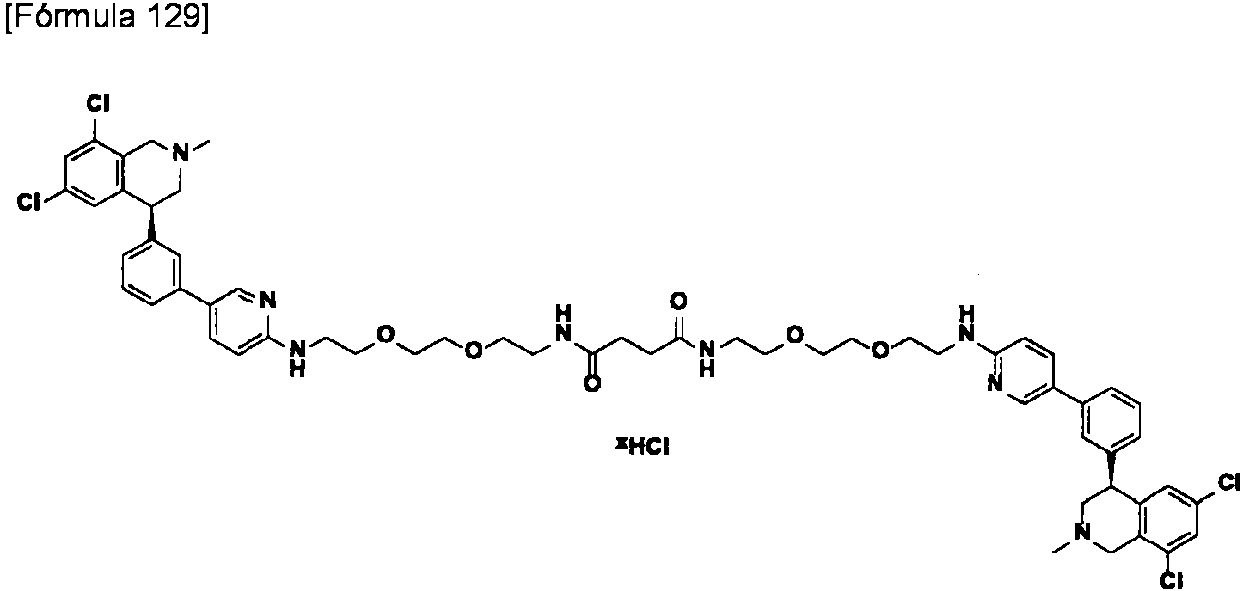
A una solución de trifluoroacetato de N-{2-[2-(2-aminoetoxi)etoxi]etil}-5-{3-[(4S)-6,8-dicloro-2-metil-1,2,3,4-tetrahidroisoquinolin-4-il]fenil}piridin-2-amina (30 mg) obtenido en el Ejemplo de Referencia 10-1 en 1,2-dicloroetano (1,0 mL), se le añadieron trietilamina (17 pL) y una solución de dicloruro de butanodio en 1,2-dicloroetano (0,5 moles/L, 46 pl) y la mezcla se agitó durante la noche a temperatura ambiente. La solución de reacción se purificó mediante HPLC preparativa de fase inversa (columna (YMC-Actus Triart 5 pm C1850 x 30 mm), fase móvil (ácido trifluoroacético al 0,1% en H2Ü:ácido trifluoroacético al 0,1% en MeCN = 90:10 ^ 20:80 ^ 5:95, 40 mL/min). El disolvente se eliminó mediante destilación a presión reducida, y a continuación se añadió una solución acuosa saturada de bicarbonato de sodio al residuo, seguido de extracción con cloroformo. La capa orgánica se secó sobre sulfato de magnesio anhidro y se filtró, y a continuación, el producto filtrado se concentró a presión reducida. El residuo obtenido se disolvió en etanol. A la solución, se agregó una solución de 4 moles/L de cloruro de hidrógeno en 1,4-dioxano, y a continuación, el disolvente se eliminó mediante destilación a presión reducida para obtener el compuesto del título (14 mg) en forma de un sólido incoloro.To a solution of N- {2- [2- (2-aminoethoxy) ethoxy] ethyl} -5- {3 - [(4S) -6,8-dichloro-2-methyl-1,2,3 trifluoroacetate, 4-tetrahydroisoquinolin-4-yl] phenyl} pyridin-2-amine (30 mg) obtained in Reference Example 10-1 in 1,2-dichloroethane (1.0 mL), triethylamine (17 pL) was added thereto and a solution of butanedium dichloride in 1,2-dichloroethane (0.5 mol / L, 46 pl) and the mixture was stirred overnight at room temperature. The reaction solution was purified by preparative reverse phase HPLC (column (YMC-Actus Triart 5 pm C1850 x 30 mm), mobile phase ( 0.1% trifluoroacetic acid in H 2 O : 0.1% trifluoroacetic acid in MeCN = 90:10 ^ 20:80 ^ 5:95, 40 mL / min.) The solvent was removed by distillation under reduced pressure, and then a saturated aqueous solution of sodium bicarbonate was added to the residue, followed by extraction with chloroform. The organic layer was dried over anhydrous magnesium sulfate and filtered, and then the filtrate was concentrated under reduced pressure The residue obtained was dissolved in ethanol To the solution, a solution of 4 mol / L chloride was added. of hydrogen in 1,4-dioxane, and then, the solvent was removed by distillation under reduced pressure to obtain the title compound (14 mg) as a colorless solid.
Tiempo de retención LC-MS 0,823 minRetention time LC-MS 0.823 min
CL: Agilent 1290CL: Agilent 1290
EM ESI/APCI: Agilent 6130ESI / APCI EM: Agilent 6130
Columna: Waters Acquity CSH C181,7 um, 2,1x50 mmColumn: Waters Acquity CSH C181.7 um, 2.1x50 mm
Disolvente: H2Ü:CHsCn (ácido fórmico al 0,1%) Solvent: H 2 Ü: CHsCn (0.1% formic acid)
Gradiente: 0,8 mL/min, 0 min (95:5) ^ 1,2 min (50:50)Gradient: 0.8 mL / min, 0 min (95: 5) ^ 1.2 min (50:50)
1,0 mL/min, ^ 1,38 min (3:97)1.0 mL / min, ^ 1.38 min (3:97)
EM (+): 1113 [M+H]+.MS (+): 1113 [M + H] +.
Ejemplo 8-2 Hidrocloruro de (2R,3R)-N,N'-bis[2-(2-{2-[(5-{3-[(4S)-6,8-dicloro-2-metil-1,2,3,4-tetrahidroisoquinolin-4-il]fenil}piridin-2-il)amino]etoxi}etoxi)etil]-2,3-dihidroxibutanodiamidaExample 8-2 (2R, 3R) -N, N'-bis [2- (2- {2 - [(5- {3 - [(4S) -6,8-dichloro-2-methyl-1) hydrochloride , 2,3,4-tetrahydroisoquinolin-4-yl] phenyl} pyridin-2-yl) amino] ethoxy} ethoxy) ethyl] -2,3-dihydroxybutanediimide
A una solución de trifluoroacetato de N-{2-[2-(2-aminoetoxi)etoxi]etil}-5-{3-[(4S)-6,8-dicloro-2-metil-1,2,3,4-tetrahidroisoquinolin-4-il]fenil}piridin-2-amina (45 mg) obtenido en el Ejemplo de Referencia 10-1 en N,N-dimetilformamida (1,0 mL), se le añadieron hexafluorofosfato de O-(7-azabenzotriazol-1-il)-N, N,N',N'-tetrametiluronio (27 mg), N,N-diisopropiletilamina (12 pL) y ácido L -(+)- tartárico (5,4 mg) y la mezcla se agitó durante la noche a temperatura ambiente. La solución de reacción se purificó mediante HPLC preparativa de fase inversa (columna (YMC-Actus Triart 5 pm C18 50 x 30 mm), fase móvil (ácido trifluoroacético al 0,1% en H2Ü:ácido trifluoroacético al 0,1% en MeCN = 90:10 ^ 20:80 ^ 5:95, 40 mL/min.) y se purificó adicionalmente mediante TLC preparativa (Fuji Silysia Chemical Ltd. "Placas NH de 0,25 mm CHRü MAt ü REX TLC", cloroformo:metanol = 20:1). El disolvente se eliminó mediante destilación a presión reducida, y a continuación, el residuo obtenido se disolvió en metanol. A la solución, se le añadió una solución de 4 moles/L de cloruro de hidrógeno en 1,4-dioxano, y a continuación, el disolvente se eliminó mediante destilación a presión reducida para obtener el compuesto del título (10 mg) en forma de un sólido incoloro.To a solution of N- {2- [2- (2-aminoethoxy) ethoxy] ethyl} -5- {3 - [(4S) -6,8-dichloro-2-methyl-1,2,3 trifluoroacetate, 4-tetrahydroisoquinolin-4-yl] phenyl} pyridin-2-amine (45 mg) obtained in Reference Example 10-1 in N, N-dimethylformamide (1.0 mL), was added O- (7-hexafluorophosphate). azabenzotriazol-1-yl) -N, N, N ', N'-tetramethyluronium (27 mg), N, N-diisopropylethylamine (12 pL) and L - (+) - tartaric acid (5.4 mg) and the The mixture was stirred overnight at room temperature. The reaction solution was purified by preparative reverse phase HPLC (column (YMC-Actus Triart 5 pm C18 50 x 30 mm), mobile phase (0.1% trifluoroacetic acid in H 2 O : 0.1% trifluoroacetic acid) in MeCN = 90:10 ^ 20:80 ^ 5:95, 40 mL / min.) and further purified by preparative TLC (Fuji Silysia Chemical Ltd. "0.25 mm NH Plates CHR ü MA t ü REX TLC" , chloroform: methanol = 20: 1) .The solvent was distilled off under reduced pressure, and then the residue obtained was dissolved in methanol.To the solution, a solution of 4 mol / L of hydrogen chloride was added to the solution. 1,4-dioxane, and then the The solvent was removed by distillation under reduced pressure to obtain the title compound (10 mg) as a colorless solid.
Tiempo de retención LC-MS 0,809 minRetention time LC-MS 0.809 min
CL: Agilent 1290CL: Agilent 1290
EM ESI/APCI: Agilent 6130ESI / APCI EM: Agilent 6130
Columna: Waters Acquity CSH C181,7 um, 2,1x50 mmColumn: Waters Acquity CSH C181.7 um, 2.1x50 mm
Disolvente: H2O:CH3Cn (ácido fórmico al 0,1%) Solvent: H 2 O: CH 3 Cn (0.1% formic acid)
Gradiente: 0,8 mL/min, 0 min (95:5) ^ 1,2 min (50:50)Gradient: 0.8 mL / min, 0 min (95: 5) ^ 1.2 min (50:50)
1.0 mL/min, ^ 1,38 min (3:97)1.0 mL / min, ^ 1.38 min (3:97)
EM (+): 1145 [M+H]+.MS (+): 1145 [M + H] +.
Ejemplo 8-3 Hidrocloruro de N,N'-bis[2-(2-{2-[(5-{3-[(4S)-6,8-dicloro-2-metil-1,2,3,4-tetrahidroisoquinolin-4-il]fenil}piridin-2-il)amino]etoxi}etoxi)etil] hexanodiamidaExample 8-3 N, N'-bis [2- (2- {2 - [(5- {3 - [(4S) -6,8-dichloro-2-methyl-1,2,3,4 hydrochloride -tetrahydroisoquinolin-4-yl] phenyl} pyridin-2-yl) amino] ethoxy} ethoxy) ethyl] hexanediamide
El compuesto del título (21 mg) se obtuvo en forma de un sólido incoloro sustancialmente a través de la misma reacción que en el Ejemplo 8-1, excepto que se utilizó dicloruro de hexanodioilo en lugar de dicloruro de butanodioilo.The title compound (21 mg) was obtained as a colorless solid substantially through the same reaction as in Example 8-1, except that hexanedioyl dichloride was used in place of butanedioyl dichloride.
Tiempo de retención LC-MS 0,833 minRetention time LC-MS 0.833 min
CL: Agilent 1290CL: Agilent 1290
EM ESI/APCI: Agilent 6130ESI / APCI EM: Agilent 6130
Columna: Waters Acquity CSH C181,7 um, 2,1x50 mmColumn: Waters Acquity CSH C181.7 um, 2.1x50 mm
Disolvente: H2O:CHsCn (ácido fórmico al 0,1%) Solvent: H 2 O: CHsCn (0.1% formic acid)
Gradiente: 0,8 mL/min, 0 min (95:5) ^ 1,2 min (50:50)Gradient: 0.8 mL / min, 0 min (95: 5) ^ 1.2 min (50:50)
1.0 mL/min, ^ 1,38 min (3:97)1.0 mL / min, ^ 1.38 min (3:97)
EM (+): 1141 [M+H]+.MS (+): 1141 [M + H] +.
Ejemplo 8-4 Hidrocloruro de N,N'-bis[2-(2-{2-[(5-{3-[(4S)-6,8-dicloro-2-metil-1,2,3,4-tetrahidroisoquinolin-4-il]fenil}piridin-2-il)amino]etoxi}etoxi)etil]benceno-1,2-dicarboxamidaExample 8-4 N, N'-bis [2- (2- {2 - [(5- {3 - [(4S) -6,8-dichloro-2-methyl-1,2,3,4-hydrochloride -tetrahydroisoquinolin-4-yl] phenyl} pyridin-2-yl) amino] ethoxy} ethoxy) ethyl] benzene-1,2-dicarboxamide
El compuesto del título (12 mg) se obtuvo en forma de un sólido incoloro sustancialmente a través de la misma reacción que en el Ejemplo 8-1, excepto que se utilizó dicloruro de benceno-1,2-dicarbonilo en lugar de dicloruro de butanodioilo.The title compound (12 mg) was obtained as a colorless solid substantially through the same reaction as in Example 8-1, except that benzene-1,2-dicarbonyl dichloride was used instead of butanedioyl dichloride .
Tiempo de retención LC-MS 0,861 minRetention time LC-MS 0.861 min
CL: Agilent 1290CL: Agilent 1290
EM ESI/APCI: Agilent 6130ESI / APCI EM: Agilent 6130
Columna: Waters Acquity CSH C181,7 um, 2,1x50 mmColumn: Waters Acquity CSH C181.7 um, 2.1x50 mm
Disolvente: H2O:CHsCn (ácido fórmico al 0,1%) Solvent: H 2 O: CHsCn (0.1% formic acid)
Gradiente: 0,8 mL/min, 0 min (95:5) ^ 1,2 min (50:50)Gradient: 0.8 mL / min, 0 min (95: 5) ^ 1.2 min (50:50)
1.0 mL/min, ^ 1,38 min (3:97)1.0 mL / min, ^ 1.38 min (3:97)
EM (+): 1161 [M+H]+.MS (+): 1161 [M + H] +.
Ejemplo 8-5 Hidrocloruro de (2R,3R)-N,N'-Bis [2-(2-{2-[2-(4-{3-[(4S)-6,8-dicloro-2-metil-1,2,3,4-tetrahidroisoquinolin-4-il]fenil}-1H-1-il)etoxi]etoxi}etoxi)etil]-2,3-dihidroxibutanodiamidaEXAMPLE 8-5 (2R, 3R) -N, N'-Bis [2- (2- {2- [2- (4- {3 - [(4S) -6,8-dichloro-2-methyl) hydrochloride -1,2,3,4-tetrahydroisoquinolin-4-yl] phenyl} -1H-1-yl) ethoxy] ethoxy} ethoxy) ethyl] -2,3-dihydroxybutanediimide
A una solución de 2-(2-{2-[2-(4-{3-[(4S)-6,8-dicloro-2-metil-1,2,3,4-tetrahidroisoquinolin-4-il]fenil}-1H-1,2,3-triazol-1-il)etoxi]etoxi}etoxi)etanamina (40 mg) obtenida en el Ejemplo de Referencia 7-1 en N,N-dimetilformamida (1,0 mL), se le añadieron hexafluorofosfato de O-(7-azabenzotriazol-1-il)-N,N,N',N'-tetrametiluronio (28 mg), N,N-diisopropiletilamina (13 pL) y una solución de ácido L -(+)-tartárico en N, N-dimetilformamida (0,5 moles/L, 60 pl) y la mezcla se agitó durante la noche a temperatura ambiente. La solución de reacción se purificó mediante HPLC preparativa de fase inversa (columna (YMC-Actus Triart 5 pm C1850 x 30 mm), fase móvil (ácido trifluoroacético al 0,1% en H2O:ácido trifluoroacético al 0,1% en MeCN = 90:10 ^ 20:80 ^ 5:95, 40 mL/min.) y se purificó adicionalmente mediante TLC preparativa (Fuji Silysia Chemical Ltd. "Placas NH de 0,25 mm CHROMATOREX TLC", cloroformo:metanol = 20:1). El disolvente se eliminó mediante destilación a presión reducida, y a continuación, el residuo obtenido se disolvió en metanol. A la solución, se agregó una solución de 4 moles/L de cloruro de hidrógeno en 1,4-dioxano, y a continuación, el disolvente se eliminó mediante destilación a presión reducida para obtener el compuesto del título (14 mg) en forma de una sustancia amorfa incolora.To a solution of 2- (2- {2- [2- (4- {3 - [(4S) -6,8-dichloro-2-methyl-1,2,3,4-tetrahydroisoquinolin-4-yl] phenyl} -1H-1,2,3-triazol-1-yl) ethoxy] ethoxy} ethoxy) ethanamine (40 mg) obtained in Reference Example 7-1 in N, N-dimethylformamide (1.0 mL), O- (7-azabenzotriazol-1-yl) -N, N, N ', N'-tetramethyluronium hexafluorophosphate (28 mg), N, N-diisopropylethylamine (13 pL) and a solution of L - acid were added. +) - tartaric in N, N-dimethylformamide (0.5 mol / L, 60 pl) and the mixture was stirred overnight at room temperature. The reaction solution was purified by preparative reverse phase HPLC (column (YMC-Actus Triart 5 pm C1850 x 30 mm), mobile phase ( 0.1% trifluoroacetic acid in H 2 O: 0.1% trifluoroacetic acid in MeCN = 90:10 ^ 20:80 ^ 5:95, 40 mL / min.) And further purified by preparative TLC (Fuji Silysia Chemical Ltd. "0.25 mm NH Plates CHROMATOREX TLC", chloroform: methanol = 20 The solvent was removed by distillation under reduced pressure, and then the residue obtained was dissolved in methanol, and a solution of 4 mol / L of hydrogen chloride in 1,4-dioxane was added to the solution. The solvent was then removed by distillation under reduced pressure to obtain the title compound (14 mg) as a colorless amorphous substance.
Tiempo de retención de LC-MS 1,013 minRetention time of LC-MS 1,013 min
CL: Agilent 1290CL: Agilent 1290
EM ESI/APCI: Agilent 6130 ESI / APCI EM: Agilent 6130
Columna: Waters Acquity CSH C181,7 um, 2,1x50 mmColumn: Waters Acquity CSH C181.7 um, 2.1x50 mm
Disolvente: H2O:CH3Cn (ácido fórmico al 0,1%) Solvent: H 2 O: CH 3 Cn (0.1% formic acid)
Gradiente: 0,8 mL/min, 0 min (95:5) ^ 1,2 min (50:50)Gradient: 0.8 mL / min, 0 min (95: 5) ^ 1.2 min (50:50)
1.0 mL/min, ^ 1,38 min (3:97)1.0 mL / min, ^ 1.38 min (3:97)
EM (+): 1183 [M+H]+.MS (+): 1183 [M + H] +.
Ejemplo 8-6 Pentahidrocloruro de N,N'-bis[2-(2-{2-[(6-{3-[(4S)-6,8-dicloro-2-metil-1,2,3,4-tetrahidroisoquinolin-4-il]fenil}pirazin-2-il)amino]etoxi}etoxi)etil]butanodiamidaExample 8-6 N, N'-bis [2- (2- {2 - [(6- {3 - [(4S) -6,8-dichloro-2-methyl-1,2,3,4-pentahydrochloride -tetrahydroisoquinolin-4-yl] phenyl} pyrazin-2-yl) amino] ethoxy} ethoxy) ethyl] butanediamide
El compuesto del título (23 mg, 31%) se obtuvo en forma de una sustancia amorfa de color amarillo sustancialmente a través de la misma reacción que en el Ejemplo 8-1, excepto que se utilizó N-{2-[2-(2-aminoetoxi)etoxi]etil}-6-{3-[(4S)-6,8-dicloro-2-metil-1,2,3,4-tetrahidroisoquinolin-4-il]fenil}pirazin-2-amina obtenida en el Ejemplo de Referencia 8-4 en lugar de trifluoroacetato de N-{2-[2-(2-aminoetoxi)etoxi]etil}-5-{3-[(4S)-6,8-dicloro-2-metil-1,2,3,4-tetrahidroisoquinolin-4-il]fenil}piridin-2-amina obtenido en el Ejemplo de Referencia 10-1.The title compound (23 mg, 31%) was obtained as a yellow amorphous substance substantially through the same reaction as in Example 8-1, except that N- {2- [2- ( 2-aminoethoxy) ethoxy] ethyl} -6- {3 - [(4S) -6,8-dichloro-2-methyl-1,2,3,4-tetrahydroisoquinolin-4-yl] phenyl} pyrazin-2-amine obtained in Reference Example 8-4 in place of N- {2- [2- (2-aminoethoxy) ethoxy] ethyl} -5- {3 - [(4S) -6,8-dichloro-2-) trifluoroacetate methyl-1,2,3,4-tetrahydroisoquinolin-4-yl] phenyl} pyridin-2-amine obtained in Reference Example 10-1.
Tiempo de retención LC-MS 1,108 minRetention time LC-MS 1.108 min
CL: Agilent 1290CL: Agilent 1290
EM ESI/APCI: Agilent 6130ESI / APCI EM: Agilent 6130
Columna: Waters Acquity CSH C181,7 um, 2,1x50 mmColumn: Waters Acquity CSH C181.7 um, 2.1x50 mm
Disolvente: H2O:CHsCn (ácido fórmico al 0,1%) Solvent: H 2 O: CHsCn (0.1% formic acid)
Gradiente: 0,8 mL/min, 0 min (95:5) ^ 1,2 min (50:50)Gradient: 0.8 mL / min, 0 min (95: 5) ^ 1.2 min (50:50)
1.0 mL/min, ^ 1,38 min (3:97)1.0 mL / min, ^ 1.38 min (3:97)
EM (+): 1115 [M+H]+.MS (+): 1115 [M + H] +.
Ejemplo 8-7 Hidrocloruro de 1-[(5-{3-[(4S)-6,8-dicloro-2-metil-1,2,3,4-tetrahidroisoquinolin-4-il]fenil}piridin-2-il)amino]-N-[2-(2-{2-[(5-{3-[(4S)-6,8-dicloro-2-metil-1,2,3,4-tetrahidroisoquinolin-4-il]fenil}piridin-2-il)amino]etoxi}etoxi)etil]-10-oxo-3,6,12-trioxa-9-azatetradecan-14-amidaEXAMPLE 8-7 1 - [(5- {3 - [(4S) -6,8-Dichloro-2-methyl-1,2,3,4-tetrahydroisoquinolin-4-yl] phenyl} pyridin-2 hydrochloride il) amino] -N- [2- (2- {2 - [(5- {3 - [(4S) -6,8-dichloro-2-methyl-1,2,3,4-tetrahydroisoquinolin-4-) il] phenyl} pyridin-2-yl) amino] ethoxy} ethoxy) ethyl] -10-oxo-3,6,12-trioxa-9-azatetradecan-14-amide
El compuesto del título (12 mg) se obtuvo en forma de un sólido incoloro sustancialmente a través de la misma reacción que en el Ejemplo 8-1, excepto que se utilizó cloruro de 2,2'-oxidiacetilo en lugar de dicloruro de butanodio. Tiempo de retención LC-MS 0,827 minThe title compound (12 mg) was obtained as a colorless solid substantially through the same reaction as in Example 8-1, except that 2,2'-oxydiacetyl chloride was used in place of butanedium dichloride. Retention time LC-MS 0.827 min
CL: Agilent 1290CL: Agilent 1290
EM ESI/APCI: Agilent 6130ESI / APCI EM: Agilent 6130
Columna: Waters Acquity CSH C181,7 um, 2,1x50 mmColumn: Waters Acquity CSH C181.7 um, 2.1x50 mm
Disolvente: H2O:CHsCn (ácido fórmico al 0,1%) Solvent: H 2 O: CHsCn (0.1% formic acid)
Gradiente: 0,8 mL/min, 0 min (95:5) ^ 1,2 min (50:50)Gradient: 0.8 mL / min, 0 min (95: 5) ^ 1.2 min (50:50)
1.0 mL/min, ^ 1,38 min (3:97)1.0 mL / min, ^ 1.38 min (3:97)
EM (+): 1129 [M+H]+.MS (+): 1129 [M + H] +.
Ejemplo 8-8 Hidrocloruro de (2R,3R)-N,N'-bis[2-(2-{2-[(6-{3-[(4S)-6,8-dicloro-2-metil-1,2,3,4-tetrahidroisoquinolin-4-il]fenil}pirimidin-4-il)amino]etoxi}etoxi)etil]-2,3-dihidroxibutanodiamidaEXAMPLE 8-8 (2R, 3R) -N, N'-bis [2- (2- {2 - [(6- {3 - [(4S) -6,8-dichloro-2-methyl-1) hydrochloride , 2,3,4-tetrahydroisoquinolin-4-yl] phenyl} pyrimidin-4-yl) amino] ethoxy} ethoxy) ethyl] -2,3-dihydroxybutanediimide
El compuesto del título (60 mg) se obtuvo en forma de una sustancia amorfa de color amarillo pálido sustancialmente a través de la misma reacción que en el Ejemplo 8-2, excepto que se utilizó N-{2-[2-(2-aminoetoxi)etoxi]etil}-6-{3-[[4S)-6,8-dicloro-2-metil-1,2,3,4-tetrahidroisoquinolin-4-il]fenil}pirimidin-4-amina obtenida sustancialmente purificando trifluoroacetato de N-{2-[2-(2-aminoetoxi)etoxi]etil}-6-{3-[(4S)-6,8-dicloro-2-metil-1,2,3,4-tetrahidroisoquinolin-4-il]fenil}pirimidin-4-amina obtenido en el Ejemplo de Referencia 8-3 mediante cromatografía en columna de gel de sílice (Cartucho SNAP KP-NH de Biotage (marca registrada), cloroformo:metanol = 100:0 ^ 85:15) en lugar de trifluoroacetato de N-{2-[2-(2-aminoetoxi)etoxi]etil}-5-{3-[(4S)-6,8-dicloro-2-metil-1,2,3,4-tetrahidroisoquinolin-4-il]fenil}piridin-2-amina obtenido en el Ejemplo de Referencia 10-1.The title compound (60 mg) was obtained as a pale yellow amorphous substance substantially through the same reaction as in Example 8-2, except that N- {2- [2- (2- aminoethoxy) ethoxy] ethyl} -6- {3 - [[4S) -6,8-dichloro-2-methyl-1,2,3,4-tetrahydroisoquinolin-4-yl] phenyl} pyrimidin-4-amine obtained substantially purifying N- {2- [2- (2-aminoethoxy) ethoxy] ethyl} -6- {3 - [(4S) -6,8-dichloro-2-methyl-1,2,3,4-tetrahydroisoquinolin trifluoroacetate] -4-yl] phenyl} pyrimidin-4-amine obtained in Reference Example 8-3 by silica gel column chromatography (SNAP KP-NH cartridge from Biotage (trademark), chloroform: methanol = 100: 0 ^ 85:15) in place of N- {2- [2- (2-aminoethoxy) ethoxy] ethyl} -5- {3 - [(4S) -6,8-dichloro-2-methyl-1,2 trifluoroacetate] , 3,4-tetrahydroisoquinolin-4-yl] phenyl} pyridin-2-amine obtained in Reference Example 10-1.
Tiempo de retención LC-MS 0,823 minRetention time LC-MS 0.823 min
CL: Agilent 1290CL: Agilent 1290
EM ESI/APCI: Agilent 6130ESI / APCI EM: Agilent 6130
Columna: Waters Acquity CSH C181,7 um, 2,1x50 mmColumn: Waters Acquity CSH C181.7 um, 2.1x50 mm
Disolvente: H20:CHsCn (ácido fórmico al 0,1%)Solvent: H20: CHsCn (0.1% formic acid)
Gradiente: 0,8 mL/min, 0 min (95:5) ^ 1,2 min (50:50)Gradient: 0.8 mL / min, 0 min (95: 5) ^ 1.2 min (50:50)
1.0 mL/min, ^ 1,38 min (3:97)1.0 mL / min, ^ 1.38 min (3:97)
EM (+): 1147 [M+H]+.MS (+): 1147 [M + H] +.
Ejemplo 8-9 Hidrocloruro de (2S,3S)-N,N'-bis[2-(2-{2-[2-(4-{3-[(4S)-6,8-dicloro-2-metil-1,2,3,4-tetrahidroisoquinolin-4 il]fenil}-1H-1,2,3-triazol-1-il)etoxi]etoxi}etoxi)etil]-2,3-dihidroxibutanodiamidaExample 8-9 Hydrochloride (2S, 3S) -N, N'-bis [2- (2- {2- [2- (4- {3 - [(4S) -6,8-dichloro-2-methyl-1,2,3 , 4-tetrahydroisoquinolin-4-yl] phenyl} -1H-1,2,3-triazol-1-yl) ethoxy] ethoxy} ethoxy) ethyl] -2,3-dihydroxybutanediimide
A una solución de 2-(2-{2-[2-(4-{3-[(4S)-6,8-dicloro-2-metil-1,2,3,4-tetrahidroisoquinolin-4-il]fenil}-1H-1,2,3-triazol-1-il)etoxi]etoxi}etoxi)etanamina (0,10 g) obtenida en el Ejemplo de Referencia 7-1 en N,N-dimetilformamida (5,0 mL), se le añadieron hexafluorofosfato de O-(7-azabenzotriazol-1-il)-N,N,N',N'-tetrametiluronio (85 mg), N,N-diisopropiletilamina (29 mg) y ácido D-(-)- tartárico (13 mg), y la mezcla se agitó a temperatura ambiente durante 3 horas. La solución de reacción se concentró y, a continuación, el residuo obtenido se purificó mediante cromatografía en columna sobre gel de sílice (Cartucho SNAP KP-NH de Biotage (marca registrada), cloroformo:metanol = 100:0 ^ 70:30). El disolvente se eliminó mediante destilación a presión reducida, y el residuo obtenido se disolvió en etanol (5,0 mL). A la solución, se le añadieron 4 moles/L de cloruro de hidrógeno en acetato de etilo (0,20 mL). El disolvente se eliminó mediante destilación a presión reducida para obtener el compuesto del título (15 mg) en forma de una sustancia amorfa incolora.To a solution of 2- (2- {2- [2- (4- {3 - [(4S) -6,8-dichloro-2-methyl-1,2,3,4-tetrahydroisoquinolin-4-yl] phenyl} -1H-1,2,3-triazol-1-yl) ethoxy] ethoxy} ethoxy) ethanamine (0.10 g) obtained in Reference Example 7-1 in N, N-dimethylformamide (5.0 mL ), O- (7-azabenzotriazol-1-yl) -N, N, N ', N'-tetramethyluronium hexafluorophosphate (85 mg), N, N-diisopropylethylamine (29 mg) and D - (-) acid were added. ) - tartaric (13 mg), and the mixture was stirred at room temperature for 3 hours. The reaction solution was concentrated and then the residue obtained was purified by column chromatography on silica gel (SNAP KP-NH cartridge from Biotage (registered trademark), chloroform: methanol = 100: 0 ^ 70:30). The solvent was removed by distillation under reduced pressure, and the residue obtained was dissolved in ethanol (5.0 mL). To the solution, 4 mol / L hydrogen chloride in ethyl acetate (0.20 mL) was added. The solvent was removed by distillation under reduced pressure to obtain the title compound (15 mg) as a colorless amorphous substance.
Tiempo de retención LC-MS 1,010 minRetention time LC-MS 1,010 min
CL: Agilent 1290CL: Agilent 1290
EM ESI/APCI: Agilent 6130ESI / APCI EM: Agilent 6130
Columna: Waters Acquity CSH C181,7 um, 2,1x50 mmColumn: Waters Acquity CSH C181.7 um, 2.1x50 mm
Disolvente: H20:CHsCn (ácido fórmico al 0,1%)Solvent: H20: CHsCn (0.1% formic acid)
Gradiente: 0,8 mL/min, O min (95:5) ^ 1,2 min (50:50)Gradient: 0.8 mL / min, O min (95: 5) ^ 1.2 min (50:50)
1.0 mL/min, ^ 1,38 min (3:97)1.0 mL / min, ^ 1.38 min (3:97)
EM (+): 1183 [M+H]+.MS (+): 1183 [M + H] +.
Ejemplo 8-10 Hidrocloruro de (2R,3R)-N,N'-Bis{2-[2-(2-{2-[(6-{3-[(4S)-6,8-dicloro-2-metil-1,2,3,4-tetrahidroisoquinolin-4-il]fenil}pirimidin-4-il)amino]etoxi}etoxi)etoxi]etil}-2,3-dihidroxibutanodiamidaEXAMPLE 8-10 (2R, 3R) -N, N'-Bis {2- [2- (2- {2 - [(6- {3 - [(4S) -6,8-dichloro-2-) hydrochloride methyl-1,2,3,4-tetrahydroisoquinolin-4-yl] phenyl} pyrimidin-4-yl) amino] ethoxy} ethoxy) ethoxy] ethyl} -2,3-dihydroxybutanediimide
El compuesto del título (60 mg) se obtuvo en forma de una sustancia amorfa de color amarillo pálido sustancialmente a través de la misma reacción que en el Ejemplo 8-2, excepto que se utilizó N-(2-{2-[2-(2-aminoetoxi)etoxi]etoxi}etil)-6-{3-[(4S)-6,8-dicloro-2-metil-1,2,3,4-tetrahidroisoquinolin-4-il]fenil}pirimidin-4-amina obtenida en el Ejemplo de Referencia 8-9 en lugar de trifluoroacetato de N-{2-[2-(2-aminoetoxi)etoxi]etil}-5-{3-[(4S)-6,8-dicloro-2-metil-1,2,3,4-tetrahidroisoquinolina -4-il]fenil}piridin-2-amina obtenido en el Ejemplo de Referencia 10-1.The title compound (60 mg) was obtained as a pale yellow amorphous substance substantially through the same reaction as in Example 8-2, except that N- (2- {2- [2- (2-aminoethoxy) ethoxy] ethoxy} ethyl) -6- {3 - [(4S) -6,8-dichloro-2-methyl-1,2,3,4-tetrahydroisoquinolin-4-yl] phenyl} pyrimidine- 4-amine obtained in Reference Example 8-9 in place of N- {2- [2- (2-aminoethoxy) ethoxy] ethyl} -5- {3 - [(4S) -6,8-dichloro) trifluoroacetate -2-methyl-1,2,3,4-tetrahydroisoquinoline -4-yl] phenyl} pyridin-2-amine obtained in Reference Example 10-1.
Tiempo de retención LC-MS 0,861 minRetention time LC-MS 0.861 min
CL: Agilent 1290CL: Agilent 1290
ESVAPCI MS: Agilent 6130ESVAPCI MS: Agilent 6130
Columna: Waters Acquity CSH C181,7 um, 2,1x50 mmColumn: Waters Acquity CSH C181.7 um, 2.1x50 mm
Disolvente: H20:CHsCn (ácido fórmico al 0,1%)Solvent: H20: CH s C n (0.1% formic acid)
Gradiente: 0,8 mL/min, O min (95:5) ^ 1,2 min (50:50)Gradient: 0.8 mL / min, O min (95: 5) ^ 1.2 min (50:50)
1.0 mL/min, ^ 1,38 min (3:97)1.0 mL / min, ^ 1.38 min (3:97)
EM (+): 1235 [M+H]+.MS (+): 1235 [M + H] +.
Ejemplo 8-11 Hidrocloruro de 1-[(6-{3-[(4R)-6,8-dicloro-2-metil-1,2,3,4-tetrahidroisoquinolin-4-il]fenil}pirimidin-4-il)amino]-N-{2-[2-(2-{2-[(6-{3-[(4S)-6,8-dicloro-2-metil-1,2,3,4-tetrahidroisoquinolin-4]-il]fenil}pirimidin-4-il)amino]etoxi}etoxi)etoxi]etil}-13-oxo-3,6,9,15-tetraoxa-12-azaheptadecan-17-amidaEXAMPLE 8-11 1 - [(6- {3 - [(4R) -6,8-Dichloro-2-methyl-1,2,3,4-tetrahydroisoquinolin-4-yl] phenyl} pyrimidin-4 hydrochloride il) amino] -N- {2- [2- (2- {2 - [(6- {3 - [(4S) -6,8-dichloro-2-methyl-1,2,3,4-tetrahydroisoquinolin -4] -yl] phenyl} pyrimidin-4-yl) amino] ethoxy} ethoxy) ethoxy] ethyl} -13-oxo-3,6,9,15-tetraoxa-12-azaheptadecan-17-amide
El compuesto del título (30 mg) se obtuvo en forma de una sustancia amorfa incolora sustancialmente a través de la misma reacción que en el Ejemplo 8-1, excepto que se utilizó N-(2-{2-[2-(2-aminoetoxi)etoxi]etoxi}etil) 6-{3-[(4S)-6,8-dicloro-2-metil-1,2,3,4-tetrahidroisoquinolin-4-il]fenil}pirimidin-4-amina obtenida en el Ejemplo de Referencia 8-9 en lugar de trifluoroacetato de N-{2-[2-(2-aminoetoxi)etoxi]etil}1-5-{3-[(4S)-6,8-dicloro-2-metil-1,2,3,4-tetrahidroisoquinolina 4-il]fenil}piridin-2-amina obtenido en el Ejemplo de Referencia 10-1, y se utilizó cloruro de 2,2'-oxidiacetilo en lugar de dicloruro de butanodioilo.The title compound (30 mg) was obtained as a colorless amorphous substance substantially through the same reaction as in Example 8-1, except that N- (2- {2- [2- (2- aminoethoxy) ethoxy] ethoxy} ethyl) 6- {3 - [(4S) -6,8-dichloro-2-methyl-1,2,3,4-tetrahydroisoquinolin-4-yl] phenyl} pyrimidin-4-amine obtained in Reference Example 8-9 in place of N- {2- [2- (2-aminoethoxy) ethoxy] ethyl} 1-5- {3 - [(4S) -6,8-dichloro-2-trifluoroacetate] methyl-1,2,3,4-tetrahydroisoquinoline 4-yl] phenyl} pyridin-2-amine obtained in Reference Example 10-1, and 2,2'-oxydiacetyl chloride was used in place of butanedioyl dichloride.
Tiempo de retención LC-MS 0,882 minLC-MS retention time 0.882 min
CL: Agilent 1290CL: Agilent 1290
EM ESI/APCI: Agilent 6130ESI / APCI EM: Agilent 6130
Columna: Waters Acquity CSH C181,7 um, 2: 1x50 mmColumn: Waters Acquity CSH C181.7 um, 2: 1x50 mm
Disolvente: H20:CHsCn (ácido fórmico al 0,1%)Solvent: H20: CH s C n (0.1% formic acid)
Gradiente: 0,8 mL/min, 0 min (95:5) ^ 1,2 min (50:50)Gradient: 0.8 mL / min, 0 min (95: 5) ^ 1.2 min (50:50)
1.0 mL/min, ^ 1,38 min (3:97)1.0 mL / min, ^ 1.38 min (3:97)
EM (+): 1219 [M+H]+.MS (+): 1219 [M + H] +.
Ejemplo 8-12 Hidrocloruro de N,N'-bis{2-[2-(2-{2-[(6-{3-[(4S)-6,8-dicloro-2-metil-1,2,3,4-tetrahidroisoquinolin-4-il]fenil}pirimidin-4-il)amino]etoxi}etoxi)etoxi]etil}butanodiamida EXAMPLE 8-12 N, N'-bis {2- [2- (2- {2 - [(6- {3 - [(4S) -6,8-dichloro-2-methyl-1,2, hydrochloride 3,4-tetrahydroisoquinolin-4-yl] phenyl} pyrimidin-4-yl) amino] ethoxy} ethoxy) ethoxy] ethyl} butanediamide
El compuesto del título (47 mg) se obtuvo en forma de una sustancia amorfa incolora sustancialmente a través de la misma reacción que en el Ejemplo 8-1, excepto que se utilizó N-(2-{2-[2-(2-aminoetoxi)etoxi]etoxi}etil)-6-{3-[(4S)-6,8-dicloro-2-metil-1,2,3,4-tetrahidroisoquinolin-4-il]fenil}pirimidin-4-amina obtenida en el Ejemplo de Referencia 8-9 en lugar de trifluoroacetato de N-{2-[2-(2-aminoetoxi)etoxi]etil}-5-{3-[(4S)-6,8-dicloro-2-metil-1,2,3,4-tetrahidroisoquinolin-4-il]fenil)piridin-2-amina obtenido en el Ejemplo de Referencia 10-1.The title compound (47 mg) was obtained as a colorless amorphous substance substantially through the same reaction as in Example 8-1, except that N- (2- {2- [2- (2- aminoethoxy) ethoxy] ethoxy} ethyl) -6- {3 - [(4S) -6,8-dichloro-2-methyl-1,2,3,4-tetrahydroisoquinolin-4-yl] phenyl} pyrimidin-4-amine obtained in Reference Example 8-9 in place of N- {2- [2- (2-aminoethoxy) ethoxy] ethyl} -5- {3 - [(4S) -6,8-dichloro-2-trifluoroacetate] methyl-1,2,3,4-tetrahydroisoquinolin-4-yl] phenyl) pyridin-2-amine obtained in Reference Example 10-1.
Tiempo de retención LC-MS 0,884 minRetention time LC-MS 0.884 min
CL: Agilent 1290CL: Agilent 1290
EM ESI/APCI: Agilent 6130ESI / APCI EM: Agilent 6130
Columna: Waters Acquity CSH C181,7 um, 2,1x50 mmColumn: Waters Acquity CSH C181.7 um, 2.1x50 mm
Disolvente: H2O:CHsCn (ácido fórmico al 0,1%) Solvent: H 2 O: CHsCn (0.1% formic acid)
Gradiente: 0,8 mL/min, 0 min (95:5) ^ 1,2 min (50:50)Gradient: 0.8 mL / min, 0 min (95: 5) ^ 1.2 min (50:50)
1.0 mL/min, ^ 1,38 min (3:97)1.0 mL / min, ^ 1.38 min (3:97)
EM (+): 1203 [M+H]+.MS (+): 1203 [M + H] +.
Ejemplo 8-13 Hidrocloruro de N,N'-bis{2-[2-(2-{2-[(6-{3-[(4S)-6,8-dicloro-2-metil-1,2,3,4-tetrahidroisoquinolin-4-il]fenil}pirimidin-4-il)amino]etoxi}etoxi)etoxi]etil}hexanodiamidaEXAMPLE 8-13 N, N'-bis {2- [2- (2- {2 - [(6- {3 - [(4S) -6,8-dichloro-2-methyl-1,2, hydrochloride 3,4-tetrahydroisoquinolin-4-yl] phenyl} pyrimidin-4-yl) amino] ethoxy} ethoxy) ethoxy] ethyl} hexanediamide
El compuesto del título (47 mg) se obtuvo en forma de una sustancia amorfa incolora sustancialmente a través de la misma reacción que en el Ejemplo 8-1, excepto que se utilizó N-(2-{2-[2-(2-aminoetoxi)etoxi]etoxi}etil)-6-{3-[(4S)-6,8-dicloro-2-metil-1,2,3,4-tetrahidroisoquinolin-4-il]fenil}pirimidin-4-amina obtenida en el Ejemplo de Referencia 8-9 en lugar de trifluoroacetato de N-{2-[2-(2-aminoetoxi)etoxi]etil}-5-{3-[(4S)-6,8-dicloro-2-metil-1,2,3,4-tetrahidroisoquinolin-4-il]fenil}piridin-2-amina obtenido en el Ejemplo de Referencia 10-1, y se utilizó dicloruro de hexanodioilo en lugar de dicloruro de butanodioilo.The title compound (47 mg) was obtained as a colorless amorphous substance substantially through the same reaction as in Example 8-1, except that N- (2- {2- [2- (2- aminoethoxy) ethoxy] ethoxy} ethyl) -6- {3 - [(4S) -6,8-dichloro-2-methyl-1,2,3,4-tetrahydroisoquinolin-4-yl] phenyl} pyrimidin-4-amine obtained in Reference Example 8-9 in place of N- {2- [2- (2-aminoethoxy) ethoxy] ethyl} -5- {3 - [(4S) -6,8-dichloro-2-trifluoroacetate] methyl-1,2,3,4-tetrahydroisoquinolin-4-yl] phenyl} pyridin-2-amine obtained in Reference Example 10-1, and hexanedioyl dichloride was used in place of butanedioyl dichloride.
Tiempo de retención LC-MS 0,894 minRetention time LC-MS 0.894 min
CL: Agilent 1290CL: Agilent 1290
EM ESI/APCI: Agilent 6130ESI / APCI EM: Agilent 6130
Columna: Waters Acquity CSH C181,7 um, 2,1x50 mmColumn: Waters Acquity CSH C181.7 um, 2.1x50 mm
Disolvente: H2O:CHsCn (ácido fórmico al 0,1%) Solvent: H 2 O: CHsCn (0.1% formic acid)
Gradiente: 0,8 mL/min, 0 min (95:5) ^ 1,2 min (50:50)Gradient: 0.8 mL / min, 0 min (95: 5) ^ 1.2 min (50:50)
1.0 mL/min, ^ 1,38 min (3:97)1.0 mL / min, ^ 1.38 min (3:97)
EM (+): 1231 [M+H]+.MS (+): 1231 [M + H] +.
Ejemplo 8-14 Tetrahidrocloruro de (2R,3R)-N-[2-(2-{2-[(5-{3-[(4R)-6,8-dicloro-2-metil-1,2,3,4-tetrahidroisoquinolin-4-il]fenil}piridazin-3-il)amino]etoxi}etoxi)etil]-N'-[2-(2-{2-[(5-{3-[(4S)-6,8-dicloro-2-metil-1,2,3,4-tetrahidroisoquinolin-4-il]fenil}piridazin-3-il)amino]etoxi}etoxi]etil]-2,3-dihidroxibutanamidaEXAMPLE 8-14 (2R, 3R) -N- [2- (2- {2 - [(5- {3 - [(4R) -6,8-dichloro-2-methyl-1,2,3-tetrahydrochloride , 4-tetrahydroisoquinolin-4-yl] phenyl} pyridazin-3-yl) amino] ethoxy} ethoxy) ethyl] -N '- [2- (2- {2 - [(5- {3 - [(4S) - 6,8-dichloro-2-methyl-1,2,3,4-tetrahydroisoquinolin-4-yl] phenyl} pyridazin-3-yl) amino] ethoxy} ethoxy] ethyl] -2,3-dihydroxybutanamide
A una solución de N-{2-[2-(2-aminoetoxi)etoxi]etil}-5-{3-[(4S)-6,8-dicloro-2-metil-1,2,3,4- tetrahidroisoquinolin-4-il]fenil}piridazin-3-amina (51 mg) obtenida en el Ejemplo de Referencia 10-3 y ácido L -(+)-tartárico (7,4 mg) en N,N-dimetilformamida (0,3 mL), se le añadieron trietilamina (14 pl), hidrocloruro de 1-etil-3-(3-dimetilaminopropil)carbodiimida (19 mg) y monohidrato de 1-hidroxibenzotriazol (15 mg), y la mezcla se agitó a temperatura ambiente durante 4 horas. La solución de reacción se purificó mediante HPLc preparativa de fase inversa (columna (YMC-Actus Triart 5 pm C18 50 x 30 mm), fase móvil (ácido fórmico al 0,1% en H2O:ácido fórmico al 0,1% en MeCN = 95:5 ^ 80:20 ^ 50:50 ^ 5:95, 40 mL/min). El disolvente se eliminó mediante destilación a presión reducida, y el residuo obtenido se purificó mediante cromatografía en columna de gel de sílice (Cartucho SNAP KP-NH de Biotage (marca registrada), cloroformo:metanol = 100:0 ^ 80:20). El disolvente se eliminó mediante destilación a presión reducida, y el residuo obtenido (37 mg) se disolvió en etanol (1,0 mL). A la solución, se le añadieron 2 moles/L de ácido clorhídrico (0,20 mL) y la mezcla se agitó a temperatura ambiente durante 10 minutos. El disolvente se eliminó mediante destilación a presión reducida para obtener el compuesto del título (35 mg, 55%) en forma de una sustancia amorfa incolora.To a solution of N- {2- [2- (2-aminoethoxy) ethoxy] ethyl} -5- {3 - [(4S) -6,8-dichloro-2-methyl-1,2,3,4- tetrahydroisoquinolin-4-yl] phenyl} pyridazin-3-amine (51 mg) obtained in Reference Example 10-3 and L - (+) - tartaric acid (7.4 mg) in N, N-dimethylformamide (0, 3 mL), triethylamine (14 pl), 1-ethyl-3- (3-dimethylaminopropyl) carbodiimide hydrochloride (19 mg) and 1-hydroxybenzotriazole monohydrate (15 mg) were added and the mixture was stirred at room temperature During 4 hours. The reaction solution was purified by reverse phase preparative HPLC (column (YMC-Actus Triart 5 pm C18 50 x 30 mm), mobile phase (0.1% formic acid in H 2 O: 0.1% formic acid) in MeCN = 95: 5 ^ 80:20 ^ 50:50 ^ 5:95, 40 mL / min.) The solvent was removed by distillation under reduced pressure, and the obtained residue was purified by silica gel column chromatography ( SNAP KP-NH cartridge from Biotage (registered trademark), chloroform: methanol = 100: 0 ^ 80:20) The solvent was distilled off under reduced pressure, and the residue obtained (37 mg) was dissolved in ethanol (1, 0 mL) To the solution, 2 mol / L hydrochloric acid (0.20 mL) was added and the mixture was stirred at room temperature for 10 minutes.The solvent was removed by distillation under reduced pressure to obtain the title (35 mg, 55%) in the form of a colorless amorphous substance.
Tiempo de retención LC-MS 0,734 minLC-MS retention time 0.734 min
CL: Agilent 1290CL: Agilent 1290
EM ESI/APCI: Agilent 6130ESI / APCI EM: Agilent 6130
Columna: Waters Acquity CSH C181,7 um, 2,1x50 mmColumn: Waters Acquity CSH C181.7 um, 2.1x50 mm
Disolvente: H20:CHsCn (ácido fórmico al 0,1%)Solvent: H20: CHsCn (0.1% formic acid)
Gradiente: 0,8 mL/min, 0 min (95:5) ^ 1,2 min (50:50)Gradient: 0.8 mL / min, 0 min (95: 5) ^ 1.2 min (50:50)
1.0 mL/min, ^ 1,38 min (3:97)1.0 mL / min, ^ 1.38 min (3:97)
EM (+): 1147 [M+H]+. MS (+): 1147 [M + H] +.
Ejemplo 8-15 Diformiato de (2R,3R)-N,N’-bis[2-(2-{2-[2-(5-{3-[(4S)-6,8-dicloro-2-metil-1,2,3,4-tetrahidroisoquinolin-4-il]fenil}-4H-1,2,4-triazol-3-il)etoxi]etoxi}etoxi)etil]-2,3-dihidroxibutanodiamidaEXAMPLE 8-15 Difromium of (2R, 3R) -N, N'-bis [2- (2- {2- [2- (5- {3 - [(4S) -6,8-dichloro-2-methyl] -1,2,3,4-tetrahydroisoquinolin-4-yl] phenyl} -4 H-1,2,4-triazol-3-yl) ethoxy] ethoxy} ethoxy) ethyl] -2,3-dihydroxybutanediimide
A una solución de 2-(2-{2-[2-(5-{3-[(4S)-6,8-dicloro-2-metil-1,2,3,4-tetrahidroisoquinolin-4-il]fenil}-4H-1,2,4-triazol-3-il)etoxi]etoxi}etoxi)etanamina (50 mg) obtenida en el Ejemplo de Referencia 14-3, hidrocloruro de 1-etil-3-(3-dimetilaminopropil)carbodiimida (27 mg), monohidrato de 1-hidroxibenzotriazol (21 mg) y trietilamina (20 pL) en cloroformo (1,0 mL), se le añadió lentamente gota a gota una solución de ácido L-(+)-tartárico (6,3 mg) en N,N-dimetilformamida (1,0 ml y la mezcla se agitó a temperatura ambiente durante 5 horas. La solución de reacción se concentró a presión reducida y, a continuación, el residuo obtenido se purificó mediante LC-MS preparativa (LC (Agilent 1260), ESIMS (6130 Quadrupole, ESI), columna (YMC-Actus Triart 5 pm C1850 x 30 mm), fase móvil (ácido fórmico al 0,1% en H2Ü:ácido fórmico al 0,1% en CH3CN = 95:5 ^ 50:50 ^ 5:95), 50 mL/min.) para obtener el compuesto del título (7,0 mg, 13%) en forma de una sustancia amorfa de color amarillo.To a solution of 2- (2- {2- [2- (5- {3 - [(4S) -6,8-dichloro-2-methyl-1,2,3,4-tetrahydroisoquinolin-4-yl] phenyl} -4H-1,2,4-triazol-3-yl) ethoxy] ethoxy} ethoxy) ethanamine (50 mg) obtained in Reference Example 14-3, 1-ethyl-3- (3-dimethylaminopropyl) hydrochloride carbodiimide (27 mg), 1-hydroxybenzotriazole monohydrate (21 mg) and triethylamine (20 pL) in chloroform (1.0 mL), a solution of L - (+) - tartaric acid was slowly added dropwise ( 6.3 mg) in N, N-dimethylformamide (1.0 ml and the mixture was stirred at room temperature for 5 hours.) The reaction solution was concentrated under reduced pressure and then the residue obtained was purified by LC- Preparative MS (LC (Agilent 1260), ESIMS (6130 Quadrupole, ESI), column (YMC-Actus Triart 5 pm C1850 x 30 mm), mobile phase ( 0.1% formic acid in H 2 0: 0 formic acid) , 1% in CH 3 CN = 95: 5 ^ 50:50 ^ 5:95), 50 mL / min.) To obtain the title compound (7.0 mg, 13%) as an amorphous colored substance loves rillo
Tiempo de retención LC-MS 0,985 minRetention time LC-MS 0.985 min
CL: Agilent 1290CL: Agilent 1290
EM ESI/APCI: Agilent 6130ESI / APCI EM: Agilent 6130
Columna: Waters Acquity CSH C181,7 um, 2,1x50 mmColumn: Waters Acquity CSH C181.7 um, 2.1x50 mm
Disolvente: H20:CHsCn (ácido fórmico al 0,1%)Solvent: H20: CHsCn (0.1% formic acid)
Gradiente: 0,8 mL/min, 0 min (95:5) ^ 1,2 min (50:50)Gradient: 0.8 mL / min, 0 min (95: 5) ^ 1.2 min (50:50)
1.0 mL/min, ^ 1,38 min (3:97)1.0 mL / min, ^ 1.38 min (3:97)
EM (+): 1183 [M+H]+.MS (+): 1183 [M + H] +.
Ejemplo 8-16 Hidrocloruro de (2R,3R)-N,N'-bis[2-(2-{2-[(6-{3-[(4S)-6,8-dicloro-2-metil-1,2,3,4-tetrahidroisoquinolin-4-il]fenil}pirimidin-4-il)oxi]etoxi}etoxi)etil]-2,3-dihidroxibutanodiamidaEXAMPLE 8-16 (2R, 3R) -N, N'-bis [2- (2- {2 - [(6- {3 - [(4S) -6,8-dichloro-2-methyl-1) hydrochloride , 2,3,4-tetrahydroisoquinolin-4-yl] phenyl} pyrimidin-4-yl) oxy] ethoxy} ethoxy) ethyl] -2,3-dihydroxybutanediimide
El compuesto del título (54 mg) se obtuvo en forma de una sustancia amorfa incolora sustancialmente a través de la misma reacción que en el Ejemplo 8-2, excepto que se utilizó 2-(2-{2-[(6-{3-[(4S)-6,8-dicloro-2-metil-1,2,3,4-tetrahidroisoquinolin-4-il]fenil}pirimidin-4-il)oxi]etoxi}etoxi)etanamina obtenida en el Ejemplo de Referencia 11-1 en lugar de trifluoroacetato de N-{2-[2-(2-aminoetoxi)etoxi]etil}-5-{3-[(4S)-6,8-dicloro-2-metil-1,2,3,4-tetrahidroisoquinolin-4-il]fenilo}piridin-2-amina obtenido en el Ejemplo de Referencia 10-1.The title compound (54 mg) was obtained as a colorless amorphous substance substantially through the same reaction as in Example 8-2, except that 2- (2- {2 - [(6- {3 - [(4S) -6,8-dichloro-2-methyl-1,2,3,4-tetrahydroisoquinolin-4-yl] phenyl} pyrimidin-4-yl) oxy] ethoxy} ethoxy) ethanamine obtained in the Example of Reference 11-1 in place of N- {2- [2- (2-aminoethoxy) ethoxy] ethyl} -5- {3 - [(4S) -6,8-dichloro-2-methyl-1,2 trifluoroacetate , 3,4-tetrahydroisoquinolin-4-yl] phenyl} pyridin-2-amine obtained in Reference Example 10-1.
Tiempo de retención LC-MS 1,133 minRetention time LC-MS 1,133 min
CL: Agilent 1290CL: Agilent 1290
EM ESI/APCI: Agilent 6130ESI / APCI EM: Agilent 6130
Columna: Waters Acquity CSH C181,7 um, 2,1x50 mmColumn: Waters Acquity CSH C181.7 um, 2.1x50 mm
Disolvente: H20:CHsCn (ácido fórmico al 0,1%)Solvent: H20: CH s C n (0.1% formic acid)
Gradiente: 0,8 mL/min, 0 min (95:5) ^ 1,2 min (50:50)Gradient: 0.8 mL / min, 0 min (95: 5) ^ 1.2 min (50:50)
1.0 mL/min, ^ 1,38 min (3:97)1.0 mL / min, ^ 1.38 min (3:97)
EM (+): 1149 [M+H]+.MS (+): 1149 [M + H] +.
Ejemplo 8-17 Hidrocloruro de (2R,3R)-N,N'-bis{2-[2-(2-{2-[(6-{3-[(4S)-6,8-dicloro-2-metil-1,2,3,4-tetrahidroisoquinolin-4-il]fenil}pirimidin-4-il)oxi]etoxi}etoxi)etoxi]etil}-2,3-dihidroxibutanodiamidaExample 8-17 (2R, 3R) -N, N'-bis {2- [2- (2- {2 - [(6- {3 - [(4S) -6,8-dichloro-2-) hydrochloride methyl-1,2,3,4-tetrahydroisoquinolin-4-yl] phenyl} pyrimidin-4-yl) oxy] ethoxy} ethoxy) ethoxy] ethyl} -2,3-dihydroxybutanediimide
El compuesto del título (60 mg) se obtuvo en forma de una sustancia amorfa incolora sustancialmente a través de la misma reacción que en el Ejemplo 8-2, excepto que se utilizó 2-[2-(2-{2-[(6-{3-[(4S)-6,8-dicloro-2-metil-1,2,3,4-tetrahidroisoquinolin-4-il]fenil}pirimidin-4-il)oxi]etoxi}etoxi)etoxi]etanamina obtenida en el Ejemplo de Referencia 11-2 en lugar de trifluoroacetato de N-{2-[2-(2-aminoetoxi)etoxi]etil}-5-{3-[(4S)-6,8-dicloro-2-metil-1,2,3,4-tetrahidroisoquinolin- 4-il]fenil}piridin-2-amina obtenido en el Ejemplo de Referencia 10-1.The title compound (60 mg) was obtained in the form of a colorless amorphous substance substantially through the same reaction as in Example 8-2, except that 2- [2- (2- {2 - [(6)] was used. - {3 - [(4S) -6,8-Dichloro-2-methyl-1,2,3,4-tetrahydroisoquinolin-4-yl] phenyl} pyrimidin-4-yl) oxy] ethoxy} ethoxy) ethoxy] ethanamine obtained in Reference Example 11-2 in place of N- {2- [2- (2-aminoethoxy) ethoxy] ethyl} -5- {3 - [(4S) -6,8-dichloro-2-trifluoroacetate] methyl-1,2,3,4-tetrahydroisoquinolin-4-yl] phenyl} pyridin-2-amine obtained in Reference Example 10-1.
Tiempo de retención LC-MS 1,161 minRetention time LC-MS 1,161 min
CL: Agilent 1290CL: Agilent 1290
EM ESI/APCI: Agilent 6130ESI / APCI EM: Agilent 6130
Columna: Waters Acquity CSH C181,7 um, 2,1x50 mmColumn: Waters Acquity CSH C181.7 um, 2.1x50 mm
Disolvente: H20:CHsCn (ácido fórmico al 0,1%)Solvent: H20: CHsCn (0.1% formic acid)
Gradiente: 0,8 mL/min, 0 min (95:5) ^ 1,2 min (50:50)Gradient: 0.8 mL / min, 0 min (95: 5) ^ 1.2 min (50:50)
1.0 mL/min, ^ 1,38 min (3:97)1.0 mL / min, ^ 1.38 min (3:97)
EM (+): 1237 [M+H]+.MS (+): 1237 [M + H] +.
Ejemplo 8-18 Hidrocloruro de 1-[(6-{3-[(4R)-6,8-dicloro-2-metil-1,2,3,4-tetrahidroisoquinolin-4-il]fenil}pirimidin-4-il)oxi]-N-{2-[2-(2-{2-[(6-{3-[(4S)-6,8-dicloro-2-metil-1,2,3,4-tetrahidroisoquinolin-4-il]fenil}pirimidin-4-il)oxi]etoxi}etoxi)etoxi]etil}-13-oxo-3,6,9,15-tetraoxa-12-azaheptadecan-17-amida EXAMPLE 8-18 1 - [(6- {3 - [(4R) -6,8-Dichloro-2-methyl-1,2,3,4-tetrahydroisoquinolin-4-yl] phenyl} pyrimidin-4 hydrochloride il) oxy] -N- {2- [2- (2- {2 - [(6- {3 - [(4S) -6,8-dichloro-2-methyl-1,2,3,4-tetrahydroisoquinolin -4-yl] phenyl} pyrimidin-4-yl) oxy] ethoxy} ethoxy) ethoxy] ethyl} -13-oxo-3,6,9,15-tetraoxa-12-azaheptadecan-17-amide
El compuesto del título (75 mg) se obtuvo en forma de una sustancia amorfa incolora sustancialmente a través de la misma reacción que en el Ejemplo 8-2, excepto que se utilizó 2-[2-(2-{2-[(6-{3-[(4S)- 6,8-dicloro-2-metil-1,2,3,4-tetrahidroisoquinolin-4-il]fenil}pirimidin-4-il)oxi]etoxi}etoxi)etoxi]etanamina obtenida en el Ejemplo de Referencia 11-2 en lugar de Trifluoroacetato de N-{2-[2-(2-aminoetoxi)etoxi]etil}-5-{3-[(4S)-6,8-dicloro-2-metil-1,2,3,4-tetrahidroisoquinolin-4-il]fenil}piridin-2-amina obtenido en el Ejemplo de Referencia 10-1, y se utilizó ácido diglicólico en lugar de ácido L -(+)-tartárico.The title compound (75 mg) was obtained as a colorless amorphous substance substantially through the same reaction as in Example 8-2, except that 2- [2- (2- {2 - [(6)] was used. - {3 - [(4S) - 6,8-Dichloro-2-methyl-1,2,3,4-tetrahydroisoquinolin-4-yl] phenyl} pyrimidin-4-yl) oxy] ethoxy} ethoxy) ethoxy] ethanamine obtained in Reference Example 11-2 in place of N- {2- [2- (2-aminoethoxy) ethoxy] ethyl} -5- {3 - [(4S) -6,8-dichloro-2-trifluoroacetate] methyl-1,2,3,4-tetrahydroisoquinolin-4-yl] phenyl} pyridin-2-amine obtained in Reference Example 10-1, and diglycolic acid was used in place of L - (+) - tartaric acid.
Tiempo de retención de LC-MS 1,189 minLC-MS retention time 1,189 min
CL: Agilent 1290CL: Agilent 1290
EM ESI/APCI: Agilent 6130ESI / APCI EM: Agilent 6130
Columna: Waters Acquity CSH C181,7 um, 2,1x50 mmColumn: Waters Acquity CSH C181.7 um, 2.1x50 mm
Disolvente: H2O:CHsCn (ácido fórmico al 0,1%) Solvent: H 2 O: CHsCn (0.1% formic acid)
Gradiente: 0,8 mL/min, 0 min (95:5) ^ 1,2 min (50:50)Gradient: 0.8 mL / min, 0 min (95: 5) ^ 1.2 min (50:50)
1.0 mL/min, ^ 1,38 min (3:97)1.0 mL / min, ^ 1.38 min (3:97)
EM (+): 1221 [M+H]+.MS (+): 1221 [M + H] +.
Ejemplo 8-19 Tetrahidrocloruro de (2R,3R)-N,N'-Bis{2-[2-(2-{2-[(5-{3-[(4S)-6,8-dicloro-2-metil-1,2,3,4-tetrahidroisoquinolin-4-il]fenil}piridazin-3-il)amino]etoxi}etoxi)etoxi]etil}-2,3-dihidroxibutanodiamidaExample 8-19 (2R, 3R) -N, N'-Bis {2- [2- (2- {2 - [(5- {3 - [(4S) -6,8-dichloro-2-) tetrahydrochloride methyl-1,2,3,4-tetrahydroisoquinolin-4-yl] phenyl} pyridazin-3-yl) amino] ethoxy} ethoxy) ethoxy] ethyl} -2,3-dihydroxybutanediimide
El compuesto del título (18 mg, 41%) se obtuvo en forma de una sustancia amorfa incolora sustancialmente a través de la misma reacción que en el Ejemplo 8-14, excepto que se utilizó N-(2-{2-[2-(2-aminoetoxi)etoxi]etoxi}etil)-5-{3-[(4S)-6,8-dicloro-2-metil-1,2,3,4-tetrahidroisoquinolin-4-il]fenil}piridazin-3-amina obtenida en el Ejemplo de Referencia 10-4 en lugar de N-{2-[2-(2-aminoetoxi)etoxi]etil}-5-{3-[(4S)-6,8-dicloro-2-metil-1,2,3,4-tetrahidroisoquinolin-4-il]fenil}piridazin-3-amina obtenida en el Ejemplo de Referencia 10-3.The title compound (18 mg, 41%) was obtained as a colorless amorphous substance substantially through the same reaction as in Example 8-14, except that N- (2- {2- [2- (2-aminoethoxy) ethoxy] ethoxy} ethyl) -5- {3 - [(4S) -6,8-dichloro-2-methyl-1,2,3,4-tetrahydroisoquinolin-4-yl] phenyl} pyridazin- 3-amine obtained in Reference Example 10-4 instead of N- {2- [2- (2-aminoethoxy) ethoxy] ethyl} -5- {3 - [(4S) -6,8-dichloro-2 -methyl-1,2,3,4-tetrahydroisoquinolin-4-yl] phenyl} pyridazin-3-amine obtained in Reference Example 10-3.
Tiempo de retención LC-MS 0,758 minRetention time LC-MS 0.758 min
CL: Agilent 1290CL: Agilent 1290
EM ESI/APCI: Agilent 6130ESI / APCI EM: Agilent 6130
Columna: Waters Acquity CSH C181,7 um, 2,1x50 mmColumn: Waters Acquity CSH C181.7 um, 2.1x50 mm
Disolvente: H2O:CHsCn (ácido fórmico al 0,1%) Solvent: H 2 O: CHsCn (0.1% formic acid)
Gradiente: 0,8 mL/min, 0 min (95:5) ^ 1,2 min (50:50)Gradient: 0.8 mL / min, 0 min (95: 5) ^ 1.2 min (50:50)
1.0 mL/min, ^ 1,38 min (3:97)1.0 mL / min, ^ 1.38 min (3:97)
EM (+): 1235 [M+H]+.MS (+): 1235 [M + H] +.
Ejemplo 8-20 Tetrahidrocloruro de (2R,3R)-N,N'-Bis{2-[2-(2-{2-[(6-{3-[(4S)-6,8-dicloro-2-metil-1,2,3,4-tetrahidroisoquinolin-4-il]fenil}pirazin-2-il)amino]etoxi}etoxi)etoxi]etil}-2,3-dihidroxibutanodiamidaEXAMPLE 8-20 (2R, 3R) -N, N'-Bis {2- [2- (2- {2 - [(6- {3 - [(4S) -6,8-dichloro-2-) tetrahydrochloride methyl-1,2,3,4-tetrahydroisoquinolin-4-yl] phenyl} pyrazin-2-yl) amino] ethoxy} ethoxy) ethoxy] ethyl} -2,3-dihydroxybutanediimide
El compuesto del título (25 mg, 35%) se obtuvo en forma de una sustancia amorfa de color amarillo sustancialmente a través de la misma reacción que en el Ejemplo 8-14, excepto que se utilizó N-(2-{2-[2-(2-aminoetoxi)etoxi]etoxi}etil)-6-{3-[(4S)-6,8-dicloro-2-metil-1,2,3,4-tetrahidroisoquinolin-4-il]fenil}pirazin-2-amina obtenida en el Ejemplo de Referencia 8-11 en lugar de N-{2-[2-(2-aminoetoxi)etoxi]etil}-5-{3-[(4S)-6,8-dicloro-2-metil-1,2,3,4-tetrahidroisoquinolin-4-il]fenil}piridazin-3-amina obtenida en el Ejemplo de Referencia 10-3.The title compound (25 mg, 35%) was obtained as a yellow amorphous substance substantially through the same reaction as in Example 8-14, except that N- (2- {2- [ 2- (2-Aminoethoxy) ethoxy] ethoxy} ethyl) -6- {3 - [(4S) -6,8-dichloro-2-methyl-1,2,3,4-tetrahydroisoquinolin-4-yl] phenyl} pyrazin-2-amine obtained in Reference Example 8-11 instead of N- {2- [2- (2-aminoethoxy) ethoxy] ethyl} -5- {3 - [(4S) -6,8-dichloro -2-methyl-1,2,3,4-tetrahydroisoquinolin-4-yl] phenyl} pyridazin-3-amine obtained in Reference Example 10-3.
Tiempo de retención LC-MS 1,131 minRetention time LC-MS 1,131 min
CL: Agilent 1290CL: Agilent 1290
EM ESI/APCI: Agilent 6130ESI / APCI EM: Agilent 6130
Columna: Waters Acquity CSH C181,7 um, 2,1x50 mmColumn: Waters Acquity CSH C181.7 um, 2.1x50 mm
Disolvente: H2O:CHsCn (ácido fórmico al 0,1%) Solvent: H 2 O: CHsCn (0.1% formic acid)
Gradiente: 0,8 mL/min, 0 min (95:5) ^ 1,2 min (50:50)Gradient: 0.8 mL / min, 0 min (95: 5) ^ 1.2 min (50:50)
1.0 mL/min, ^ 1,38 min (3:97)1.0 mL / min, ^ 1.38 min (3:97)
EM (+): 1235 [M+H]+.MS (+): 1235 [M + H] +.
Ejemplo 8-21 Formiato de (2R,3R)-N,N'-bis{2-[2-(2-{2-[(5-{3-[(4S)-6,8-dicloro-2-metil- 1,2,3,4-tetrahidroisoquinolin-4-il]fenil}pirimidin-2-il)amino]etoxi}etoxi)etoxi]etil}-2,3-dihidroxibutanodiamidaExample 8-21 Formate of (2R, 3R) -N, N'-bis {2- [2- (2- {2 - [(5- {3 - [(4S) -6,8-dichloro-2- methyl-1,2,3,4-tetrahydroisoquinolin-4-yl] phenyl} pyrimidin-2-yl) amino] ethoxy} ethoxy) ethoxy] ethyl} -2,3-dihydroxybutanediimide
El compuesto del título (8,0 mg, 6,0%) se obtuvo en forma de una sustancia amorfa incolora sustancialmente a través de la misma reacción que en el Ejemplo 8-2 (sin llevar a cabo la operación de formación de hidrocloruro) excepto que se utilizó N-(2-{2-[2-(2-aminoetoxi)etoxi]etoxi}etil)-5-{3-[(4S)-6,8-dicloro-2-metil-1,2,3,4-tetrahidroisoquinolin-4-il]fenil}pirimidina-2-amina obtenida en el Ejemplo de Referencia 9-1 en lugar de trifluoroacetato de N-{2-[2-(2-aminoetoxi)etoxi]etil}-5-{3-[(4S)-6,8-dicloro-2-metil-1,2,3,4-tetrahidroisoquinolin-4-il]fenil}piridin-2-amina obtenido en el Ejemplo de Referencia 10-1.The title compound (8.0 mg, 6.0%) was obtained as a colorless amorphous substance substantially through the same reaction as in Example 8-2 (without carrying out the hydrochloride formation step) except that N- (2- {2- [2- (2-aminoethoxy) ethoxy] ethoxy} ethyl) -5- {3 - [(4S) -6,8-dichloro-2-methyl-1,2 was used , 3,4-tetrahydroisoquinolin-4-yl] phenyl} pyrimidine-2-amine obtained in Reference Example 9-1 in place of N- {2- [2- (2-aminoethoxy) ethoxy] ethyl} - trifluoroacetate 5- {3 - [(4S) -6,8-Dichloro-2-methyl-1,2,3,4-tetrahydroisoquinolin-4-yl] phenyl} pyridin-2-amine obtained in Reference Example 10-1 .
Tiempo de retención LC-MS 1,119 min Retention time LC-MS 1,119 min
CL: Agilent 1290CL: Agilent 1290
EM ESI/APCI: Agilent 6130ESI / APCI EM: Agilent 6130
Columna: Waters Acquity CSH C181,7 um, 2,1x50 mmColumn: Waters Acquity CSH C181.7 um, 2.1x50 mm
Disolvente: H2O:CH3Cn (ácido fórmico al 0,1%) Solvent: H 2 O: CH 3 Cn (0.1% formic acid)
Gradiente: 0,8 mL/min, 0 min (95:5) ^ 1,2 min (50:50)Gradient: 0.8 mL / min, 0 min (95: 5) ^ 1.2 min (50:50)
1,0 mL/min, ^ 1,38 min (3:97)1.0 mL / min, ^ 1.38 min (3:97)
EM (+): 1235 [M+H]+.MS (+): 1235 [M + H] +.
Ejemplo 8-22 Hidrocloruro de N,N'-bis{2-[2-(2-{2-[(6-{3-[(4S)-6,8-dicloro-2-metil-1,2,3,4-tetrahidroisoquinolin-4-il]fenil}pirimidin-4-il)oxi]etoxi}etoxi)etoxi]etil}butanodiamidaEXAMPLE 8-22 N, N'-bis {2- [2- (2- {2 - [(6- {3 - [(4S) -6,8-dichloro-2-methyl-1,2, hydrochloride 3,4-tetrahydroisoquinolin-4-yl] phenyl} pyrimidin-4-yl) oxy] ethoxy} ethoxy) ethoxy] ethyl} butanediamide
El compuesto del título (40 mg) se obtuvo en forma de una sustancia amorfa incolora sustancialmente a través de la misma reacción que en el Ejemplo 8-1, excepto que se utilizó 2-[2-(2-{2-[(6-{3-[(4S)-6,8-dicloro-2-metil-1,2,3,4-tetrahidroisoquinolin-4-il]fenil}pirimidin-4-il)oxi]etoxi}etoxi)etoxi]etanamina obtenida en el Ejemplo de Referencia 11-2 en lugar de trifluoroacetato de N-{2-[2-(2-aminoetoxi)etoxi]etil}-5-{3-[(4S)-6,8-dicloro-2-metil-1,2,3,4-tetrahidroisoquinolin-4-il]fenil}piridin-2-amina obtenido en el Ejemplo de Referencia 10-1.The title compound (40 mg) was obtained as a colorless amorphous substance substantially through the same reaction as in Example 8-1, except that 2- [2- (2- {2 - [(6)] was used. - {3 - [(4S) -6,8-Dichloro-2-methyl-1,2,3,4-tetrahydroisoquinolin-4-yl] phenyl} pyrimidin-4-yl) oxy] ethoxy} ethoxy) ethoxy] ethanamine obtained in Reference Example 11-2 in place of N- {2- [2- (2-aminoethoxy) ethoxy] ethyl} -5- {3 - [(4S) -6,8-dichloro-2-trifluoroacetate] methyl-1,2,3,4-tetrahydroisoquinolin-4-yl] phenyl} pyridin-2-amine obtained in Reference Example 10-1.
Tiempo de retención LC-MS 0,657 minRetention time LC-MS 0.657 min
CL: Agilent 1290CL: Agilent 1290
EM ESI/APCI: Agilent 6130ESI / APCI EM: Agilent 6130
Columna: Waters Acquity CSH C181,7 um, 2,1x50 mmColumn: Waters Acquity CSH C181.7 um, 2.1x50 mm
Disolvente: H20:CHsCn (ácido fórmico al 0,1%)Solvent: H20: CH s C n (0.1% formic acid)
Gradiente: 0,8 mL/min, 0 min (80:20) ^ 1,2-1,4 min (1:99)Gradient: 0.8 mL / min, 0 min (80:20) ^ 1.2-1.4 min (1:99)
EM (+): 1205 [M+H]+, 1227 [M Na]+.MS (+): 1205 [M + H] +, 1227 [M Na] +.
Ejemplo 8-23 Hidrocloruro de N,N'-bis{2-[2-(2-{2-[(6-{3-[(4S)-6,8-dicloro-2-metil-1,2,3,4-tetrahidroisoquinolin-4-il]fenil}pirimidin-4-il)oxi]etoxi}etoxi)etoxi]etil}hexanodiamidaExample 8-23 N, N'-bis {2- [2- (2- {2 - [(6- {3 - [(4S) -6,8-dichloro-2-methyl-1,2, hydrochloride 3,4-tetrahydroisoquinolin-4-yl] phenyl} pyrimidin-4-yl) oxy] ethoxy} ethoxy) ethoxy] ethyl} hexanediamide
El compuesto del título (14 mg) se obtuvo en forma de una sustancia amorfa incolora sustancialmente a través de la misma reacción que en el Ejemplo 8-1, excepto que se utilizó 2-[2-(2-{2-[(6-{3-[(4S)-6,8-dicloro-2-metil-1,2,3,4-tetrahidroisoquinolin-4-il]fenil}pirimidin-4-il)oxi]etoxi}etoxi)etoxi]etanamina obtenida en el Ejemplo de Referencia 11-2 en lugar de trifluoroacetato de N-{2-[2-(2-aminoetoxi)etoxi]etil}-5-{3-[(4S)-6,8-dicloro-2-metil-1,2,3,4-tetrahidroisoquinolin-4-il]fenil}piridin-2-amina obtenido en el Ejemplo de Referencia 10-1, y se utilizó dicloruro de hexanodioilo en lugar de dicloruro de butanodio.The title compound (14 mg) was obtained in the form of a colorless amorphous substance substantially through the same reaction as in Example 8-1, except that 2- [2- (2- {2 - [(6)] was used. - {3 - [(4S) -6,8-Dichloro-2-methyl-1,2,3,4-tetrahydroisoquinolin-4-yl] phenyl} pyrimidin-4-yl) oxy] ethoxy} ethoxy) ethoxy] ethanamine obtained in Reference Example 11-2 in place of N- {2- [2- (2-aminoethoxy) ethoxy] ethyl} -5- {3 - [(4S) -6,8-dichloro-2-trifluoroacetate] methyl-1,2,3,4-tetrahydroisoquinolin-4-yl] phenyl} pyridin-2-amine obtained in Reference Example 10-1, and hexanedioyl dichloride was used in place of butanediyl dichloride.
Tiempo de retención LC-MS 0,662 minRetention time LC-MS 0.662 min
CL: Agilent 1290CL: Agilent 1290
ESI/ARCI MS: Agilent 6130ESI / ARCI MS: Agilent 6130
Columna: Waters Acquity CSH C181,7 um, 2,1x50 mmColumn: Waters Acquity CSH C181.7 um, 2.1x50 mm
Disolvente: H20:CHsCn (ácido fórmico al 0,1%)Solvent: H20: CHsCn (0.1% formic acid)
Gradiente: 0,8 mL/min, 0 min (80:20) ^ 1,2-1,4 min (1:99)Gradient: 0.8 mL / min, 0 min (80:20) ^ 1.2-1.4 min (1:99)
EM (+): 1233 [M+H]+, 1255 [M Na]+.MS (+): 1233 [M + H] +, 1255 [M Na] +.
Ejemplo 8-24 Hidrocloruro de (2R,3S,4R,5S)-N,N'-bis[2-(2-{2-[2-(5-{3-[(4S)-6,8-dicloro-2]-metil-1,2,3,4-tetrahidroisoquinolin-4-il]fenil}-4H-1,2,4-triazol-3-il)etoxi]etoxi}etoxi)etil]-2,3,4,5 de tetrahidroxihexanodiamida A una solución de 2-(2-{2-[2-(5-{3-[(4S)-6,8-dicloro-2-metil-1,2,3,4-tetrahidroisoquinolin-4-il]fenil}-4H-1,2,4-triazol-3-il)etoxi]etoxi}etoxi)etanamina (58 mg) obtenida en los Ejemplos de referencia 14-3 y ácido (4R,4'S,5S,5'R)-2,2,2',2'-tetrametil-4,4'-bis-1,3-dioxolano-5,5'-dicarboxílico (16 mg, descrito en el folleto del documento WO2006/091894) en N,N-dimetilformamida (1,1 mL), se le añadieron hexafluorofosfato de O-(7-azabenzotriazol-1-il)-N,N,N',N'-tetrametiluronio (45 mg) y N,N-diisopropiletilamina (38 pL) y la mezcla se agitó a temperatura ambiente durante 75 minutos. La solución de reacción se purificó mediante HPLC preparativa de fase inversa (columna (YMC-Actus Triart 5 pm C18 50 x 30 mm), fase móvil (ácido fórmico al 0,1% en H2O:ácido fórmico al 0,1% en MeCN = 97:3 ^ 30:70 ^ 5:95, 40 mL/min.). El disolvente se eliminó mediante destilación a presión reducida. Se añadieron agua (1,0 mL) y ácido trifluoroacético (2,0 mL) al residuo obtenido, y la mezcla se agitó durante la noche a temperatura ambiente. El disolvente se eliminó mediante destilación a presión reducida y el residuo obtenido se purificó mediante HPLC preparativa de fase inversa (columna (YMC-Actus Triart 5 pm C1850 x 30 mm), fase móvil (ácido fórmico al 0,1% en H2O:ácido fórmico al 0,1% en MeCN = 97: 3 ^ 30:70 ^ 5:95, 40 mL/min.). La solución purificada obtenida se neutralizó utilizando PL-HCO.3 MP-SPE (marca registrada) (0,20 g), y la solución se concentró a presión reducida. El residuo obtenido se disolvió en etanol (1,0 mL). A la solución, se le añadieron 2 moles/L de ácido clorhídrico (3,0 pL) y a continuación la mezcla se concentró a presión reducida para obtener el compuesto del título (2,4 mg) en forma de una sustancia amorfa de color amarillo pálido.EXAMPLE 8-24 (2R, 3S, 4R, 5S) -N, N'-bis [2- (2- {2- [2- (5- {3 - [(4S) -6,8-dichloro) hydrochloride -2] -methyl-1,2,3,4-tetrahydroisoquinolin-4-yl] phenyl} -4H-1,2,4-triazol-3-yl) ethoxy] ethoxy} ethoxy) ethyl] -2.3, 4,5 tetrahydroxyhexanodiamide To a solution of 2- (2- {2- [2- (5- {3 - [(4S) -6,8-dichloro-2-methyl-1,2,3,4-tetrahydroisoquinolin -4-yl] phenyl} -4H-1,2,4-triazol-3-yl) ethoxy] ethoxy} ethoxy) ethanamine (58 mg) obtained in Reference Examples 14-3 and acid (4R, 4'S, 5S , 5'R) -2,2,2 ', 2'-tetramethyl-4,4'-bis-1,3-dioxolane-5,5'-dicarboxylic acid (16 mg, described in the leaflet of WO2006 / 091894 ) in N, N-dimethylformamide (1.1 mL), was added O- (7-azabenzotriazol-1-yl) -N, N, N ', N'-tetramethyluronium hexafluorophosphate (45 mg) and N, N -diisopropylethylamine (38 pL) and the mixture was stirred at room temperature for 75 minutes. The reaction solution was purified by preparative reverse phase HPLC (column (YMC-Actus Triart 5 pm C18 50 x 30 mm), mobile phase (0.1% formic acid in H 2 O: 0.1% formic acid) in MeCN = 97: 3 ^ 30:70 ^ 5:95, 40 mL / min.) The solvent was distilled off under reduced pressure, water (1.0 mL) and trifluoroacetic acid (2.0 mL) were added. to the obtained residue, and the mixture was stirred overnight at room temperature The solvent was distilled off under reduced pressure and the residue obtained was purified by preparative reverse phase HPLC (column (YMC-Actus Triart 5 pm C1850 x 30 mm ), mobile phase (0.1% formic acid in H 2 O: 0.1% formic acid in MeCN = 97: 3 ^ 30:70 ^ 5:95, 40 mL / min.) The purified solution obtained neutralized using PL-HCO.3 MP-SPE (trademark) (0.20 g), and the solution was concentrated under reduced pressure. the residue obtained was dissolved in ethanol (1.0 mL). to the solution, I will They spiked with 2 mol / L hydrochloric acid (3.0 pL) and then the mixture was concentrated under reduced pressure to obtain the title compound (2.4 mg) form of a pale yellow amorphous substance.
Tiempo de retención LC-MS 0,960 minRetention time LC-MS 0.960 min
CL: Agilent 1290CL: Agilent 1290
EM ESI/APCI: Agilent 6130ESI / APCI EM: Agilent 6130
Columna: Waters Acquity CSH C181,7 um, 2,1x50 mmColumn: Waters Acquity CSH C181.7 um, 2.1x50 mm
Disolvente: H2O:CH3Cn (ácido fórmico al 0,1%) Solvent: H 2 O: CH 3 Cn (0.1% formic acid)
Gradiente: 0,8 mL/min, 0 min (95:5) ^ 1,2 min (50:50)Gradient: 0.8 mL / min, 0 min (95: 5) ^ 1.2 min (50:50)
1.0 mL/min, ^ 1,38 min (3:97)1.0 mL / min, ^ 1.38 min (3:97)
EM (+): 1243 [M+H]+MS (+): 1243 [M + H] +
Ejemplo 8-25 Hidrocloruro de (2R,3S,4R,5S)-N,N'-bis[2-(2-{2-[2-(5-{3-[(4S)-6,8-dicloro-2]-metil-1,2,3,4-tetrahidroisoquinolin-4-il]fenil}-2H-tetrazol-2-il)etoxi]etoxi}etoxi)etil]-2,3,4,5-tetrahidroxihexanodiamidaExample 8-25 (2R, 3S, 4R, 5S) -N, N'-bis [2- (2- {2- [2- (5- {3 - [(4S) -6,8-dichloro) hydrochloride -2] -methyl-1,2,3,4-tetrahydroisoquinolin-4-yl] phenyl} -2H-tetrazol-2-yl) ethoxy] ethoxy} ethoxy) ethyl] -2,3,4,5-tetrahydroxyhexanodiamide
El compuesto del título (20 mg, 28%) se obtuvo en forma de una sustancia amorfa de color amarillo pálido sustancialmente a través de la misma reacción que en el Ejemplo 8-24, excepto que se utilizó 2-(2-{2-[2-(5-{3-[(4S)-6,8-dicloro-2-metil-1,2,3,4-tetrahidroisoquinolin-4-il]fenil}-2H-tetrazol-2-il)etoxi]etoxi}etoxi)etanamina obtenida en el Ejemplo de Referencia 12-4 en lugar de 2-(2-{2-[2-(5-{3-[(4S)-6,8-dicloro-2-metil-1,2,3,4-tetrahidroisoquinolin-4-il]fenil}-4H-1,2,4-triazol-3-il)etoxi]etoxi}etoxi)etanamina obtenida en el Ejemplo de Referencia 14-3.The title compound (20 mg, 28%) was obtained as a pale yellow amorphous substance substantially through the same reaction as in Example 8-24, except that 2- (2- {2- [2- (5- {3 - [(4S) -6,8-dichloro-2-methyl-1,2,3,4-tetrahydroisoquinolin-4-yl] phenyl} -2H-tetrazol-2-yl) ethoxy ] ethoxy} ethoxy) ethanamine obtained in Reference Example 12-4 instead of 2- (2- {2- [2- (5- {3 - [(4S) -6,8-dichloro-2-methyl- 1,2,3,4-tetrahydroisoquinolin-4-yl] phenyl} -4H-1,2,4-triazol-3-yl) ethoxy] ethoxy} ethoxy) ethanamine obtained in Reference Example 14-3.
Tiempo de retención LC-MS 0,984 minRetention time LC-MS 0.984 min
CL: Agilent 1290CL: Agilent 1290
EM ESI/APCI: Agilent 6130ESI / APCI EM: Agilent 6130
Columna: Waters Acquity CSH C181,7 um, 2,1x50 mmColumn: Waters Acquity CSH C181.7 um, 2.1x50 mm
Disolvente: H2O:CH3Cn (ácido fórmico al 0,1%)Solvent: H2O: CH3C n (0.1% formic acid)
Gradiente: 0,8 mL/min, 0 min (95:5) ^ 1,2 min (50:50)Gradient: 0.8 mL / min, 0 min (95: 5) ^ 1.2 min (50:50)
1.0 mL/min, ^ 1,38 min (3:97)1.0 mL / min, ^ 1.38 min (3:97)
EM (+): 1245 [M+H]+MS (+): 1245 [M + H] +
Ejemplo 8-26 Hidrocloruro de (2R,3S,4R,5S)-N,N'-bis{2-[2-(2-{2-[(6-{3-[(4S)-6,8-dicloro-2-metil-1,2,3,4-tetrahidroisoquinolin-4-il]fenil}pirimidin-4-il)amino]etoxi}etoxi)etoxi]etil}-2,3,4,5-tetrahidroxihexanodiamidaEXAMPLE 8-26 (2R, 3S, 4R, 5S) -N, N'-bis {2- [2- (2- {2 - [(6- {3 - [(4S) -6,8-) Hydrochloride dichloro-2-methyl-1,2,3,4-tetrahydroisoquinolin-4-yl] phenyl} pyrimidin-4-yl) amino] ethoxy} ethoxy) ethoxy] ethyl} -2,3,4,5-tetrahydroxyhexanodiamide
El compuesto del título (25 mg, 31%) se obtuvo en forma de una sustancia amorfa de color amarillo pálido sustancialmente a través de la misma reacción que en el Ejemplo 8-24, excepto que se utilizó N-(2-{2-[2-(2-aminoetoxi)etoxi]etoxi}etil)-6-{3-[(4S)-6,8-dicloro-2-metil-1,2,3,4-tetrahidroisoquinolin-4-il]fenil}pirimidin-4-amina obtenida en el Ejemplo de Referencia 8-9 en lugar de 2-(2-{2-[2-(5-{3-[(4S)-6,8-dicloro-2-metil-1,2,3,4-tetrahidroisoquinolin-4- il]fenil}-4H-1,2,4-triazol-3-il)etoxi]etoxi}etoxi)etanamina obtenida en el Ejemplo de Referencia 14-3.The title compound (25 mg, 31%) was obtained as a pale yellow amorphous substance substantially through the same reaction as in Example 8-24, except that N- (2- {2- [2- (2-aminoethoxy) ethoxy] ethoxy} ethyl) -6- {3 - [(4S) -6,8-dichloro-2-methyl-1,2,3,4-tetrahydroisoquinolin-4-yl] phenyl } pyrimidin-4-amine obtained in Reference Example 8-9 instead of 2- (2- {2- [2- (5- {3 - [(4S) -6,8-dichloro-2-methyl- 1,2,3,4-tetrahydroisoquinolin-4-yl] phenyl} -4H-1,2,4-triazol-3-yl) ethoxy] ethoxy} ethoxy) ethanamine obtained in Reference Example 14-3.
Tiempo de retención LC-MS 0,738 minRetention time LC-MS 0,738 min
CL: Agilent 1290CL: Agilent 1290
EM ESI/APCI: Agilent 6130ESI / APCI EM: Agilent 6130
Columna: Waters Acquity CSH C181,7 um, 2,1x50 mmColumn: Waters Acquity CSH C181.7 um, 2.1x50 mm
Disolvente: H2O:CH3Cn (ácido fórmico al 0,1%) Solvent: H 2 O: CH 3 CN (0.1% formic acid)
Gradiente: 0,8 mL/min, 0 min (95:5) ^ 1,2 min (50:50)Gradient: 0.8 mL / min, 0 min (95: 5) ^ 1.2 min (50:50)
1.0 mL/min, ^ 1,38 min (3:97)1.0 mL / min, ^ 1.38 min (3:97)
EM (+): 1295 [M+H]+MS (+): 1295 [M + H] +
Las estructuras de los Ejemplos 8-2 a 8-26 se muestran en las Tablas 6-1 a 6-3 a continuación.The structures of Examples 8-2 to 8-26 are shown in Tables 6-1 to 6-3 below.
Ejemplos 8-2 a 8-26Examples 8-2 to 8-26
[Fórmula 130] [Formula 130]
Tabla 6-1]Table 6-1]
Ejemplo Anillo E w L2, L2' Z1 8 - 2 -NH-Example Ring E w L2, L2 'Z1 8 - 2 -NH-

Ejemplo Anillo E w L2, L2' Z1Example Ring E w L2, L2 'Z1

8 - 10 -NH-8 - 10 -NH-

8 - 11 -NH-8 - 11 -NH-

8 - 12 -NH-8 - 12 -NH-

8 - 13 -NH-8 - 13 -NH-
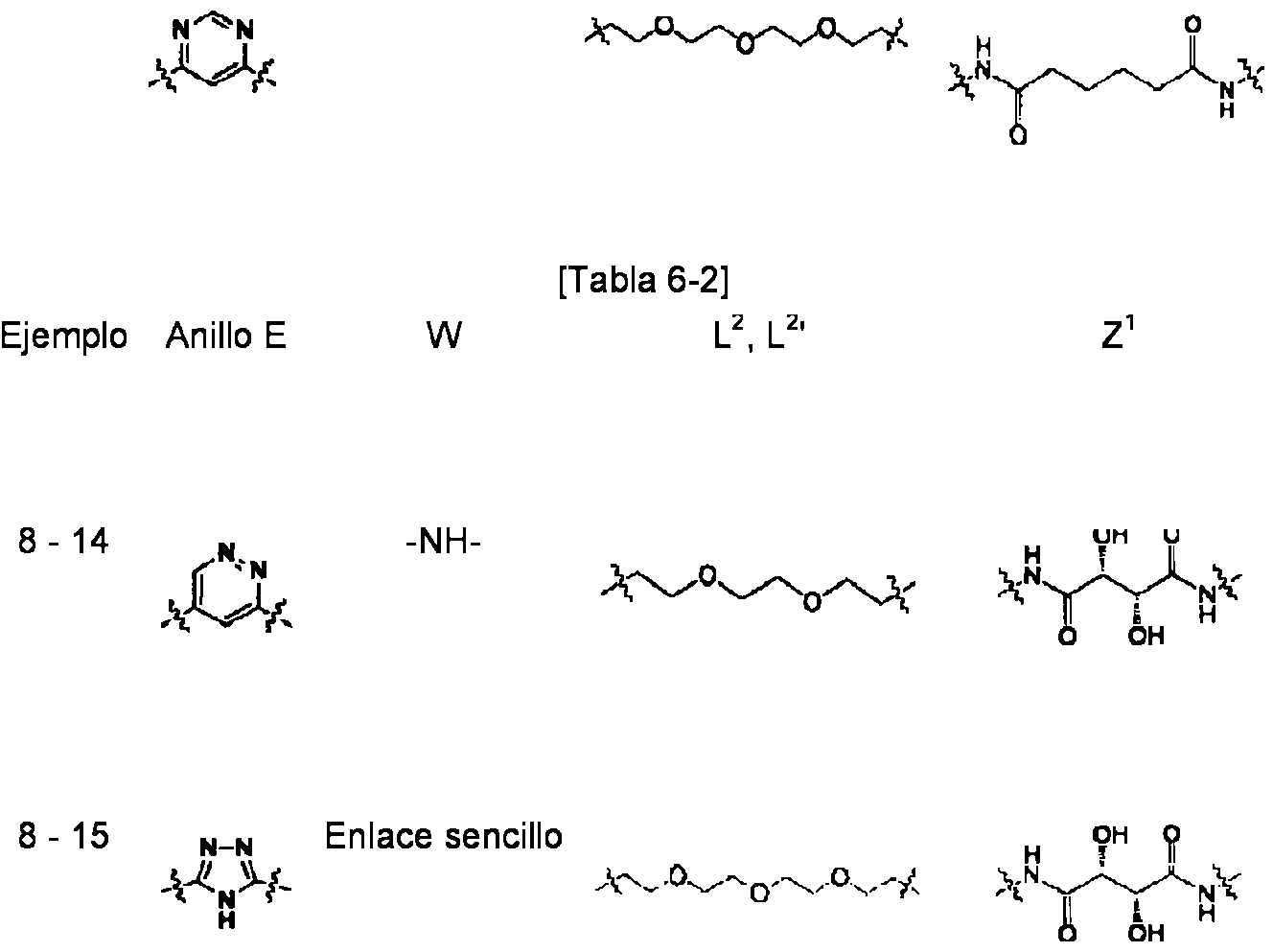
8 - 16 -O-A ' ^ ° ' x ^ 0^ \ . y 8 - 16 -O- A '^ °' x ^ 0 ^ \. Y
Ejemplo Anillo E W L2, L2' Z1Example Ring E W L2, L2 'Z1

[Tabla 6-3] [Table 6-3]

Ejemplo 9-1 Hidrocloruro de 1-(4-{3-[(4S)-6,8-dicloro-2-metil-1,2,3,4-tetrahidroisoquinolin-4-il]fenil}-1H-1,2,3-triazol-1-il)-N-[2-(2-{2-[2-(4-{3-[(4S)-6,8-dicloro-2-metil-1,2,3,4-tetrahidroisoquinolin-4-il]fenil}-1H-1,2,3-triazol-1-il)etoxi]etoxi}etoxi)etil]-15,18-bis[1-(4-{3-[(4S)-6,8-dicloro-2-metil-1,2,3,4-tetrahidroisoquinolin-4-il]fenil}-1H-1,2,3-triazol-1 -il)-13-oxo-3,6,9-trioxa-12-azatetradecan-14-il]-13-oxo-3,6,9-trioxa-12,15,18-triazaicosan-20-amida [Fórmula 131]Example 9-1 1- (4- {3 - [(4S) -6,8-Dichloro-2-methyl-1,2,3,4-tetrahydroisoquinolin-4-yl] phenyl} -1H-1 hydrochloride 2,3-triazol-1-yl) -N- [2- (2- {2- [2- (4- {3 - [(4S) -6,8-dichloro-2-methyl-1,2, 3,4-tetrahydroisoquinolin-4-yl] phenyl} -1H-1,2,3-triazol-1-yl) ethoxy] ethoxy} ethoxy) ethyl] -15,18-bis [1- (4- {3- [(4S) -6,8-dichloro-2-methyl-1,2,3,4-tetrahydroisoquinolin-4-yl] phenyl} -1 H-1,2,3-triazol-1-yl) -13-oxo -3,6,9-trioxa-12-azatetradecan-14-yl] -13-oxo-3,6,9-trioxa-12,15,18-triazaicosan-20-amide [Formula 131]

Una solución de 1 -azido-N-(2-{2-[2-(2-azidoetoxi)etoxi]etoxi}etil)-15,18-bis(1-azido-13-oxo-3,6,9-trioxa-12-azatetradecan-14-il)-13-oxo-3,6,9-trioxa-12,15,18-triazaicosan-20-amida (62 mg) obtenida en el Ejemplo de Referencia 6-6, (4S)-6,8-dicloro-4-(3-etinilfenil)-2-metil-1,2,3,4-tetrahidroisoquinolina (0,10 g) obtenida en el Ejemplo de Referencia 2-1, sulfato de cobre (4,5 mg) y ascorbato de sodio (12 mg) en una mezcla disolvente de etanol (2,0 mL)-agua (0,5 mL) se agitó a 85°C durante 3 horas. El etanol se eliminó mediante destilación a presión reducida. A continuación, el residuo se filtró a través de un filtro, y el producto se concentró a presión reducida. El residuo obtenido se purificó mediante HPLC preparativa de fase inversa (columna (YMC-Actus Triart 5 pm C1850 x 30 mm), fase móvil (ácido trifluoroacético al 0,1% en H2O:ácido trifluoroacético al 0,1% en MeCN = 90:10 ^ 20:80 ^ 5:95, 40 mL/min.) y se purificó adicionalmente mediante TLC preparativa (Fuji Silysia Chemical Ltd. "Placas NH de 0,25 mm CHROMATOREX TLC", cloroformo:metanol = 20:1). El disolvente se eliminó mediante destilación a presión reducida, y a continuación, el residuo obtenido se disolvió en metanol. A la solución, se le añadió una solución de 4 moles/L de cloruro de hidrógeno en 1,4-dioxano, y a continuación, el disolvente se eliminó mediante destilación a presión reducida para obtener el compuesto del título (10 mg, 14%) en forma de una sustancia amorfa de color amarillo pálido.A solution of 1-azido-N- (2- {2- [2- (2-azidoethoxy) ethoxy] ethoxy} ethyl) -15,18-bis (1-azido-13-oxo-3,6,9- trioxa-12-azatetradecan-14-yl) -13-oxo-3,6,9-trioxa-12,15,18-triazaicosan-20-amide (62 mg) obtained in Reference Example 6-6, (4S ) -6,8-dichloro-4- (3-ethynylphenyl) -2-methyl-1,2,3,4-tetrahydroisoquinoline (0.10 g) obtained in Reference Example 2-1, copper sulfate (4 , 5 mg) and sodium ascorbate (12 mg) in a mixed solvent of ethanol (2.0 mL) -water (0.5 mL) was stirred at 85 ° C for 3 hours. The ethanol was removed by distillation under reduced pressure. Then, the residue was filtered through a filter, and the product was concentrated under reduced pressure. The obtained residue was purified by preparative reverse phase HPLC (column (YMC-Actus Triart 5 pm C1850 x 30 mm), mobile phase (0.1% trifluoroacetic acid in H2O: 0.1% trifluoroacetic acid in MeCN = 90 : 10 ^ 20:80 ^ 5:95, 40 mL / min.) And further purified by preparative TLC (Fuji Silysia Chemical Ltd. "0.25 mm NH plates CHROMATOREX TLC", chloroform: methanol = 20: 1) The solvent was removed by distillation under reduced pressure, and then, the residue obtained was dissolved in methanol.To the solution, a solution of 4 mol / L of hydrogen chloride in 1,4-dioxane was added, and then, the solvent was removed by distillation under reduced pressure to obtain the title compound (10 mg, 14%) as a pale yellow amorphous substance.
Tiempo de retención LC-MS 1,073 minRetention time LC-MS 1,073 min
CL: Agilent 1290CL: Agilent 1290
EM ESI/APCI: Agilent 6130ESI / APCI EM: Agilent 6130
Columna: Waters Acquity CSH C181,7 um, 2,1x50 mm Column: Waters Acquity CSH C181.7 um, 2.1x50 mm
Disolvente: H2O:CH3CN (ácido fórmico al 0,1%) Solvent: H 2 O: CH 3 CN (0.1% formic acid)
Gradiente: 0,8 mL/min, 0 min (95:5) ^ 1,2 min (50:50)Gradient: 0.8 mL / min, 0 min (95: 5) ^ 1.2 min (50:50)
1,0 mL/min, ^ 1,38 min (3:97)1.0 mL / min, ^ 1.38 min (3:97)
EM (+):2359 [M+H]+.MS (+): 2359 [M + H] +.
El compuesto de la presente invención se puede evaluar para determinar su efecto inhibidor de NHE3 de acuerdo con un enfoque conocido en la técnica, por ejemplo, el método descrito en el Ejemplo de Ensayo 1.The compound of the present invention can be evaluated for its NHE3 inhibitory effect according to an approach known in the art, for example, the method described in Test Example 1.
El efecto inhibidor de NHE3 del compuesto de la presente invención se midió mediante el uso del método descrito a continuación en el Ejemplo de Ensayo 1.The inhibitory effect of NHE3 of the compound of the present invention was measured by using the method described below in Test Example 1.
Ejemplo de Ensayo 1Test Example 1
(1) Preparación de línea celular carente de NHE endógeno.(1) Preparation of cell line lacking endogenous NHE.
La línea celular carente de NHE endógeno se preparó de acuerdo con el método de Jacques Pouyssegur et al. (Proc. Natl. Acad. Sci. USA. 1984, Vol. 81, 4833-4837) utilizando células de riñón de oposum (OK) (AtCc ).The cell line lacking endogenous NHE was prepared according to the method of Jacques Pouyssegur et al. (Proc. Natl. Acad. Sci. USA, 1984, Vol. 81, 4833-4837) using opossum kidney cells (OK) (AtCc).
(2) Preparación de plásmido de expresión y línea celular que expresa NHE3 humano de forma estable(2) Preparation of expression plasmid and cell line expressing human NHE3 stably
El plásmido de expresión se construyó insertando una secuencia de ADNc de NHE3 humano (SLC9A3, Núm. de Acceso NM_004174) (GeneCopoeia, Inc.) en un vector pcDNA3,2/V5-DEST (Life Technologies Corp.).The expression plasmid was constructed by inserting a human NHE3 cDNA sequence (SLC9A3, Accession No. NM_004174) (GeneCopoeia, Inc.) into a pcDNA3,2 / V5-DEST vector (Life Technologies Corp.).
Las células OK carentes de NHE endógeno se transfectaron con el plásmido de expresión de NHE3 humano construido para preparar células de expresión estable. La transfección se llevó a cabo mediante electroporación utilizando un dispositivo Nucleofector 2b (Lonza Group Ltd.). Se seleccionó una línea celular de expresión estable en medio complementado con 500 pg/ml de Geneticina (Life Technologies Corp.) y se aisló.OK cells lacking endogenous NHE were transfected with the human NHE3 expression plasmid constructed to prepare stable expression cells. Transfection was carried out by electroporation using a Nucleofector 2b device (Lonza Group Ltd.). A stable expression cell line was selected in medium supplemented with 500 pg / ml Geneticin (Life Technologies Corp.) and isolated.
(3) Ensayo de inhibición de NHE3(3) NHE3 inhibition assay
Método de medición de la actividad del NHE3 utilizando células: la actividad se determinó mediante el uso de la recuperación mediada por el NHE3 del pH intracelular que se produce después de la acidulación intracelular, como índice. El pH intracelular se midió mediante una modificación parcial del método del indicador fluorescente sensible al pH referido por Tsien et al. (Proc. Natl. Acad. Sci. USA., 1984, 81, 7436-7440).Method of measuring the activity of NHE3 using cells: the activity was determined by using the NHE3 mediated recovery of the intracellular pH that occurs after intracellular acidulation, as an index. The intracellular pH was measured by a partial modification of the pH-sensitive fluorescent indicator method reported by Tsien et al. (Proc. Natl. Acad. Sci. USA., 1984, 81, 7436-7440).
La línea celular que expresaba NHE3 humano de forma estable se inoculó en una placa de 96 pocillos recubierta con poli-D-lisina (Greiner Bio-one) y se cultivó durante la noche. El medio se aspiró de cada pocillo y las células se lavaron una vez con solución de tampón de sal equilibrada de Hank (NaCl 137 mM, HEPES 20 mM, glucosa 5,6 mM, KCl 5,3 mM, CaCl21,3 mM), MgCh 0,5 mM, MgSO40,4 mM, KH2PO40,4 mM, Na2HPO40,3 mM, pH 7,4). A continuación, se añadió una solución de solución salina equilibrada de Hank que contenía BCECF-AM (Dojindo Laboratories) 0,25 pM a las células, que a continuación se incubaron a 37°C durante 30 minutos. La solución se aspiró de cada pocillo, y se añadió una solución tampón de NH4Cl (NH4Cl 20 mM), cloruro de colina 115 mM, h Ep ES 20 mM, glucosa 5 mM, KCl 4,7 mM, CaCl21,25 mM, MgCh 1,25 mM, pH 7,4) a las células, que a continuación se incubaron a 37°C durante 10 minutos. Las células así incubadas en la solución tampón de NH4Cl se lavaron con solución tampón (cloruro de colina 133,8 mM, HEPES 10 mM, glucosa 5 mM, KCl 4,7 mM, CaCh 1,25 mM), MgCl21,25 mM, K2HPO40,97 mM, KH2PO40,23 mM, pH 7,4) sin NH4Cl para disminuir el pH intracelular. Después de la etapa de lavado, se añadieron a las células 70 pL de una solución de compuesto de ensayo preparada con la solución tampón sin NH4Cl a las células, y a esto se añadieron 70 pl de solución tampón que contenía ión sodio (NaCl 133,8 mM, HEPES 10 mM, glucosa 5 mM, KCl 4,7 mM, CaCh 1,25 mM), MgCh 1,25 mM, Na2HPO40,97 mM, NaH2PO40,23 mM, pH 7,4) en un sistema de medición FDSS6000 (Hamamatsu Photonics K.K.) para iniciar la recuperación del pH. La recuperación del pH intracelular se verificó utilizando fluorescencia con BCECF (longitud de onda de excitación: 480 nm, longitud de onda de fluorescencia: 520 a 560 nm), y se representó la velocidad inicial de recuperación del pH. La recuperación del pH sin el compuesto de ensayo se definió como la recuperación máxima, y la concentración necesaria del compuesto de prueba para inhibir 50% de la recuperación máxima se calculó como un valor de CI50.The cell line expressing human NHE3 stably was inoculated into a 96-well plate coated with poly-D-lysine (Greiner Bio-one) and cultured overnight. The medium was aspirated from each well and the cells were washed once with Hank's balanced salt buffer solution (137 mM NaCl, 20 mM HEPES, 5.6 mM glucose, 5.3 mM KCl, 1.3 mM CaCl 2). ), 0.5 mM MgCh, 0.4 mM MgSO 4, 0.4 mM KH 2 PO 4, 0.3 mM Na 2 HPO 4 , pH 7.4). Then a solution of Hank 's balanced salt solution containing added BCECF-AM (Dojindo Laboratories) 0.25 pM cells, which are then incubated at 37 ° C for 30 minutes. The solution was aspirated from each well, and a buffer solution of NH 4 Cl ( 20 mM NH 4 Cl), choline chloride 115 mM, h Ep ES 20 mM, glucose 5 mM, KCl 4.7 mM, CaCl 2 was added. 1.25 mM, 1.25 mM MgCh, pH 7.4) to the cells, which were then incubated at 37 ° C for 10 minutes. The cells thus incubated in the NH 4 Cl buffer solution were washed with buffer solution (133.8 mM choline chloride, 10 mM HEPES, 5 mM glucose, 4.7 mM KCl, 1.25 mM CaCh ), MgCl 2 1 , 25 mM, K 2 HPO 4 0.97 mM, KH 2 PO 4 0.23 mM, pH 7.4) without NH 4 Cl to lower the intracellular pH. After the washing step, 70 pL of a solution of test compound prepared with the buffer solution without NH 4 Cl were added to the cells to the cells, and to this was added 70 μl of buffer solution containing sodium ion (NaCl 133 , 8 mM, 10 mM HEPES, 5 mM glucose, 4.7 mM KCl, 1.25 mM CaCh), 1.25 mM MgCh, 0.97 mM Na 2 HPO 4 , 0.23 mM NaH 2 PO 4 , pH 7.4) in a FDSS6000 measuring system (Hamamatsu Photonics KK) to initiate pH recovery. Recovery of intracellular pH was verified using fluorescence with BCECF (excitation wavelength: 480 nm, fluorescence wavelength: 520 to 560 nm), and the initial rate of pH recovery was plotted. Recovery of the pH without the test compound was defined as the maximum recovery, and the necessary concentration of the test compound to inhibit 50% of the maximum recovery was calculated as an IC 50 value.
(4) Resultados(4) Results
La actividad inhibidora del NHE3 humano (nM) de cada compuesto se muestra en la Tabla 7-1 a continuación.The inhibitory activity of human NHE3 (nM) of each compound is shown in Table 7-1 below.
[Tabla 7-1] [Table 7-1]
Núm. Ejemplo CI50 (nM) Núm. Ejemplo CI50 (nM) Núm. Ejemplo CI50 (nM) Núm. Ejemplo CI50 (nM) 1-1 217 6-3 301 7-19 17,7 8-2 10,7 1-2 217 6-4 97,6 7-20 7,5 8-3 13,2 1-3 392 6-5 9,5 7-21 3,8 8-4 115 1-4 257 6-6 75,01 7-22 5,7 8-5 2,8 1-5 58,1 6-7 1,1 7-23 5,5 8-6 15,5 1-6 373 6-8 0,8 7-24 5,6 8-7 41,7 1-7 626 6-9 4,1 7-25 13,6 8-8 6,2 1-8 126 6-10 6,2 7-26 5,2 8-9 3,6 1-9 561 6-11 1,4 7-27 11,3 8-10 3,2 No. Example CI 50 (nM) No. Example CI 50 (nM) No. Example CI 50 (nM) No. Example CI 50 (nM) 1-1 217 6-3 301 7-19 17.7 8-2 10 , 7 1-2 217 6-4 97.6 7-20 7.5 8-3 13.2 1-3 392 6-5 9.5 7-21 3.8 8-4 115 1-4 257 6- 6 75.01 7-22 5.7 8-5 2.8 1-5 58 6-7 1.1 7-23 5.5 8-6 15.5 1-6 373 6-8 0.8 7-24 5.6 8-7 41.7 1-7 626 6-9 4.1 7-25 13.6 8-8 6.2 1-8 126 6-10 6.2 7-26 5.2 8-9 3.6 1-9 561 6-11 1.4 7-27 11.3 8-10 3.2
1-10 169 6-12 2,3 7-28 7,3 8-11 7,51-10 169 6-12 2.3 7-28 7.3 8-11 7.5
1-11 1604 6-13 2,1 7-29 6,9 8-12 6,21-11 1604 6-13 2.1 7-29 6.9 8-12 6.2
1-12 650 7-1 2,2 7-30 2,8 8-13 10,61-12 650 7-1 2.2 7-30 2.8 8-13 10.6
1-13 271 7-2 9,4 7-31 12,4 8-14 9,11-13 271 7-2 9.4 7-31 12.4 8-14 9.1
1-14 173 7-3 11,0 7-32 18,1 8-15 1,91-14 173 7-3 11.0 7-32 18.1 8-15 1.9
1-15 117 7-4 8,4 7-33 8,6 8-16 7,61-15 117 7-4 8.4 7-33 8.6 8-16 7.6
1-16 184 7-5 4,51 7-34 3,3 8-17 2,51-16 184 7-5 4.51 7-34 3.3 8-17 2.5
1-17 109 7-6 10,0 7-35 4,4 8-18 10,71-17 109 7-6 10.0 7-35 4.4 8-18 10.7
1-18 95,7 7-7 6,8 7-36 21,4 8-19 6,81-18 95.7 7-7 6.8 7-36 21.4 8-19 6.8
1-19 856 7-8 1084 7-37 6,6 8-20 3,31-19 856 7-8 1084 7-37 6.6 8-20 3.3
1-20 208 7-9 7,3 7-38 3,8 8-21 3,2 Núm. Ejemplo CI50 (nM) Núm. Ejemplo CI50 (nM) Núm. Ejemplo CI50 (nM) Núm. Ejemplo CI50 (nM) 1-20 208 7-9 7.3 7-38 3.8 8-21 3.2 No. Example CI 50 (nM) No. Example CI 50 (nM) No. Example CI 50 (nM) No. Example CI 50 (nM)
1-21 1171 7-10 13,7 7-39 3,2 8-22 10,51-21 1171 7-10 13.7 7-39 3.2 8-22 10.5
1-22 306 7-11 33,5 7-40 11,0 8-23 4,71-22 306 7-11 33.5 7-40 11.0 8-23 4.7
1-23 3220 7-12 7,5 7-41 5518 8-24 3,41-23 3220 7-12 7.5 7-41 5518 8-24 3.4
2-1 89,3 7-13 12,0 7-42 5,5 8-25 0,22-1 89.3 7-13 12.0 7-42 5.5 8-25 0.2
3-1 49,11 7-14 13,9 7-43 8,51 8-26 2,23-1 49.11 7-14 13.9 7-43 8.51 8-26 2.2
4-1 554 7-15 8,1 7-44 7,6 9-1 13,14-1 554 7-15 8.1 7-44 7.6 9-1 13.1
5-1 760 7-16 16,6 7-45 5,75-1 760 7-16 16.6 7-45 5.7
6-1 2,4 7-17 4,4 7-46 10,96-1 2.4 7-17 4.4 7-46 10.9
6-2 5,7 7-18 5,6 8-1 14,96-2 5.7 7-18 5.6 8-1 14.9
El compuesto de la presente invención se puede evaluarse por su efecto inhibidor de la absorción de fósforo de acuerdo con un enfoque conocido en la técnica, por ejemplo, el método descrito en el Ejemplo de Ensayo 2.The compound of the present invention can be evaluated for its phosphorus absorption inhibiting effect according to an approach known in the art, for example, the method described in Test Example 2.
El efecto inhibidor de la absorción de fósforo del compuesto de la presente invención se midió mediante el uso del método descrito a continuación en el Ejemplo de Ensayo 2.The inhibitory effect of phosphorus absorption of the compound of the present invention was measured by using the method described below in Test Example 2.
Ejemplo de Ensayo 2Test Example 2
Efecto inhibidor de la absorción de fósforo del compuesto de la presente invención en el ensayo de carga oral de fosfato 32P utilizando ratas SDPhosphorus Absorption Inhibitory Effect of the Compound of the Present Invention in the 32P Phosphate Oral Load Assay Using SD Rats
Se utilizaron ratas macho SD de 8 semanas de edad (Japan SLC, Inc.) como animales de laboratorio. Cada compuesto de ensayo se suspendió o disolvió a una concentración de 0,2 mg/ml o 0,6 mg/ml en agua para inyectables (fabricada por Hikari Pharmaceutical Co., Ltd.) de la Farmacopea Japonesa y se administró por vía oral a cada rata a una dosis de 5 mL/kg de peso corporal. El agua para inyectables de la Farmacopea Japonesa se administró a la misma dosis que antes en un grupo de control. Cinco minutos después de la administración del compuesto de ensayo o del agua para inyectables, se administró una solución de fosfato (NaH2PO41,3 mM) que contenía fosfato 32P (PerkinElmer Inc.) a una dosis de 5 mL/kg. Treinta minutos después de la administración de la solución de fosfato, se extrajo sangre de la vena de la cola y la muestra de sangre se mezcló inmediatamente con EDTA-2K (fabricado por Dojindo Laboratories). A continuación, la mezcla se centrifugó a 3000 rpm a 4°C durante 10 minutos para recuperar el plasma.Male 8-week-old SD rats (Japan SLC, Inc.) were used as laboratory animals. Each test compound was suspended or dissolved at a concentration of 0.2 mg / ml or 0.6 mg / ml in water for injection (manufactured by Hikari Pharmaceutical Co., Ltd.) of the Japanese Pharmacopoeia and orally administered to each rat at a dose of 5 mL / kg of body weight. The injectable water of the Japanese Pharmacopoeia was administered at the same dose as before in a control group. Five minutes after administration of the test compound or water for injection, a solution of phosphate ( 1.3 mM NaH 2 PO 4 ) containing 32 P phosphate (PerkinElmer Inc.) was administered at a dose of 5 mL / kg. Thirty minutes after the administration of the phosphate solution, blood was drawn from the tail vein and the blood sample was immediately mixed with EDTA-2K (manufactured by Dojindo Laboratories). Then, the mixture was centrifuged at 3000 rpm at 4 ° C for 10 minutes to recover the plasma.
La radiactividad en 100 pl del plasma se midió utilizando un contador de centelleo líquido y se utilizó como recuento de absorción de fosfato. La radiactividad en plasma del grupo de control se utilizó como control, y la tasa de inhibición de la absorción de fosfato se determinó de acuerdo con la siguiente expresión:Radioactivity in 100 μl of the plasma was measured using a liquid scintillation counter and used as a phosphate absorption count. The radioactivity in plasma of the control group was used as a control, and the rate of inhibition of phosphate absorption was determined according to the following expression:
Tasa de inhibición de la absorción de fosfato (%) = (1 - Recuento de la absorción de fosfato del grupo de administración del compuesto de ensayo / Recuento de la absorción de fosfato del grupo de control) x 100 (2) ResultadosPhosphate Absorption Inhibition Rate (%) = (1 - Phosphate absorption count of the test compound administration group / Phosphate absorption count of the control group) x 100 (2) Results
La tasa de inhibición de la absorción de fosfato (%: dosis: 1 mg/kg o 3 mg/kg) de cada compuesto se muestra en la Tabla 8-1 a continuación. La dosis mínima eficaz (DME) también se puede calcular midiendo la tasa de inhibición en una pluralidad de dosis.The inhibition rate of phosphate uptake (%: dose: 1 mg / kg or 3 mg / kg) of each compound is shown in Table 8-1 below. The minimum effective dose (SMD) can also be calculated by measuring the rate of inhibition in a plurality of doses.
[Tabla 8-1][Table 8-1]
Núm. Dosis Tasa de Núm. Dosis Tasa de Núm. Dosis Tasa de Ejemplo (mg/kg) inhibición (%) Ejemplo (mg/kg) inhibición (%) Ejemplo (mg/kg) inhibición (%)No. Dose Rate No. Dose Rate No. Dose Example Rate (mg / kg) Inhibition (%) Example (mg / kg) Inhibition (%) Example (mg / kg) Inhibition (%)
6- 2 1 47 7- 9 3 22 7-42 3 296- 2 1 47 7- 9 3 22 7-42 3 29
6- 4 3 -5 7-10 3 35 7-43 3 376-4 3 -5 7-10 3 35 7-43 3 37
6- 5 3 46 7-15 3 36 7-45 3 296- 5 3 46 7-15 3 36 7-45 3 29
6- 8 3 34 7-16 3 34 7-46 3 236-8 3 34 7-16 3 34 7-46 3 23
6- 9 3 53 7-18 3 49 8- 6 3 266-9 3 53 7-18 3 49 8- 6 3 26
6-10 3 38 7-19 3 19 8- 8 3 396-10 3 38 7-19 3 19 8- 8 3 39
6-11 3 33 7-24 3 31 8-12 3 66-11 3 33 7-24 3 31 8-12 3 6
6-12 3 37 7-29 3 10 8-14 1 466-12 3 37 7-29 3 10 8-14 1 46
7- 2 3 23 7-30 3 28 8-16 3 317- 2 3 23 7-30 3 28 8-16 3 31
7- 4 3 27 7-33 3 -1 8-17 3 187- 4 3 27 7-33 3 -1 8-17 3 18
7- 5 3 23 7-39 1 38 8-18 3 277-5 3 23 7-39 1 38 8-18 3 27
7- 6 3 24 7-40 3 28 8-20 3 377-6 3 24 7-40 3 28 8-20 3 37
Aplicabilidad industrialIndustrial applicability
El compuesto de la presente invención tiene un excelente efecto inhibidor de NHE3 y puede proporcionar un producto farmacéutico eficaz para la prevención o el tratamiento del estreñimiento, la hipertensión, la nefropatía, la retención de líquidos corporales derivada de la insuficiencia renal y la retención de líquidos corporales causada por insuficiencia cardíaca, cirrosis hepática, o fármacos. El compuesto de la presente invención también tiene un excelente efecto inhibidor de la absorción de fósforo y puede proporcionar un producto farmacéutico eficaz para la prevención o el tratamiento de la CKD-MBD tipificada por hiperfosfatemia. Se espera que la presente invención mitigue las cargas en los pacientes y contribuya al desarrollo de la industria farmacéutica. The compound of the present invention has an excellent inhibitory effect of NHE3 and can provide an effective pharmaceutical product for the prevention or treatment of constipation, hypertension, nephropathy, retention of body fluids derived from kidney failure and fluid retention bodily injury caused by heart failure, liver cirrhosis, or drugs. The compound of the present invention also has an excellent phosphorus absorption inhibiting effect and can provide an effective pharmaceutical product for the prevention or treatment of CKD-MBD typified by hyperphosphatemia. It is expected that the present invention mitigates the burdens on patients and contributes to the development of the pharmaceutical industry.
Claims (1)


Applications Claiming Priority (3)
| Application Number | Priority Date | Filing Date | Title |
|---|---|---|---|
| JP2014151726 | 2014-07-25 | ||
| JP2015051289 | 2015-03-13 | ||
| PCT/JP2015/071111 WO2016013657A1 (en) | 2014-07-25 | 2015-07-24 | Phenyl tetrahydroisoquinoline compound substituted with heteroaryl |
Publications (1)
| Publication Number | Publication Date |
|---|---|
| ES2701498T3 true ES2701498T3 (en) | 2019-02-22 |
Family
ID=55163179
Family Applications (1)
| Application Number | Title | Priority Date | Filing Date |
|---|---|---|---|
| ES15825310T Active ES2701498T3 (en) | 2014-07-25 | 2015-07-24 | Phenyltetrahydroisoquinoline compound substituted with heteroaryl |
Country Status (28)
| Country | Link |
|---|---|
| US (1) | US9932331B2 (en) |
| EP (1) | EP3173408B1 (en) |
| JP (1) | JP6292307B2 (en) |
| KR (1) | KR102386666B1 (en) |
| CN (1) | CN106536502B (en) |
| AU (1) | AU2015293134B2 (en) |
| BR (1) | BR112017000691B1 (en) |
| CA (1) | CA2955572C (en) |
| CY (1) | CY1121401T1 (en) |
| DK (1) | DK3173408T3 (en) |
| ES (1) | ES2701498T3 (en) |
| HR (1) | HRP20181978T1 (en) |
| IL (1) | IL250117B (en) |
| LT (1) | LT3173408T (en) |
| ME (1) | ME03311B (en) |
| MX (1) | MX375386B (en) |
| MY (1) | MY182318A (en) |
| PH (1) | PH12017500119A1 (en) |
| PL (1) | PL3173408T3 (en) |
| PT (1) | PT3173408T (en) |
| RS (1) | RS58378B1 (en) |
| RU (1) | RU2703456C2 (en) |
| SG (1) | SG11201700398RA (en) |
| SI (1) | SI3173408T1 (en) |
| SM (1) | SMT201900104T1 (en) |
| TW (1) | TWI666206B (en) |
| WO (1) | WO2016013657A1 (en) |
| ZA (1) | ZA201700563B (en) |
Families Citing this family (7)
| Publication number | Priority date | Publication date | Assignee | Title |
|---|---|---|---|---|
| JP6903923B2 (en) * | 2016-01-22 | 2021-07-14 | 大正製薬株式会社 | A drug containing a phenyltetrahydroisoquinoline compound substituted with a heteroaryl as an active ingredient. |
| EA201991676A1 (en) * | 2017-01-09 | 2020-01-30 | Арделикс, Инк. | NHE-MEDIATED ANTI-PORT INHIBITORS |
| CN109012748B (en) * | 2018-07-27 | 2021-03-16 | 安徽师范大学 | Pyridine-substituted pyrrole-based rare earth metal catalyst and preparation method and application thereof |
| AU2020283361B2 (en) | 2019-05-31 | 2025-11-27 | Ube Corporation | Benzotriazole derivative |
| JP7828905B2 (en) | 2020-06-30 | 2026-03-12 | プロセッタ バイオサイエンシズ, インク. | Isoquinoline derivatives, methods of synthesis, and uses thereof |
| CN114716458A (en) * | 2021-01-04 | 2022-07-08 | 上海济煜医药科技有限公司 | Tetrahydroisoquinoline compounds |
| CN118387998B (en) * | 2024-04-19 | 2025-12-02 | 中原环保股份有限公司 | A method and apparatus for in-situ precision chemical phosphorus removal |
Family Cites Families (31)
| Publication number | Priority date | Publication date | Assignee | Title |
|---|---|---|---|---|
| DE19548812A1 (en) | 1995-12-27 | 1997-07-03 | Hoechst Ag | Use of inhibitors of the cellular Na · + · / H · + · exchanger (NHE) for the manufacture of a medicament for respiratory stimulation |
| DE19945302A1 (en) | 1999-09-22 | 2001-03-29 | Merck Patent Gmbh | Biphenyl derivatives as NHE-3 inhibitors |
| DE10015248A1 (en) | 2000-03-28 | 2001-10-04 | Merck Patent Gmbh | Bisamidino compounds as NHE-3 inhibitors |
| DE10019062A1 (en) | 2000-04-18 | 2001-10-25 | Merck Patent Gmbh | Use of known and new 2-guanidino-4-aryl-quinazoline derivatives as NHE-3 inhibitors useful for the treatment of e.g. hypertension, thrombosis, cardiac ischemia, peripheral and CNS ischemia |
| US6911453B2 (en) | 2001-12-05 | 2005-06-28 | Aventis Pharma Deutschland Gmbh | Substituted 4-phenyltetrahydroisoquinolinium, process for their preparation, their use as a medicament, and medicament containing them |
| HRP20040507A2 (en) | 2001-12-05 | 2005-08-31 | Aventis Pharma Deutschland Gmbh | Substituted 4-phenyltetrahydroisoquinoline methods |
| DE10161767A1 (en) | 2001-12-15 | 2003-06-26 | Merck Patent Gmbh | New 2-guanidino-4-heterocyclyl-quinazoline derivatives, useful as sodium-proton antiporter subtype III inhibitors for treating e.g. respiratory, renal, ischemic or lipid metabolism disorders |
| US20030187045A1 (en) | 2001-12-21 | 2003-10-02 | Uwe Heinelt | Substituted imidazolidines, process for their preparation, and their use as a medicament or diagnostic |
| DE10163239A1 (en) | 2001-12-21 | 2003-07-10 | Aventis Pharma Gmbh | Substituted imidazolidines, process for their preparation, their use as medicaments or diagnostic agents, and medicaments containing them |
| US6703405B2 (en) | 2001-12-22 | 2004-03-09 | Aventis Pharma Deutschland Gmbh | Substituted 4-phenyltetrahydroisoquinolinium salts, process for their preparation, their use as a medicament, and medicament containing them |
| DE10163914A1 (en) * | 2001-12-22 | 2003-07-03 | Aventis Pharma Gmbh | Substituted 4-phenyltetrahydroisoquinolinium salts, process for their preparation, their use as medicament, and medicament containing them |
| DE10163992A1 (en) | 2001-12-24 | 2003-07-03 | Merck Patent Gmbh | 4-aryl-quinazolines |
| DE10224892A1 (en) | 2002-06-04 | 2003-12-18 | Aventis Pharma Gmbh | Substituted thiophenes, process for their preparation, their use as a medicament or diagnostic agent, and medicament containing them |
| US7049333B2 (en) | 2002-06-04 | 2006-05-23 | Sanofi-Aventis Deutschland Gmbh | Substituted thiophenes: compositions, processes of making, and uses in disease treatment and diagnosis |
| DE10304294A1 (en) | 2003-02-04 | 2004-08-12 | Aventis Pharma Deutschland Gmbh | N-Substituted (benzoimidazol-2-yl) -phenyl, process for their preparation, their use as medicament or diagnostic agent and medicament containing them |
| DE10304374A1 (en) | 2003-02-04 | 2004-08-05 | Aventis Pharma Deutschland Gmbh | Novel substituted 2-aminoimidazoles, process for their preparation, their use as medicament or diagnostic agent and medicament containing them |
| US20050054705A1 (en) | 2003-02-04 | 2005-03-10 | Aventis Pharma Deutschland Gmbh | N-substituted (benzoimidazol-2-yl) phenylamines, process for their preparation, their use as medicament or diagnostic aid, and medicament comprising them |
| US7241775B2 (en) | 2003-03-24 | 2007-07-10 | Sanofi-Aventis Deutschland Gmbh | Composition, process of making, and medical use of substituted 4-phenyltetrahydroisoquinolines |
| DE10312963A1 (en) * | 2003-03-24 | 2004-10-07 | Aventis Pharma Deutschland Gmbh | Substituted 4-phenyltetrahydroisoquinolines, process for their preparation, their use as medicament, and medicament containing them |
| AU2003241471A1 (en) | 2003-05-13 | 2005-01-21 | Electric Power Research Institute, Inc. | Application of symbol sequence analysis and temporal irreversibility to monitoring and controlling boiler flames |
| DE10341240A1 (en) | 2003-09-08 | 2005-04-07 | Aventis Pharma Deutschland Gmbh | Substituted thienoimidazoles, process for their preparation, their use as medicament or diagnostic agent, and medicament containing them |
| DE102004046492A1 (en) | 2004-09-23 | 2006-03-30 | Sanofi-Aventis Deutschland Gmbh | Substituted 4-phenyltetrahydroisoquinolines, process for their preparation, their use as medicament, and medicament containing them |
| DE102005001411A1 (en) * | 2005-01-12 | 2006-07-27 | Sanofi-Aventis Deutschland Gmbh | Substituted 4-phenyltetrahydroisoquinolines, process for their preparation, their use as medicament, and medicament containing them |
| DE102005044817A1 (en) * | 2005-09-20 | 2007-03-22 | Sanofi-Aventis Deutschland Gmbh | Substituted 4-phenyltetrahydroisoquinolines, process for their preparation, their use as medicament, and medicament containing them |
| DE102006012545A1 (en) | 2006-03-18 | 2007-09-27 | Sanofi-Aventis | Substituted 2-amino-4-phenyl-dihydroquinolines, process for their preparation, their use as medicament, and medicament containing them |
| DE102006012544A1 (en) | 2006-03-18 | 2007-09-27 | Sanofi-Aventis | Substituted 1-amino-4-phenyl-dihydroisoquinolines, process for their preparation, their use as medicament, and medicament containing them |
| BRPI0918502A2 (en) | 2008-09-02 | 2015-12-01 | Sanofi Aventis | substituted aminoindans and analogs thereof, and their pharmaceutical use |
| SI2384318T1 (en) * | 2008-12-31 | 2018-03-30 | Ardelyx, Inc. | Compounds and methods for inhibiting nhe-mediated antiport in the treatment of disorders associated with fluid retention or salt overload and gastrointestinal tract disorders |
| BR112015003516A2 (en) * | 2012-08-21 | 2017-07-04 | Ardelyx Inc | compounds and methods for nhe-mediated antiport inhibition in the treatment of fluid retention or salt overload disorders and gastrointestinal tract disorders |
| MX366293B (en) | 2012-08-21 | 2019-07-04 | Ardelyx Inc | Compounds and methods for inhibiting nhe-mediated antiport in the treatment of disorders associated with fluid retention or salt overload and gastrointestinal tract disorders. |
| LT2983667T (en) | 2013-04-12 | 2019-07-10 | Ardelyx, Inc. | Nhe3-binding compounds and methods for inhibiting phosphate transport |
-
2015
- 2015-07-24 ME MEP-2019-10A patent/ME03311B/en unknown
- 2015-07-24 RU RU2017105836A patent/RU2703456C2/en active
- 2015-07-24 PT PT15825310T patent/PT3173408T/en unknown
- 2015-07-24 US US15/328,223 patent/US9932331B2/en active Active
- 2015-07-24 CA CA2955572A patent/CA2955572C/en active Active
- 2015-07-24 SI SI201530498T patent/SI3173408T1/en unknown
- 2015-07-24 WO PCT/JP2015/071111 patent/WO2016013657A1/en not_active Ceased
- 2015-07-24 MX MX2017001117A patent/MX375386B/en active IP Right Grant
- 2015-07-24 CN CN201580040318.5A patent/CN106536502B/en active Active
- 2015-07-24 ES ES15825310T patent/ES2701498T3/en active Active
- 2015-07-24 HR HRP20181978TT patent/HRP20181978T1/en unknown
- 2015-07-24 AU AU2015293134A patent/AU2015293134B2/en active Active
- 2015-07-24 DK DK15825310.4T patent/DK3173408T3/en active
- 2015-07-24 KR KR1020177003057A patent/KR102386666B1/en active Active
- 2015-07-24 SM SM20190104T patent/SMT201900104T1/en unknown
- 2015-07-24 JP JP2016535994A patent/JP6292307B2/en active Active
- 2015-07-24 TW TW104124071A patent/TWI666206B/en active
- 2015-07-24 SG SG11201700398RA patent/SG11201700398RA/en unknown
- 2015-07-24 EP EP15825310.4A patent/EP3173408B1/en active Active
- 2015-07-24 LT LTEP15825310.4T patent/LT3173408T/en unknown
- 2015-07-24 RS RS20190060A patent/RS58378B1/en unknown
- 2015-07-24 MY MYPI2017700214A patent/MY182318A/en unknown
- 2015-07-24 PL PL15825310T patent/PL3173408T3/en unknown
- 2015-07-24 BR BR112017000691-0A patent/BR112017000691B1/en active IP Right Grant
-
2017
- 2017-01-15 IL IL25011717A patent/IL250117B/en active IP Right Grant
- 2017-01-20 PH PH12017500119A patent/PH12017500119A1/en unknown
- 2017-01-24 ZA ZA2017/00563A patent/ZA201700563B/en unknown
-
2019
- 2019-01-30 CY CY20191100125T patent/CY1121401T1/en unknown
Also Published As
Similar Documents
| Publication | Publication Date | Title |
|---|---|---|
| ES2701498T3 (en) | Phenyltetrahydroisoquinoline compound substituted with heteroaryl | |
| RU2542099C2 (en) | N-phenyl-dioxox-hydropyrimidine used as hepatitis c virus inhibitor (hcv) | |
| JP6140170B2 (en) | Substituted benzylindazoles for use as BUB1 kinase inhibitors in the treatment of hyperproliferative diseases | |
| US20100160369A1 (en) | S1P1 Agonists and Methods of Making And Using | |
| JP6771491B2 (en) | EBNA1 inhibitor and how to use it | |
| ES2462522T3 (en) | Substituted heterocyclylbenzylpyrazoles and use thereof | |
| US20180338980A1 (en) | Aromatic sulfonamide derivatives | |
| EA030383B1 (en) | Bicyclically substituted uracils, processes for preparation thereof, use thereof, medicament and method for treatment using same | |
| ES2656772T3 (en) | New pyrrolopyrimidine compound or salt thereof, pharmaceutical composition containing the same, especially agent for the prevention and / or treatment of tumors, etc., based on the inhibitory effect of NAE | |
| ES2984075T3 (en) | Small molecule inhibitors of galectin-3 | |
| ES2754480T3 (en) | Pyrido-oxazinone derivatives as TNAP inhibitors | |
| JP6903923B2 (en) | A drug containing a phenyltetrahydroisoquinoline compound substituted with a heteroaryl as an active ingredient. | |
| US20230348456A1 (en) | Quinazolinones, pharmaceutical compositions containing the same, and methods of using the same | |
| IL324764A (en) | Prmt5 inhibitors | |
| ES2641469T3 (en) | 2-pyridone compound | |
| NZ728313B2 (en) | Phenyl tetrahydroisoquinoline compound substituted with heteroaryl | |
| HK1231060A1 (en) | Phenyl tetrahydroisoquinoline compound substituted with heteroaryl | |
| KR20190095944A (en) | Sulfonamide Compounds Having TNP Inhibitory Activity | |
| HK1231060B (en) | Phenyl tetrahydroisoquinoline compound substituted with heteroaryl | |
| CN121362177A (en) | APJ agonists | |
| WO2013151033A1 (en) | C-glycoside derivative having a spiro ring | |
| BR112017006798B1 (en) | COMPOUND, PHARMACEUTICAL COMPOSITION, AND, TNAP INHIBITOR |