ES2703541T3 - Purification method of transgenic factor VII - Google Patents
Purification method of transgenic factor VII Download PDFInfo
- Publication number
- ES2703541T3 ES2703541T3 ES13739975T ES13739975T ES2703541T3 ES 2703541 T3 ES2703541 T3 ES 2703541T3 ES 13739975 T ES13739975 T ES 13739975T ES 13739975 T ES13739975 T ES 13739975T ES 2703541 T3 ES2703541 T3 ES 2703541T3
- Authority
- ES
- Spain
- Prior art keywords
- human
- tgfvii
- tgfviia
- ligand
- affinity
- Prior art date
- Legal status (The legal status is an assumption and is not a legal conclusion. Google has not performed a legal analysis and makes no representation as to the accuracy of the status listed.)
- Active
Links
Classifications
-
- C—CHEMISTRY; METALLURGY
- C07—ORGANIC CHEMISTRY
- C07K—PEPTIDES
- C07K1/00—General methods for the preparation of peptides, i.e. processes for the organic chemical preparation of peptides or proteins of any length
- C07K1/14—Extraction; Separation; Purification
- C07K1/16—Extraction; Separation; Purification by chromatography
- C07K1/22—Affinity chromatography or related techniques based upon selective absorption processes
-
- C—CHEMISTRY; METALLURGY
- C12—BIOCHEMISTRY; BEER; SPIRITS; WINE; VINEGAR; MICROBIOLOGY; ENZYMOLOGY; MUTATION OR GENETIC ENGINEERING
- C12N—MICROORGANISMS OR ENZYMES; COMPOSITIONS THEREOF; PROPAGATING, PRESERVING, OR MAINTAINING MICROORGANISMS; MUTATION OR GENETIC ENGINEERING; CULTURE MEDIA
- C12N9/00—Enzymes; Proenzymes; Compositions thereof; Processes for preparing, activating, inhibiting, separating or purifying enzymes
- C12N9/14—Hydrolases (3)
- C12N9/48—Hydrolases (3) acting on peptide bonds (3.4)
- C12N9/50—Proteinases, e.g. Endopeptidases (3.4.21-3.4.25)
- C12N9/64—Proteinases, e.g. Endopeptidases (3.4.21-3.4.25) derived from animal tissue
- C12N9/6421—Proteinases, e.g. Endopeptidases (3.4.21-3.4.25) derived from animal tissue from mammals
- C12N9/6424—Serine endopeptidases (3.4.21)
- C12N9/6437—Coagulation factor VIIa (3.4.21.21)
-
- C—CHEMISTRY; METALLURGY
- C12—BIOCHEMISTRY; BEER; SPIRITS; WINE; VINEGAR; MICROBIOLOGY; ENZYMOLOGY; MUTATION OR GENETIC ENGINEERING
- C12N—MICROORGANISMS OR ENZYMES; COMPOSITIONS THEREOF; PROPAGATING, PRESERVING, OR MAINTAINING MICROORGANISMS; MUTATION OR GENETIC ENGINEERING; CULTURE MEDIA
- C12N9/00—Enzymes; Proenzymes; Compositions thereof; Processes for preparing, activating, inhibiting, separating or purifying enzymes
- C12N9/14—Hydrolases (3)
- C12N9/24—Hydrolases (3) acting on glycosyl compounds (3.2)
-
- B—PERFORMING OPERATIONS; TRANSPORTING
- B01—PHYSICAL OR CHEMICAL PROCESSES OR APPARATUS IN GENERAL
- B01D—SEPARATION
- B01D15/00—Separating processes involving the treatment of liquids with solid sorbents; Apparatus therefor
- B01D15/08—Selective adsorption, e.g. chromatography
- B01D15/26—Selective adsorption, e.g. chromatography characterised by the separation mechanism
- B01D15/38—Selective adsorption, e.g. chromatography characterised by the separation mechanism involving specific interaction not covered by one or more of groups B01D15/265 and B01D15/30 - B01D15/36, e.g. affinity, ligand exchange or chiral chromatography
-
- C—CHEMISTRY; METALLURGY
- C07—ORGANIC CHEMISTRY
- C07K—PEPTIDES
- C07K14/00—Peptides having more than 20 amino acids; Gastrins; Somatostatins; Melanotropins; Derivatives thereof
- C07K14/435—Peptides having more than 20 amino acids; Gastrins; Somatostatins; Melanotropins; Derivatives thereof from animals; from humans
- C07K14/745—Blood coagulation or fibrinolysis factors
-
- C—CHEMISTRY; METALLURGY
- C07—ORGANIC CHEMISTRY
- C07K—PEPTIDES
- C07K16/00—Immunoglobulins [IG], e.g. monoclonal or polyclonal antibodies
- C07K16/18—Immunoglobulins [IG], e.g. monoclonal or polyclonal antibodies against material from animals or humans
- C07K16/36—Immunoglobulins [IG], e.g. monoclonal or polyclonal antibodies against material from animals or humans against blood coagulation factors
-
- C—CHEMISTRY; METALLURGY
- C12—BIOCHEMISTRY; BEER; SPIRITS; WINE; VINEGAR; MICROBIOLOGY; ENZYMOLOGY; MUTATION OR GENETIC ENGINEERING
- C12N—MICROORGANISMS OR ENZYMES; COMPOSITIONS THEREOF; PROPAGATING, PRESERVING, OR MAINTAINING MICROORGANISMS; MUTATION OR GENETIC ENGINEERING; CULTURE MEDIA
- C12N9/00—Enzymes; Proenzymes; Compositions thereof; Processes for preparing, activating, inhibiting, separating or purifying enzymes
- C12N9/14—Hydrolases (3)
- C12N9/48—Hydrolases (3) acting on peptide bonds (3.4)
- C12N9/50—Proteinases, e.g. Endopeptidases (3.4.21-3.4.25)
- C12N9/64—Proteinases, e.g. Endopeptidases (3.4.21-3.4.25) derived from animal tissue
-
- C—CHEMISTRY; METALLURGY
- C12—BIOCHEMISTRY; BEER; SPIRITS; WINE; VINEGAR; MICROBIOLOGY; ENZYMOLOGY; MUTATION OR GENETIC ENGINEERING
- C12Y—ENZYMES
- C12Y304/00—Hydrolases acting on peptide bonds, i.e. peptidases (3.4)
- C12Y304/21—Serine endopeptidases (3.4.21)
- C12Y304/21021—Coagulation factor VIIa (3.4.21.21)
-
- G—PHYSICS
- G01—MEASURING; TESTING
- G01N—INVESTIGATING OR ANALYSING MATERIALS BY DETERMINING THEIR CHEMICAL OR PHYSICAL PROPERTIES
- G01N33/00—Investigating or analysing materials by specific methods not covered by groups G01N1/00 - G01N31/00
- G01N33/48—Biological material, e.g. blood, urine; Haemocytometers
- G01N33/50—Chemical analysis of biological material, e.g. blood, urine; Testing involving biospecific ligand binding methods; Immunological testing
- G01N33/68—Chemical analysis of biological material, e.g. blood, urine; Testing involving biospecific ligand binding methods; Immunological testing involving proteins, peptides or amino acids
-
- C—CHEMISTRY; METALLURGY
- C07—ORGANIC CHEMISTRY
- C07K—PEPTIDES
- C07K2317/00—Immunoglobulins specific features
- C07K2317/20—Immunoglobulins specific features characterized by taxonomic origin
- C07K2317/22—Immunoglobulins specific features characterized by taxonomic origin from camelids, e.g. camel, llama or dromedary
-
- C—CHEMISTRY; METALLURGY
- C07—ORGANIC CHEMISTRY
- C07K—PEPTIDES
- C07K2317/00—Immunoglobulins specific features
- C07K2317/50—Immunoglobulins specific features characterized by immunoglobulin fragments
- C07K2317/56—Immunoglobulins specific features characterized by immunoglobulin fragments variable (Fv) region, i.e. VH and/or VL
- C07K2317/569—Single domain, e.g. dAb, sdAb, VHH, VNAR or nanobody®
Landscapes
- Health & Medical Sciences (AREA)
- Chemical & Material Sciences (AREA)
- Life Sciences & Earth Sciences (AREA)
- Organic Chemistry (AREA)
- Engineering & Computer Science (AREA)
- Genetics & Genomics (AREA)
- Zoology (AREA)
- Wood Science & Technology (AREA)
- Bioinformatics & Cheminformatics (AREA)
- Molecular Biology (AREA)
- Biochemistry (AREA)
- General Health & Medical Sciences (AREA)
- Biomedical Technology (AREA)
- Medicinal Chemistry (AREA)
- Microbiology (AREA)
- Biotechnology (AREA)
- General Engineering & Computer Science (AREA)
- Proteomics, Peptides & Aminoacids (AREA)
- Hematology (AREA)
- Immunology (AREA)
- Biophysics (AREA)
- Analytical Chemistry (AREA)
- Urology & Nephrology (AREA)
- Cell Biology (AREA)
- Food Science & Technology (AREA)
- Physics & Mathematics (AREA)
- Pathology (AREA)
- General Physics & Mathematics (AREA)
- Toxicology (AREA)
- Gastroenterology & Hepatology (AREA)
- Chemical Kinetics & Catalysis (AREA)
- Peptides Or Proteins (AREA)
- Preparation Of Compounds By Using Micro-Organisms (AREA)
Abstract
Un método de purificación de factor VII humano transgénico (TgFVII) y/o factor VII humano transgénico activado (TgFVIIa) producido en la leche de animal no humano transgénico, que comprende; (a) una etapa de cromatografía de afinidad que comprende las etapas de: i. poner en contacto la leche que contiene TgFVII humano y/o TgFVIIa humano con un ligando que es específico para TgFVII humano y/o TgFVIIa humano, en condiciones que permiten que TgFVII humano y/o TgFVIIa humano se una al ligando, y ii. recuperar TgFVII humano y/o TgFVIIa humano alterando de una forma no destructiva la interacción con dicho ligando, en el que dicho ligando es una proteína de unión al antígeno dirigida a al menos un TgFVIIa humano o epítope de TgFVII humano, o un fragmento funcional o su derivado, y posee una afinidad superior a 1 μM hacia TgFVII humano o TgFVIIa humano, (b) purificación cromatográfica de TgFVII humano y/o TgFVIIa humano eluido en un intercambiador iónico, en condiciones en las que TgFVII humano y/o TgFVIIa humano son retenidos sobre el intercambiador iónico, (c) separación cromatográfica de TgFVII humano y/o TgFVIIa humano eluido en la resina de pseudo-afinidad, en condiciones en las que TgFVII humano y/o TgFVIIa humano son retenidos sobre la resina de pseudoafinidad, (d) separación cromatográfica de TgFVII humano y/o TgFVIIa humano eluido en un soporte de exclusión por tamaño.A method of purification of transgenic human factor VII (TgFVII) and / or activated transgenic human factor VII (TgFVIIa) produced in the milk of transgenic non-human animal, comprising; (a) an affinity chromatography stage comprising the steps of: i. contacting milk containing human TgFVII and / or human TgFVIIa with a ligand that is specific for human TgFVII and / or human TgFVIIa, under conditions that allow human TgFVII and / or human TgFVIIa to bind to the ligand, and ii. recovering human TgFVII and / or human TgFVIIa by altering in a non-destructive manner the interaction with said ligand, in which said ligand is an antigen binding protein directed to at least one human TgFVIIa or epitope of human TgFVII, or a functional fragment or its derivative, and has an affinity greater than 1 μM towards human TgFVII or human TgFVIIa, (b) chromatographic purification of human TgFVII and / or human TgFVIIa eluted in an ionic exchanger, under conditions where human TgFVII and / or human TgFVIIa are retained on the ion exchanger, (c) chromatographic separation of human TgFVII and / or human TgFVIIa eluted in the pseudo-affinity resin, under conditions where human TgFVII and / or human TgFVIIa are retained on the pseudo-affinity resin, (d ) chromatographic separation of human TgFVII and / or human TgFVIIa eluted on a size exclusion support.
Description
DESCRIPCIÓNDESCRIPTION
Método de purificación de factor VII transgénicoPurification method of transgenic factor VII
CAMPO DE LA INVENCIÓNFIELD OF THE INVENTION
La presente invención se refiere a un ligando de afinidad anti-factor VII que es particularmente útil para purificar factor VII activado humano recombinante de fuentes transgénicas. El ligando de afinidad combinado con otras etapas cromatográficas ortogonales permite la preparación de una disolución de FVII altamente purificada completamente activada libre de agregados con un bajo porcentaje de formas de FVII degradadas u oxidadas. ANTECEDENTES DE LA INVENCIÓNThe present invention relates to an anti-factor VII affinity ligand that is particularly useful for purifying recombinant human activated factor VII from transgenic sources. The affinity ligand combined with other orthogonal chromatographic steps allows the preparation of a highly purified, fully-activated FVII solution free of aggregates with a low percentage of degraded or oxidized FVII forms. BACKGROUND OF THE INVENTION
El factor VII (FVII) es una glucoproteína dependiente de la vitamina K que en su forma activada (FVIIa) participa en el proceso de coagulación que activa el factor X y el factor IX en presencia de calcio y de factor tisular. FVII se secreta en forma de una única cadena peptídica de 406 restos, con un peso molecular de aproximadamente 50 kDa. El FVII contiene cuatro dominios estructurales distintivos: el dominio gamma-carboxílico del extremo N (Gla), dos dominios de tipo "factor de crecimiento epidérmico (EGF)" y un dominio de serina proteasa. La activación del FVII en FVIIa se caracteriza por la escisión del enlace del dominio de Arg152-Ile153 (Arginina 152-Isoleucina 153). FVIIa es, por tanto, un compuesto con una cadena ligera de 152 aminoácidos con un peso molecular de aproximadamente 20 kDa y con una cadena pesada de 254 aminoácidos con un peso molecular de aproximadamente 30 kDa unidas entre sí con un único puente disulfuro (Cys135-Cys262).Factor VII (FVII) is a vitamin K-dependent glycoprotein that in its activated form (FVIIa) participates in the coagulation process that activates factor X and factor IX in the presence of calcium and tissue factor. FVII is secreted in the form of a single peptide chain of 406 residues, with a molecular weight of approximately 50 kDa. FVII contains four distinctive structural domains: the gamma-carboxylic domain of the N-terminus (Gla), two domains of type "epidermal growth factor (EGF)" and a serine protease domain. Activation of FVII in FVIIa is characterized by cleavage of the Arg152-Ile153 domain linkage (Arginine 152-Isoleucine 153). FVIIa is, therefore, a compound with a light chain of 152 amino acids with a molecular weight of approximately 20 kDa and with a heavy chain of 254 amino acids with a molecular weight of approximately 30 kDa joined together with a single disulfide bridge (Cys135- Cys262).
El FVIIa plasmático contiene varias modificaciones postraduccionales: los diez primeros ácidos glutámicos están [gamma]-carboxilados, Asp63 está parcialmente hidroxilada, Ser52 (Serina 52) y Ser60 (Serina 60) están O-glucosiladas y llevan los patrones de glucosa (Xilosa)0-2 y fucosa, respectivamente, Asn145 (Asparagina 145) y Asn322 (Asparagina 322) se N-glucosilan principalmente por estructuras complejas bisialiladas biantenarias.Plasma FVIIa contains several post-translational modifications: the first ten glutamic acids are [gamma] -carboxylated, Asp63 is partially hydroxylated, Ser52 (Serine 52) and Ser60 (Serine 60) are O-glycosylated and carry the glucose patterns (Xylose) 0 -2 and fucose, respectively, Asn145 (Asparagine 145) and Asn322 (Asparagine 322) are N-glycosylated mainly by bialenic bisialylated complex structures.
FVII se usa para el tratamiento de pacientes que padecen hemofilia, que muestran una deficiencia de factor VIII (hemofilia de tipo A) o de factor IX (hemofilia de tipo B), como de pacientes que muestran otras deficiencias de factores de coagulación, por ejemplo, una deficiencia congénita de FVII. Es, por tanto, necesario que estén disponibles concentrados de FVIIa inyectable.FVII is used for the treatment of patients suffering from hemophilia, who show a deficiency of factor VIII (hemophilia of type A) or of factor IX (hemophilia of type B), as of patients showing other deficiencies of coagulation factors, for example , a congenital deficiency of FVII. It is, therefore, necessary that injectable FVIIa concentrates are available.
El método más antiguo para obtener concentrados de FVIIa consistió en la purificación de FVIIa de proteínas del plasma resultantes del fraccionamiento del plasma. Para ese fin, el documento EP 0346241 describe la preparación de una fracción enriquecida en FVlla, obtenida después de la adsorción y posterior elución de un producto secundario del fraccionamiento de proteínas plasmáticas que contienen FVII y FVIIa y otras proteínas tales como los factores IX (FIX), X (FX) y II (FII), particularmente el pre-eluato de PPSB (P=protrombina o FII, P=proconvertina o FVII, S=factor de Stuart o FX y B=factor B antihemófilo o FIX). El inconveniente de este proceso es que el FVII obtenido todavía contiene algunas trazas de los otros factores de coagulación.The oldest method for obtaining FVIIa concentrates consisted in the purification of FVIIa from plasma proteins resulting from plasma fractionation. For this purpose, EP 0346241 describes the preparation of a fraction enriched in FVlla, obtained after the adsorption and subsequent elution of a secondary product of the fractionation of plasma proteins containing FVII and FVIIa and other proteins such as factors IX (FIX). ), X (FX) and II (FII), particularly the pre-eluate of PPSB (P = prothrombin or FII, P = proconvertine or FVII, S = Stuart factor or FX and B = antihemophilic factor B or FIX). The drawback of this process is that the obtained FVII still contains some traces of the other coagulation factors.
Asimismo, el documento EP 0 547 932 describe un proceso de fabricación de un concentrado de FVIIa de alta pureza sustancialmente libre de factores dependientes de la vitamina K y de FVIII. El FVII obtenido por este proceso, a pesar de su pureza, muestra una actividad trombogénica residual.Likewise, EP 0 547 932 describes a process for manufacturing a high purity FVIIa concentrate substantially free of factors dependent on vitamin K and FVIII. The FVII obtained by this process, despite its purity, shows residual thrombogenic activity.
En términos generales, uno de los principales inconvenientes de estos procesos es que dan solo pequeñas cantidades de productos. Además, todavía es difícil obtener un producto completamente libre de otras proteínas presentes en el plasma. Finalmente, aunque se están implementando varias precauciones en cada etapa de preparación de los factores de coagulación plasmáticos para garantizar su seguridad viral y bacteriana (seguimiento de donantes de sangre, pruebas para detectar contaminantes virales y bacterianos conocidos, purificación rigurosa y tratamientos inactivantes de virus para reducir en la medida de lo posible el riesgo de transmisión de los agentes patógenos transmitidos por la sangre), sin embargo, no se excluyen todos los riesgos de contaminación con agentes patógenos. Además, la aparición de una nueva variante de la enfermedad de Creutzfeldt-Jakob dio lugar a temores de transmisión de agentes patógenos no convencionales por hemoderivados. Además, el volumen de plasma recogido de los donantes sigue estando limitado.In general terms, one of the main drawbacks of these processes is that they only give small quantities of products. In addition, it is still difficult to obtain a product completely free of other proteins present in the plasma. Finally, although several precautions are being implemented at each stage of the preparation of plasma coagulation factors to ensure their viral and bacterial safety (follow-up of blood donors, tests to detect viral and bacterial known contaminants, rigorous purification and inactivating virus treatments for reduce as far as possible the risk of transmission of pathogens transmitted by the blood), however, do not exclude all risks of contamination with pathogens. In addition, the appearance of a new variant of Creutzfeldt-Jakob disease gave rise to fears of transmission of unconventional pathogens by blood products. In addition, the volume of plasma collected from donors remains limited.
Por tanto, desde los años 80 se aisló el ADN que codificaba el factor VII humano (Hagen et al. Proc. Natl. Acad. Sci., 1986, 83(8):2412-6) y se expresó en diversos sistemas de expresión.Therefore, since the 1980s, DNA encoding human factor VII was isolated (Hagen et al, Proc. Natl, Acad, Sci., 1986, 83 (8): 2412-6) and expressed in various expression systems. .
Se han descrito adicionalmente diversos procesos para la purificación del factor VII recombinante (véase, por ejemplo, el documento WO2009/141418). Actualmente, los polipéptidos del factor VII recombinante normalmente se purifican por uno o dos procesos diferentes de múltiples etapas, ya sea empleando exclusivamente cromatografía en resinas convencionales, o incluyendo cromatografía de afinidad empleando una resina de afinidad con ligandos de proteína.Various processes for the purification of recombinant factor VII have also been described (see, for example, WO2009 / 141418). Currently, recombinant factor VII polypeptides are normally purified by one or two different multi-step processes, either using only chromatography on conventional resins, or including affinity chromatography using an affinity resin with protein ligands.
El factor VII recombinante se puede producir a partir de lotes de fermentación, o de mamíferos transgénicos. En particular, las composiciones de FVII producidas en las glándulas mamarias de conejo hembra se describen, por ejemplo, en la solicitud de patente WO2007/138199. Entonces, el FVII producido en la leche por mamíferos transgénicos se puede purificar de la leche, por ejemplo, por filtración tangencial y cromatografía, o por precipitación con calcio, seguido por varias etapas de cromatografía.Recombinant factor VII can be produced from fermentation batches, or from transgenic mammals. In particular, FVII compositions produced in female rabbit mammary glands are described, for example, in patent application WO2007 / 138199. Then, the FVII produced in milk by mammals Transgenic can be purified from milk, for example, by tangential filtration and chromatography, or by precipitation with calcium, followed by several steps of chromatography.
Sin embargo, los métodos de purificación disponibles no carecen de inconvenientes. Todavía podrían estar presentes especialmente proteínas nativas del mamífero transgénico, y en particular factor VII nativo del mamífero transgénico, que provocarían inmunogenicidad tras la administración a un paciente humano.However, the purification methods available are not without drawbacks. Especially proteins native to the transgenic mammal, and in particular factor VII native to the transgenic mammal, which would cause immunogenicity after administration to a human patient, could still be present.
SUMARIO DE LA INVENCIÓNSUMMARY OF THE INVENTION
Es un objeto de la invención un método de purificación de factor VII transgénico (TgFVII) y/o factor VII transgénico activado (TgFVIIa) producido en la leche de animal no humano transgénico, que comprende:It is an object of the invention a method of purification of transgenic factor VII (TgFVII) and / or activated transgenic factor VII (TgFVIIa) produced in the transgenic non-human animal milk, comprising:
(a) una etapa de cromatografía de afinidad que comprende las etapas de:(a) an affinity chromatography step comprising the steps of:
i. poner en contacto la leche que contiene TgFVII humano y/o TgFVIIa humano con un ligando que es específico para TgFVII humano y/o TgFVIIa humano, en condiciones que permiten que TgFVII humano y/o TgFVIIa humano se una al ligando, yi. contacting the milk containing human TgFVII and / or human TgFVIIa with a ligand that is specific for human TgFVII and / or human TgFVIIa, under conditions that allow human TgFVII and / or human TgFVIIa to bind to the ligand, and
ii. recuperar TgFVII humano y/o TgFVIIa humano alterando de una forma no destructiva la interacción con dicho ligando, en la que dicho ligando es una proteína de unión al antígeno dirigida a al menos un TgFVII humano o epítope de TgFVIIa humano, o un fragmento funcional o su derivado y posee una afinidad superior a 1 pM hacia TgFVII humano o TgFVIIa humano, (b) purificación cromatográfica de TgFVII humano y/o TgFVIIa humano eluido en un intercambiador iónico, en condiciones en las que TgFVII humano y/o TgFVIIa humano son retenidos sobre el intercambiador iónico,ii. recovering human TgFVII and / or human TgFVIIa by altering in a non-destructive manner the interaction with said ligand, wherein said ligand is an antigen binding protein directed to at least one human TgFVII or human TgFVIIa epitope, or a functional fragment or its derivative and possesses an affinity greater than 1 pM towards human TgFVII or human TgFVIIa, (b) chromatographic purification of human TgFVII and / or human TgFVIIa eluted in an ion exchanger, under conditions in which human TgFVII and / or human TgFVIIa are retained over the ion exchanger,
(c) separación cromatográfica de TgFVII humano y/o TgFVIIa humano eluido en resina de pseudo-afinidad, en condiciones en las que TgFVII humano y/o TgFVIIa humano son retenidos sobre la resina de pseudoafinidad,(c) chromatographic separation of human TgFVII and / or human TgFVIIa eluted in pseudo-affinity resin, under conditions in which human TgFVII and / or human TgFVIIa are retained on the pseudoaffinity resin,
(d) separación cromatográfica de TgFVII humano y/o TgFVIIa humano eluido en un soporte de exclusión de tamaño.(d) chromatographic separation of human TgFVII and / or human TgFVIIa eluted on a size exclusion support.
En una realización de la invención, el ligando es una proteína de unión al antígeno dirigida a al menos un epítope de TgFVII y/o TgFVIIa, o un fragmento funcional o su derivado. Preferentemente, el ligando comprende dos cadenas de polipéptidos pesadas que forman dos sitios de unión al antígeno completos y carecen de cadenas de polipéptidos ligeras, y deriva de cadenas de inmunoglobulina pesadas de Camelidae.In one embodiment of the invention, the ligand is an antigen binding protein directed to at least one epitope of TgFVII and / or TgFVIIa, or a functional fragment or derivative thereof. Preferably, the ligand comprises two chains of heavy polypeptides that form two complete antigen binding sites and lack light polypeptide chains, and is derived from heavy immunoglobulin chains of Camelidae.
En una realización, el método de la invención es tal que la etapa (ii) comprende al menos una etapa de lavado para retirar el material no unido antes de eluir TgFVII o TgFVIIa del ligando, y además comprende opcionalmente una segunda etapa de lavado para retirar contaminantes unidos sobre la resina y que tienen una afinidad más débil que TgFVII o TgFVIIaIn one embodiment, the method of the invention is such that step (ii) comprises at least one washing step to remove the unbound material before eluting TgFVII or TgFVIIa from the ligand, and further optionally comprises a second washing step to remove contaminants bound on the resin and having a weaker affinity than TgFVII or TgFVIIa
En una realización de la invención, el material biológico fuente usado para purificar TgFVII o TgFVIIa se obtiene de un animal transgénico que produce TgFVII y/o TgFVIIa. Preferentemente, el animal es un mamífero hembra, y preferentemente un conejo hembra, y el material biológico fuente es leche.In one embodiment of the invention, the source biological material used to purify TgFVII or TgFVIIa is obtained from a transgenic animal that produces TgFVII and / or TgFVIIa. Preferably, the animal is a female mammal, and preferably a female rabbit, and the source biological material is milk.
En una realización, el método de la invención comprende además las etapas preliminares, antes de la etapa (a), de recoger y clarificar la leche. Preferentemente, la etapa de clarificación de la leche se realiza por adición de sal de citrato, seguido por filtración.In one embodiment, the method of the invention further comprises the preliminary steps, before step (a), of collecting and clarifying the milk. Preferably, the clarification step of the milk is carried out by the addition of citrate salt, followed by filtration.
En una realización, el método de la invención comprende una etapa b) de purificación cromatográfica de TgFVII y/o TgFVIIa eluidos sobre un intercambiador aniónico, en condiciones en las que TgFVII y/o TgFVIIa son retenidos sobre el intercambiador aniónico. Esta etapa se dedica preferentemente a la activación de TgFVII y al pulido de TgFVII y/o TgFVIIa.In one embodiment, the method of the invention comprises a step b) of chromatographic purification of TgFVII and / or TgFVIIa eluted on an anion exchanger, under conditions in which TgFVII and / or TgFVIIa are retained on the anion exchanger. This step is preferably dedicated to the activation of TgFVII and the polishing of TgFVII and / or TgFVIIa.
En una realización, el método de la invención comprende una etapa c) de separación cromatográfica de TgFVII y/o TgFVIIa eluidos sobre resina de hidroxiapatita, en condiciones en las que TgFVII y/o TgFVIIa son retenidos sobre la resina de hidroxiapatita. Esta etapa se dedica preferentemente al pulido de TgFVII y/o TgFVIIa y al control de la degradación de TgFVII y/o TgFVIIa.In one embodiment, the method of the invention comprises a step c) of chromatographic separation of TgFVII and / or TgFVIIa eluted on hydroxyapatite resin, under conditions in which TgFVII and / or TgFVIIa are retained on the hydroxyapatite resin. This step is preferably dedicated to the polishing of TgFVII and / or TgFVIIa and to the control of the degradation of TgFVII and / or TgFVIIa.
En una realización, el método de la invención comprende una etapa d) de separación cromatográfica de TgFVII y/o TgFVIIa eluidos sobre un soporte de exclusión por tamaño. Esta etapa se dedica preferentemente al pulido y formulación de TgFVII y/o TgFVIIa.In one embodiment, the method of the invention comprises a step d) of chromatographic separation of TgFVII and / or TgFVIIa eluted on a size exclusion support. This step is preferably dedicated to the polishing and formulation of TgFVII and / or TgFVIIa.
En una realización, el método de la invención comprende además al menos una etapa de eliminar y/o inactivar virus, preferentemente por nanofiltración y/o por tratamiento con disolvente/detergente. In one embodiment, the method of the invention further comprises at least one step of removing and / or inactivating viruses, preferably by nanofiltration and / or by treatment with solvent / detergent.
En una realización, el método de la invención comprende además las etapas finales de formular, esterilizar y liofilizar TgFVII y/o TgFVIIa purificados.In one embodiment, the method of the invention further comprises the final steps of formulating, sterilizing and lyophilizing purified TgFVII and / or TgFVIIa.
En una realización, durante la etapa de cromatografía de afinidad, el método de la invención comprende además las etapas de:In one embodiment, during the affinity chromatography step, the method of the invention further comprises the steps of:
(i) cargar una resina cromatográfica sobre la que se inmoviliza un ligando como se ha definido anteriormente, con leche de un conejo hembra transgénico que contiene TgFVII y/o TgFVIIa recombinantemente producidos, en condiciones que permiten que el ligando se una a TgFVII y/o TgFVIIa;(i) loading a chromatographic resin on which a ligand is immobilized as defined above, with milk from a transgenic female rabbit containing recombinantly produced TgFVII and / or TgFVIIa, under conditions that allow the ligand to bind to TgFVII and / o TgFVIIa;
(111) lavar el material no unido;(111) wash unbound material;
(112) lavar los contaminantes que tienen una afinidad con el ligando más débil que TgFVII y/o TgFVIIa; y (113) eluir TgFVII y/o FVIIa de la resina.(112) washing contaminants having an affinity with the ligand weaker than TgFVII and / or TgFVIIa; and (113) eluting TgFVII and / or FVIIa from the resin.
En una realización, durante la etapa de cromatografía de afinidad del método de la invención, dicha segunda etapa de lavado para eliminar material unido débil se realiza con un tampón que comprende desde 10 % hasta 50 % de un agente hidrófobo, y cuya fuerza iónica varía desde 200 hasta 600 mM.In one embodiment, during the affinity chromatography step of the method of the invention, said second washing step for removing weak bound material is performed with a buffer comprising from 10% to 50% of a hydrophobic agent, and whose ionic strength varies from 200 to 600 mM.
En una realización, durante la etapa de cromatografía de afinidad del método de la invención, dicha etapa de elución para eluir TgFVII y/o TgFVIIa de la resina se realiza con un tampón que comprende desde 20 % hasta 70 % de un agente hidrófobo, y cuya fuerza iónica varía desde 500 hasta 2500 mM.In one embodiment, during the affinity chromatography step of the method of the invention, said elution step for eluting TgFVII and / or TgFVIIa from the resin is carried out with a buffer comprising from 20% to 70% of a hydrophobic agent, and whose ionic strength varies from 500 to 2500 mM.
Las características y ventajas adicionales de la invención surgirán de la siguiente descripción de realizaciones de la invención, dadas como ejemplos no limitantes, con referencia a los dibujos adjuntos enumerados a continuación. BREVE DESCRIPCIÓN DE LOS DIBUJOSAdditional features and advantages of the invention will emerge from the following description of embodiments of the invention, given as non-limiting examples, with reference to the accompanying drawings listed below. BRIEF DESCRIPTION OF THE DRAWINGS
La Figura 1 muestra una representación esquemática de las formas de IgG1, IgG2 e IgG3 de inmunoglobulinas de Camelidae que tienen cadenas de polipéptidos pesadas y que carecen de cadenas ligeras.Figure 1 shows a schematic representation of the IgG1, IgG2 and IgG3 forms of Camelidae immunoglobulins having heavy polypeptide chains and lacking light chains.
La Figura 2 muestra la representación esquemática de la eliminación de RMP durante el proceso de la invención. El nivel de RMP se indica en ppm en función de la etapa del proceso.Figure 2 shows the schematic representation of the removal of RMP during the process of the invention. The RMP level is indicated in ppm depending on the stage of the process.
La Figura 3 muestra la representación esquemática de la eliminación de ADN durante el proceso de la invención. El nivel de ADN se indica en ppb en función de la etapa del proceso.Figure 3 shows the schematic representation of DNA deletion during the process of the invention. The level of DNA is indicated in ppb depending on the stage of the process.
La Figura 4 muestra la activación de TgFVII mediante el proceso de purificación. Los carriles 1-9 se corresponden respectivamente a: carriles 1 y 9: Peso molecular, carril 2: leche clarificada, carril 3: eluato seleccionado de FVII (después de la cromatografía de afinidad sobre el ligando de la invención), carril 4: producto intermedio 1 (después de ultrafiltración y diafiltración), carril 5: nanofiltrado, carril 6: eluato de QSXL, carril 7: eluato de CHT-I, carril 8: conjunto de SEC.Figure 4 shows the activation of TgFVII by the purification process. Lanes 1-9 correspond respectively to: lanes 1 and 9: Molecular weight, lane 2: clarified milk, lane 3: selected FVII eluate (after affinity chromatography on the ligand of the invention), lane 4: product intermediate 1 (after ultrafiltration and diafiltration), lane 5: nanofiltration, lane 6: QSXL eluate, lane 7: CHT-I eluate, lane 8: SEC assembly.
La Figura 5 muestra un histograma de la carga viral en muestras después de la etapa de prefiltración y de tratamiento con disolvente/detergente (muestra denominada Carga inicial) y después de la elución en cromatografía en Affinity FVII Select (muestra denominada Eluato A).Figure 5 shows a histogram of the viral load in samples after the prefiltration and solvent / detergent treatment step (sample called Initial charge) and after elution in Affinity FVII Select chromatography (sample called Eluate A).
DESCRIPCIÓN DETALLADA DE LA INVENCIÓNDETAILED DESCRIPTION OF THE INVENTION
Factor VII o factor VlIa transgénicoFactor VII or transgenic factor VlIa
El método de purificación de la invención se basa en particular en el uso de un ligando que muestra una afinidad específica por el factor VII transgénico (TgFVII) y/o el factor VII transgénico activado (TgFVIIa).The purification method of the invention is based in particular on the use of a ligand that shows a specific affinity for transgenic factor VII (TgFVII) and / or activated transgenic factor VII (TgFVIIa).
Se conocen las secuencias de aminoácidos del factor VII y factor VIIa transgénicos para su uso en la presente invención. La secuencia de aminoácidos del factor VII transgénico es en particular idéntica a la secuencia de aminoácidos del factor VII humano, tal como se desvela en la patente de EE.UU. N° 4.784.950.The amino acid sequences of transgenic factor VII and factor VIIa are known for use in the present invention. The amino acid sequence of transgenic factor VII is in particular identical to the amino acid sequence of human factor VII, as disclosed in U.S. Pat. No. 4,784,950.
Material biológico fuenteBiological material source
El método de la invención es especialmente útil para purificar FVII y/o FVIIa transgénicos obtenidos de diversas fuentes biológicas, que se denominan en el presente documento "material biológico fuente".The method of the invention is especially useful for purifying transgenic FVII and / or FVIIa obtained from various biological sources, which are referred to herein as "source biological material".
En una realización de la invención, el material biológico fuente contiene FVII y/o FVIIa transgénicos y se obtiene a partir del fraccionamiento de un líquido corporal de un animal transgénico que ha sido modificado (o es la progenie de un animal que ha sido modificado) para producir FVII y/o FVIIa transgénicos. El animal transgénico es preferentemente un mamífero, por ejemplo una vaca, conejo, cabra, oveja, etc. Preferentemente, el material biológico fuente que contiene TgFVII y/o TgFVIIa es una muestra de leche de mamífero, es decir, una muestra de leche de mamífero transgénico que produce FVII y/o FVIIa transgénicos en su leche. In one embodiment of the invention, the source biological material contains transgenic FVII and / or FVIIa and is obtained from the fractionation of a body fluid from a transgenic animal that has been modified (or is the progeny of an animal that has been modified) to produce transgenic FVII and / or FVIIa. The transgenic animal is preferably a mammal, for example a cow, rabbit, goat, sheep, etc. Preferably, the source biological material containing TgFVII and / or TgFVIIa is a sample of mammalian milk, ie, a sample of transgenic mammalian milk that produces transgenic FVII and / or FVIIa in its milk.
Los métodos de producción de la proteína FVII transgénica en la leche de un animal transgénico pueden incluir las siguientes etapas: se transfiere a un embrión de un mamífero no humano una molécula de ADN sintética que contiene un gen que codifica el FVII transgénico (cuya secuencia de aminoácidos corresponde a la de FVII humano), gen que está controlado por un promotor de una proteína que es naturalmente secretada en la leche. El embrión se introduce entonces en un mamífero hembra de la misma especie, que entonces pare un animal transgénico. Una vez se ha desarrollado suficientemente el sujeto, se induce la lactancia del mamífero y se recoge la leche. La leche contiene entonces la proteína recombinante deseada. Un ejemplo de un proceso para la preparación de FVII transgénico (TgFVII) en la leche de un mamífero hembra distinto de un ser humano se proporciona en el documento EP 0 527 063. En dicha realización específica, se construye un plásmido que contiene un promotor de WAP mediante la introducción de una secuencia que contiene el promotor para el gen WAP, y este plásmido se crea de tal forma que pueda recibir un gen extraño que se vuelve dependiente del promotor WAP. Se incorpora el gen que codifica el FVII transgénico y se convierte en dependiente del promotor WAP. Se usan el plásmido que contiene el promotor y el gen que codifica la proteína FVII transgénica para obtener animales transgénicos, tales como conejos, mediante microinyección en el pronúcleo masculino de embriones de conejo. Los embriones se transfieren entonces al oviducto de hembras hormonalmente preparadas.The methods of producing the transgenic FVII protein in the milk of a transgenic animal may include the following steps: a synthetic DNA molecule containing a gene encoding the transgenic FVII (the sequence of which transforms to an embryo of a non-human mammal) is transferred. amino acids corresponds to that of human FVII), a gene that is controlled by a promoter of a protein that is naturally secreted in milk. The embryo is then introduced into a female mammal of the same species, which then stops a transgenic animal. Once the subject is sufficiently developed, the mammal is breast-fed and the milk collected. The milk then contains the desired recombinant protein. An example of a process for the preparation of transgenic FVII (TgFVII) in the milk of a female mammal other than a human is provided in EP 0 527 063. In said specific embodiment, a plasmid containing a promoter of WAP by introducing a sequence containing the promoter for the WAP gene, and this plasmid is created in such a way that it can receive a foreign gene that becomes dependent on the WAP promoter. The gene encoding the transgenic FVII is incorporated and becomes dependent on the WAP promoter. The plasmid containing the promoter and the gene encoding the transgenic FVII protein are used to obtain transgenic animals, such as rabbits, by microinjection in the male pronucleus of rabbit embryos. The embryos are then transferred to the oviduct of hormonally prepared females.
Métodos de purificaciónPurification methods
La invención proporciona métodos de purificación de FVII y/o FVIIa transgénicos. Tales métodos implican en particular poner en contacto un material biológico fuente que contiene TgFVII y/o TgFVIIa con un ligando que es altamente específico para TgFVII y TgFVIIa.The invention provides methods of purification of transgenic FVII and / or FVIIa. Such methods involve in particular contacting a source biological material containing TgFVII and / or TgFVIIa with a ligand that is highly specific for TgFVII and TgFVIIa.
La producción de FVII o FVIIa transgénicos (TgFVIIa) en la leche de conejos transgénicos resulta en la presencia de numerosas impurezas que se tienen que eliminar. El proceso de la presente invención se diseña especialmente para purificar FVII o FVIIa transgénico (TgFVIIa) de la leche de conejos transgénicos, mientras se eliminan las moléculas contaminantes acompañantes, las denominadas impurezas relacionadas con el hospedador (HRI), que incluyen proteínas de leche de conejo (RMP), pero también ADN de conejo y otras moléculas que podrían contaminar la leche de conejo como las proteínas del suero de conejo. Las proteínas residuales del suero (por ejemplo, albúmina, FVII de conejo, inmunoglobulinas y transferrina) se pueden introducir en el material de fuente de leche debido a la fuga pasiva de la corriente sanguínea en la leche.The production of transgenic FVII or FVIIa (TgFVIIa) in the milk of transgenic rabbits results in the presence of numerous impurities that must be eliminated. The process of the present invention is especially designed to purify FVII or transgenic FVIIa (TgFVIIa) from the milk of transgenic rabbits, while eliminating the accompanying contaminant molecules, the so-called host-related impurities (HRI), which include milk proteins from rabbit (RMP), but also rabbit DNA and other molecules that could contaminate rabbit milk like rabbit serum proteins. Residual serum proteins (e.g., albumin, rabbit FVII, immunoglobulins and transferrin) can be introduced into the milk source material due to passive leakage of the blood stream into the milk.
La leche, de hecho, corresponde a una suspensión coloidal no estéril de proteínas solubles del suero de la leche, micelas insolubles de caseína y glóbulos de grasa de la leche. TgFVII, que se sintetiza y secreta por las células epiteliales mamarias, se encuentra en la fracción soluble del suero de la leche. Las posibles RMP contaminantes incluyen, pero no se limitan a: caseínas; lactoalbúmina, lactoglobulina y lactoferrina. Se mostró que cinco familias de proteínas: transferrina, caseínas, albúmina, proteína ácidas del suero de la leche e inmunoglobulina (Ig) representaban aproximadamente 90 % de las proteínas totales de la leche de conejo.Milk, in fact, corresponds to a non-sterile colloidal suspension of soluble proteins from milk whey, insoluble micelles of casein and fat globules of milk. TgFVII, which is synthesized and secreted by mammary epithelial cells, is found in the soluble fraction of milk whey. Possible contaminating RMPs include, but are not limited to: caseins; lactalbumin, lactoglobulin and lactoferrin. It was shown that five families of proteins: transferrin, caseins, albumin, acid whey protein and immunoglobulin (Ig) represented approximately 90% of the total proteins of rabbit milk.
Además, en una realización de la presente invención, el proceso de purificación de la invención también se diseña para activar el zimógeno TgFVII expresado en la leche, en TgFVIIa. Desafortunadamente, una vez activado, TgFVIIa se vuelve sensible a la escisión suplementaria. La escisión de TgFVII y/o TgFVIIa conducirá a TgFVII con regiones ricas en Gla parcial o totalmente ausentes o conducirá a la escisión de la cadena ligera (LC) o pesada (HC) que podría limitar la potencia de la molécula. Por tanto, son posibles la degradación de TgFVIIa durante el proceso en productos escindidos no activos o la oxidación de TgFVII durante el proceso y se tienen que eliminar para garantizar la idoneidad terapéutica de FVII.In addition, in one embodiment of the present invention, the purification process of the invention is also designed to activate the TgFVII zymogen expressed in milk, in TgFVIIa. Unfortunately, once activated, TgFVIIa becomes sensitive to the extra cleavage. Cleavage of TgFVII and / or TgFVIIa will lead to TgFVII with partially or completely absent Gla-rich regions or lead to light chain (LC) or heavy chain (HC) excision that could limit the potency of the molecule. Therefore, the degradation of TgFVIIa during the process in non-active cleaved products or the oxidation of TgFVII during the process are possible and must be eliminated to guarantee the therapeutic suitability of FVII.
ClarificaciónClarification
Se podría realizar opcionalmente la clarificación de la leche como tratamiento temprano de la leche mediante procedimientos como se describen en las solicitudes de patente WO2007/138198 o WO2008/099077, pero no existe limitación al tratamiento de la leche antes de aplicar la presente invención. Opcionalmente, la clarificación también se podría evitar, por ejemplo, si la primera etapa del proceso se realiza por una captura por afinidad en lecho fluidizado. Opcionalmente, también se podría realizar una decantación de grasa o separación de nata por cualquier tecnología disponible en la industria de la leche antes de la purificación. En una realización de la invención, preferentemente, la leche se mezcla con un tampón citrato para obtener rápidamente una fase de leche de tipo de plasma estabilizado, luego se obtiene la separación de la grasa por separación en fase líquida tal como centrifugación o decantación, seguido por filtración profunda. En una realización de la invención, preferentemente se realiza filtración profunda, ventajosamente para preparar moléculas activas biológicas de TgFVII y/o TgFVIIa por combinación de estrés de bajo cizallamiento, tecnología no oxidativa y la rápida disminución de la carga biológica y retención de tamaño de impurezas relacionadas que proceden de la recogida de la leche. En dicha realización, el tamaño de poro relativo del filtro profundo oscila desde 30 hasta 0,1 pm y la filtración profunda se implementa preferentemente por una filtración secuencial de 25 a 0,5 pm, seguida por filtración de 0,5 pm a 0,1 pm. Los filtros profundos basados en celulosa se adaptan bien a esta etapa con o sin adyuvante granular u otros compuestos de adyuvante de filtro. En una realización de la invención, la concentración de sales de citrato y la temperatura del proceso oscilan desde 0,15 M hasta sal saturada de citrato y desde 15 °C hasta 30 °C, y preferentemente desde 0,2 M hasta sal citrato 0,5 M y desde 22 °C hasta 27 °C. Estas combinaciones de sales de citrato y temperatura son necesarias para mantener las poblaciones de tamaño de las proteínas de la leche por debajo del orden de micrómetros y para obtener una clara disolución de fase de tipo plasma. Por "clara" se indica que la leche clarificada en el proceso de la invención muestra una turbidez controlada inferior a 500 NTU (unidad de turbidez normalizada) o una lectura de densidad óptica en el espectrofotómetro a A400 nanómetros inferior a 1000 UA (unidad relativa de absorbancia).Milk clarification could optionally be performed as an early treatment of the milk by methods as described in the patent applications WO2007 / 138198 or WO2008 / 099077, but there is no limitation to the treatment of the milk before applying the present invention. Optionally, clarification could also be avoided, for example, if the first stage of the process is carried out by affinity capture in a fluidized bed. Optionally, a fat decanting or cream separation could also be performed by any technology available in the milk industry before purification. In an embodiment of the invention, preferably, the milk is mixed with a citrate buffer to quickly obtain a milk phase of stabilized plasma type, then the separation of the fat is obtained by separation in liquid phase such as centrifugation or decantation, followed by deep filtration. In one embodiment of the invention, deep filtration is preferably performed, advantageously to prepare biological active molecules of TgFVII and / or TgFVIIa by combination of low shear stress, non-oxidative technology and rapid decrease of biological load and retention of impurity size related to the collection of milk. In such embodiment, the relative pore size of the deep filter ranges from 30 to 0.1 pm and deep filtration is preferably implemented by a sequential filtration of 25 to 0.5 pm, followed by filtration from 0.5 pm to 0, 1 pm. Deep cellulose-based filters are well suited to this step with or without granular adjuvant or other filter adjuvant compounds. In one embodiment of the invention, the concentration of citrate salts and the temperature of the process range from 0.15 M to saturated citrate salt and from 15 C to 30 C, and preferably from 0.2 M to citrate salt. , 5 M and from 22 ° C to 27 ° C. These combinations of citrate salts and temperature are necessary to keep milk protein size populations below the order of micrometers and to obtain a clear phase dissolution of plasma type. By "clear" it is indicated that the clarified milk in the process of the invention shows a controlled turbidity of less than 500 NTU (standardized turbidity unit) or an optical density reading in the spectrophotometer at A400 nanometer less than 1000 AU (relative unit of absorbance).
En estas condiciones, se puede realizar ventajosamente la filtración en membrana con 0,2 pm de tamaño de poro para reducir la carga biológica en la fuente biológica de proteínas.Under these conditions, membrane filtration with 0.2 μm pore size can be advantageously performed to reduce the biological load on the biological source of proteins.
La disolución de carga biológica reducida y estabilizada resultante se podría almacenar opcionalmente a temperatura baja inferior a -20 °C durante varios meses.The resulting reduced and stabilized biological charge solution could optionally be stored at a low temperature below -20 ° C for several months.
Cromatografía de afinidad sobre un ligando específicoAffinity chromatography on a specific ligand
El ligandoThe ligand
El método de la invención para purificar TgFVII/TgFVIIa de un material biológico fuente comprende al menos una etapa de separación por cromatografía de afinidad en un ligando que es específico para FVII/FVIIa transgénico. En una realización de la invención, dicho ligando de afinidad es una proteína de unión al antígeno aislada que comprende dos cadenas de polipéptidos pesadas que forman un sitio de unión al antígeno completo o varios sitios de unión al antígeno, que carecen además de cadenas de polipéptidos ligeras. La proteína de unión al antígeno usada en el método de la invención está así normalmente compuesta de un dímero de cadenas pesadas y carece de cadenas ligeras. Las dos cadenas de polipéptidos pesadas son suficientes para formar uno o más sitios de unión al antígeno completos. Por "un sitio de unión al antígeno completo" se indica según la invención un sitio que solo permitirá el reconocimiento y la unión completa de un antígeno, que se puede verificar por cualquier método conocido con respecto a la prueba de la afinidad de unión.The method of the invention for purifying TgFVII / TgFVIIa from a source biological material comprises at least one separation step by affinity chromatography on a ligand that is specific for transgenic FVII / FVIIa. In one embodiment of the invention, said affinity ligand is an isolated antigen-binding protein comprising two heavy polypeptide chains that form a complete antigen binding site or several antigen binding sites, which also lack polypeptide chains light. The antigen binding protein used in the method of the invention is thus normally composed of a heavy chain dimer and lacks light chains. The two heavy polypeptide chains are sufficient to form one or more complete antigen binding sites. By "a complete antigen binding site" according to the invention is indicated a site that will only allow the recognition and complete binding of an antigen, which can be verified by any known method with respect to the binding affinity test.
Las cadenas pesadas de la proteína de unión al antígeno usadas en el método de la invención no tienen características especiales para interaccionar con las cadenas ligeras correspondientes (que están ausentes), y así son muy diferentes de las cadenas pesadas comunes de las inmunoglobulinas. A pesar de su estructura particular, dichas proteínas de unión al antígeno son, sin embargo, capaces de mostrar propiedades funcionales que son al menos equivalentes y preferentemente mejoradas cuando se compararon con inmunoglobulinas modelo estándar de cuatro cadenas. Las cadenas pesadas que forman dicha proteína de unión al antígeno parecen así ser intrínsecamente más adecuadas para la secreción por células procariotas y eucariotas inferiores.The heavy chains of the antigen binding protein used in the method of the invention do not have special characteristics to interact with the corresponding light chains (which are absent), and thus are very different from the common heavy chains of the immunoglobulins. Despite their particular structure, said antigen-binding proteins are, however, capable of exhibiting functional properties that are at least equivalent and preferably improved when compared to standard four-chain immunoglobulins. The heavy chains forming said antigen binding protein thus appear to be intrinsically more suitable for secretion by prokaryotic and lower eukaryotic cells.
En una realización particular, las proteínas de unión al antígeno usadas como ligandos de afinidad en el método de la invención se caracterizan porque sus cadenas de polipéptidos pesadas contienen una región variable (VH) y una región constante (CH), pero carecen del primer dominio de su región constante, denominado CH1. Estas proteínas de unión al antígeno que no tienen dominio CH1 son así tal que la región variable de sus cadenas se une directamente a la región bisagra en la parte del extremo C de la región variable. El documento WO 94/25591 desvela métodos para la preparación de dichos anticuerpos de cadenas pesadas, o sus fragmentos, a una gran escala que comprende transformar un moho o levadura con una secuencia de ADN expresable que codifica dicho anticuerpo o fragmento. En una realización de la invención, dicha proteína de unión al antígeno también se puede obtener como se describe en el documento WO 94/04678.In a particular embodiment, the antigen binding proteins used as affinity ligands in the method of the invention are characterized in that their heavy polypeptide chains contain a variable region (VH) and a constant region (CH), but lack the first domain of its constant region, called CH1. These antigen-binding proteins having no CH1 domain are thus such that the variable region of their chains binds directly to the hinge region in the C-terminal part of the variable region. WO 94/25591 discloses methods for the preparation of said heavy chain antibodies, or their fragments, on a large scale comprising transforming a mold or yeast with an expressible DNA sequence encoding said antibody or fragment. In an embodiment of the invention, said antigen-binding protein can also be obtained as described in WO 94/04678.
El dominio variable de una inmunoglobulina de la cadena pesada, como se usa en el método de la invención, no tiene sitios de interacción normales con el dominio VL o CH1, que no existen en las inmunoglobulinas de la cadena pesada. Dichas inmunoglobulinas también se designan comúnmente "VHH" en la bibliografía.The variable domain of a heavy chain immunoglobulin, as used in the method of the invention, does not have normal sites of interaction with the VL or CH1 domain, which do not exist in the immunoglobulins of the heavy chain. Said immunoglobulins are also commonly referred to as "VHH" in the literature.
En una realización, las proteínas de unión al antígeno usadas como ligandos en el método de la invención se caracterizan porque sus regiones variables contienen en la posición 45 un aminoácido que es diferente de los restos de leucina, prolina o glutamina.In one embodiment, the antigen binding proteins used as ligands in the method of the invention are characterized in that their variable regions contain at position 45 an amino acid that is different from the leucine, proline or glutamine moieties.
En una realización particular, las proteínas de unión al antígeno usadas como ligandos de afinidad en el método de la invención se caracterizan porque su región variable comprende regiones estructurales (FW) y regiones determinantes de la complementariedad (CDR), especialmente 4 regiones estructurales y 3 regiones de complementariedad. Así se distinguen de las inmunoglobulinas estándar de cuatro cadenas, especialmente por el hecho de que esta región variable puede ella misma contener un sitio de unión al antígeno o varios, y no requiere la contribución de la región variable de una cadena ligera.In a particular embodiment, the antigen binding proteins used as affinity ligands in the method of the invention are characterized in that their variable region comprises structural regions (FW) and complementarity determining regions (CDR), especially 4 structural regions and regions of complementarity. Thus they are distinguished from standard four-chain immunoglobulins, especially by the fact that this variable region may itself contain an antigen binding site or several, and does not require the contribution of the variable region of a light chain.
Las secuencias de aminoácidos de las regiones estructurales 1 y 4 comprenden, entre otros, respectivamente, secuencias de aminoácidos que se pueden seleccionar de las siguientes:The amino acid sequences of structural regions 1 and 4 comprise, inter alia, respectively, amino acid sequences that can be selected from the following:
Para el dominio de la región estructural 1:For the domain of structural region 1:
GGSVQTGGSLRLSCEISGLTFD (SEQ ID NO: 1)GGSVQTGGSLRLSCEISGLTFD (SEQ ID NO: 1)
GGSVQTGGSLRLSCAVSGFSFS (SEQ ID NO: 2)GGSVQTGGSLRLSCAVSGFSFS (SEQ ID NO: 2)
GGSEQGGGSLRLSCAISGYTYG (SEQ ID NO: 3) GGSEQGGGSLRLSCAISGYTYG (SEQ ID NO: 3)
GGSVQPGGSLTLSCTVSGATYS (SEQ ID NO: 4)GGSVQPGGSLTLSCTVSGATYS (SEQ ID NO: 4)
GGSVQAGGSLRLSCTGSGFPYS (SEQ ID NO: 5)GGSVQAGGSLRLSCTGSGFPYS (SEQ ID NO: 5)
GGSVQAGGSLRLSCVAGFGTS (SEQ ID NO: 6)GGSVQAGGSLRLSCVAGFGTS (SEQ ID NO: 6)
GGSVQAGGSLRLSCVSFSPSS (SEQ ID NO: 7);GGSVQAGGSLRLSCVSFSPSS (SEQ ID NO: 7);
para el dominio de la región estructural 4:for the domain of structural region 4:
WGQGTQVTVSS (SEQ ID NO: 8)WGQGTQVTVSS (SEQ ID NO: 8)
WGQGTLVTVSS (SEQ ID NO: 9)WGQGTLVTVSS (SEQ ID NO: 9)
WGQGAQVTVSS (SEQ ID NO: 10)WGQGAQVTVSS (SEQ ID NO: 10)
WGQGTQVTASS (SEQ ID NO: 11)WGQGTQVTASS (SEQ ID NO: 11)
RGQGTQVTVSL (SEQ ID NO: 12) y/o,RGQGTQVTVSL (SEQ ID NO: 12) and / or,
para el dominio CDR3for the CDR3 domain
ALQPGGYCGYGX........... CL (SEQ ID NO: 13)ALQPGGYCGYGX ........... CL (SEQ ID NO: 13)
VSLMDRISQH..............GC (SEQ ID NO: 14)VSLMDRISQH .............. GC (SEQ ID NO: 14)
VPAHLGPGAILDLKKY...... KY (SEQ ID NO: 15)VPAHLGPGAILDLKKY ...... KY (SEQ ID NO: 15)
FCYSTAGDGGSGE..........MY (SEQ ID NO: 16)FCYSTAGDGGSGE .......... MY (SEQ ID NO: 16)
ELSGGSCELPLLF..........DY (SEQ ID NO: 17)ELSGGSCELPLLF .......... DY (SEQ ID NO: 17)
DWKYWTCGAQTGGYF........GQ (SEQ ID NO: 18)DWKYWTCGAQTGGYF ........ GQ (SEQ ID NO: 18)
RLTEMGACDARWATLATRTFAYNY (SEQ ID NO: 19)RLTEMGACDARWATLATRTFAYNY (SEQ ID NO: 19)
QKKDRTRWAEPREW.........NN (SEQ ID NO: 20)QKKDRTRWAEPREW ......... NN (SEQ ID NO: 20)
GSRFSSPVGSTSRLES-SDY-NY (SEQ ID NO: 21)GSRFSSPVGSTSRLES-SDY-NY (SEQ ID NO: 21)
ADPSIYYSILXIEY.........KY (SEQ ID NO: 22)ADPSIYYSILXIEY ......... KY (SEQ ID NO: 22)
DSPCYMPTMPAPPIRDSFGW-DD (SEQ ID NO: 23)DSPCYMPTMPAPPIRDSFGW-DD (SEQ ID NO: 23)
TSSFYWY CTTAPY.........NV (SEQ ID NO: 24)TSSFYWY CTTAPY ......... NV (SEQ ID NO: 24)
TEIEWYGCNLRTTF TR (SEQ ID NO: 25)TEIEWYGCNLRTTF TR (SEQ ID NO: 25)
NQLAGGWYLDPNYWLSVGAY-AI (SEQ ID NO: 26)NQLAGGWYLDPNYWLSVGAY-AI (SEQ ID NO: 26)
RLTEMGACDARWATLATRTFAYNY (SEQ ID NO: 27)RLTEMGACDARWATLATRTFAYNY (SEQ ID NO: 27)
DGWTRKEGGIGLPWSVQCEDGYNY (SEQ ID NO: 28)DGWTRKEGGIGLPWSVQCEDGYNY (SEQ ID NO: 28)
DSYPCHLL................DV (SEQ ID NO: 29)DSYPCHLL ................ DV (SEQ ID NO: 29)
VEYPIADMCS..............RY (SEQ ID NO: 30)VEYPIADMCS .............. RY (SEQ ID NO: 30)
En una realización, la región constante de la proteína de unión al antígeno comprende los dominios CH2 y CH3 que comprenden una secuencia de aminoácidos seleccionada del siguiente grupo de secuencias:In one embodiment, the constant region of the antigen-binding protein comprises the CH2 and CH3 domains comprising an amino acid sequence selected from the following group of sequences:
para el dominio CH2:for the CH2 domain:
APELLGGPTVFIFPPKPKDVLSITLTP (SEQ ID NO: 31)APELLGGPTVFIFPPKPKDVLSITLTP (SEQ ID NO: 31)
APELPGGPSVFVFPTKPKDVLSISGRP (SEQ ID NO: 32)APELPGGPSVFVFPTKPKDVLSISGRP (SEQ ID NO: 32)
APELPGGPSVFVFPPKPKDVLSISGRP (SEQ ID NO: 33)APELPGGPSVFVFPPKPKDVLSISGRP (SEQ ID NO: 33)
APELLGGPSVFIFPPKPKDVLSISGRP (SEQ ID NO: 34)APELLGGPSVFIFPPKPKDVLSISGRP (SEQ ID NO: 34)
para el dominio CH3: for the CH3 domain:
GQTREPQVYTLA (SEQ ID NO: 35)GQTREPQVYTLA (SEQ ID NO: 35)
GQTREPQVYTLAPXRLEL (SEQ ID NO: 36)GQTREPQVYTLAPXRLEL (SEQ ID NO: 36)
GQPREPQVYTLPPSRDEL (SEQ ID NO: 37)GQPREPQVYTLPPSRDEL (SEQ ID NO: 37)
GQPREPQVYTLPPSREEM (SEQ ID NO: 38)GQPREPQVYTLPPSREEM (SEQ ID NO: 38)
GQPREPQVYTLPPSQEEM (SEQ ID NO: 39)GQPREPQVYTLPPSQEEM (SEQ ID NO: 39)
Preferentemente, las proteínas de unión al antígeno se caracterizan por que su región bisagra comprende desde 0 hasta 50 aminoácidos. Las regiones particulares de las regiones bisagra de estas proteínas son las siguientes secuencias:Preferably, the antigen binding proteins are characterized in that their hinge region comprises from 0 to 50 amino acids. The particular regions of the hinge regions of these proteins are the following sequences:
GTNEVCKCPKCP (SEQ ID NO: 40) o,GTNEVCKCPKCP (SEQ ID NO: 40) or,
EPKIPQPQPKPQPQPQPQPKPQPKPEPECTCPKCP (SEQ ID NO: 41)EPKIPQPQPKPQPQPQPQPKPQPKPEPECTCPKCP (SEQ ID NO: 41)
La región bisagra corta corresponde a una molécula de IgG3 y la secuencia de la bisagra larga corresponde a una molécula de IgG2.The short hinge region corresponds to a molecule of IgG3 and the sequence of the long hinge corresponds to an IgG2 molecule.
En una realización particular, las proteínas de unión al antígeno usadas como ligando en el método de la invención se pueden aislar de animales, más específicamente de Camelidae, y preferentemente de la sangre de Camelidae. En una realización adicional, las proteínas de unión al antígeno derivan de inmunoglobulinas de Camelidae, y más específicamente de inmunoglobulinas de camélidos del viejo mundo (Camelus bactrianus y Camelus dromedarius) o camélidos del nuevo mundo (Lama pacos, Lama glama y Lama vicugna). Dependiendo del animal del que se originan, el peso molecular de las proteínas de unión al antígeno puede ser desde aproximadamente 43 kDa hasta aproximadamente 47 kDa, en particular 45 kDa.In a particular embodiment, the antigen-binding proteins used as a ligand in the method of the invention can be isolated from animals, more specifically from Camelidae, and preferably from the blood of Camelidae. In a further embodiment, the antigen binding proteins are derived from Camelidae immunoglobulins, and more specifically from old world camelid immunoglobulins (Camelus bactrianus and Camelus dromedarius) or new world camelids (Lama pacos, Lama glama and Lama vicugna). Depending on the animal from which they originate, the molecular weight of the antigen-binding proteins can be from about 43 kDa to about 47 kDa, in particular 45 kDa.
En una realización, estas proteínas de unión al antígeno se pueden modificar y especialmente humanizar, mediante la sustitución de toda o parte de su región constante por toda o parte de una región constante de un anticuerpo humano. Por ejemplo, los dominios CH2 y/o CH3 de dichas proteínas de unión al antígeno se podrían sustituir por los dominios CH2 y/o CH3 de la inmunoglobulina humana IgG y3. En dichas proteínas de unión al antígeno humanizadas, una parte de las secuencias variables, y en particular uno o más de los restos de la región estructural que no intervienen en el sitio de unión, también se han sustituido por restos de anticuerpo humano de la región estructural. Dichas proteínas de unión al antígeno pueden comprender inmunoglobulinas de tipo G y especialmente inmunoglobulinas que se definen como inmunoglobulinas de clase 2 (IgG2) o inmunoglobulinas de clase 3 (IgG3). Las ventajas de la proteína de unión al antígeno anteriormente descrita se basan en el hecho de la ausencia de un dominio variable de la cadena ligera significa que no se presenta la dimensión adicional de variabilidad en el repertorio de anticuerpos resultante de la posibilidad de emparejar diferentes combinaciones de dominios variables, de manera que es posible preparar proteínas de unión al antígeno dirigidas a un antígeno específico (aquí FVII/FVIIa transgénicos) en evitar la generación de grandes números de proteínas de unión al antígeno irrelevantes. Una segunda ventaja es que se ha mostrado que los dominios VHH son significativamente más estables que los anticuerpos tradicionales, de manera que se espera que las separaciones cromatográficas basadas en dichas proteínas de unión al antígeno sean significativamente más robustas. Además, la ausencia de dependencia de la interacción con un dominio variable de la cadena ligera para mantener la integridad estructural y funcional da a estos dominios VHH una ventaja sustancial con respecto a otros fragmentos de anticuerpos pequeños, en términos de facilidad de producción y comportamiento en disolución. En particular, los fragmentos VHH son moléculas especialmente aptas para purificación por inmunoafinidad, debido a su estabilidad poco usual y su capacidad para replegarse eficientemente después de la desnaturalización completa, que frecuentemente ocurre durante la elución del antígeno.In one embodiment, these antigen-binding proteins can be modified and especially humanized, by replacing all or part of their constant region with all or part of a constant region of a human antibody. For example, the CH2 and / or CH3 domains of said antigen-binding proteins could be replaced by the CH2 and / or CH3 domains of the human immunoglobulin IgG and 3. In said humanized antigen-binding proteins, a part of the sequences variables, and in particular one or more of the structural region residues that do not intervene in the binding site, have also been replaced by human antibody residues from the structural region. Said antigen binding proteins may comprise G-type immunoglobulins and especially immunoglobulins which are defined as class 2 immunoglobulins (IgG2) or class 3 immunoglobulins (IgG3). The advantages of the antigen binding protein described above are based on the fact that the absence of a variable domain of the light chain means that the additional dimension of variability in the antibody repertoire resulting from the possibility of matching different combinations does not occur. of variable domains, so that it is possible to prepare antigen-binding proteins directed to a specific antigen (here transgenic FVII / FVIIa) in avoiding generation of large numbers of irrelevant antigen-binding proteins. A second advantage is that VHH domains have been shown to be significantly more stable than traditional antibodies, so chromatographic separations based on said antigen-binding proteins are expected to be significantly more robust. In addition, the absence of dependence on the interaction with a variable domain of the light chain to maintain structural and functional integrity gives these VHH domains a substantial advantage over other small antibody fragments, in terms of ease of production and behavior in dissolution. In particular, VHH fragments are molecules especially suitable for purification by immunoaffinity, due to their unusual stability and their ability to efficiently refold after complete denaturation, which frequently occurs during the elution of the antigen.
Cuando el ligando de afinidad usado en el método de la invención es una proteína de unión al antígeno como se ha definido anteriormente, se puede dirigir contra cualquier epítope de FVII/FVIIa transgénico, a condición de que dicho epítope sea específico para FVII/FVIIa transgénico. Dichos epítopes comprenden cualquier estructura compuesta de aminoácidos, polipéptidos, hidratos de carbono, o su mezcla.When the affinity ligand used in the method of the invention is an antigen-binding protein as defined above, it can be targeted against any transgenic FVII / FVIIa epitope, provided that said epitope is specific for transgenic FVII / FVIIa. . Said epitopes comprise any structure composed of amino acids, polypeptides, carbohydrates, or their mixture.
Por la expresión "ligando que es específico para FVII/FVIIa transgénico" se indica que el ligando usado para la etapa de cromatografía de afinidad de la invención no se une sustancialmente a, o restringe sustancialmente la unión de cualquier otra proteína, que incluye FVII o FVIIa de otras especies, tales como FVII o FVIIa de conejo o cabra. El ligando usado en la invención posee preferentemente una afinidad superior a 1 |jM hacia el factor VII o factor VIIa transgénico, y puede ventajosamente tener una afinidad de al menos 100 nM y más preferentemente de desde 1 hasta 10 nM para FVII o FVIIa transgénico. En una realización particular, el ligando usado en la invención se une a FVII o FVIIa transgénico con más de un logaritmo de diferencia cuando se compara con FVII o FVIIa de conejo. Por la expresión "restringe sustancialmente la unión de proteínas" se indica que el ligando usado en la invención permite al menos 4 logaritmos o 99,99 % de retirada de impurezas relacionadas con el hospedador (HRI) contenidas en la disolución inicial cargada sobre el soporte cromatográfico, y al menos 3 logaritmos o 99,9 % de retirada de proteínas FVII o FVIIa endógenamente producidas por el mamífero transgénico usado para expresar FVII transgénico.By the term "ligand that is specific for transgenic FVII / FVIIa" is meant that the ligand used for the affinity chromatography step of the invention does not substantially bind to or substantially restrict the binding of any other protein, including FVII or FVIIa of other species, such as FVII or FVIIa of rabbit or goat. The ligand used in the invention preferably has an affinity greater than 1 | j M to factor VII or transgenic factor VIIa, and can advantageously have an affinity of at least 100 nM and more preferably from 1 to 10 nM for transgenic FVII or FVIIa. In a particular embodiment, the ligand used in the invention binds to transgenic FVII or FVIIa with more than one logarithm of difference when compared to rabbit FVII or FVIIa. By the term "substantially restricts protein binding" it is indicated that the ligand used in the invention allows at least 4 logarithms or 99.99% withdrawal of host-related impurities (HRI) contained in the initial solution loaded on the chromatographic support, and at least 3 logarithms or 99.9% removal of FVII or FVIIa proteins endogenously produced by the transgenic mammal used to express transgenic FVII.
En una realización, la masa de factor VII o factor VIIa endógeno en la fracción eluida del soporte de afinidad se reduce 100 veces, preferentemente 1000 veces, o lo más preferentemente 10000 veces o más con respecto a la masa de estas proteínas dentro de la disolución inicial cargada sobre la columna. En comparación, la masa relativa del factor VII o factor VIIa transgénico cargado sobre el ligando específico de FVII y recuperado en la fracción de elución es al menos 30 %, preferentemente al menos 50 % o más de la masa de estas proteínas dentro de la disolución inicialmente cargada.In one embodiment, the mass of factor VII or endogenous factor VIIa in the fraction eluted from the affinity support is reduced 100-fold, preferably 1000-fold, or most preferably 10,000-fold or more relative to the mass of these proteins within the solution initial loaded on the column. In comparison, the relative mass of factor VII or transgenic factor VIIa loaded on the specific ligand of FVII and recovered in the elution fraction is at least 30%, preferably at least 50% or more of the mass of these proteins within the solution initially charged.
En una realización particular, la proteína de unión al antígeno de la invención (ligando) tiene las siguientes constantes cinéticas: Ka= 2,58x10⁸ M y Kd= 9,88x10⁻⁹ M.In a particular embodiment, the antigen binding protein of the invention (ligand) has the following kinetic constants: Ka = 2.58x10⁸ M and Kd = 9.88x10⁻⁹ M.
También se puede usar cualquier fragmento funcional o derivado funcional de las proteínas de unión al antígeno anteriormente descritas como ligando para la unión, específicamente factor VII transgénico y/o factor VII transgénico activado (FVIIa) en el método de la invención.Any functional fragment or functional derivative of the antigen binding proteins described above can also be used as ligand for binding, specifically transgenic factor VII and / or activated transgenic factor VII (FVIIa) in the method of the invention.
Un "fragmento funcional" de las proteínas de unión al antígeno anteriormente descritas es un fragmento que muestra una fuerte afinidad por el factor VII o factor VIIa humano, y preferentemente sustancialmente la misma afinidad con respecto a FVII o FVIIa humano que la proteína de unión al antígeno de la que se origina, o al menos aproximadamente 50 %, todavía preferentemente al menos aproximadamente 60, 70, 80 o 90 % de la afinidad mostrada por la proteína de unión al antígeno de la que se origina.A "functional fragment" of the antigen binding proteins described above is a fragment that shows a strong affinity for human factor VII or factor VIIa, and preferably substantially the same affinity for human FVII or FVIIa as the human protein binding partner. antigen from which it originates, or at least about 50%, still preferably at least about 60, 70, 80 or 90% of the affinity shown by the antigen-binding protein from which it originates.
Los fragmentos englobados para uso como ligando en el método de la invención comprenden una cadena de polipéptidos pesada de una proteína de unión al antígeno que carece de cadenas ligeras, fragmentos obtenidos por digestión enzimática de las proteínas de unión al antígeno anteriormente descritas, especialmente las obtenidas por digestión parcial con papaína que conduce al fragmento Fc (fragmento constante) y que conduce al fragmento FVHh (que contiene los sitios de unión al antígeno de las cadenas pesadas) o su dímero F(VHh)2, o un fragmento obtenido por digestión adicional con papaína del fragmento Fc, que conduce al pFc correspondiente a la parte del extremo C del fragmento Fc, fragmentos homólogos obtenidos con otras enzimas proteolíticas, fragmentos de al menos 10, preferentemente 20 aminoácidos de la región variable de la proteína de unión al antígeno, o la región variable completa, especialmente un fragmento correspondiente a los dominios aislados VH o a los dímeros de VH unidos a la bisagra, y los fragmentos correspondientes a al menos 10, preferentemente 20 aminoácidos de la región constante o a la región constante completa de la proteína de unión al antígeno.Fragments encompassed for use as a ligand in the method of the invention comprise a heavy polypeptide chain of an antigen-binding protein that lacks light chains, fragments obtained by enzymatic digestion of the antigen-binding proteins described above, especially those obtained by partial digestion with papain leading to the Fc fragment (constant fragment) and leading to the FVHh fragment (containing the antigen binding sites of the heavy chains) or its F (VHh) 2 dimer, or a fragment obtained by additional digestion with papain from the Fc fragment, which leads to the pFc corresponding to the C-terminal part of the Fc fragment, homologous fragments obtained with other proteolytic enzymes, fragments of at least 10, preferably 20 amino acids of the variable region of the antigen-binding protein, or the entire variable region, especially a fragment corresponding to the isolated VH domains or to the V H dimers attached to the hinge, and the fragments corresponding to at least 10, preferably 20 amino acids of the constant region or to the entire constant region of the antigen-binding protein.
"Derivado funcional" significa un polipéptido que se diferencia de la proteína de unión al antígeno usada como ligando en el método de la invención por una o varias sustituciones, deleciones o adiciones de aminoácidos, hasta el punto de que el derivado muestre afinidad de unión y especificidad con respecto a FVII o FVIIa transgénico. El "derivado funcional" muestra sustancialmente preferentemente la misma afinidad que las proteínas de unión al antígeno anteriormente descritas o al menos aproximadamente 90 %, todavía preferentemente al menos aproximadamente 50, 60, 70 u 80 % de la afinidad mostrada por dicha proteína de unión al antígeno con respecto a FVIIa transgénico. Dicho derivado funcional incluye homólogos que muestran un alto porcentaje de identidad con las proteínas de unión al antígeno anteriormente descritas, con las que son al menos 80 %, 85 % 90 %, 95 % o 99 % idénticas, y preferentemente se diferencian de las proteínas de unión al antígeno anteriormente descritas por una o varias sustituciones conservativas."Functional derivative" means a polypeptide that differs from the antigen-binding protein used as a ligand in the method of the invention by one or more substitutions, deletions or additions of amino acids, to the extent that the derivative shows binding affinity and specificity with respect to transgenic FVII or FVIIa. The "functional derivative" shows substantially preferably the same affinity as the antigen binding proteins described above or at least about 90%, still preferably at least about 50, 60, 70 or 80% of the affinity shown by said binding protein. antigen with respect to transgenic FVIIa. Said functional derivative includes homologues that show a high percentage of identity with the antigen binding proteins described above, with which they are at least 80%, 85% 90%, 95% or 99% identical, and preferably differ from the proteins of antigen binding described above by one or more conservative substitutions.
En una realización de la invención, la proteína de unión al antígeno se inmoviliza sobre una fase sólida. La inmovilización se puede lograr por adsorción o por reticulación química.In one embodiment of the invention, the antigen-binding protein is immobilized on a solid phase. Immobilization can be achieved by adsorption or by chemical crosslinking.
Comúnmente, la unión de proteínas a superficies sólidas, tales como medios de cromatografía, se ha provocado exponiendo la superficie de una fase sólida a una disolución de la proteína de forma que la proteína se adsorba sobre la superficie sólida mediante mecanismos de unión no específica. Los procedimientos de inmovilización de proteínas sobre medios de cromatografía están bien establecidos en la bibliografía, véase, por ejemplo, en Boschetti E., Egly J.M., Monsigny M., 1983, Practical Guide for use in Affinity chromatography and related techniques, 2a edición, IBF Villeneuve-la-garenne, Francia, páginas 1-157. Si la superficie sólida se proporciona por un material hidrófobo tal como, por ejemplo, poliestireno, entonces la unión se provoca generalmente por la adsorción de regiones hidrófobas de la proteína sobre la superficie hidrófoba.Commonly, the binding of proteins to solid surfaces, such as chromatography media, has been caused by exposing the surface of a solid phase to a solution of the protein such that the protein is adsorbed on the solid surface by non-specific binding mechanisms. Protein immobilization procedures on chromatography media are well established in the literature, see, for example, in Boschetti E., Egly JM, Monsigny M., 1983, Practical Guide for use in Affinity chromatography and related techniques, 2nd edition, IBF Villeneuve-la-garenne, France, pages 1-157. If the solid surface is provided by a hydrophobic material such as, for example, polystyrene, then the binding is generally caused by the adsorption of hydrophobic regions of the protein on the hydrophobic surface.
Están disponibles alternativas o mejoras al método de adsorción de proteínas en la preparación de superficies de proteínas inmovilizadas.Alternatives or improvements to the protein adsorption method are available in the preparation of surfaces of immobilized proteins.
Un enfoque alternativo es usar reticulación química de restos en la proteína para la unión covalente a una superficie sólida activada usando químicas de acoplamiento convencionales, por ejemplo, como se describe en Boschetti E., Egly J.M., Monsigny M., 1983, Practical Guide for use in Affinity chromatography and related techniques, 2a edición, IBF Villeneuve-la-garenne, Francia, páginas 1-157. Los restos de aminoácidos que incorporan grupos sulfhidrilo, tales como cisteína, se pueden unir covalentemente usando un reactivo biespecífico tal como, por ejemplo, succinimidil-maleimidofenilbutirato (SMPB). An alternative approach is to use chemical cross-linking of residues in the protein for covalent attachment to an activated solid surface using conventional coupling chemistries, for example, as described in Boschetti E., Egly JM, Monsigny M., 1983, Practical Guide for use in Affinity chromatography and related techniques, 2nd edition, IBF Villeneuve-la-garenne, France, pages 1-157. The amino acid residues that incorporate sulfhydryl groups, such as cysteine, can be covalently linked using a bispecific reagent such as, for example, succinimidyl-maleimidophenylbutyrate (SMPB).
Alternativamente, se pueden acoplar grupos lisina localizados en la superficie del ligando a grupos carboxilo activados en la superficie sólida por acoplamiento de carbodiimida convencional usando 1-etil-3-[3-dimetilaminopropil]carbodiimida (EDC) y N-hidroxisuccinimida (NHS). También se puede unir el ligando usando una extensión en forma de una cola de péptido, inmovilizada a la fase sólida por adsorción no covalente o usando agentes de reticulación química convencional.Alternatively, lysine groups located on the surface of the ligand can be coupled to carboxyl groups activated on the solid surface by conventional carbodiimide coupling using 1-ethyl-3- [3-dimethylaminopropyl] carbodiimide (EDC) and N-hydroxysuccinimide (NHS). The ligand can also be bound using an extension in the form of a peptide tail, immobilized to the solid phase by non-covalent adsorption or using conventional chemical crosslinking agents.
Según una realización de la invención, la proteína de unión al antígeno de la invención se une a una fase sólida por reticulación covalente usando químicas de acoplamiento convencionales. La fase sólida puede comprender naturalmente restos reticulables adecuados para la unión covalente o se puede recubrir o derivatizar para introducir grupos reticulables adecuados según métodos muy conocidos en la técnica.According to an embodiment of the invention, the antigen binding protein of the invention is bound to a solid phase by covalent crosslinking using conventional coupling chemistries. The solid phase can naturally comprise crosslinkable residues suitable for covalent attachment or can be coated or derivatized to introduce suitable crosslinkable groups according to methods well known in the art.
La fase sólida sobre la que tiene lugar la inmovilización se puede proporcionar mediante una variedad de materiales y puede ser adecuadamente cualquier material de soporte de fase sólida convencionalmente usado en inmovilizar proteínas. El método de la invención es aplicable con cualquier material en fase sólida que sea susceptible a la inmovilización de proteínas o fragmentos de proteínas, tanto directamente como después del pretratamiento. Los materiales de soporte pueden estar en partículas (por ejemplo, perlas o gránulos, generalmente usados en columnas de extracción) o en forma de hoja (por ejemplo, membranas o filtros, portaobjetos de vidrio o plástico, placas de ensayo de microtitulación, tira reactiva, dispositivos de llenado capilar u otros) que pueden ser fibras o tubos planos, plegados o huecos. Las siguientes matrices se facilitan como ejemplos y no son exhaustivas, dichos ejemplos podrían incluir sílice (sílice amorfa porosa), por ejemplo, la serie FLASH de cartuchos que contienen sílice irregular de 60A (32-63 gm o 35-70 gm) suministrada por Biotage (una división de Dyax Corp.), soportes de agarosa o poliacrilamida, por ejemplo, la gama de Sepharose de productos suministrados por Amersham Pharmacia Biotech, o los soportes Affi-Gel suministrados por Bio-Rad. Además, hay polímeros macroporosos, tales como los soportes Affi-Prep estables a la presión como se suministran por Bio-Rad. Otros soportes que se podrían utilizar incluyen dextrano, colágeno, poliestireno, metacrilato, alginato de calcio, vidrio de poro controlado, aluminio, titanio y cerámica porosa. En una realización preferida se usan resinas como fase sólida, que incluyen resinas comerciales tales como Sephadex®, Sepharose®, Fractogel®, CIMGEL® Toyopearl®, HEMA®, Capto MP®, además de agarosa reticulada y poliestireno o poliacrilato macroporoso. La fase sólida también puede ser de naturaleza principalmente inorgánica, tal como vidrio macroporoso o minerales de arcilla, o combinaciones de resinas y extractos inorgánicos, tales como Ceramic HyperD® o gel de sílice.The solid phase on which the immobilization takes place can be provided by a variety of materials and can suitably be any solid phase support material conventionally used in immobilizing proteins. The method of the invention is applicable with any solid phase material that is susceptible to immobilization of proteins or protein fragments, both directly and after pretreatment. The support materials may be in particles (for example, beads or granules, generally used in extraction columns) or in sheet form (eg, membranes or filters, glass or plastic slides, microtiter test plates, dipstick) , capillary filling devices or others) which can be fibers or flat, folded or hollow tubes. The following matrices are given as examples and are not exhaustive, such examples could include silica (porous amorphous silica), for example, the FLASH series of cartridges containing irregular 60A silica (32-63 gm or 35-70 gm) supplied by Biotage (a division of Dyax Corp.), agarose or polyacrylamide supports, for example, the Sepharose range of products supplied by Amersham Pharmacia Biotech, or Affi-Gel media supplied by Bio-Rad. In addition, there are macroporous polymers, such as pressure-stable Affi-Prep supports as supplied by Bio-Rad. Other supports that could be used include dextran, collagen, polystyrene, methacrylate, calcium alginate, controlled pore glass, aluminum, titanium and porous ceramic. In a preferred embodiment resins are used as the solid phase, which include commercial resins such as Sephadex®, Sepharose®, Fractogel®, CIMGEL® Toyopearl®, HEMA®, Capto MP®, in addition to cross-linked agarose and macroporous polystyrene or polyacrylate. The solid phase may also be of a mainly inorganic nature, such as macroporous glass or clay minerals, or combinations of resins and inorganic extracts, such as Ceramic HyperD® or silica gel.
Etapa de cargaLoading stage
El material biológico fuente que contiene FVII/FVIIa transgénico se pretrata opcionalmente (por ejemplo, por etapas de clarificación o de filtración) antes de la carga sobre el soporte de afinidad que comprende el ligando anteriormente descrito.The source biological material containing transgenic FVII / FVIIa is optionally pretreated (eg, by clarification or filtration steps) before loading onto the affinity support comprising the ligand described above.
El material biológico fuente se ajusta preferentemente antes de la carga sobre el soporte de afinidad que comprende el ligando. En una realización de la invención, el pH del tampón de carga se ajusta desde aproximadamente 6,0 hasta 8,0. Para el fin de esta etapa cromatográfica de la invención, un tampón de carga adecuado normalmente corresponde a una disolución acuosa que comprende un agente de tamponamiento, normalmente fosfato, citrato o T ris. Sin embargo, también se podrían usar todos los tampones carboxílicos o de ión bipolar con un pK próximo a la neutralidad. Se podrían añadir iones divalentes, tales como calcio, magnesio, cinc, etc., al tampón de carga en el intervalo de desde 0 hasta 50 mM (concentración final).The source biological material is preferably adjusted prior to loading onto the affinity support comprising the ligand. In one embodiment of the invention, the pH of the loading buffer is adjusted from about 6.0 to 8.0. For the purpose of this chromatographic step of the invention, a suitable loading buffer usually corresponds to an aqueous solution comprising a buffering agent, usually phosphate, citrate or T ris. However, all carboxyl or zwitterionic buffers could also be used with a pK close to neutrality. Divalent ions, such as calcium, magnesium, zinc, etc., could be added to the loading buffer in the range of from 0 to 50 mM (final concentration).
La etapa de carga se realiza normalmente a una velocidad de flujo de 10 a 72 volúmenes de columna (VC) por hora, y preferentemente a 18 a 54 VC/hora. En algunas realizaciones, la velocidad de flujo de carga oscila desde 30 hasta 48 VC/hora, y preferentemente desde 36 VC/hora. Estos intervalos específicos permiten un tiempo de contacto suficiente de FVII/FVIIa transgénico con el ligando sin excesivo tiempo para formar un complejo no disociable.The loading stage is normally carried out at a flow rate of 10 to 72 column volumes (VC) per hour, and preferably at 18 to 54 VC / hour. In some embodiments, the charge flow rate ranges from 30 to 48 VC / hour, and preferably from 36 VC / hour. These specific ranges allow a sufficient contact time of transgenic FVII / FVIIa with the ligand without excessive time to form a non-dissociable complex.
En una realización de la invención, el material cargado se aclara después de la carga en la columna hasta que se hayan eluido los aglutinantes y contaminantes no específicos.In one embodiment of the invention, the loaded material is rinsed after loading on the column until the binders and non-specific contaminants have been eluted.
Primera etapa de lavado - Eliminación de material sin unirFirst washing stage - Removal of unbound material
En una realización de la invención, se realiza una primera etapa de lavado tal como eluir el material sin unir contenido en la disolución cargada. Dicho primer lavado se realiza preferentemente con un tampón de lavado que tiene un pH en el intervalo de desde 2 hasta 9. En algunas realizaciones, el pH del primer tampón de lavado oscila desde 3 hasta 10, desde 3 hasta 7, desde 5 hasta 9, desde 6,5 hasta 8,5 o desde 6,5 hasta 10,0, tras la aplicación a la resina de afinidad. En algunas realizaciones interesantes, el pH del primer tampón de lavado oscila desde 4,0 hasta 7,0, desde 7,0 hasta 9,0, o desde 4,5 hasta 8,5.In an embodiment of the invention, a first washing step is performed such as eluting the material without binding content in the charged solution. Said first washing is preferably carried out with a washing buffer having a pH in the range of from 2 to 9. In some embodiments, the pH of the first washing buffer ranges from 3 to 10, from 3 to 7, from 5 to 9. , from 6.5 to 8.5 or from 6.5 to 10.0, after application to the affinity resin. In some interesting embodiments, the pH of the first wash buffer ranges from 4.0 to 7.0, from 7.0 to 9.0, or from 4.5 to 8.5.
Durante la primera etapa de lavado, las débiles interacciones entre las proteínas contaminantes presentes en el material fuente y los ligandos inmovilizados se pueden reducir por dicho tampón en estos intervalos específicos de pH. Las interacciones por repulsión electrostática se usan de hecho ventajosamente para eluir las proteínas débilmente unidas. During the first washing step, the weak interactions between the contaminating proteins present in the source material and the immobilized ligands can be reduced by said buffer in these specific pH ranges. Interactions by electrostatic repulsion are advantageously used to elute weakly bound proteins.
La primera etapa del lavado normalmente se realiza a un caudal de 10 a 72 volúmenes de columna (VC) por hora, y preferentemente a 18 a 54 VC/hora. En algunas realizaciones, el caudal de lavado oscila desde 30 hasta 48 VC/hora, y es preferentemente de 36 VC/hora. En una realización de la invención, el primer tampón de lavado es una disolución acuosa que comprende un agente de tamponamiento, normalmente fosfato, o Tris. Sin embargo, también se podrían usar todos los tampones carboxílicos o de ión bipolar con un pK próximo a la neutralidad.The first washing step is usually carried out at a flow rate of 10 to 72 column volumes (VC) per hour, and preferably at 18 to 54 VC / hour. In some embodiments, the wash rate ranges from 30 to 48 VC / hour, and is preferably 36 VC / hour. In one embodiment of the invention, the first wash buffer is an aqueous solution comprising a buffering agent, usually phosphate, or Tris. However, all carboxyl or zwitterionic buffers could also be used with a pK close to neutrality.
En una realización, el primer tampón de lavado comprende tampón Tris 0 a 100 mM, preferentemente 50 mM, a un pH entre 6,5 y 8,5, y lo más preferentemente a pH 7,5.In one embodiment, the first wash buffer comprises Tris buffer 0 to 100 mM, preferably 50 mM, at a pH between 6.5 and 8.5, and most preferably at pH 7.5.
Se debe entender que la etapa de lavado se puede extender usando uno, dos o varios tampones de lavado diferentes, o por la aplicación de un tampón de lavado en gradiente.It should be understood that the washing step can be extended by using one, two or several different washing buffers, or by the application of a gradient wash buffer.
Segunda etapa de lavado - Retirada de material unido débil Second washing stage - Removal of weak bonded material
En una realización de la invención, se aplica ventajosamente un segundo tampón de lavado antes de la elución de TgFVM/TgFVNa, para eliminar contaminantes unidos sobre la resina pero que tienen una afinidad más débil que TgFVII o TgFVIIa. En una realización, el segundo tampón de lavado contiene un compuesto de éter diol y al menos una sal soluble.In one embodiment of the invention, a second wash buffer is advantageously applied before the elution of TgFVM / TgFVNa, to remove contaminants bound on the resin but having a weaker affinity than TgFVII or TgFVIIa. In one embodiment, the second wash buffer contains an ether diol compound and at least one soluble salt.
En una realización de la invención, la concentración de iones del segundo tampón de lavado se aumenta con cloruro sódico o sales caotrópicas, como magnesio. En una realización, la fuerza iónica se aumenta con componentes iónicos tales como sal aniónica y/o catiónica monovalente o multivalente. En una realización, la fuerza iónica o la concentración iónica oscila 200 a 600 mM, o más preferentemente desde 300 hasta 500 o 350 hasta 450 mM. En el mismo tiempo, la hidrofobia del tampón se aumenta con agentes hidrófobos tales como etilenglicol o propilenglicol. En una realización, el porcentaje de agente hidrófobo en el segundo tampón de lavado oscila desde 10 % hasta 50 %, desde 20 % hasta 40 %, y preferentemente desde 25 % hasta 35 %.In one embodiment of the invention, the ion concentration of the second wash buffer is increased with sodium chloride or chaotropic salts, such as magnesium. In one embodiment, the ionic strength is increased with ionic components such as monovalent or multivalent anionic and / or cationic salt. In one embodiment, the ionic strength or ionic concentration ranges from 200 to 600 mM, or more preferably from 300 to 500 or 350 to 450 mM. At the same time, the hydrophobicity of the buffer is increased with hydrophobic agents such as ethylene glycol or propylene glycol. In one embodiment, the percentage of hydrophobic agent in the second wash buffer ranges from 10% to 50%, from 20% to 40%, and preferably from 25% to 35%.
Por "material unido débil" se indica que la segunda etapa de lavado desencadena la retirada de material que tiene una afinidad (Kd) de al menos 100 pM, preferentemente de al menos 10 pM, por el ligando de afinidad usado en el método de la invención.By "weak bound material" it is indicated that the second washing step triggers the removal of material having an affinity (Kd) of at least 100 pM, preferably at least 10 pM, for the affinity ligand used in the method of the invention. invention.
En una realización, las concentraciones iónicas e hidrófobas del segundo tampón de lavado se aumentan juntas para eliminar tantos contaminantes unidos sobre la resina de afinidad como sea posible, y preferentemente todos. El segundo tampón de lavado comprende preferentemente 0 a 40 % de glicol éter y desde 0 hasta 0,5 M de una sal de sodio, en tampón Tris a un pH desde 6,5 hasta 8,5. En una realización preferida, el segundo tampón de lavado comprende 30 % de propilenglicol y NaCl 0,4 M, en tampón Tris a pH 7,5.In one embodiment, the ionic and hydrophobic concentrations of the second wash buffer are increased together to remove as many contaminants bound on the affinity resin as possible, and preferably all. The second wash buffer preferably comprises 0 to 40% glycol ether and from 0 to 0.5 M of a sodium salt, in Tris buffer at a pH of 6.5 to 8.5. In a preferred embodiment, the second wash buffer comprises 30% propylene glycol and 0.4 M NaCl, in Tris buffer at pH 7.5.
También se debe observar que la segunda etapa de lavado y la etapa de elución no necesitan ser etapas discretas, pero se pueden combinar, en particular si se usa un tampón de elución en gradiente en la etapa de elución.It should also be noted that the second washing step and the elution step do not need to be discrete steps, but can be combined, in particular if a gradient elution buffer is used in the elution step.
Etapa de eluciónElution stage
Después de la(s) etapa(s) de lavado, TgFVM/TgFVNa unido sobre el ligando de la columna de afinidad se eluye con un tampón de elución, y se recoge una disolución purificada de TgFVII y/o TgFVIIa como un eluato. La desorción de FVII o FVIIa humano se logra preferentemente cambiando las condiciones fisicoquímicas de forma que el ligando de unión al antígeno ya no se una un FVII o FVIIa humano. La elución se puede lograr cambiando las condiciones con respecto al pH, sal, temperatura, o cualquier otra medida adecuada.After the washing step (s), TgFVM / TgFVNa bound onto the ligand of the affinity column is eluted with an elution buffer, and a purified solution of TgFVII and / or TgFVIIa is collected as an eluate. Desorption of human FVII or FVIIa is preferably achieved by changing the physicochemical conditions so that the antigen-binding ligand no longer binds a human FVII or FVIIa. Elution can be achieved by changing the conditions with respect to pH, salt, temperature, or any other suitable measure.
Por la expresión "alterar de una forma no destructiva la interacción con dicho ligando" se indica que la integridad y funcionalidad de TgFVII y/o TgFVIIa se preservan en el momento de eluir dichas formas transgénicas de FVII.By the expression "to alter in a non-destructive way the interaction with said ligand" it is indicated that the integrity and functionality of TgFVII and / or TgFVIIa are preserved at the moment of eluting said transgenic forms of FVII.
En una realización, la elución se realiza con un tampón que tiene un pH inferior a 3,0, pero es necesaria una rápida neutralización a pH superior a 6,0 para mantener la actividad biológica de la molécula eluida.In one embodiment, the elution is carried out with a buffer having a pH of less than 3.0, but a rapid neutralization at a pH greater than 6.0 is necessary to maintain the biological activity of the eluted molecule.
El tampón de elución normalmente es una disolución acuosa que comprende un agente de tamponamiento, normalmente fosfato, o Tris. Sin embargo, también se podrían usar todos los tampones carboxílicos o de ión bipolar con un pK próximo a la neutralidad. La etapa de elución se realiza preferentemente con un tampón de elución que tiene un pH desde 2 hasta 10. En algunas realizaciones, los intervalos de pH desde 3 hasta 9, desde 5 hasta 8 y lo más preferentemente desde 7 hasta 8. Las interacciones de repulsión electrostática no son suficientes para alterar las interacciones de afinidad específicas entre TgFVII o TgFVIIa y ligando. El tampón de elución puede comprender además ventajosamente cualquier componente adicional que permita el mantenimiento de TgFVII/TgFVIIa biológicamente activo sin pérdida de transformaciones postraduccionales como glucosilación, por ejemplo, o evitando su agregación u oxidación.The elution buffer is usually an aqueous solution comprising a buffering agent, usually phosphate, or Tris. However, all carboxyl or zwitterionic buffers could also be used with a pK close to neutrality. The elution step is preferably carried out with an elution buffer having a pH from 2 to 10. In some embodiments, the pH ranges from 3 to 9, from 5 to 8 and most preferably from 7 to 8. The interactions of Electrostatic repulsion are not sufficient to alter the specific affinity interactions between TgFVII or TgFVIIa and ligand. The elution buffer can advantageously further comprise any additional component that allows the maintenance of biologically active TgFVII / TgFVIIa without loss of post-translational transformations such as glycosylation, for example, or preventing their aggregation or oxidation.
Preferentemente, la fuerza iónica del tampón de elución se aumenta con sales de cloruro sódico o caotrópicas como magnesio. En una realización, la fuerza iónica del tampón de elución oscila desde 500 hasta 2500 mM, desde 1000 hasta 1800 mM, o preferentemente desde 1200 hasta 1600 mM. Preferably, the ionic strength of the elution buffer is increased with sodium chloride or chaotropic salts such as magnesium. In one embodiment, the ionic strength of the elution buffer ranges from 500 to 2500 mM, from 1000 to 1800 mM, or preferably from 1200 to 1600 mM.
Preferentemente, la hidrofobia del tampón de elución aumenta con agentes hidrófobos como etilenglicol o propilenglicol. En una realización, el porcentaje del agente hidrófobo en el tampón de elución oscila desde 20 % hasta 70 %, desde 30 % hasta 50 %, o preferentemente desde 40 % hasta 50 %.Preferably, the hydrophobicity of the elution buffer increases with hydrophobic agents such as ethylene glycol or propylene glycol. In one embodiment, the percentage of the hydrophobic agent in the elution buffer ranges from 20% to 70%, from 30% to 50%, or preferably from 40% to 50%.
Lo más preferentemente, la fuerza iónica e hidrofobia del tampón de elución aumentan juntas en un tampón con un pH desde 7 hasta 8. En una realización, el porcentaje del agente hidrófobo en el tampón de elución oscila desde 20 % hasta 60 % y su fuerza iónica oscila desde 0,5 hasta 2,0 M. Preferentemente, el porcentaje del agente hidrófobo oscila desde 30 % hasta 50 % y la fuerza iónica oscila desde 1,0 hasta 1,8 M, o el porcentaje del agente hidrófobo oscila desde 40 % hasta 50 % y la fuerza iónica oscila desde 1,2 hasta 1,6 M.Most preferably, the ionic strength and hydrophobicity of the elution buffer increase together in a buffer with a pH of from 7 to 8. In one embodiment, the percentage of the hydrophobic agent in the elution buffer ranges from 20% to 60% and its strength ion ranges from 0.5 to 2.0 M. Preferably, the percentage of the hydrophobic agent ranges from 30% to 50% and the ionic strength ranges from 1.0 to 1.8 M, or the percentage of the hydrophobic agent ranges from 40 to 40. % up to 50% and the ionic strength ranges from 1.2 to 1.6 M.
En una realización preferida, la desorción de moléculas activas y estables de TgFVII y/o TgFVIIa se realiza con un tampón que comprende 45 % de propilenglicol y cloruro sódico 1,5 M en tampón T ris pH 7,5.In a preferred embodiment, the desorption of active and stable molecules of TgFVII and / or TgFVIIa is carried out with a buffer comprising 45% propylene glycol and 1.5 M sodium chloride in T riser buffer pH 7.5.
La etapa de elución normalmente se realiza a un caudal desde 10 hasta 72 volúmenes de columna (VC) por hora, y preferentemente a 18 a 54 VC/hora. En algunas realizaciones, el caudal de elución oscila desde 30 hasta 48 VC/hora, y es preferentemente de 36 VC/hora. Cuando aumenta el caudal, se reduce la posible reasociación para liberar el ligando inmovilizado y mejora la recuperación de TgFVII en la fracción de eluato. Este efecto está relacionado principalmente con la fuerte afinidad del ligando por TgFVII o TgFVIIa.The elution step is usually carried out at a flow rate from 10 to 72 column volumes (VC) per hour, and preferably at 18 to 54 VC / hour. In some embodiments, the elution flow rate ranges from 30 to 48 VC / hour, and is preferably 36 VC / hour. When the flow increases, the possible reassociation to release the immobilized ligand is reduced and the recovery of TgFVII in the eluate fraction is improved. This effect is mainly related to the strong affinity of the ligand for TgFVII or TgFVIIa.
Después de la purificación por afinidad como se propone en la invención, se prepara más de 90 % de TgFVII/TgFVMa puro, que representa una reducción de proteínas de la leche de conejo (RMP) de más de 4 logaritmos decimales (reducción de 4 log10 o 99,99 %). Sin embargo, las RMP normalmente están por debajo de 500.000 ppm, preferentemente por debajo de 100.000 ppm, y lo más preferentemente por debajo de 50.000 ppm. Se ha mostrado que la transferrina de conejo es una de las RMP contaminantes concomitantes más importantes.After affinity purification as proposed in the invention, more than 90% pure TgFVII / TgFVMa, which represents a reduction of rabbit milk proteins (RMP) of more than 4 decimal logarithms (4 log reduction), is prepared. 10 or 99.99%). However, the RMPs are usually below 500,000 ppm, preferably below 100,000 ppm, and most preferably below 50,000 ppm. It has been shown that rabbit transferrin is one of the most important concomitant contaminating RMPs.
Para reducir RMP hasta un nivel muy bajo, normalmente inferior a 5 ppm, el esquema de purificación tiene que integrar diversos métodos ortogonales. "Métodos ortogonales" significa procedimientos de purificación multietapa que emplean mecanismos de separación que son distintos entre sí. En la presente invención, la purificación se basa en métodos cromatográficos debido a su selectividad, eficiencia y simplicidad de aumentar de escala. La combinación de los métodos se diseñó específicamente para garantizar una alta calidad final de TgFVII y/o TgFVIIa, libre de agregados y con niveles muy bajos de formas degradadas y oxidadas.To reduce RMP to a very low level, usually below 5 ppm, the purification scheme has to integrate various orthogonal methods. "Orthogonal methods" means multistage purification procedures that employ separation mechanisms that are different from each other. In the present invention, the purification is based on chromatographic methods due to its selectivity, efficiency and simplicity of scaling up. The combination of the methods was designed specifically to guarantee a high final quality of TgFVII and / or TgFVIIa, free of aggregates and with very low levels of degraded and oxidized forms.
Además, el solicitante ha descubierto propiedades inesperadas y sorprendentes de la cromatografía de afinidad, específicamente su capacidad para mejorar la reducción del título viral para virus envuelto tal como el virus de la leucemia murina (MLV) y para virus no envuelto tal como el parvovirus porcino (PPV).In addition, the applicant has discovered unexpected and surprising properties of affinity chromatography, specifically its ability to improve viral titer reduction for enveloped viruses such as murine leukemia virus (MLV) and for non-enveloped viruses such as porcine parvovirus. (PPV).
En un modo preferido particular, la etapa de cromatografía de afinidad se realiza para obtener un factor de reducción viral (RF) superior a 3 log10, preferentemente superior a 4 log10, más preferentemente superior a 5 log10.In a particular preferred mode, the affinity chromatography step is performed to obtain a viral reduction (RF) factor greater than 3 log 10 , preferably greater than 4 log 10 , more preferably greater than 5 log 10 .
"Factor de reducción viral" significa la resultante de la relación entre el valor de la cantidad viral (título x volumen) medida antes de la implementación de la etapa cromatográfica (es decir, el valor de título viral de la carga inicial) y el valor de cantidad viral (título x volumen) medido después de la implementación de la etapa cromatográfica (es decir, el valor del título medido en el eluato). El título viral se calcula usando la ecuación de Spearman Karber como se describe en Federal Gazette N° 84, 4 de mayo de 1994, y en Schmidt, N.J. & Emmons, R.W. (1989) en Diagnostic Procedures for Viral, Rickettsial and Chlamydial Infection, 6a Edición."Viral reduction factor" means the result of the relationship between the value of the viral quantity (titre x volume) measured before the implementation of the chromatographic step (ie, the viral titre value of the initial charge) and the value of viral quantity (titre x volume) measured after the implementation of the chromatographic step (ie, the value of the titer measured in the eluate). The viral titer is calculated using the Spearman Karber equation as described in Federal Gazette No. 84, May 4, 1994, and in Schmidt, N.J. & Emmons, R.W. (1989) in Diagnostic Procedures for Viral, Rickettsial and Chlamydial Infection, 6th Edition.
Ultrafiltración/diafiltraciónUltrafiltration / diafiltration
Según la presente invención, el material purificado por afinidad se podría diafiltrar o diluir para reducir la fuerza iónica antes de purificarse adicionalmente. En una realización de la invención, se usa membrana de ultrafiltración con un intervalo de corte desde 5 hasta 50 kDa, preferentemente 10 hasta 30 kDa. Por intercambio de tampón, la fuerza iónica disminuye hasta un intervalo desde 1 hasta 50 mM y preferentemente 5 hasta 15 mM de tampón que contiene una sal de sodio y, en una realización de la invención una sal de citrato de trisodio.According to the present invention, the affinity purified material could be diafiltered or diluted to reduce the ionic strength before being further purified. In one embodiment of the invention, ultrafiltration membrane with a cut-off range of 5 to 50 kDa, preferably 10 to 30 kDa is used. By buffer exchange, the ionic strength decreases to a range of from 1 to 50 mM and preferably 5 to 15 mM of buffer containing a sodium salt and, in one embodiment of the invention, a trisodium citrate salt.
En una realización de la invención, podría ser ventajoso realizar almacenamiento a largo plazo en esta etapa y preferentemente a baja temperatura, inferior a -20 °C.In an embodiment of the invention, it may be advantageous to carry out long-term storage in this stage and preferably at a low temperature, below -20 ° C.
En una realización de la invención, se podría purificar adicionalmente el material purificado por afinidad estabilizado por reducción de sal, por almacenamiento a largo plazo y por retirada de microorganismos.In one embodiment of the invention, the purified material could be further purified by stabilized affinity by salt reduction, by long-term storage and by removal of microorganisms.
Cromatografía de intercambio iónicoIon exchange chromatography
Según la invención, el proceso de la invención comprende al menos una etapa de cromatografía de intercambio iónico para purificar adicionalmente TgFVII y TgFVIIa.According to the invention, the process of the invention comprises at least one step of ion exchange chromatography to further purify TgFVII and TgFVIIa.
Preferentemente, se realiza al menos una etapa de cromatografía en una resina de intercambio aniónico. Dicha cromatografía de intercambio aniónico se podrían implementar con un soporte cromatográfico de tipo base fuerte o débil. En alguna realización, se puede utilizar grupo funcionalizado con amonio cuaternario de diferentes resinas comerciales como Q-Sepharose de GE Healthcare, y lo más preferentemente como el tipo Q Sepharose XL. La lista no es limitante y se podrían usar intercambiadores aniónicos fuertes de Bio-Rad, Pall Biosepra, Merck, Millipore u otros proveedores.Preferably, at least one step of chromatography is carried out on an anion exchange resin. Said anion exchange chromatography could be implemented with a strong or weak base-type chromatographic support. In some embodiment, a quaternary ammonium functionalized group of different commercial resins can be used as Q-Sepharose from GE Healthcare, and most preferably as the Q Sepharose XL type. The list it is not limiting and strong anion exchangers from Bio-Rad, Pall Biosepra, Merck, Millipore or other suppliers could be used.
Ventajosamente, la activación de TgFVII en TgFVIIa aumenta durante la etapa de separación realizada en el intercambiador aniónico.Advantageously, the activation of TgFVII in TgFVIIa increases during the separation step carried out in the anion exchanger.
Etapa de cargaLoading stage
El material previamente purificado se adsorbe al soporte aniónico en primer lugar equilibrado en el mismo intervalo de conductividad y la misma sal como un uso.The previously purified material is adsorbed to the anionic support first equilibrated in the same conductivity range and the same salt as a use.
En una realización de la invención, se introduce un cambio de sal justo después de la carga para reforzar la interacción de RMP con la carga aniónica. La sal de sodio, y más particularmente la sal de citrato de trisodio, se cambia a un tampón de imidazol con una conductividad más baja. En este tampón específico, el imidazol oscila desde 1 hasta 50 mM y preferentemente desde 5 hasta 30 mM y más preferentemente 20 mM. El pH del tampón también se mantiene en el intervalo desde 6,5 hasta 8,5 y preferentemente 7 hasta 8. En dichas condiciones, la transferrina y TgFVII o TgFVII no activo complejado con otras proteínas muestran una interacción reforzada con la resina de intercambio aniónico.In one embodiment of the invention, a salt change is introduced just after loading to enhance the interaction of RMP with the anionic charge. The sodium salt, and more particularly the trisodium citrate salt, is changed to an imidazole buffer with a lower conductivity. In this specific buffer, the imidazole ranges from 1 to 50 mM and preferably from 5 to 30 mM and more preferably 20 mM. The pH of the buffer is also maintained in the range of 6.5 to 8.5 and preferably 7 to 8. Under these conditions, the transferrin and TgFVII or non-active TgFVII complexed with other proteins show enhanced interaction with the anion exchange resin. .
Primer lavadoFirst wash
En una realización de la invención, se aplica un primer lavado aumentando la concentración de sales y especialmente la concentración de sal de cloruro sódico en un intervalo entre 50 y 175 mM y más preferentemente entre 130 y 160 mM. Este lavado se podría aplicar por gradiente o por etapa. En una realización de la invención, este lavado muestra una elución específica de transferrina endógena de leche, mientras que, al mismo tiempo, en presencia de tampón imidazol, TgFVM/TgFVIIa permanece sobre el gel iónico y también se mantienen adsorbidas trazas de FVII transgénico complejado con otras proteínas.In one embodiment of the invention, a first wash is applied increasing the concentration of salts and especially the concentration of sodium chloride salt in a range between 50 and 175 mM and more preferably between 130 and 160 mM. This wash could be applied by gradient or by stage. In one embodiment of the invention, this wash shows a specific elution of endogenous milk transferrin, while, at the same time, in the presence of imidazole buffer, TgFVM / TgFVIIa remains on the ion gel and traces of complexed transgenic FVII are also kept adsorbed. with other proteins.
Elución de TgFVII/TgFVIIaElution of TgFVII / TgFVIIa
En la realización de la invención, se eluye TgFVN/TgFVNa del intercambiador aniónico disminuyendo la concentración de sales y especialmente la concentración de sal de cloruro sódico en un intervalo entre 0 y 75 mM y más preferentemente entre 40 y 60 mM y al mismo tiempo, introduciendo una sal de calcio a concentración muy baja, en el intervalo desde 2 hasta 9 mM y más preferentemente entre 5 y 8 mM. Se ha estudiado durante un largo tiempo la interacción específica de calcio con las proteínas que contienen el dominio gla, tales como la molécula de FVII. El cambio conformacional en la molécula de FVII conduce a un cambio de carga global que permite la elución a baja conductividad. En una realización de la invención, se mantienen adsorbidas en presencia de imidazol trazas de TgFVII complejadas con otras proteínas. Otras sales como tris-hidroximetilaminometano o citrato de trisodio muestran una co-elución de TgFVII libre y/o con TgFVII complejado con otras proteínasIn the embodiment of the invention, TgFVN / TgFVNa is eluted from the anion exchanger by decreasing the concentration of salts and especially the concentration of sodium chloride salt in a range between 0 and 75 mM and more preferably between 40 and 60 mM and at the same time, introducing a calcium salt at very low concentration, in the range from 2 to 9 mM and more preferably between 5 and 8 mM. The specific interaction of calcium with proteins containing the gla domain, such as the FVII molecule, has been studied for a long time. The conformational change in the FVII molecule leads to a global charge change that allows elution at low conductivity. In one embodiment of the invention, traces of TgFVII complexed with other proteins are kept adsorbed in the presence of imidazole. Other salts such as tris-hydroxymethylaminomethane or trisodium citrate show co-elution of free TgFVII and / or TgFVII complexed with other proteins
TgFVII eluido del intercambiador aniónico comprende desde 50 % hasta 100 % de formas activadas de TgFVIIa y más preferentemente desde 80 hasta 100 %.TgFVII eluted from the anion exchanger comprises from 50% to 100% of activated forms of TgFVIIa and more preferably from 80 to 100%.
Además, el solicitante ha descubierto propiedades inesperadas y sorprendentes de la cromatografía de intercambio iónico, específicamente su capacidad para mejorar la reducción de título viral para virus envuelto tal como el virus de la leucemia murina (MLV) y para virus no envuelto tal como el parvovirus porcino (PPV).In addition, the applicant has discovered unexpected and surprising properties of ion exchange chromatography, specifically its ability to improve viral titer reduction for enveloped viruses such as murine leukemia virus (MLV) and for non-enveloped virus such as parvovirus. pig (PPV).
En un modo preferido particular, la etapa de cromatografía de intercambio iónico se realiza para obtener un factor de reducción viral (RF) superior a 3 log10, preferentemente superior a 4 log10, más preferentemente superior a 5 log 10. Cromatografía de pseudo-afinidad, preferentemente sobre hidroxiapatita In a particular preferred mode, the ion exchange chromatography step is performed to obtain a viral reduction (RF) factor greater than 3 log 10 , preferably greater than 4 log 10 , more preferably greater than 5 log 10 . Chromatography of pseudo-affinity, preferably on hydroxyapatite
Según la invención, el eluato recogido de la cromatografía de intercambio aniónico y que contiene TgFVII y/o TgFVIIa se purifica por cromatografía de pseudo-afinidad ventajosamente sobre un gel de hidroxiapatita (Ca10(PO4)6(OH)2).According to the invention, the eluate collected from the anion exchange chromatography and containing TgFVII and / or TgFVIIa is purified by pseudo-affinity chromatography advantageously on a hydroxyapatite gel (Ca10 (PO4) 6 (OH) 2).
Esta cromatografía de pseudo-afinidad adicional se realiza preferentemente bajo las siguientes condiciones: la columna se equilibra con un tampón A acuoso que comprende fosfato de potasio o sodio desde 10 hasta 30 mM o una mezcla de los mismos, a un pH entre 7,5 y 8,5.This additional pseudo-affinity chromatography is preferably performed under the following conditions: the column is equilibrated with an aqueous buffer A comprising potassium or sodium phosphate from 10 to 30 mM or a mixture thereof, at a pH between 7.5 and 8.5.
Las moléculas de TgFVII/TgFVIIa formuladas con calcio son retenidas sobre el soporte, mientras que Des-gla-FVII y otras escisiones se retiran en el flujo a través ("Des-Gla-FVII" significa un FVII cuyo dominio g La se ha retirado, posiblemente por proteólisis).The TgFVII / TgFVIIa molecules formulated with calcium are retained on the support, while Des-gla-FVII and other excisions are removed in the flow through ("Des-Gla-FVII" means an FVII whose domain has been deleted. , possibly by proteolysis).
La percolación del tampón A, justo después de la etapa de carga, eluye una parte de TgFVII y/o TgFVIIa parcialmente escindido durante el proceso y esto permite una buena eliminación de formas de FVII no deseables, tales como TgFVIIa de baja actividad o inactivo. The percolation of buffer A, just after the loading step, elutes a part of TgFVII and / or TgFVIIa partially cleaved during the process and this allows a good elimination of undesirable FVII forms, such as low activity or inactive TgFVIIa.
La elución de TgFVIIa se realiza con un tampón que comprende una sal de fosfato, tal como fosfato de sodio o potasio, o una mezcla de las mismas, a una concentración predeterminada, que preferentemente representa un tampón B que comprende fosfato de sodio desde 0,1 M hasta 0,5 M y preferentemente desde 0,1 M hasta 0,2 M con un pH entre 7,5 y 8,5. El eluato resultante contiene TgFVIIa completamente activo, con un bajo porcentaje de formas escindidas.The elution of TgFVIIa is carried out with a buffer comprising a phosphate salt, such as sodium or potassium phosphate, or a mixture thereof, at a predetermined concentration, preferably representing a buffer B comprising sodium phosphate from 0, 1 M to 0.5 M and preferably from 0.1 M to 0.2 M with a pH between 7.5 and 8.5. The resulting eluate contains fully active TgFVIIa, with a low percentage of cleaved forms.
Cromatografía de exclusión por tamañoSize exclusion chromatography
Las trazas finales de RMP solo se podrían identificar por espectrometría de masas o por ELISA específica. Antes de la etapa de pulido final, RMP varían entre 50 y 500 ppm y lo más preferentemente inferior o igual a 300 ppm.The final traces of RMP could only be identified by mass spectrometry or by specific ELISA. Prior to the final polishing step, RMPs vary between 50 and 500 ppm and most preferably less than or equal to 300 ppm.
Según la invención, la etapa d) se realiza por cromatografía de exclusión por tamaño. La altura de la columna de exclusión por tamaño, porosidad de la resina y tampón de cromatografía se tienen que seleccionar para alcanzar la mejor selectividad. Se requieren resinas de alto rendimiento equivalentes a Superdex S75 prep grad o más preferentemente Superdex S200 prep grad para la etapa de pulido. La altura del lecho de gel superior a 60 cm e inferior a 120 cm y más preferentemente superior a 80 cm e inferior a 110 cm permite la resolución suficiente para retirar 2 logaritmos adicionales de trazas de RMP.According to the invention, step d) is carried out by size exclusion chromatography. The height of the exclusion column by size, porosity of the resin and chromatography buffer must be selected to achieve the best selectivity. High performance resins equivalent to Superdex S75 prep grad or more preferably Superdex S200 prep grad are required for the polishing step. The height of the gel bed greater than 60 cm and less than 120 cm and more preferably greater than 80 cm and less than 110 cm allows sufficient resolution to remove 2 additional logarithms of traces of RMP.
En una realización, el intercambio de tampón aplicado durante la SEC contiene un detergente no iónico a una concentración entre 20 y 500 ppm, o preferentemente desde 50 hasta 200 ppm, en combinación con aminoácidos como arginina o glicina o azúcar sin limitación. La presencia del detergente iónico en el tampón ayuda ventajosamente a mantener el estado monomérico de TgFVII/TgFVIIa durante SEC, que conduce a una separación óptima entre FVII y moléculas contaminantes. En una realización de la invención, el tampón de formulación contiene mezclas de diferentes aminoácidos con monolaurato de sorbitano o/y monooleato como se describe en la patente de EE.UU. 2012/0087908. Se aplica un caudal lineal entre 10 y 40 cm/h, más preferentemente entre 20 y 25 cm/h, combinado con un volumen de carga que varía desde 1 % hasta 10 % del volumen de columna de SEC, más preferentemente desde 2 hasta 5 % del volumen de columna de SEC para obtener un pico monomérico de TgFVII y/o TgFVIIa inferior a 5 ppm de RMP o una pureza superior a 99,9995 %.In one embodiment, the buffer exchange applied during the SEC contains a non-ionic detergent at a concentration between 20 and 500 ppm, or preferably from 50 to 200 ppm, in combination with amino acids such as arginine or glycine or sugar without limitation. The presence of the ionic detergent in the buffer advantageously helps maintain the monomeric state of TgFVII / TgFVIIa during SEC, which leads to an optimal separation between FVII and contaminating molecules. In one embodiment of the invention, the formulation buffer contains mixtures of different amino acids with sorbitan monolaurate or / and monooleate as described in U.S. Pat. 2012/0087908. A linear flow rate is applied between 10 and 40 cm / h, more preferably between 20 and 25 cm / h, combined with a loading volume ranging from 1% to 10% of the SEC column volume, more preferably from 2 to 5. % of the column volume of SEC to obtain a monomeric peak of TgFVII and / or TgFVIIa less than 5 ppm of RMP or a purity higher than 99.9995%.
Además, el solicitante ha descubierto propiedades inesperadas y sorprendentes de la cromatografía de exclusión por tamaño, específicamente su capacidad para mejorar la reducción del título viral para virus envuelto tal como el virus de la leucemia murina (MLV) y para el virus no envuelto tal como el parvovirus porcino (PPV).In addition, the applicant has discovered unexpected and surprising properties of size exclusion chromatography, specifically its ability to improve the reduction of viral titer for enveloped viruses such as murine leukemia virus (MLV) and for the non-enveloped virus such as the porcine parvovirus (PPV).
En un modo preferido particular, la etapa de cromatografía de exclusión por tamaño se realiza para obtener un factor de reducción (RF) viral superior a 3 log10, preferentemente superior a 4 log10, más preferentemente superior a 5 log10.In a particular preferred mode, the size exclusion chromatography step is performed to obtain a viral reduction factor (RF) greater than 3 log 10 , preferably greater than 4 log 10 , more preferably greater than 5 log 10.
Así, la etapa de cromatografía de afinidad y/o la etapa de cromatografía de intercambio iónico y/o la etapa de cromatografía de exclusión por tamaño permiten obtener un factor de reducción (RF) viral superior a 3 log10, preferentemente superior a 4 log10, más preferentemente superior a 5 log10.Thus, the affinity chromatography step and / or the ion exchange chromatography step and / or the size exclusion chromatography step allow obtaining a viral reduction factor (RF) greater than 3 log 10 , preferably greater than 4 log 10 , more preferably greater than 5 log 10 .
Eliminación/Inactivación de virusElimination / Inactivation of viruses
El método de la invención también puede comprender al menos una etapa dedicada a la inactivación/retirada viral, pero lo más preferentemente se tienen que incluir al menos dos etapas dedicadas a la inactivación/retirada viral ortogonal. La leche clarificada podría ser viralmente inactivada por tratamiento químico con disolvente y/o tratamiento con detergente u otros tipos de tratamiento eficientes. En una realización de la invención, se usa disolvente/detergente, en particular en presencia de una mezcla de Tween® 80 (1 % a 1,5 % en peso/volumen) y de TnBP (fosfato de tri-n-butilo 0,3 % a 0,5 % v/v), para inactivar virus envueltos. Otros detergentes no iónicos como Octoxinol100 o Triton X114 o colato de sodio o Tween® 20 sin limitación también podrían sustituir o complementar Tween® 80.The method of the invention may also comprise at least one step dedicated to viral inactivation / removal, but most preferably at least two steps dedicated to orthogonal viral inactivation / removal must be included. The clarified milk could be virally inactivated by chemical treatment with solvent and / or treatment with detergent or other types of efficient treatment. In one embodiment of the invention, solvent / detergent is used, in particular in the presence of a mixture of Tween® 80 (1% to 1.5% w / v) and TnBP (tri-n-butyl phosphate 0, 3% to 0.5% v / v), to inactivate enveloped viruses. Other non-ionic detergents such as Octoxynol 100 or Triton X114 or sodium cholate or Tween® 20 without limitation could also replace or complement Tween® 80.
Además, el eluato resultante de cualquiera de las etapas cromatográficas descritas se puede someter a una etapa de nanofiltración para eliminar eficientemente los virus, en particular los virus no envueltos, tales como el parvovirus B19. Es en particular posible usar los filtros ASAHI PLANOVA™15 que retienen los virus con un tamaño superior a 15 nm.In addition, the eluate resulting from any of the described chromatographic steps can be subjected to a nanofiltration step to efficiently remove viruses, in particular non-enveloped viruses, such as parvovirus B19. It is particularly possible to use ASAHI PLANOVA ™ 15 filters that retain viruses with a size greater than 15 nm.
En una realización de la invención, se realiza nanofiltración, preferentemente después de la primera etapa cromatográfica, donde la pureza de TgFVII es superior a 90 % y la parte principal de altos tamaños moleculares de proteína como micelas de caseínas se eliminan suficientemente para permitir la filtración en dichos nanofiltros de tamaño de poro. La concentración de FVII de partida es preferentemente entre 1,0 y 2,5 g/l y más preferentemente entre 1,3 y 2,2 g/l y un caudal típico es entre 5 y 15 LMH, preferentemente entre 8 y 12 LMH ("LMH" significa litros por metro cuadrado por hora, o L/m2/h).In one embodiment of the invention, nanofiltration is performed, preferably after the first chromatographic step, where the purity of TgFVII is greater than 90% and the main part of high molecular sizes of protein such as casein micelles are sufficiently removed to allow filtration in said pore size nanofilters. The concentration of starting FVII is preferably between 1.0 and 2.5 g / l and more preferably between 1.3 and 2.2 g / l and a typical flow rate is between 5 and 15 LMH, preferably between 8 and 12 LMH (" LMH "means liters per square meter per hour, or L / m2 / h).
Además de la retirada viral, la nanofiltración muestra también la ventajosa reducción del ADN endógeno por un mecanismo de tamizado a través de la anchura de los nanofiltros. In addition to the viral withdrawal, the nanofiltration also shows the advantageous reduction of the endogenous DNA by a sieving mechanism across the width of the nanofilters.
En una realización de la invención, se podrían usar filtros de nanofiltración equivalentes al tamaño de poro medio en nanómetros de Planova15. El filtro de tamaño de poro de 20 nanómetros podría sustituir el filtro de 15 nanómetros y el filtro de 15 nanómetros se podría acoplar al filtro con porosidad más alta. En una realización de la invención, un nanofiltro secuencial 0,2 pm/0,1 pm seguido por un Planova 20 seguido por un nanofiltro Planova 15 podría reducir ventajosamente cualquier riesgo al mismo tiempo (biocarga, micoplasmas, virus, agentes adventicios, TSE) sin pérdida de la actividad biológica de TgFVII/TgFVIIa.In one embodiment of the invention, nanofiltration filters equivalent to the average pore size in nanometers of Planova15 could be used. The 20-nanometer pore size filter could replace the 15-nanometer filter and the 15-nanometer filter could be attached to the filter with higher porosity. In one embodiment of the invention, a sequential nanofilter 0.2 pm / 0.1 pm followed by a Planova 20 followed by a Planova 15 nanofilter could advantageously reduce any risk at the same time (bioburden, mycoplasmas, viruses, adventitious agents, TSE) without loss of biological activity of TgFVII / TgFVIIa.
Formulación, esterilización, liofilizaciónFormulation, sterilization, lyophilization
Una vez se recupera el último eluato que contiene TgFVII y TgFVIIa purificados, dicho eluato se podría enviar a una etapa de filtración sobre filtros de 0,22 pm, cargar en recipientes y luego congelar/secar.Once the last eluate containing purified TgFVII and TgFVIIa is recovered, said eluate could be sent to a filtration stage on 0.22 pm filters, loaded into containers and then frozen / dried.
Preferentemente, la membrana de PVDF modificada se usa ventajosamente en la invención debido a la baja unión de proteínas y la baja adsorción de detergente no iónico descrito por los proveedores. Los filtros Durapore® Membrane de Millipore se adaptan bien a esta etapa sin limitación de otros filtros comerciales.Preferably, the modified PVDF membrane is advantageously used in the invention due to the low protein binding and the low adsorption of non-ionic detergent described by the suppliers. Millipore's Durapore® Membrane filters adapt well to this stage without limitation of other commercial filters.
Los ejemplos a continuación ilustran la invención sin limitar su alcance.The examples below illustrate the invention without limiting its scope.
EJEMPLOSEXAMPLES
Ejemplo 1: Preparación de ligandos anti-FVII/FVIIa específicosExample 1: Preparation of specific anti-FVII / FVIIa ligands
Se inmunizó una llama con antígeno FVIIa humano altamente puro. Tras el segundo refuerzo, se observó un título incrementado más de 100 veces, que indica un enriquecimiento específico contra los antígenos FVIIa/FVII humanos. Se recogió ARN de la llama y se generaron bibliotecas de expresión de VHH. Se probaron los clones en ELISA para la expresión de VHH de llama con la capacidad para unirse a FVIIa humano. Se seleccionaron 23 clones VHH y se probaron adicionalmente para su capacidad para unirse a FVII y FVIIa humano derivado de plasma y FVII de conejo recombinante. Se encontró que todos los clones eran capaces de unirse a FVII y FVIIa humano, y no se observó unión cruzada hacia FVII de conejo recombinante. Los clones se probaron adicionalmente para sus capacidades de unión y elución con respecto a FVII/FVIIa, así como para la estabilidad de sus propiedades de unión a pH ácido. Se reclonó un candidato seleccionado en el sistema de expresión de levadura de BAC y se expresaron ligandos correspondientes, entonces se acoplaron sobre NHS-Sepharose a una densidad de ligando de 2,5 mg por ml de matriz.A flame was immunized with highly pure human FVIIa antigen. After the second boost, a titer increased more than 100 fold was observed, indicating a specific enrichment against the human FVIIa / FVII antigens. RNA was collected from the flame and VHH expression libraries were generated. The clones were tested in ELISA for the expression of llama VHH with the ability to bind to human FVIIa. 23 VHH clones were selected and further tested for their ability to bind FVII and human FVIIa derived from plasma and recombinant rabbit FVII. It was found that all clones were capable of binding to human FVII and FVIIa, and cross-linking to recombinant rabbit FVII was not observed. The clones were further tested for their binding and elution capacities with respect to FVII / FVIIa, as well as for the stability of their binding properties at acidic pH. A selected candidate was recloned into the BAC yeast expression system and corresponding ligands expressed, then coupled onto NHS-Sepharose at a ligand density of 2.5 mg per ml of matrix.
Ejemplo 2: Purificación de TgFVIIa de lecheExample 2: Purification of milk TgFVIIa
El presente ejemplo describe la preparación de una disolución de TgFVII activada altamente purificada a partir de 150 litros de leche de conejo.The present example describes the preparation of a highly purified activated TgFVII solution from 150 liters of rabbit milk.
2.1 Recogida de leche2.1 Milk collection
El conjunto compuesto inicial de leche consistió en un ciclo completo de lactancia de mini-conjuntos de leche recogida 6 veces al día, envasada junta en una botella de 1 l, se muestreó para los controles de seguridad biológica (biocarga, endotoxinas y virus endógeno), luego se guardó y se congeló a temperatura muy baja (<-60 °C) durante un almacenamiento a largo plazo (varios meses a <-20 °C). Se recogió leche desde Día 4 hasta Día 24 correspondiente a un ciclo de ordeño natural.The initial milk composite consisted of a complete lactation cycle of milk mini-sets collected 6 times a day, packed together in a 1 liter bottle, sampled for biological safety controls (bioburden, endotoxins and endogenous virus) , then stored and frozen at very low temperature (<-60 ° C) during long-term storage (several months at <-20 ° C). Milk was collected from Day 4 to Day 24 corresponding to a natural milking cycle.
2.2 Clarificación2.2 Clarification
Botellas congeladas que contenían leche se dispusieron en un gran tanque de descongelación mantenido a 32 37 °C. El tiempo de descongelación fue alrededor de 1 hora para obtener el último trozo de hielo en cada botella. Se transfirieron 147,4 kg de material fuente (SM) descongelado y se reunieron en una bolsa de sistema de mezcla de 500 ml. Se añadió tampón citrato de trisodio 0,315 M para obtener una concentración de proteína en el intervalo 20 a 40 g/l. La temperatura de la mezcla se ajustó a 24-26 °C. Se detuvo el sistema de mezclado para permitir la decantación de grasa en la capa superior del SM diluido y citrado.Frozen bottles containing milk were placed in a large defrosting tank maintained at 32-37 ° C. The thawing time was about 1 hour to get the last piece of ice in each bottle. 147.4 kg of thawed source material (SM) were transferred and pooled in a 500 ml mixing system bag. 0.315 M trisodium citrate buffer was added to obtain a protein concentration in the range of 20 to 40 g / l. The temperature of the mixture was adjusted to 24-26 ° C. The mixing system was stopped to allow the decanting of fat in the upper layer of the diluted and citrated SM.
Se equilibraron preliminarmente en tampón filtros profundos con intervalo de tamaño de poro entre 15 y 0,5 pm (PDH4) y entre 0,3 y 0,1 pm (PEKS) manipulados con un dispositivo STAX (Pall Corporation). Se filtró la leche tratada con tampón citrato y se cargaron 444 Kg de filtrado en una bolsa de un solo uso antes de realizar una filtración de 0,2 pm con filtro Sartobran® de 0,45/0,2 pm (Sartorius Corporation). Se adaptó la capacidad de filtración de los diferentes filtros para filtrar sin obstrucción desde aproximadamente 2 hasta 15 kg de proteínas por metro cuadrado dependiendo del tamaño de poro medio progresivo.Preferably, deep filters with pore size range between 15 and 0.5 pm (PDH4) and between 0.3 and 0.1 pm (PEKS) manipulated with a STAX device (Pall Corporation) were preliminarily equilibrated in buffer. The treated milk was filtered with citrate buffer and 444 Kg of filtrate was loaded into a single-use bag before filtering at 0.2 pm with Sartobran® 0.45 / 0.2 μm filter (Sartorius Corporation). The filtering capacity of the different filters was adapted to filter without obstruction from approximately 2 to 15 kg of proteins per square meter depending on the progressive average pore size.
2.3 Tratamiento con S/D2.3 Treatment with S / D
Se hizo la adición de disoluciones de polisorbato 80 y fosfato de tri-n-butilo a la fuente clarificada de material (CSM) para obtener 509,8 kg de disolución que contenía 0,8-1,5 % en peso/volumen de detergente y 0,2-0,5 % v/v de disolvente. La temperatura se ajustó a 25 ± 2 °C y se mantuvo al menos 2 horas de tiempo de contacto en dichas condiciones para inactivar cualquier posible virus no envuelto en la fuente biológica. Las trazas de lípidos residuales o triglicéridos procedentes de la leche también se disolvieron químicamente mediante la adición de detergente y disolvente, haciendo una disolución más adecuada para las etapas cromatográficas adicionales.The addition of solutions of polysorbate 80 and tri-n-butyl phosphate was made to the clarified source of material (CSM) to obtain 509.8 kg of solution containing 0.8-1.5% w / v of detergent and 0.2-0.5% v / v solvent. The temperature was adjusted to 25 ± 2 ° C and at least 2 hours of contact time were maintained under said conditions to inactivate any possible virus not enveloped in the biological source. Traces of residual lipids or triglycerides from the milk were also dissolved chemically by the addition of detergent and solvent, making a more suitable solution for the additional chromatographic steps.
2.4 Cromatografía de afinidad en ligando específico de FVII/FVIIa transgénico2.4 Affinity chromatography in specific ligand of transgenic FVII / FVIIa
Se equilibró la columna con tampón Tris 50 mM a pH 7,5, luego se cargó la disolución que contenía las proteínas a 220 l/h. 6 litros de gel de afinidad fueron lo suficientemente grandes como para adsorber todo el TgFVII del conjunto de leche tratado. Después de la carga, el primer lavado se hizo con tampón Tris. Fueron necesarios 90 litros para garantizar un retorno inicial estable. Durante este gran lavado se retiraron proteínas unidas por interacciones no específicas.The column was equilibrated with 50 mM Tris buffer at pH 7.5, then the solution containing the proteins was charged at 220 l / h. 6 liters of affinity gel were large enough to adsorb all the TgFVII from the treated milk set. After loading, the first wash was made with Tris buffer. It took 90 liters to guarantee a stable initial return. During this large wash, bound proteins were removed by nonspecific interactions.
Se realizó una etapa de lavado optimizada para maximizar la elución de RMP y minimizar la desorción de FVII aumentando la fuerza iónica hasta 500 mM de cloruro sódico y la hidrofobia relativa con 30 % v/v de propilenglicol hasta el tampón Tris inicial.An optimized washing step was performed to maximize the RMP elution and minimize the desorption of FVII by increasing the ionic strength up to 500 mM sodium chloride and the relative hydrophobicity with 30% v / v of propylene glycol to the initial Tris buffer.
Se realizó una etapa de elución optimizada para minimizar la desorción de RMP y maximizar la elución de FVII aumentando la fuerza iónica hasta 1500 mM de cloruro sódico y la hidrofobia relativa con 45 % v/v de propilenglicol. Se recogieron 50,6 litros en la fracción de eluato de afinidad. La relación FVII amidolítico/FVII antigénico del eluato de afinidad fue próxima a 1 correspondiente a 1 unidad de factor de coagulación para 1 unidad de molécula de antígeno. La etapa de afinidad permitió la retirada de la parte principal de RMP con una eliminación de 4 log.An optimized elution step was performed to minimize desorption of RMP and maximize the elution of FVII by increasing the ionic strength up to 1500 mM sodium chloride and the relative hydrophobicity with 45% v / v of propylene glycol. 50.6 liters were collected in the affinity eluate fraction. The ratio FVII amidolítico / FVII antigen of the affinity eluate was close to 1 corresponding to 1 unit of coagulation factor for 1 unit of antigen molecule. The affinity step allowed the removal of the main part of RMP with a 4 log deletion.
De esta forma, se inmunopurificó satisfactoriamente TgFVM/TgFVNa coagulable.In this way, coagulable TgFVM / TgFVNa was successfully immunopurified.
2.5 Ultrafiltración2.5 Ultrafiltration
Como alternativa, se fabricó un producto intermedio que se podría almacenar usando la tecnología de ultrafiltración. Se concentró y estabilizó el eluato tratado con S/D por afinidad sobre membrana de 30 kDa de poliétersulfona, TangenX Sius-LS® de un solo uso de Novasep. La presión transmembranaria se mantuvo a 0,14 MPa (20 psig) durante la fase de concentración por ajuste de la velocidad de la bomba de recirculación. Cuando se obtuvo una concentración de proteína de 2 g/l, se realizó diafiltración en tampón citrato para retirar compuesto hidrófilo, sales y disolventes químicos.As an alternative, an intermediate product that could be stored using ultrafiltration technology was manufactured. The eluate treated with S / D was concentrated and stabilized by affinity on a 30 kDa membrane of polyethersulfone, TangenX Sius-LS® single use of Novasep. The transmembrane pressure was maintained at 0.14 MPa (20 psig) during the concentration phase by adjusting the speed of the recirculation pump. When a protein concentration of 2 g / l was obtained, diafiltration was performed in citrate buffer to remove hydrophilic compound, salts and chemical solvents.
2.6 Filtración y congelación estériles - Producto intermedio 12.6 Sterile filtration and freezing - Intermediate 1
Se filtraron asépticamente 10,4 l del producto intermedio concentrado con una actividad específica de 2638 unidades por mg con cápsulas Sartobran® de 0,45/0,2 gm bajo una campana de flujo laminar en recipientes de 1 l.10.4 L of the concentrated intermediate product was aseptically filtered with a specific activity of 2638 units per mg with 0.45 / 0.2 g Sartobran® capsules under a laminar flow hood in 1 L containers.
Las botellas se almacenaron <-60 °C para constituir el producto intermedio para el proceso aguas abajo.The bottles were stored <-60 ° C to constitute the intermediate product for the downstream process.
2.7 Filtración 0,2/0,1 gm y nanofiltración sobre filtros Planova de 20N y 15 N2.7 Filtration 0.2 / 0.1 gm and nanofiltration on Planova filters of 20N and 15 N
Fueron necesarias más purificaciones para un uso humano clínico y farmacéutico del producto TgFVN/TgFVNa. En primer lugar, para reducir la posible carga viral, el producto intermedio se filtró a través del tren de filtración:Further purifications were necessary for a clinical and pharmaceutical human use of the TgFVN / TgFVNa product. First, to reduce the possible viral load, the intermediate product was filtered through the filtration train:
• Cápsula desechable Sartopore 2® de 0,2/0,1 gm de Sartorius• Sartopore 2® disposable 0.2 / 0.1 gm Sartorius capsule
• Planova® 201 m2 seguido por Planova® 15 de 1 m2 de ASAHI KASEI• Planova® 201 m2 followed by Planova® 15 of 1 m2 of ASAHI KASEI
Se bombearon directamente 9,45 l de producto intermedio a través del tren de filtración a 12 LMH de caudal inicial y se monitorizó la presión transmembranaria durante toda la etapa para mantener un máximo de 0,08 MPa (12 psig) en cada nanofiltro. En esta etapa del proceso, la pureza se calculó alrededor de 95 % y se identificó la transferrina endógena como uno de los principales contaminantes.Directly flowed 9.45 l of intermediate product through the filtration train at 12 LMH and monitored the transmembrane pressure throughout the stage to maintain a maximum of 0.08 MPa (12 psig) in each nanofilter. In this stage of the process, the purity was calculated around 95% and endogenous transferrin was identified as one of the main contaminants.
En esta etapa del proceso, se evalúa la activación de TgFVII entre 20 y 50 % por cuantificación de análisis de SDS-PAGE en condiciones reducidas. La activación parcial se atribuye al calcio de la leche liberado durante la fase de clarificación del proceso de purificación.In this stage of the process, the activation of TgFVII between 20 and 50% is evaluated by quantification of SDS-PAGE analysis under reduced conditions. The partial activation is attributed to the calcium in the milk released during the clarification phase of the purification process.
2.8 Cromatografía de intercambio iónico sobre Q Sepharose XL2.8 Ion exchange chromatography on Q Sepharose XL
Se potenció la pureza y activación de TgFVII por cromatografía de intercambio aniónico y elución dependiente de calcio. Se cargó la disolución nanofiltrada en un intercambiador aniónico Q-Sepharose XL (GE Healthcare) previamente equilibrado con citrato de sodio 10 mM a pH 7,0.The purity and activation of TgFVII was enhanced by anion exchange chromatography and calcium-dependent elution. The nanofiltered solution was loaded into an Q-Sepharose XL anion exchanger (GE Healthcare) previously equilibrated with 10 mM sodium citrate at pH 7.0.
Se realizó una primera etapa de lavado con imidazol 20 mM a pH 7,5 y conductividad bajo 5 mS/cm a 25 °C. Se realizó una segunda etapa de lavado introduciendo 150 mM de cloruro sódico, además de imidazol 20 mM, para alcanzar una conductividad de 18 mS/cm a 25 °C. Se identificó que el pico de lavado estaba principalmente compuesto de transferrina libre. Entonces se eluyó TgFVII/TgFVIIa disminuyendo la sal de cloruro sódico hasta 50 mM y en el mismo tiempo añadiendo cloruro de calcio hasta 7 mM, mientras se mantenía el imidazol a 20 mM. La fracción de elución contuvo más de 90 % de forma activada de TgFVIIa evaluado por SDS-PAGE en condición reducida. Se midieron los niveles de RMP por ELISA y se compararon con TgFVII, se calculó RMP residual inferior a 500 ppm (véase la Tabla 3).A first washing step was performed with 20 mM imidazole at pH 7.5 and conductivity under 5 mS / cm at 25 ° C. A second washing step was carried out introducing 150 mM of sodium chloride, in addition to 20 mM imidazole, to reach a conductivity of 18 mS / cm at 25 ° C. It was identified that the wash peak was mainly composed of free transferrin. TgFVII / TgFVIIa was then eluted by decreasing the sodium chloride salt to 50 mM and at the same time adding calcium chloride to 7 mM, while keeping the imidazole at 20 mM. The Elution fraction contained more than 90% of activated form of TgFVIIa evaluated by SDS-PAGE in reduced condition. The RMP levels were measured by ELISA and compared with TgFVII, residual RMP less than 500 ppm was calculated (see Table 3).
La cromatografía QSXL contribuyó a la reducción de los niveles de HRI, con una puntuación media de 2 log10, de la que 1,6 log10 fueron transferrina.Chromatography QSXL contributed to the reduction of HRI levels, with an average score of 2 log 10 , of which 1.6 log 10 were transferrin.
Durante esta etapa, la activación en FVIIa se potenció por la presencia de calcio ionizado en el tampón de elución. Entonces se almacenó el eluato de Q-Sepharose XL a 2/+8 °C durante la noche.During this stage, activation in FVIIa was potentiated by the presence of ionized calcium in the elution buffer. The Q-Sepharose XL eluate was then stored at 2 / + 8 ° C overnight.
2.9 Cromatografía de pseudo-afinidad sobre hidroxiapatita2.9 Chromatography of pseudo-affinity on hydroxyapatite
Durante el almacenamiento, podrían ocurrir algunas escisiones de FVII, especialmente la escisión en la cadena pesada, siendo la cadena ligera protegida por iones de calcio. Los adsorbentes de hidroxiapatita y fosfato de calcio son bien conocidos por adsorber factores de coagulación tales como FVII/FVIIa y más ampliamente proteínas que contienen el dominio Gla. Se usó esta pseudo-afinidad para la etapa de pulido del proceso.During storage, some cleavages of FVII could occur, especially the heavy chain excision, with the light chain being protected by calcium ions. The hydroxyapatite and calcium phosphate adsorbents are well known for adsorbing coagulation factors such as FVII / FVIIa and more broadly proteins containing the Gla domain. This pseudo-affinity was used for the polishing step of the process.
El eluato de Q Sepharose XL que contiene FVII/FVIIa transgénico se concentró en una columna de tipo I de hidroxiapatita CHT Ceramic (BioRad), previamente equilibrada con fosfato de potasio 25 mM a pH 8,0.The Q Sepharose XL eluate containing transgenic FVII / FVIIa was concentrated in a type I column of CHT Ceramic hydroxyapatite (BioRad), previously equilibrated with 25 mM potassium phosphate at pH 8.0.
Se realizó una etapa de lavado isocrático con fosfato de potasio 25 mM a pH 8,0. Esta etapa de lavado eluyó específicamente formas proteolizadas, especialmente TgFVII/TgFVIIa que contienen una o más escisiones sobre su cadena pesada, y se monitorizó para limitar la mínima pérdida de formas activas completas en un modo isocrático. Entonces se eluyó TgFVII/TgFVIIa como un concentrado de TgFVIIa con fosfato de potasio 150 mM a pH 8,0.An isocratic wash step was performed with 25 mM potassium phosphate at pH 8.0. This washing step specifically eluted proteolyzed forms, especially TgFVII / TgFVIIa containing one or more cleavages on its heavy chain, and was monitored to limit the minimum loss of complete active forms in an isocratic mode. TgFVII / TgFVIIa was then eluted as a concentrate of TgFVIIa with 150 mM potassium phosphate at pH 8.0.
2.10 Cromatografía de exclusión por tamaño (SEC) en Superdex 2002.10 Size Exclusion Chromatography (SEC) in Superdex 200
Se hizo la estabilización de TgFVII/TgFVIIa monomérico por la última etapa de pulido del proceso. La SEC permitió la retirada de fosfato de potasio y la formulación en al menos polisorbato 80 y arginina.The stabilization of monomeric TgFVII / TgFVIIa was made by the last stage of polishing the process. The SEC allowed the removal of potassium phosphate and the formulation in at least polysorbate 80 and arginine.
Se cargó la fracción eluida de la columna cromatográfica de hidroxiapatita y que contenía TgFVII/TgFVIIa sobre una columna de Superdex 200 (GE Healthcare), previamente equilibrada con citrato de sodio 5 mM, HCl de arginina 114 mM, isoleucina 46 mM, glicina16 mM, lisina 6,5 mM, 0,07 % (v/v) de Tween 80, pH 6,0.The fraction eluted from the hydroxyapatite chromatographic column and containing TgFVII / TgFVIIa was loaded onto a Superdex 200 column (GE Healthcare), previously equilibrated with 5 mM sodium citrate, 114 mM arginine HCl, 46 mM isoleucine, 16 mM glycine, 6.5 mM lysine, 0.07% (v / v) Tween 80, pH 6.0.
Las proteínas con mayor radio dinámico o mayor tamaño molecular como la transferrina (70 kDa) o FVII complejado con otras proteínas se eluyeron justo antes de TgFVIIa monomérico (45 kDa) por exclusión por tamaño.Proteins with higher dynamic radius or larger molecular size such as transferrin (70 kDa) or FVII complexed with other proteins were eluted just before monomeric TgFVIIa (45 kDa) by size exclusion.
Las proteínas con menor radio dinámico o menor tamaño molecular como las caseínas o péptidos se eluyeron justo después de TgFVIIa monomérico (45 kDa).Proteins with lower dynamic radius or smaller molecular size such as caseins or peptides were eluted just after monomeric TgFVIIa (45 kDa).
La fracción que contenía TgFVII/TgFVIIa se eluyó con el mismo tampón que se usa para equilibrar la columna. 2.11 Estabilización y formulaciónThe fraction containing TgFVII / TgFVIIa was eluted with the same buffer used to balance the column. 2.11 Stabilization and formulation
Se formuló la disolución final de TgFVII/TgFVIIa a una concentración de 1 g de TgFVIIa/l de tampón de formulación que comprende citrato de sodio 5 mM, HCI de arginina 114 mM, isoleucina 46 mM, glicina 16 mM, lisina 6,5 mM, 0,07 % (v/v) de Tween 80, pH 6,0.The final solution of TgFVII / TgFVIIa was formulated at a concentration of 1 g of TgFVIIa / l of formulation buffer comprising 5 mM sodium citrate, 114 mM arginine HCI, 46 mM isoleucine, 16 mM glycine, 6.5 mM lysine. , 0.07% (v / v) of Tween 80, pH 6.0.
Se evaluó por SDS-PAGE en condición reducida 93,5 % de forma activada de TgFVIIa.93.5% of activated form of TgFVIIa was evaluated by SDS-PAGE in reduced condition.
2.12 Esterilización2.12 Sterilization
Entonces se filtraron asépticamente sobre una membrana Millipak 100 de 0,2 gm 5243 ml de disolución de TgFVII/TgFVIIa estabilizada formulada.A 0.2 gm Millipak 100 membrane of 5243 ml of formulated stabilized TgFVII / TgFVIIa solution was then aseptically filtered.
Ejemplo 3: Resultados analíticos durante el procesoExample 3: Analytical results during the process
Se analizaron las muestras generadas durante el proceso de purificación como se describe en el Ejemplo 2.The samples generated during the purification process were analyzed as described in Example 2.
3.1 Reproducibilidad del proceso de purificación.3.1 Reproducibility of the purification process.
Los rendimientos de FVII de cada etapa, seguido con el ensayo amidolítico de FVII o absorbancia en 8 lotes, se resumen en la Tabla 1 y 2. The yields of FVII of each stage, followed with the amidolytic assay of FVII or absorbance in 8 batches, are summarized in Table 1 and 2.
Tabla 1: Rendimientos amidolíticos de FVII hasta la ultrafiltraciónTable 1: Amidolytic yields of FVII up to ultrafiltration

Tabla 2: Rendimientos de la absorbancia de FVII hasta la filtración por esterilizaciónTable 2: Yields of the absorbance of FVII up to filtration by sterilization

Los rendimientos de FVII mostraron resultados coherentes con menos de 10 % de variación con respecto al valor medio para cada etapa.The yields of FVII showed consistent results with less than 10% variation with respect to the average value for each stage.
3.2 Eliminación de RMP3.2 Removal of RMP
Se determinó la eliminación media de RMP para los lotes probados y se muestra en la Figura 2 (eliminación de RMP).The average removal of RMP was determined for the batches tested and is shown in Figure 2 (elimination of RMP).
La eliminación de RMP durante el proceso de purificación fue perfectamente reproducible. Las etapas que contribuyeron más a la eliminación de RMP fueron:The elimination of RMP during the purification process was perfectly reproducible. The stages that contributed most to the elimination of RMP were:
- la cromatografía de afinidad en un ligando que es específico para FVII/FVIIa- affinity chromatography in a ligand that is specific for FVII / FVIIa
- la cromatografía en Q Sepharose XL, y- chromatography on Q Sepharose XL, and
- la cromatografía en Superdex200. - Chromatography in Superdex200.
Tabla 3: Eliminación de RMP durante el proceso de purificación.Table 3: Removal of RMP during the purification process.

La eliminación global de RMP resultante del proceso fue entre 8 y 9 log10.The overall elimination of RMP resulting from the process was between 8 and 9 log 10 .
3.3 Eliminación de ADN de conejo3.3 Elimination of rabbit DNA
También se evaluó la eliminación de ADN de conejo ensayando su contenido en los diferentes productos intermedios del proceso por una técnica de Q-PCR. Los resultados correspondientes se presentan en la Figura 3 (eliminación de ADN). Los resultados se expresan en ppb con respecto a la concentración de TgFVII/TgFVIIa ensayada por ELISA en la leche y por DO280 para los otros productos intermedios.The elimination of rabbit DNA was also evaluated by assaying its content in the different intermediate products of the process by a Q-PCR technique. The corresponding results are presented in Figure 3 (DNA deletion). The results are expressed in ppb with respect to the concentration of TgFVII / TgFVIIa tested by ELISA in milk and by DO280 for the other intermediate products.
Tabla 4: Eliminación de ADN de conejo durante el proceso de purificación.Table 4: Elimination of rabbit DNA during the purification process.

La etapa que contribuyó más fue la nanofiltración. Después de la cromatografía en Q Sepharose XL, todos los lotes estuvieron por debajo del nivel de cuantificación (LOQ).The stage that contributed the most was nanofiltration. After chromatography on Q Sepharose XL, all batches were below the quantitation level (LOQ).
La eliminación total de ADN resultante del proceso estuvo entre 5 y 6 log10.The total elimination of DNA resulting from the process was between 5 and 6 log 10 .
3.4 Cinética de la activación de FVII3.4 Kinetics of FVII activation
Como se desveló anteriormente, TgFVII se activa en TgFVIIa durante el proceso, y la activación se potencia principalmente con cromatografía en Q Sepharose XL. Como se detalla en la Tabla 5 a continuación, al final del proceso, la relación de activación definida por la relación de la unidad de coagulación por unidad de antígeno estuvo entre 17 y 25.As previously disclosed, TgFVII is activated in TgFVIIa during the process, and activation is enhanced primarily by chromatography on Q Sepharose XL. As detailed in Table 5 below, at the end of the process, the activation ratio defined by the ratio of the coagulation unit per antigen unit was between 17 and 25.
Tabla 5: Cuantificación de TgFVIIa mediante el proceso de purificaciónTable 5: Quantification of TgFVIIa by the purification process

TgFVII podría ser aproximadamente y fácilmente seguido por SDS-PAGE (coloración con azul de Coomasie, Figura 4)TgFVII could be approximately and easily followed by SDS-PAGE (coloration with Coomasie blue, Figure 4)
También se podrían clasificar las isoformas de FVII con una mayor exactitud por análisis de mapeo de proteínas (RP(C4)-HPLC-EM). Se determinaron las formas escindidas del sitio de activación (cadena pesada y cadena ligera) para generar TgFVIIa biológicamente activo. La cadena sin escindir correspondió a TgFVII no activado con actividad biológica muy baja y las isoformas escindidas de las cadenas ligeras y pesadas correspondieron a la degradación molecular e inactivación de la actividad biológica (% de LC: Escisión de cadena ligera o % de Des-Gla, % de HC: Escisión de cadena pesada).The FVII isoforms could also be classified with greater accuracy by protein mapping analysis (RP (C4) -HPLC-EM). The cleaved forms of the activation site (heavy chain and light chain) were determined to generate biologically active TgFVIIa. The unscreened chain corresponded to non-activated TgFVII with very low biological activity and the cleaved isoforms of the light and heavy chains corresponded to molecular degradation and inactivation of biological activity (LC%: Light chain excision or% of Des-Gla , HC%: Heavy chain excision).
El método analítico no fue capaz de cuantificar específicamente las formas oxidadas. Las formas se incluyeron en la cuantificación de la forma no activada.The analytical method was not able to quantify specifically the oxidized forms. The forms were included in the quantification of the non-activated form.
El TgFVII no activado no degradado disminuyó progresivamente durante el proceso, un signo de la activación de TgFVII en TgFVIIa. Para los 3 lotes probados, la activación fue progresiva y, al final del proceso, permaneció un promedio de 3,6 % de la forma no activada. Esta forma fue no degradada y retuvo su capacidad para ser activada después en el proceso (operación de formulación) y durante la administración intravenosa. Retuvo sus posibilidades de activación en plasma humano.Undegraded non-activated TgFVII decreased progressively during the process, a sign of TgFVII activation in TgFVIIa. For the 3 batches tested, the activation was progressive and, at the end of the process, it remained an average of 3.6% of the non-activated form. This form was not degraded and retained its ability to be activated then in the process (formulation operation) and during intravenous administration. It retained its possibilities of activation in human plasma.
3.5 Degradación de TgFVIIa en el proceso3.5 Degradation of TgFVIIa in the process
Para este ejemplo, se concentró la fracción de eluato de hidroxiapatita (CHT) hasta 3,9 g/l de TgFVIIa y los resultados de RP-HPLC se resumieron en la Tabla 6 en comparación con los resultados de SEC mostrados en la Tabla 7.For this example, the fraction of hydroxyapatite eluate (CHT) was concentrated to 3.9 g / L of TgFVIIa and the results of RP-HPLC were summarized in Table 6 compared to the results of SEC shown in Table 7.
Tabla 6: Reparto de la forma de FVII en el eluato de CHT (RP-HPLC):Table 6: Distribution of the FVII form in the CHT eluate (RP-HPLC):

Tabla 7: Reparto de la forma de FVII en el producto purificado (RP-HPLC):Table 7: Distribution of the form of FVII in the purified product (RP-HPLC):

El total de formas de TgFVII ni escindidas ni oxidadas fue superior a 90 % de TgFVII total para tanto el eluato de CHT como el producto purificado final (eluato de SEC). Esto demuestra claramente la capacidad de la etapa de CHT para controlar la degradación de Tg FVII a pesar de la activación de Tg FVII.The total forms of TgFVII neither cleaved nor oxidized was greater than 90% of total TgFVII for both the CHT eluate and the final purified product (SEC eluate). This clearly demonstrates the ability of the CHT step to control the degradation of Tg FVII despite the activation of Tg FVII.
Ejemplo 4: Calidad de la preparación de TgFVIIa altamente purificadoExample 4: Quality of the preparation of highly purified TgFVIIa
4.1 Cuantificación de RMP residual en la disolución purificada.4.1 Quantification of residual RMP in the purified solution.
El uso de un ligando altamente específico de FVII derivado de un anticuerpo de llama en combinación con técnicas cromatográficas más clásicas (intercambio iónico, pseudo-afinidad en hidroxiapatita y exclusión por tamaño) permitió así optimizar la purificación de TgFVII/TgFVIIa de leche, eliminando más particularmente RMP en la medida de lo posible.The use of a highly specific ligand of FVII derived from a flame antibody in combination with more classical chromatographic techniques (ion exchange, pseudo-affinity in hydroxyapatite and exclusion by size) thus allowed to optimize the purification of TgFVII / TgFVIIa of milk, eliminating more particularly RMP as far as possible.
Los niveles de RMP fueron de aproximadamente 10 ppm para lotes piloto (15 l de leche) como se representa en la Tabla 8 y por debajo del nivel inferior de cuantificación (LLOQ) o inferior a 6 ng/ml para los lotes producidos a gran escala (150 l de leche).RMP levels were approximately 10 ppm for pilot batches (15 liters of milk) as shown in Table 8 and below the lower quantification level (LLOQ) or less than 6 ng / ml for batches produced on a large scale (150 l of milk).
La transferrina se ensayó por ELISA en el producto purificado y su contenido se encontró próximo a 3 ppm para los lotes piloto.Transferrin was assayed by ELISA in the purified product and its content was found close to 3 ppm for the pilot batches.
Tabla 8: Contaminación por RMP y transferrina en el producto purificadoTable 8: Contamination by RMP and transferrin in the purified product
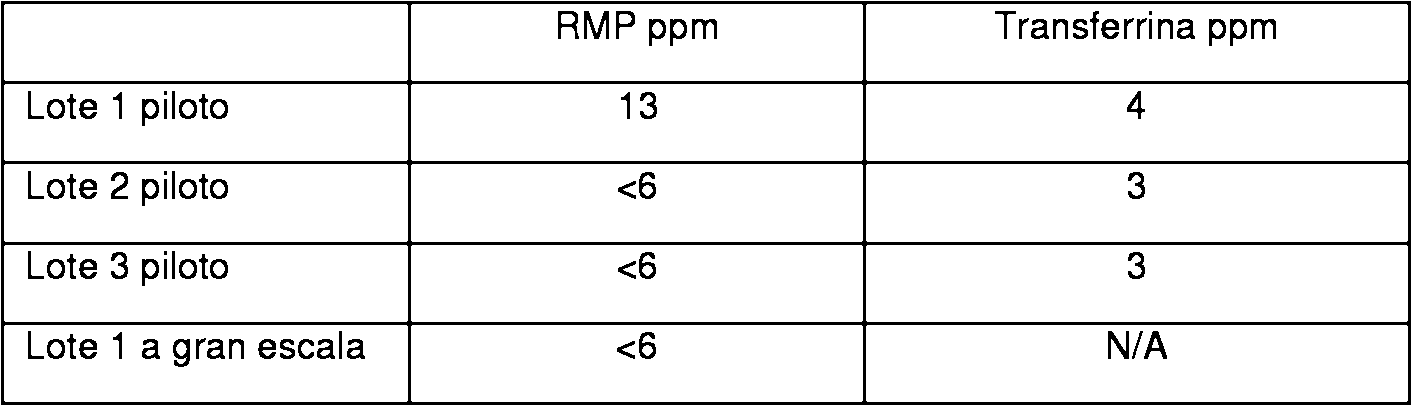

4.2 Cuantificación de ADN de conejo residual en la disolución purificada.4.2 Quantification of residual rabbit DNA in the purified solution.
El proceso como se describe alcanza así un ADN residual diana inferior a 4 ppb.The process as described thus reaches a target residual DNA less than 4 ppb.
4.3 Factor de coagulación VII de conejo4.3 Rabbit coagulation factor VII
Puesto que los conejos tienen un factor VII endógeno en su circulación y existe cierta fuga pasiva de proteínas séricas de la corriente sanguínea en la leche, se evaluó la capacidad del proceso de purificación para separar humano de FVII de conejo. Se desarrolló internamente un ELISA específico para la investigación de la presencia de dicha posible proteína concomitante en el producto purificado. Los resultados fueron inferiores a LLOQ (<45 pg/ml para todas las preparaciones analizadas).Since the rabbits have an endogenous factor VII in their circulation and there is some passive leakage of serum proteins from the bloodstream into the milk, the ability of the purification process to separate human from rabbit FVII was evaluated. A specific ELISA was developed internally for the investigation of the presence of said possible concomitant protein in the purified product. The results were lower than LLOQ (<45 pg / ml for all the preparations analyzed).
Ejemplo 5: Estudios de eliminación viral para virus envuelto (MLV, virus de la leucemia murina) después de implementar una etapa de cromatografía de afinidad en ligando específico de Tg FVIIaExample 5: Viral elimination studies for enveloped virus (MLV, murine leukemia virus) after implementing a Tg FVIIa specific ligand affinity chromatography step
Las características del virus de la leucemia murina (MLV) se describen en la tabla a continuación:The characteristics of the murine leukemia virus (MLV) are described in the table below:

5.1 Ensayo de valoración de la infectividad5.1 Test for assessing infectivity
5.1.1 Principio de la valoración de la infectividad5.1.1 Principle of the assessment of infectivity
El método de valoración es un ensayo cuantitativo en el que la medición del título de virus se basa en la detección de la producción de virus en las células infectadas, por observación de un efecto citopático específico.The titration method is a quantitative assay in which the measurement of the virus titer is based on the detection of virus production in the infected cells, by observation of a specific cytopathic effect.
El ensayo de valoración se hará en dos placas de 96 pocillos diferentes como se describe a continuación:The titration assay will be done in two different 96-well plates as described below:
• Se diluye la muestra de prueba con medio de cultivo por diluciones triples en serie (se realizan ocho duplicados para cada dilución) a través de la placa de 96 pocillos ("placa de dilución de muestras").• The test sample is diluted with culture medium by triple dilutions in series (eight duplicates are made for each dilution) through the 96-well plate ("sample dilution plate").
• Cada pocillo de la "placa de dilución de muestras" se inocula entonces en el pocillo correspondiente de una nueva placa de 96 pocillos ("placa de valoración de muestras").• Each well of the "sample dilution plate" is then inoculated into the corresponding well of a new 96-well plate ("sample titration plate").
Se añade suspensión de células a cada pocillo de la "placa de valoración de muestras" y las placas se incuban entonces a temperatura apropiada con o sin atmósfera de CO2 (dependiendo de los virus).Cell suspension is added to each well of the "sample titration plate" and the plates are then incubated at appropriate temperature with or without a CO 2 atmosphere (depending on the viruses).
Después de un periodo de incubación que permite la replicación e infección viral de células adyacentes, dependiendo de los virus,After an incubation period that allows replication and viral infection of adjacent cells, depending on the viruses,
• se cuentan los pocillos con focos después de la infección por observación en microscopio óptico invertido. • o se añade una sobrecapa de tinción (cristal violeta 1p-galactosidasa) y los pocillos se examinan para el efecto citopático. Los pocillos infectados aparecen como áreas claras, mientras que los pocillos no infectados se tiñen (o al revés, dependiendo de los virus).• Wells with foci are counted after infection by observation in inverted light microscope. • or an overlay of staining is added (crystal violet 1p-galactosidase) and the wells are examined for the cytopathic effect. Infected wells appear as clear areas, while uninfected wells stain (or vice versa, depending on viruses).
Se calcula el título infeccioso expresado como 50 % de dosis infecciosa de cultivo de tejido por mililitro (TCID50/ml) usando la fórmula apropiada. The infectious titer expressed as 50% infectious dose of tissue culture per milliliter (TCID 50 / ml) is calculated using the appropriate formula.
5.1.2 Controles de valoración5.1.2 Valuation controls
* Control negativo* Negative control
Durante cada ensayo de valoración, las células se preparan como control de referencia de células. Estas células se preparan en las mismas condiciones que las usadas para la valoración de las muestras generadas durante los ensayos preliminares, excepto que se inoculan con medio de cultivo no añadido (4 - 8 pocillos en cada placa de 96 pocillos).During each assay of titration, the cells are prepared as a reference control of cells. These cells are prepared under the same conditions as those used for the evaluation of the samples generated during the preliminary tests, except that they are inoculated with non-added culture medium (4-8 wells in each 96-well plate).
* Control de valoración positivo (control de referencia del virus)* Positive titration control (virus reference control)
Durante cada ensayo de valoración, se valora un control de referencia del virus de aproximadamente 103 - 105 TCID50/ml en las mismas condiciones que las usadas para la valoración de las muestras generadas durante los ensayos preliminares.During each assay of titration, a reference control of the virus of approximately 10 3 - 10 5 TCID 50 / ml is evaluated under the same conditions as those used for the evaluation of the samples generated during the preliminary tests.
5.1.3 Criterios de aceptación del ensayo de valoración5.1.3 Acceptance criteria of the valuation test
Se conserva el ensayo de valoración y se valida cuando:The valuation test is kept and validated when:
• El control de referencia de células para cada placa de valoración es conforme al resultado esperado,• The cell reference control for each rating plate is in accordance with the expected result,
• El título infeccioso del control de referencia del virus obtenido está en el intervalo esperado.• The infectious titer of the reference control of the virus obtained is in the expected range.
5.1.4. Determinación del título viral5.1.4. Determination of viral title
El título viral se determina según Schwartz D., 1993 (Schwartz D., "Methodes statistiques a I’usage des medecins et des biologistes", Flammarion Medecine-Sciences, cuarta edición, 1993); Kaplan M. y Koprowski H., "Laboratory techniques in rabies, tercera edición, editado por la Organización Mundial de la Salud, Ginebra, 1973.The viral titer is determined according to Schwartz D., 1993 (Schwartz D., "Methodes statistiques a I'usage des medecins et des biologistes", Flammarion Medecine-Sciences, fourth edition, 1993); Kaplan M. and Koprowski H., "Laboratory techniques in rabies, third edition, edited by the World Health Organization, Geneva, 1973.
Se calcula la TCID50 (50 % de dosis infecciosa de cultivo de tejido) usando la fórmula de Spearman Karber. La TCID50 se evalúa por ensayo cuántico y se define como la dosis de virus capaz de infectar 50 % de los cultivos inoculados.The TCID 50 (50% infectious dose of tissue culture) is calculated using Spearman's Karber formula. The TCID 50 is evaluated by quantum assay and is defined as the dose of virus capable of infecting 50% of the cultures inoculated.
5.2 Protocolo experimental5.2 Experimental protocol
Las etapas implementadas en el proceso son las siguientes:The stages implemented in the process are the following:
- Descongelación del material fuente clarificado;- Defrosting of the clarified source material;
- Infección del material fuente clarificado descongelado con 1 % del virus envuelto MLV;- Infection of the clarified source material thawed with 1% of the MLV wrapped virus;
- Prefiltración con filtros 0,2 |um;- Prefiltration with 0.2 | um filters;
- Carga sobre la columna FVII Select;- Load on the FVII Select column;
- Lavado de la columna;- Washing of the column;
- Elución.- Elution.
La Tabla 9 proporciona las condiciones de proceso implementadas durante la etapa de cromatografía en Affinity FVII Select.Table 9 provides the process conditions implemented during the chromatography stage in Affinity FVII Select.
Tabla 9:Table 9:


5.3 Resultados5.3 Results
Se ha medido la eliminación viral en una muestra de material fuente descongelado y clarificado después de la etapa de prefiltración (muestra llamada Carga 2) y después de la elución en cromatografía en Affinity FVII Select (muestra llamada Eluato). Los resultados se muestran en la Tabla 10.Viral elimination was measured in a sample of thawed and clarified source material after the pre-filtration stage (sample called Load 2) and after elution in Affinity FVII Select chromatography (sample called Eluate). The results are shown in Table 10.
Tabla 10: Medición de la eliminación viral antes (Carga 2) y después de la cromatografía en Affinity FVII SelectTable 10: Measurement of viral elimination before (Load 2) and after chromatography in Affinity FVII Select
(Eluato)(Eluato)

Los resultados de la Tabla 10 muestran que la etapa de cromatografía en Affinity FVII Select reduce el título viral de un factor de reducción (RF) superior a 4,37 log10.The results in Table 10 show that the Affinity FVII Select chromatography step reduces the viral titer of a reduction factor (RF) greater than 4.37 log 10 .
Ejemplo 6: Estudios de eliminación viral para el virus no envuelto (PPV, parvovirus porcino) después de implementar una etapa de cromatografía de afinidad en ligando específico de Tg FVIIa.Example 6: Viral elimination studies for the non-enveloped virus (PPV, porcine parvovirus) after implementing a Tg FVIIa specific ligand affinity chromatography step.
Las características del parvovirus porcino (PPV) se describen en la tabla a continuación:The characteristics of porcine parvovirus (PPV) are described in the table below:

6.1 Protocolo experimental6.1 Experimental protocol
Las etapas implementadas en el proceso son las siguientes:The stages implemented in the process are the following:
- Descongelación del material fuente clarificado;- Defrosting of the clarified source material;
- Infección del material fuente clarificado descongelado con 1 % del virus no envuelto MLV;- Infection of the clarified source material thawed with 1% of the non-enveloped MLV virus;
- Prefiltración con filtros 0,65/0,45 gm y 0,45/0,2 gm;- Prefiltration with filters 0.65 / 0.45 gm and 0.45 / 0.2 gm;
- Tratamiento con disolvente/detergente (1 hora);- Treatment with solvent / detergent (1 hour);
- Carga sobre la columna FVII Select;- Load on the FVII Select column;
- Lavado;- Washed;
- Elución. - Elution.
La Tabla 11 proporciona las condiciones de proceso implementadas durante la etapa de cromatografía en Affinity FVII Select.Table 11 provides the process conditions implemented during the chromatography stage in Affinity FVII Select.

6.2 Resultados6.2 Results
Se ha medido la eliminación viral en una muestra de material fuente descongelado y clarificado después de la etapa de prefiltración y de tratamiento con disolvente/detergente (muestra llamada Carga inicial) y después de la elución en cromatografía en Affinity FVII Select (muestra llamada Eluato A). Los resultados se muestran en forma de histograma en la Figura 5.Viral elimination was measured in a sample of thawed and clarified source material after the prefiltration and solvent / detergent treatment step (sample called Initial charge) and after elution in Affinity FVII Select chromatography (sample called Eluate A ). The results are shown in the form of a histogram in Figure 5.
El histograma de la Figura 5 muestra que la etapa de cromatografía en Affinity FVII Select reduce el título viral de un factor de reducción (RF) superior a 3,8 log10.The histogram of Figure 5 shows that the chromatography stage in Affinity FVII Select reduces the viral titer of a reduction factor (RF) greater than 3.8 log 10 .
Ejemplo 7: Estudios de eliminación viral para el virus envuelto (MLV) y virus no envuelto (PPV) después de implementar una etapa de cromatografía de exclusión por tamaño Superdex S200 prep gradExample 7: Viral elimination studies for enveloped virus (MLV) and non-enveloped virus (PPV) after implementing a size exclusion chromatography step Superdex S200 prep grad
7.1 Protocolo experimental7.1 Experimental protocol
Las etapas implementadas en el proceso son las siguientes:The stages implemented in the process are the following:
- Descongelación del material de partida muestreado de los lotes clínicos (eluato de hidroxiapatita-1 cerámica (CHT-1));- Thawing of the sampled starting material from the clinical batches (hydroxyapatite-1 ceramic eluate (CHT-1));
- Infección del material de partida con 1 % de adición (1 % de MLV o 1 % de PPV);- Infection of the starting material with 1% addition (1% MLV or 1% PPV);
- Prefiltración con filtros 0,2 gm (MLV) o filtros 0,1 gm (PPV);- Prefiltration with 0.2 gm filters (MLV) or 0.1 gm filters (PPV);
- Carga de 2,3 % de volumen de columna (VC) en la columna S200;- Load of 2.3% of column volume (VC) in column S200;
- Recogida del eluato S200 (fracción correspondiente a FVII).- Collection of eluate S200 (fraction corresponding to FVII).
La Tabla 12 proporciona condiciones de proceso implementadas durante la etapa de cromatografía de exclusión por tamaño Superdex S200 prep grad.Table 12 provides process conditions implemented during the size exclusion chromatography step Superdex S200 prep grad.
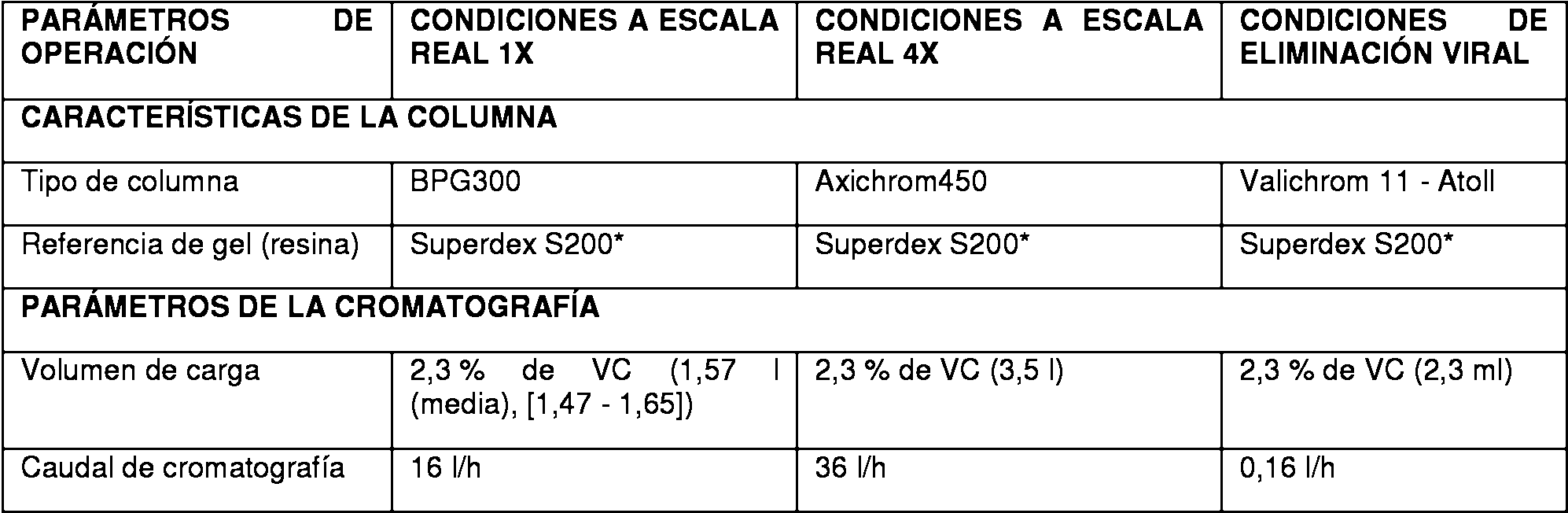

7.2 Resultados7.2 Results
Se ha medido la eliminación viral en una muestra de eluato de CHT-1 después de la etapa de prefiltración en filtros 0,2 pm (para virus MLV) o en filtros 0,1 pm (para virus PPV) (muestra llamada Carga 2), y después de elución en cromatografía de exclusión por tamaño Superdex S200 (muestra llamada Eluato). Los resultados se muestran en la Tabla 13.The viral elimination was measured in an ELT sample of CHT-1 after the prefiltration stage in filters 0.2 pm (for MLV virus) or in filters 0.1 pm (for PPV virus) (sample called Load 2) , and after elution in size exclusion chromatography Superdex S200 (sample called Eluate). The results are shown in Table 13.
Tabla 13: Medición de la eliminación viral antes (Carga 2) y después de la cromatografía de exclusión por tamaño Superdex S200 (Eluato)Table 13: Measurement of viral elimination before (Load 2) and after size exclusion chromatography Superdex S200 (Eluato)

Los resultados de la Tabla 10 muestran que la cromatografía de exclusión por tamaño la cromatografía Superdex S200 reduce el título viral de un factor de reducción igual a 3,01 log10 para virus envuelto (MLV) y un factor de reducción igual a 3,00 log10 para virus no envuelto (PPV).The results of Table 10 show that size exclusion chromatography Superdex S200 chromatography reduces the viral titer of a reduction factor equal to 3.01 log 10 for enveloped virus (MLV) and a reduction factor equal to 3.00 log 10 for non-enveloped virus (PPV).
En resumen:In summary:
- Se obtienen factores de reducción altos de la eliminación viral con la cromatografía en Affinity FVII Select, que son superiores a 4,37 log10 para virus envuelto (MLV) e iguales a 3,8 log10 para virus no envuelto (PPV);- High reduction factors for viral elimination are obtained with chromatography in Affinity FVII Select, which are higher than 4.37 log 10 for enveloped virus (MLV) and equal to 3.8 log 10 for non-enveloped virus (PPV);
- Se obtienen factores de reducción medios de la eliminación viral con la cromatografía de exclusión por tamaño Superdex S200, que son iguales a 3,0 log10 para virus envuelto (MLV) y virus no envuelto (PPV); la cromatografía en Affinity FVII Select es más eficiente que la cromatografía de exclusión por tamaño en Superdex S200 para reducir el título viral de virus envueltos y no envueltos.- Mean reduction factors of viral elimination are obtained with Superdex S200 size exclusion chromatography, which are equal to 3.0 log 10 for enveloped virus (MLV) and non-enveloped virus (PPV); Chromatography in Affinity FVII Select is more efficient than size exclusion chromatography in Superdex S200 to reduce the viral titer of enveloped and non-enveloped viruses.
Ejemplo 8: Estudios de eliminación viral para virus envuelto y virus no envuelto después de implementar varias técnicasExample 8: Viral elimination studies for enveloped virus and non-enveloped virus after implementing various techniques
8.1 Protocolo experimental8.1 Experimental protocol
Se realizaron por separado los estudios de validación viral de cromatografía de afinidad FVII Select, nanofiltración y Q Sepharose XL con 1 % de adición de diversos virus en el material de partida para cada operación de la unidad de purificación y la valoración del virus con adición en la fracción de interés (uno era FVII recuperado). Se añadieron el factor de reducción log10 obtenido para cada operación de la unidad de purificación para cada virus y se estimó virus por virus un factor de reducción global.Viral validation studies of FVII Select affinity chromatography, nanofiltration and Q Sepharose XL were carried out separately with 1% addition of various viruses in the starting material for each operation of the purification unit and virus titration with addition in the fraction of interest (one was FVII recovered). The log 10 reduction factor obtained for each operation of the purification unit for each virus was added and virus by virus was estimated as a global reduction factor.
8.2 Resultados8.2 Results
Los resultados se dan en la Tabla 14.The results are given in Table 14.
Tabla 14:Table 14:

Claims (1)
Applications Claiming Priority (2)
| Application Number | Priority Date | Filing Date | Title |
|---|---|---|---|
| EP12305882.8A EP2687595B1 (en) | 2012-07-19 | 2012-07-19 | Method for purifying transgenic factor VII |
| PCT/EP2013/065205 WO2014013024A1 (en) | 2012-07-19 | 2013-07-18 | Method for purifying transgenic factor vii |
Publications (1)
| Publication Number | Publication Date |
|---|---|
| ES2703541T3 true ES2703541T3 (en) | 2019-03-11 |
Family
ID=48856605
Family Applications (1)
| Application Number | Title | Priority Date | Filing Date |
|---|---|---|---|
| ES13739975T Active ES2703541T3 (en) | 2012-07-19 | 2013-07-18 | Purification method of transgenic factor VII |
Country Status (19)
| Country | Link |
|---|---|
| US (1) | US9982247B2 (en) |
| EP (2) | EP2687595B1 (en) |
| JP (1) | JP6219947B2 (en) |
| KR (2) | KR20140129015A (en) |
| CN (1) | CN104640980B (en) |
| AR (1) | AR091836A1 (en) |
| AU (1) | AU2013291969B2 (en) |
| CA (1) | CA2879109C (en) |
| DK (1) | DK2875129T3 (en) |
| ES (1) | ES2703541T3 (en) |
| IL (1) | IL236755B (en) |
| MX (1) | MX358139B (en) |
| MY (1) | MY172995A (en) |
| PH (1) | PH12015500083A1 (en) |
| PL (1) | PL2875129T3 (en) |
| SG (1) | SG11201500254PA (en) |
| TR (1) | TR201818506T4 (en) |
| TW (1) | TWI531576B (en) |
| WO (1) | WO2014013024A1 (en) |
Families Citing this family (7)
| Publication number | Priority date | Publication date | Assignee | Title |
|---|---|---|---|---|
| JP4874806B2 (en) | 2003-12-01 | 2012-02-15 | ノボ ノルディスク ヘルス ケア アクチェンゲゼルシャフト | Virus filtration of liquid factor VII compositions |
| ES2811526T3 (en) | 2010-12-30 | 2021-03-12 | Lab Francais Du Fractionnement | Glycols as pathogen inactivating agents |
| FR3006591B1 (en) | 2013-06-11 | 2016-05-06 | Lab Francais Du Fractionnement | FACTOR VII COMPOSITION HAVING A SUBSTANTIALLY HOMOGENEOUS ISOELECTRIC POINT |
| FR3038517B1 (en) | 2015-07-06 | 2020-02-28 | Laboratoire Francais Du Fractionnement Et Des Biotechnologies | USE OF MODIFIED FC FRAGMENTS IN IMMUNOTHERAPY |
| ES2991988T3 (en) | 2017-10-30 | 2024-12-05 | Takeda Pharmaceuticals Co | Environmentally compatible detergents for the inactivation of lipid-enveloped viruses |
| FR3082427B1 (en) * | 2018-06-14 | 2020-09-25 | Lab Francais Du Fractionnement | COMBINATION OF FACTOR VII AND A BISPECIFIC ANTIBODY ANTI-FACTORS IX AND X |
| CN114438061B (en) * | 2020-10-30 | 2023-10-20 | 北京双鹭立生医药科技有限公司 | Method for purifying factor VII |
Family Cites Families (17)
| Publication number | Priority date | Publication date | Assignee | Title |
|---|---|---|---|---|
| GR860984B (en) | 1985-04-17 | 1986-08-18 | Zymogenetics Inc | Expression of factor vii and ix activities in mammalian cells |
| FR2632524B1 (en) | 1988-06-09 | 1992-03-13 | Fondation Nale Transfusion San | PROCESS FOR THE PREPARATION OF A CONCENTRATED FRACTION IN FACTOR VIIA AND ITS APPLICATION AS A MEDICAMENT |
| FR2677652B1 (en) | 1991-06-12 | 2005-05-27 | Agronomique Inst Nat Rech | PROCESS FOR PREPARING A PROTEIN OF INTEREST IN MILK OF A TRANSGENIC ANIMAL, PRODUCT OBTAINED, AND EUCARYOTIC CELL USED |
| FR2684999A1 (en) | 1991-12-16 | 1993-06-18 | Aquitaine Dev Transf Sanguine | PROCESS FOR MANUFACTURING HIGH-PURITY ACTIVE FACTOR VII CONCENTRATE ESSENTIALLY HAVING DEPENDENT VITAMIN K FACTORS AND VIIICAG FACTORS |
| DK1621554T4 (en) | 1992-08-21 | 2012-12-17 | Univ Bruxelles | Immunoglobulins devoid of light chains |
| DK38293D0 (en) | 1993-03-31 | 1993-03-31 | Novo Nordisk As | PREPARATION OF PROTEINS |
| ES2162863T3 (en) | 1993-04-29 | 2002-01-16 | Unilever Nv | PRODUCTION OF ANTIBODIES OR FRAGMENTS (FUNCTIONALIZED) OF THE SAME DERIVED FROM HEAVY CHAIN IMMUNOGLOBULINS OF CAMELIDAE. |
| US6268487B1 (en) | 1996-05-13 | 2001-07-31 | Genzyme Transgenics Corporation | Purification of biologically active peptides from milk |
| TWI268933B (en) | 2003-06-10 | 2006-12-21 | Animal Technology Inst Taiwan | Method for separating protein from animal milk |
| FR2901707B1 (en) | 2006-05-31 | 2017-09-29 | Lab Francais Du Fractionnement | RECOMBINANT OR TRANSGENIC FACTOR VII COMPOSITION, EACH FACTOR VII MOLECULE HAVING TWO N-GLYCOSYLATION SITES WITH DEFINED GLYCANNIC PATTERNS |
| FR2901796A1 (en) | 2006-05-31 | 2007-12-07 | Lab Francais Du Fractionnement | PROCESS FOR EXTRACTING ONE OR MORE PROTEINS PRESENT IN MILK |
| FR2910786B1 (en) * | 2006-12-29 | 2017-08-11 | Laboratoire Francais Du Fractionnement Et Des Biotechnologies (Lfb) | "PROCESS FOR EXTRACTING A PROTEIN PRESENT IN MILK" |
| US20110059510A1 (en) | 2008-03-25 | 2011-03-10 | Pierre-Jean Ripoll | Transgenic rabbits producing human factor vii |
| WO2009141418A1 (en) | 2008-05-23 | 2009-11-26 | Novo Nordisk A/S | Formulations of peg-functionalised serine proteases with high concentrations of an aromatic preservative |
| FR2942233B1 (en) | 2009-02-19 | 2015-03-13 | Lfb Biotechnologies | MEANS FOR PURIFYING BLOOD PLASMA PROTEIN, AND METHODS FOR ITS IMPLEMENTATION |
| FR2947181B1 (en) * | 2009-06-26 | 2012-05-04 | Lfb Biotechnologies | FACTOR VII COMPOSITION |
| CN102161701A (en) * | 2011-01-28 | 2011-08-24 | 上海兴迪金生物技术有限公司 | Method for separating and purifying high-purity activated clotting seventh factors from cell culture solution or plasma components |
-
2012
- 2012-07-19 EP EP12305882.8A patent/EP2687595B1/en not_active Not-in-force
-
2013
- 2013-07-18 CA CA2879109A patent/CA2879109C/en active Active
- 2013-07-18 SG SG11201500254PA patent/SG11201500254PA/en unknown
- 2013-07-18 KR KR1020147022570A patent/KR20140129015A/en not_active Ceased
- 2013-07-18 US US14/415,254 patent/US9982247B2/en active Active
- 2013-07-18 DK DK13739975.4T patent/DK2875129T3/en active
- 2013-07-18 EP EP13739975.4A patent/EP2875129B1/en active Active
- 2013-07-18 JP JP2015522099A patent/JP6219947B2/en not_active Expired - Fee Related
- 2013-07-18 KR KR1020177018813A patent/KR101842412B1/en not_active Expired - Fee Related
- 2013-07-18 TR TR2018/18506T patent/TR201818506T4/en unknown
- 2013-07-18 MY MYPI2015000126A patent/MY172995A/en unknown
- 2013-07-18 ES ES13739975T patent/ES2703541T3/en active Active
- 2013-07-18 CN CN201380048473.2A patent/CN104640980B/en active Active
- 2013-07-18 TW TW102125684A patent/TWI531576B/en not_active IP Right Cessation
- 2013-07-18 AR ARP130102563A patent/AR091836A1/en unknown
- 2013-07-18 MX MX2015000778A patent/MX358139B/en active IP Right Grant
- 2013-07-18 WO PCT/EP2013/065205 patent/WO2014013024A1/en not_active Ceased
- 2013-07-18 PL PL13739975T patent/PL2875129T3/en unknown
- 2013-07-18 AU AU2013291969A patent/AU2013291969B2/en not_active Ceased
-
2015
- 2015-01-13 PH PH12015500083A patent/PH12015500083A1/en unknown
- 2015-01-15 IL IL236755A patent/IL236755B/en active IP Right Grant
Also Published As
| Publication number | Publication date |
|---|---|
| JP6219947B2 (en) | 2017-10-25 |
| DK2875129T3 (en) | 2019-01-07 |
| EP2687595B1 (en) | 2018-05-30 |
| EP2875129B1 (en) | 2018-09-05 |
| JP2015522600A (en) | 2015-08-06 |
| SG11201500254PA (en) | 2015-02-27 |
| MX2015000778A (en) | 2015-10-14 |
| WO2014013024A1 (en) | 2014-01-23 |
| KR20170083166A (en) | 2017-07-17 |
| PL2875129T4 (en) | 2019-03-29 |
| CN104640980A (en) | 2015-05-20 |
| PL2875129T3 (en) | 2019-03-29 |
| EP2875129A1 (en) | 2015-05-27 |
| CA2879109C (en) | 2019-03-05 |
| KR101842412B1 (en) | 2018-03-26 |
| TW201416373A (en) | 2014-05-01 |
| PH12015500083A1 (en) | 2015-03-02 |
| CA2879109A1 (en) | 2014-01-23 |
| CN104640980B (en) | 2019-01-08 |
| TR201818506T4 (en) | 2019-01-21 |
| AR091836A1 (en) | 2015-03-04 |
| MX358139B (en) | 2018-08-06 |
| MY172995A (en) | 2019-12-18 |
| US9982247B2 (en) | 2018-05-29 |
| US20150175983A1 (en) | 2015-06-25 |
| KR20140129015A (en) | 2014-11-06 |
| AU2013291969A1 (en) | 2015-02-05 |
| EP2687595A1 (en) | 2014-01-22 |
| AU2013291969B2 (en) | 2018-07-12 |
| TWI531576B (en) | 2016-05-01 |
| IL236755B (en) | 2018-03-29 |
Similar Documents
| Publication | Publication Date | Title |
|---|---|---|
| ES2703541T3 (en) | Purification method of transgenic factor VII | |
| JP7774384B2 (en) | Methods for purifying therapeutic proteins | |
| ES2229784T3 (en) | IMMUNOGLOBULIN PRODUCTION PROCESS FOR INTRAVENOUS ADMINISTRATION AND OTHER IMMUNOGLOBULIN PRODUCTS. | |
| JP5730211B2 (en) | Viral arginine inactivation | |
| CN102939107B (en) | Antibody preparation | |
| ES2295308T3 (en) | PROCEDURE FOR THE PRODUCTION OF GAMMAGLOBULINA G HUMAN INACTIVATED VIRUS | |
| ES2704487T3 (en) | Purification method of an antibody | |
| US20150210737A1 (en) | Integrated process for the production of therapeutics (human albumin, intravenous immunoglobulins, clotting factor viii and clotting factor ix) from human plasma | |
| ES2833100T3 (en) | Process | |
| ES2625030T3 (en) | Preparation procedure for a polyvalent immunoglobulin concentrate | |
| US20180305401A1 (en) | Processes for purifying proteins from plasma | |
| JP2024527980A (en) | Method for purifying immunoglobulin G and uses thereof | |
| Bertolini | The purification of plasma proteins for therapeutic use | |
| Brinkman et al. | The purification of plasma proteins for therapeutic use | |
| KR20150084836A (en) | Method of isolating synagis® in the absence of benzonase | |
| US20210024616A1 (en) | Method for Purifying Antibodies from Raw Milk | |
| CA2833631C (en) | Novel process for the preparation of a virus-inactivated fv concentrate starting from human plasma, scalable to industrial level | |
| AU2024351533A1 (en) | IMMUNOGLOBULIN FORMULATIONS DEPLETED IN IgA | |
| CN117769570A (en) | Methods for purifying immunoglobulin G and its uses | |
| RU2559576C1 (en) | Method of obtaining virus-safe complete prothrombin complex |