ES2709577T3 - Preparation of conjugates of maytansinoids and antibodies by a single-step process - Google Patents
Preparation of conjugates of maytansinoids and antibodies by a single-step process Download PDFInfo
- Publication number
- ES2709577T3 ES2709577T3 ES12714160T ES12714160T ES2709577T3 ES 2709577 T3 ES2709577 T3 ES 2709577T3 ES 12714160 T ES12714160 T ES 12714160T ES 12714160 T ES12714160 T ES 12714160T ES 2709577 T3 ES2709577 T3 ES 2709577T3
- Authority
- ES
- Spain
- Prior art keywords
- antibody
- mixture
- maytansinoid
- hours
- cytotoxic agent
- Prior art date
- Legal status (The legal status is an assumption and is not a legal conclusion. Google has not performed a legal analysis and makes no representation as to the accuracy of the status listed.)
- Active
Links
Classifications
-
- A—HUMAN NECESSITIES
- A61—MEDICAL OR VETERINARY SCIENCE; HYGIENE
- A61K—PREPARATIONS FOR MEDICAL, DENTAL OR TOILETRY PURPOSES
- A61K31/00—Medicinal preparations containing organic active ingredients
- A61K31/33—Heterocyclic compounds
- A61K31/395—Heterocyclic compounds having nitrogen as a ring hetero atom, e.g. guanethidine or rifamycins
- A61K31/535—Heterocyclic compounds having nitrogen as a ring hetero atom, e.g. guanethidine or rifamycins having six-membered rings with at least one nitrogen and one oxygen as the ring hetero atoms, e.g. 1,2-oxazines
- A61K31/5365—Heterocyclic compounds having nitrogen as a ring hetero atom, e.g. guanethidine or rifamycins having six-membered rings with at least one nitrogen and one oxygen as the ring hetero atoms, e.g. 1,2-oxazines ortho- or peri-condensed with heterocyclic ring systems
-
- A—HUMAN NECESSITIES
- A61—MEDICAL OR VETERINARY SCIENCE; HYGIENE
- A61K—PREPARATIONS FOR MEDICAL, DENTAL OR TOILETRY PURPOSES
- A61K47/00—Medicinal preparations characterised by the non-active ingredients used, e.g. carriers or inert additives; Targeting or modifying agents chemically bound to the active ingredient
- A61K47/50—Medicinal preparations characterised by the non-active ingredients used, e.g. carriers or inert additives; Targeting or modifying agents chemically bound to the active ingredient the non-active ingredient being chemically bound to the active ingredient, e.g. polymer-drug conjugates
- A61K47/51—Medicinal preparations characterised by the non-active ingredients used, e.g. carriers or inert additives; Targeting or modifying agents chemically bound to the active ingredient the non-active ingredient being chemically bound to the active ingredient, e.g. polymer-drug conjugates the non-active ingredient being a modifying agent
- A61K47/68—Medicinal preparations characterised by the non-active ingredients used, e.g. carriers or inert additives; Targeting or modifying agents chemically bound to the active ingredient the non-active ingredient being chemically bound to the active ingredient, e.g. polymer-drug conjugates the non-active ingredient being a modifying agent the modifying agent being an antibody, an immunoglobulin or a fragment thereof, e.g. an Fc-fragment
- A61K47/6801—Drug-antibody or immunoglobulin conjugates defined by the pharmacologically or therapeutically active agent
- A61K47/6803—Drugs conjugated to an antibody or immunoglobulin, e.g. cisplatin-antibody conjugates
- A61K47/68033—Drugs conjugated to an antibody or immunoglobulin, e.g. cisplatin-antibody conjugates the drug being a maytansine
-
- A—HUMAN NECESSITIES
- A61—MEDICAL OR VETERINARY SCIENCE; HYGIENE
- A61K—PREPARATIONS FOR MEDICAL, DENTAL OR TOILETRY PURPOSES
- A61K47/00—Medicinal preparations characterised by the non-active ingredients used, e.g. carriers or inert additives; Targeting or modifying agents chemically bound to the active ingredient
- A61K47/50—Medicinal preparations characterised by the non-active ingredients used, e.g. carriers or inert additives; Targeting or modifying agents chemically bound to the active ingredient the non-active ingredient being chemically bound to the active ingredient, e.g. polymer-drug conjugates
- A61K47/51—Medicinal preparations characterised by the non-active ingredients used, e.g. carriers or inert additives; Targeting or modifying agents chemically bound to the active ingredient the non-active ingredient being chemically bound to the active ingredient, e.g. polymer-drug conjugates the non-active ingredient being a modifying agent
- A61K47/68—Medicinal preparations characterised by the non-active ingredients used, e.g. carriers or inert additives; Targeting or modifying agents chemically bound to the active ingredient the non-active ingredient being chemically bound to the active ingredient, e.g. polymer-drug conjugates the non-active ingredient being a modifying agent the modifying agent being an antibody, an immunoglobulin or a fragment thereof, e.g. an Fc-fragment
- A61K47/6801—Drug-antibody or immunoglobulin conjugates defined by the pharmacologically or therapeutically active agent
- A61K47/6803—Drugs conjugated to an antibody or immunoglobulin, e.g. cisplatin-antibody conjugates
- A61K47/6807—Drugs conjugated to an antibody or immunoglobulin, e.g. cisplatin-antibody conjugates the drug or compound being a sugar, nucleoside, nucleotide, nucleic acid, e.g. RNA antisense
- A61K47/6809—Antibiotics, e.g. antitumor antibiotics anthracyclins, adriamycin, doxorubicin or daunomycin
-
- A—HUMAN NECESSITIES
- A61—MEDICAL OR VETERINARY SCIENCE; HYGIENE
- A61K—PREPARATIONS FOR MEDICAL, DENTAL OR TOILETRY PURPOSES
- A61K47/00—Medicinal preparations characterised by the non-active ingredients used, e.g. carriers or inert additives; Targeting or modifying agents chemically bound to the active ingredient
- A61K47/50—Medicinal preparations characterised by the non-active ingredients used, e.g. carriers or inert additives; Targeting or modifying agents chemically bound to the active ingredient the non-active ingredient being chemically bound to the active ingredient, e.g. polymer-drug conjugates
- A61K47/51—Medicinal preparations characterised by the non-active ingredients used, e.g. carriers or inert additives; Targeting or modifying agents chemically bound to the active ingredient the non-active ingredient being chemically bound to the active ingredient, e.g. polymer-drug conjugates the non-active ingredient being a modifying agent
- A61K47/68—Medicinal preparations characterised by the non-active ingredients used, e.g. carriers or inert additives; Targeting or modifying agents chemically bound to the active ingredient the non-active ingredient being chemically bound to the active ingredient, e.g. polymer-drug conjugates the non-active ingredient being a modifying agent the modifying agent being an antibody, an immunoglobulin or a fragment thereof, e.g. an Fc-fragment
- A61K47/6801—Drug-antibody or immunoglobulin conjugates defined by the pharmacologically or therapeutically active agent
- A61K47/6803—Drugs conjugated to an antibody or immunoglobulin, e.g. cisplatin-antibody conjugates
- A61K47/6811—Drugs conjugated to an antibody or immunoglobulin, e.g. cisplatin-antibody conjugates the drug being a protein or peptide, e.g. transferrin or bleomycin
- A61K47/6817—Toxins
- A61K47/6819—Plant toxins
-
- A—HUMAN NECESSITIES
- A61—MEDICAL OR VETERINARY SCIENCE; HYGIENE
- A61K—PREPARATIONS FOR MEDICAL, DENTAL OR TOILETRY PURPOSES
- A61K47/00—Medicinal preparations characterised by the non-active ingredients used, e.g. carriers or inert additives; Targeting or modifying agents chemically bound to the active ingredient
- A61K47/50—Medicinal preparations characterised by the non-active ingredients used, e.g. carriers or inert additives; Targeting or modifying agents chemically bound to the active ingredient the non-active ingredient being chemically bound to the active ingredient, e.g. polymer-drug conjugates
- A61K47/51—Medicinal preparations characterised by the non-active ingredients used, e.g. carriers or inert additives; Targeting or modifying agents chemically bound to the active ingredient the non-active ingredient being chemically bound to the active ingredient, e.g. polymer-drug conjugates the non-active ingredient being a modifying agent
- A61K47/68—Medicinal preparations characterised by the non-active ingredients used, e.g. carriers or inert additives; Targeting or modifying agents chemically bound to the active ingredient the non-active ingredient being chemically bound to the active ingredient, e.g. polymer-drug conjugates the non-active ingredient being a modifying agent the modifying agent being an antibody, an immunoglobulin or a fragment thereof, e.g. an Fc-fragment
- A61K47/6835—Medicinal preparations characterised by the non-active ingredients used, e.g. carriers or inert additives; Targeting or modifying agents chemically bound to the active ingredient the non-active ingredient being chemically bound to the active ingredient, e.g. polymer-drug conjugates the non-active ingredient being a modifying agent the modifying agent being an antibody, an immunoglobulin or a fragment thereof, e.g. an Fc-fragment the modifying agent being an antibody or an immunoglobulin bearing at least one antigen-binding site
- A61K47/6849—Medicinal preparations characterised by the non-active ingredients used, e.g. carriers or inert additives; Targeting or modifying agents chemically bound to the active ingredient the non-active ingredient being chemically bound to the active ingredient, e.g. polymer-drug conjugates the non-active ingredient being a modifying agent the modifying agent being an antibody, an immunoglobulin or a fragment thereof, e.g. an Fc-fragment the modifying agent being an antibody or an immunoglobulin bearing at least one antigen-binding site the antibody targeting a receptor, a cell surface antigen or a cell surface determinant
-
- A—HUMAN NECESSITIES
- A61—MEDICAL OR VETERINARY SCIENCE; HYGIENE
- A61K—PREPARATIONS FOR MEDICAL, DENTAL OR TOILETRY PURPOSES
- A61K47/00—Medicinal preparations characterised by the non-active ingredients used, e.g. carriers or inert additives; Targeting or modifying agents chemically bound to the active ingredient
- A61K47/50—Medicinal preparations characterised by the non-active ingredients used, e.g. carriers or inert additives; Targeting or modifying agents chemically bound to the active ingredient the non-active ingredient being chemically bound to the active ingredient, e.g. polymer-drug conjugates
- A61K47/51—Medicinal preparations characterised by the non-active ingredients used, e.g. carriers or inert additives; Targeting or modifying agents chemically bound to the active ingredient the non-active ingredient being chemically bound to the active ingredient, e.g. polymer-drug conjugates the non-active ingredient being a modifying agent
- A61K47/68—Medicinal preparations characterised by the non-active ingredients used, e.g. carriers or inert additives; Targeting or modifying agents chemically bound to the active ingredient the non-active ingredient being chemically bound to the active ingredient, e.g. polymer-drug conjugates the non-active ingredient being a modifying agent the modifying agent being an antibody, an immunoglobulin or a fragment thereof, e.g. an Fc-fragment
- A61K47/6835—Medicinal preparations characterised by the non-active ingredients used, e.g. carriers or inert additives; Targeting or modifying agents chemically bound to the active ingredient the non-active ingredient being chemically bound to the active ingredient, e.g. polymer-drug conjugates the non-active ingredient being a modifying agent the modifying agent being an antibody, an immunoglobulin or a fragment thereof, e.g. an Fc-fragment the modifying agent being an antibody or an immunoglobulin bearing at least one antigen-binding site
- A61K47/6851—Medicinal preparations characterised by the non-active ingredients used, e.g. carriers or inert additives; Targeting or modifying agents chemically bound to the active ingredient the non-active ingredient being chemically bound to the active ingredient, e.g. polymer-drug conjugates the non-active ingredient being a modifying agent the modifying agent being an antibody, an immunoglobulin or a fragment thereof, e.g. an Fc-fragment the modifying agent being an antibody or an immunoglobulin bearing at least one antigen-binding site the antibody targeting a determinant of a tumour cell
- A61K47/6867—Medicinal preparations characterised by the non-active ingredients used, e.g. carriers or inert additives; Targeting or modifying agents chemically bound to the active ingredient the non-active ingredient being chemically bound to the active ingredient, e.g. polymer-drug conjugates the non-active ingredient being a modifying agent the modifying agent being an antibody, an immunoglobulin or a fragment thereof, e.g. an Fc-fragment the modifying agent being an antibody or an immunoglobulin bearing at least one antigen-binding site the antibody targeting a determinant of a tumour cell the tumour determinant being from a cell of a blood cancer
-
- A—HUMAN NECESSITIES
- A61—MEDICAL OR VETERINARY SCIENCE; HYGIENE
- A61P—SPECIFIC THERAPEUTIC ACTIVITY OF CHEMICAL COMPOUNDS OR MEDICINAL PREPARATIONS
- A61P35/00—Antineoplastic agents
-
- A—HUMAN NECESSITIES
- A61—MEDICAL OR VETERINARY SCIENCE; HYGIENE
- A61P—SPECIFIC THERAPEUTIC ACTIVITY OF CHEMICAL COMPOUNDS OR MEDICINAL PREPARATIONS
- A61P35/00—Antineoplastic agents
- A61P35/02—Antineoplastic agents specific for leukemia
-
- C—CHEMISTRY; METALLURGY
- C07—ORGANIC CHEMISTRY
- C07K—PEPTIDES
- C07K1/00—General methods for the preparation of peptides, i.e. processes for the organic chemical preparation of peptides or proteins of any length
- C07K1/107—General methods for the preparation of peptides, i.e. processes for the organic chemical preparation of peptides or proteins of any length by chemical modification of precursor peptides
- C07K1/113—General methods for the preparation of peptides, i.e. processes for the organic chemical preparation of peptides or proteins of any length by chemical modification of precursor peptides without change of the primary structure
-
- C—CHEMISTRY; METALLURGY
- C07—ORGANIC CHEMISTRY
- C07K—PEPTIDES
- C07K16/00—Immunoglobulins [IG], e.g. monoclonal or polyclonal antibodies
- C07K16/18—Immunoglobulins [IG], e.g. monoclonal or polyclonal antibodies against material from animals or humans
- C07K16/28—Immunoglobulins [IG], e.g. monoclonal or polyclonal antibodies against material from animals or humans against receptors, cell surface antigens or cell surface determinants
- C07K16/2896—Immunoglobulins [IG], e.g. monoclonal or polyclonal antibodies against material from animals or humans against receptors, cell surface antigens or cell surface determinants against molecules with a "CD"-designation, not provided for elsewhere
-
- C—CHEMISTRY; METALLURGY
- C07—ORGANIC CHEMISTRY
- C07K—PEPTIDES
- C07K16/00—Immunoglobulins [IG], e.g. monoclonal or polyclonal antibodies
- C07K16/18—Immunoglobulins [IG], e.g. monoclonal or polyclonal antibodies against material from animals or humans
- C07K16/32—Immunoglobulins [IG], e.g. monoclonal or polyclonal antibodies against material from animals or humans against translation products of oncogenes
Landscapes
- Health & Medical Sciences (AREA)
- Bioinformatics & Cheminformatics (AREA)
- Engineering & Computer Science (AREA)
- Life Sciences & Earth Sciences (AREA)
- Chemical & Material Sciences (AREA)
- Medicinal Chemistry (AREA)
- General Health & Medical Sciences (AREA)
- Veterinary Medicine (AREA)
- Pharmacology & Pharmacy (AREA)
- Animal Behavior & Ethology (AREA)
- Public Health (AREA)
- Immunology (AREA)
- Epidemiology (AREA)
- Cell Biology (AREA)
- Organic Chemistry (AREA)
- Molecular Biology (AREA)
- Biochemistry (AREA)
- Oncology (AREA)
- Hematology (AREA)
- Toxicology (AREA)
- General Chemical & Material Sciences (AREA)
- Chemical Kinetics & Catalysis (AREA)
- Biophysics (AREA)
- Genetics & Genomics (AREA)
- Proteomics, Peptides & Aminoacids (AREA)
- Nuclear Medicine, Radiotherapy & Molecular Imaging (AREA)
- Botany (AREA)
- Analytical Chemistry (AREA)
- Medicinal Preparation (AREA)
- Medicines Containing Antibodies Or Antigens For Use As Internal Diagnostic Agents (AREA)
- Peptides Or Proteins (AREA)
- Medicines That Contain Protein Lipid Enzymes And Other Medicines (AREA)
- Pharmaceuticals Containing Other Organic And Inorganic Compounds (AREA)
- Preparation Of Compounds By Using Micro-Organisms (AREA)
- Nitrogen And Oxygen Or Sulfur-Condensed Heterocyclic Ring Systems (AREA)
Abstract
Un proceso para preparar un conjugado de anticuerpo y maitansinoide que comprende la etapa de: (a) poner en contacto un anticuerpo con un maitansinoide para formar una primera mezcla que comprende el anticuerpo y el maitansinoide, después poner en contacto la primera mezcla con un reactivo de reticulación bifuncional que comprende un conector, en una solución que tiene un pH de 4 a 9 para proporcionar una segunda mezcla que comprende (i) el conjugado de anticuerpo y maitansinoide, donde el anticuerpo está acoplado químicamente a través del conector al maitansinoide, (ii) maitansinoide libre, y (iii) subproductos de reacción.A process for preparing an antibody and maitansinoid conjugate comprising the step of: (a) contacting an antibody with a maitansinoid to form a first mixture comprising the antibody and the maitansinoid, then contacting the first mixture with a reagent bifunctional crosslinking comprising a connector, in a solution having a pH of 4 to 9 to provide a second mixture comprising (i) the antibody and maitansinoid conjugate, where the antibody is chemically coupled through the connector to the maitansinoid, ( ii) free maitansinoid, and (iii) reaction byproducts.
Description
DESCRIPCIONDESCRIPTION
Preparacion de conjugados de maitansinoides y anticuerpos mediante un proceso de una sola etapa Preparation of conjugates of maytansinoids and antibodies by a single-step process
Referenda cruzada a solicitudes relacionadasCross reference to related requests
La presente solicitud de patente reivindica el beneficio de la solicitud provisional de EE.UU. N.° 61/468.997, presentada el 29 de marzo de 2011 y la solicitud provisional de EE.UU. N.° 61/468.981, presentada el 29 de marzo de 2011. The present patent application claims the benefit of the provisional US application. No. 61 / 468,997, filed on March 29, 2011 and the US provisional application. No. 61 / 468,981, filed on March 29, 2011.
Antecedentes de la invencionBackground of the invention
Los conjugados de anticuerpos y farmacos (ADC, por sus siglas en ingles) que resultan utiles en el tratamiento de cancer y otras enfermedades estan compuestos comunmente por tres elementos distintos: un agente de union celular, un conector y un agente citotoxico. El metodo convencional para conjugar un agente de union celular, tales como un anticuerpo, con un agente citotoxico, emplea dos etapas de reaccion distintas con el anticuerpo. En la primera etapa de reaccion (la etapa de modificacion), el anticuerpo se hace reaccionar con un conector heterobifuncional para producir un anticuerpo modificado por conector. El producto de anticuerpo modificado despues se purifica opcionalmente del exceso de conector o de reactivo de conector hidrolizado. En la segunda etapa de reaccion (la etapa de conjugacion), el anticuerpo modificado con conector se hace reaccionar con el agente citotoxico que contiene un grupo reactivo, tales como tiol, para generar el conjugado de anticuerpo y agente citotoxico, el cual nuevamente se purifica en una etapa de purificacion adicional.Antibody and drug conjugates (ADCs) that are useful in the treatment of cancer and other diseases are commonly composed of three distinct elements: a cell-binding agent, a connector, and a cytotoxic agent. The conventional method for conjugating a cell binding agent, such as an antibody, with a cytotoxic agent, employs two different reaction steps with the antibody. In the first reaction step (the modification step), the antibody is reacted with a heterobifunctional linker to produce a modified antibody per linker. The modified antibody product is then optionally purified from excess hydrolysed connector reagent or reagent. In the second reaction step (the conjugation step), the modified antibody with linker is reacted with the cytotoxic agent containing a reactive group, such as thiol, to generate the antibody conjugate and cytotoxic agent, which is again purified in a further purification step.
Los procesos que se han descrito previamente para la fabricacion de los conjugados de anticuerpo y agente citotoxico son complejos porque estan cargados de etapas que son engorrosas de realizar o producen inmunoconjugados que son menos puros o menos estables que los optimos deseados. Por lo tanto, serla conveniente modificar o eliminar una o mas etapas de fabricacion a la vez que se mejora la calidad del producto, tales como la pureza y/o la estabilidad. The processes that have been previously described for the manufacture of the antibody conjugates and cytotoxic agent are complex because they are loaded with steps that are cumbersome to perform or produce immunoconjugates that are less pure or less stable than the desired optima. Therefore, it would be convenient to modify or eliminate one or more manufacturing steps while improving the quality of the product, such as purity and / or stability.
En vista de lo anterior, existe la necesidad en la tecnica de desarrollar procesos mejorados para preparar conjugados de agente de union celular y agente citotoxico que tengan una pureza sustancialmente alta, y que puedan prepararse evitando etapas engorrosas, y mediante la reduction del tiempo y del costo para el usuario. La invencion proporciona un proceso del mismo tipo. Estas y otras ventajas de la invencion, as! como otras caracterlsticas de la invencion, seran evidentes a partir de la description de la invencion que se proporciona en el presente documento.In view of the foregoing, there is a need in the art to develop improved processes for preparing conjugates of cell binding agent and cytotoxic agent having a substantially high purity, and which can be prepared by avoiding cumbersome steps, and by reducing the time and cost to the user. The invention provides a process of the same type. These and other advantages of the invention, as! as other characteristics of the invention, they will be apparent from the description of the invention that is provided herein.
Breve sumario de la invencionBrief summary of the invention
La invencion proporciona un proceso para preparar un conjugado de agente de union celular y agente citotoxico es decir, un conjugado de maitansinoide y anticuerpo que comprende la etapa de poner en contacto un agente de union celular es decir, un maitansinoide con un agente citotoxico es decir, un anticuerpo para formar una primera mezcla que comprende el agente de union celular y el agente citotoxico, y despues poner en contacto la primera mezcla que comprende el agente de union celular y el agente citotoxico con un reactivo de reticulation bifuncional que comprende un conector, en una solution que tiene un pH de 4 a 9, para proporcionar una mezcla que comprende (i) el conjugado de agente de union celular y agente citotoxico, donde el agente de union celular se acopla qulmicamente a traves del conector al agente citotoxico, (ii) agente citotoxico libre y (iii) subproductos de reaccion. El proceso puede comprender adicionalmente la etapa de purificar la mezcla para proporcionar un conjugado de agente de union celular y agente citotoxico purificado.The invention provides a process for preparing a conjugate of cell binding agent and cytotoxic agent, ie, a maytansinoid conjugate and antibody comprising the step of contacting a cell binding agent, ie, a maytansinoid with a cytotoxic agent ie , an antibody for forming a first mixture comprising the cell binding agent and the cytotoxic agent, and then contacting the first mixture comprising the cell binding agent and the cytotoxic agent with a bifunctional crosslinking reagent comprising a linker, in a solution having a pH of 4 to 9, to provide a mixture comprising (i) the conjugate of cell binding agent and cytotoxic agent, wherein the cell binding agent is chemically coupled through the linker to the cytotoxic agent, ( ii) free cytotoxic agent and (iii) reaction byproducts. The process may further comprise the step of purifying the mixture to provide a conjugate of cell binding agent and purified cytotoxic agent.
Los procesos de la presente invencion proporcionan un conjugado de agente de union celular y agente citotoxico con alta pureza y/o estabilidad. Para lograr la alta pureza y/o estabilidad del conjugado, es esencial que el agente citotoxico se ponga en contacto con el agente de union celular primero para formar una mezcla que comprenda el agente de union celular y el agente citotoxico, antes de que la mezcla se ponga en contacto con un reactivo de reticulacion bifuncional.The processes of the present invention provide a conjugate of cell binding agent and cytotoxic agent with high purity and / or stability. To achieve high purity and / or stability of the conjugate, it is essential that the cytotoxic agent is contacted with the cell binding agent first to form a mixture comprising the cell binding agent and the cytotoxic agent, before the mixture contact with a bifunctional crosslinking reagent.
La presente invencion incluye tambien un conjugado que comprende un agente de union celular que se acopla qulmicamente a un agente citotoxico preparado de acuerdo con los procesos descritos en el presente documento. The present invention also includes a conjugate comprising a cell binding agent that chemically couples to a cytotoxic agent prepared according to the processes described herein.
Basandose en la divulgation que se contiene en el presente documento, la presente invencion proporciona un proceso para preparar un conjugado de maitansinoide y anticuerpo que comprende la etapa de: (a) poner en contacto un anticuerpo con un maitansinoide para formar una primera mezcla que comprende el anticuerpo y el maitansinoide, despues poner en contacto la primera mezcla con un reactivo de reticulacion bifuncional que comprende un conector, en una solucion que tiene un pH de 4 a 9 para proporcionar una segunda mezcla que comprende (i) el conjugado de maitansinoide y anticuerpo, donde el anticuerpo se acopla qulmicamente a traves del conector al maitansinoide, (ii) maitansinoide libre y (iii) subproductos de la reaccion.Based on the disclosure contained herein, the present invention provides a process for preparing a maytansinoid-antibody conjugate comprising the step of: (a) contacting an antibody with a maytansinoid to form a first mixture comprising the antibody and the maytansinoid, then contacting the first mixture with a bifunctional crosslinking reagent comprising a linker, in a solution having a pH of from 4 to 9 to provide a second mixture comprising (i) the maytansinoid conjugate and antibody, where the antibody is chemically coupled through the maytansinoid linker, (ii) free maytansinoid and (iii) reaction byproducts.
La presente invencion y las realizaciones de la misma se exponen en las reivindicaciones adjuntas. The present invention and the embodiments thereof are set forth in the appended claims.
Descripcion detallada de la invencionDetailed description of the invention
La invencion proporciona un proceso de una etapa para preparar un conjugado de agente de union celular y agente citotoxico es decir, un conjugado de maitansinoide y anticuerpo. El proceso comprende poner en contacto un agente de union celular (es decir, un anticuerpo) con un agente citotoxico es decir, un maitansinoide para formar una primera mezcla que comprende el agente de union celular y el agente citotoxico, y despues poner en contacto la primera mezcla que comprende el agente de union celular y el agente citotoxico con un reactivo de reticulacion bifuncional que comprende un conector, en una solucion que tiene un pH de 4 a 9, para proporcionar una segunda mezcla que comprende el conjugado de agente de union celular y agente citotoxico, agente citotoxico libre y subproductos de reaccion, donde el agente de union celular se acopla qulmicamente al agente citotoxico a traves del conector. La segunda mezcla despues se somete a purification para proporcionar un conjugado de agente de union celular y agente citotoxico purificado.The invention provides a one step process for preparing a conjugate of cell binding agent and cytotoxic agent, ie, a conjugated maytansinoid and antibody. The process comprises contacting a cell-binding agent (i.e., an antibody) with a cytotoxic agent, ie, a maytansinoid to form a first mixture comprising the cell binding agent and the cytotoxic agent, and then contacting the first mixture comprising the cell binding agent and the cytotoxic agent with a bifunctional crosslinking reagent comprising a linker, in a solution having a pH of 4 to 9, to provide a second mixture comprising the cell binding agent conjugate and cytotoxic agent, free cytotoxic agent and reaction byproducts, wherein the cell binding agent is chemically coupled to the cytotoxic agent through the linker. The second mixture is then subjected to purification to provide a conjugate of cell binding agent and purified cytotoxic agent.
En una realization, la puesta en contacto se efectua proporcionando el agente de union celular, despues poniendo en contacto el agente de union celular con el agente citotoxico para formar una primera mezcla que comprende el agente de union celular y el agente citotoxico, y despues poniendo en contacto la primera mezcla que comprende el agente de union celular y el agente citotoxico con el reactivo de reticulacion bifuncional. Por ejemplo, en una realizacion, el agente de union celular se proporciona en un recipiente de reaccion, el agente citotoxico se anade al recipiente de reaccion (que entra de la misma manera en contacto con el agente de union celular), y despues se anade el reactivo de reticulacion bifuncional a la mezcla que comprende el agente de union celular y el agente citotoxico (que entra de la misma manera en contacto con la mezcla que comprende el agente de union celular y el agente citotoxico). En una realizacion, se proporciona el agente de union celular en un recipiente de reaccion, y se anade el agente citotoxico al recipiente de reaccion inmediatamente despues de colocar el agente de union celular al recipiente. En otra realizacion, se proporciona el agente de union celular en un recipiente de reaccion, y el agente citotoxico se anade al recipiente de reaccion despues de un intervalo de tiempo despues de proporcionar el agente de union celular en el recipiente (por ejemplo, aproximadamente 5 minutos, aproximadamente 10 minutos, aproximadamente 20 minutos, aproximadamente 30 minutos, aproximadamente 40 minutos, aproximadamente 50 minutos, aproximadamente 1 hora, aproximadamente 1 dla o mas despues de proporcionar el agente de union celular en el receptaculo). El agente citotoxico pude anadirse rapidamente (es decir, dentro de un intervalo de tiempo corto, tales como aproximadamente 5 minutos, aproximadamente 10 minutos) o lentamente (tales como mediante el uso de una bomba).In one embodiment, contacting is effected by providing the cell binding agent, then contacting the cell binding agent with the cytotoxic agent to form a first mixture comprising the cell binding agent and the cytotoxic agent, and then putting in contact the first mixture comprising the cell binding agent and the cytotoxic agent with the bifunctional crosslinking reagent. For example, in one embodiment, the cell-binding agent is provided in a reaction vessel, the cytotoxic agent is added to the reaction vessel (which likewise enters into contact with the cell-binding agent), and then added. the bifunctional crosslinking reagent to the mixture comprising the cell binding agent and the cytotoxic agent (which likewise enters into contact with the mixture comprising the cell binding agent and the cytotoxic agent). In one embodiment, the cell-binding agent is provided in a reaction vessel, and the cytotoxic agent is added to the reaction vessel immediately after placing the cell-binding agent into the vessel. In another embodiment, the cell binding agent is provided in a reaction vessel, and the cytotoxic agent is added to the reaction vessel after a period of time after providing the cell binding agent in the vessel (e.g. minutes, approximately 10 minutes, approximately 20 minutes, approximately 30 minutes, approximately 40 minutes, approximately 50 minutes, approximately 1 hour, approximately 1 day or more after providing the cell-binding agent in the receptacle). The cytotoxic agent can be added quickly (i.e., within a short time interval, such as about 5 minutes, about 10 minutes) or slowly (such as through the use of a pump).
La mezcla que comprende un agente de union celular y un agente citotoxico puede despues ponerse en contacto con el reactivo de reticulacion bifuncional, ya sea inmediatamente despues de poner en contacto el agente de union celular con el agente citotoxico o en un momento posterior (por ejemplo, aproximadamente 5 minutos a aproximadamente 8 horas o mas) despues de poner en contacto el agente de union celular con el agente citotoxico. Por ejemplo, en una realizacion, el reactivo de reticulacion bifuncional se anade a la mezcla que comprende el agente de union celular y el agente citotoxico inmediatamente despues de la adicion del agente citotoxico al recipiente de reaccion que comprende el agente de union celular. De manera alternativa, la mezcla que comprende el agente de union celular y el agente citotoxico puede ponerse en contacto con el reactivo de reticulacion bifuncional aproximadamente 5 minutos, aproximadamente 10 minutos, aproximadamente 20 minutos, aproximadamente 30 minutos, aproximadamente 1 hora, aproximadamente 2 horas, aproximadamente 3 horas, aproximadamente 4 horas, aproximadamente 5 horas, aproximadamente 6 horas, aproximadamente 7 horas, aproximadamente 8 horas o mas despues de poner en contacto el agente de union celular con el agente citotoxico.The mixture comprising a cell binding agent and a cytotoxic agent can then be contacted with the bifunctional crosslinking reagent, either immediately after contacting the cell binding agent with the cytotoxic agent or at a later time (e.g. , about 5 minutes to about 8 hours or more) after contacting the cell binding agent with the cytotoxic agent. For example, in one embodiment, the bifunctional crosslinking reagent is added to the mixture comprising the cell binding agent and the cytotoxic agent immediately after the addition of the cytotoxic agent to the reaction vessel comprising the cell binding agent. Alternatively, the mixture comprising the cell binding agent and the cytotoxic agent can be contacted with the bifunctional crosslinking reagent for about 5 minutes, about 10 minutes, about 20 minutes, about 30 minutes, about 1 hour, about 2 hours , about 3 hours, about 4 hours, about 5 hours, about 6 hours, about 7 hours, about 8 hours or more after contacting the cell binding agent with the cytotoxic agent.
En otra realizacion, el agente citotoxico y el agente bifuncional se anaden a traves de multiples ciclos (por ejemplo, 1, 2, 3, 4, 5 o mas ciclos). Por ejemplo, la invencion proporciona un proceso que comprende las etapas de: a) poner en contacto un agente de union celular es decir, un anticuerpo con el agente citotoxico es decir, un maitansinoide para formar una primera mezcla que comprende el agente de union celular y el agente citotoxico; y despues poner en contacto la primera mezcla con un reactivo de reticulacion bifuncional que comprende un conector, en una solucion que tiene un pH de 4 a 9 para proporcionar una segunda mezcla que comprende el conjugado de agente de union celular y agente citotoxico, agente citotoxico libre, y subproductos de reaccion, donde el agente de union celular esta acoplado qulmicamente a traves del conector al agente citotoxico; b) poner en contacto la segunda mezcla con el agente citotoxico para formar una tercera mezcla; y despues poner en contacto la tercera mezcla con el reactivo de reticulacion bifuncional a un pH de 4 a 9 para proporcionar una cuarta mezcla; y c) purificar la cuarta mezcla para proporcionar el conjugado de agente de union celular y agente citotoxico purificado. En una realizacion, la etapa b) se lleva a cabo despues de un intervalo de tiempo (por ejemplo, aproximadamente 1 hora, aproximadamente 2 horas, aproximadamente 3 horas o mas) despues de la etapa a). En otra realizacion, la etapa b) puede repetirse varias veces (por ejemplo, 1, 2, 3, 4 o mas veces) antes de llevar a cabo la etapa c). La etapa b) adicional puede llevarse a cabo despues de un intervalo de tiempo (por ejemplo, aproximadamente 1 hora, aproximadamente 2 horas, aproximadamente 3 horas o mas) despues de la etapa b) inicial.In another embodiment, the cytotoxic agent and the bifunctional agent are added through multiple cycles (eg, 1, 2, 3, 4, 5 or more cycles). For example, the invention provides a process comprising the steps of: a) contacting a cell binding agent i.e., an antibody with the cytotoxic agent i.e., a maytansinoid to form a first mixture comprising the cell binding agent and the cytotoxic agent; and then contacting the first mixture with a bifunctional crosslinking reagent comprising a linker, in a solution having a pH of 4 to 9 to provide a second mixture comprising the conjugate of cell binding agent and cytotoxic agent, cytotoxic agent. free, and reaction byproducts, wherein the cell binding agent is chemically coupled through the linker to the cytotoxic agent; b) contacting the second mixture with the cytotoxic agent to form a third mixture; and then contacting the third mixture with the bifunctional crosslinking reagent at a pH of 4 to 9 to provide a fourth mixture; and c) purifying the fourth mixture to provide the conjugate of cell binding agent and purified cytotoxic agent. In one embodiment, step b) is carried out after a time interval (e.g., about 1 hour, about 2 hours, about 3 hours or more) after step a). In another embodiment, step b) may be repeated several times (for example, 1, 2, 3, 4 or more times) before carrying out step c). The additional step b) can be carried out after a time interval (for example, about 1 hour, about 2 hours, about 3 hours or more) after the initial stage b).
En otra realizacion, el reactivo de reticulacion bifuncional se anade antes de que se completa la adicion del agente citotoxico. Por ejemplo, en una realizacion, el agente citotoxico se anade al agente de union celular de manera continua durante un intervalo de tiempo (por ejemplo, durante aproximadamente 5 minutos, aproximadamente 10 minutos, aproximadamente 30 minutos, aproximadamente 1 hora, aproximadamente 2 horas, aproximadamente 3 horas o mas) para formar una mezcla que comprende el agente de union celular y el agente citotoxico. Antes de que la adicion del agente citotoxico este completa, se anade el reactivo de reticulacion bifuncional a la mezcla que comprende el agente de union celular y el agente citotoxico, con la condicion de que el agente citotoxico este en todo momento en exceso molar respecto al reactivo de reticulacion bifuncional. En una realizacion, el reactivo de reticulacion bifuncional se anade de manera continua durante un intervalo de tiempo (por ejemplo, durante aproximadamente 5 minutos, aproximadamente 10 minutos, aproximadamente 30 minutos, aproximadamente 1 hora, aproximadamente 2 horas, aproximadamente 3 horas, o mas).In another embodiment, the bifunctional crosslinking reagent is added before the addition of the cytotoxic agent is complete. For example, in one embodiment, the cytotoxic agent is added to the cell binding agent continuously over a time interval (eg, for about 5 minutes, about 10 minutes, about 30 minutes, about 1 hour, about 2 hours, about 3 hours or more) to form a mixture comprising the cell binding agent and the cytotoxic agent. Before the addition of This cytotoxic agent is complete, the bifunctional crosslinking reagent is added to the mixture comprising the cell binding agent and the cytotoxic agent, with the proviso that the cytotoxic agent is at all times in molar excess relative to the bifunctional crosslinking reagent. In one embodiment, the bifunctional crosslinking reagent is added continuously for a period of time (eg, for about 5 minutes, about 10 minutes, about 30 minutes, about 1 hour, about 2 hours, about 3 hours, or more ).
Despues de que la mezcla que comprende el agente de union celular y el agente citotoxico se pone en contacto con el reactivo de reticulacion bifuncional, la reaccion se deja continuar durante aproximadamente 1 hora, aproximadamente 2 horas, aproximadamente 3 horas, aproximadamente 4 horas, aproximadamente 5 horas, aproximadamente 6 horas, aproximadamente 7 horas, aproximadamente 8 horas, aproximadamente 9 horas, aproximadamente 10 horas, aproximadamente 11 horas, aproximadamente 12 horas, aproximadamente 13 horas, aproximadamente 14 horas, aproximadamente 15 horas, aproximadamente 16 horas, aproximadamente 17 horas, aproximadamente 18 horas, aproximadamente 19 horas, aproximadamente 20 horas, aproximadamente 21 horas, aproximadamente 22 horas, aproximadamente 23 horas, aproximadamente 24 horas o mas (por ejemplo, aproximadamente 30 horas, aproximadamente 35 horas, aproximadamente 40 horas, aproximadamente 45 horas o aproximadamente 48 horas).After the mixture comprising the cell binding agent and the cytotoxic agent is contacted with the bifunctional crosslinking reagent, the reaction is allowed to continue for about 1 hour, about 2 hours, about 3 hours, about 4 hours, about 5 hours, approximately 6 hours, approximately 7 hours, approximately 8 hours, approximately 9 hours, approximately 10 hours, approximately 11 hours, approximately 12 hours, approximately 13 hours, approximately 14 hours, approximately 15 hours, approximately 16 hours, approximately 17 hours , about 18 hours, about 19 hours, about 20 hours, about 21 hours, about 22 hours, about 23 hours, about 24 hours or more (for example, about 30 hours, about 35 hours, about 40 hours, about 45 hours or approximately 48 hours).
La puesta en contacto el agente de union celular con el agente citotoxico y despues el reactivo de reticulacion bifuncional (es decir, la etapa de reaccion) se produce en una solucion que tiene un pH de 4 a 9 (por ejemplo, 4, aproximadamente 4,5, aproximadamente 5, aproximadamente 5,5, aproximadamente 6, aproximadamente 6,5, aproximadamente 7, aproximadamente 7,5, aproximadamente 8, aproximadamente 8,5 o 9). En una realizacion, la etapa de reaccion se produce en una solucion que tiene un pH de aproximadamente 6 o menos (por ejemplo, 4 a aproximadamente 6, 4 a aproximadamente 5,5, o aproximadamente 4,5 a aproximadamente 5,5).The cell binding agent is contacted with the cytotoxic agent and then the bifunctional crosslinking reagent (ie, the reaction step) is produced in a solution having a pH of from 4 to 9 (eg, 4, about 4). 5, approximately 5, approximately 5.5, approximately 6, approximately 6.5, approximately 7, approximately 7.5, approximately 8, approximately 8.5 or 9). In one embodiment, the reaction step occurs in a solution having a pH of about 6 or less (eg, 4 to about 6.4 to about 5.5, or about 4.5 to about 5.5).
En otra realizacion, el proceso de la invencion comprende poner en contacto un agente de union celular es decir, un anticuerpo con un agente citotoxico es decir, un maitansinoide y despues un reactivo de reticulacion bifuncional en una solucion que tiene un pH de aproximadamente 6 o mas (por ejemplo, aproximadamente 6 a 9, aproximadamente 6 a aproximadamente 7, aproximadamente 7 a 9, aproximadamente 7 a aproximadamente 8,5, aproximadamente 7,5 a aproximadamente 8,5, aproximadamente 7,5 a aproximadamente 8,0, aproximadamente 8,0 a 9,0, o aproximadamente 8,5 a 9,0). Por ejemplo, el proceso de la invencion comprende poner en contacto un agente de union celular es decir, un anticuerpo con un agente citotoxico es decir, un maitansinoide y un reactivo de reticulacion bifuncional en una solucion que tiene un pH de aproximadamente 6,0, aproximadamente 6,1, aproximadamente 6,2, aproximadamente 6,3, aproximadamente 6,4, aproximadamente 6,5, aproximadamente 6,6, aproximadamente 6,7, aproximadamente 6,8, aproximadamente 6,9, aproximadamente 7,0, aproximadamente 7,1, aproximadamente 7,2, aproximadamente 7,3, aproximadamente 7,4, aproximadamente 7,5, aproximadamente 7,6, aproximadamente 7,7, aproximadamente 7,8, aproximadamente 7,9, aproximadamente 8,0, aproximadamente 8,1, aproximadamente 8,2, aproximadamente 8,3, aproximadamente 8,4, aproximadamente 8,5, aproximadamente 8,6, aproximadamente 8,7, aproximadamente 8,8, aproximadamente 8,9 o 9,0. En una realizacion especlfica, el proceso de la invencion comprende poner un agente de union celular es decir, un anticuerpo en contacto con un agente citotoxico es decir, un maitansinoide y un reactivo de reticulacion bifuncional en una solucion con un pH de aproximadamente 7,8 (por ejemplo, un pH de 7,6 a 8,0 o un pH de 7,7 a 7,9).In another embodiment, the process of the invention comprises contacting a cell binding agent that is, an antibody with a cytotoxic agent, ie, a maytansinoid and then a bifunctional crosslinking reagent in a solution having a pH of about 6 or more. (eg, about 6 to 9, about 6 to about 7, about 7 to 9, about 7 to about 8.5, about 7.5 to about 8.5, about 7.5 to about 8.0, about 8.0 to 9.0, or approximately 8.5 to 9.0). For example, the process of the invention comprises contacting a cell binding agent that is, an antibody with a cytotoxic agent ie, a maytansinoid and a bifunctional crosslinking reagent in a solution having a pH of about 6.0, about 6.1, about 6.2, about 6.3, about 6.4, about 6.5, about 6.6, about 6.7, about 6.8, about 6.9, about 7.0, about 7.1, about 7.2, about 7.3, about 7.4, about 7.5, about 7.6, about 7.7, about 7.8, about 7.9, about 8.0, about 8.1, about 8.2, about 8.3, about 8.4, about 8.5, about 8.6, about 8.7, about 8.8, about 8.9 or 9.0. In a specific embodiment, the process of the invention comprises placing a cell binding agent, i.e., an antibody in contact with a cytotoxic agent, ie, a maytansinoid and a bifunctional crosslinking reagent in a solution with a pH of about 7.8. (for example, a pH of 7.6 to 8.0 or a pH of 7.7 to 7.9).
El proceso de la invencion comprende llevar a cabo la reaccion en una sola etapa (es decir, poner en contacto un agente de union celular es decir, un anticuerpo con un agente citotoxico es decir, un maitansinoide y despues un reactivo de reticulacion bifuncional) a cualquier temperatura adecuada conocida en la tecnica. Por ejemplo, la reaccion en una sola etapa puede ocurrir a aproximadamente 20 °C o menos (por ejemplo, aproximadamente -10 °C (con la condicion de que se evite que la solucion se congele, por ejemplo, mediante la presencia de un disolvente organico usado para disolver el agente citotoxico y el reactivo de reticulacion bifuncional) a aproximadamente 20 °C, aproximadamente 0 °C a aproximadamente 18 °C, aproximadamente 4 °C a aproximadamente 16 °C), a temperatura ambiente (por ejemplo, aproximadamente 20 °C a aproximadamente 30 °C, o aproximadamente 20 °C a aproximadamente 25 °C), o a una temperatura elevada (por ejemplo, aproximadamente 30 °C a aproximadamente 37 °C). En una realizacion, la puesta en contacto de un agente de union celular es decir, un anticuerpo con un agente citotoxico es decir, un maitansinoide y un reactivo de reticulacion bifuncional se produce a una temperatura de aproximadamente 16 °C a aproximadamente 24 °C (por ejemplo, aproximadamente 16 °C, aproximadamente 17 °C, aproximadamente 18 °C, aproximadamente 19 °C, aproximadamente 20 °C, aproximadamente 21 °C, aproximadamente 22 °C, aproximadamente 23 °C, aproximadamente 24 °C o aproximadamente 25 °C).The process of the invention comprises carrying out the reaction in a single step (i.e., contacting a cell binding agent i.e., an antibody with a cytotoxic agent ie, a maytansinoid and then a bifunctional crosslinking reagent) to any suitable temperature known in the art. For example, the one-step reaction can occur at about 20 ° C or less (for example, about -10 ° C (with the proviso that the solution is prevented from freezing, for example, by the presence of a solvent organic used to dissolve the cytotoxic agent and the bifunctional crosslinking reagent) at about 20 ° C, about 0 ° C to about 18 ° C, about 4 ° C to about 16 ° C), at room temperature (e.g. ° C at about 30 ° C, or about 20 ° C to about 25 ° C), or at an elevated temperature (for example, about 30 ° C to about 37 ° C). In one embodiment, the contacting of a cell binding agent, ie, an antibody with a cytotoxic agent ie, a maytansinoid and a bifunctional crosslinking reagent occurs at a temperature of about 16 ° C to about 24 ° C ( for example, about 16 ° C, about 17 ° C, about 18 ° C, about 19 ° C, about 20 ° C, about 21 ° C, about 22 ° C, about 23 ° C, about 24 ° C or about 25 ° C).
En otra realizacion, la puesta en contacto de un agente de union celular es decir, un anticuerpo con un agente citotoxico es decir, un maitansinoide y despues con un reactivo de reticulacion bifuncional se produce a una temperatura de aproximadamente 15 °C o menos (por ejemplo, aproximadamente -10 °C a aproximadamente 15 °C, o de aproximadamente 0 °C a aproximadamente 15 °C). En este sentido, el proceso de la invencion comprende poner un agente de union celular es decir, un anticuerpo en contacto con un agente citotoxico es decir, un maitansinoide y despues con un reactivo de reticulacion bifuncional a una temperatura de 15 °C, aproximadamente 14 °C, aproximadamente 13 °C, aproximadamente 12 °C, aproximadamente 11 °C, aproximadamente 10 °C, aproximadamente 9 °C, aproximadamente 8 °C, aproximadamente 7 °C, aproximadamente 6 °C, aproximadamente 5 °C, aproximadamente 4 °C, aproximadamente 3 °C, aproximadamente 2 °C, aproximadamente 1 °C, aproximadamente 0 °C, aproximadamente -1 °C, aproximadamente -2 °C, aproximadamente -3 °C, aproximadamente -4 °C, aproximadamente -5 °C, aproximadamente -6 °C, aproximadamente -7 °C, aproximadamente -8 °C, aproximadamente -9 °C, o aproximadamente -10 °C, con la condicion de que se evite que la solucion se congele, por ejemplo, mediante la presencia de disolvente o disolventes organicos usados para disolver el reactivo de reticulacion bifuncional. En una realization, el proceso de la invention comprende poner un agente de union celular es decir, un anticuerpo en contacto con un agente citotoxico es decir, un maitansinoide y despues con un reactivo de reticulacion bifuncional a una temperatura de aproximadamente -10 °C a aproximadamente 15 °C, aproximadamente 0 °C a aproximadamente 15 °C, aproximadamente 0 °C a aproximadamente 10 °C, aproximadamente 0 °C a aproximadamente 5 °C, aproximadamente 5 °C a aproximadamente 15 °C, aproximadamente 10 °C a aproximadamente 15 °C, o aproximadamente 5 °C a aproximadamente 10 °C. En otra realizacion, el proceso de la invencion comprende poner un agente de union celular es decir, un anticuerpo en contacto con un agente citotoxico es decir, un maitansinoide y despues con un reactivo de reticulacion bifuncional a una temperatura de aproximadamente 10 °C (por ejemplo, una temperatura de 8 °C a 12 °C o una temperatura de 9 °C a 11 °C).In another embodiment, the contacting of a cell binding agent, ie, an antibody with a cytotoxic agent, ie, a maytansinoid and then with a bifunctional crosslinking reagent, occurs at a temperature of about 15 ° C or less ( example, about -10 ° C to about 15 ° C, or about 0 ° C to about 15 ° C). In this sense, the process of the invention comprises putting a cell binding agent, that is, an antibody in contact with a cytotoxic agent, that is, a maytansinoid and then with a bifunctional crosslinking reagent at a temperature of 15 ° C, approximately 14. ° C, approximately 13 ° C, approximately 12 ° C, approximately 11 ° C, approximately 10 ° C, approximately 9 ° C, approximately 8 ° C, approximately 7 ° C, approximately 6 ° C, approximately ° C, about 4 ° C, about 3 ° C, about 2 ° C, about 1 ° C, about 0 ° C, about -1 ° C, about -2 ° C, about -3 ° C, about -4 ° C, about -5 ° C, about -6 ° C, about -7 ° C, about -8 ° C, about -9 ° C, or about -10 ° C, with the proviso that the solution is prevented from Freeze, for example, by the presence of solvent or organic solvents used to dissolve the bifunctional crosslinking reagent. In one embodiment, the process of the invention comprises putting a cell-binding agent, i.e., an antibody in contact with a cytotoxic agent ie, a maytansinoid and then with a bifunctional cross-linking reagent at a temperature of about -10 ° C to about 15 ° C, about 0 ° C to about 15 ° C, about 0 ° C to about 10 ° C, about 0 ° C to about 5 ° C, about 5 ° C to about 15 ° C, about 10 ° C a about 15 ° C, or about 5 ° C to about 10 ° C. In another embodiment, the process of the invention comprises putting a cell-binding agent, i.e., an antibody in contact with a cytotoxic agent ie, a maytansinoid and then with a bifunctional cross-linking reagent at a temperature of about 10 ° C (per example, a temperature of 8 ° C to 12 ° C or a temperature of 9 ° C to 11 ° C).
En una realizacion, el proceso de la invencion comprende poner un agente de union celular es decir, un anticuerpo en contacto con un agente citotoxico: es decir, un maitansinoide y despues con un reactivo de reticulacion bifuncional en una solucion con un pH alto (por ejemplo, aproximadamente 7 o mayor) a una baja temperatura (por ejemplo aproximadamente 15 °C o menor). Por ejemplo, en una realizacion, el proceso de la invencion comprende poner un agente de union celular es decir, un anticuerpo en contacto con un agente citotoxico es decir, un maitansinoide y despues con un reactivo de reticulacion bifuncional en una solucion con un pH de aproximadamente 7,5 a una temperatura de aproximadamente 15 °C, en una solucion con un pH de aproximadamente 7,8 a una temperatura de aproximadamente 10 °C, en una solucion con un pH de 8,2 a una temperatura de aproximadamente 0 °C o en una solucion con un pH de 8,5 a una temperatura de aproximadamente 0 °C. En otra realizacion, el proceso de la invencion comprende poner un agente de union celular en contacto con un agente citotoxico y despues con un reactivo de reticulacion bifuncional en una solucion con un pH de 7,0 a 8,5 (por ejemplo, un pH de 7,5 a 8,0) a una temperatura de 5 °C a 15 °C.In one embodiment, the process of the invention comprises placing a cell-binding agent, i.e., an antibody in contact with a cytotoxic agent: that is, a maytansinoid and then with a bifunctional cross-linking reagent in a solution with a high pH (per example, about 7 or greater) at a low temperature (for example about 15 ° C or less). For example, in one embodiment, the process of the invention comprises putting a cell-binding agent, i.e., an antibody in contact with a cytotoxic agent ie, a maytansinoid and then with a bifunctional cross-linking reagent in a solution with a pH of about 7.5 at a temperature of about 15 ° C, in a solution with a pH of about 7.8 at a temperature of about 10 ° C, in a solution with a pH of 8.2 at a temperature of about 0 ° C or in a solution with a pH of 8.5 at a temperature of about 0 ° C. In another embodiment, the process of the invention comprises placing a cell-binding agent in contact with a cytotoxic agent and then with a bifunctional crosslinking reagent in a solution with a pH of 7.0 to 8.5 (for example, a pH from 7.5 to 8.0) at a temperature of 5 ° C to 15 ° C.
En una realizacion, el proceso de la invencion comprende adicionalmente una etapa de inactivation para inactivar cualquier agente citotoxico sin reaccionar y/o reactivo de reticulacion bifuncional sin reaccionar. La etapa de inactivacion se lleva a cabo antes de la purification del agente de union celular y el agente citotoxico. Por ejemplo, el proceso de la invencion comprende (a) poner en contacto a un agente de union celular es decir, un anticuerpo con un agente citotoxico es decir, un maitansinoide para formar una mezcla que comprende el agente de union celular y el agente citotoxico, y despues poner en contacto la mezcla que comprende el agente de union celular y el agente citotoxico con un reactivo de reticulacion bifuncional, que comprende un conector, en una solucion con un pH de 4 a 9 para proporcionar una mezcla que comprende (i) el congujado de agente de union celular y agente citotoxico, donde el agente de union celular esta acoplado qulmicamente al agente citotoxico mediante el conector, (ii) agente citotoxico libre y (iii) subproductos de la reaction, (b) inactivar la mezcla preparada en la etapa (a) para inactivar cualquier agente citotoxico sin reaccionar y/o cualquier reactivo de reticulacion bifuncional sin reaccionar, y (c) purificar la mezcla para proporcionar un conjugado de agente de union celular y agente citotoxico.In one embodiment, the process of the invention further comprises an inactivation step to inactivate any unreacted cytotoxic agent and / or unreacted bifunctional crosslinking reagent. The inactivation step is carried out before the purification of the cell binding agent and the cytotoxic agent. For example, the process of the invention comprises (a) contacting a cell binding agent, ie, an antibody with a cytotoxic agent, ie, a maytansinoid to form a mixture comprising the cell binding agent and the cytotoxic agent. , and then contacting the mixture comprising the cell binding agent and the cytotoxic agent with a bifunctional crosslinking reagent, comprising a linker, in a solution with a pH of from 4 to 9 to provide a mixture comprising (i) the cell binding agent and cytotoxic agent swarm, where the cell binding agent is chemically coupled to the cytotoxic agent via the linker, (ii) free cytotoxic agent and (iii) reaction byproducts, (b) inactivate the mixture prepared in step (a) to inactivate any unreacted cytotoxic agent and / or any unreacted bifunctional crosslinking reagent; and (c) purify the mixture to provide a conjugate of unio agent. n cellular and cytotoxic agent.
En una realizacion, la mezcla se inactiva mediante la puesta en contacto de la mezcla con un reactivo de inactivacion. Tales como se usa en el presente documento, el "reactivo de inactivacion" se refiere a un reactivo que reacciona con el reactivo de reticulacion bifuncional y/o el agente citotoxico libre.In one embodiment, the mixture is inactivated by contacting the mixture with an inactivation reagent. As used herein, the "inactivation reagent" refers to a reagent that reacts with the bifunctional crosslinking reagent and / or the free cytotoxic agent.
En una realizacion, los reactivos de inactivacion de maleimida o haloacetamida, tales como acido 4-maleimidobutlrico, acido 3-maleimidopropionico, N-etilmaleimida, yodoacetamida o acido yodoacetamidopropionico, pueden usarse para asegurarse de que se inactive cualquier grupo sin reaccionar (tales como tiol) en el agente citotoxico. La etapa de inactivacion puede ayudar a prevenir la dimerization del agente citotoxico, en particular del agente citotoxico que tiene un grupo tiol sin reaccionar (tales como DM1). El agente citotoxico dimerizado puede ser diflcil de retirar. La etapa de inactivacion tambien puede minimizar cualquier reaccion de intercambio tiol-disulfuro no deseada con los grupos disulfuro de anticuerpos naturales. Despues de la inactivacion con reactivos de inactivacion de tiol cargados y polares (tales como acido 4-maleimidobutlrico o acido 3-maleimidopropionico), el exceso de agente citotoxico sin reaccionar se convierte en un aducto soluble en agua cargado y polar, que puede separarse facilmente del conjugado unido covalentemente durante la etapa de purificacion. Tambien puede emplearse la inactivacion con reactivos de inactivacion de tiol neutros y no polares.In one embodiment, the maleimide or haloacetamide inactivation reagents, such as 4-maleimidobutyric acid, 3-maleimidopropionic acid, N-ethylmaleimide, iodoacetamide or iodoacetamidopropionic acid, can be used to ensure that any unreacted group (such as thiol) is inactivated. ) in the cytotoxic agent. The inactivation step can help prevent the dimerization of the cytotoxic agent, in particular the cytotoxic agent having an unreacted thiol group (such as DM1). The dimerized cytotoxic agent may be difficult to remove. The inactivation step can also minimize any undesired thiol-disulfide exchange reaction with the disulfide groups of natural antibodies. After inactivation with charged and polar thiol inactivation reagents (such as 4-maleimidobutyric acid or 3-maleimidopropionic acid), the excess of unreacted cytotoxic agent is converted into a charged, polar water-soluble adduct, which can be easily separated. of the conjugate covalently bound during the purification step. Inactivation with neutral and non-polar thiol inactivation reagents can also be employed.
En una realizacion, la mezcla se inactiva poniendo en contacto la mezcla con un reactivo de inactivacion que reacciona con el reactivo de reticulacion bifuncional sin reaccionar. Por ejemplo, pueden anadirse nucleofilos a la mezcla para inactivar cualquier reactivo de reticulacion bifuncional sin reaccionar. El nucleofilo es preferentemente un grupo amino que contiene nucleofilos, tales como lisina, taurina o hidroxilamina.In one embodiment, the mixture is inactivated by contacting the mixture with an inactivation reagent that reacts with the unreacted bifunctional crosslinking reagent. For example, nucleophiles can be added to the mixture to inactivate any unreacted bifunctional crosslinking reagent. The nucleophile is preferably an amino group containing nucleophiles, such as lysine, taurine or hydroxylamine.
En una realizacion preferida, la reaccion (es decir, poner en contacto un agente de union celular es decir, un anticuerpo con un agente citotoxico es decir, un maitansinoide y despues un reactivo de reticulacion bifuncional) se deja avanzar hasta completar antes de poner en contacto la mezcla con un reactivo de inactivacion. En este aspecto, el agente de inactivacion se anade a la mezcla entre aproximadamente 1 hora y aproximadamente 48 horas (por ejemplo, aproximadamente 1 hora, aproximadamente 2 horas, aproximadamente 3 horas, aproximadamente 4 horas, aproximadamente 5 horas, aproximadamente 6 horas, aproximadamente 7 horas, aproximadamente 8 horas, aproximadamente 9 horas, aproximadamente 10 horas, aproximadamente 11 horas, aproximadamente 12 horas, aproximadamente 13 horas, aproximadamente 14 horas, aproximadamente 15 horas, aproximadamente 16 horas, aproximadamente 17 horas, aproximadamente 18 horas, aproximadamente 19 horas, aproximadamente 20 horas, aproximadamente 21 horas, aproximadamente 22 horas, aproximadamente 23 horas, aproximadamente 24 horas, o aproximadamente 25 horas a aproximadamente 48 horas) despues de que se ponga en contacto a la mezcla que comprende el agente de union celular y el agente citotoxico con el reactivo de reticulacion bifuncional.In a preferred embodiment, the reaction (i.e., contacting a cell binding agent i.e., an antibody with a cytotoxic agent ie, a maytansinoid and then a bifunctional cross-linking reagent) is allowed to advance to completion before putting into contact the mixture with an inactivation reagent. In this aspect, the inactivating agent is added to the mixture between about 1 hour and about 48 hours (e.g. about 1 hour, about 2 hours, about 3 hours, about 4 hours, about 5 hours, about 6 hours, about 7 hours, about 8 hours, about 9 hours, about 10 hours, about 11 hours, about 12 hours, about 13 hours hours, about 14 hours, about 15 hours, about 16 hours, about 17 hours, about 18 hours, about 19 hours, about 20 hours, about 21 hours, about 22 hours, about 23 hours, about 24 hours, or about 25 hours at about 48 hours) after the mixture comprising the cell binding agent and the cytotoxic agent is contacted with the bifunctional crosslinking reagent.
El proceso de la invencion puede incluir opcionalmente la adicion de sacarosa a la etapa de reaccion (es decir, poner en contacto a un agente de union celular es decir, un anticuerpo con un agente citotoxico es decir, un maitansinoide y un reactivo de reticulacion bifuncional) para aumentar la solubilidad y recuperacion de los conjugados de agente de union celular y agentes citotoxicos. De forma deseable, la sacarosa se anade en una concentracion de aproximadamente el 0,1 % (p/v) a aproximadamente el 20 % (p/v) (por ejemplo, aproximadamente el 0,1 % (p/v), el 1 % (p/v), el 5 % (p/v), el 10 % (p/v), el 15 % (p/v), o el 20 % (p/v)). Preferentemente, la sacarosa se anade en una concentracion de aproximadamente el 1 % (p/v) a aproximadamente el 10 % (p/v) (por ejemplo, aproximadamente el 0,5 % (p/v), aproximadamente el 1 % (p/v), aproximadamente el 1,5 % (p/v), aproximadamente el 2 % (p/v), aproximadamente el 3 % (p/v), aproximadamente el 4 % (p/v), aproximadamente el 5 % (p/v), aproximadamente el 6 % (p/v), aproximadamente el 7 % (p/v), aproximadamente el 8 % (p/v), aproximadamente el 9 % (p/v), aproximadamente el 10 % (p/v), o aproximadamente el 11 % (p/v)). A su vez, la etapa de reaccion tambien puede comprender la adicion de un agente tamponante. Puede utilizarse cualquier agente tamponante adecuado conocido en la tecnica. Los agentes tamponantes adecuados incluyen, por ejemplo, un tampon de citrato, un tampon de acetato, un tampon de succinato y un tampon de fosfato. En una realizacion, el agente tamponante se selecciona del grupo que consiste en HEPPSO (acido N-(2-hidroxietil)piperazina-N'-(2-hidroxipropanosulfonico)), POPSO (deshidrato de piperazina-1,4-bis-(acido 2-hidroxi-propano-sulfonico)), HEPES (acido 4-(2-hidroxietil)piperazina-1-etanosulfonico), HEPPS (EPPS) (acido 4-(2-hidroxietil)piperazina-1-propanosulfonico), TES (acido N-[tris(hidroximetil)metil]-2-aminoetanosulfonico) y combinaciones de los mismos.The process of the invention may optionally include the addition of sucrose to the reaction step (i.e., contacting a cell binding agent i.e., an antibody with a cytotoxic agent i.e., a maytansinoid and a bifunctional crosslinking reagent ) to increase the solubility and recovery of the conjugates of cell binding agent and cytotoxic agents. Desirably, sucrose is added in a concentration of about 0.1% (w / v) to about 20% (w / v) (eg, about 0.1% (w / v), 1% (w / v), 5% (w / v), 10% (w / v), 15% (w / v), or 20% (w / v)). Preferably, the sucrose is added in a concentration of about 1% (w / v) to about 10% (w / v) (eg, about 0.5% (w / v), about 1% ( p / v), approximately 1.5% (w / v), approximately 2% (w / v), approximately 3% (w / v), approximately 4% (w / v), approximately 5% % (w / v), approximately 6% (w / v), approximately 7% (w / v), approximately 8% (w / v), approximately 9% (w / v), approximately 10 % (p / v), or approximately 11% (p / v)). In turn, the reaction step may also comprise the addition of a buffering agent. Any suitable buffering agent known in the art can be used. Suitable buffering agents include, for example, a citrate buffer, an acetate buffer, a succinate buffer and a phosphate buffer. In one embodiment, the buffering agent is selected from the group consisting of HEPPSO (N- (2-hydroxyethyl) piperazine-N '- (2-hydroxypropanesulfonic acid)), POPSO (piperazine-1,4-bis- (acid 2-hydroxy-propane-sulfonic)), HEPES (4- (2-hydroxyethyl) piperazine-1-ethanesulfonic acid), HEPPS (EPPS) (4- (2-hydroxyethyl) piperazine-1-propanesulfonic acid), TES (acid N- [tris (hydroxymethyl) methyl] -2-aminoethanesulfonic acid) and combinations thereof.
Despues de la etapa de reaccion, el conjugado de agente de union celular y agente citotoxico se somete a una etapa de purificacion. En este sentido, el conjugado de agente de union celular y agente citotoxico puede purificarse a partir de los otros componentes de la mezcla (por ejemplo, agente citotoxico libre y subproductos de reaccion) usando filtracion de flujo tangencial (TFF, por sus siglas en ingles), el cual es un proceso de filtracion de flujo tangencial en base a membranas, cromatografla de no adsorcion, cromatografla de adsorcion, filtracion de adsorcion, precipitacion selectiva, o cualquier otro proceso de purificacion adecuada, as! como combinaciones de los mismos. En una realizacion de la invencion, el conjugado de agente de union celular y agente citotoxico se purifica usando una unica etapa de purificacion (por ejemplo, TFF). Preferentemente, el conjugado se purifica e intercambia en la formulacion adecuada usando una unica etapa de purificacion (por ejemplo, TFF). En otra realizacion de la invencion, el conjugado de agente de union celular y agente citotoxico se purifica usando dos etapas de purificacion secuenciales. Por ejemplo, el conjugado puede primero purificarse mediante precipitacion selectiva, filtracion de adsorcion, cromatografla de adsorcion o cromatografla de no adsorcion, seguida de purificacion con TFF. Un experto en la materia entendera que la purificacion del conjugado de agente citotoxico y agente de union celular permite que se aisle un conjugado estable que comprende el agente de union celular acoplado quimicamente al agente citotoxico.After the reaction step, the conjugate of cell binding agent and cytotoxic agent is subjected to a purification step. In this sense, the conjugate of cell binding agent and cytotoxic agent can be purified from the other components of the mixture (for example, free cytotoxic agent and reaction byproducts) using tangential flow filtration (TFF). ), which is a tangential flow filtration process based on membranes, non-adsorption chromatography, adsorption chromatography, adsorption filtration, selective precipitation, or any other suitable purification process, so! as combinations of them. In an embodiment of the invention, the conjugate of cell binding agent and cytotoxic agent is purified using a single purification step (e.g., TFF). Preferably, the conjugate is purified and exchanged in the appropriate formulation using a single purification step (e.g., TFF). In another embodiment of the invention, the conjugate of cell binding agent and cytotoxic agent is purified using two sequential purification steps. For example, the conjugate can first be purified by selective precipitation, adsorption filtration, adsorption chromatography or non-adsorption chromatography, followed by purification with TFF. One skilled in the art will understand that the purification of the conjugate of cytotoxic agent and cell binding agent allows a stable conjugate comprising the cell binding agent chemically coupled to the cytotoxic agent to be isolated.
Puede utilizarse cualquier sistema adecuado de TFF para la purificacion, incluyendo un sistema tipo Pellicon (Milipore, Billerica, MA), un sistema de casete Sartocon (Sartorius AG, Edgewood, NY), y un sistema de tipo Centrasette (Pall Corp., East Hills, NY).Any suitable TFF system for purification can be used, including a Pellicon type system (Milipore, Billerica, MA), a Sartocon cassette system (Sartorius AG, Edgewood, NY), and a Centrasette type system (Pall Corp., East Hills, NY).
Puede utilizarse cualquier resina adecuada para cromatografla de adsorcion para la purificacion. Las resinas para cromatografla por adsorcion que se prefieren incluyen cromatografla con hidroxiapatita, cromatografla hidrofobica inducida por carga (HCIC), cromatografla de interaccion hidrofobica (HIC), cromatografla de intercambio ionico, cromatografla de intercambio ionico de modo mixto, cromatografla de afinidad por iones metalicos inmovilizados (IMAC), cromatografla usando pigmentos como ligandos, cromatografla de afinidad, cromatografla de fase inversa, y combinaciones de las mismas. Los ejemplos de resinas adecuadas para hidroxiapatita incluyen ceramicas de hidroxiapatita (CHT Tipo I y Tipo II, Bio-Rad Laboratories, Hercules, CA), hidroxiapatita HA Ultrogel (Pall Corp., East Hills, NY) y ceramicas de fluorapatito (CFT Tipo I y Tipo II, Bio-Rad Laboratories, Hercules, CA). Un ejemplo de una resina adecuada para HCIC es la resina MEP Hypercel (Pall Corp., East Hills, NY). Los ejemplos de resinas adecuadas para HIC incluyen resinas de Butyl-Sepharose, Hexyl-Sepaharose, Phenyl-Sepaharose, y Octyl Sepharose (todas de GE Healthcare, Piscataway, NJ), asi como resinas de metilo Macro-prep y t-butilo Macro-Prep (Biorad Laboratories, Hercules, CA). Los ejemplos de resinas de intercambio ionico adecuadas incluyen SP-Sepharose, CM-Sepharose, y Q-Sepharose (todas de Ge Healthcare, Piscataway, NJ) y resinas S Unosphere (Bio-Rad Laboratories, Hercules, CA).Any suitable resin can be used for adsorption chromatography for purification. Preferred adsorption chromatography resins include hydroxyapatite chromatography, charge induced hydrophobic chromatography (HCIC), hydrophobic interaction chromatography (HIC), ion exchange chromatography, mixed mode ion exchange chromatography, metal ion affinity chromatography immobilized (IMAC), chromatography using pigments as ligands, affinity chromatography, reverse phase chromatography, and combinations thereof. Examples of suitable resins for hydroxyapatite include hydroxyapatite ceramics (Type I and Type II CHT, Bio-Rad Laboratories, Hercules, CA), HA Ultrogel hydroxyapatite (Pall Corp., East Hills, NY) and fluorapatite ceramics (Type I CFT and Type II, Bio-Rad Laboratories, Hercules, CA). An example of a resin suitable for HCIC is MEP Hypercel resin (Pall Corp., East Hills, NY). Examples of resins suitable for HIC include Butyl-Sepharose, Hexyl-Sepaharose, Phenyl-Sepaharose, and Octyl Sepharose resins (all from GE Healthcare, Piscataway, NJ), as well as Macro-prep and t-butyl methyl resins. Prep (Biorad Laboratories, Hercules, CA). Examples of suitable ion exchange resins include SP-Sepharose, CM-Sepharose, and Q-Sepharose (all from Ge Healthcare, Piscataway, NJ) and S Unosphere resins (Bio-Rad Laboratories, Hercules, CA).
Los ejemplos de intercambiadores ionicos mixtos adecuados incluyen resinas Bakerbond ABx (JT Baker, Phillipsburg NJ). Los ejemplos de resinas para IMAC adecuadas incluyen resinas Sepharose de quelacion (GE Healthcare, Piscataway, NJ), y resinas Profinity para IMAC (Bio-Rad Laboratories, Hercules, CA). Los ejemplos de resinas para ligandos de pigmentos incluyen resinas Blue Sepharose (GE Healthcare, Piscataway, NJ) y resinas Affi-gel Blue (Bio Rad Laboratories, Hercules, CA). Los ejemplos de resinas de afinidad adecuadas incluyen resinas Protein A Sepharose (por ejemplo, MabSelect, GE Healthcare, Piscataway, NJ), donde el agente de union celular es un anticuerpo, y resinas de afinidad a la lectina, por ejemplo resinas Lentil Lectin Sepharose (GE Healthcare, Piscataway,Examples of suitable mixed ion exchangers include Bakerbond ABx resins (JT Baker, Phillipsburg NJ). Examples of suitable IMAC resins include chelating Sepharose resins (GE Healthcare, Piscataway, NJ), and Profinity resins for IMAC (Bio-Rad Laboratories, Hercules, CA). Examples of resins for pigment ligands include Blue Sepharose resins (GE Healthcare, Piscataway, NJ) and Affi-gel Blue resins (Bio Rad Laboratories, Hercules, CA). Examples of suitable affinity resins include Protein A Sepharose resins (eg, MabSelect, GE Healthcare, Piscataway, NJ), where the cell binding agent is a antibody, and lectin affinity resins, for example Lentil Lectin Sepharose resins (GE Healthcare, Piscataway,
NJ), donde el agente de union celular presenta sitios de union de union de lectina adecuados. De manera alternativa,NJ), where the cell-binding agent exhibits suitable lectin-binding sites. Alternatively,
se puede utilizar un anticuerpo especlfico para el agente de union celular. Dicho anticuerpo se puede inmovilizar a,an antibody specific for the cell-binding agent can be used. Said antibody can be immobilized to,
por ejemplo, una resina Sepharose 4 Fast Flow (GE, Healthcare, Piscataway, NJ). Los ejemplos de resinas adecuadasfor example, a Sepharose 4 Fast Flow resin (GE, Healthcare, Piscataway, NJ). The examples of suitable resins
para fase invertida incluyen resinas C4, C8 y C18 (Grace Vydac, Hesperia, CA).for inverted phase include C4, C8 and C18 resins (Grace Vydac, Hesperia, CA).
Puede utilizarse cualquier resina adecuada para cromatografla de no adsorcion para la purificacion. Los ejemplos deAny suitable resin can be used for non-adsorption chromatography for purification. The examples of
resinas adecuadas para cromatografla de no adsorcion incluyen, pero no se limitan a, SEPHADEX™ G-25, G-50, G-100, resinas SEPHACRYL™ (por ejemplo, S-200 y S-300), resinas SUPERDEX™ (por ejemplo, SUPERDEX™ 75 ySuitable resins for non-adsorption chromatography include, but are not limited to, SEPHADEX ™ G-25, G-50, G-100, SEPHACRYL ™ resins (eg, S-200 and S-300), SUPERDEX ™ resins (eg example, SUPERDEX ™ 75 and
SUPERDEX™ 200), resinas BIO-GEL® (por ejemplo, P-6, P-10, P-30, P-60, y P-100) y otras conocidas para losSUPERDEX ™ 200), BIO-GEL® resins (for example, P-6, P-10, P-30, P-60, and P-100) and others known for
expertos en la tecnica.experts in the technique.
En una realizacion, el proceso de la invencion comprende tambien una etapa de retencion para liberar los conectoresIn one embodiment, the process of the invention also comprises a retention step to release the connectors
acoplados de manera inestable del agente de union celular. La etapa de retencion comprende retener la mezcla antesunstably coupled cell binding agent. The retention stage comprises retaining the mixture before
de la purificacion del conjugado de agente de union celular y agente citotoxico (por ejemplo, despues de la etapa deof the purification of the conjugate of cell binding agent and cytotoxic agent (for example, after the step of
reaccion, entre la etapa de reaccion y la etapa de inactivacion, o despues de la etapa de inactivacion). Por ejemplo, elreaction, between the reaction stage and the inactivation stage, or after the inactivation stage). For example, him
proceso de la invencion comprende (a) poner en contacto a un agente de union celular es decir, un anticuerpo con unThe process of the invention comprises (a) contacting a cell binding agent, ie, an antibody with a
agente citotoxico es decir, un maitansinoide para formar una mezcla que comprende el agente de union celular y elcytotoxic agent that is, a maytansinoid to form a mixture comprising the cell binding agent and the
agente citotoxico; y despues poner en contacto la mezcla que comprende el agente de union celular y el agentecytotoxic agent; and then contacting the mixture comprising the cell binding agent and the agent
citotoxico con un reactivo de reticulacion bifuncional, el cual proporciona un conector, en una solucion con un pH de 4cytotoxic with a bifunctional crosslinking reagent, which provides a connector, in a solution with a pH of 4
a 9 para proporcionar una mezcla que comprende (i) el congujado de agente de union celular y agente citotoxico,to 9 to provide a mixture comprising (i) the swarming of cell binding agent and cytotoxic agent,
donde el agente de union celular esta acoplado qulmicamente al agente citotoxico mediante el conector, (ii) agentewhere the cell binding agent is chemically coupled to the cytotoxic agent via the linker, (ii) agent
citotoxico libre y (iii) subproductos de la reaccion, (b) retener la mezcla tales como se preparo en la etapa (a) parafree cyto-toxic and (iii) by-products of the reaction, (b) retain the mixture as prepared in step (a) for
liberar los conectores unidos de forma inestable del agente de union celular, y (c) purificar la mezcla para proporcionarrelease the unstably bound connectors of the cell binding agent, and (c) purify the mixture to provide
un conjugado de agente de union celular y agente citotoxico purificado.a conjugate of cell binding agent and purified cytotoxic agent.
En otra realizacion, el proceso de la invencion comprende (a) poner en contacto a un agente de union celular es decir,In another embodiment, the process of the invention comprises (a) contacting a cell binding agent i.e.
un anticuerpo con un agente citotoxico es decir, un maitansinoide para formar una mezcla que comprende el agentean antibody with a cytotoxic agent that is, a maytansinoid to form a mixture comprising the agent
de union celular y el agente citotoxico, y despues poner en contacto la mezcla que comprende el agente de unionof cell binding and the cytotoxic agent, and then contacting the mixture comprising the binding agent
celular y el agente citotoxico con un reactivo de reticulacion bifuncional, el cual proporciona un conector, en unacell and the cytotoxic agent with a bifunctional cross-linking reagent, which provides a connector, in a
solucion con un pH de 4 a 9 para proporcionar una mezcla que comprende (i) el congujado de agente de union celularsolution with a pH of 4 to 9 to provide a mixture comprising (i) the cell binding agent swarming
y agente citotoxico, donde el agente de union celular esta acoplado qulmicamente al agente citotoxico mediante eland cytotoxic agent, wherein the cell binding agent is chemically coupled to the cytotoxic agent by the
conector, (ii) agente citotoxico libre y (iii) subproductos de la reaccion, (b) inactivar la mezcla preparada en la etapa (a)connector, (ii) free cytotoxic agent and (iii) reaction byproducts, (b) inactivate the mixture prepared in step (a)
para inactivar todo agente citotoxico sin reaccionar y/o reactivo de reticulacion bifuncional sin reaccionar, (c) retenerto inactivate any unreacted cytotoxic agent and / or unreacted bifunctional crosslinking reagent, (c) retain
la mezcla tales como se preparo en la etapa (b) para liberar los conectores unidos de forma inestable del agente dethe mixture as prepared in step (b) to release the unstably linked connectors of the
union celular, y (d) purificar la mezcla para proporcionar un conjugado de agente de union celular y agente citotoxicocell binding, and (d) purifying the mixture to provide a conjugate of cell binding agent and cytotoxic agent
purificado.purified.
De manera alternativa, la etapa de retencion puede tener lugar despues de la purificacion del conjugado de agente deAlternatively, the retention step may take place after the purification of the agent conjugate of
union celular y agente citotoxico, y ser seguida de una etapa de purificacion adicional.cell union and cytotoxic agent, and be followed by an additional purification step.
En una realizacion preferida, la reaccion (es decir, poner en contacto un agente de union celular es decir, un anticuerpoIn a preferred embodiment, the reaction (i.e., contacting a cell binding agent i.e., an antibody
con un agente citotoxico es decir, un maitansinoide y despues un reactivo de reticulacion bifuncional) se puedewith a cytotoxic agent that is, a maytansinoid and then a bifunctional crosslinking reagent) can be
completar antes de la etapa de retencion. En este aspecto, la etapa de retencion se puede llevar a cabocomplete before the retention stage. In this aspect, the retention stage can be carried out
aproximadamente 1 hora a aproximadamente 48 horas (por ejemplo, aproximadamente 1 hora, aproximadamente 2about 1 hour to about 48 hours (e.g., about 1 hour, about 2 hours)
horas, aproximadamente 3 horas, aproximadamente 4 horas, aproximadamente 5 horas, aproximadamente 6 horas,hours, approximately 3 hours, approximately 4 hours, approximately 5 hours, approximately 6 hours,
aproximadamente 7 horas, aproximadamente 8 horas, aproximadamente 9 horas, aproximadamente 10 horas,about 7 hours, about 8 hours, about 9 hours, about 10 hours,
aproximadamente 11 horas, aproximadamente 12 horas, aproximadamente 13 horas, aproximadamente 14 ho aproximadamente 15 horas, aproximadamente 16 horas, aproximadamente 17 horas, aproximadamente 18 ho aproximadamente 19 horas, aproximadamente 20 horas, aproximadamente 21 horas, aproximadamente 22 ho aproximadamente 23 horas, aproximadamente 24 horas, o aproximadamente 24 horas a aproximadamente 48 horas)about 11 hours, about 12 hours, about 13 hours, about 14 hours or about 15 hours, about 16 hours, about 17 hours, about 18 hours or about 19 hours, about 20 hours, about 21 hours, about 22 hours or about 23 hours, about 24 hours, or approximately 24 hours to approximately 48 hours)
despues de que se ponga en contacto a la mezcla que comprende el agente de union celular y el agente citotoxicoafter the mixture comprising the cell binding agent and the cytotoxic agent is contacted
con el reactivo de reticulacion bifuncional.with the bifunctional crosslinking reagent.
La etapa de retencion comprende mantener la solucion a una temperatura adecuada (por ejemplo, entreThe retention step comprises maintaining the solution at a suitable temperature (for example, between
aproximadamente 0 °C y aproximadamente 37 °C) durante un perlodo adecuado de tiempo (por ejemplo deabout 0 ° C and about 37 ° C) for an appropriate period of time (for example from
aproximadamente 1 hora a aproximadamente 1 semana, aproximadamente 1 hora a aproximadamente 24 horas,about 1 hour to about 1 week, about 1 hour to about 24 hours,
aproximadamente 1 hora a aproximadamente 8 horas o de aproximadamente 1 hora a aproximadamente 4 horas)about 1 hour to about 8 hours or from about 1 hour to about 4 hours)
para liberar los conectores acoplados de manera inestable del agente de union celular sin liberar cantidadesto release the unstably coupled connectors of the cell binding agent without releasing amounts
considerables de los conectores acoplados de manera estable al agente de union celular. En una realizacion, la etapaof the connectors stably coupled to the cell binding agent. In one embodiment, the stage
de retencion comprende mantener la solucion a aproximadamente 20 °C o menos (por ejemplo, de aproximadamenteof retention comprises maintaining the solution at about 20 ° C or less (for example, approximately
0 °C a aproximadamente 18 °C, de aproximadamente 4 °C a aproximadamente 16 °C), a temperatura ambiente (por0 ° C to about 18 ° C, from about 4 ° C to about 16 ° C), at room temperature (by
ejemplo de aproximadamente 20 °C a aproximadamente 30 °C o de aproximadamente 20 °C a aproximadamenteexample from about 20 ° C to about 30 ° C or from about 20 ° C to about
25 °C), o a temperaturas elevadas (por ejemplo de aproximadamente 30 °C a aproximadamente 37 °C). En una25 ° C), or at elevated temperatures (for example from about 30 ° C to about 37 ° C). In a
realizacion, la etapa de retencion comprende mantener la solucion a una temperatura de aproximadamente 16 °C aembodiment, the retention step comprises maintaining the solution at a temperature of about 16 ° C at
aproximadamente 24 °C (por ejemplo, aproximadamente 15 °C, aproximadamente 16 °C, aproximadamente 17 °C, aproximadamente 18 °C, aproximadamente 19 °C, aproximadamente 20 °C, aproximadamente 21 °C, aproximadamente 22 °C, aproximadamente 23 °C, aproximadamente 24 °C, o aproximadamente 25 °C). En otra realizacion, la etapa de retencion comprende mantener la solucion a una temperatura de aproximadamente 2 °C a aproximadamente 8 °C (por ejemplo, aproximadamente 0 °C, aproximadamente 1 °C, aproximadamente 2 °C, aproximadamente 3 °C, aproximadamente 4 °C, aproximadamente 5 °C, aproximadamente 6 °C, aproximadamente 7 °C, aproximadamente 8 °C, aproximadamente 9 °C, o aproximadamente 10 °C). En otra realizacion, la etapa de retencion comprende mantener la solucion a una temperatura de alrededor 37 °C (por ejemplo, aproximadamente 34 °C, aproximadamente 35 °C, aproximadamente 36 °C, aproximadamente 37 °C, aproximadamente 38 °C, aproximadamente 39 °C, o aproximadamente 40 °C).about 24 ° C (for example, about 15 ° C, about 16 ° C, about 17 ° C, about 18 ° C, about 19 ° C, about 20 ° C, about 21 ° C, about 22 ° C, about 23 ° C, about 24 ° C, or about 25 ° C). In another embodiment, the retention step comprises maintaining the solution at a temperature of about 2 ° C to about 8 ° C (for example, about 0 ° C, about 1 ° C, about 2 ° C, about 3 ° C, about 4 ° C, about 5 ° C, about 6 ° C, about 7 ° C, about 8 ° C, about 9 ° C, or about 10 ° C). In another embodiment, the retention step comprises maintaining the solution at a temperature of about 37 ° C (for example, about 34 ° C, about 35 ° C, about 36 ° C, about 37 ° C, about 38 ° C, about 39 ° C, or approximately 40 ° C).
La duracion de la etapa de retencion depende de la temperatura y del pH a los cuales se lleve a cabo la etapa de retencion. Por ejemplo, la duracion de la etapa de retencion puede reducirse considerablemente si la etapa de retencion se lleva a cabo a temperaturas elevadas, donde la temperatura maxima esta limitada por la estabilidad del conjugado de agente de union celular y agente citotoxico. La etapa de retencion puede comprender mantener la solucion por alrededor 1 hora a aproximadamente 1 dla (por ejemplo, aproximadamente 1 hora, aproximadamente 2 horas, aproximadamente 3 horas, aproximadamente 4 horas, aproximadamente 5 horas, aproximadamente 6 horas, aproximadamente 7 horas, aproximadamente 8 horas, aproximadamente 9 horas, aproximadamente 10 horas, aproximadamente 12 horas, aproximadamente 14 horas, aproximadamente 16 horas, aproximadamente 18 horas, aproximadamente 20 horas, aproximadamente 22 horas, o aproximadamente 24 horas), de aproximadamente 10 horas a aproximadamente 24 horas, de aproximadamente 12 horas a aproximadamente 24 horas, de aproximadamente 14 horas a aproximadamente 24 horas, de aproximadamente 16 horas a aproximadamente 24 horas, de aproximadamente 18 horas a aproximadamente 24 horas, de aproximadamente 20 horas a aproximadamente 24 horas, de aproximadamente 5 horas a aproximadamente 1 semana, de aproximadamente 20 horas a aproximadamente 1 semana, de aproximadamente 12 horas a aproximadamente 1 semana (por ejemplo, aproximadamente 12 horas, aproximadamente 16 horas, aproximadamente 20 horas, aproximadamente 24 horas, aproximadamente 2 dlas, aproximadamente 3 dlas, aproximadamente 4 dlas, aproximadamente 5 dlas, aproximadamente 6 dlas, o aproximadamente 7 dlas), o de aproximadamente 1 dla a aproximadamente 1 semana.The duration of the retention step depends on the temperature and pH at which the retention step is carried out. For example, the duration of the retention step can be considerably reduced if the retention step is carried out at elevated temperatures, where the maximum temperature is limited by the stability of the conjugate of cell binding agent and cytotoxic agent. The retention step may comprise maintaining the solution for about 1 hour to about 1 day (eg, about 1 hour, about 2 hours, about 3 hours, about 4 hours, about 5 hours, about 6 hours, about 7 hours, about 8 hours, approximately 9 hours, approximately 10 hours, approximately 12 hours, approximately 14 hours, approximately 16 hours, approximately 18 hours, approximately 20 hours, approximately 22 hours, or approximately 24 hours), from approximately 10 hours to approximately 24 hours, from about 12 hours to about 24 hours, from about 14 hours to about 24 hours, from about 16 hours to about 24 hours, from about 18 hours to about 24 hours, from about 20 hours to about 24 hours, of about 5 hours to about 1 week, from about 20 hours to about 1 week, from about 12 hours to about 1 week (e.g., about 12 hours, about 16 hours, about 20 hours, about 24 hours, about 2 days, about 3 days, about 4 days, about 5 days, about 6 days, or about 7 days), or from approximately 1 day to approximately 1 week.
En una realizacion, la etapa de retencion comprende mantener la solucion a una temperatura de aproximadamente 2 °C a aproximadamente 8 °C por un perlodo de al menos aproximadamente 12 horas hasta una semana. En otra realizacion, la etapa de retencion comprende mantener la solucion a una temperatura de aproximadamente 2 °C a aproximadamente 8 °C durante la noche (por ejemplo, aproximadamente 12 a aproximadamente 24 horas, preferentemente aproximadamente 20 horas).In one embodiment, the retention step comprises maintaining the solution at a temperature of about 2 ° C to about 8 ° C for a period of at least about 12 hours to a week. In another embodiment, the retention step comprises maintaining the solution at a temperature of about 2 ° C to about 8 ° C overnight (for example, about 12 to about 24 hours, preferably about 20 hours).
El valor de pH para la etapa de retencion es preferentemente de aproximadamente 4 a aproximadamente 10. En una realizacion, el valor de pH para la etapa de retencion es de aproximadamente 4 o mas, pero menor que aproximadamente 6 (por ejemplo 4 a 5.9) o aproximadamente 5 o mas, pero menor que aproximadamente 6 (por ejemplo, 5 a 5.9). En otra realizacion, los valores de pH para la etapa de retencion varlan de entre aproximadamente 6 a aproximadamente 10 (por ejemplo, de aproximadamente 6.5 a aproximadamente 9, de aproximadamente 6 a aproximadamente 8). Por ejemplo, los valores de pH para la etapa de retencion pueden ser aproximadamente 6, aproximadamente 6.5, aproximadamente 7, aproximadamente 7.5, aproximadamente 8, aproximadamente 8.5, aproximadamente 9, aproximadamente 9.5, o aproximadamente 10.The pH value for the retention step is preferably from about 4 to about 10. In one embodiment, the pH value for the retention step is about 4 or more, but less than about 6 (eg, 4 to 5.9) or about 5 or more, but less than about 6 (for example, 5 to 5.9). In another embodiment, the pH values for the retention step vary from about 6 to about 10 (eg, from about 6.5 to about 9, from about 6 to about 8). For example, the pH values for the retention step can be about 6, about 6.5, about 7, about 7.5, about 8, about 8.5, about 9, about 9.5, or about 10.
En realizaciones especlficas, la etapa de retencion puede comprender incubar la mezcla a 25 °C a un pH de aproximadamente 6-7,5 por aproximadamente 12 horas a aproximadamente 1 semana, incubar la mezcla a 4 °C a un pH de aproximadamente 4,5-5,9 por aproximadamente 5 horas a aproximadamente 5 dlas, o incubar la mezcla a 25 °C a un pH de aproximadamente 4,5-5,9 por aproximadamente 5 horas a aproximadamente 1 dla.In specific embodiments, the retention step may comprise incubating the mixture at 25 ° C to a pH of about 6-7.5 for about 12 hours to about 1 week, incubating the mixture at 4 ° C to a pH of about 4, 5-5.9 for about 5 hours to about 5 days, or incubate the mixture at 25 ° C to a pH of about 4.5-5.9 for about 5 hours to about 1 day.
La invencion proporciona un proceso para la preparacion de composiciones de conjugados estables que comprenden un agente de union celular es decir, un anticuerpo acoplado qulmicamente a un agente citotoxico es decir, un maitansinoide, donde las composiciones se encuentran sustancialmente libres de conjugados inestables. En este sentido, la invencion proporciona un proceso para preparar un conjugado de agente de union celular y agente citotoxico de pureza y estabilidad considerablemente altas. Dichas composiciones pueden usarse para tratar enfermedades dada la elevada pureza y estabilidad de los conjugados. Se describen composiciones que comprenden un agente de union celular, como un anticuerpo, acoplado qulmicamente a un agente citotoxico, como un maitansinoide, en, por ejemplo, la patente de EE.UU. 7.374.762. En un aspecto de la invencion, un conjugado de agente de union celular y agente citotoxico de pureza considerablemente alta tiene una o mas de las siguientes caracterlsticas: (a) mas que aproximadamente 90 % (por ejemplo, mas que o aproximadamente 91 %, 92 %, 93 %, 94 %, 95 %, 96 %, 97 %, 98 %, 99 %, o 100 %), preferentemente mas que aproximadamente 95 %, de las especies del conjugado son monomericas, (b) el nivel de conectores sin conjugar en la preparacion del conjugado es menos que aproximadamente 10 % (por ejemplo, menos que o igual a aproximadamente 9 %, 8 %, 7 %, 6 %, 5 %, 4 %, 3 %, 2 %, 1 %, o 0 %) (con relacion al total de conectores), (c) menos que 10 % de las especies del conjugado presentan reticulacion (por ejemplo, menos que o igual a aproximadamente 9 %, 8 %, 7 %, 6 %, 5 %, 4 %, 3 %, 2 %, 1 %, o 0 %), (d) el nivel de agente citotoxico libre en la preparacion del conjugado es menos que aproximadamente 2 % (por ejemplo, menos que o igual a aproximadamente 1,5 %, 1,4 %, 1,3 %, 1,2 %, 1,1 %, 1,0 %, 0,9 %, 0,8 %, 0,7 %, 0,6 %, 0,5 %, 0,4 %, 0,3 %, 0,2 %, 0,1 %, o 0 %) (mol/mol con relacion al total de agente citotoxico), y/o (e) no presenta un aumento considerable en el nivel de agente citotoxico libre cuando se almacena (por ejemplo, despues de aproximadamente 1 semana, aproximadamente 2 semanas, aproximadamente 3 semanas, aproximadamente 1 mes, aproximadamente 2 meses, aproximadamente 3 meses, aproximadamente 4 meses, aproximadamente 5 meses, aproximadamente 6 meses, aproximadamente 1 ano, aproximadamente 2 anos, aproximadamente 3 anos, alrededor 4 anos o aproximadamente 5 anos). Un "aumento considerable" en los niveles de agente citotoxico libre significa que, despues de cierto tiempo de almacenamiento (por ejemplo, aproximadamente 1 semana, aproximadamente 2 semanas, aproximadamente 3 semanas, aproximadamente 1 mes, aproximadamente 2 meses, aproximadamente 3 meses, aproximadamente 4 meses, aproximadamente 5 meses, aproximadamente 6 meses, aproximadamente 1 ano, aproximadamente 2 anos, aproximadamente 3 anos, aproximadamente 4 anos o aproximadamente 5 anos), el aumento en el nivel de agente citotoxico es menor que aproximadamente 0,1 %, aproximadamente 0,2 %, aproximadamente 0,3 %, aproximadamente 0,4 %, aproximadamente 0,5 %, aproximadamente 0,6 %, aproximadamente 0,7 %, aproximadamente 0,8 %, aproximadamente 0,9 %, aproximadamente 1,0 %, aproximadamente 1,1 %, aproximadamente 1,2 %, aproximadamente 1,3 %, aproximadamente 1,4 %, aproximadamente 1,5 %, aproximadamente 1,6 %, aproximadamente 1,7 %, aproximadamente 1,8 %, aproximadamente 1,9 %, aproximadamente 2,0 %, aproximadamente 2,2 %, aproximadamente 2,5 %, aproximadamente 2,7 %, aproximadamente 3,0 %, aproximadamente 3,2 %, aproximadamente 3,5 %, aproximadamente 3,7 %, o aproximadamente 4,0 %.The invention provides a process for the preparation of stable conjugate compositions comprising a cell binding agent, ie, an antibody chemically coupled to a cytotoxic agent, ie, a maytansinoid, wherein the compositions are substantially free of unstable conjugates. In this regard, the invention provides a process for preparing a conjugate of cell binding agent and cytotoxic agent of considerably high purity and stability. Said compositions can be used to treat diseases given the high purity and stability of the conjugates. Disclosed are compositions comprising a cell binding agent, such as an antibody, chemically coupled to a cytotoxic agent, such as a maytansinoid, in, for example, U.S. Pat. 7,374,762. In one aspect of the invention, a conjugate of cell binding agent and cytotoxic agent of substantially high purity has one or more of the following characteristics: (a) more than about 90% (eg, more than or about 91%, %, 93%, 94%, 95%, 96%, 97%, 98%, 99%, or 100%), preferably more than about 95%, of the conjugate species are monomeric, (b) the level of linkers unconjugated in the preparation of the conjugate is less than about 10% (e.g., less than or equal to about 9%, 8%, 7%, 6%, 5%, 4%, 3%, 2%, 1%, or 0%) (relative to total connectors), (c) less than 10% of the conjugate species exhibit crosslinking (eg, less than or equal to about 9%, 8%, 7%, 6%, 5%). %, 4%, 3%, 2%, 1%, or 0%), (d) the level of free cytotoxic agent in the preparation of the conjugate is less than about 2% (for example, less than or equal to about 1%). , 5%, 1.4%, 1.3 %, 1.2%, 1.1%, 1.0%, 0.9%, 0.8%, 0.7%, 0.6%, 0.5%, 0.4%, 0.3 %, 0.2%, 0.1%, or 0%) (mol / mol relative to the total cytotoxic agent), and / or (e) does not show a significant increase in the level of free cytotoxic agent when stored (for example, after about 1 week, about 2 weeks, about 3 weeks, about 1 month, about 2 months, about 3 months, about 4 months, about 5 months, about 6 months, approximately 1 year, approximately 2 years, approximately 3 years, around 4 years or approximately 5 years). A "considerable increase" in levels of free cytotoxic agent means that, after a certain storage time (for example, about 1 week, about 2 weeks, about 3 weeks, about 1 month, about 2 months, about 3 months, about 4 months, approximately 5 months, approximately 6 months, approximately 1 year, approximately 2 years, approximately 3 years, approximately 4 years or approximately 5 years), the increase in the level of the cytotoxic agent is less than approximately 0.1%, approximately 0.2%, about 0.3%, about 0.4%, about 0.5%, about 0.6%, about 0.7%, about 0.8%, about 0.9%, about 1, 0%, approximately 1.1%, approximately 1.2%, approximately 1.3%, approximately 1.4%, approximately 1.5%, approximately 1.6%, approximately 1.7%, approximately 1.8% approximately 1.9%, approximately 2 , 0%, approximately 2.2%, approximately 2.5%, approximately 2.7%, approximately 3.0%, approximately 3.2%, approximately 3.5%, approximately 3.7%, or approximately 4, 0%
Como se utiliza en el presente documento, la frase "conector sin conjugar" se refiere al agente de union celular que se enlaza, mediante enlaces covalentes, al reactivo de reticulacion bifuncional, donde el agente de union celular no se encuentra enlazado mediante enlaces covalentes al agente citotoxico por medio del conector del reactivo de reticulacion bifuncional (es decir, el "conector sin conjugar" puede representarse como CBA-L, donde CBA representa el agente de union celular y L representa el reactivo de reticulacion bifuncional. Por el contrario, el conjugado de agente de union celular y agente citotoxico se puede representar como CBA-L-D, donde D representa al agente citotoxico). As used herein, the phrase "unconjugated linker" refers to the cell binding agent that is linked, via covalent linkages, to the bifunctional crosslinking reagent, where the cell binding agent is not linked by covalent bonds to the cytotoxic agent by means of the bifunctional crosslinking reagent connector (ie, the "unconjugated connector" can be represented as CBA-L, where CBA represents the cell-binding agent and L represents the bifunctional cross-linking reagent. conjugate of cell binding agent and cytotoxic agent can be represented as CBA-LD, where D represents the cytotoxic agent).
En una realizacion, la razon molar promedio del agente citotoxico al agente de union celular en el conjugado de agente de union celular y agente citotoxico es de aproximadamente 1 a aproximadamente 10, de aproximadamente 2 a aproximadamente 7, de aproximadamente 3 a aproximadamente 5, de aproximadamente 2,5 a aproximadamente 4,5 (por ejemplo, de aproximadamente 2,5, de aproximadamente 2,6, de aproximadamente 2,7, de aproximadamente 2,8, de aproximadamente 2,9, de aproximadamente 3,0, de aproximadamente 3,1, de aproximadamente 3,3, de aproximadamente 3,4, de aproximadamente 3,5, de aproximadamente 3,6, de aproximadamente 3,7, de aproximadamente 3,8, de aproximadamente 3,9, de aproximadamente 4,0, de aproximadamente 4,1, de aproximadamente 4,2, de aproximadamente 4,3, de aproximadamente 4,4, de aproximadamente 4,5), de aproximadamente 3,0 a aproximadamente 4,0, de aproximadamente 3,2 a aproximadamente 4,2 o de aproximadamente 4,5 a 5,5 (por ejemplo, de aproximadamente 4,5, de aproximadamente 4,6, de aproximadamente 4,7, de aproximadamente 4,8, de aproximadamente 4,9, de aproximadamente 5,0, de aproximadamente 5,1, de aproximadamente 5,2, de aproximadamente 5,3, de aproximadamente 5,4 o de aproximadamente 5,5).In one embodiment, the average molar ratio of the cytotoxic agent to the cell binding agent in the conjugate of cell binding agent and cytotoxic agent is from about 1 to about 10, from about 2 to about 7, from about 3 to about 5, of about 2.5 to about 4.5 (e.g., about 2.5, about 2.6, about 2.7, about 2.8, about 2.9, about 3.0, about 3.1, about 3.3, about 3.4, about 3.5, about 3.6, about 3.7, about 3.8, about 3.9, about 4 , 0, from about 4.1, from about 4.2, from about 4.3, from about 4.4, from about 4.5), from about 3.0 to about 4.0, from about 3.2 at about 4.2 or about 4.5 to 5.5 (e.g., about 4.5, approximately 4.6, from about 4.7, from about 4.8, from about 4.9, from about 5.0, from about 5.1, from about 5.2, from about 5.3, to about 5. , 4 or about 5.5).
La presente invencion proporciona un proceso mas eficaz para preparar composiciones de conjugados estables que comprenden un agente de union celular es decir, un anticuerpo que se acopla qulmicamente a un agente citotoxico es decir, un maitansinoide. En una realizacion, en comparacion con los procesos tradicionales para la preparacion de conjugados de un agente de union celular y un agente citotoxico, se necesita menor cantidad de agente citotoxico para alcanzar la misma razon molar promedio de agente citotoxico a agente de union celular para los conjugados. The present invention provides a more efficient process for preparing stable conjugate compositions comprising a cell binding agent, ie, an antibody that is chemically coupled to a cytotoxic agent, ie, a maytansinoid. In one embodiment, compared to the traditional processes for the preparation of conjugates of a cell binding agent and a cytotoxic agent, less amount of cytotoxic agent is needed to achieve the same average molar ratio of cytotoxic agent to cell binding agent for the conjugated
Los agentes de union celular adecuados incluyen anticuerpos (por ejemplo anticuerpos monoclonales y fragmentos de los mismos).Suitable cell binding agents include antibodies (for example, monoclonal antibodies and fragments thereof).
Cuando el agente de union celular es un anticuerpo, se une a un antlgeno que es un polipeptido o un glicotopo y puede ser una molecula transmembrana (por ejemplo, receptor) o un ligando como un factor de crecimiento. Los antlgenos ejemplares incluyen moleculas tales como renina; una hormona de crecimiento, incluyendo hormona de crecimiento humana y hormona de crecimiento bovina; factor de liberacion de la hormona de crecimiento; hormona paratiroidea; hormona de estimulacion de la tiroides; lipoprotelnas; alfa-1-antitripsina; cadena A de insulina; cadena B de insulina; proinsulina; hormona follculo-estimulante; calcitonina; hormona luteinizante; glucagon; factores de coagulacion como el factor vmc, factor IX, factor tisular (TF) y factor de von Willebrand; factores anticoagulantes como la Protelna C; factor natriuretico auricular; tensioactivo pulmonar; un activador de plasminogeno, como uroquinasa u orina humana o activador de plasminogeno de tipo tisular (t-PA); bombesina; trombina; factor de crecimiento hematopoyetico; factor de necrosis tumoral alfa y beta; encefalinasa; RANTES (regulada al momento de la activacion normalmente expresada y secretada por celulas T); protelna inflamatoria de macrofago humana (MIP-1-alfa); una albumina serica, como albumina serica humana; sustancia inhibidora Muelleriana; cadena A de relaxina; cadena B de relaxina; prorrelaxina; peptido asociado con la gonadotropina de ratones; una protelna microbiana, como beta-lactamasa; DNasa; IgE; un antlgeno asociado con el linfocito T citotoxico (CTLA), como CTLA-4; inhibina; activina; factor de crecimiento endotelial vascular (VEGF); receptores para hormonas o factores de crecimiento; protelna A o D; factores reumatoides; un factor neurotrofico, como un factor neurotrofico derivado del hueso (BDNF), neurotrofina-3, -4, -5 o -6 (NT-3, NT4, NT-5 o NT-6) o un factor de crecimiento de nervios como NGF-p; factor de crecimiento derivado de plaquetas (PDGF); factor de crecimiento de fibroblastos como aFGF y bFGF; factor de crecimiento epidermico (EGF); factor de crecimiento de transformacion (TGF) como TGF-alfa y TGF-beta, incluyendo TGF-p1, TGF-p2, TGF-p3, TGF-pb4 o TGF-p5; factor de crecimiento de tipo insulina I y II (IGF-I y IGF-II); des(1-3)-IGF-I (IGF-I cerebral); protelnas de union al factor de crecimiento tipo insulina; EpCAM; GD3; FLt 3; PSmA; PSCA; Mu C1; Mu C16; STEa P; CEA; TENB2; receptores EphA; receptores EphB; receptor de folato; FOLR1; mesotelina; cripto; alfavbeta6; integrinas; VEGF; VEGFR; receptor EGFR de tarnsferrina; IRTA1; IRTA2; IRTA3; IRTA4; IRTA5; protelnas CD como CD2, CD3, CD4, CD5, CD6, CD8, CD11, CD14, CD19, CD20, CD21, CD22, CD25, CD26, CD28, CD30, CD33, CD36, CD37, CD38, CD40, CD44, CD52, CD55, CD56, CD59, CD70, CD79, CD80. CD81, CD103, CD105, CD134, CD137, CD138, CD152 o un anticuerpo que se une a uno o mas antlgenos asociados con tumores o receptores de la superficie celular descritos en la Publication de EE.UU. N.° 2008/0171040 o la Publicacion de EE.UU. N.° 2008/0305044; eritropoyetina; factores osteoinductivos; immunotoxinas; una protelna morfogenetica osea (BMP); un interferon, como interferon alfa, beta y gamma; factores de estimulacion de colonias (CSF), por ejemplo, M-CSF, GM-CSF y G-CSF; interleucinas (IL), por ejemplo, IL-1 a IL-10; superoxido dismutasa; receptores de celulas T; protelnas de membrana superficial; factor de aceleracion del deterioro; antlgenos virales como, por ejemplo, una parte de la envoltura del VIH; protelnas de transporte; receptores de alojamiento; adresinas; protelnas reguladoras; integrinas, como CD11a, CD11b, CD11c, CD18, un ICAM, VLA-4 y VCAM; un antlgeno asociado con tumores como el receptor de HER2, HER3 o HER4; endoglina; c-Met; IGF1R; antlgenos prostaticos como PCA3, PSA, PSGR, NGEP, PSMA, PSCA, TMEFF2 y STEAP1; LGR5; B7H4; y fragmentos de cualquiera de los polipeptidos listados anteriormente.When the cell binding agent is an antibody, it binds to an antigen which is a polypeptide or a glycotope and can be a transmembrane molecule (eg, receptor) or a ligand as a growth factor. Exemplary antigens include molecules such as renin; a growth hormone, including human growth hormone and bovine growth hormone; growth hormone release factor; parathyroid hormone; thyroid stimulating hormone; lipoproteins; alpha-1-antitrypsin; A chain of insulin; B chain of insulin; proinsulin; stimulus-stimulating hormone; calcitonin; luteinizing hormone; glucagon; coagulation factors such as factor vmc, factor IX, tissue factor (TF) and von Willebrand factor; anticoagulant factors such as Protelna C; atrial natriuretic factor; pulmonary surfactant; a plasminogen activator, such as urokinase or human urine or tissue-type plasminogen activator (t-PA); bombesin; thrombin; hematopoietic growth factor; tumor necrosis factor alpha and beta; enkephalinase; RANTES (regulated at the time of activation normally expressed and secreted by T cells); inflammatory protein of human macrophage (MIP-1-alpha); a seric albumin, such as human serine albumin; inhibitory substance Muelleriana; A chain of relaxin; B chain of relaxin; Prorrelaxin; peptide associated with the gonadotropin of mice; a microbial protein, such as beta-lactamase; DNase; IgE; an antigen associated with the cytotoxic T lymphocyte (CTLA), such as CTLA-4; inhibin; activin; vascular endothelial growth factor (VEGF); receptors for hormones or growth factors; protein A or D; rheumatoid factors; a neurotrophic factor, such as a neurotrophic factor derived from bone (BDNF), neurotrophin-3, -4, -5 or -6 (NT-3, NT4, NT-5 or NT-6) or a nerve growth factor such as NGF-p; platelet-derived growth factor (PDGF); fibroblast growth factor such as aFGF and bFGF; epidermal growth factor (EGF); Transforming growth factor (TGF) such as TGF-alpha and TGF-beta, including TGF-p1, TGF-p2, TGF-p3, TGF-pb4 or TGF-p5; factor of growth type insulin I and II (IGF-I and IGF-II); des (1-3) -IGF-I (cerebral IGF-I); proteins binding to insulin-like growth factor; EpCAM; GD3; FLt 3; PSmA; PSCA; Mu C1; Mu C16; STE P; CEA; TENB2; EphA receptors; EphB receivers; folate receptor; FOLR1; mesothelin; crypto; alfavbeta6; integrins; VEGF; VEGFR; EGFR receptor of tarnsferrin; IRTA1; IRTA2; IRTA3; IRTA4; IRTA5; CD players, such as CD2, CD3, CD4, CD5, CD6, CD8, CD11, CD14, CD19, CD20, CD21, CD22, CD25, CD26, CD28, CD33, CD33, CD36, CD38, CD38, CD40, CD44, CD52, CD55 , CD56, CD59, CD70, CD79, CD80. CD81, CD103, CD105, CD134, CD137, CD138, CD152 or an antibody that binds to one or more antigens associated with tumors or cell surface receptors described in US Publication. No. 2008/0171040 or US Publication. No. 2008/0305044; erythropoietin; osteoinductive factors; immunotoxins; a bone morphogenetic protein (BMP); an interferon, such as interferon alpha, beta and gamma; colony stimulation factors (CSF), for example, M-CSF, GM-CSF and G-CSF; interleukins (IL), for example, IL-1 to IL-10; superoxide dismutase; T cell receptors; surface membrane proteins; deterioration acceleration factor; viral antigens such as, for example, a part of the envelope of HIV; transportation systems; accommodation receivers; adresinas; regulatory plans; integrins, such as CD11a, CD11b, CD11c, CD18, ICAM, VLA-4 and VCAM; an antigen associated with tumors such as the HER2, HER3 or HER4 receptor; endoglin; c-Met; IGF1R; prostatic antigens such as PCA3, PSA, PSGR, NGEP, PSMA, PSCA, TMEFF2 and STEAP1; LGR5; B7H4; and fragments of any of the polypeptides listed above.
Adicionalmente puede usarse GM-CSF, que se une a celulas mieloides, como agente de union celular para celulas enfermas de leucemia mielogena aguda. La IL-2 que se une a celulas T activadas se puede usar para la prevention del rechazo de injertos en trasplantes, para la terapia y la prevencion de la enfermedad de injerto contra el huesped y para el tratamiento de leucemia aguda de celulas T. Se pueden usar MSH que se unen a melanocitos, se puede usar para el tratamiento del melanoma, as! como anticuerpos dirigidos hacia melanomas. El acido folico se puede usar para dirigirse al receptor de folato expresado en tumores de ovarios y de otro tipo. El factor de crecimiento epidermico se puede usar para dirigirse a canceres escamosos como el de pulmon y el de cabeza y cuello. La somatostatina se puede usar para dirigirse a neuroblastomas y otros tipos tumorales.Additionally, GM-CSF, which binds myeloid cells, can be used as a cell-binding agent for cells suffering from acute myelogenous leukemia. IL-2 that binds activated T cells can be used for the prevention of graft rejection in transplants, for the therapy and prevention of graft disease against the host and for the treatment of acute T cell leukemia. can use MSH that bind to melanocytes, can be used to treat melanoma, so! as antibodies directed towards melanomas. Folic acid can be used to target the folate receptor expressed in ovarian and other tumors. The epidermal growth factor can be used to target squamous cancers such as lung and head and neck cancers. Somatostatin can be used to target neuroblastomas and other tumor types.
El termino "anticuerpo" como se utiliza en el presente documento, se refiere a cualquier inmunoglobulina, cualquier fragmento de inmunoglobulina, como Fab, Fab', F(ab')2, dsFv, sFv, minicuerpos, diacuerpos, tricuerpos, tetracuerpos (Parham, J. Immunol. 131: 2895-2902 (1983); Spring et al. J. Immunol. 113: 470-478 (1974); Nisonoff et al. Arch. Biochem. Biophys. 89: 230-244 (1960), Kim et al., Mol, Cancer Ther., 7: 2486-2497 (2008), Carter, Nature Revs., 6: 343-357 (2006)), o inmunoglobulina quimerica, que se pueden unir a un antlgeno en la superficie de una celula (por ejemplo, que contiene una region determinante de complementariedad (CDR)). Se puede utilizar cualquier anticuerpo adecuado como el agente de union celular. Un experto en la materia entendera que la selection de un anticuerpo apropiado dependera de la poblacion celular diana. En este sentido, el tipo y numero de moleculas de la superficie celular (es decir, antlgenos) que se expresan selectivamente en una poblacion celular particular (tlpica y preferiblemente una poblacion celular enferma) regira la seleccion de un anticuerpo apropiado para ser utilizado en la composition inventiva. Se conocen los perfiles de expresion de la superficie celular para varios tipos celulares, incluyendo tipos de celulas tumorales, o, en caso de desconocerse, estos se pueden determinar utilizando tecnicas de rutina de biologla molecular e histoqulmica.The term "antibody" as used herein, refers to any immunoglobulin, any immunoglobulin fragment, such as Fab, Fab ', F (ab') 2, dsFv, sFv, minibodies, diabodies, tribodies, tetrabodies (Parham , J. Immunol., 131: 2895-2902 (1983), Spring et al., J. Immunol., 113: 470-478 (1974), Nisonoff et al ., Biochem. Biophys., 89: 230-244 (1960), Kim et al., Mol, Cancer Ther., 7: 2486-2497 (2008), Carter, Nature Revs., 6: 343-357 (2006)), or chimeric immunoglobulin, which can bind to an antigen on the surface of a cell (for example, containing a complementarity determining region (CDR)). Any suitable antibody can be used as the cell-binding agent. One skilled in the art will understand that the selection of an appropriate antibody will depend on the target cell population. In this regard, the type and number of cell surface molecules (ie, antigens) that are selectively expressed in a particular cell population (typically and preferably a diseased cell population) will govern the selection of an appropriate antibody to be used in the inventive composition Expression profiles of the cell surface are known for various cell types, including types of tumor cells, or, if unknown, these can be determined using routine techniques of molecular biology and histochemistry.
El anticuerpo puede ser policlonal o monoclonal, pero preferentemente es un anticuerpo monoclonal. Como se utiliza en el presente documento, anticuerpo "policlonal" hace referencia a poblaciones heterogeneas de moleculas de anticuerpos, tlpicamente encontradas en suero de animales inmunizados. Anticuerpo "monoclonal" se refiere a poblaciones homogeneas de moleculas de anticuerpos que son especlficas para un antlgeno particular. Tlpicamente, los anticuerpos monoclonales son producidos por un clon simple de linfocitos B ("celulas B"). Se pueden obtener anticuerpos monoclonales utilizando varias tecnicas conocidas por los expertos en la tecnica, incluyendo tecnologla estandar de hibridoma (vease, por ejemplo, Kohler and Milstein, Eur. J. Immunol., 5: 511-519 (1976), Harlow y Lane (eds.), Antibodies: A Laboratory Manual, CSH Press (1988), y C.A. Janeway et al. (eds.), Immunobiology, 5a Ed., Garland Publishing, Nueva York, NY (2001)). En resumen, el metodo de hibridoma para producir anticuerpos monoclonales suele implicar inyectar a cualquier animal adecuado, tlpica y preferentemente un raton, un antlgeno (es decir, un "inmunogeno"). Despues el animal es sacrificado, y los linfocitos B que se alslan de su bazo se fusionan con las celulas de mieloma humano. Se produce una celula hlbrida (es decir, un "hibridoma"), la cual prolifera indefinidamente y secreta, de forma continua, titulaciones elevadas de anticuerpos con la especificidad deseada in vitro. Se puede utilizar cualquier metodo apropiado conocido en la tecnica para identificar celulas hibridoma que producen un anticuerpo con la especificidad deseada. Dichos metodos incluyen, por ejemplo, el ensayo por inmunoabsorcion ligado a enzimas (ELISA), analisis de transferencia Western y radioinmunoensayo. La poblacion de hibridomas se analiza para aislar clones individuales, cada uno de los cuales secreta una unica especie de anticuerpo para el antlgeno. Dado que cada hibridoma es un clon derivado de la fusion con un unico linfocito B, todas las moleculas de anticuerpo que produce son identicas en cuanto a su estructura, incluyendo sus sitios de union al antlgeno y su isotipo. Tambien se pueden generar anticuerpos monoclonales utilizando otras tecnicas adecuadas incluyendo tecnologla de hibridoma-EBV (vease, por ejemplo Haskard y Archer, J. Immunol. Methods, 74(2): 361-67 (1984), y Roder et al., Methods Enzymol., 121: 140-67 (1986)), sistemas de vectores de expresion bacteriofagos (vease, por ejemplo, Huse et al., Science, 246: 1275-81 (1989)), o bibliotecas de expresion en fagos que comprenden fragmentos de anticuerpos, como Fab y scFv (region variable de cadena simple) (vease, por ejemplo las patentes de EE.UU. 5.885.793 y 5.969.108, y las publicaciones de solicitudes de patentes internacionales WO 92/01047 y WO 99/06587). The antibody can be polyclonal or monoclonal, but preferably it is a monoclonal antibody. As used herein, "polyclonal" antibody refers to heterogeneous populations of antibody molecules, typically found in the serum of immunized animals. "Monoclonal" antibody refers to homogenous populations of antibody molecules that are specific for a particular antigen. Typically, monoclonal antibodies are produced by a simple clone of B lymphocytes ("B cells"). Monoclonal antibodies can be obtained using various techniques known to those skilled in the art, including standard hybridoma technology (see, for example, Kohler and Milstein, Eur. J. Immunol., 5: 511-519 (1976), Harlow and Lane). (eds.), Antibodies: A Laboratory Manual, CSH Press (1988), and CA Janeway et al. (eds.), Immunobiology, 5th Ed., Garland Publishing, New York, NY (2001)). In summary, the hybridoma method for producing monoclonal antibodies usually involves injecting to any suitable animal, typically and preferably a mouse, an antigen (ie, an "immunogen"). After the animal is sacrificed, and the B lymphocytes that are alslan of its spleen are fused with the cells of human myeloma. A hybrid cell (i.e., a "hybridoma") is produced, which proliferates indefinitely and continuously secretes high titers of antibodies with the desired specificity in vitro. Any suitable method known in the art can be used to identify hybridoma cells that produce an antibody with the desired specificity. Such methods include, for example, enzyme-linked immunosorbent assay (ELISA), Western blot analysis and radioimmunoassay. The hybridoma population is analyzed to isolate individual clones, each of which secretes a single species of antibody for the antigen. Since each hybridoma is a clone derived from the fusion with a single B lymphocyte, all the antibody molecules it produces are identical in structure, including its binding sites to the antigen and its isotype. Monoclonal antibodies can also be generated using other suitable techniques including hybridoma-EBV technology (see, for example, Haskard and Archer, J. Immunol. Methods, 74 (2): 361-67 (1984), and Roder et al., Methods Enzymol., 121: 140-67 (1986)), bacteriophage expression vector systems (see, for example, Huse et al., Science, 246: 1275-81 (1989)), or phage display libraries comprising antibody fragments, such as Fab and scFv (single-chain variable region) (see, for example, U.S. Patents 5,885,793 and 5,969,108, and publications of international patent applications WO 92/01047 and WO 99). / 06587).
El anticuerpo monoclonal puede aislarse de o producirse en cualquier animal adecuado, pero preferentemente se produce en un mamifero, mas preferentemente un raton o un humano, y mas preferentemente un humano. Se conocen en la tecnica y se describen en el presente documento metodos para producir un anticuerpo en ratones. En lo que respecta a anticuerpos humanos, el experto en la tecnica entendera que se pueden aislar anticuerpos policlonales del suero de sujetos humanos vacunados o inmunizados con el antigeno adecuado. De manera alternativa, se pueden generar anticuerpos humanos adaptando tecnicas conocidas para producir anticuerpos humanos en animales que no son humanos, como ratones (vease, por ejemplo, las patentes de EE.UU. 5.545.806, 5.569.825 y 5.714.352, y la publicacion de solicitud de patente de EE.u U. N.° 2002/0197266 A1).The monoclonal antibody can be isolated from or produced in any suitable animal, but preferably it is produced in a mammal, more preferably a mouse or a human, and more preferably a human. Methods for producing an antibody in mice are known in the art and are described herein. As far as human antibodies are concerned, one skilled in the art will understand that polyclonal antibodies can be isolated from the serum of human subjects vaccinated or immunized with the appropriate antigen. Alternatively, human antibodies can be generated by adapting known techniques to produce human antibodies in non-human animals, such as mice (see, for example, U.S. Patent Nos. 5,545,806, 5,569,825 and 5,714,352, and U.S. Patent Application Publication No. 2002/0197266 A1).
Mientras que son la opcion ideal para aplicaciones terapeuticas en humanos, los anticuerpos humanos, en especial los anticuerpos monoclonales humanos, son tipicamente mas dificiles de generar que los anticuerpos monoclonales de raton. Los anticuerpos monoclonales de raton, sin embargo, inducen una rapida respuesta de anticuerpos del huesped cuando se administran a humanos, lo que puede reducir el potencial diagnostico o terapeutico del conjugado de anticuerpo y agente citotoxico. Para evitar estas complicaciones, preferentemente un anticuerpo monoclonal no es considerado "extrano" por el sistema inmunitario humano.While they are the ideal choice for therapeutic applications in humans, human antibodies, especially human monoclonal antibodies, are typically more difficult to generate than mouse monoclonal antibodies. Mouse monoclonal antibodies, however, induce a rapid response of host antibodies when administered to humans, which may reduce the diagnostic or therapeutic potential of the antibody conjugate and cytotoxic agent. To avoid these complications, preferably a monoclonal antibody is not considered "extraneous" by the human immune system.
Con este fin, puede utilizarse la expresion en fagos para generar el anticuerpo. En este sentido, las bibliotecas de fagos que codifican dominios variables (V) de union a antigenos para anticuerpos pueden generarse utilizando tecnicas de rutina de la biologia molecular y el ADN recombinante (vease, por ejemplo, Sambrook et al. (eds.), Molecular Cloning, A Laboratory Manual, 3a Edicion, Cold Spring Harbor Laboratory Press, Nueva York (2001)). Se seleccionan regiones variables de codificacion de fagos con la especificidad deseada para la union especifica al antigeno deseado, y se reconstituyen anticuerpos humanos completos que comprenden el dominio variable seleccionado. Se introducen secuencias de acido nucleico que codifican el anticuerpo reconstituido a una linea celular adecuada, como una celula de mieloma utilizada para la produccion de hibridomas, de manera tal que la celula secrete anticuerpos humanos con las caracteristicas de anticuerpos monoclonales (vease, por ejemplo, Janeway et al., supra, Huse et al., supra, y la patente de EE.UU. 6,265,150). De manera alternativa, se pueden generar anticuerpos monoclonales con ratones que sean transgenicos para genes de inmunoglobulina de cadena ligera y pesada especificos para humanos. Dichos metodos son conocidos en la tecnica y se describen, por ejemplo, en las patentes de EE.UU. 5.545.806 y 5.569.825 y en Janeway et al., supra. For this purpose, phage display can be used to generate the antibody. In this regard, phage libraries encoding variable domains (V) binding to antigens for antibodies can be generated using routine techniques of molecular biology and recombinant DNA (see, for example, Sambrook et al. (Eds.), molecular Cloning, a Laboratory Manual, 3rd edition, Cold Spring Harbor Laboratory Press, New York (2001)). Variable regions of phage coding with the desired specificity are selected for specific binding to the desired antigen, and whole human antibodies comprising the selected variable domain are reconstituted. Nucleic acid sequences encoding the reconstituted antibody are introduced to a suitable cell line, such as a myeloma cell used for the production of hybridomas, in such a way that the cell secretes human antibodies with the characteristics of monoclonal antibodies (see, for example, Janeway et al., Supra, Huse et al., Supra, and US Patent 6,265,150). Alternatively, monoclonal antibodies can be generated with mice that are transgenic for human-specific light and heavy chain immunoglobulin genes. Such methods are known in the art and are described, for example, in U.S. Pat. 5,545,806 and 5,569,825 and in Janeway et al., Supra.
Mas preferentemente, el anticuerpo es un anticuerpo humanizado. Como se utiliza en el presente documento, un anticuerpo "humanizado" es uno en que las regiones determinantes de complementariedad (CDR) de un anticuerpo monoclonal de raton, que forman los lazos de union del anticuerpo, se injertan al marco de una molecula de anticuerpo humano. Dadas las similitudes en los marcos de los anticuerpos de raton y de humano, se acepta mayoritariamente en la tecnica que este metodo produce un anticuerpo monoclonal que es antigenicamente identico al anticuerpo humano, pero se une al mismo antigeno que el anticuerpo monoclonal de raton del que se derivaron las secuencias de CDR. Se describen detalladamente metodos conocidos en la tecnica para generar anticuerpos humanizados, por ejemplo, en Janeway et al., supra, las patentes de EE.UU. 5.225.539, 5.585.089 y 5.693.761, la patente europea n.° 0239400 B1, y la patente del Reino Unido n.° 2188638. Tambien se pueden generar anticuerpos humanizados utilizando la tecnologia de revestimiento de anticuerpos que se describe en la patente de EE.UU. 5.639.641 y Pedersen et al., J. Mol. Biol., 235: 959-973 (1994). Mientras que el anticuerpo utilizado en el conjugado de la composicion inventiva es, mas preferentemente, un anticuerpo monoclonal humanizado, un anticuerpo monoclonal humano y un anticuerpo monoclonal de raton, como se describe anteriormente, tambien se encuentran dentro del alcance de la invencion.More preferably, the antibody is a humanized antibody. As used herein, a "humanized" antibody is one in which the complementarity determining regions (CDRs) of a mouse monoclonal antibody, which form the binding bonds of the antibody, are grafted to the framework of an antibody molecule. human. Given the similarities in the frames of mouse and human antibodies, it is widely accepted in the art that this method produces a monoclonal antibody that is antigenically identical to the human antibody, but binds to the same antigen as the mouse monoclonal antibody from which the CDR sequences were derived. Methods known in the art to generate humanized antibodies are described in detail, for example, in Janeway et al., Supra, U.S. Pat. 5,225,539, 5,585,089 and 5,693,761, European Patent No. 0239400 B1, and United Kingdom Patent No. 2188638. Humanized antibodies can also be generated using the antibody coating technology described in US Pat. U.S. Patent No. 5,639,641 and Pedersen et al., J. Mol. Biol., 235: 959-973 (1994). While the antibody used in the conjugate of the inventive composition is, more preferably, a humanized monoclonal antibody, a human monoclonal antibody and a mouse monoclonal antibody, as described above, are also within the scope of the invention.
Tambien se incluyen dentro del alcance de la invencion fragmentos de anticuerpos que tienen al menos un sitios de union de antigeno y que por lo tanto reconocen y se unen a al menos un antigeno o receptor que se encuentra en la superficie de la celula diana. En este sentido, la escision proteolitica de una molecula de anticuerpo intacta puede producir multiples fragmentos de anticuerpos que mantienen la capacidad de reconocer y unirse a antigenos. Por ejemplo, la digestion limitada de una molecula de anticuerpo con la papaina de proteasa tipicamente produce tres fragmentos, dos de los cuales son identicos y se los llama fragmentos Fab, ya que pueden mantener la actividad de union a antigenos de la molecula madre de anticuerpo. La escision de una molecula de anticuerpo con la enzima pepsina suele producir dos fragmentos de anticuerpo, uno de los cuales mantiene ambos brazos de union a antigenos de la molecula de anticuerpo, y por lo tanto se lo llama fragmento F(ab')2. La reduction de un fragmento F(ab')2 con ditiotereitol o mercaptoetilamina produce el fragmento que se llama fragmento Fab'. Se puede generar un fragmento de anticuerpo de region variable de cadena sencilla (sFv), que consiste en un fragmento Fab truncado que comprende el dominio variable (V) de una cadena pesada de anticuerpo unido a un domino V de una cadena ligera de anticuerpo mediante un peptido sintetico, utilizando tecnicas de rutina de tecnologia de ADN recombinante (vease, por ejemplo Janeway et al., supra). De manera similar, se pueden preparar fragmentos de region variable estabilizados con disulfuro (dsFv) usando tecnologia de ADN recombinante (vease, por ejemplo, Reiter et al., Protein Engineering, 7: 697-704 (1994)). Sin embargo, en el contexto de la invencion los fragmentos de anticuerpo no se ven limitados a estos ejemplos de tipos de fragmentos de anticuerpos. Se puede utilizar todo fragmento de anticuerpo adecuado que reconozca y se una a un receptor o antigeno deseado de la superficie de una celula. Los fragmentos de anticuerpos se describen adicionalmente, por ejemplo, en Parham, J. Immunol., 131: 2895-2902 (1983), Spring et al., J. Immunol., 113: 470-478 (1974), y Nisonoff et al., Arch. Biochem. Biophys., 89: 230-244 (1960). La union entre anticuerpos y antigenos se puede analizar utilizando cualquier metodo adecuado conocido en la tecnica como, por ejemplo, radioinmunoensayos (RIA), ELISA, transferencia Western, inmunoprecipitacion y ensayos de inhibicion competitiva (vease, por ejemplo, Janeway et al., supra, y la publicacion de solicitud de patente de e E.UU. n.° 2002/0197266 A1). Also included within the scope of the invention are fragments of antibodies that have at least one antigen binding site and that therefore recognize and bind to at least one antigen or receptor that is on the surface of the target cell. In this sense, the proteolytic cleavage of an intact antibody molecule can produce multiple fragments of antibodies that maintain the ability to recognize and bind antigens. For example, limited digestion of an antibody molecule with the protease papain typically yields three fragments, two of which are identical and are called Fab fragments, since they can maintain the antigen binding activity of the antibody parent molecule . The cleavage of an antibody molecule with the enzyme pepsin usually produces two antibody fragments, one of which holds both binding arms to antigens of the antibody molecule, and is therefore called the F (ab ') 2 fragment. The reduction of a F (ab ') 2 fragment with dithiotereitol or mercaptoethylamine produces the fragment which is called Fab' fragment. A single-chain variable region (sFv) antibody fragment, consisting of a truncated Fab fragment comprising the variable domain (V) of an antibody heavy chain linked to a V-domain of an antibody light chain can be generated by a synthetic peptide, using routine techniques of recombinant DNA technology (see, for example, Janeway et al., supra). Similarly, variable region fragments stabilized with disulfide (dsFv) can be prepared using recombinant DNA technology (see, eg, Reiter et al., Protein Engineering, 7: 697-704 (1994)). However, in the context of the invention the antibody fragments are not limited to these examples of types of antibody fragments. Any suitable antibody fragment that recognizes and binds to a desired receptor or antigen on the surface of a cell can be used. Antibody fragments are further described, for example, in Parham, J. Immunol., 131: 2895-2902 (1983), Spring et al., J. Immunol., 113: 470-478 (1974), and Nisonoff et al. al., Arch. Biochem. Biophys., 89: 230-244 (1960). The binding between antibodies and antigens can be analyzed using any suitable method known in the art, such as, for example, radioimmunoassays (RIA), ELISA, Western blotting, immunoprecipitation and competitive inhibition assays (see, for example, Janeway et al., supra, and US Patent Application Publication No. 2002/0197266 A1) .
A su vez, el anticuerpo puede ser un anticuerpo quimerico o un fragmento de union al antlgeno del mismo. Con "quimerico" quiere decirse que el anticuerpo comprende al menos dos inmunoglobulinas, o fragmentos de las mismas, obtenidas o derivadas de al menos dos especies diferentes (por ejemplo, dos inmunoglobulinas diferentes, como una region constante de inmunoglobulina humana combinada con una region variable de inmunoglobulina murina). El anticuerpo tambien puede ser un anticuerpo de domino (dAb) o un fragmento de union al antlgeno del mismo como, por ejemplo, un anticuerpo camelido (vease, por ejemplo, Desmyter et al., Nature Struct. Biol., 3: 752, (1996)), o un anticuerpo de tiburon, como, por ejemplo, un nuevo receptor de antlgenos (IgNAR) (vease, por ejemplo, Greenberg et al., Nature, 374: 168 (1995), y Stanfield et al., Science, 305: 1770-1773 (2004)).In turn, the antibody can be a chimeric antibody or an antigen binding fragment thereof. By "chimeric" it is meant that the antibody comprises at least two immunoglobulins, or fragments thereof, obtained or derived from at least two different species (eg, two different immunoglobulins, such as a constant region of human immunoglobulin combined with a variable region). of murine immunoglobulin). The antibody can also be a domino antibody (dAb) or an antigen binding fragment thereof such as, for example, a camelid antibody (see, eg, Desmyter et al., Nature Struct. Biol., 3: 752, (1996)), or a shark antibody, such as, for example, a new antigen receptor (IgNAR) (see, for example, Greenberg et al., Nature, 374: 168 (1995), and Stanfield et al., Science, 305: 1770-1773 (2004)).
Puede usarse cualquier anticuerpo adecuado en el contexto de la invencion. Por ejemplo, el anticuerpo monoclonal J5 es un anticuerpo IgG2a murino que es especlfico para el antlgeno de leucemia linfoblastica aguda comun (CALLA) (Ritz et al., Nature, 283: 583-585 (1980)), y se puede utilizar para dirigirse a las celulas que expresan CALLA (por ejemplo, celulas de leucemia linfoblastica aguda). El anticuerpo monoclonal MY9 es un anticuerpo IgG1 murino que se une especlficamente a el antlgeno CD33 (Griffin et al., Leukemia Res., 8: 521 (1984)), y se puede utilizar para combatir celulas que expresan CD33 (por ejemplo celulas de leucemia mielogena aguda (AML)).Any suitable antibody can be used in the context of the invention. For example, the monoclonal antibody J5 is a murine IgG2a antibody that is specific for the common acute lymphoblastic leukemia antigen (CALLA) (Ritz et al., Nature, 283: 583-585 (1980)), and can be used to target to cells that express CALLA (for example, acute lymphoblastic leukemia cells). The MY9 monoclonal antibody is a murine IgG1 antibody that binds specifically to the CD33 antigen (Griffin et al., Leukemia Res., 8: 521 (1984)), and can be used to combat cells expressing CD33 (e.g. acute myelogenous leukemia (AML)).
De manera similar, el anticuerpo monoclonal anti-B4 (tambien llamado B4) es un anticuerpo IgG1 murino que se une al antlgeno CD19 en linfocitos B (Nadler et al., J. Immunol., 131: 244-250 (1983)), y se puede utilizar para combatir linfocitos B o celulas enfermas que expresen CD19 (por ejemplo, celulas de linfoma no-Hodgkin y celulas de leucemia linfocltica cronica). el N901 es un anticuerpo monoclonal murino que se une al antlgeno CD56 (molecula de adhesion celular neural) presente en celulas de origen neuroendocrino, incluyendo tumores de pulmon de celulas pequenas, que pueden ser usadas en el conjugado para dirigir farmacos a celulas de origen neuroendocrino. Los anticuerpos J5, MY9 y B4 preferentemente se revisten o humanizan antes de ser utilizados como parte del conjugado. El revestimiento o la humanizacion de anticuerpos se describe, por ejemplo, en Roguska et al., Proc. Natl. Acad. Sci. USA, 91: 969-73 (1994).Similarly, the anti-B4 monoclonal antibody (also called B4) is a murine IgG1 antibody that binds to the CD19 antigen on B lymphocytes (Nadler et al., J. Immunol., 131: 244-250 (1983)), and can be used to combat B-lymphocytes or diseased cells expressing CD19 (e.g., non-Hodgkin's lymphoma cells and chronic lymphocytic leukemia cells). N901 is a murine monoclonal antibody that binds to antigen CD56 (neural cell adhesion molecule) present in cells of neuroendocrine origin, including small cell lung tumors, which can be used in the conjugate to direct drugs to cells of neuroendocrine origin . The antibodies J5, MY9 and B4 are preferably coated or humanized before being used as part of the conjugate. The coating or the humanization of antibodies is described, for example, in Roguska et al., Proc. Natl. Acad. Sci. USA, 91: 969-73 (1994).
Ademas, el anticuerpo monoclonal C242 se une al antlgeno CanAg (vease, por ejemplo, la patente de EE.UU.In addition, the monoclonal antibody C242 binds to the CanAg antigen (see, for example, U.S. Pat.
5.552.293), y se puede utilizar para dirigir el conjugado a tumores que expresan CanAg, como pueden ser el cancer colorrectal, cancer pancreatico, cancer de pulmon de celulas no pequenas, y cancer gastrico. El HuC242 es una forma humanizada del anticuerpo monoclonal C242 (vease, por ejemplo, la patente de EE.UU. 5.552.293). El hibridoma a partir del cual se forma el HuC242 se encuentra registrado con el numero de identification ECACC 90012601. El HuC242 se puede preparar utilizando metodos de injerto de CDR (vease, por ejemplo, las patentes de EE.UU.5,552,293), and can be used to direct the conjugate to tumors that express CanAg, such as colorectal cancer, pancreatic cancer, lung cancer of non-small cells, and gastric cancer. HuC242 is a humanized form of monoclonal antibody C242 (see, for example, U.S. Patent 5,552,293). The hybridoma from which HuC242 is formed is registered with the identification number ECACC 90012601. HuC242 can be prepared using CDR grafting methods (see, for example, U.S. Pat.
5.585.089, 5.693.761 y 5.693.762) o tecnologla de revestimiento (vease, por ejemplo, la patente de EE.UU. 5.639.641). El HuC242 se puede utilizar para dirigir al conjugado hacia celulas tumorales que expresan el antlgeno CanAg como, por ejemplo, celulas de cancer colorrectal, pancreatico, de pulmon de celulas no microclticas y gastrico.5,585,089, 5,693,761 and 5,693,762) or coating technology (see, for example, U.S. Patent 5,639,641). HuC242 can be used to direct the conjugate towards tumor cells expressing the CanAg antigen such as, for example, colorectal, pancreatic, lung cancer cells of non-microctal and gastric cells.
Para combatir celulas de cancer de ovario y cancer de prostata, puede utilizarse un anticuerpo anti-MUC1 como el agente de union celular en el conjugado. Los anticuerpos anti-MUC1 incluyen, por ejemplo, anti-HMFG-2 (vease, por ejemplo, Taylor-Papadimitriou et al., Int. J. Cancer, 28: 17-21 (1981)), hCTM01 (vease, por ejemplo, van Hof et al., Cancer Res., 56: 5179-5185 (1996)), y DS6. Las celulas de cancer de prostata tambien pueden combatirse con el conjugado utilizando un antlgeno prostatico especlfico de membrana (PSMA) como el agente de union celular, como un J591 (vease, por ejemplo, Liu et al., Cancer Res., 57: 3629-3634 (1997)). Ademas, las celulas cancerosas que expresan el antlgeno Her2, tales como los canceres de seno, de prostata y de ovario, se pueden combatir con el conjugado usando anticuerpos anti-Her2, por ejemplo, trastuzumab, como el agente de union celular. Las celulas que expresan el factor de crecimiento epidermico (EGFR) y sus variantes, como un mutante por deletion tipo III, EGFRvIII, pueden combatirse con el conjugado usando anticuerpos anti-EGFR. Los anticuerpos anti-EGFR se describen en las solicitudes internacionales de patente n.° PCT/US11/058385 y PCT/US11/058378. Se describen anticuerpos anti-EGFRvIII en las patentes de EE.UU. 7.736.644 y 7.628.986, y en las publicaciones de solicitud de EE.UU.To combat ovarian cancer and prostate cancer cells, an anti-MUC1 antibody can be used as the cell binding agent in the conjugate. Anti-MUC1 antibodies include, for example, anti-HMFG-2 (see, for example, Taylor-Papadimitriou et al., Int. J. Cancer, 28: 17-21 (1981)), hCTM01 (see, for example. , van Hof et al., Cancer Res., 56: 5179-5185 (1996)), and DS6. Prostate cancer cells can also be combated with the conjugate using a membrane specific prostatic antigen (PSMA) as the cell binding agent, such as a J591 (see, eg, Liu et al., Cancer Res., 57: 3629 -3634 (1997)). In addition, cancer cells expressing Her2 antigen, such as breast, prostate and ovarian cancers, can be combated with the conjugate using anti-Her2 antibodies, eg, trastuzumab, as the cell-binding agent. Cells expressing epidermal growth factor (EGFR) and its variants, such as a deletion mutant type III, EGFRvIII, can be combated with the conjugate using anti-EGFR antibodies. Anti-EGFR antibodies are described in International Patent Applications No. PCT / US11 / 058385 and PCT / US11 / 058378. Anti-EGFRvIII antibodies are described in U.S. Pat. 7,736,644 and 7,628,986, and in the US application publications.
2010/0111979, 2009/0240038, 2009/0175887, 2009/0156790, y 2009/0155282. Los anticuerpos anti-IGF-IR que se unen al receptor de factor de crecimiento similar a la insulina, como los que se describen en la patente de EE.UU.2010/0111979, 2009/0240038, 2009/0175887, 2009/0156790, and 2009/0155282. Anti-IGF-IR antibodies that bind to the insulin-like growth factor receptor, such as those described in U.S. Pat.
7.982.024, tambien se pueden usar en el conjugado. Tambien pueden usarse en el conjugado los anticuerpos que se unen a CD27L, Cripto, CD138, CD38, EphA2, integrinas, CD37, folato, CD20, PSGR, NGEP, PSCA, TMEFF2, STEAP1, endoglina, y Her3.7,982,024, can also be used in the conjugate. Antibodies that bind to CD27L, Crypto, CD138, CD38, EphA2, integrins, CD37, folate, CD20, PSGR, NGEP, PSCA, TMEFF2, STEAP1, endoglin, and Her3 can also be used in the conjugate.
En una realization, el anticuerpo se selecciona del grupo que consiste en huN901, huMy9-6, huB4, huC242, un anticuerpo anti-HER2 (por ejemplo, trastuzumab), bivatuzumab, sibrotuzumab, rituximab, huDS6, anticuerpos antimesotelina descritos en la publicacion de solicitud de patente internacional WO 2010/124797 (como MF-T), anticuerpos anti-cripto descritos en la publicacion de solicitud de patente de EE.UU. 2010/0093980 (como huB3F6), anticuerpos anti-CD138 descritos en la publicacion de solicitud de patente de EE.UU. 2007/0183971 (como huB-B4), anticuerpos anti-EGFR descritos en las solicitudes de patente internacional n.° PCT/US11/058385 y PCT/US11/058378 (como EGFR-7), anticuerpos anti-EGFRvIII descritos en las patentes de EE.UU. 7.736.644 y 7.628.986 y las publicaciones de solicitudes de patentes de EE.UU. 2010/0111979, 2009/0240038, 2009/0175887, 2009/0156790 y 2009/0155282, los anticuerpos humanizados EphA2 descritos en las publicaciones de solicitudes internacionales de patentes WO 2011/039721 y WO 2011/039724 (como 2H11R35R74); anticuerpos anti CD38 descritos en la publication de solicitud de patente internacional WO 2008/047242 (como hu38SB19), anticuerpos antifolato descritos en la publicacion de solicitud de patente internacional WO 2011/106528 y la publicacion de solicitud de patente de EE.UU. 2012/0009181 (por ejemplo, huMov19), anticuerpos anti-IGF1R descritos en las patentes de EE.UU. 5.958.872, 6.596.743, y 7.982.024; anticuerpos anti-CD37 descritos en la publicacion de solicitud de patente de EE.UU. 2011/0256153 (por ejemplo, huCD37-3); anticuerpos anti-integrina av06 descritos en la publicacion de solicitud de EE.UU. 2006/0127407 (por ejemplo, CNTO95); y anticuerpos anti-Her3 descritos en la publicacion de solicitud de patente internacional w O 2012/019024.In one embodiment, the antibody is selected from the group consisting of huN901, huMy9-6, huB4, huC242, an anti-HER2 antibody (eg, trastuzumab), bivatuzumab, sibrotuzumab, rituximab, huDS6, anti-mesothelin antibodies described in the publication of international patent application WO 2010/124797 (as MF-T), anti-crypto antibodies described in the U.S. patent application publication. 2010/0093980 (as huB3F6), anti-CD138 antibodies described in U.S. Patent Application Publication. 2007/0183971 (as huB-B4), anti-EGFR antibodies described in International Patent Applications No. PCT / US11 / 058385 and PCT / US11 / 058378 (as EGFR-7), anti-EGFRvIII antibodies described in the patents from the USA 7,736,644 and 7,628,986 and the publications of US patent applications. 2010/0111979, 2009/0240038, 2009/0175887, 2009/0156790 and 2009/0155282, the humanized EphA2 antibodies described in the application publications International Patent Applications WO 2011/039721 and WO 2011/039724 (as 2H11R35R74); anti CD38 antibodies described in international patent application publication WO 2008/047242 (such as hu38SB19), antifolate antibodies described in international patent application publication WO 2011/106528 and U.S. patent application publication. 2012/0009181 (for example, huMov19), anti-IGF1R antibodies described in U.S. Pat. 5,958,872, 6,596,743, and 7,982,024; anti-CD37 antibodies described in U.S. patent application publication 2011/0256153 (for example, huCD37-3); av06 anti-integrin antibodies described in the US application publication 2006/0127407 (for example, CNTO95); and anti-Her3 antibodies described in the international patent application publication w O 2012/019024.
Los anticuerpos particularmente preferidos son los anticuerpos monoclonales humanizados que se describen en el presente documento. Los ejemplos incluyen, pero no se limitan a, huN901, huMy9-6, huB4, huC242, un anticuerpo monoclonal humanizado anti-Her2 (por ejemplo, trastuzumab), bivatuzumab, sibrotuzumab, CNTO95, huDS6, y rituximab (vease, por ejemplo, las patentes de EE.UU. 5.639.641 y 5.665.357, la solicitud de patente de EE.UU. provisional n.° 60/424.332 (que esta conectada con la patente de EE.UU. 7.557.189), la publicacion de solicitud de patente internacional (PCT) WO 02/16401, Pedersen et al., supra, Roguska et al., supra, Liu et al., supra, Nadler et al., supra, Colomer et al., Cancer Invest., 19: 49-56 (2001), Heider et al., Eur. J. Cancer, 31A: 2385-2391 (1995), Welt et al., J. Clin. Oncol., 12: 1193-1203 (1994), y Maloney et al., Blood, 90: 2188-2195 (1997)). Se conocen en la tecnica otros anticuerpos monoclonales humanizados y pueden utilizarse en relation con la invention.Particularly preferred antibodies are the humanized monoclonal antibodies described herein. Examples include, but are not limited to, huN901, huMy9-6, huB4, huC242, a humanized anti-Her2 monoclonal antibody (eg, trastuzumab), bivatuzumab, sibrotuzumab, CNTO95, huDS6, and rituximab (see, for example, U.S. Patents 5,639,641 and 5,665,357; U.S. Provisional Patent Application No. 60 / 424,332 (which is connected with U.S. Patent 7,557,189); of International Patent Application (PCT) WO 02/16401, Pedersen et al., supra, Roguska et al., supra, Liu et al., supra, Nadler et al., supra, Colomer et al., Cancer Invest., 19: 49-56 (2001), Heider et al., Eur. J. Cancer, 31A: 2385-2391 (1995), Welt et al., J. Clin. Oncol., 12: 1193-1203 (1994), and Maloney et al., Blood, 90: 2188-2195 (1997)). Other humanized monoclonal antibodies are known in the art and can be used in connection with the invention.
En una realization, el agente de union celular es un anticuerpo anti-folato humanizado o un fragmento de antfgeno del mismo que se une especfficamente a un receptor de folato humano 1, donde el anticuerpo comprende: (a) un CDR1 de cadena pesada que comprende GYFMN; un CDR2 de cadena pesada que comprende RIHPYDGDTFYNQXaa1FXaa2Xaa3; y un CDR3 de cadena pesada que comprende YDg SrAMDY; y (b) un c Dr 1 de cadena ligera que comprende KASQSVSFAGTSLMH; un CDR2 de cadena ligera que comprende RASNLEA; y un CDR3 de cadena ligera que comprende QQSREYPYT; donde Xaa1 se selecciona de K, Q, H, y R; Xaa2 se selecciona de Q, H, N y R; y Xaa3 se selecciona de G, E, T, S, A y V. Preferentemente, la secuencia de CDR2 de cadena pesada comprende RIHPYDGDTFYNQKFQG.In one embodiment, the cell binding agent is a humanized anti-folate antibody or an antigen fragment thereof that specifically binds to a human folate receptor 1, wherein the antibody comprises: (a) a heavy chain CDR1 comprising GYFMN; a heavy chain CDR2 comprising RIHPYDGDTFYNQXaa1FXaa2Xaa3; and a heavy chain CDR3 comprising YDg SrAMDY; and (b) a light chain cD 1 comprising KASQSVSFAGTSLMH; a light chain CDR2 comprising RASNLEA; and a light chain CDR3 comprising QQSREYPYT; where Xaa1 is selected from K, Q, H, and R; Xaa2 is selected from Q, H, N and R; and Xaa3 is selected from G, E, T, S, A and V. Preferably, the heavy chain CDR2 sequence comprises RIHPYDGDTFYNQKFQG.
En otra realizacion, el anticuerpo anti-folato es un anticuerpo humanizado o un fragmento de union al antfgeno del mismo que se une especfficamente al receptor de folato humano 1, que comprende la cadena pesada que tiene la secuencia de aminoacidos deIn another embodiment, the anti-folate antibody is a humanized antibody or an antigen-binding fragment thereof that specifically binds to the human folate receptor 1, which comprises the heavy chain having the amino acid sequence of

En otra realizacion, el anticuerpo anti-folato es un anticuerpo humanizado o un fragmento de union a antfgeno del mismo codificado por el ADN del plasmido registrado en el ATCC el 7 de abril de 2010, y que tiene como n.° de deposito en el ATCC PTA-10772 y PTA-10773 o 10774.In another embodiment, the anti-folate antibody is a humanized antibody or an antigen-binding fragment thereof encoded by the plasmid DNA registered with the ATCC on April 7, 2010, and which has as a deposit no. ATCC PTA-10772 and PTA-10773 or 10774.
En otra realizacion, el anticuerpo anti-folato es un anticuerpo humanizado o fragmento de union al antfgeno del mismo que comprende un dominio variable de cadena pesada al menos aproximadamente un 90 %, un 95 %, un 99 % o un 100 % identica aIn another embodiment, the anti-folate antibody is a humanized antibody or antigen-binding fragment thereof which comprises a heavy chain variable domain at least about 90%, 95%, 99% or 100% identical to

y un dominio variable de cadena ligera al menos aproximadamente un 90 %, un 95 %, un 99 % o un 100 % identico a and a light chain variable domain at least about 90%, 95%, 99% or 100% identical to

El agente citotoxico es un maitansinoide, incluyendo maitansinol y analogos de maitansinol. Los maitansinoides son compuestos que inhiben la formation de microtubulos y son altamente toxicos para las celulas mamfferas. Los ejemplos de analogos de maitansinol adecuados incluyen aquellos que tienen un anillo aromatico modificado y aquellos que tienen modificaciones en otras posiciones. Dichos maitansinoides se describen, por ejemplo, en las patentes de EE.UU. 4.256.746, 4.294.757, 4.307.016, 4.313.946, 4.315.929, 4.322.348, 4.331.598, 4.361.650, 4.362.663, 4.364.866, 4.424.219, 4.371.533, 4.450.254, 5.475.092, 5.585.499, 5.846.545 y 6.333.410.The cytotoxic agent is a maytansinoid, including maytansinol and maytansinol analogues. Maytansinoids are compounds that inhibit the formation of microtubules and are highly toxic to mammalian cells. Examples of suitable maytansinol analogs include those having a modified aromatic ring and those having modifications in other positions. Such maytansinoids are described, for example, in U.S. Pat. 4,256,746, 4,294,757, 4,307,016, 4,313,946, 4,315,929, 4,322,348, 4,331,598, 4,361,650, 4,362,663, 4,364,866, 4,424,219, 4,371,533, 4,450. 254, 5,475,092, 5,585,499, 5,846,545 and 6,333,410.
Los ejemplos de analogos de maitansinol con un anillo aromatico modificado incluyen: (1) C-19-decloro (patente de EE.u U. 4.256.746) (preparado por reduction LAH de ansamitocina P2), (2) C-20-hidroxi (o C-20-demetilo) /-C-19-decloro (patentes de EE.UU. 4.361.650 y 4.307.016) (preparadas mediante desmetilacion utilizando Streptomyces o Actinomyces o decloracion utilizando LAH), y (3) C-20-demetoxi, C-20-aciloxi (-OCOR), /-decloro (patente de EE.UU.Examples of maytansinol analogs with a modified aromatic ring include: (1) C-19-dechloro (U. Patent 4,256,746 EE.u) (prepared by LAH reduction of ansamitocin P2), (2) C-20 hydroxy (or C-20-demethyl) / -C-19-dechloro (U.S. patents 4,361,650 and 4,307,016) (prepared by demethylation using Streptomyces or Actinomyces or dechlorination using LAH), and (3) C -20-demethoxy, C-20-acyloxy (-OCOR), / -dechloro (U.S. Pat.
4.294.757) (preparada mediante acilacion utilizando cloruros de acilo).4,294,757) (prepared by acylation using acyl chlorides).
Los ejemplos de analogos de maitansinol con modificaciones de las posiciones que no son anillos aromaticos incluyen: (1) C-9-SH (patente de EE.UU. 4.424.219) (preparada mediante la reaction de maitansinol con H2S o P2S5), (2) C-14-alcoximetil (demetoxi/CH2OR) (patente de EE.UU. 4.331.598), (3) C-14-hidroximetilo o aciloximetilo (CH2OH o CH2OAc) (patente de EE.UU. 4.450.254) (preparada a partir de Nocardia), (4) C-15-hidroxi/aciloxi (patente de EE.UU.Examples of maytansinol analogues with modifications of the positions that are not aromatic rings include: (1) C-9-SH (US Patent 4,424,219) (prepared by the reaction of maytansinol with H 2 S or P 2 S 5 ), (2) C-14-alkoxymethyl (demethoxy / CH 2 OR) (US Patent 4,331,598), (3) C-14-hydroxymethyl or acyloxymethyl (CH 2 OH or CH 2 OAc ) (U.S. Patent 4,450,254) (prepared from Nocardia), (4) C-15-hydroxy / acyloxy (U.S. Pat.
4.364.866) (preparada mediante la conversion de maitansinol por Streptomyces), (5) C-15-metoxi (patentes de EE.UU.4,364,866) (prepared by the conversion of maytansinol by Streptomyces), (5) C-15-methoxy (U.S. Pat.
4.313.946 y 4.315.929) (aislado de Trewia nudiflora), (6) C-18-N-demetilo (patentes de EE.UU. 4.362.663 y 4.322.348) (preparada mediante la desmetilacion de maitansinol por medio de Streptomyces), y (7) 4,5-deoxi (patente de EE.UU.4,313,946 and 4,315,929) (isolated from Trewia nudiflora), (6) C-18-N-demethyl (US patents 4,362,663 and 4,322,348) (prepared by dethylating maytansinol by means of Streptomyces), and (7) 4,5-deoxy (U.S. Pat.
4.371.533) (preparada mediante reduccion de tricloruro de titanio/LAH de maitansinol).4,371,533) (prepared by reduction of titanium trichloride / LAH of maytansinol).
En una realization preferida de la invention, el conjugado utiliza el maitansinoide DM1 que contiene tiol, tambien conocido como N2 ’-desacetil-N2 ’-(3-mercapto-1-oxopropyl)-maitansina, como agente citotoxico. La estructura de DM1 esta representada por la formula (I):In a preferred embodiment of the invention, the conjugate uses the thiol-containing maytansinoid DM1, also known as N 2 ' -desacetyl-N 2' - (3-mercapto-1-oxopropyl) -maitansine, as a cytotoxic agent. The structure of DM1 is represented by the formula (I):

En otra realizacion preferida de la invencion, el conjugado utiliza el maitansinoide DM4 que contiene tiol, tambien conocido como N2’-desacetil-N2’-(4-metil-4-mercapto-1-oxopentil)-maitansina, como agente citotoxico. La estructura de DM4 esta representada por la formula (II): In another preferred embodiment of the invention, the conjugate uses thiol-containing maytansinoid DM4, also known as N2'-desacetyl-N2 '- (4-methyl-4-mercapto-1-oxopentyl) -maitansine, as a cytotoxic agent. The structure of DM4 is represented by formula (II):
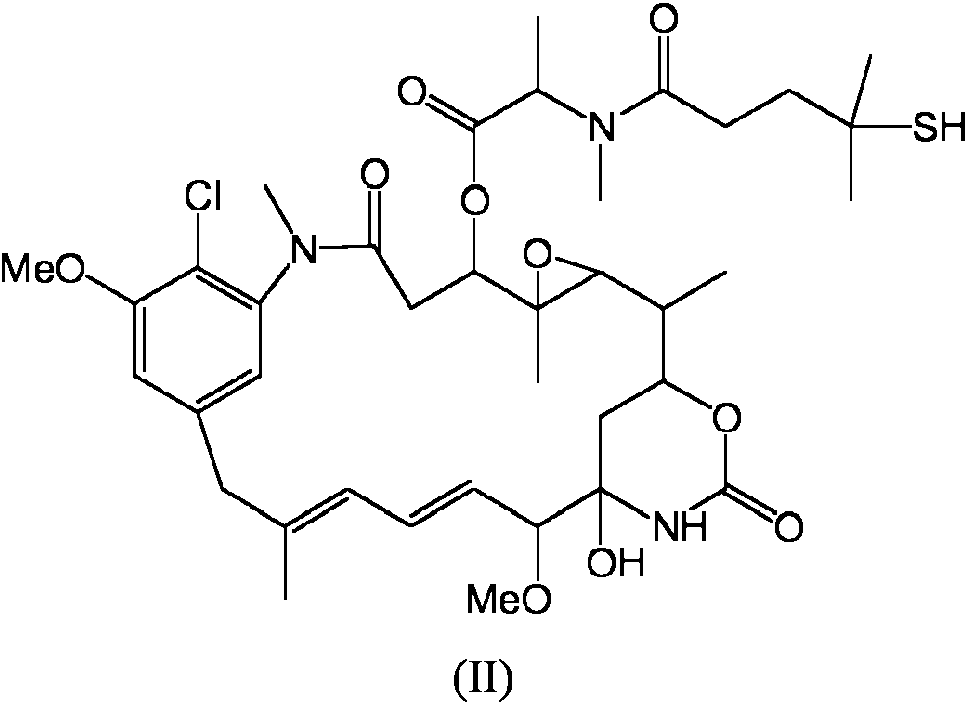
Pueden usarse otros maitansinoides en el contexto de la invencion, incluyendo, por ejemplo, maitansinoides que contienen tiol o disulfuro que tienen una sustitucion mono o dialquilo en el atomo de carbono que porta el atomo de azufre. Se prefiere particularmente un maitansinoide que tiene en la posicion C-3 (a) funcionalidad de hidroximetilo C-14, hidroxi C-15 o desmetilo C-20 y (b) una cadena lateral de aminoacido acilada con un grupo acilo que tiene un grupo sulfhidrilo impedido, donde el atomo de carbono del grupo acilo que tiene la funcionalidad de tiol tiene uno o dos sustituyentes, dichos sustituyentes son CH3 , C2 H5 , alquilo o alquenilo lineal o ramificado que tiene de 1 a 10 atomos de carbono, alquilo o alquenilo cfclico que tiene de 3 a 10 atomos de carbono, fenilo, fenilo sustituido o un aromatico heterocfclico o un radical de heterocicloalquilo, y adicionalmente donde uno de los sustituyentes puede ser H, y donde el grupo acilo tiene una longitud de cadena lineal de al menos tres atomos de carbono entre la funcionalidad de carbonilo y el atomo de azufre.Other maytansinoids may be used in the context of the invention, including, for example, thiol-containing or disulfide-containing maytansinoids having a mono- or dialkyl substitution in the carbon atom carrying the sulfur atom. Particularly preferred is a maytansinoid having in the C-3 position (a) functionality of hydroxymethyl C-14, hydroxy C-15 or desmethyl C-20 and (b) an amino acid side chain acylated with an acyl group having a group hindered sulfhydryl, wherein the carbon atom of the acyl group having the thiol functionality has one or two substituents, said substituents being CH 3 , C 2 H 5 , straight or branched alkyl or alkenyl having from 1 to 10 carbon atoms, Ccyclic alkyl or alkenyl having from 3 to 10 carbon atoms, phenyl, substituted phenyl or a heterocyclic aromatic or a heterocycloalkyl radical, and further wherein one of the substituents may be H, and wherein the acyl group has a straight chain length of at least three carbon atoms between the carbonyl functionality and the sulfur atom.
Los maitansinoides adicionales que pueden usarse en el contexto de la invencion incluyen los compuestos representados por la formula (III):The additional maytansinoids that can be used in the context of the invention include the compounds represented by the formula (III):

donde Y' representa (CR7R8) l(CR9=CR10)p(C=C)qAo(CR5R6)mDu(CR11=CR12)r(C=C)s Bt(CR3R4)nCR1R2SZ,where Y 'represents (CR 7 R 8 ) l (CR 9 = CR 10 ) p (C = C) q A o (CR 5 R 6 ) m D u (CR 11 = CR 12 ) r (C = C) s B t (CR 3 R 4 ) n CR 1 R 2 SZ,
donde R1 y R2 son cada uno independientemente CH3 , C2 H5 , alquilo o alquenilo lineal de 1 a 10 atomos de carbono, alquilo o alquenilo ramificado o cfclico con 3 a 10 atomos de carbono, fenilo, fenilo sustituido o un aromatico heterocfclico o un radical de heterocicloalquilo, y donde R2 tambien puede ser H,where R 1 and R 2 are each independently CH 3 , C 2 H 5 , linear alkyl or alkenyl of 1 to 10 carbon atoms, branched or cyclic alkyl or alkenyl with 3 to 10 carbon atoms, phenyl, substituted phenyl or heterocyclic aromatic or a heterocycloalkyl radical, and where R 2 can also be H,
donde A, B, D son cicloalquilo o cicloalquenilo que tiene de 3-10 atomos de carbono, arilo simple o sustituido, o un aromatico heterocfclico, o un radical de heterocicloalquilo,where A, B, D are cycloalkyl or cycloalkenyl having from 3-10 carbon atoms, simple or substituted aryl, or a heterocyclic aromatic, or a heterocycloalkyl radical,
donde R3 , R4 , R5 , R6 , R7 , R8 , R9 , R10 , R11 y R12 son cada uno independientemente H, CH3 , C2 H5 , alquilo o alquenilo lineal de 1 a 10 atomos de carbono, alquilo o alquenilo ramificado o cfclico con 3 a 10 atomos de carbono, fenilo, fenilo sustituido o un aromatico heterocfclico o un radical de heterocicloalquilo,where R 3 , R 4 , R 5 , R 6 , R 7 , R 8 , R 9 , R 10 , R 11 and R 12 are each independently H, CH 3 , C 2 H 5 , linear alkyl or alkenyl of 1 to 10 carbon atoms, branched or cyclic alkyl or alkenyl having 3 to 10 carbon atoms, phenyl, substituted phenyl or a heterocyclic aromatic or a heterocycloalkyl radical,
donde l, m, n, o, p, q, r, s y t son cada uno independientemente cero o un entero de 1 a 5, con la condition de que al menos dos de l, m, n, o, p, q, r, s y t no sean cero en ningun momento, y donde Z es H, SR o COR, donde R es un alquilo o alquenilo lineal de 1 a 10 atomos de carbono, alquilo o alquenilo ramificado o cfclico con 3 a 10 atomos de carbono, o un arilo simple o sustituido o un aromatico heterocfclico, o un radical de heterocicloalquilo.where l, m, n, o, p, q, r, syt are each independently zero or an integer from 1 to 5, with the proviso that at least two of l, m, n, o, p, q, r, syt are not zero at any time, and where Z is H, SR or COR, where R is a linear alkyl or alkenyl of 1 to 10 carbon atoms, branched or cyclic alkyl or alkenyl having 3 to 10 atoms of carbon, or a simple or substituted aryl or a heterocyclic aromatic, or a heterocycloalkyl radical.
Las realizaciones preferidas de la formula (III) incluyen compuestos de la formula (III) donde (a) Ri es H, R2 es metilo y Z es H, (b) R i y R2 son metilo y Z es H, (c) Ri es H, R2 es metilo, y Z es -SCH 3 , y (d) Ri y R2 son metilo, y Z es -SCH3.Preferred embodiments of formula (III) include compounds of formula (III) wherein (a) R i is H, R 2 is methyl and Z is H, (b) R i and R 2 are methyl and Z is H, (c) R i is H, R 2 is methyl, and Z is -SCH 3 , and (d) R i and R 2 are methyl, and Z is -SCH 3 .
Dichos maitansinoides adicionales tambien incluyen compuestos representados por la formula (IV-L), (IV-D) o (IV-D, L):Said additional maytansinoids also include compounds represented by the formula (IV-L), (IV-D) or (IV-D, L):

donde Y representa (CR7 R8)l(CR5R6)m(CR3 R4)nCR i R2SZ, donde R i y R2 son cada uno independientemente CH3 , C2 H5 , alquilo o alquenilo lineal que tiene de i a i0 atomos de carbono, alquilo o alquenilo ramificado o cfclico que tiene de 3 a i0 atomos de carbono, fenilo, fenilo sustituido o un aromatico heterocfclico o un radical de heterocicloalquilo, y donde R2 tambien puede ser H,where Y represents (CR 7 R 8 ) l (CR 5 R 6 ) m (CR 3 R 4 ) n CR i R 2 SZ, where R i and R 2 are each independently CH 3 , C 2 H 5 , alkyl or linear alkenyl having carbon atoms, branched or cyclic alkyl or alkenyl having 3 to 10 carbon atoms, phenyl, substituted phenyl or a heterocyclic aromatic or a heterocycloalkyl radical, and wherein R 2 may also be H,
donde R3 , R4 , R5 , R6 , R7 y R8 son cada uno independientemente H, CH3 , C2 H5 , alquilo o alquenilo lineal que tiene de i a i0 atomos de carbono, alquilo o alquenilo ramificado o cfclico que tiene de 3 a i0 atomos de carbono, fenilo, fenilo sustituido, o un aromatico heterocfclico o un radical de heterocicloalquilo,where R 3 , R 4 , R 5 , R 6 , R 7 and R 8 are each independently H, CH 3 , C 2 H 5 , linear alkyl or alkenyl having carbon atoms, branched alkyl or alkenyl or cyclic having from 3 to 10 carbon atoms, phenyl, substituted phenyl, or a heterocyclic aromatic or a heterocycloalkyl radical,
donde l, m y n son cada uno independientemente un entero de i a 5, y ademas n puede ser cero, donde Z es H, SR, o COR donde R es alquilo o alquenilo lineal o ramificado que tiene de i a i0 atomos de carbono, alquilo o alquenilo cfclico que tiene de 3 a i0 atomos de carbono, o arilo simple o sustituido o un aromatico heterocfclico o un radical de heterocicloalquilo, ywhere l, m and n are each independently an integer of ia 5, and further n can be zero, where Z is H, SR, or COR where R is linear or branched alkyl or alkenyl having carbon atoms, alkyl or cyclic alkenyl having from 3 to 10 carbon atoms, or simple or substituted aryl or a heterocyclic aromatic or a heterocycloalkyl radical, and
donde May representa un maitansinoide que porta una cadena lateral en C-3, hidroximetilo C-i4, hidroxi C -i5 o desmetilo C-20.where May represents a maytansinoid which carries a side chain at C-3, hydroxymethyl C-i4, hydroxy C -i5 or desmethyl C-20.
Las realizaciones preferidas de las formulas (IV-L), (IV-D) y (IV-D,L) incluyen compuestos de las formulas (IV-L), (IV-D) y (IV-D,L) donde (a) Ri es H, R2 es metilo, R5 , R6 , R7 y R8 son cada uno H, l y m son cada uno i , n es 0, y Z es H, (b) R i y R2 son metilo, R5 , R6 , R7 , R8 son cada uno H, l y m son i , n es 0, y Z es H, (c) R i es H, R2 es metilo, R5 , R6 , R7 y R8 son cada uno H, l y m son cada uno i , n es 0, y Z es -SCH3 , o (d) R i y R2 son metilo, R5 , R6 , R7 , R8 son cada uno H, l y m son i , n es 0, y Z es -SCH 3.Preferred embodiments of the formulas (IV-L), (IV-D) and (IV-D, L) include compounds of the formulas (IV-L), (IV-D) and (IV-D, L) where (a) R i is H, R 2 is methyl, R 5 , R 6 , R 7 and R 8 are each H, l and m are each i, n is 0, and Z is H, (b) R i and R 2 are methyl, R 5 , R 6 , R 7 , R 8 are each H, l and m are i, n is 0, and Z is H, (c) R i is H, R 2 is methyl, R 5 , R 6 , R 7 and R 8 are each H, l and m are each i, n is 0, and Z is -SCH 3 , or (d) R i and R 2 are methyl, R 5 , R 6 , R 7 , R 8 are each H, l and m are i, n is 0, and Z is -SCH 3 .
Preferentemente el agente citotoxico esta representado por la formula (IV-L).Preferably the cytotoxic agent is represented by the formula (IV-L).
Los maitansinoides adicionales preferidos tambien incluyen compuestos representados por la formula (V):Additional preferred maytansinoids also include compounds represented by formula (V):
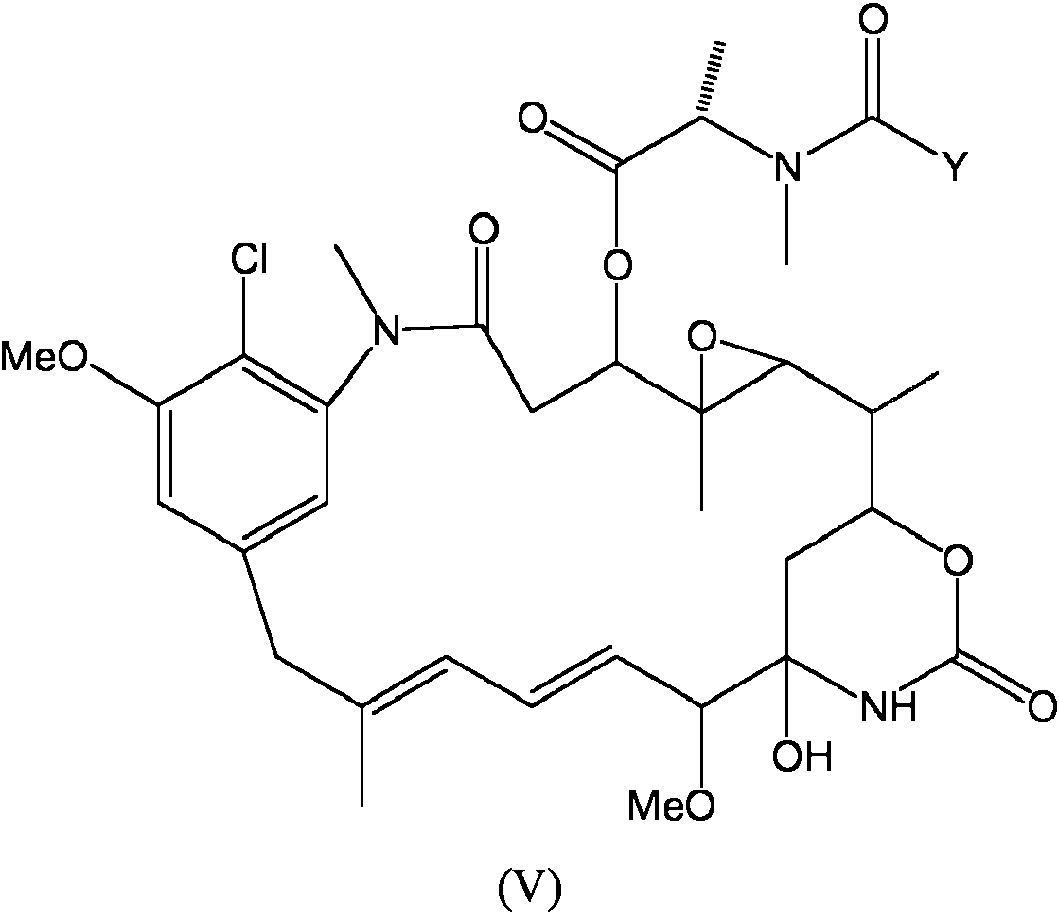
i6 i6
donde Y represents (CR7R8)i(CR5R6)m(CR3 R4)nCR i R2SZ,where Y represents (CR 7 R 8 ) i (CR 5 R 6 ) m (CR 3 R 4 ) n CR i R 2 SZ,
donde Ri y R2 son cada una independientemente CH3 , C2 H5 , alquilo o alquenilo lineal que tiene de 1 a 10 atomos de carbono, alquilo o alquenilo ramificado o cfclico que tiene de 3 a 10 atomos de carbono, fenilo, fenilo sustituido o un aromatico heterocfclico o un radical de heterocicloalquilo, y donde R2 tambien puede ser H,where R i and R 2 are each independently CH 3 , C 2 H 5 , linear alkyl or alkenyl having from 1 to 10 carbon atoms, branched or cyclic alkyl or alkenyl having from 3 to 10 carbon atoms, phenyl, substituted phenyl or a heterocyclic aromatic or a heterocycloalkyl radical, and wherein R 2 may also be H,
donde R3 , R4, R5 , R6 , R7 y R8 son cada uno independientemente H, CH3 , C2 H5 , alquilo o alquenilo lineal que tiene de 1 a 10 atomos de carbono, alquilo o alquenilo ramificado o cfclico que tiene de 3 a 10 atomos de carbono, fenilo, fenilo sustituido, o un aromatico heterocfclico o un radical de heterocicloalquilo,where R 3 , R 4 , R 5 , R 6 , R 7 and R 8 are each independently H, CH 3 , C 2 H 5 , linear alkyl or alkenyl having from 1 to 10 carbon atoms, branched alkyl or alkenyl or cyclic having from 3 to 10 carbon atoms, phenyl, substituted phenyl, or a heterocyclic aromatic or a heterocycloalkyl radical,
donde l, m y n son cada uno independientemente un entero de 1 a 5, y ademas n puede ser cero,where l, m and n are each independently an integer from 1 to 5, and in addition n can be zero,
yY
donde Z es H, SR, o COR, donde R es alquilo o alquenilo lineal que tiene de 1 a 10 atomos de carbono, alquilo o alquenilo ramificado o cfclico que tiene de 3 a 10 atomos de carbono, o arilo simple o sustituido o un aromatico heterocfclico o un radical de heterocicloalquilo.where Z is H, SR, or COR, where R is linear alkyl or alkenyl having from 1 to 10 carbon atoms, branched or cyclic alkyl or alkenyl having from 3 to 10 carbon atoms, or simple or substituted aryl or a heterocyclic aromatic or a heterocycloalkyl radical.
Las realizaciones preferidas de la formula (V) incluyen compuestos de la formula (V) donde (a) R1 es H, R2 es metilo, R5 , R6 , R7 y R8 son cada uno H, l y m son cada uno 1, n es 0, y Z es H, (b) R1 y R2 son metilo, R5 , R6 , R7 , R8 son cada uno H; l y m son 1; n es 0; y Z es H; (c) R1 es H, R2 es metilo; R5 , R6 , R7 y R8 son cada uno H, l y m son cada uno 1, n es 0, y Z es -SCH 3 , o (d) R1 y R2 son metilo, R5 , R6 , R7 , R8 son cada uno H, l y m son 1, n es 0, y Z es -SCH 3. Preferred embodiments of formula (V) include compounds of formula (V) wherein (a) R 1 is H, R 2 is methyl, R 5 , R 6 , R 7 and R 8 are each H, l and m are each one 1, n is 0, and Z is H, (b) R 1 and R 2 are methyl, R 5 , R 6 , R 7 , R 8 are each H; l and m are 1; n is 0; and Z is H; (c) R 1 is H, R 2 is methyl; R 5 , R 6 , R 7 and R 8 are each H, l and m are each 1, n is 0, and Z is -SCH 3 , or (d) R 1 and R 2 are methyl, R 5 , R 6 , R 7 , R 8 are each H, l and m are 1, n is 0, and Z is -SCH 3 .
Los maitansinoides preferidos incluyen compuestos representados por la formula (VI-L), (VI-D), o (VI-D,L):Preferred maytansinoids include compounds represented by the formula (VI-L), (VI-D), or (VI-D, L):

donde Y2 representa (CR7R8)l(CR5 R6)m(CR3R4)nCR1R2SZ2 ,where Y 2 represents (CR 7 R 8 ) l (CR 5 R 6 ) m (CR 3 R 4 ) n CR 1 R 2 SZ 2 ,
donde R1 y R2 son cada uno independientemente CH3 , C2 H5 , alquilo o alquenilo lineal que tiene de 1 a 10 atomos de carbono, alquilo o alquenilo ramificado o cfclico que tiene de 3 a 10 atomos de carbono, fenilo, fenilo sustituido o un aromatico heterocfclico o un radical de heterocicloalquilo, y donde R2 tambien puede ser H,where R 1 and R 2 are each independently CH 3 , C 2 H 5 , linear alkyl or alkenyl having from 1 to 10 carbon atoms, branched or cyclic alkyl or alkenyl having from 3 to 10 carbon atoms, phenyl, substituted phenyl or a heterocyclic aromatic or a heterocycloalkyl radical, and wherein R 2 may also be H,
donde R3 , R4 , R5 , R6 , R7 y R8 son cada uno independientemente H, CH3 , C2 H5 , alquilo o alquenilo lineal o cfclico que tiene de 1 a 10 atomos de carbono, alquilo o alquenilo ramificado o cfclico que tiene de 3 a 10 atomos de carbono, fenilo, fenilo sustituido, o un aromatico heterocfclico o un radical de heterocicloalquilo, donde l, m y n son cada uno independientemente un entero de 1 a 5, y ademas n puede ser cero,where R 3 , R 4 , R 5 , R 6 , R 7 and R 8 are each independently H, CH 3 , C 2 H 5 , linear or cyclic alkyl or alkenyl having from 1 to 10 carbon atoms, alkyl or branched or cyclic alkenyl having from 3 to 10 carbon atoms, phenyl, substituted phenyl, or a heterocyclic aromatic or a heterocycloalkyl radical, wherein l, m and n are each independently an integer from 1 to 5, and further n can be zero ,
donde Z2 es SR, o COR, donde R es alquilo o alquenilo lineal que tiene de 1 a 10 atomos de carbono, alquilo o alquenilo ramificado o cfclico que tiene de 3 a 10 atomos de carbono, o arilo simple o sustituido o un aromatico heterocfclico o un radical de heterocicloalquilo, y donde May es la estructura macrocfclica de anillo del maitansinoide. where Z 2 is SR, or COR, where R is linear alkyl or alkenyl having from 1 to 10 carbon atoms, branched or cyclic alkyl or alkenyl having from 3 to 10 carbon atoms, or simple or substituted aryl or an aromatic heterocyclic or a heterocycloalkyl radical, and where May is the macrocyclic ring structure of maytansinoid.
Los maitansinoides adicionales preferidos incluyen compuestos representados por la formula (VII):Preferred additional maytansinoids include compounds represented by formula (VII):

donde Y2’ represents (CR7R8)i(CR9=CRi 0)p(C=C)qAo(CR5R6)mDu(CRi i =CRi 2)r(C=C)s Bt(CR3R4)nCRi R2SZ2 , donde Ri y R2 son cada uno independientemente CH3 , C2 H5 , alquilo o alquenilo lineal o ramificado de 1 a 10 atomos de carbono, alquilo o alquenilo clclico con 3 a 10 atomos de carbono, fenilo, fenilo sustituido o un aromatico heteroclclico o un radical de heterocicloalquilo, y R2 tambien puede ser H,where Y 2 ' represents (CR 7 R 8 ) i (CR 9 = CR i 0 ) p (C = C) q A o (CR 5 R 6 ) m D u (CR ii = CR i 2 ) r (C = C) s B t (CR 3 R 4 ) n CR i R 2 SZ 2 , where R i and R 2 are each independently CH 3 , C 2 H 5 , straight or branched alkyl or alkenyl of 1 to 10 carbon atoms , alkyl or alkenyl cyclic with 3 to 10 carbon atoms, phenyl, substituted phenyl or a heterocyclic aromatic or a heterocycloalkyl radical, and R 2 may also be H,
donde A, B, D son cada uno independientemente cicloalquilo o cicloalquenilo que tiene de 3 a 10 atomos de carbono, arilo simpe o sustituido, o un aromatico heteroclclico, o un radical de heterocicloalquilo, donde R3 , R4, R5 , R6, R7 , R8 , R9, R10 , R11 y R12 son cada uno independientemente H, CH3 , C2 H5 , alquilo o alquenilo lineal de 1 a 10 atomos de carbono, alquilo o alquenilo ramificado o clclico con 3 a 10 atomos de carbono, fenilo, fenilo sustituido o un aromatico heteroclclico o un radical de heterocicloalquilo,where A, B, D are each independently cycloalkyl or cycloalkenyl having from 3 to 10 carbon atoms, simpe or substituted aryl, or a heterocyclic aromatic, or a heterocycloalkyl radical, wherein R 3 , R 4 , R 5 , R 6 , R 7 , R 8 , R 9 , R 10 , R 11 and R 12 are each independently H, CH 3 , C 2 H 5 , linear alkyl or alkenyl of 1 to 10 carbon atoms, branched alkyl or alkenyl or with 3 to 10 carbon atoms, phenyl, substituted phenyl or a heterocyclic aromatic or a heterocycloalkyl radical,
donde l, m, n, o, p, q, r, s y t son cada uno independientemente cero o un entero de 1 a 5, siempre que al menos dos de l, m, n, o, p, q, r, s y t no sean cero en ningun momento, ywhere l, m, n, o, p, q, r, syt are each independently zero or an integer from 1 to 5, provided that at least two of l, m, n, o, p, q, r, syt are not zero at any time, and
donde Z2 es SR o -COR, donde R es un alquilo o alquenilo lineal de 1 a 10 atomos de carbono, alquilo o alquenilo ramificado o clclico con 3 a 10 atomos de carbono, o un arilo simple o sustituido o un aromatico heteroclclico, o un radical de heterocicloalquilo.where Z 2 is SR or -COR, where R is a linear alkyl or alkenyl of 1 to 10 carbon atoms, branched or cyclic alkyl or alkenyl having 3 to 10 carbon atoms, or a simple or substituted aryl or a heterocyclic aromatic, or a heterocycloalkyl radical.
Las realizaciones preferidas de la formula (VII) incluyen compuestos de la formula (VII), donde Ri es H y R2 es metilo. Preferred embodiments of the formula (VII) include compounds of the formula (VII), wherein R i is H and R 2 is methyl.
Los conjugados de agente de union celular y agente citotoxico pueden prepararse mediante metodos in vitro. Para poder unir un agente citotoxico al anticuerpo se usa un grupo de enlace. Los grupos de enlace adecuados son conocidos en la tecnica e incluyen grupos disulfuro, grupos de acidos labiles, grupos fotolabiles, grupos de peptidasa labiles, y grupos de esterasa labiles, as! como grupos de enlace no escindibles. Por ejemplo, el agente de union celular puede estar acoplado qulmicamente al agente citotoxico por medio de enlaces qulmicos seleccionados del grupo que consiste en enlaces disulfuro, enlaces acidos labiles, enlaces fotolabiles, enlaces peptidasa labiles, enlaces tioeter y enlaces esterasa labiles.The conjugates of cell binding agent and cytotoxic agent can be prepared by in vitro methods . In order to bind a cytotoxic agent to the antibody, a linking group is used. Suitable linking groups are known in the art and include disulfide groups, labile acid groups, photolabile groups, labile peptidase groups, and labile esterase groups, thus! as non-cleavable link groups. For example, the cell-binding agent can be chemically coupled to the cytotoxic agent by means of chemical bonds selected from the group consisting of disulfide bonds, labile acid bonds, photolabile bonds, peptidase-labile bonds, thioether bonds and esterase-labile bonds.
De acuerdo con la invention, el agente de union celular se enlaza a un agente citotoxico por medio de un reactivo de reticulation bifuncional. Tales como se usa en el presente documento, un "reactivo de reticulation bifuncional" se refiere a un reactivo que posee dos grupos reactivos, uno de los cuales es capaz de reaccionar con un agente de union celular mientras que el otro es capaz de reaccionar con el agente citotoxico para unir el agente de union celular con el agente citotoxico, formando as! un conjugado.According to the invention, the cell binding agent is linked to a cytotoxic agent by means of a bifunctional crosslinking reagent. As used herein, a "bifunctional crosslinking reagent" refers to a reagent that has two reactive groups, one of which is capable of reacting with a cell binding agent while the other is capable of reacting with the cytotoxic agent to bind the cell-binding agent with the cytotoxic agent, forming ace! a conjugate.
Puede usarse cualquier reactivo de reticulacion bifuncional adecuado en conexion con la invencion, mientras el reactivo conector proporcione la retention del agente terapeutico, por ejemplo, citotoxicidad, y las caracterlsticas objetivo del agente citotoxico y del agente de union celular, respectivamente, sin toxicidad indebida. Preferentemente, la molecula conectora une al agente citotoxico con el agente de union celular a traves de enlaces qulmicos (tales como se describio anteriormente), de manera que el agente citotoxico y el agente de union celular se acoplen qulmicamente, (por ejemplo, unidos covalentemente) entre ellos.Any suitable bifunctional crosslinking reagent can be used in connection with the invention, while the linking reagent provides retention of the therapeutic agent, eg, cytotoxicity, and the target characteristics of the cytotoxic agent and the cell binding agent, respectively, without undue toxicity. Preferably, the linker molecule binds the cytotoxic agent to the cell-binding agent through chemical bonds (such as described above), so that the cytotoxic agent and the cell-binding agent are chemically coupled, (e.g., covalently linked). ) among them.
En una realization, el reactivo de reticulacion bifuncional comprende conectores no escindibles. Un conector no escindible es cualquier resto qulmico que sea capaz de unir un agente citotoxico, tales como un maitansinoide, un taxano o un analogo de CC-1065, con un agente de union celular de forma estable y covalente. Por lo tanto, los conectores no escindibles son esencialmente resistentes a la escision inducida por acido, escision inducida por luz, escision inducida por peptidasa, escision inducida por esterasa y escision de enlace de disulfuro, en condiciones en las que el agente citotoxico o el agente de union a la celula permanece activo.In one embodiment, the bifunctional crosslinking reagent comprises non-cleavable linkers. A non-cleavable linker is any chemical moiety that is capable of binding a cytotoxic agent, such as a maytansinoid, a taxane or an analogue of CC-1065, with a cell-binding agent in a stable and covalent manner. Therefore, the non-cleavable linkers are essentially resistant to acid induced cleavage, light induced cleavage, peptidase induced cleavage, esterase induced cleavage and disulfide bond cleavage, under conditions in which the cytotoxic agent or the agent of union to the cell remains active.
Los reactivos de reticulacion adecuados que forman conectores no escindibles entre un agente citotoxico y el agente de union celular son conocidos en la tecnica. En una realizacion, el agente citotoxico esta unido a un agente de union celular a traves de un enlace tioeter. Los ejemplos de conectores no escindibles incluyen conectores que tienen un resto basado en haloacetilo o maleimido para la reaction con el agente citotoxico. Dichos agentes de reticulacion bifuncionales son conocidos en la tecnica (veanse las publicaciones de patente de EE.UU. N° 2010/0129314, 2009/0274713, 2008/0050310, 20050169933, 2009/0274713, 2010/0129314 y aquellas disponibles de Pierce Biotechnology Inc. P.O. Box 117, Rockland, IL 61105, USA) e incluyen, pero no se limitan a, 4-(maleimidometil)ciclohexanocarboxilato de N-succinimidilo (SMCC), N-succinimidil-4-(N-maleimidometil)-ciclohexano-1-carboxi-(6-amidocaproato), que es un analogo de “cadena larga” de SMCC (LC-SMCC), ester de N-succinimidilo del acido K-maleimidoundecanoico (KMUA), ester de N'succinimidilo del acido Y-maleimidobutlrico (GMBS), ester de N-hidroxisuccinimida del acido £-maleimidocaproico (EMCS), ester de m-maleimidobenzoil-N-hidroxisuccinimida (MBS), ester de N-(a-maleimidoacetoxi)-succinimida (AMAS), succinimidil-6-(p-maleimidopropionamido)hexanoato (SMPH), 4-(p-maleimidofenil)-butirato de N-succinimidilo (SMPB) y N-(p-maleimidofenil)isocianato (PMPI). Los reactivos de reticulacion que comprenden un resto basado en halocetilo incluyen N-succinimidil-4-(yodoacetil)-aminobenzoato (SIAB), yodoacetato de N-succinimidilo (SIA), bromoacetato de N-succinimidilo (SBA), y 3-(bromoacetamido)propionato de N-succinimidilo (SBAP), bis-maleimidopolietilenglicol (BMPEO), BM(PEO)2 , BM(PEO)3 , ester de N-(b-maleimidopropiloxi)succinimida (BMPS), acido 5-maleimidovalerico NHS, HBVS, acido 4-(4-N-maleimidofenil)-butlrico hidrazida^HCl (MPBH), Succinimidil-(4-vinilsulfonil)benzoato (SVSB), ditiobismaleimidoetano (DTME), 1,4-bis-maleimidobutano (BMB), 1,4-bismaleimidil-2,3-dihodroxibutano (BMDB), bismaleimidohexano (BMH), bis-maleimidoetano (BMOE), 4-(N-maleimido-metil)ciclohexan-1-carboxilato de sulfosuccinimidilo (sulfo-SMCC), sulfosuccinimidil(4-yodo-acetil)aminobenzoato (sulfo-SIAB), ester de m Maleimidobenzoil-N-hidroxisulfosuccinimida (sulfo-MBS), ester de N-(Y-maleimidobutriloxi)sulfosuccinimida (sulfo-GMBS), ester de N-(e-maleimidocaproiloxi)sulfosuccimido (sulfo-EMCS), ester de N-(kmaleimidoundecanoiloxi)sulfosuccinimida (sulfo-KMUS), 4-(p-maleimidofenil)butirato de sulfosuccinimidilo (sulfo-SMPB), CX1-1, sulfo-Mal y PEGn-Mal. Preferentemente, el reactivo de reticulacion bifuncional es SMCC.Suitable crosslinking reagents that form non-cleavable linkers between a cytotoxic agent and the cell binding agent are known in the art. In one embodiment, the cytotoxic agent is linked to a cell binding agent through a thioether bond. Examples of non-cleavable linkers include linkers having a haloacetyl or maleimido based moiety for reaction with the cytotoxic agent. Such bifunctional crosslinking agents are known in the art (see U.S. Patent Publications No. 2010/0129314, 2009/0274713, 2008/0050310, 20050169933, 2009/0274713, 2010/0129314 and those available from Pierce Biotechnology. Inc. PO Box 117, Rockland, IL 61105, USA) and include, but are not limited to, N-succinimidyl 4- (maleimidomethyl) cyclohexanecarboxylate (SMCC), N-succinimidyl-4- (N-maleimidomethyl) -cyclohexane- 1-carboxy (6-amidocaproate), which is a "long-chain" analog of SMCC (LC-SMCC), N-succinimidyl ester of K-maleimidoundecanoic acid (KMUA), N-succinimidyl ester of acid Y- maleimidobutyric acid (GMBS), N-hydroxysuccinimide ester of [alpha] -maleimidocaproic acid (EMCS), m-maleimidobenzoyl-N-hydroxysuccinimide ester (MBS), N- (a-maleimidoacetoxy) -succinimide ester (AMAS), succinimidyl-6 - (p-maleimidopropionamido) hexanoate (SMPH), 4- (p-maleimidophenyl) butyrate of N-succinimidyl (SMPB) and N- (p-maleimidophenyl) isocyanate (PMPI). Cross-linking reagents comprising a halocetyl-based moiety include N-succinimidyl-4- (iodoacetyl) -aminobenzoate (SIAB), N-succinimidyl iodoacetate (SIA), N-succinimidyl bromoacetate (SBA), and 3- (bromoacetamido). N-succinimidyl propionate (SBAP), bis-maleimido-polyethylene glycol (BMPEO), BM (PEO) 2 , BM (PEO) 3 , N- (b-maleimidopropyloxy) succinimide ester (BMPS), 5-maleimidovaleric acid NHS, HBVS , 4- (4-N-maleimidophenyl) -butyric acid hydrazide ^ HCl (MPBH), Succinimidyl- (4-vinylsulfonyl) benzoate (SVSB), dithiobismaleimidoethane (DTME), 1,4-bis-maleimidobutane (BMB), 1, 4-bismaleimidyl-2,3-dihydroxybutane (BMDB), bismaleimidohexane (BMH), bis-maleimidoethane (BMOE), sulfosuccinimidyl 4- (N-maleimido-methyl) cyclohexan-1-carboxylate (sulfo-SMCC), sulfosuccinimidyl (4) -iodo-acetyl) aminobenzoate (sulfo-SIAB), ester of m Maleimidobenzoyl-N-hydroxysulfosuccinimide (sulfo-MBS), N- (Y-maleimidobutryloxy) sulfosuccinimide ester (sulfo-GMBS), N- (e-maleimidocaproyloxy) sulfosuccimido ester (sulfo-EMCS), N- (kmaleimidoundecanoyloxy) ester ) sulfosuccinimide (sulfo-KMUS), sulfosuccinimidyl 4- (p-maleimidophenyl) butyrate (sulfo-SMPB), CX1-1, sulfo-Mal and PEG n -Mal. Preferably, the bifunctional crosslinking reagent is SMCC.

En una realizacion, el reactivo conector es un conector escindible. Los ejemplos de conectores escindibles adecuados incluyen conectores de disulfuro, conectores labiles de acido, conectores fotolabiles, conectores labiles de peptidasa y conectores labiles de estearasa. Los conectores que contienen disulfuro son conectores escindibles a traves del intercambio de disulfuro, que puede ocurrir en condiciones fisiologicas. Los conectores labiles de acido son conectores escindibles a pH acido. Por ejemplo, determinados compartimentos intracelulares, tales como endosomas y lisosomas, tienen un pH acido (pH 4-5), y proporcionan condiciones adecuadas para escindir conectores labiles de acido. Los conectores fotolabiles son utiles en la superfine corporal y en muchas cavidades corporales que son accesibles a la luz. Asimismo, la luz infrarroja puede penetrar el tejido. Los conectores labiles de peptidasa pueden usarse para escindir determinados peptidos dentro o fuera de las celulas (vease por ejemplo, Trouet et al., Proc. Natl. Acad. Sci. USA, 79: 626-629 (1982), y Umemoto et al., Int. J. Cancer, 43: 677-684 (1989)). En una realizacion, el conector escindible se escinde bajo condiciones moderadas, es decir, condiciones dentro de una celula en la que la actividad del agente citotoxico no se ve afectada.In one embodiment, the connecting reagent is a cleavable linker. Examples of suitable cleavable linkers include disulfide linkers, acid labile linkers, photolabel linkers, peptidase linkers, and esterase-labile linkers. Disulfide-containing connectors are cleavable linkers through disulfide exchange, which can occur under physiological conditions. The acid labile connectors are cleavable connectors at acid pH. For example, certain intracellular compartments, such as endosomes and lysosomes, have an acidic pH (pH 4-5), and provide adequate conditions to cleave acid labile connectors. Photolabile connectors are useful in the body superfine and in many body cavities that are accessible to light. Likewise, infrared light can penetrate the tissue. Lactated peptidase linkers can be used to cleave certain peptides inside or outside cells (see, for example, Trouet et al., Proc. Natl. Acad. Sci. USA, 79: 626-629 (1982), and Umemoto et al. ., Int. J. Cancer, 43: 677-684 (1989)). In one embodiment, the cleavable linker is cleaved under moderate conditions, i.e., conditions within a cell in which the activity of the cytotoxic agent is not affected.
En otra realizacion, el agente citotoxico esta enlazado a un agente de union celular es decir, un anticuerpo a traves de un enlace de disulfuro. La molecula conectora comprende un grupo qulmico reactivo que puede reaccionar con el agente de union celular. Los grupos qulmicos reactivos preferidos para su reaccion con el agente de union celular son esteres de N-succinimidilo y esteres de N-sulfosuccinimidilo. Adicionalmente la molecula conectora comprende un grupo qulmico reactivo, preferentemente un grupo ditiopiridilo, que puede reaccionar con el agente citotoxico para formar un enlace disulfuro. Los reactivos de reticulacion bifuncionales que permiten el enlace del agente de union celular con el agente citotoxico a traves de los enlaces disulfuro son conocidos en la tecnica e incluyen, por ejemplo, 3- (2-piridilditio)propionato de N-succinimidilo (SPDP) (vease, por ejemplo, Carlsson et al., Biochem. J., 173: 723-737 (1978)), 4-(2-piridilditio)butanoato de N-succinimidilo (SPDB) (vease, por ejemplo, la patente de EE.UU. 4.563.304), 4- (2-piridilditio)pentanoato de N-succinimidilo (SPP) (vease, por ejemplo, numero de Registro CAS 341498-08-6), y N-succinimidil-4-(2-piridilditio)2-sulfo butanoato (sulfo-SPDB) (vease, por ejemplo, la publicacion de solicitud de EE.UU. N.° 2009/0274713). En la tecnica se conocen otros reactivos de reticulacion bifuncionales que pueden usarse para introducir grupos disulfuro y se describen en las patentes de EE.UU. 6.913.748, 6.716.821 y en las publicaciones de solicitud de patente de EE.UU. 2009/0274713 y 2010/0129314.In another embodiment, the cytotoxic agent is linked to a cell binding agent, ie, an antibody through a disulfide bond. The linker molecule comprises a reactive chemical group that can react with the cell binding agent. The preferred reactive chemical groups for their reaction with the cell binding agent are N-succinimidyl esters and N-sulfosuccinimidyl esters. Additionally, the linker molecule comprises a reactive chemical group, preferably a dithiopyridyl group, which can react with the cytotoxic agent to form a disulfide bond. Bifunctional crosslinking reagents that allow the binding of the cell binding agent to the cytotoxic agent through disulfide bonds are known in the art and include, for example, N-succinimidyl 3- (2-pyridyldithio) propionate (SPDP) (see, for example, Carlsson et al., Biochem. J., 173: 723-737 (1978)), N-succinimidyl 4- (2-pyridyldithio) butanoate (SPDB) (see, for example, the US 4,563,304), 4- (2-pyridyldithio) pentanoate N-succinimidyl (SPP) (see, eg, CAS Registry Number 341498-08-6), and N-succinimidyl-4- (2 -pyridyldithio) 2-sulfo butanoate (sulfo-SPDB) (see, for example, US application publication No. 2009/0274713). Other bifunctional crosslinking reagents that can be used to introduce disulfide groups are known in the art and are described in U.S. Pat. 6,913,748, 6,716,821 and in U.S. patent application publications. 2009/0274713 and 2010/0129314.
Otros reactivos de reticulacion que carecen de un atomo de azufre que forman conectores no escindibles pueden usarse tambien en el metodo de la invencion. Dichos conectores pueden derivar de restos a base de acido dicarboxllico. Los restos a base de acido dicarboxllico adecuados incluyen, pero no se limitan a, acidos a,wdicarboxllicos de la formula general (IX): Other crosslinking reagents lacking a sulfur atom that form non-cleavable linkers can also be used in the method of the invention. Said connectors can be derived from residues based on dicarboxylic acid. Suitable dicarboxylic acid-based moieties include, but are not limited to, acidic, wicarboxylic acids of the general formula (IX):
HOOC-Xi-Yn-Zm-COOHHOOC-X i -Y- n -Z m -COOH
(IX),(IX),
donde X es un grupo alquilo, alquenilo o alquinilo lineal o ramificado que tiene de 2 a 20 atomos de carbono, Y es un grupo cicloalquilo o cicloalquenilo con 3 a 10 atomos de carbono, Z es un grupo aromatico sustituido o no sustituido con 6 a 10 atomos de carbono, o un grupo heteroclclico sustituido o no sustituido donde el heteroatomo se selecciona de N, O o S, y donde l, m y n son cada uno 0 o 1, siempre que l, m y n no sean todos cero al mismo tiempo.where X is a linear or branched alkyl, alkenyl or alkynyl group having from 2 to 20 carbon atoms, Y is a cycloalkyl or cycloalkenyl group with 3 to 10 carbon atoms, Z is an aromatic group substituted or unsubstituted with 6 a 10 carbon atoms, or a substituted or unsubstituted heterocyclic group where the heteroatom is selected from N, O or S, and where l, m and n are each 0 or 1, provided that l, m and n are not all zero at the same time.
Muchos de los conectores no escindibles divulgados en el presente documento se describen en detalle en la publicacion de solicitud de patente de EE.UU. 2005/0169933 A1.Many of the non-cleavable linkers disclosed herein are described in detail in U.S. patent application publication. 2005/0169933 A1.
Los siguientes ejemplos ilustran adicionalmente la invencion pero, por supuesto, no deberlan entenderse como que limitan de manera alguna su alcance.The following examples further illustrate the invention but, of course, should not be construed as limiting its scope in any way.
Ejemplo 1Example 1
Se hizo reaccionar el anticuerpo CD37-3 humanizado con el reactivo de reticulacion heterobifuncional SMCC y el maitansinoide DM1 usando un proceso descrito previamente (por ejemplo La patente de EE.UU. 5-208-020), as! como el proceso de una etapa que es el objeto de la presente solicitud.The humanized CD37-3 antibody was reacted with the heterobifunctional crosslinking reagent SMCC and the maytansinoid DM1 using a previously described process (e.g., U.S. Patent 5-208-020), as! as the process of a stage that is the object of the present application.
Para el proceso descrito previamente, huCD37-3 (15 mg/ml) se hizo reaccionar primero con SMCC (exceso molar de 6,5 veces en relacion a la cantidad de anticuerpo) para formar el anticuerpo modificado. La reaccion de modificacion se llevo a cabo a 16 °C en tampon de fosfato de sodio 50 mM (pH 6,9) que contenla EDTA 2 mM y DMA al 10 % durante 90 minutos. La reaccion se inactivo con acetato 1 M para ajustar el pH a 4,5 y el anticuerpo modificado se purifico usando una columna de resina Sephadex G-25F equilibrada y eluida con acetato de sodio 20 mM (pH 4,5) que contenla EDTA 2 mM. Despues de la purificacion, el anticuerpo modificado (5 mg/ml) se hizo reaccionar con el maitansinoide DM1 (exceso molar de 6,8 veces en relacion con la cantidad de anticuerpo; exceso de 1,3 veces en relacion con la cantidad medida de conector en el anticuerpo) para formar el anticuerpo conjugado. La reaccion de conjugacion se llevo a cabo a 20 °C en tampon de acetato de sodio 20 mM (pH 5,0) que contenla EDTA 2 mM y DMA al 5 % durante aproximadamente 20 horas. La mezcla de reaccion se purifico usando una columna de resina Sephadex G-25F equilibrada y eluida en succinato de sodio 10 mM (pH 5,0).For the previously described process, huCD37-3 (15 mg / ml) was first reacted with SMCC (molar excess of 6.5 fold relative to the amount of antibody) to form the modified antibody. The modification reaction was carried out at 16 ° C in 50 mM sodium phosphate buffer (pH 6.9) containing 2 mM EDTA and 10% DMA for 90 minutes. The reaction was quenched with 1M acetate to adjust the pH to 4.5 and the modified antibody was purified using a Sephadex G-25F resin column equilibrated and eluted with 20 mM sodium acetate (pH 4.5) containing EDTA 2 mM. After purification, the modified antibody (5 mg / ml) was reacted with the maytansinoid DM1 (molar excess of 6.8 times in relation to the amount of antibody, 1.3-fold excess in relation to the measured amount of antibody) to form the conjugated antibody. The conjugation reaction was carried out at 20 ° C in 20 mM sodium acetate buffer (pH 5.0) containing 2 mM EDTA and 5% DMA for about 20 hours. The reaction mixture was purified using a Sephadex G-25F resin column equilibrated and eluted in 10 mM sodium succinate (pH 5.0).
Para el proceso de la invencion, huCD37-3 (2,5 mg/ml) se mezclo con DM1 (exceso molar de 6,2 veces en relacion con la cantidad de anticuerpo) y despues con SMCC (exceso de 5,2 veces en relacion a la cantidad de anticuerpo). La reaccion se llevo a cabo a 20 °C en tampon EPPS [acido 4-(2-Hidroxietil)-1-piperazinpropanosulfonico] 50 mM (pH 8,1) que contenla EDTA 2 mM y DMA al 10 % durante aproximadamente 2 horas. La reaccion se inactivo mediante la adicion de acetato 1 M para ajustar el pH a 5,0, Despues la mezcla de reaccion se retuvo a 2 - 8 °C durante aproximadamente 20 horas. Despues de la retencion, la mezcla de reaccion se filtro a traves de un filtro de PVDF de 0,2 |jm y se purifico y sometio a diafiltracion en succinato de sodio 10 mM (pH 5,0) usando filtracion de flujo tangencial (TFF).For the process of the invention, huCD37-3 (2.5 mg / ml) was mixed with DM1 (6.2-fold molar excess in relation to the amount of antibody) and then with SMCC (5.2-fold excess in relation to the amount of antibody). The reaction was carried out at 20 ° C in 50 mM EPPS [4- (2-Hydroxyethyl) -1-piperazinepropanesulfonic acid] buffer (pH 8.1) containing 2 mM EDTA and 10% DMA for about 2 hours. The reaction was quenched by the addition of 1M acetate to adjust the pH to 5.0, then the reaction mixture was retained at 2-8 ° C for about 20 hours. After retention, the reaction mixture was filtered through a 0.2 μm PVDF filter and purified and subjected to diafiltration in 10 mM sodium succinate (pH 5.0) using tangential flow filtration (TFF). ).
El conjugado derivado de los dos procesos se analizo mediante: espectroscopla UV para verificar la concentracion y la carga de agente citotoxico (relacion de maitansinoide respecto al anticuerpo, MAR); espectrometrla de masas para determinar el nivel de conector no conjugado; electroforesis SDS PAGE reducida para determinar el nivel de la especie no reducible; y SEC-HPLC para determinar el monomero conjugado; y estabilidad durante el almacenamiento respecto a la liberacion de maitansinoide libre y monomero del conjugado.The conjugate derived from the two processes was analyzed by: UV spectroscopy to verify the concentration and loading of the cytotoxic agent (maytansinoid relation to the antibody, MAR); mass spectrometry to determine the unconjugated connector level; reduced SDS PAGE electrophoresis to determine the level of the non-reducible species; and SEC-HPLC to determine the conjugated monomer; and storage stability with respect to the release of free and monomeric maytansinoid from the conjugate.
La concentracion y la relacion de maitansinoide respecto al anticuerpo (MAR) se determinaron mediante la medicion de la absorbancia del conjugado a 252 y 280 nm en un espectrofotometro UV-VIS y usando los coeficientes de extincion molar de DM1 y del anticuerpo a las dos longitudes de onda, para calcular las concentraciones molares del anticuerpo y de DM1.The concentration and the relation of maytansinoid to the antibody (MAR) were determined by measuring the absorbance of the conjugate at 252 and 280 nm in a UV-VIS spectrophotometer and using the molar extinction coefficients of DM1 and the antibody at both lengths of wave, to calculate the molar concentrations of the antibody and DM1.
El nivel de conector no conjugado de los conjugados se analizo mediante espectrometrla de masas: se midieron las areas de pico de la especie conjugada individual (incluyendo conjugados con o sin conectores no conjugados); se calculo el nivel de conector no conjugado mediante la proporcion de la suma de areas que contenlan conectores no conjugados (pesada mediante el numero de conectores) respecto a la suma de areas de todas las especies conjugadas (tambien pesada mediante el numero de conectores).The unconjugated linker level of the conjugates was analyzed by mass spectrometry: the peak areas of the individual conjugated species were measured (including conjugates with or without non-conjugated connectors); the unconjugated connector level was calculated by the proportion of the sum of areas containing unconjugated connectors (weighted by the number of connectors) with respect to the sum of areas of all the conjugated species (also weighted by the number of connectors).
El nivel de especies no reducibles de los conjugados se analizo mediante electroforesis en gel SDS reducida: se midieron las areas pico de las especies de conjugados individuales reducidas (incluyendo cadena ligera reducida, cadena pesada reducida, cadena ligera-ligera reticulada, cadena ligera-pesada reticulada, etc.); en nivel de especies no reducibles se calculo mediante la proporcion de la suma de areas de especies no reducibles respecto a la suma de las areas de todas las especies.The level of non-reducible species of the conjugates was analyzed by reduced SDS gel electrophoresis: the peak areas of the reduced individual conjugates species were measured (including reduced light chain, reduced heavy chain, cross-linked light-light chain, light-heavy chain reticulated, etc.); at the level of non-reducible species, it was calculated by the proportion of the sum of areas of non-reducible species with respect to the sum of the areas of all the species.
El nivel de monomeros de los conjugados se analizo mediante HPLC de exclusion por tamano: las areas pico de especies de bajo peso molecular, monomeros, dlmeros y anadidos se midieron usando un detector de absorbancia a una longitud de onda de 252 nm o 280 nm; el nivel de monomero se calculo mediante la proportion de area de monomero respecto al area total.The level of monomers of the conjugates was analyzed by exclusion HPLC by size: the peak areas of low molecular weight, monomer, dimer and added species were measured using an absorbance detector. a wavelength of 252 nm or 280 nm; the monomer level was calculated by the proportion of monomer area with respect to the total area.
La cantidad de maitansinoide libre presente en el conjugado se analizo mediante HPLC en doble columna (columnas HiSep y C18): las areas pico del total de especies de maitansinoide libre (eluido en el gradiente e identificado en comparacion con el tiempo de elusion con estandares conocidos) se midieron usando un detector de absorbancia a una longitud de onda de 252 nm; la cantidad de maitansinoide libre se calculo usando una curva estandar generada por las areas pico de la cantidad conocida de estandares.The amount of free maytansinoid present in the conjugate was analyzed by double column HPLC (HiSep and C18 columns): the peak areas of the total free maytansinoid species (eluted in the gradient and identified in comparison with the elusion time with known standards) ) were measured using an absorbance detector at a wavelength of 252 nm; the amount of free maytansinoid was calculated using a standard curve generated by the peak areas of the known quantity of standards.
Como se muestra en la Tabla 1 a continuation, el conjugado elaborado usando el proceso de la invention fue superior al elaborado usando el proceso previamente descrito, con respecto al conector no conjugado, especie no reducible y monomero del conjugado. A su vez, la estabilidad del conjugado elaborado mediante el proceso de la invencion resulto considerablemente superior con respecto a la liberation de maitansinoide libre despues de su almacenamiento durante cinco meses a 4 °C. Los niveles de monomeros de los conjugados elaborados mediante ambos procesos resultaron estables.As shown in Table 1 below, the conjugate made using the process of the invention was superior to that elaborated using the previously described process, with respect to the non-conjugated, non-reducible and monomer conjugate species. In turn, the stability of the conjugate prepared by the process of the invention was considerably higher with respect to the release of free maytansinoid after storage for five months at 4 ° C. The levels of monomers of the conjugates made by both processes were stable.
Tabla 1. Comparacion de propiedades clave del conjugado CD37-3 elaborado mediante el proceso de la invencion enTable 1. Comparison of key properties of the CD37-3 conjugate prepared by the process of the invention in

Los resultados de los experimentos reflejados en este ejemplo demuestran un proceso mejorado para preparar conjugados de agente de union celular y agente citotoxico que tienen una pureza considerablemente alta. Ademas de las mejoras a la pureza y estabilidad del conjugado utilizando el proceso de la invencion, tambien se presentan mejoras en los tiempos de procesamiento y conveniencia, como resultado de la elimination de dos etapas del proceso (la reaction de modification y la purification del anticuerpo modificado).The results of the experiments reflected in this example demonstrate an improved process for preparing conjugates of cell binding agent and cytotoxic agent having a considerably high purity. In addition to improvements to the purity and stability of the conjugate using the process of the invention, improvements in processing times and convenience are also presented, as a result of the elimination of two process steps (reaction modification and antibody purification). modified).
Ejemplo 2Example 2
El anticuerpo huMov19 receptor de folato humanizado (vease la publication de solicitud de EE.UU. 2012/0009181) se hizo reaccionar con el reactivo de reticulation bifuncional sulfo-SPDB y el maitansinoide DM4 usando dos procesos descritos previamente, as! como el proceso mejorado que es el sujeto de la presente solicitud.The humanized folate receptor huMov19 antibody (see US application publication 2012/0009181) was reacted with the bifunctional sulfo-SPDB crosslinking reagent and the maytansinoid DM4 using two previously described processes, thus! as the improved process that is the subject of the present application.
Para el Proceso A descrito anteriormente (proceso de dos etapas, por ejemplo Chari et al., US 5.208.020), se hizo reaccionar el anticuerpo huMov19 (20 mg/ml) en primer lugar con sulfo-SPDB (exceso molar de 5,7 veces en relation a la cantidad de anticuerpo, disuelto en DMA, dimetilacetamida) para formar el anticuerpo modificado. La reaccion de modificacion se llevo a cabo a 20 °C en un tampon de EPPS (4-(acido 2-hidroxietil)piperazin-1-propansulfonico) 50 mM (pH 8,1) con 5 % DMA durante 180 minutos. El anticuerpo modificado se purifico usando una columna de resina Sephadex G-25F equilibrada y eluida en EPPS 50 mM (pH 8,1) con EDTA (acido etilendiaminotetraacetico) 2 mM. Despues de la purificacion, el anticuerpo modificado (5,0 mg/ml) se hizo reaccionar con el maitansinoide DM4 (Disuelto en DMA; exceso molar de 9,7 veces en relacion a la cantidad del anticuerpo; exceso de 1,7 veces en relacion con la cantidad medida de conector en el anticuerpo) para formar el anticuerpo conjugado. La reaccion de conjugation se llevo a cabo a temperatura ambiente en EPPS 50 mM (pH 8,1) que contenla EDTA 2mM y DMA al 5 % durante aproximadamente 18 horas. Despues, la mezcla de reaccion se purifico usando una columna de resina G-25F Sephadex equilibrada y eluida en succinato de sodio 10 mM (pH 5,0).For Process A described above (two-step process, for example Chari et al., US 5,208,020), the huMov19 antibody (20 mg / ml) was first reacted with sulfo-SPDB (molar excess of 5, 7 times in relation to the amount of antibody, dissolved in DMA, dimethylacetamide) to form the modified antibody. The modification reaction was carried out at 20 ° C in a buffer of EPPS (4- (2-hydroxyethyl) piperazine-1-propanesulfonic acid) 50 mM (pH 8.1) with 5% DMA for 180 minutes. The modified antibody was purified using a Sephadex G-25F resin column equilibrated and eluted in 50 mM EPPS (pH 8.1) with 2 mM EDTA (ethylenediaminetetraacetic acid). After purification, the modified antibody (5.0 mg / ml) was reacted with the maytansinoid DM4 (dissolved in DMA, molar excess of 9.7 times in relation to the amount of the antibody; related to the measured amount of antibody binding) to form the conjugated antibody. The conjugation reaction was carried out at room temperature in 50 mM EPPS (pH 8.1) containing 2mM EDTA and 5% DMA for about 18 hours. Then, the reaction mixture was purified using a G-25F Sephadex resin column equilibrated and eluted in 10 mM sodium succinate (pH 5.0).
Para el Proceso B descrito anteriormente (proceso en un solo recipiente, Dai et al., patente de EE.UU. 7.811.572), se hizo reaccionar el anticuerpo huMov19 (10 mg/ml) en primer lugar con sulfo-SPDB (exceso molar de 4,9 veces en relacion a la cantidad de anticuerpo, disuelto en DMA) para formar el anticuerpo modificado. La reaccion de modificacion se llevo a cabo a 20 °C en tampon de EPPS 50 mM (pH 7,5) que contenla EDTA 2 mM y DMA al 10 % durante 60 minutos. El anticuerpo modificado no se purifico previo a la reaccion de conjugacion. En su lugar, el anticuerpo modificado sin purificar se hizo reaccionar a 10 mg/ml con el maitansinoide DM4 (exceso molar de 8,3 veces en relacion a la cantidad de anticuerpo, disuelto en DMA) para formar el anticuerpo conjugado. La reaccion de conjugacion se llevo a cabo a temperatura ambiente en tampon EPPS 50 mM (pH 7,5) que contenla EDTA 2mM y DMA al 10 % durante aproximadamente 18 horas. La mezcla de reaccion se purifico usando una columna de resina G-25F Sephadex equilibrada y eluida en succinato de sodio 10 mM (pH 5,0).For Process B described above (single container process, Dai et al., U.S. Patent 7,811,572), the huMov19 antibody (10 mg / ml) was first reacted with sulfo-SPDB (excess molar of 4.9 times in relation to the amount of antibody, dissolved in DMA) to form the modified antibody. The modification reaction was carried out at 20 ° C in 50 mM EPPS buffer (pH 7.5) containing 2 mM EDTA and 10% DMA for 60 minutes. The modified antibody was not purified prior to the conjugation reaction. Instead, the unpurified modified antibody was reacted at 10 mg / ml with the maytansinoid DM4 (8.3-fold molar excess relative to the amount of antibody, dissolved in DMA) to form the conjugated antibody. The conjugation reaction was carried out at room temperature in 50 mM EPPS buffer (pH 7.5) containing 2mM EDTA and 10% DMA for about 18 hours. The reaction mixture was purified using a resin column G-25F Sephadex equilibrated and eluted in 10 mM sodium succinate (pH 5.0).
Para el proceso de la invencion en que se utilizo Sephadex G-25 (Proceso C, proceso en una sola etapa) para purificar el conjugado, se mezclo anticuerpo huMov19 (6,0 mg/ml) con DM4 (exceso molar de 9,7 veces en relacion a la cantidad de anticuerpo, disuelto en DMA) y despues se anadio sulfo-SPDB (exceso molar de 5,7 veces en relacion a la cantidad de anticuerpo, disuelto en DMA). La reaccion se llevo a cabo a 20 °C en tampon de EPPS 50 mM (pH 8,1) que contenla EDTA 2 mM y DMA al 10 % durante aproximadamente 20 horas. La mezcla de reaccion se purifico usando una columna de resina G-25F Sephadex equilibrada y eluida en succinato de sodio 10 mM (pH 5,0).For the process of the invention in which Sephadex G-25 (Process C, single-step process) was used to purify the conjugate, huMov19 antibody (6.0 mg / ml) was mixed with DM4 (molar excess of 9.7 times in relation to the amount of antibody, dissolved in DMA) and then added sulfo-SPDB (molar excess of 5.7 times in relation to the amount of antibody, dissolved in DMA). The reaction was carried out at 20 ° C in 50 mM EPPS buffer (pH 8.1) containing 2 mM EDTA and 10% DMA for about 20 hours. The reaction mixture was purified using a G-25F Sephadex resin column equilibrated and eluted in 10 mM sodium succinate (pH 5.0).
Para el proceso de la invencion en que se utilizo filtracion de flujo tangencial (TFF) (Proceso D, proceso en una sola etapa) para purificar el conjugado, se mezclo anticuerpo huMov19 (5,0 mg/ml) con DM4 (exceso molar de 10,2 veces en relacion a la cantidad de anticuerpo, disuelto en DMA) y despues con sulfo-SPDB (exceso molar de 6,0 veces en relacion a la cantidad de anticuerpo, disuelto en DMA). La reaccion se llevo a cabo a 20 °C en tampon de EPPS 50 mM (pH 8,5) que contenla EDTA 2 mM y DMA al 10 % durante aproximadamente 20 horas. Despues, la mezcla de reaccion se purifico y se lo sometio a diafiltracion utilizando una TFF en succinato de sodio 10 mM (pH 5,0).For the process of the invention in which tangential flow filtration (TFF) (Process D, single step process) was used to purify the conjugate, huMov19 antibody (5.0 mg / ml) was mixed with DM4 (molar excess of 10.2 times in relation to the amount of antibody, dissolved in DMA) and then with sulfo-SPDB (molar excess of 6.0 times in relation to the amount of antibody, dissolved in DMA). The reaction was carried out at 20 ° C in 50 mM EPPS buffer (pH 8.5) containing 2 mM EDTA and 10% DMA for about 20 hours. Then, the reaction mixture was purified and subjected to diafiltration using a TFF in 10 mM sodium succinate (pH 5.0).
El conjugado derivado de los diferentes procesos se analizo mediante: Espectroscopla UV (para concentration y la relacion de maitansinoide respecto a anticuerpo, MAR); HPLC de fase inversa para determinar los maitansinoides libres; Espectrometrla de masas para la determination de niveles de conectores sin conjugar perfil de distribution de masa; electroforesis SDS PAGE reducida para determinar el nivel de especies no reducibles; electroforesis SDS PAGE no reducida para la determinacion del nivel de fragmentation; SEC-HPLC para determinar los monomeros del conjugado. La estabilidad durante el almacenamiento se evaluo en lo que refiere al monomero del conjugado y la liberation de maitansinoide libre. Se suministra information adicional sobre las metodologlas anallticas en el Ejemplo 1,The conjugate derived from the different processes was analyzed by: UV spectroscopy (for concentration and the relationship of maytansinoid with respect to antibody, MAR); Reverse phase HPLC to determine free maytansinoids; Mass spectrometry for the determination of connector levels without conjugate mass distribution profile; reduced SDS PAGE electrophoresis to determine the level of non-reducible species; SDS PAGE electrophoresis not reduced for the determination of the level of fragmentation; SEC-HPLC to determine the monomers of the conjugate. The stability during storage was evaluated as regards the monomer of the conjugate and the release of free maytansinoid. Additional information is provided on the analytical methodologies in Example 1,
Como se muestra en la Tabla 2, a continuation, el conjugado elaborado usando el proceso de la invencion fue superior al elaborado usando los procesos previamente descritos con respecto al monomero. El conjugado elaborado utilizando los procesos de un recipiente y una etapa en que la purification final del conjugado se realizo utilizando Sephadex G-25, Procesos B y C, respectivamente, presentaron un nivel mas alto de maitansinoide libre que el conjugado elaborado utilizando el proceso de dos etapas, Proceso A. Sin embargo, cuando se utilizo un proceso de purificacion final diferente, TFF (Proceso D), el nivel de maitansinoide libre fue muy bajo y comparable con el encontrado en los procesos de dos etapas, ambos despues de la purificacion inicial y despues del almacenamiento a 4 °C durante seis semanas. En lo que respecta a los otros atributos importantes del conjugado (por ejemplo fragmentacion, especies no reducibles, perfil de distribucion de masa y conector sin conjugar), el conjugado elaborado utilizando el proceso de la invencion fue equivalente al elaborado mediante los procesos descritos anteriormente.As shown in Table 2, below, the conjugate made using the process of the invention was superior to that made using the processes previously described with respect to the monomer. The conjugate elaborated using the processes of a container and a stage in which the final purification of the conjugate was performed using Sephadex G-25, Processes B and C, respectively, presented a higher level of free maytansinoid than the conjugate prepared using the process of Two stages, Process A. However, when a different final purification process, TFF (Process D), was used, the level of free maytansinoid was very low and comparable with that found in the two-stage processes, both after the purification initial and after storage at 4 ° C for six weeks. As regards the other important attributes of the conjugate (for example fragmentation, non-reducible species, mass distribution profile and unconjugated connector), the conjugate prepared using the process of the invention was equivalent to that elaborated by the processes described above.
Tabla 2. Comparacion de propiedades clave del conjugado huMov19 elaborado mediante el proceso de la invencion n m r i n n r n ri r .Table 2. Comparison of key properties of the huMov19 conjugate prepared by the process of the invention n m r i n n r n ri r.


* Purificado con Sephadex G-25* Purified with Sephadex G-25
** Purificado utilizando TFF** Purified using TFF
Los resultados de los experimented reflejados en este ejemplo demuestran un proceso mejorado para preparar conjugados de agente de union celular y agente citotoxico que tienen una pureza considerablemente alta. Ademas de las mejoras a la pureza y estabilidad del conjugado utilizando el proceso de la invencion, tambien se presentan mejoras en los tiempos de procesamiento y conveniencia, como resultado de la eliminacion de dos etapas del proceso (la reaccion de modificacion y la purificacion del anticuerpo modificado).The results of the experiments reflected in this example demonstrate an improved process for preparing conjugates of cell binding agent and cytotoxic agent having a considerably high purity. In addition to improvements to the purity and stability of the conjugate using the process of the invention, improvements in processing times and convenience are also presented, as a result of the elimination of two stages of the process (the modification reaction and the purification of the antibody modified).
Ejemplo 3Example 3
Este ejemplo demuestra que el proceso en una sola etapa que se describe en el presente documento puede utilizarse para elaborar conjugados a partir de diversos conectores y agentes citotoxicos de maitansinoide.This example demonstrates that the single-step process described herein can be used to make conjugates from various connectors and maytansinoid cytotoxic agents.
El anticuerpo humanizado huN901 se mezclo con maitansinoide (DM1 o DM4) y despues con un conector (Sulfo-SMCC, SMCC, SPDB, o SPP). La reaccion se realizo a 20 °C en tampon de fosfato 50 mM (pH 7,5) que contenla EDTA 2 mM y 10 % DMA durante aproximadamente 20-24 horas. La mezcla de reaccion despues se purifico usando una columna de resina G25F Sephadex, equilibrada y eluida en succinato de sodio 10 mM (pH 5,0).Humanized antibody huN901 was mixed with maytansinoid (DM1 or DM4) and then with a linker (Sulfo-SMCC, SMCC, SPDB, or SPP). The reaction was carried out at 20 ° C in 50 mM phosphate buffer (pH 7.5) containing 2 mM EDTA and 10% DMA for about 20-24 hours. The reaction mixture was then purified using a G25F Sephadex resin column, equilibrated and eluted in 10 mM sodium succinate (pH 5.0).
Como se muestra en la Tabla 3 a continuation, la reaccion en una sola etapa puede realizarse con diferentes combinaciones de conector y maitansinoide y producir un conjugado con buenos niveles de MAR y de monomeros. As shown in Table 3 below, the one-step reaction can be performed with different combinations of linker and maytansinoid and produce a conjugate with good levels of MAR and monomers.
T l . El r i n n iliz n if r n m in i n n r m i n in iT l. The r i n n i n i n i n i n i n i n i n i

El uso de los terminos “un”, “una” y “el” y referentes similares utilizados en el contexto de la description de la invencion (especialmente en el contexto de las siguientes reivindicaciones) se deben interpretar como abarcativos tanto del singular como del plural, salvo que se indique lo contrario en el presente documento o que el contexto lo contradiga claramente. Los terminos "que comprende", "que tiene", "que incluye" y "que contiene" deben interpretarse como terminos abiertos (esto es, como que significan "que incluye, pero no se limitan a"), a menos que se indique lo contrario. La mention de intervalos de valores en el presente documento meramente pretende servir como un metodo taquigrafico para referirse individualmente a cada valor separado que esta dentro del intervalo, a menos que se indique lo contrario en el presente documento, y cada valor separado se incorpora a la memoria descriptiva como si se mencionara individualmente en el presente documento. Todos los metodos descritos en el presente documento se pueden realizar en cualquier orden adecuado, salvo que se indique lo contrario en el presente documento o que el contexto lo contradiga claramente. El uso de todos y cualquiera de los ejemplos o las expresiones de ejemplo (por ejemplo, "tales como") que se proporcionan en el presente documento, pretende meramente esclarecer la invencion y no representa una limitation al alcance de la invencion, a menos que se reivindique lo contrario. No se debe interpretar ninguna expresion en la memoria descriptiva como una indication de que algun elemento no reivindicado es esencial para la puesta en practica de la invencion.The use of the terms "a", "an" and "the" and similar referents used in the context of the description of the invention (especially in the context of the following claims) should be interpreted as encompassing both singular and plural , unless otherwise indicated in this document or that the context clearly contradicts it. The terms "comprising", "having", "including" and "containing" should be interpreted as open terms (that is, as meaning "including, but not limited to"), unless otherwise indicated otherwise. The mention of ranges of values in this document is intended to serve merely as a tachygraphic method to refer individually to each separate value that is within the range, unless otherwise indicated in this document, and each separate value is incorporated into the descriptive memory as if it were mentioned individually in this document. All methods described in this document can be performed in any suitable order, unless otherwise indicated in this document or the context clearly contradicts it. The use of any and all examples or example expressions (e.g., "such as") that are provided herein, is intended merely to clarify the invention and does not represent a limitation to the scope of the invention, unless the opposite is claimed. No expression should be interpreted in the specification as an indication that some unclaimed item is essential for the implementation of the invention.
Las realizaciones preferidas de la misma invencion se describen en el presente documento, incluyendo el mejor modo conocido por los inventores para desarrollar la invencion. Las variaciones de esas realizaciones preferidas seran evidentes para los expertos en la tecnica tras la lectura de la descripcion que antecede. Los inventores esperan que los expertos utilicen tales variaciones segun sea apropiado y pretenden que la invencion se practique de una forma diferente a la que se describe especlficamente en el presente documento. Por lo tanto, la presente invencion incluye todas las modificaciones y los equivalentes de la materia mencionada en las reivindicaciones adjuntas al presente documento segun permita la legislation pertinente. Adicionalmente, toda combination de los elementos listados anteriormente en todas las variaciones posibles de los mismos se encuentra incluida en la invencion, salvo que se indique lo contrario en el presente documento o que lo contradiga claramente el contexto. Preferred embodiments of the same invention are described herein, including the best mode known to the inventors to develop the invention. Variations of those preferred embodiments will be apparent to those skilled in the art upon reading the foregoing description. The inventors expect the experts to use such variations as appropriate and intend that the invention be practiced in a manner different from that specifically described herein. Therefore, the present invention includes all modifications and equivalents of the subject matter mentioned in the claims appended hereto as permitted by the relevant legislation. Additionally, any combination of the elements listed above in all possible variations thereof is included in the invention, unless otherwise indicated in the present document or clearly contradicted by the context.
Claims (16)


Applications Claiming Priority (2)
| Application Number | Priority Date | Filing Date | Title |
|---|---|---|---|
| US201161468997P | 2011-03-29 | 2011-03-29 | |
| PCT/US2012/031243 WO2012135517A2 (en) | 2011-03-29 | 2012-03-29 | Preparation of maytansinoid antibody conjugates by a one-step process |
Publications (1)
| Publication Number | Publication Date |
|---|---|
| ES2709577T3 true ES2709577T3 (en) | 2019-04-16 |
Family
ID=46928080
Family Applications (1)
| Application Number | Title | Priority Date | Filing Date |
|---|---|---|---|
| ES12714160T Active ES2709577T3 (en) | 2011-03-29 | 2012-03-29 | Preparation of conjugates of maytansinoids and antibodies by a single-step process |
Country Status (26)
| Country | Link |
|---|---|
| US (7) | US8795673B2 (en) |
| EP (2) | EP2691155B1 (en) |
| JP (5) | JP6000329B2 (en) |
| KR (6) | KR102103302B1 (en) |
| CN (2) | CN103717262B (en) |
| AU (5) | AU2012236398B2 (en) |
| CA (1) | CA2831467C (en) |
| CY (1) | CY1121321T1 (en) |
| DK (1) | DK2691155T3 (en) |
| EA (2) | EA033468B1 (en) |
| ES (1) | ES2709577T3 (en) |
| HR (1) | HRP20190243T1 (en) |
| HU (1) | HUE041384T2 (en) |
| IL (3) | IL228559A (en) |
| LT (1) | LT2691155T (en) |
| ME (1) | ME03353B (en) |
| MX (2) | MX369659B (en) |
| NZ (1) | NZ726386A (en) |
| PL (1) | PL2691155T3 (en) |
| PT (1) | PT2691155T (en) |
| RS (1) | RS58367B1 (en) |
| SI (1) | SI2691155T1 (en) |
| SM (1) | SMT201900114T1 (en) |
| TR (1) | TR201902180T4 (en) |
| UA (1) | UA116524C2 (en) |
| ZA (1) | ZA201605918B (en) |
Families Citing this family (54)
| Publication number | Priority date | Publication date | Assignee | Title |
|---|---|---|---|---|
| JP5149620B2 (en) | 2004-07-23 | 2013-02-20 | エンドサイト,インコーポレイテッド | Bivalent linker and conjugate thereof |
| US20110166319A1 (en) * | 2005-02-11 | 2011-07-07 | Immunogen, Inc. | Process for preparing purified drug conjugates |
| EP3539572A1 (en) | 2005-08-24 | 2019-09-18 | ImmunoGen, Inc. | Process for preparing maytansinoid antibody conjugates |
| NZ580132A (en) | 2007-03-14 | 2012-11-30 | Endocyte Inc | Binding ligand linked drug delivery conjugates of tubulysins to vitamins |
| CN104383553A (en) | 2007-06-25 | 2015-03-04 | 恩多塞特公司 | Conjugates containing hydrophilic spacer linkers |
| US9877965B2 (en) | 2007-06-25 | 2018-01-30 | Endocyte, Inc. | Vitamin receptor drug delivery conjugates for treating inflammation |
| EP2437790B1 (en) | 2009-06-03 | 2019-02-20 | Immunogen, Inc. | Conjugation methods |
| AR080301A1 (en) | 2010-02-24 | 2012-03-28 | Immunogen Inc | ANTIBODIES AND IMMUNOCONJUGADOS OF FOLATO RECEIVER 1 AND ITS USES |
| MX338932B (en) | 2010-03-12 | 2016-05-06 | Immunogen Inc | Cd37-binding molecules and immunoconjugates thereof. |
| TR201902180T4 (en) | 2011-03-29 | 2019-03-21 | Immunogen Inc | PREPARATION OF MAYTANSINOID ANTIBODY CONJUGATES WITH A ONE-STEP PROCESS |
| PL2694106T3 (en) * | 2011-04-01 | 2018-06-29 | Immunogen, Inc. | WAYS TO INCREASE THE EFFECTIVENESS OF ANTI-CANCER THERAPY BASED ON THE FOLR1 RECEPTOR |
| US10080805B2 (en) | 2012-02-24 | 2018-09-25 | Purdue Research Foundation | Cholecystokinin B receptor targeting for imaging and therapy |
| US20140080175A1 (en) | 2012-03-29 | 2014-03-20 | Endocyte, Inc. | Processes for preparing tubulysin derivatives and conjugates thereof |
| KR20150046316A (en) | 2012-08-31 | 2015-04-29 | 이뮤노젠 아이엔씨 | Diagnostic assays and kits for detection of folate receptor 1 |
| CN105208876A (en) * | 2012-10-04 | 2015-12-30 | 伊缪诺金公司 | Use of an ion exchange membrane to remove impurities from cell-binding agent cytotoxic agent conjugates |
| WO2014055842A1 (en) * | 2012-10-04 | 2014-04-10 | Immunogen, Inc. | Process for preparing stable antibody maytansinoid conjugates |
| RU2661083C2 (en) | 2012-10-04 | 2018-07-11 | Иммуноджен, Инк. | Use of pvdf membrane to purify cell-binding agent - cytotoxic agent conjugates |
| JP2015536323A (en) | 2012-10-16 | 2015-12-21 | エンドサイト・インコーポレイテッドEndocyte, Inc. | Drug delivery conjugates comprising unnatural amino acids and methods of use |
| US8769557B1 (en) | 2012-12-27 | 2014-07-01 | The Nielsen Company (Us), Llc | Methods and apparatus to determine engagement levels of audience members |
| HK1219422A1 (en) | 2013-02-28 | 2017-04-07 | Immunogen, Inc. | Conjugates comprising cell-binding agents and cytotoxic agents |
| EP2961435B1 (en) | 2013-02-28 | 2019-05-01 | ImmunoGen, Inc. | Conjugates comprising cell-binding agents and cytotoxic agents |
| US9498532B2 (en) | 2013-03-13 | 2016-11-22 | Novartis Ag | Antibody drug conjugates |
| BR112015021134A2 (en) | 2013-03-15 | 2017-10-10 | Novartis Ag | drug and antibody conjugates |
| WO2014194030A2 (en) | 2013-05-31 | 2014-12-04 | Immunogen, Inc. | Conjugates comprising cell-binding agents and cytotoxic agents |
| PT3038650T (en) | 2013-08-30 | 2021-08-25 | Immunogen Inc | ANTIBODIES AND TESTS FOR FOLATE RECEIVER DETECTION 1 |
| TWI541022B (en) | 2013-12-18 | 2016-07-11 | 應克隆公司 | Compound and treatment method for fibroblast growth factor receptor-3 (FGFR3) |
| MY178160A (en) * | 2014-03-11 | 2020-10-06 | Regeneron Pharma | Anti-egfrviii antibodies and uses thereof |
| EP3160513B1 (en) | 2014-06-30 | 2020-02-12 | Glykos Finland Oy | Saccharide derivative of a toxic payload and antibody conjugates thereof |
| PE20170903A1 (en) | 2014-08-12 | 2017-07-12 | Novartis Ag | DRUG CONJUGATES WITH ANTI-CDH6 ANTIBODIES |
| WO2016065456A1 (en) * | 2014-10-31 | 2016-05-06 | Formation Biologics Inc. | Egfr antibody-based combination therapy |
| CN106267225B (en) * | 2015-05-29 | 2020-03-06 | 上海新理念生物医药科技有限公司 | Trimaleimide-type linker and use thereof |
| TW201711702A (en) | 2015-06-04 | 2017-04-01 | 應克隆公司 | Therapies utilizing compounds to fibroblast growth factor receptor-3 (FGFR3) |
| UA125496C2 (en) | 2015-06-08 | 2022-04-13 | Дебіофарм Інтернаціонал, С.А. | Method of treating a patient with b-cell cancer with an immunoconjugate that binds to cd37 together with an antibody that binds to cd20 |
| WO2016203432A1 (en) | 2015-06-17 | 2016-12-22 | Novartis Ag | Antibody drug conjugates |
| AU2016316758B2 (en) | 2015-08-28 | 2023-02-02 | Debiopharm International, S.A. | Antibodies and assays for detection of CD37 |
| JP6880006B2 (en) | 2015-09-17 | 2021-06-02 | イミュノジェン, インコーポレイテッド | A therapeutic combination that includes an anti-FOLR1 immune complex |
| US20170189548A1 (en) | 2015-11-25 | 2017-07-06 | Immunogen, Inc. | Pharmaceutical formulations and methods of use thereof |
| JP2019510741A (en) * | 2016-02-05 | 2019-04-18 | イミュノジェン・インコーポレーテッド | Efficient process for preparing cell binding agent-cytotoxic agent conjugates |
| CN108421048B (en) * | 2016-09-28 | 2021-04-20 | 首都医科大学附属北京世纪坛医院 | Nano activated carbon targeted drug delivery system, preparation method and use thereof |
| WO2018083633A1 (en) | 2016-11-02 | 2018-05-11 | Debiopharm International, S.A. | Methods for improving anti-cd37 immunoconjugate therapy |
| US10864279B2 (en) | 2016-12-16 | 2020-12-15 | Industrial Technology Research Institute | Linker-drug and antibody-drug conjugate (ADC) employing the same |
| JOP20190187A1 (en) | 2017-02-03 | 2019-08-01 | Novartis Ag | Anti-ccr7 antibody drug conjugates |
| CN116785450A (en) * | 2017-02-28 | 2023-09-22 | 伊缪诺金公司 | Maytansinoid derivatives with self-cleaving peptide linker and conjugates thereof |
| WO2018185618A1 (en) | 2017-04-03 | 2018-10-11 | Novartis Ag | Anti-cdh6 antibody drug conjugates and anti-gitr antibody combinations and methods of treatment |
| WO2019142147A2 (en) * | 2018-01-18 | 2019-07-25 | Magenta Therapeutics, Inc. | Compositions and methods for the depletion of cd134+ cells |
| EP3552631A1 (en) | 2018-04-10 | 2019-10-16 | Inatherys | Antibody-drug conjugates and their uses for the treatment of cancer |
| CA3101790A1 (en) | 2018-05-30 | 2019-12-05 | Debiopharm International, S.A. | Anti-cd37 immunoconjugate dosing regimens |
| CN111620927B (en) * | 2019-05-20 | 2022-11-11 | 烟台迈百瑞国际生物医药股份有限公司 | One-pot preparation process of antibody drug conjugate intermediate |
| CA3143373A1 (en) * | 2019-06-25 | 2020-12-30 | Tarveda Therapeutics, Inc. | Sstr-targeted conjugates and formulations thereof |
| PH12022550037A1 (en) | 2019-07-10 | 2023-04-12 | Cybrexa 3 Inc | Peptide conjugates of microtubule-targeting agents as therapeutics |
| KR20220052918A (en) | 2019-07-10 | 2022-04-28 | 싸이브렉사 2, 인크. | Peptide conjugates of cytotoxins as therapeutic agents |
| US20230181756A1 (en) | 2020-04-30 | 2023-06-15 | Novartis Ag | Ccr7 antibody drug conjugates for treating cancer |
| WO2023157989A1 (en) | 2022-02-17 | 2023-08-24 | 주식회사 노벨티노빌리티 | Antibody-drug conjugate |
| WO2025019790A1 (en) | 2023-07-19 | 2025-01-23 | Iovance Biotherapeutics, Inc. | Treatment of cancer patients with tumor infiltrating lymphocyte therapies in combination with trop-2 targeting adc |
Family Cites Families (166)
| Publication number | Priority date | Publication date | Assignee | Title |
|---|---|---|---|---|
| US1043543A (en) | 1912-02-15 | 1912-11-05 | Robert H Shaw | Poultry-house door. |
| SE430062B (en) | 1977-03-04 | 1983-10-17 | Pharmacia Fine Chemicals Ab | COUPLING OR TIOLATION REAGENTS |
| US4137230A (en) * | 1977-11-14 | 1979-01-30 | Takeda Chemical Industries, Ltd. | Method for the production of maytansinoids |
| US4307016A (en) | 1978-03-24 | 1981-12-22 | Takeda Chemical Industries, Ltd. | Demethyl maytansinoids |
| US4256746A (en) | 1978-11-14 | 1981-03-17 | Takeda Chemical Industries | Dechloromaytansinoids, their pharmaceutical compositions and method of use |
| JPS55102583A (en) | 1979-01-31 | 1980-08-05 | Takeda Chem Ind Ltd | 20-acyloxy-20-demethylmaytansinoid compound |
| JPS55162791A (en) | 1979-06-05 | 1980-12-18 | Takeda Chem Ind Ltd | Antibiotic c-15003pnd and its preparation |
| JPS5645483A (en) | 1979-09-19 | 1981-04-25 | Takeda Chem Ind Ltd | C-15003phm and its preparation |
| JPS5645485A (en) | 1979-09-21 | 1981-04-25 | Takeda Chem Ind Ltd | Production of c-15003pnd |
| EP0028683A1 (en) | 1979-09-21 | 1981-05-20 | Takeda Chemical Industries, Ltd. | Antibiotic C-15003 PHO and production thereof |
| WO1982001188A1 (en) | 1980-10-08 | 1982-04-15 | Takeda Chemical Industries Ltd | 4,5-deoxymaytansinoide compounds and process for preparing same |
| US4450254A (en) | 1980-11-03 | 1984-05-22 | Standard Oil Company | Impact improvement of high nitrile resins |
| US4313946A (en) | 1981-01-27 | 1982-02-02 | The United States Of America As Represented By The Secretary Of Agriculture | Chemotherapeutically active maytansinoids from Trewia nudiflora |
| US4315929A (en) | 1981-01-27 | 1982-02-16 | The United States Of America As Represented By The Secretary Of Agriculture | Method of controlling the European corn borer with trewiasine |
| US4563304A (en) | 1981-02-27 | 1986-01-07 | Pharmacia Fine Chemicals Ab | Pyridine compounds modifying proteins, polypeptides or polysaccharides |
| JPS57192389A (en) | 1981-05-20 | 1982-11-26 | Takeda Chem Ind Ltd | Novel maytansinoid |
| US4664911A (en) | 1983-06-21 | 1987-05-12 | Board Of Regents, University Of Texas System | Immunotoxin conjugates employing toxin B chain moieties |
| DE3584012D1 (en) | 1985-01-22 | 1991-10-10 | Saint Gobain Vitrage | METHOD FOR PRODUCING A POWDER BASED ON INDIUM FORMATE FOR PRODUCING A THIN COATING ON A SUBSTRATE, ESPECIALLY ON GLASS. |
| GB8600582D0 (en) | 1986-01-10 | 1986-02-19 | Ca Minister Nat Defence | Purifying biological materials |
| GB8607679D0 (en) | 1986-03-27 | 1986-04-30 | Winter G P | Recombinant dna product |
| US5225539A (en) | 1986-03-27 | 1993-07-06 | Medical Research Council | Recombinant altered antibodies and methods of making altered antibodies |
| US4859449A (en) | 1987-09-14 | 1989-08-22 | Center For Molecular Medicine And Immunology | Modified antibodies for enhanced hepatocyte clearance |
| US5241078A (en) | 1988-06-14 | 1993-08-31 | Cetus Oncology | Coupling agents and sterically hindered disulfide linked conjugates prepared therefrom |
| US5024834A (en) | 1988-07-12 | 1991-06-18 | Cetus Corporation | Thioether linked immunotoxin conjugates |
| CA2006408A1 (en) | 1988-12-27 | 1990-06-27 | Susumu Iwasa | Bispecific monoclonal antibody, its production and use |
| US5530101A (en) | 1988-12-28 | 1996-06-25 | Protein Design Labs, Inc. | Humanized immunoglobulins |
| US5714149A (en) | 1989-02-10 | 1998-02-03 | Celltech Therapeutics Limited | Crosslinked antibodies and processes for their preparation |
| US5208020A (en) * | 1989-10-25 | 1993-05-04 | Immunogen Inc. | Cytotoxic agents comprising maytansinoids and their therapeutic use |
| CA2026147C (en) | 1989-10-25 | 2006-02-07 | Ravi J. Chari | Cytotoxic agents comprising maytansinoids and their therapeutic use |
| US6316003B1 (en) | 1989-12-21 | 2001-11-13 | Whitehead Institute For Biomedical Research | Tat-derived transport polypeptides |
| US5137877B1 (en) | 1990-05-14 | 1996-01-30 | Bristol Myers Squibb Co | Bifunctional linking compounds conjugates and methods for their production |
| GB9015198D0 (en) | 1990-07-10 | 1990-08-29 | Brien Caroline J O | Binding substance |
| US5545806A (en) | 1990-08-29 | 1996-08-13 | Genpharm International, Inc. | Ransgenic non-human animals for producing heterologous antibodies |
| AU8507191A (en) | 1990-08-29 | 1992-03-30 | Genpharm International, Inc. | Transgenic non-human animals capable of producing heterologous antibodies |
| CA2048078A1 (en) | 1990-11-15 | 1992-05-16 | Wolfgang A. Wrasidlo | Chemical modification of antibodies for creation of immunoconjugates |
| US5252714A (en) * | 1990-11-28 | 1993-10-12 | The University Of Alabama In Huntsville | Preparation and use of polyethylene glycol propionaldehyde |
| SE9102074D0 (en) | 1991-07-03 | 1991-07-03 | Kabi Pharmacia Ab | TOMOUR ANTIGEN SPECIFIC ANTIBODY |
| SE470006B (en) * | 1991-09-26 | 1993-10-25 | Corline Systems Ab | New conjugate, its preparation and use, and substrates prepared with the conjugate |
| PT1696031E (en) | 1991-12-02 | 2010-06-25 | Medical Res Council | Production of anti-self antibodies from antibody segment repertoires and displayed on phage |
| CA2076465C (en) | 1992-03-25 | 2002-11-26 | Ravi V. J. Chari | Cell binding agent conjugates of analogues and derivatives of cc-1065 |
| US5639641A (en) | 1992-09-09 | 1997-06-17 | Immunogen Inc. | Resurfacing of rodent antibodies |
| US5556623A (en) * | 1993-03-30 | 1996-09-17 | Eli Lilly And Company | Antibody-drug conjugates |
| IL111748A0 (en) | 1993-12-03 | 1995-01-24 | Zeneca Ltd | Proteins |
| US5747446A (en) | 1994-03-22 | 1998-05-05 | Beth Israel Deaconess Medical Center | Modified polypeptides with increased biological activity |
| US5580853A (en) | 1994-03-22 | 1996-12-03 | New England Deaconess Hospital | Modified polypeptides with increased biological activity |
| US5919758A (en) | 1994-03-22 | 1999-07-06 | Beth Israel Deaconess Medical Center | Modified polypeptides with altered biological activity |
| US5612474A (en) | 1994-06-30 | 1997-03-18 | Eli Lilly And Company | Acid labile immunoconjugate intermediates |
| AU5908296A (en) * | 1995-05-31 | 1996-12-24 | Fred Hutchinson Cancer Research Center | Compositions and methods for targeted delivery of effector m olecules |
| US6265150B1 (en) | 1995-06-07 | 2001-07-24 | Becton Dickinson & Company | Phage antibodies |
| US5714352A (en) | 1996-03-20 | 1998-02-03 | Xenotech Incorporated | Directed switch-mediated DNA recombination |
| US5958872A (en) | 1996-04-01 | 1999-09-28 | Apoptosis Technology, Inc. | Active survival domains of IGF-IR and methods of use |
| US6340461B1 (en) | 1996-12-17 | 2002-01-22 | David Stephen Terman | Superantigen based methods and compositions for treatment of diseases |
| US6462070B1 (en) * | 1997-03-06 | 2002-10-08 | The General Hospital Corporation | Photosensitizer conjugates for pathogen targeting |
| US6371975B2 (en) * | 1998-11-06 | 2002-04-16 | Neomend, Inc. | Compositions, systems, and methods for creating in situ, chemically cross-linked, mechanical barriers |
| EP1012280B1 (en) * | 1997-06-11 | 2004-11-10 | Borean Pharma A/S | Trimerising module |
| US6171586B1 (en) | 1997-06-13 | 2001-01-09 | Genentech, Inc. | Antibody formulation |
| US5958677A (en) | 1997-07-28 | 1999-09-28 | The New York Blood Center, Inc. | Method for purifying viral nucleic acids |
| CA2297070A1 (en) | 1997-08-01 | 1999-02-11 | Morphosys Ag | Novel method and phage for the identification of nucleic acid sequences encoding members of a multimeric (poly)peptide complex |
| US5965714A (en) | 1997-10-02 | 1999-10-12 | Connaught Laboratories, Inc. | Method for the covalent attachment of polysaccharides to protein molecules |
| KR100680014B1 (en) * | 1997-10-03 | 2007-02-09 | 갈레니카 파마슈티칼스 인크. | Imine-forming polysaccharides, methods for their preparation and their use as adjuvants and immunostimulants |
| US6121236A (en) * | 1998-03-24 | 2000-09-19 | The Children's Medical Center Corporation | Multivalent ligands which modulate angiogenesis |
| WO1999055715A2 (en) * | 1998-04-28 | 1999-11-04 | Galenica Pharmaceuticals, Inc. | Polysaccharide-antigen conjugates |
| US5981564A (en) * | 1998-07-01 | 1999-11-09 | Universite Laval | Water-soluble derivatives of paclitaxel, method for producing same and uses thereof |
| AU750414B2 (en) | 1998-07-13 | 2002-07-18 | Board Of Regents, The University Of Texas System | Cancer treatment methods using therapeutic conjugates that bind to aminophospholipids |
| TW593241B (en) | 1999-04-20 | 2004-06-21 | Hoffmann La Roche | Carbamic acid derivatives |
| AUPQ014799A0 (en) * | 1999-05-04 | 1999-05-27 | Access Pharmaceuticals Australia Pty Limited | Amplification of folate-mediated targeting to tumor cells using polymers |
| CA2385528C (en) | 1999-10-01 | 2013-12-10 | Immunogen, Inc. | Compositions and methods for treating cancer using immunoconjugates and chemotherapeutic agents |
| ES2276708T3 (en) | 1999-11-24 | 2007-07-01 | Immunogen, Inc. | CYTOTOXIC AGENTS UNDERSTANDING TAXANS AND THERAPEUTIC USE. |
| ES2274823T3 (en) | 1999-12-29 | 2007-06-01 | Immunogen, Inc. | COTOTOXIC AGENTS THAT INCLUDE DOXORRUBICINAS AND DAUNORRUBICINAS AND ITS THERAPEUTIC USE. |
| EP1257289A1 (en) | 2000-02-08 | 2002-11-20 | The Penn State Research Foundation | Immunotherapy using interleukin 13 receptor subunit alpha 2 |
| US6632979B2 (en) | 2000-03-16 | 2003-10-14 | Genentech, Inc. | Rodent HER2 tumor model |
| US7097840B2 (en) * | 2000-03-16 | 2006-08-29 | Genentech, Inc. | Methods of treatment using anti-ErbB antibody-maytansinoid conjugates |
| US6333410B1 (en) | 2000-08-18 | 2001-12-25 | Immunogen, Inc. | Process for the preparation and purification of thiol-containing maytansinoids |
| US6596503B1 (en) | 2000-08-18 | 2003-07-22 | East Carolina University | Monoclonal antibody DS6, tumor-associated antigen CA6, and methods of use thereof |
| US20060062786A1 (en) | 2000-11-08 | 2006-03-23 | Human Genome Sciences, Inc. | Antibodies that immunospecifically bind to TRAIL receptors |
| PA8535501A1 (en) | 2001-01-05 | 2003-07-28 | Pfizer | ANTIBODIES AGAINST THE RECEIVER OF THE SIMILAR TO INSULIN GROWTH FACTOR |
| KR20030091978A (en) | 2001-01-29 | 2003-12-03 | 아이덱 파마슈티칼즈 코포레이션 | Modified antibodies and methods of use |
| WO2002098885A1 (en) * | 2001-02-07 | 2002-12-12 | Beth Israel Deaconess Medical Center | Modified psma ligands and uses related thereto |
| CA2444483A1 (en) | 2001-04-26 | 2002-11-07 | Board Of Regents, The University Of Texas System | Diagnostic imaging compositions, their methods of synthesis and use |
| WO2002092127A1 (en) | 2001-05-11 | 2002-11-21 | Board Of Regents, The University Of Texas System | Anti-cd26 monoclonal antibodies as therapy for diseases associated with cells expressing cd26 |
| EP1258255A1 (en) | 2001-05-18 | 2002-11-20 | Boehringer Ingelheim International GmbH | Conjugates of an antibody to CD44 and a maytansinoid |
| US6441163B1 (en) | 2001-05-31 | 2002-08-27 | Immunogen, Inc. | Methods for preparation of cytotoxic conjugates of maytansinoids and cell binding agents |
| JP4619651B2 (en) | 2001-06-01 | 2011-01-26 | コーネル・リサーチ・ファンデーション・インコーポレイテッド | Modified antibodies against prostate-specific membrane antigen and uses thereof |
| US6576802B2 (en) | 2001-06-04 | 2003-06-10 | Shell Oil Company | One-step production of 1, 3-propanediol from ethylene oxide and syngas with a catalyst with a phospholanoalkane ligand |
| JP2005532415A (en) | 2001-12-11 | 2005-10-27 | メルク エンド カムパニー インコーポレーテッド | Staphylococcus aureus exopolysaccharide and method |
| US6716821B2 (en) | 2001-12-21 | 2004-04-06 | Immunogen Inc. | Cytotoxic agents bearing a reactive polyethylene glycol moiety, cytotoxic conjugates comprising polyethylene glycol linking groups, and methods of making and using the same |
| WO2003057163A2 (en) | 2002-01-03 | 2003-07-17 | Smithkline Beecham Corporation | Methods for preparing immunoconjugates |
| US7591994B2 (en) * | 2002-12-13 | 2009-09-22 | Immunomedics, Inc. | Camptothecin-binding moiety conjugates |
| US8877901B2 (en) | 2002-12-13 | 2014-11-04 | Immunomedics, Inc. | Camptothecin-binding moiety conjugates |
| US6756397B2 (en) | 2002-04-05 | 2004-06-29 | Immunogen, Inc. | Prodrugs of CC-1065 analogs |
| US6534660B1 (en) | 2002-04-05 | 2003-03-18 | Immunogen, Inc. | CC-1065 analog synthesis |
| DK1501369T3 (en) | 2002-04-26 | 2015-09-28 | Genentech Inc | Non-affinity purification of proteins |
| SG187991A1 (en) | 2002-05-02 | 2013-03-28 | Wyeth Corp | Calicheamicin derivative-carrier conjugates |
| US20090068178A1 (en) | 2002-05-08 | 2009-03-12 | Genentech, Inc. | Compositions and Methods for the Treatment of Tumor of Hematopoietic Origin |
| US6596757B1 (en) | 2002-05-14 | 2003-07-22 | Immunogen Inc. | Cytotoxic agents comprising polyethylene glycol-containing taxanes and their therapeutic use |
| EP1551875A4 (en) | 2002-06-21 | 2006-06-28 | Biogen Idec Inc | Buffered formulations for concentrating antibodies and methods of use thereof |
| US7390898B2 (en) | 2002-08-02 | 2008-06-24 | Immunogen Inc. | Cytotoxic agents containing novel potent taxanes and their therapeutic use |
| ES2361739T3 (en) | 2002-08-16 | 2011-06-21 | Immunogen, Inc. | RETICULANTS WITH HIGH REACTIVITY AND SOLUBILITY AND ITS USE IN THE PREPARATION OF CONJUGATES FOR THE DIRECTED SUPPLY OF DRUGS OF SMALL MOLECULE. |
| ATE409048T1 (en) * | 2002-10-08 | 2008-10-15 | Fresenius Kabi De Gmbh | PHARMACEUTICALLY ACTIVE OLIGOSACCHARIDE CONJUGATES |
| DK3299463T3 (en) * | 2002-10-30 | 2020-12-07 | Nuevolution As | ENZYMATIC CODING |
| HUE026914T2 (en) | 2002-11-07 | 2016-08-29 | Immunogen Inc | Anti-cd33 antibodies and method for treatment of acute myeloid leukemia using the same |
| US8088387B2 (en) | 2003-10-10 | 2012-01-03 | Immunogen Inc. | Method of targeting specific cell populations using cell-binding agent maytansinoid conjugates linked via a non-cleavable linker, said conjugates, and methods of making said conjugates |
| US7374762B2 (en) | 2003-05-14 | 2008-05-20 | Immunogen, Inc. | Drug conjugate composition |
| KR101145506B1 (en) | 2003-05-20 | 2012-05-15 | 이뮤노젠 아이엔씨 | Improved cytotoxic agents comprising new maytansinoids |
| US7276497B2 (en) * | 2003-05-20 | 2007-10-02 | Immunogen Inc. | Cytotoxic agents comprising new maytansinoids |
| US7736644B2 (en) | 2003-06-27 | 2010-06-15 | Amgen Fremont Inc. | Antibodies directed to the deletion mutants of epidermal growth factor receptor and uses thereof |
| US20050074425A1 (en) * | 2003-07-02 | 2005-04-07 | Polycord, Inc. | Method for delivering polymerized therapeutic agent compositions and compositions thereof |
| CN1878568A (en) * | 2003-11-05 | 2006-12-13 | 盘林京有限公司 | Enhanced B cell cytotoxicity of CDIM binding antibody |
| US20050175619A1 (en) | 2004-02-05 | 2005-08-11 | Robert Duffy | Methods of producing antibody conjugates |
| US20110064754A1 (en) | 2005-03-03 | 2011-03-17 | Center For Molecular Medicine And Immunology | Immunoconjugates Comprising Poxvirus-Derived Peptides and Antibodies Against Antigen-Presenting Cells for Subunit-Based Poxvirus Vaccines |
| WO2005094882A1 (en) | 2004-03-03 | 2005-10-13 | Millennium Pharmaceuticals, Inc. | Modified antibodies to prostate-specific membrane antigen and uses thereof |
| JP2008505853A (en) | 2004-04-13 | 2008-02-28 | クインテセンス バイオサイエンシーズ インコーポレーティッド | Non-natural ribonuclease complex as a cytotoxic agent |
| US20060073528A1 (en) * | 2004-05-14 | 2006-04-06 | Jean-Michel Lecerf | Measurement methods |
| US7691962B2 (en) | 2004-05-19 | 2010-04-06 | Medarex, Inc. | Chemical linkers and conjugates thereof |
| US7517903B2 (en) | 2004-05-19 | 2009-04-14 | Medarex, Inc. | Cytotoxic compounds and conjugates |
| MXPA06014065A (en) | 2004-06-01 | 2007-01-31 | Genentech Inc | Antibody drug conjugates and methods. |
| US20060045877A1 (en) | 2004-08-30 | 2006-03-02 | Goldmakher Viktor S | Immunoconjugates targeting syndecan-1 expressing cells and use thereof |
| SV2006002258A (en) | 2004-10-08 | 2006-09-19 | Wyeth Corp | IMMUNOTHERAPY OF AUTOIMMUNE DISORDERS |
| AU2005316844A1 (en) | 2004-11-29 | 2006-06-22 | Seattle Genetics, Inc. | Engineered antibodies and immunoconjugates |
| PL1819359T3 (en) | 2004-12-09 | 2015-08-31 | Janssen Biotech Inc | Anti-integrin immunoconjugates, methods of their production and their use |
| US7408030B2 (en) | 2005-01-13 | 2008-08-05 | North Carolina State University | Purification of immunoglobulins using affinity chromatography and peptide ligands |
| US20110166319A1 (en) * | 2005-02-11 | 2011-07-07 | Immunogen, Inc. | Process for preparing purified drug conjugates |
| JP5165387B2 (en) | 2005-02-11 | 2013-03-21 | イムノゲン インコーポレーティッド | Method for preparing stable drug conjugates |
| JP2008531060A (en) | 2005-03-04 | 2008-08-14 | バイオジェン・アイデック・エムエイ・インコーポレイテッド | A method for humanizing immunoglobulin variable regions via rational modification of complementarity determining residues |
| WO2006113623A2 (en) | 2005-04-15 | 2006-10-26 | Immunogen, Inc. | Elimination of heterogeneous or mixed cell population in tumors |
| GB2427360A (en) * | 2005-06-22 | 2006-12-27 | Complex Biosystems Gmbh | Aliphatic prodrug linker |
| JP5436856B2 (en) | 2005-07-15 | 2014-03-05 | アンジオケム インコーポレーティッド | Use of an aprotinin polypeptide as a carrier in a pharmaceutical complex |
| WO2007019232A2 (en) * | 2005-08-03 | 2007-02-15 | Immunogen, Inc. | Immunoconjugate formulations |
| JP2009506302A (en) * | 2005-08-04 | 2009-02-12 | イェシバ・ユニバーシティ | Tau phosphorylation by ABL |
| EP3539572A1 (en) * | 2005-08-24 | 2019-09-18 | ImmunoGen, Inc. | Process for preparing maytansinoid antibody conjugates |
| WO2007034495A2 (en) * | 2005-09-22 | 2007-03-29 | Hadasit Medical Research Services & Development Limited | Dextran and arabinogalactan conjugates of therapeutically active compounds |
| AU2006294554B2 (en) | 2005-09-26 | 2013-03-21 | E. R. Squibb & Sons, L.L.C. | Antibody-drug conjugates and methods of use |
| JP5199108B2 (en) | 2005-11-14 | 2013-05-15 | ユニヴァーシティー オブ サザン カリフォルニア | Integrin binding small molecule |
| US7964415B2 (en) * | 2006-04-26 | 2011-06-21 | Cardiogenics Inc. | Stable water-soluble polyethylenimine conjugates and methods of use thereof |
| WO2007140371A2 (en) | 2006-05-30 | 2007-12-06 | Genentech, Inc. | Antibodies and immunoconjugates and uses therefor |
| EA020324B1 (en) | 2006-07-18 | 2014-10-30 | Санофи-Авентис | ANTIBODIES TO EphA2 EFRIN RECEPTOR AND THEIR APPLICATION |
| US20080213349A1 (en) * | 2006-09-11 | 2008-09-04 | Deepak Ramesh Thakker | Liposome Complexes Containing Pharmaceutical Agents and Methods |
| US8969532B2 (en) | 2006-10-03 | 2015-03-03 | Novo Nordisk A/S | Methods for the purification of polypeptide conjugates comprising polyalkylene oxide using hydrophobic interaction chromatography |
| EP1914242A1 (en) | 2006-10-19 | 2008-04-23 | Sanofi-Aventis | Novel anti-CD38 antibodies for the treatment of cancer |
| SI2019104T1 (en) | 2007-07-19 | 2013-12-31 | Sanofi | Cytotoxic agents comprising new tomaymycin derivatives and their therapeutic use |
| EP2281006B1 (en) * | 2008-04-30 | 2017-08-02 | Immunogen, Inc. | Cross-linkers and their uses |
| RU2487877C2 (en) | 2008-04-30 | 2013-07-20 | Иммьюноджен, Инк. | Potent conjugates and hydrophilic cross-linking agents (linkers) |
| GB0811743D0 (en) * | 2008-06-26 | 2008-07-30 | Hemosol Biopharma Inc | Composition |
| CN102215820A (en) * | 2008-11-17 | 2011-10-12 | 安龙制药公司 | Releasable Fusogenic Lipids for Nucleic Acid Delivery Systems |
| CN102365021B (en) | 2009-02-05 | 2015-07-15 | 伊缪诺金公司 | Novel benzodiazepine derivatives |
| UY32560A (en) | 2009-04-29 | 2010-11-30 | Bayer Schering Pharma Ag | IMMUNOCONJUGADOS OF ANTIMESOTELINA AND USES OF THE SAME |
| EP2437790B1 (en) | 2009-06-03 | 2019-02-20 | Immunogen, Inc. | Conjugation methods |
| FR2947269B1 (en) | 2009-06-29 | 2013-01-18 | Sanofi Aventis | NEW ANTICANCER COMPOUNDS |
| UY32914A (en) | 2009-10-02 | 2011-04-29 | Sanofi Aventis | ANTIBODIES SPECIFICALLY USED TO THE EPHA2 RECEIVER |
| UY32913A (en) | 2009-10-02 | 2011-04-29 | Sanofi Aventis | NEW MAITANSINOIDS AND THE USE OF SUCH MAITANSINOIDS TO PREPARE CONJUGATES WITH AN ANTIBODY |
| AR080301A1 (en) | 2010-02-24 | 2012-03-28 | Immunogen Inc | ANTIBODIES AND IMMUNOCONJUGADOS OF FOLATO RECEIVER 1 AND ITS USES |
| MX338932B (en) | 2010-03-12 | 2016-05-06 | Immunogen Inc | Cd37-binding molecules and immunoconjugates thereof. |
| KR20110103182A (en) | 2010-03-12 | 2011-09-20 | 삼성전자주식회사 | Stereoscopic image display device |
| WO2012019024A2 (en) | 2010-08-04 | 2012-02-09 | Immunogen, Inc. | Her3-binding molecules and immunoconjugates thereof |
| US20120149732A1 (en) * | 2010-12-14 | 2012-06-14 | Alexander Chucholowski | Multifunctional linkers and methods for the use thereof |
| KR20140010076A (en) * | 2011-02-15 | 2014-01-23 | 이뮤노젠 아이엔씨 | Cytotoxic benzodiazepine derivatives |
| CN103619357A (en) | 2011-03-29 | 2014-03-05 | 伊缪诺金公司 | Process for manufacturing conjugates of improved homogeneity |
| TR201902180T4 (en) | 2011-03-29 | 2019-03-21 | Immunogen Inc | PREPARATION OF MAYTANSINOID ANTIBODY CONJUGATES WITH A ONE-STEP PROCESS |
| WO2012135517A2 (en) | 2011-03-29 | 2012-10-04 | Immunogen, Inc. | Preparation of maytansinoid antibody conjugates by a one-step process |
| PL2694106T3 (en) | 2011-04-01 | 2018-06-29 | Immunogen, Inc. | WAYS TO INCREASE THE EFFECTIVENESS OF ANTI-CANCER THERAPY BASED ON THE FOLR1 RECEPTOR |
| US20130071482A1 (en) * | 2011-09-20 | 2013-03-21 | The University Of Kentucky Research Foundation | Block copolymer cross-linked nanoassemblies as modular delivery vehicles |
| AU2012352210A1 (en) | 2011-12-13 | 2014-07-24 | Immunogen, Inc. | Use of N-hydroxysuccinimide to improve conjugate stability |
| CN105208876A (en) | 2012-10-04 | 2015-12-30 | 伊缪诺金公司 | Use of an ion exchange membrane to remove impurities from cell-binding agent cytotoxic agent conjugates |
| RU2661083C2 (en) | 2012-10-04 | 2018-07-11 | Иммуноджен, Инк. | Use of pvdf membrane to purify cell-binding agent - cytotoxic agent conjugates |
| WO2014055842A1 (en) | 2012-10-04 | 2014-04-10 | Immunogen, Inc. | Process for preparing stable antibody maytansinoid conjugates |
| WO2014086835A1 (en) * | 2012-12-05 | 2014-06-12 | Ruprecht-Karls-Universität Heidelberg | Conjugates of proteins and multivalent cell-penetrating peptides and their uses |
-
2012
- 2012-03-29 TR TR2019/02180T patent/TR201902180T4/en unknown
- 2012-03-29 DK DK12714160.4T patent/DK2691155T3/en active
- 2012-03-29 KR KR1020137028135A patent/KR102103302B1/en not_active Expired - Fee Related
- 2012-03-29 NZ NZ726386A patent/NZ726386A/en not_active IP Right Cessation
- 2012-03-29 HU HUE12714160A patent/HUE041384T2/en unknown
- 2012-03-29 KR KR1020227000970A patent/KR20220009505A/en not_active Ceased
- 2012-03-29 ES ES12714160T patent/ES2709577T3/en active Active
- 2012-03-29 KR KR1020227028603A patent/KR20220123130A/en not_active Ceased
- 2012-03-29 EP EP12714160.4A patent/EP2691155B1/en active Active
- 2012-03-29 MX MX2016007829A patent/MX369659B/en unknown
- 2012-03-29 KR KR1020207010853A patent/KR102272828B1/en not_active Expired - Fee Related
- 2012-03-29 PL PL12714160T patent/PL2691155T3/en unknown
- 2012-03-29 SM SM20190114T patent/SMT201900114T1/en unknown
- 2012-03-29 ME MEP-2019-34A patent/ME03353B/en unknown
- 2012-03-29 HR HRP20190243TT patent/HRP20190243T1/en unknown
- 2012-03-29 CA CA2831467A patent/CA2831467C/en active Active
- 2012-03-29 SI SI201231538T patent/SI2691155T1/en unknown
- 2012-03-29 EA EA201391398A patent/EA033468B1/en unknown
- 2012-03-29 KR KR1020237029015A patent/KR20230128583A/en not_active Ceased
- 2012-03-29 UA UAA201312640A patent/UA116524C2/en unknown
- 2012-03-29 KR KR1020217019701A patent/KR102351886B1/en not_active Expired - Fee Related
- 2012-03-29 LT LTEP12714160.4T patent/LT2691155T/en unknown
- 2012-03-29 JP JP2014502803A patent/JP6000329B2/en not_active Expired - Fee Related
- 2012-03-29 CN CN201280016107.4A patent/CN103717262B/en not_active Expired - Fee Related
- 2012-03-29 CN CN201710705089.5A patent/CN107537040A/en active Pending
- 2012-03-29 EP EP18199729.7A patent/EP3545977A1/en not_active Withdrawn
- 2012-03-29 US US13/434,451 patent/US8795673B2/en active Active
- 2012-03-29 PT PT12714160T patent/PT2691155T/en unknown
- 2012-03-29 EA EA201991268A patent/EA201991268A3/en unknown
- 2012-03-29 AU AU2012236398A patent/AU2012236398B2/en not_active Ceased
- 2012-03-29 RS RS20190189A patent/RS58367B1/en unknown
- 2012-03-29 MX MX2013011215A patent/MX339927B/en active IP Right Grant
-
2013
- 2013-09-29 IL IL228559A patent/IL228559A/en active IP Right Grant
-
2014
- 2014-06-24 US US14/313,868 patent/US9428543B2/en active Active
-
2016
- 2016-05-03 AU AU2016202832A patent/AU2016202832B2/en not_active Ceased
- 2016-07-21 US US15/215,857 patent/US9914748B2/en not_active Expired - Fee Related
- 2016-08-25 ZA ZA2016/05918A patent/ZA201605918B/en unknown
- 2016-08-30 JP JP2016167618A patent/JP6456885B2/en not_active Expired - Fee Related
-
2017
- 2017-02-22 IL IL250723A patent/IL250723B/en active IP Right Grant
-
2018
- 2018-02-01 US US15/886,495 patent/US10435432B2/en active Active
- 2018-04-25 IL IL258929A patent/IL258929B/en active IP Right Grant
- 2018-08-03 AU AU2018211331A patent/AU2018211331B2/en not_active Ceased
- 2018-12-19 JP JP2018236944A patent/JP6797885B2/en not_active Expired - Fee Related
-
2019
- 2019-02-07 CY CY20191100166T patent/CY1121321T1/en unknown
-
2020
- 2020-02-11 US US16/787,942 patent/US11090390B2/en not_active Expired - Fee Related
- 2020-08-10 AU AU2020217301A patent/AU2020217301B2/en not_active Ceased
- 2020-11-18 JP JP2020191507A patent/JP7269210B2/en active Active
-
2021
- 2021-07-09 US US17/371,151 patent/US11744900B2/en active Active
-
2023
- 2023-04-21 JP JP2023070124A patent/JP2023083504A/en active Pending
- 2023-07-14 US US18/352,362 patent/US20240156976A1/en not_active Abandoned
-
2024
- 2024-01-09 AU AU2024200123A patent/AU2024200123A1/en not_active Abandoned
Also Published As
Similar Documents
| Publication | Publication Date | Title |
|---|---|---|
| JP7269210B2 (en) | Preparation of maytansinoid-antibody conjugates by a one-step process | |
| ES2390826T3 (en) | Procedure for preparing purified drug conjugates | |
| WO2012135517A2 (en) | Preparation of maytansinoid antibody conjugates by a one-step process | |
| HK40014867A (en) | Preparation of maytansinoid antibody conjugates by a one-step process | |
| HK1194700A (en) | Preparation of maytansinoid antibody conjugates by a one-step process | |
| HK1194700B (en) | Preparation of maytansinoid antibody conjugates by a one-step process | |
| NZ712414B2 (en) | Preparation of antibody maytansinoid conjugates | |
| BR112013025225B1 (en) | PREPARATION OF MAITANSINOID ANTIBODY CONJUGATES BY ONE-STEP PROCESS | |
| NZ616509B2 (en) | Preparation of maytansinoid antibody conjugates by a one-step process |