ES2720152T3 - Treatment of water insoluble nanoparticles with hydrophilic hydroxyphosphonic acid conjugates, the nanoparticles thus modified and their use as contrast agents - Google Patents
Treatment of water insoluble nanoparticles with hydrophilic hydroxyphosphonic acid conjugates, the nanoparticles thus modified and their use as contrast agents Download PDFInfo
- Publication number
- ES2720152T3 ES2720152T3 ES10771742T ES10771742T ES2720152T3 ES 2720152 T3 ES2720152 T3 ES 2720152T3 ES 10771742 T ES10771742 T ES 10771742T ES 10771742 T ES10771742 T ES 10771742T ES 2720152 T3 ES2720152 T3 ES 2720152T3
- Authority
- ES
- Spain
- Prior art keywords
- nanoparticles
- nanoparticle
- moieties
- composition
- alpha
- Prior art date
- Legal status (The legal status is an assumption and is not a legal conclusion. Google has not performed a legal analysis and makes no representation as to the accuracy of the status listed.)
- Active
Links
- 239000002105 nanoparticle Substances 0.000 title claims abstract description 121
- XLYOFNOQVPJJNP-UHFFFAOYSA-N water Substances O XLYOFNOQVPJJNP-UHFFFAOYSA-N 0.000 title claims description 29
- 239000002872 contrast media Substances 0.000 title claims description 23
- NBIIXXVUZAFLBC-UHFFFAOYSA-N Phosphoric acid Chemical compound OP(O)(O)=O NBIIXXVUZAFLBC-UHFFFAOYSA-N 0.000 title claims description 5
- 238000011282 treatment Methods 0.000 title description 6
- UQSXHKLRYXJYBZ-UHFFFAOYSA-N Iron oxide Chemical compound [Fe]=O UQSXHKLRYXJYBZ-UHFFFAOYSA-N 0.000 claims abstract description 26
- 239000000203 mixture Substances 0.000 claims abstract description 18
- IAYPIBMASNFSPL-UHFFFAOYSA-N Ethylene oxide Chemical group C1CO1 IAYPIBMASNFSPL-UHFFFAOYSA-N 0.000 claims abstract description 17
- BPUBBGLMJRNUCC-UHFFFAOYSA-N oxygen(2-);tantalum(5+) Chemical compound [O-2].[O-2].[O-2].[O-2].[O-2].[Ta+5].[Ta+5] BPUBBGLMJRNUCC-UHFFFAOYSA-N 0.000 claims abstract description 13
- 229910001936 tantalum oxide Inorganic materials 0.000 claims abstract description 13
- 125000006850 spacer group Chemical group 0.000 claims abstract description 7
- 239000003937 drug carrier Substances 0.000 claims abstract description 4
- 239000000725 suspension Substances 0.000 claims description 32
- 239000007924 injection Substances 0.000 claims description 10
- 238000002347 injection Methods 0.000 claims description 10
- 238000000034 method Methods 0.000 claims description 10
- 125000000217 alkyl group Chemical group 0.000 claims description 4
- 125000004432 carbon atom Chemical group C* 0.000 claims description 4
- 238000004519 manufacturing process Methods 0.000 claims description 2
- 239000000546 pharmaceutical excipient Substances 0.000 claims description 2
- 238000002405 diagnostic procedure Methods 0.000 claims 1
- 239000000375 suspending agent Substances 0.000 claims 1
- 238000003384 imaging method Methods 0.000 abstract description 6
- YMWUJEATGCHHMB-UHFFFAOYSA-N Dichloromethane Chemical compound ClCCl YMWUJEATGCHHMB-UHFFFAOYSA-N 0.000 description 57
- 239000000243 solution Substances 0.000 description 30
- FAPWRFPIFSIZLT-UHFFFAOYSA-M Sodium chloride Chemical compound [Na+].[Cl-] FAPWRFPIFSIZLT-UHFFFAOYSA-M 0.000 description 22
- 230000015572 biosynthetic process Effects 0.000 description 22
- LCGLNKUTAGEVQW-UHFFFAOYSA-N Dimethyl ether Chemical compound COC LCGLNKUTAGEVQW-UHFFFAOYSA-N 0.000 description 21
- 238000006243 chemical reaction Methods 0.000 description 21
- 239000002904 solvent Substances 0.000 description 21
- 238000003786 synthesis reaction Methods 0.000 description 21
- -1 that is Substances 0.000 description 19
- 239000002253 acid Substances 0.000 description 18
- WTFXARWRTYJXII-UHFFFAOYSA-N iron(2+);iron(3+);oxygen(2-) Chemical compound [O-2].[O-2].[O-2].[O-2].[Fe+2].[Fe+3].[Fe+3] WTFXARWRTYJXII-UHFFFAOYSA-N 0.000 description 17
- WYURNTSHIVDZCO-UHFFFAOYSA-N Tetrahydrofuran Chemical compound C1CCOC1 WYURNTSHIVDZCO-UHFFFAOYSA-N 0.000 description 16
- OKKJLVBELUTLKV-UHFFFAOYSA-N Methanol Chemical compound OC OKKJLVBELUTLKV-UHFFFAOYSA-N 0.000 description 15
- 229910052757 nitrogen Inorganic materials 0.000 description 15
- 239000000047 product Substances 0.000 description 15
- 238000002296 dynamic light scattering Methods 0.000 description 13
- ZMANZCXQSJIPKH-UHFFFAOYSA-N Triethylamine Chemical compound CCN(CC)CC ZMANZCXQSJIPKH-UHFFFAOYSA-N 0.000 description 12
- 239000000463 material Substances 0.000 description 12
- 238000005160 1H NMR spectroscopy Methods 0.000 description 11
- 206010028980 Neoplasm Diseases 0.000 description 11
- 238000001727 in vivo Methods 0.000 description 11
- VLKZOEOYAKHREP-UHFFFAOYSA-N n-Hexane Chemical compound CCCCCC VLKZOEOYAKHREP-UHFFFAOYSA-N 0.000 description 11
- 239000011541 reaction mixture Substances 0.000 description 11
- 235000002639 sodium chloride Nutrition 0.000 description 11
- 239000011780 sodium chloride Substances 0.000 description 11
- IKHGUXGNUITLKF-UHFFFAOYSA-N Acetaldehyde Chemical compound CC=O IKHGUXGNUITLKF-UHFFFAOYSA-N 0.000 description 10
- CSCPPACGZOOCGX-UHFFFAOYSA-N Acetone Chemical compound CC(C)=O CSCPPACGZOOCGX-UHFFFAOYSA-N 0.000 description 10
- QTBSBXVTEAMEQO-UHFFFAOYSA-N Acetic acid Chemical compound CC(O)=O QTBSBXVTEAMEQO-UHFFFAOYSA-N 0.000 description 9
- RTZKZFJDLAIYFH-UHFFFAOYSA-N Diethyl ether Chemical compound CCOCC RTZKZFJDLAIYFH-UHFFFAOYSA-N 0.000 description 9
- 238000001914 filtration Methods 0.000 description 9
- 239000007787 solid Substances 0.000 description 9
- IJGRMHOSHXDMSA-UHFFFAOYSA-N Atomic nitrogen Chemical compound N#N IJGRMHOSHXDMSA-UHFFFAOYSA-N 0.000 description 8
- CSNNHWWHGAXBCP-UHFFFAOYSA-L Magnesium sulfate Chemical compound [Mg+2].[O-][S+2]([O-])([O-])[O-] CSNNHWWHGAXBCP-UHFFFAOYSA-L 0.000 description 8
- 239000012736 aqueous medium Substances 0.000 description 8
- 238000009295 crossflow filtration Methods 0.000 description 8
- 239000002245 particle Substances 0.000 description 8
- YLQBMQCUIZJEEH-UHFFFAOYSA-N tetrahydrofuran Natural products C=1C=COC=1 YLQBMQCUIZJEEH-UHFFFAOYSA-N 0.000 description 8
- 150000001720 carbohydrates Chemical class 0.000 description 7
- 235000014633 carbohydrates Nutrition 0.000 description 7
- UEZVMMHDMIWARA-UHFFFAOYSA-M phosphonate Chemical compound [O-]P(=O)=O UEZVMMHDMIWARA-UHFFFAOYSA-M 0.000 description 7
- XEEYBQQBJWHFJM-UHFFFAOYSA-N Iron Chemical compound [Fe] XEEYBQQBJWHFJM-UHFFFAOYSA-N 0.000 description 6
- 229910019142 PO4 Inorganic materials 0.000 description 6
- 239000007900 aqueous suspension Substances 0.000 description 6
- 229910052751 metal Inorganic materials 0.000 description 6
- 239000002184 metal Substances 0.000 description 6
- 229940031182 nanoparticles iron oxide Drugs 0.000 description 6
- 239000003960 organic solvent Substances 0.000 description 6
- NBIIXXVUZAFLBC-UHFFFAOYSA-K phosphate Chemical compound [O-]P([O-])([O-])=O NBIIXXVUZAFLBC-UHFFFAOYSA-K 0.000 description 6
- 239000010452 phosphate Substances 0.000 description 6
- 210000001519 tissue Anatomy 0.000 description 6
- 229910052723 transition metal Inorganic materials 0.000 description 6
- VYPSYNLAJGMNEJ-UHFFFAOYSA-N Silicium dioxide Chemical compound O=[Si]=O VYPSYNLAJGMNEJ-UHFFFAOYSA-N 0.000 description 5
- HCHKCACWOHOZIP-UHFFFAOYSA-N Zinc Chemical compound [Zn] HCHKCACWOHOZIP-UHFFFAOYSA-N 0.000 description 5
- 125000004177 diethyl group Chemical group [H]C([H])([H])C([H])([H])* 0.000 description 5
- 239000007788 liquid Substances 0.000 description 5
- 238000000746 purification Methods 0.000 description 5
- 238000003860 storage Methods 0.000 description 5
- 229910052715 tantalum Inorganic materials 0.000 description 5
- GUVRBAGPIYLISA-UHFFFAOYSA-N tantalum atom Chemical compound [Ta] GUVRBAGPIYLISA-UHFFFAOYSA-N 0.000 description 5
- 150000003624 transition metals Chemical class 0.000 description 5
- 229910052725 zinc Inorganic materials 0.000 description 5
- 239000011701 zinc Substances 0.000 description 5
- GQHTUMJGOHRCHB-UHFFFAOYSA-N 2,3,4,6,7,8,9,10-octahydropyrimido[1,2-a]azepine Chemical compound C1CCCCN2CCCN=C21 GQHTUMJGOHRCHB-UHFFFAOYSA-N 0.000 description 4
- 238000004679 31P NMR spectroscopy Methods 0.000 description 4
- 241001465754 Metazoa Species 0.000 description 4
- 238000005481 NMR spectroscopy Methods 0.000 description 4
- PXHVJJICTQNCMI-UHFFFAOYSA-N Nickel Chemical compound [Ni] PXHVJJICTQNCMI-UHFFFAOYSA-N 0.000 description 4
- 150000007513 acids Chemical class 0.000 description 4
- KBPLFHHGFOOTCA-UHFFFAOYSA-N caprylic alcohol Natural products CCCCCCCCO KBPLFHHGFOOTCA-UHFFFAOYSA-N 0.000 description 4
- 230000000052 comparative effect Effects 0.000 description 4
- 150000001875 compounds Chemical class 0.000 description 4
- NKLCNNUWBJBICK-UHFFFAOYSA-N dess–martin periodinane Chemical compound C1=CC=C2I(OC(=O)C)(OC(C)=O)(OC(C)=O)OC(=O)C2=C1 NKLCNNUWBJBICK-UHFFFAOYSA-N 0.000 description 4
- 238000009826 distribution Methods 0.000 description 4
- 125000002887 hydroxy group Chemical group [H]O* 0.000 description 4
- SZVJSHCCFOBDDC-UHFFFAOYSA-N iron(II,III) oxide Inorganic materials O=[Fe]O[Fe]O[Fe]=O SZVJSHCCFOBDDC-UHFFFAOYSA-N 0.000 description 4
- JEIPFZHSYJVQDO-UHFFFAOYSA-N iron(III) oxide Inorganic materials O=[Fe]O[Fe]=O JEIPFZHSYJVQDO-UHFFFAOYSA-N 0.000 description 4
- 239000010410 layer Substances 0.000 description 4
- 229910052943 magnesium sulfate Inorganic materials 0.000 description 4
- 235000019341 magnesium sulphate Nutrition 0.000 description 4
- 230000005381 magnetic domain Effects 0.000 description 4
- 230000005291 magnetic effect Effects 0.000 description 4
- 230000007935 neutral effect Effects 0.000 description 4
- 229920000570 polyether Polymers 0.000 description 4
- 229920001223 polyethylene glycol Polymers 0.000 description 4
- HPALAKNZSZLMCH-UHFFFAOYSA-M sodium;chloride;hydrate Chemical compound O.[Na+].[Cl-] HPALAKNZSZLMCH-UHFFFAOYSA-M 0.000 description 4
- 150000003623 transition metal compounds Chemical class 0.000 description 4
- 229910000314 transition metal oxide Inorganic materials 0.000 description 4
- WVDDGKGOMKODPV-UHFFFAOYSA-N Benzyl alcohol Chemical compound OCC1=CC=CC=C1 WVDDGKGOMKODPV-UHFFFAOYSA-N 0.000 description 3
- ZOKXTWBITQBERF-UHFFFAOYSA-N Molybdenum Chemical compound [Mo] ZOKXTWBITQBERF-UHFFFAOYSA-N 0.000 description 3
- ABLZXFCXXLZCGV-UHFFFAOYSA-N Phosphorous acid Chemical compound OP(O)=O ABLZXFCXXLZCGV-UHFFFAOYSA-N 0.000 description 3
- BQCADISMDOOEFD-UHFFFAOYSA-N Silver Chemical compound [Ag] BQCADISMDOOEFD-UHFFFAOYSA-N 0.000 description 3
- UIIMBOGNXHQVGW-UHFFFAOYSA-M Sodium bicarbonate Chemical class [Na+].OC([O-])=O UIIMBOGNXHQVGW-UHFFFAOYSA-M 0.000 description 3
- YXFVVABEGXRONW-UHFFFAOYSA-N Toluene Chemical compound CC1=CC=CC=C1 YXFVVABEGXRONW-UHFFFAOYSA-N 0.000 description 3
- QCWXUUIWCKQGHC-UHFFFAOYSA-N Zirconium Chemical compound [Zr] QCWXUUIWCKQGHC-UHFFFAOYSA-N 0.000 description 3
- SXHOBWVBLVPHRU-UHFFFAOYSA-N [5-(4-ethoxycarbonylpiperidin-1-yl)-1-hydroxypentyl]phosphonic acid Chemical compound CCOC(=O)C1CCN(CCCCC(O)P(O)(O)=O)CC1 SXHOBWVBLVPHRU-UHFFFAOYSA-N 0.000 description 3
- 125000001931 aliphatic group Chemical group 0.000 description 3
- 238000004458 analytical method Methods 0.000 description 3
- 239000012267 brine Substances 0.000 description 3
- IYYIVELXUANFED-UHFFFAOYSA-N bromo(trimethyl)silane Chemical compound C[Si](C)(C)Br IYYIVELXUANFED-UHFFFAOYSA-N 0.000 description 3
- 239000007795 chemical reaction product Substances 0.000 description 3
- 239000003795 chemical substances by application Substances 0.000 description 3
- 239000000706 filtrate Substances 0.000 description 3
- 229910052735 hafnium Inorganic materials 0.000 description 3
- VBJZVLUMGGDVMO-UHFFFAOYSA-N hafnium atom Chemical compound [Hf] VBJZVLUMGGDVMO-UHFFFAOYSA-N 0.000 description 3
- 230000003993 interaction Effects 0.000 description 3
- 238000001990 intravenous administration Methods 0.000 description 3
- 229910052750 molybdenum Inorganic materials 0.000 description 3
- 239000011733 molybdenum Substances 0.000 description 3
- 238000001208 nuclear magnetic resonance pulse sequence Methods 0.000 description 3
- 125000002924 primary amino group Chemical group [H]N([H])* 0.000 description 3
- 150000003335 secondary amines Chemical class 0.000 description 3
- 229910052709 silver Inorganic materials 0.000 description 3
- 239000004332 silver Substances 0.000 description 3
- 238000004381 surface treatment Methods 0.000 description 3
- WFKWXMTUELFFGS-UHFFFAOYSA-N tungsten Chemical compound [W] WFKWXMTUELFFGS-UHFFFAOYSA-N 0.000 description 3
- 229910052721 tungsten Inorganic materials 0.000 description 3
- 239000010937 tungsten Substances 0.000 description 3
- 229910052726 zirconium Inorganic materials 0.000 description 3
- CURLTUGMZLYLDI-UHFFFAOYSA-N Carbon dioxide Chemical compound O=C=O CURLTUGMZLYLDI-UHFFFAOYSA-N 0.000 description 2
- RYGMFSIKBFXOCR-UHFFFAOYSA-N Copper Chemical compound [Cu] RYGMFSIKBFXOCR-UHFFFAOYSA-N 0.000 description 2
- OKKJLVBELUTLKV-MZCSYVLQSA-N Deuterated methanol Chemical compound [2H]OC([2H])([2H])[2H] OKKJLVBELUTLKV-MZCSYVLQSA-N 0.000 description 2
- IAZDPXIOMUYVGZ-UHFFFAOYSA-N Dimethylsulphoxide Chemical compound CS(C)=O IAZDPXIOMUYVGZ-UHFFFAOYSA-N 0.000 description 2
- WQZGKKKJIJFFOK-GASJEMHNSA-N Glucose Natural products OC[C@H]1OC(O)[C@H](O)[C@@H](O)[C@@H]1O WQZGKKKJIJFFOK-GASJEMHNSA-N 0.000 description 2
- 239000002202 Polyethylene glycol Substances 0.000 description 2
- 241000700159 Rattus Species 0.000 description 2
- HEDRZPFGACZZDS-MICDWDOJSA-N Trichloro(2H)methane Chemical compound [2H]C(Cl)(Cl)Cl HEDRZPFGACZZDS-MICDWDOJSA-N 0.000 description 2
- 150000003973 alkyl amines Chemical group 0.000 description 2
- 150000001408 amides Chemical group 0.000 description 2
- 150000001412 amines Chemical group 0.000 description 2
- 125000000129 anionic group Chemical group 0.000 description 2
- 235000010290 biphenyl Nutrition 0.000 description 2
- 239000004305 biphenyl Substances 0.000 description 2
- 125000006267 biphenyl group Chemical group 0.000 description 2
- GDTBXPJZTBHREO-UHFFFAOYSA-N bromine Substances BrBr GDTBXPJZTBHREO-UHFFFAOYSA-N 0.000 description 2
- 229910052794 bromium Inorganic materials 0.000 description 2
- 239000000872 buffer Substances 0.000 description 2
- 238000004364 calculation method Methods 0.000 description 2
- 235000013877 carbamide Nutrition 0.000 description 2
- 229910052799 carbon Inorganic materials 0.000 description 2
- 235000011089 carbon dioxide Nutrition 0.000 description 2
- 125000002915 carbonyl group Chemical group [*:2]C([*:1])=O 0.000 description 2
- 230000015556 catabolic process Effects 0.000 description 2
- 238000004113 cell culture Methods 0.000 description 2
- IJOOHPMOJXWVHK-UHFFFAOYSA-N chlorotrimethylsilane Chemical compound C[Si](C)(C)Cl IJOOHPMOJXWVHK-UHFFFAOYSA-N 0.000 description 2
- 229910017052 cobalt Inorganic materials 0.000 description 2
- 239000010941 cobalt Substances 0.000 description 2
- GUTLYIVDDKVIGB-UHFFFAOYSA-N cobalt atom Chemical compound [Co] GUTLYIVDDKVIGB-UHFFFAOYSA-N 0.000 description 2
- 229920001577 copolymer Polymers 0.000 description 2
- 229910052802 copper Inorganic materials 0.000 description 2
- 239000010949 copper Substances 0.000 description 2
- 238000006731 degradation reaction Methods 0.000 description 2
- 239000008121 dextrose Substances 0.000 description 2
- 238000003745 diagnosis Methods 0.000 description 2
- LXCYSACZTOKNNS-UHFFFAOYSA-N diethoxy(oxo)phosphanium Chemical compound CCO[P+](=O)OCC LXCYSACZTOKNNS-UHFFFAOYSA-N 0.000 description 2
- 238000007865 diluting Methods 0.000 description 2
- 238000010790 dilution Methods 0.000 description 2
- 239000012895 dilution Substances 0.000 description 2
- XBDQKXXYIPTUBI-UHFFFAOYSA-N dimethylselenoniopropionate Natural products CCC(O)=O XBDQKXXYIPTUBI-UHFFFAOYSA-N 0.000 description 2
- 239000000428 dust Substances 0.000 description 2
- 239000003792 electrolyte Substances 0.000 description 2
- 150000002148 esters Chemical class 0.000 description 2
- PCHJSUWPFVWCPO-UHFFFAOYSA-N gold Chemical compound [Au] PCHJSUWPFVWCPO-UHFFFAOYSA-N 0.000 description 2
- 229910052737 gold Inorganic materials 0.000 description 2
- 239000010931 gold Substances 0.000 description 2
- 125000001072 heteroaryl group Chemical group 0.000 description 2
- 238000002513 implantation Methods 0.000 description 2
- KQNPFQTWMSNSAP-UHFFFAOYSA-N isobutyric acid Chemical compound CC(C)C(O)=O KQNPFQTWMSNSAP-UHFFFAOYSA-N 0.000 description 2
- 125000005647 linker group Chemical group 0.000 description 2
- WPBNNNQJVZRUHP-UHFFFAOYSA-L manganese(2+);methyl n-[[2-(methoxycarbonylcarbamothioylamino)phenyl]carbamothioyl]carbamate;n-[2-(sulfidocarbothioylamino)ethyl]carbamodithioate Chemical compound [Mn+2].[S-]C(=S)NCCNC([S-])=S.COC(=O)NC(=S)NC1=CC=CC=C1NC(=S)NC(=O)OC WPBNNNQJVZRUHP-UHFFFAOYSA-L 0.000 description 2
- 239000011159 matrix material Substances 0.000 description 2
- 238000005259 measurement Methods 0.000 description 2
- 229910021645 metal ion Inorganic materials 0.000 description 2
- 125000002496 methyl group Chemical group [H]C([H])([H])* 0.000 description 2
- DUWWHGPELOTTOE-UHFFFAOYSA-N n-(5-chloro-2,4-dimethoxyphenyl)-3-oxobutanamide Chemical compound COC1=CC(OC)=C(NC(=O)CC(C)=O)C=C1Cl DUWWHGPELOTTOE-UHFFFAOYSA-N 0.000 description 2
- TVMXDCGIABBOFY-UHFFFAOYSA-N n-Octanol Natural products CCCCCCCC TVMXDCGIABBOFY-UHFFFAOYSA-N 0.000 description 2
- 229910052759 nickel Inorganic materials 0.000 description 2
- CTSLXHKWHWQRSH-UHFFFAOYSA-N oxalyl chloride Chemical compound ClC(=O)C(Cl)=O CTSLXHKWHWQRSH-UHFFFAOYSA-N 0.000 description 2
- 230000005298 paramagnetic effect Effects 0.000 description 2
- HGBOYTHUEUWSSQ-UHFFFAOYSA-N pentanal Chemical compound CCCCC=O HGBOYTHUEUWSSQ-UHFFFAOYSA-N 0.000 description 2
- 230000000737 periodic effect Effects 0.000 description 2
- ZUOUZKKEUPVFJK-UHFFFAOYSA-N phenylbenzene Natural products C1=CC=CC=C1C1=CC=CC=C1 ZUOUZKKEUPVFJK-UHFFFAOYSA-N 0.000 description 2
- 150000003009 phosphonic acids Chemical class 0.000 description 2
- 229920001451 polypropylene glycol Polymers 0.000 description 2
- 239000002244 precipitate Substances 0.000 description 2
- 235000019260 propionic acid Nutrition 0.000 description 2
- 108090000623 proteins and genes Proteins 0.000 description 2
- 102000004169 proteins and genes Human genes 0.000 description 2
- FSYKKLYZXJSNPZ-UHFFFAOYSA-N sarcosine Chemical compound C[NH2+]CC([O-])=O FSYKKLYZXJSNPZ-UHFFFAOYSA-N 0.000 description 2
- 238000003756 stirring Methods 0.000 description 2
- 239000000126 substance Substances 0.000 description 2
- 150000003460 sulfonic acids Chemical class 0.000 description 2
- 150000003512 tertiary amines Chemical class 0.000 description 2
- XSQUKJJJFZCRTK-UHFFFAOYSA-N urea group Chemical group NC(=O)N XSQUKJJJFZCRTK-UHFFFAOYSA-N 0.000 description 2
- BHUGZIJOVAVBOQ-UHFFFAOYSA-N 2-(propylazaniumyl)acetate Chemical compound CCCNCC(O)=O BHUGZIJOVAVBOQ-UHFFFAOYSA-N 0.000 description 1
- 125000000143 2-carboxyethyl group Chemical group [H]OC(=O)C([H])([H])C([H])([H])* 0.000 description 1
- DVLFYONBTKHTER-UHFFFAOYSA-N 3-(N-morpholino)propanesulfonic acid Chemical compound OS(=O)(=O)CCCN1CCOCC1 DVLFYONBTKHTER-UHFFFAOYSA-N 0.000 description 1
- BLYGFIYCEOLGRR-UHFFFAOYSA-N 3-(propylamino)propane-1-sulfonic acid Chemical compound CCCNCCCS(O)(=O)=O BLYGFIYCEOLGRR-UHFFFAOYSA-N 0.000 description 1
- IRIOFUVLMGOLFE-UHFFFAOYSA-N 3-(propylamino)propanoic acid Chemical compound CCCNCCC(O)=O IRIOFUVLMGOLFE-UHFFFAOYSA-N 0.000 description 1
- WJVQJXVMLRGNGA-UHFFFAOYSA-N 5-bromopentan-1-ol Chemical compound OCCCCCBr WJVQJXVMLRGNGA-UHFFFAOYSA-N 0.000 description 1
- LEJSXHLXJUILMI-UHFFFAOYSA-N 5-bromopentanal Chemical compound BrCCCCC=O LEJSXHLXJUILMI-UHFFFAOYSA-N 0.000 description 1
- HBAQYPYDRFILMT-UHFFFAOYSA-N 8-[3-(1-cyclopropylpyrazol-4-yl)-1H-pyrazolo[4,3-d]pyrimidin-5-yl]-3-methyl-3,8-diazabicyclo[3.2.1]octan-2-one Chemical class C1(CC1)N1N=CC(=C1)C1=NNC2=C1N=C(N=C2)N1C2C(N(CC1CC2)C)=O HBAQYPYDRFILMT-UHFFFAOYSA-N 0.000 description 1
- QGZKDVFQNNGYKY-UHFFFAOYSA-O Ammonium Chemical compound [NH4+] QGZKDVFQNNGYKY-UHFFFAOYSA-O 0.000 description 1
- VHUUQVKOLVNVRT-UHFFFAOYSA-N Ammonium hydroxide Chemical compound [NH4+].[OH-] VHUUQVKOLVNVRT-UHFFFAOYSA-N 0.000 description 1
- 241000894006 Bacteria Species 0.000 description 1
- KXDHJXZQYSOELW-UHFFFAOYSA-M Carbamate Chemical group NC([O-])=O KXDHJXZQYSOELW-UHFFFAOYSA-M 0.000 description 1
- KXDHJXZQYSOELW-UHFFFAOYSA-N Carbamic acid Chemical group NC(O)=O KXDHJXZQYSOELW-UHFFFAOYSA-N 0.000 description 1
- OKTJSMMVPCPJKN-UHFFFAOYSA-N Carbon Chemical compound [C] OKTJSMMVPCPJKN-UHFFFAOYSA-N 0.000 description 1
- 241001480079 Corymbia calophylla Species 0.000 description 1
- VGGSQFUCUMXWEO-UHFFFAOYSA-N Ethene Chemical compound C=C VGGSQFUCUMXWEO-UHFFFAOYSA-N 0.000 description 1
- 239000005977 Ethylene Substances 0.000 description 1
- 229910017344 Fe2 O3 Inorganic materials 0.000 description 1
- CWYNVVGOOAEACU-UHFFFAOYSA-N Fe2+ Chemical compound [Fe+2] CWYNVVGOOAEACU-UHFFFAOYSA-N 0.000 description 1
- WSFSSNUMVMOOMR-UHFFFAOYSA-N Formaldehyde Chemical compound O=C WSFSSNUMVMOOMR-UHFFFAOYSA-N 0.000 description 1
- 239000012981 Hank's balanced salt solution Substances 0.000 description 1
- UFHFLCQGNIYNRP-UHFFFAOYSA-N Hydrogen Chemical compound [H][H] UFHFLCQGNIYNRP-UHFFFAOYSA-N 0.000 description 1
- YQEZLKZALYSWHR-UHFFFAOYSA-N Ketamine Chemical compound C=1C=CC=C(Cl)C=1C1(NC)CCCCC1=O YQEZLKZALYSWHR-UHFFFAOYSA-N 0.000 description 1
- 235000006552 Liquidambar styraciflua Nutrition 0.000 description 1
- 239000002616 MRI contrast agent Substances 0.000 description 1
- FYYHWMGAXLPEAU-UHFFFAOYSA-N Magnesium Chemical compound [Mg] FYYHWMGAXLPEAU-UHFFFAOYSA-N 0.000 description 1
- PWHULOQIROXLJO-UHFFFAOYSA-N Manganese Chemical compound [Mn] PWHULOQIROXLJO-UHFFFAOYSA-N 0.000 description 1
- 229920002873 Polyethylenimine Polymers 0.000 description 1
- 239000004721 Polyphenylene oxide Substances 0.000 description 1
- 239000004372 Polyvinyl alcohol Substances 0.000 description 1
- GOOHAUXETOMSMM-UHFFFAOYSA-N Propylene oxide Chemical compound CC1CO1 GOOHAUXETOMSMM-UHFFFAOYSA-N 0.000 description 1
- BLRPTPMANUNPDV-UHFFFAOYSA-N Silane Chemical compound [SiH4] BLRPTPMANUNPDV-UHFFFAOYSA-N 0.000 description 1
- NINIDFKCEFEMDL-UHFFFAOYSA-N Sulfur Chemical compound [S] NINIDFKCEFEMDL-UHFFFAOYSA-N 0.000 description 1
- 241000700605 Viruses Species 0.000 description 1
- BHIIGRBMZRSDRI-UHFFFAOYSA-N [chloro(phenoxy)phosphoryl]oxybenzene Chemical compound C=1C=CC=CC=1OP(=O)(Cl)OC1=CC=CC=C1 BHIIGRBMZRSDRI-UHFFFAOYSA-N 0.000 description 1
- 238000004220 aggregation Methods 0.000 description 1
- 230000002776 aggregation Effects 0.000 description 1
- 239000004411 aluminium Substances 0.000 description 1
- 229910052782 aluminium Inorganic materials 0.000 description 1
- 229910000147 aluminium phosphate Inorganic materials 0.000 description 1
- 125000003368 amide group Chemical group 0.000 description 1
- 150000001409 amidines Chemical class 0.000 description 1
- 125000003277 amino group Chemical group 0.000 description 1
- 235000011114 ammonium hydroxide Nutrition 0.000 description 1
- 239000008346 aqueous phase Substances 0.000 description 1
- 239000007864 aqueous solution Substances 0.000 description 1
- 125000003118 aryl group Chemical group 0.000 description 1
- QVGXLLKOCUKJST-UHFFFAOYSA-N atomic oxygen Chemical compound [O] QVGXLLKOCUKJST-UHFFFAOYSA-N 0.000 description 1
- 235000019445 benzyl alcohol Nutrition 0.000 description 1
- WQZGKKKJIJFFOK-VFUOTHLCSA-N beta-D-glucose Chemical compound OC[C@H]1O[C@@H](O)[C@H](O)[C@@H](O)[C@@H]1O WQZGKKKJIJFFOK-VFUOTHLCSA-N 0.000 description 1
- 230000005540 biological transmission Effects 0.000 description 1
- 150000004663 bisphosphonates Chemical group 0.000 description 1
- 210000004369 blood Anatomy 0.000 description 1
- 239000008280 blood Substances 0.000 description 1
- 230000037396 body weight Effects 0.000 description 1
- 150000004657 carbamic acid derivatives Chemical class 0.000 description 1
- 239000004202 carbamide Chemical group 0.000 description 1
- 150000001721 carbon Chemical group 0.000 description 1
- 150000007942 carboxylates Chemical group 0.000 description 1
- 150000001735 carboxylic acids Chemical class 0.000 description 1
- 125000002057 carboxymethyl group Chemical group [H]OC(=O)C([H])([H])[*] 0.000 description 1
- 239000003054 catalyst Substances 0.000 description 1
- 125000002091 cationic group Chemical group 0.000 description 1
- 230000008859 change Effects 0.000 description 1
- 238000012512 characterization method Methods 0.000 description 1
- 239000003153 chemical reaction reagent Substances 0.000 description 1
- 238000004440 column chromatography Methods 0.000 description 1
- 238000010668 complexation reaction Methods 0.000 description 1
- 238000009833 condensation Methods 0.000 description 1
- 238000001816 cooling Methods 0.000 description 1
- 239000013078 crystal Substances 0.000 description 1
- 238000005520 cutting process Methods 0.000 description 1
- 238000002059 diagnostic imaging Methods 0.000 description 1
- AAOVKJBEBIDNHE-UHFFFAOYSA-N diazepam Chemical compound N=1CC(=O)N(C)C2=CC=C(Cl)C=C2C=1C1=CC=CC=C1 AAOVKJBEBIDNHE-UHFFFAOYSA-N 0.000 description 1
- 229960003529 diazepam Drugs 0.000 description 1
- 150000002016 disaccharides Chemical class 0.000 description 1
- 238000004090 dissolution Methods 0.000 description 1
- 229920001971 elastomer Polymers 0.000 description 1
- 239000002158 endotoxin Substances 0.000 description 1
- 125000004185 ester group Chemical group 0.000 description 1
- 125000001033 ether group Chemical group 0.000 description 1
- 150000002170 ethers Chemical class 0.000 description 1
- 125000001495 ethyl group Chemical group [H]C([H])([H])C([H])([H])* 0.000 description 1
- RUJPPJYDHHAEEK-UHFFFAOYSA-N ethyl piperidine-4-carboxylate Chemical compound CCOC(=O)C1CCNCC1 RUJPPJYDHHAEEK-UHFFFAOYSA-N 0.000 description 1
- 238000011156 evaluation Methods 0.000 description 1
- 238000001704 evaporation Methods 0.000 description 1
- 230000008020 evaporation Effects 0.000 description 1
- 238000000605 extraction Methods 0.000 description 1
- 229910001448 ferrous ion Inorganic materials 0.000 description 1
- 230000037406 food intake Effects 0.000 description 1
- 235000019256 formaldehyde Nutrition 0.000 description 1
- 238000004108 freeze drying Methods 0.000 description 1
- 210000001035 gastrointestinal tract Anatomy 0.000 description 1
- 239000010437 gem Substances 0.000 description 1
- 229910001751 gemstone Inorganic materials 0.000 description 1
- 238000012637 gene transfection Methods 0.000 description 1
- 238000012826 global research Methods 0.000 description 1
- 150000002357 guanidines Chemical class 0.000 description 1
- 150000004820 halides Chemical class 0.000 description 1
- 239000001257 hydrogen Substances 0.000 description 1
- 229910052739 hydrogen Inorganic materials 0.000 description 1
- 238000010191 image analysis Methods 0.000 description 1
- 150000002460 imidazoles Chemical class 0.000 description 1
- 150000002466 imines Chemical class 0.000 description 1
- 230000006872 improvement Effects 0.000 description 1
- 238000000338 in vitro Methods 0.000 description 1
- 238000011503 in vivo imaging Methods 0.000 description 1
- 239000012678 infectious agent Substances 0.000 description 1
- 238000001802 infusion Methods 0.000 description 1
- 238000011081 inoculation Methods 0.000 description 1
- 239000002198 insoluble material Substances 0.000 description 1
- 239000007928 intraperitoneal injection Substances 0.000 description 1
- 125000003010 ionic group Chemical group 0.000 description 1
- 229910052742 iron Inorganic materials 0.000 description 1
- LZKLAOYSENRNKR-LNTINUHCSA-N iron;(z)-4-oxoniumylidenepent-2-en-2-olate Chemical compound [Fe].C\C(O)=C\C(C)=O.C\C(O)=C\C(C)=O.C\C(O)=C\C(C)=O LZKLAOYSENRNKR-LNTINUHCSA-N 0.000 description 1
- 229960003299 ketamine Drugs 0.000 description 1
- 210000003734 kidney Anatomy 0.000 description 1
- MHCFAGZWMAWTNR-UHFFFAOYSA-M lithium perchlorate Chemical compound [Li+].[O-]Cl(=O)(=O)=O MHCFAGZWMAWTNR-UHFFFAOYSA-M 0.000 description 1
- 229910001486 lithium perchlorate Inorganic materials 0.000 description 1
- 210000004072 lung Anatomy 0.000 description 1
- 229910052749 magnesium Inorganic materials 0.000 description 1
- 239000011777 magnesium Substances 0.000 description 1
- 230000005415 magnetization Effects 0.000 description 1
- 229910052748 manganese Inorganic materials 0.000 description 1
- 239000011572 manganese Substances 0.000 description 1
- 239000003550 marker Substances 0.000 description 1
- 239000002609 medium Substances 0.000 description 1
- 239000012528 membrane Substances 0.000 description 1
- 150000001247 metal acetylides Chemical class 0.000 description 1
- 150000002739 metals Chemical class 0.000 description 1
- 210000003205 muscle Anatomy 0.000 description 1
- 150000004767 nitrides Chemical class 0.000 description 1
- 239000012299 nitrogen atmosphere Substances 0.000 description 1
- 229920001542 oligosaccharide Polymers 0.000 description 1
- 150000002482 oligosaccharides Chemical class 0.000 description 1
- 239000012044 organic layer Substances 0.000 description 1
- 239000012074 organic phase Substances 0.000 description 1
- 229910052760 oxygen Inorganic materials 0.000 description 1
- 239000001301 oxygen Substances 0.000 description 1
- 230000005408 paramagnetism Effects 0.000 description 1
- 239000012071 phase Substances 0.000 description 1
- 235000011007 phosphoric acid Nutrition 0.000 description 1
- 150000003016 phosphoric acids Chemical class 0.000 description 1
- 239000002504 physiological saline solution Substances 0.000 description 1
- DIALGAOPYXBDBK-UHFFFAOYSA-N platinum(4+);hydrate Chemical compound O.[Pt+4] DIALGAOPYXBDBK-UHFFFAOYSA-N 0.000 description 1
- 229920000642 polymer Polymers 0.000 description 1
- 229920000137 polyphosphoric acid Polymers 0.000 description 1
- 229920002451 polyvinyl alcohol Polymers 0.000 description 1
- 239000000843 powder Substances 0.000 description 1
- 238000002360 preparation method Methods 0.000 description 1
- 150000003141 primary amines Chemical class 0.000 description 1
- 230000002035 prolonged effect Effects 0.000 description 1
- KCXFHTAICRTXLI-UHFFFAOYSA-N propane-1-sulfonic acid Chemical compound CCCS(O)(=O)=O KCXFHTAICRTXLI-UHFFFAOYSA-N 0.000 description 1
- 150000003212 purines Chemical class 0.000 description 1
- 150000003216 pyrazines Chemical class 0.000 description 1
- 150000003222 pyridines Chemical class 0.000 description 1
- 150000003230 pyrimidines Chemical class 0.000 description 1
- 239000002510 pyrogen Substances 0.000 description 1
- 230000002285 radioactive effect Effects 0.000 description 1
- 238000010992 reflux Methods 0.000 description 1
- 239000004627 regenerated cellulose Substances 0.000 description 1
- 210000002345 respiratory system Anatomy 0.000 description 1
- 238000011076 safety test Methods 0.000 description 1
- 229920006395 saturated elastomer Polymers 0.000 description 1
- 238000004062 sedimentation Methods 0.000 description 1
- 150000003346 selenoethers Chemical class 0.000 description 1
- 229910000077 silane Inorganic materials 0.000 description 1
- 239000000741 silica gel Substances 0.000 description 1
- 229910002027 silica gel Inorganic materials 0.000 description 1
- 238000010898 silica gel chromatography Methods 0.000 description 1
- 235000017557 sodium bicarbonate Nutrition 0.000 description 1
- 229910000030 sodium bicarbonate Inorganic materials 0.000 description 1
- 238000000638 solvent extraction Methods 0.000 description 1
- 241000894007 species Species 0.000 description 1
- 239000011029 spinel Substances 0.000 description 1
- 229910052596 spinel Inorganic materials 0.000 description 1
- 238000005507 spraying Methods 0.000 description 1
- 238000007920 subcutaneous administration Methods 0.000 description 1
- 239000007929 subcutaneous injection Substances 0.000 description 1
- 238000010254 subcutaneous injection Methods 0.000 description 1
- 125000003107 substituted aryl group Chemical group 0.000 description 1
- 150000005846 sugar alcohols Polymers 0.000 description 1
- 239000011593 sulfur Substances 0.000 description 1
- 229910052717 sulfur Inorganic materials 0.000 description 1
- 239000004094 surface-active agent Substances 0.000 description 1
- 150000004772 tellurides Chemical class 0.000 description 1
- 150000003568 thioethers Chemical class 0.000 description 1
- 231100000331 toxic Toxicity 0.000 description 1
- 230000002588 toxic effect Effects 0.000 description 1
- 231100000419 toxicity Toxicity 0.000 description 1
- 230000001988 toxicity Effects 0.000 description 1
- CYTQBVOFDCPGCX-UHFFFAOYSA-N trimethyl phosphite Chemical compound COP(OC)OC CYTQBVOFDCPGCX-UHFFFAOYSA-N 0.000 description 1
- 238000002604 ultrasonography Methods 0.000 description 1
- 150000003672 ureas Chemical class 0.000 description 1
- 239000003981 vehicle Substances 0.000 description 1
- 210000003462 vein Anatomy 0.000 description 1
- 238000005406 washing Methods 0.000 description 1
Classifications
-
- A—HUMAN NECESSITIES
- A61—MEDICAL OR VETERINARY SCIENCE; HYGIENE
- A61K—PREPARATIONS FOR MEDICAL, DENTAL OR TOILETRY PURPOSES
- A61K49/00—Preparations for testing in vivo
- A61K49/04—X-ray contrast preparations
-
- A—HUMAN NECESSITIES
- A61—MEDICAL OR VETERINARY SCIENCE; HYGIENE
- A61K—PREPARATIONS FOR MEDICAL, DENTAL OR TOILETRY PURPOSES
- A61K49/00—Preparations for testing in vivo
- A61K49/06—Nuclear magnetic resonance [NMR] contrast preparations; Magnetic resonance imaging [MRI] contrast preparations
- A61K49/18—Nuclear magnetic resonance [NMR] contrast preparations; Magnetic resonance imaging [MRI] contrast preparations characterised by a special physical form, e.g. emulsions, microcapsules, liposomes
- A61K49/1818—Nuclear magnetic resonance [NMR] contrast preparations; Magnetic resonance imaging [MRI] contrast preparations characterised by a special physical form, e.g. emulsions, microcapsules, liposomes particles, e.g. uncoated or non-functionalised microparticles or nanoparticles
- A61K49/1821—Nuclear magnetic resonance [NMR] contrast preparations; Magnetic resonance imaging [MRI] contrast preparations characterised by a special physical form, e.g. emulsions, microcapsules, liposomes particles, e.g. uncoated or non-functionalised microparticles or nanoparticles coated or functionalised microparticles or nanoparticles
- A61K49/1824—Nuclear magnetic resonance [NMR] contrast preparations; Magnetic resonance imaging [MRI] contrast preparations characterised by a special physical form, e.g. emulsions, microcapsules, liposomes particles, e.g. uncoated or non-functionalised microparticles or nanoparticles coated or functionalised microparticles or nanoparticles coated or functionalised nanoparticles
- A61K49/1827—Nuclear magnetic resonance [NMR] contrast preparations; Magnetic resonance imaging [MRI] contrast preparations characterised by a special physical form, e.g. emulsions, microcapsules, liposomes particles, e.g. uncoated or non-functionalised microparticles or nanoparticles coated or functionalised microparticles or nanoparticles coated or functionalised nanoparticles having a (super)(para)magnetic core, being a solid MRI-active material, e.g. magnetite, or composed of a plurality of MRI-active, organic agents, e.g. Gd-chelates, or nuclei, e.g. Eu3+, encapsulated or entrapped in the core of the coated or functionalised nanoparticle
- A61K49/1851—Nuclear magnetic resonance [NMR] contrast preparations; Magnetic resonance imaging [MRI] contrast preparations characterised by a special physical form, e.g. emulsions, microcapsules, liposomes particles, e.g. uncoated or non-functionalised microparticles or nanoparticles coated or functionalised microparticles or nanoparticles coated or functionalised nanoparticles having a (super)(para)magnetic core, being a solid MRI-active material, e.g. magnetite, or composed of a plurality of MRI-active, organic agents, e.g. Gd-chelates, or nuclei, e.g. Eu3+, encapsulated or entrapped in the core of the coated or functionalised nanoparticle having a (super)(para)magnetic core coated or functionalised with an organic macromolecular compound, i.e. oligomeric, polymeric, dendrimeric organic molecule
- A61K49/1857—Nuclear magnetic resonance [NMR] contrast preparations; Magnetic resonance imaging [MRI] contrast preparations characterised by a special physical form, e.g. emulsions, microcapsules, liposomes particles, e.g. uncoated or non-functionalised microparticles or nanoparticles coated or functionalised microparticles or nanoparticles coated or functionalised nanoparticles having a (super)(para)magnetic core, being a solid MRI-active material, e.g. magnetite, or composed of a plurality of MRI-active, organic agents, e.g. Gd-chelates, or nuclei, e.g. Eu3+, encapsulated or entrapped in the core of the coated or functionalised nanoparticle having a (super)(para)magnetic core coated or functionalised with an organic macromolecular compound, i.e. oligomeric, polymeric, dendrimeric organic molecule the organic macromolecular compound being obtained otherwise than by reactions only involving carbon-to-carbon unsaturated bonds, e.g. PLGA
-
- A—HUMAN NECESSITIES
- A61—MEDICAL OR VETERINARY SCIENCE; HYGIENE
- A61K—PREPARATIONS FOR MEDICAL, DENTAL OR TOILETRY PURPOSES
- A61K49/00—Preparations for testing in vivo
- A61K49/04—X-ray contrast preparations
- A61K49/0409—Physical forms of mixtures of two different X-ray contrast-enhancing agents, containing at least one X-ray contrast-enhancing agent which is not a halogenated organic compound
- A61K49/0414—Particles, beads, capsules or spheres
- A61K49/0423—Nanoparticles, nanobeads, nanospheres, nanocapsules, i.e. having a size or diameter smaller than 1 micrometer
- A61K49/0428—Surface-modified nanoparticles, e.g. immuno-nanoparticles
-
- A—HUMAN NECESSITIES
- A61—MEDICAL OR VETERINARY SCIENCE; HYGIENE
- A61K—PREPARATIONS FOR MEDICAL, DENTAL OR TOILETRY PURPOSES
- A61K49/00—Preparations for testing in vivo
- A61K49/06—Nuclear magnetic resonance [NMR] contrast preparations; Magnetic resonance imaging [MRI] contrast preparations
- A61K49/18—Nuclear magnetic resonance [NMR] contrast preparations; Magnetic resonance imaging [MRI] contrast preparations characterised by a special physical form, e.g. emulsions, microcapsules, liposomes
-
- A—HUMAN NECESSITIES
- A61—MEDICAL OR VETERINARY SCIENCE; HYGIENE
- A61K—PREPARATIONS FOR MEDICAL, DENTAL OR TOILETRY PURPOSES
- A61K49/00—Preparations for testing in vivo
- A61K49/06—Nuclear magnetic resonance [NMR] contrast preparations; Magnetic resonance imaging [MRI] contrast preparations
- A61K49/18—Nuclear magnetic resonance [NMR] contrast preparations; Magnetic resonance imaging [MRI] contrast preparations characterised by a special physical form, e.g. emulsions, microcapsules, liposomes
- A61K49/1818—Nuclear magnetic resonance [NMR] contrast preparations; Magnetic resonance imaging [MRI] contrast preparations characterised by a special physical form, e.g. emulsions, microcapsules, liposomes particles, e.g. uncoated or non-functionalised microparticles or nanoparticles
- A61K49/1821—Nuclear magnetic resonance [NMR] contrast preparations; Magnetic resonance imaging [MRI] contrast preparations characterised by a special physical form, e.g. emulsions, microcapsules, liposomes particles, e.g. uncoated or non-functionalised microparticles or nanoparticles coated or functionalised microparticles or nanoparticles
- A61K49/1824—Nuclear magnetic resonance [NMR] contrast preparations; Magnetic resonance imaging [MRI] contrast preparations characterised by a special physical form, e.g. emulsions, microcapsules, liposomes particles, e.g. uncoated or non-functionalised microparticles or nanoparticles coated or functionalised microparticles or nanoparticles coated or functionalised nanoparticles
- A61K49/1827—Nuclear magnetic resonance [NMR] contrast preparations; Magnetic resonance imaging [MRI] contrast preparations characterised by a special physical form, e.g. emulsions, microcapsules, liposomes particles, e.g. uncoated or non-functionalised microparticles or nanoparticles coated or functionalised microparticles or nanoparticles coated or functionalised nanoparticles having a (super)(para)magnetic core, being a solid MRI-active material, e.g. magnetite, or composed of a plurality of MRI-active, organic agents, e.g. Gd-chelates, or nuclei, e.g. Eu3+, encapsulated or entrapped in the core of the coated or functionalised nanoparticle
- A61K49/1833—Nuclear magnetic resonance [NMR] contrast preparations; Magnetic resonance imaging [MRI] contrast preparations characterised by a special physical form, e.g. emulsions, microcapsules, liposomes particles, e.g. uncoated or non-functionalised microparticles or nanoparticles coated or functionalised microparticles or nanoparticles coated or functionalised nanoparticles having a (super)(para)magnetic core, being a solid MRI-active material, e.g. magnetite, or composed of a plurality of MRI-active, organic agents, e.g. Gd-chelates, or nuclei, e.g. Eu3+, encapsulated or entrapped in the core of the coated or functionalised nanoparticle having a (super)(para)magnetic core coated or functionalised with a small organic molecule
- A61K49/1842—Nuclear magnetic resonance [NMR] contrast preparations; Magnetic resonance imaging [MRI] contrast preparations characterised by a special physical form, e.g. emulsions, microcapsules, liposomes particles, e.g. uncoated or non-functionalised microparticles or nanoparticles coated or functionalised microparticles or nanoparticles coated or functionalised nanoparticles having a (super)(para)magnetic core, being a solid MRI-active material, e.g. magnetite, or composed of a plurality of MRI-active, organic agents, e.g. Gd-chelates, or nuclei, e.g. Eu3+, encapsulated or entrapped in the core of the coated or functionalised nanoparticle having a (super)(para)magnetic core coated or functionalised with a small organic molecule the small organic molecule being a phosphate or a phosphonate, not being a phospholipid
-
- A—HUMAN NECESSITIES
- A61—MEDICAL OR VETERINARY SCIENCE; HYGIENE
- A61K—PREPARATIONS FOR MEDICAL, DENTAL OR TOILETRY PURPOSES
- A61K49/00—Preparations for testing in vivo
- A61K49/06—Nuclear magnetic resonance [NMR] contrast preparations; Magnetic resonance imaging [MRI] contrast preparations
- A61K49/18—Nuclear magnetic resonance [NMR] contrast preparations; Magnetic resonance imaging [MRI] contrast preparations characterised by a special physical form, e.g. emulsions, microcapsules, liposomes
- A61K49/1818—Nuclear magnetic resonance [NMR] contrast preparations; Magnetic resonance imaging [MRI] contrast preparations characterised by a special physical form, e.g. emulsions, microcapsules, liposomes particles, e.g. uncoated or non-functionalised microparticles or nanoparticles
- A61K49/1821—Nuclear magnetic resonance [NMR] contrast preparations; Magnetic resonance imaging [MRI] contrast preparations characterised by a special physical form, e.g. emulsions, microcapsules, liposomes particles, e.g. uncoated or non-functionalised microparticles or nanoparticles coated or functionalised microparticles or nanoparticles
- A61K49/1824—Nuclear magnetic resonance [NMR] contrast preparations; Magnetic resonance imaging [MRI] contrast preparations characterised by a special physical form, e.g. emulsions, microcapsules, liposomes particles, e.g. uncoated or non-functionalised microparticles or nanoparticles coated or functionalised microparticles or nanoparticles coated or functionalised nanoparticles
- A61K49/1827—Nuclear magnetic resonance [NMR] contrast preparations; Magnetic resonance imaging [MRI] contrast preparations characterised by a special physical form, e.g. emulsions, microcapsules, liposomes particles, e.g. uncoated or non-functionalised microparticles or nanoparticles coated or functionalised microparticles or nanoparticles coated or functionalised nanoparticles having a (super)(para)magnetic core, being a solid MRI-active material, e.g. magnetite, or composed of a plurality of MRI-active, organic agents, e.g. Gd-chelates, or nuclei, e.g. Eu3+, encapsulated or entrapped in the core of the coated or functionalised nanoparticle
- A61K49/1851—Nuclear magnetic resonance [NMR] contrast preparations; Magnetic resonance imaging [MRI] contrast preparations characterised by a special physical form, e.g. emulsions, microcapsules, liposomes particles, e.g. uncoated or non-functionalised microparticles or nanoparticles coated or functionalised microparticles or nanoparticles coated or functionalised nanoparticles having a (super)(para)magnetic core, being a solid MRI-active material, e.g. magnetite, or composed of a plurality of MRI-active, organic agents, e.g. Gd-chelates, or nuclei, e.g. Eu3+, encapsulated or entrapped in the core of the coated or functionalised nanoparticle having a (super)(para)magnetic core coated or functionalised with an organic macromolecular compound, i.e. oligomeric, polymeric, dendrimeric organic molecule
- A61K49/1857—Nuclear magnetic resonance [NMR] contrast preparations; Magnetic resonance imaging [MRI] contrast preparations characterised by a special physical form, e.g. emulsions, microcapsules, liposomes particles, e.g. uncoated or non-functionalised microparticles or nanoparticles coated or functionalised microparticles or nanoparticles coated or functionalised nanoparticles having a (super)(para)magnetic core, being a solid MRI-active material, e.g. magnetite, or composed of a plurality of MRI-active, organic agents, e.g. Gd-chelates, or nuclei, e.g. Eu3+, encapsulated or entrapped in the core of the coated or functionalised nanoparticle having a (super)(para)magnetic core coated or functionalised with an organic macromolecular compound, i.e. oligomeric, polymeric, dendrimeric organic molecule the organic macromolecular compound being obtained otherwise than by reactions only involving carbon-to-carbon unsaturated bonds, e.g. PLGA
- A61K49/186—Nuclear magnetic resonance [NMR] contrast preparations; Magnetic resonance imaging [MRI] contrast preparations characterised by a special physical form, e.g. emulsions, microcapsules, liposomes particles, e.g. uncoated or non-functionalised microparticles or nanoparticles coated or functionalised microparticles or nanoparticles coated or functionalised nanoparticles having a (super)(para)magnetic core, being a solid MRI-active material, e.g. magnetite, or composed of a plurality of MRI-active, organic agents, e.g. Gd-chelates, or nuclei, e.g. Eu3+, encapsulated or entrapped in the core of the coated or functionalised nanoparticle having a (super)(para)magnetic core coated or functionalised with an organic macromolecular compound, i.e. oligomeric, polymeric, dendrimeric organic molecule the organic macromolecular compound being obtained otherwise than by reactions only involving carbon-to-carbon unsaturated bonds, e.g. PLGA the organic macromolecular compound being polyethyleneglycol [PEG]
-
- A—HUMAN NECESSITIES
- A61—MEDICAL OR VETERINARY SCIENCE; HYGIENE
- A61K—PREPARATIONS FOR MEDICAL, DENTAL OR TOILETRY PURPOSES
- A61K9/00—Medicinal preparations characterised by special physical form
- A61K9/14—Particulate form, e.g. powders, Processes for size reducing of pure drugs or the resulting products, Pure drug nanoparticles
- A61K9/16—Agglomerates; Granulates; Microbeadlets ; Microspheres; Pellets; Solid products obtained by spray drying, spray freeze drying, spray congealing,(multiple) emulsion solvent evaporation or extraction
-
- B—PERFORMING OPERATIONS; TRANSPORTING
- B82—NANOTECHNOLOGY
- B82Y—SPECIFIC USES OR APPLICATIONS OF NANOSTRUCTURES; MEASUREMENT OR ANALYSIS OF NANOSTRUCTURES; MANUFACTURE OR TREATMENT OF NANOSTRUCTURES
- B82Y5/00—Nanobiotechnology or nanomedicine, e.g. protein engineering or drug delivery
Landscapes
- Health & Medical Sciences (AREA)
- Chemical & Material Sciences (AREA)
- Nanotechnology (AREA)
- Engineering & Computer Science (AREA)
- Life Sciences & Earth Sciences (AREA)
- General Health & Medical Sciences (AREA)
- Nuclear Medicine, Radiotherapy & Molecular Imaging (AREA)
- Animal Behavior & Ethology (AREA)
- Epidemiology (AREA)
- Public Health (AREA)
- Veterinary Medicine (AREA)
- Radiology & Medical Imaging (AREA)
- Molecular Biology (AREA)
- Immunology (AREA)
- Bioinformatics & Cheminformatics (AREA)
- Medicinal Chemistry (AREA)
- Pharmacology & Pharmacy (AREA)
- Biotechnology (AREA)
- General Engineering & Computer Science (AREA)
- Medical Informatics (AREA)
- Biophysics (AREA)
- Crystallography & Structural Chemistry (AREA)
- Medicines Containing Antibodies Or Antigens For Use As Internal Diagnostic Agents (AREA)
- Compositions Of Macromolecular Compounds (AREA)
Abstract
Una composición adecuada para usar en la obtención de imágenes de un sujeto mamífero que comprende: una nanopartícula insoluble en agua a la que se adhiere al menos un resto alfa-hidroxifosfonato que tiene la fórmula:**Fórmula** en donde S es un espaciador, L es un enlace entre S y R y R es un resto hidrófilo polimérico basado en unidades de óxido de etileno y m y p son 1-5 y n y o son 0-5; y un portador farmacéuticamente aceptable y en el que la nanopartícula es una nanopartícula superparamagnética basada en óxido de hierro o una nanopartícula radiopaca basada en óxido de tantalio.A composition suitable for use in imaging a mammalian subject comprising: a water-insoluble nanoparticle to which at least one alpha-hydroxyphosphonate moiety having the formula adheres: ** Formula ** wherein S is a spacer , L is a bond between S and R and R is a polymeric hydrophilic moiety based on ethylene oxide units and m and p are 1-5 and are not 0-5; and a pharmaceutically acceptable carrier and in which the nanoparticle is a superparamagnetic nanoparticle based on iron oxide or a radiopaque nanoparticle based on tantalum oxide.
Description
DESCRIPCIÓNDESCRIPTION
Tratamiento de nanopartículas insolubles en agua con conjugados del ácido hidroxifosfónico hidrofílico, las nanopartículas así modificadas y su uso como agentes de contrasteTreatment of water insoluble nanoparticles with hydrophilic hydroxyphosphonic acid conjugates, the nanoparticles thus modified and their use as contrast agents
Antecedentes.Background.
La invención se refiere en general al tratamiento de nanopartículas, particularmente aquellas basadas en óxidos de metales de transición, para hacerlas suficientemente hidrófilas para formar suspensiones acuosas estables y, por lo tanto ser útiles en aplicaciones que requieren hidrofilicidad, tales como agentes de contraste en imágenes de diagnóstico, como IRM y rayos X, para las nanopartículas hidrófilas resultantes de dicho tratamiento, a dichas suspensiones acuosas estables y al uso de dichas nanopartículas hidrófilas como agentes de contraste en dicha formación de imágenes. Las nanopartículas, es decir, partículas cuyos diámetros se miden adecuadamente en nanómetros, se han considerado para una amplia variedad de usos finales. Algunos de estos usos requieren cierto grado de hidrofilicidad pero el material sobre el cual se basan algunas nanopartículas puede carecer de este atributo. Por ejemplo, las nanopartículas con propiedades de imagen adecuadas para su uso como agentes de contraste para RM e imagen de rayos X se basan típicamente en óxidos de metales de transición que carecen de la hidrofilicidad adecuada. Por lo tanto, se han realizado esfuerzos para modificar las propiedades de la superficie de estas nanopartículas para que sean más compatibles con medios acuosos y dar a estas nanopartículas la capacidad de formar suspensiones acuosas estables. Sin embargo, en algunas aplicaciones tales como el uso como agentes de contraste también es deseable que las nanopartículas tengan una distribución de tamaño de partícula monodispersa y cualquier tratamiento de superficie que resulte en una distribución de tamaño de partícula polidispersa tal como agregación no uniforme mediante complejación en una matriz biológica basada en hidratos de carbono con grupos carboxilato es problemático. Además, en algunas aplicaciones, como el uso in vivo como agentes de contraste, es deseable que el tratamiento de la superficie tenga una estructura reproducible bien definida y esté sujeto a pruebas de seguridad. Los tratamientos de superficie a base de silano pueden ser problemáticos porque pueden sufrir una autocondensación que interfiere con estos objetivos.The invention relates generally to the treatment of nanoparticles, particularly those based on transition metal oxides, to make them sufficiently hydrophilic to form stable aqueous suspensions and, therefore, be useful in applications requiring hydrophilicity, such as contrast agents in images. for diagnosis, such as MRI and X-rays, for the hydrophilic nanoparticles resulting from said treatment, to said stable aqueous suspensions and to the use of said hydrophilic nanoparticles as contrast agents in said imaging. Nanoparticles, that is, particles whose diameters are properly measured in nanometers, have been considered for a wide variety of end uses. Some of these uses require some degree of hydrophilicity but the material on which some nanoparticles are based may lack this attribute. For example, nanoparticles with image properties suitable for use as contrast agents for MRI and X-ray imaging are typically based on transition metal oxides that lack adequate hydrophilicity. Therefore, efforts have been made to modify the surface properties of these nanoparticles so that they are more compatible with aqueous media and give these nanoparticles the ability to form stable aqueous suspensions. However, in some applications such as the use as contrast agents it is also desirable that the nanoparticles have a monodisperse particle size distribution and any surface treatment resulting in a polydispersed particle size distribution such as non-uniform aggregation by complexation. In a biological matrix based on carbohydrates with carboxylate groups is problematic. In addition, in some applications, such as in vivo use as contrast agents, it is desirable that the surface treatment has a well-defined reproducible structure and is subject to safety tests. Silane-based surface treatments can be problematic because they can suffer from a self-condensation that interferes with these goals.
Además, ha habido una necesidad de nanopartículas hidrófilas que no sufran una degradación de su hidrofilicdad como resultado de purificación y muestren estabilidad de suspensión en medios acuosos que contienen electrolitos. Por ejemplo, en la preparación de agentes de contraste para uso in vivo en sujetos humanos, las nanopartículas candidatas se someterían típicamente a filtración y se esperaría que mostraran estabilidad de suspensión en medios acuosos isotónicos, es decir, medios que contienen aproximadamente NaCl 150 mM. Se han realizado esfuerzos para utilizar la adhesión de fosfatos para óxidos de metales de transición para impartir este tipo de hidrofilicidad a nanopartículas utilizando solo materiales basados en fosfato, tal como ácido polifosfórico, o unidos a restos hidrófilos, como el polietilenglicol. En este sentido, existe una preferencia por restos hidrófilos con un potencial zeta esencialmente neutro para uso in vivo en sujetos humanos para evitar interacciones indeseables con tejido humano. Sin embargo, tales esfuerzos no han producido nanopartículas modificadas hidrófilamente que muestren la estabilidad deseada como una suspensión coloidal en un medio acuoso de NaCl 150 mM después de filtración. Por ejemplo, dichos esfuerzos no han producido suspensiones que muestren un tamaño de partícula esencialmente estable (sin aumento en el diámetro hidrodinámico (Dh)) medido por dispersión dinámica de la luz (DLS) después de filtración de flujo tangencial con un corte de 30 kDa y almacenamiento durante más de una semana en un medio tan acuoso. In addition, there has been a need for hydrophilic nanoparticles that do not suffer degradation of their hydrophilicity as a result of purification and show suspension stability in aqueous media containing electrolytes. For example, in the preparation of contrast agents for in vivo use in human subjects, candidate nanoparticles would typically be subjected to filtration and would be expected to show suspension stability in isotonic aqueous media, that is, media containing approximately 150 mM NaCl. Efforts have been made to use phosphate adhesion for transition metal oxides to impart this type of hydrophilicity to nanoparticles using only phosphate-based materials, such as polyphosphoric acid, or attached to hydrophilic moieties, such as polyethylene glycol. In this sense, there is a preference for hydrophilic moieties with an essentially neutral zeta potential for in vivo use in human subjects to avoid undesirable interactions with human tissue. However, such efforts have not produced hydrophilically modified nanoparticles that show the desired stability as a colloidal suspension in an aqueous medium of 150 mM NaCl after filtration. For example, such efforts have not produced suspensions that show an essentially stable particle size (no increase in hydrodynamic diameter (D h )) measured by dynamic light scattering (DLS) after tangential flow filtration with a cut of 30 kDa and storage for more than a week in such an aqueous medium.
La patente WO 2009/053596 A2 describe nanopartículas de óxido de hierro cubiertas con grupos de gem-bisfosfonato, en particular para uso en IRM.WO 2009/053596 A2 discloses iron oxide nanoparticles coated with gem bisphosphonate groups, in particular for use in MRI.
Breve descripción.Short description.
La presente invención implica el descubrimiento del rendimiento superior de conjugados de ácido a-hidroxifosfónico y un resto hidrófilo que se unen a través del átomo de carbono que lleva el grupo a-hidroxi como agentes para mejorar la hidrofilicidad de nanopartículas insolubles en agua, particularmente nanopartículas basadas en óxidos de metales de transición. En la presente invención, la nanopartícula es una nanopartícula superparamagnética basada en óxido de hierro o una nanopartícula radiopaca basada en óxido de tantalio. El enlace conjugado conserva los tres grupos hidroxilo del ácido a-hidroxifosfónico y se cree que esto da al conjugado adherencia superior a nanopartículas. El conjugado tiene la siguiente estructura I:The present invention involves the discovery of the superior performance of conjugates of a-hydroxyphosphonic acid and a hydrophilic moiety that bind through the carbon atom carrying the a-hydroxy group as agents to improve the hydrophilicity of water insoluble nanoparticles, particularly nanoparticles based on transition metal oxides. In the present invention, the nanoparticle is a superparamagnetic nanoparticle based on iron oxide or a radiopaque nanoparticle based on tantalum oxide. The conjugate bond retains all three hydroxyl groups of α-hydroxyphosphonic acid and it is believed that this gives the conjugate superior adhesion to nanoparticles. The conjugate has the following structure I:
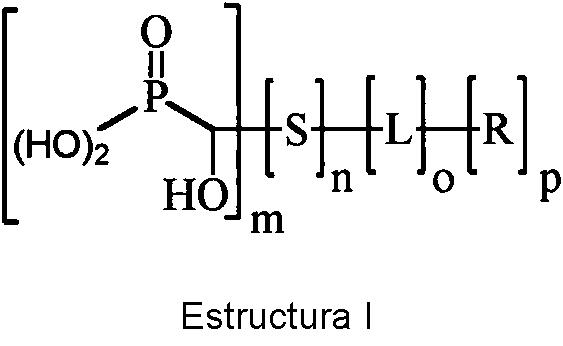
en donde S es un espaciador, L es un enlace entre S y R y R es un resto hidrófilo basado en unidades de óxido de etileno y m y p son 1-5 y n y o son 0-5. En algunas realizaciones, S es un enlace directo, un grupo alifático o cicloalifático no sustituido o sustituido, un grupo arilo no sustituido o sustituido, un grupo heteroalifático o un grupo heteroarilo y en algunos casos es un grupo alquilo de cadena lineal de 1 a 10 átomos de carbono de longitud y L es un enlace directo, grupo carbonilo, grupo éter, grupo éster, amina secundaria o terciaria, grupo amina cuaternaria, grupo amida, grupo carbamato o grupo urea. Las nanopartículas adecuadas son aquellas que no son solubles en agua en el sentido clásico en el que las moléculas individuales del soluto se dispersan uniformemente en el disolvente en forma de azúcar o sal de mesa en agua. Por lo tanto, el tratamiento de nanopartículas que poseen cierto grado de capacidad de suspensión en agua con los conjugados de ácido alfa-hidroxifosfónico y las nanopartículas resultantes con los conjugados adheridos se incluyen en la presente descripción. En la presente invención, la nanopartícula insoluble en agua es una nanopartícula superparamagnética basada en óxido de hierro o una nanopartícula radiopaca basada en óxido de tantalio.where S is a spacer, L is a bond between S and R and R is a hydrophilic moiety based on units of ethylene oxide and m and p are 1-5 and no are 0-5. In some embodiments, S is a direct link, an aliphatic or cycloaliphatic group. unsubstituted or substituted, an unsubstituted or substituted aryl group, a heteroaliphatic group or a heteroaryl group and in some cases it is a straight chain alkyl group of 1 to 10 carbon atoms in length and L is a direct bond, carbonyl group, ether group, ester group, secondary or tertiary amine, quaternary amine group, amide group, carbamate group or urea group. Suitable nanoparticles are those that are not soluble in water in the classical sense in which the individual molecules of the solute are uniformly dispersed in the solvent in the form of sugar or table salt in water. Therefore, the treatment of nanoparticles that possess a certain degree of water suspension capacity with alpha-hydroxyphosphonic acid conjugates and the resulting nanoparticles with adhered conjugates are included in the present description. In the present invention, the water insoluble nanoparticle is a superparamagnetic nanoparticle based on iron oxide or a radiopaque nanoparticle based on tantalum oxide.
Es de particular interés que el conjugado no incluya grupos o restos que podrían tener reacciones indeseables con tejido humano. Por lo tanto, es conveniente que el conjugado muestre un potencial zeta entre aproximadamente -40 mV y 40 mV, preferiblemente entre aproximadamente -15 mV y 15 mV cuando se adhiere a una nanopartícula, siendo especialmente interesante que muestre un potencial zeta esencialmente neutro cuando se adhiere. Esto se logra convenientemente utilizando zwitteriones o restos no iónicos como el resto hidrófilo.It is of particular interest that the conjugate does not include groups or moieties that could have undesirable reactions with human tissue. Therefore, it is convenient for the conjugate to show a zeta potential between about -40 mV and 40 mV, preferably between about -15 mV and 15 mV when adhering to a nanoparticle, it being especially interesting to show an essentially neutral zeta potential when adheres This is conveniently achieved using zwitterions or non-ionic moieties such as the hydrophilic moiety.
Los restos hidrófilos de la descripción pueden ser monoméricos o poliméricos pero es conveniente que tengan una carga neta iónica esencialmente neutral. Entre los restos hidrófilos poliméricos, son de especial interés aquellos poliéteres basados al menos parcialmente en unidades de óxido de etileno, tales como copolímeros de óxido de etileno/óxido de propileno y polietilenglicol. En la presente invención, el resto hidrófilo es un resto hidrófilo polimérico basado en unidades de óxido de etileno.The hydrophilic moieties of the description can be monomeric or polymeric but it is convenient that they have an essentially neutral net ionic charge. Among the polymeric hydrophilic moieties, polyethers of at least partially based on ethylene oxide units, such as copolymers of ethylene oxide / propylene oxide and polyethylene glycol, are of particular interest. In the present invention, the hydrophilic moiety is a polymeric hydrophilic moiety based on ethylene oxide units.
Restos hidrófilos monoméricos sin carga neta, particularmente los zwitteriones, son convenientes para conjugados utilizados para tratar nanopartículas para ser utilizados in vivo con sujetos humanos debido a la mayor facilidad para caracterizarlos para evaluaciones de seguridad. Entre estos, los basados en ácido 4-piperadinecarboxílico son de especial interés.Monomeric hydrophilic residues without net charge, particularly zwitterions, are suitable for conjugates used to treat nanoparticles to be used in vivo with human subjects due to the greater ease of characterizing them for safety assessments. Among these, those based on 4-piperadinecarboxylic acid are of special interest.
También es conveniente que los conjugados utilizados para tratar nanopartículas se usen in vivo con sujetos humanos, ya que el enlace entre el ácido a-hidroxifosfónico y un resto hidrófilo es un hidrato de carbono, es decir, en la estructura I A es un enlace simple. Esto minimiza la probabilidad de cualquier interacción entre dichas nanopartículas tratadas y el tejido humano. A este respecto, los conjugados de las siguientes estructuras II y III son de particular interés:It is also convenient that the conjugates used to treat nanoparticles be used in vivo with human subjects, since the link between a-hydroxyphosphonic acid and a hydrophilic moiety is a carbohydrate, that is, in structure IA it is a single bond. This minimizes the likelihood of any interaction between said treated nanoparticles and human tissue. In this regard, the conjugates of the following structures II and III are of particular interest:

El conjugado es preferiblemente suficientemente hidrófilo que cuando se usa para tratar nanopartículas en una proporción de aproximadamente dos conjugados por nanopartícula hará que las nanopartículas sean capaces de formar suspensiones coloidales estables en medios acuosos con un Dh determinado por DLS de aproximadamente 500 nm o menos. Es particularmente conveniente que haga que las nanopartículas tratadas sean lo suficientemente hidrófilas para mostrar un valor inferior a uno para el logaritmo del coeficiente de distribución entre volúmenes iguales de n-octanol y tampón 0,1 M pH 7,0 ácido 3-(N-morfolino) propanosulfónico (MOPS).The conjugate is preferably sufficiently hydrophilic that when used to treat nanoparticles in a proportion of approximately two conjugates per nanoparticle will cause the nanoparticles to be able to form stable colloidal suspensions in aqueous media with a D h determined by DLS of approximately 500 nm or less. It is particularly convenient that the treated nanoparticles are hydrophilic enough to show a value less than one for the logarithm of the distribution coefficient between equal volumes of n-octanol and 0.1 M buffer pH 7.0 acid 3- (N- morpholino) propanesulfonic acid (MOPS).
Las nanopartículas de la descripción que se tratan con el conjugado para lograr mayor hidrofilicidad se basan preferiblemente en metales de transición y compuestos de metales de transición tales como óxidos, carburos, sulfuros, nitruros, fosfuros, boruros, haluros, seleniuros, telururos y combinaciones de los mismos. Los óxidos son de particular interés. Se cree que la estructura del óxido contribuye a la adhesión del ácido a-hidroxifosfónico. Los compuestos de metales de transición son útiles para preparar agentes de contraste para imágenes de MR y rayos X. Los metales de transición del tercer período de la tabla periódica de elementos son útiles para formar compuestos que muestran paramagnetismo y convenientemente superparamagnetismo y por lo tanto son útiles como agentes de contraste de IRM. Especialmente convenientes son las nanopartículas superparamagnéticas basadas en óxido de hierro que forman parte de la presente invención y opcionalmente cobalto, cobre, manganeso, níquel o combinaciones de los mismos que forman parte de la descripción, pero no se reivindican.The nanoparticles of the description that are treated with the conjugate to achieve greater hydrophilicity are preferably based on transition metals and transition metal compounds such as oxides, carbides, sulfides, nitrides, phosphides, borides, halides, selenides, tellurides and combinations of the same. Oxides are of particular interest. It is believed that the oxide structure contributes to the adhesion of α-hydroxyphosphonic acid. Transition metal compounds are useful for preparing contrast agents for MR and X-ray images. Transition metals of the third period of the periodic table of elements are useful for forming compounds that show paramagnetism and conveniently superparamagnetism and therefore are useful as MRI contrast agents. Especially convenient are iron oxide oxide superparamagnetic nanoparticles that are part of the present invention and optionally cobalt, copper, manganese, nickel or combinations thereof that are part of the description, but are not claimed.
De estos, los más convenientes son nanopartículas basadas en magnetita, maghemita o combinaciones de aproximadamente 15 nm o menos de diámetro y que muestran superparamagnetismo. Estas se conocen comúnmente como partículas de óxido de hierro superparamagnético (SPIO). Los metales de transición con un número atómico mayor que 34 y zinc son útiles para preparar compuestos útiles como agentes de contraste de rayos X. Entre estos hafnio, molibdeno, plata, tantalio, wolframio y circonio son de interés particular, siendo el tantalio y particularmente el óxido de tantalio el más conveniente. La presente invención abarca también nanopartículas radiopacas basadas en óxido de tantalio.Of these, the most convenient are nanoparticles based on magnetite, maghemite or combinations of approximately 15 nm or less in diameter and showing superparamagnetism. These are commonly known as superparamagnetic iron oxide (SPIO) particles. Transition metals with an atomic number greater than 34 and zinc are useful for preparing useful compounds as X-ray contrast agents. Among these Hafnium, molybdenum, silver, tantalum, tungsten and zirconium are of particular interest, with tantalum and particularly tantalum oxide being the most convenient. The present invention also encompasses radiopaque nanoparticles based on tantalum oxide.
Las nanopartículas modificadas hidrófilamente suelen tener un Dh determinado por DLS de 500 nm o menos. Es conveniente que su Dh sea de 50 nm o menos, más preferiblemente de 30 nm o menos y más preferiblemente que Dh esté entre 3 y 30 nm. Si las nanopartículas modificadas hidrófilamente se destinan para uso in vivo en sujetos humanos como, por ejemplo, agentes de contraste de IRM o rayos X, un Dh particularmente conveniente es de aproximadamente 8 nm o menos.Hydrophilically modified nanoparticles usually have a Dh determined by DLS of 500 nm or less. It is convenient that its Dh is 50 nm or less, more preferably 30 nm or less and more preferably that Dh is between 3 and 30 nm. If hydrophilically modified nanoparticles are intended for use in vivo in human subjects such as, for example, MRI or X-ray contrast agents, a particularly convenient Dh is approximately 8 nm or less.
Las nanopartículas modificadas hidrófilamente se preparan convenientemente haciéndolas reaccionar con el conjugado. Un método conveniente es formar una suspensión coloidal de las nanopartículas en un disolvente orgánico como el tetrahidrofurano (THF) y después mezclarlo con una disolución orgánica del conjugado en la misma disolución orgánica o en otra diferente. La mezcla se puede mantener después a una temperatura elevada durante un período prolongado hasta que la reacción está esencialmente completada. Típicamente, son convenientes temperaturas de 50°C o más durante 16 horas o más.Hydrophilically modified nanoparticles are conveniently prepared by reacting them with the conjugate. A convenient method is to form a colloidal suspension of the nanoparticles in an organic solvent such as tetrahydrofuran (THF) and then mix it with an organic solution of the conjugate in the same or different organic solution. The mixture can then be maintained at an elevated temperature for a prolonged period until the reaction is essentially complete. Typically, temperatures of 50 ° C or more are convenient for 16 hours or more.
Se obtienen fácilmente suspensiones coloidales acuosas monodispersas estables de las nanopartículas modificadas hidrófilamente. Dichas suspensiones deberían ser preferiblemente estables frente a filtración, como filtración de flujo tangencial frente a un corte de 30 kDa y la adición de electrolitos tal como la adición de NaCl para hacer que el medio acuoso sea isotónico, es decir, aproximadamente 150 mM de NaCl. Preferiblemente, las suspensiones son estables durante períodos de almacenamiento de una semana o más y, más preferiblemente son estables no solo frente sedimentación sino también frente el crecimiento del Dh determinado por DLS de las nanopartículas suspendidas. Si las suspensiones están destinadas para uso in vivo en sujetos humanos, es conveniente hacerlas isotónicas mediante la adición de NaCl, dextrosa o combinaciones de las mismas.Stable monodispersed aqueous colloidal suspensions of the hydrophilically modified nanoparticles are easily obtained. Such suspensions should preferably be stable against filtration, such as tangential flow filtration against a 30 kDa cut and the addition of electrolytes such as the addition of NaCl to make the aqueous medium isotonic, that is, approximately 150 mM NaCl . Preferably, the suspensions are stable during storage periods of a week or more and, more preferably they are stable not only against sedimentation but also against the growth of Dh determined by DLS of the suspended nanoparticles. If the suspensions are intended for in vivo use in human subjects, it is convenient to make them isotonic by the addition of NaCl, dextrose or combinations thereof.
Las suspensiones coloidales acuosas monodispersas estables se preparan convenientemente diluyendo una suspensión coloidal en un disolvente orgánico. Un método conveniente es simplemente diluir el disolvente orgánico o disolventes en los cuales las nanopartículas han reaccionado con el conjugado mediante la adición de agua. Otro método es hacer reaccionar una suspensión coloidal de las nanopartículas en un disolvente orgánico con el conjugado en agua. En cualquier caso, es conveniente eliminar los reactivos sin reaccionar por filtración o extracción orgánica con un disolvente como hexano o una combinación. Cualquier producto volátil en la fase acuosa después de la extracción con disolvente se puede eliminar mediante la aplicación de un vacío parcial. Después, las nanopartículas modificadas hidrófilamente se pueden purificar por filtración de flujo tangencial contra un filtro de 30 kDa.Stable monodispersed aqueous colloidal suspensions are conveniently prepared by diluting a colloidal suspension in an organic solvent. A convenient method is simply to dilute the organic solvent or solvents in which the nanoparticles have reacted with the conjugate by adding water. Another method is to react a colloidal suspension of the nanoparticles in an organic solvent with the conjugate in water. In any case, it is convenient to remove unreacted reagents by filtration or organic extraction with a solvent such as hexane or a combination. Any volatile product in the aqueous phase after solvent extraction can be removed by applying a partial vacuum. Then, hydrophilically modified nanoparticles can be purified by tangential flow filtration against a 30 kDa filter.
Las nanopartículas modificadas hidrófilamente se pueden usar convenientemente como agentes de contraste en diagnóstico por imagen. Los tipos comunes de tales imágenes de diagnóstico son la RM y rayos X. En cualquier caso, es conveniente usar nanopartículas modificadas hidrófilamente que tengan un potencial zeta entre aproximadamente -15 mV y 15 mV. Un método conveniente en la formación de imágenes in vivo de sujetos humanos es administrar las nanopartículas por vía intravenosa, preferiblemente como una suspensión acuosa isotónica estable. Si la imagen debe ser por RM, las nanopartículas deberían comprender una especie paramagnética, preferiblemente superparamagnética, y lo más preferiblemente deberían estar basadas en óxido de hierro como magnetita o maghemita. Si la imagen debe ser por rayos X, las nanopartículas deberían comprender un compuesto de metal de transición de un metal con un número atómico mayor que 34 o zinc, preferiblemente oro, hafnio, molibdeno, plata. tantalio, wolframio o zirconio y lo más preferiblemente deberían estar basados en óxido de tantalio. En la presente invención, la nanopartícula es, por lo tanto, una nanopartícula superparamagnética basada en óxido de hierro o una nanopartícula radiopaca basada en óxido de tantalio.Hydrophilically modified nanoparticles can be conveniently used as contrast agents in diagnostic imaging. Common types of such diagnostic images are MRI and X-rays. In any case, it is convenient to use hydrophilically modified nanoparticles that have a zeta potential between approximately -15 mV and 15 mV. A convenient method in the in vivo imaging of human subjects is to administer the nanoparticles intravenously, preferably as a stable isotonic aqueous suspension. If the image must be by MRI, the nanoparticles should comprise a paramagnetic species, preferably superparamagnetic, and most preferably they should be based on iron oxide such as magnetite or maghemite. If the image must be by X-ray, the nanoparticles should comprise a transition metal compound of a metal with an atomic number greater than 34 or zinc, preferably gold, hafnium, molybdenum, silver. Tantalum, tungsten or zirconium and most preferably should be based on tantalum oxide. In the present invention, the nanoparticle is therefore a superparamagnetic nanoparticle based on iron oxide or a radiopaque nanoparticle based on tantalum oxide.
En una realización particularmente interesante, las nanopartículas modificadas hidrófilamente tienen un Dh de 8 nm o menos y dejan el cuerpo del sujeto a través del riñón.In a particularly interesting embodiment, the hydrophilically modified nanoparticles have a Dh of 8 nm or less and leave the subject's body through the kidney.
Dibujos.Drawings.
Estas y otras características, aspectos y ventajas de la presente invención se entenderán mejor cuando se lea la siguiente descripción detallada con referencia a los dibujos adjuntos, en los que los caracteres similares representan partes similares a los dibujos, en donde:These and other features, aspects and advantages of the present invention will be better understood when the following detailed description is read with reference to the attached drawings, in which the similar characters represent parts similar to the drawings, wherein:
La figura 1 es una fórmula estructural genérica para ácidos alfa-hidroxi fosfónicos adecuados con los que se fabrican nanopartículas hidrófilas.Figure 1 is a generic structural formula for suitable alpha-hydroxy phosphonic acids with which hydrophilic nanoparticles are manufactured.
La figura 2 es la fórmula estructural para un ácido alfa-hidroxi fosfónico particularmente interesante con el que se fabrican nanopartículas hidrófilas en las que Me es un grupo metilo.Figure 2 is the structural formula for a particularly interesting alpha-hydroxy phosphonic acid with which hydrophilic nanoparticles are manufactured in which Me is a methyl group.
La figura 3 es una ruta sintética a ácidos alfa-hidroxifosfónicos con restos R hidrófilos unidos.Figure 3 is a synthetic route to alpha-hydroxyphosphonic acids with attached hydrophilic R moieties.
La figura 4 es una ruta sintética al ácido alfa-hidroxi fosfónico particularmente interesante mostrado en la figura 2. Figure 4 is a particularly interesting synthetic route to alpha-hydroxy phosphonic acid shown in Figure 2.
La figura 5 es una representación esquemática hipotética de la unión de un ácido alfa-hidroximexfosfónico del tipo cuya síntesis se ilustra en la figura 3 con un resto hidrófilo R unido a una nanopartícula SPIO superparamagnética de óxido de hierro.Figure 5 is a hypothetical schematic representation of the binding of an alpha-hydroxymexphosphonic acid of the type whose synthesis is illustrated in Figure 3 with a hydrophilic moiety R attached to a superparamagnetic iron oxide SPIO nanoparticle.
La figura 6A es una imagen ponderada en T1 (TE = 4,1 ms) de un tumor según el ejemplo 12 sin agente de contraste. Figure 6A is a T1-weighted image (TE = 4.1 ms) of a tumor according to example 12 without contrast agent.
La figura 6B es una imagen ponderada en T1 (TE = 4,1 ms) de un tumor según el ejemplo 12, 30 minutos después de la administración del agente de contraste de nanopartícula del ejemplo 4.Figure 6B is a T1-weighted image (TE = 4.1 ms) of a tumor according to Example 12, 30 minutes after administration of the nanoparticle contrast agent of Example 4.
La figura 6C es un mapa de diferencias de las diferencias entre la figura 6A y la figura 6B.Figure 6C is a difference map of the differences between Figure 6A and Figure 6B.
La figura 6D es una imagen ponderada en T2* (TE = 18,4 ms) de un tumor según el ejemplo 12 sin agente de contraste. Figure 6D is a T2 * weighted image (TE = 18.4 ms) of a tumor according to example 12 without contrast agent.
La figura 6E es una imagen ponderada en T2* (TE = 18,4 ms) de un tumor según el ejemplo 1230 minutos después de la administración del agente de contraste de nanopartículas del ejemplo 4.Figure 6E is a T2 * weighted image (TE = 18.4 ms) of a tumor according to example 1230 minutes after administration of the nanoparticle contrast agent of example 4.
La figura 6F es un mapa de diferencia de relajación R2* de las diferencias entre la figura 6D y la figura 6E que muestra una clara distinción entre tumor y tejido muscular.Figure 6F is a relaxation difference map R2 * of the differences between Figure 6D and Figure 6E showing a clear distinction between tumor and muscle tissue.
Descripción detallada.Detailed description.
Los conjugados de la presente invención se definen ampliamente para tener una amplia variedad de enlaces y restos hidrófilos. La característica clave es que el conjugado tiene los tres grupos hidroxilo del ácido a-hidroxi fosfónico que son química y estéricamente accesibles. Si bien la estructura tiene centros quirales, se espera que todos los enantiómeros individuales y las posibles mezclas racémicas sean adecuados para impartir hidrofilicidad a las nanopartículas insolubles en agua.The conjugates of the present invention are broadly defined to have a wide variety of hydrophilic bonds and moieties. The key feature is that the conjugate has the three hydroxyl groups of α-hydroxy phosphonic acid that are chemically and sterically accessible. Although the structure has chiral centers, all individual enantiomers and possible racemic mixtures are expected to be suitable for imparting hydrophilicity to water-insoluble nanoparticles.
Estos conjugados pueden tener cualquiera de los enlaces químicos conocidos comúnmente entre la estructura del ácido a-hidroxifosfónico y el resto hidrófilo, incluidos los basados en carbono, nitrógeno, oxígeno y azufre. Los grupos de interés particular son hidratos de carbono, carbonilo, éster, éter, amina secundaria o terciaria, amina cuaternaria, urea, carbamato y amida. El uso final previsto de las nanopartículas a tratar con el conjugado puede afectar la elección del grupo de enlace. Por ejemplo, si las nanopartículas se van a usar in vivo, particularmente en sujetos humanos, puede ser deseable evitar enlaces tales como grupos cuaternarios que puedan dar interacciones con componentes tisulares como proteínas. El grupo de enlace más interesante desde el punto de vista de la inercia es un hidrato de carbono.These conjugates may have any of the commonly known chemical bonds between the structure of α-hydroxyphosphonic acid and the hydrophilic moiety, including those based on carbon, nitrogen, oxygen and sulfur. Particular interest groups are carbohydrates, carbonyl, ester, ether, secondary or tertiary amine, quaternary amine, urea, carbamate and amide. The intended end use of the nanoparticles to be treated with the conjugate may affect the choice of the linking group. For example, if nanoparticles are to be used in vivo, particularly in human subjects, it may be desirable to avoid bonds such as quaternary groups that can interact with tissue components such as proteins. The most interesting linking group from the point of view of inertia is a carbohydrate.
El resto hidrófilo de la descripción puede ser cualquiera de los restos que se sabe que tienen buena compatibilidad con agua, incluyendo los conocidos como surfactantes. Pueden ser aniónicos, catiónicos o no iónicos. El resto hidrófilo puede ser un hidrato de carbono tal como mono, di u oligosacárido, un polialcohol monomérico sin hidrato de carbono, un poliéter con grupos de óxido de etileno, un polímero sin hidratos de carbono, otros distintos de los poliéteres con grupos de óxido de etileno, que tiene grupos hidroxilo colgantes tales como como alcohol de polivinilo, poli (etilenimina), una amina alifática o cicloalifática y sus combinaciones. Con respecto a la presente invención, el resto hidrófilo es un resto hidrófilo polimérico basado en unidades de óxido de etileno.The hydrophilic moiety of the description can be any of the moieties that are known to have good water compatibility, including those known as surfactants. They can be anionic, cationic or non-ionic. The hydrophilic moiety can be a carbohydrate such as mono, di or oligosaccharide, a monomeric polyhydric alcohol without carbohydrate, a polyether with ethylene oxide groups, a polymer without carbohydrates, other than polyethers with oxide groups of ethylene, which has pendant hydroxyl groups such as polyvinyl alcohol, poly (ethyleneimine), an aliphatic or cycloaliphatic amine and combinations thereof. With respect to the present invention, the hydrophilic moiety is a polymeric hydrophilic moiety based on ethylene oxide units.
En algunas realizaciones, los restos hidrófilos se basan en óxido de etileno, siendo los poli (óxidos de etileno) de interés específico, particularmente aquellos con pesos moleculares iguales o menores que aproximadamente 5.000 daltons, especialmente aquellos con pesos moleculares iguales o menores que aproximadamente 2.000 daltons. Los poli (óxidos de etileno) con pesos moleculares de aproximadamente 350 daltons son de particular interés.In some embodiments, hydrophilic moieties are based on ethylene oxide, with poly (ethylene oxides) of specific interest, particularly those with molecular weights equal to or less than about 5,000 daltons, especially those with molecular weights equal to or less than about 2,000 daltons. Poly (ethylene oxides) with molecular weights of approximately 350 daltons are of particular interest.
El resto hidrófilo de la descripción, pero que no es parte de la presente invención, también puede ser un zwitterión que tiene uno o más restos cargados positivamente, uno o más restos cargados negativamente y un grupo espaciador entre los restos cargados. Para los fines de esta solicitud, las combinaciones de restos cargados positivamente y restos cargados negativamente se consideran zwitteriones si a valores de pH fisiológico no muestran prácticamente ninguna carga neta. Restos cargados positivamente adecuados incluyen aminas primarias protonadas, aminas secundarias protonadas, alquil aminas terciarias protonadas, alquil aminas cuantitativas, amidinas protonadas, guanidinas protonadas, piridinas protonadas, pirimidinas protonadas, pirazinas protonadas, purinas protonadas, imidazoles protonados, pirroles protonados o combinaciones de los mismos, los grupos adecuados cargados negativamente incluyen ácidos carboxílicos desprotonados, ácidos sulfónicos desprotonados, ácidos sulfínicos desprotonados, ácidos fosfónicos desprotonados, ácidos fosfóricos desprotonados, ácidos fosfínicos desprotonados o combinaciones de los mismos y grupos espaciadores adecuados incluyen grupos alifáticos, cicloalifáticos y arilo no sustituidos y sustituidos, grupos heteroalifáticos, grupos heteroarilo, éteres, amidas, ésteres, carbamatos, ureas o combinaciones de los mismos. En una realización, los grupos espaciadores incluyen grupos alquilo de cadena lineal de 1 a 10 átomos de carbono de longitud.The hydrophilic moiety of the description, but not part of the present invention, may also be a zwitterion having one or more positively charged moieties, one or more negatively charged moieties and a spacer group between the charged moieties. For the purposes of this application, combinations of positively charged residues and negatively charged residues are considered zwitterions if at physiological pH values they show virtually no net charge. Suitable positively charged residues include protonated primary amines, protonated secondary amines, protonated tertiary alkyl amines, quantitative alkyl amines, protonated amidines, protonated guanidines, protonated pyridines, protonated pyrimidines, protonated pyrazines, protonated purines, protonated imidazoles or combinations thereof Suitable negatively charged groups include deprotonated carboxylic acids, deprotonated sulfonic acids, deprotonated sulfonic acids, deprotonated phosphonic acids, deprotonated phosphoric acids, deprotonated phosphonic acids or combinations thereof, and suitable spacer groups include unsubstituted and substituted aliphatic, cycloaliphatic and aryl groups. , heteroaliphatic groups, heteroaryl groups, ethers, amides, esters, carbamates, ureas or combinations thereof. In one embodiment, the spacer groups include straight chain alkyl groups of 1 to 10 carbon atoms in length.
Si el uso final previsto de las nanopartículas es compatible con las nanopartículas modificadas hidrófilamente con los conjugados de ácido alfa-hidroxifosfónico adheridos que tienen una carga iónica neta, el resto hidrófilo de la descripción puede ser cualquiera de los restos cargados positivamente o cualquiera de los restos cargados negativamente discutidos anteriormente como adecuados para la formación de zwitteriones. If the intended end use of the nanoparticles is compatible with the hydrophilically modified nanoparticles with the adhered alpha-hydroxyphosphonic acid conjugates having a net ionic charge, the hydrophilic moiety of the description may be any of the positively charged moieties or any of the moieties negatively charged discussed above as suitable for zwitterion formation.
El uso final previsto de las nanopartículas a tratar con el conjugado puede afectar la elección del resto hidrófilo. Por ejemplo, si las nanopartículas se van a usar in vivo, particularmente en sujetos humanos, puede ser deseable evitar restos hidrófilos tal como grupos iónicos, que pueden dar lugar a interacciones con componentes del tejido, como las proteínas. Para uso in vivo, restos hidrófilos con esencialmente ninguna carga neta tal como (no parte de la presente invención) y poliéteres con unidades de óxido de etileno (parte de la presente invención) son de particular interés. Para uso con sujetos humanos, son particularmente convenientes restos hidrófilos que se caracterizan fácil y reproduciblemente para evaluación de seguridad tales como los restos monoméricos y forman parte de la descripción, pero no de la presente invención. Particularmente los restos hidrófilos convenientes son aquellos basados en ácido 4-piperadinecarboxílico que son tanto monoméricos como los zwitterions no llevan carga neta. Para aplicaciones en las que la toxicidad es menos preocupante como la inoculación in vitro de cultivos celulares, poli(etileno)iminas pueden ser restos hidrófilos apropiados.The intended end use of the nanoparticles to be treated with the conjugate may affect the choice of the hydrophilic moiety. For example, if nanoparticles are to be used in vivo, particularly in human subjects, it may be desirable to avoid hydrophilic moieties such as ionic groups, which may result in interactions with tissue components, such as proteins. For in vivo use , hydrophilic moieties with essentially no net charge such as (not part of the present invention) and polyethers with ethylene oxide units (part of the present invention) are of particular interest. For use with human subjects, hydrophilic moieties that are easily and reproducibly characterized for safety evaluation such as monomeric moieties and are part of the description, but not of the present invention, are particularly suitable. Particularly suitable hydrophilic moieties are those based on 4-piperadinecarboxylic acid that are both monomeric and zwitterions carry no net charge. For applications where toxicity is less worrisome such as in vitro inoculation of cell cultures, poly (ethylene) imines may be appropriate hydrophilic moieties.
Zwitterions particularmente adecuados son parte de la descripción pero no de la presente invención se describen en la solicitud de patente de EEUU 12/344.604 presentada el 29 de diciembre de 2008, incorporada por referencia en la presente memoria. Estos incluyen restos hidrófilos que contienen nitrógenos catiónicos y grupos basados en ácidos aniónicos carboxílicos, fosfóricos y sulfónico, tales como ácido N, N-dimetil-3-sulfo N-(3-propil) propan-1-amonio, 3-(metil) propil) amino) propano-1-sulfónico, ácido 3-(propilamino) propano-1-sulfónico, ácido 2-(etoxi (hidroxi) fosforiloxi) -N, N, N-trimetiletanio, 2etil (hidroxi) fosforiloxi) -N, N, N-trimetiletanaminio, N, N, N-trimetil-3- (N-propionilsulfamoil) ropano-1 amonio, N-((2H-tetrazol-5-il) metil)-N, N-dimetil-propan-1-aluminio, N-(2-carboxietil) -N, N-dimetil-propan-1-amonio, ácido 3- (metilpropil) amino) propanoico, ácido 3- (propilamino) propanoico, N-(carboximetil)-N, N-dimetilo -propan-1- amonio, ácido 2-(metilamino) acético, ácido 2-(propilamino) acético, ácido 2-(4-propilcarbamoil) piperazin-1-il) acético, ácido 3- (4propilcarbamoil) piperazin-1-il) propanoico, ácido 2-(metil (2-propilureido) etil) amino) acético y ácido 2-(2-(propilureido) etil) aminoacético.Particularly suitable Zwitterions are part of the description but not of the present invention are described in US patent application 12 / 344,604 filed on December 29, 2008, incorporated by reference herein. These include hydrophilic moieties containing cationic nitrogens and groups based on carboxylic, phosphoric and sulfonic anionic acids, such as N, N-dimethyl-3-sulfo N- (3-propyl) propan-1-ammonium, 3- (methyl) propyl) amino) propane-1-sulfonic acid, 3- (propylamino) propane-1-sulfonic acid, 2- (ethoxy (hydroxy) phosphoryloxy) -N, N, N-trimethylethanium, 2-ethyl (hydroxy) phosphoryloxy) -N, N, N-trimethylethanamminium, N, N, N-trimethyl-3- (N-propionylsulfamoyl) clotheshane-1 ammonium, N - ((2H-tetrazol-5-yl) methyl) -N, N-dimethyl-propan-1 -aluminium, N- (2-carboxy-ethyl) -N, N-dimethyl-propan-1-ammonium, 3- (methylpropyl) amino) propanoic acid, 3- (propylamino) propanoic acid, N- (carboxymethyl) -N, N -dimethyl -propan-1- ammonium, 2- (methylamino) acetic acid, 2- (propylamino) acetic acid, 2- (4-propylcarbamoyl) piperazin-1-yl) acetic acid, 3- (4-propylcarbamoyl) piperazin-1 acid -yl) propanoic acid, 2- (methyl (2-propylureido) ethyl) amino) acetic acid and 2- (2- (propylureido) ethyl acid) aminoacetic
Restos hidrófilos a base de poliéter hidrófilos adecuados se describen en la patente de EEUU 5.916.539 expedida el 29 de junio de 1999. Estos incluyen polietilen glicoles (PEG) de varios pesos moleculares con varios grupos terminales que incluyen amino e hidroxilo, así como copolímeros con polipropilenglicol (PPG).Suitable hydrophilic hydrophilic hydrophilic moieties are described in US Patent 5,916,539 issued June 29, 1999. These include polyethylene glycols (PEG) of various molecular weights with various terminal groups including amino and hydroxyl, as well as copolymers. with polypropylene glycol (PPG).
El conjugado es preferiblemente suficientemente hidrófilo para que pueda hacer que las nanopartículas puedan formar suspensiones acuosas estables cuando reaccionan con las nanopartículas en una proporción de dos moles de conjugado a un mol de la base metálica de la nanopartícula. En este sentido, la nanopartícula se basará típicamente en un compuesto de metal de transición como un óxido o un metal de transición en sí mismo. Es conveniente especificar la proporción de reacción utilizando los moles de metal elemental, ya que esto se puede obtener fácilmente a partir de un análisis elemental de la suspensión de partida de nanopartículas en un disolvente orgánico. A partir del conocimiento de la composición química de las nanopartículas y su tamaño promedio antes del tratamiento, se puede realizar un cálculo aproximado de la cantidad de conjugado por nanopartícula. Es particularmente conveniente que el conjugado sea lo suficientemente hidrófilo para dar nanopartículas de óxido de hierro u óxido de tantalio de menos de 15 nm tratados en esta proporción con una hidrofilicidad suficiente para mostrar un valor inferior a uno para el logaritmo del coeficiente de distribución entre volúmenes iguales de n-octanol ytampón 0,1 M pH 7,0 MOPS.The conjugate is preferably hydrophilic enough to allow the nanoparticles to form stable aqueous suspensions when they react with the nanoparticles in a proportion of two moles of conjugate to one mole of the metal base of the nanoparticle. In this sense, the nanoparticle will typically be based on a transition metal compound such as an oxide or a transition metal itself. It is convenient to specify the reaction rate using the moles of elemental metal, since this can be easily obtained from an elementary analysis of the starting suspension of nanoparticles in an organic solvent. From the knowledge of the chemical composition of the nanoparticles and their average size before treatment, an approximate calculation of the amount of conjugate per nanoparticle can be made. It is particularly convenient that the conjugate be hydrophilic enough to give iron oxide or tantalum oxide nanoparticles of less than 15 nm treated in this proportion with sufficient hydrophilicity to show a value less than one for the logarithm of the distribution coefficient between volumes Equals of n-octanol and 0.1 M buffer pH 7.0 MOPS.
Es de particular interés que las nanopartículas modificadas hidrófilamente con un conjugado de ácido alfahidroxifosfónico adherido sean suficientemente hidrófilas para formar una suspensión coloidal acuosa estable que no muestre un cambio sustancial en el diámetro hidrodinámico (Dh) según lo determinado por la dispersión dinámica de la luz (DLS) en agua 150 mM NaCl después de filtración de flujo tangencial y almacenamiento durante una semana a temperatura ambiente.It is of particular interest that hydrophilically modified nanoparticles with an adhered alpha-hydroxyphosphonic acid conjugate are sufficiently hydrophilic to form a stable aqueous colloidal suspension that does not show a substantial change in hydrodynamic diameter (Dh) as determined by the dynamic light scattering ( DLS) in 150 mM NaCl water after tangential flow filtration and storage for one week at room temperature.
Las nanopartículas que forman parte de la descripción que deben ser tratadas con el conjugado pueden ser de cualquier material insoluble en agua que se pueda formar en partículas de 500 nm o menos a las que se adherirá el ácido a-hidroxi fosfónico de conjugado. Es de interés utilizar nanopartículas que tienen utilidad como agentes de contraste en imágenes RM o rayos X. Sin embargo, también son de interés las nanopartículas para otros usos finales, como la infusión de cultivos celulares por transfección de genes. La nanopartícula insoluble en agua de la presente invención es una nanopartícula superparamagnética basada en óxido de hierro o una nanopartícula radiopaca basada en óxido de tantalio.The nanoparticles that are part of the description that must be treated with the conjugate can be of any water insoluble material that can be formed into particles of 500 nm or less to which the conjugated α-hydroxy phosphonic acid will adhere. It is of interest to use nanoparticles that have utility as contrast agents in RM or X-ray images. However, nanoparticles are also of interest for other end uses, such as infusion of cell cultures by gene transfection. The water insoluble nanoparticle of the present invention is a superparamagnetic nanoparticle based on iron oxide or a radiopaque nanoparticle based on tantalum oxide.
Para su uso como agentes de contraste para IRM, la base de las nanopartículas debe ser un metal o sus compuestos que sean paramagnéticos, siendo de particular interés aquellos que son superparamagnéticos. Estos metales se extraen convenientemente de los metales de transición del período III de la tabla periódica de los elementos que comienzan con manganeso y terminan con zinc. Un grupo de materiales particularmente interesante son aquellos basados en óxido de hierro. Los materiales especialmente convenientes son aquellos conocidos como SPIO. Estos materiales tienen la fórmula general [Fe2 03] x [Fe2 O3 (M2+ O)]-i_x donde 1 > x > 0. M2+ puede ser un ion metálico divalente como hierro, manganeso, níquel, cobalto, magnesio, cobre, zinc o una combinación de los mismos. Cuando el ion metálico (M2+) es un ion ferroso (Fe2+) y x = 0, el material es magnetita (Fe304), y cuando x = 1, el material es maghemita (Y-Fe203).For use as contrast agents for MRI, the base of the nanoparticles must be a metal or its compounds that are paramagnetic, being of particular interest those that are superparamagnetic. These metals are conveniently extracted from the transition metals of period III of the periodic table of elements that start with manganese and end with zinc. A particularly interesting group of materials are those based on iron oxide. Especially suitable materials are those known as SPIO. These materials have the general formula [Fe2 03] x [Fe2 O3 (M2 + O)] - i_x where 1> x> 0. M2 + can be a divalent metal ion such as iron, manganese, nickel, cobalt, magnesium, copper, zinc or A combination of them. When the metal ion (M2 +) is a ferrous ion (Fe2 +) and x = 0, the material is magnetite (Fe304), and when x = 1, the material is maghemite (Y-Fe203).
En general, el superparamagnetismo ocurre cuando las regiones que contienen cristales de espines no apareados son lo suficientemente grandes como para que puedan considerarse como partículas de dominio único termodinámicamente independientes llamadas dominios magnéticos. Estos dominios magnéticos muestran un dipolo magnético neto que es más grande que la suma de sus electrones individuales no pareados. En ausencia de un campo magnético aplicado, todos los dominios magnéticos están orientados aleatoriamente sin magnetización neta. La aplicación de un campo magnético externo hace que los momentos dipolares de todos los dominios magnéticos se reorienten dando como resultado un momento magnético neto. En algunas realizaciones, estos materiales demuestran una estructura cristalina de espinela como se muestra por análisis de microscopio electrónico de transmisión (TEM). In general, superparamagnetism occurs when regions that contain unpaired spin crystals are large enough to be considered as thermodynamically independent single domain particles called magnetic domains. These magnetic domains show a dipole Magnetic net that is larger than the sum of its individual unpaired electrons. In the absence of an applied magnetic field, all magnetic domains are randomly oriented without net magnetization. The application of an external magnetic field causes the dipole moments of all the magnetic domains to be reoriented resulting in a net magnetic moment. In some embodiments, these materials demonstrate a crystalline spinel structure as shown by transmission electron microscope (TEM) analysis.
Para su uso como agentes de contraste de rayos X, la base de las nanopartículas debe ser un metal o sus compuestos que sean sustancialmente más radiopacos que los materiales que normalmente se encuentran en los organismos vivos. Es conveniente utilizar materiales con un número atómico efectivo mayor o igual a 34 cuando se encuentra en una concentración de aproximadamente 50 mM. Es probable que dichos materiales produzcan una mejora de contraste apropiada de aproximadamente 30 unidades Hounsfield (UH) o mayor, lo cual es una mejora mínima de particular interés. Ejemplos de elementos de metales de transición que pueden proporcionar esta propiedad incluyen tungsteno, tantalio, hafnio, circonio, molibdeno, plata y zinc. El óxido de tantalio es un ejemplo particular de una composición de núcleo adecuada para usar en aplicaciones de imágenes de rayos X. De especial interés son los materiales que conducen a una señal CT en un intervalo de aproximadamente 100 Hounsfield a aproximadamente 5.000 unidades Hounsfield.For use as X-ray contrast agents, the base of the nanoparticles must be a metal or its compounds that are substantially more radiopaque than the materials normally found in living organisms. It is convenient to use materials with an effective atomic number greater than or equal to 34 when it is in a concentration of approximately 50 mM. Such materials are likely to produce an appropriate contrast enhancement of approximately 30 Hounsfield (UH) units or greater, which is a minimum improvement of particular interest. Examples of transition metal elements that can provide this property include tungsten, tantalum, hafnium, zirconium, molybdenum, silver and zinc. Tantalum oxide is a particular example of a core composition suitable for use in X-ray imaging applications. Of particular interest are the materials that lead to a CT signal in a range of about 100 Hounsfield to about 5,000 Hounsfield units.
Las nanopartículas modificadas hidrófilamente a las que se han adherido los ácidos alfa-hidroxifosfónicos se pueden usar como agentes de contraste en el diagnóstico por imagen. En una aplicación de este tipo, estas nanopartículas se administran a un sujeto, en algunas realizaciones un sujeto de mamífero, y luego el sujeto se somete a imágenes. Estas nanopartículas tienen una utilidad particular en imágenes RM y rayos X, aunque también pueden encontrar utilidad como agentes de contraste en imágenes de ultrasonido o marcador radioactivo.Hydrophilically modified nanoparticles to which alpha-hydroxyphosphonic acids have adhered can be used as contrast agents in imaging diagnosis. In such an application, these nanoparticles are administered to a subject, in some embodiments a mammalian subject, and then the subject is subjected to images. These nanoparticles have a particular utility in RM and X-ray images, although they can also find utility as contrast agents in ultrasound or radioactive marker images.
Cuando se usan en imágenes de diagnóstico, particularmente de sujetos mamíferos y más particularmente de sujetos humanos, las nanopartículas modificadas hidrófilamente a las que se han adherido los ácidos alfa-hidroxifosfónicos se toman típicamente en un vehículo farmacéuticamente aceptable que puede o no comprender uno o más excipientes. Si la administración tiene que ser por inyección, particularmente inyección parenteral, el vehículo es típicamente un medio acuoso que se ha vuelto isotónico mediante la adición de aproximadamente 150 mM de NaCl, 5% de dextrosa o combinaciones de los mismos. Normalmente, también tiene un pH fisiológico de entre aproximadamente 7,3 y 7,4. La administración puede ser intravascular (IM), subcutánea (SQ) o más comúnmente intravenosa (IV). Sin embargo, la administración también puede ser a través de implantación de un depósito que luego libera lentamente las nanopartículas a la sangre o tejido del sujeto.When used in diagnostic images, particularly of mammalian subjects and more particularly of human subjects, the hydrophilically modified nanoparticles to which alpha-hydroxyphosphonic acids have adhered are typically taken in a pharmaceutically acceptable carrier that may or may not comprise one or more excipients If administration has to be by injection, particularly parenteral injection, the vehicle is typically an aqueous medium that has become isotonic by the addition of approximately 150 mM NaCl, 5% dextrose or combinations thereof. Normally, it also has a physiological pH between approximately 7.3 and 7.4. Administration may be intravascular (IM), subcutaneous (SQ) or more commonly intravenous (IV). However, administration can also be through implantation of a reservoir that then slowly releases the nanoparticles to the subject's blood or tissue.
Alternativamente, la administración puede ser por ingestión para obtener imágenes del tracto GI o por inhalación para obtener imágenes de los pulmones y las vías respiratorias.Alternatively, administration may be by ingestion to obtain images of the GI tract or by inhalation to obtain images of the lungs and respiratory tract.
La administración a sujetos humanos, particularmente administración IV, requiere que las nanopartículas modificadas hidrófilamente a las que se han adherido los ácidos alfa-hidroxifosfónicos no sean tóxicas en las cantidades utilizadas y estén libres de agentes infecciosos, como bacterias y virus, y también libres de pirógenos. Por lo tanto, estas nanopartículas deben ser estables a los procedimientos de purificación necesarios y no sufrir una degradación en su hidrofilicidad.Administration to human subjects, particularly IV administration, requires that hydrophilically modified nanoparticles to which alpha-hydroxyphosphonic acids have adhered are not toxic in the amounts used and are free of infectious agents, such as bacteria and viruses, and also free of pyrogens Therefore, these nanoparticles must be stable to the necessary purification procedures and not suffer degradation in their hydrophilicity.
Estas nanopartículas se pueden suministrar al sitio de administración como una suspensión coloidal acuosa estable con la osmolalidad y el pH adecuados, como una suspensión coloidal acuosa concentrada adecuada para la dilución y el ajuste o como un polvo, tal como se obtiene por liofilización, adecuado para reconstitución.These nanoparticles can be delivered to the administration site as a stable aqueous colloidal suspension with the appropriate osmolality and pH, as a concentrated aqueous colloidal suspension suitable for dilution and adjustment or as a powder, as obtained by lyophilization, suitable for reconstitution.
Ejemplo 1.Example 1.
Síntesis de un conjugado PEG-350.Synthesis of a PEG-350 conjugate.
Síntesis de PEG-350 mono (metil éter) acetaldehído. A una disolución que contenía PEG-350 mono (metil éter) (3,438 g, 9,82 mmol) disuelto en CH2Ch (98 ml), se añadió Dess-Martin Periodinane (5,00 g, 11,79 mmol) y la disolución resultante se agitó a temperatura ambiente durante 20 h. Durante la reacción se formó un precipitado fino, blanco y se eliminó al final de la reacción mediante filtración a través de una almohadilla de celite. El disolvente se eliminó del filtrado al vacío para dejar un sólido blanco suspendido en un aceite amarillo. El sólido se trituró con éter dietílico y el sólido se eliminó por filtración a través de una capa de celite. La eliminación del disolvente del filtrado a vacío dejó el producto PEG-350 mono (metil éter) acetaldehído (3,42 g, 100%) en forma de un aceite amarillo. 1H NMR (CDCh) 8 9,73 (t, J = 4 Hz, 1H), 4,16 (d, J = 4 Hz, 2H), 3,65 (m, 24H), 3,38 (s, 3H) ppm. IR (puro) 2.873, 1.732, 1.455, 1.350, 1.109, 1.040, 948, 851, 749 cm'1.Synthesis of PEG-350 mono (methyl ether) acetaldehyde. To a solution containing PEG-350 mono (methyl ether) (3,438 g, 9.82 mmol) dissolved in CH2Ch (98 ml), Dess-Martin Periodinane (5.00 g, 11.79 mmol) was added and the solution The resulting was stirred at room temperature for 20 h. A fine white precipitate formed during the reaction and was removed at the end of the reaction by filtration through a celite pad. The solvent was removed from the filtrate in vacuo to leave a white solid suspended in a yellow oil. The solid was triturated with diethyl ether and the solid was filtered off through a layer of celite. Removal of the solvent from the filtrate in vacuo left the product PEG-350 mono (methyl ether) acetaldehyde (3.42 g, 100%) as a yellow oil. 1H NMR (CDCh) 8 9.73 (t, J = 4 Hz, 1H), 4.16 (d, J = 4 Hz, 2H), 3.65 (m, 24H), 3.38 (s, 3H ) ppm. IR (pure) 2,873, 1,732, 1,455, 1,350, 1,109, 1,040, 948, 851, 749 cm'1.
Síntesis de dietil a-hidroxi PEG-350 mono (metil éter) fosfonato. A una disolución que contenía PEG-350 mono (metil éter) acetaldehído (3,71 g, 10,7 mmol) disuelto en tetrahidrofurano (53 ml) se le añadió dietil fosfito (1,77 g, 12,8 mmol). La disolución se enfrió a 0°C y 1, 8-diazabiciclo [5.4.0] undec-7-eno (1,94 g, 12,8 mmol). Después de agitar a 0°C durante 10 min, la temperatura se calentó a temperatura ambiente y se agitó durante 24 h adicionales. El disolvente se eliminó al vacío para dejar un aceite amarillo oscuro que se purificó mediante cromatografía en columna (100% de CH2Cl2 a 15% de MeOH/85% de CH2Cl2) para dar 3,30 g (64%) del producto deseado dietil a-hidroxi PEG-350 mono (metil éter) fosfonato como un aceite amarillo. 1H NMR (CDCI3) 54,19 (m, 6H), 3,65 (m, 24H), 3,38 (s, 3H), 1,34 (m, 6H) ppm. 31P NMR (CDCh) 523,1 ppm. IR (puro) 3.343, 2.872, 1.725, 1.453, 1.248, 1.105, 965, 850, 791 cm-1. Synthesis of diethyl a-hydroxy PEG-350 mono (methyl ether) phosphonate. To a solution containing PEG-350 mono (methyl ether) acetaldehyde (3.71 g, 10.7 mmol) dissolved in tetrahydrofuran (53 ml) was added diethyl phosphite (1.77 g, 12.8 mmol). The solution was cooled to 0 ° C and 1,8-diazabicyclo [5.4.0] undec-7-ene (1.94 g, 12.8 mmol). After stirring at 0 ° C for 10 min, the temperature was heated to room temperature and stirred for an additional 24 h. The solvent was removed in vacuo to leave a dark yellow oil that was purified by column chromatography (100% CH2Cl2 at 15% MeOH / 85% CH2Cl2) to give 3.30 g (64%) of the desired product diethyl a -hydroxy PEG-350 mono (methyl ether) phosphonate as a yellow oil. 1H NMR (CDCI3) 54.19 (m, 6H), 3.65 (m, 24H), 3.38 (s, 3H), 1.34 (m, 6H) ppm. 31P NMR (CDCh) 523.1 ppm. IR (pure) 3,343, 2,872, 1,725, 1,453, 1,248, 1,105, 965, 850, 791 cm-1.
Síntesis del ácido a-hidroxi PEG-350 mono (metil éter) fosfónico. A una disolución que contenía dietil a-hidroxi PEG-350 mono (metil éter) fosfonato (3,61 g, 7,43 mmol) disuelto en cloruro de metileno (74 ml) se añadió bromuro de trimetilsililo (3,41 g, 22,3 mmol) y la disolución resultante se agitó a temperatura ambiente durante 2 h. El disolvente se eliminó a vacío para dejar un aceite marrón. El aceite resultante se disolvió en acetona (74 ml) y agua (0,5 ml) y la disolución resultante se agitó a temperatura ambiente durante 1,5 h. El disolvente se eliminó luego a vacío para dejar el producto de ácido mono (metil éter) fosfónico a-hidroxi PEG-350 deseado (2,66 g, 84%) como un aceite de oro 1H NMR (CDCla) 53,65 (m, 24H), 3,38 (s, 3H). 31P NMR (CDCla) 524,0 ppm IR (puro) 3.460, 2.870, 1.727, 1.456, 1.351, 945, 849 cm'1.Synthesis of a-hydroxy PEG-350 mono (methyl ether) phosphonic acid. To a solution containing diethyl a-hydroxy PEG-350 mono (methyl ether) phosphonate (3.61 g, 7.43 mmol) dissolved in methylene chloride (74 ml) was added trimethylsilyl bromide (3.41 g, 22 , 3 mmol) and the resulting solution was stirred at room temperature for 2 h. The solvent was removed in vacuo to leave a brown oil. The resulting oil was dissolved in acetone (74 ml) and water (0.5 ml) and the resulting solution was stirred at room temperature for 1.5 h. The solvent was then removed in vacuo to leave the desired a-hydroxy PEG-350 mono (methyl ether) phosphonic acid product (2.66 g, 84%) as a 1 H NMR gold oil (CDCla) 53.65 (m , 24H), 3.38 (s, 3H). 31P NMR (CDCla) 524.0 ppm IR (pure) 3,460, 2,870, 1,727, 1,456, 1,351, 945, 849 cm'1.
Ejemplo 2.Example 2
Síntesis de un conjugado PEG-1900.Synthesis of a PEG-1900 conjugate.
Síntesis de PEG-1900 mono (metil éter) acetaldehído. A una disolución que contenía PEG-1900mono (metil éter) (16,32 g, 8,60 mmol) disuelto en CH2O 2 (86 ml) se le añadió Dess-Martin Periodinane (4,00 g, 9,44 mmol) y la disolución resultante se agitó a temperatura ambiente durante 20 h. Durante la reacción, se formó precipitado fino y blanco y se eliminó al final de la reacción mediante filtración a través de una almohadilla de celite. El disolvente se eliminó del filtrado al vacío para dejar un sólido blanco que se recristalizó en THF/hexanos para dar el producto deseado (11,6 g, 71%) como un sólido blanco. 1H NMR (CDCla) 59,74 (t, J = 1 Hz, 1H), 4,17 (d, J = 1 Hz 2H), 3,83 (m, 2H), 3,65 (m, 170H), 3,39 (s, 3H).Synthesis of PEG-1900 mono (methyl ether) acetaldehyde. To a solution containing PEG-1900mono (methyl ether) (16.32 g, 8.60 mmol) dissolved in CH2O 2 (86 ml) was added Dess-Martin Periodinane (4.00 g, 9.44 mmol) and The resulting solution was stirred at room temperature for 20 h. During the reaction, fine white precipitate formed and was removed at the end of the reaction by filtration through a celite pad. The solvent was removed from the filtrate in vacuo to leave a white solid that was recrystallized from THF / hexanes to give the desired product (11.6 g, 71%) as a white solid. 1H NMR (CDCla) 59.74 (t, J = 1 Hz, 1H), 4.17 (d, J = 1 Hz 2H), 3.83 (m, 2H), 3.65 (m, 170H), 3.39 (s, 3 H).
Síntesis de dietil a-hidroxi PEG-1900 mono (metil éter) fosfonato. A una disolución que contenía PEG-1900 mono (metil éter) acetaldehído (10,74 g, 5,66 mmol) disuelto en tetrahidrofurano (57 ml) se le añadió dietil fosfito (0,938 g, 6,79 mmol) seguido de 1, 8-diazabiciclo [5.4.0] undec-7-eno (1,03 g, 6,79 mmol). La reacción se agitó a temperatura ambiente durante 72 h. El disolvente se eliminó a vacío para dejar un sólido amarillo anaranjado que se recristalizó en THF/hexanos para dar el producto deseado (11,08 g, 96%) como un sólido blanquecino. 1H Nm R (CDCh) 54,18 (m, 4H), 3,64 (m, 172H), 3,38 (s, 3H).Synthesis of diethyl a-hydroxy PEG-1900 mono (methyl ether) phosphonate. To a solution containing PEG-1900 mono (methyl ether) acetaldehyde (10.74 g, 5.66 mmol) dissolved in tetrahydrofuran (57 ml) was added diethyl phosphite (0.938 g, 6.79 mmol) followed by 1, 8-diazabicyclo [5.4.0] undec-7-ene (1.03 g, 6.79 mmol). The reaction was stirred at room temperature for 72 h. The solvent was removed in vacuo to leave an orange-yellow solid that was recrystallized from THF / hexanes to give the desired product (11.08 g, 96%) as an off-white solid. 1H Nm R (CDCh) 54.18 (m, 4H), 3.64 (m, 172H), 3.38 (s, 3H).
Síntesis del ácido a-hidroxi PEG-350 mono (metil éter) fosfónico. A una disolución que contenía dietil a-hidroxi PEG-1900 mono (metil éter) fosfonato (11,08 g, 5,44 mmol) disuelto en cloruro de metileno (54 ml) se añadió bromuro de trimetilsililo (2,49 g, 16,3 mmol) y la disolución resultante se agitó a temperatura ambiente durante 3 h. El disolvente se eliminó a vacío para dejar un aceite marrón. El aceite resultante se disolvió en acetona (54 ml) y agua (0,5 ml) y la disolución resultante se agitó a temperatura ambiente durante 16 h. El disolvente se eliminó luego a vacío para dejar un sólido naranja, que se recristalizó en THF/hexanos para dar el producto deseado (10,77 g, 86%) como un sólido blanquecino. 1H RMN (CDCh) 54,12 (m, 2H), 3,65 (m, 170H), 3,38 (s, 3H).Synthesis of a-hydroxy PEG-350 mono (methyl ether) phosphonic acid. To a solution containing diethyl a-hydroxy PEG-1900 mono (methyl ether) phosphonate (11.08 g, 5.44 mmol) dissolved in methylene chloride (54 ml) was added trimethylsilyl bromide (2.49 g, 16 , 3 mmol) and the resulting solution was stirred at room temperature for 3 h. The solvent was removed in vacuo to leave a brown oil. The resulting oil was dissolved in acetone (54 ml) and water (0.5 ml) and the resulting solution was stirred at room temperature for 16 h. The solvent was then removed in vacuo to leave an orange solid, which was recrystallized from THF / hexanes to give the desired product (10.77 g, 86%) as an off-white solid. 1 H NMR (CDCh) 54.12 (m, 2H), 3.65 (m, 170H), 3.38 (s, 3H).
Ejemplo comparativo 3.Comparative example 3.
Síntesis de un fosfato hidrófilo.Synthesis of a hydrophilic phosphate.
Síntesis de difenil PEG-350 mono (metil éter) fosfato. A una disolución que PEG-350 contenía mono (metil éter) (8,54 g, 24,4 mmol) disuelto en CH2Cl2 (80 ml) se le añadió trietilamina (3,68 g, 36,6 mmol) seguida de 4-N, N dimetilaminopiridina (0,298 g, 2,44 mmol). La disolución resultante se enfrió a 0°C y se añadió gota a gota clorofosfato de difenilo (7,87 g, 29,3 mmol) y la reacción se agitó a 0°C durante 10 min. La reacción se calentó luego a temperatura ambiente y se agitó durante 16 h adicionales. La reacción se detuvo con la adición de HCl al 10% (80 ml) y las capas resultantes se separaron. La capa orgánica se lavó con agua (80 ml) y salmuera (80 ml) y se secó sobre MgSO4 anhidro. La filtración y eliminación del disolvente al vacío dejaron el producto deseado (14,2 g, 100%) como un aceite dorado. 1H NMR (CDCl3) 57,34 (m, 4H), 7,22 (m, 6H), 4,38 (m, 2H), 3,73 (m, 2H), 3,64 (m, 24H), 3,54 (m, 2H), 3,38 (s, 3H).Synthesis of diphenyl PEG-350 mono (methyl ether) phosphate. To a solution that PEG-350 contained mono (methyl ether) (8.54 g, 24.4 mmol) dissolved in CH2Cl2 (80 ml) was added triethylamine (3.68 g, 36.6 mmol) followed by 4- N, N dimethylaminopyridine (0.298 g, 2.44 mmol). The resulting solution was cooled to 0 ° C and diphenyl chlorophosphate (7.87 g, 29.3 mmol) was added dropwise and the reaction was stirred at 0 ° C for 10 min. The reaction was then heated to room temperature and stirred for an additional 16 h. The reaction was stopped with the addition of 10% HCl (80 ml) and the resulting layers were separated. The organic layer was washed with water (80 ml) and brine (80 ml) and dried over anhydrous MgSO4. Filtration and removal of the solvent in vacuo left the desired product (14.2 g, 100%) as a golden oil. 1H NMR (CDCl3) 57.34 (m, 4H), 7.22 (m, 6H), 4.38 (m, 2H), 3.73 (m, 2H), 3.64 (m, 24H), 3.54 (m, 2H), 3.38 (s, 3H).
Síntesis de ácido PEG-350 mono (metil éter) fosfórico. A una disolución que contenía difenil PEG-350 mono (metil éter) fosfato (14,2 g, 24,4 mmol) disuelto en ácido acético (108 mL) se le añadió hidrato de óxido de platino (IV) (200 mg) y la suspensión resultante se calentó a 50°C y se colocó en atmósfera de H2 hasta que cesa la captación de hidrógeno. La reacción se filtró a través de una almohadilla de celite para eliminar el catalizador y el disolvente se eliminó a vacío para dejar el producto deseado (10,49 g, 100%) en forma de un aceite amarillo transparente. 1H NMR (CDCh) 54,20 (m, 2H), 3,67 (m, 24 H), 3,56 (m, 2H), 3,39 (s, 3H).Synthesis of PEG-350 mono (methyl ether) phosphoric acid. To a solution containing diphenyl PEG-350 mono (methyl ether) phosphate (14.2 g, 24.4 mmol) dissolved in acetic acid (108 mL) was added platinum (IV) hydrate (200 mg) and The resulting suspension was heated to 50 ° C and placed under H2 until hydrogen uptake ceases. The reaction was filtered through a celite pad to remove the catalyst and the solvent was removed in vacuo to leave the desired product (10.49 g, 100%) as a clear yellow oil. 1H NMR (CDCh) 54.20 (m, 2H), 3.67 (m, 24 H), 3.56 (m, 2H), 3.39 (s, 3H).
Ejemplo 3.Example 3
Síntesis de nanopartículas de óxido de hierro superparamagnético (SPIO). Un matraz de fondo redondo de tres bocas de 100 ml se cargó con Fe(acac)3 (0,706 g, 2,0 mmol) y alcohol bencílico anhidro (20 ml). La disolución resultante se roció con nitrógeno y se calentó a 165°C durante 4 horas bajo una atmósfera de nitrógeno. La suspensión coloidal resultante de partículas de óxido de hierro de 5 nm (según lo determinado por DLS) se enfrió y se almacenó a temperatura ambiente. Synthesis of superparamagnetic iron oxide (SPIO) nanoparticles. A round bottom flask of three 100 ml mouths was charged with Fe (acac) 3 (0.706 g, 2.0 mmol) and anhydrous benzyl alcohol (20 ml). The resulting solution was sprayed with nitrogen and heated at 165 ° C for 4 hours under a nitrogen atmosphere. The resulting colloidal suspension of 5 nm iron oxide particles (as determined by DLS) was cooled and stored at room temperature.
Ejemplo 4.Example 4
Síntesis de nanopartículas de óxido de hierro superparamagnético recubiertas con a-hidroxi PEG-350 mono-éter fosfonato. A una suspensión coloidal de nanopartículas de óxido de hierro superparamagnéticas del ejemplo 3 en THF a 1 mg de Fe/ml se le añadió el conjugado de ácido a-hidroxi fosfónico del ejemplo 1 (en una proporción de 1 mol de conjugado por mol de Fe) y la suspensión resultante se calentó a 50°C durante 16 h. La reacción se enfrió luego a temperatura ambiente, se diluyó con agua y la disolución acuosa marrón se lavó tres veces con hexanos. Cualquier producto volátil restante en la capa acuosa se eliminó al vacío y las nanopartículas resultantes se purificaron mediante lavado con H2O contra un filtro de corte molecular de 30 kDa utilizando filtración de flujo tangencial.Synthesis of superparamagnetic iron oxide nanoparticles coated with a-hydroxy PEG-350 mono-ether phosphonate. To a colloidal suspension of superparamagnetic iron oxide nanoparticles of example 3 in THF at 1 mg of Fe / ml was added the a-hydroxy phosphonic acid conjugate of example 1 (at a rate of 1 mol of conjugate per mol of Fe ) and the resulting suspension was heated at 50 ° C for 16 h. The reaction was then cooled to room temperature, diluted with water and the brown aqueous solution washed three times with hexanes. Any volatile product remaining in the aqueous layer was removed in vacuo and the resulting nanoparticles were purified by washing with H2O against a 30 kDa molecular cut filter using tangential flow filtration.
Ejemplo 5.Example 5
Síntesis de nanopartículas de óxido de hierro superparamagnético recubiertas con a-hidroxi PEG-1900 mono (metil éter) fosfonato. El ejemplo 4 se repitió utilizando el conjugado del ejemplo 2 en lugar del conjugado del ejemplo 1. Synthesis of superparamagnetic iron oxide nanoparticles coated with a-hydroxy PEG-1900 mono (methyl ether) phosphonate. Example 4 was repeated using the conjugate of example 2 instead of the conjugate of example 1.
Ejemplo comparativo 2.Comparative example 2.
Síntesis de nanopartículas de óxido de hierro superparamagnético recubiertas con a-hidroxi PEG-350 mono(metil éter) fosfato. El ejemplo 4 se repitió utilizando el conjugado del ejemplo comparativo 1.Synthesis of superparamagnetic iron oxide nanoparticles coated with a-hydroxy PEG-350 mono (methyl ether) phosphate. Example 4 was repeated using the conjugate of comparative example 1.
Ejemplo 6.Example 6
Síntesis de 5-bromo 1-pentanal. Se mezcló cloruro de oxalilo (2,42 ml, 0,022 mol) con diclorometano anhidro (40 ml) en un matraz de fondo redondo de 250 ml. El matraz se cubrió con nitrógeno y la disolución se enfrió a -78°C en un baño de hielo seco/acetona. La mezcla de reacción se agitó y se añadió lentamente dimetilsulfóxido anhidro (3,4 ml, 0,044 mol) al matraz seguido de 5-bromo-1-pentanol (3,34 g, 0,020 mol) y la mezcla de reacción se agitó durante 15 minutos a -78°C. Se añadió lentamente trietilamina (14,0 ml, 0,1 mol) a la mezcla de reacción. Cuando se completó la adición de trietilamina, la reacción se agitó durante 5 minutos a -78 °C. La reacción se retiró del baño de acetona con hielo seco, se calentó a temperatura ambiente y se agitó durante 18 horas a temperatura ambiente.Synthesis of 5-bromine 1-pentanal. Oxalyl chloride (2.42 ml, 0.022 mol) was mixed with anhydrous dichloromethane (40 ml) in a 250 ml round bottom flask. The flask was covered with nitrogen and the solution was cooled to -78 ° C in a dry ice / acetone bath. The reaction mixture was stirred and anhydrous dimethylsulfoxide (3.4 ml, 0.044 mol) was added slowly to the flask followed by 5-bromo-1-pentanol (3.34 g, 0.020 mol) and the reaction mixture was stirred for 15 minutes at -78 ° C. Triethylamine (14.0 ml, 0.1 mol) was added slowly to the reaction mixture. When the addition of triethylamine was completed, the reaction was stirred for 5 minutes at -78 ° C. The reaction was removed from the acetone bath with dry ice, heated to room temperature and stirred for 18 hours at room temperature.
Se añadió agua (100 ml) a la mezcla de reacción. La mezcla de dos fases se agitó vigorosamente en un embudo de separación de 500 ml. La capa acuosa se retiró y se extrajo con diclorometano (100 ml). Este diclorometano se combinó con el diclorometano de la mezcla de reacción. La disolución de diclorometano combinada se lavó sucesivamente con 100 ml cada uno de HCl(aq) al 1%, agua, NaHCO3(aq) saturado y NaCl(aq) saturado. La disolución de diclorometano se secó con sulfato de magnesio y la disolución de diclorometano se recuperó por filtración. El disolvente se eliminó por vacío dejando un líquido amarillo (1,80 g). Se confirmó que el producto principal era 5-bromo 1-pentanal por 1H NMR. 1H NMR (400 MHz, CDCh) 89,81 (m, 1H), 3,43 (m, 3H), 2,50 (m, 2H), 2,0-1,4 (m, 8H). El producto de reacción se llevó al ejemplo 7 sin purificación adicional.Water (100 ml) was added to the reaction mixture. The two phase mixture was vigorously stirred in a 500 ml separatory funnel. The aqueous layer was removed and extracted with dichloromethane (100 ml). This dichloromethane was combined with the dichloromethane of the reaction mixture. The combined dichloromethane solution was washed successively with 100 ml each of 1% HCl (aq), water, saturated NaHCO3 (aq) and saturated NaCl (aq). The dichloromethane solution was dried with magnesium sulfate and the dichloromethane solution was recovered by filtration. The solvent was removed in vacuo leaving a yellow liquid (1.80 g). It was confirmed that the main product was 5-bromine 1-pentanal per 1H NMR. 1H NMR (400 MHz, CDCh) 89.81 (m, 1H), 3.43 (m, 3H), 2.50 (m, 2H), 2.0-1.4 (m, 8H). The reaction product was taken to Example 7 without further purification.
Ejemplo 7.Example 7
Síntesis de dietil (5-bromo-1-hidroxi-pentil) fosfonato. Se disolvió 5-bromopentanal (1,64 g, 0,010 mol) en dietiléter (15 ml) en un matraz de fondo redondo de 250 ml. La reacción se cubrió con nitrógeno. Se añadió perclorato de litio (7,92 g, 0,075 mol) a la reacción y la disolución de reacción se enfrió a 0°C en un baño de hielo. Se añadió clorotrimetilsilano (0,631 ml, 0,010 moles) al matraz seguido de trimetilfosfito (2,1 ml, 0,012 mol). La mezcla de reacción se agitó durante 18 horas a temperatura ambiente.Synthesis of diethyl (5-bromo-1-hydroxy-pentyl) phosphonate. 5-Bromopentanal (1.64 g, 0.010 mol) was dissolved in diethyl ether (15 ml) in a 250 ml round bottom flask. The reaction was covered with nitrogen. Lithium perchlorate (7.92 g, 0.075 mol) was added to the reaction and the reaction solution was cooled to 0 ° C in an ice bath. Chlorotrimethylsilane (0.631 ml, 0.010 mol) was added to the flask followed by trimethyl phosphite (2.1 ml, 0.012 mol). The reaction mixture was stirred for 18 hours at room temperature.
Después de 18 horas a temperatura ambiente, se añadió agua (40 ml) a la reacción, seguido de diclorometano (40 ml). La fase orgánica se transfirió a un embudo de decantación y se lavó sucesivamente con agua (40 ml) y salmuera (40 ml). La disolución de cloruro de metileno se secó con sulfato de magnesio y se filtró para recuperar la disolución de cloruro de metileno. El disolvente se eliminó al vacío dejando un aceite amarillo (3,01 g). El aceite se caracterizó por 1H NMR y 31P NMR y se confirmó que el producto principal era dietil (5-bromo-1-hidroxi-pentil) fosfonato. 1H NMR (400 MHz, CDCla) 84,25-4,00 (m, 4H), 3,00-3,43 (m, 2H), 1,78-1,95 (m, 2H), 1,78-1,61 (m, 3H), 1,61-1,41 (m, 2H), 1,40-1,25 (m, 6H). 31P NMR (600 MHz, CDCls) 826,5 (s, lP), 24,2-24,7 (m, 0,3P). El producto de reacción se llevó al ejemplo 8 sin purificación adicional.After 18 hours at room temperature, water (40 ml) was added to the reaction, followed by dichloromethane (40 ml). The organic phase was transferred to a separatory funnel and washed successively with water (40 ml) and brine (40 ml). The methylene chloride solution was dried with magnesium sulfate and filtered to recover the methylene chloride solution. The solvent was removed in vacuo leaving a yellow oil (3.01 g). The oil was characterized by 1H NMR and 31P NMR and it was confirmed that the main product was diethyl (5-bromo-1-hydroxy-pentyl) phosphonate. 1H NMR (400 MHz, CDCla) 84.25-4.00 (m, 4H), 3.00-3.43 (m, 2H), 1.78-1.95 (m, 2H), 1.78 -1.61 (m, 3H), 1.61-1.41 (m, 2H), 1.40-1.25 (m, 6H). 31P NMR (600 MHz, CDCls) 826.5 (s, lP), 24.2-24.7 (m, 0.3P). The reaction product was taken to Example 8 without further purification.
Ejemplo 8.Example 8
Síntesis de dietil 5-(4-(etoxicarbonil) piperidin-1-il) -1-hidroxipentilfosfonato. Se disolvió dietil (5-bromo-1-hidroxi-pentil) fosfonato (3,02 g, 0,0099 mol) en tolueno anhidro (100 ml) en un matraz de fondo redondo de 300 ml. Se añadió trietilamina (2,08 ml, 0,015 mol) a la mezcla de reacción, seguido de etilisonipecotato (1,84 ml, 0,012 mol). La mezcla se calentó a reflujo durante 18 horas. El disolvente se eliminó a vacío dejando una goma naranja. La goma se disolvió en diclorometano (100 ml) y se lavó sucesivamente con NaHCO3 acuoso saturado (100 ml) y salmuera (100 ml). La disolución de cloruro de metileno se secó con sulfato de magnesio y se recuperó por filtración. El disolvente se eliminó al vacío dejando un líquido naranja (1,70 g).Synthesis of diethyl 5- (4- (ethoxycarbonyl) piperidin-1-yl) -1-hydroxypentyl phosphonate. Diethyl (5-bromo-1-hydroxy-pentyl) phosphonate (3.02 g, 0.0099 mol) was dissolved in anhydrous toluene (100 ml) in a 300 ml round bottom flask. Triethylamine (2.08 ml, 0.015 mol) was added to the reaction mixture, followed by ethylisonipecotate (1.84 ml, 0.012 mol). The mixture was heated at reflux for 18 hours. The solvent was removed in vacuo leaving an orange gum. The gum was dissolved in dichloromethane (100 ml) and washed successively with saturated aqueous NaHCO3 (100 ml) and brine (100 ml). The methylene chloride solution was dried with magnesium sulfate and recovered by filtration. The solvent was removed in vacuo leaving an orange liquid (1.70 g).
El líquido naranja se purificó por cromatografía en columna de gel de sílice. Se eluyó una columna de gel de sílice (40 g) con un gradiente de disolvente, comenzando con diclorometano al 100% y cambiando a metanol al 20% en volumen en diclorometano durante 30 minutos. Las fracciones que contenían el producto se combinaron y el disolvente se eliminó al vacío, dejando un líquido amarillo (0,66 g). El líquido amarillo se caracterizó por 1H NMR y el producto principal se identificó como dietil 5-(4-(etoxicarbonil) piperidin-1-il) -1-hidroxipentilfosfonato. 1H RMN (400 mHz, CDCh) 8 4,9-4,5 (s, 1H), 4,2-4 (m, 5H), 3,8-3,7 (m, 1H), 2,9-2,7 (m, 2H), 2,4-2,1 (m, 3H), 2,1-1,9 (m, 2H), 1,9-1,8 (m, 2H), 1,8 1,3 (m, 8H), 1,3-1,2 (m, 5H), 1,2-1,1 (m, 3H). El producto de reacción se llevó al ejemplo 9 sin purificación adicional. The orange liquid was purified by silica gel column chromatography. A column of silica gel (40 g) was eluted with a solvent gradient, starting with 100% dichloromethane and changing to 20% methanol by volume in dichloromethane for 30 minutes. The fractions containing the product were combined and the solvent was removed in vacuo, leaving a yellow liquid (0.66 g). The yellow liquid was characterized by 1 H NMR and the main product was identified as diethyl 5- (4- (ethoxycarbonyl) piperidin-1-yl) -1-hydroxypentyl phosphonate. 1H NMR (400 mHz, CDCh) 8 4.9-4.5 (s, 1H), 4.2-4 (m, 5H), 3.8-3.7 (m, 1H), 2.9- 2.7 (m, 2H), 2.4-2.1 (m, 3H), 2.1-1.9 (m, 2H), 1.9-1.8 (m, 2H), 1, 8 1.3 (m, 8H), 1.3-1.2 (m, 5H), 1.2-1.1 (m, 3H). The reaction product was taken to Example 9 without further purification.
Ejemplo 9.Example 9
Síntesis del ácido 5- (4-(etoxicarbonil) piperidin-1-il) -1-hidroxipentilfosfónico. El dietil 5- (4-(etoxicarbonil) piperidin-1-il) -1-hidroxipentilfosfonato (0,66 g, 0,0017 mol) se disolvió en diclorometano (25 ml) en un matraz de 100 ml. Se añadió bromotrimetilsilano (0,69 ml, 0,0052 mol) a la mezcla de reacción. La reacción se agitó durante la noche a temperatura ambiente. Después de agitar durante la noche, se eliminó el disolvente a vacío dejando una goma naranja. La goma se disolvió en acetona (20 ml). Se añadió agua (0,4 ml). Precipitó una goma. El disolvente se eliminó al vacío, dejando una goma roja (0,6 g). La goma se caracterizó por 1H NMR y se determinó que el producto era ácido 5- (4-(etoxicarbonil) piperidin-1-il) -1-hidroxipentilfosfónico. 1H NMR (400 MHz, CD3OD) 84,3-4,1 (m, 2H), 3,9-3,4 (m, 3H), 3,4-2,5 (m, 7H), 2,5-1,35, (m, 11H), 1,35-1,2 (m, 3H).Synthesis of 5- (4- (ethoxycarbonyl) piperidin-1-yl) -1-hydroxypentyl phosphonic acid. Diethyl 5- (4- (ethoxycarbonyl) piperidin-1-yl) -1-hydroxypentyl phosphonate (0.66 g, 0.0017 mol) was dissolved in dichloromethane (25 ml) in a 100 ml flask. Bromotrimethylsilane (0.69 ml, 0.0052 mol) was added to the reaction mixture. The reaction was stirred overnight at room temperature. After stirring overnight, the solvent was removed in vacuo leaving an orange gum. The gum was dissolved in acetone (20 ml). Water (0.4 ml) was added. A rubber precipitated. The solvent was removed in vacuo, leaving a red gum (0.6 g). The gum was characterized by 1 H NMR and the product was determined to be 5- (4- (ethoxycarbonyl) piperidin-1-yl) -1-hydroxypentyl phosphonic acid. 1H NMR (400 MHz, CD3OD) 84.3-4.1 (m, 2H), 3.9-3.4 (m, 3H), 3.4-2.5 (m, 7H), 2.5 -1.35, (m, 11H), 1.35-1.2 (m, 3H).
Ejemplo 10.Example 10
Síntesis de-(4-(etoxicarbonil) piperidin-1-il) -1- hidroxipentilfosfonato recubierto de nanopartículas de óxido de tantalio. Una disolución de metanol anhidro (17 mL) que contiene ácido isobutírico (0,242 g, 2,75 mmol) y agua (0,08 g, 4,44 mmol) se desgasificó durante 40 minutos rociando con N2. Esto se añadió gota a gota con Ta2(oEt)5 (1 g, 2,46 mmol) y la mezcla de reacción se agitó en atmósfera de N2 durante 5 h para producir una suspensión de 3 a 4 nm de nanopartículas. Se añadió gota a gota una disolución de ácido 5- (4-(etoxicarbonil) piperidin-1-il) -1-hidroxipentilfosfónico (0,088 g, 0,205 mmol) en metanol (0,5 ml) a la suspensión de nanopartículas de óxido de tantalio (1 ml) y se calentó a 70°C durante la noche bajo N2. Después de enfriar a temperatura ambiente, se añadió agua (~3 ml) gota a gota a la mezcla de reacción. Después de eliminar el metanol por evaporación a presión reducida en un evaporador rotatorio, se añadió NH4OH 1 M (0,33 ml) y la reacción se agitó a 50°C durante la noche. La mezcla de reacción se dializó frente a agua DI (3 x 2 l) durante 24 h usando una membrana de celulosa regenerada de corte de peso molecular de 3.500 Da. El tamaño se determinó que era 7 nm en agua por DLS.Synthesis of (4- (ethoxycarbonyl) piperidin-1-yl) -1-hydroxypentyl phosphonate coated with tantalum oxide nanoparticles. A solution of anhydrous methanol (17 mL) containing isobutyric acid (0.242 g, 2.75 mmol) and water (0.08 g, 4.44 mmol) was degassed for 40 minutes by spraying with N2. This was added dropwise with Ta2 (oEt) 5 (1 g, 2.46 mmol) and the reaction mixture was stirred under N2 for 5 h to produce a 3 to 4 nm suspension of nanoparticles. A solution of 5- (4- (ethoxycarbonyl) piperidin-1-yl) -1-hydroxypentyl phosphonic acid (0.088 g, 0.205 mmol) in methanol (0.5 ml) was added dropwise to the suspension of oxide nanoparticles Tantalum (1 ml) and heated at 70 ° C overnight under N2. After cooling to room temperature, water (~ 3 ml) was added dropwise to the reaction mixture. After removing the methanol by evaporation under reduced pressure on a rotary evaporator, 1M NH4OH (0.33 ml) was added and the reaction was stirred at 50 ° C overnight. The reaction mixture was dialyzed against DI water (3 x 2 L) for 24 h using a regenerated cellulose membrane of 3,500 Da molecular weight cut. The size was determined to be 7 nm in water per DLS.
Ejemplo 11.Example 11
Caracterización de suspensiones coloidales de nanopartículas SPIO. Las suspensiones coloidales obtenidas como resultado de la filtración de flujo tangencial en los ejemplos 4 y 5 y el ejemplo comparativo 2 se evaluaron para determinar la estabilidad y el potencial zeta.Characterization of colloidal suspensions of SPIO nanoparticles. The colloidal suspensions obtained as a result of the tangential flow filtration in examples 4 and 5 and comparative example 2 were evaluated to determine the stability and zeta potential.
El diámetro hidrodinámico (Dh) se midió mediante dispersión de luz dinámica (DLS) utilizando NaCl 150 mM en agua como medio de suspensión. La suspensión de SPIO purificada de la filtración de flujo tangencial se diluyó en NaCl 150 mM en agua y se pasó a través de un filtro de 100 nm para eliminar el polvo antes del análisis de DLS utilizando un Brookhaven ZetaPALS. La dilución se llevó a cabo para producir un mínimo de 20.000 conteos por segundo durante la medición de DLS. Las mediciones se realizaron poco después de fabricar las nanopartículas modificadas y después de dos semanas de almacenamiento a temperatura ambiente. Un aumento significativo en la Dh después del almacenamiento era una indicación de que las nanopartículas se habían agregado y que, por lo tanto, la suspensión coloidal en particular no era estable.The hydrodynamic diameter (Dh) was measured by dynamic light scattering (DLS) using 150 mM NaCl in water as a suspension medium. The purified SPIO suspension of the tangential flow filtration was diluted in 150 mM NaCl in water and passed through a 100 nm filter to remove dust before DLS analysis using a Brookhaven ZetaPALS. Dilution was carried out to produce a minimum of 20,000 counts per second during the DLS measurement. Measurements were made shortly after manufacturing the modified nanoparticles and after two weeks of storage at room temperature. A significant increase in Dh after storage was an indication that the nanoparticles had been added and that, therefore, the particular colloidal suspension was not stable.
El potencial zeta se midió utilizando un Brookhaven ZetaPALS después de diluir la suspensión SPIO purificada de la filtración de flujo tangencial 14x con 10 mM NaCl y pasar la disolución SPIO diluida a través de un filtro de 100 nm para eliminar el polvo. El potencial zeta para las tres suspensiones coloidales estaba dentro del intervalo ± 15 mV, comúnmente aceptado como neutral.The zeta potential was measured using a Brookhaven ZetaPALS after diluting the purified SPIO suspension of the 14x tangential flow filtration with 10 mM NaCl and passing the diluted SPIO solution through a 100 nm filter to remove dust. The zeta potential for the three colloidal suspensions was within the range ± 15 mV, commonly accepted as neutral.
Los resultados se exponen en la tabla 1.The results are shown in table 1.
Tabla 1Table 1

Ejemplo 12.Example 12
Imagen de tumores in vivo por IMR. Todos los procedimientos que involucran animales se completaron según los protocolos aprobados por GE Global Research Institutional Animal Care and Use Committee. Se indujeron tumores en ratas Fischer 344 hembras (~150 g) mediante inyección subcutánea de 2x10⁶ células Mat B III (ATCC # CRL1666, ATCC, Manassas, VA) en 0,1 ml de disolución salina equilibrada de Hank. El sitio de inyección se localizó dorsalmente entre los omóplatos. Se tomaron imágenes de los tumores 9 días después de la implantación, cuando los tumores tenían ~1 cm de diámetro.Image of tumors in vivo by IMR. All procedures involving animals were completed according to the protocols approved by the GE Global Research Institutional Animal Care and Use Committee. Tumors were induced in 344 female Fischer rats (~ 150 g) by subcutaneous injection of 2x10⁶ Mat B III cells (ATCC # CRL1666, ATCC, Manassas, VA) in 0.1 ml of Hank's balanced salt solution. The injection site was located dorsally between the shoulder blades. Images of the tumors were taken 9 days after implantation, when the tumors were ~ 1 cm in diameter.
Las imágenes se realizaron en un escáner 3 T GE MR750 clínico utilizando una bobina de RF de recepción de solenoide de ~6 cm hecha a medida. Para prepararse para la obtención de imágenes, las ratas se anestesiaron mediante inyección IP de ketamina y diazepam con dosis de 75 y 5 mg/kg, respectivamente. Una vez inmóvil, se colocó un catéter de calibre 24 en una vena lateral de la cola y se conectó a una extensión de línea de catéter de microconducción con una disolución salina y una llave de parada. El volumen muerto del catéter, la línea y la llave de paso fue de 0,5 ml. El animal preparado se colocó dentro de la bobina de RF y se colocó dentro del orificio del escáner. Se adquirió un conjunto de imágenes pre-inyección, y luego, sin mover la mesa o el animal, se inyectaron las nanopartículas de óxido de hierro superparamagnéticas recubiertas con PEG-350 a-hidroxifosfonato a través de la llave de detención, seguido de una disolución salina (~0,8 ml). Inmediatamente después de la inyección (a partir de ~30 s después de la inyección), los conjuntos de imágenes se recolectaron durante un período de adquisición dinámico de ~30 minutos, lo que dio como resultado la recopilación de ~16 puntos de tiempo posteriores al contraste. Para la inyección, el agente SPIO estaba en disolución salina fisiológica a una concentración de 10 mg de Fe/ml, se filtró de forma estéril antes de la inyección y se analizó la presencia de endotoxina. El agente se dosificó a 3 mg de Fe/kg de peso corporal.The images were made on a clinical 3T GE MR750 scanner using a custom-made ~ 6 cm RF solenoid reception coil. To prepare for imaging, the rats were anesthetized by IP injection of ketamine and diazepam with doses of 75 and 5 mg / kg, respectively. Once immobile, a 24-gauge catheter was placed in a lateral tail vein and connected to a microconducting catheter line extension with a saline solution and a stopcock. The dead volume of the catheter, the line and the stopcock was 0.5 ml. The prepared animal was placed inside the RF coil and placed inside the hole of the scanner. A set of pre-injection images was acquired, and then, without moving the table or the animal, superparamagnetic iron oxide nanoparticles coated with PEG-350 a-hydroxyphosphonate were injected through the stopcock, followed by dissolution saline (~ 0.8 ml). Immediately after the injection (after ~ 30 s after the injection), the image sets were collected during a dynamic acquisition period of ~ 30 minutes, which resulted in the collection of ~ 16 time points after the contrast. For injection, the SPIO agent was in physiological saline solution at a concentration of 10 mg Fe / ml, sterile filtered before injection and the presence of endotoxin was analyzed. The agent was dosed at 3 mg Fe / kg body weight.
Se empleó una secuencia de pulso de eco de gradiente rápido en 3D que permitió la recolección de imágenes en tiempos de eco 10. La placa de imagen se colocó a través de la interfaz gráfica de prescripción, de manera que el tumor se centró dentro de los cortes transaxiales y la cobertura incluyó la mayoría del tumor en profundidad. Los parámetros de la secuencia de pulsos fueron los siguientes: secuencia de pulsos: 3D ME fGRE; TE: osciló entre 4,1 y 68 ms, con un espaciado de 7,1 ms; TR: 75.5 ms; ángulo de giro: 25 grados; ancho de banda: 62,5 MHz; matriz: 256 x 256; espesor de corte: 0,9 mm; campo de visión: 8 cm, que produce un tamaño de vóxel de 0,31 x 0,31 x 0,9. El tiempo de adquisición de la secuencia fue de ~2 min.A rapid gradient echo pulse sequence was used in 3D that allowed the collection of images in echo times 10. The image plate was placed through the prescription graphic interface, so that the tumor was centered within the Transaxial cuts and coverage included the majority of the tumor in depth. The parameters of the pulse sequence were the following: pulse sequence: 3D ME fGRE; TE: oscillated between 4.1 and 68 ms, with a spacing of 7.1 ms; TR: 75.5 ms; angle of rotation: 25 degrees; bandwidth: 62.5 MHz; matrix: 256 x 256; cutting thickness: 0.9 mm; field of view: 8 cm, which produces a voxel size of 0.31 x 0.31 x 0.9. The sequence acquisition time was ~ 2 min.
Los conjuntos de datos de imágenes se analizaron utilizando una herramienta de software personalizada (CineTool v8.0.2, GE Healthcare) construida sobre la plataforma IDL (IDL v. 6.3, ITT Corp., Boulder, CO). En resumen, la herramienta de análisis de imágenes permitió el dibujo manual de regiones 3D de interés (ROIs) en la serie de pre inyección con el cálculo posterior de la constante de tiempo T2* por regresión exponencial para cada vóxel dentro de los ROIs dibujados en todos los puntos de tiempo. Imágenes representativas y mapas de diferencia se dan en figura 5. The image data sets were analyzed using a custom software tool (CineTool v8.0.2, GE Healthcare) built on the IDL platform (IDL v. 6.3, ITT Corp., Boulder, CO). In summary, the image analysis tool allowed the manual drawing of 3D regions of interest (ROIs) in the pre-injection series with the subsequent calculation of the time constant T2 * by exponential regression for each voxel within the ROIs drawn in All time points. Representative images and difference maps are given in figure 5.
Claims (13)


Applications Claiming Priority (2)
| Application Number | Priority Date | Filing Date | Title |
|---|---|---|---|
| US12/609,799 US9205155B2 (en) | 2009-10-30 | 2009-10-30 | Treating water insoluble nanoparticles with hydrophilic alpha-hydroxyphosphonic acid conjugates, the so modified nanoparticles and their use as contrast agents |
| PCT/EP2010/066429 WO2011051422A2 (en) | 2009-10-30 | 2010-10-29 | Treating water insoluble nanoparticles with hydrophilic alpha-hydroxyphosphonic acid conjugates, the so modified nanoparticles and their use as contrast agents |
Publications (1)
| Publication Number | Publication Date |
|---|---|
| ES2720152T3 true ES2720152T3 (en) | 2019-07-18 |
Family
ID=43480950
Family Applications (1)
| Application Number | Title | Priority Date | Filing Date |
|---|---|---|---|
| ES10771742T Active ES2720152T3 (en) | 2009-10-30 | 2010-10-29 | Treatment of water insoluble nanoparticles with hydrophilic hydroxyphosphonic acid conjugates, the nanoparticles thus modified and their use as contrast agents |
Country Status (13)
| Country | Link |
|---|---|
| US (2) | US9205155B2 (en) |
| EP (1) | EP2493512B1 (en) |
| JP (1) | JP5997609B2 (en) |
| KR (1) | KR20120101362A (en) |
| CN (1) | CN102639153B (en) |
| AU (1) | AU2010311437A1 (en) |
| BR (1) | BR112012010113A2 (en) |
| CA (1) | CA2777871A1 (en) |
| ES (1) | ES2720152T3 (en) |
| IN (1) | IN2012DN02804A (en) |
| MX (1) | MX2012005022A (en) |
| RU (1) | RU2012116880A (en) |
| WO (1) | WO2011051422A2 (en) |
Families Citing this family (12)
| Publication number | Priority date | Publication date | Assignee | Title |
|---|---|---|---|---|
| US8986836B2 (en) * | 2009-03-19 | 2015-03-24 | Ohio University | Microspheres and their methods of preparation |
| US8920681B2 (en) * | 2009-12-30 | 2014-12-30 | Korea University Research And Business Foundation | Electrically conductive polymers with enhanced conductivity |
| RU2013125324A (en) * | 2010-12-15 | 2015-01-20 | Дженерал Электрик Компани | COMPOSITION OF NANOPARTICLES AND RELATED METHODS |
| US8889103B2 (en) | 2010-12-15 | 2014-11-18 | General Electric Company | Diagnostic agent composition and associated methods thereof |
| US8895068B2 (en) | 2010-12-15 | 2014-11-25 | General Electric Company | Nanoparticle composition and associated methods thereof |
| US9474810B2 (en) * | 2012-03-02 | 2016-10-25 | General Electric Company | Superparamagnetic nanoparticles with PEG substituted α-hydroxy phosphonate shells |
| US9251937B2 (en) | 2012-06-29 | 2016-02-02 | General Electric Company | Heat stable nanoparticle preparations and associated methods thereof |
| RU2767430C2 (en) * | 2017-06-28 | 2022-03-17 | Рикен | Nanoparticle containing its magnetic resonance imaging contrast agent and ligand compound |
| US20190001001A1 (en) * | 2017-07-03 | 2019-01-03 | General Electric Company | Drug design for application-dependent payload, controlled pharmacokinetic distribution, and renal clearance |
| US11577977B2 (en) * | 2017-09-26 | 2023-02-14 | The Board Of Trustees Of The University Of Arkansas | Composite zero valent iron nanoparticles and applications thereof |
| CN110734460B (en) * | 2019-10-22 | 2022-03-29 | 华南师范大学 | Preparation and application of sulfonic acid-phosphonic acid ligand |
| CN118748269B (en) * | 2024-08-05 | 2025-10-31 | 瑞固(衢州)新材料科技有限公司 | Sulfide solid electrolyte, preparation method thereof and battery |
Family Cites Families (44)
| Publication number | Priority date | Publication date | Assignee | Title |
|---|---|---|---|---|
| JPS5651493A (en) | 1979-10-02 | 1981-05-09 | Yoshitomi Pharmaceut Ind Ltd | Diphosphoglycerol and its preparation |
| JPS6043217A (en) | 1983-08-19 | 1985-03-07 | Toshiba Corp | Magnetic recording medium |
| DE3343586A1 (en) | 1983-11-29 | 1985-06-05 | Herbert Dr. 1000 Berlin Pilgrimm | Method for sterilizing a medium and device for conduct thereof |
| DE3440190A1 (en) | 1984-11-01 | 1986-05-15 | Michel-Kim, Herwig, 1000 Berlin | Process and device for the production of nitrogen fertiliser and nitrogen-enriched biomass from air |
| DE3443810A1 (en) | 1984-11-28 | 1986-05-28 | Herbert Dr. 1000 Berlin Pilgrimm | Method of disinfecting a medium |
| DE3624626A1 (en) | 1986-07-18 | 1988-01-28 | Pilgrimm Herbert | Process for separating off substances from a mixture of substances using magnetic liquids |
| DE3709851A1 (en) | 1987-03-24 | 1988-10-06 | Silica Gel Gmbh Adsorptions Te | NMR DIAGNOSTIC LIQUID COMPOSITIONS |
| DE3709852A1 (en) | 1987-03-24 | 1988-10-06 | Silica Gel Gmbh Adsorptions Te | Stable magnetic fluid compositions and processes for their preparation and their use |
| DE4309333A1 (en) | 1993-03-17 | 1994-09-22 | Silica Gel Gmbh | Superparamagnetic particles, process for their production and use thereof |
| ATE156706T1 (en) | 1993-03-17 | 1997-08-15 | Silica Gel Gmbh | SUPERPARAMAGNETIC PARTICLES, METHOD FOR THE PRODUCTION AND USE OF THE SAME |
| US5565215A (en) | 1993-07-23 | 1996-10-15 | Massachusettes Institute Of Technology | Biodegradable injectable particles for imaging |
| JP3436760B2 (en) | 1994-07-27 | 2003-08-18 | ハーバート ピルグリム | Superparamagnetic particles |
| DE19612001A1 (en) | 1996-03-18 | 1997-09-25 | Silica Gel Gmbh Adsorptions Te | Superparamagnetic particles with increased R¶1¶ relaxivity, process for their production and their use |
| DE19726282A1 (en) | 1997-06-20 | 1998-12-24 | Inst Neue Mat Gemein Gmbh | Nanoscale particles with an iron oxide-containing core surrounded by at least two shells |
| DE10016559A1 (en) | 2000-04-03 | 2001-10-18 | Eucro Europe Contract Res Gmbh | System for the transport of active substances in a biological system |
| EP1425245B1 (en) | 2001-08-16 | 2010-06-30 | Essilor International Compagnie Generale D'optique | Method for preparing stable dispersions of metallic nanoparticles, stable dispersions obtained therefrom and coating compositions containing them |
| DE10222481A1 (en) * | 2002-05-22 | 2003-12-04 | Eucro Europe Contract Res Gmbh | Contrast agent for use in imaging |
| US6797380B2 (en) | 2002-07-31 | 2004-09-28 | General Electric Company | Nanoparticle having an inorganic core |
| ATE426906T1 (en) | 2002-10-09 | 2009-04-15 | Pilgrimm Helga | STABILIZED SUPERPARAMAGNETIC PARTICLES |
| US7560160B2 (en) | 2002-11-25 | 2009-07-14 | Materials Modification, Inc. | Multifunctional particulate material, fluid, and composition |
| FR2848850B1 (en) | 2002-12-20 | 2005-06-24 | Guerbet Sa | NOVEL MAGNETIC PARTICLES COMPOSITIONS COVERED WITH GEM-BISPHOSPHONATE DERIVATIVES. |
| US20040161435A1 (en) | 2003-02-14 | 2004-08-19 | Gupta Shyam K. | Skin Firming Anti-Aging Cosmetic Mask Compositions |
| DE10323816A1 (en) | 2003-05-23 | 2004-12-09 | Basf Ag | Process for the production of mixed oxides with average diameters less than 10 nanometers |
| US20060018835A1 (en) | 2004-04-02 | 2006-01-26 | General Electric Company | Nanoparticles with inorganic core and methods of using them |
| CN100334166C (en) | 2005-01-26 | 2007-08-29 | 上海大学 | Method for modifying nano calcium carbonate |
| US8084275B2 (en) | 2005-02-08 | 2011-12-27 | Fujifilm Corporation | Magnetic composite body, production method thereof, method for removing substance with mannose on its surface, and method for concentrating substance with mannose on its surface |
| KR100746312B1 (en) | 2005-03-14 | 2007-08-03 | 한국화학연구원 | Water soluble iron oxide nanoparticles and preparation method thereof |
| WO2006124670A2 (en) | 2005-05-12 | 2006-11-23 | Georgia Tech Research Corporation | Coated metal oxide nanoparticles and methods for producing same |
| US7767736B2 (en) | 2005-12-05 | 2010-08-03 | 3M Innovative Properties Company | Flame retardant polymer composition |
| DE102005059751A1 (en) | 2005-12-09 | 2007-06-14 | Ferropharm Gmbh Forschungslabor | Aqueous dispersion of superparamagnetic single-domain particles, their preparation and use for diagnosis and therapy |
| ITFI20060006A1 (en) | 2006-01-04 | 2007-07-05 | Colorobbia Italiana Spa | FUNCTIONALIZED NANOPARTICLES, THEIR PRODUCTION AND USE |
| DE102006007888A1 (en) | 2006-02-21 | 2007-08-23 | Degussa Gmbh | Aqueous alumina dispersion for use in melamine resin formulation for making cured product e.g. laminate for furniture or flooring contains highly disperse alumina surface modified with amino- and/or hydroxy-substituted organophosphonic acid |
| EP2023813A4 (en) | 2006-05-15 | 2013-03-13 | Dmitri B Kirpotin | Magnetic microparticles comprising organic substances |
| FR2904784B1 (en) * | 2006-08-10 | 2010-09-03 | Surfactis Technologies | PROCESS FOR RECOVERING METALLIC AND MINERAL SURFACES BY SELF-ASSEMBLED MONOMOUCHES OF BISPHOSPHONIC COMPOUNDS AND USES THEREOF |
| US20080299046A1 (en) | 2006-10-16 | 2008-12-04 | The Trustees Of Columbia University In The City Of New York | Methods for controlling surface functionality of metal oxide nanoparticles, metal oxide nanoparticles having controlled functionality, and uses thereof |
| WO2008134734A2 (en) | 2007-04-30 | 2008-11-06 | Intezyne Technologies, Inc. | Encapsulated contrast agents |
| US9072789B2 (en) | 2007-07-20 | 2015-07-07 | The Trustees Of Princeton University | Nano-particle surface modification |
| SG150405A1 (en) | 2007-08-29 | 2009-03-30 | Agency Science Tech & Res | Method of coating a particle |
| FR2921838A1 (en) | 2007-10-05 | 2009-04-10 | Guerbet Sa | NOVEL PROCESS FOR THE PREPARATION OF NANOPARTICLES COVERED WITH A GEM-BISPHOSPHONATE STABILIZING LAYER COUPLED WITH HYDROPHILIC BIODISTRIBUTION LIGANDS |
| KR20090038337A (en) | 2007-10-15 | 2009-04-20 | 재단법인서울대학교산학협력재단 | Biocompatible Acid Stabilizers for Dispersing Inorganic Nanoparticles in Aqueous Media |
| JP2011519342A (en) | 2007-12-13 | 2011-07-07 | アドゥロ バイオテック | Ligand-bound hyperthermia susceptor and method of making the same |
| US20090226376A1 (en) * | 2008-03-05 | 2009-09-10 | General Electric Company | Novel Mixed Ligand Core/Shell Iron Oxide Nanoparticles for Inflammation Imaging |
| US8173198B2 (en) | 2008-07-23 | 2012-05-08 | Life Technologies Corporation | Deposition of metal oxides onto surfaces as an immobilization vehicle for carboxylated or phophated particles or polymers |
| US20100166664A1 (en) | 2008-12-29 | 2010-07-01 | General Electric Company | Nanoparticle contrast agents for diagnostic imaging |
-
2009
- 2009-10-30 US US12/609,799 patent/US9205155B2/en active Active
-
2010
- 2010-10-29 CN CN201080049469.4A patent/CN102639153B/en active Active
- 2010-10-29 IN IN2804DEN2012 patent/IN2012DN02804A/en unknown
- 2010-10-29 BR BR112012010113A patent/BR112012010113A2/en not_active IP Right Cessation
- 2010-10-29 KR KR1020127010759A patent/KR20120101362A/en not_active Withdrawn
- 2010-10-29 WO PCT/EP2010/066429 patent/WO2011051422A2/en not_active Ceased
- 2010-10-29 JP JP2012535840A patent/JP5997609B2/en active Active
- 2010-10-29 AU AU2010311437A patent/AU2010311437A1/en not_active Abandoned
- 2010-10-29 MX MX2012005022A patent/MX2012005022A/en not_active Application Discontinuation
- 2010-10-29 EP EP10771742.3A patent/EP2493512B1/en active Active
- 2010-10-29 RU RU2012116880/15A patent/RU2012116880A/en not_active Application Discontinuation
- 2010-10-29 ES ES10771742T patent/ES2720152T3/en active Active
- 2010-10-29 CA CA2777871A patent/CA2777871A1/en not_active Abandoned
-
2015
- 2015-10-21 US US14/919,077 patent/US9827335B2/en active Active
Also Published As
| Publication number | Publication date |
|---|---|
| CN102639153B (en) | 2017-02-22 |
| EP2493512A2 (en) | 2012-09-05 |
| US20160038617A1 (en) | 2016-02-11 |
| IN2012DN02804A (en) | 2015-07-24 |
| US9205155B2 (en) | 2015-12-08 |
| KR20120101362A (en) | 2012-09-13 |
| JP2013509381A (en) | 2013-03-14 |
| RU2012116880A (en) | 2013-12-10 |
| WO2011051422A3 (en) | 2011-07-21 |
| AU2010311437A1 (en) | 2012-04-12 |
| CA2777871A1 (en) | 2011-05-05 |
| US9827335B2 (en) | 2017-11-28 |
| US20110104072A1 (en) | 2011-05-05 |
| MX2012005022A (en) | 2012-06-08 |
| WO2011051422A2 (en) | 2011-05-05 |
| BR112012010113A2 (en) | 2019-09-24 |
| CN102639153A (en) | 2012-08-15 |
| EP2493512B1 (en) | 2019-01-23 |
| JP5997609B2 (en) | 2016-09-28 |
Similar Documents
| Publication | Publication Date | Title |
|---|---|---|
| US9205155B2 (en) | Treating water insoluble nanoparticles with hydrophilic alpha-hydroxyphosphonic acid conjugates, the so modified nanoparticles and their use as contrast agents | |
| ES2647567T3 (en) | Nanoparticle contrast agents for imaging diagnosis | |
| US20090226376A1 (en) | Novel Mixed Ligand Core/Shell Iron Oxide Nanoparticles for Inflammation Imaging | |
| JP2000504300A (en) | Contrast agent | |
| CN103237564A (en) | Nanoparticle composition and associated method thereof | |
| CN104159617B (en) | Superparamagnetic nanoparticles with PEG-substituted α-hydroxyphosphonate shells | |
| US8889103B2 (en) | Diagnostic agent composition and associated methods thereof | |
| CN103237562B (en) | MRI contrast agent containing composite particles | |
| US20240252691A1 (en) | Magnetic nanoparticles for image diagnosis and contrast medium for image diagnosis | |
| US8895068B2 (en) | Nanoparticle composition and associated methods thereof | |
| ES2688882T3 (en) | Heat stable nanoparticle preparations and associated methods |