ES2744868T3 - Custom-made oils - Google Patents
Custom-made oils Download PDFInfo
- Publication number
- ES2744868T3 ES2744868T3 ES13778920T ES13778920T ES2744868T3 ES 2744868 T3 ES2744868 T3 ES 2744868T3 ES 13778920 T ES13778920 T ES 13778920T ES 13778920 T ES13778920 T ES 13778920T ES 2744868 T3 ES2744868 T3 ES 2744868T3
- Authority
- ES
- Spain
- Prior art keywords
- oil
- cell
- fatty acids
- acid
- fatty acid
- Prior art date
- Legal status (The legal status is an assumption and is not a legal conclusion. Google has not performed a legal analysis and makes no representation as to the accuracy of the status listed.)
- Active
Links
Classifications
-
- C—CHEMISTRY; METALLURGY
- C12—BIOCHEMISTRY; BEER; SPIRITS; WINE; VINEGAR; MICROBIOLOGY; ENZYMOLOGY; MUTATION OR GENETIC ENGINEERING
- C12P—FERMENTATION OR ENZYME-USING PROCESSES TO SYNTHESISE A DESIRED CHEMICAL COMPOUND OR COMPOSITION OR TO SEPARATE OPTICAL ISOMERS FROM A RACEMIC MIXTURE
- C12P7/00—Preparation of oxygen-containing organic compounds
- C12P7/64—Fats; Fatty oils; Ester-type waxes; Higher fatty acids, i.e. having at least seven carbon atoms in an unbroken chain bound to a carboxyl group; Oxidised oils or fats
- C12P7/6409—Fatty acids
-
- C—CHEMISTRY; METALLURGY
- C12—BIOCHEMISTRY; BEER; SPIRITS; WINE; VINEGAR; MICROBIOLOGY; ENZYMOLOGY; MUTATION OR GENETIC ENGINEERING
- C12N—MICROORGANISMS OR ENZYMES; COMPOSITIONS THEREOF; PROPAGATING, PRESERVING, OR MAINTAINING MICROORGANISMS; MUTATION OR GENETIC ENGINEERING; CULTURE MEDIA
- C12N9/00—Enzymes; Proenzymes; Compositions thereof; Processes for preparing, activating, inhibiting, separating or purifying enzymes
- C12N9/0004—Oxidoreductases (1.)
- C12N9/0071—Oxidoreductases (1.) acting on paired donors with incorporation of molecular oxygen (1.14)
-
- A—HUMAN NECESSITIES
- A23—FOODS OR FOODSTUFFS; TREATMENT THEREOF, NOT COVERED BY OTHER CLASSES
- A23D—EDIBLE OILS OR FATS, e.g. MARGARINES, SHORTENINGS OR COOKING OILS
- A23D9/00—Other edible oils or fats, e.g. shortenings or cooking oils
-
- A—HUMAN NECESSITIES
- A23—FOODS OR FOODSTUFFS; TREATMENT THEREOF, NOT COVERED BY OTHER CLASSES
- A23D—EDIBLE OILS OR FATS, e.g. MARGARINES, SHORTENINGS OR COOKING OILS
- A23D9/00—Other edible oils or fats, e.g. shortenings or cooking oils
- A23D9/007—Other edible oils or fats, e.g. shortenings or cooking oils characterised by ingredients other than fatty acid triglycerides
- A23D9/013—Other fatty acid esters, e.g. phosphatides
-
- C—CHEMISTRY; METALLURGY
- C07—ORGANIC CHEMISTRY
- C07C—ACYCLIC OR CARBOCYCLIC COMPOUNDS
- C07C57/00—Unsaturated compounds having carboxyl groups bound to acyclic carbon atoms
- C07C57/02—Unsaturated compounds having carboxyl groups bound to acyclic carbon atoms with only carbon-to-carbon double bonds as unsaturation
- C07C57/03—Monocarboxylic acids
-
- C—CHEMISTRY; METALLURGY
- C07—ORGANIC CHEMISTRY
- C07J—STEROIDS
- C07J9/00—Normal steroids containing carbon, hydrogen, halogen or oxygen substituted in position 17 beta by a chain of more than two carbon atoms, e.g. cholane, cholestane, coprostane
-
- C—CHEMISTRY; METALLURGY
- C11—ANIMAL OR VEGETABLE OILS, FATS, FATTY SUBSTANCES OR WAXES; FATTY ACIDS THEREFROM; DETERGENTS; CANDLES
- C11B—PRODUCING, e.g. BY PRESSING RAW MATERIALS OR BY EXTRACTION FROM WASTE MATERIALS, REFINING OR PRESERVING FATS, FATTY SUBSTANCES, e.g. LANOLIN, FATTY OILS OR WAXES; ESSENTIAL OILS; PERFUMES
- C11B1/00—Production of fats or fatty oils from raw materials
-
- C—CHEMISTRY; METALLURGY
- C12—BIOCHEMISTRY; BEER; SPIRITS; WINE; VINEGAR; MICROBIOLOGY; ENZYMOLOGY; MUTATION OR GENETIC ENGINEERING
- C12N—MICROORGANISMS OR ENZYMES; COMPOSITIONS THEREOF; PROPAGATING, PRESERVING, OR MAINTAINING MICROORGANISMS; MUTATION OR GENETIC ENGINEERING; CULTURE MEDIA
- C12N15/00—Mutation or genetic engineering; DNA or RNA concerning genetic engineering, vectors, e.g. plasmids, or their isolation, preparation or purification; Use of hosts therefor
- C12N15/09—Recombinant DNA-technology
- C12N15/11—DNA or RNA fragments; Modified forms thereof; Non-coding nucleic acids having a biological activity
- C12N15/113—Non-coding nucleic acids modulating the expression of genes, e.g. antisense oligonucleotides; Antisense DNA or RNA; Triplex- forming oligonucleotides; Catalytic nucleic acids, e.g. ribozymes; Nucleic acids used in co-suppression or gene silencing
-
- C—CHEMISTRY; METALLURGY
- C12—BIOCHEMISTRY; BEER; SPIRITS; WINE; VINEGAR; MICROBIOLOGY; ENZYMOLOGY; MUTATION OR GENETIC ENGINEERING
- C12N—MICROORGANISMS OR ENZYMES; COMPOSITIONS THEREOF; PROPAGATING, PRESERVING, OR MAINTAINING MICROORGANISMS; MUTATION OR GENETIC ENGINEERING; CULTURE MEDIA
- C12N15/00—Mutation or genetic engineering; DNA or RNA concerning genetic engineering, vectors, e.g. plasmids, or their isolation, preparation or purification; Use of hosts therefor
- C12N15/09—Recombinant DNA-technology
- C12N15/63—Introduction of foreign genetic material using vectors; Vectors; Use of hosts therefor; Regulation of expression
- C12N15/79—Vectors or expression systems specially adapted for eukaryotic hosts
- C12N15/82—Vectors or expression systems specially adapted for eukaryotic hosts for plant cells, e.g. plant artificial chromosomes (PACs)
- C12N15/8241—Phenotypically and genetically modified plants via recombinant DNA technology
- C12N15/8242—Phenotypically and genetically modified plants via recombinant DNA technology with non-agronomic quality (output) traits, e.g. for industrial processing; Value added, non-agronomic traits
- C12N15/8243—Phenotypically and genetically modified plants via recombinant DNA technology with non-agronomic quality (output) traits, e.g. for industrial processing; Value added, non-agronomic traits involving biosynthetic or metabolic pathways, i.e. metabolic engineering, e.g. nicotine, caffeine
- C12N15/8247—Phenotypically and genetically modified plants via recombinant DNA technology with non-agronomic quality (output) traits, e.g. for industrial processing; Value added, non-agronomic traits involving biosynthetic or metabolic pathways, i.e. metabolic engineering, e.g. nicotine, caffeine involving modified lipid metabolism, e.g. seed oil composition
-
- C—CHEMISTRY; METALLURGY
- C12—BIOCHEMISTRY; BEER; SPIRITS; WINE; VINEGAR; MICROBIOLOGY; ENZYMOLOGY; MUTATION OR GENETIC ENGINEERING
- C12N—MICROORGANISMS OR ENZYMES; COMPOSITIONS THEREOF; PROPAGATING, PRESERVING, OR MAINTAINING MICROORGANISMS; MUTATION OR GENETIC ENGINEERING; CULTURE MEDIA
- C12N9/00—Enzymes; Proenzymes; Compositions thereof; Processes for preparing, activating, inhibiting, separating or purifying enzymes
- C12N9/10—Transferases (2.)
- C12N9/1025—Acyltransferases (2.3)
- C12N9/1029—Acyltransferases (2.3) transferring groups other than amino-acyl groups (2.3.1)
-
- C—CHEMISTRY; METALLURGY
- C12—BIOCHEMISTRY; BEER; SPIRITS; WINE; VINEGAR; MICROBIOLOGY; ENZYMOLOGY; MUTATION OR GENETIC ENGINEERING
- C12N—MICROORGANISMS OR ENZYMES; COMPOSITIONS THEREOF; PROPAGATING, PRESERVING, OR MAINTAINING MICROORGANISMS; MUTATION OR GENETIC ENGINEERING; CULTURE MEDIA
- C12N9/00—Enzymes; Proenzymes; Compositions thereof; Processes for preparing, activating, inhibiting, separating or purifying enzymes
- C12N9/14—Hydrolases (3)
- C12N9/16—Hydrolases (3) acting on ester bonds (3.1)
-
- C—CHEMISTRY; METALLURGY
- C12—BIOCHEMISTRY; BEER; SPIRITS; WINE; VINEGAR; MICROBIOLOGY; ENZYMOLOGY; MUTATION OR GENETIC ENGINEERING
- C12N—MICROORGANISMS OR ENZYMES; COMPOSITIONS THEREOF; PROPAGATING, PRESERVING, OR MAINTAINING MICROORGANISMS; MUTATION OR GENETIC ENGINEERING; CULTURE MEDIA
- C12N9/00—Enzymes; Proenzymes; Compositions thereof; Processes for preparing, activating, inhibiting, separating or purifying enzymes
- C12N9/14—Hydrolases (3)
- C12N9/24—Hydrolases (3) acting on glycosyl compounds (3.2)
- C12N9/2402—Hydrolases (3) acting on glycosyl compounds (3.2) hydrolysing O- and S- glycosyl compounds (3.2.1)
-
- C—CHEMISTRY; METALLURGY
- C12—BIOCHEMISTRY; BEER; SPIRITS; WINE; VINEGAR; MICROBIOLOGY; ENZYMOLOGY; MUTATION OR GENETIC ENGINEERING
- C12P—FERMENTATION OR ENZYME-USING PROCESSES TO SYNTHESISE A DESIRED CHEMICAL COMPOUND OR COMPOSITION OR TO SEPARATE OPTICAL ISOMERS FROM A RACEMIC MIXTURE
- C12P33/00—Preparation of steroids
-
- C—CHEMISTRY; METALLURGY
- C12—BIOCHEMISTRY; BEER; SPIRITS; WINE; VINEGAR; MICROBIOLOGY; ENZYMOLOGY; MUTATION OR GENETIC ENGINEERING
- C12P—FERMENTATION OR ENZYME-USING PROCESSES TO SYNTHESISE A DESIRED CHEMICAL COMPOUND OR COMPOSITION OR TO SEPARATE OPTICAL ISOMERS FROM A RACEMIC MIXTURE
- C12P7/00—Preparation of oxygen-containing organic compounds
- C12P7/64—Fats; Fatty oils; Ester-type waxes; Higher fatty acids, i.e. having at least seven carbon atoms in an unbroken chain bound to a carboxyl group; Oxidised oils or fats
-
- C—CHEMISTRY; METALLURGY
- C12—BIOCHEMISTRY; BEER; SPIRITS; WINE; VINEGAR; MICROBIOLOGY; ENZYMOLOGY; MUTATION OR GENETIC ENGINEERING
- C12P—FERMENTATION OR ENZYME-USING PROCESSES TO SYNTHESISE A DESIRED CHEMICAL COMPOUND OR COMPOSITION OR TO SEPARATE OPTICAL ISOMERS FROM A RACEMIC MIXTURE
- C12P7/00—Preparation of oxygen-containing organic compounds
- C12P7/64—Fats; Fatty oils; Ester-type waxes; Higher fatty acids, i.e. having at least seven carbon atoms in an unbroken chain bound to a carboxyl group; Oxidised oils or fats
- C12P7/6436—Fatty acid esters
- C12P7/6445—Glycerides
-
- C—CHEMISTRY; METALLURGY
- C12—BIOCHEMISTRY; BEER; SPIRITS; WINE; VINEGAR; MICROBIOLOGY; ENZYMOLOGY; MUTATION OR GENETIC ENGINEERING
- C12P—FERMENTATION OR ENZYME-USING PROCESSES TO SYNTHESISE A DESIRED CHEMICAL COMPOUND OR COMPOSITION OR TO SEPARATE OPTICAL ISOMERS FROM A RACEMIC MIXTURE
- C12P7/00—Preparation of oxygen-containing organic compounds
- C12P7/64—Fats; Fatty oils; Ester-type waxes; Higher fatty acids, i.e. having at least seven carbon atoms in an unbroken chain bound to a carboxyl group; Oxidised oils or fats
- C12P7/6436—Fatty acid esters
- C12P7/6445—Glycerides
- C12P7/6458—Glycerides by transesterification, e.g. interesterification, ester interchange, alcoholysis or acidolysis
-
- C—CHEMISTRY; METALLURGY
- C12—BIOCHEMISTRY; BEER; SPIRITS; WINE; VINEGAR; MICROBIOLOGY; ENZYMOLOGY; MUTATION OR GENETIC ENGINEERING
- C12P—FERMENTATION OR ENZYME-USING PROCESSES TO SYNTHESISE A DESIRED CHEMICAL COMPOUND OR COMPOSITION OR TO SEPARATE OPTICAL ISOMERS FROM A RACEMIC MIXTURE
- C12P7/00—Preparation of oxygen-containing organic compounds
- C12P7/64—Fats; Fatty oils; Ester-type waxes; Higher fatty acids, i.e. having at least seven carbon atoms in an unbroken chain bound to a carboxyl group; Oxidised oils or fats
- C12P7/6436—Fatty acid esters
- C12P7/6445—Glycerides
- C12P7/6463—Glycerides obtained from glyceride producing microorganisms, e.g. single cell oil
-
- C—CHEMISTRY; METALLURGY
- C12—BIOCHEMISTRY; BEER; SPIRITS; WINE; VINEGAR; MICROBIOLOGY; ENZYMOLOGY; MUTATION OR GENETIC ENGINEERING
- C12P—FERMENTATION OR ENZYME-USING PROCESSES TO SYNTHESISE A DESIRED CHEMICAL COMPOUND OR COMPOSITION OR TO SEPARATE OPTICAL ISOMERS FROM A RACEMIC MIXTURE
- C12P7/00—Preparation of oxygen-containing organic compounds
- C12P7/64—Fats; Fatty oils; Ester-type waxes; Higher fatty acids, i.e. having at least seven carbon atoms in an unbroken chain bound to a carboxyl group; Oxidised oils or fats
- C12P7/6436—Fatty acid esters
- C12P7/6445—Glycerides
- C12P7/6472—Glycerides containing polyunsaturated fatty acid [PUFA] residues, i.e. having two or more double bonds in their backbone
-
- C—CHEMISTRY; METALLURGY
- C12—BIOCHEMISTRY; BEER; SPIRITS; WINE; VINEGAR; MICROBIOLOGY; ENZYMOLOGY; MUTATION OR GENETIC ENGINEERING
- C12Y—ENZYMES
- C12Y114/00—Oxidoreductases acting on paired donors, with incorporation or reduction of molecular oxygen (1.14)
- C12Y114/19—Oxidoreductases acting on paired donors, with incorporation or reduction of molecular oxygen (1.14) with oxidation of a pair of donors resulting in the reduction of molecular oxygen to two molecules of water (1.14.19)
- C12Y114/19006—DELTA12-fatty-acid desaturase (1.14.19.6), i.e. oleoyl-CoA DELTA12 desaturase
-
- C—CHEMISTRY; METALLURGY
- C12—BIOCHEMISTRY; BEER; SPIRITS; WINE; VINEGAR; MICROBIOLOGY; ENZYMOLOGY; MUTATION OR GENETIC ENGINEERING
- C12Y—ENZYMES
- C12Y302/00—Hydrolases acting on glycosyl compounds, i.e. glycosylases (3.2)
- C12Y302/01—Glycosidases, i.e. enzymes hydrolysing O- and S-glycosyl compounds (3.2.1)
- C12Y302/01014—Chitinase (3.2.1.14)
-
- C—CHEMISTRY; METALLURGY
- C12—BIOCHEMISTRY; BEER; SPIRITS; WINE; VINEGAR; MICROBIOLOGY; ENZYMOLOGY; MUTATION OR GENETIC ENGINEERING
- C12Y—ENZYMES
- C12Y302/00—Hydrolases acting on glycosyl compounds, i.e. glycosylases (3.2)
- C12Y302/01—Glycosidases, i.e. enzymes hydrolysing O- and S-glycosyl compounds (3.2.1)
- C12Y302/01026—Beta-fructofuranosidase (3.2.1.26), i.e. invertase
-
- C—CHEMISTRY; METALLURGY
- C12—BIOCHEMISTRY; BEER; SPIRITS; WINE; VINEGAR; MICROBIOLOGY; ENZYMOLOGY; MUTATION OR GENETIC ENGINEERING
- C12N—MICROORGANISMS OR ENZYMES; COMPOSITIONS THEREOF; PROPAGATING, PRESERVING, OR MAINTAINING MICROORGANISMS; MUTATION OR GENETIC ENGINEERING; CULTURE MEDIA
- C12N1/00—Microorganisms; Compositions thereof; Processes of propagating, maintaining or preserving microorganisms or compositions thereof; Processes of preparing or isolating a composition containing a microorganism; Culture media therefor
- C12N1/12—Unicellular algae; Culture media therefor
- C12N1/125—Unicellular algae isolates
-
- C—CHEMISTRY; METALLURGY
- C12—BIOCHEMISTRY; BEER; SPIRITS; WINE; VINEGAR; MICROBIOLOGY; ENZYMOLOGY; MUTATION OR GENETIC ENGINEERING
- C12N—MICROORGANISMS OR ENZYMES; COMPOSITIONS THEREOF; PROPAGATING, PRESERVING, OR MAINTAINING MICROORGANISMS; MUTATION OR GENETIC ENGINEERING; CULTURE MEDIA
- C12N2310/00—Structure or type of the nucleic acid
- C12N2310/50—Physical structure
- C12N2310/53—Physical structure partially self-complementary or closed
- C12N2310/531—Stem-loop; Hairpin
-
- C—CHEMISTRY; METALLURGY
- C12—BIOCHEMISTRY; BEER; SPIRITS; WINE; VINEGAR; MICROBIOLOGY; ENZYMOLOGY; MUTATION OR GENETIC ENGINEERING
- C12R—INDEXING SCHEME ASSOCIATED WITH SUBCLASSES C12C - C12Q, RELATING TO MICROORGANISMS
- C12R2001/00—Microorganisms ; Processes using microorganisms
- C12R2001/89—Algae ; Processes using algae
-
- C—CHEMISTRY; METALLURGY
- C12—BIOCHEMISTRY; BEER; SPIRITS; WINE; VINEGAR; MICROBIOLOGY; ENZYMOLOGY; MUTATION OR GENETIC ENGINEERING
- C12Y—ENZYMES
- C12Y203/00—Acyltransferases (2.3)
- C12Y203/01—Acyltransferases (2.3) transferring groups other than amino-acyl groups (2.3.1)
- C12Y203/01015—Glycerol-3-phosphate O-acyltransferase (2.3.1.15)
-
- C—CHEMISTRY; METALLURGY
- C12—BIOCHEMISTRY; BEER; SPIRITS; WINE; VINEGAR; MICROBIOLOGY; ENZYMOLOGY; MUTATION OR GENETIC ENGINEERING
- C12Y—ENZYMES
- C12Y203/00—Acyltransferases (2.3)
- C12Y203/01—Acyltransferases (2.3) transferring groups other than amino-acyl groups (2.3.1)
- C12Y203/0102—Diacylglycerol O-acyltransferase (2.3.1.20)
-
- C—CHEMISTRY; METALLURGY
- C12—BIOCHEMISTRY; BEER; SPIRITS; WINE; VINEGAR; MICROBIOLOGY; ENZYMOLOGY; MUTATION OR GENETIC ENGINEERING
- C12Y—ENZYMES
- C12Y203/00—Acyltransferases (2.3)
- C12Y203/01—Acyltransferases (2.3) transferring groups other than amino-acyl groups (2.3.1)
- C12Y203/01041—Beta-ketoacyl-acyl-carrier-protein synthase I (2.3.1.41)
-
- C—CHEMISTRY; METALLURGY
- C12—BIOCHEMISTRY; BEER; SPIRITS; WINE; VINEGAR; MICROBIOLOGY; ENZYMOLOGY; MUTATION OR GENETIC ENGINEERING
- C12Y—ENZYMES
- C12Y203/00—Acyltransferases (2.3)
- C12Y203/01—Acyltransferases (2.3) transferring groups other than amino-acyl groups (2.3.1)
- C12Y203/01051—1-Acylglycerol-3-phosphate O-acyltransferase (2.3.1.51)
-
- C—CHEMISTRY; METALLURGY
- C12—BIOCHEMISTRY; BEER; SPIRITS; WINE; VINEGAR; MICROBIOLOGY; ENZYMOLOGY; MUTATION OR GENETIC ENGINEERING
- C12Y—ENZYMES
- C12Y203/00—Acyltransferases (2.3)
- C12Y203/01—Acyltransferases (2.3) transferring groups other than amino-acyl groups (2.3.1)
- C12Y203/01179—Beta-ketoacyl-acyl-carrier-protein synthase II (2.3.1.179)
-
- C—CHEMISTRY; METALLURGY
- C12—BIOCHEMISTRY; BEER; SPIRITS; WINE; VINEGAR; MICROBIOLOGY; ENZYMOLOGY; MUTATION OR GENETIC ENGINEERING
- C12Y—ENZYMES
- C12Y203/00—Acyltransferases (2.3)
- C12Y203/01—Acyltransferases (2.3) transferring groups other than amino-acyl groups (2.3.1)
- C12Y203/0118—Beta-ketoacyl-acyl-carrier-protein synthase III (2.3.1.180)
-
- Y—GENERAL TAGGING OF NEW TECHNOLOGICAL DEVELOPMENTS; GENERAL TAGGING OF CROSS-SECTIONAL TECHNOLOGIES SPANNING OVER SEVERAL SECTIONS OF THE IPC; TECHNICAL SUBJECTS COVERED BY FORMER USPC CROSS-REFERENCE ART COLLECTIONS [XRACs] AND DIGESTS
- Y02—TECHNOLOGIES OR APPLICATIONS FOR MITIGATION OR ADAPTATION AGAINST CLIMATE CHANGE
- Y02E—REDUCTION OF GREENHOUSE GAS [GHG] EMISSIONS, RELATED TO ENERGY GENERATION, TRANSMISSION OR DISTRIBUTION
- Y02E50/00—Technologies for the production of fuel of non-fossil origin
- Y02E50/10—Biofuels, e.g. bio-diesel
-
- Y—GENERAL TAGGING OF NEW TECHNOLOGICAL DEVELOPMENTS; GENERAL TAGGING OF CROSS-SECTIONAL TECHNOLOGIES SPANNING OVER SEVERAL SECTIONS OF THE IPC; TECHNICAL SUBJECTS COVERED BY FORMER USPC CROSS-REFERENCE ART COLLECTIONS [XRACs] AND DIGESTS
- Y02—TECHNOLOGIES OR APPLICATIONS FOR MITIGATION OR ADAPTATION AGAINST CLIMATE CHANGE
- Y02P—CLIMATE CHANGE MITIGATION TECHNOLOGIES IN THE PRODUCTION OR PROCESSING OF GOODS
- Y02P20/00—Technologies relating to chemical industry
- Y02P20/50—Improvements relating to the production of bulk chemicals
- Y02P20/52—Improvements relating to the production of bulk chemicals using catalysts, e.g. selective catalysts
Landscapes
- Chemical & Material Sciences (AREA)
- Organic Chemistry (AREA)
- Life Sciences & Earth Sciences (AREA)
- Engineering & Computer Science (AREA)
- Health & Medical Sciences (AREA)
- Wood Science & Technology (AREA)
- Zoology (AREA)
- Genetics & Genomics (AREA)
- Bioinformatics & Cheminformatics (AREA)
- General Engineering & Computer Science (AREA)
- General Health & Medical Sciences (AREA)
- Biochemistry (AREA)
- Biotechnology (AREA)
- Microbiology (AREA)
- Oil, Petroleum & Natural Gas (AREA)
- Chemical Kinetics & Catalysis (AREA)
- Biomedical Technology (AREA)
- Molecular Biology (AREA)
- General Chemical & Material Sciences (AREA)
- Medicinal Chemistry (AREA)
- Food Science & Technology (AREA)
- Polymers & Plastics (AREA)
- Cell Biology (AREA)
- Biophysics (AREA)
- Plant Pathology (AREA)
- Physics & Mathematics (AREA)
- Nutrition Science (AREA)
- Micro-Organisms Or Cultivation Processes Thereof (AREA)
- Preparation Of Compounds By Using Micro-Organisms (AREA)
- Edible Oils And Fats (AREA)
- Fats And Perfumes (AREA)
- Liquid Carbonaceous Fuels (AREA)
- Lubricants (AREA)
- Coloring Foods And Improving Nutritive Qualities (AREA)
Abstract
Una célula de microalgas oleaginosas del género Prototheca, que comprende opcionalmente un gen de la invertasa de sacarosa exógena de manera que la célula puede crecer en sacarosa como única fuente de carbono, la célula comprende un gen heterólogo exógeno que codifica una enzima LPAAT activo, la célula productora de un aceite consistente en triglicéridos, en el que el aceite es, en virtud de la actividad LPAAT: (a) enriquecido en triglicéridos con ácidos grasos de cadena media; o (b) enriquecido en triglicéridos del tipo saturado-insaturado-saturado.An oil-bearing microalgae cell of the genus Prototheca, optionally comprising an exogenous sucrose invertase gene so that the cell can grow in sucrose as the sole carbon source, the cell comprises an exogenous heterologous gene encoding an active LPAAT enzyme, the an oil-producing cell consisting of triglycerides, in which the oil is, by virtue of LPAAT activity: (a) enriched in triglycerides with medium-chain fatty acids; or (b) enriched in triglycerides of the saturated-unsaturated-saturated type.
Description
DESCRIPCIÓNDESCRIPTION
Aceites hechos a medidaTailor made oils
REFERENCIA A UNA LISTA DE SECUENCIASREFERENCE TO A LIST OF SEQUENCES
[0001] Esta aplicación incluye una lista de secuencias como se muestra al final de la descripción detallada. [0001] This application includes a list of sequences as shown at the end of the detailed description.
CAMPO DE LA INVENCIÓNFIELD OF THE INVENTION
[0002] Los ejemplos de la presente descripción se refieren a aceites/grasas, combustibles, alimentos y oleoquímicos y su producción a partir de cultivos de células genéticamente modificadas. Los ejemplos específicos se refieren a aceites con un alto contenido de triglicéridos que llevan grupos acilo grasos sobre el esqueleto de glicerol en patrones particularmente específicos, aceites altamente estables, aceites con altos niveles de ácidos grasos oleicos o de cadena media y productos producidos a partir de dichos aceites. [0002] The examples of the present description refer to oils / fats, fuels, foods and oleochemicals and their production from genetically modified cell cultures. Specific examples refer to oils with a high triglyceride content that carry fatty acyl groups on the glycerol backbone in particularly specific patterns, highly stable oils, oils with high levels of oleic or medium chain fatty acids and products produced from said oils.
ANTECEDENTES DE LA INVENCIÓN.BACKGROUND OF THE INVENTION
[0003] Las publicaciones PCT WO2008/151149, WO2010/06032, WO2011/150410, WO2011/150411, WO2012/061647 y WO2012/106560 describen aceites y métodos para producir esos aceites en microbios, incluidas las microalgas. Estas publicaciones también describen el uso de tales aceites para fabricar oleoquímicos y combustibles. El documento US 2006/094090 describe la expresión exógena de la aciltransferasa de ácido lisofosfatídico (LPAAT) en microorganismos oleaginosos, incluidas las algas. El LPAAT exógeno da como resultado triglicéridos enriquecidos en FA poliinsaturada, es decir, enriquece los triglicéridos de tipo saturado-insaturadosaturado. [0003] PCT publications WO2008 / 151149, WO2010 / 06032, WO2011 / 150410, WO2011 / 150411, WO2012 / 061647 and WO2012 / 106560 describe oils and methods for producing those oils in microbes, including microalgae. These publications also describe the use of such oils to manufacture oleochemicals and fuels. US 2006/094090 describes the exogenous expression of lysophosphatidic acid acyltransferase (LPAAT) in oleaginous microorganisms, including algae. Exogenous LPAAT results in triglycerides enriched in polyunsaturated FA, that is, enriches saturated-unsaturated triglycerides.
[0004] El revenido es un proceso de convertir una grasa en una forma polimórfica deseada mediante la manipulación de la temperatura de la grasa o sustancia que contiene grasa, comúnmente utilizada en la fabricación de chocolate. [0004] Tempering is a process of converting a fat into a desired polymorphic form by manipulating the temperature of the fat or substance containing fat, commonly used in the manufacture of chocolate.
[0005] Ciertas enzimas de la ruta de elongación de acil-CoA graso funcionan para extender la longitud de las moléculas de acil-CoA graso. Las enzimas del complejo de elongasa extienden moléculas de acil-CoA graso en 2 adiciones de carbono, por ejemplo, miristoil-CoA a palmitoil-CoA, estearoil-CoA a araquidil-CoA u oleil-CoA a eicosanoil-CoA, eicosanoil-CoA a erucil-CoA. Además, las enzimas elongasa también extienden la longitud de la cadena de acilo en incrementos de 2 carbonos. Las enzimas KCS condensan las moléculas de acil-CoA con dos carbonos de malonil-CoA para formar beta-cetoacil-CoA. KCS y elongasas pueden mostrar especificidad para condensar sustratos de acilo de longitud de carbono particular, modificación (tal como hidroxilación) o grado de saturación. Por ejemplo, se ha demostrado que la beta-cetoacil-CoA sintasa de jojoba (Simmondsia chinensis) prefiere sustratos monoinsaturados y saturados de C18 y C20-CoA para elevar la producción de ácido erúcico en plantas transgénicas (Lassner et al., Plant Cell, 1996, Vol 8 (2), pp 281-292), mientras que las enzimas elongasa específicas de Trypanosoma brucei muestran preferencia por el alargamiento de sustratos CoA saturados de cadena corta y media (Lee et al., Cell, 2006, Vol 126 (4), pp 691-9). [0005] Certain enzymes of the fatty acyl-CoA elongation pathway function to extend the length of fatty acyl-CoA molecules. The elongase complex enzymes extend fatty acyl-CoA molecules in 2 carbon additions, for example, miristoyl-CoA to palmitoyl-CoA, stearoyl-CoA to arachidon-CoA or oleyl-CoA to eicosanoyl-CoA, eicosanoyl-CoA to erucil-CoA. In addition, elongase enzymes also extend the length of the acyl chain in 2-carbon increments. KCS enzymes condense the acyl-CoA molecules with two malonyl-CoA carbons to form beta-ketoacyl-CoA. KCS and elongases may show specificity to condense acyl substrates of particular carbon length, modification (such as hydroxylation) or saturation degree. For example, it has been shown that jojoba beta-ketoacyl-CoA synthase (Simmondsia chinensis) prefers monounsaturated and saturated substrates of C18 and C20-CoA to increase the production of erucic acid in transgenic plants (Lassner et al., Plant Cell, 1996, Vol 8 (2), pp 281-292), while Trypanosoma brucei specific elongase enzymes show a preference for elongation of short and medium saturated saturated CoA substrates (Lee et al., Cell, 2006, Vol 126 ( 4), pp 691-9).
[0006] La ruta biosintética de ácidos grasos tipo II emplea una serie de reacciones catalizadas por proteínas solubles con intermedios transportados entre enzimas como tioésteres de la proteína portadora de acilo (ACP). Por el contrario, la vía biosintética de ácidos grasos tipo I utiliza un único polipéptido multifuncional grande. [0006] The type II fatty acid biosynthetic route employs a series of reactions catalyzed by soluble proteins with intermediates transported between enzymes such as thioesters of the acyl carrier protein (ACP). In contrast, the type I fatty acid biosynthetic pathway uses a single large multifunctional polypeptide.
[0007] La alga oleaginosa, no fotosintética, Protetheca moriformis, almacena cantidades copiosas de aceite de triacilglicérido en condiciones en que el suministro de carbono nutricional es excesivo, pero la división celular se inhibe debido a la limitación de otros nutrientes esenciales. La biosíntesis a granel de ácidos grasos con longitudes de cadena de carbono hasta C18 ocurre en los plástidos; los ácidos grasos se exportan al retículo endoplásmico donde (si ocurre) se alarga el C18 y se incorpora a los triacilglicéridos (TAG). Los lípidos se almacenan en grandes orgánulos citoplasmáticos llamados cuerpos lipídicos hasta que las condiciones ambientales cambian para favorecer el crecimiento, con lo cual se movilizan para proporcionar energía y moléculas de carbono para el metabolismo anabólico. [0007] The non-photosynthetic oilseed algae, Protetheca moriformis, stores copious amounts of triacylglyceride oil under conditions where the supply of nutritional carbon is excessive, but cell division is inhibited due to the limitation of other essential nutrients. Bulk biosynthesis of fatty acids with carbon chain lengths up to C18 occurs in plastids; the fatty acids are exported to the endoplasmic reticulum where (if it occurs) the C18 is lengthened and incorporated into the triacylglycerides (GAD). Lipids are stored in large cytoplasmic organelles called lipid bodies until environmental conditions change to favor growth, thereby mobilizing to provide energy and carbon molecules for anabolic metabolism.
RESUMEN DE LA INVENCIÓNSUMMARY OF THE INVENTION
[0008] En un aspecto, la presente invención proporciona una célula microalgal oleaginosa del género Prototheca, que comprende opcionalmente 23S ARNr que tiene al menos un 65% de identidad de secuencia de nucleótidos con la SEQ ID NO: 76, opcionalmente heterótrofo obligatoriamente, y opcionalmente comprende un gen exógeno de la sacarosa invertasa para que la célula pueda crecer en sacarosa como única fuente de carbono, en donde la célula comprende un gen exógeno que codifica una enzima LPAAT activa, y la célula produce un aceite que comprende triglicéridos, en donde el aceite es, en virtud de la actividad de LPAAT: (a) enriquecida en triglicéridos con ácidos grasos de cadena media; o (b) enriquecida en triglicéridos del tipo saturado-insaturado-saturado. En algunos casos, los triglicéridos del aceite comprenden 40, 50, 60, 70 u 80% o más de ácidos grasos C8: 0, C10: 0, C12: 0, C14: 0 o C16: 0. En algunos casos, la célula comprende además un gen exógeno que codifica una tioesterasa acil-ACP FATB activa. [0008] In one aspect, the present invention provides an oleaginous microalgal cell of the Prototheca genus, optionally comprising 23S rRNA having at least 65% nucleotide sequence identity with SEQ ID NO: 76, optionally heterotrophic, and optionally it comprises an exogenous sucrose invertase gene so that the cell can grow in sucrose as the only carbon source, wherein the cell comprises an exogenous gene encoding an active LPAAT enzyme, and the cell produces an oil comprising triglycerides, wherein The oil is, by virtue of the activity of LPAAT: (a) enriched in triglycerides with medium chain fatty acids; or (b) enriched in triglycerides of the saturated-unsaturated-saturated type. In some cases, the oil triglycerides comprise 40, 50, 60, 70 or 80% or more of C8: 0, C10: 0, C12: 0, C14: 0 or C16: 0. fatty acids. In some cases, the cell It also comprises an exogenous gene encoding an active thioesterase acyl-ACP FATB.
[0009] En algunos casos, los triglicéridos del aceite se enriquecen en ácidos grasos de cadena media en más del 70% como resultado de la expresión de la LPAAT exógena y la tioesterasa acil-ACP. En algunos casos, la célula comprende además ácidos nucleicos recombinantes operables para codificar una enzima KAS I o KAS IV exógena para reducir la actividad de una enzima KAS I endógena. En algunos casos, la célula comprende además ácidos nucleicos operables para reducir la expresión de una desaturasa de ácido graso delta 12, opcionalmente a través de un promotor regulable, para producir un aceite con ácidos linoleico y linolénico con un total de 5 por ciento de área o menos por FAME GC/FID. En algunos casos, el aceite está enriquecido en triglicéridos del tipo saturado-insaturado-saturado. En algunos casos, el aceite está enriquecido en SOS, p Os y/o POP. En algunos casos, el aceite comprende triglicéridos que comprenden al menos un 50% de SOS y, opcionalmente, menos del 10% de SSS. [0009] In some cases, oil triglycerides are enriched in medium chain fatty acids by more than 70% as a result of the expression of exogenous LPAAT and thioesterase acyl-ACP. In some cases, the cell further comprises operable recombinant nucleic acids to encode an exogenous KAS I or KAS IV enzyme to reduce the activity of an endogenous KAS I enzyme. In some cases, the cell further comprises operable nucleic acids to reduce the expression of a delta 12 fatty acid desaturase, optionally through an adjustable promoter, to produce an oil with linoleic and linolenic acids with a total of 5 percent area or less by FAME GC / FID. In some cases, the oil is enriched in triglycerides of the saturated-unsaturated-saturated type. In some cases, the oil is enriched in SOS, p Os and / or POP. In some cases, the oil comprises triglycerides comprising at least 50% of SOS and, optionally, less than 10% of SSS.
[0010] En algunos casos, la célula comprende además una desactivación o desactivación de un gen desaturasa de estearoil-ACP, gen FatA, o ambos. En algunos casos, la célula comprende además ácidos nucleicos recombinantes operables para aumentar la actividad beta-cetoacil CoA sintasa. En algunos casos, los ácidos nucleicos operables para aumentar la actividad beta-cetocil sintasa comprenden un gen exógeno que codifica una beta-cetoacil CoA sintasa. [0010] In some cases, the cell further comprises a deactivation or deactivation of a stearoyl-ACP desaturase gene, FatA gene, or both. In some cases, the cell further comprises operable recombinant nucleic acids to increase beta-ketoacyl CoA synthase activity. In some cases, operable nucleic acids to increase beta-ketocyl synthase activity comprise an exogenous gene encoding a beta-ketoacyl CoA synthase.
[0011] En algunos casos, la relación de estearato a oleato en aceite es 3: 1 20%. En algunos casos, POP, SOS y POS en el aceite comprenden al menos 30% en suma. En algunos casos, el aceite comprende al menos 30% POS. En algunos casos, el aceite comprende POP al 16% 20%, POS al 38% 20% y SOS al 23% 20%. En algunos casos, el perfil de ácido graso del aceite comprende 1 a 4% de ácido araquidico. [0011] In some cases, the ratio of stearate to oleate in oil is 3: 1 20%. In some cases, POP, SOS and POS in the oil comprise at least 30% in sum. In some cases, the oil comprises at least 30% POS. In some cases, the oil comprises POP at 16% 20%, POS at 38% 20% and SOS at 23% 20%. In some cases, the fatty acid profile of the oil comprises 1 to 4% arachidic acid.
[0012] En algunos casos, la célula comprende además ácidos nucleicos operables para reducir la expresión de una desaturasa de ácido graso delta 12, opcionalmente a través de un promotor regulable, para producir un aceite con ácidos linoleico y linolénico totalizando un 5 por ciento de área o menos. En algunos casos, el aceite tiene más del 65% de SOS, menos del 45% de ácido graso insaturado, menos del 5% de ácidos grasos poliinsaturados, menos del 1% de ácido láurico y menos del 2% de ácidos grasos trans. En algunos casos, el LPAAT tiene la secuencia de aminoácidos de SEQ ID NO: 78 o SEQ ID NO: 79 o una secuencia que tiene al menos un 95% de identidad con SEQ ID NO: 78 o SEQ ID NO: 79. [0012] In some cases, the cell further comprises operable nucleic acids to reduce the expression of a delta 12 fatty acid desaturase, optionally through an adjustable promoter, to produce an oil with linoleic and linolenic acids totaling 5 percent of area or less. In some cases, the oil has more than 65% SOS, less than 45% unsaturated fatty acid, less than 5% polyunsaturated fatty acids, less than 1% lauric acid and less than 2% trans fatty acids. In some cases, the LPAAT has the amino acid sequence of SEQ ID NO: 78 or SEQ ID NO: 79 or a sequence that has at least 95% identity with SEQ ID NO: 78 or SEQ ID NO: 79.
[0014] En otro aspecto, la presente invención proporciona un método para producir un aceite que comprende proporcionar o cultivar una célula como se discutió anteriormente, y extraer el aceite, en el que la célula se cultiva opcionalmente heterotróficamente. [0014] In another aspect, the present invention provides a method of producing an oil comprising providing or culturing a cell as discussed above, and extracting the oil, in which the cell is optionally cultured heterotrophically.
[0015] En otro ejemplo, la presente descripción proporciona un aceite que comprende triglicéridos producidos por el método discutido anteriormente. En algunos casos, el aceite comprende uno o más de: al menos 10% de ergosterol; ergosterol y b-sitosterol, en donde la proporción de ergosterol a b-sitosterol es mayor que 25: 1; ergosterol y brassicasterol; ergosterol, brassicasterol y poriferasterol, y el aceite está opcionalmente libre de uno o más de psitosterol, campesterol, y estigmasterol. [0015] In another example, the present description provides an oil comprising triglycerides produced by the method discussed above. In some cases, the oil comprises one or more of: at least 10% ergosterol; ergosterol and b-sitosterol, where the ratio of ergosterol to b-sitosterol is greater than 25: 1; ergosterol and brassicasterol; Ergosterol, brassicasterol and poriferasterol, and the oil is optionally free of one or more of psitosterol, campesterol, and stigmasterol.
[0016] En algunos casos, el aceite forma cristales de p-polimorfo. En algunos casos, los cristales tienen una estructura de láminas de 2L. En algunos casos, los cristales tienen una estructura laminar de 3L. [0016] In some cases, the oil forms p-polymorph crystals. In some cases, the crystals have a 2L sheet structure. In some cases, the crystals have a laminar structure of 3L.
[0017] En algunos casos, las formas de petróleo cristales p-polimorfo. En algunos casos, los cristales tienen una estructura de laminillas 2L. En algunos casos, los cristales tienen una estructura de laminillas 3L. [0017] In some cases, the oil forms p-polymorph crystals. In some cases, the crystals have a 2L lamella structure. In some cases, the crystals have a 3L lamella structure.
[0018] En algunos casos, en los que los triglicéridos del aceite tienen un perfil de ácidos grasos caracterizado porque la suma del porcentaje de estearato y palmitato es igual al porcentaje de oleato multiplicado por 2,0 /- 40%. En algunos casos, el aceite tiene mayor que 65% de triglicéridos SOS, ácido graso insaturado de menos de 45%, ácidos grasos insaturados menos de 5%, ácido láurico menos de 1%, y de ácidos grasos trans de menos de 2%. En algunos casos, la suma del estearato y palmitato ciento en el perfil de ácidos grasos del aceite es dos veces el porcentaje de oleato,6 20%. En algunos casos, el perfil de sn-2 del aceite tiene por lo menos 40% de oleato. En algunos casos, el aceite es al menos 40, 50, 60, 70, 80, o 90% de SOS. [0018] In some cases, in which the triglycerides of the oil have a fatty acid profile characterized in that the sum of the percentage of stearate and palmitate is equal to the percentage of oleate multiplied by 2.0 / - 40%. In some cases, the oil has more than 65% SOS triglycerides, unsaturated fatty acid less than 45%, unsaturated fatty acids less than 5%, lauric acid less than 1%, and trans fatty acids less than 2%. In some cases, the sum of stearate and palmitate percent in the oil's fatty acid profile is twice the percentage of oleate, 6-20%. In some cases, the sn-2 profile of the oil has at least 40% oleate. In some cases, the oil is at least 40, 50, 60, 70, 80, or 90% SOS.
[0019] En algunos casos, el aceite es un plato de acortamiento que tiene una temperatura de fusión de entre 30°C y 40°C. En algunos casos, el aceite comprende cristales p' polimórficos. En algunos casos, el aceite tiene un contenido de grasa sólida de menos de 15% a 35°C. En algunos casos, el aceite comprende 15 a 20% de C8 a C14 de ácidos grasos, ácidos grasos de 45-50% de C16 y superior, y/o ácidos grasos insaturados de 30-25%. [0019] In some cases, the oil is a shortening dish that has a melting temperature between 30 ° C and 40 ° C. In some cases, the oil comprises polymorphic crystals. In some cases, the oil has a solid fat content of less than 15% at 35 ° C. In some cases, the oil comprises 15 to 20% of C8 to C14 of fatty acids, fatty acids of 45-50% of C16 and higher, and / or unsaturated fatty acids of 30-25%.
[0020] En otro ejemplo, la presente descripción proporciona un producto alimenticio, de combustible o químico producido utilizando el aceite que se mencionó anteriormente. [0020] In another example, the present description provides a food, fuel or chemical product produced using the oil mentioned above.
[0021] En otro ejemplo, la presente divulgación proporciona un aceite natural o aceite RBD producido a partir de un aceite natural, en la que el aceite comprende ácidos grasos 3,5% o menos saturados y, opcionalmente, comprende más de 50% de ácido oleico y/o mayor que 1% palmitoleico ácido. En algunos casos, el aceite tiene entre 0,1 y 3,5 ácidos grasos saturados%. En algunos casos, el aceite comprende ácido oleico de al menos 90%. En algunos casos, el aceite comprende ácidos grasos poliinsaturados de al menos 3%. [0021] In another example, the present disclosure provides a natural oil or RBD oil produced from a natural oil, wherein the oil comprises 3.5% or less saturated fatty acids and, optionally, comprises more than 50% of oleic acid and / or greater than 1% palmitoleic acid. In some cases, the oil has between 0.1 and 3.5% saturated fatty acids. In some cases, the oil comprises at least 90% oleic acid. In some cases, The oil comprises polyunsaturated fatty acids of at least 3%.
[0022] En otro ejemplo, la presente descripción proporciona una célula oleaginosa, que comprende opcionalmente 23S ARNr que tienen al menos 65% de identidad de secuencia de nucleótidos de SEQ ID NO: 76 y opcionalmente heterótrofa, en el que la célula produce un aceite que comprende 3,5% o menos ácidos grasos saturados.[0022] In another example, the present description provides an oil cell, optionally comprising 23S rRNAs that have at least 65% nucleotide sequence identity of SEQ ID NO: 76 and optionally heterotrophic, in which the cell produces an oil comprising 3.5% or less saturated fatty acids.
[0023] En algunos casos, la célula es una célula de microalgas, opcionalmente del género Prototheca. En algunos casos, la célula comprende además un knockout o knockdown FATA. En algunos casos, la célula comprende un gen exógeno que codifica una enzima activa para desaturar palmitoil-CoA a plamitoil-CoA. En algunos casos, el gen exógeno es un gen PAD. En algunos casos, el gen exógeno es un gen SAD que tiene actividad de desaturasa hacia palmitoil-ACP. En algunos casos, la célula comprende además una enzima KAS II sobreexpresado.[0023] In some cases, the cell is a microalgae cell, optionally of the Prototheca genus . In some cases, the cell further comprises a knockout or knockdown FATA. In some cases, the cell comprises an exogenous gene that encodes an active enzyme to desaturate palmitoyl-CoA to plamitoyl-CoA. In some cases, the exogenous gene is a PAD gene. In some cases, the exogenous gene is an SAD gene that has desaturase activity towards palmitoyl-ACP. In some cases, the cell further comprises an overexpressed KAS II enzyme.
[0024] En algunos casos, la célula comprende además ácidos nucleicos que pueden funcionar para reducir la expresión de una desaturasa de ácido graso delta 12, opcionalmente a través de un promotor regulable, a fin de producir un aceite con ácidos linoleico y linolénico por un total de 5 por ciento de área o menos.[0024] In some cases, the cell further comprises nucleic acids that can function to reduce the expression of a delta 12 fatty acid desaturase, optionally through an adjustable promoter, in order to produce an oil with linoleic and linolenic acids by a total of 5 percent area or less.
[0025] En otro ejemplo, la presente divulgación proporciona un aceite producido por las células discutidos anteriormente, opcionalmente refinado, blanqueado y desodorizado, en el que el aceite de distribución comprende uno o más de: al menos 10% ergosterol; ergosterol y bsitosterol, donde la relación de ergosterol a bsitosterol es mayor que 25: 1; ergosterol y brasicasterol; y ergosterol, brasicasterol, y poriferasterol, y en el que el aceite es opcionalmente libre de uno o más de p-sitosterol, campesterol y estigmasterol.[0025] In another example, the present disclosure provides an oil produced by the cells discussed above, optionally refined, bleached and deodorized, wherein the distribution oil comprises one or more of: at least 10% ergosterol; ergosterol and bsitosterol, where the ratio of ergosterol to bsitosterol is greater than 25: 1; ergosterol and brasicasterol; and ergosterol, brasicasterol, and poriferasterol, and in which the oil is optionally free of one or more of p-sitosterol, campesterol and stigmasterol.
[0026] En otro ejemplo, la presente descripción proporciona un método para producir un aceite que tiene 3,5% o menos ácidos grasos saturados, en el que el método comprende proporcionar o cultivo de una célula como se discutió anteriormente o en el presente documento, y extraer el aceite de la célula.[0026] In another example, the present description provides a method for producing an oil having 3.5% or less saturated fatty acids, wherein the method comprises providing or culturing a cell as discussed above or herein. , and extract the oil from the cell.
[0027] En otro ejemplo, la presente descripción proporciona un método para producir un alimento, en el que el método comprende la incorporación de un aceite producido por los métodos discutidos anteriormente en el presente documento o en la comida, en el que el producto alimenticio acabado tiene 3,5% o menos de grasa saturada.[0027] In another example, the present description provides a method for producing a food, in which the method comprises incorporating an oil produced by the methods discussed hereinbefore or in the food, in which the food product Finish has 3.5% or less saturated fat.
[0028] En otro aspecto, la presente descripción proporciona una célula oleaginosa recombinante, que comprende opcionalmente 23S ARNr que tienen al menos 65% de identidad de secuencia de nucleótidos de SEQ ID NO: 76 y opcionalmente obligatoriamente heterótrofa, en el que la célula comprende un gen exógeno que codifica una enzima de sintasa cetoacil-CoA activa.[0028] In another aspect, the present description provides a recombinant oilseed cell, optionally comprising 23S rRNAs that have at least 65% nucleotide sequence identity of SEQ ID NO: 76 and optionally heterotrophic, in which the cell comprises an exogenous gene that encodes an active ketoacyl-CoA synthase enzyme.
[0029] En algunos casos, la célula produce un aceite que comprende ácido erúcico mayor que 20%. En algunos casos, la célula produce un aceite que comprende ácido erúcico mayor que 60%. En algunos casos, la célula comprende aceite de al menos 40%. En algunos casos, la célula es del género Prototheca, y, opcionalmente, de las especies Prototheca moriformis. En algunos casos, el aceite producido por la célula comprende uno o más de: al menos 10% ergosterol; ergosterol y b-sitosterol, en donde la relación de ergosterol a b-sitosterol es mayor que 25: 1; ergosterol y brasicasterol; y ergosterol, brasicasterol, y poriferasterol, en el que el aceite es opcionalmente libre de uno o más de p-sitosterol, campesterol, estigmasterol y.[0029] In some cases, the cell produces an oil comprising erucic acid greater than 20%. In some cases, the cell produces an oil comprising erucic acid greater than 60%. In some cases, the cell comprises oil of at least 40%. In some cases, the cell is of the Prototheca genus , and, optionally, of the Prototheca moriformis species . In some cases, the oil produced by the cell comprises one or more of: at least 10% ergosterol; ergosterol and b-sitosterol, where the ratio of ergosterol to b-sitosterol is greater than 25: 1; ergosterol and brasicasterol; and ergosterol, brasicasterol, and poriferasterol, in which the oil is optionally free of one or more of p-sitosterol, campesterol, stigmasterol and.
[0030] En otro ejemplo, la presente descripción proporciona un producto químico producido a partir del aceite que se discutió anteriormente.[0030] In another example, the present description provides a chemical produced from the oil discussed above.
[0031] En otro ejemplo, la presente descripción proporciona un método para producir un aceite, en el que el método comprende proporcionar o cultivo de una célula como se discutió anteriormente, y la extracción de un aceite a partir de la célula.[0031] In another example, the present description provides a method for producing an oil, wherein the method comprises providing or culturing a cell as discussed above, and extracting an oil from the cell.
[0032] En otro ejemplo, la presente descripción proporciona una célula oleaginosa recombinante que comprende ácidos nucleicos recombinantes que pueden funcionar para suprimir la actividad de un ácido graso delta 12 producto del gen desaturasa de ácido de modo que la célula produce un aceite con un perfil de triacilglicerol que tiene ácido linoleico menos del 5%. En algunos casos, la célula produce un aceite con un perfil de triacilglicerol que tiene ácido linoleico menos del 3%. En algunos casos, la célula produce un aceite con un perfil de triacilglicerol que tiene ácido linoleico menos del 2%.[0032] In another example, the present description provides a recombinant oilseed cell comprising recombinant nucleic acids that can function to suppress the activity of a delta 12 fatty acid product of the acid desaturase gene so that the cell produces an oil with a profile of triacylglycerol that has less than 5% linoleic acid. In some cases, the cell produces an oil with a triacylglycerol profile that has less than 3% linoleic acid. In some cases, the cell produces an oil with a triacylglycerol profile that has less than 2% linoleic acid.
[0033] En algunos casos, la célula es un auxótrofo de ácido linoleico o actividad de la desaturasa de ácido graso delta 12 puede ser suprimida a través de las condiciones ambientales a fin de producir el aceite. En algunos casos, la desaturasa de ácido graso delta 12 es regulable a través de las condiciones ambientales debido a un promotor regulable en unión operativa con el gen de desaturasa de ácidos grasos delta 12. En algunos casos, el promotor regulable es regulable por el cambio en los niveles de pH de medios o de nitrógeno.[0033] In some cases, the cell is an auxotroph of linoleic acid or delta 12 fatty acid desaturase activity can be suppressed through environmental conditions in order to produce the oil. In some cases, delta 12 fatty acid desaturase is regulable through environmental conditions due to an adjustable promoter in operative union with the delta 12 fatty acid desaturase gene. In some cases, the adjustable promoter is regulable by change. in the pH levels of media or nitrogen.
[0034] En algunos casos, la célula comprende además ácidos nucleicos recombinantes que pueden funcionar para expresar una enzima KAS II, LPAAT, o CNDC exógeno. En algunos casos, la célula comprende además ácidos nucleicos recombinantes que pueden funcionar para knockout o knockdown de la expresión de una enzima desaturasa ACP estearoil. En algunos casos, la célula comprende además ácidos nucleicos recombinantes operable para knockout o knockdown la expresión de una tioesterasa acil-ACP endógeno codificado-FatA.[0034] In some cases, the cell further comprises recombinant nucleic acids that can function to express an exogenous KAS II, LPAAT, or CNDC enzyme. In some cases, the cell further comprises recombinant nucleic acids that can function for knockout or knockdown of the expression of a desaturase enzyme. ACP stearoil. In some cases, the cell further comprises recombinant nucleic acids operable for knockout or knockdown the expression of an endogenous encoded thioesterase acyl-ACP-FatA.
[0035] En algunos casos, el aceite es estable a 110°C de modo que el punto de inflexión en la conductancia aún no se alcanza por 20 horas bajo condiciones de la prueba de AOCS Cd 12b-92 Rancimat. En algunos casos, el aceite es estable a 110°C de modo que el punto de inflexión en la conductancia aún no se alcanza por 5 días en condiciones de la prueba de AOCS Cd 12b-92 Rancimat, cuando se añaden 1050ppm de tocoferol y 500 pm de palmitato de ascorbilo al aceite.[0035] In some cases, the oil is stable at 110 ° C so that the point of inflection in the conductance is not yet reached for 20 hours under conditions of the AOCS test Cd 12b-92 Rancimat. In some cases, the oil is stable at 110 ° C so that the point of inflection in the conductance is not yet reached for 5 days under conditions of the AOCS test Cd 12b-92 Rancimat, when 1050ppm of tocopherol and 500 are added pm oil ascorbyl palmitate.
[0036] En otro ejemplo, la presente descripción proporciona un método que comprende: (a) proporcionar una célula oleaginosa recombinante, que comprende opcionalmente 23S ARNr que tiene al menos 65% de identidad de secuencia de nucleótidos de SEQ ID NO: 76, opcionalmente obligatoriamente heterótrofa, en el que la célula comprende nucleico recombinante ácidos operables para modificar la cantidad de un ácido graso hecho por la célula en respuesta a un cambio en una condición ambiental; (B) cultivar la célula bajo una primera condición ambiental que es permisiva para la síntesis del ácido graso con el fin de permitir la división celular y aumentar el número de células; (c) cultivar la célula bajo una segunda condición ambiental que, debido a los ácidos nucleicos recombinantes, reduce la síntesis del ácido graso y por lo tanto la cantidad de que el ácido graso en un aceite producido por la célula; y (d) extraer el aceite de la célula.[0036] In another example, the present description provides a method comprising: (a) providing a recombinant oilseed cell, optionally comprising 23S rRNA having at least 65% nucleotide sequence identity of SEQ ID NO: 76, optionally necessarily heterotrophic, in which the cell comprises recombinant nucleic operable acids to modify the amount of a fatty acid made by the cell in response to a change in an environmental condition; (B) cultivate the cell under a first environmental condition that is permissive for fatty acid synthesis in order to allow cell division and increase the number of cells; (c) culturing the cell under a second environmental condition that, due to recombinant nucleic acids, reduces the synthesis of fatty acid and therefore the amount of fatty acid in an oil produced by the cell; and (d) extract the oil from the cell.
[0037] En algunos casos, la célula comprende ácidos nucleicos exógenos que pueden funcionar para reducir la actividad de una desaturasa de ácido graso delta 12 a fin de reducir la cantidad de ácido linoleico en el aceite. En algunos casos, el ácido linoleico se agota en el aceite por al menos de 50, 60, 70, 80, o 90%.[0037] In some cases, the cell comprises exogenous nucleic acids that can function to reduce the activity of a delta 12 fatty acid desaturase in order to reduce the amount of linoleic acid in the oil. In some cases, linoleic acid is depleted in the oil by at least 50, 60, 70, 80, or 90%.
[0038] En algunos casos, la célula se cultiva de manera heterótrofa. En algunos casos, la célula es una célula de microalgas. En algunos casos, la célula produce por lo menos 40, 50, 60, 70, 80, o 90% de aceite por peso de células secas.[0038] In some cases, the cell is cultured in a heterotrophic manner. In some cases, the cell is a microalgae cell. In some cases, the cell produces at least 40, 50, 60, 70, 80, or 90% oil by weight of dry cells.
[0039] En algunos casos, la primera condición ambiental es un primer pH y la segunda condición ambiental es un segundo pH de los medios de cultivo.[0039] In some cases, the first environmental condition is a first pH and the second environmental condition is a second pH of the culture media.
[0040] En algunos casos, el aceite, cuando se extrae de la célula, es estable a 110°C de modo que el punto de inflexión en la conductancia aún no se alcanza por 20 horas bajo condiciones de la prueba de AOCS Cd 12b-92 Rancimat. En algunos casos, el aceite, cuando se extrae de la célula, es estable a 110°C de modo que el punto de inflexión en la conductancia aún no se alcanza por 5 días en condiciones de la prueba de AOCS Cd 12b-92 Rancimat, cuando 1050ppm de tocoferol y 500 pm de palmitato de ascorbilo se añaden al aceite.[0040] In some cases, the oil, when extracted from the cell, is stable at 110 ° C so that the point of inflection in the conductance is not yet reached for 20 hours under conditions of the AOCS test Cd 12b- 92 Rancimat. In some cases, the oil, when extracted from the cell, is stable at 110 ° C so that the turning point in the conductance is not yet reached for 5 days under the conditions of the AOCS test Cd 12b-92 Rancimat, when 1050ppm of tocopherol and 500 pm of ascorbyl palmitate are added to the oil.
[0041] En algunos casos, la célula comprende un gen exógeno que codifica una enzima KAS II y opcionalmente un knockout o knockdown de un gen FatA. En algunos casos, los ácidos nucleicos recombinantes que pueden funcionar para modificar la cantidad de un ácido graso hecho por la célula comprenden un ARN inhibidor dirigidas a un gen de la FAD, la producción del ARN inhibidor estar bajo el control de un promotor regulable.[0041] In some cases, the cell comprises an exogenous gene encoding a KAS II enzyme and optionally a knockout or knockdown of a FatA gene. In some cases, recombinant nucleic acids that can function to modify the amount of a fatty acid made by the cell comprise an inhibitory RNA targeting an FAD gene, the production of the inhibitory RNA will be under the control of an adjustable promoter.
[0042] En algunos casos, el aceite se caracteriza por un perfil de ácidos grasos con ácido oleico mayor que 60% y menos del 3% poliinsaturados. En algunos casos, el aceite se caracteriza por un perfil de ácidos grasos con ácido oleico mayor que 70% y menos del 2% poliinsaturados. En algunos casos, el aceite se caracteriza por un perfil de ácidos grasos con ácido oleico mayor que 80% y menos del 1% de ácidos grasos poliinsaturados.[0042] In some cases, the oil is characterized by a profile of fatty acids with oleic acid greater than 60% and less than 3% polyunsaturated. In some cases, the oil is characterized by a profile of fatty acids with oleic acid greater than 70% and less than 2% polyunsaturated. In some cases, the oil is characterized by a profile of fatty acids with oleic acid greater than 80% and less than 1% of polyunsaturated fatty acids.
[0043] En otro ejemplo, la presente divulgación proporciona un aceite producido por el método discutido anteriormente. En algunos casos, el aceite comprende ácido linoleico 0,01 a 2% y (i) 80 a 95% de ácido oleico o (ii) más del 40% de C8, C10, C12, C14 o ácidos grasos C16. En algunos casos, el aceite comprende además uno o más de: al menos 10% ergosterol; ergosterol y p-sitosterol, donde la relación de ergosterol a p-sitosterol es mayor que 25: 1; ergosterol y brasicasterol; y ergosterol, brasicasterol y poriferasterol.[0043] In another example, the present disclosure provides an oil produced by the method discussed above. In some cases, the oil comprises 0.01 to 2% linoleic acid and (i) 80 to 95% oleic acid or (ii) more than 40% of C8, C10, C12, C14 or C16 fatty acids. In some cases, the oil also comprises one or more of: at least 10% ergosterol; ergosterol and p-sitosterol, where the ratio of ergosterol to p-sitosterol is greater than 25: 1; ergosterol and brasicasterol; and ergosterol, brasicasterol and poriferasterol.
[0044] En otro ejemplo, la presente descripción proporciona un producto producido por el aceite que se discutió anteriormente. En algunos casos, el producto es un alimento, combustible o productos químicos. En algunos casos, el producto es un aceite para freír, aceite lubricante, disolvente de limpieza, agente tensioactivo, espuma o lubricante. En algunos casos, el producto es un dímero de ácido oleico.[0044] In another example, the present description provides a product produced by the oil discussed above. In some cases, the product is a food, fuel or chemical products. In some cases, the product is a frying oil, lubricating oil, cleaning solvent, surfactant, foam or lubricant. In some cases, the product is an oleic acid dimer.
[0045] En otro aspecto, la presente invención proporciona una célula constructo, vector, cromosoma o huésped que comprende ácidos nucleicos que codifican una proteína que tiene al menos 90% de identidad con SEQ ID NO: 77 a 79. En algunos casos, los ácidos nucleicos codifican una proteína que tiene al menos 95% de identidad con SEQ ID NO: 77 a 79. en algunos casos, los ácidos nucleicos codifican una proteína que tiene al menos 98% de identidad con SEQ ID NO: 77 a 79. en algunos casos, los ácidos nucleicos tienen al menos 80, 90, 95, 96, 97, 98, o 99% de identidad de secuencia con la SEQ ID NO: 80-85 o equivalentes secuencias, en virtud de la degeneración del código genético.[0045] In another aspect, the present invention provides a construct, vector, chromosome or host cell comprising nucleic acids encoding a protein that has at least 90% identity with SEQ ID NO: 77 to 79. In some cases, Nucleic acids encode a protein that has at least 95% identity with SEQ ID NO: 77 to 79. In some cases, nucleic acids encode a protein that has at least 98% identity with SEQ ID NO: 77 to 79. in In some cases, nucleic acids have at least 80, 90, 95, 96, 97, 98, or 99% sequence identity with SEQ ID NO: 80-85 or equivalent sequences, by virtue of the degeneracy of the genetic code.
[0046] Se describen y/o ejemplifican estos y otros aspectos y realizaciones de la invención en los dibujos adjuntos, una breve descripción de los cuales sigue inmediatamente, la descripción detallada de la invención, y en los ejemplos. [0046] These and other aspects and embodiments of the invention are described and exemplified in the accompanying drawings, a brief description of which follows immediately, the detailed description of the invention, and in the examples.
BREVE DESCRIPCIÓN DE LOS DIBUJOSBRIEF DESCRIPTION OF THE DRAWINGS
[0047][0047]
Figuras 1-14 muestran perfiles de ácidos grasos y las curvas de fusión de aceites refinados, blanqueados y desodorizados cepas de Prototheca moriformis de ingeniería genética, como se describe en el Ejemplo 4; Figura 15 muestra la estabilidad de diferentes aceites como una función de la concentración de antioxidante, como se describe en el Ejemplo 5;Figures 1-14 show fatty acid profiles and melting curves of refined, bleached and deodorized oils genetically engineered Prototheca moriformis strains, as described in Example 4; Figure 15 shows the stability of different oils as a function of antioxidant concentration, as described in Example 5;
Figura 16 muestra diversas propiedades de los aceites naturales con niveles muy bajos de ácidos grasos poliinsaturados de acuerdo con una realización de la invención; yFigure 16 shows various properties of natural oils with very low levels of polyunsaturated fatty acids according to an embodiment of the invention; Y
Figura 17 muestra un gráfico de por ciento de contenido de grasa sólida para varios aceites como sigue: (a) aceite RBD P. moriformis sin ingeniería por vía de lípidos; (b) la manteca de cacao del Brasil 25% de grasa de leche; (c) tres réplicas de aceite RBD P. moriformis a partir de una cepa que expresa los ácidos nucleicos de horquilla que reducen los niveles de un alelo SAD reduciendo así el ácido oleico y el incremento de ácido esteárico en el perfil de TAG; (d) aceite RBD P. moriformis a partir de una cepa que sobreexpresa una OTE endógena (oleoil tioesterasa acil-ACP, véase el Ejemplo 45); (e) manteca de cacao de Malasia 25% de grasa de leche; y (f) manteca de cacao de Malasia. Los valores de la manteca de cacao y manteca de cacao de grasa de leche son valores de la literatura (Bailey's Industrial Oils and Fat Products, 6a ed.).Figure 17 shows a graph of percent solid fat content for various oils as follows: (a) RBD P. moriformis oil without lipid engineering; (b) Brazilian cocoa butter 25% milk fat; (c) three replicas of RBD P. moriformis oil from a strain that expresses hairpin nucleic acids that reduce the levels of an SAD allele thus reducing oleic acid and increasing stearic acid in the TAG profile; (d) RBD P. moriformis oil from a strain that overexpresses an endogenous OTE (oleoyl thioesterase acyl-ACP, see Example 45); (e) Malaysian cocoa butter 25% milk fat; and (f) Malaysian cocoa butter. The values of cocoa butter and milk fat cocoa butter are values from the literature (Bailey's Industrial Oils and Fat Products, 6th ed.).
La Figura 18 muestra los resultados de las pruebas de estabilidad térmica realizadas en aceite metilado preparado a partir de aceites de triglicéridos altos oleicos (HO) y altos oleicos de alta estabilidad (HSAo) preparados a partir de microalgas oleaginosas cultivadas heterotróficamente, en comparación con una muestra de control éster de soja metilo.Figure 18 shows the results of thermal stability tests performed on methylated oil prepared from high oleic triglyceride (HO) and high stability high oleic (HSAo) oils prepared from heterotrophically grown oleaginous microalgae, compared to a control sample methyl soy ester.
La Figura 19 muestra diversas propiedades de los aceites de algas altas oleicas y altas oleicas de alta estabilidad.Figure 19 shows various properties of high oleic and high oleic high stability algae oils.
La Figura 20 muestra la composición TAG de aceites S4495, S5665 y S5675 de matraz y biomasa fermentadora. La = laurato (C12: 0), M = miristato (C14: 0), P = palmitato (C16: 0), Po = palmitoleato (C16: 1), S = estearato de (C18: 0), O = oleato (C18 : 1), L = linoleato (C18: 2), Ln =a-linolenate (C18: 3), A = araquidato (C20: 0), B = behenato (C22: 0), Lg = lignocerato (C24: 0), Hx = hexacosanoato (c 26: 0) s Ss se refiere a la suma de TAG en la que se saturan los tres ácidos grasos. En cada bloque de barras, las cepas se muestran en el orden ilustrado en la parte inferior de la figura.Figure 20 shows the TAG composition of S4495, S5665 and S5675 flask oils and fermenting biomass. La = laurate (C12: 0), M = myristate (C14: 0), P = palmitate (C16: 0), Po = palmitoleate (C16: 1), S = stearate of (C18: 0), O = oleate ( C18: 1), L = linoleate (C18: 2), Ln = a-linolenate (C18: 3), A = arachidate (C20: 0), B = behenate (C22: 0), Lg = lignocerate (C24: 0 ), Hx = hexacosanoate (c 26: 0) s Ss refers to the sum of TAG in which the three fatty acids are saturated. In each block of bars, the strains are shown in the order illustrated in the lower part of the figure.
La Figura 21 muestra la composición TAG de aceites S5774, S5775 y S5776 de la biomasa matraz de agitación. La = laurato (C12: 0), M = miristato (C14: 0), P = palmitato (C16: 0), Po = palmitoleato (C16: 1), S = estearato de (C18: 0), O = oleato (C18 : 1), L = linoleato (C18: 2), Ln =a-linolenato (C18: 3), A = araquidato (C20: 0), B = behenato (C22: 0), Lg = lignocerato (C24: 0), Hx = hexacosanoato (C26: 0). s Ss se refiere a la suma de TAG en la que se saturan los tres ácidos grasos. En cada bloque de barras, las cepas se muestran en el orden ilustrado en la parte inferior de la figura.Figure 21 shows the TAG composition of oils S5774, S5775 and S5776 of the shake flask biomass. La = laurate (C12: 0), M = myristate (C14: 0), P = palmitate (C16: 0), Po = palmitoleate (C16: 1), S = stearate of (C18: 0), O = oleate ( C18: 1), L = linoleate (C18: 2), Ln = a-linolenate (C18: 3), A = arachididate (C20: 0), B = behenate (C22: 0), Lg = lignocerate (C24: 0 ), Hx = hexacosanoate (C26: 0). s Ss refers to the sum of TAG in which the three fatty acids are saturated. In each block of bars, the strains are shown in the order illustrated in the lower part of the figure.
La Figura 22 muestra el perfil de ácidos grasos y el contenido de grasa sólida de un miristato de aceite rico refinado, blanqueado y desoderizado de una cepa Prototheca morformis de ingeniería genética como se describe en el Ejemplo 52.Figure 22 shows the fatty acid profile and solid fat content of a rich, refined, bleached and deodorant rich myristate oil of a genetically engineered Prototheca morformis strain as described in Example 52.
La Figura 23 muestra el alineamiento por pares de las proteínas heterólogas expresadas FAE en CEPA Z.Figure 23 shows the pairwise alignment of the heterologous FAE expressed proteins in CEPA Z.
DESCRIPCIÓN DETALLADA DE LA INVENCIÓNDETAILED DESCRIPTION OF THE INVENTION
I. DEFINICIONESI. DEFINITIONS
[0048] Un "alelo" es cualquiera de una o más formas alternativas de un gen que se refieren a un rasgo o característica. [0048] An "allele" is any one or more alternative forms of a gene that refer to a trait or characteristic.
[0049] Un "aceite natural" o "grasa natural" significa un aceite predominantemente triglicérido obtenido de un organismo, donde el aceite no ha sido objeto de la mezcla con otro aceite natural o sintético, o fraccionamiento a fin de alterar sustancialmente el perfil de ácidos grasos de los triglicéridos. En relación con un aceite que comprende triglicéridos de una regioespecificidad particular, el aceite o grasa natural natural no ha sido sometido a interesterificación o de otro procedimiento de síntesis para obtener ese perfil regioespecífica de triglicéridos, en lugar de la regioespecificidad se produce naturalmente, por una célula o población de células. En relación con un aceite natural o grasa natural, y tal como se utiliza en general en toda la presente descripción, los términos aceite y grasa se utilizan indistintamente, salvo que se indique lo contrario. Por lo tanto, un "aceite" o una "grasa" pueden ser líquidos, sólidos, o parcialmente sólidos a temperatura ambiente, dependiendo de la composición de la sustancia y otras condiciones. Aquí, el término "fraccionamiento" se refiere a la eliminación de material a partir del aceite de una manera que cambia su perfil de ácidos grasos en relación con el perfil producido por el organismo logrado. Los términos "aceite natural" y aceites abarcan tales "grasas naturales" obtenidas de un organismo, donde el aceite ha sido objeto de un procesamiento mínimo, incluido el refinado, blanqueo y/o de desgomado, que no cambia sustancialmente su perfil de triglicéridos. Un aceite natural también puede ser un "aceite natural no interesterificado", lo que significa que el aceite natural no ha experimentado un proceso en el que los ácidos grasos se han redistribuido en sus enlaces acilo a glicerol y permanecen esencialmente en la misma configuración que cuando se recuperan del organismo. [0049] A "natural oil" or "natural fat" means a predominantly triglyceride oil obtained from an organism, where the oil has not been subject to mixing with another natural or synthetic oil, or fractionation in order to substantially alter the profile of fatty acids of triglycerides. In relation to an oil comprising triglycerides of a particular regiospecificity, the natural natural oil or fat has not been subjected to intersterification or other synthesis procedure to obtain that regiospecific profile of triglycerides, instead of the regiospecificity occurs naturally, by a cell or cell population. In relation to a natural oil or natural fat, and as it is generally used throughout this description, the terms oil and fat are used interchangeably, unless otherwise indicated. Therefore, an "oil" or a "fat" can be liquid, solid, or partially solid at room temperature, depending on the composition of the substance and other conditions. Here, the term "fractionation" refers to the removal of material from the oil in a way that changes its fatty acid profile in relation to the profile produced by the organism achieved. The terms "natural oil" and oils encompass such "natural fats" obtained from an organism, where the oil has undergone minimal processing, including refining, bleaching and / or degumming, which does not substantially change its triglyceride profile. A natural oil can also be a "non-interesterified natural oil", which means that natural oil has not undergone a process in which fatty acids have been redistributed in their acyl bonds to glycerol and remain essentially in the same configuration as when They recover from the body.
[0050] "Gen exógeno" se refiere a un ácido nucleico que codifica para la expresión de un ARN y/o proteína que ha sido introducido en una célula (p. ej por transformación/transfección), y también se conoce como un "transgén". Una célula que comprende un gen exógeno puede ser denominado como una célula recombinante, en el que se puede introducir gen exógeno adicional. El gen exógeno puede ser de una especie diferente (y por lo heterólogas), o de la misma especie (y así homóloga), con relación a la célula que se está transformado. Por lo tanto, un gen exógeno puede incluir un gen homólogo que ocupa una ubicación diferente en el genoma de la célula o está bajo control diferente, en relación con la copia endógena del gen. Un gen exógeno puede estar presente en más de una copia en la célula. Un gen exógeno puede mantenerse en una célula como una inserción en el genoma (nuclear o plastidio) o como una molécula episomal. [0050] "Exogenous gene" refers to a nucleic acid encoding the expression of an RNA and / or protein that has been introduced into a cell ( eg by transformation / transfection), and is also known as a "transgene ". A cell comprising an exogenous gene can be referred to as a recombinant cell, into which additional exogenous gene can be introduced. The exogenous gene can be of a different species (and therefore heterologous), or of the same species (and thus homologous), in relation to the cell that is being transformed. Therefore, an exogenous gene may include a homologous gene that occupies a different location in the genome of the cell or is under different control, in relation to the endogenous copy of the gene. An exogenous gene may be present in more than one copy in the cell. An exogenous gene can be maintained in a cell as an insertion in the genome (nuclear or plastidium) or as an episomal molecule.
[0051] "Ácidos grasos" significa ácidos grasos libres, sales de ácidos grasos, o restos de acilo graso en un glicerolípido. Se entenderá que los grupos acilo grasos de glicerolípidos se pueden describir en términos de ácido carboxílico o anión de un ácido carboxílico que se produce cuando el triglicérido es hidrolizado o saponificado. [0051] "Fatty acids" means free fatty acids, fatty acid salts, or fatty acyl moieties in a glycerolipid. It will be understood that the fatty acyl groups of glycerolipids can be described in terms of carboxylic acid or anion of a carboxylic acid that occurs when triglyceride is hydrolyzed or saponified.
[0052] "Fuente de carbono fijo" es una molécula que contiene carbono, típicamente una molécula orgánica que está presente a la temperatura ambiente y la presión en forma sólida o líquida en un medio de cultivo que puede ser utilizado por un microorganismo cultivado en el mismo. De acuerdo con ello, el dióxido de carbono no es una fuente de carbono fijo. [0052] "Fixed carbon source" is a molecule that contains carbon, typically an organic molecule that is present at room temperature and the pressure in solid or liquid form in a culture medium that can be used by a microorganism grown in the same. Accordingly, carbon dioxide is not a fixed carbon source.
[0053] "En unión operativa" es un enlace funcional entre dos secuencias de ácido nucleico, una tal secuencia de control (típicamente un promotor) y la secuencia ligada (típicamente una secuencia que codifica una proteína, también llamada una secuencia de codificación). Un promotor está en unión operativa con un gen exógeno si puede mediar la transcripción del gen. [0053] "In operational binding" is a functional link between two nucleic acid sequences, one such control sequence (typically a promoter) and the linked sequence (typically a sequence encoding a protein, also called a coding sequence). A promoter is in operational binding with an exogenous gene if it can mediate gene transcription.
[0054] "Microalgas" son organismos microbianos que contienen un cloroplasto u otro plastidio, y, opcionalmente, que es capaz de realizar la fotosíntesis, o un organismo microbiano procariota capaz de realizar la fotosíntesis. Las microalgas incluyen fotoautótrofos obligatorios, que no pueden metabolizar una fuente de carbono fijado en forma de energía, así como los heterótrofos, que pueden vivir exclusivamente fuera de una fuente de carbono fijo. Las microalgas incluyen organismos unicelulares que se separan de las células hermanas poco después de la división celular, tales como Chlamydomonas, así como microbios tales como, por ejemplo, Volvox, que es un simple microbio fotosintético multicelular de dos tipos de células distintas. Las microalgas incluyen células, tales como Chlorella, Dunaliella, y Prototheca. Las microalgas también incluye otros organismos fotosintéticos microbianas que exhiben adhesión célula-célula, tales como Agmenellum, Anabaena, y Pyrobotrys. Las microalgas incluyen también microorganismos heterótrofos obligatorios que han perdido la capacidad de realizar la fotosíntesis, tales como ciertas especies de algas dinoflageladas y especies del género Prototheca. [0054] "Microalgae" are microbial organisms that contain a chloroplast or other plastidium, and, optionally, that is capable of performing photosynthesis, or a prokaryotic microbial organism capable of performing photosynthesis. Microalgae include mandatory photoautotrophs, which cannot metabolize a fixed carbon source in the form of energy, as well as heterotrophs, which can live exclusively outside a fixed carbon source. Microalgae include unicellular organisms that separate from sister cells shortly after cell division, such as Chlamydomonas, as well as microbes such as, for example, Volvox, which is a simple multicellular photosynthetic microbe of two different cell types. Microalgae include cells, such as Chlorella, Dunaliella, and Prototheca. Microalgae also includes other microbial photosynthetic organisms that exhibit cell-cell adhesion, such as Agmenellum, Anabaena, and Pyrobotrys. Microalgae also include mandatory heterotrophic microorganisms that have lost the ability to perform photosynthesis, such as certain species of dinoflagellated algae and species of the Prototheca genus .
[0055] En relación con una célula recombinante, el término knockdown refiere a un gen que ha sido suprimido parcialmente (por ejemplo, en alrededor de 1 -95%) en términos de la producción o actividad de una proteína codificada por el gen. [0055] In relation to a recombinant cell, the term knockdown refers to a gene that has been partially suppressed (for example, in about 1-95%) in terms of the production or activity of a protein encoded by the gene.
[0056] También, en relación con una célula recombinante, el término knockout se refiere a un gen que ha sido completamente o casi completamente (por ejemplo,> 95%) suprimido en términos de la producción o actividad de una proteína codificada por el gen. Knockouts pueden prepararse por recombinación homóloga de una secuencia no codificante en una secuencia de codificación, deleción del gen, la mutación u otro método. [0056] Also, in relation to a recombinant cell, the term knockout refers to a gene that has been completely or almost completely (eg,> 95%) suppressed in terms of the production or activity of a protein encoded by the gene. . Knockouts can be prepared by homologous recombination of a non-coding sequence in a coding sequence, gene deletion, mutation or other method.
[0057] Una célula "oleaginosa" es una célula capaz de producir al menos 20% de lípidos por peso de células secas, naturalmente o por medio de mejora de la cepa recombinante o clásica. Un "microbio oleaginoso" o "microorganismo oleaginoso" es un microbio, incluyendo una microalga que es oleaginosa. Una célula oleaginosa también abarca una célula que ha tenido parte o la totalidad de su contenido de lípidos o de otra eliminado, y células tanto vivas como muertas. [0057] An "oilseed" cell is a cell capable of producing at least 20% lipids by weight of dry cells, naturally or by means of enhancing the recombinant or classical strain. A "oleaginous microbe" or "oleaginous microorganism" is a microbe, including a microalgae that is oleaginous. An oleaginous cell also encompasses a cell that has had part or all of its lipid or other content removed, and both living and dead cells.
[0058] Un "aceite ordenado" o "grasa ordenada" es uno que forma cristales que son principalmente de una estructura polimórfica dada. Por ejemplo, una grasa de aceite ordenado o ordenada puede tener cristales que son mayores que 50%, 60%, 70%, 80%, o 90% de la forma polimórfica p o p'. [0058] An "ordered oil" or "ordered fat" is one that forms crystals that are primarily of a given polymorphic structure. For example, an ordered or ordered oil grease may have crystals that are greater than 50%, 60%, 70%, 80%, or 90% of the polymorphic form po p '.
[0059] En relación con un aceite natural, un "perfil" es la distribución de especies particulares o triglicéridos o grupos acilo grasos en el aceite. Un "perfil de ácidos grasos" es la distribución de grupos acilo grasos en los triglicéridos del aceite sin referencia a la unión a un esqueleto de glicerol. perfiles de ácidos grasos se determinan típicamente por conversión en un éster metílico de ácido graso (FAME), seguido de cromatografía de gas de análisis (GC) con detección de ionización de llama (FID). El perfil de ácidos grasos se puede expresar como uno o más por ciento de un ácido graso en la señal total de ácidos grasos determinada a partir del área bajo la curva para aquel ácido graso. Porcentajes en peso aproximados de medición de FAME-GC-FID de los ácidos grasos. Un "perfil sn-2" es la distribución de los ácidos grasos que se encuentran en la posición sn-2 de los triacilglicéridos en el aceite. Un "perfil regioespecífico" es la distribución de triglicéridos con referencia a la posición de fijación de grupo acilo a la cadena principal de glicerol sin referencia a estereoespecificidad. En otras palabras, un perfil regioespecífico describe fijación de grupo acilo en sn-1/3 vs. sn-2. Por lo tanto, en un perfil regioespecífica, POS (palmitato-oleato-estearato) y SOP (estearato-oleato-palmitato) se tratan de forma idéntica. Un "perfil estereoespecífico" describe la unión de grupos acilo en sn-1, sn-2 y sn-3. A menos que se indique lo contrario, triglicéridos tales como SOP y POS han de considerarse equivalentes. Un "perfil de TAG" es la distribución de los ácidos grasos que se encuentran en los triglicéridos con referencia a la conexión a la cadena principal de glicerol, pero sin referencia a la naturaleza regioespecífica de las conexiones. Por lo tanto, en un perfil de TAG, el porcentaje de SSO en el aceite es la suma de SSO y SOS, mientras que en un perfil regioespecífico, el porcentaje de SSO se calcula sin inclusión de especies SOS en el aceite. En contraste con los porcentajes en peso de los análisis FAME-GC-FID, los porcentajes de triglicéridos se dan típicamente como porcentajes en moles; que es el porcentaje de una molécula de TAG dado en una mezcla de TAG. [0059] In relation to a natural oil, a "profile" is the distribution of particular species or triglycerides or fatty acyl groups in the oil. A "fatty acid profile" is the distribution of fatty acyl groups in the triglycerides of the oil without reference to the binding to a glycerol backbone. Fatty acid profiles are typically determined by conversion to a fatty acid methyl ester (FAME), followed by gas analysis chromatography (GC) with flame ionization detection (FID). The fatty acid profile can be expressed as one or more percent of a fatty acid in the total fatty acid signal determined from the area under the curve for that fatty acid. Approximate weight percentages of FAME-GC-FID measurement of fatty acids. A "sn-2 profile" is the distribution of the fatty acids found in the sn-2 position of the triacylglycerides in the oil. A "regiospecific profile" is the distribution of triglycerides with reference to the position of attachment of acyl group to the glycerol backbone without reference to stereospecificity. In other words, a regiospecific profile describes acyl group fixation in sn-1/3 vs.. sn-2 Therefore, in a regiospecific profile, POS (palmitate-oleate-stearate) and PCOS (stearate oleate palmitate) are treated identically. A "stereospecific profile" describes the union of acyl groups in sn-1, sn-2 and sn-3. Unless otherwise indicated, triglycerides such as PCOS and POS should be considered equivalent. A "TAG profile" is the distribution of fatty acids found in triglycerides with reference to the connection to the main glycerol chain, but without reference to the regiospecific nature of the connections. Therefore, in a TAG profile, the percentage of SSO in the oil is the sum of SSO and SOS, while in a regiospecific profile, the percentage of SSO is calculated without including SOS species in the oil. In contrast to the weight percentages of the FAME-GC-FID analyzes, the triglyceride percentages are typically given as mole percentages; which is the percentage of a TAG molecule given in a mixture of TAG.
[0060] "Recombinante" es una célula, ácido nucleico, proteína o vector que se ha modificado debido a la introducción de un ácido nucleico exógeno o la alteración de un ácido nucleico nativo. Así, por ejemplo, las células recombinantes pueden expresar genes que no se encuentran dentro de la forma nativa (no recombinante) de la célula o expresan genes nativos de manera diferente que los genes son expresados por una célula no recombinante. Las células recombinantes pueden, sin limitación, incluir ácidos nucleicos recombinantes que codifican para un producto génico o para elementos de supresión tales como mutaciones, knockouts, antisentido, ARN de interferencia (iARN) o dsARN que reducen los niveles de producto génico activo en una célula. Un "ácido nucleico recombinante" es un ácido nucleico formado originalmente in vitro, en general, mediante la manipulación de ácido nucleico, por ejemplo, usando polimerasas, ligasas, exonucleasas y endonucleasas, mediante síntesis química, o de otra manera está en una forma que normalmente no se encuentra en naturaleza. Los ácidos nucleicos recombinantes pueden ser producidos, por ejemplo, para colocar dos o más ácidos nucleicos en unión operativa. Por lo tanto, un ácido nucleico aislado o un vector de expresión formado in vitro mediante la unión de moléculas de ADN que normalmente no se unió en la naturaleza, son ambos recombinante considerado para los fines de esta invención. Una vez que un ácido nucleico recombinante que se hace y se introduce en una célula u organismo huésped, puede replicarse usando la maquinaria celular in vivo de la célula huésped; sin embargo, tales ácidos nucleicos, una vez producidos recombinantemente, aunque posteriormente replicados intracelularmente, todavía se consideran recombinantes para los propósitos de esta invención. Del mismo modo, una "proteína recombinante" es una proteína producida usando técnicas recombinantes, es decir, a través de la expresión de un ácido nucleico recombinante.[0060] "Recombinant" is a cell, nucleic acid, protein or vector that has been modified due to the introduction of an exogenous nucleic acid or the alteration of a native nucleic acid. Thus, for example, recombinant cells can express genes that are not within the native (non-recombinant) form of the cell or express native genes differently than genes are expressed by a non-recombinant cell. Recombinant cells may, without limitation, include recombinant nucleic acids encoding a gene product or for suppression elements such as mutations, knockouts, antisense, RNA interference (iRNA) or dsRNA that reduce levels of active gene product in a cell . A "recombinant nucleic acid" is a nucleic acid originally formed in vitro, in general, by manipulation of nucleic acid, for example, using polymerases, ligases, exonucleases and endonucleases, by chemical synthesis, or is otherwise in a form that It is not normally found in nature. Recombinant nucleic acids can be produced, for example, to place two or more nucleic acids in operable binding. Therefore, an isolated nucleic acid or an expression vector formed in vitro by the binding of DNA molecules that normally did not bind in nature, are both recombinant considered for the purposes of this invention. Once a recombinant nucleic acid is made and introduced into a host cell or organism, it can be replicated using the in vivo cellular machinery of the host cell; however, such nucleic acids, once recombinantly produced, although subsequently replicated intracellularly, are still considered recombinant for the purposes of this invention. Similarly, a "recombinant protein" is a protein produced using recombinant techniques, that is, through the expression of a recombinant nucleic acid.
[0061] Los términos "triglicéridos", "triacilglicérido" y "TAG" se utilizan indistintamente como se conoce en la técnica. [0061] The terms "triglycerides", "triacylglyceride" and "TAG" are used interchangeably as is known in the art.
II. GENERALII. GENERAL
[0062] Formas de realización ilustrativas de la presente descripción incluyen células oleaginosas características que producen perfiles alterados de ácidos grasos y/o distribución regioespecífica alterada de ácidos grasos en glicerolípidos, y los productos producidos a partir de las células. Los ejemplos de células oleaginosas incluyen células microbianas que tienen una ruta biosintética del ácido graso tipo II, incluyendo las células oleaginosas plastídicas tales como las de algas oleaginosas. Los ejemplos específicos de células incluyen microalgas heterótrofas o heterotrófobas obligatorias del phylum Chlorophtya, la clase Trebouxiophytae, el orden Chlorellales, o la familia Chlorellacae. Ejemplos de microalgas oleaginosas también se proporcionan en las solicitudes de patente PCT publicada WO2008/151149, WO2010/06032, WO2011/150410, y WO2011/150411, incluyendo especies de Chlorella y Prototheca, un género que comprende heterótrofos obligados. Las células oleaginosas pueden ser, por ejemplo, capaz de producir 25, 30, 40, 50, 60, 70, 80, 85, o aceite de aproximadamente 90% en peso de células, 5%. Opcionalmente, los aceites producidos pueden ser bajos en ácidos grasos altamente insaturados tales como los ácidos grasos DHA o EPA. Por ejemplo, los aceites pueden comprender menos de 5%, 2%, o 1% de DHA y/o EPA. Las publicaciones antes mencionadas también describen métodos para el cultivo de tales células y la extracción de petróleo, en especial a partir de células de microalgas; tales métodos son aplicables a las células descritas en la presente. Cuando se usan células de microalgas que se pueden cultivar autotrófico (a menos que un heterótrofo obligado) o en la oscuridad utilizando un azúcar (por ejemplo, glucosa, fructosa y/o sacarosa). En cualquiera de las realizaciones descritas en el presente documento, las células pueden ser células heterótrofas que comprenden un gen de la invertasa exógeno a fin de permitir que las células producen aceite de un material de alimentación de sacarosa. Alternativamente, o además, las células pueden metabolizar xilosa a partir de materias primas celulósicas. Por ejemplo, las células pueden ser modificadas genéticamente para expresar uno o más genes del metabolismo de la xilosa tales como las que codifican un transportador activo xilosa, un transportador de xilulosa-5-fosfato, una xilosa isomerasa, una xiluloquinasa, una xilitol deshidrogenasa y una xilosa reductasa. Ver WO2012/154626, " GENETICALLY ENGINEERED MICROORGANISMS THAT METABOLIZE XYLOSE", publicado el 15 de Nov del 2012.[0062] Illustrative embodiments of the present disclosure include characteristic oil cells that produce altered fatty acid profiles and / or altered regiospecific distribution of fatty acids in glycerolipids, and products produced from the cells. Examples of oleaginous cells include microbial cells that have a biosynthetic pathway of type II fatty acid, including plasticine oleaginous cells such as those of oleaginous algae. Specific examples of cells include mandatory heterotrophic or heterotrophobic microalgae of the phylum Chlorophtya, the Trebouxiophytae class, the order Chlorellales, or the Chlorellacae family. Examples of oleaginous microalgae are also provided in published PCT patent applications WO2008 / 151149, WO2010 / 06032, WO2011 / 150410, and WO2011 / 150411, including Chlorella and Prototheca species, a genus comprising bound heterotrophs. The oil cells may be, for example, capable of producing 25, 30, 40, 50, 60, 70, 80, 85, or oil of approximately 90% by weight of cells, 5%. Optionally, the oils produced may be low in highly unsaturated fatty acids such as DHA or EPA fatty acids. For example, oils may comprise less than 5%, 2%, or 1% of DHA and / or EPA. The aforementioned publications also describe methods for the cultivation of such cells and the extraction of oil, especially from microalgae cells; such methods are applicable to the cells described herein. When using microalgae cells that can be grown autotrophically (unless an obligate heterotroph) or in the dark using a sugar (for example, glucose, fructose and / or sucrose). In any of the embodiments described herein, the cells may be heterotrophic cells comprising an exogenous invertase gene in order to allow the cells to produce oil from a sucrose feed material. Alternatively, or in addition, cells can metabolize xylose from cellulosic raw materials. For example, cells can be genetically modified to express one or more xylose metabolism genes such as those encoding an active xylose transporter, a xylulose-5-phosphate transporter, a xylose isomerase, a xylulokinase, a xylitol dehydrogenase and a xylose reductase. See WO2012 / 154626, "GENETICALLY ENGINEERED MICROORGANISMS THAT METABOLIZE XYLOSE", published on Nov 15, 2012.
[0063] Las células oleaginosas expresan uno o más genes exógenos que codifican enzimas de la biosíntesis de ácidos grasos. Como resultado, algunas realizaciones incluyen aceites naturales que no eran obtenibles a partir de un no vegetal o aceite no de semillas, o no pueden obtenerse en absoluto.[0063] Oleaginous cells express one or more exogenous genes that encode fatty acid biosynthesis enzymes. As a result, some embodiments include natural oils that were not obtainable from a non-vegetable or non-seed oil, or cannot be obtained at all.
[0064] Las células oleaginosas producen un aceite de almacenamiento, que es principalmente triacilglicérido y se pueden almacenar en los órganos de almacenamiento de la célula. Un aceite crudo se puede obtener de las células mediante la interrupción de las células y aislar el aceite. WO2008/151149, WO2010/06032, WO2011/150410, y WO2011/1504 dan a conocer las técnicas de cultivo y de aislamiento de aceite de heterotróficas. Por ejemplo, el aceite se puede obtener proporcionando o cultivar, el secado y pulsando las células. Los aceites producidos pueden ser refinado, blanqueado y desodorizado (RBD) tal como se conoce en la técnica o como se describe en WO2010/120939. [0064] The oil cells produce a storage oil, which is mainly triacylglyceride and can be stored in the cell's storage organs. A crude oil can be obtained from the cells by disrupting the cells and isolating the oil. WO2008 / 151149, WO2010 / 06032, WO2011 / 150410, and WO2011 / 1504 disclose heterotrophic oil culture and isolation techniques. For example, oil can be obtained by providing or culturing, drying and pulsing the cells. The oils produced can be refined, bleached and deodorized (RBD) as is known in the art or as described in WO2010 / 120939.
Los aceites crudos o RBD se pueden usar en una variedad de alimentos, productos químicos, y productos o procesos industriales. Después de la recuperación del aceite, una valiosa biomasa residual permanece. Usos de la biomasa residual incluyen la producción de papel, plásticos, absorbentes, adsorbentes, fluidos de perforación, como alimento para animales, para la nutrición humana, o para fertilizante.Raw oils or RBD can be used in a variety of foods, chemicals, and industrial products or processes. After oil recovery, a valuable residual biomass remains. Uses of residual biomass include the production of paper, plastics, absorbents, adsorbents, drilling fluids, as animal feed, for human nutrition, or for fertilizer.
[0065] Cuando un perfil de ácidos grasos de un triglicérido (también denominado un "triacilglicérido" o "TAG") se da aceite celular aquí, se entenderá que esto se refiere a una muestra no fraccionada del aceite de almacenamiento extraído de la célula analizada bajo condiciones en donde los fosfolípidos se han eliminado o con un método de análisis que es sustancialmente insensible a los ácidos grasos de los fosfolípidos (por ejemplo, usando la cromatografía y espectrometría de masas). El aceite puede ser sometido a un proceso de RBD para eliminar fosfolípidos, ácidos grasos libres y los olores tienen todavía sólo cambios menores o insignificantes para el perfil de ácidos grasos de los triglicéridos en el aceite. Debido a que las células son oleaginosas, en algunos casos el aceite de almacenamiento constituirá el grueso de todas las TAG en la célula. Ejemplos 1, 2 y 8 a continuación dan métodos analíticos para determinar la composición de ácidos grasos de TAG y la estructura regioespecífica. [0065] When a fatty acid profile of a triglyceride (also called a "triacylglyceride" or "TAG") is given cell oil here, it will be understood that this refers to an unfractionated sample of storage oil extracted from the analyzed cell under conditions where phospholipids have been removed or with an analysis method that is substantially insensitive to the fatty acids of phospholipids (for example, using chromatography and mass spectrometry). The oil can be subjected to an RBD process to remove phospholipids, free fatty acids and odors still have only minor or insignificant changes to the fatty acid profile of triglycerides in the oil. Because the cells are oleaginous, in some cases the storage oil will constitute the bulk of all TAGs in the cell. Examples 1, 2 and 8 below give analytical methods to determine the fatty acid composition of TAG and the regiospecific structure.
[0066] Clasificados en términos generales, ciertos ejemplos de la descripción incluyen (i) auxótrofos de ácidos grasos particulares; (ii) células que producen aceites que tienen bajas concentraciones de ácidos grasos poliinsaturados, incluyendo las células que son auxotróficas para los ácidos grasos insaturados; (iii) células que producen aceites que tienen altas concentraciones de ácidos grasos particulares debido a la expresión de uno o más genes exógenos que codifican enzimas que transfieren los ácidos grasos para glicerol o un éster de glicerol; (iv) las células productoras de aceites regioespecíficos, y (v) construcciones genéticas o células que codifican un gen recién descubierto que codifica una enzima LPAAT de Cuphea PSR23 (véase el Ejemplo 43). Los ejemplos también engloban los aceites hechos por tales células, la biomasa residual de dichas células después de la extracción de aceite, olecoquímicos, combustibles y productos alimenticios elaborados a partir de los aceites y los métodos de cultivo de las células. [0066] Generally classified, certain examples of the description include (i) particular fatty acid auxotrophs; (ii) cells that produce oils that have low concentrations of polyunsaturated fatty acids, including cells that are auxotrophic for unsaturated fatty acids; (iii) cells that produce oils that have high concentrations of particular fatty acids due to the expression of one or more exogenous genes encoding enzymes that transfer fatty acids to glycerol or a glycerol ester; (iv) regiospecific oil producing cells, and (v) genetic constructs or cells encoding a newly discovered gene encoding a Cuphea PSR23 LPAAT enzyme (see Example 43). The examples also encompass the oils made by such cells, the residual biomass of said cells after the extraction of oil, olecochemicals, fuels and food products made from the oils and the cell culture methods.
[0067] En cualquiera de los ejemplos siguientes, las células usadas son células que tienen opcionalmente una ruta biosintética del ácido graso tipo II, tales como células de microalgas incluyendo células de microalgas heterótrofas heterotróficas u obligados, incluyendo las células clasificadas como Chlorophyta, Trebouxiophyceae, Chlorellales, Chlorellaceae, o Chlorophyceae, o células por ingeniería genética para tener una vía de biosíntesis de ácidos grasos de tipo II mediante las herramientas de la biología sintética (es decir, el trasplante de la maquinaria genética de una biosíntesis de ácidos grasos tipo II en un organismo que carece de tal vía). En realizaciones específicas, la célula es de la especie Prototheca moriformis, Prototheca krugani, Prototheca stagnora o Prototheca zopfii o tiene una secuencia de 23S ARNr con al menos 65, 70, 75, 80, 85, 90 o 95% de identidad de nucleótidos SEQ ID NO: 76. Mediante el cultivo en la oscuridad o el uso de un heterótrofo obligado, el aceite natural producido puede ser bajo en clorofila u otros colorantes. Por ejemplo, el aceite natural puede tener menos de 100, 50, 10, 5, 1,0.0.5 ppm de clorofila sin purificación sustancial. [0067] In any of the following examples, the cells used are cells that optionally have a biosynthetic pathway of type II fatty acid, such as microalgae cells including heterotrophic or obligate heterotrophic microalgae cells, including cells classified as Chlorophyta, Trebouxiophyceae, Chlorellales, Chlorellaceae, or Chlorophyceae, or genetically engineered cells to have a type II fatty acid biosynthesis pathway using synthetic biology tools (i.e., the transplantation of the genetic machinery of a type II fatty acid biosynthesis into an organism that lacks such a path). In specific embodiments, the cell is of the species Prototheca moriformis, Prototheca krugani, Prototheca stagnora or Prototheca zopfii or has a 23S rRNA sequence with at least 65, 70, 75, 80, 85, 90 or 95% nucleotide identity SEQ ID NO: 76. By culturing in the dark or using a forced heterotroph, the natural oil produced can be low in chlorophyll or other dyes. For example, natural oil may have less than 100, 50, 10, 5, 1.0.0.5 ppm of chlorophyll without substantial purification.
[0068] El valor de isótopo de carbono estable 613C es una expresión de la relación de 13C/12C con relación a un estándar (por ejemplo PDB, carbonita de esqueleto fósil de Belemnite americana de la formación Peedee de Carolina del Sur). El valor de isótopo de carbono estable 613C (%o) de los aceites puede estar relacionado con el valor 613C de la materia prima utilizada. En algunas realizaciones, los aceites se derivan de organismos oleaginosos heterotróficamente cultivados en azúcar derivado de una planta C4 tales como maíz o caña de azúcar. En algunas realizaciones el 613C (%%) del aceite es -10 a -17 % o -13 a -16 %. [0068] The stable carbon isotope value 613C is an expression of the 13C / 12C ratio to a standard (for example PDB, American Belemnite fossil skeleton carbonite of the Peedee formation of South Carolina). The 613C stable carbon isotope value (% o ) of the oils may be related to the 613C value of the raw material used. In some embodiments, the oils are derived from heterotrophically grown oleaginous organisms in sugar derived from a C4 plant such as corn or sugarcane. In some embodiments, 613C ( %%) of the oil is -10 to -17% or -13 to -16%.
[0069] En formas de realización y ejemplos específicos analizados a continuación, uno o más genes de síntesis de ácido graso (por ejemplo, que codifica una tioesterasa acil-ACP, una sintasa ceto-acil ACP, un LPAAT, una desaturasa estearoil ACP, u otros descritos en este documento) se incorpora en una microalga. Se ha encontrado que para cierta microalga, un producto del gen de síntesis de ácido graso de planta es funcional en ausencia de la correspondiente proteína portadora de acilo de planta (ACP), incluso cuando el producto génico es una enzima, tal como una tioesterasa acil-ACP, que requiere la unión de ACP para funcionar. Por lo tanto, opcionalmente, las células de microalgas pueden utilizar tales genes para hacer un aceite deseado sin co-expresión del gen de ACP de planta. [0069] In embodiments and specific examples discussed below, one or more fatty acid synthesis genes (for example, encoding an ACP thioesterase, an ACP keto-acyl synthase, a LPAAT, an ACP stearoyl desaturase, or others described in this document) is incorporated into a microalgae. It has been found that for a certain microalgae, a product of the plant fatty acid synthesis gene is functional in the absence of the corresponding plant acyl carrier protein (ACP), even when the gene product is an enzyme, such as an acyl thioesterase -ACP, which requires the ACP union to function. Therefore, optionally, microalgae cells can use such genes to make a desired oil without co-expression of the plant ACP gene.
III. AUXÓTROFOS DE ÁCIDOS GRASOS/REDUCCIÓN DE NIVELES DE ÁCIDOS GRASOS PARA CONDICIONES INHIBIDORAS DEL CRECIMIENTO DURANTE UNA FASE DE PRODUCCIÓN PETROLERAIII. AUXOTROPHES OF FATTY ACIDS / REDUCTION OF LEVELS OF FATTY ACIDS FOR INHIBITING CONDITIONS OF GROWTH DURING A PHASE OF OIL PRODUCTION
[0070] En una realización, la célula se manipula genéticamente para que todos los alelos de un gen de la ruta de los lípidos son eliminados. Alternativamente, la cantidad o actividad de los productos génicos de los alelos es derribada como para requerir la suplementación con ácidos grasos. Una primera construcción de transformación se puede generar con secuencias donantes homólogas a uno o más de los alelos del gen. Esta primera construcción de transformación puede ser introducida y métodos de selección seguido para obtener una cepa aislada se caracterizan por una o más interrupciones alélicas. Alternativamente, una primera cepa puede ser creada que está diseñada para expresar un marcador seleccionable a partir de una inserción en un primer alelo, inactivando de este modo el primer alelo. Esta cepa se puede usar como el anfitrión para aún más ingeniería genética para knockout o knockdown de los alelo(s) restante(s) del gen de la ruta de los lípidos. La complementación del gen endógeno se puede lograr a través de la expresión por ingeniería de una construcción de transformación adicional que lleva el gen endógeno cuya actividad fue sometida a ablación originalmente, o mediante la expresión de un gen heterólogo adecuado. La expresión del gen de complementación o bien se puede regular de forma constitutiva o regulable a través del control, permitiendo de este modo la sintonización de expresión al nivel deseado de manera que permita el crecimiento o crear una condición auxotrófica a voluntad. En una realización, una población de las células auxótrofas de ácido graso se utiliza para el cribado para complementar genes; por ejemplo, por transformación con determinados genes candidatos para las enzimas de síntesis de ácidos grasos exógenos, o una biblioteca de ácidos nucleicos que se cree que contiene dichos candidatos. [0070] In one embodiment, the cell is genetically engineered so that all alleles of a lipid pathway gene are removed. Alternatively, the amount or activity of the allele gene products is demolished to require supplementation with fatty acids. A first transformation construct can be generated with donor sequences homologous to one or more of the gene alleles. This first transformation construct can be introduced and selection methods followed to obtain an isolated strain are characterized by one or more allelic interruptions. Alternatively, a first strain can be created that is designed to express a selectable marker from an insertion in a first allele, thereby inactivating the first allele. This strain can be used as the host for even more genetic engineering for knockout or knockdown of the remaining allele (s) of the lipid path gene. Complementation of the endogenous gene can be achieved through the engineering expression of an additional transformation construct carrying the endogenous gene whose activity was originally ablated, or by the expression of a suitable heterologous gene. The expression of the complementation gene or it can be regulated constitutively or regulably through the control, thus allowing the tuning of expression at the desired level so as to allow growth or create an auxotrophic condition at will. In one embodiment, a population of fatty acid auxotroph cells is used for screening to complement genes; for example, by transformation with certain candidate genes for exogenous fatty acid synthesis enzymes, or a nucleic acid library that is believed to contain such candidates.
[0071] Knockout de todos los alelos del gen y la complementación del gen knockout deseado no tiene por qué llevarse a cabo de forma secuencial. La interrupción de un gen endógeno de interés y su complementación ya sea por expresión constitutiva o inducible de un gen de complementación adecuado puede llevarse a cabo de varias maneras. En un método, esto se puede conseguir por co-transformación de construcciones adecuadas, uno interrumpiendo el gen de interés y el segundo proporcionando complementación en un locus adecuado, alternativo. En otro método, la ablación del gen diana puede efectuarse a través de la sustitución directa del gen diana por un gen adecuado bajo control de un promotor inducible. De esta manera, la expresión del gen diana ahora está bajo el control de un promotor regulable. Un enfoque adicional consiste en sustituir los elementos reguladores endógenos de un gen con un sistema de expresión de genes exógenos, inducible. Bajo este régimen, el gen de interés ahora se puede activar o desactivar en función de las necesidades particulares. Un método adicional más es crear una primera cepa para expresar un gen exógeno capaz de complementar el gen de interés, a continuación, un knockout o knockdown de todos los alelos del gen de interés en esta primera cepa. El enfoque de knockdown o knockout alélico múltiple y complementación con genes exógenos se puede utilizar para alterar el perfil de ácidos grasos, perfil regioespecífico, perfil sn-2, o el perfil de TAG de la célula de ingeniería. [0071] Knockout of all alleles of the gene and complementation of the desired knockout gene need not be carried out sequentially. The disruption of an endogenous gene of interest and its complementation either by constitutive or inducible expression of a suitable complementation gene can be carried out in several ways. In one method, this can be achieved by co-transformation of suitable constructs, one interrupting the gene of interest and the second providing complementation in a suitable, alternative locus. In another method, ablation of the target gene can be performed through direct replacement of the target gene with a suitable gene under the control of an inducible promoter. In this way, the expression of the target gene is now under the control of an adjustable promoter. An additional approach is to replace the endogenous regulatory elements of a gene with an inducible exogenous gene expression system. Under this regime, the gene of interest can now be activated or deactivated depending on the particular needs. A further additional method is to create a first strain to express an exogenous gene capable of complementing the gene of interest, then a knockout or knockdown of all alleles of the gene of interest in this first strain. The multiple allelic knockdown or knockout approach and complementation with exogenous genes can be used to alter the fatty acid profile, regiospecific profile, sn-2 profile, or the TAG profile of the engineering cell.
[0072] En una realización específica, la célula recombinante comprende ácidos nucleicos que pueden funcionar para reducir la actividad de una tioesterasa de acil-ACP endógena; por ejemplo, una tioesterasa FatA o FatB acil-ACP que tiene una preferencia para hidrolizar cadenas grasas acil-ACP de longitud C18 (por ejemplo, estearato de (C18: 0) u oleato de (C18: 1), o ácidos grasos C8: 0-C16: 0. La actividad de una tioesterasa acil-ACP endógena se puede reducir por enfoques knockout o knockdown. Knockdown puede conseguirse mediante el uso de una o más construcciones de horquilla de ARN, por el promotor de secuestro (sustitución de una actividad inferior o promotor inducible para el promotor nativo de un gen endógeno), o por un knockout de genes en combinación con la introducción de un gen similar o idéntico bajo el control de un promotor inducible. Ejemplo 34 describe la ingeniería de una cepa Prototheca en la que dos alelos de tioesterasa de acil-ACP graso endógeno (FatA1) se han eliminado. La actividad de FATA1 de Prototheca moriformis fue complementada por la expresión de una tioesterasa exógena. Ejemplo 36 detalla el uso de constructos de horquilla de ARN para reducir la expresión de FATA1 en Prototheca. [0072] In a specific embodiment, the recombinant cell comprises nucleic acids that can function to reduce the activity of an endogenous acyl-ACP thioesterase; for example, a FatA or FatB acyl-ACP thioesterase having a preference for hydrolyzing acyl-ACP fatty chains of length C18 (for example, (C18: 0) stearate or (C18: 1) oleate, or C8 fatty acids: 0-C16: 0. The activity of an endogenous acyl-ACP thioesterase can be reduced by knockout or knockdown approaches Knockdown can be achieved by using one or more RNA hairpin constructs, by the sequestration promoter (replacing an activity lower or inducible promoter for the native promoter of an endogenous gene), or by a knockout of genes in combination with the introduction of a similar or identical gene under the control of an inducible promoter.Example 34 describes the engineering of a Prototheca strain in the that two alleles of endogenous fatty acyl-ACP thioesterase (FatA1) have been eliminated.The activity of FATA1 from Prototheca moriformis was complemented by the expression of an exogenous thioesterase Example 36 details the use of horqui constructs RNA to reduce the expression of FATA1 in Prototheca.
[0073] En consecuencia, las células oleaginosas, incluidas las de los organismos con una ruta biosintética de ácido graso de tipo II pueden tener knockouts o knockdown de alelos que codifican la acil-ACP-tioesterasa en un grado tal como para eliminar o limitar severamente la viabilidad de las células en ausencia de suplementación de ácido graso o complementaciones genéticas. Estas cepas se pueden utilizar para seleccionar los transformantes que expresan transgenes acil-ACP-tioesterasa. Alternativamente, o además, las cepas se pueden utilizar para trasplantar completamente tioesterasas acil-ACP exógenas para dar dramáticamente diferentes perfiles de ácidos grasos de aceites naturales producidos por tales células. Por ejemplo, la expresión FATA puede ser completamente o casi completamente eliminada y reemplazada con genes FatB que producen ácidos grasos de cadena media. En realizaciones específicas, estos transformantes producen aceites naturales con más de 50, 60, 70, 80, o 90% de ácido caprílico, cáprico, láurico, mirístico, o palmítico, o los ácidos grasos totales de longitud de cadena inferior a 18 átomos de carbono. Tales células pueden requerir la suplementación con ácidos grasos de cadena más larga tales como ácido estearático o oleico o conmutación de las condiciones ambientales entre el crecimiento de estados permisivos y restrictivos en el caso de un promotor inducible que regula un gen FatA. [0073] Accordingly, oil cells, including those of organisms with a type II fatty acid biosynthetic pathway may have knockouts or knockdown of alleles encoding acyl-ACP-thioesterase to a degree such as to eliminate or severely limit the viability of the cells in the absence of fatty acid supplementation or genetic complements. These strains can be used to select transformants that express acyl-ACP-thioesterase transgenes. Alternatively, or in addition, the strains can be used to completely transplant exogenous acyl-ACP thioesterase to dramatically give different fatty acid profiles of natural oils produced by such cells. For example, the FATA expression can be completely or almost completely eliminated and replaced with FatB genes that produce medium chain fatty acids. In specific embodiments, these transformants produce natural oils with more than 50, 60, 70, 80, or 90% caprylic, capric, lauric, myristic, or palmitic acid, or total fatty acids of chain length less than 18 atoms of carbon. Such cells may require supplementation with longer chain fatty acids such as stearic or oleic acid or switching environmental conditions between the growth of permissive and restrictive states in the case of an inducible promoter that regulates a FatA gene.
[0074] En una realización, se cultivan las células oleaginosas. Las células son totalmente auxotróficas o parcialmente auxotróficas (es decir, la letalidad o enfermedad sintética) con respecto a uno o más tipos de ácidos grasos. Las células se cultivan con la suplementación de ácido(s) graso(s) a fin de aumentar el número de células, a continuación, permitiendo que las células acumulen aceite (por ejemplo al menos 40% en peso celular seco). Alternativamente, las células comprenden un gen de síntesis de ácidos grasos regulable que se puede cambiar en la actividad sobre la base de las condiciones ambientales y las condiciones ambientales durante una primera división celular, producción de favor de fase del ácido graso y de las condiciones ambientales durante una segunda acumulación de aceite, producción de desfavor de fase del ácido graso. En el caso de un gen inducible, la regulación del gen inducible puede estar mediada, sin limitación, a través de pH del medio ambiente (por ejemplo, utilizando el promotor AMT3 como se describe en los Ejemplos). [0074] In one embodiment, the oil cells are cultured. The cells are totally auxotrophic or partially auxotrophic (i.e., lethality or synthetic disease) with respect to one or more types of fatty acids. The cells are cultured with the supplementation of fatty acid (s) in order to increase the number of cells, then allowing the cells to accumulate oil (for example at least 40% by dry cell weight). Alternatively, the cells comprise an adjustable fatty acid synthesis gene that can be changed in activity based on environmental conditions and environmental conditions during a first cell division, favor production of fatty acid phase and environmental conditions. during a second oil accumulation, production of fatty acid phase unfavor. In the case of an inducible gene, the regulation of the inducible gene may be mediated, without limitation, through environmental pH (for example, using the AMT3 promoter as described in the Examples).
[0075] Como resultado de la aplicación de cualquiera de estos métodos de administración de suplementos o de regulación, un aceite de célula puede ser obtenido de la célula que tiene bajas cantidades de uno o más ácidos grasos esenciales para la propagación celular óptima. Los ejemplos específicos de aceites que pueden obtenerse incluyen aquellos bajo en ácidos linolénico esteárico, y/o linoleico. [0075] As a result of the application of any of these methods of supplement administration or regulation, a cell oil can be obtained from the cell that has low amounts of one or more fatty acids essential for optimal cell propagation. Specific examples of oils that can be obtained include those low in stearic linolenic acids, and / or linoleic acids.
[0076] Estas células y métodos se ilustran en relación con los aceites poliinsaturados bajos en la sección inmediatamente a continuación y en el Ejemplo 6 (auxótrofo de desaturasa de ácido graso) en relación con los aceites bajos en ácidos grasos poliinsaturados y en el Ejemplo 34 (auxótrofo de tioesterasa de acil-ACP). [0076] These cells and methods are illustrated in relation to the low polyunsaturated oils in the section immediately below and in Example 6 (fatty acid desaturase auxotroph) in relation to the oils low in polyunsaturated fatty acids and in Example 34 (acyl-ACP thioesterase auxotroph).
[0077] Del mismo modo, los auxótrofos de ácidos grasos se pueden hacer en otros genes de síntesis de ácidos grasos que incluyen los que codifican una SAD, FAD, KASIII, KASI, KASII, KCS, elongasa, GPAT, LPAAT, DGAT o AGPAT o PAP. Estos auxótrofos también se pueden utilizar para seleccionar los genes del complemento o eliminar la expresión natural de estos genes a favor de los genes exógenos deseados con el fin de alterar el perfil de ácidos grasos, perfil regioespecífico, o perfil de TAG de aceites naturales producidos por las células oleaginosas. [0077] Similarly, fatty acid auxotrophs can be made in other fatty acid synthesis genes that include those encoding an SAD, FAD, KASIII, KASI, KASII, KCS, elongasa, GPAT, LPAAT, DGAT or AGPAT or PAP. These auxotrophs can also be used to select complement genes or eliminate the natural expression of these genes in favor of the desired exogenous genes in order to alter the fatty acid profile, regiospecific profile, or TAG profile of natural oils produced by oil cells.
[0078] En consecuencia, en un ejemplo de la divulgación, hay un método para producir un aceite/grasa. El método comprende cultivar una célula oleaginosa recombinante en una fase de crecimiento bajo un primer conjunto de condiciones que es permisivo para la división celular a fin de aumentar el número de células debido a la presencia de un ácido graso, cultivando la célula en una fase de producción de aceite bajo un segundo conjunto de condiciones que es restrictivo para la división celular pero permisivo para la producción de un aceite que se agota en el ácido graso, y extraer el aceite de la célula, donde la célula tiene una mutación o ácidos nucleicos exógenos que puede funcionar para suprimir la actividad de una enzima de síntesis de ácidos grasos, siendo la enzima opcionalmente una desaturasa de estearoil-ACP, desaturasa de ácido graso delta 12, o una sintasa cetoacil-ACP. El aceite producido por la célula se puede agotar en el ácido graso en por lo menos de 50, 60, 70, 80, o 90%. La célula puede ser cultivada heterótrofa. La célula puede ser una célula de microalgas cultivadas heterotróficamente o autotróficas y puede producir al menos 40, 50, 60, 70, 80, o 90% de aceite por peso de células secas. [0078] Accordingly, in an example of the disclosure, there is a method for producing an oil / fat. The method comprises culturing a recombinant oilseed cell in a growth phase under a first set of conditions that is permissible for cell division in order to increase the number of cells due to the presence of a fatty acid, culturing the cell in a phase of Oil production under a second set of conditions that is restrictive for cell division but permissive for the production of an oil that is depleted in fatty acid, and extract the oil from the cell, where the cell has an exogenous mutation or nucleic acid which can work to suppress the activity of a fatty acid synthesis enzyme, the enzyme being optionally a stearoyl-ACP desaturase, delta 12 fatty acid desaturase, or a ketoacyl-ACP synthase. The oil produced by the cell can be depleted in the fatty acid by at least 50, 60, 70, 80, or 90%. The cell can be cultured heterotrophic. The cell can be a heterotrophically or autotrophic cultured microalgae cell and can produce at least 40, 50, 60, 70, 80, or 90% oil by weight of dried cells.
IV. Los aceites naturales bajos poliinsaturadosIV. Low polyunsaturated natural oils
[0079] En un ejemplo de la presente descripción, el aceite natural producido por la célula tiene niveles muy bajos de ácidos grasos poliinsaturados. Como resultado, el aceite natural puede tener una estabilidad mejorada, que incluye la estabilidad oxidativa. El aceite natural puede ser un líquido o sólido a temperatura ambiente, o una mezcla de aceites líquidos y sólidos, incluyendo los aceites regioespecíficos o estereoespecíficos, aceites de alto estearato, o aceites de alta mitad de la cadena descrita infra. La estabilidad oxidativa se puede medir por el método Rancimat usando la prueba estándar AOCS Cd 12b-92 a una temperatura definida. Por ejemplo, la prueba de OSI (índice de estabilidad oxidativa) puede realizarse a temperaturas entre 110°C y 140°C. El aceite es producido por la cultivación de células (por ejemplo, cualquiera de las células microbianas plastídicas mencionadas anteriormente o en otra parte en el presente documento) que se han diseñado genéticamente para reducir la actividad de uno o más desaturasas de ácido graso. Por ejemplo, las células pueden modificarse por ingeniería genética para reducir la actividad de uno o más de desaturasa(s) A12 de acilo graso responsables de convertir ácido oleico (18: 1) en ácido linoleico (18: 2) y/o una o más desaturasa(s) A15 de acilo graso responsables de la conversión de ácido linoleico (18: 2) en ácido linolénico (18: 3). Varios métodos pueden ser usados para inhibir la desaturasa incluyendo knockout o mutación de uno o más alelos del gen que codifica la desaturasa en la codificación o regiones reguladoras, la inhibición de la transcripción del ARN, o la traducción de la enzima, incluyendo ARNi, ARNip, miARN, dsARN, las técnicas antisentido, y ARN de horquilla. Otras técnicas conocidas en la técnica también pueden ser usadas incluyendo la introducción de un gen exógeno que produce una proteína inhibidora u otra sustancia que es específica para la desaturasa. [0079] In an example of the present description, the natural oil produced by the cell has very low levels of polyunsaturated fatty acids. As a result, natural oil may have improved stability, which includes oxidative stability. The natural oil may be a liquid or solid at room temperature, or a mixture of liquid and solid oils, including regiospecific or stereospecific oils, high stearate oils, or high half oils of the chain described below. Oxidative stability can be measured by the Rancimat method using the standard AOCS Cd 12b-92 test at a defined temperature. For example, the OSI test (oxidative stability index) can be performed at temperatures between 110 ° C and 140 ° C. The oil is produced by the cultivation of cells (for example, any of the plastidic microbial cells mentioned above or elsewhere herein) that have been genetically engineered to reduce the activity of one or more fatty acid desaturations. For example, cells can be engineered to reduce the activity of one or more of fatty acid acyl desaturase (s) responsible for converting oleic acid (18: 1) into linoleic acid (18: 2) and / or one or plus A15 fatty acid desaturase (s) responsible for the conversion of linoleic acid (18: 2) into linolenic acid (18: 3). Several methods can be used to inhibit desaturase including knockout or mutation of one or more alleles of the gene encoding desaturase in the coding or regulatory regions, inhibition of RNA transcription, or enzyme translation, including RNAi, siRNA. , miRNA, dsRNA, antisense techniques, and hairpin RNA. Other techniques known in the art can also be used including the introduction of an exogenous gene that produces an inhibitor protein or other substance that is specific for desaturase.
[0080] En una realización específica, actividad de desaturasa de ácido graso (por ejemplo, desaturasa de ácidos grasos A12) en la célula se reduce a un grado tal que la célula es incapaz de ser cultivada o es difícil de cultivar (por ejemplo, la tasa de división celular disminuye más de 10, 20, 30, 40, 50, 60, 70, 80, 90, 95, 97 o 99%). El logro de tales condiciones puede implicar knockout, o la supresión efectiva de la actividad de múltiples copias de genes (por ejemplo, 2, 3, 4 o más) de la desaturasa o sus productos génicos. Una realización específica incluye el cultivo en un cultivo celular de un auxótrofo de ácido graso total o parcial con la suplementación del ácido graso o una mezcla de ácidos grasos a fin de aumentar el número de células, a continuación, permitiendo que las células acumulen aceite (por ejemplo a al menos 40 % en peso de la célula). Alternativamente, las células comprenden un gen de síntesis de ácidos grasos regulable que se puede cambiar en la actividad. Por ejemplo, la regulación se puede basar en las condiciones ambientales y las condiciones ambientales durante una primera división celular, la producción de favor de fase del ácido graso y de las condiciones ambientales durante una segunda acumulación de aceite, fase de producción de desfavor del aceite. Por ejemplo, el cultivo de medios de pH puede ser utilizado como un control ambiental para cambiar la expresión de un gen de la ruta de lípidos para producir un estado de actividad de la enzima sintética de alta o baja. Ejemplos de tales células se describen en el Ejemplo 7. [0080] In a specific embodiment, fatty acid desaturase activity (eg, A12 fatty acid desaturase) in the cell is reduced to a degree such that the cell is unable to be cultured or difficult to cultivate (eg, the cell division rate decreases more than 10, 20, 30, 40, 50, 60, 70, 80, 90, 95, 97 or 99%). Achieving such conditions may involve knockout, or the effective suppression of the activity of multiple copies of genes (eg, 2, 3, 4 or more) of the desaturase or its gene products. A specific embodiment includes the cultivation in a cell culture of a total or partial fatty acid auxotroph with the supplementation of the fatty acid or a mixture of fatty acids in order to increase the number of cells, then allowing the cells to accumulate oil ( for example at least 40% by weight of the cell). Alternatively, the cells comprise an adjustable fatty acid synthesis gene that can be changed in activity. For example, regulation can be based on environmental conditions and environmental conditions during a first cell division, favor production of fatty acid phase and environmental conditions during a second oil accumulation, oil unfavor production phase . For example, culture of pH media can be used as an environmental control to change the expression of a lipid path gene to produce a high or low synthetic enzyme activity state. Examples of such cells are described in Example 7.
[0081] En una realización específica, una célula se cultiva utilizando una modulación de los niveles de ácido linoleico dentro de la célula. En particular, el aceite natural es producido por el cultivo de las células bajo una primera condición que es permisiva a un aumento en el número de células debido a la presencia de ácido linoleico y a continuación, el cultivo de las células bajo una segunda condición que se caracteriza por inanición de ácido linoleico y, por tanto es inhibidora de la división celular, pero permisiva de acumulación de aceite. Por ejemplo, un cultivo de siembra de las células puede ser producido en presencia de ácido linoleico añadido al medio de cultivo. Por ejemplo, la adición de ácido linoleico a 0,25 g/L en el cultivo de siembra de una cepa Prototheca deficiente en la producción de ácido linoleico debido a la ablación de dos alelos de una desaturasa A12 de acilo graso (es decir, un auxótrofo linoleico) fue suficiente para apoyar la división celular a un nivel comparable al de las células de tipo salvaje. Opcionalmente, el ácido linoleico a continuación, puede ser consumido por las células, o se retira de otra manera o se diluye. Después las células se cambiaron en una fase de producción de aceite (por ejemplo, suministrando azúcar bajo condiciones que limitan el azúcar como se describe en WO2010/063032). Sorprendentemente, se ha encontrado que la producción de petróleo ocurra incluso en ausencia de la producción de ácido linoleico o de suplementos, como se demuestra en microalgas oleaginosas heterótrofas obligadas Prototheca pero generalmente aplicables a otras microalgas oleaginosos, microorganismos, o incluso organismos multicelulares (por ejemplo, células de plantas cultivadas). En estas condiciones, el contenido de aceite de la célula puede aumentar hasta aproximadamente 10, 20, 30, 40, 50, 60, 70, 80, 90%, o más en peso de células secas, mientras que el aceite producido puede tener perfil de ácido graso poliinsaturado (por ejemplo; linoleico linolénico) con 5%, 4%, 3%, 2%, 1%, 0,5%, 0,3%, 0,2%, 0,1%, 0,05% o menos, como un porcentaje de los ácidos grasos de triglicéridos totales en el petróleo. Por ejemplo, el contenido de aceite de la célula puede ser 50% o más por peso de células secas y el triglicérido del petróleo produjo menos de 3% de ácidos grasos poliinsaturados. [0081] In a specific embodiment, a cell is cultured using a modulation of linoleic acid levels within the cell. In particular, natural oil is produced by the cultivation of the cells under a first condition that is permissive to an increase in the number of cells due to the presence of linoleic acid and then the culture of the cells under a second condition that is characterized by starvation of linoleic acid and, therefore, is inhibitor of cell division, but permissible for oil accumulation. For example, a planting culture of the cells can be produced in the presence of linoleic acid added to the culture medium. For example, the addition of linoleic acid at 0.25 g / L in the sowing culture of a Prototheca strain deficient in the production of linoleic acid due to the ablation of two alleles of a fatty acid acyl desaturase A12 (i.e. Linoleic auxotroph) was sufficient to support cell division at a level comparable to that of wild-type cells. Optionally, the linoleic acid can then be consumed by the cells, or removed in another way or diluted. The cells were then changed in an oil production phase (for example, supplying sugar under conditions that limit the sugar as described in WO2010 / 063032). Surprisingly, it has been found that oil production occurs even in the absence of the production of linoleic acid or supplements, as demonstrated in Prototheca obligate heterotrophic oleaginous microalgae but generally applicable to other oleaginous microalgae, microorganisms, or even multicellular organisms (for example , cultured plant cells). Under these conditions, the oil content of the cell may increase to approximately 10, 20, 30, 40, 50, 60, 70, 80, 90%, or more by weight of dry cells, while the oil produced may have a profile of polyunsaturated fatty acid (for example; linoleic linoleic acid) with 5%, 4%, 3%, 2%, 1%, 0.5%, 0.3%, 0.2%, 0.1%, 0.05 % or less, as a percentage of the total triglyceride fatty acids in oil. For example, the oil content of the cell can be 50% or more by weight of dry cells and the triglyceride of the oil produced less than 3% polyunsaturated fatty acids.
[0082] Estos aceites también se pueden producir sin la necesidad (o reducción de la necesidad) para suplementar el cultivo con ácido linoleico mediante el uso de maquinaria de la célula para producir el ácido linoleico, pero predominantemente o sólo durante la fase de división celular. La maquinaria de las células productoras de linoleico puede ser regulable con el fin de producir ácido linoleico sustancialmente menos durante la fase de producción de aceite. La regulación puede ser a través de la modulación de la transcripción de los gen(es) de desaturasa. Por ejemplo, la mayoría, y preferiblemente la totalidad de la actividad de desaturasa de ácido graso A12 puede colocarse debajo de un promotor regulable regulado para expresar la desaturasa en la fase de la división celular, pero que se reduce o se apaga durante la fase de acumulación de aceite. La regulación puede estar vinculada a una condición de cultivo celular, tales como el nivel de pH, y/o nitrógeno, como se describe en los ejemplos en el presente documento, u otra condición ambiental. En la práctica, la condición puede ser manipulada mediante la adición o la eliminación de una sustancia (por ejemplo, los protones a través de la adición de ácido o base) o permitiendo que las células consuman una sustancia (por ejemplo, el nitrógeno de suministro de nutrientes) para efectuar el interruptor deseado en la regulación de la actividad de desaturasa. [0082] These oils can also be produced without the need (or reduction of need) to supplement the culture with linoleic acid by using cell machinery to produce linoleic acid, but predominantly or only during the cell division phase. . The machinery of the linoleic producing cells can be adjustable in order to produce substantially less linoleic acid during the oil production phase. Regulation can be through modulation of transcription of desaturase gene (s). For example, the majority, and preferably all of the A12 fatty acid desaturase activity can be placed under a regulated adjustable promoter to express the desaturase in the cell division phase, but which is reduced or turned off during the phase of oil accumulation The regulation may be linked to a cell culture condition, such as the pH level, and / or nitrogen, as described in the examples herein, or other environmental condition. In practice, the condition can be manipulated by adding or removing a substance (for example, protons through the addition of acid or base) or allowing cells to consume a substance (for example, supply nitrogen of nutrients) to effect the desired switch in the regulation of desaturase activity.
[0083] Otros métodos genéticos o no genéticos para la regulación de la actividad de desaturasa también pueden ser utilizados. Por ejemplo, un inhibidor de la desaturasa puede ser añadido al medio de cultivo de una manera que es eficaz para inhibir que los ácidos grasos poliinsaturados se produzcan durante la fase de producción de petróleo. [0083] Other genetic or non-genetic methods for the regulation of desaturase activity can also be used. For example, a desaturase inhibitor can be added to the culture medium in a manner that is effective in inhibiting polyunsaturated fatty acids from occurring during the oil production phase.
[0084] En consecuencia, en un ejemplo específico de la divulgación, hay un método que comprende proporcionar una célula recombinante que tiene un gen de la desaturasa de ácidos grasos delta 12 regulable, bajo el control de un elemento regulador recombinante a través de una condición ambiental. La célula se cultiva en condiciones que favorecen la multiplicación celular. Al alcanzar una densidad celular dada, el medio celular se altera para cambiar las células a modo de producción de lípidos por la limitación de nutrientes (por ejemplo, reducción de nitrógeno disponible). Durante la fase de producción de lípidos, la condición ambiental es tal que la actividad de la desaturasa de ácido graso delta 12 se regula al baja. Las células se recogieron a continuación y, opcionalmente, se extrajo el aceite. Debido al bajo nivel de desaturasa de ácido graso delta 12 durante la fase de producción de lípidos, el aceite tiene menos ácidos grasos poliinsaturados y ha mejorado la estabilidad oxidativa. Opcionalmente, las células se cultivan heterotróficamente y, opcionalmente, células de microalgas. [0084] Accordingly, in a specific example of the disclosure, there is a method comprising providing a recombinant cell having an adjustable delta 12 fatty acid desaturase gene, under the control of a recombinant regulatory element through a condition environmental. The cell is grown under conditions that favor cell multiplication. Upon reaching a given cell density, the cellular medium is altered to change the cells as lipid production by nutrient limitation (eg, available nitrogen reduction). During the lipid production phase, the environmental condition is such that the activity of delta 12 fatty acid desaturase is regulated downwards. The cells were then collected and, optionally, the oil was extracted. Due to the low level of delta 12 fatty acid desaturase during the lipid production phase, the oil has less polyunsaturated fatty acids and has improved oxidative stability. Optionally, cells are cultured heterotrophically and, optionally, microalgae cells.
[0085] Utilizando uno o más de estos métodos de regulación de desaturasa, es posible obtener un aceite natural que se cree que ha sido previamente imposible de obtener, especialmente en el cultivo a gran escala en un biorreactor (por ejemplo, más de 1000L). El aceite puede tener niveles de ácido graso poliinsaturado que son 5%, 4%, 3%, 2%, 1%, 0,5%, 0,3%, 0,2%, o menos, como un porcentaje de área de los ácidos grasos de triglicéridos totales en el aceite. [0085] Using one or more of these desaturase regulation methods, it is possible to obtain a natural oil that is believed to have been previously impossible to obtain, especially in large-scale culture in a bioreactor (for example, more than 1000L) . The oil may have polyunsaturated fatty acid levels that are 5%, 4%, 3%, 2%, 1%, 0.5%, 0.3%, 0.2%, or less, as a percentage of area of the total triglyceride fatty acids in the oil.
[0086] Una consecuencia de tener tales bajos niveles de ácidos grasos poliinsaturados es que los aceites son excepcionalmente estables a la oxidación. De hecho, en algunos casos, los aceites pueden ser más estables que cualquier aceite natural de las células previamente conocidas. En realizaciones específicas, el aceite es estable, sin antioxidantes añadidos, a 110°C de modo que el punto de inflexión en la conductancia aún no se alcanza por 10 horas, 15 horas, 20 horas, 30 horas, 40, horas, 50 horas, 60 horas, o 70 horas bajo condiciones de AOCS Cd 12b-92. Prueba Rancimat, señalando que para los aceites muy estables, la reposición de agua puede ser necesaria en tal prueba debido a la evaporación que se produce con períodos tan largos de ensayo (véase el Ejemplo 5). Por ejemplo, el aceite puede tener un valor o S i de 40-50 horas o 41-46 horas a 110°C sin antioxidantes añadidos. Cuando se añaden antioxidantes (aptos para alimentos o de otro tipo), el valor OSI medido puede aumentarse adicionalmente. Por ejemplo, con tocoferol añadido (100 ppm) y palmitato de ascorbilo (500 ppm) o PANA y palmitato de ascorbilo, un aceite tal puede tener un índice de estabilidad oxidativa (valor OSI) a 110°C en exceso de 100 o 200 horas, medido por la prueba de Rancimat. En otro ejemplo, 1050 ppm de tocoferoles mezclados y 500 pm de palmitato de ascorbilo se añaden a un aceite que comprende ácido linoleico menos del 1% o menos del 1% linoleico linolénico; como resultado, el aceite es estable a 110°C durante 1, 2, 3, 4, 5, 6, 7, 8, o 9, 10, 11, 12, 13, 14, 15, o 16, 20, 30, 40 o 50 días, 5 a 15 días, 6 a 14 días, 7 a 13 días, 8 a 12 días, de 9 a 11 días, aproximadamente 10 días o aproximadamente 20 días. El aceite también puede ser estable a 130°C durante de 1, 2, 3, 4, 5, 6, 7, 8, o 9, 10, 11, 12, 13, 14, 15, o 16, 20, 30, 40 o 50 días, 5 a 15 días, 6 a 14 días, 7 a 13 días, 8 a 12 días, de 9 a 11 días, aproximadamente 10 días o aproximadamente 20 días. En un ejemplo específico, se encontró que tal aceite era estable durante más de 100 horas (alrededor de 128 horas como se observa). En una realización adicional, el valor OSI del aceite natural sin antioxidantes añadidos a 120°C es mayor de 15 horas o 20 horas o está en el intervalo de 10-15, 15-20, 20-25, o 25 50 horas, o 50-100 horas. [0086] A consequence of having such low levels of polyunsaturated fatty acids is that the oils are exceptionally stable to oxidation. In fact, in some cases, the oils may be more stable than any natural oil from previously known cells. In specific embodiments, the oil is stable, without added antioxidants, at 110 ° C so that the conductance inflection point is not yet reached for 10 hours, 15 hours, 20 hours, 30 hours, 40, hours, 50 hours. , 60 hours, or 70 hours under conditions of AOCS Cd 12b-92. Rancimat test, noting that for very stable oils, water replacement may be necessary in such a test due to evaporation that occurs with such long periods of testing (see Example 5). For example, the oil can have a value or S i of 40-50 hours or 41-46 hours at 110 ° C without added antioxidants. When antioxidants (suitable for food or other) are added, the measured OSI value can be further increased. For example, with added tocopherol (100 ppm) and ascorbyl palmitate (500 ppm) or PANA and ascorbyl palmitate, such an oil can have an oxidative stability index (OSI value) at 110 ° C in excess of 100 or 200 hours , measured by the Rancimat test. In another example, 1050 ppm of mixed tocopherols and 500 pm of ascorbyl palmitate are added to an oil comprising linoleic acid less than 1% or less than 1% linoleic linoleic; As a result, the oil is stable at 110 ° C for 1, 2, 3, 4, 5, 6, 7, 8, or 9, 10, 11, 12, 13, 14, 15, or 16, 20, 30, 40 or 50 days, 5 to 15 days, 6 to 14 days, 7 to 13 days, 8 to 12 days, 9 to 11 days, approximately 10 days or approximately 20 days. The oil can also be stable at 130 ° C for 1, 2, 3, 4, 5, 6, 7, 8, or 9, 10, 11, 12, 13, 14, 15, or 16, 20, 30, 40 or 50 days, 5 to 15 days, 6 to 14 days, 7 to 13 days, 8 to 12 days, 9 to 11 days, approximately 10 days or approximately 20 days. In a specific example, it was found that such oil was stable for more than 100 hours (about 128 hours as observed). In a further embodiment, the OSI value of the natural oil without antioxidants added at 120 ° C is greater than 15 hours or 20 hours or is in the range of 10-15, 15-20, 20-25, or 25 50 hours, or 50-100 hours
[0087] En un ejemplo, utilizando estos métodos, el contenido de aceite de una célula de microalgas es de entre 40 y aproximadamente 85% en peso celular seco y los ácidos grasos poliinsaturados en el perfil de ácidos grasos del aceite es de entre 0,001% y 3% en el ácido graso el perfil del aceite y, opcionalmente, se obtiene un aceite natural que tiene un tiempo de inducción OSI de al menos 20 horas a 110°C sin la adición de antioxidantes. En otro ejemplo, no es un aceite natural producido por RBD para tratamiento de un aceite natural de una célula oleaginosa, el aceite comprende entre 0,001% y 2% ácidos grasos poliinsaturados y tiene un tiempo de inducción OSI superior a 30 horas a 110C sin la adición de antioxidantes. En otro ejemplo, no es un aceite natural producido por RBD para tratamiento de un aceite natural de una célula oleaginosa, el aceite comprende entre 0,001% y 1% de ácidos grasos poliinsaturados y tiene un tiempo de inducción OSI superior a 30 horas a 110C sin la adición de antioxidantes. [0087] In one example, using these methods, the oil content of a microalgae cell is between 40 and about 85% by dry cell weight and the polyunsaturated fatty acids in the oil fatty acid profile is between 0.001% and 3% in the fatty acid the oil profile and, optionally, a natural oil is obtained which has an OSI induction time of at least 20 hours at 110 ° C without the addition of antioxidants. In another example, it is not a natural oil produced by RBD for the treatment of a natural oil from an oil cell, the oil comprises between 0.001% and 2% polyunsaturated fatty acids and has an OSI induction time greater than 30 hours at 110C without antioxidant addition In another example, it is not a natural oil produced by RBD for treatment of a natural oil of an oil cell, the oil comprises between 0.001% and 1% of polyunsaturated fatty acids and has an OSI induction time greater than 30 hours at 110C without the addition of antioxidants.
[0088] En otra realización específica no es un aceite con niveles de polisaturado reducidos producidos por los métodos anteriormente descritos. El aceite se combina con antioxidantes tales como PANA y palmitato de ascorbilo. Por ejemplo, se encontró que cuando un aceite tal se combinó con 0,5% PANA y 500 ppm de palmitato de ascorbilo el aceite tenía un valor OSI de aproximadamente 5 días a 130°C o 21 días a 110°C. Estos resultados notables sugieren que no sólo es el aceite excepcionalmente estable, pero estos dos antioxidantes son excepcionalmente potentes estabilizantes de aceites de triglicéridos y la combinación de estos antioxidantes pueden tener aplicabilidad general, incluyendo la producción de lubricantes biodegradables estables (por ejemplo, lubricantes de motores a reacción). En realizaciones específicas, la manipulación genética de desaturasa de acilo graso A12 resulta en un aumento 2 a 30, o 5 a 25, o de 10 a 20 veces en OSI (por ejemplo, a 110°C) con relación a una cepa sin la manipulación. El aceite puede ser producido por la supresión de la actividad de desaturasa en una célula, incluyendo como se describe anteriormente. [0088] In another specific embodiment it is not an oil with reduced polysaturation levels produced by the methods described above. The oil is combined with antioxidants such as PANA and ascorbyl palmitate. For example, it was found that when such an oil was combined with 0.5% PANA and 500 ppm of ascorbyl palmitate the oil had an OSI value of approximately 5 days at 130 ° C or 21 days at 110 ° C. These remarkable results suggest that not only is the oil exceptionally stable, but these two antioxidants are exceptionally potent stabilizers of triglyceride oils and the combination of these antioxidants may have general applicability, including the production of stable biodegradable lubricants (e.g., engine lubricants jet). In specific embodiments, genetic manipulation of fatty acyl desaturase A12 results in a 2 to 30, or 5 to 25, or 10 to 20 fold increase in OSI (eg, at 110 ° C) relative to a strain without handling. The oil can be produced by suppressing desaturase activity in a cell, including as described above.
[0089] Los antioxidantes adecuados para uso con los aceites de la presente invención incluyen alfa, delta, gamma y tocoferol (vitamina E), tocotrienol, ácido ascórbico (vitamina C), glutatión, ácido lipoico, ácido úrico, p-caroteno, el licopeno, la luteína, el retinol (vitamina A), el ubiquinol (coenzima Q), la melatonina, resveratrol, flavonoides, extracto de romero, galato de propilo (PG), butilhidroquinona terciaria (TBHQ), hidroxianisol butilado (BHA), e hidroxitolueno butilado (BHT), N,N'-di-2-butil-1,4-fenilendiamina, 2,6-di-terc-butil-4-metilfenol, 2,4-dimetil-6-terc-butilfenol, 2,4-dimetil-6-terc-butilfenol, 2,4-dimetil-6-terc-butilfenol, 2,6-di-terc-butil-4-metilfenol, 2,6-di-terc-butilfenol, y fenilo-alfanaftilamina (PANA). [0089] Antioxidants suitable for use with the oils of the present invention include alpha, delta, gamma and tocopherol (vitamin E), tocotrienol, ascorbic acid (vitamin C), glutathione, lipoic acid, uric acid, p-carotene, lycopene, lutein, retinol (vitamin A), ubiquinol (coenzyme Q), melatonin, resveratrol, flavonoids, rosemary extract, propyl gallate (PG), tertiary butylhydroquinone (TBHQ), butylated hydroxyanisole (BHA), e butylated hydroxytoluene (BHT), N, N'-di-2-butyl-1,4-phenylenediamine, 2,6-di-tert-butyl-4-methylphenol, 2,4-dimethyl-6-tert-butylphenol, 2 , 4-dimethyl-6-tert-butylphenol, 2,4-dimethyl-6-tert-butylphenol, 2,6-di-tert-butyl-4-methylphenol, 2,6-di-tert-butylphenol, and phenyl- alfanaphthylamine (PANA).
[0090] Además de las modificaciones desaturasa, en una realización relacionada otras modificaciones genéticas pueden realizarse para adaptar adicionalmente las propiedades del aceite, tal como se describe en todas partes, incluyendo la introducción o sustitución de tioesterasas acil-ACP teniendo especificidad de longitud de cadena alterada y/o sobreexpresión de un gen endógeno o exógeno que codifica un KAS, gen SAD, LPAAT, o DGAT. Por ejemplo, una cepa que produce niveles elevados de ácido oleico también puede producir bajos niveles de ácidos grasos poliinsaturados. Tales modificaciones genéticas pueden incluir el aumento de la actividad de la desaturasa de estearoil-ACP (SAD) mediante la introducción de un gen exógeno SAD, el aumento de la actividad de elongasa mediante la introducción de un gen exógeno KASII, y/o el derribo o la anulación de un gen FATA. [0090] In addition to the desaturase modifications, in a related embodiment other genetic modifications can be made to further adapt the properties of the oil, as described everywhere, including the introduction or substitution of acyl-ACP thioesterase having chain length specificity. altered and / or overexpression of an endogenous or exogenous gene encoding a KAS, SAD gene, LPAAT, or DGAT. For example, a strain that produces high levels of oleic acid can also produce low levels of polyunsaturated fatty acids. Such genetic modifications may include increasing the activity of stearoyl-ACP desaturase (SAD) by introducing an exogenous SAD gene, increasing elongase activity by introducing an exogenous KASII gene, and / or knocking it down. or the cancellation of a FATA gene.
[0091] En una realización específica, un aceite natural de alto contenido oleico con ácidos grasos poliinsaturados bajos puede ser producido. Por ejemplo, el aceite puede tener un perfil de ácidos grasos con más de 60, 70, 80, 90, o 95% de ácido oleico y menos de 5, 4, 3, 2, o 1% de poliinsaturados. En realizaciones relacionadas, un aceite natural es producido por una célula que tiene ácidos nucleicos recombinantes que pueden funcionar para disminuir la actividad de desaturasa de ácidos grasos A12 y opcionalmente desaturasa de ácido graso A15 con el fin de producir un aceite que tiene menos de o igual a 3% de ácidos grasos poliinsaturados con ácido oleico mayor que 60%, ácidos grasos poliinsaturados menor que 2% y ácido oleico mayor que 70%, menos de 1 % de ácidos grasos poliinsaturados y mayor que 80% de ácido oleico, o ácidos grasos poliinsaturados de menos de 0,5% y ácido oleico mayor que 90%. Se ha encontrado que una manera de aumentar el ácido oleico es el uso de ácidos nucleicos recombinantes operables para disminuir la expresión de una tioesterasa FATA acil-ACP y opcionalmente sobreexpresar un gen KAS II; una célula de este tipo puede producir un aceite con ácido oleico mayor que o igual a 75%. Alternativamente, la sobreexpresión de KASII puede ser utilizada sin el knockout o knockdown FATA. Los niveles de ácido oleico pueden incrementarse aún más mediante la reducción de la actividad de desaturasa de ácido graso delat 12 usando los métodos anteriormente, disminuyendo de ese modo la cantidad de ácido oleico se convierte en los ácidos insaturados linoleico y linolénico. Por lo tanto, el aceite producido puede tener un perfil de ácidos grasos con al menos 75% ácido oleico y como máximo 3%, 2%, 1%, o 0,5% ácido linoleico. En un ejemplo relacionado, el aceite tiene ácido entre 80 a 95% oleico y ácido linoleico aproximadamente 0,001 a 2%, ácido linoleico 0,01 a 2%, o ácido linoleico 0,1 a 2%. Tales aceites tienen un punto de congelación bajo, con una excelente estabilidad y son útiles en los alimentos, para freír, combustibles, o en aplicaciones químicas. Además, estos aceites pueden exhibir una propensión reducida a cambiar de color con el tiempo. En una aplicación química ilustrativa, el alto aceite oleico se utiliza para producir un producto químico. Los dobles enlaces de ácido oleico de los grupos de ácido oleico de los triglicéridos en el aceite pueden ser epoxidados o hidroxilados para hacer un poliol. El aceite epoxidado o hidroxilado se puede utilizar en una variedad de aplicaciones. Una de tales aplicaciones es la producción de poliuretano (incluyendo espuma de poliuretano) a través de la condensación del triglicérido hidroxilado con un isocianato, como se ha practicado con aceite de soja hidroxilado o aceite de ricino. Véase, por ejemplo US2005/0239915, US2009/0176904, US2005/0176839, US2009/0270520, y la patente de Estados Unidos N° 4.264.743 y Zlatanic, et al, Biomacromolecules 2002, 3, 1048-1056 (2002) para ejemplos de hidroxilación y químicas de condensación de poliuretano. Reacciones de formación de hidroxilo adecuadas incluyen la epoxidación de uno o más dobles enlaces de un ácido graso seguido de apertura del anillo epóxido de ácido catalizado con agua (para formar un diol), alcohol (para formar un éter hidroxilo), o un ácido (para formar un éster hidroxilo). Hay múltiples ventajas de usar el aceite poliinsaturado bajo/alto oleico en la producción de un poliuretano de base biológica: (1) el tiempo de conservación, color u olor, de espumas de poliuretano se pueden mejorar; (2) la reproducibilidad del producto puede ser mejorada debido a la falta de reacciones secundarias no deseadas que resultan de polunsaturados; (3) se puede producir un mayor grado de reacción de hidroxilación debido a la falta de ácidos grasos poliinsaturados y las características estructurales del producto de poliuretano se puede mejorar en consecuencia. [0091] In a specific embodiment, a high oleic natural oil with low polyunsaturated fatty acids can be produced. For example, the oil may have a fatty acid profile with more than 60, 70, 80, 90, or 95% oleic acid and less than 5, 4, 3, 2, or 1% polyunsaturated. In related embodiments, a natural oil is produced by a cell that has recombinant nucleic acids that can function to decrease the activity of A12 fatty acid desaturase and optionally A15 fatty acid desaturase in order to produce an oil that is less than or equal. to 3% polyunsaturated fatty acids with oleic acid greater than 60%, polyunsaturated fatty acids less than 2% and oleic acid greater than 70%, less than 1% polyunsaturated fatty acids and greater than 80% oleic acid, or fatty acids polyunsaturates of less than 0.5% and oleic acid greater than 90%. It has been found that one way to increase oleic acid is the use of operable recombinant nucleic acids to decrease the expression of a FATA acyl-ACP thioesterase and optionally overexpress a KAS II gene; Such a cell can produce an oil with oleic acid greater than or equal to 75%. Alternatively, KASII overexpression can be used without the FATA knockout or knockdown. Oleic acid levels can be further increased by reducing delat 12 fatty acid desaturase activity using the methods above, thereby decreasing the amount of oleic acid converted to linoleic and linolenic unsaturated acids. Therefore, the oil produced can have a fatty acid profile with at least 75% oleic acid and at most 3%, 2%, 1%, or 0.5% linoleic acid. In a related example, the oil has between 80 to 95% oleic acid and approximately 0.001 to 2% linoleic acid, 0.01 to 2% linoleic acid, or 0.1 to 2% linoleic acid. Such oils have a low freezing point, with excellent stability and are useful in food, for frying, fuels, or in chemical applications. In addition, these oils may exhibit a reduced propensity to change color over time. In an illustrative chemical application, high oleic oil is used to produce a chemical. The oleic acid double bonds of the triglyceride oleic acid groups in the oil can be epoxidized or hydroxylated to make a polyol. Epoxidized or hydroxylated oil can be used in a variety of applications. One such application is the production of polyurethane (including polyurethane foam) through the condensation of hydroxylated triglyceride with an isocyanate, as practiced with hydroxylated soybean oil or castor oil. See, for example, US2005 / 0239915, US2009 / 0176904, US2005 / 0176839, US2009 / 0270520, and U.S. Patent No. 4,264,743 and Zlatanic, et al, Biomacromolecules 2002, 3, 1048-1056 (2002) for examples Hydroxylation and chemical condensation polyurethane. Suitable hydroxyl formation reactions include the epoxidation of one or more double bonds of a fatty acid followed by opening the water-catalyzed acid epoxide ring (to form a diol), alcohol (to form a hydroxyl ether), or an acid ( to form a hydroxyl ester). There are multiple advantages of using low / high oleic polyunsaturated oil in the production of a biologically based polyurethane: (1) the shelf life, color or smell of polyurethane foams can be improved; (2) the reproducibility of the product can be improved due to the lack of unwanted side reactions resulting from polyunsaturated; (3) A higher degree of hydroxylation reaction can occur due to the lack of polyunsaturated fatty acids and the structural characteristics of the polyurethane product can be improved accordingly.
[0092] Los aceites poliinsaturados o aceites poliinsaturados de alto/bajo oleico descritos aquí pueden ser utilizados ventajosamente en aplicaciones químicas donde amarilleo no es deseable. Por ejemplo, color amarillento puede ser indeseable en pinturas o recubrimientos hechos de los ácidos triglicéridos grasos derivados de los triglicéridos. Color amarillo puede ser causado por reacciones que implican ácidos grasos poliinsaturados y tocotrienoles y/o tocoferoles. Por lo tanto, la producción del aceite de alta estabilidad en un microbio oleaginoso con bajos niveles de tocotrienoles puede ser ventajoso en la elevación de la estabilidad de color alto una composición química hecha usando el aceite. En contraste a los aceites vegetales usados comúnmente, a través de la elección apropiada de microbio oleaginoso, los aceites naturales de estas realizaciones pueden tener niveles de tocoferoles y tocotrienoles de 1 g/L o menos. En una realización específica, un aceite natural tiene un perfil de ácidos grasos con menos de 2% con ácidos grasos poliinsaturados y menos de 1 g/L de tocoferoles, tocotrienoles o la suma de los tocoferoles y tocotrienoles. En otra realización específica, el aceite natural tiene tiene un perfil de ácidos grasos con menos de 1% con ácidos grasos poliinsaturados y menos de 0,5 g/L de tocoferoles, tocotrienoles o la suma de los tocoferoles y tocotrienoles. [0092] The polyunsaturated oils or high / low oleic polyunsaturated oils described herein can be advantageously used in chemical applications where yellowing is undesirable. For example, yellowish color may be undesirable in paints or coatings made of fatty triglyceride acids derived from triglycerides. Yellow color may be caused by reactions involving polyunsaturated fatty acids and tocotrienols and / or tocopherols. Therefore, the production of the oil of high stability in an oil microbe with low levels of tocotrienols can be advantageous in raising the high color stability of a chemical composition made using the oil. In contrast to commonly used vegetable oils, through the appropriate choice of oilseed microbe, the natural oils of these embodiments may have levels of tocopherols and tocotrienols of 1 g / L or less. In a specific embodiment, a natural oil has a fatty acid profile with less than 2% with polyunsaturated fatty acids and less than 1 g / L of tocopherols, tocotrienols or the sum of tocopherols and tocotrienols. In another specific embodiment, the natural oil has a fatty acid profile with less than 1% with polyunsaturated fatty acids and less than 0.5 g / L of tocopherols, tocotrienols or the sum of tocopherols and tocotrienols.
[0093] Cualquiera de los aceites naturales de alta estabilidad (bajo poliinsaturado) o derivados de los mismos se pueden usar para formular alimentos, medicamentos, vitaminas, nutracéuticos, cuidado personal u otros productos, y son especialmente útiles para productos oxidativamente sensibles. Por ejemplo, el aceite natural de alta estabilidad (por ejemplo, menos de o igual a 3%, 2% o 1% poliinsaturados) se puede utilizar para formular un filtro solar (por ejemplo, una composición que tiene uno o más de avobenzona, homosalato, octisalato, octocrileno o oxibenzona) o crema para la cara retinoide con un aumento en la vida útil debido a la ausencia de reacciones de radicales libres asociados con los ácidos grasos poliinsaturados. Por ejemplo, la vida útil se puede aumentar en términos de color, olor, propiedades organolépticas o % de compuesto activo restante después de la degradación acelerada durante 4 semanas a 54°C. El aceite de alta estabilidad también puede ser utilizado como un lubricante con una excelente estabilidad a alta temperatura. Además de la estabilidad, los aceites pueden ser biodegradables, que es una rara combinación de propiedades. [0093] Any of the high stability natural oils (low polyunsaturated) or derivatives thereof can be used to formulate foods, medications, vitamins, nutraceuticals, personal care or other products, and are especially useful for oxidatively sensitive products. For example, natural oil of high stability (for example, less than or equal to 3%, 2% or 1% polyunsaturated) can be used to formulate a sunscreen (for example, a composition having one or more avobenzone, homosalate, octisalate, octocrylene or oxybenzone) or retinoid face cream with an increase in shelf life due to the absence of free radical reactions associated with polyunsaturated fatty acids. For example, the shelf life can be increased in terms of color, odor, organoleptic properties or% of active compound remaining after accelerated degradation for 4 weeks at 54 ° C. High stability oil can also be used as a lubricant with excellent high temperature stability. In addition to stability, oils can be biodegradable, which is a rare combination of properties.
[0094] En otra realización relacionada, el perfil de ácidos grasos de un aceite natural es elevado en ácidos grasos C8 a C16 a través de la modificación genética adicional, por ejemplo a través de la sobreexpresión de una cadena corta a mitad de la cadena prefiriendo tioesterasa de acil-ACP u otras modificaciones descritas aquí. Un aceite poliinsaturado bajo de acuerdo con estas formas de realización se puede utilizar para diversos alimentos o productos de consumo industriales, incluyendo los que requieren una estabilidad oxidativa mejorada. En aplicaciones de alimentos, los aceites se pueden utilizar para freír con la vida extendida a alta temperatura, o la vida de almacenamiento prolongada. [0094] In another related embodiment, the fatty acid profile of a natural oil is elevated in C8 to C16 fatty acids through additional genetic modification, for example through overexpression of a short chain in the middle of the chain preferring acyl-ACP thioesterase or other modifications described herein. A low polyunsaturated oil according to these embodiments can be used for various industrial foods or consumer products, including those that require improved oxidative stability. In food applications, oils can be used for frying with extended life at high temperature, or prolonged storage life.
[0095] Cuando se usa el aceite para freír, la alta estabilidad del aceite puede permitir freír sin la adición de antioxidante y/o antiespumantes (por ejemplo, silicona). Como resultado de la omisión de los antiespumantes, los alimentos fritos pueden absorber menos aceite. Cuando se usa en aplicaciones de combustible, ya sea como un triglicérido o transformados en biodiesel o diesel renovable (véase, por ejemplo, WO2008/151149 WO2010/063032 y WO2011/150410), la alta estabilidad puede promover el almacenamiento durante largos períodos, o permitir el uso a elevadas temperaturas. Por ejemplo, el combustible hecho del aceite de alta estabilidad se puede almacenar para su uso en un generador de respaldo durante más de un año o más de 5 años. El aceite de freír puede tener un punto de humo de más de 200°C, y ácidos grasos libres de menos del 0,1%. [0095] When the oil is used for frying, the high stability of the oil can allow frying without the addition of antioxidant and / or antifoams (eg silicone). As a result of the omission of defoamers, fried foods can absorb less oil. When used in fuel applications, either as a triglyceride or transformed into biodiesel or renewable diesel (see, for example, WO2008 / 151149 WO2010 / 063032 and WO2011 / 150410), high stability can promote storage for long periods, or allow use at high temperatures. For example, fuel made from high stability oil can be stored for use in a backup generator for more than a year or more than 5 years. Frying oil may have a smoke point of more than 200 ° C, and free fatty acids of less than 0.1%.
[0096] Los aceites poliinsaturados bajos se pueden mezclar con aceites de alimentos, incluidos las grasas estructurantes tales como los que forman cristales beta o beta prima, incluyendo los producidos como se describe a continuación. Estos aceites también se pueden mezclar con aceites líquidos. Si se mezcla con un aceite que tiene ácido linoleico, tal como aceite de maíz, el nivel de ácido linoleico de la mezcla puede aproximar el de altos aceites vegetales oleicos tales como aceites de alto oleico de girasol (por ejemplo, aproximadamente 80% oleico y 8% linoleico). [0096] Low polyunsaturated oils can be mixed with food oils, including structuring fats such as those that form beta or raw beta crystals, including those produced as described below. These oils can also be mixed with liquid oils. If mixed with an oil that has linoleic acid, such as corn oil, the level of linoleic acid in the mixture may approximate that of high oleic vegetable oils such as high oleic sunflower oils (for example, approximately 80% oleic and 8% linoleic).
[0097] Las mezclas de aceite natural poliinsaturado bajo pueden ser interesterificadas con otros aceites. Por ejemplo, el aceite puede ser químicamente o enzimáticamente interesterificado. En una realización específica, un aceite poliinsaturado bajo de acuerdo con un ejemplo de la divulgación tiene ácido oleico de al menos 10% en su perfil de ácidos grasos y menos de un 5% en ácidos grasos poliinsaturados y es enzimáticamente interesterificado con un aceite de alta saturado (por ejemplo, aceite de soja hidrogenado u otro aceite con altos niveles de estearato) utilizando una enzima que es específica para posiciones de triacilglicerol sn-2 y sn-1. El resultado es un aceite que incluye un estearato-oleatestearato (SOS). Los métodos para la interesterificación son conocidos en la técnica; véase por ejemplo, "Enzymes in Lipid Modification," Uwe T. Bornschuer, ed., Wiley_VCH, 2000, ISBN 3-527-30176-3. [0097] Mixtures of low polyunsaturated natural oil may be interesterified with other oils. For example, the oil can be chemically or enzymatically intersterified. In a specific embodiment, a low polyunsaturated oil according to an example of the disclosure has oleic acid of at least 10% in its fatty acid profile and less than 5% in polyunsaturated fatty acids and is enzymatically intersterified with a high oil saturated (for example, hydrogenated soybean oil or other oil with high levels of stearate) using an enzyme that is specific for triacylglycerol sn-2 and sn-1 positions. The result is an oil that includes a stearate oleatestearate (SOS). Methods for interesterification are known in the art; see for example, "Enzymes in Lipid Modification," Uwe T. Bornschuer, ed., Wiley_VCH, 2000, ISBN 3-527-30176-3.
[0098] Aceites de alta estabilidad se pueden utilizar como aceites de pulverización. Por ejemplo, frutos secos como pasas se pueden rociar con un aceite de alta estabilidad que tiene menos de 5, 4, 3, 2, o 1% poliinsaturados. Como resultado, la boquilla de pulverización utilizada se obstruirá con menos frecuencia debido a la acumulación de producto de polimerización u oxidación en la boquilla que de otro modo podrían resultar de la presencia de ácidos grasos poliinsaturados. [0098] High stability oils can be used as spray oils. For example, nuts such as raisins can be sprayed with a high stability oil that has less than 5, 4, 3, 2, or 1% polyunsaturated. As a result, the spray nozzle used will be clogged less frequently due to the accumulation of polymerization or oxidation product in the nozzle that could otherwise result from the presence of polyunsaturated fatty acids.
[0099] En una realización adicional, un aceite que es alto es SOS, tal como los descritos a continuación puede ser mejorado en la estabilidad por knockdown o regulación de desaturasa de ácidos grasos delta 12. [0099] In a further embodiment, an oil that is high is SOS, such as those described below can be improved in stability by knockdown or regulation of delta 12 fatty acid desaturase.
V. CÉLULAS CON ACILTRANSFERASAS EXÓGENASV. CELLS WITH EXOGEN ACILTRANSPHERASES
[0100] En diversos ejemplos de la descripción y realizaciones de la presente invención como se indica en las reivindicaciones, uno o más genes que codifican una aciltransferasa (una enzima responsable de la condensación de un ácido graso con glicerol o un derivado del glicerol para formar un acilglicérido) pueden introducirse en una célula oleaginosa (por ejemplo, una célula de microalgas plastídicas) con el fin de alterar la composición de ácidos grasos de un aceite natural producido por la célula. Los genes pueden codificar una o más de una aciltransferasa de glicerol-3-fosfato (GPAT), aciltransferasa de ácido lisofosfatídico (LPAAT), también conocida como 1- acilglicerol aciltransferasa-3-fosfato (AGPAT), fosfatasa de ácido fosfatídico (PAP), o aciltransferasa de diacilglicerol (DGAT) que transfiere un grupo acilo en la posición sn-3 de DAG, produciendo de este modo un TAG. [0100] In various examples of the description and embodiments of the present invention as indicated in the claims, one or more genes encoding an acyltransferase (an enzyme responsible for the condensation of a fatty acid with glycerol or a glycerol derivative to form an acylglyceride) can be introduced into an oil cell (for example, a plastic microalgae cell) in order to alter the fatty acid composition of a natural oil produced by the cell. The genes can encode one or more of a glycerol-3-phosphate acyltransferase (GPAT), lysophosphatidic acid acyltransferase (LPAAT), also known as 1- acylglycerol acyltransferase-3-phosphate (AGPAT), phosphatidic acid phosphatase (PAP) , or diacylglycerol acyltransferase (DGAT) that transfers an acyl group in the sn-3 position of DAG, thereby producing a TAG.
[0101] Los ácidos nucleicos recombinantes pueden estar integrados en un plásmido o cromosoma de la célula. Alternativamente, el gen codifica una enzima de una vía de lípidos que genera moléculas precursoras TAG a través de rutas independientes de acil-CoA graso separadas de las anteriores. Acil-ACP puede ser sustratos para GPAT plastidial y las enzimas LPAAT y/o GPAT mitocondriales y enzimas LPAAT. Entre otras enzimas capaces de incorporar grupos acilo (por ejemplo, a partir de los fosfolípidos de membrana) para producir TAG es aciltransferasa de diacilglicerol de fosfolípido (PDAT). Aún otras aciltransferasas, incluyendo aciltransferasa de lisofosfosfatidilcolina (LPCAT), aciltransferasa de lisofosfosfatidilserina (LPSAT), aciltransferasa de lisofosfosfatidiletanolamina (LPEAT), y aciltransferasa de lisofosfosfatidilinositol (LPIAT), están involucrados en la síntesis de fosfolípidos y remodelación que pueda afectar composición de triglicéridos. [0101] Recombinant nucleic acids may be integrated into a plasmid or chromosome of the cell. Alternatively, the gene encodes an enzyme of a lipid pathway that generates TAG precursor molecules through independent fatty acyl-CoA pathways separated from the above. Acil-ACP can be substrates for GPAT plastidial and mitochondrial LPAAT and / or GPAT enzymes and LPAAT enzymes. Among other enzymes capable of incorporating acyl groups (for example, from membrane phospholipids) to produce GAD is phospholipid diacylglycerol acyltransferase (PDAT). Still other acyltransferases, including acyltransferase lisofosfosfatidilcolina (LPCAT), acyltransferase lisofosfosfatidilserina (LPSAT), acyltransferase lisofosfosfatidiletanolamina (LPEAT) and acyltransferase lisofosfosfatidilinositol (LPIAT), are involved in phospholipid synthesis and remodeling that may affect triglyceride composition.
[0102] El gen exógeno puede codificar una enzima de aciltransferasa que tiene especificidad preferencial para transferir un sustrato de acilo que comprende un número específico de átomos de carbono y/o un grado específico de saturación, se introduce en una célula oleaginosa a fin de producir un aceite enriquecido en un triglicérido regioespecífico dado. Por ejemplo, la aciltransferasa de ácido lisofosfatídico de coco (Cocos nucífera) se ha demostrado que prefiere C12: 0-sustratos de CoA reductasa sobre otros sustratos CoA de acilo (Knutzon et al, Plant Physiology, Vol 120, 1999, pp 739-746), mientras que la aciltransferasa 1-acil-sn-3-glicerol-3-fosfato de semillas de cártamo muestra preferencia por linoleoil-CoA y sustratos oleil-CoA reductasa sobre otros sustratos acil-CoA, incluyendo estearoil-CoA (Ichihara et al., European Journal of Biochemistry, Vol. 167, 1989, pp 339-347). Además, las proteínas aciltransferasa pueden demostrar la especificidad preferencial para uno o más sustratos de acil-CoA o acil-ACP de cadena corta, de cadena media, o de cadena larga, pero la preferencia sólo pueden ser encontrados donde, por ejemplo, un particular grupo de acilo de cadena media, está presente en la posición sn-1 o sn-3 del sustrato donante de ácido lisofosfatídico. Como resultado del gen exógeno, un aceite TAG puede ser producido por la célula en la que un ácido graso particular, se encuentra en la posición sn-2 en mayor que 20, 30, 40, 50, 60, 70, 90, o 90 % de las moléculas de TAG. [0102] The exogenous gene can encode an acyltransferase enzyme that has preferential specificity to transfer an acyl substrate comprising a specific number of carbon atoms and / or a specific degree of saturation, is introduced into an oil cell in order to produce an oil enriched in a given regiospecific triglyceride. For example, coconut lysophosphatidic acid acyltransferase ( Cocos nucifer) has been shown to prefer C12: 0-CoA reductase substrates over other CoA acyl substrates (Knutzon et al, Plant Physiology, Vol 120, 1999, pp 739-746 ), while safflower seed acyltransferase 1-acyl-sn-3-glycerol-3-phosphate shows preference for linoleoyl-CoA and oleyl-CoA reductase substrates over other acyl-CoA substrates, including stearoyl-CoA (Ichihara et al ., European Journal of Biochemistry, Vol. 167, 1989, pp 339-347). In addition, acyltransferase proteins may demonstrate the preferential specificity for one or more acyl-CoA or short-chain, medium-chain, or long-chain acyl-ACP substrates, but preference can only be found where, for example, a particular medium chain acyl group, is present in the sn-1 or sn-3 position of the lysophosphatidic acid donor substrate. As a result of the exogenous gene, a TAG oil can be produced by the cell in which a particular fatty acid is in the sn-2 position at greater than 20, 30, 40, 50, 60, 70, 90, or 90 % of TAG molecules.
[0103] En algunas realizaciones de la invención, la célula hace que un aceite rico en TAG saturados-insaturadossaturaos (sat-unsat-sat). TAG Sat-Unsat-Sat incluyen 1,3-dihexadecanoil-2-(9Z-octadecenoilo)-glicerol (referido como 1-palmitoil-2-oleil-glicero-3-palmitoil), 1,3-dioctadecanoil-2-(9Z-octadecenoilo)-glicerol (referido como 1-estearoil-2-oleil-glicero-3-estearoil), y 1-hexadecanoil-2-(9Z-octadecenoilo)-3-octadecanoil-glicerol (referido como 1 -palmitoil-2-oleil-glicero-3-estearoil). Estas moléculas se denominan más comúnmente como POP, SOS, y POS, respectivamente, donde 'P' representa ácido palmítico, 'S' representa ácido esteárico, y 'O' representa ácido oleico. Otros ejemplos de TAG saturados-no saturados-saturados incluyen MOM, LOL, MOL, COC y COL, donde 'M' representa ácido mirístico, 'L' representa ácido láurico, y 'C' representa ácido cáprico (C8: 0). Trisaturados, triglicéridos con tres grupos de acilo graso saturado, se buscan comúnmente para su uso en aplicaciones de alimentos para su mayor velocidad de cristalización que otros tipos de triglicéridos. Ejemplos de trisaturados incluyen PPM, PPP, LLL, SSS, CCC, PPS, PPL, PPM, LLP, y LLS. Además, la distribución regioespecífica de ácidos grasos en un TAG es un determinante importante del destino metabólico de grasa de la dieta durante la digestión y absorción. [0103] In some embodiments of the invention, the cell makes an oil rich in saturated-unsaturated TAGs (sat-unsat-sat). TAG Sat-Unsat-Sat include 1,3-dihexadecanoyl-2- (9Z-octadecenoyl) -glycerol (referred to as 1-palmitoyl-2-oleyl-glycer-3-palmitoyl), 1,3-dioctadecanoyl-2- (9Z -octadecenoyl) -glycerol (referred to as 1-stearoyl-2-oleyl-glycer-3-stearoyl), and 1-hexadecanoyl-2- (9Z-octadecenoyl) -3-octadecanoyl-glycerol (referred to as 1-palmitoyl-2- oleyl-glycerol-3-stearoyl). These molecules are more commonly referred to as POP, SOS, and POS, respectively, where 'P' represents palmitic acid, 'S' represents stearic acid, and 'O' represents oleic acid. Other examples of saturated-unsaturated-saturated TAGs include MOM, LOL, MOL, COC and COL, where 'M' represents myristic acid, 'L' represents lauric acid, and 'C' represents capric acid (C8: 0). Trisaturates, triglycerides with three groups of saturated fatty acyl, are commonly sought for use in food applications for their higher crystallization rate than other types of triglycerides. Examples of trisaturates include PPM, PPP, LLL, SSS, CCC, PPS, PPL, PPM, LLP, and LLS. In addition, the regiospecific distribution of fatty acids in a GAD is an important determinant of the metabolic fate of dietary fat during digestion and absorption.
[0104] De acuerdo con ciertas realizaciones de la presente invención, las células oleaginosas según se transforman con ácidos nucleicos recombinantes tal como se describe en las reivindicaciones a fin de producir aceites naturales que comprenden una cantidad elevada de un triglicérido regioespecífico especificado, por ejemplo 1 -acil-2-oleil glicero-3-acilo, o 1-acil-2-láurico-glicero-3-acilo donde el ácido oleico o láurico respectivamente está en la posición sn-2, como resultado de ácidos nucleicos recombinantes introducidos. Alternativamente, ácidos caprílico, cáprico, mirístico, o palmítico pueden estar en la posición sn-2. La cantidad del triglicérido regioespecífica especificada presente en el aceite natural se puede incrementar en más de un 5%, mayor que 10%, mayor que 15%, mayor que 20%, mayor que 25%, mayor que 30%, mayor que 35%, mayor que 40%, mayor que 50%, mayor que 60%, mayor que 70%, mayor que 80%, mayor que 90%, mayor que 100-500%, o mayor que 500% en el aceite natural producido por el microorganismo sin los ácidos nucleicos recombinantes. Como resultado, el perfil de sn-2 del triglicérido celular puede tener mayor que 10, 20, 30, 40, 50, 60, 70, 80, o 90% del ácido graso particular. [0104] In accordance with certain embodiments of the present invention, the oil cells as transformed with recombinant nucleic acids as described in the claims in order to produce natural oils comprising a high amount of a specified regiospecific triglyceride, for example 1 -acrylic-2-oleyl glycer-3-acyl, or 1-acyl-2-lauric-glycer-3-acyl where the oleic or lauric acid respectively is in the sn-2 position, as a result of introduced recombinant nucleic acids. Alternatively, caprylic, capric, myristic, or palmitic acids may be in the sn-2 position. The amount of the specified regiospecific triglyceride present in natural oil can be increased by more than 5%, greater than 10%, greater than 15%, greater than 20%, greater than 25%, greater than 30%, greater than 35%, greater than 40%, greater than 50%, greater than 60%, greater than 70%, greater than 80%, greater than 90%, greater than 100-500%, or greater than 500% in the natural oil produced by the microorganism without the recombinant nucleic acids. As a result, the sn-2 profile of the cellular triglyceride may have greater than 10, 20, 30, 40, 50, 60, 70, 80, or 90% of the particular fatty acid.
[0105] La identidad de las cadenas de acilo situadas en las posiciones estereoespecíficas o regioespecíficas distintas en un glicerolípido puede ser evaluada a través de uno o más métodos analíticos conocidos en la técnica (véase Luddy et al., J. Am. Oil Chem. Soc., 41, 693-696 (1964), Brockerhoff, J. Lipid Res, 6, 10-15 (1965), Angers y arilo, J. Am Oil Chem Soc, Vol. 76:4, (1999), Buchgraber et al., Eur. J. Lipid Sci. Technol., 106, 621-648 (2004)), o de acuerdo con los Ejemplos 1, 2 y 8 indicados a continuación. [0105] The identity of acyl chains located at different stereospecific or regiospecific positions in a glycerolipid can be evaluated through one or more analytical methods known in the art (see Luddy et al., J. Am. Oil Chem. Soc., 41, 693-696 (1964), Brockerhoff, J. Lipid Res, 6, 10-15 (1965), Angers and arilo, J. Am Oil Chem Soc, Vol. 76: 4, (1999), Buchgraber et al., Eur. J. Lipid Sci. Technol., 106, 621-648 (2004)), or in accordance with Examples 1, 2 and 8 indicated below.
[0106] La distribución de la posición de los ácidos grasos en una molécula de triglicérido puede ser influenciada por la especificidad de sustrato de aciltransferasas y por la concentración y el tipo de restos de acilo disponibles. Los ejemplos no limitantes de enzimas adecuadas para alterar la regioespecificidad de un triglicérido producida en un microorganismo recombinante se enumeran en las Tablas 1-4. Un experto en la técnica puede identificar proteínas adecuadas adicionales. [0106] The distribution of the position of fatty acids in a triglyceride molecule can be influenced by the specificity of acyltransferase substrate and by the concentration and type of acyl moieties available. Non-limiting examples of enzymes suitable for altering the regiospecificity of a triglyceride produced in a recombinant microorganism are listed in Tables 1-4. One skilled in the art can identify additional suitable proteins.
Tabla 1. Aciltransferasas de glicerol-3-fosfato y números de acceso de GenBank.Table 1. Glycerol-3-phosphate acyltransferases and GenBank accession numbers.

[0107] Aciltransferasas de ácido lisofosfatídico adecuadas para su uso con los microbios y métodos de la invención incluyen, sin limitación, los enumerados en la Tabla 2. [0107] Lysophosphatidic acid acyltransferases suitable for use with the microbes and methods of the invention include, without limitation, those listed in Table 2.
Tabla 2. Aciltransferasas de ácido lisofosfatídico y números de acceso GenBankTable 2. Lysophosphatidic acid acyltransferases and GenBank accession numbers

[0108] Aciltransferasas de diacilglicerol adecuadas para su uso con los microbios y los métodos de la invención incluyen, sin limitación, los enumerados en la Tabla 3. [0108] Diacylglycerol acyltransferases suitable for use with microbes and the methods of the invention include, without limitation, those listed in Table 3.
Tabla 3. Aciltransferasas de diacilglicerol y números de acceso GenBank Table 3. Diacylglycerol acyltransferases and GenBank accession numbers

[0109] Aciltransferasas de diacilglicerol fosfolípido adecuadas para su uso con los microbios y métodos de la invención incluyen, sin limitación, los enumerados en la Tabla 4. [0109] Diacylglycerol phospholipid acyltransferases suitable for use with the microbes and methods of the invention include, without limitation, those listed in Table 4.
Tabla 4. Aciltransferasas de diacilglicerol fosfolípido y números de acceso GenBankTable 4. Diacylglycerol phospholipid acyltransferases and GenBank accession numbers

[0110] En realizaciones de la invención según se reivindica, genes conocidos o nuevos LPAAT se transforman en las células oleaginosas con el fin de alterar el perfil de ácidos grasos de los triglicéridos producidos por esas células, lo más notablemente mediante la alteración del perfil sn-2 de los triglicéridos. Por ejemplo, en virtud de expresar una LPAAT activa exógena en una célula oleaginosa, el porcentaje de ácidos grasos insaturados en la posición sn-2 se incrementa en 10, 20, 30, 40, 50, 60, 70, 80, 90% o más. Por ejemplo, una célula puede producir triglicéridos con 30% insaturados (que puede ser principalmente 18: 1 y 18: 2 y 18: 3 ácidos grasos) en la posición sn-2. En este ejemplo, la introducción de la actividad LPAAT aumenta los compuestos insaturados en la posición sn-2 en un 20% por lo que el 36% de los triglicéridos comprenden compuestos insaturados en la posición sn-2. Alternativamente, un LPAAT exógeno se puede utilizar para aumentar ácidos grasos de cadena media incluyendo cadenas mediadas saturadas tales como C8: 0, C10: 0, C12: 0, C14: 0 o C16: 0 restos en la posición sn-2. Como resultado, los niveles de cadena media en el perfil de ácidos grasos en general se pueden aumentar. Ejemplos 43 y 44 describen la alteración de los perfiles de sn-2 y de ácido graso en un microbio oleaginoso. Como puede verse a partir de estos ejemplos, la elección del gen LPAAT es importante en que los diferentes LPAAT pueden causar un cambio en la posición sn-2 y perfiles de ácidos grasos hacia diferentes longitudes de cadena de grupos acilo o niveles de saturación. Por ejemplo, el LPAAT del Ejemplo 43 aumenta ácidos grasos C10-C14 y el LPAAT del Ejemplo 44 provoca un aumento en los ácidos grasos C16 y C18. Como en estos ejemplos, la introducción de un LPAAT exógeno se puede combinar con introducción de tioesterasa acil-ACP exógena. La combinación de un LPAAT que prefiere la cadena media y un FatB que prefiere la cadena media se encontró para dar un efecto aditivo; el perfil de ácidos grasos se desplazó más hacia los ácidos grasos de cadena media más cuando estuvo presente que cuando sólo un gen exógeno FatB estaba presente tanto un LPAAT exógeno como un gen FatB. En una realización específica, el aceite producido por una célula que comprende un LPAAT específico exógeno de cadena media y (opcionalmente) un gen de tioesterasa de FatB acil-ACP puede tener un perfil de ácidos grasos exógenos con 40, 50, 60, 70, 80% o más de C8: 0, C10: 0, C12: 0, C14: 0, o C16: 0 ácidos grasos (por separado o en suma). [0110] In embodiments of the invention as claimed, known or new LPAAT genes are transformed into the oil cells in order to alter the fatty acid profile of triglycerides produced by those cells, most notably by altering the sn profile -2 of triglycerides. For example, by virtue of expressing an exogenous active LPAAT in an oil cell, the percentage of unsaturated fatty acids in the sn-2 position is increased by 10, 20, 30, 40, 50, 60, 70, 80, 90% or plus. For example, a cell can produce triglycerides with 30% unsaturated (which can be mainly 18: 1 and 18: 2 and 18: 3 fatty acids) in the sn-2 position. In this example, the introduction of the LPAAT activity increases the unsaturated compounds in the sn-2 position by 20% so that 36% of the triglycerides comprise unsaturated compounds in the sn-2 position. Alternatively, an exogenous LPAAT can be used to increase medium chain fatty acids including saturated mediated chains such as C8: 0, C10: 0, C12: 0, C14: 0 or C16: 0 residues in position sn-2. As a result, medium chain levels in the fatty acid profile in general can be increased. Examples 43 and 44 describe the alteration of the sn-2 and fatty acid profiles in an oleaginous microbe. As can be seen from these examples, the choice of the LPAAT gene is important in that different LPAATs can cause a change in sn-2 position and fatty acid profiles towards different chain lengths of acyl groups or saturation levels. For example, the LPAAT of Example 43 increases C10-C14 fatty acids and the LPAAT of Example 44 causes an increase in C16 and C18 fatty acids. As in these examples, the introduction of an exogenous LPAAT can be combined with introduction of exogenous thioesterase acyl-ACP. The combination of a LPAAT that prefers the middle chain and a FatB that prefers the middle chain was found to give an additive effect; the fatty acid profile shifted more towards medium chain fatty acids more when it was present than when only an exogenous FatB gene was present both an exogenous LPAAT and a FatB gene. In a specific embodiment, the oil produced by a cell comprising a specific medium chain exogenous LPAAT and (optionally) a FatB acyl-ACP thioesterase gene may have an exogenous fatty acid profile with 40, 50, 60, 70, 80% or more of C8: 0, C10: 0, C12: 0, C14: 0, or C16: 0 fatty acids (separately or in sum).
[0111] Las realizaciones específicas de la invención son una construcción de ácido nucleico, una célula que comprende la construcción de ácido nucleico, un método de cultivar la célula para producir un triglicérido, como el expuesto en las reivindicaciones, donde la construcción de ácido nucleico tiene un promotor unido operativamente a una secuencia de codificación novela LPAAT. La secuencia de codificación puede tener un codón de iniciación aguas arriba y un codón de terminación aguas abajo seguido por una secuencia 3 UTR. En una realización particular específica, el gen LPAAT tiene una secuencia de codificación con al menos 80, 85, 90, 95, o 98% de identidad de secuencia con cualquiera de los ADNc de SEQ ID NO: 80 a 85 o un fragmento funcional de la misma que incluye secuencias equivalentes en virtud de la degeneración del código genético. Los intrones pueden ser insertados en la secuencia también. Alternativamente, el gen codifica LPAAT para la secuencia de aminoácidos de SEQ ID NO 77-79 o fragmentos funcionales de los mismos. Las plantas que expresan la LPAAT novela se incluyen expresamente en las realizaciones y se pueden producir usando técnicas de ingeniería genética conocidas. [0111] Specific embodiments of the invention are a nucleic acid construct, a cell comprising the nucleic acid construct, a method of culturing the cell to produce a triglyceride, as set forth in the claims, wherein the nucleic acid construct It has a promoter operably linked to a novel LPAAT coding sequence. The coding sequence may have an upstream initiation codon and a downstream termination codon followed by a 3 UTR sequence. In a specific specific embodiment, the LPAAT gene has a coding sequence with at least 80, 85, 90, 95, or 98% sequence identity with any of the cDNAs of SEQ ID NO: 80 to 85 or a functional fragment of it includes equivalent sequences by virtue of the degeneracy of the genetic code. Introns can be inserted in the sequence as well. Alternatively, the gene encodes LPAAT for the amino acid sequence of SEQ ID NO 77-79 or functional fragments thereof. Plants expressing the novel LPAAT are expressly included in the embodiments and can be produced using known genetic engineering techniques.
VI. CÉLULAS CON ELONGASAS EXÓGENAS O ENZIMAS COMPLEJAS DE ELONGASASAW. CELLS WITH EXOGEN ELONGASES OR ELONGASA COMPLEX ENZYMES
[0112] En diversas realizaciones de la presente invención como se expone en las reivindicaciones, uno o más genes que codifican elongasas o componentes del complejo de elongación de acil-CoA graso se pueden introducir en una célula oleaginosa (por ejemplo, una célula de microalgas plastídicas) con el fin de alterar la composición de ácido graso de la célula o de un aceite natural producido por la célula. Los genes pueden codificar una sintasa beta-cetoacil-CoA (también referida como 3-cetoacil sintasa, beta-cetoacil sintasa o KCS), una reductasa cetoacil-CoA, una deshidratasa de hidroxiacil-CoA, reductasa de enoil-CoA, o elongasa. Las enzimas codificadas por estos genes son activos en el alargamiento de moléculas de acil-CoA liberados por tioesterasas acilo-ACP. Los ácidos nucleicos recombinantes pueden estar integrados en un plásmido o cromosoma de la célula. La célula es del género Prototheca. [0112] In various embodiments of the present invention as set forth in the claims, one or more genes encoding elongases or components of the elongation complex of fatty acyl-CoA can be introduced into an oleaginous cell (eg, a microalgae cell plastids) in order to alter the acid composition fat of the cell or a natural oil produced by the cell. The genes can encode a beta-ketoacyl-CoA synthase (also referred to as 3-ketoacyl synthase, beta-ketoacyl synthase or KCS), a ketoacyl-CoA reductase, a hydroxyacyl-CoA dehydratase, enoyl-CoA reductase, or elongase. Enzymes encoded by these genes are active in the elongation of acyl-CoA molecules released by acyl thioesterase-ACP. Recombinant nucleic acids can be integrated into a plasmid or chromosome of the cell. The cell is of the Prototheca genus .
[0113] Enzimas de sintasa y elongasa de beta-cetoacil-CoA adecuadas para su uso con los microbios y los métodos de la invención incluyen, sin limitación, los enumerados en la Tabla 5. [0113] Beta-ketoacyl-CoA synthase and elongase enzymes suitable for use with microbes and the methods of the invention include, without limitation, those listed in Table 5.
Tabla 5. Sintasas y elongasas de beta-cetoacil-CoA listadas con números de acceso de GenBank.Table 5. Beta-ketoacyl-CoA synthases and elongases listed with GenBank accession numbers.

[0114] En una realización de la invención, un gen exógeno que codifica una sintasa de beta-cetoacil-CoA o enzima de elongasa que tiene especificidad preferencial para alargar un sustrato de acilo que comprende un número específico de átomos de carbono y/o un grado específico de saturación de la cadena de acilo se introduce en una célula oleaginosa a fin de producir una célula o un aceite enriquecido en ácidos grasos de longitud de cadena especificada y/o la saturación. Ejemplo 40 describe la ingeniería de cepa Protothecas en las que elongasas exógenas con preferencias para extender acil-CoA graso de cadena media se han sobreexpresado para aumentar la concentración de estearato. Ejemplos 42 y 54 describen la ingeniería de Prototheca en donde elongasas exógenas o sintasas de beta-cetoacil-CoA reductasa con preferencias para extender sustratos C18 y C20-CoA monoinsaturados y saturados se sobreexpresan para aumentar la concentración de ácido erúcico. [0114] In one embodiment of the invention, an exogenous gene encoding a beta-ketoacyl-CoA synthase or elongase enzyme having preferential specificity for elongating an acyl substrate comprising a specific number of carbon atoms and / or a Specific degree of saturation of the acyl chain is introduced into an oil cell in order to produce a cell or oil enriched in fatty acids of specified chain length and / or saturation. Example 40 describes the engineering of Protothecas strain in which exogenous elongases with preferences for extending medium chain fatty acyl-CoA have been overexpressed to increase stearate concentration. Examples 42 and 54 describe Prototheca engineering where exogenous elongases or beta-ketoacyl-CoA reductase synthases with preferences for extending monounsaturated and saturated C18 and C20-CoA substrates are overexpressed to increase the concentration of erucic acid.
[0115] En realizaciones específicas, la célula oleaginosa produce un aceite que comprende más de 0,5, 1, 2, 5, 10, 20, 30, 40, 50, 60 70, o 80% de ácido erúcico y/o eicosenoico. Alternativamente, la célula produce un aceite que comprende 0,5-5, 5-10, 10-15, 15-20, 20-30, 30-40, 40-50, 50-60, 60-70, 70-80, 80- 90, o 90-99% de ácido erúcico o eicosenoico. La célula puede comprender ácidos recombinantes descritos anteriormente en relación con los aceites de alto oleico con una introducción adicional de una sintasa betacetoacil-CoA exógena que es activa en el alargamiento de oleoil-CoA. Como resultado de la expresión de la sintasa de betacetoacil-CoA exógena, la producción natural de ácido erúcico o eicosenoico por la célula se puede aumentar en más de 2, 3, 4, 5, 10, 20, 30, 40, 50, 70, 100, 130, 170 o 200 veces. El alto aceite erúcico y/o eicosenoico también puede ser un aceite de alta estabilidad; por ejemplo, uno que comprende menos de 5, 4, 3, 2, o 1% de ácidos grasos poliinsaturados. En una realización específica, la célula es una célula de microalgas, opcionalmente cultivada heterótrofa. Como en las otras realizaciones, la grasa puede ser producida por ingeniería genética de una célula plastídica, incluyendo microalgas heterótrofas de phylum Chlorophyta, la clase Trebouxiophytae, el orden Chlorellales, o la familia Chlorellacae. Preferiblemente, la célula es oleaginosa y capaz de acumular el aceite de al menos 40% en peso de células secas. La célula puede ser un heterótrofo obligado, tal como una especie de Prototheca, incluyendo Prototheca moriformis o Prototheca zopfii. [0115] In specific embodiments, the oil cell produces an oil comprising more than 0.5, 1, 2, 5, 10, 20, 30, 40, 50, 60, 70, or 80% erucic acid and / or eicosenoic acid . Alternatively, the cell produces an oil comprising 0.5-5, 5-10, 10-15, 15-20, 20-30, 30-40, 40-50, 50-60, 60-70, 70-80 , 80-90, or 90-99% erucic or eicosenoic acid. The cell may comprise recombinant acids described above in relation to high oleic oils with an additional introduction of an exogenous beta-ketoacyl-CoA synthase that is active in the elongation of oleoyl-CoA. As a result of the expression of exogenous beta-ketoacyl-CoA synthase, the natural production of erucic or eicosenoic acid by the cell can be increased by more than 2, 3, 4, 5, 10, 20, 30, 40, 50, 70 , 100, 130, 170 or 200 times. The high erucic and / or eicosenoic oil can also be a high stability oil; for example, one comprising less than 5, 4, 3, 2, or 1% polyunsaturated fatty acids. In a specific embodiment, the cell is a microalgae cell, optionally cultured heterotroph. As in the other embodiments, the fat can be produced by genetic engineering of a plastic cell, including heterotrophic microalgae of phylum Chlorophyta, the Trebouxiophytae class, the order Chlorellales, or the Chlorellacae family. Preferably, the cell is oleaginous and capable of accumulating oil of at least 40% by weight of dried cells. The cell can be an obligate heterotroph, such as a species of Prototheca, including Prototheca moriformis or Prototheca zopfii.
VII. ACEITES/GRASAS REGIOESPECÍFICAS Y ESTEREOESPECÍFICASVII. REGIO-SPECIFIC AND STEREO-SPECIFIC OILS / FATS
[0116] En una realización, una célula recombinante produce una grasa natural o aceite que tiene una formulación regioespecífica dada. Como resultado, la célula puede producir grasas de triglicéridos que tienen una tendencia a formar cristales de una forma polimórfica dada; por ejemplo, cuando se calienta a la temperatura de fusión por encima y luego se enfrió hasta por debajo de la temperatura de fusión de la grasa. Por ejemplo, la grasa puede tender a formar polimorfos cristalinos de la forma p o p' (por ejemplo, tal como se determina por análisis de difracción de rayos X), ya sea con o sin templar. Las grasas se pueden ordenar las grasas. En realizaciones específicas, la grasa puede formar directamente ya sea cristales p o p' al enfriarse; alternativamente, la grasa puede proceder a través de una forma p a una forma p'. Tales grasas pueden usarse como grasas de laminación, estructuración o recubrimiento para aplicaciones alimentarias. Las grasas naturales se pueden incorporar en el caramelo, chocolate negro o blanco, chocolate con sabor a confituras, helados, margarinas u otros productos para untar, rellenos de crema, pasteles, o de otros productos alimenticios. Opcionalmente, las grasas pueden ser semisólidas todavía libres de ácidos grasos trans producidos artificialmente. Tales grasas también pueden ser útiles en el cuidado de la piel y otros productos de consumo o industriales. [0116] In one embodiment, a recombinant cell produces a natural fat or oil that has a given regiospecific formulation. As a result, the cell can produce triglyceride fats that have a tendency to form crystals of a given polymorphic form; for example, when it is heated to the melting temperature above and then cooled to below the melting temperature of the fat. For example, fat may tend to form crystalline polymorphs of the pop 'form (for example, as determined by X-ray diffraction analysis), either with or without tempering. Fats can be ordered fats. In specific embodiments, the fat can directly form either pop 'crystals upon cooling; alternatively, the fat can proceed through a form for a form p '. Such fats can be used as lamination, structuring or coating greases for food applications. Natural fats can be incorporated into caramel, dark or white chocolate, chocolate flavored with jams, ice cream, margarines or other spreads, filled with cream, cakes, or other food products. Optionally, the fats may be semi-solid yet free of artificially produced trans fatty acids. Such fats may also be useful in skin care and other consumer or industrial products.
[0117] Como en los otros ejemplos de la divulgación, la grasa puede ser producida por ingeniería genética de una célula plastídica, incluyendo microalgas heterótrofas de la phylum Chlorophyta, la clase Trebouxiophytae, el orden Chlorellales, o la familia Chlorellacae. Preferiblemente, la célula es oleaginosa y capaz de acumular el aceite de al menos 40% en peso de células secas. La célula puede ser un heterótrofo obligado, tal como una especie de Prototheca, incluso Prototheca moriformis o Prototheca zopfii, de acuerdo con la invención. Las grasas también pueden producirse en las algas o plantas autotróficas. Opcionalmente, la célula es capaz de utilizar sacarosa para producir aceite y un gen de la invertasa recombinante puede ser introducido para permitir el metabolismo de la sacarosa, como se describe en las publicaciones PCT WO2008/151149, WO2010/06032, WO2011/150410, WO2011/150411, y la solicitud de patente internacional PCT/US12/23696. La invertasa puede optimizarse por codón e integrarse en un cromosoma de la célula, al igual que todos los genes mencionados aquí. [0117] As in the other examples of the disclosure, fat can be produced by genetic engineering of a plastid cell, including heterotrophic microalgae of the phylum Chlorophyta, the Trebouxiophytae class, the order Chlorellales, or the Chlorellacae family. Preferably, the cell is oleaginous and capable of accumulating oil of at least 40% by weight of dried cells. The cell may be an obligate heterotroph, such as a species of Prototheca, including Prototheca moriformis or Prototheca zopfii, according to the invention. Fats can also be produced in algae or autotrophic plants. Optionally, the cell is capable of using sucrose to produce oil and a recombinant invertase gene can be introduced to allow sucrose metabolism, as described in PCT publications WO2008 / 151149, WO2010 / 06032, WO2011 / 150410, WO2011 / 150411, and the international patent application PCT / US12 / 23696. The invertase can be optimized by codon and integrated into a cell chromosome, just like all the genes mentioned here.
[0118] En una realización, la grasa natural tiene al menos 30, 40, 50, 60, 70, 80, o 90% de grasa de la estructura general [ácido graso saturado (sn-1)-ácido graso no saturado (sn-2)-ácido graso saturado (sn-3)]. Esto se indica a continuación en forma de grasa Sat-Insat-Sat. En una realización específica, el ácido graso saturado en esta estructura es preferiblemente estearato o palmitato y el ácido graso insaturado es preferiblemente oleato. Como resultado, la grasa puede formar principalmente cristales polimórficos p o p', o una mezcla de estos, y tienen propiedades físicas correspondientes, incluidos los deseables para su uso en alimentos o productos de cuidado personal. Por ejemplo, la grasa puede fundirse a temperatura de la boca para un producto alimenticio o temperatura de la piel para una crema, loción o de otro producto de cuidado personal (por ejemplo, una temperatura de fusión de 30 a 40, o 32 a 35°C). Opcionalmente, las grasas pueden tener una estructura lamelar 2L o 3L (por ejemplo, tal como se determina por análisis de difracción de rayos X). Opcionalmente, la grasa puede formar esta forma polimórfica sin templar. [0118] In one embodiment, the natural fat has at least 30, 40, 50, 60, 70, 80, or 90% fat of the general structure [saturated fatty acid (sn-1)-unsaturated fatty acid (sn -2) - saturated fatty acid (sn-3)]. This is indicated below in the form of Sat-Insat-Sat grease. In a specific embodiment, the saturated fatty acid in this structure is preferably stearate or palmitate and the unsaturated fatty acid is preferably oleate. As a result, the fat can mainly form polymorphic po p 'crystals, or a mixture thereof, and have corresponding physical properties, including those desirable for use in food or personal care products. For example, fat can be melted at the mouth temperature for a food product or skin temperature for a cream, lotion or other personal care product (for example, a melting temperature of 30 to 40, or 32 to 35 ° C). Optionally, the fats may have a 2L or 3L lamellar structure (for example, as determined by X-ray diffraction analysis). Optionally, the fat can form this polymorphic form without tempering.
[0119] En una realización relacionada específica, un triglicérido de la grasa natural tiene una alta concentración de SOS (es decir, triglicéridos con estearato en el terminal de posiciones sn-1 y sn-3, con oleato en la posición sn-2 del esqueleto de glicerol). Por ejemplo, la grasa puede tener triglicéridos que comprenden al menos 50, 60, 70, 80 o 90% de SOS. En una realización, la grasa tiene triglicéridos de al menos 80% de SOS. Opcionalmente, al menos 50, 60, 70, 80 o 90% de los ácidos grasos con enlaces sn-2 son ácidos grasos insaturados. En una realización específica, al menos el 95% de los ácidos grasos con enlaces sn-2 son ácidos grasos insaturados. Además, el nivel de SSS (triestearato) puede ser de menos de 20, 10 o 5% y/o el nivel de C20: 0 ácido graso (ácido araquídico) puede ser menor que 6%, y, opcionalmente, mayor que 1% (por ejemplo, del 1 al 5%). Por ejemplo, en una realización específica, una grasa natural producida por una célula recombinante tiene al menos 70% de triglicéridos SOS con al menos 80% de restos de acilo graso insaturado sn-2. En otra realización específica, una grasa natural producida por una célula recombinante tiene TAG con al menos 80% SOS de triglicéridos y con al menos 95% de restos de acilo graso insaturado de sn-2. En aún otra realización específica, una grasa natural producida por una célula recombinante tiene TAG con al menos 80% SOS, con al menos 95% de restos de acilo graso insaturado de Sn-2, y 18 entre 1 a 6% de ácidos grasos C20. [0119] In a specific related embodiment, a natural fat triglyceride has a high concentration of SOS (ie, triglycerides with stearate in the sn-1 and sn-3 position terminal, with oleate in the sn-2 position of the glycerol skeleton). For example, the fat may have triglycerides comprising at least 50, 60, 70, 80 or 90% of SOS. In one embodiment, the fat has triglycerides of at least 80% SOS. Optionally, at least 50, 60, 70, 80 or 90% of the fatty acids with sn-2 bonds are unsaturated fatty acids. In a specific embodiment, at least 95% of the fatty acids with sn-2 bonds are unsaturated fatty acids. In addition, the level of SSS (triestearate) may be less than 20, 10 or 5% and / or the level of C20: 0 fatty acid (arachidic acid) may be less than 6%, and, optionally, greater than 1% (for example, from 1 to 5%). For example, in a specific embodiment, a natural fat produced by a recombinant cell has at least 70% SOS triglycerides with at least 80% unsaturated fatty acyl moiety sn-2. In another specific embodiment, a natural fat produced by a recombinant cell has GAD with at least 80% SOS triglycerides and with at least 95% unsaturated fatty acyl moieties of sn-2. In yet another specific embodiment, a natural fat produced by a recombinant cell has GAD with at least 80% SOS, with at least 95% unsaturated fatty acyl residues of Sn-2, and 18 between 1 to 6% C20 fatty acids .
[0120] En aún otra realización específica, la suma del estearato y palmitato porcentual en el perfil de ácidos grasos de la grasa natural es dos veces el porcentaje de oleato, 10, 20, 30 o 40% [por ejemplo, (%P+%S)/%O=2,0 20%]. Opcionalmente, el perfil de sn-2 de esta grasa es al menos 40%, y preferiblemente al menos 50, 60, 70, o 80% de oleato. También opcionalmente, esta grasa puede ser al menos 40, 50, 60, 70, 80, o 90% de SOS. Opcionalmente, la grasa comprende entre 1 a 6% de ácidos grasos C20. [0120] In yet another specific embodiment, the sum of stearate and palmitate percent in the fatty acid profile of natural fat is twice the percentage of oleate, 10, 20, 30 or 40% [eg, (% P +% S) /% O = 2.0 20%]. Optionally, the sn-2 profile of this fat is at least 40%, and preferably at least 50, 60, 70, or 80% oleate. Also optionally, this grease can be at least 40, 50, 60, 70, 80, or 90% SOS. Optionally, the fat comprises between 1 to 6% of C20 fatty acids.
[0121] En cualquiera de estas realizaciones, el alto contenido de grasa SatInsatSat puede tender a formar cristales p' polimórficos. A diferencia de las grasas vegetales previamente disponibles como manteca de cacao, la grasa SatUnsatSat producida por la célula puede formarcristales p' polimórficos sin revenido. En una realización, las formas polimorfas por calentamiento a la temperatura de fusión por encima y enfriamiento a menos que la temperatura de fusión para 3, 2, 1, ó 0,5 horas. En una realización relacionada, las formas polimorfas por calentamiento a por encima de 60°C y enfriamiento a 10°C durante 3, 2, 1, ó 0,5 horas. [0121] In any of these embodiments, the high SatInsatSat fat content may tend to form polymorphic crystals. Unlike previously available vegetable fats such as cocoa butter, the SatUnsatSat fat produced by the cell can form polymorphic crystals without tempering. In one embodiment, the polymorphic forms by heating to the melting temperature above and cooling unless the melting temperature for 3, 2, 1, or 0.5 hours. In a related embodiment, the polymorphic forms by heating to above 60 ° C and cooling to 10 ° C for 3, 2, 1, or 0.5 hours.
[0122] En diversas realizaciones la grasa forma polimorfos de la forma p, forma p', o ambos, cuando se calienta por encima de la temperatura de fusión y la enfría por debajo de la temperatura de fusión y, opcionalmente, de proceder a al menos 50% de equilibrio polimórfico dentro de 5, 4, 3, 2, 1,0,5 horas o menos cuando se calienta hasta por encima de temperatura de fusión y luego se enfrió a 10°C. La grasa puede formar cristales a un ritmo más rápido que el de la manteca de cacao. [0122] In various embodiments, the fat forms polymorphs of the form p, form p ', or both, when heated above the melting temperature and cooled below the melting temperature and, optionally, proceeding to the minus 50% polymorphic equilibrium within 5, 4, 3, 2, 1.0.5 hours or less when heated to above melting temperature and then cooled to 10 ° C. Fat can form crystals at a faster rate than cocoa butter.
[0123] Opcionalmente, cualquiera de estas grasas puede tener menos de 2% en moles de diacilglicerol, o menos de 2% en moles de mono y diacilgliceroles, en suma. [0123] Optionally, any of these fats may have less than 2 mol% of diacylglycerol, or less than 2 mol% of mono and diacylglycerols, in sum.
[0124] En una realización, la grasa puede tener una temperatura de fusión de entre 30-60°C, 30-40°C, 32-37°C, de 40-60°C o 45-55°C. En otra realización, la grasa puede tener un contenido de grasa sólida (SFC) de 40 a 50%, 15 a 25%, o menos de 15% a 20°C y/o tener un SFC de menos de 15% a 35°C. [0124] In one embodiment, the grease may have a melting temperature of between 30-60 ° C, 30-40 ° C, 32-37 ° C, 40-60 ° C or 45-55 ° C. In another embodiment, the fat may have a solid fat content (CFS) of 40 to 50%, 15 to 25%, or less than 15% at 20 ° C and / or have an CFS of less than 15% at 35 ° C.
[0125] La célula utilizada para hacer la grasa puede incluir ácidos nucleicos recombinantes que pueden funcionar para modificar la relación saturada a insaturada de los ácidos grasos en el triglicérido de células con el fin de favorecer la formación de grasa SatUnsatSat. Por ejemplo, un knockout o knock-down de desaturasa de gen de estearoil-ACP (SAD) puede utilizarse para favorecer la formación de estearato de más de oleato o expresión de una tioesterasa de acil-ACP que prefiere la cadena media puede aumentar los niveles de saturados de cadena media exógena. Alternativamente un gen que codifica una enzima de SAD puede ser sobreexpresado para aumentar insaturados. [0125] The cell used to make the fat may include recombinant nucleic acids that can function to modify the saturated to unsaturated ratio of the fatty acids in the triglyceride of cells in order to favor the formation of SatUnsatSat fat. For example, a knockout or knock-down of stearoyl-ACP gene desaturase (SAD) can be used to favor the formation of stearate from more than oleate or expression of a thioesterase from Acyl-ACP that prefers the medium chain can increase the levels of saturated exogenous medium chain. Alternatively a gene encoding an SAD enzyme can be overexpressed to increase unsaturated.
[0126] En una realización específica, la célula tiene ácidos nucleicos recombinantes que pueden funcionar para elevar el nivel de estearato en la célula. Como resultado, la concentración de SOS se puede aumentar. Ejemplo 9 demuestra que el perfil regioespecífico del microbio recombinante se enriquece para triglicéridos SatUnsatSat p Op , POS y SOS como resultado de la sobreexpresión de una tioesterasa que prefiere Brassica napus C18:0. Una forma adicional de aumentar el estearato de una célula es para disminuir los niveles de oleato. Para las células que tienen niveles altos de oleato (por ejemplo, en exceso de un medio de los niveles de estearato) también se puede emplear ácidos nucleicos recombinantes o mutaciones genéticas clásicas operables para disminuir los niveles de oleato. Por ejemplo, la célula puede tener un knockout, knockdown, o mutación en uno o más alelos FATA, que codifican un oleato de liberar tioesterasa de acil-ACP, y/o uno o más alelos que codifica una desaturasa ACP estearoil (SAD). Ejemplo 35 describe la inhibición de la expresión del producto génico SAD2 usando ARN de horquilla para producir un perfil de ácidos grasos de 37% de estearato en Prototheca moriformis (UTEX 1435), mientras que la cepa de tipo salvaje produjo menos de 4% de estearato, una mejora de más de 9 veces. Por otra parte, mientras que las cepas del Ejemplo 35 se han diseñado para reducir la actividad SAD, suficiente actividad SAD permanece para producir suficiente oleato de hacer SOS, p Op , y POS. Ver las profies TAG del Ejemplo 47. En ejemplos específicos, uno de los múltiples alelos que codifican SAD puede ser eliminado y/o uno o más alelos se regulan a la baja utilizando técnicas de inhibición tales como antisentido, ARNi o ARNsi, ARN de horquilla o una combinación de los mismos. En diversas realizaciones, la célula puede producir TAG que tienen 20-30, 30-40, 40-50, 50-60, 60-70, 70-80, 80-90, o 90 a aproximadamente 100% de estearato. En otras realizaciones, las células pueden producir TAG que son 20-30, 30-40, 40-50, 50-60, 60-70, 70 80, 80-90, o 90 a aproximadamente 100% de SOS. Opcionalmente, o además de la modificación genética, desaturasa estearoil ACP puede ser inhibida químicamente; por ejemplo, por adición de ácido estercúlico al cultivo celular durante la producción de aceite. [0126] In a specific embodiment, the cell has recombinant nucleic acids that can function to raise the level of stearate in the cell. As a result, the concentration of SOS can be increased. Example 9 demonstrates that the regiospecific profile of the recombinant microbe is enriched for SatUnsatSat p Op, POS and SOS triglycerides as a result of overexpression of a thioesterase preferred by Brassica napus C18: 0. An additional way to increase a cell's stearate is to decrease oleate levels. For cells that have high levels of oleate (for example, in excess of one half of the stearate levels), recombinant nucleic acids or operable classical genetic mutations can also be used to decrease oleate levels. For example, the cell may have a knockout, knockdown, or mutation in one or more FATA alleles, which encode an oleate to release acyl-ACP thioesterase, and / or one or more alleles encoding an ACP stearoyl desaturase (SAD). Example 35 describes the inhibition of SAD2 gene product expression using hairpin RNA to produce a 37% stearate fatty acid profile in Prototheca moriformis (UTEX 1435), while the wild type strain produced less than 4% stearate. , an improvement of more than 9 times. On the other hand, while the strains of Example 35 have been designed to reduce SAD activity, sufficient SAD activity remains to produce sufficient oleate to make SOS, p Op, and POS. See the TAG profies of Example 47. In specific examples, one of the multiple alleles encoding SAD can be removed and / or one or more alleles are downregulated using inhibition techniques such as antisense, RNAi or siRNA, hairpin RNA or a combination thereof. In various embodiments, the cell can produce GADs having 20-30, 30-40, 40-50, 50-60, 60-70, 70-80, 80-90, or 90 to about 100% stearate. In other embodiments, the cells can produce GADs that are 20-30, 30-40, 40-50, 50-60, 60-70, 70 80, 80-90, or 90 to about 100% SOS. Optionally, or in addition to the genetic modification, stearoyl ACP desaturase can be chemically inhibited; for example, by adding esteric acid to the cell culture during oil production.
[0127] Sorprendentemente, knockout de un único alelo FATA se ha encontrado para aumentar la presencia de ácidos grasos C18 producidos en microalgas. Por la anulación de un alelo, o de otra manera suprimir la actividad del producto del gen FATa (por ejemplo, el uso de horquilla) de ARN, mientras que también la supresión de la actividad de la desaturasa de estearoil-ACP (usando técnicas descritas en este documento), los niveles de estearato en la célula se pueden aumentar. [0127] Surprisingly, knockout of a single FATA allele has been found to increase the presence of C18 fatty acids produced in microalgae. By canceling an allele, or otherwise suppressing the activity of the FATa gene product (for example, the use of hairpin) of RNA, while also suppressing the activity of stearoyl-ACP desaturase (using techniques described in this document), stearate levels in the cell can be increased.
[0128] Otra modificación genética para aumentar los niveles de estearato incluye aumentar una actividad de sintasa de cetoacil ACP (KAS) en la célula a fin de aumentar la tasa de producción de estearato. Se ha encontrado que en microalgas, aumentar la actividad KASII es eficaz en el aumento de la síntesis de C18 y particularmente eficaz en la elevación de los niveles de estearato en triglicéridos de células en combinación con el ADN recombinante eficaz en disminuir la actividad de SAD. Los ácidos nucleicos recombinantes que pueden funcionar para aumentar KASII (por ejemplo, un gen exógeno KASII) pueden también combinarse con un knockout o knockdown de un gen FatA, o con agujeros ciegos o knockdown tanto de un gen FatA y un gen SAD). [0128] Another genetic modification to increase stearate levels includes increasing an activity of ketoacyl ACP synthase (KAS) in the cell in order to increase the rate of stearate production. It has been found that in microalgae, increasing KASII activity is effective in increasing C18 synthesis and particularly effective in raising stearate levels in triglyceride cells in combination with recombinant DNA effective in decreasing SAD activity. Recombinant nucleic acids that can function to increase KASII (for example, an exogenous KASII gene) can also be combined with a knockout or knockdown of a FatA gene, or with blind holes or knockdown of both a FatA gene and a SAD gene).
[0129] Opcionalmente, la célula puede incluir un estearato exógeno liberando tioesterasa acil-ACP, ya sea como una única modificación o en combinación con uno o más de otras modificaciones genéticas que aumentan estearato. Por ejemplo, la célula se puede diseñar para sobreexpresar una tioesterasa acil-ACP con preferencia para escindir C18: 0-ACP. Ejemplo 9 describe la expresión de tioesterasas acil-ACP que prefiere C18:0 exógeno para aumentar estearato en el perfil de ácidos grasos de Prototheca moriformis (UTEX 1435) de aproximadamente 3,7% a aproximadamente 30,4%. Ejemplo 41 proporciona ejemplos adicionales de tioesterasas de acil-ACP que prefiere C18:0 funcionan para elevar niveles de C18:0 en Prototheca. Introducción de la tioesterasa se puede combinar con un knockout o knockdown de uno o más tioesterasa de alelos de acil-ACP endógenos. Introducción de la tioesterasa también se puede combinar con la sobreexpresión de una elongasa o sintasa de beta-cetoacil-CoA. Además, uno o más genes exógenos (por ejemplo, codificación de SAD o KASII) pueden ser regulados a través de una condición ambiental (por ejemplo, mediante la colocación en unión operativa con un promotor regulable). En un ejemplo específico, el pH y/o el nivel de nitrógeno se utiliza para regular un promotor amt03. La condición ambiental puede entonces ser modulada para sintonizar la célula para producir la cantidad deseada de estearato de aparecer en los triglicéridos de células (por ejemplo, al doble de la concentración de oleato). Como resultado de estas manipulaciones, la célula puede exhibir un aumento de estearato de al menos 5, 10, 15, o 20 veces. [0129] Optionally, the cell may include an exogenous stearate releasing thioesterase acyl-ACP, either as a single modification or in combination with one or more other genetic modifications that increase stearate. For example, the cell can be designed to overexpress an acyl-ACP thioesterase preferably to cleave C18: 0-ACP. Example 9 describes the expression of acyl-ACP thioesterases that prefer C18: 0 exogenous to increase stearate in the Prototheca moriformis fatty acid profile (UTEX 1435) from about 3.7% to about 30.4%. Example 41 provides additional examples of acyl-ACP thiosterases that C18: 0 prefers work to raise C18: 0 levels in Prototheca. Introduction of thioesterase can be combined with a knockout or knockdown of one or more thioesterase from endogenous acyl-ACP alleles. Introduction of thioesterase can also be combined with overexpression of an elongase or beta-ketoacyl-CoA synthase. In addition, one or more exogenous genes (for example, coding of SAD or KASII) can be regulated through an environmental condition (for example, by placing in operative binding with an adjustable promoter). In a specific example, the pH and / or nitrogen level is used to regulate an amt03 promoter. The environmental condition can then be modulated to tune the cell to produce the desired amount of stearate to appear in the triglycerides of cells (for example, at twice the concentration of oleate). As a result of these manipulations, the cell can exhibit a stearate increase of at least 5, 10, 15, or 20 times.
[0130] Como una modificación adicional solo o en combinación con las otras modificaciones de estearato crecientes, la célula puede comprender ácidos nucleicos recombinantes que pueden funcionar para expresar una elongasa o una sintasa de beta-cetoacil-CoA. Por ejemplo, la sobreexpresión de una tioesterasa de acil-ACP que prefiere C18:0 se pueden combinar con la sobreexpresión de una elongasa de extensión de cadena media o KCS para aumentar la producción de estearato en la célula recombinante. Uno o más de los genes exógenos (por ejemplo, codificando una tioesterasa, elongasa, o KCS) puede ser regulado a través de una condición ambiental (por ejemplo, mediante la colocación en unión operativa con un promotor regulable). En un ejemplo específico, el pH y/o el nivel de nitrógeno se utiliza para regular un promotor amt03. La condición ambiental puede entonces ser modulada para sintonizar la célula para producir la cantidad deseada de estearato de aparecer en los triglicéridos de células (por ejemplo, al doble de la concentración de oleato). Como resultado de estas manipulaciones, la célula puede exhibir un aumento de estearato de al menos 5, 10, 15, o 20 veces. Además de estearato, también se pueden producir ácidos araquídico, behénico, lignocérico, cerótico. [0130] As an additional modification alone or in combination with the other increasing stearate modifications, the cell may comprise recombinant nucleic acids that can function to express an elongase or a beta-ketoacyl-CoA synthase. For example, overexpression of an acyl-ACP thioesterase that prefers C18: 0 can be combined with overexpression of a medium chain extension elongase or KCS to increase stearate production in the recombinant cell. One or more of the exogenous genes (for example, encoding a thioesterase, elongase, or KCS) can be regulated through an environmental condition (for example, by placing in operative binding with an adjustable promoter). In a specific example, the pH and / or nitrogen level is used to regulate an amt03 promoter. The environmental condition can then be modulated to tune the cell to produce the desired amount of stearate to appear in the triglycerides of cells (for example, at twice the concentration of oleate). As a result of these manipulations, the cell can exhibit a stearate increase of at least 5, 10, 15, or 20 times. In addition to stearate, arachidic, behenic acids can also be produced, lignoceric, cerotic.
[0131] En realizaciones específicas, debido a las manipulaciones genéticas de la célula para aumentar los niveles de estearato, la proporción de estearato de oleato en el aceite producido por la célula es de 3: 1 30% (es decir, en el intervalo de 2,7: 1 a 3,3: 1), 3: 1 20% o 3: 1 10%. [0131] In specific embodiments, due to the genetic manipulations of the cell to increase stearate levels, the proportion of oleate stearate in the oil produced by the cell is 3: 1 30% (ie, in the range of 2.7: 1 to 3.3: 1), 3: 1 20% or 3: 1 10%.
[0132] Alternativamente, la célula puede ser diseñada para favorecer la formación de SatUnsatSat donde Sat es palmitato o una mezcla de palmitato y estearato. En este caso la introducción de una tioesterasa de acil-ACP liberadora de palmitato exógeno puede promover la formación de palmitato. En esta realización, la célula puede producir triglicéridos, que son al menos 30, 40, 50, 60, 70, o 80% p Op , o triglicéridos en la que la suma de POP, SOS, y POS es de al menos 30, 40, 50, 60, 70, 80, o 90% de triglicéridos de células. En otras realizaciones relacionadas, el nivel de POS es de al menos 30, 40, 50, 60, 70, 80, o 90% de los triglicéridos producidos por la célula. [0132] Alternatively, the cell can be designed to favor the formation of SatUnsatSat where Sat is palmitate or a mixture of palmitate and stearate. In this case, the introduction of an exogenous palmitate-releasing acyl thioesterase can promote palmitate formation. In this embodiment, the cell can produce triglycerides, which are at least 30, 40, 50, 60, 70, or 80% p Op, or triglycerides in which the sum of POP, SOS, and POS is at least 30, 40, 50, 60, 70, 80, or 90% cell triglycerides. In other related embodiments, the level of POS is at least 30, 40, 50, 60, 70, 80, or 90% of the triglycerides produced by the cell.
[0133] En una realización específica, la temperatura de fusión del aceite es similar a la de la manteca de cacao (alrededor de 30-32°C). Los niveles de POP, POS y SOS pueden aproximar la manteca de cacao a aproximadamente 16, 38, y 23%, respectivamente. Por ejemplo, POp puede ser 16%+20%, POS puede ser 38%+20%, y SOS pueden ser 23%+20%. O, Po p puede ser 16%+15%, POS puede ser 38%+15%, un SOS puede ser 23%+15%. O, POP puede ser 16%+10%, POS puede ser 38%+10%, un SOS puede ser 23%+10%. [0133] In a specific embodiment, the melting temperature of the oil is similar to that of cocoa butter (about 30-32 ° C). POP, POS and SOS levels can approximate cocoa butter to approximately 16, 38, and 23%, respectively. For example, POp can be 16% + 20%, POS can be 38% + 20%, and SOS can be 23% + 20%. Or, Po p can be 16% + 15%, POS can be 38% + 15%, an SOS can be 23% + 15%. Or, POP can be 16% + 10%, POS can be 38% + 10%, an SOS can be 23% + 10%.
[0134] Como resultado de los ácidos nucleicos recombinantes que aumentan estearato, una proporción del perfil de ácidos grasos puede ser ácido araquídico. Por ejemplo, el perfil de ácidos grasos puede ser de 0,01% a 5%, de 0,1 a 4%, o ácido araquídico 1 a 3%. Además, el perfil regioespecífico puede tener 0,01% a 4%, 0,05% a 3%, o 0,07% a 2% AOS, o puede tener 0,01% a 4%, 0,05% a 3%, o 0,07% a 2% AOA. Se cree que el AM y AOA pueden reducir la floración y la migración de grasa en confección que comprende las grasas de la presente invención, entre otros beneficios potenciales. [0134] As a result of recombinant nucleic acids that increase stearate, a proportion of the fatty acid profile may be arachidic acid. For example, the fatty acid profile may be from 0.01% to 5%, from 0.1 to 4%, or arachidic acid 1 to 3%. In addition, the regiospecific profile may have 0.01% to 4%, 0.05% to 3%, or 0.07% to 2% AOS, or it may have 0.01% to 4%, 0.05% to 3 %, or 0.07% at 2% AOA. It is believed that AM and AOA can reduce flowering and fat migration in clothing comprising the fats of the present invention, among other potential benefits.
[0135] Además de las manipulaciones destinadas a aumentar estearato y/o palmitato, y para modificar los niveles SatUnsatSat, los niveles de ácidos grasos poliinsaturados pueden ser suprimidos, incluyendo como se describe anteriormente mediante la reducción de actividad delta de desaturasa de ácidos grasos 12 (por ejemplo, como la codificada por un gen Fad) y, opcionalmente, la suplementación del medio de crecimiento o regulación de la expresión FAD. Se ha descubierto que, en microalgas (como se evidencia por el trabajo en cepas Prototheca), ácidos grasos poliinsaturados se añaden preferentemente a la posición sn-2. Por lo tanto, para elevar el porcentaje de triglicéridos con oleato en la posición sn-2, la producción de ácido linoleico por la célula puede ser suprimida. Las técnicas descritas en el presente documento, en relación con aceites altamente estable a la oxidación, para inhibir o la ablación de genes de desaturasa de ácido graso (FAD) o productos génicos pueden ser aplicados con buen efecto hacia la producción de aceites SatUnsatSat mediante la reducción de ácidos grasos poliinsaturados en la posición sn-2. Como un beneficio adicional, estos aceites pueden mejorar la estabilidad oxidativa. Como también se describe en el presente documento, las grasas pueden producirse en dos etapas con ácidos grasos poliinsaturados suministrados o producidos por la célula en la primera etapa con un déficit de ácidos grasos poliinsaturados durante la etapa de la producción de grasa. La grasa producida puede tener un perfil de ácidos grasos que tienen menos de o igual a 15,10,7, 5, 4, 3, 2, 1, o 0,5% de ácidos grasos poliinsaturados. En una realización específica, el aceite/grasa producida por la célula tiene más que 50% SatUnsatSat, y, opcionalmente, más que 50% SOS, sin embargo, tiene menos del 3% poliinsaturados. Opcionalmente, ácidos grasos poliinsaturados pueden ser aproximados por la suma de área de ácido linoleico y ácido linolénico% en el perfil de ácidos grasos. [0135] In addition to manipulations intended to increase stearate and / or palmitate, and to modify SatUnsatSat levels, polyunsaturated fatty acid levels can be suppressed, including as described above by reducing delta fatty acid desaturase activity 12 (for example, as encoded by a Fad gene) and, optionally, the supplementation of the growth medium or regulation of the FAD expression. It has been found that, in microalgae (as evidenced by work on Prototheca strains ), polyunsaturated fatty acids are preferably added to the sn-2 position. Therefore, to raise the percentage of triglycerides with oleate in the sn-2 position, the production of linoleic acid by the cell can be suppressed. The techniques described herein, in relation to oils highly stable to oxidation, to inhibit or ablation of fatty acid desaturase genes (FAD) or gene products can be applied with good effect towards the production of SatUnsatSat oils by reduction of polyunsaturated fatty acids in the sn-2 position. As an additional benefit, these oils can improve oxidative stability. As also described herein, fats can be produced in two stages with polyunsaturated fatty acids supplied or produced by the cell in the first stage with a deficit of polyunsaturated fatty acids during the fat production stage. The fat produced may have a profile of fatty acids having less than or equal to 15.10.7, 5, 4, 3, 2, 1, or 0.5% polyunsaturated fatty acids. In a specific embodiment, the oil / fat produced by the cell has more than 50% SatUnsatSat, and, optionally, more than 50% SOS, however, it has less than 3% polyunsaturated. Optionally, polyunsaturated fatty acids can be approximated by the sum of the area of linoleic acid and linolenic acid% in the fatty acid profile.
[0136] En una realización, la grasa natural es un sustituto de estearina de shea que tiene 65% a 95% de SOS y opcionalmente 0,001 a 5% SSS. En una realización relacionada, la grasa tiene 65% a 95% de SOS, 0,001 a 5% SSS, y triglicéridos opcionalmente 0,1 a 8% de ácido araquídico que contiene. En otra realización relacionada, la grasa tiene 65% a 95% SOS y la suma de SSS y SSO es menos de 10% o menos de 5%. [0136] In one embodiment, natural fat is a shea stearin substitute that has 65% to 95% SOS and optionally 0.001 to 5% SSS. In a related embodiment, the fat has 65% to 95% SOS, 0.001 to 5% SSS, and optionally 0.1 to 8% triglycerides of arachidic acid it contains. In another related embodiment, the fat is 65% to 95% SOS and the sum of SSS and SSO is less than 10% or less than 5%.
[0137] La preferencia regioespecífica de la célula puede ser aprendida usando el método de análisis descrito a continuación (Ejemplos 1-2, 8). A pesar del equilibrio de los ácidos grasos saturados e insaturados, como se describe anteriormente, es posible que las enzimas de la célula no colocan el ácido graso insaturado en la posición sn-2. En este caso, las manipulaciones genéticas pueden conferir la regioespecificidad deseada por (i) la reducción de la actividad de transferasas sn-2 endógenas específicas de acilo (por ejemplo, LPAAT) y/o (ii) introducir un LPAAT exógeno con la especificidad deseada (es decir, la introducción de oleato en sn-2). Cuando se introduce un LPAAT exógeno, preferiblemente el gen que codifica el LPAAT se integra en un cromosoma del huésped y está dirigido al retículo endoplásmico. En algunos casos, la célula huésped puede tener ambos alelos LPAAT específicos y no específicos y la supresión de la actividad de uno de estos alelos (por ejemplo, con un gen knockout) conferirán la especificidad deseada. Por ejemplo, los genes que codifican los LPAAT de SEQ ID NO: 78 y SEQ ID NO: 79 o un LPAAT que comprende al menos 90, 95, 98, o identidad de aminoácidos del 99% a cualquiera de estas secuencias se pueden utilizar para añadir oleato a la posición sn-2 con el fin de aumentar los niveles de TAG SatUnsatSat. Los genes pueden tener al menos 80, 85, 90, 95, 96, 97, 98, o la identidad de nucleótidos del 99% con cualquiera de las SEQ ID NO: 80 a 85 o secuencias equivalentes en virtud de la degeneración del código genético. Estos genes pueden manifestarse como constructos de ácidos nucleicos recombinantes, vectores, cromosomas o células huésped que comprenden estas secuencias o fragmentos funcionales de los mismos, que se pueden encontrar por la eliminación sistemática de ácido nucleico a partir de las secuencias usando técnicas conocidas. Como resultado de la expresión de los genes, la cantidad de TAGs sat-insat-sat tales como SOS, POS, POP, o triglicéridos con ácidos grasos C8 a C16 en la posición sn-2 se puede aumentar en una célula huésped. [0137] The regiospecific cell preference can be learned using the analysis method described below (Examples 1-2, 8). Despite the balance of saturated and unsaturated fatty acids, as described above, it is possible that cell enzymes do not place unsaturated fatty acid in the sn-2 position. In this case, genetic manipulations can confer the desired regiospecificity by (i) reducing the activity of endogenous acyl-specific sn-2 transferases (for example, LPAAT) and / or (ii) introducing an exogenous LPAAT with the desired specificity (that is, the introduction of oleate into sn-2). When an exogenous LPAAT is introduced, preferably the gene encoding the LPAAT is integrated into a host chromosome and is directed to the endoplasmic reticulum. In some cases, the host cell may have both specific and non-specific LPAAT alleles and the suppression of the activity of one of these alleles (for example, with a knockout gene) will confer the desired specificity. For example, the genes encoding the LPAAT of SEQ ID NO: 78 and SEQ ID NO: 79 or an LPAAT comprising at least 90, 95, 98, or 99% amino acid identity to any of these sequences can be used to add oleate to the sn-2 position in order to increase SatUnsatSat TAG levels. The genes may have at least 80, 85, 90, 95, 96, 97, 98, or 99% nucleotide identity with any of SEQ ID NO: 80 to 85 or equivalent sequences by virtue of the degeneracy of the genetic code . These genes may manifest as recombinant nucleic acid constructs, vectors, chromosomes or host cells comprising these functional sequences or fragments thereof, which can be found by elimination. Systematic nucleic acid from sequences using known techniques. As a result of gene expression, the amount of sat-insat-sat TAGs such as SOS, POS, POP, or triglycerides with C8 to C16 fatty acids in the sn-2 position can be increased in a host cell.
[0138] En un ejemplo, las grasas producidas por las células según la invención se utilizan para producir un producto de confitería, capa de caramelo u otro producto alimenticio. Como resultado, un producto alimenticio como una barra de chocolate o caramelo puede tener el "chasquido" (por ejemplo, cuando se rompe) de un producto similar producido usando manteca de cacao. La grasa utilizada puede estar en una forma polimórfica beta o tienden a una forma polimórfica beta. En una realización, un método incluye la adición de una grasa tal a un producto de confitería. Opcionalmente, la grasa puede ser una manteca de cacao equivalente por normativa CEE, teniendo SOS, ácido graso insaturado mayor que 65% menos de 45%, los ácidos de menos de 5% grasos poliinsaturados, ácido láurico menos de 1 %, y menos de 2% de trans ácido graso. Las grasas también se pueden usar como extensores de la manteca de cacao, mejoradores, sustitutos, o agentes anti-florecedores, o como sustitutos de manteca de karité, incluidos en los productos alimenticios y de cuidado personal. Grasas de alta SOS producidas usando las células y métodos descritos aquí se pueden utilizar en cualquier aplicación o formulación que require la manteca de karité o fracción de karité. Sin embargo, a diferencia de la manteca de karité, grasas producidas por las realizaciones de la invención pueden tener bajas cantidades de insaponificables; por ejemplo, menos de 7, 5, 3, o 2% insaponificables. Además, la manteca de karité tiende a degradar rápidamente debido a la presencia de diacilglicéridos mientras que las grasas producidas por las realizaciones de la invención pueden tener bajas cantidades de diacilglicéridos; por ejemplo, a menos de 5, 4, 3, 2, 1, o 0,5% diacilglicéridos. [0138] In one example, the fats produced by the cells according to the invention are used to produce a confectionery, candy layer or other food product. As a result, a food product such as a chocolate or caramel bar may have the "snap" (for example, when it breaks) of a similar product produced using cocoa butter. The fat used may be in a beta polymorphic form or tend to a beta polymorphic form. In one embodiment, a method includes the addition of such a fat to a confectionery product. Optionally, the fat may be an equivalent cocoa butter by EEC regulations, having SOS, unsaturated fatty acid greater than 65% less than 45%, acids of less than 5% polyunsaturated fatty acids, lauric acid less than 1%, and less than 2% trans fatty acid. Fats can also be used as cocoa butter extenders, improvers, substitutes, or anti-blooming agents, or as substitutes for shea butter, included in food and personal care products. High SOS fats produced using the cells and methods described here can be used in any application or formulation that requires shea butter or shea fraction. However, unlike shea butter, fats produced by the embodiments of the invention may have low amounts of unsaponifiable; for example, less than 7, 5, 3, or 2% unsaponifiable. In addition, shea butter tends to degrade rapidly due to the presence of diacylglycerides while the fats produced by the embodiments of the invention may have low amounts of diacylglycerides; for example, less than 5, 4, 3, 2, 1, or 0.5% diacylglycerides.
[0139] En un ejemplo de la descripción hay una grasa natural adecuada como un acortamiento, y, en particular, como un acortamiento de entrada. Por lo tanto, el acortamiento puede ser utilizado para hacer pasteles u otros alimentos de láminas múltiples. El acortamiento se puede producir usando métodos descritos en este documento para la producción de organismos manipulados y microalgas especialmente heterótrofas. En una realización, el acortamiento tiene una temperatura de fusión de entre 40 a 60°C y preferiblemente entre 45-55°C y puede tener un perfil de triglicéridos con 15 a 20% de ácidos grasos de cadena media (C8 a C14), 45-50% de ácidos saturados de cadena larga (grasos C16 y superior), y ácidos grasos insaturados de 30-35% (preferiblemente con más oleico que linoleico). El acortamiento puede formar cristales p’ polimórficos, opcionalmente sin pasar a través de la forma p polimórfica. El acortamiento puede ser tixotrópico. El acortamiento puede tener un contenido de grasa sólida de menos de 15% a 35°C. En un ejemplo específico, no es un aceite natural adecuado como un acortamiento de entrada producido por una microalga recombinante, donde el aceite tiene una tensión de fluencia entre 400 y 700 o 500 y 600 Pa y un módulo de almacenamiento de más de 1x10⁵ Pa o 1x10⁶ Pa. (Véase el Ejemplo 46). [0139] In one example of the description there is a suitable natural fat as a shortening, and, in particular, as an input shortening. Therefore, the shortening can be used to make cakes or other multi-layered foods. The shortening can be produced using methods described herein for the production of especially heterotrophic organisms and microalgae. In one embodiment, the shortening has a melting temperature of between 40 to 60 ° C and preferably between 45-55 ° C and may have a triglyceride profile with 15 to 20% of medium chain fatty acids (C8 to C14), 45-50% long chain saturated acids (C16 fatty acids and higher), and unsaturated fatty acids 30-35% (preferably with more oleic than linoleic). The shortening can form polymorphic p 'crystals, optionally without passing through the polymorphic p form. The shortening can be thixotropic. The shortening may have a solid fat content of less than 15% at 35 ° C. In a specific example, it is not a suitable natural oil as an input shortening produced by a recombinant microalgae, where the oil has a creep voltage between 400 and 700 or 500 and 600 Pa and a storage module of more than 1x10⁵ Pa or 1x10⁶ Pa. (See Example 46).
[0140] Un sistema de grasa sólido-líquido estructurado se puede producir usando los aceites de estructuración mediante la mezcla con un aceite que es un líquido a temperatura ambiente (por ejemplo, un aceite alto en triestearina o trioleína). El sistema de mezclado puede ser adecuado para uso en un alimento para untar, mayonesa, aderezo, acortamiento; es decir, por formación de una emulsión de aceite-agua-aceite. Las grasas de estructuración de acuerdo con las realizaciones descritas aquí, y especialmente las de alta SOS, se pueden mezclar con otros aceites/grasas para hacer una manteca de cacao equivalente, sustituto o extensor. Por ejemplo, una grasa natural que tiene más del 65% de SOS se puede mezclar con fracción media de palma para hacer una manteca de cacao equivalente. [0140] A structured solid-liquid fat system can be produced using structuring oils by mixing with an oil that is a liquid at room temperature (for example, a high trytetherine or triolein oil). The mixing system may be suitable for use in a spreadable food, mayonnaise, dressing, shortening; that is, by formation of an oil-water-oil emulsion. Structuring fats according to the embodiments described herein, and especially those of high SOS, can be mixed with other oils / fats to make an equivalent cocoa butter, substitute or extender. For example, a natural fat that has more than 65% SOS can be mixed with a medium palm fraction to make an equivalent cocoa butter.
[0141] En general, tales grasas altas Sat-Unsat-Sat o sistemas de grasa se pueden utilizar en una variedad de otros productos, incluyendo coberturas batidas, margarinas, pastas para untar, aderezos para ensaladas, productos horneados (por ejemplo pan, galletas, galletas saladas, magdalenas y pasteles), quesos, queso crema, mayonesa, etc. [0141] In general, such high Sat-Unsat-Sat fats or fat systems can be used in a variety of other products, including whipped toppings, margarines, spreads, salad dressings, baked goods (eg bread, cookies , crackers, muffins and cakes), cheeses, cream cheese, mayonnaise, etc.
[0142] En una realización específica, una grasa Sat-Unsat-Sat descrito anteriormente se utiliza para producir una margarina, extensión, o similares. Por ejemplo, una margarina se puede hacer de la grasa usando cualquiera de las recetas o métodos que se encuentran en las Patentes de EE.UU. Nos 7.118.773, 6.171.636, 4.447.462, 5.690.985, 5.888.575, 5.972.412, 6.171.636, o publicaciones de patente internacional WO9108677A1. [0142] In a specific embodiment, a Sat-Unsat-Sat fat described above is used to produce a margarine, spread, or the like. For example, a margarine can be made from fat using any of the recipes or methods found in US Pat. Nos. 7,118,773, 6,171,636, 4,447,462, 5,690,985, 5,888,575, 5,972,412, 6,171,636, or international patent publications WO9108677A1.
[0143] En un ejemplo, una grasa comprende una grasa natural (por ejemplo, a partir de células de microalgas) opcionalmente mezclada con otra grasa y es útil para producir una propagación o margarina u otro producto alimenticio se produce por la célula manipulada genéticamente y tiene glicéridos derivados de ácidos grasos que comprende: [0143] In one example, a fat comprises a natural fat (for example, from microalgae cells) optionally mixed with another fat and is useful for producing a propagation or margarine or other food product produced by the genetically engineered cell and It has glycerides derived from fatty acids comprising:
(a) al menos 10% en peso de C18 a los ácidos grasos saturados C24,(a) at least 10% by weight of C18 to C24 saturated fatty acids,
(b) que comprenden ácido esteárico y/o araquídico y/o behénico y/o lignocérico y(b) comprising stearic and / or arachidic and / or behenic and / or lignoceric acid and
(c) ácido oleico y/o linoleico, mientras que(c) oleic and / or linoleic acid, while
(d) la relación de ácido saturado C18/ácidos saturados (C20+C22+C24) >1, preferiblemente >5, más preferiblemente >10, cuyos glicéridos contienen:(d) the ratio of C18 saturated acid / saturated acids (C20 + C22 + C24)> 1, preferably> 5, more preferably> 10, whose glycerides contain:
(e) <5% en peso de ácido linolénico, calculado sobre el peso total de ácidos grasos(e) <5% by weight of linolenic acid, calculated on the total weight of fatty acids
(f) <5% en peso de ácidos grasos trans calculados sobre el peso total de ácido graso(f) <5% by weight of trans fatty acids calculated on the total weight of fatty acid
(g) <75% en peso, preferiblemente <60% en peso de ácido oleico en la posición sn-2: cuyos glicéridos se calculan sobre el peso total de glicéridos,(g) <75% by weight, preferably <60% by weight of oleic acid in the sn-2 position: whose glycerides are calculated on the total weight of glycerides,
(h) >8% en peso de triglicéridos HOH+HHO (h)> 8% by weight of HOH + HHO triglycerides
(i) <5% en peso de triglicéridos trisaturados, y opcionalmente una o más de las siguientes propiedades: (j) un contenido de grasa sólida de >10% a 10°C(i) <5% by weight of trisaturated triglycerides, and optionally one or more of the following properties: (j) a solid fat content of> 10% at 10 ° C
(k) un contenido de grasa sólida <15% a 35°C,(k) a solid fat content <15% at 35 ° C,
(l) un contenido de grasa sólida de >15% a 10°C y un contenido de grasa sólida <25% a 35°C,(l) a solid fat content of> 15% at 10 ° C and a solid fat content <25% at 35 ° C,
(m) la relación de (HOH+HHO) y (HLH+HHL) triglicéridos es >1, y preferiblemente >2, donde H significa ácido graso C18-C24 saturado, O para el ácido oleico, y L para el ácido linoleico.(m) The ratio of (HOH + HHO) and (HLH + HHL) triglycerides is> 1, and preferably> 2, where H means saturated C18-C24 fatty acid, O for oleic acid, and L for linoleic acid.
[0144] Opcionalmente, el contenido sólido de la grasa (% SFC) es de 11 a 30 a 10°C, 4 a 15 a 20°C, 0,5 a 8 a 30°C, y 0 a 4 a 35°C. Alternativamente, el SFC% de la grasa es de 20 a 45 a 10°C, 14 al 25 a 20°C, 2 a 12 a 30°C, y 0 a 5 a 35°C. En el ejemplo relacionado, el SFC% de la grasa es de 30 a 60 a 10°C, 20 a 55 a 20°C, de 5 a 35 a 30°C, y 0 a 15 a 35°C. El contenido de ácido graso C12-C16 puede ser <15% en peso. La grasa puede tener <5% en peso de diglicéridos disaturados. [0144] Optionally, the solid fat content (% CFS) is 11 to 30 at 10 ° C, 4 to 15 at 20 ° C, 0.5 to 8 at 30 ° C, and 0 to 4 at 35 ° C. Alternatively, the SFC% of the fat is from 20 to 45 at 10 ° C, 14 to 25 at 20 ° C, 2 to 12 at 30 ° C, and 0 to 5 at 35 ° C. In the related example, the SFC% of the fat is 30 to 60 at 10 ° C, 20 to 55 to 20 ° C, 5 to 35 to 30 ° C, and 0 to 15 to 35 ° C. The C12-C16 fatty acid content may be <15% by weight. The fat may have <5% by weight of desaturated diglycerides.
[0145] En los ejemplos relacionados existe un diferencial, margarina u otro producto alimenticio elaborado con el aceite natural o mezcla de aceites naturales. Por ejemplo, la grasa natural puede ser utilizada para hacer una emulsión W/O comestible que comprende 70-20% en peso de una fase acuosa dispersa en 30-80 % en peso de una fase grasa que la fase grasa es una mezcla de 50-99 % en peso de un aceite vegetal triglicérido A y 1-50 % en peso de una grasa B de estructuración de triglicéridos, cuya grasa se compone de 5-100 % en peso de una grasa C de partida dura y hasta 95 % en peso de una grasa D, donde al menos 45 % en peso de los triglicéridos C de grasa de partida dura consisten en triglicéridos SatOSat y donde Sat indica un residuo de ácido graso con una cadena de carbono C18-C24 saturado y O indica un residuo de ácido oleico y con la condición de que cualquier material duro de grasa C que ha sido obtenido por fraccionamiento, se excluyen de hidrogenación, esterificación o interesterificación de la grasa. La grasa dura puede ser una grasa natural producida por una célula de acuerdo con los métodos descritos en este documento. En consecuencia, la grasa dura puede ser una grasa que tiene un perfil regioespecífico que tiene al menos 50, 60, 70, 80, o 90% de SOS. La emulsión W/O se puede preparar con métodos conocidos en la técnica, incluyendo en la Patente de Estados Unidos N° 7.118.773. [0145] In the related examples there is a differential, margarine or other food product made from natural oil or a mixture of natural oils. For example, natural fat can be used to make an edible W / O emulsion comprising 70-20% by weight of an aqueous phase dispersed in 30-80% by weight of a fatty phase that the fatty phase is a mixture of 50 -99% by weight of a triglyceride A vegetable oil and 1-50% by weight of a triglyceride structuring B fat, whose fat is composed of 5-100% by weight of a hard starting C fat and up to 95% in weight of a fat D, where at least 45% by weight of the triglycerides C of hard starting fat consist of SatOSat triglycerides and where Sat indicates a fatty acid residue with a saturated C18-C24 carbon chain and O indicates a residue of oleic acid and with the proviso that any hard fat material C that has been obtained by fractionation, is excluded from hydrogenation, esterification or intersterification of the fat. Hard fat can be a natural fat produced by a cell according to the methods described in this document. Consequently, hard fat can be a fat that has a regiospecific profile that has at least 50, 60, 70, 80, or 90% SOS. The W / O emulsion can be prepared by methods known in the art, including in US Patent No. 7,118,773.
[0146] En una realización relacionada, la célula también expresa una enzima hidrolasa endógena que produce ácido ricinoleico. Como resultado, el aceite (por ejemplo, un aceite líquido o grasa estructurada) producido se puede emulsionar más fácilmente en una margarina, extensión, u otro producto alimenticio o producto no alimentario. Por ejemplo, el aceite producido se puede emulsionar sin usar emulsionantes añadidos o el uso de cantidades más bajas de tales emulsionantes. La solicitud de patente de EE.UU. N° 13/365.253, publicada como US 2012/0203018, describe métodos para expresar tales hidroxilasas en microalgas y otras células. En ejemplos específicos, un aceite natural comprende al menos 1, 2, o 5% SRS, donde S es el estearato y R es ácido ricinoleico. [0146] In a related embodiment, the cell also expresses an endogenous hydrolase enzyme that produces ricinoleic acid. As a result, the oil (for example, a structured liquid or fat oil) produced can be more easily emulsified in a margarine, spread, or other food product or non-food product. For example, the oil produced can be emulsified without using added emulsifiers or the use of lower amounts of such emulsifiers. U.S. patent application No. 13 / 365,253, published as US 2012/0203018, describes methods for expressing such hydroxylases in microalgae and other cells. In specific examples, a natural oil comprises at least 1, 2, or 5% SRS, where S is stearate and R is ricinoleic acid.
[0147] En un ejemplo alternativo, un aceite natural que es un mimético de la manteca de cacao como se describió anteriormente se puede fraccionar para eliminar trisaturados (por ejemplo, triestearina y tripalmitina, SSP, y PPS). Por ejemplo, se ha encontrado que las microalgas diseñadas para disminuir la actividad SAD para aumentar la concentración SOS crea un aceite que se puede fraccionar para eliminar trisaturado. Véase el Ejemplo 47. En ejemplos específicos, la temperatura de fusión del aceite natural fraccionado es similar a la de la manteca de cacao (alrededor de 30-32°C). Los niveles de POP, POS y SOS pueden aproximar la manteca de cacao a aproximadamente 16, 38, y 23%, respectivamente. Por ejemplo, POP puede ser 16%+20%, POS puede ser 38%+20%, un SOS puede ser 23%+20%. O, POP puede ser 16%+15%, POS puede ser 38%+15%, un SOS puede ser 23%+15%. O, POP puede ser 16%+10%, POS puede ser 38%+10%, un s Os puede ser 23%+10%. Además, los niveles de triestearina pueden ser menos del 5% de los triacilglicéridos. [0147] In an alternative example, a natural oil that is a cocoa butter mimetic as described above can be fractionated to eliminate trisaturates (eg, tryteratein and tripalmitin, SSP, and PPS). For example, it has been found that microalgae designed to decrease SAD activity to increase SOS concentration creates an oil that can be fractionated to eliminate trisaturation. See Example 47. In specific examples, the melting temperature of fractionated natural oil is similar to that of cocoa butter (around 30-32 ° C). POP, POS and SOS levels can approximate cocoa butter to approximately 16, 38, and 23%, respectively. For example, POP can be 16% + 20%, POS can be 38% + 20%, an SOS can be 23% + 20%. Or, POP can be 16% + 15%, POS can be 38% + 15%, an SOS can be 23% + 15%. Or, POP can be 16% + 10%, POS can be 38% + 10%, one s can be 23% + 10%. In addition, the triestearin levels may be less than 5% of the triacylglycerides.
VIII. ACEITES DE CADENA MEDIA ALTOSVIII. HIGH MEDIUM CHAIN OILS
[0148] En una realización de la presente invención, la célula tiene ácidos nucleicos recombinantes, como se reivindica operable para elevar el nivel de ácidos grasos de cadena media (por ejemplo, C8: 0, C10: 0, C12: 0, C14: 0, o C16: 0 ácidos grasos) en la célula o en el aceite de la célula. Una forma de aumentar los niveles de ácidos grasos de cadena media en la célula o en el aceite de la célula es diseñar una célula para expresar una tioesterasa exógena acil-ACP que tiene actividad hacia sustratos acil-ACP grasos de cadena media (por ejemplo, uno codificado por un gen FatB), ya sea como una única modificación o en combinación con una o más de otras modificaciones genéticas. De conformidad con las reivindicaciones, una modificación genética adicional para aumentar el nivel de ácidos grasos de cadena media en la célula o el aceite de la célula es la expresión de un gen de la aciltransferasa de ácido lisofosfatídico exógeno que codifica una aciltransferasa de ácido lisofosfatídico activa (LPAAT) que cataliza la transferencia de un grupo acilo graso de cadena media en la posición sn-2 de un acilgliceroester sustituido. En una realización relacionada específica, tanto una tioesterasa acil-ACP exógeno y LPAAT se expresan de forma estable en la célula. En una realización, los ácidos nucleicos recombinantes se introducen en una célula oleaginosa (y especialmente en una célula microbiana plastídica) que causa la expresión de una tioesterasa exógena a mitad de cadena específica y un LPAAT exógeno que cataliza la transferencia de un grupo de acilo graso de cadena media a la posición sn-2 de un acilgliceroester sustituido. Como resultado, la célula se puede hacer para aumentar el porcentaje de un ácido graso de cadena media en las TAG que produce por 10, 2030, 40, 50, 60, 70, 80, 90 veces, o más. Introducción del LPAAT exógeno puede aumentar ácidos grasos de cadena media en la posición sn-2 de 1,2, 1,5, 1,7, 2, 3, 4 veces o más en comparación con la introducción de una tioesterasa de acil-ACP que prefiere cadena media exógena. En una realización, el ácido graso de cadena media es mayor que 30, 40, 5060, 70, 80, o 90% de los ácidos grasos TAG producidos por la célula. En diversas realizaciones, el ácido graso de cadena media es láurico, mirístico, palmítico o. Ejemplos 3, 43 y 44 describen la expresión de LPAATs de plantas en células de microalgas con alteraciones resultantes en los perfiles de ácidos grasos. Como en los ejemplos, las células también pueden expresar una tioesterasa acil-ACP exógeno (que también puede ser de una planta) con una preferencia por una longitud de cadena dada acil-ACP graso. Por ejemplo, una célula de microalgas puede comprender genes exógenos que codifican un LPAAT y una tioesterasa de acil-ACP que preferentemente escinden ácidos grasos C8, C10, C12, C14, C8-C12, o C8-C10. En una realización específica, dicha célula es capaz de producir un aceite natural que comprende un perfil de ácidos grasos de 10-20, 20-30, 30-40, 40-50, 50-60, 60-70, 70-80, 80 -90, o 90-99%, >20%, >30%, >40%, >50%, >60%, >70%, >80% o >90% ácidos grasos C8, C10, C12, C14, C8-C12 o C8-C10. Otros LPAAT pueden escindir preferentemente ácidos grasos C16 o C18 (véase el Ejemplo 44). Además la manipulación genética de la ruta de desaturasa de ácido graso (por ejemplo, como se describe infra) puede aumentar la estabilidad de los aceites. [0148] In one embodiment of the present invention, the cell has recombinant nucleic acids, as claimed operable to raise the level of medium chain fatty acids (eg, C8: 0, C10: 0, C12: 0, C14: 0, or C16: 0 fatty acids) in the cell or in the cell oil. One way to increase the levels of medium chain fatty acids in the cell or in the cell oil is to design a cell to express an exogenous acyl-ACP thioesterase that has activity towards medium chain fatty acyl-ACP substrates (e.g., one encoded by a FatB gene), either as a single modification or in combination with one or more other genetic modifications. According to the claims, a further genetic modification to increase the level of medium chain fatty acids in the cell or cell oil is the expression of an exogenous lysophosphatidic acid acyltransferase gene encoding an active lysophosphatidic acid acyltransferase (LPAAT) which catalyzes the transfer of a medium chain fatty acyl group at the sn-2 position of a substituted acylglycerol ester. In a specific related embodiment, both an exogenous acyl-ACP thioesterase and LPAAT are stably expressed in the cell. In one embodiment, the recombinant nucleic acids are introduced into an oilseed cell (and especially a plastidic microbial cell) that causes the expression of an exogenous thioesterase at the mid-specific chain and an exogenous LPAAT that catalyzes the transfer of a fatty acyl group medium chain to the sn-2 position of a substituted acylglycerol ester. As a result, the cell can be made to increase the percentage of a medium chain fatty acid in GADs that it produces by 10, 2030, 40, 50, 60, 70, 80, 90 times, or more. Introduction of exogenous LPAAT can increase medium-chain fatty acids in the sn-2 position of 1,2, 1,5, 1,7, 2, 3, 4 times or more compared to the introduction of an acyl-ACP thioesterase which prefers exogenous middle chain. In a embodiment, the medium chain fatty acid is greater than 30, 40, 5060, 70, 80, or 90% of the TAG fatty acids produced by the cell. In various embodiments, the medium chain fatty acid is lauric, myristic, palmitic or. Examples 3, 43 and 44 describe the expression of plant LPAATs in microalgae cells with resulting alterations in fatty acid profiles. As in the examples, cells can also express an exogenous acyl-ACP thioesterase (which can also be from a plant) with a preference for a given acyl-ACP fatty chain length. For example, a microalgae cell may comprise exogenous genes encoding an LPAAT and an acyl-ACP thioesterase that preferably cleave C8, C10, C12, C14, C8-C12, or C8-C10 fatty acids. In a specific embodiment, said cell is capable of producing a natural oil comprising a fatty acid profile of 10-20, 20-30, 30-40, 40-50, 50-60, 60-70, 70-80, 80 -90, or 90-99%,>20%,>30%,>40%,>50%,>60%,>70%,> 80% or> 90% C8, C10, C12, C14 fatty acids , C8-C12 or C8-C10. Other LPAATs can preferably cleave C16 or C18 fatty acids (see Example 44). In addition, genetic manipulation of the fatty acid desaturase pathway (for example, as described below) can increase the stability of the oils.
[0149] Cualquiera de estos aceites naturales se pueden interesterificar. La interesterificación puede, por ejemplo, ser utilizada para bajar la temperatura de fusión o del punto de fluidez del aceite. En un ejemplo específico, el aceite natural comprende al menos 50% de la suma de los ácidos cáprico y caprílico y puede interesterificarse para reducir el punto de fluidez y/o la viscosidad cinemática. Un tal aceite (natural o interesterificado) puede ser, opcionalmente, un aceite de alta estabilidad que comprende, por ejemplo, menos de 2% de ácidos grasos poliinsaturados. [0149] Any of these natural oils can be interesterified. Intersterification can, for example, be used to lower the melting temperature or oil pour point. In a specific example, the natural oil comprises at least 50% of the sum of capric and caprylic acids and can be interesterified to reduce the pour point and / or kinematic viscosity. Such an oil (natural or intersterified) may optionally be a high stability oil comprising, for example, less than 2% polyunsaturated fatty acids.
[0150] Además de la expresión de un LPAAT exógeno, la célula puede comprender ácidos nucleicos recombinantes que son operables para expresar una enzima KASI o KASIV exógena y, opcionalmente, para disminuir o eliminar la actividad de un KASII, que es particularmente ventajoso cuando se expresa una mitad de la cadena que prefiere tioesterasa acil-ACP. Ejemplo 37 describe la ingeniería de células Prototheca para sobreexpresar enzimas KASI o KASIV en conjunción con una mitad de la cadena prefiriendo tioesterasa de acil-ACP para generar cepas en las que la producción de ácidos grasos C10-C12 es sobre 59% de ácidos grasos totales. La producción a mitad de cadena también se puede aumentar mediante la supresión de la actividad de KASI y/o KASII (por ejemplo, usando un knockout o knockdown). Ejemplo 38 detalla el knockout cromosómico de diferentes alelos de Prototheca moriformis (UTEX 1435) KASI en conjunción con la sobreexpresión de una mitad de la cadena prefiriendo tioesterasa de acil-ACP para lograr perfiles de ácidos grasos que son aproximadamente 76% o 84% de ácidos grasos C10-C14. Ejemplo 39 proporciona células recombinantes y aceites caracterizados por ácidos grasos de cadena media elevados como resultado de la expresión de polinucleótidos de la horquilla de ARN KASI. Además de cualquiera de estas modificaciones, la producción de ácido graso insaturado o poliinsaturado puede ser suprimida (por ejemplo, por knockout o knockdown) de una enzima SAD o FAD. [0150] In addition to the expression of an exogenous LPAAT, the cell may comprise recombinant nucleic acids that are operable to express an exogenous KASI or KASIV enzyme and, optionally, to decrease or eliminate the activity of a KASII, which is particularly advantageous when expresses one half of the chain that prefers thioesterase acyl-ACP. Example 37 describes the engineering of Prototheca cells to overexpress KASI or KASIV enzymes in conjunction with one half of the chain preferring acyl-ACP thioesterase to generate strains in which the production of C10-C12 fatty acids is about 59% of total fatty acids . Mid-chain production can also be increased by suppressing the activity of KASI and / or KASII (for example, using a knockout or knockdown). Example 38 details the chromosomal knockout of different Prototheca moriformis (UTEX 1435) KASI alleles in conjunction with the overexpression of one half of the chain preferring acyl-ACP thioesterase to achieve fatty acid profiles that are approximately 76% or 84% acids C10-C14 fatty. Example 39 provides recombinant cells and oils characterized by elevated medium chain fatty acids as a result of the expression of polynucleotides of the KASI RNA hairpin. In addition to any of these modifications, the production of unsaturated or polyunsaturated fatty acid can be suppressed (for example, by knockout or knockdown) of an SAD or FAD enzyme.
[0151] En una realización particular, una célula recombinante produce TAG que tiene ácido láurico 40% o más. En otra realización relacionada, una célula recombinante produce TAG que tiene un perfil de ácidos grasos de 40% o más de ácido mirístico, caprílico, cáprico, o palmítico. Por ejemplo, una célula recombinante clorófito oleaginosa puede producir 40% de ácido láurico o mirístico en un aceite que conforma 40, 50, o 60% o más del peso en seco de la célula. [0151] In a particular embodiment, a recombinant cell produces GAD that has 40% or more lauric acid. In another related embodiment, a recombinant cell produces GAD that has a fatty acid profile of 40% or more of myristic, caprylic, capric, or palmitic acid. For example, a recombinant oil chlorophyte cell can produce 40% lauric or myristic acid in an oil that makes up 40, 50, or 60% or more of the dry weight of the cell.
[0152] En una realización específica, una célula recombinante comprende ácidos nucleicos que pueden funcionar para expresar un producto de un gen exógeno que codifica una aciltransferasa de ácido lisofosfatídico que cataliza la transferencia de un grupo de acilo graso a mitad de la cadena a la posición sn-2 de un acilgliceroester sustituido y ácidos nucleicos operables para expresar un producto de un gen exógeno de tioesterasa de acil-ACP que codifica una tioesterasa acil-ACP activo que cataliza la escisión de los ácidos grasos de cadena media a partir de ACP. Como resultado, en una realización, el aceite producido se puede caracterizar por un perfil de ácidos grasos elevado en ácidos grasos C10 y C12 y la reducción en C16, C18, y C18: ácidos grasos 1 como resultado de los ácidos nucleicos recombinantes. Véase el Ejemplo 3, en donde la sobreexpresión de una tioesterasa de acil-ACP Cuphea wrightii y un gen de LPAAT Cocos nucifera aumentó el porcentaje de ácidos grasos C12 de aproximadamente 0,04% en las células no transformadas a aproximadamente 46% y aumentó el porcentaje de ácidos grasos C10 de aproximadamente 0,01% en las células no transformadas a aproximadamente 11 %. En realizaciones relacionadas, el aumento de la producción de ácidos grasos de cadena media es mayor que 70%, de 75-85%, de 70-90%, de 90-200%, de 200-300%, de 300-400%, de 400- 500%, o mayor que 500%. [0152] In a specific embodiment, a recombinant cell comprises nucleic acids that can function to express a product of an exogenous gene encoding a lysophosphatidic acid acyltransferase that catalyzes the transfer of a fatty acyl group midway through the chain to the position. sn-2 of a substituted acylglycerol ester and operable nucleic acids to express a product of an exogenous acyl-ACP thioesterase gene encoding an active acyl-ACP thioesterase that catalyzes the cleavage of medium chain fatty acids from ACP. As a result, in one embodiment, the oil produced can be characterized by a high fatty acid profile in C10 and C12 fatty acids and the reduction in C16, C18, and C18: 1 fatty acids as a result of recombinant nucleic acids. See Example 3, where overexpression of an acyl-ACP thioesterase Cuphea wrightii and a LPAAT Cocos nucifera gene increased the percentage of C12 fatty acids from approximately 0.04% in non-transformed cells to approximately 46% and increased the C10 fatty acid percentage of about 0.01% in non-transformed cells at about 11%. In related embodiments, the increase in the production of medium chain fatty acids is greater than 70%, 75-85%, 70-90%, 90-200%, 200-300%, 300-400% , 400-500%, or greater than 500%.
[0153] Longitud de media cadena también se puede reducir por la sobreexpresión de una tioesterasa acil-ACP específica a C18. Los ácidos nucleicos recombinantes operables para sobreexpresar un C18 u otra tioesterasa de acil-ACP se pueden usar solo o en combinación con las otras construcciones descritas aquí para reducir aún más la longitud de cadena media. Entre otros usos, los aceites producidos se pueden utilizar como sustituto de la manteca de cacao/grasa de leche. Véase el Ejemplo 45 y de la discusión de la Fig. 17. En una realización, una de las células productoras de cadena media altas descritas anteriormente se modifica posteriormente para producir un aceite poliinsaturado bajo al noquear o derribar una o más desaturasas de acilo graso, como se describe anteriormente en la sección IV. En consecuencia, el aceite producido puede tener la característica de alta estabilidad mencionada en esa sección o en los Ejemplos correspondientes. En una realización específica, la célula produce un aceite que comprende ácidos grasos de cadena media mayor que 30% y 5% o menos poliinsaturados. En una realización relacionada, la célula produce un aceite que comprende ácidos grasos de cadena media mayor que 40% y 4% o menos poliinsaturados. En una realización relacionada adicional, la célula produce un aceite que comprende ácidos grasos de cadena media mayor que 50% y el 3% o menos poliinsaturados. [0153] Half chain length can also be reduced by overexpression of a C18-specific acyl-ACP thioesterase. The recombinant nucleic acids operable to overexpress a C18 or other acyl-ACP thioesterase can be used alone or in combination with the other constructs described herein to further reduce the average chain length. Among other uses, the oils produced can be used as a substitute for cocoa butter / milk fat. See Example 45 and the discussion of Fig. 17. In one embodiment, one of the high medium chain producing cells described above is subsequently modified to produce a low polyunsaturated oil by knocking out or knocking down one or more fatty acyl desaturations, as described above in section IV. Consequently, the oil produced may have the high stability characteristic mentioned in that section or in the corresponding Examples. In a specific embodiment, the cell produces an oil comprising medium chain fatty acids greater than 30% and 5% or less polyunsaturated. In a related embodiment, the cell produces an oil comprising medium chain fatty acids greater than 40% and 4% or less polyunsaturated. In a further related embodiment, the cell produces an oil comprising medium chain fatty acids greater than 50% and 3% or less polyunsaturated.
[0154] Los aceites de alta cadena media o ácidos grasos derivados de la hidrólisis de estos aceites pueden ser particularmente útiles en los alimentos, el combustible y aplicaciones oleoquímicas incluyendo la producción de lubricantes y agentes tensioactivos. Por ejemplo, los ácidos grasos derivados de las células pueden ser esterificados, agrietados, reducidos a un aldehído o alcohol, aminados, sulfatados, sulfonados, o sometidos a otro proceso químico conocido en la técnica. [0154] High medium chain oils or fatty acids derived from the hydrolysis of these oils can be particularly useful in food, fuel and oleochemical applications including the production of lubricants and surfactants. For example, fatty acids derived from cells can be esterified, cracked, reduced to an aldehyde or alcohol, amined, sulfated, sulphonated, or subjected to another chemical process known in the art.
[0155] En algunas realizaciones, el aceite natural se interesterifica y la viscosidad cinemática del aceite natural interesterificado es menor que 30, 20, 15, 10, 9, 8, 7, 6, 5, 4, 3, 2, o 1 centiStokes (3 x 10⁻⁵, 2 x 10⁻⁵, 1,5 x 10⁻⁵, 1 x 10 5, 0,9 x 10⁻⁵, 0,8 x 10⁻⁵, 0,7 x 10⁻⁵, 0,6 x 10⁻⁵, 0,5 x 10⁻⁵, 0,4 x 10⁻⁵, 0,3 x 10⁻⁵, 0,2 x 10⁻⁵ o 0,1 x 10⁻⁵ m2/s) a 40°C. En algunas realizaciones, la viscosidad cinemática es menos de 3 centiStokes (0,3 x 10⁻⁵ m2/s) a 40°C. En algunas realizaciones, el punto de vertido de un aceite natural interesterificado es inferior a, 5°C, 0°C, -10°C, -12°C, -15°C, -20°C, -25°C, -30°C, -35°C, -40°C, -45°C, o -50°C. En algunas realizaciones, el punto de fluidez es inferior a -10°C. En algunas realizaciones, el punto de fluidez es inferior a -20°C. [0155] In some embodiments, the natural oil is intersterified and the kinematic viscosity of the interesterified natural oil is less than 30, 20, 15, 10, 9, 8, 7, 6, 5, 4, 3, 2, or 1 centiStokes (3 x 10⁻⁵, 2 x 10⁻⁵, 1.5 x 10⁻⁵, 1 x 10 5, 0.9 x 10⁻⁵, 0.8 x 10⁻⁵, 0.7 x 10⁻⁵, 0.6 x 10⁻⁵, 0.5 x 10⁻⁵, 0.4 x 10⁻⁵, 0.3 x 10⁻⁵, 0.2 x 10⁻⁵ or 0.1 x 10⁻⁵ m2 / s ) at 40 ° C. In some embodiments, the kinematic viscosity is less than 3 centiStokes (0.3 x 10⁻⁵ m2 / s) at 40 ° C. In some embodiments, the pour point of an intersterified natural oil is less than, 5 ° C, 0 ° C, -10 ° C, -12 ° C, -15 ° C, -20 ° C, -25 ° C, -30 ° C, -35 ° C, -40 ° C, -45 ° C, or -50 ° C. In some embodiments, the pour point is below -10 ° C. In some embodiments, the pour point is below -20 ° C.
[0156] Ejemplo 53 describe el uso de un gen FatB de planta en algas para producir aceites en microalgas con mayor que 60% de miristato. En una realización, un gen que codifica una proteína que tiene al menos 90, 95, 96, 97, 98, o 99% de identidad de aminoácidos con la SEQ ID NO: 87 o SEQ ID NO: 89 se utiliza, en combinación con una mitad de cadena preferida LPAAT como se describe anteriormente. [0156] Example 53 describes the use of a plant FatB gene in algae to produce oils in microalgae with greater than 60% myristate. In one embodiment, a gene encoding a protein that has at least 90, 95, 96, 97, 98, or 99% amino acid identity with SEQ ID NO: 87 or SEQ ID NO: 89 is used, in combination with a preferred LPAAT chain half as described above.
IX. ACEITE OLEICO/PALMÍTICO ALTOIX. OLEICO / PALMÍTICO ALTO OIL
[0157] En otro ejemplo, hay un alto aceite oleico con ácido aproximadamente el 60% oleico, ácido palmítico 25% y, opcionalmente, 5% poliinsaturados o menos. El alto aceite oleico puede producirse usando los métodos descritos en la Solicitud de Patente de Estados Unidos N° 13/365.253. Por ejemplo, la célula puede tener ácidos nucleicos que pueden funcionar para suprimir una tioesterasa acil-ACP (por ejemplo, knockout o knockdown de un gen que codifica FATA), mientras que también expresa un gen que aumenta la actividad KASII. La célula puede tener modificaciones adicionales para inhibir la expresión de desaturasa de ácido graso delta 12, incluyendo la regulación de la expresión génica como descrived anteriormente. Como resultado, los ácidos grasos poliinsaturados pueden ser menos o igual que 5, 4, 3, 2, o 1% de área. [0157] In another example, there is a high oleic oil with approximately 60% oleic acid, 25% palmitic acid and, optionally, 5% polyunsaturated or less. High oleic oil can be produced using the methods described in US Patent Application No. 13 / 365,253. For example, the cell may have nucleic acids that can function to suppress an acyl-ACP thioesterase (for example, knockout or knockdown of a gene encoding FATA), while also expressing a gene that increases KASII activity. The cell may have additional modifications to inhibit the expression of delta 12 fatty acid desaturase, including the regulation of gene expression as described above. As a result, polyunsaturated fatty acids may be less than or equal to 5, 4, 3, 2, or 1% area.
X. ACEITE DE BAJOS SATURADOSX. SATURATED LOW OIL
[0158] En una realización, un aceite natural se produce a partir de una célula recombinante. El aceite producido tiene un perfil de ácidos grasos que tiene menos que 4%, 3%, 2%, 1% (% de área), ácidos grasos saturados. En una realización específica, el aceite tiene 0,1 a 3,5% de ácidos grasos saturados. Algunos de estos aceites se pueden utilizar para producir un alimento con cantidades insignificantes de ácidos grasos saturados. Opcionalmente, estos aceites pueden tener perfiles de ácidos grasos que comprenden ácido oleico de al menos 90% o ácido oleico de al menos 90% con ácidos grasos poliinsaturados de al menos 3%. En una realización, un aceite natural producida por una célula recombinante comprende ácido oleico de al menos 90%, al menos 3% de la suma de ácido linoleico y ácido linolénico y tiene ácidos grasos saturados a menos de 3,5%. En una realización relacionada, un aceite natural producida por una célula recombinante comprende ácido oleico de al menos 90%, al menos 3% de la suma de ácido linoleico y ácido linolénico y tiene ácidos grasos saturados a menos de 3,5%, la mayoría de los ácidos grasos saturados siendo compuesta de longitud de la cadena 10 a 16. Estos aceites pueden ser producidos por las células recombinantes oleaginosos que incluyen pero no se limitan a los descritos aquí y en la Solicitud de Patente de Estados Unidos N° 13/365.253. Por ejemplo, la sobreexpresión de una enzima KASII en una célula con un SAD altamente activo puede producir un alto aceite oleico con menos de o igual a 3,5% de saturados. Opcionalmente, una tioesterasa acil-ACP-oleato específico también se sobreexpresa y/o una tioesterasa endógena que tiene una propensión para hidrolizar cadenas de acilo de menos de C18 noqueado o suprimido. La tioesterasa acil-ACP-oleato específico puede ser un transgén con baja actividad hacia ACP-palmitato y ACP-estearato de manera que la relación de ácido oleico con respecto a la suma de ácido palmítico y ácido esteárico en el perfil de ácidos grasos del aceite producido es mayor de 3, 5, 7 ó 10. Alternativamente, o además, un gen FATA puede ser eliminado o derribado, como en el Ejemplo 36 a continuación. Un gen FATA puede ser eliminado o derribado y un KASII exógeno sobreexpresa. Otra modificación opcional es aumentar KASI y/o actividad KASIII, que puede suprimir adicionalmente la formación de ácidos grasos saturados de cadena más corta. Opcionalmente, uno o más aciltransferasas (por ejemplo, un LPAAT) que tienen especificidad para la transferencia de restos de acilo graso insaturado a un glicerol sustituido también se sobreexpresa y/o una aciltransferasa endógeno es eliminado o atenuado. Una modificación opcional adicional es para aumentar la actividad de las enzimas de KCS que tienen especificidad para alargar ácidos grasos insaturados y/o una KCS endógeno que tiene especificidad para alargar ácidos grasos saturados es eliminado o atenuado. Opcionalmente, oleato se aumenta a expensas de la producción de linoleato por knockout o knockdown de una desaturasa de ácido graso delta 12; por ejemplo, utilizando las técnicas de la sección IV de esta solicitud de patente. [0158] In one embodiment, a natural oil is produced from a recombinant cell. The oil produced has a fatty acid profile that has less than 4%, 3%, 2%, 1% (% area), saturated fatty acids. In a specific embodiment, the oil has 0.1 to 3.5% saturated fatty acids. Some of these oils can be used to produce a food with negligible amounts of saturated fatty acids. Optionally, these oils may have fatty acid profiles comprising at least 90% oleic acid or at least 90% oleic acid with at least 3% polyunsaturated fatty acids. In one embodiment, a natural oil produced by a recombinant cell comprises at least 90% oleic acid, at least 3% of the sum of linoleic acid and linolenic acid and has saturated fatty acids at less than 3.5%. In a related embodiment, a natural oil produced by a recombinant cell comprises oleic acid of at least 90%, at least 3% of the sum of linoleic acid and linolenic acid and has saturated fatty acids at less than 3.5%, most of the saturated fatty acids being composed of chain length 10 to 16. These oils may be produced by the oleaginous recombinant cells that include but are not limited to those described herein and in US Patent Application No. 13 / 365,253 . For example, overexpression of a KASII enzyme in a cell with a highly active SAD can produce a high oleic oil with less than or equal to 3.5% saturated. Optionally, a specific acyl-ACP-oleate thioesterase is also overexpressed and / or an endogenous thioesterase having a propensity to hydrolyze acyl chains of less than knocked out or suppressed C18. The specific thioesterase acyl-ACP-oleate can be a transgene with low activity towards ACP-palmitate and ACP-stearate so that the ratio of oleic acid to the sum of palmitic acid and stearic acid in the fatty acid profile of the oil produced is greater than 3, 5, 7 or 10. Alternatively, or in addition, a FATA gene can be deleted or knocked down, as in Example 36 below. A FATA gene can be eliminated or knocked down and an exogenous KASII overexpresses. Another optional modification is to increase KASI and / or KASIII activity, which can further suppress the formation of shorter chain saturated fatty acids. Optionally, one or more acyltransferases (for example, a LPAAT) having specificity for the transfer of unsaturated fatty acyl moieties to a substituted glycerol is also overexpressed and / or an endogenous acyltransferase is removed or attenuated. An additional optional modification is to increase the activity of KCS enzymes that have specificity to elongate unsaturated fatty acids and / or an endogenous KCS that has specificity to elongate saturated fatty acids is eliminated or attenuated. Optionally, oleate is increased at the expense of linoleate production by knockout or knockdown of a delta 12 fatty acid desaturase; for example, using the techniques in section IV of this patent application.
[0159] Como se ha descrito en el Ejemplo 51, los niveles de grasas saturadas pueden reducirse también mediante la introducción de un gen exógeno que desatura el ácido palmítico a ácido palmitoleico. Ejemplos de genes adecuados para uso en las células oleaginosas se encuentran en las plantas, incluyendo Macfadyena unguis (uña de gato), Macadamia integrifolia (nuez de macadamia) y Hippophae rhamnoides (espino amarillo). SAD exógenos o endógenos variantes que desaturan palmitoil-ACP también se pueden utilizar y se describen adicionalmente en el Ejemplo 51. Opcionalmente, el gen PAD o SAD tiene al menos 95% de identidad de secuencia de aminoácidos con el producto del gen descrito en el Ejemplo 51. Esta modificación puede usarse solo, o en combinación con modificaciones de oleato crecientes tales como los descritos inmediatamente antes, en la sección IX y en los ejemplos, incluyendo knockout o knockdown de uno o más alelos FATA endógenos y/o sobreexpresión de KASII. En una realización, una célula oleaginosa tal como microalgas oleaginosas tiene una combinación de (i) un knockout o knockdown FATA con (ii) la expresión de un gen de PAD exógeno (esto también podría ser una variante SAD con la actividad de PAD, véase el Ejemplo 55) y/o una mutación en un gen endógeno SAD para dar actividad de PAD. Tal como una célula puede comprender además un endógeno sobreexpresado o gen KASII exógeno. De conformidad con cualquiera de estas realizaciones de la invención, la célula oleaginosa produce un aceite que tiene un perfil de ácidos grasos con 1-2, 2 3, 3-4, 5-6, 7-8, 9-10, 10-15, 15-20, 20-30, 30-40, 40-60, ácido palmitoleico 60-70, 70-80, 80-90, o 90-100 por ciento de área. En una realización específica, la célula produce ácido oleico mayor que 50%, ácido palmitoleico superior al 1%, y 3,5% de área o menos de ácidos grasos saturados. [0159] As described in Example 51, saturated fat levels can also be reduced by introducing an exogenous gene that desaturates palmitic acid to palmitoleic acid. Examples of genes suitable for use in oil cells are found in plants, including Macfadyena unguis (cat's claw), Macadamia integrifolia (macadamia nut) and Hippophae rhamnoides (sea buckthorn). SAD exogenous or endogenous Palmitoyl-ACP desaturation variants can also be used and are further described in Example 51. Optionally, the PAD or SAD gene has at least 95% amino acid sequence identity with the product of the gene described in Example 51. This modification it can be used alone, or in combination with increasing oleate modifications such as those described immediately above, in section IX and in the examples, including knockout or knockdown of one or more endogenous FATA alleles and / or overexpression of KASII. In one embodiment, an oil cell such as oil microalgae has a combination of (i) a FATA knockout or knockdown with (ii) the expression of an exogenous PAD gene (this could also be a SAD variant with PAD activity, see Example 55) and / or a mutation in an endogenous SAD gene to give PAD activity. Just as a cell can also comprise an overexpressed endogenous or exogenous KASII gene. In accordance with any of these embodiments of the invention, the oil cell produces an oil having a fatty acid profile with 1-2, 2 3, 3-4, 5-6, 7-8, 9-10, 10- 15, 15-20, 20-30, 30-40, 40-60, palmitoleic acid 60-70, 70-80, 80-90, or 90-100 percent area. In a specific embodiment, the cell produces oleic acid greater than 50%, palmitoleic acid greater than 1%, and 3.5% area or less of saturated fatty acids.
[0160] Además de las modificaciones genéticas anteriores, el aceite saturado bajo puede ser un aceite de alta estabilidad en virtud de cantidades bajas de ácidos grasos poliinsaturados. Métodos y caracterizaciones de alta estabilidad, los aceites bajos poliinsaturados son descritos en la sección anterior bajo el título aceites poliinsaturados bajos, incluyendo el método para reducir la actividad de desaturasa A12 de ácido graso endógeno. En una realización específica, un aceite es producido por una célula microbiana oleaginosa que tiene una vía de síntesis de ácidos grasos de tipo II y no tiene ácidos grasos saturados de más de 3,5% y tampoco tiene ácidos grasos poliinsaturados de más de 3%. En otra realización específica, el aceite no tiene ácidos grasos saturados de más de 3% y tampoco tiene ácidos grasos poliinsaturados de más de 2%. En otra realización específica, el aceite no tiene ácidos grasos saturados de más de 3% y tampoco tiene ácidos grasos poliinsaturados de más de 1%. [0160] In addition to the above genetic modifications, the low saturated oil may be a high stability oil by virtue of low amounts of polyunsaturated fatty acids. High stability methods and characterizations, low polyunsaturated oils are described in the previous section under the heading low polyunsaturated oils, including the method for reducing the activity of endogenous fatty acid A12 desaturase. In a specific embodiment, an oil is produced by an oleaginous microbial cell that has a type II fatty acid synthesis pathway and does not have saturated fatty acids of more than 3.5%, nor does it have polyunsaturated fatty acids of more than 3%. . In another specific embodiment, the oil has no saturated fatty acids of more than 3% and neither does it have polyunsaturated fatty acids of more than 2%. In another specific embodiment, the oil has no saturated fatty acids of more than 3% and neither does it have polyunsaturated fatty acids of more than 1%.
[0161] El aceite bajo saturado y aceite bajo saturado/de alta estabilidad se pueden mezclar con aceites menos costosos para llegar a un nivel de ácido graso saturado dirigido a menos gasto. Por ejemplo, un aceite con grasas saturadas 1% puede mezclarse con un aceite que tiene 7% de grasa saturada (por ejemplo, aceite alto en oleico de girasol) para dar un aceite que tiene 3% de grasa saturada. [0161] Low saturated oil and low saturated / high stability oil can be mixed with less expensive oils to reach a level of saturated fatty acid directed at less expense. For example, an oil with 1% saturated fat can be mixed with an oil that has 7% saturated fat (for example, oil high in sunflower oleic) to give an oil that has 3% saturated fat.
[0162] Aceites producidos de acuerdo con realizaciones de la presente invención se pueden utilizar en las industrias de combustibles de transporte, oleoquímicas, y/o de alimentos y cosméticos, entre otras aplicaciones. Por ejemplo, la transesterificación de los lípidos puede producir ésteres de ácidos grasos de cadena larga útiles como biodiesel. Otros procesos enzimáticos y químicos pueden ser adaptados para producir ácidos grasos, aldehídos, alcoholes, alcanos y alquenos. En algunas aplicaciones, diesel renovable, combustible de aviación, u otros compuestos de hidrocarburos se producen. La presente descripción también proporciona métodos para el cultivo de microalgas para una mayor productividad y una mayor producción de lípidos, y/o para más producción rentable de las composiciones descritas en este documento. Los métodos descritos aquí permiten la producción de aceites a partir de cultivos de células plastídicas en gran escala; por ejemplo, 1.000, 10.000, 100.000 litros o más. En una realización, un aceite extraído de la célula tiene 3,5%, 3%, 2,5%, o 2% de grasa saturada o menos y se incorpora en un producto alimenticio. El producto alimenticio acabado tiene grasas saturadas 3,5, 3, 2,5, o 2% o menos. [0162] Oils produced in accordance with embodiments of the present invention can be used in the transport fuel, oleochemical, and / or food and cosmetic industries, among other applications. For example, transesterification of lipids can produce esters of long-chain fatty acids useful as biodiesel. Other enzymatic and chemical processes can be adapted to produce fatty acids, aldehydes, alcohols, alkanes and alkenes. In some applications, renewable diesel, aviation fuel, or other hydrocarbon compounds are produced. The present description also provides methods for the cultivation of microalgae for higher productivity and higher lipid production, and / or for more cost effective production of the compositions described herein. The methods described here allow the production of oils from large-scale plastic cell cultures; for example, 1,000, 10,000, 100,000 liters or more. In one embodiment, an oil extracted from the cell has 3.5%, 3%, 2.5%, or 2% saturated fat or less and is incorporated into a food product. The finished food product has saturated fats 3,5, 3, 2,5, or 2% or less.
XI. MIMÉTICOS DE MEZCLA DE MANTECA DE CACAO/GRASA DE LECHEXI MIMETICS OF COCOA / MILK FAT MIXTURE
[0163] En ciertas realizaciones, la célula produce un aceite natural que tiene un contenido dependiente de la temperatura de grasa sólida ("Curva SFC") que se aproxima a una mezcla de manteca de cacao y grasa de leche. Tales aceites se pueden usar cuando se podría utilizar la mezcla de manteca de cacao/grasa de leche; por ejemplo, en chocolates otros dulces, helados u otros postres helados, pasteles, o de masa, incluyendo para panes rápidos, u otros productos horneados. Los aceites pueden inhibir la floración, mejorar el sabor, mejorar la textura, o reducir los costos. En un ejemplo específico, el aceite natural se aproxima. Por consiguiente, un ejemplo de la divulgación está utilizando un aceite natural de una célula de microalgas recombinante para sustituir una mezcla de manteca de cacao/grasa de leche en una receta. [0163] In certain embodiments, the cell produces a natural oil that has a temperature dependent content of solid fat ("SFC Curve") that approximates a mixture of cocoa butter and milk fat. Such oils can be used when the cocoa butter / milk fat mixture could be used; for example, in chocolates other sweets, ice cream or other frozen desserts, cakes, or dough, including for quick breads, or other baked goods. Oils can inhibit flowering, improve flavor, improve texture, or reduce costs. In a specific example, natural oil is approaching. Therefore, an example of the disclosure is using a natural oil from a recombinant microalgae cell to replace a cocoa butter / milk fat mixture in a recipe.
[0164] La Figura 17 muestra un gráfico de contenido de % de grasa sólida para varios aceites como sigue (a) aceite RBD P. moriformis sin ingeniería vía de lípidos, (b) manteca de cacao brasileña 25% de grasa, (c) tres réplicas de aceite RBD P. moriformis a partir de una cepa que expresa los ácidos nucleicos de horquilla que reducen los niveles de un alelo SAD reduciendo así el ácido oleico y el aumento de ácido esteárico en el perfil de TAG, (d) aceite RBD P. moriformis a partir de una cepa que sobreexpresa una OTE (oleoil tioesterasa acil-ACP endógeno, ver Ejemplo 45), (e) de cacao de Malasia mantequilla 25% de grasa, y (f) manteca de cacao de Malasia. Los valores de grasa de leche de manteca de cacao y manteca de cacao son valores de la literatura (Ac Bailey's Industrial Oils and Fat Products, 6° ed.) [0164] Figure 17 shows a graph of% solid fat content for various oils as follows (a) RBD P. moriformis oil without lipid engineering, (b) Brazilian cocoa butter 25% fat, (c) three replicas of RBD P. moriformis oil from a strain that expresses hairpin nucleic acids that reduce the levels of an SAD allele thus reducing oleic acid and increasing stearic acid in the TAG profile, (d) RBD oil P. moriformis from a strain that overexpresses an OTE (endogenous oleyl thioesterase acyl-ACP, see Example 45), (e) Malaysian cocoa butter 25% fat, and (f) Malaysian cocoa butter. The fat values of cocoa butter milk and cocoa butter are values of the literature (Ac Bailey's Industrial Oils and Fat Products, 6th ed.)
[0165] En una realización de la presente invención, un aceite natural que es similar en propiedades térmicas a una mezcla de 75% de manteca de cacao/25% de grasa de leche producida por una de microalgas u otra célula se describe en las reivindicaciones. La célula comprende ácidos nucleicos recombinantes que pueden funcionar para alterar el perfil de ácidos grasos de los triglicéridos producidos por la célula con el fin de que el aceite tiene un contenido de grasa sólida (por ejemplo, tal como se determina por Rm N) de 38%>+30% a 20°C, 32%o+30% a 25°C, 17%+30% a 30°C, y menos del 5%+30% a 35°C. Por el bien de la claridad, 10% se refiere a por ciento de la SFC (por ejemplo, 30% de 5% SFC es 1,5% SFC por lo que el rango es de 3,5 a 6,5% SFC a 35°C). En realizaciones relacionadas, el aceite tiene un contenido de grasa sólida (por ejemplo, tal como se determina por RMN) del 38%+20% a 20°C, 32%+20% a 25°C, 17%+20% a 30°C, y menos del 5%+20% a 35°C o el aceite tiene un contenido de grasa sólida (por ejemplo, tal como se determina por RMN) del 38%+10% a 20°C, 32%+10% a 25°C, 17%+10% a 30°C, y menos del 5%+10% a 35°C. [0165] In one embodiment of the present invention, a natural oil that is similar in thermal properties to a mixture of 75% cocoa butter / 25% milk fat produced by one of microalgae or another cell is described in the claims. . The cell comprises recombinant nucleic acids that can function to alter the fatty acid profile of triglycerides produced by the cell so that the oil has a solid fat content (for example, as determined by Rm N) of 38 %> + 30% at 20 ° C, 32% or + 30% at 25 ° C, 17% + 30% at 30 ° C, and less than 5% + 30% at 35 ° C. For the sake of clarity, 10% refers to percent of the CFS (for example, 30% of 5% CFS is 1.5% CFS so the range is 3.5 to 6.5% CFS at 35 ° C). In related embodiments, the oil has a solid fat content (for example, as determined by NMR) of 38% + 20% at 20 ° C, 32% + 20% at 25 ° C, 17% + 20% at 30 ° C, and less than 5% + 20% at 35 ° C or the oil has a solid fat content (for example, as determined by NMR) of 38% + 10% at 20 ° C, 32% + 10% at 25 ° C, 17% + 10% at 30 ° C, and less than 5% + 10% at 35 ° C.
XII. COMPONENTES DE ACEITE MENORESXII. MINOR OIL COMPONENTS
[0166] Los aceites producidos de acuerdo con los métodos anteriores en algunos casos se realizan utilizando una célula huésped de microalgas. Como se describió anteriormente, la microalga puede, sin limitación, clasificarse en Chlorophyta, Trebouxiophyceae, Chlorellales, Chlorellaceae, o Chlorophyceae. Se ha encontrado que las microalgas de Trebouxiophyceae pueden distinguirse de los aceites vegetales en función de sus perfiles de esteroles. Aceite producido por Chlorella protothecoides fue encontrado para producir esteroles que parecían ser brasicasterol, ergosterol, campesterol, estigmasterol, y p-sitosterol, cuando se detecta mediante g C - M S . Sin embargo, se cree que todos los esteroles producidos por Chlorella tienen C24p estereoquímica. Por lo tanto, se cree que las moléculas detectadas como campesterol, estigmasterol, y p-sitosterol, son en realidad 22,23-dihidrobrasicasterol, proferasterol y clionasterol, respectivamente. Por lo tanto, los aceites producidos por las microalgas se ha descrito anteriormente se pueden distinguir de los aceites vegetales por la presencia de esteroles con C24p estereoquímica y la ausencia de C24a estereoquímica en los esteroles presentes. Por ejemplo, los aceites producidos pueden contener 22,23-dihidrobrasicasterol mientras que carecen de campesterol; contienen clionasterol, mientras que carecen de psitosterol, y/o contienen poriferasterol mientras que carecen de estigmasterol. Alternativamente, o además, los aceites pueden contener cantidades significativas de A7-poriferasterol. [0166] Oils produced according to the above methods in some cases are made using a microalgae host cell. As described above, the microalgae can, without limitation, be classified into Chlorophyta, Trebouxiophyceae, Chlorellales, Chlorellaceae, or Chlorophyceae. It has been found that Trebouxiophyceae microalgae can be distinguished from vegetable oils based on their sterile profiles. Oil produced by Chlorella protothecoides was found to produce sterols that appeared to be brasicasterol, ergosterol, campesterol, stigmasterol, and p-sitosterol, when detected by g C - MS. However, it is believed that all sterols produced by Chlorella have stereochemical C24p. Therefore, it is believed that the molecules detected as campesterol, stigmasterol, and p-sitosterol, are actually 22,23-dihydrobrasicasterol, proferasterol and clionasterol, respectively. Therefore, the oils produced by the microalgae described above can be distinguished from vegetable oils by the presence of sterols with stereochemical C24p and the absence of stereochemical C24a in the sterols present. For example, the oils produced may contain 22,23-dihydrobrasicasterol while lacking campesterol; they contain clionasterol, while they lack psitosterol, and / or they contain poriferasterol while they lack stigmasterol. Alternatively, or in addition, the oils may contain significant amounts of A7-poriferasterol.
[0167] En una realización, los aceites proporcionados en este documento no son los aceites vegetales. Los aceites vegetales son aceites extraídos de plantas y semillas de plantas. Los aceites vegetales se pueden distinguir de los aceites no vegetales proporcionados en este documento sobre la base de su contenido de aceite. Una variedad de métodos para analizar el contenido de aceite se puede emplear para determinar la fuente del aceite o si se ha producido la adulteración de un aceite proporcionado en este documento con un aceite de un origen diferente (por ejemplo, plantas). La determinación se puede hacer sobre la base de uno o una combinación de los métodos analíticos. Estas pruebas incluyen, pero no se limitan a análisis de uno o más de los ácidos grasos libres, perfil de ácidos grasos, contenido total de triacilglicerol, contenido de diacilglicerol, los valores de peróxido, propiedades espectroscópicas (por ejemplo, absorción UV), perfil de esterol, productos de degradación de esteroles, antioxidantes (por ejemplo, tocoferoles), pigmentos (por ejemplo, clorofila), los valores d13C y análisis sensorial (por ejemplo, sabor, olor y sensación en la boca). Muchas de tales pruebas se han estandarizado para los aceites comerciales, tales como las normas del Codex Alimentarius para las grasas y aceites comestibles. [0167] In one embodiment, the oils provided herein are not vegetable oils. Vegetable oils are oils extracted from plants and plant seeds. Vegetable oils can be distinguished from non-vegetable oils provided in this document based on their oil content. A variety of methods for analyzing the oil content can be used to determine the source of the oil or if there has been an adulteration of an oil provided herein with an oil of a different origin (eg, plants). The determination can be made on the basis of one or a combination of the analytical methods. These tests include, but are not limited to analysis of one or more of the free fatty acids, fatty acid profile, total triacylglycerol content, diacylglycerol content, peroxide values, spectroscopic properties (e.g., UV absorption), profile of sterol, degradation products of sterols, antioxidants (for example, tocopherols), pigments (for example, chlorophyll), d13C values and sensory analysis (for example, taste, smell and mouthfeel). Many such tests have been standardized for commercial oils, such as the Codex Alimentarius standards for edible fats and oils.
[0168] El análisis de perfil de esterol es un método particularmente bien conocido para determinar la fuente biológica de la materia orgánica. Campesterol, b-sitosterol, y stigamsterol son esteroles vegetales comunes, siendo b-sitosterol un principio esterol vegetal. Por ejemplo, se encontró que b-sitosterol estaba en mayor abundancia en un análisis de ciertos aceites de semillas, aproximadamente el 64% en el maíz, el 29% en semilla de colza, 64% en girasol, 74% en semilla de algodón, 26% en la soja, y 79% en aceite de oliva (Gul et al J. Cell and Molecular Biology. 5: 71-79, 2006). [0168] Sterol profile analysis is a particularly well known method for determining the biological source of organic matter. Campesterol, b-sitosterol, and stigamsterol are common plant sterols, with b-sitosterol being a plant sterol principle. For example, it was found that b-sitosterol was in greater abundance in an analysis of certain seed oils, approximately 64% in corn, 29% in rapeseed, 64% in sunflower, 74% in cottonseed, 26% in soybeans, and 79% in olive oil (Gul et al. J. Cell and Molecular Biology. 5: 71-79, 2006).
[0169] Aceite aislado de cepa UTEX1435 Prototheca moriformis se aclararon por separado (CL), se refinaron y se blanquearon (RB), o se refinaron, blanquearon y desodorizaron (RBD) y se ensayaron para contenido de esterol de acuerdo con el procedimiento descrito en JAOCS vol. 60, N° 8, agosto de 1983. Los resultados del análisis se muestran a continuación (unidades en mg/100 g): [0169] UTEX1435 Prototheca moriformis strain isolated oil rinsed separately (CL), refined and bleached (RB), or refined, bleached and deodorized (RBD) and tested for sterol content according to the procedure described in JAOCS vol. 60, No. 8, August 1983. The results of the analysis are shown below (units in mg / 100 g):
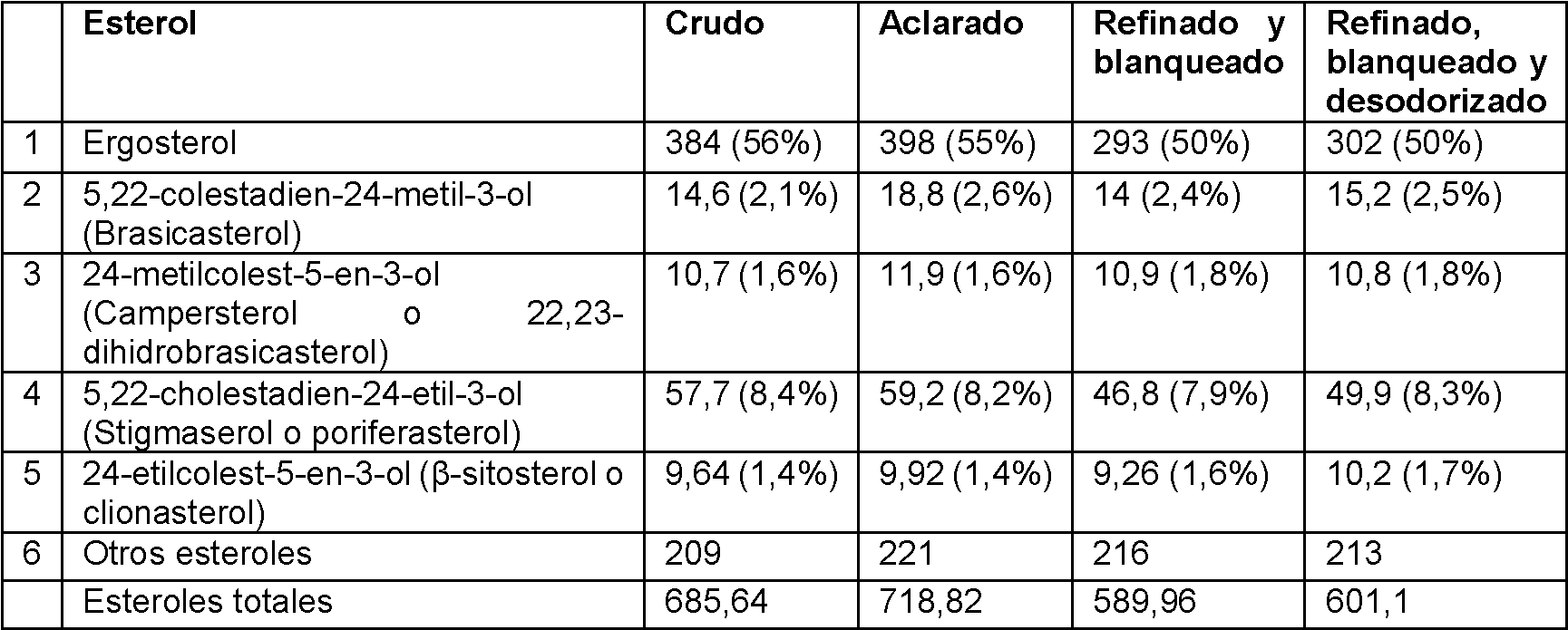
[0170] Estos resultados muestran tres características llamativas. En primer lugar, se encontró que ergosterol era el más abundante de todos los esteroles, que representa aproximadamente el 50% o más del total de esteroles. La cantidad de ergosterol es mayor que la de campesterol, p-sitosterol, y stigamsterol combinado. El ergosterol es esteroide comúnmente encontrado en hongos y no se encuentran comúnmente en las plantas, y su presencia en particular en cantidades significativas sirve como un marcador útil para aceites no vegetales. En segundo lugar, se encontró que el aceite contenía brasicasterol. Con la excepción del aceite de colza, brasicasterol no se encuentra comúnmente en los aceites a base de plantas. En tercer lugar, a menos de 2% p-sitosterol se encontró que estaba presente. p-sitosterol es un destacado esterol de planta que no se encuentra comúnmente en microalgas, y su presencia en particular en cantidades significativas sirve como un marcador útil para los aceites de origen vegetal. En resumen, cepa UTEX1435 Prototheca moriformis se ha encontrado que contiene tanto cantidades significativas de ergosterol como sólo cantidades pequeñas de p-sitosterol como un porcentaje del contenido total de esteroles. En consecuencia, la relación de ergosterol: p-sitosterol o en combinación con la presencia de brasicasterol se pueden utilizar para distinguir este aceite a partir de aceites vegetales. [0170] These results show three striking characteristics. First, it was found that ergosterol was the most abundant of all sterols, which represents approximately 50% or more of the total sterols. The amount of ergosterol is greater than that of campesterol, p-sitosterol, and combined stigamsterol. Ergosterol is a steroid commonly found in fungi and is not commonly found in plants, and its presence in particular in significant amounts serves as a useful marker for non-vegetable oils. Second, it was found that the oil contained brasicasterol. With the exception of rapeseed oil, brasicasterol is not commonly found in plant-based oils. Third, less than 2% p-sitosterol was found to be present. p-sitosterol is a prominent plant sterol that is not commonly found in microalgae, and its presence in particular in significant quantities serves as a useful marker for oils of plant origin. In summary, strain UTEX1435 Prototheca moriformis has been found to contain both significant amounts of ergosterol and only small amounts of p-sitosterol as a percentage of the total sterols content. Consequently, the ratio of ergosterol: p-sitosterol or in combination with the presence of brasicasterol can be used to distinguish this oil from vegetable oils.
[0171] En algunas realizaciones, el contenido de aceite de un aceite proporcionado en este documento contiene, como un porcentaje del total de esteroles, menos del 20%, 15%, 10%, 5%, 4%, 3%, 2%, o 1% p-sitosterol. En otras formas de realización el aceite está libre de p-sitosterol. [0171] In some embodiments, the oil content of an oil provided herein contains, as a percentage of total sterols, less than 20%, 15%, 10%, 5%, 4%, 3%, 2% , or 1% p-sitosterol. In other embodiments the oil is free of p-sitosterol.
[0172] En algunas realizaciones, el aceite es libre de uno o más de p-sitosterol, campesterol, estigmasterol. En algunas realizaciones, el aceite está libre de p-sitosterol, campesterol, estigmasterol y. En algunas realizaciones, el aceite está libre de campesterol. En algunas realizaciones, el aceite está libre de estigmasterol. [0172] In some embodiments, the oil is free of one or more of p-sitosterol, campesterol, stigmasterol. In some embodiments, the oil is free of p-sitosterol, campesterol, and stigmasterol. In some embodiments, the oil is free from campesterol. In some embodiments, the oil is stigmasterol free.
[0173] En algunas realizaciones, el contenido de aceite de un aceite proporcionado en este documento comprende, como porcentaje del total de esteroles, menos del 20%, 15%, 10%, 5%, 4%, 3%, 2%, o 1% de 24 etilcolest-5-en-3-ol. En algunas realizaciones, el 24-etilcolest-5-en-3-ol es clionasterol. En algunas realizaciones, el contenido de aceite de un aceite proporcionado en este documento comprende, como porcentaje del total de esteroles, por lo menos 1%, 2%, 3%, 4%, 5%, 6%, 7%, 8%, 9%, o 10% clionasterol. [0173] In some embodiments, the oil content of an oil provided herein comprises, as a percentage of the total sterols, less than 20%, 15%, 10%, 5%, 4%, 3%, 2%, or 1% of 24 ethylcolest-5-en-3-ol. In some embodiments, 24-ethylcolest-5-en-3-ol is clionasterol. In some embodiments, the oil content of an oil provided herein comprises, as a percentage of the total sterols, at least 1%, 2%, 3%, 4%, 5%, 6%, 7%, 8% , 9%, or 10% clionasterol.
[0174] En algunas realizaciones, el contenido de aceite de un aceite proporcionado en este documento contiene, como un porcentaje del total de esteroles, menos de 20%, 15%, 10%, 5%, 4%, 3%, 2%, o 1% 24-metilcolest-5-en-3-ol. En algunas realizaciones, el 24-metilcolest-5-en-3-ol es 22,23-dihidrobrasicasterol. En algunas realizaciones, el contenido de aceite de un aceite proporcionado en este documento comprende, como porcentaje del total de esteroles, por lo menos 1%, 2%, 3%, 4%, 5%, 6%, 7%, 8%, 9%, o 10% 22,23-dihidrobrasicasterol. [0174] In some embodiments, the oil content of an oil provided herein contains, as a percentage of the total sterols, less than 20%, 15%, 10%, 5%, 4%, 3%, 2% , or 1% 24-methylcolest-5-en-3-ol. In some embodiments, 24-methylcolest-5-en-3-ol is 22,23-dihydrobrasicasterol. In some embodiments, the oil content of an oil provided herein comprises, as a percentage of the total sterols, at least 1%, 2%, 3%, 4%, 5%, 6%, 7%, 8% , 9%, or 10% 22,23-dihydrobrasicasterol.
[0175] En algunas realizaciones, el contenido de aceite de un aceite proporcionado en este documento contiene, como un porcentaje del total de esteroles, menos del 20%, 15%, 10%, 5%, 4%, 3%, 2%, o 1% 5,22-colestadien-24-etil-3-ol. En algunas realizaciones, la 5,22-colestadien- 24-etil-3-ol es poriferasterol. En algunas realizaciones, el contenido de aceite de un aceite proporcionado en este documento comprende, como porcentaje del total de esteroles, por lo menos 1%, 2%, 3%, 4%, 5%, 6%, 7%, 8%, 9%, o 10% poriferasterol. [0175] In some embodiments, the oil content of an oil provided herein contains, as a percentage of total sterols, less than 20%, 15%, 10%, 5%, 4%, 3%, 2% , or 1% 5,22-colestadien-24-ethyl-3-ol. In some embodiments, 5,22-cholestadien-24-ethyl-3-ol is poriferasterol. In some embodiments, the oil content of an oil provided herein comprises, as a percentage of the total sterols, at least 1%, 2%, 3%, 4%, 5%, 6%, 7%, 8% , 9%, or 10% poriferasterol.
[0176] En algunas realizaciones, el contenido de aceite de un aceite proporcionado en el presente documento contiene ergosterol o brasicasterol o una combinación de los dos. En algunas realizaciones, el contenido de aceite contiene, como un porcentaje del total de esteroles, por lo menos 5%, 10%, 20%, 25%, 35%, 40%, 45%, 50%, 55%, 60%, o 65 % ergosterol. En algunas realizaciones, el contenido de aceite contiene, como un porcentaje del total de esteroles, por lo menos 25% ergosterol. En algunas realizaciones, el contenido de aceite contiene, como un porcentaje del total de esteroles, por lo menos 40% ergosterol. En algunas realizaciones, el contenido de aceite contiene, como un porcentaje del total de esteroles, por lo menos 5%, 10%, 20%, 25%, 35%, 40%, 45%, 50%, 55%, 60%, o 65 % de una combinación de ergosterol y brasicasterol. [0176] In some embodiments, the oil content of an oil provided herein contains ergosterol or brasicasterol or a combination of the two. In some embodiments, the oil content contains, as a percentage of the total sterols, at least 5%, 10%, 20%, 25%, 35%, 40%, 45%, 50%, 55%, 60% , or 65% ergosterol. In some embodiments, the oil content contains, as a percentage of the total sterols, at least 25% ergosterol. In some embodiments, the oil content contains, as a percentage of the total sterols, at least 40% ergosterol. In some embodiments, the oil content contains, as a percentage of the total sterols, at least 5%, 10%, 20%, 25%, 35%, 40%, 45%, 50%, 55%, 60% , or 65% of a combination of ergosterol and brasicasterol.
[0177] En algunas realizaciones, el contenido de aceite contiene, como un porcentaje del total de esteroles, por lo menos 1%, 2%, 3%, 4% o 5% de brasicasterol. En algunas realizaciones, el contenido de aceite contiene, como un porcentaje del total de esteroles de menos de 10%, 9%, 8%, 7%, 6%, o 5% de brasicasterol. [0177] In some embodiments, the oil content contains, as a percentage of the total sterols, at least 1%, 2%, 3%, 4% or 5% of brasicasterol. In some embodiments, the oil content contains, as a percentage of the total sterols of less than 10%, 9%, 8%, 7%, 6%, or 5% of brasicasterol.
[0178] En algunas realizaciones la relación de ergosterol a brasicasterol es al menos 5: 1, 10: 1, 15: 1, o 20: 1. [0178] In some embodiments the ratio of ergosterol to brasicasterol is at least 5: 1, 10: 1, 15: 1, or 20: 1.
[0179] En algunas realizaciones, el contenido de aceite contiene, como un porcentaje del total de esteroles, por lo menos 5%, 10%, 20%, 25%, 35%, 40%, 45%, 50%, 55%, 60%, o 65 % ergosterol y menos de 20%, 15%, 10%, 5%, 4%, 3%, 2%, o 1% p-sitosterol. En algunas realizaciones, el contenido de aceite contiene, como un porcentaje del total de esteroles, por lo menos 25% ergosterol y menos de 5% p-sitosterol. En algunas realizaciones, el contenido de aceite comprende además brasicasterol. [0179] In some embodiments, the oil content contains, as a percentage of the total sterols, at least 5%, 10%, 20%, 25%, 35%, 40%, 45%, 50%, 55% , 60%, or 65% ergosterol and less than 20%, 15%, 10%, 5%, 4%, 3%, 2%, or 1% p-sitosterol. In some embodiments, the oil content contains, as a percentage of the total sterols, at least 25% ergosterol and less than 5% p-sitosterol. In some embodiments, the oil content further comprises brasicasterol.
XIII. COMBUSTIBLES Y PRODUCTOS QUÍMICOSXIII FUELS AND CHEMICALS
[0180] Los aceites mencionados anteriormente solos o en combinación son útiles en la producción de alimentos, combustibles y productos químicos (incluyendo plásticos, espumas, películas, etc.). Los aceites, triglicéridos, ácidos grasos de los aceites pueden ser sometidos a la activación CH, metilación hidroamino, metoxi-carbonatación, ozonólisis, las transformaciones enzimáticas, epoxidación, la metilación, la dimerización, tiolación, metátesis, hidroalquilación, lactonización, u otros procesos químicos. [0180] The above-mentioned oils alone or in combination are useful in the production of food, fuels and chemicals (including plastics, foams, films, etc.). The oils, triglycerides, fatty acids of the oils can be subjected to CH activation, hydroamine methylation, methoxycarbonation, Ozonolysis, enzymatic transformations, epoxidation, methylation, dimerization, thiolation, metathesis, hydroalkylation, lactonization, or other chemical processes.
[0181] Los aceites pueden ser convertidos a los alcanos (por ejemplo, diesel renovable) o ésteres (por ejemplo, ésteres de metilo o etilo para biodisesel producidos por transesterificación). Los alcanos o ésteres pueden usarse como combustible, como disolventes o lubricantes, o como materia prima química. Los métodos para la producción de diesel renovable y biodiesel están bien establecidos en la técnica. Véase, por ejemplo, WO2011/150411. [0181] The oils can be converted to alkanes (for example, renewable diesel) or esters (for example, methyl or ethyl esters for biodiesel produced by transesterification). Alkanes or esters can be used as fuel, as solvents or lubricants, or as a chemical raw material. The methods for the production of renewable diesel and biodiesel are well established in the art. See, for example, WO2011 / 150411.
[0182] En un ejemplo específico de la presente descripción, un aceite de alto oleico o alto contenido de ácido oleico de alta estabilidad descrito anteriormente se esterifica. Por ejemplo, los aceites pueden ser transesterificados con metanol para dar un aceite que es rico en oleato de metilo. Como se ha descrito en el Ejemplo 49, se han encontrado tales formulaciones para comparar favorablemente con oleato de metilo de aceite de soja. [0182] In a specific example of the present description, a high oleic oil or high oleic acid content of high stability described above is esterified. For example, oils can be transesterified with methanol to give an oil that is rich in methyl oleate. As described in Example 49, such formulations have been found to compare favorably with soybean oil methyl oleate.
[0183] En otro ejemplo específico, el aceite se convierte a diácidos C36 o productos de diácidos C36. Los ácidos grasos producidos a partir del petróleo se pueden polimerizar para dar una composición rica en ácidos dímeros C36. En un ejemplo específico, el aceite de alto oleico se divide para dar un material de ácido graso de alto oleico que se polimeriza para dar una composición rica en ácidos C36-dímero. Opcionalmente, el aceite es alto aceite oleico de alta estabilidad (por ejemplo, mayor que 60% de ácido oleico con menos de 3% ácidos grasos poliinsaturados, ácido oleico mayor que 70% con menos de 2% ácidos grasos poliinsaturados, o ácido oleico mayor que 80% con menos de 1% poliinsaturados). Se cree que el uso de un alto oleico, alta estabilidad, material de partida dará menores cantidades de productos cíclicos, que pueden ser deseables en algunos casos. Después de hidrolizar el aceite, se obtiene una alta concentración de ácido oleico. En el proceso de hacer los ácidos dímeros, una corriente de alto ácido oleico se convertirá en un ácido dímero "más limpio" C36 y no produce trímeros ácidos (C54) y otros subproductos cíclicos más complejos que se obtienen debido a la presencia de ácidos C18: 2 y C18: 3. Por ejemplo, el aceite se puede hidrolizar a los ácidos grasos y los ácidos grasos purificados y dimerizarse a 250°C en presencia de arcilla montmorillonita. Ver SRI Natural Fatty Acid, de marzo de 2009. Un producto rico en dímeros C36 de ácido oleico se recupera. [0183] In another specific example, the oil is converted to C36 diacids or C36 diacid products. Fatty acids produced from petroleum can be polymerized to give a composition rich in C36 dimer acids. In a specific example, the high oleic oil is divided to give a high oleic fatty acid material that polymerizes to give a composition rich in C36-dimer acids. Optionally, the oil is high oleic oil of high stability (for example, greater than 60% oleic acid with less than 3% polyunsaturated fatty acids, oleic acid greater than 70% with less than 2% polyunsaturated fatty acids, or greater oleic acid than 80% with less than 1% polyunsaturated). It is believed that the use of a high oleic, high stability, starting material will give smaller amounts of cyclic products, which may be desirable in some cases. After hydrolyzing the oil, a high concentration of oleic acid is obtained. In the process of making the dimer acids, a high oleic acid stream will become a "cleaner" C36 dimer acid and does not produce acid trimer (C54) and other more complex cyclic by-products that are obtained due to the presence of C18 acids : 2 and C18: 3. For example, the oil can be hydrolyzed to fatty acids and purified fatty acids and dimerized at 250 ° C in the presence of montmorillonite clay. See SRI Natural Fatty Acid, March 2009. A product rich in C36 dimers of oleic acid is recovered.

[0184] Además, los ácidos dímeros C36 pueden ser esterificados y hidrogenados para dar dioles. Los dioles pueden ser polimerizados por deshidratación catalítica. Los polímeros también pueden producirse por transesterificación de dimerdioles con carbonato de dimetilo. [0184] In addition, C36 dimer acids can be esterified and hydrogenated to give diols. The diols can be polymerized by catalytic dehydration. The polymers can also be produced by transesterification of dimeriols with dimethyl carbonate.
[0185] Para la producción de combustible de acuerdo con los métodos de la invención, lípidos producidos por las células de la invención son cosechados, o recogidos de otra manera, por cualquier medio conveniente. Los lípidos se pueden aislar por extracción de células enteras. Las células se rompen primero, y luego los lípidos asociados con intracelular y membrana de la célula/pared de la célula, así como hidrocarburos extracelulares pueden ser separados de la masa de células, tales como mediante el uso de centrifugación. Lípidos intracelulares producidos en células oleaginosas, en algunas realizaciones, se extrajeron después de lisar las células. Una vez extraídos, los lípidos se refinan adicionalmente para producir aceites, combustibles, o productos oleoquímicos. [0185] For the production of fuel according to the methods of the invention, lipids produced by the cells of the invention are harvested, or otherwise collected, by any convenient means. Lipids can be isolated by extracting whole cells. The cells are broken first, and then the lipids associated with intracellular and cell membrane / cell wall, as well as extracellular hydrocarbons can be separated from the cell mass, such as by the use of centrifugation. Intracellular lipids produced in oil cells, in some embodiments, were extracted after lysing the cells. Once extracted, lipids are further refined to produce oils, fuels, or oleochemicals.
[0186] Varios métodos están disponibles para la separación de lípidos a partir de lisados celulares. Por ejemplo, lípidos y derivados de lípidos tales como aldehídos grasos, alcoholes grasos, e hidrocarburos tales como alcanos se pueden extraer con un disolvente hidrófobo, tal como hexano (ver Frenz et al 1989, Enzyme Microb Technol., 11: 717). Los lípidos y derivados de lípidos también se pueden extraer utilizando licuefacción (ver por ejemplo Sawayama et al 1999, Biomass and Bioenergy 17: 33-39 y Inoue et al 1993, Biomass Bioenergy 6 (4): 269-274); licuación de aceite (véase, por ejemplo Minowa et al 1995, Fuel 74 (12):. 1735-1738); y extracción supercrítica de CO2 (véase, por ejemplo Mendes et al 2003, Inorganica Chimica Acta 356:. 328-334). Miao y Wu describe un protocolo de la recuperación de los lípidos de microalgas de un cultivo de Chlorella prototheocoides en donde las células se recogieron por centrifugación, se lavaron con agua destilada y se secaron por liofilización. El polvo de células resultante se pulverizó en un mortero y después se extrajo con n-hexano. Miao y Wu, Biosource Technology (2006) 97: 841-846. [0186] Several methods are available for the separation of lipids from cell lysates. For example, lipids and lipid derivatives such as fatty aldehydes, fatty alcohols, and hydrocarbons such as alkanes can be extracted with a hydrophobic solvent, such as hexane (see Frenz et al 1989, Enzyme Microb Technol., 11: 717). Lipids and lipid derivatives can also be extracted using liquefaction (see for example Sawayama et al 1999, Biomass and Bioenergy 17: 33-39 and Inoue et al 1993, Biomass Bioenergy 6 (4): 269-274); oil liquefaction (see, for example, Minowa et al 1995, Fuel 74 (12): 1735-1738); and supercritical CO2 extraction (see, for example, Mendes et al 2003, Inorganica Chimica Acta 356: 328-334). Miao and Wu describe a recovery protocol for The microalgae lipids of a Chlorella prototheocoid culture where the cells were collected by centrifugation, washed with distilled water and dried by lyophilization. The resulting cell powder was pulverized in a mortar and then extracted with n-hexane. Miao and Wu, Biosource Technology (2006) 97: 841-846.
[0187] Los lípidos y derivados de lípidos se pueden recuperar por extracción con un disolvente orgánico. En algunos casos, el disolvente orgánico preferido es hexano. Típicamente, se añade directamente el disolvente orgánico al lisado sin separación previa de los componentes del lisado. En una realización, el lisado generado por uno o más de los métodos descritos anteriormente se pone en contacto con un disolvente orgánico durante un período de tiempo suficiente para permitir el lípido y/o componentes de hidrocarburos para formar una solución con el disolvente orgánico. En algunos casos, la solución puede ser entonces refinada de nuevo para recuperar los componentes de lípidos o de hidrocarburos deseados específicos. Métodos de extracción con hexano son bien conocidos en la técnica. [0187] Lipids and lipid derivatives can be recovered by extraction with an organic solvent. In some cases, the preferred organic solvent is hexane. Typically, the organic solvent is added directly to the lysate without prior separation of the lysate components. In one embodiment, the lysate generated by one or more of the methods described above is contacted with an organic solvent for a period of time sufficient to allow the lipid and / or hydrocarbon components to form a solution with the organic solvent. In some cases, the solution can then be refined to recover the specific desired lipid or hydrocarbon components. Hexane extraction methods are well known in the art.
[0188] Los lípidos producidos por las células en vivo, o enzimáticamente modificados in vitro, como se describe en el presente documento pueden estar opcionalmente procesados adicionalmente por medios convencionales. El procesamiento puede incluir "craqueo" para reducir el tamaño, y por lo tanto incrementar la proporción hidrógeno: carbono, de moléculas de hidrocarburos. Métodos de craqueo catalítico y térmicos se utilizan rutinariamente en hidrocarburos y procesamiento de aceite de triglicérido. Métodos catalíticos implican el uso de un catalizador, tal como un catalizador ácido sólido. El catalizador puede ser de sílice-alúmina o una zeolita, que dan como resultado la rotura heterolítica o asimétrica de un enlace carbono-carbono para dar lugar a una carbocación y un anión hidruro. Estos intermediarios reactivos a continuación, se someten a cualquiera de reordenamiento o transferencia de hidruro con otro hidrocarburo. Las reacciones se pueden por lo tanto regenerar los intermedios para dar lugar a un mecanismo de cadena de auto-propagación. Los hidrocarburos también pueden ser procesados para reducir, opcionalmente a cero, el número de enlaces dobles o triples carbono-carbono en los mismos. Los hidrocarburos también pueden ser procesados para eliminar un anillo o estructura cíclica en él. Los hidrocarburos también pueden ser procesados para aumentar la proporción hidrógeno: carbono. Esto puede incluir la adición de hidrógeno ("hidrogenación") y/o el "craqueo" de hidrocarburos en hidrocarburos más pequeños. [0188] Lipids produced by cells in vivo, or enzymatically modified in vitro, as described herein may optionally be further processed by conventional means. Processing may include "cracking" to reduce the size, and therefore increase the hydrogen: carbon ratio of hydrocarbon molecules. Catalytic and thermal cracking methods are routinely used in hydrocarbons and triglyceride oil processing. Catalytic methods involve the use of a catalyst, such as a solid acid catalyst. The catalyst can be silica-alumina or a zeolite, which results in the heterolytic or asymmetric rupture of a carbon-carbon bond to give rise to a carbocation and a hydride anion. These reactive intermediates are then subjected to either rearrangement or transfer of hydride with another hydrocarbon. The reactions can therefore regenerate the intermediates to give rise to a self-propagation chain mechanism. Hydrocarbons can also be processed to optionally reduce to zero the number of carbon or carbon double or triple bonds in them. Hydrocarbons can also be processed to eliminate a ring or cyclic structure in it. Hydrocarbons can also be processed to increase the hydrogen: carbon ratio. This may include the addition of hydrogen ("hydrogenation") and / or the "cracking" of hydrocarbons into smaller hydrocarbons.
[0189] Los métodos térmicos implican el uso de temperatura y presión para reducir el tamaño de hidrocarburos elevado. Una temperatura elevada de aproximadamente 800°C y presión de aproximadamente 700kPa pueden ser utilizadas. Estas condiciones generan "luz", un término que se utiliza a veces para referirse a moléculas de hidrocarburos ricos en hidrógeno (a diferencia de flujo de fotones), mientras que se genera también, por condensación, moléculas de hidrocarburos más pesados que son relativamente agotados de hidrógeno. La metodología proporciona la rotura homolítica, o simétrica, y produce alquenos, que pueden estar opcionalmente saturados enzimáticamente como se describe anteriormente. [0189] Thermal methods involve the use of temperature and pressure to reduce the size of hydrocarbons. An elevated temperature of approximately 800 ° C and pressure of approximately 700kPa can be used. These conditions generate "light," a term that is sometimes used to refer to hydrogen-rich hydrocarbon molecules (as opposed to photon flux), while heavier hydrocarbon molecules that are relatively depleted are also generated by condensation. of hydrogen. The methodology provides homolytic, or symmetrical, breakage and produces alkenes, which may be optionally saturated enzymatically as described above.
[0190] Métodos catalíticos y térmicos son estándar en las plantas para el procesamiento y refinación de hidrocarburos de petróleo. Por lo tanto hidrocarburos producidos por las células como se describe en el presente documento pueden ser recogidos y procesados o refinados a través de medios convencionales. Ver Hillen et al. (Biotechnology and Bioengineering, Vol XXIV. 193-205 (1982)) para un informe sobre el hidrocraqueo de hidrocarburos producidos por microalgas. En realizaciones alternativas, la fracción se trata con otro catalizador, tal como un compuesto orgánico, el calor, y/o un compuesto inorgánico. Para el procesamiento de los lípidos en biodiesel, un proceso de transesterificación se utiliza como se describe a continuación en esta sección. [0190] Catalytic and thermal methods are standard in plants for the processing and refining of petroleum hydrocarbons. Therefore hydrocarbons produced by the cells as described herein can be collected and processed or refined by conventional means. See Hillen et al. (Biotechnology and Bioengineering, Vol XXIV. 193-205 (1982)) for a report on hydrocracking of hydrocarbons produced by microalgae. In alternative embodiments, the fraction is treated with another catalyst, such as an organic compound, heat, and / or an inorganic compound. For the processing of lipids in biodiesel, a transesterification process is used as described below in this section.
[0191] Hidrocarburos producidos a través de métodos de la presente invención son útiles en una variedad de aplicaciones industriales. Por ejemplo, la producción de sulfonato de alquilbenceno lineal (LAS), un tensioactivo aniónico se utiliza en casi todos los tipos de detergentes y productos de limpieza, utiliza los hidrocarburos que comprenden generalmente una cadena de 10-14 átomos de carbono. Véase, por ejemplo, la Patente de Estados Unidos N°: 6.946.430; 5.506.201; 6.692.730; 6.268.517; 6.020.509; 6.140.302; 5.080.848; y 5.567.359. Tensioactivos, tales como LAS, se pueden utilizar en la producción de composiciones y detergentes para el cuidado personal, tales como los descritos en la Patente de Estados Unidos N°: 5.942.479; 6.086.903; 5.833.999; 6.468.955; y 6.407.044. [0191] Hydrocarbons produced through methods of the present invention are useful in a variety of industrial applications. For example, the production of linear alkylbenzene sulphonate (LAS), an anionic surfactant is used in almost all types of detergents and cleaning products, uses hydrocarbons that generally comprise a chain of 10-14 carbon atoms. See, for example, U.S. Patent No. 6,946,430; 5,506,201; 6,692,730; 6,268,517; 6,020,509; 6,140,302; 5,080,848; and 5,567,359. Surfactants, such as LAS, can be used in the production of personal care compositions and detergents, such as those described in US Patent No. 5,942,479; 6,086,903; 5,833,999; 6,468,955; and 6,407,044.
[0192] Creciente interés se dirige a la utilización de componentes de hidrocarburos de origen biológico en los combustibles, tales como el biodiesel, diesel renovable, y combustible de aviación, puesto que los materiales biológicos de partida renovables que pueden reemplazar materiales derivados de combustibles fósiles de partida están disponibles, y el uso del mismo es deseable. Hay una necesidad urgente de métodos para producir componentes de hidrocarburos a partir de materiales biológicos. La presente divulgación satisface esta necesidad proporcionando métodos para la producción de biodiesel, diesel renovable, y combustible para aviones utilizando los lípidos generados por los métodos descritos en el presente documento como un material biológico para producir biodiesel, diesel renovable, y combustible de aviación. [0192] Increasing interest is directed to the use of components of hydrocarbons of biological origin in fuels, such as biodiesel, renewable diesel, and aviation fuel, since renewable starting biological materials that can replace fossil fuel derived materials Starting are available, and the use thereof is desirable. There is an urgent need for methods to produce hydrocarbon components from biological materials. The present disclosure satisfies this need by providing methods for the production of biodiesel, renewable diesel, and jet fuel using the lipids generated by the methods described herein as a biological material for producing biodiesel, renewable diesel, and aviation fuel.
[0193] Combustibles diesel tradicionales son destilados de petróleo ricos en hidrocarburos parafínicos. Tienen intervalos de ebullición tan amplios como 370° a 780° F, que son adecuados para la combustión en un motor de encendido por compresión, tal como un vehículo de motor diesel. La Sociedad Americana de Pruebas y Materiales (ASTM) establece el grado de diesel de acuerdo con el intervalo de ebullición, junto con rangos permisibles de otras propiedades del combustible, como el número de cetano, punto de enturbiamiento, punto de inflamación, viscosidad, punto de anilina, contenido de azufre, agua contenido, contenido de cenizas, la corrosión tira de cobre, y residuo de carbono. Técnicamente, cualquier material destilado de hidrocarburo derivado de la biomasa o de otra forma que cumpla con la especificación ASTM apropiado puede definirse como combustible diesel (ASTM D975), combustible de aviación (ASTM D1655), o como biodiesel si es un éster metílico de ácido graso (D6751 ASTM). [0193] Traditional diesel fuels are petroleum distillates rich in paraffinic hydrocarbons. They have boiling ranges as wide as 370 ° to 780 ° F, which are suitable for combustion in a compression ignition engine, such as a diesel engine vehicle. The American Society for Testing and Materials (ASTM) establishes the degree of diesel according to the boiling range, along with allowable ranges of other fuel properties, such as cetane number, cloud point, flash point, viscosity, point of aniline, sulfur content, water content, ash content, copper strip corrosion, and residue of carbon. Technically, any hydrocarbon distillate material derived from biomass or otherwise that meets the appropriate ASTM specification can be defined as diesel fuel (ASTM D975), aviation fuel (ASTM D1655), or as biodiesel if it is an acid methyl ester fatty (D6751 ASTM).
[0194] Después de la extracción, los componentes de lípidos y/o hidrocarburos recuperados de la biomasa microbiana descritos en este documento pueden ser sometidos a tratamiento químico para la fabricación de un combustible para uso en vehículos diesel y motores a reacción. [0194] After extraction, the lipid and / or hydrocarbon components recovered from the microbial biomass described herein may be subjected to chemical treatment for the manufacture of a fuel for use in diesel vehicles and jet engines.
[0195] El biodiesel es un líquido que varía en color - entre marrón dorado y oscuro - en función de la materia prima de producción. Es prácticamente inmiscible con agua, tiene un alto punto de ebullición y baja presión de vapor. Biodiesel se refiere a un combustible procesado diesel equivalente para su uso en vehículos de motor diesel. El biodiesel es biodegradable y no tóxico. Un beneficio adicional de biodiesel más de combustible diesel convencional es menor desgaste del motor. Típicamente, el biodiesel comprende ésteres de alquilo C14-C18. Diversos procesos convierten biomasa o un lípido producido y aislado como se describe en este documento para los combustibles diesel. Un método preferido para producir biodiesel es por transesterificación de un lípido, como se describe en el presente documento. Un éster de alquilo preferido para uso como biodiesel es un éster metílico o éster etílico. [0195] Biodiesel is a liquid that varies in color - between golden brown and dark - depending on the production raw material. It is practically immiscible with water, has a high boiling point and low vapor pressure. Biodiesel refers to an equivalent diesel processed fuel for use in diesel engine vehicles. Biodiesel is biodegradable and non-toxic. An additional benefit of biodiesel over conventional diesel fuel is less engine wear. Typically, biodiesel comprises C14-C18 alkyl esters. Various processes convert biomass or a lipid produced and isolated as described in this document for diesel fuels. A preferred method of producing biodiesel is by transesterification of a lipid, as described herein. A preferred alkyl ester for use as biodiesel is a methyl ester or ethyl ester.
[0196] Biodiesel producido mediante un método descrito en el presente documento puede utilizarse solo o mezclado con el combustible diesel convencional a cualquier concentración en la mayoría de los vehículos modernos motores diesel. Cuando se mezcla con el combustible diesel convencional (diesel de petróleo), el biodiesel puede estar presente desde aproximadamente 0,1% a aproximadamente 99,9%. Gran parte del mundo utiliza un sistema conocido como el factor "B" para indicar la cantidad de biodiesel en cualquier mezcla de combustible. Por ejemplo, el combustible que contiene 20% de biodiesel se etiqueta B20. El biodiesel puro se conoce como B100. [0196] Biodiesel produced by a method described herein can be used alone or mixed with conventional diesel fuel at any concentration in most modern diesel engine vehicles. When mixed with conventional diesel fuel (petroleum diesel), biodiesel can be present from about 0.1% to about 99.9%. Much of the world uses a system known as the "B" factor to indicate the amount of biodiesel in any fuel mixture. For example, the fuel that contains 20% biodiesel is labeled B20. Pure biodiesel is known as B100.
[0197] El biodiesel puede ser producido por transesterificación de triglicéridos contenidos en la biomasa rica en petróleo. Por lo tanto, en otro ejemplo de la presente descripción se proporciona un método para la producción de biodiesel. En un ejemplo preferido, el método para la producción de biodiesel comprende las etapas de (a) cultivo de un microorganismo que contiene lípidos usando métodos descritos en este documento (b) lisar un microorganismo que contiene lípidos para producir un lisado, (c) aislar lípidos a partir del microorganismo lisado y (d) la transesterificación de la composición de los lípidos, lo que produce biodiesel. Los métodos para el crecimiento de un microorganismo, lisar un microorganismo para producir un lisado, tratar el lisado en un medio que comprende un disolvente orgánico para formar una mezcla heterogénea y separar el lisado tratado en una composición lipídica que se han descrito anteriormente y también puede ser utilizado en el método de producción de biodiesel. El perfil de lípidos de biodiesel es por lo general muy similar al perfil de lípidos de la materia prima de aceite. [0197] Biodiesel can be produced by transesterification of triglycerides contained in petroleum rich biomass. Therefore, in another example of the present description a method for the production of biodiesel is provided. In a preferred example, the method for the production of biodiesel comprises the steps of (a) culturing a microorganism containing lipids using methods described herein (b) lysing a microorganism containing lipids to produce a lysate, (c) isolating lipids from the lysate microorganism and (d) the transesterification of the lipid composition, which produces biodiesel. The methods for the growth of a microorganism, lysing a microorganism to produce a lysate, treating the lysate in a medium comprising an organic solvent to form a heterogeneous mixture and separating the treated lysate into a lipid composition described above and can also Be used in the biodiesel production method. The biodiesel lipid profile is generally very similar to the lipid profile of the oil raw material.
[0198] Composiciones lipídicas pueden ser sometidas a la transesterificación para producir ésteres de ácidos grasos de cadena larga útiles como biodiesel. Reacciones de transesterificación preferidas se describen a continuación e incluyen transesterificación y transesterificación catalizada por base usando lipasas recombinantes. En un proceso de transesterificación catalizada por base, los triacilglicéridos se hacen reaccionar con un alcohol, tal como metanol o etanol, en presencia de un catalizador alcalino, típicamente hidróxido de potasio. Esta reacción forma ésteres de metilo o etilo y glicerina (glicerol) como subproducto. [0198] Lipid compositions may be subjected to transesterification to produce esters of long chain fatty acids useful as biodiesel. Preferred transesterification reactions are described below and include transesterification and base catalyzed transesterification using recombinant lipases. In a base catalyzed transesterification process, the triacylglycerides are reacted with an alcohol, such as methanol or ethanol, in the presence of an alkaline catalyst, typically potassium hydroxide. This reaction forms methyl or ethyl esters and glycerin (glycerol) as a byproduct.
[0199] La transesterificación también se ha llevado a cabo, como se discutió anteriormente, utilizando una enzima, tal como una lipasa en lugar de una base. La transesterificación catalizada por lipasa puede llevarse a cabo, por ejemplo, a una temperatura entre la temperatura ambiente y 80°C, y una relación molar de la etiqueta para el alcohol inferior de más de 1: 1, preferiblemente de aproximadamente 3: 1. Las lipasas adecuadas para uso en la transesterificación incluyen, pero no se limitan a, los enumerados en la Tabla 9. Otros ejemplos de lipasas útiles para la transesterificación se encuentran en, por ejemplo, la Patente de Estados Unidos N° 4.798.793.; 4.940.8455.156.963; 5.342.768; 5776741 y WO89/01032. Tales lipasas incluyen, pero no se limitan a, lipasas producidas por microorganismos del Rhizopus, Aspergillus, Candida, Mucor, Pseudomonas, Rhizomucor, Candida, y Humicola y lipasa de páncreas. [0199] Transesterification has also been carried out, as discussed above, using an enzyme, such as a lipase instead of a base. Lipase catalyzed transesterification can be carried out, for example, at a temperature between room temperature and 80 ° C, and a molar ratio of the label for the lower alcohol of more than 1: 1, preferably about 3: 1. Lipases suitable for use in transesterification include, but are not limited to, those listed in Table 9. Other examples of lipases useful for transesterification are found in, for example, US Patent No. 4,798,793 .; 4,940,8455,156,963; 5,342,768; 5776741 and WO89 / 01032. Such lipases include, but are not limited to, lipases produced by microorganisms of Rhizopus, Aspergillus, Candida, Mucor, Pseudomonas, Rhizomucor, Candida, and Humicola and pancreas lipase.
[0200] Procesos posteriores también se pueden utilizar si el biodiesel se utilizará en temperaturas particularmente frías. Tales procesos incluyen acondicionamiento para el invierno y fraccionamiento. Ambos procesos están diseñados para mejorar el flujo en frío y el rendimiento de invierno del combustible mediante la reducción del punto de enturbiamiento (la temperatura a la que el biodiesel comienza a cristalizar). Hay varios enfoques para el biodiesel de invierno. Un método consiste en mezclar el biodiesel con diesel de petróleo. Otro enfoque es el uso de aditivos que pueden disminuir el punto de enturbiamiento de biodiesel. Otro enfoque es eliminar ésteres metílicos saturados indiscriminadamente mezclando los aditivos y permitiendo la cristalización de ácidos grasos saturados y luego filtrando los cristales. El fraccionamiento separa selectivamente ésteres metílicos en componentes o fracciones individuales, lo que permite la eliminación o inclusión de ésteres metílicos específicos. métodos de fraccionamiento incluyen fraccionamiento de urea, fraccionamiento de disolvente y la destilación térmica. [0200] Subsequent processes can also be used if biodiesel will be used in particularly cold temperatures. Such processes include winter conditioning and fractionation. Both processes are designed to improve the cold flow and winter performance of the fuel by reducing the cloud point (the temperature at which the biodiesel begins to crystallize). There are several approaches to winter biodiesel. One method is to mix biodiesel with petroleum diesel. Another approach is the use of additives that can decrease the cloud point of biodiesel. Another approach is to eliminate saturated methyl esters indiscriminately by mixing the additives and allowing the crystallization of saturated fatty acids and then filtering the crystals. The fractionation selectively separates methyl esters into individual components or fractions, which allows the removal or inclusion of specific methyl esters. Fractionation methods include urea fractionation, solvent fractionation and thermal distillation.
[0201] Otro valioso combustible proporcionado por los métodos de la presente descripción es diesel renovable, que comprende alcanos, tales como C10: 0, C12: 0, C14: 0, C16: 0 y C18: 0 y, por tanto, son distinguibles de biodiesel. Diesel renovable de alta calidad se adecua a la norma ASTM D975. Los lípidos producidos por los métodos de la presente invención pueden servir como materia prima para producir diesel renovable. Por lo tanto, en otro ejemplo de la presente descripción, se proporciona un método para la producción de diesel renovable. Diesel renovable puede ser producido por al menos tres procesos: procesamiento hidrotérmico (hidrotratamiento); hidrotratamiento; y licuefacción indirecta. Estos procesos producen destilados no éster. Durante estos procesos, triacilglicéridos producido y aislado como se describe en el presente documento, se convierten en alcanos. [0201] Another valuable fuel provided by the methods of the present disclosure is renewable diesel, which comprises alkanes, such as C10: 0, C12: 0, C14: 0, C16: 0 and C18: 0 and, therefore, are distinguishable of biodiesel. High quality renewable diesel conforms to ASTM D975. The lipids produced by the methods of the present invention can serve as raw material for producing renewable diesel. Therefore, in another example of The present description provides a method for the production of renewable diesel. Renewable diesel can be produced by at least three processes: hydrothermal processing (hydrotreatment); hydrotreatment; and indirect liquefaction. These processes produce non-ester distillates. During these processes, triacylglycerides produced and isolated as described herein, become alkanes.
[0202] En un ejemplo, el método para producir diesel renovable comprende (a) el cultivo de un microorganismo que contiene lípidos usando métodos dados a conocer en el presente documento (b) lisar el microorganismo para producir un lisado, (c) aislar lípidos a partir del microorganismo lisado, y (d) desoxigenación y hidrotratamiento de los lípidos para producir un alcano, con lo que se produce diesel renovable. Los lípidos adecuados para la fabricación de diesel renovable se pueden obtener mediante extracción a partir de biomasa microbiana usando un disolvente orgánico tal como hexano, o mediante otros métodos, tales como los descritos en la patente US 5.928.696. Algunos métodos adecuados pueden incluir prensado mecánico y centrifugación. [0202] In one example, the method of producing renewable diesel comprises (a) the cultivation of a lipid-containing microorganism using methods disclosed herein (b) lysing the microorganism to produce a lysate, (c) isolating lipids from the lysed microorganism, and (d) deoxygenation and hydrotreatment of lipids to produce an alkane, whereby renewable diesel is produced. Suitable lipids for the manufacture of renewable diesel can be obtained by extraction from microbial biomass using an organic solvent such as hexane, or by other methods, such as those described in US Patent 5,928,696. Some suitable methods may include mechanical pressing and centrifugation.
[0203] En algunos métodos, el lípido microbiano está agrietado primero en conjunción con hidrotratamiento para reducir la longitud de cadena de carbono y saturar los enlaces dobles, respectivamente. El material luego se isomeriza, también en combinación con hidrotratamiento. La fracción de nafta puede retirarse entonces a través de destilación, seguido de destilación adicional para vaporizar y separar por destilación los componentes deseados en el combustible diesel para satisfacer una norma ASTM D975, dejando los componentes que son más pesados que lo deseado para cumplir con el estándar D975. El hidrotratamiento, hidrocraqueo, desoxigenación y métodos de isomerización de los aceites de la modificación química, incluidos los aceites de triglicéridos, son bien conocidos en la técnica. Véase por ejemplo solicitudes de patente europea EP1741768 (A1); EP1741767 (A1); EP1682466 (A1); EP1640437 (A1); EP1681337 (A1); EP1795576 (A1); y Patentes de Estados Unidos 7.238.277; 6.630.066; 6.596.155; 6.977.322; 7.041.866; 6.217.746; 5.885.440; 6.881.873. [0203] In some methods, the microbial lipid is first cracked in conjunction with hydrotreatment to reduce the carbon chain length and saturate the double bonds, respectively. The material is then isomerized, also in combination with hydrotreatment. The naphtha fraction can then be removed through distillation, followed by additional distillation to vaporize and distillate the desired components in diesel fuel to meet an ASTM D975 standard, leaving components that are heavier than desired to comply with the D975 standard. Hydrotreatment, hydrocracking, deoxygenation and isomerization methods of chemical modification oils, including triglyceride oils, are well known in the art. See for example European patent applications EP1741768 (A1); EP1741767 (A1); EP1682466 (A1); EP1640437 (A1); EP1681337 (A1); EP1795576 (A1); and United States Patents 7,238,277; 6,630,066; 6,596,155; 6,977,322; 7,041,866; 6,217,746; 5,885,440; 6,881,873.
[0204] En un ejemplo del método para la producción de diesel renovable, el tratamiento de los lípidos para producir un alcano se lleva a cabo por el hidrotratamiento de la composición lipídica. En el procesamiento hidrotérmico, típicamente, la biomasa se hace reaccionar en agua a una temperatura y presión elevadas para formar aceites y sólidos residuales. Las temperaturas de conversión son normalmente de 300° a 660° F, con presión suficiente para mantener el agua principalmente como un líquido, de 100 a 170 atmósfera estándar (atm). Los tiempos de reacción son del orden de 15 a 30 minutos. Después de que se completó la reacción, los orgánicos se separan del agua. De este modo se produce un destilado adecuado para diesel. [0204] In an example of the method for the production of renewable diesel, the treatment of lipids to produce an alkane is carried out by hydrotreating the lipid composition. In hydrothermal processing, typically, biomass is reacted in water at a high temperature and pressure to form residual oils and solids. Conversion temperatures are normally from 300 ° to 660 ° F, with sufficient pressure to maintain water primarily as a liquid, from 100 to 170 standard atmosphere (atm). The reaction times are of the order of 15 to 30 minutes. After the reaction is complete, the organics are separated from the water. This produces a distillate suitable for diesel.
[0205] En algunos métodos de fabricación de diesel renovable, la primera etapa de tratar un triglicérido es de hidroprocesamiento para saturar los enlaces dobles, seguido de desoxigenación a temperatura elevada en presencia de hidrógeno y un catalizador. En algunos métodos, la hidrogenación y la desoxigenación se producen en la misma reacción. En otros métodos de desoxigenación se produce antes de la hidrogenación. A continuación, se realiza opcionalmente la isomerización, también en presencia de hidrógeno y un catalizador. Componentes de la nafta se eliminan preferiblemente a través de destilación. Para ejemplos, véanse las patentes 5475160 (de hidrogenación de triglicéridos) de Estados Unidos; 5.091.116 (desoxigenación, de hidrogenación y de eliminación de gas); 6.391.815 (de hidrogenación); y 5.888.947 (isomerización). [0205] In some methods of manufacturing renewable diesel, the first stage of treating a triglyceride is hydroprocessing to saturate the double bonds, followed by high temperature deoxygenation in the presence of hydrogen and a catalyst. In some methods, hydrogenation and deoxygenation occur in the same reaction. In other methods of deoxygenation occurs before hydrogenation. Then, isomerization is optionally performed, also in the presence of hydrogen and a catalyst. Naphtha components are preferably removed through distillation. For examples, see United States patents 5475160 (for hydrogenation of triglycerides); 5,091,116 (deoxygenation, hydrogenation and gas elimination); 6,391,815 (of hydrogenation); and 5,888,947 (isomerization).
[0206] Un método adecuado para la hidrogenación de triglicéridos incluye la preparación de una solución acuosa de sales de cobre, zinc, magnesio y lantano y otra solución de metal alcalino o, preferiblemente, carbonato de amonio. Las dos soluciones se pueden calentar a una temperatura de aproximadamente 20°C a aproximadamente 85°C y dosifican juntos en un recipiente de precipitación a tasas tales que el pH en el recipiente de precipitación se mantiene entre 5,5 y 7,5 con el fin de formar un catalizador. El agua adicional se puede utilizar ya sea inicialmente en el recipiente de precipitación o se añade simultáneamente con la solución de sal y la solución de precipitación. El precipitado resultante se puede lavar a fondo, se seca, se calcina a aproximadamente 300°C y se activa en hidrógeno a temperaturas que varían de aproximadamente 100°C a aproximadamente 400°C. Uno o más triglicéridos pueden estar entonces en contacto y se hacen reaccionar con hidrógeno en presencia del catalizador descrito anteriormente en un reactor. El reactor puede ser un reactor de lecho de goteo, reactor de gas-sólido de lecho fijo, reactor de columna de burbujas empaquetada, tanque continuamente agitado, un reactor de fase en suspensión, o cualquier otro tipo de reactor adecuado conocido en la técnica. El proceso puede llevarse a cabo tanto de manera discontinua como de manera continua. Las temperaturas de reacción están típicamente en el intervalo de aproximadamente 170°C a aproximadamente 250°C mientras que las presiones de reacción están típicamente en el intervalo de aproximadamente 300 psig a aproximadamente 2000 psig. Además, la relación molar de hidrógeno a triglicéridos en el proceso de la presente invención está típicamente en el intervalo de aproximadamente 20: 1 a aproximadamente 700: 1. El proceso se lleva a cabo típicamente a una velocidad espacial horaria en peso (WHSV) en el intervalo de aproximadamente 0,1 h-1 a aproximadamente 5 h-1. Un experto en la técnica reconocerá que el período de tiempo requerido para la reacción variará en función de la temperatura utilizada, la relación molar de hidrógeno a triglicéridos, y la presión parcial de hidrógeno. Los productos producidos por tales procesos de hidrogenación incluyen alcoholes grasos, glicerol, trazas de parafinas y triglicéridos sin reaccionar. Estos productos son típicamente separados por medios convencionales tales como, por ejemplo, destilación, extracción, filtración, cristalización, y similares. [0206] A suitable method for the hydrogenation of triglycerides includes the preparation of an aqueous solution of copper, zinc, magnesium and lanthanum salts and another solution of alkali metal or, preferably, ammonium carbonate. The two solutions can be heated to a temperature of about 20 ° C to about 85 ° C and dosed together in a precipitation vessel at rates such that the pH in the precipitation vessel is maintained between 5.5 and 7.5 with the In order to form a catalyst. The additional water can be used either initially in the precipitation vessel or added simultaneously with the salt solution and the precipitation solution. The resulting precipitate can be washed thoroughly, dried, calcined at about 300 ° C and activated in hydrogen at temperatures ranging from about 100 ° C to about 400 ° C. One or more triglycerides can then be in contact and reacted with hydrogen in the presence of the catalyst described above in a reactor. The reactor may be a drip bed reactor, fixed bed solid gas reactor, packaged bubble column reactor, continuously stirred tank, a suspended phase reactor, or any other type of suitable reactor known in the art. The process can be carried out both discontinuously and continuously. Reaction temperatures are typically in the range of about 170 ° C to about 250 ° C while reaction pressures are typically in the range of about 300 psig to about 2000 psig. In addition, the molar ratio of hydrogen to triglycerides in the process of the present invention is typically in the range of about 20: 1 to about 700: 1. The process is typically carried out at an hourly space velocity by weight (WHSV) in the range of about 0.1 h-1 to about 5 h-1. One skilled in the art will recognize that the period of time required for the reaction will vary depending on the temperature used, the molar ratio of hydrogen to triglycerides, and the partial pressure of hydrogen. Products produced by such hydrogenation processes include fatty alcohols, glycerol, traces of paraffins and unreacted triglycerides. These products are typically separated by conventional means such as, for example, distillation, extraction, filtration, crystallization, and the like.
[0207] Refinerías de petróleo utilizan hidroprocesamiento para eliminar las impurezas mediante el tratamiento de alimentaciones con hidrógeno. temperaturas de conversión de hidroprocesamiento son típicamente de 300° a 700° F. [0207] Oil refineries use hydroprocessing to remove impurities by treating hydrogen feeds. Hydroprocessing conversion temperatures are typically 300 ° to 700 ° F.
Las presiones son típicamente de 40 a 100 atm. Los tiempos de reacción son típicamente del orden de 10 a 60 minutos. Los catalizadores sólidos se emplean para aumentar ciertas velocidades de reacción, mejorar la selectividad para ciertos productos, y optimizar el consumo de hidrógeno.Pressures are typically 40 to 100 atm. Reaction times are typically of the order of 10 to 60 minutes. Solid catalysts are used to increase certain reaction rates, improve selectivity for certain products, and optimize hydrogen consumption.
[0208] Los métodos adecuados para la desoxigenación de un aceite incluye calentar un aceite a una temperatura en el intervalo de aproximadamente 350° F a aproximadamente 550° F y poner en contacto continuamente el aceite calentado con nitrógeno bajo que varía de aproximadamente atmospeheric anteriormente durante al menos presión al menos aproximadamente 5 minutos. [0208] Suitable methods for deoxygenation of an oil include heating an oil at a temperature in the range of about 350 ° F to about 550 ° F and continuously contacting the oil heated with low nitrogen that varies from about atmospeheric above during at least pressure at least about 5 minutes.
[0209] Los métodos adecuados para la isomerización incluyen el uso de isomerización alcalina y otra isomerización de aceite conocida en la técnica. [0209] Suitable methods for isomerization include the use of alkaline isomerization and other oil isomerization known in the art.
[0210] El hidrotratamiento y hidroprocesamiento en última instancia, conducen a una reducción en el peso molecular de la alimentación de triglicéridos. La molécula de triglicérido se reduce a cuatro moléculas de hidrocarburos en condiciones de hidroprocesamiento: una molécula de propano y tres moléculas de hidrocarburos más pesados, típicamente en el intervalo de C8 a C18. [0210] Hydrotreatment and hydroprocessing ultimately lead to a reduction in the molecular weight of the triglyceride feed. The triglyceride molecule is reduced to four hydrocarbon molecules under hydroprocessing conditions: one propane molecule and three heavier hydrocarbon molecules, typically in the range of C8 to C18.
[0211] Por lo tanto, en un ejemplo, el producto de una o más reacción(es) química(s) realizado en composiciones de lípidos de la invención es una mezcla de alcano que comprende ASTM D975 diesel renovable. La producción de hidrocarburos por microorganismos es revisado por Metzger et al. Appl Microbiol Biotechnol (2005) 66: 486-496 y una mirada retrospectiva en el U.S.Department of Energy's Aquatic Species Program: Biodiesel from Algae, NREL/TP-580-24190, John Sheehan, Terri Dunahay, John Benemann and Paul Roessler (1998. [0211] Therefore, in one example, the product of one or more chemical reaction (s) carried out in lipid compositions of the invention is an alkane mixture comprising renewable ASTM D975 diesel. The production of hydrocarbons by microorganisms is reviewed by Metzger et al. Appl Microbiol Biotechnol (2005) 66: 486-496 and a retrospective look at the USDepartment of Energy's Aquatic Species Program: Biodiesel from Algae, NREL / TP-580-24190, John Sheehan, Terri Dunahay, John Benemann and Paul Roessler (1998.
[0212] Las propiedades de destilación de un combustible diesel se describen en términos de T10-T90 (temperatura a 10% y 90%, respectivamente, el volumen de destilado). El T10-T90 del material producido en el Ejemplo 13 era 57,9°C. Métodos de hidrotratamiento, isomerización, y otra modificación covalente de los aceites descritos en este documento, así como los métodos de destilación y fraccionamiento (tales como filtración en frío) descritos aquí, se pueden emplear para generar composiciones de diesel renovable con otros intervalos de T10-T90, tales como 20, 25, 30, 35, 40, 45, 50, 60 y 65 °C utilizando aceites de triglicéridos producidos según los métodos descritos en este documento. [0212] The distillation properties of a diesel fuel are described in terms of T10-T90 (temperature at 10% and 90%, respectively, the volume of distillate). The T10-T90 of the material produced in Example 13 was 57.9 ° C. Hydrotreatment, isomerization, and other covalent modification methods of the oils described herein, as well as the distillation and fractionation methods (such as cold filtration) described herein, can be used to generate renewable diesel compositions with other T10 intervals -T90, such as 20, 25, 30, 35, 40, 45, 50, 60 and 65 ° C using triglyceride oils produced according to the methods described herein.
[0213] Métodos de hidrotratamiento, isomerización, y otra modificación covalente de los aceites descritos en este documento, así como los métodos de destilación y fraccionamiento (tales como filtración en frío) descritos aquí, se pueden emplear para generar composiciones de diesel renovable con otros valores T10, tales como T10 entre 180 y 295, entre 190 y 270, entre 210 y 250, entre 225 y 245, y al menos 290. [0213] Methods of hydrotreatment, isomerization, and other covalent modification of the oils described herein, as well as the methods of distillation and fractionation (such as cold filtration) described herein, can be used to generate renewable diesel compositions with others T10 values, such as T10 between 180 and 295, between 190 and 270, between 210 and 250, between 225 and 245, and at least 290.
[0214] Métodos de hidrotratamiento, isomerización, y otra modificación covalente de los aceites descritos en este documento, así como los métodos de destilación y fraccionamiento (tales como filtración en frío) descrita en este documento se pueden emplear para generar composiciones de diesel renovable con ciertos valores T90, tales como T90 entre 280 y 380, entre 290 y 360, entre 300 y 350, entre 310 y 340, y al menos 290. [0214] Methods of hydrotreatment, isomerization, and other covalent modification of the oils described herein, as well as the distillation and fractionation methods (such as cold filtration) described herein can be used to generate renewable diesel compositions with certain T90 values, such as T90 between 280 and 380, between 290 and 360, between 300 and 350, between 310 and 340, and at least 290.
[0215] La FBP del material producido en el Ejemplo 13 era 300°C. Métodos de hidrotratamiento, isomerización, y otra modificación covalente de los aceites descritos en este documento, así como los métodos de destilación y fraccionamiento (tales como filtración en frío) que se describen aquí, se pueden emplear para generar composiciones de diesel renovable con otros valores FBP, tales como FBP entre 290 y 400, entre 300 y 385, entre 310 y 370, entre 315 y 360, y al menos 300. [0215] The FBP of the material produced in Example 13 was 300 ° C. Hydrotreatment, isomerization, and other covalent modification methods of the oils described herein, as well as the distillation and fractionation methods (such as cold filtration) described herein, can be used to generate renewable diesel compositions with other values FBP, such as FBP between 290 and 400, between 300 and 385, between 310 and 370, between 315 and 360, and at least 300.
[0216] Otros aceites proporcionados por los métodos de la invención y composiciones de la divulgación pueden ser sometidos a combinaciones de hidrotratamiento, isomerización, y otra modificación covalente incluyendo aceites con perfiles de lípidos, incluyendo (a) al menos 1% -5%, preferiblemente al menos 4%, C8-C14; (b) al menos 0,25% -1%, preferiblemente al menos 0,3%, C8; (c) al menos 1% - 5%, preferiblemente al menos 2%, C10; (d) al menos 1% -5%, preferiblemente al menos 2%, C12; y (3) al menos 20% -40%, preferiblemente al menos 30% c 8-C14. [0216] Other oils provided by the methods of the invention and compositions of the disclosure may be subjected to combinations of hydrotreatment, isomerization, and other covalent modification including oils with lipid profiles, including (a) at least 1% -5%, preferably at least 4%, C8-C14; (b) at least 0.25% -1%, preferably at least 0.3%, C8; (c) at least 1% -5%, preferably at least 2%, C10; (d) at least 1% -5%, preferably at least 2%, C12; and (3) at least 20% -40%, preferably at least 30% c 8-C14.
[0217] Un diesel tradicional de contenido de azufre ultra-bajo puede ser producido de cualquier forma de biomasa por un proceso de dos pasos. En primer lugar, la biomasa se convierte en un gas de síntesis, una mezcla gaseosa rica en hidrógeno y monóxido de carbono. A continuación, el gas de síntesis se convierte catalíticamente a los líquidos. Típicamente, la producción de líquidos se logra utilizando Fischer-Tropsch de síntesis (FT). Esta tecnología se aplica a carbón, gas natural y aceites pesados. Por lo tanto, en todavía otro ejemplo preferido del método para la producción de diesel renovable, el tratamiento de la composición de lípidos para producir un alcano se lleva a cabo por licuefacción indirecta de la composición lipídica. [0217] A traditional ultra-low sulfur content diesel can be produced in any form of biomass by a two-step process. First, the biomass is converted into a synthesis gas, a gaseous mixture rich in hydrogen and carbon monoxide. Next, the synthesis gas is catalytically converted to liquids. Typically, liquid production is achieved using Fischer-Tropsch synthesis (FT). This technology is applied to coal, natural gas and heavy oils. Therefore, in yet another preferred example of the method for the production of renewable diesel, the treatment of the lipid composition to produce an alkane is carried out by indirect liquefaction of the lipid composition.
[0218] La presente descripción también proporciona métodos para producir combustible para aviones. El combustible de avión es claro y de color pajizo. El combustible más común es un combustible a base de aceite sin plomo/parafina clasificado como Avión A-1, que se produce a un conjunto internacionalmente estandarizado de especificaciones. El combustible de avión es una mezcla de un gran número de diferentes hidrocarburos, posiblemente tantos como mil o más. La gama de sus tamaños (pesos moleculares o números de carbono) está restringido por los requisitos para el producto, por ejemplo, punto de congelación o punto de humo. Combustible de avión de tipo Kerosone (incluyendo Jet A y Jet A-1) tiene una distribución de número de carbono entre aproximadamente 8 y 16. Combustible de avión de tipo corte ancho o nafta (incluyendo Jet B) típicamente tiene una distribución de número de carbonos entre aproximadamente 5 y 15 carbonos. [0218] The present description also provides methods for producing jet fuel. The jet fuel is clear and straw colored. The most common fuel is a lead-free oil / paraffin-based fuel classified as Airplane A-1, which is produced to an internationally standardized set of specifications. Aircraft fuel is a mixture of a large number of different hydrocarbons, possibly as many as a thousand or more. The range of its sizes (molecular weights or carbon numbers) is restricted by the requirements for the product, for example, freezing point or smoke point. Kerosone type jet fuel (including Jet A and Jet A-1) have a carbon number distribution between approximately 8 and 16. Wide-cut or naphtha-type jet fuel (including Jet B) typically has a carbon number distribution between approximately 5 and 15 carbons.
[0219] En un ejemplo de la divulgación, un combustible de avión se produce mediante la mezcla de combustibles de algas con combustible de avión existente. Los lípidos producidos por los métodos de la presente invención pueden servir como materia prima para producir el combustible para aviones. Por lo tanto, en otro ejemplo de la presente descripción, se proporciona un método para la producción de combustible para aviones. Por la presente se proporcionan dos métodos para producir el combustible para aviones a partir de los lípidos producidos por los métodos de la presente invención: craqueo catalítico fluido (FCC); y hidrodesoxigenación (HDO). [0219] In an example of the disclosure, an aircraft fuel is produced by mixing algae fuels with existing aircraft fuel. The lipids produced by the methods of the present invention can serve as raw material for producing jet fuel. Therefore, in another example of the present description, a method for the production of jet fuel is provided. Two methods are provided herein for producing jet fuel from the lipids produced by the methods of the present invention: fluid catalytic cracking (FCC); and hydrodeoxygenation (HDO).
[0220] Craqueo catalítico fluido (FCC) es un método que se utiliza para producir olefinas, especialmente propileno a partir de fracciones de crudo pesado. Los lípidos producidos por el método de la presente invención se pueden convertir en olefinas. El proceso implica hacer fluir los lípidos producidos a través de una zona de FCC y recoger una corriente de producto que comprende olefinas, que es útil como un combustible para aviones. Los lípidos producidos se ponen en contacto con un catalizador de craqueo en condiciones de craqueo para proporcionar una corriente de producto que comprende olefinas e hidrocarburos útiles como combustible de avión. [0220] Fluid catalytic cracking (FCC) is a method used to produce olefins, especially propylene from heavy crude fractions. The lipids produced by the method of the present invention can be converted into olefins. The process involves flowing the lipids produced through an FCC zone and collecting a product stream comprising olefins, which is useful as a jet fuel. The lipids produced are contacted with a cracking catalyst under cracking conditions to provide a product stream comprising olefins and hydrocarbons useful as an airplane fuel.
[0221] En un ejemplo, el método para producir combustible para aviones comprende (a) cultivar un microorganismo que contiene lípidos usando métodos descritos en este documento, (b) lisar el microorganismo que contiene lípidos para producir un lisado, (c) aislar lípidos a partir del lisado, y (d) tratar la composición de lípidos, lo que produce el combustible para aviones. En un ejemplo del método para la producción de un combustible de aviación, la composición lipídica puede hacerse fluir a través de una zona de craqueo catalítico fluido, que, en una realización, puede comprender poner en contacto la composición de lípidos con un catalizador de craqueo en condiciones de craqueo para proporcionar una corriente de producto que comprende olefinas C2-C5. [0221] In one example, the method for producing jet fuel comprises (a) culturing a lipid-containing microorganism using methods described herein, (b) lysing the lipid-containing microorganism to produce a lysate, (c) isolating lipids from the lysate, and (d) treat the lipid composition, which produces the jet fuel. In an example of the method for the production of an aviation fuel, the lipid composition may be flowed through a fluid catalytic cracking zone, which, in one embodiment, may comprise contacting the lipid composition with a cracking catalyst. under cracking conditions to provide a product stream comprising C2-C5 olefins.
[0222] En ciertos ejemplos de este método, puede ser deseable eliminar cualquier contaminante que pueda estar presente en la composición de lípidos. Por lo tanto, antes de hacer fluir la composición de lípidos a través de una zona de craqueo catalítico fluido, la composición lipídica se trata previamente. El pretratamiento puede implicar poner en contacto la composición de lípidos con una resina de intercambio iónico. La resina de intercambio iónico es una resina de intercambio iónico ácida, tal como Amberlyst™-15 y se puede usar como un lecho en un reactor a través del cual se hace fluir la composición de lípidos, ya sea de flujo ascendente o flujo descendente. Otros pretratamientos pueden incluir lavados ácidos suaves al contactar la composición de lípidos con un ácido, tales como ácido sulfúrico, acético, nítrico o clorhídrico. El contacto se realiza con una solución ácida diluida normalmente a temperatura ambiente y presión atmosférica. [0222] In certain examples of this method, it may be desirable to remove any contaminant that may be present in the lipid composition. Therefore, before flowing the lipid composition through a fluid catalytic cracking zone, the lipid composition is pretreated. Pretreatment may involve contacting the lipid composition with an ion exchange resin. The ion exchange resin is an acidic ion exchange resin, such as Amberlyst ™ -15 and can be used as a bed in a reactor through which the lipid composition is flowed, either upstream or downstream. Other pretreatments may include mild acid washes upon contacting the lipid composition with an acid, such as sulfuric, acetic, nitric or hydrochloric acid. The contact is made with an acid solution normally diluted at room temperature and atmospheric pressure.
[0223] La composición de los lípidos, opcionalmente pretratada, se hace fluir a una zona de FCC donde los componentes hidrocarbonados están agrietadas a olefinas. El craqueo catalítico se lleva a cabo poniendo en contacto la composición de lípidos en una zona de reacción con un catalizador compuesto de material en partículas finamente dividido. La reacción es craqueo catalítico, a diferencia de hidrocraqueo, y se lleva a cabo en ausencia de hidrógeno añadido o el consumo de hidrógeno. Como el craqueo avanza la reacción, cantidades sustanciales de coque son depositadas sobre el catalizador. El catalizador se regenera a altas temperaturas quemando coque del catalizador en una zona de regeneración. Coke catalizador que contiene, referido en este documento como "catalizador coquizado", es transportado continuamente desde la zona de reacción a la zona de regeneración para ser regenerado y reemplazado por catalizador regenerado esencialmente libre de coque de la zona de regeneración. La fluidización de las partículas del catalizador por varias corrientes gaseosas permite el transporte de catalizador entre la zona de reacción y zona de regeneración. Los métodos para craqueo de hidrocarburos, tales como las de la composición de lípidos descrita en el presente documento, en una corriente fluidizada de catalizador, el transporte de catalizador entre las zonas de reacción y regeneración, y la combustión de coque en el regenerador son bien conocidos por los expertos en la técnica de los procesos FCC. Aplicaciones y catalizadores de FCC ejemplares útiles para el craqueo de la composición de lípidos para producir olefinas C2-C5 se describen en la patente de los Estados Unidos. Nos 6.538.169, 7.288.685. [0223] The lipid composition, optionally pretreated, is flowed to an FCC zone where the hydrocarbon components are cracked to olefins. Catalytic cracking is carried out by contacting the lipid composition in a reaction zone with a catalyst composed of finely divided particulate material. The reaction is catalytic cracking, unlike hydrocracking, and is carried out in the absence of added hydrogen or hydrogen consumption. As cracking progresses the reaction, substantial amounts of coke are deposited on the catalyst. The catalyst is regenerated at high temperatures by burning coke from the catalyst in a regeneration zone. Coke containing catalyst, referred to herein as "coked catalyst", is continuously transported from the reaction zone to the regeneration zone to be regenerated and replaced by regenerated catalyst essentially free of coke from the regeneration zone. The fluidization of the catalyst particles by several gaseous streams allows the transport of catalyst between the reaction zone and the regeneration zone. The methods for cracking hydrocarbons, such as those of the lipid composition described herein, in a fluidized catalyst stream, the transport of catalyst between the reaction and regeneration zones, and the combustion of coke in the regenerator are well known to those skilled in the art of FCC processes. Exemplary FCC applications and catalysts useful for cracking the lipid composition to produce C2-C5 olefins are described in US Pat. Nos. 6,538,169, 7,288,685.
[0224] Catalizadores de FCC adecuados generalmente comprenden al menos dos componentes que pueden o no pueden estar en la misma matriz. En algunas realizaciones, ambos componentes pueden distribuirse a través de todo el recipiente de reacción. El primer componente en general incluye cualquiera de los catalizadores bien conocidos que se utilizan en la técnica de craqueo catalítico fluidizado, tal como un catalizador activo amorfo de tipo arcilla y/o un tamiz molecular cristalino de alta actividad. Catalizadores de tamiz molecular pueden ser preferidos sobre catalizadores amorfos debido a su muy mejorada selectividad a productos deseados. En algunos ejemplos preferidos, las zeolitas se pueden usar como el tamiz molecular en los procesos de FCC. Preferiblemente, el primer componente de catalizador comprende una zeolita de poro grande, tal como una zeolita de tipo Y, un material de alúmina activa, un material aglutinante, que comprende sílice o alúmina y un relleno inerte tal como caolín. [0224] Suitable FCC catalysts generally comprise at least two components that may or may not be in the same matrix. In some embodiments, both components can be distributed throughout the entire reaction vessel. The first component in general includes any of the well known catalysts that are used in the technique of fluidized catalytic cracking, such as an amorphous active clay catalyst and / or a high activity crystalline molecular sieve. Molecular sieve catalysts may be preferred over amorphous catalysts due to their much improved selectivity to desired products. In some preferred examples, zeolites can be used as the molecular sieve in FCC processes. Preferably, the first catalyst component comprises a large pore zeolite, such as a Y-type zeolite, an active alumina material, a binder material, comprising silica or alumina and an inert filler such as kaolin.
[0225] En un ejemplo, el agrietamiento de la composición de lípidos de la presente descripción, tiene lugar en la sección de tubería vertical o, alternativamente, la sección de elevación, de la zona de FCC. La composición de lípidos se introduce en el tubo de subida por una boquilla que resulta en la rápida vaporización de la composición lipídica. [0225] In one example, the cracking of the lipid composition of the present description takes place in the vertical pipe section or, alternatively, the elevation section, of the FCC zone. The lipid composition is introduced into the riser tube by a nozzle that results in rapid vaporization of the lipid composition.
Antes de contactar con el catalizador, la composición lipídica ordinariamente tiene una temperatura de aproximadamente 149°C a aproximadamente 316°C (300° F a 600° F). El catalizador se hace fluir desde un recipiente de fusión a la columna ascendente donde hace contacto con la composición lipídica durante un tiempo de suspensión de 2 segundos o menos.Before contacting the catalyst, the lipid composition ordinarily has a temperature of about 149 ° C to about 316 ° C (300 ° F to 600 ° F). The catalyst is flowed from a fusion vessel to the ascending column where it makes contact with the lipid composition for a suspension time of 2 seconds or less.
[0226] El catalizador mezclado y composición de lípidos reaccionada de los vapores se descargan desde la parte superior de la columna ascendente a través de una salida y se separan en una corriente de vapor de producto craqueado que incluye las olefinas y una colección de partículas del catalizador cubiertas con cantidades sustanciales de coque y generalmente se denomina "catalizador coquizado”. En un esfuerzo por minimizar el tiempo de contacto de la composición lipídica y el catalizador que puede promover la conversión adicional de productos deseados a otros productos indeseables, cualquier disposición de separadores tales como una disposición de brazo de remolino se puede utilizar para eliminar el catalizador coquizado de la corriente de producto de forma rápida. El separador, por ejemplo, brazo separador de remolino, se encuentra en una porción superior de una cámara con una zona de extracción situada en la parte inferior de la cámara. El catalizador separado por la disposición de brazo de remolino cae hacia abajo en la zona de extracción. La corriente de vapor de producto craqueado que comprende hidrocarburos craqueados que incluyen olefinas ligeras y un poco de salida de catalizador de la cámara a través de un conducto que está en comunicación con ciclones. los ciclones retiran los restos de partículas de catalizador de la corriente de vapor producto para reducir las concentraciones de partículas a niveles muy bajos. La corriente de vapor producto a continuación, sale de la parte superior del recipiente de separación. El catalizador separado por los ciclones se devuelve al recipiente de separación y luego a la zona de extracción. La zona de extracción elimina los hidrocarburos adsorbidos de la superficie del catalizador mediante contacto a contracorriente con vapor de agua. [0226] The mixed catalyst and reacted lipid composition of the vapors are discharged from the top of the ascending column through an outlet and separated into a stream of cracked product vapor that includes the olefins and a collection of particles from the catalyst covered with substantial amounts of coke and is generally referred to as "coked catalyst." In an effort to minimize the contact time of the lipid composition and the catalyst that can promote the additional conversion of desired products to other undesirable products, any arrangement of separators such as a swirl arm arrangement can be used to remove the coked catalyst from the product stream quickly.The separator, for example, swirl separator arm, is located in an upper portion of a chamber with an extraction zone located at the bottom of the chamber. The catalyst separated by l available swirl arm falls down in the extraction zone. The vapor stream of cracked product comprising cracked hydrocarbons that include light olefins and a little catalyst outlet from the chamber through a conduit that is in communication with cyclones. The cyclones remove the remains of catalyst particles from the product vapor stream to reduce particle concentrations to very low levels. The product vapor stream then leaves the top of the separation vessel. The catalyst separated by the cyclones is returned to the separation vessel and then to the extraction zone. The extraction zone removes adsorbed hydrocarbons from the catalyst surface by countercurrent contact with water vapor.
[0227] Baja presión parcial de hidrocarburo opera para favorecer la producción de olefinas ligeras. De acuerdo con ello, la presión de tubo ascendente se fija en unos 172 a 241 kPa (25 a 35 psia) con una presión parcial de hidrocarburo de aproximadamente 35 a 172 kPa (5 a 25 psia), con una presión preferida de hidrocarburo parcial de aproximadamente 69 a 138 kPa (10 a 20 psia). Esta presión parcial relativamente baja para hidrocarburo se logra mediante el uso de vapor de agua como un diluyente en la medida en que el diluyente es de 10 a 55% en peso de la composición de lípidos y preferiblemente de aproximadamente 15% en peso de la composición de lípidos. Otros diluyentes como el gas seco pueden ser usados para alcanzar presiones parciales de hidrocarburos equivalentes. [0227] Low partial pressure of hydrocarbon operates to favor the production of light olefins. Accordingly, the rising pipe pressure is set at about 172 to 241 kPa (25 to 35 psia) with a partial hydrocarbon pressure of approximately 35 to 172 kPa (5 to 25 psia), with a preferred partial hydrocarbon pressure. from approximately 69 to 138 kPa (10 to 20 psia). This relatively low partial pressure for hydrocarbon is achieved by the use of water vapor as a diluent to the extent that the diluent is 10 to 55% by weight of the lipid composition and preferably about 15% by weight of the composition. of lipids. Other diluents such as dry gas can be used to achieve partial pressures of equivalent hydrocarbons.
[0228] La temperatura de la corriente craqueada en la salida del tubo ascendente será de aproximadamente 510°C a 621°C (950° F a 1150° F). Sin embargo, las temperaturas de salida del tubo ascendente por encima de 566°C (1050° F) hacen más gas seco y más olefinas. Mientras que las temperaturas de salida del tubo ascendente por debajo de 566°C (1050° F) hacen menos etileno y propileno. Por consiguiente, se prefiere llevar a cabo el proceso de FCC a una temperatura preferida de aproximadamente 566°C a aproximadamente 630°C, la presión preferida de aproximadamente 138 kPa a aproximadamente 240 kPa (20 a 35 psia). Otra condición para el proceso es el catalizador a la proporción de composición de lípidos que puede variar de aproximadamente 5 a aproximadamente 20 y preferiblemente de aproximadamente 10 a aproximadamente 15. [0228] The temperature of the cracked current at the outlet of the riser will be approximately 510 ° C to 621 ° C (950 ° F to 1150 ° F). However, the outlet temperatures of the riser above 566 ° C (1050 ° F) make more dry gas and more olefins. While the rising pipe outlet temperatures below 566 ° C (1050 ° F) make less ethylene and propylene. Therefore, it is preferred to carry out the FCC process at a preferred temperature of about 566 ° C to about 630 ° C, the preferred pressure of about 138 kPa to about 240 kPa (20 to 35 psia). Another condition for the process is the catalyst at the proportion of lipid composition that can vary from about 5 to about 20 and preferably from about 10 to about 15.
[0229] En un ejemplo del método para la producción de un combustible de aviación, la composición lipídica se introduce en la sección de ascensor de un reactor FCC. La temperatura en la sección de elevación será muy caliente y el intervalo de aproximadamente 700°C (1292° F) a aproximadamente 760°C (1400° F) con un catalizador a la proporción de composición de lípidos de aproximadamente 100 a aproximadamente 150. Se prevé que introducir la composición de lípidos en la sección de elevación producirá cantidades considerables de propileno y etileno. [0229] In an example of the method for the production of an aviation fuel, the lipid composition is introduced into the elevator section of an FCC reactor. The temperature in the elevation section will be very hot and the range of about 700 ° C (1292 ° F) to about 760 ° C (1400 ° F) with a catalyst at the lipid composition ratio of about 100 to about 150. It is anticipated that introducing the lipid composition into the elevation section will produce considerable amounts of propylene and ethylene.
[0230] En otra realización del método para la producción de un combustible de avión que utiliza la composición de los lípidos o los lípidos producidos como se describe en el presente documento, la estructura de la composición de los lípidos o los lípidos es rota por un proceso denominado hidrodesoxigenación (HDO). HDO significa la eliminación de oxígeno por medio de hidrógeno, es decir, el oxígeno se retira mientras que romper la estructura del material. dobles enlaces olefínicos son hidrogenados y cualquiera de los compuestos de azufre y nitrógeno se eliminan. La eliminación de azufre se denomina hidrodesulfuración (HDS). El pretratamiento y la pureza de las materias primas (composición de lípidos o los lípidos) contribuyen a la vida útil del catalizador. [0230] In another embodiment of the method for the production of an airplane fuel using the composition of lipids or lipids produced as described herein, the structure of the composition of lipids or lipids is broken by a process called hydrodeoxygenation (HDO). HDO means the removal of oxygen by means of hydrogen, that is, oxygen is removed while breaking the structure of the material. Olefinic double bonds are hydrogenated and any of the sulfur and nitrogen compounds are removed. The removal of sulfur is called hydrodesulfurization (HDS). Pretreatment and purity of raw materials (composition of lipids or lipids) contribute to the shelf life of the catalyst.
[0231] En general, en la etapa de HDO/HDS, el hidrógeno se mezcla con el material de alimentación (composición de los lípidos o los lípidos) y después la mezcla se pasa a través de un lecho de catalizador como un flujo en co-corriente, ya sea como una única fase o un material de alimentación de dos fases. Después de la etapa de HDO/MDS, la fracción de producto se separa y se pasa a un reactor de isomerización separada. Un reactor de isomerización para el material de partida biológico se describe en la literatura (FI 100248) como un reactor co-corriente. [0231] In general, in the HDO / HDS stage, hydrogen is mixed with the feedstock (composition of lipids or lipids) and then the mixture is passed through a catalyst bed as a co-flow -current, either as a single phase or a two phase feeding material. After the HDO / MDS step, the product fraction is separated and passed to a separate isomerization reactor. An isomerization reactor for the biological starting material is described in the literature (FI 100248) as a co-current reactor.
[0232] El procedimiento para producir un combustible mediante la hidrogenación de una alimentación de hidrocarburos, por ejemplo, la composición de los lípidos o los lípidos en el presente documento, también puede realizarse haciendo pasar la composición de los lípidos o los lípidos como un flujo en co-corriente con gas hidrógeno a través de una primera zona de hidrogenación, y a partir de entonces el efluente hidrocarbonado se hidrogena adicionalmente en una segunda zona de hidrogenación pasando gas de hidrógeno a la segunda zona de hidrogenación como un flujo en contracorriente con respecto al efluente de hidrocarburos. aplicaciones y catalizadores HDO ejemplares útiles para el craqueo de la composición de lípidos para producir olefinas C2-C5 se describen en la patente de los Estados Unidos. N° 7.232.935. [0232] The process for producing a fuel by hydrogenating a hydrocarbon feed, for example, the composition of the lipids or lipids herein, can also be performed by passing the lipid or lipid composition as a flow in co-current with hydrogen gas through a first hydrogenation zone, and thereafter the hydrocarbon effluent is additionally hydrogenated in a second hydrogenation zone by passing hydrogen gas to the second hydrogenation zone as a countercurrent flow with respect to the hydrocarbon effluent. Exemplary HDO applications and catalysts useful for cracking the lipid composition to produce C2-C5 olefins are described in United States patent. No. 7,232,935.
[0233] Típicamente, en la etapa de hidrodesoxigenación, la estructura del componente biológico, tales como la composición de los lípidos o los lípidos en el presente documento, consiste en compuestos de oxígeno, nitrógeno, fósforo y azufre descompuestos, y se eliminan hidrocarburos ligeros como gas, y los enlaces olefínicos están hidrogenados. En el segundo paso del proceso, es decir, en el denominado paso de isomerización, la isomerización se lleva a cabo para la ramificación de la cadena de hidrocarburos y para mejorar el rendimiento de la parafina a bajas temperaturas. [0233] Typically, in the hydrodeoxygenation stage, the structure of the biological component, such as the composition of lipids or lipids herein, consists of decomposed oxygen, nitrogen, phosphorus and sulfur compounds, and light hydrocarbons are removed as gas, and olefinic bonds are hydrogenated. In the second step of the process, that is, in the so-called isomerization step, the isomerization is carried out for the branching of the hydrocarbon chain and to improve the performance of the paraffin at low temperatures.
[0234] En el primer paso, es decir, la etapa de HDO del proceso de craqueo, el gas de hidrógeno y la composición de los lípidos o los lípidos de la presente invención que van a ser hidrogenados se pasan a un sistema de lecho de catalizador HDO ya sea como flujos de co-corriente o contracorriente, comprendiendo dicho sistema de lecho de catalizador uno o más catalizador(es) de lecho, preferiblemente 1-3 lechos de catalizador. La etapa de HDO se hace funcionar normalmente de una manera co-corriente. En el caso de un sistema de lecho de catalizador de HDO que comprende dos o más lechos de catalizador, uno o más de los lechos pueden ser operados usando el principio de flujo a contracorriente. En la etapa de HDO, la presión varía entre 20 y 150 bar, preferiblemente entre 50 y 100 bar, y la temperatura varía entre 200 y 500°C, preferiblemente en el intervalo de 300-400°C. En la etapa de HDO, se pueden usar catalizadores de hidrogenación conocidos que contienen metales del Grupo VII y/o VIB del sistema periódico. Preferiblemente, los catalizadores de hidrogenación son compatibles Pd, Pt, Ni, NiMo o un catalizador de CoMo, siendo el soporte alúmina y/o sílice. Típicamente, se utilizan catalizadores NiMo/Al2O3 y CoMo/AbO3. [0234] In the first step, that is, the HDO stage of the cracking process, the hydrogen gas and the composition of the lipids or lipids of the present invention to be hydrogenated are passed to a bed system of HDO catalyst either as co-current or counter-current flows, said catalyst bed system comprising one or more bed catalyst (s), preferably 1-3 catalyst beds. The HDO stage is normally operated in a co-current manner. In the case of an HDO catalyst bed system comprising two or more catalyst beds, one or more of the beds can be operated using the counter flow principle. In the HDO stage, the pressure varies between 20 and 150 bar, preferably between 50 and 100 bar, and the temperature varies between 200 and 500 ° C, preferably in the range of 300-400 ° C. In the HDO stage, known hydrogenation catalysts containing Group VII and / or VIB metals of the periodic system can be used. Preferably, the hydrogenation catalysts are compatible Pd, Pt, Ni, NiMo or a CoMo catalyst, the support being alumina and / or silica. Typically, NiMo / Al2O3 and CoMo / AbO3 catalysts are used.
[0235] Antes de la etapa de HDO, la composición de lípidos o los lípidos en este documento pueden opcionalmente ser tratados por hidrogenación previa en condiciones más suaves, evitando así reacciones secundarias de los dobles enlaces. Tal hidrogenación previa se lleva a cabo en presencia de un catalizador de hidrogenación previa a temperaturas de 50-400°C y a presiones de hidrógeno de 1-200 bar (100 a 20000 kPa), preferiblemente a una temperatura entre 150 y 250°C y a una presión de hidrógeno entre 10 y 100 bar (1000-10000 kPa). El catalizador puede contener metales del grupo VIII y/o VIB del sistema periódico. Preferiblemente, el catalizador de hidrogenación previa es un catalizador de Pd, Pt, Ni, NiMo o un catalizador de CoMo, siendo el soporte alúmina y/o soportado sobre sílice. [0235] Prior to the HDO stage, the lipid or lipid composition herein may optionally be treated by prior hydrogenation under milder conditions, thus avoiding secondary reactions of the double bonds. Such prior hydrogenation is carried out in the presence of a prior hydrogenation catalyst at temperatures of 50-400 ° C and hydrogen pressures of 1-200 bar (100 to 20,000 kPa), preferably at a temperature between 150 and 250 ° C and a hydrogen pressure between 10 and 100 bar (1000-10000 kPa). The catalyst may contain metals of group VIII and / or VIB of the periodic system. Preferably, the prior hydrogenation catalyst is a catalyst of Pd, Pt, Ni, NiMo or a CoMo catalyst, the support being alumina and / or supported on silica.
[0236] Una corriente gaseosa de la etapa de HDO que contiene hidrógeno se enfría y luego compuestos de monóxido de carbono, dióxido de carbono, nitrógeno, fósforo y azufre, hidrocarburos ligeros gaseosos y otras impurezas se eliminan de la misma. Después de la compresión, el hidrógeno purificado o hidrógeno reciclado se devuelve de nuevo al primer lecho de catalizador y/o entre los lechos de catalizador para compensar la corriente de gas retirado. El agua se elimina del líquido condensado. El líquido se hace pasar al primer lecho de catalizador o entre los lechos de catalizador. [0236] A gaseous stream of the HDO stage containing hydrogen is cooled and then composed of carbon monoxide, carbon dioxide, nitrogen, phosphorus and sulfur, gaseous light hydrocarbons and other impurities are removed therefrom. After compression, the purified hydrogen or recycled hydrogen is returned back to the first catalyst bed and / or between the catalyst beds to compensate for the gas stream removed. Water is removed from the condensed liquid. The liquid is passed to the first catalyst bed or between the catalyst beds.
[0237] Después de la etapa de HDO, el producto se somete a una etapa de isomerización. Es sustancial para el proceso que las impurezas se eliminen lo más completamente posible antes de que los hidrocarburos se ponen en contacto con el catalizador de isomerización. La etapa de isomerización comprende una etapa de separación opcional, en la que el producto de reacción de la etapa de HDO puede purificarse mediante arrastre con vapor de agua o un gas adecuado tal como un hidrocarburo ligero, nitrógeno o hidrógeno. La etapa de separación opcional se lleva a cabo de una manera a contracorriente en una unidad de aguas arriba del catalizador de isomerización, en donde el gas y el líquido se ponen en contacto unos con otros, o antes de que el reactor de isomerización real en una unidad de separación separado utilizando el principio de contracorriente. [0237] After the HDO stage, the product is subjected to an isomerization stage. It is substantial for the process that the impurities are removed as completely as possible before the hydrocarbons come into contact with the isomerization catalyst. The isomerization stage comprises an optional separation stage, in which the reaction product of the HDO stage can be purified by steam entrainment or a suitable gas such as a light hydrocarbon, nitrogen or hydrogen. The optional separation step is carried out in a countercurrent manner in a unit upstream of the isomerization catalyst, where the gas and liquid come into contact with each other, or before the actual isomerization reactor in a separate separation unit using the countercurrent principle.
[0238] Después de la etapa de separación del gas de hidrógeno y la composición lipídica hidrogenado o lípidos en el presente documento, y opcionalmente una mezcla de n-parafina, se pasan a una unidad de isomerización reactiva que comprende uno o varios lecho(s) de catalizador. Los lechos de catalizador de la etapa de isomerización pueden funcionar ya sea en co-corriente o a contracorriente. [0238] After the hydrogen gas separation step and the hydrogenated lipid or lipid composition herein, and optionally a mixture of n-paraffin, they are passed to a reactive isomerization unit comprising one or more beds (s). ) of catalyst. The catalyst beds of the isomerization stage can operate either in co-current or counter-current.
[0239] Es importante para el proceso que se aplique el principio de flujo a contracorriente en la etapa de isomerización. En la etapa de isomerización se hace esto mediante la realización de cualquiera de la etapa de separación opcional o la etapa de reacción de isomerización o ambos en forma de contracorriente. En la etapa de isomerzation, la presión varía en el intervalo de 20-150 bar (2000-15.000 kPa), preferiblemente en el intervalo de 20-100 bar (2000-10000 kPa), la temperatura está comprendida entre 200 y 500°C, preferiblemente entre 300 y 400°C. En la etapa de isomerización, catalizadores de isomerización conocidos en la técnica pueden ser utilizados. Catalizadores de isomerización adecuados contienen un tamiz molecular y/o un metal del Grupo VII y/o un portador. Preferiblemente, el catalizador de isomerización contiene SAPO-11 o SAPO41 o ZSM-22 o ZSM-23 o ferrierita y Pt, Pd o Ni y AbO3 o SiO2. catalizadores de isomerización típicos son, por ejemplo, Pt/SAPO-11/AbO3, Pt/ZSM-22/AbO3, Pt/ZSM-23/AbO3 y Pt/SAPO-11/SiO2. La etapa de isomerización y la etapa de HDO se pueden llevar a cabo en el mismo recipiente a presión o en recipientes a presión separados. Hidrogenación previa opcional se puede llevar a cabo en un recipiente de presión separado o en el mismo recipiente a presión como el HDO y pasos de isomerización. [0239] It is important for the process that the principle of countercurrent flow be applied in the isomerization stage. In the isomerization stage this is done by performing either of the optional separation stage or the isomerization reaction stage or both in the form of countercurrent. In the isomerization stage, the pressure varies in the range of 20-150 bar (2000-15,000 kPa), preferably in the range of 20-100 bar (2000-10000 kPa), the temperature is between 200 and 500 ° C , preferably between 300 and 400 ° C. In the isomerization stage, isomerization catalysts known in the art can be used. Suitable isomerization catalysts contain a molecular sieve and / or a Group VII metal and / or a carrier. Preferably, the isomerization catalyst contains SAPO-11 or SAPO41 or ZSM-22 or ZSM-23 or ferrite and Pt, Pd or Ni and AbO3 or SiO2. Typical isomerization catalysts are, for example, Pt / SAPO-11 / AbO3, Pt / ZSM-22 / AbO3, Pt / ZSM-23 / AbO3 and Pt / SAPO-11 / SiO2. The isomerization stage and the HDO stage can be carried out in the same pressure vessel or in separate pressure vessels. Optional prior hydrogenation can be carried out in a separate pressure vessel or in the same pressure vessel as the HDO and isomerization steps.
[0240] Por lo tanto, en un ejemplo, el producto de una o más reacciones químicas es una mezcla de alcano que comprende HRJ- 5. En otra realización, el producto de las una o más reacciones químicas es una mezcla de alcano que comprende combustible de avión ASTM D1655. En algunos ejemplos, la composición que se adecúa al combustible de avión de la especificación de la norma ASTM 1655 tiene un contenido de azufre que es menor que 10 ppm. En otros ejemplos, la composición conforme al combustible de avión de la especificación de la norma ASTM 1655 tiene un valor de T10 de la curva de destilación de menos de 205°C. En otro ejemplo, la composición conforme al combustible de avión de la especificación de la norma ASTM 1655 tiene un punto de ebullición final (FBP) de menos de 300°C. en otro ejemplo, la composición conforme al combustible de avión de la especificación de la norma ASTM 1655 tiene un punto de inflamación de al menos 38°C. en otro ejemplo, la composición conforme al combustible de avión de la especificación de la norma ASTM 1655 tiene una densidad de entre 775K/M3 y 840K/M3. En otro ejemplo, la composición conforme al combustible de avión de la especificación de la norma ASTM 1655 tiene un punto de congelación que está por debajo de -47°C. En otro ejemplo, la composición conforme al combustible de avión de la especificación de la norma ASTM 1655 tiene un calor neto de combustión que es de al menos 42,8 MJ/K. En otro ejemplo, la composición conforme al combustible de avión de la especificación de la norma ASTM 1655 tiene un contenido de hidrógeno que es al menos 13,4% en masa. En otro ejemplo, la composición conforme al combustible de avión de la especificación de la norma ASTM 1655 tiene una estabilidad térmica, como se ha probado por JFTOT gravimétrica cuantitativa a 260°C, que está por debajo de 3 mm de Hg. En otro ejemplo, la composición conforme al combustible de avión de la especificación de la norma ASTM 1655 tiene una goma existente que está por debajo de 7 mg/dl. [0240] Therefore, in one example, the product of one or more chemical reactions is an alkane mixture comprising HRJ-5. In another embodiment, the product of the one or more chemical reactions is an alkane mixture. comprising ASTM D1655 jet fuel. In some examples, the composition that fits the aircraft fuel of the ASTM 1655 specification has a sulfur content that is less than 10 ppm. In other examples, the composition according to aircraft fuel of the specification of ASTM 1655 has a T10 value of the distillation curve of less than 205 ° C. In another example, the composition according to the aircraft fuel of the ASTM 1655 specification has a final boiling point (FBP) of less than 300 ° C. In another example, the composition according to the aircraft fuel of the ASTM 1655 specification has a flash point of at least 38 ° C. In another example, the composition according to the aircraft fuel of the specification of ASTM 1655 has a density between 775K / M3 and 840K / M3. In another example, the composition according to the aircraft fuel of the ASTM 1655 specification has a freezing point that is below -47 ° C. In another example, the composition according to the jet fuel of the specification of ASTM 1655 has a net heat of combustion that is at least 42.8 MJ / K. In another example, the composition according to aircraft fuel of the specification of ASTM 1655 has a hydrogen content that is at least 13.4% by mass. In another example, the composition according to aircraft fuel of the specification of ASTM 1655 has a thermal stability, as tested by quantitative gravimetric JFTOT at 260 ° C, which is below 3 mm Hg. In another example, the composition according to the jet fuel of the ASTM 1655 specification has an existing rubber that is below 7 mg / dl.
[0241] Por lo tanto, la presente descripción proporciona una variedad de métodos en las que se realiza la modificación química de los lípidos de microalgas para producir productos útiles en una variedad de aplicaciones industriales y otros. Ejemplos de procedimientos de modificación de aceite producido por los métodos descritos en el presente documento incluyen, pero no se limitan a, la hidrólisis del aceite, hidroprocesamiento del aceite, y la esterificación del aceite. Otros modificación química de los lípidos de microalgas incluyen, sin limitación, epoxidación, oxidación, hidrólisis, sulfataciones, sulfonación, etoxilación, propoxilación, amidación, y saponificación. La modificación del aceite de microalgas produce productos oleoquímicos básicos que se pueden modificar aún más en productos oleoquímicos derivados seleccionados para una función deseada. De una manera similar a la descrita anteriormente con referencia a alimentar los procesos de producción, estas modificaciones químicas también se pueden realizar en aceites generados a partir de los cultivos microbianos descritos en este documento. Ejemplos de productos oleoquímicos básicos incluyen, pero no se limitan a, los jabones, ácidos grasos, ésteres grasos, alcoholes grasos, compuestos de nitrógeno grasos incluyendo amidas grasas, ésteres metílicos de ácidos grasos y glicerol. Ejemplos de productos oleoquímicos derivados incluyen, pero no se limitan a, nitrilos grasos, ésteres, ácidos dímeros, quats, tensioactivos, alcanolamidas de ácidos grasos, sulfatos de alcoholes grasos, resinas, emulsionantes, alcoholes grasos, olefinas, lodos de perforación, polioles, poliuretanos, poliacrilatos, goma, velas, cosméticos, jabones metálicos, jabones, ésteres de metilo alfa-sulfonados, sulfatos de alcoholes grasos, etoxilatos de alcoholes grasos, sulfatos de éter de alcohol graso, imidazolinas, agentes tensioactivos, detergentes, ésteres, quats, productos de ozonolisis, aminas grasas, alcanolamidas de ácidos grasos, etoxisulfatos, monoglicéridos, diglicéridos, triglicéridos (incluyendo triglicéridos de cadena media), lubricantes, fluidos hidráulicos, grasas, fluidos dieléctricos, agentes de desmoldeo, fluidos para el trabajo de metales, fluidos de transferencia de calor, otros fluidos funcionales, productos químicos industriales (por ejemplo, limpiadores, adyuvantes de procesamiento textil, plastificantes, estabilizadores, aditivos), recubrimientos de superficies, pinturas y lacas, aislamiento cableado eléctrico, y alcanos superiores. [0241] Therefore, the present description provides a variety of methods in which the chemical modification of microalgae lipids is performed to produce products useful in a variety of industrial and other applications. Examples of oil modification procedures produced by the methods described herein include, but are not limited to, oil hydrolysis, oil hydroprocessing, and oil esterification. Other chemical modifications of microalgae lipids include, without limitation, epoxidation, oxidation, hydrolysis, sulphatations, sulfonation, ethoxylation, propoxylation, amidation, and saponification. The modification of the microalgae oil produces basic oleochemical products that can be further modified in derived oleochemical products selected for a desired function. In a manner similar to that described above with reference to feeding the production processes, these chemical modifications can also be made in oils generated from the microbial cultures described herein. Examples of basic oleochemicals include, but are not limited to, soaps, fatty acids, fatty esters, fatty alcohols, fatty nitrogen compounds including fatty amides, fatty acid methyl esters and glycerol. Examples of oleochemical derivatives include, but are not limited to, fatty nitriles, esters, dimer acids, quats, surfactants, fatty acid alkanolamides, fatty alcohol sulfates, resins, emulsifiers, fatty alcohols, olefins, drilling muds, polyols, polyurethanes, polyacrylates, rubber, candles, cosmetics, metal soaps, soaps, alpha-sulphonated methyl esters, fatty alcohol sulfates, fatty alcohol ethoxylates, fatty alcohol ether sulfates, imidazolines, surfactants, detergents, esters, quats, Ozonolysis products, fatty amines, fatty acid alkanolamides, ethoxy sulfates, monoglycerides, diglycerides, triglycerides (including medium chain triglycerides), lubricants, hydraulic fluids, fats, dielectric fluids, mold release agents, metalworking fluids, metal fluids heat transfer, other functional fluids, industrial chemicals (eg cleaner it is, textile processing aids, plasticizers, stabilizers, additives), surface coatings, paints and lacquers, electrical wiring insulation, and higher alkanes.
[0242] La hidrólisis de los constituyentes de ácidos grasos de los glicerolípidos producidas por los métodos de la invención produce ácidos grasos libres que pueden derivatizarse para producir otros productos químicos útiles. La hidrólisis se produce en presencia de agua y un catalizador que puede ser o bien un ácido o una base. Los ácidos grasos libres liberados pueden ser derivatizados para producir una variedad de productos, como se informa en la siguiente: Patente de Estados Unidos N° 5,304,664 (ácidos grasos altamente sulfatados); 7,262,158 (composiciones de limpieza); 7,115,173 (composiciones de suavizante de telas); 6,342,208 (emulsiones para tratamiento de la piel); 7,264,886 (composiciones repelentes de agua); 6,924,333 (aditivos de pintura); 6.596.768 (piensos rumiantes enriquecidos en lípidos); y 6,380,410 (tensioactivos para detergentes y productos de limpieza). [0242] Hydrolysis of the fatty acid constituents of the glycerolipids produced by the methods of the invention produces free fatty acids that can be derivatized to produce other useful chemicals. Hydrolysis occurs in the presence of water and a catalyst that can be either an acid or a base. The free fatty acids released can be derivatized to produce a variety of products, as reported in the following: US Patent No. 5,304,664 (highly sulfated fatty acids); 7,262,158 (cleaning compositions); 7,115,173 (fabric softener compositions); 6,342,208 (emulsions for skin treatment); 7,264,886 (water repellent compositions); 6,924,333 (paint additives); 6,596,768 (ruminant feed enriched in lipids); and 6,380,410 (surfactants for detergents and cleaning products).
[0243] En algunos procedimientos, el primer paso de modificación química puede ser de hidroprocesamiento para saturar los enlaces dobles, seguido de desoxigenación a temperatura elevada en presencia de hidrógeno y un catalizador. En otros métodos, la hidrogenación y la desoxigenación pueden ocurrir en la misma reacción. En todavía otros métodos, la desoxigenación se produce antes de la hidrogenación. La isomerización se puede realizar entonces opcionalmente, también en presencia de hidrógeno y un catalizador. Finalmente, los gases y los componentes de nafta se pueden eliminar si se desea. Por ejemplo, véanse las patentes 5475160 (de hidrogenación de triglicéridos) de Estados Unidos; 5.091.116 (desoxigenación, hidrogenación y eliminación de gas); 6.391.815 (de hidrogenación); y 5.888.947 (isomerización). [0243] In some procedures, the first chemical modification step may be hydroprocessing to saturate the double bonds, followed by high temperature deoxygenation in the presence of hydrogen and a catalyst. In other methods, hydrogenation and deoxygenation can occur in the same reaction. In still other methods, deoxygenation occurs before hydrogenation. The isomerization can then be carried out optionally, also in the presence of hydrogen and a catalyst. Finally, gases and gasoline components can be removed if desired. For example, see United States patents 5475160 (for hydrogenation of triglycerides); 5,091,116 (deoxygenation, hydrogenation and gas elimination); 6,391,815 (of hydrogenation); and 5,888,947 (isomerization).
[0244] En algunos ejemplos de la divulgación, los aceites de triglicéridos son parcial o completamente desoxigenados. Las reacciones de desoxigenación forman productos deseados, incluyendo, sin limitación, ácidos grasos, alcoholes grasos, polioles, cetonas y aldehídos. En general, sin estar limitado por ninguna teoría en particular, las reacciones de desoxigenación implican una combinación de varias diferentes rutas de reacción, incluyendo sin limitación: hidrogenólisis, hidrogenación, hidrogenación-hidrogenólisis consecutivo, hidrogenólisis-hidrogenación consecutivo, y las reacciones de hidrogenación-hidrogenolisis combinadas, resultando en al menos la eliminación parcial de oxígeno del éster de ácido graso o ácido graso para producir productos de reacción, tales como alcoholes grasos, que pueden ser convertidos fácilmente a los productos químicos deseados por el procesamiento posterior. Por ejemplo, un alcohol graso se puede convertir en olefinas través de la reacción FCC o a alcanos superiores a través de una reacción de condensación. [0244] In some examples of the disclosure, triglyceride oils are partially or completely deoxygenated. Deoxygenation reactions form desired products, including, without limitation, fatty acids, fatty alcohols, polyols, ketones and aldehydes. In general, without being limited by any particular theory, deoxygenation reactions involve a combination of several different reaction routes, including without limitation: hydrogenolysis, hydrogenation, hydrogenation-consecutive hydrogenation, hydrogenolysis-hydrogenation consecutive, and hydrogenation reactions- combined hydrogenolysis, resulting in at least partial removal of oxygen from the fatty acid or fatty acid ester to produce reaction products, such as fatty alcohols, which can be easily converted to the desired chemicals by further processing. For example, a fatty alcohol can be converted to olefins through the FCC reaction or to higher alkanes through a condensation reaction.
[0245] Una tal modificación química es la hidrogenación, que es la adición de hidrógeno a dobles enlaces en los componentes de ácido graso de glicerolípidos o de ácidos grasos libres. El proceso de hidrogenación permite la transformación de aceites líquidos en grasas semisólidas o sólidas, que pueden ser más adecuadas para aplicaciones específicas. [0245] One such chemical modification is hydrogenation, which is the addition of hydrogen to double bonds in the fatty acid components of glycerolipids or free fatty acids. The hydrogenation process allows the transformation of liquid oils into semi-solid or solid fats, which may be more suitable for specific applications.
[0246] La hidrogenación del aceite producido por los métodos descritos en el presente documento puede realizarse en conjunción con uno o más de los métodos y/o materiales proporcionados en este documento, como se informa en las siguientes: Patentes de Estados Unidos Nos 7,288,278 (aditivos o medicamentos de comida); 5,346,724 (productos de lubricación); 5,475,160 (alcoholes grasos); 5,091,116 (aceites comestibles); 6,808,737 (grasas estructurales para margarina y diferenciales); 5,298,637 (sustitutos de grasa reducidos en calorías); 6,391,815 (catalizador de hidrogenación y adsorbente de azufre); 5,233,099 y 5,233,100 (alcoholes grasos); 4,584,139 (catalizadores de hidrogenación); 6,057,375 (espuma de agentes supresores); y 7,118,773 (emulsiones comestibles). [0246] Hydrogenation of the oil produced by the methods described herein may be carried out in conjunction with one or more of the methods and / or materials provided herein, as reported in the following: United States Patents Nos. 7,288,278 ( food additives or medications); 5,346,724 (lubrication products); 5,475,160 (fatty alcohols); 5,091,116 (edible oils); 6,808,737 (structural fats for margarine and differentials); 5,298,637 (reduced calorie fat substitutes); 6,391,815 (hydrogenation catalyst and sulfur adsorbent); 5,233,099 and 5,233,100 (fatty alcohols); 4,584,139 (hydrogenation catalysts); 6,057,375 (foam suppressing agents); and 7,118,773 (edible emulsions).
[0247] Un experto en la técnica reconocerá que varios procesos se pueden usar para hidrogenar los hidratos de carbono. Un método adecuado incluye poner en contacto el hidrato de carbono con hidrógeno o hidrógeno mezclado con un gas adecuado y un catalizador bajo condiciones suficientes en un reactor de hidrogenación para formar un producto hidrogenado. El catalizador de hidrogenación generalmente puede incluir Cu, Re, Ni, Fe, Co, Ru, Pd, Rh, Pt, Os, Ir, y aleaciones o cualquier combinación de los mismos, ya sea solo o con promotores tales como W, Mo, Au, Ag, Cr, Zn, Mn, Sn, B, P, Bi, y aleaciones o cualquier combinación de los mismos. Otros materiales catalizadores de hidrogenación eficaces incluyen ya sea de níquel soportado o rutenio modificado con renio. En una realización, el catalizador de hidrogenación también incluye uno cualquiera de los soportes, dependiendo de la funcionalidad deseada del catalizador. Los catalizadores de hidrogenación se pueden preparar por métodos conocidos por los expertos normales en la técnica. [0247] One skilled in the art will recognize that several processes can be used to hydrogenate carbohydrates. A suitable method includes contacting the carbohydrate with hydrogen or hydrogen mixed with a suitable gas and a catalyst under sufficient conditions in a hydrogenation reactor to form a hydrogenated product. The hydrogenation catalyst can generally include Cu, Re, Ni, Fe, Co, Ru, Pd, Rh, Pt, Os, Ir, and alloys or any combination thereof, either alone or with promoters such as W, Mo, Au, Ag, Cr, Zn, Mn, Sn, B, P, Bi, and alloys or any combination thereof. Other effective hydrogenation catalyst materials include either supported nickel or rhenium modified rhenium. In one embodiment, the hydrogenation catalyst also includes any one of the supports, depending on the desired functionality of the catalyst. Hydrogenation catalysts can be prepared by methods known to those of ordinary skill in the art.
[0248] En algunos ejemplos el catalizador de hidrogenación incluye un catalizador de metal del Grupo VIII soportado y un material de esponja de metal (por ejemplo, un catalizador de níquel esponja). Níquel Raney proporciona un ejemplo de un catalizador de esponja de níquel activado adecuado para uso en esta invención. En otros ejemplos, la reacción de hidrogenación en la invención se realiza usando un catalizador que comprende un catalizador de níquelrenio o un catalizador de níquel tungsteno-modificado. Un ejemplo de un catalizador adecuado para la reacción de hidrogenación de la invención es un catalizador de níquel-renio soportado sobre carbono. [0248] In some examples the hydrogenation catalyst includes a supported Group VIII metal catalyst and a metal sponge material (eg, a nickel sponge catalyst). Raney nickel provides an example of an activated nickel sponge catalyst suitable for use in this invention. In other examples, the hydrogenation reaction in the invention is carried out using a catalyst comprising a nickelrenium catalyst or a tungsten-modified nickel catalyst. An example of a catalyst suitable for the hydrogenation reaction of the invention is a nickel-rhenium catalyst supported on carbon.
[0249] En un ejemplo, un catalizador de níquel Raney adecuado puede prepararse mediante el tratamiento de una aleación de cantidades aproximadamente iguales en peso de níquel y aluminio con una solución alcalina acuosa, por ejemplo, que contiene aproximadamente 25% en peso de hidróxido de sodio. El aluminio se disuelve selectivamente por la solución alcalina acuosa resultante en un material en forma de esponja que comprende principalmente níquel con cantidades menores de aluminio. La aleación inicial incluye metales promotores (es decir, de molibdeno o cromo) en la cantidad tal que aproximadamente 1 a 2% en peso permanece en el catalizador de esponja de níquel formado. En otro ejemplo, el catalizador de hidrogenación se prepara usando una solución de rutenio (iii) nitrosilnitrato, cloruro de rutenio (iii) en agua para impregnar un material de soporte adecuado. La solución se seca a continuación para formar un sólido que tiene un contenido de agua de menos de aproximadamente 1% en peso. El sólido se puede reducir a presión atmosférica en una corriente de hidrógeno a 300°C (sin calcinar) o 400°C (calcinado) en un horno de bola rotativo durante 4 horas. Después de enfriar y hacer inerte el catalizador con nitrógeno, 5% en volumen de oxígeno en nitrógeno se hace pasar sobre el catalizador durante 2 horas. [0249] In one example, a suitable Raney nickel catalyst can be prepared by treating an alloy of approximately equal amounts by weight of nickel and aluminum with an aqueous alkaline solution, for example, containing about 25% by weight of hydroxide of sodium. Aluminum is selectively dissolved by the resulting aqueous alkaline solution in a sponge-shaped material that mainly comprises nickel with smaller amounts of aluminum. The initial alloy includes promoter metals (i.e. molybdenum or chromium) in the amount such that approximately 1 to 2% by weight remains in the nickel sponge catalyst formed. In another example, the hydrogenation catalyst is prepared using a solution of ruthenium (iii) nitrosylnitrate, ruthenium chloride (iii) in water to impregnate a suitable support material. The solution is then dried to form a solid that has a water content of less than about 1% by weight. The solid can be reduced at atmospheric pressure in a stream of hydrogen at 300 ° C (without calcining) or 400 ° C (calcined) in a rotary ball oven for 4 hours. After cooling and inerting the catalyst with nitrogen, 5% by volume of oxygen in nitrogen is passed over the catalyst for 2 hours.
[0250] En determinados ejemplos, el catalizador descrito incluye un soporte de catalizador. El soporte del catalizador se estabiliza y es compatible con el catalizador. El tipo de soporte de catalizador utilizado depende del catalizador elegido y las condiciones de reacción. Los soportes adecuados para la invención incluyen, pero no se limitan a, carbono, sílice, sílice-alúmina, zirconia, titania, ceria, óxido de vanadio, nitruro, nitruro de boro, heteropoliácidos, hidroxiapatita, óxido de zinc, óxido de cromo, las zeolitas, los nanotubos de carbono, fullereno de carbono y cualquier combinación de los mismos. [0250] In certain examples, the catalyst described includes a catalyst support. The catalyst support stabilizes and is compatible with the catalyst. The type of catalyst support used depends on the catalyst chosen and the reaction conditions. Suitable carriers for the invention include, but are not limited to, carbon, silica, silica-alumina, zirconia, titania, ceria, vanadium oxide, nitride, boron nitride, heteropolyacids, hydroxyapatite, zinc oxide, chromium oxide, zeolites, carbon nanotubes, carbon fullerene and any combination thereof.
[0251] Los catalizadores usados en esta invención se pueden preparar usando métodos convencionales conocidos por los expertos en la técnica. Los métodos adecuados pueden incluir, pero no se limitan a, humectación incipiente, impregnación por evaporación, deposición de vapor químico, recubrimiento por lavado, las técnicas de pulverización de magnetrón, y similares. [0251] The catalysts used in this invention can be prepared using conventional methods known to those skilled in the art. Suitable methods may include, but are not limited to, incipient wetting, evaporation impregnation, chemical vapor deposition, washing coating, magnetron spray techniques, and the like.
[0252] Las condiciones para llevar a cabo la reacción de hidrogenación pueden variar en función del tipo de material de partida y los productos deseados. Un experto ordinario en la técnica, con el beneficio de esta descripción, reconocerá las condiciones de reacción apropiadas. En general, la reacción de hidrogenación se lleva a cabo a temperaturas de 80°C a 250°C, y preferiblemente a 90°C a 200°C, y lo más preferiblemente de 100°C a 150°C. En algunas realizaciones, la reacción de hidrogenación se lleva a cabo a presiones de 500 KPa a 14.000 KPa. [0252] The conditions for carrying out the hydrogenation reaction may vary depending on the type of starting material and the desired products. A person skilled in the art, with the benefit of this description, will recognize the appropriate reaction conditions. In general, the hydrogenation reaction is carried out at temperatures of 80 ° C to 250 ° C, and preferably at 90 ° C to 200 ° C, and most preferably from 100 ° C to 150 ° C. In some embodiments, the hydrogenation reaction is carried out at pressures of 500 KPa to 14,000 KPa.
[0253] El hidrógeno utilizado en la reacción de hidrogenólisis de la divulgación actual puede incluir hidrógeno externo, hidrógeno reciclado, generado in situ de hidrógeno, y cualquier combinación de los mismos. Tal como se utiliza aquí, el término "hidrógeno externo" se refiere a hidrógeno que no se origina de la reacción de la biomasa misma, sino que se añade más bien al sistema de otra fuente. [0253] The hydrogen used in the hydrogenolysis reaction of the current disclosure may include external hydrogen, recycled hydrogen, hydrogen generated in situ, and any combination thereof. As used herein, the term "external hydrogen" refers to hydrogen that does not originate from the reaction of the biomass itself, but rather is added to the system from another source.
[0254] En algunos ejemplos de la divulgación, es deseable convertir los hidratos de carbono a partir de una molécula más pequeña que se convertirá más fácilmente en hidrocarburos superiores deseados. Un método adecuado para esta conversión es a través de una reacción de hidrogenólisis. Se conocen diversos procedimientos para llevar a cabo la hidrogenolisis de hidratos de carbono. Un método adecuado incluye poner en contacto un hidrato de carbono con hidrógeno o hidrógeno mezclado con un gas adecuado y un catalizador de hidrogenolisis en un reactor de hidrogenolisis en condiciones suficientes para formar un producto de reacción que comprende moléculas o polioles más pequeños. Tal como se utiliza aquí, el término "moléculas más pequeñas o polioles" incluye cualquier molécula que tiene un peso molecular más pequeño, que puede incluir un número menor de átomos de carbono o átomos de oxígeno que el hidrato de carbono de partida. En un ejemplo, los productos de reacción incluyen moléculas pequeñas que incluyen polioles y alcoholes. Alguien de habilidad ordinaria en la técnica sería capaz de seleccionar el método apropiado mediante el cual llevar a cabo la reacción de hidrogenólisis. [0254] In some examples of the disclosure, it is desirable to convert carbohydrates from a smaller molecule that will more easily become desired higher hydrocarbons. A suitable method for this conversion is through a hydrogenolysis reaction. Various methods are known to carry out hydrogenation of carbohydrates. A suitable method includes contacting a carbohydrate with hydrogen or hydrogen mixed with a suitable gas and a hydrogenolysis catalyst in a hydrogenolysis reactor under conditions sufficient to form a reaction product comprising smaller molecules or polyols. As used herein, the term "smaller molecules or polyols" includes any molecule that has a smaller molecular weight, which may include a smaller number of carbon atoms or oxygen atoms than the starting carbohydrate. In one example, the reaction products include small molecules that include polyols and alcohols. Someone of ordinary skill in the art would be able to select the appropriate method by which to carry out the hydrogenolysis reaction.
[0255] En algunos ejemplos, un azúcar o alcohol de azúcar 5 y/o 6 de carbono se puede convertir en propilenglicol, etilenglicol y glicerol usando un catalizador de hidrogenólisis. El catalizador de hidrogenolisis puede incluir Cr, Mo, W, Re, Mn, Cu, Cd, Fe, Co, Ni, Pt, Pd, Rh, Ru, Ir, Os, y aleaciones o cualquier combinación de los mismos, ya sea solo o con promotores tales como Au, Ag, Cr, Zn, Mn, Sn, Bi, B, o, y aleaciones o cualquier combinación de los mismos. El catalizador de hidrogenolisis puede incluir también un catalizador piropolímero carbonoso que contiene metales de transición (por ejemplo, cromo, molibdemo, tungsteno, renio, manganeso, cobre, cadmio) o metales del Grupo VIII (por ejemplo, hierro, cobalto, níquel, platino, paladio, rodio, rutenio, iridio y osmio). En determinados ejemplos, el catalizador de hidrogenolisis puede incluir cualquiera de los metales anteriores combinados con un óxido de metal alcalinotérreo o adheridos a un soporte catalíticamente activo. En determinados ejemplos, el catalizador descrito en la reacción de hidrogenólisis puede incluir un soporte de catalizador tal como se describe anteriormente para la reacción de hidrogenación. [0255] In some examples, a sugar or 5 and / or 6 carbon sugar alcohol can be converted to propylene glycol, ethylene glycol and glycerol using a hydrogenolysis catalyst. The hydrogenolysis catalyst may include Cr, Mo, W, Re, Mn, Cu, Cd, Fe, Co, Ni, Pt, Pd, Rh, Ru, Ir, Os, and alloys or any combination thereof, either alone or with promoters such as Au, Ag, Cr, Zn, Mn, Sn, Bi, B, or, and alloys or any combination thereof. The hydrogenolysis catalyst may also include a carbonaceous pyropolymer catalyst containing transition metals (e.g., chromium, molybdenum, tungsten, rhenium, manganese, copper, cadmium) or Group VIII metals (e.g., iron, cobalt, nickel, platinum , palladium, rhodium, ruthenium, iridium and osmium). In certain examples, the hydrogenolysis catalyst may include any of the foregoing metals combined with an alkaline earth metal oxide or adhered to a catalytically active support. In certain examples, the catalyst described in the hydrogenolysis reaction may include a catalyst support as described above for the hydrogenation reaction.
[0256] Las condiciones para llevar a cabo la reacción de hidrogenólisis varían en función del tipo de material de partida y los productos deseados. Un experto ordinario en la técnica, con el beneficio de esta descripción, reconocerá las condiciones apropiadas para usar para llevar a cabo la reacción. En general, la reacción de hidrogenolisis se realiza a temperaturas de 110°C a 300°C, y preferiblemente de 170°C a 220°C, y lo más preferiblemente de 200°C a 225°C. En algunos ejemplos, la reacción de hidrogenólisis se lleva a cabo en condiciones básicas, preferiblemente a un pH de 8 a 13, e incluso más preferiblemente a un pH de 10 a 12. En algunos ejemplos, la reacción de hidrogenólisis se lleva a cabo a presiones en un intervalo entre 60 KPa y 16.500 KPa, y preferiblemente en un intervalo de entre 1.700 KPa y 14.000 KPa, y aún más preferiblemente entre 4.800 KPa y 11.000 KPa. [0256] The conditions for carrying out the hydrogenolysis reaction vary depending on the type of starting material and the desired products. One of ordinary skill in the art, with the benefit of this description, will recognize the appropriate conditions to use to carry out the reaction. In general, the hydrogenolysis reaction is carried out at temperatures of 110 ° C to 300 ° C, and preferably 170 ° C to 220 ° C, and most preferably 200 ° C to 225 ° C. In some examples, the hydrogenolysis reaction is carried out under basic conditions, preferably at a pH of 8 to 13, and even more preferably at a pH of 10 to 12. In some examples, the hydrogenolysis reaction is carried out at pressures in a range between 60 KPa and 16,500 KPa, and preferably in a range between 1,700 KPa and 14,000 KPa, and even more preferably between 4,800 KPa and 11,000 KPa.
[0257] El hidrógeno utilizado en la reacción de hidrogenólisis de la presente invención puede incluir hidrógeno externo, hidrógeno reciclado, hidrógeno generado in situ de, y cualquier combinación de los mismos. [0257] The hydrogen used in the hydrogenolysis reaction of the present invention may include external hydrogen, recycled hydrogen, hydrogen generated in situ from, and any combination thereof.
[0258] En algunos ejemplos, los productos de reacción descritos anteriormente se pueden convertir en hidrocarburos superiores a través de una reacción de condensación en un reactor de condensación. En tales ejemplos, la condensación de los productos de reacción se produce en presencia de un catalizador capaz de formar hidrocarburos superiores. Si bien no se pretende estar limitado por la teoría, se cree que la producción de hidrocarburos superiores procede a través de una reacción de adición por etapas incluyendo la formación de carbono-carbono, o enlace carbono-oxígeno. Los productos de reacción resultantes incluyen cualquier número de compuestos que contienen estos restos, como se describe en más detalle a continuación. [0258] In some examples, the reaction products described above can be converted into higher hydrocarbons through a condensation reaction in a condensation reactor. In such examples, the condensation of the reaction products occurs in the presence of a catalyst capable of forming higher hydrocarbons. While not intended to be limited by theory, it is believed that the production of higher hydrocarbons proceeds through a stepwise addition reaction including carbon-carbon formation, or carbon-oxygen bonding. The resulting reaction products include any number of compounds containing these moieties, as described in more detail below.
[0259] En ciertos ejemplos, los catalizadores de condensación adecuados incluyen un catalizador ácido, un catalizador base, o un catalizador ácido/base. Tal como se utiliza aquí, el término "catalizador ácido/base" se refiere a un catalizador que tiene tanto un ácido como una funcionalidad de base. En algunos ejemplos el catalizador de condensación puede incluir, sin limitación, zeolitas, carburos, nitruros, óxido de circonio, alúmina, sílice, aluminosilicatos, fosfatos, óxidos de titanio, óxidos de zinc, óxidos de vanadio, óxidos de lantano, óxidos de itrio, óxidos de escandio, óxidos de magnesio, óxidos de cerio, óxidos de bario, óxidos de calcio, hidróxidos, heteropoliácidos, ácidos inorgánicos, resinas modificadas de ácido, resinas de base modificada, y cualquier combinación de los mismos. En algunos ejemplos, el catalizador de condensación puede incluir también un modificador. Modificadores adecuados incluyen La, Y, Sc, P, B, Bi, Li, Na, K, Rb, Cs, Mg, Ca, Sr, Ba, y cualquier combinación de los mismos. En algunos ejemplos, el catalizador de condensación puede incluir también un metal. Los metales adecuados incluyen Cu, Ag, Au, Pt, Ni, Fe, Co, Ru, Zn, Cd, Ga, In, Rh, Pd, Ir, Re, Mn, Cr, Mo, W, Sn, Os, aleaciones, y cualquier combinación de los mismos. [0259] In certain examples, suitable condensation catalysts include an acid catalyst, a base catalyst, or an acid / base catalyst. As used herein, the term "acid / base catalyst" refers to a catalyst that has both an acid and a base functionality. In some examples the condensation catalyst may include, without limitation, zeolites, carbides, nitrides, zirconium oxide, alumina, silica, aluminosilicates, phosphates, titanium oxides, zinc oxides, vanadium oxides, lanthanum oxides, yttrium oxides , scandium oxides, magnesium oxides, cerium oxides, barium oxides, calcium oxides, hydroxides, heteropoly acids, inorganic acids, modified acid resins, modified base resins, and any combination thereof. In some examples, the condensation catalyst may also include a modifier. Suitable modifiers include La, Y, Sc, P, B, Bi, Li, Na, K, Rb, Cs, Mg, Ca, Sr, Ba, and any combination thereof. In some examples, the condensation catalyst may also include a metal. Suitable metals include Cu, Ag, Au, Pt, Ni, Fe, Co, Ru, Zn, Cd, Ga, In, Rh, Pd, Go, Re, Mn, Cr, Mo, W, Sn, Os, alloys, and any combination thereof.
[0260] En determinados ejemplos, el catalizador descrito en la reacción de condensación puede incluir un soporte de catalizador como se ha descrito anteriormente para la reacción de hidrogenación. En determinados ejemplos, el catalizador de condensación es autoportante. Tal como se utiliza aquí, el término "autoportante" significa que el catalizador no necesita otro material que sirva de apoyo. En otros ejemplos, el catalizador de condensación se utiliza conjuntamente con un soporte separado adecuado para la suspensión del catalizador. En un ejemplo, el soporte de catalizador de condensación es sílice. [0260] In certain examples, the catalyst described in the condensation reaction may include a catalyst support as described above for the hydrogenation reaction. In certain examples, the condensation catalyst is self-supporting. As used herein, the term "self-supporting" means that the catalyst does not need other material to support. In other examples, the condensation catalyst is used together with a separate support suitable for catalyst suspension. In one example, the condensation catalyst support is silica.
[0261] Las condiciones bajo las que se produce la reacción de condensación variarán en función del tipo de material de partida y los productos deseados. Un experto ordinario en la técnica, con el beneficio de esta descripción, reconocerá las condiciones apropiadas para usar para llevar a cabo la reacción. En algunos ejemplos, la reacción de condensación se lleva a cabo a una temperatura a la que la termodinámica de la reacción propuesta son favorables. La temperatura para la reacción de condensación variará en función del poliol de partida específico o alcohol. En algunos ejemplos, la temperatura para la reacción de condensación se encuentra en un intervalo de 80°C a 500°C, y preferiblemente de 125°C a 450°C, y más preferiblemente de 125°C a 250°C. En algunos ejemplos, la reacción de condensación se lleva a cabo a presiones en un intervalo entre 0 kPa a 9000 kPa, y preferiblemente en un intervalo entre 0 kPa y 7000 kPa, y aún más preferiblemente entre 0 kPa y 5000 kPa. [0261] The conditions under which the condensation reaction occurs will vary depending on the type of starting material and the desired products. One of ordinary skill in the art, with the benefit of this description, will recognize the appropriate conditions to use to carry out the reaction. In some examples, the condensation reaction is carried out at a temperature at which the thermodynamics of the proposed reaction are favorable. The temperature for the condensation reaction will vary depending on the specific starting polyol or alcohol. In some examples, the temperature for the condensation reaction is in a range of 80 ° C to 500 ° C, and preferably 125 ° C to 450 ° C, and more preferably 125 ° C to 250 ° C. In some examples, the condensation reaction is carried out at pressures in a range between 0 kPa to 9000 kPa, and preferably in a range between 0 kPa and 7000 kPa, and even more preferably between 0 kPa and 5000 kPa.
[0262] Los alcanos superiores formados por la invención incluyen, pero no se limitan a, alcanos de cadena lineal o ramificada que tienen de 4 a 30 átomos de carbono, alquenos de cadena lineal o ramificada que tienen de 4 a 30 átomos de carbono, cicloalcanos que tienen de 5 a 30 átomos de carbono, cicloalquenos que tienen de 5 a 30 átomos de carbono, arilos, arilos fusionados, alcoholes y cetonas. alcanos adecuados incluyen, pero no se limitan a, butano, pentano, penteno, 2-metilbutano, hexano, hexeno, 2-metilpentano, 3-metilpentano, 2,2,-dimetilbutano, 2,3-dimetilbutano, heptano, hepteno, octano, octeno, 2,2,4-trimetilpentano, hexano 2,3-dimetilo, 2,3,4-trimetilpentano, 2,3-dimetilpentano, nonano, noneno, decano, deceno, undecano, undeceno, dodecano, dodeceno, tridecano, trideceno, tetradecano, tetradeceno, pentadecano, pentadeceno, nonildecano, nonildeceno, eicosano, eicoseno, uneicosano, uneicoseno, doeicosano, doeicoseno, trieicosano, trieicoseno, tetraeicosano, tetraeicoseno, e isómeros de los mismos. Algunos de estos productos pueden ser adecuados para su uso como combustibles. [0262] The higher alkanes formed by the invention include, but are not limited to, straight or branched chain alkanes having 4 to 30 carbon atoms, straight or branched chain alkenes having 4 to 30 carbon atoms, cycloalkanes having 5 to 30 carbon atoms, cycloalkenes having 5 to 30 carbon atoms, aryls, fused aryls, alcohols and ketones. Suitable alkanes include, but are not limited to, butane, pentane, pentene, 2-methylbutane, hexane, hexene, 2-methylpentane, 3-methylpentane, 2,2, -dimethylbutane, 2,3-dimethylbutane, heptane, heptene, octane , octene, 2,2,4-trimethylpentane, hexane 2,3-dimethyl, 2,3,4-trimethylpentane, 2,3-dimethylpentane, nonano, noneno, decane, decene, undecane, undecene, dodecane, dodecene, tridecan, Tridecene, tetradecane, tetradecene, pentadecane, pentadecene, nonildecane, nonildecene, eicosano, eicoseno, uneicosano, uneicoseno, doeicosano, doeicoseno, trieicosano, trieicoseno, tetraeicosano, tetraeicoseno, and isomers thereof. Some of these products may be suitable for use as fuels.
[0263] En algunas realizaciones, los cicloalcanos y los cicloalquenos son no sustituidos. En otras realizaciones, los cicloalcanos y cicloalquenos son mono-sustituidos. En todavía otras realizaciones, los cicloalcanos y cicloalquenos son multi-sustituidos. En las realizaciones que comprenden los cicloalcanos y cicloalquenos sustituidos, el grupo sustituido incluye, sin limitación, un alquilo de cadena lineal o ramificada que tiene de 1 a 12 átomos de carbono, un alquileno de cadena lineal o ramificada que tiene de 1 a 12 átomos de carbono, un fenilo, y cualquier combinación de los mismos. Cicloalcanos y cicloalquenos adecuados incluyen, pero no se limitan a, ciclopentano, ciclopenteno, ciclohexano, ciclohexeno, metil-ciclopentano, metil-ciclopenteno, etil-ciclopentano, etil-ciclopenteno, etil-ciclohexano, etil-ciclohexeno, isómeros y cualquier combinación de los mismos. [0263] In some embodiments, cycloalkanes and cycloalkenes are unsubstituted. In other embodiments, the cycloalkanes and cycloalkenes are mono-substituted. In still other embodiments, the cycloalkanes and cycloalkenes are multi-substituted. In embodiments comprising the substituted cycloalkanes and cycloalkenes, the substituted group includes, without limitation, a straight or branched chain alkyl having 1 to 12 carbon atoms, a straight or branched chain alkylene having 1 to 12 atoms of carbon, a phenyl, and any combination thereof. Suitable cycloalkanes and cycloalkenes include, but are not limited to, cyclopentane, cyclopentene, cyclohexane, cyclohexene, methyl-cyclopentane, methyl-cyclopentene, ethyl-cyclopentane, ethyl-cyclopentene, ethyl-cyclohexane, ethyl-cyclohexene, isomers and any combination of the same.
[0264] En algunas realizaciones, los arilos formados son no sustituidos. En otra realización, los arilos formados son monosustituidos. En las realizaciones que comprenden los arilos sustituidos, el grupo sustituido incluye, sin limitación, un alquilo de cadena lineal o ramificada que tiene de 1 a 12 átomos de carbono, un alquileno ramificado o de cadena lineal que tiene 1 a 12 átomos de carbono, un fenilo, y cualquier combinación de los mismos. Arilos adecuados para la invención incluyen, pero no se limitan a, benceno, tolueno, xileno, etilbenceno, párrafo xileno, xileno meta, y cualquier combinación de los mismos. [0264] In some embodiments, the aryls formed are unsubstituted. In another embodiment, the aryls formed are monosubstituted. In embodiments comprising the substituted aryls, the substituted group includes, without limitation, a straight or branched chain alkyl having 1 to 12 carbon atoms, a branched or straight chain alkylene having 1 to 12 carbon atoms, a phenyl, and any combination thereof. Suitable aryls for the invention include, but are not limited to, benzene, toluene, xylene, ethylbenzene, xylene paragraph, meta xylene, and any combination thereof.
[0265] Los alcoholes producidos en la invención tienen de 4 a 30 átomos de carbono. En algunas realizaciones, los alcoholes son cíclicos. En otras formas de realización, los alcoholes son ramificados. En otra realización, los alcoholes son de cadena lineal. Los alcoholes adecuados para la invención incluyen, pero no se limitan a, butanol, pentanol, hexanol, heptanol, octanol, nonanol, decanol, undecanol, dodecanol, tridecanol, tetradecanol, pentadecanol, hexadecanol, heptildecanol, octildecanol, nonildecanol, eicosanol, uneicosanol, doeicosanol, trieicosanol, tetraeicosanol, y sus isómeros. [0265] The alcohols produced in the invention have from 4 to 30 carbon atoms. In some embodiments, the alcohols are cyclic. In other embodiments, the alcohols are branched. In another embodiment, the alcohols are straight chain. Suitable alcohols for the invention include, but are not limited to, butanol, pentanol, hexanol, heptanol, octanol, nonanol, decanol, undecanol, dodecanol, tridecanol, tetradecanol, pentadecanol, hexadecanol, heptildecanol, octildecanol, nonildecanol, eicosanol, uneicosanol, uneicosanol, uneicosanol doeicosanol, trieicosanol, tetraeicosanol, and their isomers.
[0266] Las cetonas producidas en la invención tienen de 4 a 30 átomos de carbono. En una realización, las cetonas son cíclicas. En otra realización, las cetonas son ramificadas. En otra realización, las cetonas son de cadena lineal. Cetonas adecuadas para la invención incluyen, pero no se limitan a, butanona, pentanona, hexanona, heptanona, octanona, nonanona, decanona, undecanona, dodecanona, tridecanona, tetradecanona, pentadecanona, hexadecanona, heptildecanona, octildecanona, nonildecanona, eicosanona, uneicosanona, doeicosanona, trieicosanona, tetraeicosanona, y sus isómeros. [0266] The ketones produced in the invention have from 4 to 30 carbon atoms. In one embodiment, the ketones are cyclic. In another embodiment, the ketones are branched. In another embodiment, the ketones are straight chain. Ketones suitable for the invention include, but are not limited to, butanone, pentanone, hexanone, heptanone, octanone, nonanone, decanone, undecanone, dodecanone, tridecanone, tetradecanone, pentadecanone, hexadecanone, heptildecanone, octildecanone, nonildecanone, eicosanone, eonaanone, unicosanone, eicosanone, unanoneanone, unicosanone, eicosanone, unanoneanone, eicosanone, unanoneanone, unicosanone, eicosanone, unanoneanone, eicosanone, eonaanone, uniconeone , trieicosanone, tetraeicosanone, and their isomers.
[0267] Otra tal modificación química es la interesterificación. glicerolípidos producidos naturalmente no tienen una distribución uniforme de los constituyentes de ácidos grasos. En el contexto de los aceites, interesterificación se refiere al intercambio de radicales acilo entre dos ésteres de diferentes glicerolípidos. El proceso de interesterificación proporciona un mecanismo por el cual los constituyentes de ácidos grasos de una mezcla de glicerolípidos se pueden reorganizar para modificar el patrón de distribución. La interesterificación es un proceso químico conocido, y en general comprende el calentamiento (a aproximadamente 200°C) una mezcla de aceites durante un período (por ejemplo, 30 minutos) en presencia de un catalizador, tal como un metal alcalino o alquilato de metal alcalino (por ejemplo, metóxido de sodio). Este proceso se puede utilizar para aleatorizar el patrón de distribución de los constituyentes de ácidos grasos de una mezcla de aceite, o puede ser dirigido para producir un patrón de distribución deseado. Este método de modificación química de los lípidos se puede realizar en materiales proporcionados en este documento, como la biomasa microbiana con un porcentaje de peso de células secas como lípido de al menos 20%. [0267] Another such chemical modification is interesterification. Naturally produced glycerolipids do not have a uniform distribution of fatty acid constituents. In the context of oils, interesterification refers to the exchange of acyl radicals between two esters of different glycerolipids. The intersterification process provides a mechanism by which the fatty acid constituents of a glycerolipid mixture can be rearranged to modify the distribution pattern. Intersterification is a known chemical process, and generally comprises heating (at about 200 ° C) a mixture of oils for a period (for example, 30 minutes) in the presence of a catalyst, such as an alkali metal or metal alkylate alkaline (for example, sodium methoxide). This process can be used to randomize the distribution pattern of the fatty acid constituents of an oil mixture, or it can be directed to produce a desired distribution pattern. This method of chemical modification of lipids can be performed on materials provided herein, such as microbial biomass with a percentage of dry cell weight as a lipid of at least 20%.
[0268] Interesterificación dirigida, en la que se busca un patrón de distribución específica de ácidos grasos, se puede realizar mediante el mantenimiento de la mezcla de aceite a una temperatura por debajo del punto de algunas TAG que puedan producir la fusión. Esto resulta en la cristalización selectiva de estas TAG, que los elimina eficazmente de la mezcla de reacción cuando se cristalizan. El proceso puede continuar hasta que la mayoría de los ácidos grasos en el aceite han precipitado, por ejemplo. Un proceso de interesterificación dirigido se puede utilizar, por ejemplo, para producir un producto con un contenido calórico inferior a través de la sustitución de los ácidos grasos de cadena más larga con sus homólogos de cadena más corta. La interesterificación dirigida también se puede utilizar para producir un producto con una mezcla de grasas que pueden proporcionar características de fusión deseadas y las características estructurales que se buscan en aditivos alimentarios o productos (por ejemplo, margarina) sin recurrir a la hidrogenación, que puede producir isómeros trans no deseados. [0268] Directed intersterification , in which a specific pattern of fatty acid distribution is sought, can be carried out by maintaining the oil mixture at a temperature below the point of some GADs that can cause melting. This results in the selective crystallization of these TAGs, which effectively removes them from the reaction mixture when they crystallize. The process can continue until most of the fatty acids in the oil have precipitated, for example. A directed intersterification process can be used, for example, to produce a product with a lower caloric content through the replacement of longer chain fatty acids with their shorter chain counterparts. Targeted interesterification can also be used to produce a product with a mixture of fats that can provide desired melting characteristics and the structural characteristics that are sought in food additives or products (eg, margarine) without resorting to hydrogenation, which can produce unwanted trans isomers.
[0269] La interesterificación de aceites producidos por los métodos descritos en el presente documento puede realizarse en conjunción con uno o más de los métodos y/o materiales, o para producir productos, como se informa en las siguientes: Patente de Estados Unidos Nos 6,080,853 (sustitutos de grasas no digeribles); 4,288,378 (estabilizador de mantequilla de cacahuete); 5,391,383 (aceite en aerosol comestible); 6,022,577 (grasas comestibles para productos alimenticios); 5,434,278 (grasas comestibles para productos alimenticios); 5,268,192 (productos de nueces bajos en calorías); 5.258.197 (composiciones comestibles calorías reducidas); 4,335,156 (producto de grasa comestible); 7,288,278 (aditivos alimentarios o medicamentos); 7,115,760 (procedimiento de fraccionamiento); 6,808,737 (grasas estructurales); 5,888,947 (lubricantes de motor); 5,686,131 (mezclas de aceite comestible); y 4,603,188 (composiciones de uretano curable). [0269] The interesterification of oils produced by the methods described herein may be carried out in conjunction with one or more of the methods and / or materials, or to produce products, as reported in the following: US Patent No. 6,080,853 (substitutes for non-digestible fats); 4,288,378 (peanut butter stabilizer); 5,391,383 (edible aerosol oil); 6,022,577 (edible fats for food products); 5,434,278 (edible fats for food products); 5,268,192 (low-calorie nut products); 5,258,197 (edible compositions reduced calories); 4,335,156 (edible fat product); 7,288,278 (food additives or medications); 7,115,760 (fractionation procedure); 6,808,737 (structural fats); 5,888,947 (engine lubricants); 5,686,131 (edible oil mixtures); and 4,603,188 (curable urethane compositions).
[0270] En un ejemplo de acuerdo con la divulgación, la transesterificación del aceite, como se describe anteriormente, es seguida por la reacción del producto transesterificado con poliol, como se informa en la Patente de Estados Unidos N° 6.465.642, para producir poliésteres de ácido graso de poliol. Tal proceso de esterificación y la separación pueden comprender las etapas de la siguiente manera: hacer reaccionar un éster de alquilo inferior con poliol en presencia de jabón; la eliminación de jabón residual de la mezcla del producto; lavado con agua y secado de la mezcla del producto para eliminar las impurezas; blanqueo de la mezcla del producto para el refinamiento; separar al menos una porción del éster de alquilo inferior sin reaccionar a partir del poliéster de ácido graso de poliol en la mezcla de productos; y reciclar el éster de alquilo inferior sin reaccionar separado. [0270] In an example according to the disclosure, oil transesterification, as described above, is followed by the reaction of the transesterified product with polyol, as reported in US Patent No. 6,465,642, to produce polyol fatty acid polyesters. Such an esterification process and the separation may comprise the steps as follows: reacting a lower alkyl ester with polyol in the presence of soap; the removal of residual soap from the product mixture; washing with water and drying the product mixture to remove impurities; bleaching of the product mixture for refinement; separating at least a portion of the unreacted lower alkyl ester from the polyol fatty acid polyester in the product mixture; and recycle the unreacted lower alkyl ester separately.
[0271] La transesterificación también se puede realizar sobre la biomasa microbiana con ésteres de ácidos grasos de cadena corta, como se informa en la Patente de EE.UU. 6.278.006. En general, la transesterificación puede llevarse a cabo mediante la adición de un éster de ácido graso de cadena corta a un aceite en presencia de un catalizador adecuado y calentando la mezcla. En algunos ejemplos, el aceite comprende de aproximadamente 5% a aproximadamente 90% de la mezcla de reacción en peso. En algunos ejemplos, los ésteres de ácidos grasos de cadena corta pueden ser de aproximadamente 10% a aproximadamente 50% de la mezcla de reacción en peso. Los ejemplos no limitantes de catalizadores incluyen catalizadores básicos, metóxido sódico, catalizadores ácidos incluyen ácidos inorgánicos tales como ácido sulfúrico y arcillas acidificadas, ácidos orgánicos tales como ácido metanosulfónico, ácido bencenosulfónico y ácido toluenosulfónico, y resinas ácidas tales como Amberlyst 15. Metales tales como el sodio y el magnesio, y el metal hidruros también son catalizadores útiles. [0271] Transesterification can also be performed on microbial biomass with short chain fatty acid esters, as reported in US Pat. 6,278,006. In general, transesterification can be carried out by adding a short chain fatty acid ester to an oil in the presence of a suitable catalyst and heating the mixture. In some examples, the oil comprises from about 5% to about 90% of the reaction mixture by weight. In some examples, short chain fatty acid esters may be from about 10% to about 50% of the reaction mixture by weight. Non-limiting examples of catalysts include basic catalysts, sodium methoxide, acid catalysts include inorganic acids such as sulfuric acid and acidified clays, organic acids such as methanesulfonic acid, benzenesulfonic acid and toluenesulfonic acid, and acid resins such as Amberlyst 15. Metals such as Sodium and magnesium, and metal hydrides are also useful catalysts.
[0272] Otra tal modificación química es la hidroxilación, que implica la adición de agua a un doble enlace resultante de la saturación y la incorporación de un resto hidroxilo. El proceso de hidroxilación proporciona un mecanismo para la conversión de uno o más constituyentes de ácidos grasos de un glicerolípido a un ácido graso hidroxi. La hidroxilación puede realizarse, por ejemplo, a través del método descrito en la Patente de Estados Unidos N° 5.576.027. Ácidos grasos hidroxilados, incluyendo aceite de ricino y sus derivados, son útiles como componentes en varias aplicaciones industriales, incluyendo los aditivos, agentes tensioactivos, agentes humectantes de pigmentos, agentes antiespumantes, aditivos impermeabilizantes, agentes plastificantes, agentes emulsionantes cosméticos y/o agentes desodorantes, así como en electrónica, productos farmacéuticos, pinturas, tintas, adhesivos, y lubricantes. Un ejemplo de cómo la hidroxilación de un glicérido puede ser realizada es la siguiente: grasa se puede calentar, preferiblemente a aproximadamente 30-50°C combinada con heptano y se mantiene a temperatura durante treinta minutos o más; ácido acético puede entonces ser añadido a la mezcla seguido de una solución acuosa de ácido sulfúrico seguido de una solución de peróxido de hidrógeno acuoso al que se añade en pequeños incrementos a la mezcla durante una hora; después del peróxido de hidrógeno acuoso, la temperatura se puede aumentar hasta al menos aproximadamente 60°C y se agita durante al menos seis horas; después de la agitación, la mezcla se deja sedimentar y una capa acuosa inferior formada por la reacción puede eliminarse mientras que la capa de heptano superior formada por la reacción se puede lavar con agua caliente que tiene una temperatura de aproximadamente 60°C; la capa de heptano lavada puede ser neutralizada con una solución acuosa de hidróxido potásico a un pH de aproximadamente 5 a 7 y luego se retira por destilación al vacío; el producto de reacción se puede secar a vacío a 100°C y el producto secado se desodoriza con vapor en condiciones de vacío y se filtra a aproximadamente 50° a 60°C utilizando tierra de diatomeas. [0272] Another such chemical modification is hydroxylation, which involves adding water to a double bond resulting from saturation and incorporating a hydroxyl moiety. The hydroxylation process provides a mechanism for the conversion of one or more fatty acid constituents of a glycerolipid to a hydroxy fatty acid. The hydroxylation can be carried out, for example, by the method described in US Patent No. 5,576,027. Hydroxylated fatty acids, including castor oil and its derivatives, are useful as components in various industrial applications, including additives, surfactants, pigment wetting agents, antifoaming agents, waterproofing additives, plasticizing agents, cosmetic emulsifying agents and / or deodorant agents , as well as electronics, pharmaceuticals, paints, inks, adhesives, and lubricants. An example of how the hydroxylation of a glyceride can be performed is as follows: fat can be heated, preferably at about 30-50 ° C combined with heptane and maintained at temperature for thirty minutes or more; Acetic acid can then be added to the mixture followed by an aqueous solution of sulfuric acid followed by an aqueous hydrogen peroxide solution to which is added in small increments to the mixture for one hour; after aqueous hydrogen peroxide, the temperature can be increased to at least about 60 ° C and stirred for at least six hours; after stirring, the mixture is allowed to settle and a lower aqueous layer formed by the reaction can be removed while the upper heptane layer formed by the reaction can be washed with hot water having a temperature of about 60 ° C; The washed heptane layer can be neutralized with an aqueous solution of potassium hydroxide at a pH of about 5 to 7 and then removed by vacuum distillation; The reaction product can be dried under vacuum at 100 ° C and the dried product is deodorized with steam under vacuum conditions and filtered at approximately 50 ° to 60 ° C using diatomaceous earth.
[0273] La hidroxilación de aceites microbianos producidos por los métodos descritos en el presente documento puede realizarse en conjunción con uno o más de los métodos y/o materiales, o para producir productos, como se informa en las siguientes: Nos 6,590,113 (revestimientos y tinta a base de aceite de patente de EE.UU.); 4,049,724 (proceso de hidroxilación); 6,113,971 (mantequilla de aceite de oliva); 4,992,189 (aditivos lubricantes y lubricantes); 5,576,027 (leche hidroxilada); y 6,869,597 (cosméticos). [0273] The hydroxylation of microbial oils produced by the methods described herein may be carried out in conjunction with one or more of the methods and / or materials, or to produce products, as reported in the following: Nos. 6,590,113 (coatings and US based oil based ink); 4,049,724 (hydroxylation process); 6,113,971 (olive oil butter); 4,992,189 (lubricant additives and lubricants); 5,576,027 (hydroxylated milk); and 6,869,597 (cosmetics).
[0274] Glicerolípidos hidroxilados se pueden convertir a estólidos. Estólidos consisten en un glicerolípido en el que un constituyente de ácido graso hidroxilado se ha esterificado con otra molécula de ácido graso. La conversión de glicerolípidos hidroxilados a estólidos puede llevarse a cabo calentando una mezcla de glicerolípidos y ácidos grasos y en contacto la mezcla con un ácido mineral, como se describe por Isbell et al, JAOCS 71 (2): 169-174 (1994). Estólidos son útiles en una variedad de aplicaciones, incluyendo sin limitación los descritos en lo siguiente: Patente de Estados Unidos N° 7.196.124 (materiales elastoméricos y revestimientos para el suelo); 5,458,795 (aceites espesados para aplicaciones de alta temperatura); 5,451,332 (fluidos para aplicaciones industriales); 5,427,704 (aditivos de combustible); y 5,380,894 (lubricantes, grasas, plastificantes, y tintas de impresión). [0274] Hydroxylated glycerolipids can be converted to stolids. Stolids consist of a glycerolipid in which a hydroxylated fatty acid constituent has been esterified with another fatty acid molecule. The conversion of hydroxylated glycerolipids to stolids can be carried out by heating a mixture of glycerolipids and fatty acids and contacting the mixture with a mineral acid, as described by Isbell et al, JAOCS 71 (2): 169-174 (1994). Stolids are useful in a variety of applications, including without limitation those described in the following: US Patent No. 7,196,124 (elastomeric materials and floor coverings); 5,458,795 (thickened oils for high temperature applications); 5,451,332 (fluids for industrial applications); 5,427,704 (fuel additives); and 5,380,894 (lubricants, greases, plasticizers, and printing inks).
[0275] Otra tal modificación química es la metátesis de olefinas. En metátesis de olefinas, un catalizador separa los carbonos alquilideno en un alqueno (olefina) y forma nuevos alquenos por el emparejamiento de cada uno de ellos con diferentes carbonos alquilidino. La reacción de metátesis de olefinas proporciona un mecanismo para procesos tales como el truncamiento de cadenas de alquilo de ácidos grasos insaturados en alquenos por etenólisis, reticulación de ácidos grasos a través de los vínculos de alqueno por la auto-metátesis, y la incorporación de nuevos grupos funcionales en ácidos grasos por metátesis cruzada con alquenos derivatizados. [0275] Another such chemical modification is olefin metathesis. In olefin metathesis, a catalyst separates the alkylidene carbons into an alkene (olefin) and forms new alkenes by matching each of them with different alkylidine carbons. The olefin metathesis reaction provides a mechanism for processes such as truncation of unsaturated fatty acid alkyl chains in alkenes by etheolysis, cross-linking of fatty acids through alkene bonds by self-metathesis, and the incorporation of new functional groups in fatty acids by cross-metathesis with derivatized alkenes.
[0276] En conjunto con otras reacciones, tales como transesterificación y hidrogenación, metátesis de olefinas puede transformar glicerolípidos insaturados en diversos productos finales. Estos productos incluyen oligómeros glicerolípido para ceras; glicerolípidos de cadena corta para lubricantes; cadenas de alquilo homo- y hetero-bifuncionales para los productos químicos y polímeros; ésteres para biocombustible de cadena corta; e hidrocarburos de cadena corta para combustible de avión. La metátesis de olefinas se puede realizar en los triacilgliceroles y derivados de ácidos grasos, por ejemplo, usando los catalizadores y métodos descritos en la Patente de Estados Unidos N° 7,119,216, Pub. De Patente de EE.UU. N° 2010/0160506, y la Pub. de patente de EE.UU. N° 2010/0145086. [0276] In conjunction with other reactions, such as transesterification and hydrogenation, olefin metathesis can transform unsaturated glycerolipids into various final products. These products include glycerolipid oligomers for waxes; short chain glycerolipids for lubricants; homo- and hetero-bifunctional alkyl chains for chemicals and polymers; esters for short chain biofuel; and short chain hydrocarbons for jet fuel. The olefin metathesis can be performed on triacylglycerols and fatty acid derivatives, for example, using the catalysts and methods described in US Patent No. 7,119,216, Pub. No. 2010/0160506, and U.S. Patent Pub. No. 2010/0145086.
[0277] La metátesis de olefinas de bio-aceites generalmente comprende la adición de una solución de catalizador de Ru a una carga de aproximadamente 10 a 250 ppm en condiciones inertes a ésteres de ácidos grasos insaturados en presencia (metátesis cruzada) o ausencia (auto-metátesis) de otros alquenos. Las reacciones se dejaron proceder típicamente de horas a días y, finalmente, se produce una distribución de productos de alqueno. Un ejemplo de cómo la metátesis de olefinas se puede realizar en un derivado de ácido graso es como sigue: Una solución de la primera generación de catalizador de Grubbs (dicloro[2(1-metiletoxi-a-O)fenil]metilen-a-C] (triciclohexilfosfina) en tolueno a una carga de catalizador de 222 ppm puede ser añadido a un recipiente que contiene oleato de metilo desgasificado y secado. A continuación, el recipiente puede ser presurizado con aproximadamente 60 psig de gas etileno y se mantiene a o por debajo de aproximadamente 30°C durante 3 horas, con lo que aproximadamente puede producirse un rendimiento del 50% de metil 9-decenoato. [0277] The bio-oil olefin metathesis generally comprises the addition of a Ru catalyst solution at a load of approximately 10 to 250 ppm under inert conditions to esters of unsaturated fatty acids in the presence (cross-metathesis) or absence (self - metathesis) of other alkenes. The reactions were allowed to proceed typically for hours to days and, finally, a distribution of alkene products occurs. An example of how olefin metathesis can be performed on a fatty acid derivative is as follows: A solution of the first generation Grubbs catalyst (dichloro [2 (1-methylethoxy-aO) phenyl] methylene-aC] (tricyclohexylphosphine) ) in toluene at a catalyst charge of 222 ppm can be added to a vessel containing degassed methyl oleate and then dried, the vessel can be pressurized with approximately 60 psig of ethylene gas and maintained at or below approximately 30 ° C for 3 hours, whereby approximately 50% yield of methyl 9-decanoate can be produced.
[0278] La metátesis de olefinas de aceites producidos por los métodos descritos en el presente documento puede realizarse en conjunción con uno o más de los métodos y/o materiales, o para producir productos, como se informa en la siguiente: Sol. de Patente PCT/US07/081427 (ácidos grasos a-olefina) y Sol. de Patente de EE.UU. Nos 12/281,938 (cremas petróleo), 12/281.931 (cápsulas de pistola de paintball), 12/653.742 (plastificantes y lubricantes), 12/422,096 (compuestos orgánicos bifuncionales), y 11/795.052 (cera para velas). [0278] The oil olefin metathesis produced by the methods described herein can be carried out in conjunction with one or more of the methods and / or materials, or to produce products, as reported in the following: Patent Sol. PCT / US07 / 081427 (α-olefin fatty acids) and Sol. US Pat. Nos. 12 / 281,938 (oil creams), 12 / 281,931 (paintball gun capsules), 12 / 653,742 (plasticizers and lubricants), 12 / 422,096 (bifunctional organic compounds), and 11 / 795,052 (candle wax).
[0279] Otras reacciones químicas que se pueden realizar en aceites microbianos incluyen hacer reaccionar triglicéridos con un agente de ciclopropanación para mejorar la fluidez y/o estabilidad a la oxidación, como se informa en la patente de EE.UU. 6.051.539; fabricación de ceras de triglicéridos, como se informa en la patente de EE.UU. [0279] Other chemical reactions that can be performed in microbial oils include reacting triglycerides with a cyclopropaneting agent to improve fluidity and / or oxidation stability, as reported in US Pat. 6,051,539; manufacture of triglyceride waxes, as reported in US Pat.
6.770.104; y epoxidación de triacilgliceroles, como se informa en "The effect of fatty acid composition on the acrylation kinetics of epoxidized triacylglycerols", Journal of the American Oil Chemists' Society, 79:1, 59-63, (2001) y Free Radical Biology and Medicine, 37:1, 104-114 (2004).6,770,104; and epoxidation of triacylglycerols, as reported in "The effect of fatty acid composition on the acrylation kinetics of epoxidized triacylglycerols", Journal of the American Oil Chemists' Society, 79: 1, 59-63, (2001) and Free Radical Biology and Medicine, 37: 1, 104-114 (2004).
[0280] La generación de biomasa microbiana de aceite de cojinete para el combustible y productos químicos como se describe anteriormente da como resultado la producción de harina de biomasa sin lípidos. Comida sin lípidos es un subproducto de la preparación de aceite de algas y es útil como alimento para animales para animales de granja, por ejemplo, rumiantes, aves de corral, cerdos y la acuicultura. La harina resultante, aunque de reducido contenido de aceite, todavía contiene proteínas de alta calidad, hidratos de carbono, fibra, ceniza, aceite residual y otros nutrientes apropiados para un alimento para animales. Debido a que las células se lisaron predominantemente por el proceso de separación de aceite, la comida sin lípidos es fácilmente digerible por dichos animales. Comida sin lípidos opcionalmente se puede combinar con otros ingredientes, tales como grano, en un alimento para animales. Debido a que la comida sin lípidos tiene una consistencia de polvo, puede ser presionada en gránulos utilizando una extrusora o expansor u otro tipo de máquina, que están disponibles comercialmente. [0280] The generation of microbial biomass of bearing oil for fuel and chemicals as described above results in the production of lipid-free biomass flour. Lipid-free food is a byproduct of seaweed oil preparation and is useful as animal feed for farm animals, for example, ruminants, poultry, pigs and aquaculture. The resulting flour, although of low oil content, still contains high quality proteins, carbohydrates, fiber, ash, residual oil and other appropriate nutrients for an animal feed. Because the cells were lysed predominantly by the oil separation process, lipid-free food is easily digestible by said animals. Lipid-free food can optionally be combined with other ingredients, such as grain, in an animal feed. Because lipid-free food has a powder consistency, it can be pressed into granules using an extruder or expander or other type of machine, which are commercially available.
[0281] La invención, habiendo sido descrita en detalle anteriormente, se ejemplifica en los siguientes ejemplos, que se ofrecen para ilustrar, pero no limitar, la invención reivindicada. [0281] The invention, having been described in detail above, is exemplified in the following examples, which are offered to illustrate, but not limit, the claimed invention.
XIV. EJEMPLOS XIV EXAMPLES
EJEMPLO 1: ANÁLISIS DE ÁCIDOS GRASOS POR DETECCIÓN DE ESTER METÍLICO DE ÁCIDOS GRASOS EXAMPLE 1: ANALYSIS OF FATTY ACIDS BY DETECTION OF METAL ESTER OF FATTY ACIDS
[0282] Muestras de lípidos se preparan a partir de biomasa seca. 20-40 mg de biomasa seca se resuspendió en 2 ml de 5% H2SO4 en MeOH, y 200 ul de tolueno que contiene una cantidad apropiada de un patrón interno adecuado (C19: 0) se añadió. La mezcla se sonicó brevemente para dispersar la biomasa, después se calentó a 70 -75°C durante 3,5 horas. se añadieron 2 ml de heptano para extraer los ésteres metílicos de ácidos grasos, seguido de la adición de 2 ml de 6% K2CO3 (Ac) para neutralizar el ácido. La mezcla se agita vigorosamente, y una porción de la capa superior se transfirió a un vial que contenía Na2SO4 (Anhidro) para el análisis de cromatografía de gases usando métodos estándar de FAME GC/FID (detección de ionización de llama de cromatografía de gas de éster metílico del ácido graso). [0282] Lipid samples are prepared from dry biomass. 20-40 mg of dry biomass was resuspended in 2 ml of 5% H2SO4 in MeOH, and 200 ul of toluene containing an appropriate amount of a suitable internal standard (C19: 0) was added. The mixture was briefly sonicated to disperse the biomass, then heated at 70-75 ° C for 3.5 hours. 2 ml of heptane were added to extract the fatty acid methyl esters, followed by the addition of 2 ml of 6% K2CO3 (Ac) to neutralize the acid. The mixture is vigorously stirred, and a portion of the upper layer was transferred to a vial containing Na2SO4 (Anhydrous) for gas chromatography analysis using standard methods of FAME GC / FID (flame ionization detection of gas chromatography of fatty acid methyl ester).
EJEMPLO 2: PURIFICACIÓN DE TRIACILGLICÉRIDO A PARTIR DE ACEITE Y MÉTODOS PARA DIGESTION DE LIPASA DE TRIACILGLICÉRIDOEXAMPLE 2: PURIFICATION OF TRIACILGLYCERIDE FROM OIL AND METHODS FOR DIGESTION OF TRIACILGLICERIDE LIPASE
[0283] La fracción de triacilglicéridos (TAG) de cada muestra de aceite se aisló disolviendo ~10 mg de aceite en diclorometano y cargarlo en un cartucho de extracción de Bond-Elut aminopropil en fase sólida (500 mg) acondicionado previamente con heptano. TAG se eluyeron con dicolorometano-MeOH (1: 1) en un tubo de recogida, mientras que los lípidos polares fueron retenidos en la columna. El disolvente se eliminó con una corriente de gas nitrógeno. Tampón Tris y 2 mg de lipasa pancreática porcina (tipo II, Sigma, 100-400 unidades/mg) se añadieron a la fracción TAG, seguido de la adición de soluciones de sal y cloruro de calcio biliares. La lipasa pancreática porcina escinde ácidos grasos sn-1 y sn-3, generando de esta manera 2-monoacilglicéridos y ácidos grasos libres. Esta mezcla se calentó con agitación a 40°C durante tres minutos, se enfrió brevemente, después se inactivó con 6 N de HCl. Después, la mezcla se extrajo con éter dietílico y la capa de éter se lavó con agua y después se secó sobre sulfato de sodio. El disolvente se eliminó con una corriente de nitrógeno. Para aislar la fracción de monoacilglicérido (MAG), el residuo se disolvió en heptano y se cargó en un segundo cartucho de extracción en fase sólida de aminopropil pretratado con heptano. TAG residuales se eluyeron con éter dietílico-diclorometano-heptano (1: 9: 40), diacilglicéridos (DAG) se eluyeron con acetato de etilo-heptano (1: 4), y MAG se eluyeron desde el cartucho con diclorometano-metanol (2: 1). El MAG resultante, DAG, y fracciones de TAG se concentraron a sequedad con una corriente de nitrógeno y se sometieron al método de transesterificiation directa de análisis GC/FID como se ha descrito en el Ejemplo 1. [0283] The triacylglyceride (TAG) fraction of each oil sample was isolated by dissolving ~ 10 mg of oil in dichloromethane and loading it in a solid phase aminopropyl Bond-Elut extraction cartridge (500 mg) preconditioned with heptane. TAGs were eluted with dicholoromethane-MeOH (1: 1) in a collection tube, while polar lipids were retained in the column. The solvent was removed with a stream of nitrogen gas. Tris buffer and 2 mg of swine pancreatic lipase (type II, Sigma, 100-400 units / mg) were added to the TAG fraction, followed by the addition of bile salt and calcium chloride solutions. Swine pancreatic lipase cleaves sn-1 and sn-3 fatty acids, thereby generating 2-monoacryl glycerides and free fatty acids. This mixture was heated with stirring at 40 ° C for three minutes, cooled briefly, then quenched with 6 N HCl. Then, the mixture was extracted with diethyl ether and the ether layer was washed with water and then dried over sodium sulfate. The solvent was removed with a stream of nitrogen. To isolate the mono acyl glyceride (MAG) fraction, the residue was dissolved in heptane and loaded into a second solid phase extraction cartridge of aminopropyl pretreated with heptane. Residual TAGs were eluted with diethyl ether-dichloromethane-heptane (1: 9: 40), diacylglycerides (DAG) eluted with ethyl acetate-heptane (1: 4), and MAG eluted from the cartridge with dichloromethane-methanol (2 : one). The resulting MAG, DAG, and TAG fractions were concentrated to dryness with a stream of nitrogen and subjected to the direct transesterificiation method of GC / FID analysis as described in Example 1.
EJEMPLO 3: INGENIERÍA DE MICROORGANISMOS PARA LOS ÁCIDOS GRASOS Y PERFILES DE SN-2 AUMENTADOS EN ÁCIDO LÁURICO A TRAVÉS DE EXPRESIÓN LPAAT EXÓGENAEXAMPLE 3: ENGINEERING OF MICROORGANISMS FOR THE FATTY ACIDS AND PROFILES OF SN-2 INCREASED IN LAMIC ACID THROUGH EXOGEN LPAAT EXPRESSION
[0284] Este ejemplo describe el uso de polinucleótidos recombinantes que codifican una enzima de aciltransferasa C. nucífera 1 -acil-sn-glicerol 3-fosfato (cn LPAAT) para diseñar un microorganismo en el que el perfil de ácidos grasos y el perfil sn-2 del microorganismo transformado se ha enriquecido en ácido láurico. [0284] This example describes the use of recombinant polynucleotides encoding an acyltransferase enzyme C. nucifer 1-acyl-sn-glycerol 3-phosphate ( cn LPAAT) to design a microorganism in which the fatty acid profile and sn profile -2 of the transformed microorganism has been enriched in lauric acid.
[0285] Una cepa mutagenizada clásicamente de Prototheca moríformís (UTEX 1435), Cepa A, se transformó inicialmente con el constructo plasmídico pSZ1283 de acuerdo con métodos de transformación biolística, como se describe en el documento PCT/US2009/066141, PCT/US2009/066142, PCT/US2011/038463, PCT/US2011/038464, y PCT/US2012/023696. pSZ1283, que se describe en el documento PCT/US2011/038463, PCT/US2011/038464, y PCT/US2012/023696, contenía la secuencia de codificación de la tioesterasa Cuphea wríghtíí FATB2 (cwTE2) (s EQ ID NO: 10), 5' (SEQ ID NO: 1) y 3' (SEQ ID NO: 2) secuencias de orientación recombinantes homólogas (que flanquean el constructo) a la región genómica 6S para la integración en el genoma nuclear y una región codificante de la invertasa de sacarosa S. cerevísíae SUC2 (SEQ ID NO: 4), para expresar la secuencia de la proteína dada en SEQ ID NO: 3, bajo el control de promotor p-tubulina/5'UTR C. reínhardtíí (SEQ ID NO: 5) y nitrato reductasa 3' UTR Chlorella vulgarís (SEQ ID NO: 6). Este casete de expresión S. cerevísíae SUC2 se muestra como SEQ ID NO: 7 y sirvió como un marcador seleccionable. La secuencia de codificación de proteína CwTE2 para expresar la secuencia de la proteína dada en SEQ ID NO: 11, estaba bajo el control del promotor P. moríformís Amt03/5'UTR (SEQ ID NO: 8) y nitrato reductasa 3'UTR C. vulgarís. La proteína de regiones de codificación CwTE2 y suc2 fueron optimizados por codones para reflejar el sesgo de codón inherente en genes nucleares UTEX 1435 P. moríformís como se describe en el documento PCT/US2009/066141, PCT/US2009/066142, PCT/US2011/038463, PCT/US2011/038464, y PCT/US2012/023696. [0285] A classically mutagenized strain of Prototheca moríformís (UTEX 1435), strain A, was initially transformed with the plasmid construct pSZ1283 according to biolistic transformation methods, as described in document PCT / US2009 / 066141, PCT / US2009 / 066142, PCT / US2011 / 038463, PCT / US2011 / 038464, and PCT / US2012 / 023696. pSZ1283, which is described in document PCT / US2011 / 038463, PCT / US2011 / 038464, and PCT / US2012 / 023696, contained the coding sequence of the Cuphea wríghtíí thioesterase FATB2 (cwTE2) (s EQ ID NO: 10), 5 '(SEQ ID NO: 1) and 3' (SEQ ID NO: 2) homologous recombinant targeting sequences (flanking the construct) to the 6S genomic region for integration into the nuclear genome and an invertase coding region of sucrose S. cerevísíae SUC2 (SEQ ID NO: 4), to express the protein sequence given in SEQ ID NO: 3, under the control of the p-tubulin / 5'UTR C. reinhardtíí promoter (SEQ ID NO: 5) and nitrate reductase 3 'UTR Chlorella vulgarís (SEQ ID NO: 6). This S. cerevísíae SUC2 expression cassette is shown as SEQ ID NO: 7 and served as a selectable marker. The CwTE2 protein coding sequence to express the protein sequence given in SEQ ID NO: 11, was under the control of the P. moríformís promoter Amt03 / 5'UTR (SEQ ID NO: 8) and nitrate reductase 3'UTR C Vulgaris The protein coding regions CwTE2 and suc2 were optimized by codons to reflect the codon bias inherent in nuclear genes UTEX 1435 P. moríformís as described in document PCT / US2009 / 066141, PCT / US2009 / 066142, PCT / US2011 / 038463, PCT / US2011 / 038464, and PCT / US2012 / 023696.
[0286] Tras la transformación de pSZ1283 en la cepa A, se seleccionaron los clones positivos en placas de agar con sacarosa como única fuente de carbono. Los transformantes primarios fueron entonces purificados clonalmente y un único transformante, cepa B, se seleccionó para su posterior modificación genética. Esta cepa de ingeniería genética se transformó con construcción de plásmido pSZ2046 para interrumpir el locus genómico pLoop de la cepa B. El constructo pSZ2046 comprendía la secuencia codificante de la enzima de aciltransferasa de 1-acil-sn-glicerol-3-fosfato C. nucífera (cn LPAAT) (SEQ ID NO: 12), 5' (SEQ ID NO: 13) y 3' (SEQ ID NO: 14) secuencias homólogas de recombinación de orientación (que flanquean el constructo) a la región genómica pLoop para la integración en el genoma nuclear y una secuencia de resistencia a la neomicina que codifica la proteína bajo el control de promotor ptubulina/5'UTR C. reínhardtíí (SEQ ID NO: 5), y nitrato reductasa 3' UTR Chlorella vulgarís (SEQ ID NO: 6). Este casete de expresión NeoR se muestra como SEQ ID NO: 15 y sirvió como un marcador seleccionable. La secuencia de codificación de la proteína Cn LPAAT estaba bajo el control del promotor Amt03/5'UTR P. moríformís (SEQ ID NO: 8) y nitrato reductasa 3'UTR C. vulgarís. Las regiones de codificación de proteína de Cn LPAAT y NeoR eran codones optimizados para reflejar el sesgo de codón inherente en genes nucleares UTEX 1435 P. moriformis como se describe en el documento PCT/US2009/066141, PCT/US2009/066142, PCT/US2011/038463, PCT/US2011/038464, y PCT/US2012/023696. La secuencia de aminoácidos de Cn LPAATse proporciona como SEQ ID NO: 16. [0286] After transformation of pSZ1283 into strain A, positive clones in agar plates with sucrose were selected as the sole carbon source. The primary transformants were then clonally purified and a single transformant, strain B, was selected for subsequent genetic modification. This genetically engineered strain was transformed with plasmid construction pSZ2046 to disrupt the pLoop genomic locus of strain B. The construct pSZ2046 comprised the coding sequence of the acyltransferase enzyme of 1-acyl-sn-glycerol-3-phosphate C. nucifer ( cn LPAAT) (SEQ ID NO: 12), 5 '(SEQ ID NO: 13) and 3' (SEQ ID NO: 14) homologous targeting recombination sequences (flanking the construct) to the pLoop genomic region for integration into the nuclear genome and a neomycin resistance sequence encoding the protein under the control of the ptubulin / 5'UTR C. reinhardtíí promoter (SEQ ID NO: 5), and 3 'UTR Chlorella vulgarís nitrate reductase (SEQ ID NO : 6). This NeoR expression cassette is shown as SEQ ID NO: 15 and served as a selectable marker. The coding sequence of the Cn LPAAT protein was under the control of the Amt03 / 5'UTR P. moríformís promoter (SEQ ID NO: 8) and 3'UTR C. vulgaris nitrate reductase . The protein coding regions of Cn LPAAT and NeoR were codons optimized to reflect codon bias inherent in UTEX 1435 P. moriformis nuclear genes as described in PCT / US2009 / 066141, PCT / US2009 / 066142, PCT / US2011 / 038463, PCT / US2011 / 038464, and PCT / US2012 / 023696. The amino acid sequence of Cn LPAAT is provided as SEQ ID NO: 16.
[0287] Tras la transformación de pSZ2046 en la cepa B, generando de este modo la cepa C, se seleccionaron los clones positivos en placas de agar que contienen G418 (Geneticina). Los transformantes individuales fueron clonalmente purificados y se cultivaron a pH 7,0 en condiciones adecuadas para la producción de lípidos tal como se detalla en el documento PCT/US2009/066141, PCT/US2009/066142, PCT/US2011/038463, PCT/US2011/038464, y PCT/US2012/023696. muestras de lípidos se prepararon a partir de biomasa seca de cada transformante y de perfiles de ácidos grasos de estas muestras se analizaron usando métodos de detección de ionización de llama de cromatografía de gases de éster metílico de ácido graso estándar (FAME GC/FID) como se describe en el Ejemplo 1. Los perfiles de ácido graso (expresados como Área% de ácidos grasos totales) de UTEX 1435 P. moriformis (U1) cultivado en glucosa como única fuente de carbono, sin transformar la cepa B y cinco pSZ2046 transformantes positivos (cepa C, 1-5) se presentan en la Tabla 6. [0287] After transformation of pSZ2046 into strain B, thereby generating strain C, positive clones were selected on agar plates containing G418 (Geneticin). The individual transformants were clonally purified and cultured at pH 7.0 under conditions suitable for lipid production as detailed in PCT / US2009 / 066141, PCT / US2009 / 066142, PCT / US2011 / 038463, PCT / US2011 / 038464, and PCT / US2012 / 023696. Lipid samples were prepared from dry biomass of each transformant and fatty acid profiles of these samples were analyzed using flame ionization methods of standard fatty acid methyl ester gas chromatography (FAME GC / FID) as described in Example 1. The fatty acid profiles (expressed as Area% of total fatty acids) of UTEX 1435 P. moriformis (U1) cultured in glucose as the only carbon source, without transforming strain B and five pSZ2046 positive transformants (strain C, 1-5) are presented in Table 6.
Tabla 6. Efecto de la expresión LPAAT en los perfiles de ácidos grasos de Prototheca moriformis transformado (UTEX 1435) que comprende una tioesterasa que prefiere la cadena media.Table 6. Effect of LPAAT expression on the fatty acid profiles of transformed Prototheca moriformis (UTEX 1435) comprising a thioesterase that prefers the middle chain.

[0288] Como se muestra en la Tabla 6, el perfil de ácidos grasos de la cepa B que expresan cwTE2 mostró aumento de la composición de C10: 0, C12: 0 y C14: 0 ácidos grasos y una disminución en C16: 0, C18: 0 y C18: ácidos grasos 1 en relación con el perfil de ácidos grasos de la cepa UTEX 1435 no transformada. El impacto de la modificación genética adicional en el perfil de ácidos grasos de las cepas transformadas, es decir, la expresión de CnLPAAT en la cepa B, es un aumento aún más en la composición de C10: 0 y C12: 0 ácidos grasos, una disminución aún más en C16 : 0, C18: 0 y C18: 1 ácidos grasos, pero ningún efecto significativo sobre la composición de ácidos grasos C14: 0. Estos datos indican que la CnLPAAT muestra preferencia de sustrato en el contexto de un organismo huésped microbiano. [0288] As shown in Table 6, the fatty acid profile of strain B expressing cwTE2 showed an increase in the composition of C10: 0, C12: 0 and C14: 0 fatty acids and a decrease in C16: 0, C18: 0 and C18: fatty acids 1 in relation to the fatty acid profile of the unprocessed UTEX 1435 strain. The impact of the additional genetic modification on the fatty acid profile of the transformed strains, that is, the expression of CnLPAAT in strain B, is a further increase in the composition of C10: 0 and C12: 0 fatty acids, a further decrease in C16: 0, C18: 0 and C18: 1 fatty acids, but no significant effect on the composition of C14: 0. fatty acids. These data indicate that CnLPAAT shows substrate preference in the context of a microbial host organism .
[0289] La Cepa Ais transformada P. moriformis caracterizada por un perfil de ácidos grasos comprende ácidos grasos C12 de menos de 0,5% y ácidos grasos C10-C12 de menos de 1%. En contraste, el perfil de ácidos grasos de la cepa B que expresa una tioesterasa C. wrightii comprende 31% C12: 0 ácidos grasos, con ácidos grasos C10-C12 que comprende más del 36% de los ácidos grasos totales. Además, los perfiles de ácidos grasos de la cepa C, que expresan una mayor tioesterasa de plantas y una enzima Cn LPAAT, comprendida entre 45,67% y 46,63% C12: 0 ácidos grasos, con ácidos grasos C10-C12% que comprenden entre 71 y 73% de ácidos grasos totales. El resultado de expresar una tioesterasa exógena era un aumento de 62 veces en el porcentaje de ácido graso C12 presente en el microbio de ingeniería. El resultado de expresar una tioesterasa exógena y LPAAT exógeno era un aumento de 92 veces en el porcentaje de ácidos grasos C12 presentes en el microbio modificado. [0289] The transformed P. moriformis Ais strain characterized by a fatty acid profile comprises C12 fatty acids of less than 0.5% and C10-C12 fatty acids of less than 1%. In contrast, the fatty acid profile of strain B expressing a C. wrightii thioesterase comprises 31% C12: 0 fatty acids, with C10-C12 fatty acids comprising more than 36% of the total fatty acids. In addition, the fatty acid profiles of strain C, which express a higher plant thioesterase and a Cn LPAAT enzyme, comprised between 45.67% and 46.63% C12: 0 fatty acids, with C10-C12% fatty acids that They comprise between 71 and 73% of total fatty acids. The result of expressing an exogenous thioesterase was a 62-fold increase in the percentage of C12 fatty acid present in the engineering microbe. The result of expressing an exogenous thioesterase and exogenous LPAAT was a 92-fold increase in the percentage of C12 fatty acids present in the modified microbe.
[0290] La fracción TAG de muestras de aceite extraído de las cepas A, B, y C se analizaron para el perfil sn-2 de sus triacilglicéridos. se extrajeron y se procesaron las etiquetas como se describe en el Ejemplo 2 y se analizaron como en los Ejemplos 1 y 2. La composición de ácidos grasos y los perfiles sn-2 de la fracción TAG del aceite extraído de las cepas A, B, y C (expresados como % de área de ácidos grasos totales) se presentan en la Tabla 7. Los valores no reportados se indican como "n.r." [0290] The TAG fraction of oil samples extracted from strains A, B, and C were analyzed for the sn-2 profile of their triacylglycerides. the labels were extracted and processed as described in Example 2 and analyzed as in Examples 1 and 2. The fatty acid composition and sn-2 profiles of the TAG fraction of the oil extracted from strains A, B, and C (expressed as% of total fatty acid area) are presented in Table 7. Unreported values are indicated as "nr"
Tabla 7. Efecto de expresión LPAAT en la composición de ácido graso y el perfil sn-2 de TAG producidas de Prototheca moriformis transformado (UTEX 1435) que comprende una tioesterasa que prefiere la cadena media.Table 7. Effect of LPAAT expression on the fatty acid composition and sn-2 profile of TAG produced from transformed Prototheca moriformis (UTEX 1435) comprising a thioesterase that prefers the medium chain.

[0291] Como se muestra en la Tabla 7, la composición de ácidos grasos de los triglicéridos (TAG) aislados de la cepa B que expresan cwTE2 se aumentó para C10: 0, C12: 0 y C14: 0 ácidos grasos y disminución de C16: 0 y C18: 1 ácidos grasos con relación al perfil de ácidos grasos de tAg aislados de Cepa A no transformada. El impacto de la modificación genética adicional en el perfil de ácidos grasos de las cepas transformadas, es decir, la expresión de CnLPAAT, era un aumento aún más en la composición de C10: 0 y C12: 0 ácidos grasos, una disminución aún más en C16: 0, C18: 0 y C18: 1 ácidos grasos, pero ningún efecto significativo sobre la composición de ácidos grasos C14: 0. Estos datos indican que la expresión de la CnLPAAT exógena mejora el perfil de ácidos grasos de cadena media de microbios transformados. [0291] As shown in Table 7, the triglyceride fatty acid (TAG) composition isolated from strain B expressing cwTE2 was increased for C10: 0, C12: 0 and C14: 0 fatty acids and C16 decrease : 0 and C18: 1 fatty acids in relation to the tAg fatty acid profile isolated from non-transformed strain A. The impact of the additional genetic modification on the fatty acid profile of the transformed strains, that is, the expression of CnLPAAT, was a further increase in the composition of C10: 0 and C12: 0 fatty acids, a further decrease in C16: 0, C18: 0 and C18: 1 fatty acids, but no significant effect on the composition of C14: 0 fatty acids. These data indicate that the expression of exogenous CnLPAAT improves the profile of medium chain fatty acids of transformed microbes .
[0292] La cepa A P. moriformis transformada se caracteriza por un perfil de sn-2 de aproximadamente 0,6% C14, aproximadamente 1,6% C16: aproximadamente 0,3% C18: 0, aproximadamente 90% C18: 1, y aproximadamente 5,8% de C18: 2. En contraste con la cepa A, cepa B, que expresa una tioesterasa C. wrightii se caracteriza por un perfil de sn-2 que es más alto en ácidos grasos de cadena media y más bajo en ácidos grasos de cadena larga. Ácidos grasos C12 comprendían 25% del perfil de sn-2 de la cepa B. El impacto de la modificación genética adicional sobre el perfil sn-2 de las cepas transformadas, es decir, la expresión de CnLPAAT, era todavía un aumento adicional de ácidos grasos C12 (de 25% a 52,8%), una disminución en C18: 1 ácidos grasos (36,6% a 17,5%), y una disminución de C10: 0 ácidos grasos. (La composición de perfil sn-2 de C14: 0 y C16: 0 ácidos grasos fue relativamente similar para las cepas B y C.) [0292] The transformed P. moriformis strain A is characterized by an sn-2 profile of approximately 0.6% C14, approximately 1.6% C16: approximately 0.3% C18: 0, approximately 90% C18: 1, and approximately 5.8% of C18: 2. In contrast to strain A, strain B, which expresses a thioesterase C. wrightii is characterized by a sn-2 profile that is higher in medium chain fatty acids and lower in long chain fatty acids. C12 fatty acids comprised 25% of the sn-2 profile of strain B. The impact of the additional genetic modification on the sn-2 profile of the transformed strains, that is, the expression of CnLPAAT, was still an additional increase in acids. C12 fatty acids (from 25% to 52.8%), a decrease in C18: 1 fatty acids (36.6% to 17.5%), and a decrease in C10: 0 fatty acids. (The sn-2 profile composition of C14: 0 and C16: 0 fatty acids was relatively similar for strains B and C.)
[0293] Estos datos demuestran la utilidad y eficacia de polinucleótidos que permiten la expresión de LPAAT exógeno para alterar el perfil de ácidos grasos de los microorganismos de ingeniería y, en particular en el aumento de la concentración de C10: 0 y C12: 0 ácidos grasos en células microbianas. Estos datos demuestran adicionalmente la utilidad y la eficacia de polinucleótidos que permiten tioesterasa exógena y la expresión de LPAAT exógeno para alterar el perfil sn-2 de TAG producidas por las células microbianas, en particular, en el aumento de la composición C12 de perfiles sn-2 y disminuyendo la composición C18: 1 de perfiles sn-2. [0293] These data demonstrate the usefulness and efficacy of polynucleotides that allow the expression of exogenous LPAAT to alter the fatty acid profile of engineering microorganisms and, in particular in increasing the concentration of C10: 0 and C12: 0 acids fatty in microbial cells. These data further demonstrate the usefulness and efficacy of polynucleotides that allow exogenous thioesterase and the expression of exogenous LPAAT to alter the sn-2 profile of TAG produced by microbial cells, in particular, in increasing the C12 composition of sn-profiles. 2 and decreasing the composition C18: 1 of sn-2 profiles.
EJEMPLO 4: COMPORTAMIENTO TÉRMICO DE ACEITES PRODUCIDOS A PARTIR DE CÉLULAS MICROALGAS.EXAMPLE 4: THERMAL BEHAVIOR OF OILS PRODUCED FROM MICROALGA CELLS.
[0294] Las Figuras 1-14 incluyen perfiles de ácidos grasos y las curvas de fusión de aceites refinados, blanqueados y desodorizados de ingeniería genética Prototheca moriformis. En algunos casos, las modificaciones de las curvas de fusión se obtienen a través de la ingeniería genética. Por ejemplo, algunos de los aceites producidos tienen transiciones de fusión poco profundas y más agudas en relación con los aceites de microalgas de control (es decir, aquellos producidos a partir de cepas que carecen de una modificación genética dada) o con relación a aceites de plantas ampliamente disponibles. Además, la figura 12 muestra la calorimetría de exploración para un alto contenido de aceite palmítico cuando templado manteniéndose a temperatura ambiente durante varios días (trazo inferior) y para el mismo aceite después de realizar la primera exploración (trazo superior). Las exploraciones oscilaron entre -60°C a 50°C con una velocidad de calentamiento de 10°C/minuto. Las diferencias entre las dos huellas sugiere que el templado del aceite causó un cambio en la estructura cristalina dentro del aceite. [0294] Figures 1-14 include fatty acid profiles and melting curves of refined, bleached and deodorized genetically engineered Prototheca moriformis oils. In some cases, modifications of the fusion curves are obtained through genetic engineering. For example, some of the oils produced have shallow and more acute fusion transitions in relation to control microalgae oils (i.e., those produced from strains that lack a given genetic modification) or in relation to oils of widely available plants. In addition, Figure 12 shows the scanning calorimetry for a high palmitic oil content when tempered being kept at room temperature for several days (lower stroke) and for the same oil after performing the first exploration (upper stroke). The scans ranged from -60 ° C to 50 ° C with a heating rate of 10 ° C / minute. The differences between the two tracks suggest that the tempering of the oil caused a change in the crystalline structure within the oil.
[0295] También se ha de notar que las Figuras 10 y 11 muestran las pruebas de estabilidad de RBD-5 y RBD 6. [0295] It should also be noted that Figures 10 and 11 show the stability tests of RBD-5 and RBD 6.
Sorprendentemente, RBD-6, un aceite con menos de 0,1% 18: 2 y 18: 3 ácidos grasos era sustancialmente estable según lo medido por el índice de estabilidad oxidativa (Método AOCS Cd 12b-92), incluso después de 36 horas de calentamiento a 110°C.Surprisingly, RBD-6, an oil with less than 0.1% 18: 2 and 18: 3 fatty acids was substantially stable as measured by the oxidative stability index (AOCS Method Cd 12b-92), even after 36 hours heating at 110 ° C.
[0296] Tabla 8, a continuación, da detalles de la ingeniería genética de las cepas identificadas en las Figuras 1-13. [0296] Table 8, below, gives details of the genetic engineering of the strains identified in Figures 1-13.
Tabla 8. Cepas genéticamente modificadas.Table 8. Genetically modified strains.

EJEMPLO 5: CARACTERISTICAS DE ACEITE PROCESADO FABRICADO DE MICROORGANISMOS MODIFICADOSEXAMPLE 5: CHARACTERISTICS OF PROCESSED OIL MANUFACTURED OF MODIFIED MICROORGANISMS
[0297] Métodos y efectos de la transformación Prototheca moriformis (UTEX 1435) con vector de transformación pSZ1500 (SEQ ID NO: 17) se han descrito previamente en la Solicitud PCT N° PCT/US2011/038463, PCT/US2011/038464, y PCT/US2012/023696. [0297] Methods and effects of the Prototheca moriformis transformation (UTEX 1435) with pSZ1500 transformation vector (SEQ ID NO: 17) have been previously described in PCT Application No. PCT / US2011 / 038463, PCT / US2011 / 038464, and PCT / US2012 / 023696.
[0298] Un derivado clásicamente mutagenizado (para una mayor producción de aceite) de Protheca moriformis (UTEX 1435), Cepa A, se transformó con pSZ1500 de acuerdo con métodos de transformación biolística, como se describe en el documento PCT/US2009/066141, PCT/US2009/066142, PCT/US2011/038463, PCT/US2011/038464, y PCT/US2012/023696. Secuencia de nucleótidos comprendida por pSZ1500 de genes de tioesterasa de oleil Carthamus tinctorius (CtOTE), codones optimizados para la expresión en P. moriformis UTEX 1435. La construcción de expresión pSZ1500 incluía secuencias de recombinación homólogas 5' (SEQ ID NO: 18) y 3' (SEQ ID NO: 19) (de orientación que flanquean el constructo) a la región genómica FADC para la integración en el genoma nuclear y una región codificante de sacarosa de invertasa suc2 S. cerevisiae bajo el control de promotor p-tubulina/5'UTR C. reinhardtii (SEQ ID NO: 5) y nitrato reductasa 3' UTR Chlorella vulgaris (SEQ ID NO: 6). Este casete de expresión de SUC2 S. cerevisiae se muestra como SEQ ID NO: 7 y sirvió como un marcador de selección. La región de codificación CtOTE estaba bajo el control del promotor Amt03/5'UTR P. moriformis (SEQ ID NO: 8) y nitrato reductasa 3'UTR C. vulgaris, y el péptido de tránsito nativo fue sustituido por el péptido de tránsito de desaturasa de estearoil-ACP C. protothecoides (SEQ ID NO: 9). Las regiones de codificación de proteína CtOTE y suc2 fueron de codones optimizados para reflejar el sesgo de codón inherente a genes nucleares UTEX 1435 P. moriformis como se describe en el documento PCT/US2009/066141, PCT/US2009/066142, PCT/US2011/038463, PCT/US2011/038464, y PCT/US2012/023696. [0298] A classically mutagenized derivative (for increased oil production) of Protheca moriformis (UTEX 1435), strain A, was transformed with pSZ1500 according to biolistic transformation methods, as described in document PCT / US2009 / 066141, PCT / US2009 / 066142, PCT / US2011 / 038463, PCT / US2011 / 038464, and PCT / US2012 / 023696. Nucleotide sequence comprised of pSZ1500 from oleyl thioesterase genes Carthamus tinctorius (CtOTE), codons optimized for expression in P. moriformis UTEX 1435. The pSZ1500 expression construct included 5 'homologous recombination sequences (SEQ ID NO: 18) and 3 '(SEQ ID NO: 19) (of orientation that flank the construct) to the FADC genomic region for integration into the nuclear genome and a sucrose coding region of suc2 S. cerevisiae invertase under the control of p-tubulin promoter / 5'UTR C. reinhardtii (SEQ ID NO: 5) and nitrate reductase 3 'UTR Chlorella vulgaris (SEQ ID NO: 6). This SUC2 S. cerevisiae expression cassette is shown as SEQ ID NO: 7 and served as a selection marker. The CtOTE coding region was under the control of the Amt03 / 5'UTR P. moriformis promoter (SEQ ID NO: 8) and 3'UTR C. vulgaris nitrate reductase, and the native transit peptide was replaced by the transit peptide of Stearoyl -ACP C. protothecoides desaturase (SEQ ID NO: 9). The CtOTE and suc2 protein coding regions were codons optimized to reflect codon bias inherent in UTEX 1435 P. moriformis nuclear genes as described in PCT / US2009 / 066141, PCT / US2009 / 066142, PCT / US2011 / 038463, PCT / US2011 / 038464, and PCT / US2012 / 023696.
[0299] Se seleccionaron transformantes pSZ1500 primarios de la cepa A en placas de agar que contienen sacarosa como única fuente de carbono, clonalmente purificada, y una sola línea de ingeniería, la cepa D se seleccionó para el análisis. La Cepa D se cultivó como se describe en el documento PCT/US2009/066141, PCT/US2009/066142, PCT/US2011/038463, PCT/US2011/038464, y PCT/US2012/023696. La extracción con hexano del aceite de la biomasa generada entonces se llevó a cabo utilizando métodos estándar, y el aceite de triglicérido resultante se determinó para ser libre de hexano residual. Otros métodos de extracción de aceite a partir de microalgas utilizando una prensa de torta de presión se describen en la Solicitud PCT N° PCT/US2010/031108. [0299] Primary pSZ1500 transformants of strain A were selected on agar plates containing sucrose as the only carbon source, clonally purified, and a single engineering line, strain D was selected for analysis. Strain D was cultured as described in document PCT / US2009 / 066141, PCT / US2009 / 066142, PCT / US2011 / 038463, PCT / US2011 / 038464, and PCT / US2012 / 023696. Hexane extraction of the biomass oil generated was then carried out using standard methods, and the resulting triglyceride oil was determined to be free of residual hexane. Other methods of extracting oil from microalgae using a pressure cake press are described in PCT Application No. PCT / US2010 / 031108.
[0300] Diferentes lotes de aceite extraídos de la biomasa de la cepa D fueron refinados, blanqueados y desodorizados utilizando métodos estándar de procesamiento de aceite vegetal. Estos procedimientos generan muestras de aceite RBD437, RBD469, RBD501, RBD502, RBD503, y RBD529, que se sometieron a protocolos de ensayo analítico de acuerdo con métodos definidos a través de la American Oil Chemists' Society, la American Society for Testing and Materials, y la International Organization for Standardization. Los resultados de estos análisis se resumen a continuación en las Tablas 9-14. [0300] Different batches of oil extracted from the biomass of strain D were refined, bleached and deodorized using standard methods of vegetable oil processing. These procedures generate oil samples RBD437, RBD469, RBD501, RBD502, RBD503, and RBD529, which were subjected to analytical test protocols according to methods defined through the American Oil Chemists' Society, the American Society for Testing and Materials, and the International Organization for Standardization. The results of these analyzes are summarized below in Tables 9-14.
Tabla 9. Los resultados analíticos para muestra de aceite RBD469.Table 9. Analytical results for RBD469 oil sample.

[0301] El aceite RBD469 se analizó para contenido de oligoelementos, contenido de grasa sólida, y el color Lovibond de acuerdo con métodos AOCS. Los resultados de estos análisis se presentan a continuación en la Tabla 10, Tabla 10 y la Tabla 11. [0301] RBD469 oil was analyzed for trace element content, solid fat content, and Lovibond color according to AOCS methods. The results of these analyzes are presented below in Table 10, Table 10 and Table 11.
Tabla 10. Análisis elemental ICP de aceite RBD469.Table 10. ICP elemental analysis of RBD469 oil.

Tabla 11. Contenido de grasa sólida de aceite RBD469Table 11. Solid fat content of RBD469 oil

Tabla 12. Color Lovibond de aceite RBD469 Número de método Color 


[0302] Aceite RBD469 se sometió a transesterificación para producir ásteres metílicos de ácidos grasos (FAME). El perfil de FAME resultante de RBD469 se muestra en la Tabla 12. [0302] Oil RBD469 underwent transesterification to produce fatty acid methyl esters (FAME). The resulting FAME profile of RBD469 is shown in Table 12.
Tabla 13. Perfil FAME del aceite RBD469Table 13. FAME profile of the RBD469 oil

[0303] Los índices de estabilidad del aceite (OSI) de 6 muestras de aceite RBD sin antioxidantes suplementados y 3 muestras de aceite RBD suplementados con antioxidantes se analizaron de acuerdo con el Método AOCS de Índice de Estabilidad de Aceite de Cd 12b-92. Se muestran en la Tabla 14 los resultados de pruebas OSI AOCS Cd 12b-92, realizadas a 110°C, obtenidos usando un Metrohm 873 Biodiesel Rancimat. Resultados, excepto donde se indica con un asterisco (*), son el promedio de múltiples OSI. Esas muestras no analizadas se indican (NA). [0303] The oil stability indices (OSI) of 6 RBD oil samples without supplemented antioxidants and 3 RBD oil samples supplemented with antioxidants were analyzed according to the AOCS Method of Cd Oil Stability Index 12b-92. The results of OSI AOCS Cd 12b-92 tests, performed at 110 ° C, obtained using a Metrohm 873 Biodiesel Rancimat are shown in Table 14. Results, except where indicated by an asterisk (*), are the average of multiple OSIs. Those unanalyzed samples are indicated (NA).
Tabla 14. Índice de Estabilidad de Aceite a 110°C de muestras de aceite RBD con y sin antioxidantes.Table 14. Oil Stability Index at 110 ° C of RBD oil samples with and without antioxidants.

[0304] El perfil de ácidos no transformados P. moriformis (UTEX 1435) comprende menos de 60% de C18: 1 ácidos grasos y más que 7% C18: 2 ácidos grasos. En contraste, la cepa D (que comprende pSZ1500) exhibió perfiles de ácidos grasos con un aumento de la composición de C18: 1 ácidos grasos (a por encima del 85%) y una disminución en C18: 2 ácidos grasos (a menos de 0,06%). Tras la refinación, blanqueo, y desgomado, muestras de aceites RBD preparadas a partir del aceite hecho de la cepa E mostraron valores de OSI >26 h. Con la adición de antioxidantes, los OSI de aceites RBD preparados a partir de aceites de la cepa D aumentaron de 48,60 horas hasta más de 242 horas. En otros experimentos, se alcanzaron valores de OSI de más de 400 horas. Las propiedades adicionales de un aceite poliinsaturado bajo se dan en la Fig. 16. [0304] The P. moriformis non-transformed acid profile (UTEX 1435) comprises less than 60% C18: 1 fatty acids and more than 7% C18: 2 fatty acids. In contrast, strain D (comprising pSZ1500) exhibited fatty acid profiles with an increase in the composition of C18: 1 fatty acids (to above 85%) and a decrease in C18: 2 fatty acids (less than 0 , 06%). After refining, bleaching, and degumming, samples of RBD oils prepared from the oil made from strain E showed OSI values> 26 h. With the addition of antioxidants, the OSI of RBD oils prepared from oils of strain D increased from 48.60 hours to more than 242 hours. In other experiments, OSI values of more than 400 hours were reached. Additional properties of a low polyunsaturated oil are given in Fig. 16.
EJEMPLO 6: MEJORAR LOS NIVELES DE LOS ÁCIDOS OLEICOS DE ÁCIDO DE MICROBIOS MODIFICADOS A TRAVÉS DE LA INTERRUPCIÓN ALÉLICA DE UNA DESATURASA DE ÁCIDOS GRASOS Y UNA TIOESTERASA DE ACIL-ACPEXAMPLE 6: IMPROVE THE LEVELS OF THE OLEIC ACIDS OF MODIFIED MICROBID ACID THROUGH THE ALLELIC INTERRUPTION OF A DESATURASA OF FATTY ACIDS AND A THYESTERASE OF ACIL-ACP
[0305] Este ejemplo describe el uso de un vector de transformación para interrumpir un locus FATA de una cepa Prototheca moriformis diseñada previamente para alto ácido oleico y baja producción de ácido linoleico. El casete de transformación utilizada en este ejemplo comprendía secuencias marcadoras seleccionables y nucleótidos que codifican una enzima KASII P. moriformis para modificar microorganismos en los que el perfil de ácidos grasos del microorganismo transformado se ha alterado para aumentar aún más el ácido oleico y los niveles de ácido palmítico bajados. [0305] This example describes the use of a transformation vector to interrupt a FATA locus of a Prototheca moriformis strain previously designed for high oleic acid and low linoleic acid production. The transformation cassette used in this example comprised selectable marker sequences and nucleotides encoding a KASII P. moriformis enzyme to modify microorganisms in which the fatty acid profile of the transformed microorganism has been altered to further increase oleic acid and levels of palmitic acid lowered.
[0306] La Cepa D, descrita en el Ejemplo 5 y en el documento PCT/US2012/023696, es un derivado clásicamente mutagenizado (para una mayor producción de aceite) de P. moriformis (UTEX 1435) posteriormente transformada con el constructo de transformación pSZ1500 (SEQ ID NO: 17) de acuerdo con métodos de transformación biolística, como se describe en el documento PCT/US2009/066141, PCT/US2009/066142, PCT/US2011/038463, PCT/US2011/038464, y PCT/US2012/023696. Esta cepa se utilizó como huésped para la transformación con constructo pSZ2276 para aumentar la expresión de una enzima KASII mientras que concomitantemente la ablación de una tioesterasa de acil-ACP endógeno locus genético para generar la Cepa E. El constructo de transformación pSZ2276 incluía secuencias homólogas de recombinación de orientación 5' (SEQ ID NO: 20) y 3' (SEQ ID NO: 21) (que flanquean el constructo) a la región genómica FATA1 para la integración en el genoma nuclear P. moriformis, una región codificante de proteína THIC A. thaliana bajo el control del promotor de la actina/5'UTR C. protothecoides (SEQ ID NO: 22) y nitrato reductasa 3' UTR C. vulgaris (SEQ ID NO: 6). Este casete de expresión AtTHIC se muestra como SEQ ID NO: 23 y sirvió como un marcador de selección. La región de codificación de proteína de KASII P. moriformis estaba bajo el control del promotor Amt03/5'UTR P. moriformis (SEQ ID NO: 8) y nitrato reductasa 3'UTR C. vulgaris, y el péptido de tránsito nativo de la enzima KASII fue sustituido por el péptido de tránsito de desaturasa de estearoil-ACP C. protothecoides (SEQ ID NO: 9). La secuencia optimizada por codon de PmKASII que comprende un péptido de tránsito de desaturasa de estearoil-ACP S106 C. protothecoides se proporciona la lista de secuencias como SEQ ID NO: 24. SEQ ID NO: 25 proporciona la traducción de la proteína de SEQ ID NO: 24. La proteína de regiones de PmKASII y codificación suc2 fueron codones optimizados para reflejar el sesgo de codón inherente a genes nucleares UTEX 1435 P. moriformis como se describe en el documento PCT/US2009/066141, PCT/US2009/066142, PCT/US2011/038463, PCT/US2011/038464, y PCT/US2012/023696. [0306] Strain D, described in Example 5 and in PCT / US2012 / 023696, is a classically mutagenized derivative (for increased oil production) of P. moriformis (UTEX 1435) subsequently transformed with the transformation construct pSZ1500 (SEQ ID NO: 17) according to biolistic transformation methods, as described in document PCT / US2009 / 066141, PCT / US2009 / 066142, PCT / US2011 / 038463, PCT / US2011 / 038464, and PCT / US2012 / 023696. This strain was used as a host for transformation with the pSZ2276 construct to increase the expression of a KASII enzyme while concomitantly ablating an endogenous genetic locus acyl-ACP thioesterase to generate Strain E. The pSZ2276 transformation construct included homologous sequences of 5 'orientation recombination (SEQ ID NO: 20) and 3' (SEQ ID NO: 21) (flanking the construct) to the FATA1 genomic region for integration into the P. moriformis nuclear genome , a THIC protein coding region A. thaliana under the control of the actin promoter / 5'UTR C. protothecoides (SEQ ID NO: 22) and nitrate reductase 3 'UTR C. vulgaris (SEQ ID NO: 6). This AtTHIC expression cassette is shown as SEQ ID NO: 23 and served as a selection marker. The protein coding region of KASII P. moriformis was under the control of the Amt03 / 5'UTR P. moriformis promoter (SEQ ID NO: 8) and 3'UTR C. vulgaris nitrate reductase , and the native transit peptide of the KASII enzyme was replaced by the transit peptide of stearoyl desaturase-ACP C. protothecoides (SEQ ID NO: 9). The codon-optimized sequence of PmKASII comprising a stearoyl-ACP S106 C. protothecoides desaturase transit peptide is provided with the sequence list as SEQ ID NO: 24. SEQ ID NO: 25 provides the translation of the protein from SEQ ID NO: 24. the protein regions PmKASII and coding suc2 were codon optimized to reflect the codon bias inherent in nuclear genes UTEX 1435 P. moriformis as described in PCT / US2009 / 066141, PCT / US2009 / 066142, PCT / US2011 / 038463, PCT / US2011 / 038464, and PCT / US2012 / 023696.
[0307] Transformantes pSZ2276 primarios de la cepa D se seleccionaron en placas de agar que carecen de tiamina, clonalmente purificada, y una sola línea de ingeniería, la cepa E fue seleccionada para el análisis. Cepa E fue cultivada en condiciones de producción de lípidos heterotróficos en pH 5,0 y pH 7,0 como se describe en el documento PCT/US2009/066141, PCT/US2009/066142, PCT/US2011/038463, PCT/US2011/038464, y PCT/US2012/023696. Muestras de lípidos se prepararon a partir de biomasa seca de cada transformante y perfiles de ácidos grasos de estas muestras se analizaron mediante métodos de detección de ionización de llama de cromatografía de gas de éster metílico de ácido graso estándar (FAME GC/FID) como se describe en el Ejemplo 1. Los perfiles de ácidos grasos (expresados como % de área de los ácidos grasos totales) de la línea transgénica derivada de la transformación con pSZ2276 en la Cepa D se muestran en la Tabla 15. [0307] Primary pSZ2276 transformants of strain D were selected on agar plates lacking thiamine, clonally purified, and a single engineering line, strain E was selected for analysis. Strain E was grown under conditions of heterotrophic lipid production at pH 5.0 and pH 7.0 as described in PCT / US2009 / 066141, PCT / US2009 / 066142, PCT / US2011 / 038463, PCT / US2011 / 038464 , and PCT / US2012 / 023696. Lipid samples were prepared from dry biomass of each transformant and fatty acid profiles of these samples were analyzed by flame ionization detection methods of standard fatty acid methyl ester gas chromatography (FAME GC / FID) as described in Example 1. The fatty acid profiles (expressed as% of total fatty acid area) of the transgenic line derived from transformation with pSZ2276 in Strain D are shown in Table 15.
Tabla 15. Perfiles de ácidos grasos de Prototheca moriformis (UTEX 1435) Las cepas A, D y E diseñadas para aumentar el ácido oleico y disminuir los niveles de ácido linoleico.Table 15. Prototheca moriformis fatty acid profiles (UTEX 1435) Strains A, D and E designed to increase oleic acid and decrease linoleic acid levels.

[0308] Como se muestra en la Tabla 15, la interrupción selectiva de alelos FADC con un casete de expresión CtOTE impactó los perfiles de ácidos grasos de microorganismos transformados. Perfiles de ácidos grasos de la cepa D (que comprende el vector de transformación pSZ1500) mostraron una mayor composición de C18: 1 ácidos grasos con una disminución concomitante en C16: 0 y C18: 2 ácidos grasos con respecto a la cepa A. La posterior transformación de la cepa D con pSZ2276 para sobreexpresar una proteína KASII P. moriformis (UTEX 1435) mientras que tiene lugar la ablación de forma concomitante de un locus genético FATA (generando de ese modo la cepa E) resultó en aún más impacto en los perfiles de ácidos grasos de los microorganismos transformados. Perfiles de ácidos grasos de la cepa E mostraron un aumento de composición de C18: 1 ácidos grasos, con una disminución adicional en C16: 0 ácidos grasos con respecto a las cepas A y D. La propagación de la cepa E en condiciones de cultivo a pH 7, para inducir la expresión del promotor Amt03, dio lugar a un perfil de ácidos grasos que fue mayor en C18: 0 y C18: 1 ácidos grasos y menor en C16: 0 ácidos grasos, en relación con la misma cepa cultivada a pH 5.[0308] As shown in Table 15, selective disruption of FADC alleles with a CtOTE expression cassette impacted the fatty acid profiles of transformed microorganisms. Fatty acid profiles of strain D (comprising the transformation vector pSZ1500) showed a higher composition of C18: 1 fatty acids with a concomitant decrease in C16: 0 and C18: 2 fatty acids with respect to strain A. The subsequent Transformation of strain D with pSZ2276 to overexpress a KASII P. moriformis protein (UTEX 1435) while concomitant ablation of a FATA genetic locus (thereby generating strain E) took place resulted in even more impact on the profiles of fatty acids from transformed microorganisms. Fatty acid profiles of strain E showed an increase in composition of C18: 1 fatty acids, with an additional decrease in C16: 0 fatty acids with respect to strains A and D. The propagation of strain E under growing conditions a pH 7, to induce the expression of the Amt03 promoter, resulted in a fatty acid profile that was higher in C18: 0 and C18: 1 fatty acids and lower in C16: 0 fatty acids, relative to the same strain grown at pH 5.
[0309] Estos datos demuestran la utilidad de múltiples modificaciones genéticas para impactar el perfil de ácidos grasos de un organismo huésped por aumento de los niveles de ácido oleico con concomitante disminución de los niveles de ácido linoleico y ácido palmítico. Además, este ejemplo ilustra el uso de polinucleótidos recombinantes para apuntar interrupción génica de un alelo FATA endógeno con un casete que comprende un promotor pH regulable para controlar la expresión de una región codificante de la proteína exógena KASII con el fin de alterar el perfil de ácidos grasos de un microbio huesped.[0309] These data demonstrate the utility of multiple genetic modifications to impact the fatty acid profile of a host organism by increasing levels of oleic acid with concomitant decreasing levels of linoleic acid and palmitic acid. In addition, this example illustrates the use of recombinant polynucleotides to target gene disruption of an endogenous FATA allele with a cassette comprising an adjustable pH promoter to control the expression of a coding region of the exogenous KASII protein in order to alter the acid profile. Fatty of a host microbe.
EJEMPLO 7: EXPRESIÓN CONDICIONAL DE UNA DESATURASA DE ÁCIDOS GRASOSEXAMPLE 7: CONDITIONAL EXPRESSION OF A DESATURASA OF FATTY ACIDS
[0310] Este ejemplo describe el uso de un vector de transformación para expresar condicionalmente una desaturasa de ácidos grasos 12 delta (DCP) en una cepa Prototheca moriformis diseñada previamente para alto ácido oleico y la producción de ácido linoleico muy bajo en etapas de propagación de sembrado y de la productividad de lípidos. Los niveles de ácido linoleico muy bajos en aceites naturales son buscados para su uso en ciertas aplicaciones. Sin embargo, la ausencia de ácido linoleico durante la fase de división celular ("etapa de sembrado") de un microbio huésped es desventajosa. El ácido linoleico puede ser suplementado al medio de siembra para acelerar la división celular y no se añade durante la producción de lípidos, pero esta adición impone costes no deseados. Para superar este reto, un casete de transformación fue construido para la expresión regulada de una enzima FAD2 tal que los niveles de ácidos linoleicos suficientes para la división celular se podrían lograr y aceite con niveles muy bajos de ácidos linoleicos podrían ser producidos durante la fase de producción de aceite del cultivo de un microorganismo. El casete de transformación utilizado en este ejemplo comprendía un marcador seleccionable, un promotor de pH regulable, y secuencias de nucleótidos que codifica una enzima FAD2 P. moriformis para diseñar microorganismos en donde el perfil de ácidos grasos del microorganismo transformado se ha alterado para aumentar la producción de ácido oleico y la producción de ácido linoleico regulable.[0310] This example describes the use of a transformation vector to conditionally express a 12 delta fatty acid desaturase (DCP) in a Prototheca moriformis strain previously designed for high oleic acid and very low linoleic acid production in propagation stages of sown and lipid productivity. Very low levels of linoleic acid in natural oils are sought for use in certain applications. However, the absence of linoleic acid during the cell division phase ("seeding stage") of a host microbe is disadvantageous. Linoleic acid can be supplemented to the seeding medium to accelerate cell division and is not added during lipid production, but this addition imposes unwanted costs. To overcome this challenge, a transformation cassette was constructed for the regulated expression of an FAD2 enzyme such that linoleic acid levels sufficient for cell division could be achieved and oil with very low levels of linoleic acids could be produced during the phase of Oil production from the culture of a microorganism. The transformation cassette used in this example comprised a selectable marker, an adjustable pH promoter, and nucleotide sequences encoding an FAD2 P. moriformis enzyme to design microorganisms where the fatty acid profile of the transformed microorganism has been altered to increase the oleic acid production and the production of adjustable linoleic acid.
[0311] Cepa D, descrita en los Ejemplos 5, 6, y en el documento PCT/US2012/023696, es un derivado clásicamente mutagenizado (para una mayor producción de aceite) de P. moriformis (UTEX 1435) posteriormente transformada con el constructo de transformación pSZ1500 (SEQ ID NO: 17) de acuerdo con métodos de transformación biolística, como se describe en el documento PCT/US2009/066141, PCT/US2009/066142, PCT/US2011/038463, PCT/US2011/038464, y PCT/US2012/023696. Esta cepa se utilizó como huésped para la transformación con constructo pSZ2413 para introducir un promotor pH impulsado para la regulación de una enzima FAD2 P. moriformis. El constructo de transformación pSZ2413 incluía secuencias de recombinación homólogas de orientación 5' (SEQ ID NO: 1) y 3' (SEQ ID NO: 2) (que flanquean el constructo) a la región genómica 6S para la integración en el genoma nuclear P. moriformis, una región codificante de proteína THIC A. thaliana bajo el control del promotor de la actina/5'UTR (SEQ ID NO: 22) y nitrato reductasa 3' UTR C. vulgaris (SEQ ID NO: 6). Este casete de expresión AtTHIC se muestra como SEQ ID NO: 23 y sirvió como un marcador de selección. La región de codificación de la proteína FAD2 P. moriformis estaba bajo el control del promotor Amt03/5'UTR P. moriformis (SEQ ID NO: 8) y nitrato reductasa 3'UTR C. vulgaris. La secuencia optimizada por codones de PmFAD2 se proporciona en la lista de secuencias como SEQ ID NO: 26. SEQ ID NO: 27 proporciona la traducción de la proteína de Se Q ID NO: 26. La proteína de regiones de PmFAD2 y codificación suc2 fueron de codones optimizados para reflejar el sesgo de codón inherente a genes nucleares UTEX 1435 P. moriformis como se describe en el documento PCT/US2009/066141, PCT/US2009/066142, PCT/US2011/038463, PCT/US2011/038464, y PCT/US2012/023696.[0311] Strain D, described in Examples 5, 6, and in PCT / US2012 / 023696, is a classically mutagenized derivative (for increased oil production) of P. moriformis (UTEX 1435) subsequently transformed with the construct of transformation pSZ1500 (SEQ ID NO: 17) according to biolistic transformation methods, as described in document PCT / US2009 / 066141, PCT / US2009 / 066142, PCT / US2011 / 038463, PCT / US2011 / 038464, and PCT / US2012 / 023696. This strain was used as a host for transformation with pSZ2413 construct to introduce a pH driven promoter for the regulation of an FAD2 P. moriformis enzyme . Transformation construct pSZ2413 included homologous recombination sequences of 5 'orientation (SEQ ID NO: 1) and 3' (SEQ ID NO: 2) (flanking the construct) to the 6S genomic region for integration into the nuclear P genome Moriformis, a THIC A. thaliana protein coding region under the control of the actin / 5'UTR promoter (SEQ ID NO: 22) and 3'UTR nitrate reductase C. vulgaris (SEQ ID NO: 6). This AtTHIC expression cassette is shown as SEQ ID NO: 23 and served as a selection marker. The protein coding region FAD2 P. moriformis was under the control of the Amt03 / 5'UTR P. moriformis promoter (SEQ ID NO: 8) and 3'UTR C. vulgaris nitrate reductase . The codon optimized sequence of PmFAD2 is provided in the sequence list as SEQ ID NO: 26. SEQ ID NO: 27 provides the translation of the protein of Se Q ID NO: 26. The protein regions of PmFAD2 and suc2 coding were of codons optimized to reflect the codon bias inherent in UTEX 1435 P. moriformis nuclear genes as described in PCT / US2009 / 066141, PCT / US2009 / 066142, PCT / US2011 / 038463, PCT / US2011 / 038464, and PCT / US2012 / 023696.
[0312] Se seleccionaron transformantes pSZ2413 primarias de la cepa D en placas de agar que carecen de tiamina, clonalmente purificada, y los aislados de la línea de ingeniería, se seleccionó la cepa F para el análisis. Estos aislados se cultivaron en condiciones de producción de lípidos heterotróficos a pH 7,0 (para activar la expresión de FAD2 del promotor PmAmt03) y a pH 5,0, como se describe en el documento PCT/US2009/066141, PCT/US2009/066142, PCT/US2011/038463, PCT/US2011/038464, y PCT/US2012/023696. Las muestras de lípidos se prepararon a partir de biomasa seca de cada transformante y de perfiles de ácidos grasos de estas muestras se analizaron usando métodos de detección de ionización de llama de cromatografía de gases de éster metílico de ácido graso estándar (FAME GC/FID) como se describe en el Ejemplo 1. El perfil resultante de C18: 2 ácidos grasos (expresadas en % de área) de nueve aislados representativos de cepa transgénica F (F-1 hasta F-9) derivada de la transformación con pSZ2413 en la cepa D se muestran en la Tabla 16. [0312] Primary pSZ2413 transformants of strain D were selected on agar plates lacking thiamine, clonally purified, and isolates from the engineering line, strain F was selected for analysis. These isolates were grown under conditions of heterotrophic lipid production at pH 7.0 (to activate the FAD2 expression of the PmAmt03 promoter) and at pH 5.0, as described in PCT / US2009 / 066141, PCT / US2009 / 066142 , PCT / US2011 / 038463, PCT / US2011 / 038464, and PCT / US2012 / 023696. Lipid samples were prepared from dry biomass of each transformant and fatty acid profiles of these samples were analyzed using flame ionization methods of standard fatty acid methyl ester gas chromatography (FAME GC / FID) as described in Example 1. The resulting C18 profile: 2 fatty acids (expressed in% area) of nine representative isolates of transgenic strain F (F-1 through F-9) derived from transformation with pSZ2413 in the strain D are shown in Table 16.
Tabla 16. C18: 2 perfiles de ácidos grasos de Prototheca moriformis (UTEX 1435) Cepas A, D y F.Table 16. C18: 2 fatty acid profiles of Prototheca moriformis (UTEX 1435) Strains A, D and F.

[0313] Como se muestra en la Tabla 16 el impacto de la expresión regulada de la enzima PmFAD2, efectúado a través del cultivo de la cepa en diferentes niveles de pH, es un claro aumento en la composición de C18: 2 ácidos grasos en el microorganismo transformado. El ácido linoleico comprende de aproximadamente 6% a aproximadamente 7,3% de ácidos grasos de la cepa A. En contraste, la cepa D (que comprende el vector de transformación pSZ1500 para la ablación de ambos alelos FAD2) se caracteriza por un perfil de ácidos grasos de ácido linoleico 0,01 %. Transformación de la cepa D con pSZ2413 para generar la cepa F resulta en un microbio recombinante en el que la producción de ácido linoleico está regulada por el promotor Amt03. La propagación de aislados de cepa F en condiciones de cultivo a pH 7, para inducir la expresión FAD2 a partir del promotor Amt03, resultó en un perfil de ácidos grasos caracterizado por aproximadamente un 4,5% a ácido linoleico aproximadamente 7,5%. En contraste, la propagación de aislados de cepa F en condiciones de cultivo a pH 5 resultó en un perfil de ácidos grasos caracterizado por aproximadamente 0,33 a ácido linoleico sobre 0,77%. [0313] As shown in Table 16, the impact of the regulated expression of the enzyme PmFAD2, effected through the cultivation of the strain at different pH levels, is a clear increase in the composition of C18: 2 fatty acids in the transformed microorganism Linoleic acid comprises from about 6% to about 7.3% of fatty acids of strain A. In contrast, strain D (comprising the transformation vector pSZ1500 for the ablation of both FAD2 alleles) is characterized by a profile of 0.01% linoleic acid fatty acids. Transformation of strain D with pSZ2413 to generate strain F results in a recombinant microbe in which the production of linoleic acid is regulated by the Amt03 promoter. The propagation of isolates of strain F under culture conditions at pH 7, to induce FAD2 expression from the Amt03 promoter, resulted in a fatty acid profile characterized by approximately 4.5% to approximately 7.5% linoleic acid. In contrast, the propagation of isolates of strain F under culture conditions at pH 5 resulted in a fatty acid profile characterized by approximately 0.33 to linoleic acid over 0.77%.
[0314] Estos datos demuestran la utilidad y la eficacia de polinucleótidos recombinantes que permiten la expresión condicional de una enzima FAD2 para alterar el perfil de ácidos grasos de los microorganismos modificados y, en particular, en la regulación de la producción de C 18: 2 ácidos grasos en las células microbianas. [0314] These data demonstrate the utility and efficacy of recombinant polynucleotides that allow conditional expression of an FAD2 enzyme to alter the fatty acid profile of modified microorganisms and, in particular, in the regulation of the production of C 18: 2 fatty acids in microbial cells.
EJEMPLO 8: ANÁLISIS DE PERFIL REGIOESPECÍFICOEXAMPLE 8: REGIONAL SPECIFIC PROFILE ANALYSIS
[0315] Análisis de distribución de TAG LC/MS se llevaron a cabo usando un sistema de cromatografía de líquidos de rendimiento ultra alto Shimadzu Nexera que incluía un muestreador automático SIL-30AC, dos bombas LC-30AD, un DGU-20A5 desgasificador en línea, y un horno de columna CTO-20A, acoplado a un espectrómetro de masas de triple cuadrupolo Shimadzu LCMS 8030 equipado con una fuente APCI. Los datos fueron adquiridos utilizando un análisis Q3 de m/z 350-1050 a una velocidad de barrido de 1428 u/seg en el modo de ion positivo con la presión del gas CID (argón) ajustado a 230 kPa. Los APCI, línea de desolvatación, y temperaturas de bloque de calor eran ajustados a 300, 250, y 200°C, respectivamente, las velocidades de flujo de los gases de nebulización y de secado eran 3,0 L/min y 5,0 L/min, respectivamente, y la tensión de interfaz era de 4500 V. Las muestras de aceite se disolvieron en diclorometano-metanol (1: 1) a una concentración de 5 mg/ml, y 0,8 pL de la muestra se inyectó en Shimadzu Shimpack XR-ODS III (2,2 pm, 2,0 x 200 mm) mantenido a 30°C. Un gradiente lineal de 30% de diclorometano-2-propanol (1: 1)/acetonitrilo al 51% diclorometano-2-propanol (1: 1)/acetonitrilo durante 27 minutos a 0,48 ml/min se utilizó para las separaciones cromatográficas. [0315] TAG LC / MS distribution analyzes were performed using a Shimadzu Nexera ultra high performance liquid chromatography system that included a SIL-30AC automatic sampler, two LC-30AD pumps, a DGU-20A5 in-line degasser , and a CTO-20A column oven, coupled to a Shimadzu LCMS 8030 triple quadrupole mass spectrometer equipped with an APCI source. The data were acquired using a Q3 analysis of m / z 350-1050 at a scan rate of 1428 u / sec in the positive ion mode with the CID (argon) gas pressure set at 230 kPa. APCI, desolvation line, and heat block temperatures were adjusted to 300, 250, and 200 ° C, respectively, the flow rates of the fogging and drying gases were 3.0 L / min and 5.0 L / min, respectively, and the interface voltage was 4500 V. The oil samples were dissolved in dichloromethane-methanol (1: 1) at a concentration of 5 mg / ml, and 0.8 pL of The sample was injected into Shimadzu Shimpack XR-ODS III (2.2 pm, 2.0 x 200 mm) maintained at 30 ° C. A linear gradient of 30% dichloromethane-2-propanol (1: 1) / 51% acetonitrile dichloromethane-2-propanol (1: 1) / acetonitrile for 27 minutes at 0.48 ml / min was used for chromatographic separations .
EJEMPLO 9: INGENIERÍA DE MICROBIOS PARA AUMENTAR LA PRODUCCIÓN DE TRIACILGLICÉRIDOS SOS, POP, Y POSEXAMPLE 9: MICROBIAL ENGINEERING TO INCREASE THE PRODUCTION OF SOS, POP, AND POS TRIACILGLYCERIDES
[0316] Este ejemplo describe el uso de polinucleótidos recombinantes que codifican una enzima de tioesterasa que prefiere C18: 0 Brassica napus (bnOTE) para diseñar un microorganismo en el que la distribución de triacilglicérido del microorganismo transformado se ha enriquecido en triacilglicéridos SOS, POS, y POP. [0316] This example describes the use of recombinant polynucleotides encoding a thioesterase enzyme that prefers C18: 0 Brassica napus (bnOTE) to design a microorganism in which the triacylglyceride distribution of the transformed microorganism has been enriched in triacylglycerides SOS, POS, and POP.
[0317] Una cepa clásicamente mutagenizada de Prototheca moriformis (UTEX 1435), Cepa A, se transformó inicialmente con el constructo plasmídico pSZ1358 de acuerdo con métodos de transformación biolística, como se describe en el documento PCT/US2009/066141, PCT/US2009/066142, PCT/US2011/038463, PCT/US2011/038464, y PCT/US2012/023696. pSZ1358, que se describe en el documento PCT/US2012/023696, contenía la secuencia de codificación de la tioesterasa Brassica napus (bnOTE) tioesterasa (SEQ ID NO: 28), secuencias de recombinación de orientación 5' (SEQ ID NO: 1) y 3' (SEQ ID NO: 2) homólogas (que flanquean el constructo) a la región genómica 6S para la integración en el genoma nuclear y una región codificante de la invertasa de sacarosa suc2 S. cerevisiae (SEQ ID NO: 4), para expresar la secuencia de la proteína dada en SEQ ID NO: 3, bajo el control de promotor ptubulina/5'UTR C. reinhardtii (SEQ ID NO: 5) y nitrato reductasa 3' UTR Chlorella vulgaris (SEQ ID NO: 6). Este casete de expresión suc2 S. cerevisiae se muestra como SEQ ID NO: 7 y sirvió como un marcador seleccionable. La secuencia de codificación de proteína BnOTE para expresar la secuencia de la proteína dada en SEQ ID NO: 29, estaba bajo el control del promotor Amt03/5'UTR P. moriformis (SEQ ID NO: 8) y nitrato reductasa 3'UTR C. vulgaris. Las regiones de codificación de proteína de BnOTE y suc2 fueron de codones optimizados para reflejar el sesgo de codón inherente a genes nucleares UTEX 1435 P. moriformis como se describe en el documento PCT/US2009/066141, PCT/US2009/066142, PCT/US2011/038463, PCT/US2011/038464, y PCT/US2012/023696. [0317] A classically mutagenized strain of Prototheca moriformis (UTEX 1435), Strain A, was initially transformed with the plasmid construct pSZ1358 according to biolistic transformation methods, as described in document PCT / US2009 / 066141, PCT / US2009 / 066142, PCT / US2011 / 038463, PCT / US2011 / 038464, and PCT / US2012 / 023696. pSZ1358, described in PCT / US2012 / 023696, contained the coding sequence of the thioesterase Brassica napus (bnOTE) thioesterase (SEQ ID NO: 28), 5 'orientation recombination sequences (SEQ ID NO: 1) and 3 '(SEQ ID NO: 2) homologous (flanking the construct) to the 6S genomic region for integration into the nuclear genome and a region encoding sucrose invertase suc2 S. cerevisiae (SEQ ID NO: 4), to express the protein sequence given in SEQ ID NO: 3, under the control of the ptubulin / 5'UTR C. reinhardtii promoter (SEQ ID NO: 5) and 3 'UTR nitrate reductase Chlorella vulgaris (SEQ ID NO: 6) . This suc2 S. cerevisiae expression cassette is shown as SEQ ID NO: 7 and served as a selectable marker. The BnOTE protein coding sequence to express the protein sequence given in SEQ ID NO: 29, was under the control of the Amt03 / 5'UTR P. moriformis promoter (SEQ ID NO: 8) and nitrate reductase 3'UTR C Vulgaris The protein coding regions of BnOTE and suc2 were codon optimized to reflect codon bias inherent in UTEX 1435 P. moriformis nuclear genes as described in PCT / US2009 / 066141, PCT / US2009 / 066142, PCT / US2011 / 038463, PCT / US2011 / 038464, and PCT / US2012 / 023696.
[0318] Se seleccionaron transformantes pSZ1358 primarios de la cepa A en placas de agar que contienen sacarosa como única fuente de carbono, clonalmente purificada, y la línea de ingeniería única, Cepa G fue seleccionada para el análisis. Cepa G se cultivó en condiciones de producción de lípidos heterotróficas a pH 7,0 (para activar la expresión de BnOTE a partir del promotor PmAmt03) como se describe en el documento PCT/US2009/066141, PCT/US2009/066142, PCT/US2011/038463, PCT/US2011/038464, y PCT/US2012/023696. Las muestras de aceite obtenidas de la cepa A y cepa G se analizaron para la composición de ácidos grasos utilizando los métodos descritos en los Ejemplos 1 y 2, y, usando los métodos descritos en el Ejemplo 8, para la regioespecificidad de triacilglicéridos en el aceite. Perfiles de ácidos grasos de TAG aislados de la cepa A y G se muestran en la Tabla 17. Tabla 18 presenta el perfil de regioespecificidad de TAG de POP, POS y SOS presentes en muestras de aceite de la Cepa A y G. [0318] Primary pSZ1358 transformants of strain A were selected on agar plates containing sucrose as the only carbon source, clonally purified, and the single engineering line, strain G was selected for analysis. Strain G was grown under conditions of heterotrophic lipid production at pH 7.0 (to activate BnOTE expression from the PmAmt03 promoter) as described in PCT / US2009 / 066141, PCT / US2009 / 066142, PCT / US2011 / 038463, PCT / US2011 / 038464, and PCT / US2012 / 023696. Oil samples obtained from strain A and strain G were analyzed for the fatty acid composition using the methods described in Examples 1 and 2, and, using the methods described in Example 8, for the regiospecificity of triacylglycerides in the oil . TAG fatty acid profiles isolated from strain A and G are shown in Table 17. Table 18 presents the regiospecific profile of TAG from POP, POS and SOS present in oil samples from strain A and G.
Tabla 17. Efecto de expresión BnOTE en la composición de ácidos grasos y el perfil sn-2 de TAG producida a partir de Prototheca moriformis transformada.Table 17. Effect of BnOTE expression on the fatty acid composition and sn-2 profile of TAG produced from transformed Prototheca moriformis .
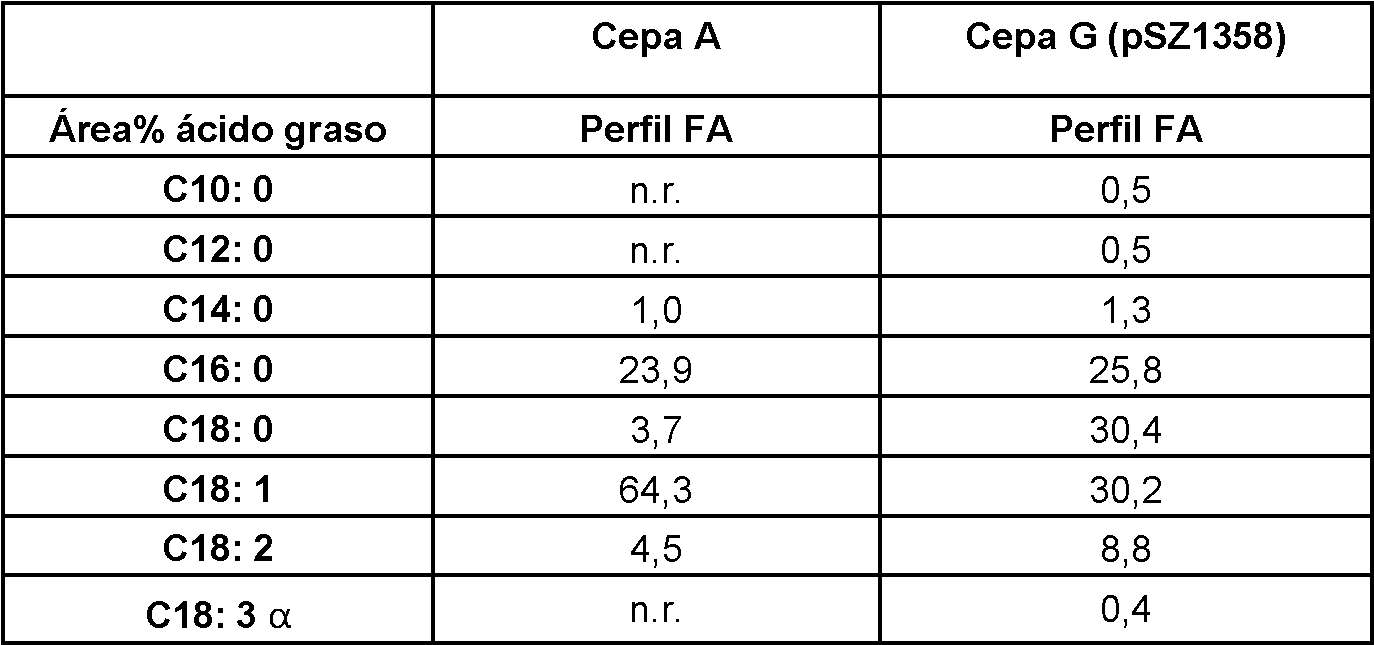
Tabla 18. Efecto de la expresión de BnOTE sobre el perfil regioespecífico de las TAG de POP, POS y SOS producidos a partir de Prototheca moriformis transformadaTable 18. Effect of BnOTE expression on the regiospecific profile of POP, POS and SOS TAGs produced from transformed Prototheca moriformis

[0319] Como se muestra en la Tabla 17, la composición de ácidos grasos de TAG aislada de la cepa G que expresa bnOTE se aumentó marcadamente para C18: 0 ácidos grasos (de 3,7% a 30,4%) y disminuyó en C18: 1 ácidos grasos (de 64,3% a 30,2%) con respecto al perfil de ácidos grasos de TAG aislada de cepa A no transformada. La composición de ácidos grasos de TAG aislada de la cepa A se caracterizó por ácido palmítico al 23,9%, ácido esteárico al 3,7%, y ácido oleico al 64,3%, una proporción de P: S: O de aproximadamente 6,5: 1: 17,4. En contraste, la composición de ácidos grasos de TAG aislada de la cepa G se caracterizó por ácido palmítico al 25,8%, ácido esteárico del 30,4%, y ácido oleico al 30,2%, una proporción de P: O: S de 1: 1,18: 1,17.[0319] As shown in Table 17, the TAG fatty acid composition isolated from strain G expressing bnOTE was markedly increased for C18: 0 fatty acids (from 3.7% to 30.4%) and decreased by C18: 1 fatty acids (from 64.3% to 30.2%) with respect to the TAG fatty acid profile isolated from non-transformed strain A. The TAG fatty acid composition isolated from strain A was characterized by 23.9% palmitic acid, 3.7% stearic acid, and 64.3% oleic acid, a P: S: O ratio of approximately 6.5: 1: 17.4. In contrast, the TAG fatty acid composition isolated from strain G was characterized by 25.8% palmitic acid, 30.4% stearic acid, and 30.2% oleic acid, a proportion of P: O: S of 1: 1.18: 1.17.
[0320] El impacto de la expresión de una tioestereasa que prefiere C18: 0 en el perfil regioespecífico de TAG de POP, POS y SOS de los aceites producidos a partir del microorganismo transformado fue un aumento en todos los tres CTC como una proporción de los CTC totales presentes en el aceite. Como se muestra en la Tabla 18, la suma de TAG de POP POS SOS representó el 45% de las etiquetas producidas por la cepa G, mientras que TAG de POP, POS y SOS sumaron sólo alrededor del 17% de TAG producidas en la cepa A. Los porcentajes de POP, POS y SOS de cepa G se comparan con manteca de cacao en la Tabla 18. Como se puede ver, las proporciones de POP, POS y SOS de la cepa G son muy similares a las proporciones observadas en la manteca de cacao.[0320] The impact of the expression of a thioesterase that prefers C18: 0 on the regiospecific TAG profile of POP, POS and SOS of the oils produced from the transformed microorganism was an increase in all three CTCs as a proportion of the Total CTC present in the oil. As shown in Table 18, the sum of TAG of POP POS SOS represented 45% of the labels produced by strain G, while TAG of POP, POS and SOS accounted for only about 17% of TAG produced in the strain. A. The percentages of POP, POS and SOS of strain G are compared with cocoa butter in Table 18. As can be seen, the proportions of POP, POS and SOS of strain G are very similar to the proportions observed in the cocoa butter
[0321] Estos datos demuestran la utilidad y eficacia de polinucleótidos que permiten la expresión de tioesterasa exógena para alterar el ácido graso y perfiles regioespecíficos de TAG de microorganismos de ingeniería, en particular para aumentar la distribución de TAG de POP, POS y SOS.[0321] These data demonstrate the usefulness and efficacy of polynucleotides that allow the expression of exogenous thioesterase to alter fatty acid and regiospecific TAG profiles of engineering microorganisms, in particular to increase the distribution of TAG of POP, POS and SOS.
EJEMPLOS 10-33: Ingeniería de m icroorganismosEXAMPLES 10-33: Microorganisms Engineering
[0322] Ejemplos 10-33 a continuación describen la ingeniería de diversos microorganismos. Para alterar el perfil de ácidos grasos de un microorganismo, los microorganismos pueden ser modificados genéticamente en donde las enzimas de la ruta de biosíntesis de lípidos endógenos o exógenos se expresan, sobreexpresan o atenúan. Pasos para genéticamente modificar un microbio para alterar su perfil de ácidos grasos en cuanto al grado de insaturación de ácidos grasos y para disminuir o aumentar longitud de cadena de ácido graso comprenden el diseño y construcción de un vector de transformación (p.ej, un plásmido), la transformación del microbio con uno o más vectores, selección de microbios transformados (transformantes), el crecimiento del microbio transformado, y el análisis del perfil de ácidos grasos de los lípidos producidos por el microbio modificado.[0322] Examples 10-33 below describe the engineering of various microorganisms. To alter the fatty acid profile of a microorganism, microorganisms can be genetically modified where enzymes in the biosynthesis pathway of endogenous or exogenous lipids are expressed, overexpressed or attenuated. Steps for genetically modifying a microbe to alter its fatty acid profile in terms of the degree of unsaturation of fatty acids and to decrease or increase fatty acid chain length comprise the design and construction of a transformation vector ( e.g., a plasmid ), the transformation of the microbe with one or more vectors, selection of transformed microbes (transformants), the growth of the transformed microbe, and the analysis of the fatty acid profile of the lipids produced by the modified microbe.
[0323] Los transgenes que alteran los perfiles de ácidos grasos de organismos huésped pueden ser expresados en numerosos microbios eucariotas. Los ejemplos de la expresión de transgenes en los microbios eucariotas, incluyendo Chlamydomonas reinhardtii, Chlorella ellipsoidea, Chlorella saccarophila, Chlorella vulgaris, Chlorella kessleri, Chlorella sorokiniana, Haematococcus pluvialis, Gonium pectorale, Volvox carteri, Dunaliella tertiolecta, Dunaliella viridis, Dunaliella salina, Closterium peracerosumstrigosum- littorale compleja, Nannochloropsis sp., Thalassiosira Pseudonana, Phaeodactylum tricornutum, Navivcula saprophila, Cylindrotheca fusiformis, Ciclotella cryptica, Symbiodinium microadriacticum, Amphidinium sp., Chaetoceros sp., Mortierella alpina, y Yarrowia lipolitica se pueden encontrar en la literatura científica. Estas técnicas de expresión se pueden combinar con las enseñanzas de la presente invención para producir microorganismos de ingeniería con perfiles de ácidos grasos alteradas.[0323] Transgenes that alter the fatty acid profiles of host organisms can be expressed in numerous eukaryotic microbes. Examples of expression of transgenes in eukaryotic microbes, including Chlamydomonas reinhardtii, Chlorella ellipsoidea, Chlorella saccarophila, Chlorella vulgaris, Chlorella kessleri, Chlorella sorokiniana, Haematococcus pluvialis, Gonium pectorale, Volvox carteri, Dunaliella tertiolecta, Dunaliella viridis, Dunaliella salina, Closterium peracerosumstrigosum-lithtorale complex, Nannochloropsis sp., Thalassiosira Pseudonana, Phaeodactylum tricornutum, Navivcula saprophila, Cylindrotheca fusiformis, Ciclotella cryptica, Symbiodinium microadriacticum, Amphidinium sp., Chaetoceros al . These expression techniques can be combined with the teachings of the present invention to produce engineering microorganisms with altered fatty acid profiles.
[0324] Los transgenes que alteran los perfiles de ácidos grasos de organismos huésped o alterar la distribución regioespecífica de glicerolipds producidos por organismos huésped también pueden expresarse en numerosos microbios procariotas. Los ejemplos de la expresión de transgenes en los microbios oleaginosas incluyendo Rhodococcus opacus se pueden encontrar en la literatura. Estas técnicas de expresión se pueden combinar con las enseñanzas de la presente invención para producir microorganismos de ingeniería con perfiles de ácidos grasos alterados. [0324] Transgenes that alter the fatty acid profiles of host organisms or alter the regiospecific distribution of glycerolipds produced by host organisms can also be expressed in numerous prokaryotic microbes. Examples of transgene expression in oilseed microbes including Rhodococcus opacus can be found in the literature. These expression techniques can be combined with the teachings of the present invention to produce engineering microorganisms with altered fatty acid profiles.
Tablas 19A-D. Listado de preferencia de codón.Tables 19A-D. Codon preference list.


Tabla 20. Proteínas de la vía de biosíntesis de lípidos.Table 20. Proteins of the lipid biosynthesis pathway.

(continuado)(continued)

(continuado)(continued)

(continuado)(continued)

EJEMPLO 34: INGENIERIA DE MICROALGAS PARA AUXOTROFIA DE ACIDOS GRASOSEXAMPLE 34: MICROALGES ENGINEERING FOR FATTY ACIDS AUXOTROPHY
[0325] Cepa B del Ejemplo 3, Prototheca moriformis (UTEX 1435) modificado para expresar una Cuphea wrightii tioesterasa (cwTE2), fue utilizada como el organismo huésped para su posterior modificación genética para noquear ambos alelos tioesterasa endógenos, FATA1-1 y FATA1-2. Aquí, una primera construcción de transformación fue generada para integrar un casete de expresión de neomicina en la cepa B en el locus FATA1-1. Este constructo, pSZ2226, incluidas secuencias de recombinación homólogas 5' (SEQ ID NO: 30) y 3' (SEQ ID NO: 31) (de orientación que flanquean el constructo) para el locus FATA1-1 del genoma nuclear y una secuencia de codificación de proteínas de resistencia de neomicina bajo el control del promotor p-tubulina/5'uTR C. reinhardtii (SEQ ID NO: 5) y Chlorella vulgaris nitrato reductasa 3' UTR (SEQ ID NO: 6). Este casete de expresión NeoR se muestra como SEQ iD NO: 15 y sirvió como un marcador seleccionable. [0325] Strain B of Example 3, Prototheca moriformis (UTEX 1435) modified to express a Cuphea wrightii thioesterase (cwTE2), was used as the host organism for subsequent genetic modification to knock out both endogenous thioesterase alleles, FATA1-1 and FATA1- two. Here, a first transformation construct was generated to integrate a neomycin expression cassette into strain B in the FATA1-1 locus. This construct, pSZ2226, included 5 '(SEQ ID NO: 30) and 3' (SEQ ID NO: 31) homologous recombination sequences (targeting the construct) for the nuclear genome FATA1-1 locus and a sequence of Neomycin resistance protein coding under the control of the p-tubulin / 5'uTR C. reinhardtii promoter (SEQ ID NO: 5) and Chlorella vulgaris nitrate reductase 3 'UTR (SEQ ID NO: 6). This NeoR expression cassette is shown as SEQ iD NO: 15 and served as a selectable marker.
[0326] Tras la transformación de pSZ2226 en la cepa B, se seleccionaron los transformantes individuales en placas de agar que contienen sacarosa y G418. Un único aislado, la cepa H, se seleccionó para su posterior modificación genética. Una segunda construcción de transformación, pSZ2236, se generó para integrar los polinucleótidos que permiten la expresión de un marcador seleccionable de tiamina en la cepa H en el locus FATA1-2. pSZ2236 incluidas secuencias de recombinación 5' (SEQ ID NO: 32) y 3' (SEQ ID NO: 33) homólogas (de orientación que flanquean el constructo) a la región genómica FATA1-2 para la integración en P. moriformis (UTEX 1435) del genoma nuclear y una región codificante de proteína THIC A. thaliana bajo el control de C. protothecoides promotor de la actina/5'UTR (SEQ ID NO: 22) y C. vulgaris nitrato reductasa 3' UTR (SEQ ID NO: 6). Este casete de expresión AtTHIC se muestra como SEQ ID NO: 23 y sirvió como un marcador seleccionable. Tras la transformación de la cepa H con pSZ2236 para generar la cepa I, los transformantes individuales fueron seleccionados en placas de agar que comprenden ácidos grasos libres. Cepa I era capaz de propagar sobre placas de agar y en medio carente de tiamina y suplementado con ácidos grasos libres. [0326] After transformation of pSZ2226 into strain B, individual transformants were selected on agar plates containing sucrose and G418. A single isolate, strain H, was selected for subsequent genetic modification. A second transformation construct, pSZ2236, was generated to integrate polynucleotides that allow the expression of a selectable thiamine marker in strain H in the FATA1-2 locus. pSZ2236 including 5 '(SEQ ID NO: 32) and 3' (SEQ ID NO: 33) recombination sequences homologous (targeting the construct) to the FATA1-2 genomic region for integration into P. moriformis (UTEX 1435 ) of the nuclear genome and a THIC A. thaliana protein coding region under the control of C. protothecoides actin promoter / 5'UTR (SEQ ID NO: 22) and C. vulgaris nitrate reductase 3 'UTR (SEQ ID NO: 6). This AtTHIC expression cassette is shown as SEQ ID NO: 23 and served as a selectable marker. After transformation of strain H with pSZ2236 to generate strain I, individual transformants were selected on agar plates comprising free fatty acids. Strain I was able to propagate on agar plates and in a medium lacking thiamine and supplemented with free fatty acids.
EJEMPLO 35: MICROORGANISMOS DE INGENIERÍA PARA LA PRODUCCIÓN AUMENTADA DE ÁCIDO ESTEARICOEXAMPLE 35: ENGINEERING MICROORGANISMS FOR INCREASED PRODUCTION OF ESTEARIC ACID
[0327] Una cepa clásicamente mutagenizada de Prototheca moriformis (UTEX 1435), Cepa J, se transformó con el constructo plásmido pSZ2281 de acuerdo con métodos de transformación biolística, como se describe en el documento PCT/US2009/066141, PCT/US2009/066142, PCT/US2011/038463, PCT/US2011/038464, y PCT/US2012/023696. pSZ2281 incluía horquillas de ARN que codifican polinucleótidos (SAD2hpC, SEQ ID NO: 34) para regular a la baja la expresión de desaturasa de estearoil-ACP, secuencias de recombinación homóloga de orientación 5' (SEQ ID NO: 1) y 3' (SEQ ID NO: 2) (que flanquea el constructo) a la región genómica 6S para la integración en el genoma nuclear, y S. suc2 cerevisiae región codificante de la invertasa de sacarosa (SEQ ID NO: 4), para expresar la secuencia de la proteína dada en SEQ ID NO: 3, bajo el control de C. reinhardtii promotor ptubulina/5'UTR (SEQ ID NO: 5) y Chlorella vulgaris nitrato reductasa 3' Ut R (SEQ ID NO: 6). S. cerevisiae suc2 casete de expresión se muestra como SEQ ID NO: 7 y sirvió como un marcador seleccionable. La secuencia de polinucleótido que codifica la horquilla de ARN SAD2hpC estaba bajo el control de C. protothecoides promotor de la actina/5'UTR (SEQ ID NO: 22) y C. vulgaris nitrato reductasa 3' UTR (SEQ ID NO: 6). [0327] A classically mutagenized strain of Prototheca moriformis (UTEX 1435), strain J, was transformed with the plasmid construct pSZ2281 according to biolistic transformation methods, as described in PCT / US2009 / 066141, PCT / US2009 / 066142, PCT / US2011 / 038463, PCT / US2011 / 038464, and PCT / US2012 / 023696. pSZ2281 included RNA hairpins encoding polynucleotides (SAD2hpC, SEQ ID NO: 34) to downregulate the expression of stearoyl-ACP desaturase, homologous recombination sequences of 5 'orientation (SEQ ID NO: 1) and 3' ( SEQ ID NO: 2) (flanking the construct) to the 6S genomic region for integration into the nuclear genome, and S. suc2 cerevisiae region encoding sucrose invertase (SEQ ID NO: 4), to express the sequence of the protein given in SEQ ID NO: 3, under the control of C. reinhardtii promoter ptubulin / 5'UTR (SEQ ID NO: 5) and Chlorella vulgaris nitrate reductase 3 'Ut R (SEQ ID NO: 6). S. cerevisiae suc2 expression cassette is shown as SEQ ID NO: 7 and served as a selectable marker. The polynucleotide sequence encoding the SAD2hpC RNA hairpin was under the control of C. protothecoides actin promoter / 5'UTR (SEQ ID NO: 22) and C. vulgaris nitrate reductase 3 'UTR (SEQ ID NO: 6) .
[0328] Tras la transformación de la cepa J con constructo pSZ2281, generando de este modo la cepa K, se seleccionaron los clones positivos en placas de agar que contienen sacarosa como única fuente de carbono. Los transformantes individuales fueron clonalmente purificados y propagados en condiciones heterotróficas adecuadas para la producción de lípidos como los que se detallan en el documento PCT/US2009/066141, PCT/US2009/066142, PCT/US2011/038463, PCT/US2011/038464, y PCT/US2012/023696. Muestras de lípidos se preparan a partir de biomasa seca y se analizaron usando los métodos de detección de ionización de cromatografía de gases de éster metílico de ácidos grasos de llama convencionales como se describe en el Ejemplo 1 (ver también PCT/US2012/023696). Los perfiles de ácidos grasos (expresados como % de área de los ácidos grasos totales) de P. moriformis UTEX cepa J propagado en glucosa como única fuente de carbono y tres aislados representativos de la cepa K, propagada en sacarosa como única fuente de carbono, se presenta en la Tabla 21. [0328] After transformation of strain J with construct pSZ2281, thereby generating strain K, positive clones were selected on agar plates containing sucrose as the sole carbon source. The individual transformants were clonally purified and propagated under heterotrophic conditions suitable for lipid production such as those detailed in PCT / US2009 / 066141, PCT / US2009 / 066142, PCT / US2011 / 038463, PCT / US2011 / 038464, and PCT / US2012 / 023696. Lipid samples are prepared from dry biomass and analyzed using ionization detection methods of conventional flame fatty acid methyl ester gas chromatography as described in Example 1 (see also PCT / US2012 / 023696). The fatty acid profiles (expressed as% of total fatty acid area) of P. moriformis UTEX strain J propagated in glucose as the sole source of carbon and three representative isolates of strain K, propagated in sucrose as the sole source of carbon, It is presented in Table 21.
Tabla 21. Perfiles de ácidos grasos de células Prototheca moriformis (UTEX 1435) diseñadas para expresar una construcción de ARN de horquilla orientado a gen de desaturasa de ACP estearoil/products génicos.Table 21. Fatty acid profiles of Prototheca moriformis cells (UTEX 1435) designed to express a fork RNA construct targeting ACS stearoyl desaturase gene / gene products.

[0329] Los datos presentados en la Tabla 21 muestran un claro impacto de la expresión de constructo de ARN de horquilla SAD2 en los perfiles de ácidos grasos C18: 0 y C18: 1 del organismo transformado. Los perfiles de ácidos grasos de los transformantes de cepa K que comprenden un constructo de ARN de horquilla SAD2 demostraron un aumento en el porcentaje de ácidos grasos saturados C18: 0 con una disminución concomitante de ácidos grasos insaturados C18: 1. Perfiles de ácidos grasos de la cepa no transformada comprenden de aproximadamente 3% C18: 0. Perfiles de ácidos grasos de las cepas transformadas comprenden aproximadamente 37% de C18: 0. Estos datos ilustran la expresión exitosa y el uso de polinucleótidos que permiten la expresión de un constructo de horquilla de ARN SAD en Prototheca moriformis para alterar el porcentaje de ácidos grasos saturados en los microbios huésped manipulados, y en particular en el aumento de la concentración de ácidos grasos C18: 0 y la disminución de ácidos grasos C18: 1 en las células microbianas. [0329] The data presented in Table 21 show a clear impact of the SAD2 hairpin RNA construct expression on the C18: 0 and C18: 1 fatty acid profiles of the transformed organism. The fatty acid profiles of strain K transformants comprising an SAD2 hairpin RNA construct demonstrated an increase in the percentage of saturated C18: 0 fatty acids with a concomitant decrease in C18 unsaturated fatty acids: 1. Fatty acid profiles of The non-transformed strain comprises about 3% C18: 0. Fatty acid profiles of the transformed strains comprise about 37% of C18: 0. These data illustrate the successful expression and use of polynucleotides that allow the expression of a hairpin construct. of SAD RNA in Prototheca moriformis to alter the percentage of saturated fatty acids in the manipulated host microbes, and in particular in increasing the concentration of C18: 0 fatty acids and the decrease of C18: 1 fatty acids in microbial cells.
[0330] También mostrada en la Tabla 21, la cepa K-4 tenía un nivel aún elevado adicional de estearato. La cepa K4 fue creada mediante la inserción de la construcción de cepas K1-K3 en el locus de la SAD2B. Por lo tanto, por la anulación de una copia del gen SAD y la inhibición de las copias restantes a nivel del ARN, una reducción adicional en el ácido oleico y el aumento de estearato correspondiente se obtuvo. Análisis de los triglicéridos de aceite RBD obtenidos de cepa K4 mostró aproximadamente 12% de POP, 27% de POS y 18% de SOS. [0330] Also shown in Table 21, strain K-4 had an additional still high level of stearate. The K4 strain was created by inserting the K1-K3 strain construct into the SAD2B locus. Therefore, by canceling a copy of the SAD gene and inhibiting the remaining copies at the RNA level, an additional reduction in oleic acid and the corresponding increase in stearate was obtained. Analysis of the RBD oil triglycerides obtained from strain K4 showed approximately 12% POP, 27% POS and 18% SOS.
EJEMPLO 36: INGENIERÍA DE MICROORGANISMOS PARA LA PRODUCCIÓN AUMENTADA DE LOS ÁCIDOS OLEICOS A TRAVÉS KNOCKDOWN DE UNA TIOESTERASA DE ACIL-ACP ENDÓGENA EXAMPLE 36: ENGINEERING OF MICROORGANISMS FOR THE INCREASED PRODUCTION OF OLEIC ACIDS THROUGH KNOCKDOWN OF A THYESTERASE OF ACIL-ACP ENDÓGENA
[0331] Una cepa mutagenizada clásicamente de P ro to th e ca m o rifo rm is (UTEX 1435), Cepa J, se transformó de forma independiente con cada uno de los constructos pSZ2402-pSZ2407 de acuerdo con métodos de transformación biolística, como se describe en el documento PCT/US2009/066141, PCT/US2009/066142, PCT/US2011/038463, PCT/US2011/038464 y PCT/US2012/023696. Cada uno de los constructos pSZ2402-pSZ2407 incluyó diferentes polinucleótidos que codifican un ARN de horquilla dirigida contra transcripciones de ARNm FATA1 P ro to th e ca m o rifo rm is para regular a la baja la expresión de tioesterasa de acil-ACP graso, secuencias de recombinación 5' (SEQ ID NO: 1) y 3' (SEQ ID NO: 2) homólogas de orientación (que flanquean el constructo) a la región genómica 6S para la integración en el genoma nuclear, y S. ce re v is ia e s u c2 región de codificación de sacarosa invertasa (SEQ ID NO: 4) para expresar la secuencia de la proteína dada en SEQ ID NO: 3 bajo el control de C. re in h a rd tii promotor ptubulina/5'UTR (SEQ ID NO: 5) y C h lo re lla vu lga ris nitrato reductasa 3' UTR (SEQ ID NO: 6). S. ce re v is ia e s u c2 casete de expresión se muestra como SEQ ID NO: 7 y sirvió como un marcador seleccionable. Lista de secuencias identidades para los polinucleótidos correspondientes a cada horquilla se enumeran en la Tabla 22. La secuencia de polinucleótido que codifica cada horquilla de ARN estaba bajo el control de C. re in h a rd tii promotor p-tubulina/5'UTR (SEQ ID NO: 5) y C. vu lga ris nitrato reductasa 3' UTR (SEQ ID NO: 6). [0331] A classically mutagenized strain of P ro to th e ca mo rifo rm is (UTEX 1435), Cepa J, was transformed independently with each of the constructs pSZ2402-pSZ2407 according to biolistic transformation methods, as described in document PCT / US2009 / 066141, PCT / US2009 / 066142, PCT / US2011 / 038463, PCT / US2011 / 038464 and PCT / US2012 / 023696. Each of the pSZ2402-pSZ2407 constructs included different polynucleotides encoding a hairpin RNA directed against transcripts of FATA1 mRNA rm is to regulate downward expression of fatty acyl-ACP thioesterase, sequences of 5 'recombination (SEQ ID NO: 1) and 3' (SEQ ID NO: 2) homologous orientation (flanking the construct) to the 6S genomic region for integration into the nuclear genome, and S. ce re v is ia esu c2 sucrose invertase coding region (SEQ ID NO: 4) to express the protein sequence given in SEQ ID NO: 3 under the control of C. re in ha rd tii promoter ptubulin / 5'UTR (SEQ ID NO : 5) and C h re lla vu lga ris nitrate reductase 3 'UTR (SEQ ID NO: 6). S. ce re v is ia esu c2 expression cassette is shown as SEQ ID NO: 7 and served as a selectable marker. List of sequence identities for the polynucleotides corresponding to each hairpin are listed in Table 22. The polynucleotide sequence encoding each hairpin of RNA was under the control of C. re in ha rd tii promoter p-tubulin / 5'UTR (SEQ ID NO: 5) and C. vu lga ris nitrate reductase 3 'UTR (SEQ ID NO: 6).
Tabla 22. Construcciones de plásmidos utilizados para transformar P ro to th e ca m o rifo rm is (UTEX 1435) Cepa J.Table 22. Plasmid constructions used to transform P ro to th e ca mo rifo rm is (UTEX 1435) Strain J.
Construcción Designación de horquilla SEQ ID NO:Construction Fork designation SEQ ID NO:
de plásmidoplasmid
PmFATA-hpB SEQ ID NO: 40PmFATA-hpB SEQ ID NO: 40
pSZ2402pSZ2402
pSZ2403 PmFATA-hpC SEQ ID NO: 41pSZ2403 PmFATA-hpC SEQ ID NO: 41
pSZ2404 PmFATA-hpD SEQ ID NO: 42pSZ2404 PmFATA-hpD SEQ ID NO: 42
pSZ2405 PmFATA-hpE SEQ ID NO: 43pSZ2405 PmFATA-hpE SEQ ID NO: 43
pSZ2406 PmFATA-hpF SEQ ID NO: 44pSZ2406 PmFATA-hpF SEQ ID NO: 44
pSZ2407 PmFATA-hpG SEQ ID NO: 45pSZ2407 PmFATA-hpG SEQ ID NO: 45
[0332] Tras la transformación independiente de la cepa J con cada una de las construcciones enumeradas en la Tabla 22, se seleccionaron los clones positivos en placas de agar que contienen sacarosa como única fuente de carbono. Los transformantes individuales fueron purificados clonalmente y propagados en condiciones heterotróficas adecuadas para la producción de lípidos como los que se detallan en el documento PCT/US2009/066141, PCT/US2009/066142, PCT/US2011/038463, PCT/US2011/038464, y PCT/US2012/023696. Muestras de lípidos se preparan a partir de biomasa seca y se analizan usando los métodos de detección de ionización de cromatografía de gases de éster metílico de ácidos grasos de llama convencionales como se describe en el Ejemplo 1 (ver también PCT/US2012/023696). Los perfiles de ácidos grasos (expresados como % de área de los ácidos grasos totales) de P. m o rifo rm is (UTEX 1435) Cepa J propaga en glucosa como única fuente de carbono y aislados representativos de cada transformación de la cepa J, propagada en sacarosa como única fuente de carbono, se presentan en la Tabla 23. [0332] After independent transformation of strain J with each of the constructs listed in Table 22, positive clones in agar plates containing sucrose were selected as the sole carbon source. The individual transformants were clonally purified and propagated under heterotrophic conditions suitable for lipid production such as those detailed in PCT / US2009 / 066141, PCT / US2009 / 066142, PCT / US2011 / 038463, PCT / US2011 / 038464, and PCT / US2012 / 023696. Lipid samples are prepared from dry biomass and analyzed using ionization detection methods of conventional flame fatty acid methyl ester gas chromatography as described in Example 1 (see also PCT / US2012 / 023696). The fatty acid profiles (expressed as% of total fatty acid area) of P. mo rifo rm is (UTEX 1435) Strain J propagates in glucose as the only carbon source and representative isolates of each transformation of strain J, propagated in sucrose as the only carbon source, they are presented in Table 23.
Tabla 23. Perfiles de ácidos grasos de células P ro to th e ca m o rifo rm is (UTEX 1435) diseñadas para expresar construcciones de ARN en horquilla orientadas a gen de tioesterasa de acil-ACP graso/productos génicos.Table 23. P ro to th e ca mo rifo rm is (UTEX 1435) fatty acid profiles designed to express hairpin RNA constructs oriented to fatty acyl-ACP thioesterase gene / gene products.

(continúa)(keep going)

[0333] Los datos presentados en la Tabla 23 muestran un claro impacto de la expresión de construcciones de ARN de horquilla FATA en perfiles de ácidos grasos C18: 0 y C18: 1 del organismo transformado. Los perfiles de ácidos grasos de los transformantes de cepa J comprenden un constructo de ARN de horquilla FATA demostraron un aumento en el porcentaje de C18: 1 de ácidos grasos con una disminución concomitante de C16: 0 y C18: 0 ácidos grasos. Perfiles de ácidos grasos de la cepa J no transformada son aproximadamente 26,66% C16: 0, 3% C18: 0, y alrededor de 59% de C18: 1 ácidos grasos. Por el contrario, los perfiles de ácidos grasos de las cepas transformadas comprenden tan bajo como 8,6% C16: 0 y 1,54% C18: 0 y más que 78% de C18: 1 ácidos grasos. [0333] The data presented in Table 23 show a clear impact of the expression of FATA hairpin RNA constructs on C18: 0 and C18: 1 fatty acid profiles of the transformed organism. The fatty acid profiles of strain J transformants comprise a FATA hairpin RNA construct demonstrated an increase in the C18: 1 percentage of fatty acids with a concomitant decrease of C16: 0 and C18: 0 fatty acids. Fatty acid profiles of the non-transformed strain J are approximately 26.66% C16: 0.3% C18: 0, and about 59% C18: 1 fatty acids. In contrast, the fatty acid profiles of the transformed strains comprise as low as 8.6% C16: 0 and 1.54% C18: 0 and more than 78% of C18: 1 fatty acids.
[0334] Estos datos ilustran la utilidad y uso exitoso de polinucleótido de construcciones de horquilla ARN FATA en Prototheca moriformis para alterar el perfil de ácidos grasos de microbios modificados, y en particular en el aumento de la concentración de C18: 1 ácidos grasos y la disminución de C18: 0 y C16: 0 ácidos grasos en las células microbianas. [0334] These data illustrate the usefulness and successful use of polynucleotide of FATA RNA hairpin constructs in Prototheca moriformis to alter the fatty acid profile of modified microbes, and in particular in increasing the concentration of C18: 1 fatty acids and the decrease in C18: 0 and C16: 0 fatty acids in microbial cells.
EJEMPLO 37: MICROORGANISMOS DE INGENIERÍA PARA LA PRODUCCIÓN AUMENTADA DE ÁCIDOS GRASOS DE CADENA MEDIA A TRAVÉS DE SOBREEXPRESIÓN KASI O KASIVEXAMPLE 37: ENGINEERING MICROORGANISMS FOR THE INCREASED PRODUCTION OF MEDIUM CHAIN FATTY ACIDS THROUGH KASI OR KASIV OVEREXPRESSION
[0335] Este ejemplo describe el uso de polinucleótidos recombinantes que codifican enzimas KASI o KASIV para diseñar microorganismos en los cuales los perfiles de ácidos grasos de los microorganismos transformados han sido enriquecidos en ácido láurico, C10: 0 y ácidos grasos saturados totales. [0335] This example describes the use of recombinant polynucleotides encoding KASI or KASIV enzymes to design microorganisms in which the fatty acid profiles of the transformed microorganisms have been enriched in lauric acid, C10: 0 and total saturated fatty acids.
[0336] Cada uno de los constructos pSZD1132, pSZD1133, pSZD1134, o pSZD1201 se usó independientemente para transformar la cepa B del Ejemplo 3, Prototheca moriformis (UTEX 1435) modificado para expresar Cuphea wrightii tioesterasa (cwTE2), de acuerdo con los métodos de transformación biolística, como se describe en el documento PCT/US2009/066141, PCT/US2009/066142, PCT/US2011/038463, PCT/US2011/038464, y PCT/US2012/023696. Cada uno de los constructos anteriores incluyeron diferentes polinucleótidos que codifican una enzima KASI o KASIV, secuencias de recombinación de orientación 5' (SEQ ID NO: 13) y 3' (SEQ ID NO: 14) homólogas (que flanquean el constructo) a la región genómica pLoop para la integración en el genoma nuclear, y una secuencia de resistencia a la neomicina que codifica la proteína bajo el control de C. reinhardtii promotor p-tubulina/5'UTR (SEQ ID NO: 5) y Chlorella vulgaris nitrato reductasa 3' UTR (SEQ ID NO: 6). Este casete de expresión NeoR se muestra como SEQ ID NO: 15 y sirvió como un marcador seleccionable. Lista de secuencias identidades para los polinucleótidos correspondientes a cada constructo se enumeran en la Tabla 20. La secuencia de polinucleótido que codifica cada enzima KAS estaba bajo el control de P. moriformis UTEX 1435 promotor Amt03/5'UTR (SEQ ID n O: 8) y C. vulgaris nitrato reductasa 3' u Tr (SEQ ID NO: 6). La regiones codificadoras de proteína de las enzimas KAS y el gen de resistencia de neomicina fueron optimizados por codon para reflejar el sesgo de codon inherente a genes nucleares P. moriformis UTEX 1435 como se describe en el documento PCT/US2009/066141, PCT/US2009/066142, PCT/US2011/038463, PCT/US2011/038464, y PCT/US2012/023696. [0336] Each of the constructs pSZD1132, pSZD1133, pSZD1134, or pSZD1201 was used independently to transform strain B of Example 3, Prototheca moriformis (UTEX 1435) modified to express Cuphea wrightii thioesterase (cwTE2), according to the methods of Biolistic transformation, as described in document PCT / US2009 / 066141, PCT / US2009 / 066142, PCT / US2011 / 038463, PCT / US2011 / 038464, and PCT / US2012 / 023696. Each of the above constructs included different polynucleotides encoding a KASI or KASIV enzyme, 5 '(SEQ ID NO: 13) and 3' (SEQ ID NO: 14) homologous (flanking the construct) homologous recombination sequences. pLoop genomic region for integration into the nuclear genome, and a neomycin resistance sequence encoding the protein under the control of C. reinhardtii promoter p-tubulin / 5'UTR (SEQ ID NO: 5) and Chlorella vulgaris nitrate reductase 3 'UTR (SEQ ID NO: 6). This NeoR expression cassette is shown as SEQ ID NO: 15 and served as a selectable marker. List of sequence identities for the polynucleotides corresponding to each construct are listed in Table 20. The polynucleotide sequence encoding each KAS enzyme was under the control of P. moriformis UTEX 1435 promoter Amt03 / 5'UTR (SEQ ID No: 8 ) and C. vulgaris nitrate reductase 3 'or Tr (SEQ ID NO: 6). The protein coding regions of the KAS enzymes and the neomycin resistance gene were optimized by codon to reflect codon bias inherent in P. moriformis UTEX 1435 nuclear genes as described in PCT / US2009 / 066141, PCT / US2009 / 066142, PCT / US2011 / 038463, PCT / US2011 / 038464, and PCT / US2012 / 023696.
[0337] Tras la transformación de los plásmidos individuales en la cepa B, se seleccionaron los clones positivos en placas de agar que contienen G418. Los transformantes individuales fueron clonalmente purificados y se hicieron crecer en sacarosa como única fuente de carbono a pH 7,0 en condiciones adecuadas para la producción de lípidos tal como se detalla en el documento PCT/US2009/066141, PCT/US2009/066142, PCT/US2011/038463, PCT/US2011/038464, y PCT/US2012/023696. Muestras de lípidos se prepararon a partir de biomasa seca de cada transformante y de perfiles de ácidos grasos de estas muestras se analizaron usando métodos de detección de ionización éster metílico de cromatografía de gases de la llama de ácido graso estándar (FAME GC/FID) como se describe en el Ejemplo 1. Los perfiles de ácidos grasos (expresados como % de área de los ácidos grasos totales) de la cepa B y cuatro transformantes positivos de cada uno de pSZ2046 (cepas MP, 1-4) se presentan en la Tabla 24. [0337] After transformation of the individual plasmids into strain B, positive clones in agar plates containing G418 were selected. The individual transformants were clonally purified and grown in sucrose as the sole carbon source at pH 7.0 under conditions suitable for lipid production as detailed in PCT / US2009 / 066141, PCT / US2009 / 066142, PCT / US2011 / 038463, PCT / US2011 / 038464, and PCT / US2012 / 023696. Lipid samples were prepared from dry biomass of each transformant and fatty acid profiles of these samples were analyzed using detection methods of Methyl ester ionization of standard fatty acid flame gas chromatography (FAME GC / FID) as described in Example 1. Fatty acid profiles (expressed as% of total fatty acid area) of strain B and Four positive transformants of each of pSZ2046 (strains MP, 1-4) are presented in Table 24.
Tabla 24. Constructos plásmidos utilizados para transformar Prototheca moriformis (UTEX 1435) Cepa B.Table 24. Plasmid constructs used to transform Prototheca moriformis (UTEX 1435) Strain B.

Tabla 25. Perfiles de ácidos grasos de P ro to th e ca m o rifo rm is (UTEX 1435) Cepa diseñada para un aumento de C10, ácido láurico, y ácidos grasos saturados totalesTable 25. P ro to th e ca mo rifo is fatty acid profiles (UTEX 1435) A strain designed for an increase in C10, lauric acid, and total saturated fatty acids

[0338] Los datos presentados en la Tabla 25 muestran un claro impacto de la expresión exógena de enzimas de KASI y KASIV sobre perfiles de ácidos grasos C10: 0 y C12 del organismo transformado. Los perfiles de ácidos grasos de la cepa B, que expresan Cuphea wrightii tioesterasa solo, comprendida aproximadamente 8% C10: 0 y aproximadamente 35,5% C12: 0, con ácidos grasos saturados representan el 72,55% de ácidos grasos totales. En constraste, los transformantes de la cepa B modificados para expresar adicionalmente Cuphea wrightii KASI con P. moriformis péptido de tránsito de desaturasa estearoil ACP se caracteriza por un perfil de ácidos grasos de aproximadamente 13% C10: 0 y aproximadamente 46% C12: 0. Los ácidos grasos saturados representaron tan alto como 77% en los transformantes de la cepa B co-expresión de C.wrightii proteína de fusión KASI. Del mismo modo, los transformantes de la cepa B modificados para expresar C. wrightii KASI con péptido de tránsito nativo de la enzima se caracteriza por un perfil de ácidos grasos de aproximadamente 15% C10, 44% C12, y aproximadamente 79% de ácidos grasos saturados. Los perfiles de ácidos grasos o muchos transformantes de la cepa B que expresan Cuphea pulcherrima KASIV o Cuphea hookeriana KASIV también mostraron niveles C10% y C12% elevados, en comparación con el perfil de ácidos grasos de la cepa B en sí. [0338] The data presented in Table 25 show a clear impact of the exogenous expression of KASI and KASIV enzymes on C10: 0 and C12 fatty acid profiles of the transformed organism. The fatty acid profiles of strain B, which express Cuphea wrightii thioesterase alone, comprised approximately 8% C10: 0 and approximately 35.5% C12: 0, with saturated fatty acids representing 72.55% of total fatty acids. In contrast, the transformants of strain B modified to further express Cuphea wrightii KASI with P. moriformis transit peptide of stearoyl desaturase ACP is characterized by a fatty acid profile of approximately 13% C10: 0 and approximately 46% C12: 0. Saturated fatty acids represented so high as 77% in the transformants of strain B co-expression of C. wrightii KASI fusion protein. Similarly, strain B transformants modified to express C. wrightii KASI with native enzyme transit peptide are characterized by a fatty acid profile of approximately 15% C10, 44% C12, and approximately 79% fatty acids saturated. The fatty acid profiles or many transformants of strain B expressing Cuphea pulcherrima KASIV or Cuphea hookeriana KASIV also showed elevated C10% and C12% levels, compared to the fatty acid profile of strain B itself.
[0339] Estos datos demuestran la utilidad y eficacia de polinucleótidos que permiten la expresión de constructos de KASI y KASIV en Prototheca moriformis (UTEX 1435) para alterar el porcentaje de ácidos grasos saturados en los microbios huésped manipulados, y en particular en el aumento de la concentración de C10: 0 y C12: 0 ácidos grasos en células microbianas. [0339] These data demonstrate the usefulness and efficacy of polynucleotides that allow the expression of KASI and KASIV constructs in Prototheca moriformis (UTEX 1435) to alter the percentage of saturated fatty acids in the manipulated host microbes, and in particular in increasing the concentration of C10: 0 and C12: 0 fatty acids in microbial cells.
EJEMPLO 38: INGENIERÍA MICROORGANISMOS PARA LA PRODUCCIÓN AUMENTADA DE ÁCIDOS GRASOS DE CADENA MEDIA A TRAVÉS DE KNOCKOUT KASIEXAMPLE 38: MICROORGANISM ENGINEERING FOR INCREASED PRODUCTION OF MEDIUM CHAIN FATTY ACIDS THROUGH KNOCKOUT KASI
[0340] Este ejemplo describe el uso de polinucleótidos recombinantes que interrumpen diferentes alelos KASI para diseñar microorganismos en los cuales los perfiles de ácidos grasos de los microorganismos transformados han sido enriquecidos en C10: 0 y ácidos grasos de cadena media. [0340] This example describes the use of recombinant polynucleotides that disrupt different KASI alleles to design microorganisms in which the fatty acid profiles of the transformed microorganisms have been enriched in C10: 0 and medium chain fatty acids.
[0341] Constructos pSZ2302 y pSZ2304 se utilizaron para transformar de forma independiente Cepa B del Ejemplo 3, Prototheca moriformis (UTEX 1435) modificado para expresar Cuphea wrightii tioesterasa (cwTE2), de acuerdo con los métodos de transformación biolística, como se describe en el documento PCT/US2009/066141, PCT/US2009/066142, PCT/US2011/038463, PCT/US2011/038464, y PCT/US2012/023696. pSZ2302 incluidas secuencias de recombinación 5' (SEQ ID NO: 50) y 3' (SEQ ID NO: 51) homólogas (de orientación que flanquean el constructo) a la región genómica KASI alelo 1 para la integración en P. moriformis genoma nuclear, A. thaliana región codificante de proteína THIC bajo el control de C. protothecoides promotor de la actina/5'UTR (SEQ ID NO: 22) y C. vulgaris nitrato reductasa 3' UTR (SEQ ID NO: 6). pSZ2304 incluidas secuencias de recombinación 5' (SEQ ID NO: 52) y 3' (SEQ ID NO: 53) homólogas (de orientación que flanquean el constructo) a la región genómica KAS1 alelo 2 para su integración en P. moriformis genoma nuclear, A. thaliana región codificante de proteína THIC bajo el control de C. protothecoides promotor de la actina/5'UTR (SEQ ID NO: 22) y C. vulgaris nitrato reductasa 3' u Tr (SEQ ID NO: 6). Este casete de expresión AtTHIC se muestra como SEQ ID NO: 23 y sirvió como un marcador de selección. La proteína de la región de codificación de AtTHIC se optimiza por codones para reflejar el sesgo de codón inherente P. moriformis genes nucleares UTEX 1435 como se describe en el documento PCT/US2009/066141, PCT/US2009/066142, PCT/US2011/038463, PCT/US2011/038464, y PCT/US2012/023696. [0341] Constructs pSZ2302 and pSZ2304 were used to independently transform strain B of Example 3, Prototheca moriformis (UTEX 1435) modified to express Cuphea wrightii thioesterase (cwTE2), according to the biolistic transformation methods, as described in PCT / US2009 / 066141, PCT / US2009 / 066142, PCT / US2011 / 038463, PCT / US2011 / 038464, and PCT / US2012 / 023696. pSZ2302 including 5 '(SEQ ID NO: 50) and 3' (SEQ ID NO: 51) recombination sequences homologous (targeting the construct) to the KASI genomic region allele 1 for integration into P. moriformis nuclear genome, A. thaliana THIC protein coding region under the control of C. protothecoides actin promoter / 5'UTR (SEQ ID NO: 22) and C. vulgaris nitrate reductase 3 'UTR (SEQ ID NO: 6). pSZ2304 including 5 '(SEQ ID NO: 52) and 3' (SEQ ID NO: 53) homologous (targeting flanking the construct) recombination sequences to the genomic region KAS1 allele 2 for integration into P. moriformis nuclear genome, A. thaliana THIC protein coding region under the control of C. protothecoides actin promoter / 5'UTR (SEQ ID NO: 22) and C. vulgaris nitrate reductase 3 'or Tr (SEQ ID NO: 6). This AtTHIC expression cassette is shown as SEQ ID NO: 23 and served as a selection marker. The protein in the AtTHIC coding region is optimized by codons to reflect the inherent codon bias P. moriformis nuclear genes UTEX 1435 as described in PCT / US2009 / 066141, PCT / US2009 / 066142, PCT / US2011 / 038463 , PCT / US2011 / 038464, and PCT / US2012 / 023696.
[0342] Tras transformación independiente de pSZ2302 y pSZ2304 en la cepa B, generando de este modo Cepa Q y R, se seleccionaron los clones positivos en placas de agar que comprenden tiamina. Los transformantes individuales fueron clonalmente purificados y cultivados en sacarosa como única fuente de carbono a pH 5,0 o pH 7,0 bajo condiciones heterotróficas adecuadas para la producción de lípidos tal como se detalla en el documento PCT/US2009/066141, PCT/US2009/066142, PCT/US2011/038463, PCT/US2011/038464, y PCT/US2012/023696. Muestras de lípidos se prepararon a partir de biomasa seca de cada transformante y de perfiles de ácidos grasos de estas muestras se analizaron usando métodos de detección de ionización de ácido graso de éster metílico de cromatografía de gas de la llama (FAME GC/FID) como se describe en el Ejemplo 1. Los perfiles de ácidos grasos (expresados como Area % de ácidos grasos totales) de la cepa B y pSZ2302 positivo (Cepa Q, 1-5) y pSZ2304 (cepa R, 1-5) transformantes se presentan en las Tablas 26 y 27. [0342] After independent transformation of pSZ2302 and pSZ2304 into strain B, thereby generating strain Q and R, positive clones were selected on agar plates comprising thiamine. The individual transformants were clonally purified and cultured in sucrose as the sole carbon source at pH 5.0 or pH 7.0 under heterotrophic conditions suitable for lipid production as detailed in document PCT / US2009 / 066141, PCT / US2009 / 066142, PCT / US2011 / 038463, PCT / US2011 / 038464, and PCT / US2012 / 023696. Lipid samples were prepared from dry biomass of each transformant and fatty acid profiles of these samples were analyzed using flame gas chromatography methyl ester ionization methods (FAME GC / FID) as described in Example 1. Fatty acid profiles (expressed as Area% of total fatty acids) of strain B and pSZ2302 positive (Strain Q, 1-5) and pSZ2304 (strain R, 1-5) transformants are presented in Tables 26 and 27.
Tabla 26. Perfiles de ácidos grasos de P ro to th e ca m o rifo rm is (UTEX 1435) Cepas B, Q y R diseñadas para aumentar los ácidos grasos de la cadena media, cultivados a pH 5.0.Table 26. P ro to th e ca mo rifo is fatty acid profiles (UTEX 1435) Strains B, Q and R designed to increase the medium chain fatty acids, grown at pH 5.0.

Tabla 27. Perfiles de ácidos grasos de P ro to th e ca m o rifo rm is (UTEX 1435), cepas B, Q y R diseñadas para aumentar los ácidos grasos de la cadena media, cultivados a pH 7,0Table 27. Fatty acid profiles of P ro to th e ca mo rifo rm is (UTEX 1435), strains B, Q and R designed to increase the medium chain fatty acids, grown at pH 7.0

[0343] Los datos presentados en las Tablas 26 y 27 muestran un claro impacto de la interrupción de diferentes alelos KASI en los perfiles de ácidos grasos de los organismos transformados. Cuando se cultivan a un pH de 5,0, los perfiles de ácidos grasos de P ro to th e ca m o rifo rm is (UTEX 1435) y P ro to th e ca m o rifo rm is (UTEX 1435) Cepa B, que expresa C u ph ea w rig h tii tioesterasa FATB2 bajo el control de un promotor regulable pH fueron muy similares. Estos perfiles se caracterizaron por aproximadamente 1% C14: 0, aproximadamente 21-26% C16: 0, alrededor del 2-3% C18: 0, aproximadamente 60-65% C18: 1, aproximadamente 7% de C18: 2, con C10-C14 ácidos grasos que comprenden de aproximadamente 1,19 a 1,3% de ácidos grasos totales. En constraste, cuando se cultiva a un pH de 5,0, Cepa B más modificada para interrumpir KASI alelo 1 (cepa Q) o KASI alelo 2 (cepa R) demostraron perfiles de ácidos grasos alterados que se caracterizan por aumento de los niveles de C12, los niveles de aumento de C14, disminución de niveles de C18, y la disminución de los niveles de C18: 1 ácidos grasos en comparación con la cepa B o UTEX 1435. Los perfiles de ácidos grasos de los aislados de cepas Q y R diferían en que aislados de cepa R (alelo 2 knockout) tenían generalmente mayores C12s y menores C16s y C18: 1s que la cepa Q (alelo 1 knockout). [0343] The data presented in Tables 26 and 27 show a clear impact of the disruption of different KASI alleles on the fatty acid profiles of transformed organisms. When grown at a pH of 5.0, the fatty acid profiles of P ro to th e ca mo rifo rm is (UTEX 1435) and P ro to th e ca mo rifo rm is (UTEX 1435) Cepa B, which Express C u ph ea w rig h tii thioesterase FATB2 under the control of a pH adjustable promoter were very similar. These profiles were characterized by about 1% C14: 0, about 21-26% C16: 0, about 2-3% C18: 0, about 60-65% C18: 1, about 7% of C18: 2, with C10 -C14 fatty acids comprising from about 1.19 to 1.3% of total fatty acids. In contrast, when grown at a pH of 5.0, strain B more modified to disrupt KASI allele 1 (strain Q) or KASI allele 2 (strain R) demonstrated altered fatty acid profiles characterized by increased levels of C12, levels of increase in C14, decrease in levels of C18, and decrease in levels of C18: 1 fatty acids compared to strain B or UTEX 1435. Fatty acid profiles of isolates of strains Q and R they differed in that isolates of strain R (2 knockout allele) generally had higher C12s and lower C16s and C18: 1s than strain Q (1 knockout allele).
[0344] Cuando se cultivaron a pH 7,0, el perfil de ácidos grasos de P ro to th e ca m o rifo rm is (UTEX 1435) es distinto de P ro to th e ca m o rifo rm is (UTEX 1435) Cepa B que expresa C u p h e a w rig h tii tioesterasa FATB2 bajo el control de un promotor de pH regulable. Cuando se cultivaron a pH 7,0, Cepa B se caracteriza por un perfil de ácidos grasos elevado en ácidos grasos C10, C12, y C14 (estos compuestos sobre 50% de los ácidos grasos totales). Cuando se cultivaron a pH 7,0, cepa Q y cepa R demostraron perfiles de ácidos grasos con todavía aumenta en C10, C12, y C14 ácidos grasos y aún disminuye aún más en C18: 0 y C18: 1 ácidos grasos con respecto a la cepa B. De nuevo, se observaron diferencias en los perfiles de ácidos grasos entre la cepa Q y R con el perfil de la cepa R comprende mayores niveles porcentuales de C12 y menores niveles de C18: 1 que la cepa P. [0344] When grown at pH 7.0, the fatty acid profile of P ro to th e ca mo rifo rm is (UTEX 1435) is different from P ro to th e ca mo rifo rm is (UTEX 1435) strain B expressing C upheaw rig h tii thioesterase FATB2 under the control of an adjustable pH promoter. When grown at pH 7.0, strain B is characterized by a high fatty acid profile in C10, C12, and C14 fatty acids (these compounds over 50% of the total fatty acids). When grown at pH 7.0, strain Q and strain R demonstrated fatty acid profiles with still increases in C10, C12, and C14 fatty acids and further decreased in C18: 0 and C18: 1 fatty acids with respect to strain B. Again, they were observed Differences in fatty acid profiles between strain Q and R with the profile of strain R comprise higher percentage levels of C12 and lower levels of C18: 1 than strain P.
[0345] Estos datos ilustran la expresión y el uso de polinucleótidos que permiten la expresión de KASI y KASIV construcciones en éxito Prototheca moriformis para alterar el porcentaje de ácidos grasos saturados en los microbios huésped manipuladas, y en particular en el aumento de la concentración de C10: 0 y C12: 0 ácidos grasos y la disminución de la concentración de C18: 0 y C18: 1 ácidos grasos en las células microbianas. Además, los datos aquí indican los diferentes alelos KASI pueden romperse para dar como resultado perfiles de ácidos grasos alteradas de los organismos transformados. [0345] These data illustrate the expression and use of polynucleotides that allow the expression of KASI and KASIV constructs successfully Prototheca moriformis to alter the percentage of saturated fatty acids in the manipulated host microbes, and in particular in increasing the concentration of C10: 0 and C12: 0 fatty acids and decreased concentration of C18: 0 and C18: 1 fatty acids in microbial cells. In addition, the data here indicates the different KASI alleles can be broken to result in altered fatty acid profiles of the transformed organisms.
EJEMPLO 39: INGENIERÍA DE MICROORGANISMOS PARA LA PRODUCCIÓN AUMENTADA DE ÁCIDOS GRASOS DE CADENA MEDIA A TRAVÉS DE KNOCKDOWN KASIEXAMPLE 39: MICROORGANISM ENGINEERING FOR INCREASED PRODUCTION OF MEDIUM CHAIN FATTY ACIDS THROUGH KNOCKDOWN KASI
[0346] Este ejemplo describe el uso de polinucleótidos recombinantes que codifican horquillas de ARN para atenuar una enzima KASI para diseñar un microorganismo en el que el perfil de ácidos grasos del microorganismo transformado se ha enriquecido en ácidos grasos de cadena media. [0346] This example describes the use of recombinant polynucleotides that encode RNA hairpins to attenuate a KASI enzyme to design a microorganism in which the fatty acid profile of the transformed microorganism has been enriched in medium chain fatty acids.
[0347] Una cepa mutagenizada clásicamente de Prototheca moriformis (UTEX 1435), cepa S, se transformó de forma independiente con cada uno de los constructos pSZ2482-pSZ2485 de acuerdo con métodos de transformación biolística, como se describe en el documento PCT/US2009/066141, PCT/US2009/066142, PCT/US2011/038463, PCT/US2011/038464 y PCT/US2012/023696. Cada uno de los constructos pSZ2482-pSZ2485 incluyó diferentes polinucleótidos que codifican ARN de horquilla dirigidos contra transcritos KASI de ARNm (UTEX 1435) para regular a la baja la expresión de acil-ACP graso tioesterasa, secuencias de recombinación 5' (SEQ ID NO: 1) y 3' (SEQ ID NO: 2) homólogas de orientación (que flanquean el constructo) a la región genómica 6S para la integración en el genoma nuclear, y S. cerevisiae región de codificación suc2 invertasa sacarosa (SEQ ID NO: 4) para expresar la secuencia de la proteína dada en SEQ ID NO: 3 bajo el control de C. reinhardtii promotor de p-tubulina/5'UTR (SEQ ID NO: 5) y Chlorella vulgaris nitrato reductasa 3' UTR (SEQ ID NO: 6). S. cerevisiae suc2 casete de expresión se muestra como SEQ ID NO: 7 y sirvió como un marcador seleccionable. Identidades de lista de secuencias para los polinucleótidos correspondientes a cada horquilla KASI se enumeran en la Tabla 28. La secuencia de polinucleótido que codifica cada horquilla de ARN estaba bajo el control de P. moriformis promotor Amt03/5'UTR (SEQ ID NO: 8) y C. vulgaris nitrato reductasa 3' UTR (SEQ ID NO: 6). La región de codificación de proteína del casete de expresión suc2 se se optimizó por codones para reflejar el sesgo de codón inherente a genes nucleares P. moriformis UTEX 1435 como se describe en el documento PCT/US2009/066141, PCT/US2009/066142, PCT/US2011/038463, PCT/US2011/038464, y PCT/US2012/023696. [0347] A classically mutagenized strain of Prototheca moriformis (UTEX 1435), strain S, was transformed independently with each of the constructs pSZ2482-pSZ2485 according to biolistic transformation methods, as described in document PCT / US2009 / 066141, PCT / US2009 / 066142, PCT / US2011 / 038463, PCT / US2011 / 038464 and PCT / US2012 / 023696. Each of the pSZ2482-pSZ2485 constructs included different polynucleotides encoding hairpin RNAs directed against KASI mRNA transcripts (UTEX 1435) to downregulate the expression of fatty acyl-ACP thioesterase, 5 'recombination sequences (SEQ ID NO: 1) and 3 '(SEQ ID NO: 2) orientation homologs (flanking the construct) to the 6S genomic region for integration into the nuclear genome, and S. cerevisiae suc2 invertase sucrose coding region (SEQ ID NO: 4 ) to express the protein sequence given in SEQ ID NO: 3 under the control of C. reinhardtii promoter of p-tubulin / 5'UTR (SEQ ID NO: 5) and Chlorella vulgaris nitrate reductase 3 'UTR (SEQ ID NO : 6). S. cerevisiae suc2 expression cassette is shown as SEQ ID NO: 7 and served as a selectable marker. Sequence list identities for the polynucleotides corresponding to each KASI hairpin are listed in Table 28. The polynucleotide sequence encoding each RNA hairpin was under the control of P. moriformis promoter Amt03 / 5'UTR (SEQ ID NO: 8 ) and C. vulgaris nitrate reductase 3 'UTR (SEQ ID NO: 6). The protein coding region of the suc2 expression cassette was optimized by codons to reflect the codon bias inherent in P. moriformis UTEX 1435 nuclear genes as described in PCT / US2009 / 066141, PCT / US2009 / 066142, PCT / US2011 / 038463, PCT / US2011 / 038464, and PCT / US2012 / 023696.
Tabla 28. Construcciones de plásmidos utilizados para transformar Prototheca moriformis (UTEX 1435) Cepa S.Table 28. Plasmid constructions used to transform Prototheca moriformis (UTEX 1435) Cepa S.

[0348] Tras la transformación independiente de la cepa S con cada una de las construcciones enumeradas en la Tabla 28, se seleccionaron los clones positivos en placas de agar que contienen sacarosa como única fuente de carbono. Los transformantes individuales fueron purificados clonalmente y propagados en condiciones heterotróficas adecuadas para la producción de lípidos como los que se detallan en el documento PCT/US2009/066141, PCT/US2009/066142, PCT/US2011/038463, PCT/US2011/038464, y PCT/US2012/023696. Muestras de lípidos se preparan a partir de biomasa seca y se analizaron usando los métodos de detección de ionización de llama de cromatografía de gases de ésteres metílicos de ácidos grasos como se describe en el Ejemplo 1 (ver también PCT/US2012/023696). Los perfiles de ácidos grasos (expresados como % de área de los ácidos grasos totales) de P. moriformis UTEX 1435 propagado en glucosa como única fuente de carbono y cuatro aislados representativos de cada transformación de la cepa S, propagadado en sacarosa como única fuente de carbono, se presentan en la Tabla 29. [0348] After independent transformation of strain S with each of the constructs listed in Table 28, positive clones in agar plates containing sucrose were selected as the sole carbon source. The individual transformants were clonally purified and propagated under heterotrophic conditions suitable for lipid production such as those detailed in PCT / US2009 / 066141, PCT / US2009 / 066142, PCT / US2011 / 038463, PCT / US2011 / 038464, and PCT / US2012 / 023696. Lipid samples are prepared from dry biomass and analyzed using flame ionization methods of fatty acid methyl gas chromatography as described in Example 1 (see also PCT / US2012 / 023696). The fatty acid profiles (expressed as% area of total fatty acids) of P. moriformis UTEX 1435 propagated in glucose as the sole source of carbon and four representative isolates of each transformation of strain S, propagated in sucrose as the sole source of carbon, are presented in Table 29.
Tabla 29. Perfiles de ácidos grasos de cé lu la s P ro to th e ca m o rifo rm is (UTEX 1435) diseñadas para expresar construcciones de ARN en horquilla orientadas a gen KASI/productos génicosTable 29. Profiles of fatty acids from cé lu la s P ro to th e ca mo rifo rm is (UTEX 1435) designed to express fork RNA constructions oriented to KASI gene / gene products

[0349] Los datos presentados en la Tabla 29 muestran un claro impacto de la expresión de construcciones de ARN de horquilla KAS en los perfiles de ácidos grasos de los organismos transformados. Los perfiles de ácidos grasos de los transformantes de cepa S que comprenden ya sea constructo de ARN de horquilla KASI pSZ2482 o pSZ2484 demostraron un aumento en el porcentaje de ácidos grasos C10, C12, C14, y C16 con una disminución concomitante de C18: 0 y C18: 1 ácidos grasos con respecto al perfil de ácidos grasos de UTEX 1435. [0349] The data presented in Table 29 show a clear impact of the expression of KAS hairpin RNA constructs in the fatty acid profiles of transformed organisms. The fatty acid profiles of strain S transformants comprising either KASI hairpin RNA construct pSZ2482 or pSZ2484 demonstrated an increase in the percentage of C10, C12, C14, and C16 fatty acids with a concomitant decrease of C18: 0 and C18: 1 fatty acids with respect to the UTEX 1435 fatty acid profile.
[0350] Estos datos ilustran la utilidad y uso exitoso de polinucleótido de construcciones de horquilla de ARN KASI en Prototheca moriformis (UTEX 1435) para alterar el perfil de ácidos grasos de microbios modificados, y en particular en el aumento de la concentración de ácidos grasos de cadena media y la disminución de C18: 0 y C18: 1 ácidos grasos en las células microbianas. [0350] These data illustrate the usefulness and successful use of polynucleotide of KASI RNA hairpin constructs in Prototheca moriformis (UTEX 1435) to alter the profile of fatty acids of modified microbes, and in particular in increasing the concentration of fatty acids medium chain and the decrease in C18: 0 and C18: 1 fatty acids in microbial cells.
EJEMPLO 40: INGENIERÍA DE MICROORGANISMOS PARA LA PRODUCCIÓN AUMENTADA DE ÁCIDO ESTEÁRICO A TRAVÉS DE SOBREEXPRESIÓN DE ELONGASAEXAMPLE 40: MICROORGANISM ENGINEERING FOR THE INCREASED PRODUCTION OF ESTEARIC ACID THROUGH ELONGASA OVEREXPRESSION
[0351] Este ejemplo describe el uso de polinucleótidos recombinantes que codifican elongasas para diseñar un microorganismo en el que el perfil de ácidos grasos del microorganismo transformado se ha enriquecido en ácido esteárico, ácido araquídico y ácido docosadienoico. [0351] This example describes the use of recombinant polynucleotides encoding elongases to design a microorganism in which the fatty acid profile of the transformed microorganism has been enriched in stearic acid, arachidic acid and docosadienoic acid.
[0352] Una cepa mutagenizada clásicamente de Prototheca moriformis (UTEX 1435), Cepa J, se transformó de forma independiente con cada uno de los constructos pSZ2323, pSZ2324, o pSZ2328 de acuerdo con métodos de transformación biolística, como se describe en el documento PCT/US2009/066141, PCT/US2009/066142, PCT/US2011/038463, PCT/US2011/038464, y PCT/US2012/023696. Cada uno de los constructos incluyen una proteína de región de codificación para sobreexpresar una elongasa, secuencias de recombinación de orientación 5' (SEQ ID NO: 1) y 3' (SEQ ID NO: 2) homólogas (que flanquean el constructo) a la región genómica 6S para la integración en el genoma nuclear, y S. cerevisiae región de codificación suc2 invertasa sacarosa (SEQ ID NO: 4) para expresar la secuencia de la proteína dada en SEQ ID NO: 3 bajo el control de C. re in h a rd tii promotor p-tubulina/5'UTR (SEQ ID NO: 5) y C h lo re lla vu lg a ris nitrato reductasa 3' UTR (SEQ ID NO: 6). S. c e re v is ia e su c2 casete de expresión se muestra como SEQ ID NO: 7 y sirvió como un marcador seleccionable. Identidades de lista de secuencias para los polinucleótidos correspondientes a cada elongasa se enumeran en la Tabla 30. La secuencia de polinucleótido que codifica cada elongasa estaba bajo el control de P. m o rifo rm is promotor Amt03/5'UTR (SEQ ID NO: 8) y C. vu lga ris nitrato reductasa 3' UTR (SEQ ID NO: 6). Las regiones de codificación de proteína de las elongasas exógenas y el casete de expresión su c2 se optimizó por codones para reflejar el sesgo de codón inherente a P. m o rifo rm is genes nucleares UTEX 1435 como se describe en el documento PCT/US2009/066141, PCT/US2009/066142, PCT/US2011/038463, PCT/US2011/038464, y PCT/US2012/023696. [0352] A classically mutagenized strain of Prototheca moriformis (UTEX 1435), strain J, was transformed independently with each of the constructs pSZ2323, pSZ2324, or pSZ2328 according to biolistic transformation methods, as described in PCT / US2009 / 066141, PCT / US2009 / 066142, PCT / US2011 / 038463, PCT / US2011 / 038464, and PCT / US2012 / 023696. Each of the constructs includes a coding region protein to overexpress an elongase, 5 'orientation sequences (SEQ ID NO: 1) and 3' (SEQ ID NO: 2) homologous (flanking the construct) to the construct 6S genomic region for integration in the nuclear genome, and S. cerevisiae suc2 invertase sucrose (SEQ ID NO: 4) coding region for express the sequence of the protein given in SEQ ID NO: 3 under the control of C. re in ha rd tii promoter p-tubulin / 5'UTR (SEQ ID NO: 5) and C h re lla vu lg a ris nitrato 3 'UTR reductase (SEQ ID NO: 6). S. ce re v is ia e its c2 expression cassette is shown as SEQ ID NO: 7 and served as a selectable marker. Sequence list identities for the polynucleotides corresponding to each elongase are listed in Table 30. The polynucleotide sequence encoding each elongase was under the control of P. mo rifo rm is Amt03 / 5'UTR promoter (SEQ ID NO: 8 ) and C. vu lga ris nitrate reductase 3 'UTR (SEQ ID NO: 6). The protein coding regions of the exogenous elongases and their c2 expression cassette were optimized by codons to reflect the codon bias inherent in P. mo rifo rm is UTEX 1435 nuclear genes as described in PCT / US2009 / 066141 , PCT / US2009 / 066142, PCT / US2011 / 038463, PCT / US2011 / 038464, and PCT / US2012 / 023696.
Tabla 30. Construcciones de plásmidos utilizados para transformar P ro to th e ca m o rifo rm is (UTEX 1435) Cepa J.Table 30. Plasmid constructions used to transform P ro to th e ca mo rifo rm is (UTEX 1435) Strain J.

[0353] Tras la transformación independiente de la cepa J con las construcciones enumeradas en la Tabla 30, se seleccionaron los clones positivos en placas de agar que contienen sacarosa como única fuente de carbono. Los transformantes individuales fueron purificados clonalmente y propagados en condiciones heterotróficas adecuadas para la producción de lípidos como los que se detallan en el documento PCT/US2009/066141, PCT/US2009/066142, PCT/US2011/038463, PCT/US2011/038464, y PCT/US2012/023696. Muestras de lípidos se prepararon a partir de biomasa seca y se analizaron usando los métodos de detección de ionización de llama de cromatografía de gases de ésteres metílicos de ácidos grasos como se describe en el Ejemplo 1 (ver también PCT/US2012/023696). Los perfiles de ácidos grasos (expresados como % de área de los ácidos grasos totales) de P. m o rifo rm is UTEX 1435 Cepa J propagado en glucosa como única fuente de carbono y tres aislados representativos de cada transformación de la cepa J, propagado en sacarosa como única fuente de carbono se presentan en la Tabla 31. [0353] After independent transformation of strain J with the constructs listed in Table 30, positive clones in agar plates containing sucrose were selected as the sole carbon source. The individual transformants were clonally purified and propagated under heterotrophic conditions suitable for lipid production such as those detailed in PCT / US2009 / 066141, PCT / US2009 / 066142, PCT / US2011 / 038463, PCT / US2011 / 038464, and PCT / US2012 / 023696. Lipid samples were prepared from dry biomass and analyzed using flame ionization methods of fatty acid methyl gas chromatography as described in Example 1 (see also PCT / US2012 / 023696). The fatty acid profiles (expressed as% area of total fatty acids) of P. mo rifo rm is UTEX 1435 strain J propagated in glucose as the sole source of carbon and three representative isolates of each transformation of strain J, propagated in Sucrose as the sole source of carbon is presented in Table 31.
Tabla 31. Perfiles de ácidos grasos de células de la cepa J de P ro to th e ca m o rifo rm is (UTEX 1435) diseñadas para sobreexpresar elongasasTable 31. Fatty acid profiles of cells from strain J of P ro to th e ca mo rifo rm is (UTEX 1435) designed to overexpress elongases

[0354] Los datos presentados en la Tabla 31 muestran un claro impacto de la expresión de enzimas de M archan tía p o lim o rp h a y T ryp a n o so m a b ru c e i sobre perfiles de ácidos grasos C14, C16, C18: 0, C20: 0 y C22: 2n6 de los organismos transformados. El perfil de ácidos grasos de la cepa J no transformada fue de aproximadamente 27,42% C16: 0, aproximadamente 3% C18: 0, aproximadamente 57,5% de C18: 1, aproximadamente 0,3% C20: 0 y aproximadamente 0,03% C22: 2n6 ácidos grasos. En contraste con la cepa J, los perfiles de ácidos grasos de la cepa J transformadas con diferentes constructos de plásmido para expresar elongasas comprendidas más bajos niveles de porcentaje de C16 y más altos niveles de porcentaje de C18: 0, C20: 0 y C22: 2n6 ácidos grasos. El resultado de la sobreexpresión de elongasa de M a rch a n tía p o lim o rp h a fue de aproximadamente un aumento de 2,5 veces en los niveles porcentuales de C18: 0 ácidos grasos, un incremento de 2 veces en los niveles porcentuales de C20: 0 ácidos grasos, y alrededor de un aumento en veces de 15 a 30 en los niveles porcentuales de C22: 2N6 ácidos grasos relativos al perfil de ácidos grasos de la cepa J. [0354] The data presented in Table 31 show a clear impact of M archan aunt po lim o rp ha and T ryp ano so mab ru cei enzymes on C14, C16, C18: 0, C20 fatty acid profiles : 0 and C22: 2n6 of transformed organisms. The fatty acid profile of the non-transformed strain J was approximately 27.42% C16: 0, approximately 3% C18: 0, approximately 57.5% C18: 1, approximately 0.3% C20: 0 and approximately 0 , 03% C22: 2n6 fatty acids. In contrast to strain J, the fatty acid profiles of strain J transformed with different plasmid constructs to express elongases comprised lower levels of C16 percentage and higher levels of C18 percentage: 0, C20: 0 and C22: 2n6 fatty acids. The result of the elongase overexpression of M a rch an aunt po lim or rp has been approximately 2.5 times an increase in the percentage levels of C18: 0 fatty acids, a 2-fold increase in the percentage levels of C20 : 0 fatty acids, and about a 15 to 30 fold increase in C22 percentage levels: 2N6 fatty acids relative to the fatty acid profile of strain J.
[0355] Estos datos ilustran el uso exitoso de polinucleótidos que codifican para la expresión en elongasas [0355] These data illustrate the successful use of polynucleotides that code for expression in elongases P ro to th e ca m o rifo rm is P ro to th e ca m o rifo rm is (UTEX 1435) para alterar el perfil de ácidos grasos de microbios modificados, y en particular en el aumento de la concentración de C18: 0, C20: 0 y C22: 2n6 ácidos grasos y la disminución de C16: 0 ácidos grasos en las células microbianas recombinantes.(UTEX 1435) to alter the fatty acid profile of modified microbes, and in particular in increasing the concentration of C18: 0, C20: 0 and C22: 2n6 fatty acids and the decrease of C16: 0 fatty acids in cells recombinant microbial
EJEMPLO 41: INGENIERÍA DE MICROORGANISMOS PARA LA PRODUCCIÓN AUMENTADA DE ÁCIDO ESTEÁRICO A TRAVÉS DE SOBREEXPRESIÓN DE TIOESTERASA DE ACIL-ACPEXAMPLE 41: ENGINEERING OF MICROORGANISMS FOR THE INCREASED PRODUCTION OF ESTEARIC ACID THROUGH THROESTERASE OVERPRINTING OF ACIL-ACP
[0356] Este ejemplo describe el uso de polinucleótidos recombinantes que codifican diferente tioesterasa de acil-ACP que prefiere C18: 0 para diseñar microorganismos en los cuales los perfiles de ácidos grasos de los microorganismos transformados han sido enriquecidos en ácido esteárico.[0356] This example describes the use of recombinant polynucleotides encoding different acyl-ACP thioesterase that C18: 0 prefers to design microorganisms in which the fatty acid profiles of the transformed microorganisms have been enriched in stearic acid.
[0357] Cepas clásicamente mutagenizadas de [0357] Classically mutagenized strains of P ro to th e ca m o rifo rm is P ro to th e ca m o rifo rm is (UTEX 1435), cepa J o cepa A, se transformaron de manera independiente con los constructos enumerados en la Tabla 32 de acuerdo con los métodos de transformación biolística, como se describe en el documento PCT/US2009/066141, PCT/US2009/066142, PCT/US2011/038463, PCT/US2011/038.464, y PCT/US2012/023696. Cada uno de los constructos incluyen una proteína de región de codificación para sobreexpresar una tioesterasa de acil-ACP graso con una etiqueta de epítopo FLAG® 3X C-terminal, secuencias recombinantes 5' (SEQ ID NO: 1) y 3' (SEQ ID NO: 2) homólogas (que flanquean el constructo) a la región genómica 6S para la integración en el genoma nuclear, y una S. (UTEX 1435), strain J or strain A, were transformed independently with the constructs listed in Table 32 according to the methods of biolistic transformation, as described in document PCT / US2009 / 066141, PCT / US2009 / 066142 , PCT / US2011 / 038463, PCT / US2011 / 038.464, and PCT / US2012 / 023696. Each of the constructs includes a coding region protein to overexpress a fatty acyl-ACP thioesterase with a FLAG® 3X C-terminal epitope tag, 5 '(SEQ ID NO: 1) and 3' (SEQ ID) recombinant sequences NO: 2) homologous (flanking the construct) to the 6S genomic region for integration into the nuclear genome, and an S. ce re v is ia e ce re v is ia e región de codificación coding region su c2 his c2 invertasa sacarosa (SEQ ID NO: 4) para expresar la secuencia de la proteína dada en SEQ ID NO: 3 bajo el control de sucrose invertase (SEQ ID NO: 4) to express the protein sequence given in SEQ ID NO: 3 under the control of C. re in h a rd tii C. re in h a rd tii promotor p-tubulina/5'UTR (SEQ ID NO: 5) y p-tubulin / 5'UTR promoter (SEQ ID NO: 5) and C h lo re lla vu lga ris C h lo re lla vu lga ris nitrato reductasa 3' UTR (SEQ ID NO: 6). S. 3 'UTR nitrate reductase (SEQ ID NO: 6). S. c e re v is ia e su c2 c e re v is ia e su c2 casete de expresión se muestra como SEQ ID NO: 7 y sirvió como un marcador seleccionable. Identidades de lista de secuencias para los polinucleótidos correspondientes a cada tioesterasa se enumeran en la Tabla 32. La secuencia de polinucleótidos que codifican cada tioesterasa estaba bajo el control de Expression cassette is shown as SEQ ID NO: 7 and served as a selectable marker. Sequence list identities for the polynucleotides corresponding to each thioesterase are listed in Table 32. The polynucleotide sequence encoding each thioesterase was under the control of P. m o rifo rm is P. m o rifo rm is promotor Amt03/5'UTR (SEQ ID NO: 8) y Amt03 / 5'UTR promoter (SEQ ID NO: 8) and C. vu lga ris C. vu lga ris nitrato reductasa 3' UTR (SEQ ID n O: 6). Las regiones de codificación de proteína de las tioesterasas exógenas y casete de expresión de 3 'UTR nitrate reductase (SEQ ID n O: 6). The protein coding regions of exogenous thioesterase and expression cassette of s u c2 s u c2 se optimizaron por codones para reflejar el sesgo de codón inherente a were optimized by codons to reflect the codon bias inherent in P. m o rifo rm is P. m o rifo rm is genes nucleares UTEX 1435 como se describe en el documento PCT/US2009/066141, PCT/US2009/066142, PCT/US2011/038463, PCT/US2011/038464, y PCT/US2012/023696.UTEX 1435 nuclear genes as described in PCT / US2009 / 066141, PCT / US2009 / 066142, PCT / US2011 / 038463, PCT / US2011 / 038464, and PCT / US2012 / 023696.
Tabla 32. Construcciones de plásmidos utilizados para transformar Table 32. Plasmid constructs used to transform P ro to th e ca m o rifo rm is P ro to th e ca m o rifo rm is (UTEX 1435) Cepa A o Cepa J.(UTEX 1435) Strain A or Strain J.

[0358] Tras la transformación independiente de la cepa A o J con las construcciones enumeradas en la Tabla 32, se seleccionaron los clones positivos en placas de agar que contienen sacarosa como única fuente de carbono. Los transformantes individuales fueron purificados clonalmente y propagados en condiciones heterotróficas adecuadas para la producción de lípidos como los que se detallan en el documento PCT/US2009/066141, PCT/US2009/066142, PCT/US2011/038463, PCT/US2011/038464, y PCT/US2012/023696. Muestras de lípidos se preparan a partir de biomasa seca y se analizaron usando los métodos de detección de ionización de llama de cromatografía de gases de ésteres metílicos de ácidos grasos como se describe en el Ejemplo 1 (ver también PCT/US2012/023696). Los perfiles de ácidos grasos (expresados como % de área de los ácidos grasos totales) de [0358] After independent transformation of strain A or J with the constructs listed in Table 32, positive clones in agar plates containing sucrose were selected as the sole carbon source. The individual transformants were clonally purified and propagated under heterotrophic conditions suitable for lipid production such as those detailed in PCT / US2009 / 066141, PCT / US2009 / 066142, PCT / US2011 / 038463, PCT / US2011 / 038464, and PCT / US2012 / 023696. Lipid samples are prepared from dry biomass and analyzed using flame ionization methods of fatty acid methyl gas chromatography as described in Example 1 (see also PCT / US2012 / 023696). Fatty acid profiles (expressed as% area of total fatty acids) of P. m o rifo rm is P. m o rifo rm is UTEX 1435 Cepa J propaga en glucosa como única fuente de carbono y cepas representativas de cada transformación de la cepa J, propagada en sacarosa como única fuente de carbono se presentan en la Tabla 33. UTEX 1435 Strain J propagates in glucose as the sole source of carbon and representative strains of each transformation of strain J, propagated in sucrose as the sole source of carbon are presented in Table 33.
Tabla 33. Perfiles de ácidos grasos de Prototheca moriformis (UTEX 1435) células de cepa J diseñadas para sobreexpresar enzimas de tioesterasa de acil-ACP exógenoTable 33. Prototheca moriformis fatty acid profiles (UTEX 1435) J strain cells designed to overexpress exogenous acyl-ACP thioesterase enzymes

[0359] Los datos presentados en la Tabla 33 muestran un claro impacto de la expresión de enzimas acil-ACP exógenos en los perfiles de ácidos grasos de los microorganismos transformados. Los perfiles de ácidos grasos de la cepa no transformada A y J fueron aproximadamente 25% de C16: 0, aproximadamente 3,3% de C18: 0, aproximadamente 57 a 60% de C18: 1. Por el contrario, los perfiles de ácidos grasos de la cepa A transformados con diferentes constructos plásmidos para expresar las enzimas acil-ACP comprendían mayores niveles porcentuales de C18: 0 y menores niveles porcentuales de C18: 1 ácidos grasos que la de la cepa A. Expresión de enzimas FATA de B. napus, C. tinctorius, R. communis y G. mangostana en la cepa A o J permitieron la acumulación de los niveles de estearato en los organismos transformados. El resultado de la sobreexpresión de Brassica napus tioestearasa acil-ACP era un aumento de aproximadamente 2 a 5 veces en los niveles porcentuales de C18: 0 ácidos grasos del perfil de ácidos grasos de los organismos transformados en relación con el perfil de ácidos grasos de los perfiles de ácidos grasos de cepa A. de células manipuladas para sobreexpresar G. mangostana tioesterasa de acil-ACP FATA con C. protothecoides péptido de tránsito SAD1 se caracteriza por un aumento de aproximadamente 2 a 3 veces en los niveles porcentuales de C18: 0 ácidos grasos del perfil de ácidos grasos del organismo transformado en relación con el perfil de ácidos grasos de la cepa J. [0359] The data presented in Table 33 show a clear impact of the expression of exogenous acyl-ACP enzymes on the fatty acid profiles of transformed microorganisms. The fatty acid profiles of the non-transformed strain A and J were approximately 25% of C16: 0, approximately 3.3% of C18: 0, approximately 57 to 60% of C18: 1. On the contrary, acid profiles fatty acids of strain A transformed with different plasmid constructs to express acyl-ACP enzymes comprised higher percentage levels of C18: 0 and lower percentage levels of C18: 1 fatty acids than that of strain A. Expression of FATA enzymes of B. napus , C. tinctorius, R. communis and G. mangostana in strain A or J allowed the accumulation of stearate levels in transformed organisms. The result of the overexpression of Brassica napus thioestearase acyl-ACP was an increase of approximately 2 to 5 times in the percentage levels of C18: 0 fatty acids of the fatty acid profile of the transformed organisms in relation to the fatty acid profile of the Fatty acid profiles of strain A. of cells manipulated to overexpress G. acylo -ACP FATA thioesterase mangostana with C. protothecoides SAD1 transit peptide is characterized by an increase of approximately 2 to 3 times in C18: 0 acid percentage levels fatty acids of the fatty acid profile of the transformed organism in relation to the fatty acid profile of strain J.
[0360] Estos datos ilustran la utilidad y uso efectivo de polinucleótidos que codifican tioesterasas de acil-ACP graso para la expresión en Prototheca moriformis (UTEX 1435) para alterar el perfil de ácidos grasos de microbios modificados, y en particular en el aumento de la concentración de C18: 0 y la disminución de C18: 1 ácidos grasos en células microbianas recombinantes. [0360] These data illustrate the usefulness and effective use of polynucleotides encoding fatty acyl-ACP thioesrases for expression in Prototheca moriformis (UTEX 1435) to alter the profile of fatty acids of modified microbes, and in particular in increasing the C18: 0 concentration and the decrease in C18: 1 fatty acids in recombinant microbial cells.
EJEMPLO 42: INGENIERÍA DE MICROORGANISMOS PARA LA PRODUCCIÓN AUMENTADA DE ÁCIDO ERÚCICO A TRAVÉS DE ELONGASA O SOBREEXPRESIÓN DE SINTASA DE BETA-CETOACIL-COA EXAMPLE 42: MICROORGANISM ENGINEERING FOR INCREASED PRODUCTION OF ERUTIC ACID THROUGH ELONGASA OR BINT-CETOACIL-COA SYNTHEASPRINT EXPRESSION
[0361] En un ejemplo de la presente descripción, un vector de transformación de polinucleótido recombinante operable para expresar una elongasa exógena o sintasa de beta-cetoacil-CoA en un microbio oleaginoso opcionalmente plastídico está construido y utilizado para transformar Prototheca moriformis (UTEX 1435) de acuerdo con los métodos de transformación biolística, como se describe en el documento PCT/US2009/066141, PCT/US2009/066142, PCT/US2011/038463, PCT/US2011/038464, y PCT/US2012/023696 para obtener una célula aumentada para la producción de ácido erúcico. El vector de transformación incluye una región de codificación de proteína para sobreexpresar una elongasa o sintasa de beta-cetoacil-CoA tales como los enumerados en la Tabla 5, el promotor y secuencias de control 3'UTR para regular la expresión del gen exógeno, secuencias de orientación recombinantes 5' y 3' homólogas orientadas a los polinucleótidos recombinantes para la integración en P. moriformis (UTEX 1435) del genoma nuclear, y los nucleótidos operables para expresar un marcador seleccionable. Las secuencias codificantes de proteínas del vector de transformación se optimizan por codones para la expresión P. moriformis (UTEX 1435) como se describe en el documento PCT/US2009/066141, PCT/US2009/066142, PCT/US2011/038463, PCT/US2011/038464, y PCT/US2012/023696. Polinucleótidos recombinantes que codifican promotores, 3' UTRs, y marcadores seleccionables operables para la expresión en P. moriformis (UTEX 1435) se dan a conocer en el presente documento y en el documento PCT/US2009/066141, PCT/US2009/066142, PCT/US2011/038463, PCT/US2011/038464, y PCT/US2012/023696. [0361] In an example of the present description, an operable recombinant polynucleotide transformation vector To express an exogenous elongase or beta-ketoacyl-CoA synthase in an optionally plastid oleaginous microbe is constructed and used to transform Prototheca moriformis (UTEX 1435) according to the methods of biolistic transformation, as described in document PCT / US2009 / 066141, PCT / US2009 / 066142, PCT / US2011 / 038463, PCT / US2011 / 038464, and PCT / US2012 / 023696 to obtain an augmented cell for the production of erucic acid. The transformation vector includes a protein coding region to overexpress a beta-ketoacyl-CoA elongase or synthase such as those listed in Table 5, the promoter and 3'UTR control sequences to regulate the expression of the exogenous gene, sequences 5 'and 3' homologous-targeting recombinant polynucleotide-oriented recombinants for integration into P. moriformis (UTEX 1435) of the nuclear genome, and operable nucleotides to express a selectable marker. The protein coding sequences of the transformation vector are optimized by codons for the expression P. moriformis (UTEX 1435) as described in PCT / US2009 / 066141, PCT / US2009 / 066142, PCT / US2011 / 038463, PCT / US2011 / 038464, and PCT / US2012 / 023696. Recombinant polynucleotides encoding promoters, 3 'UTRs, and selectable markers operable for expression in P. moriformis (UTEX 1435) are disclosed herein and in PCT / US2009 / 066141, PCT / US2009 / 066142, PCT / US2011 / 038463, PCT / US2011 / 038464, and PCT / US2012 / 023696.
[0362] Tras la transformación del vector de transformación en P. moriformis (UTEX 1435) o una cepa clásica mutagenizada de P. moriformis (UTEX 1435), los clones positivos se seleccionan sobre placas de agar. Los transformantes individuales son clonalmente purificados y cultivados bajo condiciones heterotróficas adecuadas para la producción de lípidos tal como se detalla en el documento PCT/US2009/066141, PCT/US2009/066142, PCT/US2011/038463, PCT/US2011/038464, y PCT/US2012/023696. Muestras de lípidos se preparan a partir de biomasa seca de cada transformante y de perfiles de ácidos grasos de estas muestras se analizan usando métodos de detección de ionización de ácido graso de éster metílico de cromatografía de gas de la llama (FAME GC/FID) como se describe en el Ejemplo 1. Como resultado de estas manipulaciones, la célula puede exhibir un aumento en ácido erúcico de al menos 5, 10, 15, o 20 veces. [0362] Following transformation of the transformation vector into P. moriformis (UTEX 1435) or a mutagenized classical strain of P. moriformis (UTEX 1435), the positive clones are selected on agar plates. Individual transformants are clonally purified and cultured under heterotrophic conditions suitable for lipid production as detailed in PCT / US2009 / 066141, PCT / US2009 / 066142, PCT / US2011 / 038463, PCT / US2011 / 038464, and PCT / US2012 / 023696. Lipid samples are prepared from dry biomass of each transformant and fatty acid profiles of these samples are analyzed using flame gas chromatography methyl ester ionization methods (FAME GC / FID) as described in Example 1. As a result of these manipulations, the cell may exhibit an increase in erucic acid of at least 5, 10, 15, or 20 times.
EJEMPLO 43: GENERACIÓN DE ACEITES RICOS EN ÁCIDO CÁPRICO, LÁURICO Y MIRÍSTICO EN CEPA UTEX1435 POR LA EXPRESIÓN DE CUPHEA PSR23 LPAATSEXAMPLE 43: GENERATION OF RICH OILS IN CÁPRICO, LÁURICO AND MIRÍSTICO ACID IN CEPA UTEX1435 BY THE EXPRESSION OF CUPHEA PSR23 LPAATS
[0363] Hemos ensayado el efecto de la expresión de dos aciltransferasas 1-acil-sn-glicerol-3-fosfato (LPAATs) en una cepa transgénica descrita previamente P. moriformis (UTEX 1435), expresando la tioesterasa acil ACP (FATB2) a partir de Cuphea wrightii. Los genes LPAAT2 y LPAAT3 de Cuphea PSR23 (CuPSR23) se identificaron por análisis de una combinación de secuencias genómicas CuPSR23 y secuencias transcriptómicas derivadas de ARN de semillas. Los dos LPAATs no se han descrito previamente. Los genes se optimizaron por codones para reflejar uso de codones UTEX 1435. Transformaciones, cultivo celular, producción de lípidos y análisis de ácidos grasos fueron llevados a cabo como se describió previamente. [0363] We tested the effect of the expression of two acyltransferases 1-acyl-sn-glycerol-3-phosphate ( LPAATs) in a previously described transgenic strain P. moriformis (UTEX 1435), expressing the acyl thioesterase ACP (FATB2) a from Cuphea wrightii. The LPAAT2 and LPAAT3 genes of Cuphea PSR23 (CuPSR23) were identified by analysis of a combination of CuPSR23 genomic sequences and transcriptomic sequences derived from seed RNA. The two LPAATs have not been previously described. The genes were optimized by codons to reflect use of UTEX 1435 codons. Transformations, cell culture, lipid production and fatty acid analysis were carried out as previously described.
[0364] La acumulación de ácido cáprico, láurico y mirístico en la cepa B por la expresión de las aciltransferasas Cuphea PSR231-acil-sn-glicerol-3-fosfato (LPAAT2 y LPAAT3) [PSZ2299 y pSZ2300, respectivamente]: En este ejemplo, las cepas transgénicas se generan a través de transformación de la cepa B con las construcciones pSZ2299 o pSZ2300, la codificación CuPSR23 LPAAT2 y LPAAT3, respectivamente. Se seleccionaron las cepas transgénicas para la resistencia al antibiótico G418. El constructo pSZ2299 se puede escribir como pLOOP5': :CrTUB2:NeoR:CvNR::PmAMT3:CuPSR23LPAAT2-1: CvNR: :pLOOP3'. El constructo pSZ2300 se puede escribir como pLOOP5'::CrTUB2:NeoR:CvNR::PmAMT3:CuPSR23LPAAT3-1:CvNR::pLOOP3'. La secuencia del ADN transformante (pSZ2299 y pSZ2300) se proporciona a continuación. Los sitios de restricción relevantes en el constructo de 5'-3', BspQI, Kpnl, Xbal, Mfel I, BamHI, EcoRI, Spel, Xhol, SacI, BspQI, respectivamente, se indican en minúsculas, negrita y subrayado. Los sitios BspQI delimitan los extremos 5' y 3' del ADN transformante, secuencias minúsculas en negrita en los extremos 5' y 3' de la construcción representan ADN genómico de UTEX 1435 que se dirigen a la integración al locus pLoop mediante recombinación homóloga. Procediendo en la dirección 5' a 3', el casete de selección tiene C. reinhardtii promotor de p-tubulina conduciendo a la expresión gen NeoR (confiriendo resistencia a G418) y Chlorella vulgaris nitrato reductasa (NR) de genes 3' UTR. El promotor se indica mediante texto en minúsculas, en caja. El iniciador ATG y el terminador TGA para NeoR se indican mediante cursiva y en mayúsculas, mientras que la región de codificación está indicada con minúsculas en letra cursiva. 3' UTR se indica mediante texto en minúsculas subrayadas. La región espaciadora entre los dos casetes se indica mediante texto en mayúsculas. El segundo casete que contiene el gen LPAAT2 optimizado por codón (pSZ2299) o gen LPAAT3 (pSZ2300) a partir de Cuphea PSR23 es impulsado por Prototheca moriformis promotor a MT3 endógeno, y tiene Chlorella vulgaris nitrato reductasa (NR) de genes 3' UTR. En este casete, el promotor AMT3 se indica por letras minúsculas, texto en caja. El iniciador ATG y el terminador TGA para genes CuPSR23 LPAAT2 y LPAAT3 se indican en cursiva y en mayúsculas, mientras que las regiones de codificación se indican mediante minúsculas en cursiva. 3' UTR se indica mediante texto en minúsculas subrayadas. Las construcciones finales se secuenciaron para asegurar marcos de lectura correctos y secuencias de direccionamiento. [0364] The accumulation of capric, lauric and myristic acid in strain B by the expression of Cuphea acyltransferases PSR231-acyl-sn-glycerol-3-phosphate ( LPAAT2 and LPAAT3) [PSZ2299 and pSZ2300, respectively]: In this example , the transgenic strains are generated through transformation of strain B with the constructs pSZ2299 or pSZ2300, the CuPSR23 coding LPAAT2 and LPAAT3, respectively. Transgenic strains were selected for antibiotic resistance G418. The pSZ2299 construct can be written as pLOOP5 ':: CrTUB2: NeoR: CvNR :: PmAMT3: CuPSR23LPAAT2-1: CvNR:: pLOOP3'. The pSZ2300 construct can be written as pLOOP5 ':: CrTUB2: NeoR: CvNR :: PmAMT3: CuPSR23LPAAT3-1: CvNR :: pLOOP3'. The sequence of the transforming DNA (pSZ2299 and pSZ2300) is provided below. The relevant restriction sites in the 5'-3 'construct, BspQI, Kpnl, Xbal, Mfel I, BamHI, EcoRI, Spel, Xhol, SacI, BspQI, respectively, are indicated in lowercase, bold and underlined. The BspQI sites delimit the 5 'and 3' ends of the transforming DNA, tiny bold sequences at the 5 'and 3' ends of the construct represent UTEX 1435 genomic DNA that are directed to integration into the pLoop locus by homologous recombination. Proceeding in the 5 'to 3' direction, the selection cassette has C. reinhardtii p-tubulin promoter leading to the expression NeoR gene (conferring resistance to G418) and Chlorella vulgaris nitrate reductase ( NR) of 3 'UTR genes. The promoter is indicated by lowercase text, in box. The ATG initiator and the TGA terminator for NeoR are indicated in italics and in uppercase, while the coding region is indicated in lower case in italics. 3 'UTR is indicated by underlined lowercase text. The spacer region between the two cassettes is indicated by uppercase text. The second cassette containing the codon optimized LPAAT2 gene (pSZ2299) or LPAAT3 gene (pSZ2300) from Cuphea PSR23 is driven by Prototheca moriformis endogenous MT3 promoter, and has Chlorella vulgaris nitrate reductase ( NR) of 3 'UTR genes. In this cassette, the AMT3 promoter is indicated by lowercase letters, boxed text. The ATG initiator and the TGA terminator for CuPSR23 LPAAT2 and LPAAT3 genes are indicated in italics and uppercase, while coding regions are indicated by italic lowercase. 3 'UTR is indicated by underlined lowercase text. The final constructions were sequenced to ensure correct reading frames and addressing sequences.
Constructo transformante pSZ2299 Transforming construct pSZ2299
gctcttccgctaacggaggtctgtcaccaaatggaccccgtctattgcgggaaaccacggcgatggcacgtttcaaaacttgat gaaatacaatattcagtatgtcgcgggcggcgacggcggggagctgatgtcgcgctgggtattgcttaatcgccagcttcgcc cccgtcttggcgcgaggcgtgaacaagccgaccgatgtgcacgagcaaatcctgacactagaagggctgactcgcccggca cggctgaattacacaggcttgcaaaaataccagaatttgcacgcaccgtattcgcggtattttgttggacagtgaatagcgatg cggcaatggcttgtggcgttagaaggtgcgacgaaggtggtgccaccactgtgccagccagtcctggcggctcccagggccc cgatcaagagccaggacatccaaactacccacagcatcaacgccccggcctatactcgaaccccacttgcactctgcaatggt algggaaecacggggcagteltgtgtgggtegcgcctatcgcggtcggcgaagaecgggaaggtaedctttcttgcgctatgac gctcttccgctaacggaggtctgtcaccaaatggaccccgtctattgcgggaaaccacggcgatggcacgtttcaaaacttgat gaaatacaatattcagtatgtcgcgggcggcgacggcggggagctgatgtcgcgctgggtattgcttaatcgccagcttcgcc cccgtcttggcgcgaggcgtgaacaagccgaccgatgtgcacgagcaaatcctgacactagaagggctgactcgcccggca cggctgaattacacaggcttgcaaaaataccagaatttgcacgcaccgtattcgcggtattttgttggacagtgaatagcgatg cggcaatggcttgtggcgttagaaggtgcgacgaaggtggtgccaccactgtgccagccagtcctggcggctcccagggccc cgatcaagagccaggacatccaaactacccacagcatcaacgccccggcctatactcgaaccccacttgcactctgcaatggt algggaaecacggggcagteltgtgtgggtegcgcctatcgcggtcggcgaagaecgggaaggtaedctttcttgcgctatgac
a c t t c c a g c a a a a g g t a g g g c g g g c t g c g a g a c g g c t t c c c g g c g c t g c a t g c a a c a c c g a t g a t g c t t c g a c c c c c c g a a g c t c c a c t t c c a g c a a a a g g t a g g g c g g g c t g c g a g a c g g c t t c c c g g c g c t g c a t g c a a c a c c g a t g a t g c t t c g a c c c c c c g a a g c t c c
t t c g g g g c t g c a t g g g c g c t c c g a t g c c g c t c c a g g g c g a g c g c t g t t t a a a t a g c c a g g c c c c c g a t t g c a a a g a c a t t a t a g c g a t t c g g g g c t g c a t g g g c g c t c c g a t g c c g c t c c a g g g c g a g c g c t g t t a a a t a g c c a g g c c c c g a t t g c a a a g a c a t t a t a g c g a
g c t a c c a a a g c c a t a t t c a a a c a c c t a g a t c a c t a c c a c t t c t a c a c a g g c c a c t c g a g c t t g t g a t c g c a c t c c g c t a a g g g g g c g c g c t a c c a a a g c c a t a t t c a a a c a c c t a g a t c a c t a c c a c t t c t a c a c a g g c c a c t c g a g c t t g t g a t c g c a c t c c g c t a a g g g g g c g c
c t c t t c c t c t t c g t t t c a g t c a c a a c c c g c a a a c i t c t a g a a t a t c a ^ r G a / c g Q g c a g g a c g g c c / c c a c g c c g g c / c c c c c g c c g cctgggtggagcgcctgttcggctacgactgggcccagcagaccatcggctgctccgacgccgccgtgttccgcctgtccgccca gggccgccccgtgctgttcgtgaagaccgacctgtccggcgccctgaacgagctgcaggacgaggccgcccgcctgtcctggct

cctgggccaaggacaagtccaccctgaagtcccacatcgagcgcctgatcgactaccccctgcccttctggctggtcatcttcgtcg agggcacccgcttcacgcgcacgaagctgctggcggcccagcagtacgcggtctcctccggcctgcccgtcccccgcaacgtcc tgatcccccgcacgaagggcttcgtctcctgcgtgtcccacatgcgctccttcgtccccgcggtgtacgacgtcacggtggcgttccc caagacgtcccccccccccacgctgctgaacctgttcgagggccagtccatcatgctgcacgtgcacatcaagcgccacgccatg aaggacctgcccgagtccgacgacgccgtcgcggagtggtgccgcgacaagttcgtcgagaaggacgccctgctggacaagc acaacgcggaggacacgttctccggccaggaggtgtgccactccggctcccgccagctgaagtccctgctggtcgtgatctcctg ggtcgtggtgacgacgttcggcgccctgaagttcctgcagtggtcctcctggaagggcaaggcgttctccgccatcggcctgggca tcgtcaccctgctgatgcacgtgctgatcctgtcctcccaggccgagcgctccaaccccgccgaggtggcccaggccaagctgaa cctgggccaaggacaagtccaccctgaagtcccacatcgagcgcctgatcgactaccccctgcccttctggctggtcatcttcgtcg agggcacccgcttcacgcgcacgaagctgctggcggcccagcagtacgcggtctcctccggcctgcccgtcccccgcaacgtcc tgatcccccgcacgaagggcttcgtctcctgcgtgtcccacatgcgctccttcgtccccgcggtgtacgacgtcacggtggcgttccc caagacgtcccccccccccacgctgctgaacctgttcgagggccagtccatcatgctgcacgtgcacatcaagcgccacgccatg aaggacctgcccgagtccgacgacgccgtcgcggagtggtgccgcgacaagttcgtcgagaaggacgccctgctggacaagc acaacgcggaggacacgttctccggccaggaggtgtgccactccggctcccgccagctgaagtccctgctggtcgtgatctcctg ggtcgtggtgacgacgttcggcgccctgaagttcctgcagtggtcctcctggaagggcaaggcgttctccgccatcggcctgggca tcgtcaccctgctgatgcacgtgctgatcctgtcctcccaggccgagcgctccaaccccgccgaggtggcccaggccaagctgaa
g a c c g g c c t e f c c a f c f c c a a g a a g g t e a c g g a c a a g g a g a a c r G ^ t o a t o a c t c g a g g c a g c a g c a g c t c g g a t a g t a t c gacacactctggacgctggtcgtgtgatggactgttgccgccacacttgctgccttgacctgtgaatatccctgccgcttttatcaaacag cctcagtgtgtttgatcttgtgtgtacgcgcttttgcgagttgctagctgcttgtgctatttgcgaataccacccccagcatccccttccctcg tttcatatcgcttgcatcccaaccgcaacttatctacgctgtcctgctatccctcagcgctgctcctgctcctgctcactgcccctcgcaca gccttggtttgggctccgcctgtattctcctggtactgcaacctgtaaaccagcactgcaatgctgatgcacgggaagtagtgggatgg gaacacaaatggaaagcttgagctcagcggcgacggtcctgctaccgtacgacgttgggcacgcccatgaaagtttgtataccg agcttgttgagcgaactgcaagcgcggctcaaggatacttgaactcctggattgatatcggtccaataatggatggaaaatcc gaacctcgtgcaagaactgagcaaacctcgttacatggatgcacagtcgccagtccaatgaacattgaagtgagcgaactgtt cgcttcggtggcagtactactcaaagaatgagctgctgttaaaaatgcactctcgttctctcaagtgagtggcagatgagtgctc acgccttgcacttcgctgcccgtgtcatgccctgcgccccaaaatttgaaaaaagggatgagattattgggcaatggacgacgt cgtcgctccgggagtcaggaccggcggaaaataagaggcaacacactccgcttcttagctcttcg (SEQ ID NO:90) gaccggcctefccafcfccaa gaaggteacggacaaggagaa cr ^ G toatoactcgaggcagcagca gctcggatagtatc gacacactctggacgctggtcgtgtgatggactgttgccgccacacttgctgccttgacctgtgaatatccctgccgcttttatcaaacag cctcagtgtgtttgatcttgtgtgtacgcgcttttgcgagttgctagctgcttgtgctatttgcgaataccacccccagcatccccttccctcg tttcatatcgcttgcatcccaaccgcaacttatctacgctgtcctgctatccctcagcgctgctcctgctcctgctcactgcccctcgcaca gccttggtttgggctccgcctgtattctcctggtactgcaacctgtaaaccagcactgcaatgctgatgcacgggaagtagtgggatgg gaacacaaatggaaagcttgagctcagcggcgacggtcctgctaccgtacgacgttgggcacgcccatgaaagtttgtataccg agcttgttgagcgaactgcaagcgcggctcaaggatacttgaactcctggattgatatcggtccaataatggatggaaaatcc gaacctcgtgcaagaactgagcaaacctcgttacatggatgcacagtcgccagtccaatgaacattgaagtgagcgaactgtt cgcttcggtggcagtactactcaaagaatgagctgctgttaaaaatgcactctcgttctctcaagtgagtggcagatgagtgctc acgccttgcacttcgctgcccgtgtcatgccctgcgccccaaaatttgaaaaaagggatgagattattgggcaatggacgacgt cgtcgctccgggagtcaggaccggcggaaaataagaggcaacacactccgcttcttagctcttcg (SEQ ID NO: 90)
Constructo transformante pSZ2300 Transforming construct pSZ2300
gctcttccgctaacggaggtctgtcaccaaatggaccccgtctattgcgggaaaccacggcgatggcacgtttcaaaacttgat gaaatacaatattcagtatgtcgcgggcggcgacggcggggagctgatgtcgcgctgggtattgcttaatcgccagcttcgcc cccgtcttggcgcgaggcgtgaacaagccgaccgatgtgcacgagcaaatcctgacactagaagggctgactcgcccggca cggctgaattacacaggcttgcaaaaataccagaatttgcacgcaccgtattcgcggtattttgttggacagtgaatagcgatg cggcaatggcttgtggcgttagaaggtgcgacgaaggtggtgccaccactgtgccagccagtcctggcggctcccagggccc cgatcaagagccaggacatccaaactacccacagcatcaacgccccggcctatactcgaaccccacttgcactctgcaatggt atgggaaccacggggcagtcttgtgtgggtcgcgcctatcgcggtcggcgaagaccgggaaggtacclctttcttgcgctatgac acttccagcaaaaggtagggcgggctgcgagacggcttcccggcgctgcatgcaacaccgatgatgcttcgaccccccgaagctcc ttcggggctgcatgggcgctccgatgccgctccagggcgagcgctgtttaaatagccaggcccccgattgcaaagacattatagcga gctaccaaagccatattcaaacacctagatcactaccacttctacacaggccactcgagcttgtgatcgcactccgctaagggggcgc ctcttcctcttcgtttcagtcacaacccgcaaacItctagaatatca^rGafcgqgcaggacggccfccacgccggcfcccccgccg cctgggtggagcgcctgttcggctacgactgggcccagcagaccatcggctgctccgacgccgccgtgttccgcctgtccgccca gggccgccccgtgctgttcgtgaagaccgacctgtccggcgccctgaacgagctgcaggacgaggccgcccgcctgtcctggct 
gctcctgggccaaggacgagatcacgctgaagtccggcctgaaccgcctgaaggactaccccctgcccttctggctggcgctgtt cgtggagggcacgcgcttcacccgcgcgaagctgctggcggcgcagcagtacgccgcgtcctccggcctgcccgtgccccgca acgtgctgatcccccgcacgaagggcttcgtgtcctccgtgtcccacatgcgctccttcgtgcccgcgatctacgacgtcaccgtgg ccatccccaagacgtcccccccccccacgctgatccgcatgttcaagggccagtcctccgtgctgcacgtgcacctgaagcgcca cctgatgaaggacctgcccgagtccgacgacgccgtcgcgcagtggtgccgcgacatcttcgtggagaaggacgcgctgctgg acaagcacaacgccgaggacaccttctccggccaggagctgcaggagaccggccgccccatcaagtccctgctggtcgtcatct cctgggccgtcctggaggtgttcggcgccgtcaagttcctgcagtggtcctccctgctgtcctcctggaagggcctggcgttctccgg catcggcctgggcgtgatcaccctgctgatgcacatcctgatcctgttctcccagtccgagcgctccacccccgccaaggtggccc ccscsaascccaasaacsassscsastcctccaasaccsasa tssasaassasaasT G A ttaa ttaactcüsiüQcaQcaQ cagctcggatagtatcgacacactctggacgctggtcgtgtgatggactgttgccgccacacttgctgccttgacctgtgaatatccctg ccgcttttatcaaacagcctcagtgtgtttgatcttgtgtgtacgcgcttttgcgagttgctagctgcttgtgctatttgcgaataccaccccc agcatccccttccctcgtttcatatcgcttgcatcccaaccgcaacttatctacgctgtcctgctatccctcagcgctgctcctgctcctgct cactgcccctcgcacagccttggtttgggctccgcctgtattctcctggtactgcaacctgtaaaccagcactgcaatgctgatgcacgg gaagtagtgggatgggaacacaaatggaaagcttgagctcagcggcgacggtcctgctaccgtacgacgttgggcacgcccatg aaagtttgtataccgagcttgttgagcgaactgcaagcgcggctcaaggatacttgaactcctggattgatatcggtccaataa tggatggaaaatccgaacctcgtgcaagaactgagcaaacctcgttacatggatgcacagtcgccagtccaatgaacattga agtgagcgaactgttcgcttcggtggcagtactactcaaagaatgagctgctgttaaaaatgcactctcgttctctcaagtgagt ggcagatgagtgctcacgccttgcacttcgctgcccgtgtcatgccctgcgccccaaaatttgaaaaaagggatgagattattg ggcaatggacgacgtcgtcgctccgggagtcaggaccggcggaaaataagaggcaacacactccgcttcttagctcttcg gctcctgggccaaggacgagatcacgctgaagtccggcctgaaccgcctgaaggactaccccctgcccttctggctggcgctgtt cgtggagggcacgcgcttcacccgcgcgaagctgctggcggcgcagcagtacgccgcgtcctccggcctgcccgtgccccgca acgtgctgatcccccgcacgaagggcttcgtgtcctccgtgtcccacatgcgctccttcgtgcccgcgatctacgacgtcaccgtgg ccatccccaagacgtcccccccccccacgctgatccgcatgttcaagggccagtcctccgtgctgcacgtgcacctgaagcgcca cctgatgaaggacctgcccgagtccgacgacgccgtcgcgcagtggtgccgcgacatcttcgtggagaaggacgcgctgctgg acaagcacaacgccgaggacaccttctccggccaggagctgcaggagaccggccgccccatcaagtccctgctggtcgtcatct cctgggccgtcctggaggtgttcggcgccgtcaagttcctgcagtggtcctccctgctgtcctcctggaagggcctggcgttctccgg catcggcctgggcgtgatcaccctgctgatgcacatcctgatcctgttctcccagtccgagcgctccacccccgccaaggtggccc ccscsaascccaasaacsassscsastcctccaasaccsasa tssasaassasaasT GA ttaa ttaactcüsiüQcaQcaQ cagctcggatagtatcgacacactctggacgctggtcgtgtgatggactgttgccgccacacttgctgccttgacctgtgaatatccctg ccgcttttatcaaacagcctcagtgtgtttgatcttgtgtgtacgcgcttttgcgagttgctagctgcttgtgctatttgcgaataccaccccc agcatccccttccctcgtttcatatcgcttgcatccc aaccgcaacttatctacgctgtcctgctatccctcagcgctgctcctgctcctgct cactgcccctcgcacagccttggtttgggctccgcctgtattctcctggtactgcaacctgtaaaccagcactgcaatgctgatgcacgg gaagtagtgggatgggaacacaaatggaaagcttgagctcagcggcgacggtcctgctaccgtacgacgttgggcacgcccatg aaagtttgtataccgagcttgttgagcgaactgcaagcgcggctcaaggatacttgaactcctggattgatatcggtccaataa tggatggaaaatccgaacctcgtgcaagaactgagcaaacctcgttacatggatgcacagtcgccagtccaatgaacattga agtgagcgaactgttcgcttcggtggcagtactactcaaagaatgagctgctgttaaaaatgcactctcgttctctcaagtgagt ggcagatgagtgctcacgccttgcacttcgctgcccgtgtcatgccctgcgccccaaaatttgaaaaaagggatgagattattg ggcaatggacgacgtcgtcgctccgggagtcaggaccggcggaaaataagaggcaacacactccgcttcttagctcttcg
(SEQ ID NO:91)(SEQ ID NO: 91)
[0365] Para determinar el impacto de genes CuPSR23 LPAAT2 y LPAAT3 sobre la acumulación de ácido graso de cadena medial los constructos anteriores que oontienen genes optimizados por codón CePSR23 LPAAT2 o LPAAT3 conducidos por promotor UTEX 1453 AMT3 ae transformaron en la cepa B. [0365] To determine the impact of CuPSR23 LPAAT2 and LPAAT3 genes on the accumulation of medium chain fatty acid, the above constructs that contain genes optimized by CePSR23 codon LPAAT2 or LPAAT3 driven by UTEX 1453 AMT3 ae promoter transformed into strain B.
[0366] Los transformantes primarios fueron purificados clonalmente y cultivados bajo condiciones de producción de lípidos estándar a pH 7,0 (todas las cepas requieren crecimiento a un pH de 7,0 para permitir la expresión máxima de gen CuPSR23 LPÁATp o I-PAAT3 impulsado por el promotor AMT3 regulrdo por pH). Los perfiles resultantes de un conjunta de clones representativos que surgeo de estas transfremaciones se muestran en la Tabla 34, a caetinuación. D1520 representa clones de la ce pa B con CuPSRA3 LPAAT2 y D1521 representa clones de la cepa B con CuPSR23 LPAAT3. [ 0366] The primary transformants were clonally purified and cultured under standard lipid production conditions at pH 7.0 (all strains require growth at pH 7.0 to allow maximum expression of CuPSR23 LPÁATp or I-PAAT3 driven gene by the pH regulated AMT3 promoter). The profiles resulting from a group of representative clones that arise from these transfremations are shown in Table 34, below. D1520 represents clones of strain pa B with CuPSRA3 LPAAT2 and D1521 represents clones of strain B with CuPSR23 LPAAT3.
recombinación homologa. Procediendo en la dirección 5' a 3', el casete de selección tiene C. reinhardtii p-tubulina promotor de la expresión del gen de conducción NeoR (que confiere resistencia a G418) y Chlorella vulgaris nitrato reductasa (NR) de genes 3' UTR. El promotor se indica mediante texto en minúsculas, en caja. El iniciador ATG y el terminador TGA paraNeoR se indican mediante cursiva y en mayúsculas, mientras que la región de codificación está indicada con minúsculas en letra cursivaLa 3' UTR se indica mediante texto en minúsculas subrayadas. La región espaciadora entre las dos casetes se indica mediante texto en mayúsculas. El segundo casete que contiene el gen LPAATxoptimizado por codón (pSZ2575) a partir de Cuphea PSR23 es impulsado por Prototheca moriformis promotor endógeno AMT3, y tiene Chlorella vulgaris nitrato reductasa (NR) de genes 3' UTR. En este casete, el promotor AMT3 se indica mediante texto en minúsculas, en caja. El iniciador ATG y el terminador TGA para genes CuPSR23 LPAATx se indican en cursiva y en mayúsculas, mientras que la región de codificación está indicada en minúsculas en cursiva. homologous recombination. Proceeding in the 5 'to 3' direction, the selection cassette has C. reinhardtii p-tubulin promoter for the expression of the NeoR conduction gene (which confers resistance to G418) and Chlorella vulgaris nitrate reductase ( NR) of 3 'UTR genes . The promoter is indicated by lowercase text, in box. The ATG initiator and the TGA terminator for NeoR are indicated in italics and in capital letters, while the coding region is indicated in italic lowercase letters. The 3 'UTR is indicated by underlined lowercase text. The spacer region between the two cassettes is indicated by uppercase text. The second cassette containing the codon optimized LPAATx gene (pSZ2575) from Cuphea PSR23 is driven by Prototheca moriformis endogenous promoter AMT3, and has Chlorella vulgaris nitrate reductase ( NR) of 3 'UTR genes. In this cassette, the AMT3 promoter is indicated by lowercase, boxed text. The ATG initiator and the TGA terminator for CuPSR23 LPAATx genes are italicized and in uppercase, while the coding region is indicated in italic lowercase.
3' UTR se indica mediante texto en minúsculas subrayadas. La construcción final se secuenció para asegurar marco de lectura correcto y secuencias de direccionamiento.3 'UTR is indicated by underlined lowercase text. The final construction was sequenced to ensure correct reading frame and addressing sequences.
[0371] Constructo transformante pSZ2575 [ 0371] Transforming construct pSZ2575
gctcttccgctaacggaggtctgtcaccaaatggaccccgtctattgcgggaaaccacggcgatggcacgtttcaaaacttgat gaaatacaatattcagtatgtcgcgggcggcgacggcggggagctgatgtcgcgctgggtattgcttaatcgccagcttcgcc cccgtcttggcgcgaggcgtgaacaagccgaccgatgtgcacgagcaaatcctgacactagaagggctgactcgcccggca cggctgaattacacaggcttgcaaaaataccagaatttgcacgcaccgtattcgcggtattttgttggacagtgaatagcgatg cggcaatggcttgtggcgttagaaggtgcgacgaaggtggtgccaccactgtgccagccagtcctggcggctcccagggccc cgatcaagagccaggacatccaaactacccacagcatcaacgccccggcctatactcgaaccccacttgcactctgcaatggt atgggaaccacggggcagtcttgtgtgggtcgcgcctatcgcggtcggcgaagaccgggaaggtacclctttcttgcgctatgac acttccagcaaaaggtagggcgggctgcgagacggcttcccggcgctgcatgcaacaccgatgatgcttcgaccccccgaagctcc ttcggggctgcatgggcgctccgatgccgctccagggcgagcgctgtttaaatagccaggcccccgattgcaaagacattatagcga gctaccaaagccatattcaaacacctagatcactaccacttctacacaggccactcgagcttgtgatcgcactccgctaagggggcgc ctcttcctcttcgtttcagtcacaacccgcaaacItctagaatatca^rGqfcgqgcqggqcggccfccqcgccggcfcccccgccg cctgggtggagcgcctgttcggctacgactgggcccagcagaccatcggctgctccgacgccgccgtgttccgcctgtccgccca gggccgccccgtgctgttcgtgaagaccgacctgtccggcgccctgaacgagctgcaggacgaggccgcccgcctgtcctggct ggccaccaccggcgtgccctgcgccgccgtgctggacgtggtgaccgaggccggccgcgactggctgctgctgggcgaggtgc ccggccaggacctgctgtcctcccacctggcccccgccgagaaggtgtccatcatggccgacgccatgcgccgcctgcacaccc tggaccccgccacctgccccttcgaccaccaggccaagcaccgcatcgagcgcgcccgcacccgcatggaggccggcctggtg gaccaggacgacctggacgaggagcaccagggcctggcccccgccgagctgttcgcccgcctgaaggcccgcatgcccgacg gcgaggacctggtggtgacccacggcgacgcctgcctgcccaacatcatggtggagaacggccgcttctccggcttcatcgactg cggccgcctgggcgtggccgaccgctaccaggacatcgccctggccacccgcgacatcgccgaggagctgggcggcgagtgg gccgaccgcttcctggtgctgtacggcatcgccgcccccgactcccagcgcatcgccttctaccgcctgctggacgagttcttcTG ;4caattggcagcagcagctcggatagtatcgacacactctggacgctggtcgtgtgatggactgttgccgccacacttgctgccttga cctgtgaatatccctgccgcttttatcaaacagcctcagtgtgtttgatcttgtgtgtacgcgcttttgcgagttgctagctgcttgtgctattt gcgaataccacccccagcatccccttccctcgtttcatatcgcttgcatcccaaccgcaacttatctacgctgtcctgctatccctcagcg ctgctcctgctcctgctcactgcccctcgcacagccttggtttgggctccgcctgtattctcctggtactgcaacctgtaaaccagcactg caatgctgatgcacgggaagtagtgggatgggaacacaaatggaggatccCGCGT CTCGAAC AGAGCGCGC A GAGGAACGCTGAAGGTCTCGCCTCTGTCGCACCTCAGCGCGGCATACACCACAA TAACCACCTGACGAATGCGCTTGGTTCTTCGTCCATTAGCGAAGCGTCCGGTTCA C AC ACGT GCC ACGTTGGCGAGGT GGC AGGT GAC AATGATCGGT GGAGCT GAT GG TCG AAACGTT C AC AGC CT AGGG AT AT C2asám sgccgacaggacgcgcgtcaaaggtgctggtcgtgt atgccctggccggcaggtcgttgctgctgctggttagtgattccgcaaccctgattttggcgtcttattttggcgtggcaaacgctggc 
gtccatc tgctccgtgtccc tgttctacaaga teca ca tcaagggcc tggaga ace tgcccccc ccccac tcccccgc cgtgtacgt gtccaaccaccagtccttcctggacatctacaccctgctgaccctgggccgcaccttcaagttcatctccaagaccgagatcttcctg tacece a lea tcggc tgggcca tgtaca tgctgggcacc a tccccc tgaagcgcc tgga ctcccgc lee cagctggacaccc tga agcgctgcatggacctgatcaagaagggcgcctccgtgttcttcttccccgagggcacccgctccaaggacggcaagctgggcg ccttcaagaagggcgccttctccatcgccgccaagtccaaggtgcccgtggtgcccatcaccctgatcggcaccggcaagatcat gccccccggctccgagctgaccgtgaaccccggcaccgtgcaggtgatcatccacaagcccatcgagggctccgacgccgagg cea tgtgcaacgaggcccgcgc cacea tctccca ctccctgga cga c 7GA tfgafíaactcgaggcagcagcagctcggatagt gtccatc tgctccgtgtccc tgttctacaaga teak ca tcaagggcc tggaga ace tgcccccc ccccac tcccccgc cgtgtacgt gtccaaccaccagtccttcctggacatctacaccctgctgaccctgggccgcaccttcaagttcatctccaagaccgagatcttcctg tacece to read tcggc TGTACA tgggcca tgctgggcacc to tccccc tgaagcgcc TGGA ctcccgc read cagctggacaccc tga agcgctgcatggacctgatcaagaagggcgcctccgtgttcttcttccccgagggcacccgctccaaggacggcaagctgggcg ccttcaagaagggcgccttctccatcgccgccaagtccaaggtgcccgtggtgcccatcaccctgatcggcaccggcaagatcat gccccccggctccgagctgaccgtgaaccccggcaccgtgcaggtgatcatccacaagcccatcgagggctccgacgccgagg cea tgtgcaacgaggcccgcgc cacea tctccca ctccctgga cga c 7 GA tfgafíaactcgaggcagcagcagctcggatagt
a t c g a c a c a c t c t g g a c g c t g g t c g t g t g a t g g a c t g t t g c c g c c a c a c t t g c t g c c t t g a c c t g t g a a t a t c c c t g c c g c t t t t a t c a a a cagcctcagtgtgtttgatcttgtgtgtacgcgcttttgcgagttgctagctgcttgtgctatttgcgaataccacccccagcatccccttccto t c g a c a c a c t c t g g a c g c t g g t c g t g t g to t g g a c t g t t g c c g c c a c a c t t g c t g c c t t g a c c t g t g a a t a t c c c t g c c g c t t t t to t c a a a cagcctcagtgtgtttgatcttgtgtgtacgcgcttttgcgagttgctagctgcttgtgctatttgcgaataccacccccagcatccccttcc

gggaacacaaatggaaagcttgagctcagcggcgacggtcctgctaccgtacgacgttgggcacgcccatgaaagtttgtatac cgagcttgttgagcgaactgcaagcgcggctcaaggatacttgaactcctggattgatatcggtccaataatggatggaaaat ccgaacctcgtgcaagaactgagcaaacctcgttacatggatgcacagtcgccagtccaatgaacattgaagtgagcgaact gttcgcttcggtggcagtactactcaaagaatgagctgctgttaaaaatgcactctcgttctctcaagtgagtggcagatgagtg ctcacgccttgcacttcgctgcccgtgtcatgccctgcgccccaaaatttgaaaaaagggatgagattattgggcaatggacga gggaacacaaatggaaagcttgagctcagcggcgacggtcctgctaccgtacgacgttgggcacgcccatgaaagtttgtatac cgagcttgttgagcgaactgcaagcgcggctcaaggatacttgaactcctggattgatatcggtccaataatggatggaaaat ccgaacctcgtgcaagaactgagcaaacctcgttacatggatgcacagtcgccagtccaatgaacattgaagtgagcgaact gttcgcttcggtggcagtactactcaaagaatgagctgctgttaaaaatgcactctcgttctctcaagtgagtggcagatgagtg ctcacgccttgcacttcgctgcccgtgtcatgccctgcgccccaaaatttgaaaaaagggatgagattattgggcaatggacga cgtcgtcgctccgggagtcaggaccggcggaaaataagaggcaacacactccgcttcttagctcttcg (SEQ ID cgtcgtcgctccgggagtcaggaccggcggaaaataagaggcaacacactccgcttcttagctcttcg (SEQ ID
NO:92)NO: 92)
[0372] Para determinar el impacto del gen CuPSR23 [0372] To determine the impact of the CuPSR23 gene LPAATx LPAATx sobre la acumulación de ácido graso, el constructo anteriormente que contiene el gen optimizado por codón CuPSR23 on the accumulation of fatty acid, the construct that previously contains the gene optimized by codon CuPSR23 LPAATx LPAATx impulsado por el promotor UTEX 1453 powered by the UTEX 1453 promoter AMT3 AMT3 se transformó en la cepa B.It became strain B.
[0373] Los transformantes primarios fueron purificados clonalmente y cultivados bajo condiciones bajas de nitrógeno a pH 7,0; las cepas requieren crecimiento a un pH de 7,0 para psrmitir la expregión máxima de genes CuPSR23 [0373] The primary transformants were clonally purified and cultured under low nitrogen conditions at pH 7.0; strains require growth at a pH of 7.0 to psrmit maximum expregion of CuPSR23 genes LPAATx LPAATx y Y CwFATCwFAT B2 impulsados por el promoton B2 driven by the promoton AMTO AMTO regulado por pH. Los perfiles resultantes de nn conjunto de clones rerreoentativos que surgen de estgs transformaciones se muestran en la Tabla 3P, a continuación. D1T4O representa clones de la cepa B conCuPSR23 pH regulated. The profiles resulting from a set of rereentative clones that arise from these transformations are shown in Table 3P, below. D1T4O represents clones of strain B with CuPSR23 LPAATx.LPAATx.
Tabla 35. Perfiles de ácidos grasos de Cepa B y líneas transgénicas representativas transformadas con pSZ2575.Table 35. Profiles of fatty acids of strain B and representative transgenic lines transformed with pSZ2575.

[0374] Las cepas transgénicas CuPSR23 LPAATx (D1542A-E) muestran una disminución significativa en la acumulación de C10: 0, C12: 0 y C14: 0 ácidos grasos con respecto a la matriz, Cepa B, con un aumento concomitante en C16: 0, C18: 0, C18 : 1 y C18: 2. La expresión de gen CuPSR23 [0374] CuPSR23 LPAATx (D1542A-E) transgenic strains show a significant decrease in the accumulation of C10: 0, C12: 0 and C14: 0 fatty acids with respect to the matrix, Strain B, with a concomitant increase in C16: 0, C18: 0, C18: 1 and C18: 2. CuPSR23 gene expression LPAATx LPAATx en estas líneas transgénicas parece ser directamente responsable de la acumulación reducida de ácidos grasos de cadena media (C10-C14) y el aumento de la acumulación de C16: 0 y C18 ácidos grasos, con el aumento más pronunciado observado en palmitatos (C16: 0). Los datos presentados muestran también que a pesar de la expresión específica de in these transgenic lines it seems to be directly responsible for the reduced accumulation of medium chain fatty acids (C10-C14) and the increase of the accumulation of C16: 0 and C18 fatty acids, with the most pronounced increase observed in palmitates (C16: 0 ). The data presented also show that despite the specific expression of FATB2 FATB2 de cadena media desde medium chain from C. wrightii C. wrightii (presente en la cepa B), la expresión de CeóSa23 (present in strain B), the expression of CeóSa23 LPAATe LPAATe rarece favorecor le incorporación de ácidos grooos de cadena más larga en las TAG.The incorporation of longer chain grooos acids into GADs is rarely favored.
[0375] Nuestros resultados sugieren que la er^ma [0375] Our results suggest that the er ^ ma LPAATx a LPAATx a partir de start from Cuphea Cuphea PSR2T está activa en las cepas de algas derivadas de UTEX 1435. Controriamerte a PSR2T is active in algae strains derived from UTEX 1435. Controriamerte a Cuphea Cuphea PSR23 PSR23 LPAAT2 LPAAT2 y Y LPAAT3, LPAAT3, que aumentan tos niveles de ácidos grasos de cadeoa medto, CuPSR23 that increase the levels of fatty acids of cadeoa medto, CuPSR23 LPM Tx LPM Tx conduce a un aumento de niveles C16: 0 y C18: 0. Estos resultados nemuestrar que loo diferentes LPóóATs se derivan de CuPSR23(LPAAT2, leads to an increase in levels C16: 0 and C18: 0. These results show that different LPóóATs are derived from CuPSR23 (LPAAT2, LPAAT3, LPAAT3, y Y LpAa Tx ) LpAa Tx) Presentan diferentes especificlfades en ácidos g rasós ef la ceea B cemo se juzga por sus efectos sob re los niveles de áciO os grasos xn geneoafThey have different specificities in acidic acids and cee B cemo is judged by its effects on the levels of fatty acids xn geneoaf
EJEMPLO 45: REDUCCIÓN DE LONGITUD DE CADENA DE PERFIL TE Ác id o s GRASOS COMO RESULTADO DE SOBREEXPRESIÓN DE TI OESTERASA IDE ACIL-ACP FATA DO MICROALGAS ENDÓGENAEXAMPLE 45: PROFILE CHAIN LENGTH REDUCTION TE Ác id o s FATS AS A RESULT OF IT OESTERASA IDE OESTERASE IDE ACIL-ACP FATA DO MICROALGAS ENDÓGENA
[0376] Aquí, se demuestra que la sobreexpresión de las tioesterasas endógenas FATA1 Prototheca moriformis en UTEX1435 resulta en una clara disminución de triglicéridos celulares C18: 0 y C18: 1 cadenas de acilo con un aumento en C16: 0, C14: 0.[0376] Here, it is shown that overexpression of the endogenous thio sterases FATA1 Prototheca moriformis in UTEX1435 results in a clear decrease in C18: 0 and C18: 1 cell triglycerides with an increase in C16: 0, C14: 0.
[0377] Construcciones utilizadas para la sobre expresión del gen FATA1 P. m o r i fo r m is (pSZ2422, pSZ2421): Para sobreexpresar la PmFATAI en P. moriformis CEPA J, un gen PmFATAI de codones optimizados se ha transformado en cepa J con el gen de la invertasa. El gen de invertasa Saccharomyces cerevisiae fue utilizado como el marcador seleccionable para conferir la capacidad de crecer en medios de sacarosa. El constructo pSZ2422 que se ha expresado en la cepa J puede escribirse como: 6SA::CrTUB2-ScSUC2-CvNR3':PmAMT3-Pm FATA1 (opt) -CvNR3'::6SB, y constructo pSZ2421 se puede escribir como 6SA::CrTUB2-ScSUC2-CvNR3':PmAMT3-S106SAD TP-Pm FATA1 (opt)-CvNR3'::6SB. [0377] Constructions used for the overexpression of the FATA1 gene P. mori fo rm is (pSZ2422, pSZ2421): To overexpress PmFATAI in P. moriformis CEPA J, an optimized codon PmFATAI gene has been transformed into strain J with the invertase gene. The Saccharomyces cerevisiae invertase gene was used as the selectable marker to confer the ability to grow in sucrose media. The pSZ2422 construct that has been expressed in strain J can be written as: 6SA :: CrTUB2-ScSUC2-CvNR3 ': PmAMT3-Pm FATA1 (opt) -CvNR3' :: 6SB, and pSZ2421 construct can be written as 6SA :: CrTUB2 -ScSUC2-CvNR3 ': PmAMT3-S106SAD TP-Pm FATA1 (opt) -CvNR3' :: 6SB.
[0378] La secuencia del ADN transformante se proporciona a continuación. Sitios de restricción relevantes en el constructo pSZ2422 se indican en minúsculas, en negrita y subrayado y son 5'-3' BspQ 1, Kpn I, Xba I, MfeI I, BamH I, EcoR I, Spe I, Asc I, Cla I, Sac I, BspQ I, respectivamente. sitios BspQI delimitan el 5' y 3' del ADN transformante, secuencias minúsculas en negrita representan ADN genómico de CEPA J que permiten integración dirigida en el locus 6s a través de recombinación homóloga. Procediendo en la dirección 5' a 3', la C. reinhardtii promotor p-tubulina de conducir la expresión del gen de levadura de sacarosa invertasa (que confiere la capacidad de la cepa J para metabolizar la sacarosa) se indica mediante texto en caja. El iniciador ATG y el terminador TGA para la invertasa se indican con mayúsculas, negrita y cursiva, mientras que la región de codificación está indicada en minúsculas en cursiva. El nitrato reductasa Chlorella vulgaris 3' UTR se indica mediante texto subrayado de letras minúsculas seguido por un promotor amt03 endógeno de P. moriformis, indicado por texto cursiva en caja. Los codones de ATG iniciador y terminador TGA de la PmFATA1 se indican con mayúsculas, negrita y cursiva, mientras que el resto del gen se indica mediante negrita y cursiva. El C. vulgaris nitrato reductasa 3' UTR se indica de nuevo por texto subrayado en minúsculas seguido por la región genómica de cepa J 6S indicada mediante texto en negrita en minúsculas. [0378] The transforming DNA sequence is provided below. Relevant restriction sites in the pSZ2422 construct are indicated in lowercase, bold and underlined and are 5'-3 'BspQ 1, Kpn I, Xba I, MfeI I, BamH I, EcoR I, Spe I, Asc I, Cla I , Sac I, BspQ I, respectively. BspQI sites delimit the 5 'and 3' of the transforming DNA, lowercase bold sequences represent genomic DNA from CEPA J that allow targeted integration into the 6s locus through homologous recombination. Proceeding in the 5 'to 3' direction, the C. reinhardtii p-tubulin promoter of conducting the expression of the sucrose invertase yeast gene (which confers the ability of strain J to metabolize sucrose) is indicated by boxed text. The ATG initiator and the TGA terminator for the invertase are indicated in uppercase, bold and italic, while the coding region is indicated in italic lowercase. The nitrate reductase Chlorella vulgaris 3 'UTR is indicated by underlined text in lowercase letters followed by an endogenous amt03 promoter of P. moriformis, indicated by italicized boxed text. The TGA initiator and TGA terminator codons of PmFATA1 are indicated in uppercase, bold and italic, while the rest of the gene is indicated by bold and italic. C. vulgaris nitrate reductase 3 'UTR is again indicated by lowercase underlined text followed by the genomic region of strain J 6S indicated by bold lowercase text.
[0379] Sitios de restricción relevantes en el constructo pSZ2421 son los mismos que pSZ2422. En pSZ2421, la PmFATA1 se fusiona al péptido de tránsito de desaturasa S106 estearoil-ACP Chlorella protothecoides y el péptido de tránsito está situado entre el iniciador ATG de PmFATA1 y el sitio Asc I. [0379] Relevant restriction sites in the pSZ2421 construct are the same as pSZ2422. In pSZ2421, PmFATA1 is fused to the S106 stearoyl-ACP Chlorella protothecoides desaturase transit peptide and the transit peptide is located between the ATG initiator of PmFATA1 and the Asc I site.
[0380] Secuencia de nucleótidos del ADN transformante contenida en pSZ2422 [0380] Nucleotide sequence of the transforming DNA contained in pSZ2422
gctcttcgccgccgccactcctgctcgagcgcgcccgcgcgtgcgccgccagcgccttggccttttcgccgcgctcgtgcgcgtc gctgatgtccatcaccaggtccatgaggtctgccttgcgccggctgagccactgcttcgtccgggcggccaagaggagcatga gggaggactcctggtccagggtcctgacgtggtcgcggctctgggagcgggccagcatcatctggctctgccgcaccgaggc cgcctccaactggtcctccagcagccgcagtcgccgccgaccctggcagaggaagacaggtgaggggggtatgaattgtaca gaacaaccacgagccttgtctaggcagaatccctaccagtcatggctttacctggatgacggcctgcgaacagctgtccagcg accctcgctgccgccgcttctcccgcacgcttctttccagcaccgtgatggcgcgagccagcgccgcacgctggcgctgcgctt cgccgatctgaggacagtcggggaactctgatcagtctaaacccccttgcgcgttagtgttgccatcctttgcagaccggtgag agccgacttgttgtgcgccaccccccacaccacctcctcccagaccaattctgtcacctttttggcgaaggcatcggcctcggcc tgcagagaggacagcagtgcccagccgctgggggttggcggatgcacgctcaggtacclctttcttgcgctatgacacttccagca aaaggtagggcgggctgcgagacggcttcccggcgctgcatgcaacaccgatgatgcttcgaccccccgaagctccttcggggctg catgggcgctccgatgccgctccagggcgagcgctgtttaaatagccaggcccccgattgcaaagacattatagcgagctaccaaag ccatattcaaacacctagatcactaccacttctacacaggccactcgagcttgtgatcgcactccgctaagggggcgcctcttcctcttc gtttcagtcacaacccgcaaactctagaatatcaATGctgctgcaggccttcctgttcctgctggccggcttcgccgccaagatcag cgcctccatgacgaacgagacgtccgaccgccccctggtgcacttcacccccaacaagggctggatgaacgaccccaacggcc tgtggtacgacgagaaggacgccaagtggcacctgtacttccagtacaacccgaacgacaccgtctgggggacgcccttgttctg gggccacgccacgtccgacgacctgaccaactgggaggaccagcccatcgccatcgccccgaagcgcaacgactccggcgc cttctccggctccatggtggtggactacaacaacacctccggcttcttcaacgacaccatcgacccgcgccagcgctgcgtggcca tctggacctacaacaccccggagtccgaggagcagtacatctcctacagcctggacggcggctacaccttcaccgagtaccaga agaaccccgtgctggccgccaactccacccagttccgcgacccgaaggtcttctggtacgagccctcccagaagtggatcatgac cgcggccaagtcccaggactacaagatcgagatctactcctccgacgacctgaagtcctggaagctggagtccgcgttcgccaa cgagggcttcctcggctaccagtacgagtgccccggcctgatcgaggtccccaccgagcaggaccccagcaagtcctactgggt gatgttcatctccatcaaccccggcgccccggccggcggctccttcaaccagtacttcgtcggcagcttcaacggcacccacttcg aggccttcgacaaccagtcccgcgtggtggacttcggcaaggactactacgccctgcagaccttcttcaacaccgacccgaccta cgggagcgccctgggcatcgcgtgggcctccaactgggagtactccgccttcgtgcccaccaacccctggcgctcctccatgtccc tcgtgcgcaagttctccctcaacaccgagtaccaggccaacccggagacggagctgatcaacctgaaggccgagccgatcctg aacatcagcaacgccggcccctggagccggttcgccaccaacaccacgttgacgaaggccaacagctacaacgtcgacctgtc caacagcac cggcaccctggagttcgagctggtgta cgccgtcaa caccaccc agacga te teca agtccgtgttcgcgga ce te tccctctggttcaagggcctggaggaccccgaggagtacctccgcatgggcttcgaggtgtccgcgtcctccMcttcctggaccgc gggaacagcaaggtgaagttcgtgaaggagaacccctacttcaccaaccgcatgügcgtgaacaaccagcccttcaagagcg agaacgacctgtcctaciacaaggtgtacggcttgctggaccagaacatcctggagctgtacttcaacgacggcgacgtcgtgtcc accaacacctacttcaJgaccaccgggaacgccctgggctccgtgaacatgacgacgggggtggacaacctgttctacatcgac aagffciw ^ececiw ^fcaügy'G^caattggcagcagcagctcggatagtatcgacacactctggacgctggtcgtgtgat gctcttcgccgccgccactcctgctcgagcgcgcccgcgcgtgcgccgccagcgccttggccttttcgccgcgctcgtgcgcgtc gctgatgtccatcaccaggtccatgaggtctgccttgcgccggctgagccactgcttcgtccgggcggccaagaggagcatga gggaggactcctggtccagggtcctgacgtggtcgcggctctgggagcgggccagcatcatctggctctgccgcaccgaggc cgcctccaactggtcctccagcagccgcagtcgccgccgaccctggcagaggaagacaggtgaggggggtatgaattgtaca gaacaaccacgagccttgtctaggcagaatccctaccagtcatggctttacctggatgacggcctgcgaacagctgtccagcg accctcgctgccgccgcttctcccgcacgcttctttccagcaccgtgatggcgcgagccagcgccgcacgctggcgctgcgctt cgccgatctgaggacagtcggggaactctgatcagtctaaacccccttgcgcgttagtgttgccatcctttgcagaccggtgag agccgacttgttgtgcgccaccccccacaccacctcctcccagaccaattctgtcacctttttggcgaaggcatcggcctcggcc tgcagagaggacagcagtgcccagccgctgggggttggcggatgcacgctcaggtacclctttcttgcgctatgacacttccagca aaaggtagggcgggctgcgagacggcttcccggcgctgcatgcaacaccgatgatgcttcgaccccccgaagctccttcggggctg catgggcgctccgatgccgctccagggcgagcgctgtttaaatagccaggcccccgattgcaaagacattatagcgagctaccaaag ccatattcaaacacctagatcactaccacttctacacaggccactcgagcttgtgatcgcac tccgctaagggggcgcctcttcctcttc gtttcagtcacaacccgcaaactctagaatatca ATGctgctgcaggccttcctgttcctgctggccggcttcgccgccaagatcag cgcctccatgacgaacgagacgtccgaccgccccctggtgcacttcacccccaacaagggctggatgaacgaccccaacggcc tgtggtacgacgagaaggacgccaagtggcacctgtacttccagtacaacccgaacgacaccgtctgggggacgcccttgttctg gggccacgccacgtccgacgacctgaccaactgggaggaccagcccatcgccatcgccccgaagcgcaacgactccggcgc cttctccggctccatggtggtggactacaacaacacctccggcttcttcaacgacaccatcgacccgcgccagcgctgcgtggcca tctggacctacaacaccccggagtccgaggagcagtacatctcctacagcctggacggcggctacaccttcaccgagtaccaga agaaccccgtgctggccgccaactccacccagttccgcgacccgaaggtcttctggtacgagccctcccagaagtggatcatgac cgcggccaagtcccaggactacaagatcgagatctactcctccgacgacctgaagtcctggaagctggagtccgcgttcgccaa cgagggcttcctcggctaccagtacgagtgccccggcctgatcgaggtccccaccgagcaggaccccagcaagtcctactgggt gatgttcatctccatcaaccccggcgccccggccggcggctccttcaaccagtacttcgtcggcagcttcaacggcacccacttcg aggccttcgacaaccagtcccgcgtggtggacttcggcaaggactactacgccctgcagaccttcttcaacaccgacccgaccta cgggagcgccctgggcatcgcgtgggcct ccaactgggagtactccgccttcgtgcccaccaacccctggcgctcctccatgtccc tcgtgcgcaagttctccctcaacaccgagtaccaggccaacccggagacggagctgatcaacctgaaggccgagccgatcctg aacatcagcaacgccggcccctggagccggttcgccaccaacaccacgttgacgaaggccaacagctacaacgtcgacctgtc caacagcac cgccgtcaa cggcaccctggagttcgagctggtgta agacga caccaccc like teak agtccgtgttcgcgga ce I tccctctggttcaagggcctggaggaccccgaggagtacctccgcatgggcttcgaggtgtccgcgtcctccMcttcctggaccgc gggaacagcaaggtgaagttcgtgaaggagaacccctacttcaccaaccgcatgügcgtgaacaaccagcccttcaagagcg agaacgacctgtcctaciacaaggtgtacggcttgctggaccagaacatcctggagctgtacttcaacgacggcgacgtcgtgtcc accaacacctacttcaJgaccaccgggaacgccctgggctccgtgaacatgacgacgggggtggacaacctgttctacatcgac aagffciw ececiw ^ ^ ^ fcaügy'G caattggcagcagcagctcggatagtatcgacacactctggacgctggtcgtgtgat
g £ a c t g t t e c c £ c c a c a c t t g c t g c c t t e a c c t e t a a a t a t c c c t e c c £ c t t t t a t c a a a c a g c c t : c a £ t g t e t t t £ a t c t t g t e t g t a c £ c g cttttgcaaKttactaactecttgtectatttgcgaataccaccccca^catccccttccctcgtttcatatcKCttacatcccaaccacaac g £ a c t g t t e c c £ c c a c a c t t g c t g c c t t a a c c t e t a a a t a t c c t t c c c
t t a t c t a c a c t g t c c t e c t a t c c c t c a a c a c t g c t c c t e c t c c t g c t c a c t g c c c c t c a c a c a g c c t t a a t t t g ^ g c t c c a c c t g t a t t c t c c t t a t c t a c a c t g t c c t e c t a t c c c t c a a c a c t g c t c c t e c t c c t g c t c a c t g c c c c t c a c a c a g c c t t a a t t t g ^ g c t c c a c c t g t a t t c t c c
t a a t a c t g c a a c c t e t a a a c c a a c a c t e c a a t g c t e a t g c a c a £ g a a K t a a t e g £ a t g £ g a a c a c a a a t e a a g g a t c c c g c a t c t c gt a a t a c t g c a a c c t e t a a a c c a a c a c t e c a a t g c t e a t g c a c a £ g a a k t a a t e g £ a t g £ g a a c a c a a a t e a a g g a t c c c g c a t c t c g

ctcctcctgggtgatgatcaacatccgcacccgccgcccctgccgcatgcccgagctggtgcgcgtgaagtccgccttcttcgccc gcgagcccccccgcctggccctgccccccgccgtgacccgcgccaagctgcccaacatcgccacccccgcccccctgcgcggc caccgccaggtggcccgccgcaccgacatggacatgaacggccacgtgaacaacgtggcctacctggcctggtgcctggaggc cgtgcccgagcacgtgttctccgactaccacctgtaccagatggagatcgacttcaaggccgagtgccacgccggcgacgtgatc tcctcccaggccgagcagatccccccccaggaggccctgacccacaacggcgccggccgcaacccctcctgcttcgtgcactcc atcctgcgcgccgagaccgagctggtgcgcgcccgcaccacctggtccgcccccatcgacgcccccgccgccaagccccccaa ggcctcccacatggactacaaggaccacgacggcgactacaaggaccacgacatcgactacaaggacgacgacgacaagT (24atcgatagatctcttaaggcagcagcagctcggatagtatcgacacactctggacgctggtcgtgtgatggactgttgccgccac acttgctgccttgacctgtgaatatccctgccgcttttatcaaacagcctcagtgtgtttgatcttgtgtgtacgcgcttttgcgagttgctag ctgcttgtgctatttgcgaataccacccccagcatccccttccctcgtttcatatcgcttgcatcccaaccgcaacttatctacgctgtcctg ctatccctcagcgctgctcctgctcctgctcactgcccctcgcacagccttggtttgggctccgcctgtattctcctggtactgcaacctgt aaaccagcactgcaatgctgatgcacgggaagtagtgggatgggaacacaaatggaaagcttaattaagagctcttgttttccagaa ggagttgctccttgagcctttcattctcagcctcgataacctccaaagccgctctaattgtggagggggttcgaatttaaaagctt ggaatgttggttcgtgcgtctggaacaagcccagacttgttgctcactgggaaaaggaccatcagctccaaaaaacttgccgc tcaaaccgcgtacctctgctttcgcgcaatctgccctgttgaaatcgccaccacattcatattgtgacgcttgagcagtctgtaat tgcctcagaatgtggaatcatctgccccctgtgcgagcccatgccaggcatgtcgcgggcgaggacacccgccactcgtacag cagaccattatgctacctcacaatagttcataacagtgaccatatttctcgaagctccccaacgagcacctccatgctctgagtg gccaccccccggccctggtgcttgcggagggcaggtcaaccggcatggggctaccgaaatccccgaccggatcccaccaccc ccgcgatgggaagaatctctccccgggatgtgggcccaccaccagcacaacctgctggcccaggcgagcgtcaaaccatacc acacaaatatccttggcatcggccctgaattccttctgccgctctgctacccggtgcttctgtccgaagcaggggttgctaggga tcgctccgagtccgcaaacccttgtcgcgtggcggggcttgttcgagcttgaagagc (SEQ ID NO:93) ctcctcctgggtgatgatcaacatccgcacccgccgcccctgccgcatgcccgagctggtgcgcgtgaagtccgccttcttcgccc gcgagcccccccgcctggccctgccccccgccgtgacccgcgccaagctgcccaacatcgccacccccgcccccctgcgcggc caccgccaggtggcccgccgcaccgacatggacatgaacggccacgtgaacaacgtggcctacctggcctggtgcctggaggc cgtgcccgagcacgtgttctccgactaccacctgtaccagatggagatcgacttcaaggccgagtgccacgccggcgacgtgatc tcctcccaggccgagcagatccccccccaggaggccctgacccacaacggcgccggccgcaacccctcctgcttcgtgcactcc atcctgcgcgccgagaccgagctggtgcgcgcccgcaccacctggtccgcccccatcgacgcccccgccgccaagccccccaa ggcctcccacatggactacaaggaccacgacggcgactacaaggaccacgacatcgactacaaggacgacgacgacaagT (24atcgatagatctcttaaggcagcagcagctcggatagtatcgacacactctggacgctggtcgtgtgatggactgttgccgccac acttgctgccttgacctgtgaatatccctgccgcttttatcaaacagcctcagtgtgtttgatcttgtgtgtacgcgcttttgcgagttgctag ctgcttgtgctatttgcgaataccacccccagcatccccttccctcgtttcatatcgcttgcatcccaaccgcaacttatctacgctgtcctg ctatccctcagcgctgctcctgctcctgctcactgcccctcgcacagccttggtttgggctccgcctgtattctcctggtactgcaacctgt aaaccagcactgcaatgctgatgcacgggaagtagtgg gatgggaacacaaatggaaagcttaattaagagctcttgttttccagaa ggagttgctccttgagcctttcattctcagcctcgataacctccaaagccgctctaattgtggagggggttcgaatttaaaagctt ggaatgttggttcgtgcgtctggaacaagcccagacttgttgctcactgggaaaaggaccatcagctccaaaaaacttgccgc tcaaaccgcgtacctctgctttcgcgcaatctgccctgttgaaatcgccaccacattcatattgtgacgcttgagcagtctgtaat tgcctcagaatgtggaatcatctgccccctgtgcgagcccatgccaggcatgtcgcgggcgaggacacccgccactcgtacag cagaccattatgctacctcacaatagttcataacagtgaccatatttctcgaagctccccaacgagcacctccatgctctgagtg gccaccccccggccctggtgcttgcggagggcaggtcaaccggcatggggctaccgaaatccccgaccggatcccaccaccc ccgcgatgggaagaatctctccccgggatgtgggcccaccaccagcacaacctgctggcccaggcgagcgtcaaaccatacc acacaaatatccttggcatcggccctgaattccttctgccgctctgctacccggtgcttctgtccgaagcaggggttgctaggga tcgctccgagtccgcaaacccttgtcgcgtggcggggcttgttcgagcttgaagagc (SEQ ID NO: 93)
[0381] Para determinar el impacto ¡sobre los perfiles de ácidos grasos cuando el gen endógeno FATA1 ha sido sobreexpresado en la cepa J, tonto el P. moriformis FATA1 con péptido de tránsito nudivo y PmFATA1 fusionado a un péptido de tránsito SAD Chlorella protothecoides fueson dirigidos por el promotor amt03 y los resultantes plásmidos se transformaron independientemente en la cepa J. [0381] To determine the impact on fatty acid profiles when the endogenous FATA1 gene has been overexpressed in strain J, fool P. moriformis FATA1 with a nudivo transit peptide and PmFATA1 fused to a SAD Chlorella protothecoides fueson transit peptide directed by the amt03 promoter and the resulting plasmids were independently transformed into strain J.
[0382] Los transformantes primarios fueron puripcados clonalmente y cultivados bajo condiciones de producción de lípidos de baja atmósfera de nitrógeno a pH 7,0 (todos los pláamidos requieren crenimienta a un pH de 7,0 para permitir la expresión ee genes de PmFAeA1 máxima dirigida por el promotor amt03 pH regulado). Los perfiles resultantes de clones representativns derivados de transformaciones con oSZ2422 y pSZ2421 en la cepa J se muestran en las tablas siguientes. [0382] The primary transformants were clonally purified and grown under conditions of low-nitrogen nitrogen lipid production at pH 7.0 (all plamids require pepper at a pH of 7.0 to allow expression of the maximum directed PmFAeA1 genes by the amt03 pH regulated promoter). The resulting profiles of representative clones derived from transformations with oSZ2422 and pSZ2421 in strain J are shown in the following tables.
[0383] En la Tabla 36, a continuación, el impacto de sobreexpresar PmFATA1 nativa es una clara disminución de C18: 1 longitudes de cadena con un aumento en C16: 0, C14: 0, y posiblemente en C18: 0. Teniendo en cuenta la localización de la proteína de procesamiento, tamtiién ensayamos la PmFATAI fusionada a un péptida de tránsito de desaturasa de estearoil-ACP Chlorella protothecoides. Similarmente a los resultados que observamos en el constructo PmFATA1 amt03-natal, los niveles C16: 0 y C14: 0 son significativamente más altos que la cepa parental CEPA J. [0383] In Table 36, below, the impact of overexpressing native PmFATA1 is a clear decrease in C18: 1 chain lengths with an increase in C16: 0, C14: 0, and possibly C18: 0. Considering the location of the processing protein, we also tested the fused PmFATAI to a transit peptide of stearoyl-ACP desaturase Chlorella protothecoides. Similar to the results we observed in the PmFATA1 amt03-natal construct, levels C16: 0 and C14: 0 are significantly higher than the parental strain CEPA J.
Tabla 36. perfiles de ácidos grasos en la Cepa J y líneas transgénicas derivadas transformadas con ADN pSZ2422.Table 36. Fatty acid profiles in strain J and derived transgenic lines transformed with pSZ2422 DNA.
Muestra ID C14:0 C16:0 C18:0 C18:1 C18:2 pH 7; Cepa J; T374; D1377-796pociMo 7,69 55,0 4,92 24,94 5,19 Sample ID C14: 0 C16: 0 C18: 0 C18: 1 C18: 2 pH 7; Strain J; T374; D1377-796 position 7.69 55.0 4.92 24.94 5.19
pH 7; Cepa J; T374; D1377-1396pociMo 6,39 54,11 5,85 25,91 5,76 pH 7; Strain J; T374; D1377-1396 position 6.39 54.11 5.85 25.91 5.76
pH 7; Cepa J; T374; D1377-1496pociMo 6,57 53,55 4,68 27,18 5,74 pH 7; Strain J; T374; D1377-1496 position 6.57 53.55 4.68 27.18 5.74
pH 7; Cepa J; T374; D1377-1696pociMo 5,29 49,93 4,24 30,76 7,27 pH 7; Strain J; T374; D1377-1696 position 5.29 49.93 4.24 30.76 7.27
pH 7; Cepa J; T374; D1377-996pociMo 4,76 49,10 4,75 32,36 6,77 pH 7; Strain J; T374; D1377-996 position 4.76 49.10 4.75 32.36 6.77
pH 7; Cepa J; T374; D1377-1996pociMo 4,28 46,06 5,14 35,87 6,69 pH 7; Strain J; T374; D1377-1996 position 4.28 46.06 5.14 35.87 6.69
Ctrl-pH7; Cepa J 1,42 27,63 3,31 57,20 8,00 Ctrl-pH7; Strain J 1.42 27.63 3.31 57.20 8.00
Tabla 37. perfiles de ácidos grasos en la CEPA J y líneas transgénicas derivadas transformadas con ADN pSZ2421.Table 37. Fatty acid profiles in CEPA J and derived transgenic lines transformed with pSZ2421 DNA.
Muestra ID C14:0 C16:0 C18:0 C18:1 C18:2 pH 7; CEPA J; T374; D1376-21 96pocillo 6,76 57,06 4,12 23,66 6,07 pH 7; CEPA J; T374; D1376-22 96pocillo 6,56 54,62 5,44 25,69 5,64 pH 7; CEPA J; T374; D1376-23 96pocillo 4,54 48,38 4,27 33,23 7,24 pH 7; CEPA J; T374; D1376-19 96pocillo 4,48 47,66 4,60 34,28 6,91 pH 7; CEPA J; T374; D1376-20 96pocillo 4,53 47,30 4,67 34,51 6,80 pH 7; CEPA J; T374; D1376-17 96pocillo 3,56 42,70 4,03 39,85 7,52 Ctrl-pH7; CEPA J 1,42 27,63 3,31 57,20 8,00 Sample ID C14: 0 C16: 0 C18: 0 C18: 1 C18: 2 pH 7; CEPA J; T374; D1376-21 96 well 6.76 57.06 4.12 23.66 6.07 pH 7; CEPA J; T374; D1376-22 96 well 6.56 54.62 5.44 25.69 5.64 pH 7; CEPA J; T374; D1376-23 96 well 4.54 48.38 4.27 33.23 7.24 pH 7; CEPA J; T374; D1376-19 96 well 4.48 47.66 4.60 34.28 6.91 pH 7; CEPA J; T374; D1376-20 96 well 4.53 47.30 4.67 34.51 6.80 pH 7; CEPA J; T374; D1376-17 96 well 3.56 42.70 4.03 39.85 7.52 Ctrl-pH7; CEPA J 1.42 27.63 3.31 57.20 8.00
[0384] Por lo tanto, concluimos que niveles de ácido mirístico y láurico en el perfil de ácidos grasos de una célula de microalgas se pueden incrementar por la sobreexpresión de una tioesterasa acil-ACP que prefiere C18. [0384] Therefore, we conclude that levels of myristic and lauric acid in the fatty acid profile of a microalgae cell can be increased by overexpression of an acyl-ACP thioesterase that C18 prefers.
EJEMPLO 46: ACEITES NATURALES ADECUADOS PARA USO COMO ACORTAMIENTOS DE ENTRADA EXAMPLE 46: NATURAL OILS SUITABLE FOR USE AS ENTRY ACCESSORIES
[0385] Las propiedades nutricionales y funcionales de grasas comestibles han sido tradicionalmente asociadas con las composiciones químicas específicas y las condiciones de cristalización. Cambiar de una fuente de aceite a otra suele ser una tarea difícil, ya que tanto el comportamiento de fusión y la estructura de los cambios en la grasa de forma espectacular, dando lugar a cambios adversos en la funcionalidad. En la historia reciente, podemos recordar el periodo de dolor cuando las grasas parcialmente hidrogenadas fueron sustituidas por fracciones de aceite de palma y aceite de palma. Examinamos cómo la tensión de fluencia, módulo de elasticidad, el polimorfismo, microestructura y perfil de fusión de dos grasas con muy diferentes composiciones químicas pueden ser emparejadas. Aceite A fue producido a partir de células que expresan Prototheca moriformis de invertasa exógena y Ulmus americana de tioesterasa de acil-ACP con una secuencia Chlorella protothecoides plástido. Aceite B se produce a partir de células que expresan Prototheca moriformis de invertasa exógena y Cuphea hookeriana de tioesterasa de acil-ACP. Aceite A contenía mayor que 62% (p/p) ácidos grasos de cadena media, o MCT (C8: 0-C14: 0), 23% (C16: 0 C18: 0) y 9% de C18: 1, mientras que el aceite B contenía menos de 2% C8: 0-C14: 0, 54% (C16: 0 C18: 0) y 29% de C18: 1. Aceite A era una grasa rica en triglicéridos de cadena media, mientras que el aceite B parecía aceite de palma. Ambos aceites tenían un contenido de grasa sólida de ~45% a 20°C, y SFC muy similar frente a los perfiles de temperatura. Perfiles de fusión DSC (calorimetría de barrido dinámico) mostraron dos picos principales centrados alrededo r~12-13°C y ~28-35°C. Tanto las grasas estaban en la forma polimórfica forma beta-prima (como se determina por difracción de rayos X) y se muestra la morfología de los cristalitos asimétricos, alargados con rasgos característicos. Las tensiones y módulos de almacenamiento de rendimiento (G ') de aceite A y B de aceite eran 520-550 Pa, y 7x10⁶Pa-1,8x10⁷Pa, respectivamente. Una tensión de fluencia en esta región sugiere una plasticidad satisfactoria, combinándose con un alto módulo de almacenamiento para un acortamiento ideal de entrada. Así, es posible alterar la composición química de un aceite de alimentos mientras que conserva su funcionalidad de laminación. [0385] The nutritional and functional properties of edible fats have traditionally been associated with specific chemical compositions and crystallization conditions. Switching from one oil source to another is usually a difficult task, since both the melting behavior and the structure of the changes in the fat dramatically, leading to adverse changes in functionality. In recent history, we can remember the period of pain when partially hydrogenated fats were replaced by fractions of palm oil and palm oil. We examine how creep stress, modulus of elasticity, polymorphism, microstructure and melting profile of two fats with very different chemical compositions can be matched. Oil A was produced from cells expressing Prototheca moriformis of exogenous invertase and Ulmus americana of acyl-ACP thioesterase with a plastid Chlorella protothecoides sequence. Oil B is produced from cells expressing Prototheca moriformis of exogenous invertase and Cuphea hookeriana of acyl-ACP thioesterase. Oil A contained greater than 62% (w / w) medium chain fatty acids, or MCT (C8: 0-C14: 0), 23% (C16: 0 C18: 0) and 9% C18: 1, while Oil B contained less than 2% C8: 0-C14: 0, 54% (C16: 0 C18: 0) and 29% of C18: 1. Oil A was a medium-chain triglyceride-rich fat, while the oil B looked like palm oil. Both oils had a solid fat content of ~ 45% at 20 ° C, and SFC very similar to temperature profiles. DSC fusion profiles (dynamic scanning calorimetry) showed two main peaks centered around r ~ 12-13 ° C and ~ 28-35 ° C. Both the fats were in the polymorphic beta-prime form (as determined by X-ray diffraction) and the morphology of the asymmetric crystallites, elongated with characteristic features, is shown. The stresses and performance storage modules (G ') of oil A and B of oil were 520-550 Pa, and 7x10⁶Pa-1,8x10⁷Pa, respectively. A creep stress in this region suggests satisfactory plasticity, combined with a high storage module for an ideal input shortening. Thus, it is possible to alter the chemical composition of a food oil while retaining its lamination functionality.
[0386] Otras enzimas adecuadas para su uso con las células y los métodos de cualquiera de las realizaciones anteriores de la invención incluyen las que tienen una identidad de aminoácidos de al menos 70% con una de las proteínas enumeradas en la descripción anterior y que presentan la correspondiente actividad enzimática deseada. En realizaciones adicionales, la actividad enzimática está presente en una secuencia que tiene al menos aproximadamente 75%, al menos aproximadamente 80%, al menos aproximadamente 85%, al menos aproximadamente 90%, al menos aproximadamente 95%, o identidad de al menos aproximadamente 99% con una de las secuencias de ácido nucleico descritas anteriormente. [0386] Other enzymes suitable for use with the cells and methods of any of the previous embodiments of the invention include those having an amino acid identity of at least 70% with one of the proteins listed in the above description and presenting the corresponding desired enzymatic activity. In further embodiments, the enzymatic activity is present in a sequence that has at least about 75%, at least about 80%, at least about 85%, at least about 90%, at least about 95%, or identity of at least about 99% with one of the nucleic acid sequences described above.
EJEMPLO 47: FRACCIONAMIENTO PARA ELIMINAR TRISATURADOS A PARTIR DE UN ACEITE MICROBIANO QUE ES UNA MANTECA DE CACAO MIMÉTICA EXAMPLE 47: FRACTIONATION TO ELIMINATE CRUSHERS FROM A MICROBIAL OIL WHICH IS A MIMETIC COCOA MAINTAIN
[0387] Un aceite blanqueado y desodorizado refinado se obtuvo de Cepa K4 (véase el Ejemplo 35). El aceite se calentó a 70°C y se enfrió a 0,5°C por minuto a 36°C y se mantuvo a 36°C durante 1 hora. a continuación, una muestra de aproximadamente 2,5 ml se centrifugó a 36°C durante 1 hora a 4300. Un sobrenadante líquido se recuperó y se analizó utilizando lipasa y espectrometría de masas. Se encontró que la muestra fue empobrecida en triestearina (SSS), SSP, y PPS. Se encontró que los triacilgliceroles de la muestra eran muy similares a los de la manteca de cacao y el sobrenadante líquido fue incluso más cercano al de la manteca de cacao en términos de bajas cantidades de trisaturados. [0387] A refined bleached and deodorized oil was obtained from strain K4 (see Example 35). The oil was heated to 70 ° C and cooled to 0.5 ° C per minute to 36 ° C and held at 36 ° C for 1 hour. then, a sample of approximately 2.5 ml was centrifuged at 36 ° C for 1 hour at 4300. A liquid supernatant was recovered and analyzed using lipase and mass spectrometry. It was found that the sample was depleted in triestearin (SSS), SSP, and PPS. It was found that the triacylglycerols in the sample were very similar to those of cocoa butter and the liquid supernatant was even closer to that of cocoa butter in terms of low amounts of trisaturates.
Tabla 38. Perfil TAG de aceite de la cepa K4 antes y después de la fraccionación en comparación con manteca de cacao.Table 38. TAG oil profile of strain K4 before and after fractionation compared to cocoa butter.

EJEMPLO 48: PRODUCCIÓN DE ACEITE DE TRIGLICÉRIDO DE ALTO ESTEARATO EN UNA CÉLULA OLEAGINOSA POR LA SOBREEXPRESIÓN DE KASII, KNOCKOUT DE UN ALELO SAD Y LA REPRESIÓN DE UN SEGUNDO ALELO SADEXAMPLE 48: PRODUCTION OF HIGH-STEERATE TRIGLYCERIDE OIL IN AN OLEAGINOUS CELL BY KASII OVEREXPRESSION, KNOCKOUT OF A SAD ALELO AND THE REPRESSION OF A SECOND SAD ALELO
[0388] La alga oleaginosa, no fotosintétic, Protetheca moriformis, almacena grandes cantidades de aceite de triaciiglicérido bajo condiciones donde el suministro de carbono nutricional está en exceso, pero la división celular se inhibe debido a la limitación de otros nutrientes esenciales. Biosíntesis a granel de ácidos grasos con longitudes de cadena de carbono de hasta C18 se produce en los plástidos; ácidos grasos se exportan al retículo endoplásmico donde se cree que la elongación pasado C18 y la incorporación en triacilglicéridos (etiquetas) que se produzca. Los lípidos se almacenan en grandes orgánulos citoplasmáticos llamados cuerpos de lípidos hasta que las condiciones ambientales cambian para favorecer el crecimiento, después de lo cual se movilizan rápidamente para proporcionar moléculas de energía y carbono para el metabolismo anabólico. Lípidos P. moriformis de tipo salvaje de almacenamiento se compone principalmente de ácidos ~60% oleico (C18: 1), -25-30% palmítico (C16: 0), y ~5-8% linoleico (C18: 2), con cantidades menores de ácidos esteárico (C18: 0), mirístico (C14: 0), a-linolénico (C18: 3 a), y palmitoleico (C16: 1). Este perfil de ácidos grasos resulta de las actividades relativas y afinidades de sustrato de las enzimas de la ruta biosintética del ácido graso endógeno. P. moriformis es susceptible de manipulación de ácidos grasos y biosíntesis de lípidos utilizando herramientas de genética molecular, permitiendo la producción de aceites con perfiles de ácidos grasos que son muy diferentes a la composición de tipo salvaje. Aquí se describe cepas donde hemos modificado la expresión de ACP desaturasa estearoil (SAD) y genes de $-cetoacil-ACP sintasa II (KASII) con el fin de generar cepas con hasta 57% de estearato y tan poco como 7% de palmitato. Identificamos cepas adicionales con hasta un 55% de estearato y tan poco como 2,4% linoleato cuando realizamos modificaciones similares en conjunto con la regulación negativa de la expresión de la FATA tioesterasa y la genes FAD2 de desaturasa de ácidos grasos. [0388] The non-photosynthetic oleaginous algae, Protetheca moriformis, stores large amounts of triacylglyceride oil under conditions where the supply of nutritional carbon is in excess, but cell division is inhibited due to the limitation of other essential nutrients. Bulk biosynthesis of fatty acids with carbon chain lengths of up to C18 occurs in plastids; Fatty acids are exported to the endoplasmic reticulum where it is believed that the past elongation C18 and the incorporation into triacylglycerides (labels) occur. Lipids are stored in large cytoplasmic organelles called lipid bodies until environmental conditions change to favor growth, after which they quickly mobilize to provide energy and carbon molecules for anabolic metabolism. P. moriformis wild-type storage lipids are mainly composed of ~ 60% oleic acids (C18: 1), -25-30% palmitic (C16: 0), and ~ 5-8% linoleic acids (C18: 2), with smaller amounts of stearic (C18: 0), myristic (C14: 0), a-linolenic (C18: 3 a), and palmitoleic (C16: 1) acids. This fatty acid profile results from the relative activities and substrate affinities of the enzymes of the endogenous fatty acid biosynthetic pathway. P. moriformis is susceptible to fatty acid manipulation and lipid biosynthesis using molecular genetic tools, allowing the production of oils with fatty acid profiles that are very different from the wild type composition. Here we describe strains where we have modified the expression of ACP desaturase stearoyl ( SAD) and $ -ketoacyl-ACP synthase II ( KASII) genes in order to generate strains with up to 57% stearate and as little as 7% palmitate. We identify additional strains with up to 55% stearate and as little as 2.4% linoleate when we make similar modifications in conjunction with the negative regulation of the expression of FATA thioesterase and FAD2 fatty acid desaturase genes.
[0389] SADs solubles son localizados por plastidio, enzimas di-hierro que catalizan la desaturación de proteína portadora de acilo estearato unido a (ACP) de oleato (C18: 1 cis-A9). Anteriormente, hemos establecido que las construcciones de horquilla dirigidas a las transcripciones SAD1 o SAD2 activan la maquinaria celular interferencia de ARN (iARN), actividad SAD de regulación a la baja y que resulta en niveles elevados de C18: 0 en el lípido de almacenamiento. Actividad SAD también se reduce en las cepas en las que interrumpen uno de los dos alelos de SAD2, que codifica los principales SADs que se expresan durante la biosíntesis de lípidos de almacenamiento. El gen de desaturasa 2 de ácido graso (FAD2) codifica una desaturasa asociada a la membrana del retículo endoplásmico que convierte oleato a linoleato (C18: 2 cisA9, cis-A12). Construcciones de horquilla de iARN diana FAD2 reducen los niveles de linoleato a 1-2%. KASII es un ácido graso sintasa que cataliza específicamente la condensación de malonil-ACP con palmitoilo (C16: 0)-ACP para formar p-ceto-estearoil-ACP. Hemos demostrado que la sobreexpresión de KASII en P. moriformis provoca niveles C16: 0 para disminuir con un incremento concomitente en abundancia C18: 1. En los ejemplos siguientes se demuestra que la regulación a la baja de la la expresión génica SAD utilizando iARN, interrumpiendo un alelo del gen SAD2, y la sobreexpresión del ácido graso sintasa KASII, se generan cepas capaces de acumular estearato en exceso de 50% de los ácidos grasos totales, y con SOS como las principales especies de TAG. Niveles SOS aumentan hasta un 47% en las cepas que combinan regulación a la baja SAD2 y FAD2 con sobreexpresión de KASII. [0389] SADs soluble are located by plastidium, di-iron enzymes that catalyze the desaturation of acyl stearate carrier protein bound to (ACP) oleate (C18: 1 cis-A9). Previously, we have established that fork constructions targeting SAD1 or SAD2 transcripts activate cellular RNA interference (iRNA) machinery, SAD down-regulation activity that results in elevated C18: 0 levels in the storage lipid. SAD activity is also reduced in strains in which they interrupt one of the two alleles of SAD2, which encodes the main SADs that are expressed during storage lipid biosynthesis. The fatty acid desaturase 2 gene ( FAD2) encodes an endoplasmic reticulum-associated membrane desaturase that converts oleate to linoleate (C18: 2 cisA9, cis-A12). IADN target FAD2 fork constructions reduce linoleate levels to 1-2%. KASII is a fatty acid synthase that specifically catalyzes the condensation of malonyl-ACP with palmitoyl (C16: 0) -ACP to form p-keto-stearoyl-ACP. We have shown that overexpression of KASII in P. moriformis causes C16: 0 levels to decrease with a concomitant increase in C18 abundance: 1. The following examples show that downregulation of SAD gene expression using iRNA, disrupting an allele of the SAD2 gene , and the overexpression of KASII synthase fatty acid, strains capable of accumulating stearate in excess of 50% of total fatty acids are generated, and with SOS as the main TAG species. SOS levels increase up to 47% in strains that combine down-regulation SAD2 and FAD2 with overexpression of KASII .
[0390] Construcciones utilizadas para SAD2 knockout/iARN en S1920: Una construcción de ADN, pSZ2282, se hizo para interrumpir simultáneamente el alelo SAD2-1 y expresar una construcción en horquilla SAD2 en S1920. Una versión del gen SUC2 Saccharomyces cerevisiae, que codifica para la invertasa de sacarosa, que fue codones optimizados para la expresión en P. moriformis, se utilizó como un marcador seleccionable para la transformación. La secuencia del ADN transformante se proporciona inmediatamente debajo. Sitios de restricción relevantes se indican en minúsculas, negrita, y son de 5'-3' BspQI, KpnI, AscI, MfeI, BamHI, AvrII, EcoRV, EcoRI, SpeI, BamHI, HindIII, y SacI, respectivamente. Sitios BspQI delimitan el 5' y 3' del ADN transformante. Secuencias subrayadas en los extremos 5' y 3' flancos de la construcción representan ADN genómico de P. moriformis que permiten la integración dirigida del a Dn de transformación a través de recombinación homóloga en el lugar SAD2-1. Procediendo en la dirección 5' a 3', el Chlamydomonas reinhardtii promotor tub2 que dirige la expresión de Saccharomyces cerevisiae suc2 gen (que codifica actividad de hidrólisis de la sacarosa, permitiendo de este modo que la cepa se cultive en sacarosa) se indica mediante letras minúsculas, texto en caja. El iniciador ATG y el terminador TGA para SUC2 se indican mediante cursiva y en mayúsculas, mientras que la región de codificación está indicada con letra cursiva en minúsculas. UTR 3' de gen Chlorella vulgaris nitrato reductasa (NR) se indica por pequeñas mayúsculas, seguido por una región espaciadora indicada por texto en minúsculas. Una segunda secuencia promotora tub2 C. reinhardtii, indicada por texto en caja en minúsculas, conduce la expresión de SAD2 secuencia de horquilla C. Las cadenas con sentido y antisentido se indican con mayúsculas, negrita y cursiva, y están separadas por P. moriformis A12 desaturasa de ácido graso (FAD2) Intrón y las primeras 10 bases de FAD2 segundo exón (cursiva y en mayúsculas). Un segundo C. vulgaris NR 3' UTR se indica por pequeñas mayúsculas. [0390] Constructions used for SAD2 knockout / iRNA in S1920: A DNA construct, pSZ2282, was made to simultaneously interrupt the SAD2-1 allele and express a SAD2 fork construct in S1920. A version of the SUC2 Saccharomyces cerevisiae gene, which codes for sucrose invertase, which was codons optimized for expression in P. moriformis, was used as a selectable marker for transformation. The sequence of the transforming DNA is provided immediately below. Relevant restriction sites are indicated in lowercase, bold, and are 5'-3 'BspQI, KpnI, AscI, MfeI, BamHI, AvrII, EcoRV, EcoRI, SpeI, BamHI, HindIII, and SacI, respectively. BspQI sites delimit the 5 'and 3' of the transforming DNA. Underlined sequences at the 5 'and 3' ends of the construction represent genomic DNA from P. moriformis that allow the targeted integration of the transformation Dn through homologous recombination at the SAD2-1 site . Proceeding in the 5 'to 3' direction, the Chlamydomonas reinhardtii promoter tub2 that directs the expression of Saccharomyces cerevisiae suc2 gene (which encodes sucrose hydrolysis activity, thus allowing the strain to be cultivated in sucrose) is indicated by letters Lowercase, boxed text. The ATG initiator and the TGA terminator for SUC2 are indicated in italics and in uppercase, while the coding region is indicated in italic in lowercase. 3 'UTR of the Chlorella vulgaris nitrate reductase ( NR) gene is indicated by small capital letters, followed by a spacer region indicated by lowercase text. A second promoter sequence tub2 C. reinhardtii, indicated by lowercase boxed text, conducts the expression of SAD2 hairpin sequence C. Sense and antisense strings are indicated with uppercase, bold and italic, and are separated by P. moriformis A12 Fatty acid desaturase ( FAD2) Intron and the first 10 bases of FAD2 second exon (italic and uppercase). A second C. vulgaris NR 3 'UTR is indicated by small capital letters.
[0391] Secuencia de nucleótidos del ADN transformante de pSZ2282: [0391] Nucleotide sequence of the transforming DNA of pSZ2282:
g c t c t t c g g g t c g c c g c g c t g c c t c g c g t c c c c t g g t g g t g c g c g c g g t c g c c a g c g a g g c c c c g c t g g g c g t t c c g c c c t c g g t g c a g c g c c c c t c c c c c g t g g t c t a c t c c a a g c t g g a c a a g c a g c a c c g c c t g a c g c c c g a g c g c c t g g a g c t g g t g c a g a g c a t g g g g c a g t t t g c g g a g g a g a g g g t g c t g c c c g t g c t g c a c c c c g t g g a c a a g c t g t g g c a g c c g c a g g a c t t t t t g c c c g a c c c c g a g t c g c c c g a c t t c g a g g a t c a g g t g g c g g a g c t g c g c g c g c g c g c c a a g g a c c t g c c c g a c g a g t a c t t t g t g g t g c t g g t g g g g g a c a t g a t c a c g g a g g a g g c g c t g c c g a c c t a c a t g g c c a t g c t c a a c a c g c t g g a c g g c g t g c g c g a c g a c a c g g g c g c g g c c g a c c a c c c g t g g g c g c g c t g g a c g c g g c a g t g g g t g g c c g a g g a g a a c c g g c a c g g c g a c c t g c t g a a c a a g t a c t g c t g g c t g a c g g g g c g c g t c a a c a t g c g g g c c g t g g a g g t g a c c a t c a a c a a c c t g a t c a a g a g c g g c a t g a a c c c g c a g a c g g a c a a c a a c c c t t a t t t g g g g t t c g t c t a c a c c t c c t t c c a g g a g c g c g c c a c c a a g t a g g t a c c c t t t c t t g c g c t a t g a c a c t t c c a g c a a a a g g t a g g g c g g g c t g c g a g a c g g c t t c c c g g c g c t g c a t g c a a c a c c g a t g a t g c t t c g a c c c c c c g a a g c t c c t t c g g g g c t g c a t g g g c g c t c c g a t g c c g c t c c a g g g c g a g c g c t g t t t a a a t a g c c a g g c c c c c g a t t g c a a a g a c a t t a t a g c g a g c t a c c a a a g c c a t a t t c a a a c a c c t a g a t c a c t a c c a c t t c t a c a c a g g c c a c t c g a g c t t g t g a t c g c a c t c c g c t a a g g g g g c g c c t c t t c c t c t t c g t t t c a g t c a c g c t c t t c g g g t c g c c g c g c t g c c t c g c g t c c c c t g g t g g t g c g c g c g g t c g c c a g c g a g g c c c c g c t g g g c g t t c c g c c c t c g g t g c a g c g c c c c t c c c c c g t g g t c t a c t c c a a g c t g g a c a a g c a g c a c c g c c t g a c g c c c g a g c g c c t g g a g c t g g t g c a g a g c a t g g g g c a g t t t g c g g a g g a g a g g g t g c t g c c c g t g c t g c a c c c c g t g g a c a a g c t g t g g c a g c c g c a g g a c t t t t t g c c c g a c c c c g a g t c g c c c g a c t t c g a g g a t c a g g t g g c g g a g c t g c g c g c g c g c g c c a a g g a c c t g c c c g a c g a g t a c t t t g t g g t g c t g g t g g g g g a c a t g a t c a c g g a g g a g g c g c t g c c g a c c t a c a t g g c c a t g c t c a a c a c g c t g g a c g g c g t g c g c g a c g a c a c g g g c g c g g c c g a c c a c c c g t g g g c g c g c t g g a c g c g g c a g t g g g t g g c c g a g g a g a a c c g g c a c g g c g a c c t g c t g a a c a a g t a c t g c t g g c t g a c g g g g c g c g t c a a c a t g c g g g c c g t g g a g g t g a c c a t c a a c a a c c t g a t c a a g a g c g g c a t g a a c c c g c a g a c g g a c a a c a a c c c t t a t t t g g g g t t c g t c t a c a c c t c c t t c c a g g a g c g c g c c a c c a a g t a g g t a c c c t t t c t t g c g c t a t g a c a c t t c c a g c a a a a g g t a g g g c g g g c t g c g a g a c g g c t t c c c g g c g c t g c a t g c a a c a c c g a t g a t g c t t c g a c c c c c c g a a g c t c c t t c g g g g c t g c a t g g g c g c t c c g a t g c c g c t c c a g g g c g a g c g c t g t t t a a a t a g c c a g g c c c c c g a t t g c a a a g a c a t t a t a g c g a g c t a c c a a a g c c a t a t t c a a a c a c c t a g a t c a c t a c c a c t t c t a c a c a g g c c a c t c g a g c t t g t g a t c g c a c t c c g c t a a g g g g g c g c c t c t t c c t c t t c g t t t c a g t c a c aacccgcaaacggcgcgccATGctgctgcaggccttcctgttcctgctggccggcttcgccgccaagatcagcgcctccatgac aacccgcaaacggcgcgccATGctgctgcaggccttcctgttcctgctggccggcttcgccgccaagatcagcgcctccatgac gaacgagacgtccgaccgccccctggtgcacttcacccccaacaagggctggatgaacgaccccaacggcctgtggtacgac gagaaggacgccaagtggcacctgtacttccagtacaacccgaacgacaccgtctgggggacgcccttgttctggggccacg ccacgtccgacgacctgaccaactgggaggaccagcccatcgccatcgccccgaagcgcaacgactccggcgccttctccggc tccatggtggtggactacaacaacacctccggcttcttcaacgacaccatcgacccgcgccagcgctgcgtggccatctggacc tacaacaccccggagtccgaggagcagtacatctcctacagcctggacggcggctacaccttcaccgagtaccagaagaacc ccgtgctggccgccaactccacccagttccgcgacccgaaggtcttctggtacgagccctcccagaagtggatcatgaccgcgg ccaagtcccaggactacaagatcgagatctactcctccgacgacctgaagtcctggaagctggagtccgcgttcgccaacgag ggcttcctcggctaccagtacgagtgccccggcctgatcgaggtccccaccgagcaggaccccagcaagtcctactgggtgat gttcatctccatcaaccccggcgccccggccggcggctccttcaaccagtacttcgtcggcagcttcaacggcacccacttcgag gccttcgacaaccagtcccgcgtggtggacttcggcaaggactactacgccctgcagaccttcttcaacaccgacccgacctac gggagcgccctgggcatcgcgtgggcctccaactgggagtactccgccttcgtgcccaccaacccctggcgctcctccatgtccc tcgtgcgcaagttctccctcaacaccgagtaccaggccaacccggagacggagctgatcaacctgaaggccgagccgatcct gaacatcagcaacgccggcccctggagccggttcgccaccaacaccacgttgacgaaggccaacagctacaacgtcgacctg tccaacagcaccggcaccctggagttcgagctggtgtacgccgtcaacaccacccagacgatctccaagtccgtgttcgcgga cctctccctctggttcaagggcctggaggaccccgaggagtacctccgcatgggcttcgaggtgtccgcgtcctccttcttcctgg accgcgggaacagcaaggtgaagttcgtgaaggagaacccctacttcaccaaccgcatgagcgtgaacaaccagcccttca agagcgagaacgacctgtcctactacaaggtgtacggcttgctggaccagaacatcctggagctgtacttcaacgacggcga cgtcgtgtccaccaacacctacttcatgaccaccgggaacgccctgggctccgtgaacatgacgacgggggtggacaacctgt gaacgagacgtccgaccgccccctggtgcacttcacccccaacaagggctggatgaacgaccccaacggcctgtggtacgac gagaaggacgccaagtggcacctgtacttccagtacaacccgaacgacaccgtctgggggacgcccttgttctggggccacg ccacgtccgacgacctgaccaactgggaggaccagcccatcgccatcgccccgaagcgcaacgactccggcgccttctccggc tccatggtggtggactacaacaacacctccggcttcttcaacgacaccatcgacccgcgccagcgctgcgtggccatctggacc tacaacaccccggagtccgaggagcagtacatctcctacagcctggacggcggctacaccttcaccgagtaccagaagaacc ccgtgctggccgccaactccacccagttccgcgacccgaaggtcttctggtacgagccctcccagaagtggatcatgaccgcgg ccaagtcccaggactacaagatcgagatctactcctccgacgacctgaagtcctggaagctggagtccgcgttcgccaacgag ggcttcctcggctaccagtacgagtgccccggcctgatcgaggtccccaccgagcaggaccccagcaagtcctactgggtgat gttcatctccatcaaccccggcgccccggccggcggctccttcaaccagtacttcgtcggcagcttcaacggcacccacttcgag gccttcgacaaccagtcccgcgtggtggacttcggcaaggactactacgccctgcagaccttcttcaacaccgacccgacctac gggagcgccctgggcatcgcgtgggcctccaactgggagtactccgccttcgtgcccaccaacccctggcgctcctccatgtccc tcgtgcgcaagttctccctcaacaccgagtaccaggccaacccggagacggagctgatcaacctgaaggccg agccgatcct gaacatcagcaacgccggcccctggagccggttcgccaccaacaccacgttgacgaaggccaacagctacaacgtcgacctg tccaacagcaccggcaccctggagttcgagctggtgtacgccgtcaacaccacccagacgatctccaagtccgtgttcgcgga cctctccctctggttcaagggcctggaggaccccgaggagtacctccgcatgggcttcgaggtgtccgcgtcctccttcttcctgg accgcgggaacagcaaggtgaagttcgtgaaggagaacccctacttcaccaaccgcatgagcgtgaacaaccagcccttca agagcgagaacgacctgtcctactacaaggtgtacggcttgctggaccagaacatcctggagctgtacttcaacgacggcga cgtcgtgtccaccaacacctacttcatgaccaccgggaacgccctgggctccgtgaacatgacgacgggggtggacaacctgt
ícíocoícgocoogííccoggígcgcgoggícoogrG /4caattgG C A G C A G C A G C T C G G A T A G T A T C G A C A C A C T C T G G A C GCTGGTCGTGTGATGGACTGTTGCCGCCACACTTGCTGCCTTGACCTGTGAATATCCCTGCCGCTTTTATCAAACAGCCTCA GTGTGTTTGATCTTGTGTGTACGCGCTmGCGAGTTGCTAGCTGCTTGTGCTATTTGCGAATACCACCCCCAGCATCCCCT TCCCTCGTTTCATATCGCTTGCATCCCAACCGCAACTTATCTACGCTGTCCTGCTATCCCTCAGCGCTGCTCCTGCTCCTGCT CACTGCCCCTCGCACAGCCTTGGTTTGGGCTCCGCCTGTATTCTCCTGGTACTGCAACCTGTAAACCAGCACTGCAATGCT GATG CACG G G AAG TAG TG G G ATG G G AACACAAATG G Aggatcccgcgtctcgaacagagcgcgcagaggaacgctgaaggt ícíocoícgocoogííccoggígcgcgoggícoogrG / 4caattgG C A G C A G C A G C T C G G A T A G T A T C G A C A C A C T C T G G A C GCTGGTCGTGTGATGGACTGTTGCCGCCACACTTGCTGCCTTGACCTGTGAATATCCCTGCCGCTTTTATCAAACAGCCTCA GTGTGTTTGATCTTGTGTGTACGCGCTmGCGAGTTGCTAGCTGCTTGTGCTATTTGCGAATACCACCCCCAGCATCCCCT TCCCTCGTTTCATATCGCTTGCATCCCAACCGCAACTTATCTACGCTGTCCTGCTATCCCTCAGCGCTGCTCCTGCTCCTGCT CACTGCCCCTCGCACAGCCTTGGTTTGGGCTCCGCCTGTATTCTCCTGGTACTGCAACCTGTAAACCAGCACTGCAATGCT GATG CACG G G AAG TAG TG G G ATG G G AACACAAATG G Aggatcccgcgtctcgaacagagcgcgcagaggaacgctgaaggt
c t c g c c t c t g t c g c a c c t c a g c g c g g c a t a c a c c a c a a t a a c c a c c t g a c g a a t g c g c t t g g t t c t t c g t c c a t t a g c g a a g c g t c c g c t c g c c t c t g t c g c a c c t c a g c g c g g c a t a c a c c a c a a t a a c c a c c t g a c g a a t g c g c t t g g t t c t t c g t c c a t t a g c g a a g c g t c c g
g t t c a c a c a c g t g c c a c g t t g g c g a g g t g g c a g g t g a c a a t g a t c g g t g g a g c t g a t g g t c g a a a c g t t c a c a g c c t a g g g a t a t c g t t c a c a c a c g t g c c a c g t t g g c g a g g t g g c a g g t g a c a a t g a t c g g t g g a g c t g a t g g t c g a a c g t t c a c a g c c t a g g g a t a t c
g a a t t c c t t t c t t g c g c t a t g a c a c t t c c a g c a a a a g g t a g g g c g g g c t g c g a g a c g g c t t c c c g g c g c t g c a t g c a a c a c c g a t g a g a a t t c c t t t c t t g c g c t a t g a c a c t t c c a g c a a a a g g t a g g g c g g g c t g c g a g a c g g t t c c c g g c g c t g c a t g c a a c a c c g a t g a
t g c t t c g a c c c c c c g a a g c t c c t t c g g g g c t g c a t g g g c g c t c c g a t g c c g c t c c a g g g c g a g c g c t g t t t a a a t a g c c a g g c c c c c t g c t t c g a c c c c c c g a a g c t c c t t c g g g g c t g c a t g g g c g c t c c g a t g c c g c t c c a g g g c g a g c g c t g t t t a a a t a g c c a g g c c c c c
g a t t g c a a a g a c a t t a t a g c g a g c t a c c a a a g c c a t a t t c a a a c a c c t a g a t c a c t a c c a c t t c t a c a c a g g c c a c t c g a g c t t g t g g a t t g c a a a g a c a t t a t a g c g a g c t a c c a a a g c c a t a t t c a a a c a c c t a g a t c a c t a c c a c t t c t a c a c a g g c c a c t c g a g c t t g t g
a tc g c a c t c c g c ta a g g g g g c g c c tc t tc c tc t t c g t t t c a g tc a c a a c c c g c a a a c a c ta g tG C G C T G G Á C G C G G G flG T G GGTGGCCGAGGAGAACCGGCACGGCGACCTGCTGAACAAGTACTGTTGGCTGACGGGGCGCGTC AACATGCGGGCCGTGGAGGTGACCATCAACAACCTGATCAAGAGCGGCATGAACCCGCAGACGG gcactccgc tc ta tc agggggcgcc c t tc tc tc ttcgtttcag acaacccgcaaacac ta g tG CGCTGG Á CGCGGG FLG TG GGTGGCCGAGGAGAACCGGCACGGCGACCTGCTGAACAAGTACTGTTGGCTGACGGGGCGCGTC AACATGCGGGCCGTGGAGGTGACCATCAACAACCTGATCAAGAGCGGCATGAACCCGCAGACGG
ACA ACA A CCCTTA CTTGGGCTTCGTCTA CA CCTCCTTCCA GGA GCGCGCGA CCAAGTA CA GCCA CGG ACA ACA TO CCCTTA CTTGGGCTTCGTCTA CA CCTCCTTCCA GGA GCGCGCGA CCAAGTA CA GCCA CGG
CAACACCGCGCGCCTTGCGGCCGAGCAGTGTGTTTGAGGGTTTTGGTTGCCCGTATCGAGGTCCTGG CAACACCGCGCGCCTTGCGGCCGAGCAGTGTGTTTGAGGGTTTTGGTTGCCCGTATCGAGGTCCTGG
TGGCGCGCATGGGGGAGAAGGCGCCTGTCCCGCTGACCCCCCCGGCTACCCTCCCGGCACCTTCCAGTGGCGCGCATGGGGGAGAAGGCGCCTGTCCCGCTGACCCCCCCGGCTACCCTCCCGGCACCTTCCAG
GGCGCGTACGggatccTGCTCGGCCGCAAGGCGCGCGGTGTTGCCGTGGCTGTACTTGGTCGCGCGC GGCGCGTACGggatccTGCTCGGCCGCAAGGCGCGCGGTGTTGCCGTGGCTGTACTTGGTCGCGCGC
TCCTGGAAGGAGGTGTAGACGAAGCCCAAGTAAGGGTTGTTGTCCGTCTGCGGGTTCATGCCGCT TCCTGGAAGGAGGTGTAGACGAAGCCCAAGTAAGGGTTGTTGTCCGTCTGCGGGTTCATGCCGCT
CTTGA TCA GGTTGTTGA TGGTCA CCTCCA CGGCCCGCA TGTTGA CGCGCCCCGTCA GCCAACAGTA CCTTGA TCA GGTTGTTGA TGGTCA CCTCCA CGGCCCGCA TGTTGA CGCGCCCCGTCA GCCAACAGTA C
TTGTTCAGCAGGTCGCCGTGCCGGTTCTCCTCGGCCACCCACTGCCGCGTCCAGCGCaagcttGCf\GCf\G TTGTTCAGCAGGTCGCCGTGCCGGTTCTCCTCGGCCACCCACTGCCGCGTCCAGCGCaagcttGCf \ GCf \ G
CAGCTCGGATAGTATCGACACACTCTGGACGCTGGTCGTGTGATGGACTGTTGCCGCCACACTTGCTGCCTTGACCTGTGACAGCTCGGATAGTATCGACACACTCTGGACGCTGGTCGTGTGATGGACTGTTGCCGCCACACTTGCTGCCTTGACCTGTGA
ATATCCCTGCCGCTmATCAAACAGCCTCAGTGTGTTTGATCTTGTGTGTACGCGCTTTTGCGAGTTGCTAGCTGCTTGTG ATATCCCTGCCGCTmATCAAACAGCCTCAGTGTGTTTGATCTTGTGTGTACGCGCTTTTGCGAGTTGCTAGCTGCTTGTG
CTATTTGCGAATACCACCCCCAGCATCCCCTTCCCTCGTTTCATATCGCTTGCATCCCAACCGCAACTTATCTACGCTGTCCT CTATTTGCGAATACCACCCCCAGCATCCCCTTCCCTCGTTTCATATCGCTTGCATCCCAACCGCAACTTATCTACGCTGTCCT
GCTATCCCTCAGCGCTGCTCCTGCTCCTGCTCACTGCCCCTCGCACAGCCTTGGTTTGGGCTCCGCCTGTATTCTCCTGGTAGCTATCCCTCAGCGCTGCTCCTGCTCCTGCTCACTGCCCCTCGCACAGCCTTGGTTTGGGCTCCGCCTGTATTCTCCTGGTA
CTGCAACCTGTAAACCAGCACTGCAATGCTGATGCACGGGAAGTAGTGGGATGGGAACACAAATGGAAAGCTGgagCtC cagccacggcaacaccgcgcgccttgcggccgagcacggcgacaagaacctgagcaagatctgcgggctgatcgccagcgacga gggccggcacgagatcgcctacacgcgcatcgtggacgagttcttccgcctcgaccccgagggcgccgtcgccgcctacgccaaca tgatgcgcaagcagatcaccatgcccgcgcacctcatggacgacatgggccacggcgaggccaacccgggccgcaacctcttcgc cgacttctccgcggtcgccgagaagatcgacgtctacgacgccgaggactactgccgcatcctggagcacctcaacgcgcgctgga aggtggacgagcgccaggtcagcggccaggccgccgcggaccaggagtacgtcctgggcctgccccagcgcttccggaaactcgc cgagaagaccgccgccaagcgcaagcgcgtcgcgcgcaggcccgtcgccttctcctggatctccgggcgcgagatcatggtctagg gagcgacgagtgtgcgtgcggggctggcgggagtgggacgccctcctcgctcctctctgttctgaacggaacaatcggccaccccg cgctacgcgccacgcatcgagcaacgaagaaaaccccccgatgataggttgcggtggctgccgggatatagatccggccgcacat caaagggcccctccgccagagaagaagctcctttcccagcagactcctgaagagc (SEQ ID NO: 94)CTGCAACCTGTAAACCAGCACTGCAATGCTGATGCACGGGAAGTAGTGGGATGGGAACACAAATGGAAAGCTGgagCtC gggccggcacgagatcgcctacacgcgcatcgtggacgagttcttccgcctcgaccccgagggcgccgtcgccgcctacgccaaca cagccacggcaacaccgcgcgccttgcggccgagcacggcgacaagaacctgagcaagatctgcgggctgatcgccagcgacga tgatgcgcaagcagatcaccatgcccgcgcacctcatggacgacatgggccacggcgaggccaacccgggccgcaacctcttcgc cgacttctccgcggtcgccgagaagatcgacgtctacgacgccgaggactactgccgcatcctggagcacctcaacgcgcgctgga aggtggacgagcgccaggtcagcggccaggccgccgcggaccaggagtacgtcctgggcctgccccagcgcttccggaaactcgc cgagaagaccgccgccaagcgcaagcgcgtcgcgcgcaggcccgtcgccttctcctggatctccgggcgcgagatcatggtctagg gagcgacgagtgtgcgtgcggggctggcgggagtgggacgccctcctcgctcctctctgttctgaacggaacaatcggccaccccg cgctacgcgccacgcatcgagcaacgaagaaaaccccccgatgataggttgcggtggctgccgggatatagatccggccgcacat caaagggcccctccgccagagaagaagctcctttcccagcagactcctgaagagc (SEQ ID NO: 94)
[03(92] Identificación y análisis de [03 (92] Identification and analysis of S A D 2 S A D 2 knockout/cepas desmontables: Constructo D1283, derivado de pSZ2282, se transformó en S1920 como seo describió anteriormente. Los transformantes primarios fueron purificados clonalmente y cultivador ba-o condiciones de producción de lípidos estándar a pH 5. Los perfiles de ácidos grasos resoltantes de clones representativos derivados de la transformación ron |SZ2282 en S1920 se resumen en la Teblu 39, a coutinuación. Transformantes ID 12853 ocumularon hiasta -42% de C18: 0 a exsensas de C18: 1, indicando que la actividad SAD se redujo significativamente en estas cepas. Knockout / detachable strains: Constructo D1283, derived from pSZ2282, was transformed into S1920 as described above. The primary transformants were clonally purified and grower under standard lipid production conditions at pH 5. The resolving fatty acid profiles of representative clones derived from the ron | SZ2282 transformation in S1920 are summarized in Teblu 39, below. Transformants ID 12853 occluded hiasta -42% of C18: 0 to exsenses of C18: 1, indicating that SAD activity was significantly reduced in these strains.
Tabla 39. Perfiles de ácido grasos de transformantes primarios D1283 [pSZ2282], en comparación con la cepa parental de tipo silvestre, S1920.Table 39. Fatty acid profiles of primary transformants D1283 [pSZ2282], compared to the wild-type parental strain, S1920.

[0393] En la Tabla 39, niveles de estearato (C18: 0) mayores que el nivel de tipo salvaje se destacan con negrita.[0393] In Table 39, stearate levels (C18: 0) higher than the wild type level are highlighted in bold.
[0394] Los perfiles de ácidos grasos de los transformantes D1283-4 y -7 se determinaron que eran estables después de más de 30 generaciones de crecimiento en ausencia de selección (crecimiento en sacarosa). A continuación, se evaluó el comportamiento de las cepas seleccionadas en ensayos en matraz de agitación, y los perfiles de ácidos grasos y los títulos de lípidos se presentan en la Tabla 40, a continuación. S4495 tenía el más alto nivel de C18: 0 (~44%) y el mejor título de lípidos (~26%) en relación con el padre S1920, y así fue seleccionado para un mayor desarrollo de la fermentación.[0394] The fatty acid profiles of transformants D1283-4 and -7 were determined to be stable after more than 30 generations of growth in the absence of selection (sucrose growth). Next, the behavior of the selected strains in shake flask assays was evaluated, and fatty acid profiles and lipid titres are presented in Table 40, below. S4495 had the highest level of C18: 0 (~ 44%) and the best lipid titer (~ 26%) in relation to the father S1920, and was thus selected for further fermentation development.
Tabla 40. Perfiles de ácido graso y títulos lipídicos de cepas knockout/knockdown SAD2 derivadas de transformantes primarios D1283, en comparación con la cepa parental de tipo silvestre, S1920.Table 40. Fatty acid profiles and lipid titers of SAD2 knockout / knockdown strains derived from primary D1283 transformants, compared to the wild type parental strain, S1920.

[0395] En la Tabla 40, niveles de estearato (C18: 0) mayores que el nivel de tipo salvaje se destacan con negrita.[0395] In Table 40, stearate levels (C18: 0) greater than the wild type level are highlighted in bold.
[0396] Hemos optimizado el rendimiento de S4495 en 7-L fermentaciones, y encontramos que podíamos coincidir con el nivel ~44% C18: 0 obtenido en matraces de agitación, con productividades de lípidos que estaban ~45% de la matriz de tipo salvaje. Los perfiles de ácidos grasos y los títulos de lípidos de fermentaciones representativos S4495 se [0396] We optimized the performance of S4495 in 7-L fermentations, and found that we could match the level ~ 44% C18: 0 obtained in shake flasks, with lipid productivity that were ~ 45% of the wild type matrix . Fatty acid profiles and lipids titres of representative fermentations S4495 are resumen en la Tabla 41, a continuación. Fermentación de S4495 en condiciones óptimas produjo casi el 44% de C18: 0, que era similar al nivel de estearato que se acumuló en ensayos en matraz oscilante. S4495 produjo altos niveles C18: 0 en escala tanto matraz como 7-L y tenía la productividad de lípidos aceptable en 7-L fermentaciones; por consiguiente esta cepa fue seleccionada como una cepa base para modificaciones adicionales destinadas a aumentar la acumulación C18: 0.summary in Table 41, below. Fermentation of S4495 under optimal conditions produced almost 44% of C18: 0, which was similar to the level of stearate that accumulated in oscillating flask assays. S4495 produced high C18: 0 levels in both a flask and 7-L scale and had acceptable lipid productivity in 7-L fermentations; therefore this strain was selected as a base strain for additional modifications intended to increase the C18: 0 accumulation.
Tabla 41. Perfiles de ácido grasos y títulos lipídicos de S4495, en comparación con la cepa transgénica de control, S2074.Table 41. Fatty acid profiles and lipid titers of S4495, compared to the transgenic control strain, S2074.

[0397] En la Tabla 41, niveles de estearato (C18: 0) mayores que los de control se resaltan con texto en negrita. S2074 contiene S. cerevisiae SUC2, la codificación de la invertasa de sacarosa, integrado en el locus 6S, y tiene un perfil de ácidos grasos que es indistinguible del de tipo salvaje padre S1920.[0397] In Table 41, stearate (C18: 0) levels higher than control levels are highlighted with bold text. S2074 contains S. cerevisiae SUC2, the coding of sucrose invertase, integrated into the 6S locus, and has a fatty acid profile that is indistinguishable from the wild-type father S1920.
[0398] Construcciones utilizadas para sobreexpresión de [0398] Constructions used for overexpression of K A S II K A S II en S4495: Constructo de ADN pSZ2734 se hizo para sobreexpresar un codón optimizado In S4495: DNA construct pSZ2734 was made to overexpress an optimized codon P. m o rifo rm is P. m o rifo rm is gen gen K A S II K A S II en S4495. El gen in S4495. The Gen n e o R n e o R de transposón transposon Tn5, TN5, que confiere resistencia a los antibióticos aminoglucósidos, se utilizó como un marcador seleccionable para la transformación. La secuencia del ADN transformante se proporciona inmediatamente debajo. Sitios de restricción relevantes se indican en minúsculas, negrita, y son de 5'-3' BspQI, KpnI, XbaI, MfeI, BamHI, AvrII, EcoRV, SpeI, AscI, ClaI, BglII, AflII, HindIII y SacI, respectivamente. Sitios BspQI delimitan el 5' y 3' del ADN transformante. Secuencias subrayadas en los extremos 5' y 3' flancos de la construcción representan ADN genómico de Conferring resistance to aminoglycoside antibiotics, it was used as a selectable marker for transformation. The sequence of the transforming DNA is provided immediately below. Relevant restriction sites are indicated in lowercase, bold, and are 5'-3 'BspQI, KpnI, XbaI, MfeI, BamHI, AvrII, EcoRV, SpeI, AscI, ClaI, BglII, AflII, HindIII and SacI, respectively. BspQI sites delimit the 5 'and 3' of the transforming DNA. Underlined sequences at the 5 'and 3' ends of the construction represent genomic DNA from P. m o rifo rm is P. m o rifo rm is que permiten la integración dirigida del ADN de transformación a través de recombinación homóloga en el lugar which allow the targeted integration of transformation DNA through homologous recombination at the site 6S.6S.
Procediendo en la dirección 5' a 3', C. Proceeding in the direction 5 'to 3', C. re in h a rd tii re in h a rd tii promotor promoter tu b 2 you b 2 que dirige la expresión de who directs the expression of n e o R n e o R (que codifica la actividad de la fosfotransferasa de aminoglucósido, permitiendo de este modo la cepa para crecer en G418) está indicado por letras minúsculas, texto en caja. El iniciador ATG y el terminador TGA para (which encodes the activity of aminoglycoside phosphotransferase, thereby allowing the strain to grow in G418) is indicated by lowercase letters, boxed text. The ATG initiator and the TGA terminator for n e o R n e o R se indican mediante cursiva y en mayúsculas, mientras que la región de codificación está indicada con letra cursiva en minúsculas. UTR 3' de they are indicated in italics and in capital letters, while the coding region is indicated in italic in lowercase. UTR 3 'of C. vu lga ris C. vu lga ris gen gen N R N R se indica por pequeñas mayúsculas, seguido por una región espaciadora indicada por texto en minúsculas. La secuencia promotora It is indicated by small capital letters, followed by a spacer region indicated by lowercase text. The promoter sequence S A D 2-2P . m o rifo rm is , S A D 2-2P. m or rm rm is, indicada por texto en caja, conduce a la expresión del gen indicated by text in box, leads to gene expression K A S II K A S II optimizado por codón codon optimized P. m o rifo rm is . P. m or rifo rm is. La región que codifica la secuencia de direccionamiento de plástido KASII se indica mediante cursiva y en mayúsculas. La secuencia que codifica el polipéptido KASII maduro The region encoding the KASII plastid addressing sequence is indicated in italics and in uppercase. The sequence encoding the mature KASII polypeptide P. m o rifo rm is P. m o rifo rm is se indica con subrayado, cursiva, mayúsculas y en negrita, mientras que una secuencia de epítopo de codificación 3xFLAG está en negrita y cursiva. Un segundo It is indicated with underline, italic, uppercase and bold, while a 3xFLAG coding epitope sequence is bold and italic. One second N R N R 3' UTR 3 'UTR C. vu lg a ris C. vu lg a ris se indica por pequeñas mayúsculas.It is indicated by small capital letters.
[0399] Secuencia de nucleótidos del ADN transformante de pSZ2734: [0399] Nucleotide sequence of the transforming DNA of pSZ2734:
g c t c t t c g c c g c c g c c a c t c c t g c t c g a g c g c g c c c g c g c g t g c g c c g c c a g c g c c t t g g c c t t t t c g c c g c g c t c g t g c g c g t c g c t g c t c t t c g c c g c c g c c a c t c c t g c t c g a g c g c g c c c g c g c g t g c g c c g c c a g c g c c t t g g c c t t t t c g c c g c g c t c g t g c g c g t c g c t
g a t g t c c a t c a c c a g g t c c a t g a g g t c t g c c t t g c g c c g g c t g a g c c a c t g c t t c g t c c g g g c g g c c a a g a g g a g c a t g a g g g a g g g a t g t c c a t c a c c a g g t c c a t g a g g t c t g c c t t g c g c c g g c t g a g c c a c t g c t t c g t c c g g g c g g c c a a g a g g a g c a t g a g g g a g g
a c t c c t g g t c c a g g g t c c t g a c g t g g t c g c g g c t c t g g g a g c g g g c c a g c a t c a t c t g g c t c t g c c g c a c c g a g g c c g c c t c c a a c t a c t c c t g g t c c a g g g t c c t g a c g t g g t c g c g g c t c t g g g a g c g g g c c a g c a t c a t c t g g c t c t g c c g c a c c g a g g c c g c c t c c a a c t
g g t c c t c c a g c a g c c g c a g t c g c c g c c g a c c c t g g c a g a g g a a g a c a g g t g a g g g g t g t a t g a a t t g t a c a g a a c a a c c a c g a g c g g t c c t c c a g c a g c c g c a g t c g c c g c c g a c c c t g g c a g a g g a a g a c a g g t g a g g g g t g t a t g a a t t g t a c a g a a c a a c c a c g a g c
c t t g t c t a g g c a g a a t c c c t a c c a g t c a t g g c t t t a c c t g g a t g a c g g c c t g c g a a c a g c t g t c c a g c g a c c c t c g c t g c c g c c g c t t c t t g t c t a g g c a g a a t c c c t a c c a g t c a t g g c t t t a c c t g g a t g a c g g c c t g c g a a c a g c t g t c c a g c g a c c c t c g c t g c c g c c g c t t
c t c c c g c a c g c t t c t t t c c a g c a c c g t g a t g g c g c g a g c c a g c g c c g c a c g c t g g c g c t g c g c t t c g c c g a t c t g a g g a c a g t c g g g c t c c c g c a c g c t t c t t t c c a g c a c c g t g a t g g c g c g a g c c a g c g c c g c a c g c t g g c g c t g c g c t t c g c c g a t c t g a g g a c a g t c g g g
g a a c t c t g a t c a g t c t a a a c c c c c t t g c g c g t t a g t g t t g c c a t c c t t t g c a g a c c g g t g a g a g c c g a c t t g t t g t g c g c c a c c c c c c a g a a c t c t g a t c a g t c t a a a c c c c c t t g c g c g t t a g t g t t g c c a t c c t t t g c a g a c c g g t g a g a g c c g a c t t g t t g t g c g c c a c c c c c a
c a c c a c c t c c t c c c a g a c c a a t t c t g t c a c c t t t t t g g c g a a g g c a t c g g c c t c g g c c t g c a g a g a g g a c a g c a g t g c c c a g c c g c tc a c c a c c t c c t c c c a g a c c a a t t c t g t c a c c t t t t t g g c g a a g g c a t c g g c c t c g g c c t g c a g a g a g g a c a g c a g t g c c c a g c c g c t

c t a c a c a g g c c a c t c g a g c t t g t g a t c g c a c t c c g c t a a g g g g g c g c c t c t t c c t c t t c g t t t c a g t c a c a a c c c g c a a a c t c t a g a a c t a c a c a g g c c a c t c g a g c t t g t g a t c g c a c t c c g c t a a g g g g g c g c c t c t t c c t c t t c g t t t c a g t c a c a a c c c g c a a a c t c t a g a a tatcaATGatcgagcaggacggcctccacgccggctcccccgccgcctgggtggagcgcctgttcggctacgactgggcccag cagaccatcggctgctccgacgccgccgtgttccgcctgtccgcccagggccgccccgtgctgttcgtgaagaccgacctgtccg gcgccctgaacgagctgcaggacgaggccgcccgcctgtcctggctggccaccaccggcgtgccctgcgccgccgtgctggac gtggtgaccgaggccggccgcgactggctgctgctgggcgaggtgcccggccaggacctgctgtcctcccacctggcccccgc cgagaaggtgtccatcatggccgacgccatgcgccgcctgcacaccctggaccccgccacctgccccttcgaccaccaggcca agcaccgcatcgagcgcgcccgcacccgcatggaggccggcctggtggaccaggacgacctggacgaggagcaccagggc ctggcccccgccgagctgttcgcccgcctgaaggcccgcatgcccgacggcgaggacctggtggtgacccacggcgacgcctg cctgcccaacatcatggtggagaacggccgcttctccggcttcatcgactgcggccgcctgggcgtggccgaccgctaccagg acatcgccctggccacccgcgacatcgccgaggagctgggcggcgagtgggccgaccgcttcctggtgctgtacggcatcgcc gcccccgactcccagcgcatcgccttctaccgcctgctggacgagttcttcTGAcaattgGCAGCAGCAGCTCGGATAG tatcaATGatcgagcaggacggcctccacgccggctcccccgccgcctgggtggagcgcctgttcggctacgactgggcccag cagaccatcggctgctccgacgccgccgtgttccgcctgtccgcccagggccgccccgtgctgttcgtgaagaccgacctgtccg gcgccctgaacgagctgcaggacgaggccgcccgcctgtcctggctggccaccaccggcgtgccctgcgccgccgtgctggac gtggtgaccgaggccggccgcgactggctgctgctgggcgaggtgcccggccaggacctgctgtcctcccacctggcccccgc cgagaaggtgtccatcatggccgacgccatgcgccgcctgcacaccctggaccccgccacctgccccttcgaccaccaggcca agcaccgcatcgagcgcgcccgcacccgcatggaggccggcctggtggaccaggacgacctggacgaggagcaccagggc ctggcccccgccgagctgttcgcccgcctgaaggcccgcatgcccgacggcgaggacctggtggtgacccacggcgacgcctg cctgcccaacatcatggtggagaacggccgcttctccggcttcatcgactgcggccgcctgggcgtggccgaccgctaccagg acatcgccctggccacccgcgacatcgccgaggagctgggcggcgagtgggccgaccgcttcctggtgctgtacggcatcgcc gcccccgactcccagcgcatcgccttctaccgcctgctggacgagttcttcTGAcaattgGCAGCAGCAGCTCGGATAG TATCG ACACA CTCTG G ACG CTG GTCGTGTG ATG G ACTGTTG CCG CCACACTTG CTG CCTTG ACCTGT GAATATCCCTG CCG CTTTT AT CAAACAG CCTCAGTGTGTTTG ATCTTGTGTGTACG CG CTTTTG CG AG TTG CTAG CTG CTTGTGCTATTTG CG AATACCACCCCCAG CAT CCCCTT CCCT CGTTT CAT AT CG CTTG C ATCCCAACCG C A ACTTATCTACG CTGTCCTG CTATCCCTC AG CG CTG CTCCTG CTCCTG CTCACTG CCC TATCG ACACA CTCTG G ACG CTG GTCGTGTG ATG G ACTGTTG CCG CCACACTTG CTG CCTTG ACCTGT GAATATCCCTG CCG CTTTT AT CAAACAG CCTCAGTGTGTTTG ATCTTGTGTGTACG CG CTTTTG CG AG TTG CTAG CTG CTTGTGCTATTTG CG AATACCACCCCCAG CAT CCCCTT CCCT CGTTT CAT AT CG CTTG C ATCCCAACCG CA ACTTATCTACG CTGTCCTG CTATCCCTC AG CG CTG CTCCTG CTCCTG CTCACTG CCC CTCG CACAG CCTTG GTTTG GGCTCCG CCTGTATTCTCCTG GTACTG CAACCTGTAA ACCAG CACTG CA ATGCTGATGCACGGGAAGTAGTGGGATGGGAACACAAATGGAggatcccgcgtctcgaacagagcgcgcaga ggaacgctgaaggtctcgcctctgtcgcacctcagcgcggcatacaccacaataaccacctgacgaatgcgcttggttcttcgtccat tagcgaagcgtccggttcacacacgtgccacgttggcgaggtggcaggtgacaatgatcggtggagctgatggtcgaaacgttcac agcctagggatatcCTGAAGAATGGGAGGCAGGTGTTGTTGATTATGAGTGTGTAAAAGAAAGGGGTA GAGAGCCGTCCTCAGATCCGACTACTATGCAGGTAGCCGCTCGCCCATGCCCGCCTGGCTGAATATT G ATG CATG CCCATCAAG G C AG G C AG G CATTTCTGTG C ACG C ACC A AG CCC AC A ATCTTCC AC A AC AC ACAGCATGTACCAACGCACGCGTAAAAGTTGGGGTGCTGCCAGTGCGTCATGCCAGGCATGATGTG CTCCTGCACATCCGCCATGATCTCCTCCATCGTCTCGGGTGTTTCCGGCGCCTGGTCCGGGAGCCGTT CCGCCAGATACCCAGACGCCACCTCCGACCTCACGGGGTACTTTTCGAGCGTCTGCCGGTAGTCGAC GATCGCGTCCACCATGGAGTAGCCGAGGCGCCGGAACTGGCGTGACGGAGGGAGGAGAGGGAGG AGAGAGAGGGGGGGGGGGGGGGGGGATGATTACACGCCAGTCTCACAACGCATGCAAGACCCGT TT G ATT ATG AGTAC A AT C AT G C ACTACT AG ATG G ATG AG CG CC AG G C AT AAGGCACACCGACGTTG ATGGCATGAGCAACTCCCG C AT C AT ATTT CCT ATT GTCCTC ACG CC A AG CCG GT C ACC AT CCG C ATG C TCATATTACAG CG CACG CACCG CTTCGTG ATCCACCG G GTG A ACGTAGTCCTCG ACG G A AACATCTG G CTCG G G CCTCGTG CTG G C ACTCCCTCCC ATG CCG ACAACCTTTCTG CTGTC ACC ACG ACCC ACG ATG CAACGCGACACGACCCGGTGGGACTGATCGGTTCACTGCACCTGCATGCAATTGTCACAAGCGCAT ACT CC A AT CGTAT CCGTTT G ATTT CTGTG A A A ACT CGCTCGACCGCCCGCGTCCCGCAGGCAGCGAT GACGTGTGCGTGACCTGGGTGTTTCGTCGAAAGGCCAGCAACCCCAAATCGCAGGCGATCCGGAGA TTGGGATCTGATCCGAGCTTGGACCAGATCCCCCACGATGCGGCACGGGAACTGCATCGACTCGGC G CG G A ACCC AG CTTTCGTA A ATG CC AG ATTG GTGTCCG AT ACCTTG ATTTG CC ATC AG CG A A AC A AG ACTT CAGCAGCGAGCGT ATTT GGCGGGCGTGCTACCAGGGTTG C ATAC ATT G CCC ATTT CTGTCTG G ACCGCTTTACCGGCGCAGAGGGTGAGTTGATGGGGTTGGCAGGCATCGAAACGCGCGTGCATGGT GTGTGTGTCTGTTTTCGGCTGCACAATTTCAATAGTCGGATGGGCGACGGTAGAATTGGGTGTTGC GCTCGCGTGCATGCCTCGCCCCGTCGGGTGTCATGACCGGGACTGGAATCCCCCCTCGCGACCCTCC TG CTA ACG CTCCCG ACT CTCCCG CCCG CG CG C AG G ATAG ACT CT AGTT C A ACC A AT CG AC A a ctagtA T GCA GA CCGCCCA CCAGCGCCCCCCCA CCG A GGGCCA CTG CTTCGGCG CCCG CCTGCCCA CCGCCTCCC GCCGCGCCGTGCGCCGCGCCTGGTCCCGCATCGCCCGCGggcgcgccGCCGCCGCCGCCGACGCCAAC CCCGCCCGCCCCGAGCGCCGCGTGGTGATCACCGGCCAGGGCGTGGTGACCTCCCTGGGCCAGACC A TCGA GCAGTTCTA CTCCTCCCTGCTGGA GGGCGTGTCCGGCA TCTCCCA GA TCCA GAAGTTCGA CA CTCG CACAG CCTTG GTTTG GGCTCCG CCTGTATTCTCCTG GTACTG CAACCTGTAA ACCAG CACTG CA ATGCTGATGCACGGGAAGTAGTGGGATGGGAACACAAATGGAggatcccgcgtctcgaacagagcgcgcaga ggaacgctgaaggtctcgcctctgtcgcacctcagcgcggcatacaccacaataaccacctgacgaatgcgcttggttcttcgtccat tagcgaagcgtccggttcacacacgtgccacgttggcgaggtggcaggtgacaatgatcggtggagctgatggtcgaaacgttcac agcctagggatatcCTGAAGAATGGGAGGCAGGTGTTGTTGATTATGAGTGTGTAAAAGAAAGGGGTA GAGAGCCGTCCTCAGATCCGACTACTATGCAGGTAGCCGCTCGCCCATGCCCGCCTGGCTGAATATT G ATG CATG CCCATCAAG GC AG GC AG G CATTTCTGTG C ACG C ACC A AG CCC AC A ATCTTCC AC A AC AC ACAGCATGTACCAACGCACGCGTAAAAGTTGGGGTGCTGCCAGTGCGTCATGCCAGGCATGATGTG CTCCTGCACATCCGCCATGATCTCCTCCATCGTCTCGGGTGTTTCCGGCGCCTGGTCCGGGAGCCGTT CCGCCAGATACCCAGACGCCACCTCCGACCTCACGGGGTACTTTTCGAGCGTCTGCCGGTAGTCGAC GATCGCGTCCACCATGGAGTAGCCGAGGCGCCGGAACTGGCGTGACGGAGGGAGGAGAGGGAGG AGAGAGAGGGGGGGGGGGGGGGGGGATGATTACACGCCAGTCTCACAACGCATGCAAGACCCGT TT G ATT ATG AGTAC A AT C AT GC ACTACT AG ATG G ATG AG CG CC AG GC AT AAGGCACACCGACGTTG ATGGCATGAGCAACTCCCG C AT C AT ATTT CCT ATT GTCCTC ACG CC A AG CCG GT C ACC AT CCG C ATG C TCATATTACAG CG CACG CACCG CTTCGTG ATCCACCG G GTG A ACGTAGTCCTCG ACG GA AACATCTG G CTCG GG CCTCGTG CTG GC ACTCCCTCCC ATG CCG ACAACCTTTCTG CTGTC ACC ACG ACCC ACG ATG CAACGCGACACGACCCGGTGGGACTGATCGGTTCACTGCACCTGCATGCAATTGTCACAAGCGCAT ACT CC A AT CGTAT CCGTTT G ATTT CTGTG AAA ACT CGCTCGACCGCCCGCGTCCCGCAGGCAGCGAT GACGTGTGCGTGACCTGGGTGTTTCGTCGAAAGGCCAGCAACCCCAAATCGCAGGCGATCCGGAGA TTGGGATCTGATCCGAGCTTGGACCAGATCCCCCACGATGCGGCACGGGAACTGCATCGACTCGGC G CG GA ACCC AG CTTTCGTA A ATG CC AG ATTG GTGTCCG AT ACCTTG ATTTG CC ATC AG CG AA AC A AG ACTT CAGCAGCGAGCGT ATTT GGCGGGCGTGCTACCAGGGTTG C ATAC ATT G CCC ATTT CTGTCTG G ACCGCTTTACCGGCGCAGAGGGTGAGTTGATGGGGTTGGCAGGCATCGAAACGCGCGTGCATGGT GTGTGTGTCTGTTTTCGGCTGCACAATTTCAATAGTCGGATGGGCGACGGTAGAATTGGGTGTTGC GCTCGCGTGCATGCCTCGCCCCGTCGGGTGTCATGACCGGGACTGGAATCCCCCCTCGCGACCCTCC TG ACG CTA ACT CTCCCG CTCCCG CCCG AG G C CG CG ATAG ACT ACC CT AGTT CA aT a CG T AC a to ctagtA GCA GA CCGCCCA CCAGCGCC CCCCCA GCC CTG GGGCCA CTTCGGCG CCCG CCTGCCCA CCGCCTCCC GCCGCGCCGTGCGCCGCGCCTGGTCCCGCATCGCCCGCGggcgcgccGCCGCCGCCGCCGACGCCAAC CCCGCCCGCCCCGAGCGCCGCGTGGTGATCACCGGCCAGGGCGTGGTGACCTCCCTGGGCCAGACC A TCGA GCAGTTCTA CTCCTCCCTGCTGGA GGGCGTGTCCGGCA TCTCCCA GA TCCA GAAGTTCGA CA CCACCGGCTACACCACCACCATCGCCGGCGAGATCAAGTCCCTGCAGCTGGACCCCTACGTGCCCAA GCGCTGGGCCAA GCGCGTGGA CGA CGTGA TCAA GTA CGTGTA CA TCGCCGGCAA GCA GGCCCTGG AGTCCGCCGGCCTGCCCATCGAGGCCGCCGGCCTGGCCGGCGCCGGCCTGGACCCCGCCCTGTGCG GCGTGCTGA TCGGCA CCGCCA TGGCCGGCA TGACCTCCTTCGCCGCCGGCGTGGA GGCCCTGA CCC GCGGCGGCGTGCGCAA GA TGAA CCCCTTCTGCA TCCCCTTCTCCA TCTCCAA CA TGGGCGGCGCCA T GCTGGCCATGGACATCGGCTTCATGGGCCCCAACTACTCCATCTCCACCGCCTGCGCCACCGGCAAC TACTGCATCCTGGGCGCCGCCGACCACATCCGCCGCGGCGACGCCAACGTGATGCTGGCCGGCGGC GCCGACGCCGCCA TCA TCCCCTCCGGCA TCGGCGGCTTCA TCGCCTGCAAGGCCCTGTCCAAGCGCA A CGA CGA GCCCGA GCGCGCCTCCCGCCCCTGGGA CGCCGA CCGCGA CGGCTTCGTGA TGGGCGA G GGCGCCGGCGTGCTGGTGCTGGAGGAGCTGGAGCACGCCAAGCGCCGCGGCGCCACCATCCTGGC CGAGCTGGTGGGCGGCGCCGCCACCTCCGACGCCCACCACATGACCGAGCCCGACCCCCAGGGCCG CGGCGTGCGCCTGTGCCTGGAGCGCGCCCTGGAGCGCGCCCGCCTGGCCCCCGAGCGCGTGGGCTA CGTGAACGCCCACGGCACCTCCACCCCCGCCGGCGACGTGGCCGAGTACCGCGCCATCCGCGCCGT GATCCCCCAGGACTCCCTGCGCATCAACTCCACCAAGTCCATGATCGGCCACCTGCTGGGCGGCGCC GGCGCCGTGGAGGCCGTGGCCGCCA TCCA GGCCCTGCGCA CCGGCTGGCTGCA CCCCAA CCTGAA C CTGGAGAACCCCGCCCCCGGCGTGGACCCCGTGGTGCTGGTGGGCCCCCGCAAGGAGCGCGCCGA GGACCTGGACGTGGTGCTGTCCAACTCCTTCGGCTTCGGCGGCCACAACTCCTGCGTGATCTTCCGC A A GTA CGA CGA GA TGGA CTA CAA GGA CCA CGA CGGCGA CTA CAAGGA CCA CGA CA TCGA CTA CA AGGACGACGACGACAAGTGAatCRatazatCtCttaaRGCAGCAGCAGCTCGGATAGTATCGACACACTC TGGACGCTGGTCGTGTGATGGACTGTTGCCGCCACACTTGCTGCCTTGACCTGTGAATATCCCTGCC G CTTTTATCAAACAG CCT CAGT GT GTTTG AT CTT GT GT GTACGCG CTTTTG CGAGTTG CTAGCTG CU GTG CTAUTG CG AATACC ACCCCCAG C ATCCCCUCCCTCGUTCATATCG CUG CATCCCAACCG CAA CUATCTACG CTGTCCTG CTATCCCTCAG CG CTG CTCCTG CTCCTG CTCACTG CCCCTCG C AC AG CCU GGTTTG GGCTCCG CCTGTAUCTCCTG GT ACTG C A ACCTGTA A ACC AG CACTG CAATG CTG ATG C AC GGGAAGTAGTGGGATGGGAACACAAATGGAaagcttaattaagagctcttgttttccagaaggagttgctccttgag cctttcattctcagcctcgataacctccaaagccgctctaattgtggagggggttcgaatttaaaagcttggaatgttggttcgtgcgt ctggaacaagcccagacttgttgctcactgggaaaaggaccatcagctccaaaaaacttgccgctcaaaccgcgtacctctgctttc gcgcaatctgccctgttgaaatcgccaccacattcatattgtgacgcttgagcagtctgtaattgcctcagaatgtggaatcatctgcc ccctgtgcgagcccatgccaggcatgtcgcgggcgaggacacccgccactcgtacagcagaccattatgctacctcacaatagttca taacagtgaccatatttctcgaagctccccaacgagcacctccatgctctgagtggccaccccccggccctggtgcttgcggagggc aggtcaaccggcatggggctaccgaaatccccgaccggatcccaccacccccgcgatgggaagaatctctccccgggatgtgggcc caccaccagcacaacctgctggcccaggcgagcgtcaaaccataccacacaaatatccttggcatcggccctgaattccttctgccg CCACCGGCTACACCACCACCATCGCCGGCGAGATCAAGTCCCTGCAGCTGGACCCCTACGTGCCCAA GCGCTGGGCCAA GCGCGTGGA CGA CGTGA TCAA GTA CGTGTA CA TCGCCGGCAA GCA GGCCCTGG AGTCCGCCGGCCTGCCCATCGAGGCCGCCGGCCTGGCCGGCGCCGGCCTGGACCCCGCCCTGTGCG GCGTGCTGA TCGGCA CCGCCA TGGCCGGCA TGACCTCCTTCGCCGCCGGCGTGGA GGCCCTGA CCC GCGGCGGCGTGCGCAA GA TGAA CCCCTTCTGCA TCCCCTTCTCCA TCTCCAA CA TGGGCGGCGCCA T GCTGGCCATGGACATCGGCTTCATGGGCCCCAACTACTCCATCTCCACCGCCTGCGCCACCGGCAAC TACTGCATCCTGGGCGCCGCCGACCACATCCGCCGCGGCGACGCCAACGTGATGCTGGCCGGCGGC GCCGACGCCGCCA TCA TCCCCTCCGGCA TCGGCGGCTTCA TCGCCTGCAAGGCCCTGTCCAAGCGCA A CGA CGA GCCCGA GCGCGCCTCCCGCCCCTGGGA CGCCGA CCGCGA CGGCTTCGTGA TGGGCGA G GGCGCCGGCGTGCTGGTGCTGGAGGAGCTGGAGCACGCCAAGCGCCGCGGCGCCACCATCCTGGC CGAGCTGGTGGGCGGCGCCGCCACCTCCGACGCCCACCACATGACCGAGCCCGACCCCCAGGGCCG CGGCGTGCGCCTGTGCCTGGAGCGCGCCCTGGAGCGCGCCCGCCTGGCCCCCGAGCGCGTGGGCTA CGTGAACGCCCACGGCACCTCCACCCCCGCCGGCGACGTGGCCGAGTACCGCGCCATCCGCGCCGT GATCCCCCAGGACTCCCTGCGCATCAACTCCACCAAGTCCATGATCGGCCACCTGCTGGGCGGCGCC GGCGCCGTGGAGGCCGTGGCCGC CA TCCA GGCCCTGCGCA CCGGCTGGCTGCA CCCCAA CCTGAA C CTGGAGAACCCCGCCCCCGGCGTGGACCCCGTGGTGCTGGTGGGCCCCCGCAAGGAGCGCGCCGA GGACCTGGACGTGGTGCTGTCCAACTCCTTCGGCTTCGGCGGCCACAACTCCTGCGTGATCTTCCGC AA GTA CGA CGA GA TGGA CTA CAA GGA CCA CGA CGGCGA CTA CAAGGA CCA CGA CA TCGA CTA CA AGGACGACGACGACAAGTGAatCRatazatCtCttaaRGCAGCAGCAGCTCGGATAGTATCGACACACTC TGGACGCTGGTCGTGTGATGGACTGTTGCCGCCACACTTGCTGCCTTGACCTGTGAATATCCCTGCC G CTTTTATCAAACAG CCT CAGT GT GTTTG AT CTT GT GT GTACGCG CTTTTG CGAGTTG CTAGCTG CU GTG CTAUTG CG AATACC ACCCCCAG C ATCCCCUCCCTCGUTCATATCG CATCCCAACCG CUG CAA CTG CG CUATCTACG CTGTCCTG CTATCCCTCAG CTCCTG CTCCTG CTCACTG AC CCCCTCG C AG GT CCU GGTTTG GGCTCCG CCTGTAUCTCCTG ACTG CA ACCTGTA A ACC ATG CTG AG CACTG CAATG C AC GGGAAGTAGTGGGATGGGAACACAAATGGAaagcttaattaagagctcttgttttccagaaggagttgctccttgag cctttcattctcagcctcgataacctccaaagccgctctaattgtggagggggttcgaatttaaaagcttggaatgttggttcgtgcgt ctggaacaagcccagacttgttgctcactgggaaaaggaccatcagctccaaaaaacttgccgctcaaaccgcgtacctctgctttc gcgcaatctgccctgttg aaatcgccaccacattcatattgtgacgcttgagcagtctgtaattgcctcagaatgtggaatcatctgcc ccctgtgcgagcccatgccaggcatgtcgcgggcgaggacacccgccactcgtacagcagaccattatgctacctcacaatagttca taacagtgaccatatttctcgaagctccccaacgagcacctccatgctctgagtggccaccccccggccctggtgcttgcggagggc aggtcaaccggcatggggctaccgaaatccccgaccggatcccaccacccccgcgatgggaagaatctctccccgggatgtgggcc caccaccagcacaacctgctggcccaggcgagcgtcaaaccataccacacaaatatccttggcatcggccctgaattccttctgccg

[0400] La sobreexpresi ón de [0400] Overexpression of K A S II K A S II en la cepa X: Constructo D1643 derivado de pSZ2734 se transformó en S4495 como se 0 escribió anteriorme nte. Los transformantes primarios fuoron pu rificados clonal meote y cultivados bajo condiciones de producción de lípidos estándar in strain X: Construct D1643 derived from pSZ2734 was transformed into S4495 as previously written 0. The primary transformants fuoron pu rified clonal meote and cultured under standard lipid production conditions a to cH 5. Loc perfiles de ácidos grasos resultantes de clones representativos derivados de transformación de £>4495 con UU1643 se resumeo en la TaOla 42, a continuación. La sobreexpresión de cH 5. Loc fatty acid profiles resulting from representative clones derived from transformation of £> 4495 with UU1643 are summarized in TaOla 42, below. Overexpression of K A S II K A S II en el in the S A D 2 S A D 2 knockout/knockdown fondo S4495 resultó en múltiples cepas acumulando más de 50% de C18: 0 knockout / knockdown fund S4495 resulted in multiple strains accumulating more than 50% of C18: 0 y Y con niveles sustancialmente reducidos de C16: 0. También olóseovames que KAS/r que sobre expresan líneas tenían relaciones gtolrsles más baras de saturados a los áddos grasos insaturados en comparaoión con S4495.with substantially reduced levels of C16: 0. Also, olsoseovames that KAS / r that express lines had gtolrsles more saturated ratios to unsaturated fatty acids compared to S4495.
Tabla 42. Perfiles de ácido graso de transformantes primarios D1653 [pSZ2734], en comparación con la cepa base S4495 y la cepa padre de tipo silvestre, S1920.Table 42. Fatty acid profiles of primary transformants D1653 [pSZ2734], compared to the base strain S4495 and the wild type parent strain, S1920.
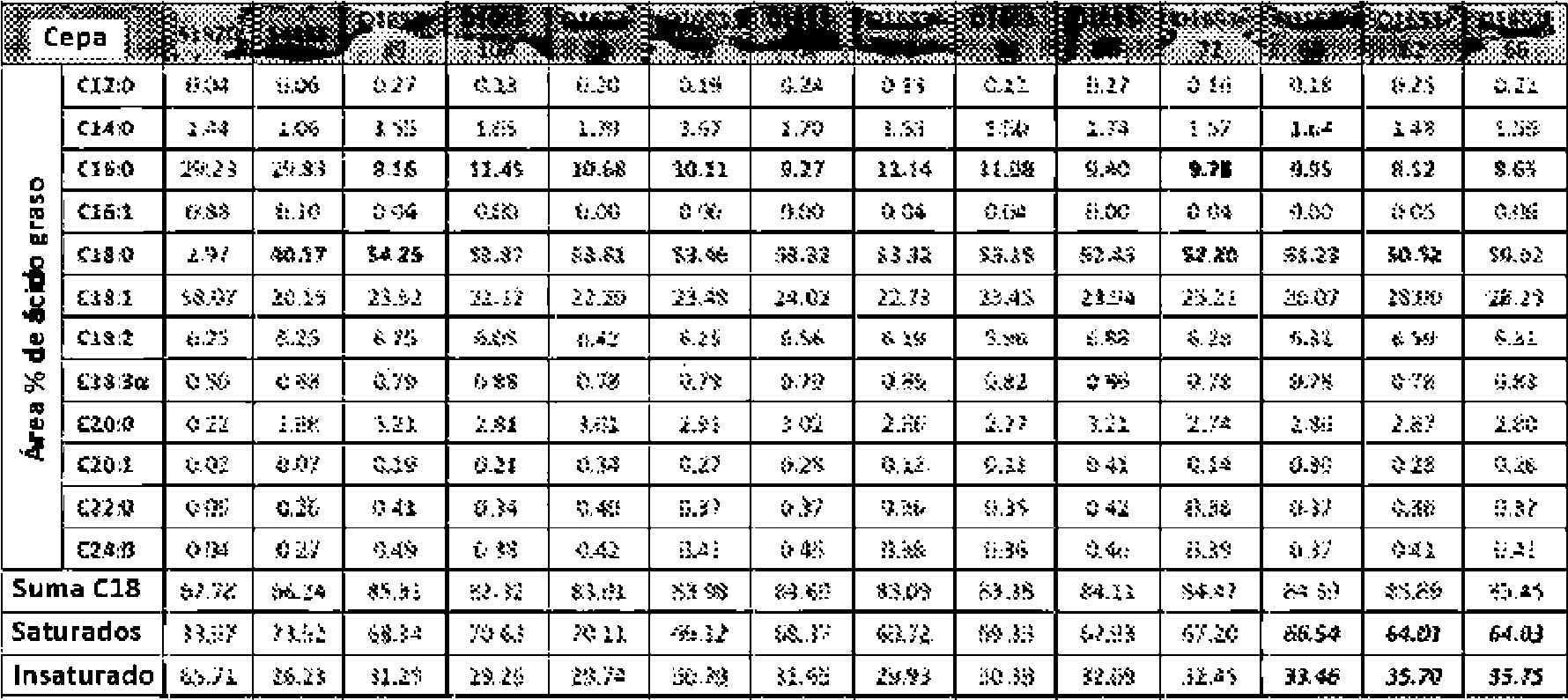
[0401] En la Tabla 42, niveles de estearato (C18: 0) mayores que el nivel de tipo salvaje se destacan con negrita. Niveles de palmitato (C16: 0) más bajos que S4495 o S1920 se destacan con negrita. Para tres cepas la proporción de saturados a los ácidos grasos insaturados es < 2: 1; éstos se resaltan con texto en cursiva negrita.[0401] In Table 42, stearate (C18: 0) levels greater than the wild-type level are highlighted in bold. Palmitate levels (C16: 0) lower than S4495 or S1920 are highlighted in bold. For three strains the ratio of saturated to unsaturated fatty acids is <2: 1; These are highlighted with bold italic text.
[0402] Líreao estables se aisiaron de los transformantes erimarios que pe muestras en la Tabla 42r Los perfiles de ácidos grasos y los títulos de lípidos de cultivos en matraces de agitación se presentan en la Tabla 43, a continuación. Las cepas acumularon haste un 55%> de C18. 0, con so precio tan bajo como 7% de C16: 0, con títulos de lípidos comparables ai padre S4495. Las relaciones caturados:insatunados se redujeron custancialmente en oomparación con S4495. Lss cepas S5665 y S5675 se seleccioraron para evaluación en fermentaciones de alta densidad 3-L. [0402] Stable lireao were isolated from the erimary transformants that are shown in Table 42r. The fatty acid profiles and the lipid titres of cultures in shake flasks are presented in Table 43, below. Strains accumulated up to 55%> of C18. 0, with a price as low as 7% of C16: 0, with lipid titles comparable to the father S4495. Caturated: unsaturated relationships were reduced substantially in oration with S4495. Lss strains S5665 and S5675 were selected for evaluation in 3-L high density fermentations.
Tabla 43. Ensayos de frasco de agitación de cepas derivadas de D1653, expresando KASII, impulsadas por el promotor PmSAD2-2, orientadas al locus 6S.Table 43. Stirring bottle assays of strains derived from D1653, expressing KASII, driven by the PmSAD2-2 promoter, oriented to the 6S locus.

[0403] En la Tabla 43, S4495 es la cepa parental; S1920 es la cepa de base de tipo salvaje. Estearato de (C18: 0) los niveles de al menos dos veces mayor que en la cepa de tipo salvaje se destacan en negrita. Niveles de palmitato que son menos que en S1920 y S4495 se resaltan en negrita. Negrita y cursiva indican que la relación saturados:insaturados es <2: 1.[0403] In Table 43, S4495 is the parental strain; S1920 is the wild type base strain. Stearate of (C18: 0) levels at least twice as high as in the wild type strain are highlighted in bold. Palmitate levels that are less than in S1920 and S4495 are highlighted in bold. Bold and italic indicate that the saturated: unsaturated ratio is <2: 1.
[0404] Los perfiles de ácidos grasos y las métricas de rendimiento de las cepas de S5665 y S5675 se detallan en la Tabla 44, a continuación. El perfil de ácidos grasos de la cepa madre S4495, que se cultiva en las mismas condiciones de fermentación, se presenta para comparación. Las cepas que sobreexpresan [0404] The fatty acid profiles and performance metrics of the S5665 and S5675 strains are detailed in Table 44, below. The fatty acid profile of the mother strain S4495, which is grown under the same fermentation conditions, is presented for comparison. The overexpressing strains K A S II K A S II se acumulan alrededor del 11 % más de C18: 0 de la matriz S4495. C16: 0 se reduce a 7-9%, y los niveles de ácidos grasos insaturados aumentan en 4-5%. Los títulos de lípidos de S5665 y S5675 eran comparables a S4495, indicando que sobre-expresión de KASII no tenían efectos nocivos sobre la producción de lípidos. around 11% more than C18: 0 of the S4495 matrix accumulate. C16: 0 is reduced to 7-9%, and unsaturated fatty acid levels increase by 4-5%. The lipid titers of S5665 and S5675 were comparable to S4495, indicating that overexpression of KASII had no harmful effects on lipid production.
[0508] Tabla 44. Perfiles de ácido graso de punto final de biomasa de fermentaciones S4495, S5665 y S5775.[0508] Table 44. Biomass end point fatty acid profiles of fermentations S4495, S5665 and S5775.

[0405] Las fermentaciones se cultivaron durante 6 días utilizando un proceso de alimentación por lotes. El perfil de ácidos grasos S4495 de la fermentación 120580F1 se presenta en la Tabla 41, y se muestra de nuevo en la Tabla 44 para la comparación con S5665 y S5675. Todas las fermentaciones se realizaron a 32°C, pH 5, con un nitrógeno/fósforo (N/P) de 1,4, 30% de oxígeno disuelto (OD), nitrógeno 300 mM [N], y 557,5 pM hierro. La fuente de azúcar era de 70% de sacarosa (S70). Niveles de estearato de (C18: 0) más altos que en la cepa de tipo salvaje se indican con negrita. Niveles de palmitato (C16: 0) que son menos que en el de tipo salvaje se destacan en negrita.[0405] The fermentations were grown for 6 days using a batch feeding process. The S4495 fatty acid profile of fermentation 120580F1 is presented in Table 41, and is again shown in Table 44 for comparison with S5665 and S5675. All fermentations were performed at 32 ° C, pH 5, with a nitrogen / phosphorus (N / P) of 1.4, 30% dissolved oxygen (OD), 300 mM nitrogen [N], and 557.5 pM iron . The sugar source was 70% sucrose (S70). Stearate levels of (C18: 0) higher than in the wild type strain are indicated in bold. Palmitate levels (C16: 0) that are less than in the wild type are highlighted in bold.
[0406] Aceites de escala de laboratorio se prepararon a partir de biomasa derivada de los matraces de agitación y fermentaciones descritas anteriormente. Las composiciones de TAG de estos aceites se determinaron por LC/MS. SOS son las principales especies de TAG en tanto S5665 como S5675, que van desde 33-35% en la biomasa a partir de matraces de agitación, y alcanzando el 37% en la biomasa de fermentación de alta densidad. Los principales TAG que contiene palmitato se reducen sustancialmente, y los niveles de trisaturado son menos de la mitad de los observados en los aceites S4495. Estos resultados demuestran que sobre-expresión KASII en un fondo de alto estearato mejora significativamente la acumulación de SOS, y reduce la acumulación de TAG trisaturadas.[0406] Laboratory scale oils were prepared from biomass derived from the stirring and fermentation flasks described above. The TAG compositions of these oils were determined by LC / MS. SOS are the main TAG species in both S5665 and S5675, ranging from 33-35% in biomass from shake flasks, and reaching 37% in high-density fermentation biomass. The main GAD containing palmitate are substantially reduced, and the levels of trisaturation are less than half of those observed in S4495 oils. These results demonstrate that over-expression KASII in a high stearate fund significantly improves the accumulation of SOS, and reduces the accumulation of trisaturated GADs.
[0407] Construcciones utilizadas para ruptura F A T A -1 , sobre-expresión K A S II y F A D 2 iA R N en S1920: Una construcción de ADN, pSZ2419, se hizo para interrumpir simultáneamente alelo FA TA -1 , sobre-expresan P. m o rifo rm is K A S II y expresan una construcción en horquilla F A D 2 en S1920. Una versión de S. ce re v is ia e ge n suc2 , que codifica para la invertasa de sacarosa, que fue codones optimizados para la expresión en P. m o rifo rm is , se utilizó como un marcador seleccionable para la transformación. La secuencia del ADN transformante se proporciona inmediatamente debajo. Sitios de restricción relevantes se indican en minúsculas, negrita, y son de 5'-3' BspQI, Kpnl, AscI, Mfel, BamHI, Avrll, EcoRV, EcoRI, SpeI, AscI, ClaI, BglII, AflII, HindIII, SacI, SpeI, y XhoI, respectivamente. Sitios BspQI delimitan el ADN transformante 5' y 3. Secuencias subrayadas en los extremos 5' y 3' flancos de la construcción representan ADN genómico de P. m o rifo rm is que permiten la integración dirigida del ADN de transformación a través de recombinación homóloga en el F A TA -1 lugar. Procediendo en la dirección 5' a 3', C. re in h a rd tii promotor tub2 que dirige la expresión de S. ce re v is ia e gen su c 2 (que codifica actividad de hidrólisis de la sacarosa, permitiendo de este modo que la cepa crezca en sacarosa) se indica mediante letras minúsculas, texto en caja. El iniciador ATG y el terminador TGA para s u c2 se indican mediante cursiva y en mayúsculas, mientras que la región de codificación está indicada con letra cursiva en minúsculas. El gen de nitrato reductasa UTR 3' de C. vu lg a ris (N R ) se indica por pequeñas mayúsculas, seguido por una región espadadora indicada por texto en minúsculas. P. m o rifo rm is A M T 3 promotor, indicado por texto en caja en minúsculas, conduce la expresión del gen P. m o rifo rm is K A S II. La región que codifica el péptido dirigido a plastidios de C h lo re lla p ro to th e c o id e s SAD1 se indica mediante cursiva y en mayúsculas. La secuencia que codifica el polipéptido KASII maduro P. m o rifo rm is se indica con subrayado, cursiva, mayúscula y en negrita, mientras que una secuencia de epítopo de codificación 3xFLAG está en negrita y cursiva. Un segundo N R 3' UTR C. vu lga ris se indica por pequeñas mayúsculas. Una segunda secuencia promotora de tu b 2 C. re inha rd tii, indicada por texto en caja en minúsculas, conduce la expresión de una secuencia de horquilla F A D 2 P. m orifo rm is . [0407] Constructions used for rupture FATA -1, over-expression KAS II and FAD 2 iA RN in S1920: A DNA construct, pSZ2419, was made to simultaneously interrupt FA TA-1 allele , over-express P. mo rifo rm is KAS II and express a FAD 2 fork construction in S1920. A version of S. ce re v is ia e ge n suc2, which codes for sucrose invertase, which were codons optimized for expression in P. m rifo rm is, was used as a selectable marker for transformation. The sequence of the transforming DNA is provided immediately below. Relevant restriction sites are indicated in lowercase, bold, and are 5'-3 'BspQI, Kpnl, AscI, Mfel, BamHI, Avrll, EcoRV, EcoRI, SpeI, AscI, ClaI, BglII, AflII, HindIII, SacI, SpeI , and XhoI, respectively. BspQI sites delimit the 5 'and 3' transforming DNA. Underlined sequences at the 5 'and 3' ends of the construction represent genomic DNA from P. mo rifo rm is that allow the targeted integration of the transformation DNA through homologous recombination into FA TA -1 place. Proceeding in the 5 'to 3' direction, C. re in ha rd tii promoter tub2 that directs the expression of S. ce re v is ia e gene its c 2 (which encodes sucrose hydrolysis activity, thus allowing that the strain grows in sucrose) is indicated by lowercase letters, boxed text. The ATG initiator and the TGA terminator for its c2 are indicated in italics and in uppercase, while the coding region is indicated in italic in lowercase. The 3 'UTR nitrate reductase gene of C. vu lg a ris ( NR) is indicated by small uppercase, followed by a spacer region indicated by lowercase text. P. mo rifo rm is AMT 3 promoter, indicated by lowercase boxed text, conducts the expression of the P. mo rifo rm is KAS II gene . The region coding for the C h plastid-directed peptide that is known as SAD1 is indicated in italics and in capital letters. The sequence encoding the mature KASII polypeptide P. mo rifo rm is indicated with underline, italic, uppercase and bold, while a 3xFLAG coding epitope sequence is bold and italic. A second NR 3 'UTR C. vu lga ris is indicated by small capital letters. A second promoter sequence of your b 2 C. re inha rd tii, indicated by lowercase boxed text, leads to the expression of a fork sequence FAD 2 P. m orifo rm is.
Las cadenas con sentido y antisentido se indican con mayúsculas, negrita y cursiva, y están separadas por Strings with meaning and antisense are indicated in capital letters, bold and italic, and are separated by F A D 2 F A D 2 intrón y las primeras 10 bases del segundo exón intron and the first 10 bases of the second exon F A D 2 F A D 2 (cursiva y en mayúsculas). Un tercero (italic and uppercase). A third N R N R 3' UTR 3 'UTR C. vu lga ris C. vu lga ris se indica por pequeñas mayúsculas, seguido de una segunda región espaciadora que se indica mediante texto en minúsculas.it is indicated by small capital letters, followed by a second spacer region that is indicated by lowercase text.
[0408] Secuencia de nucleótidos del ADN transformante de pSZ2419: [0408] Nucleotide sequence of the transforming DNA of pSZ2419:
gctcttcggagtcactgtgccactgagttcgactggtagctgaatggagtcgctgctccactaaacgaattgtcagcaccgccagcc ggccgaggacccgagtcatagcgagggtagtagcgcgccatggcaccgaccagcctgcttgccagtactggcgtctcttccgcttct ctgtggtcctctgcgcgctccagcgcgtgcgcttttccggtggatcatgcggtccgtggcgcaccgcagcggccgctgcccatgcagc gccgctgcttccgaacagtggcggtcagggccgcacccgcggtagccgtccgtccggaacccgcccaagagttttgggagcagctt gagccctgcaagatggcggaggacaagcgcatcttcctggaggagcaccggtgcgtggaggtccggggctgaccggccgtcgcat tcaacgtaatcaatcgcatgatgatcagaggacacgaagtcttggtggcggtggccagaaacactgtccattgcaagggcataggg atgcgttccttcacctctcatttctcatttctgaatccctccctgctcactctttctcctcctccttcccgttcacgcagcattcggggta ccgctcttcggagtcactgtgccactgagttcgactggtagctgaatggagtcgctgctccactaaacgaattgtcagcaccgccagcc ggccgaggacccgagtcatagcgagggtagtagcgcgccatggcaccgaccagcctgcttgccagtactggcgtctcttccgcttct ctgtggtcctctgcgcgctccagcgcgtgcgcttttccggtggatcatgcggtccgtggcgcaccgcagcggccgctgcccatgcagc gccgctgcttccgaacagtggcggtcagggccgcacccgcggtagccgtccgtccggaacccgcccaagagttttgggagcagctt gagccctgcaagatggcggaggacaagcgcatcttcctggaggagcaccggtgcgtggaggtccggggctgaccggccgtcgcat tcaacgtaatcaatcgcatgatgatcagaggacacgaagtcttggtggcggtggccagaaacactgtccattgcaagggcataggg atgcgttccttcacctctcatttctcatttctgaatccctccctgctcactctttctcctcctccttcccgttcacgcagcattcggggta cc

ctccgcta agggggcgcctcttcctcttcgtttcagtca ca a cccgca a a cggcgcgccA ctccgcta agggggcgcctcttcctcttcgtttcagtca ca a cccgca a a cggcgcgccA TG ctgctgcaggccttcctgttcctgct ggccggcttcgccgccaagatcagcgcctccatgacgaacgagacgtccgaccgccccctggtgcacttcacccccaacaagg gctggatgaacgaccccaacggcctgtggtacgacgagaaggacgccaagtggcacctgtacttccagtacaacccgaacg acaccgtctgggggacgcccttgttctggggccacgccacgtccgacgacctgaccaactgggaggaccagcccatcgccatc gccccgaagcgcaacgactccggcgccttctccggctccatggtggtggactacaacaacacctccggcttcttcaacgacacc atcgacccgcgccagcgctgcgtggccatctggacctacaacaccccggagtccgaggagcagtacatctcctacagcctgga cggcggctacaccttcaccgagtaccagaagaaccccgtgctggccgccaactccacccagttccgcgacccgaaggtcttctg gtacgagccctcccagaagtggatcatgaccgcggccaagtcccaggactacaagatcgagatctactcctccgacgacctga agtcctggaagctggagtccgcgttcgccaacgagggcttcctcggctaccagtacgagtgccccggcctgatcgaggtcccc accgagcaggaccccagcaagtcctactgggtgatgttcatctccatcaaccccggcgccccggccggcggctccttcaaccag tacttcgtcggcagcttcaacggcacccacttcgaggccttcgacaaccagtcccgcgtggtggacttcggcaaggactactac gccctgcagaccttcttcaacaccgacccgacctacgggagcgccctgggcatcgcgtgggcctccaactgggagtactccgcc ttcgtgcccaccaacccctggcgctcctccatgtccctcgtgcgcaagttctccctcaacaccgagtaccaggccaacccggaga cggagctgatcaacctgaaggccgagccgatcctgaacatcagcaacgccggcccctggagccggttcgccaccaacaccac gttgacgaaggccaacagctacaacgtcgacctgtccaacagcaccggcaccctggagttcgagctggtgtacgccgtcaac accacccagacgatctccaagtccgtgttcgcggacctctccctctggttcaagggcctggaggaccccgaggagtacctccgc atgggcttcgaggtgtccgcgtcctccttcttcctggaccgcgggaacagcaaggtgaagttcgtgaaggagaacccctacttc accaaccgcatgagcgtgaacaaccagcccttcaagagcgagaacgacctgtcctactacaaggtgtacggcttgctggacc agaacatcctggagctgtacttcaacgacggcgacgtcgtgtccaccaacacctacttcatgaccaccgggaacgccctgggc tccgtgaacatgacgacgggggtggacaacctgttctacatcgacaagttccaggtgcgcgaggtcaagTGAcaattgGCA TG ctgctgcaggccttcctgttcctgct ggccggcttcgccgccaagatcagcgcctccatgacgaacgagacgtccgaccgccccctggtgcacttcacccccaacaagg gctggatgaacgaccccaacggcctgtggtacgacgagaaggacgccaagtggcacctgtacttccagtacaacccgaacg acaccgtctgggggacgcccttgttctggggccacgccacgtccgacgacctgaccaactgggaggaccagcccatcgccatc gccccgaagcgcaacgactccggcgccttctccggctccatggtggtggactacaacaacacctccggcttcttcaacgacacc atcgacccgcgccagcgctgcgtggccatctggacctacaacaccccggagtccgaggagcagtacatctcctacagcctgga cggcggctacaccttcaccgagtaccagaagaaccccgtgctggccgccaactccacccagttccgcgacccgaaggtcttctg gtacgagccctcccagaagtggatcatgaccgcggccaagtcccaggactacaagatcgagatctactcctccgacgacctga agtcctggaagctggagtccgcgttcgccaacgagggcttcctcggctaccagtacgagtgccccggcctgatcgaggtcccc accgagcaggaccccagcaagtcctactgggtgatgttcatctccatcaaccccggcgccccggccggcggctccttcaaccag tacttcgtcggcagcttcaacggcacccacttcgaggccttcgacaaccagtcccgcgtggtggacttcggcaaggactactac gccctgcagaccttcttcaacaccgacccgacctacgggagcgccctgggcatcgcgtgggcctccaactgggagtactccgcc ttcgtgcccaccaacccctggcgctcctccatgtccctcgtgc gcaagttctccctcaacaccgagtaccaggccaacccggaga cggagctgatcaacctgaaggccgagccgatcctgaacatcagcaacgccggcccctggagccggttcgccaccaacaccac gttgacgaaggccaacagctacaacgtcgacctgtccaacagcaccggcaccctggagttcgagctggtgtacgccgtcaac accacccagacgatctccaagtccgtgttcgcggacctctccctctggttcaagggcctggaggaccccgaggagtacctccgc atgggcttcgaggtgtccgcgtcctccttcttcctggaccgcgggaacagcaaggtgaagttcgtgaaggagaacccctacttc accaaccgcatgagcgtgaacaaccagcccttcaagagcgagaacgacctgtcctactacaaggtgtacggcttgctggacc agaacatcctggagctgtacttcaacgacggcgacgtcgtgtccaccaacacctacttcatgaccaccgggaacgccctgggc tccgtgaacatgacgacgggggtggacaacctgttctacatcgacaagttccaggtgcgcgaggtcaagTGAcaattgGCA G CAG CAG CTCG G ATAGTATCG ACACACTCTG G ACG CTG GTCGTGTG ATG G ACTGTTG CCG CCACACT G CAG CAG CTCG G ATAGTATCG ACACACTCTG G ACG CTG GTCGTGTG ATG G ACTGTTG CCG CCACACT TGCTGCCTTGACCTGTGAATATCCCTGCCGCTTTTATCAAACAGCCTCAGTGTGTTTGATCTTGTGTGT ACGCG CTTTTG CGAGTTG CTAG CTG CTTGTG CTATTTG CG A AT ACC ACCCCC AG C ATCCCCTTCCCTC GTTTCATATCG CTTGCATCCC AACCG CAACTTATCTACG CTGTCCTG CTATCCCTC AGCG CTG CTCCTG CTCCTG CTC ACTG CCCCTCG C AC AG CCTTG GTTTG GGCTCCG CCTGTATTCTCCTG GTACTG CAACCT GTAAACCAGCACTG C A AT GCTGATGCACGGGAAGTAGTGGGATGGG A ACACA A AT G G Agga tcccgc gtctcgaacagagcgcgcagaggaacgctgaaggtctcgcctctgtcgcacctcagcgcggcatacaccacaataaccacctgacg aatgcgcttggttcttcgtccattagcgaagcgtccggttcacacacgtgccacgttggcgaggtggcaggtgacaatgatcggtgg agctgatggtcgaaacgttcacagcctagggatatcgaattcggccgacaggacgcgcgtcaaaggtgctggtcgtgtatgccctg gccggcaggtcgttgctgctgctggttagtgattccgca a ccctga ttttggcgtctta ttttggcgtggca a acgctggcgcccgcga gccgggccggcggcgatgcggtgccccacggctgccggaatccaagggaggcaagagcgcccgggtcagttgaagggctttacgc gcaaggtacagccgctcctgcaaggctgcgtggtggaattggacgtgcaggtcctgctgaagttcctccaccgcctcaccagcggaTGCTGCCTTGACCTGTGAATATCCCTGCCGCTTTTATCAAACAGCCTCAGTGTGTTTGATCTTGTGTGT ACGCG CTTTTG CGAGTTG CTAG CTG CTTGTG CTATTTG GC A AT ACC ACCCCC AG C ATCCCCTTCCCTC GTTTCATATCG CTTGCATCCC AACCG CAACTTATCTACG CTGTCCTG CTATCCCTC AGCG CTG CTCCTG CTCCTG CTC ACTG CCCCTCG C AC AG CCTTG GTTTG GGCTCCG CCTGTATTCTCCTG GTACTG CAACCT GTAAACCAGCACTG CA AT GCTGATGCACGGGAAGTAGTGGGATGGG A ACACA A AT GG Agga tcccgc gtctcgaacagagcgcgcagaggaacgctgaaggtctcgcctctgtcgcacctcagcgcggcatacaccacaataaccacctgacg aatgcgcttggttcttcgtccattagcgaagcgtccggttcacacacgtgccacgttggcgaggtggcaggtgacaatgatcggtgg agctgatggtcgaaacgttcacagcctagggatatcgaattcggccgacaggacgcgcgtcaaaggtgctggtcgtgtatgccctg gccggcaggtcgttgctgctgctggttagtgattccgca to ttttggcgtctta ccctga ttttggcgtggca to gccgggccggcggcgatgcggtgccccacggctgccggaatccaagggaggcaagagcgcccgggtcagttgaagggctttacgc acgctggcgcccgcga gcaaggtacagccgctcctgcaaggctgcgtggtggaattggacgtgcaggtcctgctgaagttcctccaccgcctcaccagcgga

TTTCTCGGCGTTCAATGCCCGCTGCGGCGACCTGCGTCGCTCGGCGGGCTCCGGGCCCCGGCGCCCA GCGAGGCCCCTCCCCGTGCGCGggcgcgccGCCGCCGCCGCCGACGCCAACCCCGCCCGCCCCGAGCG CCGCGTGGTGA TCA CCGGCCAGGGCGTGGTGACCTCCCTGGGCCA GACCA TCGA GCAGTTCTA CTC CTCCCTGCTGGA GGGCG TGTCCGGCA TCTCCCA GA TCCA GAAGTTCGA CA CCA CCGGCTA CA CCA CC ACCATCGCCGGCGAGATCAAGTCCCTGCAGCTGGACCCCTACGTGCCCAAGCGCTGGGCCAAGCGC GTGGACGACGTGATCAAGTACGTGTACATCGCCGGCAAGCAGGCCCTGGAGTCCGCCGGCCTGCC CATCGAGGCCGCCGGCCTGGCCGGCGCCGGCCTGGACCCCGCCCTGTGCGGCGTGCTGATCGGCAC CGCCATGGCCGGCATGACCTCCTTCGCCGCCGGCGTGGAGGCCCTGACCCGCGGCGGCGTGCGCAA GA TGAACCCCTTCTGCA TCCCCTTCTCCA TCTCCAA CA TGGGCGGCGCCA TGCTGGCCA TGGACA TC GGCTTCA TGGGCCCCAA CTA CTCCA TCTCCA CCGCCTGCGCCA CCGGCAA CTA CTGCA TCCTGGGCG CCGCCGACCACATCCGCCGCGGCGACGCCAACGTGATGCTGGCCGGCGGCGCCGACGCCGCCATCA TTTCTCGGCGTTCAATGCCCGCTGCGGCGACCTGCGTCGCTCGGCGGGCTCCGGGCCCCGGCGCCCA GCGAGGCCCCTCCCCGTGCGCGggcgcgccGCCGCCGCCGCCGACGCCAACCCCGCCCGCCCCGAGCG CCGCGTGGTGA TCA CTC CCGGCCAGGGCGTGGTGACCTCCCTGGGCCA GACCA TCGA GCAGTTCTA CTCCCTGCTGGA GGGCG TGTCCGGCA TCTCCCA GA TCCA GAAGTTCGA CCGGCTA CA CA CCA CCA CC ACCATCGCCGGCGAGATCAAGTCCCTGCAGCTGGACCCCTACGTGCCCAAGCGCTGGGCCAAGCGC GTGGACGACGTGATCAAGTACGTGTACATCGCCGGCAAGCAGGCCCTGGAGTCCGCCGGCCTGCC CATCGAGGCCGCCGGCCTGGCCGGCGCCGGCCTGGACCCCGCCCTGTGCGGCGTGCTGATCGGCAC CGCCATGGCCGGCATGACCTCCTTCGCCGCCGGCGTGGAGGCCCTGACCCGCGGCGGCGTGCGCAA GA TGAACCCCTTCTGCA TCCCCTTCTCCA TCTCCAA CA TGGGCGGCGCCA TGCTGGCCA TGGACA TC GGCTTCA TGGGCCCCAA CTA CTA CTCCA TCTCCA CCGCCTGCGCCA CCGGCAA CTGCA TCCTGGGCG CCGCCGACCACATCCGCCGCGGCGACGCCAACGTGATGCTGGCCGGCGGCGCCGACGCCGCCATCA TCCCCTCCGGCATCGGCGGCTTCATCGCCTGCAAGGCCCTGTCCAAGCGCAACGACGAGCCCGAGC GCGCCTCCCGCCCCTGGGA CGCCGA CCGCGA CGGCTTCGTGA TGGGCGA GGGCGCCGGCGTGCTG GTGCTGGAGGAGCTGGAGCACGCCAAGCGCCGCGGCGCCACCATCCTGGCCGAGCTGGTGGGCG GCGCCGCCACCTCCGACGCCCACCACATGACCGAGCCCGACCCCCAGGGCCGCGGCGTGCGCCTGT GCCTGGAGCGCGCCCTGGAGCGCGCCCGCCTGGCCCCCGAGCGCGTGGGCTACGTGAACGCCCAC GGCACCTCCACCCCCGCCGGCGACGTGGCCGAGTACCGCGCCATCCGCGCCGTGATCCCCCAGGACT CCCTGCGCATCAACTCCACCAAGTCCATGATCGGCCACCTGCTGGGCGGCGCCGGCGCCGTGGAGG CCGTGGCCGCCATCCAGGCCCTGCGCACCGGCTGGCTGCACCCCAACCTGAACCTGGAGAACCCCG CCCCCGGCGTGGACCCCGTGGTGCTGGTGGGCCCCCGCAAGGAGCGCGCCGAGGACCTGGACGTG GTGCTGTCCAA CTCCTTCGGCTTCGGCGGCCA CAA CTCCTGCGTGA TCTTCCGCAAGTA CGA CGA GA TGGACTACAAGGACCACGACGGCGACTACAAGGACCACGACATCGACTACAAGGACGACGACGAC AAGTGAatcgatagatctcttaagGCAGCAGCAGCTCGGATAGTATCGACACACTCTGGACGCTGGTCGT GTGATGGACTGTTGCCGCCACACTTGCTGCCTTGACCTGTGAATATCCCTGCCGCTTTTATCAAACAG CCTCAGTGTGTTTGATCTTGTGTGTACGCGCTTTTGCGAGTTGCTAGCTGCTTGTGCTATTTGCGAAT ACCACCCCCAG C AT CCCCTT CCCT CGTTT C AT ATCG CTT G CATCCC AACCG C A ACTT ATCTACG CTGTC CTG CTATCCCTC AG CG CTG CT CCT G CTCCTG CTC ACTG CCCCT CG C AC AG CCTT G GTTT GGGCTCCGC CTGTATTCTCCTGGTACTGCAACCTGTAAACCAGCACTGCAATGCTGATGCACGGGAAGTAGTGGGA TGGGAACACAAATGGAaagcttaattaagagctcctttcttgcgctatgacacttccagcaaaaggtagggcgggctgcga gacggcttcccggcgctgcatgcaacaccgatgatgcttcgaccccccgaagctccttcggggctgcatgggcgctccgatgccgct ccagggcgagcgctgtttaaatagccaggcccccgattgcaaagacattatagcgagctaccaaagccatattcaaacacctagat |cactaccacttctacacaggccactcgagcttgtgatcgcactccgctaagggggcgcctcttcctcttcgtttcagtcacaacccgc| a a a c|a ctagtA TGGCTA TCAAGACGAA CA GGCA GCCTGTGGA GAA GCCTCCGTTCA CGA TCGGGA CG CTGCGCAA GGCCA TCCCCGCGCA CTGTTTCGA GCGCTCGGCGCTTCGTA GCA GCA TGTA CCTGGCCT TTGACATCGCGGTCATGTCCCTGCTCTACGTCGCGTCGACGTACATCGACCCTGCACCGGTGCCTAC GTGGGTCAAGTACGGCATCATGTGGCCGCTCTACTGGTTCTTCCAGGTGTGTTTGAGGGTTTTGGTT GCCCGTATTGAGGTCCTGGTGGCGCGCATGGAGGAGAAGGCGCCTGTCCCGCTGACCCCCCCGGCT ACCCTCCCGGCACCTTCCAGGGCGCGTACGGGAAGAACCAGTAGAGCGGCCACATGATGCCGTACT TGACCCACGTAGGCACCGGTGCAGGGTCGATGTACGTCGACGCGACGTAGAGCAGGGACATGACC GCGATGTCAAAGGCCAGGTACATGCTGCTACGAAGCGCCGAGCGCTCGAAACAGTGCGCGGGGA TGGCCTTGCGCA GCGTCCCGA TCGTGAA CGGA GGCTTCTCCA CA GGCTGCCTGTTCGTCTTGA TA GC CATctcgagGCAGCAGCAGCTCGGATAGTATCGACACACTCTGGACGCTGGTCGTGTGATGGACTGTT TCCCCTCCGGCATCGGCGGCTTCATCGCCTGCAAGGCCCTGTCCAAGCGCAACGACGAGCCCGAGC GCGCCTCCCGCCCCTGGGA CGCCGA CCGCGA CGGCTTCGTGA TGGGCGA GGGCGCCGGCGTGCTG GTGCTGGAGGAGCTGGAGCACGCCAAGCGCCGCGGCGCCACCATCCTGGCCGAGCTGGTGGGCG GCGCCGCCACCTCCGACGCCCACCACATGACCGAGCCCGACCCCCAGGGCCGCGGCGTGCGCCTGT GCCTGGAGCGCGCCCTGGAGCGCGCCCGCCTGGCCCCCGAGCGCGTGGGCTACGTGAACGCCCAC GGCACCTCCACCCCCGCCGGCGACGTGGCCGAGTACCGCGCCATCCGCGCCGTGATCCCCCAGGACT CCCTGCGCATCAACTCCACCAAGTCCATGATCGGCCACCTGCTGGGCGGCGCCGGCGCCGTGGAGG CCGTGGCCGCCATCCAGGCCCTGCGCACCGGCTGGCTGCACCCCAACCTGAACCTGGAGAACCCCG CCCCCGGCGTGGACCCCGTGGTGCTGGTGGGCCCCCGCAAGGAGCGCGCCGAGGACCTGGACGTG GTGCTGTCCAA CTCCTTCGGCTTCGGCGGCCA CAA CGA CGA GA CTCCTGCGTGA TCTTCCGCAAGTA TGGACTACAAGGACCACGACGGCGACTACAAGGACCACGACATCGACTACAAGGACGACGACGAC AAGTGAatcgatagatctcttaagGCAGCAGCAGCTCGGATAGTATCGACACACTCTGGACGCTGGTCGT GTGATGGACTGTTGCCGCCACACTTGCTGCCTTGACCTGTGAATATCCCTGCCGCTTTTATCAAACAG CCTCAGTGTGTTTGATCTTGTGTGTACGCGCTTTTGCGAGTTGCTAGCTGCTTGTGCTATTTGCGAAT ACCACCCCCAG C AT AT CCCCTT CCCT CGTTT C ATCG C TT G CATCCC AACCG CA ACTT ATCTACG CTGTC CTG CTG CT CTATCCCTC AG CG CTC CCT G CTCCTG CCCCT ACTG GC C AC G AG CCTT GTTT GGGCTCCGC CTGTATTCTCCTGGTACTGCAACCTGTAAACCAGCACTGCAATGCTGATGCACGGGAAGTAGTGGGA TGGGAACACAAATGGAaagcttaattaagagctcctttcttgcgctatgacacttccagcaaaaggtagggcgggctgcga gacggcttcccggcgctgcatgcaacaccgatgatgcttcgaccccccgaagctccttcggggctgcatgggcgctccgatgccgct ccagggcgagcgctgtttaaatagccaggcccccgattgcaaagacattatagcgagctaccaaagccatattcaaacacctagat | cactaccacttctacacaggccactcgagcttgtgatcgcactccgctaagggggcgcctcttcctcttcgtttcagtcacaacccgc | AAAC | to ctagtA TGGCTA TCAAGACGAA CA GGCA GCCTGTGGA GCCTCCGTTCA CGA GAA TCGGGA CG CTGCGCAA GGCCA TCCCCGCGCA CTGTTTCGA GCGCTCGGCGCTTCGTA GCA GCA TGTA CCTGGCCT TTGACATCGCGGTCATGTCCCTGCTCTACGTCGCGTCGACGTACATCGACCCTGCACCGGTGCCTAC GTGGGTCAAGTACGGCATCATGTGGCCGCTCTACTGGTTCTTCCAGGTGTGTTTGAGGGTTTTGGTT GCCCGTATTGAGGTCCTGGTGGCGCGCATGGAGGAGAAGGCGCCTGTCCCGCTGACCCCCCCGGCT ACCCTCCCGGCACCTTCCAGGGCGCGTACGGGAAGAACCAGTAGAGCGGCCACATGATGCCGTACT TGACCCACGTAGGCACCGGTGCAGGGTCGATGTACGTCGACGCGACGTAGAGCAGGGACATGACC GCGATGTCAAAGGCCAGGTACATGCTGCTACGAAGCGCCGAGCGCTCGAAACAGTGCGCGGGGA TGGCCTTGCGCA GCGTCCCGA TCGTGAA CGGA GGCTTCTCCA CA GGCTGCCTGTTCGTCTTGA TA GC CATctcgagGCAGCAGCAGCTCGGATAGTATCGACACACTCTGGACGCTGGTCGTGTGATGGACTGTT GCCGCCACACTTGCTGCCTTGACCTGTGAATATCCCTGCCGCTTTTATCAAACAGCCTCAGTGTGTTT GATCTTGTGTGTACGCGCTmGCGAGTTGCTAGCTGCTTGTGCTATTTGCGAATACCACCCCCAGCA T CCCCTT CCCT CGTTT CAT AT CG CTTG CATCCC AACCG C A ACTT ATCTACG CTGTCCTGCTATCCCTCAG CG CTG CTCCTG CTCCTG CTCACTG CCCCTCGCACAG CCTTG GTTTGGG CTCCG CCTGTATTCTCCTG GT ACTGCAACCTGTAAACCAGCACTGCAATGCTGATGCACGGGAAGTAGTGGGATGGGAACACAAATG GAaagctgtattgttttccagaaggagttgctccttgagcctttcattctcagcctcgataacctccaaagccgctctaattgtggagg gggttcga agacagggtggttggctggatggggaaacgctggtcgcgggattcgatcctgctgcttatatcctccctggaagcacac ccacgactctgaagaagaaaacgtgcacacacacaacccaaccggccgaatatttgcttccttatcccgggtccaagagagactgc gatgcccccctcaatcagcatcctcctccctgccgcttcaatcttccctgcttgcctgcgcccgcggtgcgccgtctgcccgcccagtc agtcactcctgcacaggccccttgtgcgcagtgctcctgtaccctttaccgctccttccattctgcgaggccccctattgaatgtattcg ttgcctgtgtggccaagcgggctgctgggcgcgccgccgtcgggcagtgctcggcgactttggcggaagccgattgttcttctgtaag ccacgcgcttgctgctttgggaagagaagggggggggtactgaatggatgaggaggagaaggaggggtattggtattatctgagtt GCCGCCACACTTGCTGCCTTGACCTGTGAATATCCCTGCCGCTTTTATCAAACAGCCTCAGTGTGTTT GATCTTGTGTGTACGCGCTmGCGAGTTGCTAGCTGCTTGTGCTATTTGCGAATACCACCCCCAGCA T CCCCTT CCCT CGTTT CAT AT CG CTTG CATCCC AACCG C A ACTT ATCTACG CTGTCCTGCTATCCCTCAG CTG CG CTCCTG CTCCTG CTCACTG CCCCTCGCACAG CCTTG GTTTGGG CTCCG CCTGTATTCTCCTG GT ACTGCAACCTGTAAACCAGCACTGCAATGCTGATGCACGGGAAGTAGTGGGATGGGAACACAAATG GAaagctgtattgttttccagaaggagttgctccttgagcctttcattctcagcctcgataacctccaaagccgctctaattgtggagg gggttcga agacagggtggttggctggatggggaaacgctggtcgcgggattcgatcctgctgcttatatcctccctggaagcacac ccacgactctgaagaagaaaacgtgcacacacacaacccaaccggccgaatatttgcttccttatcccgggtccaagagagactgc gatgcccccctcaatcagcatcctcctccctgccgcttcaatcttccctgcttgcctgcgcccgcggtgcgccgtctgcccgcccagtc agtcactcctgcacaggccccttgtgcgcagtgctcctgtaccctttaccgctccttccattctgcgaggccccctattgaatgtattcg ttgcctgtgtggccaagcgggctgctgggcgcgccgccgtcgggcagtgctcggcgactttggcggaagccgattgttcttctgtaag ccacgcgcttgctgctttgggaagagaagggggggggtactgaatggatgaggaggagaaggaggggtattggtattatctgagtt
g g g t g a a g a g c (SEQ ID NO:96) gggtgaagagc (SEQ ID NO: 96)
[0409] Identificarión y análisis de knockout FATA-1, sobre-expresión de KASII y cepas iARN F A D 2 : Constructo D1358, derivado de pSZ2419, se transformó en £51 £520 como se describió anteriormente. Los transformantes primarios fueron purifieados closalmente y cultivados bajo condicisnes de producción de lípidos estándar a pH 5. Los perfiles de ácidos grasos resultantes de clones represeotativos derivados de transformación de £519P0 con D1358 se resumen en la Tabla 45, a contisuación. P. m o rifo rm is A M T 3 fromotorestá reprimido a pH 5 por lo qee Icos fenotipos observados no reflejan la sobre exoresión de P. moriformis K A S ir. Sin emberge, se observe) que múltiples cepas habían reducido sustancialmente los niveles de C16: 0 y 10-15% de aumento en C18: 1, lo que sugiere que la construcción había interrumpido el gen diana F A T A -1 , aumentando la cantidad de palmitoil-ACP disponible para la extensión por KASII endógena. Una línea, D1398-13, se sefeccionó para su posterior análisis. Dp°58-13 acumularle ~17% de C16: 0, ~75% de C18: 1 y menos del 2% de C18: 2, lo que indica que hateamos integrado con éxito sn F A T A -1 y la actividad regulada a la baja de la FAD2 A12-desaturasa en esta cepa. [0409] Identification and analysis of knockout FATA-1, overexpression of KASII and iRNA strains FAD 2: Construct D1358, derived from pSZ2419, was transformed into £ 51 £ 520 as described above. The primary transformants were purified closally and cultured under standard lipid production conditions at pH 5. The fatty acid profiles resulting from representative clones derived from transformation of £ 519P0 with D1358 are summarized in Table 45, below. P. mo rifo rm is AMT 3 fromotorestá repressed at pH 5 so that the observed phenotypes do not reflect the over extortion of P. moriformis KAS go. Without emberge, it should be noted that multiple strains had substantially reduced the levels of C16: 0 and 10-15% increase in C18: 1, suggesting that the construction had disrupted the target gene FATA -1, increasing the amount of palmitoil -ACP available for extension by endogenous KASII. One line, D1398-13, was selected for further analysis. Dp ° 58-13 accumulate ~ 17% of C16: 0, ~ 75% of C18: 1 and less than 2% of C18: 2, which indicates that we hate successfully integrated sn FATA -1 and downregulated activity of FAD2 A12-desaturase in this strain.
Tabla 45. Perfiles de ácido graso de transformantes primarios D1358 [pSZ2419], en comparación con la cepa parental de tipo silvestre, S1920.Table 45. Fatty acid profiles of primary transformants D1358 [pSZ2419], compared to the wild-type parental strain, S1920.

[0410] En la Tabla 45, niveles de oleato (C18: 1) mayores que el nivel de tipo salvaje se destacan con negrita. Niveles de palmitato (C16: 0) menores que los de tipo salvaje se destacan con negrita. Los niveles de linoleato (C18: 2) reducidos en 1% o más en comparación con el padre S1920 se destacan con negrita.[0410] In Table 45, oleate levels (C18: 1) greater than the wild type level are highlighted in bold. Palmitate levels (C16: 0) lower than those of the wild type are highlighted with bold. Linoleate (C18: 2) levels reduced by 1% or more compared to the S1920 parent are highlighted in bold.
[0411] Los perfiles de ácidos grasos de cepas derivadas de D1358-13 transformante fueron determinados a ser estables después de más de 60 generaciones de crecimiento en ausencia de selección (crecimiento en sacarosa). A continuación, se evaluó el comportamiento de las cepas seleccionadas en ensayos en matraz de agitación, y los perfiles de ácidos grasos y los títulos de lípidos se presentan en la Tabla 46, a continuación. experimentos en matraces se llevaron a cabo a pH 7, lo que permite la activación del promotor de expresión [0411] The fatty acid profiles of strains derived from transformant D1358-13 were determined to be stable after more than 60 generations of growth in the absence of selection (sucrose growth). Next, the behavior of the selected strains in shake flask assays was evaluated, and fatty acid profiles and lipid titres are presented in Table 46, below. flask experiments were carried out at pH 7, allowing activation of the expression promoter P m A M T 3 P m A M T 3 del transgén KASII. La combinación de sobre-expresión of the KASII transgene. The combination of overexpression K A S II K A S II y knockout and knockout F A TA -1 F A TA -1 conduce a reducciones adicionales en los niveles de palmitato y oleato de acumulación reforzada en comparación con los fenotipos observados a pH 5 (Tabla 45). Con más de 82% de C18: 1, menos de 11% de C16: 0, a menos de 2% de C18: 2 y ~83% de la titulación de los lípidos de tipo salvaje, S5003 se determinó que era la cepa más adecuada de este conjunto para servir como una cepa huésped para las modificaciones posteriores para elevar los niveles de estearato. El análisis de transferencia de ADN mostró que S5003 tiene una simple inserción de constructo D1358 [pSZ2419] en el locus leads to additional reductions in palmitate and oleate levels of enhanced accumulation compared to the phenotypes observed at pH 5 (Table 45). With more than 82% of C18: 1, less than 11% of C16: 0, less than 2% of C18: 2 and ~ 83% of the titration of wild-type lipids, S5003 was determined to be the strain most suitable for this set to serve as a host strain for subsequent modifications to raise stearate levels. DNA transfer analysis showed that S5003 has a simple D1358 construct insert [pSZ2419] in the locus F A TA -1.F A TA -1.
Tabla 46. Perfiles de ácido graso y títulos lipídicos de knockout FATA-1, sobreexpresión de KASII, líneas de iARN FAD2 derivadas de transformantes primarios D1358-13, en comparación a la cepa padre de tipo silvestre, S1920.Table 46. Fatty acid profiles and lipid titles of FATA-1 knockout, overexpression of KASII, FAD2 iRNA lines derived from primary transformants D1358-13, compared to the wild-type parent strain, S1920.

[0412] En la Tabla 46, niveles de estearato (C18: 1) mayores que el nivel de tipo salvaje se destacan con negrita. Niveles de palmitato (C16: 0) inferiores a los de tipo salvaje se destacan con negrita. Niveles de linoleato (C18: 2) que son inferiores a los de tipo salvaje se indican con el texto en negrita.[0412] In Table 46, stearate (C18: 1) levels greater than the wild type level are highlighted in bold. Palmitate levels (C16: 0) lower than those of wild type are highlighted with bold. Levels of linoleate (C18: 2) that are lower than those of the wild type are indicated by bold text.
[0413] Construcciones utilizadas para knockout SAD2/ÍARN en S5003: Dos construcciones de ADN, pSZ2283 y pSZ2697, se hicieron para interrumpir simultáneamente el alelo [0413] Constructions used for SAD2 / IARN knockout in S5003: Two DNA constructs, pSZ2283 and pSZ2697, were made to simultaneously interrupt the allele S A D 2-1 S A D 2-1 y expresar una construcción en horquilla and express a fork construction S A D 2 S A D 2 en S5003. En cada construcción, gen in S5003. In each construction, gen n e o R n e o R de transposón transposon Tn5, TN5, que confiere resistencia a los antibióticos aminoglucósidos, se utilizó como un marcador seleccionable para la transformación. La secuencia del ADN transformante derivado de pSZ2283 se proporciona inmediatamente debajo. Sitios de restricción relevantes se indican en minúsculas, negrita, y son de 5'-3' BspQI, KpnI, XbaI, MfeI, BamHI, AvrII, EcoRV, EcoRI, SpeI, BamHI, HindIII, y SacI, respectivamente. sitios BspQI delimitan 5' y 3' del ADN transformante. Secuencias subrayadas en los extremos 5' y 3' flancos de la construcción representan ADN genómico de Conferring resistance to aminoglycoside antibiotics, it was used as a selectable marker for transformation. The transforming DNA sequence derived from pSZ2283 is provided immediately below. Relevant restriction sites are indicated in lowercase, bold, and are 5'-3 'BspQI, KpnI, XbaI, MfeI, BamHI, AvrII, EcoRV, EcoRI, SpeI, BamHI, HindIII, and SacI, respectively. BspQI sites delimit 5 'and 3' of the transforming DNA. Underlined sequences at the 5 'and 3' ends of the construction represent genomic DNA from P. m o rífo rm is P. m o rífo rm is permiten la integración dirigida del ADN de transformación a través de recombinación homóloga en el locus allow the targeted integration of transformation DNA through homologous recombination in the locus S A D 2-1. S A D 2-1. Procediendo en la dirección 5' a 3', Proceeding in the 5 'to 3' direction, C h la m yd o m o n a s re in h a rd tii tu b 2 C h la m yd o m o n a s re in h a rd tii tu b 2 promotor que dirige la expresión de promoter that directs the expression of n e o R n e o R (que codifica la actividad de la fosfotransferasa de aminoglucósido, permitiendo de este modo que la cepa se cultive en G418) está indicado por letras minúsculas, texto en caja. El iniciador ATG y el terminador TGA para neoR se indican mediante cursiva y en mayúsculas, mientras que la región de codificación está indicado con letra cursiva en minúsculas. La 3' UTR del gen NR de C. vulgaris está indicada por pequeñas mayúsculas, seguido por una región espaciadora indicada por texto en minúsculas. Una segunda secuencia promotora (which encodes the activity of aminoglycoside phosphotransferase, thereby allowing the strain to be grown in G418) is indicated by lowercase letters, boxed text. The ATG initiator and the TGA terminator for neoR are indicated in italics and in uppercase, while the coding region is indicated in lower case italic. The 3 'UTR of the NR gene of C. vulgaris is indicated by small capital letters, followed by a spacer region indicated by lowercase text. A second promoter sequence tu b 2 C. re inh a rd tii, you b 2 C. re inh a rd tii, indicada por texto en caja en minúsculas, conduce la expresión de la secuencia de horquilla C indicated by boxed text in lowercase, conducts the expression of the fork sequence C S A D 2. S A D 2. Las cadenas con sentido y antisentido se indican con mayúsculas, negrita y cursiva, y están separadas por Strings with meaning and antisense are indicated in capital letters, bold and italic, and are separated by P. m o rifo rm is F A D 2 P. m o rifo rm is F A D 2 intrón y las primeras 10 bases del segundo exón intron and the first 10 bases of the second exon F A D 2 F A D 2 (cursiva y en mayúsculas). Un segundo (italic and uppercase). One second N R N R 3' UTR 3 'UTR C. vu lg a ris C. vu lg a ris se indica por pequeñas mayúsculas.It is indicated by small capital letters.
[0414] Secuencia de nucleótidos del ADN transformante de pSZ2283: [0414] Nucleotide sequence of the transforming DNA of pSZ2283:
gctcttcgggtcgccgcgctgcctcgcgtcccctggtggtgcgcgcggtcgccagcgaggccccgctgggcgttccgccctcggtgca gcgcccctcccccgtggtctactccaagctggacaagcagcaccgcctgacgcccgagcgcctggagctggtgcagagcatggggc agtttgcggaggagagggtgctgcccgtgctgcaccccgtggacaagctgtggcagccgcaggactttttgcccgaccccgagtcgc ccgacttcgaggatcaggtggcggagctgcgcgcgcgcgccaaggacctgcccgacgagtactttgtggtgctggtgggggacatg atcacggaggaggcgctgccgacctacatggccatgctcaacacgctggacggcgtgcgcgacgacacgggcgcggccgaccacc cgtgggcgcgctggacgcggcagtgggtggccgaggagaaccggcacggcgacctgctgaacaagtactgctggctgacggggc gcgtcaacatgcgggccgtggaggtgaccatcaacaacctgatcaagagcggcatgaacccgcagacggacaacaacccttatttgctcttcgggtcgccgcgctgcctcgcgtcccctggtggtgcgcgcggtcgccagcgaggccccgctgggcgttccgccctcggtgca gcgcccctcccccgtggtctactccaagctggacaagcagcaccgcctgacgcccgagcgcctggagctggtgcagagcatggggc agtttgcggaggagagggtgctgcccgtgctgcaccccgtggacaagctgtggcagccgcaggactttttgcccgaccccgagtcgc ccgacttcgaggatcaggtggcggagctgcgcgcgcgcgccaaggacctgcccgacgagtactttgtggtgctggtgggggacatg atcacggaggaggcgctgccgacctacatggccatgctcaacacgctggacggcgtgcgcgacgacacgggcgcggccgaccacc cgtgggcgcgctggacgcggcagtgggtggccgaggagaaccggcacggcgacctgctgaacaagtactgctggctgacggggc gcgtcaacatgcgggccgtggaggtgaccatcaacaacctgatcaagagcggcatgaacccgcagacggacaacaacccttattt

acctagatcactaccacttctacacaggccactcgagcttgtgatcgcactccgctaagggggcgcctcttcctcttcgtttcagtcac acctagatcactaccacttctacacaggccactcgagcttgtgatcgcactccgctaagggggcgcctcttcctcttcgtttcagtcac aacccgcaaactctagaatatcaATGatcgagcaggacggcctccacgccggctcccccgccgcctgggtggagcgcctgttc ggctacgactgggcccagcagaccatcggctgctccgacgccgccgtgttccgcctgtccgcccagggccgccccgtgctgttc gtgaagaccgacctgtccggcgccctgaacgagctgcaggacgaggccgcccgcctgtcctggctggccaccaccggcgtgc cctgcgccgccgtgctggacgtggtgaccgaggccggccgcgactggctgctgctgggcgaggtgcccggccaggacctgct gtcctcccacctggcccccgccgagaaggtgtccatcatggccgacgccatgcgccgcctgcacaccctggaccccgccacctg ccccttcgaccaccaggccaagcaccgcatcgagcgcgcccgcacccgcatggaggccggcctggtggaccaggacgacctg gacgaggagcaccagggcctggcccccgccgagctgttcgcccgcctgaaggcccgcatgcccgacggcgaggacctggtg gtgacccacggcgacgcctgcctgcccaacatcatggtggagaacggccgcttctccggcttcatcgactgcggccgcctgggc gtggccgaccgctaccaggacatcgccctggccacccgcgacatcgccgaggagctgggcggcgagtgggccgaccgcttcc tggtgctgtacggcatcgccgcccccgactcccagcgcatcgccttctaccgcctgctggacgagttcttcTGAcaattgGCAG aacccgcaaactctagaatatcaATGatcgagcaggacggcctccacgccggctcccccgccgcctgggtggagcgcctgttc ggctacgactgggcccagcagaccatcggctgctccgacgccgccgtgttccgcctgtccgcccagggccgccccgtgctgttc gtgaagaccgacctgtccggcgccctgaacgagctgcaggacgaggccgcccgcctgtcctggctggccaccaccggcgtgc cctgcgccgccgtgctggacgtggtgaccgaggccggccgcgactggctgctgctgggcgaggtgcccggccaggacctgct gtcctcccacctggcccccgccgagaaggtgtccatcatggccgacgccatgcgccgcctgcacaccctggaccccgccacctg ccccttcgaccaccaggccaagcaccgcatcgagcgcgcccgcacccgcatggaggccggcctggtggaccaggacgacctg gacgaggagcaccagggcctggcccccgccgagctgttcgcccgcctgaaggcccgcatgcccgacggcgaggacctggtg gtgacccacggcgacgcctgcctgcccaacatcatggtggagaacggccgcttctccggcttcatcgactgcggccgcctgggc gtggccgaccgctaccaggacatcgccctggccacccgcgacatcgccgaggagctgggcggcgagtgggccgaccgcttcc tggtgctgtacggcatcgccgcccccgactcccagcgcatcgccttctaccgcctgctggacgagttcttcTGAcaattgGCAG CAG CAG CTCGG ATAGTATCG ACACACTCTG G ACG CTG GTCGTGTG ATG G ACTGTTG CCG CCACACTT G CTG CCTTG ACCTGTG AATATCCCTG CCG CTTTTATCA AACAG CCTCAGTGTGTTTG ATCTTGTGTGT ACG CG CTTTTG CGAGTTG CTAG CTG CTTGTG CTATTTG CG A AT ACC ACCCCC AG C ATCCCCTTCCCTC GTTTCATATCG CTTGCATCCC AACCG CAACTTATCTACG CTGTCCTG CTATCCCTC AGCG CTG CTCCTG CTCCTG CTC ACTG CCCCTCG C AC AG CCTTG GTTTG GGCTCCG CCTGTATTCTCCTG GTACTG CAACCT GTAAACCAGCACTGCAATGCTGATGCACGGGAAGTAGTGGGATGGGAACACAAATGGAggateccgc gtctcgaacagagcgcgcagaggaacgctgaaggtctcgcctctgtcgcacctcagcgcggcatacaccacaataaccacctgacg CAG CAG CTCGG ATAGTATCG ACACACTCTG G ACG CTG GTCGTGTG ATG G ACTGTTG CCG CCACACTT G CTG CCTTG ACCTGTG AATATCCCTG CCG CTTTTATCA AACAG CCTCAGTGTGTTTG ATCTTGTGTGT ACG CG CTTTTG CGAGTTG CTAG CTG CTTGTG CTATTTG GC A AT ACC ACCCCC AG C ATCCCCTTCCCTC GTTTCATATCG CTTGCATCCC AACCG CAACTTATCTACG CTGTCCTG CTATCCCTC AGCG CTG CTCCTG CTCCTG CTC C ACTG CCCCTCG AC AG CCTTG GTTTG GGCTCCG CCTGTATTCTCCTG GTACTG CAACCT GTAAACCAGCACTGCAATGCTGATGCACGGGAAGTAGTGGGATGGGAACACAAATGGAggateccgc gtctcgaacagagcgcgcagaggaacgctgaaggtctcgcctctgtcgcacctcagcgcggcatacaccacaataaccacctgacg aatgcgcttggttcttcgtccattagcgaagcgtccggttcacacacgtgccacgttggcgaggtggcaggtgacaatgatcggtggaatgcgcttggttcttcgtccattagcgaagcgtccggttcacacacgtgccacgttggcgaggtggcaggtgacaatgatcggtgg

AA GTA CTGTTGGCTGA CGGGGCGCGTCAA CA TGCGGGCCGTGGA GGTGA CCA TCAA CAA CCTGA TAA GTA CTGTTGGCTGA CGGGGCGCGTCAA CA TGCGGGCCGTGGA GGTGA CCA TCAA CAA CCTGA T
CAA GA GCGGCA TGAA CCCGCA GA CGGA CAA CAA CCCTTA CTTGGGCTTCGTCTA CA CCTCCTTCCA G CAA GA GCGGCA TGAA CCCGCA GA CGGA CAA CAA CCCTTA CTTGGGCTTCGTCTA CA CCTCCTTCCA G
GAGCGCGCGACCAAGTACAGCCACGGCAACACCGCGCGCCTTGCGGCCGAGCAGTGTGTTTGAGG GAGCGCGCGACCAAGTACAGCCACGGCAACACCGCGCGCCTTGCGGCCGAGCAGTGTGTTTGAGG
GTTTTGGTTGCCCGTATCGAGGTCCTGGTGGCGCGCATGGGGGAGAAGGCGCCTGTCCCGCTGACCGTTTTGGTTGCCCGTATCGAGGTCCTGGTGGCGCGCATGGGGGAGAAGGCGCCTGTCCCGCTGACC
CCCCCGGCTACCCTCCCGGCACCTTCCAGGGCGCGTACGggatccTGCTCGGCCGCAAGGCGCGCGGT CCCCCGGCTACCCTCCCGGCACCTTCCAGGGCGCGTACGggatccTGCTCGGCCGCAAGGCGCGCGGT
GTTGCCGTGGCTGTA CTTGGTCGCGCGCTCCTGGAA GGAGGTGTA GACGAA GCCCAAGTAA GGGT GTTGCCGTGGCTGTA CTTGGTCGCGCGCTCCTGGAA GGAGGTGTA GACGAA GCCCAAGTAA GGGT
TGTTGTCCGTCTGCGGGTTCATGCCGCTCTTGATCAGGTTGTTGATGGTCACCTCCACGGCCCGCAT TGTTGTCCGTCTGCGGGTTCATGCCGCTCTTGATCAGGTTGTTGATGGTCACCTCCACGGCCCGCAT
GTTGACGCGCCCCGTCAGCCAACAGTACTTGTTCAGCAGGTCGCCGTGCCGGTTCTCCTCGGCCACCGTTGACGCGCCCCGTCAGCCAACAGTACTTGTTCAGCAGGTCGCCGTGCCGGTTCTCCTCGGCCACC
CACTGCCGCGTCCAGCGCaagcttGCAGCAGCAGCTCGGATAGTATCGACACACTCTGGACGCTGGTC CACTGCCGCGTCCAGCGCaagcttGCAGCAGCAGCTCGGATAGTATCGACACACTCTGGACGCTGGTC
GTGTGATGGACTGTTGCCGCCACACTTGCTGCCTTGACCTGTGAATATCCCTGCCGCTTTTATCAAAC GTGTGATGGACTGTTGCCGCCACACTTGCTGCCTTGACCTGTGAATATCCCTGCCGCTTTTATCAAAC
AGCCTCAGTGTGTTTGATCTTGTGTGTACGCGCTTTTGCGAGTTGCTAGCTGCTTGTGCTATTTGCGA AGCCTCAGTGTGTTTGATCTTGTGTGTACGCGCTTTTGCGAGTTGCTAGCTGCTTGTGCTATTTGCGA
AT ACCACCCCCAG CAT CCCCTT CCCT CGTTT C AT AT CG CTTGCAT CCCAACCG C AACTT AT CTACGCT GAT ACCACCCCCAG CAT CCCCTT CCCT CGTTT C AT AT CG CTTGCAT CCCAACCG C AACTT AT CTACGCT G
TCCTG CT ATCCCTC AG CG CTG CT CCT G CTCCTG CTC ACTG CCCCTCG C AC AG CCTT G GTTT G G G CTCCG CCTGTATTCTCCTG GTACTGCA ACCTGTAAACCAGC ACTG CAATG CTG ATG CACG GGAAGTAGTG G G ATGGGAACACAAATGGAaagctggagctccagccacggcaacaccgcgcgccttgcggccgagcacggcgacaagaacc tgagcaagatctgcgggctgatcgccagcgacgagggccggcacgagatcgcctacacgcgcatcgtggacgagttcttccgcctc gaccccgagggcgccgtcgccgcctacgccaacatgatgcgcaagcagatcaccatgcccgcgcacctcatggacgacatgggcc acggcgaggccaacccgggccgcaacctcttcgccgacttctccgcggtcgccgagaagatcgacgtctacgacgccgaggactac tgccgcatcctggagcacctcaacgcgcgctggaaggtggacgagcgccaggtcagcggccaggccgccgcggaccaggagtac gtcctgggcctgccccagcgcttccggaaactcgccgagaagaccgccgccaagcgcaagcgcgtcgcgcgcaggcccgtcgcctt ctcctggatctccgggcgcgagatcatggtctagggagcgacgagtgtgcgtgcggggctggcgggagtgggacgccctcctcgct cctctctgttctgaacggaacaatcggccaccccgcgctacgcgccacgcatcgagcaacgaagaaaaccccccgatgataggttg cggtggctgccgggatatagatccggccgcacatcaaagggcccctccgccagagaagaagctcctttcccagcagactcctgaag age (SEQ ID NO:97)TCCTG CT ATCCCTC AG CG CTG CT CCT G CTCCTG CTC ACTG CCCCTCG C AC AG CCTT G GTTT G G G CTCCG CCTGTATTCTCCTG GTACTGCA ACCTGTAAACCAGC ACTG CAATG CTG ATG CACG GGAAGTAGTG G G ATGGGAACACAAATGGAaagctggagctccagccacggcaacaccgcgcgccttgcggccgagcacggcgacaagaacc tgagcaagatctgcgggctgatcgccagcgacgagggccggcacgagatcgcctacacgcgcatcgtggacgagttcttccgcctc gaccccgagggcgccgtcgccgcctacgccaacatgatgcgcaagcagatcaccatgcccgcgcacctcatggacgacatgggcc acggcgaggccaacccgggccgcaacctcttcgccgacttctccgcggtcgccgagaagatcgacgtctacgacgccgaggactac tgccgcatcctggagcacctcaacgcgcgctggaaggtggacgagcgccaggtcagcggccaggccgccgcggaccaggagtac gtcctgggcctgccccagcgcttccggaaactcgccgagaagaccgccgccaagcgcaagcgcgtcgcgcgcaggcccgtcgcctt ctcctggatctccgggcgcgagatcatggtctagggagcgacgagtgtgcgtgcggggctggcgggagtgggacgccctcctcgct cctctctgttctgaacggaacaatcggccaccccgcgctacgcgccacgcatcgagcaacgaagaaaaccccccgatgataggttg cggtggctgccgggatatagatccggccgcacatcaaagggcccctccgccagagaagaagctcctttcccagcagactcctgaag age (SEQ ID NO: 97)
[0415] La secuencia del ADN transformante derivado de pSZ2697 se proporciona inmediatamente debajo. Sitios de restricción relevantes se indictan en minúsculas, negrita, y son de 5'-3' NsiI, SpeI, BamlHI, HindIII, SacII, EcoRV, Kpnl, Xbal, l\/lfel, E5aml-II, AvrII, EcoRV, EcoRI y X.bal, respectivamente. {Secuencias subrayadas en los extoemos 5' y 3' flancos de la construcción representan ADN genómico de P. m o rifo rm is que permiten la integración dirigida del ADN de transformación a través de recombinación homóloga en el locus S A D 2-1. Procediendo en la dirección 5' a 3', las hebras de S A D 2 de horquilla C sensorial y antisentido se indican con mayúsculas, negrita y cursiva, y están separados por P. m o rifo rm is F A D 2 intrón y las primeras 10 bases del segundo exón F A D 2 (cursiva y en mayúsculas). uTr 3' de gen N R C. vu lga ris se indica por pequeñas mayúsculas. C h lo re lla so ro k in ia n a G lu ta m a to D e sh id ro g e n a sa (G D H ) promotor que dirige la expresión de n e o R (Que codifica la actividad de la fosfotransferasa de aminoglucósido, permitiendo de este modo lu cepa paru crecer en <o41 Í3) está indiciado por letras mi núsculas, tnxto en caja. El iniciador ATG y el terminadoe TGA paea n e o R se indican mediante cursiva y en mayúseulas, mieotras que la región dc codificación está indicada con letra cursiva en minúsculas. Un segundo N R 3' uTr C. vu lg a ris se indica por pequdias mayúsculas, necnido por una región espaciadora indicada eontexto en minúsculas. [0415] The sequence of the transforming DNA derived from pSZ2697 is provided immediately below. Relevant restriction sites are indicated in lowercase, bold, and are 5'-3 'NsiI, SpeI, BamlHI, HindIII, SacII, EcoRV, Kpnl, Xbal, l \ / lfel, E5aml-II, AvrII, EcoRV, EcoRI and X.bal, respectively. {Sequences underlined in Extoemos 5 ' and 3' Construction flanks represent genomic DNA from P. mo rifo rm is that allow the targeted integration of the transformation DNA through homologous recombination in the SAD 2-1 locus . Proceeding in the 5 'to 3' direction, the SAD 2 strands of sensory and antisense fork C are indicated in capitals, bold and italic, and are separated by P. m rifo rm is FAD 2 intron and the first 10 bases of the second exon FAD 2 (italic and uppercase). uTr 3 'of NR C. vu lga ris gene is indicated by small capital letters. C h lo re lla so ro k in ia na G lu ta ma to D e sh id ro gena sa ( GDH) promoter that directs the expression of neo R (which encodes the activity of aminoglycoside phosphotransferase, thus allowing lu strain paru grow in <o41 Í3) is indicated by my lowercase letters, text boxed. The ATG initiator and the TGA paea neo R terminator are indicated in italics and in capital letters, while the coding region is indicated in lower case italic. A second NR 3 'uTr C. vu lg a ris is indicated by uppercase pequdias, necnido by a space region indicated in lowercase.
[0416] Secuencia de nucleótidos del ADN transformante de pSZ2697:[0416] Nucleotide sequence of the transforming DNA of pSZ2697:
atgcatgccggtcaccacccgcatgctcgtactacagcgcacgcaccgcttcgtgatccaccgggtgaacgtagtcctcgacggaa acatctggttcgggcctcctgcttgcactcccgcccatgccgacaacctttctgctgttaccacgacccacaatgcaacgcgacacga ccgtgtgggactgatcggttcactgcacctgcatgcaattgtcacaagcgcttactccaattgtattcgtttgttttctgggagcagttg ctcgaccgcccgcgtcccgcaggcagcgatgacgtgtgcgtggcctgggtgtttcgtcgaaaggccagcaaccctaaatcgcaggc gatccggagattgggatctgatccgagtttggaccagatccgccccgatgcggcacgggaactgcatcgactcggcgcggaaccca gctttcgtaaatgccagattggtgtccgatacctggatttgccatcagcgaaacaagacttcagcagcgagcgtatttggcgggcgt gctaccagggttgcatacattgcccatttctgtctggaccgctttactggcgcagagggtgagttgatggggttggcaggcatcgaaa cgcgcgtgcatggtgtgcgtgtctgttttcggctgcacgaattcaatagtcggatgggcgacggtagaattgggtgtggcgctcgcgt gcatgcctcgccccgtcgggtgtcatgaccgggactggaatcccccctcgcgaccatcttgctaacgctcccgactctcccga ctagt atgcatgccggtcaccacccgcatgctcgtactacagcgcacgcaccgcttcgtgatccaccgggtgaacgtagtcctcgacggaa acatctggttcgggcctcctgcttgcactcccgcccatgccgacaacctttctgctgttaccacgacccacaatgcaacgcgacacga ccgtgtgggactgatcggttcactgcacctgcatgcaattgtcacaagcgcttactccaattgtattcgtttgttttctgggagcagttg ctcgaccgcccgcgtcccgcaggcagcgatgacgtgtgcgtggcctgggtgtttcgtcgaaaggccagcaaccctaaatcgcaggc gatccggagattgggatctgatccgagtttggaccagatccgccccgatgcggcacgggaactgcatcgactcggcgcggaaccca gctttcgtaaatgccagattggtgtccgatacctggatttgccatcagcgaaacaagacttcagcagcgagcgtatttggcgggcgt gctaccagggttgcatacattgcccatttctgtctggaccgctttactggcgcagagggtgagttgatggggttggcaggcatcgaaa cgcgcgtgcatggtgtgcgtgtctgttttcggctgcacgaattcaatagtcggatgggcgacggtagaattgggtgtggcgctcgcgt gcatgcctcgccccgtcgggtgtcatgaccgggactggaatcccccctcgcgaccatcttgctaacgctcccgactctcccga ctagt
GCGCTGGA CGCGGCA GTGGGTGGCCGA GGA GAA CCGGCA CGGCGACCTGCTGAA CAAGTA CTGT GCGCTGGA CGCGGCA GTGGGTGGCCGA GGA GAA CCGGCA CGGCGACCTGCTGAA CAAGTA CTGT
TGGCTGA CGGGGCGCGTCAA CA TGCGGGCCGTGGA GGTGA CCA TCAACAA CCTGA TCAA GA GCGTGGCTGA CGGGGCGCGTCAA CA TGCGGGCCGTGGA GGTGA CCA TCAACAA CCTGA TCAA GA GCG
GCA TGA A CCCGCA GA CGGA CAA CAA CCCTTA CTTGGGCTTCGTCTA CA CCTCCTTCCA GGAGCGCGC GCA TGA TO CCCGCA GA CGGA CAA CAA CCCTTA CTTGGGCTTCGTCTA CA CCTCCTTCCA GGAGCGCGC
GACCAAGTACAGCCACGGCAACACCGCGCGCCTTGCGGCCGAGCAGTGTGTTTGAGGGTTTTGGTT GACCAAGTACAGCCACGGCAACACCGCGCGCCTTGCGGCCGAGCAGTGTGTTTGAGGGTTTTGGTT
GCCCGTATCGAGGTCCTGGTGGCGCGCATGGGGGAGAAGGCGCCTGTCCCGCTGACCCCCCCGGCTGCCCGTATCGAGGTCCTGGTGGCGCGCATGGGGGAGAAGGCGCCTGTCCCGCTGACCCCCCCGGCT
ACCCTCCCGGCACCTTCCAGGGCGCGTACGggatccTGCTCGGCCGCAAGGCGCGCGGTGTTGCCGTG ACCCTCCCGGCACCTTCCAGGGCGCGTACGggatccTGCTCGGCCGCAAGGCGCGCGGTGTTGCCGTG
GCTGTACTTGGTCGCGCGCTCCTGGAAGGAGGTGTAGACGAAGCCCAAGTAAGGGTTGTTGTCCG GCTGTACTTGGTCGCGCGCTCCTGGAAGGAGGTGTAGACGAAGCCCAAGTAAGGGTTGTTGTCCG TCTGCGGGTTCA TGCCGCTCTTGA TCAGGTTGTTGA TGGTCACCTCCA CGGCCCGCA TGTTGA CGCG CCCCGTCA GCCAA CAGTACTTGTTCA GCA GGTCGCCGTGCCGGTTCTCCTCGGCCA CCCA CTGCCGC GTCGAGCGCaagcttGCAGCAGCAGCTCGGATAGTATCGACACACTCTGGACGCTGGTCGTGTGATG G ACTGTTG CCG CCACACTTG CTG CCTTG ACCTGTG A ATATCCCTG CCG CTTTTATC A A AC AG CCTC AG TGT GTTT G AT CTT GTGTGTACGCG CTTTT GCGAGTTGCTAGCTG CTT GTG CT ATTT G CG A AT ACC ACC CCCAG CAT CCCCTT CCCT CGTTT CAT AT CG CTTG CATCCCAACCG C A ACTT ATCTACG CTGTCCTGCTA TCCCTC AG CG CTG CTCCTG CTCCTG CTC ACTG CCCCTCG C AC AG CCTTG GTTTG GGCTCCG CCTGTATT CTCCTGGTACTGCAACCTGTAAACCAGCACTGCAATGCTGATGCACGGGAAGTAGTGGGATGGGAA CACAAATGGAAAGCTGgagctcaaagatatcaacttaattaaccaaggtacccgcctgcaacgcaagggcagccacagcc gctcccacccgccgctgaaccgacacgtgcttgggcgcctgccgcctgcctgccgcatgcttgtgctggtgaggctgggcagtgctg ccatgctgattgaggcttggttcatcgggtggaagcttatgtgtgtgctgggcttgcatgccgggcaatgcgcatggtggcaagagg gcggcagcacttgctggagctgccgcggtgcctccaggtggttcaatcgcggcagccagagggatttcagatgatcgcgcgtacag gttgagcagcagtgtcagcaaaggtagcagtttgccagaatgatcggttcagctgttaatcaatgccagcaagagaaggggtcaag tgcaaacacgggcatgccacagcacgggcaccggggagtggaatggcaccaccaagtgtgtgcgagccagcatcgccgcctggct gtttcagctacaacggcaggagtcatccaacgtaaccatgagctgatcaacactgcaatcatcgggcgggcgtgatgcaagcatgc ctggcgaagacacatggtgtgcggatgctgccggctgctgcctgctgcgcacgccgttgagttggcagcaggctcagccatgcactg gatggcagctgggctgccactgcaatgtggtggataggatgcaagtggagcgaataccaaaccctctggctgcttgctgggttgcat ggcatcgcaccatcagcaggagcgcatgcgaagggactggccccatgcacgccatgccaaaccggagcgcaccgagtgtccaca ctgtcaccaggcccgcaagctttgcagaaccatgctcatggacgcatgtagcgctgacgtcccttgacggcgctcctctcgggtgtg ggaaacgcaatgcagcacaggcagcagaggcggcggcagcagagcggcggcagcagcggcgggggccacccttcttgcggggt cgcgccccagccagcggtgatgcgctgatcccaaacgagttcacattcatttgcatgcctggagaagcgaggctggggcctttgggc tggtgcagcccgcaatggaatgcgggaccgccaggctagcagcaaaggcgcctcccctactccgcatcgatgttccatagtgcatt ggactgcatttgggtggggcggccggctgtttctttcgtgttgcaaaacgcgccagctcagcaacctgtcccgtgggtcccccgtgcc gatgaaatcgtgtgcacgccgatcagctgattgcccggctcgcgaagtaggcgccctcctttctgctcgccctctctccgtcccgcqtc tagaatatca TCTGCGGGTTCA TGCCGCTCTTGA TCAGGTTGTTGA TGGTCACCTCCA CGGCCCGCA TGTTGA CGCG CCCCGTCA GCCAA CAGTACTTGTTCA GCA GGTCGCCGTGCCGGTTCTCCTCGGCCA CCCA CTGCCGC GTCGAGCGCaagcttGCAGCAGCAGCTCGGATAGTATCGACACACTCTGGACGCTGGTCGTGTGATG G ACTGTTG CCG CCACACTTG CTG CCTTG ACCTGTG A ATATCCCTG CCG CTTTTATC AA AC AG CCTC AG TGT GTTT G AT CTT GTGTGTACGCG CTTTT GCGAGTTGCTAGCTG CTT GTG CT ATTT G CG A AT ACC ACC CCCAG CAT CAT CCCCTT CCCT CGTTT AT CG CTTG CATCCCAACCG CA ACTT ATCTACG CTGTCCTGCTA TCCCTC AG CG CTG CTC CTCCTG CTCCTG CCCCTCG C ACTG AC AG CCTTG GTTTG GGCTCCG CCTGTATT CTCCTGGTACTGCAACCTGTAAACCAGCACTGCAATGCTGATGCACGGGAAGTAGTGGGATGGGAA CACAAATGGAAAGCTGgagctcaaagatatcaacttaattaaccaaggtacccgcctgcaacgcaagggcagccacagcc gctcccacccgccgctgaaccgacacgtgcttgggcgcctgccgcctgcctgccgcatgcttgtgctggtgaggctgggcagtgctg ccatgctgattgaggcttggttcatcgggtggaagcttatgtgtgtgctgggcttgcatgccgggcaatgcgcatggtggcaagagg gcggcagcacttgctggagctgccgcggtgcctccaggtggttcaatcgcggcagccagagggatttcagatgatcgcgcgtacag gttgagcagcagtgtcagcaaaggtagcagtttgc cagaatgatcggttcagctgttaatcaatgccagcaagagaaggggtcaag tgcaaacacgggcatgccacagcacgggcaccggggagtggaatggcaccaccaagtgtgtgcgagccagcatcgccgcctggct gtttcagctacaacggcaggagtcatccaacgtaaccatgagctgatcaacactgcaatcatcgggcgggcgtgatgcaagcatgc ctggcgaagacacatggtgtgcggatgctgccggctgctgcctgctgcgcacgccgttgagttggcagcaggctcagccatgcactg gatggcagctgggctgccactgcaatgtggtggataggatgcaagtggagcgaataccaaaccctctggctgcttgctgggttgcat ggcatcgcaccatcagcaggagcgcatgcgaagggactggccccatgcacgccatgccaaaccggagcgcaccgagtgtccaca ctgtcaccaggcccgcaagctttgcagaaccatgctcatggacgcatgtagcgctgacgtcccttgacggcgctcctctcgggtgtg ggaaacgcaatgcagcacaggcagcagaggcggcggcagcagagcggcggcagcagcggcgggggccacccttcttgcggggt cgcgccccagccagcggtgatgcgctgatcccaaacgagttcacattcatttgcatgcctggagaagcgaggctggggcctttgggc tggtgcagcccgcaatggaatgcgggaccgccaggctagcagcaaaggcgcctcccctactccgcatcgatgttccatagtgcatt ggactgcatttgggtggggcggccggctgtttctttcgtgttgcaaaacgcgccagctcagcaacctgtcccgtgggtcccccgtgcc gatgaaatcgtgtgcacgccgatcagctgattgcccggctcgcgaagtaggcgccctcctttctgctcgccctctctc cgtcccgcqtc tagaatatca ATGatcgagcaggacggcctccacgccggctcccccgccgcctgggtggagcgcctgttcggctacgactggg cccagcagaccatcggctgctccgacgccgccgtgttccgcctgtccgcccagggccgccccgtgctgttcgtgaagaccgacct gtccggcgccctgaacgagctgcaggacgaggccgcccgcctgtcctggctggccaccaccggcgtgccctgcgccgccgtgc tggacgtggtgaccgaggccggccgcgactggctgctgctgggcgaggtgcccggccaggacctgctgtcctcccacctggcc cccgccgagaaggtgtccatcatggccgacgccatgcgccgcctgcacaccctggaccccgccacctgccccttcgaccaccag gccaagcaccgcatcgagcgcgcccgcacccgcatggaggccggcctggtggaccaggacgacctggacgaggagcacca ATGatcgagcaggacggcctccacgccggctcccccgccgcctgggtggagcgcctgttcggctacgactggg cccagcagaccatcggctgctccgacgccgccgtgttccgcctgtccgcccagggccgccccgtgctgttcgtgaagaccgacct gtccggcgccctgaacgagctgcaggacgaggccgcccgcctgtcctggctggccaccaccggcgtgccctgcgccgccgtgc tggacgtggtgaccgaggccggccgcgactggctgctgctgggcgaggtgcccggccaggacctgctgtcctcccacctggcc cccgccgagaaggtgtccatcatggccgacgccatgcgccgcctgcacaccctggaccccgccacctgccccttcgaccaccag gccaagcaccgcatcgagcgcgcccgcacccgcatggaggccggcctggtggaccaggacgacctggacgaggagcacca gggcctggcccccgccgagctgttcgcccgcctgaaggcccgcatgcccgacggcgaggacctggtggtgacccacggcgac gcctgcctgcccaacatcatggtggagaacggccgcttctccggcttcatcgactgcggccgcctgggcgtggccgaccgctac caggacatcgccctggccacccgcgacatcgccgaggagctgggcggcgagtgggccgaccgcttcctggtgctgtacggca tcgccgcccccgactcccagcgcatcgccttctaccgcctgctggacgagttcttcTGA gggcctggcccccgccgagctgttcgcccgcctgaaggcccgcatgcccgacggcgaggacctggtggtgacccacggcgac gcctgcctgcccaacatcatggtggagaacggccgcttctccggcttcatcgactgcggccgcctgggcgtggccgaccgctac caggacatcgccctggccacccgcgacatcgccgaggagctgggcggcgagtgggccgaccgcttcctggtgctgtacggca tcgccgcccccgactcccagcgcatcgccttctaccgcctgctggacgagttcttcTGA caa ttgGCAG CAG CAG CTCG G A TAGTATCG ACACACTCTG G ACG CTG GTCGTGTG ATG G ACTGTTG CCG CCACACTTG CTGCCTTG ACC TGTGAATATCCCTGCCGCTTTTATCAAACAGCCTCAGTGTGTTTGATCTTGTGTGTACGCGCTTTTGC GAGTTGCTAG CTG CTTGTG CTATTTG CG A AT ACC ACCCCC AG CAT CCCCTT CCCT CGTTT CAT AT CG CT TG CATCCCAACCG C A ACTTATCTACG CTGTCCTG CT ATCCCTC AG CG CTG CTCCTG CTCCTG CTCACTG CCCCTCG CACAG CCTTG GTTTG GG CTCCG CCTGT ATT CTCCTG GTACTG CA ACCT GTAAACCAG CACT GCAATGCTGATGCACGGGAAGTAGTGGGATGGGAACACAAATGGAggatcccgcgtctcgaacagagcgcg cagaggaacgctgaaggtctcgcctctgtcgcacctcagcgcggcatacaccacaataaccacctgacgaatgcgcttggttcttcg tccattagcgaagcgtccggttcacacacgtgccacgttggcgaggtggcaggtgacaatgatcggtggagctgatggtcgaaacg ttcacagcctagggatatcgaattccgggtcgccgcgctgcctcgcgtcccctggtggtgcgcgcggtcgccagcgaggccccgctg ggcgttccgccctcggtgcagcgcccctcccccgtggtctactccaagctggacaagcagcaccgcctgacgcccgagcgcctgga gctggtgcagagcatggggcagtttgcggaggagagggtgctgcccgtgctgcaccccgtggacaagctgtggcagccgcaggac tttttgcccgaccccgagtcgcccgacttcgaggatcaggtggcggagctgcgcgcgcgcgccaaggacctgcccgacgagtacttt gtggtgctggtgggggacatgatcacggaggaggcgctgccgacctacatggccatgctcaacacgctggacggcgtgcgcgacg acacgggcgcggccga cea cccgtgggcgcgctgga cgcggcagtgggtggccgaggaga a ccggca cggcga cctgctga a ca agtactgctggctgacggggcgcgtcaacatgcgggccgtggaggtgaccatcaacaacctgatcaagagcggcatgaacccgca gacggacaacaacccttatttggggttcgtctacacctccttccaggagcgcgccaccaagtatctaga (SEQ ID NO:98)caa ttgGCAG CAG CAG CTCG GA TAGTATCG ACACACTCTG G ACG CTG GTCGTGTG ATG G ACTGTTG CCG CCACACTTG CTGCCTTG ACC TGTGAATATCCCTGCCGCTTTTATCAAACAGCCTCAGTGTGTTTGATCTTGTGTGTACGCGCTTTTGC GAGTTGCTAG CTG CTTGTG CTATTTG GC A AT ACC ACCCCC AG CAT CCCCTT CCCT CGTTT CAT AT CG CT TG CATCCCAACCG CA ACTTATCTACG CTGTCCTG CT ATCCCTC AG CG CTG CTCCTG CTCCTG CTCACTG CCCCTCG CACAG CCTTG GTTTG GG CTCCG CCTGT ATT CTCCTG GTACTG CA ACCT GTAAACCAG CACT GCAATGCTGATGCACGGGAAGTAGTGGGATGGGAACACAAATGGAggatcccgcgtctcgaacagagcgcg cagaggaacgctgaaggtctcgcctctgtcgcacctcagcgcggcatacaccacaataaccacctgacgaatgcgcttggttcttcg tccattagcgaagcgtccggttcacacacgtgccacgttggcgaggtggcaggtgacaatgatcggtggagctgatggtcgaaacg ttcacagcctagggatatcgaattccgggtcgccgcgctgcctcgcgtcccctggtggtgcgcgcggtcgccagcgaggccccgctg ggcgttccgccctcggtgcagcgcccctcccccgtggtctactccaagctggacaagcagcaccgcctgacgcccgagcgcctgga gctggtgcagagcatggggcagtttgcggaggagagggtgctgcccgtgctgcaccccgtggacaagctgtggcagccgcaggac tttttgcccgaccccgagtcgcccgacttcgaggatcaggtggcggagctgcgcgcgcgcgc caaggacctgcccgacgagtacttt acacgggcgcggccga gtggtgctggtgggggacatgatcacggaggaggcgctgccgacctacatggccatgctcaacacgctggacggcgtgcgcgacg cea cccgtgggcgcgctgga cgcggcagtgggtggccgaggaga to cggcga ccggca cctgctga to agtactgctggctgacggggcgcgtcaacatgcgggccgtggaggtgaccatcaacaacctgatcaagagcggcatgaacccgca gacggacaacaacccttatttggggttcgtctacacctccttccaggagcgcgccaccaagtatctaga ca (SEQ ID NO: 98)
[0417] Identificación y análisis de [0417] Identification and analysis of S A D 2 S A D 2 cepas knockout/knockdown en el fondo S5003: Constructos D1639, derivados de pSZ2697, y D1682, derivado de pSZ2283, se transformaron en £>5003 como sen describió anteriormente. Los transformantes primarios fueron puiificados clonalmente Bottom knockout / knockdown strains S5003: Constructs D1639, derived from pSZ2697, and D1682, derived from pSZ2283, were transformed into £> 5003 as described above. Primary transformants were clonally puiified y Y cultivados bajo conclifiones de producción de lípidos estándar grown under standard lipid production conclifions a to pH 7. Los perfiles de ácidos grasos resultantes de clonec repoesentativosderivadoc Uc la transformación se resumen en la Tabla 47, s continuación. transformantes D1639 scumulsdos hasta £56% de C18: 0| pH 7. The fatty acid profiles resulting from clonec repoesentativosderivadoc Uc the transformation are summarized in Table 47, s below. D1639 scumulsed transformants up to £ 56% of C18: 0 | y Y los transformantes D1682 soumulados un máximo fo aproximadamente 35%> de C18: 0. La mayor parte de los aumentos de estearato vinieron a expensas de C18: 1, lo que indica que la actividad SAD se redujo significativamente por constructos de D1682 soumulant transformants a maximum fo approximately 35%> of C18: 0. Most stearate increases came at the expense of C18: 1, indicating that SAD activity was significantly reduced by constructs of S A D 2 S A D 2 knockout/iARN en estas cepas. Niveles C16: f vaeialcan de 6%> a 14%>; C18: 2 variaban de 2-5%. La mayoría de las cepas mantuvieren fenotiievc bajos C16: 0 y C18: knockout / iRNA in these strains. C16 levels: f vaeialcan from 6%> to 14%>; C18: 2 varied from 2-5%. Most strains keep phenotiievc low C16: 0 and C18: 2 two pe los padres S5003. Estos perfiles de ácidss grasos demusetran que la expresióc de regulación a la baja de SAD2 usando constructos knockout/iARN, en un fondo con perturbsdo eg parents S5003. These fatty acid profiles show that the expression of down-regulation of SAD2 using knockout / iRNA constructs, in a background with disturbance F A TA -1 , K A S F A TA -1, K A S f° sobre-expresión y f-overexpression and F A D 2 ¡AFIN, F A D 2 AFIN, produce cepas cor fonot^os falto C I3: 0, bajo C16: 0 y bajo C18: 2. Estas cepas serán útiles para la producción de alta estabilidad, alto estearato, aceites oleicos altos, y los aceites que tienen alto contenido SOS. produces strains cor fonot ^ os missing C I3: 0, under C16: 0 and under C18: 2. These strains will be useful for the production of high stability, high stearate, high oleic oils, and oils that have high SOS content.
Tabla 47. Perfiles de ácido graso de transformantes primarios D1639 [pSZ2697] y D1682 [pSZ2283], en comparación con la cepa de tipo silvestre, S1920, y la cepa base padre S5003.Table 47. Fatty acid profiles of primary transformants D1639 [pSZ2697] and D1682 [pSZ2283], compared to the wild type strain, S1920, and the parent base strain S5003.

[0418] En la Tabla 47, niveles de estearato (C18: 0) mayores que el nivel de tipo salvaje se destacan con negrita. Niveles de oleato (C18: 1) que son más altos que en los de tipo salvaje se indican con el texto en negrita. Niveles de palmitato (C16: 0) menores que el nivel de tipo salvaje se destacan con negrita. Los niveles reducidos de linoleato (C18: 2) en comparación con los de tipo salvaje se destacan con negrita.[0418] In Table 47, stearate levels (C18: 0) greater than the wild type level are highlighted in bold. Oleate levels (C18: 1) that are higher than in the wild type are indicated by bold text. Palmitate levels (C16: 0) lower than the wild type level are highlighted with bold. Reduced levels of linoleate (C18: 2) compared to wild type are highlighted in bold.
[0419] Líneas estables se aislaron a partir de una serie de transformantes D1639 y D1682. Ensayos de frasco de agitación se llevaron a cabo para evaluar el rendimiento de cuatro líneas derivadas de D1639-5. Perfiles de ácidos grasos y los títulos de lípidos relativos desde la biomasa se muestran en la Tabla 48, a continuación.[0419] Stable lines were isolated from a series of transformants D1639 and D1682. Shake flask tests were carried out to evaluate the performance of four lines derived from D1639-5. Fatty acid profiles and relative lipid titers from biomass are shown in Table 48, below.
Tabla 48. Agitar ensayos de frasco de cepas derivados de D1639-5, expresando Table 48. Stir flask assays of strains derived from D1639-5, expressing S A D 2hpC , S A D 2hpC, impulsado por el promotor promoter driven C rTU B 2, C rTU B 2, orientado al locus locus oriented S A D 2-1S A D 2-1

[0420] En la Tabla 48, S5003 es la cepa parental; S1920 es la cepa de base de tipo salvaje. Niveles de estearato de (C18: 0) más altos que en la cepa de tipo salvaje se indican con negrita. El texto en negrita indica el aumento del nivel de oleato (C18: 1) en S5003 en comparación con el de tipo salvaje. Niveles de palmitato (C16: 0) que son menos que en el de tipo salvaje se destacan en negrita. Niveles de linoleato (C18: 2) que son menos que en el de tipo salvaje se indican con negrita.[0420] In Table 48, S5003 is the parental strain; S1920 is the wild type base strain. Stearate levels of (C18: 0) higher than in the wild type strain are indicated in bold. Bold text indicates the increase in the level of oleate (C18: 1) in S5003 compared to that of the wild type. Palmitate levels (C16: 0) that are less than in the wild type are highlighted in bold. Levels of linoleate (C18: 2) that are less than in the wild type are indicated in bold.
[0421] Aceites de escala de laboratorio se prepararon a partir de biomasa recogida de los matraces de agitación S5774, S5775 y S5776. Las composiciones de TAG de estos aceites se determinaron por LC/MS, y se muestran en la Figura 21. La acumulación SOS variaba entre 42-47% en estas cepas. POS fue el siguiente TAG más abundante, al 16-17%. TAGs que contienen linoleato se redujeron en más de un 50% en comparación con los aceites S5665 y S5675, descritos anteriormente. Aceites S5774-S5776 contenían 12-13% de TAG trisaturados (SSS), similares a las cantidades que se acumularon en los aceites S5665 y S5775. Modulación de la actividad SAD durante la producción de aceite para evitar la sobreproducción de ácidos grasos saturados puede ayudar a reducir la acumulación de trisaturados.[0421] Laboratory scale oils were prepared from biomass collected from the shaking flasks S5774, S5775 and S5776. The TAG compositions of these oils were determined by LC / MS, and are shown in Figure 21. The SOS accumulation varied between 42-47% in these strains. POS was the next most abundant TAG, at 16-17%. TAGs containing linoleate were reduced by more than 50% compared to the S5665 and S5675 oils, described above. Oils S5774-S5776 contained 12-13% trisaturated TAG (SSS), similar to the amounts that accumulated in S5665 and S5775 oils. Modulation of SAD activity during oil production to avoid overproduction of saturated fatty acids can help reduce the accumulation of trisaturates.
EJEMPLO 49: PROPIEDADES DE OLEATO DE METILO A PARTIR DE ACEITES DE MICROALGAS RICAS EN OLEICO.EXAMPLE 49: PROPERTIES OF METAL OLEATE FROM MICROALGA OILS RICH IN OLEICO.
[0422] Aceites esterificados con alto contenido en oleato de metilo son útiles en una variedad de aplicaciones tales como la limpieza y lubricación de maquinaria. Para algunas de estas aplicaciones, se desea una alta estabilidad térmica. Las pruebas de estabilidad térmica se realizaron en aceite metilado preparado a partir de aceites de triglicéridos de alto oleico y de alta estabilidad oleicos preparados a partir de microalgas oleaginosas heterotróficamente cultivadas como se describe anteriormente. Los aceites se blanquearon y desodorizaron antes de la metilación. Éster metílico de soja comercialmente disponible se usó como un control.[0422] Esterified oils with a high content of methyl oleate are useful in a variety of applications such as machinery cleaning and lubrication. For some of these applications, high thermal stability is desired. Thermal stability tests were performed on methylated oil prepared from high oleic and high stability oleic triglyceride oils prepared from heterotrophically cultivated oleaginous microalgae as described above. The oils were bleached and deodorized before methylation. Commercially available soy methyl ester was used as a control.
[0423] Aceite alto oleico (HO) se preparó a partir de una cepa de alta tensión oleaginosa de [0423] High oleic oil (HO) was prepared from an oleaginous high tension strain of P ro to th e ca m o rifo rm is P ro to th e ca m o rifo rm is transformada con un plásmido que puede ser descrito como FatA1_Btub: inv: nr::amt03-CwTE2:nr_FatA1. Este plásmido fue diseñado para recombinarse de manera homóloga en el sitio cromosómico FatA1, ablación por lo tanto una tioesterasa FATA de acil-ACP alelo cromosomal, mientras que la expresión de una tioesterasa acil-ACP exógena de Cuphea. wrightii (CwTE2, SEQ ID NO: 11) bajo el control del promotor amt3 pH-regulable. El gen CwTE2 puede regularse a la baja de cultivo a pH 5 durante la producción de petróleo para elevar aún más la producción de oleato. Invertasa de sacarosa también se expresó como un marcador de selección y para permitir cultivo de la cepa en sacarosa como única fuente de carbono. Secuencias UTR 3' son transformed with a plasmid that can be described as FatA1_Btub: inv: nr :: amt03-CwTE2: nr_FatA1. This plasmid was designed to homologously recombine at the FatA1 chromosomal site, thus ablating a chromosomal allele acyl-ACP FATA thioesterase, while expressing an exogenous Cuphea acyl-ACP thioesterase. wrightii (CwTE2, SEQ ID NO: 11) under the control of the pH-adjustable amt3 promoter. The CwTE2 gene can be regulated to the culture drop at pH 5 during oil production to further raise oleate production. Sucrose invert was also expressed as a selection marker and to allow culture of the sucrose strain as the sole source of carbon. 3 'UTR sequences are C h lo re lla vu lga ris C h lo re lla vu lga ris gen de la reductasa de nitrato. La cepa HO resultante se denota la mancha P. El perfil de ácidos grasos del aceite producido por la cepa Q se enumera a continuación en la Tabla 49.nitrate reductase gene. The resulting HO strain is denoted the P spot. The fatty acid profile of the oil produced by the Q strain is listed below in Table 49.
Tabla 49. Perfil de ácido graso de alto aceite oleico de la Cepa QTable 49. High oleic oil fatty acid profile of strain Q

[0424] Un aceite alto oleico de alta estabilidad (HSAo) también se preparó a partir de una alta tensión oleaginosa de P ro to th e ca m o rifo rm is transformada con un plásmido que puede ser descrito como FADc5'_Btub: inv: nr::BTub-CpSAD_CtOTE: nr_FADc3'. La cepa resultante (cepa R) expresa la invertasa de sacarosa como un marcador de selección y para permitir el cultivo en sacarosa como única fuente de carbono. Además, un alelo de FAD (que codifica desaturasa de ácido graso responsable de la conversión de oleato de linoleato) se interrumpe y una tioesterasa acil-ACP-oleato específico (C a rth a m u s tin c to riu s OTE, véase el ejemplo 5) fusionado con el péptido de tránsito del gen SAD de C h lo re lla p ro to th e c o id e s se expresa bajo el control del promotor de beta tubulina. Secuencias UTR 3' son de C h lo re lla vu lg a ris gen de la reductasa de nitrato. El perfil de ácidos grasos del aceite producido por la cepa R después del cultivo heterotrófico se enumeran a continuación en la Tabla 50. El perfil de ácidos grasos tiene más de 85% de oleato sin embargo, casi ninguno de los principales ácidos grasos poliinsaturados, linoeico y linolénico. [0424] A high stability high oleic oil (HSAo) was also prepared from a high oil pressure of P ro to th e ca mo rm rm is transformed with a plasmid that can be described as FADc5'_Btub: inv: nr :: BTub-CpSAD_CtOTE: nr_FADc3 '. The resulting strain (strain R) expresses sucrose invertase as a selection marker and to allow sucrose culture as the sole source of carbon. In addition, an FAD allele (encoding fatty acid desaturase responsible for the conversion of linoleate oleate) is interrupted and a specific acyl-ACP-oleate thioesterase ( C a rth amus tin c to riu s OTE, see example 5) fused with the transit peptide of the SAD gene of C h, what is known as the echo id is expressed under the control of the beta tubulin promoter. 3 'UTR sequences are from C h lo re lla vu lg a ris gene nitrate reductase. The fatty acid profile of the oil produced by strain R after heterotrophic culture is listed below in Table 50. The fatty acid profile has more than 85% oleate however, almost none of the major polyunsaturated fatty acids, linoeic and linolenic.
Tabla 50. Perfil de ácido graso de alto aceite oleico de la cepa R.Table 50. High oleic oil fatty acid profile of strain R.

[0425] Los aceites Ho y HSAo se metilan por técnicas de producción de biodiesel conocida para hacer ésteres de metil-HO y metil-HSAo. Estos ésteres metílicos luego se someten a prueba térmica de acuerdo con el siguiente procedimiento:[0425] Ho and HSAo oils are methylated by biodiesel production techniques known to make methyl-HO and methyl-HSAo esters. These methyl esters are then thermally tested according to the following procedure:
1. Preparar equipo como se muestra en la Figura 1.1. Prepare equipment as shown in Figure 1.
2. Añadir 1 litro de agua para probar recipiente y llevar a un hervor activo en la placa caliente.2. Add 1 liter of water to test bowl and bring to an active boil on the hot plate.
3. Para cada producto de ensayo añadir 50 ppm de cobalto (0,083 g de 6% de cobalto naftenato en 100,0 gramo de muestra) y mezclar completamente.3. For each test product add 50 ppm of cobalt (0.083 g of 6% cobalt naphthenate in 100.0 gram of sample) and mix thoroughly.
4. Pesar, en un vidrio de reloj, 7,0 g de gasa de algodón 100%, (n° 50 del paño de queso).4. Weigh, on a watch glass, 7.0 g of 100% cotton gauze (No. 50 of the cheesecloth).
5. distribuir uniformemente 14,0 g de producto de ensayo, tal como se preparó en el paso 3, en la gasa. 6. Colocar el termopar (termómetro) a través del centro del tapón n° 15. Envolver el algodón alrededor del termopar.5. evenly distribute 14.0 g of test product, as prepared in step 3, in the gauze. 6. Place the thermocouple (thermometer) through the center of the # 15 plug. Wrap the cotton around the thermocouple.
7. Colocar algodón envuelto en 24 cilindro de marco de alambre de malla de manera que ocupe las 4 A pulgadas superiores.7. Place cotton wrapped in 24 mesh wire frame cylinder so that it occupies the upper 4 A inches.
8. Posición con gasa envuelta en la vaso alto de 1L. Asegurar el vaso de precipitados en el agua hirviendo y comenzar a registrar el aumento de la temperatura con el tiempo.8. Position with gauze wrapped in the tall 1L glass. Secure the beaker in the boiling water and start recording the temperature rise over time.
9. Continuar la vigilancia de la temperatura durante 2 horas o hasta que se observe una caída de temperatura de 10 grados.9. Continue monitoring the temperature for 2 hours or until a temperature drop of 10 degrees is observed.
10. Trazar la temperatura vs tiempo en un gráfico.10. Plot temperature vs. time on a graph.
11. Cualquier muestra que muestra una temperatura superior a 100 grados C en 1 hora o 200 grados C en 2 horas debe ser considerada como un riesgo de oxidación peligroso o uno que es probable que produzca una combustión espontánea.11. Any sample that shows a temperature above 100 degrees C in 1 hour or 200 degrees C in 2 hours should be considered as a risk of dangerous oxidation or one that is likely to produce spontaneous combustion.
[0426] Resultados: El éster metílico HO y HSAo no mostró auto-oxidación como se evidencia por un aumento de temperatura. La muestra de éster de metilo de control de soja hizo exhibir el potencial para la auto-oxidación. Los perfiles de tiempo y temperatura se muestran en la Figura 18.[0426] Results: HO and HSAo methyl ester did not show self-oxidation as evidenced by a temperature rise. The soy control methyl ester sample exhibited the potential for self-oxidation. Time and temperature profiles are shown in Figure 18.
[0427] Además, se encontró que los ácidos grasos metilados a partir de aceite producidos por la cepa Q tenían las siguientes características:[0427] In addition, it was found that methylated fatty acids from oil produced by strain Q had the following characteristics:
• Punto de inflamación (ASTM D93) de 182°C• Flash point (ASTM D93) of 182 ° C
• No COV• No VOC
• Valor Kauri Butanol (ASTM D1133) de 53,5• Kauri Butanol (ASTM D1133) value of 53.5
• Viscosidad a 40°C (ASTM D445) de 4,57 mm2/s• Viscosity at 40 ° C (ASTM D445) of 4.57 mm2 / s
• Número de ácido (D664 ASTM) de 0,17 mg KOH/g• Acid number (D664 ASTM) of 0.17 mg KOH / g
• distribución de intervalo de ebullición (ASTM D2887) 325 a 362°C.• boiling range distribution (ASTM D2887) 325 at 362 ° C.
EJEMPLO 50: PROPIEDADES ADICIONALES DE ACEITES DE MICROALGAS ALTOS OLEICOS (HO) Y ALTOS OLEICOS DE ALTA ESTABILIDAD (HSAO). EXAMPLE 50: ADDITIONAL PROPERTIES OF HIGH-STABILITY OIL MICROALGAS OILS (HO) AND HIGH STABILITY OLEICS (HSAO).
[0428] El alto aceite oleico y aceites de alto oleico de algas de alta estabilidad pueden tener las propiedades mostradas en la Figura 19 o estos valores 20% para los parámetros medidos.[0428] The high oleic oil and high oleic oils of high stability algae may have the properties shown in Figure 19 or these 20% values for the measured parameters.
[0429] En un experimento, aceite de microalgas HSAO mostró estabilidad 512 horas medido por OSI a 110°C (estimada a partir de datos 130°C) con antioxidantes de 0,5% fenil-alfa-naftilamina (PANA) y 500 ppm palmitato de ascorbilo (AP).[0429] In one experiment, HSAO microalgae oil showed stability 512 hours measured by OSI at 110 ° C (estimated from 130 ° C data) with antioxidants of 0.5% phenyl-alpha-naphthylamine (PANA) and 500 ppm ascorbyl palmitate (AP).
EJEMPLO 51: PRODUCCIÓN DE ACEITE DE BAJO SATURADO POR CONVERSIÓN DE PALMÍTICO A PALMITOLEATO.EXAMPLE 51: PRODUCTION OF LOW OIL SATURATED BY CONVERSION OF PALMYTHIC TO PALMITOLATE.
[0430] Como se describe en los ejemplos anteriores, la manipulación genética de microalgas puede disminuir los niveles de grasas saturadas, especialmente mediante el aumento de la producción de ácido oleico. Sin embargo, en algunos casos, las tioesterasas acilo-ACP expresadas en la célula oleaginosa desprende más que cantidades deseables de palmitato. A continuación, describimos métodos para la conversión de palmitato (16: 0) a palmitoleato (16: 1) mediante la sobreexpresión de un gen desaturasa (PAD) palmitoil-ACP. El gen PAD puede ser obtenido a partir de fuentes naturales tales como Macfadyena unguis (uña de gato), Macadamia integrifolia (nuez de macadamia), Hippophae rhamnoides (espino amarillo), o mediante la creación de un PAD a través de la mutación de una desaturasa de estearoil-ACP de tener actividad 16: 1. La desaturasa [0430] As described in the previous examples, genetic manipulation of microalgae can lower saturated fat levels, especially by increasing the production of oleic acid. However, in some cases, acyl-ACP thioesterase expressed in the oil cell gives off more than desirable amounts of palmitate. Next, we describe methods for the conversion of palmitate (16: 0) to palmitoleate (16: 1) by overexpression of a palmitoyl-ACP desaturase gene (PAD). The PAD gene can be obtained from natural sources such as Macfadyena unguis (cat's claw), Macadamia integrifolia (macadamia nut), Hippophae rhamnoides (sea buckthorn), or by creating a PAD through the mutation of a Stearoyl-ACP desaturase having 16: 1 activity. Desaturase Macfadyena unguis Macfadyena unguis se denota (MuPAD).It is denoted (MuPAD).
[0431] Una cepa productora de alto aceite de [0431] A high oil producing strain of Prototheca moriformis Prototheca moriformis (Cepa Z) se transforma biolísticamente con construcciones de plásmido de ADN con un gen PAD. Por ejemplo, una de las altas cepas oleicas descritas en los Ejemplos 6, 36, o 49 puede comprender además un gen (Strain Z) is biolistically transformed with plasmid DNA constructs with a PAD gene. For example, one of the high oleic strains described in Examples 6, 36, or 49 may further comprise a gene PAD PAD exógeno. Las construcciones comprenden invertasa sacarosa como un marcador seleccionable y, o bien exogenous The constructs comprise sucrose invertase as a selectable marker and, or laMuPAD laMuPAD o un gen or a gene SAD SAD (por ejemplo, (for example, Olea europaea Olea europaea desaturasa de estearoil-ACP, n° de acceso de GenBank AAB67840,1) que tiene la mutación L118W para cambiar sustratoespecificidad hacia palmitato. Ver Cahoon, et al, Plant Physoil (1998) 117: 593-598. Se utilizan tanto los promotores de tubulina beta (BTub) como amt3. Además, el péptido de tránsito nativo de un gen vegetal PAD se puede intercambiar con un conocido por ser eficaz en microalgas (por ejemplo, el péptido de tránsito de el Stearoyl-ACP desaturase, GenBank accession number AAB67840.1) which has the L118W mutation to change substrate specificity towards palmitate. See Cahoon, et al, Plant Physoil (1998) 117: 593-598. Both beta tubulin (BTub) and amt3 promoters are used. In addition, the native transit peptide of a PAD plant gene can be exchanged with a known to be effective in microalgae (e.g., the transit peptide of the Chlorella vularis Chlorella vularis gen SAD).SAD gene).
[0432] El gen [0432] The gene PAD PAD se puede expresar en una variedad de cepas incluyendo aquellas con un FATA knockout o knockdown y/o un KASII knockin para producir aceite de alto oleico. Opcionalmente, estas cepas también pueden producir aceite de alta estabilidad (bajo poliunsaturado) en virtud de un FAD (desaturasa de ácido graso delta 12) knockout, knockdown, o mediante la colocación de expresión de FAD bajo el control de un promotor regulable y producción de petróleo en condiciones que regula FAD a la baja. Además, las cepas base útiles para la introducción de actividades de genes It can be expressed in a variety of strains including those with a knockout or knockdown FATA and / or a knockin KASII to produce high oleic oil. Optionally, these strains can also produce high stability oil (low polyunsaturated) under an FAD (delta 12 fatty acid desaturase) knockout, knockdown, or by placing FAD expression under the control of an adjustable promoter and production of oil under conditions that regulates FAD down. In addition, the base strains useful for the introduction of gene activities PAD PAD también pueden incluir cepas que poseen they can also include strains that possess KASII KASII knockouts, y knockouts, and FATa FATa Knockins, con lo que los niveles de C16: 0 palmitato son elevados.Knockins, with which the levels of C16: 0 palmitate are high.
[0433] Como resultado, los niveles más bajos de ácido palmítico se encuentran en el perfil de ácidos grasos del aceite de microalgas como este se convierte en ácidos cis-palmitoleico y cis-vacénico. En algunos casos, el porcentaje de área total de ácidos grasos saturados es inferior a igual a 3,5%, 3% o 2,5%.[0433] As a result, lower levels of palmitic acid are found in the fatty acid profile of microalgae oil as this is converted to cis-palmitoleic and cis-vacénic acids. In some cases, the percentage of total area of saturated fatty acids is less than equal to 3.5%, 3% or 2.5%.
[0434] Siguen construcciones para la sobreexpresión de [0434] Construction continues for overexpression of Macfadyena unguis Macfadyena unguis C16: 0 desaturasa (MuPAD):C16: 0 desaturase (MuPAD):
1) pSZ3142: 6S::CrTUB2: ScSUC2: CvNR::PmAMT3: CpSADtp: MuPAD: CvNR::6S1) pSZ3142: 6S :: CrTUB2: ScSUC2: CvNR :: PmAMT3: CpSADtp: MuPAD: CvNR :: 6S
Sitios de restricción relevantes en el constructo pSZ3142Relevant restriction sites in the pSZ3142 construct
[0435] 6S::CrTUB2: ScSUC2: CvNR::PmAMT3: CpSADtp: MuPAD: CvNR::6S se indican en minúsculas, en negrita y subrayado y son 5'-3' [0435] 6S :: CrTUB2: ScSUC2: CvNR :: PmAMT3: CpSADtp: MuPAD: CvNR :: 6S are indicated in lowercase, bold and underlined and are 5'-3 ' BspQ BspQ 1, one, KPN KPN I, Xba I, I, Xba I, Mfe Mfe I, I, BamH BamH I, I, EcoR EcoR I, I, Spe Spe I, Asc I, I, Asc I, Cla Cla I, I, Sac Sac I, I, BspQI, BspQI, respectivamente. Sitios respectively. Sites BspQI BspQI delimitan el 5' y 3' del ADN transformante, secuencias minúsculas en negrita representan ADN genómico de esa integración dirigida en el locus 6s a través de recombinación homóloga. Procediendo en la dirección 5' a 3', they delimit the 5 'and 3' of the transforming DNA, lowercase sequences in bold represent genomic DNA of that integration directed at the 6s locus through homologous recombination. Proceeding in the 5 'to 3' direction, C. reinhardtii C. reinhardtii promotor p-tubulina de conducir la expresión del gen de levadura de sacarosa invertasa (que confiere la capacidad de la cepa Z para metabolizar la sacarosa) se indica mediante texto en caja. El iniciador ATG y el terminador TGA para la invertasa se indican con mayúsculas, negrita y cursiva, mientras que la región de codificación está indicada en minúsculas en cursiva. p-tubulin promoter of driving the expression of the sucrose invertase yeast gene (which confers the ability of strain Z to metabolize sucrose) is indicated by boxed text. The ATG initiator and the TGA terminator for the invertase are indicated in uppercase, bold and italic, while the coding region is indicated in italic lowercase. Chlorella vulgaris Chlorella vulgaris nitrato reductasa 3' UTR se indica mediante letras minúsculas texto subrayado seguido de un promotor endógeno de amt03 3 'UTR nitrate reductase is indicated by lowercase letters underlined text followed by an endogenous promoter of amt03 Prototheca moriformis, Prototheca moriformis, indicado por texto cursiva en caja. Los codones ATG iniciador y terminador TGA de la MuPAD se indican con mayúsculas, negrita y cursiva, mientras que el resto de la región codificante se indica mediante negrita y cursiva. indicated by italic text in box. The ATP codons initiator and terminator TGA of the MuPAD are indicated in capitals, bold and italic, while the rest of the coding region is indicated by bold and italic. Chlorella protothecoides Chlorella protothecoides péptido de tránsito desaturasa de estearoil-ACP S106 está situado entre el iniciador ATG y el sitio Asc I. Stearoyl-ACP S106 desaturase transit peptide is located between the ATG initiator and the Asc I site. C. vulgaris C. vulgaris nitrato reductasa 3' UTR se indica de nuevo por minúsculas de texto subrayado seguido por la región genómica 6S indicado por texto minúsculas en negrita.3 'UTR nitrate reductase is again indicated by lowercase underlined text followed by the 6S genomic region indicated by bold lowercase text.
[0436] Secuencia de nucleótidos de la transformación de ADN contenido en pSZ3142: [0436] Nucleotide sequence of the DNA transformation contained in pSZ3142:
gctcttcgccgccgccactcctgctcgagcgcgcccgcgcgtgcgccgccagcgccttggccttttcgccgcgctcgtgcgcgtcgct gatgtccatcaccaggtccatgaggtctgccttgcgccggctgagccactgcttcgtccgggcggccaagaggagcatgagggag gactcctggtccagggtcctgacgtggtcgcggctctgggagcgggccagcatcatctggctctgccgcaccgaggccgcctccaa ctggtcctccagcagccgcagtcgccgccgaccctggcagaggaagacaggtgaggggggtatgaattgtacagaacaaccacg agccttgtctaggcagaatccctaccagtcatggctttacctggatgacggcctgcgaacagctgtccagcgaccctcgctgccgcc gctcttcgccgccgccactcctgctcgagcgcgcccgcgcgtgcgccgccagcgccttggccttttcgccgcgctcgtgcgcgtcgct gatgtccatcaccaggtccatgaggtctgccttgcgccggctgagccactgcttcgtccgggcggccaagaggagcatgagggag gactcctggtccagggtcctgacgtggtcgcggctctgggagcgggccagcatcatctggctctgccgcaccgaggccgcctccaa ctggtcctccagcagccgcagtcgccgccgaccctggcagaggaagacaggtgaggggggtatgaattgtacagaacaaccacg agccttgtctaggcagaatccctaccagtcatggctttacctggatgacggcctgcgaacagctgtccagcgaccctcgctgccgcc gcttctcccgcacgcttctttccagcaccgtgatggcgcgagccagcgccgcacgctggcgctgcgcttcgccgatctgaggacagt cggggaactctgatcagtctaaacccccttgcgcgttagtgttgccatcctttgcagaccggtgagagccgacttgttgtgcgccac cccccacaccacctcctcccagaccaattctgtcacctttttggcgaaggcatcggcctcggcctgcagagaggacagcagtgcccgcttctcccgcacgcttctttccagcaccgtgatggcgcgagccagcgccgcacgctggcgctgcgcttcgccgatctgaggacagt cggggaactctgatcagtctaaacccccttgcgcgttagtgttgccatcctttgcagaccggtgagagccgacttgttgtgcgccac cccccacaccacctcctcccagaccaattctgtcacctttttggcgaaggcatcggcctcggcctgcagagaggacagcagtgccc

gacgtccgaccgccccctggtgcacttcacccccaacaagggctggatgaacgaccccaacggcctgtggtacgacgagaag gacgccaagtggcacctgtacttccagtacaacccgaacgacaccgtctgggggacgcccttgttctggggccacgccacgtc cgacgacctgaccaactgggaggaccagcccatcgccatcgccccgaagcgcaacgactccggcgccttctccggctccatgg tggtggactacaacaacacctccggcttcttcaacgacaccatcgacccgcgccagcgctgcgtggccatctggacctacaaca ccccggagtccgaggagcagtacatctcctacagcctggacggcggctacaccttcaccgagtaccagaagaaccccgtgctg gccgccaactccacccagttccgcgacccgaaggtcttctggtacgagccctcccagaagtggatcatgaccgcggccaagtc ccaggactacaagatcgagatctactcctccgacgacctgaagtcctggaagctggagtccgcgttcgccaacgagggcttcc tcggctaccagtacgagtgccccggcctgatcgaggtccccaccgagcaggaccccagcaagtcctactgggtgatgttcatct ccatcaaccccggcgccccggccggcggctccttcaaccagtacttcgtcggcagcttcaacggcacccacttcgaggccttcga caaccagtcccgcgtggtggacttcggcaaggactactacgccctgcagaccttcttcaacaccgacccgacctacgggagcg ccctgggcatcgcgtgggcctccaactgggagtactccgccttcgtgcccaccaacccctggcgctcctccatgtccctcgtgcgc aagttctccctcaacaccgagtaccaggccaacccggagacggagctgatcaacctgaaggccgagccgatcctgaacatca gcaacgccggcccctggagccggttcgccaccaacaccacgttgacgaaggccaacagctacaacgtcgacctgtccaacag caccggcaccctggagttcgagctggtgtacgccgtcaacaccacccagacgatctccaagtccgtgttcgcggacctctccctc tggttcaagggcctggaggaccccgaggagtacctccgcatgggcttcgaggtgtccgcgtcctccttcttcctggaccgcggg aacagcaaggtgaagttcgtgaaggagaacccctacttcaccaaccgcatgagcgtgaacaaccagcccttcaagagcgag aacgacctgtcctactacaaggtgtacggcttgctggaccagaacatcctggagctgtacttcaacgacggcgacgtcgtgtcc accaacacctacttcatgaccaccgggaacgccctgggctccgtgaacatgacgacgggggtggacaacctgttctacatcga gacgtccgaccgccccctggtgcacttcacccccaacaagggctggatgaacgaccccaacggcctgtggtacgacgagaag gacgccaagtggcacctgtacttccagtacaacccgaacgacaccgtctgggggacgcccttgttctggggccacgccacgtc cgacgacctgaccaactgggaggaccagcccatcgccatcgccccgaagcgcaacgactccggcgccttctccggctccatgg tggtggactacaacaacacctccggcttcttcaacgacaccatcgacccgcgccagcgctgcgtggccatctggacctacaaca ccccggagtccgaggagcagtacatctcctacagcctggacggcggctacaccttcaccgagtaccagaagaaccccgtgctg gccgccaactccacccagttccgcgacccgaaggtcttctggtacgagccctcccagaagtggatcatgaccgcggccaagtc ccaggactacaagatcgagatctactcctccgacgacctgaagtcctggaagctggagtccgcgttcgccaacgagggcttcc tcggctaccagtacgagtgccccggcctgatcgaggtccccaccgagcaggaccccagcaagtcctactgggtgatgttcatct ccatcaaccccggcgccccggccggcggctccttcaaccagtacttcgtcggcagcttcaacggcacccacttcgaggccttcga caaccagtcccgcgtggtggacttcggcaaggactactacgccctgcagaccttcttcaacaccgacccgacctacgggagcg ccctgggcatcgcgtgggcctccaactgggagtactccgccttcgtgcccaccaacccctggcgctcctccatgtccctcgtgcgc aagttctccctcaacaccgagtaccaggccaacccggagacggagctgatcaacctgaaggccgagccga tcctgaacatca gcaacgccggcccctggagccggttcgccaccaacaccacgttgacgaaggccaacagctacaacgtcgacctgtccaacag caccggcaccctggagttcgagctggtgtacgccgtcaacaccacccagacgatctccaagtccgtgttcgcggacctctccctc tggttcaagggcctggaggaccccgaggagtacctccgcatgggcttcgaggtgtccgcgtcctccttcttcctggaccgcggg aacagcaaggtgaagttcgtgaaggagaacccctacttcaccaaccgcatgagcgtgaacaaccagcccttcaagagcgag aacgacctgtcctactacaaggtgtacggcttgctggaccagaacatcctggagctgtacttcaacgacggcgacgtcgtgtcc accaacacctacttcatgaccaccgggaacgccctgggctccgtgaacatgacgacgggggtggacaacctgttctacatcga cqqqffccqqqfqcqcqqqqfcqqq7Giflcaattggcagcagcagctcggatagtatcgacacactctggacgctggtcgtgtga tggactgttgccgccacacttgctgccttgacctgtgaatatccctgccgcttttatcaaacagcctcagtgtgtttgatcttgtgtgtac gcgcttttgcgagttgctagctgcttgtgctatttgcgaataccacccccagcatccccttccctcgtttcatatcgcttgcatcccaacc gcaacttatctacgctgtcctgctatccctcagcgctgctcctgctcctgctcactgcccctcgcacagccttggtttgggctccgcctgt attctcctggtactgcaacctgtaaaccagcactgcaatgctgatgcacgggaagtagtgggatgggaacacaaatggaggatccc cqqqffccqqqfqcqcqqqqfcqqq7Giflcaattggcagcagcagctcggatagtatcgacacactctggacgctggtcgtgtga tggactgttgccgccacacttgctgccttgacctgtgaatatccctgccgcttttatcaaacagcctcagtgtgtttgatcttgtgtgtac gcgcttttgcgagttgctagctgcttgtgctatttgcgaataccacccccagcatccccttccctcgtttcatatcgcttgcatcccaacc gcaacttatctacgctgtcctgctatccctcagcgctgctcctgctcctgctcactgcccctcgcacagccttggtttgggctccgcctgt attctcctggtactgcaacctgtaaaccagcactgcaatgctgatgcacgggaagtagtgggatgggaacacaaatggaggatccc gcgtctcgaacagagcgcgcagaggaacgctgaaggtctcgcctctgtcgcacctcagcgcggcatacaccacaataaccacctga cgaatgcgcttggttcttcgtccattagcgaagcgtccggttcacacacgtgccacgttggcgaggtggcaggtgacaatgatcggtgcgtctcgaacagagcgcgcagaggaacgctgaaggtctcgcctctgtcgcacctcagcgcggcatacaccacaataaccacctga cgaatgcgcttggttcttcgtccattagcgaagcgtccggttcacacacgtggccatgggggggggt

ggcgggctccgggccccggcgcccagcgaggcccctccccgtgcgcgggcgcgccgccaccctgcgctccggcctgcgcgac gtggagaccgtgaagaagaccttctcccccgcccgcgaggtgcacgtgcaggtgacccactccatggccccccagaagatc gagatcttcaaggccatggaggactgggccgagaacaacatcctggtgcacctgaagaacgtggagaagtgcccccagc cccaggacttcctgcccgaccccgcctccgacgagttccacgaccagatcaaggagctgcgcgagcgcgccaaggagatcc ccgacgactacttcgtggtgctggtgggcgacatgatcaccgaggaggccctgcccacctaccagaccatgctgaacacctg ggacggcgtgcgcgacgagaccggcgcctcccccacctcctgggccatctggacccgcgcctggaccgccgaggagaaccg ccacggcgaccccctgaacaagtacctgtacctgtccggccgcgtggacatgaagcagatcgagaagaccatccagtacct gatcggctccggcatggacccccgcaccgagaactccccctacctgggcttcatctacacctccttccaggagcgcgccacctt catctcccacggcaacaccgcccgcctggcccgcgaccacggcgacttcaagctggcccagatctgcggcaccatcgcctccg acgagaagcgccacgagaccgcctacaccaagatcgtggagaagctgttcgagatcgaccccgacggcaccgtgctggcc ttcggcgacatgatgaagaagaagatctccatgcccgaccacttcatgtacgacggccgcgacgacaacctgttcgaccact tctcctccgtggcccagcgcctgggcgtgtacaccgccaaggactacgccgacatcctggagcacctggtgggccgctggaa ggtggagaagctgaccggcctgtccgccgagggccagaaggcccaggactacgtgtgcggcctgcccccccgcatccgccg cctggaggagcgcgcccagatccgcgccaagcaggccccccgcctgcccttctcctggatctacgaccgcgaggtgcagctg ataaactacaaaaaccacaacaacaactacaaaaaccacaacatcaactacaaaaacaacaacaacaaaTGAatcRat ggcgggctccgggccccggcgcccagcgaggcccctccccgtgcgcgggcgcgccgccaccctgcgctccggcctgcgcgac gtggagaccgtgaagaagaccttctcccccgcccgcgaggtgcacgtgcaggtgacccactccatggccccccagaagatc gagatcttcaaggccatggaggactgggccgagaacaacatcctggtgcacctgaagaacgtggagaagtgcccccagc cccaggacttcctgcccgaccccgcctccgacgagttccacgaccagatcaaggagctgcgcgagcgcgccaaggagatcc ccgacgactacttcgtggtgctggtgggcgacatgatcaccgaggaggccctgcccacctaccagaccatgctgaacacctg ggacggcgtgcgcgacgagaccggcgcctcccccacctcctgggccatctggacccgcgcctggaccgccgaggagaaccg ccacggcgaccccctgaacaagtacctgtacctgtccggccgcgtggacatgaagcagatcgagaagaccatccagtacct gatcggctccggcatggacccccgcaccgagaactccccctacctgggcttcatctacacctccttccaggagcgcgccacctt catctcccacggcaacaccgcccgcctggcccgcgaccacggcgacttcaagctggcccagatctgcggcaccatcgcctccg acgagaagcgccacgagaccgcctacaccaagatcgtggagaagctgttcgagatcgaccccgacggcaccgtgctggcc ttcggcgacatgatgaagaagaagatctccatgcccgaccacttcatgtacgacggccgcgacgacaacctgttcgaccact tctcctccgtggcccagcgcctgggcgtgtacaccgccaaggactacgccgacatcctggagcacctggtgggccgctggaa ggtggagaag ctgaccggcctgtccgccgagggccagaaggcccaggactacgtgtgcggcctgcccccccgcatccgccg cctggaggagcgcgcccagatccgcgccaagcaggccccccgcctgcccttctcctggatctacgaccgcgaggtgcagctg ataaactacaaaaaccacaacaacaactacaaaaaccacaacatcaactacaaaaacaacaacaacaaaTGAatcRat agatctcttaaggcagcagcagctcggatagtatcgacacactctggacgctggtcgtgtgatggactgttgccgccacacttgctgc cttgacctgtgaatatccctgccgcttttatcaaacagcctcagtgtgtttgatcttgtgtgtacgcgcttttgcgagttgctagctgctt gtgctatttgcgaataccacccccagcatccccttccctcgtttcatatcgcttgcatcccaaccgcaacttatctacgctgtcctgcta tccctcagcgctgctcctgctcctgctcactgcccctcgcacagccttggtttgggctccgcctgtattctcctggtactgcaacctgta aaccagcactgcaatgctgatgcacgggaagtagtgggatgggaacacaaatggaaagcttaattaagaectcttgttttccagaa ggagttgctccttgagcctttcattctcagcctcgataacctccaaagccgctctaattgtggagggggttcgaatttaaaagcttgg aatgttggttcgtgcgtctggaacaagcccagacttgttgctcactgggaaaaggaccatcagctccaaaaaacttgccgctcaaa ccgcgtacctctgctttcgcgcaatctgccctgttgaaatcgccaccacattcatattgtgacgcttgagcagtctgtaattgcctca gaatgtggaatcatctgccccctgtgcgagcccatgccaggcatgtcgcgggcgaggacacccgccactcgtacagcagaccatt atgctacctcacaatagttcataacagtgaccatatttctcgaagctccccaacgagcacctccatgctctgagtggccaccccccg gccctggtgcttgcggagggcaggtcaaccggcatggggctaccgaaatccccgaccggatcccaccacccccgcgatgggaag aatctctccccgggatgtgggcccaccaccagcacaacctgctggcccaggcgagcgtcaaaccataccacacaaatatccttgg catcggccctgaattccttctgccgctctgctacccggtgcttctgtccgaagcaggggttgctagggatcgctccgagtccgcaaa cccttgtcgcgtggcggggcttgttcgagcttgaagagc (SEQ ID NO:99)agatctcttaaggcagcagcagctcggatagtatcgacacactctggacgctggtcgtgtgatggactgttgccgccacacttgctgc cttgacctgtgaatatccctgccgcttttatcaaacagcctcagtgtgtttgatcttgtgtgtacgcgcttttgcgagttgctagctgctt gtgctatttgcgaataccacccccagcatccccttccctcgtttcatatcgcttgcatcccaaccgcaacttatctacgctgtcctgcta tccctcagcgctgctcctgctcctgctcactgcccctcgcacagccttggtttgggctccgcctgtattctcctggtactgcaacctgta aaccagcactgcaatgctgatgcacgggaagtagtgggatgggaacacaaatggaaagcttaattaagaectcttgttttccagaa ggagttgctccttgagcctttcattctcagcctcgataacctccaaagccgctctaattgtggagggggttcgaatttaaaagcttgg aatgttggttcgtgcgtctggaacaagcccagacttgttgctcactgggaaaaggaccatcagctccaaaaaacttgccgctcaaa ccgcgtacctctgctttcgcgcaatctgccctgttgaaatcgccaccacattcatattgtgacgcttgagcagtctgtaattgcctca gaatgtggaatcatctgccccctgtgcgagcccatgccaggcatgtcgcgggcgaggacacccgccactcgtacagcagaccatt atgctacctcacaatagttcataacagtgaccatatttctcgaagctccccaacgagcacctccatgctctgagtggccaccccccg gccctggtgcttgcggagggcaggtcaaccggcatggggctaccgaaatccccgaccggatcccaccacccccgcgatgggaag aatctctccccgggatgtgggcccac caccagcacaacctgctggcccaggcgagcgtcaaaccataccacacaaatatccttgg catcggccctgaattccttctgccgctctgctacccggtgcttctgtccgaagcaggggttgctagggatcgctccgagtccgcaaa cccttgtcgct
2) PSZ3145: 6S::CrTUB2: ScSUC2: CvNR::PmAMT3: MuPAD: CvNR::6S2) PSZ3145: 6S :: CrTUB2: ScSUC2: CvNR :: PmAMT3: MuPAD: CvNR :: 6S
[0437] Sitios de restricción relevantes en el constructo pSZ3145 6S::CrTUB2: ScSUC2: CvNR::PmAMT3: MuPAD: CvNR::6S se indican en minúsculas, en negrita y subrayado y son 5'-3' [0437] Relevant restriction sites in the pSZ3145 6S :: CrTUB2: ScSUC2: CvNR :: PmAMT3: MuPAD: CvNR :: 6S construct are indicated in lowercase, bold and underlined and are 5'-3 ' B spQ B spQ 1, one, K P N K P N I, Xba I, I, Xba I, M F E M F E I, I, B a m H B a m H I, I, E co R E co R I, I, S pe S pe I, I, C la C the I, I, S ac S ac I, I, B sp Q B sp Q I, respectivameate. Sitios I, respectively. Sites B sp Q I B sp Q I delimitan el 5' y 3' del ADN transfo rmante, secuencias minúsculas en negrita representan ADN genómico de esa integración dirigida en el locus 6s a través da recombinación homóloga. Procediendo en la dirección they delimit the 5 'and 3' of the transforming DNA, lowercase bold sequences represent genomic DNA of that integration directed in the 6s locus through homologous recombination. Proceeding at the address 5 1 5 1 a 3', at 3 ', C. re in h a rd tii C. re in h a rd tii promotor p-tubulina ccnduce la expresión del gen de levadura sacarosa invertasa (que confiere la capacidad de la cepp Z pera metabcizer la sacarosa) se indica mediante texto en capa. Be iniciadcr ATG y el terminado! TGA pera la invertasa se indican con mayúnculas, negreta y cunsiva, mientras que la región de codificación está indicada en minúsculas en cursiva. p-tubulin promoter ccnduce the expression of the sucrose invertase yeast gene (which confers the ability of cepp Z pear to metabcizer sucrose) is indicated by layered text. Be initiated ATG and finished! TGA for invertase are indicated with uppercase, bold and cunsiva, while the coding region is indicated in lower case in italics. C h lo re lla vu lga ris C h lo re lla vu lga ris nitrato reductasa 3' UTR se indica medióete leteas mrnúsculas de texto subrayado se^ido de un promotor endógeno de amt03 3 'UTR nitrate reductase is indicated by means of lowercase text milks underlined from an endogenous promoter of amt03 P ro to th e ca m orífo rm is , P ro to th e ca m orífo rm is, indiciado por texto cursiva en caja. Los codones ATG iniciador y terminadorTGA de MuPAD se indican con mayúsculas, negrita y cursiva, mientras que el resto de la aegión crdifi cante se 1 ndica med i aste segnita y curs iva. indexed by italic text in box. The ATP codons initiator and terminator TGA of MuPAD are indicated in capitals, bold and italic, while the rest of the cryptographic aegion is indicated only by segnite and italic. C. vu lga ris C. vu lga ris nitrato eeductasa 3' UTR se indica de nuevo pcn minpeeulas de texto subrayado seguido por la región genómica 6S indicado por texto en min ús culas en negrita.3 'UTR nitrate eeductase is again indicated by underlined text mini-films followed by the 6S genomic region indicated by text in small bold letters.
[0438] Secuersie de nucleótidos de lp tuansfoimación de ADN contenido en pSZ3145: [0438] Nucleotide sequence of lp tuansfoimation of DNA contained in pSZ3145:
gctcttcgccgccgccactcctgctcgagcgcgcccgcgcgtgcgccgccagcgccttggccttttcgccgcgctcgtgcgcgtcgct gatgtccatcaccaggtccatgaggtctgccttgcgccggctgagccactgcttcgtccgggcggccaagaggagcatgagggag gactcctggtccagggtcctgacgtggtcgcggctctgggagcgggccagcatcatctggctctgccgcaccgaggccgcctccaa ctggtcctccagcagccgcagtcgccgccgaccctggcagaggaagacaggtgaggggggtatgaattgtacagaacaaccacg agccttgtctaggcagaatccctaccagtcatggctttacctggatgacggcctgcgaacagctgtccagcgaccctcgctgccgcc gcttctcccgcacgcttctttccagcaccgtgatggcgcgagccagcgccgcacgctggcgctgcgcttcgccgatctgaggacagt cggggaactctgatcagtctaaacccccttgcgcgttagtgttgccatcctttgcagaccggtgagagccgacttgttgtgcgccac cccccacaccacctcctcccagaccaattctgtcacctttttggcgaaggcatcggcctcggcctgcagagaggacagcagtgcccgctcttcgccgccgccactcctgctcgagcgcgcccgcgcgtgcgccgccagcgccttggccttttcgccgcgctcgtgcgcgtcgct gatgtccatcaccaggtccatgaggtctgccttgcgccggctgagccactgcttcgtccgggcggccaagaggagcatgagggag gactcctggtccagggtcctgacgtggtcgcggctctgggagcgggccagcatcatctggctctgccgcaccgaggccgcctccaa ctggtcctccagcagccgcagtcgccgccgaccctggcagaggaagacaggtgaggggggtatgaattgtacagaacaaccacg agccttgtctaggcagaatccctaccagtcatggctttacctggatgacggcctgcgaacagctgtccagcgaccctcgctgccgcc gcttctcccgcacgcttctttccagcaccgtgatggcgcgagccagcgccgcacgctggcgctgcgcttcgccgatctgaggacagt cggggaactctgatcagtctaaacccccttgcgcgttagtgttgccatcctttgcagaccggtgagagccgacttgttgtgcgccac cccccacaccacctcctcccagaccaattctgtcacctttttggcgaaggcatcggcctcggcctgcagagaggacagcagtgccc

gacgtccgaccgccccctggtgcacttcacccccaacaagggctggatgaacgaccccaacggcctgtggtacgacgagaag gacgccaagtggcacctgtacttccagtacaacccgaacgacaccgtctgggggacgcccttgttctggggccacgccacgtc cgacgacctgaccaactgggaggaccagcccatcgccatcgccccgaagcgcaacgactccggcgccttctccggctccatgg tggtggactacaacaacacctccggcttcttcaacgacaccatcgacccgcgccagcgctgcgtggccatctggacctacaaca ccccggagtccgaggagcagtacatctcctacagcctggacggcggctacaccttcaccgagtaccagaagaaccccgtgctg gccgccaactccacccagttccgcgacccgaaggtcttctggtacgagccctcccagaagtggatcatgaccgcggccaagtc ccaggactacaagatcgagatctactcctccgacgacctgaagtcctggaagctggagtccgcgttcgccaacgagggcttcc tcggctaccagtacgagtgccccggcctgatcgaggtccccaccgagcaggaccccagcaagtcctactgggtgatgttcatct ccatcaaccccggcgccccggccggcggctccttcaaccagtacttcgtcggcagcttcaacggcacccacttcgaggccttcga caaccagtcccgcgtggtggacttcggcaaggactactacgccctgcagaccttcttcaacaccgacccgacctacgggagcg ccctgggcatcgcgtgggcctccaactgggagtactccgccttcgtgcccaccaacccctggcgctcctccatgtccctcgtgcgc aagttctccctcaacaccgagtaccaggccaacccggagacggagctgatcaacctgaaggccgagccgatcctgaacatca gcaacgccggcccctggagccggttcgccaccaacaccacgttgacgaaggccaacagctacaacgtcgacctgtccaacag caccggcaccctggagttcgagctggtgtacgccgtcaacaccacccagacgatctccaagtccgtgttcgcggacctctccctc tggttcaagggcctggaggaccccgaggagtacctccgcatgggcttcgaggtgtccgcgtcctccttcttcctggaccgcggg aacagcaaggtgaagttcgtgaaggagaacccctacttcaccaaccgcatgagcgtgaacaaccagcccttcaagagcgag aacgacctgtcctactacaaggtgtacggcttgctggaccagaacatcctggagctgtacttcaacgacggcgacgtcgtgtcc accaacacctacttcatgaccaccgggaacgccctgggctccgtgaacatgacgacgggggtggacaacctgttctacatcga gacgtccgaccgccccctggtgcacttcacccccaacaagggctggatgaacgaccccaacggcctgtggtacgacgagaag gacgccaagtggcacctgtacttccagtacaacccgaacgacaccgtctgggggacgcccttgttctggggccacgccacgtc cgacgacctgaccaactgggaggaccagcccatcgccatcgccccgaagcgcaacgactccggcgccttctccggctccatgg tggtggactacaacaacacctccggcttcttcaacgacaccatcgacccgcgccagcgctgcgtggccatctggacctacaaca ccccggagtccgaggagcagtacatctcctacagcctggacggcggctacaccttcaccgagtaccagaagaaccccgtgctg gccgccaactccacccagttccgcgacccgaaggtcttctggtacgagccctcccagaagtggatcatgaccgcggccaagtc ccaggactacaagatcgagatctactcctccgacgacctgaagtcctggaagctggagtccgcgttcgccaacgagggcttcc tcggctaccagtacgagtgccccggcctgatcgaggtccccaccgagcaggaccccagcaagtcctactgggtgatgttcatct ccatcaaccccggcgccccggccggcggctccttcaaccagtacttcgtcggcagcttcaacggcacccacttcgaggccttcga caaccagtcccgcgtggtggacttcggcaaggactactacgccctgcagaccttcttcaacaccgacccgacctacgggagcg ccctgggcatcgcgtgggcctccaactgggagtactccgccttcgtgcccaccaacccctggcgctcctccatgtccctcgtgcgc aagttctccctcaacaccgagtaccaggccaacccggagacggagctgatcaacctgaaggccgagccga tcctgaacatca gcaacgccggcccctggagccggttcgccaccaacaccacgttgacgaaggccaacagctacaacgtcgacctgtccaacag caccggcaccctggagttcgagctggtgtacgccgtcaacaccacccagacgatctccaagtccgtgttcgcggacctctccctc tggttcaagggcctggaggaccccgaggagtacctccgcatgggcttcgaggtgtccgcgtcctccttcttcctggaccgcggg aacagcaaggtgaagttcgtgaaggagaacccctacttcaccaaccgcatgagcgtgaacaaccagcccttcaagagcgag aacgacctgtcctactacaaggtgtacggcttgctggaccagaacatcctggagctgtacttcaacgacggcgacgtcgtgtcc accaacacctacttcatgaccaccgggaacgccctgggctccgtgaacatgacgacgggggtggacaacctgttctacatcga caaqffccaqqfqcqcqaqqfcaaqTGiflcaattggcagcagcagctcggatagtatcgacacactctggacgctggtcgtgtga tggactgttgccgccacacttgctgccttgacctgtgaatatccctgccgcttttatcaaacagcctcagtgtgtttgatcttgtgtgtac gcgcttttgcgagttgctagctgcttgtgctatttgcgaataccacccccagcatccccttccctcgtttcatatcgcttgcatcccaacc gcaacttatctacgctgtcctgctatccctcagcgctgctcctgctcctgctcactgcccctcgcacagccttggtttgggctccgcctgt attctcctggtactgcaacctgtaaaccagcactgcaatgctgatgcacgggaagtagtgggatgggaacacaaatggaggatccc gcgtctcgaacagagcgcgcagaggaacgctgaaggtctcgcctctgtcgcacctcagcgcggcatacaccacaataaccacctga cgaatgcgcttggttcttcgtccattagcgaagcgtccggttcacacacgtgccacgttggcgaggtggcaggtgacaatgatcggtcaaqffccaqqfqcqcqaqqfcaaqTGiflcaattggcagcagcagctcggatagtatcgacacactctggacgctggtcgtgtga tggactgttgccgccacacttgctgccttgacctgtgaatatccctgccgcttttatcaaacagcctcagtgtgtttgatcttgtgtgtac gcgcttttgcgagttgctagctgcttgtgctatttgcgaataccacccccagcatccccttccctcgtttcatatcgcttgcatcccaacc gcaacttatctacgctgtcctgctatccctcagcgctgctcctgctcctgctcactgcccctcgcacagccttggtttgggctccgcctgt attctcctggtactgcaacctgtaaaccagcactgcaatgctgatgcacgggaagtagtgggatgggaacacaaatggaggatccc gcgtctcgaacagagcgcgcagaggaacgctgaaggtctcgcctctgtcgcacctcagcgcggcatacaccacaataaccacctga cgaatgcgcttggttcttcgtccattagcgaagcgtccggttcacacacgtgccacgttggcgaggtggcaggtgacaatgatcggt

gccccccgtggtgtccctgcgctcccccaagctgtccgtggccgccaccctgcgctccggcctgcgcgacgtggagaccgtga agaagaccttctcccccgcccgcgaggtgcacgtgcaggtgacccactccatggccccccagaagatcgagatcttcaaggc catggaggactgggccgagaacaacatcctggtgcacctgaagaacgtggagaagtgcccccagccccaggacttcctgc ccgaccccgcctccgacgagttccacgaccagatcaaggagctgcgcgagcgcgccaaggagatccccgacgactacttcg tggtgctggtgggcgacatgatcaccgaggaggccctgcccacctaccagaccatgctgaacacctgggacggcgtgcgcg acgagaccggcgcctcccccacctcctgggccatctggacccgcgcctggaccgccgaggagaaccgccacggcgaccccct gaacaagtacctgtacctgtccggccgcgtggacatgaagcagatcgagaagaccatccagtacctgatcggctccggcat ggacccccgcaccgagaactccccctacctgggcttcatctacacctccttccaggagcgcgccaccttcatctcccacggcaa caccgcccgcctggcccgcgaccacggcgacttcaagctggcccagatctgcggcaccatcgcctccgacgagaagcgccac gagaccgcctacaccaagatcgtggagaagctgttcgagatcgaccccgacggcaccgtgctggccttcggcgacatgatg gccccccgtggtgtccctgcgctcccccaagctgtccgtggccgccaccctgcgctccggcctgcgcgacgtggagaccgtga agaagaccttctcccccgcccgcgaggtgcacgtgcaggtgacccactccatggccccccagaagatcgagatcttcaaggc catggaggactgggccgagaacaacatcctggtgcacctgaagaacgtggagaagtgcccccagccccaggacttcctgc ccgaccccgcctccgacgagttccacgaccagatcaaggagctgcgcgagcgcgccaaggagatccccgacgactacttcg tggtgctggtgggcgacatgatcaccgaggaggccctgcccacctaccagaccatgctgaacacctgggacggcgtgcgcg acgagaccggcgcctcccccacctcctgggccatctggacccgcgcctggaccgccgaggagaaccgccacggcgaccccct gaacaagtacctgtacctgtccggccgcgtggacatgaagcagatcgagaagaccatccagtacctgatcggctccggcat ggacccccgcaccgagaactccccctacctgggcttcatctacacctccttccaggagcgcgccaccttcatctcccacggcaa caccgcccgcctggcccgcgaccacggcgacttcaagctggcccagatctgcggcaccatcgcctccgacgagaagcgccac gagaccgcctacaccaagatcgtggagaagctgttcgagatcgaccccgacggcaccgtgctggccttcggcgacatgatg aagaagaagatctccatgcccgaccacttcatgtacgacggccgcgacgacaacctgttcgaccacttctcctccgtggccca gcgcctgggcgtgtacaccgccaaggactacgccgacatcctggagcacctggtgggccgctggaaggtggagaagctga ccggcctgtccgccgagggccagaaggcccaggactacgtgtgcggcctgcccccccgcatccgccgcctggaggagcgcg cccagatccgcgccaagcaggccccccgcctgcccttctcctggatctacgaccgcgaggtgcagctgatggactacaagga ccacgacggcgactacaaggaccacgacatcgactacaaggacgacgacgacaagTGAatcgata gatctcttaaggcag cagcagctcggatagtatcgacacactctggacgctggtcgtgtgatggactgttgccgccacacttgctgccttgacctgtgaatat ccctgccgcttttatcaaacagcctcagtgtgtttgatcttgtgtgtacgcgcttttgcgagttgctagctgcttgtgctatttgcgaata ccacccccagcatccccttccctcgtttcatatcgcttgcatcccaaccgcaacttatctacgctgtcctgctatccctcagcgctgctc ctgctcctgctcactgcccctcgcacagccttggtttgggctccgcctgtattctcctggtactgcaacctgtaaaccagcactgcaat gctgatgcacgggaagtagtgggatgggaacacaaatggaaagcttaattaagagctcttgttttccagaaggagttgctccttga gcctttcattctcagcctcgataacctccaaagccgctctaattgtggagggggttcgaatttaaaagcttggaatgttggttcgtgc gtctggaacaagcccagacttgttgctcactgggaaaaggaccatcagctccaaaaaacttgccgctcaaaccgcgtacctctgct ttcgcgcaatctgccctgttgaaatcgccaccacattcatattgtgacgcttgagcagtctgtaattgcctcagaatgtggaatcatc tgccccctgtgcgagcccatgccaggcatgtcgcgggcgaggacacccgccactcgtacagcagaccattatgctacctcacaata gttcataacagtgaccatatttctcgaagctccccaacgagcacctccatgctctgagtggccaccccccggccctggtgcttgcgg agggcaggtcaaccggcatggggctaccgaaatccccgaccggatcccaccacccccgcgatgggaagaatctctccccgggat gtgggcccaccaccagcacaacctgctggcccaggcgagcgtcaaaccataccacacaaatatccttggcatcggccctgaattc cttctgccgctctgctacccggtgcttctgtccgaagcaggggttgctagggatcgctccgagtccgcaaacccttgtcgcgtggcg gggcttgttcgagcttgaagagc (SEQ ID NO: 100) aagaagaagatctccatgcccgaccacttcatgtacgacggccgcgacgacaacctgttcgaccacttctcctccgtggccca ccggcctgtccgccgagggccagaaggcccaggactacgtgtgcggcctgcccccccgcatccgccgcctggaggagcgcg gcgcctgggcgtgtacaccgccaaggactacgccgacatcctggagcacctggtgggccgctggaaggtggagaagctga cccagatccgcgccaagcaggccccccgcctgcccttctcctggatctacgaccgcgaggtgcagctgatggactacaagga ccacgacggcgactacaaggaccacgacatcgactacaaggacgacgacgacaagT GAatcgata gatctcttaaggcag cagcagctcggatagtatcgacacactctggacgctggtcgtgtgatggactgttgccgccacacttgctgccttgacctgtgaatat ccctgccgcttttatcaaacagcctcagtgtgtttgatcttgtgtgtacgcgcttttgcgagttgctagctgcttgtgctatttgcgaata ccacccccagcatccccttccctcgtttcatatcgcttgcatcccaaccgcaacttatctacgctgtcctgctatccctcagcgctgctc ctgctcctgctcactgcccctcgcacagccttggtttgggctccgcctgtattctcctggtactgcaacctgtaaaccagcactgcaat gctgatgcacgggaagtagtgggatgggaacacaaatggaaagcttaattaagagctcttgttttccagaaggagttgctccttga gcctttcattctcagcctcgataacctccaaagccgctctaattgtggagggggttcgaatttaaaagcttggaatgttggttcgtgc gtctggaacaagcccagacttgttgctcactgggaaaaggaccatcagc tccaaaaaacttgccgctcaaaccgcgtacctctgct ttcgcgcaatctgccctgttgaaatcgccaccacattcatattgtgacgcttgagcagtctgtaattgcctcagaatgtggaatcatc tgccccctgtgcgagcccatgccaggcatgtcgcgggcgaggacacccgccactcgtacagcagaccattatgctacctcacaata gttcataacagtgaccatatttctcgaagctccccaacgagcacctccatgctctgagtggccaccccccggccctggtgcttgcgg agggcaggtcaaccggcatggggctaccgaaatccccgaccggatcccaccacccccgcgatgggaagaatctctccccgggat gtgggcccaccaccagcacaacctgctggcccaggcgagcgtcaaaccataccacacaaatatccttggcatcggccctgaattc cttctgccgctctgctacccggtgcttctgtccgaagcaggggttgctagggatcgctccgagtccgcaaacccttgtcgcgtggcg gggcttgttcgagcttgaagagc (SEQ ID NO: 100)
3) pSZ3137: 6S::CrTUB2: ScSUC2: CvNR::CrTUB2: CuSADtp: MuPAD: CvNR::6S3) pSZ3137: 6S :: CrTUB2: ScSUC2: CvNR :: CrTUB2: CuSADtp: MuPAD: CvNR :: 6S
Sitios de restricción relevantes en el constructo pSZ3137Relevant restriction sites in the pSZ3137 construct
[0439] 6S::CrTUB2: ScSUC2: CvNR::CrTUB2: CpSADtp: MuPAD: CvNR::6S se indican en mlnúsculas, en negrita y subrayado [0439] 6S :: CrTUB2: ScSUC2: CvNR :: CrTUB2: CpSADtp: MuPAD: CvNR :: 6S are indicated in lowercase, bold and underlined y Y son 5'-3' it's 5'-3 ' B sp Q B sp Q 1, one, K P N K P N I, Xba I, I, Xba I, M F E M F E a to B a m H B a m H I, EI, E coR coR I, I, S pe S pe I, Asc I, I, Asc I, c la c the I, SI, S aco aco I, I, B sp Q B sp Q I, respectivamente. Sitiss I, respectively. Sitiss B s p Q I B s p Q I delimitan el 5' y 3' del ADN transformante, secuenc ias minúsc ulas en neg rita represeatan ADN ge nómico de esa integración dirigida en el locus 6s a través de recombinación homóloga. Procediendo en la dirección 5' a 3', they delimit the 5 'and 3' of the transforming DNA, tiny sequences in bold letters represent genomic DNA of that integration directed in the 6s locus through homologous recombination. Proceeding in the 5 'to 3' direction, C. re in h a rd tii C. re in h a rd tii promotor p-tubulma conduce la expresión del gen de levadura sacarosa inversa (que confiere la capacidad de la cnpa Z para reetabolizar la eacarosa) se indica mediante texto en caja. El iniciador ATG y el terminador TGA para la invertasa ce ind|can con mayúsculae, negrita y curs|va, mientras que la región de codifieveión está indicarla en minúsculas en nrrsiva. p-tubulma promoter conducts the expression of the reverse sucrose yeast gene (which confers the ability of cnpa Z to re-metabolize eacarose) is indicated by boxed text. The ATG initiator and the TGA terminator for the invertase ce ind | can with uppercase, bold and curs | va, while the coding region is indicated in lowercase in nrrsiva. Chlooella vulganie Chlooella vulganie nitrato reoluctasa 3' UTR se indica por m¡núaculas de texto culsrayado seguido por C. 3 'UTR nitrate reoluctase is indicated by cullased text molecules followed by C. re in h a rd tii re in h a rd tii premntor p-tubulina, indicado portoxOo cursiva en cajc. Los codones ATG iniciador y terminador TGA de MuPAD se indican con mayúsculas, negrita y cursiva, mientras que el resto de la región codificante se indica mediante negrita y cursiva. premntor p-tubulin, indicated portoxOo italic in cajc. The ATP codons initiator and terminator TGA of MuPAD are indicated in capitals, bold and italic, while the rest of the coding region is indicated by bold and italic. C h lo re iia pn o to tenco ides C h lo re iia pn or to tenco ides péptido de tránsito desaturasa de estearoil-ACP S106 está situado entre el iniciador ATG y el sitio Asc I. Stearoyl-ACP S106 desaturase transit peptide is located between the ATG initiator and the Asc I site. C. vu lga ris C. vu lga ris nitrato reductasa 3' UTR se indica de nuevo por minúsculas de texto subrayado aegn,do por la región genómica 6S indicada por texto minúsculas en negrite.3 'UTR nitrate reductase is again indicated by lowercase text underlined by the 6S genomic region indicated by lowercase bold text.
[0440] Secuepc.e de nucleótielcs pe la transformac¡ón de /¡ACON ccmtenido en pSZ3137: [0440] Sequence of nucleotielcs eg the transformation of / ACON ccm held in pSZ3137:
gctcttcgccgccgccactcctgctcgagcgcgcccgcgcgtgcgccgccagcgccttggccttttcgccgcgctcgtgcgcgtcgct gatgtccatcaccaggtccatgaggtctgccttgcgccggctgagccactgcttcgtccgggcggccaagaggagcatgagggag gactcctggtccagggtcctgacgtggtcgcggctctgggagcgggccagcatcatctggctctgccgcaccgaggccgcctccaa ctggtcctccagcagccgcagtcgccgccgaccctggcagaggaagacaggtgaggggggtatgaattgtacagaacaaccacg agccttgtctaggcagaatccctaccagtcatggctttacctggatgacggcctgcgaacagctgtccagcgaccctcgctgccgcc gcttctcccgcacgcttctttccagcaccgtgatggcgcgagccagcgccgcacgctggcgctgcgcttcgccgatctgaggacagt cggggaactctgatcagtctaaacccccttgcgcgttagtgttgccatcctttgcagaccggtgagagccgacttgttgtgcgccac cccccacaccacctcctcccagaccaattctgtcacctttttggcgaaggcatcggcctcggcctgcagagaggacagcagtgcccgctcttcgccgccgccactcctgctcgagcgcgcccgcgcgtgcgccgccagcgccttggccttttcgccgcgctcgtgcgcgtcgct gatgtccatcaccaggtccatgaggtctgccttgcgccggctgagccactgcttcgtccgggcggccaagaggagcatgagggag gactcctggtccagggtcctgacgtggtcgcggctctgggagcgggccagcatcatctggctctgccgcaccgaggccgcctccaa ctggtcctccagcagccgcagtcgccgccgaccctggcagaggaagacaggtgaggggggtatgaattgtacagaacaaccacg agccttgtctaggcagaatccctaccagtcatggctttacctggatgacggcctgcgaacagctgtccagcgaccctcgctgccgcc gcttctcccgcacgcttctttccagcaccgtgatggcgcgagccagcgccgcacgctggcgctgcgcttcgccgatctgaggacagt cggggaactctgatcagtctaaacccccttgcgcgttagtgttgccatcctttgcagaccggtgagagccgacttgttgtgcgccac cccccacaccacctcctcccagaccaattctgtcacctttttggcgaaggcatcggcctcggcctgcagagaggacagcagtgccc

gacgtccgaccgccccctggtgcacttcacccccaacaagggctggatgaacgaccccaacggcctgtggtacgacgagaag gacgccaagtggcacctgtacttccagtacaacccgaacgacaccgtctgggggacgcccttgttctggggccacgccacgtc cgacgacctgaccaactgggaggaccagcccatcgccatcgccccgaagcgcaacgactccggcgccttctccggctccatgg tggtggactacaacaacacctccggcttcttcaacgacaccatcgacccgcgccagcgctgcgtggccatctggacctacaaca ccccggagtccgaggagcagtacatctcctacagcctggacggcggctacaccttcaccgagtaccagaagaaccccgtgctg gccgccaactccacccagttccgcgacccgaaggtcttctggtacgagccctcccagaagtggatcatgaccgcggccaagtc ccaggactacaagatcgagatctactcctccgacgacctgaagtcctggaagctggagtccgcgttcgccaacgagggcttcc tcggctaccagtacgagtgccccggcctgatcgaggtccccaccgagcaggaccccagcaagtcctactgggtgatgttcatct ccatcaaccccggcgccccggccggcggctccttcaaccagtacttcgtcggcagcttcaacggcacccacttcgaggccttcga caaccagtcccgcgtggtggacttcggcaaggactactacgccctgcagaccttcttcaacaccgacccgacctacgggagcg ccctgggcatcgcgtgggcctccaactgggagtactccgccttcgtgcccaccaacccctggcgctcctccatgtccctcgtgcgc aagttctccctcaacaccgagtaccaggccaacccggagacggagctgatcaacctgaaggccgagccgatcctgaacatca gacgtccgaccgccccctggtgcacttcacccccaacaagggctggatgaacgaccccaacggcctgtggtacgacgagaag gacgccaagtggcacctgtacttccagtacaacccgaacgacaccgtctgggggacgcccttgttctggggccacgccacgtc cgacgacctgaccaactgggaggaccagcccatcgccatcgccccgaagcgcaacgactccggcgccttctccggctccatgg tggtggactacaacaacacctccggcttcttcaacgacaccatcgacccgcgccagcgctgcgtggccatctggacctacaaca ccccggagtccgaggagcagtacatctcctacagcctggacggcggctacaccttcaccgagtaccagaagaaccccgtgctg gccgccaactccacccagttccgcgacccgaaggtcttctggtacgagccctcccagaagtggatcatgaccgcggccaagtc ccaggactacaagatcgagatctactcctccgacgacctgaagtcctggaagctggagtccgcgttcgccaacgagggcttcc tcggctaccagtacgagtgccccggcctgatcgaggtccccaccgagcaggaccccagcaagtcctactgggtgatgttcatct ccatcaaccccggcgccccggccggcggctccttcaaccagtacttcgtcggcagcttcaacggcacccacttcgaggccttcga caaccagtcccgcgtggtggacttcggcaaggactactacgccctgcagaccttcttcaacaccgacccgacctacgggagcg ccctgggcatcgcgtgggcctccaactgggagtactccgccttcgtgcccaccaacccctggcgctcctccatgtccctcgtgcgc aagttctccctcaacaccgagtaccaggccaacccggagacggagctgatcaacctgaaggccgagccga tcctgaacatca gcaacgccggcccctggagccggttcgccaccaacaccacgttgacgaaggccaacagctacaacgtcgacctgtccaacag caccggcaccctggagttcgagctggtgtacgccgtcaacaccacccagacgatctccaagtccgtgttcgcggacctctccctc tggttcaagggcctggaggaccccgaggagtacctccgcatgggcttcgaggtgtccgcgtcctccttcttcctggaccgcggg aacagcaaggtgaagttcgtgaaggagaacccctacttcaccaaccgcatgagcgtgaacaaccagcccttcaagagcgag aacgacctgtcctactacaaggtgtacggcttgctggaccagaacatcctggagctgtacttcaacgacggcgacgtcgtgtcc accaacacctacttcatgaccaccgggaacgccctgggctccgtgaacatgacgacgggggtggacaacctgttctacatcga caaqffccaqqfqcqcqaqqfcaaqTGiflcaattggcagcagcagctcggatagtatcgacacactctggacgctggtcgtgtga tggactgttgccgccacacttgctgccttgacctgtgaatatccctgccgcttttatcaaacagcctcagtgtgtttgatcttgtgtgtac gcgcttttgcgagttgctagctgcttgtgctatttgcgaataccacccccagcatccccttccctcgtttcatatcgcttgcatcccaacc gcaacttatctacgctgtcctgctatccctcagcgctgctcctgctcctgctcactgcccctcgcacagccttggtttgggctccgcctgt attctcctggtactgcaacctgtaaaccagcactgcaatgctgatgcacgggaagtagtgggatgggaacacaaatggaggatccc gcgtctcgaacagagcgcgcagaggaacgctgaaggtctcgcctctgtcgcacctcagcgcggcatacaccacaataaccacctga cgaatgcgcttggttcttcgtccattagcgaagcgtccggttcacacacgtgccacgttggcgaggtggcaggtgacaatgatcggt gcaacgccggcccctggagccggttcgccaccaacaccacgttgacgaaggccaacagctacaacgtcgacctgtccaacag caccggcaccctggagttcgagctggtgtacgccgtcaacaccacccagacgatctccaagtccgtgttcgcggacctctccctc tggttcaagggcctggaggaccccgaggagtacctccgcatgggcttcgaggtgtccgcgtcctccttcttcctggaccgcggg aacagcaaggtgaagttcgtgaaggagaacccctacttcaccaaccgcatgagcgtgaacaaccagcccttcaagagcgag aacgacctgtcctactacaaggtgtacggcttgctggaccagaacatcctggagctgtacttcaacgacggcgacgtcgtgtcc accaacacctacttcatgaccaccgggaacgccctgggctccgtgaacatgacgacgggggtggacaacctgttctacatcga caaqffccaqqfqcqcqaqqfcaaqTGiflcaattggcagcagcagctcggatagtatcgacacactctggacgctggtcgtgtga tggactgttgccgccacacttgctgccttgacctgtgaatatccctgccgcttttatcaaacagcctcagtgtgtttgatcttgtgtgtac gcgcttttgcgagttgctagctgcttgtgctatttgcgaataccacccccagcatccccttccctcgtttcatatcgcttgcatcccaacc gcaacttatctacgctgtcctgctatccctcagcgctgctcctgctcctgctcactgcccctcgcacagccttggtttgggctccgcctgt attctcctggtactgcaacctgtaaaccagcactgcaatgctgatgcacgggaagtagtgggatgggaacacaaatggaggatccc gcgtctcgaacagagcgcgcagaggaacgctgaaggtctcgcctc tgtcgcacctcagcgcggcatacaccacaataaccacctga cgaatgcgcttggttcttcgtccattagcgaagcgtccggttcacacacgtgccacgttggcgaggtggcaggtgacaatgatcggt

ggcgggctccgggccccggcgcccagcgaggcccctccccgtgcgcgggcgcgccgccaccctgcgctccggcctgcgcgac gtggagaccgtgaagaagaccttctcccccgcccgcgaggtgcacgtgcaggtgacccactccatggccccccagaagatc gagatcttcaaggccatggaggactgggccgagaacaacatcctggtgcacctgaagaacgtggagaagtgcccccagc cccaggacttcctgcccgaccccgcctccgacgagttccacgaccagatcaaggagctgcgcgagcgcgccaaggagatcc ccgacgactacttcgtggtgctggtgggcgacatgatcaccgaggaggccctgcccacctaccagaccatgctgaacacctg ggacggcgtgcgcgacgagaccggcgcctcccccacctcctgggccatctggacccgcgcctggaccgccgaggagaaccg ccacggcgaccccctgaacaagtacctgtacctgtccggccgcgtggacatgaagcagatcgagaagaccatccagtacct gatcggctccggcatggacccccgcaccgagaactccccctacctgggcttcatctacacctccttccaggagcgcgccacctt catctcccacggcaacaccgcccgcctggcccgcgaccacggcgacttcaagctggcccagatctgcggcaccatcgcctccg acgagaagcgccacgagaccgcctacaccaagatcgtggagaagctgttcgagatcgaccccgacggcaccgtgctggcc ttcggcgacatgatgaagaagaagatctccatgcccgaccacttcatgtacgacggccgcgacgacaacctgttcgaccact tctcctccgtggcccagcgcctgggcgtgtacaccgccaaggactacgccgacatcctggagcacctggtgggccgctggaa ggtggagaagctgaccggcctgtccgccgagggccagaaggcccaggactacgtgtgcggcctgcccccccgcatccgccg ggcgggctccgggccccggcgcccagcgaggcccctccccgtgcgcgggcgcgccgccaccctgcgctccggcctgcgcgac gtggagaccgtgaagaagaccttctcccccgcccgcgaggtgcacgtgcaggtgacccactccatggccccccagaagatc gagatcttcaaggccatggaggactgggccgagaacaacatcctggtgcacctgaagaacgtggagaagtgcccccagc cccaggacttcctgcccgaccccgcctccgacgagttccacgaccagatcaaggagctgcgcgagcgcgccaaggagatcc ccgacgactacttcgtggtgctggtgggcgacatgatcaccgaggaggccctgcccacctaccagaccatgctgaacacctg ggacggcgtgcgcgacgagaccggcgcctcccccacctcctgggccatctggacccgcgcctggaccgccgaggagaaccg ccacggcgaccccctgaacaagtacctgtacctgtccggccgcgtggacatgaagcagatcgagaagaccatccagtacct gatcggctccggcatggacccccgcaccgagaactccccctacctgggcttcatctacacctccttccaggagcgcgccacctt catctcccacggcaacaccgcccgcctggcccgcgaccacggcgacttcaagctggcccagatctgcggcaccatcgcctccg acgagaagcgccacgagaccgcctacaccaagatcgtggagaagctgttcgagatcgaccccgacggcaccgtgctggcc ttcggcgacatgatgaagaagaagatctccatgcccgaccacttcatgtacgacggccgcgacgacaacctgttcgaccact tctcctccgtggcccagcgcctgggcgtgtacaccgccaaggactacgccgacatcctggagcacctggtgggccgctggaa ggtggagaag ctgaccggcctgtccgccgagggccagaaggcccaggactacgtgtgcggcctgcccccccgcatccgccg cctggaggagcgcgcccagatccgcgccaagcaggccccccgcctgcccttctcctggatctacgaccgcgaggtgcagctg atggactacaaggaccacgacggcgactacaaggaccacgacatcgactacaaggacgacgacgacaagTGAatcgat agatctcttaaggcagcagcagctcggatagtatcgacacactctggacgctggtcgtgtgatggactgttgccgccacacttgctgc cttgacctgtgaatatccctgccgcttttatcaaacagcctcagtgtgtttgatcttgtgtgtacgcgcttttgcgagttgctagctgctt gtgctatttgcgaataccacccccagcatccccttccctcgtttcatatcgcttgcatcccaaccgcaacttatctacgctgtcctgcta tccctcagcgctgctcctgctcctgctcactgcccctcgcacagccttggtttgggctccgcctgtattctcctggtactgcaacctgta aaccagcactgcaatgctgatgcacgggaagtagtgggatgggaacacaaatggaaagcttaattaagagctcttgttttccagaa ggagttgctccttgagcctttcattctcagcctcgataacctccaaagccgctctaattgtggagggggttcgaatttaaaagcttgg aatgttggttcgtgcgtctggaacaagcccagacttgttgctcactgggaaaaggaccatcagctccaaaaaacttgccgctcaaa ccgcgtacctctgctttcgcgcaatctgccctgttgaaatcgccaccacattcatattgtgacgcttgagcagtctgtaattgcctca gaatgtggaatcatctgccccctgtgcgagcccatgccaggcatgtcgcgggcgaggacacccgccactcgtacagcagaccatt atgctacctcacaatagttcataacagtgaccatatttctcgaagctccccaacgagcacctccatgctctgagtggccaccccccg gccctggtgcttgcggagggcaggtcaaccggcatggggctaccgaaatccccgaccggatcccaccacccccgcgatgggaag aatctctccccgggatgtgggcccaccaccagcacaacctgctggcccaggcgagcgtcaaaccataccacacaaatatccttgg catcggccctgaattccttctgccgctctgctacccggtgcttctgtccgaagcaggggttgctagggatcgctccgagtccgcaaa cccttgtcgcgtggcggggcttgttcgagcttgaagagc (SEQ ID NO: 101) cctggaggagcgcgcccagatccgcgccaagcaggccccccgcctgcccttctcctggatctacgaccgcgaggtgcagctg atggactacaaggaccacgacggcgactacaaggaccacgacatcgactacaaggacgacgacgacaagTGAatcgat agatctcttaaggcagcagcagctcggatagtatcgacacactctggacgctggtcgtgtgatggactgttgccgccacacttgctgc cttgacctgtgaatatccctgccgcttttatcaaacagcctcagtgtgtttgatcttgtgtgtacgcgcttttgcgagttgctagctgctt gtgctatttgcgaataccacccccagcatccccttccctcgtttcatatcgcttgcatcccaaccgcaacttatctacgctgtcctgcta tccctcagcgctgctcctgctcctgctcactgcccctcgcacagccttggtttgggctccgcctgtattctcctggtactgcaacctgta aaccagcactgcaatgctgatgcacgggaagtagtgggatgggaacacaaatggaaagcttaattaagagctcttgttttccagaa ggagttgctccttgagcctttcattctcagcctcgataacctccaaagccgctctaattgtggagggggttcgaatttaaaagcttgg aatgttggttcgtgcgtctggaacaagcccagacttgttgctcactgggaaaaggaccatcagctccaaaaaacttgccgctcaaa ccgcgtacctctgctttcgcgcaatctgccctgttgaaatcgccaccacattcatattgtgacgcttgagcagtctgtaattgcctca gaatgtggaatcatctgccccctgtgcgagcccatgccaggcatgtcgcgggcgaggacacccgccactcgtacagcagaccatt atgctacctcacaatagttcataacagtgaccatatt tctcgaagctccccaacgagcacctccatgctctgagtggccaccccccg gccctggtgcttgcggagggcaggtcaaccggcatggggctaccgaaatccccgaccggatcccaccacccccgcgatgggaag aatctctccccgggatgtgggcccaccaccagcacaacctgctggcccaggcgagcgtcaaaccataccacacaaatatccttgg catcggccctgaattccttctgccgctctgctacccggtgcttctgtccgaagcaggggttgctagggatcgctccgagtccgcaaa cccttgtcgcgtggcggggcttgttcgagcttgaagagc (SEQ ID NO: 101)
EJEMPLO 52: ACEITE RICO EN MIRISTATO PRODUCIDO POR SOBREEXPRESIÓN DE UNA TIOESTERASA EXAMPLE 52: OIL RICH IN MIRISTATO PRODUCED BY OVEREXPRESSION OF A THIOESTERASE C U P H E A P A L U S T R ISC U P H E A P A L U S T R IS
[0441] Aquí, hemos demostrado que la sobreexpresión de una tioesterasa de C u p h e a p a lu s tr is (C p a l FATB1, adhesión AAC49180) UTEX1435 resulta en u n gran aumento de C14: 0. [0441] Here, we have shown that overexpression of a thioesterase from C upheapa lu s tr is ( C pal FATB1, accession AAC49180) UTEX1435 results in a large increase in C14: 0.
[0442] Construcciones utiliza das paro la sobreexpre sión del gen [0442] Constructions used to stop overexpression of the gene C p a l C p a l FATB1 se optimizó por codón para la expres i ón en FATB1 was optimized by codon for expression in P. m o rifo rm is P. m o rifo rm is coree se describe aquí. La cnestrucción puede ser escrita como 6SA: :CrTUB2-ScSUC2-CvNR: PmAMT3- CpSAD1tp Ext_Cpal FATB2FLAG_ExtA-CvNR::6SB.Coree is described here. The instruction can be written as 6SA:: CrTUB2-ScSUC2-CvNR: PmAMT3- CpSAD1tp Ext_Cpal FATB2FLAG_ExtA-CvNR :: 6SB.
[0443] En esta pepa de alta miriststo, el contenido de miristato era 65,70 por ciento, epmo se muestra en la Tabla e1, a coatinuación. Eate es ua muy gran aumento del contenido de miristoto de aceite ríe tipio salvaje producido por la cepa de ba se que tiene un conte nido de miristato de aproximadamente 1%.[0443] In this pepa of high miriststo, the myristate content was 65.70 percent, as shown in Table e1, below. Eate is a very large increase in the myristic content of wild-type laughter oil produced by the ba strain that has a myristate content of approximately 1%.
Tabla 51. Ei perfil de ácidos granos de la cepa de alta miristato.Table 51. The profile of acid grains of the high myristate strain.

[0444] La Figura 22 muestra que a 25°C, el contenido de grasa sólida es más del 80%. A 25°C, el aceite de cepa base no tiene o tiene poca grasa sólida. Como comparación, el contenido de grasa sólida de un aceite refinado, blanqueado, desodorizado (RBD-3), como se muestra en la Figura 4, se reproduce. RBD-3 es el aceite de una cepa de [0444] Figure 22 shows that at 25 ° C, the solid fat content is more than 80%. At 25 ° C, the base strain oil does not have or has low solid fat. As a comparison, the solid fat content of a refined, bleached, deodorized oil (RBD-3), as shown in Figure 4, is reproduced. RBD-3 is the oil of a strain of P. m o rifo rm is P. m o rifo rm is por ingeniería genética para producir altas cantidades de C16: 0. El constructo de la alta cepa productora C16: 0 se puede escribir como 6SA-BTub-Inv-nr::Amt03-Ch16TE Nativo-nr-6SB. Este constructo codifica para una tioesterasa by genetic engineering to produce high amounts of C16: 0. The construct of the high producing strain C16: 0 can be written as 6SA-BTub-Inv-nr :: Amt03-Ch16TE Native-nr-6SB. This construct codes for a thioesterase C u ph ea h o o k e ria n a C u ph ea h o o k e ria n a que prefiere C16: 0.which prefers C16: 0.
EJEMPLO 53: ACEITE RICO EN MIRISTATO PRODUCIDO POR SOBREEXPRESIÓN DE UNA TIOESTERASA DE EXAMPLE 53: OIL RICH IN MIRISTATE PRODUCED BY OVEREXPRESSION OF A THIOESTERASE OF C U P H E A P A L U S T R ISC U P H E A P A L U S T R IS
[0445] Aquí, hemos demostrado que la sobreexpresión de una tioesterasa de C u ph ea p a lu s tr is (C p a l FATB2, adhesión AAC49180) en los resultados de UTEX1435 en un gran aumento de C14: 0 de producción (más del 60% del perfil de ácido graso). [0445] Here, we have shown that overexpression of a thioesterase of C u ph ea pa lu s tr is ( C pal FATB2, accession AAC49180) in the results of UTEX1435 in a large increase of C14: 0 production (more than 60 % fatty acid profile).
[0446] Construcciones utilizadas para la sobreexpresión del gen FATB2 [0446] Constructions used for overexpression of the FATB2 gene C p a l C p a l se optimizó por codón para la expresión en it was optimized by codon for expression in P. m o rifo rm is P. m o rifo rm is como se describe aquí. As described here. C u ph ea p a lu s tr is C u ph ea p a lu s tr is FATB2 es una tioesterasa que prefiere C14. Dos construcciones, ambas codificando el gen FATB2 is a thioesterase that prefers C14. Two constructs, both encoding the gene C p a l C p a l de FATB2, se prepararon. La primera construcción, pSZ2479, se puede escribir como 6SA::CrTUB2-ScSUC2-CvNR: PmAMT3-CpSAD1tpExt-CpalFATB2ExtA-CvNR::6SB. La secuencia codificante de FatB2 se da como SEQ ID NO: 86 y la secuencia de aminoácidos se da como SEQ ID NO: 87. El segundo constructo, pSZ2480 puede escribirse como 6SA::CrTUB2- ScSUC2-CvNR: PmAMT3-CpSADItpExt-CpalFATB2FLAG- exta-CvNR::6SB. La secuencia de ácido nucleico y secuencia de aminoácidos se dan como SEQ ID NO: 88 y SEQ ID NO: 89.of FATB2, were prepared. The first construction, pSZ2479, can be written as 6SA :: CrTUB2-ScSUC2-CvNR: PmAMT3-CpSAD1tpExt-CpalFATB2ExtA-CvNR :: 6SB. The coding sequence of FatB2 is given as SEQ ID NO: 86 and the amino acid sequence is given as SEQ ID NO: 87. The second construct, pSZ2480 can be written as 6SA :: CrTUB2- ScSUC2-CvNR: PmAMT3-CpSADItpExt-CpalFATB2FLAG- exta-CvNR :: 6SB. The nucleic acid sequence and amino acid sequence are given as SEQ ID NO: 88 and SEQ ID NO: 89.
[0447] [0447] P. m o rifo rm is P. m o rifo rm is transformado con pSZ2480 produce altos niveles de ácido mirístico. El contenido de miristato fue 65,70 por ciento. Esto es un incremento muy grande en comparación con el contenido de miristato de aceite de tipo salvaje producido por la cepa de base, que tiene un contenido de miristato de aproximadamente 1%.Transformed with pSZ2480 produces high levels of myristic acid. The myristate content was 65.70 percent. This is a very large increase compared to the wild-type oil myristate content produced by the base strain, which has a myristate content of approximately 1%.
[0448] El perfil de ácidos grasos de la cepa de alto miristato se muestra en la Tabla 52 a continuación.[0448] The fatty acid profile of the high myristate strain is shown in Table 52 below.
Tabla 52. Perfil de ácido graso de la cepa de alto miristato.Table 52. Fatty acid profile of the high myristate strain.

EJEMPLO 54: PRODUCCIÓN DE ÁCIDOS GRASOS EICOSENOICO Y ERÚCICOEXAMPLE 54: EICOSENOIC AND ERUCIAN FATTY ACIDS PRODUCTION
[0449] En este ejemplo demostramos que la expresión de la elongasa de ácido graso heterólogo (FAE), también conocido como 3- cetoacil-CoA sintasa (KCS), los genes de C ra m b le a b yss in ica (C aFA E , N° de acceso: AY793549), L u n a ria an n u a (LaFA E , ACJ61777), y C a rd a m in e g ra e c a (C gFA E , ACJ61778) conduce a la producción de ácidos grasos de cadena monoinsaturada muy larga tales como ácidos eicosenoico (20: 1 A11) y erúcico (22: 1 A13) en derivado mutagenizado clásicamente de UTEX 1435, cepa Z. Por otro lado un gen putativo FAE de T ropa e lum m a ju s (Tm FA E , ABD77097) y dos genes FAE de B ra ss ica n a p u s (B nF A E 1 , AAA96054 y B nF A E 2 , AAT65206), mientras que resulta un aumento modesto en eicosenoico (20: 1A11), no produjo ningún ácido erúcico detectable en cepa Z. Curiosamente el perfil de ácidos grasos insaturados obtenido con la expresión heteróloga de ¡5nEAE1 en la cepa Z resultó en un incremento notable en ácido docosadienoico (22: 2n6). Todos los genes se optimizaron por codones para reflejar uso de codones UTEX 1435. Estos resultados sugieren que genes C aFA E , L a F A E o C g F A E codifican condensación de enzimas implicadas en la biosíntesis de cadena muy larga utilizando grasas monoinsaturadas y sustratos de acilo saturada¡os, con capacidad específica para mejorar el contenido de ácido eicosenoico y erúcico. [0449] In this example we demonstrate that the expression of heterologous fatty acid elongase (FAE), also known as 3- ketoacyl-CoA synthase (KCS), the genes of C ra mb le ab yss in ica ( C aFA E, Accession number: AY793549), L una ria an nua ( LaFA E, ACJ61777), and C a rd am in eg eca ( C gFA E, ACJ61778) leads to the production of very long monounsaturated chain fatty acids such as Eicosenoic acid (20: 1 A11) and erucic acid (22: 1 A13) in a classically mutagenized derivative of UTEX 1435, strain Z. On the other hand, a putative FAE gene from T clothes and lumines ( Tm FA E, ABD77097) Two FAE genes of B ra ss ica napus ( B nF AE 1, AAA96054 and B nF AE 2, AAT65206), while resulting in a modest increase in eicosenoic acid (20: 1A11), did not produce any detectable erucic acid in strain Z. Curiously The unsaturated fatty acid profile obtained with the heterologous expression of ¡5nEAE1 in strain Z resulted in a notable increase in docosadienoic acid (22: 2n6). All genes were optimized by codons to reflect use of UTEX 1435 codons. These results suggest that C aFA E, L to FAE or C g FAE genes encode condensation of enzymes involved in very long chain biosynthesis using monounsaturated fats and acyl substrates saturated, with specific capacity to improve the content of eicosenoic and erucic acid.
[0450] Construcción utilizada para la expresión de la elongasa de ácidos grasos [0450] Construction used for the expression of fatty acid elongase C ra m b le a b y s s in ic a C ra m b le a b y s s in ic a (CAFAE) en (CAFAE) in P. m o r i fo r m is P. m o r i fo r m is (UTEX 1435 cepa CEPA Z)-[pSZ3070]: En este ejemplo cepas CEPA Z, transformadas con el constructo pSZ3070, fueron generadas, que expresan sacarosa invertasa (permitiendo su selección y crecimiento en un medio que contiene sacarosa) y (UTEX 1435 strain CEPA Z) - [pSZ3070]: In this example CEPA Z strains, transformed with the pSZ3070 construct, were generated, expressing sucrose invertase (allowing their selection and growth in a medium containing sucrose) and C. a b yss in ica C. a b yss in ica gen FAE. Constructo pSZ3070 introducido para la expresión en la cepa Z se puede escribir como 6S::CrTUB2-ScSUC2-Cvnr:PmAmt03-CAFAE-Cvnr::6S. FAE gene. Construct pSZ3070 introduced for expression in strain Z can be written as 6S :: CrTUB2-ScSUC2-Cvnr: PmAmt03-CAFAE-Cvnr :: 6S.
[0451] La secuencia del ADN transformante se proporciona a continuación. Sitios de restricción relevantes en el constructo se indican en minúsculas, negrita, y son de 5'-3' BspQI, K P N I, X b a I, M feI, B am H I, E coR I, SpeI, A flII, SacoI, BspQI, respectivamente. Sitios B spQ I delimitan el 5' y 3' del ADN transformante, secuencias minúsculas en negrita representan ADN genómico de la cepa Z que permiten integración dirigida en el locus 6S a través de recombinación homóloga. Procediendo en la dirección 5' a 3', C. re in h a rd tii promotor p-tubulina de conduce a la expresión de la S a cch a ro m yce s c e re v is ia e gen su c2 (que codifica actividad de hidrólisis de la sacarosa, permitiendo de este modo que la cepa crezca en sacarosa) se indica mediante letras minúsculas, texto en caja. El iniciador ATG y el terminador TGA paraSUC2 se indican mediante cursiva y en mayúsculas, mientras que la región de codificación está indicad con letra cursiva en minúsculas. C h lo re lla vu lg a ris n itra to re d u c ta s a (N R ) gen 3' UTR se indica mediante texto en minúsculas subrayado seguido por un promotor endógeno de AMT3 P. m o rifo rm is , indicado por el texto en cursiva en caja. Los codones ATG iniciador y terminador TGA de laCAFAE se indican con mayúsculas, negrita y cursiva, mientras que el resto del gen se indica mediante negrita y cursiva. C. vu lga ris nitrato reductasa 3' UTR se indica de nuevo por minúsculas texto subrayado seguido por la región genómica Z 6S deformación indicada por, texto minúsculas en negrita. La construcción final se secuenció para asegurarse de marcos de lectura correcto y secuencias de direccionamiento. [0451] The sequence of the transforming DNA is provided below. Relevant restriction sites in the construct are indicated in lowercase, bold, and are 5'-3 'BspQI, KPNI, X ba I, M feI, B am HI, E coR I, SpeI, A flII, SacoI, BspQI, respectively. B spQ I sites delimit 5 'and 3' of the transforming DNA, lowercase bold sequences represent genomic DNA from strain Z that allow targeted integration into the 6S locus through homologous recombination. Proceeding in the 5 'to 3' direction, C. re in ha rd tii p-tubulin promoter leads to the expression of S a cch a ro m yce sce re v is ia e gene su c2 (which encodes hydrolysis activity of sucrose, thus allowing the strain to grow in sucrose) is indicated by lowercase letters, boxed text. The ATG initiator and the TGA terminator for SUC2 are indicated in italics and in uppercase, while the coding region is indicated in italic in lowercase. C h lo re lla vu lg a ris n itra to re duc ta sa ( NR) gen 3 'UTR is indicated by underlined lowercase text followed by an endogenous AMT3 promoter P. mo rifo rm is, indicated by italicized text in box The ATFA codons initiator and terminator TGA of the CAFAE are indicated in capitals, bold and italic, while the rest of the gene is indicated by bold and italic. C. vu lga ris nitrate reductase 3 'UTR is again indicated by lowercase underlined text followed by the genomic region Z 6S deformation indicated by, lowercase bold text. The final construction was sequenced to ensure correct reading frames and addressing sequences.
[0452] Secuencia de nucleótidos del ADN transformante contenido en el plásmido pSZ3070:[0452] Nucleotide sequence of the transforming DNA contained in plasmid pSZ3070:

ettg ucguu cg a g acg tc<, g o c e ge ettg ucguu cg a g acg tc <, g o c e ge y y and and x ctg g tg cac upa. x ctg g tg cac upa. r y y y r y y y x a a c a a g g g ctg gu tgattcg a a. i x a o c g g a ’tgig gtacg a x a a c a a g g g ctg gu tgattcg a a. i x a o c g g a ’tgig gtacg a f F gctg gctg
aaggtiíg ccaagtgg aaggtiíg ccaagtgg cucctgtacttecag tacaaci cganegaca a. g te tgg ggaf. g c c i tigtte ig gg a xicgccac u xgacg cu cctgtacttecag tacaaci cganegaca a. g te tgg gga f. gcci tigtte ig gg a xicgcca c u xgacg
a c c tg a c c a a c tg g g a g g a c ia g r i C a tc g c c a íc g c c c c g a a g c g c a a c g íta ix g g c g p c ttp tc c g g c u x a tg g tg g tg g a c ta c m a c c tg a c c a a c tg g g a g g a c ia g r i C a tc g c c a íc g c c c c g a a g c g c a a c g íta ix g g c g p c ttp tc c g g c u x a tg g tg g tg g a c ta c m
caacacctíXggcttcttcaacgacíiccatcgacccgcgccagcgctgcgtggccaU'tggacctacimcaccccggagtccgaggagcagt caacacctíXggcttcttcaacgacíiccatcgacccgcgccagcgctgcgtggccaU'tggacctacimcaccccggagtccgaggagcagt
acalca rtaragcctggacggcggctacaccttcaccgagtaccagaagaat rccgtgctggccgccaactccacccagttccgcgacccg acalca rtaragcctggacggcggctacaccttcaccgagtaccagaagaat rccgtgctggccgccaactccacccagttccgcgacccg
ííagg tetíi ííagg tetíi tg gtat'gagcr ctitg gtat'gagcr cti yxagaag tggatia and xagaag tggatia tg a c c g cggccaagttxcaggactacangatcgagaíctac i c a <xgacgti¡ ctg tg accg cggccaagttxcaggactacangatcgagaícta c ica <xgacgti¡ ctg
aaglcctggaagctggagtccgcgttcgccaacgagggcttcctcggctaccagtacgagtgccccggcctgatcgaggtccccaccgagca aaglcctggaagctggagtccgcgttcgccaacgagggcttcctcggctaccagtacgagtgccccggcctgatcgaggtccccaccgagca
ggia'cccagcatigtcctáctgggtgatgttcatcicciiiiaaccccggcgccccggccggcggctccttcem ccagtacttcgtcggcágcftc a a c g g c a c c c a c t tc g a g g c c t tc g a c a a c c a g tc c c g c g tg g tg g a c t tc g g c a a g g a c ta c ta c g c c c tg c a g a c c ttc t tc a a c a c c g a c c c g a c c ta c g g g a g c g c c c tg g g c a tc g c g tg g g c c tc c a a c tg g g a g ta c tc c g c c ttc g tg c c c a c c a a c c c c tg g c g c tc c tc c a tg tc c t c tc g tg c g c a a g ttc tc c c tc a a c a c c g a g ta c c a g g c c a a c c c g g a g a c g g a g c tg a tc a a c c tg a a g g c c g a g c c g a tc c tg a a c a tc a g c a a c g c c g g c c c c tg g a g c c g g ttc g c c a c c a a c a c c a c g ttg a c g a a g g c c a a c a g c ta c a a c g tc g a c c tg tc c a a c a g c a c c g g c a c c c tg g a g ttc g a g c tg g tg ta c g c c g tc a a c a c c a c c c a g a c g a tc tc c a a g tc c g tg t tc g c g g a c c tc tc c c tc tg g t tc a a g g g c c tg g a g g a c c c c g a g g a g ta c c tc c g c a tg g g c ttc g a g g tg tc c g c g tc c tc c t tc t tc c tg g a c c g c g g g a a c a g c a a g g tg a a g t tc g tg a a g g a g a a c c c c ta c ttc a c c a a c c g c a tg a g c g tg a a c a a c c a g c c c ttc a a g a g c g a g a a c g a c c tg tc c ta c ta c a a g g tg ta c g g c t tg c tg g ' a c c a g a a c a tc c tg g a g c tg ta c ttc a a c g a c g g c g a c g tc g tg tc c a c c a a c a c c ta c ttc a tg a c c a c c g g g a a c g c c c tg g g c tc c g tg a a c a tg a c g a c g g g g g tg g a c a a c c tg t tc ta c a tc g a c a a g t tc c a g g tg c g c g a g g tc a a g T G A c a a t t2.& ca£ca£ca£CtC£,gata : g t a t c g a c a c a c t c t g g a c g c t g g t c g t g t g a t g g a c t g t t g c c g c c a c a c t t g c t g c c t t g a c c t g t g a a t a t c c c t g c c g c t t t t a t c a a a c a g c c t c a g t g t g t t t g a t c t t g t g t g t a c g c g c t t t t g c g a g t t g c t a g c t g c t t g t g c t a t t t g c g a a t a c c a c c c c c a g c a t c c c c t t c c c t c g t t t c a t a t c g c t t ] g c a t c c c a a c c g c a a c t t a t c t a c g c t g t c c t g c t a t c c c t c a g c g c t g c t c c t g c t c c t g c t c a c t g c c c c t c g c a c a g c c t t g g t t t g g g c t c c g c c t g t a t t c t c c t g g t a c t g c a a c c t g t a a a c c a g c a c t g c a a t g c t g a t g c a c g g g a a g t a g t g g g a t g g g a a c a c a a a t g g a g g a t c c c g c g t c t c : g a a c a g a g c g c g c a g a g g a a c g c t g a a g g t c t c g c c t c t g t c g c a c c t c a g c g c g g c a t a c a c c a c a a t a a c c a c c t g a c g a a t g c g c t t g g t t c t t c g t c c a t t a g c g a a g c g t c c g g t t c a c a c a c g t g c c a c g t t g g c g a g g t g g c a g g t g a c a a t g a t c g g t g g a g c t g a t g g t c g a a a c g t t c a c ggia'cccagcatigtcctáctgggtgatgttcatcicciiiiaaccccggcgccccggccggcggctccttcem ccagtacttcgtcggcágcftc aacggcacccact tc gaggcct tc gacaaccag tc ccgcg tg g tg gact tc ggcaaggac ta c ta cgccc tg cagacc ttc t tc aacaccgacccgacc ta cgggagcgccc tg ggca tc gcg tg ggcc tc tc cc tc tc cg tc tc c t c tc g tg cgcaag ttc tc cc tc aacaccgag ta ccaggccaacccggagacgga gc tg tc aacc tg aaggccgagccga tc c tg aaca tc agcaacgccggcccc tg gagccgg ttc gccaccaacaccacg ttg acgaaggccaacagc ta caacg tc GACC tg tc caacagcaccggcaccc tg gag ttc gagc tg g tg ta cgccg tc aacaccacccagacga tc tc caag tc cg tg t tc gcggacc tc tc cc tc tg gt tc aagggcc tg gaggaccccgaggag ta cc tc cgca tg ggc ttc gagg tg tc cgcg tc c tc ct tc tg tg tg tg tg tg tg tg ttc accaaccgca tg agcg tg aacaaccagccc ttc aagagcgagaacgacc tg tc c ta c ta caagg tg ta cggct tg c tg g ' accagaaca tc c tg gagc tg ta c ttc aacgacggcgacg tc tc tc tc tc tc tg acgacggggg tg gacaacc tg t tc ta ca tc gacaagt tc cag g tg cgcgagg tc aag TGA caat t2 & ca £ ca £ ca £ CtC £, cat. gtatcgacacactctggacgc tggtcgtgtgatggactgttg ccgccacacttgctgccttga cctgtgaatatccctgccgct tttatcaaacagcctcagtgt gtttgatcttgtgtgtacgcg cttttgcgagttgctagctgc ttgtgctatttgcgaatacca cccccagcatccccttccctc gtttcatatcgctt] gcatcccaaccgcaacttatc tacgctgtcctgctatccctc agcgctgctcctgctcctgct cactgcccctcgcacagcctt ggtttgggctccgcctgtatt ctcctggtactgcaacctgta aaccagcactgcaatgctgat gcacgggaagtagtgggatgg gaacacaaatggaggatcccg cgtctc: gaacagagcgcgcagaggaac gctgaaggtctcgcctctgtc gcacctcagcgcggcatacac cacaataaccacctgacgaat gcgcttggttcttcgtccatt agcgaagcgtccggttcacac acgtgccacgttggcgaggtg gcaggtgacaatgatcggtgg agctgatggtcgaaacgttca c
a g c c t a g g g a t a t c g a a t t d g g c c g a c a g g a c g c g c g tc a a a g g tg c tg g tc g tg ta tg c c c tg g c c g g c a g g tc g t tg c tg c tg c tg g tta g í g a ttc c g c a a c c c tg a t t t tg g c g tc t ta t t t tg g c g tg g c a a a c g c tg g c g c c c g c g a g c c g g g c c g g c g g c g a tg c g g tg c c c c a c g g c tg \ t c c g g a a tc c a a g g g a g g c a a g a g c g c c c g g g tc a g t tg a a g g g c tt ta c g c g c a a g g ta c a g c c g c tc c tg c a a g g c tg c g tg g tg g a a tq ; g g a c g tg c a g g tc c tg c tg a a g ttc c tc c a c c g c c tc a c c a g c g g a c a a a g c a c c g g tg ta tc a g g tc c g tg tc a tc c a c tc ta a a g a a c tc g a c ta c g a c c ta c tg a tg g c c c ta g a t tc t tc a tc a a a a a c g c c tg a g a c a c t tg c c c a g g a t tg a a a c tc c c tg a a g g g a c c a c c a g g g g c c c tg a g t tg t tc c t tc c c c c c g tg g c g a g c tg c c a g c c a g g c tg ta c c tg tg a tc g a g g c tg g c g g g a a a a ta g g c ttc g tg tg c tc a g g tc a tg g g a g g tg c a g g a c a g c tc a tg a a a c g c c a a c a a tc g c a c a a ttc a tg tc a a g c ta a tc a g c ta t t tc c tc t tc a c g a g c tg ta a ttg tc c c a a a a ttc tg g tc ta c c g g g g g tg a tc c t tc g tg ta c g g g c c c t tc c c tc a a c c c ta g g ta tg c g c g c a tg c g g tc g c c g c g c a a c tc g c g c g a g g g c c g a g g g t t tg g g a c g g g c c g tc c c g a a a tg c a g t tg c a c c c g g a tg c g tg g c a c c t t t t t tg c g a ta a tt ta tg c a a tg g a c tg c tc tg c a a a a t t c tg g c tc tg tc g c c a a c c c ta g g a tc a g c g g c g ta g g a t t tc g ta a tc a ttc g tc c tg a tg g g g a g c ta c c g a c ta c c c ta a ta tc a g c c c g a c t g c c tg a c g c c a g c g tc c a c t t t tg tg c a c a c a t tc c a t tc g tg c c c a a g a c a tt tc a t tg tg g tg c g a a g c g tc c c c a g t ta c g c tc a c c tg t t tc c c g a c c tc c t ta c tg t tc tg tc g a c a g a g c g g g c c c a c a g g c c g g tc g c a g c c ^ ic .ísig ¡L A T G acctC C atC C M C gtgaagC tgC tg tacc actacgtgatcaccaacctgttcaacctgtgcttcttccccctgaccgccatcgtggccggcaaggcctcccgcctgaccatcgacg acctgcaccacctgtactactcctacctgcagcacaacgtgatcaccatcgcccccctgttcgccttcaccgtgttcggctccatcct gtacatcgtgacccgccccaagcccgtgtacctggtggagtactcctgctacctgccccccacccagtgccgctcctccatctccaa ggtgatggacatcttctaccaggtgcgcaaggccgaccccttccgcaacggcacctgcgacgactcctcctggctggacttcctgc gcaagatccaggagcgctccggcctgggcgacgagacccacggccccgagggcctgctgcaggtgcccccccgcaagacctt cgccgccgcccgcgaggagaccgagcaggtgatcgtgggcgccctgaagaacctgttcgagaacaccaaggtgaaccccaa ggacatcggcatcctggtggtgaactcctccatgttcaaccccaccccctccctgtccgccatggtggtgaacaccttcaagctgcg ctccaacgtgcgctccttcaacctgggcggcatgggctgctccgccggcgtgatcgccatcgacctggccaaggacctgctgcac gtgcacaagaacacctacgccctggtggtgtccaccgagaacatcacctacaacatctacgccggcgacaaccgctccatgatg gtgtccaactgcctgttccgcgtgggcggcgccgccatcctgctgtccaacaagccccgcgaccgccgccgctccaagtacgagc tggtgcacaccgtgcgcacccacaccggcgccgacgacaagtccttccgctgcgtgcagcagggcgacgacgagaacggcaa gaccggcgtgtccctgtccaaggacatcaccgaggtggccggccgcaccgtgaagaagaacatcgccaccctgggccccctga tcctgcccctgtccgagaagctgctgttcttcgtgaccttcatggccaagaagctgttcaaggacaaggtgaagcactactacgtgc ccgacttcaagctggccatcgaccacttctgcatccacgccggcggccgcgccgtgatcgacgtgctggagaagaacctgggcc tggcccccatcgacgtggaggcctcccgctccaccctgcaccgcttcggcaacacctcctcctcctccatctggtacgagctggcct acatcgaggccaagggccgcatgaagaagggcaacaaggtgtggcagatcgccctgggctccggcttcaagtgcaactccgc cgtgtgggtggccctgtccaacgtgaaggcctccaccaactccccctgggagcactgcatcgaccgctaccccgtgaagatcgac tccsactccsccaastccsasacccscscccasaacssccsctccTGActtaaaQca.sca.sca.sctcssata.sta.tcsacaca.ctct g g a c g c t g g t c g t g t g a t g g a c t g t t g c c g c c a c a c t t g c t g c c t t g a c c t g t g a a t a t c c c t g c c g c t t t t a t c a a a c a g c c t c a g t g t g t t t g a t c t t g t g t g t a c g c g c t t t t g c g a g t t g c t a g c t g c t t g t g c t a t t t g c g a a t a c c a c c c c c a g c a t c c c c t t c c c t c g t t t c a t a t c g c t t g c a t c c c a a c c g c a a c t t a t c t a c g c t g t c c t g c t a t c c c t c a g c g c t g c t c c t g c t c c t g c t c a c t g c c c c t c g c a c a g c c t t g g t t t g g g c t c c g c c t g t a t t c t c c t g g t a c agcctagggatatcgaattd ggccgacaggacgcgcg tc aaagg tg c tg g tc g tg ta tg ccc tg gccggcagg tc gt tg c tg c tg c tg g tta t ccccacggc tg \ tccggaa tc caagggaggcaagagcgcccg gg tc agt tg aagggc tt ta cgcgcaagg ta cagccgc tc c tg caaggc tg cg tg g tg gaat q; ggacg tg cagg tc c tg c tg aag ttc c tc caccgcc tc accagcggacaaagcaccgg tg ta tc agg tc cg tg tc a tc cac tc ta aagaac tc gac ta cgacc ta c tg a tg gccc ta gat tc ta tc a tc cccaggat tg aaac tc cc tg aagggaccaccaggggccc tg agt tg t tc ct tc cccccg tg gcgagc tg ccagccaggc tg ta cc tg tg a tc gaggc tg gcgggaaaa ta ggc ttc g tg tg c tc ta gg tg ttc a tg tc aagc ta a tc agc ta tt tc c tc t tc acgagc tg ta a ttg tc ccaaaa ttc tg g tc ta ccggggg tg a tc ct tc g tg ta cgggccct tc cc tc aaccc ta gg ta tg cgcgca gccgcgcaac tc gcgcgagggccgagggtt tg ggacgggccg tc ccgaaa tg cagt tg cacccgga tg cg tg gcaccttttt tg cga ta a tt ta tg caa tg gac tg c tc tg caaaattc tg tac gc tc tc tc gc tc tc tc tc tc tc tc gc tc tc c tg a tg gggagc ta ccgac ta ccc ta a ta tc agcccgactgcc tg acgccagcg tc cacttt tg tg cacacat tc cat tc g tg cccaagaca tt tc at tg tg g tg cgaagcg tc cccagt ta cgt tc acc tg cgacc tc ta ct t c tg tg tc tc tc gcagcc gacagagcgggcccacaggcc gg ^ ic .ísig LATG acctC C TGC ATC CMC gtgaagC tg tacc actacgtgatcaccaacctgttcaacctgtgcttcttccccctgaccgccatcgtggccggcaaggcctcccgcctgaccatcgacg acctgcaccacctgtactactcctacctgcagcacaacgtgatcaccatcgcccccctgttcgccttcaccgtgttcggctccatcct gtacatcgtgacccgccccaagcccgtgtacctggtggagtactcctgctacctgccccccacccagtgccgctcctccatctccaa ggtgatggacatcttctaccaggtgcgcaaggccgaccccttccgcaacggcacctgcgacgactcctcctggctggacttcctgc gcaagatccaggagcgctccggcctgggcgacgagacccacggccccgagggcctgctgcaggtgcccccccgcaagacctt cgccgccgcccgcgaggagaccgagcaggtgatcgtgggcgccctgaagaacctgttcgagaacaccaaggtgaaccccaa ggacatcggcatcctggtggtgaactcctccatgttcaaccccaccccctccctgtccgccatggtggtgaacaccttcaagctgcg ctccaacgtgcgctccttcaacctgggcggcatgggctgctccgccggcgtgatcgccatcgacctggccaaggacctgctgcac gtgcacaagaacacctacgccctggtggtgtccaccgagaacatcacctacaacatctacgccggcgacaaccgctccatgatg gtgtccaactgcctgttccgcgtgggcggcgccgccatcctgctgtccaacaagccccgcgaccgccgccgctccaagtacgagc tggtgcacaccgtgcgcacccacaccggcgccgacgacaagtccttccgctgcgtgcagcagggcgacgacgagaacggcaa gaccggcgtgtccctgtccaaggacatcaccgaggtggccggccgcaccgtgaagaagaacatcgccaccctgggccccctga tcctgcccctgtccgagaagctgctgttcttcgtgaccttcatggccaagaagctgttcaaggacaaggtgaagcactactacgtgc ccgacttcaagctggccatcgaccacttctgcatccacgccggcggccgcgccgtgatcgacgtgctggagaagaacctgggcc tggcccccatcgacgtggaggcctcccgctccaccctgcaccgcttcggcaacacctcctcctcctccatctggtacgagctggcct acatcgaggccaagggccgcatgaagaagggcaacaaggtgtggcagatcgccctgggctccggcttcaagtgcaactccgc cgtgtgggtggccctgtccaacgtgaaggcctccaccaactccccctgggagcactgcatcgaccgctaccccgtgaagatcgac tccsactccsccaastccsasacccscscccasaacssccsctccTGActtaaaQca.sca.sca.sctcssata.sta.tcsacaca.ctct ggacgctggtcgtgtgatgga ctgttgccgccacacttgctg ccttgacctgtgaatatccct gccgcttttatcaaacagcct cagtgtgtttgatcttgtgtg tacgcgcttttgcgagttgct agctgc ttgtgctatttgcga ataccacccccagcatcccct tccctcgtttcatatcgcttg catcccaaccgcaacttatct acgctgtcctgctatccctca gcgctgctcctgctcctgctc actgcccctcgcacagccttg gtttggtactcgccggggtcgc
t g c a a c c t g t a a a c c a g c a c t g c a a t g c t g a t g c a c g g g a a g t a g t g g g a t g g g a a c a c a a a t g g a a a g c t t a a t t a a g a g c t c t t g t t t t c c a g a a g g a g t tg c tc c t tg a g c c t t t c a t tc tc a g c c t c g a ta a c c tc c a a a g c c g c t c ta a t tg t g g a g g g g g t tc g a a t t ta a a a g c t t g g a a tg t tg g t tc g tg c g tc tg g a a c a a g c c c a g a c t t g t tg c t c a c tg g g a a a a g g a c c a tc a g c tc c a a a a a a c t tg c c g c tc a a a c c g c g t a c c tc tg c t t tc g c g c a a tc tg c c c tg t tg a a a tc g c c a c c a c a t tc a ta t t g tg a c g c t t g a g c a g tc tg t a a t tg c c tc a g a a t g tg g a a tc a t c tg c c c c c tg tg c g a g c c c a tg c c a g g c a t g tc g c g g g c g a g g a c a c c c g c c a c tc g t a c a g c a g a c c a t ta t g c ta c c tc a c a a ta g t tc a ta a c a g tg a c c a ta t t t c tc g a a g c tc c c c a a c g a g c a c c t c c a tg c tc t g a g tg g c c a c c c c c c g g c c c tg g t g c t tg c g g a g g g c a g g t c a a c c g g c a tg g g g c ta c c g a a a tc c c c g a c c g g a tc c c a c c a c c c c c g c g a tg g g a a g a a tc tc t c c c c g g g a tg tg g g c c c a c c a c c a g c a c a a c c tg c tg g c c c a g g c g a g c g tc a a a c c a ta c c a c a c a a a t a tc c t t g g c a tc g g c c c tg a a t t c c t tc t g c c g c tc tg c t a c c c g g tg c t tc tg tc c g a a g c a g g g g t tg c ta g g g a t c g c tc c g a g tc c g c a a a c c c t tg tc g c g t g g c g g g g c t tg t t c g a g c t tg a a g a g c (SEQ ID NO: 102) tgcaacctgtaaaccagcact gcaatgctgatgcacgggaag tagtgggatgggaacacaaat ggaaagcttaattaagagctc ttgttttccaga aggagt tg c tc ct tg agcctttcat tc tc agcctcga ta acc tc caaagccgctc ta at tg tggagggggt tc gaatt ta aaagcttggaa tg t tg gt tc g tg cg tc tg gaacaagcccagacttgt tg ctcac tg ggaaaaggacca tc agc tc caaaaaact tg ccgc tc aaaccgcgtacc tc tg ctt tc gcgcaa tc tg ccc tg t tg aaa tc gccaccacat tc a ta ttg tg acgcttgagcag tc tg taat tg cc tc agaatg tg gaa tc atc tg ccccc tg tg cgagccca tg ccaggcatg tc gcgcgc tc at rt ACAG tg acca ta TTTC tc gaagc tc cccaacgagcacctcca tg c tc tgag tg gccaccccccggccc tg gtgct tg cggagggcaggtcaaccggca tg GGGC ta ccgaaa tc cccgaccgga tc ccaccacccccgcga tg ggaagaa tc tc tccccggga tg tg ggcccaccaccagcacaacc tg c tg gcccaggcgagcg tc aaacca ccacacaaata ta tc cttggca tc GGCCC tg aattcct tc tgccgc tc tg ctacccgg tg ct tc tg tc cgaagcaggggt tg c ta gggatcgc tc cgag tc cgcaaaccct tg tc gcgtggcggggct tg ttcgagct tg aag agc (SEQ ID NO: 102)
[0453] Construcciones utilizadas para la expresión de los genes FAE de planta:; superiores en la cepa Z: Además del gen [0453] Constructions used for the expression of plant FAE genes :; superior in strain Z: In addition to the gene C a F A E C to F A E (pSZ3070), (pSZ3070), L a F A E L to F A E (PSZ3071) (PSZ3071) a to partir de start from L u n a ria annua, L u n a ria annua, CgFAE (pSZ3072) a partir de CgFAE (pSZ3072) from C a rd a m in e g ra eca , T m F A E C a rd a m in e g ra eca, T m F A E (PSZ3067) (PSZ3067) m a ju s m to ju s y Y B n F A E l B n F A E l (PSZ3068) y (PSZ3068) and B n F A E 2 B n F A E 2 (pSZ3069) genes de (pSZ3069) genes of B ra ss ica napee B ra ss ica napee se han construido para la expresión en CEPA Z. Estas construcciones se pueden describir como:They have been built for expression in CEPA Z. These constructions can be described as:
pSZ3071 - 6S::CrTUB2-ScSUC2-Cvnr: PmAmt03-LaFAE-Cvnr::6SpSZ3071 - 6S :: CrTUB2-ScSUC2-Cvnr: PmAmt03-LaFAE-Cvnr :: 6S
pSZ3072 - 6S::CrTUBa-ScSUC2-Cvnr: PmAmt03-CgFAE- Cvnr::6SpSZ3072 - 6S :: CrTUBa-ScSUC2-Cvnr: PmAmt03-CgFAE- Cvnr :: 6S
pSZ3067 -6S::CrTUBa-ScSUC2-Cvnr: PmAmt03-TmFAE-Cvnr:6SpSZ3067 -6S :: CrTUBa-ScSUC2-Cvnr: PmAmt03-TmFAE-Cvnr: 6S
pSZ3068 - 6S::CiTUBa-ScSUC2-Cvnr: PmAmt03-BnFAE1-Cvnn:6SpSZ3068 - 6S :: CiTUBa-ScSUC2-Cvnr: PmAmt03-BnFAE1-Cvnn: 6S
pSZ3069 - 6S::CrTUBa-ScSUC2 -Cvnr PmAmt03-BnFAE2-Cvnn:6SpSZ3069 - 6S :: CrTUBa-ScSUC2 -Cvnr PmAmt03-BnFAE2-Cvnn: 6S
[0454] Todas estas construcciones tienen el mismo esqueleto del vector; marcador seleccionable, los promotores, y 3' UTR como pSZ3070, que sólo difieres en loe respectivos genee FAE. sitios de restricción relevantes en eitas construcciones son también los mismos que en pSZ3070. Las secuencias de [0454] All these constructions have the same vector skeleton; Selectable marker, promoters, and 3 'UTR as pSZ3070, which differ only in the respective generates FAE. Relevant restriction sites in eitas constructions are also the same as in pSZ3070. The sequences of LaFA E , C gFA E , Tm FAE, B n F A E l LaFA E, C gFA E, Tm FAE, B n F A E l y Y B n F A E 2 B n F A E 2 se muestran abajo. sitios de restricción relevantes como texto en negrita que incluyeSpeyo y They are shown below. Relevant restriction sites such as bold text that includes Support and afl\\ afl \\ se muestran 5'-3', resieectivameote. Secuencia de nucleótidos de 5'-3 'shown, resieectivameote. Nucleotide sequence of ña F A E ña F A E contenida es pSZ3071: Contained is pSZ3071:
actggtATGacctccatcaacgtgaagctgctgtaccactacgtgatcaccaacttcttcaacctgtgcttcttccccctgaccgccat cctggccggcaaggcctcccgcctgaccaccaacgacctgcaccacttctactcctacctgcagcacaacctgatcaccctgacc ctgctgttcgccttcaccgtgttcggctccgtgctgtacttcgtgacccgccccaagcccgtgtacctggtggactactcctgctacctg cccccccagcacctgtccgccggcatctccaagaccatggagatcttctaccagatccgcaagtccgaccccctgcgcaacgtgg ccctggacgactcctcctccctggacttcctgcgcaagatccaggagcgctccggcctgggcgacgagacctacggccccgagg gcctgttcgagatccccccccgcaagaacctggcctccgcccgcgaggagaccgagcaggtgatcaacggcgccctgaagaa cctgttcgagaacaccaaggtgaaccccaaggagatcggcatcctggtggtgaactcctccatgttcaaccccaccccctccctgt ccgccatggtggtgaacaccttcaagctgcgctccaacatcaagtccttcaacctgggcggcatgggctgctccgccggcgtgatc gccatcgacctggccaaggacctgctgcacgtgcacaagaacacctacgccctggtggtgtccaccgagaacatcacccagaa catctacaccggcgacaaccgctccatgatggtgtccaactgcctgttccgcgtgggcggcgccgccatcctgctgtccaacaagc ccggcgaccgccgccgctccaagtaccgcctggcccacaccgtgcgcacccacaccggcgccgacgacaagtccttcggctgc gtgcgccaggaggaggacgactccggcaagaccggcgtgtccctgtccaaggacatcaccggcgtggccggcatcaccgtgc agaagaacatcaccaccctgggccccctggtgctgcccctgtccgagaagatcctgttcgtggtgaccttcgtggccaagaagct gctgaaggacaagatcaagcactactacgtgcccgacttcaagctggccgtggaccacttctgcatccacgccggcggccgcgc cgtgatcgacgtgctggagaagaacctgggcctgtcccccatcgacgtggaggcctcccgctccaccctgcaccgcttcggcaac acctcctcctcctccatctggtacgagctggcctacatcgaggccaagggccgcatgaagaagggcaacaaggcctggcagatc gccgtgggctccggcttcaagtgcaactccgccgtgtgggtggccctgcgcaacgtgaaggcctccgccaactccccctgggagc actgcatccacaagtaccccgtgcagatgtactccggctcctccaagtccgagacccgcgcccagaacggccgctccTGActta q g actggtATGacctccatcaacgtgaagctgctgtaccactacgtgatcaccaacttcttcaacctgtgcttcttccccctgaccgccat cctggccggcaaggcctcccgcctgaccaccaacgacctgcaccacttctactcctacctgcagcacaacctgatcaccctgacc ctgctgttcgccttcaccgtgttcggctccgtgctgtacttcgtgacccgccccaagcccgtgtacctggtggactactcctgctacctg cccccccagcacctgtccgccggcatctccaagaccatggagatcttctaccagatccgcaagtccgaccccctgcgcaacgtgg ccctggacgactcctcctccctggacttcctgcgcaagatccaggagcgctccggcctgggcgacgagacctacggccccgagg gcctgttcgagatccccccccgcaagaacctggcctccgcccgcgaggagaccgagcaggtgatcaacggcgccctgaagaa cctgttcgagaacaccaaggtgaaccccaaggagatcggcatcctggtggtgaactcctccatgttcaaccccaccccctccctgt ccgccatggtggtgaacaccttcaagctgcgctccaacatcaagtccttcaacctgggcggcatgggctgctccgccggcgtgatc gccatcgacctggccaaggacctgctgcacgtgcacaagaacacctacgccctggtggtgtccaccgagaacatcacccagaa catctacaccggcgacaaccgctccatgatggtgtccaactgcctgttccgcgtgggcggcgccgccatcctgctgtccaacaagc ccggcgaccgccgccgctccaagtaccgcctggcccacaccgtgcgcacccacaccggcgccgacgacaagtccttcggctgc gtgcgccaggaggaggacgactccggcaagaccggcgtgtccctgtccaa ggacatcaccggcgtggccggcatcaccgtgc agaagaacatcaccaccctgggccccctggtgctgcccctgtccgagaagatcctgttcgtggtgaccttcgtggccaagaagct gctgaaggacaagatcaagcactactacgtgcccgacttcaagctggccgtggaccacttctgcatccacgccggcggccgcgc cgtgatcgacgtgctggagaagaacctgggcctgtcccccatcgacgtggaggcctcccgctccaccctgcaccgcttcggcaac acctcctcctcctccatctggtacgagctggcctacatcgaggccaagggccgcatgaagaagggcaacaaggcctggcagatc gccgtgggctccggcttcaagtgcaactccgccgtgtgggtggccctgcgcaacgtgaaggcctccgccaactccccctgggagc actgcatccacaagtaccccgtgcagatgtactccggctcctccaagtccgagacccgcgcccagaacggccgctccTGActta q g (SEQ ID NO: 103)(SEQ ID NO: 103)
Secuencia de nucleótidos de Nucleotide sequence of C g F A E C g F A E contenida en pSZ3072:contained in pSZ3072:
actagtATGacctccatcaacgtgaagctgctgtaccactacgtgctgaccaacttcttcaacctgtgcctgttccccctgaccgcctt ccccgccggcaaggcctcccagctgaccaccaacgacctgcaccacctgtactcctacctgcaccacaacctgatcaccgtgac cctgctgttcgccttcaccgtgttcggctccatcctgtacatcgtgacccgccccaagcccgtgtacctggtggactactcctgctacc tgcccccccgccacctgtcctgcggcatctcccgcgtgatggagatcttctacgagatccgcaagtccgacccctcccgcgaggtg cccttcgacgacccctcctccctggagttcctgcgcaagatccaggagcgctccggcctgggcgacgagacctacggcccccag ggcctggtgcacgacatgcccctgcgcatgaacttcgccgccgcccgcgaggagaccgagcaggtgatcaacggcgccctgga gaagctgttcgagaacaccaaggtgaacccccgcgagatcggcatcctggtggtgaactcctccatgttcaaccccaccccctcc actagtATGacctccatcaacgtgaagctgctgtaccactacgtgctgaccaacttcttcaacctgtgcctgttccccctgaccgcctt ccccgccggcaaggcctcccagctgaccaccaacgacctgcaccacctgtactcctacctgcaccacaacctgatcaccgtgac cctgctgttcgccttcaccgtgttcggctccatcctgtacatcgtgacccgccccaagcccgtgtacctggtggactactcctgctacc tgcccccccgccacctgtcctgcggcatctcccgcgtgatggagatcttctacgagatccgcaagtccgacccctcccgcgaggtg cccttcgacgacccctcctccctggagttcctgcgcaagatccaggagcgctccggcctgggcgacgagacctacggcccccag ggcctggtgcacgacatgcccctgcgcatgaacttcgccgccgcccgcgaggagaccgagcaggtgatcaacggcgccctgga gaagctgttcgagaacaccaaggtgaacccccgcgagatcggcatcctggtggtgaactcctccatgttcaaccccaccccctcc ctgtccgccatggtggtgaacaccttcaagctgcgctccaacatcaagtccttctccctgggcggcatgggctgctccgccggcatc atcgccatcgacctggccaaggacctgctgcacgtgcacaagaacacctacgccctggtggtgtccaccgagaacatcacccac tccacctacaccggcgacaaccgctccatgatggtgtccaactgcctgttccgcaígggcggcgccgccatcctgctgtccaacaa ggccggcgaccgccgccgctccaagtacaagctggcccacaccgtgcgcacccacaccggcgccgacgaccagtccttccgct gcgtgcgccaggaggacgacgaccgcggcaagatcggcgtgtgcctgtccaaggacatcaccgccgtggccggcaagaccgt gaccaagaacatcgccaccctgggccccctggtgctgcccctgtccgagaagttcctgtacgtggtgtccctgatggccaagaag ctgttcaagaacaagatcaagcacacctacgtgcccgacttcaagctggccatcgaccacttctgcatccacgccggcggccgcg ccgtgatcgacgtgctggagaagaacctggccctgtcccccgtggacgtggaggcctcccgctccaccctgcaccgcttcggcaa cacctcctcctcctccatctggtacgagctggcctacatcgaggccaagggccgcatgaagaagggcaacaaggtgtggcagat cgccatcggctccggcttcaagtgcaactccgccgtgtgggtggccctgtgcaacgtgaagccctccgtgaactccccctgggag cactgcatcgaccgctaccccgtggagatcaactacggctcctccaagtccgagacccgcgcccagaacggccgctccTGActt qag ctgtccgccatggtggtgaacaccttcaagctgcgctccaacatcaagtccttctccctgggcggcatgggctgctccgccggcatc atcgccatcgacctggccaaggacctgctgcacgtgcacaagaacacctacgccctggtggtgtccaccgagaacatcacccac tccacctacaccggcgacaaccgctccatgatggtgtccaactgcctgttccgcaígggcggcgccgccatcctgctgtccaacaa ggccggcgaccgccgccgctccaagtacaagctggcccacaccgtgcgcacccacaccggcgccgacgaccagtccttccgct gcgtgcgccaggaggacgacgaccgcggcaagatcggcgtgtgcctgtccaaggacatcaccgccgtggccggcaagaccgt gaccaagaacatcgccaccctgggccccctggtgctgcccctgtccgagaagttcctgtacgtggtgtccctgatggccaagaag ctgttcaagaacaagatcaagcacacctacgtgcccgacttcaagctggccatcgaccacttctgcatccacgccggcggccgcg ccgtgatcgacgtgctggagaagaacctggccctgtcccccgtggacgtggaggcctcccgctccaccctgcaccgcttcggcaa cacctcctcctcctccatctggtacgagctggcctacatcgaggccaagggccgcatgaagaagggcaacaaggtgtggcagat cgccatcggctccggcttcaagtgcaactccgccgtgtgggtggccctgtgcaacgtgaagccctccgtgaactccccctgggag cactgcatcgaccgctaccccgtggagatcaactacggctcctccaagtccgagacccgcgcccagaacggccgctccTGActt QAG ( S E Q I D N O : 104 )(S E Q I D N O: 104)
Secuencia de; nudeótidos de Sequence of; nudeotides of T m F A E T m F A E contenida en pSZ3067:contained in pSZ3067:
actagtATGtccggcaccaaggccacctccgtgtccgtgcccctgcccgacttcaagcagtccgtgaacctgaagtacgtgaagc tgggctaccactactccatcacccacgccatgtacctgttcctgacccccctgctgctgatcatgtccgcccagatctccaccttctcc atccaggacttccaccacctgtacaaccacctgatcctgcacaacctgtcctccctgatcctgtgcatcgccctgctgctgttcgtgct gaccctgtacttcctgacccgccccacccccgtgtacctgctgaacttctcctgctacaagcccgacgccatccacaagtgcgacc gccgccgcttcatggacaccatccgcggcatgggcacctacaccgaggagaacatcgagttccagcgcaaggtgctggagcgc tccggcatcggcgagtcctcctacctgccccccaccgtgttcaagatccccccccgcgtgtacgacgccgaggagcgcgccgag gccgagatgctgatgttcggcgccgtggacggcctgttcgagaagatctccgtgaagcccaaccagatcggcgtgctggtggtga actgcggcctgttcaaccccatcccctccctgtcctccatgatcgtgaaccgctacaagatgcgcggcaacgtgttctcctacaacct gggcggcatgggctgctccgccggcgtgatctccatcgacctggccaaggacctgctgcaggtgcgccccaactcctacgccctg gtggtgtccctggagtgcatctccaagaacctgtacctgggcgagcagcgctccatgctggtgtccaactgcctgttccgcatgggc ggcgccgccatcctgctgtccaacaagatgtccgaccgctggcgctccaagtaccgcctggtgcacaccgtgcgcacccacaag ggcaccgaggacaactgcttctcctgcgtgacccgcaaggaggactccgacggcaagatcggcatctccctgtccaagaacctg atggccgtggccggcgacgccctgaagaccaacatcaccaccctgggccccctggtgctgcccatgtccgagcagctgctgttctt cgccaccctggtgggcaagaaggtgttcaagatgaagctgcagccctacatccccgacttcaagctggccttcgagcacttctgc atccacgccggcggccgcgccgtgctggacgagctggagaagaacctgaagctgtcctcctggcacatggagccctcccgcat gtccctgtaccgcttcggcaacacctcctcctcctccctgtggtacgagctggcctactccgaggccaagggccgcatcaagaagg gcgaccgcgtgtggcagatcgccttcggctccggcttcaagtgcaactccgccgtgtggaaggccctgcgcaacgtgaaccccg ccgaggagaagaacccctggatggacgagatccacctgttccccgtggaggtgcccctgaac TGActtaas actagtATGtccggcaccaaggccacctccgtgtccgtgcccctgcccgacttcaagcagtccgtgaacctgaagtacgtgaagc tgggctaccactactccatcacccacgccatgtacctgttcctgacccccctgctgctgatcatgtccgcccagatctccaccttctcc atccaggacttccaccacctgtacaaccacctgatcctgcacaacctgtcctccctgatcctgtgcatcgccctgctgctgttcgtgct gaccctgtacttcctgacccgccccacccccgtgtacctgctgaacttctcctgctacaagcccgacgccatccacaagtgcgacc gccgccgcttcatggacaccatccgcggcatgggcacctacaccgaggagaacatcgagttccagcgcaaggtgctggagcgc tccggcatcggcgagtcctcctacctgccccccaccgtgttcaagatccccccccgcgtgtacgacgccgaggagcgcgccgag gccgagatgctgatgttcggcgccgtggacggcctgttcgagaagatctccgtgaagcccaaccagatcggcgtgctggtggtga actgcggcctgttcaaccccatcccctccctgtcctccatgatcgtgaaccgctacaagatgcgcggcaacgtgttctcctacaacct gggcggcatgggctgctccgccggcgtgatctccatcgacctggccaaggacctgctgcaggtgcgccccaactcctacgccctg gtggtgtccctggagtgcatctccaagaacctgtacctgggcgagcagcgctccatgctggtgtccaactgcctgttccgcatgggc ggcgccgccatcctgctgtccaacaagatgtccgaccgctggcgctccaagtaccgcctggtgcacaccgtgcgcacccacaag ggcaccgaggacaactgcttctcctgcgtgacccgcaaggagga ctccgacggcaagatcggcatctccctgtccaagaacctg atggccgtggccggcgacgccctgaagaccaacatcaccaccctgggccccctggtgctgcccatgtccgagcagctgctgttctt cgccaccctggtgggcaagaaggtgttcaagatgaagctgcagccctacatccccgacttcaagctggccttcgagcacttctgc atccacgccggcggccgcgccgtgctggacgagctggagaagaacctgaagctgtcctcctggcacatggagccctcccgcat gtccctgtaccgcttcggcaacacctcctcctcctccctgtggtacgagctggcctactccgaggccaagggccgcatcaagaagg gcgaccgcgtgtggcagatcgccttcggctccggcttcaagtgcaactccgccgtgtggaaggccctgcgcaacgtgaaccccg ccgaggagaagaacccctggatggacgagatccacctgttccccgtggaggtgcccctgaac TGActtaas (S E Q ID (S E Q ID
N O : 105 )N O: 105)
Secuencia de nucleótidos de Nucleotide sequence of B n F A E lB n F A E l contenida en pSZ3068: contained in pSZ3068:
actagtATGacctccatcaacgtgaagctgctgtaccactacgtgatcaccaacctgttcaacctgtgcttcttccccctgaccgcc atcgtggccggcaaggcctacctgaccatcgacgacctgcaccacctgtactactcctacctgcagcacaacctgatcaccatcg cccccctgctggccttcaccgtgttcggctccgtgctgtacatcgccacccgccccaagcccgtgtacctggtggagtactcctgcta cctgccccccacccactgccgctcctccatctccaaggtgatggacatcttcttccaggtgcgcaaggccgacccctcccgcaacg gcacctgcgacgactcctcctggctggacttcctgcgcaagatccaggagcgctccggcctgggcgacgagacccacggcccc gagggcctgctgcaggtgcccccccgcaagaccttcgcccgcgcccgcgaggagaccgagcaggtgatcatcggcgccctgg agaacctgttcaagaacaccaacgtgaaccccaaggacatcggcatcctggtggtgaactcctccatgttcaaccccaccccctc cctgtccgccatggtggtgaacaccttcaagctgcgctccaacgtgcgctccttcaacctgggcggcatgggctgctccgccggcg tgatcgccatcgacctggccaaggacctgctgcacgtgcacaagaacacctacgccctggtggtgtccaccgagaacatcacct acaacatctacgccggcgacaaccgctccatgatggtgtccaactgcctgttccgcgtgggcggcgccgccatcctgctgtccaac aagccccgcgaccgccgccgctccaagtacgagctggtgcacaccgtgcgcacccacaccggcgccgacgacaagtccttcc gctgcgtgcagcagggcgacgacgagaacggccagaccggcgtgtccctgtccaaggacatcaccgacgtggccggccgcac cgtgaagaagaacatcgccaccctgggccccctgatcctgcccctgtccgagaagctgctgttcttcgtgaccttcatgggcaaga agctgttcaaggacgagatcaagcactactacgtgcccgacttcaagctggccatcgaccacttctgcatccacgccggcggcaa ggccgtgatcgacgtgctggagaagaacctgggcctggcccccatcgacgtggaggcctcccgctccaccctgcaccgcttcgg caacacctcctcctcctccatctggtacgagctggcctacatcgagcccaagggccgcatgaagaagggcaacaaggtgtggca gatcgccctgggctccggcttcaagtgcaactccgccgtgtgggtggccctgaacaacgtgaaggcctccaccaactccccctgg gagcactgcatcgaccgctaccccgtgaagatcgactccgactccggcaagtccgagacccgcgtgcccaacggccgctccTG Acttaas actagtATGacctccatcaacgtgaagctgctgtaccactacgtgatcaccaacctgttcaacctgtgcttcttccccctgaccgcc atcgtggccggcaaggcctacctgaccatcgacgacctgcaccacctgtactactcctacctgcagcacaacctgatcaccatcg cccccctgctggccttcaccgtgttcggctccgtgctgtacatcgccacccgccccaagcccgtgtacctggtggagtactcctgcta cctgccccccacccactgccgctcctccatctccaaggtgatggacatcttcttccaggtgcgcaaggccgacccctcccgcaacg gcacctgcgacgactcctcctggctggacttcctgcgcaagatccaggagcgctccggcctgggcgacgagacccacggcccc gagggcctgctgcaggtgcccccccgcaagaccttcgcccgcgcccgcgaggagaccgagcaggtgatcatcggcgccctgg agaacctgttcaagaacaccaacgtgaaccccaaggacatcggcatcctggtggtgaactcctccatgttcaaccccaccccctc cctgtccgccatggtggtgaacaccttcaagctgcgctccaacgtgcgctccttcaacctgggcggcatgggctgctccgccggcg tgatcgccatcgacctggccaaggacctgctgcacgtgcacaagaacacctacgccctggtggtgtccaccgagaacatcacct acaacatctacgccggcgacaaccgctccatgatggtgtccaactgcctgttccgcgtgggcggcgccgccatcctgctgtccaac aagccccgcgaccgccgccgctccaagtacgagctggtgcacaccgtgcgcacccacaccggcgccgacgacaagtccttcc gctgcgtgcagcagggcgacgacgagaacggccagaccggcgtgtccctgtccaa ggacatcaccgacgtggccggccgcac cgtgaagaagaacatcgccaccctgggccccctgatcctgcccctgtccgagaagctgctgttcttcgtgaccttcatgggcaaga agctgttcaaggacgagatcaagcactactacgtgcccgacttcaagctggccatcgaccacttctgcatccacgccggcggcaa caacacctcctcctcctccatctggtacgagctggcctacatcgagcccaagggccgcatgaagaagggcaacaaggtgtggca ggccgtgatcgacgtgctggagaagaacctgggcctggcccccatcgacgtggaggcctcccgctccaccctgcaccgcttcgg gatcgccctgggctccggcttcaagtgcaactccgccgtgtgggtggccctgaacaacgtgaaggcctccaccaactccccctgg gagcactgcatcgaccgctaccccgtgaagatcgactccgactccggcaagtccgagacccgcgtgcccaacggccgctccTG Acttaas (SEQ ID NO: 106)(SEQ ID NO: 106)
Secuencia de nucleótidos de Nucleotide sequence of B n F A E 2 B n F A E 2 contenida en pSZ3069: contained in pSZ3069:
actagtATGgagcgcaccaactccatcgagatggaccaggagcgcctgaccgccgagatggccttcaaggactcctcctccgc cgtgatccgcatccgccgccgcctgcccgacttcctgacctccgtgaagctgaagtacgtgaagctgggcctgcacaactccttca acttcaccaccttcctgttcctgctgatcatcctgcccctgaccggcaccgtgctggtgcagctgaccggcctgaccttcgagaccttc tccgagctgtggtacaaccacgccgcccagctggacggcgtgacccgcctggcctgcctggtgtccctgtgcttcgtgctgatcatc tacgtgaccaaccgctccaagcccgtgtacctggtggacttctcctgctacaagcccgaggacgagcgcaagatgtccgtggact ccttcctgaagatgaccgagcagaacggcgccttcaccgacgacaccgtgcagttccagcagcgcatctccaaccgcgccggc ctgggcgacgagacctacctgccccgcggcatcacctccaccccccccaagctgaacatgtccgaggcccgcgccgaggccga ggccgtgatgttcggcgccctggactccctgttcgagaagaccggcatcaagcccgccgaggtgggcatcctgatcgtgtcctgct ccctgttcaaccccaccccctccctgtccgccatgatcgtgaaccactacaagatgcgcgaggacatcaagtcctacaacctggg cggcatgggctgctccgccggcctgatctccatcgacctggccaacaacctgctgaaggccaaccccaactcctacgccgtggtg gtgtccaccgagaacatcaccctgaactggtacttcggcaacgaccgctccatgctgctgtgcaactgcatcttccgcatgggcgg cgccgccatcctgctgtccaaccgccgccaggaccgctccaagtccaagtacgagctggtgaacgtggtgcgcacccacaagg gctccgacgacaagaactacaactgcgtgtaccagaaggaggacgagcgcggcaccatcggcgtgtccctggcccgcgagct gatgtccgtggccggcgacgccctgaagaccaacatcaccaccctgggccccatggtgctgcccctgtccggccagctgatgttct ccgtgtccctggtgaagcgcaagctgctgaagctgaaggtgaagccctacatccccgacttcaagctggccttcgagcacttctgc atccacgccggcggccgcgccgtgctggacgaggtgcagaagaacctggacctggaggactggcacatggagccctcccgca tgaccctgcaccgcttcggcaacacctcctcctcctccctgtggtacgagatggcctacaccgaggccaagggccgcgtgaaggc cggcgaccgcctgtggcagatcgccttcggctccggcttcaagtgcaactccgccgtgtggaaggccctgcgcgtggtgtccacc gaggagctgaccggcaacgcctgggccggctccatcgagaactaccccgtgaagatcgtgcagíGAcümg actagtATGgagcgcaccaactccatcgagatggaccaggagcgcctgaccgccgagatggccttcaaggactcctcctccgc cgtgatccgcatccgccgccgcctgcccgacttcctgacctccgtgaagctgaagtacgtgaagctgggcctgcacaactccttca acttcaccaccttcctgttcctgctgatcatcctgcccctgaccggcaccgtgctggtgcagctgaccggcctgaccttcgagaccttc tccgagctgtggtacaaccacgccgcccagctggacggcgtgacccgcctggcctgcctggtgtccctgtgcttcgtgctgatcatc tacgtgaccaaccgctccaagcccgtgtacctggtggacttctcctgctacaagcccgaggacgagcgcaagatgtccgtggact ccttcctgaagatgaccgagcagaacggcgccttcaccgacgacaccgtgcagttccagcagcgcatctccaaccgcgccggc ctgggcgacgagacctacctgccccgcggcatcacctccaccccccccaagctgaacatgtccgaggcccgcgccgaggccga ggccgtgatgttcggcgccctggactccctgttcgagaagaccggcatcaagcccgccgaggtgggcatcctgatcgtgtcctgct ccctgttcaaccccaccccctccctgtccgccatgatcgtgaaccactacaagatgcgcgaggacatcaagtcctacaacctggg cggcatgggctgctccgccggcctgatctccatcgacctggccaacaacctgctgaaggccaaccccaactcctacgccgtggtg gtgtccaccgagaacatcaccctgaactggtacttcggcaacgaccgctccatgctgctgtgcaactgcatcttccgcatgggcgg cgccgccatcctgctgtccaaccgccgccaggaccgctccaagtccaagta cgagctggtgaacgtggtgcgcacccacaagg gctccgacgacaagaactacaactgcgtgtaccagaaggaggacgagcgcggcaccatcggcgtgtccctggcccgcgagct gatgtccgtggccggcgacgccctgaagaccaacatcaccaccctgggccccatggtgctgcccctgtccggccagctgatgttct ccgtgtccctggtgaagcgcaagctgctgaagctgaaggtgaagccctacatccccgacttcaagctggccttcgagcacttctgc atccacgccggcggccgcgccgtgctggacgaggtgcagaagaacctggacctggaggactggcacatggagccctcccgca tgaccctgcaccgcttcggcaacacctcctcctcctccctgtggtacgagatggcctacaccgaggccaagggccgcgtgaaggc cggcgaccgcctgtggcagatcgccttcggctccggcttcaagtgcaactccgccgtgtggaaggccctgcgcgtggtgtccacc gaggagctgaccggcaacgcctgggccggctccatcgagaactaccccgtgaagatcgtgcagíGAcümg (S E Q ID (S E Q ID
N O : 107 )N O: 107)
[0455] Para determinar su impacto sobre los perfiles des ácidos grasos, las construcciones anteriores que contienen diversos genes heterólogos FAE, dirigido per el eromotor PmAMe3, se transformaron independientemente en CEPA Z.[0455] To determine their impact on fatty acid profiles, the previous constructs containing various heterologous FAE genes, directed by the PmAMe3 eromotor, were independently transformed into CEPA Z.
[0456] Los fransformantes lorimarios fueron puoificados clonalmente y cultivados bajo condiciones de producción de lípipos estándar a pH 7,0 (tedos los plásmidos rrsquieren crec¡miento a un pH de e,0 para permitir lía máxime expresión del gen FAE cuando impulsado por el pH promotor PmAMT03 regulada). Los perfilor resultantes de un conjonto de clones representativos derivados de transformaciones con pSZ3070, pSZ3071, pSZ3072, pSZ3067, pSZ3068 y pSZ3069 en la cepa Z se muestran en las Tsblas eS-58, (especOivamente, a continuación.[0456] The lorimary fransformants were clonally puoified and cultured under conditions of production of standard lipids at pH 7.0 (all plasmids require growth at a pH of e0, to allow maximum expression of the FAE gene when driven by the pH promoter PmAMT03 regulated). The profiles resulting from a set of representative clones derived from transformations with pSZ3070, pSZ3071, pSZ3072, pSZ3067, pSZ3068 and pSZ3069 in strain Z are shown in Tsblas eS-58, (specifically, below.
[0457] Todas las cepas CEPA Z transgénicas que expresan genes heterólogos FAE muestran un aumento de la acumulación de Cs0: 1 [0457] All transgenic CEPA Z strains expressing FAE heterologous genes show an increase in Cs0: 1 accumulation y Y C22: ácido graso de 1 (véanse las Tablas 53-58). El aumento ee niveles de ácidos eicosenoico (20: 1ñ11) C22: 1 fatty acid (see Tables 53-58). The increase in eicosenoic acid levels (20: 1ñ11) y Y erúcico (22: 1ñ13) sptare el tipo salvaje es consistentemeste más alto que los oiveles de tipo salvaje. Además, el pergil de ácido grano insaturaclo obtenido con la expresión heteróloga de BnFAE1 en la cepa Z resultó en incremento notable en ácido docosadienoico (C22: 2n6). alineación de proteínas de mencionada FAE expresada en la cepe Z se muestra en la FigFra 23. Erucic (22: 113) sptare the wild type is consistently higher than the wild-type oiveles. In addition, the unsaturated grain acid stencil obtained with the heterologous expression of BnFAE1 in strain Z resulted in a marked increase in docosadienoic acid (C22: 2n6). protein alignment of said FAE expressed in strain Z is shown in Fig. 23.
Tabla 53. Perfil de ácidos grasos insaturados en las líneas transgénicas de derivados representativos transformados con ADN pSZ3070 (CAFAE) CEPA Z.Table 53. Profile of unsaturated fatty acids in the transgenic lines of representative derivatives transformed with DNA pSZ3070 (CAFAE) CEPA Z.
M uestra ID C161 C I K I C18:3a C20;1 C221 C22:2nt C 225 CEPA Z T5SÍ;Sample ID C161 CIKI C18: 3rd C20; 1 C221 C22: 2nt C 225 CEPA Z T5 YES;
D1328-20 61 M 0.13 0 65 4.35 1.24 0.11 0.00D1328-20 61 M 0.13 0 65 4.35 1.24 0.11 0.00
CEPA Z: T588;CEPA Z: T588;
D1826-23 6569 7.65 0 50 376 0-65 0.00 013D1826-23 6569 7.65 0 50 376 0-65 0.00 013
CEPA Z: T588:CEPA Z: T588:
D1826-43 54.70 7.61 0 50 344 0-65 0.09 0.00D1826-43 54.70 7.61 0 50 344 0-65 0.09 0.00
CEPA Z: T586;CEPA Z: T586;
D1826-12 32 *3 7.60 0 so Z72 0-73 0.00 0.00 CEPA Z: T588:D1826-12 32 * 3 7.60 0 or Z72 0-73 0.00 0.00 CEPA Z: T588:
01*28-19 W 02 7.12 052 3.04 0,63 0.10 0.1101 * 28-19 W 02 7.12 052 3.04 0.63 0.10 0.11
c n tíl CEPA Zc n t CE CE Z
pH7 67.09 6.62 0 56 010 0.00 0.06 0.05 c n tíl CEPA zpH7 67.09 6.62 0 56 010 0.00 0.06 0.05 c n t CEP z
pH 5 5770 7.06 0 54 0.11 0.00 005 005 pH 5 5770 7.06 0 54 0.11 0.00 005 005
Tabla 54. Perfil de ácidos grasos insaturados en CEPA Z y las líneas transgénicas de derivados representativos transformados con Ad N pSZ3071 (LaFAE)Table 54. Profile of unsaturated fatty acids in CEPA Z and the transgenic lines of representative derivatives transformed with Ad N pSZ3071 (LaFAE)
M uestra ID C1S1 C18:2 Cl6:3a C20:1 C221 C22:2n6 C22;5 CEPA Z T586;:Sample ID C1S1 C18: 2 Cl6: 3a C20: 1 C221 C22: 2n6 C22; 5 CEPA Z T586 ;:
D 1829-36 54.66 7.04 0.52 1.82 0.84 0.12 0.09D 1829-36 54.66 7.04 0.52 1.82 0.84 0.12 0.09
CEPA Z iT O S ; .CEPA Z iT O S; .
01029-24 5627 6.72 051 1.70 0.72 009 0.0001029-24 5627 6.72 051 1.70 0.72 009 0.00
CEPA Z T588;:CEPA Z T588 ;:
D1829 11 66.65 936 0.54 2.04 007 0.00 0.00D1829 11 66.65 936 0.54 2.04 007 0.00 0.00
CEPA Z: T588;:CEPA Z: T588 ;:
01329-35 55.57 7.71 0 53 0-10 0-66 0.00 0.0001329-35 55.57 7.71 0 53 0-10 0-66 0.00 0.00
CEPA Z: T588;;CEPA Z: T588 ;;
D1829-42 56.03 706 0.54 ,54 0.51 0.06 0.03D1829-42 56.03 706 0.54, 54 0.51 0.06 0.03
C nlri : CEPA Z C nlri: CEPA Z
pH 7 57.70 708 0.54 0.11 000 0.06 0.05 C nlri CEPA ZpH 7 57.70 708 0.54 0.11 000 0.06 0.05 C nlri CEPA Z
pH 5 57.99 6.62 0.56 0.10 0.00 0.05 0.05 pH 5 57.99 6.62 0.56 0.10 0.00 0.05 0.05
Tabla 55. Perfil de ácidos grasos insaturados en CEPA Z y las líneas transgénicas de derivados representativos transformadas con ADN pSZ3072 (CgFAE)Table 55. Profile of unsaturated fatty acids in CEPA Z and the transgenic lines of representative derivatives transformed with pSZ3072 DNA (CgFAE)
M uestra 10 C1S;1 C18r2 C18:3a C2Pr1 C22;1 C22:2n6 C22.5 CEPA Z: T586;Sample 10 C1S; 1 C18r2 C18: 3rd C2Pr1 C22; 1 C22: 2n6 C22.5 CEPA Z: T586;
D1S30-47 57.74 7.79 0.52 1.61 0.25 0.11 0.05D1S30-47 57.74 7.79 0.52 1.61 0.25 0.11 0.05
CEPA C .7 W : :CEPA C .7 W::
D1830-16 5B.06 7.39 0.55 1.64 0.22 O.07 0 06D1830-16 5B.06 7.39 0.55 1.64 0.22 O.07 0 06
CEPA Z-, 7M8;CEPA Z-, 7M8;
D1830-12 57.77 0 66 0.51 1-34 0.19 009 0.00D1830-12 57.77 0 66 0.51 1-34 0.19 009 0.00
CEPA Z: T586; ■CEPA Z: T586; ■
D1830-37 68.45 7.54 0.49 1.65 0.19 0.06 0.00D1830-37 68.45 7.54 0.49 1.65 0.19 0.06 0.00
CEPA Z: T588; iCEPA Z: T588; i
D1Í30-44 67.10 7.28 0.56 1.43 0.19 0.07 0.00D1Í30-44 67.10 7.28 0.56 1.43 0.19 0.07 0.00
C nlri CEPA 2C nlri CEPA 2
pH 7 57.70 7.08 0.54 0.11 0.00 0.06 0.05 c n in CEPA 2pH 7 57.70 7.08 0.54 0.11 0.00 0.06 0.05 cn in CEPA 2
pH S 57,99 0 62 056 0 19 0.00 005 0.05 Tabla 56. Perfil de ácidos grasos insaturados en S3067 y líneas transgénicas derivadas representativas transformadas con ADN pSZ3070 (TmFAE). No se detectaron picos de ácido erúcico (22: 1) para estas líneas transgénicas. pH S 57.99 0 62 056 0 19 0.00 005 0.05 Table 56. Profile of unsaturated fatty acids in S3067 and representative derived transgenic lines transformed with pSZ3070 DNA (TmFAE). No peaks of erucic acid (22: 1) were detected for these transgenic lines.
Muestra id c is : i C i3 :i C t3:3a C201 CÍ2:2n6 022:5 C E P A 2 : T$88:Sample id c is: i C i3: i C t3: 3a C201 CÍ2: 2n6 022: 5 CEPA 2: T $ 88:
□ 1825-47 5997 744 0.50 0-57 0.00 QOO CEPA Z: T5S-8: □ 1825-47 5997 744 0.50 0-57 0.00 QOO CEPA Z: T5S-8:
D1E25-35 56.77 7 ,ie 0,01 0-50 009 0.11 CEPA Z: T5M: D1E25-35 56.77 7, ie 0.01 0-50 009 0.11 CEPA Z: T5M:
D1825-27 6040 7.92 047 044 0.07 007 CEPA 5TBM: D1825-27 6040 7.92 047 044 0.07 007 CEPA 5TBM:
D1825-14 53.07 7.32 0.54 0.41 005 0.05 CEPA Z\ T5S6: ; D1825-14 53.07 7.32 0.54 0.41 005 0.05 CEPA Z \ T5S6:;
D1825-40 53.66 7.74 0.49 0-30 o.oa 0.00 Crilr c e p a ^pH 7 57.99 6.62 0.50 0.19 005 0.05 Crttr CEPA Z PH 5 5770 7.09 0 54 0.11 0.00 005 D1825-40 53.66 7.74 0.49 0-30 o.oa 0.00 Crilr strain ^ pH 7 57.99 6.62 0.50 0.19 005 0.05 Crttr CEPA Z PH 5 5770 7.09 0 54 0.11 0.00 005
Tabla 57. Perfil de ácidos grasos insaturados en CEPA Z y líneas transgénicas derivadas representativas transformadas con ADN pSZ3068 (TmFAE). No se detectaron picos de ácido erúcico (22: 1) para estas líneas transgénicas.Table 57. Profile of unsaturated fatty acids in CEPA Z and representative derived transgenic lines transformed with pSZ3068 DNA (TmFAE). No peaks of erucic acid (22: 1) were detected for these transgenic lines.
Muéstralo C18:11 C18;2 C18:3a C2Q;1 C22.2 06 C22.5 CEPA Z: T566;; Show it C18: 11 C18; 2 C18: 3rd C2Q; 1 C22.2 06 C22.5 CEPA Z: T566 ;;
Di 026-39 59.62 7.00 0.55 0.32 0.17 0.10 CEPA %TH9;: Say 026-39 59.62 7.00 0.55 0.32 0.17 0.10 CEPA% TH9 ;:
D1926-23 59.32 e.02 0.56 0.27 0.18 0.07 CEPA Zj.TSM:; D1926-23 59.32 e.02 0.56 0.27 0.18 0.07 CEPA Zj.TSM :;
D1826-4S 59.63 7.49 0.55 0.27 0.19 0.03 CEPA Z: T5S6:! D1826-4S 59.63 7.49 0.55 0.27 0.19 0.03 CEPA Z: T5S6 :!
D1926-24 59.35 7.78 0.57 0,26 0.23 0.00 CEPA Z; to sí i D1926-24 59.35 7.78 0.57 0.26 0.23 0.00 CEPA Z; to yes i
Di 826-34 59.14 761 057 0.35 0-23 0.05 Cntrl CEPA Z pH 7 57.81 7.15 0.59 0.19 0.04 0.06 Cntrl CEPA Z pH 5 58.23 6.70 0.53 0.18 005 0.06 Di 826-34 59.14 761 057 0.35 0-23 0.05 Cntrl CEPA Z pH 7 57.81 7.15 0.59 0.19 0.04 0.06 Cntrl CEPA Z pH 5 58.23 6.70 0.53 0.18 005 0.06
Tabla 58. Perfil de ácidos grasos insaturados en CEPA Z y líneas transgénicas derivadas representativas transformadas con ADN pSZ3069 (BnFAE2). No se detectaron picos de ácido erúcico (22: 1) para estas líneas transgénicas.Table 58. Profile of unsaturated fatty acids in CEPA Z and representative derived transgenic lines transformed with pSZ3069 DNA (BnFAE2). No peaks of erucic acid (22: 1) were detected for these transgenic lines.
Muestra id c ib u 018:2 C "13:3a C2Q:1 C22:3ri& C22:5 Sample id c ib u 018: 2 C "13: 3a C2Q: 1 C22: 3ri & C22: 5
CEPA Strain Z: Z: T566; í:T566; í:
D182T-6 6059 8.20 0.57 0.34 0.00 0.07 CEPA Z: T5S-8:; D182T-6 6059 8.20 0.57 0.34 0.00 0.07 CEPA Z: T5S-8 :;
DI 827-42 59.62 6.44 0.52 030 007 0.00 : CEPA Z: T5SÍ; DI 827-42 59.62 6.44 0.52 030 007 0.00 : CEPA Z: T5 YES;
D1827-48 59.71 7.99 0.59 0.30 0.06 0.00 CEPA Z: T5S9;; D1827-48 59.71 7.99 0.59 0.30 0.06 0.00 CEPA Z: T5S9 ;;
D1827-43 6066 8.21 059 0,29 0.04 0.00 CEPA Z: T58-8; 1 D1827-43 6066 8.21 059 0.29 0.04 0.00 CEPA Z: T58-8; one
01827-3 6026 7.99 0-57 028 004 0.00 Cntrt CEPA Z pH 7 57.01 7.16 0.59 0.19 0.04 0.06 Cntrl CEPA Z pH 5 50.23 6.70 0.50 0.18 9.05 0.06 01827-3 6026 7.99 0-57 028 004 0.00 Cntrt CEPA Z pH 7 57.01 7.16 0.59 0.19 0.04 0.06 Cntrl CEPA Z pH 5 50.23 6.70 0.50 0.18 9.05 0.06
EJEMPLO 55: Elevación de nivel total de ácidos grasos insaturados mediante la expresión de genes de desaturasas heterólogasEXAMPLE 55: Elevation of total level of unsaturated fatty acids through the expression of heterologous desaturases genes
[0458] Uno de los enfoques para generar una cepa "cero SAT FAT" (por ejemplo, objetivo total de ácidos grasos [0458] One of the approaches to generate a "zero SAT FAT" strain (for example, total fatty acid target insaturados en el 97% o más/menos de o igual a 3% de grasa saturada) es para expresar genes de desaturasa en una alta cepa oleica tales como la cepa N, que nos pareció producir alrededor de 85% de C18: 1 con un total de insaturados de alrededor de 93% en varias ejecuciones de fermentación. Esperamos que los saturados totales se reducirán aún más por que expresan genes de desaturasas en la cepa N.unsaturated in 97% or more / less than or equal to 3% saturated fat) is to express desaturase genes in a high oleic strain such as strain N, which we found to produce about 85% of C18: 1 with a total unsaturated of about 93% in several fermentation executions. We expect that total saturates will be further reduced by expressing desaturases genes in strain N.
[0459] En los ejemplos siguientes, hemos demostrado la capacidad de reducir los niveles de ácido esteárico y palmítico en cepa UTEX1435 de tipo salvaje por sobreexpresión de genes de desaturasa de heterólogos de estearoil-ACP, incluyendo desaturasas de [0459] In the following examples, we have demonstrated the ability to reduce stearic and palmitic acid levels in wild-type UTEX1435 strain by overexpression of stearoyl-ACP heterologous desaturase genes, including desaturases from O lea eu ropaea , R ic in u s com m u n is , Or read eu clothes, R ic in u s com m u n is, y Y C h lo re lla p ro to th e co id e s .C h lo re lla p ro to th e co id e s.
[0460] Constructo utilizado para la expresión de [0460] Construct used for the expression of O le a e u ro p a e a O le a e u ro p a e a desaturasa de estearoil-ACP: Para introducir O. Stearoyl-ACP desaturase: To introduce O. e u ro p a e a e u ro p a e a desaturasa de estearoil-ACP (n° de acceso: AAB67840,1) en UTEX1435, la cepa A, el gen Stearoyl-ACP desaturase (accession number: AAB67840.1) in UTEX1435, strain A, the gene S a cch a ro m yce s ce re v is ia e S a cch a ro m yce s ce re v is ia e de la invertasa se utilizó como el marcador seleccionable para conferir la capacidad de crecer en medios de sacarosa. El constructo que se ha expresado en UTEX1435, cepa A se puede escribir como 6SA::CrTUB2: ScSUC2: CvNR::CrTUB2: CpSADtp: OeSAD: CvNR::6SB y se denomina pSZ1377.of the invertase was used as the selectable marker to confer the ability to grow in sucrose media. The construct that has been expressed in UTEX1435, strain A can be written as 6SA :: CrTUB2: ScSUC2: CvNR :: CrTUB2: CpSADtp: OeSAD: CvNR :: 6SB and is called pSZ1377.
[0461] Sitios de restricción relevantes en el constructo pSZ1377 se indican en minúsculas, en negrita y subrayado y son 5'-3' [0461] Relevant restriction sites in the pSZ1377 construct are indicated in lowercase, bold and underlined and are 5'-3 ' B sp Q B sp Q 1, one, K P N K P N I, I, X b a X b a I, I, M F E M F E I, I, B a m H B a m H I, I, E c o R E c o R I, I, S pe S pe I, ^sc I, I, ^ sc I, C la C the I, I, S ac S ac I, I, B spQ I, B spQ I, respectivamente. Sitios respectively. Sites B sp Q I B sp Q I delimitan el 5' y 3' del ADN transformante, secuencias minúsculas en negrita representan ADN genómico que permiten integración dirigida en el locus 6s a través de recombinación homóloga. Procediendo en la dirección 5' a 3', they delimit 5 'and 3' of the transforming DNA, lowercase bold sequences represent genomic DNA that allow targeted integration into the 6s locus through homologous recombination. Proceeding in the 5 'to 3' direction, C. re in h a rd tii C. re in h a rd tii promotor p-tubulina que dirige la expresión del gen de la invertasa de levadura sacarosa se indica mediante texto en caja. El iniciador ATG y el terminador TGA para la invertasa se indican con mayúsculas, negrita y cursiva, mientras que la región de codificación está indicada en minúsculas en cursiva. p-tubulin promoter that directs the expression of the sucrose yeast invertase gene is indicated by boxed text. The ATG initiator and the TGA terminator for the invertase are indicated in uppercase, bold and italic, while the coding region is indicated in italic lowercase. C h lo re lla vu lga ris C h lo re lla vu lga ris nitrato reductasa 3' UTR se indica mediante letras minúsculas con texto subrayado seguido por 3 'UTR nitrate reductase is indicated by lowercase letters with underlined text followed by C. re in h a rd tii C. re in h a rd tii segundo promotor p-tubulina que conduce a la expresión de la OeSAD, indicado por texto cursiva en caja. Los codones ATG iniciador y terminador TGA de la OeSAD se indican con mayúsculas, negrita y cursiva, mientras que el resto de la región codificante de desaturasa de estearoil-ACP se indica mediante negrita y cursiva. second p-tubulin promoter that leads to the expression of the OeSAD, indicated by italicized boxed text. The ATG initiator and TGA terminator codons of the OeSAD are indicated in uppercase, bold and italic, while the rest of the stearoyl-ACP desaturase coding region is indicated by bold and italic. C h lo re lla p ro to th e c o id e s C h lo re lla p ro to th e c o id e s péptido de tránsito desaturasa de estearoil-ACP está situado entre el iniciador ATG y el sitio ^sc I. Stearoyl-ACP desaturase transit peptide is located between the ATG initiator and the ^ sc I site. C. vu lga ris C. vu lga ris nitrato reductasa 3' UTR se indica de nuevo por minúsculas texto subrayado seguido por la región genómica 6S indicado por, texto minúsculas en negrita.3 'UTR nitrate reductase is again indicated by lowercase underlined text followed by the 6S genomic region indicated by, bold lowercase text.
[0462] Secuencia de nucleótidos de la transformación de ADN contenido en PSZ 1377: [0462] Nucleotide sequence of the DNA transformation contained in PSZ 1377:
g c tc t tc g cc g cc g cc a c tc c tg c tc g a g c g c g c c c g c g c g tg c g c c g c c a g c g c c ttg g c c tt ttc g c c g c g c tc g tg c g c g tc g c tg a tg tc c a g c tc t tc g cc g cc g cc a c tc c tg c tc g a g c g c g c c c g c g c g tg c g c c g c c a g c g c c ttg g c c tt ttc g c c g c g c tc g tg c g c g tc g c tg a tg tc c a
tc a c c a g g tc c a tg a g g tc tg c c ttg c g c c g g c tg a g c c a c tg c ttc g tc c g g g c g g c c a a g a g g a g c a tg a g g g a g g a c tc c tg g tc c a g g g tc a c c a g g tc c a tg a g g tc tg c c ttg c g c c g g c tg a g c c a c tg c ttc g tc c g g g c g g c c a a g a g g a g c a tg a g g g a g g a c tc c tg g tc c a g g g
tc c tg a c g tg g tc g c g g c tc tg g g a g c g g g c c a g c a tc a tc tg g c tc tg c c g c a c c g a g g c c g c c tc c a a c tg g tc c tc c a g c a g c c g c a g tc g tc c tg a c g tg g tc g c g g c tc tg g g a g c g g g c c a g c a tc a tc tg g c tc tg c c g c a c c g a g g c c g c c tc c a a c tg g tc c tc c a g c a g c c g c a g tc g
c c g c c g a c c c tg g c a g a g g a a g a c a g g tg a g g g g g g ta tg a a ttg ta c a g a a c a a c c a c g a g c c ttg tc ta g g c a g a a tc c c ta c c a g tc a t c c g c c g a c c c tg g c a g a g g a a g a c a g g tg a g g g g g g ta tg a a ttg ta c a g a a c a a c c a c g a g c c ttg tc ta g g c a g a a tc c c ta c c a g tc a t
g g c tt ta c c tg g a tg a c g g c c tg c g a a c a g c tg tc c a g c g a c c c tc g c tg c c g c c g c ttc tc c c g c a c g c ttc tt tc c a g c a c c g tg a tg g c g c g g g c tt ta c c tg g a tg a c g g c c tg c g a a c a g c tg tc c a g c g a c c c tc g c tg c c g c c g c ttc tc c c g c a c g c ttc tt tc c a g c a c c g tg a tg g c g c g
a g c c a g c g c c g c a c g c tg g c g c tg c g c ttc g c c g a tc tg a g g a c a g tc g g g g a a c tc tg a tc a g tc ta a a c c c c c ttg c g c g tta g tg ttg c c a a g c c a g c g c c g c a c g c tg g c g c tg c g c ttc g c c g a tc tg a g g a c a g tc g g g g a a c tc tg a tc a g tc ta a a c c c c c ttg c g c g tta g tg ttg c c a
tc c tt tg c a g a c c g g tg a g a g c c g a c ttg ttg tg c g c c a c c c c c c a c a c c a c c tc c tc c c a g a c c a a ttc tg tc a c c tt t ttg g c g a a g g c a tc g g tc c tt tg c a g a c c g g tg a g a g c c g a c ttg ttg tg c g c c a c c c c c c a c a c c a c c tc c tc c c a g a c c a a ttc tg tc a c c tt t ttg g c g a a g g c a tc g
c c tc g g c c tg c a g a g a g g a c a g c a g tg c c c a g c c g c tg g g g g ttg g c g g a tg c a c g c tc a g g ta c c c tt tc ttg c g c ta tg a c a c ttc c a g c a a aaggtagggcgggctgcgagacggcttcccggcgctgcatgcaacaccgatgatgcttcgaccccccgaagctccttcggggctgcatgggcgc tccgatgccgctccagggcgagcgctgtttaaatagccaggcccccgattgcaaagacattatagcgagctaccaaagccatattcaaacacct agatcactaccacttctacacaggccactcgagcttgtgatcgcactccgctaagggggcgcctcttcctcttcgtttcagtcacaacccgcaaac c c tc g g c c tg c a g a g a g g a c a g c a g tg c c c a g c c g c tg g g g g ttg g c g g a tg c a c g c tc a g g t c c c tt tc ttg c g c t tg a c a c ttc c to g c a a aaggtagggcgggctgcgagacggcttcccggcgctgcatgcaacaccgatgatgcttcgaccccccgaagctccttcggggctgcatgggcgc tccgatgccgctccagggcgagcgctgtttaaatagccaggcccccgattgcaaagacattatagcgagctaccaaagccatattcaaacacct agatcactaccacttctacacaggccactcgagcttgtgatcgcactccgctaagggggcgcctcttcctcttcgtttcagtcacaacccgcaaac
t c t a g a a ta tca t c t a g a a ta tca ATGctactacaaaccttcctattcctactaaccaacttcaccaccaaaatcaacacctccataacaaacaaaacatccaa ccgccccctggtgcacttcacccccaacaagggctggatgaacgaccccaacggcctgtggtacgacgagaaggacgccaagtggcacc tgtacttccagtacaacccgaacgacaccgtctgggggacgcccttgttctggggccacgccacgtccgacgacctgaccaactgggagg accagcccatcgccatcgccccgaagcgcaacgactccggcgccttctccggctccatggtggtggactacaacaacacctccggcttcttc aacgacaccatcgacccgcgccagcgctgcgtggccatctggacctacaacaccccggagtccgaggagcagtacatctcctacagcctg gacggcggctacaccttcaccgagtaccagaagaaccccgtgctggccgccaactccacccagttccgcgacccgaaggtcttctggtacg agccctcccagaagtggatcatgaccgcggccaagtcccaggactacaagatcgagatctactcctccgacgacctgaagtcctggaagc tggagtccgcgttcgccaacgagggcttcctcggctaccagtacgagtgccccggcctgatcgaggtccccaccgagcaggaccccagca agtcctactgggtgatgttcatctccatcaaccccggcgccccggccggcggctccttcaaccagtacttcgtcggcagcttcaacggcaccc acttcgaggccttcgacaaccagtcccgcgtggtggacttcggcaaggactactacgccctgcagaccttcttcaacaccgacccgacctac gggagcgccctgggcatcgcgtgggcctccaactgggagtactccgccttcgtgcccaccaacccctggcgctcctccatgtccctcgtgcgc aagttctccctcaacaccgagtaccaggccaacccggagacggagctgatcaacctgaaggccgagccgatcctgaacatcagcaacgc cggcccctggagccggttcgccaccaacaccacgttgacgaaggccaacagctacaacgtcgacctgtccaacagcaccggcaccctgga gttcgagctggtgtacgccgtcaacaccacccagacgatctccaagtccgtgttcgcggacctctccctctggttcaagggcctggaggacc ccgaggagtacctccgcatgggcttcgaggtgtccgcgtcctccttcttcctggaccgcgggaacagcaaggtgaagttcgtgaaggaga acccctacttcaccaaccgcatgagcgtgaacaaccagcccttcaagagcgagaacgacctgtcctactacaaggtgtacggcttgctgga ATGctactacaaaccttcctattcctactaaccaacttcaccaccaaaatcaacacctccataacaaacaaaacatccaa ccgccccctggtgcacttcacccccaacaagggctggatgaacgaccccaacggcctgtggtacgacgagaaggacgccaagtggcacc tgtacttccagtacaacccgaacgacaccgtctgggggacgcccttgttctggggccacgccacgtccgacgacctgaccaactgggagg accagcccatcgccatcgccccgaagcgcaacgactccggcgccttctccggctccatggtggtggactacaacaacacctccggcttcttc aacgacaccatcgacccgcgccagcgctgcgtggccatctggacctacaacaccccggagtccgaggagcagtacatctcctacagcctg gacggcggctacaccttcaccgagtaccagaagaaccccgtgctggccgccaactccacccagttccgcgacccgaaggtcttctggtacg agccctcccagaagtggatcatgaccgcggccaagtcccaggactacaagatcgagatctactcctccgacgacctgaagtcctggaagc tggagtccgcgttcgccaacgagggcttcctcggctaccagtacgagtgccccggcctgatcgaggtccccaccgagcaggaccccagca agtcctactgggtgatgttcatctccatcaaccccggcgccccggccggcggctccttcaaccagtacttcgtcggcagcttcaacggcaccc acttcgaggccttcgacaaccagtcccgcgtggtggacttcggcaaggactactacgccctgcagaccttcttcaacaccgacccgacctac gggagcgccctgggcatcgcgtgggcctccaactgggagtactccgccttcgtgcccaccaacccctggcgctcctccatgtccctcgtgcgc aagttctccctcaacaccgagtaccaggccaacccggagacggagctgatcaacctgaaggccgagccgatcctgaacatcagcaacgc cggcccctggagccggttcgccaccaacaccacgttgacgaaggccaacagctacaacgtcgacctgtccaacagcaccggcaccctgga gttcgagctggtgtacgccgtcaacaccacccagacgatctccaagtccgtgttcgcggacctctccctctggttcaagggcctggaggacc acccctacttcaccaaccgcatgagcgtgaacaaccagcccttcaagagcgagaacgacctgtcctactacaaggtgtacggcttgctgga ccgaggagtacctccgcatgggcttcgaggtgtccgcgtcctccttcttcctggaccgcgggaacagcaaggtgaagttcgtgaaggaga ccagaacatcctggagctgtacttcaacgacggcgacgtcgtgtccaccaacacctacttcatgaccaccgggaacgccctgggctccgtg aacataacaacaaaaataaacaacctattctacatcaacaaattccaaatacacaaaatcaaaTGAcaattsRcaRcae.cae.ctce.Rat ccagaacatcctggagctgtacttcaacgacggcgacgtcgtgtccaccaacacctacttcatgaccaccgggaacgccctgggctccgtg aacataacaacaaaaataaacaacctattctacatcaacaaattccaaatacacaaaatcaaa.TCAcae agtatcgacacactctggacgctggtcgtgtgatggactgttgccgccacacttgctgccttgacctgtgaatatccctgccgcttttatcaaacag cctcagtgtgtttgatcttgtgtgtacgcgcttttgcgagttgctagctgcttgtgctatttgcgaataccacccccagcatccccttccctcgtttcat atcgcttgcatcccaaccgcaacttatctacgctgtcctgctatccctcagcgctgctcctgctcctgctcactgcccctcgcacagccttggtttgg gctccgcctgtattctcctggtactgcaacctgtaaaccagcactgcaatgctgatgcacgggaagtagtgggatgggaacacaaatggaggat cccgcgtctcgaacagagcgcgcagaggaacgctgaaggtctcgcctctgtcgcacctcagcgcggcatacaccacaataaccacctgacgaa tgcgcttggttcttcgtccattagcgaagcgtccggttcacacacgtgccacgttggcgaggtggcaggtgacaatgatcggtggagctgatggtc gaaacgttcacagcctagggatatcgaattc agtatcgacacactctggacgctggtcgtgtgatggactgttgccgccacacttgctgccttgacctgtgaatatccctgccgcttttatcaaacag cctcagtgtgtttgatcttgtgtgtacgcgcttttgcgagttgctagctgcttgtgctatttgcgaataccacccccagcatccccttccctcgtttcat atcgcttgcatcccaaccgcaacttatctacgctgtcctgctatccctcagcgctgctcctgctcctgctcactgcccctcgcacagccttggtttgg gctccgcctgtattctcctggtactgcaacctgtaaaccagcactgcaatgctgatgcacgggaagtagtgggatgggaacacaaatggaggat cccgcgtctcgaacagagcgcgcagaggaacgctgaaggtctcgcctctgtcgcacctcagcgcggcatacaccacaataaccacctgacgaa tgcgcttggttcttcgtccattagcgaagcgtccggttcacacacgtgccacgttggcgaggtggcaggtgacaatgatcggtggagctgatggtc gaaacgttcacagcctagggatatcgaattc ctttcttgcgctatgacacttccagcaaaaggtagggcgggctgcgagacggcttcccggc gctgcatgcaacaccgatgatgcttcgaccccccgaagctccttcggggctgcatgggcgctccgatgccgctccagggcgagcgctgttta aatagccaggcccccgattgcaaagacattatagcgagctaccaaagccatattcaaacacctagatcactaccacttctacacaggcca ctcgagcttgtgatcgcactccgctaagggggcgcctcttcctcttcgtttcagtcacaacccgcaaac actaetATGaccaccacatccact ttctcaacattcaatacccactacaacaacctacatcactcaacaaactccaaaccccaacacccaacaaaacccctccccatacacassc sesee aaaatacacatacaaataacccactccctaacccccaaaaaacacaaaatcttcaactccctaaacaactaaacccaaaaaaa catcctggtgctgctgaaggacgtggacaagtgctggcagccctccgacttcctgcccgactccgcctccgagggcttcgacgagcaggt gatggagctgcgcaagcgctgcaaggagatccccgacgactacttcatcgtgctggtgggcgacatgatcaccgaggaggccctgccc acctaccagaccatgctgaacaccctggacggcgtgcgcgacgagaccggcgcctccctgaccccctgggccatctggacccgcgcctg gaccgccgaggagaaccgccacggcgacctgctgaacaagtacctgtacctgtccggccgcgtggacatgaagcagatcgagaagac catccagtacctgatcggctccggcatggacccccgcaccgagaacaacccctacctgggcttcatctacacctccttccaggagcgcgcc accttcatctcccacggcaacaccgcccgcctggccaaggagcacggcgacctgaagctggcccagatctgcggcatcatcgccgccga cgagaagcgccacgagaccgcctacaccaagatcgtggagaagctgttcgagatcgaccccgacggcaccgtgctggccctggccgac atgatgcgcaagaaggtgtccatgcccgcccacctgatgtacgacggccaggacgacaacctgttcgagaacttctcctccgtggccca gcgcctgggcgtgtacaccgccaaggactacgccgacatcctggagttcctggtgggccgctgggacatcgagaagctgaccggcctgt ccggcgagggccgcaaggcccaggactacgtgtgcaccctgcccccccgcatccgccgcctggaggagcgcgcccagtcccgcgtgaa gaaggcctccgccacccccttctcctggatcttcggccgcgagatcaacctgatggactacaaggaccacgacggcgactacaaggacc acaacatcaactacaaaaacaacaacaacaaaTGAatcsataeatctcttaaeecaecaecaectceeataetatceacacactcteeac ctttcttgcgctatgacacttccagcaaaaggtagggcgggctgcgagacggcttcccggc gctgcatgcaacaccgatgatgcttcgaccccccgaagctccttcggggctgcatgggcgctccgatgccgctccagggcgagcgctgttta aatagccaggcccccgattgcaaagacattatagcgagctaccaaagccatattcaaacacctagatcactaccacttctacacaggcca ctcgagcttgtgatcgcactccgctaagggggcgcctcttcctcttcgtttcagtcacaacccgcaaac actaetATGaccaccacatccact ttctcaacattcaatacccactacaacaacctacatcactcaacaaactccaaaccccaacacccaacaaaacccctccccatacacassc sesee aaaatacacatacaaataacccactccctaacccccaaaaaacacaaaatcttcaactccctaaacaactaaacccaaaaaaa catcctggtgctgctgaaggacgtggacaagtgctggcagccctccgacttcctgcccgactccgcctccgagggcttcgacgagcaggt gatggagctgcgcaagcgctgcaaggagatccccgacgactacttcatcgtgctggtgggcgacatgatcaccgaggaggccctgccc acctaccagaccatgctgaacaccctggacggcgtgcgcgacgagaccggcgcctccctgaccccctgggccatctggacccgcgcctg gaccgccgaggagaaccgccacggcgacctgctgaacaagtacctgtacctgtccggccgcgtggacatgaagcagatcgagaagac catccagtacctgatcggctccggcatggacccccgcaccgagaacaacccctacctgggcttcatctacacctccttccaggagcgcgcc accttcatctcccacggcaacaccgcc cgcctggccaaggagcacggcgacctgaagctggcccagatctgcggcatcatcgccgccga atgatgcgcaagaaggtgtccatgcccgcccacctgatgtacgacggccaggacgacaacctgttcgagaacttctcctccgtggccca cgagaagcgccacgagaccgcctacaccaagatcgtggagaagctgttcgagatcgaccccgacggcaccgtgctggccctggccgac gcgcctgggcgtgtacaccgccaaggactacgccgacatcctggagttcctggtgggccgctgggacatcgagaagctgaccggcctgt ccggcgagggccgcaaggcccaggactacgtgtgcaccctgcccccccgcatccgccgcctggaggagcgcgcccagtcccgcgtgaa gaaggcctccgccacccccttctcctggatcttcggccgcgagatcaacctgatggactacaaggaccacgacggcgactacaaggacc acaacatcaactacaaaaacaacaacaacaaaTGAatcsataeatctcttaaeecaecaecaectceeataetatceacacactcteeac gctggtcgtgtgatggactgttgccgccacacttgctgccttgacctgtgaatatccctgccgcttttatcaaacagcctcagtgtgtttgatcttgtg tgtacgcgcttttgcgagttgctagctgcttgtgctatttgcgaataccacccccagcatccccttccctcgtttcatatcgcttgcatcccaaccgca acttatctacgctgtcctgctatccctcagcgctgctcctgctcctgctcactgcccctcgcacagccttggtttgggctccgcctgtattctcctggt actgcaacctgtaaaccagcactgcaatgctgatgcacgggaagtagtgggatgggaacacaaatgga aagettaatta a g a g c tc t tg tt t tc c a g a a g g a g t tg c tc c ttg a g c c tt tc a t tc tc a g c c tc g a ta a c c tc c a a a g c c g c tc ta a ttg tg g a g g g g g ttc g a a t t ta a a a g c ttg g a a gctggtcgtgtgatggactgttgccgccacacttgctgccttgacctgtgaatatccctgccgcttttatcaaacagcctcagtgtgtttgatcttgtg tgtacgcgcttttgcgagttgctagctgcttgtgctatttgcgaataccacccccagcatccccttccctcgtttcatatcgcttgcatcccaaccgca acttatctacgctgtcctgctatccctcagcgctgctcctgctcctgctcactgcccctcgcacagccttggtttgggctccgcctgtattctcctggt actgcaacctgtaaaccagcactgcaatgctgatgcacgggaagtagtgggatgggaacacaaatgga aagettaatta agagc tc tc t tg tt t cagaaggagt c tc c tg tt ttg AGCC AGCC tc tc tc tc at ga acc tc ta tc ta caaagccgc ttg ttc tg gaggggg ttg gaa gaatt ta aaagc
tg ttg g ttc g tg c g tc tg g a a c a a g c c c a g a c ttg ttg c tc a c tg g g a a a a g g a c c a tc a g c tc c a a a a a a c t tg c c g c tc a a a c c g c g ta c c t tg ttg g ttc g tg c g tc tg g a a c a a g c c c a g a c ttg ttg c tc a c tg g g a a a g g a c c a tc a g c tc c a a a a a a a c t tg c c g c tc a a c c g c g ta c c t
c tg c t t tc g c g c a a tc tg c c c tg t tg a a a tc g c c a c c a c a t tc a ta t tg tg a c g c t tg a g c a g tc tg ta a t tg c c tc a g a a tg tg g a a tc a tc tg c c tg c t t tc g c g c a a tc tg c c c tg t tg a a a tc g c c a c c a c a t tc a ta t tg tg a c g c t tg a g c a g tc tg ta a t tg c c tc a g a a tg tg g a a tc a tc tg c
c c c c tg tg c g a g c c c a tg c c a g g c a tg tc g c g g g c g a g g a c a c c c g c c a c tc g ta c a g c a g a c c a tta tg c ta c c tc a c a a ta g ttc a ta a c a c c c c tg tg c g a g c c c a tg c c a g g c a tg tc g c g g g c g a g g a c a c c c g c c a c tc g ta c a g c a g a c c a tta tg c ta c c tc a c a a ta g ttc a ta a c a g tg a c c a ta t t tc tc g a a g c tc c c c a a c g a g c a c c tc c a tg c tc tg a g tg g c c a c c c c c c g g c c c tg g tg c ttg c g g a g g g c a g g tc a a c c g g c a tg g g g c ta c c g a a a tc c c c g a c c g g a tc c c a c c a c c c c c g c g a tg g g a a g a a tc tc tc c c c g g g a tg tg g g c c c a c c a c c a g c a c a a c c tg cg tg a c c a t t t tc tc g as g c tc c c c a a c g to g c a c c tc c to tg c tc tg g tg g c c a c c c c c c g g c c c tg g tg c ttg c g g a g g g c a g g tc a a c c g g c to tg g g g c t c c g a a a tc c c c g a c c g g tc c c a c c a c c c c c g c g to tg g g a to g as tc tc tc c c c g g g to tg tg g g c c c a c c a c c a g c a c a a c c tg c
tg g c c c a g g c g a g c g tc a a a c c a ta c c a c a c a a a ta tc c t tg g c a tc g g c c c tg a a t tc c t tc tg c c g c tc tg c ta c c c g g tg c t tc tg tc c g a atg g c c c a g g c g a g c g tc a a a c c a ta c c a c a c a a a ta tc c t tg g c a tc g g c c c tg a a t tc c t tc tg c c g c tc tg c ta c c c g g tg c t tc tg tc c g a a
g c a g g g g t tg c ta g g g a tc g c tc c g a g tc c g c a a a c c c t tg tc g c g tg g c g g g g c t tg ttc g a g c ttg a a g a g c ( S E Q I D N O : 108 )g c a g g g g t tg c ta g g g a tc g c tc c g a g tc c g c a a a c c c t tg tc g c g tg g c g g g g c t tg ttc g a g c ttg a a g a g c (S E Q I D N O: 108)
[0463] Construcción utilizada para la expresión de la [0463] Construction used for the expression of the R ic in u s c o m m u n is R ic in u s c o m m u n is desaturasa estearoil-ACP: Para introducir Stearoyl-ACP desaturase: To introduce R ic in u s co m m u n is R ic in u s co m m u n is desaturasa des estearoil-ACP (n0 de acceso: AAA74692,1) en UTEX1435, la cepa A, desaroaro des estearoil-ACP (access no .: AAA74692,1) in UTEX1435, strain A, S a cch a ro m yce s ce re v is ia e S a cch a ro m yce s ce re v is ia e gen de la invertasa se utilizó como el marcador seleccionable para conferir la capacidad de crecer en medios de sacaiosa. El caonstructo que se ha expiesado en UTEX1435, cepa Invertase gene was used as the selectable marker to confer the ability to grow on sucrose media. The construct that has been extended in UTEX1435, strain A TO se pu ca 6SA::CrTUB2: ScSUC2: CvNR::PmAieiT03: CpSADtp: RcSAD: CvNR::6SB n se denomina pSZ1454.6SA :: CrTUB2: ScSUC2: CvNR :: PmAieiT03: CpSADtp: RcSAD: CvNR :: 6SB is called pSZ1454.
[0464] Sitios de restriccancán relevantes en el constructo n6ZD454 se indican en minúeculas, en negrita y subrayado [0464] Relevant cancan sites in the n6ZD454 construct are indicated in lowercase, bold and underlined yY
son 5'-3' it's 5'-3 ' B sp Q B sp Q 1, one, K P N K P N I, I, X b a X b a I, MAE I, I, MAE I, B a m H B a m H I, I, E c o R E c o R I, I, S pe S pe I, /Sac I, I, / Sac I, C la C the I, I, S ac S ac l, l, B s/ Q B s / Q I, respectivamente. Sitios I, respectively. Sites B sp Q t B sp Q t delimitan el n ' delimit the n ' 'y 3' 'and 3' d cal ADN transúormonde, s ecuen ci as m in asculas en ne grita reerese nten ADN ge nómico que permiten integración dirigida ere l locus 6s a través de la recombinación homólona. Procediendo en la dirección 5' a 3', C.d cal transúmonal DNA, s m e asn m i asulas in ne y shouts return genomic DNA that allow targeted integration into the 6s through homolone recombination. Proceeding in the direction 5 'to 3', C.
re in h a rd tii re in h a rd tii promotor p-tubulina que dirige la expresión del gen de la invertasa de levadura sacarosa se indica mediante texto en caja. El iniciador ATG p-tubulin promoter that directs the expression of the sucrose yeast invertase gene is indicated by boxed text. The ATG Initiator 'y 'Y el terminadoc TGA fnnra la invertasa se iedican con mayúsculan, negrita the TGA termination fnnra the invertase is capitalized, bold y Y cprsive, miurrtúas que ,a región de codificación ert¡á ¡rrrlicadd en mmuscu|od en cursiva. cprsive, miurrtúas that, a region of coding ert¡á rrrlicadd in mmuscu | od in italics. C h lo re lla vu lga ris C h lo re lla vu lga ris nitraíto reductasa 3'3 'nitrate reductase
UTR se indica mediante letras minúsculas tcxtu subra^rfo ^^,r)i^ ii^ o poe scl pi'umntor AMT03 ennliógeno dirige la expreúón de la RcSAD, indicano por texto caues^ va an capn, Los raodunes de ATG inicaiador UTR is indicated by lowercase letters tcxtu subra ^ rfo ^^, r) i ^ ii ^ or poe scl pi'umntor AMT03 ennliógeno directs the expcration of the RcSAD, indicated by text caves ^ goes to capn, The radads of ATG initiator 'y 'Y e^mriin^ doo T RcSAD se indinan non mayúsaulas, negrita y cursiva, mientras que ulrestu de la región dn cuCiticaeión dea desaturasa de estearoil-ACP su indica mediante negrita y curuiva. CU/oqeda e ^ mriin ^ doo T RcSAD are indicated non-capitalized, bold and italic, while ulrestu of the region of stearoyl-ACP desaturase cuCiticaeión is indicated by bold and cursive. CU / oqeda po a to ihe co id es po a to ihe co id es pépddo Se tránsito desaforara dn estearoil-ACP está situado entre el iniciador ATG y el sitio Asc I. Pepddo Se transit will be unchecked by stearoil-ACP is located between the ATG initiator and the Asc I site. C. vu lg a ris C. vu lg a ris nitrato reductasa 3' UTR se indica de nuevo por minúsculas texto subrayado seguido por la región genómica 6S indicado por, texto minúsculas en negrita.3 'UTR nitrate reductase is again indicated by lowercase underlined text followed by the 6S genomic region indicated by, bold lowercase text.
[0465] Secuencia de nueleótidos de la transformación de ADN uontenido en pSZ1454:[0465] Nueleotide sequence of DNA transformation contained in pSZ1454:
g c tc t tc g c c g c c g c c a c tc c tg c tc g a g c g c g c c c g c g c g tg c g c c g c c a g c g c c ttg g c c tt ttc g c c g c g c tc g tg c g c g tc g c tg a tg tc c ag c tc t tc g c c g c c g c c a c tc c tg c tc g a g c g c g c c c g c g c g tg c g c c g c c a g c g c c ttg g c c tt ttc g c c g c g c tc g tg c g c g tc g c tg a tg tc c
tc a c c a g g tc c a tg a g g tc tg c c ttg c g c c g g c tg a g c c a c tg c ttc g tc c g g g c g g c c a a g a g g a g c a tg a g g g a g g a c tc c tg g tc c a g g gtc a c c a g g tc c a tg a g g tc tg c c ttg c g c c g g c tg a g c c a c tg c ttc g tc c g g g c g g c c a a g a g g a g c a tg a g g g a g g a c tc c tg g tc c a g g g
tc c tg a c g tg g tc g c g g c tc tg g g a g c g g g c c a g c a tc a tc tg g c tc tg c c g c a c c g a g g c c g c c tc c a a c tg g tc c tc c a g c a g c c g c a g tc gtc c tg a c g tg g tc g c g g c tc tg g g a g c g g g c c a g c a tc a tc tg g c tc tg c c g c a c c g a g g c c g c c tc c a a c tg g tc c tc c a g c a g c c g c a g tc g
c c g c c g a c c c tg g c a g a g g a a g a c a g g tg a g g g g g g ta tg a a ttg ta c a g a a c a a c c a c g a g c c ttg tc ta g g c a g a a tc c c ta c c a g tc a tc c g c c g a c c c tg g c a g a g g a a g a c a g g tg a g g g g g g ta tg a a ttg ta c a g a a c a a c c a c g a g c c ttg tc ta g g c a g a a tc c c ta c c a g tc a t
g g c t t ta c c tg g a tg a c g g c c tg c g a a c a g c tg tc c a g c g a c c c tc g c tg c c g c c g c t tc tc c c g c a c g c t tc tt tc c a g c a c c g tg a tg g c g c g g g c t t ta c c tg g a tg a c g g c c tg c g a a c a g c tg tc c a g c g a c c c tc g c tg c c g c c g c t tc tc c c g c a c g c t tc tt tc c a g c a c c g tg a tg g c g c g
a g c c a g c g c c g c a c g c tg g c g c tg c g c ttc g c c g a tc tg a g g a c a g tc g g g g a a c tc tg a tc a g tc ta a a c c c c c ttg c g c g tta g tg ttg c c a a g c c a g c g c c g c a c g c tg g c g c tg c g c ttc g c c g a tc tg a g g a c a g tc g g g g a a c tc tg a tc a g tc ta a a c c c c c ttg c g c g tta g tg ttg c c a
tc c tt tg c a g a c c g g tg a g a g c c g a c ttg ttg tg c g c c a c c c c c c a c a c c a c c tc c tc c c a g a c c a a ttc tg tc a c c tt t ttg g c g a a g g c a tc g gtc c tt tg c a g a c c g g tg a g a g c c g a c ttg ttg tg c g c c a c c c c c c a c a c c a c c tc c tc c c a g a c c a a ttc tg tc a c c tt t ttg g c g a a g g c a tc g

tctagaatatca ATGctactacaaaccttcctattcctactaaccaacttcaccaccaaaatcaacacctccataacaaacaaaacatccaa ccgccccctggtgcacttcacccccaacaagggctggatgaacgaccccaacggcctgtggtacgacgagaaggacgccaagtggcacc tgtacttccagtacaacccgaacgacaccgtctgggggacgcccttgttctggggccacgccacgtccgacgacctgaccaactgggagg accagcccatcgccatcgccccgaagcgcaacgactccggcgccttctccggctccatggtggtggactacaacaacacctccggcttcttc aacgacaccatcgacccgcgccagcgctgcgtggccatctggacctacaacaccccggagtccgaggagcagtacatctcctacagcctg gacggcggctacaccttcaccgagtaccagaagaaccccgtgctggccgccaactccacccagttccgcgacccgaaggtcttctggtacg agccctcccagaagtggatcatgaccgcggccaagtcccaggactacaagatcgagatctactcctccgacgacctgaagtcctggaagc tggagtccgcgttcgccaacgagggcttcctcggctaccagtacgagtgccccggcctgatcgaggtccccaccgagcaggaccccagca agtcctactgggtgatgttcatctccatcaaccccggcgccccggccggcggctccttcaaccagtacttcgtcggcagcttcaacggcaccc acttcgaggccttcgacaaccagtcccgcgtggtggacttcggcaaggactactacgccctgcagaccttcttcaacaccgacccgacctac gggagcgccctgggcatcgcgtgggcctccaactgggagtactccgccttcgtgcccaccaacccctggcgctcctccatgtccctcgtgcgc aagttctccctcaacaccgagtaccaggccaacccggagacggagctgatcaacctgaaggccgagccgatcctgaacatcagcaacgc cggcccctggagccggttcgccaccaacaccacgttgacgaaggccaacagctacaacgtcgacctgtccaacagcaccggcaccctgga gttcgagctggtgtacgccgtcaacaccacccagacgatctccaagtccgtgttcgcggacctctccctctggttcaagggcctggaggacc ccgaggagtacctccgcatgggcttcgaggtgtccgcgtcctccttcttcctggaccgcgggaacagcaaggtgaagttcgtgaaggaga acccctacttcaccaaccgcatgagcgtgaacaaccagcccttcaagagcgagaacgacctgtcctactacaaggtgtacggcttgctgga ccagaacatcctggagctgtacttcaacgacggcgacgtcgtgtccaccaacacctacttcatgaccaccgggaacgccctgggctccgtg aacataacaacaaaaataaacaacctattctacatcaacaaattccaaatacacaaaatcaaaTGAcaattsRcaRcaRcaRctcRRat agtatcgacacactctggacgctggtcgtgtgatggactgttgccgccacacttgctgccttgacctgtgaatatccctgccgcttttatcaaacag cctcagtgtgtttgatcttgtgtgtacgcgcttttgcgagttgctagctgcttgtgctatttgcgaataccacccccagcatccccttccctcgtttcat atcgcttgcatcccaaccgcaacttatctacgctgtcctgctatccctcagcgctgctcctgctcctgctcactgcccctcgcacagccttggtttgg gctccgcctgtattctcctggtactgcaacctgtaaaccagcactgcaatgctgatgcacgggaagtagtgggatgggaacacaaatggaggat cccgcgtctcgaacagagcgcgcagaggaacgctgaaggtctcgcctctgtcgcacctcagcgcggcatacaccacaataaccacctgacgaa tgcgcttggttcttcgtccattagcgaagcgtccggttcacacacgtgccacgttggcgaggtggcaggtgacaatgatcggtggagctgatggtc gaaacgttcacagcctagggatatcgaattc ggccgacaggacgcgcgtcaaaggtgctggtcgtgtatgccctggccggcaggtcgttgc tgctgctggttagtgattccgcaaccctgattttggcgtcttattttggcgtggcaaacgctggcgcccgcgagccgggccggcggcgatgc ggtgccccacggctgccggaatccaagggaggcaagagcgcccgggtcagttgaagggctttacgcgcaaggtacagccgctcctgca aggctgcgtggtggaattggacgtgcaggtcctgctgaagttcctccaccgcctcaccagcggacaaagcaccggtgtatcaggtccgtgt tctagaatatca ATGctactacaaaccttcctattcctactaaccaacttcaccaccaaaatcaacacctccataacaaacaaaacatccaa ccgccccctggtgcacttcacccccaacaagggctggatgaacgaccccaacggcctgtggtacgacgagaaggacgccaagtggcacc tgtacttccagtacaacccgaacgacaccgtctgggggacgcccttgttctggggccacgccacgtccgacgacctgaccaactgggagg accagcccatcgccatcgccccgaagcgcaacgactccggcgccttctccggctccatggtggtggactacaacaacacctccggcttcttc aacgacaccatcgacccgcgccagcgctgcgtggccatctggacctacaacaccccggagtccgaggagcagtacatctcctacagcctg gacggcggctacaccttcaccgagtaccagaagaaccccgtgctggccgccaactccacccagttccgcgacccgaaggtcttctggtacg agccctcccagaagtggatcatgaccgcggccaagtcccaggactacaagatcgagatctactcctccgacgacctgaagtcctggaagc tggagtccgcgttcgccaacgagggcttcctcggctaccagtacgagtgccccggcctgatcgaggtccccaccgagcaggaccccagca agtcctactgggtgatgttcatctccatcaaccccggcgccccggccggcggctccttcaaccagtacttcgtcggcagcttcaacggcaccc acttcgaggccttcgacaaccagtcccgcgtggtggacttcggcaaggactactacgccctgcagaccttcttcaacaccgacccgacctac gggagcgccctgggcatcgcgtgggcctccaactgggagtactccgccttcgtgcccaccaacccctggcgctcctccat gtccctcgtgcgc aagttctccctcaacaccgagtaccaggccaacccggagacggagctgatcaacctgaaggccgagccgatcctgaacatcagcaacgc cggcccctggagccggttcgccaccaacaccacgttgacgaaggccaacagctacaacgtcgacctgtccaacagcaccggcaccctgga gttcgagctggtgtacgccgtcaacaccacccagacgatctccaagtccgtgttcgcggacctctccctctggttcaagggcctggaggacc ccgaggagtacctccgcatgggcttcgaggtgtccgcgtcctccttcttcctggaccgcgggaacagcaaggtgaagttcgtgaaggaga acccctacttcaccaaccgcatgagcgtgaacaaccagcccttcaagagcgagaacgacctgtcctactacaaggtgtacggcttgctgga ccagaacatcctggagctgtacttcaacgacggcgacgtcgtgtccaccaacacctacttcatgaccaccgggaacgccctgggctccgtg aacataacaacaaaaataaacaacctattctacatcaacaaattccaaatacacaaaatcaaaTGAcaattsRcaRcaRcaRctcRRat agtatcgacacactctggacgctggtcgtgtgatggactgttgccgccacacttgctgccttgacctgtgaatatccctgccgcttttatcaaacag cctcagtgtgtttgatcttgtgtgtacgcgcttttgcgagttgctagctgcttgtgctatttgcgaataccacccccagcatccccttccctcgtttcat atcgcttgcatcccaaccgcaacttatctacgctgtcctgctatccctcagcgctgctcctgctcctgctcactgcccctcgcacagccttggtttgg gctccgcctgtattctcctggtactgcaacctgtaaaccagcactgcaa tgctgatgcacgggaagtagtgggatgggaacacaaatggaggat cccgcgtctcgaacagagcgcgcagaggaacgctgaaggtctcgcctctgtcgcacctcagcgcggcatacaccacaataaccacctgacgaa tgcgcttggttcttcgtccattagcgaagcgtccggttcacacacgtgccacgttggcgaggtggcaggtgacaatgatcggtggagctgatggtc gaaacgttcacagcctagggatatcgaattc ggccgacaggacgcgcgtcaaaggtgctggtcgtgtatgccctggccggcaggtcgttgc tgctgctggttagtgattccgcaaccctgattttggcgtcttattttggcgtggcaaacgctggcgcccgcgagccgggccggcggcgatgc ggtgccccacggctgccggaatccaagggaggcaagagcgcccgggtcagttgaagggctttacgcgcaaggtacagccgctcctgca aggctgcgtggtggaattggacgtgcaggtcctgctgaagttcctccaccgcctcaccagcggacaaagcaccggtgtatcaggtccgtgt catccactctaaagaactcgactacgacctactgatggccctagattcttcatcaaaaacgcctgagacacttgcccaggattgaaactccc tgaagggaccaccaggggccctgagttgttccttccccccgtggcgagctgccagccaggctgtacctgtgatcgaggctggcgggaaaa taggcttcgtgtgctcaggtcatgggaggtgcaggacagctcatgaaacgccaacaatcgcacaattcatgtcaagctaatcagctatttc ctcttcacgagctgtaattgtcccaaaattctggtctaccgggggtgatccttcgtgtacgggcccttccctcaaccctaggtatgcgcgcatg cggtcgccgcgcaactcgcgcgagggccgagggtttgggacgggccgtcccgaaatgcagttgcacccggatgcgtggcaccttttttgc gataatttatgcaatggactgctctgcaaaattctggctctgtcgccaaccctaggatcagcggcgtaggatttcgtaatcattcgtcctgat ggggagctaccgactaccctaatatcagcccgactgcctgacgccagcgtccacttttgtgcacacattccattcgtgcccaagacatttcat tgtggtgcgaagcgtccccagttacgctcacctgtttcccgacctccttactgttctgtcgacagagcgggcccacaggccggtcgcagcc ac ta g tATGaccaccacatccactttctcaacattcaatacccactacaacaacctacatcactcaacaaactccaaaccccaacacccaac aaaacccctccccatacacasscscsccacctccaccctaaaatccaactccaaaaaaataaaaaacctaaaaaaacccttcataccccc ccgcgaggtgcacgtgcaggtgacccactccatgcccccccagaagatcgagatcttcaagtccctggacaactgggccgaggagaac atcctggtgcacctgaagcccgtggagaagtgctggcagccccaggacttcctgcccgaccccgcctccgacggcttcgacgagcaggt gcgcgagctgcgcgagcgcgccaaggagatccccgacgactacttcgtggtgctggtgggcgacatgatcaccgaggaggccctgccc acctaccagaccatgctgaacaccctggacggcgtgcgcgacgagaccggcgcctcccccacctcctgggccatctggacccgcgcctgg accgccgaggagaaccgccacggcgacctgctgaacaagtacctgtacctgtccggccgcgtggacatgcgccagatcgagaagacc atccagtacctgatcggctccggcatggacccccgcaccgagaactccccctacctgggcttcatctacacctccttccaggagcgcgccac cttcatctcccacggcaacaccgcccgccaggccaaggagcacggcgacatcaagctggcccagatctgcggcaccatcgccgccgacg agaagcgccacgagaccgcctacaccaagatcgtggagaagctgttcgagatcgaccccgacggcaccgtgctggccttcgccgacat gatgcgcaagaagatctccatgcccgcccacctgatgtacgacggccgcgacgacaacctgttcgaccacttctccgccgtggcccagcg cctgggcgtgtacaccgccaaggactacgccgacatcctggagttcctggtgggccgctggaaggtggacaagctgaccggcctgtccg ccgagggccagaaggcccaggactacgtgtgccgcctgcccccccgcatccgccgcctggaggagcgcgcccagggccgcgccaagg aggcccccaccatgcccttctcctggatcttcgaccgccaggtgaagctgatggactacaaggaccacgacggcgactacaaggaccac aacafcaacfacaaaaacaacaacaacaaarG^atcgatagatctcttaaggcagcagcagctcggatagtatcgacacactctggacgc tggtcgtgtgatggactgttgccgccacacttgctgccttgacctgtgaatatccctgccgcttttatcaaacagcctcagtgtgtttgatcttgtgtg tacgcgcttttgcgagttgctagctgcttgtgctatttgcgaataccacccccagcatccccttccctcgtttcatatcgcttgcatcccaaccgcaa cttatctacgctgtcctgctatccctcagcgctgctcctgctcctgctcactgcccctcgcacagccttggtttgggctccgcctgtattctcctggtac tgcaacctgtaaaccagcactgcaatgctgatgcacgggaagtagtgggatgggaacacaaatggaaagcttaattaaeagctcttgttttcca g a a g g a g t tg c tc c t tg a g c c t t tc a ttc tc a g c c tc g a ta a c c tc c a a a g c c g c tc ta a t tg tg g a g g g g g t tc g a a t t ta a a a g c t tg g a a tg ttg g t tc g tg c g tc tg g a a c a a g c c c a g a c t tg t tg c tc a c tg g g a a a a g g a c c a tc a g c tc c a a a a a a c t tg c c g c tc a a a c c g c g ta c c tc t g c t t tc g c g c a a tc tg c c c tg t tg a a a tc g c c a c c a c a ttc a ta t tg tg a c g c t tg a g c a g tc tg ta a ttg c c tc a g a a tg tg g a a tc a tc tg c c c c c tg tg c g a g c c c a tg c c a g g c a tg tc g c g g g c g a g g a c a c c c g c c a c tc g ta c a g c a g a c c a t ta tg c ta c c tc a c a a ta g t tc a ta a c a g t g a c c a ta tt tc tc g a a g c tc c c c a a c g a g c a c c tc c a tg c tc tg a g tg g c c a c c c c c c g g c c c tg g tg c ttg c g g a g g g c a g g tc a a c c g g c a t g g g g c ta c c g a a a tc c c c g a c c g g a tc c c a c c a c c c c c g c g a tg g g a a g a a tc tc tc c c c g g g a tg tg g g c c c a c c a c c a g c a c a a c c tg c tg catccactctaaagaactcgactacgacctactgatggccctagattcttcatcaaaaacgcctgagacacttgcccaggattgaaactccc tgaagggaccaccaggggccctgagttgttccttccccccgtggcgagctgccagccaggctgtacctgtgatcgaggctggcgggaaaa taggcttcgtgtgctcaggtcatgggaggtgcaggacagctcatgaaacgccaacaatcgcacaattcatgtcaagctaatcagctatttc ctcttcacgagctgtaattgtcccaaaattctggtctaccgggggtgatccttcgtgtacgggcccttccctcaaccctaggtatgcgcgcatg cggtcgccgcgcaactcgcgcgagggccgagggtttgggacgggccgtcccgaaatgcagttgcacccggatgcgtggcaccttttttgc gataatttatgcaatggactgctctgcaaaattctggctctgtcgccaaccctaggatcagcggcgtaggatttcgtaatcattcgtcctgat ggggagctaccgactaccctaatatcagcccgactgcctgacgccagcgtccacttttgtgcacacattccattcgtgcccaagacatttcat tgtggtgcgaagcgtccccagttacgctcacctgtttcccgacctccttactgttctgtcgacagagcgggcccacaggccggtcgcagcc ac ta g tATGaccaccacatccactttctcaacattcaatacccactacaacaacctacatcactcaacaaactccaaaccccaacacccaac aaaacccctccccatacacasscscsccacctccaccctaaaatccaactccaaaaaaataaaaaacctaaaaaaacccttcataccccc ccgcgaggtgcacgtgcaggtgacccactccatgcccccccagaagatcgagatcttcaagtccctggaca actgggccgaggagaac atcctggtgcacctgaagcccgtggagaagtgctggcagccccaggacttcctgcccgaccccgcctccgacggcttcgacgagcaggt gcgcgagctgcgcgagcgcgccaaggagatccccgacgactacttcgtggtgctggtgggcgacatgatcaccgaggaggccctgccc acctaccagaccatgctgaacaccctggacggcgtgcgcgacgagaccggcgcctcccccacctcctgggccatctggacccgcgcctgg accgccgaggagaaccgccacggcgacctgctgaacaagtacctgtacctgtccggccgcgtggacatgcgccagatcgagaagacc atccagtacctgatcggctccggcatggacccccgcaccgagaactccccctacctgggcttcatctacacctccttccaggagcgcgccac cttcatctcccacggcaacaccgcccgccaggccaaggagcacggcgacatcaagctggcccagatctgcggcaccatcgccgccgacg agaagcgccacgagaccgcctacaccaagatcgtggagaagctgttcgagatcgaccccgacggcaccgtgctggccttcgccgacat gatgcgcaagaagatctccatgcccgcccacctgatgtacgacggccgcgacgacaacctgttcgaccacttctccgccgtggcccagcg cctgggcgtgtacaccgccaaggactacgccgacatcctggagttcctggtgggccgctggaaggtggacaagctgaccggcctgtccg ccgagggccagaaggcccaggactacgtgtgccgcctgcccccccgcatccgccgcctggaggagcgcgcccagggccgcgccaagg aggcccccaccatgcccttctcctggatcttcgaccgccaggtgaagctgatggactacaaggaccacgacggcgactacaag gaccac aacafcaacfacaaaaacaacaacaacaaarG ^ atcgatagatctcttaaggcagcagcagctcggatagtatcgacacactctggacgc tggtcgtgtgatggactgttgccgccacacttgctgccttgacctgtgaatatccctgccgcttttatcaaacagcctcagtgtgtttgatcttgtgtg tacgcgcttttgcgagttgctagctgcttgtgctatttgcgaataccacccccagcatccccttccctcgtttcatatcgcttgcatcccaaccgcaa cttatctacgctgtcctgctatccctcagcgctgctcctgctcctgctcactgcccctcgcacagccttggtttgggctccgcctgtattctcctggtac tgcaacctgtaaaccagcactgcaatgctgatgcacgggaagtagtgggatgggaacacaaatggaaagcttaattaaeagctcttgttttcca gaaggagt tg c tc ct tg agcctt tc to ttc tc SCFA tc ga ta acc tc caaagccgc tc ta at tg tg gagggggt tc gaatt ta aaagct tg gaa tg ttg gt tc g tg cg tc tg gaacaagcccagact tg t tg c tc ac tg ggaaaaggacca tc agc tc caaaaaact tg ccgc tc aaaccgcg ta cc tc tgctt tc gcgcaa tc tg ccc tg t tg aaa tc gccaccaca ttc a ta t tg tg acgct tg tc tg tc tc tg tc a tc tg ccccc tg tg cgagccca tg ccaggca tg tc gcgggcgaggacacccgccac tc g ta cagcagaccat ta tg c ta cc tc acaa ta gt tc a ta acagtgacca ta tt tc tc gaagc tc cccaacgagcacc tc ca tg c tc tg ag tg gccaccccccggccc tg g tg c ttg cggagggcagg tc aaccggcatggggc ta ccgaaa tc cccgaccgga tc ccaccacccccgcga tg ggaagaa tg gcgacga
g c c c a g g c g a g c g tc a a a c c a ta c c a c a c a a a ta tc c ttg g c a tc g g c c c tg a a ttc c t tc tg c c g c tc tg c ta c c c g g tg c t tc tg tc c g a a g c a g g g g t tg c ta g g g a tc g c tc c g a g tc c g c a a a c c c ttg tc g c g tg g c g g g g c t tg t tc g a g c t tg a a g a g c ( S E Q I D N O : 109 ) gcccaggcgagcg tc aaacca ta ccacacaaa ta tc c ttg gca tc ggccc tg aa ttc ct tc tg ccgc tc tg c ta cccggtg ct tc tg tc tc cgaagcaggggt tg c ta ggga tc gc tc tc tg tg tg tg aagagc (SEQIDNO: 109)
[0466] Construcción utilizada para la expresión de [0466] Construction used for the expression of C h lo re lla p ro to th e c o id e s C h lo re lla p ro to th e c o id e s desaturasa de estearoil-ACP: Para introducir Stearoyl-ACP desaturase: To introduce C h lo re lla p ro to th e c o id e s C h lo re lla p ro to th e c o id e s desaturasa de estearoil-ACP en UTEX1435, Cepa Z, la Stearoyl-ACP desaturase in UTEX1435, Cepa Z, la S a cch a ro m yce s ce re v is ia e S a cch a ro m yce s ce re v is ia e gen de la invertasa se utilizó como el marcador seleccionable para conferir la capacidad de crecer en medios de sacarosa. El constructo que se ha expresado en UTEX1435, Cepa Z se puede escribir como 6SA::CrTUB2: ScSUC2: CvNR::PmAMT03: CpSAD1: CvNR::6s B Invertase gene was used as the selectable marker to confer the ability to grow in sucrose media. The construct that has been expressed in UTEX1435, Cepa Z can be written as 6SA :: CrTUB2: ScSUC2: CvNR :: PmAMT03: CpSAD1: CvNR :: 6s B y Y se denomina pSZ3144.It is called pSZ3144.
[0467] Sitios de restricción relevantes en el constructo pSZ3144 fe indican en minúsculas, en negrita y subrayado y son d'-3' [0467] Relevant restriction sites in the pSZ3144 faith construct indicate in lowercase, bold and underlined and are d'-3 ' B sp Q B sp Q 1, one, K P N K P N i, i, X b a X b a I, I, M F E M F E I, I, B a m H B a m H I, I, E c o R E c o R I, Spe I, I, Spe I, cía Inc I, I, S aco Coat I, I, B sp Q B sp Q I, respoctivamente. Sitios I, respectively. Sites B sp Q / B sp Q / delimitan el 5' y 3' del ADN transformante., secuencias minúsculas en negrita representan they delimit the 5 'and 3' of the transforming DNA., lowercase sequences in bold represent A TO DN genómico que peemitf c dirigido integracióf en el locus 6s a través de recombinación homólcga. Procediendo en la dirección 5' Genomic DN that peemitf c directed integration into the 6s locus through homologous recombination. Proceeding in the 5 'direction a to 3', 3', C. re iffh a rd tii C. re iffh a rd tii promotor (U-tuOaiina que dirige la expaesión del gen de la invertasa de levadura sacarosa se indica mediunte texto en caja. El iniciador ATG y el terminador TGA para la invertasa se indican con mayúsculas, negrita y cursiva, mientras que la regrcn de codificaciór está indicado en miaúsculas en cursiva. promoter (U-tuOaiina that directs the expansion of the sucrose yeast invertase gene is indicated by boxed text. The ATG initiator and the TGA terminator for the invertase are capitalized, bold and italic, while the coding regrcn is indicated in italics in italics. C h lo re lla vu lga ns C h lo re lla vu lga ns nitoato reductasa 3' UTR 6e indica mediante letaae minúsculas texto subrayado seguido por el prcmotor AMT03 endógeno dirige la expresión de la CpSAD1, innlicado pro s texto curc,va en caja. Los codones ATG iniciadon y termirndar TGA de la CpSADi se indican con mayúsculas, negrita y cursiva, mientras que el resto de la región de codificación de desaturasa de estearoil-ACP se indica mediante negrita y cursiva. Nitoate reductase 3 'UTR 6e indicates by lowercase letaae underlined text followed by the endogenous AMT03 engine directs the expression of CpSAD1, listed by the curc text, is boxed. The ATG codons initiated and terminated TGA of the CpSADi are indicated in uppercase, bold and italic, while the rest of the coding region of stearoyl-ACP desaturase is indicated in bold and italic. C. vu lga ris C. vu lga ris nitrato reeuctasa nitrate reeuctase 3' 3' UTR re indicta Ce nuevo por miconculas aon texto scf rayado seguido por la región genómica 6S indicada por texto miaaaculas ea engrita.UTR reindicates Ce again by aon scf micronicles followed by the 6S genomic region indicated by myaacula eagrim text.
[0468] Secuencia de nucleótidos de la transformación de ADN contenido en pSZ3144:[0468] Nucleotide sequence of the DNA transformation contained in pSZ3144:
g c tc t tc g c c g c c g c c a c tc c tg c tc g a g c g c g c c c g c g c g tg c g c c g c c a g c g c c ttg g c c tt ttc g c c g c g c tc g tg c g c g tc g c tg a tg tc c a g c tc t tc g c c g c c g c c a c tc c tg c tc g a g c g c g c c c g c g c g tg c g c c g c c a g c g c c ttg g c c tt ttc g c c g c g c tc g tg c g c g tc g c tg a tg tc c
tc a c c a g g tc c a tg a g g tc tg c c ttg c g c c g g c tg a g c c a c tg c ttc g tc c g g g c g g c c a a g a g g a g c a tg a g g g a g g a c tc c tg g tc c a g g g tc a c c a g g tc c a tg a g g tc tg c c ttg c g c c g g c tg a g c c a c tg c ttc g tc c g g g c g g c c a a g a g g a g c a tg a g g g a g g a c tc c tg g tc c a g g g
tc c tg a c g tg g tc g c g g c tc tg g g a g c g g g c c a g c a tc a tc tg g c tc tg c c g c a c c g a g g c c g c c tc c a a c tg g tc c tc c a g c a g c c g c a g tc g tc c tg a c g tg g tc g c g g c tc tg g g a g c g g g c c a g c a tc a tc tg g c tc tg c c g c a c c g a g g c c g c c tc c a a c tg g tc c tc c a g c a g c c g c a g tc g
c c g c c g a c c c tg g c a g a g g a a g a c a g g tg a g g g g g g ta tg a a ttg ta c a g a a c a a c c a c g a g c c ttg tc ta g g c a g a a tc c c ta c c a g tc a t c c g c c g a c c c tg g c a g a g g a a g a c a g g tg a g g g g g g ta tg a a ttg ta c a g a a c a a c c a c g a g c c ttg tc ta g g c a g a a tc c c ta c c a g tc a t
g g c tt ta c c tg g a tg a c g g c c tg c g a a c a g c tg tc c a g c g a c c c tc g c tg c c g c c g c ttc tc c c g c a c g c ttc tt tc c a g c a c c g tg a tg g c g c g g g c tt ta c c tg g a tg a c g g c c tg c g a a c a g c tg tc c a g c g a c c c tc g c tg c c g c c g c ttc tc c c g c a c g c ttc tt tc c a g c a c c g tg a tg g c g c g
a g c c a g c g c c g c a c g c tg g c g c tg c g c ttc g c c g a tc tg a g g a c a g tc g g g g a a c tc tg a tc a g tc ta a a c c c c c ttg c g c g tta g tg ttg c c a a g c c a g c g c c g c a c g c tg g c g c tg c g c ttc g c c g a tc tg a g g a c a g tc g g g g a a c tc tg a tc a g tc ta a a c c c c c ttg c g c g tta g tg ttg c c a
tc c tt tg c a g a c c g g tg a g a g c c g a c ttg t tg tg c g c c a c c c c c c a c a c c a c c tc c tc c c a g a c c a a ttc tg tc a c c tt t ttg g c g a a g g c a tc g g tc c tt tg c a g a c c g g tg a g a g c c g a c ttg t tg tg c g c c a c c c c c c a c a c c a c c tc c tc c c a g a c c a a ttc tg tc a c c tt t ttg g c g a a g g c a tc g
cctcggcctgcagagaggacagcagtgcccagccgctgggggttggcggatgcacgctcaggtaccctttcttgcgctatgacacttccagcaa cctcggcctgcagagaggacagcagtgcccagccgctgggggttggcggatgcacgctcaggtaccctttcttgcgctatgacacttccagcaa
a a g g ta g g g c g g g c tg c g a g a c g g c ttc c c g g c g c tg c a tg c a a c a c c g a tg a tg c ttc g a c c c c c c g a a g c tc c ttc g g g g c tg c a tg g g c g c a a g g ta g g g c g g g c tg c g a g a c g g c ttc c c g g c g c tg c a tg c a a c a c c g a tg a tg c ttc g a c c c c c c g a a g c tc c ttc g g g g c tg c a tg g g c g c tccgatgccgctccagggcgagcgctgtttaaatagccaggcccccgattgcaaagacattatagcgagctaccaaagccatattcaaacacct agatcactaccacttctacacaggccactcgagcttgtgatcgcactccgctaagggggcgcctcttcctcttcgtttcagtcacaacccgcaaac tctagaatatca ATGctactacaaaccttcctattcctactaaccaacttcaccaccaaaatcaacacctccataacaaacaaaacatccaa ccgccccctggtgcacttcacccccaacaagggctggatgaacgaccccaacggcctgtggtacgacgagaaggacgccaagtggcacc tgtacttccagtacaacccgaacgacaccgtctgggggacgcccttgttctggggccacgccacgtccgacgacctgaccaactgggagg accagcccatcgccatcgccccgaagcgcaacgactccggcgccttctccggctccatggtggtggactacaacaacacctccggcttcttc aacgacaccatcgacccgcgccagcgctgcgtggccatctggacctacaacaccccggagtccgaggagcagtacatctcctacagcctg gacggcggctacaccttcaccgagtaccagaagaaccccgtgctggccgccaactccacccagttccgcgacccgaaggtcttctggtacg agccctcccagaagtggatcatgaccgcggccaagtcccaggactacaagatcgagatctactcctccgacgacctgaagtcctggaagc tggagtccgcgttcgccaacgagggcttcctcggctaccagtacgagtgccccggcctgatcgaggtccccaccgagcaggaccccagca agtcctactgggtgatgttcatctccatcaaccccggcgccccggccggcggctccttcaaccagtacttcgtcggcagcttcaacggcaccc acttcgaggccttcgacaaccagtcccgcgtggtggacttcggcaaggactactacgccctgcagaccttcttcaacaccgacccgacctac gggagcgccctgggcatcgcgtgggcctccaactgggagtactccgccttcgtgcccaccaacccctggcgctcctccatgtccctcgtgcgc aagttctccctcaacaccgagtaccaggccaacccggagacggagctgatcaacctgaaggccgagccgatcctgaacatcagcaacgc cggcccctggagccggttcgccaccaacaccacgttgacgaaggccaacagctacaacgtcgacctgtccaacagcaccggcaccctgga gttcgagctggtgtacgccgtcaacaccacccagacgatctccaagtccgtgttcgcggacctctccctctggttcaagggcctggaggacc ccgaggagtacctccgcatgggcttcgaggtgtccgcgtcctccttcttcctggaccgcgggaacagcaaggtgaagttcgtgaaggaga acccctacttcaccaaccgcatgagcgtgaacaaccagcccttcaagagcgagaacgacctgtcctactacaaggtgtacggcttgctgga ccagaacatcctggagctgtacttcaacgacggcgacgtcgtgtccaccaacacctacttcatgaccaccgggaacgccctgggctccgtg aacataacaacaaaaataaacaacctattctacatcaacaaattccaaatacacaaaatcaaaTGAcaatt£e.cae.cae.cae.ctce.e.at agtatcgacacactctggacgctggtcgtgtgatggactgttgccgccacacttgctgccttgacctgtgaatatccctgccgcttttatcaaacag cctcagtgtgtttgatcttgtgtgtacgcgcttttgcgagttgctagctgcttgtgctatttgcgaataccacccccagcatccccttccctcgtttcat atcgcttgcatcccaaccgcaacttatctacgctgtcctgctatccctcagcgctgctcctgctcctgctcactgcccctcgcacagccttggtttgg gctccgcctgtattctcctggtactgcaacctgtaaaccagcactgcaatgctgatgcacgggaagtagtgggatgggaacacaaatggaggat cccgcgtctcgaacagagcgcgcagaggaacgctgaaggtctcgcctctgtcgcacctcagcgcggcatacaccacaataaccacctgacgaa tgcgcttggttcttcgtccattagcgaagcgtccggttcacacacgtgccacgttggcgaggtggcaggtgacaatgatcggtggagctgatggtc gaaacgttcacagcctagggatatcgaattc ggccgacaggacgcgcgtcaaaggtgctggtcgtgtatgccctggccggcaggtcgttgc tccgatgccgctccagggcgagcgctgtttaaatagccaggcccccgattgcaaagacattatagcgagctaccaaagccatattcaaacacct agatcactaccacttctacacaggccactcgagcttgtgatcgcactccgctaagggggcgcctcttcctcttcgtttcagtcacaacccgcaaac tctagaatatca ATGctactacaaaccttcctattcctactaaccaacttcaccaccaaaatcaacacctccataacaaacaaaacatccaa ccgccccctggtgcacttcacccccaacaagggctggatgaacgaccccaacggcctgtggtacgacgagaaggacgccaagtggcacc tgtacttccagtacaacccgaacgacaccgtctgggggacgcccttgttctggggccacgccacgtccgacgacctgaccaactgggagg accagcccatcgccatcgccccgaagcgcaacgactccggcgccttctccggctccatggtggtggactacaacaacacctccggcttcttc aacgacaccatcgacccgcgccagcgctgcgtggccatctggacctacaacaccccggagtccgaggagcagtacatctcctacagcctg gacggcggctacaccttcaccgagtaccagaagaaccccgtgctggccgccaactccacccagttccgcgacccgaaggtcttctggtacg agccctcccagaagtggatcatgaccgcggccaagtcccaggactacaagatcgagatctactcctccgacgacctgaagtcctggaagc tggagtccgcgttcgccaacgagggcttcctcggctaccagtacgagtgccccggcctgatcgaggtccccaccgagcaggaccccagca agtcctactgggtgatgttcatctccatcaaccccggcgccccggccggcggctccttcaaccagtacttcgtcg gcagcttcaacggcaccc acttcgaggccttcgacaaccagtcccgcgtggtggacttcggcaaggactactacgccctgcagaccttcttcaacaccgacccgacctac gggagcgccctgggcatcgcgtgggcctccaactgggagtactccgccttcgtgcccaccaacccctggcgctcctccatgtccctcgtgcgc aagttctccctcaacaccgagtaccaggccaacccggagacggagctgatcaacctgaaggccgagccgatcctgaacatcagcaacgc cggcccctggagccggttcgccaccaacaccacgttgacgaaggccaacagctacaacgtcgacctgtccaacagcaccggcaccctgga gttcgagctggtgtacgccgtcaacaccacccagacgatctccaagtccgtgttcgcggacctctccctctggttcaagggcctggaggacc ccgaggagtacctccgcatgggcttcgaggtgtccgcgtcctccttcttcctggaccgcgggaacagcaaggtgaagttcgtgaaggaga acccctacttcaccaaccgcatgagcgtgaacaaccagcccttcaagagcgagaacgacctgtcctactacaaggtgtacggcttgctgga ccagaacatcctggagctgtacttcaacgacggcgacgtcgtgtccaccaacacctacttcatgaccaccgggaacgccctgggctccgtg aacataacaacaaaaataaacaacctattctacatcaacaaattccaaatacacaaaatcaaaTGAcaatt £ e.cae.cae.cae.ctce.e.at agtatcgacacactctggacgctggtcgtgtgatggactgttgccgccacacttgctgccttgacctgtgaatatccctgccgcttttatcaaacag cctcagtgtgtttgatcttgtgtgtacgcgcttttgcgagttgctagctg cttgtgctatttgcgaataccacccccagcatccccttccctcgtttcat atcgcttgcatcccaaccgcaacttatctacgctgtcctgctatccctcagcgctgctcctgctcctgctcactgcccctcgcacagccttggtttgg gctccgcctgtattctcctggtactgcaacctgtaaaccagcactgcaatgctgatgcacgggaagtagtgggatgggaacacaaatggaggat cccgcgtctcgaacagagcgcgcagaggaacgctgaaggtctcgcctctgtcgcacctcagcgcggcatacaccacaataaccacctgacgaa tgcgcttggttcttcgtccattagcgaagcgtccggttcacacacgtgccacgttggcgaggtggcaggtgacaatgatcggtggagctgatggtc gaaacgttcacagcctagggatatcgaattc ggccgacaggacgcgcgtcaaaggtgctggtcgtgtatgccctggccggcaggtcgttgc

c g g tc g c c g c g c a a c tc g c g c g a g g g c c g a g g g tt tg g g a c g g g c c g tc c c g a a a tg c a g ttg c a c c c g g a tg c g tg g c a c c t t t t t tg c c g g tc g c c g c g c a a c tc g c g c g a g g g c c g a g g g tt tg g g a c g g g c c g tc c c g a a a tg c a g ttg c a c c c g g a tg c g tg g c a c c t t t t t tg c
g a ta a t t ta tg c a a tg g a c tg c tc tg c a a a a t tc tg g c tc tg tc g c c a a c c c ta g g a tc a g c g g c g ta g g a t t tc g ta a tc a t tc g tc c tg a t g a ta a t t ta tg c a a tg g a c tg c tc tg c a a a a t tc tg g c tc tg tc g c c a a c c ta g g a tc a g c g g c g ta g g a t t tc g ta a tc a t tc g tc c tg a t
g g g g a g c ta c c g a c ta c c c ta a ta tc a g c c c g a c tg c c tg a c g c c a g c g tc c a c t t t tg tg c a c a c a ttc c a t tc g tg c c c a a g a c a tt tc a t g g g g a g c ta c c g a c ta c c c ta a ta tc a g c c c g a c tg c c tg a c g c c a g c g tc c a c t t t tg tg c a c a c a ttc c a t tc g tg c c c a a g a c a tt tc a t
tg tg g tg c g a a g c g tc c c c a g tta c g c tc a c c tg tt tc c c g a c c tc c t ta c tg t tc tg tc g a c a g a g c g g g c c c a c a g g c c g g tc g c a g c c ac ta g XATGaccaccacctccaccttctccaccttcaacacccactacaacaacctacaccactccaccaactccaacccccaccaccccaccc gccccctgcccgtgcgcgccgccatcgcctccgaggtgcccgtggccaccacctccccccgccccggccccaccgtgtactccaagctggac aaggcccacaccctgacccccgagcgcatggagctgatcaacggcatgtccgccttcgccgaggagcgcatcctgcccgtgctgcagccc gtggagaagctgtggcagccccaggacctgctgcccgaccccgagtcccccgacttcctggaccaggtggccgagctgcgcgcccgcgc cgccaacgtgcccgacgactacttcgtggtgctggtgggcgacatgatcaccgaggaggccctgcccacctacatggccatgctgaaca ccctggacggcgtgcgcgacgagaccggcgccgccgaccacccctggggccgctggacccgccagtgggtggccgaggagaaccgcc acggcgacctgctgaacaagtactgctggctgaccggccgcgtgaacatgaaggccatcgaggtgaccatccagaacctgatcggctc cggcatgaaccccaagaccgagaacaacccctacctgggcttcgtgtacacctccttccaggagcgcgccaccaagtactcccacggca acaccgcccgcctggccgcccagtacggcgacgccaccctgtccaaggtgtgcggcgtgatcgccgccgacgagggccgccacgagat cgcctacacccgcatcgtggaggagttcttccgcctggaccccgagggcgccatgtccgcctacgccgacatgatgcgcaagcagatcac catgcccgcccacctgatggacgaccagcagcacggcacccgcaacaccggccgcaacctgttcgccgacttctccgccgtgaccgaga agctggacgtgtacgacgccgaggactactgcaagatcctggagcacctgaactcccgctggaagatcgccgaccgcaccgtgtccgg cgacgccggcgccgaccaggagtacgtgctgcgcctgccctcccgcttccgcaagctggccgagaagtccgccgccaagcgcgccaag accaaacccaaacccataaccttctcctaactatccaaccacaaaataataataTGAatcsatas.atctcttaaRs.cas.cas.cas.ctcRs.a tagtatcgacacactctggacgctggtcgtgtgatggactgttgccgccacacttgctgccttgacctgtgaatatccctgccgcttttatcaaaca gcctcagtgtgtttgatcttgtgtgtacgcgcttttgcgagttgctagctgcttgtgctatttgcgaataccacccccagcatccccttccctcgtttca tatcgcttgcatcccaaccgcaacttatctacgctgtcctgctatccctcagcgctgctcctgctcctgctcactgcccctcgcacagccttggtttgg gctccgcctgtattctcctggtactgcaacctgtaaaccagcactgcaatgctgatgcacgggaagtagtgggatgggaacacaaatggaaagc t ta a tta a g a g c tc t tg t t t tc c a g a a g g a g ttg c tc c ttg a g c c tt tc a t tc tc a g c c tc g a ta a c c tc c a a a g c c g c tc ta a t tg tg g a g g g g g t tc g a a t t ta a a a g c t tg g a a tg ttg g t tc g tg c g tc tg g a a c a a g c c c a g a c ttg t tg c tc a c tg g g a a a a g g a c c a tc a g c tc c a a a a a a c t tg c c g c tc a a a c c g c g ta c c tc tg c t t tc g c g c a a tc tg c c c tg t tg a a a tc g c c a c c a c a t tc a ta ttg tg a c g c t tg a g c a g tc tg ta a t tg c c tc a g a a tg tg g a a tc a tc tg c c c c c tg tg c g a g c c c a tg c c a g g c a tg tc g c g g g c g a g g a c a c c c g c c a c tc g ta c a g c a g a c c a tta tg c t a c c tc a c a a ta g t tc a ta a c a g tg a c c a ta t ttc tc g a a g c tc c c c a a c g a g c a c c tc c a tg c tc tg a g tg g c c a c c c c c c g g c c c tg g tg c ttg cggagggcaggtcaaccggcatggggcta ccgaaatccccgaccggatcccaccacccccgcgatgggaagaatct ct ccccgggatgtggg c c c a c c a c c a g c a c a a c c tg c tg g c c c a g g c g a g c g tc a a a c c a ta c c a c a c a a a ta tc c ttg g c a tc g g c c c tg a a ttc c t tc tg c c g c tc tg c ta c c c g g tg c t tc tg tc c g a a g c a g g g g ttg c ta g g g a tc g c tc c g a g tc c g c a a a c c c ttg tc g c g tg g c g g g g c ttg ttc g a g c ttg a a g a g e ( S E Q I D N O : 110 ) tg tg tg g cgaagcg tc cccag tta cgc acc tg tt tc tc tc ccgacc ta ct t c tg tg tc tc tc gacagagcgggcccacaggcc gg gcagcc ac ta g XATGaccaccacctccaccttctccaccttcaacacccactacaacaacctacaccactccaccaactccaacccccaccaccccaccc gccccctgcccgtgcgcgccgccatcgcctccgaggtgcccgtggccaccacctccccccgccccggccccaccgtgtactccaagctggac aaggcccacaccctgacccccgagcgcatggagctgatcaacggcatgtccgccttcgccgaggagcgcatcctgcccgtgctgcagccc gtggagaagctgtggcagccccaggacctgctgcccgaccccgagtcccccgacttcctggaccaggtggccgagctgcgcgcccgcgc cgccaacgtgcccgacgactacttcgtggtgctggtgggcgacatgatcaccgaggaggccctgcccacctacatggccatgctgaaca ccctggacggcgtgcgcgacgagaccggcgccgccgaccacccctggggccgctggacccgccagtgggtggccgaggagaaccgcc acggcgacctgctgaacaagtactgctggctgaccggccgcgtgaacatgaaggccatcgaggtgaccatccagaacctgatcggctc cggcatgaaccccaagaccgagaacaacccctacctgggcttcgtgtacacctccttccaggagcgcgccaccaagtactcccacggca acaccgcccgcctggccgcccagtacggcgacgccaccctgtccaaggtgtgcggcgtgatcgccgccgacgagggccgccacgagat cgcctacacccgcatcgtggaggagttcttccgcctggaccccgagggcgccatgtccgccta cgccgacatgatgcgcaagcagatcac catgcccgcccacctgatggacgaccagcagcacggcacccgcaacaccggccgcaacctgttcgccgacttctccgccgtgaccgaga agctggacgtgtacgacgccgaggactactgcaagatcctggagcacctgaactcccgctggaagatcgccgaccgcaccgtgtccgg cgacgccggcgccgaccaggagtacgtgctgcgcctgccctcccgcttccgcaagctggccgagaagtccgccgccaagcgcgccaag accaaacccaaacccataaccttctcctaactatccaaccacaaaataataataTGAatcsatas.atctcttaaRs.cas.cas.cas.ctcRs.a tagtatcgacacactctggacgctggtcgtgtgatggactgttgccgccacacttgctgccttgacctgtgaatatccctgccgcttttatcaaaca gcctcagtgtgtttgatcttgtgtgtacgcgcttttgcgagttgctagctgcttgtgctatttgcgaataccacccccagcatccccttccctcgtttca tatcgcttgcatcccaaccgcaacttatctacgctgtcctgctatccctcagcgctgctcctgctcctgctcactgcccctcgcacagccttggtttgg gctccgcctgtattctcctggtactgcaacctgtaaaccagcactgcaatgctgatgcacgggaagtagtgggatgggaacacaaatggaaagc t ta to tc agagc tta ttt tg t tc cagaaggag ttg ttg c c tc tc tt AGCC AGCC at tc tc tc ta ga acc tc caaagccgc tc ta at tg tg gagggggt tc gaatt ta aaagct tg gaa tg ttg gt tc g tg cg tc tg gaacaagcccagac ttg t tg ct c ac tg ggaaaaggacca tc agc tc caaaaaact tg ccgc tc aaaccgcg ta cc tc tg ctt tc gcgcaa tc tg ccc tg t tg aaa tc gccaccacat tc a ta ttg tg acgct tg agcag tc tg tga tg tc tg ccccc tg tg cgagccca tg ccaggca tg tc gcgggcgaggacacccgccac tc g ta cagcagacca tta tg ctacc tc ACAA ta gt tc at rt ACAG tg acca ta t ttc tc gaagc tc cccaacgagcacc tc ca tg c tc tg g tg gccaccccccggccc tg g tg c ttg cggagggcaggtcaaccggcatggggcta ccgaaatccccgaccggatcccaccacccccgcgatgggaagaatct ct ccccgggatgtggg cccaccaccagcacaacc tg c tg gcccaggcgagcg tc aaacca ta ccacacaaa ta tc c ttg gca tc ggccc tg aa ttc ct tc tg ccgc tc tg c ta cccgg tg ct tc tc tc tc tc tg tg tg tg tg tg tg gcggggc ttg ttc gagc ttg aagage (SEQIDNO: 110)
[0469] Resultados: Los transformantes primarios fueron purificados clonalmente y cultivados bajo condiciones de producción de lípidos bajo nitrógeno, ya sea en pH 5,0 o pH 7,0, er furción de los promotores qae dirigen la expresión de los genen de desaturasa. Las líneas transgénicas derivadas de las toansformantions con pSZ1377 (D583) se ensayaron ea loo medios de producción de lípidos en pH ¡5,0, debido a la naturaleza de los promogores [0469] Results: The primary transformants were clonally purified and cultured under conditions of lipid production under nitrogen, either at pH 5.0 or pH 7.0, in which the promoters lead to the expression of the desaturase gene. Transgenic lines derived from toansformantions with pSZ1377 (D583) were tested at the lipid production media at pH 5.0, due to the nature of the promoters 'y 'Y el hecho de que the fact that P. m o rífo rm is P. m o rífo rm is produce más de lípidos en pH 5,0. Las líneas transgénicas generadas a partir de la transformación produces more lipids in pH 5.0. The transgenic lines generated from the transformation de pSZ1454 (D648) y pSZ3144 (D1923) se someten a ensayo a pH 7,0 para permitir la expresión del gen desaturasa máxima cuando dirigido por el promotor PmAMT3 regulado por pH. Los perfiles resultantes de clones representativos derivados de transformaciones con D583, D648, D1923 y se muestran en las Tablas 59, 60 y 61, respectivamente, a continuación. La expresión de genes OeSAD y CpSAD1 es una clara disminución de C18: 0 longitudes de cadena con un aumento de C18: 1. También nos dimos cuenta de que hay un leve aumento en el nivel de C16: 1, lo que indica estas desaturasas de estearoil-ACP pueden tener una amplia especificidad. Los transformantes que resultaron de la expresión del gen RcSAD también disminuyen en el nivel de C18: 0, y la elevación en C16: 1. Sin embargo, también hay una caída en el nivel de C18: ácido 1 graso y aumento de C18: 2, que puede ser causado por el defecto de crecimiento de estas líneas transgénicas. El impacto de estos genes de desaturasa en el alto cepa oleico S5587 será determinado.of pSZ1454 (D648) and pSZ3144 (D1923) are tested at pH 7.0 to allow expression of the maximum desaturase gene when directed by the pH-regulated PmAMT3 promoter. The profiles resulting from representative clones derived from transformations with D583, D648, D1923 and are shown in Tables 59, 60 and 61, respectively, below. The expression of OeSAD and CpSAD1 genes is a clear decrease in C18: 0 chain lengths with an increase in C18: 1. We also realized that there is a slight increase in the level of C16: 1, which indicates these desaturases of Stearoyl-ACP may have broad specificity. The transformants that resulted from the expression of the RcSAD gene also decrease at the level of C18: 0, and the elevation at C16: 1. However, there is also a drop in the level of C18: fatty acid 1 and increase in C18: 2 , which can be caused by the growth defect of these transgenic lines. The impact of these desaturase genes on the high oleic strain S5587 will be determined.
Tabla 59. Perfil de lípido de clones representativos derivados de la transformación con ADN D583 (pSZ1377)Table 59. Lipid profile of representative clones derived from transformation with D583 DNA (pSZ1377)

Tabla 60. Perfil de lípido de clones representativos derivados de la transformación con ADN D648 (pSZ1454)Table 60. Lipid profile of representative clones derived from transformation with D648 DNA (pSZ1454)

Tabla 61. Perfil de lípido de clones representativos derivados de la transformación con ADN D1923 (pSZ3144)Table 61. Lipid profile of representative clones derived from transformation with DNA D1923 (pSZ3144)

Claims (1)
Applications Claiming Priority (10)
| Application Number | Priority Date | Filing Date | Title |
|---|---|---|---|
| US201261635285P | 2012-04-18 | 2012-04-18 | |
| US201261639838P | 2012-04-27 | 2012-04-27 | |
| US201261655469P | 2012-06-04 | 2012-06-04 | |
| US201261672196P | 2012-07-16 | 2012-07-16 | |
| US201261679026P | 2012-08-02 | 2012-08-02 | |
| US201261715998P | 2012-10-19 | 2012-10-19 | |
| US201361769678P | 2013-02-26 | 2013-02-26 | |
| US201361778963P | 2013-03-13 | 2013-03-13 | |
| US201361809213P | 2013-04-05 | 2013-04-05 | |
| PCT/US2013/037261 WO2013158938A1 (en) | 2012-04-18 | 2013-04-18 | Tailored oils |
Publications (1)
| Publication Number | Publication Date |
|---|---|
| ES2744868T3 true ES2744868T3 (en) | 2020-02-26 |
Family
ID=49384085
Family Applications (1)
| Application Number | Title | Priority Date | Filing Date |
|---|---|---|---|
| ES13778920T Active ES2744868T3 (en) | 2012-04-18 | 2013-04-18 | Custom-made oils |
Country Status (13)
| Country | Link |
|---|---|
| US (11) | US8945908B2 (en) |
| EP (2) | EP3550025A1 (en) |
| JP (3) | JP6499577B2 (en) |
| KR (1) | KR20150001830A (en) |
| CN (2) | CN104364386A (en) |
| AU (3) | AU2013249172C1 (en) |
| BR (1) | BR112014025719A8 (en) |
| CA (1) | CA2870364A1 (en) |
| ES (1) | ES2744868T3 (en) |
| MX (1) | MX353601B (en) |
| SG (2) | SG11201406711TA (en) |
| WO (1) | WO2013158938A1 (en) |
| ZA (1) | ZA201407555B (en) |
Families Citing this family (74)
| Publication number | Priority date | Publication date | Assignee | Title |
|---|---|---|---|---|
| US20090004715A1 (en) | 2007-06-01 | 2009-01-01 | Solazyme, Inc. | Glycerol Feedstock Utilization for Oil-Based Fuel Manufacturing |
| US20100303989A1 (en) | 2008-10-14 | 2010-12-02 | Solazyme, Inc. | Microalgal Flour |
| WO2010054322A1 (en) | 2008-11-07 | 2010-05-14 | Solazyme, Inc. | Cosmetic compositions comprising microalgal components |
| AU2009319722B2 (en) * | 2008-11-28 | 2016-08-04 | Corbion Biotech, Inc. | Production of tailored oils in heterotrophic microorganisms |
| US8592188B2 (en) | 2010-05-28 | 2013-11-26 | Solazyme, Inc. | Tailored oils produced from recombinant heterotrophic microorganisms |
| EP2635663B1 (en) * | 2010-11-03 | 2019-05-08 | Corbion Biotech, Inc. | Microbial oils with lowered pour points, dielectric fluids produced therefrom, and related methods |
| KR101964965B1 (en) | 2011-02-02 | 2019-04-03 | 테라비아 홀딩스 인코포레이티드 | Tailored oils produced from recombinant oleaginous microorganisms |
| MX339607B (en) | 2011-05-06 | 2016-05-31 | Solazyme Inc | Genetically engineered microorganisms that metabolize xylose. |
| US9328351B2 (en) | 2011-11-28 | 2016-05-03 | Solazyme, Inc. | Genetically engineered microbial strains including Prototheca lipid pathway genes |
| US8945908B2 (en) | 2012-04-18 | 2015-02-03 | Solazyme, Inc. | Tailored oils |
| US9719114B2 (en) | 2012-04-18 | 2017-08-01 | Terravia Holdings, Inc. | Tailored oils |
| BR112015013193A2 (en) | 2012-12-07 | 2017-07-11 | Solazyme Inc | recombinant nucleic acid, expression cassette, cell, method for obtaining microbial oil, microbial oil, and method for obtaining microbial oil. |
| US10098371B2 (en) | 2013-01-28 | 2018-10-16 | Solazyme Roquette Nutritionals, LLC | Microalgal flour |
| US9816079B2 (en) | 2013-01-29 | 2017-11-14 | Terravia Holdings, Inc. | Variant thioesterases and methods of use |
| US9567615B2 (en) | 2013-01-29 | 2017-02-14 | Terravia Holdings, Inc. | Variant thioesterases and methods of use |
| CA2903494A1 (en) | 2013-03-08 | 2014-09-12 | Solazyme, Inc. | Oleaginous microbial lubricants |
| US9290749B2 (en) | 2013-03-15 | 2016-03-22 | Solazyme, Inc. | Thioesterases and cells for production of tailored oils |
| US9783836B2 (en) | 2013-03-15 | 2017-10-10 | Terravia Holdings, Inc. | Thioesterases and cells for production of tailored oils |
| BR112015023192A8 (en) | 2013-03-15 | 2018-01-02 | Solazyme Inc | THIOESTERASES AND CELLS FOR THE PRODUCTION OF PERSONALIZED OILS |
| EP2993993A2 (en) * | 2013-04-26 | 2016-03-16 | Solazyme, Inc. | Low polyunsaturated fatty acid oils and uses thereof |
| US9597280B2 (en) | 2013-05-15 | 2017-03-21 | Terravia Holdings, Inc. | Cosmetic compositions comprising microalgal oil |
| FR3009619B1 (en) | 2013-08-07 | 2017-12-29 | Roquette Freres | BIOMASS COMPOSITIONS OF MICROALGUES RICH IN PROTEINS OF SENSORY QUALITY OPTIMIZED |
| MX369685B (en) * | 2013-10-04 | 2019-11-19 | Terravia Holdings Inc | Tailored oils. |
| US10280431B2 (en) * | 2013-12-18 | 2019-05-07 | Nutech Ventures | Acyltransferases and methods of using |
| JP6310544B2 (en) | 2014-03-03 | 2018-04-11 | 花王株式会社 | Method for producing lipid using β-ketoacyl-ACP synthase |
| WO2015149026A1 (en) * | 2014-03-28 | 2015-10-01 | Solazyme, Inc. | Lauric ester compositions |
| WO2015164550A1 (en) | 2014-04-23 | 2015-10-29 | Solazyme, Inc. | Food-related uses of high-stability oil |
| US20150320086A1 (en) | 2014-05-07 | 2015-11-12 | Solazyme, Inc. | Microalgae Meal |
| JP2017515480A (en) * | 2014-05-15 | 2017-06-15 | キャリスタ, インコーポレイテッド | Method for biological production of very long carbon chain compounds |
| AU2015266785B2 (en) * | 2014-05-29 | 2021-11-18 | Ginkgo Bioworks, Inc. | Increasing lipid production and optimizing lipid composition |
| US20150352034A1 (en) | 2014-06-08 | 2015-12-10 | Solazyme, Inc. | Personal Care Products Containing Microalgae or Extracts Thereof |
| US20160002521A1 (en) | 2014-07-03 | 2016-01-07 | Solazyme, Inc. | Lubricants and wellbore fluids |
| US9969990B2 (en) | 2014-07-10 | 2018-05-15 | Corbion Biotech, Inc. | Ketoacyl ACP synthase genes and uses thereof |
| US9765368B2 (en) | 2014-07-24 | 2017-09-19 | Terravia Holdings, Inc. | Variant thioesterases and methods of use |
| US10125382B2 (en) | 2014-09-18 | 2018-11-13 | Corbion Biotech, Inc. | Acyl-ACP thioesterases and mutants thereof |
| CN107208088B (en) * | 2014-12-10 | 2022-02-11 | 银杏生物制品公司 | Oleic acid production in yeast |
| US20160176800A1 (en) | 2014-12-17 | 2016-06-23 | Solazyme, Inc. | Microalgal Derived Cleaners and Surfactants |
| WO2016105931A1 (en) | 2014-12-23 | 2016-06-30 | Bridgestone Americas Tire Operations, Llc | Oil-containing rubber compositions and related methods |
| MX2017012103A (en) * | 2015-03-24 | 2018-11-12 | Terravia Holdings Inc | Microalgal compositions and uses thereof. |
| BR112017020906A2 (en) | 2015-03-31 | 2018-07-10 | Terravia Holdings Inc | microalgae adapted for heterotrophic culture conditions |
| CN107960101A (en) * | 2015-04-06 | 2018-04-24 | 柯碧恩生物技术公司 | Oil-producing microalgae with LPAAT ablations |
| US11155761B2 (en) | 2015-05-19 | 2021-10-26 | Quaker Chemical Corporation | Synthetic esters derived from high stability oleic acid |
| JP6568718B2 (en) | 2015-05-22 | 2019-08-28 | 花王株式会社 | Method for producing lipid |
| CN104894146A (en) * | 2015-05-26 | 2015-09-09 | 昆明理工大学 | A new application of Δ12-fatty acid dehydrogenase gene |
| JP6580912B2 (en) * | 2015-09-11 | 2019-09-25 | 花王株式会社 | Method for producing lipid |
| CN108368525A (en) * | 2015-09-28 | 2018-08-03 | 柯碧恩生物技术公司 | Triglyceride oil with asymmetric triglycerides molecule |
| WO2017208173A1 (en) * | 2016-06-01 | 2017-12-07 | National Research Council Of Canada | Winter aconite fatty acid elongase and uses thereof in the production of fatty acids |
| US20180142218A1 (en) * | 2016-10-05 | 2018-05-24 | Terravia Holdings, Inc. | Novel acyltransferases, variant thioesterases, and uses thereof |
| JP6971607B2 (en) * | 2016-12-19 | 2021-11-24 | 花王株式会社 | Lipid manufacturing method |
| MX385745B (en) * | 2017-02-08 | 2025-03-18 | Nestle Sa | CREAM-FORMING COMPOSITIONS. |
| WO2018159864A1 (en) * | 2017-02-28 | 2018-09-07 | 엘지전자 주식회사 | Mobile terminal and control method for mobile terminal |
| EP3619301A4 (en) | 2017-05-05 | 2021-03-03 | Purissima, Inc. | Neurotransmitters and methods of making the same |
| WO2018227184A1 (en) * | 2017-06-09 | 2018-12-13 | C16, Llc | Methods of producing lipids |
| CN110358692B (en) * | 2018-04-09 | 2021-07-27 | 中国科学院青岛生物能源与过程研究所 | Recombinant yeast strain for producing nervonic acid and its application |
| JP7250267B2 (en) * | 2018-07-12 | 2023-04-03 | ヤヱガキ醗酵技研株式会社 | Methods of making lipid and fatty acid compositions, and fatty acid compositions |
| US11618890B2 (en) * | 2018-08-22 | 2023-04-04 | Corbion Biotech, Inc. | Beta-ketoacyl-ACP synthase II variants |
| WO2020047216A1 (en) * | 2018-08-30 | 2020-03-05 | Checkerspot, Inc. | Hydroformylated triglycerides and uses thereof |
| WO2020167745A1 (en) * | 2019-02-11 | 2020-08-20 | Checkerspot, Inc. | Triglyceride oil compositions |
| CN110257444B (en) * | 2019-03-08 | 2023-04-25 | 海南大学 | A method of producing medium-chain fatty acids in plant cells |
| US12133539B2 (en) | 2019-03-19 | 2024-11-05 | Conopco, Inc. | Frozen confection |
| GB201911317D0 (en) * | 2019-08-07 | 2019-09-18 | Rothamsted Res Ltd | Non-human organism for producing triacylglycerol |
| WO2021102139A1 (en) | 2019-11-20 | 2021-05-27 | Corbion Biotech, Inc. | Sucrose invertase variants |
| EP4077439A4 (en) | 2019-12-18 | 2023-12-13 | Checkerspot, Inc. | Uses of microbially derived materials in polymer applications |
| CA3167348A1 (en) * | 2020-02-10 | 2021-08-19 | Vladimir YONG-GONZALEZ | Microbially produced palm oil substitutes |
| WO2022026341A1 (en) * | 2020-07-28 | 2022-02-03 | The Regents Of The University Of California | Expressing multiple genes from a single transcript in algae and plants |
| WO2023043945A2 (en) | 2021-09-17 | 2023-03-23 | Checkerspot, Inc. | High oleic oil compositions and uses thereof |
| WO2023091669A1 (en) | 2021-11-19 | 2023-05-25 | Checkerspot, Inc. | Recycled polyurethane formulations |
| WO2023102069A1 (en) | 2021-12-01 | 2023-06-08 | Checkerspot, Inc. | Polyols, polyurethane dispersions, and uses thereof |
| WO2023105498A1 (en) * | 2021-12-10 | 2023-06-15 | Phycoil Biotechnology International, Inc. | Heterotrophic production of essential long-chain polyunsaturated lipids (lcpufa) in auxenochlorella protothecoides |
| WO2023133417A2 (en) * | 2022-01-05 | 2023-07-13 | Change Foods, Inc. | Dairy-like compositions |
| WO2023212726A2 (en) * | 2022-04-29 | 2023-11-02 | Checkerspot, Inc. | Regiospecific incorporation of fatty acids in triglyceride oil |
| WO2024238964A1 (en) * | 2023-05-17 | 2024-11-21 | Yali Biosciences Inc. | Engineered yeast and use for production of triacylglycerol |
| WO2025096830A1 (en) * | 2023-11-01 | 2025-05-08 | Checkerspot, Inc. | Regiospecific triglyceride oils and blends and related food and nutrition applications |
| NL2037130B1 (en) * | 2024-02-27 | 2025-09-08 | Nopalm Ingredients B V | Microbial lipid composition |
Family Cites Families (399)
| Publication number | Priority date | Publication date | Assignee | Title |
|---|---|---|---|---|
| US2235056A (en) | 1938-03-04 | 1941-03-18 | Ici Ltd | Process for the recovery of glycerol from still residues from fermentation processes |
| US2383602A (en) | 1943-03-04 | 1945-08-28 | Colgate Palmolive Peet Co | Process for treatment of fatty glycerides |
| US2967700A (en) | 1955-03-01 | 1961-01-10 | Morris B Kallison | Whipping and aerating apparatus |
| US2874171A (en) | 1957-02-20 | 1959-02-17 | Upjohn Co | Recovery of ergosterol |
| US3142135A (en) | 1962-02-13 | 1964-07-28 | Grain Processing Corp | Production of carotenoids by the cultivation of algae |
| US3280502A (en) | 1962-11-07 | 1966-10-25 | Hoffmann La Roche | Process for the preparation of lutein |
| US3320693A (en) | 1964-09-11 | 1967-05-23 | Kk | Method of industral cultivation of unicellular green algae such as chlorella |
| US3475274A (en) | 1967-08-07 | 1969-10-28 | Commercial Solvents Corp | Production of riboflavin |
| DE1938186A1 (en) | 1969-07-28 | 1971-02-11 | Kohlenstoffbiologische Forschu | Use of planktonic marine and freshwater algae for medical and dietetic purposes |
| US3962466A (en) | 1972-11-10 | 1976-06-08 | Dai-Nippon Sugar Manufacturing Co., Ltd. | Method for treatment of microorganisms |
| US4049724A (en) | 1973-11-20 | 1977-09-20 | Atlantic Richfield Company | Osmium catalyzed organic hydroperoxide hydroxylation of olefinic compounds |
| JPS5328989B2 (en) | 1974-05-27 | 1978-08-17 | ||
| US4005062A (en) | 1974-08-16 | 1977-01-25 | Standard Oil Company (Indiana) | Process of preparing water-soluble whippable extract from microorganism protein material |
| US3957578A (en) | 1975-01-03 | 1976-05-18 | Hokkaido Sugar Co., Ltd. | Method for manufacture of α-galactosidase by microorganism |
| US4103039A (en) | 1976-08-18 | 1978-07-25 | Fuji Oil Company, Limited | Method for producing improved shea fat |
| US4104460A (en) | 1976-09-14 | 1978-08-01 | Nobuyasu Hasebe | Method for treating seaweed with hydrogen peroxide or hydrogen peroxide compound |
| FR2375319A1 (en) | 1976-12-23 | 1978-07-21 | British Petroleum Co | Processing microbial lipid extracts for fatty acid recovery - by saponification; distilling out non:saponifiable(s), then acidifying the soap |
| US4182777A (en) | 1977-03-01 | 1980-01-08 | Standard Oil Company (Indiana) | Co-dried yeast whey food product and process |
| US4140805A (en) | 1977-03-11 | 1979-02-20 | Edwards George W | Process of producing useful materials from plants |
| US4264743A (en) | 1979-04-23 | 1981-04-28 | Nhk Spring Co., Ltd. | Polyurethane foam sealing material and process for producing the same |
| US4288378A (en) | 1979-05-23 | 1981-09-08 | The Procter & Gamble Company | Method of preparing an enriched peanut oil peanut butter stabilizer |
| IL57712A (en) | 1979-07-03 | 1984-02-29 | Yissum Res Dev Co | Cultivation of halophilic algae of the dunaliella species for the production of fuel-like product |
| US4273790A (en) | 1979-11-19 | 1981-06-16 | Standard Brands Incorporated | Low-fat liquid spread and process |
| US4335156A (en) | 1980-09-19 | 1982-06-15 | Nabisco Brands, Inc. | Edible fat product |
| US4373434A (en) | 1980-11-24 | 1983-02-15 | Simon-Rosedowns Limited | Apparatus for the expansion of oil bearing seeds |
| JPS57150379A (en) | 1981-03-14 | 1982-09-17 | Kikujiro Ishiwatari | Crushing of cell membrane of chlorella |
| US4447462A (en) | 1981-11-04 | 1984-05-08 | The Procter & Gamble Company | Structural fat and method for making same |
| US4390561A (en) | 1981-11-04 | 1983-06-28 | The Procter & Gamble Company | Margarine oil product |
| US4584139A (en) | 1983-01-31 | 1986-04-22 | Olin Corporation | Hydrogenation of long chain olefinic oils with Raney catalyst |
| JPS606799A (en) | 1983-06-07 | 1985-01-14 | 北畠 三之丞 | Manufacture of powerful detergent from rice bran as raw material |
| DK402583D0 (en) | 1983-09-05 | 1983-09-05 | Novo Industri As | PROCEDURE FOR THE MANUFACTURING OF AN IMMOBILIZED LIPASE PREPARATION AND APPLICATION |
| US4519845A (en) | 1984-02-09 | 1985-05-28 | Uop Inc. | Separation of sucrose from molasses |
| US4940845A (en) | 1984-05-30 | 1990-07-10 | Kao Corporation | Esterification process of fats and oils and enzymatic preparation to use therein |
| US4627192B1 (en) | 1984-11-16 | 1995-10-17 | Sigco Res Inc | Sunflower products and methods for their production |
| US4755467A (en) | 1985-06-03 | 1988-07-05 | Unisearch Limited | Method for the production of sorbitol and gluconate |
| US5001059A (en) | 1985-07-01 | 1991-03-19 | Bio-Technical Resources, Inc. | L-ascorbic acid production in microorganisms |
| US5900370A (en) | 1985-07-01 | 1999-05-04 | Bio-Technical Resources | Process for the production of ascorbic acid with prototheca |
| US5792631A (en) | 1985-07-01 | 1998-08-11 | Dcv, Inc. | Microbial process for the production of ascorbic acid using Chlorella protothecoides |
| US4603188A (en) | 1985-07-10 | 1986-07-29 | Itoh Seiyu Kabushiki Kaisha | Curable urethane composition |
| US4673490A (en) | 1985-08-23 | 1987-06-16 | Fluor Corporation | Process for separating crude oil components |
| JPH0775557B2 (en) | 1986-04-25 | 1995-08-16 | 富士レビオ株式会社 | Method for measuring lipid-bound sialic acid |
| US5091116A (en) | 1986-11-26 | 1992-02-25 | Kraft General Foods, Inc. | Methods for treatment of edible oils |
| US5360730A (en) | 1987-06-05 | 1994-11-01 | Universal Foods Corporation | Zeaxanthin producing strains of Neospongiococcum Excentricum |
| DK399387D0 (en) | 1987-07-31 | 1987-07-31 | Novo Industri As | IMMOBILIZED LIPASE AND ITS USE |
| WO1989002916A1 (en) | 1987-09-28 | 1989-04-06 | Novo-Nordisk A/S | Method for immobilizing lipase |
| FR2626584B1 (en) | 1988-01-28 | 1990-07-13 | Agronomique Inst Nat Rech | EFFECTIVE ARS SEQUENCE IN YARROWIA LIPOLYTICA AND PROCESS FOR ITS PREPARATION |
| US4992605A (en) | 1988-02-16 | 1991-02-12 | Craig Wayne K | Production of hydrocarbons with a relatively high cetane rating |
| JPH01215262A (en) | 1988-02-25 | 1989-08-29 | Yoshio Tanaka | Vacuum-packed dunaliella algae-containing food and production thereof |
| US4901635A (en) | 1988-04-08 | 1990-02-20 | Anderson International Corp. | Apparatus and method for the continuous extrusion and partial deliquefaction of oleaginous materials |
| US5080848A (en) | 1988-12-22 | 1992-01-14 | The Proctor & Gamble Company | Process for making concentrated surfactant granules |
| JPH078217Y2 (en) | 1988-07-07 | 1995-03-01 | 日立電線株式会社 | Light emitting diode head |
| US20060094089A1 (en) | 1988-09-07 | 2006-05-04 | Martek Biosciences Corporation | Process for the heterotrophic production of microbial products with high concentrations of omega-3 highly unsaturated fatty acids |
| US5340742A (en) | 1988-09-07 | 1994-08-23 | Omegatech Inc. | Process for growing thraustochytrium and schizochytrium using non-chloride salts to produce a microfloral biomass having omega-3-highly unsaturated fatty acids |
| US5130242A (en) | 1988-09-07 | 1992-07-14 | Phycotech, Inc. | Process for the heterotrophic production of microbial products with high concentrations of omega-3 highly unsaturated fatty acids |
| US5693507A (en) | 1988-09-26 | 1997-12-02 | Auburn University | Genetic engineering of plant chloroplasts |
| US6680426B2 (en) | 1991-01-07 | 2004-01-20 | Auburn University | Genetic engineering of plant chloroplasts |
| DE3836447C2 (en) | 1988-10-26 | 1994-02-03 | Stockhausen Chem Fab Gmbh | Process for obtaining highly sulfated fatty acids, hydroxy fatty acids or oxyalkylated hydroxy fatty acids |
| DK638688D0 (en) | 1988-11-16 | 1988-11-16 | Novo Industri As | PARTICULAR IMMOBILIZED LIPASE PREPARATION, PROCEDURE FOR PREPARING IT AND USING THEREOF |
| WO1990013612A1 (en) | 1989-05-10 | 1990-11-15 | Davy Mckee (London) Limited | Multi-step hydrodesulphurisation process |
| US5434278A (en) | 1989-09-20 | 1995-07-18 | Nabisco, Inc. | Synthesis of acetoglyceride fats |
| US5391383A (en) | 1989-09-20 | 1995-02-21 | Nabisco, Inc. | Edible spray oil |
| US5258197A (en) | 1989-09-20 | 1993-11-02 | Nabisco, Inc. | Reduced calorie triglyceride mixtures |
| IE65886B1 (en) | 1989-12-18 | 1995-11-29 | Kraft Foods Inc | Margarine oils having both low trans- and low intermediate chain saturate content |
| WO1991009924A1 (en) | 1989-12-29 | 1991-07-11 | The Procter & Gamble Company | Ultra mild surfactant with good lather |
| US4992189A (en) | 1990-02-07 | 1991-02-12 | Mobil Oil Corporation | Lubricants and lube additives from hydroxylation and esterification of lower alkene oligomers |
| DE4004800C2 (en) | 1990-02-13 | 2000-12-21 | Aventis Cropscience Gmbh | Transgenic plants changed in habit and yield |
| US5407957A (en) | 1990-02-13 | 1995-04-18 | Martek Corporation | Production of docosahexaenoic acid by dinoflagellates |
| US7053267B2 (en) | 1990-03-16 | 2006-05-30 | Calgene Llc | Plant seed oils |
| US5298421A (en) | 1990-04-26 | 1994-03-29 | Calgene, Inc. | Plant medium-chain-preferring acyl-ACP thioesterases and related methods |
| US5164308A (en) | 1990-05-21 | 1992-11-17 | Martek Corporation | Preparation of labelled triglyceride oils by cultivation of microorganisms |
| US6483008B1 (en) | 1990-08-15 | 2002-11-19 | Calgene Llc | Methods for producing plants with elevated oleic acid content |
| US6022577A (en) | 1990-12-07 | 2000-02-08 | Nabisco Technology Company | High stearic acid soybean oil blends |
| US5530186A (en) | 1990-12-20 | 1996-06-25 | E. I. Du Pont De Nemours And Company | Nucleotide sequences of soybean acyl-ACP thioesterase genes |
| US5945585A (en) | 1990-12-20 | 1999-08-31 | E. I. Du Pont De Nemours And Company | Specific for palmitoyl, stearoyl and oleoyl-alp thioesters nucleic acid fragments encoding acyl-acp thiosesterase enzymes and the use of these fragments in altering plant oil composition |
| JPH0699337B2 (en) | 1990-12-27 | 1994-12-07 | 花王株式会社 | Alcohol production method |
| MY107920A (en) | 1990-12-27 | 1996-06-29 | Kao Corp | Process for producing alcohol |
| GB9102349D0 (en) | 1991-02-04 | 1991-03-20 | Unilever Plc | Improvements in edible fats |
| US5380894A (en) | 1991-03-01 | 1995-01-10 | The United States Of America As Represented By The Secretary Of Agriculture | Production of hydroxy fatty acids and estolide intermediates |
| US5346724A (en) | 1991-04-12 | 1994-09-13 | Nippon Oil Company, Ltd. | Oil and fat composition for lubricating food processing machines and use thereof |
| CU22292A1 (en) | 1991-05-07 | 1995-01-31 | Cigb | Procedure for obtaining fructose-glucose liquors on an industrial scale from saccharose, and the installations for carrying out the process. |
| US5455167A (en) | 1991-05-21 | 1995-10-03 | Calgene Inc. | Medium-chain thioesterases in plants |
| US5270175A (en) | 1991-07-12 | 1993-12-14 | Dna Plant Technology Corporation | Methods and compositions for producing metabolic products for algae |
| US5268192A (en) | 1991-07-16 | 1993-12-07 | Nabisco, Inc. | Low calorie nut products and process of making |
| JP3143636B2 (en) | 1991-09-11 | 2001-03-07 | 株式会社サン・クロレラ | Method for disrupting chlorella cell wall by cell rupture |
| DE4130986A1 (en) | 1991-09-18 | 1993-03-25 | Bayer Ag | PINOSYLVIN SYNTHASE GENES |
| PH31293A (en) | 1991-10-10 | 1998-07-06 | Rhone Poulenc Agrochimie | Production of y-linolenic acid by a delta6-desaturage. |
| US6355861B1 (en) | 1991-10-10 | 2002-03-12 | Rhone-Poulenc Agrochimie | Production of gamma linolenic acid by a Δ6-desaturase |
| FR2686619B1 (en) | 1992-01-28 | 1995-07-13 | Commissariat Energie Atomique | PROCESS FOR THE SELECTIVE PRODUCTION OF POLYUNSATURATED LIPIDS FROM A CULTURE OF PORPHYRIDIUM MICROALGAE AND TANK USED IN THIS PROCESS. |
| US5395455A (en) | 1992-03-10 | 1995-03-07 | Energy, Mines And Resources - Canada | Process for the production of anhydrosugars from lignin and cellulose containing biomass by pyrolysis |
| DE4209779C1 (en) | 1992-03-26 | 1993-07-15 | Oelmuehle Leer Connemann Gmbh & Co., 2950 Leer, De | |
| RU2125796C1 (en) | 1992-06-19 | 1999-02-10 | М.Нономура Артур | Plant growth promoting method and composition |
| TW211523B (en) | 1992-06-29 | 1993-08-21 | Amerchol Corp | Hydroxylated milk glycerides |
| US6410281B1 (en) | 1992-07-10 | 2002-06-25 | Omegatech, Inc. | Reducing corrosion in a fermentor by providing sodium with a non-chloride sodium salt |
| JPH078217B2 (en) | 1992-08-11 | 1995-02-01 | 昭 遠藤 | Manufacturing method of solid seasoned vinegar mozuku |
| US5298637A (en) | 1992-10-22 | 1994-03-29 | Arco Chemical Technology, L.P. | Process for producing a reduced calorie lipid composition |
| JP3090810B2 (en) | 1993-03-09 | 2000-09-25 | 日本碍子株式会社 | Method for producing palmito oleic acid |
| GB2277052A (en) | 1993-04-14 | 1994-10-19 | Du Pont Canada | Polyurethane foam laminates |
| JPH078215A (en) | 1993-04-30 | 1995-01-13 | Kawasaki Steel Corp | Docosahexaenoic acid-containing marine microalgae food material and method for producing the same |
| JPH078217A (en) | 1993-06-29 | 1995-01-13 | Kawasaki Steel Corp | Health food containing docosahexaenoic acid and method for producing the same |
| JP3506740B2 (en) | 1993-09-09 | 2004-03-15 | 日清オイリオ株式会社 | Method for culturing algae containing docosahexaenoic acid |
| HU225065B1 (en) | 1993-09-14 | 2006-05-29 | Unilever Nv | Natural triglyceride fat and its use |
| WO1995013390A2 (en) | 1993-11-10 | 1995-05-18 | Calgene, Inc. | Plant acyl acp thioesterase sequences |
| US5451332A (en) | 1994-01-28 | 1995-09-19 | The Lubrizol Corporation | Estolides of hydroxy-containing triglycerides that contain a performance additive |
| US5427704A (en) | 1994-01-28 | 1995-06-27 | The Lubrizol Corporation | Triglyceride oils thickened with estolides of hydroxy-containing triglycerides |
| US5458795A (en) | 1994-01-28 | 1995-10-17 | The Lubrizol Corporation | Oils thickened with estolides of hydroxy-containing triglycerides |
| JP3670284B2 (en) | 1994-02-21 | 2005-07-13 | ノボザイムス アクティーゼルスカブ | Method for producing immobilized enzyme preparation and use of immobilized enzyme preparation |
| US5563058A (en) | 1994-04-06 | 1996-10-08 | Calgene, Inc. | Plant lysophosphatidic acid acyltransferases |
| US5910630A (en) * | 1994-04-06 | 1999-06-08 | Davies; Huw Maelor | Plant lysophosphatidic acid acyltransferases |
| US5506201A (en) | 1994-04-29 | 1996-04-09 | International Flavors & Fragrances Inc. | Formulation of a fat surfactant vehicle containing a fragrance |
| JP3375726B2 (en) | 1994-05-18 | 2003-02-10 | 雪印乳業株式会社 | Edible fats and oils and fat mixtures |
| DE69535543T2 (en) | 1994-05-18 | 2008-04-30 | Bayer Bioscience Gmbh | FOR ENZYMES WHO HAVE THE ABILITY TO SYNTHESIZE LINEAR ALPHA 1,4-GLUCANE IN PLANTS, MUSHROOMS, AND MICROORGANISMS, ENCODING DNA SEQUENCES |
| IL110396A (en) | 1994-07-21 | 2000-07-16 | Univ Ben Gurion | Coloring materials derived from red microalgae their preparation and compositions containing them |
| US6113971A (en) | 1994-07-25 | 2000-09-05 | Elmaleh; David R. | Olive oil butter |
| US5928696A (en) | 1994-08-16 | 1999-07-27 | Dr. Frische Gmbh | Process for extracting native products which are not water-soluble from native substance mixtures by centrifugal force |
| US5756135A (en) | 1994-09-15 | 1998-05-26 | Robert D. Seeley Trust | Water insoluble yeast solids product and process of making same |
| EP0805673A1 (en) | 1994-10-20 | 1997-11-12 | The Procter & Gamble Company | Personal treatment compositions and/or cosmetic compositions containing enduring perfume |
| US5475160A (en) | 1994-11-07 | 1995-12-12 | Shell Oil Company | Process for the direct hydrogenation of triglycerides |
| US5680812A (en) | 1995-01-23 | 1997-10-28 | Linsgeseder; Helmut | Apparatus and method for the extraction of vegetable oils |
| DE19503062A1 (en) | 1995-02-01 | 1996-08-08 | Henkel Kgaa | Use of alkoxylation products of epoxidized fatty substances as defoamers |
| US5942479A (en) | 1995-05-27 | 1999-08-24 | The Proctor & Gamble Company | Aqueous personal cleansing composition with a dispersed oil phase comprising two specifically defined oil components |
| AU700899B2 (en) | 1995-06-06 | 1999-01-14 | Agro Management Group, Inc. | Vegetable based biodegradable liquid lubricants |
| US5685218A (en) | 1995-07-14 | 1997-11-11 | The French Oil Mill Machinery Co. | Method for treating oil-bearing material |
| WO1997016408A1 (en) | 1995-10-27 | 1997-05-09 | Basf Aktiengesellschaft | Fatty acid derivatives and the use thereof as surface active agents in washing and cleaning agents |
| US6086903A (en) | 1996-02-26 | 2000-07-11 | The Proctor & Gamble Company | Personal treatment compositions and/or cosmetic compositions containing enduring perfume |
| US6255505B1 (en) | 1996-03-28 | 2001-07-03 | Gist-Brocades, B.V. | Microbial polyunsaturated fatty acid containing oil from pasteurised biomass |
| AR006830A1 (en) | 1996-04-26 | 1999-09-29 | Du Pont | SOY OIL WITH HIGH OXIDATIVE STABILITY |
| US5595965A (en) | 1996-05-08 | 1997-01-21 | The Lubrizol Corporation | Biodegradable vegetable oil grease |
| US6312623B1 (en) | 1996-06-18 | 2001-11-06 | Abb Power T&D Company Inc. | High oleic acid oil compositions and methods of making and electrical insulation fluids and devices comprising the same |
| AU3692097A (en) | 1996-08-02 | 1998-02-25 | Plum Kemi Produktion A/S | An oil-in-water emulsion for use on human skin for cleansing, preserving or improving the condition of the skin |
| CN1230963A (en) | 1996-08-08 | 1999-10-06 | 普罗克特和甘保尔公司 | Polyol polyester synthesis |
| US5885440A (en) | 1996-10-01 | 1999-03-23 | Uop Llc | Hydrocracking process with integrated effluent hydrotreating zone |
| US7109392B1 (en) | 1996-10-09 | 2006-09-19 | Cargill, Incorporated | Methods for increasing oleic acid content in seeds from transgenic plants containing a mutant delta 12 desaturase |
| EP0846421A1 (en) | 1996-11-06 | 1998-06-10 | Unilever N.V. | Triglyceride fat crystallization |
| ES2314988T3 (en) | 1997-01-24 | 2009-03-16 | Kirin Holdings Kabushiki Kaisha | ENZYM BETA-CETOACIL-ACP-SINTETASA II AND GEN THAT CODIFIES IT. |
| US6465642B1 (en) | 1997-02-07 | 2002-10-15 | The Procter & Gamble Company | Lower alkyl ester recycling in polyol fatty acid polyester synthesis |
| DE19710152C2 (en) | 1997-03-12 | 1999-04-22 | Henkel Kgaa | Process for the preparation of anionic surfactant granules |
| US6243725B1 (en) | 1997-05-21 | 2001-06-05 | Premier International, Ltd. | List building system |
| JP2001512029A (en) | 1997-08-01 | 2001-08-21 | マーテック・バイオサイエンスィズ・コーポレーション | DHA-containing nutritional compositions and methods for their production |
| US6344231B1 (en) | 1997-09-29 | 2002-02-05 | Nihon Tobacco Inc. | Yeast extract composition, yeast for obtaining the same, and process for producing yeast extract composition |
| ID28631A (en) | 1998-01-21 | 2001-06-21 | Univ Maryland Biotech Inst | METHOD FOR FERTILIZING LIVES OF FISH LARVES WITH FOOD NUTRITION MATERIALS |
| US6407044B2 (en) | 1998-01-28 | 2002-06-18 | The Proctor & Gamble Company | Aerosol personal cleansing emulsion compositions which contain low vapor pressure propellants |
| US6139897A (en) | 1998-03-24 | 2000-10-31 | Kao Corporation | Oil or fat composition containing phytosterol |
| US6468955B1 (en) | 1998-05-01 | 2002-10-22 | The Proctor & Gamble Company | Laundry detergent and/or fabric care compositions comprising a modified enzyme |
| US20020012979A1 (en) | 1998-06-08 | 2002-01-31 | Alan Berry | Vitamin c production in microorganisms and plants |
| US6051539A (en) | 1998-07-02 | 2000-04-18 | Cargill, Inc. | Process for modifying unsaturated triacylglycerol oils resulting products and uses thereof |
| JP4579415B2 (en) | 1998-07-06 | 2010-11-10 | ディーシーブイ・インコーポレイテッド・ドゥーイング・ビジネス・アズ・バイオ−テクニカル・リソーシィズ | Vitamin production method |
| US6531303B1 (en) | 1998-07-06 | 2003-03-11 | Arkion Life Sciences Llc | Method of producing geranylgeraniol |
| US7511190B2 (en) | 1999-11-17 | 2009-03-31 | Mendel Biotechnology, Inc. | Polynucleotides and polypeptides in plants |
| JP2000136199A (en) | 1998-10-29 | 2000-05-16 | Asahi Glass Co Ltd | Signal peptide, secretory expression vector usable in Schizosaccharomyces pombe, and method for producing protein using the same |
| US6762345B1 (en) | 1998-12-03 | 2004-07-13 | E. I. Du Pont De Nemours And Company | Plant stearoyl desaturases |
| JP2000175696A (en) | 1998-12-14 | 2000-06-27 | Yoshio Tanaka | Extraction of dunaliella alga body |
| US6166231A (en) | 1998-12-15 | 2000-12-26 | Martek Biosciences Corporation | Two phase extraction of oil from biomass |
| US6020509A (en) | 1998-12-22 | 2000-02-01 | Condea Vista Company | Method for producing surfactant compositions |
| US6630066B2 (en) | 1999-01-08 | 2003-10-07 | Chevron U.S.A. Inc. | Hydrocracking and hydrotreating separate refinery streams |
| US6534261B1 (en) | 1999-01-12 | 2003-03-18 | Sangamo Biosciences, Inc. | Regulation of endogenous gene expression in cells using zinc finger proteins |
| US7211418B2 (en) | 1999-01-14 | 2007-05-01 | Martek Biosciences Corporation | PUFA polyketide synthase systems and uses thereof |
| US6278006B1 (en) | 1999-01-19 | 2001-08-21 | Cargill, Incorporated | Transesterified oils |
| AU4211600A (en) | 1999-04-10 | 2000-11-14 | Maxygen, Inc. | Modified lipid production |
| AU4231600A (en) | 1999-04-12 | 2000-11-14 | Monsanto Technology Llc | Transgenic plants containing altered levels of sterol compounds and tocopherols |
| DE60022503T3 (en) | 1999-06-04 | 2010-10-14 | Consejo Superior De Investigaciones Cientificas | USE OF OIL-SUBSTANCES AND STEEL-INGREDIENTS OILS |
| DE19926456A1 (en) | 1999-06-10 | 2000-12-14 | Norddeutsche Pflanzenzucht Han | Process for increasing the fatty acid content in plant seeds |
| AU5764800A (en) | 1999-07-01 | 2001-01-22 | Johnson & Johnson Consumer Companies, Inc. | Cleansing compositions |
| US6217746B1 (en) | 1999-08-16 | 2001-04-17 | Uop Llc | Two stage hydrocracking process |
| DE10000978A1 (en) | 2000-01-12 | 2001-07-26 | Gvs Ges Fuer Erwerb Und Verwer | Process for increasing the level of fatty acids in plants and microorganisms |
| US6391815B1 (en) | 2000-01-18 | 2002-05-21 | Süd-Chemie Inc. | Combination sulphur adsorbent and hydrogenation catalyst for edible oils |
| RU2336307C2 (en) | 2000-01-19 | 2008-10-20 | Мартек Биосайнсис Корпорейшн | Method of obtaining lipids (versions) and lipids obtained by this method |
| US6338866B1 (en) | 2000-02-15 | 2002-01-15 | Applied Food Biotechnology, Inc. | Pet foods using algal or fungal waste containing fatty acids |
| GB0007651D0 (en) | 2000-03-29 | 2000-05-17 | Ascorbex Ltd | Gene sequence |
| CA2404900A1 (en) | 2000-04-21 | 2001-11-01 | Martek Biosciences Corporation | Trophic conversion of obligate phototrophic algae through metabolic engineering |
| US6268517B1 (en) | 2000-05-09 | 2001-07-31 | Condea Vista Company | Method for producing surfactant compositions |
| WO2001085892A1 (en) | 2000-05-11 | 2001-11-15 | The Procter & Gamble Company | Highly concentrated fabric softener compositions and articles containing such compositions |
| US20020178467A1 (en) | 2000-05-12 | 2002-11-28 | Katayoon Dehesh | Plastid transit peptide sequences for efficient plastid targeting |
| MY122480A (en) | 2000-05-29 | 2006-04-29 | Premium Vegetable Oils Sdn Bhd | Trans free hard structural fat for margarine blend and spreads |
| AU2001279007A1 (en) | 2000-07-25 | 2002-02-05 | Calgene Llc | Nucleic acid sequences encoding beta-ketoacyl-acp synthase and uses thereof |
| EP1178118A1 (en) | 2000-08-02 | 2002-02-06 | Dsm N.V. | Isolation of microbial oils |
| FR2814064B1 (en) | 2000-09-20 | 2005-06-17 | Oreal | WASHING COMPOSITION COMPRISING ALUMINUM OXIDE PARTICLES, AT LEAST ONE CONDITIONING AGENT AND AT LEAST ONE DETERGENT SURFACTANT |
| US6596155B1 (en) | 2000-09-26 | 2003-07-22 | Uop Llc | Hydrocracking process |
| JP2002125601A (en) | 2000-10-25 | 2002-05-08 | Kurorera Kogyo Kk | Feed for animal plankton, method for producing the same, and method for culturing animal plankton |
| AU2002224445A1 (en) | 2000-10-26 | 2002-05-06 | Joe E. Guyer | Method of generating and recovering gas from subsurface formations of coal, carbonaceous shale and organic-rich shales |
| US6538169B1 (en) | 2000-11-13 | 2003-03-25 | Uop Llc | FCC process with improved yield of light olefins |
| AU2002220655B2 (en) | 2000-11-21 | 2006-05-25 | Upfield Europe B.V. | Edible spread containing a natural fat phase |
| JP2002161294A (en) * | 2000-11-29 | 2002-06-04 | Kanegafuchi Chem Ind Co Ltd | Plastic fat composition |
| US7081567B2 (en) | 2000-12-03 | 2006-07-25 | Lexun Xue | Transgenic dunaliella salina as a bioreactor |
| DK1343860T3 (en) | 2000-12-21 | 2012-05-07 | Aarhuskarlshamn Denmark As | PROCEDURE FOR THE PREPARATION OF VEGETABLE OIL FRACTIONS WITH HIGH CONTENT OF NON-TOXIC, HIGH-MELTING, INCOMPATIBLE SUBSTANCE |
| US20020144455A1 (en) | 2001-01-06 | 2002-10-10 | Bertrand Jerome C. | Non sooting candle composition |
| DE10105242C1 (en) | 2001-02-06 | 2002-07-25 | Wincor Nixdorf Gmbh & Co Kg | Sheet stacking device e.g. for banknotes or cheques, has two spaced rollers reciprocated parallel to sheet stack support surface with guide surfaces for sheet deposition positioned between them |
| CN102146031B (en) | 2001-03-26 | 2014-08-06 | 陶氏环球技术有限责任公司 | Metathesis of unsaturated fatty acid esters or unsaturated fatty acids with lower olefins |
| JP4823430B2 (en) | 2001-03-28 | 2011-11-24 | 花王株式会社 | Surfactant composition |
| AU2002307432A1 (en) | 2001-04-20 | 2002-11-05 | Cargill, Incorporated | Production of alpha-lipoic acid |
| US6620427B2 (en) | 2001-04-24 | 2003-09-16 | Abbott Laboratories | Method for improving bone mineralization |
| FR2824266B1 (en) | 2001-05-04 | 2005-11-18 | Oreal | COSMETIC COMPOSITION FOR CARE OR MAKE-UP OF KERATIN MATERIALS COMPRISING AN ESTER WITH AROMATIC GROUP AND A PHOTOPROTECTIVE AGENT AND USES |
| US6503285B1 (en) | 2001-05-11 | 2003-01-07 | Cargill, Inc. | Triacylglycerol based candle wax |
| US6596768B2 (en) | 2001-05-22 | 2003-07-22 | Church & Dwight Co., Inc. | Unsaturated lipid-enriched feedstock for ruminants |
| US6974893B2 (en) | 2001-06-29 | 2005-12-13 | Brookhaven Science Associates, Llc | Isoform of castor oleate hydroxylase |
| US20030082595A1 (en) | 2001-08-03 | 2003-05-01 | Bo Jiang | Nucleic acids of aspergillus fumigatus encoding industrial enzymes and methods of use |
| US6706659B2 (en) | 2001-08-29 | 2004-03-16 | Uop Llc | High-activity isomerization catalyst and process |
| US6867308B2 (en) | 2001-09-19 | 2005-03-15 | Archer-Daniels-Midland Company | Process for separation of tocopherols |
| JP3816774B2 (en) | 2001-10-01 | 2006-08-30 | 独立行政法人科学技術振興機構 | Hydrocarbon-utilized microalgae and bioremediation method using the same |
| EP1461392B2 (en) | 2002-01-03 | 2013-08-07 | Archer-Daniels-Midland Company | Polyunsaturated fatty acids as part of reactive structures for latex paints: thickeners, surfactants and dispersants |
| DE60325457D1 (en) | 2002-01-23 | 2009-02-05 | Royal Nedalco B V | FERMENTATION OF PENTOSE SUGAR |
| US7314974B2 (en) | 2002-02-21 | 2008-01-01 | Monsanto Technology, Llc | Expression of microbial proteins in plants for production of plants with improved properties |
| JP4095392B2 (en) | 2002-03-11 | 2008-06-04 | 水澤化学工業株式会社 | Biofuel production method |
| US6590113B1 (en) | 2002-03-26 | 2003-07-08 | Ronald T. Sleeter | Process for treating oils containing antioxidant compounds |
| US20030229237A1 (en) | 2002-04-02 | 2003-12-11 | Haas Michael J. | In situ production of fatty acid alkyl esters |
| WO2003092628A2 (en) | 2002-05-03 | 2003-11-13 | Martek Biosciences Corporation | High-quality lipids and methods for producing by enzymatic liberation from biomass |
| US20030211594A1 (en) | 2002-05-07 | 2003-11-13 | Rosebrook Donald Ian | Microalgae for remediation of waste and method of culturing the same |
| AU2003231779B2 (en) | 2002-05-14 | 2009-02-05 | Viance, Llc | Water repellent compositions for wood preservatives |
| US6818589B1 (en) | 2002-06-18 | 2004-11-16 | Uop Llc | Isomerization catalyst and processes |
| JP2005530506A (en) | 2002-06-21 | 2005-10-13 | モンサント テクノロジー エルエルシー | Thiesterase-related nucleic acid sequences for the production of plants with altered fatty acid composition and methods of use thereof |
| EP2338510A1 (en) | 2002-07-19 | 2011-06-29 | Novartis Pharma AG | Vaccine compositions containing amyloid beta1-6 antigen arrays |
| US7232935B2 (en) | 2002-09-06 | 2007-06-19 | Fortum Oyj | Process for producing a hydrocarbon component of biological origin |
| US7041866B1 (en) | 2002-10-08 | 2006-05-09 | Uop Llc | Solid-acid isomerization catalyst and process |
| US20040074760A1 (en) | 2002-10-17 | 2004-04-22 | Carnegie Mellon University | Production of biofuels |
| FI116627B (en) | 2002-11-01 | 2006-01-13 | Danisco | A method for regulating the fatty acid chain composition of triglycerides and their use |
| AU2003295624A1 (en) | 2002-11-18 | 2004-06-15 | Monsanto Technology, Llc | Production of increased oil and protein in plants by the disruption of the phenylpropanoid pathway |
| US7196124B2 (en) | 2003-01-08 | 2007-03-27 | Texas Tech University | Elastomeric material compositions obtained from castor oil and epoxidized soybean oil |
| CA2513289A1 (en) | 2003-01-20 | 2004-08-05 | Sungene Gmbh & Co. Kgaa | Expression cassette with promotors of starch synthesis 3 for the expression of nucleic acids in plant tissue containing starch |
| EP3202899B1 (en) | 2003-01-28 | 2020-10-21 | Cellectis | Custom-made meganuclease and use thereof |
| ATE531806T1 (en) | 2003-03-03 | 2011-11-15 | Meiji Seika Kaisha | TRANSGENIC PLANT WITH FRUCTOOLIGOSACCHARIDE ENRICHED THEREIN AND METHOD FOR CONSTRUCTION THEREOF |
| US7238482B2 (en) | 2003-05-07 | 2007-07-03 | E. I. Du Pont De Nemours And Company | Production of polyunsaturated fatty acids in oleaginous yeasts |
| US7125672B2 (en) | 2003-05-07 | 2006-10-24 | E. I. Du Pont De Nemours And Company | Codon-optimized genes for the production of polyunsaturated fatty acids in oleaginous yeasts |
| US7032664B2 (en) | 2004-06-02 | 2006-04-25 | Halliburton Energy Services, Inc. | Nanocomposite particulates and methods of using nanocomposite particulates |
| US7259255B2 (en) | 2003-06-25 | 2007-08-21 | E. I. Du Pont De Nemours And Company | Glyceraldehyde-3-phosphate dehydrogenase and phosphoglycerate mutase promoters for gene expression in oleaginous yeast |
| EP1642959B1 (en) | 2003-07-09 | 2010-05-19 | The Nisshin OilliO Group, Ltd. | Process for producing symmetrical triglyceride |
| EP1673457B1 (en) | 2003-08-25 | 2011-05-18 | Funzyme Biotechnologies SA | Novel fungal proteins and nucleic acids encoding same |
| PE20050398A1 (en) | 2003-09-22 | 2005-06-03 | Rosales Jose Antonio Socla | PROCESS AND PURIFICATION OF MARIGOLD XANTOFILES |
| US20060048240A1 (en) | 2004-04-01 | 2006-03-02 | Nickolai Alexandrov | Sequence-determined DNA fragments and corresponding polypeptides encoded thereby |
| BRPI0415046A (en) | 2003-10-02 | 2006-12-12 | Univ Mississippi | production of biodiesel and other valuable chemicals from wastewater treatment plant waste |
| US7504259B2 (en) | 2003-11-12 | 2009-03-17 | E. I. Du Pont De Nemours And Company | Δ12 desaturases suitable for altering levels of polyunsaturated fatty acids in oleaginous yeast |
| US7473811B2 (en) | 2003-11-13 | 2009-01-06 | Neste Oil Oyj | Process for the hydrogenation of olefins |
| KR100913626B1 (en) | 2003-11-20 | 2009-08-24 | 솔베이(소시에떼아노님) | Process for producing a chlorinated organic compound |
| US20050239915A1 (en) | 2003-12-18 | 2005-10-27 | Biopolymers, Llc | Systems and preparations for bio-based polyurethane foams |
| WO2005063995A2 (en) | 2003-12-23 | 2005-07-14 | Basf Plant Science Gmbh | Sugar and lipid metabolism regulators in plants vi |
| CN1238469C (en) | 2004-01-16 | 2006-01-25 | 清华大学 | Novel process for preparing biological diesel oil from grease catalyzed by lipase in the reaction system with organic substrate as medium |
| US20050176839A1 (en) | 2004-02-10 | 2005-08-11 | Huzeir Lekovic | Low density acoustic foams based on biopolymers |
| US7063957B2 (en) | 2004-03-26 | 2006-06-20 | The University Of Hong Kong | Methods for production of astaxanthin from the green microalgae Chlorella in dark-heterotrophic cultures |
| US20080194029A1 (en) | 2004-05-07 | 2008-08-14 | Peter Hegemann | Method for Increasing the Ratio of Homologous to Non-Homologous Recombination |
| US7364883B2 (en) | 2004-05-07 | 2008-04-29 | Yeastern Biotech Co., Ltd. | Process for producing poly-unsaturated fatty acids by oleaginous yeasts |
| EP1766037B1 (en) | 2004-05-12 | 2015-07-01 | Transworld Technologies Limited | Generation of hydrogen from hydrocarbon-bearing materials |
| US7214297B2 (en) | 2004-06-28 | 2007-05-08 | Applied Materials, Inc. | Substrate support element for an electrochemical plating cell |
| US20060075522A1 (en) | 2004-07-31 | 2006-04-06 | Jaclyn Cleveland | Genes and uses for plant improvement |
| WO2006036864A2 (en) | 2004-09-22 | 2006-04-06 | Ceres, Inc. | Promoter, promoter control elements, and combinations, and uses thereof |
| ES2689290T3 (en) | 2004-09-28 | 2018-11-13 | Neste Oyj | Process to etherify iso-olefins |
| GB0421937D0 (en) * | 2004-10-02 | 2004-11-03 | Univ York | Acyl CoA synthetases |
| US7678931B2 (en) | 2004-10-22 | 2010-03-16 | Martek Biosciences Corporation | Process for preparing materials for extraction |
| US7879591B2 (en) | 2004-11-04 | 2011-02-01 | E.I. Du Pont De Nemours And Company | High eicosapentaenoic acid producing strains of Yarrowia lipolytica |
| US7189559B2 (en) * | 2004-11-04 | 2007-03-13 | E. I. Du Pont De Nemours And Company | Mortierella alpina lysophosphatidic acid acyltransferase homolog for alteration of polyunsaturated fatty acids and oil content in oleaginous organisms |
| US8685679B2 (en) | 2004-11-04 | 2014-04-01 | E I Du Pont De Nemours And Company | Acyltransferase regulation to increase the percent of polyunsaturated fatty acids in total lipids and oils of oleaginous organisms |
| US7192762B2 (en) * | 2004-11-04 | 2007-03-20 | E. I. Du Pont De Nemours And Company | Mortierella alpina glycerol-3-phosphate o-acyltransferase for alteration of polyunsaturated fatty acids and oil content in oleaginous organisms |
| US7550286B2 (en) | 2004-11-04 | 2009-06-23 | E. I. Du Pont De Nemours And Company | Docosahexaenoic acid producing strains of Yarrowia lipolytica |
| US7238277B2 (en) | 2004-12-16 | 2007-07-03 | Chevron U.S.A. Inc. | High conversion hydroprocessing |
| US20060225341A1 (en) | 2004-12-20 | 2006-10-12 | Rodolfo Rohr | Production of biodiesel |
| EP1838522A4 (en) | 2004-12-30 | 2011-03-09 | Sun Drilling Products Corp | Thermoset nanocomposite particles, processing for their production, and their use in oil and natural gas drilling applications |
| PT1681337E (en) | 2005-01-14 | 2010-12-24 | Neste Oil Oyj | Method for the manufacture of hydrocarbons |
| DE102005003624A1 (en) | 2005-01-26 | 2006-07-27 | Nutrinova Nutrition Specialties & Food Ingredients Gmbh | Antioxidative active extract, useful to prepare fatty acid composition, which is useful as e.g. an active agent in pharmaceutical composition, a food supplement and/or food ingredient or an animal feed, comprises Crypthecodinium species |
| US7692049B2 (en) | 2005-01-31 | 2010-04-06 | Exxonmobil Chemical Patents Inc. | Hydrocarbon compositions useful for producing fuels and methods of producing the same |
| WO2006092449A2 (en) | 2005-03-02 | 2006-09-08 | Metanomics Gmbh | Process for the production of fine chemicals |
| CN103589650A (en) | 2005-03-18 | 2014-02-19 | 米克罗比亚公司 | Production of carotenoids in oleaginous yeast and fungi |
| US20060223153A1 (en) | 2005-04-05 | 2006-10-05 | Luca Technologies, Llc | Generation of materials with enhanced hydrogen content from anaerobic microbial consortia |
| US7426960B2 (en) | 2005-05-03 | 2008-09-23 | Luca Technologies, Inc. | Biogenic fuel gas generation in geologic hydrocarbon deposits |
| CN101227900A (en) | 2005-05-11 | 2008-07-23 | 高级生物营养公司 | stabilized form of fish oil |
| WO2006124598A2 (en) | 2005-05-12 | 2006-11-23 | Martek Biosciences Corporation | Biomass hydrolysate and uses and production thereof |
| US7288685B2 (en) | 2005-05-19 | 2007-10-30 | Uop Llc | Production of olefins from biorenewable feedstocks |
| ZA200709029B (en) | 2005-05-19 | 2009-02-25 | Unilever Plc | Nutrition products |
| EP2993218A1 (en) | 2005-07-04 | 2016-03-09 | Neste Oil Oyj | Process for the manufacture of diesel range hydrocarbons |
| PL1741767T3 (en) | 2005-07-04 | 2015-12-31 | Neste Oil Oyj | Process for the manufacture of diesel range hydrocarbons |
| EP1928994A2 (en) | 2005-08-25 | 2008-06-11 | Solix Biofuels, Inc. | Method, apparatus and system for biodiesel production from algae |
| WO2007027669A1 (en) | 2005-08-29 | 2007-03-08 | Cps Biofuels, Inc. | Improved biodiesel fuel, additives, and lubbricants |
| FR2890961B1 (en) | 2005-09-21 | 2007-11-23 | Inst Francais Du Petrole | IMPROVED METHOD OF MANUFACTURING ETHYL ESTERS FROM NATURALLY FAT BODIES |
| BRPI0616573A2 (en) | 2005-09-27 | 2009-11-24 | Univ Cornell | nucleic acids and proteins associated with sucrose degradation in coffee |
| CN100408656C (en) | 2005-09-28 | 2008-08-06 | 中国科学院大连化学物理研究所 | A kind of preparation method of biodiesel |
| US20070160728A1 (en) | 2005-10-13 | 2007-07-12 | Noel Rudie | Gluten-free food products including deflavored bean powder |
| US8163675B2 (en) | 2005-10-20 | 2012-04-24 | Akzo Nobel N.V. | Emulsifier based on polyamines and fatty acid/maleic anhydride |
| EP1795576B1 (en) | 2005-12-12 | 2014-05-21 | Neste Oil Oyj | Process for the manufacture of hydrocarbons |
| US7538236B2 (en) | 2006-01-04 | 2009-05-26 | Suresh Narine | Bioplastics, monomers thereof, and processes for the preparation thereof from agricultural feedstocks |
| US20070166266A1 (en) | 2006-01-19 | 2007-07-19 | Solazyme, Inc. | Methods and compositions for improving the health and appearance of skin |
| US20090274736A1 (en) | 2006-01-19 | 2009-11-05 | Solazyme Inc. | Nutraceutical Compositions From Microalgae And Related Methods of Production And Administration |
| US20070167396A1 (en) | 2006-01-19 | 2007-07-19 | Solazyme, Inc. | Methods and compositions for cholesterol reduction in mammals |
| US20070218183A1 (en) | 2006-03-14 | 2007-09-20 | Bunge Oils, Inc. | Oil composition of conjugated linoleic acid |
| KR101524398B1 (en) | 2006-03-15 | 2015-06-04 | 디에스엠 아이피 어셋츠 비.브이. | Polyunsaturated Fatty Acid Production in Heterologous Organisms Using PUFA Polyketide Synthase Systems |
| CN100590186C (en) | 2006-03-17 | 2010-02-17 | 中国科学院大连化学物理研究所 | A method for producing bio-oil and bio-diesel |
| AU2007235419A1 (en) | 2006-04-03 | 2007-10-18 | Advanced Bionutrition Corporation | Feed formulations containing docosahexaenoic acid |
| US20100248322A1 (en) | 2006-04-05 | 2010-09-30 | Luca Technologies, Inc. | Chemical amendments for the stimulation of biogenic gas generation in deposits of carbonaceous material |
| BRPI0709946A2 (en) | 2006-04-13 | 2011-08-02 | Ambrozea Inc | compositions and methods for producing fermentation products and residues |
| US7309602B2 (en) | 2006-04-13 | 2007-12-18 | Ambrozea, Inc. | Compositions and methods for producing fermentation products and residuals |
| WO2007134294A2 (en) | 2006-05-12 | 2007-11-22 | Arizona Board Of Regents, A Body Corporate Of The State Of Az Acting For & On Behalf Of Az State Unviversity | Novel chlorella species and uses therefor |
| EP2035553A1 (en) | 2006-06-06 | 2009-03-18 | Total Raffinage Marketing | Lysophosphatidic acid acyltransferase genes and uses thereof |
| CA2893168C (en) | 2006-06-28 | 2017-11-07 | Nucelis Inc. | Fatty acid blends and uses therefor |
| CN101108997B (en) | 2006-07-19 | 2010-07-21 | 中国科学院大连化学物理研究所 | A kind of preparation method of microbial grease |
| WO2008020048A2 (en) | 2006-08-16 | 2008-02-21 | Bioecon International Holding N.V. | Production of linear alkanes by hydrotreating mixtures of triglycerides with vacuum gasoil |
| EP2082016A1 (en) | 2006-09-14 | 2009-07-29 | Biofuelbox Corporation | Methods of robust and efficient conversion of cellular lipids to biofuels |
| CN101528913B (en) | 2006-09-18 | 2013-02-13 | 亚利桑那董事会,代表亚利桑那州立大学行事的亚利桑那州法人团体 | Algal medium chain length fatty acids and hydrocarbons |
| JP2008081559A (en) | 2006-09-26 | 2008-04-10 | Nippon Shokubai Co Ltd | Biodiesel fuel composition and method for producing the same |
| EP2074214A2 (en) | 2006-09-28 | 2009-07-01 | Microbia, Inc. | Production of sterols in oleaginous yeast and fungi |
| WO2008046106A2 (en) | 2006-10-13 | 2008-04-17 | Elevance Renewable Sciences, Inc. | Synthesis of terminal alkenes from internal alkenes via olefin metathesis |
| US9101161B2 (en) | 2006-11-02 | 2015-08-11 | The Coca-Cola Company | High-potency sweetener composition with phytoestrogen and compositions sweetened therewith |
| WO2008060571A2 (en) | 2006-11-13 | 2008-05-22 | Aurora Biofuels, Inc. | Methods and compositions for production and purification of biofuel from plants and microalgae |
| ITMI20062193A1 (en) | 2006-11-15 | 2008-05-16 | Eni Spa | PROCESS FOR PRODUCING HYDROCARBURAL FRACTIONS FROM MIXTURES OF BIOLOGICAL ORIGIN |
| WO2008075725A1 (en) | 2006-12-19 | 2008-06-26 | Asahi Glass Company, Limited | Method for producing soft polyurethane foam |
| JP4820277B2 (en) | 2006-12-20 | 2011-11-24 | 花王株式会社 | Method for producing ketone body and / or secondary alcohol |
| JP2008178871A (en) | 2006-12-28 | 2008-08-07 | Tohoku Techno Arch Co Ltd | Regeneration method of strongly basic anion exchange resin |
| US7977076B2 (en) | 2006-12-29 | 2011-07-12 | Genifuel Corporation | Integrated processes and systems for production of biofuels using algae |
| WO2008083351A2 (en) | 2006-12-29 | 2008-07-10 | Genifuel Corporation | Controlled growth environments for algae cultivation |
| BRPI0807237A2 (en) | 2007-02-02 | 2014-04-29 | Kirin Holdings Kk | DNA CODING XYLITOL DEHYDROGENASE, NUCLEIC ACID CONSTRUCTION, VECTORS, MICROORGANISMS AND METHODS FOR PRODUCING XYLITOL DESIGROGENASE AND ETHANOL |
| US8129512B2 (en) | 2007-04-12 | 2012-03-06 | Pioneer Hi-Bred International, Inc. | Methods of identifying and creating rubisco large subunit variants with improved rubisco activity, compositions and methods of use thereof |
| NZ578234A (en) | 2007-05-02 | 2012-12-21 | Ouro Fino Participacoes E Empreendimentos S A | Process to produce biodiesel and/or fuel oil |
| JP5628024B2 (en) | 2007-05-15 | 2014-11-19 | ダウ グローバル テクノロジーズ エルエルシー | High elastic foam |
| CA2683310C (en) | 2007-05-17 | 2012-10-23 | Cooper Industries, Inc. | Vegetable oil dielectric fluid composition |
| US8801975B2 (en) | 2007-05-17 | 2014-08-12 | Cooper Industries, Llc | Vegetable oil dielectric fluid composition |
| US20090004715A1 (en) | 2007-06-01 | 2009-01-01 | Solazyme, Inc. | Glycerol Feedstock Utilization for Oil-Based Fuel Manufacturing |
| US7914832B2 (en) | 2007-06-01 | 2011-03-29 | Kyoto Eiyo Co., Ltd. | Method for producing chlorella fermented food |
| EP2635691B1 (en) | 2007-06-12 | 2016-08-24 | CPS Biofuels, Inc. | Production of gasoline from fermentable feedstocks |
| US20090018300A1 (en) | 2007-07-11 | 2009-01-15 | Archer-Daniels-Midland Company | Monomers and polymers from bioderived carbon |
| CN101092353B (en) | 2007-07-12 | 2010-12-01 | 上海交通大学 | Method for preparing fatty acid monoester converted from animal and vegetable oil |
| CN101130513A (en) | 2007-08-24 | 2008-02-27 | 北京科技大学 | A method for extracting and purifying lutein from chlorella algae powder |
| US7982035B2 (en) | 2007-08-27 | 2011-07-19 | Duquesne University Of The Holy Spirit | Tricyclic compounds having antimitotic and/or antitumor activity and methods of use thereof |
| EA023523B1 (en) | 2007-08-31 | 2016-06-30 | Мартек Биосайнсиз Корпорейшн | Polyunsaturated fatty acid-containing solid fat compositions and uses and production thereof |
| CN101874117A (en) | 2007-09-12 | 2010-10-27 | 马太克生物科学公司 | Biological oil and preparation and application thereof |
| US20090176272A1 (en) | 2007-09-12 | 2009-07-09 | Kuehnle Agrosystems, Inc. | Expression of nucleic acid sequences for production of biofuels and other products in algae and cyanobacteria |
| US20090117253A1 (en) | 2007-10-03 | 2009-05-07 | E. I. Du Pont De Nemours And Company | Peroxisome biogenesis factor protein (pex) disruptions for altering polyunsaturated fatty acids and total lipid content in oleaginous eukaryotic organisms |
| CA2704371A1 (en) | 2007-11-01 | 2009-05-07 | Wake Forest University School Of Medicine | Compositions and methods for prevention and treatment of mammalian diseases |
| FR2924126B1 (en) | 2007-11-28 | 2011-04-15 | Roquette Freres | NOVEL PROCESS FOR CULTURING A HETEROTROPIC MICROALGUE |
| US20090145392A1 (en) | 2007-11-30 | 2009-06-11 | Clark Richard Hugh | Fuel formulations |
| US8815567B2 (en) | 2007-11-30 | 2014-08-26 | E I Du Pont De Nemours And Company | Coenzyme Q10 production in a recombinant oleaginous yeast |
| MX2010006539A (en) | 2007-12-11 | 2011-02-23 | Synthetic Genomics Inc | Secretion of fatty aicds by photosynthetic microorganisms. |
| GB0724720D0 (en) | 2007-12-19 | 2008-01-30 | Ici Plc | Triglyceride macromonomers |
| WO2009105620A1 (en) | 2008-02-20 | 2009-08-27 | Cco Technology, Ltd. | Selective short chain monounsaturated oils |
| CN101230364A (en) | 2008-02-25 | 2008-07-30 | 清华大学 | A method for producing biodiesel by high-density fermentation of heterotrophic chlorella |
| US8048654B2 (en) | 2010-06-09 | 2011-11-01 | Joule Unlimited Technologies, Inc. | Methods and compositions for the recombinant biosynthesis of fatty acids and esters |
| US8598378B2 (en) | 2008-03-14 | 2013-12-03 | University Of Hawaii | Methods and compositions for extraction and transesterification of biomass components |
| US8043496B1 (en) | 2008-03-18 | 2011-10-25 | Peter Allen Schuh | System for extracting oil from algae |
| WO2009124070A1 (en) | 2008-03-31 | 2009-10-08 | Kuehnle Agrosystems, Inc. | Nuclear based expression of genes for production of biofuels and process co-products in algae |
| US20100170144A1 (en) | 2008-04-09 | 2010-07-08 | Solazyme, Inc. | Hydroprocessing Microalgal Oils |
| CA2720828C (en) | 2008-04-09 | 2017-03-21 | Solazyme, Inc. | Direct chemical modification of microbial biomass and microbial oils |
| US20110065821A1 (en) | 2008-05-13 | 2011-03-17 | Cargill, Incorporated | Polyol made from partialy hydrogenated, fully epoxidized natural oils |
| CN101280328B (en) | 2008-05-27 | 2011-06-29 | 清华大学 | Method for producing biodiesel by autotrophic culture and heterotrophic culture of chlorella |
| US8435790B2 (en) | 2008-07-25 | 2013-05-07 | The Regents Of The University Of California | Methods of modulating lipid concentrations in eukaryotic cells |
| NZ590750A (en) | 2008-07-28 | 2012-12-21 | Univ Massachusetts | Methods and compositions for improving the production of products in microorganisms, especially clostridium phytofermentans |
| US8273694B2 (en) | 2008-07-28 | 2012-09-25 | Jeffrey A Brown | Synthetic compositions obtained from algae |
| US20100035309A1 (en) | 2008-08-06 | 2010-02-11 | Luca Technologies, Inc. | Analysis and enhancement of metabolic pathways for methanogenesis |
| US8927475B2 (en) | 2008-08-08 | 2015-01-06 | The Dial Corporation | Consumer products comprising algae derived ingredients |
| WO2010019813A2 (en) | 2008-08-13 | 2010-02-18 | Sapphire Energy, Inc. | Production of fatty actds by genetically modified photosynthetic organisms |
| BRPI0913818A2 (en) | 2008-10-03 | 2017-03-28 | Agrisoma Biosciences Inc | transgenic plant production method, transgenic plant and oil production method |
| KR101717569B1 (en) * | 2008-10-07 | 2017-03-17 | 알이지 라이프 사이언시스, 엘엘씨 | Method and compositions for producing fatty aldehydes |
| US20100303989A1 (en) | 2008-10-14 | 2010-12-02 | Solazyme, Inc. | Microalgal Flour |
| US20120128851A1 (en) | 2008-10-14 | 2012-05-24 | Solazyme, Inc | Novel microalgal food compositions |
| US20100297295A1 (en) | 2008-10-14 | 2010-11-25 | Solazyme, Inc. | Microalgae-Based Beverages |
| US20100303990A1 (en) | 2008-10-14 | 2010-12-02 | Solazyme, Inc. | High Protein and High Fiber Algal Food Materials |
| US20100297296A1 (en) | 2008-10-14 | 2010-11-25 | Solazyme, Inc. | Healthier Baked Goods Containing Microalgae |
| US20130122180A1 (en) | 2008-10-14 | 2013-05-16 | Solazyme, Inc. | Microalgal Food Compositions |
| US20100303961A1 (en) | 2008-10-14 | 2010-12-02 | Solazyme, Inc. | Methods of Inducing Satiety |
| US20100297323A1 (en) | 2008-10-14 | 2010-11-25 | Solazyme, Inc. | Gluten-free Foods Containing Microalgae |
| US20100297292A1 (en) | 2008-10-14 | 2010-11-25 | Solazyme, Inc. | Reduced Pigmentation Microalgae Strains and Products Therefrom |
| US20100297325A1 (en) | 2008-10-14 | 2010-11-25 | Solazyme, Inc. | Egg Products Containing Microalgae |
| CN102271525B (en) | 2008-10-14 | 2015-01-07 | 索拉兹米公司 | Food composition of microalgal biomass |
| US20100303957A1 (en) | 2008-10-14 | 2010-12-02 | Solazyme, Inc. | Edible Oil and Processes for Its Production from Microalgae |
| US20100297331A1 (en) | 2008-10-14 | 2010-11-25 | Solazyme, Inc. | Reduced Fat Foods Containing High-Lipid Microalgae with Improved Sensory Properties |
| AU2009319722B2 (en) | 2008-11-28 | 2016-08-04 | Corbion Biotech, Inc. | Production of tailored oils in heterotrophic microorganisms |
| WO2010068921A2 (en) | 2008-12-11 | 2010-06-17 | Bio Architecture Lab, Inc. | Biosynthesis of commodity chemicals |
| US8389625B2 (en) | 2008-12-23 | 2013-03-05 | Exxonmobil Research And Engineering Company | Production of synthetic hydrocarbon fluids, plasticizers and synthetic lubricant base stocks from renewable feedstocks |
| CA3055144C (en) | 2008-12-23 | 2022-07-19 | REG Life Sciences, LLC | Methods and compositions related to thioesterase enzymes |
| US8075797B2 (en) | 2009-01-29 | 2011-12-13 | Honeywell International Inc. | Azeotrope-like compositions of pentafluoropropane, chlorotrifluoropropene, and hydrogen fluoride |
| US20100196575A1 (en) | 2009-01-30 | 2010-08-05 | Solae, Llc | Melting Vegetable Protein Based Substitute Cheese |
| JP5477011B2 (en) | 2009-02-03 | 2014-04-23 | セントラル硝子株式会社 | (Z) Purification method of 1-chloro-3,3,3-trifluoropropene |
| CN101824440A (en) | 2009-03-04 | 2010-09-08 | 中国科学院大连化学物理研究所 | Method for separating microorganisms from grease |
| EP2411481B1 (en) | 2009-03-27 | 2016-08-03 | E. I. du Pont de Nemours and Company | Dielectric heat-transfer fluid |
| KR101899933B1 (en) * | 2009-04-14 | 2018-09-19 | 테라비아 홀딩스 인코포레이티드 | Novel microalgal food compositions |
| SG10201401472YA (en) | 2009-04-14 | 2014-08-28 | Solazyme Inc | Methods Of Microbial Oil Extraction And Separation |
| EP2430166A1 (en) | 2009-05-13 | 2012-03-21 | BASF Plant Science Company GmbH | Acyltransferases and uses thereof in fatty acid production |
| JP5338908B2 (en) | 2009-06-30 | 2013-11-13 | 富士通株式会社 | Drawing apparatus and drawing method |
| US9359623B2 (en) * | 2009-07-24 | 2016-06-07 | The Regents Of The University Of California | Methods and compositions for the production of fatty acids in photosynthetic prokaryotic microorganisms |
| EP2470665A4 (en) | 2009-08-28 | 2013-04-17 | Phycal Inc | Biofuel from recombinant oleginous algae using sugar carbon sources |
| CA3056664A1 (en) | 2009-09-25 | 2011-03-31 | Alfred Gaertner | Production of fatty acid derivatives in recombinant bacterial cells expressing an ester synthase variant |
| EP2327776A1 (en) | 2009-11-30 | 2011-06-01 | Institut National De La Recherche Agronomique | Method for the production of Very Long Chain Fatty Acids (VLCFA) by fermentation with a recombinant Yarrowia sp |
| CN102984935B (en) | 2009-12-18 | 2016-01-13 | 嘉吉公司 | Produce the Brassica plants with the oil of low total saturated fatty acid content |
| ES2651313T3 (en) | 2009-12-28 | 2018-01-25 | Dsm Ip Assets B.V. | Recombinant traustoquids growing in xylose, and compositions, methods of preparation and uses thereof |
| WO2011082253A2 (en) | 2009-12-30 | 2011-07-07 | Board Of Trustees Of Michigan State University | A method to produce acetyldiacylglycerols (ac-tags) by expression ofan acetyltransferase gene isolated from euonymus alatus (burning bush) |
| US20110256268A1 (en) | 2010-04-14 | 2011-10-20 | Solazyme, Inc. | Oleaginous Yeast Food Compositions |
| KR101914694B1 (en) | 2010-04-14 | 2018-11-02 | 솔라자임, 로케트 뉴트리셔널스, 엘엘씨 | Lipid-rich microalgal flour food compositions |
| BR112012026242A2 (en) | 2010-04-14 | 2019-09-24 | Solazyme Inc | method for producing oil and oilseed oil isolated |
| US8592188B2 (en) | 2010-05-28 | 2013-11-26 | Solazyme, Inc. | Tailored oils produced from recombinant heterotrophic microorganisms |
| EP2635663B1 (en) | 2010-11-03 | 2019-05-08 | Corbion Biotech, Inc. | Microbial oils with lowered pour points, dielectric fluids produced therefrom, and related methods |
| US8530207B2 (en) * | 2010-12-23 | 2013-09-10 | Exxonmobil Research And Engineering Company | Photosynthetic microorganisms comprising exogenous prokaryotic acyl-ACP thioesterases and methods for producing fatty acids |
| KR101964965B1 (en) | 2011-02-02 | 2019-04-03 | 테라비아 홀딩스 인코포레이티드 | Tailored oils produced from recombinant oleaginous microorganisms |
| MX339607B (en) | 2011-05-06 | 2016-05-31 | Solazyme Inc | Genetically engineered microorganisms that metabolize xylose. |
| US9328351B2 (en) | 2011-11-28 | 2016-05-03 | Solazyme, Inc. | Genetically engineered microbial strains including Prototheca lipid pathway genes |
| US20130157917A1 (en) | 2011-12-20 | 2013-06-20 | Rhodia Operations | Industrial cleaning compositions and methods for using same |
| IN2014DN05883A (en) | 2011-12-23 | 2015-05-22 | Solazyme Inc | |
| US9719114B2 (en) | 2012-04-18 | 2017-08-01 | Terravia Holdings, Inc. | Tailored oils |
| US8945908B2 (en) | 2012-04-18 | 2015-02-03 | Solazyme, Inc. | Tailored oils |
| CA2903494A1 (en) | 2013-03-08 | 2014-09-12 | Solazyme, Inc. | Oleaginous microbial lubricants |
| EP2993993A2 (en) | 2013-04-26 | 2016-03-16 | Solazyme, Inc. | Low polyunsaturated fatty acid oils and uses thereof |
| MX369685B (en) | 2013-10-04 | 2019-11-19 | Terravia Holdings Inc | Tailored oils. |
| WO2015149026A1 (en) | 2014-03-28 | 2015-10-01 | Solazyme, Inc. | Lauric ester compositions |
| US9969990B2 (en) | 2014-07-10 | 2018-05-15 | Corbion Biotech, Inc. | Ketoacyl ACP synthase genes and uses thereof |
| US9765368B2 (en) | 2014-07-24 | 2017-09-19 | Terravia Holdings, Inc. | Variant thioesterases and methods of use |
| CN107960101A (en) | 2015-04-06 | 2018-04-24 | 柯碧恩生物技术公司 | Oil-producing microalgae with LPAAT ablations |
| CN108368525A (en) | 2015-09-28 | 2018-08-03 | 柯碧恩生物技术公司 | Triglyceride oil with asymmetric triglycerides molecule |
| US20180142218A1 (en) | 2016-10-05 | 2018-05-24 | Terravia Holdings, Inc. | Novel acyltransferases, variant thioesterases, and uses thereof |
-
2013
- 2013-04-18 US US13/865,974 patent/US8945908B2/en active Active
- 2013-04-18 EP EP19172300.6A patent/EP3550025A1/en not_active Withdrawn
- 2013-04-18 KR KR1020147032017A patent/KR20150001830A/en not_active Ceased
- 2013-04-18 EP EP13778920.2A patent/EP2839018B1/en active Active
- 2013-04-18 ES ES13778920T patent/ES2744868T3/en active Active
- 2013-04-18 CN CN201380031877.0A patent/CN104364386A/en active Pending
- 2013-04-18 JP JP2015507197A patent/JP6499577B2/en active Active
- 2013-04-18 SG SG11201406711TA patent/SG11201406711TA/en unknown
- 2013-04-18 CA CA2870364A patent/CA2870364A1/en not_active Abandoned
- 2013-04-18 BR BR112014025719A patent/BR112014025719A8/en not_active Application Discontinuation
- 2013-04-18 CN CN201910636096.3A patent/CN110358686A/en active Pending
- 2013-04-18 WO PCT/US2013/037261 patent/WO2013158938A1/en not_active Ceased
- 2013-04-18 AU AU2013249172A patent/AU2013249172C1/en active Active
- 2013-04-18 MX MX2014012552A patent/MX353601B/en active IP Right Grant
- 2013-04-18 SG SG10201702442RA patent/SG10201702442RA/en unknown
- 2013-07-12 US US13/941,342 patent/US9200307B2/en active Active
- 2013-07-12 US US13/941,353 patent/US8846375B2/en active Active
- 2013-07-12 US US13/941,346 patent/US9068213B2/en not_active Expired - Fee Related
- 2013-07-12 US US13/941,357 patent/US9102973B2/en not_active Expired - Fee Related
-
2014
- 2014-09-01 US US14/474,244 patent/US9249441B2/en active Active
- 2014-10-17 ZA ZA2014/07555A patent/ZA201407555B/en unknown
-
2015
- 2015-12-18 US US14/975,137 patent/US9551017B2/en active Active
-
2016
- 2016-12-05 US US15/369,557 patent/US9909155B2/en active Active
-
2017
- 2017-06-12 JP JP2017115071A patent/JP2017153489A/en not_active Withdrawn
- 2017-07-19 AU AU2017206206A patent/AU2017206206A1/en not_active Abandoned
-
2018
- 2018-01-19 US US15/875,984 patent/US10287613B2/en active Active
-
2019
- 2019-02-08 JP JP2019021238A patent/JP2019068863A/en active Pending
- 2019-04-02 US US16/373,496 patent/US10683522B2/en active Active
- 2019-04-23 AU AU2019202843A patent/AU2019202843A1/en not_active Abandoned
-
2020
- 2020-05-05 US US16/866,877 patent/US11401538B2/en active Active
Also Published As
Similar Documents
| Publication | Publication Date | Title |
|---|---|---|
| ES2744868T3 (en) | Custom-made oils | |
| JP6517196B2 (en) | Adjusted oil | |
| US9719114B2 (en) | Tailored oils | |
| WO2014176515A2 (en) | Low polyunsaturated fatty acid oils and uses thereof | |
| KR20180002663A (en) | Oil-rich microalgae with LPAAT removed |