ES2755417T3 - Procedure to stabilize 5-hydroxymethylfurfural (HMF) - Google Patents
Procedure to stabilize 5-hydroxymethylfurfural (HMF) Download PDFInfo
- Publication number
- ES2755417T3 ES2755417T3 ES17170003T ES17170003T ES2755417T3 ES 2755417 T3 ES2755417 T3 ES 2755417T3 ES 17170003 T ES17170003 T ES 17170003T ES 17170003 T ES17170003 T ES 17170003T ES 2755417 T3 ES2755417 T3 ES 2755417T3
- Authority
- ES
- Spain
- Prior art keywords
- hmf
- sterically hindered
- hindered piperidine
- oxyl
- solution
- Prior art date
- Legal status (The legal status is an assumption and is not a legal conclusion. Google has not performed a legal analysis and makes no representation as to the accuracy of the status listed.)
- Active
Links
- NOEGNKMFWQHSLB-UHFFFAOYSA-N 5-hydroxymethylfurfural Chemical compound OCC1=CC=C(C=O)O1 NOEGNKMFWQHSLB-UHFFFAOYSA-N 0.000 title claims abstract description 133
- RJGBSYZFOCAGQY-UHFFFAOYSA-N hydroxymethylfurfural Natural products COC1=CC=C(C=O)O1 RJGBSYZFOCAGQY-UHFFFAOYSA-N 0.000 title claims abstract description 126
- 238000000034 method Methods 0.000 title claims abstract description 23
- 230000000087 stabilizing effect Effects 0.000 claims abstract description 13
- 125000004169 (C1-C6) alkyl group Chemical group 0.000 claims abstract description 8
- 125000002924 primary amino group Chemical group [H]N([H])* 0.000 claims abstract description 6
- 125000004191 (C1-C6) alkoxy group Chemical group 0.000 claims abstract description 5
- 125000002887 hydroxy group Chemical group [H]O* 0.000 claims abstract description 4
- YMWUJEATGCHHMB-UHFFFAOYSA-N Dichloromethane Chemical group ClCCl YMWUJEATGCHHMB-UHFFFAOYSA-N 0.000 claims description 75
- GDOPTJXRTPNYNR-UHFFFAOYSA-N methyl-cyclopentane Natural products CC1CCCC1 GDOPTJXRTPNYNR-UHFFFAOYSA-N 0.000 claims description 30
- 239000003381 stabilizer Substances 0.000 claims description 18
- 239000000203 mixture Substances 0.000 claims description 12
- 239000000010 aprotic solvent Substances 0.000 claims description 9
- QYTDEUPAUMOIOP-UHFFFAOYSA-N TEMPO Chemical group CC1(C)CCCC(C)(C)N1[O] QYTDEUPAUMOIOP-UHFFFAOYSA-N 0.000 claims description 7
- HEDRZPFGACZZDS-UHFFFAOYSA-N Chloroform Chemical compound ClC(Cl)Cl HEDRZPFGACZZDS-UHFFFAOYSA-N 0.000 claims description 5
- 229960001701 chloroform Drugs 0.000 claims description 5
- 150000001875 compounds Chemical class 0.000 claims description 4
- 239000000243 solution Substances 0.000 description 53
- 230000015572 biosynthetic process Effects 0.000 description 17
- 239000002904 solvent Substances 0.000 description 15
- HYBBIBNJHNGZAN-UHFFFAOYSA-N furfural Chemical compound O=CC1=CC=CO1 HYBBIBNJHNGZAN-UHFFFAOYSA-N 0.000 description 12
- 239000000126 substance Substances 0.000 description 12
- 238000000354 decomposition reaction Methods 0.000 description 7
- 239000003960 organic solvent Substances 0.000 description 7
- 238000004519 manufacturing process Methods 0.000 description 6
- 238000003860 storage Methods 0.000 description 6
- 238000004128 high performance liquid chromatography Methods 0.000 description 5
- XLYOFNOQVPJJNP-UHFFFAOYSA-N water Substances O XLYOFNOQVPJJNP-UHFFFAOYSA-N 0.000 description 5
- VYPSYNLAJGMNEJ-UHFFFAOYSA-N Silicium dioxide Chemical compound O=[Si]=O VYPSYNLAJGMNEJ-UHFFFAOYSA-N 0.000 description 4
- 239000007864 aqueous solution Substances 0.000 description 4
- 238000012545 processing Methods 0.000 description 4
- CSCPPACGZOOCGX-UHFFFAOYSA-N Acetone Chemical compound CC(C)=O CSCPPACGZOOCGX-UHFFFAOYSA-N 0.000 description 3
- LFQSCWFLJHTTHZ-UHFFFAOYSA-N Ethanol Chemical compound CCO LFQSCWFLJHTTHZ-UHFFFAOYSA-N 0.000 description 3
- XEKOWRVHYACXOJ-UHFFFAOYSA-N Ethyl acetate Chemical compound CCOC(C)=O XEKOWRVHYACXOJ-UHFFFAOYSA-N 0.000 description 3
- OKKJLVBELUTLKV-UHFFFAOYSA-N Methanol Chemical compound OC OKKJLVBELUTLKV-UHFFFAOYSA-N 0.000 description 3
- ZMXDDKWLCZADIW-UHFFFAOYSA-N N,N-Dimethylformamide Chemical compound CN(C)C=O ZMXDDKWLCZADIW-UHFFFAOYSA-N 0.000 description 3
- NQRYJNQNLNOLGT-UHFFFAOYSA-N Piperidine Chemical compound C1CCNCC1 NQRYJNQNLNOLGT-UHFFFAOYSA-N 0.000 description 3
- 238000001914 filtration Methods 0.000 description 3
- -1 fructose Chemical class 0.000 description 3
- 150000002402 hexoses Chemical class 0.000 description 3
- 239000003112 inhibitor Substances 0.000 description 3
- 230000006641 stabilisation Effects 0.000 description 3
- 238000011105 stabilization Methods 0.000 description 3
- 238000012360 testing method Methods 0.000 description 3
- 239000002028 Biomass Substances 0.000 description 2
- RTZKZFJDLAIYFH-UHFFFAOYSA-N Diethyl ether Chemical compound CCOCC RTZKZFJDLAIYFH-UHFFFAOYSA-N 0.000 description 2
- PPBRXRYQALVLMV-UHFFFAOYSA-N Styrene Chemical compound C=CC1=CC=CC=C1 PPBRXRYQALVLMV-UHFFFAOYSA-N 0.000 description 2
- QVGXLLKOCUKJST-UHFFFAOYSA-N atomic oxygen Chemical compound [O] QVGXLLKOCUKJST-UHFFFAOYSA-N 0.000 description 2
- 150000001720 carbohydrates Chemical class 0.000 description 2
- 235000014633 carbohydrates Nutrition 0.000 description 2
- 229910052681 coesite Inorganic materials 0.000 description 2
- 229910052906 cristobalite Inorganic materials 0.000 description 2
- 230000007850 degeneration Effects 0.000 description 2
- 230000018044 dehydration Effects 0.000 description 2
- 238000006297 dehydration reaction Methods 0.000 description 2
- 230000000694 effects Effects 0.000 description 2
- 238000000605 extraction Methods 0.000 description 2
- 238000009472 formulation Methods 0.000 description 2
- 229910052739 hydrogen Inorganic materials 0.000 description 2
- 238000010335 hydrothermal treatment Methods 0.000 description 2
- 238000002156 mixing Methods 0.000 description 2
- 239000000178 monomer Substances 0.000 description 2
- 238000006384 oligomerization reaction Methods 0.000 description 2
- 230000003647 oxidation Effects 0.000 description 2
- 238000007254 oxidation reaction Methods 0.000 description 2
- 239000001301 oxygen Substances 0.000 description 2
- 229910052760 oxygen Inorganic materials 0.000 description 2
- 239000002245 particle Substances 0.000 description 2
- 229920000642 polymer Polymers 0.000 description 2
- 238000002360 preparation method Methods 0.000 description 2
- 239000000377 silicon dioxide Substances 0.000 description 2
- 235000012239 silicon dioxide Nutrition 0.000 description 2
- 239000007787 solid Substances 0.000 description 2
- 229910052682 stishovite Inorganic materials 0.000 description 2
- 239000000758 substrate Substances 0.000 description 2
- 229910052905 tridymite Inorganic materials 0.000 description 2
- PXJJKVNIMAZHCB-UHFFFAOYSA-N 2,5-diformylfuran Chemical compound O=CC1=CC=C(C=O)O1 PXJJKVNIMAZHCB-UHFFFAOYSA-N 0.000 description 1
- 229930091371 Fructose Natural products 0.000 description 1
- RFSUNEUAIZKAJO-ARQDHWQXSA-N Fructose Chemical compound OC[C@H]1O[C@](O)(CO)[C@@H](O)[C@@H]1O RFSUNEUAIZKAJO-ARQDHWQXSA-N 0.000 description 1
- 239000005715 Fructose Substances 0.000 description 1
- UFHFLCQGNIYNRP-UHFFFAOYSA-N Hydrogen Chemical compound [H][H] UFHFLCQGNIYNRP-UHFFFAOYSA-N 0.000 description 1
- 239000004642 Polyimide Substances 0.000 description 1
- 239000004793 Polystyrene Substances 0.000 description 1
- 229920002125 Sokalan® Polymers 0.000 description 1
- 230000032683 aging Effects 0.000 description 1
- YLFIGGHWWPSIEG-UHFFFAOYSA-N aminoxyl Chemical compound [O]N YLFIGGHWWPSIEG-UHFFFAOYSA-N 0.000 description 1
- 239000003963 antioxidant agent Substances 0.000 description 1
- 239000007900 aqueous suspension Substances 0.000 description 1
- 239000003054 catalyst Substances 0.000 description 1
- 238000012993 chemical processing Methods 0.000 description 1
- 230000003247 decreasing effect Effects 0.000 description 1
- 238000011161 development Methods 0.000 description 1
- 230000018109 developmental process Effects 0.000 description 1
- 239000006185 dispersion Substances 0.000 description 1
- 239000003814 drug Substances 0.000 description 1
- 238000007580 dry-mixing Methods 0.000 description 1
- 238000001704 evaporation Methods 0.000 description 1
- 239000001257 hydrogen Substances 0.000 description 1
- 239000010954 inorganic particle Substances 0.000 description 1
- 229920000592 inorganic polymer Polymers 0.000 description 1
- 230000014759 maintenance of location Effects 0.000 description 1
- 239000000463 material Substances 0.000 description 1
- 238000005259 measurement Methods 0.000 description 1
- 239000002184 metal Substances 0.000 description 1
- 229910052751 metal Inorganic materials 0.000 description 1
- 229910044991 metal oxide Inorganic materials 0.000 description 1
- 150000004706 metal oxides Chemical class 0.000 description 1
- 239000002923 metal particle Substances 0.000 description 1
- 150000002739 metals Chemical class 0.000 description 1
- 125000002496 methyl group Chemical group [H]C([H])([H])* 0.000 description 1
- 239000002480 mineral oil Substances 0.000 description 1
- 239000002105 nanoparticle Substances 0.000 description 1
- 229910052757 nitrogen Inorganic materials 0.000 description 1
- 125000004433 nitrogen atom Chemical group N* 0.000 description 1
- 239000011146 organic particle Substances 0.000 description 1
- 229920000620 organic polymer Polymers 0.000 description 1
- 230000001590 oxidative effect Effects 0.000 description 1
- 239000003208 petroleum Substances 0.000 description 1
- 150000003053 piperidines Chemical class 0.000 description 1
- 239000004033 plastic Substances 0.000 description 1
- 229920003023 plastic Polymers 0.000 description 1
- 239000004584 polyacrylic acid Substances 0.000 description 1
- 229920000768 polyamine Polymers 0.000 description 1
- 229920001721 polyimide Polymers 0.000 description 1
- 239000002952 polymeric resin Substances 0.000 description 1
- 238000006116 polymerization reaction Methods 0.000 description 1
- 229920002223 polystyrene Polymers 0.000 description 1
- 239000000843 powder Substances 0.000 description 1
- 239000002243 precursor Substances 0.000 description 1
- 239000003586 protic polar solvent Substances 0.000 description 1
- 239000002994 raw material Substances 0.000 description 1
- 229920006395 saturated elastomer Polymers 0.000 description 1
- 239000013049 sediment Substances 0.000 description 1
- 238000003756 stirring Methods 0.000 description 1
- 125000001424 substituent group Chemical group 0.000 description 1
- 239000004094 surface-active agent Substances 0.000 description 1
- 238000003786 synthesis reaction Methods 0.000 description 1
- 229920003002 synthetic resin Polymers 0.000 description 1
- 238000005979 thermal decomposition reaction Methods 0.000 description 1
- 230000007704 transition Effects 0.000 description 1
Classifications
-
- C—CHEMISTRY; METALLURGY
- C07—ORGANIC CHEMISTRY
- C07D—HETEROCYCLIC COMPOUNDS
- C07D307/00—Heterocyclic compounds containing five-membered rings having one oxygen atom as the only ring hetero atom
- C07D307/02—Heterocyclic compounds containing five-membered rings having one oxygen atom as the only ring hetero atom not condensed with other rings
- C07D307/34—Heterocyclic compounds containing five-membered rings having one oxygen atom as the only ring hetero atom not condensed with other rings having two or three double bonds between ring members or between ring members and non-ring members
- C07D307/38—Heterocyclic compounds containing five-membered rings having one oxygen atom as the only ring hetero atom not condensed with other rings having two or three double bonds between ring members or between ring members and non-ring members with substituted hydrocarbon radicals attached to ring carbon atoms
- C07D307/40—Radicals substituted by oxygen atoms
- C07D307/46—Doubly bound oxygen atoms, or two oxygen atoms singly bound to the same carbon atom
- C07D307/48—Furfural
-
- C—CHEMISTRY; METALLURGY
- C07—ORGANIC CHEMISTRY
- C07D—HETEROCYCLIC COMPOUNDS
- C07D213/00—Heterocyclic compounds containing six-membered rings, not condensed with other rings, with one nitrogen atom as the only ring hetero atom and three or more double bonds between ring members or between ring members and non-ring members
- C07D213/02—Heterocyclic compounds containing six-membered rings, not condensed with other rings, with one nitrogen atom as the only ring hetero atom and three or more double bonds between ring members or between ring members and non-ring members having three double bonds between ring members or between ring members and non-ring members
- C07D213/89—Heterocyclic compounds containing six-membered rings, not condensed with other rings, with one nitrogen atom as the only ring hetero atom and three or more double bonds between ring members or between ring members and non-ring members having three double bonds between ring members or between ring members and non-ring members with hetero atoms directly attached to the ring nitrogen atom
Landscapes
- Chemical & Material Sciences (AREA)
- Organic Chemistry (AREA)
- Hydrogenated Pyridines (AREA)
Abstract
Un método para estabilizar 5-hidroximetilfurfural (HMF), que comprende la adición de al menos un radical piperidina-Noxilo estéricamente impedido de fórmula general I**Fórmula** donde R1, R2, R3, y R4 cada uno representa independientemente alquilo C1-C6, y R5 y R6 representan cada uno independientemente H, hidroxi, alquilo C1-C6, alcoxi C1-C6 o amino. en una cantidad efectiva.A method of stabilizing 5-hydroxymethylfurfural (HMF), which comprises the addition of at least one sterically hindered piperidine-Noxyl radical of general formula I ** Formula ** where R1, R2, R3, and R4 each independently represent C1- alkyl C6, and R5 and R6 each independently represent H, hydroxy, C1-C6 alkyl, C1-C6 alkoxy or amino. in an effective amount.
Description
DESCRIPCIÓNDESCRIPTION
Procedimiento para estabilizar 5-hidroximetilfurfural (HMF)Procedure to stabilize 5-hydroxymethylfurfural (HMF)
La invención se refiere a un método para estabilizar 5-hidroximetilfurfural (HMF). En particular, la invención se refiere a un método para evitar la descomposición y oligomerización de HMF, usando radicales de piperidina-N-oxilo estéricamente impedidos, preferiblemente 2,2,6,6-tetrametil-1 -piperidiniloxilo (TEMPO). Otros aspectos de la invención se refieren a una mezcla de sustancias que contiene HMF, al menos un radical piperidina-N-oxilo impedido estéricamente en una cantidad eficaz, y un disolvente aprótico, y el uso de piperidina-N-oxilos impedidos estéricamente como estabilizadores de HMF. The invention relates to a method of stabilizing 5-hydroxymethylfurfural (HMF). In particular, the invention relates to a method of preventing decomposition and oligomerization of HMF, using sterically hindered piperidine-N-oxyl radicals, preferably 2,2,6,6-tetramethyl-1 -piperidinyloxy (TEMPO). Other aspects of the invention relate to a mixture of substances containing HMF, at least one sterically hindered piperidine-N-oxyl radical in an effective amount, and an aprotic solvent, and the use of sterically hindered piperidine-N-oxyl as stabilizers from HMF.
Los piperidina-N-oxilos estéricamente impedidos se usan ampliamente como estabilizadores de plásticos y monómeros etilénicamente insaturados. El documento EP 193 772 6 A1 describe, por ejemplo, N-oxilos de diversos derivados de piperidinas 2,2,6,6-tetraalquiladas y su uso para estabilizar monómeros tales como el estireno.Sterically hindered piperidine-N-oxyls are widely used as stabilizers for plastics and ethylenically unsaturated monomers. EP 193 772 6 A1 describes, for example, N-oxyl of various 2,2,6,6-tetraalkylated piperidine derivatives and their use to stabilize monomers such as styrene.
5-hidroximetilfurfural (HMF)5-hydroxymethylfurfural (HMF)

es un producto de deshidratación intramolecular de hexosas que se forma durante la descomposición térmica de la biomasa rica en carbohidratos. El HMF puede obtenerse de una manera particularmente respetuosa con el medio ambiente mediante el tratamiento hidrotérmico de suspensiones acuosas de biomasa vegetal, o soluciones acuosas de hexosas tal como fructosa, a temperaturas de 150 a 250 ° C, bajo presión de vapor saturado.it is a product of intramolecular dehydration of hexoses that is formed during the thermal decomposition of biomass rich in carbohydrates. HMF can be obtained in a particularly environmentally friendly way by hydrothermal treatment of aqueous suspensions of plant biomass, or aqueous solutions of hexoses such as fructose, at temperatures of 150 to 250 ° C, under saturated steam pressure.
Como una plataforma química actual, HMF está en el centro de una serie de aplicaciones industriales, y se utiliza, por ejemplo, como precursor para la síntesis de diversos disolventes a base de aceites no minerales, tensioactivos, productos farmacéuticos y productos químicos finos y especiales, así como compuestos para la producción de polímeros. HMF por lo tanto juega un papel clave en el cambio de la química basada en el petróleo a la química basada en materias primas renovables.As a current chemical platform, HMF is at the center of a number of industrial applications, and is used, for example, as a precursor for the synthesis of various solvents based on non-mineral oils, surfactants, pharmaceuticals, and fine and specialty chemicals. , as well as compounds for the production of polymers. HMF therefore plays a key role in the shift from petroleum-based chemistry to chemistry based on renewable raw materials.
Sin embargo, se sabe que el uso de HMF plantea problemas. HMF muestra una tendencia a la degeneración, con la formación de oligómeros u otros productos de descomposición, en presencia de numerosos factores tales como el oxígeno, la luz o la temperatura, o bajo el efecto de productos químicos.However, the use of HMF is known to pose problems. HMF shows a tendency to degeneration, with the formation of oligomers or other decomposition products, in the presence of numerous factors such as oxygen, light or temperature, or under the effect of chemical products.
Galkin et al. describe el envejecimiento y la descomposición de HMF con la formación de oligómeros en la revista técnica Angewandte Chemie International Edition (201655, 1-6).Galkin et al. describes the aging and decomposition of HMF with the formation of oligomers in the technical journal Angewandte Chemie International Edition (201655, 1-6).
La formación de oligómeros en soluciones de HMF también se conoce a partir del documento DE 102014 112240 A1, por ejemplo.The formation of oligomers in HMF solutions is also known from DE 102014 112240 A1, for example.
Los oligómeros son cadenas de cadena corta, lineales, o con un tamaño apropiado, ramificadas, compuestas de dos o más moléculas de HMF que están unidas de varias maneras. No son deseables debido al hecho de que, según su origen, tienen un alto grado de similitud con el HMF con respecto a las propiedades físicas y químicas, y resultan en dificultades para procesar el HMF y también disminuyen su pureza. Además, reducen la eficiencia del uso de HMF. Sin embargo, durante la producción, el almacenamiento, el transporte o el procesamiento es muy laborioso y difícil, a veces incluso es imposible evitar la exposición del HMF al aire, la luz o los productos químicos reactivos.Oligomers are branched, linear, or appropriately sized, short-chain chains made up of two or more HMF molecules that are linked in various ways. They are undesirable due to the fact that, depending on their origin, they have a high degree of similarity to HMF with respect to physical and chemical properties, and result in difficulties in processing HMF and also decrease its purity. In addition, they reduce the efficiency of using HMF. However, during production, storage, transportation or processing it is very laborious and difficult, sometimes it is even impossible to avoid exposing HMF to air, light or reactive chemicals.
Para disminuir los oligómeros indeseables de HMF, se propone en DE 102014112240 A1 que después de la formación, se eliminen del HMF por filtración, en función del diferente tamaño de partícula. Sin embargo, esto requiere un paso de trabajo adicional.In order to decrease the undesirable oligomers of HMF, it is proposed in DE 102014112240 A1 that after formation, they are removed from the HMF by filtration, depending on the different particle size. However, this requires an additional work step.
En el documento US 9.365.531 B2, también se aborda la inestabilidad de HMF, en particular a altas temperaturas, y se debate el problema asociado de baja pureza de los productos obtenidos por oxidación a partir de HMF. Para preparar el producto de oxidación 2,5-diformilfurano, el documento US 9.365.531 B2 enseña el uso de ciertos radicales piperidina-N-oxilo estéricamente impedidos como catalizadores, que son parte de una formulación oxidante. Sin embargo, el documento US 9.365.531 B2 no describe el uso de radicales piperidina-N-oxilo estéricamente impedidos como estabilizadores para HMF, ni los propone.In US 9,365,531 B2, the instability of HMF is also addressed, particularly at high temperatures, and the associated problem of low purity of products obtained by oxidation from HMF is discussed. To prepare the As a product of oxidation 2,5-diformylfuran, US 9,365,531 B2 teaches the use of certain sterically hindered piperidine-N-oxyl radicals as catalysts, which are part of an oxidizing formulation. However, US 9,365,531 B2 does not describe or propose the use of sterically hindered piperidine-N-oxyl radicals as stabilizers for HMF.
El objeto de la invención es prevenir o al menos reducir la formación de oligómeros con HMF.The object of the invention is to prevent or at least reduce the formation of oligomers with HMF.
Se ha descubierto que los radicales de piperidina-N-oxilo impedidos estéricamente son sorprendentemente adecuados para prevenir o reducir la formación de oligómeros con HMF. Además, los inventores han descubierto que los radicales piperidina-N-oxilo impedidos estéricamente previenen o reducen la formación de furfural, un producto de descomposición del HMF. Los radicales piperidina-N-oxilo estéricamente impedidos inhiben efectivamente la degeneración de HMF y tienen las propiedades estabilizadoras deseadas con respecto a HMF.Sterically hindered piperidine-N-oxyl radicals have been found to be surprisingly suitable for preventing or reducing the formation of oligomers with HMF. Furthermore, the inventors have discovered that sterically hindered piperidine-N-oxyl radicals prevent or reduce the formation of furfural, a decomposition product of HMF. The sterically hindered piperidine-N-oxyl radicals effectively inhibit the degeneration of HMF and have the desired stabilizing properties with respect to HMF.
En un aspecto, la invención se refiere a un método para estabilizar 5-hidroximetilfurfural (HMF), que comprende la adición de al menos un radical piperidina-N-oxilo impedido estéricamente en una cantidad efectiva.In one aspect, the invention relates to a method of stabilizing 5-hydroxymethylfurfural (HMF), which comprises adding at least one sterically hindered piperidine-N-oxyl radical in an effective amount.
El al menos un radical piperidina-N-oxilo es el llamado radical nitroxilo estable que se obtiene de la piperidina, y en el que todos los sustituyentes en la posición a con respecto al átomo de nitrógeno son diferentes del hidrógeno. El al menos un radical piperidina-N-oxilo también puede estar presente en forma inmovilizada en un sustrato adecuado. Los sustratos pueden ser en particular partículas orgánicas o inorgánicas, por ejemplo polímeros orgánicos o inorgánicos o metales magnéticos y no magnéticos, óxidos metálicos o partículas híbridas hechas de diversos materiales, por ejemplo partículas metálicas recubiertas de SiO2, a las que al menos un radical piperidina-N-oxilo está unido directa o indirectamente.The at least one piperidine-N-oxyl radical is the so-called stable nitroxyl radical obtained from piperidine, and in which all substituents at position a with respect to the nitrogen atom are different from hydrogen. The at least one piperidine-N-oxyl radical may also be present in immobilized form on a suitable substrate. The substrates can be in particular organic or inorganic particles, for example organic or inorganic polymers or magnetic and non-magnetic metals, metal oxides or hybrid particles made of various materials, for example SiO2 coated metal particles, to which at least one piperidine radical -N-oxyl is attached directly or indirectly.
La resistencia de HMF al oxígeno, la luz, la temperatura, así como la resistencia física y / o química de HMF puede aumentarse agregando una cantidad efectiva de al menos un radical piperidina-N-oxilo estéricamente impedido a1HMF. Una cantidad efectiva del radical piperidina-N-oxilo impedido estéricamente evita o reduce la descomposición y / o la oligomerización de HMF, estabilizando así el HMF. Sin limitarse a una teoría particular, se supone que evitar la formación de furfural en sí mismo contribuye significativamente a la estabilización del HMF.HMF's resistance to oxygen, light, temperature, as well as the physical and / or chemical resistance of HMF can be increased by adding an effective amount of at least one sterically hindered piperidine-N-oxyl radical to 1HMF. An effective amount of the sterically hindered piperidine-N-oxyl radical prevents or reduces decomposition and / or oligomerization of HMF, thereby stabilizing HMF. Without being limited to a particular theory, it is assumed that preventing furfural formation in itself contributes significantly to the stabilization of HMF.
La adición de una cantidad efectiva de al menos un radical piperidina-N-oxilo impedido estéricamente puede significar que un radical piperidina-N-oxilo impedido estéricamente o múltiples radicales piperidina-N-oxilo impedidos estéricamente se añaden al HMF en un cantidad. Los radicales piperidina-N-oxilo impedidos estéricamente, como estabilizadores de HMF, se pueden agregar al HMF para estabilizarlos de acuerdo con la invención, antes, durante o después de la producción, almacenamiento, procesamiento físico y / o químico, y / o transporte.The addition of an effective amount of at least one sterically hindered piperidine-N-oxyl radical can mean that one sterically hindered piperidine-N-oxyl radical or multiple sterically hindered piperidine-N-oxyl radicals are added to the HMF in an amount. Sterically hindered piperidine-N-oxyl radicals, as HMF stabilizers, can be added to HMF to stabilize them according to the invention, before, during or after production, storage, physical and / or chemical processing, and / or transportation .
El HMF a estabilizar puede estar presente en forma esencialmente pura. Sin embargo, también puede estar contenido en una mezcla con otros compuestos y / o disolventes. El HMF puede estar presente como un sólido cristalino o amorfo, por ejemplo. Las formas cristalinas abarcan formas más o menos puras, como se obtiene generalmente en la producción de HMF. Las soluciones de HMF son generalmente aquellas que ocurren en la producción de HMF en solución acuosa, que se forman, por ejemplo, durante la deshidratación de hexosas, o como resultado de la extracción de HMF (crudo) de una solución acuosa con disolventes orgánicos. El HMF a estabilizar suele estar presente en las soluciones esencialmente completamente disueltas. Sin embargo, la estabilización según la invención también se recomienda para dispersiones, por ejemplo. La transición entre la forma disuelta y la dispersa puede no estar claramente definida, de modo que no se hace una distinción a este respecto en la presente invención. Según la invención, también es posible tratar las llamadas soluciones oleaginosas de HMF que contienen HMF en altas concentraciones, por ejemplo, después de evaporar o filtrar los disolventes. Además, el método según la invención también abarca soluciones que se obtienen disolviendo HMF sólido más o menos puro en disolventes adecuados.The HMF to be stabilized can be present in essentially pure form. However, it can also be contained in a mixture with other compounds and / or solvents. HMF can be present as a crystalline or amorphous solid, for example. The crystalline forms encompass more or less pure forms, as is generally obtained in the production of HMF. HMF solutions are generally those that occur in the production of HMF in aqueous solution, which are formed, for example, during dehydration of hexoses, or as a result of extraction of HMF (crude) from an aqueous solution with organic solvents. The HMF to be stabilized is usually present in essentially completely dissolved solutions. However, stabilization according to the invention is also recommended for dispersions, for example. The transition between dissolved and dispersed form may not be clearly defined, so no distinction is made in this regard in the present invention. According to the invention, it is also possible to treat so-called HMF oilseed solutions containing HMF in high concentrations, for example after evaporating or filtering the solvents. Furthermore, the method according to the invention also encompasses solutions that are obtained by dissolving more or less pure solid HMF in suitable solvents.
Según la invención, para estabilizar el HMF, los radicales piperidina-N-oxilo se añaden a1HMF, ventajosamente mediante mezcla, opcionalmente con agitación. El al menos un radical piperidina-N-oxilo impedido estéricamente puede añadirse al HMF por diversos métodos, por ejemplo, mezcla en seco en forma de polvos o mezcla en húmedo en forma de soluciones. El al menos un radical piperidina-N-oxilo impedido estéricamente puede usarse como tal, o en forma de una solución en un disolvente adecuado. El radical piperidina-N-oxilo se puede introducir una vez, en porciones o de forma continua. Si se agregan múltiples radicales piperidina-N-oxilo al HMF para estabilizarlo, se pueden agregar en sucesión, simultáneamente o también en forma premezclada.According to the invention, to stabilize the HMF, the piperidine-N-oxyl radicals are added to 1HMF, advantageously by mixing, optionally with stirring. The at least one sterically hindered piperidine-N-oxyl radical can be added to the HMF by various methods, for example, dry mixing in the form of powders or wet mixing in the form of solutions. The at least one sterically hindered piperidine-N-oxyl radical can be used as such, or in the form of a solution in a suitable solvent. The piperidine-N-oxyl radical can be introduced once, in portions, or continuously. If multiple piperidine-N-oxyl radicals are added to the HMF to stabilize it, they can be added in succession, simultaneously or also in a premixed form.
Según una realización ventajosa de la invención, el HMF a estabilizar comprende una solución de HMF. Debido a su estructura, como se indicó anteriormente, HMF es soluble en una amplia gama de diferentes disolventes acuosos y orgánicos, próticos y apróticos. Un disolvente puede ser cualquier disolvente que esencialmente disuelva completamente el HMF y sea compatible con el uso previsto del HMF. En general, es común que los expertos en la técnica coordinen los radicales piperidina-N-oxilo estéricamente impedidos con respecto a su solubilidad con la/s solución/es particular/es de HMF. El disolvente comprende preferiblemente agua, metanol, etanol, acetona, acetato de etilo, dimetilformamida, éter, diclorometano, triclorometano o mezclas de los mismos, siempre que se garantice la compatibilidad. La solución de HMF estabilizada comprende particularmente preferiblemente diclorometano y / o triclorometano. HMF tiene muy buena solubilidad en estos disolventes; el disolvente no desestabiliza el HMF, y el disolvente no reacciona con al menos un radical piperidina-N-oxilo para reducir o incluso eliminar su efecto estabilizador.According to an advantageous embodiment of the invention, the HMF to be stabilized comprises an HMF solution. Due to its structure, as indicated above, HMF is soluble in a wide range of different aqueous and organic, protic and aprotic solvents. A solvent can be any solvent that essentially completely dissolves HMF and is compatible with the intended use of HMF. In general, it is common for those skilled in the art to coordinate the Piperidine-N-oxyl radicals sterically hindered with respect to their solubility with the particular solution / s of HMF. The solvent preferably comprises water, methanol, ethanol, acetone, ethyl acetate, dimethylformamide, ether, dichloromethane, trichloromethane, or mixtures thereof, provided that compatibility is guaranteed. The stabilized HMF solution particularly preferably comprises dichloromethane and / or trichloromethane. HMF has very good solubility in these solvents; the solvent does not destabilize HMF, and the solvent does not react with at least one piperidine-N-oxyl radical to reduce or even eliminate its stabilizing effect.
Según otra realización ventajosa de la invención, el HMF está presente en la solución en una concentración de 40 a 70% en peso, preferiblemente en una concentración de 50 a 60% en peso, en base al peso total de la solución.According to another advantageous embodiment of the invention, HMF is present in the solution in a concentration of 40 to 70% by weight, preferably in a concentration of 50 to 60% by weight, based on the total weight of the solution.
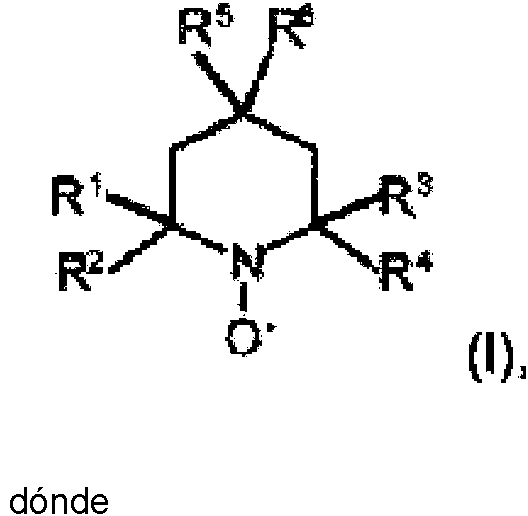
De acuerdo con la invención, el radical piperidina-N-oxilo estéricamente impedido tiene la fórmula general IAccording to the invention, the sterically hindered piperidine-N-oxyl radical has the general formula I

dondewhere
R1, R2, R3, y R4 cada uno representa independientemente alquilo C1-C6, yR1, R2, R3, and R4 each independently represent C1-C6 alkyl, and
R5 y R6 representan cada uno independientemente H, hidroxi, alquilo C1-C6, alcoxi C1-C6 o amino.R5 and R6 each independently represent H, hydroxy, C1-C6 alkyl, C1-C6 alkoxy or amino.
En un radical piperidina-N-oxilo impedido estéricamente particularmente preferido de fórmula general I, R1, R2, R3, R4 en cada caso representan alquilo C1 (metilo), y R5 y R6 representan cada uno H. El radical piperidina-N-oxilo conocido como 2,2,6,6-tetrametil-1-piperidiniloxilo (TEMPO) está representado por la fórmula IIIn a particularly preferred sterically hindered piperidine-N-oxyl radical of general formula I, R1, R2, R3, R4 each represent C1-alkyl (methyl), and R5 and R6 each represent H. The piperidine-N-oxyl radical known as 2,2,6,6-tetramethyl-1-piperidinyloxy (TEMPO) is represented by formula II

TEMPO se usa preferiblemente para estabilizar una solución de HMF. TEMPO se usa particularmente preferiblemente para estabilizar una solución de HMF en un disolvente orgánico. El HMF en el disolvente orgánico puede ser el resultado de la extracción de HMF de una solución acuosa. El disolvente orgánico también puede ser una mezcla de disolventes adecuados. El disolvente orgánico comprende preferiblemente un disolvente aprótico, es decir, un disolvente en el que no tiene lugar un intercambio de protones perceptible. La combinación de un disolvente aprótico orgánico y TEMPO es particularmente ventajosa, ya que se logra un nivel sorprendentemente alto de estabilidad de1HMF. El disolvente orgánico comprende particularmente preferiblemente diclorometano y / o triclorometano.TEMPO is preferably used to stabilize an HMF solution. TEMPO is particularly preferably used to stabilize a HMF solution in an organic solvent. The HMF in the organic solvent can be the result of the extraction of HMF from an aqueous solution. The organic solvent can also be a mixture of suitable solvents. The organic solvent preferably comprises an aprotic solvent, that is, a solvent in which no noticeable proton exchange takes place. The combination of an organic aprotic solvent and TEMPO is particularly advantageous, as a surprisingly high level of 1HMF stability is achieved. The organic solvent particularly preferably comprises dichloromethane and / or trichloromethane.
Según una realización particular, el radical piperidina-N-oxilo impedido estéricamente de fórmula general I está unido a una estructura polimérica a través de R5 y/o R6. Varios de estos radicales piperidina-N-oxilo estéricamente impedidos, inmovilizados con polímeros se describen en la bibliografía técnica. Por ejemplo, A. Bogdan y D.T. McQuade en Beilstein Journal of Organic Chemistry 2009, 5, No. 17 describen la producción de una resina polimérica que se funcionaliza con 2,2,6,6-tetrametil-1-piperidiniloxilo. Otros ejemplos son nanopartículas de SiO2 funcionalizadas con 2,2,6,6-tetrametil-1-piperidiniloxilo (ver RSC Adv., 2013, 3, 9752) o poliimidas (J. Photopolym. Sci. Technol. 27, 2, 2014): 2,2,6,6-tetrametil-1-piperidiniloxilo soportado con ácido poliacrílico y poliestireno y piperidiniloxilo inmovilizado con poliamina (PIPO). Es posible unir 2,2,6,6-tetrametil-1 -piperidiniloxilo y sus derivados a la estructura polimérica, por ejemplo, utilizando la denominada "química de clic" o por polimerización. Como resultado de la unión del al menos un radical piperidina-N-oxilo impedido estéricamente de fórmula general I a una estructura polimérica, se forma un radical piperidina-N-oxilo impedido estéricamente inmovilizado con polímero que durante el uso puede eliminarse fácilmente de1HMF. Esto es particularmente ventajoso, ya que el radical piperidina-N-oxilo puede recuperarse y reutilizarse. According to a particular embodiment, the sterically hindered piperidine-N-oxyl radical of general formula I is attached to a polymeric structure through R5 and / or R6. Several of these sterically hindered piperidine-N-oxyl radicals, immobilized with polymers are described in the technical literature. For example, A. Bogdan and DT McQuade in Beilstein Journal of Organic Chemistry 2009, 5, No. 17 describe the production of a polymer resin that is functionalized with 2,2,6,6-tetramethyl-1-piperidinyloxy. Other examples are SiO2 nanoparticles functionalized with 2,2,6,6-tetramethyl-1-piperidinyloxy (see RSC Adv., 2013, 3, 9752) or polyimides (J. Photopolym. Sci. Technol. 27, 2, 2014) : 2,2,6,6-tetramethyl-1-piperidinyloxy supported with polyacrylic acid and polystyrene and piperidinyloxy immobilized with polyamine (PIPO). It is possible to attach 2,2,6,6-tetramethyl-1 -piperidinyloxy and its derivatives to the polymeric structure, for example, using so-called "click chemistry" or by polymerization. As a result of the attachment of the at least one sterically hindered piperidine-N-oxyl radical of general formula I to a polymeric structure, a sterile immobilized piperidine-N-oxyl radical is formed which can be easily removed from 1HMF during use. This is particularly advantageous since the piperidine-N-oxyl radical can be recovered and reused.
Según otra realización ventajosa de la invención, el HMF a estabilizar se combina con el al menos un radical piperidina-N-oxilo impedido estéricamente en una relación molar de 800: 1 a 1: 800. La cantidad efectiva de un radical piperidina-N-oxilo impedido estéricamente que se usará de acuerdo con la invención puede variar en un amplio intervalo, dependiendo de las condiciones y la composición del HMF a estabilizar. Debido a la inesperadamente alta efectividad, el efecto estabilizador buscado se logra con frecuencia incluso con muy poco del radical piperidina-N-oxilo estéricamente impedido.According to another advantageous embodiment of the invention, the HMF to be stabilized is combined with the at least one sterically hindered piperidine-N-oxyl radical in a molar ratio of 800: 1 to 1: 800. The effective amount of a piperidine-N- radical Sterically hindered oxyl to be used according to the invention can vary over a wide range, depending on the conditions and composition of the HMF to be stabilized. Due to the unexpectedly high effectiveness, the desired stabilizing effect is often achieved even with very little of the sterically hindered piperidine-N-oxyl radical.
El HMF a estabilizar se combina preferiblemente con al menos un radical piperidina-N-oxilo impedido estéricamente en una relación molar de 500: 1 a 100: 1, particularmente preferiblemente 450: 1 a 150: 1. Se prefiere además una relación molar de 420: 1 a 380: 1 o 220: 1 a 160: 1. Las relaciones molares de más de 500: 1 también pueden ser importantes según la invención. Combinar el HMF con al menos un radical piperidina-N-oxilo impedido estéricamente en tales relaciones molares es particularmente ventajoso cuando una solución de HMF se estabiliza por un período corto de tiempo, es decir, por minutos, horas o días, como es frecuentemente requerido para el tratamiento físico y / o químico de HMF. Además, la estabilización es muy rentable debido a la pequeña cantidad de radical piperidina-N-oxilo estéricamente impedido.The HMF to be stabilized is preferably combined with at least one sterically hindered piperidine-N-oxyl radical in a molar ratio of 500: 1 to 100: 1, particularly preferably 450: 1 to 150: 1. A molar ratio of 420 is further preferred : 1 to 380: 1 or 220: 1 to 160: 1. Molar ratios of more than 500: 1 may also be important according to the invention. Combining HMF with at least one sterically hindered piperidine-N-oxyl radical in such molar ratios is particularly advantageous when an HMF solution stabilizes for a short period of time, i.e., for minutes, hours or days, as is frequently required for the physical and / or chemical treatment of HMF. In addition, stabilization is very cost effective due to the small amount of sterically hindered piperidine-N-oxyl radical.
También se prefiere que el HMF se estabilice para combinarse con el al menos un radical piperidina-N-oxilo impedido estéricamente en una relación molar de 4: 1 a 10: 1, particularmente preferiblemente 4,5: 1 a 6: 1. Combinar e1HMF con al menos un radical piperidina-N-oxilo impedido estéricamente en tales relaciones molares es particularmente ventajoso cuando una solución de HMF se estabiliza durante un período de tiempo más largo, es decir, durante varios días, semanas o años, como es deseable para el almacenamiento de HMF.It is also preferred that the HMF is stabilized to combine with the at least one sterically hindered piperidine-N-oxyl radical in a molar ratio of 4: 1 to 10: 1, particularly preferably 4.5: 1 to 6: 1. Combine e1HMF with at least one sterically hindered piperidine-N-oxyl radical in such molar ratios is particularly advantageous when an HMF solution stabilizes for a longer period of time, i.e. for several days, weeks or years, as is desirable for the HMF storage.
Según otra realización ventajosa de la invención, además del al menos un radical piperidina-N-oxilo impedido estéricamente, se añade al menos un compuesto estabilizador adicional al HMF. Por ejemplo, es posible agregar adicionalmente antioxidantes al HMF. Estos pueden agregarse al HMF por separado de los radicales piperidina-N-oxilo impedidos estéricamente, o junto con los mismos en una formulación.According to another advantageous embodiment of the invention, in addition to the at least one sterically hindered piperidine-N-oxyl radical, at least one additional stabilizing compound is added to the HMF. For example, it is possible to additionally add antioxidants to HMF. These can be added to the HMF separately from the sterically hindered piperidine-N-oxyl radicals, or together with them in a formulation.
Otros aspectos de la invención se refieren a una mezcla de sustancias que contiene HMF y al menos un radical piperidina-N-oxilo impedido estéricamente en una cantidad eficaz, y el uso de piperidina-N-oxilos impedidos estéricamente como estabilizadores de HMF.Other aspects of the invention relate to a mixture of substances containing HMF and at least one sterically hindered piperidine-N-oxyl radical in an effective amount, and the use of sterically hindered piperidine-N-oxyl as stabilizers for HMF.
Todas las declaraciones en la presente descripción con respecto al método de acuerdo con la invención, con respecto al HMF a estabilizar y / o los radicales piperidina-N-oxilo y / o componentes adicionales, por supuesto, se aplican de manera similar para la mezcla de sustancias de acuerdo con la invención y el uso según la invención.All statements in the present description regarding the method according to the invention, regarding the HMF to stabilize and / or the piperidine-N-oxyl radicals and / or additional components, of course, apply similarly for the mixture of substances according to the invention and the use according to the invention.
La mezcla de sustancias según la invención contiene HMF, una cantidad eficaz de al menos un radical piperidina-N-oxilo impedido estéricamente de fórmula general IThe mixture of substances according to the invention contains HMF, an effective amount of at least one sterically hindered piperidine-N-oxyl radical of general formula I

(I).(I).
donde R1, R2, R3, y R4 tienen los significados descritos anteriormente, y R5 y R6 representan cada uno independientemente H, alquilo C 1-C6, alcoxi C 1-C6 o amino, y un disolvente aprótico.where R1, R2, R3, and R4 have the meanings described above, and R5 and R6 each independently represent H, C 1 -C 6 alkyl, C 1 -C 6 alkoxy or amino, and an aprotic solvent.
La mezcla de sustancias se puede obtener por el método de acuerdo con la invención, como se indica en la descripción anterior.The mixture of substances can be obtained by the method according to the invention, as indicated in the previous description.
El disolvente aprótico tiene la ventaja de que el disolvente no desestabiliza e1HMF, y que el disolvente no reacciona con el al menos un radical piperidina-N-oxilo para reducir o incluso eliminar su efecto estabilizador. El disolvente aprótico es diclorometano o triclorometano.The aprotic solvent has the advantage that the solvent does not destabilize e1HMF, and that the solvent does not react with the at least one piperidine-N-oxyl radical to reduce or even eliminate its stabilizing effect. The aprotic solvent is dichloromethane or trichloromethane.
Se prefiere igualmente al menos un radical piperidina-N-oxilo estéricamente impedido TEMPO.At least one sterically hindered piperidine-N-oxyl radical TEMPO is also preferred.
Los siguientes ejemplos se usan únicamente para explicar la invención, y no pretenden limitar la invención de ninguna manera. The following examples are used only to explain the invention, and are not intended to limit the invention in any way.
EJEMPLOSEXAMPLES
Ejemplo 1Example 1
Disminución de la formación de HMF y oligómero, con y sin TEMPO, durante el almacenamiento de una solución de HMF. Decreased formation of HMF and oligomer, with and without TEMPO, during storage of an HMF solution.
En la serie de pruebas resumida en el Ejemplo 1, se comparó la disminución de HMF y la formación de oligómeros en función del tiempo, con y sin estabilizador. Con este fin, se disolvió HMF cristalino ( < 97% de pureza) en diclorometano (DCM). La concentración de HMF fue del 54% en peso, en base al peso total de la solución. Una porción de la solución se almacenó durante un mes a temperatura ambiente (RT), bajo la influencia de la luz del día y el aire. Además, se preparó una segunda solución de HMF cristalino (< 97% de pureza) que tenía una concentración de 53% en peso en diclorometano (DCM). Se añadió TEMPO como estabilizador a la segunda solución en una concentración del 7,7% en peso, en base al peso total de la solución. La segunda solución que contenía TEMPO como estabilizador se almacenó en condiciones idénticas, a temperatura ambiente (RT) y al aire libre bajo la influencia de la luz del día. Para representar también la influencia simultánea de la luz y la temperatura, una porción de la solución de HMF, sin estabilizador, se mantuvo en la oscuridad a 4 ° C bajo el efecto del aire, del mismo modo durante un mes. Durante el almacenamiento, la concentración de HMF en cada una de las soluciones se midió en intervalos regulares mediante cromatografía líquida de alta resolución (HPLC) a 280 nm. El tiempo de retención de los oligómeros fue de entre 17 y 19 minutos en el sistema de HPLC seleccionado. Las fracciones de HMF y oligómeros en los tiempos de medición se determinaron integrando las áreas debajo de los picos obtenidos para HMF y los oligómeros en el cromatograma de HPLC.In the test series summarized in Example 1, the decrease in HMF and the formation of oligomers as a function of time were compared, with and without stabilizer. To this end, crystalline HMF (<97% purity) was dissolved in dichloromethane (DCM). The HMF concentration was 54% by weight, based on the total weight of the solution. A portion of the solution was stored for one month at room temperature (RT), under the influence of daylight and air. In addition, a second solution of crystalline HMF (<97% purity) was prepared having a concentration of 53% by weight in dichloromethane (DCM). TEMPO was added as a stabilizer to the second solution in a concentration of 7.7% by weight, based on the total weight of the solution. The second solution containing TEMPO as a stabilizer was stored under identical conditions, at room temperature (RT) and outdoors under the influence of daylight. To also represent the simultaneous influence of light and temperature, a portion of the HMF solution, without stabilizer, was kept in the dark at 4 ° C under the effect of air, in the same way for one month. During storage, the HMF concentration in each of the solutions was measured at regular intervals by high performance liquid chromatography (HPLC) at 280 nm. The retention time of the oligomers was between 17 and 19 minutes in the selected HPLC system. The HMF and oligomer fractions at the measurement times were determined by integrating the areas below the peaks obtained for HMF and the oligomers in the HPLC chromatogram.
La disminución observada en HMF en % en función del tiempo se ilustra gráficamente en la Figura 1 de los dibujos. Es evidente en la Figura 1 que TEMPO como estabilizador reduce la disminución de HMF en DCM a temperatura ambiente. Además, se puede ver que la disminución de HMF con TEMPO como estabilizador a temperatura ambiente fue mayor que la disminución de HMF en la solución sin estabilizador, almacenada a 4 ° C en la oscuridad. TEMPO es un inhibidor más efectivo de la formación de oligómeros durante el almacenamiento.The observed decrease in HMF in% as a function of time is illustrated graphically in Figure 1 of the drawings. It is evident from Figure 1 that TEMPO as a stabilizer reduces the decrease of HMF in DCM at room temperature. Furthermore, it can be seen that the decrease in HMF with TEMPO as stabilizer at room temperature was greater than the decrease in HMF in the solution without stabilizer, stored at 4 ° C in the dark. TEMPO is a more effective inhibitor of oligomer formation during storage.
La Figura 2 ilustra la formación de oligómeros, que acompaña a la disminución de HMF, en función del tiempo, en base a la relación del área de los picos de oligómero y el área del pico de HMF determinada durante la HPLC. Es evidente a partir de la Figura 2 que el desarrollo de la formación de oligómero confirma el efecto estabilizador de TEMPO. La Figura 2 muestra que para la solución almacenada a temperatura ambiente con estabilizador, y para la solución almacenada a 4 ° C, se observa una disminución en los oligómeros a partir de los 17 días. Esta disminución se atribuye al hecho de que los oligómeros se combinan en agregados más grandes que se han eliminado como sedimento insoluble por filtración, antes de llevar a cabo la HPLC.Figure 2 illustrates the formation of oligomers, which accompanies the decrease of HMF, as a function of time, based on the ratio of the area of the oligomer peaks and the area of the HMF peak determined during HPLC. It is evident from Figure 2 that the development of oligomer formation confirms the stabilizing effect of TEMPO. Figure 2 shows that for the solution stored at room temperature with stabilizer, and for the solution stored at 4 ° C, a decrease in the oligomers is observed after 17 days. This decrease is attributed to the fact that the oligomers combine into larger aggregates that have been removed as insoluble sediment by filtration, before HPLC is carried out.
Ejemplo 2Example 2
Formación de oligómeros, con y sin TEMPO en un evaporador rotatorioOligomer formation, with and without TEMPO on a rotary evaporator
El Ejemplo 2 muestra una serie de pruebas que compara la formación de oligómeros, con y sin estabilizador, durante la concentración de soluciones de HMF en diclorometano (DCM) por medio de un evaporador rotatorio.Example 2 shows a series of tests comparing the formation of oligomers, with and without stabilizer, during the concentration of HMF solutions in dichloromethane (DCM) by means of a rotary evaporator.
Para este propósito, se prepararon las siguientes soluciones:For this purpose, the following solutions were prepared:
- Solución A: solución de HMF cristalino en DCM- Solution A: solution of crystalline HMF in DCM
Para la preparación de la solución A, se disolvió HMF cristalino (s 97% de pureza) en diclorometano (DCM).For the preparation of Solution A, crystalline HMF (s 97% pure) was dissolved in dichloromethane (DCM).
- Solución B: extracto de agua de proceso de HMF en DCM- Solution B: HMF process water extract in DCM
Para la preparación de la solución B, se extrajo agua de proceso del tratamiento hidrotérmico de carbohidratos con DCM. El extracto que contiene el HMF se designa como solución B.For the preparation of solution B, process water was extracted from the hydrothermal treatment of carbohydrates with DCM. The extract containing the HMF is designated as solution B.
Las soluciones A y B se concentraron en un evaporador rotatorio a 25 ° C, con concentración de HMF. Como se muestra en la Tabla 1 a continuación, se añadió TEMPO como estabilizador a las soluciones antes de la concentración en el evaporador rotatorio. Los valores de comparación se generaron con las soluciones correspondientes que no contenían TEMPO.Solutions A and B were concentrated on a rotary evaporator at 25 ° C, with HMF concentration. As shown in Table 1 below, TEMPO was added as a stabilizer to the solutions prior to concentration on the rotary evaporator. Comparison values were generated with corresponding solutions that did not contain TEMPO.
Las concentraciones de HMF al comienzo de la concentración (concentración HMF_IN, columna 2) y después de finalizar la concentración (concentración HMF_FIN, columna 4), las cantidades añadidas de TEMPO como estabilizador (columna 3), y los resultados de las series de pruebas se presentan en la Tabla 1.HMF concentrations at the beginning of the concentration (HMF_IN concentration, column 2) and after the end of the concentration (HMF_FIN concentration, column 4), the amounts of TEMPO added as stabilizer (column 3), and the results of the test series are presented in Table 1.
Tabla 1Table 1
Concentración Cantidad Concentración Número de Área de Área de Área de de HMF IN en de de HMF_FIN picos de picos de picos de pico de 5-DCM (mg/l) TEMPO en DCM (mg/l) oligómeros oligómeros oligómeros HMF (%)Concentration Quantity Concentration Area Number Area Area of HMF IN in of HMF_FIN peaks of peaks of peaks of peak of 5-DCM (mg / l) TEMPO in DCM (mg / l) oligomers oligomers oligomers HMF (%)
(mM) (%) (%)/ área(mM) (%) (%) / area
de pico depeak
5-HMF (%) Solución A: 5-HMF5-HMF (%) Solution A: 5-HMF
cristalino disuelto 131578 0 745935 2 3,15 3,29 95,9 en DCM dissolved crystalline 131578 0 745935 2 3.15 3.29 95.9 in DCM
Solución A: 5-HMFSolution A: 5-HMF
cristalino disuelto 131578 5 685895 3 0,53 0,54 97,7 en DCM dissolved crystalline 131578 5 685895 3 0.53 0.54 97.7 in DCM
Solución B: 5-HMFSolution B: 5-HMF
extraído de agua deextracted from water
proceso, utilizando 356615 0 909629 10 6,52 7,60 85,8 DCM process, using 356 615 0 909 629 10 6.52 7.60 85.8 DCM
Solución B: 5-HMFSolution B: 5-HMF
extraído de agua deextracted from water
proceso, utilizando 356615 5 982261 8 2,47 2,74 90 DCM process, using 356 615 5 982 261 8 2.47 2.74 90 DCM
Los resultados resumidos en la Tabla 1 muestran que la relación de oligómeros de HMF y HMF fue mucho menor en las soluciones en las que se mezcló TEMPO antes de la concentración en el evaporador rotatorio (columna 7). En general, se demostró que la cantidad de oligómeros en las soluciones, tratadas con TEMPO, después de la concentración fue mucho menor que en las soluciones no tratadas. Esto es consistente con la observación de que la cantidad de HMF en las soluciones tratadas con TEMPO fue mayor que en las soluciones no tratadas. TEMPO es un inhibidor efectivo de la formación de oligómeros durante el procesamiento físico del HMF por concentración en el evaporador rotatorio.The results summarized in Table 1 show that the ratio of HMF and HMF oligomers was much lower in the solutions in which TEMPO was mixed prior to concentration on the rotary evaporator (column 7). In general, it was shown that the amount of oligomers in the TEMPO-treated solutions after concentration was much less than in the untreated solutions. This is consistent with the observation that the amount of HMF in the TEMPO-treated solutions was higher than in the untreated solutions. TEMPO is an effective inhibitor of oligomer formation during physical processing of HMF by concentration on the rotary evaporator.
Ejemplo 3Example 3
La descomposición en furfural, con y sin TEMPO, en el evaporador rotatorio.Decomposition into furfural, with and without TEMPO, on the rotary evaporator.
En la solución A, con y sin TEMPO, del Ejemplo 2, se determinó la concentración de furfural después de la concentración en el evaporador rotatorio descrito en el Ejemplo 2. Los resultados se muestran en la Tabla 2.In solution A, with and without TEMPO, of Example 2, the furfural concentration was determined after concentration in the rotary evaporator described in Example 2. The results are shown in Table 2.
Tabla 2Table 2
TEMPO (mM) Concentración de furfural FIN en DCM (mg/l)TEMPO (mM) Furfural concentration FIN in DCM (mg / l)
Solución A: 5-HMF cristalino disuelto en DCM 0 653 Solution A: Crystalline 5-HMF dissolved in DCM 0 653
Solución A: 5-HMF cristalino disuelto en DCM 5 383 Solution A: crystalline 5-HMF dissolved in DCM 5 383
Es evidente a partir de la Tabla 2 que la concentración en la solución A, tratada con TEMPO como estabilizador, es mucho menor que en la solución concentrada sin TEMPO. TEMPO es un inhibidor efectivo de la descomposición de1HMF en furfural durante el procesamiento físico del HMF por concentración en el evaporador rotatorio.It is evident from Table 2 that the concentration in solution A, treated with TEMPO as a stabilizer, is much less than in the concentrated solution without TEMPO. TEMPO is an effective inhibitor of the decomposition of 1HMF in furfural during physical processing of HMF by concentration on the rotary evaporator.
Los ejemplos demuestran el efecto estabilizador inesperado del radical de piperidina-N-oxilo TEMPO, incluso cuando se agrega en pequeñas cantidades.The examples demonstrate the unexpected stabilizing effect of the piperidine-N-oxyl radical TEMPO, even when added in small amounts.
Otras ventajas y realizaciones ventajosas se exponen en las reivindicaciones.Other advantages and advantageous embodiments are set out in the claims.
Todas las características de la invención pueden ser esenciales para la invención, individualmente o en cualquier combinación arbitraria entre sí. All the features of the invention may be essential to the invention, individually or in any arbitrary combination with each other.
Claims (11)




Applications Claiming Priority (1)
| Application Number | Priority Date | Filing Date | Title |
|---|---|---|---|
| EP17170003.2A EP3401312B1 (en) | 2017-05-08 | 2017-05-08 | Method for stabilisation of hydroxymethylfurfural (hmf) |
Publications (1)
| Publication Number | Publication Date |
|---|---|
| ES2755417T3 true ES2755417T3 (en) | 2020-04-22 |
Family
ID=58672531
Family Applications (1)
| Application Number | Title | Priority Date | Filing Date |
|---|---|---|---|
| ES17170003T Active ES2755417T3 (en) | 2017-05-08 | 2017-05-08 | Procedure to stabilize 5-hydroxymethylfurfural (HMF) |
Country Status (4)
| Country | Link |
|---|---|
| EP (1) | EP3401312B1 (en) |
| ES (1) | ES2755417T3 (en) |
| HU (1) | HUE045365T2 (en) |
| PL (1) | PL3401312T3 (en) |
Families Citing this family (1)
| Publication number | Priority date | Publication date | Assignee | Title |
|---|---|---|---|---|
| CN116178314B (en) * | 2021-11-29 | 2025-01-28 | 中国科学院宁波材料技术与工程研究所 | A method for improving the storage and transportation stability of 5-hydroxymethylfurfural |
Family Cites Families (7)
| Publication number | Priority date | Publication date | Assignee | Title |
|---|---|---|---|---|
| GB0521319D0 (en) * | 2005-10-20 | 2005-11-30 | A H Marks And Company Ltd | Method |
| CN102137889B (en) * | 2008-08-28 | 2013-11-13 | 巴斯夫欧洲公司 | Stabilisers for inanimate organic materials |
| FR2984889B1 (en) | 2011-12-22 | 2017-02-24 | Roquette Freres | IMPROVED METHOD OF SELECTIVE OXIDATION OF 5-HYDROMETHYL FURALDEHYDE |
| US9422257B2 (en) * | 2013-03-14 | 2016-08-23 | Archer Daniels Midland Company | Process for making HMF from sugars with reduced byproduct formation, and improved stability HMF compositions |
| KR101617758B1 (en) * | 2013-07-09 | 2016-05-03 | 명지대학교 산학협력단 | Method for preparing 2,5-diformylfuran from oxidation of 5-hydroxymethylfurfural using metal free catalyst and co-catalyst |
| JP2016011264A (en) * | 2014-06-27 | 2016-01-21 | 花王株式会社 | Process for producing 2,5-furandicarboxylic acid |
| NO2681399T3 (en) | 2014-08-26 | 2018-04-07 |
-
2017
- 2017-05-08 PL PL17170003T patent/PL3401312T3/en unknown
- 2017-05-08 ES ES17170003T patent/ES2755417T3/en active Active
- 2017-05-08 EP EP17170003.2A patent/EP3401312B1/en active Active
- 2017-05-08 HU HUE17170003A patent/HUE045365T2/en unknown
Also Published As
| Publication number | Publication date |
|---|---|
| HUE045365T2 (en) | 2019-12-30 |
| PL3401312T3 (en) | 2020-03-31 |
| EP3401312A1 (en) | 2018-11-14 |
| EP3401312B1 (en) | 2019-09-04 |
Similar Documents
| Publication | Publication Date | Title |
|---|---|---|
| Wang et al. | Organobase modulated synthesis of high-quality β-ketoenamine-linked covalent organic frameworks | |
| Ding et al. | Synthesis, characterization and properties of geminal imidazolium ionic liquids | |
| US4188376A (en) | Stable liquid compositions containing salts of 1,2-benzisothiazolin-3-one | |
| PT2376506E (en) | Liquid composition containing phosphoric or thiophosphoric triamide derivative and use thereof | |
| ES2641320T3 (en) | Amphiphilic macromolecule and its uses | |
| KR20110079920A (en) | Ionic liquids containing nitrogen-containing cations | |
| JP2014534180A5 (en) | ||
| RU2014128600A (en) | DRYING SUBSTANCE FOR SELF-OXIDIZING COVERING COMPOSITIONS | |
| BR112015012300B1 (en) | beta-amino ester gas hydrate inhibiting compounds, composition comprising these and method for inhibiting formation of hydrate agglomerates | |
| RU2014128538A (en) | DRYER FOR SELF-OXIDIZABLE COATING COMPOSITIONS | |
| ES2755417T3 (en) | Procedure to stabilize 5-hydroxymethylfurfural (HMF) | |
| WO2008094846A1 (en) | Reversible room-temperature ionic liquids | |
| BR102015012870A2 (en) | composition | |
| CN102250039A (en) | Ionic liquid of N-methyl piperazine salt and preparation method thereof | |
| BR112013024082B1 (en) | compound and composition of fluorescent whitening agent, its uses and process for bleaching and paper obtained in said process | |
| CN101316810A (en) | ionic liquid | |
| BR112019023447A2 (en) | POLYMERIC STABILIZATION AGENT, STABILIZED SOLID BASE COMPOSITION FOR STORAGE, AND METHODS TO PRODUCE A SOLID BASE COMPOSITION AND A TANK MIXTURE, TO STABILIZE A SOLID BASE COMPOSITION AND TO INCREASE A STABILITY COMPOSITION SOLID BASE | |
| ES2527722T3 (en) | Method for reacting 1,3-heteroaromatic 2-carboxylates with water | |
| Hanabusa et al. | Easy preparation and prominent gelation of new gelator based on L-lysine | |
| US2271707A (en) | Wetting agent | |
| CN106179109A (en) | A kind of fluorocarbon surfactant based on short fluorocarbon chain and preparation method thereof | |
| ES2298049A1 (en) | Process for manufacturing 3(r)-(2-hydroxy-2,2-dithien-2-ylacetoxy)-1-(3- phenoxypropyl)-1 -azoniabicyclo[2.2.2]octane bromide | |
| JPH10158243A (en) | New photostabilizer using sterically hindered amine as base material | |
| Rubio et al. | Synthesis and organogelating ability of bis-urea pseudopeptidic compounds | |
| Qiao et al. | Synthesis and surface activity properties of symmetric double chains alkylbetaine surfactants derived from s-triazine |