ES2761660T3 - Radical polymerization of alkoxyamines at low temperature - Google Patents
Radical polymerization of alkoxyamines at low temperature Download PDFInfo
- Publication number
- ES2761660T3 ES2761660T3 ES15823668T ES15823668T ES2761660T3 ES 2761660 T3 ES2761660 T3 ES 2761660T3 ES 15823668 T ES15823668 T ES 15823668T ES 15823668 T ES15823668 T ES 15823668T ES 2761660 T3 ES2761660 T3 ES 2761660T3
- Authority
- ES
- Spain
- Prior art keywords
- alkoxyamine
- polymerization
- radical
- photoinitiator
- nitroxide
- Prior art date
- Legal status (The legal status is an assumption and is not a legal conclusion. Google has not performed a legal analysis and makes no representation as to the accuracy of the status listed.)
- Active
Links
- 125000005262 alkoxyamine group Chemical group 0.000 title claims abstract description 40
- 238000010526 radical polymerization reaction Methods 0.000 title claims abstract description 9
- 238000006116 polymerization reaction Methods 0.000 claims abstract description 30
- 239000000178 monomer Substances 0.000 claims abstract description 24
- 239000000203 mixture Substances 0.000 claims abstract description 23
- 238000006243 chemical reaction Methods 0.000 claims abstract description 9
- 238000000034 method Methods 0.000 claims description 36
- 150000003254 radicals Chemical class 0.000 claims description 25
- 239000000463 material Substances 0.000 claims description 19
- 230000008569 process Effects 0.000 claims description 16
- 239000003999 initiator Substances 0.000 claims description 10
- 238000005516 engineering process Methods 0.000 claims description 4
- 239000003292 glue Substances 0.000 claims description 4
- 238000010146 3D printing Methods 0.000 claims description 3
- 238000000576 coating method Methods 0.000 claims description 3
- 239000002131 composite material Substances 0.000 claims description 3
- 238000004519 manufacturing process Methods 0.000 claims description 3
- 239000003822 epoxy resin Substances 0.000 claims description 2
- 239000000835 fiber Substances 0.000 claims description 2
- 229920000647 polyepoxide Polymers 0.000 claims description 2
- 229920000728 polyester Polymers 0.000 claims description 2
- 229920002635 polyurethane Polymers 0.000 claims description 2
- 239000004814 polyurethane Substances 0.000 claims description 2
- 239000002966 varnish Substances 0.000 claims description 2
- LNEPOXFFQSENCJ-UHFFFAOYSA-N haloperidol Chemical compound C1CC(O)(C=2C=CC(Cl)=CC=2)CCN1CCCC(=O)C1=CC=C(F)C=C1 LNEPOXFFQSENCJ-UHFFFAOYSA-N 0.000 claims 1
- -1 nitroxide radicals Chemical class 0.000 description 46
- 125000004432 carbon atom Chemical group C* 0.000 description 15
- 230000015572 biosynthetic process Effects 0.000 description 14
- AVXURJPOCDRRFD-UHFFFAOYSA-N Hydroxylamine Chemical class ON AVXURJPOCDRRFD-UHFFFAOYSA-N 0.000 description 13
- LYCAIKOWRPUZTN-UHFFFAOYSA-N ethylene glycol Natural products OCCO LYCAIKOWRPUZTN-UHFFFAOYSA-N 0.000 description 13
- 238000003786 synthesis reaction Methods 0.000 description 13
- PPBRXRYQALVLMV-UHFFFAOYSA-N Styrene Chemical compound C=CC1=CC=CC=C1 PPBRXRYQALVLMV-UHFFFAOYSA-N 0.000 description 12
- IJGRMHOSHXDMSA-UHFFFAOYSA-N Atomic nitrogen Chemical compound N#N IJGRMHOSHXDMSA-UHFFFAOYSA-N 0.000 description 10
- 125000003118 aryl group Chemical group 0.000 description 10
- 229920001400 block copolymer Polymers 0.000 description 10
- 229920001577 copolymer Polymers 0.000 description 10
- 125000000217 alkyl group Chemical group 0.000 description 9
- LFQSCWFLJHTTHZ-UHFFFAOYSA-N Ethanol Chemical compound CCO LFQSCWFLJHTTHZ-UHFFFAOYSA-N 0.000 description 8
- 150000001252 acrylic acid derivatives Chemical class 0.000 description 8
- WGCNASOHLSPBMP-UHFFFAOYSA-N hydroxyacetaldehyde Natural products OCC=O WGCNASOHLSPBMP-UHFFFAOYSA-N 0.000 description 8
- 229920000642 polymer Polymers 0.000 description 8
- 125000003545 alkoxy group Chemical group 0.000 description 7
- CQEYYJKEWSMYFG-UHFFFAOYSA-N butyl acrylate Chemical compound CCCCOC(=O)C=C CQEYYJKEWSMYFG-UHFFFAOYSA-N 0.000 description 7
- 239000011541 reaction mixture Substances 0.000 description 7
- 239000000654 additive Substances 0.000 description 6
- 229910052794 bromium Inorganic materials 0.000 description 6
- 239000000460 chlorine Substances 0.000 description 6
- 229910052801 chlorine Inorganic materials 0.000 description 6
- 238000004458 analytical method Methods 0.000 description 5
- 125000005843 halogen group Chemical group 0.000 description 5
- 238000010438 heat treatment Methods 0.000 description 5
- 229910052757 nitrogen Inorganic materials 0.000 description 5
- CERQOIWHTDAKMF-UHFFFAOYSA-M Methacrylate Chemical compound CC(=C)C([O-])=O CERQOIWHTDAKMF-UHFFFAOYSA-M 0.000 description 4
- VVQNEPGJFQJSBK-UHFFFAOYSA-N Methyl methacrylate Chemical compound COC(=O)C(C)=C VVQNEPGJFQJSBK-UHFFFAOYSA-N 0.000 description 4
- QYKIQEUNHZKYBP-UHFFFAOYSA-N Vinyl ether Chemical compound C=COC=C QYKIQEUNHZKYBP-UHFFFAOYSA-N 0.000 description 4
- NIXOWILDQLNWCW-UHFFFAOYSA-N acrylic acid group Chemical group C(C=C)(=O)O NIXOWILDQLNWCW-UHFFFAOYSA-N 0.000 description 4
- 125000004104 aryloxy group Chemical group 0.000 description 4
- GDTBXPJZTBHREO-UHFFFAOYSA-N bromine Chemical compound BrBr GDTBXPJZTBHREO-UHFFFAOYSA-N 0.000 description 4
- 125000000753 cycloalkyl group Chemical group 0.000 description 4
- 230000005670 electromagnetic radiation Effects 0.000 description 4
- 229910052731 fluorine Inorganic materials 0.000 description 4
- 238000002360 preparation method Methods 0.000 description 4
- 238000003756 stirring Methods 0.000 description 4
- 229960000834 vinyl ether Drugs 0.000 description 4
- YXFVVABEGXRONW-UHFFFAOYSA-N Toluene Chemical compound CC1=CC=CC=C1 YXFVVABEGXRONW-UHFFFAOYSA-N 0.000 description 3
- CIUQDSCDWFSTQR-UHFFFAOYSA-N [C]1=CC=CC=C1 Chemical compound [C]1=CC=CC=C1 CIUQDSCDWFSTQR-UHFFFAOYSA-N 0.000 description 3
- 230000004913 activation Effects 0.000 description 3
- 230000008901 benefit Effects 0.000 description 3
- 125000000484 butyl group Chemical group [H]C([*])([H])C([H])([H])C([H])([H])C([H])([H])[H] 0.000 description 3
- 125000002915 carbonyl group Chemical group [*:2]C([*:1])=O 0.000 description 3
- 239000011521 glass Substances 0.000 description 3
- 230000009477 glass transition Effects 0.000 description 3
- 230000000977 initiatory effect Effects 0.000 description 3
- 150000002734 metacrylic acid derivatives Chemical class 0.000 description 3
- 125000005395 methacrylic acid group Chemical group 0.000 description 3
- 150000002978 peroxides Chemical class 0.000 description 3
- 125000001997 phenyl group Chemical group [H]C1=C([H])C([H])=C(*)C([H])=C1[H] 0.000 description 3
- 229920000058 polyacrylate Polymers 0.000 description 3
- 229920001515 polyalkylene glycol Polymers 0.000 description 3
- 229920001451 polypropylene glycol Polymers 0.000 description 3
- 239000011347 resin Substances 0.000 description 3
- 229920005989 resin Polymers 0.000 description 3
- 150000003839 salts Chemical class 0.000 description 3
- 238000012546 transfer Methods 0.000 description 3
- PSGCQDPCAWOCSH-UHFFFAOYSA-N (4,7,7-trimethyl-3-bicyclo[2.2.1]heptanyl) prop-2-enoate Chemical compound C1CC2(C)C(OC(=O)C=C)CC1C2(C)C PSGCQDPCAWOCSH-UHFFFAOYSA-N 0.000 description 2
- KWKAKUADMBZCLK-UHFFFAOYSA-N 1-octene Chemical compound CCCCCCC=C KWKAKUADMBZCLK-UHFFFAOYSA-N 0.000 description 2
- OZAIFHULBGXAKX-UHFFFAOYSA-N 2-(2-cyanopropan-2-yldiazenyl)-2-methylpropanenitrile Chemical compound N#CC(C)(C)N=NC(C)(C)C#N OZAIFHULBGXAKX-UHFFFAOYSA-N 0.000 description 2
- FTALTLPZDVFJSS-UHFFFAOYSA-N 2-(2-ethoxyethoxy)ethyl prop-2-enoate Chemical compound CCOCCOCCOC(=O)C=C FTALTLPZDVFJSS-UHFFFAOYSA-N 0.000 description 2
- KZBUYRJDOAKODT-UHFFFAOYSA-N Chlorine Chemical compound ClCl KZBUYRJDOAKODT-UHFFFAOYSA-N 0.000 description 2
- ZMDDERVSCYEKPQ-UHFFFAOYSA-N Ethyl (mesitylcarbonyl)phenylphosphinate Chemical compound C=1C=CC=CC=1P(=O)(OCC)C(=O)C1=C(C)C=C(C)C=C1C ZMDDERVSCYEKPQ-UHFFFAOYSA-N 0.000 description 2
- 241000254158 Lampyridae Species 0.000 description 2
- ABLZXFCXXLZCGV-UHFFFAOYSA-N Phosphorous acid Chemical group OP(O)=O ABLZXFCXXLZCGV-UHFFFAOYSA-N 0.000 description 2
- 230000000996 additive effect Effects 0.000 description 2
- 239000000853 adhesive Substances 0.000 description 2
- 230000001070 adhesive effect Effects 0.000 description 2
- 125000002947 alkylene group Chemical group 0.000 description 2
- 150000001412 amines Chemical class 0.000 description 2
- 125000003277 amino group Chemical group 0.000 description 2
- 125000002102 aryl alkyloxo group Chemical group 0.000 description 2
- 125000004429 atom Chemical group 0.000 description 2
- 239000012965 benzophenone Substances 0.000 description 2
- 150000008366 benzophenones Chemical class 0.000 description 2
- 125000001797 benzyl group Chemical group [H]C1=C([H])C([H])=C(C([H])=C1[H])C([H])([H])* 0.000 description 2
- 239000003153 chemical reaction reagent Substances 0.000 description 2
- 150000001875 compounds Chemical class 0.000 description 2
- 238000001816 cooling Methods 0.000 description 2
- 125000001495 ethyl group Chemical group [H]C([H])([H])C([H])([H])* 0.000 description 2
- 238000001704 evaporation Methods 0.000 description 2
- 230000008020 evaporation Effects 0.000 description 2
- 239000000284 extract Substances 0.000 description 2
- 230000002349 favourable effect Effects 0.000 description 2
- 125000001153 fluoro group Chemical group F* 0.000 description 2
- 229920001519 homopolymer Polymers 0.000 description 2
- BHEPBYXIRTUNPN-UHFFFAOYSA-N hydridophosphorus(.) (triplet) Chemical group [PH] BHEPBYXIRTUNPN-UHFFFAOYSA-N 0.000 description 2
- 125000004356 hydroxy functional group Chemical group O* 0.000 description 2
- 238000011065 in-situ storage Methods 0.000 description 2
- 238000001802 infusion Methods 0.000 description 2
- 125000001449 isopropyl group Chemical group [H]C([H])([H])C([H])(*)C([H])([H])[H] 0.000 description 2
- 239000007788 liquid Substances 0.000 description 2
- 239000011159 matrix material Substances 0.000 description 2
- 229910052751 metal Inorganic materials 0.000 description 2
- 239000002184 metal Substances 0.000 description 2
- 125000002496 methyl group Chemical group [H]C([H])([H])* 0.000 description 2
- 125000000449 nitro group Chemical group [O-][N+](*)=O 0.000 description 2
- 230000003287 optical effect Effects 0.000 description 2
- 125000005010 perfluoroalkyl group Chemical group 0.000 description 2
- 230000002085 persistent effect Effects 0.000 description 2
- 239000003505 polymerization initiator Substances 0.000 description 2
- 230000000379 polymerizing effect Effects 0.000 description 2
- 230000005855 radiation Effects 0.000 description 2
- 239000002904 solvent Substances 0.000 description 2
- DTGKSKDOIYIVQL-WEDXCCLWSA-N (+)-borneol Chemical group C1C[C@@]2(C)[C@@H](O)C[C@@H]1C2(C)C DTGKSKDOIYIVQL-WEDXCCLWSA-N 0.000 description 1
- HGTUJZTUQFXBIH-UHFFFAOYSA-N (2,3-dimethyl-3-phenylbutan-2-yl)benzene Chemical group C=1C=CC=CC=1C(C)(C)C(C)(C)C1=CC=CC=C1 HGTUJZTUQFXBIH-UHFFFAOYSA-N 0.000 description 1
- BQCIDUSAKPWEOX-UHFFFAOYSA-N 1,1-Difluoroethene Chemical compound FC(F)=C BQCIDUSAKPWEOX-UHFFFAOYSA-N 0.000 description 1
- VXNZUUAINFGPBY-UHFFFAOYSA-N 1-Butene Chemical compound CCC=C VXNZUUAINFGPBY-UHFFFAOYSA-N 0.000 description 1
- QEDGLQDJPVXWJX-UHFFFAOYSA-N 1-ethyl-3-hydroxyimidazolidin-2-one;2-methylprop-2-enoic acid Chemical compound CC(=C)C(O)=O.CCN1CCN(O)C1=O QEDGLQDJPVXWJX-UHFFFAOYSA-N 0.000 description 1
- LIKMAJRDDDTEIG-UHFFFAOYSA-N 1-hexene Chemical compound CCCCC=C LIKMAJRDDDTEIG-UHFFFAOYSA-N 0.000 description 1
- XLPJNCYCZORXHG-UHFFFAOYSA-N 1-morpholin-4-ylprop-2-en-1-one Chemical class C=CC(=O)N1CCOCC1 XLPJNCYCZORXHG-UHFFFAOYSA-N 0.000 description 1
- KGRVJHAUYBGFFP-UHFFFAOYSA-N 2,2'-Methylenebis(4-methyl-6-tert-butylphenol) Chemical compound CC(C)(C)C1=CC(C)=CC(CC=2C(=C(C=C(C)C=2)C(C)(C)C)O)=C1O KGRVJHAUYBGFFP-UHFFFAOYSA-N 0.000 description 1
- QTKPMCIBUROOGY-UHFFFAOYSA-N 2,2,2-trifluoroethyl 2-methylprop-2-enoate Chemical compound CC(=C)C(=O)OCC(F)(F)F QTKPMCIBUROOGY-UHFFFAOYSA-N 0.000 description 1
- LTMRRSWNXVJMBA-UHFFFAOYSA-L 2,2-diethylpropanedioate Chemical compound CCC(CC)(C([O-])=O)C([O-])=O LTMRRSWNXVJMBA-UHFFFAOYSA-L 0.000 description 1
- SMZOUWXMTYCWNB-UHFFFAOYSA-N 2-(2-methoxy-5-methylphenyl)ethanamine Chemical compound COC1=CC=C(C)C=C1CCN SMZOUWXMTYCWNB-UHFFFAOYSA-N 0.000 description 1
- PFPUZMSQZJFLBK-UHFFFAOYSA-N 2-(2-oxoimidazolidin-1-yl)ethyl 2-methylprop-2-enoate Chemical compound CC(=C)C(=O)OCCN1CCNC1=O PFPUZMSQZJFLBK-UHFFFAOYSA-N 0.000 description 1
- JAHNSTQSQJOJLO-UHFFFAOYSA-N 2-(3-fluorophenyl)-1h-imidazole Chemical compound FC1=CC=CC(C=2NC=CN=2)=C1 JAHNSTQSQJOJLO-UHFFFAOYSA-N 0.000 description 1
- DPBJAVGHACCNRL-UHFFFAOYSA-N 2-(dimethylamino)ethyl prop-2-enoate Chemical compound CN(C)CCOC(=O)C=C DPBJAVGHACCNRL-UHFFFAOYSA-N 0.000 description 1
- SFPNZPQIIAJXGL-UHFFFAOYSA-N 2-ethoxyethyl 2-methylprop-2-enoate Chemical class CCOCCOC(=O)C(C)=C SFPNZPQIIAJXGL-UHFFFAOYSA-N 0.000 description 1
- OMIGHNLMNHATMP-UHFFFAOYSA-N 2-hydroxyethyl prop-2-enoate Chemical compound OCCOC(=O)C=C OMIGHNLMNHATMP-UHFFFAOYSA-N 0.000 description 1
- VHSHLMUCYSAUQU-UHFFFAOYSA-N 2-hydroxypropyl methacrylate Chemical compound CC(O)COC(=O)C(C)=C VHSHLMUCYSAUQU-UHFFFAOYSA-N 0.000 description 1
- 125000004200 2-methoxyethyl group Chemical group [H]C([H])([H])OC([H])([H])C([H])([H])* 0.000 description 1
- FKLBRTJRFNSRJD-UHFFFAOYSA-N 2-methyl-6-trimethylsilylhex-1-en-3-one Chemical compound CC(=C)C(=O)CCC[Si](C)(C)C FKLBRTJRFNSRJD-UHFFFAOYSA-N 0.000 description 1
- 125000003903 2-propenyl group Chemical group [H]C([*])([H])C([H])=C([H])[H] 0.000 description 1
- KGIGUEBEKRSTEW-UHFFFAOYSA-N 2-vinylpyridine Chemical compound C=CC1=CC=CC=N1 KGIGUEBEKRSTEW-UHFFFAOYSA-N 0.000 description 1
- SLRMQYXOBQWXCR-UHFFFAOYSA-N 2154-56-5 Chemical compound [CH2]C1=CC=CC=C1 SLRMQYXOBQWXCR-UHFFFAOYSA-N 0.000 description 1
- JHWGFJBTMHEZME-UHFFFAOYSA-N 4-prop-2-enoyloxybutyl prop-2-enoate Chemical compound C=CC(=O)OCCCCOC(=O)C=C JHWGFJBTMHEZME-UHFFFAOYSA-N 0.000 description 1
- WIYVVIUBKNTNKG-UHFFFAOYSA-N 6,7-dimethoxy-3,4-dihydronaphthalene-2-carboxylic acid Chemical compound C1CC(C(O)=O)=CC2=C1C=C(OC)C(OC)=C2 WIYVVIUBKNTNKG-UHFFFAOYSA-N 0.000 description 1
- OZAIFHULBGXAKX-VAWYXSNFSA-N AIBN Substances N#CC(C)(C)\N=N\C(C)(C)C#N OZAIFHULBGXAKX-VAWYXSNFSA-N 0.000 description 1
- HRPVXLWXLXDGHG-UHFFFAOYSA-N Acrylamide Chemical compound NC(=O)C=C HRPVXLWXLXDGHG-UHFFFAOYSA-N 0.000 description 1
- NLHHRLWOUZZQLW-UHFFFAOYSA-N Acrylonitrile Chemical compound C=CC#N NLHHRLWOUZZQLW-UHFFFAOYSA-N 0.000 description 1
- 239000004342 Benzoyl peroxide Substances 0.000 description 1
- OMPJBNCRMGITSC-UHFFFAOYSA-N Benzoylperoxide Chemical compound C=1C=CC=CC=1C(=O)OOC(=O)C1=CC=CC=C1 OMPJBNCRMGITSC-UHFFFAOYSA-N 0.000 description 1
- OKTJSMMVPCPJKN-UHFFFAOYSA-N Carbon Chemical compound [C] OKTJSMMVPCPJKN-UHFFFAOYSA-N 0.000 description 1
- 229910052684 Cerium Inorganic materials 0.000 description 1
- VGGSQFUCUMXWEO-UHFFFAOYSA-N Ethene Chemical compound C=C VGGSQFUCUMXWEO-UHFFFAOYSA-N 0.000 description 1
- 239000005977 Ethylene Substances 0.000 description 1
- UFHFLCQGNIYNRP-UHFFFAOYSA-N Hydrogen Chemical compound [H][H] UFHFLCQGNIYNRP-UHFFFAOYSA-N 0.000 description 1
- WOBHKFSMXKNTIM-UHFFFAOYSA-N Hydroxyethyl methacrylate Chemical compound CC(=C)C(=O)OCCO WOBHKFSMXKNTIM-UHFFFAOYSA-N 0.000 description 1
- CNCOEDDPFOAUMB-UHFFFAOYSA-N N-Methylolacrylamide Chemical class OCNC(=O)C=C CNCOEDDPFOAUMB-UHFFFAOYSA-N 0.000 description 1
- WHNWPMSKXPGLAX-UHFFFAOYSA-N N-Vinyl-2-pyrrolidone Chemical compound C=CN1CCCC1=O WHNWPMSKXPGLAX-UHFFFAOYSA-N 0.000 description 1
- 229910019142 PO4 Inorganic materials 0.000 description 1
- 239000004793 Polystyrene Substances 0.000 description 1
- OFOBLEOULBTSOW-UHFFFAOYSA-N Propanedioic acid Natural products OC(=O)CC(O)=O OFOBLEOULBTSOW-UHFFFAOYSA-N 0.000 description 1
- BUGBHKTXTAQXES-UHFFFAOYSA-N Selenium Chemical group [Se] BUGBHKTXTAQXES-UHFFFAOYSA-N 0.000 description 1
- NINIDFKCEFEMDL-UHFFFAOYSA-N Sulfur Chemical compound [S] NINIDFKCEFEMDL-UHFFFAOYSA-N 0.000 description 1
- HVVWZTWDBSEWIH-UHFFFAOYSA-N [2-(hydroxymethyl)-3-prop-2-enoyloxy-2-(prop-2-enoyloxymethyl)propyl] prop-2-enoate Chemical compound C=CC(=O)OCC(CO)(COC(=O)C=C)COC(=O)C=C HVVWZTWDBSEWIH-UHFFFAOYSA-N 0.000 description 1
- 239000002253 acid Substances 0.000 description 1
- 150000003926 acrylamides Chemical class 0.000 description 1
- 239000003570 air Substances 0.000 description 1
- 125000003342 alkenyl group Chemical group 0.000 description 1
- SHGAZHPCJJPHSC-YCNIQYBTSA-N all-trans-retinoic acid Chemical compound OC(=O)\C=C(/C)\C=C\C=C(/C)\C=C\C1=C(C)CCCC1(C)C SHGAZHPCJJPHSC-YCNIQYBTSA-N 0.000 description 1
- 239000012080 ambient air Substances 0.000 description 1
- 238000013459 approach Methods 0.000 description 1
- 150000005840 aryl radicals Chemical class 0.000 description 1
- QVGXLLKOCUKJST-UHFFFAOYSA-N atomic oxygen Chemical compound [O] QVGXLLKOCUKJST-UHFFFAOYSA-N 0.000 description 1
- 125000000751 azo group Chemical group [*]N=N[*] 0.000 description 1
- 235000019400 benzoyl peroxide Nutrition 0.000 description 1
- IAQRGUVFOMOMEM-UHFFFAOYSA-N butene Natural products CC=CC IAQRGUVFOMOMEM-UHFFFAOYSA-N 0.000 description 1
- 229910052799 carbon Inorganic materials 0.000 description 1
- 150000001723 carbon free-radicals Chemical class 0.000 description 1
- 230000015556 catabolic process Effects 0.000 description 1
- GWXLDORMOJMVQZ-UHFFFAOYSA-N cerium Chemical compound [Ce] GWXLDORMOJMVQZ-UHFFFAOYSA-N 0.000 description 1
- 239000003795 chemical substances by application Substances 0.000 description 1
- 238000004891 communication Methods 0.000 description 1
- 238000007906 compression Methods 0.000 description 1
- 230000006835 compression Effects 0.000 description 1
- 239000000470 constituent Substances 0.000 description 1
- 230000008878 coupling Effects 0.000 description 1
- 238000010168 coupling process Methods 0.000 description 1
- 238000005859 coupling reaction Methods 0.000 description 1
- YQHLDYVWEZKEOX-UHFFFAOYSA-N cumene hydroperoxide Chemical compound OOC(C)(C)C1=CC=CC=C1 YQHLDYVWEZKEOX-UHFFFAOYSA-N 0.000 description 1
- 125000000113 cyclohexyl group Chemical group [H]C1([H])C([H])([H])C([H])([H])C([H])(*)C([H])([H])C1([H])[H] 0.000 description 1
- 238000006731 degradation reaction Methods 0.000 description 1
- 239000012933 diacyl peroxide Substances 0.000 description 1
- WNAHIZMDSQCWRP-UHFFFAOYSA-N dodecane-1-thiol Chemical compound CCCCCCCCCCCCS WNAHIZMDSQCWRP-UHFFFAOYSA-N 0.000 description 1
- 125000003438 dodecyl group Chemical group [H]C([H])([H])C([H])([H])C([H])([H])C([H])([H])C([H])([H])C([H])([H])C([H])([H])C([H])([H])C([H])([H])C([H])([H])C([H])([H])C([H])([H])* 0.000 description 1
- 239000000975 dye Substances 0.000 description 1
- 230000000694 effects Effects 0.000 description 1
- 239000000839 emulsion Substances 0.000 description 1
- 125000002573 ethenylidene group Chemical group [*]=C=C([H])[H] 0.000 description 1
- RTZKZFJDLAIYFH-UHFFFAOYSA-N ether Substances CCOCC RTZKZFJDLAIYFH-UHFFFAOYSA-N 0.000 description 1
- 229940052303 ethers for general anesthesia Drugs 0.000 description 1
- 238000000605 extraction Methods 0.000 description 1
- 239000000945 filler Substances 0.000 description 1
- 238000009472 formulation Methods 0.000 description 1
- 125000002541 furyl group Chemical group 0.000 description 1
- 229910052736 halogen Inorganic materials 0.000 description 1
- 125000005842 heteroatom Chemical group 0.000 description 1
- 238000010505 homolytic fission reaction Methods 0.000 description 1
- 229910052739 hydrogen Inorganic materials 0.000 description 1
- 239000001257 hydrogen Substances 0.000 description 1
- 125000004435 hydrogen atom Chemical group [H]* 0.000 description 1
- 239000000852 hydrogen donor Substances 0.000 description 1
- 150000002432 hydroperoxides Chemical class 0.000 description 1
- 238000002347 injection Methods 0.000 description 1
- 239000007924 injection Substances 0.000 description 1
- 238000009434 installation Methods 0.000 description 1
- 125000000959 isobutyl group Chemical group [H]C([H])([H])C([H])(C([H])([H])[H])C([H])([H])* 0.000 description 1
- 150000002576 ketones Chemical class 0.000 description 1
- 125000000400 lauroyl group Chemical group O=C([*])C([H])([H])C([H])([H])C([H])([H])C([H])([H])C([H])([H])C([H])([H])C([H])([H])C([H])([H])C([H])([H])C([H])([H])C([H])([H])[H] 0.000 description 1
- 239000003446 ligand Substances 0.000 description 1
- 229920001427 mPEG Polymers 0.000 description 1
- 229920002521 macromolecule Polymers 0.000 description 1
- 238000003760 magnetic stirring Methods 0.000 description 1
- VZCYOOQTPOCHFL-UPHRSURJSA-N maleic acid Chemical compound OC(=O)\C=C/C(O)=O VZCYOOQTPOCHFL-UPHRSURJSA-N 0.000 description 1
- 239000011976 maleic acid Substances 0.000 description 1
- 150000002688 maleic acid derivatives Chemical class 0.000 description 1
- FPYJFEHAWHCUMM-UHFFFAOYSA-N maleic anhydride Chemical compound O=C1OC(=O)C=C1 FPYJFEHAWHCUMM-UHFFFAOYSA-N 0.000 description 1
- 230000007246 mechanism Effects 0.000 description 1
- 125000000956 methoxy group Chemical group [H]C([H])([H])O* 0.000 description 1
- LVHBHZANLOWSRM-UHFFFAOYSA-N methylenebutanedioic acid Natural products OC(=O)CC(=C)C(O)=O LVHBHZANLOWSRM-UHFFFAOYSA-N 0.000 description 1
- 238000002156 mixing Methods 0.000 description 1
- GYVGXEWAOAAJEU-UHFFFAOYSA-N n,n,4-trimethylaniline Chemical compound CN(C)C1=CC=C(C)C=C1 GYVGXEWAOAAJEU-UHFFFAOYSA-N 0.000 description 1
- TVMXDCGIABBOFY-UHFFFAOYSA-N n-Octanol Natural products CCCCCCCC TVMXDCGIABBOFY-UHFFFAOYSA-N 0.000 description 1
- YPHQUSNPXDGUHL-UHFFFAOYSA-N n-methylprop-2-enamide Chemical compound CNC(=O)C=C YPHQUSNPXDGUHL-UHFFFAOYSA-N 0.000 description 1
- HKMUDAWTNXZJJO-UHFFFAOYSA-N n-methylprop-2-enamide;2-methylprop-2-enamide Chemical compound CNC(=O)C=C.CC(=C)C(N)=O HKMUDAWTNXZJJO-UHFFFAOYSA-N 0.000 description 1
- 125000000740 n-pentyl group Chemical group [H]C([H])([H])C([H])([H])C([H])([H])C([H])([H])C([H])([H])* 0.000 description 1
- 239000002071 nanotube Substances 0.000 description 1
- 125000001971 neopentyl group Chemical group [H]C([*])([H])C(C([H])([H])[H])(C([H])([H])[H])C([H])([H])[H] 0.000 description 1
- 125000002524 organometallic group Chemical group 0.000 description 1
- 229910052760 oxygen Inorganic materials 0.000 description 1
- 239000001301 oxygen Substances 0.000 description 1
- WRAQQYDMVSCOTE-UHFFFAOYSA-N phenyl prop-2-enoate Chemical compound C=CC(=O)OC1=CC=CC=C1 WRAQQYDMVSCOTE-UHFFFAOYSA-N 0.000 description 1
- NBIIXXVUZAFLBC-UHFFFAOYSA-K phosphate Chemical compound [O-]P([O-])([O-])=O NBIIXXVUZAFLBC-UHFFFAOYSA-K 0.000 description 1
- 239000010452 phosphate Substances 0.000 description 1
- 239000000049 pigment Substances 0.000 description 1
- 239000004033 plastic Substances 0.000 description 1
- 229920003023 plastic Polymers 0.000 description 1
- 239000004014 plasticizer Substances 0.000 description 1
- 229920001223 polyethylene glycol Polymers 0.000 description 1
- 239000004848 polyfunctional curative Substances 0.000 description 1
- 229920001296 polysiloxane Polymers 0.000 description 1
- 229920002223 polystyrene Polymers 0.000 description 1
- 239000002243 precursor Substances 0.000 description 1
- ZAKVZVDDGSFVRG-UHFFFAOYSA-N prop-1-en-2-ylbenzene;styrene Chemical class C=CC1=CC=CC=C1.CC(=C)C1=CC=CC=C1 ZAKVZVDDGSFVRG-UHFFFAOYSA-N 0.000 description 1
- AHIHJODVQGBOND-UHFFFAOYSA-M propan-2-yl carbonate Chemical compound CC(C)OC([O-])=O AHIHJODVQGBOND-UHFFFAOYSA-M 0.000 description 1
- 125000001436 propyl group Chemical group [H]C([*])([H])C([H])([H])C([H])([H])[H] 0.000 description 1
- 125000004076 pyridyl group Chemical group 0.000 description 1
- 230000002787 reinforcement Effects 0.000 description 1
- 238000011160 research Methods 0.000 description 1
- 229920006395 saturated elastomer Polymers 0.000 description 1
- 229910052711 selenium Inorganic materials 0.000 description 1
- 238000007493 shaping process Methods 0.000 description 1
- 238000007086 side reaction Methods 0.000 description 1
- 239000000243 solution Substances 0.000 description 1
- 229910001220 stainless steel Inorganic materials 0.000 description 1
- 239000010935 stainless steel Substances 0.000 description 1
- 239000000126 substance Substances 0.000 description 1
- GHAKYKGFKFZYSJ-UHFFFAOYSA-N sulfonylmethanone Chemical class O=C=S(=O)=O GHAKYKGFKFZYSJ-UHFFFAOYSA-N 0.000 description 1
- 229910052717 sulfur Inorganic materials 0.000 description 1
- 239000011593 sulfur Substances 0.000 description 1
- 239000000725 suspension Substances 0.000 description 1
- 230000002194 synthesizing effect Effects 0.000 description 1
- WYKYCHHWIJXDAO-UHFFFAOYSA-N tert-butyl 2-ethylhexaneperoxoate Chemical compound CCCCC(CC)C(=O)OOC(C)(C)C WYKYCHHWIJXDAO-UHFFFAOYSA-N 0.000 description 1
- 239000003017 thermal stabilizer Substances 0.000 description 1
- 150000003568 thioethers Chemical class 0.000 description 1
- VZCYOOQTPOCHFL-UHFFFAOYSA-N trans-butenedioic acid Natural products OC(=O)C=CC(O)=O VZCYOOQTPOCHFL-UHFFFAOYSA-N 0.000 description 1
- UZNHKBFIBYXPDV-UHFFFAOYSA-N trimethyl-[3-(2-methylprop-2-enoylamino)propyl]azanium;chloride Chemical compound [Cl-].CC(=C)C(=O)NCCC[N+](C)(C)C UZNHKBFIBYXPDV-UHFFFAOYSA-N 0.000 description 1
- 229920002554 vinyl polymer Polymers 0.000 description 1
- XLYOFNOQVPJJNP-UHFFFAOYSA-N water Substances O XLYOFNOQVPJJNP-UHFFFAOYSA-N 0.000 description 1
Classifications
-
- C—CHEMISTRY; METALLURGY
- C08—ORGANIC MACROMOLECULAR COMPOUNDS; THEIR PREPARATION OR CHEMICAL WORKING-UP; COMPOSITIONS BASED THEREON
- C08F—MACROMOLECULAR COMPOUNDS OBTAINED BY REACTIONS ONLY INVOLVING CARBON-TO-CARBON UNSATURATED BONDS
- C08F293/00—Macromolecular compounds obtained by polymerisation on to a macromolecule having groups capable of inducing the formation of new polymer chains bound exclusively at one or both ends of the starting macromolecule
- C08F293/005—Macromolecular compounds obtained by polymerisation on to a macromolecule having groups capable of inducing the formation of new polymer chains bound exclusively at one or both ends of the starting macromolecule using free radical "living" or "controlled" polymerisation, e.g. using a complexing agent
-
- C—CHEMISTRY; METALLURGY
- C08—ORGANIC MACROMOLECULAR COMPOUNDS; THEIR PREPARATION OR CHEMICAL WORKING-UP; COMPOSITIONS BASED THEREON
- C08F—MACROMOLECULAR COMPOUNDS OBTAINED BY REACTIONS ONLY INVOLVING CARBON-TO-CARBON UNSATURATED BONDS
- C08F2/00—Processes of polymerisation
- C08F2/38—Polymerisation using regulators, e.g. chain terminating agents, e.g. telomerisation
-
- C—CHEMISTRY; METALLURGY
- C08—ORGANIC MACROMOLECULAR COMPOUNDS; THEIR PREPARATION OR CHEMICAL WORKING-UP; COMPOSITIONS BASED THEREON
- C08F—MACROMOLECULAR COMPOUNDS OBTAINED BY REACTIONS ONLY INVOLVING CARBON-TO-CARBON UNSATURATED BONDS
- C08F2/00—Processes of polymerisation
- C08F2/46—Polymerisation initiated by wave energy or particle radiation
- C08F2/48—Polymerisation initiated by wave energy or particle radiation by ultraviolet or visible light
- C08F2/50—Polymerisation initiated by wave energy or particle radiation by ultraviolet or visible light with sensitising agents
-
- C—CHEMISTRY; METALLURGY
- C08—ORGANIC MACROMOLECULAR COMPOUNDS; THEIR PREPARATION OR CHEMICAL WORKING-UP; COMPOSITIONS BASED THEREON
- C08F—MACROMOLECULAR COMPOUNDS OBTAINED BY REACTIONS ONLY INVOLVING CARBON-TO-CARBON UNSATURATED BONDS
- C08F220/00—Copolymers of compounds having one or more unsaturated aliphatic radicals, each having only one carbon-to-carbon double bond, and only one being terminated by only one carboxyl radical or a salt, anhydride ester, amide, imide or nitrile thereof
- C08F220/02—Monocarboxylic acids having less than ten carbon atoms; Derivatives thereof
- C08F220/10—Esters
-
- C—CHEMISTRY; METALLURGY
- C08—ORGANIC MACROMOLECULAR COMPOUNDS; THEIR PREPARATION OR CHEMICAL WORKING-UP; COMPOSITIONS BASED THEREON
- C08F—MACROMOLECULAR COMPOUNDS OBTAINED BY REACTIONS ONLY INVOLVING CARBON-TO-CARBON UNSATURATED BONDS
- C08F4/00—Polymerisation catalysts
- C08F4/28—Oxygen or compounds releasing free oxygen
- C08F4/32—Organic compounds
- C08F4/34—Per-compounds with one peroxy-radical
-
- C—CHEMISTRY; METALLURGY
- C09—DYES; PAINTS; POLISHES; NATURAL RESINS; ADHESIVES; COMPOSITIONS NOT OTHERWISE PROVIDED FOR; APPLICATIONS OF MATERIALS NOT OTHERWISE PROVIDED FOR
- C09D—COATING COMPOSITIONS, e.g. PAINTS, VARNISHES OR LACQUERS; FILLING PASTES; CHEMICAL PAINT OR INK REMOVERS; INKS; CORRECTING FLUIDS; WOODSTAINS; PASTES OR SOLIDS FOR COLOURING OR PRINTING; USE OF MATERIALS THEREFOR
- C09D153/00—Coating compositions based on block copolymers containing at least one sequence of a polymer obtained by reactions only involving carbon-to-carbon unsaturated bonds; Coating compositions based on derivatives of such polymers
-
- C—CHEMISTRY; METALLURGY
- C09—DYES; PAINTS; POLISHES; NATURAL RESINS; ADHESIVES; COMPOSITIONS NOT OTHERWISE PROVIDED FOR; APPLICATIONS OF MATERIALS NOT OTHERWISE PROVIDED FOR
- C09J—ADHESIVES; NON-MECHANICAL ASPECTS OF ADHESIVE PROCESSES IN GENERAL; ADHESIVE PROCESSES NOT PROVIDED FOR ELSEWHERE; USE OF MATERIALS AS ADHESIVES
- C09J153/00—Adhesives based on block copolymers containing at least one sequence of a polymer obtained by reactions only involving carbon-to-carbon unsaturated bonds; Adhesives based on derivatives of such polymers
-
- C—CHEMISTRY; METALLURGY
- C08—ORGANIC MACROMOLECULAR COMPOUNDS; THEIR PREPARATION OR CHEMICAL WORKING-UP; COMPOSITIONS BASED THEREON
- C08F—MACROMOLECULAR COMPOUNDS OBTAINED BY REACTIONS ONLY INVOLVING CARBON-TO-CARBON UNSATURATED BONDS
- C08F220/00—Copolymers of compounds having one or more unsaturated aliphatic radicals, each having only one carbon-to-carbon double bond, and only one being terminated by only one carboxyl radical or a salt, anhydride ester, amide, imide or nitrile thereof
- C08F220/02—Monocarboxylic acids having less than ten carbon atoms; Derivatives thereof
- C08F220/10—Esters
- C08F220/12—Esters of monohydric alcohols or phenols
- C08F220/16—Esters of monohydric alcohols or phenols of phenols or of alcohols containing two or more carbon atoms
- C08F220/18—Esters of monohydric alcohols or phenols of phenols or of alcohols containing two or more carbon atoms with acrylic or methacrylic acids
- C08F220/1804—C4-(meth)acrylate, e.g. butyl (meth)acrylate, isobutyl (meth)acrylate or tert-butyl (meth)acrylate
-
- C—CHEMISTRY; METALLURGY
- C08—ORGANIC MACROMOLECULAR COMPOUNDS; THEIR PREPARATION OR CHEMICAL WORKING-UP; COMPOSITIONS BASED THEREON
- C08F—MACROMOLECULAR COMPOUNDS OBTAINED BY REACTIONS ONLY INVOLVING CARBON-TO-CARBON UNSATURATED BONDS
- C08F2438/00—Living radical polymerisation
- C08F2438/02—Stable Free Radical Polymerisation [SFRP]; Nitroxide Mediated Polymerisation [NMP] for, e.g. using 2,2,6,6-tetramethylpiperidine-1-oxyl [TEMPO]
-
- C—CHEMISTRY; METALLURGY
- C08—ORGANIC MACROMOLECULAR COMPOUNDS; THEIR PREPARATION OR CHEMICAL WORKING-UP; COMPOSITIONS BASED THEREON
- C08L—COMPOSITIONS OF MACROMOLECULAR COMPOUNDS
- C08L2205/00—Polymer mixtures characterised by other features
- C08L2205/04—Polymer mixtures characterised by other features containing interpenetrating networks
Landscapes
- Chemical & Material Sciences (AREA)
- Chemical Kinetics & Catalysis (AREA)
- Organic Chemistry (AREA)
- Medicinal Chemistry (AREA)
- Polymers & Plastics (AREA)
- Health & Medical Sciences (AREA)
- Materials Engineering (AREA)
- Engineering & Computer Science (AREA)
- Life Sciences & Earth Sciences (AREA)
- Wood Science & Technology (AREA)
- Addition Polymer Or Copolymer, Post-Treatments, Or Chemical Modifications (AREA)
- Polymerisation Methods In General (AREA)
- Organic Low-Molecular-Weight Compounds And Preparation Thereof (AREA)
- Polymerization Catalysts (AREA)
Abstract
Procedimiento de polimerización radicálica que comprende las siguientes etapas: - mezcla comprendiendo al menos un monómero en presencia de al menos un fotoiniciador y al menos una alcoxiamina, - llevar a cabo la polimerización de la mezcla a una temperatura comprendida entre -50 °C y 80 °C hasta la conversión completa de los monómeros.Radical polymerization process comprising the following steps: - mixture comprising at least one monomer in the presence of at least one photoinitiator and at least one alkoxyamine, - carry out the polymerization of the mixture at a temperature between -50 ° C and 80 ° C until complete conversion of the monomers.
Description
DESCRIPCIÓNDESCRIPTION
Polimerización radicálica de alcoxiaminas a baja temperaturaRadical polymerization of alkoxyamines at low temperature
La presente invención se refiere a un procedimiento de polimerización radicálica de alcoxiaminas a baja temperatura, típicamente a temperaturas tan bajas como menores que 50 °C en presencia de un fotoiniciador. La invención se refiere igualmente a la utilización del procedimiento de la invención para obtener objetos, así como los objetos obtenidos.The present invention relates to a low temperature radical alkoxyamine polymerization process, typically at temperatures as low as less than 50 ° C in the presence of a photoinitiator. The invention also relates to the use of the method of the invention to obtain objects, as well as the objects obtained.
La polimerización radicálica es una técnica de polimerización conocida. La utilización de alcoxiaminas permite preparar copolímeros de bloque.Radical polymerization is a known polymerization technique. The use of alkoxyamines makes it possible to prepare block copolymers.
Estas polimerizaciones son casi siempre llevadas a cabo a temperaturas al menos mayores que 100 °C. Una excepción concierne a la utilización del nitróxido de N-terc-tiobutil-1 -dietilfosfono-2,2-dimetilpropilo también denominado SG1 pues permite poner en marcha la polimerización desde 50 °C. Este nitróxido cuya fórmula se recuerda a continuación se describe más en particular en la Patente Europea EP0760824:These polymerizations are almost always carried out at temperatures greater than 100 ° C. An exception concerns the use of N-tert-thiobutyl-1-diethylphosphono-2,2-dimethylpropyl nitroxide, also called SG1, since it allows polymerization to be started from 50 ° C. This nitroxide whose formula is recalled below is described more particularly in European Patent EP0760824:

Si este nitróxido presenta numerosas ventajas, tales como temperaturas de polimerización moderadas, un buen control de numerosos monómeros, no permite que se lleven a cabo polimerizaciones a temperaturas bajas como la ambiente (por ejemplo, 20 °C), incluso por debajo de la ambiente dentro de las temperaturas compatibles con los ciclos industriales cuando procede de alcoxiaminas, no pudiendo estas últimas generar el radical persistente más que a temperaturas mayores que 50 °C.If this nitroxide has numerous advantages, such as moderate polymerization temperatures, good control of numerous monomers, it does not allow polymerizations to be carried out at low ambient temperatures (eg 20 ° C), even below ambient within temperatures compatible with industrial cycles when it comes from alkoxyamines, the latter not being able to generate the persistent radical more than at temperatures higher than 50 ° C.
En la Patente Internacional WO 03/074572 se describe la posibilidad de polimerizar de manera controlada mediante nitróxido a temperaturas comprendidas entre 50 °C y 160 °C, pero preferiblemente entre 80 °C y 100 °C. La reacción no es posible, por lo tanto, por ejemplo, a temperatura ambiente. Ahora bien, existe una necesidad real de poder efectuar polimerizaciones a temperaturas tan bajas, incluso a temperaturas negativas, por ejemplo, en el caso de la polimerización de piezas de dimensiones muy grandes (palas de turbinas eólicas, cascos de barcos, por ejemplo) para las que es muy costosa una instalación de calentamiento de tipo horno. Una polimerización efectuada a temperatura ambiente incluso a temperaturas negativas sería pues un gran avance sobre el plan económico o permitiría, por ejemplo, en el caso de colas multicomponente que fueran utilizables en condiciones severas de temperaturas negativas.International Patent WO 03/074572 describes the possibility of polymerizing in a controlled manner by nitroxide at temperatures between 50 ° C and 160 ° C, but preferably between 80 ° C and 100 ° C. The reaction is therefore not possible, for example, at room temperature. However, there is a real need to be able to carry out polymerizations at such low temperatures, even at negative temperatures, for example, in the polymerization of parts of very large dimensions (wind turbine blades, ship hulls, for example) to which is very expensive an oven-type heating installation. A polymerization carried out at room temperature even at negative temperatures would therefore be a great advance over the economic plan or would allow, for example, in the case of multi-component glues that could be used in severe conditions of negative temperatures.
Por otra parte, en una formulación que comprenda copolímeros de bloque, la introducción de copolímeros de bloque sintetizados en una etapa preliminar genera con más frecuencia un aumento muy importante de la viscosidad de la mezcla, lo que constituye un obstáculo fundamental para procedimientos que requieren una viscosidad baja como los procedimientos de infusión para la fabricación de materiales compuestos o los procedimientos de ritmo rápido para los que el comportamiento reológico de la preparación es crucial. Parece prudente, pues, preparar el copolímero de bloque in situ, es decir, durante la conformación del material y esto a baja temperatura (>0 °C), típicamente a temperatura ambiente, es decir, alrededor de 25 °C.On the other hand, in a formulation comprising block copolymers, the introduction of synthesized block copolymers in a preliminary stage more often generates a very significant increase in the viscosity of the mixture, which constitutes a fundamental obstacle for procedures that require a low viscosity such as infusion procedures for the manufacture of composite materials or fast-paced procedures for which the rheological behavior of the preparation is crucial. It therefore seems prudent to prepare the block copolymer in situ, that is, during the shaping of the material and this at low temperature (> 0 ° C), typically at room temperature, that is, around 25 ° C.
En otras situaciones, la polimerización a baja temperatura presenta ventajas (limitación de reacciones secundarias, no degradación de ciertas moléculas sensibles a la temperatura), pero también permite consumir menos energía o incluso minimizar la presión en los reactores de síntesis.In other situations, low-temperature polymerization has advantages (limitation of side reactions, no degradation of certain temperature-sensitive molecules), but it also allows less energy to be consumed or even to minimize pressure in the synthesis reactors.
En polimerización radicálica clásica se sabe cuando el iniciador utilizado es un peróxido que la adición de aminas como dimetil-para-toluidina (QIU K. et al, Polymer Communications, n.° 1, 76-81, 1985) permite la iniciación a baja temperatura. Este sistema rédox es útil para preparar colas bicomponente utilizables en el ambiente, por ejemplo. In classical radical polymerization it is known when the initiator used is a peroxide that the addition of amines such as dimethyl-para-toluidine (QIU K. et al, Polymer Communications, No. 1, 76-81, 1985) allows low initiation temperature. This redox system is useful for preparing two-component glues that can be used in the environment, for example.
La solicitante ha descubierto ahora, inesperadamente, que una alcoxiamina, en presencia de un fotoiniciador, reinicia la polimerización de monómeros con irradiación de radiación electromagnética e incluso a temperaturas negativas, con una cinética rápida, es decir, con tiempos compatibles con las aplicaciones industriales, típicamente de unos minutos a unas horas.The Applicant has now unexpectedly discovered that an alkoxyamine, in the presence of a photoinitiator, restarts monomer polymerization with irradiation of electromagnetic radiation and even at negative temperatures, with rapid kinetics, i.e. with times compatible with industrial applications, typically a few minutes to a few hours.
Resumen de la invenciónSummary of the Invention
La presente invención se refiere a un procedimiento de polimerización radicálica que comprende las siguientes etapas: - mezcla que comprende al menos un monómero en presencia de al menos un fotoiniciador y al menos una alcoxiamina,The present invention relates to a radical polymerization process comprising the following steps: - mixture comprising at least one monomer in the presence of at least one photoinitiator and at least one alkoxyamine,
- llevar a cabo la polimerización de la mezcla a una temperatura comprendida entre -50 °C y 80 °C hasta la conversión completa de los monómeros.- carrying out the polymerization of the mixture at a temperature comprised between -50 ° C and 80 ° C until complete conversion of the monomers.
Descripción detalladaDetailed description
El procedimiento de la invención puede aplicarse con todo tipo de alcoxiamina. Esta puede ser igualmente una polialcoxiamina, susceptible de generar varios radicales nitróxido, o incluso una alcoxiamina macromolecular o polialcoxiamina macromolecular procedente de una etapa de polimerización entre al menos un monómero y una alcoxiamina.The process of the invention can be applied with all kinds of alkoxyamine. This can also be a polyalkoxyamine, capable of generating various nitroxide radicals, or even a macromolecular alkoxyamine or macromolecular polyalkoxyamine from a polymerization step between at least one monomer and an alkoxyamine.
Así, según una primera forma de la invención, al menos una de las alcoxiaminas es monofuncional.Thus, according to a first form of the invention, at least one of the alkoxyamines is monofunctional.
Según una segunda forma de la invención, al menos una de las alcoxiaminas es multifuncional.According to a second form of the invention, at least one of the alkoxyamines is multifunctional.
La alcoxiamina o la polialcoxiamina se describe por la fórmula general Z(-T)n en la que Z designa un grupo multivalente, T un nitróxido y n un número entero mayor o igual que 1, preferiblemente comprendido entre 2 y 10, ventajosamente comprendido entre 2 y 8 e incluso más preferiblemente comprendido entre 2 y 4, comprendidos los límites. n representa la funcionalidad de la alcoxiamina, es decir, el número de radicales nitróxido T liberables por la alcoxiamina según el mecanismo:Alkoxyamine or polyalkoxyamine is described by the general formula Z (-T) n in which Z designates a multivalent group, T a nitroxide and n an integer greater than or equal to 1, preferably between 2 and 10, advantageously between 2 and 8 and even more preferably between 2 and 4, including limits. n represents the functionality of the alkoxyamine, that is, the number of nitroxide radicals T liberable by the alkoxyamine according to the mechanism:
Esta reacción se activa por la presencia de un fotoiniciador que bajo radiación electromagnética genera radicales libres. En presencia de monómero(s), la alcoxiamina activada inicia la polimerización. El esquema a continuación ilustra la preparación de un copolímero poliM2-poliM1-poliM2 a base de una alcoxiamina para la que n = 2. El monómero M1 se polimeriza primero después de la activación de la alcoxiamina, después una vez que el bloque poliM 1 termina, el monómero M2 se polimeriza a continuación:This reaction is activated by the presence of a photoinitiator that generates free radicals under electromagnetic radiation. In the presence of monomer (s), the activated alkoxyamine initiates polymerization. The scheme below illustrates the preparation of an alkoxyamine-based polyM2-polyM1-polyM2 copolymer for which n = 2. The M1 monomer polymerizes first after activation of the alkoxyamine, then once the polyM 1 block ends , the M2 monomer is polymerized below:
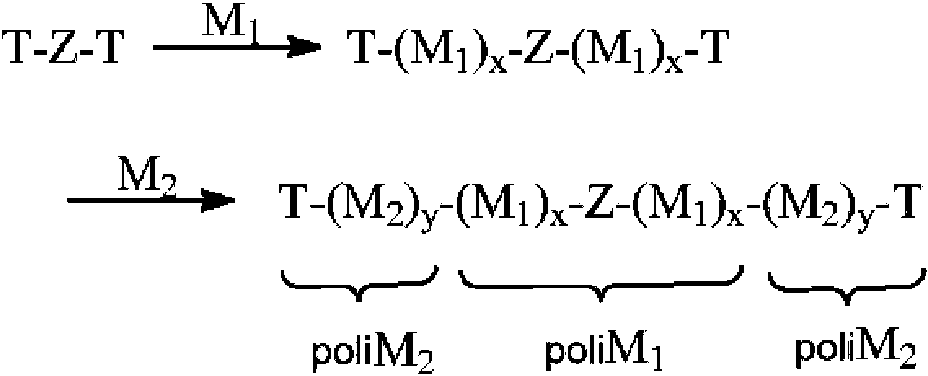
El principio de la preparación de copolímeros de bloque sigue siendo válido para n mayor o igual que 1.The principle of preparing block copolymers remains valid for n greater than or equal to 1.
Z designa un grupo multivalente, es decir, un grupo susceptible de liberar después de la activación varios sitios radicálicos. La activación en cuestión se produce por ruptura del enlace covalente Z-T.Z designates a multivalent group, that is, a group capable of releasing several root sites after activation. The activation in question occurs by breaking the covalent Z-T bond.
A modo de ejemplo, Z puede elegirse entre los grupos (I) a (VIII) siguientes:By way of example, Z can be chosen from the following groups (I) to (VIII):

en la que R3 y R4 , iguales o diferentes, representan un radical alquilo, lineal o ramificado, que tiene un número de átomos de carbono que va de 1 a 10, radicales fenilo o tienilo sustituidos eventualmente por un átomo de halógeno como F, Cl, Br o incluso por un radical alquilo, lineal o ramificado, con un número de átomos de carbono que va de 1 a 4, o incluso por radicales nitro, alcoxi, ariloxi, carbonilo, carboxi; un radical bencilo, un radical cicloalquilo con un número de átomos de carbono que va de 3 a 12, un radical que comprende una o varias insaturaciones; B representa un radical alquileno lineal o ramificado, con un número de átomos de carbono que va de 1 a 20; m es un número entero que va de 1 a 10; wherein R 3 and R 4 , the same or different, represent a linear or branched alkyl radical having a number of carbon atoms ranging from 1 to 10, phenyl or thienyl radicals optionally substituted by a halogen atom such as F , Cl, Br or even by a linear or branched alkyl radical, with a number of carbon atoms ranging from 1 to 4, or even by nitro, alkoxy, aryloxy, carbonyl, carboxy radicals; a benzyl radical, a cycloalkyl radical with a number of carbon atoms ranging from 3 to 12, a radical comprising one or more unsaturations; B represents a linear or branched alkylene radical, with a number of carbon atoms ranging from 1 to 20; m is an integer from 1 to 10;

en la que R5 y R6, iguales o diferentes, representan radicales arilo, piridilo, furilo, tienilo, sustituidos eventualmente por un átomo de halógeno como F, Cl, Br, o incluso por un radical alquilo, lineal o ramificado, con un número de átomos de carbono que va de 1 a 4 o incluso por radicales nitro, alcoxi, ariloxi, carbonilo, carboxi; D representa un radical alquileno, lineal o ramificado, con un número de átomos de carbono que va de 1 a 6 , un radical fenileno, un radical cicloalquileno; siendo p un número entero que va de 1 a 1 0 ;in which R 5 and R 6 , the same or different, represent aryl, pyridyl, furyl, thienyl radicals, possibly substituted by a halogen atom such as F, Cl, Br, or even by a linear or branched alkyl radical, with a number of carbon atoms ranging from 1 to 4 or even nitro, alkoxy, aryloxy, carbonyl, carboxy radicals; D represents a linear or branched alkylene radical, with a number of carbon atoms ranging from 1 to 6 , a phenylene radical, a cycloalkylene radical; where p is an integer from 1 to 1 0 ;

en la que R7 , R8 y R9 , iguales o diferentes, tienen los mismos significados que R3 y R4 de la fórmula (I), q, r y s son números enteros que van de 1 a 1 0 ;where R 7 , R8 and R 9 , the same or different, have the same meanings as R 3 and R 4 of formula (I), q, r and i are integers ranging from 1 to 1 0 ;

en la que R10 tiene el mismo significado que R5 y R6 de la fórmula (II), t es un número entero que va de 1 a 4, u es un número entero comprendido entre 2 y 6 (el grupo aromático está sustituido);where R 10 has the same meaning as R 5 and R 6 of formula (II), t is an integer from 1 to 4, u is an integer from 2 to 6 (the aromatic group is substituted );

en la que R11 tiene el mismo significado que el radical R10 de la fórmula (IV) y v es un número entero comprendido entre 2 y 6 ;where R 11 has the same meaning as the radical R 10 of formula (IV) and v is an integer from 2 to 6 ;

en la que R12, R13 y R14, iguales o diferentes, representan un radical fenilo, sustituido eventualmente por un átomo de halógeno como Cl, Br, o bien por un radical alquilo, lineal o ramificado, con un número de átomos de carbono que va de 1 a 10; W representa un átomo de oxígeno, de azufre, de selenio, w es igual a cero o 1;in which R 12 , R 13 and R 14 , the same or different, represent a phenyl radical, optionally substituted by a halogen atom such as Cl, Br, or by an alkyl radical, linear or branched, with a number of atoms of carbon ranging from 1 to 10; W represents an oxygen, sulfur, selenium atom, w equals zero or 1;

en la que R15 tiene el mismo significado que R3 de la fórmula (I), R16 tiene el mismo significado que R5 o R6 de la fórmula (II); wherein R 15 has the same meaning as R 3 in formula (I), R 16 has the same meaning as R 5 or R 6 in formula (II);

en la que R17 y R18, iguales o diferentes, representan un átomo de hidrógeno, un radical alquilo, lineal o ramificado, con un número de átomos de carbono que va de 1 a 10, un radical arilo, sustituido eventualmente por un átomo de halógeno o un heteroátomo.in which R 17 and R 18 , the same or different, represent a hydrogen atom, a linear or branched alkyl radical, with a number of carbon atoms ranging from 1 to 10, an aryl radical, optionally substituted by an atom halogen or heteroatom.
T designa un nitróxido que es un radical libre estable que presenta un grupoT designates a nitroxide which is a stable free radical that has a group
=N —O es decir, un grupo en el que hay un electrón desapareado. Se designa como radical libre estable un radical totalmente persistente y no reactivo frente al aire y a la humedad del aire ambiental, que puede ser manipulado y conservado durante un periodo de tiempo mucho más largo que la mayoría de los radicales libres (véase a este fin, Accounts of Chemical Research 1976, 9, 13-19). El radical libre estable se distingue así de los radicales libres cuya vida es efímera (de unos milisegundos a unos segundos) como radicales libres procedentes de iniciadores habituales de polimerización como peróxidos, hidroperóxidos o iniciadores azoicos. Se puede decir que un radical libre es estable si no es iniciador de polimerización y si la vida media del radical es de al menos un minuto.= N —O that is, a group in which there is an unpaired electron. Stable free radical is defined as a totally persistent and non-reactive radical against the air and humidity of the ambient air, which can be manipulated and conserved for a much longer period of time than most free radicals (see for this purpose, Accounts of Chemical Research 1976 , 9, 13-19). The stable free radical is thus distinguished from free radicals whose life is short-lived (from a few milliseconds to a few seconds) as free radicals from common polymerization initiators such as peroxides, hydroperoxides or azo initiators. A free radical can be said to be stable if it is not a polymerization initiator and if the radical half-life is at least one minute.
T se representa por la estructura:T is represented by the structure:

en la que R19, R20, R21, R22, R23 y R24 designan los grupos:where R 19 , R 20 , R 21 , R 22 , R 23 and R 24 designate the groups:
- alquilo lineales o ramificados en C1-C20, preferiblemente en C1-C10 como metilo, etilo, propilo, butilo, isopropilo, isobutilo, terc-tiobutilo, neopentilo, sustituidos o no,- linear or branched C 1 -C 20 alkyl, preferably C 1 -C 10 as methyl, ethyl, propyl, butyl, isopropyl, isobutyl, tert-thiobutyl, neopentyl, substituted or unsubstituted,
- arilo en C6-C30 sustituidos o no como bencilo, aril(fenilo)- C 6 -C 30 aryl substituted or unsubstituted as benzyl, aryl (phenyl)
- cíclicos saturados en C1-C30 - cyclic saturated in C 1 -C 30
y en la que los grupos R19 y R22 pueden formar parte de una estructura cíclica R19-CNC-R22 eventualmente sustituida, que pueden elegirse entre:and in which the groups R 19 and R 22 can form part of a cyclical structure R 19 -CNC-R 22 possibly substituted, which can be chosen between:

A modo de ejemplo, se podrán utilizar los nitróxidos siguientes: As an example, the following nitroxides can be used:

Ra y Rb designan grupos alquilo, iguales o diferentes, que posean de 1 a 40 átomos de carbono, eventualmente enlazados entre sí para formar un ciclo y eventualmente sustituidos por grupos hidroxi, alcoxi o amino,Ra and Rb designate alkyl groups, the same or different, having from 1 to 40 carbon atoms, optionally bonded together to form a cycle and optionally substituted by hydroxy, alkoxy or amino groups,
designando Rl un grupo monovalente de masa molar mayor que 15,42 g/mol, preferiblemente mayor que 30 g/mol. El grupo Rl puede tener, por ejemplo, una masa molar comprendida entre 40 g/mol y 450 g/mol. Se trata preferiblemente de un grupo fosforado de fórmula general (XI):Rl denoting a monovalent molar mass group greater than 15.42 g / mol, preferably greater than 30 g / mol. The group Rl can have, for example, a molar mass of between 40 g / mol and 450 g / mol. It is preferably a phosphorous group of the general formula (XI):

en la que X e Y, que pueden ser iguales o diferentes, pueden elegirse entre radicales alquilo, cicloalquilo, alcoxilo, ariloxilo, arilo, aralquiloxilo, perfluoroalquilo, aralquilo y pueden comprender de 1 a 20 átomos de carbono; X o Y pueden ser igualmente un átomo de halógeno como un átomo de cloro, bromo o flúor.wherein X and Y, which may be the same or different, may be chosen from alkyl, cycloalkyl, alkoxy, aryloxy, aryl, aralkyloxy, perfluoroalkyl, aralkyl radicals and may comprise from 1 to 20 carbon atoms; X or Y can also be a halogen atom such as a chlorine, bromine or fluorine atom.
Ventajosamente, Rl es un grupo fosfonato de fórmula:Advantageously, Rl is a phosphonate group of the formula:

en el que Rc y Rd son dos grupos alquilo iguales o diferentes enlazados eventualmente para formar un ciclo, comprendiendo de 1 a 4 átomos de carbono, eventualmente sustituidos o no.wherein Rc and Rd are two identical or different alkyl groups optionally bonded to form a ring, comprising 1 to 4 carbon atoms, optionally substituted or unsubstituted.
El grupo Rl puede comprender igualmente al menos un ciclo aromático como el radical fenilo o el radical naftilo, sustituido, por ejemplo, por uno o varios radicales alquilo que comprendan de 1 a 10 átomos de carbono.The Rl group may also comprise at least one aromatic ring such as the phenyl radical or the naphthyl radical, substituted, for example, by one or more alkyl radicals comprising from 1 to 10 carbon atoms.
Se prefieren los nitróxidos de fórmula (X) puesto que permiten obtener un buen control de la polimerización radicálica de los monómeros (met)acrílicos como se explica en la Patente Internacional WO 03/062293. Las alcoxiaminas de fórmula (XIII) que tienen un nitróxido de fórmula (X) son preferidas: Nitroxides of formula (X) are preferred since they allow good control of the radical polymerization of (meth) acrylic monomers as explained in International Patent WO 03/062293. Alkoxyamines of formula (XIII) having a nitroxide of formula (X) are preferred:

Z designa un grupo multivalente;Z designates a multivalent group;
Ra y Rb designan grupos alquilo, iguales o diferentes, que posean de 1 a 40 átomos de carbono, eventualmente enlazados entre sí para formar un ciclo y eventualmente sustituidos por dos grupos hidroxi, alcoxi o amino;Ra and Rb designate the same or different alkyl groups having from 1 to 40 carbon atoms, optionally bonded together to form a cycle and optionally substituted by two hydroxy, alkoxy or amino groups;
Rl designa un grupo monovalente de masa molar mayor que 15,042 g/mol, preferiblemente mayor que 30 g/mol. El grupo Rl puede tener, por ejemplo, una masa molar comprendida entre 40 g/mol y 450 g/mol. Se trata preferiblemente de un grupo fosforado de fórmula general (XI):Rl designates a monovalent group of molar mass greater than 15.042 g / mol, preferably greater than 30 g / mol. The group Rl can have, for example, a molar mass of between 40 g / mol and 450 g / mol. It is preferably a phosphorous group of the general formula (XI):

en la que X e Y, que pueden ser iguales o diferentes, pueden elegirse entre radicales alquilo, cicloalquilo, alcoxilo, ariloxilo, arilo, aralquiloxilo, perfluoroalquilo, aralquilo y pueden comprender de 1 a 20 átomos de carbono; X e Y pueden ser igualmente un átomo de halógeno como un átomo de cloro, bromo o flúor.wherein X and Y, which may be the same or different, may be chosen from alkyl, cycloalkyl, alkoxy, aryloxy, aryl, aralkyloxy, perfluoroalkyl, aralkyl radicals and may comprise from 1 to 20 carbon atoms; X and Y can also be a halogen atom such as a chlorine, bromine or fluorine atom.
Ventajosamente, Rl es un grupo fosfonato de fórmula:Advantageously, Rl is a phosphonate group of the formula:

en la que Rc y Rd son dos grupos alquilo, iguales o diferentes, eventualmente enlazados para formar un ciclo, que comprenda de 1 a 40 átomos de carbono, eventualmente sustituidos o no.in which Rc and Rd are two alkyl groups, the same or different, optionally linked to form a cycle, comprising from 1 to 40 carbon atoms, optionally substituted or not.
El grupo Rl puede comprender igualmente al menos un ciclo aromático como el radical fenilo o el radical naftilo, sustituido, por ejemplo, por uno o varios radicales alquilo que comprendan de 1 a 10 átomos de carbono.The Rl group may also comprise at least one aromatic ring such as the phenyl radical or the naphthyl radical, substituted, for example, by one or more alkyl radicals comprising from 1 to 10 carbon atoms.
Como ejemplo de nitróxido de fórmula (X) que pueda soportar la alcoxiamina (XIII), se pueden citar:As an example of nitroxide of formula (X) that can support alkoxyamine (XIII), there can be mentioned:
- nitróxido de N-terc-tiobutil-1 -fenil-2-metilpropilo,- N-tert-thiobutyl-1-phenyl-2-methylpropyl nitroxide,
- nitróxido de N-(2-hidroximetilpropil)-1-fenil-2-metilpropilo,- N- (2-hydroxymethylpropyl) -1-phenyl-2-methylpropyl nitroxide,
- nitróxido de N-terc-tiobutil-1-dibencilfosfono-2,2-dimetil-propilo- N-tert-thiobutyl-1-dibenzylphosphono-2,2-dimethyl-propyl nitroxide
- nitróxido de N-terc-tiobutil-1 -di(2,2,2-trifluoroetil)fosfono-2,2-dimetilpropilo,- N-tert-thiobutyl-1 -di (2,2,2-trifluoroethyl) phosphono-2,2-dimethylpropyl nitroxide,
- nitróxido de N-terc-tiobutil[(1-dietilfosfono)-2-metilpropilo],- N-tert-thiobutyl nitroxide [(1-diethylphosphono) -2-methylpropyl],
- N-(1-metiletil)-1 -ciclohexil-1 -(dietil-fosfono)nitróxido,- N- (1-methylethyl) -1 -cyclohexyl-1 - (diethyl-phosphono) nitroxide,
- nitróxido de N-(1-fenilbencil)-[(1-dietilfosfono)-1-metiletil]nitróxido,- N- (1-phenylbenzyl) nitroxide - [(1-diethylphosphono) -1-methylethyl] nitroxide,
- nitróxido de N-fenil-1 -dietilfosfono-2,2-dimetilpropilo,- N-phenyl-1-diethylphosphono-2,2-dimethylpropyl nitroxide,
- N-fenil-1 -dietilfosfono-1 -metiletilnitróxido,- N-phenyl-1-diethylphosphono-1-methylethylnitroxide,
- nitróxido de N-(1-fenil-2-metilpropil)-1 -dietilfosfonometiletiIo- N- (1-phenyl-2-methylpropyl) -1-diethylphosphonomethylethio nitroxide
- o incluso el nitróxido de fórmula - or even the formula nitroxide

El nitróxido de fórmula (XIV) es particularmente preferido:Nitroxide of formula (XIV) is particularly preferred:

Se trata del nitróxido de N-terc-tiobutil-1-dietilfosfono-2,2-dimetilpropilo, comúnmente denominado SG1 para simplificar.This is N-tert-thiobutyl-1-diethylphosphono-2,2-dimethylpropyl nitroxide, commonly called SG1 for simplicity.
La alcoxiamina (I), y especialmente la alcoxiamina (XIII), pueden prepararse por los modos de preparación descritos por ejemplo en la Patente Francesa FR2791979. Un método que puede utilizarse consiste en realizar acoplamiento de un radical carbonado con un nitróxido. El acoplamiento puede realizarse a partir de un derivado halogenado en presencia de un sistema organometálico como CuX/ligando (X = Cl o Br) según una reacción de tipo ATRA (adición de radicales por transferencia de átomos) tal como describen D. Greszta y col. en Macromolecules 1996, 29, 7661 7670.Alkoxyamine (I), and especially alkoxyamine (XIII), can be prepared by the modes of preparation described for example in French Patent FR2791979. One method that can be used is to couple a carbon radical with a nitroxide. Coupling can be performed from a halogenated derivative in the presence of an organometallic system such as CuX / ligand (X = Cl or Br) according to an ATRA type reaction (addition of radicals by transfer of atoms) as described by D. Greszta et al . in Macromolecules 1996, 29, 7661 7670.

Las alcoxiaminas que pueden utilizarse en el ámbito de la invención se representan a continuación: The alkoxyamines that can be used in the scope of the invention are represented below:


Las dos últimas alcoxiaminas se denominan DIAMINS y TRIAMINS, respectivamente, y son las alcoxiaminas preferidas.The last two alkoxyamines are called DIAMINS and TRIAMINS, respectively, and are the preferred alkoxyamines.
No se apartaría del ámbito de la presente invención combinar varias alcoxiaminas que respondan a la fórmula (I), en particular varias alcoxiaminas de la fórmula (XIII). Estas mezclas podrían comprender así, por ejemplo, una alcoxiamina que tenga n1 nitróxidos unidos y una alcoxiamina que tenga n2 nitróxidos unidos con n1 diferente de n2. Podría tratarse también de una combinación de alcoxiaminas portadoras de nitróxidos diferentes.It would not depart from the scope of the present invention to combine various alkoxyamines responsive to formula (I), in particular various alkoxyamines of formula (XIII). These mixtures could thus comprise, for example, an alkoxyamine having n1 nitroxides attached and an alkoxyamine having n2 nitroxides bound with n1 other than n2. It could also be a combination of different nitroxide-bearing alkoxyamines.
Los fotoiniciadores son compuestos susceptibles de generar radicales libres cuando estos compuestos se exponen a radiación electromagnética. Preferiblemente, las radiaciones electromagnéticas presentan longitudes de onda en el campo del ultravioleta o del visible, pero no se apartaría del ámbito de la invención utilizar longitudes de onda en los campos de longitud de onda mas cortas (rayos X o gama) o más largas (infrarrojo, incluso más largas).Photoinitiators are compounds that can generate free radicals when these compounds are exposed to electromagnetic radiation. Preferably, electromagnetic radiation has wavelengths in the ultraviolet or visible field, but it would not depart from the scope of the invention to use wavelengths in the shorter wavelength (X-ray or gamma) or longer fields ( infrared, even longer).
Se puede tratar también de un fotoiniciador susceptible de generar radicales libres por absorción de al menos dos fotones.It may also be a photoinitiator capable of generating free radicals by absorbing at least two photons.
Este último ejemplo es particularmente útil cuando se trata de polimerizar selectivamente una zona en la masa de la mezcla de reacción, en particular en los ámbitos de la impresión 3D comprometiendo una polimerización en presencia de fotoiniciador, es decir, la creación de objetos tridimensionales y prototipos por polimerización de capas sucesivas con ayuda de un rayo láser.This last example is particularly useful when it comes to selectively polymerizing an area in the mass of the reaction mixture, particularly in the areas of 3D printing by compromising a polymerization in the presence of a photoinitiator, that is, the creation of three-dimensional objects and prototypes by polymerization of successive layers with the help of a laser beam.
Los fotoiniciadores pueden ser de cualquier tipo. Preferiblemente, se eligen entre los que generan radicales libres por una reacción de ruptura homolítica en posición a con respecto al grupo carbonilo, como los derivados de éteres de benzoínas, hidroxialquilfenonas, dialcoxiacetofenonas, así como derivados de óxidos de acilfosfina y en posición p como sulfuros de cetonas y derivados de sulfonilcetonas, los que forman radicales libres por extracción de hidrógeno de un donador de hidrógeno, como benzofenonas o tioxantonas. En el proceso se hace intervenir un complejo de transferencia de carga con una amina, después una transferencia de electrones y de protones para conducir a la formación de un radical alquilo iniciador y un radical cetilo inactivo. Se pueden citar diacetales bencílicos, hidroxialquilfenona, alfa-aminocetonas, óxidos de acilofosfina, benzofenonas, tioxantonas. No se apartaría del ámbito de la invención utilizar una combinación de varios fotoiniciadores o incluso una combinación de fotoiniciadores e iniciador(es) radicálico(s) cuyo(s) radical(es) se genere(n) térmicamente o por una reacción de oxidorreducción, por ejemplo, el par metileno-bis(dietilmalonato)cerio IV o incluso el par H2O2/Fe2+.Photoinitiators can be of any type. Preferably, they are chosen from those that generate free radicals by a homolytic cleavage reaction in position a with respect to the carbonyl group, such as derivatives of benzoin ethers, hydroxyalkylphenones, dialkoxyacetophenones, as well as derivatives of acylphosphine oxides and in p position as sulfides of ketones and derivatives of sulfonyl ketones, those that form free radicals by extraction of hydrogen from a hydrogen donor, such as benzophenones or thioxanthones. The process involves a charge transfer complex with an amine, then an electron and proton transfer to lead to the formation of an initiator alkyl radical and an inactive cetyl radical. Mention may be made of benzyl diacetals, hydroxyalkylphenone, alpha-aminoketones, acylphosphine oxides, benzophenones, thioxanthones. It would not depart from the scope of the invention to use a combination of several photoinitiators or even a combination of photoinitiators and radical initiator (s) whose radical (s) are (are) generated thermally or by an oxidoreduction reaction, by For example, the cerium IV methylene-bis (diethylmalonate) pair or even the H 2 O 2 / Fe2 + pair.
Entre los iniciadores se pueden citar los peróxidos de diacilos, peroxiésteres, peróxidos de dialquilo, peroxiacetales, compuestos azoicos. Los iniciadores radicálicos que pueden convenir son, por ejemplo, carbonato de isopropilo, peróxido de benzoílo, de lauroílo, de caproílo, de dicumilo, perbenzoato de terc-tiobutilo, 2-etil-perhexanoato de terctiobutilo, hidroperóxido de cumilo, 1,1-di(terc-t-butilperoxi)-3,3,5-trimetilciclohexano, peroxiisobutirato de terc-tiobutilo, peracetato de terc-tiobutilo, perpivalato de terc-tiobutilo, perpivalato de amilo, peroctoato de terc-tiobutilo.Initiators include, but are not limited to, diacyl peroxides, peroxyesters, dialkyl peroxides, peroxyacetals, azo compounds. Radical initiators which may be suitable are, for example, isopropyl carbonate, benzoyl peroxide, lauroyl, caproyl, dicumyl, tert-thiobutyl perbenzoate, tert-butyl 2-ethyl-perhexanoate, cumyl hydroperoxide, 1,1- di (tert-t-butylperoxy) -3,3,5-trimethylcyclohexane, tert-thiobutyl peroxyisobutyrate, tert-thiobutyl peracetate, tert-thiobutyl perpivalate, amyl perpivalate, tert-thiobutyl peroctoate.
El procedimiento de la invención puede comprender igualmente diversos aditivos, como plastificantes, estabilizantes térmicos o UV, colorantes, en función de la utilización final del objeto obtenido por utilización del procedimiento de la invención. La realización de la polimerización según el procedimiento de la invención puede efectuarse en masa, en solución, en suspensión o incluso en emulsión.The process of the invention may also comprise various additives, such as plasticizers, thermal stabilizers or UV, dyes, depending on the end use of the object obtained by using the process of the invention. The polymerization according to the process of the invention can be carried out in bulk, in solution, in suspension or even in emulsion.
Según una variante de la invención, la alcoxilamina utilizada puede prepararse por un procedimiento de polimerización radicálica controlada por nitróxidos similar, pero sin la presencia del fotoiniciador, a una temperatura mayor que 50 °C. Se trata, por ejemplo, de hacer un primer bloque que comprenda al menos un monómero, que posteriormente será puesto en las condiciones de la presente invención, es decir, a baja temperatura, típicamente a temperatura ambiente para generar la polimerización de otros bloques. Se obtendrá pues un copolímero con varios bloques.According to a variant of the invention, the alkoxylamine used can be prepared by a similar nitroxide controlled radical polymerization procedure, but without the presence of the photoinitiator, at a temperature greater than 50 ° C. For example, it is a question of making a first block comprising at least one monomer, which will subsequently be placed under the conditions of the present invention, that is, at low temperature, typically at room temperature to generate the polymerization of other blocks. A copolymer with several blocks will thus be obtained.
En la síntesis de copolímeros secuenciales o copolímeros de bloque se utilizan varias técnicas desde hace muchos años. En cada una de estas técnicas las temperaturas utilizadas para la síntesis son siempre muy alejadas de la ambiente y se requieren condiciones particulares de preparación, a menudo incompatibles con los procedimientos de fabricación utilizados en las aplicaciones. En el procedimiento de la invención, las temperaturas de las polimerizaciones están comprendidas entre -50 °C y 80 °C, ventajosamente entre -20 °C y 80 °C, preferiblemente entre 0 °C y 80 °C, incluso preferiblemente entre 0 °C y 50 °C, e idealmente entre 10 °C y 35 °C.Various techniques have been used in the synthesis of sequential copolymers or block copolymers for many years. In each of these techniques the temperatures used for the synthesis are always very far from the environment and particular preparation conditions are required, often incompatible with the manufacturing procedures used in the applications. In the process of the invention, the temperatures of the polymerizations are between -50 ° C and 80 ° C, advantageously between -20 ° C and 80 ° C, preferably between 0 ° C and 80 ° C, even preferably between 0 ° C and 50 ° C, and ideally between 10 ° C and 35 ° C.
Numerosos trabajos, por consiguiente, han consistido en sintetizar el copolímero de bloque en una primera etapa, después introducirlo en forma de aditivo en los materiales elegidos según la aplicación pretendida. Se ha demostrado que la utilización de estos aditivos permitía obtener mejores equilibrios de las propiedades con respecto a las técnicas anteriores habitualmente utilizadas. Sin embargo, la introducción de copolímeros de bloque en un material hospedadora requiere herramientas y técnicas de mezcla particulares (en caliente, mediante disolvente) debido a la muy alta viscosidad de estos aditivos. El mismo efecto limita igualmente el contenido de copolímeros de bloque que puede introducirse en el material final. Para estas aplicaciones, la tasa de polímero utilizable como aditivo está limitada por la viscosidad generada. En el caso en que la síntesis del copolímero se produce directamente en una resina hospedadora, o la mezcla resina/endurecedor, como puede ser el caso en la presente invención, la viscosidad ya no es un problema puesto que aparecería únicamente al final del procedimiento. Esto abre oportunidades nuevas en los ámbitos en que la viscosidad sea un factor limitante como revestimientos, procedimientos de inyección o de infusión de resina, adhesivos...Numerous works, therefore, have consisted of synthesizing the block copolymer in a first stage, then introducing it as an additive in the chosen materials according to the intended application. It has been demonstrated that the use of these additives allowed to obtain better balances of the properties with respect to the commonly used prior techniques. However, the introduction of block copolymers into a host material requires particular mixing tools and techniques (hot, by solvent) due to the very high viscosity of these additives. The same effect also limits the content of block copolymers that can be introduced into the final material. For these applications, the rate of polymer usable as an additive is limited by the viscosity generated. In the case where the synthesis of the copolymer occurs directly in a host resin, or the resin / hardener mixture, as may be the case in the present invention, viscosity is no longer a problem since it would only appear at the end of the process. This opens up new opportunities in areas where viscosity is a limiting factor such as coatings, resin injection or infusion procedures, adhesives ...
La presente invención tiene la doble ventaja de permitir la síntesis de copolímeros de bloque in situ en el material hospedador, para obtener una morfología particular más favorable a las propiedades de aplicación y conservando una viscosidad inicial baja particularmente favorable para la aplicación del material con aditivos.The present invention has the double advantage of allowing the synthesis of block copolymers in situ in the host material, to obtain a particular morphology more favorable to the application properties and maintaining a low initial viscosity particularly favorable for the application of the material with additives.
El material hospedador puede ser un disolvente, polímero, oligómero, una carga pigmentaria o no de cualquier dimensión y de cualquier tipo de factor de forma, porosa o no, de fibras cortas o largas, tejidas o no, de nanotubos o una combinación de estos materiales hospedadores. El material hospedador puede ser también un precursor de polímero, por ejemplo, cualquier sistema bicomponente o no susceptible de polimerizar independientemente de la polimerización que comprometa a la alcoxiamina, por ejemplo, de manera no limitante una resina epoxídica, poliuretano, poliéster. Se puede polimerizar, por ejemplo, simultáneamente o de manera secuencial, el material hospedador y el material procedente de la polimerización de la alcoxiamina.The host material may be a solvent, polymer, oligomer, a pigment filler or not of any dimension and any type of form factor, porous or not, of short or long fibers, woven or not, of nanotubes or a combination of these host materials. The host material may also be a polymer precursor, for example, any bicomponent or non-polymerizable system regardless of the polymerization that compromises the alkoxyamine, eg, non-limitingly an epoxy resin, polyurethane, polyester. For example, the host material and the material resulting from the polymerization of the alkoxyamine can be polymerized, for example, simultaneously or sequentially.
En este sentido, la presente invención se acerca a los procedimientos descritos en la Patente Internacional WO 03/062293 o incluso en la Patente Internacional WO 06/06152, pero difiere de estas últimas por el hecho de que la temperatura de síntesis del segundo bloque es significativamente muy inferior a las descritas en la técnica anterior, típicamente a temperatura ambiente, lo que se hace posible por la utilización combinada de un iniciador de alcoxiamina macromolecular preparado previamente durante una primera etapa clásicamente descrita en la técnica anterior, en presencia de un fotoiniciador y monómeros constitutivos del segundo bloque.In this sense, the present invention approaches the procedures described in International Patent WO 03/062293 or even in International Patent WO 06/06152, but differs from the latter in the fact that the synthesis temperature of the second block is significantly much lower than those described in the prior art, typically at room temperature, which is made possible by the combined use of a macromolecular alkoxyamine initiator prepared previously during a first step classically described in the prior art, in the presence of a photoinitiator and constituent monomers of the second block.
Entre los monómeros que pueden utilizarse en el procedimiento de la invención, se pueden citar los monómeros que presentan uno o varios dobles enlaces como los monómeros vinilaromáticos como estireno o los estirenos sustituidos especialmente alfa-metilestireno, monómeros acrílicos como ácido acrílico o sus sales, acrilatos de alquilo (presentando o no varias funciones acrílicas), de cicloalquilo o de arilo como el acrilato de metilo, etilo, butilo, etilhexilo o fenilo, acrilatos de hidroxialquilo como el acrilato de 2-hidroxietilo, acrilatos de éteralquilo como el acrilato de 2-metoxietilo, acrilatos de alcoxi- o ariloxi-polialquilenglicol como los acrilatos de metoxipolietilenglicol, acrilatos de etoxipolietilenglicol, acrilatos de metoxipolipropilenglicol, acrilatos de metoxi-polietilenglicol-polipropilenglicol o sus mezclas, los acrilatos de aminoalquilo como el acrilato de 2-(dimetilamino)etilo (ADAME), acrilatos fluorados, acrilatos sililados, acrilatos fosforados como los acrilatos de fosfato de alquilenglicol, monómeros metacrílicos como ácido metacrílico o sus sales, metacrilatos de alquilo (presentando o no varias funciones metacrílicas), de cicloalquilo, de alcenilo o de arilo como metacrilato de metilo (MAM), de laurilo, de ciclohexilo, de alilo, de fenilo o de naftilo, metacrilatos de hidroxialquilo como metacrilato de 2-hidroxietilo o metacrilato de 2-hidroxipropilo, metacrilatos de éteralquilo como metacrilato de 2-etoxietilo, metacrilatos de alcoxi- o ariloxi-polialquilenglicol como los metacrilatos de metoxipolietilenglicol, metacrilatos de etoxipolietilenglicol, metacrilatos de metoxipolipropilenglicol, metacrilatos de metoxipolietilenglicol-polipropilenglicol o sus mezclas, metacrilatos de aminoalquilo como metacrilato de 2-(dimetilamino)etilo (MADa Me ), metacrilatos fluorados como metacrilato de 2,2,2-trifluoroetilo, metacrilatos sililados como 3-metacriloilpropiltrimetilsilano, metacrilatos fosforados como los metacrilatos de fosfato de alquilenglicol, metacrilato de hidroxi-etilimidazolidona, metacrilato de hidroxi-etilimidazolidinona, metacrilato de 2-(2-oxo-1-imidazolidinil)etilo, acrilonitrilo, acrilamida o acrilamidas substituidas, 4-acriloilmorfoline, N-metilolacrilamida, metacrilamida o metacrilamidas substituidas, N-metilolmetacrilamida, cloruro de metacrilamido-propiltrimetil amonio (MAPTAC), ácido itacónico, ácido maleico o sus sales, anhídrido maleico, maleatos o hemimaleatos de alquilo o de alcoxi- o ariloxi-polialquilenglicol, vinilpiridina, vinilpirrolidinona, (alcoxi)poli(alquilenglicol) vinil éter o divinil éter, como metoxi poli(etilenglicol) vinil éter, poli(etilenglicol) divinil éter, monómeros olefínicos, entre los que se pueden citar etileno, buteno, hexeno y 1-octeno así como los monómeros olefínicos fluorados y monómeros vinilidénicos, entre los que se pueden citar fluoruro de vinilideno, solos o en mezclas de al menos dos monómeros citados previamente. Among the monomers that can be used in the process of the invention, mention may be made of monomers having one or more double bonds such as vinyl aromatic monomers such as styrene or especially substituted alpha-methylstyrene styrenes, acrylic monomers such as acrylic acid or its salts, acrylates of alkyl (having or not having various acrylic functions), of cycloalkyl or of aryl such as methyl, ethyl, butyl, ethylhexyl or phenyl acrylate, hydroxyalkyl acrylates such as 2-hydroxyethyl acrylate, etherealkyl acrylates such as 2- methoxyethyl, alkoxy- or aryloxy-polyalkylene glycol acrylates such as methoxypolyethylene glycol acrylates, ethoxypolyethylene glycol acrylates, methoxy polypropylene glycol acrylates, methylopolyethylene glycol polypropylene glycol acrylates or their ADAME), fluorinated acrylates, silylated acrylates, phosphorous acrylates such as acrylates alkylene glycol phosphate, methacrylic monomers such as acid methacrylic or its salts, alkyl methacrylates (having or not having various methacrylic functions), cycloalkyl, alkenyl or aryl as methyl methacrylate (MAM), lauryl, cyclohexyl, allyl, phenyl or naphthyl methacrylates hydroxyalkyl such as 2-hydroxyethyl methacrylate or 2-hydroxypropyl methacrylate, ether alkyl alkyl methacrylates such as 2-ethoxyethyl methacrylates, alkoxy- or aryloxy-polyalkylene glycol yl-methacrylyol yolyethylene glycol yl-methacrylate yl-methacrylate, methacrylate, methacrylate, methacrylate polypropylene glycol or mixtures thereof, aminoalkyl methacrylates such as 2- (dimethylamino) ethyl methacrylate (MADa Me), fluorinated methacrylates such as 2,2,2-trifluoroethyl methacrylate, silylated methacrylates such as 3-methacrylylpropyltrimethylsilane, phosphorous methacrylates of methacrylates alkylene glycol, hydroxy-ethylimidazolidone methacrylate, hi methacrylate droxy-ethylimidazolidinone, 2- (2-oxo-1-imidazolidinyl) ethyl methacrylate, acrylonitrile, acrylamide, or substituted acrylamides, 4-acryloylmorpholine, substituted N-methylolacrylamide, methacrylamide-methyl acrylamide, N-methyl acrylamide MAPTAC), itaconic acid, maleic acid or its salts, maleic anhydride, alkyl or alkoxy- or aryloxy-polyalkylene glycol maleates or hemimaleates, vinylpyridine, vinylpyrrolidinone, (alkoxy) poly (alkylene glycol) vinyl ether or divinyl ether, such as methoxy poly ( ethylene glycol) vinyl ether, poly (ethylene glycol) divinyl ether, olefinic monomers, including ethylene, butene, hexene and 1-octene, as well as fluorinated olefinic monomers and vinylidene monomers, including vinylidene fluoride, alone or in mixtures of at least two previously mentioned monomers.
La invención se centra igualmente en polímeros o copolímeros, de bloque o no, obtenidos según el procedimiento de la invención en presencia o no de un material hospedador.The invention also focuses on polymers or copolymers, block or not, obtained according to the process of the invention in the presence or not of a host material.
La presente invención se centra igualmente en las aplicaciones de la utilización de este procedimiento de síntesis a temperatura baja. Este procedimiento se hace compatible con las numerosas aplicaciones y variaciones para las que la temperatura de aplicación permanece fría o moderada.The present invention also focuses on the applications of using this low temperature synthesis procedure. This procedure is compatible with the many applications and variations for which the application temperature remains cold or moderate.
En particular, la presente invención se adapta ventajosamente a aplicaciones como barnices, impresión 3D, revestimientos, colas y adhesivos, refuerzo mecánico de plásticos, materiales compuestos ya que la temperatura de polimerización coincide con la temperatura de la aplicación.In particular, the present invention is advantageously adapted to applications such as varnishes, 3D printing, coatings, glues and adhesives, mechanical reinforcement of plastics, composites since the polymerization temperature coincides with the application temperature.
La presente invención se centra igualmente en materiales hospedadores que comprenden polímeros o copolímeros procedentes del procedimiento de la invención debido a sus propiedades únicas resultantes de la utilización del procedimiento de la invención, que permiten especialmente incorporar cantidades importantes de copolímeros objeto de la invención a los materiales hospedadores utilizando el procedimiento de la invención.The present invention also focuses on host materials comprising polymers or copolymers from the process of the invention due to their unique properties resulting from the use of the process of the invention, which especially allow to incorporate significant amounts of copolymers object of the invention to the materials hosts using the method of the invention.
Ejemplo 1Example 1
Síntesis de la alcoxiamina DIAMINS:Synthesis of DIAMINS alkoxyamine:
En un reactor de 2,5 litros se introducen 1,25 litros de etanol, 380 g de Blocbuilder® (Arkema),100 g de diacrilato de butanodiol. Se calienta la mezcla con agitación a 80 °C durante 4 h. La mezcla de reacción se trasvasa después, después se evapora el etanol con ayuda de un evaporador rotativo. Se obtienen de manera cuantitativa 480 g de Diamins.1.25 liters of ethanol, 380 g of Blocbuilder® (Arkema), 100 g of butanediol diacrylate are introduced into a 2.5 liter reactor. The mixture is heated with stirring at 80 ° C for 4 h. The reaction mixture is then transferred, then the ethanol is evaporated with the aid of a rotary evaporator. 480 g of Diamins are obtained quantitatively.
Ejemplo 2Example 2
Síntesis de una polialcoxiaminaSynthesis of a polyalkoxyamine
Se introducen en un reactor metálico de 2 litros provisto de agitador de hélice, una doble envoltura de calentamiento por circulación de aceite y una toma de vacío/nitrógeno:They are introduced into a 2-liter metal reactor equipped with a propeller stirrer, a double oil circulation heating jacket and a vacuum / nitrogen tap:
• 301 g de acrilato de butilo• 301 g of butyl acrylate
• 49 g de estireno• 49 g styrene
• 7,7 g de DIAMINS.• 7.7 g of DIAMINS.
Después de la introducción de los reactivos, la mezcla de reacción se desgasifica tres veces a vacío/en nitrógeno. Se cierra entonces el reactor, después se ponen en marcha la agitación (50 vueltas por minuto) y el calentamiento (registro de temperatura: 125 °C). La temperatura de la mezcla de reacción alcanza 113 °C en aproximadamente 30 minutos. La presión se establece hacia 0,15 MPa (1,5 bar). La temperatura del reactor se mantiene al nivel de 115 °C durante 522 min. Se recuperan después de enfriamiento 340 g de una mezcla al 67 % de extracto seco. El acrilato de butilo en exceso se elimina a continuación por evaporación a 70 °C a presión reducida durante 3 h. La relación en peso de acrilato de butilo a estireno del macrorradical obtenido es 83 : 17. El análisis por GPC del bloque B da los resultados siguientes: Mn: 35000 g/mol; Mp: 65000 g/mol; polimolecularidad: 1,86.After introduction of the reagents, the reaction mixture is degassed three times under vacuum / under nitrogen. The reactor is then closed, then stirring (50 revolutions per minute) and heating are started (temperature register: 125 ° C). The temperature of the reaction mixture reaches 113 ° C in approximately 30 minutes. The pressure is set at 0.15 MPa (1.5 bar). The reactor temperature is maintained at the 115 ° C level for 522 min. After cooling, 340 g of a 67% dry extract mixture are recovered. The excess butyl acrylate is then removed by evaporation at 70 ° C under reduced pressure for 3 h. The weight ratio of butyl acrylate to styrene of the obtained macroradical is 83: 17. The GPC analysis of block B gives the following results: Mn: 35000 g / mol; Mp: 65000 g / mol; polymolecularity: 1.86.
Ejemplo 3Example 3
Síntesis de la alcoxiamina TRIAMINS Synthesis of the alkoxyamine TRIAMINS
En un reactor de 500 mililitros se introducen 206 g de etanol, 100 g de Blocbuider® (Arkema), 26,5 g de triacrilato de pentaeritritol (Sartomer SR444D). Se calienta la mezcla con agitación 80 °C durante 4 h. La mezcla de reacción se trasvasa a continuación, después se evapora el etanol con ayuda de un evaporador rotativo. Se obtienen de manera cuantitativa 126 g de triamins.206 g of ethanol, 100 g of Blocbuider® (Arkema), 26.5 g of pentaerythritol triacrylate (Sartomer SR444D) are introduced into a 500 milliliter reactor. The mixture is heated with stirring 80 ° C for 4 h. The reaction mixture is then transferred, then the ethanol is evaporated with the aid of a rotary evaporator. 126 g of triamins are obtained quantitatively.
Ejemplo 4Example 4
Síntesis de microiniciador CS1CS1 Microinitiator Synthesis
Síntesis de una polialcoxiamina macroiniciadora DS1Synthesis of a DS1 macroinitiator polyalkoxyamine
Se introducen en un reactor metálico de 2 litros provisto de agitador de hélice, una doble envoltura de calentamiento por circulación de aceite y una toma de vacío/nitrógeno:They are introduced into a 2-liter metal reactor equipped with a propeller stirrer, a double oil circulation heating jacket and a vacuum / nitrogen tap:
• 643 g de acrilato de butilo• 643 g of butyl acrylate
• 96 g de estireno• 96 g styrene
• 6 g de TRIAMINS.• 6 g of TRIAMINS.
Después de la introducción de los reactivos, la mezcla de reacción se desgasifica tres veces a vacío/en nitrógeno. Se cierra entonces el reactor, después se pone en marcha la agitación (50 vueltas por minuto) y el calentamiento (registro de temperatura: 125 °C). La temperatura de la mezcla de reacción alcanza 113 °C en aproximadamente 30 minutos. La presión se establece hacia 0,15 MPa (1,5 bar). La temperatura del reactor se mantiene al nivel de 115 °C durante 522 min. Se recuperan después de enfriamiento 740 g de una mezcla al 70 % de extracto seco. El acrilato de butilo en exceso se elimina a continuación por evaporación a 70 °C con presión reducida durante 3 h. La relación en peso de acrilato de butilo a estireno del macrorradical obtenido es 83 : 17. El análisis por GPC calibrada con ayuda de muestras de poliestireno del macroiniciador da los resultados siguientes: Mn: 129 000 g/mol; Mp: 510 000 g/mol; polimolecularidad: 3,9.After introduction of the reagents, the reaction mixture is degassed three times under vacuum / under nitrogen. The reactor is then closed, then stirring is started (50 revolutions per minute) and heating (temperature record: 125 ° C). The temperature of the reaction mixture reaches 113 ° C in approximately 30 minutes. The pressure is set at 0.15 MPa (1.5 bar). The reactor temperature is maintained at the 115 ° C level for 522 min. After cooling, 740 g of a 70% dry extract mixture are recovered. The excess butyl acrylate is then removed by evaporation at 70 ° C under reduced pressure for 3 h. The weight ratio of butyl acrylate to styrene of the obtained macroradical is 83: 17. Analysis by GPC calibrated using polystyrene samples from the macroinitiator gives the following results: Mn: 129,000 g / mol; Mp: 510,000 g / mol; polymolecularity: 3.9.
Ejemplo 5Example 5
Síntesis del copolímero no iniciador (polialcoxiamina)Synthesis of the non-initiating copolymer (polyalkoxyamine)
En un reactor agitado de acero inoxidable comúnmente utilizado por el experto en la materia se introduce una mezcla compuesta por 500 g de acrilato de butilo, 70 g de estireno, 966 g de tolueno, 0,1854 g de AIBN (Vazo64 de Dupont), 0. 6 g de n-dodecilmercaptano. El reactor se pone a 0,2 MPa (2 bar) de presión de nitrógeno y se calienta a una temperatura de 85 °C durante 3 h. La mezcla se enfría, a continuación, a temperatura ambiente (20 °C), después se seca a vacío en una estufa durante 16 h a 125 °C y 10 kPa (100 mbar) de presión absoluta. Se obtiene entonces el copolímero seco de poliacrilato de butilo-co-estireno no iniciador.A mixture consisting of 500 g of butyl acrylate, 70 g of styrene, 966 g of toluene, 0.1854 g of AIBN (Vazo64 from Dupont), is introduced into a stirred stainless steel reactor commonly used by the person skilled in the art. 0. 6 g of n-dodecyl mercaptan. The reactor is placed at 0.2 MPa (2 bar) of nitrogen pressure and heated at a temperature of 85 ° C for 3 h. The mixture is then cooled to room temperature (20 ° C), then vacuum dried in an oven for 16 hr at 125 ° C and 10 kPa (100 mbar) of absolute pressure. The non-initiator butyl co-styrene polyacrylate dry copolymer is then obtained.
Ejemplo 6Example 6
Polimerización de metacrilato de metilo en UV a 25°CPolymerization of methyl methacrylate in UV at 25 ° C
Se realiza en un vial de vidrio una mezcla que contiene el macroiniciador o copolímero no iniciador, el iniciador UV Esacure TPO de la compañía Lamberti y un monómero de metacrilato de metilo. El tiempo de irradiación es de 90 min. La fuente de irradiación es la lámpara UVAHAND250 de la compañía Dr. Honle AG UV Technology (Lochhamer Schlag 1, 82166 Grafelfing/München, Alemania). La temperatura inicial de la mezcla es la temperatura ambiente (20 °C). Los resultados se dan en la tabla 1; los porcentajes son porcentajes en masa:A mixture containing the macroinitiator or non-initiating copolymer, the UV primer Esacure TPO from the company Lamberti and a methyl methacrylate monomer is made in a glass vial. The irradiation time is 90 min. The irradiation source is the UVAHAND250 lamp from the company Dr. Honle AG UV Technology (Lochhamer Schlag 1, 82166 Grafelfing / München, Germany). The initial temperature of the mixture is the ambient temperature (20 ° C). The results are given in Table 1; percentages are percentages by mass:

En la figura 1 se proporcionan fotos de las muestras 6b, 6e y 6c.Pictures of samples 6b, 6e and 6c are provided in Figure 1.
El análisis dinámico mecánico (DMA) en la figura 2 muestra claramente una diferencia de comportamiento mecánico entre los ejemplos 6c y 6e. El material 6c no presenta resistencia mecánica, fluye a temperatura ambiente (20 °C) lo que se traduce en el cruzamiento de los módulos G' y G'' a 18 °C. Se puede concluir que no está estructurado. En cambio, el material 6e conserva una buena resistencia mecánica que se traduce en un módulo G' mayor que el módulo G'' en toda la franja de temperatura. Se concluye que está estructurado.The dynamic mechanical analysis (DMA) in Figure 2 clearly shows a difference in mechanical behavior between Examples 6c and 6e. Material 6c does not present mechanical resistance, it flows at room temperature (20 ° C) which results in the crossing of modules G 'and G' 'at 18 ° C. It can be concluded that it is not structured. On the other hand, the material 6e retains a good mechanical resistance which translates into a modulus G 'greater than the modulus G' 'throughout the temperature range. It is concluded that it is structured.
Ejemplo 7Example 7
Polimerización de metacrilato de metilo en el UV a 0 °C. Se reproduce el ejemplo 6e, pero esta vez el vial de vidrio descansa sobre un lecho de agua glicolada a -15 °C. Se observa el mismo resultado que para el ejemplo 6e, se obtiene una polimerización de la mezcla y un polímero transparente.Polymerization of methyl methacrylate in the UV at 0 ° C. Example 6e is reproduced, but this time the glass vial rests on a bed of glycol water at -15 ° C. The same result is observed as for Example 6e, a polymerization of the mixture and a transparent polymer are obtained.
Ejemplo 8Example 8
Polimerización de acrilato de isobornilo en UV en presencia de macroiniciadorPolymerization of isobornyl acrylate in UV in the presence of macroinitiator
El macroiniciador utilizado es el procedente del ejemplo 2. El iBoA es el acrilato de isobornilo (la Tg del homopolímero PiBoA es de alrededor de 100 °C). Speedcure TPO-L es (2,4,6-trimetilbenzoil)fenilfosfinato de etilo, un fotoiniciador liquido distribuido por Lambson.The macroinitiator used is from Example 2. The iBoA is isobornyl acrylate (the Tg of the PiBoA homopolymer is around 100 ° C). Speedcure TPO-L is ethyl (2,4,6-trimethylbenzoyl) phenylphosphinate, a liquid photoinitiator distributed by Lambson.
La composición másica dada en la tabla 2, a continuación, se homogeniza con agitación magnética a temperatura ambiente (20 °C), se enfría después en un molde de silicona (de dimensiones 40 mm de largo, 30 mm de ancho y 1 mm de espesor). El molde lleno se pone, a continuación, bajo radiación UV-LED (modelo Firefly distribuido por Phoseon Technology, longitud de onda 395 nm, potencia 4 W/cm2) durante 40 segundos.The mass composition given in Table 2, below, is homogenized with magnetic stirring at room temperature (20 ° C), then cooled in a silicone mold (dimensions 40 mm long, 30 mm wide and 1 mm thick). thickness). The filled mold is then placed under UV-LED radiation (Firefly model distributed by Phoseon Technology, wavelength 395 nm, power 4 W / cm2) for 40 seconds.

El análisis mecánico dinámico de tracción muestra en la figura 3 dos temperaturas de transición vítrea que corresponden a dos fases distintas, una asociada al polímero macroiniciador (Tg -11 °C) y la otra a la matriz de poliacrilato de isobornilo (Tg 101 °C). El módulo E se mantiene mayor que el módulo E' hasta 80 °C, se deduce que el material está estructurado. La transparencia óptica nos indica que está estructuración es muy fina (escala submicrónica) figura 4.The dynamic mechanical analysis of traction shows in Figure 3 two glass transition temperatures corresponding to two different phases, one associated with the macroinitiator polymer (Tg -11 ° C) and the other with the isobornyl polyacrylate matrix (Tg 101 ° C). ). Module E remains higher than module E 'up to 80 ° C, it follows that the material is structured. Optical transparency indicates that this structure is very fine (submicron scale) figure 4.
Ejemplo 9Example 9
Polimerización de acrilato de 2-(2-etoxietoxi)etilo en UV en presencia de macroiniciadorPolymerization of 2- (2-ethoxyethoxy) ethyl acrylate in UV in the presence of macroinitiator
El macroiniciador utilizado es el procedente del ejemplo 2. El SR256 es el acrilato de 2-(2-etoxietoxi)etilo, distribuido por Sartomer (la Tg del homopolímero está en los alrededores de -55 °C). Speedcure TPO-L es (2,4,6-trimetilbenzoil)fenilfosfinato de etilo, un fotoiniciador líquido distribuid por Lambson.The macroinitiator used is from Example 2. SR256 is 2- (2-ethoxyethoxy) ethyl acrylate, distributed by Sartomer (the Tg of the homopolymer is around -55 ° C). Speedcure TPO-L is ethyl (2,4,6-trimethylbenzoyl) phenylphosphinate, a liquid photoinitiator distributed by Lambson.
La composición másica dada en la tabla 3, a continuación, se homogeniza a temperatura ambiente (20 °C), se deposita después en un portaobjetos de vidrio. Esta última se coloca, a continuación, bajo radiación UV-LED (modelo Firefly distribuido por Phoseon Technology, longitud de onda 395 nm, potencia 4 W/cm2) durante 40 segundos.The mass composition given in Table 3, below, is homogenized at room temperature (20 ° C), then deposited on a glass slide. The latter is then placed under UV-LED radiation (Firefly model distributed by Phoseon Technology, wavelength 395 nm, power 4 W / cm2) for 40 seconds.
Tabla 3Table 3

El análisis mecánico dinámico de compresión muestra en la figura 5 una temperatura de transición vítrea a -40 °C de la matriz de poliacrilato de 2-2etoxietoxietilo. El módulo elástico E' sigue siendo mayor que el módulo E'' después de esta transición vítrea a -40 °C, lo que se traduce en la presencia de una estructuración. Una vez más, la transparencia óptica de la muestra confirma que la escala de la estructuración es muy fina, submicrónica (figura 6). Dynamic mechanical compression analysis shows in Figure 5 a glass transition temperature at -40 ° C of the 2-2-ethoxyethoxyethyl polyacrylate matrix. The elastic modulus E 'is still greater than the modulus E' 'after this glass transition at -40 ° C, which results in the presence of a structuring. Once again, the optical transparency of the sample confirms that the scale of the structuring is very fine, submicron (Figure 6).
Claims (10)
Applications Claiming Priority (2)
| Application Number | Priority Date | Filing Date | Title |
|---|---|---|---|
| FR1462720A FR3030526B1 (en) | 2014-12-18 | 2014-12-18 | RADICAL POLYMERIZATION OF LOW TEMPERATURE ALCOXYAMINES |
| PCT/FR2015/053616 WO2016097646A1 (en) | 2014-12-18 | 2015-12-18 | Low-temperature radical polymerisation of alkoxyamines |
Publications (1)
| Publication Number | Publication Date |
|---|---|
| ES2761660T3 true ES2761660T3 (en) | 2020-05-20 |
Family
ID=53191759
Family Applications (1)
| Application Number | Title | Priority Date | Filing Date |
|---|---|---|---|
| ES15823668T Active ES2761660T3 (en) | 2014-12-18 | 2015-12-18 | Radical polymerization of alkoxyamines at low temperature |
Country Status (8)
| Country | Link |
|---|---|
| EP (1) | EP3233932B1 (en) |
| JP (1) | JP6677729B2 (en) |
| KR (1) | KR101963523B1 (en) |
| CN (1) | CN107207644A (en) |
| ES (1) | ES2761660T3 (en) |
| FR (1) | FR3030526B1 (en) |
| IL (1) | IL252948B (en) |
| WO (1) | WO2016097646A1 (en) |
Families Citing this family (2)
| Publication number | Priority date | Publication date | Assignee | Title |
|---|---|---|---|---|
| FR3047991B1 (en) * | 2016-02-24 | 2020-03-20 | Arkema France | POLYMERIZABLE COMPOSITION OF LOW VISCOSITY PRECURSOR OF IMPACT REINFORCED MATERIALS |
| FR3080374B1 (en) * | 2018-04-19 | 2020-11-06 | Arkema France | OLIGOMERIC ALCOXYAMINES |
Family Cites Families (24)
| Publication number | Priority date | Publication date | Assignee | Title |
|---|---|---|---|---|
| US4666978A (en) * | 1985-11-27 | 1987-05-19 | First Chemical Corporation | Method of curing unsaturated polyester resins at low temperatures |
| FR2730240A1 (en) | 1995-02-07 | 1996-08-09 | Atochem Elf Sa | STABILIZATION OF A POLYMER BY A STABLE FREE RADICAL |
| US5723511A (en) * | 1996-06-17 | 1998-03-03 | Xerox Corporation | Processes for preparing telechelic, branched and star thermoplastic resin polymers |
| US5728747A (en) * | 1996-08-08 | 1998-03-17 | Xerox Corporation | Stable free radical polymerization processes and compositions thereof |
| FR2791979B1 (en) | 1999-04-08 | 2003-05-16 | Atochem Elf Sa | PROCESS FOR THE PREPARATION OF ALCOXYAMINES FROM NITROXIDES |
| JP4505698B2 (en) * | 2000-01-17 | 2010-07-21 | 日油株式会社 | Vinyl group-containing alkoxyamine, its use and production method |
| FR2804118B1 (en) * | 2000-01-26 | 2003-08-22 | Atofina | CONTROLLED RADICAL POLYMERIZATION OR COPOLYMERIZATION OF HIGH PRESSURE ETHYLENE IN THE PRESENCE OF FREE PRIMERING RADIALS AND CONTROLLING INDOLINIC NITROXIDE RADIALS |
| FR2807439B1 (en) * | 2000-04-07 | 2003-06-13 | Atofina | MULTIMODAL POLYMERS BY CONTROLLED RADICAL POLYMERIZATION IN THE PRESENCE OF ALCOXYAMINES |
| US8013062B2 (en) | 2002-01-22 | 2011-09-06 | Arkema France | Method of producing and using materials which are reinforced against impact and which contain block copolymers that are obtained by means of controlled radical polymerization in the presence of nitroxides |
| US7297819B2 (en) | 2002-03-05 | 2007-11-20 | Ciba Specialty Chemicals Corp. | Open-chain alkoxyamines and their corresponding nitroxides for controlled low temperature radical polymerization |
| FR2843394B1 (en) * | 2002-08-07 | 2005-12-30 | Atofina | ALCOXYAMINES FROM NITROXIDES B-PHOSPHORUS, THEIR USE IN RADICAL POLYMERIZATION |
| FR2866026B1 (en) * | 2004-02-06 | 2008-05-23 | Arkema | RADICAL EMULSION POLYMERIZATION PROCESS USING WATER-SOLUBLE ALCOXYAMINES |
| WO2006006152A2 (en) | 2004-07-08 | 2006-01-19 | Ramot At Tel-Aviv University Ltd | Treatment of disorders and diseases of the colon |
| FR2877670B1 (en) * | 2004-11-09 | 2007-02-02 | Arkema Sa | WATER-SOLUBLE ACRYLIC DISPERTERS OBTAINED BY CONTROLLED RADICAL POLYMERIZATION |
| JP4691986B2 (en) * | 2004-12-27 | 2011-06-01 | 住友化学株式会社 | Manufacturing method of resin bonded body |
| FR2898127B1 (en) * | 2006-03-02 | 2008-07-11 | Arkema Sa | PROCESS FOR THE CONTROLLED RADICAL POLYMERIZATION OR COPOLYMERIZATION OF ONE OR MORE MONOMERS IN THE PRESENCE OF AN ALCOXYAMINE STARTER |
| US20090065737A1 (en) * | 2007-09-11 | 2009-03-12 | Arkema Inc. | Polymerization controllers for composites cured by organic peroxide initiators |
| EP2238178B1 (en) * | 2008-01-28 | 2014-09-10 | Basf Se | Photolatent amidine bases for redox curing of radically curable formulations |
| FR2931153B1 (en) * | 2008-05-19 | 2010-05-28 | Arkema France | PROCESS FOR PREPARING A DISPERSION OF POLYMERIC PARTICLES IN AQUEOUS MEDIUM |
| JP5233704B2 (en) * | 2009-01-30 | 2013-07-10 | 株式会社リコー | Block copolymer and method for producing the same |
| JP5229167B2 (en) * | 2009-09-04 | 2013-07-03 | 株式会社リコー | Composition for radical polymerization and method for producing polymer |
| JP4821916B1 (en) * | 2010-05-07 | 2011-11-24 | 横浜ゴム株式会社 | Process for producing modified polymers |
| JP5333975B2 (en) * | 2011-05-23 | 2013-11-06 | 電気化学工業株式会社 | (Meth) acrylate ester copolymer, pressure-sensitive adhesive composition comprising the same, and method for producing (meth) acrylate ester copolymer |
| FR2983773B1 (en) * | 2011-12-09 | 2014-10-24 | Arkema France | PROCESS FOR PREPARING SURFACES |
-
2014
- 2014-12-18 FR FR1462720A patent/FR3030526B1/en active Active
-
2015
- 2015-12-18 CN CN201580075300.9A patent/CN107207644A/en active Pending
- 2015-12-18 JP JP2017532037A patent/JP6677729B2/en active Active
- 2015-12-18 WO PCT/FR2015/053616 patent/WO2016097646A1/en not_active Ceased
- 2015-12-18 ES ES15823668T patent/ES2761660T3/en active Active
- 2015-12-18 EP EP15823668.7A patent/EP3233932B1/en active Active
- 2015-12-18 KR KR1020177020041A patent/KR101963523B1/en active Active
-
2017
- 2017-06-15 IL IL252948A patent/IL252948B/en unknown
Also Published As
| Publication number | Publication date |
|---|---|
| EP3233932A1 (en) | 2017-10-25 |
| JP6677729B2 (en) | 2020-04-08 |
| KR101963523B1 (en) | 2019-07-31 |
| KR20170096180A (en) | 2017-08-23 |
| FR3030526A1 (en) | 2016-06-24 |
| IL252948A0 (en) | 2017-08-31 |
| FR3030526B1 (en) | 2018-06-15 |
| WO2016097646A1 (en) | 2016-06-23 |
| IL252948B (en) | 2021-08-31 |
| EP3233932B1 (en) | 2019-09-18 |
| CN107207644A (en) | 2017-09-26 |
| JP2017538022A (en) | 2017-12-21 |
Similar Documents
| Publication | Publication Date | Title |
|---|---|---|
| US10829672B2 (en) | Water compatible nanogel compositions | |
| BR112013023429B1 (en) | SUPPORT MATERIAL REMOVABLE BY DISSOLUTION AND CONTAINING MALE ICO ANYTHRID COPOLIMER FOR THE 3D PRINTING PROCESS BY FUSED DEPOSITION MODELING (FDM) | |
| US10968300B2 (en) | Control of polymer network structures via nanogels | |
| CN105745237A (en) | Liquid optical adhesive compositions | |
| ES2767528T3 (en) | Radical polymerization of alkoxyamines at low temperature | |
| ES2761660T3 (en) | Radical polymerization of alkoxyamines at low temperature | |
| JP2025534640A (en) | Photocurable composition for additive manufacturing and its use | |
| US10563000B2 (en) | Low-temperature radical polymerisation of alkoxyamines | |
| Corrigan et al. | 3D printing polymerizable eutectics via RAFT polymerization | |
| JP2010511089A (en) | Optical three-dimensional (3D) recording apparatus comprising a block copolymer containing a photoactive monomer having a group capable of photoisomerization | |
| Hasa | Nano/microstructured materials obtained using photopolymerization induced phase separation | |
| WO2024003429A1 (en) | Hydrolysable crosslinkers and products derived from same | |
| JP2007098347A (en) | Polymerizable composition for microfluid device, and microfluid device | |
| Adzima | Cycloaddition polymerizations | |
| JPS62232415A (en) | Heat resistant resin composition |