ES2767528T3 - Radical polymerization of alkoxyamines at low temperature - Google Patents
Radical polymerization of alkoxyamines at low temperature Download PDFInfo
- Publication number
- ES2767528T3 ES2767528T3 ES15823675T ES15823675T ES2767528T3 ES 2767528 T3 ES2767528 T3 ES 2767528T3 ES 15823675 T ES15823675 T ES 15823675T ES 15823675 T ES15823675 T ES 15823675T ES 2767528 T3 ES2767528 T3 ES 2767528T3
- Authority
- ES
- Spain
- Prior art keywords
- radical
- alkoxyamine
- nitroxide
- polymerization
- process according
- Prior art date
- Legal status (The legal status is an assumption and is not a legal conclusion. Google has not performed a legal analysis and makes no representation as to the accuracy of the status listed.)
- Active
Links
- 125000005262 alkoxyamine group Chemical group 0.000 title claims abstract description 41
- 238000010526 radical polymerization reaction Methods 0.000 title claims abstract description 10
- 238000006116 polymerization reaction Methods 0.000 claims abstract description 28
- 239000000178 monomer Substances 0.000 claims abstract description 25
- AVXURJPOCDRRFD-UHFFFAOYSA-N Hydroxylamine Chemical class ON AVXURJPOCDRRFD-UHFFFAOYSA-N 0.000 claims abstract description 24
- 239000000203 mixture Substances 0.000 claims abstract description 21
- 239000003638 chemical reducing agent Substances 0.000 claims abstract description 11
- 238000006243 chemical reaction Methods 0.000 claims abstract description 8
- 238000000034 method Methods 0.000 claims description 35
- 239000000463 material Substances 0.000 claims description 19
- 230000008569 process Effects 0.000 claims description 17
- 150000002978 peroxides Chemical class 0.000 claims description 13
- 150000001412 amines Chemical class 0.000 claims description 11
- GYVGXEWAOAAJEU-UHFFFAOYSA-N n,n,4-trimethylaniline Chemical group CN(C)C1=CC=C(C)C=C1 GYVGXEWAOAAJEU-UHFFFAOYSA-N 0.000 claims description 9
- 239000004342 Benzoyl peroxide Substances 0.000 claims description 8
- OMPJBNCRMGITSC-UHFFFAOYSA-N Benzoylperoxide Chemical group C=1C=CC=CC=1C(=O)OOC(=O)C1=CC=CC=C1 OMPJBNCRMGITSC-UHFFFAOYSA-N 0.000 claims description 8
- 235000019400 benzoyl peroxide Nutrition 0.000 claims description 8
- 238000000354 decomposition reaction Methods 0.000 claims description 4
- 239000003292 glue Substances 0.000 claims description 4
- 238000000576 coating method Methods 0.000 claims description 3
- 239000002131 composite material Substances 0.000 claims description 3
- 238000004519 manufacturing process Methods 0.000 claims description 3
- 229920000647 polyepoxide Polymers 0.000 claims description 3
- 238000010146 3D printing Methods 0.000 claims description 2
- 239000003822 epoxy resin Substances 0.000 claims description 2
- 239000000835 fiber Substances 0.000 claims description 2
- 239000004814 polyurethane Substances 0.000 claims description 2
- 239000002966 varnish Substances 0.000 claims description 2
- 239000011248 coating agent Substances 0.000 claims 1
- 229920000728 polyester Polymers 0.000 claims 1
- 229920002635 polyurethane Polymers 0.000 claims 1
- -1 nitroxide radicals Chemical class 0.000 description 43
- 150000003254 radicals Chemical class 0.000 description 22
- LYCAIKOWRPUZTN-UHFFFAOYSA-N Ethylene glycol Chemical compound OCCO LYCAIKOWRPUZTN-UHFFFAOYSA-N 0.000 description 21
- 125000004432 carbon atom Chemical group C* 0.000 description 14
- WGCNASOHLSPBMP-UHFFFAOYSA-N hydroxyacetaldehyde Natural products OCC=O WGCNASOHLSPBMP-UHFFFAOYSA-N 0.000 description 14
- PPBRXRYQALVLMV-UHFFFAOYSA-N Styrene Chemical compound C=CC1=CC=CC=C1 PPBRXRYQALVLMV-UHFFFAOYSA-N 0.000 description 12
- 229920001400 block copolymer Polymers 0.000 description 11
- 230000015572 biosynthetic process Effects 0.000 description 10
- 229920001577 copolymer Polymers 0.000 description 10
- 238000003786 synthesis reaction Methods 0.000 description 10
- 125000003118 aryl group Chemical group 0.000 description 9
- 125000000217 alkyl group Chemical group 0.000 description 8
- IJGRMHOSHXDMSA-UHFFFAOYSA-N Atomic nitrogen Chemical compound N#N IJGRMHOSHXDMSA-UHFFFAOYSA-N 0.000 description 6
- BAPJBEWLBFYGME-UHFFFAOYSA-N Methyl acrylate Chemical compound COC(=O)C=C BAPJBEWLBFYGME-UHFFFAOYSA-N 0.000 description 6
- 125000003545 alkoxy group Chemical group 0.000 description 6
- 125000005843 halogen group Chemical group 0.000 description 6
- KGIGUEBEKRSTEW-UHFFFAOYSA-N 2-vinylpyridine Chemical compound C=CC1=CC=CC=N1 KGIGUEBEKRSTEW-UHFFFAOYSA-N 0.000 description 5
- VVQNEPGJFQJSBK-UHFFFAOYSA-N Methyl methacrylate Chemical compound COC(=O)C(C)=C VVQNEPGJFQJSBK-UHFFFAOYSA-N 0.000 description 5
- JLTDJTHDQAWBAV-UHFFFAOYSA-N N,N-dimethylaniline Chemical compound CN(C)C1=CC=CC=C1 JLTDJTHDQAWBAV-UHFFFAOYSA-N 0.000 description 5
- 239000000654 additive Substances 0.000 description 5
- 229910052794 bromium Inorganic materials 0.000 description 5
- 239000000460 chlorine Substances 0.000 description 5
- 229910052801 chlorine Inorganic materials 0.000 description 5
- 229920000642 polymer Polymers 0.000 description 5
- 239000011347 resin Substances 0.000 description 5
- 229920005989 resin Polymers 0.000 description 5
- 239000000523 sample Substances 0.000 description 5
- LCFVJGUPQDGYKZ-UHFFFAOYSA-N Bisphenol A diglycidyl ether Chemical compound C=1C=C(OCC2OC2)C=CC=1C(C)(C)C(C=C1)=CC=C1OCC1CO1 LCFVJGUPQDGYKZ-UHFFFAOYSA-N 0.000 description 4
- LFQSCWFLJHTTHZ-UHFFFAOYSA-N Ethanol Chemical compound CCO LFQSCWFLJHTTHZ-UHFFFAOYSA-N 0.000 description 4
- NIXOWILDQLNWCW-UHFFFAOYSA-N acrylic acid group Chemical group C(C=C)(=O)O NIXOWILDQLNWCW-UHFFFAOYSA-N 0.000 description 4
- 125000004104 aryloxy group Chemical group 0.000 description 4
- GDTBXPJZTBHREO-UHFFFAOYSA-N bromine Chemical compound BrBr GDTBXPJZTBHREO-UHFFFAOYSA-N 0.000 description 4
- CQEYYJKEWSMYFG-UHFFFAOYSA-N butyl acrylate Chemical compound CCCCOC(=O)C=C CQEYYJKEWSMYFG-UHFFFAOYSA-N 0.000 description 4
- 125000000753 cycloalkyl group Chemical group 0.000 description 4
- 150000002734 metacrylic acid derivatives Chemical class 0.000 description 4
- 239000011541 reaction mixture Substances 0.000 description 4
- 239000000243 solution Substances 0.000 description 4
- 0 CC(C)(CI)C(N(C(C)(C)C1*C1)O)P(**)(C(*)=O)=O Chemical compound CC(C)(CI)C(N(C(C)(C)C1*C1)O)P(**)(C(*)=O)=O 0.000 description 3
- 239000004593 Epoxy Substances 0.000 description 3
- YXFVVABEGXRONW-UHFFFAOYSA-N Toluene Chemical compound CC1=CC=CC=C1 YXFVVABEGXRONW-UHFFFAOYSA-N 0.000 description 3
- QYKIQEUNHZKYBP-UHFFFAOYSA-N Vinyl ether Chemical compound C=COC=C QYKIQEUNHZKYBP-UHFFFAOYSA-N 0.000 description 3
- CIUQDSCDWFSTQR-UHFFFAOYSA-N [C]1=CC=CC=C1 Chemical compound [C]1=CC=CC=C1 CIUQDSCDWFSTQR-UHFFFAOYSA-N 0.000 description 3
- 230000004913 activation Effects 0.000 description 3
- 230000000996 additive effect Effects 0.000 description 3
- 230000008901 benefit Effects 0.000 description 3
- 125000000484 butyl group Chemical group [H]C([*])([H])C([H])([H])C([H])([H])C([H])([H])[H] 0.000 description 3
- 229910052731 fluorine Inorganic materials 0.000 description 3
- 238000010438 heat treatment Methods 0.000 description 3
- 229910052757 nitrogen Inorganic materials 0.000 description 3
- 125000001997 phenyl group Chemical group [H]C1=C([H])C([H])=C(*)C([H])=C1[H] 0.000 description 3
- 239000004848 polyfunctional curative Substances 0.000 description 3
- 238000002360 preparation method Methods 0.000 description 3
- 239000002904 solvent Substances 0.000 description 3
- 238000003756 stirring Methods 0.000 description 3
- 238000012360 testing method Methods 0.000 description 3
- 229960000834 vinyl ether Drugs 0.000 description 3
- YPAURZBMECSUPE-UHFFFAOYSA-N 1-(2-hydroxyethyl)imidazolidin-2-one;2-methylprop-2-enoic acid Chemical compound CC(=C)C(O)=O.OCCN1CCNC1=O YPAURZBMECSUPE-UHFFFAOYSA-N 0.000 description 2
- KWKAKUADMBZCLK-UHFFFAOYSA-N 1-octene Chemical compound CCCCCCC=C KWKAKUADMBZCLK-UHFFFAOYSA-N 0.000 description 2
- OZAIFHULBGXAKX-UHFFFAOYSA-N 2-(2-cyanopropan-2-yldiazenyl)-2-methylpropanenitrile Chemical compound N#CC(C)(C)N=NC(C)(C)C#N OZAIFHULBGXAKX-UHFFFAOYSA-N 0.000 description 2
- BGNGWHSBYQYVRX-UHFFFAOYSA-N 4-(dimethylamino)benzaldehyde Chemical compound CN(C)C1=CC=C(C=O)C=C1 BGNGWHSBYQYVRX-UHFFFAOYSA-N 0.000 description 2
- KZBUYRJDOAKODT-UHFFFAOYSA-N Chlorine Chemical compound ClCl KZBUYRJDOAKODT-UHFFFAOYSA-N 0.000 description 2
- CERQOIWHTDAKMF-UHFFFAOYSA-M Methacrylate Chemical compound CC(=C)C([O-])=O CERQOIWHTDAKMF-UHFFFAOYSA-M 0.000 description 2
- ABLZXFCXXLZCGV-UHFFFAOYSA-N Phosphorous acid Chemical group OP(O)=O ABLZXFCXXLZCGV-UHFFFAOYSA-N 0.000 description 2
- 150000001252 acrylic acid derivatives Chemical class 0.000 description 2
- 239000000853 adhesive Substances 0.000 description 2
- 230000001070 adhesive effect Effects 0.000 description 2
- 150000001336 alkenes Chemical class 0.000 description 2
- 125000003277 amino group Chemical group 0.000 description 2
- 125000002102 aryl alkyloxo group Chemical group 0.000 description 2
- 125000004429 atom Chemical group 0.000 description 2
- 238000000089 atomic force micrograph Methods 0.000 description 2
- 230000005540 biological transmission Effects 0.000 description 2
- 229910052799 carbon Inorganic materials 0.000 description 2
- 125000002915 carbonyl group Chemical group [*:2]C([*:1])=O 0.000 description 2
- 230000008878 coupling Effects 0.000 description 2
- 238000010168 coupling process Methods 0.000 description 2
- 238000005859 coupling reaction Methods 0.000 description 2
- 125000001495 ethyl group Chemical group [H]C([H])([H])C([H])([H])* 0.000 description 2
- 230000002349 favourable effect Effects 0.000 description 2
- 125000001153 fluoro group Chemical group F* 0.000 description 2
- 239000007789 gas Substances 0.000 description 2
- 239000011521 glass Substances 0.000 description 2
- NAQMVNRVTILPCV-UHFFFAOYSA-N hexane-1,6-diamine Chemical compound NCCCCCCN NAQMVNRVTILPCV-UHFFFAOYSA-N 0.000 description 2
- BHEPBYXIRTUNPN-UHFFFAOYSA-N hydridophosphorus(.) (triplet) Chemical group [PH] BHEPBYXIRTUNPN-UHFFFAOYSA-N 0.000 description 2
- 125000004356 hydroxy functional group Chemical group O* 0.000 description 2
- 238000011065 in-situ storage Methods 0.000 description 2
- 238000001802 infusion Methods 0.000 description 2
- 125000001449 isopropyl group Chemical group [H]C([H])([H])C([H])(*)C([H])([H])[H] 0.000 description 2
- 238000003760 magnetic stirring Methods 0.000 description 2
- FQPSGWSUVKBHSU-UHFFFAOYSA-N methacrylamide Chemical compound CC(=C)C(N)=O FQPSGWSUVKBHSU-UHFFFAOYSA-N 0.000 description 2
- 125000002496 methyl group Chemical group [H]C([H])([H])* 0.000 description 2
- 125000000449 nitro group Chemical group [O-][N+](*)=O 0.000 description 2
- JRZJOMJEPLMPRA-UHFFFAOYSA-N olefin Natural products CCCCCCCC=C JRZJOMJEPLMPRA-UHFFFAOYSA-N 0.000 description 2
- 125000005010 perfluoroalkyl group Chemical group 0.000 description 2
- 230000002085 persistent effect Effects 0.000 description 2
- 238000006479 redox reaction Methods 0.000 description 2
- 150000003839 salts Chemical class 0.000 description 2
- UZNHKBFIBYXPDV-UHFFFAOYSA-N trimethyl-[3-(2-methylprop-2-enoylamino)propyl]azanium;chloride Chemical compound [Cl-].CC(=C)C(=O)NCCC[N+](C)(C)C UZNHKBFIBYXPDV-UHFFFAOYSA-N 0.000 description 2
- HGTUJZTUQFXBIH-UHFFFAOYSA-N (2,3-dimethyl-3-phenylbutan-2-yl)benzene Chemical group C=1C=CC=CC=1C(C)(C)C(C)(C)C1=CC=CC=C1 HGTUJZTUQFXBIH-UHFFFAOYSA-N 0.000 description 1
- 125000003837 (C1-C20) alkyl group Chemical group 0.000 description 1
- BQCIDUSAKPWEOX-UHFFFAOYSA-N 1,1-Difluoroethene Chemical compound FC(F)=C BQCIDUSAKPWEOX-UHFFFAOYSA-N 0.000 description 1
- VXNZUUAINFGPBY-UHFFFAOYSA-N 1-Butene Chemical compound CCC=C VXNZUUAINFGPBY-UHFFFAOYSA-N 0.000 description 1
- LIKMAJRDDDTEIG-UHFFFAOYSA-N 1-hexene Chemical compound CCCCC=C LIKMAJRDDDTEIG-UHFFFAOYSA-N 0.000 description 1
- QTKPMCIBUROOGY-UHFFFAOYSA-N 2,2,2-trifluoroethyl 2-methylprop-2-enoate Chemical class CC(=C)C(=O)OCC(F)(F)F QTKPMCIBUROOGY-UHFFFAOYSA-N 0.000 description 1
- SMZOUWXMTYCWNB-UHFFFAOYSA-N 2-(2-methoxy-5-methylphenyl)ethanamine Chemical compound COC1=CC=C(C)C=C1CCN SMZOUWXMTYCWNB-UHFFFAOYSA-N 0.000 description 1
- PFPUZMSQZJFLBK-UHFFFAOYSA-N 2-(2-oxoimidazolidin-1-yl)ethyl 2-methylprop-2-enoate Chemical compound CC(=C)C(=O)OCCN1CCNC1=O PFPUZMSQZJFLBK-UHFFFAOYSA-N 0.000 description 1
- JAHNSTQSQJOJLO-UHFFFAOYSA-N 2-(3-fluorophenyl)-1h-imidazole Chemical compound FC1=CC=CC(C=2NC=CN=2)=C1 JAHNSTQSQJOJLO-UHFFFAOYSA-N 0.000 description 1
- OMIGHNLMNHATMP-UHFFFAOYSA-N 2-hydroxyethyl prop-2-enoate Chemical compound OCCOC(=O)C=C OMIGHNLMNHATMP-UHFFFAOYSA-N 0.000 description 1
- VHSHLMUCYSAUQU-UHFFFAOYSA-N 2-hydroxypropyl methacrylate Chemical compound CC(O)COC(=O)C(C)=C VHSHLMUCYSAUQU-UHFFFAOYSA-N 0.000 description 1
- 125000004200 2-methoxyethyl group Chemical group [H]C([H])([H])OC([H])([H])C([H])([H])* 0.000 description 1
- 125000003903 2-propenyl group Chemical group [H]C([*])([H])C([H])=C([H])[H] 0.000 description 1
- SLRMQYXOBQWXCR-UHFFFAOYSA-N 2154-56-5 Chemical compound [CH2]C1=CC=CC=C1 SLRMQYXOBQWXCR-UHFFFAOYSA-N 0.000 description 1
- WIYVVIUBKNTNKG-UHFFFAOYSA-N 6,7-dimethoxy-3,4-dihydronaphthalene-2-carboxylic acid Chemical compound C1CC(C(O)=O)=CC2=C1C=C(OC)C(OC)=C2 WIYVVIUBKNTNKG-UHFFFAOYSA-N 0.000 description 1
- NUXLDNTZFXDNBA-UHFFFAOYSA-N 6-bromo-2-methyl-4h-1,4-benzoxazin-3-one Chemical compound C1=C(Br)C=C2NC(=O)C(C)OC2=C1 NUXLDNTZFXDNBA-UHFFFAOYSA-N 0.000 description 1
- OZAIFHULBGXAKX-VAWYXSNFSA-N AIBN Substances N#CC(C)(C)\N=N\C(C)(C)C#N OZAIFHULBGXAKX-VAWYXSNFSA-N 0.000 description 1
- NIXOWILDQLNWCW-UHFFFAOYSA-M Acrylate Chemical compound [O-]C(=O)C=C NIXOWILDQLNWCW-UHFFFAOYSA-M 0.000 description 1
- NLHHRLWOUZZQLW-UHFFFAOYSA-N Acrylonitrile Chemical compound C=CC#N NLHHRLWOUZZQLW-UHFFFAOYSA-N 0.000 description 1
- OKTJSMMVPCPJKN-UHFFFAOYSA-N Carbon Chemical compound [C] OKTJSMMVPCPJKN-UHFFFAOYSA-N 0.000 description 1
- MYMOFIZGZYHOMD-UHFFFAOYSA-N Dioxygen Chemical compound O=O MYMOFIZGZYHOMD-UHFFFAOYSA-N 0.000 description 1
- VGGSQFUCUMXWEO-UHFFFAOYSA-N Ethene Chemical compound C=C VGGSQFUCUMXWEO-UHFFFAOYSA-N 0.000 description 1
- 239000005977 Ethylene Substances 0.000 description 1
- WOBHKFSMXKNTIM-UHFFFAOYSA-N Hydroxyethyl methacrylate Chemical compound CC(=C)C(=O)OCCO WOBHKFSMXKNTIM-UHFFFAOYSA-N 0.000 description 1
- CERQOIWHTDAKMF-UHFFFAOYSA-N Methacrylic acid Chemical compound CC(=C)C(O)=O CERQOIWHTDAKMF-UHFFFAOYSA-N 0.000 description 1
- LSDPWZHWYPCBBB-UHFFFAOYSA-N Methanethiol Chemical compound SC LSDPWZHWYPCBBB-UHFFFAOYSA-N 0.000 description 1
- 229910019142 PO4 Inorganic materials 0.000 description 1
- 239000004793 Polystyrene Substances 0.000 description 1
- OFOBLEOULBTSOW-UHFFFAOYSA-N Propanedioic acid Natural products OC(=O)CC(O)=O OFOBLEOULBTSOW-UHFFFAOYSA-N 0.000 description 1
- BUGBHKTXTAQXES-UHFFFAOYSA-N Selenium Chemical group [Se] BUGBHKTXTAQXES-UHFFFAOYSA-N 0.000 description 1
- NINIDFKCEFEMDL-UHFFFAOYSA-N Sulfur Chemical compound [S] NINIDFKCEFEMDL-UHFFFAOYSA-N 0.000 description 1
- HVVWZTWDBSEWIH-UHFFFAOYSA-N [2-(hydroxymethyl)-3-prop-2-enoyloxy-2-(prop-2-enoyloxymethyl)propyl] prop-2-enoate Chemical compound C=CC(=O)OCC(CO)(COC(=O)C=C)COC(=O)C=C HVVWZTWDBSEWIH-UHFFFAOYSA-N 0.000 description 1
- 239000003570 air Substances 0.000 description 1
- 125000003342 alkenyl group Chemical group 0.000 description 1
- 125000005250 alkyl acrylate group Chemical group 0.000 description 1
- XYLMUPLGERFSHI-UHFFFAOYSA-N alpha-Methylstyrene Chemical compound CC(=C)C1=CC=CC=C1 XYLMUPLGERFSHI-UHFFFAOYSA-N 0.000 description 1
- 239000012080 ambient air Substances 0.000 description 1
- 238000013459 approach Methods 0.000 description 1
- 150000005840 aryl radicals Chemical group 0.000 description 1
- 125000000751 azo group Chemical group [*]N=N[*] 0.000 description 1
- 125000001797 benzyl group Chemical group [H]C1=C([H])C([H])=C(C([H])=C1[H])C([H])([H])* 0.000 description 1
- 238000012662 bulk polymerization Methods 0.000 description 1
- IAQRGUVFOMOMEM-UHFFFAOYSA-N butene Natural products CC=CC IAQRGUVFOMOMEM-UHFFFAOYSA-N 0.000 description 1
- 150000001721 carbon Chemical group 0.000 description 1
- 150000001723 carbon free-radicals Chemical class 0.000 description 1
- 230000015556 catabolic process Effects 0.000 description 1
- 239000003153 chemical reaction reagent Substances 0.000 description 1
- 238000004891 communication Methods 0.000 description 1
- 150000001875 compounds Chemical class 0.000 description 1
- 239000000470 constituent Substances 0.000 description 1
- 238000001816 cooling Methods 0.000 description 1
- YQHLDYVWEZKEOX-UHFFFAOYSA-N cumene hydroperoxide Chemical compound OOC(C)(C)C1=CC=CC=C1 YQHLDYVWEZKEOX-UHFFFAOYSA-N 0.000 description 1
- 125000000113 cyclohexyl group Chemical group [H]C1([H])C([H])([H])C([H])([H])C([H])(*)C([H])([H])C1([H])[H] 0.000 description 1
- 238000006731 degradation reaction Methods 0.000 description 1
- 239000012933 diacyl peroxide Substances 0.000 description 1
- WNAHIZMDSQCWRP-UHFFFAOYSA-N dodecane-1-thiol Chemical compound CCCCCCCCCCCCS WNAHIZMDSQCWRP-UHFFFAOYSA-N 0.000 description 1
- 125000003438 dodecyl group Chemical group [H]C([H])([H])C([H])([H])C([H])([H])C([H])([H])C([H])([H])C([H])([H])C([H])([H])C([H])([H])C([H])([H])C([H])([H])C([H])([H])C([H])([H])* 0.000 description 1
- 230000000694 effects Effects 0.000 description 1
- 239000000839 emulsion Substances 0.000 description 1
- 125000002573 ethenylidene group Chemical group [*]=C=C([H])[H] 0.000 description 1
- 238000001704 evaporation Methods 0.000 description 1
- 230000008020 evaporation Effects 0.000 description 1
- 239000000284 extract Substances 0.000 description 1
- 239000000945 filler Substances 0.000 description 1
- 238000009472 formulation Methods 0.000 description 1
- 238000010528 free radical solution polymerization reaction Methods 0.000 description 1
- 125000002541 furyl group Chemical group 0.000 description 1
- 125000005842 heteroatom Chemical group 0.000 description 1
- 239000008240 homogeneous mixture Substances 0.000 description 1
- 125000004435 hydrogen atom Chemical group [H]* 0.000 description 1
- 150000002432 hydroperoxides Chemical class 0.000 description 1
- 238000002347 injection Methods 0.000 description 1
- 239000007924 injection Substances 0.000 description 1
- 238000009434 installation Methods 0.000 description 1
- 125000000959 isobutyl group Chemical group [H]C([H])([H])C([H])(C([H])([H])[H])C([H])([H])* 0.000 description 1
- 125000000400 lauroyl group Chemical group O=C([*])C([H])([H])C([H])([H])C([H])([H])C([H])([H])C([H])([H])C([H])([H])C([H])([H])C([H])([H])C([H])([H])C([H])([H])C([H])([H])[H] 0.000 description 1
- 239000003446 ligand Substances 0.000 description 1
- 229920001427 mPEG Polymers 0.000 description 1
- 229920002521 macromolecule Polymers 0.000 description 1
- VZCYOOQTPOCHFL-UPHRSURJSA-N maleic acid Chemical compound OC(=O)\C=C/C(O)=O VZCYOOQTPOCHFL-UPHRSURJSA-N 0.000 description 1
- 239000011976 maleic acid Substances 0.000 description 1
- 150000002688 maleic acid derivatives Chemical class 0.000 description 1
- FPYJFEHAWHCUMM-UHFFFAOYSA-N maleic anhydride Chemical compound O=C1OC(=O)C=C1 FPYJFEHAWHCUMM-UHFFFAOYSA-N 0.000 description 1
- 230000007246 mechanism Effects 0.000 description 1
- 229910052751 metal Inorganic materials 0.000 description 1
- 239000002184 metal Substances 0.000 description 1
- 125000005641 methacryl group Chemical group 0.000 description 1
- 125000005395 methacrylic acid group Chemical group 0.000 description 1
- LVHBHZANLOWSRM-UHFFFAOYSA-N methylenebutanedioic acid Natural products OC(=O)CC(=C)C(O)=O LVHBHZANLOWSRM-UHFFFAOYSA-N 0.000 description 1
- 238000002156 mixing Methods 0.000 description 1
- TVMXDCGIABBOFY-UHFFFAOYSA-N n-Octanol Natural products CCCCCCCC TVMXDCGIABBOFY-UHFFFAOYSA-N 0.000 description 1
- YPHQUSNPXDGUHL-UHFFFAOYSA-N n-methylprop-2-enamide Chemical compound CNC(=O)C=C YPHQUSNPXDGUHL-UHFFFAOYSA-N 0.000 description 1
- 125000000740 n-pentyl group Chemical group [H]C([H])([H])C([H])([H])C([H])([H])C([H])([H])C([H])([H])* 0.000 description 1
- 239000002071 nanotube Substances 0.000 description 1
- 125000001624 naphthyl group Chemical group 0.000 description 1
- 125000001971 neopentyl group Chemical group [H]C([*])([H])C(C([H])([H])[H])(C([H])([H])[H])C([H])([H])[H] 0.000 description 1
- 125000002524 organometallic group Chemical group 0.000 description 1
- 229910052760 oxygen Inorganic materials 0.000 description 1
- 239000001301 oxygen Substances 0.000 description 1
- 238000005191 phase separation Methods 0.000 description 1
- WRAQQYDMVSCOTE-UHFFFAOYSA-N phenyl prop-2-enoate Chemical compound C=CC(=O)OC1=CC=CC=C1 WRAQQYDMVSCOTE-UHFFFAOYSA-N 0.000 description 1
- 235000021317 phosphate Nutrition 0.000 description 1
- 239000004033 plastic Substances 0.000 description 1
- 229920003023 plastic Polymers 0.000 description 1
- 229920003229 poly(methyl methacrylate) Polymers 0.000 description 1
- 229920000058 polyacrylate Polymers 0.000 description 1
- 229920001225 polyester resin Polymers 0.000 description 1
- 239000004645 polyester resin Substances 0.000 description 1
- 229920001223 polyethylene glycol Polymers 0.000 description 1
- 230000000379 polymerizing effect Effects 0.000 description 1
- 239000004926 polymethyl methacrylate Substances 0.000 description 1
- 229920001451 polypropylene glycol Polymers 0.000 description 1
- 229920002223 polystyrene Polymers 0.000 description 1
- 229920005749 polyurethane resin Polymers 0.000 description 1
- 239000002243 precursor Substances 0.000 description 1
- 230000037452 priming Effects 0.000 description 1
- AHIHJODVQGBOND-UHFFFAOYSA-M propan-2-yl carbonate Chemical compound CC(C)OC([O-])=O AHIHJODVQGBOND-UHFFFAOYSA-M 0.000 description 1
- 125000001436 propyl group Chemical group [H]C([*])([H])C([H])([H])C([H])([H])[H] 0.000 description 1
- 125000004076 pyridyl group Chemical group 0.000 description 1
- 238000007342 radical addition reaction Methods 0.000 description 1
- 230000002787 reinforcement Effects 0.000 description 1
- 238000011160 research Methods 0.000 description 1
- 229910052711 selenium Inorganic materials 0.000 description 1
- 238000007493 shaping process Methods 0.000 description 1
- 238000007086 side reaction Methods 0.000 description 1
- 229910001220 stainless steel Inorganic materials 0.000 description 1
- 239000010935 stainless steel Substances 0.000 description 1
- 150000003440 styrenes Chemical class 0.000 description 1
- 125000003011 styrenyl group Chemical group [H]\C(*)=C(/[H])C1=C([H])C([H])=C([H])C([H])=C1[H] 0.000 description 1
- 239000000126 substance Substances 0.000 description 1
- 229910052717 sulfur Inorganic materials 0.000 description 1
- 239000011593 sulfur Substances 0.000 description 1
- 239000000725 suspension Substances 0.000 description 1
- 230000002194 synthesizing effect Effects 0.000 description 1
- 125000000999 tert-butyl group Chemical group [H]C([H])([H])C(*)(C([H])([H])[H])C([H])([H])[H] 0.000 description 1
- VZCYOOQTPOCHFL-UHFFFAOYSA-N trans-butenedioic acid Natural products OC(=O)C=CC(O)=O VZCYOOQTPOCHFL-UHFFFAOYSA-N 0.000 description 1
- 238000012546 transfer Methods 0.000 description 1
Classifications
-
- C—CHEMISTRY; METALLURGY
- C08—ORGANIC MACROMOLECULAR COMPOUNDS; THEIR PREPARATION OR CHEMICAL WORKING-UP; COMPOSITIONS BASED THEREON
- C08F—MACROMOLECULAR COMPOUNDS OBTAINED BY REACTIONS ONLY INVOLVING CARBON-TO-CARBON UNSATURATED BONDS
- C08F293/00—Macromolecular compounds obtained by polymerisation on to a macromolecule having groups capable of inducing the formation of new polymer chains bound exclusively at one or both ends of the starting macromolecule
- C08F293/005—Macromolecular compounds obtained by polymerisation on to a macromolecule having groups capable of inducing the formation of new polymer chains bound exclusively at one or both ends of the starting macromolecule using free radical "living" or "controlled" polymerisation, e.g. using a complexing agent
-
- C—CHEMISTRY; METALLURGY
- C08—ORGANIC MACROMOLECULAR COMPOUNDS; THEIR PREPARATION OR CHEMICAL WORKING-UP; COMPOSITIONS BASED THEREON
- C08F—MACROMOLECULAR COMPOUNDS OBTAINED BY REACTIONS ONLY INVOLVING CARBON-TO-CARBON UNSATURATED BONDS
- C08F220/00—Copolymers of compounds having one or more unsaturated aliphatic radicals, each having only one carbon-to-carbon double bond, and only one being terminated by only one carboxyl radical or a salt, anhydride ester, amide, imide or nitrile thereof
- C08F220/02—Monocarboxylic acids having less than ten carbon atoms; Derivatives thereof
- C08F220/10—Esters
- C08F220/12—Esters of monohydric alcohols or phenols
- C08F220/16—Esters of monohydric alcohols or phenols of phenols or of alcohols containing two or more carbon atoms
- C08F220/18—Esters of monohydric alcohols or phenols of phenols or of alcohols containing two or more carbon atoms with acrylic or methacrylic acids
-
- C—CHEMISTRY; METALLURGY
- C08—ORGANIC MACROMOLECULAR COMPOUNDS; THEIR PREPARATION OR CHEMICAL WORKING-UP; COMPOSITIONS BASED THEREON
- C08F—MACROMOLECULAR COMPOUNDS OBTAINED BY REACTIONS ONLY INVOLVING CARBON-TO-CARBON UNSATURATED BONDS
- C08F220/00—Copolymers of compounds having one or more unsaturated aliphatic radicals, each having only one carbon-to-carbon double bond, and only one being terminated by only one carboxyl radical or a salt, anhydride ester, amide, imide or nitrile thereof
- C08F220/02—Monocarboxylic acids having less than ten carbon atoms; Derivatives thereof
- C08F220/10—Esters
- C08F220/12—Esters of monohydric alcohols or phenols
- C08F220/16—Esters of monohydric alcohols or phenols of phenols or of alcohols containing two or more carbon atoms
- C08F220/18—Esters of monohydric alcohols or phenols of phenols or of alcohols containing two or more carbon atoms with acrylic or methacrylic acids
- C08F220/1804—C4-(meth)acrylate, e.g. butyl (meth)acrylate, isobutyl (meth)acrylate or tert-butyl (meth)acrylate
-
- C—CHEMISTRY; METALLURGY
- C08—ORGANIC MACROMOLECULAR COMPOUNDS; THEIR PREPARATION OR CHEMICAL WORKING-UP; COMPOSITIONS BASED THEREON
- C08F—MACROMOLECULAR COMPOUNDS OBTAINED BY REACTIONS ONLY INVOLVING CARBON-TO-CARBON UNSATURATED BONDS
- C08F4/00—Polymerisation catalysts
- C08F4/28—Oxygen or compounds releasing free oxygen
- C08F4/32—Organic compounds
- C08F4/34—Per-compounds with one peroxy-radical
-
- C—CHEMISTRY; METALLURGY
- C09—DYES; PAINTS; POLISHES; NATURAL RESINS; ADHESIVES; COMPOSITIONS NOT OTHERWISE PROVIDED FOR; APPLICATIONS OF MATERIALS NOT OTHERWISE PROVIDED FOR
- C09D—COATING COMPOSITIONS, e.g. PAINTS, VARNISHES OR LACQUERS; FILLING PASTES; CHEMICAL PAINT OR INK REMOVERS; INKS; CORRECTING FLUIDS; WOODSTAINS; PASTES OR SOLIDS FOR COLOURING OR PRINTING; USE OF MATERIALS THEREFOR
- C09D153/00—Coating compositions based on block copolymers containing at least one sequence of a polymer obtained by reactions only involving carbon-to-carbon unsaturated bonds; Coating compositions based on derivatives of such polymers
-
- C—CHEMISTRY; METALLURGY
- C09—DYES; PAINTS; POLISHES; NATURAL RESINS; ADHESIVES; COMPOSITIONS NOT OTHERWISE PROVIDED FOR; APPLICATIONS OF MATERIALS NOT OTHERWISE PROVIDED FOR
- C09J—ADHESIVES; NON-MECHANICAL ASPECTS OF ADHESIVE PROCESSES IN GENERAL; ADHESIVE PROCESSES NOT PROVIDED FOR ELSEWHERE; USE OF MATERIALS AS ADHESIVES
- C09J153/00—Adhesives based on block copolymers containing at least one sequence of a polymer obtained by reactions only involving carbon-to-carbon unsaturated bonds; Adhesives based on derivatives of such polymers
-
- C—CHEMISTRY; METALLURGY
- C08—ORGANIC MACROMOLECULAR COMPOUNDS; THEIR PREPARATION OR CHEMICAL WORKING-UP; COMPOSITIONS BASED THEREON
- C08F—MACROMOLECULAR COMPOUNDS OBTAINED BY REACTIONS ONLY INVOLVING CARBON-TO-CARBON UNSATURATED BONDS
- C08F2438/00—Living radical polymerisation
- C08F2438/02—Stable Free Radical Polymerisation [SFRP]; Nitroxide Mediated Polymerisation [NMP] for, e.g. using 2,2,6,6-tetramethylpiperidine-1-oxyl [TEMPO]
-
- C—CHEMISTRY; METALLURGY
- C08—ORGANIC MACROMOLECULAR COMPOUNDS; THEIR PREPARATION OR CHEMICAL WORKING-UP; COMPOSITIONS BASED THEREON
- C08L—COMPOSITIONS OF MACROMOLECULAR COMPOUNDS
- C08L2205/00—Polymer mixtures characterised by other features
- C08L2205/04—Polymer mixtures characterised by other features containing interpenetrating networks
Landscapes
- Chemical & Material Sciences (AREA)
- Chemical Kinetics & Catalysis (AREA)
- Organic Chemistry (AREA)
- Health & Medical Sciences (AREA)
- Polymers & Plastics (AREA)
- Medicinal Chemistry (AREA)
- Engineering & Computer Science (AREA)
- Materials Engineering (AREA)
- Wood Science & Technology (AREA)
- Life Sciences & Earth Sciences (AREA)
- Polymerization Catalysts (AREA)
- Graft Or Block Polymers (AREA)
- Polymerisation Methods In General (AREA)
- Addition Polymer Or Copolymer, Post-Treatments, Or Chemical Modifications (AREA)
- Organic Low-Molecular-Weight Compounds And Preparation Thereof (AREA)
- Adhesives Or Adhesive Processes (AREA)
Abstract
Procedimiento de polimerización radicálica que comprende las etapas siguientes: - mezcla que comprende al menos un monómero en presencia de al menos un reductor de nitróxido y al menos una alcoxiamina, - ejecución de la polimerización de la mezcla a una temperatura comprendida entre -50 y 80 ºC hasta conversión completa de los monómeros.Radical polymerization process comprising the following steps: - a mixture comprising at least one monomer in the presence of at least one nitroxide reducer and at least one alkoxyamine, - carrying out the polymerization of the mixture at a temperature between -50 and 80 ° C until complete conversion of the monomers.
Description
DESCRIPCIÓNDESCRIPTION
Polimerización radicálica de alcoxiaminas a baja temperaturaRadical polymerization of alkoxyamines at low temperature
La presente invención se refiere a un procedimiento de polimerización radicálica de alcoxiaminas a baja temperatura, típicamente a temperaturas tan bajas como menos de 50 °C en presencia de un reductor de nitróxidos. La invención se refiere igualmente al uso del procedimiento de la invención con el fin de obtener objetos, así como a los objetos obtenidos.The present invention relates to a low temperature alkoxyamine radical polymerization process, typically at temperatures as low as less than 50 ° C in the presence of a nitroxide reducer. The invention also relates to the use of the method of the invention in order to obtain objects, as well as the objects obtained.
La polimerización radicálica es una técnica de polimerización bien conocida. El uso de alcoxiaminas permite preparar copolímeros de bloques.Radical polymerization is a well known polymerization technique. The use of alkoxyamines makes it possible to prepare block copolymers.
Estas polimerizaciones se ejecutan casi siempre a temperaturas al menos superiores a 100 °C. Una excepción se refiere al uso del nitróxido de N-terc-butiM-dietilfosfono-2,2-dimetilpropilo también llamado SG1, pues permite comenzar la polimerización desde 50 °C. Este nitróxido, del que se recuerda la fórmula a continuación, se describe más particularmente en el documento EP0760824:These polymerizations are almost always carried out at temperatures at least above 100 ° C. An exception refers to the use of N-tert-butiM-diethylphosphono-2,2-dimethylpropyl nitroxide, also called SG1, since it allows polymerization to start from 50 ° C. This nitroxide, of which the formula below is recalled, is more particularly described in EP0760824:

Aunque este nitróxido presenta numerosas ventajas tales como temperaturas de polimerización moderadas y un buen control de numerosos monómeros, no permite ejecutar polimerizaciones a baja temperatura tales como la ambiental hasta por debajo de la ambiental en tiempos compatibles con los ciclos industriales cuando se parte de alcoxiaminas, no pudiendo estas últimas generar un radical persistente más que a temperaturas superiores a 50 °C.Although this nitroxide has numerous advantages such as moderate polymerization temperatures and good control of numerous monomers, it does not allow low temperature polymerizations such as ambient to below ambient to be carried out at times compatible with industrial cycles when starting with alkoxyamines, the latter not being able to generate a persistent radical other than at temperatures above 50 ° C.
El documento WO03/074572 describe la posibilidad de polimerizar de forma controlada por la vía de nitróxido a temperaturas comprendidas entre 50 y 160 °C, pero preferiblemente entre 80 y 100 °C. La reacción no es por lo tanto posible, por ejemplo, a temperatura ambiental.WO03 / 074572 describes the possibility of polymerizing in a controlled manner via the nitroxide route at temperatures between 50 and 160 ° C, but preferably between 80 and 100 ° C. The reaction is therefore not possible, for example, at room temperature.
Ahora bien, existe la necesidad real de poder efectuar polimerizaciones a temperaturas tan bajas, hasta temperaturas negativas, por ejemplo, en el caso de polimerización de piezas de muy grandes dimensiones (aspas de aerogeneradores, cascos de barcos, por ejemplo) para las que una instalación de calentamiento de tipo horno es muy costosa. Una polimerización efectuada a temperatura ambiente o incluso a temperaturas negativas sería por lo tanto un avance importante en el plano económico o permitiría, por ejemplo, en el caso de colas multicomponentes, ser utilizables en condiciones exigentes de temperaturas negativas.However, there is a real need to be able to carry out polymerizations at such low temperatures, up to negative temperatures, for example, in the polymerization of very large parts (wind turbine blades, ship hulls, for example) for which a Furnace type heating installation is very expensive. A polymerization carried out at room temperature or even at negative temperatures would therefore be an important advance in the economic sphere or would allow, for example, in the case of multi-component glues, to be usable under demanding conditions of negative temperatures.
Por otra parte, en una formulación que comprende copolímeros de bloques, la introducción de copolímeros de bloques sintetizados en una etapa preliminar crea lo más a menudo un aumento muy grande de la viscosidad de la mezcla, lo que constituye un obstáculo considerable para procedimientos que necesitan una viscosidad baja como los procedimientos de infusión para la fabricación de materiales compuestos, o los procedimientos de ritmo rápido para los que es crucial el comportamiento reológico de la preparación. Parece entonces sensato preparar el copolímero de bloques in situ, es decir, durante la conformación del material y esto a baja temperatura (>0 °C), típicamente ambiental, es decir alrededor de 25 °C.On the other hand, in a formulation comprising block copolymers, the introduction of synthesized block copolymers at a preliminary stage most often creates a very large increase in the viscosity of the mixture, which constitutes a considerable obstacle for processes requiring a low viscosity such as infusion procedures for the manufacture of composite materials, or fast-paced procedures for which the rheological behavior of the preparation is crucial. It then seems sensible to prepare the block copolymer in situ, that is, during the shaping of the material and this at low temperature (> 0 ° C), typically ambient, that is to say around 25 ° C.
En otras situaciones, la polimerización a baja temperatura presenta ventajas (limitación de reacciones secundarias, no degradación de ciertas moléculas sensibles a la temperatura) pero también permite consumir menos energía o también minimizar la presión en los reactores de síntesis.In other situations, low-temperature polymerization has advantages (limitation of side reactions, no degradation of certain temperature-sensitive molecules) but it also allows less energy to be consumed or pressure to be minimized in the synthesis reactors.
En polimerización radicálica clásica, es bien conocido cuando el cebador usado es un peróxido al que la adición de aminas tales como dimetil-para-toluidina (QIU K. et al, Polymer Communications, N°1,76-81, 1985) permite un cebado a baja temperatura. Este sistema rédox es útil para preparar colas bicomponentes utilizables a temperatura ambiente por ejemplo.In classical radical polymerization, it is well known when the primer used is a peroxide to which the addition of amines such as dimethyl-para-toluidine (QIU K. et al, Polymer Communications, No. 1.76-81, 1985) allows a low temperature priming. This redox system is useful for preparing two-component glues usable at room temperature for example.
La solicitante ha descubierto ahora, contra todo pronóstico, que una alcoxiamina, en presencia de un reductor de nitróxido, vuelve a cebar la polimerización de monómeros y esto incluso a temperaturas negativas, con una cinética rápida, es decir con tiempos compatibles con las aplicaciones industriales, típicamente de varios minutos a varias horas. The applicant has now discovered, against all odds, that an alkoxyamine, in the presence of a nitroxide reducer, re-primes the polymerization of monomers and this even at negative temperatures, with rapid kinetics, i.e. with times compatible with industrial applications , typically from several minutes to several hours.
Compendio de la invención:Compendium of the invention:
La invención se refiere a un procedimiento de polimerización radicálica que comprende las siguientes etapas:The invention relates to a radical polymerization process comprising the following steps:
- Mezcla que comprende al menos un monómero en presencia de al menos un reductor de nitróxido y al menos una alcoxiamina,- Mixture comprising at least one monomer in the presence of at least one nitroxide reducer and at least one alkoxyamine,
- Ejecución de la polimerización de la mezcla a una temperatura comprendida entre -50 y 80 °C hasta la conversión completa de los monómeros.- Execution of the polymerization of the mixture at a temperature between -50 and 80 ° C until the complete conversion of the monomers.
Descripción detallada:Detailed description:
El procedimiento de la invención puede aplicarse con cualquier tipo de alcoxiamina. Puede ser igualmente una polialcoxiamina, susceptible de generar varios radicales nitróxidos, o también una alcoxiamina macromolecular o polialcoxiamina macromolecular procedente de una etapa de polimerización entre al menos un monómero y una alcoxiamina.The process of the invention can be applied with any type of alkoxyamine. It can also be a polyalkoxyamine, capable of generating various nitroxide radicals, or also a macromolecular alkoxyamine or macromolecular polyalkoxyamine from a polymerization step between at least one monomer and an alkoxyamine.
Así, según una primera forma de la invención, al menos una de las alcoxiaminas es monofuncional.Thus, according to a first form of the invention, at least one of the alkoxyamines is monofunctional.
Según una segunda forma de la invención, al menos una de las alcoxiaminas es multifuncional.According to a second form of the invention, at least one of the alkoxyamines is multifunctional.
La alcoxiamina o polialcoxiamina se describe por la fórmula general Z(-T)n en la que Z designa un agrupamiento multivalente, T un nitróxido y n un entero mayor o igual a 1, preferiblemente comprendido entre 2 y 10, ventajosamente comprendido entre 2 y 8 y más preferiblemente comprendido entre 2 y 4, incluyendo los extremos.The alkoxyamine or polyalkoxyamine is described by the general formula Z (-T) n in which Z designates a multivalent group, T a nitroxide and n an integer greater than or equal to 1, preferably between 2 and 10, advantageously between 2 and 8 and more preferably between 2 and 4, including the ends.
n representa la funcionalidad de la alcoxiamina, es decir el número de radicales nitróxidos T liberables por la alcoxiamina según el mecanismo:n represents the functionality of the alkoxyamine, that is, the number of nitroxide radicals liberable by the alkoxyamine according to the mechanism:

Esta reacción se activa por la presencia de un reductor de nitróxidos que puede ser, por ejemplo, un radical procedente de la descomposición de un cebador radicálico o bien por la temperatura o bien por una reacción rédox. En presencia de un monómero o monómeros, la alcoxiamina activada ceba una polimerización. El esquema siguiente ilustra la preparación de un copolímero poliM2-poliM1-poliM2 basado en una alcoxiamina para el que n= 2. El monómero M1 se polimeriza primero después de la activación de la alcoxiamina, luego una vez se termina el bloque poliMI, se polimeriza a continuación el monómero M2:This reaction is activated by the presence of a nitroxide reducer which can be, for example, a radical originating from the decomposition of a radical primer either by temperature or by a redox reaction. In the presence of a monomer or monomers, the activated alkoxyamine primes a polymerization. The following scheme illustrates the preparation of an alkoxyamine based polyM2-polyM1-polyM2 copolymer for which n = 2. The M1 monomer is polymerized first after activation of the alkoxyamine, then once the polyMI block is terminated, it is polymerized below the M2 monomer:

El principio de preparación de copolímeros de bloques sigue siendo válido para n mayor o igual a 1.The principle of preparing block copolymers remains valid for n greater than or equal to 1.
Z designa un agrupamiento multivalente, es decir, un agrupamiento susceptible de liberar después de la activación varios sitios radicálicos. La activación en cuestión se produce por ruptura del enlace covalente Z-T.Z designates a multivalent cluster, that is, a cluster capable of releasing several root sites after activation. The activation in question occurs by breaking the covalent Z-T bond.
A modo de ejemplo, Z puede elegirse entre los agrupamientos (I) a (VIII) siguientes:By way of example, Z can be chosen from the following groupings (I) to (VIII):

en la que R3 y R4 , iguales o diferentes, representan un radical alquilo lineal o ramificado que tiene un número de átomos de carbono que va de 1 a 10, radicales fenilo o tienilo eventualmente sustituidos con un átomo de halógeno tales como F, CI, Br, o bien por un radical alquilo lineal o ramificado que tiene un número de átomos de carbono que va de 1 a 4, o bien también por radicales nitro, alcoxi, ariloxi, carbonilo o carboxi; un radical bencilo, un radical cicloalquilo que tiene un número de átomos de carbono que va de 3 a 12, un radical que consta de una o varias insaturaciones; B representa un radical alquileno lineal o ramificado que tiene un número de átomos de carbono que va de 1 a 20; m es un número entero que va de 1 a 10;wherein R 3 and R 4 , the same or different, represent a linear or branched alkyl radical having a number of carbon atoms ranging from 1 to 10, phenyl or thienyl radicals optionally substituted with a halogen atom such as F, CI, Br, either by a linear or branched alkyl radical having a number of carbon atoms ranging from 1 to 4, or also by nitro, alkoxy, aryloxy, carbonyl or carboxy radicals; a benzyl radical, a cycloalkyl radical having a number of carbon atoms ranging from 3 to 12, a radical consisting of one or more unsaturations; B represents a linear or branched alkylene radical having a number of carbon atoms that it goes from 1 to 20; m is an integer from 1 to 10;

en la que R5 y R6, iguales o diferentes, representan radicales arilo, piridilo, furilo o tienilo eventualmente sustituidos con un átomo de halógeno tal como F, Cl, Br o bien con un radical alquilo lineal o ramificado que tiene un número de átomos de carbono que va de 1 a 4, o bien también con radicales nitro, alcoxi, ariloxi, carbonilo o carboxi; D representa un radical alquileno lineal o ramificado que tiene un número de átomos de carbono que va de 1 a 6, un radical fenileno o un radical cicloalquileno; siendo p un número entero que va de 1 a 10;in which R5 and R6, the same or different, represent aryl, pyridyl, furyl or thienyl radicals optionally substituted with a halogen atom such as F, Cl, Br or with a linear or branched alkyl radical having a number of atoms of carbon ranging from 1 to 4, or also with nitro, alkoxy, aryloxy, carbonyl or carboxy radicals; D represents a linear or branched alkylene radical having a carbon atom number ranging from 1 to 6, a phenylene radical or a cycloalkylene radical; where p is an integer from 1 to 10;

en la que R7, R8 y R9, iguales o diferentes, tienen los mismos significados que R3 y R4 de la fórmula (I), q, r y s son números enteros que van de 1 a 10;wherein R7, R8 and R9, the same or different, have the same meanings as R3 and R4 of formula (I), q, r and s are integers from 1 to 10;

en la que R10 tiene el mismo significado que R5 y R6 de la fórmula (II), t es un número entero que va de 1 a 4 y u es un entero comprendido entre 2 y 6 (el agrupamiento aromático está sustituido);where R10 has the same meaning as R5 and R6 of formula (II), t is an integer from 1 to 4 and u is an integer from 2 to 6 (the aromatic grouping is substituted);

en la que R11 tiene el mismo significado que el radical R10 de la fórmula (IV) y v es un entero comprendido entre 2 y 6;wherein R11 has the same meaning as the radical R10 of formula (IV) and v is an integer from 2 to 6;

en la que R12, R13 y R14, iguales o diferentes, representan un radical fenilo, eventualmente sustituido con un átomo de halógeno tal como Cl, Br o bien con un radical alquilo lineal o ramificado que tiene un número de átomos de carbono que va de 1 a 10; W representa un átomo de oxígeno, azufre o selenio y w es igual a 0 o 1; in which R12, R13 and R14, the same or different, represent a phenyl radical, optionally substituted with a halogen atom such as Cl, Br or with a linear or branched alkyl radical having a number of carbon atoms ranging from 1 to 10; W represents an oxygen, sulfur or selenium atom and w is equal to 0 or 1;
OOR
Ris-<p i-C-O-Cl Í2-CH-R, 6 (v il)Ris- <p iCO-Cl Í2-CH-R, 6 (v il)
en la que R15 tiene el mismo significado que R3 de la fórmula (I), R16 tiene el mismo significado que R5 o R6 de la fórmula (II)wherein R15 has the same meaning as R3 of formula (I), R16 has the same meaning as R5 or R6 of formula (II)

en la que R ^ y R18, iguales o diferentes, representan un átomo de hidrógeno, un radical alquilo lineal o ramificado que tiene un número de átomos de carbono que va de 1 a 10, un radical arilo eventualmente sustituido con un átomo de halógeno o un heteroátomo.where R ^ and R18, the same or different, represent a hydrogen atom, a linear or branched alkyl radical having a number of carbon atoms ranging from 1 to 10, an aryl radical optionally substituted with a halogen atom or a hetero atom.
T designa un nitróxido que es un radical libre estable que presenta un agrupamiento =N-O^, es decir un agrupamiento sobre el que está presente un electrón desapareado. Se designa como radical libre estable un radical persistente y no reactivo frente al aire y la humedad en el aire ambiental tal que puede manipularse y conservarse durante un periodo bastante más largo que la mayoría de los radicales libres (véase con este fin Accounts of Chemical Research 1976, 9, 13-19). El radical libre estable se distingue así de los radicales libres cuyo periodo de vida es efímero (de algunos milisegundos a algunos segundos) como los radicales libres procedentes de cebadores habituales de polimerización como los peróxidos, hidroperóxidos o cebadores azoicos. Se puede decir que un radical libre es estable si no es cebador de polimerización y si el periodo de vida media del radical es de al menos un minuto.T designates a nitroxide that is a stable free radical that has a grouping = NO ^, that is, a grouping on which an unpaired electron is present. Stable free radical is defined as a persistent and non-reactive radical against air and humidity in ambient air such that it can be handled and preserved for a considerably longer period than most free radicals (see Accounts of Chemical Research 1976, 9, 13-19). The stable free radical is thus distinguished from free radicals whose life span is short-lived (from a few milliseconds to a few seconds) such as free radicals from standard polymerization primers such as peroxides, hydroperoxides or azo primers. A free radical can be said to be stable if it is not a polymerization primer and if the radical's half-life is at least one minute.
T se representa por la estructura:T is represented by the structure:
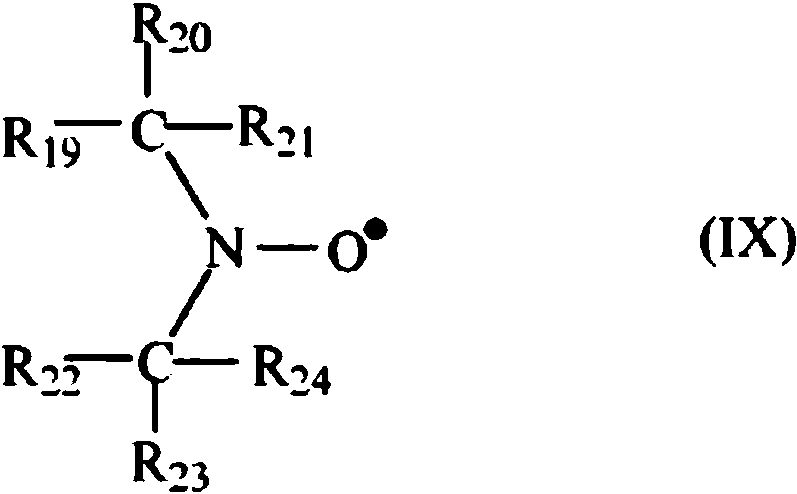
en la que R19, R20, R21, R22, R23 y R24 designan agrupamientos:in which R19, R20, R21, R22, R23 and R24 designate groupings:
- alquilo lineales o ramificados C1-C20, preferiblemente C1-C10, tales como metilo, etilo, propilo, butilo, isopropilo, isobutilo, terc-butilo o neopentilo, sustituidos o no,- linear or branched C1-C20 alkyl, preferably C1-C10, such as methyl, ethyl, propyl, butyl, isopropyl, isobutyl, tert-butyl or neopentyl, substituted or not,
- arilo C6-C30, sustituidos o no, tales como bencilo o arilo (fenilo),- C6-C30 aryl, substituted or unsubstituted, such as benzyl or aryl (phenyl),
- cíclicos saturados C1-C30- saturated cyclic C1-C30
y en la que los agrupamientos R19 y R22 pueden formar parte de una estructura cíclica R19-CNC-R22 eventualmente sustituida que puede elegirse entre:and in which the groups R19 and R22 can form part of a cyclical structure R19-CNC-R22, possibly substituted, which can be chosen between:

en las que x designa un entero comprendido entre 1 y 12. where x designates an integer from 1 to 12.
A modo de ejemplos, se podrán utilizar los nitróxidos siguientes:As examples, the following nitroxides can be used:

De manera particularmente preferible, se usan los nitróxidos de fórmula (X):Particularly preferably, the nitroxides of formula (X) are used:

designando Ra y Rb agolpamientos alquilo iguales o diferentes que poseen de 1 a 40 átomos de carbono, eventualmente ligados entre sí para formar un ciclo y eventualmente sustituidos con agolpamientos hidroxi, alcoxi o amino,where Ra and Rb designate the same or different alkyl groupings having from 1 to 40 carbon atoms, optionally linked together to form a cycle and optionally substituted with hydroxy, alkoxy or amino groups,
designando Rl un agrupamiento monovalente de masa molar superior a 15,42 g/mol, preferiblemente superior a 30 g/mol. El agrupamiento Rl puede tener por ejemplo una masa molar comprendida entre 40 y 450 g/mol. Se trata preferiblemente de un agrupamiento fosforado de fórmula general (XI):Rl denoting a monovalent grouping of molar mass greater than 15.42 g / mol, preferably greater than 30 g / mol. The group Rl may for example have a molar mass of between 40 and 450 g / mol. It is preferably a phosphorous group of general formula (XI):

en la que X e Y, que pueden ser iguales o diferentes, pueden elegirse entre los radicales alquilo, cicloalquilo, alcoxilo, ariloxilo, arilo, aralquiloxilo, perfluoroalquilo o aralquilo y pueden comprender de 1 a 20 átomos de carbono; X y/o Y pueden ser igualmente un átomo de halógeno como un átomo de cloro, bromo o flúor.wherein X and Y, which may be the same or different, may be chosen from the alkyl, cycloalkyl, alkoxy, aryloxy, aryl, aralkyloxy, perfluoroalkyl or aralkyl radicals and may comprise from 1 to 20 carbon atoms; X and / or Y can also be a halogen atom such as a chlorine, bromine or fluorine atom.
Ventajosamente, Rl es un agrupamiento fosfonato de fórmula:Advantageously, Rl is a phosphonate group of formula:
R c — oxí| R c - oxy |
/ P / P (X II)(X II)
Rd—crRd — cr
en la que Rc y Rd son dos agrupamientos alquilo iguales o diferentes, eventualmente ligados para formar un ciclo, que comprenden de 1 a 40 átomos de carbono, eventualmente sustituidos o no.wherein Rc and Rd are two identical or different alkyl groups, optionally linked to form a cycle, comprising from 1 to 40 carbon atoms, optionally substituted or not.
El agrupamiento Rl puede comprender igualmente al menos un ciclo aromático tal como el radical fenilo o el radical naftilo, sustituido por ejemplo por uno o varios radicales alquilo que comprenden de 1 a 10 átomos de carbono. Los nitróxidos de fórmula (X) son preferidos pues permiten obtener un buen control de la polimerización radicálica de los monómeros (met)acrílicos, como se enseña esto en el documento WO 03/062293. Las alcoxiaminas de fórmula (XIII) que tienen un nitróxido de fórmula (X) son por lo tanto preferidas: The group Rl can also comprise at least one aromatic ring such as the phenyl radical or the naphthyl radical, substituted for example by one or more alkyl radicals comprising from 1 to 10 carbon atoms. Nitroxides of formula (X) are preferred as they allow good control of the radical polymerization of (meth) acrylic monomers, as taught in WO 03/062293. Alkoxyamines of formula (XIII) having a nitroxide of formula (X) are therefore preferred:

en la quein which
Z designa un agolpamiento multivalente;Z designates a multivalent crush;
Ra y Rb designan agolpamientos alquilo iguales o diferentes que poseen de 1 a 40 átomos de carbono, eventualmente ligados entre sí para formar un ciclo y eventualmente sustituidos con agolpamientos hidroxi, alcoxi o amino;Ra and Rb designate the same or different alkyl groupings having from 1 to 40 carbon atoms, optionally bonded together to form a cycle and optionally substituted with hydroxy, alkoxy or amino groups;
Rl designa un agolpamiento monovalente de masa molar superior a 15,042 g/mol, preferiblemente superior a 30 g/mol. El agrupamiento Rl puede tener por ejemplo una masa molar comprendida entre 40 y 450 g/mol. Se trata preferiblemente de un agrupamiento fosforado de fórmula general (XI):Rl designates a monovalent crush of molar mass greater than 15.042 g / mol, preferably greater than 30 g / mol. The group Rl may for example have a molar mass of between 40 and 450 g / mol. It is preferably a phosphorous group of general formula (XI):

en la que X e Y, que pueden ser iguales o diferentes, pueden elegirse entre los radicales alquilo, cicloalquilo, alcoxilo, ariloxilo, arilo, aralquiloxilo, perfluoroalquilo o aralquilo y pueden comprender de 1 a 20 átomos de carbono; y X y/o Y pueden ser igualmente un átomo de halógeno como un átomo de cloro, bromo o flúor.wherein X and Y, which may be the same or different, may be chosen from the alkyl, cycloalkyl, alkoxy, aryloxy, aryl, aralkyloxy, perfluoroalkyl or aralkyl radicals and may comprise from 1 to 20 carbon atoms; and X and / or Y can also be a halogen atom such as a chlorine, bromine or fluorine atom.
Ventajosamente, Rl es un agrupamiento fosfonato de fórmula:Advantageously, Rl is a phosphonate group of formula:

en la que Rc y Rd son dos agrupamientos alquilo iguales o diferentes, eventualmente ligados para formar un ciclo, que comprenden de 1 a 40 átomos de carbono, eventualmente sustituidos o no.wherein Rc and Rd are two identical or different alkyl groups, optionally linked to form a cycle, comprising from 1 to 40 carbon atoms, optionally substituted or not.
El agrupamiento Rl puede comprender igualmente al menos un ciclo aromático tal como el radical fenilo o el radical naftilo, sustituido por ejemplo con uno o varios radicales alquilo que comprenden de 1 a 10 átomos de carbono. The group Rl can also comprise at least one aromatic ring such as the phenyl radical or the naphthyl radical, substituted for example by one or more alkyl radicals comprising from 1 to 10 carbon atoms.
A modo de ejemplo de nitróxido de fórmula (X) que puede estar portado por la alcoxiamina (XIII), se pueden citar:By way of example of nitroxide of formula (X) that may be carried by alkoxyamine (XIII), there may be mentioned:
- nitróxido de N-ferc-butil-1-fenil-2-metilpropilo,- N-ferc-butyl-1-phenyl-2-methylpropyl nitroxide,
- nitróxido de N-(2-hidroximetilpropil)-1-fenil-2-metilpropilo,- N- (2-hydroxymethylpropyl) -1-phenyl-2-methylpropyl nitroxide,
- nitróxido de N-ferc-butil-1-dibencilfosfono-2,2-dimetilpropilo,- N-ferc-butyl-1-dibenzylphosphono-2,2-dimethylpropyl nitroxide,
- nitróxido de N-íerc-butil-1-di(2,2,2-trifluoroetil)fosfono-2,2-dimetilpropilo,- N-érc-butyl-1-di (2,2,2-trifluoroethyl) phosphono-2,2-dimethylpropyl nitroxide,
- nitróxido de N-ferc-butil-[(1-dietilfosfono)-2-metilpropilo],- N-ferc-butyl nitroxide - [(1-diethylphosphono) -2-methylpropyl],
- nitróxido de N-(1 -metiletil)-1-ciclohexil-1-(dietilfosfono),- N- (1 -methylethyl) -1-cyclohexyl-1- (diethylphosphono) nitroxide,
- nitróxido de N-(1 -fenilbencil)-[(1 -dietilfosfono)-1 -metiletilo],- N- (1 -phenylbenzyl) nitroxide - [(1-diethylphosphono) -1 -methylethyl],
- nitróxido de N-fenil-1-dietilfosfono-2,2-dimetilpropilo,- N-phenyl-1-diethylphosphono-2,2-dimethylpropyl nitroxide,
- nitróxido de N-fenil-1-dietilfosfono-1 -metiletilo,- N-phenyl-1-diethylphosphono-1-methyl ethyl nitroxide,

El nitróxido de fórmula (XIV) es particularmente preferido:Nitroxide of formula (XIV) is particularly preferred:

Se trata del nitróxido de N-íerc-butil-1-dietMfosfono-2,2-dimetMpropilo, denominado corrientemente SG1 para simplificar.This is N-terc-butyl-1-dietMphosphono-2,2-dimethMpropyl nitroxide, commonly called SG1 for simplicity.
La alcoxiamina (I), y especialmente la alcoxiamina (XIII), pueden prepararse mediante recetas descritas por ejemplo en el documento FR2791979. Un método que puede usarse consiste en realizar el acoplamiento de un radical carbonado con un nitróxido. El acoplamiento puede realizarse a partir de un derivado halogenado en presencia de un sistema organometálico como CuX/ligando (X=Cl o Br) según una reacción de tipo ATRA (Atom Transfer Radical Addition, “adición de radical de transferencia atómica”) tal como la descrita por D. Greszta y col. en Macromolecules 1996, 29, 7661-7670.Alkoxyamine (I), and especially alkoxyamine (XIII), can be prepared by recipes described for example in document FR2791979. One method that can be used is to perform the coupling of a carbon radical with a nitroxide. The coupling can be performed from a halogenated derivative in the presence of an organometallic system such as CuX / ligand (X = Cl or Br) according to an ATRA (Atom Transfer Radical Addition) reaction, such as that described by D. Greszta et al. in Macromolecules 1996, 29, 7661-7670.

Las alcoxiaminas que pueden usarse en el marco de la invención se representan a continuación:The alkoxyamines that can be used in the context of the invention are represented below:


Las dos ultimas alcoxiaminas se denominan DIAMINS y TRIAMINS, respectivamente, y son las alcoxiammas preferidas.The last two alkoxyamines are called DIAMINS and TRIAMINS, respectively, and are the preferred alkoxyamms.
No se saldría del marco de la presente invención combinando varias alcoxiaminas que responden a la fórmula (I), en particular varias alcoxiaminas de fórmula (XIII). Estas mezclas podrían comprender así, por ejemplo, una alcoxiamina que tiene n1 nitróxidos unidos y una alcoxiamina que tiene n2 nitróxidos unidos, siendo n1 diferente de n2. Podría tratarse también de una combinación de alcoxiaminas portadoras de nitróxidos diferentes.It would not depart from the scope of the present invention by combining various alkoxyamines that respond to formula (I), in particular various alkoxyamines of formula (XIII). These mixtures could thus comprise, for example, an alkoxyamine having n1 nitroxides attached and an alkoxyamine having n2 nitroxides bound, n1 being different from n2. It could also be a combination of different nitroxide-bearing alkoxyamines.
Tratándose del reductor de nitróxidos, pueden ser de cualquier tipo. Este puede ser un mercaptano o un radical. Preferiblemente, se trata de un radical procedente de la descomposición de un cebador radicálico o bien por temperatura o bien por una reacción rédox o cualquier otro sistema rédox que pueda generar radicales, como por ejemplo el par bis(dietilmalonato) de metileno-cerio (IV) o también el par H2O2/Fe2+.In the case of the nitroxide reducer, they can be of any type. This can be a mercaptan or a radical. Preferably, it is a radical derived from the decomposition of a radical primer either by temperature or by a redox reaction or any other redox system that can generate radicals, such as the methylene-cerium (IV) bis (diethylmalonate) pair ) or also the H2O2 / Fe2 + pair.
Se entiende por reductor de nitróxido cualquier compuesto susceptible de reaccionar con un nitróxido.Nitroxide reducer is understood to mean any compound capable of reacting with a nitroxide.
Tratándose del cebador radicálico, puede elegirse entre peróxidos de diacilos, peroxiésteres, peróxidos de dialquilo, peroxiacetales o compuestos azoicos. Los cebadores radicálicos que pueden convenir son, por ejemplo, carbonato de isopropilo, peróxido de benzoílo, lauroílo, caproílo, dicumilo, perbenzoato de tere-butilo, 2-etilperhexanoato de terebutilo, hidroperóxido de cumilo, 1,1-di(tere-butilperoxi)-3,3,5-trimetilciclohexano, peroxiisobutirato de tere-butilo, peracetato de tere-butilo, perpivalato de tere-butilo, perpivalato de amilo o peroctoato de tere-butilo. No se saldría del marco de la invención usando una mezcla de cebadores radicálicos elegidos de la lista anterior. El cebador radicálico preferido es un peróxido, y más particularmente peróxido de benzoílo.In the case of the radical primer, one can choose between diacyl peroxides, peroxyesters, dialkyl peroxides, peroxyacetals or azo compounds. Suitable radical primers are, for example, isopropyl carbonate, benzoyl peroxide, lauroyl, caproyl, dicumyl, tere-butyl perbenzoate, terebutyl 2-ethylperhexanoate, cumyl hydroperoxide, 1,1-di (tere-butylperoxy ) -3,3,5-trimethylcyclohexane, tere-butyl peroxyisobutyrate, tere-butyl peracetate, tere-butyl perpivalate, amyl perpivalate or tere-butyl peroctoate. You would not depart from the scope of the invention using a mixture of root primers chosen from the above list. The preferred root primer is a peroxide, and more particularly benzoyl peroxide.
Según una forma preferida, el radical se genera mediante reacción entre un peróxido y una amina.According to a preferred form, the radical is generated by reaction between a peroxide and an amine.
Tratándose de la amina, puede usarse cualquier tipo de amina susceptible de reaccionar con un peróxido. In the case of the amine, any type of amine capable of reacting with a peroxide can be used.
Preferiblemente, se trata de aminas sustituidas, y más particularmente de aminas trisustituidas, entre las que se pueden citar N,N-dimetilanilina (DMA) y sus derivados para-sustituidos tales como dimetil-p-toluidina (DMPT), phidroximetil-N,N-dimetilanilina (HMDA), p-nitro-N,N-N,N-dimetilanilina (NDMA) y p-dimetilaminobenzaldehído (DMAB). Más particularmente, se trata de dimetil-p-toluidina.Preferably, they are substituted amines, and more particularly trisubstituted amines, among which there may be mentioned N, N-dimethylaniline (DMA) and its para-substituted derivatives such as dimethyl-p-toluidine (DMPT), phidroxymethyl-N, N-dimethylaniline (HMDA), p-nitro-N, NN, N-dimethylaniline (NDMA) and p-dimethylaminobenzaldehyde (DMAB). More particularly, it is dimethyl-p-toluidine.
La ejecución de la polimerización según el procedimiento de la invención puede efectuarse en masa, solución, suspensión o también emulsión.The polymerization according to the process of the invention can be carried out in bulk, solution, suspension or also emulsion.
Según una variante de la invención, la alcoxiamina usada puede prepararse mediante un procedimiento de polimerización radicálica controlado por nitróxidos similar, pero sin presencia del reductor de nitróxido, a una temperatura superior a 50 °C. Se trata por ejemplo de hacer un primer bloque que comprende al menos un monómero, que posteriormente se pondrá en las condiciones de la presente invención, es decir a baja temperatura, típicamente a temperatura ambiente, para generar la polimerización de los demás bloques. Se obtendrá por lo tanto un copolímero con varios bloquesAccording to a variant of the invention, the used alkoxyamine can be prepared by a similar nitroxide controlled radical polymerization procedure, but without the presence of the nitroxide reducer, at a temperature above 50 ° C. For example, it is a matter of making a first block comprising at least one monomer, which will subsequently be placed under the conditions of the present invention, that is, at low temperature, typically at room temperature, to generate the polymerization of the other blocks. Therefore, a copolymer with several blocks will be obtained.
La síntesis de copolímeros secuenciados, o copolímeros de bloques, usa varias técnicas desde hace muchos años. En cada una de estas técnicas, las temperaturas usadas para la síntesis están siempre muy alejadas de la ambiental y requieren por lo tanto condiciones particulares de preparación, a menudo incompatibles con los procedimientos de fabricación usados en las aplicaciones. En el procedimiento de la invención, las temperaturas de polimerizaciones están comprendidas entre -50 y 80 °C, ventajosamente entre -20 y 80 °C, preferiblemente entre 0 y 80 °C, más preferiblemente entre 0 y 50 °C, e idealmente entre 10 y 35 °C.The synthesis of sequenced copolymers, or block copolymers, has used various techniques for many years. In each of these techniques, the temperatures used for the synthesis are always very far from the ambient and therefore require particular preparation conditions, often incompatible with the manufacturing procedures used in the applications. In the process of the invention, the polymerization temperatures are between -50 and 80 ° C, advantageously between -20 and 80 ° C, preferably between 0 and 80 ° C, more preferably between 0 and 50 ° C, and ideally between 10 and 35 ° C.
Numerosos trabajos han consistido por consiguiente en sintetizar el copolímero de bloques en una primera etapa, e introducirlo luego en forma de aditivo en materiales elegidos según la aplicación pretendida. Se ha demostrado que el uso de estos aditivos permitía obtener compromisos de propiedades mejoradas con relación a técnicas anteriores habitualmente usadas. Sin embargo, la introducción de copolímeros de bloques en un material hospedador requiere herramientas y técnicas de mezcla particulares (en caliente, en disolvente) a causa de la muy alta viscosidad de estos aditivos. El mismo efecto limita igualmente el contenido de copolímeros de bloques que se puede introducir en el material final. Para estas aplicaciones, la tasa de polímero utilizable como aditivo está limitada por la viscosidad creada. En el caso en que la síntesis del copolímero se desarrolle directamente en una resina hospedadora o la mezcla de resina/endurecedor, como puede ser el caso en la presente invención, la viscosidad no es ya un problema puesto que aparece únicamente al final del procedimiento. Esto abre oportunidades nuevas en los campos en que la viscosidad es un factor limitante tales como recubrimientos, procedimientos de inyección o infusión de resina, adhesivos, etc. Numerous works have therefore consisted of synthesizing the block copolymer in a first stage, and then introducing it as an additive in materials chosen according to the intended application. It has been demonstrated that the use of these additives allowed to obtain compromises of improved properties in relation to commonly used prior techniques. However, the introduction of block copolymers into a host material requires particular mixing tools and techniques (hot, solvent) because of the very high viscosity of these additives. The same effect also limits the content of block copolymers that can be introduced into the final material. For these applications, the rate of polymer usable as an additive is limited by the viscosity created. In the case where the synthesis of the copolymer takes place directly in a host resin or the resin / hardener mixture, as may be the case in the present invention, viscosity is no longer a problem since it appears only at the end of the process. This opens up new opportunities in fields where viscosity is a limiting factor such as coatings, resin injection or infusion procedures, adhesives, etc.
La presente invención tiene la doble ventaja de permitir la síntesis del copolímero de bloques in situ en el material hospedador, de manera que se obtiene una morfología particular más favorable a las propiedades aplicativas, y se conserva una viscosidad inicial baja particularmente favorable a la aplicación del material aditivo.The present invention has the double advantage of allowing the synthesis of the block copolymer in situ in the host material, so that a particular morphology more favorable to the application properties is obtained, and a low initial viscosity particularly favorable to the application of the additive material.
El material hospedador puede ser un disolvente, un polímero, un oligómero, una carga pigmentada o no de cualquier dimensión y cualquier tipo de factor de forma, poroso o no, fibras cortas o largas, tejidas o no tejidas, nanotubos o una combinación de estos materiales hospedadores. El material hospedador puede ser también un precursor de polímero, por ejemplo, cualquier sistema bicomponente o no susceptible de polimerizar independientemente de la polimerización que conlleva la alcoxiamina, por ejemplo, de forma no limitante una resina epóxido, poliuretano o poliéster. Se puede polimerizar por ejemplo simultáneamente o de forma secuencial el material hospedador y el material procedente de la polimerización de la alcoxiamina.The host material can be a solvent, a polymer, an oligomer, a pigmented or non-pigmented filler of any dimension and any type of form factor, porous or not, short or long fibers, woven or non-woven, nanotubes or a combination of these. host materials. The host material may also be a polymer precursor, for example, any bicomponent or non-polymerizable system regardless of the polymerization involved in the alkoxyamine, for example, non-limitingly, an epoxy, polyurethane or polyester resin. For example, the host material and the material resulting from the polymerization of the alkoxyamine can be polymerized simultaneously or sequentially.
En este sentido, la presente invención se acerca a los procedimientos descritos en el documento WO 03/062293 o también WO 06/06152, pero difiere de estos últimos por el hecho de que la temperatura de síntesis del segundo bloque es muy significativamente inferior a las descritas en la técnica anterior, típicamente a temperatura ambiente, lo que se hace posible por el uso combinado de un cebador de alcoxiamina macromolecular preparado previamente en una primera etapa descrita clásicamente en la técnica anterior, en presencia de un reductor de nitróxido y monómeros constitutivos del segundo bloque.In this sense, the present invention approaches the procedures described in WO 03/062293 or WO 06/06152, but differs from the latter in that the synthesis temperature of the second block is very significantly lower than described in the prior art, typically at room temperature, which is made possible by the combined use of a macromolecular alkoxyamine primer prepared previously in a first stage classically described in the prior art, in the presence of a nitroxide reducer and constituent monomers of the Second block.
Entre los monómeros que pueden usarse en el procedimiento de la invención, se pueden citar los monómeros que presentan uno o varios doble enlaces tales como los monómeros vinilaromáticos como estireno, o estirenos sustituidos, especialmente alfa-metilestireno, monómeros acrílicos tales como ácido acrílico o sus sales, acrilatos de alquilo (que presentan o no varias funciones acrílicas), de cicloalquilo o arilo tales como acrilato de metilo, etilo, butilo, etilhexilo o fenilo, acrilatos de hidroxialquilo tales como acrilato de 2-hidroxietilo, acrilatos de eteralquilo tales como acrilato de 2-metoxietilo, acrilatos de alcoxipolialquilenglicol o ariloxipolialquilenglicol tales como acrilatos de metoxipolietilenglicol, acrilatos de etoxipolietilenglicol, acrilatos de metoxipolipropilenglicol, acrilatos de metoxipolietilenglicolpolipropilenglicol o sus mezclas, acrilatos de aminoalquilo tales como acrilato de 2-(dimetilamino)etilo (ADAME), acrilatos fluorados, acrilatos sililados, acrilatos fosforados tales como acrilatos de fosfato de alquilenglicol, monómeros metacrílicos como ácido metacrílico o sus sales, metacrilatos de alquilo, cicloalquilo, alquenilo o arilo tales como metacrilato de metilo (MAM), laurilo, ciclohexilo, alilo, fenilo o naftilo, metacrilatos de hidroxialquilo tales como metacrilato de 2-hidroxietilo o metacrilato de 2-hidroxipropilo, metacrilatos de eteralquilo tales como metacrilato de 2-etoxietilo, metacrilatos de alcoxipolialquilenglicol o ariloxipolialquilenglicol tales como metacrilatos de metoxipolietilenglicol, metacrilatos de etoxipolietilenglicol, metacrilatos de metoxipolipropilenglicol, metacrilatos de metoxipolietilenglicolpolipropilenglicol o sus mezclas, metacrilatos de aminoalquilo tales como metacrilato de 2-(dimetilamino)etilo (MADAME), metacrilatos fluorados tales como metacrilato de 2,2,2-trifluoroetilo, metacrilatos sililados tales como 3-metacriloilpropiltrimetilsilano, metacrilatos fosforados tales como metacrilatos de fosfato de alquilenglicol, metacrilato de hidroxietilimidazolidona, metacrilato de hidroxietilimidazolidinona, metacrilato de 2-(2-oxo-1-imidazolidinil)etilo, acrilonitrilo, acrilamida o acrilamidas sustituidas, 4-acriloilmorfolina, N-metilolacrilamida, metacrilamida o metacrilamidas sustituidas, N-metilolmetacrilamida, cloruro de metacrilamidopropiltrimetilamonio (MAPTAC), ácido itacónico, ácido maleico o sus sales, anhídrido maleico, maleatos o hemimaleatos de alquilo o de alcoxipolialquilenglicol o ariloxipolialquilenglicol, vinilpiridina, vinilpirrolidinona, (alcoxi)poli(alquilenglicol)viniléter o (alcoxi)poli(alquilenglicol)diviniléter, tales como metoxipoli(etilenglicol)viniléter, poli(etilenglicol)diviniléter, monómeros olefínicos entre los que se pueden citar etileno, buteno, hexeno y 1-octeno, así como monómeros olefínicos fluorados y monómeros vinilidénicos entre los que se pueden citar fluoruro de vinilideno, solos o en mezcla de al menos dos monómeros anteriormente citados.Among the monomers that can be used in the process of the invention, mention may be made of monomers that have one or more double bonds such as vinylaromatic monomers such as styrene, or substituted styrenes, especially alpha-methylstyrene, acrylic monomers such as acrylic acid or their cycloalkyl or aryl salts, alkyl acrylates (having or not having various acrylic functions) such as methyl, ethyl, butyl, ethylhexyl or phenyl acrylate, hydroxyalkyl acrylates such as 2-hydroxyethyl acrylate, etharalkyl acrylates such as acrylate of 2-methoxyethyl, alkoxypolyalkylene glycol or aryloxypolyalkylene glycol acrylates such as methoxypolyethylene glycol acrylates, ethoxypolyethylene glycol acyl acylates, methyloxypropylene glycol acyl acylates, , silylated acrylates, acrylates phosphates such as alkylene glycol phosphate acrylates, methacrylic monomers such as methacrylic acid or its salts, alkyl, cycloalkyl, alkenyl or aryl methacrylates such as methyl methacrylate (MAM), lauryl, cyclohexyl, allyl, phenyl or naphthyl, hydroxyalkyl methacrylates such as 2-hydroxyethyl methacrylate or 2-hydroxypropyl methacrylate, etheralkyl methacrylates such as 2-ethoxyethyl methacrylate, alkoxypolyalkylene glycol methacryletolyethylene glycol, methacrypyrolyethylene glycol yl methacryl, methacryptyl glycol yl methacrylate, Methyl acrylate methacryptyl methacryptyl methacrylate, Methyl acrylate, Methyl acrylate methoxypolyethylene glycol polypropylene glycol methacrylates or mixtures thereof, aminoalkyl methacrylates such as 2- (dimethylamino) ethyl methacrylate (MADAME), fluorinated methacrylates such as 2,2,2-trifluoroethyl methacrylates such as 3-methacryloylpropyltrimethyl methacrylates, alkylene glycol phosphate methacrylates, hydroxyethylimidazolidone methacrylate, hydroxyethylimidazolidinone methacrylate, 2- (2-oxo-1-imidazolidinyl) ethyl methacrylate, acrylonitrile, methacrylamide, n-acrylamide, methylacrylamide, N-acrylamide, N-acrylamide, 4-acrylamide, N-acrylamide, N-acrylamide, N-acrylamide, N-acrylamide, N-acrylamide, N-acrylamide, N-acrylamide, N-acrylamide, N-acrylamide, N-acrylamide, N-acrylamide, N-acrylamide, N-acrylamide, N-methylacrylamide, N-acrylamide, 2-acrylamide, 2-acrylamide, 2-acrylamide, 2-acrylamide, 2-acrylamide, 2-acrylamide, 2-acrylamide, 4-acrylamide, 2-acrylamide, 2-acrylamide. -methylolmethacrylamide, methacrylamidopropyltrimethylammonium chloride (MAPTAC), itaconic acid, maleic acid or its salts, maleic anhydride, maleates or hemimaleates of alkyl or alkoxypolyalkylene glycol, alkyloxypyridine, vinylpyridine, vinylpyridine, vinylpyridine, vinylpyridine, vinylpyridine (alkylene glycol) divinyl ether, such as methoxypoly (ethylene glycol) vinyl ether, poly (ethylene glycol) divinyl ether, olefin monomers including ethylene, butene, hexene and 1-octene, as well as fluorinated olefin monomers and vinylidene monomers, including vinylidene fluoride, alone or in a mixture of at least two aforementioned monomers.
La presente invención abarca igualmente aplicaciones de uso de este procedimiento de síntesis a baja temperatura. Este procedimiento se vuelve compatible con aplicaciones numerosas y variadas para las que la temperatura de aplicación permanezca fría o moderada.The present invention also encompasses applications for the use of this low temperature synthesis procedure. This procedure becomes compatible with numerous and varied applications for which the application temperature remains cold or moderate.
En particular, la presente invención está ventajosamente adaptada a aplicaciones como barnices, recubrimientos, colas y adhesivos, refuerzo mecánico de materiales plásticos, impresión tridimensional y materiales compuestos, puesto la temperatura de polimerización coincide con la temperatura de aplicación.In particular, the present invention is advantageously adapted to applications such as varnishes, coatings, glues and adhesives, mechanical reinforcement of plastic materials, three-dimensional printing and composite materials, since the polymerization temperature coincides with the application temperature.
La presente invención abarca igualmente materiales hospedadores que comprenden polímeros o copolímeros procedentes del procedimiento de invención a causa de sus propiedades únicas resultantes del uso del procedimiento de la invención, que permiten especialmente incorporar considerables cantidades de copolímeros objeto de la invención a materiales hospedadores usando el procedimiento de la invención.The present invention also encompasses host materials comprising polymers or copolymers from the process of the invention because of their unique properties resulting from the use of the process of the invention, which especially allow to incorporate considerable amounts of copolymers object of the invention to host materials using the process of the invention.
Ejemplo 1Example 1
Síntesis de la alcoxiamina TRIAMINSSynthesis of the alkoxyamine TRIAMINS
En un reactor de 500 ml se introducen 206 g de etanol, 100 g de Blocbuider® (Arkema) y 26,5 g de triacrilato de pentaeritritol (Sartomer SR444D). Se calienta la mezcla con agitación a 80 °C durante 4 h. Se extrae a continuación la mezcla de reacción y luego se evapora el etanol con la ayuda de un rotavapor. Se obtienen cuantitativamente 126 g de Triamins.206 g of ethanol, 100 g of Blocbuider® (Arkema) and 26.5 g of pentaerythritol triacrylate (Sartomer SR444D) are introduced into a 500 ml reactor. The mixture is heated with stirring at 80 ° C for 4 h. The reaction mixture is then extracted and then the ethanol is evaporated with the aid of a rotary evaporator. 126 g of Triamins are obtained quantitatively.
Ejemplo 2:Example 2:
Síntesis de una polialcoxiamina macrocebadora.Synthesis of a macroprimer polyalkoxyamine.
Se introducen en un reactor metálico de 2 litros provisto de un agitador de hélice, una camisa doble de calentamiento por circulación de aceite y una entrada de vacío/nitrógeno:They are introduced into a 2-liter metal reactor fitted with a propeller stirrer, a double oil circulation heating jacket and a vacuum / nitrogen inlet:
• 643 g de acrilato de butilo• 643 g of butyl acrylate
• 96 g de estireno• 96 g styrene
• 6 g de TRIAMINS.• 6 g of TRIAMINS.
Después de la introducción de los reactivos, se desgasifica la mezcla de reacción tres veces a vacío/con nitrógeno. Se cierra entonces el reactor y se ponen en marcha luego la agitación (50 rpm) y el calentamiento (registro de temperatura: 125 °C). La temperatura de la mezcla de reacción alcanza 113 °C en aprox. 30 min. La presión se estabiliza hacia 1,5 bar. La temperatura del reactor se mantiene en una meseta a 115 °C durante 522 min. Se recuperan después del enfriamiento 740 g de una mezcla al 70 % de extracto seco. Se elimina a continuación el acrilato de butilo en exceso por evaporación a 70 °C a presión reducida durante 3 h. La relación en peso de acrilato de butilo:estireno del macrorradical obtenido es de 83:17. El análisis por GPC calibrado con ayuda de muestras de poliestireno del macrocebador da los siguientes resultados: Mn: 129000 g/mol; Mw: 510000 g/mol; polimolecularidad: 3,9.After introduction of the reagents, the reaction mixture is degassed three times under vacuum / with nitrogen. The reactor is then closed and then stirring (50 rpm) and heating are started (temperature record: 125 ° C). The temperature of the reaction mixture reaches 113 ° C in approx. 30 min. The pressure stabilizes at 1.5 bar. The reactor temperature is maintained on a plateau at 115 ° C for 522 min. 740 g of a 70% dry extract mixture are recovered after cooling. The excess butyl acrylate is then removed by evaporation at 70 ° C under reduced pressure for 3 h. The weight ratio of butyl acrylate: styrene of the obtained macroradical is 83:17. Analysis by GPC calibrated with the help of polystyrene samples of the macroprimer gives the following results: Mn: 129000 g / mol; Mw: 510000 g / mol; polymolecularity: 3.9.
Ejemplo 3:Example 3:
Síntesis del copolímero no cebador (PABu/estireno radicálico).Synthesis of the non-primer copolymer (PABu / radical styrene).
En un reactor agitado de acero inoxidable usado comúnmente por el especialista en la materia, se introduce una mezcla compuesta por 500 g de acrilato de butilo, 70 g de estireno, 966 g de tolueno, 0,1854 g de AIBN (Vazo64 de Dupont) y 0,6 g de n-dodecilmercaptano. Se pone el reactor a 2 bar de presión de nitrógeno y se calienta a una temperatura de 85 °C durante 3 h. Se enfría a continuación la mezcla a temperatura ambiente (20 °C) y se seca luego a vacío en una estufa durante 16 h a 125 °C y 100 mbar de presión absoluta. Se obtiene entonces el copolímero seco de poliacrilato de butilo-co-estireno no cebador.A mixture consisting of 500 g of butyl acrylate, 70 g of styrene, 966 g of toluene, 0.1854 g of AIBN (Vazo64 from Dupont) is introduced into a stirred stainless steel reactor commonly used by the person skilled in the art. and 0.6 g of n-dodecyl mercaptan. The reactor is placed at 2 bar of nitrogen pressure and heated to a temperature of 85 ° C for 3 h. The mixture is then cooled to room temperature (20 ° C) and then dried under vacuum in an oven for 16 h at 125 ° C and 100 mbar of absolute pressure. Then, the non-primer butyl co-styrene polyacrylate dry copolymer is obtained.
Ejemplo 4: Example 4:
Se realizan las polimerizaciones en masa, sin disolvente, a temperatura ambiente de 25 °C a presión atmosférica. Bulk polymerizations are carried out, without solvent, at room temperature of 25 ° C at atmospheric pressure.
Se busca en estos ejemplos polimerizar el metacrilato de metilo sobre la polialcoxiamina macrocebadora del ejemplo 2. El peróxido elegido es el peróxido de benzoílo (BPO), la amina es la dimetil-para-toluidina (DMPT).The aim of these examples is to polymerize the methyl methacrylate on the polyalkoxyamine primer of Example 2. The peroxide chosen is benzoyl peroxide (BPO), the amine is dimethyl-para-toluidine (DMPT).
Se preparan las soluciones (sin peróxido) con agitación magnética, luego se desgasifican a vacío durante 15 minutos, esto con el fin de eliminar los gases disueltos que podrían perjudicar la polimerización. Se vierte la solución (20 g de mezcla de reacción) en un frasco de vidrio de 30 ml. Se añade el peróxido al frasco y luego se cierra el frasco con la ayuda de un tapón estanco.The solutions are prepared (without peroxide) with magnetic stirring, then they are degassed under vacuum for 15 minutes, this in order to eliminate the dissolved gases that could harm the polymerization. The solution (20 g of reaction mixture) is poured into a 30 ml glass bottle. The peroxide is added to the bottle and then the bottle is closed with the help of a tight stopper.
Una sonda de temperatura introducida en el frasco a través del tapón registra la evolución de la temperatura para seguir la polimerización en la muestra. Cuando el perfil de temperatura presenta un máximo, se anota el tiempo correspondiente.A temperature probe inserted into the bottle through the stopper records the evolution of the temperature to follow the polymerization in the sample. When the temperature profile has a maximum, the corresponding time is noted.
Se dan los resultados en la tabla 1, los porcentajes indicados son másicos.The results are given in Table 1, the indicated percentages are mass.

Los materiales correspondientes a los ensayos de la invención son todos transparentes, es decir, presentan una transmisión de luz superior al 80 % para un grosor de muestra de 3 mm. La foto 1 representativa de imágenes de AFM obtenidas a partir de la muestra del ensayo 9 muestra una nanoestructuración típica de copolímeros de bloques que muestran que la reacción ha tenido lugar entre la polialcoxiamina y el metacrilato de metilo. Cuando se ejecuta un ensayo con la ayuda de un copolímero de PAbu/estireno de masa molecular en peso similar, pero que no presenta funcionalidad alcoxiamina, en presencia de peróxido y amina, el material resultante es turbio, es decir, presenta una transmisión de luz ampliamente inferior al 80 % para un grosor de muestra de 3 mm. En este último caso, hay macroseparación de fases entre el copolímero de PAbu/estireno y el PMMA. No ha habido alargamiento de cadena de PAbu/estireno.The materials corresponding to the tests of the invention are all transparent, that is, they have a light transmission greater than 80% for a sample thickness of 3 mm. Photo 1 representative of AFM images obtained from test sample 9 shows a typical nanostructuring of block copolymers showing that the reaction has taken place between polyalkoxyamine and methyl methacrylate. When a test is carried out with the help of a PAbu / styrene copolymer of similar molecular weight, but which does not have alkoxyamine functionality, in the presence of peroxide and amine, the resulting material is cloudy, that is, it has a light transmission widely less than 80% for a sample thickness of 3 mm. In the latter case, there is macrose phase separation between the PAbu / styrene copolymer and the PMMA. There has been no PAbu / styrene chain elongation.
Ejemplo 5:Example 5:
Polimerización de metacrilato de metilo en presencia de un macrocebador, en una mezcla de resina epoxídica. Polymerization of methyl methacrylate in the presence of a macroprimer, in an epoxy resin mixture.
Etapa 1: Se realizan las polimerizaciones en solución en una resina epoxídica DGEBA (bis(4-(2,3-epoxipropoxi)fenil)propano, epóxido equivalente= 186 g/eq, nombre comercial: LY556 HUNSTMAN), a temperatura ambiente de 25 °C a presión atmosférica.Step 1: Solution polymerizations are performed in a DGEBA (bis (4- (2,3-epoxypropoxy) phenyl) propane epoxy equivalent = 186 g / eq, trade name: LY556 HUNSTMAN) epoxy at room temperature of 25 ° C at atmospheric pressure.
El peróxido elegido es el peróxido de benzoílo (BPO), la amina es dimetil-para-toluidina (DMPT). Las soluciones se preparan con agitación magnética, se desgasifican luego a vacío durante 15 minutos, esto con el fin de eliminar los gases disueltos que podrían perjudicar la polimerización.The chosen peroxide is benzoyl peroxide (BPO), the amine is dimethyl-para-toluidine (DMPT). The solutions are prepared with magnetic stirring, then degassed under vacuum for 15 minutes, this in order to eliminate dissolved gases that could harm the polymerization.
Se prepara en un matraz de vidrio una mezcla que contiene: Prepare a mixture in a glass flask containing:
1.5 g de la polialcoxiamina macrocebadora del ejemplo 2,1.5 g of the macroprimer polyalkoxyamine from Example 2,
8.5 g de metacrilato de metilo8.5 g of methyl methacrylate
0,1 g de peróxido de benzoílo0.1 g benzoyl peroxide
90 g de resina DGEBA90 g DGEBA resin
Una vez se homogeneiza la mezcla, se añaden 0,01 g de amina DMPT con agitación para obtener una mezcla homogénea.Once the mixture is homogenized, 0.01 g of DMPT amine is added with stirring to obtain a homogeneous mixture.
Etapa 2Stage 2
Se polimeriza la resina DGEBA con la ayuda del endurecedor Jeffamine (Polioxipropilentriamina, M= 400 g/mol, nombre comercial: T403 HUNSTMAN).The DGEBA resin is polymerized with the help of the Jeffamine hardener (Polyoxypropylenetriamine, M = 400 g / mol, trade name: T403 HUNSTMAN).
Se añaden 36,5 g de endurecedor Jeffamine a la mezcla procedente de la etapa 1.36.5 g of Jeffamine hardener are added to the mixture from step 1.
Se obtiene un material duro al cabo de 2 h a temperatura ambiente.A hard material is obtained after 2 h at room temperature.
Las imágenes de AFM muestran una estructura a escala nanométrica (foto 2). The AFM images show a structure at the nanometric scale (photo 2).
Claims (13)
Applications Claiming Priority (2)
| Application Number | Priority Date | Filing Date | Title |
|---|---|---|---|
| FR1462678A FR3030525B1 (en) | 2014-12-18 | 2014-12-18 | RADICAL POLYMERIZATION OF LOW TEMPERATURE ALCOXYAMINES |
| PCT/FR2015/053625 WO2016097649A1 (en) | 2014-12-18 | 2015-12-18 | Low-temperature radical polymerisation of alkoxyamines |
Publications (1)
| Publication Number | Publication Date |
|---|---|
| ES2767528T3 true ES2767528T3 (en) | 2020-06-17 |
Family
ID=53191757
Family Applications (1)
| Application Number | Title | Priority Date | Filing Date |
|---|---|---|---|
| ES15823675T Active ES2767528T3 (en) | 2014-12-18 | 2015-12-18 | Radical polymerization of alkoxyamines at low temperature |
Country Status (9)
| Country | Link |
|---|---|
| US (1) | US10131734B2 (en) |
| EP (1) | EP3233933B1 (en) |
| JP (1) | JP6677731B2 (en) |
| KR (1) | KR101922361B1 (en) |
| CN (2) | CN110396147B (en) |
| ES (1) | ES2767528T3 (en) |
| FR (1) | FR3030525B1 (en) |
| IL (1) | IL252950B (en) |
| WO (1) | WO2016097649A1 (en) |
Families Citing this family (4)
| Publication number | Priority date | Publication date | Assignee | Title |
|---|---|---|---|---|
| FR3075212B1 (en) | 2017-12-18 | 2020-11-20 | Arkema France | COMPOSITION OF ACRYLIC POLYMER (METH), PROCESS FOR PREPARATION AND USE |
| FR3075211B1 (en) | 2017-12-18 | 2020-11-20 | Arkema France | COMPOSITION OF ACRYLIC POLYMER (METH), PROCESS FOR PREPARATION AND USE |
| FR3088329B1 (en) * | 2018-11-08 | 2022-01-07 | Arkema France | ALCOXYAMINE COMPOSITIONS |
| FR3117487B1 (en) * | 2020-12-10 | 2022-12-23 | Arkema France | Suspension polymerization of alkoxyamines with styrenic and (meth)acrylic monomers. |
Family Cites Families (29)
| Publication number | Priority date | Publication date | Assignee | Title |
|---|---|---|---|---|
| US4666978A (en) * | 1985-11-27 | 1987-05-19 | First Chemical Corporation | Method of curing unsaturated polyester resins at low temperatures |
| FR2730240A1 (en) | 1995-02-07 | 1996-08-09 | Atochem Elf Sa | STABILIZATION OF A POLYMER BY A STABLE FREE RADICAL |
| WO1997046593A1 (en) * | 1996-06-04 | 1997-12-11 | Elf Atochem S.A. | Method for preparing telechelic 1,3-diene oligomers by the controlled free radical polymerization of 1,3-dienes in presence of a stable free radical |
| WO1998030601A2 (en) * | 1997-01-10 | 1998-07-16 | E.I. Du Pont De Nemours And Company | Method of controlling polymer molecular weight and structure |
| EP0996643B1 (en) * | 1997-07-15 | 2003-03-26 | Ciba SC Holding AG | Polymerizable compositions containing alkoxyamine compounds derived from nitroso- or nitrone compounds |
| FR2791979B1 (en) * | 1999-04-08 | 2003-05-16 | Atochem Elf Sa | PROCESS FOR THE PREPARATION OF ALCOXYAMINES FROM NITROXIDES |
| JP4505698B2 (en) * | 2000-01-17 | 2010-07-21 | 日油株式会社 | Vinyl group-containing alkoxyamine, its use and production method |
| FR2804118B1 (en) | 2000-01-26 | 2003-08-22 | Atofina | CONTROLLED RADICAL POLYMERIZATION OR COPOLYMERIZATION OF HIGH PRESSURE ETHYLENE IN THE PRESENCE OF FREE PRIMERING RADIALS AND CONTROLLING INDOLINIC NITROXIDE RADIALS |
| FR2807439B1 (en) * | 2000-04-07 | 2003-06-13 | Atofina | MULTIMODAL POLYMERS BY CONTROLLED RADICAL POLYMERIZATION IN THE PRESENCE OF ALCOXYAMINES |
| TWI236482B (en) * | 2000-11-13 | 2005-07-21 | Ciba Sc Holding Ag | Process for the (co)polymerization of vinyl chloride in the presence of a stable free nitroxyl radical |
| US8013062B2 (en) | 2002-01-22 | 2011-09-06 | Arkema France | Method of producing and using materials which are reinforced against impact and which contain block copolymers that are obtained by means of controlled radical polymerization in the presence of nitroxides |
| US6762263B2 (en) * | 2002-02-01 | 2004-07-13 | Atofina Chemicals, Inc. | High-solids coatings resins via controlled radical polymerization |
| AU2003212272A1 (en) * | 2002-03-05 | 2003-09-16 | Ciba Specialty Chemicals Holding Inc. | Open-chain alkoxyamines and their corresponding nitroxides for controlled low temperature radical polymerization |
| JP2004156005A (en) * | 2002-03-28 | 2004-06-03 | Djk Kenkyusho:Kk | Normal temperature curable resin composition, method for curing the same and cured material of the same |
| JP2004027172A (en) * | 2002-05-08 | 2004-01-29 | Djk Kenkyusho:Kk | Curing assisting compound for free-radical curable resin composition, free-radical curable resin composition containing it, and method for curing the resin composition |
| FR2859476B1 (en) * | 2003-09-10 | 2005-11-11 | Specific Polymers | TRIBLOCK COPOLYMERS FORMED OF A HYDROPHILIC BLOCK FRAMED BY TWO HYDROPHOBIC BLOCKS AND STRUCTURANTS USED AS GELIFYING OR THICKENING AGENTS OF AQUEOUS SYSTEMS |
| JP2005113058A (en) * | 2003-10-09 | 2005-04-28 | Mitsubishi Rayon Co Ltd | Emulsion polymerization method using water-soluble polymer initiator |
| WO2006006152A2 (en) | 2004-07-08 | 2006-01-19 | Ramot At Tel-Aviv University Ltd | Treatment of disorders and diseases of the colon |
| JP4691986B2 (en) | 2004-12-27 | 2011-06-01 | 住友化学株式会社 | Manufacturing method of resin bonded body |
| CN101180332B (en) * | 2005-05-03 | 2010-08-04 | 西巴特殊化学品控股有限公司 | Process for preparing comb-shaped block copolymers from epoxy-functionalized nitroxyl ethers and anionically polymerizable monomers |
| FR2889703A1 (en) * | 2005-08-09 | 2007-02-16 | Arkema Sa | PROCESS FOR THE PREPARATION OF A POLYMERIC MATERIAL COMPRISING A MULTIBLOC COPOLYMER OBTAINED BY CONTROLLED RADICAL POLYMERIZATION |
| ATE465183T1 (en) * | 2005-08-30 | 2010-05-15 | Basf Se | POLYMERS OBTAINED FROM NITROXYL RADICAL POLYMERIZATION |
| US20090065737A1 (en) * | 2007-09-11 | 2009-03-12 | Arkema Inc. | Polymerization controllers for composites cured by organic peroxide initiators |
| JP5527036B2 (en) * | 2010-04-15 | 2014-06-18 | Dic株式会社 | Mortar composition, concrete structure and repair method |
| JP4821916B1 (en) * | 2010-05-07 | 2011-11-24 | 横浜ゴム株式会社 | Process for producing modified polymers |
| US9434837B2 (en) * | 2010-09-01 | 2016-09-06 | Arkema Inc. | Method of producing fluoropolymers using acid-functionalized monomers |
| FR2969633B1 (en) * | 2010-12-23 | 2015-02-06 | Arkema France | COMPOSITION FOR RETICULATED NANOSTRUCTURED CAST PLATES |
| JP5333975B2 (en) * | 2011-05-23 | 2013-11-06 | 電気化学工業株式会社 | (Meth) acrylate ester copolymer, pressure-sensitive adhesive composition comprising the same, and method for producing (meth) acrylate ester copolymer |
| US9834698B2 (en) * | 2012-02-10 | 2017-12-05 | Arkema Inc. | Latex binders useful in zero or low VOC coating compositions |
-
2014
- 2014-12-18 FR FR1462678A patent/FR3030525B1/en active Active
-
2015
- 2015-12-18 JP JP2017532745A patent/JP6677731B2/en active Active
- 2015-12-18 WO PCT/FR2015/053625 patent/WO2016097649A1/en not_active Ceased
- 2015-12-18 CN CN201910706082.4A patent/CN110396147B/en active Active
- 2015-12-18 US US15/536,449 patent/US10131734B2/en active Active
- 2015-12-18 KR KR1020177019698A patent/KR101922361B1/en active Active
- 2015-12-18 ES ES15823675T patent/ES2767528T3/en active Active
- 2015-12-18 CN CN201580073742.XA patent/CN107108823B/en active Active
- 2015-12-18 EP EP15823675.2A patent/EP3233933B1/en active Active
-
2017
- 2017-06-15 IL IL252950A patent/IL252950B/en unknown
Also Published As
| Publication number | Publication date |
|---|---|
| US20170362369A1 (en) | 2017-12-21 |
| JP2017538831A (en) | 2017-12-28 |
| EP3233933A1 (en) | 2017-10-25 |
| IL252950B (en) | 2021-10-31 |
| KR101922361B1 (en) | 2018-11-26 |
| CN107108823A (en) | 2017-08-29 |
| CN110396147B (en) | 2023-06-02 |
| KR20170096147A (en) | 2017-08-23 |
| FR3030525B1 (en) | 2018-05-11 |
| IL252950A0 (en) | 2017-08-31 |
| JP6677731B2 (en) | 2020-04-08 |
| CN110396147A (en) | 2019-11-01 |
| CN107108823B (en) | 2019-09-03 |
| FR3030525A1 (en) | 2016-06-24 |
| WO2016097649A1 (en) | 2016-06-23 |
| US10131734B2 (en) | 2018-11-20 |
| EP3233933B1 (en) | 2019-11-06 |
Similar Documents
| Publication | Publication Date | Title |
|---|---|---|
| US10829672B2 (en) | Water compatible nanogel compositions | |
| CA2822570C (en) | Crosslinked nanostructured cast sheets | |
| ES2712733T3 (en) | Liquid (meth) acrylic syrup impregnation of a fibrous substrate and its manufacturing process, impregnation process of a fibrous substrate, composite material obtained after the polymerization of said pre-impregnated substrate | |
| BR112013023429B1 (en) | SUPPORT MATERIAL REMOVABLE BY DISSOLUTION AND CONTAINING MALE ICO ANYTHRID COPOLIMER FOR THE 3D PRINTING PROCESS BY FUSED DEPOSITION MODELING (FDM) | |
| BR122017010545B1 (en) | statistical thermoplastic copolymer, its preparation method, its compositions and vehicle tire | |
| US10131734B2 (en) | Low-temperature radical polymerisation of alkoxyamines | |
| CN107683271A (en) | Sequential polymers for filtrate monitoring | |
| US10563000B2 (en) | Low-temperature radical polymerisation of alkoxyamines | |
| BRPI0708472A2 (en) | polymerization process of one or more monomers, polymer or copolymer, use of a polymer or copolymer, cosmetic composition, cement composition, bitumen composition, plaster composition and paint composition | |
| ES2761660T3 (en) | Radical polymerization of alkoxyamines at low temperature | |
| Wu et al. | Fluorescent protein-reactive polymers via one-pot combination of the Ugi reaction and RAFT polymerization | |
| CN107889495B (en) | Sequential polymers for monitoring filtrate | |
| BRPI0708465A2 (en) | composition, use of a polymer or copolymer and use of a composition | |
| Lorenzana | Molecular Design of Polymer Combs and Living Gels | |
| Desroches | Mechanical reinforcement and property tuning of adhesive elastomers with polymer-grafted inorganic nanoparticles | |
| US20220332859A1 (en) | Polymer material and method for producing same, and polymer compatibilizing agent |