ES2773111T3 - Proprotein convertase subtilisin / kexin 9 inhibitor (PCSK9) for use in reducing lipoprotein levels (a) - Google Patents
Proprotein convertase subtilisin / kexin 9 inhibitor (PCSK9) for use in reducing lipoprotein levels (a) Download PDFInfo
- Publication number
- ES2773111T3 ES2773111T3 ES12761864T ES12761864T ES2773111T3 ES 2773111 T3 ES2773111 T3 ES 2773111T3 ES 12761864 T ES12761864 T ES 12761864T ES 12761864 T ES12761864 T ES 12761864T ES 2773111 T3 ES2773111 T3 ES 2773111T3
- Authority
- ES
- Spain
- Prior art keywords
- antibody
- pharmaceutical composition
- pcsk9
- antigen
- patient
- Prior art date
- Legal status (The legal status is an assumption and is not a legal conclusion. Google has not performed a legal analysis and makes no representation as to the accuracy of the status listed.)
- Active
Links
Classifications
-
- A—HUMAN NECESSITIES
- A61—MEDICAL OR VETERINARY SCIENCE; HYGIENE
- A61K—PREPARATIONS FOR MEDICAL, DENTAL OR TOILETRY PURPOSES
- A61K39/00—Medicinal preparations containing antigens or antibodies
- A61K39/395—Antibodies; Immunoglobulins; Immune serum, e.g. antilymphocytic serum
- A61K39/39533—Antibodies; Immunoglobulins; Immune serum, e.g. antilymphocytic serum against materials from animals
- A61K39/3955—Antibodies; Immunoglobulins; Immune serum, e.g. antilymphocytic serum against materials from animals against proteinaceous materials, e.g. enzymes, hormones, lymphokines
-
- C—CHEMISTRY; METALLURGY
- C07—ORGANIC CHEMISTRY
- C07K—PEPTIDES
- C07K16/00—Immunoglobulins [IG], e.g. monoclonal or polyclonal antibodies
- C07K16/40—Immunoglobulins [IG], e.g. monoclonal or polyclonal antibodies against enzymes
-
- A—HUMAN NECESSITIES
- A61—MEDICAL OR VETERINARY SCIENCE; HYGIENE
- A61P—SPECIFIC THERAPEUTIC ACTIVITY OF CHEMICAL COMPOUNDS OR MEDICINAL PREPARATIONS
- A61P11/00—Drugs for disorders of the respiratory system
-
- A—HUMAN NECESSITIES
- A61—MEDICAL OR VETERINARY SCIENCE; HYGIENE
- A61P—SPECIFIC THERAPEUTIC ACTIVITY OF CHEMICAL COMPOUNDS OR MEDICINAL PREPARATIONS
- A61P27/00—Drugs for disorders of the senses
- A61P27/02—Ophthalmic agents
-
- A—HUMAN NECESSITIES
- A61—MEDICAL OR VETERINARY SCIENCE; HYGIENE
- A61P—SPECIFIC THERAPEUTIC ACTIVITY OF CHEMICAL COMPOUNDS OR MEDICINAL PREPARATIONS
- A61P3/00—Drugs for disorders of the metabolism
- A61P3/06—Antihyperlipidemics
-
- A—HUMAN NECESSITIES
- A61—MEDICAL OR VETERINARY SCIENCE; HYGIENE
- A61P—SPECIFIC THERAPEUTIC ACTIVITY OF CHEMICAL COMPOUNDS OR MEDICINAL PREPARATIONS
- A61P43/00—Drugs for specific purposes, not provided for in groups A61P1/00-A61P41/00
-
- A—HUMAN NECESSITIES
- A61—MEDICAL OR VETERINARY SCIENCE; HYGIENE
- A61P—SPECIFIC THERAPEUTIC ACTIVITY OF CHEMICAL COMPOUNDS OR MEDICINAL PREPARATIONS
- A61P7/00—Drugs for disorders of the blood or the extracellular fluid
-
- A—HUMAN NECESSITIES
- A61—MEDICAL OR VETERINARY SCIENCE; HYGIENE
- A61P—SPECIFIC THERAPEUTIC ACTIVITY OF CHEMICAL COMPOUNDS OR MEDICINAL PREPARATIONS
- A61P9/00—Drugs for disorders of the cardiovascular system
-
- A—HUMAN NECESSITIES
- A61—MEDICAL OR VETERINARY SCIENCE; HYGIENE
- A61P—SPECIFIC THERAPEUTIC ACTIVITY OF CHEMICAL COMPOUNDS OR MEDICINAL PREPARATIONS
- A61P9/00—Drugs for disorders of the cardiovascular system
- A61P9/10—Drugs for disorders of the cardiovascular system for treating ischaemic or atherosclerotic diseases, e.g. antianginal drugs, coronary vasodilators, drugs for myocardial infarction, retinopathy, cerebrovascula insufficiency, renal arteriosclerosis
-
- A—HUMAN NECESSITIES
- A61—MEDICAL OR VETERINARY SCIENCE; HYGIENE
- A61K—PREPARATIONS FOR MEDICAL, DENTAL OR TOILETRY PURPOSES
- A61K39/00—Medicinal preparations containing antigens or antibodies
- A61K2039/505—Medicinal preparations containing antigens or antibodies comprising antibodies
-
- C—CHEMISTRY; METALLURGY
- C07—ORGANIC CHEMISTRY
- C07K—PEPTIDES
- C07K2317/00—Immunoglobulins specific features
- C07K2317/20—Immunoglobulins specific features characterized by taxonomic origin
- C07K2317/21—Immunoglobulins specific features characterized by taxonomic origin from primates, e.g. man
-
- C—CHEMISTRY; METALLURGY
- C07—ORGANIC CHEMISTRY
- C07K—PEPTIDES
- C07K2317/00—Immunoglobulins specific features
- C07K2317/70—Immunoglobulins specific features characterized by effect upon binding to a cell or to an antigen
- C07K2317/76—Antagonist effect on antigen, e.g. neutralization or inhibition of binding
Landscapes
- Health & Medical Sciences (AREA)
- Chemical & Material Sciences (AREA)
- Life Sciences & Earth Sciences (AREA)
- Medicinal Chemistry (AREA)
- Organic Chemistry (AREA)
- General Health & Medical Sciences (AREA)
- Engineering & Computer Science (AREA)
- Bioinformatics & Cheminformatics (AREA)
- Animal Behavior & Ethology (AREA)
- Public Health (AREA)
- Veterinary Medicine (AREA)
- Pharmacology & Pharmacy (AREA)
- Chemical Kinetics & Catalysis (AREA)
- Nuclear Medicine, Radiotherapy & Molecular Imaging (AREA)
- General Chemical & Material Sciences (AREA)
- Immunology (AREA)
- Molecular Biology (AREA)
- Proteomics, Peptides & Aminoacids (AREA)
- Genetics & Genomics (AREA)
- Biophysics (AREA)
- Biochemistry (AREA)
- Diabetes (AREA)
- Cardiology (AREA)
- Heart & Thoracic Surgery (AREA)
- Hematology (AREA)
- Mycology (AREA)
- Endocrinology (AREA)
- Epidemiology (AREA)
- Microbiology (AREA)
- Vascular Medicine (AREA)
- Pulmonology (AREA)
- Ophthalmology & Optometry (AREA)
- Urology & Nephrology (AREA)
- Obesity (AREA)
- Medicines Containing Antibodies Or Antigens For Use As Internal Diagnostic Agents (AREA)
- Peptides Or Proteins (AREA)
- Medicines That Contain Protein Lipid Enzymes And Other Medicines (AREA)
- Pharmaceuticals Containing Other Organic And Inorganic Compounds (AREA)
- Acyclic And Carbocyclic Compounds In Medicinal Compositions (AREA)
Abstract
Una composición farmacéutica que comprende un inhibidor de PCSK9 para su uso en la reducción de los niveles de lipoproteína (a) (Lp(a)) en un paciente que presenta un nivel de Lp(a) en suero superior a 30 mg/dl y a quien se le diagnostica de o se identifica que está en riesgo de desarrollar una enfermedad o un trastorno cardiovascular antes o en el momento de la administración de la composición, o a quien se le diagnostica de o se identifica que está en riesgo de desarrollar una enfermedad o un trastorno trombótico oclusivo antes o en el momento de la administración de la composición; y en donde el inhibidor de PCSK9 es un anticuerpo o fragmento de unión al antígeno del mismo que se une específicamente a PCSK9.A pharmaceutical composition comprising a PCSK9 inhibitor for use in reducing lipoprotein (a) (Lp (a)) levels in a patient with a serum Lp (a) level greater than 30 mg / dl and who is diagnosed with or identified as being at risk of developing a cardiovascular disease or disorder prior to or at the time of administration of the composition, or who is diagnosed with or is identified as being at risk of developing a disease or an occlusive thrombotic disorder before or at the time of administration of the composition; and wherein the PCSK9 inhibitor is an antibody or antigen-binding fragment thereof that specifically binds to PCSK9.
Description
DESCRIPCIÓNDESCRIPTION
Inhibidor de la proproteína convertasa subtilisina/kexina 9 (PCSK9) para su uso en la reducción de los niveles de lipoproteína (a)Inhibitor of proprotein convertase subtilisin / kexin 9 (PCSK9) for use in lowering lipoprotein (a) levels
Campo de la invenciónField of the invention
La presente invención se refiere al campo de los tratamientos terapéuticos de enfermedades y trastornos que están asociados con niveles elevados de lipoproteínas. De manera más específica, la invención se refiere a la administración de inhibidores de PCSK9 para reducir los niveles de Lp(a) en suero en un paciente, en donde el inhibidor de PCSK9 es un anticuerpo o fragmento de unión al antígeno del mismo que se une específicamente a PCSK9.The present invention relates to the field of therapeutic treatments for diseases and disorders that are associated with elevated levels of lipoproteins. More specifically, the invention relates to the administration of PCSK9 inhibitors to reduce serum Lp (a) levels in a patient, wherein the PCSK9 inhibitor is an antibody or antigen-binding fragment thereof that is specifically binds to PCSK9.
AntecedentesBackground
La lipoproteína (a) (Lp(a)) es una partícula de tipo lipoproteína de baja densidad formada por la asociación de la apolipoproteína (a) (Apo(a)) con la apopolipoproteína B100 (ApoB100). El componente Apo(a) está unido covalentemente al componente ApoB100 en la partícula de Lp(a) ensamblada a través de un enlace disulfuro. Se ha demostrado que la Lp(a) en suero elevada se correlaciona con una variedad de trastornos ateroscleróticos y trombóticos. (Véanse, por ejemplo, Marcovina y Koschinsky (1998), Am. J. Cardiol. 82:57U-66U; Ignatescu et al. (1998), Thromb. Haemost. 80:231-232; Lippi y Guidi (2000), Q. J. Med. 93:75-84; Bennet et al. (2008), Arch. Intern. Med. 168:598-608; "The Emerging Risk Factors Collaboration" (2009), J. Am. Med. Assoc. 302:412-423; y Lamon-Fava et al. (2011), J. Lpid Res. 52:1181-1187). Por lo tanto, se ha sugerido la reducción terapéutica de los niveles en suero de Lp(a) como un medio para tratar o reducir el riesgo de trastornos cardiovasculares. Hay pocas opciones terapéuticas disponibles para reducir los niveles en suero de Lp(a). Los ejemplos de tratamientos que han sido probados y/o propuestos para reducir la Lp(a) en suero incluyen la administración de ácido acetilsalicílico, L-carnitina, niacina o anacetrapib, o aféresis de LDL. (Véanse, por ejemplo, Parhofer (2011), Curr. Pharm Des 17:871-876). Sin embargo, en la actualidad, no se dispone de tratamientos que proporcionen una terapia adecuada y práctica para la Lp(a) elevada.Lipoprotein (a) (Lp (a)) is a low-density lipoprotein-type particle formed by the association of apolipoprotein (a) (Apo (a)) with apopolipoprotein B100 (ApoB100). The Apo (a) component is covalently attached to the ApoB100 component in the assembled Lp (a) particle through a disulfide bond. Elevated serum Lp (a) has been shown to correlate with a variety of atherosclerotic and thrombotic disorders. (See, for example, Marcovina and Koschinsky (1998), Am. J. Cardiol. 82: 57U-66U; Ignatescu et al. (1998), Thromb. Haemost. 80: 231-232; Lippi and Guidi (2000), QJ Med. 93: 75-84; Bennet et al. (2008), Arch. Intern. Med. 168: 598-608; "The Emerging Risk Factors Collaboration" (2009), J. Am. Med. Assoc. 302: 412-423; and Lamon-Fava et al. (2011), J. Lpid Res. 52: 1181-1187). Therefore, therapeutic reduction of serum levels of Lp (a) has been suggested as a means of treating or reducing the risk of cardiovascular disorders. Few therapeutic options are available to reduce serum levels of Lp (a). Examples of treatments that have been tested and / or proposed to reduce serum Lp (a) include administration of acetylsalicylic acid, L-carnitine, niacin, or anacetrapib, or LDL apheresis. (See, for example, Parhofer (2011), Curr. Pharm Des 17: 871-876). However, at present, there are no treatments that provide adequate and practical therapy for elevated Lp (a).
La proproteína convertasa subtilisina/kexina de tipo 9 (PCSK9) es una proproteína convertasa que pertenece a la subfamilia de la proteinasa K de la familia de las subtilasas secretoras. El uso de inhibidores de PCSK9 (anticuerpos anti-PCSK9) para reducir el colesterol total en suero, el colesterol LDL y los triglicéridos en suero se describe en la publicación de solicitud de patente de EE.UU. n.° 2010/0166768. Nordestgaard et al., (2010) European Heart Journal 31(23): 2844, describe la asociación entre niveles elevados de Lp(a) y un mayor riesgo cardiovascular. Parhofer (2011), Current Pharmaceutical Design 17: 871-876, indica que se desconoce el efecto de los anticuerpos anti-PCSK-9 sobre la Lp(a). El documento WO2011/028938 describe el uso de inhibidores de PCSK9 para disminuir el LDL, ApoB o colesterol total. No obstante, hasta ahora, no se ha demostrado que los inhibidores de PCSK9 disminuyan los niveles de Lp(a) en pacientes. Por lo tanto, sigue existiendo la necesidad en la técnica de métodos terapéuticos para reducir los niveles en suero de Lp(a).Proprotein convertase subtilisin / kexin type 9 (PCSK9) is a proprotein convertase that belongs to the proteinase K subfamily of the secretory subtilases family. The use of PCSK9 inhibitors (anti-PCSK9 antibodies) to reduce serum total cholesterol, LDL cholesterol and serum triglycerides is described in US Patent Application Publication No. 2010/0166768. Nordestgaard et al., (2010) European Heart Journal 31 (23): 2844, describe the association between elevated levels of Lp (a) and an increased cardiovascular risk. Parhofer (2011), Current Pharmaceutical Design 17: 871-876, indicates that the effect of anti-PCSK-9 antibodies on Lp (a) is unknown. WO2011 / 028938 describes the use of PCSK9 inhibitors to lower LDL, ApoB or total cholesterol. However, until now, PCSK9 inhibitors have not been shown to lower Lp (a) levels in patients. Therefore, there remains a need in the art for therapeutic methods to reduce serum levels of Lp (a).
Breve sumario de la invenciónBrief summary of the invention
La presente invención aborda la necesidad anteriormente mencionada en la técnica proporcionando composiciones farmacéuticas para su uso en métodos de reducción de los niveles de Lp(a) en suero en un individuo. El método comprende seleccionar un paciente que muestre un nivel de Lp(a) en suero superior a 30 mg/dl y que haya sido diagnosticado de, o identificado como un paciente que está en riesgo de desarrollar, una enfermedad y un trastorno oclusivo trombótico y/o cardiovascular, y administrar la composición farmacéutica que comprende un inhibidor de PCSK9 al paciente, en donde el inhibidor de PCSK9 es un anticuerpo o fragmento de unión al antígeno del mismo que se une específicamente a PCSK9. El paciente también puede seleccionarse en función de si presenta factores de riesgo adicionales para dichas enfermedades y trastornos en los que una reducción de los niveles de Lp(a) sería beneficiosa o reduciría el riesgo. Por ejemplo, los pacientes con hipercolesterolemia (por ejemplo, HFHe, no HF, etc.) pueden ser buenos candidatos para el tratamiento con los métodos terapéuticos.The present invention addresses the aforementioned need in the art by providing pharmaceutical compositions for use in methods of reducing serum Lp (a) levels in an individual. The method comprises selecting a patient who displays a serum Lp (a) level greater than 30 mg / dl and who has been diagnosed with, or identified as a patient who is at risk of developing, a thrombotic disease and occlusive disorder and / or cardiovascular, and administering the pharmaceutical composition comprising a PCSK9 inhibitor to the patient, wherein the PCSK9 inhibitor is an antibody or antigen-binding fragment thereof that specifically binds to PCSK9. The patient can also be selected based on whether they have additional risk factors for such diseases and disorders in which a reduction in Lp (a) levels would be beneficial or reduce risk. For example, patients with hypercholesterolemia (eg, HeFH, non-HF, etc.) may be good candidates for treatment with therapeutic methods.
Los ejemplos de anticuerpos anti-PCSK9 específicos que se pueden usar incluyen cualquier anticuerpo o fragmento de unión al antígeno establecido en la publicación de solicitud de patente de EE. UU. n.° 2010/0166768, y/o desvelado en el presente documento.Examples of specific anti-PCSK9 antibodies that can be used include any antibody or antigen-binding fragment set forth in US Patent Application Publication No. 2010/0166768, and / or disclosed herein.
El inhibidor de PCSK9 se puede administrar a un sujeto por vía subcutánea o intravenosa. Asimismo, el inhibidor de PCSK9 se puede administrar a un paciente que esté sometido a un régimen terapéutico de estatinas en el momento de la intervención terapéutica.The PCSK9 inhibitor can be administered to a subject subcutaneously or intravenously. Also, the PCSK9 inhibitor can be administered to a patient who is on a statin therapeutic regimen at the time of therapeutic intervention.
Otras realizaciones de la presente invención resultarán evidentes a partir de una revisión de la siguiente descripción detallada.Other embodiments of the present invention will become apparent from a review of the following detailed description.
Descripción detallada Detailed description
Antes de describir la presente invención, debe entenderse que la presente invención no se limita a los métodos ni a las condiciones experimentales particulares que se describen, ya que dichos métodos y condiciones pueden variar. También debe entenderse que la terminología usada en el presente documento únicamente tiene el fin de describir realizaciones particulares y no se pretende que sea limitante, ya que el alcance de la presente invención estará limitado únicamente por las reivindicaciones adjuntas.Before describing the present invention, it should be understood that the present invention is not limited to the particular experimental methods and conditions described, as such methods and conditions may vary. It should also be understood that the terminology used herein is only for the purpose of describing particular embodiments and is not intended to be limiting, as the scope of the present invention will be limited only by the appended claims.
A menos que se defina lo contrario, todos los términos técnicos y científicos usados en el presente documento tienen el mismo significado que el que entiende comúnmente un experto habitual en la materia a la que pertenece la presente invención. Como se usa en el presente documento, el término "aproximadamente", cuando se usa en referencia a un valor numérico indicado en particular, significa que el valor puede variar del valor indicado en no más del 1 %. Por ejemplo, como se usa en el presente documento, la expresión "aproximadamente 100" incluye 99 y 101, y todos los valores intermedios (por ejemplo, 99,1, 99,2, 99,3, 99,4, etc.).Unless defined otherwise, all technical and scientific terms used herein have the same meaning as commonly understood by one of ordinary skill in the art to which the present invention belongs. As used herein, the term "about", when used in reference to a particular indicated numerical value, means that the value may vary from the indicated value by no more than 1%. For example, as used herein, the term "about 100" includes 99 and 101, and all values in between (eg, 99.1, 99.2, 99.3, 99.4, etc.) .
Aunque puede usarse cualquier método y material similar o equivalente a los descritos en el presente documento en la práctica de la presente invención, ahora se describen los métodos y materiales preferidos.Although any methods and materials similar or equivalent to those described herein can be used in the practice of the present invention, the preferred methods and materials are now described.
Niveles elevados de Lp(a) en sueroElevated Lp (a) levels in serum
La presente invención proporciona composiciones farmacéuticas para su uso en métodos de reducción de los niveles de Lp(a) en suero en un paciente. Los métodos comprenden seleccionar un paciente que presente una Lp(a) en suero elevada, por encima de 30 mg/dl, y administrar al paciente la composición farmacéutica que comprende un inhibidor de PCSK9, en donde el inhibidor de PCSK9 es un anticuerpo o fragmento de unión al antígeno del mismo que se une específicamente a PCSK9. Como se usa en el presente documento, las expresiones "Lp(a)" o "lipoproteína (a)" se refieren a una partícula de tipo lipoproteína de baja densidad formada por la asociación de la apolipoproteína (a) (apo(a)) con la apolipoproteína B100 (apoB100).The present invention provides pharmaceutical compositions for use in methods of reducing serum Lp (a) levels in a patient. The methods comprise selecting a patient with elevated serum Lp (a), above 30 mg / dl, and administering to the patient the pharmaceutical composition comprising a PCSK9 inhibitor, wherein the PCSK9 inhibitor is an antibody or fragment antigen-binding thereof that specifically binds to PCSK9. As used herein, the terms "Lp (a)" or "lipoprotein (a)" refer to a low-density lipoprotein-like particle formed by the association of apolipoprotein (a) (apo (a)) with apolipoprotein B100 (apoB100).
Como se describe en el presente documento, "Lp(a) elevada en suero" significa un nivel de Lp(a) en suero superior a aproximadamente 14 mg/dl. Se puede considerar que un paciente presenta Lp(a) en suero elevada si el nivel de Lp(a) en suero medido en el paciente es superior a aproximadamente 15 mg/dl, 20 mg/dl, 25 mg/dl, 30 mg/dl, 35 mg/dl, 40 mg/dl, 45 mg/dl, 50 mg/dl, 60 mg/dl, 70 mg/dl, 80 mg/dl, 90 mg/dl, 100 mg/dl, 120 mg/dl, 140 mg/dl, 160 mg/dl, 180 mg/dl o 200 mg/dl. El nivel de Lp(a) en suero se puede medir en un paciente tras las comidas. En algunas realizaciones, el nivel de Lp(a) se mide tras un período de ayuno (por ejemplo, tras ayunar durante 6 horas, 8 h, 10 h, 12 h o más). Un método ilustrativo para medir la Lp(a) en suero en un paciente es mediante inmunonefelometría cinética, aunque puede usarse cualquier método de diagnóstico clínicamente aceptable en el contexto de la presente invención.As described herein, "elevated serum Lp (a)" means a serum Lp (a) level greater than about 14 mg / dl. A patient can be considered to have elevated serum Lp (a) if the serum Lp (a) level measured in the patient is greater than approximately 15 mg / dl, 20 mg / dl, 25 mg / dl, 30 mg / dl, 35 mg / dl, 40 mg / dl, 45 mg / dl, 50 mg / dl, 60 mg / dl, 70 mg / dl, 80 mg / dl, 90 mg / dl, 100 mg / dl, 120 mg / dl, 140 mg / dl, 160 mg / dl, 180 mg / dl, or 200 mg / dl. The level of Lp (a) in serum can be measured in a patient after meals. In some embodiments, the level of Lp (a) is measured after a period of fasting (eg, after fasting for 6 hours, 8 hours, 10 hours, 12 hours, or more). An illustrative method for measuring serum Lp (a) in a patient is by kinetic immunonephelometry, although any clinically acceptable diagnostic method can be used in the context of the present invention.
Población de pacientesPatient population
Los métodos descritos en el presente documento son útiles para reducir los niveles de Lp(a) en suero en sujetos humanos que presentan un nivel elevado de Lp(a) en suero. En algunos casos, el paciente que presenta Lp(a) en suero elevado está, por lo demás, sano. Por ejemplo, el paciente puede que no presente ningún otro factor de riesgo cardiovascular, enfermedades o trastornos trombóticos o de otro tipo en el momento del tratamiento. En otros casos, sin embargo, el paciente se selecciona en función de ser diagnosticado de, o estar en riesgo de desarrollar, una enfermedad o un trastorno causado o correlacionado con niveles elevados de Lp(a) en suero. Por ejemplo, en el momento o antes de la administración de la composición farmacéutica de la presente invención, el paciente puede ser diagnosticado de, o identificado como un paciente en riesgo de desarrollar, una enfermedad o un trastorno cardiovascular, tal como, por ejemplo, arteriopatía coronaria, infarto agudo de miocardio, aterosclerosis carotídea asintomática, apoplejía, enfermedad oclusiva de las arterias periféricas, etc. La enfermedad o el trastorno cardiovascular, en algunos casos, es hipercolesterolemia. Por ejemplo, se puede seleccionar un paciente para el tratamiento si el paciente es diagnosticado de, o identificado como un paciente en riesgo de desarrollar, una afección de hipercolesterolemia tal como, por ejemplo, hipercolesterolemia familiar heterocigótica (HFHe), hipercolesterolemia familiar homocigótica (HFHo), así como incidencias de hipercolesterolemia que son distintas de la hipercolesterolemia familiar (no HF).The methods described herein are useful for reducing serum Lp (a) levels in human subjects exhibiting elevated serum Lp (a) levels. In some cases, the patient with elevated serum Lp (a) is otherwise healthy. For example, the patient may not have any other cardiovascular risk factors, thrombotic or other diseases or disorders at the time of treatment. In other cases, however, the patient is selected on the basis of being diagnosed with, or at risk of developing, a disease or disorder caused or correlated with elevated serum Lp (a) levels. For example, at the time of or prior to administration of the pharmaceutical composition of the present invention, the patient may be diagnosed with, or identified as a patient at risk of developing, a cardiovascular disease or disorder, such as, for example, coronary artery disease, acute myocardial infarction, asymptomatic carotid atherosclerosis, stroke, peripheral artery occlusive disease, etc. The cardiovascular disease or disorder, in some cases, is hypercholesterolemia. For example, a patient may be selected for treatment if the patient is diagnosed with, or identified as a patient at risk of developing, a hypercholesterolemic condition such as, for example, heterozygous familial hypercholesterolemia (HeFH), homozygous familial hypercholesterolemia (HFH). ), as well as incidences of hypercholesterolemia that are different from familial hypercholesterolemia (not HF).
En otros casos, en el momento o antes de la administración de la composición farmacéutica de la presente invención, el paciente puede ser diagnosticado de, o identificado como un paciente en riesgo de desarrollar, una enfermedad o un trastorno trombótico oclusivo, tal como, por ejemplo, embolia pulmonar, oclusión de la vena retiniana central, etc. En ciertas realizaciones, el paciente se selecciona en función de ser diagnosticado de, o estar en riesgo de desarrollar, una combinación de dos o más de las enfermedades o trastornos mencionados anteriormente. Por ejemplo, en el momento o antes de la administración de la composición farmacéutica de la presente invención, el paciente puede ser diagnosticado de, o identificado como un paciente que está en riesgo de desarrollar, enfermedad arterial coronaria y embolia pulmonar. Otras combinaciones de diagnóstico (por ejemplo, aterosclerosis y oclusión de la vena central de la retina, HFHe y apoplejía, etc.) también se incluyen en la definición de las poblaciones de pacientes que se pueden tratar.In other cases, at the time of or before administration of the pharmaceutical composition of the present invention, the patient may be diagnosed with, or identified as a patient at risk of developing, an occlusive thrombotic disease or disorder, such as, for example, pulmonary embolism, central retinal vein occlusion, etc. In certain embodiments, the patient is selected based on being diagnosed with, or at risk of developing, a combination of two or more of the aforementioned diseases or disorders. For example, at the time of or prior to administration of the pharmaceutical composition of the present invention, the patient may be diagnosed with, or identified as a patient who is at risk of developing coronary artery disease and pulmonary embolism. Other diagnostic combinations (eg, atherosclerosis and central retinal vein occlusion, HeFH and stroke, etc.) are also included in the definition of patient populations that can be treated.
En otros casos más, el paciente que se va a tratar se selecciona en función de uno o más factores seleccionados del grupo que consiste en la edad (por ejemplo, mayores de 40, 45, 50, 55, 60, 65, 70, 75 u 80 años), la raza, el género (masculino o femenino), los hábitos de ejercicio (por ejemplo, que realiza ejercicio regularmente, sedentario), otras afecciones médicas preexistentes (por ejemplo, diabetes de tipo II, tensión arterial alta, etc.), y el estado actual de medicación (por ejemplo, si toma estatinas actualmente [por ejemplo, cerivastatina, atorvastatina, simvastatina, pitavastatina, rosuvastatina, fluvastatina, lovastatina, pravastatina, etc.], betabloqueantes, niacina, etc.). La presente invención también incluye composiciones farmacéuticas para su uso en métodos de reducción de los niveles en suero de Lp(a) en pacientes intolerantes, que no responden o que no responde adecuadamente a la terapia convencional con estatinas. Los posibles pacientes pueden seleccionarse/cribarse en función de uno o más de estos factores (por ejemplo, según un cuestionario, una evaluación diagnóstica, etc.) antes de ser tratados.In still other cases, the patient to be treated is selected based on one or more factors selected from the group consisting of age (for example, over 40, 45, 50, 55, 60, 65, 70, 75 or 80 years), race, gender (male or female), exercise habits (for example, exercising regularly, sedentary), other pre-existing medical conditions (for example, type II diabetes, high blood pressure, etc.), and current medication status ( for example, if you are currently taking statins [eg cerivastatin, atorvastatin, simvastatin, pitavastatin, rosuvastatin, fluvastatin, lovastatin, pravastatin, etc.], beta-blockers, niacin, etc.). The present invention also includes pharmaceutical compositions for use in methods of reducing serum levels of Lp (a) in patients who are intolerant, unresponsive, or not responding adequately to conventional statin therapy. Potential patients can be selected / screened based on one or more of these factors (eg, based on a questionnaire, diagnostic evaluation, etc.) before being treated.
La presente divulgación también incluye composiciones farmacéuticas para su uso en métodos de aumento de la excreción transintestinal del colesterol (TICE, TransIntestinal Cholesterol Excretion) en un sujeto mediante la administración de la composición farmacéutica que comprende un inhibidor de PCSK9 al sujeto, en donde el inhibidor de PCSK9 es un anticuerpo o fragmento de unión al antígeno del mismo que se une específicamente a PCSK9, por ejemplo, el anticuerpo denominado en el presente documento "mAb316P". De acuerdo con ciertos aspectos, el método puede comprender identificar a un sujeto para el que sea beneficiosa una mejora de la TICE, o identificar a un sujeto que presente una TICE insuficiente, y administrar el inhibidor de PCSK9 (por ejemplo, mAb316P) al sujeto.The present disclosure also includes pharmaceutical compositions for use in methods of enhancing transintestinal cholesterol excretion (TICE) in a subject by administering the pharmaceutical composition comprising a PCSK9 inhibitor to the subject, wherein the inhibitor PCSK9 is an antibody or antigen-binding fragment thereof that specifically binds to PCSK9, eg, the antibody referred to herein as "mAb316P". According to certain aspects, the method may comprise identifying a subject for whom an enhancement of TICE is beneficial, or identifying a subject exhibiting insufficient TICE, and administering the PCSK9 inhibitor (eg, mAb316P) to the subject. .
Inhibidores de PCSK9PCSK9 inhibitors
Como se usa en el presente documento, un "inhibidor de PCSK9" es cualquier agente que se une o interactúa con la PCSK9 humana e inhibe la función biológica normal de la PCSK9 in vitro o in vivo. Los ejemplos no limitantes de categorías de inhibidores de PCSK9 incluyen antagonistas de PCSK9 de molécula pequeña, antagonistas de PCSK9 basados en péptidos (por ejemplo, moléculas de "pepticuerpo") y anticuerpos o fragmentos de anticuerpos de unión al antígeno que se unen específicamente a la PCSK9 humana.As used herein, a "PCSK9 inhibitor" is any agent that binds or interacts with human PCSK9 and inhibits the normal biological function of PCSK9 in vitro or in vivo. Non-limiting examples of categories of PCSK9 inhibitors include small molecule PCSK9 antagonists, peptide-based PCSK9 antagonists (eg, "peptibody" molecules), and antigen-binding antibodies or antibody fragments that specifically bind to the Human PCSK9.
La expresión "proproteína convertasa subtilisina/kexina de tipo 9 humana" o "PCSK9 humana" o "hPCSK9", como se usa en el presente documento, se refiere a la PCSK9 que tiene la secuencia de ácido nucleico mostrada en SEQ ID NO: 754 y la secuencia de aminoácidos de SEQ ID NO: 755, o uno de sus fragmentos biológicamente activos. The term "human type 9 subtilisin / kexin proprotein convertase" or "human PCSK9" or "hPCSK9", as used herein, refers to PCSK9 having the nucleic acid sequence shown in SEQ ID NO: 754 and the amino acid sequence of SEQ ID NO: 755, or one of its biologically active fragments.
El término "anticuerpo", como se usa en el presente documento, pretende referirse a moléculas de inmunoglobulina que comprenden cuatro cadenas polipeptídicas, dos cadenas pesadas (H) y dos cadenas ligeras (L) interconectadas por enlaces disulfuro, así como multímeros de las mismas (por ejemplo IgM). Cada cadena pesada comprende una región variable de cadena pesada (abreviada en el presente documento como HCVR o Vh) y una región constante de cadena pesada. La región constante de cadena pesada comprende tres dominios, Ch1, Ch2 y Ch3. Cada cadena ligera comprende una región variable de cadena ligera (abreviada en el presente documento como LCVR o Vl) y una región constante de cadena ligera. La región constante de cadena ligera comprende un dominio (Cl1). Las regiones Vh y Vl pueden subdividirse además en regiones de hipervariabilidad, denominadas regiones determinantes de complementariedad (CDR), intercaladas con regiones que están más conservadas, denominadas regiones marco conservadas (FR). Cada Vh y Vl está compuesta por tres CDR y cuatro FR, dispuestas desde el extremo amino hasta el extremo carboxilo en el siguiente orden: FR1, CDR1, FR2, CDR2, FR3, CDR3, FR4. En diferentes realizaciones de la invención, las FR del anticuerpo anti-PCSK9 (o parte de unión al antígeno del mismo) pueden ser idénticas a las secuencias de la línea germinal humana o pueden modificarse de manera natural o artificial. Una secuencia consenso de aminoácidos se puede definir basándose en un análisis paralelo de dos o más CDR.The term "antibody", as used herein, is intended to refer to immunoglobulin molecules comprising four polypeptide chains, two heavy (H) chains, and two light (L) chains interconnected by disulfide bonds, as well as multimers thereof. (for example IgM). Each heavy chain comprises a heavy chain variable region (abbreviated herein as HCVR or V h ) and a heavy chain constant region. The heavy chain constant region comprises three domains, C h 1, C h 2, and C h 3. Each light chain comprises a light chain variable region (abbreviated herein as LCVR or V l ) and a chain constant region. light. The light chain constant region comprises a domain ( C1 ). The V h and V l regions can be further subdivided into regions of hypervariability, termed complementarity determining regions (CDR), interspersed with regions that are more conserved, termed framework regions (FR). Each V h and V l is composed of three CDRs and four FRs, arranged from the amino end to the carboxyl end in the following order: FR1, CDR1, FR2, CDR2, FR3, CDR3, FR4. In different embodiments of the invention, the FRs of the anti-PCSK9 antibody (or antigen-binding part thereof) may be identical to human germline sequences or they may be naturally or artificially modified. A consensus amino acid sequence can be defined based on a parallel analysis of two or more CDRs.
El término "anticuerpo", como se usa en el presente documento, también incluye fragmentos de unión al antígeno de moléculas de anticuerpo completas. Las expresiones "parte de unión al antígeno" de un anticuerpo o "fragmento de unión al antígeno" de un anticuerpo, como se usa en el presente documento, incluyen cualquier polipéptido o glicoproteína de origen natural, obtenible enzimáticamente, sintético o modificado por ingeniería genética que se une específicamente a un antígeno para formar un complejo. Los fragmentos de unión al antígeno de un anticuerpo pueden obtenerse, por ejemplo, de moléculas de anticuerpo completas, usando cualquier técnica convencional adecuada tal como digestión proteolítica o técnicas de ingeniería genética recombinante que implican la manipulación y expresión de ADN que codifica dominios variables, y opcionalmente constantes, de anticuerpo. Dicho ADN se conoce y/o se puede adquirir fácilmente de, por ejemplo, fuentes comerciales, genotecas (incluyendo, por ejemplo, fagotecas de anticuerpos), o puede sintetizarse. El ADN puede secuenciarse y manipularse químicamente o usando técnicas de biología molecular, por ejemplo, para disponer uno o más dominios variables y/o constantes en una configuración adecuada, o para introducir codones, crear restos de cisteína, modificar, añadir o suprimir aminoácidos, etc.The term "antibody", as used herein, also includes antigen-binding fragments of whole antibody molecules. The terms "antigen-binding part" of an antibody or "antigen-binding fragment" of an antibody, as used herein, include any naturally occurring, enzymatically obtainable, synthetic, or engineered polypeptide or glycoprotein. that specifically binds to an antigen to form a complex. Antigen-binding fragments of an antibody can be obtained, for example, from whole antibody molecules, using any suitable conventional technique such as proteolytic digestion or recombinant genetic engineering techniques that involve manipulation and expression of DNA encoding variable domains, and optionally constants, antibody. Such DNA is known and / or readily available from, for example, commercial sources, libraries (including, for example, antibody phages), or it may be synthesized. DNA can be sequenced and manipulated chemically or using molecular biology techniques, for example, to arrange one or more variable and / or constant domains in a suitable configuration, or to introduce codons, create cysteine residues, modify, add or delete amino acids, etc.
Los ejemplos no limitantes de fragmentos de unión al antígeno incluyen: (i) fragmentos Fab; (ii) fragmentos F(ab')2; (iii) fragmentos Fd; (iv) fragmentos Fv; (v) moléculas Fv de cadena sencilla (scFv); (vi) fragmentos dAb; y (vii) unidades de reconocimiento mínimas que consisten en los restos de aminoácidos que imitan la región hipervariable de un anticuerpo (por ejemplo, una región determinante de complementariedad (CDR) aislada, tal como un péptido CDR3) o un péptido FR3-CDR3-FR4 restringido. Otras moléculas modificadas por ingeniería genética, tales como anticuerpos específicos de dominio, anticuerpos de un solo dominio, anticuerpos de dominio suprimido, anticuerpos quiméricos, anticuerpos injertados con CDR, diacuerpos, triacuerpos, tetracuerpos, minicuerpos, nanocuerpos (por ejemplo, nanocuerpos monovalentes, nanocuerpos bivalentes, etc.), agentes inmunofarmacéuticos modulares pequeños (SMIP) y dominios IgNAR variables de tiburón, también se abarcan dentro de la expresión "fragmento de unión al antígeno", como se usa en el presente documento.Non-limiting examples of antigen-binding fragments include: (i) Fab fragments; (ii) F (ab ') 2 fragments; (iii) Fd fragments; (iv) Fv fragments; (v) single chain Fv molecules (scFv); (vi) dAb fragments; and (vii) minimal recognition units consisting of amino acid residues that mimic the hypervariable region of an antibody (eg, an isolated complementarity determining region (CDR), such as a CDR3 peptide) or a FR3-CDR3- peptide. FR4 restricted. Other genetically engineered molecules, such as domain-specific antibodies, single domain antibodies, suppressed domain antibodies, chimeric antibodies, CDR-grafted antibodies, diabodies, tribodies, tetrabodies, minibodies, nanobodies (eg, monovalent nanobodies, nanobodies bivalents, etc.), small modular immunpharmaceuticals (SMIPs), and shark variable IgNAR domains, are also encompassed within the term " antigen ", as used herein.
Un fragmento de unión al antígeno de un anticuerpo normalmente comprenderá al menos un dominio variable. El dominio variable puede ser de cualquier tamaño o composición de aminoácidos y, en general, comprenderá al menos una CDR que está adyacente a o en fase con una o más secuencias marco. En fragmentos de unión al antígeno que tienen un dominio Vh asociado con un dominio Vl, los dominios Vh y Vl pueden situarse uno con respecto al otro en cualquier disposición adecuada. Por ejemplo, la región variable puede ser dimérica y contener dímeros Vh-Vh, Vh-Vl o Vl-Vl. Como alternativa, el fragmento de unión al antígeno de un anticuerpo puede contener un dominio Vh o Vl monomérico.An antigen-binding fragment of an antibody will typically comprise at least one variable domain. The variable domain can be of any size or amino acid composition, and will generally comprise at least one CDR that is adjacent to or in phase with one or more framework sequences. In antigen-binding fragments having a V h domain associated with a V 1 domain, the V h and V 1 domains can be positioned relative to each other in any suitable arrangement. For example, the variable region may be dimeric and contain V h -V h , V h -V l, or V l -V l dimers. Alternatively, the antigen-binding fragment of an antibody may contain a monomeric V h or V l domain.
En ciertas realizaciones, un fragmento de unión al antígeno de un anticuerpo puede contener al menos un dominio variable unido covalentemente con al menos un dominio constante. Las configuraciones ilustrativas, no limitantes, de dominios variables y constantes que se pueden encontrar dentro de un fragmento de unión al antígeno de un anticuerpo de la presente invención incluyen: (i) Vh-Ch1; (ii) Vh-Ch2; (iii) Vh-Ch3; (iv) Vh-Ch 1-Ch2; (v) Vh-Ch1-Ch2-Ch3;In certain embodiments, an antigen-binding fragment of an antibody can contain at least one variable domain covalently linked with at least one constant domain. Illustrative, non-limiting configurations of constant and variable domains that may be found within an antigen-binding fragment of an antibody of the present invention include: (i) V h -C h 1; (ii) V h -C h 2; (iii) V h -C h 3; (iv) V h -C h 1 -C h 2; (v) V h -C h 1 -C h 2 -C h 3;
(vi) Vh-Ch2-Ch3; (vii) Vh-Cl; (viii) Vl-Ch1; (ix) Vl-Ch2; (x) Vl-Ch3; (xi) Vl-Ch1-Ch2; (xii) Vl-Ch1-C Ch3; y (xiv) Vl-Cl. En cualquier configuración de dominios variables y constantes, incluyendo cualquiera de las configuraciones ilustrativas enumeradas anteriormente, los dominios variables y constantes pueden estar unidos directamente entre sí o pueden estar unidos mediante una región bisagra o conectora completa o parcial. Una región bisagra puede consistir en al menos 2 (por ejemplo, 5, 10, 15, 20, 40, 60 o más) aminoácidos que den lugar a una unión flexible o semiflexible entre dominios variables y/o constantes adyacentes en una única molécula polipeptídica.(vi) V h -C h 2 -C h 3; (vii) V h -C l ; (viii) V l -C h 1; (ix) V 1 -C h 2; (x) V l -C h 3; (xi) V l -C h 1 -C h 2; (xii) V l -C h 1 -CC h 3; and (xiv) V l -C l . In any configuration of variable and constant domains, including any of the illustrative configurations listed above, the variable and constant domains may be directly linked to each other or they may be linked via a complete or partial connector or hinge region. A hinge region can consist of at least 2 (eg, 5, 10, 15, 20, 40, 60 or more) amino acids that result in a flexible or semi-flexible linkage between adjacent variable and / or constant domains in a single polypeptide molecule. .
Además, un fragmento de unión al antígeno de un anticuerpo de la presente invención puede comprender un homodímero o heterodímero (u otro multímero) de cualquiera de las configuraciones de dominio variable y constante enumeradas anteriormente en asociación no covalente entre sí y/o con uno o más dominios Vh o Vl monoméricos (por ejemplo, mediante enlace o enlaces disulfuro).Furthermore, an antigen-binding fragment of an antibody of the present invention may comprise a homodimer or heterodimer (or other multimer) of any of the variable and constant domain configurations listed above in non-covalent association with each other and / or with one or more more monomeric V h or V l domains (eg, via disulfide bond (s)).
Como ocurre con las moléculas de anticuerpo completas, los fragmentos de unión al antígeno pueden ser monoespecíficos o multiespecíficos (por ejemplo, biespecíficos). Un fragmento de unión al antígeno multiespecífico de un anticuerpo normalmente comprenderá al menos dos dominios variables diferentes, en donde cada dominio variable puede unirse específicamente con un antígeno distinto o con un epítopo diferente en el mismo antígeno.As with whole antibody molecules, antigen-binding fragments can be monospecific or multispecific (eg, bispecific). A multispecific antigen-binding fragment of an antibody will typically comprise at least two different variable domains, where each variable domain can specifically bind to a different antigen or to a different epitope on the same antigen.
Cualquier formato de anticuerpo multiespecífico, incluyendo los formatos de anticuerpo biespecífico ilustrativos desvelados en el presente documento, puede adaptarse para su uso en el contexto de un fragmento de unión al antígeno de un anticuerpo de la presente invención usando técnicas rutinarias disponibles en la técnica.Any multispecific antibody format, including the illustrative bispecific antibody formats disclosed herein, can be adapted for use in the context of an antigen-binding fragment of an antibody of the present invention using routine techniques available in the art.
La región constante de un anticuerpo es importante en la capacidad de un anticuerpo de fijar el complemento y mediar la citotoxicidad dependiente de células. Por lo tanto, el isotipo de un anticuerpo puede seleccionarse basándose en si se desea que el anticuerpo medie la citotoxicidad.The constant region of an antibody is important in an antibody's ability to fix complement and mediate cell-dependent cytotoxicity. Therefore, the isotype of an antibody can be selected based on whether it is desired that the antibody mediates cytotoxicity.
La expresión "anticuerpo humano", como se usa en el presente documento, pretende incluir anticuerpos que tienen regiones variables y constantes derivadas de secuencias de inmunoglobulina de la línea germinal humana. Los anticuerpos humanos de la invención pueden incluir, no obstante, restos de aminoácidos no codificados por secuencias de inmunoglobulina de línea germinal humana (por ejemplo, mutaciones introducidas por mutagénesis aleatoria o específica in vitro o mediante mutación somática in vivo), por ejemplo, en las CDR y, en particular, CDR3.The term "human antibody" as used herein is intended to include antibodies that have variable and constant regions derived from human germline immunoglobulin sequences. The human antibodies of the invention may, however, include amino acid residues not encoded by human germline immunoglobulin sequences (eg, mutations introduced by random or specific mutagenesis in vitro or by somatic mutation in vivo), for example, in CDRs and, in particular, CDR3.
Sin embargo, la expresión "anticuerpo humano", como se usa en el presente documento, no pretende incluir anticuerpos en los que las secuencias CDR derivadas de la línea germinal de otra especie de mamífero, tal como de un ratón, se han injertado en secuencias marco humanas.However, the term "human antibody", as used herein, is not intended to include antibodies in which CDR sequences derived from the germ line of another mammalian species, such as a mouse, have been grafted onto sequences human frame.
La expresión "anticuerpo humano recombinante", como se usa en el presente documento, pretende incluir todos los anticuerpos humanos que se han preparado, expresados, creado o aislado por medios recombinantes, tales como anticuerpos expresados usando un vector de expresión recombinante introducido por transfección en una célula hospedadora (descrito en más detalle posteriormente), anticuerpos aislados de un banco combinatorio, recombinante, de anticuerpos humanos (descrito más adelante), anticuerpos aislados de un animal (por ejemplo, un ratón) que es transgénico para genes de inmunoglobulina humana (véase, por ejemplo, Taylor et al. (1992) Nucl. Acids Res. The term "recombinant human antibody", as used herein, is intended to include all human antibodies that have been prepared, expressed, created, or isolated by recombinant means, such as antibodies expressed using a recombinant expression vector transfected into a host cell (described in more detail below), antibodies isolated from a combinatorial, recombinant, human antibody library (described below), antibodies isolated from an animal (e.g., a mouse) that is transgenic for human immunoglobulin genes ( see, for example, Taylor et al. (1992) Nucl. Acids Res.
20:6287-6295) o anticuerpos preparados, expresados, creados o aislados por cualquier otro medio que implique el corte y empalme de secuencias génicas de inmunoglobulina humana en otras secuencias de ADN. Dichos anticuerpos humanos recombinantes tienen regiones variables y constantes procedentes de secuencias de inmunoglobulina de la línea germinal humana. En ciertas realizaciones, sin embargo, dichos anticuerpos humanos recombinantes se someten a mutagénesis in vitro (o, cuando se usa un animal transgénico para secuencias de Ig humana, mutagénesis somática in vivo) y, por tanto, las secuencias de aminoácidos de las regiones Vh y Vl de los anticuerpos recombinantes son secuencias que, aunque proceden de, y están relacionadas con, secuencias de Vh y Vl de línea germinal humana, no pueden existir de forma natural dentro del repertorio de la línea germinal de anticuerpos humanos in vivo. 20: 6287-6295) or antibodies prepared, expressed, created, or isolated by any other means involving splicing of human immunoglobulin gene sequences into other DNA sequences. Such recombinant human antibodies have variable and constant regions derived from human germline immunoglobulin sequences. In certain embodiments, however, said recombinant human antibodies are subjected to in vitro mutagenesis (or, when a transgenic animal is used for human Ig sequences, in vivo somatic mutagenesis ) and hence the amino acid sequences of the V regions h and V l of recombinant antibodies are sequences that, although derived from, and related to, human germline V h and V l sequences, cannot exist naturally within the germline repertoire of human antibodies in alive.
Los anticuerpos humanos pueden existir en dos formas que están asociadas con heterogeneidad de bisagra. En una forma, una molécula de inmunoglobulina comprende una construcción de cuatro cadenas estable de aproximadamenteHuman antibodies can exist in two forms that are associated with hinge heterogeneity. In one form, an immunoglobulin molecule comprises a stable four-chain construct of approximately
150-160 kDa en la que los dímeros se mantienen juntos por un enlace disulfuro intercatenario de la cadena pesada.150-160 kDa in which the dimers are held together by an interchain disulfide bond of the heavy chain.
En una segunda forma, los dímeros no están unidos mediante enlaces disulfuro intercatenarios y se forma una molécula de aproximadamente 75-80 kDa compuesta de una cadena ligera y pesada acopladas covalentemente (semianticuerpo). Estas formas han sido extremadamente difíciles de separar, incluso tras purificación por afinidad. In a second form, the dimers are not linked by interchain disulfide bonds and a molecule of approximately 75-80 kDa is formed composed of a covalently coupled heavy and light chain. (half antibody). These forms have been extremely difficult to separate, even after affinity purification.
La frecuencia de aparición de la segunda forma en diversos isotipos de IgG intacta se debe a, pero sin limitación, diferencias estructurales asociadas con el isotipo de la región bisagra del anticuerpo. Una sustitución de un único aminoácido en la región bisagra de la bisagra de IgG4 humana puede reducir significativamente la aparición de la segunda forma (Angal et al. (1993) Molecular Immunology 30:105) hasta los niveles normalmente observados usando una bisagra de IgG1 humana. La presente invención incluye anticuerpos que tienen una o más mutaciones en la región bisagra, Ch2 o Ch3, que pueden ser deseables, por ejemplo, en la producción, para mejorar el rendimiento de la forma de anticuerpo deseada.The frequency of occurrence of the second form in various isotypes of intact IgG is due to, but not limited to, structural differences associated with the isotype of the antibody hinge region. A single amino acid substitution in the hinge region of human IgG4 can significantly reduce the occurrence of the second form (Angal et al. (1993) Molecular Immunology 30: 105) to levels normally seen using a human IgG1 hinge . The present invention includes antibodies that have one or more mutations in the hinge region, C h 2 or C h 3, which may be desirable, for example, in production, to improve the performance of the desired antibody form.
Un "anticuerpo aislado", como se usa en el presente documento, significa un anticuerpo que se ha identificado y separado y/o recuperado de al menos un componente de su entorno natural. Por ejemplo, un anticuerpo que se ha separado o retirado de al menos un componente de un organismo, o de un tejido o de una célula en donde existe de forma natural o se produce de forma natural el anticuerpo, es un "anticuerpo aislado" para los fines de la presente invención. Un anticuerpo aislado también incluye un anticuerpo in situ dentro de una célula recombinante. Los anticuerpos aislados son anticuerpos que se han sometido a al menos una etapa de purificación o aislamiento. De acuerdo con determinadas realizaciones, un anticuerpo aislado puede estar sustancialmente libre de otro material celular y/o agentes químicos.An "isolated antibody", as used herein, means an antibody that has been identified and separated and / or recovered from at least one component of its natural environment. For example, an antibody that has been separated or removed from at least one component of an organism, or from a tissue or cell where the antibody naturally exists or occurs naturally, is an "isolated antibody" to the purposes of the present invention. An isolated antibody also includes an antibody in situ within a recombinant cell. Isolated antibodies are antibodies that have undergone at least one purification or isolation step. According to certain embodiments, an isolated antibody can be substantially free of other cellular material and / or chemical agents.
La expresión "se une específicamente", significa que un anticuerpo o fragmento de unión al antígeno del mismo forma un complejo con un antígeno que es relativamente estable en condiciones fisiológicas. Se conocen bien en la técnica métodos para determinar si un anticuerpo se une específicamente con un antígeno e incluyen, por ejemplo, diálisis de equilibrio y resonancia de plasmón superficial. Por ejemplo, un anticuerpo que "se une específicamente" a PCSK9, como se usa en el contexto de la presente invención, incluye anticuerpos que se unen a PCSK9 o parte del mismo con una Kd de menos de aproximadamente 1.000 nM, menos de aproximadamente 500 nM, menos de aproximadamente 300 nM, menos de aproximadamente 200 nM, menos de aproximadamente 100 nM, menos de aproximadamente 90 nM, menos de aproximadamente 80 nM, menos de aproximadamente 70 nM, menos de aproximadamente 60 nM, menos de aproximadamente 50 nM, menos de aproximadamente 40 nM, menos de aproximadamente 30 nM, menos de aproximadamente 20 nM, menos de aproximadamente 10 nM, menos de aproximadamente 5 nM, menos de aproximadamente 4 nM, menos de aproximadamente 3 nM, menos de aproximadamente 2 nM, menos de aproximadamente 1 nM o menos de aproximadamente 0,5 nM, medida en un ensayo de resonancia de plasmón superficial. Un anticuerpo aislado que se une específicamente a PCSK9 humana, sin embargo, tiene reactividad cruzada con otros antígenos, tales como moléculas de PCSK9 de otras especies (no humanas).The term "specifically binds" means that an antibody or antigen-binding fragment thereof forms a complex with an antigen that is relatively stable under physiological conditions. Methods for determining whether an antibody specifically binds to an antigen are well known in the art and include, for example, equilibrium dialysis and surface plasmon resonance. For example, an antibody that "specifically binds" to PCSK9, as used in the context of the present invention, includes antibodies that bind to or part of PCSK9 with a K d of less than about 1,000 nM, less than about 500 nM, less than about 300 nM, less than about 200 nM, less than about 100 nM, less than about 90 nM, less than about 80 nM, less than about 70 nM, less than about 60 nM, less than about 50 nM , less than about 40 nM, less than about 30 nM, less than about 20 nM, less than about 10 nM, less than about 5 nM, less than about 4 nM, less than about 3 nM, less than about 2 nM, less of about 1 nM or less than about 0.5 nM, measured in a surface plasmon resonance assay. An isolated antibody that specifically binds to human PCSK9, however, is cross-reactive with other antigens, such as PCSK9 molecules from other (non-human) species.
Los anticuerpos anti-PCSK9 pueden comprender una o más sustituciones de aminoácidos, inserciones y/o eliminaciones de aminoácidos en las regiones marco y/o CDR de los dominios variables de cadena pesada y ligera en comparación con las secuencias correspondientes de la línea germinal de las que se obtuvieron los anticuerpos. Dichas mutaciones pueden averiguarse fácilmente comparando las secuencias de aminoácidos desveladas en el presente documento con secuencias de la línea germinal disponibles en, por ejemplo, bases de datos de secuencias de anticuerpos públicas. La presente invención incluye anticuerpos y fragmentos de unión al antígeno de los mismos, que se obtienen a partir de cualquiera de las secuencias de aminoácidos desveladas en el presente documento, en las que uno o más aminoácidos de dentro de una o más regiones marco y/o CDR están mutados al resto o restos correspondientes de la secuencia de la línea germinal de la que se obtuvo el anticuerpo, o el resto o restos correspondientes de otra secuencia de la línea germinal humana, o a una sustitución de aminoácidos conservativa del resto o restos de la línea germinal correspondientes (dichos cambios de secuencia se mencionan en el presente documento colectivamente como "mutaciones de la línea germinal"). Un experto en la materia, partiendo con las secuencias de la región variable de cadena pesada y ligera desveladas en el presente documento, puede producir fácilmente numerosos anticuerpos y fragmentos de unión al antígeno que comprenden una o más mutaciones de la línea germinal individuales o combinaciones de las mismas. En ciertas realizaciones, todos los restos marco y/o CDR de dentro de los dominios Vh y/o Vl vuelven a mutar a los restos encontrados en la secuencia de la línea germinal humana de la que se obtuvo el anticuerpo. En otras realizaciones, únicamente determinados restos vuelven a mutar a la secuencia de la línea germinal original, por ejemplo, únicamente los restos mutados encontrados dentro de los 8 primeros aminoácidos de FR1 o dentro de los 8 últimos aminoácidos de FR4, o únicamente los restos mutados encontrados dentro de CDR1, CDR2 o CDR3. En otras realizaciones, uno o más los restos marco y/o de CDR están mutados a los restos correspondientes de una secuencia de línea germinal diferente (es decir, una secuencia de línea germinal que es diferente de la secuencia de línea germinal de la que se obtiene el anticuerpo originalmente). Además, los anticuerpos de la presente invención pueden contener cualquier combinación de dos o más mutaciones de la línea germinal dentro de las regiones marco conservadas y/o CDR, por ejemplo, en donde determinados restos individuales están mutados al resto correspondiente de una secuencia de la línea germinal particular mientras que otros restos determinados que difieren de la secuencia de la línea germinal original se mantienen o están mutados al resto correspondiente de una secuencia de la línea germinal diferente. Una vez obtenidos, los anticuerpos y fragmentos de unión al antígeno que contienen una o más mutaciones de la línea germinal pueden ensayarse fácilmente para determinar una o más propiedades deseadas tales como, mejor especificidad de unión, mayor afinidad de unión, propiedades biológicas antagonistas o agonistas mejoradas o potenciadas (según pueda ser el caso), menor inmunogenicidad, etc. Dentro de la presente invención se incluyen anticuerpos y fragmentos de unión al antígeno obtenidos de esta manera general.Anti-PCSK9 antibodies may comprise one or more amino acid substitutions, insertions and / or amino acid deletions in the framework and / or CDR regions of the heavy and light chain variable domains compared to the corresponding germline sequences of the that the antibodies were obtained. Such mutations can be easily ascertained by comparing the amino acid sequences disclosed herein with germline sequences available in, for example, public antibody sequence databases. The present invention includes antibodies and antigen-binding fragments thereof, which are derived from any of the amino acid sequences disclosed herein, wherein one or more amino acids from within one or more framework regions and / or CDRs are mutated to the corresponding residue (s) of the germline sequence from which the antibody was obtained, or the corresponding residue (s) from another human germline sequence, or to a conservative amino acid substitution of the residue (s) from the corresponding germline (such sequence changes are collectively referred to herein as "germline mutations"). One of ordinary skill in the art, starting with the heavy and light chain variable region sequences disclosed herein, can readily produce numerous antibodies and antigen-binding fragments comprising one or more individual germline mutations or combinations of the same. In certain embodiments, all framework and / or CDR residues within the V h and / or V l domains are re-mutated to residues found in the human germline sequence from which the antibody was derived. In other embodiments, only certain residues are mutated back to the original germline sequence, for example, only the mutated residues found within the first 8 amino acids of FR1 or within the last 8 amino acids of FR4, or only the mutated residues found within CDR1, CDR2 or CDR3. In other embodiments, one or more of the framework and / or CDR residues are mutated to corresponding residues of a different germline sequence (i.e., a germline sequence that is different from the germline sequence from which they are derived. get the antibody originally). Furthermore, the antibodies of the present invention may contain any combination of two or more germline mutations within framework conserved regions and / or CDRs, for example, where certain individual residues are mutated to the corresponding residue of a sequence of the particular germline while certain other residues that differ from the original germline sequence remain or are mutated to the corresponding residue of a different germline sequence. Once obtained, antibodies and antigen-binding fragments containing one or more germline mutations can easily be tested for one or more desired properties such as, better binding specificity, higher binding affinity, antagonistic or agonist biological properties. improved or enhanced (as the case may be), lower immunogenicity, etc. Antigen-binding fragments and antibodies are included within the present invention. obtained in this general way.
La presente invención también incluye composiciones farmacéuticas que comprenden anticuerpos anti-PCSK9 que comprenden variantes de cualquiera de las secuencias de aminoácidos de HCVR, LCVR y/o c Dr desveladas en el presente documento que tienen una o más sustituciones conservativas. Por ejemplo, la presente invención incluye anticuerpos anti-PCSK9 que tienen secuencias de aminoácidos de HCVR, LCVR y/o c Dr con, por ejemplo, 10 o menos, 8 o menos, 6 o menos, 4 o menos, etc. sustituciones conservativas de aminoácidos en relación con cualquiera de las secuencias de aminoácidos de HCVR, LCVR y/o CDR desveladas en el presente documento.The present invention also includes pharmaceutical compositions comprising anti-PCSK9 antibodies comprising variants of any of the HCVR, LCVR and / or c Dr amino acid sequences disclosed herein that have one or more conservative substitutions. For example, the present invention includes anti-PCSK9 antibodies having HCVR, LCVR and / or c Dr amino acid sequences with, for example, 10 or less, 8 or less, 6 or less, 4 or less, etc. conservative amino acid substitutions relative to any of the HCVR, LCVR and / or CDR amino acid sequences disclosed herein.
La expresión "resonancia de plasmón superficial", como se usa en el presente documento, se refiere a un fenómeno óptico que permite el análisis de interacciones en tiempo real por detección de alteraciones en concentraciones de proteína dentro de una matriz biodetectora, por ejemplo, usando el sistema BIAcore™ (Biacore Life Sciences división de GE Healthcare, Piscataway, NJ).The term "surface plasmon resonance", as used herein, refers to an optical phenomenon that allows analysis of interactions in real time by detecting alterations in protein concentrations within a biosensor matrix, for example, using the BIAcore ™ system (Biacore Life Sciences division of GE Healthcare, Piscataway, NJ).
El término "Kd", como se usa en el presente documento, pretende hacer referencia a la constante de disociación en equilibrio de una interacción particular de anticuerpo-antígeno.The term "K d ", as used herein, is intended to refer to the equilibrium dissociation constant of a particular antibody-antigen interaction.
El término "epítopo" se refiere a un determinante antigénico que interactúa con un sitio de unión al antígeno específico en la región variable de una molécula de anticuerpo conocida como parátopo. Un único antígeno puede tener más de un epítopo. Por lo tanto, diferentes anticuerpos pueden unirse a diferentes áreas en un antígeno o puede tener diferentes efectos biológicos. Los epítopos pueden ser conformacionales o lineales. Un epítopo conformacional se produce por yuxtaposición espacial de aminoácidos de diferentes segmentos de la cadena de polipéptido lineal. Un epítopo lineal es uno producido por restos de aminoácidos adyacentes en una cadena polipeptídica. En determinadas circunstancias, un epítopo puede incluir restos de sacáridos, grupos fosforilo o grupos sulfonilo en el antígeno. The term "epitope" refers to an antigenic determinant that interacts with a specific antigen-binding site in the variable region of an antibody molecule known as a paratope. A single antigen can have more than one epitope. Therefore, different antibodies can bind to different areas on an antigen or it can have different biological effects. Epitopes can be conformational or linear. A conformational epitope is produced by spatial juxtaposition of amino acids from different segments of the linear polypeptide chain. A linear epitope is one produced by adjacent amino acid residues in a polypeptide chain. In certain circumstances, an epitope may include saccharide residues, phosphoryl groups, or sulfonyl groups on the antigen.
Preparación de anticuerpos humanosPreparation of human antibodies
Los métodos para generar anticuerpos humanos en ratones transgénicos se conocen en la técnica. Cualquiera de dichos métodos conocidos puede usarse en el contexto de la presente invención para preparar anticuerpos humanos que se unan específicamente a PCSK9 humana.Methods for generating human antibodies in transgenic mice are known in the art. Any such known method can be used in the context of the present invention to prepare human antibodies that specifically bind to human PCSK9.
Usando la tecnología VELOCIMMUNE™ (véase, por ejemplo, el documento US 6.596.541, Regeneron Pharmaceuticals) o cualquier otro método conocido para generar anticuerpos monoclonales, inicialmente se aíslan anticuerpos quiméricos de alta afinidad contra PCSK9 que tienen una región variable humana y una región constante de ratón. La tecnología VELOCIMMUNE® implica la generación de un ratón transgénico que tiene un genoma que comprende regiones variables de cadena pesada y ligera humanas unidas operativamente a locus de regiones constantes de ratón endógenos de modo que el ratón produce un anticuerpo que comprende una región variable humana y una región constante de ratón en respuesta a la estimulación antigénica. El ADN que codifica las regiones variables de las cadenas pesadas y ligeras del anticuerpo se aísla y se une operativamente al ADN que codifica las regiones constantes humanas de cadena pesada y ligera. El ADN luego se expresa en una célula capaz de expresar el anticuerpo completamente humano.Using VELOCIMMUNE ™ technology (see, for example, US 6,596,541, Regeneron Pharmaceuticals) or any other known method of generating monoclonal antibodies, high affinity chimeric antibodies against PCSK9 having a human variable region and a region are initially isolated. mouse constant. VELOCIMMUNE® technology involves the generation of a transgenic mouse having a genome comprising human heavy and light chain variable regions operably linked to endogenous mouse constant region loci such that the mouse produces an antibody comprising a human variable region and a mouse constant region in response to antigenic stimulation. DNA encoding the antibody heavy and light chain variable regions is isolated and operably linked to DNA encoding the human heavy and light chain constant regions. The DNA is then expressed in a cell capable of expressing the fully human antibody.
En general, un ratón VELOCIMMUNE® se expone al antígeno de interés, y las células linfáticas (tales como los linfocitos B) se extraen de los ratones que expresan anticuerpos. Las células linfáticas pueden fusionarse con una estirpe celular de mieloma para preparar estirpes celulares de hibridoma inmortales, y dichas estirpes celulares de hibridoma se criban y seleccionan para identificar estirpes celulares de hibridoma que produzcan anticuerpos específicos para el antígeno de interés. El ADN que codifica las regiones variables de la cadena pesada y la cadena ligera puede aislarse y unirse a regiones isotípicas constantes deseables de la cadena pesada y la cadena ligera. Dicha proteína de anticuerpo se puede producir en una célula, tal como una célula CHO. Como alternativa, el ADN que codifica los anticuerpos quiméricos específicos del antígeno o los dominios variables de las cadenas ligera y pesada pueden aislarse directamente de los linfocitos específicos del antígeno.In general, a VELOCIMMUNE® mouse is exposed to the antigen of interest, and lymphatic cells (such as B lymphocytes) are removed from the antibody-expressing mice. Lymphatic cells can be fused with a myeloma cell line to prepare immortal hybridoma cell lines, and such hybridoma cell lines are screened and selected to identify hybridoma cell lines that produce antibodies specific for the antigen of interest. DNA encoding the variable regions of the heavy chain and light chain can be isolated and joined to desirable constant isotypic regions of the heavy chain and light chain. Such an antibody protein can be produced in a cell, such as a CHO cell. Alternatively, DNA encoding the antigen-specific chimeric antibodies or the variable domains of the light and heavy chains can be isolated directly from the antigen-specific lymphocytes.
Inicialmente, se aíslan anticuerpos quiméricos de alta afinidad que tienen una región variable humana y una región constante de ratón. Los anticuerpos se caracterizan y se seleccionan en función de características deseables, entre las que se incluyen la afinidad, selectividad, epítopo, etc., usando procedimientos convencionales conocidos por los expertos en la materia. Las regiones constantes de ratón se remplazan por una región constante humana deseada para generar el anticuerpo completamente humano de la invención, por ejemplo, IgG1 o IgG4 de tipo silvestre o modificada. Aunque la región constante seleccionada puede variar de acuerdo con el uso específico, las características de unión al antígeno de alta afinidad y especificidad hacia la diana residen en la región variable.Initially, high affinity chimeric antibodies having a human variable region and a mouse constant region are isolated. Antibodies are characterized and selected based on desirable characteristics, including affinity, selectivity, epitope, etc., using standard procedures known to those of skill in the art. The mouse constant regions are replaced with a desired human constant region to generate the fully human antibody of the invention, eg, wild-type or modified IgG1 or IgG4. Although the constant region selected may vary according to the specific use, the high affinity antigen-binding characteristics and specificity towards the target reside in the variable region.
En general, los anticuerpos que se pueden usar en la presente invención poseen altas afinidades, como se ha descrito anteriormente, medidas mediante la unión al antígeno inmovilizado sobre fase sólida o en fase en solución. Las regiones constantes de ratón se remplazan por regiones constantes humanas deseadas para generar los anticuerpos completamente humanos de la invención. Aunque la región constante seleccionada puede variar de acuerdo con el uso específico, las características de unión al antígeno de alta afinidad y especificidad hacia la diana residen en la región variable. In general, the antibodies that can be used in the present invention possess high affinities, as described above, as measured by binding to antigen immobilized on solid phase or in solution phase. Mouse constant regions are replaced by desired human constant regions to generate the fully human antibodies of the invention. Although the constant region selected may vary according to the specific use, the high affinity antigen-binding characteristics and specificity towards the target reside in the variable region.
Los ejemplos específicos de anticuerpos humanos o fragmentos de anticuerpos de unión al antígeno que se unen específicamente a PCSK9 que se pueden usar en el contexto de la presente invención incluyen cualquier anticuerpo o fragmento de unión al antígeno que comprenda las tres CDR de cadena pesada (HCDR1, HCDR2 y HCDR3) contenidas dentro de una región variable de cadena pesada (HCVR) que tenga una secuencia de aminoácidos seleccionada del grupo que consista en SEQ ID NO: 2, 18, 22, 26, 42, 46, 50, 66, 70, 74, 90, 94, 98, 114, 118, 122, 138, 142, 146, 162, 166, 170, 186, 190, 194, 210, 214, 218, 234, 238, 242, 258, 262, 266, 282, 286, 290, 306, 310, 314, 330, 334, 338, 354, 358, 362, 378, 382, 386, 402, 406, 410, 426, 430, 434, 450, 454, 458, 474, 478, 482, 498, 502, 506, 522, 526, 530, 546, 550, 554, 570, 574, 578, 594, 598, 602, 618, 622, 626, 642, 646, 650, 666, 670, 674, 690, 694, 698, 714, 718, 722, 738 y 742, o una secuencia esencialmente similar de las mismas que tenga al menos un 90 %, al menos un 95 %, al menos un 98 % o al menos un 99 % de identidad de secuencia. El anticuerpo o fragmento de unión al antígeno puede comprender las tres CDR de cadena ligera (LCVR1, LCVR2, LCVR3) contenidas dentro de una región variable de cadena ligera (LCVR) que tenga una secuencia de aminoácidos seleccionada del grupo que consista en SEQ ID NO: 10, 20, 24, 34, 44, 48, 58, 68, 72, 82, 92, 96, 106, 116, 120, 130, 140, 144, 154, 164, 168, 178, 188, 192, 202, 212, 216, 226, 236, 240, 250, 260, 264, 274, 284, 288, 298, 308, 312, 322, 332, 336, 346, 356, 360, 370, 380, 384, 394, 404, 408, 418, 428, 432, 442, 452, 456, 466, 476, 480, 490, 500, 504, 514, 524, 528, 538, 548, 552, 562, 572, 576, 586, 596, 600, 610, 620, 624, 634, 644, 648, 658, 668, 672, 682, 692, 696, 706, 716, 720, 730, 740 y 744, o una secuencia esencialmente similar de las mismas que tenga al menos un 90 %, al menos un 95 %, al menos un 98 % o al menos un 99 % de identidad de secuencia.Specific examples of human antibodies or antigen-binding antibody fragments that specifically bind to PCSK9 that can be used in the context of the present invention include any antibody or antigen-binding fragment comprising all three heavy chain CDRs (HCDR1 , HCDR2 and HCDR3) contained within a heavy chain variable region (HCVR) having an amino acid sequence selected from the group consisting of SEQ ID NO: 2, 18, 22, 26, 42, 46, 50, 66, 70 , 74, 90, 94, 98, 114, 118, 122, 138, 142, 146, 162, 166, 170, 186, 190, 194, 210, 214, 218, 234, 238, 242, 258, 262, 266 , 282, 286, 290, 306, 310, 314, 330, 334, 338, 354, 358, 362, 378, 382, 386, 402, 406, 410, 426, 430, 434, 450, 454, 458, 474 , 478, 482, 498, 502, 506, 522, 526, 530, 546, 550, 554, 570, 574, 578, 594, 598, 602, 618, 622, 626, 642, 646, 650, 666, 670 , 674, 690, 694, 698, 714, 718, 722, 738, and 742, or an essentially similar sequence thereof having at least u n 90%, at least 95%, at least 98% or at least 99% sequence identity. The antibody or antigen-binding fragment may comprise all three light chain CDRs (LCVR1, LCVR2, LCVR3) contained within a light chain variable region (LCVR) having an amino acid sequence selected from the group consisting of SEQ ID NO. : 10, 20, 24, 34, 44, 48, 58, 68, 72, 82, 92, 96, 106, 116, 120, 130, 140, 144, 154, 164, 168, 178, 188, 192, 202 , 212, 216, 226, 236, 240, 250, 260, 264, 274, 284, 288, 298, 308, 312, 322, 332, 336, 346, 356, 360, 370, 380, 384, 394, 404 , 408, 418, 428, 432, 442, 452, 456, 466, 476, 480, 490, 500, 504, 514, 524, 528, 538, 548, 552, 562, 572, 576, 586, 596, 600 , 610, 620, 624, 634, 644, 648, 658, 668, 672, 682, 692, 696, 706, 716, 720, 730, 740, and 744, or an essentially similar sequence thereof having at least one 90%, at least 95%, at least 98% or at least 99% sequence identity.
En determinadas realizaciones de la presente invención, el anticuerpo o fragmento de unión al antígeno del mismo comprende las seis CDR (HCDR1, Hc DR2, HCDR3, LCDR1, Lc Dr 2 y LCDR3) de los pares de secuencias de aminoácidos de la región variable de cadena pesada y ligera (HCVR/LCVR) seleccionados del grupo que consiste en SEQ ID NO: 2/10, 18/20, 22/24, 26/34, 42/44, 46/48, 50/58, 66/68, 70/72, 74/82, 90/92, 94/96, 98/106, 114/116, 118/120, 122/130, 138/140, 142/144, 146/154, 162/164, 166/168, 170/178, 186/188, 190/192, 194/202, 210/212, 214/216, 218/226, 234/236, 238/240, 242/250, 258/260, 262/264, 266/274, 282/284, 286/288, 290/298, 306/308, 310/312, 314/322, 330/332, 334/336, 338/346, 354/356, 358/360, 362/370, 378/380, 382/384, 386/394, 402/404, 406/408, 410/418, 426/428, 430/432, 434/442, 450/452, 454/456, 458/466, 474/476, 478/480, 482/490, 498/500, 502/504, 506/514, 522/524, 526/528, 530/538, 546/548, 550/552, 554/562, 570/572, 574/576, 578/586, 594/596, 598/600, 602/610, 618/620, 622/624, 626/634, 642/644, 646/648, 650/658, 666/668, 670/672, 674/682, 690/692, 694/696, 698/706, 714/716, 718/720, 722/730, 738/740 y 742/744.In certain embodiments of the present invention, the antibody or antigen-binding fragment thereof comprises the six CDRs (HCDR1, Hc DR2, HCDR3, LCDR1, Lc Dr 2, and LCDR3) of the amino acid sequence pairs of the variable region of heavy and light chain (HCVR / LCVR) selected from the group consisting of SEQ ID NO: 2/10, 18/20, 22/24, 26/34, 42/44, 46/48, 50/58, 66/68 , 70/72, 74/82, 90/92, 94/96, 98/106, 114/116, 118/120, 122/130, 138/140, 142/144, 146/154, 162/164, 166 / 168, 170/178, 186/188, 190/192, 194/202, 210/212, 214/216, 218/226, 234/236, 238/240, 242/250, 258/260, 262/264 , 266/274, 282/284, 286/288, 290/298, 306/308, 310/312, 314/322, 330/332, 334/336, 338/346, 354/356, 358/360, 362 / 370, 378/380, 382/384, 386/394, 402/404, 406/408, 410/418, 426/428, 430/432, 434/442, 450/452, 454/456, 458/466 , 474/476, 478/480, 482/490, 498/500, 502/504, 506/514, 522/524, 526/528, 530/538, 546/548, 550/552, 554/562, 570 / 572, 574/576, 578/586, 594/596, 598/600, 602/610, 618/62 0, 622/624, 626/634, 642/644, 646/648, 650/658, 666/668, 670/672, 674/682, 690/692, 694/696, 698/706, 714/716, 718/720, 722/730, 738/740 and 742/744.
En determinadas realizaciones de la presente invención, el anticuerpo anti-PCSK9, o fragmento de unión al antígeno del mismo, que se puede usar en la presente invención tiene secuencias de aminoácidos de HCDR1/HCDR2/HCDR3/LCDR1/LCDR2/LCDR3 seleccionadas de SEQ ID NO: 76/78/80/84/86/88 (mAb316P) y 220/222/224/228/230/232 (mAb300N) (véase la publicación de solicitud de patente de EE.UU. n.° 2010/0166768). In certain embodiments of the present invention, the anti-PCSK9 antibody, or antigen-binding fragment thereof, that can be used in the present invention has amino acid sequences of HCDR1 / HCDR2 / HCDR3 / LCDR1 / LCDR2 / LCDR3 selected from SEQ ID NO: 76/78/80/84/86/88 (mAb316P) and 220/222/224/228/230/232 (mAb300N) (see US Patent Application Publication No. 2010 / 0166768).
En determinadas realizaciones de la presente invención, el anticuerpo o fragmento de unión al antígeno del mismo comprende pares de secuencias de aminoácidos de HCVR/LCVR seleccionados del grupo que consiste en SEQ ID NO: 2/10, 18/20, 22/24, 26/34, 42/44, 46/48, 50/58, 66/68, 70/72, 74/82, 90/92, 94/96, 98/106, 114/116, 118/120, 122/130, 138/140, 142/144, 146/154, 162/164, 166/168, 170/178, 186/188, 190/192, 194/202, 210/212, 214/216, 218/226, 234/236, 238/240, 242/250, 258/260, 262/264, 266/274, 282/284, 286/288, 290/298, 306/308, 310/312, 314/322, 330/332, 334/336, 338/346, 354/356, 358/360, 362/370, 378/380, 382/384, 386/394, 402/404, 406/408, 410/418, 426/428, 430/432, 434/442, 450/452, 454/456, 458/466, 474/476, 478/480, 482/490, 498/500, 502/504, 506/514, 522/524, 526/528, 530/538, 546/548, 550/552, 554/562, 570/572, 574/576, 578/586, 594/596, 598/600, 602/610, 618/620, 622/624, 626/634, 642/644, 646/648, 650/658, 666/668, 670/672, 674/682, 690/692, 694/696, 698/706, 714/716, 718/720, 722/730, 738/740 y 742/744.In certain embodiments of the present invention, the antibody or antigen-binding fragment thereof comprises pairs of HCVR / LCVR amino acid sequences selected from the group consisting of SEQ ID NO: 2/10, 18/20, 22/24, 26/34, 42/44, 46/48, 50/58, 66/68, 70/72, 74/82, 90/92, 94/96, 98/106, 114/116, 118/120, 122 / 130, 138/140, 142/144, 146/154, 162/164, 166/168, 170/178, 186/188, 190/192, 194/202, 210/212, 214/216, 218/226, 234/236, 238/240, 242/250, 258/260, 262/264, 266/274, 282/284, 286/288, 290/298, 306/308, 310/312, 314/322, 330 / 332, 334/336, 338/346, 354/356, 358/360, 362/370, 378/380, 382/384, 386/394, 402/404, 406/408, 410/418, 426/428, 430/432, 434/442, 450/452, 454/456, 458/466, 474/476, 478/480, 482/490, 498/500, 502/504, 506/514, 522/524, 526 / 528, 530/538, 546/548, 550/552, 554/562, 570/572, 574/576, 578/586, 594/596, 598/600, 602/610, 618/620, 622/624, 626/634, 642/644, 646/648, 650/658, 666/668, 670/672, 674/682, 690/692, 694/696, 698/706, 714/716, 718 / 720, 722/730, 738/740 and 742/744.
Composiciones farmacéuticas y métodos de administraciónPharmaceutical compositions and methods of administration
Las composiciones farmacéuticas de la invención se formulan con vehículos, excipientes y otros agentes adecuados que proporcionan, por ejemplo, una transferencia, administración o tolerancia adecuadas. Puede encontrarse una multitud de formulaciones apropiadas en el formulario conocido para todos los químicos farmacéuticos: "Remington's Pharmaceutical Sciences", Mack Publishing Company, Easton, PA. Estas formulaciones incluyen, por ejemplo, polvos, pastas, pomadas, gelatinas, ceras, aceites, lípidos, vesículas que contienen lípidos (catiónicos o aniónicos) (tales como LIPOFECTIN™), conjugados de ADN, pastas de absorción anhidras, emulsiones de aceite en agua y de agua en aceite, emulsiones de Carbowax (polietilenglicoles de diversos pesos moleculares), geles semisólidos y mezclas semisólidas que contienen Carbowax. Véase también Powell et al., "Compendium of excipients for parenteral formulations" PDA (1998) J Pharm Sci Technol 52:238-311.The pharmaceutical compositions of the invention are formulated with suitable carriers, excipients, and other agents that provide, for example, adequate carry-over, delivery, or tolerance. A multitude of suitable formulations can be found in the form known to all pharmaceutical chemists: "Remington's Pharmaceutical Sciences", Mack Publishing Company, Easton, PA. These formulations include, for example, powders, pastes, ointments, jellies, waxes, oils, lipids, lipid-containing vesicles (cationic or anionic) (such as LIPOFECTIN ™), DNA conjugates, anhydrous absorption pastes, oil emulsions in water and water-in-oil, Carbowax emulsions (polyethylene glycols of various molecular weights), semisolid gels and semisolid mixtures containing Carbowax. See also Powell et al., "Compendium of excipients for parenteral formulations" PDA (1998) J Pharm Sci Technol 52: 238-311.
Se conocen diversos sistemas de administración y pueden usarse para administrar la composición farmacéutica de la invención, por ejemplo, encapsulación en liposomas, micropartículas, microcápsulas, células recombinantes capaces de expresar los virus mutantes, endocitosis mediada por receptor (véase, por ejemplo, Wu et al., 1987, J. Biol. Chem. Various delivery systems are known and can be used to administer the pharmaceutical composition of the invention, for example, encapsulation in liposomes, microparticles, microcapsules, recombinant cells capable of expressing the mutant viruses, receptor-mediated endocytosis (see, for example, Wu et al., 1987, J. Biol. Chem.
262:4429-4432). Los métodos de administración incluyen, aunque sin limitación, la vía intradérmica, intramuscular, intraperitoneal, intravenosa, subcutánea, intranasal, epidural y oral. La composición puede administrarse por cualquier vía conveniente, por ejemplo, por infusión o inyección en bolo, por absorción a través de revestimientos epiteliales o mucocutáneos (por ejemplo, mucosa oral, mucosa rectal e intestinal, etc.) y pueden administrarse junto con otros agentes biológicamente activos.262: 4429-4432). Methods of administration include, but are not limited to, intradermal, intramuscular, intraperitoneal, intravenous, subcutaneous, intranasal, epidural, and oral. The composition can be administered by any convenient route, for example, by infusion or bolus injection, by absorption through epithelial linings or mucocutaneous (eg oral mucosa, rectal and intestinal mucosa, etc.) and can be administered in conjunction with other biologically active agents.
Una composición farmacéutica de la presente invención puede administrarse por vía subcutánea o por vía intravenosa con una aguja y una jeringa convencionales. También, con respecto a la administración subcutánea, un dispositivo de administración de pluma tiene fácilmente aplicaciones en la administración de una composición farmacéutica de la presente invención. Dicho dispositivo de administración de pluma puede ser reutilizable o desechable. Un dispositivo de administración de pluma reutilizable usa, en general, un cartucho reemplazable que contiene una composición farmacéutica. Una vez que se ha administrado toda la composición farmacéutica dentro del cartucho y que el cartucho está vacío, el cartucho vacío puede desecharse fácilmente y remplazarse con un nuevo cartucho que contenga la composición farmacéutica. El dispositivo de administración de pluma puede entonces reutilizarse. En un dispositivo de administración de pluma desechable, no hay cartucho reemplazable. Más bien, el dispositivo de administración de pluma desechable viene precargado con la composición farmacéutica mantenida en un depósito dentro del dispositivo. Una vez que el depósito se vacía de la composición farmacéutica, el dispositivo completo se desecha.A pharmaceutical composition of the present invention can be administered subcutaneously or intravenously with a conventional needle and syringe. Also, with respect to subcutaneous administration, a pen delivery device easily has applications in the administration of a pharmaceutical composition of the present invention. Such a pen delivery device can be reusable or disposable. A reusable pen delivery device generally uses a replaceable cartridge that contains a pharmaceutical composition. Once all of the pharmaceutical composition has been delivered into the cartridge and the cartridge is empty, the empty cartridge can be easily disposed of and replaced with a new cartridge containing the pharmaceutical composition. The pen delivery device can then be reused. In a disposable pen delivery device, there is no replaceable cartridge. Rather, the disposable pen delivery device comes pre-filled with the pharmaceutical composition held in a reservoir within the device. Once the reservoir is emptied of the pharmaceutical composition, the entire device is discarded.
Numerosos dispositivos de administración de pluma y autoinyector reutilizables tienen aplicaciones en la administración subcutánea de una composición farmacéutica de la presente invención. Los ejemplos incluyen, aunque sin limitación, AUTOPEN™ (Owen Mumford, Inc., Woodstock, RU), DISETRONIC™ (Disetronic Medical Systems, Bergdorf, Suiza), pluma HUMALOG MIX75/25™, pluma HUMALOG™, pluma HUMALIN 70/30™ (Eli Lilly y Co., Indianápolis, IN), NOVOPEN™ I, II y III (Novo Nordisk, Copenhague, Dinamarca), NOVOPEN JUNIOR™ (Novo Nordisk, Copenhague, Dinamarca), pluma BD™ (Becton Dickinson, Franklin Lakes, NJ), OPTIPEN™, OPTIPEN PRO™, OpT iPEN STARLET™ y OpTICLIK™ (sanofi-aventis, Frankfurt, Alemania), por nombrar solo algunos. Los ejemplos de dispositivos de administración de pluma desechables que tienen aplicaciones en la administración subcutánea de una composición farmacéutica de la presente invención incluyen, aunque sin limitación, la pluma SOLOSTAR™ (sanofi-aventis), el FLEXPEN™ (Novo Nordisk) y el KWIKPEN™ (Eli Lilly), el autoinyector SURECLICK™ (Amgen, Thousand Oaks, CA), el PENLET™ (Haselmeier, Stuttgart, Alemania), el EPIPEN (Dey, L.P.), y la pluma HUMIRA™ (Abbott Labs, Abbott Park IL), por nombrar solo algunos.Numerous reusable pen and autoinjector delivery devices have applications in the subcutaneous administration of a pharmaceutical composition of the present invention. Examples include, but are not limited to, AUTOPEN ™ (Owen Mumford, Inc., Woodstock, UK), DISETRONIC ™ (Disetronic Medical Systems, Bergdorf, Switzerland), HUMALOG MIX75 / 25 ™ pen, HUMALOG ™ pen, HUMALIN 70/30 pen ™ (Eli Lilly and Co., Indianapolis, IN), NOVOPEN ™ I, II and III (Novo Nordisk, Copenhagen, Denmark), NOVOPEN JUNIOR ™ (Novo Nordisk, Copenhagen, Denmark), BD ™ pen (Becton Dickinson, Franklin Lakes , NJ), OPTIPEN ™, OPTIPEN PRO ™, OpT iPEN STARLET ™ and OpTICLIK ™ (sanofi-aventis, Frankfurt, Germany), to name just a few. Examples of disposable pen delivery devices that have applications in the subcutaneous administration of a pharmaceutical composition of the present invention include, but are not limited to, the SOLOSTAR ™ pen (sanofi-aventis), the FLEXPEN ™ (Novo Nordisk), and the KWIKPEN. ™ (Eli Lilly), the SURECLICK ™ autoinjector (Amgen, Thousand Oaks, CA), the PENLET ™ (Haselmeier, Stuttgart, Germany), the EPIPEN (Dey, LP), and the HUMIRA ™ pen (Abbott Labs, Abbott Park IL ), to name just a few.
En determinadas situaciones, la composición farmacéutica puede administrarse en un sistema de liberación controlada. En una realización, puede usarse una bomba (véase Langer, anteriormente citado; Sefton, 1987, CRC Crit. Ref. Biomed. Eng. 14:201). En otra realización, se pueden usar materiales poliméricos; véase, Medical Applications of Controlled Release, Langer y Wise (eds.), 1974, CRC Pres., Boca Ratón, Florida. En otra realización más, un sistema de liberación controlada puede ubicarse en las proximidades de la diana de la composición, requiriendo, por tanto, solo una fracción de la dosis sistémica (véase, por ejemplo, Goodson, 1984, en "Medical Applications of Controlled Release", mencionado anteriormente, vol. 2, pág. 115-138). Se analizan otros sistemas de liberación controlada en la revisión de Langer, 1990, Science 249:1527-1533.In certain situations, the pharmaceutical composition can be administered in a controlled release system. In one embodiment, a pump can be used (see Langer, previously cited; Sefton, 1987, CRC Crit. Ref. Biomed. Eng. 14: 201). In another embodiment, polymeric materials can be used; see, Medical Applications of Controlled Release, Langer and Wise (eds.), 1974, CRC Pres., Boca Raton, Florida. In yet another embodiment, a controlled release system can be located in the vicinity of the composition target, thus requiring only a fraction of the systemic dose (see, eg, Goodson, 1984, in "Medical Applications of Controlled Release ", mentioned above, vol. 2, pp. 115-138). Other controlled release systems are discussed in the review by Langer, 1990, Science 249: 1527-1533.
Las preparaciones inyectables pueden incluir formas farmacéuticas para inyecciones intravenosas, subcutáneas, intravenosas e intramusculares, infusiones por goteo, etc. Estas preparaciones inyectables pueden prepararse por métodos conocidos. Por ejemplo, las preparaciones inyectables pueden prepararse, por ejemplo, disolviendo, suspendiendo o emulsionando el anticuerpo o su sal descrita anteriormente en un medio acuoso estéril o un medio oleoso usado convencionalmente para inyecciones. Como medio acuoso para inyecciones, existen, por ejemplo, solución salina fisiológica, una solución isotónica que contiene glucosa y otros coadyuvantes, etc., que pueden usarse en combinación con un agente solubilizante apropiado tal como un alcohol (por ejemplo, etanol), un polialcohol (por ejemplo, propilenglicol, polietilenglicol), un tensioactivo no iónico [por ejemplo, polisorbato 80, HCO-50 (aducto de polioxietileno (50 mol) de aceite de ricino hidrogenado)], etc. Como medio oleoso, se emplean, por ejemplo, aceite de sésamo, aceite de soja, etc., que pueden usarse en combinación con un agente solubilizante tal como benzoato de bencilo, alcohol bencílico, etc. La inyección preparada de este modo se carga preferentemente en una ampolla apropiada.Injectable preparations may include dosage forms for intravenous, subcutaneous, intravenous and intramuscular injections, drip infusions, etc. These injectable preparations can be prepared by known methods. For example, injectable preparations can be prepared, for example, by dissolving, suspending or emulsifying the antibody or its salt described above in a sterile aqueous medium or an oily medium conventionally used for injections. As the aqueous medium for injections, there are, for example, physiological saline, an isotonic solution containing glucose and other adjuvants, etc., which can be used in combination with an appropriate solubilizing agent such as an alcohol (for example, ethanol), a polyalcohol (eg propylene glycol, polyethylene glycol), a non-ionic surfactant [eg polysorbate 80, HCO-50 (hydrogenated castor oil polyoxyethylene (50 mol) adduct)], etc. As the oil medium, for example, sesame oil, soybean oil, etc. are employed, which can be used in combination with a solubilizing agent such as benzyl benzoate, benzyl alcohol, etc. The injection prepared in this way is preferably filled into an appropriate ampoule.
De manera ventajosa, las composiciones farmacéuticas para su uso oral o parenteral descritas anteriormente se preparan en formas farmacéuticas en una dosis unitaria adecuada para ajustarse a una dosis de los principios activos. Dichas formas farmacéuticas en una dosis unitaria incluyen, por ejemplo, comprimidos, píldoras, cápsulas, inyecciones (ampollas), supositorios, etc.Advantageously, the pharmaceutical compositions for oral or parenteral use described above are prepared in pharmaceutical forms in a unit dose suitable to adjust to a dose of the active principles. Such dosage unit dosage forms include, for example, tablets, pills, capsules, injections (ampoules), suppositories, etc.
DosificaciónDosage
La cantidad de inhibidor de PCSK9 (por ejemplo, anticuerpo anti-PCSK9) administrada a un sujeto es, en general, una cantidad terapéuticamente eficaz. Como se usa en el presente documento, la expresión "cantidad terapéuticamente eficaz" significa una dosis de inhibidor de PCSK9 que produce una reducción detectable en la Lp(a) en suero. Por ejemplo, la "cantidad terapéuticamente eficaz" de un inhibidor de PCSK9 incluye, por ejemplo, una cantidad de inhibidor de PCSK9 que produce una reducción de al menos el 2 %, 5 %, 10 %, 15 %, 20 %, 25 %, 30 %, 40 %, 50 % o más en los niveles de Lp(a) cuando se administra a un paciente humano, por ejemplo, como se ilustra en el Ejemplo 2, en el presente documento. Como alternativa, se pueden usar modelos animales para establecer si una determinada cantidad de un inhibidor de PCSK9 candidato es una cantidad terapéuticamente eficaz. The amount of PCSK9 inhibitor (eg, anti-PCSK9 antibody) administered to a subject is, in general, a therapeutically effective amount. As used herein, the term "therapeutically effective amount" means a dose of PCSK9 inhibitor that produces a detectable reduction in serum Lp (a). For example, the "therapeutically effective amount" of a PCSK9 inhibitor includes, for example, an amount of PCSK9 inhibitor that produces a reduction of at least 2%, 5%, 10%, 15%, 20%, 25%. , 30%, 40%, 50% or more in Lp (a) levels when administered to a human patient, for example, as illustrated in Example 2, herein. Alternatively, animal models can be used to establish whether a certain amount of a candidate PCSK9 inhibitor is a therapeutically effective amount.
En el caso de un anticuerpo anti-PCSK9, una cantidad terapéuticamente eficaz puede ser de aproximadamente 0,05 mg a aproximadamente 600 mg, por ejemplo, aproximadamente 0,05 mg, aproximadamente 0,1 mg, aproximadamente 1,0 mg, aproximadamente 1,5 mg, aproximadamente 2,0 mg, aproximadamente 10 mg, aproximadamente 20 mg, aproximadamente 30 mg, aproximadamente 40 mg, aproximadamente 50 mg, aproximadamente 60 mg, aproximadamente 70 mg, aproximadamente 80 mg, aproximadamente 90 mg, aproximadamente 100 mg aproximadamente 110 mg, aproximadamente 120 mg, aproximadamente 130 mg, aproximadamente 140 mg aproximadamente 150 mg, aproximadamente 160 mg, aproximadamente 170 mg, aproximadamente 180 mg aproximadamente 190 mg, aproximadamente 200 mg, aproximadamente 210 mg, aproximadamente 220 mg aproximadamente 230 mg, aproximadamente 240 mg, aproximadamente 250 mg, aproximadamente 260 mg aproximadamente 270 mg, aproximadamente 280 mg, aproximadamente 290 mg, aproximadamente 300 mg aproximadamente 310 mg, aproximadamente 320 mg, aproximadamente 330 mg, aproximadamente 340 mg aproximadamente 350 mg, aproximadamente 360 mg, aproximadamente 370 mg, aproximadamente 380 mg aproximadamente 390 mg, aproximadamente 400 mg, aproximadamente 410 mg, aproximadamente 420 mg aproximadamente 430 mg, aproximadamente 440 mg, aproximadamente 450 mg, aproximadamente 460 mg aproximadamente 470 mg, aproximadamente 480 mg, aproximadamente 490 mg, aproximadamente 500 mg aproximadamente 510 mg, aproximadamente 520 mg, aproximadamente 530 mg, aproximadamente 540 mg aproximadamente 550 mg, aproximadamente 560 mg, aproximadamente 570 mg, aproximadamente 580 mg aproximadamente 590 mg o aproximadamente 600 mg del anticuerpo anti-PCSK9.In the case of an anti-PCSK9 antibody, a therapeutically effective amount can be from about 0.05 mg to about 600 mg, for example, about 0.05 mg, about 0.1 mg, about 1.0 mg, about 1 , 5mg, about 2.0mg, about 10mg, about 20mg, about 30mg, about 40mg, about 50mg, about 60mg, about 70mg, about 80mg, about 90mg, about about 100mg 110mg, about 120mg, about 130mg, about 140mg about 150mg, about 160mg, about 170mg, about 180mg about 190mg, about 200mg, about 210mg, about 220mg about 230mg, about 240mg mg, about 250 mg, about 260 mg about 270 mg, about 280 mg, about 290 mg, about 300 mg about 310 m g, about 320 mg, about 330 mg, about 340 mg about 350 mg, about 360 mg, about 370 mg, about 380 mg about 390 mg, about 400 mg, about 410 mg, about 420 mg about 430 mg, about 440 mg , about 450 mg, about 460 mg, about 470 mg, about 480 mg, about 490 mg, about 500 mg, about 510 mg, about 520 mg, about 530 mg, about 540 mg, about 550 mg, about 560 mg, about 570 mg, about 580 mg, about 590 mg, or about 600 mg of the anti-PCSK9 antibody.
La cantidad de anticuerpo anti-PCSK9 contenida dentro de las dosis individuales puede expresarse en términos de miligramos de anticuerpo por kilogramo de peso corporal del paciente (es decir, mg/kg). Por ejemplo, el anticuerpo anti-PCSK9 puede administrarse a un paciente a una dosis de aproximadamente 0,0001 a aproximadamente 10 mg/kg de peso corporal del paciente.The amount of anti-PCSK9 antibody contained within individual doses can be expressed in terms of milligrams of antibody per kilogram of the patient's body weight (ie, mg / kg). For example, the anti-PCSK9 antibody can be administered to a patient at a dose of from about 0.0001 to about 10 mg / kg of the patient's body weight.
Terapias de combinaciónCombination therapies
De acuerdo con determinadas realizaciones, la composición farmacéutica de la invención puede usarse en un método que comprenda administrar una composición farmacéutica que comprenda un anticuerpo anti-PCSK9 a un paciente que esté sometido a un régimen terapéutico para el tratamiento de la hipercolesterolemia en el momento de, o justo antes de, la administración de la composición farmacéutica de la invención. Por ejemplo, un paciente que ha sido diagnosticado previamente de hipercolesterolemia le pueden haber recetado y estar siendo sometido a un régimen terapéutico estable de otro fármaco antes y/o simultáneamente a la administración de una composición farmacéutica que comprende un anticuerpo anti-PCSK9. El régimen terapéutico previo o simultáneo puede comprender, por ejemplo, (1) un agente que induce un agotamiento celular de la síntesis de colesterol al inhibir la 3-hidroxi-3-metilglutaril (HMG)-coenzima A (CoA) reductasa, tal como una estatina (por ejemplo, cerivastatina, atorvastatina, simvastatina, pitavastatina, rosuvastatina, fluvastatina, lovastatina, pravastatina, etc.); 2) un agente que inhibe la absorción del colesterol y/o la reabsorción de los ácidos biliares; (3) un agente que aumenta el catabolismo de las lipoproteínas (tal como la niacina); y/o (4) activadores del factor de transcripción LXR que desempeña un papel en la eliminación del colesterol, tales como el 22-hidroxicolesterol. En ciertas realizaciones, el paciente, antes o simultáneamente a la administración de un anticuerpo anti-PCSK9, recibe una combinación fija de agentes terapéuticos tales como ezetimiba más simvastatina; una estatina con una resina biliar (por ejemplo, colestiramina, colestipol, colesevelam); niacina más una estatina (por ejemplo, niacina con lovastatina); o con otros agentes reductores de lípidos, tales como los ésteres etílicos de ácidos grasos omega-3 (por ejemplo, omacor).According to certain embodiments, the pharmaceutical composition of the invention can be used in a method comprising administering a pharmaceutical composition comprising an anti-PCSK9 antibody to a patient who is undergoing a therapeutic regimen for the treatment of hypercholesterolemia at the time of , or just prior to, the administration of the pharmaceutical composition of the invention. For example, a patient who has been previously diagnosed with hypercholesterolemia may have been prescribed and undergoing a stable therapeutic regimen of another drug prior to and / or simultaneously with the administration of a pharmaceutical composition comprising an anti-PCSK9 antibody. The prior or concurrent therapeutic regimen may comprise, for example, (1) an agent that induces a cellular depletion of cholesterol synthesis by inhibiting 3-hydroxy-3-methylglutaryl (HMG) -coenzyme A (CoA) reductase, such as a statin (for example, cerivastatin, atorvastatin, simvastatin, pitavastatin, rosuvastatin, fluvastatin, lovastatin, pravastatin, etc.); 2) an agent that inhibits the absorption of cholesterol and / or the reabsorption of bile acids; (3) an agent that increases lipoprotein catabolism (such as niacin); and / or (4) activators of the transcription factor LXR that play a role in cholesterol removal, such as 22-hydroxycholesterol. In certain embodiments, the patient, prior to or simultaneously with the administration of an anti-PCSK9 antibody, receives a fixed combination of therapeutic agents such as ezetimibe plus simvastatin; a statin with a bile resin (eg, cholestyramine, colestipol, colesevelam); niacin plus a statin (for example, niacin with lovastatin); or with other lipid lowering agents, such as omega-3 fatty acid ethyl esters (eg omacor).
Regímenes de administraciónAdministration regimes
De acuerdo con determinadas realizaciones de la presente invención, Se pueden administrar múltiples dosis de un inhibidor de PCSK9 a un sujeto durante un curso de tiempo definido. Los métodos de acuerdo con este aspecto de la invención comprenden administrar secuencialmente a un sujeto múltiples dosis de un inhibidor de PCSK9. Como se usa en el presente documento, "administrar secuencialmente" significa que cada dosis de inhibidor de PCSK9 se administra al sujeto en un momento diferente, por ejemplo, en diferentes días separados por un intervalo predeterminado (por ejemplo, horas, días, semanas o meses). La presente invención incluye composiciones farmacéuticas como se define en las reivindicaciones para su uso en métodos que comprenden administrar secuencialmente al paciente una sola dosis inicial de un inhibidor de PCSK9, seguida de una o más dosis secundarias del inhibidor de PCSK9, y opcionalmente, seguidas de una o más dosis terciarias del inhibidor de PCSK9.In accordance with certain embodiments of the present invention, multiple doses of a PCSK9 inhibitor can be administered to a subject over a defined time course. Methods in accordance with this aspect of the invention comprise sequentially administering multiple doses of a PCSK9 inhibitor to a subject. As used herein, "administer sequentially" means that each dose of PCSK9 inhibitor is administered to the subject at a different time, eg, on different days separated by a predetermined interval (eg, hours, days, weeks, or months). The present invention includes pharmaceutical compositions as defined in the claims for use in methods comprising sequentially administering to the patient a single initial dose of a PCSK9 inhibitor, followed by one or more secondary doses of the PCSK9 inhibitor, and optionally, followed by one or more tertiary doses of the PCSK9 inhibitor.
Las expresiones "dosis inicial", "dosis secundarias", y "dosis terciarias", se refieren a la secuencia temporal de administración del inhibidor de PCSK9. Por lo tanto, la "dosis inicial" es la dosis que se administra al inicio del régimen de tratamiento (también denominada "dosis basal"); las "dosis secundarias" son las dosis que se administran tras la dosis inicial; y las "dosis terciarias" son las dosis que se administran tras las dosis secundarias. Las dosis iniciales, secundarias y terciarias pueden contener todas la misma cantidad de inhibidor de PCSK9, pero, en general, difieren entre sí en cuanto a la frecuencia de administración. En ciertas realizaciones, sin embargo, la cantidad de inhibidor de PCSK9 contenida en la dosis inicial, secundarias y/o terciarias varían entre sí (por ejemplo, se ajustan al alza o a la baja según lo apropiado) durante el curso de tratamiento.The terms "initial dose", "secondary doses", and "tertiary doses" refer to the time sequence of administration of the PCSK9 inhibitor. Therefore, the "starting dose" is the dose given at the start of the treatment regimen (also called the "basal dose"); "Secondary doses" are the doses given after the initial dose; and "tertiary doses" are the doses that are administered after the secondary doses. Initial, secondary, and tertiary doses may all contain the same amount of PCSK9 inhibitor, but generally differ from each other in the frequency of administration. In certain embodiments, however, the amount of PCSK9 inhibitor contained in the initial, secondary and / or tertiary doses vary from each other (eg, adjusted up or down as appropriate) during the course of treatment.
En una realización ilustrativa de la presente invención, cada dosis secundaria y/o terciaria se administra de 1 a 30 (por ejemplo, 1, 2, 3, 4, 5, 6, 7, 8, 9, 10, 11, 12, 13, 14, 15, 16, 17, 18, 19, 20, 21, 22, 23, 24, 25, 26, 27, 28, 29, 30 o más) días después de la dosis inmediatamente anterior. La expresión "la dosis inmediatamente anterior", como se usa en el presente documento, significa, en una secuencia de múltiples administraciones, la dosis de inhibidor de PCSK9 que se administra a un paciente antes de la administración de justo la siguiente dosis en la secuencia sin dosis intermedias. In an illustrative embodiment of the present invention, each secondary and / or tertiary dose is administered from 1 to 30 (per example, 1, 2, 3, 4, 5, 6, 7, 8, 9, 10, 11, 12, 13, 14, 15, 16, 17, 18, 19, 20, 21, 22, 23, 24, 25, 26, 27, 28, 29, 30 or more) days after the immediately preceding dose. The term "the immediately preceding dose", as used herein, means, in a sequence of multiple administrations, the dose of PCSK9 inhibitor that is administered to a patient prior to administration of just the next dose in the sequence. without intermediate doses.
Los métodos de acuerdo con este aspecto de la invención pueden comprender administrar a un paciente cualquier cantidad de dosis secundarias y/o terciarias de un inhibidor de PCSK9. Por ejemplo, en ciertas realizaciones, se administra únicamente una sola dosis secundaria al paciente. En otras realizaciones, se administran dos o más (por ejemplo, 2, 3, 4, 5, 6, 7, 8 o más) dosis secundarias al paciente. De manera análoga, en ciertas realizaciones, se administra únicamente una sola dosis terciaria al paciente. En otras realizaciones, se administran dos o más (por ejemplo, 2, 3, 4, 5, 6, 7, 8 o más) dosis terciarias al paciente.Methods according to this aspect of the invention may comprise administering to a patient any number of secondary and / or tertiary doses of a PCSK9 inhibitor. For example, in certain embodiments, only a single secondary dose is administered to the patient. In other embodiments, two or more (eg, 2, 3, 4, 5, 6, 7, 8, or more) secondary doses are administered to the patient. Similarly, in certain embodiments, only a single tertiary dose is administered to the patient. In other embodiments, two or more (eg, 2, 3, 4, 5, 6, 7, 8 or more) tertiary doses are administered to the patient.
En realizaciones que implican múltiples dosis secundarias, cada dosis secundaria puede administrarse a la misma frecuencia que las otras dosis secundarias. Por ejemplo, cada dosis secundaria se puede administrar al paciente de 1 a 29 días después de la dosis inmediatamente anterior. De manera similar, en realizaciones que implican múltiples dosis terciarias, cada dosis terciaria puede administrarse a la misma frecuencia que las otras dosis terciarias. Por ejemplo, cada dosis terciaria se puede administrar al paciente de 1 a 60 días después de la dosis inmediatamente anterior. Como alternativa, la frecuencia a la que se administran las dosis secundarias y/o terciarias a un paciente puede variar en el curso del régimen de tratamiento. La frecuencia de administración también puede ajustarse durante el curso de tratamiento por un médico dependiendo de las necesidades de cada paciente tras un examen clínico. In embodiments involving multiple secondary doses, each secondary dose can be administered at the same frequency as the other secondary doses. For example, each secondary dose can be administered to the patient 1 to 29 days after the immediately preceding dose. Similarly, in embodiments involving multiple tertiary doses, each tertiary dose can be administered at the same frequency as the other tertiary doses. For example, each tertiary dose can be administered to the patient 1 to 60 days after the immediately preceding dose. Alternatively, the frequency at which secondary and / or tertiary doses are administered to a patient may vary over the course of the treatment regimen. The frequency of administration can also be adjusted during the course of treatment by a physician depending on the needs of each patient after a clinical examination.
EjemplosExamples
Los siguientes ejemplos se presentan para proporcionar a los expertos en la materia una divulgación y descripción completas de cómo preparar y usar las composiciones de la invención, y no se pretende que limiten el alcance de lo que los inventores consideran su invención. Se han realizado esfuerzos para garantizar la precisión con respecto a los números usados (por ejemplo, cantidades, temperatura, etc.) pero deben tenerse en cuenta algunos errores y desviaciones experimentales. A menos que se indique otra cosa, las partes son partes en peso, el peso molecular es peso molecular promedio, la temperatura está en grados centígrados y la presión es atmosférica o cercana a la atmosférica.The following examples are presented to provide those skilled in the art with a complete disclosure and description of how to prepare and use the compositions of the invention, and are not intended to limit the scope of what the inventors consider their invention. Efforts have been made to ensure precision with respect to the numbers used (eg quantities, temperature, etc.) but some errors and experimental deviations must be taken into account. Unless otherwise indicated, parts are parts by weight, molecular weight is average molecular weight, temperature is in degrees centigrade, and pressure is atmospheric or near atmospheric.
Ejemplo 1. Generación de anticuerpos humanos contra PCSK9 humanaExample 1. Generation of human antibodies against human PCSK9
Los anticuerpos humanos anti-PCSK9 se generaron como se describe en la publicación de solicitud de patente de EE. UU. n.° 2010/0166768. El inhibidor de PCSK9 ilustrativo usado en el siguiente ejemplo es el anticuerpo humano anti-PCSK9 denominado mAb316P. mAb316P tiene las siguientes características de secuencia de aminoácidos: región variable de cadena pesada (HCVR) que comprende la SEQ ID NO: 90; dominio variable de cadena ligera (LCVR) que comprende la SEQ ID NO: 92; región determinante de complementariedad de la cadena pesada 1 (HCDR1) que comprende la SEQ ID NO: 76; HCDR2 que comprende la Se Q ID NO: 78; HCDR3 que comprende la s Eq ID n O: 80; región determinante de la complementariedad de la cadena ligera 1 (LCDR1) que comprende la SEQ ID NO: 84; LCDR2 que comprende la SEQ ID NO: 86; y LCDR3 que comprende la SEQ ID NO: 88.Human anti-PCSK9 antibodies were generated as described in US Patent Application Publication No. 2010/0166768. The exemplary PCSK9 inhibitor used in the following example is the human anti-PCSK9 antibody designated mAb316P. mAb316P has the following amino acid sequence characteristics: heavy chain variable region (HCVR) comprising SEQ ID NO: 90; light chain variable domain (LCVR) comprising SEQ ID NO: 92; heavy chain complementarity determining region 1 (HCDR1) comprising SEQ ID NO: 76; HCDR2 comprising Se Q ID NO: 78; HCDR3 comprising s Eq ID n O: 80; light chain complementarity determining region 1 (LCDR1) comprising SEQ ID NO: 84; LCDR2 comprising SEQ ID NO: 86; and LCDR3 comprising SEQ ID NO: 88.
Ejemplo 2: Ensayos clínicos de un anticuerpo monoclonal anti-PCSK9, como monoterapia o terapia complementaria en la hipercolesterolemia familiar heterocigótica y no familiarExample 2: Clinical trials of an anti-PCSK9 monoclonal antibody, as monotherapy or adjunctive therapy in heterozygous and non-familial familial hypercholesterolemia
IntroducciónIntroduction
Este ejemplo describe los resultados de dos ensayos clínicos en los que se administraron dosis únicas del anticuerpo monoclonal anti-PCSK9 mAb316P por vía intravenosa (IV) o subcutánea (SC) a voluntarios sanos, y un ensayo clínico de múltiples dosis de mAb316P en sujetos con hipercolesterolemia familiar (HF) o no HF, que recibieron dosis estables de atorvastatina o solo intervención dietética.This example describes the results of two clinical trials in which single doses of the anti-PCSK9 monoclonal antibody mAb316P were administered intravenously (IV) or subcutaneously (SC) to healthy volunteers, and a multi-dose clinical trial of mAb316P in subjects with familial hypercholesterolemia (FH) or non-FH, who received stable doses of atorvastatin or only dietary intervention.
MétodosMethods
A. Diseño del estudioA. Study design
Se realizaron tres ensayos clínicos usando mAb316P administrado a pacientes humanos. Dos de los ensayos fueron estudios controlados con placebo de una sola dosis de mAb316P administrada IV o SC, respectivamente. El tercer ensayo fue una evaluación de múltiples dosis ascendentes, controlada con placebo, aleatorizada, con doble ocultación, de mAb316P administrado SC a sujetos con HF o no HF. El tercer ensayo se realizó en dos partes: Parte A y Parte B. En la Parte A del tercer ensayo, cada sujeto recibió un total de 3 administraciones de mAb316P (50 mg, 100 mg o 150 mg) o un placebo equivalente. En la Parte B del tercer ensayo, cada sujeto recibió 2 administraciones de mAb316P (200 mg) o placebo equivalente. En ambas partes del ensayo de múltiples dosis SC, la primera dosis se administró en una unidad de hospitalización donde los sujetos fueron confinados y observados durante 48 horas tras la dosis. Las dosis posteriores se administraron de forma ambulatoria con al menos 2 horas de observación posterior a la dosis. Three clinical trials were conducted using mAb316P administered to human patients. Two of the trials were placebo-controlled studies of a single dose of mAb316P given IV or SC, respectively. The third trial was a multi-dose ascending, placebo-controlled, randomized, double-blind evaluation of mAb316P administered SC to subjects with HF or non-HF. The third trial was conducted in two parts: Part A and Part B. In Part A of the third trial, each subject received a total of 3 administrations of mAb316P (50 mg, 100 mg, or 150 mg) or an equivalent placebo. In Part B of the third trial, each subject received 2 administrations of mAb316P (200 mg) or equivalent placebo. In both parts of the multiple dose SC trial, the first dose was administered in an inpatient unit where subjects were confined and observed for 48 hours post-dose. Subsequent doses were administered on an outpatient basis with at least 2 hours of post-dose observation.
B. Dosis y escala de dosisB. Dose and dose range
El estudio de una sola dosis IV incluyó 5 cohortes secuenciales (0,3, 1,0, 3,0, 6,0 o 12,0 mg/kg de mAb316P), y el ensayo de una sola dosis SC incluyó 4 cohortes de dosis secuenciales (50, 100, 150 y 250 mg de mAb316P). Según los resultados iniciales de estos ensayos, el tercer ensayo evaluó dosis SC de mAb316P de 50 mg, 100 mg, 150 mg o placebo administradas en los días 1, 29 y 43 a 7 grupos de sujetos con HF o no HF (Parte A), y 200 mg o placebo administradas en los días 1 y 29 a un octavo grupo de sujetos con HF o no HF (Parte B). Las pautas posológicas y las composiciones de los pacientes de los tres ensayos se resumen en la Tabla 1.The single-dose IV study included 5 sequential cohorts (0.3, 1.0, 3.0, 6.0, or 12.0 mg / kg mAb316P), and the single-dose SC trial included 4 cohorts of sequential doses (50, 100, 150 and 250 mg of mAb316P). Based on the initial results of these trials, the third trial evaluated mAb316P 50 mg, 100 mg, 150 mg, or placebo SC doses given on days 1, 29, and 43 to 7 groups of subjects with HF or non-HF (Part A) , and 200 mg or placebo administered on days 1 and 29 to an eighth group of subjects with HF or non-HF (Part B). Dosing regimens and patient compositions for the three trials are summarized in Table 1.
Tabla 1Table 1

En el ensayo de múltiples dosis SC, cada nivel de dosis comenzó con un grupo centinela de 3 sujetos (HF, no HF o ambas), recibiendo al menos 1, pero no más de 2, sujetos mAb316P. La inscripción de sujetos adicionales a un nivel de dosis dado solo se realizó después de que los 3 sujetos iniciales hubieran completado de manera segura sus evaluaciones del día 3 después del tratamiento. La inscripción en el siguiente nivel de dosis más alta se abrió una vez que 10 sujetos completaron las evaluaciones de seguridad del día 15. La inscripción, una vez iniciada en cada nivel de dosis, continuó independientemente de la decisión de aumento de la dosis y la revisión de seguridad del día 15.In the multiple dose SC trial, each dose level started with a sentinel group of 3 subjects (HF, non-HF, or both), receiving at least 1, but no more than 2, mAb316P subjects. Enrollment of additional subjects at a given dose level was only done after the initial 3 subjects had safely completed their post-treatment day 3 assessments. Enrollment in the next higher dose level was opened after 10 subjects completed the Day 15 safety assessments. Enrollment, once started at each dose level, continued regardless of the dose escalation decision and security review on the 15th.
C. SujetosC. Subjects
Los sujetos de los estudios de una sola dosis eran varones y mujeres sanos (18-65 años de edad, 50-95 kg de peso corporal, índice de masa corporal [IMC] = 18-30 kg/m2) con LDL-C en suero > 100 mg/dl (2,59 mmol/l). A lo largo de estos estudios, se prohibió el uso del resto de agentes para modificar los lípidos ajenos a estos estudios.Subjects in the single-dose studies were healthy males and females (18-65 years of age, 50-95 kg body weight, body mass index [BMI] = 18-30 kg / m2) with LDL-C in serum> 100 mg / dl (2.59 mmol / l). Throughout these studies, the use of the other agents to modify lipids outside of these studies was prohibited.
Los sujetos del estudio de múltiples dosis tenían HF heterocigótica o no HF (18-65 años de edad, IMC = 18,0 35,0 kg/m2) y estaban en tratamiento estable con atorvastatina (10 a 40 mg por día) con colesterol LDL > 100 mg/dl (2,59 mmol/l), o no HF y estaban con una dieta solo con colesterol LDL > 130 mg/dl (3,36 mmol/l) (Tabla 1). Todos los sujetos revisaron y firmaron un consentimiento informado previamente aprobado por una junta de revisión institucional antes de cualquier procedimiento relacionado con el estudio. Los sujetos del grupo de HF cumplían los criterios de Simon Broome para la HF definida o posible (Simon Broome Register Group (1991), BMJ 303:893-896; Neil et al., (2000), BMJ 321: 148) mientras que los sujetos no HF no lo hacían. Los que tomaron atorvastatina recibieron una dosis estable, de 10 a 40 mg diarios, durante al menos 28 días antes del inicio del estudio, y se mantuvieron con la misma dosis durante todo el estudio. Los pacientes no HF solo sometidos a dieta no podían haber recibido terapia hipolipemiante durante al menos 28 días antes del inicio del estudio, y permanecieron fuera de dicho tratamiento durante todo el estudio. Los pacientes potencialmente elegibles que no recibían atorvastatina podían entrar en un período de preinclusión de 4 semanas durante el que se les cambiaba a una dosis de atorvastatina (10 a 40 mg al día) que probablemente mantendría el colesterol LDL cerca de su nivel previo al estudio y > 100 mg/dl (2,59 mmol/l). Todos los sujetos resultaron tener < 300 mg/dl de triglicéridos y presión arterial controlada con menos de 3 medicamentos antihipertensivos. Los pacientes con antecedentes de enfermedad cerebrovascular, cardiovascular, aterosclerótica vascular periférica, diabetes o trastornos que se sabe que producen elevaciones secundarias del colesterol LDL se excluyeron al igual que aquellos con transaminasas hepáticas (ALT o AST) > 1,2 veces el límite superior del normal (x LSN), > 2+ proteinuria o creatina quinasa (CK) > 3 x LSN, a menos que estuviera claramente relacionado con el ejercicio, en cuyo caso se les exigió repetir la prueba con CK < 3 x LSN.Subjects in the multi-dose study had heterozygous or non-HF (18-65 years of age, BMI = 18.0 35.0 kg / m2) and were on stable treatment with atorvastatin (10 to 40 mg per day) with cholesterol LDL> 100 mg / dl (2.59 mmol / l), or no HF and they were on a diet only with LDL cholesterol> 130 mg / dl (3.36 mmol / l) (Table 1). All subjects reviewed and signed an informed consent previously approved by an institutional review board prior to any study-related procedure. Subjects in the HF group met Simon Broome's criteria for definite or possible HF (Simon Broome Register Group (1991), BMJ 303: 893-896; Neil et al., (2000), BMJ 321: 148) while non-HF subjects did not. Those taking atorvastatin received a stable dose, 10 to 40 mg daily, for at least 28 days prior to the start of the study, and they stayed on the same dose throughout the study. Non-HF diet-only patients could not have received lipid-lowering therapy for at least 28 days prior to the start of the study, and they remained off such treatment throughout the study. Potentially eligible patients not receiving atorvastatin could enter a 4-week run-in period during which they were switched to a dose of atorvastatin (10 to 40 mg daily) that would likely keep LDL cholesterol close to their pre-study level and> 100 mg / dl (2.59 mmol / l). All subjects were found to have <300 mg / dl of triglycerides and blood pressure controlled with less than 3 antihypertensive medications. Patients with a history of cerebrovascular, cardiovascular, peripheral vascular atherosclerotic disease, diabetes, or disorders known to cause secondary elevations in LDL cholesterol are excluded, as did those with liver transaminases (ALT or AST)> 1.2 times the upper limit of normal (x ULN),> 2+ proteinuria or creatine kinase (CK)> 3 x ULN, unless clearly related to the exercise, in which case they were required to repeat the test with CK <3 x ULN.
D. Mediciones y métodos de laboratorioD. Laboratory measurements and methods
En el estudio de múltiples dosis, se realizaron pruebas de laboratorio de lípidos en suero (colesterol total, y colesterol HDL, LDL, no HDL y VLDL) y apolipoproteína (Apo) B, A1 y Lp(a), hs-CRP y de seguridad tras 12 horas de ayuno durante la noche (solo agua) en el reconocimiento (día -21 a -3), día -2 (para aquellos que recibieron atorvastatina), día -1, días 1,2, 3, 8, 15, 29, 43, 57, 71, 85, 99, 120 y el final del estudio (día 148). Todas las mediciones de laboratorio fueron realizadas por un laboratorio central que mantuvo la certificación de la Parte III del Programa de Estandarización de Lípidos del c Dc y la acreditación del Colegio de Patólogos estadounidenses. Los triglicéridos y el colesterol se midieron con pruebas colorimétricas enzimáticas (Analizador AU2700 o AU5400 Olympus, Olympus, Center Valley, Pensilvania, EE. UU.) con calibración rastreable directamente con respecto a los procedimientos de referencia del CDC. Las lipoproteínas que contienen Apo B se precipitaron con sulfato de dextrano y se midió el colestero1HDL del sobrenadante. (Warnick et al., (1978), J. Lipid Res. 19:65-76). El colesterol LDL y VLDL se midió tras la ultracentrifugación preparativa (cuantificación beta). Apo A1, B, Lp(a) y la hs-CRP se midieron mediante inmunonefelometría cinética (nefelómetro Dade Behring BNII, Siemens Healthcare Diagnostics, Deerfield, Illinois, EE.UU.). Todos los valores de lípidos, apolipoproteína y hs-CRP fueron ocultados para los investigadores, el personal del estudio y los pacientes después del día -2 para los grupos tratados con atorvastatina o del día -1 para el grupo solo sometido a dieta.In the multi-dose study, laboratory tests were performed for serum lipids (total cholesterol, and HDL, LDL, non-HDL and VLDL cholesterol) and apolipoprotein (Apo) B, A1 and Lp (a), hs-CRP and de safety after 12 hours of fasting overnight (water only) on examination (day -21 to -3), day -2 (for those who received atorvastatin), day -1, days 1,2, 3, 8, 15 , 29, 43, 57, 71, 85, 99, 120 and the end of the study (day 148). All laboratory measurements were performed by a central laboratory that maintained Part III certification of the c Dc Lipid Standardization Program and accreditation from the American College of Pathologists. Triglycerides and cholesterol were measured with enzymatic colorimetric tests (Olympus AU2700 or AU5400 Analyzer, Olympus, Center Valley, Pennsylvania, USA) with calibration directly traceable to CDC reference procedures. Apo B-containing lipoproteins were precipitated with dextran sulfate and the cholesterol1HDL of the supernatant was measured. (Warnick et al., (1978), J. Lipid Res. 19: 65-76). LDL and VLDL cholesterol were measured after preparative ultracentrifugation (beta quantification). Apo A1, B, Lp (a) and hs-CRP were measured by kinetic immunonephelometry (Dade Behring BNII nephelometer, Siemens Healthcare Diagnostics, Deerfield, Illinois, USA). All lipid, apolipoprotein, and hs-CRP values were hidden from investigators, study personnel, and patients after day -2 for the atorvastatin-treated groups or day -1 for the diet-only group.
E. Plan estadísticoE. Statistical plan
Los efectos de mAb316P sobre los parámetros lipídicos en los estudios de una sola dosis se evaluaron usando modelos de análisis de covarianza (ANCOVA). Se obtuvieron las medias por mínimos cuadrados de las diferencias entre los grupos de tratamiento y el grupo de placebo agrupado, los intervalos de confianza del 95 % y los valores de p para la comparación entre los grupos de tratamiento frente al placebo por visita en el marco de ANCOVA. La significancia para todas las pruebas se estableció en 0,05.The effects of mAb316P on lipid parameters in single dose studies were evaluated using analysis of covariance (ANCOVA) models. The least squares means of the differences between the treatment groups and the pooled placebo group, the 95% confidence intervals, and the p- values were obtained for the comparison between the treatment groups versus placebo per visit in the frame. of ANCOVA. The significance for all tests was set at 0.05.
En el estudio de múltiples dosis, todos los sujetos que recibieron placebo y atorvastatina se agruparon en dos grupos de placebo de sujetos con HF o no HF. Los 6 sujetos de los grupos de placebo HF y no HF (tratados con atorvastatina), y 5 y 8 sujetos de cada uno de los respectivos grupos de dosis tratados con mAb316P HF y H no H proporcionaron al menos un 80 % de potencia para detectar una diferencia de tratamiento del 30 % (DT = 15 %) frente al placebo en el cambio porcentual medio del valor basal de colesterol LDL en cada visita de estudio cuando se comparó cada dosis de placebo con una prueba de 2 aspectos al nivel de significancia del 5 %. No se realizaron ajustes para comparaciones múltiples. Los resultados del grupo 7 se resumieron por separado por tratamiento y placebo, y los dos grupos se compararon individualmente. Se usó ANCOVA con grupo de tratamiento como efecto fijo y el valor basal relevante como covariable para analizar las variables continuas. Los valores perdidos fueron imputados por el método de imputación de la última observación (LOCF). Todos los valores de p, a excepción de los triglicéridos y la Lp(a), que se obtuvieron del análisis basado en el rango de covariables, fueron extraídos del modelo ANCOVA.In the multi-dose study, all subjects receiving placebo and atorvastatin were grouped into two placebo groups of subjects with HF or non-HF. All 6 subjects in the placebo HF and non-HF groups (treated with atorvastatin), and 5 and 8 subjects in each of the respective dose groups treated with mAb316P HF and H non-H provided at least 80% power to detect. a 30% (SD = 15%) treatment difference versus placebo in mean percent change from baseline LDL cholesterol at each study visit when each placebo dose was compared with a 2-way test at the significance level of 5 %. No adjustments were made for multiple comparisons. Group 7 results were separately summarized by treatment and placebo, and the two groups were compared individually. ANCOVA was used with treatment group as fixed effect and relevant baseline value as covariate to analyze continuous variables. Missing values were imputed by the last observation imputation method (LOCF). All p values, except for triglycerides and Lp (a), which were obtained from the analysis based on the range of covariates, were extracted from the ANCOVA model.
Para resumir los efectos de los lípidos y las lipoproteínas, los resultados se seleccionaron a partir del día 57 del estudio, en donde se pudieron observar los efectos de dos períodos de dosificación posteriores de 2 semanas. El estudio no se realizó para una comparación estadística directa de la respuesta de los sujetos con HF con la de los sujetos no HF.To summarize the effects of lipids and lipoproteins, results were selected from study day 57, where the effects of two subsequent 2-week dosing periods could be observed. The study was not conducted for a direct statistical comparison of the response of HF subjects with that of non-HF subjects.
ResultadosResults
A. Población de estudioA. Study population
Se asignó un total de 40 sujetos al azar al estudio de una sola dosis IV y de 32 al estudio de una sola dosis SC. Para la Parte A del estudio de múltiples dosis SC, se seleccionó un total de 97 sujetos y 62 fueron asignados al azar (21 HF y 41 no HF). Se incluyó un total de 10 sujetos en la Parte B del estudio de múltiples dosis SC (4 HF y 6 no HF). Las características basales de los sujetos de los estudios de una sola dosis y la Parte A del estudio de múltiples dosis se muestran en la Tabla 2A. Las características basales de los sujetos de la Parte B del estudio de múltiples dosis se muestran en la Tabla 2B.A total of 40 subjects were randomized to the IV single dose study and 32 to the SC single dose study. For Part A of the multiple dose SC study, a total of 97 subjects were selected and 62 were randomized (21 HF and 41 non-HF). A total of 10 subjects were included in Part B of the multiple dose SC study (4 HF and 6 non-HF). The baseline characteristics of the subjects of the single dose studies and Part A of the multiple dose study are shown in Table 2A. The baseline characteristics of the Part B subjects of the multi-dose study are shown in Table 2B.
Tabla 2ATable 2A

continuacióncontinuation

Tabla 2BTable 2B
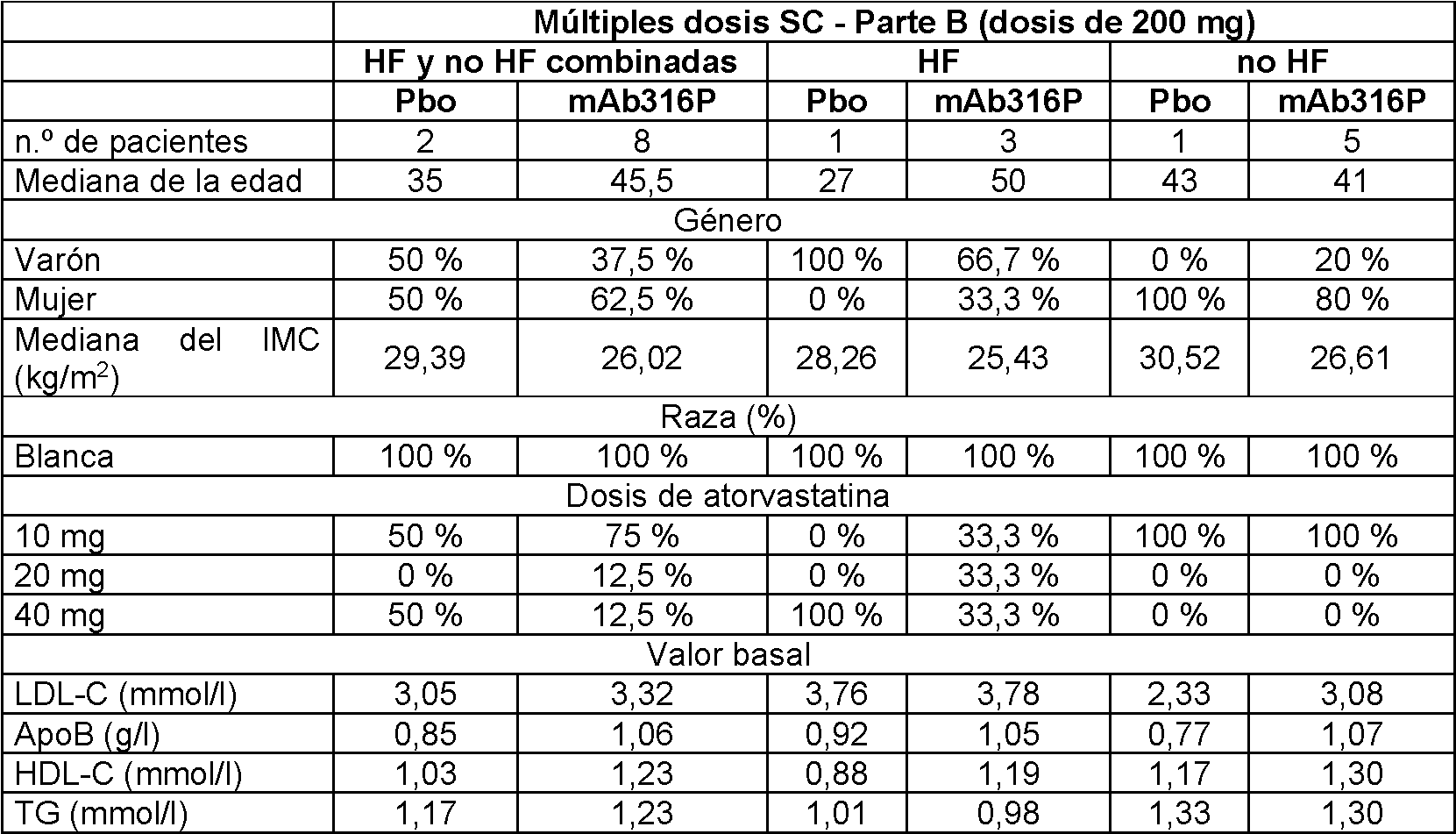
B. Respuesta de los lípidos y las lipoproteínasB. Lipid and lipoprotein response
La administración de una sola dosis IV o SC de mAb316P a voluntarios sanos produjo reducciones porcentuales máximas medias similares en el colesterol LDL, del 55-60 %. El grado y la duración de la reducción del colesterol LDL resultó depender de la dosis, y las reducciones del colesterol LDL se mantuvieron al menos hasta 29 y 22 días después de la administración de niveles de dosis superiores de mAb316P IV o SC, respectivamente. De manera similar, en el estudio de múltiples dosis, la reducción porcentual media desde el valor basal en el colesterol LDL fue dependiente de la dosis y resultó superar el 50 % dos semanas después de la administración de 150 mg en las poblaciones de HF y no HF que recibieron atorvastatina y las poblaciones no HF solo sometidas a dieta. Todos menos 1 sujeto de cada población que recibió 150 mg en el estudio de múltiples dosis experimentó una reducción de al menos el 40 % desde el inicio.Administration of a single IV or SC dose of mAb316P to healthy volunteers produced similar mean maximum percentage reductions in LDL cholesterol of 55-60%. The degree and duration of LDL cholesterol reduction was found to be dose dependent, and LDL cholesterol reductions were sustained for at least 29 and 22 days after administration of higher dose levels of mAb316P IV or SC, respectively. Similarly, in the multi-dose study, the mean percent reduction from baseline in LDL cholesterol was dose dependent and was found to exceed 50% two weeks after 150 mg administration in the HF and non-HF populations. HF receiving atorvastatin and non-HF only dieting populations. All but 1 subject in each population who received 150 mg in the multi-dose study experienced a reduction of at least 40% from baseline.
Los niveles de lípidos y apolipoproteínas basales y del día 57 para todos los grupos de tratamiento de la Parte A del estudio de múltiples dosis se muestran en las Tablas 3A (sujetos tratados con atorvastatina) y 3B (solo dieta, sin tratamiento con atorvastatina). Baseline and day 57 lipid and apolipoprotein levels for all treatment groups from Part A of the multi-dose study are shown in Tables 3A (subjects treated with atorvastatin) and 3B (diet only, no treatment with atorvastatin).
Tabla 3ATable 3A

Tabla 3BTable 3B

La respuesta del colesterol LDL en el día 57 fue similar en todos los sujetos independientemente de si eran HF o no HF, tratados con atorvastatina o solo con dieta. También se observaron cambios correspondientes en el colesterol total y no HDL y Apo B (Tablas 3A y 3B). Es importante destacar que también se observaron reducciones en la Lp(a). Además, en los pacientes que tomaron atorvastatina, se observaron cambios favorables tanto en el colestero1HDL como en la apoA1.The LDL cholesterol response on day 57 was similar in all subjects regardless of whether they were HF or non-HF, treated with atorvastatin or diet alone. Corresponding changes were also observed in total and non-HDL cholesterol and Apo B (Tables 3A and 3B). Importantly, reductions in Lp (a) were also observed. Furthermore, in patients taking atorvastatin, favorable changes were observed in both HDL cholesterol and apoA1.
Se observaron mejoras similares en los pacientes tratados con mAb316P en la Parte B del estudio de múltiples dosis. Es decir, la administración subcutánea de 200 mg de mAb316P indujo rápidas reducciones sustanciales y sostenidas de LDL-C, colesterol total, no HDL-C, apoB, y en la proporción de apoB/apoA. Los pacientes que recibieron 200 mg de mAb316P SC también parecieron demostrar una tendencia hacia niveles más altos de HDL-C y ApoA1.Similar improvements were seen in patients treated with mAb316P in Part B of the multi-dose study. That is, subcutaneous administration of 200 mg of mAb316P induced rapid and sustained substantial reductions in LDL-C, total cholesterol, non-HDL-C, apoB, and in the apoB / apoA ratio. Patients who received 200 mg of mAb316P SC also seemed to show a trend toward higher levels of HDL-C and ApoA1.
AnálisisAnalysis
Este ejemplo describe ensayos en realizados en seres humanos del anticuerpo anti-PCSK9, que se denomina en el presente documento mAb316P, comenzando con dos estudios de una sola dosis ascendente en voluntarios sanos y extendiéndose a un gran ensayo de prueba de concepto de múltiples dosis en pacientes con HF y no HF tratados con una estatina o solo con una dieta. Estos ensayos confirman el potencial de lograr reducciones rápidas y significativas en el colesterol LDL con la inhibición de PCSK9 en la hipercolesterolemia familiar y no familiar, ya sea con una estatina o solo con una dieta. Las poblaciones evaluadas engloban la gran mayoría de los pacientes con hipercolesterolemia. This example describes human trials of the anti-PCSK9 antibody, which is referred to herein as mAb316P, beginning with two ascending single-dose studies in healthy volunteers and extending to a large multi-dose proof-of-concept trial in HF and non-HF patients treated with a statin or diet alone. These trials confirm the potential for achieving rapid and significant reductions in LDL cholesterol with PCSK9 inhibition in familial and non-familial hypercholesterolemia, either with a statin or with diet alone. The populations evaluated include the vast majority of patients with hypercholesterolemia.
El efecto potente y reproducible sobre el colesterol LDL de mAb316P a partir de una sola dosis IV, pasando por una sola dosis SC, hasta múltiples dosis SC se observa en un tiempo inesperadamente corto tras la administración, alcanzando un máximo en aproximadamente 2 semanas. Esta rapidez es superior a la de todas las demás modalidades terapéuticas para la hipercolesterolemia distinta de la eliminación del colesterol LDL mediante aféresis, y es mayor que para las estatinas. El hecho de poderse lograr grandes reducciones de colesterol LDL con mAb316P en pacientes que ya reciben dosis relativamente altas de atorvastatina que se sabe que producen reducciones de colesterol LDL del 40 % al 50 %, distingue claramente el potencial de mAb316P de otras terapias de investigación que se han añadido a las estatinas, tales como ezetimiba, secuestrantes de ácidos biliares e inhibidores del escualeno sintasa. La eficacia reductora del colesterol LDL de mAb316P, combinada con la aparente tolerabilidad y seguridad, destaca las sorprendentes ventajas terapéuticas de mAb316P frente a otros varios agentes reductores de Apo B/lDL-C en desarrollo, tales como los inhibidores no codificantes de Apo B, inhibidores de MTP y análogos de la hormona tiroidea. De hecho, el logro en muchos de los sujetos en estos estudios de niveles bajos de colesterol LDL de 50 mg por decilitro (1,29 mmol/l) o inferiores sin ningún aumento en las transaminasas hepáticas está en marcado contraste con los resultados obtenidos con agentes que inhiben la formación de LDLD y LDL hepática. Los estudios epidemiológicos que demuestran que la subexpresión genética o incluso la ausencia de PCSK9 y los bajos niveles de colesterol LDL durante toda la vida parecen no estar asociados con una morbilidad o mortalidad inesperada, proporcionan un nivel de comodidad con respecto al potencial terapéutico de la inhibición farmacológica de PCSK9. The potent and reproducible effect on LDL cholesterol of mAb316P from a single IV dose, through a single SC dose, up to multiple SC doses is observed in an unexpectedly short time after administration, peaking at approximately 2 weeks. This rapidity is greater than that of all other therapeutic modalities for hypercholesterolemia other than removal of LDL cholesterol by apheresis, and it is greater than for statins. The fact that large reductions in LDL cholesterol can be achieved with mAb316P in patients already receiving relatively high doses of atorvastatin known to produce reductions in LDL cholesterol from 40 % to 50% clearly distinguishes the potential of mAb316P from other investigational therapies that have been added to statins, such as ezetimibe, bile acid sequestrants, and squalene synthase inhibitors. The LDL cholesterol lowering efficacy of mAb316P, combined with the apparent tolerability and safety, highlights the striking therapeutic advantages of mAb316P over several other Apo B / LDL-C lowering agents in development, such as the non-coding Apo B inhibitors, MTP inhibitors and thyroid hormone analogs. In fact, the achievement in many of the subjects in these studies of low LDL cholesterol levels of 50 mg per deciliter (1.29 mmol / L) or less without any increase in liver transaminases is in stark contrast to the results obtained with agents that inhibit the formation of LDLD and hepatic LDL. Epidemiological studies showing that genetic underexpression or even absence of PCSK9 and low levels of LDL cholesterol throughout life appear not to be associated with unexpected morbidity or mortality, provide a comfort level regarding the therapeutic potential of inhibition pharmacology of PCSK9.
Los anticuerpos anti-PCSK9 de la presente invención, tales como el mAb316P, también proporcionan a los pacientes incapaces de tolerar las estatinas (ahora se estima que es aproximadamente del 5 % al 10 % de todos los pacientes tratados con estatinas) una oportunidad significativa para lograr grandes reducciones (al menos del 50 %) en el colesterol LDL. Para muchos de los aproximadamente 10 millones de pacientes en todo el mundo con HF, los anticuerpos anti-PCSK9 de la invención, incluyendo mAb316P, ofrecen la posibilidad real de que su uso junto con las estatinas finalmente logre un control óptimo del colesterol LDL y pueda reducir aún más su riesgo sustancial de padecer una enfermedad cardiovascular precoz y recurrente. Las metodologías terapéuticas desveladas en el presente documento también pueden ofrecer a muchos pacientes la posibilidad de suspender la aféresis de LDL, un procedimiento costoso e invasivo que se ha de realizar cada 2 semanas y que requiere mucho tiempo, que solo proporciona una reducción a corto plazo del colesterol LDL.The anti-PCSK9 antibodies of the present invention, such as mAb316P, also provide patients unable to tolerate statins (now estimated to be approximately 5% to 10% of all statin-treated patients) a significant opportunity to achieve large reductions (at least 50%) in LDL cholesterol. For many of the approximately 10 million patients worldwide with HF, the anti-PCSK9 antibodies of the invention, including mAb316P, offer the real possibility that their use in conjunction with statins will eventually achieve optimal control of LDL cholesterol and may further reduce your substantial risk of early and recurrent cardiovascular disease. The therapeutic methodologies disclosed herein may also offer many patients the ability to discontinue LDL apheresis, an expensive and invasive procedure that has to be performed every 2 weeks and is time consuming, providing only short-term reduction. of LDL cholesterol.
Se observaron efectos beneficiosos inesperados adicionales sobre otros lípidos en el colestero1HDL, la Apo A1 y, lo más sorprendente, la Lp(a) que tendió hacia o alcanzó, la significancia estadística, incluso en los pacientes tratados con atorvastatina. Es importante destacar que antes de ahora, no se ha demostrado clínicamente que los agentes biológicos terapéuticos (por ejemplo, anticuerpos anti-PCSK9) reduzcan la Lp(a), que se creía que no se eliminaba a través del receptor de l Dl . Por lo tanto, los presentes experimentos son la primera demostración de la capacidad de un inhibidor de PCSK9 para reducir los niveles en suero de Lp(a) en pacientes.Additional unexpected beneficial effects on other lipids were seen in HDL cholesterol1, Apo A1 and, most surprisingly, Lp (a) that tended towards or reached statistical significance, even in patients treated with atorvastatin. Importantly, prior to now, therapeutic biological agents (eg, anti-PCSK9 antibodies) have not been clinically shown to reduce Lp (a), which was believed not to be cleared through the l Dl receptor. Therefore, the present experiments are the first demonstration of the ability of a PCSK9 inhibitor to reduce serum levels of Lp (a) in patients.
En cuanto a la seguridad, las reacciones en el sitio de inyección de mAb316P fueron mínimas. El mAb316P también fue, en general, seguro y bien tolerado, sin tendencia a producir eventos adversos relacionados con el fármaco y sin evidencia de hepatotoxicidad ni miotoxicidad. Las pocas elevaciones de CK que se observaron estaban relacionadas con el ejercicio.Regarding safety, reactions at the injection site of mAb316P were minimal. MAb316P was also generally safe and well tolerated, with no tendency to produce drug-related adverse events and no evidence of hepatotoxicity or myotoxicity. The few elevations in CK that were observed were related to exercise.
En resumen, este ejemplo muestra que la inhibición de PCSK9 con mAb316P, además de reducir eficazmente el colesterol LDL en pacientes humanos, sorprendentemente también redujo los niveles de Lp(a).In summary, this example shows that inhibition of PCSK9 with mAb316P, in addition to effectively lowering LDL cholesterol in human patients, surprisingly also reduced Lp (a) levels.
Ejemplo 3: Estudio de 12 semanas, controlado con placebo, con doble ocultación, aleatorizado, sobre la seguridad y eficacia de un anticuerpo monoclonal anti-PCSK9 en pacientes con hipercolesterolemia familiar heterocigóticaExample 3: 12-week, placebo-controlled, double-blind, randomized study on the safety and efficacy of an anti-PCSK9 monoclonal antibody in patients with heterozygous familial hypercholesterolemia
Se realizó un ensayo clínico para evaluar la eficacia de diferentes dosis subcutáneas (SC) y pautas posológicas de mAb316P en suero sobre el colesterol de lipoproteína de baja densidad (LDL-C) y otros lípidos/apolipoproteínas (por ejemplo, colesterol total, colesterol de lipoproteínas de alta densidad, triglicéridos, apo B, Apo A1 y Lp [a]) en pacientes con hipercolesterolemia familiar heterocigótica (HFHe).A clinical trial was conducted to evaluate the efficacy of different subcutaneous (SC) doses and dosing regimens of serum mAb316P on low-density lipoprotein cholesterol (LDL-C) and other lipids / apolipoproteins (e.g., total cholesterol, cholesterol of high-density lipoproteins, triglycerides, apo B, Apo A1 and Lp [a]) in patients with heterozygous familial hypercholesterolemia (HeFH).
Población de pacientesPatient population
La población de pacientes para este estudio incluía varones y mujeres, de edades 18-75 años, quienes fueron diagnosticados de HFHe, que presentaban niveles de LDL-C de 100 mg/dl o superiores, y que estaban recibiendo una dosis de estatina diaria estable (con o sin ezetimiba) al comienzo del estudio. Se excluyeron los pacientes que estaban tomando cualquier compuesto hipolipemiante adicional tal como fibratos, niacina, ácidos grasos omega-3, resinas de ácidos biliares, estanoles vegetales (por ejemplo, Benecol, aceite de linaza, psyllium) o arroz de levadura roja. Un total de 77 pacientes completó el estudio.The patient population for this study included men and women, ages 18-75 years, who were diagnosed with HeFH, who had LDL-C levels of 100 mg / dL or higher, and who were receiving a stable daily dose of statin. (with or without ezetimibe) at the beginning of the study. Patients taking any additional lipid-lowering compounds such as fibrates, niacin, omega-3 fatty acids, bile acid resins, plant stanols (eg Benecol, flaxseed oil, psyllium), or red yeast rice were excluded. A total of 77 patients completed the study.
Formulación farmacológicaPharmacological formulation
La formulación farmacológica comprendía 150 mg/ml de mAb316P, histidina 10 mM, polisorbato 20 al 0,2 %, sacarosa al 10 %, y tenía un pH de 6,0.The drug formulation comprised 150 mg / ml mAb316P, 10 mM histidine, 0.2% polysorbate 20, 10% sucrose, and had a pH of 6.0.
Método de administraciónMethod of administration
La formulación farmacológica (o el placebo) se administró a los pacientes mediante inyección subcutánea en el abdomen. Cada tratamiento incluyó dos inyecciones subcutáneas de 1 ml cada una. The drug formulation (or the placebo) was administered to patients by subcutaneous injection in the abdomen. Each treatment included two subcutaneous injections of 1 ml each.
Regímenes de administraciónAdministration regimes
Los pacientes fueron divididos en cinco grupos. El Grupo 1 incluía 15 pacientes que recibieron placebo una vez cada dos semanas; el Grupo 2 incluía 16 pacientes que recibieron 150 mg de mAb316P una vez cada dos semanas; el Grupo 3 incluía 15 pacientes que recibieron 150 mg de mAb316P una vez cada cuatro semanas; el Grupo 4 incluía 16 pacientes que recibieron 200 mg de mAb316P una vez cada cuatro semanas; y el Grupo 5 incluía 15 pacientes que recibieron 300 mg de mAb316P una vez cada cuatro semanas. La duración del estudio fue de 12 semanas.The patients were divided into five groups. Group 1 included 15 patients who received placebo once every two weeks; Group 2 included 16 patients who received 150 mg of mAb316P once every two weeks; Group 3 included 15 patients who received 150 mg of mAb316P once every four weeks; Group 4 included 16 patients who received 200 mg of mAb316P once every four weeks; and Group 5 included 15 patients who received 300 mg of mAb316P once every four weeks. The duration of the study was 12 weeks.
Evaluación de la eficaciaEffectiveness evaluation
Se recogieron muestras de sangre de los pacientes durante todo el estudio y durante un período de seguimiento de 8 semanas. Las muestras fueron extraídas tras un ayuno de al menos 12 horas (por la mañana antes del consumo de cualquier fármaco). Las mediciones de los siguientes parámetros se determinaron a partir de las muestras de sangre: (1) colesterol total; (2) LDL-C; (3) HDL-C; (4) triglicéridos (TG); (5) Apo B; (6) Apo A1; y (7) Lp(a). La mediana de los cambios porcentuales en estos parámetros en comparación con el placebo al final del estudio (semana 12) se resume en la Tabla 4.Blood samples were collected from the patients throughout the study and during a follow-up period of 8 weeks. The samples were extracted after a fast of at least 12 hours (in the morning before the consumption of any drug). Measurements of the following parameters were determined from the blood samples: (1) total cholesterol; (2) LDL-C; (3) HDL-C; (4) triglycerides (TG); (5) Apo B; (6) Apo A1; and (7) Lp (a). The median percentage changes in these parameters compared to placebo at the end of the study (week 12) is summarized in Table 4.
Tabla 4Table 4

__________________________________________
Ejemplo 4: Estudio de 12 semanas, controlado con placebo, de grupos paralelos, con doble ocultación, aleatorizado, sobre la seguridad y eficacia de un anticuerpo monoclonal anti-PCSK9 en pacientes con hipercolesterolemia primaria en tratamiento estable con atorvastatinaExample 4: 12-week, placebo-controlled, double-blind, randomized, placebo-controlled study of the safety and efficacy of an anti-PCSK9 monoclonal antibody in patients with primary hypercholesterolemia on stable treatment with atorvastatin
Se realizó un ensayo clínico para evaluar la eficacia de pautas de cinco dosis y de dos dosis de mAb316P durante 12 semanas en pacientes con hipercolesterolemia primaria y niveles de LDL-C superiores a 100 mg/dl en tratamiento con atorvastatina estable en curso. La eficacia se evaluó en función de los cambios producidos en el colesterol de lipoproteína de baja densidad (LDL-C) y otros lípidos/apolipoproteínas (por ejemplo, colesterol total, colesterol de lipoproteínas de alta densidad, triglicéridos, apo B, Apo A1, y Lp [a]) en el curso del estudio.A clinical trial was conducted to evaluate the efficacy of 12-week mAb316P 5-dose and 2-dose regimens in patients with primary hypercholesterolaemia and LDL-C levels greater than 100 mg / dL on ongoing stable atorvastatin treatment. Efficacy was evaluated based on changes in low-density lipoprotein cholesterol (LDL-C) and other lipids / apolipoproteins (for example, total cholesterol, high-density lipoprotein cholesterol, triglycerides, apo B, Apo A1, and Lp [a]) in the course of the study.
Población de pacientesPatient population
La población de pacientes para este estudio incluía varones y mujeres, de edades 18-75 años, que habían sido diagnosticados de hipercolesterolemia primaria, que presentaban niveles de LDL-C de 100 mg/dl o superiores, y que habían estado en tratamiento estable con atorvastatina de 10, 20 o 40 mg durante al menos seis semanas antes del inicio del estudio. Se excluyeron los pacientes que estaban tomando cualquier compuesto hipolipemiante adicional tal como fibratos, niacina, ácidos grasos omega-3, resinas de ácidos biliares, estanoles vegetales (por ejemplo, Benecol, aceite de linaza, psyllium) o arroz de levadura roja. Un total de 118 pacientes completó el estudio.The patient population for this study included men and women, ages 18-75 years, who had been diagnosed with primary hypercholesterolemia, who had LDL-C levels of 100 mg / dl or higher, and who had been on stable treatment with atorvastatin 10, 20 or 40 mg for at least six weeks before the start of the study. Patients taking any additional lipid-lowering compounds such as fibrates, niacin, omega-3 fatty acids, bile acid resins, plant stanols (eg Benecol, flaxseed oil, psyllium), or red yeast rice were excluded. A total of 118 patients completed the study.
Formulación farmacológicaPharmacological formulation
La formulación farmacológica comprendía 150 mg/ml de mAb316P, histidina 10 mM, polisorbato 20 al 0,2 %, sacarosa al 10 %, y tenía un pH de 6,0.The drug formulation comprised 150 mg / ml mAb316P, 10 mM histidine, 0.2% polysorbate 20, 10% sucrose, and had a pH of 6.0.
Método de administraciónMethod of administration
La formulación farmacológica (o el placebo) se administró a los pacientes mediante inyección subcutánea en el abdomen. Cada tratamiento incluyó dos inyecciones subcutáneas de 1 ml cada una.The drug formulation (or the placebo) was administered to patients by subcutaneous injection in the abdomen. Each treatment included two subcutaneous injections of 1 ml each.
Regímenes de administraciónAdministration regimes
Los pacientes fueron divididos en seis grupos. El Grupo 1 incluía 20 pacientes que recibieron placebo una vez cada dos semanas; el Grupo 2 incluía 19 pacientes que recibieron 50 mg de mAb316P una vez cada dos semanas; el Grupo 3 incluía 20 pacientes que recibieron 100 mg de mAb316P una vez cada dos semanas; el Grupo 4 incluía 18 pacientes que recibieron 150 mg de mAb316P una vez cada dos semanas; el Grupo 5 incluía 20 pacientes que recibieron 200 mg de mAb316P una vez cada cuatro semanas; y el Grupo 6 incluía 21 pacientes que recibieron 300 mg de mAb316P una vez cada cuatro semanas. La duración del estudio fue de 12 semanas.The patients were divided into six groups. Group 1 included 20 patients who received placebo once every two weeks; Group 2 included 19 patients who received mAb316P 50 mg once every two weeks; the group 3 included 20 patients who received 100 mg of mAb316P once every two weeks; Group 4 included 18 patients who received 150 mg of mAb316P once every two weeks; Group 5 included 20 patients who received 200 mg of mAb316P once every four weeks; and Group 6 included 21 patients who received 300 mg of mAb316P once every four weeks. The duration of the study was 12 weeks.
Evaluación de la eficaciaEffectiveness evaluation
Se recogieron muestras de sangre de los pacientes durante todo el estudio y durante un período de seguimiento de 8 semanas. Las muestras fueron extraídas tras un ayuno de al menos 12 horas (por la mañana antes del consumo de cualquier fármaco). Las mediciones de los siguientes parámetros se determinaron a partir de las muestras de sangre: (1) colesterol total; (2) LDL-C; (3) HDL-C; (4) triglicéridos (TG); (5) Apo B; (6) Apo A1; y (7) Lp(a). La mediana de los cambios porcentuales en estos parámetros en comparación con el placebo al final del estudio (semana 12) se resume en la Tabla 5.Blood samples were collected from the patients throughout the study and during a follow-up period of 8 weeks. The samples were extracted after a fast of at least 12 hours (in the morning before the consumption of any drug). Measurements of the following parameters were determined from the blood samples: (1) total cholesterol; (2) LDL-C; (3) HDL-C; (4) triglycerides (TG); (5) Apo B; (6) Apo A1; and (7) Lp (a). The median percentage changes in these parameters compared to placebo at the end of the study (week 12) is summarized in Table 5.
Tabla 5Table 5

______________________________________________
Ejemplo 5: Estudio de dosis fija, controlado con placebo, de grupos paralelos, con doble ocultación, aleatorizado, sobre la seguridad y eficacia de un anticuerpo monoclonal anti-PCSK9 administrado junto con 80 mg de atorvastatina en pacientes con hipercolesterolemia primariaExample 5: Randomized, double-blind, placebo-controlled, fixed-dose, fixed-dose study on the safety and efficacy of an anti-PCSK9 monoclonal antibody administered together with atorvastatin 80 mg in patients with primary hypercholesterolemia
Se realizó un ensayo clínico para evaluar la eficacia de mAb316P cuando se administró junto con 80 mg de atorvastatina durante 8 semanas en pacientes con hipercolesterolemia primaria y niveles de LDL-C superiores a 100 mg/dl. La eficacia se evaluó en función de los cambios producidos en el colesterol de lipoproteína de baja densidad (LDL-C) y otros lípidos/apolipoproteínas (por ejemplo, colesterol total, colesterol de lipoproteínas de alta densidad, triglicéridos, apo B, Apo A1, y Lp [a]) en el curso del estudio.A clinical trial was conducted to evaluate the efficacy of mAb316P when co-administered with atorvastatin 80 mg for 8 weeks in patients with primary hypercholesterolaemia and LDL-C levels above 100 mg / dL. Efficacy was evaluated based on changes in low-density lipoprotein cholesterol (LDL-C) and other lipids / apolipoproteins (for example, total cholesterol, high-density lipoprotein cholesterol, triglycerides, apo B, Apo A1, and Lp [a]) in the course of the study.
Población de pacientesPatient population
La población de pacientes para este estudio incluía varones y mujeres, de edades 18-75 años, que habían sido diagnosticados de hipercolesterolemia primaria, que presentaban niveles de LDL-C de 100 mg/dl o superiores, y que habían estado en tratamiento estable con atorvastatina de 10 mg durante al menos seis semanas antes del inicio del estudio. Se excluyeron los pacientes que estaban tomando cualquier compuesto hipolipemiante adicional tal como fibratos, niacina, ácidos grasos omega-3, resinas de ácidos biliares, estanoles vegetales (por ejemplo, Benecol, aceite de linaza, psyllium) o arroz de levadura roja. Un total de 88 pacientes completó el estudio.The patient population for this study included men and women, ages 18-75 years, who had been diagnosed with primary hypercholesterolemia, who had LDL-C levels of 100 mg / dl or higher, and who had been on stable treatment with atorvastatin 10 mg for at least six weeks before the start of the study. Patients taking any additional lipid-lowering compounds such as fibrates, niacin, omega-3 fatty acids, bile acid resins, plant stanols (eg Benecol, flaxseed oil, psyllium), or red yeast rice were excluded. A total of 88 patients completed the study.
Formulación farmacológicaPharmacological formulation
La formulación farmacológica comprendía 150 mg/ml de mAb316P, histidina 10 mM, polisorbato 20 al 0,2 %, sacarosa al 10 %, y tenía un pH de 6,0.The drug formulation comprised 150 mg / ml mAb316P, 10 mM histidine, 0.2% polysorbate 20, 10% sucrose, and had a pH of 6.0.
Método de administraciónMethod of administration
La formulación farmacológica (o el placebo) se administró a los pacientes mediante inyección subcutánea en el abdomen. Cada tratamiento incluyó una inyección subcutánea de 1 ml.The drug formulation (or the placebo) was administered to patients by subcutaneous injection in the abdomen. Each treatment included a 1 ml subcutaneous injection.
Regímenes de administraciónAdministration regimes
Los pacientes fueron divididos en tres grupos. El Grupo 1 incluía 29 pacientes que recibieron placebo una vez cada dos semanas más 80 mg de atorvastatina diariamente; el Grupo 2 incluía 30 pacientes que recibieron 150 mg de mAb316P una vez cada dos semanas más 80 mg de atorvastatina al día; y el Grupo 3 incluía 29 pacientes que recibieron 150 mg de mAb316P una vez cada dos semanas más 10 mg de atorvastatina al día. La duración del estudio fue de 8 semanas. The patients were divided into three groups. Group 1 included 29 patients who received placebo once every two weeks plus atorvastatin 80 mg daily; Group 2 included 30 patients who received 150 mg of mAb316P once every two weeks plus 80 mg of atorvastatin daily; and Group 3 included 29 patients who received 150 mg of mAb316P once every two weeks plus 10 mg of atorvastatin daily. The duration of the study was 8 weeks.
Claims (12)
Applications Claiming Priority (4)
| Application Number | Priority Date | Filing Date | Title |
|---|---|---|---|
| US201161535392P | 2011-09-16 | 2011-09-16 | |
| US201161559162P | 2011-11-14 | 2011-11-14 | |
| US201261641321P | 2012-05-02 | 2012-05-02 | |
| PCT/US2012/054756 WO2013039969A1 (en) | 2011-09-16 | 2012-09-12 | METHODS FOR REDUCING LIPOPROTEIN(a) LEVELS BY ADMINISTERING AN INHIBITOR OF PROPROTEIN CONVERTASE SUBTILISIN KEXIN-9 (PCSK9) |
Publications (1)
| Publication Number | Publication Date |
|---|---|
| ES2773111T3 true ES2773111T3 (en) | 2020-07-09 |
Family
ID=46881178
Family Applications (3)
| Application Number | Title | Priority Date | Filing Date |
|---|---|---|---|
| ES23176223T Active ES2992345T3 (en) | 2011-09-16 | 2012-09-12 | Methods for reducing lipoprotein(a) levels by administering a proprotein convertase subtilisin kexin-9 (PCSK9) inhibitor |
| ES12761864T Active ES2773111T3 (en) | 2011-09-16 | 2012-09-12 | Proprotein convertase subtilisin / kexin 9 inhibitor (PCSK9) for use in reducing lipoprotein levels (a) |
| ES19162319T Active ES2953713T3 (en) | 2011-09-16 | 2012-09-12 | Methods to reduce lipoprotein(a) levels by administering a proprotein convertase subtilisin kexin-9 (PCSK9) inhibitor |
Family Applications Before (1)
| Application Number | Title | Priority Date | Filing Date |
|---|---|---|---|
| ES23176223T Active ES2992345T3 (en) | 2011-09-16 | 2012-09-12 | Methods for reducing lipoprotein(a) levels by administering a proprotein convertase subtilisin kexin-9 (PCSK9) inhibitor |
Family Applications After (1)
| Application Number | Title | Priority Date | Filing Date |
|---|---|---|---|
| ES19162319T Active ES2953713T3 (en) | 2011-09-16 | 2012-09-12 | Methods to reduce lipoprotein(a) levels by administering a proprotein convertase subtilisin kexin-9 (PCSK9) inhibitor |
Country Status (26)
| Country | Link |
|---|---|
| US (2) | US10076571B2 (en) |
| EP (4) | EP4461373A3 (en) |
| JP (2) | JP6158813B2 (en) |
| KR (1) | KR101964031B1 (en) |
| CN (2) | CN103930444B (en) |
| AR (1) | AR087881A1 (en) |
| AU (1) | AU2012308797B2 (en) |
| BR (1) | BR112014005522A2 (en) |
| CA (1) | CA2848201C (en) |
| CL (1) | CL2014000605A1 (en) |
| CO (1) | CO6910163A2 (en) |
| EA (1) | EA028278B1 (en) |
| ES (3) | ES2992345T3 (en) |
| HR (1) | HRP20241450T1 (en) |
| HU (1) | HUE069234T2 (en) |
| IL (1) | IL231011B (en) |
| MA (1) | MA35430B1 (en) |
| MX (1) | MX363642B (en) |
| MY (1) | MY170089A (en) |
| PH (1) | PH12014500342B1 (en) |
| PL (1) | PL4252857T3 (en) |
| RS (1) | RS66342B1 (en) |
| SG (1) | SG2014010524A (en) |
| TW (1) | TWI601740B (en) |
| WO (1) | WO2013039969A1 (en) |
| ZA (1) | ZA201401114B (en) |
Families Citing this family (55)
| Publication number | Priority date | Publication date | Assignee | Title |
|---|---|---|---|---|
| JOP20080381B1 (en) | 2007-08-23 | 2023-03-28 | Amgen Inc | Antigen Binding Proteins to Proprotein Convertase subtillisin Kexin type 9 (pcsk9) |
| US20130064834A1 (en) | 2008-12-15 | 2013-03-14 | Regeneron Pharmaceuticals, Inc. | Methods for treating hypercholesterolemia using antibodies to pcsk9 |
| JO3672B1 (en) * | 2008-12-15 | 2020-08-27 | Regeneron Pharma | High Affinity Human Antibodies to PCSK9 |
| SG192117A1 (en) | 2011-01-28 | 2013-08-30 | Sanofi Sa | Human antibodies to pcsk9 for use in methods of treating particular groups of subjects |
| JOP20200043A1 (en) | 2011-05-10 | 2017-06-16 | Amgen Inc | Ways to treat or prevent cholesterol disorders |
| AR087305A1 (en) | 2011-07-28 | 2014-03-12 | Regeneron Pharma | STABILIZED FORMULATIONS CONTAINING ANTI-PCSK9 ANTIBODIES, PREPARATION METHOD AND KIT |
| HUE069234T2 (en) | 2011-09-16 | 2025-02-28 | Regeneron Pharma | Methods for reducing lipoprotein(a) levels by administering an inhibitor of proprotein convertase subtilisin kexin-9 (pcsk9) |
| EA039663B1 (en) | 2012-05-03 | 2022-02-24 | Амген Инк. | Use of an anti-pcsk9 antibody for lowering serum cholesterol ldl and treating cholesterol related disorders |
| US9255154B2 (en) | 2012-05-08 | 2016-02-09 | Alderbio Holdings, Llc | Anti-PCSK9 antibodies and use thereof |
| EP2986599A1 (en) | 2013-04-17 | 2016-02-24 | Pfizer Inc. | N-piperidin-3-ylbenzamide derivatives for treating cardiovascular diseases |
| US10111953B2 (en) * | 2013-05-30 | 2018-10-30 | Regeneron Pharmaceuticals, Inc. | Methods for reducing remnant cholesterol and other lipoprotein fractions by administering an inhibitor of proprotein convertase subtilisin kexin-9 (PCSK9) |
| TWI682780B (en) * | 2013-05-30 | 2020-01-21 | 美商再生元醫藥公司 | Use of a pharmaceutical composition for the manufacture of a medicament for treating autosomal dominant hypercholesterolemia associated with pcsk9 gain-of-function mutations |
| US10494442B2 (en) | 2013-06-07 | 2019-12-03 | Sanofi Biotechnology | Methods for inhibiting atherosclerosis by administering an inhibitor of PCSK9 |
| ES2914978T3 (en) * | 2013-10-11 | 2022-06-20 | Sanofi Biotechnology | Use of a PCSK9 inhibitor to treat hyperlipidemia |
| CN118105480A (en) | 2013-11-12 | 2024-05-31 | 赛诺菲生物技术公司 | Dosing regimen for use with PCSK9 inhibitors |
| US8980273B1 (en) | 2014-07-15 | 2015-03-17 | Kymab Limited | Method of treating atopic dermatitis or asthma using antibody to IL4RA |
| US8986694B1 (en) | 2014-07-15 | 2015-03-24 | Kymab Limited | Targeting human nav1.7 variants for treatment of pain |
| US9051378B1 (en) | 2014-07-15 | 2015-06-09 | Kymab Limited | Targeting rare human PCSK9 variants for cholesterol treatment |
| US9045548B1 (en) | 2014-07-15 | 2015-06-02 | Kymab Limited | Precision Medicine by targeting rare human PCSK9 variants for cholesterol treatment |
| US9914769B2 (en) | 2014-07-15 | 2018-03-13 | Kymab Limited | Precision medicine for cholesterol treatment |
| US8986691B1 (en) | 2014-07-15 | 2015-03-24 | Kymab Limited | Method of treating atopic dermatitis or asthma using antibody to IL4RA |
| US9067998B1 (en) | 2014-07-15 | 2015-06-30 | Kymab Limited | Targeting PD-1 variants for treatment of cancer |
| US9045545B1 (en) | 2014-07-15 | 2015-06-02 | Kymab Limited | Precision medicine by targeting PD-L1 variants for treatment of cancer |
| US8883157B1 (en) | 2013-12-17 | 2014-11-11 | Kymab Limited | Targeting rare human PCSK9 variants for cholesterol treatment |
| US9017678B1 (en) | 2014-07-15 | 2015-04-28 | Kymab Limited | Method of treating rheumatoid arthritis using antibody to IL6R |
| US8992927B1 (en) | 2014-07-15 | 2015-03-31 | Kymab Limited | Targeting human NAV1.7 variants for treatment of pain |
| US9023359B1 (en) | 2014-07-15 | 2015-05-05 | Kymab Limited | Targeting rare human PCSK9 variants for cholesterol treatment |
| DE112014005975T5 (en) * | 2013-12-17 | 2016-09-15 | Kymab Limited | Human goals |
| US8945560B1 (en) | 2014-07-15 | 2015-02-03 | Kymab Limited | Method of treating rheumatoid arthritis using antibody to IL6R |
| US9034332B1 (en) | 2014-07-15 | 2015-05-19 | Kymab Limited | Precision medicine by targeting rare human PCSK9 variants for cholesterol treatment |
| EA201691320A1 (en) * | 2014-02-14 | 2016-11-30 | Ридженерон Фармасьютикалз, Инк. | METHODS OF TREATMENT OF PATIENTS WITH HYPERSHOLESTERINEMIA, WHICH STABLE TO THERAPY WITH MODERN STATIN DOSES THERAPY |
| GB201403775D0 (en) | 2014-03-04 | 2014-04-16 | Kymab Ltd | Antibodies, uses & methods |
| EP3134431B1 (en) | 2014-04-25 | 2021-04-07 | The Trustees Of The University Of Pennsylvania | Ldlr variants and their use in compositions for reducing cholesterol levels |
| US9150660B1 (en) | 2014-07-15 | 2015-10-06 | Kymab Limited | Precision Medicine by targeting human NAV1.8 variants for treatment of pain |
| US9139648B1 (en) | 2014-07-15 | 2015-09-22 | Kymab Limited | Precision medicine by targeting human NAV1.9 variants for treatment of pain |
| KR20230074283A (en) * | 2014-07-16 | 2023-05-26 | 사노피 바이오테크놀로지 | METHODS FOR TREATING PATIENTS WITH HETEROZYGOUS FAMILIAL HYPERCHOLESTEROLEMIA(heFH) |
| CA2955304C (en) * | 2014-07-16 | 2023-12-12 | Sanofi Biotechnology | Methods for treating high cardiovascular risk patients with hypercholesterolemia |
| EP3267989A4 (en) | 2015-03-13 | 2018-11-07 | Esperion Therapeutics, Inc. | Fixed dose combinations and formulations comprising etc1002 and ezetimibe and methods of treating or reducing the risk of cardiovascular disease |
| JP2018523684A (en) | 2015-08-18 | 2018-08-23 | リジェネロン・ファーマシューティカルズ・インコーポレイテッドRegeneron Pharmaceuticals, Inc. | Anti-PCSK9 inhibitory antibody for treating hyperlipidemic patients undergoing lipoprotein apheresis |
| AU2016366560A1 (en) | 2015-12-11 | 2018-06-28 | The Trustees Of The University Of Pennsylvania | Gene therapy for treating familial hypercholesterolemia |
| EP3398968B1 (en) | 2015-12-31 | 2024-06-12 | Jiangsu Hengrui Medicine Co., Ltd. | Pcsk9 antibody, antigen-binding fragment thereof, and medicinal application thereof |
| CN107531795B (en) | 2016-01-05 | 2021-01-19 | 江苏恒瑞医药股份有限公司 | PCSK9 antibody, antigen-binding fragment thereof and medical application thereof |
| US10858422B2 (en) | 2016-05-31 | 2020-12-08 | Abcentra, Llc | Methods for treating systemic lupus erythematosus with an anti-apolipoprotein B antibody |
| CN107474140B (en) * | 2016-06-08 | 2022-06-03 | 常州博嘉生物医药科技有限公司 | PCSK9 specific binding protein MV072 and application thereof |
| RU2769282C2 (en) | 2016-06-20 | 2022-03-30 | Кимаб Лимитед | Anti-pd-l1 and il-2 cytokines |
| WO2018022511A1 (en) | 2016-07-25 | 2018-02-01 | The Trustees Of The University Of Pennsylvania | Compositions comprising a lecithin cholesterol acyltransferase variant and uses thereof |
| JP7103748B2 (en) * | 2016-10-05 | 2022-07-20 | サッポロビール株式会社 | PCSK9 inhibitor and food composition for improving cholesterol metabolism |
| EP3534947A1 (en) | 2016-11-03 | 2019-09-11 | Kymab Limited | Antibodies, combinations comprising antibodies, biomarkers, uses & methods |
| JP2020510648A (en) * | 2017-02-20 | 2020-04-09 | ザ・トラステイーズ・オブ・ザ・ユニバーシテイ・オブ・ペンシルベニア | Gene therapy to treat familial hypercholesterolemia |
| JP7050807B2 (en) | 2017-04-13 | 2022-04-08 | カディラ ヘルスケア リミティド | New peptide-based PCSK9 vaccine |
| TW201945401A (en) * | 2018-03-06 | 2019-12-01 | 法商賽諾菲生物技術公司 | Methods for reducing cardiovascular risk |
| WO2020010024A1 (en) * | 2018-07-02 | 2020-01-09 | Abcentra, Llc | Compositions and methods for reduction of lipoprotein a formation and treatment of aortic valve sclerosis and aortic stenosis |
| BR112021013807A2 (en) | 2019-01-18 | 2021-11-30 | Astrazeneca Ab | pcsk9 inhibitors and their methods of use |
| CA3160636A1 (en) | 2019-11-12 | 2021-05-20 | Abcentra, Llc | Methods and compositions for treating cancer |
| WO2021119321A1 (en) | 2019-12-10 | 2021-06-17 | Regeneron Pharmaceuticals, Inc. | Use of a pcsk9 inhibitor to treat homozygous familial hypercholesterolemia |
Family Cites Families (116)
| Publication number | Priority date | Publication date | Assignee | Title |
|---|---|---|---|---|
| FI94339C (en) | 1989-07-21 | 1995-08-25 | Warner Lambert Co | Process for the preparation of pharmaceutically acceptable [R- (R *, R *)] - 2- (4-fluorophenyl) -, - dihydroxy-5- (1-methylethyl) -3-phenyl-4 - [(phenylamino) carbonyl] -1H- for the preparation of pyrrole-1-heptanoic acid and its pharmaceutically acceptable salts |
| DE69120146T2 (en) | 1990-01-12 | 1996-12-12 | Cell Genesys Inc | GENERATION OF XENOGENIC ANTIBODIES |
| JP2648897B2 (en) | 1991-07-01 | 1997-09-03 | 塩野義製薬株式会社 | Pyrimidine derivatives |
| AU2309692A (en) | 1991-07-03 | 1993-02-11 | Cryolife, Inc. | Method for stabilization of biomaterials |
| WO1993022336A1 (en) | 1992-04-30 | 1993-11-11 | Alpha Therapeutic Corporation | Improved solubilization and stabilization of factor viii complex |
| US6177401B1 (en) | 1992-11-13 | 2001-01-23 | Max-Planck-Gesellschaft Zur Forderung Der Wissenschaften | Use of organic compounds for the inhibition of Flk-1 mediated vasculogenesis and angiogenesis |
| GB9410534D0 (en) | 1994-05-26 | 1994-07-13 | Lynxvale Ltd | Improvements in or relating to growth factor inhibitors |
| US6685940B2 (en) | 1995-07-27 | 2004-02-03 | Genentech, Inc. | Protein formulation |
| US6267958B1 (en) | 1995-07-27 | 2001-07-31 | Genentech, Inc. | Protein formulation |
| JPH09154588A (en) | 1995-10-07 | 1997-06-17 | Toagosei Co Ltd | VEGF binding polypeptide |
| CA2250570A1 (en) | 1996-03-26 | 1997-10-02 | Eli Lilly And Company | Formulations of ob protein |
| US6100071A (en) | 1996-05-07 | 2000-08-08 | Genentech, Inc. | Receptors as novel inhibitors of vascular endothelial growth factor activity and processes for their production |
| EP0852951A1 (en) | 1996-11-19 | 1998-07-15 | Roche Diagnostics GmbH | Stable lyophilized monoclonal or polyclonal antibodies containing pharmaceuticals |
| US7312196B2 (en) | 1997-01-08 | 2007-12-25 | Amylin Pharmaceuticals, Inc. | Formulations for amylin agonist peptides |
| US20070224663A1 (en) | 1997-03-07 | 2007-09-27 | Human Genome Sciences, Inc. | Human Secreted Proteins |
| US6171586B1 (en) | 1997-06-13 | 2001-01-09 | Genentech, Inc. | Antibody formulation |
| JP4549529B2 (en) | 1998-01-30 | 2010-09-22 | サイオス,インコーポレーテッド | Controlled release delivery of peptides or proteins |
| US7001892B1 (en) | 1999-06-11 | 2006-02-21 | Purdue Research Foundation | Pharmaceutical materials and methods for their preparation and use |
| EP1514933A1 (en) | 1999-07-08 | 2005-03-16 | Research Association for Biotechnology | Secretory protein or membrane protein |
| US7129338B1 (en) | 1999-07-08 | 2006-10-31 | Research Association For Biotechnology | Secretory protein or membrane protein |
| US7029895B2 (en) | 1999-09-27 | 2006-04-18 | Millennium Pharmaceuticals, Inc. | 27411, a novel human PGP synthase |
| EP1257572A2 (en) | 2000-02-07 | 2002-11-20 | Millennium Pharmaceuticals, Inc. | Narc-1, subtilase-like homologs |
| US6659982B2 (en) | 2000-05-08 | 2003-12-09 | Sterling Medivations, Inc. | Micro infusion drug delivery device |
| US6629949B1 (en) | 2000-05-08 | 2003-10-07 | Sterling Medivations, Inc. | Micro infusion drug delivery device |
| DK2990420T3 (en) | 2000-05-26 | 2017-04-03 | Immunex Corp | USE OF INTERLEUKIN-4 RECEPTOR ANTIBODIES AND COMPOSITIONS THEREOF |
| MXPA03002045A (en) | 2000-09-08 | 2003-07-24 | Amgen Inc | G-csf analog compositions and methods. |
| AU2002213441B2 (en) | 2000-10-12 | 2006-10-26 | Genentech, Inc. | Reduced-viscosity concentrated protein formulations |
| US6596541B2 (en) | 2000-10-31 | 2003-07-22 | Regeneron Pharmaceuticals, Inc. | Methods of modifying eukaryotic cells |
| US20030133939A1 (en) | 2001-01-17 | 2003-07-17 | Genecraft, Inc. | Binding domain-immunoglobulin fusion proteins |
| US7754208B2 (en) | 2001-01-17 | 2010-07-13 | Trubion Pharmaceuticals, Inc. | Binding domain-immunoglobulin fusion proteins |
| MXPA04000747A (en) | 2001-07-25 | 2004-07-08 | Protein Desing Labs Inc | Stable lyophilized pharmaceutical formulation of igg antibodies. |
| US20040101920A1 (en) | 2002-11-01 | 2004-05-27 | Czeslaw Radziejewski | Modification assisted profiling (MAP) methodology |
| AU2003293543A1 (en) | 2002-12-13 | 2004-07-09 | Abgenix, Inc. | System and method for stabilizing antibodies with histidine |
| MXPA05010555A (en) | 2003-04-04 | 2006-03-09 | Genentech Inc | High concentration antibody and protein formulations. |
| EP1471152A1 (en) | 2003-04-25 | 2004-10-27 | Institut National De La Sante Et De La Recherche Medicale (Inserm) | Mutations in the human PCSK9 gene associated to hypercholesterolemia |
| DE602004028115D1 (en) | 2003-05-02 | 2010-08-26 | Univ College Cork Nat Univ Ie | LIGHT-EMITTING MESASTRUCTURES OF HIGH HEIGHT-TO-WIDE RATIO AND QUASI-PARABOLIC SIDE WALLS AND THEIR PRODUCTION |
| BRPI0416603A (en) | 2003-11-07 | 2007-01-30 | Immunex Corp | antibody that binds to the human interleukin-4 (il-4) receptor |
| US7850962B2 (en) | 2004-04-20 | 2010-12-14 | Genmab A/S | Human monoclonal antibodies against CD20 |
| US20060147945A1 (en) | 2005-01-06 | 2006-07-06 | Edmonds Brian T | Novel secreted proteins and their uses |
| ES2366974T3 (en) | 2006-05-05 | 2011-10-27 | Isis Pharmaceuticals, Inc. | COMPOUNDS AND PROCEDURES TO MODULATE THE EXPRESSION OF SGLT2. |
| JP2009536222A (en) | 2006-05-05 | 2009-10-08 | アイシス ファーマシューティカルズ, インコーポレーテッド | Compounds and methods for modulating the expression of PCSK9 |
| CA2654510C (en) | 2006-06-16 | 2015-03-17 | Regeneron Pharmaceuticals, Inc. | Vegf antagonist formulations suitable for intravitreal administration |
| US7572618B2 (en) | 2006-06-30 | 2009-08-11 | Bristol-Myers Squibb Company | Polynucleotides encoding novel PCSK9 variants |
| MY149079A (en) | 2006-10-02 | 2013-07-15 | Regeneron Pharma | High affinity human antibodies to human il-4 receptor |
| US7608693B2 (en) | 2006-10-02 | 2009-10-27 | Regeneron Pharmaceuticals, Inc. | High affinity human antibodies to human IL-4 receptor |
| US20100040610A1 (en) | 2006-11-07 | 2010-02-18 | Ayesha Sitlani | Antagonists of pcsk9 |
| US20100040611A1 (en) | 2006-11-07 | 2010-02-18 | Sparrow Carl P | Antagonists of pcsk9 |
| WO2008057458A2 (en) | 2006-11-07 | 2008-05-15 | Merck & Co., Inc. | Antagonists of pcsk9 |
| WO2008057459A2 (en) | 2006-11-07 | 2008-05-15 | Merck & Co., Inc. | Antagonists of pcsk9 |
| US8093222B2 (en) * | 2006-11-27 | 2012-01-10 | Isis Pharmaceuticals, Inc. | Methods for treating hypercholesterolemia |
| CA2670563A1 (en) | 2006-11-27 | 2008-06-05 | Isis Pharmaceuticals, Inc. | Methods for treating hypercholesterolemia |
| WO2008073300A2 (en) | 2006-12-08 | 2008-06-19 | Lexicon Pharmaceuticals, Inc. | Monoclonal antibodies against angptl3 |
| EA200901376A1 (en) * | 2007-04-13 | 2010-12-30 | Новартис Аг | MOLECULES AND METHODS OF MODULATION PROPROTEINKONVERTASY SUBTILYZIN / KEKINOVYY TYPE 9 (PCSK9) |
| CN101687927B (en) | 2007-05-15 | 2013-10-30 | 霍夫曼-拉罗奇有限公司 | Antibody directed to G protein coupled receptors (GPCR) |
| JOP20080381B1 (en) | 2007-08-23 | 2023-03-28 | Amgen Inc | Antigen Binding Proteins to Proprotein Convertase subtillisin Kexin type 9 (pcsk9) |
| US20100286021A1 (en) | 2007-09-25 | 2010-11-11 | Qun-Yong Zhou | Methods of Modulating Prokineticin 2 for Treatment of Stress Response and Anxiety-Related Disorders |
| NZ584902A (en) | 2007-10-26 | 2012-03-30 | Schering Corp | Anti-pcsk9 and methods for treating lipid and cholesterol disorders |
| AR070315A1 (en) | 2008-02-07 | 2010-03-31 | Merck & Co Inc | ANTIBODIES 1B20 ANTAGONISTS OF PCSK9 |
| AR070316A1 (en) | 2008-02-07 | 2010-03-31 | Merck & Co Inc | PCSK9 ANTAGONISTS (SUBTILISINE-KEXINA TYPE 9 PROPROTEIN) |
| KR102057826B1 (en) | 2008-04-11 | 2019-12-20 | 추가이 세이야쿠 가부시키가이샤 | Antigen-binding molecule capable of binding to two or more antigen molecules repeatedly |
| TWI516501B (en) | 2008-09-12 | 2016-01-11 | 禮納特神經系統科學公司 | Pcsk9 antagonists |
| PT2331090T (en) | 2008-09-19 | 2018-02-07 | Pfizer | Stable liquid antibody formulation |
| TWI440469B (en) | 2008-09-26 | 2014-06-11 | Chugai Pharmaceutical Co Ltd | Improved antibody molecules |
| US8357371B2 (en) | 2008-12-15 | 2013-01-22 | Regeneron Pharmaceuticals, Inc. | Methods for treating hypercholesterolemia using antibodies to PCSK9 |
| US20130064834A1 (en) | 2008-12-15 | 2013-03-14 | Regeneron Pharmaceuticals, Inc. | Methods for treating hypercholesterolemia using antibodies to pcsk9 |
| JO3672B1 (en) | 2008-12-15 | 2020-08-27 | Regeneron Pharma | High Affinity Human Antibodies to PCSK9 |
| AU2010221156A1 (en) | 2009-03-06 | 2011-09-22 | Genentech, Inc. | Antibody formulation |
| JP2012530721A (en) | 2009-06-18 | 2012-12-06 | ワイス・エルエルシー | Lyophilized formulations for small module immunity drugs |
| WO2011028938A1 (en) | 2009-09-02 | 2011-03-10 | Alnylam Pharmaceuticals, Inc. | Methods for lowering serum cholestrol in a subject using inhibition of pcsk9 |
| US20120219558A1 (en) | 2009-09-25 | 2012-08-30 | Yan Ni | Antagonists of pcsk9 |
| WO2011039578A1 (en) | 2009-10-02 | 2011-04-07 | INSERM (Institut National de la Santé et de la Recherche Médicale) | Combination of spla2 activity and lp(a) cardiovascular risk factors for the diagnosis/prognosis of a cardiovascular disease/event |
| IN2012DN03824A (en) | 2009-10-30 | 2015-08-28 | Merck Sharp & Dohme | |
| CN102596249A (en) | 2009-10-30 | 2012-07-18 | 默沙东公司 | AX1 and AX189 PCSK9 antagonists and variants |
| EP2501408B1 (en) | 2009-11-20 | 2020-05-27 | Biocon Limited | Formulations of antibody |
| AR079336A1 (en) | 2009-12-11 | 2012-01-18 | Irm Llc | ANTAGONISTS OF THE PRO-PROTEIN CONVERTASE-SUBTILISINE / TYPE 9 QUEXINE (PCSK9) |
| JO3417B1 (en) | 2010-01-08 | 2019-10-20 | Regeneron Pharma | Stabilized formulations containing anti-interleukin-6 receptor (il-6r) antibodies |
| JP5932670B2 (en) | 2010-03-11 | 2016-06-08 | ライナット ニューロサイエンス コーポレイション | Antibody with pH-dependent antigen binding |
| GB201005005D0 (en) | 2010-03-25 | 2010-05-12 | Angeletti P Ist Richerche Bio | New vaccine |
| NZ609557A (en) | 2010-10-06 | 2014-12-24 | Regeneron Pharma | Stabilized formulations containing anti-interleukin-4 receptor (il-4r) antibodies |
| WO2012054438A1 (en) | 2010-10-22 | 2012-04-26 | Schering Corporation | Anti-pcsk9 |
| US9518132B2 (en) | 2010-11-09 | 2016-12-13 | Altimab Therapeutics, Inc. | Protein complexes for antigen binding and methods of use |
| US8771696B2 (en) | 2010-11-23 | 2014-07-08 | Regeneron Pharmaceuticals, Inc. | Method of reducing the severity of stress hyperglycemia with human antibodies to the glucagon receptor |
| JO3756B1 (en) | 2010-11-23 | 2021-01-31 | Regeneron Pharma | Human antibodies to the glucagon receptor |
| CN103261230A (en) | 2010-12-22 | 2013-08-21 | 霍夫曼-拉罗奇有限公司 | Anti-PCSK9 antibodies and methods of use |
| SG192117A1 (en) | 2011-01-28 | 2013-08-30 | Sanofi Sa | Human antibodies to pcsk9 for use in methods of treating particular groups of subjects |
| WO2012109530A1 (en) | 2011-02-11 | 2012-08-16 | Irm Llc | Pcsk9 antagonists |
| AR088782A1 (en) | 2011-04-29 | 2014-07-10 | Sanofi Sa | TEST SYSTEMS AND METHODS TO IDENTIFY AND CHARACTERIZE HYPOLIPEMIATING PHARMACOS |
| JOP20200043A1 (en) * | 2011-05-10 | 2017-06-16 | Amgen Inc | Ways to treat or prevent cholesterol disorders |
| US20140004122A1 (en) | 2011-05-10 | 2014-01-02 | Amgen Inc. | Methods for treating or preventing cholesterol related disorders |
| BR112014000392A2 (en) | 2011-07-14 | 2017-02-21 | Pfizer | anti-pcsk9 antibody treatment |
| AR087305A1 (en) | 2011-07-28 | 2014-03-12 | Regeneron Pharma | STABILIZED FORMULATIONS CONTAINING ANTI-PCSK9 ANTIBODIES, PREPARATION METHOD AND KIT |
| AR087715A1 (en) | 2011-09-16 | 2014-04-09 | Lilly Co Eli | ANTI PCSK9 ANTIBODIES AND USES OF THE SAME |
| HUE069234T2 (en) | 2011-09-16 | 2025-02-28 | Regeneron Pharma | Methods for reducing lipoprotein(a) levels by administering an inhibitor of proprotein convertase subtilisin kexin-9 (pcsk9) |
| WO2013158984A1 (en) | 2012-04-19 | 2013-10-24 | Acetylon Pharmaceuticals, Inc. | Biomarkers to identify patients that will respond to treatment and treating such patients |
| EA039663B1 (en) | 2012-05-03 | 2022-02-24 | Амген Инк. | Use of an anti-pcsk9 antibody for lowering serum cholesterol ldl and treating cholesterol related disorders |
| US9255154B2 (en) | 2012-05-08 | 2016-02-09 | Alderbio Holdings, Llc | Anti-PCSK9 antibodies and use thereof |
| KR20150059638A (en) | 2012-05-25 | 2015-06-01 | 카타베이시스 파마슈티칼즈, 인코포레이티드 | Methods of lowering proprotein convertase subtilisin/kexin type 9(pcsk9) |
| US9540449B2 (en) | 2012-08-13 | 2017-01-10 | Regeneron Pharmaceuticals, Inc. | Anti-PCSK9 antibodies with pH-dependent binding characteristics |
| EP2703008A1 (en) | 2012-08-31 | 2014-03-05 | Sanofi | Human antibodies to PCSK9 for use in methods of treating particular groups of subjects |
| EP2703009A1 (en) | 2012-08-31 | 2014-03-05 | Sanofi | Combination treatments involving antibodies to human PCSK9 |
| EP2706070A1 (en) | 2012-09-06 | 2014-03-12 | Sanofi | Combination treatments involving antibodies to human PCSK9 |
| TWI682780B (en) | 2013-05-30 | 2020-01-21 | 美商再生元醫藥公司 | Use of a pharmaceutical composition for the manufacture of a medicament for treating autosomal dominant hypercholesterolemia associated with pcsk9 gain-of-function mutations |
| US10111953B2 (en) | 2013-05-30 | 2018-10-30 | Regeneron Pharmaceuticals, Inc. | Methods for reducing remnant cholesterol and other lipoprotein fractions by administering an inhibitor of proprotein convertase subtilisin kexin-9 (PCSK9) |
| US10494442B2 (en) | 2013-06-07 | 2019-12-03 | Sanofi Biotechnology | Methods for inhibiting atherosclerosis by administering an inhibitor of PCSK9 |
| ES2914978T3 (en) | 2013-10-11 | 2022-06-20 | Sanofi Biotechnology | Use of a PCSK9 inhibitor to treat hyperlipidemia |
| CN118105480A (en) | 2013-11-12 | 2024-05-31 | 赛诺菲生物技术公司 | Dosing regimen for use with PCSK9 inhibitors |
| US8945560B1 (en) | 2014-07-15 | 2015-02-03 | Kymab Limited | Method of treating rheumatoid arthritis using antibody to IL6R |
| US9034332B1 (en) | 2014-07-15 | 2015-05-19 | Kymab Limited | Precision medicine by targeting rare human PCSK9 variants for cholesterol treatment |
| US8883157B1 (en) | 2013-12-17 | 2014-11-11 | Kymab Limited | Targeting rare human PCSK9 variants for cholesterol treatment |
| EA201691320A1 (en) | 2014-02-14 | 2016-11-30 | Ридженерон Фармасьютикалз, Инк. | METHODS OF TREATMENT OF PATIENTS WITH HYPERSHOLESTERINEMIA, WHICH STABLE TO THERAPY WITH MODERN STATIN DOSES THERAPY |
| WO2015140079A1 (en) | 2014-03-17 | 2015-09-24 | Sanofi | Methods for treating subjects with primary hypercholesterolemia that is not adequately controlled |
| KR20230074283A (en) | 2014-07-16 | 2023-05-26 | 사노피 바이오테크놀로지 | METHODS FOR TREATING PATIENTS WITH HETEROZYGOUS FAMILIAL HYPERCHOLESTEROLEMIA(heFH) |
| CA2955304C (en) | 2014-07-16 | 2023-12-12 | Sanofi Biotechnology | Methods for treating high cardiovascular risk patients with hypercholesterolemia |
| EA039310B1 (en) | 2015-02-26 | 2022-01-12 | Санофи Байотекнолоджи | Methods for reducing cardiovascular risk |
| JP2018523684A (en) | 2015-08-18 | 2018-08-23 | リジェネロン・ファーマシューティカルズ・インコーポレイテッドRegeneron Pharmaceuticals, Inc. | Anti-PCSK9 inhibitory antibody for treating hyperlipidemic patients undergoing lipoprotein apheresis |
| US10933134B2 (en) | 2017-03-16 | 2021-03-02 | Memorial Sloan Kettering Cancer Center | Combination therapies for treatment of cancer |
-
2012
- 2012-09-12 HU HUE23176223A patent/HUE069234T2/en unknown
- 2012-09-12 PH PH1/2014/500342A patent/PH12014500342B1/en unknown
- 2012-09-12 CA CA2848201A patent/CA2848201C/en active Active
- 2012-09-12 EP EP24202055.0A patent/EP4461373A3/en active Pending
- 2012-09-12 ES ES23176223T patent/ES2992345T3/en active Active
- 2012-09-12 BR BR112014005522A patent/BR112014005522A2/en not_active Application Discontinuation
- 2012-09-12 CN CN201280044795.5A patent/CN103930444B/en active Active
- 2012-09-12 ES ES12761864T patent/ES2773111T3/en active Active
- 2012-09-12 EP EP12761864.3A patent/EP2756004B1/en active Active
- 2012-09-12 EA EA201490641A patent/EA028278B1/en not_active IP Right Cessation
- 2012-09-12 WO PCT/US2012/054756 patent/WO2013039969A1/en not_active Ceased
- 2012-09-12 ES ES19162319T patent/ES2953713T3/en active Active
- 2012-09-12 KR KR1020147009762A patent/KR101964031B1/en active Active
- 2012-09-12 EP EP19162319.8A patent/EP3536712B1/en active Active
- 2012-09-12 PL PL23176223.8T patent/PL4252857T3/en unknown
- 2012-09-12 RS RS20241435A patent/RS66342B1/en unknown
- 2012-09-12 EP EP23176223.8A patent/EP4252857B1/en active Active
- 2012-09-12 CN CN202010667134.4A patent/CN111789944A/en active Pending
- 2012-09-12 JP JP2014530746A patent/JP6158813B2/en active Active
- 2012-09-12 HR HRP20241450TT patent/HRP20241450T1/en unknown
- 2012-09-12 SG SG2014010524A patent/SG2014010524A/en unknown
- 2012-09-12 US US13/611,405 patent/US10076571B2/en active Active
- 2012-09-12 MX MX2014002158A patent/MX363642B/en unknown
- 2012-09-12 MY MYPI2014000359A patent/MY170089A/en unknown
- 2012-09-12 AU AU2012308797A patent/AU2012308797B2/en active Active
- 2012-09-14 AR ARP120103399A patent/AR087881A1/en unknown
- 2012-09-14 TW TW101133592A patent/TWI601740B/en active
-
2014
- 2014-02-13 ZA ZA2014/01114A patent/ZA201401114B/en unknown
- 2014-02-17 IL IL231011A patent/IL231011B/en unknown
- 2014-03-06 MA MA36809A patent/MA35430B1/en unknown
- 2014-03-13 CL CL2014000605A patent/CL2014000605A1/en unknown
- 2014-03-14 CO CO14054971A patent/CO6910163A2/en unknown
-
2017
- 2017-06-07 JP JP2017112371A patent/JP2017206520A/en active Pending
-
2018
- 2018-08-02 US US16/053,448 patent/US11116839B2/en active Active
Also Published As
Similar Documents
| Publication | Publication Date | Title |
|---|---|---|
| ES2773111T3 (en) | Proprotein convertase subtilisin / kexin 9 inhibitor (PCSK9) for use in reducing lipoprotein levels (a) | |
| US12606638B2 (en) | Dosing regimens for use with PCSK9 inhibitors | |
| ES2896107T3 (en) | Methods of treating hyperlipidemia with an ANGPTL8 inhibitor and an ANGPTL3 inhibitor | |
| ES3032667T3 (en) | Methods for treating patients with familial hypercholesterolemia | |
| ES3052976T3 (en) | Anti-pcsk9 inhibitory antibodies for treating patients with hyperlipidemia undergoing lipoprotein apheresis | |
| ES2951262T3 (en) | Methods to treat or prevent atherosclerosis by administering an ANGPTL3 inhibitor | |
| ES2779126T3 (en) | Using a PCSK9 Inhibitor to Treat Hyperlipidemia | |
| ES2864350T3 (en) | Dosage Guidelines for Use with PCSK9 Inhibitors | |
| HK40059806A (en) | Dosing regimens for use with pcsk9 inhibitors | |
| NZ621135B2 (en) | METHODS FOR REDUCING LIPOPROTEIN(a) LEVELS BY ADMINISTERING AN INHIBITOR OF PROPROTEIN CONVERTASE SUBTILISIN KEXIN-9 (PCSK9) | |
| HK1196834B (en) | INHIBITOR OF PROPROTEIN CONVERTASE SUBTILISIN KEXIN-9 (PCSK9) FOR USE IN REDUCING LlPOPROTEIN(A) LEVELS | |
| HK1196834A (en) | INHIBITOR OF PROPROTEIN CONVERTASE SUBTILISIN KEXIN-9 (PCSK9) FOR USE IN REDUCING LlPOPROTEIN(A) LEVELS |