ES2828717T3 - Ionizable Compounds and Compositions and Uses Thereof - Google Patents
Ionizable Compounds and Compositions and Uses Thereof Download PDFInfo
- Publication number
- ES2828717T3 ES2828717T3 ES16815348T ES16815348T ES2828717T3 ES 2828717 T3 ES2828717 T3 ES 2828717T3 ES 16815348 T ES16815348 T ES 16815348T ES 16815348 T ES16815348 T ES 16815348T ES 2828717 T3 ES2828717 T3 ES 2828717T3
- Authority
- ES
- Spain
- Prior art keywords
- mmol
- dcm
- compound
- mixture
- yield
- Prior art date
- Legal status (The legal status is an assumption and is not a legal conclusion. Google has not performed a legal analysis and makes no representation as to the accuracy of the status listed.)
- Active
Links
- QPLNABOJJNJLOA-UHFFFAOYSA-N CCCCCCCCCCCCCC(OCCN(CCOC(CCCCCCCCCCCCC)=O)C(CN1CC(CO)C1)=O)=O Chemical compound CCCCCCCCCCCCCC(OCCN(CCOC(CCCCCCCCCCCCC)=O)C(CN1CC(CO)C1)=O)=O QPLNABOJJNJLOA-UHFFFAOYSA-N 0.000 description 1
Classifications
-
- C—CHEMISTRY; METALLURGY
- C07—ORGANIC CHEMISTRY
- C07C—ACYCLIC OR CARBOCYCLIC COMPOUNDS
- C07C271/00—Derivatives of carbamic acids, i.e. compounds containing any of the groups, the nitrogen atom not being part of nitro or nitroso groups
- C07C271/06—Esters of carbamic acids
- C07C271/08—Esters of carbamic acids having oxygen atoms of carbamate groups bound to acyclic carbon atoms
- C07C271/10—Esters of carbamic acids having oxygen atoms of carbamate groups bound to acyclic carbon atoms with the nitrogen atoms of the carbamate groups bound to hydrogen atoms or to acyclic carbon atoms
- C07C271/16—Esters of carbamic acids having oxygen atoms of carbamate groups bound to acyclic carbon atoms with the nitrogen atoms of the carbamate groups bound to hydrogen atoms or to acyclic carbon atoms to carbon atoms of hydrocarbon radicals substituted by singly-bound oxygen atoms
-
- C—CHEMISTRY; METALLURGY
- C07—ORGANIC CHEMISTRY
- C07D—HETEROCYCLIC COMPOUNDS
- C07D207/00—Heterocyclic compounds containing five-membered rings not condensed with other rings, with one nitrogen atom as the only ring hetero atom
- C07D207/02—Heterocyclic compounds containing five-membered rings not condensed with other rings, with one nitrogen atom as the only ring hetero atom with only hydrogen or carbon atoms directly attached to the ring nitrogen atom
- C07D207/04—Heterocyclic compounds containing five-membered rings not condensed with other rings, with one nitrogen atom as the only ring hetero atom with only hydrogen or carbon atoms directly attached to the ring nitrogen atom having no double bonds between ring members or between ring members and non-ring members
- C07D207/10—Heterocyclic compounds containing five-membered rings not condensed with other rings, with one nitrogen atom as the only ring hetero atom with only hydrogen or carbon atoms directly attached to the ring nitrogen atom having no double bonds between ring members or between ring members and non-ring members with hetero atoms or with carbon atoms having three bonds to hetero atoms with at the most one bond to halogen, e.g. ester or nitrile radicals, directly attached to ring carbon atoms
- C07D207/12—Oxygen or sulfur atoms
-
- A—HUMAN NECESSITIES
- A61—MEDICAL OR VETERINARY SCIENCE; HYGIENE
- A61K—PREPARATIONS FOR MEDICAL, DENTAL OR TOILETRY PURPOSES
- A61K9/00—Medicinal preparations characterised by special physical form
- A61K9/10—Dispersions; Emulsions
- A61K9/127—Synthetic bilayered vehicles, e.g. liposomes or liposomes with cholesterol as the only non-phosphatidyl surfactant
-
- A—HUMAN NECESSITIES
- A61—MEDICAL OR VETERINARY SCIENCE; HYGIENE
- A61K—PREPARATIONS FOR MEDICAL, DENTAL OR TOILETRY PURPOSES
- A61K31/00—Medicinal preparations containing organic active ingredients
- A61K31/70—Carbohydrates; Sugars; Derivatives thereof
- A61K31/7088—Compounds having three or more nucleosides or nucleotides
- A61K31/7105—Natural ribonucleic acids, i.e. containing only riboses attached to adenine, guanine, cytosine or uracil and having 3'-5' phosphodiester links
-
- A—HUMAN NECESSITIES
- A61—MEDICAL OR VETERINARY SCIENCE; HYGIENE
- A61K—PREPARATIONS FOR MEDICAL, DENTAL OR TOILETRY PURPOSES
- A61K31/00—Medicinal preparations containing organic active ingredients
- A61K31/70—Carbohydrates; Sugars; Derivatives thereof
- A61K31/7088—Compounds having three or more nucleosides or nucleotides
- A61K31/713—Double-stranded nucleic acids or oligonucleotides
-
- A—HUMAN NECESSITIES
- A61—MEDICAL OR VETERINARY SCIENCE; HYGIENE
- A61K—PREPARATIONS FOR MEDICAL, DENTAL OR TOILETRY PURPOSES
- A61K47/00—Medicinal preparations characterised by the non-active ingredients used, e.g. carriers or inert additives; Targeting or modifying agents chemically bound to the active ingredient
- A61K47/06—Organic compounds, e.g. natural or synthetic hydrocarbons, polyolefins, mineral oil, petrolatum or ozokerite
- A61K47/16—Organic compounds, e.g. natural or synthetic hydrocarbons, polyolefins, mineral oil, petrolatum or ozokerite containing nitrogen, e.g. nitro-, nitroso-, azo-compounds, nitriles, cyanates
-
- A—HUMAN NECESSITIES
- A61—MEDICAL OR VETERINARY SCIENCE; HYGIENE
- A61K—PREPARATIONS FOR MEDICAL, DENTAL OR TOILETRY PURPOSES
- A61K47/00—Medicinal preparations characterised by the non-active ingredients used, e.g. carriers or inert additives; Targeting or modifying agents chemically bound to the active ingredient
- A61K47/06—Organic compounds, e.g. natural or synthetic hydrocarbons, polyolefins, mineral oil, petrolatum or ozokerite
- A61K47/22—Heterocyclic compounds, e.g. ascorbic acid, tocopherol or pyrrolidones
-
- A—HUMAN NECESSITIES
- A61—MEDICAL OR VETERINARY SCIENCE; HYGIENE
- A61K—PREPARATIONS FOR MEDICAL, DENTAL OR TOILETRY PURPOSES
- A61K47/00—Medicinal preparations characterised by the non-active ingredients used, e.g. carriers or inert additives; Targeting or modifying agents chemically bound to the active ingredient
- A61K47/06—Organic compounds, e.g. natural or synthetic hydrocarbons, polyolefins, mineral oil, petrolatum or ozokerite
- A61K47/24—Organic compounds, e.g. natural or synthetic hydrocarbons, polyolefins, mineral oil, petrolatum or ozokerite containing atoms other than carbon, hydrogen, oxygen, halogen, nitrogen or sulfur, e.g. cyclomethicone or phospholipids
-
- A—HUMAN NECESSITIES
- A61—MEDICAL OR VETERINARY SCIENCE; HYGIENE
- A61K—PREPARATIONS FOR MEDICAL, DENTAL OR TOILETRY PURPOSES
- A61K9/00—Medicinal preparations characterised by special physical form
- A61K9/48—Preparations in capsules, e.g. of gelatin, of chocolate
- A61K9/50—Microcapsules having a gas, liquid or semi-solid filling; Solid microparticles or pellets surrounded by a distinct coating layer, e.g. coated microspheres, coated drug crystals
- A61K9/51—Nanocapsules; Nanoparticles
- A61K9/5107—Excipients; Inactive ingredients
- A61K9/5123—Organic compounds, e.g. fats, sugars
-
- A—HUMAN NECESSITIES
- A61—MEDICAL OR VETERINARY SCIENCE; HYGIENE
- A61P—SPECIFIC THERAPEUTIC ACTIVITY OF CHEMICAL COMPOUNDS OR MEDICINAL PREPARATIONS
- A61P43/00—Drugs for specific purposes, not provided for in groups A61P1/00-A61P41/00
-
- C—CHEMISTRY; METALLURGY
- C07—ORGANIC CHEMISTRY
- C07C—ACYCLIC OR CARBOCYCLIC COMPOUNDS
- C07C237/00—Carboxylic acid amides, the carbon skeleton of the acid part being further substituted by amino groups
- C07C237/02—Carboxylic acid amides, the carbon skeleton of the acid part being further substituted by amino groups having the carbon atoms of the carboxamide groups bound to acyclic carbon atoms of the carbon skeleton
- C07C237/04—Carboxylic acid amides, the carbon skeleton of the acid part being further substituted by amino groups having the carbon atoms of the carboxamide groups bound to acyclic carbon atoms of the carbon skeleton the carbon skeleton being acyclic and saturated
- C07C237/08—Carboxylic acid amides, the carbon skeleton of the acid part being further substituted by amino groups having the carbon atoms of the carboxamide groups bound to acyclic carbon atoms of the carbon skeleton the carbon skeleton being acyclic and saturated having the nitrogen atom of at least one of the carboxamide groups bound to an acyclic carbon atom of a hydrocarbon radical substituted by singly-bound oxygen atoms
-
- C—CHEMISTRY; METALLURGY
- C07—ORGANIC CHEMISTRY
- C07C—ACYCLIC OR CARBOCYCLIC COMPOUNDS
- C07C237/00—Carboxylic acid amides, the carbon skeleton of the acid part being further substituted by amino groups
- C07C237/02—Carboxylic acid amides, the carbon skeleton of the acid part being further substituted by amino groups having the carbon atoms of the carboxamide groups bound to acyclic carbon atoms of the carbon skeleton
- C07C237/16—Carboxylic acid amides, the carbon skeleton of the acid part being further substituted by amino groups having the carbon atoms of the carboxamide groups bound to acyclic carbon atoms of the carbon skeleton the carbon skeleton being acyclic and unsaturated
-
- C—CHEMISTRY; METALLURGY
- C07—ORGANIC CHEMISTRY
- C07C—ACYCLIC OR CARBOCYCLIC COMPOUNDS
- C07C237/00—Carboxylic acid amides, the carbon skeleton of the acid part being further substituted by amino groups
- C07C237/50—Carboxylic acid amides, the carbon skeleton of the acid part being further substituted by amino groups having the nitrogen atom of at least one of the carboxamide groups quaternised
-
- C—CHEMISTRY; METALLURGY
- C07—ORGANIC CHEMISTRY
- C07D—HETEROCYCLIC COMPOUNDS
- C07D205/00—Heterocyclic compounds containing four-membered rings with one nitrogen atom as the only ring hetero atom
- C07D205/02—Heterocyclic compounds containing four-membered rings with one nitrogen atom as the only ring hetero atom not condensed with other rings
- C07D205/04—Heterocyclic compounds containing four-membered rings with one nitrogen atom as the only ring hetero atom not condensed with other rings having no double bonds between ring members or between ring members and non-ring members
-
- C—CHEMISTRY; METALLURGY
- C07—ORGANIC CHEMISTRY
- C07D—HETEROCYCLIC COMPOUNDS
- C07D207/00—Heterocyclic compounds containing five-membered rings not condensed with other rings, with one nitrogen atom as the only ring hetero atom
- C07D207/02—Heterocyclic compounds containing five-membered rings not condensed with other rings, with one nitrogen atom as the only ring hetero atom with only hydrogen or carbon atoms directly attached to the ring nitrogen atom
- C07D207/04—Heterocyclic compounds containing five-membered rings not condensed with other rings, with one nitrogen atom as the only ring hetero atom with only hydrogen or carbon atoms directly attached to the ring nitrogen atom having no double bonds between ring members or between ring members and non-ring members
- C07D207/08—Heterocyclic compounds containing five-membered rings not condensed with other rings, with one nitrogen atom as the only ring hetero atom with only hydrogen or carbon atoms directly attached to the ring nitrogen atom having no double bonds between ring members or between ring members and non-ring members with hydrocarbon radicals, substituted by hetero atoms, attached to ring carbon atoms
- C07D207/09—Radicals substituted by nitrogen atoms, not forming part of a nitro radical
-
- C—CHEMISTRY; METALLURGY
- C07—ORGANIC CHEMISTRY
- C07D—HETEROCYCLIC COMPOUNDS
- C07D211/00—Heterocyclic compounds containing hydrogenated pyridine rings, not condensed with other rings
- C07D211/04—Heterocyclic compounds containing hydrogenated pyridine rings, not condensed with other rings with only hydrogen or carbon atoms directly attached to the ring nitrogen atom
- C07D211/68—Heterocyclic compounds containing hydrogenated pyridine rings, not condensed with other rings with only hydrogen or carbon atoms directly attached to the ring nitrogen atom having one double bond between ring members or between a ring member and a non-ring member
- C07D211/72—Heterocyclic compounds containing hydrogenated pyridine rings, not condensed with other rings with only hydrogen or carbon atoms directly attached to the ring nitrogen atom having one double bond between ring members or between a ring member and a non-ring member with hetero atoms or with carbon atoms having three bonds to hetero atoms, with at the most one bond to halogen, directly attached to ring carbon atoms
- C07D211/74—Oxygen atoms
-
- C—CHEMISTRY; METALLURGY
- C07—ORGANIC CHEMISTRY
- C07D—HETEROCYCLIC COMPOUNDS
- C07D211/00—Heterocyclic compounds containing hydrogenated pyridine rings, not condensed with other rings
- C07D211/04—Heterocyclic compounds containing hydrogenated pyridine rings, not condensed with other rings with only hydrogen or carbon atoms directly attached to the ring nitrogen atom
- C07D211/80—Heterocyclic compounds containing hydrogenated pyridine rings, not condensed with other rings with only hydrogen or carbon atoms directly attached to the ring nitrogen atom having two double bonds between ring members or between ring members and non-ring members
- C07D211/82—Heterocyclic compounds containing hydrogenated pyridine rings, not condensed with other rings with only hydrogen or carbon atoms directly attached to the ring nitrogen atom having two double bonds between ring members or between ring members and non-ring members with only hydrogen atoms, hydrocarbon or substituted hydrocarbon radicals, directly attached to ring carbon atoms
-
- C—CHEMISTRY; METALLURGY
- C07—ORGANIC CHEMISTRY
- C07D—HETEROCYCLIC COMPOUNDS
- C07D211/00—Heterocyclic compounds containing hydrogenated pyridine rings, not condensed with other rings
- C07D211/04—Heterocyclic compounds containing hydrogenated pyridine rings, not condensed with other rings with only hydrogen or carbon atoms directly attached to the ring nitrogen atom
- C07D211/80—Heterocyclic compounds containing hydrogenated pyridine rings, not condensed with other rings with only hydrogen or carbon atoms directly attached to the ring nitrogen atom having two double bonds between ring members or between ring members and non-ring members
- C07D211/84—Heterocyclic compounds containing hydrogenated pyridine rings, not condensed with other rings with only hydrogen or carbon atoms directly attached to the ring nitrogen atom having two double bonds between ring members or between ring members and non-ring members with hetero atoms or with carbon atoms having three bonds to hetero atoms, with at the most one bond to halogen directly attached to ring carbon atoms
- C07D211/86—Oxygen atoms
-
- C—CHEMISTRY; METALLURGY
- C07—ORGANIC CHEMISTRY
- C07F—ACYCLIC, CARBOCYCLIC OR HETEROCYCLIC COMPOUNDS CONTAINING ELEMENTS OTHER THAN CARBON, HYDROGEN, HALOGEN, OXYGEN, NITROGEN, SULFUR, SELENIUM OR TELLURIUM
- C07F9/00—Compounds containing elements of Groups 5 or 15 of the Periodic Table
- C07F9/02—Phosphorus compounds
- C07F9/06—Phosphorus compounds without P—C bonds
-
- C—CHEMISTRY; METALLURGY
- C07—ORGANIC CHEMISTRY
- C07F—ACYCLIC, CARBOCYCLIC OR HETEROCYCLIC COMPOUNDS CONTAINING ELEMENTS OTHER THAN CARBON, HYDROGEN, HALOGEN, OXYGEN, NITROGEN, SULFUR, SELENIUM OR TELLURIUM
- C07F9/00—Compounds containing elements of Groups 5 or 15 of the Periodic Table
- C07F9/02—Phosphorus compounds
- C07F9/06—Phosphorus compounds without P—C bonds
- C07F9/08—Esters of oxyacids of phosphorus
- C07F9/09—Esters of phosphoric acids
- C07F9/10—Phosphatides, e.g. lecithin
- C07F9/106—Adducts, complexes, salts of phosphatides
-
- A—HUMAN NECESSITIES
- A61—MEDICAL OR VETERINARY SCIENCE; HYGIENE
- A61K—PREPARATIONS FOR MEDICAL, DENTAL OR TOILETRY PURPOSES
- A61K2300/00—Mixtures or combinations of active ingredients, wherein at least one active ingredient is fully defined in groups A61K31/00 - A61K41/00
Landscapes
- Chemical & Material Sciences (AREA)
- Health & Medical Sciences (AREA)
- Organic Chemistry (AREA)
- Life Sciences & Earth Sciences (AREA)
- General Health & Medical Sciences (AREA)
- Animal Behavior & Ethology (AREA)
- Veterinary Medicine (AREA)
- Public Health (AREA)
- Pharmacology & Pharmacy (AREA)
- Medicinal Chemistry (AREA)
- Epidemiology (AREA)
- Engineering & Computer Science (AREA)
- Molecular Biology (AREA)
- Biochemistry (AREA)
- General Chemical & Material Sciences (AREA)
- Chemical Kinetics & Catalysis (AREA)
- Bioinformatics & Cheminformatics (AREA)
- Oil, Petroleum & Natural Gas (AREA)
- Physics & Mathematics (AREA)
- Biomedical Technology (AREA)
- Nanotechnology (AREA)
- Optics & Photonics (AREA)
- Biophysics (AREA)
- Dispersion Chemistry (AREA)
- Nuclear Medicine, Radiotherapy & Molecular Imaging (AREA)
- Pharmaceuticals Containing Other Organic And Inorganic Compounds (AREA)
- Medicinal Preparation (AREA)
- Organic Low-Molecular-Weight Compounds And Preparation Thereof (AREA)
- Hydrogenated Pyridines (AREA)
- Plural Heterocyclic Compounds (AREA)
- Pyrrole Compounds (AREA)
- Medicines That Contain Protein Lipid Enzymes And Other Medicines (AREA)
- Acyclic And Carbocyclic Compounds In Medicinal Compositions (AREA)
Abstract
Compuesto que comprende la estructura mostrada en la fórmula I **(Ver fórmula)** en la que R1 y R2 son R1 = CH2(CH2)nOC(=O)R4 R2 = CH2(CH2)mOC(=O)R5 en los que n y m son cada uno independientemente desde 1 hasta 2; y R4 y R5 son independientemente en cada aparición un grupo alquilo C(12-20) o un grupo alquenilo C(12-20); en la que R3 se selecciona de **(Ver fórmula)** en los que cada R6 se selecciona independientemente de H, alquilo, hidroxilo, hidroxialquilo, alcoxilo, alcoxialcoxilo y aminoalquilo; cada R7 se selecciona independientemente de H, alquilo, hidroxialquilo y aminoalquilo; Q es O o NR7, en los que alquilo es alquilo C(1-6), hidroxialquilo es hidroxi[alquilo C(1-6)] y aminoalquilo es amino[alquilo C(1-6)].Compound comprising the structure shown in formula I ** (See formula) ** in which R1 and R2 are R1 = CH2 (CH2) nOC (= O) R4 R2 = CH2 (CH2) mOC (= O) R5 in those where n and m are each independently from 1 to 2; and R4 and R5 are independently at each occurrence a C (12-20) alkyl group or a C (12-20) alkenyl group; wherein R3 is selected from ** (See formula) ** wherein each R6 is independently selected from H, alkyl, hydroxyl, hydroxyalkyl, alkoxy, alkoxyalkoxy, and aminoalkyl; each R7 is independently selected from H, alkyl, hydroxyalkyl, and aminoalkyl; Q is O or NR7, where alkyl is C (1-6) alkyl, hydroxyalkyl is hydroxy [C (1-6) alkyl] and aminoalkyl is amino [C (1-6) alkyl].
Description
DESCRIPCIÓNDESCRIPTION
Compuestos ionizables y composiciones y usos de los mismosIonizable Compounds and Compositions and Uses Thereof
Campo técnico de la invenciónTechnical field of the invention
Esta invención se refiere a los campos de productos biofarmacéuticos y terapéuticos. Más particularmente, esta invención se refiere a compuestos, a composiciones y a métodos para proporcionar nanopartículas para administrar y distribuir agentes activos o compuestos farmacológicos a células, tejidos, órganos y sujetos.This invention relates to the fields of biopharmaceutical and therapeutic products. More particularly, this invention relates to compounds, compositions, and methods for providing nanoparticles for delivering and delivering active agents or pharmacological compounds to cells, tissues, organs, and subjects.
Antecedentes de la invenciónBackground of the invention
Los agentes terapéuticos tales como compuestos farmacológicos, moléculas de ácido nucleico y otros agentes activos actúan por absorción en las células, los tejidos y los órganos de un sujeto. La transfección de agentes y moléculas en células es a menudo una etapa limitante en la acción terapéutica.Therapeutic agents such as drug compounds, nucleic acid molecules, and other active agents act by absorption into the cells, tissues, and organs of a subject. Transfection of agents and molecules into cells is often a limiting step in therapeutic action.
Cuando las moléculas de agente activo son sensibles al ataque o a la degradación en suero u otros entornos biológicos, se vuelve necesario proteger las moléculas con el fin de lograr su efecto farmacológico.When the active agent molecules are sensitive to attack or degradation in serum or other biological environments, it becomes necessary to protect the molecules in order to achieve their pharmacological effect.
Por ejemplo, un modo de llevar a cabo la transfección de ácidos nucleicos es encapsular las moléculas activas en una nanopartícula lipídica. Los inconvenientes de esta metodología incluyen toxicidad potencial en diversas modalidades de administración, tales como inyección intravenosa, y bajas tasas de penetración celular.For example, one way to carry out nucleic acid transfection is to encapsulate the active molecules in a lipid nanoparticle. The drawbacks of this methodology include potential toxicity in various modes of administration, such as intravenous injection, and low cell penetration rates.
Desde hace mucho tiempo existe la necesidad de moléculas que proporcionen nanopartículas que tengan propiedades de transfección favorables para administrar agentes activos a células.There has been a long-standing need for molecules that provide nanoparticles that have favorable transfection properties for delivering active agents to cells.
Lo que es necesario son composiciones y compuestos para formar nanopartículas para agentes activos. Existe la necesidad continuada de moléculas de tipo lípido y composiciones para la transfección y distribución eficientes de moléculas de ácido nucleico y otros agentes a células y sujetos.What is needed are compositions and compounds to form nanoparticles for active agents. There is a continuing need for lipid-like molecules and compositions for efficient transfection and delivery of nucleic acid molecules and other agents to cells and subjects.
Breve sumarioBrief summary
Esta invención se refiere a moléculas y a composiciones de las mismas para su uso en productos biofarmacéuticos y terapéuticos. Más particularmente, esta invención se refiere a compuestos, a composiciones y a métodos para proporcionar nanopartículas para administrar y distribuir agentes activos o compuestos farmacológicos a células, tejidos, órganos y sujetos.This invention relates to molecules and compositions thereof for use in biopharmaceutical and therapeutic products. More particularly, this invention relates to compounds, compositions, and methods for providing nanoparticles for delivering and delivering active agents or pharmacological compounds to cells, tissues, organs, and subjects.
Esta invención proporciona una gama de compuestos ionizables. Los compuestos ionizables de esta invención pueden usarse para formar nanopartículas para administrar y distribuir agentes activos.This invention provides a range of ionizable compounds. The ionizable compounds of this invention can be used to form nanoparticles to deliver and deliver active agents.
Realizaciones de esta invención tienen la estructura mostrada en la fórmula IEmbodiments of this invention have the structure shown in formula I

en la que R1 y R2 sonwhere R1 and R2 are
R1 = CH2(CH2)nOC(=O)R4R1 = CH2 (CH2) nOC (= O) R4
R2 = CH2(CH2)mOC(=O)R5R2 = CH2 (CH2) mOC (= O) R5
en los que n y m son cada uno independientemente desde 1 hasta 2; y R4 y R5 son independientemente en cada aparición un grupo alquilo C(12-20) o un grupo alquenilo C(12-20);where n and m are each independently from 1 to 2; and R4 and R5 are independently at each occurrence a C (12-20) alkyl group or a C (12-20) alkenyl group;
en la que R3 se selecciona dewherein R3 is selected from


en los quein which
cada R6 se selecciona independientemente de H, alquilo, hidroxilo, hidroxialquilo, alcoxilo, alcoxialcoxilo y aminoalquilo;each R6 is independently selected from H, alkyl, hydroxyl, hydroxyalkyl, alkoxy, alkoxyalkoxy, and aminoalkyl;
cada R7 se selecciona independientemente de H, alquilo, hidroxialquilo y aminoalquilo;each R7 is independently selected from H, alkyl, hydroxyalkyl, and aminoalkyl;
Q es O o NR7;Q is O or NR7;
en los que alquilo es alquilo C(1-6), hidroxialquilo es hidroxi[alquilo C(1-6)] y aminoalquilo es amino[alquilo C(1-6)]. Esta invención contempla además composiciones que contienen un compuesto ionizable anterior y un portador farmacéuticamente aceptable. En algunas realizaciones, la composición puede contener nanopartículas. Esta divulgación incluye composiciones farmacéuticas que comprenden un compuesto ionizable anterior, un agente activo y un portador farmacéuticamente aceptable. El compuesto ionizable puede ser de desde el 15% en moles hasta el 40% en moles de los lípidos de la composición. En algunas realizaciones, la composición puede comprender nanopartículas.wherein alkyl is C (1-6) alkyl, hydroxyalkyl is hydroxy [C (1-6) alkyl] and aminoalkyl is amino [C (1-6) alkyl]. This invention further contemplates compositions containing an ionizable compound above and a pharmaceutically acceptable carrier. In some embodiments, the composition can contain nanoparticles. This disclosure includes pharmaceutical compositions comprising an ionizable compound above, an active agent, and a pharmaceutically acceptable carrier. The ionizable compound can be from 15% by mole to 40% by mole of the lipids in the composition. In some embodiments, the composition can comprise nanoparticles.
Un agente activo de esta divulgación puede ser una o más moléculas de iARN. Un agente activo puede ser una o más moléculas de iARN seleccionadas de ARN de interferencia pequeños (ARNip), ARN bicatenarios (ARNbc) que son sustratos de Dicer, microARN (miARN), ARN en horquilla cortos (ARNhc), Ar N dirigidos por ADN (ARNda), ARN asociados a Piwi (piARN), ARNip asociados a repeticiones (ARNipar) y formas modificadas de los mismos.An active agent of this disclosure can be one or more iRNA molecules. An active agent can be one or more iRNA molecules selected from small interfering RNAs (siRNAs), double-stranded RNAs (dsRNA) that are substrates of Dicer, microRNA (miRNA), short hairpin RNAs (shRNA), DNA-targeted Ar N (DaRNA), Piwi-associated RNA (piRNA), repeat-associated siRNA (siRNA), and modified forms thereof.
Un agente activo de esta divulgación puede ser uno o más principios activos farmacéuticos.An active agent of this disclosure can be one or more active pharmaceutical ingredients.
En determinadas realizaciones, esta invención incluye composiciones para su uso en la distribución de un agente activo para tratar un estado o una enfermedad en un sujeto, comprendiendo la composición un compuesto ionizable anterior, un lípido estructural, un lípido estabilizante y un lípido para reducir la inmunogenicidad de la composición. El agente activo puede ser una o más moléculas de iARN y la composición puede comprender nanopartículas que encapsulan las moléculas de iARN.In certain embodiments, this invention includes compositions for use in delivering an active agent to treat a condition or disease in a subject, the composition comprising an ionizable above compound, a structural lipid, a stabilizing lipid, and a lipid to reduce immunogenicity of the composition. The active agent can be one or more iRNA molecules and the composition can comprise nanoparticles that encapsulate the iRNA molecules.
Esta invención contempla además composiciones que contienen un compuesto ionizable y uno o más excipientes farmacéuticamente aceptables. En algunas realizaciones, una composición de esta invención puede ser una nanopartícula que se compone, al menos en parte, de un compuesto ionizable.This invention further contemplates compositions containing an ionizable compound and one or more pharmaceutically acceptable excipients. In some embodiments, a composition of this invention can be a nanoparticle that is composed, at least in part, of an ionizable compound.
Los compuestos de esta invención pueden usarse para elaborar composiciones para su uso en la distribución de un agente activo en un sujeto, en los que la composición incluye un compuesto ionizable. The compounds of this invention can be used to make compositions for use in delivering an active agent to a subject, wherein the composition includes an ionizable compound.
Una composición de esta invención puede usarse en la distribución de un agente activo para tratar un estado o una enfermedad en un sujeto.A composition of this invention can be used in the delivery of an active agent to treat a condition or disease in a subject.
Una composición para su uso en la distribución de un agente activo para tratar un estado o una enfermedad en un sujeto puede incluir un compuesto ionizable, un lípido estructural y un lípido para reducir la inmunogenicidad de la composición.A composition for use in delivering an active agent to treat a condition or disease in a subject may include an ionizable compound, a structural lipid, and a lipid to reduce the immunogenicity of the composition.
Breve descripción de los dibujosBrief description of the drawings
Los compuestos que no se incluyen en las reivindicaciones adjuntas deben considerarse solamente como compuestos de referencia.Compounds not included in the appended claims are to be considered as reference compounds only.
Figura 1: la figura 1 muestra un esquema para la preparación del compuesto A6.Figure 1: Figure 1 shows a scheme for the preparation of compound A6.
Figura 2: la figura 2 muestra un esquema para la preparación del compuesto AB.Figure 2: Figure 2 shows a scheme for the preparation of compound AB.
Figura 3: la figura 3 muestra un esquema para la preparación del compuesto A4.Figure 3: Figure 3 shows a scheme for the preparation of compound A4.
Figura 4: la figura 4 muestra un esquema para la preparación del compuesto B8.Figure 4: Figure 4 shows a scheme for the preparation of compound B8.
Figura 5: la figura 5 muestra un esquema para la preparación del compuesto A9.Figure 5: Figure 5 shows a scheme for the preparation of compound A9.
Figura 6: la figura 6 muestra un esquema para la preparación del compuesto AA.Figure 6: Figure 6 shows a scheme for the preparation of compound AA.
Figura 7: la figura 7 muestra un esquema para la preparación del compuesto A5.Figure 7: Figure 7 shows a scheme for the preparation of compound A5.
Figura 8: la figura 8 muestra un esquema para la preparación del compuesto A1.Figure 8: Figure 8 shows a scheme for the preparation of compound A1.
Figura 9: la figura 9 muestra un esquema para la preparación del compuesto D22.Figure 9: Figure 9 shows a scheme for the preparation of compound D22.
Figura 10: la figura 10 muestra un esquema para la preparación de los compuestos A7 y A8.Figure 10: Figure 10 shows a scheme for the preparation of compounds A7 and A8.
Figura 11: la figura 11 muestra un esquema para la preparación de los compuestos C3 y C2.Figure 11: Figure 11 shows a scheme for the preparation of compounds C3 and C2.
Figura 12: la figura 12 muestra un esquema para la preparación del compuesto DD.Figure 12: Figure 12 shows a scheme for the preparation of compound DD.
Figura 13: la figura 13 muestra un esquema para la preparación del compuesto E4.Figure 13: Figure 13 shows a scheme for the preparation of compound E4.
Figura 14: la figura 14 muestra un esquema para la preparación del compuesto CA.Figure 14: Figure 14 shows a scheme for the preparation of compound CA.
Figura 15: la figura 15 muestra un esquema para la preparación del compuesto D1.Figure 15: Figure 15 shows a scheme for the preparation of compound D1.
Figura 16: la figura 16 muestra un esquema para la preparación del compuesto D7.Figure 16: Figure 16 shows a scheme for the preparation of compound D7.
Figura 17: la figura 17 muestra un esquema para la preparación del compuesto F6.Figure 17: Figure 17 shows a scheme for the preparation of compound F6.
Figura 18: la figura 18 muestra un esquema para la preparación de los compuestos F5 y F7.Figure 18: Figure 18 shows a scheme for the preparation of compounds F5 and F7.
Figura 19: la figura 19 muestra un esquema para la preparación de los compuestos F8 y F9.Figure 19: Figure 19 shows a scheme for the preparation of compounds F8 and F9.
Figura 20: la figura 20 muestra un esquema para la preparación de los compuestos C25 y C24Figure 20: Figure 20 shows a scheme for the preparation of compounds C25 and C24
Figura 21: la figura 21 muestra un esquema para la preparación del compuesto D16.Figure 21: Figure 21 shows a scheme for the preparation of compound D16.
Figura 22: la figura 22 muestra un esquema para la preparación del compuesto D17.Figure 22: Figure 22 shows a scheme for the preparation of compound D17.
Figura 23: la figura 23 muestra un esquema para la preparación del compuesto D18.Figure 23: Figure 23 shows a scheme for the preparation of compound D18.
Figura 24: la figura 24 muestra un esquema para la preparación del compuesto D19.Figure 24: Figure 24 shows a scheme for the preparation of compound D19.
Figura 25: la figura 25 muestra un esquema para la preparación del compuesto D20.Figure 25: Figure 25 shows a scheme for the preparation of compound D20.
Figura 26: la figura 26 muestra un esquema para la preparación del compuesto D21.Figure 26: Figure 26 shows a scheme for the preparation of compound D21.
Figura 27: la figura 27 muestra un esquema para la preparación del compuesto E37. Figure 27: Figure 27 shows a scheme for the preparation of compound E37.
Figura 28: la figura 28 muestra un esquema para la preparación de los compuestos E38 y E39.Figure 28: Figure 28 shows a scheme for the preparation of compounds E38 and E39.
Figura 29: la figura 29 muestra un esquema para la preparación del compuesto E40.Figure 29: Figure 29 shows a scheme for the preparation of compound E40.
Figura 30: la figura 30 muestra un esquema para la preparación del compuesto A23.Figure 30: Figure 30 shows a scheme for the preparation of compound A23.
Figura 31: la figura 31 muestra un esquema para la preparación del compuesto A24.Figure 31: Figure 31 shows a scheme for the preparation of compound A24.
Figura 32: la figura 32 muestra un esquema para la preparación del compuesto A25.Figure 32: Figure 32 shows a scheme for the preparation of compound A25.
Descripción detallada de la invenciónDetailed description of the invention
Esta invención proporciona una gama de moléculas ionizables que son anfífilas con propiedades similares a los lípidos. Los compuestos ionizables de esta invención pueden usarse en la administración de agentes terapéuticos a células, tejidos u órganos, organismos y sujetos.This invention provides a range of ionizable molecules that are amphiphilic with lipid-like properties. The ionizable compounds of this invention can be used in the delivery of therapeutic agents to cells, tissues or organs, organisms and subjects.
En algunos aspectos, esta invención proporciona compuestos para formar nanopartículas lipídicas para encapsular y administrar agentes activos, tales como moléculas de ácido nucleico, a células y sujetos.In some aspects, this invention provides compounds for forming lipid nanoparticles to encapsulate and deliver active agents, such as nucleic acid molecules, to cells and subjects.
Esta invención puede proporcionar una composición para su uso en la distribución de un agente activo en células, tejidos u órganos, organismos y sujetos, en la que la composición incluye una o más de las moléculas ionizables de esta invención.This invention can provide a composition for use in delivering an active agent to cells, tissues or organs, organisms, and subjects, wherein the composition includes one or more of the ionizable molecules of this invention.
Las composiciones de esta invención pueden incluir una o más de las moléculas ionizables, junto con un lípido estructural y uno o más lípidos para reducir la inmunogenicidad de la composición.The compositions of this invention can include one or more of the ionizable molecules, together with a structural lipid and one or more lipids to reduce the immunogenicity of the composition.
Una molécula ionizable de esta invención puede ser cualquier % en moles de una composición de esta invención. Las composiciones de esta invención pueden incluir una o más de las moléculas ionizables, junto con un lípido estructural y uno o más lípidos para reducir la inmunogenicidad de la composición.An ionizable molecule of this invention can be any mole% of a composition of this invention. The compositions of this invention can include one or more of the ionizable molecules, together with a structural lipid and one or more lipids to reduce the immunogenicity of the composition.
Las composiciones de esta invención pueden incluir una o más de las moléculas ionizables, junto con un lípido estructural, uno o más lípidos estabilizantes y uno o más lípidos para reducir la inmunogenicidad de la composición. Composiciones con tres componentesThe compositions of this invention may include one or more of the ionizable molecules, together with a structural lipid, one or more stabilizing lipids, and one or more lipids to reduce the immunogenicity of the composition. Compositions with three components
Tal como se usa en el presente documento, un componente de una formulación, tal como un “lípido”, puede ser un compuesto individual o puede ser una combinación de uno o más compuestos lipídicos adecuados. Por ejemplo, “un lípido estabilizante” puede referirse a un lípido estabilizante individual o a una combinación de uno o más lípidos estabilizantes adecuados. Un experto en la técnica puede apreciar fácilmente que pueden usarse determinadas combinaciones de los compuestos descritos en el presente documento sin experimentación indebida y que la descripción de un componente de una formulación abarca diversas combinaciones de compuestos.As used herein, a component of a formulation, such as a "lipid", can be a single compound or it can be a combination of one or more suitable lipid compounds. For example, "a stabilizing lipid" can refer to a single stabilizing lipid or a combination of one or more suitable stabilizing lipids. One skilled in the art can readily appreciate that certain combinations of the compounds described herein can be used without undue experimentation and that the description of one component of a formulation encompasses various combinations of compounds.
Los compuestos ionizables de una composición de esta invención pueden ser de desde el 50% en moles hasta el 80% en moles de los componentes lipídicos de la composición. En determinadas realizaciones, las moléculas ionizables de una composición pueden ser de desde el 55% en moles hasta el 65% en moles de los componentes lipídicos de la composición. En realizaciones adicionales, las moléculas ionizables de una composición pueden ser aproximadamente el 60% en moles de los componentes lipídicos de la composición.The ionizable compounds of a composition of this invention can be from 50% by mole to 80% by mole of the lipid components of the composition. In certain embodiments, the ionizable molecules of a composition can be from 55 mol% to 65 mol% of the lipid components of the composition. In additional embodiments, the ionizable molecules of a composition can be about 60% by mole of the lipid components of the composition.
El lípido estructural de una composición de esta invención puede ser de desde el 20% en moles hasta el 50% en moles de los componentes lipídicos de la composición. En determinadas realizaciones, el lípido estructural de una composición puede ser de desde el 35% en moles hasta el 45% en moles de los componentes lipídicos de la composición.The structural lipid of a composition of this invention may be from 20% by mole to 50% by mole of the lipid components of the composition. In certain embodiments, the structural lipid of a composition can be from 35% by mole to 45% by mole of the lipid components of the composition.
El uno o más lípidos para reducir la inmunogenicidad de la composición pueden ser de desde un total del 1% en moles hasta el 8% en moles de los componentes lipídicos de la composición. En determinadas realizaciones, el uno o más lípidos para reducir la inmunogenicidad de la composición pueden ser de desde un total del 1% en moles hasta el 5% en moles de los componentes lipídicos de la composición.The one or more lipids to reduce the immunogenicity of the composition may be from a total of 1% by mole to 8% by mole of the lipid components of the composition. In certain embodiments, the one or more lipids to reduce the immunogenicity of the composition may be from a total of 1% by mole to 5% by mole of the lipid components of the composition.
En aspectos adicionales, una composición de esta invención puede incluir además un lípido catiónico, que puede ser de desde el 5% en moles hasta el 25% en moles de los componentes lipídicos de la composición. En determinadas realizaciones, una composición de esta invención puede incluir además un lípido catiónico, que puede ser de desde el 5% en moles hasta el 15% en moles de los componentes lipídicos de la composición. En estos aspectos, la razón molar de las concentraciones del lípido catiónico con respecto a las moléculas ionizables de una composición de esta invención puede ser de desde 5:80 hasta 25:50. In additional aspects, a composition of this invention may further include a cationic lipid, which may be from 5 mole% to 25 mole% of the lipid components of the composition. In certain embodiments, a composition of this invention can further include a cationic lipid, which can be from 5 mole% to 15 mole% of the lipid components of the composition. In these aspects, the molar ratio of cationic lipid concentrations to ionizable molecules in a composition of this invention can be from 5:80 to 25:50.
En composiciones de esta invención, la totalidad de los componentes lipídicos puede incluir uno o más de los componentes moleculares del compuesto ionizable, un lípido estructural y uno o más lípidos para reducir la inmunogenicidad de la composición.In compositions of this invention, all of the lipid components may include one or more of the molecular components of the ionizable compound, a structural lipid, and one or more lipids to reduce the immunogenicity of the composition.
Composiciones con cuatro componentesCompositions with four components
Las moléculas ionizables de una composición de esta invención pueden ser de desde el 15% en moles hasta el 40% en moles de los componentes lipídicos de la composición. En determinadas realizaciones, las moléculas ionizables de una composición pueden ser de desde el 20% en moles hasta el 35% en moles de los componentes lipídicos de la composición. En realizaciones adicionales, las moléculas ionizables de una composición pueden ser de desde el 25% en moles hasta el 30% en moles de los componentes lipídicos de la composición.The ionizable molecules of a composition of this invention can be from 15% by mole to 40% by mole of the lipid components of the composition. In certain embodiments, the ionizable molecules of a composition can be from 20% by mole to 35% by mole of the lipid components of the composition. In additional embodiments, the ionizable molecules of a composition can be from 25% by mole to 30% by mole of the lipid components of the composition.
El lípido estructural de una composición de esta invención puede ser de desde el 25% en moles hasta el 40% en moles de los componentes lipídicos de la composición. En determinadas realizaciones, el lípido estructural de una composición puede ser de desde el 30% en moles hasta el 35% en moles de los componentes lipídicos de la composición.The structural lipid of a composition of this invention can be from 25% by mole to 40% by mole of the lipid components of the composition. In certain embodiments, the structural lipid of a composition can be from 30% by mole to 35% by mole of the lipid components of the composition.
La suma de los lípidos estabilizantes de una composición de esta invención puede ser de desde el 25% en moles hasta el 40% en moles de los componentes lipídicos de la composición. En determinadas realizaciones, la suma de los lípidos estabilizantes de una composición puede ser de desde el 30% en moles hasta el 40% en moles de los componentes lipídicos de la composición.The sum of the stabilizing lipids in a composition of this invention can be from 25% by mole to 40% by mole of the lipid components of the composition. In certain embodiments, the sum of the stabilizing lipids in a composition can be from 30% by mole to 40% by mole of the lipid components of the composition.
En algunas realizaciones, una composición de esta invención puede incluir dos o más lípidos estabilizantes, en la que cada uno de los lípidos estabilizantes puede ser, individualmente, de desde el 5% en moles hasta el 35% en moles de los componentes lipídicos de la composición. En determinadas realizaciones, una composición de esta invención puede incluir dos o más lípidos estabilizantes, en la que cada uno de los lípidos estabilizantes puede ser, individualmente, de desde el 10% en moles hasta el 30% en moles de los componentes lipídicos de la composición. In some embodiments, a composition of this invention may include two or more stabilizing lipids, wherein each of the stabilizing lipids may individually be from 5 mol% to 35 mol% of the lipid components of the composition. In certain embodiments, a composition of this invention may include two or more stabilizing lipids, wherein each of the stabilizing lipids may individually be from 10 mol% to 30 mol% of the lipid components of the composition.
En determinadas realizaciones, la suma del uno o más lípidos estabilizantes puede ser de desde el 25% en moles hasta el 40% en moles de los lípidos de la composición, en la que cada uno de los lípidos estabilizantes puede ser, individualmente, de desde el 5% en moles hasta el 35% en moles.In certain embodiments, the sum of the one or more stabilizing lipids may be from 25 mole% to 40 mole% of the lipids in the composition, wherein each of the stabilizing lipids may individually be from 5% by moles to 35% by moles.
En determinadas realizaciones, la suma del uno o más lípidos estabilizantes pueden ser de desde el 30% en moles hasta el 40% en moles de los lípidos de la composición, en la que cada uno de los lípidos estabilizantes puede ser, individualmente, de desde el 10% en moles hasta el 30% en moles.In certain embodiments, the sum of the one or more stabilizing lipids can be from 30% by moles to 40% by moles of the lipids in the composition, wherein each of the stabilizing lipids can individually be from 10% by mole to 30% by mole.
El uno o más lípidos para reducir la inmunogenicidad de la composición pueden ser de desde un total del 1% en moles hasta el 8% en moles de los componentes lipídicos de la composición. En determinadas realizaciones, el uno o más lípidos para reducir la inmunogenicidad de la composición pueden ser de desde un total del 1% en moles hasta el 5% en moles de los componentes lipídicos de la composición.The one or more lipids to reduce the immunogenicity of the composition may be from a total of 1% by mole to 8% by mole of the lipid components of the composition. In certain embodiments, the one or more lipids to reduce the immunogenicity of the composition may be from a total of 1% by mole to 5% by mole of the lipid components of the composition.
En aspectos adicionales, una composición de esta invención puede incluir además un lípido catiónico, que puede ser de desde el 5% en moles hasta el 25% en moles de los componentes lipídicos de la composición. En determinadas realizaciones, una composición de esta invención puede incluir además un lípido catiónico, que puede ser de desde el 5% en moles hasta el 15% en moles de los componentes lipídicos de la composición. En estos aspectos, la razón molar de las concentraciones del lípido catiónico con respecto a las moléculas ionizables de una composición de esta invención puede ser de desde 5:35 hasta 25:15.In additional aspects, a composition of this invention may further include a cationic lipid, which may be from 5 mole% to 25 mole% of the lipid components of the composition. In certain embodiments, a composition of this invention can further include a cationic lipid, which can be from 5 mole% to 15 mole% of the lipid components of the composition. In these aspects, the molar ratio of cationic lipid concentrations to ionizable molecules in a composition of this invention can be from 5:35 to 25:15.
En determinadas realizaciones, la totalidad de los componentes lipídicos de una composición puede incluir uno o más de los componentes moleculares del compuesto ionizable, un lípido estructural, uno o más lípidos para reducir la inmunogenicidad de la composición y uno o más lípidos estabilizantes.In certain embodiments, all of the lipid components of a composition may include one or more of the molecular components of the ionizable compound, a structural lipid, one or more lipids to reduce the immunogenicity of the composition, and one or more stabilizing lipids.
Ejemplos de composiciones lipídicasExamples of lipid compositions
En algunas realizaciones, tres componentes similares a lípidos, es decir, una o más moléculas ionizables, un lípido estructural y uno o más lípidos para reducir la inmunogenicidad de la composición pueden ser el 100% de los componentes lipídicos de la composición. En determinadas realizaciones, puede incluirse un lípido catiónico.In some embodiments, three lipid-like components, ie, one or more ionizable molecules, a structural lipid, and one or more lipids to reduce the immunogenicity of the composition may be 100% of the lipid components of the composition. In certain embodiments, a cationic lipid can be included.
En la tabla 1 se muestran ejemplos de composiciones de esta invención.Examples of compositions of this invention are shown in Table 1.
Tabla 1: composiciones de componentes lipídicos (cada uno en % en moles del total)Table 1: compositions of lipid components (each in mole% of the total)


En determinadas realizaciones, cuatro componentes similares a lípidos, es decir, una o más moléculas ionizables, un lípido estructural y uno o más lípidos para reducir la inmunogenicidad de la composición y uno o más lípidos estabilizantes pueden ser el 100% de los componentes lipídicos de la composición.In certain embodiments, four lipid-like components, i.e., one or more ionizable molecules, a structural lipid, and one or more lipids to reduce the immunogenicity of the composition, and one or more stabilizing lipids, may be 100% of the lipid components of the composition.
En la tabla 2 se muestran ejemplos de composiciones de esta invención.Examples of compositions of this invention are shown in Table 2.
Tabla 2: composiciones de componentes lipídicos (cada uno en % en moles del total)Table 2: compositions of lipid components (each in mole% of the total)

Composiciones para la biodistribución selectivaCompositions for selective biodistribution
Algunos aspectos de esta invención pueden proporcionar una gama de composiciones para su uso en la distribución de un agente activo a diversos órganos o tejidos de un sujeto.Some aspects of this invention may provide a range of compositions for use in delivering an active agent to various organs or tissues of a subject.
Por ejemplo, las composiciones de esta invención pueden contener un lípido ionizable, un lípido estructural y un lípido para reducir la inmunogenicidad de la composición.For example, the compositions of this invention may contain an ionizable lipid, a structural lipid, and a lipid to reduce the immunogenicity of the composition.
En algunas realizaciones, las composiciones de esta invención pueden contener un lípido ionizable, un lípido estructural, uno o más lípidos estabilizantes y un lípido para reducir la inmunogenicidad de la composición.In some embodiments, the compositions of this invention may contain an ionizable lipid, a structural lipid, one or more stabilizing lipids, and a lipid to reduce the immunogenicity of the composition.
Las composiciones de esta invención pueden proporcionar una biodistribución sorprendentemente selectiva del agente activo a un órgano o tejido particular.The compositions of this invention can provide surprisingly selective biodistribution of the active agent to a particular organ or tissue.
En algunas realizaciones, una composición de esta invención puede proporcionar una biodistribución sorprendentemente selectiva del agente activo al pulmón de un sujeto.In some embodiments, a composition of this invention can provide surprisingly selective biodistribution of the active agent to the lung of a subject.
En realizaciones adicionales, una composición de esta invención puede proporcionar una biodistribución sorprendentemente selectiva del agente activo al hígado de un sujeto.In additional embodiments, a composition of this invention can provide surprisingly selective biodistribution of the active agent to the liver of a subject.
En algunas realizaciones, una composición de esta invención puede proporcionar una biodistribución sorprendentemente selectiva del agente activo al colon de un sujeto.In some embodiments, a composition of this invention can provide surprisingly selective biodistribution of the active agent to the colon of a subject.
En algunas realizaciones, una composición de esta invención puede proporcionar una biodistribución sorprendentemente selectiva del agente activo al páncreas de un sujeto.In some embodiments, a composition of this invention can provide surprisingly selective biodistribution of the active agent to the pancreas of a subject.
En determinadas realizaciones, la razón de la distribución del agente activo al pulmón con respecto a la distribución del agente activo al hígado del sujeto puede ser al menos 1,5.In certain embodiments, the ratio of active agent delivery to the lung relative to active agent delivery to the subject's liver can be at least 1.5.
En realizaciones adicionales, la razón de la distribución del agente activo al pulmón con respecto a la distribución del agente activo al hígado del sujeto puede ser al menos 5. In further embodiments, the ratio of active agent delivery to the lung relative to active agent delivery to the subject's liver can be at least 5.
Compuestos ionizablesIonizable compounds
Los compuestos ionizables de esta invención pueden tener propiedades similares a los lípidos, por ejemplo, como anfífilos.The ionizable compounds of this invention may have lipid-like properties, for example, as amphiphiles.
Los compuestos ionizables de la invención tienen la estructura mostrada en la fórmula IThe ionizable compounds of the invention have the structure shown in formula I

en la que R1 y R2 sonwhere R1 and R2 are
R1 = CH2(CH2)nOC(=O)R4R1 = CH2 (CH2) nOC (= O) R4
R2 = CH2(CH2)mOC(=O)R5R2 = CH2 (CH2) mOC (= O) R5
en los que n y m son cada uno independientemente desde 1 hasta 2; y R4 y R5 son independientemente en cada aparición un grupo alquilo C(12-20) o un grupo alquenilo C(12-20);where n and m are each independently from 1 to 2; and R4 and R5 are independently at each occurrence a C (12-20) alkyl group or a C (12-20) alkenyl group;
en la que R3 se selecciona dewherein R3 is selected from

en los quein which
cada R6 se selecciona independientemente de H, alquilo, hidroxilo, hidroxialquilo, alcoxilo, alcoxialcoxilo y aminoalquilo;each R6 is independently selected from H, alkyl, hydroxyl, hydroxyalkyl, alkoxy, alkoxyalkoxy, and aminoalkyl;
cada R7 se selecciona independientemente de H, alquilo, hidroxialquilo y aminoalquilo; each R7 is independently selected from H, alkyl, hydroxyalkyl, and aminoalkyl;
Q es O o NR7.Q is O or NR7.
En algunas realizaciones, cada uno de los grupos alquenilo puede tener desde uno hasta dos dobles enlaces. Los términos alquilo, hidroxialquilo y aminoalquilo se refieren a alquilo C(1-6), hidroxi[alquilo C(1-6)] y amino[alquilo C(1-6)].In some embodiments, each of the alkenyl groups can have from one to two double bonds. The terms alkyl, hydroxyalkyl and aminoalkyl refer to C (1-6) alkyl, hydroxy [C (1-6) alkyl] and amino [C (1-6) alkyl].
Según la invención, la molécula ionizable se refiere preferiblemente a compuestos que tienen la estructura mostrada en la fórmula IAccording to the invention, the ionizable molecule preferably refers to compounds having the structure shown in formula I

en la que R1 y R2 sonwhere R1 and R2 are
R1 = CH2(CH2)nOC(=O)R4R1 = CH2 (CH2) nOC (= O) R4
R2 = CH2(CH2)mOC(=O)R5R2 = CH2 (CH2) mOC (= O) R5
en los que n y m son cada uno independientemente desde 1 hasta 2; y R4 y R5 son independientemente en cada aparición un grupo alquilo C(12-20) o un grupo alquenilo C(12-20);where n and m are each independently from 1 to 2; and R4 and R5 are independently at each occurrence a C (12-20) alkyl group or a C (12-20) alkenyl group;
en la que R3 se selecciona de wherein R3 is selected from
cada R6 se selecciona independientemente de H, alquilo, hidroxilo, hidroxialquilo, alcoxilo, alcoxialcoxilo, aminoalquilo; cada R7 se selecciona independientemente de H, alquilo, hidroxialquilo;each R6 is independently selected from H, alkyl, hydroxyl, hydroxyalkyl, alkoxy, alkoxyalkoxy, aminoalkyl; each R7 is independently selected from H, alkyl, hydroxyalkyl;
Q es O o NR7;Q is O or NR7;
en la que cada uno de los grupos alquenilo puede tener desde uno hasta dos dobles enlaces;wherein each of the alkenyl groups can have from one to two double bonds;
y los términos alquilo, hidroxialquilo y aminoalquilo se refieren a alquilo C(1-6), hidroxi[alquilo C(1-6)] y amino[alquilo C(1-6)].and the terms "alkyl, hydroxyalkyl, and aminoalkyl" refer to C (1-6) alkyl, hydroxy [C (1-6) alkyl], and amino [C (1-6) alkyl].
En algunas realizaciones, los ejemplos de una molécula ionizable incluyen compuestos que tienen la estructura mostrada en la fórmula IIn some embodiments, examples of an ionizable molecule include compounds having the structure shown in formula I

en la que R1 y R2 sonwhere R1 and R2 are
R1 = CH2(CH2)nOC(=O)R4R1 = CH2 (CH2) nOC (= O) R4
R2 = CH2(CH2)mOC(=O)R5R2 = CH2 (CH2) mOC (= O) R5
en los que n y m son cada uno independientemente desde 1 hasta 2; y R4 y R5 son independientemente en cada aparición un grupo alquilo C(12-20) o un grupo alquenilo C(12-20);where n and m are each independently from 1 to 2; and R4 and R5 are independently at each occurrence a C (12-20) alkyl group or a C (12-20) alkenyl group;
en la que R3 se selecciona dewherein R3 is selected from

en los quein which
cada R6 se selecciona independientemente de H, alquilo, hidroxilo, hidroxialquilo, alcoxilo, alcoxialcoxilo, aminoalquilo; cada R7 se selecciona independientemente de H, alquilo;each R6 is independently selected from H, alkyl, hydroxyl, hydroxyalkyl, alkoxy, alkoxyalkoxy, aminoalkyl; each R7 is independently selected from H, alkyl;
cada uno de los grupos alquenilo puede tener desde uno hasta dos dobles enlaces;each of the alkenyl groups can have from one to two double bonds;
R4 y R5 son independientemente en cada aparición un grupo alquilo C(14-18) o un grupo alquenilo C(14-18).R4 and R5 are independently at each occurrence a C (14-18) alkyl group or a C (14-18) alkenyl group.
Los términos alquilo, hidroxialquilo y aminoalquilo se refieren a alquilo C(1-6), hidroxi[alquilo C(1-6)] y amino[alquilo C(1-6)].The terms alkyl, hydroxyalkyl and aminoalkyl refer to C (1-6) alkyl, hydroxy [C (1-6) alkyl] and amino [C (1-6) alkyl].
En algunas realizaciones, los ejemplos de una molécula ionizable incluyen compuestos que tienen la estructura mostrada en la fórmula IIn some embodiments, examples of an ionizable molecule include compounds having the structure shown in formula I

en la que R1 y R2 sonwhere R1 and R2 are
R1 = CH2(CH2)nOC(=O)R4 R1 = CH2 (CH2) nOC (= O) R4
R2 = CH2(CH2)mOC(=O)R5R2 = CH2 (CH2) mOC (= O) R5
en los que n y m son cada uno independientemente desde 1 hasta 2; y R4 y R5 son independientemente en cada aparición un grupo alquilo C(12-20) o un grupo alquenilo C(12-20);where n and m are each independently from 1 to 2; and R4 and R5 are independently at each occurrence a C (12-20) alkyl group or a C (12-20) alkenyl group;
en la que R3 se selecciona dewherein R3 is selected from

en los quein which
cada R6 es independientemente hidroxilo;each R6 is independently hydroxyl;
cada R7 se selecciona independientemente de H, alquilo.each R7 is independently selected from H, alkyl.
En algunas realizaciones, cada uno de los grupos alquenilo puede tener desde uno hasta dos dobles enlaces.In some embodiments, each of the alkenyl groups can have from one to two double bonds.
En algunas realizaciones, R4 y R5 son independientemente en cada aparición un grupo alquilo C(14-18) o un grupo alquenilo C(14-18).In some embodiments, R4 and R5 are independently at each occurrence a C (14-18) alkyl group or a C (14-18) alkenyl group.
Los ejemplos de un compuesto ionizable incluyen el siguiente compuesto A1:Examples of an ionizable compound include the following compound A1:

que es (9Z,9'Z,12Z,12'Z)-bis(octadeca-9,12-dienoato) de ((2-(3-(hidroximetil)azetidin-1-il)acetil)azanodiil)bis(etano-2,1-diílo).which is (9Z, 9'Z, 12Z, 12'Z) -bis (octadeca-9,12-dienoate) of ((2- (3- (hydroxymethyl) azetidin-1-yl) acetyl) azanodiyl) bis (ethane -2,1-diyl).
Los ejemplos de un compuesto ionizable incluyen el siguiente compuesto A2:Examples of an ionizable compound include the following compound A2:


Los ejemplos de un compuesto ionizable incluyen el siguiente compuesto A5:Examples of an ionizable compound include the following compound A5:
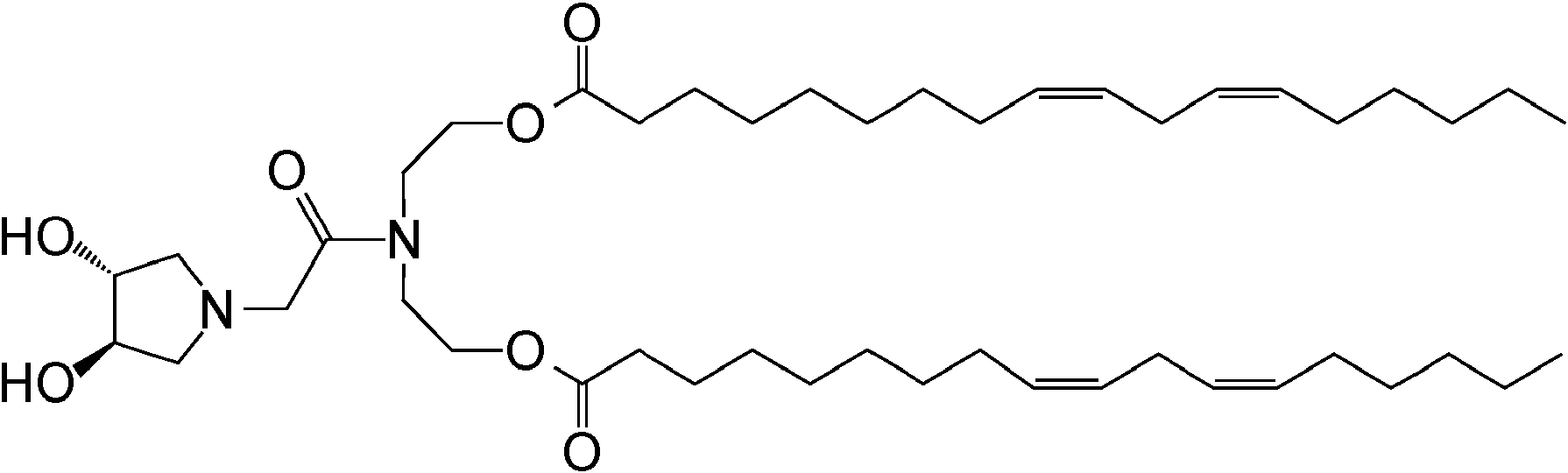
que es (9Z,9'Z,12Z,12'Z)-bis(octadeca-9,12-dienoato) de ((2-((3R,4R)-3,4-dihidroxipirrolidin-1-il)acetil)azanodiil)bis(etano-2,1-diílo).which is (9Z, 9'Z, 12Z, 12'Z) -bis (octadeca-9,12-dienoate) of ((2 - ((3R, 4R) -3,4-dihydroxypyrrolidin-1-yl) acetyl) azanodiyl) bis (ethane-2,1-diyl).
Los ejemplos de un compuesto ionizable incluyen el siguiente compuesto A6:Examples of an ionizable compound include the following compound A6:

que es (9Z,9'Z,12Z,12'Z)-bis(octadeca-9,12-dienoato) de ((2-((3S,4R)-3,4-dihidroxipirrolidin-1-il)acetil)azanodiil)bis(etano-2,1-diílo). which is (9Z, 9'Z, 12Z, 12'Z) -bis (octadeca-9,12-dienoate) of ((2 - ((3S, 4R) -3,4-dihydroxypyrrolidin-1-yl) acetyl) azanodiyl) bis (ethane-2,1-diyl).
Los ejemplos de un compuesto ionizable incluyen el siguiente compuesto A9:Examples of an ionizable compound include the following compound A9:

Los ejemplos de un compuesto ionizable incluyen el siguiente compuesto AA:Examples of an ionizable compound include the following compound AA:

que es (9Z,9'Z,12Z,12'Z)-bis(octadeca-9,12-dienoato) de ((2-(4-(2-hidroxietil)piperazin-1-il)acetil)azanodiil)bis(etano-2,1-diílo).which is (9Z, 9'Z, 12Z, 12'Z) -bis (octadeca-9,12-dienoate) of ((2- (4- (2-hydroxyethyl) piperazin-1-yl) acetyl) azanodiyl) bis (ethane-2,1-diyl).
Los ejemplos de un compuesto ionizable incluyen el siguiente compuesto AB:Examples of an ionizable compound include the following compound AB:

que es (9Z,9'Z,12Z,12'Z)-bis(octadeca-9,12-dienoato) de ((2-(4-(2-hidroxietil)piperazin-1-il)acetil)azanodiil)bis(etano-2,1-diílo).which is (9Z, 9'Z, 12Z, 12'Z) -bis (octadeca-9,12-dienoate) of ((2- (4- (2-hydroxyethyl) piperazin-1-yl) acetyl) azanodiyl) bis (ethane-2,1-diyl).
Los ejemplos de un compuesto ionizable incluyen el siguiente compuesto AC:Examples of an ionizable compound include the following compound AC:

ĊĊ
Los ejemplos de un compuesto ionizable incluyen el siguiente compuesto AD:Examples of an ionizable compound include the following compound AD:

Los ejemplos de un compuesto ionizable incluyen el siguiente compuesto B4:Examples of an ionizable compound include the following compound B4:

Los ejemplos de lípidos estructurales incluyen colesteroles, esteroles y esteroides.Examples of structural lipids include cholesterols, sterols, and steroids.
Los ejemplos de lípidos estructurales incluyen colanos, colestanos, ergostanos, campestanos, poriferastanos, estigmastanos, gorgostanos, lanostanos, gonanos, estranos, androstanos, pregnanos y cicloartanos.Examples of structural lipids include colans, cholestanes, ergostanes, campestanes, poriferastanes, stigmastanes, gorgostanes, lanostanos, gonanes, estranos, androstanos, preganes and cycloartanos.
Los ejemplos de lípidos estructurales incluyen esteroles y zoosteroles tales como colesterol, lanosterol, zimosterol, zimostenol, desmosterol, estigmastanol, dihidrolanosterol y 7-deshidrocolesterol.Examples of structural lipids include sterols and zoosterols such as cholesterol, lanosterol, zimosterol, zimostenol, desmosterol, stigmastanol, dihydrolanosterol, and 7-dehydrocholesterol.
Los ejemplos de lípidos estructurales incluyen colesteroles pegilados y compuestos colestano-3-oxo-acilo (C1-22), por ejemplo, acetato de colesterilo, araquidonato de colesterilo, butirato de colesterilo, hexanoato de colesterilo, miristato de colesterilo, palmitato de colesterilo, behenato de colesterilo, estearato de colesterilo, caprilato de colesterilo, n decanoato de colesterilo, dodecanoato de colesterilo, nervonato de colesterilo, pelargonato de colesterilo, n-valerato de colesterilo, oleato de colesterilo, elaidato de colesterilo, erucato de colesterilo, heptanoato de colesterilo, linolelaidato de colesterilo y linoleato de colesterilo.Examples of structural lipids include pegylated cholesterols and cholestane-3-oxo-acyl (C1-22) compounds, for example, cholesteryl acetate, cholesteryl arachidonate, cholesteryl butyrate, cholesteryl hexanoate, cholesteryl myristate, cholesteryl palmitate, cholesteryl behenate, cholesteryl stearate, cholesteryl caprylate, Cholesteryl n decanoate, cholesteryl dodecanoate, cholesteryl nervonate, cholesteryl pelargonate, cholesteryl n-valerate, cholesteryl oleate, cholesteryl elaidate, cholesteryl erucate, cholesteryl heptanoate, cholesteryl linolelaidate, and cholesteryl linolelaidate.
Los ejemplos de lípidos estructurales incluyen esteroles tales como fitoesteroles, beta-sitosterol, campesterol, ergosterol, brasicasterol, delta-7-estigmasterol y delta-7-avenasterol.Examples of structural lipids include sterols such as phytosterols, beta-sitosterol, campesterol, ergosterol, brassicasterol, delta-7-stigmasterol, and delta-7-avenasterol.
Lípidos estabilizantesStabilizing lipids
Los ejemplos de lípidos estabilizantes incluyen lípidos zwitteriónicos.Examples of stabilizing lipids include zwitterionic lipids.
Los ejemplos de lípidos estabilizantes incluyen compuestos tales como fosfolípidos.Examples of stabilizing lipids include compounds such as phospholipids.
Los ejemplos de fosfolípidos incluyen fosfatidilcolina, fosfatidiletanolamina, fosfatidilserina, fosfatidilinositol, ácido fosfatídico, palmitoiloleoilfosfatidilcolina, lisofosfatidilcolina, lisofosfatidiletanolamina, dipalmitoilfosfatidilcolina, dioleoilfosfatidilcolina, diestearoilfosfatidilcolina y ordilinoleoilfosfatidilcolina.Examples of phospholipids include phosphatidylcholine, phosphatidylethanolamine, phosphatidylserine, phosphatidylinositol, phosphatidic acid, palmitoyloleoylphosphatidylcholine, lysophosphatidylcholine, lysophosphatidylethanolamine, dipalmitoylphosphatidylphostenylphosphate, diocholylphosphatidylphostenylphosphate
Los ejemplos de lípidos estabilizantes incluyen compuestos de fosfatidiletanolamina y compuestos de fosfatidilcolina. Los ejemplos de lípidos estabilizantes incluyen 1,2-dioleoil-sn-glicero-3-fosfocolina (DOPC).Examples of stabilizing lipids include phosphatidylethanolamine compounds and phosphatidylcholine compounds. Examples of stabilizing lipids include 1,2-dioleoyl-sn-glycero-3-phosphocholine (DOPC).
Los ejemplos de lípidos estabilizantes incluyen difitanoilfosfatidiletanolamina (DPhPE) y 1,2-difitanoil-sn-glicero-3-fosfocolina (DPhPC).Examples of stabilizing lipids include dipitanoylphosphatidylethanolamine (DPhPE) and 1,2-diphytanoyl-sn-glycero-3-phosphocholine (DPhPC).
Los ejemplos de lípidos estabilizantes incluyen 1,2-diestearoil-sn-glicero-3-fosfocolina (DSPC), 1,2-dipalmitoil-snglicero-3-fosfocolina (DPPC), 1,2-dipalmitoil-sn-glicero-3-fosfoetanolamina (DPPE) y 1,2-dioleoil-sn-glicero-3-fosfoetanolamina (DOPE).Examples of stabilizing lipids include 1,2-distearoyl-sn-glycero-3-phosphocholine (DSPC), 1,2-dipalmitoyl-sglycero-3-phosphocholine (DPPC), 1,2-dipalmitoyl-sn-glycero-3- phosphoethanolamine (DPPE) and 1,2-dioleoyl-sn-glycero-3-phosphoethanolamine (DOPE).
Los ejemplos de lípidos estabilizantes incluyen 1,2-dilauroil-sn-glicerol (DLG); 1,2-dimiristoil-sn-glicerol (DMG); 1,2-dipalmitoil-sn-glicerol (DPG); 1,2-diestearoil-sn-glicerol (DSG); 1,2-diaraquidoil-sn-glicero-3-fosfocolina (DAPC); 1,2-dilauroil-sn-glicero-3-fosfocolina (DLPC); 1,2-dimiristoil-sn-glicero-3-fosfocolina (DMPC); 1,2-dipalmitoil-sn-glicero-O-etil-3-fosfocolina (DPePC); 1,2-dilauroil-sn-glicero-3-fosfoetanolamina (DLPE); 1,2-dimiristoil-sn-glicero-3-fosfoetanolamina (DMPE); 1,2-diestearoil-sn-glicero-3-fosfoetanolamina (DSPE); 1-palmitoil-2-linoleoil-sn-glicero-3-fosfocolina; 1-palmitoil-2-oleoil-sn-glicero-3-fosfocolina (POPC); 1-palmitoil-2-liso-sn-glicero-3-fosfocolina (P-liso-PC); y 1-estearoil-2-liso-sn-glicero-3-fosfocolina (S-liso-PC).Examples of stabilizing lipids include 1,2-dilauroyl-sn-glycerol (DLG); 1,2-dimyristoyl-sn-glycerol (DMG); 1,2-dipalmitoyl-sn-glycerol (DPG); 1,2-distearoyl-sn-glycerol (DSG); 1,2-diarachidoyl-sn-glycero-3-phosphocholine (DAPC); 1,2-dilauroyl-sn-glycero-3-phosphocholine (DLPC); 1,2-dimyristoyl-sn-glycero-3-phosphocholine (DMPC); 1,2-dipalmitoyl-sn-glycero-O-ethyl-3-phosphocholine (DPePC); 1,2-dilauroyl-sn-glycero-3-phosphoethanolamine (DLPE); 1,2-dimyristoyl-sn-glycero-3-phosphoethanolamine (DMPE); 1,2-distearoyl-sn-glycero-3-phosphoethanolamine (DSPE); 1-palmitoyl-2-linoleoyl-sn-glycero-3-phosphocholine; 1-palmitoyl-2-oleoyl-sn-glycero-3-phosphocholine (POPC); 1-palmitoyl-2-lyso-sn-glycero-3-phosphocholine (P-lyso-PC); and 1-stearoyl-2-lyso-sn-glycero-3-phosphocholine (S-lyso-PC).
Lípidos para reducir la inmunogenicidadLipids to reduce immunogenicity
Los ejemplos de lípidos para reducir la inmunogenicidad incluyen compuestos poliméricos y conjugados de polímerolípido.Examples of lipids to reduce immunogenicity include polymeric compounds and polymer-lipid conjugates.
Los ejemplos de lípidos para reducir la inmunogenicidad incluyen lípidos pegilados que tienen regiones de polietilenglicol (PEG). Las regiones de PEG pueden ser de cualquier masa molecular. En algunas realizaciones, una región de PEG puede tener una masa molecular de 200, 300, 350, 400, 500, 550, 750, 1000, 1500, 2000, 3000, 3500, 4000 ó 5000 Da.Examples of lipids to reduce immunogenicity include pegylated lipids having polyethylene glycol (PEG) regions. The PEG regions can be of any molecular mass. In some embodiments, a PEG region can have a molecular mass of 200, 300, 350, 400, 500, 550, 750, 1000, 1500, 2000, 3000, 3500, 4000, or 5000 Da.
Los ejemplos de lípidos para reducir la inmunogenicidad incluyen compuestos que tienen una región de metoxipolietilenglicol.Examples of lipids for reducing immunogenicity include compounds having a methoxypolyethylene glycol region.
Los ejemplos de lípidos para reducir la inmunogenicidad incluyen compuestos que tienen una región de carbonilmetoxipolietilenglicol.Examples of lipids for reducing immunogenicity include compounds having a carbonylmethoxypolyethylene glycol region.
Los ejemplos de lípidos para reducir la inmunogenicidad incluyen compuestos que tienen una región de PEG multirramificada.Examples of lipids for reducing immunogenicity include compounds that have a multi-branched PEG region.
Los ejemplos de lípidos para reducir la inmunogenicidad incluyen compuestos que tienen una región de poliglicerina. Los ejemplos de lípidos para reducir la inmunogenicidad incluyen lípidos poliméricos tales como DSPE-mPEG, DMPE-mPEG, DPPE-mPEG y DOPE-mPEG.Examples of lipids for reducing immunogenicity include compounds that have a polyglycerin region. Examples of lipids to reduce immunogenicity include polymeric lipids such as DSPE-mPEG, DMPE-mPEG, DPPE-mPEG, and DOPE-mPEG.
Los ejemplos de lípidos para reducir la inmunogenicidad incluyen PEG-fosfolípidos y PEG-ceramidas.Examples of lipids to reduce immunogenicity include PEG-phospholipids and PEG-ceramides.
Lípido catiónicosCationic lipid
Los ejemplos de lípidos catiónicos incluyen compuestos de HEDC catiónico tal como se describe en el documento US 2013/0330401 A1. Algunos ejemplos de lípidos catiónicos se proporcionan en el documento US 2013/0115274 A1. Examples of cationic lipids include cationic HEDC compounds as described in US 2013/0330401 A1. Some examples of cationic lipids are provided in US 2013/0115274 A1.
Composiciones lipídicasLipid compositions
En algunas realizaciones, una composición puede contener el compuesto ionizable A6, el lípido estructural colesterol, los lípidos estabilizantes DOPC y DOPE y el lípido para reducir la inmunogenicidad DPPE-mPEG. En determinadas realizaciones, el compuesto A6 puede ser del 15 al 25% en moles de la composición; el colesterol, DOPC y DOPE combinados pueden ser del 75 al 85% en moles de la composición; y DPPE-mPEG puede ser el 5% en moles de la composición.In some embodiments, a composition may contain the ionizable compound A6, the structural lipid cholesterol, the stabilizing lipids DOPC and DOPE, and the lipid to reduce DPPE-mPEG immunogenicity. In certain embodiments, compound A6 can be 15-25% by mole of the composition; cholesterol, DOPC and DOPE combined can be 75 to 85% by mole of the composition; and DPPE-mPEG can be 5 mol% of the composition.
En una realización, el compuesto A6 puede ser el 25% en moles de la composición; el colesterol puede ser el 30% en moles de la composición, DOPC puede ser el 20% en moles de la composición, DOPE puede ser el 20% en moles de la composición; y DPPE-mPEG(2000) puede ser el 5% en moles de la composición.In one embodiment, compound A6 can be 25% by mole of the composition; cholesterol can be 30% by moles of the composition, DOPC can be 20% by moles of the composition, DOPE can be 20% by moles of the composition; and DPPE-mPEG (2000) can be 5 mol% of the composition.
NanopartículasNanoparticles
Realizaciones de esta invención pueden proporcionar composiciones de nanopartículas liposómicas. Las moléculas ionizables de esta invención pueden usarse para formar composiciones liposómicas, que pueden tener una o más estructuras de bicapa de moléculas similares a lípidos.Embodiments of this invention can provide liposomal nanoparticle compositions. The ionizable molecules of this invention can be used to form liposomal compositions, which can have one or more bilayer structures of lipid-like molecules.
Una composición de nanopartículas puede tener una o más de las moléculas ionizables de esta invención en una estructura liposómicas, una estructura de bicapa, una micela, una estructura laminar o una mezcla de las mismas. En algunas realizaciones, una composición puede incluir uno o más componentes de vehículo líquido. Un vehículo líquido adecuado para la administración de los agentes activos de esta invención puede ser un vehículo líquido farmacéuticamente aceptable. Un vehículo líquido puede incluir un disolvente orgánico o una combinación de agua y un disolvente orgánico.A nanoparticle composition can have one or more of the ionizable molecules of this invention in a liposomal structure, a bilayer structure, a micelle, a lamellar structure, or a mixture thereof. In some embodiments, a composition can include one or more liquid carrier components. A suitable liquid vehicle for the administration of the active agents of this invention may be a pharmaceutically acceptable liquid vehicle. A liquid carrier can include an organic solvent or a combination of water and an organic solvent.
Realizaciones de esta invención pueden proporcionar nanopartículas lipídicas que tienen un tamaño de desde 10 hasta 1000 nm. En algunas realizaciones, las nanopartículas liposómicas pueden tener un tamaño de desde 10 hasta 150 nm.Embodiments of this invention can provide lipid nanoparticles having a size of from 10 to 1000 nm. In some embodiments, the liposomal nanoparticles can be from 10 to 150 nm in size.
Composiciones farmacéuticasPharmaceutical compositions
Esta invención contempla además métodos de distribución de un agente activo a un órgano de un sujeto para tratar la fibrosis mediante la administración de una composición de esta invención al sujeto. Los órganos que pueden tratarse incluyen pulmón, hígado, páncreas, riñón, colon, corazón, médula ósea, piel, intestino, cerebro y ojo.This invention further contemplates methods of delivering an active agent to an organ of a subject to treat fibrosis by administering a composition of this invention to the subject. Organs that can be treated include the lung, liver, pancreas, kidney, colon, heart, bone marrow, skin, intestine, brain, and eye.
En algunas realizaciones, esta invención proporciona métodos para tratar una enfermedad de fibrosis pulmonar mediante la administración de una composición de esta invención al sujeto.In some embodiments, this invention provides methods of treating pulmonary fibrosis disease by administering a composition of this invention to the subject.
Los ejemplos de enfermedad de fibrosis incluyen fibrosis pulmonar idiopática y cirrosis hepática.Examples of fibrosis disease include idiopathic pulmonary fibrosis and liver cirrhosis.
En aspectos adicionales, esta invención proporciona una gama de formulaciones farmacéuticas.In additional aspects, this invention provides a range of pharmaceutical formulations.
Una formulación farmacéutica en el presente documento puede incluir un agente activo, así como un portador de fármaco o un lípido de esta invención, junto con un portador o diluyente farmacéuticamente aceptable. En general, los agentes activos de esta descripción incluyen ARNip, agentes activos para la fibrosis, así como cualquier fármaco de molécula pequeña.A pharmaceutical formulation herein may include an active agent, as well as a drug or lipid carrier of this invention, together with a pharmaceutically acceptable carrier or diluent. In general, the active agents of this disclosure include siRNA, fibrosis active agents, as well as any small molecule drug.
Una formulación farmacéutica de esta invención puede contener uno o más de cada uno de los siguientes: un agente tensioactivo, un diluyente, un excipiente, un conservante, un estabilizante, un tinte y un agente de suspensión. Algunos portadores, diluyentes y componentes farmacéuticos para una formulación farmacéutica, así como métodos para la formulación y administración de los compuestos y las composiciones de esta invención, se describen en Remington's Pharmaceutical Sciences, 18a ed., Mack Publishing Co., Easton, Penn. (1990).A pharmaceutical formulation of this invention may contain one or more of each of the following: a surfactant, a diluent, an excipient, a preservative, a stabilizer, a dye, and a suspending agent. Certain pharmaceutical carriers, diluents and components for a pharmaceutical formulation, as well as methods for the formulation and administration of the compounds and compositions of this invention, are described in Remington's Pharmaceutical Sciences, 18th ed., Mack Publishing Co., Easton, Penn. (1990).
Los ejemplos de conservantes incluyen benzoato de sodio, ácido ascórbico y ésteres del ácido p-hidroxibenzoico. Los ejemplos de agentes tensioactivos incluyen alcoholes, ésteres, alcoholes alifáticos sulfatados.Examples of preservatives include sodium benzoate, ascorbic acid, and p-hydroxybenzoic acid esters. Examples of surfactants include alcohols, esters, sulfated aliphatic alcohols.
Los ejemplos de excipientes incluyen sacarosa, glucosa, lactosa, almidón, celulosa cristalizada, manitol, silicato anhidro ligero, aluminato de magnesio, metasilicato-aluminato de magnesio, silicato de aluminio sintético, carbonato de calcio, carbonato ácido de sodio, hidrogenofosfato de calcio y carboximetilcelulosa de calcio.Examples of excipients include sucrose, glucose, lactose, starch, crystallized cellulose, mannitol, light anhydrous silicate, magnesium aluminate, magnesium metasilicate-aluminate, synthetic aluminum silicate, calcium carbonate, sodium acid carbonate, calcium hydrogen phosphate and calcium carboxymethyl cellulose.
Los ejemplos de agentes suspensión incluyen aceite de coco, aceite de oliva, aceite de sésamo, aceite de cacahuete, soja, acetato-ftalato de celulosa, copolímero de acetato de metilo-metacrilato y éster de ftalatos. Examples of suspending agents include coconut oil, olive oil, sesame oil, peanut oil, soybean, cellulose acetate-phthalate, methyl acetate-methacrylate copolymer, and phthalate ester.
Estructuras de colas molecularesMolecular tail structures
Un compuesto de esta invención puede tener una o más colas lipófilas que contienen uno o más grupos alquilo o alquenilo. Los ejemplos de colas lipófilas que tienen grupos alquenilo incluyen alquenilo C(14:1(5)), alquenilo C(14:1(9)), alquenilo C(16:1(7)), alquenilo C(16:1(9)), alquenilo C(18:1(3)), alquenilo C(18:1(5)), alquenilo C(18:1(7)), alquenilo C(18:1(9)), alquenilo C(18:1(11)), alquenilo C(18:1(12)), alquenilo C(18:2(9,12)), alquenilo C(18:2(9,11)), alquenilo C(18:3(9,12,15)), alquenilo C(18:3(6,9,12)), alquenilo C(18:3(9,11,13)), alquenilo C(18:4(6,9,12,15)), alquenilo C(18:4(9,11,13,15)), alquenilo C(20:1(9)), alquenilo C(20:1(11)), alquenilo C(20:2(8,11)), alquenilo C(20:2(5,8)), alquenilo C(20:2(11,14)), alquenilo C(20:3(5,8,11)), alquenilo C(20:4(5,8,11,14)), alquenilo C(20:4(7,10,13,16)), alquenilo C(20:5(5,8,11,14,17)), alquenilo C(20:6(4,7,10,13,16,19)), alquenilo C(22:1(9)), alquenilo C(22:1(13)) y alquenilo C(24:1(9)). Algunos ejemplos de estructuras de cola se encuentran en Donald Voet y Judith Voet, Biochemistry, 3a edición (2005), pág. 383.A compound of this invention may have one or more lipophilic tails containing one or more alkyl or alkenyl groups. Examples of lipophilic tails having alkenyl groups include C alkenyl (14: 1 (5)), C alkenyl (14: 1 (9)), C alkenyl (16: 1 (7)), C alkenyl (16: 1 ( 9)), C alkenyl (18: 1 (3)), C alkenyl (18: 1 (5)), C alkenyl (18: 1 (7)), C alkenyl (18: 1 (9)), C alkenyl (18: 1 (11)), C alkenyl (18: 1 (12)), C alkenyl (18: 2 (9,12)), C alkenyl (18: 2 (9,11)), C alkenyl (18 : 3 (9,12,15)), C alkenyl (18: 3 (6,9,12)), C alkenyl (18: 3 (9,11,13)), C alkenyl (18: 4 (6, 9,12,15)), C alkenyl (18: 4 (9,11,13,15)), C alkenyl (20: 1 (9)), C alkenyl (20: 1 (11)), C alkenyl ( 20: 2 (8.11)), C alkenyl (20: 2 (5.8)), C alkenyl (20: 2 (11.14)), C alkenyl (20: 3 (5.8.11)) , C alkenyl (20: 4 (5,8,11,14)), C alkenyl (20: 4 (7,10,13,16)), C alkenyl (20: 5 (5,8,11,14, 17)), C alkenyl (20: 6 (4,7,10,13,16,19)), C alkenyl (22: 1 (9)), C alkenyl (22: 1 (13)) and C alkenyl ( 24: 1 (9)). Some examples of tail structures are found in Donald Voet and Judith Voet, Biochemistry, 3rd edition (2005), p. 383.
Algunos ejemplos de colas lipófilas incluyen las siguientes estructuras:Some examples of lipophilic tails include the following structures:

Cualquiera de estas estructuras de ejemplo de colas lipófilas puede tener o más ramificaciones químicas adicionales. Any of these example lipophilic tail structures may have one or more additional chemical branches.
Definiciones químicasChemical definitions
El término “alquilo”, tal como se usa en el presente documento, se refiere a un radical hidrocarbilo de un grupo alifático saturado, que puede ser de cualquier longitud. Un grupo alquilo puede ser un grupo alifático ramificado o no ramificado, sustituido o no sustituido que contiene desde 1 hasta 22 átomos de carbono. Esta definición también se aplica a la porción alquilo de otros grupos tales como, por ejemplo, cicloalquilo, alcoxilo, alcanoílo y aralquilo, por ejemplo. The term "alkyl", as used herein, refers to a hydrocarbyl radical of a saturated aliphatic group, which can be of any length. An alkyl group can be a branched or unbranched, substituted or unsubstituted aliphatic group containing from 1 to 22 carbon atoms. This definition also applies to the alkyl portion of other groups such as, for example, cycloalkyl, alkoxy, alkanoyl and aralkyl, for example.
Tal como se usa en el presente documento, por ejemplo, un término tal como “alquilo C(1-5)” incluye alquilo C(1), alquilo C(2), alquilo C(3), alquilo C(4) y alquilo C(5). Del mismo modo, por ejemplo, el término “alquilo C(3-22)” incluye alquilo C(1), alquilo C(2), alquilo C(3), alquilo C(4), alquilo C(5), alquilo C(6), alquilo C(7), alquilo C(8), alquilo C(9), alquilo C(10), alquilo C(11), alquilo C(12), alquilo c (13), alquilo C(14), alquilo C(15), alquilo C(16), alquilo C(17), alquilo C(18), alquilo C(19), alquilo C(20), alquilo C(21) y alquilo C(22).As used herein, for example, a term such as "C (1-5) alkyl" includes C (1) alkyl, C (2) alkyl, C (3) alkyl, C (4) alkyl, and C (5) alkyl. Similarly, for example, the term "C (3-22) alkyl" includes C (1) alkyl, C (2) alkyl, C (3) alkyl, C (4) alkyl, C (5) alkyl, alkyl C (6), C (7) alkyl, C (8) alkyl, C (9) alkyl, C (10) alkyl, C (11) alkyl, C (12) alkyl, C (13) alkyl, C ( 14), C (15) alkyl, C (16) alkyl, C (17) alkyl, C (18) alkyl, C (19) alkyl, C (20) alkyl, C (21) alkyl, and C (22) alkyl .
Tal como se usa en el presente documento, un grupo alquilo puede designarse mediante un término tal como Me (metilo, -CH3), Et (etilo, -CH2CH3), Pr (cualquier grupo propilo), nPr (n-Pr, n-propilo), P r (i-Pr, isopropilo), Bu (cualquier grupo butilo), nBu (n-Bu, n-butilo), Bu (i-Bu, isobutilo), sBu (s-Bu, sec-butilo) y ‘Bu (t-Bu, terc-butilo).As used herein, an alkyl group can be designated by a term such as Me (methyl, -CH3), Et (ethyl, -CH2CH3), Pr (any propyl group), nPr (n-Pr, n- propyl), P r (i-Pr, isopropyl), Bu (any butyl group), nBu (n-Bu, n-butyl), Bu (i-Bu, isobutyl), sBu (s-Bu, sec-butyl) and 'Bu (t-Bu, tert-butyl).
El término “alquenilo”, tal como se usa en el presente documento, se refiere a un radical hidrocarbilo que tiene al menos un doble enlace carbono-carbono. Un grupo alquenilo puede ser un radical hidrocarbilo ramificado o no ramificado, sustituido o no sustituido que tiene de 2 a 22 átomos de carbono y al menos un doble enlace carbonocarbono. Un grupo “alquenilo” tiene uno o más dobles enlaces carbono-carbono.The term "alkenyl", as used herein, refers to a hydrocarbyl radical having at least one carbon-carbon double bond. An alkenyl group can be a branched or unbranched, substituted or unsubstituted hydrocarbyl radical having 2 to 22 carbon atoms and at least one carbon-carbon double bond. An "alkenyl" group has one or more carbon-carbon double bonds.
El término “sustituido”, tal como se usa en el presente documento, se refiere a un átomo que tiene una o más sustituciones o sustituyentes que pueden ser el mismo o diferentes y pueden incluir un sustituyente hidrógeno. Por tanto, los términos alquilo, cicloalquilo, alquenilo, alcoxilo, alcanoílo y arilo, por ejemplo, se refieren a grupos que pueden incluir variaciones sustituidas. Las variaciones sustituidas incluyen variaciones lineales, ramificadas y cíclicas y grupos que tienen un sustituyente o sustituyentes que reemplazan uno o más hidrógenos unidos a cualquier átomo de carbono del grupo.The term "substituted", as used herein, refers to an atom that has one or more substitutions or substituents that may be the same or different and may include a hydrogen substituent. Thus, the terms alkyl, cycloalkyl, alkenyl, alkoxy, alkanoyl, and aryl, for example, refer to groups that may include substituted variations. Substituted variations include linear, branched, and cyclical variations and groups having a substituent or substituents that replace one or more hydrogens attached to any carbon atom in the group.
En general, un compuesto puede contener uno o más centros quirales. Los compuestos que contienen uno o más centros quirales pueden incluir aquellos descritos como un “ isómero”, un “estereoisómero”, un “diastereómero”, un “enantiómero”, un “isómero óptico”, o como una “mezcla racémica”. En la técnica se conocen convenciones para la nomenclatura estereoquímica, por ejemplo, las reglas de nomenclatura de estereoisómeros de Cahn, Ingold y Prelog, así como métodos para la determinación de la estereoquímica y la separación de estereoisómeros. Véase, por ejemplo, Michael B. Smith y Jerry March, March's Advanced Organic Chemistry, 5a edición, 2001. Los compuestos y las estructuras de esta divulgación pretenden abarcar todos los posibles isómeros, estereoisómeros, diastereómeros, enantiómeros y/o isómeros ópticos que se entendería que existen para el compuesto o la estructura especificados, incluyendo cualquier mezcla, racémica o de otro tipo, de los mismos.In general, a compound can contain one or more chiral centers. Compounds containing one or more chiral centers can include those described as an "isomer", a "stereoisomer", a "diastereomer", an "enantiomer", an "optical isomer", or as a "racemic mixture". Conventions for stereochemical nomenclature are known in the art, for example, the Cahn, Ingold and Prelog rules for stereoisomer nomenclature, as well as methods for the determination of stereochemistry and the separation of stereoisomers. See, for example, Michael B. Smith and Jerry March, March's Advanced Organic Chemistry, 5th Edition, 2001. The compounds and structures of this disclosure are intended to encompass all possible isomers, stereoisomers, diastereomers, enantiomers, and / or optical isomers that are I would understand that they exist for the specified compound or structure, including any mixture, racemic or otherwise, thereof.
Esta invención abarca todas y cada una de las formas tautoméricas, solvatadas o no solvatadas, hidratadas o no hidratadas, así como cualquier forma isotópica de los átomos de los compuestos y las composiciones divulgados en el presente documento.This invention encompasses any and all tautomeric forms, solvated or unsolvated, hydrated or non-hydrated, as well as any isotopic form of the atoms of the compounds and compositions disclosed herein.
Esta invención abarca todas y cada uno de los polimorfos cristalinos o formas cristalinas diferentes de los compuestos y las composiciones divulgados en el presente documento.This invention encompasses any and all crystalline polymorphs or different crystalline forms of the compounds and compositions disclosed herein.
Abreviaturas usadas:Abbreviations used:
DMAP - 4-N,N-dimetilaminopiridinaDMAP - 4-N, N-dimethylaminopyridine
DCM - diclorometanoDCM - dichloromethane
TEA -trietilam inaTEA -triethylamine
EDC - clorhidrato de 1-(3-dimetilaminopropil)-3-etilcarbodimimdaEDC - 1- (3-dimethylaminopropyl) -3-ethylcarbodimimda hydrochloride
Na2SO4 - sulfato de sodioNa2SO4 - sodium sulfate
EtOAc - acetato de etiloEtOAc - ethyl acetate
DMF - N,N-dimetilformidaDMF - N, N-dimethylformide
ELSD - detector evaporativo de dispersión de luzELSD - evaporative light scattering detector
NaCl - cloruro de sodioNaCl - sodium chloride
K2CO3 - carbonato de potasioK2CO3 - potassium carbonate
MeOH - metanolMeOH - methanol
TFA - ácido trifluoroacéticoTFA - trifluoroacetic acid
DIEA - N,N-diisopropiletilaminaDIEA - N, N-diisopropylethylamine
MgSO4 - sulfato de magnesioMgSO4 - magnesium sulfate
CL-EM - cromatografía de líquidos-espectrometría de masasLC-MS - liquid chromatography-mass spectrometry
NaHCO3 - bicarbonato de sodioNaHCO3 - sodium bicarbonate
H2O - aguaH2O - water
HCl - clorhidratoHCl - hydrochloride
KI - yoduro de potasioKI - potassium iodide
DMSO - dimetilsulfóxidoDMSO - dimethylsulfoxide
TBAF - fluoruro de tetra-N-butilamonioTBAF - tetra-N-butylammonium fluoride
NaBH4 - borohidruro de sodio NaBH4 - sodium borohydride
THF -tetrahidrofuranoTHF -tetrahydrofuran
TBDMS -terc-butildimetilsililoTBDMS -tert-butyldimethylsilyl
LiOH - hidróxido de litioLiOH - lithium hydroxide
Mel - yoduro de metiloMel - methyl iodide
BOC -terc-butiloxicarboniloBOC -tert-butyloxycarbonyl
Fmoc - fluorenilmetiloxicarboniloFmoc - fluorenylmethyloxycarbonyl
EjemplosExamples
En lo que sigue, los ejemplos que no se incluyen en las reivindicaciones adjuntas deben considerarse solamente como ejemplos de referencia. Lo mismo se aplica a los dibujos.In the following, examples not included in the appended claims are to be construed as reference examples only. The same applies to drawings.
Ejemplo 1: en la figura 1 se muestra un esquema para la preparación del compuesto A6.Example 1: Figure 1 shows a scheme for the preparation of compound A6.
Producto intermedio 1: a ácido linoleico (50,0 g, 178,30 mmol), W-Boc-dietanolamina (18,3 g, 89,10 mmol) y DMAP (1,1 g, 8,90 mmol) en un matraz secado al horno (1 l) con una barra magnética se le añadió DCM anhidro (400 ml). Se agitó la mezcla a temperatura ambiental durante 2 minutos hasta obtener una disolución transparente. Luego se añadió EDC (35,9 g, 187,20 mmol) y se agitó la mezcla a temperatura ambiente durante la noche (17 horas). Finalmente, se extinguió la reacción con disolución acuosa saturada de NaCl (400 ml) y se extrajo con DCM dos veces (400 ml, 100 ml). Se combinaron las fases orgánicas, se secaron sobre Na2SO4 (20 g) y se filtraron. Se concentró el filtrado a presión reducida. Se disolvió el crudo en 50 ml de DCM y se purificó mediante un sistema de purificación de cromatografía ultrarrápida (columna de gel de sílice de 330 g) usando un gradiente de hexano durante 5 min, luego el 0-20% de EtOAc/hexano durante 40 min a una velocidad de flujo de 100 ml/min. Se recogieron las fracciones de producto y se concentraron para producir el producto intermedio 1 (59 g, rendimiento del 91%) como un líquido transparente. 1H-RMN (400 MHz, CDCl3) 8: 5,32-5,33 (8H, m, CH=), 4,13-4,17 (4H, m, OCH2), 3,43-3,49 (4H, m, NCH2), 2,73-2,74 (4H, m, =CHCH2CH=), 2,03-2,28 (4H, m, CH2CO), 2,00-2,01 (8H, m, =CHCH2), 1,60-1,70 (4H, m, CH2CH2CO), 1,43 (9H, S, C(CHa)a), 1,28-1,31 (28H, m, CH2), 0,85-0,86 (6H, m, CH3).Intermediate 1: to linoleic acid (50.0 g, 178.30 mmol), W-Boc-diethanolamine (18.3 g, 89.10 mmol) and DMAP (1.1 g, 8.90 mmol) in a Anhydrous DCM (400 ml) was added to an oven-dried flask (1 L) with a magnetic bar. The mixture was stirred at room temperature for 2 minutes until a clear solution was obtained. EDC (35.9 g, 187.20 mmol) was then added and the mixture was stirred at room temperature overnight (17 hours). Finally, the reaction was quenched with saturated aqueous NaCl solution (400 ml) and extracted with DCM twice (400 ml, 100 ml). The organic phases were combined, dried over Na2SO4 (20 g), and filtered. The filtrate was concentrated under reduced pressure. The crude was dissolved in 50 ml of DCM and purified by a flash chromatography purification system (330 g silica gel column) using a gradient of hexane over 5 min, then 0-20% EtOAc / hexane for 40 min at a flow rate of 100 ml / min. Product fractions were collected and concentrated to yield Intermediate 1 (59g, 91% yield) as a clear liquid. 1H-NMR (400 MHz, CDCl3) 8: 5.32-5.33 (8H, m, CH =), 4.13-4.17 (4H, m, OCH2), 3.43-3.49 ( 4H, m, NCH2), 2.73-2.74 (4H, m, = CHCH2CH =), 2.03-2.28 (4H, m, CH2CO), 2.00-2.01 (8H, m , = CHCH2), 1.60-1.70 (4H, m, CH2CH2CO), 1.43 (9H, S, C (CHa) a), 1.28-1.31 (28H, m, CH2), 0.85-0.86 (6H, m, CH3).
Producto intermedio 2: al producto intermedio 1 (50,0 g, 68,50 mmol) en un matraz secado al horno (1000 ml) con una barra magnética se le añadió DCM anhidro (100 ml). Se agitó la mezcla durante 2 minutos hasta obtener una disolución transparente. Luego se añadió TFA (100 ml) y se agitó la mezcla a temperatura ambiental durante 2 horas. Durante la agitación, el color de la disolución cambió de transparente a rojo. A continuación, se concentró en primer lugar la mezcla de reacción usando un evaporador rotatorio y se lavó con disolución acuosa saturada de NaHcO3 (300 ml). Luego se extrajo la mezcla con DCM (2 x 200 ml) y se combinaron las fases orgánicas, se secaron sobre Na2SO4 (20 g), se filtraron y se concentraron a presión reducida para dar un producto intermedio oleoso, que luego se disolvió en DCM anhidro (300 ml) y se enfrió hasta 0°C con un baño de agua helada. Luego se añadió lentamente cloruro de cloroacetilo (6,0 ml, 75,30 mmol) seguido por DIEA (14,3 ml, 82,20 mmol) a 0°C. Tras completarse la adición, se retiró el baño de agua helada y se agitó la mezcla a temperatura ambiental durante 2 horas. A continuación, se concentró la mezcla de reacción usando un evaporador rotatorio, se lavó con disolución acuosa saturada de NaHCO3 (300 ml) y se extrajo con DCM (300 ml, 200 ml). Luego se secaron las fases orgánicas combinadas sobre Na2SO4 (20 g), se filtraron y se concentraron a presión reducida. Se disolvió el crudo en 20 ml de DCM y se purificó con una columna de sílice de 330 g usando un gradiente de hexano durante 5 min, luego el 10% de EtOAc/hexano durante 20 min seguido por el 20% de EtOAc/hexano durante 20 min a una velocidad de flujo de 60 ml/min. Se recogieron las fracciones de producto y se concentraron para producir el producto intermedio 2 (41,4 g, rendimiento del 82%) como un líquido amarillo transparente. 1H-RMN (400 MHz, CDCl3) 8: 5,35-5,33 (8H, m, CH=), 4,24-4,22 (4H, m, OCH2),4,14 (2H, s, CH2Cl), 3,67-3,63 (4H, m, NCH2), 2,78-2,75 (4H, m, =CHCH2CH=), 2,30-2,29 (4H, m, CH2CO), 2,03-2,05 (8H, m, =CHCH2), 1,60-1,56 (4H, m, CH2CH2CO), 1,33-1,29 (28H, m, CH2), 0,90-0,86 (6H, m, CH3).Intermediate 2: To intermediate 1 (50.0 g, 68.50 mmol) in an oven-dried flask (1000 ml) with a magnetic bar was added anhydrous DCM (100 ml). The mixture was stirred for 2 minutes until a clear solution was obtained. Then TFA (100 ml) was added and the mixture was stirred at room temperature for 2 hours. During stirring, the color of the solution changed from clear to red. The reaction mixture was then first concentrated using a rotary evaporator and washed with saturated aqueous NaHcO3 solution (300 ml). The mixture was then extracted with DCM (2 x 200 ml) and the organic phases were combined, dried over Na2SO4 (20 g), filtered and concentrated under reduced pressure to give an oily intermediate, which was then dissolved in DCM anhydrous (300 ml) and cooled to 0 ° C with an ice water bath. Chloroacetyl chloride (6.0 ml, 75.30 mmol) was then added slowly followed by DIEA (14.3 ml, 82.20 mmol) at 0 ° C. After the addition was complete, the ice water bath was removed and the mixture was stirred at room temperature for 2 hours. The reaction mixture was then concentrated using a rotary evaporator, washed with saturated aqueous NaHCO3 solution (300 ml) and extracted with DCM (300 ml, 200 ml). The combined organic phases were then dried over Na2SO4 (20 g), filtered and concentrated under reduced pressure. The crude was dissolved in 20 ml of DCM and purified with a 330 g silica column using a gradient of hexane for 5 min, then 10% EtOAc / hexane for 20 min followed by 20% EtOAc / hexane for 20 min at a flow rate of 60 ml / min. Product fractions were collected and concentrated to yield intermediate 2 (41.4 g, 82% yield) as a clear yellow liquid. 1H-NMR (400 MHz, CDCl3) 8: 5.35-5.33 (8H, m, CH =), 4.24-4.22 (4H, m, OCH2), 4.14 (2H, s, CH2Cl), 3.67-3.63 (4H, m, NCH2), 2.78-2.75 (4H, m, = CHCH2CH =), 2.30-2.29 (4H, m, CH2CO), 2.03-2.05 (8H, m, = CHCH2), 1.60-1.56 (4H, m, CH2CH2CO), 1.33-1.29 (28H, m, CH2), 0.90- 0.86 (6H, m, CH3).
Compuesto A6: al producto intermedio 2 (5,0 g, 7,07 mmol), Kl (1,2 g, 7,07 mmol) y clorhidrato de c/s-3,4-dihidroxipirrolidina (1,3 g, 9,20 mmol) en un vial secado al horno (200 ml) con una barra magnética se le añadió DMF anhidra (20 ml). Se agitó la mezcla a temperatura ambiental durante 2 minutos hasta obtener una disolución transparente. Luego se añadió DIEA (3,0 ml, 9,91 mmol) y se agitó la mezcla a 30°C durante 2,5 horas. Tras eliminar el disolvente mediante un evaporador rotatorio a alto vacío, al residuo se le añadió disolución saturada de NaHCO3 (100 ml) y se extrajo con DCM (100 ml, 50 ml). Luego se combinaron las fases orgánicas, se secaron sobre Na2SO4 (20 g), se filtraron y se concentraron a presión reducida. Se disolvió el crudo en 5 ml de DCM y se purificó con una columna de sílice de 120 g usando un gradiente de hexano durante 5 min, luego el 0-50% de EtOAc/hexano durante 10 min seguido por el 50% de EtOAc/hexano durante 10 min, luego con DCM durante 5 min y seguido por el 5% de MeOH/DCM durante 30 min a una velocidad de flujo de 60 ml/min. Se recogieron las fracciones de producto y se concentraron para producir el compuesto A6 (3,5 g, rendimiento del 64%) como un líquido amarillo. 1H-RMN (400 MHz, CDCl3) 8: 5,34-5,29 (8H, m, CH=), 4,22-4,20 (6H, m, OCH2, OCH), 3,59-3,49 (6H, m, NCH2, COCH2N), 2,95-2,74 (6H, m, =CHCH2CH=, NCH2), 2,30-2,29 (4H, m, CH2CO), 2,05-2,03 (8H, m, =CHCH2), 1,60 (4H, m, CH2CH2CO), 1,33-1,29 (28H, m, CH2), 0,90-0,88 (6H, m, CH3).Compound A6: to intermediate 2 (5.0 g, 7.07 mmol), Kl (1.2 g, 7.07 mmol) and c / s-3,4-dihydroxypyrrolidine hydrochloride (1.3 g, 9 , 20 mmol) in an oven-dried vial (200 ml) with a magnetic bar was added anhydrous DMF (20 ml). The mixture was stirred at room temperature for 2 minutes until a clear solution was obtained. Then DIEA (3.0 ml, 9.91 mmol) was added and the mixture was stirred at 30 ° C for 2.5 hours. After removing the solvent by high vacuum rotary evaporator, saturated NaHCO3 solution (100 ml) was added to the residue and extracted with DCM (100 ml, 50 ml). The organic phases were then combined, dried over Na2SO4 (20 g), filtered and concentrated under reduced pressure. The crude was dissolved in 5 ml of DCM and purified with a 120 g silica column using a gradient of hexane for 5 min, then 0-50% EtOAc / hexane for 10 min followed by 50% EtOAc / hexane for 10 min, then with DCM for 5 min and followed by 5% MeOH / DCM for 30 min at a flow rate of 60 ml / min. Product fractions were collected and concentrated to yield compound A6 (3.5 g, 64% yield) as a yellow liquid. 1H-NMR (400 MHz, CDCl3) 8: 5.34-5.29 (8H, m, CH =), 4.22-4.20 (6H, m, OCH2, OCH), 3.59-3, 49 (6H, m, NCH2, COCH2N), 2.95-2.74 (6H, m, = CHCH2CH =, NCH2), 2.30-2.29 (4H, m, CH2CO), 2.05-2 .03 (8H, m, = CHCH2), 1.60 (4H, m, CH2CH2CO), 1.33-1.29 (28H, m, CH2), 0.90-0.88 (6H, m, CH3).
Ejemplo 2: en la figura 2 se muestra un esquema para la preparación del compuesto AB.Example 2: Figure 2 shows a scheme for the preparation of compound AB.
Producto intermedio 3: al producto intermedio 1 (10,0 g, 13,70 mmol) en un matraz secado al horno (200 ml) con una barra magnética se le añadió DCM anhidro (15 ml). Se agitó la mezcla durante 2 minutos hasta obtener una disolución transparente. Luego se añadió TFA (15 ml) y se agitó la mezcla a temperatura ambiental durante 2 horas. Durante la agitación, el color de la disolución cambió de transparente a rojo. A continuación, se concentró en primer lugar la mezcla de reacción usando un evaporador rotatorio. Se diluyó el residuo con DCM (~50 ml) y se le añadió K2CO3 al 10% (15 ml) y se agitó durante 10-15 minutos en un baño de hielo. Se comprobó el pH de la fase acuosa para garantizar un pH > 8. Luego se transfirió la mezcla a un embudo de separación y se extrajo con DCM (50 ml, 25 ml), se secó sobre MgSO4, se filtró y se concentró a presión reducida para dar un producto intermedio oleoso, que luego se disolvió en DCM anhidro (30 ml) y luego se le añadió lentamente bromuro de bromoacetilo (1,2 ml, 13,70 mmol) seguido por TEA (2,1 ml, 15,07 mmol). Tras completarse la adición, se agitó la mezcla a temperatura ambiental durante la noche. Luego se concentró la mezcla de reacción usando un evaporador rotatorio, se lavó con agua (30 ml) y se extrajo con DCM (30 ml, 20 ml). Luego se secaron las fases orgánicas combinadas sobre MgSO4, se filtraron y se concentraron a presión reducida. Se disolvió el crudo en 20 ml de DCM y se purificó con una columna de sílice de 330 g usando un gradiente de hexano durante 0,5 min, luego un gradiente de 30 min del 0-20% de EtOAc/hexano seguido por el 30% de EtOAc/hexano durante 5 min a una velocidad de flujo de 130ml/min. Se recogieron las fracciones de producto y se concentraron para producir el producto intermedio 3 (8,1 g, rendimiento del 79%) como un líquido amarillo transparente. 1H-RMN (400 MHz, CDCh) 8: 5,35-5,33 (8H, m, CH=), 4,24-4,22 (4H, m, OCH2), 3,93 (2H, s, CH2Br), 3,69-3,61 (4H, m, NCH2), 2,78-2,74 (4H, m, =CHCH2CH=), 2,32-2,28 (4H, m, CH2CO), 2,06-2,02 (8H, m, =CHCH2), 1,62-1,60 (4H, m, CH2CH2CO), 1,36-1,26 (28H, m, CH2), 0,90-0,86 (6H, m, CH3).Intermediate 3: To intermediate 1 (10.0 g, 13.70 mmol) in an oven-dried flask (200 ml) with a magnetic bar was added anhydrous DCM (15 ml). The mixture was stirred for 2 minutes until a clear solution was obtained. Then TFA (15 ml) was added and the mixture was stirred at room temperature for 2 hours. During stirring, the color of the solution changed from clear to red. Then, the reaction mixture was first concentrated using a rotary evaporator. The residue was diluted with DCM (~ 50 mL) and 10% K2CO3 (15 mL) was added and stirred for 10-15 minutes in an ice bath. The pH of the aqueous phase was checked to ensure a pH> 8. The mixture was then transferred to a separatory funnel and extracted with DCM (50 ml, 25 ml), dried over MgSO4, filtered and concentrated under pressure. reduced to give an oily intermediate, which was then dissolved in anhydrous DCM (30 ml) and then bromoacetyl bromide (1.2 ml, 13.70 mmol) was added slowly followed by TEA (2.1 ml, 15, 07 mmol). After the addition was complete, the mixture was stirred at room temperature overnight. The reaction mixture was then concentrated using a rotary evaporator, washed with water (30 ml) and extracted with DCM (30 ml, 20 ml). The combined organic phases were then dried over MgSO4, filtered and concentrated under reduced pressure. The crude was dissolved in 20 ml of DCM and purified with a 330 g silica column using a 0.5 min hexane gradient, then a 30 min gradient of 0-20% EtOAc / hexane followed by 30 % EtOAc / hexane for 5 min at a flow rate of 130 ml / min. Product fractions were collected and concentrated to yield intermediate 3 (8.1 g, 79% yield) as a clear yellow liquid. 1H-NMR (400 MHz, CDCh) 8: 5.35-5.33 (8H, m, CH =), 4.24-4.22 (4H, m, OCH2), 3.93 (2H, s, CH2Br), 3.69-3.61 (4H, m, NCH2), 2.78-2.74 (4H, m, = CHCH2CH =), 2.32-2.28 (4H, m, CH2CO), 2.06-2.02 (8H, m, = CHCH2), 1.62-1.60 (4H, m, CH2CH2CO), 1.36-1.26 (28H, m, CH2), 0.90- 0.86 (6H, m, CH3).
Compuesto AB: al producto intermedio 3 (460 mg, 0,61 mmol) y 1-piperazin-propanol (89 mg, 0,61 mmol) en un vial secado al horno (100 ml) con una barra magnética se le añadió DCM anhidro (10 ml). Se agitó la mezcla a temperatura ambiental durante 2 minutos hasta obtener una disolución transparente. Luego se añadió TEA (103 |il, 0,74 mmol) y se agitó la mezcla a temperatura ambiental durante la noche. Tras eliminar el disolvente mediante un evaporador rotatorio a alto vacío, al residuo se le añadió disolución saturada de K2CO3 al 10% (50 ml) y se extrajo con DCM (50 ml, 25 ml). Luego se combinaron las fases orgánicas, se secaron sobre MgSO4, se filtraron y se concentraron a presión reducida. Se purificó el crudo mediante un sistema de purificación de cromatografía ultrarrápida. Se cargó el material directamente sobre una columna de sílice de 24 g y usando un gradiente de DCM durante 3 min, luego el 0-8% de MeOH/DCM durante 7 min seguido por el 8% de MeOH/DCM durante 20 min a una velocidad de flujo de 25 ml/min. Se recogieron las fracciones de producto y se concentraron para producir el compuesto AB (379 mg, rendimiento del 76%) como un líquido amarillo. 1H-RMN (400 MHz, CDCla) 8: 5,39-5,29 (8H, m, CH=), 4,22-4,21 (4H, m, OCH2), 3,74 3,71 (2H, m, CH2OH), 3,59-3,49 (4H, m, NCH2), 3,23 (2H, s, COCH2), 2,78-2,75 (2H, m, CH2CH2OH), 2,59-2,57 (8H, m, NCH2CH2N), 2,32-2,27 (4H, m, CHCH2CH), 2,05-2,03 (8H, m, =CHCH2CH2), 1,60 (4H, m, CH2CH2CO), 1,33-1,29 (28H, m, CH2), 0,90-0,88 (6H, m, CH3).Compound AB: to intermediate 3 (460 mg, 0.61 mmol) and 1-piperazine-propanol (89 mg, 0.61 mmol) in an oven-dried vial (100 ml) with a magnetic bar was added anhydrous DCM (10 ml). The mixture was stirred at room temperature for 2 minutes until a clear solution was obtained. Then TEA (103 µl, 0.74 mmol) was added and the mixture was stirred at room temperature overnight. After removing the solvent by rotary evaporator under high vacuum, the residue was added saturated 10% K2CO3 solution (50 ml) and extracted with DCM (50 ml, 25 ml). The organic phases were then combined, dried over MgSO4, filtered and concentrated under reduced pressure. The crude was purified by a flash chromatography purification system. The material was loaded directly onto a 24 g silica column using a DCM gradient for 3 min, then 0-8% MeOH / DCM for 7 min followed by 8% MeOH / DCM for 20 min at a speed. flow rate of 25 ml / min. Product fractions were collected and concentrated to yield compound AB (379 mg, 76% yield) as a yellow liquid. 1H-NMR (400 MHz, CDCla) 8: 5.39-5.29 (8H, m, CH =), 4.22-4.21 (4H, m, OCH2), 3.74 3.71 (2H , m, CH2OH), 3.59-3.49 (4H, m, NCH2), 3.23 (2H, s, COCH2), 2.78-2.75 (2H, m, CH2CH2OH), 2.59 -2.57 (8H, m, NCH2CH2N), 2.32-2.27 (4H, m, CHCH2CH), 2.05-2.03 (8H, m, = CHCH2CH2), 1.60 (4H, m , CH2CH2CO), 1.33-1.29 (28H, m, CH2), 0.90-0.88 (6H, m, CH3).
Ejemplo 3: en la figura 3 se muestra un esquema para la preparación del compuesto A4.Example 3: A scheme for the preparation of compound A4 is shown in figure 3.
Producto intermedio 4: a ácido mirístico (50,0 g, 218,90 mmol), W-Boc-dietanolamina (21,4 g, 218,90 mmol) y DMAP (3,8 g, 65,70 mmol) en un matraz secado al horno (1 l) con una barra magnética se le añadió DCM anhidro (300 ml). Se agitó la mezcla a temperatura ambiental durante 2 minutos hasta obtener una disolución transparente. Luego se añadió EDC (44,0 g, 481,70 mmol) y se agitó la mezcla a temperatura ambiente durante la noche (17 horas). Finalmente, se extinguió la reacción con disolución saturada de NaCl (400 ml) y se extrajo con DCM dos veces (400 ml, 100 ml). Se combinaron las fases orgánicas, se secaron sobre Na2SO4 (20 g) y se filtraron. Se concentró el filtrado a presión reducida. Se disolvió el crudo en 50 ml de DCM y se purificó mediante un sistema de purificación de cromatografía ultrarrápida (columna de gel de sílice de 330 g) usando un gradiente del 5-50% de EtOAc/hexano durante 40 min a una velocidad de flujo de 100 ml/min. Se recogieron las fracciones de producto y se concentraron para producir el producto intermedio 4 (50,0 g, rendimiento del 71%) como un sólido blanco. 1H-RMN (400 MHz, CDCh) 8: 4,14-4,17 (4H, m, OCH2), 3,44-3,50 (4H, m, NCH2), 2,27-2,30 (4H, m, CH2CO), 1,60-1,70 (4H, m, CH2CH2CO), 1,45 (9H, S, C(CH3)3), 1,20-1,25 (40H, m, CH2), 0,81-0,88 (6H, m, CH3).Intermediate 4: to myristic acid (50.0 g, 218.90 mmol), W-Boc-diethanolamine (21.4 g, 218.90 mmol) and DMAP (3.8 g, 65.70 mmol) in a Anhydrous DCM (300 ml) was added to an oven-dried flask (1 L) with a magnetic bar. The mixture was stirred at room temperature for 2 minutes until a clear solution was obtained. EDC (44.0 g, 481.70 mmol) was then added and the mixture was stirred at room temperature overnight (17 hours). Finally, the reaction was quenched with saturated NaCl solution (400 ml) and extracted with DCM twice (400 ml, 100 ml). The organic phases were combined, dried over Na2SO4 (20 g), and filtered. The filtrate was concentrated under reduced pressure. The crude was dissolved in 50 ml of DCM and purified by a flash chromatography purification system (330 g silica gel column) using a 5-50% EtOAc / hexane gradient over 40 min at flow rate 100 ml / min. Product fractions were collected and concentrated to yield intermediate 4 (50.0 g, 71% yield) as a white solid. 1H-NMR (400 MHz, CDCh) 8: 4.14-4.17 (4H, m, OCH2), 3.44-3.50 (4H, m, NCH2), 2.27-2.30 (4H , m, CH2CO), 1.60-1.70 (4H, m, CH2CH2CO), 1.45 (9H, S, C (CH3) 3), 1.20-1.25 (40H, m, CH2) , 0.81-0.88 (6H, m, CH3).
Producto intermedio 5: al producto intermedio 4 (10,0 g, 16,00 mmol) en un matraz secado al horno (200 ml) con una barra magnética se le añadió DCM anhidro (15 ml). Se agitó la mezcla durante 2 minutos hasta obtener una disolución transparente. Luego se añadió TFA (15,0 ml) y se agitó la mezcla a temperatura ambiental durante 2 horas. Se concentró en primer lugar la mezcla de reacción usando un evaporador rotatorio y se lavó con una disolución acuosa de K2CO3 al 10% (100 ml). Luego se extrajo la mezcla con DCM (2 x 100 ml) y se combinaron las fases orgánicas, se secaron sobre Na2SO4 (20 g), se filtraron y se concentraron a presión reducida para dar un residuo, que luego se disolvió en DCM anhidro (50 ml) y se enfrió hasta 0°C con un baño de agua helada. Luego se añadió lentamente trietilamina (2,5 ml, 17,60 mmol) seguido por bromuro de bromoacetilo (1,4 ml, 16,00 mmol) a 0°C. Tras completarse la adición, se retiró el baño de agua helada y se agitó la mezcla a temperatura ambiental durante 2 horas. A continuación, se concentró la mezcla de reacción usando un evaporador rotatorio. Se disolvió el crudo en 10 ml de DCM y se purificó con una columna de sílice de 220 g usando un gradiente del 0-50% de EtOAc/hexano durante 40 min a una velocidad de flujo de 60 ml/min. Se recogieron las fracciones de producto y se concentraron para producir el producto intermedio 5 (8,2 g, rendimiento del 79%) como un sólido amarrillo pálido. 1H-RMN (400 MHz, CDCh) 8: 4,23-4,24 (4H, m, OCH2), 3,93 (2H, s, ClCH2), 3,60-3,69 (4H, m, NCH2), 2,28-2,30 (4H, m, CH2CO), 1,57-1,59 (4H, m, CH2CH2CO), 1,24-1,27 (40H, m, CH2), 0,85-0,89 (6H, m, CH3).Intermediate 5: To intermediate 4 (10.0 g, 16.00 mmol) in an oven-dried flask (200 ml) with a magnetic bar was added anhydrous DCM (15 ml). The mixture was stirred for 2 minutes until a clear solution was obtained. Then TFA (15.0 ml) was added and the mixture was stirred at room temperature for 2 hours. The reaction mixture was first concentrated using a rotary evaporator and washed with a 10% aqueous K2CO3 solution (100 ml). The mixture was then extracted with DCM (2 x 100 ml) and the organic phases were combined, dried over Na2SO4 (20 g), filtered and concentrated under reduced pressure to give a residue, which was then dissolved in anhydrous DCM ( 50 ml) and cooled to 0 ° C with an ice water bath. Then triethylamine (2.5 ml, 17.60 mmol) was added slowly followed by bromoacetyl bromide (1.4 ml, 16.00 mmol) at 0 ° C. After the addition was complete, the ice water bath was removed and the mixture was stirred at room temperature for 2 hours. The reaction mixture was then concentrated using a rotary evaporator. The crude was dissolved in 10 ml of DCM and purified with a 220 g silica column using a 0-50% EtOAc / hexane gradient over 40 min at a flow rate of 60 ml / min. Product fractions were collected and concentrated to yield intermediate 5 (8.2 g, 79% yield) as a pale yellow solid. 1H-NMR (400 MHz, CDCh) 8: 4.23-4.24 (4H, m, OCH2), 3.93 (2H, s, ClCH2), 3.60-3.69 (4H, m, NCH2 ), 2.28-2.30 (4H, m, CH2CO), 1.57-1.59 (4H, m, CH2CH2CO), 1.24-1.27 (40H, m, CH2), 0.85 -0.89 (6H, m, CH3).
Compuesto A4: al producto intermedio 5 (1,7 g, 2,57 mmol), (3S,4S)-dihidroxipirrolidina (0,3 g, 2,57 mmol) en un vial secado al horno (40 ml) con una barra magnética se le añadió DCM anhidro (20 ml). Se agitó la mezcla a temperatura ambiental durante 2 minutos hasta obtener una disolución transparente. Luego se añadió trietilamina (0,4 ml, 2,57 mmol) y se agitó la mezcla a temperatura ambiental durante la noche (17 horas). Tras eliminar el disolvente mediante un evaporador rotatorio a alto vacío, al residuo se le añadió una disolución de K2CO3 al 10% (50 ml) y se extrajo con DCM (2 x 50 ml). Luego se combinaron las fases orgánicas, se secaron sobre Na2SO4 (20 g), se filtraron y se concentraron a presión reducida. Se disolvió el crudo en 5 ml de DCM y se purificó con una columna de sílice de 24 g usando un gradiente del 0-20% de MeOH/DCM durante 30 min a una velocidad de flujo de 20 ml/min. Se recogieron las fracciones de producto y se concentraron para producir el compuesto A4 (870 mg, rendimiento del 51%) como un sólido blanco. 1H-RMN (400 MHz, CDCh) 8: 4,09-4,21 (6H, m, OCH2, OCH), 3,56-3,63 (6H, m, NCH2, COCH2N), 3,28-3,29 (2H, m, NCH2CH), 2,74-2,76 (2H, m, NCH2CH), 2,26-2,30 (4H, m, CH2CO), 1,59-1,60 (4H, m, CH2CH2CO), 1,24-1,27 (40H, m, CH2), 0,85-0,88 (6H, m, CH3).Compound A4: to intermediate 5 (1.7 g, 2.57 mmol), (3S, 4S) -dihydroxypyrrolidine (0.3 g, 2.57 mmol) in an oven-dried vial (40 ml) with a stick Magnetically, anhydrous DCM (20 ml) was added. The mixture was stirred at room temperature for 2 minutes until a clear solution was obtained. Then triethylamine (0.4 ml, 2.57 mmol) was added and the mixture was stirred at room temperature overnight (17 hours). After removing the solvent by a high vacuum rotary evaporator, a 10% K2CO3 solution (50 ml) was added to the residue and extracted with DCM (2 x 50 ml). The organic phases were then combined, dried over Na2SO4 (20 g), filtered and concentrated under reduced pressure. The crude was dissolved in 5 ml of DCM and purified with a 24 g silica column using a 0-20% MeOH / DCM gradient over 30 min at a flow rate of 20 ml / min. Product fractions were collected and concentrated to yield compound A4 (870 mg, 51% yield) as a white solid. 1H-NMR (400 MHz, CDCh) 8: 4.09-4.21 (6H, m, OCH2, OCH), 3.56-3.63 (6H, m, NCH2, COCH2N), 3.28-3 , 29 (2H, m, NCH2CH), 2.74-2.76 (2H, m, NCH2CH), 2.26-2.30 (4H, m, CH2CO), 1.59-1.60 (4H, m, CH2CH2CO), 1.24-1.27 (40H, m, CH2), 0.85-0.88 (6H, m, CH3).
Ejemplo 4: en la figura 4 se muestra un esquema para la preparación del compuesto B8.Example 4: Figure 4 shows a scheme for the preparation of compound B8.
Compuesto B8: al producto intermedio 4 (1,0 g, 1,60 mmol) en un vial secado al horno (20 ml) con una barra magnética se le añadió DCM anhidro (3 ml). Se agitó la mezcla durante 2 minutos hasta obtener una disolución transparente. Luego se añadió TFA (3 ml) y se agitó la mezcla a temperatura ambiental durante 2 horas. Se concentró en primer lugar la mezcla de reacción usando un evaporador rotatorio y se lavó con disolución acuosa de K2CO3 al 10% (20 ml). Luego se extrajo la mezcla con DCM (2 x 20 ml) y se combinaron las fases orgánicas, se secaron sobre Na2SO4 (2 g), se filtraron y se concentraron a presión reducida para dar un producto intermedio, que luego se disolvió en DCM anhidro (7 ml). Luego se añadieron anhídrido glutárico (0,3 g, 2,40 mmol) seguido por trietilamina (0,3 ml, 2,40 mmol) a temperatura ambiental. Se agitó la mezcla a temperatura ambiental durante la noche (17 horas). A continuación, se concentró la mezcla de reacción usando un evaporador rotatorio. Se disolvió el crudo en 2 ml de DCM y se purificó con una columna de sílice de 24 g usando un gradiente del 0-10% de MeOH/DCM durante 20 min a una velocidad de flujo de 25 ml/min. Se recogieron las fracciones de producto y se concentraron para producir el compuesto B8 (667 mg, rendimiento del 65%) como un sólido blanco. 1H-RMN (400 MHz, CDCh) 8: 4,18-4,23 (4H, m, OCH2), 3,59-3,62 (4H, m, NCH2), 2,44-2,49 (4H, m, CH2CO), 2,29-2,31 (4H, m, CH2CO), 1,97-2,00 (4H, m, CH2CO), 1,57-1,62 (8H, m, CH2CH2CO, CH2), 1,26-1,31 (40H, m, CH2), 0,87-0,89 (6H, m, CH3).Compound B8: To intermediate 4 (1.0 g, 1.60 mmol) in an oven-dried vial (20 ml) with a magnetic bar was added anhydrous DCM (3 ml). The mixture was stirred for 2 minutes until a clear solution was obtained. Then TFA (3 ml) was added and the mixture was stirred at room temperature for 2 hours. The reaction mixture was first concentrated using a rotary evaporator and washed with 10% aqueous K2CO3 solution (20 ml). The mixture was then extracted with DCM (2 x 20 ml) and the organic phases were combined, dried over Na2SO4 (2 g), filtered and concentrated under reduced pressure to give an intermediate product, which was then dissolved in anhydrous DCM (7 ml). Then glutaric anhydride (0.3 g, 2.40 mmol) was added followed by triethylamine (0.3 ml, 2.40 mmol) at room temperature. The mixture was stirred at room temperature overnight (17 hours). The reaction mixture was then concentrated using a rotary evaporator. The crude was dissolved in 2 ml of DCM and purified with a 24 g silica column using a gradient of 0-10% MeOH / DCM over 20 min at a flow rate of 25 ml / min. Product fractions were collected and concentrated to yield compound B8 (667 mg, 65% yield) as a white solid. 1H-NMR (400 MHz, CDCh) 8: 4.18-4.23 (4H, m, OCH2), 3.59-3.62 (4H, m, NCH2), 2.44-2.49 (4H , m, CH2CO), 2.29-2.31 (4H, m, CH2CO), 1.97-2.00 (4H, m, CH2CO), 1.57-1.62 (8H, m, CH2CH2CO, CH2), 1.26-1.31 (40H, m, CH2), 0.87-0.89 (6H, m, CH3).
Ejemplo 5: en la figura 5 se muestra un esquema para la preparación del compuesto A9.Example 5: A scheme for the preparation of compound A9 is shown in figure 5.
Compuesto A9: al producto intermedio 5 (2,4 g, 3,72 mmol), clorhidrato de 3-azetidin-metanol (1,0 g, 8,09 mmol) en un vial secado al horno (40 ml) con una barra magnética se le añadió DCM anhidro (20 ml) y DMSO (2 ml). Se agitó la mezcla a temperatura ambiental durante 2 minutos hasta obtener una disolución transparente. Luego se añadió trietilamina (1,6 ml, 11,12 mmol) y se agitó la mezcla a temperatura ambiental durante 1 hora. Se extinguió la reacción con una disolución saturada de K2CO3 al 10% (100 ml) y se extrajo con DCM (2 x 50 ml). Luego se combinaron las fases orgánicas, se secaron sobre Na2SO4 (20 g), se filtraron y se concentraron a presión reducida. Se disolvió el crudo en 5 ml de DCM y se purificó con una columna de sílice de 40 g usando un gradiente del 0-15% de MeOH/DCM durante 30 min a una velocidad de flujo de 20 ml/min. Se recogieron las fracciones de producto y se concentraron para producir el compuesto A9 (1,2 g, rendimiento del 49%) como un sólido amarrillo pálido. 1H-RMN (400 MHz, CDCh) 8: 4,18-4,21 (4H, m, OCH2), 3,76-3,77 (2H, m, CH2OH), 3,60-3,50 (4H, m, NCH2), 3,46-3,47 (2H, m, NCH2), 3,38 (2H, s, COCH2N), 3,25-3,26 (2H, m, NCH2), 2,64-2,70 (1H, m, CH), 2,28-2,31 (4H, m, CH2CO), 1,59 (4H, m, CH2CH2CO), 1,24-1,26 (40H, m, CH2), 0,85-0,87 (6H, m, CH3).Compound A9: to intermediate 5 (2.4 g, 3.72 mmol), 3-azetidine-methanol hydrochloride (1.0 g, 8.09 mmol) in an oven-dried vial (40 ml) with a stick Magnetically dry DCM (20 ml) and DMSO (2 ml) were added. The mixture was stirred at room temperature for 2 minutes until a clear solution was obtained. Then triethylamine (1.6 ml, 11.12 mmol) was added and the mixture was stirred at room temperature for 1 hour. The reaction was quenched with a 10% saturated K2CO3 solution (100 ml) and extracted with DCM (2 x 50 ml). The organic phases were then combined, dried over Na2SO4 (20 g), filtered and concentrated under reduced pressure. The crude was dissolved in 5 ml of DCM and purified with a 40 g silica column using a 0-15% MeOH / DCM gradient over 30 min at a flow rate of 20 ml / min. Product fractions were collected and concentrated to yield compound A9 (1.2 g, 49% yield) as a pale yellow solid. 1H-NMR (400 MHz, CDCh) 8: 4.18-4.21 (4H, m, OCH2), 3.76-3.77 (2H, m, CH2OH), 3.60-3.50 (4H , m, NCH2), 3.46-3.47 (2H, m, NCH2), 3.38 (2H, s, COCH2N), 3.25-3.26 (2H, m, NCH2), 2.64 -2.70 (1H, m, CH), 2.28-2.31 (4H, m, CH2CO), 1.59 (4H, m, CH2CH2CO), 1.24-1.26 (40H, m, CH2), 0.85-0.87 (6H, m, CH3).
Ejemplo 6: en la figura 6 se muestra un esquema para la preparación del compuesto AA.Example 6: Figure 6 shows a scheme for the preparation of compound AA.
Compuesto AA: al producto intermedio 3 (460 mg, 0,61 mmol), 1-piperazin-propanol (88,5m g, 0,61 mmol) en un vial secado al horno (40 ml) con una barra magnética se le añadió DCM anhidro (10 ml). Se agitó la mezcla a temperatura ambiental durante 2 minutos hasta obtener una disolución transparente. Luego se añadió trietilamina (0,1 ml, 0,74 mmol) y se agitó la mezcla a temperatura ambiental durante la noche (17 horas). Se extinguió la reacción con una disolución de K2CO3 al 10% (50 ml) y se extrajo con DCM (2 x 50 ml). Luego se combinaron las fases orgánicas, se secaron sobre MgSO4 (5 g), se filtraron y se concentraron a presión reducida. Se disolvió el crudo en 5 ml de DCM y se purificó con una columna de sílice de 12 g usando un gradiente del 0-20% de MeOH/DCM durante 30 min a una velocidad de flujo de 20 ml/min. Se recogieron las fracciones de producto y se concentraron para producir el compuesto AA (389 mg, rendimiento del 78%) como un aceite incoloro. 1H-RMN (400 MHz, CDCh) 8: 5,29-5,34 (8H, m, CH=), 4,20-4,23 (4H, m, OCH2), 3,58-3,80 (6H, m, CH2OH, NCH2), 3,21 (2H, s, COCH2N), 2,75-2,78 (4H, m, =CHCH2CH=), 2,35-2,65 (8H, m, NCH2), 2,27-2,31 (4H, m, CH2CO), 2,02-2,06 (8H, m, =CHCH2), 1,70-1,73 (4H, m, CH2), 1,59-1,61 (4H, m, CH2CH2CO), 1,25-1,36 (28H, m, CH2), 0,87-0,90 (6H, m, CH3). Compound AA: to intermediate 3 (460 mg, 0.61 mmol), 1-piperazine-propanol (88.5 µg, 0.61 mmol) in an oven-dried vial (40 ml) with a magnetic bar was added Anhydrous DCM (10 ml). The mixture was stirred at room temperature for 2 minutes until a clear solution was obtained. Then triethylamine (0.1 ml, 0.74 mmol) was added and the mixture was stirred at room temperature overnight (17 hours). The reaction was quenched with a 10% K2CO3 solution (50 ml) and extracted with DCM (2 x 50 ml). The organic phases were then combined, dried over MgSO4 (5 g), filtered and concentrated under reduced pressure. The crude was dissolved in 5 ml of DCM and purified with a 12 g silica column using a 0-20% MeOH / DCM gradient over 30 min at a flow rate of 20 ml / min. Product fractions were collected and concentrated to yield compound AA (389 mg, 78% yield) as a colorless oil. 1H-NMR (400 MHz, CDCh) 8: 5.29-5.34 (8H, m, CH =), 4.20-4.23 (4H, m, OCH2), 3.58-3.80 ( 6H, m, CH2OH, NCH2), 3.21 (2H, s, COCH2N), 2.75-2.78 (4H, m, = CHCH2CH =), 2.35-2.65 (8H, m, NCH2 ), 2.27-2.31 (4H, m, CH2CO), 2.02-2.06 (8H, m, = CHCH2), 1.70-1.73 (4H, m, CH2), 1, 59-1.61 (4H, m, CH2CH2CO), 1.25-1.36 (28H, m, CH2), 0.87-0.90 (6H, m, CH3).
Ejemplo 7: en la figura 7 se muestra un esquema para la preparación del compuesto A5.Example 7: A scheme for the preparation of compound A5 is shown in figure 7.
Compuesto A5: al producto intermedio 3 (200 mg, 0,27 mmol), frans-3,4-pirrolidin-diol (28 mg, 0,27 mmol) en un vial secado al horno (40 ml) con una barra magnética se le añadió DCM anhidro (10 ml) y DMSO (1 ml). Se agitó la mezcla a temperatura ambiental durante 2 minutos hasta obtener una disolución transparente. Luego se añadió trietilamina (50 ml, 0,32 mmol) y se agitó la mezcla a temperatura ambiental durante la noche (17 horas). Se extinguió la reacción con una disolución de K2CO3 al 10% (50 ml) y se extrajo con DCM (2 x 50 ml). Luego se combinaron las fases orgánicas, se secaron sobre MgSO4 (5 g), se filtraron y se concentraron a presión reducida. Se disolvió el crudo en 5 ml de DCM y se purificó con una columna de sílice de 12 g usando un gradiente de EtOAc durante 5 min y el 0-30% de MeOH/DCM durante 30 min a una velocidad de flujo de 20 ml/min. Se recogieron las fracciones de producto y se concentraron para producir el compuesto A5 (389 mg, rendimiento del 78%) como un líquido incoloro. 1H-RMN (400 MHz, CDCla) 8: 5,29-5,39 (8H, m, CH=), 4,20-4,25 (4H, m, OCH2), 4,10-4,11 (2H, m, CHOH), 3,55-3,62 (4H, m, NCH2, COCH2N), 3,28-3,31 (2H, m, NCH2), 2,75-2,76 (6H, m, NCH2, =CHCH2CH=), 2,60 (2H, m, NCH2), 2,27-2,32 (4H, m, CH2CO), 2,02-2,06 (8H, m, =CHCH2), 1,60-1,61 (4H, m, CH2CH2CO), 1,25-1,36 (28H, m, CH2), 0,87-0,90 (6H, m, CH3).Compound A5: intermediate 3 (200 mg, 0.27 mmol), frans-3,4-pyrrolidin-diol (28 mg, 0.27 mmol) in an oven-dried vial (40 ml) with a magnetic bar is Anhydrous DCM (10 ml) and DMSO (1 ml) were added. The mixture was stirred at room temperature for 2 minutes until a clear solution was obtained. Then triethylamine (50 ml, 0.32 mmol) was added and the mixture was stirred at room temperature overnight (17 hours). The reaction was quenched with a 10% K2CO3 solution (50 ml) and extracted with DCM (2 x 50 ml). The organic phases were then combined, dried over MgSO4 (5 g), filtered and concentrated under reduced pressure. The crude was dissolved in 5 ml of DCM and purified with a 12 g silica column using a gradient of EtOAc for 5 min and 0-30% MeOH / DCM for 30 min at a flow rate of 20 ml / min. Product fractions were collected and concentrated to yield compound A5 (389 mg, 78% yield) as a colorless liquid. 1H-NMR (400 MHz, CDCla) 8: 5.29-5.39 (8H, m, CH =), 4.20-4.25 (4H, m, OCH2), 4.10-4.11 ( 2H, m, CHOH), 3.55-3.62 (4H, m, NCH2, COCH2N), 3.28-3.31 (2H, m, NCH2), 2.75-2.76 (6H, m , NCH2, = CHCH2CH =), 2.60 (2H, m, NCH2), 2.27-2.32 (4H, m, CH2CO), 2.02-2.06 (8H, m, = CHCH2), 1.60-1.61 (4H, m, CH2CH2CO), 1.25-1.36 (28H, m, CH2), 0.87-0.90 (6H, m, CH3).
Ejemplo 8: en la figura 8 se muestra un esquema para la preparación del compuesto A1.Example 8: Figure 8 shows a scheme for the preparation of compound A1.
Compuesto A1: al producto intermedio 3 (1,0 g, 1,33 mmol), clorhidrato de 3-azetidin-metanol (0,3 g, 2,66 mmol) en un vial secado al horno (40 ml) con una barra magnética se le añadió DCM anhidro (20 ml) y DMSO (2 ml). Se agitó la mezcla a temperatura ambiental durante 2 minutos hasta obtener una disolución transparente. Luego se añadió trietilamina (0,7 ml, 5,32 mmol) y se agitó la mezcla a temperatura ambiental durante la noche (17 horas). Se extinguió la reacción con una disolución de K2CO3 al 10% (50 ml) y se extrajo con DCM (2x 50 ml). Luego se combinaron las fases orgánicas, se secaron sobre Na2SO4 (5 g), se filtraron y se concentraron a presión reducida. Se disolvió el crudo en 5 ml de DCM y se purificó con una columna de sílice de 24 g usando un gradiente del 0-50% de EtOAc/hexano durante 10 min y el 0-15% de MeOH/DCM durante 20 min a una velocidad de flujo de 20 ml/min. Se recogieron las fracciones de producto y se concentraron para producir el compuesto A1 (130 mg, rendimiento del 13%) como un líquido amarillo pálido. 1H-RMN (400 MHz, CDCla) 8: 5,29-5,35 (8H, m, CH=), 4,18-4,21 (4H, m, OCH2), 3,40-3,77 (12H, m, CH2OH, CONCH2, NCH2, NCH2CO), 2,74-2,77 (5H, m, CH, =CHCH2CH=), 2,28-2,30 (4H, m, CH2CO), 2,04 2,05 (8H, m, =CHCH2), 1,60 (4H, m, CH2CH2CO), 1,24-1,26 (40H, m, CH2), 0,85-0,87 (6H, m, CH3).Compound A1: to intermediate 3 (1.0 g, 1.33 mmol), 3-azetidine-methanol hydrochloride (0.3 g, 2.66 mmol) in an oven-dried vial (40 ml) with a stick Magnetically dry DCM (20 ml) and DMSO (2 ml) were added. The mixture was stirred at room temperature for 2 minutes until a clear solution was obtained. Then triethylamine (0.7 ml, 5.32 mmol) was added and the mixture was stirred at room temperature overnight (17 hours). The reaction was quenched with a 10% K2CO3 solution (50 ml) and extracted with DCM (2x 50 ml). The organic phases were then combined, dried over Na2SO4 (5 g), filtered and concentrated under reduced pressure. The crude was dissolved in 5 ml of DCM and purified with a 24 g silica column using a gradient of 0-50% EtOAc / hexane over 10 min and 0-15% MeOH / DCM over 20 min at a flow rate of 20 ml / min. Product fractions were collected and concentrated to yield compound A1 (130 mg, 13% yield) as a pale yellow liquid. 1H-NMR (400 MHz, CDCla) 8: 5.29-5.35 (8H, m, CH =), 4.18-4.21 (4H, m, OCH2), 3.40-3.77 ( 12H, m, CH2OH, CONCH2, NCH2, NCH2CO), 2.74-2.77 (5H, m, CH, = CHCH2CH =), 2.28-2.30 (4H, m, CH2CO), 2.04 2.05 (8H, m, = CHCH2), 1.60 (4H, m, CH2CH2CO), 1.24-1.26 (40H, m, CH2), 0.85-0.87 (6H, m, CH3).
Ejemplo 9: en la figura 9 se muestra un esquema para la preparación del compuesto D22.Example 9: Figure 9 shows a scheme for the preparation of compound D22.
Producto intermedio 6: al producto intermedio 1 (11,4 g, 15,6 mol) en un matraz secado al horno (100 ml) con una barra magnética se le añadió DCM anhidro (10 ml). Se agitó la mezcla durante 2 minutos hasta obtener una disolución transparente. Luego se añadió TFA (10,0 ml) y se agitó la mezcla a temperatura ambiental durante 2 horas. Durante la agitación, el color de la disolución cambió de transparente a rojo. A continuación, se concentró en primer lugar la mezcla de reacción usando un evaporador rotatorio y se lavó con disolución acuosa de K2CO3 al 10% (50 ml). Luego se extrajo la mezcla con DCM (2 x 50 ml) y se combinaron las fases orgánicas, se secaron sobre Na2SO4 (5 g), se filtraron y se concentraron a presión reducida para dar un residuo oleoso, que luego se disolvió en DCM anhidro (100 ml) y se le añadieron Fmoc-Glu(OtBu)-OH (6,6 g, 15,60 mmol), EDC (4,5 g, 23,40 mmol) y DMAP (0,4 g, 3,10 mmol) en secuencia. Se agitó la mezcla a temperatura ambiental durante la noche (17 horas). Al día siguiente, se lavó la mezcla de reacción con salmuera (100 ml), se extrajo con DCM (2 x 50 ml), se secó sobre Na2SO4, se filtró y se concentró mediante un evaporador rotatorio. Se disolvió el crudo en 5 ml de DCM y se purificó con una columna de sílice de 220 g usando un gradiente del 0-50% de EtOAc/hexano durante 30 min a una velocidad de flujo de 50 ml/min. Se recogieron las fracciones de producto y se concentraron para producir el producto intermedio 6 (8,3 g, rendimiento del 47%) como un líquido transparente. 1H-RMN (400 MHz, CDCh) 8: 7,75-7,76 (2H, d, J = 6,4Hz, ArH), 7,59 (2H, t, J = 4,8 Hz, ArH), 7,38-7,41 (2H, m, ArH), 7,26-7,33 (2H, m, ArH), 5,62-5,64 (1H, d, J = 6,8 Hz, COCH2), 5,30-5,39 (8H, m, OCH2, =CH), 4,76-4,79 (1H, m, COCH2), 4,11-4,41 (6H, m, CH, OCH2), 3,35-3,98 (6H, m, NCH2), 2,74-2,78 (4H, m, =CHCH2CH=), 2,25-2,36 (8H, m, CH2, CH2CO), 2,00-2,06 (8H, m, =CHCH2), 1,54-1,77 (4H, m, CH2CH2CO), 1,45 (9H, s, O(CH3)3), 1,24-1,37 (28H, m, CH2), 0,87-0,90 (6H, m, CH3).Intermediate 6: To intermediate 1 (11.4 g, 15.6 mol) in an oven dried flask (100 ml) with a magnetic bar was added anhydrous DCM (10 ml). The mixture was stirred for 2 minutes until a clear solution was obtained. Then TFA (10.0 ml) was added and the mixture was stirred at room temperature for 2 hours. During stirring, the color of the solution changed from clear to red. The reaction mixture was then first concentrated using a rotary evaporator and washed with 10% aqueous K2CO3 solution (50 ml). The mixture was then extracted with DCM (2 x 50 ml) and the organic phases were combined, dried over Na2SO4 (5 g), filtered and concentrated under reduced pressure to give an oily residue, which was then dissolved in anhydrous DCM (100 ml) and Fmoc-Glu (OtBu) -OH (6.6 g, 15.60 mmol), EDC (4.5 g, 23.40 mmol) and DMAP (0.4 g, 3, 10 mmol) in sequence. The mixture was stirred at room temperature overnight (17 hours). The next day, the reaction mixture was washed with brine (100 ml), extracted with DCM (2 x 50 ml), dried over Na2SO4, filtered and concentrated by rotary evaporator. The crude was dissolved in 5 ml of DCM and purified with a 220 g silica column using a 0-50% EtOAc / hexane gradient over 30 min at a flow rate of 50 ml / min. Product fractions were collected and concentrated to yield intermediate 6 (8.3 g, 47% yield) as a clear liquid. 1H-NMR (400 MHz, CDCh) 8: 7.75-7.76 (2H, d, J = 6.4Hz, ArH), 7.59 (2H, t, J = 4.8Hz, ArH), 7.38-7.41 (2H, m, ArH), 7.26-7.33 (2H, m, ArH), 5.62-5.64 (1H, d, J = 6.8 Hz, COCH2 ), 5.30-5.39 (8H, m, OCH2, = CH), 4.76-4.79 (1H, m, COCH2), 4.11-4.41 (6H, m, CH, OCH2 ), 3.35-3.98 (6H, m, NCH2), 2.74-2.78 (4H, m, = CHCH2CH =), 2.25-2.36 (8H, m, CH2, CH2CO) , 2.00-2.06 (8H, m, = CHCH2), 1.54-1.77 (4H, m, CH2CH2CO), 1.45 (9H, s, O (CH3) 3), 1.24 -1.37 (28H, m, CH2), 0.87-0.90 (6H, m, CH3).
Producto intermedio 7: se disolvió el producto intermedio 6 (4,3 g, 4,14 mmol) en acetonitrilo (18 ml) en un vial secado al horno (100 ml) con una barra magnética, seguido por la adición de piperidina (2 ml). Se agitó la mezcla a temperatura ambiental durante 2 horas. Luego se eliminó el disolvente a vacío. Se disolvió el crudo en 5 ml de DCM y se purificó con una columna de sílice de 80 g usando un gradiente del 0-5% de MeOH/DCM durante 30 min a una velocidad de flujo de 40 ml/min. Se recogieron las fracciones de producto y se concentraron para producir el producto intermedio 7 (2,1 g, rendimiento del 64%) como un líquido transparente. El análisis de CL-EM confirmó el producto - m/z de [M+H]+ = 816,17.Intermediate 7: Intermediate 6 (4.3 g, 4.14 mmol) was dissolved in acetonitrile (18 ml) in an oven-dried vial (100 ml) with a magnetic stick, followed by the addition of piperidine (2 ml). The mixture was stirred at room temperature for 2 hours. Then the solvent was removed in vacuo. The crude was dissolved in 5 ml of DCM and purified with an 80 g silica column using a 0-5% MeOH / DCM gradient over 30 min at a flow rate of 40 ml / min. Product fractions were collected and concentrated to yield intermediate 7 (2.1 g, 64% yield) as a clear liquid. LC-MS analysis confirmed the product - m / z of [M + H] + = 816.17.
Producto intermedio 8: al producto intermedio 7 (2,1 g, 2,58 mol) en un matraz secado al horno (100 ml) con una barra magnética se le añadieron acetonitrilo anhidro (30 ml), cianoborohidruro de sodio (0,9 g, 1,48 mmol), formaldehído (al 37% en agua, 50 ml) y ácido acético (2 ml) en secuencia. Se agitó la mezcla durante 2 horas. Luego se trató la mezcla de reacción con una disolución acuosa de K2CO3 al 10% (50 ml) y se extrajo con DCM (2 x 50 ml). Se combinaron las fases orgánicas, se secaron sobre Na2SO4 (5 g), se filtraron y se concentraron a presión reducida. Se disolvió el crudo en 2 ml de DCM y se purificó con una columna de sílice de 40 g usando un gradiente del 0-10% de MeOH/DCM durante 30 min a una velocidad de flujo de 30 ml/min. Se recogieron las fracciones de producto y se concentraron para producir el producto intermedio 8 (1,4 g, rendimiento del 64%) como un líquido transparente. El análisis de CL-EM confirmó el producto - m/z de [M+H]+ = 844,22.Intermediate 8: Anhydrous acetonitrile (30 ml), sodium cyanoborohydride (0.9 g, 1.48 mmol), formaldehyde (37% in water, 50 ml) and acetic acid (2 ml) in sequence. The mixture was stirred for 2 hours. The reaction mixture was then treated with a 10% K2CO3 aqueous solution (50 ml) and extracted with DCM (2 x 50 ml). The organic phases were combined, dried over Na2SO4 (5 g), filtered and concentrated under reduced pressure. The crude was dissolved in 2 ml of DCM and purified with a 40 g silica column using a 0-10% MeOH / DCM gradient. for 30 min at a flow rate of 30 ml / min. Product fractions were collected and concentrated to yield intermediate 8 (1.4 g, 64% yield) as a clear liquid. LC-MS analysis confirmed the product - m / z of [M + H] + = 844.22.
Compuesto D22: al producto intermedio 8 (1,4 g, 1,66 mmol) en un matraz secado al horno (100 ml) con una barra magnética se le añadió DCM anhidro (10 ml). Se agitó la mezcla durante 2 minutos hasta obtener una disolución transparente. Luego se añadió TFA (10,0 ml) y se agitó la mezcla a temperatura ambiental durante 4 horas. Luego se concentró la mezcla de reacción con un evaporador rotatorio. Se disolvió el crudo en 5 ml de DCM y se purificó con una columna de sílice de 24 g usando un gradiente del 0-15% de MeOH/DCM durante 25 min a una velocidad de flujo de 25 ml/min. Se recogieron las fracciones de producto y se concentraron para producir Lp09 (200 mg, rendimiento del 15%) como un líquido transparente. 1H-RMN (400 MHz, CDCh) 8: 5,30-5,39 (8H, m, OCH2, =CH), 4,59-4,61 (1H, m, COCHN), 4,23-4,34 (4H, m, OCH2), 3,54-3,77 (4H, m, NCH2), 2,90 (6H, s, NCH3), 2,76 (4H, t, J = 5,2Hz, =CHCH2CH=), 2,50-2,55 (2H, m, CH2CO), 2,31-2,34 (4H, m, CH2CO), 2,22-2,27 (2H, m, CH2), 2,03-2,07 (8H, m, =CHCH2), 1,59-1,60 (4H, m, CH2CH2CO), 1,26-1,37 (28H, m, CH2), 0,88-0,90 (6H, m, CH3).Compound D22: To intermediate 8 (1.4 g, 1.66 mmol) in an oven-dried flask (100 ml) with a magnetic bar was added anhydrous DCM (10 ml). The mixture was stirred for 2 minutes until a clear solution was obtained. Then TFA (10.0 ml) was added and the mixture was stirred at room temperature for 4 hours. The reaction mixture was then concentrated with a rotary evaporator. The crude was dissolved in 5 ml of DCM and purified with a 24 g silica column using a 0-15% MeOH / DCM gradient over 25 min at a flow rate of 25 ml / min. Product fractions were collected and concentrated to yield Lp09 (200 mg, 15% yield) as a clear liquid. 1H-NMR (400 MHz, CDCh) 8: 5.30-5.39 (8H, m, OCH2, = CH), 4.59-4.61 (1H, m, COCHN), 4.23-4, 34 (4H, m, OCH2), 3.54-3.77 (4H, m, NCH2), 2.90 (6H, s, NCH3), 2.76 (4H, t, J = 5.2Hz, = CHCH2CH =), 2.50-2.55 (2H, m, CH2CO), 2.31-2.34 (4H, m, CH2CO), 2.22-2.27 (2H, m, CH2), 2 .03-2.07 (8H, m, = CHCH2), 1.59-1.60 (4H, m, CH2CH2CO), 1.26-1.37 (28H, m, CH2), 0.88-0 , 90 (6H, m, CH3).
Ejemplo 10: en la figura 10 se muestra un esquema para la preparación de los compuestos A7 y A8.Example 10: Figure 10 shows a scheme for the preparation of compounds A7 and A8.
Producto intermedio 9: al producto intermedio 1 (1,0 g, 1,37 mmol) en un matraz secado al horno (100 ml) con una barra magnética se le añadió DCM anhidro (10 ml). Se agitó la mezcla durante 2 minutos hasta obtener una disolución transparente. Luego se añadió TFA (10,0 ml) y se agitó la mezcla a temperatura ambiental durante 2 horas. Durante la agitación, el color de la disolución cambió de transparente a rojo. A continuación, se concentró en primer lugar la mezcla de reacción usando un evaporador rotatorio y se lavó con disolución acuosa de K2CO3 al 10% (50 ml). Luego se extrajo la mezcla con DCM (2 x 50 ml) y se combinaron las fases orgánicas, se secaron sobre Na2SO4 (5 g), se filtraron y se concentraron a presión reducida para dar el producto intermedio 9 como un aceite, que se usó luego sin purificación adicional.Intermediate 9: To intermediate 1 (1.0 g, 1.37 mmol) in an oven dried flask (100 ml) with a magnetic bar was added anhydrous DCM (10 ml). The mixture was stirred for 2 minutes until a clear solution was obtained. Then TFA (10.0 ml) was added and the mixture was stirred at room temperature for 2 hours. During stirring, the color of the solution changed from clear to red. The reaction mixture was then first concentrated using a rotary evaporator and washed with 10% aqueous K2CO3 solution (50 ml). The mixture was then extracted with DCM (2 x 50 ml) and the organic phases were combined, dried over Na2SO4 (5 g), filtered and concentrated under reduced pressure to give intermediate 9 as an oil, which was used then without further purification.
Producto intermedio 10: a 2-(dimetilamino)etan-1-ol (0,1 ml, 1,39 mmol) en DCM anhidro (10 ml) se le añadió carbonocloridato de 4-nitrofenilo (0,3 g, 1,39 mmol) seguido por DIEA (0,5 ml, 2,76 mmol). Se agitó la mezcla a temperatura ambiental durante la noche (17 horas) para dar la disolución del producto intermedio 10, que se usó directamente sin purificación adicional.Intermediate 10: to 2- (dimethylamino) ethane-1-ol (0.1 ml, 1.39 mmol) in anhydrous DCM (10 ml) was added 4-nitrophenyl carbonchloridate (0.3 g, 1.39 mmol) followed by DIEA (0.5 ml, 2.76 mmol). The mixture was stirred at room temperature overnight (17 hours) to give the intermediate 10 solution, which was used directly without further purification.
Compuesto A7: se disolvió el producto intermedio 9 en DCM (10 ml) y se transfirió a la disolución del producto intermedio 10 en un matraz. Se agitó la mezcla a temperatura ambiental durante la noche (17 horas). Al día siguiente, se concentró la mezcla de reacción usando un evaporador rotatorio. Se disolvió el crudo en 2 ml de DCM y se purificó con una columna de sílice de 24 g usando un gradiente del 0-50% de EtOAc/hexano durante 10 min, el 2-20% de MeOH/DCM durante 20 min a una velocidad de flujo de 25 ml/min. Se recogieron las fracciones de producto y se concentraron para producir el compuesto A7 (540 mg, rendimiento del 54%) como un líquido amarillo transparente.Compound A7: intermediate 9 was dissolved in DCM (10 ml) and transferred to the intermediate 10 solution in a flask. The mixture was stirred at room temperature overnight (17 hours). The next day, the reaction mixture was concentrated using a rotary evaporator. The crude was dissolved in 2 ml of DCM and purified with a 24 g silica column using a gradient of 0-50% EtOAc / hexane over 10 min, 2-20% MeOH / DCM over 20 min at a flow rate of 25 ml / min. Product fractions were collected and concentrated to yield compound A7 (540 mg, 54% yield) as a clear yellow liquid.
1H-RMN (400 MHz, CDCla) 8: 5,30-5,40 (8H, m, CH=), 4,20-4,40 (6H, m, OCH2), 3,45-3,55 (6H, m, NCH2), 2,75-2,78 (4H, m, =CHCH2CH=), 2,25-2,30 (10H, m, NCH3, CH2CO), 2,03-2,05 (8H, m, =CHCH2), 1,56-1,60 (4H, m, CH2CH2CO), 1,29-1,33 (28H, m, CH2), 0,86-0,90 (6H, m, CH3).1H-NMR (400 MHz, CDCla) 8: 5.30-5.40 (8H, m, CH =), 4.20-4.40 (6H, m, OCH2), 3.45-3.55 ( 6H, m, NCH2), 2.75-2.78 (4H, m, = CHCH2CH =), 2.25-2.30 (10H, m, NCH3, CH2CO), 2.03-2.05 (8H , m, = CHCH2), 1.56-1.60 (4H, m, CH2CH2CO), 1.29-1.33 (28H, m, CH2), 0.86-0.90 (6H, m, CH3 ).
Compuesto A8: se añadió el compuesto A7 (160 mg, 0,22 mmol) a yoduro de metilo (2 ml) en un vial secado al horno (20 ml) con una barra magnética. Se agitó la mezcla a temperatura ambiental durante 2 horas. A continuación, se eliminó el yoduro de metilo a vacío. Se disolvió el crudo en 1 ml de DCM y se purificó con una columna de sílice de 12 g usando un gradiente del 2-20% de MeOH/DCM durante 30 min a una velocidad de flujo de 20 ml/min. Se recogieron las fracciones de producto y se realizó intercambio aniónico de yoduro por cloruro usando resina Amberst 26. Finalmente, se concentró la disolución resultante a presión reducida para dar el compuesto A8 (100 mg, rendimiento del 59%) como un líquido transparente. 1H-RMN (400 MHz, CDCh) 8: 5,29-5,34 (8H, m, CH=), 4,60-4,65 (2H, m, OCH2), 4,10-4,20 (6H, m, NCH2, OCH2), 3,50-3,55 (13H, m, NCH3, NCH2), 2,75-2,78 (4H, m, =CHCH2CH=), 2,25-2,30 (4H, m, CH2CO), 2,02-2,06 (8H, m, =CHCH2), 1,59-1,61 (4H, m, CH2CH2CO), 1,25-1,36 (28H, m, CH2), 0,87 0,90 (6H, m, CH3).Compound A8: Compound A7 (160 mg, 0.22 mmol) was added to methyl iodide (2 ml) in an oven-dried vial (20 ml) with a magnetic bar. The mixture was stirred at room temperature for 2 hours. The methyl iodide was then removed in vacuo. The crude was dissolved in 1 ml of DCM and purified with a 12 g silica column using a 2-20% MeOH / DCM gradient over 30 min at a flow rate of 20 ml / min. Product fractions were collected and iodide for chloride anion exchange was performed using Amberst 26 resin. Finally, the resulting solution was concentrated under reduced pressure to give compound A8 (100 mg, 59% yield) as a clear liquid. 1H-NMR (400 MHz, CDCh) 8: 5.29-5.34 (8H, m, CH =), 4.60-4.65 (2H, m, OCH2), 4.10-4.20 ( 6H, m, NCH2, OCH2), 3.50-3.55 (13H, m, NCH3, NCH2), 2.75-2.78 (4H, m, = CHCH2CH =), 2.25-2.30 (4H, m, CH2CO), 2.02-2.06 (8H, m, = CHCH2), 1.59-1.61 (4H, m, CH2CH2CO), 1.25-1.36 (28H, m , CH2), 0.87 0.90 (6H, m, CH3).
Ejemplo 11: en la figura 11 se muestra un esquema para la preparación de los compuestos C3 y C2.Example 11: Figure 11 shows a scheme for the preparation of compounds C3 and C2.
Producto intermedio 11: se disolvió Boc-beta-H-Asp(OBz)-OH (35,0 g, 10,20 mmol) en MeOH (45 ml) en un matraz de fondo redondo purgado con gas de argón. Se añadió Pd al 10%/C (350 mg) y se purgó el matraz con gas de argón de nuevo. A continuación, se eliminó todo el aire mediante una bomba de vacío y se le unió un globo llenado con gas de hidrógeno. Se dejó agitar la mezcla de reacción durante ~2 horas a temperatura ambiental. Se retiró el globo de hidrógeno y luego se retiró de la mezcla por filtración el catalizador de Pd/C a través de un lecho de Celite, seguido por enjuague con copiosas cantidades de MeOH. Finalmente, se concentró el filtrado mediante un evaporador rotatorio para producir el producto intermedio 11 (2,5 g, rendimiento del 100%), que se usó sin purificación adicional.Intermediate 11: Boc-beta-H-Asp (OBz) -OH (35.0 g, 10.20 mmol) was dissolved in MeOH (45 mL) in a round bottom flask purged with argon gas. 10% Pd / C (350 mg) was added and the flask was purged with argon gas again. Then all air was removed by a vacuum pump and a balloon filled with hydrogen gas was attached to it. The reaction mixture was allowed to stir for ~ 2 hours at room temperature. The hydrogen balloon was removed and then the Pd / C catalyst was removed from the mixture by filtration through a bed of Celite, followed by rinsing with copious amounts of MeOH. Finally, the filtrate was concentrated by rotary evaporator to yield intermediate 11 (2.5 g, 100% yield), which was used without further purification.
Producto intermedio 12: al producto intermedio 11 (2,5 g, 10,11 mmol), EDC (5,8 g, 30,30 mmol) y DMAP (494 mg, 4,04 mmol) en un matraz secado al horno (200 ml) con una barra magnética se le añadió DCM anhidro (50 ml). Se agitó la mezcla a temperatura ambiental durante ~5 minutos hasta obtener una disolución transparente. Luego se añadió alcohol linoleílico (6,5 g, 24,20 mmol) y se agitó la mezcla a temperatura ambiente durante la noche. Intermediate 12: to Intermediate 11 (2.5 g, 10.11 mmol), EDC (5.8 g, 30.30 mmol) and DMAP (494 mg, 4.04 mmol) in an oven-dried flask ( 200 ml) with a magnetic bar was added anhydrous DCM (50 ml). The mixture was stirred at room temperature for ~ 5 minutes until a clear solution was obtained. Then linoleyl alcohol (6.5 g, 24.20 mmol) was added and the mixture was stirred at room temperature overnight.
Finalmente, se extinguió la reacción con H2O (50 ml) y se extrajo con DCM dos veces (2 x 50 ml). Se combinaron las fases orgánicas, se secaron sobre MgSO4y se filtraron. Se concentró el filtrado a presión reducida. Se purificó el crudo mediante un sistema de purificación de cromatografía ultrarrápida (columna de gel de sílice de 80 g) usando un gradiente de hexano durante 2 min, luego el 0-25% de EtOAc/hexano durante 15 min, luego el 25% de EtOAc/hexano durante 5 min, luego el 75% de EtOAc/hexano durante 5 min a una velocidad de flujo de 60 ml/min. Se recogieron las fracciones de producto y se concentraron para producir el producto intermedio 12 (7,0 g, rendimiento del 93%) como un líquido transparente. 1H-RMN (400 MHz, CDCh) 8: 5,38-5,31 (8H, m, CH=), 4,28 (1H, s a, NH), 4,08-4,05 (4H, m, OCH2), 2,78-2,75 (4H, m, =CHCH2CH=), 2,69-2,59 (4H, m, COCH2N), 2,06-2,02 (4H, m, CH2CH2CH), 1,62-1,58 (4H, m, CH2CH2O), 1,43 (9H, s, C(CHa)a), 1,35-1,26 (36H, m, CH2), 0,90-0,86 (6H, m, CH3).Finally, the reaction was quenched with H2O (50 ml) and extracted with DCM twice (2 x 50 ml). The organic phases were combined, dried over MgSO4, and filtered. The filtrate was concentrated under reduced pressure. The crude was purified by a flash chromatography purification system (80 g silica gel column) using a gradient of hexane for 2 min, then 0-25% EtOAc / hexane for 15 min, then 25% of EtOAc / hexane for 5 min, then 75% EtOAc / hexane for 5 min at a flow rate of 60 ml / min. Product fractions were collected and concentrated to yield intermediate 12 (7.0 g, 93% yield) as a clear liquid. 1H-NMR (400 MHz, CDCh) 8: 5.38-5.31 (8H, m, CH =), 4.28 (1H, bs, NH), 4.08-4.05 (4H, m, OCH2), 2.78-2.75 (4H, m, = CHCH2CH =), 2.69-2.59 (4H, m, COCH2N), 2.06-2.02 (4H, m, CH2CH2CH), 1.62-1.58 (4H, m, CH2CH2O), 1.43 (9H, s, C (CHa) a), 1.35-1.26 (36H, m, CH2), 0.90-0 , 86 (6H, m, CH3).
Producto intermedio 13: se disolvió el producto intermedio 12 (2,3 g, 3,09 mmol) en DCM (20 ml) y se enfrió en un baño de hielo. Se añadió TFA (20 ml) y se dejó agitar la mezcla durante ~1 hora bajo una manta de gas de argón. Después de eso, se concentró el material a vacío. Se disolvió el residuo en DCM (20 ml) y luego se añadió K2CO3 al 10% (20 ml). Tras agitar la mezcla en un baño de hielo durante —1/2 hora, se sometió a reparto, comprobando el pH de la fase acuosa para garantizar que fuera básico. Se extrajo la fase acuosa turbia con d Cm (3 x 20 ml). A las fases orgánicas combinadas se le añadió MgSO4, se agitaron de nuevo en el baño de hielo durante —20 minutos y se filtraron. El filtrado, el producto intermedio 13, prosiguió sin ningún refinamiento adicional (2,0 g, rendimiento cuantitativo supuesto).Intermediate 13: Intermediate 12 (2.3 g, 3.09 mmol) was dissolved in DCM (20 mL) and cooled in an ice bath. TFA (20 ml) was added and the mixture was allowed to stir for ~ 1 hour under a blanket of argon gas. After that, the material was concentrated in vacuo. The residue was dissolved in DCM (20 ml) and then 10% K2CO3 (20 ml) was added. After stirring the mixture in an ice bath for -1/2 hour, it was partitioned, checking the pH of the aqueous phase to ensure that it was basic. The cloudy aqueous phase was extracted with d Cm (3 x 20 ml). MgSO4 was added to the combined organic phases, stirred again in the ice bath for -20 minutes, and filtered. The filtrate, intermediate 13, was continued without any further refinement (2.0 g, assumed quantitative yield).
Compuesto C3: a sal de HCl de W,W-dimetilglicina (260 mg, 1,86 mmol), EDC (447 mg, 2,33 mmol) y DMAP (38 mg, 0,31 mmol) en un matraz secado al horno (50 ml) con una barra magnética se le añadió DCM anhidro (15 ml). Se agitó la mezcla a temperatura ambiental durante —5 minutos. Luego se añadió el producto intermedio 13 (1,0 g, 1,55 mmol) y se agitó la mezcla a temperatura ambiente durante la noche. Finalmente, se extinguió la reacción con H2O (50 ml) y se extrajo con DCM dos veces (2 x 50 ml). Se combinaron las fases orgánicas, se secaron sobre MgSO4 y se filtraron. Se concentró el filtrado a presión reducida. Se purificó el crudo mediante un sistema de purificación de cromatografía ultrarrápida (columna de gel de sílice de 40 g) usando un gradiente de hexano durante 1 min, luego el 0-50% de EtOAc/hexano durante 25 min, luego el 50% de EtOAc/hexano durante 5 min a una velocidad de flujo de 40 ml/min. Se recogieron las fracciones de producto y se concentraron para producir Lp12 (890 mg, rendimiento del 79%) como un líquido transparente. 1H-RMN (400 MHz, CDCla) 8: 7,76-7,74 (1H, d, NH), 5,40-5,30 (8H, m, CH=), 4,28 (1H, m, CHN), 4,08-4,05 (4H, m, OCH2), 2,92 (2H, s, COCH2N), 2,78-2,75 (4H, m, =CHCH2CH=), 2,732,62 (4H, m, COCH2N), 2,27 (6H, s, N(CHs)2), 2,06-2,02 (4H, m, CH2CH2CH), 1,62-1,58 (4H, m, CH2CH2O), 1,43 (9H, s, C(CHs)3), 1,35-1,26 (36H, m, CH2), 0,90-0,86 (6H, m, CH3).Compound C3: to HCl salt of W, W-dimethylglycine (260 mg, 1.86 mmol), EDC (447 mg, 2.33 mmol) and DMAP (38 mg, 0.31 mmol) in an oven-dried flask (50 ml) with a magnetic bar was added anhydrous DCM (15 ml). The mixture was stirred at room temperature for -5 minutes. Then intermediate 13 (1.0 g, 1.55 mmol) was added and the mixture was stirred at room temperature overnight. Finally, the reaction was quenched with H2O (50 ml) and extracted with DCM twice (2 x 50 ml). The organic phases were combined, dried over MgSO4, and filtered. The filtrate was concentrated under reduced pressure. The crude was purified by a flash chromatography purification system (40 g silica gel column) using a gradient of hexane for 1 min, then 0-50% EtOAc / hexane for 25 min, then 50% of EtOAc / hexane for 5 min at a flow rate of 40 ml / min. Product fractions were collected and concentrated to yield Lp12 (890 mg, 79% yield) as a clear liquid. 1H-NMR (400 MHz, CDCla) 8: 7.76-7.74 (1H, d, NH), 5.40-5.30 (8H, m, CH =), 4.28 (1H, m, CHN), 4.08-4.05 (4H, m, OCH2), 2.92 (2H, s, COCH2N), 2.78-2.75 (4H, m, = CHCH2CH =), 2.732.62 ( 4H, m, COCH2N), 2.27 (6H, s, N (CHs) 2), 2.06-2.02 (4H, m, CH2CH2CH), 1.62-1.58 (4H, m, CH2CH2O ), 1.43 (9H, s, C (CHs) 3), 1.35-1.26 (36H, m, CH2), 0.90-0.86 (6H, m, CH3).
Compuesto C2: se disolvió el compuesto C3 (890 mg, 1,22 mmol) en acetonitrilo (9 ml) y se añadió yodometano (1 ml). Se purgó el vial con gas de argón y se dejó agitar a 50°C durante la noche. Al día siguiente, se concentró la mezcla de reacción a vacío y se purificó mediante un sistema de purificación de cromatografía ultrarrápida (columna de gel de sílice de 40 g) usando un gradiente de DCM durante 2 min, luego el 0-8% de MeOH/DCM durante 20 min, luego el 8% de MeOH/DCM durante 5 min a una velocidad de flujo de 40 ml/min. Se recogieron las fracciones de producto y se concentraron, y se sometieron a tratamiento con una resina de intercambio aniónico Amberlyst A26 para producir el compuesto C2 (623 mg, rendimiento del 66%) como un aceite. 1H-RMN (400 MHz, CDCh) 8: 9,69-9,66 (1H, d, NH), 5,40-5,30 (8H, m, CH=), 4,67 (1H, m, CHN), 4,57 (2H, s, COCH2N), 4,08-4,05 (4H, m, OCH2), 3,43 (9H, s, N(CHs)3), 2,78-2,75 (4H, m, =CHCH2CH=), 2,73-2,62 (4H, m, COCH2N), , 2,06-2,02 (4H, m, CH2CH2CH), 1,62-1,58 (4H, m, CH2CH2O), 1,43 (9H, s, C(CH3)3), 1,35-1,26 (36H, m, CH2), 0,90-0,86 (6H, m, CH3).Compound C2: Compound C3 (890 mg, 1.22 mmol) was dissolved in acetonitrile (9 ml) and iodomethane (1 ml) was added. The vial was purged with argon gas and allowed to stir at 50 ° C overnight. The next day, the reaction mixture was concentrated in vacuo and purified by a flash chromatography purification system (40 g silica gel column) using a DCM gradient over 2 min, then 0-8% MeOH / DCM for 20 min, then 8% MeOH / DCM for 5 min at a flow rate of 40 ml / min. Product fractions were collected and concentrated, and treated with Amberlyst A26 anion exchange resin to yield compound C2 (623 mg, 66% yield) as an oil. 1H-NMR (400 MHz, CDCh) 8: 9.69-9.66 (1H, d, NH), 5.40-5.30 (8H, m, CH =), 4.67 (1H, m, CHN), 4.57 (2H, s, COCH2N), 4.08-4.05 (4H, m, OCH2), 3.43 (9H, s, N (CHs) 3), 2.78-2, 75 (4H, m, = CHCH2CH =), 2.73-2.62 (4H, m, COCH2N), .2.06-2.02 (4H, m, CH2CH2CH), 1.62-1.58 ( 4H, m, CH2CH2O), 1.43 (9H, s, C (CH3) 3), 1.35-1.26 (36H, m, CH2), 0.90-0.86 (6H, m, CH3 ).
Ejemplo 12: en la figura 12 se muestra un esquema para la preparación del compuesto DD.Example 12: A scheme for the preparation of compound DD is shown in Figure 12.
Producto intermedio 14: se disolvió el producto intermedio 12 (4,4 g, 5,93 mmol) en DCM (20 ml) y se enfrió en un baño de hielo. Se añadió TFA (20 ml) y se dejó agitar la mezcla durante —1 hora bajo una manta de gas de argón. Luego se concentró la mezcla de reacción a vacío. Se disolvió el residuo en DCM (20 ml) y luego se añadió K2CO3 al 10% (20 ml). Tras agitar la mezcla en un baño de hielo durante —1/2 hora, se sometió a reparto, comprobando el pH de la fase acuosa para garantizar que fuera básico. Se extrajo la fase acuosa turbia con d Cm (3 x 20 ml). A las fases orgánicas combinadas se les añadió MgSO4, se agitaron de nuevo en el baño de hielo durante —20 minutos y se filtraron. Al filtrado se le añadió luego difosgeno (1,1 ml, 8,90 mmol). Se dejó agitar la mezcla de reacción durante la noche a temperatura ambiental bajo una manta de gas de argón. Al día siguiente, se eliminaron el DCM y el difosgeno en exceso a vacío. Se secó completamente el residuo, el producto intermedio 14, antes de proseguir sin ningún refinamiento adicional (4,6 g, rendimiento cuantitativo supuesto).Intermediate 14: Intermediate 12 (4.4 g, 5.93 mmol) was dissolved in DCM (20 mL) and cooled in an ice bath. TFA (20 ml) was added and the mixture was allowed to stir for -1 hour under a blanket of argon gas. Then the reaction mixture was concentrated in vacuo. The residue was dissolved in DCM (20 ml) and then 10% K2CO3 (20 ml) was added. After stirring the mixture in an ice bath for -1/2 hour, it was partitioned, checking the pH of the aqueous phase to ensure that it was basic. The cloudy aqueous phase was extracted with d Cm (3 x 20 ml). MgSO4 was added to the combined organic phases, stirred again in the ice bath for -20 minutes, and filtered. Diphosgene (1.1 mL, 8.90 mmol) was then added to the filtrate. The reaction mixture was allowed to stir overnight at room temperature under a blanket of argon gas. The next day, DCM and excess diphosgene were removed in vacuo. The residue, intermediate 14, was completely dried before proceeding without any further refinement (4.6 g, assumed quantitative yield).
Compuesto DD: se suspendió sal de HCl de 2-(dimetilamino)etanotiol (2,1 g, 14,90 mmol) en DCM (25 ml) y se añadió al producto intermedio 14 (2,3 g, 2,97 mmol) en DCM (25 ml). Se añadió lentamente TEA (2,7 ml, 19,30 mmol) a la mezcla. Se dejó agitar la reacción durante la noche a temperatura ambiental bajo una manta de gas de argón. Al día siguiente, se diluyó la mezcla de reacción con DCM (100 ml) y se lavó con H2O (100 ml) seguido por K2CO3 al 10% (100 ml). Se realizó retroextracción para ambos lavados acuosos con DCM (2 x 40 ml). Se combinaron las fases orgánicas, se secaron con MgSO4, se filtraron y se concentraron a vacío. Se purificó el crudo mediante un sistema de purificación de cromatografía ultrarrápida (columna de gel de sílice de 80 g) usando un gradiente del 10% de EtOAc/hexano durante 3 min, luego el 10-100% de EtOAc/hexano durante 15 min, luego EtOAc durante 5 minutos a una velocidad de flujo de 60 ml/min. Se recogieron las fracciones de producto y se concentraron para producir el compuesto DD (300 mg, rendimiento del 39%) como un líquido transparente. 1H-RMN (400 MHz, CDCh) 8: 6,53-6,51 (1H, d, NH), 5,34-5,30 (8H, m, CH=), 4,57 (1H, m, CHN), 4,08-4,05 (4H, m, OCH2), 2,75-2,68 (2H, m, SCH2CH2), 2,78 2,75 (4H, m, =CH-CH2CH=), 2,73-2,62 (4H, m, COCH2N), 2,30-2,25 (2H, m, SCH2CH2) 2,15 (6H, s, N(CH3)2), 2,06 2,02 (4H, m, CH2CH2CH), 1,62-1,58 (4H, m, CH2CH2O), 1,43 (9H, s, C(CH3)3), 1,35-1,26 (36H, m, CH2), 0,90-0,86 (6H, m, CH3).Compound DD: 2- (dimethylamino) ethanethiol HCl salt (2.1 g, 14.90 mmol) was suspended in DCM (25 ml) and added to intermediate 14 (2.3 g, 2.97 mmol) in DCM (25 ml). TEA (2.7 ml, 19.30 mmol) was added slowly to the mixture. The reaction was allowed to stir overnight at room temperature under a blanket of argon gas. The next day, the reaction mixture was diluted with DCM (100 ml) and washed with H2O (100 ml) followed by 10% K2CO3 (100 ml). Back extraction was performed for both aqueous washes with DCM (2 x 40 ml). The organic phases were combined, dried over MgSO4, filtered, and concentrated in vacuo. The crude was purified by a flash chromatography purification system (80 g silica gel column) using a gradient of 10% EtOAc / hexane over 3 min, then 10-100% EtOAc / hexane over 15 min, then EtOAc for 5 min at a flow rate of 60 ml / min. Product fractions were collected and concentrated to yield compound DD (300 mg, 39% yield) as a clear liquid. 1H-NMR (400 MHz, CDCh) 8: 6.53-6.51 (1H, d, NH), 5.34-5.30 (8H, m, CH =), 4.57 (1H, m, CHN), 4.08-4.05 (4H, m, OCH2), 2.75-2.68 (2H, m, SCH2CH2), 2.78 2.75 (4H, m, = CH-CH2CH =) , 2.73-2.62 (4H, m, COCH2N), 2.30-2.25 (2H, m, SCH2CH2) 2.15 (6H, s, N (CH3) 2), 2.06 2, 02 (4H, m, CH2CH2CH), 1.62-1.58 (4H, m, CH2CH2O), 1.43 (9H, s, C (CH3) 3), 1.35-1.26 (36H, m , CH2), 0.90-0.86 (6H, m, CH3).
Ejemplo 13: en la figura 13 se muestra un esquema para la preparación del compuesto E4.Example 13: Figure 13 shows a scheme for the preparation of compound E4.
Compuesto E4: se suspendió el producto intermedio 14 (6,4 g, 8,22 mmol) en DCM (75 ml) en un matraz de fondo redondo (500 ml) con una barra de agitación magnética. Se añadió lentamente 2-(dimetilamino)etanol (4,1 ml, 41,1 mmol) seguido por TEA (7,4 ml, 53,4 mmol) a la mezcla. Se dejó agitar la reacción durante la noche a temperatura ambiental bajo una manta de gas de argón. Al día siguiente, se diluyó la mezcla de reacción con DCM (100 ml) y se lavó con H2O (100 ml) seguido por K2CO3 al 10% (100 ml). Se realizó retroextracción para ambos lavados acuosos con DCM (2 x 40 ml). Se combinaron las fases orgánicas, se secaron con MgSO4, se filtraron y se concentraron a vacío. Se purificó el crudo mediante un sistema de purificación de cromatografía ultrarrápida (columna de gel de sílice de 80 g) usando un gradiente del 10% de EtOAc/hexano durante 3 min, luego el 10-100% de EtOAc/hexano durante 15 min, luego EtOAc durante 5 minutos a una velocidad de flujo de 60 ml/min. Se recogieron las fracciones de producto y se concentraron para producir el compuesto E4 (3,3 g, rendimiento del 53%) como un líquido transparente. 1H-RMN (400 MHz, CDCl3) 8: 6,53-6,51 (1H, s a, NH), 5,40-5,20 (8H, m, CH=), 4,35 (1H, m, CHN), 4,20-4,10 (2H, m, COOCH2), 4,10-4,00 (4H, m, COOCH2), 2,78-2,75 (4H, m, =CHCH2CH=), 2,732,62 (4H, m, COCH2N), 2,60-2,50 (2H, m, OCH2CH2) 2,25 (6H, s, N(CH3)2), 2,06-2,02 (4H, m, CH2CH2CH), 1,62-1,58 (4H, m, CH2CH2O), 1,43 (9H, s, C(CH3)3), 1,35-1,26 (36H, m, CH2), 0,90-0,86 (6H, m, CH3).Compound E4: Intermediate 14 (6.4 g, 8.22 mmol) was suspended in DCM (75 ml) in a round bottom flask (500 ml) with a magnetic stir bar. 2- (dimethylamino) ethanol (4.1 ml, 41.1 mmol) followed by TEA (7.4 ml, 53.4 mmol) was slowly added to the mixture. The reaction was allowed to stir overnight at room temperature under a blanket of argon gas. The next day, the reaction mixture was diluted with DCM (100 ml) and washed with H2O (100 ml) followed by 10% K2CO3 (100 ml). Back extraction was performed for both aqueous washes with DCM (2 x 40 ml). The organic phases were combined, dried over MgSO4, filtered, and concentrated in vacuo. The crude was purified by a flash chromatography purification system (80 g silica gel column) using a gradient of 10% EtOAc / hexane over 3 min, then 10-100% EtOAc / hexane over 15 min, then EtOAc for 5 minutes at a flow rate of 60 ml / min. Product fractions were collected and concentrated to yield compound E4 (3.3 g, 53% yield) as a clear liquid. 1H-NMR (400 MHz, CDCl3) 8: 6.53-6.51 (1H, bs, NH), 5.40-5.20 (8H, m, CH =), 4.35 (1H, m, CHN), 4.20-4.10 (2H, m, COOCH2), 4.10-4.00 (4H, m, COOCH2), 2.78-2.75 (4H, m, = CHCH2CH =), 2,732.62 (4H, m, COCH2N), 2.60-2.50 (2H, m, OCH2CH2) 2.25 (6H, s, N (CH3) 2), 2.06-2.02 (4H, m, CH2CH2CH), 1.62-1.58 (4H, m, CH2CH2O), 1.43 (9H, s, C (CH3) 3), 1.35-1.26 (36H, m, CH2), 0.90-0.86 (6H, m, CH3).
Ejemplo 14: en la figura 14 se muestra un esquema para la preparación del compuesto CA.Example 14: Figure 14 shows a scheme for the preparation of compound CA.
Producto intermedio 15: se disolvió el producto intermedio 13 (1,0 g, 1,55 mmol) en DCM anhidro (15 ml) y luego se añadió lentamente bromuro de bromoacetilo (135 |il, 1,55 mmol) seguido por TEA (238 |il, 1,71 mmol). Tras completarse la adición, se agitó la mezcla a temperatura ambiental durante la noche. Al día siguiente, se diluyó la mezcla con DCM (50 ml) y se lavó con H2O (50 ml) y K2CO3 al 10% (50 ml). Se realizó retroextracción para ambos lavados acuosos con DCM (2 x 25 ml). Se combinaron las fases orgánicas, se secaron con MgSO4, se filtraron y se concentraron a vacío. Se purificó el crudo con una columna de sílice de 40 g en un sistema de cromatografía ultrarrápida equipado con detector ESLD usando un gradiente de hexano durante 0,5 min, luego un gradiente de 30 min del 0-50% de EtOAc/hexano seguido por el 50% de EtOAc/hexano durante 5 min a una velocidad de flujo de 40 ml/min. Se recogieron las fracciones de producto y se concentraron para producir el producto intermedio 15 (950 mg, rendimiento del 80%) como un líquido incoloro. 1H-RMN (400 MHz, CDCl3) 8: 7,44-7,42 (1H, s a, NH), 5,40 5,32 (8H, m, CH=), 4,62-4,57 (1H, m, CHN), 4,10-4,07 (4H, m, COOCH2), 3,83 (2H, s, CH2Br), 2,78-2,75 (4H, m, =CH-CH2CH=), 2,73-2,62 (4H, m, COCH2N), 2,60-2,50 (2H, m, OCH2CH2) 2,25 (6H, s, N(CH3)2), 2,06-2,02 (4H, m, CH2CH2CH), 1,62-1,58 (4H, m, CH2CH2O), 1,43 (9H, s, C(CH3)3), 1,35-1,26 (36H, m, CH2), 0,90-0,86 (6H, m, CH3). Intermediate 15: Intermediate 13 (1.0 g, 1.55 mmol) was dissolved in anhydrous DCM (15 mL) and then bromoacetyl bromide (135 µl, 1.55 mmol) was added slowly followed by TEA ( 238 | yl, 1.71 mmol). After the addition was complete, the mixture was stirred at room temperature overnight. The next day, the mixture was diluted with DCM (50 ml) and washed with H2O (50 ml) and 10% K2CO3 (50 ml). Back extraction was performed for both aqueous washes with DCM (2 x 25 ml). The organic phases were combined, dried over MgSO4, filtered, and concentrated in vacuo. The crude was purified with a 40 g silica column on a flash chromatography system equipped with an ESLD detector using a 0.5 min hexane gradient, then a 30 min gradient of 0-50% EtOAc / hexane followed by 50% EtOAc / hexane for 5 min at a flow rate of 40 ml / min. Product fractions were collected and concentrated to yield intermediate 15 (950 mg, 80% yield) as a colorless liquid. 1H-NMR (400 MHz, CDCl3) 8: 7.44-7.42 (1H, bs, NH), 5.40 5.32 (8H, m, CH =), 4.62-4.57 (1H , m, CHN), 4.10-4.07 (4H, m, COOCH2), 3.83 (2H, s, CH2Br), 2.78-2.75 (4H, m, = CH-CH2CH =) , 2.73-2.62 (4H, m, COCH2N), 2.60-2.50 (2H, m, OCH2CH2) 2.25 (6H, s, N (CH3) 2), 2.06-2 .02 (4H, m, CH2CH2CH), 1.62-1.58 (4H, m, CH2CH2O), 1.43 (9H, s, C (CH3) 3), 1.35-1.26 (36H, m, CH2), 0.90-0.86 (6H, m, CH3).
Compuesto CA: se suspendió el producto intermedio 16 (400 mg, 0,52 mmol) en DCM (10 ml) en un matraz de fondo redondo (50 ml) con una barra de agitación magnética y se añadió 1-(2-hidroxietil)piperazina (70 |il, 0,58 mmol) seguido por TEA (91 |il, 0,65 mmol). Se agitó la mezcla durante la noche a temperatura ambiental bajo una manta de gas de argón. Al día siguiente, se diluyó la mezcla con DCM (25 ml) y se lavó con H2O (25 ml) seguido por K2CO3 al 10% (25 ml). Se realizó retroextracción para ambos lavados acuosos con DCM (2 x 25 ml). Se combinaron las fases orgánicas, se secaron con MgSO4, se filtraron y se concentraron a vacío. Se purificó el crudo mediante un sistema de purificación de cromatografía ultrarrápida (columna de gel de sílice de 40 g) usando DCM durante 1 min, luego el 10% de MeOH/DCM durante 15 min a una velocidad de flujo de 40 ml/min. Se recogieron las fracciones de producto y se concentraron para producir el compuesto CA (400 mg, rendimiento del 94%) como un líquido transparente. 1H-RMN (400 MHz, CDCl3) 8: 7,82-7,80 (1H, s a, NH), 5,40-5,29 (8H, m, CH=), 4,61-4,57 (1H, m, CHN), 4,07-4,04 (4H, m, COOCH2), 3,63-3,61 (2H, m, CH2CH2OH), 2,97 (2H, s, COCH2N), 2,78-2,75 (4H, m, =CHCH2CH=), 2,73-2,62 (4H, m, COCH2N), 2,62-2,59 (2H, m, NCH2CH2OH), 2,59-2,50 (8H, m, N(CH3)2N), 2,06-2,02 (8H, m, CH2CH2CH), 1,62-1,58 (4H, m, CH2CH2O), 1,35-1,26 (32H, m, CH2), 0,90-0,86 (6H, m, CH3).Compound CA: intermediate 16 (400 mg, 0.52 mmol) was suspended in DCM (10 ml) in a round bottom flask (50 ml) with a magnetic stir bar and 1- (2-hydroxyethyl) was added piperazine (70 µl, 0.58 mmol) followed by TEA (91 µl, 0.65 mmol). The mixture was stirred overnight at room temperature under a blanket of argon gas. The next day, the mixture was diluted with DCM (25 ml) and washed with H2O (25 ml) followed by 10% K2CO3 (25 ml). Back extraction was performed for both aqueous washes with DCM (2 x 25 ml). The organic phases were combined, dried over MgSO4, filtered, and concentrated in vacuo. The crude was purified by a flash chromatography purification system (40 g silica gel column) using DCM for 1 min, then 10% MeOH / DCM for 15 min at a flow rate of 40 ml / min. Product fractions were collected and concentrated to yield compound CA (400 mg, 94% yield) as a clear liquid. 1H-NMR (400 MHz, CDCl3) 8: 7.82-7.80 (1H, bs, NH), 5.40-5.29 (8H, m, CH =), 4.61-4.57 ( 1H, m, CHN), 4.07-4.04 (4H, m, COOCH2), 3.63-3.61 (2H, m, CH2CH2OH), 2.97 (2H, s, COCH2N), 2, 78-2.75 (4H, m, = CHCH2CH =), 2.73-2.62 (4H, m, COCH2N), 2.62-2.59 (2H, m, NCH2CH2OH), 2.59-2 , 50 (8H, m, N (CH3) 2N), 2.06-2.02 (8H, m, CH2CH2CH), 1.62-1.58 (4H, m, CH2CH2O), 1.35-1, 26 (32H, m, CH2), 0.90-0.86 (6H, m, CH3).
Ejemplo 15: en la figura 15 se muestra un esquema para la preparación del compuesto D1.Example 15: Figure 15 shows a scheme for the preparation of compound D1.
Compuesto D1: se suspendió el producto intermedio 15 (500 mg, 0,653 mmol) en DCM (8,5 ml) en un vial de centelleo con una barra de agitación magnética. Se añadió sal de HCl de c/'s-pirrolidin-3,4-diol (100 mg, 0,72 mmol) en DMSO (1 ml) seguido por TEA (229 |il, 1,64 mmol). Se agitó la mezcla durante la noche a temperatura ambiental bajo una manta de gas de argón. Al día siguiente, se diluyó la mezcla con DCM (25 ml) y se lavó con H2O (25 ml) seguido por K2CO3 al 10% (25 ml). Se realizó retroextracción para ambos lavados acuosos con DCM (2 x 10 ml). Se combinaron las fases orgánicas, se secaron con MgSO4, se filtraron y se concentraron a vacío. Se purificó el crudo mediante un sistema de purificación de cromatografía ultrarrápida (columna de gel de sílice de 40 g) usando DCM durante 1 min, luego el 10% de MeOH/DCM durante 15 min a una velocidad de flujo de 40 ml/min. Se recogieron las fracciones de producto y se concentraron para producir el compuesto D1 (437 mg, rendimiento del 87%) como un líquido transparente. 1H-RMN (400 MHz, CDCI3) 8: 7,82-7,80 (1H, s a, NH), 5,40-5,29 (8H, m, CH=), 4,61-4,57 (1H, m, CHN), 4,07-4,04 (4H, m, COOCH2), 3,63-3,61 (2H, m, CH2CH2OH), 3,10 (2H, s, CH2CHOH), 2,78-2,75 (4H, m, =CHCH2CH=), 2,73-2,62 (4H, m, COCH2N), 2,62-2,58 (4H, m, N(CH2)2CHOH), 2,06-2,02 (8H, m, CH2CH2CH), 1,62-1,58 (4H, m, CH2CH2O), 1,35-1,29 (32H, m, CH2), 0,90-0,86 (6H, m, CH3).Compound D1: Intermediate 15 (500mg, 0.653mmol) was suspended in DCM (8.5ml) in a scintillation vial with a magnetic stir bar. HCl salt of c / 's-pyrrolidine-3,4-diol (100 mg, 0.72 mmol) in DMSO (1 mL) was added followed by TEA (229 µl, 1.64 mmol). The mixture was stirred overnight at room temperature under a blanket of argon gas. The next day, the mixture was diluted with DCM (25 ml) and washed with H2O (25 ml) followed by 10% K2CO3 (25 ml). Back extraction was performed for both aqueous washes with DCM (2 x 10 ml). The organic phases were combined, dried over MgSO4, filtered, and concentrated in vacuo. The crude was purified by a flash chromatography purification system (40 g silica gel column) using DCM for 1 min, then 10% MeOH / DCM for 15 min at a flow rate of 40 ml / min. Product fractions were collected and concentrated to yield compound D1 (437 mg, 87% yield) as a liquid. transparent. 1H-NMR (400 MHz, CDCl3) 8: 7.82-7.80 (1H, bs, NH), 5.40-5.29 (8H, m, CH =), 4.61-4.57 ( 1H, m, CHN), 4.07-4.04 (4H, m, COOCH2), 3.63-3.61 (2H, m, CH2CH2OH), 3.10 (2H, s, CH2CHOH), 2, 78-2.75 (4H, m, = CHCH2CH =), 2.73-2.62 (4H, m, COCH2N), 2.62-2.58 (4H, m, N (CH2) 2CHOH), 2 .06-2.02 (8H, m, CH2CH2CH), 1.62-1.58 (4H, m, CH2CH2O), 1.35-1.29 (32H, m, CH2), 0.90-0, 86 (6H, m, CH3).
Ejemplo 16: en la figura 16 se muestra un esquema para la preparación del compuesto D7.Example 16: A scheme for the preparation of compound D7 is shown in Figure 16.
Compuesto D7: se suspendió el producto intermedio 15 (750 mg, 0,98 mmol) en DCM (10 ml) en un matraz de fondo redondo (50 ml) con una barra de agitación magnética y se añadió sal de HCl de azetidin-3-il-metanol (149 mg, 1,18 mmol) seguido por TEA (341 |il, 2,45 mmol). Se agitó la mezcla durante la noche a temperatura ambiental bajo una manta de gas de argón. Al día siguiente, se diluyó la mezcla con DCM (25 ml) y se lavó con H2O (25 ml) seguido por K2CO3 al 10% (25 ml). Se realizó retroextracción para ambos lavados acuosos con DCM (2 x 10 ml). Se combinaron las fases orgánicas, se secaron con MgSO4, se filtraron y se concentraron a vacío. Se purificó el crudo mediante un sistema de purificación de cromatografía ultrarrápida (columna de gel de sílice de 40 g) usando DCM durante 2 min, luego el 10% de MeOH/DCM durante 20 min a una velocidad de flujo de 40 ml/min. Se recogieron las fracciones de producto y se concentraron para producir el compuesto D7 (350 mg, rendimiento del 46%) como un líquido transparente. 1H-RMN (400 MHz, CDCh) 8: 7,71-7,68 (1H, s a, NH), 5,35-5,33 (8H, m, CH=), 4,57-4,55 (1H, m, CHN), 4,07-4,04 (4H, m, COOCH2), 3,77 (2H, s, COCH2N), 3,38-3,35 (2H, m, CHCH2OH), 3,20-3,00 (4H, m, N(CH3)2CH), 2,78-2,75 (4H, m, =CHCH2CH=), 2,73-2,62 (4H, m, COCH2N), 2,06-2,02 (8H, m, CH2CH2CH), 1,62-1,58 (4H, m, CH2CH2O), 1,35-1,26 (32H, m, CH2), 0,90-0,86 (6H, m, CH3).Compound D7: Intermediate 15 (750mg, 0.98mmol) was suspended in DCM (10ml) in a round bottom flask (50ml) with a magnetic stir bar and azetidin-3 HCl salt was added -yl-methanol (149 mg, 1.18 mmol) followed by TEA (341 | yl, 2.45 mmol). The mixture was stirred overnight at room temperature under a blanket of argon gas. The next day, the mixture was diluted with DCM (25 ml) and washed with H2O (25 ml) followed by 10% K2CO3 (25 ml). Back extraction was performed for both aqueous washes with DCM (2 x 10 ml). The organic phases were combined, dried over MgSO4, filtered, and concentrated in vacuo. The crude was purified by a flash chromatography purification system (40 g silica gel column) using DCM for 2 min, then 10% MeOH / DCM for 20 min at a flow rate of 40 ml / min. Product fractions were collected and concentrated to yield compound D7 (350 mg, 46% yield) as a clear liquid. 1H-NMR (400 MHz, CDCh) 8: 7.71-7.68 (1H, bs, NH), 5.35-5.33 (8H, m, CH =), 4.57-4.55 ( 1H, m, CHN), 4.07-4.04 (4H, m, COOCH2), 3.77 (2H, s, COCH2N), 3.38-3.35 (2H, m, CHCH2OH), 3, 20-3.00 (4H, m, N (CH3) 2CH), 2.78-2.75 (4H, m, = CHCH2CH =), 2.73-2.62 (4H, m, COCH2N), 2 , 06-2.02 (8H, m, CH2CH2CH), 1.62-1.58 (4H, m, CH2CH2O), 1.35-1.26 (32H, m, CH2), 0.90-0, 86 (6H, m, CH3).
Ejemplo 17: en la figura 17 se muestra un esquema para la preparación del compuesto F6.Example 17: A scheme for the preparation of compound F6 is shown in Figure 17.
Producto intermedio 16: se disolvió W,A/-dimetil-1,4-butanodiamina (1,0 g, 8,60 mmol) en MeOH (15 ml). Se colocó la mezcla en un baño de hielo y se añadió (terc-butil)-dimetilsiloxiacetaldehído (1,7 ml, 9,03 mmol) y se agitó durante 1 hora. Luego se añadió NaBH4 (522 mg, 13,8 mmol) y se agitó la mezcla durante otra hora a 0°C. A continuación, se extinguió la reacción con H2O (1 ml) y se concentró a vacío para producir el producto intermedio 16. El material prosiguió sin ningún refinamiento adicional (2,4 g, rendimiento cuantitativo supuesto).Intermediate 16: W, A / -dimethyl-1,4-butanediamine (1.0 g, 8.60 mmol) was dissolved in MeOH (15 mL). The mixture was placed in an ice bath and (tert-butyl) -dimethylsiloxyacetaldehyde (1.7 ml, 9.03 mmol) was added and stirred for 1 hour. Then NaBH4 (522 mg, 13.8 mmol) was added and the mixture was stirred for another hour at 0 ° C. The reaction was then quenched with H2O (1 mL) and concentrated in vacuo to yield intermediate 16. The material was continued without further refinement (2.4 g, assumed quantitative yield).
Producto intermedio 17: a ácido linoleico (1,2 g, 4,37 mmol), EDC (1,1 g, 5,46 mmol) y DMAP (89 mg, 0,73 mmol) en un matraz secado al horno (50 ml) con una barra magnética se le añadió DCM anhidro (15 ml). Se agitó la mezcla a temperatura ambiental durante ~5 minutos hasta obtener una disolución transparente. Luego se añadió el producto intermedio 16 (1,0 g, 3,64 mmol) y se agitó la mezcla a temperatura ambiente durante la noche. Finalmente, se extinguió la reacción con H2O (50 ml) y se extrajo con DCM dos veces (2 x 50 ml). Se combinaron las fases orgánicas, se secaron sobre MgSO4 y se filtraron. Se concentró el filtrado a presión reducida. Se purificó el crudo mediante un sistema de purificación de cromatografía ultrarrápida (columna de gel de sílice de 24 g) usando un gradiente de DCM durante 1 min, luego el 0-10% de MeOH/DCM durante 2 min, luego el 10% de MeOH/DCM durante 7 min, luego el 10-30% de MeOH/DCM durante 2 min, luego el 30% de MeOH/DCM durante 7 min a una velocidad de flujo de 35 ml/min. Se recogieron las fracciones de producto y se concentraron para producir el producto intermedio 17 (460 mg, rendimiento del 24%) como un líquido transparente. Se verificó el producto con CL-EM antes de llevar a cabo la siguiente etapa.Intermediate 17: to linoleic acid (1.2 g, 4.37 mmol), EDC (1.1 g, 5.46 mmol) and DMAP (89 mg, 0.73 mmol) in an oven-dried flask (50 ml) anhydrous DCM (15 ml) was added with a magnetic bar. The mixture was stirred at room temperature for ~ 5 minutes until a clear solution was obtained. Then intermediate 16 (1.0 g, 3.64 mmol) was added and the mixture was stirred at room temperature overnight. Finally, the reaction was quenched with H2O (50 ml) and extracted with DCM twice (2 x 50 ml). The organic phases were combined, dried over MgSO4, and filtered. The filtrate was concentrated under reduced pressure. The crude was purified by a flash chromatography purification system (24 g silica gel column) using a gradient of DCM for 1 min, then 0-10% MeOH / DCM for 2 min, then 10% of MeOH / DCM for 7 min, then 10-30% MeOH / DCM for 2 min, then 30% MeOH / DCM for 7 min at a flow rate of 35 ml / min. Product fractions were collected and concentrated to yield intermediate 17 (460 mg, 24% yield) as a clear liquid. The product was verified with LC-MS before carrying out the next step.
Producto intermedio 18: se añadió TBAF 1,0M/THF (2,6 ml, 2,57 mmol) al producto intermedio 17 (460 mg, 0,86 mmol) disuelto en THF (5 ml) en un matraz secado al horno (50 ml) con una barra magnética y se dejó agitar la mezcla a temperatura ambiental durante la noche bajo una manta de gas de argón. Al día siguiente, se concentró la mezcla a vacío y se prosiguió sin ninguna purificación adicional (361 mg, rendimiento cuantitativo supuesto). Se verificó el producto con CL-EM antes de llevar a cabo la siguiente etapa.Intermediate 18: 1.0M TBAF / THF (2.6 mL, 2.57 mmol) was added to Intermediate 17 (460 mg, 0.86 mmol) dissolved in THF (5 mL) in an oven-dried flask ( 50 ml) with a magnetic bar and the mixture was allowed to stir at room temperature overnight under a blanket of argon gas. The next day, the mixture was concentrated in vacuo and continued without any further purification (361 mg, assumed quantitative yield). The product was verified with LC-MS before carrying out the next step.
Compuesto F6: a ácido linoleico (289 mg, 1,0 mmol), EDC (247 mg, 1,29 mmol) y DMAP (21 mg, 0,171 mmol) en un matraz secado al horno (50 ml) con una barra magnética se le añadió DCM anhidro (20 ml). Se agitó la mezcla a temperatura ambiental durante ~5 minutos hasta obtener una disolución transparente. Luego se añadió el producto intermedio 18 (361 mg, 0,86 mmol) y se agitó la mezcla a temperatura ambiente durante la noche. Al día siguiente, se diluyó la mezcla con DCM (50 ml) y se lavó con H2O (50 ml) seguido por K2CO3 al 10% (50 ml). Se realizó retroextracción para ambos lavados acuosos con DCM (2 x 20 ml). Se combinaron las fases orgánicas, se secaron con MgSO4, se filtraron y se concentraron a vacío. Se purificó el crudo mediante un sistema de purificación de cromatografía ultrarrápida (columna de gel de sílice de 80 g) usando un gradiente de hexano durante 2 min, luego el 0-25% de EtOAc/hexano durante 15 min, luego el 25% de EtOAc/hexano durante 5 min, luego el 75% de EtOAc/hexano durante 5 min a una velocidad de flujo de 60 ml/min. Se recogieron las fracciones de producto y se concentraron para producir el compuesto F6 (385 mg, rendimiento del 65%) como un líquido transparente. 1H-RMN (400 MHz, CDCl3) 8: 5,40-5,30 (8H, m, CH=), 4,20-4,17 (2H, m, NCH2CH2O), 3,56-3,50 (2H, m, NCH2 CH2O), 3,38 3,27 (2H, m, CO NCH2), 2,77-2,75 (2H, m, =CHCH2CH=), 2,66-2,56 (4H, m, N(CH3)2CH2), 2,40-2,27 (10H, m, COCH2, y N(CH3)2), 2,06-2,02 (8H, m, CH2CH2CH), 1,85-1,58 (8H, m, CH2CH2CO y NCH2(CH2)2CH2N), 1,36-1,26 (28H, m, CH2), 0,90-0,86 (6H, m, CH3).Compound F6: Linoleic acid (289 mg, 1.0 mmol), EDC (247 mg, 1.29 mmol) and DMAP (21 mg, 0.171 mmol) in an oven-dried flask (50 ml) with a magnetic bar are Anhydrous DCM (20 ml) was added. The mixture was stirred at room temperature for ~ 5 minutes until a clear solution was obtained. Then intermediate 18 (361 mg, 0.86 mmol) was added and the mixture was stirred at room temperature overnight. The next day, the mixture was diluted with DCM (50 ml) and washed with H2O (50 ml) followed by 10% K2CO3 (50 ml). Back extraction was performed for both aqueous washes with DCM (2 x 20 ml). The organic phases were combined, dried over MgSO4, filtered, and concentrated in vacuo. The crude was purified by a flash chromatography purification system (80 g silica gel column) using a gradient of hexane for 2 min, then 0-25% EtOAc / hexane for 15 min, then 25% of EtOAc / hexane for 5 min, then 75% EtOAc / hexane for 5 min at a flow rate of 60 ml / min. Product fractions were collected and concentrated to yield compound F6 (385 mg, 65% yield) as a clear liquid. 1H-NMR (400 MHz, CDCl3) 8: 5.40-5.30 (8H, m, CH =), 4.20-4.17 (2H, m, NCH2CH2O), 3.56-3.50 ( 2H, m, NCH2 CH2O), 3.38 3.27 (2H, m, CO NCH2), 2.77-2.75 (2H, m, = CHCH2CH =), 2.66-2.56 (4H, m, N (CH3) 2CH2), 2.40-2.27 (10H, m, COCH2, and N (CH3) 2), 2.06-2.02 (8H, m, CH2CH2CH), 1.85- 1.58 (8H, m, CH2CH2CO and NCH2 (CH2) 2CH2N), 1.36-1.26 (28H, m, CH2), 0.90-0.86 (6H, m, CH3).
Ejemplo 18: en la figura 18 se muestra un esquema para la preparación de los compuestos F5 y F7. Example 18: Figure 18 shows a scheme for the preparation of compounds F5 and F7.
Producto intermedio 19: se disolvió 3-(dimetilamino)-1-propilamina (4,4 ml, 30,50 mmol) en MeOH (20 ml). Se colocó la mezcla en un baño de hielo y se añadió (terc-butil-dimetilsilil)acetaldehído (6,1 ml, 32,00 mmol), se dejó agitar durante 1 hora. Luego se añadió NaBH4 (1,9 g, 48,79 mmol) y se agitó la mezcla durante otra hora a 0°C. A continuación, se extinguió la reacción con H2O (5 ml), se eliminó por filtración el precipitado y se concentró a vacío para producir el producto intermedio 19. El material prosiguió sin ningún refinamiento adicional (8,1 g, rendimiento cuantitativo supuesto).Intermediate 19: 3- (dimethylamino) -1-propylamine (4.4 mL, 30.50 mmol) was dissolved in MeOH (20 mL). The mixture was placed in an ice bath and (tert-butyl-dimethylsilyl) acetaldehyde (6.1 ml, 32.00 mmol) was added, allowed to stir for 1 hour. Then NaBH4 (1.9 g, 48.79 mmol) was added and the mixture was stirred for another hour at 0 ° C. The reaction was then quenched with H2O (5 mL), the precipitate was filtered off and concentrated in vacuo to yield intermediate 19. The material proceeded without any further refinement (8.1 g, assumed quantitative yield).
Producto intermedio 20: a ácido linoleico (10,4 g, 37,10 mmol), EDC (8,9 g, 46,42 mmol) y DMAP (755 mg, 6,22 mmol) en un matraz secado al horno (200 ml) con una barra magnética se le añadió DCM anhidro (50 ml). Se agitó la mezcla a temperatura ambiental durante ~5 minutos hasta obtener una disolución transparente. Luego se añadió el producto intermedio 19 (8,1 g, 30,91 mmol) y se agitó la mezcla a temperatura ambiente durante la noche. Al día siguiente, se diluyó con DCM (50 ml) y se lavó con H2O (50 ml) seguido por K2CO3 al 10% (50 ml). Se realizó retroextracción para ambos lavados acuosos con DCM (2 x 25 ml). Se combinaron las fases orgánicas, se secaron con MgSO4, se filtraron y se concentraron a vacío. Se purificó el crudo mediante un sistema de purificación de cromatografía ultrarrápida (columna de gel de sílice de 330 g) usando un gradiente de DCM durante 5 min, luego el 0-10% de MeOH/DCM durante 25 min, luego el 10% de MeOH/DCM durante 15 min a una velocidad de flujo de 200 ml/min. Se recogieron las fracciones de producto y se concentraron para producir el producto intermedio 20 (9,8 g, rendimiento del 60%) como un líquido transparente. 1H-RMN (400 MHz, CDCh) 8: 5,37-5,29 (4H, m, CH=), 3,75-3,67 (2H, m, NCH2CH2O), 3,46-3,35 (4H, m, CONCH2), 2,77-2,74 (2H, m, =CHCH2CH=), 2,36-2,23 (4H, m, COCH2 y (CHa^NC^), 2,21-2,20 (6H, d, (CHs)2N), 2,04-2,00 (4H, m, CH2CH2CH), 1,71-1,59 (2H, m, NCH2CH2CH2N), 1,36-1,26 (14H, m, CH2), 0,89 0,86 (12H, s, SiC(CHs)3 y CH3), 0,36-0,28 (6H, m, Si(CH3)2).Intermediate 20: to linoleic acid (10.4 g, 37.10 mmol), EDC (8.9 g, 46.42 mmol) and DMAP (755 mg, 6.22 mmol) in an oven-dried flask (200 ml) anhydrous DCM (50 ml) was added with a magnetic bar. The mixture was stirred at room temperature for ~ 5 minutes until a clear solution was obtained. Then intermediate 19 (8.1 g, 30.91 mmol) was added and the mixture was stirred at room temperature overnight. The next day, it was diluted with DCM (50 ml) and washed with H2O (50 ml) followed by 10% K2CO3 (50 ml). Back extraction was performed for both aqueous washes with DCM (2 x 25 ml). The organic phases were combined, dried over MgSO4, filtered, and concentrated in vacuo. The crude was purified by a flash chromatography purification system (330 g silica gel column) using a gradient of DCM for 5 min, then 0-10% MeOH / DCM for 25 min, then 10% of MeOH / DCM for 15 min at a flow rate of 200 ml / min. Product fractions were collected and concentrated to yield intermediate 20 (9.8 g, 60% yield) as a clear liquid. 1H-NMR (400 MHz, CDCh) 8: 5.37-5.29 (4H, m, CH =), 3.75-3.67 (2H, m, NCH2CH2O), 3.46-3.35 ( 4H, m, CONCH2), 2.77-2.74 (2H, m, = CHCH2CH =), 2.36-2.23 (4H, m, COCH2 and (CHa ^ NC ^), 2.21-2 , 20 (6H, d, (CHs) 2N), 2.04-2.00 (4H, m, CH2CH2CH), 1.71-1.59 (2H, m, NCH2CH2CH2N), 1.36-1.26 (14H, m, CH2), 0.89-0.86 (12H, s, SiC (CHs) 3 and CH3), 0.36-0.28 (6H, m, Si (CH3) 2).
Producto intermedio 21: se añadió TBAF 1,0M/THF (55,2 ml, 55,21 mmol) al producto intermedio 20 (9,6 g, 18,43 mmol) en un matraz secado al horno (50 ml) con una barra magnética y se dejó agitar durante tres horas bajo una manta de gas de argón. Luego se concentró la mezcla a vacío y se prosiguió sin ningún refinamiento adicional (7,5 g, rendimiento cuantitativo supuesto). Se verificó el producto con CL-EM antes de llevar a cabo la siguiente etapa. Intermediate 21: 1.0M TBAF / THF (55.2 mL, 55.21 mmol) was added to Intermediate 20 (9.6 g, 18.43 mmol) in an oven-dried flask (50 mL) with a magnetic bar and stirred for three hours under a blanket of argon gas. The mixture was then concentrated in vacuo and continued without further refinement (7.5 g, assumed quantitative yield). The product was verified with LC-MS before carrying out the next step.
Compuesto F5: a ácido linoleico (6,2 g, 22,13 mmol), EDC (5,3 g, 27,64 mmol) y DMAP (450 mg, 3,68 mmol) en un matraz secado al horno (50 ml) con una barra magnética se le añadió DCM anhidro (20 ml). Se agitó la mezcla a temperatura ambiental durante ~5 minutos hasta obtener una disolución transparente. Luego se añadió el producto intermedio 21 (7,5 g, 18,42 mmol) y se agitó la mezcla a temperatura ambiente durante la noche. Al día siguiente, se diluyó con DCM (50 ml) y se lavó con H2O (50 ml) seguido por K2CO3 al 10% (50 ml). Se realizó retroextracción para ambos lavados acuosos con DCM (2 x 40 ml). Se combinaron las fases orgánicas, se secaron con MgSO4, se filtraron y se concentraron a vacío. Se purificó el crudo mediante un sistema de purificación de cromatografía ultrarrápida (columna de gel de sílice de 330 g) usando un gradiente de DCM durante 10 min, luego el 0-5% de MeOH/DCM durante 5 min, luego el 5% de MeOH/DCM durante 15 min, luego el 5-20% de MeOH/DCM durante 10 min, luego el 20% de MeOH/DCM durante 2 minutos a una velocidad de flujo de 200 ml/min. Se recogieron las fracciones de producto y se concentraron para producir el compuesto F5 (8,0 g, rendimiento del 65%) como un líquido transparente.Compound F5: to linoleic acid (6.2 g, 22.13 mmol), EDC (5.3 g, 27.64 mmol) and DMAP (450 mg, 3.68 mmol) in an oven-dried flask (50 ml ) with a magnetic bar was added anhydrous DCM (20 ml). The mixture was stirred at room temperature for ~ 5 minutes until a clear solution was obtained. Then intermediate 21 (7.5 g, 18.42 mmol) was added and the mixture was stirred at room temperature overnight. The next day, it was diluted with DCM (50 ml) and washed with H2O (50 ml) followed by 10% K2CO3 (50 ml). Back extraction was performed for both aqueous washes with DCM (2 x 40 ml). The organic phases were combined, dried over MgSO4, filtered, and concentrated in vacuo. The crude was purified by a flash chromatography purification system (330 g silica gel column) using a gradient of DCM for 10 min, then 0-5% MeOH / DCM for 5 min, then 5% of MeOH / DCM for 15 min, then 5-20% MeOH / DCM for 10 min, then 20% MeOH / DCM for 2 min at a flow rate of 200 ml / min. Product fractions were collected and concentrated to yield compound F5 (8.0 g, 65% yield) as a clear liquid.
1H-RMN (400 MHz, CDCh) 8: 5,40-5,20 (8H, m, CH=), 4,20-4,17 (2H, m, NCH2CH2O), 3,90-4,10 (2H, m, NCH2CH2O), 3,50-3,60 (2H, m, CONCH2), 2,77-2,75 (4H, m, =CHCH2CH=), 2,40-2,10 (14H, m, CH2CH2CH y N(CH3)2), 2,10-1,90 (8H, m, COCH2, y N(CH2) y OCOCH2CH2), 2,06-2,02 (4H, m, CH2CH2CH), 1,80-1,50 (4H, m, NCH2CH2CH2N y NCOCH2CH2), 1,40-1,00 (28H, m, CH2), 0,99-0,71 (6H, m, CH3).1H-NMR (400 MHz, CDCh) 8: 5.40-5.20 (8H, m, CH =), 4.20-4.17 (2H, m, NCH2CH2O), 3.90-4.10 ( 2H, m, NCH2CH2O), 3.50-3.60 (2H, m, CONCH2), 2.77-2.75 (4H, m, = CHCH2CH =), 2.40-2.10 (14H, m , CH2CH2CH and N (CH3) 2), 2.10-1.90 (8H, m, COCH2, and N (CH2) and OCOCH2CH2), 2.06-2.02 (4H, m, CH2CH2CH), 1, 80-1.50 (4H, m, NCH2CH2CH2N and NCOCH2CH2), 1.40-1.00 (28H, m, CH2), 0.99-0.71 (6H, m, CH3).
Compuesto F7: se disolvió el compuesto F5 (6,1 g, 9,04 mmol) en acetonitrilo (18 ml) y se añadió yoduro de metilo (2 ml). Se purgó el vial con gas de argón y se dejó agitar la mezcla a 40°C durante 4 horas. Después de eso, se concentró la mezcla a vacío y se purificó mediante cromatografía ultrarrápida cargando el aceite crudo directamente sobre una columna de gel de sílice de 120 g y usando un gradiente de DCM durante 2 min, luego el 0-10% de MeOH/DCM durante 10 min, luego el 10% de MeOH/DCM durante 5 min, luego el 10-15% de MeOH/DCM durante 5 min, luego el 15% de MeOH/DCM durante 5 min a una velocidad de flujo de 85 ml/min. Se recogieron las fracciones de producto, se concentraron y se sometieron a tratamiento con una resina de intercambio aniónico Amberlyst A26 para producir el compuesto F7 (3,2 g, rendimiento del 50%) como un aceite. 1H-RMN (400 MHz, CDCh) 8: 5,40-5,20 (8H, m, CH=), 4,30-4,20 (2H, m, NCH2CH2O), 3,80-3,60 (4H, m, NCH2CH2O y CONCH2), 3,68-3,39 (9H, m, N(CH3)3), 2,77-2,73 (4H, m, =CHCH2CH=), 2,40-2,30 (2H, m, COCH2), 2,30-2,20 (2H, m, (C ^ ^ N C ^ ) , 2,20-1,10 (2H, m, OCOCH2CH2), 2,10-1,90 (8H, m, CH2CH2CH), 1,70-1,50 (4H, m, NCH2CH2CH2N y NCOCH2CH2), 1,40-1,10 (28H, m, CH2), 0,90-0,85 (6H, m, CH3).Compound F7: Compound F5 (6.1 g, 9.04 mmol) was dissolved in acetonitrile (18 ml) and methyl iodide (2 ml) was added. The vial was purged with argon gas and the mixture was allowed to stir at 40 ° C for 4 hours. After that, the mixture was concentrated in vacuo and purified by flash chromatography loading crude oil directly onto a 120g silica gel column using a DCM gradient for 2 min, then 0-10% MeOH / DCM for 10 min, then 10% MeOH / DCM for 5 min, then 10-15% MeOH / DCM for 5 min, then 15% MeOH / DCM for 5 min at a flow rate of 85 ml / min. Product fractions were collected, concentrated, and treated with Amberlyst A26 anion exchange resin to yield compound F7 (3.2 g, 50% yield) as an oil. 1H-NMR (400 MHz, CDCh) 8: 5.40-5.20 (8H, m, CH =), 4.30-4.20 (2H, m, NCH2CH2O), 3.80-3.60 ( 4H, m, NCH2CH2O and CONCH2), 3.68-3.39 (9H, m, N (CH3) 3), 2.77-2.73 (4H, m, = CHCH2CH =), 2.40-2 , 30 (2H, m, COCH2), 2.30-2.20 (2H, m, (C ^ ^ NC ^), 2.20-1.10 (2H, m, OCOCH2CH2), 2.10-1 , 90 (8H, m, CH2CH2CH), 1.70-1.50 (4H, m, NCH2CH2CH2N and NCOCH2CH2), 1.40-1.10 (28H, m, CH2), 0.90-0.85 ( 6H, m, CH3).
Ejemplo 19: en la figura 19 se muestra un esquema para la preparación de los compuestos F8 y F9.Example 19: Figure 19 shows a scheme for the preparation of compounds F8 and F9.
Producto intermedio 22: a ácido mirístico (2,0 g, 8,82 mmol), EDC (2,1 g, 11,02 mmol) y DMAP (180 mg, 1,47 mmol) en un matraz secado al horno (100 ml) con una barra magnética se le añadió DCM anhidro (20 ml). Se agitó la mezcla a temperatura ambiental durante ~5 minutos hasta obtener una disolución transparente. Luego se añadió el producto intermedio 19 (1,9 g, 7,35 mmol) y se agitó la mezcla a temperatura ambiente durante la noche. Al día siguiente, se diluyó la mezcla de reacción con DCM (50 ml) y se lavó con H2O (50 ml) seguido por K2CO3 al 10% (50 ml). Se realizó retroextracción para ambos lavados acuosos con DCM (2 x 25 ml). Se combinaron las fases orgánicas, se secaron con MgSO4, se filtraron y se concentraron a vacío. Se purificó el crudo mediante un sistema de purificación de cromatografía ultrarrápida (columna de gel de sílice de 80 g) usando un gradiente de DCM durante 1 min, luego el 0-10% de MeOH/DCM durante 15 min, luego el 10% de MeOH/DCM durante 5 min, luego el 30% de MeOH/DCM durante 5 min a una velocidad de flujo de 60 ml/min. Se recogieron las fracciones de producto y se concentraron para producir el producto intermedio 22 (1,5 g, rendimiento del 39%) como un líquido transparente. 1H-RMN (400 MHz, CDCh) 8: 3,75-3,67 (2H, m, NCH2CH2O), 3,44-3,35 (4H, m, CONCH2), 2,36-2,21 (4H, m, COCH2 y (CHa^NC^), 2,26-2,21 (6H, d, (CHs)2N), 1,71-1,59 (2H, m, NCH2CH2CH2N), 1,63-1,59 (2H, m, COCH2CH2), 1,28-1,24 (20H, m, CH2), 0,88-0,85 (12H, m, SiC(CHa)a y CH3), 0,38-0,30 (6H, m, Si(CHa^).Intermediate 22: to myristic acid (2.0 g, 8.82 mmol), EDC (2.1 g, 11.02 mmol) and DMAP (180 mg, 1.47 mmol) in an oven-dried flask (100 ml) with a magnetic bar was added anhydrous DCM (20 ml). The mixture was stirred at room temperature for ~ 5 minutes until a clear solution was obtained. Then intermediate 19 (1.9 g, 7.35 mmol) was added and the mixture was stirred at room temperature overnight. The next day, the reaction mixture was diluted with DCM (50 ml) and washed with H2O (50 ml) followed by 10% K2CO3 (50 ml). Back extraction was performed for both aqueous washes with DCM (2 x 25 ml). The organic phases were combined, dried over MgSO4, filtered, and concentrated in vacuo. The crude was purified by a purification system of Flash chromatography (80 g silica gel column) using a gradient of DCM for 1 min, then 0-10% MeOH / DCM for 15 min, then 10% MeOH / DCM for 5 min, then 30 % MeOH / DCM for 5 min at a flow rate of 60 ml / min. Product fractions were collected and concentrated to yield intermediate 22 (1.5 g, 39% yield) as a clear liquid. 1H-NMR (400 MHz, CDCh) 8: 3.75-3.67 (2H, m, NCH2CH2O), 3.44-3.35 (4H, m, CONCH2), 2.36-2.21 (4H , m, COCH2 y (CHa ^ NC ^), 2.26-2.21 (6H, d, (CHs) 2N), 1.71-1.59 (2H, m, NCH2CH2CH2N), 1.63-1 , 59 (2H, m, COCH2CH2), 1.28-1.24 (20H, m, CH2), 0.88-0.85 (12H, m, SiC (CHa) a and CH3), 0.38-0 , 30 (6H, m, Si (CHa ^).
Producto intermedio 23: se añadió TBAF 1,0 M/THF (6,4 ml, 6,36 mmol) al producto intermedio 22 (1,0 g, 2,12 mmol) disuelto en THF (5 ml) en un matraz secado al horno (25 ml) con una barra magnética y se dejó agitar durante tres horas bajo una manta de gas de argón. Luego se concentró la mezcla a vacío y se prosiguió sin ningún refinamiento adicional (728 mg, rendimiento cuantitativo supuesto). Se verificó el producto con CL-EM antes de llevar a cabo la siguiente etapa.Intermediate 23: 1.0 M TBAF / THF (6.4 mL, 6.36 mmol) was added to intermediate 22 (1.0 g, 2.12 mmol) dissolved in THF (5 mL) in a dried flask Baked (25 ml) with a magnetic bar and stirred for three hours under a blanket of argon gas. The mixture was then concentrated in vacuo and continued without further refinement (728 mg, assumed quantitative yield). The product was verified with LC-MS before carrying out the next step.
Compuesto F8: a ácido linoleico (659 mg, 2,35 mmol), EDC (631 mg, 3,29 mmol) y DMAP (54 mg, 0,44 mmol) en un matraz secado al horno (25 ml) con una barra magnética se le añadió DCM anhidro (5 ml). Se agitó la mezcla a temperatura ambiental durante ~5 minutos hasta obtener una disolución transparente. Luego se añadió el producto intermedio 23 (781 mg, 2,19 mmol) y se agitó la mezcla a temperatura ambiente durante la noche. Al día siguiente, se diluyó con DCM (50 ml) y se lavó con H2O (50 ml) seguido por K2CO3 al 10% (50 ml). Se realizó retroextracción para ambos lavados acuosos con DCM (2 x 40 ml). Se combinaron las fases orgánicas, se secaron con MgSO4, se filtraron y se concentraron a vacío. Se purificó el crudo mediante un sistema de purificación de cromatografía ultrarrápida (columna de gel de sílice de 80 g) usando un gradiente de DCM durante 1 min, luego el 0-30% de MeOH/DCM durante 30 min a una velocidad de flujo de 60 ml/min. Se recogieron las fracciones de producto y se concentraron para producir el compuesto F8 (225 mg, rendimiento del 68%) como un líquido transparente. 1H-RMN (400 MHz, CDCh) 8: 4,20 4,15 (2H, m, NCH2CH2O), 3,57-3,54 (2H, m, NCH2CH2O), 3,40-3,33 (4H, m, CONCH2), 2,42-2,21(12H, m, CH2CH2CH y CH2N(CHa)2), 1,80-1,71 (2H, m, NCH2CH2CH2N), 1,70-1,58 (4H, m, COCH2CH2), 1,29-1,15 (20H, m, CH2), 0,93-0,86 (6H, m, CHa).Compound F8: to linoleic acid (659 mg, 2.35 mmol), EDC (631 mg, 3.29 mmol) and DMAP (54 mg, 0.44 mmol) in an oven-dried flask (25 ml) with a bar Magnetically, anhydrous DCM (5 ml) was added. The mixture was stirred at room temperature for ~ 5 minutes until a clear solution was obtained. Then intermediate 23 (781 mg, 2.19 mmol) was added and the mixture was stirred at room temperature overnight. The next day, it was diluted with DCM (50 ml) and washed with H2O (50 ml) followed by 10% K2CO3 (50 ml). Back extraction was performed for both aqueous washes with DCM (2 x 40 ml). The organic phases were combined, dried over MgSO4, filtered, and concentrated in vacuo. The crude was purified by a flash chromatography purification system (80 g silica gel column) using a gradient of DCM over 1 min, then 0-30% MeOH / DCM over 30 min at a flow rate of 60 ml / min. Product fractions were collected and concentrated to yield compound F8 (225 mg, 68% yield) as a clear liquid. 1H-NMR (400 MHz, CDCh) 8: 4.20 4.15 (2H, m, NCH2CH2O), 3.57-3.54 (2H, m, NCH2CH2O), 3.40-3.33 (4H, m, CONCH2), 2.42-2.21 (12H, m, CH2CH2CH and CH2N (CHa) 2), 1.80-1.71 (2H, m, NCH2CH2CH2N), 1.70-1.58 (4H , m, COCH2CH2), 1.29-1.15 (20H, m, CH2), 0.93-0.86 (6H, m, CHa).
Compuesto F9: se disolvió el compuesto F8 (620 mg, 1,09 mmol) en acetonitrilo (9 ml) y se añadió yoduro de metilo (1 ml). Se purgó el vial con gas de argón y se dejó agitar a 40°C durante 4 horas. Después de eso, se concentró la mezcla a vacío y se purificó mediante cromatografía ultrarrápida cargando el aceite crudo directamente sobre una columna de gel de sílice de 24 g y usando un gradiente de DCM durante 1 min, luego el 0-25% de MeOH/DCM durante 25 min a una velocidad de flujo de 32 ml/min. Se combinaron las fracciones de producto, se concentraron y se sometieron a tratamiento con una resina de intercambio aniónico Amberlyst A26 para producir el compuesto F9 (325 mg, rendimiento del 48%) como un aceite transparente. 1H-RMN (400 MHz, CDCh) 8: 4,21-4,19 (2H, m, NCH2CH2O), 3,86-3,81 (2H, m, NCH2CH2O), 3,47-3,44 (2H, m, CONCH2), 3,41 (9H, s, N(CHa)a), 2,38-2,35 (2H, m, CH2N(CHa)a), 2,28-2,25 (2H, m, NCH2CH2CH2N), 2,13-2,08 (2H, m, NCOCH2CH2N), 1,58-1,56 (4H, m, COCH2CH2), 1,29-1,17 (44H, m, CH2), 0,87-0,85 (6H, m, CHa).Compound F9: Compound F8 (620 mg, 1.09 mmol) was dissolved in acetonitrile (9 ml) and methyl iodide (1 ml) was added. The vial was purged with argon gas and allowed to stir at 40 ° C for 4 hours. After that, the mixture was concentrated in vacuo and purified by flash chromatography loading the crude oil directly onto a 24g silica gel column using a gradient of DCM for 1 min, then 0-25% MeOH / DCM for 25 min at a flow rate of 32 ml / min. The product fractions were combined, concentrated, and treated with Amberlyst A26 anion exchange resin to yield compound F9 (325 mg, 48% yield) as a clear oil. 1H-NMR (400 MHz, CDCh) 8: 4.21-4.19 (2H, m, NCH2CH2O), 3.86-3.81 (2H, m, NCH2CH2O), 3.47-3.44 (2H , m, CONCH2), 3.41 (9H, s, N (CHa) a), 2.38-2.35 (2H, m, CH2N (CHa) a), 2.28-2.25 (2H, m, NCH2CH2CH2N), 2.13-2.08 (2H, m, NCOCH2CH2N), 1.58-1.56 (4H, m, COCH2CH2), 1.29-1.17 (44H, m, CH2), 0.87-0.85 (6H, m, CHa).
Ejemplo 20: en la figura 20 se muestra un esquema para la preparación de los compuestos C25 y C24.Example 20: Figure 20 shows a scheme for the preparation of compounds C25 and C24.
Producto intermedio 24: a Fmoc-Dap(Boc).H2O (10,0 g, 22,50 mmol) en un matraz secado al horno (250 ml) con una barra magnética se le añadieron DCM anhidro (100 ml), ácido linoleico (7,7 ml, 24,79 mmol), EDC (6,5 g, 33,80 mmol) y DMAP (0,6 g, 4,52 mmol) en secuencia. Se agitó la mezcla a temperatura ambiental durante la noche (17 horas). Se concentró la mezcla de reacción a presión reducida, se disolvió en 5 ml de DCM y se purificó mediante un sistema de purificación de cromatografía ultrarrápida (columna de gel de sílice de 220 g) usando un gradiente del 0-50% de EtOAc/hexano durante 30 min a una velocidad de flujo de 60 ml/min. Se recogieron las fracciones de producto y se concentraron para producir el producto intermedio 24 (15,2 g, rendimiento del 100%) como un líquido transparente. Se verificó el producto con CL-EM antes de llevar a cabo la siguiente etapa - m/z de [M+H]+ = 675,98.Intermediate 24: To Fmoc-Dap (Boc) .H2O (10.0 g, 22.50 mmol) in an oven-dried flask (250 ml) with a magnetic bar was added anhydrous DCM (100 ml), linoleic acid (7.7 ml, 24.79 mmol), EDC (6.5 g, 33.80 mmol) and DMAP (0.6 g, 4.52 mmol) in sequence. The mixture was stirred at room temperature overnight (17 hours). The reaction mixture was concentrated under reduced pressure, dissolved in 5 ml of DCM and purified by a flash chromatography purification system (220 g silica gel column) using a 0-50% EtOAc / hexane gradient. for 30 min at a flow rate of 60 ml / min. Product fractions were collected and concentrated to yield intermediate 24 (15.2 g, 100% yield) as a clear liquid. The product was verified with LC-MS before carrying out the next step - m / z of [M + H] + = 675.98.
Producto intermedio 25: al producto intermedio 24 (3,0 g, 4,44 mmol) en un matraz secado al horno (100 ml) con una barra magnética se le añadieron acetonitrilo anhidro (20 ml) y piperidina (2 ml). Se agitó la mezcla a temperatura ambiental durante 2 horas. Se concentró la mezcla de reacción, se disolvió en 2 ml de DCM y se purificó con una columna de sílice de 40 g usando un gradiente del 0-50% de EtOAc/hexano durante 10 min, el 0-15% de MeOH/DCM durante 20 min a una velocidad de flujo de 40 ml/min. Se recogieron las fracciones de producto y se concentraron para producir el producto intermedio 25 (1,3 g, rendimiento del 65%) como un líquido amarillo transparente. Se verificó el producto con CL-EM antes de llevar a cabo la siguiente etapa - m/z de [M+H]+ = 453,82.Intermediate 25: Anhydrous acetonitrile (20 ml) and piperidine (2 ml) were added to intermediate 24 (3.0 g, 4.44 mmol) in an oven-dried flask (100 ml) with a magnetic bar. The mixture was stirred at room temperature for 2 hours. The reaction mixture was concentrated, dissolved in 2 ml of DCM and purified with a 40 g silica column using a gradient of 0-50% EtOAc / hexane over 10 min, 0-15% MeOH / DCM for 20 min at a flow rate of 40 ml / min. The product fractions were collected and concentrated to yield intermediate 25 (1.3 g, 65% yield) as a clear yellow liquid. The product was verified with LCMS before carrying out the next step - m / z of [M + H] + = 453.82.
Producto intermedio 26: al producto intermedio 25 (1,3 g, 2,87 mmol) en un matraz secado al horno (100 ml) con una barra magnética se le añadieron DCM anhidro (30 ml), ácido linoleico (0,9 ml, 2,87 mmol), EDC (0,7g, 3,44 mmol) y DMAP (0,1 g, 0,57 mmol) en secuencia. Se agitó la mezcla a temperatura ambiental durante la noche (17 horas). Luego se concentró la mezcla de reacción a presión reducida, se disolvió en 2 ml de DCM y se purificó mediante un sistema de purificación de cromatografía ultrarrápida (columna de gel de sílice de 24 g) usando un gradiente del 0-20% de EtOAc/hexano durante 30 min a una velocidad de flujo de 25 ml/min. Se recogieron las fracciones de producto y se concentraron para producir el producto intermedio 26 (2,0 g, rendimiento del 97%) como un líquido transparente. Se verificó el producto con CL-EM antes de llevar a cabo la siguiente etapa - m/z de [M+H]+ = 716,16. Intermediate 26: To intermediate 25 (1.3 g, 2.87 mmol) in an oven-dried flask (100 ml) with a magnetic bar was added anhydrous DCM (30 ml), linoleic acid (0.9 ml , 2.87 mmol), EDC (0.7g, 3.44 mmol) and DMAP (0.1 g, 0.57 mmol) in sequence. The mixture was stirred at room temperature overnight (17 hours). The reaction mixture was then concentrated under reduced pressure, dissolved in 2 ml of DCM and purified by a flash chromatography purification system (24 g silica gel column) using a gradient of 0-20% EtOAc / hexane for 30 min at a flow rate of 25 ml / min. Product fractions were collected and concentrated to yield intermediate 26 (2.0 g, 97% yield) as a clear liquid. The product was verified with LC-MS before carrying out the next step - m / z of [M + H] + = 716.16.
Compuesto C25: al producto intermedio 26 (2,0 g, 2,80 mmol) en un matraz secado al horno (100 ml) con una barra magnética se le añadieron DCM anhidro (20 ml) y TFA (4 ml) en secuencia. Se agitó la mezcla a temperatura ambiental durante 2 horas. Durante la agitación, el color de la disolución cambió de transparente a rojo. A continuación, se concentró en primer lugar la mezcla de reacción usando un evaporador rotatorio y se lavó con disolución acuosa de K2CO3 al 10% (50 ml). Luego se extrajo la mezcla con DCM (2 x 50 ml) y se combinaron las fases orgánicas, se secaron sobre Na2SO4 (5 g), se filtraron y se concentraron a presión reducida para dar un residuo oleoso, que se disolvió en DCM anhidro (20 ml) y se añadió DMA-Gly-OH.HCl (0,5 g, 3,37 mmol), EDC.HCl (0,8 g, 4,22 mmol), DMAP (0,2 g, 1,64 mmol) y TEA (0,2 ml, 1,50 mmol) en secuencia. Se agitó la mezcla a temperatura ambiental durante 2,5 horas. A continuación, se lavó la mezcla de reacción con una disolución acuosa de K2CO3 al 10% (50 ml), se extrajo con DCM (2 x 50mL), se secó sobre Na2SO4 y se concentró mediante un evaporador rotatorio. Se disolvió el crudo en 2 ml de DCM y se purificó con una columna de sílice de 40 g usando un gradiente del 0-15% de MeOH/DCM durante 30 min a una velocidad de flujo de 40 ml/min. Se recogieron las fracciones de producto y se concentraron para producir el compuesto C25 (1,5 g, rendimiento del 76,6%) como un líquido transparente. 1H-RMN (400 MHz, CDCl3) 8: 7,50 (1H, s a, NH), 6,75 (1H, s a, NH), 5,33-5,35 (8H, m, CH=), 4,60-4,65 (1H, m, COCHN), 4,10-4,15 (2H, m, OCH2), 3,70-3,75 (2H, m, NCH2), 2,90 (2H, s, NCH2), 2,74-2,76 (4H, m, =CHCH2CH=), 2,25 (6H, s, NCH3), 2,23-2,24 (2H, m, CH2CO), 2,03-2,04 (8H, m, =CHCH2), 1,65-1,66 (4H, m, CH2CH2CO), 1,29-1,31 (30H, m, CH2), 0,86-0,88 (6H, m, CH3). Compound C25: Anhydrous DCM (20 ml) and TFA (4 ml) were added in sequence to intermediate 26 (2.0 g, 2.80 mmol) in an oven-dried flask (100 ml) with a magnetic bar. The mixture was stirred at room temperature for 2 hours. During stirring, the color of the solution changed from clear to red. The reaction mixture was then first concentrated using a rotary evaporator and washed with 10% aqueous K2CO3 solution (50 ml). The mixture was then extracted with DCM (2 x 50 ml) and the organic phases were combined, dried over Na2SO4 (5 g), filtered and concentrated under reduced pressure to give an oily residue, which was dissolved in anhydrous DCM ( 20 ml) and DMA-Gly-OH.HCl (0.5 g, 3.37 mmol), EDC.HCl (0.8 g, 4.22 mmol), DMAP (0.2 g, 1.64 mmol) and TEA (0.2 ml, 1.50 mmol) in sequence. The mixture was stirred at room temperature for 2.5 hours. The reaction mixture was then washed with a 10% aqueous K2CO3 solution (50 ml), extracted with DCM (2 x 50mL), dried over Na2SO4 and concentrated by rotary evaporator. The crude was dissolved in 2 ml of DCM and purified with a 40 g silica column using a 0-15% MeOH / DCM gradient over 30 min at a flow rate of 40 ml / min. Product fractions were collected and concentrated to yield compound C25 (1.5 g, 76.6% yield) as a clear liquid. 1H-NMR (400 MHz, CDCl3) 8: 7.50 (1H, bs, NH), 6.75 (1H, brs, NH), 5.33-5.35 (8H, m, CH =), 4 , 60-4.65 (1H, m, COCHN), 4.10-4.15 (2H, m, OCH2), 3.70-3.75 (2H, m, NCH2), 2.90 (2H, s, NCH2), 2.74-2.76 (4H, m, = CHCH2CH =), 2.25 (6H, s, NCH3), 2.23-2.24 (2H, m, CH2CO), 2, 03-2.04 (8H, m, = CHCH2), 1.65-1.66 (4H, m, CH2CH2CO), 1.29-1.31 (30H, m, CH2), 0.86-0, 88 (6H, m, CH3).
Compuesto C24: se añadió el compuesto C25 (1,5 g, 2,14 mmol) a yoduro de metilo (2 ml) en un vial secado al horno (20 ml) con una barra magnética. Se agitó la mezcla a temperatura ambiental durante la noche (17 horas). A continuación, se eliminó el exceso de reactivo a vacío. Se disolvió el crudo en 1 ml de DCM y se purificó con una columna de sílice de 40 g usando un gradiente del 0-15% de MeOH/DCM durante 30 min a una velocidad de flujo de 30 ml/min. Se combinaron las fracciones de producto, se concentraron y se sometieron a tratamiento con una resina de intercambio aniónico Amberlyst A26 para producir el compuesto C24 (1,6 g, rendimiento del 96%) como un líquido transparente. 1H-RMN (400 MHz, CDCh) 8: 8,80 (1H, s a, NH), 6,90 (1H, s a, NH), 5,33-5,35 (8H, m, CH=), 4,80-4,85 (2H, m, COCH2N), 4,25-4,26 (1H, m, COCHN), 4,10-4,18 (2H, m,OCH2), 3,80-3,81 (1H, m, NCH2), 3,60-3,61 (1H, m, NCH2), 3,45 (9H, s, NCH3), 2,74-2,76 (4H, m, =CHCH2CH=), 2,37-2,38 (2H, m, CH2CO), 2,03-2,04 (8H, m, =CHCH2), 1,65-1,66 (4H, m, CH2CH2CO), 1,29-1,31 (30H, m, CH2), 0,86-0,88 (6H, m, CH3).Compound C24: Compound C25 (1.5 g, 2.14 mmol) was added to methyl iodide (2 ml) in an oven-dried vial (20 ml) with a magnetic bar. The mixture was stirred at room temperature overnight (17 hours). The excess reagent was then removed in vacuo. The crude was dissolved in 1 ml of DCM and purified with a 40 g silica column using a 0-15% MeOH / DCM gradient over 30 min at a flow rate of 30 ml / min. Product fractions were combined, concentrated, and treated with Amberlyst A26 anion exchange resin to yield compound C24 (1.6 g, 96% yield) as a clear liquid. 1H-NMR (400 MHz, CDCh) 8: 8.80 (1H, bs, NH), 6.90 (1H, brs, NH), 5.33-5.35 (8H, m, CH =), 4 , 80-4.85 (2H, m, COCH2N), 4.25-4.26 (1H, m, COCHN), 4.10-4.18 (2H, m, OCH2), 3.80-3, 81 (1H, m, NCH2), 3.60-3.61 (1H, m, NCH2), 3.45 (9H, s, NCH3), 2.74-2.76 (4H, m, = CHCH2CH = ), 2.37-2.38 (2H, m, CH2CO), 2.03-2.04 (8H, m, = CHCH2), 1.65-1.66 (4H, m, CH2CH2CO), 1, 29-1.31 (30H, m, CH2), 0.86-0.88 (6H, m, CH3).
Ejemplo 21: en la figura 21 se muestra un esquema para la preparación del compuesto D16.Example 21: Figure 21 shows a scheme for the preparation of compound D16.
Producto intermedio 27: al producto intermedio 26 (10,3 g, 14,44 mmol) en un matraz secado al horno (100 ml) con una barra magnética se le añadieron DCM anhidro (20 ml) y TFA (4 ml) en secuencia. Se agitó la mezcla a temperatura ambiental durante 2 horas. Durante la agitación, el color de la disolución cambió de transparente a rojo. A continuación, se concentró en primer lugar la mezcla de reacción usando un evaporador rotatorio y se lavó con disolución acuosa de K2CO3 al 10% (50 ml). Luego se extrajo la mezcla con DCM (2 x 50 ml) y se combinaron las fases orgánicas, se secaron sobre Na2SO4 (5 g), se filtraron y se concentraron a presión reducida para dar un residuo oleoso, que luego se disolvió en DCM anhidro (30 ml) y se añadió lentamente bromuro de bromoacetilo (1,3 ml, 14,44 mmol) y TEA (2,2 ml, 15,85 mmol) en secuencia. Se agitó la mezcla a temperatura ambiental durante 2,5 horas. A continuación, se concentró la mezcla de reacción mediante un evaporador rotatorio. Se disolvió el crudo en 10 ml de DCM y se purificó con una columna de sílice de 220 g usando un gradiente del 0-50% de EtOAc/hexano durante 30 min a una velocidad de flujo de 60 ml/min. Se recogieron las fracciones de producto y se concentraron para producir el producto intermedio 27 (8,0 g, rendimiento del 76%) como un líquido transparente. Se verificó el producto con CL-EM antes de llevar a cabo la siguiente etapa - m/z de [M+H]+ = 736,03.Intermediate 27: To intermediate 26 (10.3 g, 14.44 mmol) in an oven-dried flask (100 ml) with a magnetic bar were added anhydrous DCM (20 ml) and TFA (4 ml) in sequence . The mixture was stirred at room temperature for 2 hours. During stirring, the color of the solution changed from clear to red. The reaction mixture was then first concentrated using a rotary evaporator and washed with 10% aqueous K2CO3 solution (50 ml). The mixture was then extracted with DCM (2 x 50 ml) and the organic phases were combined, dried over Na2SO4 (5 g), filtered and concentrated under reduced pressure to give an oily residue, which was then dissolved in anhydrous DCM (30 ml) and bromoacetyl bromide (1.3 ml, 14.44 mmol) and TEA (2.2 ml, 15.85 mmol) were added slowly in sequence. The mixture was stirred at room temperature for 2.5 hours. The reaction mixture was then concentrated by rotary evaporator. The crude was dissolved in 10 ml of DCM and purified with a 220 g silica column using a 0-50% EtOAc / hexane gradient over 30 min at a flow rate of 60 ml / min. Product fractions were collected and concentrated to yield intermediate 27 (8.0 g, 76% yield) as a clear liquid. The product was verified with LC-MS before carrying out the next step - m / z of [M + H] + = 736.03.
Compuesto D16: se añadió el producto intermedio 27 (1,0 g, 1,36 mmol) a DCM anhidro (20 ml) con DMSO (1 ml) en un vial secado al horno (40 ml) con una barra magnética. Luego se añadieron clorhidrato de c/s-pirrolidin-3,4-diol (cDHP.HCl) (0,3 g, 2,03 mmol) y TEA (0,5 ml, 3,41 mmol). Se agitó la mezcla a temperatura ambiental durante 2 horas. Tras eliminar el disolvente mediante un evaporador rotatorio a vacío, se trató el residuo con una disolución de K2CO3 al 10% (50 ml) y se extrajo con DCM (2 x 50 ml). Luego se combinaron las fases orgánicas, se secaron sobre Na2SO4 (10 g), se filtraron y se concentraron a presión reducida. Se disolvió el crudo en 2 ml de DCM y se purificó con una columna de sílice de 24 g usando un gradiente del 0-15% de MeOH/DCM durante 30 min a una velocidad de flujo de 25 ml/min. Se recogieron las fracciones de producto y se concentraron para producir el compuesto D16 (0,8 g, rendimiento del 78%) como un líquido amarillo. 1H-RMN (400 MHz, CDCh) 8: 8,264 (1H, s a, NH), 6,71 (1H, d, J=5,2Hz, NH), 5,34-5,37 (8H, m, CH=), 4,60-4,70 (1H, m, COCHN), 4,15-4,24 (4H, m, OCH2, OCH), 3,83-3,86 (1H, m, COCH2N), 3,36-3,40 (1H, m, COCH2N), 3,16 (2H, s a, COCH2N), 3,09 (1H, d, J=8,4 Hz, NCH2), 2,92 (1H, d, J=8,4 Hz, NCH2), 2,77-2,93 (4H, m, =CHCH2CH=), 2,61 (2H, s a, NCH2), 2,28-2,31 (2H, m, CH2CO), 2,03-2,07 (8H, m, =CHCH2), 1,64 1,67 (4H, m, CH2CH2CO), 1,30-1,37 (30H, m, CH2), 0,87-0,90 (6H, m, CH3).Compound D16: intermediate 27 (1.0 g, 1.36 mmol) was added to anhydrous DCM (20 ml) with DMSO (1 ml) in an oven-dried vial (40 ml) with a magnetic bar. Then c / s-pyrrolidine-3,4-diol hydrochloride (cDHP.HCl) (0.3 g, 2.03 mmol) and TEA (0.5 ml, 3.41 mmol) were added. The mixture was stirred at room temperature for 2 hours. After removing the solvent by means of a rotary evaporator under vacuum, the residue was treated with a 10% K2CO3 solution (50 ml) and extracted with DCM (2 x 50 ml). The organic phases were then combined, dried over Na2SO4 (10 g), filtered and concentrated under reduced pressure. The crude was dissolved in 2 ml of DCM and purified with a 24 g silica column using a 0-15% MeOH / DCM gradient over 30 min at a flow rate of 25 ml / min. Product fractions were collected and concentrated to yield compound D16 (0.8 g, 78% yield) as a yellow liquid. 1H-NMR (400 MHz, CDCh) 8: 8.264 (1H, bs, NH), 6.71 (1H, d, J = 5.2Hz, NH), 5.34-5.37 (8H, m, CH =), 4.60-4.70 (1H, m, COCHN), 4.15-4.24 (4H, m, OCH2, OCH), 3.83-3.86 (1H, m, COCH2N), 3.36-3.40 (1H, m, COCH2N), 3.16 (2H, sa, COCH2N), 3.09 (1H, d, J = 8.4 Hz, NCH2), 2.92 (1H, d, J = 8.4 Hz, NCH2), 2.77-2.93 (4H, m, = CHCH2CH =), 2.61 (2H, bs, NCH2), 2.28-2.31 (2H, m, CH2CO), 2.03-2.07 (8H, m, = CHCH2), 1.64 1.67 (4H, m, CH2CH2CO), 1.30-1.37 (30H, m, CH2), 0.87-0.90 (6H, m, CH3).
Ejemplo 22: en la figura 22 se muestra un esquema para la preparación del compuesto D17.Example 22: A scheme for the preparation of compound D17 is shown in figure 22.
Compuesto D17: se añadió el producto intermedio 27 (1,0 g, 1,36 mmol) a DCM anhidro (20 ml) con DMSO (1 ml) en un vial secado al horno (40 ml) con una barra magnética. Luego se añadieron clorhidrato de frans-pirrolidin-3,4-diol (tDHP.HCl) (0,3 g, 2,03 mmol) y TEA (0,5 ml, 3,41 mmol). Se agitó la mezcla a temperatura ambiental durante 2 horas. Tras eliminar el disolvente mediante un evaporador rotatorio a vacío, se trató el residuo con una disolución de K2CO3 al 10% (50 ml) y se extrajo con DCM (2 x 50 ml). Luego se combinaron las fases orgánicas, se secaron sobre Na2SO4 (10 g), se filtraron y se concentraron a presión reducida. Se disolvió el crudo en 2 ml de DCM y se purificó con una columna de sílice de 24 g usando un gradiente del 0-15% de MeOH/DCM durante 30 min a una velocidad de flujo de 25 ml/min. Se recogieron las fracciones de producto y se concentraron para producir el compuesto D17 (1,1 g, rendimiento del 100%) como un líquido amarillo. 1H-RMN (400 MHz, CDCls) 8: 8,23 (1H, s a, NH), 6,68 (1H, d, J=5,2Hz, NH), 5,30-5,37 (8H, m, CH=), 4,64-4,67 (1H, m, COCHN), 4,12-4,18 (4H, m, OCH2, OCH), 3,91-3,94 (1H, m, COCH2N), 3,17-3,31 (3H, m, COCH2N), 3,09-3,12 (2H, m, CH2OH), 2,76-2,78 (4H, m, =CHCH2CH=), 2,67-2,71 (2H, m, CH2OH), 2,25-2,28 (2H, m, CH2CO), 2,03-2,07 (8H, m, =CHCH2), 1,63-1,77 (4H, m, OCH2CH2), CH2CH2CO), 1,27-1,37 (30H, m, CH2), 0,87-0,90 (6H, m, CH3).Compound D17: Intermediate 27 (1.0 g, 1.36 mmol) was added to anhydrous DCM (20 ml) with DMSO (1 ml) in an oven-dried vial (40 ml) with a magnetic bar. Then frans-pyrrolidine-3,4-diol hydrochloride (tDHP.HCl) (0.3 g, 2.03 mmol) and TEA (0.5 ml, 3.41 mmol) were added. The mixture was stirred at room temperature for 2 hours. After removing the solvent by means of a rotary evaporator under vacuum, the residue was treated with a 10% K2CO3 solution (50 ml) and extracted with DCM (2 x 50 ml). Then the organic phases were combined, dried over Na2SO4 (10 g), filtered and concentrated under reduced pressure. The crude was dissolved in 2 ml of DCM and purified with a 24 g silica column using a 0-15% MeOH / DCM gradient over 30 min at a flow rate of 25 ml / min. Product fractions were collected and concentrated to yield compound D17 (1.1 g, 100% yield) as a yellow liquid. 1H-NMR (400 MHz, CDCls) 8: 8.23 (1H, bs, NH), 6.68 (1H, d, J = 5.2Hz, NH), 5.30-5.37 (8H, m , CH =), 4.64-4.67 (1H, m, COCHN), 4.12-4.18 (4H, m, OCH2, OCH), 3.91-3.94 (1H, m, COCH2N ), 3.17-3.31 (3H, m, COCH2N), 3.09-3.12 (2H, m, CH2OH), 2.76-2.78 (4H, m, = CHCH2CH =), 2 , 67-2.71 (2H, m, CH2OH), 2.25-2.28 (2H, m, CH2CO), 2.03-2.07 (8H, m, = CHCH2), 1.63-1 , 77 (4H, m, OCH2CH2), CH2CH2CO), 1.27-1.37 (30H, m, CH2), 0.87-0.90 (6H, m, CH3).
Ejemplo 23: en la figura 23 se muestra un esquema para la preparación del compuesto D18.Example 23: A scheme for the preparation of compound D18 is shown in figure 23.
Compuesto D18: se añadió el producto intermedio 27 (1,0 g, 1,36 mmol) a DCM anhidro (20 ml) en un vial secado al horno (40 ml) con una barra magnética. Luego se añadieron 1-(2-hidroxi)etilpiperazina (0,2 ml, 1,63 mmol) y TEA (0,2 ml, 1,5 mmol). Se agitó la mezcla a temperatura ambiental durante 2 horas. Tras eliminar el disolvente mediante un evaporador rotatorio a vacío, se trató el residuo con una disolución de K2CO3 al 10% (50 ml) y se extrajo con DCM (2 x 50 ml). Luego se combinaron las fases orgánicas, se secaron sobre Na2SO4 (10 g), se filtraron y se concentraron a presión reducida. Se disolvió el crudo en 2 ml de DCM y se purificó con una columna de sílice de 24 g usando un gradiente del 0-15% de MeOH/DCM durante 30 min a una velocidad de flujo de 25 ml/min. Se recogieron las fracciones de producto y se concentraron para producir el compuesto D18 (0,9 g, rendimiento del 84%) como un líquido amarillo.Compound D18: Intermediate 27 (1.0 g, 1.36 mmol) was added to anhydrous DCM (20 ml) in an oven-dried vial (40 ml) with a magnetic bar. Then 1- (2-hydroxy) ethylpiperazine (0.2 ml, 1.63 mmol) and TEA (0.2 ml, 1.5 mmol) were added. The mixture was stirred at room temperature for 2 hours. After removing the solvent by means of a rotary evaporator under vacuum, the residue was treated with a 10% K2CO3 solution (50 ml) and extracted with DCM (2 x 50 ml). The organic phases were then combined, dried over Na2SO4 (10 g), filtered and concentrated under reduced pressure. The crude was dissolved in 2 ml of DCM and purified with a 24 g silica column using a 0-15% MeOH / DCM gradient over 30 min at a flow rate of 25 ml / min. Product fractions were collected and concentrated to yield compound D18 (0.9 g, 84% yield) as a yellow liquid.
1H-RMN (400 MHz, CDCla) 8: 7,48-7,50 (1H, m, NH), 6,68-6,70 (1H, s, NH), 5,29-5,35 (8H, m, CH=), 4,59-4,62 (1H, m, COCHN), 4,10-4,12 (2H, m, OCH2), 3,59-3,66 (4H, m, CH2OH, COCH2N), 2,99 (2H, s, COCH2N), 2,75-2,76 (4H, m, =CHCH2CH=), 2,53-2,55 (10H, m, CH2N), 2,20-2,21 (2H, m, CH2CO), 2,03-2,05 (8H, m, =CH-CH2), 1,61-1,63 (4H, m, OCH2CH2), CH2CH2CO), 1,29-1,30 (30H, m, CH2), 0,86-0,89 (6H, m, CH3).1H-NMR (400 MHz, CDCla) 8: 7.48-7.50 (1H, m, NH), 6.68-6.70 (1H, s, NH), 5.29-5.35 (8H , m, CH =), 4.59-4.62 (1H, m, COCHN), 4.10-4.12 (2H, m, OCH2), 3.59-3.66 (4H, m, CH2OH , COCH2N), 2.99 (2H, s, COCH2N), 2.75-2.76 (4H, m, = CHCH2CH =), 2.53-2.55 (10H, m, CH2N), 2.20 -2.21 (2H, m, CH2CO), 2.03-2.05 (8H, m, = CH-CH2), 1.61-1.63 (4H, m, OCH2CH2), CH2CH2CO), 1, 29-1.30 (30H, m, CH2), 0.86-0.89 (6H, m, CH3).
Ejemplo 24: en la figura 24 se muestra un esquema para la preparación del compuesto D19.Example 24: A scheme for the preparation of compound D19 is shown in Figure 24.
Compuesto D19: se añadió el producto intermedio 27 (1,0 g, 1,36 mmol) a DCM anhidro (20 ml) en un vial secado al horno (40 ml) con una barra magnética. Luego se añadieron 1-(2-hidroxi)propilpiperazina (HPPip) (0,2 ml, 1,63 mmol) y TEA (0,2 ml, 1,50 mmol). Se agitó la mezcla a temperatura ambiental durante 2 horas. Tras eliminar el disolvente mediante un evaporador rotatorio a vacío, se trató el residuo con una disolución de K2CO3 al 10% (50 ml) y se extrajo con DCM (2 x 50 ml). Luego se combinaron las fases orgánicas, se secaron sobre Na2SO4 (10 g), se filtraron y se concentraron a presión reducida. Se disolvió el crudo en 2 ml de DCM y se purificó con una columna de sílice de 24 g usando un gradiente del 0-15% de MeOH/DCM durante 30 min a una velocidad de flujo de 25 ml/min. Se recogieron las fracciones de producto y se concentraron para producir el compuesto D19 (0,9 g, rendimiento del 84%) como un líquido amarillo. 1H-RMN (400 MHz, CDCh) 8: 7,48-7,50 (1H, m, NH), 6,68-6,70 (1H, s, NH), 5,29-5,35 (8H, m, CH=), 4,59-4,62 (1H, m, COCHN), 4,10-4,12 (2H, m, OCH2), 3,59-3,66 (4H, m, CH2OH, COCH2N), 2,99 (2H, s, COCH2N), 2,75-2,76 (4H, m, =CHCH2CH=), 2,53-2,55 (10H, m, CH2N), 2,20-2,21 (2H, m, CH2CO), 2,03-2,05 (8H, m, =CHCH2), 1,61-1,63 (4H, m, OCH2CH2), CH2CH2CO), 1,29-1,30 (30H, m, CH2), 0,86-0,89 (6H, m, CH3).Compound D19: Intermediate 27 (1.0 g, 1.36 mmol) was added to anhydrous DCM (20 ml) in an oven-dried vial (40 ml) with a magnetic bar. Then 1- (2-hydroxy) propylpiperazine (HPPip) (0.2 ml, 1.63 mmol) and TEA (0.2 ml, 1.50 mmol) were added. The mixture was stirred at room temperature for 2 hours. After removing the solvent by means of a rotary evaporator under vacuum, the residue was treated with a 10% K2CO3 solution (50 ml) and extracted with DCM (2 x 50 ml). The organic phases were then combined, dried over Na2SO4 (10 g), filtered and concentrated under reduced pressure. The crude was dissolved in 2 ml of DCM and purified with a 24 g silica column using a 0-15% MeOH / DCM gradient over 30 min at a flow rate of 25 ml / min. Product fractions were collected and concentrated to yield compound D19 (0.9 g, 84% yield) as a yellow liquid. 1H-NMR (400 MHz, CDCh) 8: 7.48-7.50 (1H, m, NH), 6.68-6.70 (1H, s, NH), 5.29-5.35 (8H , m, CH =), 4.59-4.62 (1H, m, COCHN), 4.10-4.12 (2H, m, OCH2), 3.59-3.66 (4H, m, CH2OH , COCH2N), 2.99 (2H, s, COCH2N), 2.75-2.76 (4H, m, = CHCH2CH =), 2.53-2.55 (10H, m, CH2N), 2.20 -2.21 (2H, m, CH2CO), 2.03-2.05 (8H, m, = CHCH2), 1.61-1.63 (4H, m, OCH2CH2), CH2CH2CO), 1.29- 1.30 (30H, m, CH2), 0.86-0.89 (6H, m, CH3).
Ejemplo 25: en la figura 25 se muestra un esquema para la preparación del compuesto D20.Example 25: A scheme for the preparation of compound D20 is shown in Figure 25.
Producto intermedio 28: a clorhidrato de W,W-dimetilglicina (0,6 g, 3,94 mmol) en un matraz secado al horno (100 ml) con una barra magnética se le añadieron DCM anhidro (20 ml), H-Dap(Boc)-OMe.HCl (1,0 g, 3,94 mmol), EDC (1,0 g, 4,73 mmol) y DMAP (0,1 g, 0,80 mmol) en secuencia. Se agitó la mezcla a temperatura ambiental durante la noche (17 horas). Se concentró la mezcla de reacción a presión reducida y se purificó mediante un sistema de purificación de cromatografía ultrarrápida (columna de gel de sílice de 24 g) usando un gradiente del 2-20% de MeOH/DCM durante 30 min a una velocidad de flujo de 25 ml/min. Se recogieron las fracciones de producto y se concentraron para producir el producto intermedio 28 (1,0 g, rendimiento del 84%) como un sólido blanco. Se verificó el producto con CL-EM antes de llevar a cabo la siguiente etapa - m/z de [M+H]+ = 304,51.Intermediate 28: To W, W-dimethylglycine hydrochloride (0.6 g, 3.94 mmol) in an oven-dried flask (100 ml) with a magnetic bar was added anhydrous DCM (20 ml), H-Dap (Boc) -OMe.HCl (1.0 g, 3.94 mmol), EDC (1.0 g, 4.73 mmol) and DMAP (0.1 g, 0.80 mmol) in sequence. The mixture was stirred at room temperature overnight (17 hours). The reaction mixture was concentrated under reduced pressure and purified by a flash chromatography purification system (24 g silica gel column) using a 2-20% MeOH / DCM gradient over 30 min at a flow rate. 25 ml / min. The product fractions were collected and concentrated to yield intermediate 28 (1.0 g, 84% yield) as a white solid. The product was verified with LCMS before carrying out the next step - [M + H] + = 304.51 m / z.
Producto intermedio 29: al producto intermedio 28 (1,0 g, 3,30 mmol) en un vial secado al horno (40 ml) con una barra magnética se le añadieron metanol (10 ml) y LiOH (87 mg, 3,60 mmol). Se agitó la mezcla a temperatura ambiental durante la noche (17 horas). Se concentró la mezcla de reacción para proporcionar el producto intermedio 29 crudo para la siguiente etapa sin purificación. Se verificó el producto con CL-Em antes de llevar a cabo la siguiente etapa -m/z de [M+H]+ = 209,44.Intermediate 29: To intermediate 28 (1.0 g, 3.30 mmol) in an oven-dried vial (40 ml) with a magnetic bar were added methanol (10 ml) and LiOH (87 mg, 3.60 mmol). The mixture was stirred at room temperature overnight (17 hours). The reaction mixture was concentrated to provide crude intermediate 29 for the next step without purification. The product was verified with CL-Em before carrying out the next step -m / z of [M + H] + = 209.44.
Producto intermedio 30: al producto intermedio 29 crudo (~1,1 g, ~2,87 mmol) en un matraz secado al horno (100 ml) con una barra magnética se le añadieron DCM anhidro (20 ml), ácido linoleico (1,1 ml, 3,60 mmol), EDC (0,9 g, 4,80 mmol) y DMAP (0,1 g, 0,64 mmol) en secuencia. Se agitó la mezcla a temperatura ambiental durante la noche (17 horas). Se concentró la mezcla de reacción a presión reducida y se purificó mediante un sistema de purificación de cromatografía ultrarrápida (columna de gel de sílice de 24 g) usando un gradiente del 0-20% de MeOH/DCM durante 30 min a una velocidad de flujo de 25 ml/min. Se recogieron las fracciones de producto y se concentraron para producir el producto intermedio 30 (22 mg, rendimiento del 13%) como un líquido transparente. Se verificó el producto con CL-e M antes de llevar a cabo la siguiente etapa - m/z de [M+H]+ = 538,84.Intermediate 30: To crude intermediate 29 (~ 1.1 g, ~ 2.87 mmol) in an oven-dried flask (100 ml) with a magnetic bar was added anhydrous DCM (20 ml), linoleic acid (1 , 1 ml, 3.60 mmol), EDC (0.9 g, 4.80 mmol) and DMAP (0.1 g, 0.64 mmol) in sequence. The mixture was stirred at room temperature overnight (17 hours). The reaction mixture was concentrated under reduced pressure and purified by a flash chromatography purification system (24 g silica gel column) using a 0-20% MeOH / DCM gradient over 30 min at a flow rate. 25 ml / min. Product fractions were collected and concentrated to yield intermediate 30 (22 mg, 13% yield) as a clear liquid. The product was verified with CL-e M before carrying out the next step - [M + H] + m / z = 538.84.
Compuesto D20: al producto intermedio 30 (220 mg, 0,41 mmol) en un matraz secado al horno (100 ml) con una barra magnética se le añadieron DCM anhidro (15 ml) y TFA (1 ml) en secuencia. Se agitó la mezcla a temperatura ambiental durante 2 horas. Durante la agitación, el color de la disolución cambió de transparente a rojo. A continuación, se concentró en primer lugar la mezcla de reacción usando un evaporador rotatorio y se lavó con disolución acuosa de K2CO3 al 10% (50 ml). Luego se extrajo la mezcla con DCM (2 x 50 ml) y se combinaron las fases orgánicas, se secaron sobre Na2SO4 (5 g), se filtraron y se concentraron a presión reducida para dar un residuo oleoso, que luego se disolvió en DCM anhidro (30 ml) y se añadió DCM anhidro (20 ml), ácido linoleico (0,2 ml, 0,49 mmol), EDC (118 mg, 0,62 mmol) y DMAP (10 mg, 0,08 mmol) en secuencia. Se agitó la mezcla a temperatura ambiental durante 4 horas. Se concentró la mezcla de reacción usando un evaporador rotatorio y se lavó con disolución acuosa de K2CO3 al 10% (50 ml). Luego se extrajo la mezcla con DCM (2 x 50 ml) y se combinaron las fases orgánicas, se secaron sobre Na2SO4 (5 g), se filtraron y se concentraron a presión reducida. Finalmente, se purificó el crudo con una columna de sílice de 12 g usando un gradiente del 0-15% de MeOH/DCM durante 30 min a una velocidad de flujo de 20 ml/min. Se recogieron las fracciones de producto y se concentraron para producir el compuesto D20 (140 mg, rendimiento del 49%) como un líquido transparente. 1H-RMN (400 MHz, CDCla) 8: 7,90 (1H, s a, NH), 6,10 (1H, s a, NH), 5,60-5,70 (8H, m, CH=), 4,65 (1H, s a, COCHN), 4,20-4,25 (2H, m, OCH2), 3,58-3,71 (2H, m, CH2N), 2,90-2,91 (2H, m, COCH2N), 2,75-2,76 (4H, m, =CHCH2CH2), 2,30 (6H, s, NCH3), 2,10-2,11 (2H, m, COCH2), 2,0-2,1 (8H, m, =CHCH2), 1,54-1,69 (4H, m, OCH2CH2), CH2CH2CO), 1,10-1,30 (30H, m, CH2), 0,80-0,82 (6H, m, CH3).Compound D20: to intermediate 30 (220 mg, 0.41 mmol) in an oven-dried flask (100 ml) with a stick Magnetically dry DCM (15 ml) and TFA (1 ml) were added in sequence. The mixture was stirred at room temperature for 2 hours. During stirring, the color of the solution changed from clear to red. The reaction mixture was then first concentrated using a rotary evaporator and washed with 10% aqueous K2CO3 solution (50 ml). The mixture was then extracted with DCM (2 x 50 ml) and the organic phases were combined, dried over Na2SO4 (5 g), filtered and concentrated under reduced pressure to give an oily residue, which was then dissolved in anhydrous DCM (30 ml) and anhydrous DCM (20 ml), linoleic acid (0.2 ml, 0.49 mmol), EDC (118 mg, 0.62 mmol) and DMAP (10 mg, 0.08 mmol) were added in sequence. The mixture was stirred at room temperature for 4 hours. The reaction mixture was concentrated using a rotary evaporator and washed with 10% aqueous K2CO3 solution (50 ml). The mixture was then extracted with DCM (2 x 50 ml) and the organic phases were combined, dried over Na2SO4 (5 g), filtered and concentrated under reduced pressure. Finally, the crude was purified with a 12 g silica column using a 0-15% MeOH / DCM gradient over 30 min at a flow rate of 20 ml / min. Product fractions were collected and concentrated to yield compound D20 (140 mg, 49% yield) as a clear liquid. 1H-NMR (400 MHz, CDCla) 8: 7.90 (1H, bs, NH), 6.10 (1H, brs, NH), 5.60-5.70 (8H, m, CH =), 4 , 65 (1H, bs, COCHN), 4.20-4.25 (2H, m, OCH2), 3.58-3.71 (2H, m, CH2N), 2.90-2.91 (2H, m, COCH2N), 2.75-2.76 (4H, m, = CHCH2CH2), 2.30 (6H, s, NCH3), 2.10-2.11 (2H, m, COCH2), 2.0 -2.1 (8H, m, = CHCH2), 1.54-1.69 (4H, m, OCH2CH2), CH2CH2CO), 1.10-1.30 (30H, m, CH2), 0.80- 0.82 (6H, m, CH3).
Ejemplo 26: en la figura 26 se muestra un esquema para la preparación del compuesto D21.Example 26: A scheme for the preparation of compound D21 is shown in Figure 26.
Compuesto D21: a dioleato de (2R)-3-(((2-(dimetilamino)etoxi)(hidroxi)fosforil)oxi)propan-1,2-diílo (450 mg, 0,58 mmol) en un vial secado al horno (40 ml) con una barra magnética se le añadieron DCM anhidro (8 ml), cloruro de 2-metoxietoximetilo (133 ml, 1,16 mmol) y carbonato de potasio (332 mg, 2,32 mmol) en secuencia. Se agitó la mezcla a temperatura ambiental durante una semana. Se filtró la mezcla de reacción y se concentró a presión reducida, que se purificó con una columna de sílice de 12 g usando un gradiente del 0-20% de MeOH/DCM durante 30 min a una velocidad de flujo de 20 ml/min. Se recogieron las fracciones de producto y se concentraron para producir el compuesto D21 (150 mg, rendimiento del 30%) como un líquido transparente. 1H-RMN (400 MHz, CDCh) 8: 75,29 5,33 (8H, m, CH=), 5,20 (1H, s a, OCH), 4,92 (2H, s, OCH2O), 4,31-4,40 (2H, m, OCH2), 3,98-4,04 (4H, m, OCH2), 3,70-3,71 (2H, m, OCH2), 3,56-3,57 (2H, m, OCH2), 3,36 (3H, s, OCH3), 3,24 (6H, s, NCH3), 2,27-2,90 (2H, m, COCH2), 1,99-2,00 (8H, m, =CHCH2), 1,54-1,69 (4H, m, COCH2CH2), 1,20-1,30 (40H, m, CH2), 0,85-0,88 (6H, m, CH3).Compound D21: to (2R) -3 - (((2- (dimethylamino) ethoxy) (hydroxy) phosphoryl) oxy) propan-1,2-diyl dioleate (450 mg, 0.58 mmol) in a dried vial oven (40 ml) with a magnetic bar were added anhydrous DCM (8 ml), 2-methoxyethoxymethyl chloride (133 ml, 1.16 mmol) and potassium carbonate (332 mg, 2.32 mmol) were added in sequence. The mixture was stirred at room temperature for one week. The reaction mixture was filtered and concentrated under reduced pressure, which was purified with a 12 g silica column using a 0-20% MeOH / DCM gradient over 30 min at a flow rate of 20 ml / min. Product fractions were collected and concentrated to yield compound D21 (150 mg, 30% yield) as a clear liquid. 1H-NMR (400 MHz, CDCh) 8: 75.29 5.33 (8H, m, CH =), 5.20 (1H, bs, OCH), 4.92 (2H, s, OCH2O), 4, 31-4.40 (2H, m, OCH2), 3.98-4.04 (4H, m, OCH2), 3.70-3.71 (2H, m, OCH2), 3.56-3.57 (2H, m, OCH2), 3.36 (3H, s, OCH3), 3.24 (6H, s, NCH3), 2.27-2.90 (2H, m, COCH2), 1.99-2 0.00 (8H, m, = CHCH2), 1.54-1.69 (4H, m, COCH2CH2), 1.20-1.30 (40H, m, CH2), 0.85-0.88 (6H , m, CH3).
Ejemplo 27: en la figura 27 se muestra un esquema para la preparación del compuesto E37.Example 27: A scheme for the preparation of compound E37 is shown in figure 27.
Producto intermedio 31: a clorhidrato de (2S,4R)-4-aminopirrolidin-1,2-dicarboxilato de 1-(terc-butilo) y 2-metilo (2,0 g, 7,12 mmol) en un matraz secado al horno (100 ml) con una barra magnética se le añadieron DCM anhidro (25 ml), ácido 3-(dimetilamino)propanoico (1,3 g, 8,55 mmol), hexafluorofosfato de 1H-1,2,3-triazolo[4,5-b]piridinio-3-óxido de 1-[bis(dimetilamino)metileno] (4,1 g, 10,68 mmol) y DIEA (2,6 ml, 14,96 mmol) en secuencia. Se agitó la mezcla a temperatura ambiental durante la noche (17 horas). Se concentró la mezcla de reacción a presión reducida y se purificó mediante un sistema de purificación de cromatografía ultrarrápida (columna de gel de sílice de 24 g) usando un gradiente del 0-10% de MeOH/DCM durante 30 min a una velocidad de flujo de 25 ml/min. Se recogieron las fracciones de producto y se concentraron para producir el producto intermedio 31 (1,5 g, rendimiento del 85%) como un aceite transparente. Se verificó el producto con CL-EM antes de llevar a cabo la siguiente etapa - m/z de [M+H]+ = 344,57. Intermediate 31: to 1- (tert-butyl) and 2-methyl (2S, 4R) -4-aminopyrrolidine-1,2-dicarboxylate hydrochloride (2.0 g, 7.12 mmol) in a flask dried oven (100 ml) with a magnetic bar were added anhydrous DCM (25 ml), 3- (dimethylamino) propanoic acid (1.3 g, 8.55 mmol), 1H-1,2,3-triazolo hexafluorophosphate [ 1- [bis (dimethylamino) methylene] 4,5-b] pyridinium-3-oxide (4.1 g, 10.68 mmol) and DIEA (2.6 ml, 14.96 mmol) in sequence. The mixture was stirred at room temperature overnight (17 hours). The reaction mixture was concentrated under reduced pressure and purified by a flash chromatography purification system (24 g silica gel column) using a gradient of 0-10% MeOH / DCM over 30 min at a flow rate. 25 ml / min. Product fractions were collected and concentrated to yield intermediate 31 (1.5 g, 85% yield) as a clear oil. The product was verified with LC-MS before carrying out the next step - m / z of [M + H] + = 344.57.
Producto intermedio 32: al producto intermedio 31 (1,5 g, 4,25 mmol) en un matraz secado al horno (50 ml) con una barra magnética se le añadieron hidróxido de litio (1,2 mg, 5,10 mmol), agua (5 ml) y MeOH (5 ml). Se agitó la mezcla a temperatura ambiental durante la noche. A continuación se eliminaron los disolventes a presión reducida y se secó el material húmedo mediante liofilización para dar el producto intermedio 32 crudo (1,3 g, rendimiento del 95%) como un sólido blanco, que se usó sin purificación adicional. Se verificó el crudo con LC-MS antes de llevar a cabo la siguiente etapa - m/z de [M+H]+ = 330,00.Intermediate 32: To intermediate 31 (1.5 g, 4.25 mmol) in an oven-dried flask (50 ml) with a magnetic bar was added lithium hydroxide (1.2 mg, 5.10 mmol) , water (5 ml) and MeOH (5 ml). The mixture was stirred at room temperature overnight. The solvents were then removed under reduced pressure and the wet material was dried by lyophilization to give crude intermediate 32 (1.3 g, 95% yield) as a white solid, which was used without further purification. The crude was verified with LC-MS before carrying out the next step - m / z of [M + H] + = 330.00.
Producto intermedio 33: al producto intermedio 32 (1,3 g, 3,95 mmol) en un matraz secado al horno (100 ml) con una barra magnética se le añadieron DMF anhidra (20 ml), alcohol linoleílico (1,4 g, 5,14 mmol), EDC (1,5 g, 7,90 mmol) y DMAP (0,5 g, 3,95 mmol) en secuencia. Se agitó la mezcla a temperatura ambiental durante la noche (17 horas). Se diluyó la mezcla de reacción con DCM (25 ml), se lavó con bicarbonato de sodio (20 ml), se secó sobre Na2SO4 (5 g), se filtró y se concentró a presión reducida. Se purificó el crudo mediante un sistema de purificación de cromatografía ultrarrápida (columna de gel de sílice de 24 g) usando un gradiente del 0-10% de MeOH/DCM durante 30 min a una velocidad de flujo de 25 ml/min. Se recogieron las fracciones de producto y se concentraron para producir el producto intermedio 33 (1,9 g, rendimiento del 85%) como un aceite transparente. Se verificó el producto con CL-EM antes de llevar a cabo la siguiente etapa - m/z de [M+H]+ = 578,91.Intermediate 33: To intermediate 32 (1.3 g, 3.95 mmol) in an oven-dried flask (100 ml) with a magnetic bar was added anhydrous DMF (20 ml), linoleyl alcohol (1.4 g , 5.14 mmol), EDC (1.5 g, 7.90 mmol) and DMAP (0.5 g, 3.95 mmol) in sequence. The mixture was stirred at room temperature overnight (17 hours). The reaction mixture was diluted with DCM (25 ml), washed with sodium bicarbonate (20 ml), dried over Na2SO4 (5 g), filtered and concentrated under reduced pressure. The crude was purified by a flash chromatography purification system (24 g silica gel column) using a 0-10% MeOH / DCM gradient over 30 min at a flow rate of 25 ml / min. The product fractions were collected and concentrated to yield intermediate 33 (1.9 g, 85% yield) as a clear oil. The product was verified with LC-MS before carrying out the next step - m / z of [M + H] + = 578.91.
Producto intermedio 34: al producto intermedio 33 (1,9 g, 3,33 mmol) en un matraz secado al horno (25 ml) con una barra magnética se le añadieron DCM anhidro (10 ml) y TFA (2 ml) en secuencia. Se agitó la mezcla a temperatura ambiental durante 2 horas. Durante la agitación, el color de la disolución cambió de transparente a rojo. A continuación, se concentró en primer lugar la mezcla de reacción usando un evaporador rotatorio y se lavó con una disolución de Na2CO3 al 10% (20 ml). Luego se extrajo la mezcla con DCM (2 x 20 ml) y se combinaron las fases orgánicas, se secaron sobre Na2SO4 (5 g), se filtraron y se concentraron a presión reducida para dar un producto intermedio oleoso 34 (1,5 g, rendimiento del 92%) que se usó para la siguiente etapa sin purificación adicional. Se verificó el producto con CL-EM antes de llevar a cabo la siguiente etapa - m/z de [M+H]+ = 478,82.Intermediate 34: To intermediate 33 (1.9 g, 3.33 mmol) in an oven-dried flask (25 ml) with a magnetic bar were added anhydrous DCM (10 ml) and TFA (2 ml) in sequence . The mixture was stirred at room temperature for 2 hours. During stirring, the color of the solution changed from clear to red. The reaction mixture was then first concentrated using a rotary evaporator and washed with 10% Na2CO3 solution (20 ml). The mixture was then extracted with DCM (2 x 20 ml) and the organic phases were combined, dried over Na2SO4 (5 g), filtered and concentrated under reduced pressure to give an oily intermediate 34 (1.5 g, 92% yield) which was used for the next step without further purification. The product was verified with LC-MS before carrying out the next step - m / z of [M + H] + = 478.82.
Compuesto E37: al producto intermedio 34 (1,5 g, 3,14 mmol) en un matraz secado al horno (100 ml) con una barra magnética se le añadieron DMF anhidra (10 ml), ácido linoleico (1,3 g, 4,71 mmol) y hexafluorofosfato de 1H-1,2,3-triazolo[4,5-b]piridinio-3-óxido de 1-[bis(dimetilamino)metileno] (2,3 g, 6,28 mmol) en secuencia. Se agitó la mezcla a temperatura ambiental durante la noche (17 horas). Se concentró la mezcla de reacción a presión reducida y se purificó mediante un sistema de purificación de cromatografía ultrarrápida (columna de gel de sílice de 24 g) usando un gradiente del 0-10% de MeOH/DCM durante 30 min a una velocidad de flujo de 25 ml/min. Se recogieron las fracciones de producto y se concentraron para producir el compuesto E37 (2,0 g, rendimiento del 92%) como un aceite transparente. 1H-RMN (400 MHz, CDCls) 8: 8,0 (1H, s a, NH) 5,54-5,25 (8H, m, CH=), 4,65-4,29 (2H, m, NHCH, NCHCO), 4,30-3,90 (2H, m, OCH2), 3,80-3,62 (2H, m, NCH2CHNH-), 3,60-3,45 (2H, m, (CHs^NC^), 2,84 (6H, s, N(CH3)2), 2,80-2,60 (6H, m, CH2), 2,40-1,90 (12H, m, CH2CONH, CH2CH=), 1,65-1,48 (4H, m, CH2), 1,45-1,20 (30H, m, CH2), 0,86-0,85 (6H, m, CH3).Compound E37: To intermediate 34 (1.5 g, 3.14 mmol) in an oven-dried flask (100 ml) with a magnetic bar was added anhydrous DMF (10 ml), linoleic acid (1.3 g, 4.71 mmol) and 1H-1,2,3-triazolo [4,5-b] pyridinium-3-oxide 1- [bis (dimethylamino) methylene] hexafluorophosphate (2.3 g, 6.28 mmol) in sequence. The mixture was stirred at room temperature overnight (17 hours). The reaction mixture was concentrated under reduced pressure and purified by a flash chromatography purification system (24 g silica gel column) using a gradient of 0-10% MeOH / DCM over 30 min at a flow rate. 25 ml / min. Product fractions were collected and concentrated to yield compound E37 (2.0 g, 92% yield) as a clear oil. 1H-NMR (400 MHz, CDCls) 8: 8.0 (1H, bs, NH) 5.54-5.25 (8H, m, CH =), 4.65-4.29 (2H, m, NHCH , NCHCO), 4.30-3.90 (2H, m, OCH2), 3.80-3.62 (2H, m, NCH2CHNH-), 3.60-3.45 (2H, m, (CHs ^ NC ^), 2.84 (6H, s, N (CH3) 2), 2.80-2.60 (6H, m, CH2), 2.40-1.90 (12H, m, CH2CONH, CH2CH = ), 1.65-1.48 (4H, m, CH2), 1.45-1.20 (30H, m, CH2), 0.86-0.85 (6H, m, CH3).
Ejemplo 28: en la figura 28 se muestra un esquema para la preparación de los compuestos E38 y E39.Example 28: Figure 28 shows a scheme for the preparation of compounds E38 and E39.
Producto intermedio 35: a clorhidrato de (2S,4R)-4-aminopirrolidin-1,2-dicarboxilato de 1-(terc-butilo) y 2-metilo (5,0 g, 17,81 mmol) en un matraz secado al horno (100 ml) con una barra magnética se le añadieron DCM anhidro (25 ml), ácido 3-(dimetilamino)butanoico (3,6 g, 21,37 mmol), EDC (6,8 g, 35,62 mmol), DMAP (2,2 g, 17,81 mmol) y DIeA (8,1 g, 62,34 mmol) en secuencia. Se agitó la mezcla a temperatura ambiental durante la noche (17 horas). Luego se diluyó la mezcla de reacción con DCM (25 ml), se lavó con bicarbonato de sodio (20 ml), se secó sobre Na2SO4 (5 g), se filtró y se concentró a presión reducida. Se purificó el crudo mediante un sistema de purificación de cromatografía ultrarrápida (columna de gel de sílice de 120 g) usando un gradiente del 0-10% de MeOH/DCM durante 30 min a una velocidad de flujo de 25 ml/min. Se recogieron las fracciones de producto y se concentraron para producir el producto intermedio 35 (6,1 g, rendimiento del 80%) como un aceite transparente. Se verificó el producto con CL-EM antes de llevar a cabo la siguiente etapa - m/z de [M+H]+ = 358,59.Intermediate 35: to 1- (tert-butyl) and 2-methyl (2S, 4R) -4-aminopyrrolidine-1,2-dicarboxylate hydrochloride (5.0 g, 17.81 mmol) in a flask dried oven (100 ml) with a magnetic bar were added anhydrous DCM (25 ml), 3- (dimethylamino) butanoic acid (3.6 g, 21.37 mmol), EDC (6.8 g, 35.62 mmol) , DMAP (2.2 g, 17.81 mmol) and DIeA (8.1 g, 62.34 mmol) in sequence. The mixture was stirred at room temperature overnight (17 hours). The reaction mixture was then diluted with DCM (25 ml), washed with sodium bicarbonate (20 ml), dried over Na2SO4 (5 g), filtered and concentrated under reduced pressure. The crude was purified by a flash chromatography purification system (120 g silica gel column) using a 0-10% MeOH / DCM gradient over 30 min at a flow rate of 25 ml / min. Product fractions were collected and concentrated to yield Intermediate 35 (6.1 g, 80% yield) as a clear oil. The product was verified with LC-MS before carrying out the next step - [M + H] + m / z = 358.59.
Producto intermedio 36: al producto intermedio 35 (6,1 g, 17,03 mmol) en un matraz secado al horno (50 ml) con una barra magnética se le añadieron hidróxido de litio (0,5 g, 20,44 mmol), agua (5 ml) y MeOH (20 ml). Se agitó la mezcla a temperatura ambiental durante la noche. A continuación se eliminaron los disolventes a presión reducida y se secó el material húmedo mediante liofilización para dar el producto intermedio 36 crudo (5,6 g, rendimiento del 95%) como un sólido blanco, que se usó sin purificación adicional. Se verificó el crudo con LC-MS antes de llevar a cabo la siguiente etapa - m/z de [M+H]+ = 344,55.Intermediate 36: To intermediate 35 (6.1 g, 17.03 mmol) in an oven-dried flask (50 ml) with a magnetic bar was added lithium hydroxide (0.5 g, 20.44 mmol) , water (5 ml) and MeOH (20 ml). The mixture was stirred at room temperature overnight. The solvents were then removed under reduced pressure and the wet material was dried by lyophilization to give crude intermediate 36 (5.6 g, 95% yield) as a white solid, which was used without further purification. The crude was verified with LC-MS before carrying out the next step - m / z of [M + H] + = 344.55.
Producto intermedio 37: al producto intermedio 36 (2,8 g, 8,11 mmol) en un matraz secado al horno (100 ml) con una barra magnética se le añadieron DMF anhidra (10 ml), alcohol linoleílico (2,6 g, 9,73 mmol) y hexafluorofosfato de 1H-1,2,3-triazolo[4,5-b]piridinio-3-óxido de 1-[bis(dimetilamino)metileno] (4,6 g, 12,16 mmol) en secuencia. Se agitó la mezcla a temperatura ambiental durante la noche (17 horas). Se diluyó la mezcla de reacción con DCM (25 ml), se lavó con bicarbonato de sodio (20 ml), se secó sobre Na2SO4 (5 g), se filtró y se concentró a presión reducida. Se purificó el crudo mediante un sistema de purificación de cromatografía ultrarrápida (columna de gel de sílice de 24 g) usando un gradiente del 0-10% de MeOH/DCM durante 30 min a una velocidad de flujo de 25 ml/min. Se recogieron las fracciones de producto y se concentraron para producir el producto intermedio 37 (3,9 g, rendimiento del 82%) como un sólido blanco. Se verificó el producto con CL-EM antes de llevar a cabo la siguiente etapa - m/z de [M+H]+ = 592,91.Intermediate 37: To intermediate 36 (2.8 g, 8.11 mmol) in an oven-dried flask (100 ml) with a magnetic bar was added anhydrous DMF (10 ml), linoleyl alcohol (2.6 g , 9.73 mmol) and 1H-1,2,3-triazolo [4,5-b] pyridinium-3-oxide 1- [bis (dimethylamino) methylene] hexafluorophosphate (4.6 g, 12.16 mmol ) in sequence. The mixture was stirred at room temperature overnight (17 hours). The reaction mixture was diluted with DCM (25 ml), washed with sodium bicarbonate (20 ml), dried over Na2SO4 (5 g), filtered and concentrated under reduced pressure. The crude was purified by a flash chromatography purification system (24 g silica gel column) using a 0-10% MeOH / DCM gradient over 30 min at a flow rate of 25 ml / min. Product fractions were collected and concentrated to yield intermediate 37 (3.9 g, 82% yield) as a white solid. The product was verified with LC-MS before carrying out the next step - m / z of [M + H] + = 592.91.
Producto intermedio 38: al producto intermedio 37 (1,4 g, 2,31 mmol) en un matraz secado al horno (25 ml) con una barra magnética se le añadieron DCM anhidro (20 ml) y TFA (5 ml) en secuencia. Se agitó la mezcla a temperatura ambiental durante 2 horas. Durante la agitación, el color de la disolución cambió de transparente a rojo. A continuación, se concentró en primer lugar la mezcla de reacción usando un evaporador rotatorio y se lavó con una disolución de Na2CO3 al 10% (20 ml). Luego se extrajo la mezcla con DCM (2 x 20 ml) y se combinaron las fases orgánicas, se secaron sobre Na2SO4 (5 g), se filtraron y se concentraron a presión reducida para dar el producto intermedio 38 oleoso amarillo claro (580 mg, rendimiento del 51%) que se usó para la siguiente etapa sin purificación adicional. Se verificó el producto con CL-EM antes de llevar a cabo la siguiente etapa - m/z de [M+H]+ = 492,81.Intermediate 38: To intermediate 37 (1.4 g, 2.31 mmol) in an oven-dried flask (25 ml) with a magnetic bar were added anhydrous DCM (20 ml) and TFA (5 ml) in sequence . The mixture was stirred at room temperature for 2 hours. During stirring, the color of the solution changed from clear to red. The reaction mixture was then first concentrated using a rotary evaporator and washed with 10% Na2CO3 solution (20 ml). The mixture was then extracted with DCM (2 x 20 ml) and the organic phases were combined, dried over Na2SO4 (5 g), filtered and concentrated under reduced pressure to give light yellow oily intermediate 38 (580 mg, 51% yield) which was used for the next step without further purification. The product was verified with LC-MS before carrying out the next step - m / z of [M + H] + = 492.81.
Compuesto E38: al producto intermedio 38 (580 mg, 1,18 mmol) en un matraz secado al horno (100 ml) con una barra magnética se le añadieron DMF anhidra (5 ml), ácido linoleico (460 mg, 1,53 mmol) y hexafluorofosfato de 1H-1,2,3-triazolo[4,5-b]piridinio-3-óxido de 1-[bis(dimetilamino)metileno] (898 mg, 2,36 mmol) en secuencia. Se agitó la mezcla a temperatura ambiental durante la noche (17 horas). Se concentró la mezcla de reacción a presión reducida y se purificó mediante un sistema de purificación de cromatografía ultrarrápida (columna de gel de sílice de 24 g) usando un gradiente del 0-10% de MeOH/DCM durante 30 min a una velocidad de flujo de 25 ml/min. Se recogieron las fracciones de producto y se concentraron para producir el compuesto E38 (750 mg, rendimiento del 95%) como un aceite transparente. 1H-RMN (400 MHz, CDCls) 8: 5,45-5,25 (8H, m, CH=), 4,70-4,29 (2H, m, NHCH, NCHCO), 4,20 4,00 (2H, m, OCH2), 3,90-3,78 (2H, m, NCH2CHNH-), 3,75-3,62 (2H, m, Me2NCH2), 2,84 (6H, s, N (CHs^), 2,90-2,70 (4H, m, CH2), 2,60-2,55 (2H, m, CH2), 2,10-1,90 (12H, m, CH2CONH, CH2CH=), 1,65-1,40 (6H, m, CH2), 1,40-1,20 (30H, m, CH2), 0,90-0,80 (6H, m, CH3). Compound E38: To intermediate 38 (580 mg, 1.18 mmol) in an oven-dried flask (100 ml) with a magnetic bar was added anhydrous DMF (5 ml), linoleic acid (460 mg, 1.53 mmol ) and 1H-1,2,3-triazolo [4,5-b] pyridinium-3-oxide 1- [bis (dimethylamino) methylene] hexafluorophosphate (898 mg, 2.36 mmol) in sequence. The mixture was stirred at room temperature overnight (17 hours). The reaction mixture was concentrated under reduced pressure and purified by a flash chromatography purification system (24 g silica gel column) using a gradient of 0-10% MeOH / DCM over 30 min at a flow rate. 25 ml / min. Product fractions were collected and concentrated to yield compound E38 (750 mg, 95% yield) as a clear oil. 1H-NMR (400 MHz, CDCls) 8: 5.45-5.25 (8H, m, CH =), 4.70-4.29 (2H, m, NHCH, NCHCO), 4.20-4.00 (2H, m, OCH2), 3.90-3.78 (2H, m, NCH2CHNH-), 3.75-3.62 (2H, m, Me2NCH2), 2.84 (6H, s, N (CHs ^), 2.90-2.70 (4H, m, CH2), 2.60-2.55 (2H, m, CH2), 2.10-1.90 (12H, m, CH2CONH, CH2CH =) , 1.65-1.40 (6H, m, CH2), 1.40-1.20 (30H, m, CH2), 0.90-0.80 (6H, m, CH3).
Compuesto E39: se añadió el compuesto E38 (350 mg, 0,46 mmol) a yoduro de metilo (2 ml) en un vial secado al horno (20 ml) con una barra magnética. Se agitó la mezcla a temperatura ambiental durante la noche (17 horas). A continuación, se eliminó el exceso de reactivo a vacío. Se disolvió el crudo en 1 ml de DCM y se purificó con una columna de sílice de 40 g usando un gradiente del 0-15% de MeOH/DCM durante 30 min a una velocidad de flujo de 30 ml/min. Se combinaron las fracciones de producto, se concentraron y se sometieron a tratamiento con una resina de intercambio aniónico Amberlyst A26 para producir el compuesto E39 (165 mg, rendimiento del 82%) como un líquido transparente. 1H-RMN (400 MHz, CDCla) 8: 5,45-5,25 (8H, m, CH=), 4,70-4,35 (2H, m, NHCH, NCHCO), 4,20 4,00 (2H, m, OCH2), 3,90-3,40 (4H, m, NCH2CH2CH2CO-, NCH2CHNH-), 3,30 (9H, s, N+ (CH3)3), 2,85-2,70 (4H, m, CH2), 2,60-2,45 (2H, m, CH2), 2,45-2,10 (8H, m, CH2CH2CH=), 2,10-2,00 (6H, m, CH2), 1,70-1,40 (4H, m, CH2), 1,40 1,20 (30H, m, CH2), 0,90-0,70 (6H, m, CH3).Compound E39: Compound E38 (350mg, 0.46mmol) was added to methyl iodide (2ml) in an oven dried vial (20ml) with a magnetic bar. The mixture was stirred at room temperature overnight (17 hours). The excess reagent was then removed in vacuo. The crude was dissolved in 1 ml of DCM and purified with a 40 g silica column using a 0-15% MeOH / DCM gradient over 30 min at a flow rate of 30 ml / min. The product fractions were combined, concentrated, and treated with an Amberlyst A26 anion exchange resin to yield compound E39 (165 mg, 82% yield) as a clear liquid. 1H-NMR (400 MHz, CDCla) 8: 5.45-5.25 (8H, m, CH =), 4.70-4.35 (2H, m, NHCH, NCHCO), 4.20-4.00 (2H, m, OCH2), 3.90-3.40 (4H, m, NCH2CH2CH2CO-, NCH2CHNH-), 3.30 (9H, s, N + (CH3) 3), 2.85-2.70 ( 4H, m, CH2), 2.60-2.45 (2H, m, CH2), 2.45-2.10 (8H, m, CH2CH2CH =), 2.10-2.00 (6H, m, CH2), 1.70-1.40 (4H, m, CH2), 1.40-1.20 (30H, m, CH2), 0.90-0.70 (6H, m, CH3).
Ejemplo 29: en la figura 29 se muestra un esquema para la preparación del compuesto E40.Example 29: A scheme for the preparation of compound E40 is shown in figure 29.
Producto intermedio 39: a ácido (2S,4R)-1-(terc-butoxicarbonil)-4-hidroxipirrolidin-2-carboxílico (5,0 g, 21,62 mmol) en un matraz secado al horno (100 ml) con una barra magnética se le añadieron acetonitrilo anhidro (500 ml), TBDPS-Cl (11,9 g, 43,24 mmol) y 1,8-diazabicicloundec-7-eno (11,5 g, 75,67 mmol) en secuencia. Se sometió la mezcla a reflujo a 50°C durante 4 horas. Luego se eliminó el disolvente a presión reducida. Se disolvió el residuo en HCl 0,2 N (50 ml), se extrajo con DCM (2 x 50 ml), se secó sobre Na2SO4 (5 g), se filtró y se concentró a presión reducida. Se purificó el crudo mediante un sistema de purificación de cromatografía ultrarrápida (columna de gel de sílice de 330 g) usando un gradiente del 0-5% de MeOH/DCM durante 30 min a una velocidad de flujo de 25 ml/min. Se recogieron las fracciones de producto y se concentraron para producir el producto intermedio 39 (9,9 g, rendimiento del 97%) como un aceite transparente. Se verificó el producto con CL-EM antes de llevar a cabo la siguiente etapa - m/z de [M+H]+ = 470,49.Intermediate 39: to (2S, 4R) -1- (tert-butoxycarbonyl) -4-hydroxypyrrolidine-2-carboxylic acid (5.0 g, 21.62 mmol) in an oven-dried flask (100 ml) with a Anhydrous acetonitrile (500 ml), TBDPS-Cl (11.9 g, 43.24 mmol) and 1,8-diazabicycloundec-7-ene (11.5 g, 75.67 mmol) were added in sequence. The mixture was refluxed at 50 ° C for 4 hours. Then the solvent was removed under reduced pressure. The residue was dissolved in 0.2N HCl (50 ml), extracted with DCM (2 x 50 ml), dried over Na2SO4 (5 g), filtered and concentrated under reduced pressure. The crude was purified by a flash chromatography purification system (330 g silica gel column) using a 0-5% MeOH / DCM gradient over 30 min at a flow rate of 25 ml / min. The product fractions were collected and concentrated to yield intermediate 39 (9.9 g, 97% yield) as a clear oil. The product was verified with LC-MS before carrying out the next step - m / z of [M + H] + = 470.49.
Producto intermedio 40: al producto intermedio 39 (9,9 g, 21,29 mmol) en un matraz secado al horno (250 ml) con una barra magnética se le añadieron DCM anhidro (100 ml), alcohol linoleílico (6,8 g, 25,55 mmol), EDC (8,2 g, 42,58 mmol) y DMAP (1,3 g, 10,65 mmol) en secuencia. Se agitó la mezcla a temperatura ambiental durante la noche (17 horas). Se diluyó la mezcla de reacción con DCM (25 ml), se lavó con bicarbonato de sodio (20 ml), se secó sobre Na2SO4 (5 g), se filtró y se concentró a presión reducida. Se purificó el crudo mediante un sistema de purificación de cromatografía ultrarrápida (columna de gel de sílice de 330 g) usando un gradiente del 0-20% de MeOH/DCM durante 30 min a una velocidad de flujo de 25 ml/min. Se recogieron las fracciones de producto y se concentraron para producir el producto intermedio 40 (12,8 g, rendimiento del 98%) como un sólido blanco. Se verificó el producto con CL-EM antes de llevar a cabo la siguiente etapa - m/z de [M+H]+ = 718,75.Intermediate 40: To intermediate 39 (9.9 g, 21.29 mmol) in an oven-dried flask (250 ml) with a magnetic bar was added anhydrous DCM (100 ml), linoleyl alcohol (6.8 g , 25.55 mmol), EDC (8.2 g, 42.58 mmol) and DMAP (1.3 g, 10.65 mmol) in sequence. The mixture was stirred at room temperature overnight (17 hours). The reaction mixture was diluted with DCM (25 ml), washed with sodium bicarbonate (20 ml), dried over Na2SO4 (5 g), filtered and concentrated under reduced pressure. The crude was purified by a flash chromatography purification system (330 g silica gel column) using a 0-20% MeOH / DCM gradient over 30 min at a flow rate of 25 ml / min. Product fractions were collected and concentrated to yield intermediate 40 (12.8 g, 98% yield) as a white solid. The product was verified with LC-MS before carrying out the next step - m / z of [M + H] + = 718.75.
Producto intermedio 41: al producto intermedio 40 (5,8 g, 6,96 mmol) en un matraz secado al horno (50 ml) con una barra magnética se le añadieron HCl 4N en una disolución de 1,4-dioxano (20 ml). Luego se agitó la mezcla a temperatura ambiental durante 3 horas. A continuación, se concentró la mezcla de reacción a presión reducida para obtener un aceite transparente, que luego se disolvió en DCM anhidro (20 ml) y se añadió ácido linoleico (2,3 g, 8,36 mmol), EDC (2,0 g, 10,45 mmol) y DMAP (0,6 g, 4,87 mmol) en secuencia. Se agitó la mezcla a temperatura ambiental durante la noche (17 horas). Se diluyó la mezcla de reacción con DCM (25 ml), se lavó con bicarbonato de sodio (20 ml), se secó sobre Na2SO4 (5 g), se filtró y se concentró a presión reducida. Se purificó el crudo mediante un sistema de purificación de cromatografía ultrarrápida (columna de gel de sílice de 330 g) usando un gradiente del 0-20% de MeOH/DCM durante 30 min a una velocidad de flujo de 25 ml/min. Se recogieron las fracciones de producto y se concentraron para producir el producto intermedio 41 (5,8 g, rendimiento del 94%) como un aceite incoloro. Se verificó el producto con CL-EM antes de llevar a cabo la siguiente etapa - m/z de [M+H]+ = 880,91.Intermediate 41: To intermediate 40 (5.8 g, 6.96 mmol) in an oven-dried flask (50 ml) with a magnetic bar was added 4N HCl in a solution of 1,4-dioxane (20 ml ). Then the mixture was stirred at room temperature for 3 hours. The reaction mixture was then concentrated under reduced pressure to obtain a clear oil, which was then dissolved in anhydrous DCM (20 ml) and linoleic acid (2.3 g, 8.36 mmol), EDC (2, 0 g, 10.45 mmol) and DMAP (0.6 g, 4.87 mmol) in sequence. The mixture was stirred at room temperature overnight (17 hours). The reaction mixture was diluted with DCM (25 ml), washed with sodium bicarbonate (20 ml), dried over Na2SO4 (5 g), filtered and concentrated under reduced pressure. The crude was purified by a flash chromatography purification system (330 g silica gel column) using a 0-20% MeOH / DCM gradient over 30 min at a flow rate of 25 ml / min. Product fractions were collected and concentrated to yield intermediate 41 (5.8 g, 94% yield) as a colorless oil. The product was verified with LC-MS before carrying out the next step - m / z of [M + H] + = 880.91.
Producto intermedio 42: al producto intermedio 41 (5,8 g, 6,58 mmol) en un matraz secado al horno (250 ml) con una barra magnética se le añadieron THF (100 ml) y trifluorhidrato de trietilamina (10,6 g, 65,8 mmol) secuencialmente. Luego se agitó la mezcla a temperatura ambiental durante 17 horas. A continuación, se concentró la mezcla de reacción a presión reducida y se purificó mediante un sistema de purificación de cromatografía ultrarrápida (columna de gel de sílice de 120 g) usando un gradiente del 0-30% de EtOAc/hexano durante 10 min, luego el 0-10% de MeOH/DCM durante 20 min a una velocidad de flujo de 25 ml/min. Se recogieron las fracciones de producto y se concentraron para producir el producto intermedio 42 (4,3 g, rendimiento del 78%) como un aceite incoloro. Se verificó el producto con CL-EM antes de llevar a cabo la siguiente etapa - m/z de [M+H]+ = 642,91.Intermediate 42: To intermediate 41 (5.8 g, 6.58 mmol) in an oven-dried flask (250 ml) with a magnetic bar were added THF (100 ml) and triethylamine trifluorohydrate (10.6 g , 65.8 mmol) sequentially. Then the mixture was stirred at room temperature for 17 hours. The reaction mixture was then concentrated under reduced pressure and purified by a flash chromatography purification system (120 g silica gel column) using a 0-30% EtOAc / hexane gradient over 10 min, then 0-10% MeOH / DCM for 20 min at a flow rate of 25 ml / min. Product fractions were collected and concentrated to yield intermediate 42 (4.3 g, 78% yield) as a colorless oil. The product was verified with LC-MS before carrying out the next step - m / z of [M + H] + = 642.91.
Producto intermedio 43: al producto intermedio 42 (2,3 g, 7,16 mmol) en un matraz secado al horno (50 ml) con una barra magnética se le añadieron DCM(10 ml), bromuro de 2-bromoacetilo (0,9 g, 4,66 mmol) y TEA (0,7 g, 7,16 mmol) secuencialmente. Luego se agitó la mezcla a temperatura ambiental durante 3 horas. A continuación, se concentró la mezcla de reacción a presión reducida y se purificó mediante un sistema de purificación de cromatografía ultrarrápida (columna de gel de sílice de 120 g) usando un gradiente del 0-30% de EtOAc/hexano durante 10 min, luego el 0-10% de MeOH/DCM durante 20 min a una velocidad de flujo de 25 ml/min. Se recogieron las fracciones de producto y se concentraron para producir el producto intermedio 43 (2,4 g, rendimiento del 82%) como un aceite incoloro. Se verificó el producto con CL-EM antes de llevar a cabo la siguiente etapa - m/z de [M+H]+ = 764,74.Intermediate 43: To intermediate 42 (2.3 g, 7.16 mmol) in an oven-dried flask (50 ml) with a magnetic bar was added DCM (10 ml), 2-bromoacetyl bromide (0, 9g, 4.66mmol) and TEA (0.7g, 7.16mmol) sequentially. Then the mixture was stirred at room temperature for 3 hours. The reaction mixture was then concentrated under reduced pressure and purified by a flash chromatography purification system (120 g silica gel column) using a 0-30% EtOAc / hexane gradient over 10 min, then 0-10% MeOH / DCM for 20 min at a flow rate of 25 ml / min. Product fractions were collected and concentrated to yield intermediate 43 (2.4 g, 82% yield) as a colorless oil. The product was verified with LC-MS before carrying out the next step - m / z of [M + H] + = 764.74.
Compuesto E40: se añadió el producto intermedio 43 (300 mg, 0,39 mmol) a DCM anhidro (5 ml) en un vial secado al horno (40 ml) con una barra magnética. Luego se añadieron clorhidrato de 3-azetidin-metanol (97 mg, 0,79 mmol) y TEA (0,2 ml, 1,18 mmol) en secuencia. Se agitó la mezcla a temperatura ambiental durante 17 horas. Tras eliminar el disolvente mediante un evaporador rotatorio a vacío, se trató el residuo con una disolución de K2CO3 al 10% (50 ml) y se extrajo con DCM (2 x 50 ml). Luego se combinaron las fases orgánicas, se secaron sobre Na2SO4 (10 g), se filtraron y se concentraron a presión reducida. Se disolvió el crudo en 2 ml de DCM y se purificó con una columna de sílice de 24 g usando un gradiente del 0-15% de MeOH/DCM durante 30 min a una velocidad de flujo de 25 ml/min. Se recogieron las fracciones de producto y se concentraron para producir el compuesto E40 (196 mg, rendimiento del 65%) como un líquido amarillo. Se confirmó la identidad de los lípidos con análisis de CL-EM - m/z de [M+H]+ = 769,17. Compound E40: intermediate 43 (300 mg, 0.39 mmol) was added to anhydrous DCM (5 ml) in an oven-dried vial (40 ml) with a magnetic bar. Then 3-azetidine-methanol hydrochloride (97 mg, 0.79 mmol) and TEA (0.2 ml, 1.18 mmol) in sequence. The mixture was stirred at room temperature for 17 hours. After removing the solvent by means of a rotary evaporator under vacuum, the residue was treated with a 10% K2CO3 solution (50 ml) and extracted with DCM (2 x 50 ml). The organic phases were then combined, dried over Na2SO4 (10 g), filtered and concentrated under reduced pressure. The crude was dissolved in 2 ml of DCM and purified with a 24 g silica column using a 0-15% MeOH / DCM gradient over 30 min at a flow rate of 25 ml / min. Product fractions were collected and concentrated to yield compound E40 (196 mg, 65% yield) as a yellow liquid. The identity of the lipids was confirmed with LC-MS-m / z analysis of [M + H] + = 769.17.
Ejemplo 30: en la figura 30 se muestra un esquema para la preparación del compuesto A23.Example 30: A scheme for the preparation of compound A23 is shown in Figure 30.
Producto intermedio 44: a 0-benzoil-W-(terc-butoxicarbonil)-L-serina (3,0 g, 10,16 mmol) en un matraz secado al horno (100 ml) con una barra magnética se le añadieron DCM anhidro (40 ml), amina mirística (2,4 g, 11,17 mmol), EDC (2,9 g, 15,24 mmol) y DMAP (0,6 g, 5,08 mmol) en secuencia. Se agitó la mezcla a temperatura ambiental durante la noche (17 horas). Se diluyó la mezcla de reacción con EtOAc (300 ml), se lavó con bicarbonato de sodio (20 ml), se secó sobre Na2SO4 (5 g), se filtró y se concentró a presión reducida. Se purificó el crudo mediante un sistema de purificación de cromatografía ultrarrápida (columna de gel de sílice de 330 g) usando EtOAc/hexano 1:2 v/v durante 30 min a una velocidad de flujo de 25 ml/min. Se recogieron las fracciones de producto y se concentraron para producir el producto intermedio 44 (4,4 g, rendimiento del 89%) como un sólido blanco. Se verificó el producto con CL-EM antes de llevar a cabo la siguiente etapa - m/z de [M+H]+ = 491,61.Intermediate 44: to 0-benzoyl-W- (tert-butoxycarbonyl) -L-serine (3.0 g, 10.16 mmol) in an oven-dried flask (100 ml) with a magnetic bar was added anhydrous DCM (40 ml), myristic amine (2.4 g, 11.17 mmol), EDC (2.9 g, 15.24 mmol) and DMAP (0.6 g, 5.08 mmol) in sequence. The mixture was stirred at room temperature overnight (17 hours). The reaction mixture was diluted with EtOAc (300 ml), washed with sodium bicarbonate (20 ml), dried over Na2SO4 (5 g), filtered and concentrated under reduced pressure. The crude was purified by a flash chromatography purification system (330 g silica gel column) using 1: 2 v / v EtOAc / hexane for 30 min at a flow rate of 25 ml / min. Product fractions were collected and concentrated to yield intermediate 44 (4.4 g, 89% yield) as a white solid. The product was verified with LC-MS before carrying out the next step - m / z of [M + H] + = 491.61.
Producto intermedio 45: al producto intermedio 44 (2,0 g, 4,08 mmol) en un matraz secado al horno (50 ml) con una barra magnética se le añadieron MeOH (30 ml) y paladio sobre carbono (120 mg). Luego se purgó el matraz con hidrógeno usando un globo de hidrógeno. Se agitó la mezcla a temperatura ambiental durante 5 horas y se filtró mediante un lecho de Celite. Luego se concentró el filtrado a presión reducida para obtener el producto intermedio 45 (1,7 g, 95%) como un sólido blanco, que se usó para la siguiente etapa sin purificación adicional. Se verificó el producto con CL-EM antes de llevar a cabo la siguiente etapa - m/z de [M+H]+ = 401,44.Intermediate 45: To intermediate 44 (2.0 g, 4.08 mmol) in an oven-dried flask (50 ml) with a magnetic bar was added MeOH (30 ml) and palladium on carbon (120 mg). The flask was then purged with hydrogen using a hydrogen balloon. The mixture was stirred at room temperature for 5 hours and filtered through a Celite pad. The filtrate was then concentrated under reduced pressure to obtain intermediate 45 (1.7 g, 95%) as a white solid, which was used for the next step without further purification. The product was verified with LCMS before carrying out the next step - m / z of [M + H] + = 401.44.
Producto intermedio 46: al producto intermedio 45 (1,7 g, 4,28 mmol) en un matraz secado al horno (50 ml) con una barra magnética se le añadieron DCM anhidro (20 ml), ácido mirístico (1,3 g, 5,56 mmol), EDC (1,6 g, 8,55 mmol) y DMAP (0,5 g, 4,28 mmol) en secuencia. Se agitó la mezcla a temperatura ambiental durante la noche (17 horas). Se diluyó la mezcla de reacción con EtOAc (100 ml), se lavó con HCl 1 N (20 ml), se secó sobre Na2SO4 (5 g), se filtró y se concentró a presión reducida. Se purificó el crudo mediante un sistema de purificación de cromatografía ultrarrápida (120 g de columna de gel de sílice) usando EtOAc/hexano 1:2 v/v durante 30 min a una velocidad de flujo de 25 ml/min. Se recogieron las fracciones de producto y se concentraron para producir el producto intermedio 46 (2,4 g, rendimiento del 94%) como un sólido blanco. Se verificó el producto con CL-EM antes de llevar a cabo la siguiente etapa - m/z de [M+H]+ = 612,02.Intermediate 46: To intermediate 45 (1.7 g, 4.28 mmol) in an oven-dried flask (50 ml) with a magnetic bar was added anhydrous DCM (20 ml), myristic acid (1.3 g , 5.56 mmol), EDC (1.6 g, 8.55 mmol) and DMAP (0.5 g, 4.28 mmol) in sequence. The mixture was stirred at room temperature overnight (17 hours). The reaction mixture was diluted with EtOAc (100 mL), washed with 1N HCl (20 mL), dried over Na2SO4 (5 g), filtered, and concentrated under reduced pressure. The crude was purified by a flash chromatography purification system (120 g silica gel column) using EtOAc / hexane 1: 2 v / v for 30 min at a flow rate of 25 ml / min. Product fractions were collected and concentrated to yield intermediate 46 (2.4 g, 94% yield) as a white solid. The product was verified with LCMS before carrying out the next step - m / z of [M + H] + = 612.02.
Compuesto A23: al producto intermedio 46 (435 mg, 0,85 mmol) en un matraz secado al horno (25 ml) con una barra magnética se le añadieron DCM anhidro (20 ml) y TFA (5 ml) en secuencia. Se agitó la mezcla a temperatura ambiental durante 2 horas. Durante la agitación, el color de la disolución cambió de transparente a rojo. A continuación, se concentró en primer lugar la mezcla de reacción usando un evaporador rotatorio y se lavó con una disolución de Na2CO3 al 10% (20 ml). Luego se extrajo la mezcla con DCM (2 x 20 ml) y se combinaron las fases orgánicas, se secaron sobre Na2SO4 (5 g), se filtraron y se concentraron hasta dar un residuo oleoso, al que se le añadió luego, en DCM (10 ml), anhídrido succínico (118 mg, 1,17 mmol) y TEA (118 mg, 1,17 mmol). Se agitó la mezcla a temperatura ambiental durante la noche (17 horas). Se diluyó la mezcla de reacción con DCM (100 ml), se lavó con bicarbonato de sodio (20 ml), se secó sobre Na2SO4 (5 g), se filtró y se concentró a presión reducida. Se purificó el crudo mediante un sistema de purificación de cromatografía ultrarrápida (columna de gel de sílice de 120 g) usando el 0-20% de MeOH/DCM durante 30 min a una velocidad de flujo de 25 ml/min. Se recogieron las fracciones de producto y se concentraron para producir el compuesto A23 (338 mg, rendimiento del 92%) como un sólido blanco. 1H-RMN (400 MHz, CDCl3) 8: 6,76-6,70 (1H, m, CHNHCO), 6,40-6,35 (1H, m, CH2NHCO), 4,70-4,60 (1H, m, NHCHCO), 4,42 4,20 (2H, m, CH2 O), 3,26-3,12 (2H, m, NHCH2), 2,80-2,60 (2H, m, CH2CO2H), 2,57-2,50 (2H, m, CH2CONH), 2,30 2,20 (2H, m, CH2CO2), 1,60-1,50 (2H, m, CH2CH2CO2), 1,50-1,40 (2H, CH2CH2NH), 1,35-1,15 (42H, m, NH(CH2)2(CH2)11Me, CO(CH2)2(CH2)10Me,), 0,90-0,83 (6H, m, CH3).Compound A23: Anhydrous DCM (20 ml) and TFA (5 ml) were added in sequence to intermediate 46 (435 mg, 0.85 mmol) in an oven-dried flask (25 ml) with a magnetic bar. The mixture was stirred at room temperature for 2 hours. During stirring, the color of the solution changed from clear to red. The reaction mixture was then first concentrated using a rotary evaporator and washed with 10% Na2CO3 solution (20 ml). The mixture was then extracted with DCM (2 x 20 ml) and the organic phases were combined, dried over Na2SO4 (5 g), filtered and concentrated to an oily residue, to which it was then added, in DCM ( 10 ml), succinic anhydride (118 mg, 1.17 mmol) and TEA (118 mg, 1.17 mmol). The mixture was stirred at room temperature overnight (17 hours). The reaction mixture was diluted with DCM (100 ml), washed with sodium bicarbonate (20 ml), dried over Na2SO4 (5 g), filtered and concentrated under reduced pressure. The crude was purified by a flash chromatography purification system (120 g silica gel column) using 0-20% MeOH / DCM for 30 min at a flow rate of 25 ml / min. Product fractions were collected and concentrated to yield compound A23 (338 mg, 92% yield) as a white solid. 1H-NMR (400 MHz, CDCl3) 8: 6.76-6.70 (1H, m, CHNHCO), 6.40-6.35 (1H, m, CH2NHCO), 4.70-4.60 (1H , m, NHCHCO), 4.42 4.20 (2H, m, CH2O), 3.26-3.12 (2H, m, NHCH2), 2.80-2.60 (2H, m, CH2CO2H) , 2.57-2.50 (2H, m, CH2CONH), 2.30 2.20 (2H, m, CH2CO2), 1.60-1.50 (2H, m, CH2CH2CO2), 1.50-1 , 40 (2H, CH2CH2NH), 1.35-1.15 (42H, m, NH (CH2) 2 (CH2) 11Me, CO (CH2) 2 (CH2) 10Me,), 0.90-0.83 ( 6H, m, CH3).
Ejemplo 31: en la figura 31 se muestra un esquema para la preparación del compuesto A24.Example 31: A scheme for the preparation of compound A24 is shown in Figure 31.
Producto intermedio 46: a W-(((9H-fluoren-9-il)metoxi)carbonil)-0-tritil-L-serina (3,0 g, 5,27 mmol) en un matraz secado al horno (100 ml) con una barra magnética se le añadieron DCM anhidro (40 ml), alcohol linoleílico (1,5 g, 5,79 mmol), EDC (2,0 g, 10,54 mmol) y DMAP (3,7 g, 0,70 mmol) en secuencia. Se agitó la mezcla a temperatura ambiental durante la noche (17 horas). Se diluyó la mezcla de reacción con DCM (100 ml), se lavó con bicarbonato de sodio (20 ml), se secó sobre Na2SO4 (5 g), se filtró y se concentró a presión reducida. Se purificó el crudo mediante un sistema de purificación de cromatografía ultrarrápida (columna de gel de sílice de 120 g) usando EtOAc/hexano 1:2 v/v durante 30 min a una velocidad de flujo de 25 ml/min. Se recogieron las fracciones de producto y se concentraron para producir el producto intermedio 46 (4,3 g, rendimiento del 90%) como un aceite transparente. Se verificó el producto con CL-EM antes de llevar a cabo la siguiente etapa - m/z de [M+NH4]+ = 835,00. Intermediate 46: a W - (((9H-fluoren-9-yl) methoxy) carbonyl) -0-trityl-L-serine (3.0 g, 5.27 mmol) in an oven-dried flask (100 ml ) with a magnetic bar were added anhydrous DCM (40 ml), linoleyl alcohol (1.5 g, 5.79 mmol), EDC (2.0 g, 10.54 mmol) and DMAP (3.7 g, 0 , 70 mmol) in sequence. The mixture was stirred at room temperature overnight (17 hours). The reaction mixture was diluted with DCM (100 ml), washed with sodium bicarbonate (20 ml), dried over Na2SO4 (5 g), filtered and concentrated under reduced pressure. The crude was purified by a flash chromatography purification system (120 g silica gel column) using 1: 2 v / v EtOAc / hexane for 30 min at a flow rate of 25 ml / min. Product fractions were collected and concentrated to yield intermediate 46 (4.3 g, 90% yield) as a clear oil. The product was verified with LC-MS before carrying out the next step - [M + NH4] + m / z = 835.00.
Producto intermedio 47: al producto intermedio 46 (4,3 g, 5,19 mmol) en un matraz secado al horno (50 ml) con una barra magnética se le añadieron HCl 3 N en una disolución de MeOH (40 ml). Luego se agitó la mezcla a temperatura ambiental durante 3 horas. A continuación, se concentró la mezcla de reacción a presión reducida hasta obtener el producto intermedio 47 (2,5 g, rendimiento del 86%) como un aceite transparente, que se usó luego para la siguiente reacción sin purificación adicional. Se verificó el producto con CL-EM antes de llevar a cabo la siguiente etapa - m/z de [M+H]+ = 576,68.Intermediate 47: To intermediate 46 (4.3 g, 5.19 mmol) in an oven-dried flask (50 ml) with a magnetic bar was added 3N HCl in a MeOH solution (40 ml). Then the mixture was stirred at room temperature for 3 hours. The reaction mixture was then concentrated under reduced pressure to obtain intermediate 47 (2.5 g, 86% yield) as a clear oil, which was then used for the next reaction without further purification. The product was verified with LCMS before carrying out the next step - m / z of [M + H] + = 576.68.
Producto intermedio 48: al producto intermedio 47 (2,5 g, 4,34 mmol) en un matraz secado al horno (100 ml) con una barra magnética se le añadieron DCM anhidro (50 ml), ácido linoleico (1,3 g, 4,78 mmol), EDC (1,7 g, 8,68 mmol) y DMAP (0,3 g, 2,17 mmol) en secuencia. Se agitó la mezcla a temperatura ambiental durante la noche (17 horas). Se diluyó la mezcla de reacción con DCM (100 ml), se lavó con bicarbonato de sodio 1 N (20 ml), se secó sobre Na2SO4 (5 g), se filtró y se concentró a presión reducida. Se purificó el crudo mediante un sistema de purificación de cromatografía ultrarrápida (columna de gel de sílice de 120 g) usando EtOAc/hexano 1:2 v/v durante 30 min a una velocidad de flujo de 25 ml/min. Se recogieron las fracciones de producto y se concentraron para producir el producto intermedio 48 (2,1 g, rendimiento del 82%) como un sólido blanco. Se verificó el producto con CL-EM antes de llevar a cabo la siguiente etapa - m/z de [M+NH4]+ = 856,06.Intermediate 48: To intermediate 47 (2.5 g, 4.34 mmol) in an oven-dried flask (100 ml) with a magnetic bar was added anhydrous DCM (50 ml), linoleic acid (1.3 g , 4.78 mmol), EDC (1.7 g, 8.68 mmol) and DMAP (0.3 g, 2.17 mmol) in sequence. The mixture was stirred at room temperature overnight (17 hours). The reaction mixture was diluted with DCM (100 ml), washed with 1N sodium bicarbonate (20 ml), dried over Na2SO4 (5 g), filtered and concentrated under reduced pressure. The crude was purified by a flash chromatography purification system (120 g silica gel column) using 1: 2 v / v EtOAc / hexane for 30 min at a flow rate of 25 ml / min. Product fractions were collected and concentrated to yield intermediate 48 (2.1 g, 82% yield) as a white solid. The product was verified with LC-MS before carrying out the next step - [M + NH4] + = 856.06 m / z.
Producto intermedio 49: al producto intermedio 48 (2,9 g, 3,40 mmol) en un matraz secado al horno (50 ml) con una barra magnética se le añadieron acetonitrilo anhidro (20 ml) y piperidina (4 ml). Se agitó la mezcla a temperatura ambiental durante la noche (17 horas). Se concentró la mezcla de reacción a presión reducida y se purificó mediante un sistema de purificación de cromatografía ultrarrápida (columna de gel de sílice de 120 g) usando el 0-50% de EtOAc/hexano durante 30 min a una velocidad de flujo de 40 ml/min. Se recogieron las fracciones de producto y se concentraron para producir el producto intermedio 49 (1,3 g, rendimiento del 90%) como un aceite transparente. Se verificó el producto con CL-EM antes de llevar a cabo la siguiente etapa - m/z de [M+H]+ = 617,06.Intermediate 49: Anhydrous acetonitrile (20 ml) and piperidine (4 ml) were added to intermediate 48 (2.9 g, 3.40 mmol) in an oven-dried flask (50 ml) with a magnetic bar. The mixture was stirred at room temperature overnight (17 hours). The reaction mixture was concentrated under reduced pressure and purified by a flash chromatography purification system (120 g silica gel column) using 0-50% EtOAc / hexane for 30 min at a flow rate of 40 ml / min. Product fractions were collected and concentrated to yield intermediate 49 (1.3 g, 90% yield) as a clear oil. The product was verified with LC-MS before carrying out the next step - m / z of [M + H] + = 617.06.
Producto intermedio 50: se disolvió el producto intermedio 49 (500 mg, 0,81 mmol) en DCM anhidro (10 ml) y luego se añadió lentamente bromuro de bromoacetilo (0,1 ml, 0,81 mmol) seguido por TEA (0,1 ml, 0,89 mmol). Tras completarse la adición, se agitó la mezcla a temperatura ambiental durante la noche. Al día siguiente, se diluyó la mezcla con DCM (50 ml) y se lavó con H2O (50 ml) y K2CO3 al 10% (50 ml). Se realizó retroextracción para ambos lavados acuosos con DCM (2 x 25 ml). Se combinaron las fases orgánicas, se secaron con MgSO4, se filtraron y se concentraron a vacío. Se purificó el crudo con una columna de sílice de 40 g en un sistema de cromatografía ultrarrápida equipado con detector ESLD usando un gradiente de hexano durante 0,5 min, luego un gradiente de 30 min del 0-50% de EtOAc/hexano seguido por el 50% de EtOAc/hexano durante 5 min a una velocidad de flujo de 40 ml/min. Se recogieron las fracciones de producto y se concentraron para producir el producto intermedio 50 (445 mg, rendimiento del 80%) como un líquido incoloro. Se verificó el producto con CL-EM antes de llevar a cabo la siguiente etapa - m/z de [M+H]+ = 737,01.Intermediate 50: Intermediate 49 (500mg, 0.81mmol) was dissolved in anhydrous DCM (10ml) and then bromoacetyl bromide (0.1ml, 0.81mmol) was slowly added followed by TEA (0 , 1 ml, 0.89 mmol). After the addition was complete, the mixture was stirred at room temperature overnight. The next day, the mixture was diluted with DCM (50 ml) and washed with H2O (50 ml) and 10% K2CO3 (50 ml). Back extraction was performed for both aqueous washes with DCM (2 x 25 ml). The organic phases were combined, dried over MgSO4, filtered, and concentrated in vacuo. The crude was purified with a 40 g silica column on a flash chromatography system equipped with an ESLD detector using a 0.5 min hexane gradient, then a 30 min gradient of 0-50% EtOAc / hexane followed by 50% EtOAc / hexane for 5 min at a flow rate of 40 ml / min. Product fractions were collected and concentrated to yield intermediate 50 (445 mg, 80% yield) as a colorless liquid. The product was verified with LC-MS before carrying out the next step - m / z of [M + H] + = 737.01.
Compuesto A24: se añadió el producto intermedio 50 (150 mg, 0,20 mmol) a DCM anhidro (5 ml) en un vial secado al horno (40 ml) con una barra magnética. Luego se añadieron 3-(piperazin-1-il)propan-1-ol (33 mg, 0,22 mmol) y TEA (40 ml, 0,25 mmol). Se agitó la mezcla a temperatura ambiental durante 4 horas. Tras eliminar el disolvente mediante un evaporador rotatorio a vacío, se trató el residuo con una disolución de K2CO3 al 10% (50 ml) y se extrajo con DCM (2 x 50 ml). Luego se combinaron las fases orgánicas, se secaron sobre Na2SO4 (10 g), se filtraron y se concentraron a presión reducida. Se disolvió el crudo en 2 ml de DCM y se purificó con una columna de sílice de 24 g usando un gradiente del 10-15% de EtOAc/hexano durante 10 min, luego el 0-10% de MeOH/DCM durante 30 min a una velocidad de flujo de 25 ml/min. Se recogieron las fracciones de producto y se concentraron para producir el compuesto A24 (128 mg, rendimiento del 70%) como un líquido incoloro. 1H-RMN (400 MHz, CDCh) 8: 6,50-6,40 (1H, m, NHCO), 5,45-5,20 (8H, m, CH=), 4,90-4,60 (2H, m, NHCHCO, HO) 4,60-4,50 (1H, m, CH2CHOC(O)), 4,45-4,30 (1H, m, CH2CHOC(O)), 4,20-4,10 (2H, m, C(O)OCH2CH2), 3,80-3,70 (2H, m, HOCH2CH2), 3,47 (2H, s, NCH2C(O)NH), 2,85 2,70 (4H, m, =CHCH2CH=), 2,70-2,45 (8H, m, HOCH2CH2CH2N, CH2NCH2C(O), O(CO)CH2CH2), 2,30-1,90 (12H, m, NCH2CH2NCH2C(O), CH2CH2CH=), 1,60-1,10 (36H, m, CH2), 0,90-0,75 (6H, m, CH3).Compound A24: Intermediate 50 (150 mg, 0.20 mmol) was added to anhydrous DCM (5 ml) in an oven-dried vial (40 ml) with a magnetic bar. Then 3- (piperazin-1-yl) propan-1-ol (33 mg, 0.22 mmol) and TEA (40 ml, 0.25 mmol) were added. The mixture was stirred at room temperature for 4 hours. After removing the solvent by means of a rotary evaporator under vacuum, the residue was treated with a 10% K2CO3 solution (50 ml) and extracted with DCM (2 x 50 ml). The organic phases were then combined, dried over Na2SO4 (10 g), filtered and concentrated under reduced pressure. The crude was dissolved in 2 ml of DCM and purified with a 24 g silica column using a gradient of 10-15% EtOAc / hexane over 10 min, then 0-10% MeOH / DCM over 30 min at a flow rate of 25 ml / min. Product fractions were collected and concentrated to yield compound A24 (128 mg, 70% yield) as a colorless liquid. 1H-NMR (400 MHz, CDCh) 8: 6.50-6.40 (1H, m, NHCO), 5.45-5.20 (8H, m, CH =), 4.90-4.60 ( 2H, m, NHCHCO, HO) 4.60-4.50 (1H, m, CH2CHOC (O)), 4.45-4.30 (1H, m, CH2CHOC (O)), 4.20-4, 10 (2H, m, C (O) OCH2CH2), 3.80-3.70 (2H, m, HOCH2CH2), 3.47 (2H, s, NCH2C (O) NH), 2.85 2.70 ( 4H, m, = CHCH2CH =), 2.70-2.45 (8H, m, HOCH2CH2CH2N, CH2NCH2C (O), O (CO) CH2CH2), 2.30-1.90 (12H, m, NCH2CH2NCH2C (O ), CH2CH2CH =), 1.60-1.10 (36H, m, CH2), 0.90-0.75 (6H, m, CH3).
Ejemplo 32: en la figura 32 se muestra un esquema para la preparación del compuesto A25.Example 32: A scheme for the preparation of compound A25 is shown in Figure 32.
Compuesto A25: se añadió el producto intermedio 50 (208 mg, 0,28 mmol) a DCM anhidro (5 ml) en un vial secado al horno (40 ml) con una barra magnética. Luego se añadieron clorhidrato de 3-azetidin-metanol (70 mg, 0,26 mmol) y TEA (120 ml, 0,85 mmol). Se agitó la mezcla a temperatura ambiental durante 2 horas. Tras eliminar el disolvente mediante un evaporador rotatorio a vacío, se trató el residuo con una disolución de K2CO3 al 10% (50 ml) y se extrajo con DCM (2 x 50 ml). Luego se combinaron las fases orgánicas, se secaron sobre Na2SO4 (10 g), se filtraron y se concentraron a presión reducida. Se disolvió el crudo en 2 ml de DCM y se purificó con una columna de sílice de 24 g usando un gradiente del 0-10% de MeOH/DCM durante 30 min a una velocidad de flujo de 25 ml/min. Se recogieron las fracciones de producto y se concentraron para producir el compuesto A25 (66 mg, rendimiento del 31%) como un líquido incoloro. 1H-RMN (400 MHz, CDCh) 8: 6,60-6,50 (1H, m, NHCO), 5,40-5,20 (8H, m, CH=), 4,90-4,80 (2H, m, CH2CH2OC(O)), 4,52-4,45 (1H, m, NHCHCO), 4,13-4,02 (2H, m, CH2OC(O)), 3,60-3,40 (2H, m, CH2OH), 3,70-3,30 (4H, m, CHCH2N), 3,20 (2H, s, CH2N), 2,80-2,65 (5H, m, =CHCH2CH=, -OH), 2,70-2,40 (3H, m, CH2CH2CO(O), HOCH2CH), 2,30-1,90 (8H, m, CH2CH2CH=), 1,60-1,10 (34H, m, CH2), 0,90-0,83 (6H, m, CH3). Compound A25: intermediate 50 (208 mg, 0.28 mmol) was added to anhydrous DCM (5 ml) in an oven-dried vial (40 ml) with a magnetic bar. Then 3-azetidine-methanol hydrochloride (70 mg, 0.26 mmol) and TEA (120 ml, 0.85 mmol) were added. The mixture was stirred at room temperature for 2 hours. After removing the solvent by means of a rotary evaporator under vacuum, the residue was treated with a 10% K2CO3 solution (50 ml) and extracted with DCM (2 x 50 ml). The organic phases were then combined, dried over Na2SO4 (10 g), filtered and concentrated under reduced pressure. The crude was dissolved in 2 ml of DCM and purified with a 24 g silica column using a 0-10% MeOH / DCM gradient over 30 min at a flow rate of 25 ml / min. Product fractions were collected and concentrated to yield compound A25 (66 mg, 31% yield) as a colorless liquid. 1H-NMR (400 MHz, CDCh) 8: 6.60-6.50 (1H, m, NHCO), 5.40-5.20 (8H, m, CH =), 4.90-4.80 ( 2H, m, CH2CH2OC (O)), 4.52-4.45 (1H, m, NHCHCO), 4.13-4.02 (2H, m, CH2OC (O)), 3.60-3.40 (2H, m, CH2OH), 3.70-3.30 (4H, m, CHCH2N), 3.20 (2H, s, CH2N), 2.80-2.65 (5H, m, = CHCH2CH =, -OH), 2.70-2.40 (3H, m, CH2CH2CO (O), HOCH2CH), 2.30-1.90 (8H, m, CH2CH2CH =), 1.60-1.10 (34H, m, CH2), 0.90-0.83 (6H, m, CH3).
Ejemplo 33: se preparan formulaciones de ejemplo para encapsular agentes de ácido nucleico de interferencia pequeños (ARNip), tal como se muestra en la tabla 3.Example 33: Example formulations are prepared to encapsulate small interfering nucleic acid agents (siRNAs), as shown in Table 3.
Tabla 3: formulaciones lipídicas para ARNipTable 3: lipid formulations for siRNA

* Eficiencia de encapsulación para ARNip.* Encapsulation efficiency for siRNA.
Ejemplo 34: se preparan formulaciones de ejemplo para encapsular agentes de ácido nucleico de interferencia pequeños (ARNip), tal como se muestra en la tabla 4.Example 34: Example formulations are prepared to encapsulate small interfering nucleic acid agents (siRNAs), as shown in Table 4.
Tabla 4: formulaciones lipídicas para ARNipTable 4: lipid formulations for siRNA

* Eficiencia de encapsulación para ARNip.* Encapsulation efficiency for siRNA.
Ejemplo 35: se preparan formulaciones de ejemplo para encapsular agentes de ácido nucleico de interferencia pequeños (ARNip), tal como se muestra en la tabla 5.Example 35: Example formulations are prepared to encapsulate small interfering nucleic acid agents (siRNAs), as shown in Table 5.
Tabla 5: formulaciones lipídicas para ARNipTable 5: lipid formulations for siRNA

* Eficiencia de encapsulación para ARNip.* Encapsulation efficiency for siRNA.
Ejemplo 36: se preparan formulaciones de ejemplo para encapsular agentes de ácido nucleico de interferencia pequeños (ARNip), tal como se muestra en la tabla 6.Example 36: Example Formulations are Prepared to Encapsulate Interfering Nucleic Acid Agents small (siRNA), as shown in Table 6.
Tabla 6: formulaciones lipídicas para ARNipTable 6: lipid formulations for siRNA

* Eficiencia de encapsulación para ARNip.* Encapsulation efficiency for siRNA.
Ejemplo 37: se prepararon formulaciones para encapsular agentes de ácido nucleico de interferencia pequeños (ARNip), tal como se muestra en la tabla 7.Example 37: Formulations were prepared to encapsulate small interfering nucleic acid agents (siRNAs), as shown in Table 7.
Tabla 7: formulaciones lipídicas para ARNipTable 7: lipid formulations for siRNA

* Eficiencia de encapsulación para ARNip.* Encapsulation efficiency for siRNA.
Ejemplo 38: se prepararon formulaciones para encapsular agentes de ácido nucleico de interferencia pequeños (ARNip).Example 38: Formulations were prepared to encapsulate small interfering nucleic acid agents (siRNAs).
Se prepararon formulaciones lipídicas de nanopartículas con las siguientes composiciones:Nanoparticle lipid formulations were prepared with the following compositions:
(Compuesto ionizable/DOPE/DOPC/Colesterol/DMPE-PEG), % en moles(Ionizable Compound / DOPE / DOPC / Cholesterol / DMPE-PEG),% by mole
50/28/0/21/150/28/0/21/1
50/28/0/20/250/28/0/20/2
26/21/21/31/126/21/21/31/1
Las características de las formulaciones de nanopartículas se muestran en la tabla 8. Las formulaciones tenían propiedades superiores para encapsular el ARNip y tenían un tamaño de partícula pequeño.The characteristics of the nanoparticle formulations are shown in Table 8. The formulations had superior properties to encapsulate siRNA and had a small particle size.
Tabla 8: formulaciones lipídicas para ARNipTable 8: lipid formulations for siRNA


* Eficiencia de encapsulación para ARNip.* Encapsulation efficiency for siRNA.
Ejemplo 39: se prepararon formulaciones para encapsular agentes de ácido nucleico de interferencia pequeños (ARNip).Example 39: Formulations were prepared to encapsulate small interfering nucleic acid agents (siRNAs).
Se prepararon formulaciones lipídicas de nanopartículas con las siguientes composiciones:Nanoparticle lipid formulations were prepared with the following compositions:
(Compuesto ionizable/DOPE/Colesterol/DMPE-PEG), % en moles(Ionizable Compound / DOPE / Cholesterol / DMPE-PEG),% by mole
50/28/21/150/28/21/1
Se midieron la estabilidad en suero y la CE50 de las formulaciones de nanopartículas y se muestran en la tabla 9. Las formulaciones fueron capaces de encapsular el ARNip y conservar la estabilidad en suero humano.The stability in serum and the EC50 of the nanoparticle formulations were measured and are shown in Table 9. The formulations were able to encapsulate siRNA and retain stability in human serum.
Tabla 9: formulaciones lipídicas para ARNipTable 9: lipid formulations for siRNA
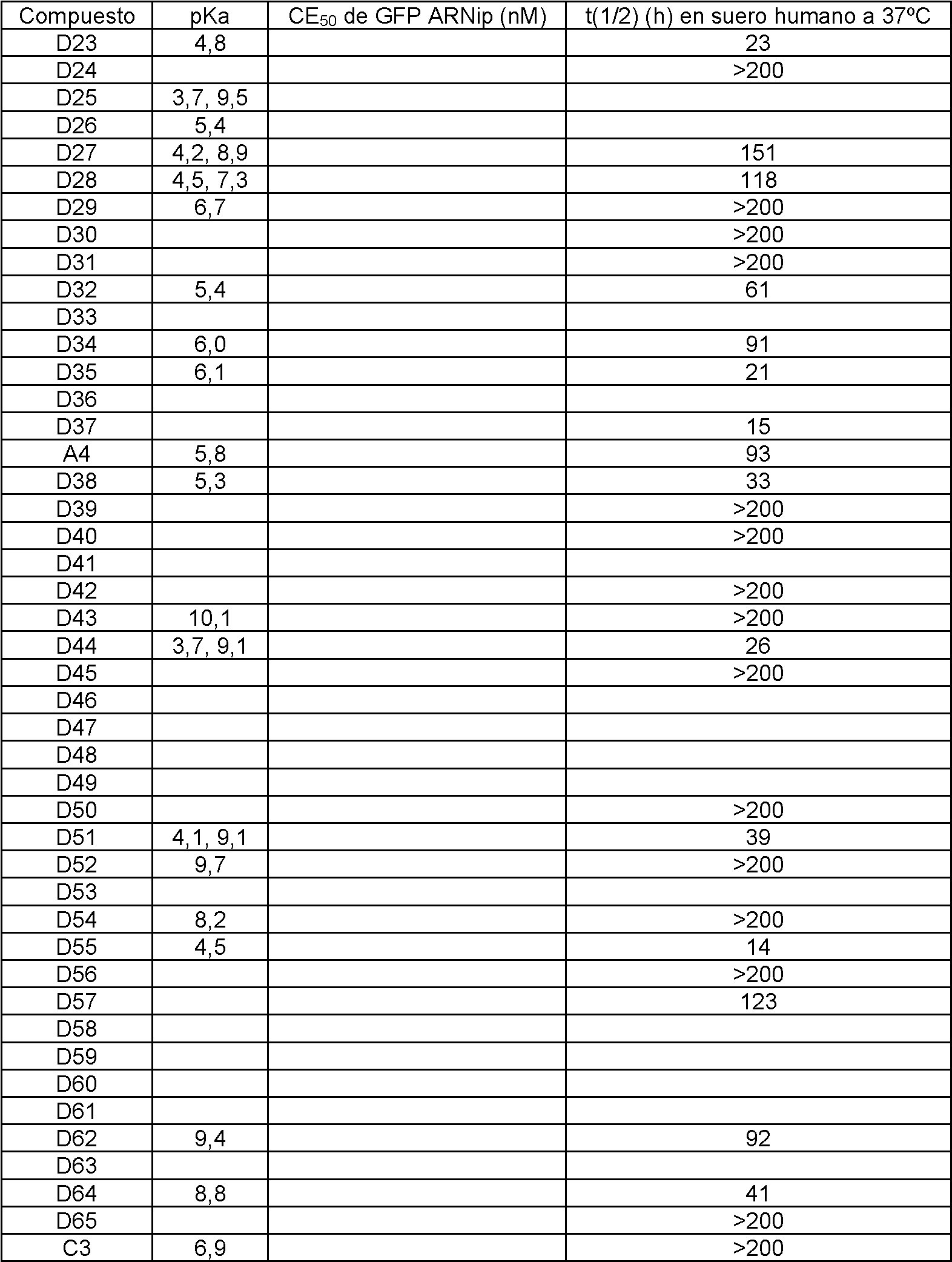

Ejemplo 40: se preparan formulaciones de ejemplo para encapsular agentes de ácido nucleico de interferencia pequeños (ARNip).Example 40: Example formulations are prepared to encapsulate small interfering nucleic acid agents (siRNAs).
Se preparan formulaciones lipídicas de nanopartículas con las siguientes composiciones:Nanoparticle lipid formulations are prepared with the following compositions:
(Compuesto ionizable/DOPE/Colesterol/DMPE-PEG), % en moles(Ionizable Compound / DOPE / Cholesterol / DMPE-PEG),% by mole
50/28/21/150/28/21/1
Se mide la estabilidad en suero de una formulación de nanopartículas y se muestra en la tabla 10. Las formulaciones son capaces de encapsular el ARNip y conservar la estabilidad en suero humano.The serum stability of a nanoparticle formulation is measured and is shown in Table 10. The formulations are capable of encapsulating siRNA and maintaining stability in human serum.
Tabla 10: formulaciones lipídicas para ARNipTable 10: lipid formulations for siRNA

Las realizaciones descritas en el presente documento no son limitativas y un experto en la técnica puede apreciar fácilmente que pueden someterse a pruebas combinaciones específicas de las modificaciones descritas en el presente documento sin experimentación indebida para la identificación de moléculas de ácido nucleico con actividad de iARN mejorada.The embodiments described herein are not limiting and one skilled in the art can readily appreciate that specific combinations of the modifications described herein can be tested without undue experimentation for the identification of nucleic acid molecules with enhanced iRNA activity. .
Se entiende que esta invención no se limita a la metodología, los protocolos, los materiales y los reactivos particulares descritos, ya que estos pueden variar. También debe entenderse que la terminología usada en el presente documento es solamente con el fin de describir realizaciones particulares y no se pretende limitar el alcance de la presente invención.It is understood that this invention is not limited to the particular methodology, protocols, materials, and reagents described, as these may vary. It should also be understood that the terminology used herein is only for the purpose of describing particular embodiments and is not intended to limit the scope of the present invention.
Cabe destacar que, tal como se usa en el presente documento y en las reivindicaciones adjuntas, las formas en singular “un”, “una” y “el/la” incluyen las referencias en plural a menos que el contexto dicte claramente lo contrario. Además, los términos “un” (o “una”), “uno o más” y “al menos uno” pueden usarse de manera intercambiable en el presente documento. También cabe destacar que los términos “comprende”, “que comprende”, “que contiene”, “que incluye” y “que tiene” pueden usarse de manera intercambiable y debe leerse en sentido amplio y sin limitación. It should be noted that, as used herein and in the appended claims, the singular forms "a", "an" and "the" include plural references unless the context clearly dictates otherwise. Furthermore, the terms "a" (or "an"), "one or more" and "at least one" may be used interchangeably herein. It should also be noted that the terms "comprises", "comprising", "containing", "including" and "having" can be used interchangeably and should be read broadly and without limitation.
La mención de intervalos de valores en el presente documento está destinada simplemente a servir como método de abreviatura para referirse individualmente a cada valor por separado que se encuentra dentro del intervalo, a menos que se indique de otro modo en el presente documento, y cada valor por separado se incorpora en la memoria descriptiva como si se mencionara individualmente en el presente documento. Para los grupos de Markush, los expertos en la técnica reconocerán que esta descripción incluye los miembros individuales, así como subgrupos de los miembros del grupo de Markush.Mention of ranges of values herein is merely intended to serve as an abbreviation for individually referring to each separate value that falls within the range, unless otherwise indicated herein, and each value separately is incorporated into the specification as if individually mentioned herein. For Markush groups, those skilled in the art will recognize that this description includes the individual members as well as subgroups of the members of the Markush group.
Un compuesto, una molécula o una composición de esta invención puede tener una forma iónica para la que el contraión o los contraiones correspondientes no se muestran. Un experto en la técnica entenderá inmediatamente que el contraión o los contraiones existirán según sea necesario. Los ejemplos de contraiones incluyen iones de metal alcalino, Cl- y contraiones farmacéuticamente aceptables.A compound, molecule, or composition of this invention may have an ionic form for which the corresponding counterion (s) are not shown. One skilled in the art will readily understand that the counterion or counterions will exist as needed. Examples of counter ions include pharmaceutically acceptable alkali metal ions, Cl-, and counter ions.
Por ejemplo, cuando se proporciona una lista de ejemplos o componentes, tal como una lista de compuestos, moléculas o composiciones adecuados para esta invención, resultará evidente para los expertos en la técnica que también pueden ser adecuadas mezclas de los compuestos, las moléculas o las composiciones enumeradas.For example, when a list of examples or components is provided, such as a list of suitable compounds, molecules, or compositions for this invention, it will be apparent to those skilled in the art that mixtures of the compounds, molecules, or compositions may also be suitable. numbered compositions.
Sin elaboración adicional, se cree que un experto en la técnica puede, basándose en la descripción anterior, utilizar la presente invención en su máxima extensión. Por tanto, las siguientes realizaciones específicas deben interpretarse como simplemente ilustrativas y no limitativas del resto de la divulgación en lo más mínimo.Without further elaboration, it is believed that one skilled in the art can, based on the foregoing description, utilize the present invention to its fullest extent. Therefore, the following specific embodiments are to be construed as merely illustrative and not limiting of the remainder of the disclosure in the least.
Todas las características divulgadas en esta memoria descriptiva pueden combinarse en cualquier combinación. All of the features disclosed in this specification can be combined in any combination.
Claims (12)


Applications Claiming Priority (2)
| Application Number | Priority Date | Filing Date | Title |
|---|---|---|---|
| US201562184188P | 2015-06-24 | 2015-06-24 | |
| PCT/US2016/039114 WO2016210190A1 (en) | 2015-06-24 | 2016-06-23 | Ionizable compounds and compositions and uses thereof |
Publications (1)
| Publication Number | Publication Date |
|---|---|
| ES2828717T3 true ES2828717T3 (en) | 2021-05-27 |
Family
ID=57585619
Family Applications (1)
| Application Number | Title | Priority Date | Filing Date |
|---|---|---|---|
| ES16815348T Active ES2828717T3 (en) | 2015-06-24 | 2016-06-23 | Ionizable Compounds and Compositions and Uses Thereof |
Country Status (11)
| Country | Link |
|---|---|
| US (4) | US10167253B2 (en) |
| EP (2) | EP3686184A3 (en) |
| JP (1) | JP6480025B2 (en) |
| KR (1) | KR102659774B1 (en) |
| CN (1) | CN107708739A (en) |
| AU (1) | AU2016281685B2 (en) |
| CA (1) | CA2990668C (en) |
| ES (1) | ES2828717T3 (en) |
| PT (1) | PT3313449T (en) |
| TW (1) | TWI746442B (en) |
| WO (1) | WO2016210190A1 (en) |
Families Citing this family (26)
| Publication number | Priority date | Publication date | Assignee | Title |
|---|---|---|---|---|
| US10167253B2 (en) * | 2015-06-24 | 2019-01-01 | Nitto Denko Corporation | Ionizable compounds and compositions and uses thereof |
| US12491261B2 (en) | 2016-10-26 | 2025-12-09 | Acuitas Therapeutics, Inc. | Lipid nanoparticle formulations |
| CN111164068B (en) * | 2018-08-21 | 2023-11-14 | 株式会社东芝 | Biodegradable compounds, lipid particles, compositions containing lipid particles, and kits |
| CA3116576A1 (en) | 2018-10-18 | 2020-04-23 | Acuitas Therapeutics, Inc. | Lipids for lipid nanoparticle delivery of active agents |
| JP7667077B2 (en) * | 2018-11-16 | 2025-04-22 | 日東電工株式会社 | RNA interference delivery formulations and methods for malignant tumors |
| PT3908568T (en) | 2019-01-11 | 2024-09-30 | Acuitas Therapeutics Inc | Lipids for lipid nanoparticle delivery of active agents |
| WO2021204175A1 (en) * | 2020-04-09 | 2021-10-14 | Suzhou Abogen Biosciences Co., Ltd. | Lipid nanoparticle composition |
| EP4132576A1 (en) | 2020-04-09 | 2023-02-15 | Suzhou Abogen Biosciences Co., Ltd. | Nucleic acid vaccines for coronavirus |
| US20220049251A1 (en) * | 2020-05-20 | 2022-02-17 | Nitto Denko Corporation | dsRNA Directed to Coronavirus Proteins |
| ES3054438T3 (en) | 2020-07-16 | 2026-02-03 | Acuitas Therapeutics Inc | Cationic lipids for use in lipid nanoparticles |
| BR112023000568A2 (en) * | 2020-07-17 | 2023-01-31 | Sanofi Pasteur | CLEAVABLE LIPID COMPOUNDS, COMPOSITIONS CONTAINING THEM, AND USES THEREOF |
| CN113185421B (en) * | 2020-11-27 | 2022-01-25 | 广州市锐博生物科技有限公司 | Lipid compounds and compositions thereof |
| CA3207753A1 (en) | 2021-02-10 | 2022-08-18 | Jessica DETERLING | Compounds, compositions, and methods of using thereof |
| CN115466269A (en) * | 2021-06-11 | 2022-12-13 | 复旦大学 | A kind of choline carbonate prodrug and its preparation method and application |
| CA3242402A1 (en) | 2021-12-16 | 2023-06-22 | Acuitas Therapeutics, Inc. | Lipids for use in lipid nanoparticle formulations |
| JP2025502599A (en) * | 2021-12-23 | 2025-01-28 | スージョウ・アボジェン・バイオサイエンシズ・カンパニー・リミテッド | Lipid Compounds and Lipid Nanoparticle Compositions |
| WO2023126053A1 (en) * | 2021-12-28 | 2023-07-06 | BioNTech SE | Lipid-based formulations for administration of rna |
| CN116396244B (en) * | 2021-12-31 | 2025-07-11 | 厦门赛诺邦格生物科技股份有限公司 | A nitrogen-containing heterocyclic cationic lipid and its application |
| WO2024012272A1 (en) * | 2022-07-11 | 2024-01-18 | 传信生物医药(苏州)有限公司 | Lipid compound and use thereof |
| WO2024032754A1 (en) * | 2022-08-12 | 2024-02-15 | 上海蓝鹊生物医药有限公司 | Nitrogen-containing chain compound, preparation method therefor, composition containing said compound, and use thereof |
| CN115947672B (en) * | 2023-01-04 | 2024-02-27 | 成都威斯津生物医药科技有限公司 | Compounds, liposomes and drug carriers for drug delivery |
| CN121039098A (en) * | 2023-04-28 | 2025-11-28 | 日东电工株式会社 | Lipids, pharmaceutical compositions comprising them, and methods for delivering active pharmaceutical ingredients. |
| EP4480943A1 (en) * | 2023-06-22 | 2024-12-25 | Oz Biosciences | New class of lipids for delivering active ingredients into cells |
| WO2025059107A1 (en) * | 2023-09-11 | 2025-03-20 | The Trustees Of The University Of Pennsylvania | Degradable, branched lipid compounds, methods of preparation thereof, lipid nanoparticles (lnps) comprising the same, and methods of use thereof |
| WO2025064475A2 (en) * | 2023-09-18 | 2025-03-27 | Flagship Pioneering Innovations Vii, Llc | Ionizable lipidoid compositions and therapeutic uses thereof |
| WO2025140595A1 (en) * | 2023-12-29 | 2025-07-03 | 厦门赛诺邦格生物科技股份有限公司 | Asymmetric cationic lipid having branched piperazine ring |
Family Cites Families (56)
| Publication number | Priority date | Publication date | Assignee | Title |
|---|---|---|---|---|
| US4115548A (en) * | 1974-01-18 | 1978-09-19 | The Procter & Gamble Company | Detergent compositions comprising modified proteins |
| CS226907B1 (en) * | 1981-08-07 | 1984-04-16 | Kasafirek Evzen | Alkylamides of carboxyalkanoylpeptides |
| DE3806852A1 (en) * | 1988-03-03 | 1989-09-14 | Knoll Ag | NEW (ALPHA) AMINODICARBONIC ACID DERIVATIVES, THEIR PRODUCTION AND USE |
| CA2064783C (en) | 1989-08-29 | 2002-12-17 | Richard C. Franson | Cytoprotective fatty moiety compounds |
| US5082683A (en) | 1990-08-01 | 1992-01-21 | Nabisco Brands, Inc. | Amide/amine ester derivatives as low calorie fat mimetics |
| JP2575235B2 (en) | 1991-04-11 | 1997-01-22 | 株式会社トクヤマ | Method for producing ion-sensitive membrane |
| DE4112971A1 (en) * | 1991-04-20 | 1992-10-22 | Hoechst Ag | SULPHONIC ACID ESTERS OF 2,4,6-TRIS- (2-HYDROXY-ETHOXY) - (1,3,5) TRIAZINE, A POSITIVELY WORKING RADIATION-SENSITIVE MIXTURE AND RECORDING MATERIAL THEREFORE |
| MY111077A (en) | 1992-11-13 | 1999-08-30 | Kao Corp | Agricultural chemical composition |
| JP2994898B2 (en) | 1992-12-28 | 1999-12-27 | 花王株式会社 | Liquid soft finish |
| JPH06336466A (en) * | 1993-05-26 | 1994-12-06 | Lion Corp | Novel amido ester amine compound, intermediate thereof, production method thereof and softening agent |
| JPH0718570A (en) | 1993-06-29 | 1995-01-20 | Lion Corp | Softener composition |
| JPH0718569A (en) | 1993-06-29 | 1995-01-20 | Lion Corp | Softener composition |
| JPH08295657A (en) | 1995-04-27 | 1996-11-12 | Kanebo Ltd | Intermediate for surfactant |
| DE19605175A1 (en) * | 1996-02-13 | 1997-08-14 | Sourovoi Andrej Dr | Lipid compounds and their use |
| BR9711154A (en) | 1996-08-12 | 1999-08-17 | Yoshitomi Pharmaceutical | Pharmaceutical agent containing rho kinase inhibitor |
| DE19637043A1 (en) | 1996-09-12 | 1998-03-19 | Boehringer Mannheim Gmbh | Novel amino alcohol derivatives, processes for their preparation and medicaments and reagents containing these compounds |
| US5958894A (en) | 1997-04-04 | 1999-09-28 | Megabios Corporation | Amphiphilic biguanide derivatives |
| CA2263367A1 (en) | 1997-06-12 | 1998-12-17 | Transgene S.A. | Novel lipid complexes for transferring at least a therapeutically active substance, in particular a polynucleotide into a target cell and use in gene therapy |
| US6372254B1 (en) * | 1998-04-02 | 2002-04-16 | Impax Pharmaceuticals Inc. | Press coated, pulsatile drug delivery system suitable for oral administration |
| US6399629B1 (en) | 1998-06-01 | 2002-06-04 | Microcide Pharmaceuticals, Inc. | Efflux pump inhibitors |
| JP2001247532A (en) | 2000-03-08 | 2001-09-11 | Chukyo Yushi Kk | Fatty acid amide compound and use thereof |
| GB0024428D0 (en) * | 2000-10-05 | 2000-11-22 | King S College | Absorption enhancers |
| AU2002212015B2 (en) | 2000-10-13 | 2007-01-25 | Shire Canada Inc. | Dioxolane analogs for improved inter-cellular delivery |
| JP4823430B2 (en) * | 2001-03-28 | 2011-11-24 | 花王株式会社 | Surfactant composition |
| JP2004250343A (en) | 2003-02-18 | 2004-09-09 | Fuji Photo Film Co Ltd | Iodoaryl group-having amino acid derivative |
| JPWO2005054486A1 (en) * | 2003-12-05 | 2007-06-28 | 福岡県 | Gene transfer reagent preparation method |
| JP2006254877A (en) * | 2005-03-18 | 2006-09-28 | Fukuoka Prefecture | Glycolipid-containing carrier and gene transfer method using the same |
| CR9465A (en) * | 2005-03-25 | 2008-06-19 | Surface Logix Inc | PHARMACOCINETICALLY IMPROVED COMPOUNDS |
| US7915230B2 (en) | 2005-05-17 | 2011-03-29 | Molecular Transfer, Inc. | Reagents for transfection of eukaryotic cells |
| NZ593080A (en) | 2006-05-05 | 2012-12-21 | Molecular Transfer Inc | Novel reagents for transfection of eukaryotic cells |
| US20080132500A1 (en) * | 2006-10-20 | 2008-06-05 | Kun Liu | Antibiotic compounds |
| JP2010520238A (en) | 2007-03-01 | 2010-06-10 | マリンクロット インコーポレイテッド | Integrated photoactive small molecule and integrated photoactive small molecule use |
| GB0720486D0 (en) | 2007-10-19 | 2007-11-28 | Univ Edinburgh | Cationic lipids |
| WO2009097332A2 (en) | 2008-01-29 | 2009-08-06 | Shire Human Genetic Therapies, Inc. | Therapeutic compositions |
| JP5062042B2 (en) | 2008-05-28 | 2012-10-31 | コニカミノルタビジネステクノロジーズ株式会社 | Toner for developing electrostatic image and image forming method |
| EP2143726A1 (en) * | 2008-07-11 | 2010-01-13 | Novosom AG | Nucleic acid comprising zwitterionic nucleotides |
| US8722082B2 (en) | 2008-11-10 | 2014-05-13 | Tekmira Pharmaceuticals Corporation | Lipids and compositions for the delivery of therapeutics |
| JP5515360B2 (en) | 2009-03-30 | 2014-06-11 | 日油株式会社 | Lipid derivatives |
| CN101648121B (en) | 2009-08-21 | 2012-08-29 | 江苏钟山化工有限公司 | Water-soluble thickener, preparation method thereof and application thereof in pesticide formulation |
| KR101773643B1 (en) * | 2010-04-28 | 2017-08-31 | 교와 핫꼬 기린 가부시키가이샤 | Cationic lipid |
| US20160015656A2 (en) * | 2010-08-05 | 2016-01-21 | Nitto Denko Corporation | Composition for regenerating normal tissue from fibrotic tissue |
| CA2824526C (en) * | 2011-01-11 | 2020-07-07 | Alnylam Pharmaceuticals, Inc. | Pegylated lipids and their use for drug delivery |
| WO2012132022A1 (en) | 2011-03-30 | 2012-10-04 | Fukuoka Prefectural Government | Agent for promoting gene transfer and method of gene transfer using the same |
| WO2013158127A1 (en) | 2012-04-16 | 2013-10-24 | Molecular Transfer, Inc. | Agents for improved delivery of nucleic acids to eukaryotic cells |
| WO2012142622A1 (en) | 2011-04-15 | 2012-10-18 | Molecular Transfer, Inc. | Agents for improved delivery of nucleic acids to eukaryotic cells |
| WO2012162210A1 (en) | 2011-05-26 | 2012-11-29 | Merck Sharp & Dohme Corp. | Ring constrained cationic lipids for oligonucleotide delivery |
| EP2718261B1 (en) | 2011-06-08 | 2016-02-24 | Nitto Denko Corporation | Compounds for targeting drug delivery and enhancing sirna activity |
| US9011903B2 (en) * | 2011-06-08 | 2015-04-21 | Nitto Denko Corporation | Cationic lipids for therapeutic agent delivery formulations |
| JP2013095755A (en) | 2011-11-02 | 2013-05-20 | Kyowa Hakko Kirin Co Ltd | Cationic lipid |
| US9579338B2 (en) | 2011-11-04 | 2017-02-28 | Nitto Denko Corporation | Method of producing lipid nanoparticles for drug delivery |
| WO2013081118A1 (en) * | 2011-12-01 | 2013-06-06 | 国立大学法人 東京大学 | Compound having read-through activity |
| CA2869748C (en) | 2012-04-12 | 2017-10-24 | Yale University | Vehicles for controlled delivery of different pharmaceutical agents |
| HRP20181855T1 (en) | 2012-06-08 | 2018-12-28 | Nitto Denko Corporation | LIPIDES FOR THE FORMULATION INTENDED FOR THE THERAPY |
| US10264976B2 (en) * | 2014-12-26 | 2019-04-23 | The University Of Akron | Biocompatible flavonoid compounds for organelle and cell imaging |
| WO2016134146A2 (en) * | 2015-02-19 | 2016-08-25 | Nitto Denko Corporation | Rna interference therapeutics against ebola virus |
| US10167253B2 (en) * | 2015-06-24 | 2019-01-01 | Nitto Denko Corporation | Ionizable compounds and compositions and uses thereof |
-
2016
- 2016-06-23 US US15/191,511 patent/US10167253B2/en active Active
- 2016-06-23 WO PCT/US2016/039114 patent/WO2016210190A1/en not_active Ceased
- 2016-06-23 CN CN201680037092.8A patent/CN107708739A/en active Pending
- 2016-06-23 AU AU2016281685A patent/AU2016281685B2/en active Active
- 2016-06-23 KR KR1020187002177A patent/KR102659774B1/en active Active
- 2016-06-23 EP EP20163284.1A patent/EP3686184A3/en active Pending
- 2016-06-23 CA CA2990668A patent/CA2990668C/en active Active
- 2016-06-23 ES ES16815348T patent/ES2828717T3/en active Active
- 2016-06-23 JP JP2017566796A patent/JP6480025B2/en active Active
- 2016-06-23 PT PT168153484T patent/PT3313449T/en unknown
- 2016-06-23 EP EP16815348.4A patent/EP3313449B1/en active Active
- 2016-06-24 TW TW105120027A patent/TWI746442B/en active
-
2018
- 2018-12-20 US US16/228,054 patent/US11384051B2/en active Active
-
2022
- 2022-04-05 US US17/658,075 patent/US12319643B2/en active Active
-
2025
- 2025-04-22 US US19/186,484 patent/US20250250226A1/en active Pending
Also Published As
| Publication number | Publication date |
|---|---|
| RU2018102536A3 (en) | 2019-11-08 |
| PT3313449T (en) | 2020-10-30 |
| RU2018102536A (en) | 2019-07-24 |
| US10167253B2 (en) | 2019-01-01 |
| US20190127318A1 (en) | 2019-05-02 |
| HK1253031A1 (en) | 2019-06-06 |
| US20220242820A1 (en) | 2022-08-04 |
| CN107708739A (en) | 2018-02-16 |
| AU2016281685A1 (en) | 2018-01-18 |
| US20160376229A1 (en) | 2016-12-29 |
| KR102659774B1 (en) | 2024-04-23 |
| EP3686184A3 (en) | 2020-08-26 |
| JP2018524330A (en) | 2018-08-30 |
| AU2016281685B2 (en) | 2021-08-12 |
| CA2990668C (en) | 2024-07-02 |
| EP3313449A4 (en) | 2018-11-07 |
| CA2990668A1 (en) | 2016-12-29 |
| EP3313449A1 (en) | 2018-05-02 |
| WO2016210190A1 (en) | 2016-12-29 |
| KR20180021115A (en) | 2018-02-28 |
| EP3313449B1 (en) | 2020-09-23 |
| US12319643B2 (en) | 2025-06-03 |
| JP6480025B2 (en) | 2019-03-06 |
| EP3686184A2 (en) | 2020-07-29 |
| TWI746442B (en) | 2021-11-21 |
| US20250250226A1 (en) | 2025-08-07 |
| TW201713614A (en) | 2017-04-16 |
| US11384051B2 (en) | 2022-07-12 |
Similar Documents
| Publication | Publication Date | Title |
|---|---|---|
| ES2828717T3 (en) | Ionizable Compounds and Compositions and Uses Thereof | |
| ES2964547T3 (en) | Compound, salt thereof and lipid particles | |
| EP4122920A1 (en) | Lipid compound as well as lipid carrier, nucleic acid lipid nanoparticle composition and pharmaceutical preparation containing same | |
| ES3036322T3 (en) | Lipid composition | |
| JP7429536B2 (en) | Nucleic acid-containing lipid nanoparticles | |
| AU2023202793B2 (en) | Fusogenic compounds for delivery of biologically active molecules | |
| EP3162794B1 (en) | Alkyl substituted azetidines as cationic lipid | |
| EP4635939A1 (en) | Novel lipid compound and lipid nanoparticle composition comprising same | |
| JP6495408B2 (en) | Cationic lipid | |
| RU2776478C2 (en) | Ionized compounds and compositions and their use | |
| BR112017027458B1 (en) | COMPOUND, AND, COMPOSITION | |
| HK1253031B (en) | Ionizable compounds and compositions and uses thereof | |
| RU2808990C2 (en) | Fusogenic compounds for delivery of biologically active molecules | |
| WO2025242231A1 (en) | Cationic lipids and preparation method thereof | |
| KR20250103031A (en) | Lipid nanoparticle composition comprising gallic acid derivative lipid and use thereof |