ES2852448T3 - Spunbonded nonwovens with fine wavy fibers and improved uniformity - Google Patents
Spunbonded nonwovens with fine wavy fibers and improved uniformity Download PDFInfo
- Publication number
- ES2852448T3 ES2852448T3 ES19153529T ES19153529T ES2852448T3 ES 2852448 T3 ES2852448 T3 ES 2852448T3 ES 19153529 T ES19153529 T ES 19153529T ES 19153529 T ES19153529 T ES 19153529T ES 2852448 T3 ES2852448 T3 ES 2852448T3
- Authority
- ES
- Spain
- Prior art keywords
- melt flow
- flow rate
- base polymer
- fibers
- polymer
- Prior art date
- Legal status (The legal status is an assumption and is not a legal conclusion. Google has not performed a legal analysis and makes no representation as to the accuracy of the status listed.)
- Active
Links
Classifications
-
- D—TEXTILES; PAPER
- D04—BRAIDING; LACE-MAKING; KNITTING; TRIMMINGS; NON-WOVEN FABRICS
- D04H—MAKING TEXTILE FABRICS, e.g. FROM FIBRES OR FILAMENTARY MATERIAL; FABRICS MADE BY SUCH PROCESSES OR APPARATUS, e.g. FELTS, NON-WOVEN FABRICS; COTTON-WOOL; WADDING ; NON-WOVEN FABRICS FROM STAPLE FIBRES, FILAMENTS OR YARNS, BONDED WITH AT LEAST ONE WEB-LIKE MATERIAL DURING THEIR CONSOLIDATION
- D04H3/00—Non-woven fabrics formed wholly or mainly of yarns or like filamentary material of substantial length
- D04H3/08—Non-woven fabrics formed wholly or mainly of yarns or like filamentary material of substantial length characterised by the method of strengthening or consolidating
- D04H3/16—Non-woven fabrics formed wholly or mainly of yarns or like filamentary material of substantial length characterised by the method of strengthening or consolidating with bonds between thermoplastic filaments produced in association with filament formation, e.g. immediately following extrusion
-
- D—TEXTILES; PAPER
- D01—NATURAL OR MAN-MADE THREADS OR FIBRES; SPINNING
- D01D—MECHANICAL METHODS OR APPARATUS IN THE MANUFACTURE OF ARTIFICIAL FILAMENTS, THREADS, FIBRES, BRISTLES OR RIBBONS
- D01D5/00—Formation of filaments, threads, or the like
- D01D5/12—Stretch-spinning methods
- D01D5/14—Stretch-spinning methods with flowing liquid or gaseous stretching media, e.g. solution-blowing
-
- D—TEXTILES; PAPER
- D01—NATURAL OR MAN-MADE THREADS OR FIBRES; SPINNING
- D01D—MECHANICAL METHODS OR APPARATUS IN THE MANUFACTURE OF ARTIFICIAL FILAMENTS, THREADS, FIBRES, BRISTLES OR RIBBONS
- D01D5/00—Formation of filaments, threads, or the like
- D01D5/08—Melt spinning methods
- D01D5/098—Melt spinning methods with simultaneous stretching
-
- D—TEXTILES; PAPER
- D04—BRAIDING; LACE-MAKING; KNITTING; TRIMMINGS; NON-WOVEN FABRICS
- D04H—MAKING TEXTILE FABRICS, e.g. FROM FIBRES OR FILAMENTARY MATERIAL; FABRICS MADE BY SUCH PROCESSES OR APPARATUS, e.g. FELTS, NON-WOVEN FABRICS; COTTON-WOOL; WADDING ; NON-WOVEN FABRICS FROM STAPLE FIBRES, FILAMENTS OR YARNS, BONDED WITH AT LEAST ONE WEB-LIKE MATERIAL DURING THEIR CONSOLIDATION
- D04H3/00—Non-woven fabrics formed wholly or mainly of yarns or like filamentary material of substantial length
- D04H3/005—Synthetic yarns or filaments
-
- D—TEXTILES; PAPER
- D01—NATURAL OR MAN-MADE THREADS OR FIBRES; SPINNING
- D01D—MECHANICAL METHODS OR APPARATUS IN THE MANUFACTURE OF ARTIFICIAL FILAMENTS, THREADS, FIBRES, BRISTLES OR RIBBONS
- D01D5/00—Formation of filaments, threads, or the like
- D01D5/08—Melt spinning methods
- D01D5/098—Melt spinning methods with simultaneous stretching
- D01D5/0985—Melt spinning methods with simultaneous stretching by means of a flowing gas (e.g. melt-blowing)
-
- D—TEXTILES; PAPER
- D01—NATURAL OR MAN-MADE THREADS OR FIBRES; SPINNING
- D01D—MECHANICAL METHODS OR APPARATUS IN THE MANUFACTURE OF ARTIFICIAL FILAMENTS, THREADS, FIBRES, BRISTLES OR RIBBONS
- D01D5/00—Formation of filaments, threads, or the like
- D01D5/22—Formation of filaments, threads, or the like with a crimped or curled structure; with a special structure to simulate wool
-
- D—TEXTILES; PAPER
- D01—NATURAL OR MAN-MADE THREADS OR FIBRES; SPINNING
- D01F—CHEMICAL FEATURES IN THE MANUFACTURE OF ARTIFICIAL FILAMENTS, THREADS, FIBRES, BRISTLES OR RIBBONS; APPARATUS SPECIALLY ADAPTED FOR THE MANUFACTURE OF CARBON FILAMENTS
- D01F1/00—General methods for the manufacture of artificial filaments or the like
- D01F1/02—Addition of substances to the spinning solution or to the melt
- D01F1/10—Other agents for modifying properties
-
- D—TEXTILES; PAPER
- D01—NATURAL OR MAN-MADE THREADS OR FIBRES; SPINNING
- D01F—CHEMICAL FEATURES IN THE MANUFACTURE OF ARTIFICIAL FILAMENTS, THREADS, FIBRES, BRISTLES OR RIBBONS; APPARATUS SPECIALLY ADAPTED FOR THE MANUFACTURE OF CARBON FILAMENTS
- D01F8/00—Conjugated, i.e. bi- or multicomponent, artificial filaments or the like; Manufacture thereof
- D01F8/04—Conjugated, i.e. bi- or multicomponent, artificial filaments or the like; Manufacture thereof from synthetic polymers
- D01F8/06—Conjugated, i.e. bi- or multicomponent, artificial filaments or the like; Manufacture thereof from synthetic polymers with at least one polyolefin as constituent
-
- D—TEXTILES; PAPER
- D04—BRAIDING; LACE-MAKING; KNITTING; TRIMMINGS; NON-WOVEN FABRICS
- D04H—MAKING TEXTILE FABRICS, e.g. FROM FIBRES OR FILAMENTARY MATERIAL; FABRICS MADE BY SUCH PROCESSES OR APPARATUS, e.g. FELTS, NON-WOVEN FABRICS; COTTON-WOOL; WADDING ; NON-WOVEN FABRICS FROM STAPLE FIBRES, FILAMENTS OR YARNS, BONDED WITH AT LEAST ONE WEB-LIKE MATERIAL DURING THEIR CONSOLIDATION
- D04H1/00—Non-woven fabrics formed wholly or mainly of staple fibres or like relatively short fibres
-
- D—TEXTILES; PAPER
- D04—BRAIDING; LACE-MAKING; KNITTING; TRIMMINGS; NON-WOVEN FABRICS
- D04H—MAKING TEXTILE FABRICS, e.g. FROM FIBRES OR FILAMENTARY MATERIAL; FABRICS MADE BY SUCH PROCESSES OR APPARATUS, e.g. FELTS, NON-WOVEN FABRICS; COTTON-WOOL; WADDING ; NON-WOVEN FABRICS FROM STAPLE FIBRES, FILAMENTS OR YARNS, BONDED WITH AT LEAST ONE WEB-LIKE MATERIAL DURING THEIR CONSOLIDATION
- D04H1/00—Non-woven fabrics formed wholly or mainly of staple fibres or like relatively short fibres
- D04H1/40—Non-woven fabrics formed wholly or mainly of staple fibres or like relatively short fibres from fleeces or layers composed of fibres without existing or potential cohesive properties
- D04H1/42—Non-woven fabrics formed wholly or mainly of staple fibres or like relatively short fibres from fleeces or layers composed of fibres without existing or potential cohesive properties characterised by the use of certain kinds of fibres insofar as this use has no preponderant influence on the consolidation of the fleece
- D04H1/4282—Addition polymers
- D04H1/4291—Olefin series
-
- D—TEXTILES; PAPER
- D04—BRAIDING; LACE-MAKING; KNITTING; TRIMMINGS; NON-WOVEN FABRICS
- D04H—MAKING TEXTILE FABRICS, e.g. FROM FIBRES OR FILAMENTARY MATERIAL; FABRICS MADE BY SUCH PROCESSES OR APPARATUS, e.g. FELTS, NON-WOVEN FABRICS; COTTON-WOOL; WADDING ; NON-WOVEN FABRICS FROM STAPLE FIBRES, FILAMENTS OR YARNS, BONDED WITH AT LEAST ONE WEB-LIKE MATERIAL DURING THEIR CONSOLIDATION
- D04H1/00—Non-woven fabrics formed wholly or mainly of staple fibres or like relatively short fibres
- D04H1/40—Non-woven fabrics formed wholly or mainly of staple fibres or like relatively short fibres from fleeces or layers composed of fibres without existing or potential cohesive properties
- D04H1/42—Non-woven fabrics formed wholly or mainly of staple fibres or like relatively short fibres from fleeces or layers composed of fibres without existing or potential cohesive properties characterised by the use of certain kinds of fibres insofar as this use has no preponderant influence on the consolidation of the fleece
- D04H1/4391—Non-woven fabrics formed wholly or mainly of staple fibres or like relatively short fibres from fleeces or layers composed of fibres without existing or potential cohesive properties characterised by the use of certain kinds of fibres insofar as this use has no preponderant influence on the consolidation of the fleece characterised by the shape of the fibres
-
- D—TEXTILES; PAPER
- D04—BRAIDING; LACE-MAKING; KNITTING; TRIMMINGS; NON-WOVEN FABRICS
- D04H—MAKING TEXTILE FABRICS, e.g. FROM FIBRES OR FILAMENTARY MATERIAL; FABRICS MADE BY SUCH PROCESSES OR APPARATUS, e.g. FELTS, NON-WOVEN FABRICS; COTTON-WOOL; WADDING ; NON-WOVEN FABRICS FROM STAPLE FIBRES, FILAMENTS OR YARNS, BONDED WITH AT LEAST ONE WEB-LIKE MATERIAL DURING THEIR CONSOLIDATION
- D04H1/00—Non-woven fabrics formed wholly or mainly of staple fibres or like relatively short fibres
- D04H1/40—Non-woven fabrics formed wholly or mainly of staple fibres or like relatively short fibres from fleeces or layers composed of fibres without existing or potential cohesive properties
- D04H1/54—Non-woven fabrics formed wholly or mainly of staple fibres or like relatively short fibres from fleeces or layers composed of fibres without existing or potential cohesive properties by welding together the fibres, e.g. by partially melting or dissolving
- D04H1/541—Composite fibres, e.g. sheath-core, sea-island or side-by-side; Mixed fibres
-
- D—TEXTILES; PAPER
- D04—BRAIDING; LACE-MAKING; KNITTING; TRIMMINGS; NON-WOVEN FABRICS
- D04H—MAKING TEXTILE FABRICS, e.g. FROM FIBRES OR FILAMENTARY MATERIAL; FABRICS MADE BY SUCH PROCESSES OR APPARATUS, e.g. FELTS, NON-WOVEN FABRICS; COTTON-WOOL; WADDING ; NON-WOVEN FABRICS FROM STAPLE FIBRES, FILAMENTS OR YARNS, BONDED WITH AT LEAST ONE WEB-LIKE MATERIAL DURING THEIR CONSOLIDATION
- D04H1/00—Non-woven fabrics formed wholly or mainly of staple fibres or like relatively short fibres
- D04H1/40—Non-woven fabrics formed wholly or mainly of staple fibres or like relatively short fibres from fleeces or layers composed of fibres without existing or potential cohesive properties
- D04H1/54—Non-woven fabrics formed wholly or mainly of staple fibres or like relatively short fibres from fleeces or layers composed of fibres without existing or potential cohesive properties by welding together the fibres, e.g. by partially melting or dissolving
- D04H1/542—Adhesive fibres
- D04H1/544—Olefin series
-
- D—TEXTILES; PAPER
- D04—BRAIDING; LACE-MAKING; KNITTING; TRIMMINGS; NON-WOVEN FABRICS
- D04H—MAKING TEXTILE FABRICS, e.g. FROM FIBRES OR FILAMENTARY MATERIAL; FABRICS MADE BY SUCH PROCESSES OR APPARATUS, e.g. FELTS, NON-WOVEN FABRICS; COTTON-WOOL; WADDING ; NON-WOVEN FABRICS FROM STAPLE FIBRES, FILAMENTS OR YARNS, BONDED WITH AT LEAST ONE WEB-LIKE MATERIAL DURING THEIR CONSOLIDATION
- D04H3/00—Non-woven fabrics formed wholly or mainly of yarns or like filamentary material of substantial length
- D04H3/005—Synthetic yarns or filaments
- D04H3/007—Addition polymers
-
- D—TEXTILES; PAPER
- D04—BRAIDING; LACE-MAKING; KNITTING; TRIMMINGS; NON-WOVEN FABRICS
- D04H—MAKING TEXTILE FABRICS, e.g. FROM FIBRES OR FILAMENTARY MATERIAL; FABRICS MADE BY SUCH PROCESSES OR APPARATUS, e.g. FELTS, NON-WOVEN FABRICS; COTTON-WOOL; WADDING ; NON-WOVEN FABRICS FROM STAPLE FIBRES, FILAMENTS OR YARNS, BONDED WITH AT LEAST ONE WEB-LIKE MATERIAL DURING THEIR CONSOLIDATION
- D04H3/00—Non-woven fabrics formed wholly or mainly of yarns or like filamentary material of substantial length
- D04H3/016—Non-woven fabrics formed wholly or mainly of yarns or like filamentary material of substantial length characterised by the fineness
-
- D—TEXTILES; PAPER
- D04—BRAIDING; LACE-MAKING; KNITTING; TRIMMINGS; NON-WOVEN FABRICS
- D04H—MAKING TEXTILE FABRICS, e.g. FROM FIBRES OR FILAMENTARY MATERIAL; FABRICS MADE BY SUCH PROCESSES OR APPARATUS, e.g. FELTS, NON-WOVEN FABRICS; COTTON-WOOL; WADDING ; NON-WOVEN FABRICS FROM STAPLE FIBRES, FILAMENTS OR YARNS, BONDED WITH AT LEAST ONE WEB-LIKE MATERIAL DURING THEIR CONSOLIDATION
- D04H3/00—Non-woven fabrics formed wholly or mainly of yarns or like filamentary material of substantial length
- D04H3/018—Non-woven fabrics formed wholly or mainly of yarns or like filamentary material of substantial length characterised by the shape
-
- D—TEXTILES; PAPER
- D04—BRAIDING; LACE-MAKING; KNITTING; TRIMMINGS; NON-WOVEN FABRICS
- D04H—MAKING TEXTILE FABRICS, e.g. FROM FIBRES OR FILAMENTARY MATERIAL; FABRICS MADE BY SUCH PROCESSES OR APPARATUS, e.g. FELTS, NON-WOVEN FABRICS; COTTON-WOOL; WADDING ; NON-WOVEN FABRICS FROM STAPLE FIBRES, FILAMENTS OR YARNS, BONDED WITH AT LEAST ONE WEB-LIKE MATERIAL DURING THEIR CONSOLIDATION
- D04H3/00—Non-woven fabrics formed wholly or mainly of yarns or like filamentary material of substantial length
- D04H3/02—Non-woven fabrics formed wholly or mainly of yarns or like filamentary material of substantial length characterised by the method of forming fleeces or layers, e.g. reorientation of yarns or filaments
-
- D—TEXTILES; PAPER
- D04—BRAIDING; LACE-MAKING; KNITTING; TRIMMINGS; NON-WOVEN FABRICS
- D04H—MAKING TEXTILE FABRICS, e.g. FROM FIBRES OR FILAMENTARY MATERIAL; FABRICS MADE BY SUCH PROCESSES OR APPARATUS, e.g. FELTS, NON-WOVEN FABRICS; COTTON-WOOL; WADDING ; NON-WOVEN FABRICS FROM STAPLE FIBRES, FILAMENTS OR YARNS, BONDED WITH AT LEAST ONE WEB-LIKE MATERIAL DURING THEIR CONSOLIDATION
- D04H3/00—Non-woven fabrics formed wholly or mainly of yarns or like filamentary material of substantial length
- D04H3/08—Non-woven fabrics formed wholly or mainly of yarns or like filamentary material of substantial length characterised by the method of strengthening or consolidating
- D04H3/14—Non-woven fabrics formed wholly or mainly of yarns or like filamentary material of substantial length characterised by the method of strengthening or consolidating with bonds between thermoplastic yarns or filaments produced by welding
-
- D—TEXTILES; PAPER
- D04—BRAIDING; LACE-MAKING; KNITTING; TRIMMINGS; NON-WOVEN FABRICS
- D04H—MAKING TEXTILE FABRICS, e.g. FROM FIBRES OR FILAMENTARY MATERIAL; FABRICS MADE BY SUCH PROCESSES OR APPARATUS, e.g. FELTS, NON-WOVEN FABRICS; COTTON-WOOL; WADDING ; NON-WOVEN FABRICS FROM STAPLE FIBRES, FILAMENTS OR YARNS, BONDED WITH AT LEAST ONE WEB-LIKE MATERIAL DURING THEIR CONSOLIDATION
- D04H3/00—Non-woven fabrics formed wholly or mainly of yarns or like filamentary material of substantial length
- D04H3/08—Non-woven fabrics formed wholly or mainly of yarns or like filamentary material of substantial length characterised by the method of strengthening or consolidating
- D04H3/14—Non-woven fabrics formed wholly or mainly of yarns or like filamentary material of substantial length characterised by the method of strengthening or consolidating with bonds between thermoplastic yarns or filaments produced by welding
- D04H3/147—Composite yarns or filaments
-
- D—TEXTILES; PAPER
- D04—BRAIDING; LACE-MAKING; KNITTING; TRIMMINGS; NON-WOVEN FABRICS
- D04H—MAKING TEXTILE FABRICS, e.g. FROM FIBRES OR FILAMENTARY MATERIAL; FABRICS MADE BY SUCH PROCESSES OR APPARATUS, e.g. FELTS, NON-WOVEN FABRICS; COTTON-WOOL; WADDING ; NON-WOVEN FABRICS FROM STAPLE FIBRES, FILAMENTS OR YARNS, BONDED WITH AT LEAST ONE WEB-LIKE MATERIAL DURING THEIR CONSOLIDATION
- D04H3/00—Non-woven fabrics formed wholly or mainly of yarns or like filamentary material of substantial length
- D04H3/08—Non-woven fabrics formed wholly or mainly of yarns or like filamentary material of substantial length characterised by the method of strengthening or consolidating
- D04H3/14—Non-woven fabrics formed wholly or mainly of yarns or like filamentary material of substantial length characterised by the method of strengthening or consolidating with bonds between thermoplastic yarns or filaments produced by welding
- D04H3/153—Mixed yarns or filaments
-
- D—TEXTILES; PAPER
- D04—BRAIDING; LACE-MAKING; KNITTING; TRIMMINGS; NON-WOVEN FABRICS
- D04H—MAKING TEXTILE FABRICS, e.g. FROM FIBRES OR FILAMENTARY MATERIAL; FABRICS MADE BY SUCH PROCESSES OR APPARATUS, e.g. FELTS, NON-WOVEN FABRICS; COTTON-WOOL; WADDING ; NON-WOVEN FABRICS FROM STAPLE FIBRES, FILAMENTS OR YARNS, BONDED WITH AT LEAST ONE WEB-LIKE MATERIAL DURING THEIR CONSOLIDATION
- D04H5/00—Non woven fabrics formed of mixtures of relatively short fibres and yarns or like filamentary material of substantial length
- D04H5/08—Non woven fabrics formed of mixtures of relatively short fibres and yarns or like filamentary material of substantial length characterised by the method of forming fleeces or layers, e.g. reorientation of fibres or yarns
-
- D—TEXTILES; PAPER
- D01—NATURAL OR MAN-MADE THREADS OR FIBRES; SPINNING
- D01F—CHEMICAL FEATURES IN THE MANUFACTURE OF ARTIFICIAL FILAMENTS, THREADS, FIBRES, BRISTLES OR RIBBONS; APPARATUS SPECIALLY ADAPTED FOR THE MANUFACTURE OF CARBON FILAMENTS
- D01F6/00—Monocomponent artificial filaments or the like of synthetic polymers; Manufacture thereof
- D01F6/44—Monocomponent artificial filaments or the like of synthetic polymers; Manufacture thereof from mixtures of polymers obtained by reactions only involving carbon-to-carbon unsaturated bonds as major constituent with other polymers or low-molecular-weight compounds
- D01F6/46—Monocomponent artificial filaments or the like of synthetic polymers; Manufacture thereof from mixtures of polymers obtained by reactions only involving carbon-to-carbon unsaturated bonds as major constituent with other polymers or low-molecular-weight compounds of polyolefins
-
- D—TEXTILES; PAPER
- D10—INDEXING SCHEME ASSOCIATED WITH SUBLASSES OF SECTION D, RELATING TO TEXTILES
- D10B—INDEXING SCHEME ASSOCIATED WITH SUBLASSES OF SECTION D, RELATING TO TEXTILES
- D10B2321/00—Fibres made from polymers obtained by reactions only involving carbon-to-carbon unsaturated bonds
- D10B2321/02—Fibres made from polymers obtained by reactions only involving carbon-to-carbon unsaturated bonds polyolefins
- D10B2321/021—Fibres made from polymers obtained by reactions only involving carbon-to-carbon unsaturated bonds polyolefins polyethylene
-
- D—TEXTILES; PAPER
- D10—INDEXING SCHEME ASSOCIATED WITH SUBLASSES OF SECTION D, RELATING TO TEXTILES
- D10B—INDEXING SCHEME ASSOCIATED WITH SUBLASSES OF SECTION D, RELATING TO TEXTILES
- D10B2321/00—Fibres made from polymers obtained by reactions only involving carbon-to-carbon unsaturated bonds
- D10B2321/02—Fibres made from polymers obtained by reactions only involving carbon-to-carbon unsaturated bonds polyolefins
- D10B2321/022—Fibres made from polymers obtained by reactions only involving carbon-to-carbon unsaturated bonds polyolefins polypropylene
-
- D—TEXTILES; PAPER
- D10—INDEXING SCHEME ASSOCIATED WITH SUBLASSES OF SECTION D, RELATING TO TEXTILES
- D10B—INDEXING SCHEME ASSOCIATED WITH SUBLASSES OF SECTION D, RELATING TO TEXTILES
- D10B2509/00—Medical; Hygiene
- D10B2509/02—Bandages, dressings or absorbent pads
- D10B2509/026—Absorbent pads; Tampons; Laundry; Towels
Landscapes
- Engineering & Computer Science (AREA)
- Textile Engineering (AREA)
- Mechanical Engineering (AREA)
- Chemical & Material Sciences (AREA)
- Chemical Kinetics & Catalysis (AREA)
- General Chemical & Material Sciences (AREA)
- Manufacturing & Machinery (AREA)
- Nonwoven Fabrics (AREA)
- Multicomponent Fibers (AREA)
- Spinning Methods And Devices For Manufacturing Artificial Fibers (AREA)
- Artificial Filaments (AREA)
Abstract
Una tela no tejida unida por hilado que tiene fibras de múltiples componentes onduladas, en la que un primer componente de las fibras de múltiples componentes consiste en un primer material polimérico termoplástico que comprende un primer polímero base termoplástico y un segundo componente de las fibras de múltiples componentes consiste en un segundo material polimérico termoplástico que comprende un segundo polímero base termoplástico que es diferente del primer polímero base; en el que el primer polímero base y el segundo polímero base son poliolefinas; en el que el primer polímero base y el segundo polímero base tienen una rata de flujo de fusión de entre 15 y 60 g/10 min según se mide de acuerdo con ISO 1133 con condiciones de 230 °C y 2,16 kg; en la que al menos uno del primer material polimérico o el segundo material polimérico es una mezcla polimérica que comprende, además del respectivo polímero base, entre 1 y 10 por ciento en peso de un polímero de alta rata de flujo de fusión; en la que el polímero de alta rata de flujo de fusión es una poliolefina y tiene una rata de flujo de fusión de entre 600 y 3000 g/10 min según lo medido de acuerdo con ISO 1133 con condiciones de 230 °C y 2,16 kg; en la que las fibras tienen una densidad de masa lineal de menos de 1,5 denier; en la que el número promedio de ondulado de las fibras de múltiples componentes onduladas está en el intervalo de al menos 8 ondulaciones por cm en la fibra, medido según la norma japonesa JIS L-1015-1981 bajo una carga de tensión previa de 2 mg/denier; y en la que la tela no tejida se puede obtener en un aparato que comprende al menos dos extrusores con una hilera, un canal de estirado y una correa móvil, en la que las fibras se hilan en una hilera, se estiran en un canal de estirado y se tienden sobre una correa móvil, en la que el aparato comprende una cabina de aire de proceso presurizado desde la cual el aire de proceso se dirige a través del canal de estirado para extraer fibras, en la que la diferencia de presión entre la presión ambiental y la presión en la cabina de aire de proceso es de al menos 4000 Pascal y/o en la que la velocidad máxima del aire en el canal de estirado es de al menos 70 m/s.A spunbond nonwoven fabric having crimped multicomponent fibers, wherein a first component of the multicomponent fibers consists of a first thermoplastic polymeric material comprising a first thermoplastic base polymer and a second component of the multicomponent fibers. components consists of a second thermoplastic polymeric material comprising a second thermoplastic base polymer that is different from the first base polymer; wherein the first base polymer and the second base polymer are polyolefins; wherein the first base polymer and the second base polymer have a melt flow rate of between 15 and 60 g/10 min as measured according to ISO 1133 with conditions of 230°C and 2.16 kg; wherein at least one of the first polymeric material or the second polymeric material is a polymer blend comprising, in addition to the respective base polymer, between 1 and 10 percent by weight of a high melt flow rate polymer; wherein the high melt flow rate polymer is a polyolefin and has a melt flow rate of between 600 and 3000 g/10 min as measured in accordance with ISO 1133 under conditions of 230 °C and 2.16 kg; wherein the fibers have a linear bulk density of less than 1.5 denier; wherein the average number of crimps of the crimped multicomponent fibers is in the range of at least 8 crimps per cm in the fiber, measured according to Japanese standard JIS L-1015-1981 under a prestress load of 2 mg /denier; and in which the nonwoven fabric can be obtained in an apparatus comprising at least two extruders with a die, a drawing channel and a moving belt, in which the fibers are spun in a spinneret, drawn in a drawing channel drawn and laid on a moving belt, in which the apparatus comprises a pressurized process air cabinet from which process air is directed through the drawing channel to extract fibres, in which the pressure difference between the ambient pressure and the pressure in the process air cabinet is at least 4000 Pascal and/or in which the maximum speed of the air in the drawing channel is at least 70 m/s.
Description
DESCRIPCIÓNDESCRIPTION
Telas no tejidas unidos por hilado con fibras finas onduladas y uniformidad mejoradaSpunbonded nonwovens with fine wavy fibers and improved uniformity
La presente invención se relaciona con una tela no tejida unida por hilado que comprende fibras de múltiples componentes onduladas. Debido a una elección particular de materiales de fibra y configuraciones de proceso, las fibras se pueden producir de manera estable con un diámetro más bajo, lo que conduce a productos de alta uniformidad y muy alto nivel de suavidad del material.The present invention relates to a spunbonded nonwoven fabric comprising wavy multi-component fibers. Due to a particular choice of fiber materials and process configurations, the fibers can be stably produced with a smaller diameter, leading to products of high uniformity and very high level of material softness.
Las telas no tejidas unidas por hilado que comprenden fibras de múltiples componentes onduladas son conocidas en la técnica y las primeras tecnologías se han descrito, por ejemplo, en los documentos US 6,454,989 B1, EP 2343406 B1 y EP 1369518 B1. Las fibras onduladas hacen que estos materiales sean de alta curvatura con mayor suavidad y flexibilidad. Generalmente, las fibras utilizadas en estos materiales comprenden una distribución lado a lado, núcleo de vaina de excéntrica o similares de dos polímeros con características diferentes que hacen que la fibra se ondule helicoidalmente durante el proceso de temple y estiramiento.Spunbonded nonwovens comprising wavy multi-component fibers are known in the art and early technologies have been described, for example, in US 6,454,989 B1, EP 2343406 B1 and EP 1369518 B1. The wavy fibers make these materials high curvature with greater softness and flexibility. Generally, the fibers used in these materials comprise a side-by-side distribution, eccentric sheath core or the like of two polymers with different characteristics that cause the fiber to wave helically during the quenching and drawing process.
La publicación reciente EP 3246444 A1 divulga materiales hilados de alta curvatura fabricados sobre la base de un homopolímero de polipropileno y un copolímero de polipropileno-etileno aleatorio, que logran buenas propiedades de ondulado y por lo tanto suavidad. En los documentos EP 3246 443 A1, EP 3 121 314 A1 y EP 3 165 656 A1 se divulgan otros materiales unidos por hilado de alta curvatura de nueva generación fabricados a partir de fibras onduladas.The recent publication EP 3246444 A1 discloses high curvature spun materials made on the basis of a polypropylene homopolymer and a random polypropylene-ethylene copolymer, which achieve good crimp properties and therefore softness. Other new generation high curvature spunbonded materials made from corrugated fibers are disclosed in EP 3246 443 A1, EP 3 121 314 A1 and EP 3 165 656 A1.
Un desafío en la fabricación de materiales de alta curvatura con base en procesos conocidos es que la uniformidad de los materiales es a menudo relativamente pobre. Una de las razones de esto es que las fibras tienden a colisionar y crear aglomeraciones cuando generan ondulaciones durante el proceso de temple y estiramiento, lo que conduce a un tendido desigual e irregularidades visibles, especialmente visibles en materiales que tienen pesos base por debajo de 25 gramos por metro cuadrado. Ha habido intentos de retrasar el proceso de ondulación de las fibras hasta después del tendido sobre la correa de hilado, pero el ondulado siempre ha sido deficiente una vez que las fibras se han depositado en la correa de hilado.A challenge in manufacturing high-curvature materials based on known processes is that the uniformity of the materials is often relatively poor. One of the reasons for this is that the fibers tend to collide and create clumps when they create ripples during the quenching and stretching process, which leads to uneven lay and visible irregularities, especially visible in materials that have basis weights below 25 grams per square meter. There have been attempts to delay the fiber crimping process until after laying on the spinning belt, but crimping has always been poor once the fibers have settled on the spinning belt.
Otro desafío general en la fabricación de material no tejido de alta curvatura es la provisión de materiales que sean lo más suaves posible.Another general challenge in manufacturing high curvature nonwoven is providing materials that are as smooth as possible.
El problema que va a resolver la presente invención es la provisión de materiales unidos por hilado de alta curvatura sobre la base de fibras de múltiples componentes onduladas que tienen una uniformidad y suavidad mejoradas. The problem to be solved by the present invention is the provision of high curvature spunbonded materials based on corrugated multi-component fibers having improved smoothness and smoothness.
En este contexto, la invención se relaciona con una tela no tejida unida por hilado que tiene fibras de múltiples componentes onduladas, en el que un primer componente de las fibras de múltiples componentes consiste en un primer material polimérico termoplástico que comprende un primer polímero base termoplástico y un segundo componente de las fibras de múltiples componentes consiste en un segundo material polimérico termoplástico que comprende un segundo polímero base termoplástico que es diferente del primer polímero base. El primer polímero base y el segundo polímero base son poliolefinas y tienen una rata de flujo de fusión entre 15 y 60 g/10 min. Al menos uno del primer material polimérico o el segundo material polimérico es una mezcla de polímeros que comprende, además del polímero base respectivo, entre 1 y 10 por ciento en peso de un polímero de alta rata de flujo de fusión que es igualmente una poliolefina y tiene una rata de flujo de fusión de entre 600 y 3000 g/10 min. Las fibras tienen una densidad de masa lineal de menos de 1,5 denier. El número promedio de ondulado de las fibras de múltiples componentes onduladas está en el intervalo de al menos 8 ondulados por cm en la fibra, medido según la norma japonesa JIS L-1015-1981 bajo una carga de tensión previa de 2 mg/denier.In this context, the invention relates to a spunbonded nonwoven fabric having corrugated multi-component fibers, wherein a first component of the multi-component fibers consists of a first thermoplastic polymeric material comprising a first thermoplastic base polymer. and a second component of the multicomponent fibers consists of a second thermoplastic polymeric material comprising a second thermoplastic base polymer that is different from the first base polymer. The first base polymer and the second base polymer are polyolefins and have a melt flow rate between 15 and 60 g / 10 min. At least one of the first polymeric material or the second polymeric material is a polymer blend comprising, in addition to the respective base polymer, between 1 and 10 percent by weight of a high melt flow rate polymer which is also a polyolefin and it has a melt flow rate of between 600 and 3000 g / 10 min. The fibers have a linear mass density of less than 1.5 denier. The average crimp number of crimped multi-component fibers is in the range of at least 8 crimps per cm in the fiber, measured according to Japanese JIS L-1015-1981 under a pre-tension load of 2 mg / denier.
La adición de una pequeña cantidad de 1 a 10 por ciento en peso de un polímero de alta rata de flujo de fusión de definición dada a al menos uno y preferiblemente ambos materiales poliméricos da como resultado una distribución de peso molecular bimodal del respectivo material polimérico y actúa como un coadyuvante de hilado en el sentido de que permite adaptar las condiciones de hilado de manera que se puedan hilar fibras de menor densidad de masa lineal, manteniendo al mismo tiempo el comportamiento de ondulado, que no se observa de manera similar con materiales terminados que tienen ratas de flujo de fusión intermedias. En comparación con la tecnología anterior donde se han hilado fibras de múltiples componentes onduladas de densidad de masa lineal típicamente más alta, esto conduce a mejoras cuantificables en la uniformidad y mejoras importantes en la suavidad. Además, se ha observado que las propiedades de tracción no se ven comprometidas pero a veces incluso mejoran.The addition of a small amount of 1 to 10 weight percent of a given high definition melt flow rate polymer to at least one and preferably both polymeric materials results in a bimodal molecular weight distribution of the respective polymeric material and acts as a spinning aid in the sense that it enables spinning conditions to be tailored so that fibers of lower linear mass density can be spun while maintaining crimp behavior, which is not observed in a similar way with finished materials that have intermediate melt flow rats. Compared to prior technology where typically higher linear mass density wavy multi-component fibers have been spun, this leads to measurable improvements in uniformity and significant improvements in smoothness. Furthermore, it has been observed that the tensile properties are not compromised but sometimes even improved.
La distribución de peso molecular bimodal del respectivo material polimérico se obtiene porque el polímero base y el polímero de alta rata de flujo de fusión tienen, en correlación con sus diferentes ratas de flujo de fusión, distribuciones de peso molecular típicamente diferentes, donde las cadenas de polímero en el polímero de alta rata de flujo de fusión son, en promedio, más cortas que en el polímero base. En una función de distribución de pesos moleculares, el material polimérico respectivo desarrolla por lo tanto dos picos/máximos a diferentes pesos moleculares. El pico para el auxiliar de hilado de alto peso molecular es relativamente más pequeño (debido al contenido del 10% en peso máximo) y se observa a un primer peso molecular que es relativamente más pequeño que un segundo peso molecular, en el que se observa el pico relativamente más grande correspondiente al polímero base. Los dos picos distintos, en una medición de GPC típica, son específicamente evidentes en contenidos de entre 5 y 10 % en peso del polímero de alta rata de flujo de fusión. A contenidos más bajos del polímero de alta rata de flujo de fusión, el segundo pico podría aparecer en la medición de GPC como un pequeño aumento en la región de moléculas de menor peso molecular. The bimodal molecular weight distribution of the respective polymeric material is obtained because the base polymer and the high melt flow rate polymer have, in correlation with their different melt flow rates, typically different molecular weight distributions, where the chains of polymer in the high melt flow rate polymer are, on average, shorter than in the base polymer. In a molecular weight distribution function, the respective polymeric material therefore develops two peaks / maxima at different molecular weights. The peak for the high molecular weight spinning aid is relatively smaller (due to the content of 10% by maximum weight) and it is observed at a first molecular weight that is relatively smaller than a second molecular weight, in which it is observed the relatively larger peak corresponding to the base polymer. The two distinct peaks, in a typical GPC measurement, are specifically evident at contents between 5 and 10% by weight of the polymer of high melt flow rate. At lower contents of the high melt flow rate polymer, the second peak could appear in the GPC measurement as a small increase in the region of lower molecular weight molecules.
En una realización preferida, el punto de fusión del polímero de alta rata de flujo de fusión supera 120 °C y más preferiblemente 130 °C. Esto es particularmente cierto para los polímeros de alta rata de flujo de fusión con base en polipropileno, que son aditivos especialmente adecuados para materiales base a base de polipropileno, polietileno o co-polietileno-propileno. Cuando en el presente documento se hace referencia a los puntos de fusión de los polímeros o de las composiciones poliméricas, se entiende que estos se miden de acuerdo con ISO 11357-3. Cuando en el presente documento se hace referencia a ratas de flujo de fusión, se entiende que son medidas de acuerdo con la norma ISO 1133 con condiciones de 230 ° C y 2,16 kg.In a preferred embodiment, the melting point of the high melt flow rate polymer exceeds 120 ° C and more preferably 130 ° C. This is particularly true for polypropylene based high melt flow rate polymers, which are especially suitable additives for polypropylene, polyethylene or co-polyethylene-propylene based base materials. When reference is made to the melting points of polymers or polymer compositions herein, it is understood that these are measured in accordance with ISO 11357-3. When reference is made to melt flow rats herein, it is understood that they are measured in accordance with ISO 1133 under conditions of 230 ° C and 2.16 kg.
En una realización, el primer material polimérico y el segundo material polimérico consisten en el respectivo polímero base, el respectivo polímero de alta rata de flujo de fusión y como máximo 10 % en peso, preferiblemente como máximo 5 % en peso y más preferiblemente como máximo 3 % en peso de otros componentes.In one embodiment, the first polymeric material and the second polymeric material consist of the respective base polymer, the respective high melt flow rate polymer, and at most 10% by weight, preferably at most 5% by weight, and more preferably at most. 3% by weight of other components.
En una realización, se puede añadir un aditivo de viscorreducción a los respectivos materiales poliméricos para iniciar un grado controlado de agrietamiento de la cadena polimérica en el extrusor. Esto puede reducir aún más la viscosidad del polímero base en un cierto grado sin deteriorar la naturaleza bimodal de la mezcla y el equilibrio en la elección del polímero para mantener el comportamiento de ondulado. Los aditivos de viscorreducción pueden agregarse deliberadamente o pueden estar presentes ya en un producto polimérico de alta rata de flujo de fusión. El aditivo de viscorreducción puede comprender un peróxido orgánico, un éster de hidroxilamina orgánico, un éster aromático o combinaciones de los mismos. Si está presente, puede estar presente en una cantidad de entre 50 y 500 ppm y preferiblemente de 100 y 500 ppm por peso del material polimérico primero o segundo.In one embodiment, a visbreaking additive can be added to the respective polymeric materials to initiate a controlled degree of polymer chain cracking in the extruder. This can further reduce the viscosity of the base polymer to a certain degree without impairing the bimodal nature of the blend and the balance in the choice of polymer to maintain the wavy behavior. Visbreaking additives may be added deliberately or may already be present in a high melt flow rate polymeric product. The visbreaking additive may comprise an organic peroxide, an organic hydroxylamine ester, an aromatic ester, or combinations thereof. If present, it may be present in an amount of between 50 and 500 ppm and preferably 100 and 500 ppm by weight of the first or second polymeric material.
Tanto los polímeros base como el polímero de alta rata de flujo de fusión pueden ser en sí mismos una mezcla de polímeros. Por lo tanto, en una realización de la invención, se añade una mezcla de polímeros de alta rata de flujo de fusión en una cantidad de 1-10 % en peso total a al menos uno del primer material polimérico o el segundo material polimérico. Preferiblemente aún, en interés del comportamiento bimodal, los polímeros base y, en particular, los polímeros de alta rata de flujo de fusión no son mezclas sino que son un material específico que se añade en una cantidad del 1 al 10% en peso total.Both the base polymers and the high melt flow polymer can themselves be a blend of polymers. Therefore, in one embodiment of the invention, a high melt flow rate polymer blend in an amount of 1-10% by total weight is added to at least one of the first polymeric material or the second polymeric material. Still preferably, in the interest of bimodal behavior, the base polymers and, in particular, the high melt flow rate polymers are not mixtures but are a specific material that is added in an amount of 1 to 10% by total weight.
Los polímeros base primero y segundo pueden tener diferentes ratas de flujo de fusión, puntos de fusión, cristalinidad, distribuciones de peso molecular, compuestos químicos y combinaciones de tales diferencias de modo que se pueda obtener un ondulado de fibra. Cuando se hace referencia en el presente documento a fibras onduladas, típicamente se pretende describir fibras onduladas helicoidalmente. La tela no tejida es una hoja de forma generalmente plana. The first and second base polymers can have different melt flow rates, melting points, crystallinity, molecular weight distributions, chemical compounds, and combinations of such differences so that fiber crimp can be obtained. When referring to corrugated fibers herein, it is typically intended to describe helically corrugated fibers. Nonwoven fabric is a generally flat-shaped sheet.
En una realización, se añade entre el 1 y el 10 por ciento en peso de un polímero de alta rata de flujo de fusión tanto al primer como al segundo material polimérico. El polímero de alta rata de flujo de fusión agregado al primer material polimérico puede ser el mismo o diferente del polímero de alta rata de flujo de fusión agregado al segundo material polimérico.In one embodiment, between 1 and 10 percent by weight of a high melt flow rate polymer is added to both the first and second polymeric materials. The high melt flow rate polymer added to the first polymeric material may be the same or different from the high melt flow rate polymer added to the second polymeric material.
En una realización, la rata de flujo de fusión del polímero de alta rata de flujo de fusión es superior a 750 g/10 min y preferiblemente superior a 1000 g/10 min. En una realización, la rata de flujo de fusión del polímero de alta rata de flujo de fusión es y/o menor que 2200 g/10 min, preferiblemente menor que 1800 g/10 min y más preferiblemente menor que 1500 g/10 min. Los materiales a manera de ejemplo podrían tener valores de 1200 g/10 min. El uso de materiales de este tipo de ratas de flujo de fusión ha demostrado ser más eficaz.In one embodiment, the melt flow rate of the high melt flow rate polymer is greater than 750 g / 10 min and preferably greater than 1000 g / 10 min. In one embodiment, the melt flow rate of the high melt flow rate polymer is and / or less than 2200 g / 10 min, preferably less than 1800 g / 10 min, and more preferably less than 1500 g / 10 min. Example materials could have values of 1200 g / 10 min. The use of such materials for melt flow rats has been shown to be more effective.
En una realización, el nivel de incorporación del polímero de alta rata de flujo de fusión en el primer material polimérico y/o el segundo material polimérico está entre 3 y 9 por ciento en peso. Se ha demostrado que estos niveles de incorporación son los más efectivos.In one embodiment, the incorporation level of the high melt flow rate polymer into the first polymeric material and / or the second polymeric material is between 3 and 9 percent by weight. These levels of incorporation have been shown to be the most effective.
En una realización, la densidad de masa lineal de las fibras es 0,6 o superior. Los intervalos preferidos comprenden entre 0,8 y 1,35 denier o entre 1,0 y 1,2 denier. Se ha demostrado que las fibras de tal densidad de masa lineal se pueden obtener fácilmente bajo condiciones estables cuando se utilizan los materiales definidos en esta invención. También se ha demostrado que las fibras de tal densidad de masa lineal exhiben un ondulado suficiente y un tendido uniforme.In one embodiment, the linear mass density of the fibers is 0.6 or higher. Preferred ranges are between 0.8 and 1.35 denier or between 1.0 and 1.2 denier. It has been shown that fibers of such linear mass density can be easily obtained under stable conditions when using the materials defined in this invention. Fibers of such linear mass density have also been shown to exhibit sufficient crimp and uniform lay.
En una realización, el primer polímero base y/o el segundo polímero base se selecciona del grupo que consiste en un homopolímero de polipropileno, un homopolímero de polietileno o un copolímero de polipropileno-etileno. Aún más preferiblemente, el primer polímero base y el segundo polímero base es un homopolímero de polipropileno o un copolímero de polipropileno-etileno. Como copolímeros de polipropileno-etileno, se utilizan preferiblemente copolímeros aleatorios. Se prefiere tener polímeros base con una distribución de peso molecular estrecha de 7 o menos, preferiblemente de 5 o menos. Se pueden preferir distribuciones de peso molecular entre 3 y 5. Los polímeros base también pueden ser mezclas de más de un polímero base.In one embodiment, the first base polymer and / or the second base polymer is selected from the group consisting of a polypropylene homopolymer, a polyethylene homopolymer, or a polypropylene-ethylene copolymer. Even more preferably, the first base polymer and the second base polymer is a polypropylene homopolymer or a polypropylene-ethylene copolymer. As polypropylene-ethylene copolymers, random copolymers are preferably used. It is preferred to have base polymers with a narrow molecular weight distribution of 7 or less, preferably 5 or less. Molecular weight distributions between 3 and 5 may be preferred. Base polymers can also be mixtures of more than one base polymer.
En una realización, el primer polímero base es un homopolímero de polipropileno y el segundo polímero base es un copolímero de polipropileno-etileno. En esta realización, las ratas de flujo de fusión y/o las polidispersidades del homopolímero de polipropileno y el copolímero de polipropileno-etileno pueden diferir en menos del 30 %, menos del 25 % o menos del 20 %. En términos de valores absolutos, la rata de flujo de fusión del homopolímero de polipropileno y/o el copolímero de polipropileno-etileno puede estar en el intervalo de 20-40 o 25-35 g/10min. Los puntos de fusión del homopolímero de polipropileno y el copolímero de polipropileno-etileno difieren en 5 °C o 10 °C o más y/o difieren en 20 °C o menos. La diferencia del punto de fusión puede estar en el intervalo de 5-20 °C. En términos de valores absolutos, por ejemplo, el homopolímero de polipropileno puede exhibir un punto de fusión en el intervalo de 155-165 °C o 159-163 °C y el copolímero de polipropileno-etileno puede exhibir un punto de fusión en el intervalo de 140-148 °C o 142-146 °C.In one embodiment, the first base polymer is a polypropylene homopolymer and the second base polymer is a polypropylene-ethylene copolymer. In this embodiment, the melt flow rates and / or polydispersities of the polypropylene homopolymer and the polypropylene-ethylene copolymer may differ by less than 30%, less than 25 % or less than 20%. In terms of absolute values, the melt flow rate of the polypropylene homopolymer and / or the polypropylene-ethylene copolymer can be in the range of 20-40 or 25-35 g / 10min. The melting points of the polypropylene homopolymer and the polypropylene-ethylene copolymer differ by 5 ° C or 10 ° C or more and / or differ by 20 ° C or less. The melting point difference can be in the range of 5-20 ° C. In terms of absolute values, for example, polypropylene homopolymer can exhibit a melting point in the range of 155-165 ° C or 159-163 ° C and polypropylene-ethylene copolymer can exhibit a melting point in the range 140-148 ° C or 142-146 ° C.
En otra realización, el primer polímero base es un homopolímero de polipropileno y el segundo polímero base es una mezcla del mismo homopolímero de polipropileno y otro homopolímero de polipropileno. En esta realización, la rata de flujo de fusión del homopolímero de polipropileno usado en el polímero base primero y segundo puede ser al menos 25 % o al menos 35 % más alta que la rata de flujo de fusión del otro homopolímero de polipropileno. En términos de números absolutos, la rata de flujo de fusión del homopolímero de polipropileno utilizado en el polímero base primero y segundo puede ser de 25 g/10 min o más y la rata de flujo de fusión del otro homopolímero de polipropileno puede ser de 25 g/10min o menos medido de acuerdo con ISO 1133 con condiciones de 230 °C y 2,16 kg. Los puntos de fusión de ambos homopolímeros de polipropileno pueden ser similares y la diferencia puede estar en el intervalo de menos de 10 °C. En términos de valores absolutos, por ejemplo, los puntos de fusión pueden estar en el intervalo de 155-165 °C o 159-163 °C. El segundo polímero base puede comprender al menos 20 % en peso del homopolímero de polipropileno que está presente solo en el segundo polímero base. En una realización, la diferencia en la distribución del peso molecular entre los homopolímeros de polipropileno es mayor que 0,5, mayor que 1,0 o mayor que 1,5. En términos de números absolutos, la distribución del peso molecular del homopolímero de polipropileno usado en el polímero base primero y segundo puede estar entre 3,0 y 5,0 y la distribución del peso molecular del otro homopolímero de polipropileno puede estar entre 5,0 y 7,0.In another embodiment, the first base polymer is a polypropylene homopolymer and the second base polymer is a mixture of the same polypropylene homopolymer and another polypropylene homopolymer. In this embodiment, the melt flow rate of the polypropylene homopolymer used in the first and second base polymer can be at least 25% or at least 35% higher than the melt flow rate of the other polypropylene homopolymer. In terms of absolute numbers, the melt flow rate of the polypropylene homopolymer used in the first and second base polymer can be 25 g / 10 min or more and the melt flow rate of the other polypropylene homopolymer can be 25 g / 10min or less measured according to ISO 1133 under conditions of 230 ° C and 2.16 kg. The melting points of both polypropylene homopolymers can be similar and the difference can be in the range of less than 10 ° C. In terms of absolute values, for example, melting points can be in the range of 155-165 ° C or 159-163 ° C. The second base polymer can comprise at least 20% by weight of the polypropylene homopolymer that is present only in the second base polymer. In one embodiment, the difference in molecular weight distribution between the polypropylene homopolymers is greater than 0.5, greater than 1.0, or greater than 1.5. In terms of absolute numbers, the molecular weight distribution of the polypropylene homopolymer used in the first and second base polymer can be between 3.0 and 5.0 and the molecular weight distribution of the other polypropylene homopolymer can be between 5.0 and 7.0.
En una realización, la relación en peso del primer componente al segundo componente en las fibras está entre 90/10 y 30/70, preferiblemente entre 75/25 y 45/55. Si el polímero de alta rata de flujo de fusión se agrega solo a uno de los materiales poliméricos, preferiblemente se agrega al primer material polimérico.In one embodiment, the weight ratio of the first component to the second component in the fibers is between 90/10 and 30/70, preferably between 75/25 and 45/55. If the high melt flow rate polymer is added to only one of the polymeric materials, it is preferably added to the first polymeric material.
El polímero de alta rata de flujo de fusión es igualmente una poliolefina, preferiblemente seleccionada del grupo que consiste en un homopolímero de polipropileno, un homopolímero de polietileno o un copolímero de polipropilenoetileno. En una realización, esa poliolefina es del mismo grupo que el material base al que se agregará, como agregar un polipropileno (homo o copolímero) a un material base de polipropileno (homo o copolímero). Se prefiere particularmente un polipropileno. Los polipropilenos adecuados incluyen, por ejemplo, polipropilenos de Ziegler-Natta o polipropilenos de metaloceno. Típicamente, los homopolímeros de tipo Ziegler-Natta se fabrican a partir de un PP base de bajo MFR y luego se viscoreducen durante la composición y granulación para lograr el MFR deseado. Es concebible que el aditivo viscoreducido no se utilice completamente hasta el paso de granulación y que algo de aditivo permanezca en el granulado. Este también puede ser el caso de otros tipos de polímeros de alta rata de flujo de fusión. The high melt flow rate polymer is also a polyolefin, preferably selected from the group consisting of a polypropylene homopolymer, a polyethylene homopolymer or a polypropyleneethylene copolymer. In one embodiment, that polyolefin is from the same group as the base material to which it will be added, such as adding a polypropylene (homo or copolymer) to a polypropylene base material (homo or copolymer). A polypropylene is particularly preferred. Suitable polypropylenes include, for example, Ziegler-Natta polypropylenes or metallocene polypropylenes. Typically, Ziegler-Natta type homopolymers are made from a low MFR base PP and then viscored during compounding and granulation to achieve the desired MFR. It is conceivable that the viscored additive is not fully utilized until the granulation step and that some additive remains in the granulate. This may also be the case for other types of high melt flow rate polymers.
En una realización, el polímero de alta rata de flujo de fusión tiene una distribución de peso molecular estrecha de 5 más pequeños y se prefieren preferiblemente 3 más pequeños, porque normalmente conducen a condiciones de hilado relativamente estables. En una realización, el polímero de alta rata de flujo de fusión tiene una viscosidad de fusión de entre 5.000 y 15.000 mPa s y preferiblemente de entre 7.000 y 10.000 mPa s a 190 °C cuando se determina de acuerdo con ASTM D 3236. En una realización, el polímero de alta rata de flujo de fusión tiene un peso molecular promedio nominal de entre 25.000 y 75.000 g/mol, preferiblemente entre 40.000 y 60.000 g/mol.In one embodiment, the high melt flow rate polymer has a narrow molecular weight distribution of 5 smaller ones and 3 smaller ones are preferably preferred, because they normally lead to relatively stable spinning conditions. In one embodiment, the high melt flow rate polymer has a melt viscosity of between 5,000 and 15,000 mPa s and preferably between 7,000 and 10,000 mPa s at 190 ° C when determined in accordance with ASTM D 3236. In one embodiment, The high melt flow rate polymer has a nominal average molecular weight of between 25,000 and 75,000 g / mol, preferably between 40,000 and 60,000 g / mol.
En una realización, el material polimérico primeo y/o segundo consiste en el polímero base y el polímero de alta rata de flujo de fusión, si está presente. Opcionalmente, puede estar presente adicionalmente hasta un 5 por ciento en peso de un aditivo.In one embodiment, the first and / or second polymeric material consists of the base polymer and the high melt flow rate polymer, if present. Optionally, up to 5 percent by weight of an additive may additionally be present.
Un aditivo adecuado que puede estar presente en el material polimérico primero y/o segundo es un agente de deslizamientro capaz de mejorar la suavidad de la fibra. Los agentes de deslizamiento adecuados comprenden derivados de ácidos grasos de cadena larga, por ejemplo amidas de ácidos insaturados C-18 a C-22. Los ejemplos particularmente preferidos son oleilamidas (C-18 insaturada simple) a erucilamidas (C-22 insaturada simple). La inclusión de un agente de deslizamiento en el material polimérico primero y/o segundo puede conducir a una suavidad mejorada, que es muy deseada en aplicaciones higiénicas. Si está presente, el agente de deslizamiento puede añadirse en una realización, por ejemplo, en una cantidad de hasta 5000 ppm, preferiblemente en una cantidad de 2000-3000 ppm con base en el peso total del material polimérico respectivo.A suitable additive that may be present in the first and / or second polymeric material is a slip agent capable of improving the smoothness of the fiber. Suitable slip agents comprise derivatives of long chain fatty acids, for example C-18 to C-22 unsaturated acid amides. Particularly preferred examples are oleylamides (single unsaturated C-18) to erucylamides (single unsaturated C-22). The inclusion of a slip agent in the first and / or second polymeric material can lead to improved softness, which is highly desired in hygienic applications. If present, the slip agent can be added in one embodiment, for example, in an amount of up to 5000 ppm, preferably in an amount of 2000-3000 ppm based on the total weight of the respective polymeric material.
En una realización, la capa también puede consistir exclusivamente en las fibras descritas. Las fibras de múltiples componentes son preferiblemente fibras bicomponente. En una realización, las fibras de múltiples componentes tienen una configuración de lado a lado. En realizaciones alternativas, las fibras de múltiples componentes pueden tener configuraciones de núcleo de vaina excéntrica o trilobulares.In one embodiment, the layer can also consist exclusively of the fibers described. The multicomponent fibers are preferably bicomponent fibers. In one embodiment, the multicomponent fibers have a side-by-side configuration. In alternative embodiments, the multicomponent fibers may have eccentric or trilobar sheath core configurations.
En una realización, la amplitud del ondulado está preferiblemente en el intervalo de menos de 0.30 mm y preferiblemente entre 0.15 y 0.30 mm cuando se mide de acuerdo con el documento JIS L-1015-1981 bajo una carga de tensión previa de 2 mg/denier. In one embodiment, the amplitude of the crimp is preferably in the range of less than 0.30 mm and preferably between 0.15 and 0.30 mm when measured according to JIS L-1015-1981 under a pre-tension load of 2 mg / denier. .
La densidad de la tela no tejida es preferiblemente menor de 60 mg/cm3 y preferiblemente menor de 50 mg/cm3, que son valores que son típicos para telas no tejidas de alta curvatura con fibras ondulada. Las telas no tejidas de curvatura estándar con un ondulado de fibra insuficiente suelen tener densidades superiores a 60-70 mg/cm3.The density of the nonwoven fabric is preferably less than 60 mg / cm3 and preferably less than 50 mg / cm3, which are values that are typical for high curvature nonwoven fabrics with wavy fibers. Nonwovens of standard curvature with insufficient fiber crimp typically have densities greater than 60-70 mg / cm3.
En una realización, la tela no tejida comprende un patrón de unión que se introduce mediante rollos de calandria durante la fabricación. En una realización, el patrón de unión comprende un área de unión del 10-16 % y/o una densidad de puntos de 20-45 puntos/cm2 y/o un tamaño de punto de 0,35-0,55 mm2 por punto.In one embodiment, the nonwoven fabric comprises a bonding pattern that is introduced by calender rolls during manufacture. In one embodiment, the bonding pattern comprises a bond area of 10-16% and / or a dot density of 20-45 dots / cm2 and / or a dot size of 0.35-0.55 mm2 per dot. .
La invención se relaciona además con un método para fabricar una tela no tejida unida por hilado de acuerdo con la invención en un aparato que comprende al menos dos extrusoras con una hilera, un canal de estirado y una correa móvil, en el que las fibras se hilan en una hilera, se estiran en un canal de estirado y ubicado sobre una correa móvil, en el que el aparato comprende una cabina de aire de proceso presurizado desde la cual se dirige el aire de proceso a través del canal de estirado para estirar fibras. La diferencia de presión entre la presión ambiental y la presión en la cabina de aire de proceso es de al menos 4000 Pascal. La velocidad máxima del aire en el canal de estirado es de al menos 70 m/s.The invention further relates to a method for manufacturing a spunbonded nonwoven fabric according to the invention in an apparatus comprising at least two extruders with a spinneret, a drawing channel and a moving belt, in which the fibers are spun in a row, stretched in a drawing channel and located on a moving belt, in which the apparatus comprises a pressurized process air cabin from which the process air is directed through the drawing channel to stretch fibers . The pressure difference between the ambient pressure and the pressure in the process air cabinet is at least 4000 Pascals. The maximum air speed in the draw channel is at least 70 m / s.
Cuando se usan materiales como los usados en la tecnología conservadora de telas no tejidas, tales diferencias de presión y velocidades del aire eran a menudo demasiado altas y daban como resultado condiciones de proceso inestables, donde las fibras se rompían y se formaban gotas. Debido a la reología de los materiales que se utilizan ahora, tales diferencias de presión y velocidades del aire pueden funcionar de forma estable.When using materials such as those used in conservative nonwoven technology, such pressure differences and air velocities were often too high and resulted in unstable process conditions, where the fibers broke and droplets were formed. Due to the rheology of the materials used now, such pressure differences and air velocities can work stably.
En una realización, la diferencia de presión entre la presión ambiental y la presión en la cabina de aire de proceso es como máximo de 8000 Pascal y está preferiblemente entre 5000 y 7000 Pascal, más preferiblemente entre 5500 y 6500 Pascal. En algunos experimentos, se ha demostrado que un valor de 6000 Pascal es una elección óptima. In one embodiment, the pressure difference between the ambient pressure and the pressure in the process air cabinet is at most 8000 Pascal and is preferably between 5000 and 7000 Pascal, more preferably between 5500 and 6500 Pascal. In some experiments, a value of 6000 Pascals has been shown to be an optimal choice.
En una realización, la velocidad máxima del aire en el canal de estirado es como máximo 110 m/s y preferiblemente entre 80 y 100 m/s. Se ha demostrado que un valor de aproximadamente 95 m/s en algunos experimentos es una opción óptima.In one embodiment, the maximum air speed in the draw channel is at most 110 m / s and preferably between 80 and 100 m / s. A value of about 95 m / s has been shown in some experiments to be an optimal choice.
El rendimiento de material de la hilera puede estar entre 0,30 y 0,70 g/agujero/min.The material throughput of the die can be between 0.30 and 0.70 g / hole / min.
En una realización, el aparato puede comprender más de una cabina para dirigir aire de proceso de diferentes temperaturas y/o velocidades del aire a las fibras. En este caso, el nivel de presión en al menos una de las cabinas, preferiblemente en la cabina cuyo aire de proceso entra más cerca de la hilera y puede tener la temperatura más alta o la velocidad del aire más lenta, es como se definió.In one embodiment, the apparatus may comprise more than one cabinet for directing process air of different temperatures and / or air velocities to the fibers. In this case, the pressure level in at least one of the booths, preferably in the booth whose process air enters closest to the row and may have the highest temperature or the slowest air velocity, is as defined.
El canal de estirado puede comprender más de una sección. El canal de estirado o una sección del canal de estirado puede hacerse más estrecho al aumentar la distancia desde la hilera. En una realización, se puede ajustar el ángulo de convergencia. El aparato puede formar un agregado cerrado que se extiende entre al menos el punto de entrada del aire de proceso hasta el extremo del canal de estriado, por lo que no puede entrar aire desde el exterior y ningún aire de proceso suministrado puede escapar al exterior. En una realización, el aparato comprende al menos un difusor, que está dispuesto entre el extremo del canal de estirado y la correa móvil.The drawing channel can comprise more than one section. The draw channel or a section of the draw channel can be made narrower by increasing the distance from the spinneret. In one embodiment, the toe angle can be adjusted. The apparatus can form a closed aggregate that extends from at least the entry point of the process air to the end of the scoring channel, whereby no air can enter from the outside and no supplied process air can escape to the outside. In one embodiment, the apparatus comprises at least one diffuser, which is arranged between the end of the drawing channel and the movable belt.
En una realización, específicamente cuando se incluye un aditivo de viscorreducción en el polímero base primero y/o segundo, la temperatura del extrusor del extrusor respectivo puede establecerse entre 240 °C y 285 °C. En el caso de usar un peróxido orgánico como aditivo de viscorreducción, pueden preferirse temperaturas del extrusor de 240 °C a 270 °C. En el caso de usar un éster de hidroxilamina orgánico como aditivo de viscorreducción, se pueden preferir temperaturas del extrusor de 250 °C a 285 °C.In one embodiment, specifically when a visbreaking additive is included in the first and / or second base polymer, the extruder temperature of the respective extruder can be set between 240 ° C and 285 ° C. In the case of using an organic peroxide as a visbreaking additive, extruder temperatures of 240 ° C to 270 ° C may be preferred. In the case of using an organic hydroxylamine ester as a visbreaking additive, extruder temperatures of 250 ° C to 285 ° C may be preferred.
La invención también se relaciona con una tela que comprende una tela no tejida unida por hilada de acuerdo con la invención. La tela puede ser una tela en capas que comprenda una o más capas de la tela no tejida unida por hilado en combinación con una o más capas de tela no tejidas fundidas por soplado y/u otras capas de tela no tejidas unidas por hilado. Estas telas típicas son del tipo SMS intercalado, donde S significa capa unida por hilado y M significa capa fundida por soplado. Como se entiende en el presente documento, SMS incluye configuraciones SSMS, SMMS, etc. La tela no tejida unida por hilado de la invención también se puede combinar, en una tela de tipo SMS o de otro modo, con capas de tela no tejidas unidas por hilado convencionales fuera del alcance de la presente invención.The invention also relates to a fabric comprising a spunbonded nonwoven fabric according to the invention. The fabric may be a layered fabric comprising one or more layers of the spunbonded nonwoven fabric in combination with one or more melt blown nonwoven fabric layers and / or other spunbonded nonwoven fabric layers. These typical fabrics are of the SMS sandwich type, where S stands for spunbonded layer and M stands for melt blown layer. As understood herein, SMS includes SSMS, SMMS, etc. settings. The spunbonded nonwoven fabric of the invention may also be combined, in an SMS type fabric or otherwise, with conventional spunbonded nonwoven fabric layers outside the scope of the present invention.
Aún más, la invención se relaciona con un producto de higiene que comprende una tela no tejida unida por hilado o una tela de acuerdo con la invención. Los materiales no tejidos de la presente invención pueden usarse en la industria de la higiene como láminas no tejidas en productos de higiene tales como productos para la incontinencia de adultos, pañales para bebés, compresas higiénicas y similares.Still further, the invention relates to a hygiene product comprising a spunbonded nonwoven fabric or a fabric according to the invention. The nonwoven materials of the present invention can be used in the hygiene industry as nonwoven sheets in hygiene products such as adult incontinence products, baby diapers, sanitary napkins and the like.
A continuación se describirán más detalles y ventajas de la invención con referencia a las figuras y con referencia a ejemplos de trabajo. Las figuras muestran:Further details and advantages of the invention will now be described with reference to the figures and with reference to working examples. Figures show:
Figura 1: una ilustración esquemática de un aparato de unión por hilado adecuado para producir telas no tejidas unidas por hilado de acuerdo con la invención; Figure 1: a schematic illustration of a spunbond apparatus suitable for producing spunbonded nonwoven fabrics in accordance with the invention;
Figura 2: diagramas que muestran el resultado de un análisis de uniformidad para las telas no tejidas del Ejemplo C1 Comparativo y los Ejemplos 2 y 3;Figure 2: diagrams showing the result of a uniformity analysis for the nonwoven fabrics of Comparative Example C1 and Examples 2 and 3;
Figura 3: diagramas que muestran el resultado de un análisis de uniformidad para las telas no tejidas del Ejemplo C9 Comparativo y del Ejemplo 11; yFigure 3: diagrams showing the result of a uniformity analysis for the nonwovens of Comparative Example C9 and Example 11; and
Figura 4: bocetos de configuraciones de fibra bicomponente lado a lado, de vaina de núcleo excéntrica, y trilobular. Figure 4: Sketches of side-by-side bicomponent fiber, eccentric core sheath, and tri-lobe configurations.
La Figura 1 muestra un aparato que es adecuado para producir telas no tejidas unidas por hilado de acuerdo con la invención. Las telas no tejidas unidas por hilado se producen a partir de fibras 3 continuas de material termoplástico, que se hilan en una hilera 1 y posteriormente se pasan a través de un dispositivo 2 de enfriamiento. Un dispositivo 4 de succión de monómeros para eliminar gases en forma de productos de descomposición, monómeros, oligómeros y similares generados durante el hilado de las fibras 3 está dispuesto entre la hilera 1 y el dispositivo 2 de enfriamiento. El dispositivo 4 de succión de monómeros comprende aberturas de succión o brechas de succión.Figure 1 shows an apparatus that is suitable for producing spunbonded nonwovens according to the invention. The spunbonded nonwovens are produced from continuous fibers 3 of thermoplastic material, which are spun in a spinneret 1 and subsequently passed through a cooling device 2. A monomer suction device 4 for removing gases in the form of decomposition products, monomers, oligomers and the like generated during the spinning of the fibers 3 is arranged between the spinneret 1 and the cooling device 2. The monomer suction device 4 comprises suction openings or suction gaps.
En el dispositivo 2 de enfriamiento, se aplica aire de proceso a la cortina de fibras desde la hilera 1 desde lados opuestos. El dispositivo 2 de enfriamiento está dividido en dos secciones 2a y 2b, que están dispuestas en serie a lo largo de la dirección de flujo de las fibras. Por lo tanto, se puede aplicar aire de proceso a una temperatura relativamente más alta (por ejemplo, 60 °C) a las fibras en una etapa anterior en la sección 2a de cámara y se puede aplicar aire de proceso a una temperatura relativamente más baja (por ejemplo, 30 °C) a las fibras en una etapa posterior en la sección 2b de cámara. El suministro de aire de proceso se realiza a través de las cabinas 5a y 5b de suministro de aire, respectivamente. La presión de la cabina dentro de al menos la cabina 5b y preferiblemente también la cámara 5a, de acuerdo con la presente invención, puede ser de más de 4000 Pascal por encima de la temperatura ambiente.In the cooling device 2, process air is applied to the fiber curtain from the spinneret 1 from opposite sides. The cooling device 2 is divided into two sections 2a and 2b, which are arranged in series along the flow direction of the fibers. Therefore, process air at a relatively higher temperature (eg 60 ° C) can be applied to the fibers in an earlier stage in chamber section 2a and process air can be applied at a relatively lower temperature. (eg 30 ° C) to the fibers at a later stage in chamber section 2b. The process air supply is through the air supply cabinets 5a and 5b, respectively. The cabin pressure within at least cabin 5b and preferably also chamber 5a, according to the present invention, can be more than 4000 Pascals above ambient temperature.
Un dispositivo 6 de estiramiento para estirar y extender las fibras 3 está dispuesto debajo del dispositivo 2 de enfriamiento. El dispositivo de estirado incluye un canal 7 intermedio, que preferiblemente converge y se hace más estrecho al aumentar la distancia de la hilera 1. En una realización, se puede ajustar el ángulo de convergencia del canal 7 intermedio. Después del canal 7 intermedio, la cortina de fibras entra en el canal 8 inferior.A stretching device 6 for stretching and spreading the fibers 3 is arranged below the cooling device 2. The stretching device includes an intermediate channel 7, which preferably converges and narrows with increasing distance from the row 1. In one embodiment, the angle of convergence of the intermediate channel 7 can be adjusted. After the intermediate channel 7, the fiber curtain enters the lower channel 8.
El dispositivo 2 de enfriamiento y el dispositivo 6 de estiramiento, incluyendo el canal 7 intermedio y el canal 8 inferior, se forman juntos como un agregado cerrado, lo que significa que, en toda la longitud del agregado, no puede entrar un flujo de aire principal desde el exterior y ningún aire de proceso principal suministrado en el dispositivo 2 de enfriamiento puede escapar al exterior. Se pueden incorporar algunos dispositivos de extracción de humos directamente debajo de la hilera extrayendo un volumen de aire menor.The cooling device 2 and the stretching device 6, including the middle channel 7 and the bottom channel 8, are formed together as a closed aggregate, which means that, over the entire length of the aggregate, no air flow can enter main from the outside and no main process air supplied in the cooling device 2 can escape to the outside. Some smoke extraction devices can be incorporated directly below the row, extracting a smaller volume of air.
Las fibras 3 que salen del dispositivo 6 de estiramiento se pasan a continuación a través de una unidad 9 de tendido, que comprende dos difusores 10 y 11 dispuestos sucesivamente, teniendo cada difusor 10 y 11 una sección convergente y una sección divergente contigua. Los ángulos de los difusores, en particular los ángulos de los difusores en las regiones divergentes de los difusores 10 y 11, son ajustables. Además, se puede ajustar la posición de los difusores 10 y 11 y por lo tanto su distancia entre sí y desde la correa 13 de hilado. Entre los difusores 10 y 11 hay una brecha 15 a través del cual se aspira aire ambiental al espacio de flujo de la fibra.The fibers 3 exiting the stretching device 6 are then passed through a laying unit 9, which comprises two diffusers 10 and 11 arranged successively, each diffuser 10 and 11 having a convergent section and an adjoining divergent section. The angles of the diffusers, in particular the angles of the diffusers in the divergent regions of the diffusers 10 and 11, are adjustable. Furthermore, the position of the diffusers 10 and 11 and hence their distance from each other and from the spinning belt 13 can be adjusted. Between the diffusers 10 and 11 there is a gap 15 through which ambient air is drawn into the fiber flow space.
Después de pasar por la unidad 9 de tendido, las fibras 3 se depositan como banda 12 no tejida sobre una correa 13 de hilado, formada a partir de una banda permeable al aire. Un dispositivo 16 de succión está dispuesto debajo del área de tendido de la correa 13 de hilado para succionar el aire del proceso, que se ilustra en la Figura 1 con la flecha A. Específicamente, aunque esto no se ilustra específicamente en la Figura 1, una pluralidad de dispositivos de succión puede disponerse en serie a lo largo de la dirección de movimiento de la correa 13 de hilado. El dispositivo 16 de succión que se encuentra directamente debajo del área de tendido se ajusta a la velocidad de extracción de aire más alta, el dispositivo de succión posterior a la segunda más alta, y así sucesivamente.After passing through the laying unit 9, the fibers 3 are deposited as a non-woven web 12 on a spinning belt 13, formed from an air-permeable web. A suction device 16 is arranged below the laying area of the spinning belt 13 to suck the process air, which is illustrated in Figure 1 by arrow A. Specifically, although this is not specifically illustrated in Figure 1, A plurality of suction devices may be arranged in series along the direction of movement of the spinning belt 13. The suction device 16 directly below the laying area is set to the highest air extraction speed, the post suction device to the second highest, and so on.
Una vez depositada, la banda 12 no tejida se guía primero a través del espacio entre un par de 14 rodillos de preconsolidación para preconsolidar la banda 12 no tejida. Posteriormente, en una posición no mostrada en la figura, se realizará una posterior consolidación y unión de la banda 12 no tejida, por ejemplo mediante el uso de rodillos de calandria, mediante el uso de una cuchilla de aire caliente o mediante consolidación hidrodinámica.Once deposited, the nonwoven web 12 is first guided through the space between a pair of 14 preconsolidation rollers to preconsolidate the nonwoven web 12. Subsequently, in a position not shown in the figure, a subsequent consolidation and bonding of the non-woven web 12 will be carried out, for example by the use of calender rollers, by the use of a hot air knife or by hydrodynamic consolidation.
Los siguientes términos y abreviaturas pueden usarse en los ejemplos de trabajo.The following terms and abbreviations can be used in the working examples.
MFR: Rata de flujo de fusión medido según ISO 1133 con valores expresados en g/10 min y siendo las condiciones 230 °C y 2,16 kgMFR: Melt flow rate measured according to ISO 1133 with values expressed in g / 10 min and the conditions being 230 ° C and 2.16 kg
MD: Dirección de la máquinaMD: Machine direction
CD: Dirección transversal de la máquinaCD: Cross Machine Direction
Denier: filamento g/9000mDenier: filament g / 9000m
Calibre: Grosor de un material no tejido cuando se mide de acuerdo con WSP.120.1 (R4), presión de 0,5 kPa GSM: peso base de la tela no tejida en gramos por metro cuadradoGauge: Thickness of a non-woven material when measured in accordance with WSP.120.1 (R4), pressure 0.5 kPa GSM: basis weight of non-woven fabric in grams per square meter
TM: punto de fusión en °C determinado de acuerdo con el método DSC (Calorimetría Diferencial de Barrido) ISO 11357-3TM: melting point in ° C determined according to the DSC method (Differential Scanning Calorimetry) ISO 11357-3
MWD: Distribución de peso molecular Mw/Mn, también conocida como PD, el índice de polidispersidad medido de acuerdo con ASTM D1238-13, donde se usó TCB estabilizado con BHT como un solvente para el polímero, donde la concentración de polímero fue 1,5 g/l y la temperatura de medición fue de 160 °C, y donde el sensor era de tipo IR. Las columnas se calibraron mediante estándares PS, y los resultados de las pruebas se convirtieron utilizando la ecuación de Mark Houwink con el conjunto de parámetros PS: alpha = 0,7/K = 0,0138\PP: alpha = 0,707/K = 0,0242. Opacidad: expresada en % promedio medido de acuerdo con NWSP 060.1.R0 en un espectrofotómetro Hunter ColorFlex EZMWD: Mw / Mn molecular weight distribution, also known as PD, the polydispersity index measured according to ASTM D1238-13, where TCB stabilized with BHT was used as a solvent for the polymer, where the polymer concentration was 1, 5 g / l and the measurement temperature was 160 ° C, and where the sensor was IR type. The columns were calibrated using PS standards, and the test results were converted using the Mark Houwink equation with the set of PS parameters: alpha = 0.7 / K = 0.0138 \ PP: alpha = 0.707 / K = 0 , 0242. Opacity: expressed in% average measured in accordance with NWSP 060.1.R0 on a Hunter ColorFlex EZ spectrophotometer
Nivel de ondulado: expresado en ondulado/cm medido de acuerdo con la norma japonesa JIS L-1015-1981 bajo una carga de tensión previa de 2 mg/denier en un Textechno Favimat utilizando una sensibilidad de 0,05 mm Amplitud de ondulado: expresada en mm, medida de acuerdo con la norma japonesa JIS L-1015-1981 bajo una carga de tensión previa de 2 mg/denier en una Textechno Favimat+ usando una sensibilidad de 0,05 mmWave level: expressed in wave / cm measured according to Japanese standard JIS L-1015-1981 under a pre-tension load of 2 mg / denier in a Textechno Favimat using a sensitivity of 0.05 mm Wave width: expressed in mm, measured according to Japanese JIS L-1015-1981 under a pre-tension load of 2 mg / denier on a Textechno Favimat + using a sensitivity of 0.05 mm
[0050] Se hilaron varios ondulados lado a lado en una máquina de unión por hilado como se muestra en la Figura 1 usando diferentes mezclas de polímeros para ambas zonas de fibra y diferentes configuraciones de la máquina. En la Figura 4 se ilustra una configuración típica de lado a lado, junto con configuraciones alternativas conocidas.[0050] Various corrugations were spun side by side on a spunbond machine as shown in Figure 1 using different polymer blends for both fiber zones and different machine configurations. A typical side-by-side configuration is illustrated in Figure 4, along with known alternative configurations.
Ejemplo C1 comparativo y Ejemplos 2-8 (combinaciones PP/CoPP):Comparative Example C1 and Examples 2-8 (PP / CoPP combinations):
Una primera serie de experimentos se resume en la Tabla 1 a continuación:A first series of experiments is summarized in Table 1 below:
Tabla 1Table 1


En la máquina Reicofil usada para los experimentos y con una brecha SAS de 22 mm, la presión de cabina de 3800 Pa aplicada en el Ejemplo Comparativo C1 dio como resultado una velocidad máxima del aire de aproximadamente 75 m/s y un flujo de volumen de aire de aproximadamente 7500 m3/h en el canal de estirado. Una presión de cabina de 6000 Pa aplicada en los Ejemplos 2-3 dio como resultado una velocidad máxima del aire de aproximadamente 95 m/s y un flujo de volumen de aproximadamente 9500 m3/h en el canal de estirado.In the Reicofil machine used for the experiments and with a SAS gap of 22 mm, the cabin pressure of 3800 Pa applied in Comparative Example C1 resulted in a maximum air speed of approximately 75 m / s and an air volume flow of approximately 7500 m3 / h in the drawing channel. A cabin pressure of 6000 Pa applied in Examples 2-3 resulted in a maximum air velocity of about 95 m / s and a volume flow of about 9500 m3 / h in the draw channel.
Los materiales poliméricos usados en los experimentos fueron los siguientes: El material 511A es un homopolipropileno de Sabic con una MWD de 3-5 (indicación del fabricante) y una MFR de 25 g/10 min. Tiene una temperatura de fusión de entre 160-166 °C. El material RP248R es un copolímero de polipropileno-etileno aleatorio de Lyondellbasell con un MWD de 3-5, una MFR de 30 g/10min y una temperatura de fusión de 144 °C. El material HL712FB es un homopolímero de polipropileno Ziegler-Natta de Borealis con una MWD estrecha, una MFR de 1200 g/10 min y una temperatura de fusión de 158 °C. El material MF650X es un homopolímero de polipropileno metaloceno de LyndoneNBaseN con una MFR de 1200 g/10 min y una temperatura de fusión superior a 150 °C. El material HL708FB es un homopolímero de polipropileno Ziegler-Natta de Borealis con una MFR de 800 g/10min y una temperatura de fusión de 158 °C. El material S400 es una poliolefina de bajo peso molecular de Idemitsu, una MWD de 2, una MFR de> 2000 g/10 min y un punto de fusión de 80 °C (según lo determinado por un estándar de prueba del fabricante Idemitsu).The polymeric materials used in the experiments were as follows: Material 511A is a homopolypropylene from Sabic with a MWD of 3-5 (manufacturer's indication) and an MFR of 25 g / 10 min. It has a melting temperature between 160-166 ° C. The RP248R material is a random polypropylene-ethylene copolymer from Lyondellbasell with a MWD of 3-5, a MFR of 30g / 10min, and a melting temperature of 144 ° C. The HL712FB material is a Ziegler-Natta polypropylene homopolymer from Borealis with a narrow MWD, a MFR of 1200 g / 10 min, and a melting temperature of 158 ° C. The MF650X material is a LyndoneNBaseN metallocene polypropylene homopolymer with an MFR of 1200 g / 10 min and a melting temperature greater than 150 ° C. The HL708FB material is a Borealis Ziegler-Natta polypropylene homopolymer with an MFR of 800 g / 10 min and a melting temperature of 158 ° C. Material S400 is a low molecular weight polyolefin from Idemitsu, an MWD of 2, an MFR of> 2000 g / 10 min, and a melting point of 80 ° C (as determined by a test standard from the manufacturer Idemitsu).
En el Ejemplo C1 comparativo, la presión de cabina de 3800 Pa es la presión de cabina máxima que podría usarse con los polímeros dados. Las presiones más altas de la cabina dieron como resultado condiciones de hilatura inestables y provocaron la rotura de la fibra y la formación de gotas. En los Ejemplos 2-8 inventivos, se podrían usar presiones de cabina de 5000 Pa y superiores en condiciones de hilatura estables y sin provocar rotura de filamento ni formación de gotas.In Comparative Example C1, the cabin pressure of 3800 Pa is the maximum cabin pressure that could be used with the given polymers. Higher booth pressures resulted in unstable spinning conditions and caused fiber breakage and droplet formation. In inventive Examples 2-8, cabinet pressures of 5000 Pa and above could be used under stable spinning conditions and without causing filament breakage or droplet formation.
En total, el Ejemplo C1 comparativo y los ejemplos 2-8, los materiales no tejidos se unieron térmicamente con un rodillo de acero de calandria calentado con un patrón de unión de puntos abiertos con un área de unión del 12 % y una concentración de unión por puntos de 24 puntos/cm2 corriendo contra un rodillo de acero liso. La temperatura del rodillo modelado se fijó en 140 °C, la temperatura del rodillo liso se fijó en 135 °C y la fuerza de contacto lineal se mantuvo constante en 60 daN/cm.In total, Comparative Example C1 and Examples 2-8, the nonwovens were thermally bonded with a heated calender steel roll with an open point bond pattern with a bond area of 12% and a bond concentration. by points of 24 points / cm2 running against a smooth steel roller. The patterned roll temperature was set at 140 ° C, the smooth roll temperature was set at 135 ° C, and the linear contact force was kept constant at 60 daN / cm.
Las propiedades de los materiales no tejidos unidos por hilado resultantes se resumen en las Tablas 2-4 siguientes. The properties of the resulting spunbonded nonwovens are summarized in Tables 2-4 below.
Tabla 2Table 2

Tabla 3Table 3

Tabla 4Table 4

El producto del Ejemplo C1 comparativo comprende fibras onduladas en el intervalo de denier normal de aproximadamente 1,5, que es un valor mínimo típico que se puede conseguir con la tecnología conservadora de unión por hilado ondulada. Los intentos de obtener fibras de menor denier simplemente aumentando la presión de la cabina no tienen éxito porque esto conducirá a la rotura de la fibra. Los Ejemplos 2-8 inventivos permiten adaptar los ajustes de la máquina para obtener fibras de denier más bajo que aún generan ondulado espontáneo.The product of Comparative Example C1 comprises crimped fibers in the normal denier range of about 1.5, which is a typical minimum value that can be achieved with conservative crimp spunbond technology. Attempts to obtain lower denier fibers simply by increasing the car pressure are unsuccessful because this will lead to fiber breakage. Inventive Examples 2-8 allow machine settings to be tailored to obtain lower denier fibers that still generate spontaneous crimp.
Como es evidente a partir de la Tabla 2, la adición de sólo el 5 % de un aditivo de polipropileno de alta MFR a los polímeros para ambas secciones de fibra conduce a una combinación de materiales donde se pueden usar de forma estable presiones de cabina más altas para obtener materiales de menor denier. Los grosores y densidades de los Ejemplos 2-8 inventivos, respectivamente, indican que el nivel de ondulado total de las fibras permanece sin cambios a pesar del denier más bajo, lo cual es importante para la blandura del material. Los valores medidos para los números de ondulado y las amplitudes de ondulado confirman esta observación. Un cambio a un mayor número de ondulaciones de menor amplitud, de manera que se pueda observar un cambio a ondulaciones más finas, sin embargo, no tiene una influencia negativa aparente en la curvatura.As is evident from Table 2, the addition of only 5% of a high MFR polypropylene additive to the polymers for both fiber sections leads to a combination of materials where higher cabin pressures can be used stably. high for lower denier materials. The thicknesses and densities of the inventive Examples 2-8, respectively, indicate that the total crimp level of the fibers remains unchanged despite the lower denier, which is important for the softness of the material. The measured values for the waviness numbers and waviness amplitudes confirm this observation. A change to a greater number of undulations of smaller amplitude, so that a change to finer undulations can be observed, however, has no apparent negative influence on the curvature.
Como es evidente a partir de la Tabla 3, para estos materiales de PP/Co-PP, las propiedades de tracción se mejoran incluso en los Ejemplos 2-8 inventivos con respecto al material de referencia del Ejemplo C1 comparativo. Se observa un aumento tanto en TSMD como en TSCD. La comparación es significativa porque todos los materiales tienen grosores y pesos base similares. La mejora en las propiedades de tracción es sorprendente porque se esperaría que la adición de polímeros de alta MFR como HL712FB o S400 a las corrientes de polímero debería tener un impacto negativo en la resistencia a la tracción de las fibras individuales, especialmente porque son más delgadas. Sin embargo, se sospecha que esta posible disminución de la estabilidad de una sola fibra suele compensarse en exceso con un aumento del número de fibras.As is evident from Table 3, for these PP / Co-PP materials, tensile properties are improved even in inventive Examples 2-8 over the reference material of comparative Example C1. An increase in both TSMD and TSCD is observed. The comparison is meaningful because all the materials have similar thicknesses and basis weights. The improvement in tensile properties is surprising because it would be expected that the addition of high MFR polymers like HL712FB or S400 to polymer streams should have a negative impact on the tensile strength of individual fibers, especially since they are thinner. . However, it is suspected that this possible decrease in the stability of a single fiber is often overcompensated by an increase in the number of fibers.
Además, la uniformidad mejoró significativamente en los Ejemplos 2 y 3 inventivos, para los que se midió esta propiedad, con respecto al Ejemplo C1 comparativo. Se cree que esto se debe al intervalo de denier más bajo y, al mismo tiempo, debido a menos colisiones de fibras y más volumen de aire disponible en los difusores, que en última instancia está relacionado con la mayor presión de la cabina. Específicamente, para determinar la uniformidad del tendido, se realiza un escaneo de las telas no tejidas con un análisis posterior del escaneo en un nivel de píxel en escala de grises. Se escaneó una hoja de material que tiene tamaño A3 para obtener una imagen en escala de grises de 3510x4842, es decir, cerca de 17 millones de píxeles. A continuación, cada píxel se calificó de 0 a 255, siendo 0 el nivel totalmente negro y 255 el blanco. El resultado de este análisis para las telas no tejidas del Ejemplo C1 comparativo y los Ejemplos 2 y 3 se puede ilustrar en los diagramas de las Figuras 2a a 2c. En la Figura 2a, el recuento de píxeles (eje y) se ha representado frente a la clasificación de píxeles (eje x) para cada ejemplo. La Figura 2b muestra una curva obtenida integrando el gráfico de la Figura 2a, donde el eje y muestra la suma de todos los píxeles de una calificación inferior o equivalente a la posición actual en el eje x. La Figura 2c analiza la pendiente de la curva de la Figura 2b en la sección entre y = 2.106 a y = 15.106. Una cosa que se puede observar en la Figura 2a es que el pico se vuelve más alto en los Ejemplos 2 y 3. Debido a que se evalúa la misma cantidad de píxeles en cualquier caso, un pico más alto corresponde a una distribución más estrecha en la clasificación de píxeles, que a su vez apunta a un material más uniforme. Otra cosa que se puede notar es que las curvas de los Ejemplos 2 y 3 son más estrechas en las áreas de los límites donde los recuentos de píxeles son inferiores a 50.000, lo que significa que hay áreas menos "extremas" de densidades de fibra que son mucho más bajas o mucho más altas que el promedio. Ambos hallazgos se confirman en la Figura 2b y, en particular, en la Figura 2c, donde la pendiente de píxeles más alta medida en la Figura 2c cuantifica el hallazgo visual de una distribución más uniforme. Aún otra cosa que puede observarse en las Figuras 2a-2c es que la escala de grises promedio en los Ejemplos 2 y 3 es más alta que en el Ejemplo C1 comparativo. Esto es una consecuencia de los diámetros de fibra más delgados y el aspecto generalmente más denso, aunque la densidad real expresada en g/cm3 permanece más o menos sin cambios. Este último hallazgo se confirma por los valores de opacidad más altos obtenidos para los Ejemplos 2-3.Furthermore, uniformity was significantly improved in inventive Examples 2 and 3, for which this property was measured, relative to comparative Example C1. This is believed to be due to the lower denier range and at the same time due to fewer fiber collisions and more air volume available in the diffusers, which is ultimately related to the higher cabin pressure. Specifically, to determine the uniformity of the lay, a scan of the nonwovens is performed with a subsequent analysis of the scan at a grayscale pixel level. A sheet of material having size A3 was scanned to obtain a grayscale image of 3510x4842, that is, about 17 million pixels. Each pixel was then graded from 0 to 255, with 0 being completely black and 255 being white. The result of this analysis for the nonwovens of Comparative Example C1 and Examples 2 and 3 can be illustrated in the diagrams of Figures 2a to 2c. In Figure 2a, the pixel count (y-axis) has been plotted against the pixel rank (x-axis) for each example. Figure 2b shows a curve obtained by integrating the graph of Figure 2a, where the y-axis shows the sum of all pixels with a rating lower than or equivalent to the current position on the x-axis. Figure 2c analyzes the slope of the curve of Figure 2b in the section between y = 2.106 to y = 15.106. One thing that can be seen in Figure 2a is that the peak gets taller in Examples 2 and 3. Because the same number of pixels is evaluated in either case, a higher peak corresponds to a narrower distribution in pixel classification, which in turn points to a more uniform material. Another thing that can be noticed is that the curves in Examples 2 and 3 are narrower in the boundary areas where the pixel counts are less than 50,000, which means there are less "extreme" areas of fiber densities than they are much lower or much higher than average. Both findings are confirmed in Figure 2b and, in particular, in Figure 2c, where the highest pixel slope measured in Figure 2c quantifies the visual finding of a more uniform distribution. Still another thing that can be seen from Figures 2a-2c is that the average gray scale in Examples 2 and 3 is higher than in Comparative Example C1. This is a consequence of the thinner fiber diameters and the generally denser appearance, although the actual density expressed in g / cm3 remains more or less unchanged. This last finding is confirmed by the higher opacity values obtained for Examples 2-3.
Ejemplo C9 comparativo y Ejemplos 10-19 (combinaciones PP/PP):Comparative Example C9 and Examples 10-19 (PP / PP combinations):
Una segunda serie de experimentos se resume en la Tabla 5 a continuación:A second series of experiments is summarized in Table 5 below:
Tabla 5Table 5


(continuación)(continuation)


La presión de cabina de 3200 Pa aplicada en el Ejemplo C9 comparativo dio como resultado velocidades de aire máximas y un flujo de volumen de aire solo ligeramente más bajo que en el Ejemplo C1 comparativo descrito anteriormente. En los Ejemplos 10-19 inventivos, las velocidades de aire máximas y los flujos de volumen de aire máximos eran mayores.The 3200 Pa cabin pressure applied in Comparative Example C9 resulted in maximum air velocities and air volume flow only slightly lower than in Comparative Example C1 described above. In inventive Examples 10-19, the maximum air velocities and the maximum air volume flows were higher.
Los materiales poliméricos usados en los experimentos fueron los siguientes: El material 3155 es un homopolipropileno de Exxonmobil con una MWD de 3-5 y una MFR de 35 g/10 min. El material 552N es un homopolipropileno de Lyondellbasell con una MWD de 5-7 y una MFR de 13 g/10min. El material 552R es un homopolipropileno de Lyondellbasell con una MWD de 5-7 y una MFR de 25 g/10min. El materia1HG475FB es un homo-polipropileno de Borealis con una MWD de 3-5 y una MFR de 27 g/10min. Todos estos homo-polipropilenos tienen puntos de fusión en el área de entre 160-166 °C. El material suave es un agente de deslizamiento con un 10% de Erucamida en un concentrado de color de polipropileno (Constab SL 05068PP). Los materiales HL712FB y S400 son los descritos anteriormente.The polymeric materials used in the experiments were as follows: Material 3155 is a homopolypropylene from Exxonmobil with a MWD of 3-5 and a MFR of 35 g / 10 min. Material 552N is a Lyondellbasell homopolypropylene with a MWD of 5-7 and a MFR of 13g / 10min. Material 552R is a Lyondellbasell homopolypropylene with a MWD of 5-7 and a MFR of 25g / 10min. Materia1HG475FB is a homopolypropylene from Borealis with a MWD of 3-5 and a MFR of 27 g / 10min. All of these homo-polypropylenes have melting points in the area of 160-166 ° C. The soft material is a slip agent with 10% Erucamide in a polypropylene color concentrate (Constab SL 05068PP). The HL712FB and S400 materials are as described above.
En el Ejemplo C9 comparativo, la presión de cabina de 3200 Pa es la presión de cabina máxima que podría usarse con los polímeros dados. Las presiones más altas de la cabina dieron como resultado condiciones de hilatura inestables y provocaron la rotura de la fibra y la formación de gotas. En los Ejemplos 10-19 inventivos, se podría utilizar una presión de cabina de 6000 Pa en condiciones de hilatura estables y sin provocar rotura de filamento ni formación de gotas.In Comparative Example C9, the cabin pressure of 3200 Pa is the maximum cabin pressure that could be used with the given polymers. Higher booth pressures resulted in unstable spinning conditions and caused fiber breakage and droplet formation. In inventive Examples 10-19, a cabinet pressure of 6000 Pa could be used under stable spinning conditions and without causing filament breakage or droplet formation.
Otros ajustes fueron similares a los de los Ejemplos C1/2-8, con la excepción de que las condiciones de temperatura y presión lineal de los rodillos de calandria se modificaron para tener en cuenta la naturaleza de solo polipropileno de estos materiales.Other settings were similar to Examples C1 / 2-8, except that the temperature and linear pressure conditions of the calender rolls were modified to account for the polypropylene-only nature of these materials.
Las propiedades de los materiales no tejidos unidos por hilado resultantes se resumen en las Tablas 6-8 siguientes.The properties of the resulting spunbonded nonwovens are summarized in Tables 6-8 below.
Tabla 6Table 6

Tabla 7Table 7

(continuación)(continuation)

Tabla 8Table 8
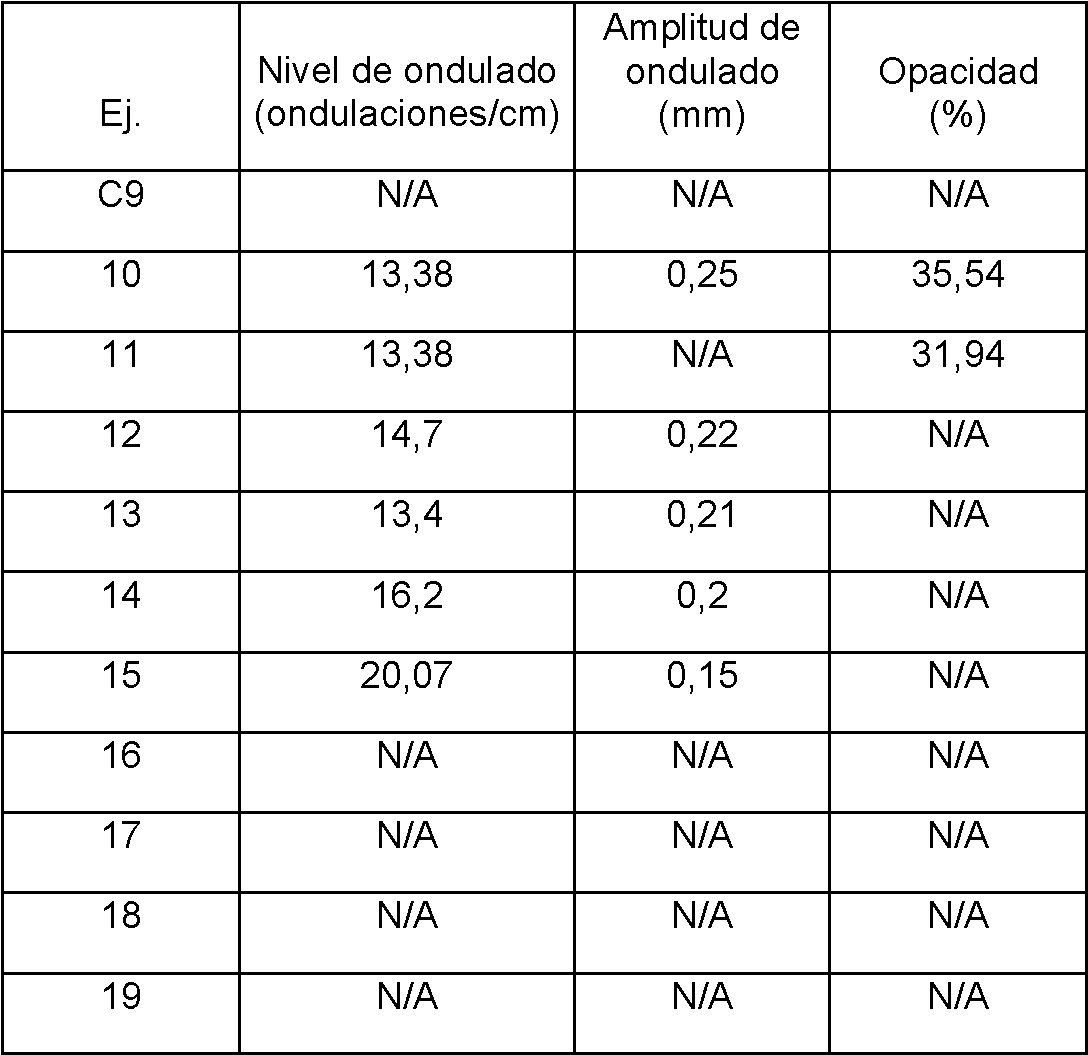
N/A indica que no se determinó una propiedad experimentalmente para esa muestra respectiva.N / A indicates that a property was not determined experimentally for that respective sample.
De manera similar a las observaciones que se pudieron hacer en el Ejemplo C1/2-8, el producto del Ejemplo C9 comparativo comprende un diámetro de fibra más alto de aproximadamente 1,8 denier, mientras que el denier podría disminuir significativamente en los Ejemplos 10-19.Similar to the observations that could be made in Example C1 / 2-8, the product of comparative Example C9 comprises a higher fiber diameter of approximately 1.8 denier, while the denier could be significantly decreased in Examples 10 -19.
La adición de pequeñas cantidades de un aditivo de polipropileno de alta MFR a los polímeros para ambas secciones de fibra (Ejemplos 10, 12-19) o incluso solo la sección de fibra más voluminosa (Ejemplo 11) conduce a una combinación de materiales donde presiones de cabina más altas se pueden utilizar de forma estable para obtener materiales de menor denier. Los espesores del material permanecen esencialmente sin cambios a pesar del denier más bajo. Las propiedades de tracción se mejoran en algunos ejemplos de la invención con respecto al material de referencia del Ejemplo C9 comparativo y, en algunos casos, se observa un aumento tanto en TSMD como en TSCD. En todos los ejemplos de la invención, al menos no se reducen, a pesar del peso base a veces menor.Adding small amounts of a high MFR polypropylene additive to the polymers for both fiber sections (Examples 10, 12-19) or even just the bulkier fiber section (Example 11) leads to a material combination where higher cabin pressures can be used stably to obtain lower denier materials. The thicknesses of the material remain essentially unchanged despite the lower denier. Tensile properties are improved in some examples of the invention over the reference material of comparative Example C9 and, in some cases, an increase in both TSMD and TSCD is observed. In all the examples of the invention, at least they are not reduced, despite the sometimes lower basis weight.
Aunque no se han llevado a cabo mediciones del nivel de ondulado u opacidad para el Ejemplo C9 comparativo, los datos del Ejemplo 10 son similares a los datos de los Ejemplos 2-3 y, por lo tanto, son representativos del resultado beneficioso deseado.Although measurements of the level of waviness or haze have not been carried out for Comparative Example C9, the data in Example 10 is similar to the data in Examples 2-3 and is therefore representative of the desired beneficial result.
Las medidas de uniformidad que comparan el Ejemplo 9 comparativo y el Ejemplo 11 se representan en las Figuras 3a-3c. Como en el caso de los Ejemplos C1/2-3, una mejora es claramente visible.Uniformity measures comparing Comparative Example 9 and Example 11 are depicted in Figures 3a-3c. As in the case of Examples C1 / 2-3, an improvement is clearly visible.
La suavidad percibida de los materiales de todos los Ejemplos 2-8 y 10-19 inventivos es muy alta y similar a la suavidad percibida de una banda tejida de micropolar, que muchos en la industria de la higiene consideran el material en última instancia cuando llega a calificaciones de suavidad para el uso en productos de cuidado personal como pañales para bebés, almohadillas protectoras para el cuidado femenino y productos de higiene para la incontinencia para adultos. The perceived softness of the materials of all inventive Examples 2-8 and 10-19 is very high and similar to the perceived softness of a woven microfleece web, which many in the hygiene industry consider the material ultimately when it arrives. a softness ratings for use in personal care products such as baby diapers, feminine care pads, and adult incontinence hygiene products.
Claims (15)
Applications Claiming Priority (1)
| Application Number | Priority Date | Filing Date | Title |
|---|---|---|---|
| EP18154375 | 2018-01-31 |
Publications (1)
| Publication Number | Publication Date |
|---|---|
| ES2852448T3 true ES2852448T3 (en) | 2021-09-13 |
Family
ID=61132120
Family Applications (1)
| Application Number | Title | Priority Date | Filing Date |
|---|---|---|---|
| ES19153529T Active ES2852448T3 (en) | 2018-01-31 | 2019-01-24 | Spunbonded nonwovens with fine wavy fibers and improved uniformity |
Country Status (15)
| Country | Link |
|---|---|
| US (1) | US11091861B2 (en) |
| EP (1) | EP3521495B1 (en) |
| JP (1) | JP6732975B2 (en) |
| KR (1) | KR102376158B1 (en) |
| CN (1) | CN110106636B (en) |
| AR (1) | AR114351A1 (en) |
| BR (1) | BR102019001677B1 (en) |
| DK (1) | DK3521495T3 (en) |
| ES (1) | ES2852448T3 (en) |
| IL (1) | IL264427B (en) |
| MX (1) | MX385688B (en) |
| MY (1) | MY202904A (en) |
| PL (1) | PL3521495T3 (en) |
| RU (1) | RU2748508C2 (en) |
| ZA (1) | ZA201900632B (en) |
Families Citing this family (22)
| Publication number | Priority date | Publication date | Assignee | Title |
|---|---|---|---|---|
| KR102641112B1 (en) * | 2018-09-28 | 2024-02-28 | 베리 글로벌 인코포레이티드 | SELF-CRIMPED MULTI-COMPONENT FIBERS AND METHODS OF MAKING THE SAME |
| GB2588779A (en) * | 2019-11-05 | 2021-05-12 | Teknoweb Mat S R L | Co-mingling of particulate material and spun-blown fibers |
| US20230119832A1 (en) * | 2020-03-31 | 2023-04-20 | Mitsui Chemicals, Inc. | Nonwoven fabric layered body, cover sheet, and absorbent article |
| KR102320794B1 (en) * | 2020-04-02 | 2021-11-02 | 도레이첨단소재 주식회사 | Non-woven fabric and laminate thereof, article including the laminate, and method of preparing the non-woven fabric |
| WO2022044892A1 (en) * | 2020-08-27 | 2022-03-03 | 出光興産株式会社 | Nonwoven fabric comprising crimped fibers |
| CN112030361B (en) * | 2020-08-31 | 2021-10-22 | 俊富非织造材料(无锡)有限公司 | A kind of soft medical surgical gown SMS non-woven fabric and preparation method thereof |
| US11913151B2 (en) | 2021-01-11 | 2024-02-27 | Fitesa Simpsonville, Inc. | Nonwoven fabric having a single layer with a plurality of different fiber types, and an apparatus, system, and method for producing same |
| EP4036297B1 (en) | 2021-02-01 | 2024-04-24 | Reifenhäuser GmbH & Co. KG Maschinenfabrik | Spun nonwoven laminate and method for producing a spun nonwoven laminate |
| JP2022117962A (en) * | 2021-02-01 | 2022-08-12 | ライフェンホイザー・ゲゼルシャフト・ミト・ベシュレンクテル・ハフツング・ウント・コンパニー・コマンデイトゲゼルシャフト・マシイネンファブリーク | Spun-bonded nonwoven fabric laminate and manufacturing method of spun-bonded nonwoven fabric laminate |
| DE102021102287B3 (en) | 2021-02-01 | 2022-03-03 | Reifenhäuser GmbH & Co. KG Maschinenfabrik | Spunbonded nonwoven laminate and method of making a spunbonded nonwoven laminate |
| US12576611B2 (en) * | 2021-06-04 | 2026-03-17 | Nanhai Nanxin Non-Woven Co. Ltd. | Nonwoven fabrics suitable for medical applications |
| CN118103560A (en) | 2021-10-18 | 2024-05-28 | 贝里国际公司 | High loft nonwoven fabric |
| EP4180017A1 (en) * | 2021-11-10 | 2023-05-17 | Fibertex Personal Care A/S | Elastic nonwoven sheet |
| GB2628948A (en) * | 2021-12-17 | 2024-10-09 | Kimberly Clark Co | Nonwoven webs made from multicomponent filaments and process for forming nonwoven webs |
| CN115247319A (en) * | 2021-12-22 | 2022-10-28 | 青岛大学 | Parallel two-component melt-blown fiber filtering material and preparation method thereof |
| MY206169A (en) * | 2022-01-05 | 2024-12-03 | Fibertex Personal Care As | Nonwoven material comprising crimped multicomponent fibers |
| EP4209629B8 (en) * | 2022-01-05 | 2025-08-20 | Borealis GmbH | Use of polymer composition on making soft nonwoven fabrics |
| DE102022115200A1 (en) * | 2022-06-17 | 2023-12-28 | Reifenhäuser GmbH & Co. KG Maschinenfabrik | Nonwoven fabric and device for producing a nonwoven fabric |
| US20240368813A1 (en) | 2023-04-14 | 2024-11-07 | Pfnonwovens Holding S.R.O. | Nonwoven fabric and method of forming the same |
| AR135206A1 (en) | 2024-02-09 | 2026-07-22 | Fibertex Personal Care As | NON-WOVEN SHEET COMPRISING FIBERS ORIENTED IN THE MACHINE DIRECTION |
| WO2025215422A2 (en) | 2024-04-12 | 2025-10-16 | Pfnonwovens Holding S.R.O. | Nonwoven fabric and method of forming the same |
| CN119507067B (en) * | 2024-12-02 | 2025-09-16 | 埃克森美孚(惠州)化工有限公司 | Polyolefin composition, method for preparing nonwoven fabric, and nonwoven fabric |
Family Cites Families (24)
| Publication number | Priority date | Publication date | Assignee | Title |
|---|---|---|---|---|
| US5213881A (en) * | 1990-06-18 | 1993-05-25 | Kimberly-Clark Corporation | Nonwoven web with improved barrier properties |
| US5368919A (en) * | 1993-05-20 | 1994-11-29 | Himont Incorporated | Propylene polymer compositions containing high melt strength propylene polymer material |
| US5587225A (en) * | 1995-04-27 | 1996-12-24 | Kimberly-Clark Corporation | Knit-like nonwoven composite fabric |
| US6454989B1 (en) * | 1998-11-12 | 2002-09-24 | Kimberly-Clark Worldwide, Inc. | Process of making a crimped multicomponent fiber web |
| US6444151B1 (en) * | 1999-04-15 | 2002-09-03 | E. I. Du Pont De Nemours And Company | Apparatus and process for spinning polymeric filaments |
| JP2003518205A (en) | 1999-12-21 | 2003-06-03 | キンバリー クラーク ワールドワイド インコーポレイテッド | Fine denier multicomponent fiber |
| AU2002226738B9 (en) | 2001-01-29 | 2007-04-05 | Mitsui Chemicals, Inc. | Non-woven fabrics of wind-shrink fiber and laminates thereof |
| US7998384B2 (en) * | 2001-08-02 | 2011-08-16 | Fiberweb Simpsonville, Inc. | Spunbond nonwoven fabrics from reclaimed polymer and the manufacture thereof |
| US20050164587A1 (en) * | 2004-01-27 | 2005-07-28 | The Procter & Gamble Company | Soft extensible nonwoven webs containing multicomponent fibers with high melt flow rates |
| AU2007211498A1 (en) * | 2006-02-02 | 2007-08-09 | Basell Polyolefine Gmbh | Propylene melt blown resins, propylene melt blown resin fibers and non-woven fabric made from the same, and methods of making the same |
| ES2434019T3 (en) * | 2006-12-22 | 2013-12-13 | Reifenhäuser GmbH & Co. KG Maschinenfabrik | Procedure and device for the manufacture of a spunbond fabric from cellulose filaments |
| PL2028296T3 (en) | 2007-08-24 | 2012-07-31 | Reifenhaeuser Masch | Method for manufacturing synthetic filaments from a polymer blend |
| CN101861415B (en) * | 2007-10-31 | 2014-01-15 | 埃克森美孚化学专利公司 | Polypropylene spunbond fibers |
| WO2010050407A1 (en) | 2008-10-29 | 2010-05-06 | 三井化学株式会社 | Crimped composite fiber, and non-woven fabric comprising the fiber |
| EP2528567B1 (en) * | 2010-01-28 | 2020-09-16 | Glatfelter Falkenhagen GmbH | Flexible, highly absorbent material |
| BR112016011370B1 (en) | 2013-11-20 | 2022-02-08 | Kimberly-Clark Worldwide, Inc | NON-WOVEN COMPOSITE, MULTI-LAYER LAMINATED, AND ABSORBENT ARTICLE |
| JP6618002B2 (en) | 2014-03-20 | 2019-12-11 | 出光興産株式会社 | Crimped fiber and non-woven fabric |
| EP3165656B1 (en) | 2014-07-03 | 2021-05-12 | Idemitsu Kosan Co., Ltd | Spunbonded non-woven fabric and method for manufacturing same |
| WO2016022977A1 (en) * | 2014-08-07 | 2016-02-11 | Avintiv Specialty Materials Inc. | Self-crimped ribbon fiber and nonwovens manufactured therefrom |
| EP3246443B1 (en) | 2016-05-18 | 2020-06-17 | Fibertex Personal Care A/S | Nonwoven fabric comprising a high loft layer |
| PL3246444T3 (en) | 2016-05-18 | 2020-09-07 | Fibertex Personal Care A/S | Method for making a high loft nonwoven web |
| BR112018073948B1 (en) | 2016-05-31 | 2022-10-04 | Basf Se | NON-WOVEN FABRIC, PROCESS FOR PREPARING NON-WOVEN FABRICS, AND BICOMPONENT FIBERS |
| JP2018145536A (en) | 2017-03-01 | 2018-09-20 | 出光興産株式会社 | Spunbond nonwoven fabric |
| WO2018211843A1 (en) * | 2017-05-16 | 2018-11-22 | 出光興産株式会社 | Crimped fibers and nonwoven fabric |
-
2019
- 2019-01-22 US US16/253,593 patent/US11091861B2/en active Active
- 2019-01-23 IL IL264427A patent/IL264427B/en unknown
- 2019-01-24 DK DK19153529.3T patent/DK3521495T3/en active
- 2019-01-24 PL PL19153529T patent/PL3521495T3/en unknown
- 2019-01-24 EP EP19153529.3A patent/EP3521495B1/en active Active
- 2019-01-24 ES ES19153529T patent/ES2852448T3/en active Active
- 2019-01-28 BR BR102019001677-9A patent/BR102019001677B1/en active IP Right Grant
- 2019-01-28 MY MYPI2019000485A patent/MY202904A/en unknown
- 2019-01-28 RU RU2019102217A patent/RU2748508C2/en active
- 2019-01-30 ZA ZA201900632A patent/ZA201900632B/en unknown
- 2019-01-30 KR KR1020190011854A patent/KR102376158B1/en active Active
- 2019-01-31 CN CN201910097569.7A patent/CN110106636B/en active Active
- 2019-01-31 MX MX2019001343A patent/MX385688B/en unknown
- 2019-01-31 JP JP2019015078A patent/JP6732975B2/en active Active
- 2019-01-31 AR ARP190100218A patent/AR114351A1/en active IP Right Grant
Also Published As
| Publication number | Publication date |
|---|---|
| MY202904A (en) | 2024-05-29 |
| IL264427A (en) | 2019-05-30 |
| ZA201900632B (en) | 2019-10-30 |
| KR102376158B1 (en) | 2022-03-18 |
| MX385688B (en) | 2025-03-18 |
| RU2748508C2 (en) | 2021-05-26 |
| JP2019131946A (en) | 2019-08-08 |
| EP3521495B1 (en) | 2020-11-11 |
| DK3521495T3 (en) | 2020-12-14 |
| PL3521495T3 (en) | 2021-04-19 |
| IL264427B (en) | 2022-05-01 |
| CN110106636A (en) | 2019-08-09 |
| RU2019102217A (en) | 2020-07-28 |
| EP3521495A1 (en) | 2019-08-07 |
| MX2019001343A (en) | 2019-09-13 |
| BR102019001677B1 (en) | 2023-12-26 |
| JP6732975B2 (en) | 2020-07-29 |
| US11091861B2 (en) | 2021-08-17 |
| AR114351A1 (en) | 2020-08-26 |
| CN110106636B (en) | 2022-08-16 |
| RU2019102217A3 (en) | 2021-04-19 |
| BR102019001677A2 (en) | 2019-08-20 |
| KR20190093164A (en) | 2019-08-08 |
| US20190233993A1 (en) | 2019-08-01 |
Similar Documents
| Publication | Publication Date | Title |
|---|---|---|
| CN110106636B (en) | Spunbond nonwoven fabric with crimped fine fibers and improved uniformity | |
| US11021821B2 (en) | Method for making a spunbonded high loft nonwoven web | |
| US11591728B2 (en) | Spunbond nonwoven laminate and method of making same | |
| EP3690096A1 (en) | Spunbond nonwoven fabric | |
| TWI799461B (en) | Spunbonded nonwoven | |
| CN118696154B (en) | Nonwoven materials containing crimped multicomponent fibers | |
| JP7110795B2 (en) | spunbond nonwoven fabric | |
| TWI753968B (en) | Spunbond nonwoven fabric and method of making the same | |
| JP7156033B2 (en) | CRIMPED FIBERS, SPUNBOND NONWOVENS AND METHOD OF MANUFACTURE THEREOF | |
| CN115315547B (en) | Spunbond nonwoven fabric | |
| KR101001042B1 (en) | Spinneret and Fiber Manufacturing Method | |
| CA3237017C (en) | Nonwoven material comprising crimped multicomponent fibers | |
| CN114836903B (en) | Spunbond nonwoven laminate materials and methods for preparing spunbond nonwoven laminate materials | |
| RU2811530C2 (en) | Method for producing nonwoven fabric from spunbond nonwoven material with high elasticity | |
| JP2019026956A (en) | Crimped fiber, spunbonded non-woven fabric, and method for manufacturing crimped fiber | |
| JP2024042784A (en) | Spunbond nonwoven fabric and sanitary materials made using the same |