ES2876290T3 - Procedure for preparing substituted 4-aminoindan derivatives - Google Patents
Procedure for preparing substituted 4-aminoindan derivatives Download PDFInfo
- Publication number
- ES2876290T3 ES2876290T3 ES18731108T ES18731108T ES2876290T3 ES 2876290 T3 ES2876290 T3 ES 2876290T3 ES 18731108 T ES18731108 T ES 18731108T ES 18731108 T ES18731108 T ES 18731108T ES 2876290 T3 ES2876290 T3 ES 2876290T3
- Authority
- ES
- Spain
- Prior art keywords
- formula
- alkyl
- hydrogen
- range
- methyl
- Prior art date
- Legal status (The legal status is an assumption and is not a legal conclusion. Google has not performed a legal analysis and makes no representation as to the accuracy of the status listed.)
- Active
Links
- RXTJLDXSGNEJIT-UHFFFAOYSA-N 2,3-dihydro-1h-inden-4-amine Chemical class NC1=CC=CC2=C1CCC2 RXTJLDXSGNEJIT-UHFFFAOYSA-N 0.000 title claims abstract description 27
- 238000000034 method Methods 0.000 title claims description 41
- 229910052739 hydrogen Inorganic materials 0.000 claims abstract description 54
- 239000001257 hydrogen Substances 0.000 claims abstract description 54
- KRHYYFGTRYWZRS-UHFFFAOYSA-N Fluorane Chemical compound F KRHYYFGTRYWZRS-UHFFFAOYSA-N 0.000 claims abstract description 51
- 150000001875 compounds Chemical class 0.000 claims abstract description 38
- 125000004178 (C1-C4) alkyl group Chemical group 0.000 claims abstract description 33
- 125000004435 hydrogen atom Chemical group [H]* 0.000 claims abstract description 26
- 238000004519 manufacturing process Methods 0.000 claims abstract description 20
- 125000004209 (C1-C8) alkyl group Chemical group 0.000 claims abstract description 12
- 229910052736 halogen Inorganic materials 0.000 claims abstract description 10
- 150000002367 halogens Chemical group 0.000 claims abstract description 10
- 229910000040 hydrogen fluoride Inorganic materials 0.000 claims abstract description 6
- 125000002496 methyl group Chemical group [H]C([H])([H])* 0.000 claims description 29
- 230000008569 process Effects 0.000 claims description 19
- XLYOFNOQVPJJNP-UHFFFAOYSA-N water Substances O XLYOFNOQVPJJNP-UHFFFAOYSA-N 0.000 claims description 17
- UFHFLCQGNIYNRP-UHFFFAOYSA-N Hydrogen Chemical compound [H][H] UFHFLCQGNIYNRP-UHFFFAOYSA-N 0.000 claims description 14
- 125000004123 n-propyl group Chemical group [H]C([H])([H])C([H])([H])C([H])([H])* 0.000 claims description 14
- 125000001495 ethyl group Chemical group [H]C([H])([H])C([H])([H])* 0.000 claims description 13
- 125000001449 isopropyl group Chemical group [H]C([H])([H])C([H])(*)C([H])([H])[H] 0.000 claims description 13
- 125000004108 n-butyl group Chemical group [H]C([H])([H])C([H])([H])C([H])([H])C([H])([H])* 0.000 claims description 12
- 125000001424 substituent group Chemical group 0.000 claims description 4
- 230000035484 reaction time Effects 0.000 claims description 2
- KRHYYFGTRYWZRS-UHFFFAOYSA-M Fluoride anion Chemical compound [F-] KRHYYFGTRYWZRS-UHFFFAOYSA-M 0.000 claims 1
- 230000003301 hydrolyzing effect Effects 0.000 claims 1
- 150000002431 hydrogen Chemical group 0.000 abstract description 14
- 125000006552 (C3-C8) cycloalkyl group Chemical group 0.000 abstract description 4
- QPJSUIGXIBEQAC-UHFFFAOYSA-N n-(2,4-dichloro-5-propan-2-yloxyphenyl)acetamide Chemical compound CC(C)OC1=CC(NC(C)=O)=C(Cl)C=C1Cl QPJSUIGXIBEQAC-UHFFFAOYSA-N 0.000 description 41
- HEMHJVSKTPXQMS-UHFFFAOYSA-M Sodium hydroxide Chemical compound [OH-].[Na+] HEMHJVSKTPXQMS-UHFFFAOYSA-M 0.000 description 21
- YXFVVABEGXRONW-UHFFFAOYSA-N Toluene Chemical compound CC1=CC=CC=C1 YXFVVABEGXRONW-UHFFFAOYSA-N 0.000 description 18
- -1 1-oxo-1- (2,2,4-trimethyl-3,4-dihydroquinoline-1 (2H) -yl) propan-2-yl Chemical group 0.000 description 17
- 239000000047 product Substances 0.000 description 14
- 239000000243 solution Substances 0.000 description 13
- KYWYAWFSWFSPAY-UHFFFAOYSA-N 1,1,3-trimethyl-2,3-dihydroinden-4-amine Chemical class C1=CC(N)=C2C(C)CC(C)(C)C2=C1 KYWYAWFSWFSPAY-UHFFFAOYSA-N 0.000 description 12
- 229910052799 carbon Inorganic materials 0.000 description 11
- 238000002360 preparation method Methods 0.000 description 9
- 239000011541 reaction mixture Substances 0.000 description 9
- YMWUJEATGCHHMB-UHFFFAOYSA-N Dichloromethane Chemical compound ClCCl YMWUJEATGCHHMB-UHFFFAOYSA-N 0.000 description 8
- 125000000217 alkyl group Chemical group 0.000 description 8
- QGZKDVFQNNGYKY-UHFFFAOYSA-N Ammonia Chemical class N QGZKDVFQNNGYKY-UHFFFAOYSA-N 0.000 description 7
- 239000003960 organic solvent Substances 0.000 description 7
- 238000003786 synthesis reaction Methods 0.000 description 7
- WEVYAHXRMPXWCK-UHFFFAOYSA-N Acetonitrile Chemical compound CC#N WEVYAHXRMPXWCK-UHFFFAOYSA-N 0.000 description 6
- XEKOWRVHYACXOJ-UHFFFAOYSA-N Ethyl acetate Chemical compound CCOC(C)=O XEKOWRVHYACXOJ-UHFFFAOYSA-N 0.000 description 6
- WYURNTSHIVDZCO-UHFFFAOYSA-N Tetrahydrofuran Chemical compound C1CCOC1 WYURNTSHIVDZCO-UHFFFAOYSA-N 0.000 description 6
- 230000015572 biosynthetic process Effects 0.000 description 6
- 239000000203 mixture Substances 0.000 description 6
- XJEVHMGJSYVQBQ-UHFFFAOYSA-N 2,3-dihydro-1h-inden-1-amine Chemical class C1=CC=C2C(N)CCC2=C1 XJEVHMGJSYVQBQ-UHFFFAOYSA-N 0.000 description 5
- 230000008707 rearrangement Effects 0.000 description 5
- 239000002699 waste material Substances 0.000 description 5
- LBUJPTNKIBCYBY-UHFFFAOYSA-N 1,2,3,4-tetrahydroquinoline Chemical class C1=CC=C2CCCNC2=C1 LBUJPTNKIBCYBY-UHFFFAOYSA-N 0.000 description 4
- DLFVBJFMPXGRIB-UHFFFAOYSA-N Acetamide Chemical compound CC(N)=O DLFVBJFMPXGRIB-UHFFFAOYSA-N 0.000 description 4
- CSCPPACGZOOCGX-UHFFFAOYSA-N Acetone Chemical compound CC(C)=O CSCPPACGZOOCGX-UHFFFAOYSA-N 0.000 description 4
- BZLVMXJERCGZMT-UHFFFAOYSA-N Methyl tert-butyl ether Chemical compound COC(C)(C)C BZLVMXJERCGZMT-UHFFFAOYSA-N 0.000 description 4
- ZMXDDKWLCZADIW-UHFFFAOYSA-N N,N-Dimethylformamide Chemical compound CN(C)C=O ZMXDDKWLCZADIW-UHFFFAOYSA-N 0.000 description 4
- 238000006243 chemical reaction Methods 0.000 description 4
- 238000002955 isolation Methods 0.000 description 4
- 239000010808 liquid waste Substances 0.000 description 4
- 239000007787 solid Substances 0.000 description 4
- RFFLAFLAYFXFSW-UHFFFAOYSA-N 1,2-dichlorobenzene Chemical compound ClC1=CC=CC=C1Cl RFFLAFLAYFXFSW-UHFFFAOYSA-N 0.000 description 3
- DICCKTLYSLKYNN-UHFFFAOYSA-N 1-(2,2,4-trimethyl-3,4-dihydroquinolin-1-yl)ethanone Chemical compound C1=CC=C2C(C)CC(C)(C)N(C(C)=O)C2=C1 DICCKTLYSLKYNN-UHFFFAOYSA-N 0.000 description 3
- QTBSBXVTEAMEQO-UHFFFAOYSA-N Acetic acid Chemical compound CC(O)=O QTBSBXVTEAMEQO-UHFFFAOYSA-N 0.000 description 3
- ZAMOUSCENKQFHK-UHFFFAOYSA-N Chlorine atom Chemical compound [Cl] ZAMOUSCENKQFHK-UHFFFAOYSA-N 0.000 description 3
- RTZKZFJDLAIYFH-UHFFFAOYSA-N Diethyl ether Chemical compound CCOCC RTZKZFJDLAIYFH-UHFFFAOYSA-N 0.000 description 3
- IAZDPXIOMUYVGZ-UHFFFAOYSA-N Dimethylsulphoxide Chemical compound CS(C)=O IAZDPXIOMUYVGZ-UHFFFAOYSA-N 0.000 description 3
- LYCAIKOWRPUZTN-UHFFFAOYSA-N Ethylene glycol Chemical compound OCCO LYCAIKOWRPUZTN-UHFFFAOYSA-N 0.000 description 3
- PXGOKWXKJXAPGV-UHFFFAOYSA-N Fluorine Chemical compound FF PXGOKWXKJXAPGV-UHFFFAOYSA-N 0.000 description 3
- OKKJLVBELUTLKV-UHFFFAOYSA-N Methanol Chemical compound OC OKKJLVBELUTLKV-UHFFFAOYSA-N 0.000 description 3
- 239000004809 Teflon Substances 0.000 description 3
- 229920006362 Teflon® Polymers 0.000 description 3
- BFNBIHQBYMNNAN-UHFFFAOYSA-N ammonium sulfate Chemical compound N.N.OS(O)(=O)=O BFNBIHQBYMNNAN-UHFFFAOYSA-N 0.000 description 3
- 229910052921 ammonium sulfate Inorganic materials 0.000 description 3
- 235000011130 ammonium sulphate Nutrition 0.000 description 3
- 229910052801 chlorine Inorganic materials 0.000 description 3
- 239000000460 chlorine Substances 0.000 description 3
- 125000000753 cycloalkyl group Chemical group 0.000 description 3
- 229910052731 fluorine Inorganic materials 0.000 description 3
- 239000011737 fluorine Substances 0.000 description 3
- 230000000855 fungicidal effect Effects 0.000 description 3
- 125000001436 propyl group Chemical group [H]C([*])([H])C([H])([H])C([H])([H])[H] 0.000 description 3
- YLQBMQCUIZJEEH-UHFFFAOYSA-N tetrahydrofuran Natural products C=1C=COC=1 YLQBMQCUIZJEEH-UHFFFAOYSA-N 0.000 description 3
- UOCLXMDMGBRAIB-UHFFFAOYSA-N 1,1,1-trichloroethane Chemical class CC(Cl)(Cl)Cl UOCLXMDMGBRAIB-UHFFFAOYSA-N 0.000 description 2
- QPFMBZIOSGYJDE-UHFFFAOYSA-N 1,1,2,2-tetrachloroethane Chemical compound ClC(Cl)C(Cl)Cl QPFMBZIOSGYJDE-UHFFFAOYSA-N 0.000 description 2
- VHUUQVKOLVNVRT-UHFFFAOYSA-N Ammonium hydroxide Chemical compound [NH4+].[OH-] VHUUQVKOLVNVRT-UHFFFAOYSA-N 0.000 description 2
- PAYRUJLWNCNPSJ-UHFFFAOYSA-N Aniline Chemical compound NC1=CC=CC=C1 PAYRUJLWNCNPSJ-UHFFFAOYSA-N 0.000 description 2
- WKBOTKDWSSQWDR-UHFFFAOYSA-N Bromine atom Chemical compound [Br] WKBOTKDWSSQWDR-UHFFFAOYSA-N 0.000 description 2
- HEDRZPFGACZZDS-UHFFFAOYSA-N Chloroform Chemical class ClC(Cl)Cl HEDRZPFGACZZDS-UHFFFAOYSA-N 0.000 description 2
- LCGLNKUTAGEVQW-UHFFFAOYSA-N Dimethyl ether Chemical compound COC LCGLNKUTAGEVQW-UHFFFAOYSA-N 0.000 description 2
- LFQSCWFLJHTTHZ-UHFFFAOYSA-N Ethanol Chemical compound CCO LFQSCWFLJHTTHZ-UHFFFAOYSA-N 0.000 description 2
- NTIZESTWPVYFNL-UHFFFAOYSA-N Methyl isobutyl ketone Chemical compound CC(C)CC(C)=O NTIZESTWPVYFNL-UHFFFAOYSA-N 0.000 description 2
- UIHCLUNTQKBZGK-UHFFFAOYSA-N Methyl isobutyl ketone Natural products CCC(C)C(C)=O UIHCLUNTQKBZGK-UHFFFAOYSA-N 0.000 description 2
- FXHOOIRPVKKKFG-UHFFFAOYSA-N N,N-Dimethylacetamide Chemical compound CN(C)C(C)=O FXHOOIRPVKKKFG-UHFFFAOYSA-N 0.000 description 2
- LRHPLDYGYMQRHN-UHFFFAOYSA-N N-Butanol Chemical compound CCCCO LRHPLDYGYMQRHN-UHFFFAOYSA-N 0.000 description 2
- QAOWNCQODCNURD-UHFFFAOYSA-N Sulfuric acid Chemical compound OS(O)(=O)=O QAOWNCQODCNURD-UHFFFAOYSA-N 0.000 description 2
- 125000002777 acetyl group Chemical group [H]C([H])([H])C(*)=O 0.000 description 2
- 229910021529 ammonia Inorganic materials 0.000 description 2
- RDOXTESZEPMUJZ-UHFFFAOYSA-N anisole Chemical compound COC1=CC=CC=C1 RDOXTESZEPMUJZ-UHFFFAOYSA-N 0.000 description 2
- 239000007864 aqueous solution Substances 0.000 description 2
- 150000004945 aromatic hydrocarbons Chemical class 0.000 description 2
- GDTBXPJZTBHREO-UHFFFAOYSA-N bromine Substances BrBr GDTBXPJZTBHREO-UHFFFAOYSA-N 0.000 description 2
- 229910052794 bromium Inorganic materials 0.000 description 2
- QARVLSVVCXYDNA-UHFFFAOYSA-N bromobenzene Chemical class BrC1=CC=CC=C1 QARVLSVVCXYDNA-UHFFFAOYSA-N 0.000 description 2
- 239000003153 chemical reaction reagent Substances 0.000 description 2
- 125000001316 cycloalkyl alkyl group Chemical group 0.000 description 2
- 238000004821 distillation Methods 0.000 description 2
- 150000002170 ethers Chemical class 0.000 description 2
- 238000001819 mass spectrum Methods 0.000 description 2
- PGMYKACGEOXYJE-UHFFFAOYSA-N pentyl acetate Chemical compound CCCCCOC(C)=O PGMYKACGEOXYJE-UHFFFAOYSA-N 0.000 description 2
- 239000002244 precipitate Substances 0.000 description 2
- 150000003839 salts Chemical class 0.000 description 2
- 239000002904 solvent Substances 0.000 description 2
- 239000007858 starting material Substances 0.000 description 2
- HVZJRWJGKQPSFL-UHFFFAOYSA-N tert-Amyl methyl ether Chemical compound CCC(C)(C)OC HVZJRWJGKQPSFL-UHFFFAOYSA-N 0.000 description 2
- VZGDMQKNWNREIO-UHFFFAOYSA-N tetrachloromethane Chemical class ClC(Cl)(Cl)Cl VZGDMQKNWNREIO-UHFFFAOYSA-N 0.000 description 2
- GETTZEONDQJALK-UHFFFAOYSA-N (trifluoromethyl)benzene Chemical compound FC(F)(F)C1=CC=CC=C1 GETTZEONDQJALK-UHFFFAOYSA-N 0.000 description 1
- BOSAWIQFTJIYIS-UHFFFAOYSA-N 1,1,1-trichloro-2,2,2-trifluoroethane Chemical compound FC(F)(F)C(Cl)(Cl)Cl BOSAWIQFTJIYIS-UHFFFAOYSA-N 0.000 description 1
- SEQRDAAUNCRFIT-UHFFFAOYSA-N 1,1-dichlorobutane Chemical class CCCC(Cl)Cl SEQRDAAUNCRFIT-UHFFFAOYSA-N 0.000 description 1
- 125000005919 1,2,2-trimethylpropyl group Chemical group 0.000 description 1
- RELMFMZEBKVZJC-UHFFFAOYSA-N 1,2,3-trichlorobenzene Chemical compound ClC1=CC=CC(Cl)=C1Cl RELMFMZEBKVZJC-UHFFFAOYSA-N 0.000 description 1
- WSLDOOZREJYCGB-UHFFFAOYSA-N 1,2-Dichloroethane Chemical class ClCCCl WSLDOOZREJYCGB-UHFFFAOYSA-N 0.000 description 1
- KNKRKFALVUDBJE-UHFFFAOYSA-N 1,2-dichloropropane Chemical compound CC(Cl)CCl KNKRKFALVUDBJE-UHFFFAOYSA-N 0.000 description 1
- 125000005918 1,2-dimethylbutyl group Chemical group 0.000 description 1
- RYHBNJHYFVUHQT-UHFFFAOYSA-N 1,4-Dioxane Chemical compound C1COCCO1 RYHBNJHYFVUHQT-UHFFFAOYSA-N 0.000 description 1
- OCJBOOLMMGQPQU-UHFFFAOYSA-N 1,4-dichlorobenzene Chemical class ClC1=CC=C(Cl)C=C1 OCJBOOLMMGQPQU-UHFFFAOYSA-N 0.000 description 1
- REXBHUYJOXFIFD-UHFFFAOYSA-N 1-(2,2,4-trimethyl-3,4,4a,5-tetrahydroquinolin-1-yl)ethanone Chemical compound C1=CCC2C(C)CC(C)(C)N(C(C)=O)C2=C1 REXBHUYJOXFIFD-UHFFFAOYSA-N 0.000 description 1
- 125000006218 1-ethylbutyl group Chemical group [H]C([H])([H])C([H])([H])C([H])([H])C([H])(*)C([H])([H])C([H])([H])[H] 0.000 description 1
- 238000005160 1H NMR spectroscopy Methods 0.000 description 1
- NRSSQPOIEQOQGP-UHFFFAOYSA-N 2,3-dihydro-1H-indene-1-carboxamide pyridine Chemical class c1ccncc1.NC(=O)C1CCc2ccccc12 NRSSQPOIEQOQGP-UHFFFAOYSA-N 0.000 description 1
- MCQYYCLBEHBGDL-UHFFFAOYSA-N 2,3-dihydro-1h-indene-1-carboxamide;1h-pyrazole Chemical class C=1C=NNC=1.C1=CC=C2C(C(=O)N)CCC2=C1 MCQYYCLBEHBGDL-UHFFFAOYSA-N 0.000 description 1
- VZSRBBMJRBPUNF-UHFFFAOYSA-N 2-(2,3-dihydro-1H-inden-2-ylamino)-N-[3-oxo-3-(2,4,6,7-tetrahydrotriazolo[4,5-c]pyridin-5-yl)propyl]pyrimidine-5-carboxamide Chemical compound C1C(CC2=CC=CC=C12)NC1=NC=C(C=N1)C(=O)NCCC(N1CC2=C(CC1)NN=N2)=O VZSRBBMJRBPUNF-UHFFFAOYSA-N 0.000 description 1
- 125000006176 2-ethylbutyl group Chemical group [H]C([H])([H])C([H])([H])C([H])(C([H])([H])*)C([H])([H])C([H])([H])[H] 0.000 description 1
- 125000004493 2-methylbut-1-yl group Chemical group CC(C*)CC 0.000 description 1
- 125000005916 2-methylpentyl group Chemical group 0.000 description 1
- 125000003542 3-methylbutan-2-yl group Chemical group [H]C([H])([H])C([H])(*)C([H])(C([H])([H])[H])C([H])([H])[H] 0.000 description 1
- 125000005917 3-methylpentyl group Chemical group 0.000 description 1
- 238000006443 Buchwald-Hartwig cross coupling reaction Methods 0.000 description 1
- DKPFZGUDAPQIHT-UHFFFAOYSA-N Butyl acetate Natural products CCCCOC(C)=O DKPFZGUDAPQIHT-UHFFFAOYSA-N 0.000 description 1
- 0 CC(*)(CC1*)C2=C1C(N)=CC(C)(*)C=C2 Chemical compound CC(*)(CC1*)C2=C1C(N)=CC(C)(*)C=C2 0.000 description 1
- LOWPIOLRSXPTSO-UHFFFAOYSA-N CCCC1CC(C)(C)C2=CC=CC(NC(C)=O)=C12 Chemical compound CCCC1CC(C)(C)C2=CC=CC(NC(C)=O)=C12 LOWPIOLRSXPTSO-UHFFFAOYSA-N 0.000 description 1
- OKTJSMMVPCPJKN-UHFFFAOYSA-N Carbon Chemical group [C] OKTJSMMVPCPJKN-UHFFFAOYSA-N 0.000 description 1
- KMTRUDSVKNLOMY-UHFFFAOYSA-N Ethylene carbonate Chemical compound O=C1OCCO1 KMTRUDSVKNLOMY-UHFFFAOYSA-N 0.000 description 1
- SECXISVLQFMRJM-UHFFFAOYSA-N N-Methylpyrrolidone Chemical compound CN1CCCC1=O SECXISVLQFMRJM-UHFFFAOYSA-N 0.000 description 1
- NIPNSKYNPDTRPC-UHFFFAOYSA-N N-[2-oxo-2-(2,4,6,7-tetrahydrotriazolo[4,5-c]pyridin-5-yl)ethyl]-2-[[3-(trifluoromethoxy)phenyl]methylamino]pyrimidine-5-carboxamide Chemical compound O=C(CNC(=O)C=1C=NC(=NC=1)NCC1=CC(=CC=C1)OC(F)(F)F)N1CC2=C(CC1)NN=N2 NIPNSKYNPDTRPC-UHFFFAOYSA-N 0.000 description 1
- CYTYCFOTNPOANT-UHFFFAOYSA-N Perchloroethylene Chemical group ClC(Cl)=C(Cl)Cl CYTYCFOTNPOANT-UHFFFAOYSA-N 0.000 description 1
- 239000002253 acid Substances 0.000 description 1
- 150000001298 alcohols Chemical class 0.000 description 1
- 150000007824 aliphatic compounds Chemical class 0.000 description 1
- 125000003342 alkenyl group Chemical group 0.000 description 1
- 125000005119 alkyl cycloalkyl group Chemical group 0.000 description 1
- 125000000304 alkynyl group Chemical group 0.000 description 1
- 150000001408 amides Chemical class 0.000 description 1
- 150000001412 amines Chemical class 0.000 description 1
- SMWDFEZZVXVKRB-UHFFFAOYSA-N anhydrous quinoline Natural products N1=CC=CC2=CC=CC=C21 SMWDFEZZVXVKRB-UHFFFAOYSA-N 0.000 description 1
- 229940111121 antirheumatic drug quinolines Drugs 0.000 description 1
- 150000001491 aromatic compounds Chemical class 0.000 description 1
- 230000008901 benefit Effects 0.000 description 1
- PQNFLJBBNBOBRQ-UHFFFAOYSA-N benzocyclopentane Natural products C1=CC=C2CCCC2=C1 PQNFLJBBNBOBRQ-UHFFFAOYSA-N 0.000 description 1
- KCXMKQUNVWSEMD-UHFFFAOYSA-N benzyl chloride Chemical compound ClCC1=CC=CC=C1 KCXMKQUNVWSEMD-UHFFFAOYSA-N 0.000 description 1
- 230000000975 bioactive effect Effects 0.000 description 1
- 238000009835 boiling Methods 0.000 description 1
- 125000000484 butyl group Chemical group [H]C([*])([H])C([H])([H])C([H])([H])C([H])([H])[H] 0.000 description 1
- KVNRLNFWIYMESJ-UHFFFAOYSA-N butyronitrile Chemical compound CCCC#N KVNRLNFWIYMESJ-UHFFFAOYSA-N 0.000 description 1
- 125000004432 carbon atom Chemical group C* 0.000 description 1
- 150000004649 carbonic acid derivatives Chemical class 0.000 description 1
- 239000003054 catalyst Substances 0.000 description 1
- UXWNJCNODBVATH-UHFFFAOYSA-N chlorobenzene;1,2-dichloroethane Chemical class ClCCCl.ClC1=CC=CC=C1 UXWNJCNODBVATH-UHFFFAOYSA-N 0.000 description 1
- 238000004440 column chromatography Methods 0.000 description 1
- 238000009833 condensation Methods 0.000 description 1
- 230000005494 condensation Effects 0.000 description 1
- 125000000113 cyclohexyl group Chemical group [H]C1([H])C([H])([H])C([H])([H])C([H])(*)C([H])([H])C1([H])[H] 0.000 description 1
- 125000001511 cyclopentyl group Chemical group [H]C1([H])C([H])([H])C([H])([H])C([H])(*)C1([H])[H] 0.000 description 1
- 125000001559 cyclopropyl group Chemical group [H]C1([H])C([H])([H])C1([H])* 0.000 description 1
- 229940117389 dichlorobenzene Drugs 0.000 description 1
- SBZXBUIDTXKZTM-UHFFFAOYSA-N diglyme Chemical compound COCCOCCOC SBZXBUIDTXKZTM-UHFFFAOYSA-N 0.000 description 1
- 238000004090 dissolution Methods 0.000 description 1
- 238000001035 drying Methods 0.000 description 1
- 150000002148 esters Chemical class 0.000 description 1
- 238000000605 extraction Methods 0.000 description 1
- 238000001914 filtration Methods 0.000 description 1
- 125000002485 formyl group Chemical group [H]C(*)=O 0.000 description 1
- 150000005826 halohydrocarbons Chemical class 0.000 description 1
- 238000010438 heat treatment Methods 0.000 description 1
- FUZZWVXGSFPDMH-UHFFFAOYSA-M hexanoate Chemical compound CCCCCC([O-])=O FUZZWVXGSFPDMH-UHFFFAOYSA-M 0.000 description 1
- 125000004051 hexyl group Chemical group [H]C([H])([H])C([H])([H])C([H])([H])C([H])([H])C([H])([H])C([H])([H])* 0.000 description 1
- 125000001183 hydrocarbyl group Chemical group 0.000 description 1
- 125000002887 hydroxy group Chemical group [H]O* 0.000 description 1
- 125000002768 hydroxyalkyl group Chemical group 0.000 description 1
- 150000002468 indanes Chemical class 0.000 description 1
- 238000009413 insulation Methods 0.000 description 1
- 239000000543 intermediate Substances 0.000 description 1
- PNDPGZBMCMUPRI-UHFFFAOYSA-N iodine Chemical compound II PNDPGZBMCMUPRI-UHFFFAOYSA-N 0.000 description 1
- 125000000959 isobutyl group Chemical group [H]C([H])([H])C([H])(C([H])([H])[H])C([H])([H])* 0.000 description 1
- 125000004491 isohexyl group Chemical group C(CCC(C)C)* 0.000 description 1
- 238000006317 isomerization reaction Methods 0.000 description 1
- 125000001972 isopentyl group Chemical group [H]C([H])([H])C([H])(C([H])([H])[H])C([H])([H])C([H])([H])* 0.000 description 1
- JMMWKPVZQRWMSS-UHFFFAOYSA-N isopropanol acetate Natural products CC(C)OC(C)=O JMMWKPVZQRWMSS-UHFFFAOYSA-N 0.000 description 1
- 229940011051 isopropyl acetate Drugs 0.000 description 1
- GWYFCOCPABKNJV-UHFFFAOYSA-M isovalerate Chemical compound CC(C)CC([O-])=O GWYFCOCPABKNJV-UHFFFAOYSA-M 0.000 description 1
- 150000002576 ketones Chemical class 0.000 description 1
- 239000007788 liquid Substances 0.000 description 1
- 238000002844 melting Methods 0.000 description 1
- 230000008018 melting Effects 0.000 description 1
- AUHZEENZYGFFBQ-UHFFFAOYSA-N mesitylene Substances CC1=CC(C)=CC(C)=C1 AUHZEENZYGFFBQ-UHFFFAOYSA-N 0.000 description 1
- 125000001827 mesitylenyl group Chemical group [H]C1=C(C(*)=C(C([H])=C1C([H])([H])[H])C([H])([H])[H])C([H])([H])[H] 0.000 description 1
- UZKWTJUDCOPSNM-UHFFFAOYSA-N methoxybenzene Substances CCCCOC=C UZKWTJUDCOPSNM-UHFFFAOYSA-N 0.000 description 1
- 244000005700 microbiome Species 0.000 description 1
- 125000002950 monocyclic group Chemical group 0.000 description 1
- HQQWWPQOQDEPDL-UHFFFAOYSA-N n-(2,3-dihydro-1h-inden-1-yl)benzamide Chemical class C1CC2=CC=CC=C2C1NC(=O)C1=CC=CC=C1 HQQWWPQOQDEPDL-UHFFFAOYSA-N 0.000 description 1
- 125000001971 neopentyl group Chemical group [H]C([*])([H])C(C([H])([H])[H])(C([H])([H])[H])C([H])([H])[H] 0.000 description 1
- 238000006386 neutralization reaction Methods 0.000 description 1
- 150000002825 nitriles Chemical class 0.000 description 1
- 239000012044 organic layer Substances 0.000 description 1
- 239000012074 organic phase Substances 0.000 description 1
- QULYNCCPRWKEMF-UHFFFAOYSA-N parachlorobenzotrifluoride Chemical compound FC(F)(F)C1=CC=C(Cl)C=C1 QULYNCCPRWKEMF-UHFFFAOYSA-N 0.000 description 1
- 125000003538 pentan-3-yl group Chemical group [H]C([H])([H])C([H])([H])C([H])(*)C([H])([H])C([H])([H])[H] 0.000 description 1
- 125000001147 pentyl group Chemical group C(CCCC)* 0.000 description 1
- 239000000575 pesticide Substances 0.000 description 1
- 239000012071 phase Substances 0.000 description 1
- 229920000137 polyphosphoric acid Polymers 0.000 description 1
- 239000002243 precursor Substances 0.000 description 1
- 125000002924 primary amino group Chemical group [H]N([H])* 0.000 description 1
- BDERNNFJNOPAEC-UHFFFAOYSA-N propan-1-ol Chemical compound CCCO BDERNNFJNOPAEC-UHFFFAOYSA-N 0.000 description 1
- RUOJZAUFBMNUDX-UHFFFAOYSA-N propylene carbonate Chemical compound CC1COC(=O)O1 RUOJZAUFBMNUDX-UHFFFAOYSA-N 0.000 description 1
- 238000000746 purification Methods 0.000 description 1
- 150000003248 quinolines Chemical class 0.000 description 1
- 150000003254 radicals Chemical class 0.000 description 1
- 238000006462 rearrangement reaction Methods 0.000 description 1
- 238000011084 recovery Methods 0.000 description 1
- 229920006395 saturated elastomer Polymers 0.000 description 1
- 125000002914 sec-butyl group Chemical group [H]C([H])([H])C([H])([H])C([H])(*)C([H])([H])[H] 0.000 description 1
- 125000003548 sec-pentyl group Chemical group [H]C([H])([H])C([H])([H])C([H])([H])C([H])(*)C([H])([H])[H] 0.000 description 1
- 238000000926 separation method Methods 0.000 description 1
- 238000001577 simple distillation Methods 0.000 description 1
- 238000003756 stirring Methods 0.000 description 1
- 238000006467 substitution reaction Methods 0.000 description 1
- 125000000999 tert-butyl group Chemical group [H]C([H])([H])C(*)(C([H])([H])[H])C([H])([H])[H] 0.000 description 1
- 125000001973 tert-pentyl group Chemical group [H]C([H])([H])C([H])([H])C(*)(C([H])([H])[H])C([H])([H])[H] 0.000 description 1
- 229950011008 tetrachloroethylene Drugs 0.000 description 1
- 230000009466 transformation Effects 0.000 description 1
- 229910052723 transition metal Inorganic materials 0.000 description 1
- 150000003624 transition metals Chemical class 0.000 description 1
- 239000008096 xylene Substances 0.000 description 1
- 150000003738 xylenes Chemical class 0.000 description 1
Classifications
-
- C—CHEMISTRY; METALLURGY
- C07—ORGANIC CHEMISTRY
- C07C—ACYCLIC OR CARBOCYCLIC COMPOUNDS
- C07C231/00—Preparation of carboxylic acid amides
- C07C231/12—Preparation of carboxylic acid amides by reactions not involving the formation of carboxamide groups
-
- C—CHEMISTRY; METALLURGY
- C07—ORGANIC CHEMISTRY
- C07C—ACYCLIC OR CARBOCYCLIC COMPOUNDS
- C07C209/00—Preparation of compounds containing amino groups bound to a carbon skeleton
- C07C209/54—Preparation of compounds containing amino groups bound to a carbon skeleton by rearrangement reactions
-
- C—CHEMISTRY; METALLURGY
- C07—ORGANIC CHEMISTRY
- C07C—ACYCLIC OR CARBOCYCLIC COMPOUNDS
- C07C209/00—Preparation of compounds containing amino groups bound to a carbon skeleton
- C07C209/62—Preparation of compounds containing amino groups bound to a carbon skeleton by cleaving carbon-to-nitrogen, sulfur-to-nitrogen, or phosphorus-to-nitrogen bonds, e.g. hydrolysis of amides, N-dealkylation of amines or quaternary ammonium compounds
-
- C—CHEMISTRY; METALLURGY
- C07—ORGANIC CHEMISTRY
- C07C—ACYCLIC OR CARBOCYCLIC COMPOUNDS
- C07C211/00—Compounds containing amino groups bound to a carbon skeleton
- C07C211/43—Compounds containing amino groups bound to a carbon skeleton having amino groups bound to carbon atoms of six-membered aromatic rings of the carbon skeleton
- C07C211/57—Compounds containing amino groups bound to a carbon skeleton having amino groups bound to carbon atoms of six-membered aromatic rings of the carbon skeleton having amino groups bound to carbon atoms of six-membered aromatic rings being part of condensed ring systems of the carbon skeleton
- C07C211/60—Compounds containing amino groups bound to a carbon skeleton having amino groups bound to carbon atoms of six-membered aromatic rings of the carbon skeleton having amino groups bound to carbon atoms of six-membered aromatic rings being part of condensed ring systems of the carbon skeleton containing a ring other than a six-membered aromatic ring forming part of at least one of the condensed ring systems
Landscapes
- Chemical & Material Sciences (AREA)
- Organic Chemistry (AREA)
- Chemical Kinetics & Catalysis (AREA)
- Organic Low-Molecular-Weight Compounds And Preparation Thereof (AREA)
Abstract
Procedimiento para preparar los derivados de 4-aminoindano sustituidos, de la fórmula general (I) **(Ver fórmula)** en la que R1 es hidrógeno, alquilo (C1-C8) o cicloalquilo (C3-C8); R2, R3, cada uno es de forma independiente entre sí, hidrógeno, alquilo (C1-C8) o cicloalquilo (C3-C8); R4 es CO-alquilo (C1-C4); R5 es hidrógeno, halógeno o alquilo (C1-C4); caracterizada porque el compuesto de la fórmula (II): **(Ver fórmula)** se hace reaccionar con fluoruro de hidrógeno anhidro, en la que la definición de los residuos R1, R2, R3, R4 y R5 mencionados en la fórmula (II), es la misma que los de la fórmula (I).Process for preparing the substituted 4-aminoindane derivatives, of the general formula (I) **(See formula)** in which R1 is hydrogen, (C1-C8)alkyl or (C3-C8)cycloalkyl; R2, R3 are each independently hydrogen, (C1-C8)alkyl or (C3-C8)cycloalkyl; R4 is CO-(C1-C4)alkyl; R5 is hydrogen, halogen or (C1-C4)alkyl; characterized in that the compound of formula (II): **(See formula)** is reacted with anhydrous hydrogen fluoride, in which the definition of the residues R1, R2, R3, R4 and R5 mentioned in formula ( II), is the same as those of formula (I).
Description
DESCRIPCIÓNDESCRIPTION
Procedimiento para preparar los derivados de 4-aminoindano sustituidosProcedure for preparing substituted 4-aminoindan derivatives
La presente invención se refiere a un procedimiento para preparar derivados de aminoindano sustituidos mediante la reordenación de un compuesto de la fórmula (II) en ácido fluorhídrico (HF) anhidro.The present invention relates to a process for preparing substituted aminoindan derivatives by rearranging a compound of formula (II) in anhydrous hydrofluoric acid (HF).
Los 4-aminoindanos y sus derivados son intermedios importantes para la preparación de compuestos bioactivos que pueden utilizarse específicamente para controlar microorganismos nocivos en la protección de cultivos.4-aminoindanes and their derivatives are important intermediates for the preparation of bioactive compounds that can be used specifically to control harmful microorganisms in crop protection.
Por ejemplo, se conoce que diversas pirazol indanil carboxamidas tienen actividad fungicida (por ejemplo, en el documento WO 1992/12970, WO 2012/065947, J. Org. Chem. 1995, 60, 1626 y el documento WO 2012/084812). For example, various pyrazole indanyl carboxamides are known to have fungicidal activity (for example, in WO 1992/12970, WO 2012/065947, J. Org. Chem. 1995, 60, 1626 and WO 2012/084812).
También se conoce que diversas piridin indanil carboxamidas tienen actividad fungicida (por ejemplo, en el documento EP-A 0256503, JP-A 1117864, J. Pesticide Sci. 1993, 18, 245).Various pyridine indanyl carboxamides are also known to have fungicidal activity (for example, in EP-A 0256503, JP-A 1117864, J. Pesticide Sci. 1993, 18, 245).
Además, se conoce que algunas benzoil indanil amidas tienen actividad fungicida (en el documento WO 2010/109301). Furthermore, some benzoyl indanyl amides are known to have fungicidal activity (in WO 2010/109301).
Las síntesis químicas de derivados de 4-aminoindano se han descrito en la bibliografía, pero solo permiten la preparación de 4-aminoindanos con patrones de sustitución muy limitados (documentos W o 2010/109301, WO 2014/103811, EP 0654464, US 5521317). Por ejemplo, los procedimientos descritos en el documento WO 2010/109301 y en el documento WO 2014/103811, únicamente permiten la síntesis de los derivados de 1,1,3-trimetil-4-aminoindano, a partir de anilina por condensación con acetona, y explotar la reacción de reordenamiento descrita en el documento EP 0654464 y US 5521317.Chemical syntheses of 4-aminoindan derivatives have been described in the literature, but they only allow the preparation of 4-aminoindanes with very limited substitution patterns (W o 2010/109301, WO 2014/103811, EP 0654464, US 5521317) . For example, the procedures described in document WO 2010/109301 and in document WO 2014/103811, only allow the synthesis of 1,1,3-trimethyl-4-aminoindan derivatives, from aniline by condensation with acetone , and exploiting the rearrangement reaction described in EP 0654464 and US 5521317.
Una posibilidad adicional para preparar los derivados de 4-aminoindano, se describe en el documento WO 2013/167545 y el documento WO 2013/167549. La síntesis se basa en una aminación de Buchwald-Hartwig y, por lo tanto, permite una ruta sintética general a los 4-aminoindanos sustituidos. Las desventajas de este procedimiento son, en primer lugar, el uso costoso de catalizadores de metales de transición y, en segundo lugar, la síntesis problemática de los precursores de indano sustituidos con halo. Además, la función amino no se puede introducir directamente por medio de NH3 libre, sino que más bien requiere el uso de derivados de amoníaco protegidos y costosos.A further possibility to prepare the 4-aminoindan derivatives is described in WO 2013/167545 and WO 2013/167549. The synthesis is based on a Buchwald-Hartwig amination and therefore allows a general synthetic route to the substituted 4-aminoindanes. The disadvantages of this process are, first, the expensive use of transition metal catalysts and, second, the problematic synthesis of halo-substituted indane precursors. Furthermore, the amino function cannot be introduced directly via free NH 3 , but rather requires the use of protected and expensive ammonia derivatives.
El documento EP 0654464 desvela un procedimiento para la preparación de 4-amino-1,1,3-trimetilindano, en el que 1-(2-acetoxipropioniI)-1,2,3,4-tetrahidro-2,2,4-trimetilquinolina (es decir, 1-oxo-1-(2,2,4-trimetil-3,4-dihidroquinolina-1(2H)-il)propan-2-il acetato) se añadió durante 45 minutos a H2SO4 al 98%, a 25-60°C (exotérmica). Después de agitar durante 30 minutos más, a 60 °C, se añadió cuidadosamente agua que contenía ácido acético, gota a gota, y la mezcla se calentó a 100 °C durante 3 horas. Se añadió nafta (60/80 p.e.), y la mezcla se basificó a pH 9 con amoniaco acuoso al 35 %. La separación de la capa orgánica, el secado (MgSO4) y la disolución rápida con disolvente dieron el producto deseado 4-amino-1,1,3-trimetilindano con 69 % de rendimiento (EP 0654464, ejemplo 1.B (iii)). En vista del rendimiento alcanzado, este procedimiento de la técnica anterior para producir 4-amino-1,1,3-trimetilindano necesita ser mejorado. Más aún, el procedimiento, de acuerdo con el documento EP 0654464, produce grandes cantidades de desechos líquidos, es decir, una solución acuosa de sulfato de amonio. El H2SO4 utilizado durante el procedimiento, necesita ser neutralizado con amoníaco (tal como se describe anteriormente: 35 % de amoniaco acuoso) para aislar el derivado de aminoindano deseado, ya que este último, forma fácilmente una sal soluble en agua con H2SO4. Tal producción de residuos es desventajosa, ya que no es ecológica.EP 0654464 discloses a process for the preparation of 4-amino-1,1,3-trimethylindane, in which 1- (2-acetoxypropioniI) -1,2,3,4-tetrahydro-2,2,4- Trimethylquinoline (i.e. 1-oxo-1- (2,2,4-trimethyl-3,4-dihydroquinoline-1 (2H) -yl) propan-2-yl acetate) was added over 45 minutes to H 2 SO 4 98%, 25-60 ° C (exothermic). After stirring for a further 30 minutes at 60 ° C, water containing acetic acid was carefully added dropwise, and the mixture was heated at 100 ° C for 3 hours. Naphtha (60/80 bp) was added, and the mixture was basified to pH 9 with 35% aqueous ammonia. Separation of the organic layer, drying (MgSO 4 ) and rapid dissolution with solvent gave the desired product 4-amino-1,1,3-trimethylindane in 69% yield (EP 0654464, example 1.B (iii) ). In view of the yield achieved, this prior art process for producing 4-amino-1,1,3-trimethylindane needs to be improved. Furthermore, the process, according to EP 0654464, produces large amounts of liquid waste, ie an aqueous solution of ammonium sulfate. The H 2 SO 4 used during the procedure needs to be neutralized with ammonia (as described above: 35% aqueous ammonia) to isolate the desired aminoindan derivative, since the latter easily forms a water soluble salt with H 2 SO 4 . Such waste production is disadvantageous as it is not environmentally friendly.
Cliffe y col. (J. Chem. Soc. (C), 1966, 514-517: "La reordenación catalizada por ácido de derivados de tetrahidroquinolina") desvela un procedimiento para preparar derivados de aminoindano sustituidos por medio del reordenamiento de un compuesto de quinolina, o un compuesto relacionado con H2SO4, o HNO3-H2SO4, o ácido polifosfórico, en los que la reacción se lleva a cabo a 100 °C durante una hora. Este procedimiento no es respetuoso con el medio ambiente, ya que para el aislamiento del producto del H2SO4, este último debería, presumiblemente, estar completamente neutralizado, produciendo grandes cantidades de desechos líquidos similares a los descritos anteriormente.Cliffe et al. (J. Chem. Soc. (C), 1966, 514-517: "Acid-catalyzed rearrangement of tetrahydroquinoline derivatives") discloses a process for preparing substituted aminoindan derivatives by rearranging a quinoline compound, or a compound related to H 2 SO 4 , or HNO 3 -H 2 SO 4 , or polyphosphoric acid, in which the reaction is carried out at 100 ° C for one hour. This procedure is not environmentally friendly, since for the isolation of the H 2 SO 4 product , the latter should presumably be completely neutralized, producing large amounts of liquid waste similar to those described above.
El documento WO 2014/103811 describe la preparación de 4-amino-1,1,3-trimetilindano, por medio de la isomerización de N-acetil-2,2,4-trimetiltetrahidroquinolina, el cual fue calentado a 90 °C, añadido gota a gota al 98 % en peso de ácido sulfúrico (H2SO4), y se mantuvo a 60 °C, después de añadir la mezcla de la reacción en agua caliente (98 °C), calentar la mezcla resultante a 105 °C durante 4 horas, neutralizar con solución acuosa de hidróxido de sodio al 27 % en peso (solución de NaOH) y extraer con tolueno para dar una solución de 4-amino-1,1,3-trimetilindano en tolueno (190,4 g de una solución de tolueno que contiene 39,1 % en peso de 4-amino-1,1,3-trimetilindano con 92,6% de pureza, y un rendimiento del 76,4 % (WO 2014/103811, ejemplo de referencia 1-3). Este procedimiento no es amigable con el medio ambiente, ya que para el aislamiento del producto del H2SO4 , este último debe neutralizarse por completo al añadir NaOH, produciendo grandes cantidades de desechos.Document WO 2014/103811 describes the preparation of 4-amino-1,1,3-trimethylindane, by means of the isomerization of N-acetyl-2,2,4-trimethyltetrahydroquinoline, which was heated to 90 ° C, added dropwise at 98% by weight of sulfuric acid (H 2 SO 4 ), and kept at 60 ° C, after adding the reaction mixture in hot water (98 ° C), heat the resulting mixture to 105 ° C for 4 hours, neutralize with 27% by weight aqueous sodium hydroxide solution (NaOH solution) and extract with toluene to give a solution of 4-amino-1,1,3-trimethylindane in toluene (190.4 g of a toluene solution containing 39.1% by weight of 4-amino-1,1,3-trimethylindane with 92.6% purity, and a yield of 76.4% (WO 2014/103811, reference example 1-3) This procedure is not environmentally friendly, since for the isolation of the H 2 SO 4 product , the latter must be completely neutralized by adding NaOH, producing large amounts of waste.
Con respecto a las desventajas descritas anteriormente, existe una demanda de un procedimiento simplificado que pueda llevarse a cabo de manera industrial y económica, para la preparación general de derivados de 4-aminoindano sustituidos a partir de un compuesto disponible de la fórmula (II). Los derivados de 4-aminoindano sustituidos obtenibles por este procedimiento deseado, deberían obtenerse en este caso, preferentemente, con alto rendimiento y alta pureza. En particular, el procedimiento deseado debería permitir obtener los compuestos diana deseados sin la necesidad de procedimientos de purificación complejos, tales como la cromatografía en columna. En particular, el procedimiento deseado debería permitir obtener los compuestos diana deseados sin producir grandes cantidades de desechos durante el aislamiento de los compuestos diana, en particular, no a través de la neutralización de H2SO4 , por medio de la adición de NaOH.With regard to the disadvantages described above, there is a demand for a simplified process that can be carried out industrially and economically, for the general preparation of substituted 4-aminoindan derivatives from an available compound of formula (II). The substituted 4-aminoindan derivatives obtainable by this desired procedure should in this case preferably be obtained in high yield. and high purity. In particular, the desired procedure should allow the desired target compounds to be obtained without the need for complex purification procedures, such as column chromatography. In particular, the desired procedure should make it possible to obtain the desired target compounds without producing large amounts of waste during the isolation of the target compounds, in particular, not through the neutralization of H 2 SO 4 , by means of the addition of NaOH.
Ahora se ha descubierto que los derivados de 4-aminoindano pueden prepararse en alta selectividad y en condiciones muy suaves tras la reorganización de un compuesto de la fórmula (II) en fluoruro de hidrógeno anhidro (HF; número de registro CAS: 7664-39-3). Esto es muy sorprendente ya que hasta la fecha no se ha descrito tal reacción, y los expertos en la materia habrían esperado que la exposición al HF anhidro no condujera al 4-aminoindano deseado, ya que el HF anhidro es un ácido débil, en comparación con, por ejemplo, el H2SO4. Una ventaja adicional es que, una vez que se completa el procedimiento, el exceso de HF puede eliminarse fácilmente del producto, utilizando una destilación simple a presión normal, y finalmente puede incluso recuperarse y reciclarse. En consecuencia, el nuevo procedimiento de preparación actual impide la producción de grandes cantidades de desechos.It has now been discovered that 4-aminoindane derivatives can be prepared in high selectivity and under very mild conditions after rearrangement of a compound of formula (II) in anhydrous hydrogen fluoride (HF; CAS registry number: 7664-39- 3). This is very surprising as no such reaction has been described to date, and those skilled in the art would have expected that exposure to anhydrous HF would not lead to the desired 4-aminoindane, since anhydrous HF is a weak acid, in comparison with, for example, H 2 SO 4 . An additional advantage is that, once the process is completed, the excess HF can be easily removed from the product, using a simple distillation under normal pressure, and finally it can even be recovered and recycled. Consequently, the current new preparation procedure prevents the production of large amounts of waste.
Por lo tanto, la presente invención se refiere a un nuevo procedimiento para preparar derivados de 4-aminoindano sustituidos de la fórmula general (I):Therefore, the present invention relates to a new process for preparing substituted 4-aminoindan derivatives of the general formula (I):

en la que:in which:
R1 es hidrógeno, alquilo (C1-C8) o cicloalquilo (C3-C8);R1 is hydrogen, (C 1 -C 8) -alkyl or (C 3 -C 8);
R2, R3 cada uno es de forma independiente entre sí, hidrógeno, alquilo (C1-C8) o cicloalquilo (C3-C8);R2, R3 are each independently of one another hydrogen, (C 1 -C 8) -alkyl or (C 3 -C 8);
R4 es CO-alquilo (C1-C4);R4 is CO-(C 1 -C 4 ) alkyl;
R5 es hidrógeno, halógeno o alquilo (C1-C4);R5 is hydrogen, halogen or (C 1 -C 4 ) alkyl;
caracterizado porque el compuesto de la fórmula (II):characterized in that the compound of formula (II):

se hace reaccionar con HF, en el que las definiciones de los residuos R1, R2, R3, R4 y R5 mencionados en la fórmula (II) son los mismos que los de la fórmula (I).it is reacted with HF, in which the definitions of the residues R1, R2, R3, R4 and R5 mentioned in formula (II) are the same as those of formula (I).
La presente invención también se refiere a un nuevo procedimiento para preparar derivados sustituidos de 4-aminoindano de la fórmula general (I), como se ha definido anteriormente, en la queThe present invention also relates to a new process for preparing substituted 4-aminoindan derivatives of the general formula (I), as defined above, in which
R1 es metilo;R1 is methyl;
R2, R3 cada uno es de forma independiente entre sí, hidrógeno, alquilo (C1-C8) o cicloalquilo (C3-C8);R2, R3 are each independently of one another hydrogen, (C 1 -C 8) -alkyl or (C 3 -C 8);
R4 es CO-alquilo (C1-C4);R4 is CO-(C 1 -C 4 ) alkyl;
R5 es hidrógeno, halógeno o alquilo (C1-C4),R5 is hydrogen, halogen or (C 1 -C 4 ) alkyl,
caracterizado porque el compuesto de la fórmula (II), como se ha definido anteriormente, se hace reaccionar con HF anhidro, en el que las definiciones de los residuos R1, R2, R3, R4, y R5 mencionados en la fórmula (II), son los mismos que los de la fórmula (I). characterized in that the compound of formula (II), as defined above, is reacted with anhydrous HF, in which the definitions of the residues R1, R2, R3, R4, and R5 mentioned in formula (II), are the same as those of formula (I).
Además, la presente invención también se refiere a un nuevo procedimiento para preparar derivados sustituidos de 4-aminoindano de la fórmula general (I), como se ha definido anteriormente, en el queFurthermore, the present invention also relates to a new process for preparing substituted 4-aminoindan derivatives of the general formula (I), as defined above, in which
R1 es alquilo (C2-C8);R1 is (C 2 -C 8 ) alkyl;
R2, R3 cada uno es de forma independiente entre sí, hidrógeno, alquilo (C1-C8) o cicloalquilo (C3-C8);R2, R3 are each independently of one another hydrogen, (C 1 -C 8) -alkyl or (C 3 -C 8);
R4 es CO-alquilo (C1-C4);R4 is CO-(C 1 -C 4 ) alkyl;
R5 es hidrógeno, halógeno o alquilo (C1-C4),R5 is hydrogen, halogen or (C 1 -C 4 ) alkyl,
caracterizado porque el compuesto de la fórmula (II), como se ha definido anteriormente, se hace reaccionar con HF anhidro, en el que las definiciones de los residuos R1, R2, R3, R4, y R5 mencionados en la fórmula (II) son los mismos que en la fórmula (I).characterized in that the compound of formula (II), as defined above, is reacted with anhydrous HF, in which the definitions of the residues R1, R2, R3, R4, and R5 mentioned in formula (II) are the same as in formula (I).
Las definiciones preferidas, particularmente preferidas y especialmente preferidas de los residuos R1, R2, R3, R4 y R5 enumerados en las fórmulas (I) y (II) mencionadas anteriormente se aclaran a continuación.The preferred, particularly preferred and especially preferred definitions of the residues R1, R2, R3, R4 and R5 listed in formulas (I) and (II) mentioned above are clarified below.
Definiciones preferidas de los residuos R1, R2, R3, R4 y R5 mencionados en la fórmula (I) y (II), son:Preferred definitions of the residues R1, R2, R3, R4 and R5 mentioned in formula (I) and (II) are:
R1 es hidrógeno o alquilo (C1-C4);R1 is hydrogen or (C 1 -C 4 ) alkyl;
R2 y R3 cada uno es de forma independiente entre sí, hidrógeno o alquilo (C1-C4);R2 and R3 are each independently of one another hydrogen or (C 1 -C 4 ) alkyl;
R4 es CO-(alquilo C1-C4);R4 is CO- (C 1 -C 4 alkyl);
R5 es hidrógeno o alquilo (C1-C4).R5 is hydrogen or (C 1 -C 4 ) alkyl.
También, definiciones preferidas de los residuos R1, R2, R3, R4 y R5 mencionados en la fórmula (I) y (II), son:Also, preferred definitions of the residues R1, R2, R3, R4 and R5 mentioned in formula (I) and (II) are:
R1 es metilo;R1 is methyl;
R2 y R3 cada uno es de forma independiente entre sí, hidrógeno o alquilo (C1-C4);R2 and R3 are each independently of one another hydrogen or (C 1 -C 4 ) alkyl;
R4 es CO-(alquilo C1-C4);R4 is CO- (C 1 -C 4 alkyl);
R5 es hidrógeno o alquilo (C1-C4).R5 is hydrogen or (C 1 -C 4 ) alkyl.
También, las definiciones preferidas de los residuos R1, R2, R3, R4 y R5 mencionados en la fórmula (I) y (II) son: R1 es alquilo (C2-C4);Also, preferred definitions of the residues R1, R2, R3, R4 and R5 mentioned in formula (I) and (II) are: R1 is (C 2 -C 4 ) alkyl;
R2 y R3 cada uno es de forma independiente entre sí, hidrógeno o alquilo (C1-C4);R2 and R3 are each independently of one another hydrogen or (C 1 -C 4 ) alkyl;
R4 es CO-(alquilo C1-C4);R4 is CO- (C 1 -C 4 alkyl);
R5 es hidrógeno o alquilo (C1-C4).R5 is hydrogen or (C 1 -C 4 ) alkyl.
Particularmente, las definiciones preferidas de los residuos R1, R2, R3, R4 y R5 mencionados en la fórmula (I) y (II) son: R1 es hidrógeno, metilo, etilo, n-propilo, isopropilo o n-butilo;Particularly, the preferred definitions of the residues R1, R2, R3, R4 and R5 mentioned in formula (I) and (II) are: R1 is hydrogen, methyl, ethyl, n-propyl, isopropyl or n-butyl;
R2 y R3 cada uno es de forma independiente entre sí, metilo, etilo, n-propilo, isopropilo o n-butilo;R2 and R3 are each independently of one another, methyl, ethyl, n-propyl, isopropyl, or n-butyl;
R4 es CO-CH3 (es decir, acetilo);R4 is CO-CH 3 (ie, acetyl);
R5 es hidrógeno, o metilo.R5 is hydrogen, or methyl.
También, las definiciones particularmente preferidas de los residuos R1, R2, R3, R4y R5 mencionados en la fórmula (I) y (II) son:Also, particularly preferred definitions of the residues R1, R2, R3, R4 and R5 mentioned in formula (I) and (II) are:
R1 es metilo;R1 is methyl;
R2 y R3 cada uno es de forma independiente entre sí, metilo, etilo, n-propilo, isopropilo, n-butilo;R2 and R3 are each independently of one another, methyl, ethyl, n-propyl, isopropyl, n-butyl;
R4 es CO-CH3;R4 is CO-CH 3 ;
R5 es hidrógeno o metilo.R5 is hydrogen or methyl.
También, las definiciones particularmente preferidas de los residuos R1, R2, R3, R4y R5 mencionados en la fórmula (I) y (II) son: Also, particularly preferred definitions of the residues R1, R2, R3, R4 and R5 mentioned in formula (I) and (II) are:
R1 es etilo, n-propilo, isopropilo o n-butilo;R1 is ethyl, n-propyl, isopropyl, or n-butyl;
R2 y R3 cada uno es de forma independiente entre sí, metilo, etilo, n-propilo, isopropilo o n-butilo;R2 and R3 are each independently of one another, methyl, ethyl, n-propyl, isopropyl, or n-butyl;
R4 es CO-CH3;R4 is CO-CH 3 ;
R5 es hidrógeno o metilo.R5 is hydrogen or methyl.
Especialmente, las definiciones preferidas de los residuos R1, R2, R3, R4 y R5 mencionados en la fórmula (I) y (II) son: R1, R2 y R3 cada uno es metilo;Especially, the preferred definitions of the residues R1, R2, R3, R4 and R5 mentioned in formula (I) and (II) are: R1, R2 and R3 are each methyl;
R4 es CO-CH3 ;R4 is CO-CH 3 ;
R5 es hidrógeno.R5 is hydrogen.
También, las definiciones especialmente preferidas de los residuos R1, R2, R3, R4 y R5 mencionados en la fórmula (I) y (II) son:Also, especially preferred definitions of the residues R1, R2, R3, R4 and R5 mentioned in formula (I) and (II) are:
R1 es n-propilo;R1 is n-propyl;
R2 y R3 cada uno es metilo;R2 and R3 are each methyl;
R4 es CO-CH3;R4 is CO-CH 3 ;
R5 es hidrógeno.R5 is hydrogen.
Definiciones GeneralesGeneral Definitions
En las definiciones de los símbolos dados en las fórmulas anteriores, se utilizaron términos colectivos que generalmente son representativos de los siguientes sustituyentes:In the definitions of the symbols given in the above formulas, collective terms were used that are generally representative of the following substituents:
Halógeno: flúor, cloro, bromo y yodo y, preferentemente, flúor, cloro, bromo y, más preferentemente, flúor, cloro. Halogen : fluorine, chlorine, bromine and iodine, and preferably fluorine, chlorine, bromine, and more preferably fluorine, chlorine.
Alquilo: radicales hidrocarbilo saturados, de cadena lineal o ramificados que tienen 1 a 8, preferentemente, 1 a 6 y, más preferentemente, 1 a 4 átomos de carbono, por ejemplo (pero no limitado a): alquilo C1-C6 , tal como metilo, etilo, propilo, 1 -metiletilo, butilo, 1 -metilpropilo, 2-metilpropilo, 1,1 -dimetiletilo, pentilo, 1 -metilbutilo, 2-metilbutilo, 3-metilbutilo, 2,2-dimetilpropilo, 1 -etilpropilo, hexilo, 1,1-dimetilpropilo, 1,2-dimetilpropilo, 1 -metilpentilo, 2-metilpentilo, 3-metilpentilo, 4-metilpentilo, 1,1 -dimetilbutilo, 1,2-dimetilbutilo, 1,3-dimetilbutilo, 2,2-dimetilbutilo, 2,3-dimetilbutilo, 3,3-dimetilbutilo, 1 -etilbutilo, 2-etilbutilo, 1,1,2-trimetilpropilo, 1,2,2-trimetilpropilo, 1 -etil-1 -metilpropil y 1-etil-2-metilpropil. Esta definición también se aplica al alquilo, como parte de un sustituyente compuesto, por ejemplo, cicloalquilalquilo, hidroxialquilo etc., a menos que se defina en otra parte del documento. Cuando el alquilo se encuentra al final de un sustituyente compuesto como en alquilcicloalquilo, por ejemplo, la parte del sustituyente compuesto al comienzo, por ejemplo, el cicloalquilo, puede estar sustituido de forma simple o múltiple de forma idéntica o diferente e independiente por el alquilo. Lo mismo también se aplica a los sustituyentes compuestos en los que otros radicales, por ejemplo, alquenilo, alquinilo, hidroxilo, halógeno, formilo, etc., están en el extremo. Cicloalquilo: grupos hidrocarbilo saturados monocíclicos que tienen de 3 a 8, preferentemente, de 3 a 6 miembros de anillos de carbono, por ejemplo (pero sin limitarse a) ciclopropilo, ciclopentilo y ciclohexilo. Esta definición también se aplica al cicloalquilo como parte de un sustituyente compuesto, por ejemplo, cicloalquilalquilo, etc., a menos que se defina en otra parte del documento. Alkyl : saturated, straight chain or branched hydrocarbyl radicals having 1 to 8, preferably 1 to 6, and more preferably 1 to 4 carbon atoms, for example (but not limited to): C 1 -C 6 alkyl, such as methyl, ethyl, propyl, 1-methylethyl, butyl, 1-methylpropyl, 2-methylpropyl, 1,1-dimethylethyl, pentyl, 1-methylbutyl, 2-methylbutyl, 3-methylbutyl, 2,2-dimethylpropyl, 1- ethylpropyl, hexyl, 1,1-dimethylpropyl, 1,2-dimethylpropyl, 1-methylpentyl, 2-methylpentyl, 3-methylpentyl, 4-methylpentyl, 1,1-dimethylbutyl, 1,2-dimethylbutyl, 1,3-dimethylbutyl, 2,2-dimethylbutyl, 2,3-dimethylbutyl, 3,3-dimethylbutyl, 1-ethylbutyl, 2-ethylbutyl, 1,1,2-trimethylpropyl, 1,2,2-trimethylpropyl, 1-ethyl-1-methylpropyl and 1-ethyl-2-methylpropyl. This definition also applies to alkyl, as part of a compound substituent, eg, cycloalkylalkyl, hydroxyalkyl etc., unless defined elsewhere in the document. When the alkyl is at the end of a compound substituent as in alkylcycloalkyl, for example, the part of the compound substituent at the beginning, for example, cycloalkyl, can be singly or multiple substituted identically or differently and independently by alkyl . The same also applies to compound substituents in which other radicals, eg, alkenyl, alkynyl, hydroxyl, halogen, formyl, etc., are at the end. Cycloalkyl : monocyclic saturated hydrocarbyl groups having 3 to 8, preferably 3 to 6 carbon ring members, for example (but not limited to) cyclopropyl, cyclopentyl and cyclohexyl. This definition also applies to cycloalkyl as part of a compound substituent, eg, cycloalkylalkyl, etc., unless defined elsewhere in the document.
Descripción detallada del procedimientoDetailed description of the procedure
El 1-acil-trialquilo-3,4-dihidro-1H-quinolinad de la fórmula (II), se conoce y puede ser preparado, de acuerdo con el documento WO 2014/103811 (Ejemplo de referencia 1-1 de WO 2014/103811).The 1-acyl-trialkyl-3,4-dihydro-1H-quinoline of formula (II), is known and can be prepared, according to document WO 2014/103811 (Reference Example 1-1 of WO 2014 / 103811).
El presente procedimiento de la invención se lleva a cabo generalmente a una temperatura en el intervalo de -10 °C a 80 °C, preferentemente, en el intervalo de 0 ° C a 50 °C, más preferentemente, en el intervalo de 0 ° C a 40 °C, lo más preferentemente, en el intervalo de 0 °C a 30 °C, y especialmente, de manera preferente, a una temperatura en el intervalo de 10 °C a 20 °C.The present process of the invention is generally carried out at a temperature in the range of -10 ° C to 80 ° C, preferably in the range of 0 ° C to 50 ° C, more preferably in the range of 0 ° C. C to 40 ° C, most preferably in the range of 0 ° C to 30 ° C, and especially preferably at a temperature in the range of 10 ° C to 20 ° C.
El procedimiento generalmente se realiza a presión normal, o a presión elevada en una autoclave.The procedure is generally carried out at normal pressure, or at elevated pressure in an autoclave.
La cantidad de HF anhidro puede variar dentro de un amplio intervalo, pero, preferentemente, se encuentra en el intervalo de 1 a 100 equivalentes molares, de manera particular, preferentemente de 5 a 30 equivalentes molares, y especialmente, de manera preferente, 5 a 20 molares equivalentes, en cada caso basado en la cantidad total de compuestos de la fórmula (II).The amount of anhydrous HF can vary within a wide range, but is preferably in the range of 1 to 100 molar equivalents, particularly preferably 5 to 30 molar equivalents, and especially preferably 5 to 20 molar equivalents, in each case based on the total amount of compounds of formula (II).
HF puede utilizarse en la forma anhidra, como una solución en disolventes orgánicos (éteres, como el tetrahidrofurano (THF)), o como solución acuosa. De preferencia, el procedimiento, de acuerdo con la invención, se lleva a cabo en HF anhidro.HF can be used in the anhydrous form, as a solution in organic solvents (ethers, such as tetrahydrofuran (THF)), or as an aqueous solution. Preferably, the process according to the invention is carried out in anhydrous HF.
El procedimiento se lleva a cabo, preferentemente, sin disolvente orgánico adicional, utilizando HF anhidro como reactivo y como disolvente. Pero es posible reemplazar una parte de HF anhidro por un disolvente orgánico, en particular, por éteres como THF, dioxano, dietil éter, diglima, metil terc-butil éter (MTBE), terc-amil metil éter (TAME), dimetil éter, 2-metil-THF; nitrilos, como acetonitrilo (ACN) o butironitrilo; cetonas, como acetona, metil isobutil cetona (MIBK); hidrocarburos aromáticos tales como tolueno, anisol, xilenos, mesitileno; ésteres tales como acetato de etilo, acetato de isopropilo, acetato de butilo, acetato de pentilo; alcoholes tales como metanol, etanol, propanol, butanol, etilenglicol; carbonatos tales como carbonato de etileno, carbonato de propileno; amidas, tales como N,N-dimetilacetamida (DMAc), N,N-dimetilformamida (DMF), N-metilpirrolidona; halohidrocarbonos, e hidrocarburos aromáticos halogenados, particularmente, clorohidrocarburos, tales como tetracloroetileno, tetracloroetano, dicloropropano, cloruro de metileno (diclorometano, DCM), diclorobutano, cloroformo, tetracloruro de carbono, tricloroetano, tricloroetileno, pentacloroetano, difluorobenceno, 1,2-dicloroetano, clorobenceno, bromobenceno, diclorobenceno, especialmente, 1,2-diclorobenceno, clorotolueno, triclorobenceno; compuestos alifáticos y aromáticos fluorados como triclorotrifluoroetano, benzotrifluoruro o 4-clorobenzotrifluoruro.The process is preferably carried out without additional organic solvent, using anhydrous HF as reagent and solvent. But it is possible to replace a part of anhydrous HF by an organic solvent, in particular, by ethers such as THF, dioxane, diethyl ether, diglyme, methyl tert-butyl ether (MTBE), tert-amyl methyl ether (TAME), dimethyl ether, 2-methyl-THF; nitriles, such as acetonitrile (ACN) or butyronitrile; ketones, such as acetone, methyl isobutyl ketone (MIBK); aromatic hydrocarbons such as toluene, anisole, xylenes, mesitylene; esters such as ethyl acetate, isopropyl acetate, butyl acetate, pentyl acetate; alcohols such as methanol, ethanol, propanol, butanol, ethylene glycol; carbonates such as ethylene carbonate, propylene carbonate; amides, such as N, N-dimethylacetamide (DMAc), N, N-dimethylformamide (DMF), N-methylpyrrolidone; halohydrocarbons, and halogenated aromatic hydrocarbons, particularly chlorohydrocarbons, such as tetrachlorethylene, tetrachloroethane, dichloropropane, methylene chloride (dichloromethane, DCM), dichlorobutane, chloroform, carbon tetrachloride, trichloroethane, trichloroethane, diplochloroethane, 1,2-dichloroethane, diplochloroethane, 1,2-dichloroethane chlorobenzene, bromobenzene, dichlorobenzene, especially 1,2-dichlorobenzene, chlorotoluene, trichlorobenzene; fluorinated aliphatic and aromatic compounds such as trichlorotrifluoroethane, benzotrifluoride or 4-chlorobenzotrifluoride.
Preferentemente, se utiliza el HF en su forma anhidra, opcionalmente como una solución en disolventes orgánicos, más preferentemente, el HF se utiliza en su forma anhidra, con un punto de ebullición de 20 °C (es decir, sin disolventes orgánicos y sin agua).Preferably, HF is used in its anhydrous form, optionally as a solution in organic solvents, more preferably, HF is used in its anhydrous form, with a boiling point of 20 ° C (i.e. without organic solvents and without water ).
El tiempo de reacción en el HF anhidro no es crítico, y generalmente puede variar de 1 a 24 horas (h), preferentemente, 10 a 22 h.The reaction time in anhydrous HF is not critical, and can generally range from 1 to 24 hours (h), preferably 10 to 22 h.
De acuerdo con la invención, el material de partida, es decir, un compuesto de acuerdo con la fórmula (II), se mezcla con HF anhidro y se agita durante un cierto tiempo, a una cierta temperatura, como se ha definido anteriormente. Para el aislamiento del producto, el exceso de HF anhidro se elimina, preferentemente, mediante destilación, y se obtiene el producto (precipitado) de la fórmula (I) (se separa por filtración).According to the invention, the starting material, that is, a compound according to formula (II), is mixed with anhydrous HF and stirred for a certain time, at a certain temperature, as defined above. For product isolation, the excess anhydrous HF is preferably removed by distillation, and the product (precipitate) of formula (I) is obtained (separated by filtration).
Dependiendo del procedimiento de elaboración y aislamiento de la mezcla de la reacción obtenida después de la reacción del compuesto de la fórmula (II) con HF anhidro, es posible obtener un compuesto de la fórmula (l), en la que R4 es CO-(alquilo C1-C4), o un compuesto de la fórmula (III), en la que R4 es hidrógeno, es decir, una amina libre, tal como se ilustra en el esquema del procedimiento, y también en los ejemplos de preparación 1 y 2, a continuación. Depending on the procedure for making and isolating the reaction mixture obtained after the reaction of the compound of formula (II) with anhydrous HF, it is possible to obtain a compound of formula (I), in which R 4 is CO- (C 1 -C 4 alkyl), or a compound of formula (III), in which R 4 is hydrogen, that is, a free amine, as illustrated in the procedure scheme, and also in the examples of preparation 1 and 2, below.
El compuesto de la fórmula (I), en la que R4 es CO-(alquilo C1-C4), se aísla de la mezcla de la reacción como un sólido tras la eliminación de HF por destilación. El sólido se lava con agua fría (5-10 °C) para eliminar las trazas de HF, y se seca. Para preparar un compuesto de la fórmula (III) en la que R4 es H, se agrega agua al precipitado después de la eliminación de HF y esta mezcla se calienta a una temperatura en el intervalo de 50 °C a 100 °C, preferentemente, en el intervalo de 60 °C a 100 °C, especialmente, de manera preferente, a una temperatura en el intervalo de 80 °C a 100 °C durante 6 a 10 h. Después de la transformación, el pH del medio se ajusta a 8 tras la adición de una solución acuosa de NaOH, el producto se filtra o se extrae con disolvente orgánico y se seca. La cantidad de agua puede variar en un amplio intervalo, pero, preferentemente, está en el intervalo de 1 a 100 equivalentes molares, de manera particular, preferentemente, en el intervalo de 5 a 30 equivalentes molares, y especialmente, de manera preferente, en el intervalo de 5 a 20 equivalentes molares, en cada caso basado en la cantidad total de compuestos de la fórmula (I). El trabajo y el aislamiento generalmente se realizan a presión normal.The compound of formula (I), in which R 4 is CO- (C 1 -C 4 alkyl), is isolated from the reaction mixture as a solid after removal of HF by distillation. The solid is washed with cold water (5-10 ° C) to remove traces of HF, and dried. To prepare a compound of the formula (III) in which R 4 is H, water is added to the precipitate after removal of HF and this mixture is heated to a temperature in the range of 50 ° C to 100 ° C, preferably , in the range of 60 ° C to 100 ° C, especially preferably at a temperature in the range of 80 ° C to 100 ° C for 6 to 10 h. After transformation, the pH of the medium is adjusted to 8 after the addition of an aqueous NaOH solution, the product is filtered or extracted with an organic solvent and dried. The amount of water can vary over a wide range, but is preferably in the range of 1 to 100 molar equivalents, particularly, preferably, in the range of 5 to 30 molar equivalents, and especially, preferably, in the range from 5 to 20 molar equivalents, in each case based on the total amount of compounds of formula (I). The work and insulation are generally carried out under normal pressure.
Esquema del procedimientoOutline of the procedure

(II) (I) (III)(II) (I) (III)
en las que en las fórmulas (I), (II) y (III) los sustituyentes R1, R2, R3, R4 y R5 cada uno tiene los significados generales, preferidos, particularmente preferidos o especialmente preferidos que ya se han mencionado para estos sustituyentes, en relación con la descripción de los compuestos de las fórmulas (I), (II) y (III).wherein in formulas (I), (II) and (III) the substituents R1, R2, R3, R4 and R5 each have the general, preferred, particularly preferred or especially preferred meanings already mentioned for these substituents , in connection with the description of the compounds of formulas (I), (II) and (III).
A continuación, se describe la realización preferida de la presente invención. Next, the preferred embodiment of the present invention is described.
Una primera realización preferida es el procedimiento para preparar derivados de 4-aminoindano sustituidos de la fórmula general (I), como se ha definido anteriormente, en el queA first preferred embodiment is the process for preparing substituted 4-aminoindan derivatives of the general formula (I), as defined above, in which
R1 es hidrógeno, alquilo (C1-C8) o cicloalquilo (C3-C8);R1 is hydrogen, (C 1 -C 8) -alkyl or (C 3 -C 8);
R2, R3 cada uno es de forma independiente entre sí, hidrógeno, alquilo (C1-C8), o cicloalquilo (C3-C8);R2, R3 each is independently hydrogen, (C 1 -C 8 ) alkyl, or (C 3 -C 8 ) cycloalkyl;
R4 es CO-alquilo (C1-C4);R4 is CO-(C 1 -C 4 ) alkyl;
R5 es hidrógeno, halógeno o alquilo (C1-C4);R5 is hydrogen, halogen or (C 1 -C 4 ) alkyl;
caracterizado porque el compuesto de la fórmula (II), como se ha definido anteriormente, se hace reaccionar con HF anhidro, a una temperatura en el intervalo de 0 ° C a 30 °C, en la que las definiciones de los residuos R1, R2, R3, R4 y R5 mencionados en la fórmula (II), son los mismos que los de la fórmula (I).characterized in that the compound of formula (II), as defined above, is reacted with anhydrous HF, at a temperature in the range of 0 ° C to 30 ° C, in which the definitions of the residues R1, R2 , R3, R4 and R5 mentioned in formula (II) are the same as those in formula (I).
Una segunda realización preferida es el procedimiento para preparar derivados de 4-aminoindano sustituidos de la fórmula general (I), como se ha definido anteriormente, en el queA second preferred embodiment is the process for preparing substituted 4-aminoindan derivatives of the general formula (I), as defined above, in which
R1 es metilo;R1 is methyl;
R2, R3 cada uno es de forma independiente entre sí, hidrógeno, alquilo (C1-C8), o cicloalquilo (C3-C8);R2, R3 each is independently hydrogen, (C 1 -C 8 ) alkyl, or (C 3 -C 8 ) cycloalkyl;
R4 es CO-alquilo (C1-C4);R4 is CO-(C 1 -C 4 ) alkyl;
R5 es hidrógeno, halógeno, o alquilo (C1-C4);R5 is hydrogen, halogen, or (C 1 -C 4 ) alkyl;
caracterizado porque el compuesto de la fórmula (II), como se ha definido anteriormente, se hace reaccionar con HF anhidro, a una temperatura en el intervalo de 0 °C a 30 °C, en la que las definiciones de los residuos R1, R2, R3, R4 y R5 mencionados en la fórmula (II), son los mismos que los de la fórmula (I).characterized in that the compound of formula (II), as defined above, is reacted with anhydrous HF, at a temperature in the range of 0 ° C to 30 ° C, in which the definitions of the residues R1, R2 , R3, R4 and R5 mentioned in formula (II) are the same as those in formula (I).
Una tercera realización preferida es el procedimiento para preparar derivados de 4-aminoindano sustituidos de la fórmula general (I), como se ha definido anteriormente, en el queA third preferred embodiment is the process for preparing substituted 4-aminoindan derivatives of the general formula (I), as defined above, in which
R1 es alquilo (C2-C8);R1 is (C 2 -C 8 ) alkyl;
R2, R3 cada uno es de forma independiente entre sí, hidrógeno, o alquilo (C1-C8) o cicloalquilo (C3-C8);R2, R3 are each independently of one another hydrogen, or (C 1 -C 8) -alkyl or (C 3 -C 8);
R4 es CO-alquilo (C1-C4);R4 is CO-(C 1 -C 4 ) alkyl;
R5 es hidrógeno, halógeno, o alquilo (C1-C4);R5 is hydrogen, halogen, or (C 1 -C 4 ) alkyl;
caracterizado porque el compuesto de la fórmula (II), como se ha definido anteriormente, se hace reaccionar con HF anhidro, a una temperatura en el intervalo de 0 °C a 30 °C, en la que las definiciones de los residuos R1, R2, R3, R4 y R5 mencionados en la fórmula (II), son los mismos que los de la fórmula (I).characterized in that the compound of formula (II), as defined above, is reacted with anhydrous HF, at a temperature in the range of 0 ° C to 30 ° C, in which the definitions of the residues R1, R2 , R3, R4 and R5 mentioned in formula (II) are the same as those in formula (I).
Una cuarta realización preferida es el procedimiento para preparar derivados de 4-aminoindano sustituidos de la fórmula general (I), como se ha definido anteriormente, en el queA fourth preferred embodiment is the process for preparing substituted 4-aminoindan derivatives of the general formula (I), as defined above, in which
R1 es hidrógeno o alquilo (C1-C4);R1 is hydrogen or (C 1 -C 4 ) alkyl;
R2 y R3 cada uno es de forma independiente entre sí, hidrógeno o alquilo (C1-C4);R2 and R3 are each independently of one another hydrogen or (C 1 -C 4 ) alkyl;
R4 es CO-(alquilo C1-C4);R4 is CO- (C 1 -C 4 alkyl);
R5 es hidrógeno o alquilo (C1-C4);R5 is hydrogen or (C 1 -C 4 ) alkyl;
caracterizado porque el compuesto de la fórmula (II), como se ha definido anteriormente, se hace reaccionar con HF anhidro, a una temperatura en el intervalo de 0 °C a 30 °C, en la que las definiciones de los residuos R1, R2, R3, R4 y R5 mencionados en la fórmula (II), son los mismos que los de la fórmula (I).characterized in that the compound of formula (II), as defined above, is reacted with anhydrous HF, at a temperature in the range of 0 ° C to 30 ° C, in which the definitions of the residues R1, R2 , R3, R4 and R5 mentioned in formula (II) are the same as those in formula (I).
Una quinta realización preferida predilecto es el procedimiento para preparar derivados de 4-aminoindano sustituidos de la fórmula general (I), como se ha definido anteriormente, en el queA fifth preferred embodiment is the process for preparing substituted 4-aminoindan derivatives of the general formula (I), as defined above, wherein
R1 es metilo;R1 is methyl;
R2 y R3 cada uno es de forma independiente entre sí, hidrógeno o alquilo (C1-C4);R2 and R3 are each independently of one another hydrogen or (C 1 -C 4 ) alkyl;
R4 es CO-(alquilo C1-C4);R4 is CO- (C 1 -C 4 alkyl);
R5 es hidrógeno o alquilo (C1-C4), R5 is hydrogen or (C 1 -C 4 ) alkyl,
caracterizado porque el compuesto de la fórmula (II), como se ha definido anteriormente, se hace reaccionar con HF anhidro, a una temperatura en el intervalo de 0 °C a 30 °C, en la que las definiciones de los residuos R1, R2, R3, R4 y R5 mencionados en la fórmula (II), son los mismos que los de la fórmula (I).characterized in that the compound of formula (II), as defined above, is reacted with anhydrous HF, at a temperature in the range of 0 ° C to 30 ° C, in which the definitions of the residues R1, R2 , R3, R4 and R5 mentioned in formula (II) are the same as those in formula (I).
Una sexta realización preferida predilecto es el procedimiento para preparar derivados de 4-aminoindano sustituidos de la fórmula general (I), como se ha definido anteriormente, en el queA sixth preferred embodiment is the process for preparing substituted 4-aminoindan derivatives of the general formula (I), as defined above, wherein
R1 es alquilo (C2-C4);R1 is (C 2 -C 4 ) alkyl;
R2 y R3 cada uno es de forma independiente entre sí, hidrógeno o alquilo (C1-C4);R2 and R3 are each independently of one another hydrogen or (C 1 -C 4 ) alkyl;
R4 es CO-(C1-C4-alquilo);R4 is CO- (C 1 -C 4 -alkyl);
R5 es hidrógeno o alquilo (C1-C4),R5 is hydrogen or (C 1 -C 4 ) alkyl,
caracterizado porque el compuesto de la fórmula (II), como se ha definido anteriormente, se hace reaccionar con HF anhidro, a una temperatura en el intervalo de 0 ° C a 30 °C, en la que las definiciones de los residuos R1, R2, R3, R4 and R5 mencionados en la fórmula (II), son los mismos que los de la fórmula (I).characterized in that the compound of formula (II), as defined above, is reacted with anhydrous HF, at a temperature in the range of 0 ° C to 30 ° C, in which the definitions of the residues R1, R2 , R3, R4 and R5 mentioned in formula (II), are the same as those in formula (I).
Una séptima realización es el procedimiento para preparar derivados de 4-aminoindano sustituidos de la fórmula general (I), como se ha definido anteriormente, en el queA seventh embodiment is the process for preparing substituted 4-aminoindan derivatives of the general formula (I), as defined above, wherein
R1 es hidrógeno, metilo, etilo, n-propilo, isopropilo o n-butilo;R1 is hydrogen, methyl, ethyl, n-propyl, isopropyl, or n-butyl;
R2 y R3 cada uno es de forma independiente entre sí, metilo, etilo, n-propilo, isopropilo o n-butilo;R2 and R3 are each independently of one another, methyl, ethyl, n-propyl, isopropyl, or n-butyl;
R4 es CO-CH3 (es decir, acetilo);R4 is CO-CH 3 (ie, acetyl);
R5 es hidrógeno, o metilo;R5 is hydrogen, or methyl;
caracterizado porque el compuesto de la fórmula (II) como se ha definido anteriormente, se hace reaccionar con HF anhidro, a una temperatura en el intervalo de 0 °C a 30 °C, en la que las definiciones de los residuos R1, R2, R3, R4 y R5 mencionados en la fórmula (II), son los mismos que la fórmula (I).characterized in that the compound of formula (II) as defined above, is reacted with anhydrous HF, at a temperature in the range of 0 ° C to 30 ° C, in which the definitions of the residues R1, R2, R3, R4 and R5 mentioned in formula (II) are the same as formula (I).
Una octava realización preferida es el procedimiento para preparar derivados de 4-aminoindano sustituidos de la fórmula general (I) como se ha definido anteriormente, en el queAn eighth preferred embodiment is the process for preparing substituted 4-aminoindan derivatives of the general formula (I) as defined above, wherein
R1 es metilo;R1 is methyl;
R2 y R3 cada uno es de forma independiente entre sí, metilo, etilo, n-propilo, isopropilo o n-butilo;R2 and R3 are each independently of one another, methyl, ethyl, n-propyl, isopropyl, or n-butyl;
R4 es CO-CH3;R4 is CO-CH 3 ;
R5 es hidrógeno, o metilo;R5 is hydrogen, or methyl;
caracterizado porque el compuesto de la fórmula (II), como se ha definido anteriormente, se hace reaccionar con HF anhidro, a una temperatura en el intervalo de 0 °C a 30 °C, en la que las definiciones de los residuos R1, R2, R3, R4 y R5 mencionados en la fórmula (II), son los mismos que la fórmula (I).characterized in that the compound of formula (II), as defined above, is reacted with anhydrous HF, at a temperature in the range of 0 ° C to 30 ° C, in which the definitions of the residues R1, R2 , R3, R4 and R5 mentioned in formula (II) are the same as formula (I).
Una novena realización preferida es el procedimiento para preparar derivados de 4-aminoindano sustituidos de la fórmula general (I) como se ha definido anteriormente, en el queA ninth preferred embodiment is the process for preparing substituted 4-aminoindan derivatives of the general formula (I) as defined above, wherein
R1 es etilo, n-propilo, isopropilo o n-butilo;R1 is ethyl, n-propyl, isopropyl, or n-butyl;
R2 y R3 cada uno es de forma independiente entre sí, metilo, etilo, n-propilo, isopropilo o n-butilo;R2 and R3 are each independently of one another, methyl, ethyl, n-propyl, isopropyl, or n-butyl;
R4 es CO-CH3;R4 is CO-CH 3 ;
R5 es hidrógeno o metilo;R5 is hydrogen or methyl;
caracterizado en que la fórmula (II), como se ha definido anteriormente, se hace reaccionar con HF anhidro, a una temperatura en el intervalo de 0 ° C a 30 °C, en la que las definiciones de los residuos R1, R2, R3, R4 y R5 mencionados en la fórmula (II), son los mismos que en la fórmula (I).characterized in that formula (II), as defined above, is reacted with anhydrous HF, at a temperature in the range of 0 ° C to 30 ° C, in which the definitions of the residues R1, R2, R3 , R4 and R5 mentioned in formula (II) are the same as in formula (I).
Una décima realización preferida es el procedimiento para preparar derivados de 4-aminoindano sustituidos de la fórmula general (I) como se ha definido anteriormente, en el queA tenth preferred embodiment is the process for preparing substituted 4-aminoindan derivatives of the general formula (I) as defined above, wherein
R1, R2 y R3 cada uno es metilo;R1, R2, and R3 are each methyl;
R4 es CO-CH3 ; R4 is CO-CH 3 ;
R5 es hidrógeno;R5 is hydrogen;
caracterizado porque la fórmula (II), como se ha definido anteriormente, se hace reaccionar con HF anhidro, a una temperatura en el intervalo de 0 °C a 30 °C, en la que las definiciones de los residuos R1, R2, R3, R4 y R5 mencionados en la fórmula (II), son los mismos que en la fórmula (I).characterized in that formula (II), as defined above, is reacted with anhydrous HF, at a temperature in the range of 0 ° C to 30 ° C, in which the definitions of the residues R1, R2, R3, R4 and R5 mentioned in formula (II) are the same as in formula (I).
Una undécima realización preferida es el procedimiento para preparar derivados de 4-aminoindano sustituidos de la fórmula general (I) como se ha definido anteriormente, en el queAn eleventh preferred embodiment is the process for preparing substituted 4-aminoindan derivatives of the general formula (I) as defined above, wherein
R1 es n-propilo;R1 is n-propyl;
R2 y R3 cada uno es metilo;R2 and R3 are each methyl;
R4 es CO-CH3 R4 is CO-CH 3
R5 es hidrógeno,R5 is hydrogen,
caracterizado porque la fórmula (II), como se ha definido anteriormente, se hace reaccionar con HF anhidro, a una temperatura en el intervalo de 0 ° C a 30 °C, en la que las definiciones de los residuos R1, R2, R3, R4 y R5 mencionados en la fórmula (II), son los mismos que en la fórmula (I).characterized in that formula (II), as defined above, is reacted with anhydrous HF, at a temperature in the range of 0 ° C to 30 ° C, in which the definitions of the residues R1, R2, R3, R4 and R5 mentioned in formula (II) are the same as in formula (I).
Ejemplos de Preparación:Preparation Examples:
Ejemplo 1: Síntesis de N-(1,1,3-trimetilindano-il)acetamida (Un Compuesto De La Fórmula (I))Example 1: Synthesis of N- (1,1,3-trimethylindano-yl) acetamide (A Compound of Formula (I))

Se cargaron inicialmente 80 g de ácido fluorhídrico (HF) anhidro en un reactor de teflón de 250 ml y se enfriaron hasta 0 °C. Se añadieron 21,7 g (0,1 mol) de 1-(2,2,4-trimetil-3,4-dihidroquinolina-1-il)etanona y la mezcla de la reacción se dejó calentar lentamente a 15 °C en 1 h. La mezcla de reacción se agitó a esta temperatura durante 20 h, y después se destilaron 70-75 g de HF y se recuperaron. El sólido que precipitó se filtró y se lavó tres veces con 20 ml de agua fría, y se secó para dar 21 g de N-(1,1,3-trimetilindano-4-il)acetamida (con un rendimiento del 97 %), en forma de un sólido de color amarillo pálido con un punto de fusión de 115-116 °C.80 g of anhydrous hydrofluoric acid (HF) was initially charged into a 250 ml Teflon reactor and cooled to 0 ° C. 21.7 g (0.1 mol) of 1- (2,2,4-trimethyl-3,4-dihydroquinoline-1-yl) ethanone was added and the reaction mixture was allowed to warm slowly to 15 ° C in 1 hour. The reaction mixture was stirred at this temperature for 20 h, and then 70-75 g of HF was distilled and recovered. The solid that precipitated was filtered and washed three times with 20 ml of cold water, and dried to give 21 g of N- (1,1,3-trimethylindano-4-yl) acetamide (with a yield of 97%) , as a pale yellow solid with a melting point of 115-116 ° C.
RMN 1H (DMSO) 8: 9,31 (s,1H), 7,22 (d, 1H), 7, 12 (t, 1H), 6,95 (d, 1H), 3,40 (m, 1H), 2,13 (dd, 1H) 2, 03 (s, 3H), 1,51 (dd, 1H), 1, 28 (s, 3H), 1,18 (d,3H), 1,15 (s, 3H) ppm.1H NMR (DMSO) 8: 9.31 (s, 1H), 7.22 (d, 1H), 7.12 (t, 1H), 6.95 (d, 1H), 3.40 (m, 1H ), 2.13 (dd, 1H) 2.03 (s, 3H), 1.51 (dd, 1H), 1.28 (s, 3H), 1.18 (d, 3H), 1.15 ( s, 3H) ppm.
De la misma manera, el compuesto N-(1,1-dimetil-3-propilindano-4-il)acetamida, en la que R1 es propilo, podría obtenerse con este procedimiento.In the same way, the compound N- (1,1-dimethyl-3-propylindane-4-yl) acetamide, in which R1 is propyl, could be obtained with this procedure.
En comparación con los procedimientos conocidos del documento EP 0654464 y Cliffe y col. (J. Chem. Soc. (C), 1966, 514-517: "The Acid-catalyzed Rearrangement of Tetrahydroquinoline Derivatives"), el procedimiento de acuerdo con la invención, conduce a una disminución de la cantidad de residuos:Compared to known procedures from EP 0654464 and Cliffe et al. ( J. Chem. Soc. ( C), 1966, 514-517: "The Acid-catalyzed Rearrangement of Tetrahydroquinoline Derivatives"), the process according to the invention, leads to a decrease in the amount of residues:
De acuerdo con el documento EP 0654464, 55 g del material de partida se usaron en reacción con 50 ml (es decir, 90 g) de H2SO4 concentrado. Para aislar el producto (4-amino-1,1,3-trimetilindano), 50 ml (es decir, 50 g) de agua, y 150 ml de amoniaco (35 % solución en agua, es decir 150 g) se añadieron (para formar sulfato de amonio), y se aisló el producto por medio de una extracción. En conclusión, para 22 g del producto obtenido, 290 g líquido de desecho (solución en agua de sulfato de amonio), se produjeron, lo que equivale a 1 g del producto deseado por 13 g de residuos líquidos.According to EP 0654464, 55 g of the starting material was used in reaction with 50 ml (ie 90 g) of concentrated H 2 SO 4. To isolate the product (4-amino-1,1,3-trimethylindane), 50 ml (i.e. 50 g) of water, and 150 ml of ammonia (35% solution in water, i.e. 150 g) were added ( to form ammonium sulfate), and the product was isolated by extraction. In conclusion, for 22 g of the product obtained, 290 g of waste liquid (ammonium sulfate solution in water) was produced, which is equivalent to 1 g of the desired product per 13 g of liquid waste.
Cliffe y col. describe la reordenación de quinolinas en derivados de aminoindano al calentar con H2SO4. Para la preparación de 1 g del producto se necesitan 10 g de H2SO4 (concentrado) produciendo después del trabajo al menos 50-100 g de H2SO4 diluido. Aunque no se describe explícitamente en el documento, este H2SO4 diluido debe neutralizarse por completo para aislar los derivados de aminoindano deseados, que forman fácilmente una sal soluble en agua con H2SO4. En conclusión, también el procedimiento según Cliffe y col. presumiblemente produce mayores cantidades de desechos líquidos por unidad de producto.Cliffe et al. describes the rearrangement of quinolines into aminoindan derivatives upon heating with H 2 SO 4 . For the preparation of 1 g of the product, 10 g of H 2 SO 4 (concentrated) are needed, yielding after work at least 50-100 g of diluted H 2 SO 4. Although not explicitly described in the document, this dilute H 2 SO 4 must be completely neutralized to isolate the desired aminoindan derivatives, which readily form a water soluble salt with H 2 SO 4 . In conclusion, also the procedure according to Cliffe et al. it presumably produces higher amounts of liquid waste per unit of product.
Contrariamente a eso, el procedimiento de acuerdo con la presente invención consume un máximo de 1 equivalente de HF anhidro basado en la cantidad total de reactivo empleado y el exceso de HF utilizado para la reorganización puede recuperarse completamente. Contrary to that, the process according to the present invention consumes a maximum of 1 equivalent of anhydrous HF based on the total amount of reagent used and the excess HF used for rearrangement can be fully recovered.
Ejemplo 2 (Ejemplo De Referencia): Síntesis de 1,1,3-trimetil-indano-4-amina (Un Compuesto De La Fórmula Example 2 (Reference Example): Synthesis of 1,1,3-trimethyl-indane-4-amine (A Compound Of The Formula
(III))(III))

Se cargaron inicialmente 80 g de fluoruro de hidrógeno anhidro en un reactor de teflón de 250 ml y se enfriaron hasta 0 °C. 21,7 g (0,1 mol) de 1-(2,2,4-trimetil-3,4-dihidroquinolina-1-il)etanona, se añadieron y la mezcla de la reacción se dejó calentar lentamente a 19 °C. La mezcla de la reacción se agitó a esta temperatura durante 20 h y después se destilaron 70-75 g de HF. Se añadieron 60 g de agua y la mezcla se calentó durante 6 h a 100 °C. Después, el pH de la solución se ajustó a 8 con 4-5 ml de solución de NaOH al 40 % en agua y el producto se extrajo con acetato de etilo. El disolvente orgánico se evaporó para dar 15,7 (90 %) de 1,1,3-trimetil-indana-4-amina, en forma de un aceite de color amarillo pálido.80 g of anhydrous hydrogen fluoride was initially charged into a 250 ml Teflon reactor and cooled to 0 ° C. 21.7 g (0.1 mol) of 1- (2,2,4-trimethyl-3,4-dihydroquinoline-1-yl) ethanone was added and the reaction mixture was allowed to warm slowly to 19 ° C . The reaction mixture was stirred at this temperature for 20 h and then 70-75 g of HF was distilled. 60 g of water were added and the mixture was heated for 6 h at 100 ° C. Then the pH of the solution was adjusted to 8 with 4-5 ml of 40% NaOH solution in water and the product was extracted with ethyl acetate. The organic solvent was evaporated to give 15.7 (90%) 1,1,3-trimethyl-indane-4-amine, as a pale yellow oil.
Espectro de masa: m/z 175.Mass spectrum: m / z 175.
De la misma manera, el compuesto 1,1-dimetil-3-propilindano-4-amina, en la que R1 es propilo, puede obtenerse con este procedimiento.In the same way, the 1,1-dimethyl-3-propylindane-4-amine compound, in which R1 is propyl, can be obtained by this procedure.
Ejemplo 3 (Ejemplo De Referencia): Síntesis de 1,1,3-trimetil-indano-4-amina (Un Compuesto De La Fórmula (NI)) Con Recuperación de HFExample 3 (Reference Example): Synthesis of 1,1,3-trimethyl-indane-4-amine (A Compound Of The Formula (NI)) With Recovery Of HF

Se cargaron inicialmente 80 g de fluoruro de hidrógeno anhidro en un reactor de teflón de 250 ml y se enfriaron hasta 0 °C. 21,7 g (0,1 mol) de 1-(2,2,4-trimetil-3,4-dihidroquinolina-1-il)etanona, se añadieron y la mezcla de la reacción se dejó calentar lentamente a 19 °C. La mezcla de la reacción se agitó a esta temperatura durante 20 h y se añadieron 70 ml de tolueno. Después se destiló el HF a presión normal a 30-40 °C recuperando (75-78 g) de HF. Se añadieron 60 g de agua y la mezcla de dos fases se calentó durante 6 h a 100 °C. Después, el pH de la solución se ajustó a 8 con 2-3 ml de solución de NaOH al 40 % en agua, se separó la fase orgánica y se eliminó el tolueno al vacío para dar 16 g de 1,1,3-trimetil-indano-4-amina, como un aceite amarillo pálido.80 g of anhydrous hydrogen fluoride was initially charged into a 250 ml Teflon reactor and cooled to 0 ° C. 21.7 g (0.1 mol) of 1- (2,2,4-trimethyl-3,4-dihydroquinoline-1-yl) ethanone was added and the reaction mixture was allowed to warm slowly to 19 ° C . The reaction mixture was stirred at this temperature for 20 h and 70 ml of toluene was added. The HF was then distilled under normal pressure at 30-40 ° C recovering (75-78 g) of HF. 60 g of water were added and the two-phase mixture was heated for 6 h at 100 ° C. Then, the pH of the solution was adjusted to 8 with 2-3 ml of 40% NaOH solution in water, the organic phase was separated and the toluene was removed in vacuo to give 16 g of 1,1,3-trimethyl -indane-4-amine, as a pale yellow oil.
Espectro de masa: m/z 175. Mass spectrum: m / z 175.
Claims (12)
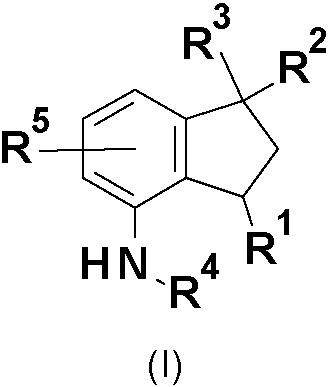

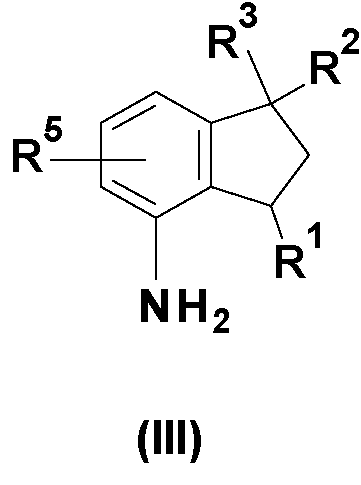
Applications Claiming Priority (2)
| Application Number | Priority Date | Filing Date | Title |
|---|---|---|---|
| EP17178090 | 2017-06-27 | ||
| PCT/EP2018/066396 WO2019002042A1 (en) | 2017-06-27 | 2018-06-20 | Method for preparing substituted 4-aminoindane derivatives |
Publications (1)
| Publication Number | Publication Date |
|---|---|
| ES2876290T3 true ES2876290T3 (en) | 2021-11-12 |
Family
ID=59227611
Family Applications (1)
| Application Number | Title | Priority Date | Filing Date |
|---|---|---|---|
| ES18731108T Active ES2876290T3 (en) | 2017-06-27 | 2018-06-20 | Procedure for preparing substituted 4-aminoindan derivatives |
Country Status (11)
| Country | Link |
|---|---|
| US (1) | US11180441B2 (en) |
| EP (1) | EP3645509B1 (en) |
| JP (1) | JP7049371B2 (en) |
| KR (1) | KR102611830B1 (en) |
| CN (1) | CN110799491B (en) |
| BR (1) | BR112019027697B1 (en) |
| DK (1) | DK3645509T3 (en) |
| ES (1) | ES2876290T3 (en) |
| IL (1) | IL271512B (en) |
| TW (1) | TWI768069B (en) |
| WO (1) | WO2019002042A1 (en) |
Families Citing this family (2)
| Publication number | Priority date | Publication date | Assignee | Title |
|---|---|---|---|---|
| TW202506625A (en) * | 2023-04-25 | 2025-02-16 | 韓商Jw製藥公司 | Method of preparing 4-aminoindan and method of preparing dihydroindenyl-pyrazolo[3,4-b]pyridine amine |
| TW202506626A (en) * | 2023-04-25 | 2025-02-16 | 韓商Jw製藥公司 | Method of preparing 4-aminoindan and method of preparing dihydroindenyl-pyrazolo[3,4-b]pyridine amine |
Family Cites Families (18)
| Publication number | Priority date | Publication date | Assignee | Title |
|---|---|---|---|---|
| JPS59144744A (en) * | 1983-02-07 | 1984-08-18 | Sumitomo Chem Co Ltd | Indanylbenzamide derivative, its preparation and plant-blight controlling agent containing said derivative as active component |
| ATE82966T1 (en) | 1986-08-12 | 1992-12-15 | Mitsubishi Chem Ind | PYRIDINECARBOXAMIDE DERIVATIVES AND THEIR USE AS A FUNGICIDE. |
| FR2649104B1 (en) * | 1989-06-29 | 1991-09-27 | Rhone Poulenc Chimie | |
| US5093347A (en) | 1991-01-28 | 1992-03-03 | Monsanto Company | 3-difluoromethylpyrazolecarboxamide fungicides, compositions and use |
| EP0654464A1 (en) | 1993-10-22 | 1995-05-24 | Shell Internationale Researchmaatschappij B.V. | Processes for the preparation of pesticides and intermediates |
| US5521317A (en) | 1993-10-22 | 1996-05-28 | American Cyanamid Co. | Processes for the preparation of pesticides and intermediates |
| JP3675112B2 (en) | 1997-06-23 | 2005-07-27 | 富士写真フイルム株式会社 | Image reading apparatus and information processing apparatus |
| US6531597B2 (en) * | 2001-02-13 | 2003-03-11 | Hoffmann-La Roche Inc. | Process for preparation of 2-phenyl acetic acid derivatives |
| AR067027A1 (en) * | 2007-06-19 | 2009-09-30 | Astrazeneca Ab | DERIVATIVES OF 2, 3-DIHIDRO-1H-PIRROL [3, 4B] QUINOLIN-1-ONA, A PHARMACEUTICAL COMPOSITION THAT INCLUDES THEM AND ITS USE IN THE MANUFACTURE OF A MEDICINAL PRODUCT FOR THE TREATMENT OF DISEASES MEDITATED BY THE MODULATION OF THE ACTIVITY OF RECEIVER GABA A. |
| ITMI20090488A1 (en) | 2009-03-27 | 2010-09-28 | Isagro Ricerca Srl | HIGH-ACTIVITY BENZAMIDIC COMPOUNDS FUNGICIDAL AND RELATED USE |
| JP5869570B2 (en) * | 2010-08-10 | 2016-02-24 | シンジェンタ パーティシペーションズ アクチェンゲゼルシャフト | Method for preparing 3-haloalkylpyrazole |
| WO2012065947A1 (en) | 2010-11-15 | 2012-05-24 | Bayer Cropscience Ag | 5-halogenopyrazolecarboxamides |
| IT1403275B1 (en) | 2010-12-20 | 2013-10-17 | Isagro Ricerca Srl | HIGH-ACTIVITY INDANYLANILIDES FUNGICIDE AND THEIR PHYTOSANITARY COMPOSITIONS |
| CN104411689A (en) | 2012-05-09 | 2015-03-11 | 拜尔农作物科学股份公司 | Pyrazole indanyl carboxamides |
| JP6262208B2 (en) | 2012-05-09 | 2018-01-17 | バイエル・クロップサイエンス・アクチェンゲゼルシャフト | Pyrazole indanyl carboxamides |
| EP2940001B1 (en) | 2012-12-27 | 2017-05-03 | Sumitomo Chemical Company, Limited | Method for producing purified form of amine compound |
| KR102233203B1 (en) * | 2013-05-22 | 2021-03-26 | 바이엘 크롭사이언스 악티엔게젤샤프트 | Method for the production of 3,5-bis(fluoroalkyl)pyrazole derivatives |
| AR101820A1 (en) * | 2014-06-25 | 2017-01-18 | Bayer Cropscience Ag | DIFLUOROMETIL-INDANIL-CARBOXAMIDAS NICOTÍNICAS |
-
2018
- 2018-06-20 US US16/624,183 patent/US11180441B2/en active Active
- 2018-06-20 CN CN201880042720.0A patent/CN110799491B/en active Active
- 2018-06-20 DK DK18731108.9T patent/DK3645509T3/en active
- 2018-06-20 WO PCT/EP2018/066396 patent/WO2019002042A1/en not_active Ceased
- 2018-06-20 KR KR1020197038305A patent/KR102611830B1/en active Active
- 2018-06-20 ES ES18731108T patent/ES2876290T3/en active Active
- 2018-06-20 EP EP18731108.9A patent/EP3645509B1/en active Active
- 2018-06-20 JP JP2019571046A patent/JP7049371B2/en active Active
- 2018-06-20 BR BR112019027697-1A patent/BR112019027697B1/en active IP Right Grant
- 2018-06-25 TW TW107121653A patent/TWI768069B/en active
-
2019
- 2019-12-17 IL IL271512A patent/IL271512B/en unknown
Also Published As
| Publication number | Publication date |
|---|---|
| US11180441B2 (en) | 2021-11-23 |
| US20200172468A1 (en) | 2020-06-04 |
| IL271512B (en) | 2022-03-01 |
| EP3645509B1 (en) | 2021-03-24 |
| DK3645509T3 (en) | 2021-06-14 |
| KR20200020729A (en) | 2020-02-26 |
| CN110799491B (en) | 2022-10-28 |
| EP3645509A1 (en) | 2020-05-06 |
| TW201920076A (en) | 2019-06-01 |
| JP2020525443A (en) | 2020-08-27 |
| BR112019027697A2 (en) | 2020-09-15 |
| CN110799491A (en) | 2020-02-14 |
| BR112019027697B1 (en) | 2023-01-31 |
| IL271512A (en) | 2020-02-27 |
| JP7049371B2 (en) | 2022-04-06 |
| WO2019002042A1 (en) | 2019-01-03 |
| KR102611830B1 (en) | 2023-12-11 |
| TWI768069B (en) | 2022-06-21 |
Similar Documents
| Publication | Publication Date | Title |
|---|---|---|
| JP6985367B2 (en) | New compounds and methods | |
| BR112015024255A2 (en) | AZOXYSTROBIN PREPARATION METHOD | |
| ES2604405T3 (en) | A procedure for improved rilpivirine | |
| ES2658991T3 (en) | Improved procedure for the preparation of 2,3-dihydroxybenzonitrile | |
| ES2876290T3 (en) | Procedure for preparing substituted 4-aminoindan derivatives | |
| WO2017071419A1 (en) | Method for preparing rociletinib | |
| KR0156265B1 (en) | Method for preparing 2-amino-6-halogenopurine and synthetic intermediate | |
| EP3224257B1 (en) | Novel method for preparing thienopyrimidine compound and intermediates used therein | |
| AU2014389984A1 (en) | Process of preparing a quinazoline derivative | |
| US10087152B2 (en) | Process for preparing (E)-(5,6-dihydro-1,4,2-dioxazin-3-yl)(2-hydroxyphenyl)methanone O-methyl oxime | |
| ES2444519T3 (en) | New method of preparing nitroorotic acid | |
| CN105377812B (en) | The preparation method of 2- amino -2- oximido-N- alkoxy acetimidoyl cyanides and its prepare intermediate | |
| JP4138067B2 (en) | Method for producing methine derivative | |
| JP5917514B2 (en) | Method for selective meta-chlorination of alkylanilines | |
| ES2392735T3 (en) | Method to produce a nicotinic acid derivative or salt thereof | |
| ES2241303T3 (en) | DERIVATIVES OF DIFLUOROMETOXIBENCENO AND ITS USE AS INTERMEDIARIES. | |
| BRPI1009491B1 (en) | process for the production of enaminocarbonyls, and their intermediates | |
| CN110655491B (en) | Simple preparation method of 2-aminopyrimidine-5-formic ether | |
| ES2699927T3 (en) | Method for the preparation of N - [(6-chloropyridin-3-yl) methyl] -2,2-difluoroethane-1-amine by alkylation of 2,2-difluoroethylamine | |
| KR20170050453A (en) | Novel process for preparing thienopyrimidine compound and intermediates used therein | |
| JP2003113153A (en) | Method for producing β-oxonitrile derivative or alkali metal salt thereof | |
| CN112088154A (en) | Process for the preparation of substituted 4-aminoindan derivatives from 2-(hydroxyalkyl)-anilines | |
| PL206473B1 (en) | Method for the manufacture of N-(triaryl methyl)hydrazines | |
| PL110196B2 (en) | Method of producing pentanitrodiphenylmethane and hexanitrodiphenylmethane |