ES2877166T3 - Use of triarylbenzene derivatives as marking tracers for fuels and liquid fuels, fuels and liquid fuels containing such derivatives and corresponding processes - Google Patents
Use of triarylbenzene derivatives as marking tracers for fuels and liquid fuels, fuels and liquid fuels containing such derivatives and corresponding processes Download PDFInfo
- Publication number
- ES2877166T3 ES2877166T3 ES17717209T ES17717209T ES2877166T3 ES 2877166 T3 ES2877166 T3 ES 2877166T3 ES 17717209 T ES17717209 T ES 17717209T ES 17717209 T ES17717209 T ES 17717209T ES 2877166 T3 ES2877166 T3 ES 2877166T3
- Authority
- ES
- Spain
- Prior art keywords
- fuels
- halogen
- fuel
- branched
- linear
- Prior art date
- Legal status (The legal status is an assumption and is not a legal conclusion. Google has not performed a legal analysis and makes no representation as to the accuracy of the status listed.)
- Active
Links
- PAIQXYSZUMLJGD-UHFFFAOYSA-N CCCCCCCCCCCCOc(c(-c1cc(C(F)(F)F)ccc1)cc(-c1cc(C(F)(F)F)ccc1)c1)c1-c1cccc(C(F)(F)F)c1 Chemical compound CCCCCCCCCCCCOc(c(-c1cc(C(F)(F)F)ccc1)cc(-c1cc(C(F)(F)F)ccc1)c1)c1-c1cccc(C(F)(F)F)c1 PAIQXYSZUMLJGD-UHFFFAOYSA-N 0.000 description 1
Classifications
-
- C—CHEMISTRY; METALLURGY
- C10—PETROLEUM, GAS OR COKE INDUSTRIES; TECHNICAL GASES CONTAINING CARBON MONOXIDE; FUELS; LUBRICANTS; PEAT
- C10L—FUELS NOT OTHERWISE PROVIDED FOR; NATURAL GAS; SYNTHETIC NATURAL GAS OBTAINED BY PROCESSES NOT COVERED BY SUBCLASSES C10G OR C10K; LIQUIFIED PETROLEUM GAS; USE OF ADDITIVES TO FUELS OR FIRES; FIRE-LIGHTERS
- C10L1/00—Liquid carbonaceous fuels
- C10L1/003—Marking, e.g. coloration by addition of pigments
-
- C—CHEMISTRY; METALLURGY
- C10—PETROLEUM, GAS OR COKE INDUSTRIES; TECHNICAL GASES CONTAINING CARBON MONOXIDE; FUELS; LUBRICANTS; PEAT
- C10L—FUELS NOT OTHERWISE PROVIDED FOR; NATURAL GAS; SYNTHETIC NATURAL GAS OBTAINED BY PROCESSES NOT COVERED BY SUBCLASSES C10G OR C10K; LIQUIFIED PETROLEUM GAS; USE OF ADDITIVES TO FUELS OR FIRES; FIRE-LIGHTERS
- C10L1/00—Liquid carbonaceous fuels
- C10L1/10—Liquid carbonaceous fuels containing additives
- C10L1/14—Organic compounds
- C10L1/16—Hydrocarbons
- C10L1/1608—Well defined compounds, e.g. hexane, benzene
-
- C—CHEMISTRY; METALLURGY
- C10—PETROLEUM, GAS OR COKE INDUSTRIES; TECHNICAL GASES CONTAINING CARBON MONOXIDE; FUELS; LUBRICANTS; PEAT
- C10L—FUELS NOT OTHERWISE PROVIDED FOR; NATURAL GAS; SYNTHETIC NATURAL GAS OBTAINED BY PROCESSES NOT COVERED BY SUBCLASSES C10G OR C10K; LIQUIFIED PETROLEUM GAS; USE OF ADDITIVES TO FUELS OR FIRES; FIRE-LIGHTERS
- C10L1/00—Liquid carbonaceous fuels
- C10L1/10—Liquid carbonaceous fuels containing additives
- C10L1/14—Organic compounds
- C10L1/18—Organic compounds containing oxygen
- C10L1/185—Ethers; Acetals; Ketals; Aldehydes; Ketones
- C10L1/1852—Ethers; Acetals; Ketals; Orthoesters
-
- C—CHEMISTRY; METALLURGY
- C10—PETROLEUM, GAS OR COKE INDUSTRIES; TECHNICAL GASES CONTAINING CARBON MONOXIDE; FUELS; LUBRICANTS; PEAT
- C10L—FUELS NOT OTHERWISE PROVIDED FOR; NATURAL GAS; SYNTHETIC NATURAL GAS OBTAINED BY PROCESSES NOT COVERED BY SUBCLASSES C10G OR C10K; LIQUIFIED PETROLEUM GAS; USE OF ADDITIVES TO FUELS OR FIRES; FIRE-LIGHTERS
- C10L1/00—Liquid carbonaceous fuels
- C10L1/10—Liquid carbonaceous fuels containing additives
- C10L1/14—Organic compounds
- C10L1/20—Organic compounds containing halogen
- C10L1/202—Organic compounds containing halogen aromatic bond
-
- C—CHEMISTRY; METALLURGY
- C10—PETROLEUM, GAS OR COKE INDUSTRIES; TECHNICAL GASES CONTAINING CARBON MONOXIDE; FUELS; LUBRICANTS; PEAT
- C10L—FUELS NOT OTHERWISE PROVIDED FOR; NATURAL GAS; SYNTHETIC NATURAL GAS OBTAINED BY PROCESSES NOT COVERED BY SUBCLASSES C10G OR C10K; LIQUIFIED PETROLEUM GAS; USE OF ADDITIVES TO FUELS OR FIRES; FIRE-LIGHTERS
- C10L1/00—Liquid carbonaceous fuels
- C10L1/10—Liquid carbonaceous fuels containing additives
- C10L1/14—Organic compounds
- C10L1/20—Organic compounds containing halogen
- C10L1/203—Organic compounds containing halogen hydroxyl compounds; ethers, acetals, ketals
-
- C—CHEMISTRY; METALLURGY
- C10—PETROLEUM, GAS OR COKE INDUSTRIES; TECHNICAL GASES CONTAINING CARBON MONOXIDE; FUELS; LUBRICANTS; PEAT
- C10L—FUELS NOT OTHERWISE PROVIDED FOR; NATURAL GAS; SYNTHETIC NATURAL GAS OBTAINED BY PROCESSES NOT COVERED BY SUBCLASSES C10G OR C10K; LIQUIFIED PETROLEUM GAS; USE OF ADDITIVES TO FUELS OR FIRES; FIRE-LIGHTERS
- C10L10/00—Use of additives to fuels or fires for particular purposes
- C10L10/04—Use of additives to fuels or fires for particular purposes for minimising corrosion or incrustation
-
- C—CHEMISTRY; METALLURGY
- C10—PETROLEUM, GAS OR COKE INDUSTRIES; TECHNICAL GASES CONTAINING CARBON MONOXIDE; FUELS; LUBRICANTS; PEAT
- C10L—FUELS NOT OTHERWISE PROVIDED FOR; NATURAL GAS; SYNTHETIC NATURAL GAS OBTAINED BY PROCESSES NOT COVERED BY SUBCLASSES C10G OR C10K; LIQUIFIED PETROLEUM GAS; USE OF ADDITIVES TO FUELS OR FIRES; FIRE-LIGHTERS
- C10L2230/00—Function and purpose of a components of a fuel or the composition as a whole
- C10L2230/16—Tracers which serve to track or identify the fuel component or fuel composition
-
- C—CHEMISTRY; METALLURGY
- C10—PETROLEUM, GAS OR COKE INDUSTRIES; TECHNICAL GASES CONTAINING CARBON MONOXIDE; FUELS; LUBRICANTS; PEAT
- C10L—FUELS NOT OTHERWISE PROVIDED FOR; NATURAL GAS; SYNTHETIC NATURAL GAS OBTAINED BY PROCESSES NOT COVERED BY SUBCLASSES C10G OR C10K; LIQUIFIED PETROLEUM GAS; USE OF ADDITIVES TO FUELS OR FIRES; FIRE-LIGHTERS
- C10L2270/00—Specifically adapted fuels
- C10L2270/02—Specifically adapted fuels for internal combustion engines
- C10L2270/023—Specifically adapted fuels for internal combustion engines for gasoline engines
-
- C—CHEMISTRY; METALLURGY
- C10—PETROLEUM, GAS OR COKE INDUSTRIES; TECHNICAL GASES CONTAINING CARBON MONOXIDE; FUELS; LUBRICANTS; PEAT
- C10L—FUELS NOT OTHERWISE PROVIDED FOR; NATURAL GAS; SYNTHETIC NATURAL GAS OBTAINED BY PROCESSES NOT COVERED BY SUBCLASSES C10G OR C10K; LIQUIFIED PETROLEUM GAS; USE OF ADDITIVES TO FUELS OR FIRES; FIRE-LIGHTERS
- C10L2270/00—Specifically adapted fuels
- C10L2270/02—Specifically adapted fuels for internal combustion engines
- C10L2270/026—Specifically adapted fuels for internal combustion engines for diesel engines, e.g. automobiles, stationary, marine
-
- C—CHEMISTRY; METALLURGY
- C10—PETROLEUM, GAS OR COKE INDUSTRIES; TECHNICAL GASES CONTAINING CARBON MONOXIDE; FUELS; LUBRICANTS; PEAT
- C10L—FUELS NOT OTHERWISE PROVIDED FOR; NATURAL GAS; SYNTHETIC NATURAL GAS OBTAINED BY PROCESSES NOT COVERED BY SUBCLASSES C10G OR C10K; LIQUIFIED PETROLEUM GAS; USE OF ADDITIVES TO FUELS OR FIRES; FIRE-LIGHTERS
- C10L2270/00—Specifically adapted fuels
- C10L2270/04—Specifically adapted fuels for turbines, planes, power generation
Landscapes
- Chemical & Material Sciences (AREA)
- Oil, Petroleum & Natural Gas (AREA)
- Engineering & Computer Science (AREA)
- Organic Chemistry (AREA)
- Chemical Kinetics & Catalysis (AREA)
- General Chemical & Material Sciences (AREA)
- Combustion & Propulsion (AREA)
- Health & Medical Sciences (AREA)
- Emergency Medicine (AREA)
- Organic Low-Molecular-Weight Compounds And Preparation Thereof (AREA)
- Investigating Or Analyzing Non-Biological Materials By The Use Of Chemical Means (AREA)
Abstract
Uso como trazador de marcado de carburantes y combustibles líquidos de al menos un compuesto de Fórmula I: en la cual: - el anillo de benceno A se sustituye opcionalmente en al menos una de las posiciones 2, 4 o 6 por: - un radical alquilo, lineal, ramificado o cíclico, de C1-C18, opcionalmente sustituido por al menos un halógeno y/o opcionalmente interrumpido por al menos un oxígeno; o - un radical alcoxi, lineal, ramificado o cíclico, de C1-C18, opcionalmente sustituido por al menos un halógeno y/o opcionalmente interrumpido por al menos un oxígeno; o - un radical alquenilo, lineal, ramificado o cíclico, de C2-C18, opcionalmente sustituido por al menos un halógeno y/o opcionalmente interrumpido por al menos un oxígeno; - los anillos de benceno B, C y D se sustituyen, independientemente unos de otros, en al menos una posición orto, meta o para con respecto al anillo de benceno A por: - un radical alquilo, lineal, ramificado o cíclico, de C1-C18, opcionalmente sustituido por al menos un halógeno y/o opcionalmente interrumpido por al menos un oxígeno; o - un radical alcoxi, lineal, ramificado o cíclico, de C1-C18, opcionalmente sustituido por al menos un halógeno y/o opcionalmente interrumpido por al menos un oxígeno; o - un radical alquenilo, lineal, ramificado o cíclico, de C2-C18, opcionalmente sustituido por al menos un halógeno y/o opcionalmente interrumpido por al menos un oxígeno; o - un halógeno; al menos un anillo de benceno B, C y D que además puede contener un ciclo alifático de 5-7 eslabones acoplados a este, por ejemplo, un ciclo de 6 eslabones, con la condición de que, cuando el anillo de benceno A no se sustituya y los anillos de benceno B, C y D se sustituyan cada uno por un metilo, este último no estará en posición con respecto al anillo de benceno A.Use as a marking tracer for fuels and liquid fuels of at least one compound of Formula I: in which: - the benzene ring A is optionally substituted in at least one of the 2, 4 or 6 positions by: - an alkyl radical , linear, branched or cyclic, from C1-C18, optionally substituted by at least one halogen and/or optionally interrupted by at least one oxygen; or - a C1-C18 linear, branched or cyclic alkoxy radical, optionally substituted by at least one halogen and/or optionally interrupted by at least one oxygen; or - a C2-C18 linear, branched or cyclic alkenyl radical, optionally substituted by at least one halogen and/or optionally interrupted by at least one oxygen; - the benzene rings B, C and D are substituted, independently of each other, in at least one ortho, meta or para position with respect to the benzene ring A by: - a linear, branched or cyclic C1 alkyl radical -C18, optionally substituted by at least one halogen and/or optionally interrupted by at least one oxygen; or - a C1-C18 linear, branched or cyclic alkoxy radical, optionally substituted by at least one halogen and/or optionally interrupted by at least one oxygen; or - a C2-C18 linear, branched or cyclic alkenyl radical, optionally substituted by at least one halogen and/or optionally interrupted by at least one oxygen; or - a halogen; at least one benzene ring B, C and D which may additionally contain a 5-7 membered aliphatic ring coupled to it, for example a 6 membered ring, with the proviso that when the benzene ring A is not substitute and the benzene rings B, C and D are each replaced by a methyl, the latter will not be in position with respect to the benzene ring A.
Description
DESCRIPCIÓNDESCRIPTION
Uso de derivados de triarilbenceno como trazadores de marcado de carburantes y combustibles líquidos, carburantes y combustibles líquidos que contienen tales derivados y procesos correspondientesUse of triarylbenzene derivatives as marking tracers for fuels and liquid fuels, fuels and liquid fuels containing such derivatives and corresponding processes
[0001] La presente invención se refiere al uso de derivados de triarilbenceno como trazadores de marcado para los carburantes y combustibles líquidos; a los carburantes y combustibles líquidos que contienen tales derivados; a un procedimiento de marcado de carburantes y combustibles líquidos para tales derivados; y un procedimiento para determinar si unos carburantes o combustibles líquidos que contienen inicialmente estos trazadores han sido falsificados, utilizados de manera ilegal o robados.[0001] The present invention relates to the use of triarylbenzene derivatives as marking tracers for fuels and liquid fuels; to fuels and liquid fuels containing such derivatives; to a procedure for marking fuels and liquid fuels for such derivatives; and a procedure for determining whether fuels or liquid fuels initially containing these tracers have been counterfeit, illegally used, or stolen.
[0002] El marcado de los carburantes y combustibles líquidos con diferentes tipos de marcadores químicos es ampliamente conocido en el estado de la técnica. Con este fin se han utilizado compuestos, así como numerosas técnicas de análisis para la detección de los marcadores (por ejemplo, la cromatografía de gases acoplada a espectrometría de masas). Una aplicación importante consiste en marcar los carburantes combustibles según su tipo impositivo. La eliminación deliberada del trazador con fines ilegales es una cuestión importante. Como hasta ahora los trazadores tenían colorantes, los «métodos de eliminación» se llamaban «métodos de blanqueo». Estos métodos son físicos (por ejemplo: adsorción en carbón o sobre en de sílice) o químicos (por ejemplo: tratamiento ácido o básico). En consecuencia, estos marcadores deben ser resistentes a tales métodos de eliminación, completamente compatibles con los carburantes y combustibles líquidos, e identificables mediante un método analítico apropiado.[0002] The marking of fuels and liquid fuels with different types of chemical markers is widely known in the state of the art. Compounds have been used for this purpose, as well as numerous analytical techniques for the detection of markers (eg gas chromatography coupled to mass spectrometry). An important application is to mark combustible fuels according to their tax rate. Deliberate removal of the tracer for illegal purposes is an important issue. Since tracers until now had dyes, the "removal methods" were called "bleaching methods." These methods are physical (for example: adsorption on carbon or on silica) or chemical (for example: acid or basic treatment). Consequently, these markers must be resistant to such removal methods, fully compatible with fuels and liquid fuels, and identifiable by an appropriate analytical method.
[0003] El fraude con relación a los carburantes o combustibles líquidos abarca diferentes comportamientos: la falsificación por blanqueo o por adulteración, el uso ilegal, el contrabando y el robo. La falsificación por blanqueo se refiere a la transformación de un carburante o combustible líquido con un tipo impositivo bajo en carburante o combustible líquido con un tipo impositivo más elevado, por ejemplo -en Francia- la transformación de combustible para uso doméstico en gasóleo. La falsificación por adulteración se refiere a la dilución de un carburante o combustible líquido con un tipo impositivo elevado en carburante mediante un carburante o combustible líquido con un tipo impositivo bajo. El uso ilegal se refiere al uso ilegal de un carburante o combustible líquido con un tipo impositivo bajo en lugar de un carburante o combustible líquido con un tipo impositivo más elevado. El contrabando se refiere a la compra de un carburante o combustible líquido con un tipo impositivo bajo en un país para revenderlo en otro país donde los impuestos son más elevados.[0003] Fraud in relation to fuels or liquid fuels encompasses different behaviors: counterfeiting by laundering or adulteration, illegal use, smuggling and theft. Counterfeiting by laundering refers to the transformation of a fuel or liquid fuel with a low tax rate on fuel or liquid fuel with a higher tax rate, for example - in France - the transformation of fuel for domestic use into diesel. Counterfeiting by adulteration refers to the dilution of a fuel or liquid fuel with a high tax rate in fuel with a fuel or liquid fuel with a low tax rate. Illegal use refers to the illegal use of a fuel or liquid fuel with a low tax rate instead of a fuel or liquid fuel with a higher tax rate. Smuggling refers to the purchase of a fuel or liquid fuel with a low tax rate in one country to resell it in another country where taxes are higher.
[0004] La WO2012/153132 A1 describe unos marcadores orgánicos aromáticos sustituidos por al menos un bromo y/o un átomo de flúor, y/o uno o varios grupos fluoroalquilo. La combustión de los carburantes marcados con tales compuestos puede producir bromuro de hidrógeno y/o fluoruro de hidrógeno en los gases de combustión. El bromuro y el fluoruro de hidrógeno son conocidos por ser especialmente corrosivos para el motor. El fluoruro de hidrógeno es bien conocido por ser altamente tóxico para las personas y para el medio ambiente.[0004] WO2012 / 153132 A1 describes aromatic organic labels substituted by at least one bromine and / or one fluorine atom, and / or one or more fluoroalkyl groups. Combustion of fuels labeled with such compounds can produce hydrogen bromide and / or hydrogen fluoride in the combustion gases. Hydrogen bromide and fluoride are known to be especially corrosive to engines. Hydrogen fluoride is well known to be highly toxic to people and the environment.
[0005] La WO2014/008164 describe éteres de arilo y de alquilo tritilado como trazadores para el marcado de los hidrocarburos. Tales trazadores no presentan una buena resistencia a los métodos de eliminación anteriormente mencionados.[0005] WO2014 / 008164 describes aryl and tritylated alkyl ethers as tracers for marking hydrocarbons. Such tracers do not exhibit good resistance to the aforementioned removal methods.
[0006] La US 5981 283 describe el uso de una gran variedad de compuestos orgánicos para el marcado de los productos petrolíferos entre los que se encuentra el 1,3,5-trifenilbenceno. Este compuesto trazador no presenta una buena resistencia a los métodos de eliminación anteriormente mencionados.[0006] US 5981 283 describes the use of a wide variety of organic compounds for the marking of petroleum products, including 1,3,5-triphenylbenzene. This tracer compound does not exhibit good resistance to the above-mentioned removal methods.
[0007] La US 7858373 describe el uso de una variedad de compuestos orgánicos para un uso en el marcado de los carburantes líquidos tales como los hidrocarburos y los aceites. Se pueden utilizar combinaciones de marcadores como sistemas de marcado digital, formando la relación de la concentración de cada marcador un código del producto marcado.[0007] US 7858373 describes the use of a variety of organic compounds for use in marking liquid fuels such as hydrocarbons and oils. Combinations of markers can be used as digital marking systems, with the ratio of the concentration of each marker forming a code for the marked product.
[0008] Por lo tanto, aún existe una necesidad de marcadores químicos suplementarios compatibles con los carburantes y combustibles líquidos, detectables en un medio complejo tal y resistentes a los métodos físicos y químicos de blanqueo, al menos al método físico de blanqueo por carbón activado y/o sílice.Therefore, there is still a need for supplementary chemical markers compatible with fuels and liquid fuels, detectable in such a complex medium and resistant to physical and chemical bleaching methods, at least to the physical method of activated carbon bleaching. and / or silica.
[0009] De manera sorprendente, se ha descubierto que ciertos triarilbencenos son especialmente eficaces para el marcado de carburantes y combustibles líquidos. Además, se ha demostrado que estos triarilbencenos son en particular resistentes a los intentos de blanqueo químico y físico. Por otra parte, la mayoría de estos triarilbencenos solo contienen carbono e hidrógeno y la combustión de estos compuestos utilizados como marcadores solo produce dióxido de carbono y agua.[0009] Surprisingly, certain triarylbenzenes have been found to be especially effective for marking fuels and liquid fuels. Furthermore, these triarylbenzenes have been shown to be particularly resistant to chemical and physical bleaching attempts. On the other hand, most of these triarylbenzenes only contain carbon and hydrogen and the combustion of these compounds used as markers only produces carbon dioxide and water.
[0010] Por lo tanto, la presente invención tiene por objeto, primero que todo, el uso como trazador de marcado de carburantes y combustibles líquidos de por lo menos un compuesto de Fórmula I: Therefore, the present invention aims, first of all, the use as marking tracer of fuels and liquid fuels of at least one compound of Formula I:

en la cual:in which:
- el anillo de benceno A se sustituye opcionalmente en al menos una de las posiciones 2, 4 o 6 por:- the benzene ring A is optionally substituted in at least one of the 2, 4 or 6 positions by:
• un radical alquilo, lineal, ramificado o cíclico, de C1-C18, opcionalmente sustituido por al menos un halógeno y/o opcionalmente interrumpido por al menos un oxígeno; o• a C1-C18 linear, branched or cyclic alkyl radical, optionally substituted by at least one halogen and / or optionally interrupted by at least one oxygen; or
• un radical alcoxi, lineal, ramificado o cíclico, de C1-C18, opcionalmente sustituido por al menos un halógeno y/o opcionalmente interrumpido por al menos un oxígeno; o• a C1-C18 linear, branched or cyclic alkoxy radical, optionally substituted by at least one halogen and / or optionally interrupted by at least one oxygen; or
• un radical alquenilo, lineal, ramificado o cíclico, de C2-C18, opcionalmente sustituido por al menos un halógeno y/o opcionalmente interrumpido por al menos un oxígeno;• a C2-C18 linear, branched or cyclic alkenyl radical, optionally substituted by at least one halogen and / or optionally interrupted by at least one oxygen;
- los anillos de benceno B, C y D se sustituyen, independientemente unos de otros, en al menos una posición orto, meta o para con respecto al anillo de benceno A por:- the benzene rings B, C and D are substituted, independently of each other, in at least the ortho, meta or para to the benzene ring A position:
• un radical alquilo, lineal, ramificado o cíclico, de C1-C18, opcionalmente sustituido por al menos un halógeno y/o opcionalmente interrumpido por al menos un oxígeno; o• a C1-C18 linear, branched or cyclic alkyl radical, optionally substituted by at least one halogen and / or optionally interrupted by at least one oxygen; or
• un radical alcoxi, lineal, ramificado o cíclico, de C1-C18, opcionalmente sustituido por al menos un halógeno y/o opcionalmente interrumpido por al menos un oxígeno; o• a C1-C18 linear, branched or cyclic alkoxy radical, optionally substituted by at least one halogen and / or optionally interrupted by at least one oxygen; or
• un radical alquenilo, lineal, ramificado o cíclico, de C2-C18, opcionalmente sustituido por al menos un halógeno y/o opcionalmente interrumpido por al menos un oxígeno; o• a C2-C18 linear, branched or cyclic alkenyl radical, optionally substituted by at least one halogen and / or optionally interrupted by at least one oxygen; or
• un halógeno;• a halogen;
donde al menos un anillo de benceno B, C y D puede contener además un ciclo alifático de 5-7 eslabones acoplados a este, por ejemplo, un ciclo de 6 eslabones,where at least one benzene ring B, C and D may further contain a 5-7 membered aliphatic ring coupled to it, for example a 6 membered ring,
con la condición de que, cuando el anillo de benceno A no se sustituya y los anillos de benceno B, C y D se sustituyan cada uno por un metilo, este último no estará en posición con respecto al anillo de benceno A.Provided that when benzene ring A is not substituted and benzene rings B, C and D are each substituted by a methyl, the latter will not be in position with respect to benzene ring A.
[0011] Se ha de señalar que, en la Fórmula 1, todo átomo puede ser reemplazado por uno de sus isótopos.[0011] It should be noted that, in Formula 1, every atom can be replaced by one of its isotopes.
[0012] Preferiblemente, el anillo de benceno A no se sustituye, o se sustituye por alcoxi de C1-C18.[0012] Preferably, benzene ring A is not substituted, or is substituted by C1-C18 alkoxy.
[0013] Preferiblemente, los anillos de benceno B, C y D se sustituyen por:[0013] Preferably, benzene rings B, C and D are replaced by:
- un radical alquilo, lineal, ramificado o cíclico, de C1-C18, especialmente de C1-C12, en particular de C1-C6, opcionalmente sustituido por al menos un halógeno; o- a linear, branched or cyclic alkyl radical of C1-C18, especially C1-C12, in particular C1-C6, optionally substituted by at least one halogen; or
- al menos un halógeno.- at least one halogen.
[0014] Un halógeno que se incluye en la definición de la Fórmula I puede ser F, Cl, Br e I, y en particular F, Cl y Br.[0014] A halogen that is included in the definition of Formula I can be F, Cl, Br and I, and in particular F, Cl and Br.
[0015] El compuesto de Fórmula I se puede escoger especialmente entre: [0015] The compound of Formula I can be chosen especially from:


[0016] De manera particularmente preferida, el compuesto de Fórmula I es:[0016] Particularly preferably, the compound of Formula I is:

[0017] La invención tiene igualmente como objetivo un carburante o combustible líquido que contiene como trazador de marcado al menos un compuesto de Fórmula I.[0017] Another object of the invention is a fuel or liquid fuel that contains as marking tracer at least one compound of Formula I.
[0018] Como carburante o combustible líquido, se pueden citar:[0018] As fuel or liquid fuel, the following can be mentioned:
- los carburantes o combustibles líquidos obtenidos a partir del petróleo entre los que se pueden citar la gasolina, el gasóleo, el combustible para uso doméstico, el queroseno, el petróleo lampante;- Fuels or liquid fuels obtained from oil, among which we can mention gasoline, diesel, fuel for domestic use, kerosene, lampante oil;
- los carburantes o combustibles líquidos obtenidos a partir de vegetales tales como los biocarburantes entre los que se pueden citar los aceites vegetales, el etanol, el butanol, el etil tert-butil éter (ETBE), los ésteres metílicos de ácidos grasos.- fuels or liquid fuels obtained from plants such as biofuels, including vegetable oils, ethanol, butanol, ethyl tert-butyl ether (ETBE), fatty acid methyl esters.
[0019] Los compuestos de Fórmula I se pueden preparar por acoplamiento de Suzuki catalizado por paladio entre un 1,3,5-trihalogenoareno con sustituyentes en las posiciones 2, 4 o 6 y tres equivalentes de un ácido arilborónico en presencia de una base mineral: [0019] Compounds of Formula I can be prepared by palladium catalyzed Suzuki coupling between a 1,3,5-trihalogenoarene with substituents at the 2, 4 or 6 positions and three equivalents of an arylboronic acid in the presence of a mineral base :
[0020] Los compuestos de Fórmula I sin sustituyentes en el anillo de benceno A, también se pueden preparar por cidotrimerización de las arilmetilcetonas, según:[0020] Compounds of Formula I without substituents on the benzene A ring, can also be prepared by cytotrimerization of arylmethyl ketones, according to:

[0021] La reacción tiene lugar a entre 80 y 150 °C en presencia de catalizadores o de agentes deshidratantes. Los catalizadores son ácidos de Bronsted o de Lewis. El empleo de los ácidos arenosulfónicos está bien descrito en la literatura. En particular el empleo de una cantidad catalítica de ácido 4-toluensulfónico monohidrato se describe en Zhao, Y.; Li, J.; Li, C.; Yin, K.; Ye, D.; Jia, X. Green Chem. 2010, 12, 1370.[0021] The reaction takes place between 80 and 150 ° C in the presence of catalysts or dehydrating agents. The catalysts are Bronsted or Lewis acids. The use of arenesulfonic acids is well described in the literature. In particular the use of a catalytic amount of 4-toluenesulfonic acid monohydrate is described in Zhao, Y .; Li, J .; Li, C .; Yin, K .; Ye, D .; Jia, X. Green Chem. 2010, 12, 1370.
[0022] El compuesto de Fórmula I se agrega al carburante o combustible líquido a razón de 0,01 a 500 mg/L, en particular a razón de 0,02 a 20 mg/L, y más particularmente a razón de 0,1 a 5 mg/L.The compound of Formula I is added to the fuel or liquid fuel at a rate of 0.01 to 500 mg / L, in particular at a rate of 0.02 to 20 mg / L, and more particularly at a rate of 0.1 at 5 mg / L.
[0023] La invención también tiene por objeto un procedimiento de marcado de carburantes o combustibles líquidos, caracterizado por el hecho de que se prepara una solución al 0,1-40 % en peso del compuesto de Fórmula I en un solvente o una mezcla de solventes y de que se inyecta dicha solución en el carburante o combustible líquido, por ejemplo en línea en un oleoducto o en el brazo de carga de un camión cisterna, o también en una cuba para obtener la concentración pretendida del marcador en el carburante o combustible líquido.[0023] The invention also has as its object a process for marking fuels or liquid fuels, characterized in that a solution at 0.1-40% by weight of the compound of Formula I is prepared in a solvent or a mixture of solvents and that said solution is injected into the fuel or liquid fuel, for example in line in an oil pipeline or in the loading arm of a tanker truck, or also in a tank to obtain the target concentration of the marker in the fuel or fuel liquid.
[0024] Preferiblemente, se prepara una solución al 0,2-20 % en peso del compuesto de Fórmula I en el solvente o mezcla de solventes.[0024] Preferably, a 0.2-20% by weight solution of the compound of Formula I is prepared in the solvent or solvent mixture.
[0025] El o los solventes se pueden escoger entre los solventes aromáticos tales como el tolueno, el etilbenceno, los xilenos, el mesitileno, el 1,2,4-trimetilbenceno, el cumeno, el p-cimeno, los hidrocarburos aromáticos (por ejemplo Shellsol® A100, Solvarex® 10, Solvesso® 200); entre los solventes alifáticos tales como el pentano, los hexanos, el ciclohexano, los heptanos, el 2,2,4-trimetilpentano, la gasolina blanca, el queroseno, las isoparafinas, las parafinas; entre los solventes oxigenados y/o nitrogenados tales como las cetonas, los éteres, los ésteres, las lactonas, los fenoles, las amidas, las lactamas; o entre los solventes halogenados tales como el clorobenceno, el 1,2-diclorobenceno, el a,a,a-trifluorotolueno.[0025] The solvent (s) can be chosen from aromatic solvents such as toluene, ethylbenzene, xylenes, mesitylene, 1,2,4-trimethylbenzene, cumene, p-cymene, aromatic hydrocarbons (for example Shellsol® A100, Solvarex® 10, Solvesso® 200); among aliphatic solvents such as pentane, hexanes, cyclohexane, heptanes, 2,2,4-trimethylpentane, white gasoline, kerosene, isoparaffins, paraffins; among oxygenated and / or nitrogenous solvents such as ketones, ethers, esters, lactones, phenols, amides, lactams; or between halogenated solvents such as chlorobenzene, 1,2-dichlorobenzene, a, a, a-trifluorotoluene.
[0026] La invención tiene igualmente como objetivo un procedimiento para determinar si los carburantes o combustibles líquidos se han falsificado por blanqueo, caracterizado por el hecho de que se toma una muestra del carburante o combustible líquido del que se sospecha que ha sido falsificado y se analiza para determinar si la concentración del compuesto de Fórmula I en dicha muestra es inferior a la concentración inicial, y, en caso afirmativo, se deduce que la muestra ha sido falsificada por blanqueo.[0026] The invention also aims at a method for determining whether fuels or liquid fuels have been counterfeited by bleaching, characterized by the fact that a sample of the fuel or liquid fuel suspected of having been counterfeited is taken and is analyzes to determine if the concentration of the compound of Formula I in said sample is lower than the initial concentration, and, if so, it is deduced that the sample has been falsified by bleaching.
[0027] La invención tiene también como objetivo un procedimiento para determinar si los carburantes o combustibles líquidos se han falsificado por adulteración, o si se han utilizado de manera ilegal o han sido objeto de contrabando o de robo, caracterizado por el hecho de que se toma una muestra del carburante o combustible líquido del que se sospecha que ha sido falsificado o utilizado de manera ilegal o ha sido objeto de contrabando o de robo y se analiza para determinar si el compuesto de Fórmula I está presente en dicha muestra, y, en caso afirmativo, se deduce de ello que la muestra ha sido falsificada o utilizada de manera ilegal o ha sido objeto de contrabando o de robo.The invention also aims at a method for determining whether fuels or liquid fuels have been falsified by adulteration, or if they have been used illegally or have been smuggled or stolen, characterized by the fact that they are takes a sample of the fuel or liquid fuel suspected of having been counterfeit or illegally used or has been smuggled or stolen and is tested to determine whether the Formula I compound is present in the sample, and If so, it follows that the sample has been falsified or used illegally or has been smuggled or stolen.
[0028] Se ha de señalar aquí que el o los marcadores según la invención se pueden utilizar individualmente o en combinación con otros marcadores.[0028] It should be noted here that the marker (s) according to the invention can be used individually or in combination with other markers.
[0029] Los carburantes o combustibles líquidos marcados por uno o varios compuestos de Fórmula I se pueden analizar cualitativamente o cuantitativamente, por ejemplo, por los métodos siguientes: cromatografía de gases acoplada a un detector de ionización de llama o a un espectrómetro de masas; cromatografía líquida de alta resolución acoplada a un detector de red de diodos o a un espectrómetro de masas.[0029] Fuels or liquid fuels labeled by one or more compounds of Formula I can be analyzed qualitatively or quantitatively, for example, by the following methods: gas chromatography coupled to a flame ionization detector or a mass spectrometer; High performance liquid chromatography coupled to a diode array detector or mass spectrometer.
[0030] Los Ejemplos siguientes ilustran la presente invención sin limitar no obstante su alcance. En estos Ejemplos, los porcentajes son en peso excepto que se indique lo contrario.The following Examples illustrate the present invention without however limiting its scope. In these Examples, the percentages are by weight unless otherwise indicated.
[0031] Las pruebas siguientes de eliminación física y química de los marcadores se han llevado a cabo sobre los compuestos de los Ejemplos 1 (de referencia), del 2 al 18 (de la invención) y 19 y 20 (comparativos). [0031] The following tests of physical and chemical removal of the markers have been carried out on the compounds of Examples 1 (reference), 2 to 18 (of the invention) and 19 and 20 (comparative).
Pru eba de eliminación físicaPhysical elimination test
[0032] En un tubo de ensayo, a 10 mL de gasóleo de tipo B0 conforme a la norma EN 590 que contenía 10 mg/L de marcador químico, se agregó una cantidad -precisada a continuación- de agente de eliminación sólido: gel de sílice1, carbón activado2; alúmina3.[0032] In a test tube, to 10 mL of type B0 diesel according to EN 590 standard containing 10 mg / L of chemical marker, a quantity - specified below - of solid eliminating agent was added: silica 1 , activated carbon 2 ; alumina 3 .
10,060-0,200 mm, 40A, Acros 241660010 1 0.060-0.200mm, 40A, Acros 241660010
2 Comelt Carbosorb 10A 2 Comelt Carbosorb 10A
3 Sigma-Aldrich 11028 3 Sigma-Aldrich 11028
[0033] Se agitó el tubo utilizando un agitador lineal de 300 movimientos/min durante 10 min.[0033] The tube was shaken using a 300 strokes / min linear shaker for 10 min.
[0034] A continuación, se filtró el líquido a través de una membrana de politetrafluoroetileno (PTFE) de 0,2 |jm y se analizó por GC/FID.[0034] The liquid was then filtered through a 0.2 µm polytetrafluoroethylene (PTFE) membrane and analyzed by GC / FID.
Columna ZB-50 de 15 m x 0,25 mm x 0,25 ^m ID.Column ZB-50 15 m x 0.25 mm x 0.25 ^ m ID.
Helio P = 90kPaHelium P = 90kPa
Flujo de 50 mL/min.Flow of 50 mL / min.
Inyector 280°CInjector 280 ° C
Detector 300°C300 ° C detector
Horno: 100°C a 320°C a 20°C/min y luego 320°C durante 19 min.Oven: 100 ° C to 320 ° C at 20 ° C / min and then 320 ° C for 19 min.
Volumen inyectado: 2 |jL.Injected volume: 2 | jL.
Prueba de eliminación químicaChemical removal test
[0035] En un tubo de ensayo, a 10 mL de gasóleo de tipo B0 conforme a la norma EN 590 que contiene 10 mg/L de marcador químico se agregaron 10 mL de agente de eliminación química: H2SO4 , HNO3 , NaOH, NaClO, HCl a las concentraciones indicadas.[0035] In a test tube, 10 mL of chemical removal agent were added to 10 mL of type B0 diesel according to EN 590 standard containing 10 mg / L of chemical marker: H 2 SO 4 , HNO 3 , NaOH, NaClO, HCl at the indicated concentrations.
[0036] Se agitó el tubo utilizando un agitador lineal de 300 movimientos/min durante 10 min. Después de algunos minutos de reposo, se extrajo el líquido que constituía la fase superior y luego se filtró a través de una membrana de politetrafluoroetileno (PTFE) de 0,45 ^m y se analizó por GC/FID. Las condiciones de análisis son aquellas indicadas arriba para la prueba de eliminación física.[0036] The tube was shaken using a 300 strokes / min linear shaker for 10 min. After a few minutes of standing, the liquid constituting the upper phase was removed and then filtered through a 0.45 µm polytetrafluoroethylene (PTFE) membrane and analyzed by GC / FID. The analysis conditions are those indicated above for the physical elimination test.
[0037] El gasóleo que contiene el compuesto de los Ejemplos del 1 al 18 de la concentración de 10 mg/L se sometió a las pruebas de eliminación física y química descritas arriba. La concentración de cada compuesto, medida en el gasóleo después del tratamiento de eliminación, se indica en las Tablas respectivamente de la 1 a la 18 en calidad de porcentaje de la concentración medida antes del tratamiento de eliminación.The gas oil containing the compound of Examples 1 to 18 of the concentration of 10 mg / L was subjected to the physical and chemical removal tests described above. The concentration of each compound, measured in the gas oil after the elimination treatment, is indicated in Tables 1 to 18 respectively as a percentage of the concentration measured before the elimination treatment.
Ejemplo 1 (de referencia): 1,3,5-T ris(4-metilfenil)bencenoExample 1 (reference): 1,3,5-T ris (4-methylphenyl) benzene
[0038][0038]

[0039] Se calentó una mezcla de 134,2 g de 4'-metilacetofenona y de 19 g de ácido 4-toluensulfónico monohidratado hasta 140°C mientras se agitaba. Se eliminó el agua por destilación para alcanzar la temperatura y luego durante la reacción. Se mantuvo la temperatura de 140 °C durante 24 h.[0039] A mixture of 134.2 g of 4'-methylacetophenone and 19 g of 4-toluenesulfonic acid monohydrate was heated to 140 ° C while stirring. The water was removed by distillation to reach temperature and then during the reaction. The temperature of 140 ° C was maintained for 24 h.
[0040] Después del enfriamiento de la mezcla reactiva a temperatura ambiente, se agregó el tolueno para disolver la masa. La solución orgánica se lavó a continuación 3 veces con agua y luego se secó con el sulfato de magnesio. Se eliminó el solvente por destilación al vacío.[0040] After cooling the reaction mixture to room temperature, toluene was added to dissolve the mass. The organic solution was then washed 3 times with water and then dried over magnesium sulfate. The solvent was removed by vacuum distillation.
[0041] Se obtuvieron 92 g de 1,3,5-Tris(4-metilfenil)benceno. Una purificación por cromatografía en gel de sílice (ciclohexano/acetato de etilo: 99/1) seguida de una recristalización en etanol dio como resultado un polvo cristalino beis.[0041] 92 g of 1,3,5-Tris (4-methylphenyl) benzene were obtained. Purification by silica gel chromatography (cyclohexane / ethyl acetate: 99/1) followed by recrystallization from ethanol resulted in a beige crystalline powder.
T l 1T l 1

Ejemplo 2 (de la invención): 1,3,5-Tris(4-isobutilfenil)bencenoExample 2 (of the invention): 1,3,5-Tris (4-isobutylphenyl) benzene
[0042][0042]
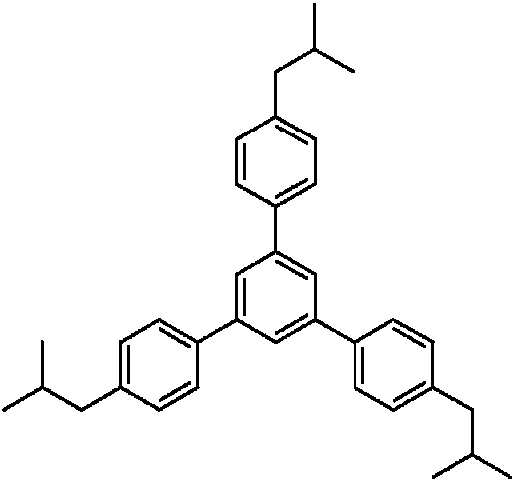
[0043] El compuesto del epígrafe fue preparado según la secuencia operativa del Ejemplo 1 a excepción de que la mezcla inicial era una mezcla de 176,3 g de 4'-isobutilacetofenona y de 19 g de ácido 4-toluensulfónico monohidratado.[0043] The title compound was prepared according to the operating sequence of Example 1 except that the initial mixture was a mixture of 176.3 g of 4'-isobutylacetophenone and 19 g of 4-toluenesulfonic acid monohydrate.
[0044] Se obtuvieron 126 g de un líquido marrón muy viscoso que contenía 68% (m/m) de 1,3,5-tris(4-isobutilfenil)benceno.[0044] 126 g of a very viscous brown liquid were obtained containing 68% (m / m) of 1,3,5-tris (4-isobutylphenyl) benzene.
T l 2T l 2

Ejemplo 3 (de la invención): 1,3,5-Tris(4-butilfenil)bencenoExample 3 (of the invention): 1,3,5-Tris (4-butylphenyl) benzene
[0045][0045]

[0046] El compuesto del epígrafe se preparó según la secuencia operativa del Ejemplo 1, a excepción de que la mezcla inicial era una mezcla de 10 g de 4'-butilactofonona y de 1,1 g de ácido 4-toluensulfónico monohidratado.[0046] The title compound was prepared according to the operating sequence of Example 1, except that the initial mixture was a mixture of 10 g of 4'-butylactophonone and 1.1 g of 4-toluenesulfonic acid monohydrate.
[0047] Se obtuvieron 10,1 g de 1,3,5-tris (4-butilfenil)benceno en forma de un líquido marrón muy viscoso.[0047] 10.1 g of 1,3,5-tris (4-butylphenyl) benzene were obtained in the form of a very viscous brown liquid.

Ejemplo 4 (de la invención): 1,3,5-Tris(4-tert-butilfenil)bencenoExample 4 (of the invention): 1,3,5-Tris (4-tert-butylphenyl) benzene
[0048][0048]

[0049] 1,23 g de 1,3,5-trifenilbenceno se suspendieron en 10 mL de diclorometano y 1,5 mL de 2-cloro-2-metilopropano. A continuación, se agregaron 25 mg de cloruro férrico. Después de algunos minutos, se agregaron el agua y el diclorometano mientras se agitaba. La solución orgánica se lavó a continuación dos veces con una solución acuosa al 10 % de carbonato de sodio, se secó con sulfato de magnesio y se evaporó al vacío. Se obtuvieron 1,88 g de 1,3,5-Tris(4-tert-butilfenil)benceno. Tras recristalización en tolueno, se obtuvo como resultado un producto cristalino blanco.[0049] 1.23 g of 1,3,5-triphenylbenzene were suspended in 10 mL of dichloromethane and 1.5 mL of 2-chloro-2-methylpropane. Then 25 mg of ferric chloride were added. After a few minutes, added the water and dichloromethane while stirring. The organic solution was then washed twice with a 10% aqueous sodium carbonate solution, dried over magnesium sulfate and evaporated in vacuo. 1.88 g of 1,3,5-Tris (4-tert-butylphenyl) benzene were obtained. After recrystallization from toluene, a white crystalline product resulted.
T l 4T l 4

Ejemplo 5 (de la invención): 1,3,5-Tris(4- etilfenil) bencenoExample 5 (of the invention): 1,3,5-Tris (4-ethylphenyl) benzene
[0050][0050]

[0051] El compuesto del epígrafe se preparó según la secuencia operativa del Ejemplo 1 a excepción de que la mezcla inicial fue una mezcla de 10 g de 4'-etilacetofenona y de 1,3 g de ácido 4-toluensulfónico monohidratado.[0051] The title compound was prepared according to the operating sequence of Example 1 except that the initial mixture was a mixture of 10 g of 4'-ethylacetophenone and 1.3 g of 4-toluenesulfonic acid monohydrate.
[0052] Se obtuvieron 7,3 g de 1,3,5-tris(4-etilfenil)benceno en forma de un líquido marrón muy viscoso.[0052] 7.3 g of 1,3,5-tris (4-ethylphenyl) benzene were obtained in the form of a very viscous brown liquid.
T lT l

Ejemplo 6 (de la invención): 1,3,5-Tris(4-fluorofenil)bencenoExample 6 (of the invention): 1,3,5-Tris (4-fluorophenyl) benzene
[0053][0053]

[0054] En atmósfera de argón, se calentó a reflujo una mezcla de 630 mg de 1,3,5-tribromobenceno, 1,007 g de ácido 4-fluorofenilborónico, 15 mg de acetato de paladio y 52 mg de trifenilfosfina en 4 mL de solución acuosa de carbonato de sodio 2 M y de 13 mL de 1-propanol mientras se agitaba durante 3 h.[0054] Under argon atmosphere, a mixture of 630 mg of 1,3,5-tribromobenzene, 1.007 g of 4-fluorophenylboronic acid, 15 mg of palladium acetate and 52 mg of triphenylphosphine in 4 mL of solution was heated to reflux. 2M aqueous sodium carbonate and 13 mL of 1-propanol while stirring for 3 h.
[0055] A continuación, se agregaron 20 mL de agua. El producto se extrajo dos veces con acetato de etilo. La solución orgánica se lavó a continuación con una solución acuosa de bicarbonato sódico al 4 % y con salmuera saturada, se secó en sulfato de magnesio, se filtró en Hyflo® y luego se evaporó al vacío. El producto bruto se recristalizó en etanol para dar 0,53 g de 1,3,5-tris(4-fluorofenil)benceno en forma de un polvo cristalino blanco grisáceo.[0055] Next, 20 mL of water were added. The product was extracted twice with ethyl acetate. The organic solution was then washed with 4% aqueous sodium bicarbonate solution and saturated brine, dried over magnesium sulfate, filtered over Hyflo®, and then evaporated in vacuo. The crude product was recrystallized from ethanol to give 0.53 g of 1,3,5-tris (4-fluorophenyl) benzene as a grayish-white crystalline powder.
T lT l

Ejemplo 7 (de la invención): 1,3,5-Tris(4-clorofenil)bencenoExample 7 (of the invention): 1,3,5-Tris (4-chlorophenyl) benzene
[0056] [0056]

[0057] El 1,3,5-tris(4-clorofenil)benceno se preparó según la secuencia operativa del Ejemplo 1 reemplazando la 4'-metilacetofenona por la 4'-cloroacetofenona. El producto bruto se recristalizó en etanol. Se obtuvieron 36,8 g de cristales blancos amarillentos.[0057] 1,3,5-tris (4-chlorophenyl) benzene was prepared according to the operating sequence of Example 1 replacing 4'-methylacetophenone with 4'-chloroacetophenone. The crude product was recrystallized from ethanol. 36.8 g of yellowish white crystals were obtained.
Tabla 7Table 7

Ejemplo 8 (de la invención): 1,3,5-Tris(4- bromofenil)bencenoExample 8 (of the invention): 1,3,5-Tris (4-bromophenyl) benzene
[0058][0058]

[0059] El 1,3,5-Tris(4-bromofenil)benceno se preparó según la secuencia operativa del Ejemplo 1 reemplazando la 4'-metilacetofenona por la 4'-bromoacetofenona. El producto bruto se recristalizó a partir de tolueno. Se obtuvieron 54,3 g de cristales blancos amarillentos.[0059] 1,3,5-Tris (4-bromophenyl) benzene was prepared according to the operating sequence of Example 1 replacing 4'-methylacetophenone with 4'-bromoacetophenone. The crude product was recrystallized from toluene. 54.3 g of yellowish white crystals were obtained.
Tabla 8Table 8

Ejemplo 9 (de la invención): 1-Dodeciloxi-2,4,6-tris(4-fluorofenil)bencenoExample 9 (of the invention): 1-Dodecyloxy-2,4,6-tris (4-fluorophenyl) benzene
[0060][0060]

[0061] Una mezcla de 12,8 g de 2,4,6-tribromofenol, de 9,85 g de 1-bromododecano y de 10,35 g de carbonato de potasio en 25 mL de N-etilpirrolidona se calentó a 115°C mientras se agitaba durante 2 h. A continuación, se vertió la mezcla en agua fría. Se agregó ácido clorhídrico al 16 % hasta un pH <2. Luego el producto se extrajo con ciclohexano. La solución orgánica se lavó a continuación con agua, se secó sobre carbonato de potasio y luego se evaporó al vacío para dar 18,6 g de 1-dodciloxi-2,4,6-tribromobenceno.[0061] A mixture of 12.8 g of 2,4,6-tribromophenol, 9.85 g of 1-bromododecane and 10.35 g of potassium carbonate in 25 mL of N-ethylpyrrolidone was heated to 115 ° C while stirring for 2 h. The mixture was then poured into cold water. 16% hydrochloric acid was added until pH <2. Then the product was extracted with cyclohexane. The organic solution was then washed with water, dried over potassium carbonate and then evaporated in vacuo to give 18.6 g of 1-dodcyloxy-2,4,6-tribromobenzene.
[0062] En atmósfera de argón, se calentó a la temperatura de reflujo una mezcla de 998 mg de 1-dodeciloxi-2,4,6-tribromobenceno, 1,007 g de ácido 4-fluorofenilborónico, 15 mg de acetato de paladio y 52 mg de trifenilfosfina en 4 mL de solución acuosa de carbonato de sodio 2 M y 13 mL de 1-propanol mientras se agitaba durante 3 h.[0062] Under argon atmosphere, a mixture of 998 mg of 1-dodecyloxy-2,4,6-tribromobenzene, 1.007 g of 4-fluorophenylboronic acid, 15 mg of palladium acetate and 52 mg of triphenylphosphine in 4 mL of 2 M aqueous sodium carbonate solution and 13 mL of 1-propanol while stirring for 3 h.
[0063] A continuación, se agregaron 20 mL de agua. El producto se extrajo dos veces con acetato de etilo. La solución orgánica se lavó a continuación con una solución acuosa de bicarbonato sódico al 4 % y con salmuera saturada, se secó en sulfato de magnesio, se filtró en Hyflo® y se evaporó al vacío. El producto bruto se recristalizó en etanol para dar 0,69 g de 1-dodeciloxi-2,4,6-tris(4-fluorofenil)benceno en forma de un polvo cristalino blanco. [0063] Then, 20 mL of water were added. The product was extracted twice with ethyl acetate. The organic solution was then washed with 4% aqueous sodium bicarbonate solution and saturated brine, dried over magnesium sulfate, filtered over Hyflo®, and evaporated in vacuo. The crude product was recrystallized from ethanol to give 0.69 g of 1-dodecyloxy-2,4,6-tris (4-fluorophenyl) benzene as a white crystalline powder.
T lT l

Ejemplo 10 (de la invención): 1-Octiloxi-2,4,6-tris(4-fluorofenil)bencenoExample 10 (of the invention): 1-Octyloxy-2,4,6-tris (4-fluorophenyl) benzene
[0064][0064]

[0065] El 1-octiloxi-2,4,6-tribromobenceno se preparó según el procedimiento del Ejemplo 9 reemplazando el 1-bromododecano por el 1-bromooctano.[0065] 1-Octyloxy-2,4,6-tribromobenzene was prepared according to the procedure of Example 9 replacing 1-bromododecane with 1-bromooctane.
[0066] En atmósfera de argón, se calentó a reflujo una mezcla de 1,33 g de 1-octiloxi-2,4,6-tribromobenceno, 1,51 g de ácido 4-fluorofenilborónico, 99 mg de acetato de paladio y 297 mg de trifenilfosfina en 6 mL de solución acuosa de carbonato de sodio 2 M y 20 mL de 1-propanol mientras se agitaba durante 2 h.[0066] Under argon, a mixture of 1.33 g of 1-octyloxy-2,4,6-tribromobenzene, 1.51 g of 4-fluorophenylboronic acid, 99 mg of palladium acetate and 297 mg of triphenylphosphine in 6 mL of 2M aqueous sodium carbonate solution and 20 mL of 1-propanol while stirring for 2 h.
[0067] A continuación, se agregaron 20 mL de agua. El producto se extrajo dos veces con acetato de etilo. La solución orgánica se lavó a continuación con una solución acuosa de bicarbonato sódico al 4 % y con salmuera saturada, se secó en sulfato de magnesio, se filtró en Hyflo® y se evaporó al vacío. El producto bruto fue recristalizado en etanol para dar 0,4 g de 1-Octiloxi-2,4,6-tris(4-fluorofenil)benceno en forma de un polvo cristalino blanco.[0067] Next, 20 mL of water were added. The product was extracted twice with ethyl acetate. The organic solution was then washed with 4 % aqueous sodium bicarbonate solution and saturated brine, dried over magnesium sulfate, filtered over Hyflo®, and evaporated in vacuo. The crude product was recrystallized from ethanol to give 0.4 g of 1-Octyloxy-2,4,6-tris (4-fluorophenyl) benzene as a white crystalline powder.
T l 1T l 1

Ejemplo 11 (de la invención) : 1-Butoxi-2,4,6-tris (4-fluorofenil)bencenoExample 11 (of the invention): 1-Butoxy-2,4,6-tris (4-fluorophenyl) benzene
[0068][0068]

[0069] El 1-butoxi-2,4,6-tribromobenceno se preparó según el procedimiento del Ejemplo 9 reemplazando el 1-bromododecano por el 1-bromobutano.[0069] 1-Butoxy-2,4,6-tribromobenzene was prepared according to the procedure of Example 9 replacing 1-bromododecane with 1-bromobutane.
[0070] En atmósfera de argón, se calentó a reflujo una mezcla de 774 mg de 1-butoxi-2,4,6-tribromobenceno, 1,007 g de ácido 4-fluorofenilborónico, 15 mg de acetato de paladio y 52 mg de trifenilfosfina en 4 mL de una solución acuosa de carbonato de sodio 2 M y 13 mL de 1-propanol mientras se agitaba durante 2 h.[0070] Under argon atmosphere, a mixture of 774 mg of 1-butoxy-2,4,6-tribromobenzene, 1.007 g of 4-fluorophenylboronic acid, 15 mg of palladium acetate and 52 mg of triphenylphosphine in 4 mL of a 2 M aqueous sodium carbonate solution and 13 mL of 1-propanol while stirring for 2 h.
[0071] Se agregaron 20 mL de agua. El producto se extrajo dos veces con acetato de etilo. La solución orgánica se lavó a continuación con una solución acuosa de bicarbonato sódico al 4 % y con salmuera saturada, se secó en sulfato de magnesio, se filtró en Hyflo® y luego se evaporó al vacío.[0071] 20 mL of water were added. The product was extracted twice with ethyl acetate. The organic solution was then washed with 4% aqueous sodium bicarbonate solution and saturated brine, dried over magnesium sulfate, filtered over Hyflo®, and then evaporated in vacuo.
El producto bruto se recristalizó en etanol para dar 0,52 g de 1-Butoxi-2,4,6-tris(4-fluorofenil)benceno en forma de un polvo cristalino blanco.The crude product was recrystallized from ethanol to give 0.52 g of 1-Butoxy-2,4,6-tris (4-fluorophenyl) benzene as a white crystalline powder.
T l 11T l 11

Ejemplo 12 (de la invención): 1-Dodeciloxi-2,4,6-tris (3,4-difluorofenil)-bencenoExample 12 (of the invention): 1-Dodecyloxy-2,4,6-tris (3,4-difluorophenyl) -benzene
[0072][0072]

[0073] En atmósfera de argón, se calentó a reflujo una mezcla de 998 mg de 1-dodciloxi-2,4,6-tribromobenceno(ver Ejemplo 9), 1,14 g de ácido 3,4-difluorofenilborónico, 66 mg de acetato de paladio y 200 mg de trifenilfosfina en 4 mL de solución acuosa de carbonato de sodio 2 M y 13 mL de 1-propanol mientras se agitaba durante 2 h.[0073] Under argon atmosphere, a mixture of 998 mg of 1-dodcyloxy-2,4,6-tribromobenzene (see Example 9), 1.14 g of 3,4-difluorophenylboronic acid, 66 mg of palladium acetate and 200 mg of triphenylphosphine in 4 mL of 2M aqueous sodium carbonate solution and 13 mL of 1-propanol while stirring for 2 h.
[0074] Se agregaron 20 mL de agua. El producto se extrajo dos veces con acetato de etilo. La solución orgánica se lavó a continuación con una solución acuosa de bicarbonato sódico al 4 % y con salmuera saturada, se secó en sulfato de magnesio, se filtró en Hyflo® y luego se evaporó al vacío. El producto bruto se recristalizó en etanol para dar 0,48 g de 1-dodeciloxi-2,4,6-tris(3,4-difluorofenil)benceno en forma de un polvo cristalino blanco.[0074] 20 mL of water were added. The product was extracted twice with ethyl acetate. The organic solution was then washed with 4 % aqueous sodium bicarbonate solution and saturated brine, dried over magnesium sulfate, filtered over Hyflo®, and then evaporated in vacuo. The crude product was recrystallized from ethanol to give 0.48 g of 1-dodecyloxy-2,4,6-tris (3,4-difluorophenyl) benzene as a white crystalline powder.
T l 12T l 12

Ejemplo 13 (de la invención): 1- Octiloxi-2,4,6-tris (3,4-difluorofenil)-bencenoExample 13 (of the invention): 1- Octyloxy-2,4,6-tris (3,4-difluorophenyl) -benzene
[0075][0075]

[0076] En atmósfera de argón, se calentó a reflujo una mezcla de 886 mg de 1-octiloxi-2,4,6-tribromobenceno (ver Ejemplo 10), 1,14 g de ácido 3,4-difluorofenilborónico 15 mg de acetato de paladio y 52 mg de trifenilfosfina en 4 mL de solución acuosa de carbonato de sodio 2 M y 13 mL de 1-propanol mientras se agitaba durante 3 h.[0076] Under argon atmosphere, a mixture of 886 mg of 1-octyloxy-2,4,6-tribromobenzene (see Example 10), 1.14 g of 3,4-difluorophenylboronic acid, 15 mg of acetate was heated to reflux of palladium and 52 mg of triphenylphosphine in 4 mL of 2M aqueous sodium carbonate solution and 13 mL of 1-propanol while stirring for 3 h.
[0077] Se agregaron 20 mL de agua. El producto se extrajo dos veces con acetato de etilo. La solución orgánica se lavó a continuación con una solución acuosa de bicarbonato sódico al 4 % y con salmuera saturada, se secó en sulfato de magnesio, se filtró en Hyflo® y luego se evaporó al vacío. El producto bruto se recristalizó en etanol para dar 0,83 g de 1-octiloxi-2,4,6-tris(3,4-difluorofenil)benceno en forma de un polvo cristalino grisáceo.[0077] 20 mL of water were added. The product was extracted twice with ethyl acetate. The organic solution was then washed with 4% aqueous sodium bicarbonate solution and saturated brine, dried over magnesium sulfate, filtered over Hyflo®, and then evaporated in vacuo. The crude product was recrystallized from ethanol to give 0.83 g of 1-octyloxy-2,4,6-tris (3,4-difluorophenyl) benzene as a grayish crystalline powder.
T l 1T l 1

Ejemplo 14 (de la invención): 1-Dodeciloxi-2,4,6-tris(4-metilfenil)bencenoExample 14 (of the invention): 1-Dodecyloxy-2,4,6-tris (4-methylphenyl) benzene
[0078] [0078]
[0079] En atmósfera de argón, se calentó a reflujo una mezcla de 998 mg de 1-dodeciloxi-2,4,6-tribromobenceno (ver Ejemplo 9), 979 mg de ácido 4- tolilborónico, 66 mg de acetato de paladio y 199 mg de trifenilfosfina en 4 mL de solución acuosa de carbonato de sodio 2 M y 14 mL de 1-propanol mientras se agitaba durante 4 h. A continuación, se agregaron 20 mL de agua. El producto se extrajo dos veces con acetato de etilo. La solución orgánica se lavó a continuación con una solución acuosa de bicarbonato sódico al 4 % y con salmuera saturada, se secó en sulfato de magnesio, se filtró en Hyflo® y luego se evaporó al vacío. El producto bruto se recristalizó en etanol para obtener un resultado de 0,59 g de 1-octiloxi-2,4,6-tris(4-metilfenil)benceno en forma de un polvo cristalino blanco.[0079] Under argon atmosphere, a mixture of 998 mg of 1-dodecyloxy-2,4,6-tribromobenzene (see Example 9), 979 mg of 4-tolylboronic acid, 66 mg of palladium acetate and 199 mg of triphenylphosphine in 4 mL of 2M aqueous sodium carbonate solution and 14 mL of 1-propanol while stirring for 4 h. Then 20 mL of water were added. The product was extracted twice with ethyl acetate. The organic solution was then washed with 4% aqueous sodium bicarbonate solution and saturated brine, dried over magnesium sulfate, filtered over Hyflo®, and then evaporated in vacuo. The crude product was recrystallized from ethanol to obtain 0.59 g of 1-octyloxy-2,4,6-tris (4-methylphenyl) benzene as a white crystalline powder.
Tabla 14Table 14

Ejemplo 15 (de la invención): 1 -octiloxi-2,4,6-tris(4-metilfenil)bencenoExample 15 (of the invention): 1 -octyloxy-2,4,6-tris (4-methylphenyl) benzene
[0080][0080]

[0081] En atmósfera de argón, se calentó a reflujo una mezcla de 886 mg de 1-octiloxi-2,4,6-tribromobenceno (ver Ejemplo 10), 979 mg de ácido 4-tolilborónico, 66 mg de acetato de paladio y 199 mg de trifenilfosfina en 4 mL de solución acuosa de carbonato de sodio 2 M y 14 mL de 1-propanol mientras se agitaba durante 2 h.[0081] Under argon atmosphere, a mixture of 886 mg of 1-octyloxy-2,4,6-tribromobenzene (see Example 10), 979 mg of 4-tolylboronic acid, 66 mg of palladium acetate and 199 mg of triphenylphosphine in 4 mL of 2M aqueous sodium carbonate solution and 14 mL of 1-propanol while stirring for 2 h.
[0082] Se agregaron 20 mL de agua. El producto se extrajo dos veces con acetato de etilo. La solución orgánica se lavó a continuación con una solución acuosa de bicarbonato sódico al 4 % y con salmuera saturada, se secó en sulfato de magnesio, se filtró en Hyflo® y luego se evaporó al vacío. El producto bruto se recristalizó en etanol para dar 0,58 g de 1-octiloxi-2,4,6-tris(4-metilfenil)benceno en forma de un polvo cristalino blanco.[0082] 20 mL of water were added. The product was extracted twice with ethyl acetate. The organic solution was then washed with 4% aqueous sodium bicarbonate solution and saturated brine, dried over magnesium sulfate, filtered over Hyflo®, and then evaporated in vacuo. The crude product was recrystallized from ethanol to give 0.58 g of 1-octyloxy-2,4,6-tris (4-methylphenyl) benzene as a white crystalline powder.
T l 1T l 1

Ejemplo 16 (de la invención): 1-Butoxi-2,4,6-tris(4-metilfenil)bencenoExample 16 (of the invention): 1-Butoxy-2,4,6-tris (4-methylphenyl) benzene
[0083][0083]

[0084] En atmósfera de argón, se calentó a reflujo una mezcla de 182 mg de 1-butoxi-2,4,6-tribromobenceno (ver Ejemplo 11), 230 mg de ácido 4-tolilborónico, 15 mg de acetato de paladio y 47 mg de trifenilfosfina en 1 mL de solución acuosa de carbonato de sodio 2 M y 3,5 mL de 1-propanol mientras se agitaba durante 2 h.[0084] Under argon atmosphere, a mixture of 182 mg of 1-butoxy-2,4,6-tribromobenzene (see Example 11), 230 mg of 4-tolylboronic acid, 15 mg of palladium acetate and 47 mg of triphenylphosphine in 1 mL of 2M aqueous sodium carbonate solution and 3.5 mL of 1-propanol while stirring for 2 h.
[0085] A continuación, se agregaron 20 mL de agua. El producto se extrajo dos veces con acetato de etilo. La solución orgánica se lavó a continuación con una solución acuosa de bicarbonato sódico al 4 % y con salmuera saturada, se secó en sulfato de magnesio, se filtró en Hyflo® y luego se evaporó al vacío. El producto bruto se recristalizó en etanol para dar 0,15 g de 1-octiloxi-2,4,6-tris(4-metilfenil)benceno en forma de un polvo cristalino blanco.[0085] Next, 20 mL of water were added. The product was extracted twice with ethyl acetate. The organic solution was then washed with 4% aqueous sodium bicarbonate solution and saturated brine, dried over magnesium sulfate, filtered over Hyflo®, and then evaporated in vacuo. The crude product was recrystallized from ethanol to give 0.15 g of 1-octyloxy-2,4,6-tris (4-methylphenyl) benzene as a white crystalline powder.
__________ Tabla 16____________________ Table 16__________
Para 10 mL de gasóleo marcado: For 10 mL of marked diesel:

Ejemplo 17 (de la invención) -: 1-Dodeciloxi-2,4,6-tris (3-trifluorometil-fenil)bencenoExample 17 (of the invention) -: 1-Dodecyloxy-2,4,6-tris (3-trifluoromethyl-phenyl) benzene
[0086][0086]

[0087] En atmósfera de argón, se calentó a reflujo una mezcla de 998 mg de 1-dodeciloxi-2,4,6-tribromobenceno (ver Ejemplo 9), 1,37 g de ácido 3- trifluorometilfeniloborónico, 66 mg de acetato de paladio y 199 mg de trifenilfosfina en 4 mL de solución acuosa de carbonato de sodio 2 M y 14 mL de 1-propanol mientras se agitaba durante 3 h.[0087] Under argon atmosphere, a mixture of 998 mg of 1-dodecyloxy-2,4,6-tribromobenzene (see Example 9), 1.37 g of 3-trifluoromethylphenyloboronic acid, 66 mg of acetate of palladium and 199 mg of triphenylphosphine in 4 mL of 2M aqueous sodium carbonate solution and 14 mL of 1-propanol while stirring for 3 h.
[0088] Se agregaron 20 mL de agua. El producto se extrajo dos veces con acetato de etilo. La solución orgánica se lavó a continuación con una solución acuosa de bicarbonato sódico al 4 % y con salmuera saturada, se secó en sulfato de magnesio, se filtró en Hyflo® y luego se evaporó al vacío. 1,62 g de 1-dodeciloxi-2,4,6-tris(3-trifluorometilfenil)benceno en forma de un aceite pardusco.[0088] 20 mL of water were added. The product was extracted twice with ethyl acetate. The organic solution was then washed with 4% aqueous sodium bicarbonate solution and saturated brine, dried over magnesium sulfate, filtered over Hyflo®, and then evaporated in vacuo. 1.62 g of 1-dodecyloxy-2,4,6-tris (3-trifluoromethylphenyl) benzene as a brownish oil.

Ejemplo 18 (de la invención) -: 1,3,5-Tris(2-metilfenil)bencenoExample 18 (of the invention) -: 1,3,5-Tris (2-methylphenyl) benzene
[0089][0089]

[0090] El producto es comercializado por Sigma-Aldrich (ref. 764671). [0090] The product is available from Sigma-Aldrich ( ref. 764671).
T l 1T l 1

Ejemplo 19 (comparativo): ((3-(sec-butil)-4-(deciloxi)fenil)-metanotriil)tribencenoExample 19 (comparative): ((3- (sec-butyl) -4- (decyloxy) phenyl) -methanetriyl) tribenzene
[0091][0091]

[0092] La solicitud de patente WO2014/008164 descritbe especialmente el ((3-(sec-butil)-4-(deciloxi)fenil)-metanotriil)tribenceno, comercializado con el nombre Accutrace S10®. [0092] Patent application WO2014 / 008164 especially describes ((3- (sec-butyl) -4- (decyloxy) phenyl) -methanetriyl) tribenzene, marketed under the name Accutrace S10®.
[0093] Gasóleo que contenía ((3-(sec-butil)-4-(deciloxi)fenil)-metanotriil)tribenceno en la concentración de 10 mg/L se sometió a las pruebas de eliminación física y química descritas más arriba. La concentración del compuesto medida en el gasóleo después del tratamiento de eliminación se indica en la Tabla 19 como el porcentaje de la concentración medida antes del tratamiento de eliminación.[0093] Gas oil containing ((3- (sec-butyl) -4- (decyloxy) phenyl) -methanetriyl) tribenzene in the concentration of 10 mg / L was subjected to the physical and chemical removal tests described above. The concentration of the compound measured in the gas oil after the elimination treatment is indicated in Table 19 as the percentage of the concentration measured before the elimination treatment.

[0094] El compuesto del Ejemplo 2 es claramente más resistente al tratamiento por la sílice que el compuesto del Ejemplo Comparativo 19. Además, el marcador del Ejemplo Comparativo 19 es totalmente eliminado por el ácido nítrico cuando el compuesto del Ejemplo 2 presenta una muy buena resistencia a este agente químico.[0094] The compound of Example 2 is clearly more resistant to treatment by silica than the compound of Comparative Example 19. Furthermore, the marker of Comparative Example 19 is totally eliminated by nitric acid when the compound of Example 2 exhibits a very good resistance to this chemical agent.
Ejemplo 20 (comparativo): 1,3,5-trifenilbenceno (TPB)Example 20 (comparative): 1,3,5-triphenylbenzene (TPB)
[0095] El producto es comercializado por Sigma-Aldrich (ref. T82007). [0095] The product is available from Sigma-Aldrich ( ref. T82007).
T l 2T l 2

[0096] El compuesto del Ejemplo 2 es claramente más resistente al tratamiento por el carbón activado que el TPB. Además, el compuesto del Ejemplo 2 es superior al TPB para la resistencia al tratamiento por la sílice.[0096] The compound of Example 2 is clearly more resistant to treatment by activated carbon than TPB. Furthermore, the compound of Example 2 is superior to TPB for resistance to treatment by silica.
Ejemplo 21: Prueba de suciedad de conductos de inyección de carburante según la norma CEC F-23-01Example 21: Dirt test of fuel injection pipes according to CEC F-23-01 standard
[0097] Esta prueba se ha realizado sobre el gasóleo de tipo B0 conforme a la norma EN 590 por una parte sin marcador y por otra parte con el marcador del Ejemplo 2 añadido a razón de 6,8 mg/L.[0097] This test was carried out on type B0 diesel according to EN 590 on the one hand without a marker and on the other with the marker from Example 2 added at a rate of 6.8 mg / L.
[0098] El porcentaje medio de reducción del flujo de aire en el inyector a 0,1 mm de levantamiento de aguja es de 70,8 para el carburante sin marcador y de 69,5 para el carburante con marcador. La adición del marcador no tiene por lo tanto influencia significativa sobre la suciedad de los conductos de inyección. [0098] The average percentage reduction of the air flow in the injector at 0.1 mm needle lift is 70.8 for fuel without marker and 69.5 for fuel with marker. The addition of the marker therefore has no significant influence on the dirtiness of the injection lines.
Claims (11)


Applications Claiming Priority (2)
| Application Number | Priority Date | Filing Date | Title |
|---|---|---|---|
| FR1652729A FR3049614B1 (en) | 2016-03-30 | 2016-03-30 | USE OF TRIARYLBENZENE DERIVATIVES AS MARKERS FOR LIQUID FUELS AND FUELS, LIQUID FUELS AND FUELS CONTAINING SUCH DERIVATIVES AND RELATED METHODS |
| PCT/FR2017/050517 WO2017168066A1 (en) | 2016-03-30 | 2017-03-09 | Use of triarylbenzene derivatives as tracers for marking liquid fuels and motor fuels, liquid fuels and motor fuels containing such derivatives and corresponding processes |
Publications (1)
| Publication Number | Publication Date |
|---|---|
| ES2877166T3 true ES2877166T3 (en) | 2021-11-16 |
Family
ID=56069124
Family Applications (1)
| Application Number | Title | Priority Date | Filing Date |
|---|---|---|---|
| ES17717209T Active ES2877166T3 (en) | 2016-03-30 | 2017-03-09 | Use of triarylbenzene derivatives as marking tracers for fuels and liquid fuels, fuels and liquid fuels containing such derivatives and corresponding processes |
Country Status (4)
| Country | Link |
|---|---|
| EP (1) | EP3436552B1 (en) |
| ES (1) | ES2877166T3 (en) |
| FR (1) | FR3049614B1 (en) |
| WO (1) | WO2017168066A1 (en) |
Families Citing this family (1)
| Publication number | Priority date | Publication date | Assignee | Title |
|---|---|---|---|---|
| US11274258B2 (en) | 2018-04-05 | 2022-03-15 | Dow Global Technologies Llc | Substituted dibenzofurans as fuel markers |
Family Cites Families (6)
| Publication number | Priority date | Publication date | Assignee | Title |
|---|---|---|---|---|
| WO1993015398A1 (en) | 1992-01-29 | 1993-08-05 | David King Ii Anderson | Method of identifying chemicals by use of non-radioactive isotopes |
| US20050019939A1 (en) * | 2003-07-25 | 2005-01-27 | Dale Spall | Combination marker for liquids and method identification thereof |
| US7858373B2 (en) | 2006-02-03 | 2010-12-28 | Rohm And Haas Company | Chemical markers |
| GB201107870D0 (en) * | 2011-05-11 | 2011-06-22 | Johnson Matthey Plc | Tracers and method of marking hydrocarbon liquids |
| JP5913583B2 (en) * | 2011-06-24 | 2016-04-27 | ダウ グローバル テクノロジーズ エルエルシー | Tritylated ether |
| TWI516468B (en) | 2012-07-06 | 2016-01-11 | 羅門哈斯公司 | Tritylated alkyl aryl ether |
-
2016
- 2016-03-30 FR FR1652729A patent/FR3049614B1/en active Active
-
2017
- 2017-03-09 ES ES17717209T patent/ES2877166T3/en active Active
- 2017-03-09 WO PCT/FR2017/050517 patent/WO2017168066A1/en not_active Ceased
- 2017-03-09 EP EP17717209.5A patent/EP3436552B1/en active Active
Also Published As
| Publication number | Publication date |
|---|---|
| FR3049614A1 (en) | 2017-10-06 |
| EP3436552B1 (en) | 2021-05-12 |
| WO2017168066A1 (en) | 2017-10-05 |
| EP3436552A1 (en) | 2019-02-06 |
| FR3049614B1 (en) | 2020-02-07 |
Similar Documents
| Publication | Publication Date | Title |
|---|---|---|
| ES2601507T3 (en) | Alkyl aryl titrated ethers | |
| Mackay et al. | Aqueous solubility of polynuclear aromatic hydrocarbons | |
| Matoušek et al. | Expanding the scope of hypervalent iodine reagents for perfluoroalkylation: from trifluoromethyl to functionalized perfluoroethyl | |
| ES2704227T3 (en) | Use of liquid compositions to mark fuels and liquid hydrocarbon fuels and detection process of these markers | |
| ES2549031T3 (en) | Biphenyl benzyl ether marker compounds for liquid hydrocarbons and other fuels and oils | |
| Longwell | The formation of polycyclic aromatic hydrocarbons by combustion | |
| BR112013031711B1 (en) | METHOD FOR MARKING AN OIL HYDROCARBON OR A BIOLOGICALLY DERIVED LIQUID FUEL | |
| BRPI1102239A2 (en) | compound, and, method for marking a hydrocarbon of protole, fuel biodiesel or fuel ethanol | |
| Kantlehner | New Methods for the preparation of aromatic aldehydes | |
| KR20140044812A (en) | Method of marking hydrocarbon liquids | |
| ES2690593T3 (en) | Alkyl trityl phenyl ethers | |
| BR112015026096B1 (en) | GAS CHROMATOGRAPHY METHOD FOR DETECTION OF A FIRST MARKER COMPOUND AND A SECOND MARKER COMPOUND IN A PETROLEUM HYDROCARBIDE OR A LIQUID FUEL | |
| Nienałtowski et al. | Large‐Scale Synthesis of a Niche Olefin Metathesis Catalyst Bearing an Unsymmetrical N‐Heterocyclic Carbene (NHC) Ligand and its Application in a Green Pharmaceutical Context | |
| BR112014026082B1 (en) | compound, and, method for labeling a petroleum hydrocarbon or a biologically derived liquid fuel | |
| KR101802555B1 (en) | Method of marking hydrocarbon liquids | |
| EP3436552B1 (en) | Use of triarylbenzene derivatives as tracers for marking liquid fuels and motor fuels, liquid fuels and motor fuels containing such derivatives and corresponding processes | |
| BR112018006913B1 (en) | METHOD FOR MONITORING A PARAMETER OF A HYDROCARBIDE WELL | |
| BR112021002488A2 (en) | methods, products and uses related thereto | |
| Verevkin | Determination of the ortho‐, para‐, and meta‐interactions in secondary‐alkylphenols from thermochemical measurements | |
| Csenki et al. | Acidity Controlled Formal Nucleophilic Substitution of Hydrofluoroolefin‐Based Iodonium Salt with O‐nucleophiles: Synthetic Application and Mechanistic Study | |
| ES2978190T3 (en) | Xanthenes as fuel markers | |
| Zhao et al. | Solubility comparison and partial molar volumes of 1, 2-hexanediol before and after end-group modification by methyl oxalyl chloride and ethyl oxalyl monochloride in supercritical CO2 | |
| Baston et al. | Dimetalation: the acidity of monometalated arenes towards superbasic reagents | |
| TW201816098A (en) | Composition for removing iron sulfide | |
| Verevkin | Thermochemical study of the ortho interactions in alkyl substituted anilines |