ES2880324T3 - Process for preparing poly (trimethylene furandicarboxylate) using zinc catalyst - Google Patents
Process for preparing poly (trimethylene furandicarboxylate) using zinc catalyst Download PDFInfo
- Publication number
- ES2880324T3 ES2880324T3 ES18708880T ES18708880T ES2880324T3 ES 2880324 T3 ES2880324 T3 ES 2880324T3 ES 18708880 T ES18708880 T ES 18708880T ES 18708880 T ES18708880 T ES 18708880T ES 2880324 T3 ES2880324 T3 ES 2880324T3
- Authority
- ES
- Spain
- Prior art keywords
- polymer
- poly
- zinc
- furandicarboxylate
- ppm
- Prior art date
- Legal status (The legal status is an assumption and is not a legal conclusion. Google has not performed a legal analysis and makes no representation as to the accuracy of the status listed.)
- Active
Links
- LKYPAGRAVMGUDX-UHFFFAOYSA-N 7,8-dihydro-6h-furo[2,3-g][1,5]dioxonine-4,10-dione Chemical compound O=C1OCCCOC(=O)C2=C1C=CO2 LKYPAGRAVMGUDX-UHFFFAOYSA-N 0.000 title claims description 44
- 238000004519 manufacturing process Methods 0.000 title claims description 8
- 239000003054 catalyst Substances 0.000 title description 33
- HCHKCACWOHOZIP-UHFFFAOYSA-N Zinc Chemical compound [Zn] HCHKCACWOHOZIP-UHFFFAOYSA-N 0.000 title description 16
- 239000011701 zinc Substances 0.000 title description 16
- 229910052725 zinc Inorganic materials 0.000 title description 16
- 229920000642 polymer Polymers 0.000 claims abstract description 154
- 238000000034 method Methods 0.000 claims abstract description 68
- DNXDYHALMANNEJ-UHFFFAOYSA-N furan-2,3-dicarboxylic acid Chemical compound OC(=O)C=1C=COC=1C(O)=O DNXDYHALMANNEJ-UHFFFAOYSA-N 0.000 claims abstract description 67
- -1 poly(alkylene ether Chemical compound 0.000 claims abstract description 59
- 150000002148 esters Chemical class 0.000 claims abstract description 56
- 230000008569 process Effects 0.000 claims abstract description 51
- 239000000203 mixture Substances 0.000 claims abstract description 42
- DNIAPMSPPWPWGF-VKHMYHEASA-N (+)-propylene glycol Chemical compound C[C@H](O)CO DNIAPMSPPWPWGF-VKHMYHEASA-N 0.000 claims abstract description 37
- YPFDHNVEDLHUCE-UHFFFAOYSA-N 1,3-propanediol Substances OCCCO YPFDHNVEDLHUCE-UHFFFAOYSA-N 0.000 claims abstract description 37
- 229920000166 polytrimethylene carbonate Polymers 0.000 claims abstract description 37
- 150000003752 zinc compounds Chemical class 0.000 claims abstract description 30
- RTZKZFJDLAIYFH-UHFFFAOYSA-N ether Substances CCOCC RTZKZFJDLAIYFH-UHFFFAOYSA-N 0.000 claims abstract description 27
- 150000002009 diols Chemical class 0.000 claims abstract description 15
- 238000010438 heat treatment Methods 0.000 claims abstract description 11
- LYCAIKOWRPUZTN-UHFFFAOYSA-N Ethylene glycol Chemical compound OCCO LYCAIKOWRPUZTN-UHFFFAOYSA-N 0.000 claims description 33
- PYKYMHQGRFAEBM-UHFFFAOYSA-N anthraquinone Natural products CCC(=O)c1c(O)c2C(=O)C3C(C=CC=C3O)C(=O)c2cc1CC(=O)OC PYKYMHQGRFAEBM-UHFFFAOYSA-N 0.000 claims description 21
- 238000006068 polycondensation reaction Methods 0.000 claims description 21
- WGCNASOHLSPBMP-UHFFFAOYSA-N hydroxyacetaldehyde Natural products OCC=O WGCNASOHLSPBMP-UHFFFAOYSA-N 0.000 claims description 15
- 238000002844 melting Methods 0.000 claims description 15
- 230000008018 melting Effects 0.000 claims description 15
- 229910052698 phosphorus Inorganic materials 0.000 claims description 13
- 239000011574 phosphorus Substances 0.000 claims description 13
- UWQOPFRNDNVUOA-UHFFFAOYSA-N dimethyl furan-2,5-dicarboxylate Chemical group COC(=O)C1=CC=C(C(=O)OC)O1 UWQOPFRNDNVUOA-UHFFFAOYSA-N 0.000 claims description 10
- 229920001577 copolymer Polymers 0.000 claims description 9
- 239000004246 zinc acetate Substances 0.000 claims description 9
- XLOMVQKBTHCTTD-UHFFFAOYSA-N Zinc monoxide Chemical compound [Zn]=O XLOMVQKBTHCTTD-UHFFFAOYSA-N 0.000 claims description 8
- 239000007787 solid Substances 0.000 claims description 8
- 150000003609 titanium compounds Chemical class 0.000 claims description 8
- OAICVXFJPJFONN-UHFFFAOYSA-N Phosphorus Chemical compound [P] OAICVXFJPJFONN-UHFFFAOYSA-N 0.000 claims description 7
- ZOIORXHNWRGPMV-UHFFFAOYSA-N acetic acid;zinc Chemical compound [Zn].CC(O)=O.CC(O)=O ZOIORXHNWRGPMV-UHFFFAOYSA-N 0.000 claims description 7
- 229910052739 hydrogen Inorganic materials 0.000 claims description 7
- ONDPHDOFVYQSGI-UHFFFAOYSA-N zinc nitrate Chemical compound [Zn+2].[O-][N+]([O-])=O.[O-][N+]([O-])=O ONDPHDOFVYQSGI-UHFFFAOYSA-N 0.000 claims description 7
- 125000002947 alkylene group Chemical group 0.000 claims description 5
- 125000003107 substituted aryl group Chemical group 0.000 claims description 5
- DMDRBXCDTZRMHZ-UHFFFAOYSA-N 1,4-bis(2,4,6-trimethylanilino)anthracene-9,10-dione Chemical compound CC1=CC(C)=CC(C)=C1NC(C=1C(=O)C2=CC=CC=C2C(=O)C=11)=CC=C1NC1=C(C)C=C(C)C=C1C DMDRBXCDTZRMHZ-UHFFFAOYSA-N 0.000 claims description 4
- WYURNTSHIVDZCO-UHFFFAOYSA-N Tetrahydrofuran Chemical compound C1CCOC1 WYURNTSHIVDZCO-UHFFFAOYSA-N 0.000 claims description 4
- FMRLDPWIRHBCCC-UHFFFAOYSA-L Zinc carbonate Chemical compound [Zn+2].[O-]C([O-])=O FMRLDPWIRHBCCC-UHFFFAOYSA-L 0.000 claims description 4
- 125000000113 cyclohexyl group Chemical group [H]C1([H])C([H])([H])C([H])([H])C([H])(*)C([H])([H])C1([H])[H] 0.000 claims description 4
- 239000011667 zinc carbonate Substances 0.000 claims description 4
- 235000004416 zinc carbonate Nutrition 0.000 claims description 4
- 229910000010 zinc carbonate Inorganic materials 0.000 claims description 4
- 239000011787 zinc oxide Substances 0.000 claims description 4
- VCQWRGCXUWPSGY-UHFFFAOYSA-L zinc;2,2,2-trifluoroacetate Chemical compound [Zn+2].[O-]C(=O)C(F)(F)F.[O-]C(=O)C(F)(F)F VCQWRGCXUWPSGY-UHFFFAOYSA-L 0.000 claims description 4
- MCOGTQGPHPAUJN-UHFFFAOYSA-L zinc;2-hydroxyacetate Chemical compound [Zn+2].OCC([O-])=O.OCC([O-])=O MCOGTQGPHPAUJN-UHFFFAOYSA-L 0.000 claims description 4
- YISPIDBWTUCKKH-UHFFFAOYSA-L zinc;4-methylbenzenesulfonate Chemical compound [Zn+2].CC1=CC=C(S([O-])(=O)=O)C=C1.CC1=CC=C(S([O-])(=O)=O)C=C1 YISPIDBWTUCKKH-UHFFFAOYSA-L 0.000 claims description 4
- NHXVNEDMKGDNPR-UHFFFAOYSA-N zinc;pentane-2,4-dione Chemical compound [Zn+2].CC(=O)[CH-]C(C)=O.CC(=O)[CH-]C(C)=O NHXVNEDMKGDNPR-UHFFFAOYSA-N 0.000 claims description 4
- 229920001400 block copolymer Polymers 0.000 claims description 3
- 230000000379 polymerizing effect Effects 0.000 claims description 3
- IAYPIBMASNFSPL-UHFFFAOYSA-N Ethylene oxide Chemical compound C1CO1 IAYPIBMASNFSPL-UHFFFAOYSA-N 0.000 claims description 2
- GOOHAUXETOMSMM-UHFFFAOYSA-N Propylene oxide Chemical compound CC1CO1 GOOHAUXETOMSMM-UHFFFAOYSA-N 0.000 claims description 2
- 229920000163 poly(trimethylene ether) Polymers 0.000 claims description 2
- 125000003258 trimethylene group Chemical group [H]C([H])([*:2])C([H])([H])C([H])([H])[*:1] 0.000 claims 1
- 125000004122 cyclic group Chemical group 0.000 description 21
- 238000006116 polymerization reaction Methods 0.000 description 21
- 238000005809 transesterification reaction Methods 0.000 description 19
- OKKJLVBELUTLKV-UHFFFAOYSA-N Methanol Chemical compound OC OKKJLVBELUTLKV-UHFFFAOYSA-N 0.000 description 15
- 238000002425 crystallisation Methods 0.000 description 15
- 230000008025 crystallization Effects 0.000 description 15
- CHTHALBTIRVDBM-UHFFFAOYSA-N furan-2,5-dicarboxylic acid Chemical compound OC(=O)C1=CC=C(C(O)=O)O1 CHTHALBTIRVDBM-UHFFFAOYSA-N 0.000 description 13
- NBIIXXVUZAFLBC-UHFFFAOYSA-N Phosphoric acid Chemical compound OP(O)(O)=O NBIIXXVUZAFLBC-UHFFFAOYSA-N 0.000 description 12
- 238000006243 chemical reaction Methods 0.000 description 12
- 239000000178 monomer Substances 0.000 description 12
- IJGRMHOSHXDMSA-UHFFFAOYSA-N Atomic nitrogen Chemical compound N#N IJGRMHOSHXDMSA-UHFFFAOYSA-N 0.000 description 10
- WERYXYBDKMZEQL-UHFFFAOYSA-N butane-1,4-diol Chemical compound OCCCCO WERYXYBDKMZEQL-UHFFFAOYSA-N 0.000 description 10
- 229910052751 metal Inorganic materials 0.000 description 10
- 239000002184 metal Substances 0.000 description 10
- RTAQQCXQSZGOHL-UHFFFAOYSA-N Titanium Chemical compound [Ti] RTAQQCXQSZGOHL-UHFFFAOYSA-N 0.000 description 8
- 238000000113 differential scanning calorimetry Methods 0.000 description 8
- 239000010936 titanium Substances 0.000 description 8
- 229910052719 titanium Inorganic materials 0.000 description 8
- 235000013904 zinc acetate Nutrition 0.000 description 8
- 229920000728 polyester Polymers 0.000 description 7
- 239000002253 acid Substances 0.000 description 6
- 229910000147 aluminium phosphate Inorganic materials 0.000 description 6
- 230000000052 comparative effect Effects 0.000 description 6
- JOTDFEIYNHTJHZ-UHFFFAOYSA-N furan-2,4-dicarboxylic acid Chemical compound OC(=O)C1=COC(C(O)=O)=C1 JOTDFEIYNHTJHZ-UHFFFAOYSA-N 0.000 description 6
- 239000000463 material Substances 0.000 description 6
- 238000000425 proton nuclear magnetic resonance spectrum Methods 0.000 description 6
- 229960000314 zinc acetate Drugs 0.000 description 6
- 230000015572 biosynthetic process Effects 0.000 description 5
- 238000005227 gel permeation chromatography Methods 0.000 description 5
- 239000004615 ingredient Substances 0.000 description 5
- 229910052757 nitrogen Inorganic materials 0.000 description 5
- 239000002904 solvent Substances 0.000 description 5
- DJWUNCQRNNEAKC-UHFFFAOYSA-L zinc acetate Chemical compound [Zn+2].CC([O-])=O.CC([O-])=O DJWUNCQRNNEAKC-UHFFFAOYSA-L 0.000 description 5
- 102100029880 Glycodelin Human genes 0.000 description 4
- 101000585553 Homo sapiens Glycodelin Proteins 0.000 description 4
- 150000001875 compounds Chemical class 0.000 description 4
- FXJUUMGKLWHCNZ-UHFFFAOYSA-N dimethyl furan-2,3-dicarboxylate Chemical compound COC(=O)C=1C=COC=1C(=O)OC FXJUUMGKLWHCNZ-UHFFFAOYSA-N 0.000 description 4
- 239000012535 impurity Substances 0.000 description 4
- 229920002601 oligoester Polymers 0.000 description 4
- 229920000139 polyethylene terephthalate Polymers 0.000 description 4
- 239000005020 polyethylene terephthalate Substances 0.000 description 4
- 238000001542 size-exclusion chromatography Methods 0.000 description 4
- 239000000243 solution Substances 0.000 description 4
- 238000010977 unit operation Methods 0.000 description 4
- 238000005160 1H NMR spectroscopy Methods 0.000 description 3
- 125000003903 2-propenyl group Chemical group [H]C([*])([H])C([H])=C([H])[H] 0.000 description 3
- YLQBMQCUIZJEEH-UHFFFAOYSA-N Furan Chemical group C=1C=COC=1 YLQBMQCUIZJEEH-UHFFFAOYSA-N 0.000 description 3
- FFMORQVMPGKRBA-UHFFFAOYSA-N O1C(=C(C=C1)C(=O)O)C(=O)O.C(CCO)O.C(CCO)O Chemical compound O1C(=C(C=C1)C(=O)O)C(=O)O.C(CCO)O.C(CCO)O FFMORQVMPGKRBA-UHFFFAOYSA-N 0.000 description 3
- 125000005907 alkyl ester group Chemical group 0.000 description 3
- 229940057499 anhydrous zinc acetate Drugs 0.000 description 3
- 238000000576 coating method Methods 0.000 description 3
- 230000007423 decrease Effects 0.000 description 3
- LKHUWNGGFCYROX-UHFFFAOYSA-N diethyl furan-2,3-dicarboxylate Chemical compound CCOC(=O)C=1C=COC=1C(=O)OCC LKHUWNGGFCYROX-UHFFFAOYSA-N 0.000 description 3
- VBBJNPBEJKFLNU-UHFFFAOYSA-N dihexyl furan-2,3-dicarboxylate Chemical compound CCCCCCOC(=O)C=1C=COC=1C(=O)OCCCCCC VBBJNPBEJKFLNU-UHFFFAOYSA-N 0.000 description 3
- 230000032050 esterification Effects 0.000 description 3
- 238000005886 esterification reaction Methods 0.000 description 3
- 125000001495 ethyl group Chemical group [H]C([H])([H])C([H])([H])* 0.000 description 3
- 239000000835 fiber Substances 0.000 description 3
- 235000013305 food Nutrition 0.000 description 3
- 230000004927 fusion Effects 0.000 description 3
- 239000008187 granular material Substances 0.000 description 3
- 238000002347 injection Methods 0.000 description 3
- 239000007924 injection Substances 0.000 description 3
- 239000000155 melt Substances 0.000 description 3
- 125000002496 methyl group Chemical group [H]C([H])([H])* 0.000 description 3
- 150000003018 phosphorus compounds Chemical class 0.000 description 3
- 239000002685 polymerization catalyst Substances 0.000 description 3
- 125000002924 primary amino group Chemical group [H]N([H])* 0.000 description 3
- 239000011541 reaction mixture Substances 0.000 description 3
- 230000009467 reduction Effects 0.000 description 3
- 238000003756 stirring Methods 0.000 description 3
- QPFMBZIOSGYJDE-UHFFFAOYSA-N 1,1,2,2-tetrachloroethane Chemical compound ClC(Cl)C(Cl)Cl QPFMBZIOSGYJDE-UHFFFAOYSA-N 0.000 description 2
- CHRJZRDFSQHIFI-UHFFFAOYSA-N 1,2-bis(ethenyl)benzene;styrene Chemical compound C=CC1=CC=CC=C1.C=CC1=CC=CC=C1C=C CHRJZRDFSQHIFI-UHFFFAOYSA-N 0.000 description 2
- IBABXJRXGSAJLQ-UHFFFAOYSA-N 1,4-bis(2,6-diethyl-4-methylanilino)anthracene-9,10-dione Chemical compound CCC1=CC(C)=CC(CC)=C1NC(C=1C(=O)C2=CC=CC=C2C(=O)C=11)=CC=C1NC1=C(CC)C=C(C)C=C1CC IBABXJRXGSAJLQ-UHFFFAOYSA-N 0.000 description 2
- 125000000590 4-methylphenyl group Chemical group [H]C1=C([H])C(=C([H])C([H])=C1*)C([H])([H])[H] 0.000 description 2
- MWPLVEDNUUSJAV-QDRJLNDYSA-N 9,10-dideuterioanthracene Chemical compound C1=CC=C2C([2H])=C(C=CC=C3)C3=C([2H])C2=C1 MWPLVEDNUUSJAV-QDRJLNDYSA-N 0.000 description 2
- DLFVBJFMPXGRIB-UHFFFAOYSA-N Acetamide Chemical compound CC(N)=O DLFVBJFMPXGRIB-UHFFFAOYSA-N 0.000 description 2
- 239000002028 Biomass Substances 0.000 description 2
- 229920001634 Copolyester Polymers 0.000 description 2
- VYPSYNLAJGMNEJ-UHFFFAOYSA-N Silicium dioxide Chemical compound O=[Si]=O VYPSYNLAJGMNEJ-UHFFFAOYSA-N 0.000 description 2
- CTSKAPUYEZZYQA-UHFFFAOYSA-N ac1lgnjz Chemical compound C1=CC(C(=O)C=2C3=CC=CC=2)=C2C3=CC(=O)NC2=C1 CTSKAPUYEZZYQA-UHFFFAOYSA-N 0.000 description 2
- 125000005233 alkylalcohol group Chemical group 0.000 description 2
- 229910052782 aluminium Inorganic materials 0.000 description 2
- XAGFODPZIPBFFR-UHFFFAOYSA-N aluminium Chemical compound [Al] XAGFODPZIPBFFR-UHFFFAOYSA-N 0.000 description 2
- 238000004458 analytical method Methods 0.000 description 2
- 150000004056 anthraquinones Chemical class 0.000 description 2
- 230000008901 benefit Effects 0.000 description 2
- 150000001732 carboxylic acid derivatives Chemical group 0.000 description 2
- 125000002843 carboxylic acid group Chemical group 0.000 description 2
- 239000007795 chemical reaction product Substances 0.000 description 2
- 229910017052 cobalt Inorganic materials 0.000 description 2
- 239000010941 cobalt Substances 0.000 description 2
- 229940011182 cobalt acetate Drugs 0.000 description 2
- GUTLYIVDDKVIGB-UHFFFAOYSA-N cobalt atom Chemical compound [Co] GUTLYIVDDKVIGB-UHFFFAOYSA-N 0.000 description 2
- QAHREYKOYSIQPH-UHFFFAOYSA-L cobalt(II) acetate Chemical compound [Co+2].CC([O-])=O.CC([O-])=O QAHREYKOYSIQPH-UHFFFAOYSA-L 0.000 description 2
- 238000000748 compression moulding Methods 0.000 description 2
- 150000005690 diesters Chemical class 0.000 description 2
- 239000000539 dimer Substances 0.000 description 2
- 239000006185 dispersion Substances 0.000 description 2
- 125000004185 ester group Chemical group 0.000 description 2
- 230000007717 exclusion Effects 0.000 description 2
- 238000002474 experimental method Methods 0.000 description 2
- 238000001125 extrusion Methods 0.000 description 2
- 239000012467 final product Substances 0.000 description 2
- 239000006260 foam Substances 0.000 description 2
- 238000004817 gas chromatography Methods 0.000 description 2
- 239000011521 glass Substances 0.000 description 2
- 230000009477 glass transition Effects 0.000 description 2
- 238000004128 high performance liquid chromatography Methods 0.000 description 2
- 239000012456 homogeneous solution Substances 0.000 description 2
- BHEPBYXIRTUNPN-UHFFFAOYSA-N hydridophosphorus(.) (triplet) Chemical class [PH] BHEPBYXIRTUNPN-UHFFFAOYSA-N 0.000 description 2
- 239000001257 hydrogen Substances 0.000 description 2
- 125000002887 hydroxy group Chemical group [H]O* 0.000 description 2
- 238000001746 injection moulding Methods 0.000 description 2
- 238000002156 mixing Methods 0.000 description 2
- 239000012299 nitrogen atmosphere Substances 0.000 description 2
- 230000003287 optical effect Effects 0.000 description 2
- 238000004806 packaging method and process Methods 0.000 description 2
- 239000002952 polymeric resin Substances 0.000 description 2
- 229920005862 polyol Polymers 0.000 description 2
- 150000003077 polyols Chemical class 0.000 description 2
- 229920002215 polytrimethylene terephthalate Polymers 0.000 description 2
- 239000000843 powder Substances 0.000 description 2
- 238000012545 processing Methods 0.000 description 2
- 125000001436 propyl group Chemical group [H]C([*])([H])C([H])([H])C([H])([H])[H] 0.000 description 2
- 238000010926 purge Methods 0.000 description 2
- 239000002994 raw material Substances 0.000 description 2
- WPPDXAHGCGPUPK-UHFFFAOYSA-N red 2 Chemical compound C1=CC=CC=C1C(C1=CC=CC=C11)=C(C=2C=3C4=CC=C5C6=CC=C7C8=C(C=9C=CC=CC=9)C9=CC=CC=C9C(C=9C=CC=CC=9)=C8C8=CC=C(C6=C87)C(C=35)=CC=2)C4=C1C1=CC=CC=C1 WPPDXAHGCGPUPK-UHFFFAOYSA-N 0.000 description 2
- CXMXRPHRNRROMY-UHFFFAOYSA-N sebacic acid Chemical compound OC(=O)CCCCCCCCC(O)=O CXMXRPHRNRROMY-UHFFFAOYSA-N 0.000 description 2
- 239000007858 starting material Substances 0.000 description 2
- 239000000126 substance Substances 0.000 description 2
- 238000003786 synthesis reaction Methods 0.000 description 2
- 229920003002 synthetic resin Polymers 0.000 description 2
- 239000013638 trimer Substances 0.000 description 2
- 239000003643 water by type Substances 0.000 description 2
- BEAZKUGSCHFXIQ-UHFFFAOYSA-L zinc;diacetate;dihydrate Chemical compound O.O.[Zn+2].CC([O-])=O.CC([O-])=O BEAZKUGSCHFXIQ-UHFFFAOYSA-L 0.000 description 2
- VDCOSJPGDDQNJH-JVSYPLCOSA-N (8s,9s,10r,11r,13s,14s)-11-hydroxy-13-methyl-1,2,6,7,8,9,10,11,12,14,15,16-dodecahydrocyclopenta[a]phenanthrene-3,17-dione Chemical compound O=C1CC[C@@H]2[C@H]3[C@H](O)C[C@](C)(C(CC4)=O)[C@@H]4[C@@H]3CCC2=C1 VDCOSJPGDDQNJH-JVSYPLCOSA-N 0.000 description 1
- BYEAHWXPCBROCE-UHFFFAOYSA-N 1,1,1,3,3,3-hexafluoropropan-2-ol Chemical compound FC(F)(F)C(O)C(F)(F)F BYEAHWXPCBROCE-UHFFFAOYSA-N 0.000 description 1
- QPFMBZIOSGYJDE-QDNHWIQGSA-N 1,1,2,2-tetrachlorethane-d2 Chemical compound [2H]C(Cl)(Cl)C([2H])(Cl)Cl QPFMBZIOSGYJDE-QDNHWIQGSA-N 0.000 description 1
- CKBFYMOTEJMJTP-UHFFFAOYSA-N 1,5-bis(3-methylanilino)anthracene-9,10-dione Chemical compound CC1=CC=CC(NC=2C=3C(=O)C4=CC=CC(NC=5C=C(C)C=CC=5)=C4C(=O)C=3C=CC=2)=C1 CKBFYMOTEJMJTP-UHFFFAOYSA-N 0.000 description 1
- AQSGJLAPBPZKOI-UHFFFAOYSA-N 1-N,4-N-bis(2,4,6-trimethylphenyl)anthracene-1,4-diamine Chemical compound CC1=C(C(=CC(=C1)C)C)NC1=CC=C(C2=CC3=CC=CC=C3C=C12)NC1=C(C=C(C=C1C)C)C AQSGJLAPBPZKOI-UHFFFAOYSA-N 0.000 description 1
- KHUFHLFHOQVFGB-UHFFFAOYSA-N 1-aminoanthracene-9,10-dione Chemical compound O=C1C2=CC=CC=C2C(=O)C2=C1C=CC=C2N KHUFHLFHOQVFGB-UHFFFAOYSA-N 0.000 description 1
- UHVMKWLQGQBLFM-UHFFFAOYSA-N 3,8,13-trioxabicyclo[8.2.1]trideca-1(12),10-diene-2,9-dione Chemical compound O=C1OCCCCOC(=O)C2=CC=C1O2 UHVMKWLQGQBLFM-UHFFFAOYSA-N 0.000 description 1
- NOEGNKMFWQHSLB-UHFFFAOYSA-N 5-hydroxymethylfurfural Chemical compound OCC1=CC=C(C=O)O1 NOEGNKMFWQHSLB-UHFFFAOYSA-N 0.000 description 1
- RZVHIXYEVGDQDX-UHFFFAOYSA-N 9,10-anthraquinone Chemical compound C1=CC=C2C(=O)C3=CC=CC=C3C(=O)C2=C1 RZVHIXYEVGDQDX-UHFFFAOYSA-N 0.000 description 1
- 229910000975 Carbon steel Inorganic materials 0.000 description 1
- LFQSCWFLJHTTHZ-UHFFFAOYSA-N Ethanol Chemical compound CCO LFQSCWFLJHTTHZ-UHFFFAOYSA-N 0.000 description 1
- UFHFLCQGNIYNRP-UHFFFAOYSA-N Hydrogen Chemical compound [H][H] UFHFLCQGNIYNRP-UHFFFAOYSA-N 0.000 description 1
- KLDXJTOLSGUMSJ-JGWLITMVSA-N Isosorbide Chemical compound O[C@@H]1CO[C@@H]2[C@@H](O)CO[C@@H]21 KLDXJTOLSGUMSJ-JGWLITMVSA-N 0.000 description 1
- OFOBLEOULBTSOW-UHFFFAOYSA-N Malonic acid Chemical compound OC(=O)CC(O)=O OFOBLEOULBTSOW-UHFFFAOYSA-N 0.000 description 1
- 238000005481 NMR spectroscopy Methods 0.000 description 1
- YNPNZTXNASCQKK-UHFFFAOYSA-N Phenanthrene Natural products C1=CC=C2C3=CC=CC=C3C=CC2=C1 YNPNZTXNASCQKK-UHFFFAOYSA-N 0.000 description 1
- ISWSIDIOOBJBQZ-UHFFFAOYSA-N Phenol Chemical compound OC1=CC=CC=C1 ISWSIDIOOBJBQZ-UHFFFAOYSA-N 0.000 description 1
- 239000004721 Polyphenylene oxide Substances 0.000 description 1
- 239000004743 Polypropylene Substances 0.000 description 1
- 229920003365 Selar® Polymers 0.000 description 1
- 229920013627 Sorona Polymers 0.000 description 1
- KDYFGRWQOYBRFD-UHFFFAOYSA-N Succinic acid Natural products OC(=O)CCC(O)=O KDYFGRWQOYBRFD-UHFFFAOYSA-N 0.000 description 1
- DGEZNRSVGBDHLK-UHFFFAOYSA-N [1,10]phenanthroline Chemical compound C1=CN=C2C3=NC=CC=C3C=CC2=C1 DGEZNRSVGBDHLK-UHFFFAOYSA-N 0.000 description 1
- 150000007513 acids Chemical class 0.000 description 1
- 239000000853 adhesive Substances 0.000 description 1
- 230000001070 adhesive effect Effects 0.000 description 1
- 150000001299 aldehydes Chemical class 0.000 description 1
- 125000000217 alkyl group Chemical group 0.000 description 1
- PNEYBMLMFCGWSK-UHFFFAOYSA-N aluminium oxide Inorganic materials [O-2].[O-2].[O-2].[Al+3].[Al+3] PNEYBMLMFCGWSK-UHFFFAOYSA-N 0.000 description 1
- 238000000149 argon plasma sintering Methods 0.000 description 1
- 239000012298 atmosphere Substances 0.000 description 1
- 230000004888 barrier function Effects 0.000 description 1
- 239000011324 bead Substances 0.000 description 1
- 235000013361 beverage Nutrition 0.000 description 1
- 239000011230 binding agent Substances 0.000 description 1
- 238000000071 blow moulding Methods 0.000 description 1
- YHWCPXVTRSHPNY-UHFFFAOYSA-N butan-1-olate;titanium(4+) Chemical compound [Ti+4].CCCC[O-].CCCC[O-].CCCC[O-].CCCC[O-] YHWCPXVTRSHPNY-UHFFFAOYSA-N 0.000 description 1
- KDYFGRWQOYBRFD-NUQCWPJISA-N butanedioic acid Chemical compound O[14C](=O)CC[14C](O)=O KDYFGRWQOYBRFD-NUQCWPJISA-N 0.000 description 1
- 125000000484 butyl group Chemical group [H]C([*])([H])C([H])([H])C([H])([H])C([H])([H])[H] 0.000 description 1
- 239000006227 byproduct Substances 0.000 description 1
- 238000004364 calculation method Methods 0.000 description 1
- 125000004432 carbon atom Chemical group C* 0.000 description 1
- 239000010962 carbon steel Substances 0.000 description 1
- 150000001768 cations Chemical class 0.000 description 1
- 239000003795 chemical substances by application Substances 0.000 description 1
- 238000004140 cleaning Methods 0.000 description 1
- 239000003426 co-catalyst Substances 0.000 description 1
- 239000013078 crystal Substances 0.000 description 1
- 150000001923 cyclic compounds Chemical class 0.000 description 1
- 230000001419 dependent effect Effects 0.000 description 1
- GDWJLUWBTSOFPJ-UHFFFAOYSA-N dibutyl furan-2,3-dicarboxylate Chemical compound CCCCOC(=O)C=1C=COC=1C(=O)OCCCC GDWJLUWBTSOFPJ-UHFFFAOYSA-N 0.000 description 1
- PHGMGTWRSNXLDV-UHFFFAOYSA-N diethyl furan-2,5-dicarboxylate Chemical group CCOC(=O)C1=CC=C(C(=O)OCC)O1 PHGMGTWRSNXLDV-UHFFFAOYSA-N 0.000 description 1
- ABNPSXYQFUUGMH-UHFFFAOYSA-N dipentyl furan-2,3-dicarboxylate Chemical compound CCCCCOC(=O)C=1C=COC=1C(=O)OCCCCC ABNPSXYQFUUGMH-UHFFFAOYSA-N 0.000 description 1
- GQAVKLLJQAFSEZ-UHFFFAOYSA-N dipropyl furan-2,3-dicarboxylate Chemical compound C(CC)OC(=O)C=1OC=CC=1C(=O)OCCC GQAVKLLJQAFSEZ-UHFFFAOYSA-N 0.000 description 1
- 238000004821 distillation Methods 0.000 description 1
- 238000009826 distribution Methods 0.000 description 1
- 230000000694 effects Effects 0.000 description 1
- 238000005516 engineering process Methods 0.000 description 1
- 238000010101 extrusion blow moulding Methods 0.000 description 1
- 238000007765 extrusion coating Methods 0.000 description 1
- 238000001914 filtration Methods 0.000 description 1
- 238000009408 flooring Methods 0.000 description 1
- 125000000524 functional group Chemical group 0.000 description 1
- 239000007789 gas Substances 0.000 description 1
- 229910052736 halogen Inorganic materials 0.000 description 1
- 150000002367 halogens Chemical class 0.000 description 1
- 235000019534 high fructose corn syrup Nutrition 0.000 description 1
- 150000002431 hydrogen Chemical group 0.000 description 1
- RJGBSYZFOCAGQY-UHFFFAOYSA-N hydroxymethylfurfural Natural products COC1=CC=C(C=O)O1 RJGBSYZFOCAGQY-UHFFFAOYSA-N 0.000 description 1
- 229910052738 indium Inorganic materials 0.000 description 1
- 238000010102 injection blow moulding Methods 0.000 description 1
- 238000010103 injection stretch blow moulding Methods 0.000 description 1
- 239000013067 intermediate product Substances 0.000 description 1
- 229960002479 isosorbide Drugs 0.000 description 1
- 230000007774 longterm Effects 0.000 description 1
- 238000005259 measurement Methods 0.000 description 1
- 235000013372 meat Nutrition 0.000 description 1
- 150000002739 metals Chemical class 0.000 description 1
- 150000004702 methyl esters Chemical group 0.000 description 1
- 238000013508 migration Methods 0.000 description 1
- 230000005012 migration Effects 0.000 description 1
- 235000013336 milk Nutrition 0.000 description 1
- 239000008267 milk Substances 0.000 description 1
- 210000004080 milk Anatomy 0.000 description 1
- 230000000877 morphologic effect Effects 0.000 description 1
- 238000000465 moulding Methods 0.000 description 1
- 238000000569 multi-angle light scattering Methods 0.000 description 1
- AYYCRXDSCYPSRP-UHFFFAOYSA-N n-cyclohexyl-3-[[4-[3-(cyclohexylsulfamoyl)-2,4,6-trimethylanilino]-9,10-dioxoanthracen-1-yl]amino]-2,4,6-trimethylbenzenesulfonamide Chemical compound CC1=CC(C)=C(S(=O)(=O)NC2CCCCC2)C(C)=C1NC(C=1C(=O)C2=CC=CC=C2C(=O)C=11)=CC=C1NC(C=1C)=C(C)C=C(C)C=1S(=O)(=O)NC1CCCCC1 AYYCRXDSCYPSRP-UHFFFAOYSA-N 0.000 description 1
- 239000002667 nucleating agent Substances 0.000 description 1
- 125000002347 octyl group Chemical group [H]C([*])([H])C([H])([H])C([H])([H])C([H])([H])C([H])([H])C([H])([H])C([H])([H])C([H])([H])[H] 0.000 description 1
- 230000003647 oxidation Effects 0.000 description 1
- 238000007254 oxidation reaction Methods 0.000 description 1
- 238000010525 oxidative degradation reaction Methods 0.000 description 1
- 239000012785 packaging film Substances 0.000 description 1
- 229920006280 packaging film Polymers 0.000 description 1
- 239000003973 paint Substances 0.000 description 1
- 239000003208 petroleum Substances 0.000 description 1
- 150000003014 phosphoric acid esters Chemical class 0.000 description 1
- 229920003023 plastic Polymers 0.000 description 1
- 239000004033 plastic Substances 0.000 description 1
- 239000004014 plasticizer Substances 0.000 description 1
- 229920001281 polyalkylene Polymers 0.000 description 1
- 229920000570 polyether Polymers 0.000 description 1
- 229920000137 polyphosphoric acid Polymers 0.000 description 1
- 229920001155 polypropylene Polymers 0.000 description 1
- 239000004810 polytetrafluoroethylene Substances 0.000 description 1
- 229920001343 polytetrafluoroethylene Polymers 0.000 description 1
- 229920000909 polytetrahydrofuran Polymers 0.000 description 1
- 239000000047 product Substances 0.000 description 1
- ULWHHBHJGPPBCO-UHFFFAOYSA-N propane-1,1-diol Chemical compound CCC(O)O ULWHHBHJGPPBCO-UHFFFAOYSA-N 0.000 description 1
- 238000011002 quantification Methods 0.000 description 1
- 239000011347 resin Substances 0.000 description 1
- 229920005989 resin Polymers 0.000 description 1
- 229920006126 semicrystalline polymer Polymers 0.000 description 1
- 229920006300 shrink film Polymers 0.000 description 1
- 238000007086 side reaction Methods 0.000 description 1
- 239000000377 silicon dioxide Substances 0.000 description 1
- 239000002356 single layer Substances 0.000 description 1
- 238000005245 sintering Methods 0.000 description 1
- 239000002002 slurry Substances 0.000 description 1
- 150000003384 small molecules Chemical class 0.000 description 1
- UYCAUPASBSROMS-AWQJXPNKSA-M sodium;2,2,2-trifluoroacetate Chemical compound [Na+].[O-][13C](=O)[13C](F)(F)F UYCAUPASBSROMS-AWQJXPNKSA-M 0.000 description 1
- 239000011877 solvent mixture Substances 0.000 description 1
- 241000894007 species Species 0.000 description 1
- 238000009987 spinning Methods 0.000 description 1
- 239000010935 stainless steel Substances 0.000 description 1
- 229910001220 stainless steel Inorganic materials 0.000 description 1
- 239000000758 substrate Substances 0.000 description 1
- ISIJQEHRDSCQIU-UHFFFAOYSA-N tert-butyl 2,7-diazaspiro[4.5]decane-7-carboxylate Chemical compound C1N(C(=O)OC(C)(C)C)CCCC11CNCC1 ISIJQEHRDSCQIU-UHFFFAOYSA-N 0.000 description 1
- 238000010998 test method Methods 0.000 description 1
- 238000003856 thermoforming Methods 0.000 description 1
- 238000012546 transfer Methods 0.000 description 1
- STCOOQWBFONSKY-UHFFFAOYSA-N tributyl phosphate Chemical compound CCCCOP(=O)(OCCCC)OCCCC STCOOQWBFONSKY-UHFFFAOYSA-N 0.000 description 1
- DQWPFSLDHJDLRL-UHFFFAOYSA-N triethyl phosphate Chemical compound CCOP(=O)(OCC)OCC DQWPFSLDHJDLRL-UHFFFAOYSA-N 0.000 description 1
- XZZNDPSIHUTMOC-UHFFFAOYSA-N triphenyl phosphate Chemical compound C=1C=CC=CC=1OP(OC=1C=CC=CC=1)(=O)OC1=CC=CC=C1 XZZNDPSIHUTMOC-UHFFFAOYSA-N 0.000 description 1
- 238000000214 vapour pressure osmometry Methods 0.000 description 1
- 238000000196 viscometry Methods 0.000 description 1
- 230000002087 whitening effect Effects 0.000 description 1
- 235000013618 yogurt Nutrition 0.000 description 1
- YZYKBQUWMPUVEN-UHFFFAOYSA-N zafuleptine Chemical compound OC(=O)CCCCCC(C(C)C)NCC1=CC=C(F)C=C1 YZYKBQUWMPUVEN-UHFFFAOYSA-N 0.000 description 1
Classifications
-
- C—CHEMISTRY; METALLURGY
- C08—ORGANIC MACROMOLECULAR COMPOUNDS; THEIR PREPARATION OR CHEMICAL WORKING-UP; COMPOSITIONS BASED THEREON
- C08G—MACROMOLECULAR COMPOUNDS OBTAINED OTHERWISE THAN BY REACTIONS ONLY INVOLVING UNSATURATED CARBON-TO-CARBON BONDS
- C08G63/00—Macromolecular compounds obtained by reactions forming a carboxylic ester link in the main chain of the macromolecule
- C08G63/66—Polyesters containing oxygen in the form of ether groups
- C08G63/668—Polyesters containing oxygen in the form of ether groups derived from polycarboxylic acids and polyhydroxy compounds
- C08G63/672—Dicarboxylic acids and dihydroxy compounds
-
- C—CHEMISTRY; METALLURGY
- C08—ORGANIC MACROMOLECULAR COMPOUNDS; THEIR PREPARATION OR CHEMICAL WORKING-UP; COMPOSITIONS BASED THEREON
- C08G—MACROMOLECULAR COMPOUNDS OBTAINED OTHERWISE THAN BY REACTIONS ONLY INVOLVING UNSATURATED CARBON-TO-CARBON BONDS
- C08G63/00—Macromolecular compounds obtained by reactions forming a carboxylic ester link in the main chain of the macromolecule
- C08G63/02—Polyesters derived from hydroxycarboxylic acids or from polycarboxylic acids and polyhydroxy compounds
- C08G63/12—Polyesters derived from hydroxycarboxylic acids or from polycarboxylic acids and polyhydroxy compounds derived from polycarboxylic acids and polyhydroxy compounds
- C08G63/16—Dicarboxylic acids and dihydroxy compounds
- C08G63/18—Dicarboxylic acids and dihydroxy compounds the acids or hydroxy compounds containing carbocyclic rings
- C08G63/181—Acids containing aromatic rings
-
- C—CHEMISTRY; METALLURGY
- C08—ORGANIC MACROMOLECULAR COMPOUNDS; THEIR PREPARATION OR CHEMICAL WORKING-UP; COMPOSITIONS BASED THEREON
- C08G—MACROMOLECULAR COMPOUNDS OBTAINED OTHERWISE THAN BY REACTIONS ONLY INVOLVING UNSATURATED CARBON-TO-CARBON BONDS
- C08G63/00—Macromolecular compounds obtained by reactions forming a carboxylic ester link in the main chain of the macromolecule
- C08G63/78—Preparation processes
- C08G63/82—Preparation processes characterised by the catalyst used
- C08G63/826—Metals not provided for in groups C08G63/83 - C08G63/86
-
- C—CHEMISTRY; METALLURGY
- C08—ORGANIC MACROMOLECULAR COMPOUNDS; THEIR PREPARATION OR CHEMICAL WORKING-UP; COMPOSITIONS BASED THEREON
- C08G—MACROMOLECULAR COMPOUNDS OBTAINED OTHERWISE THAN BY REACTIONS ONLY INVOLVING UNSATURATED CARBON-TO-CARBON BONDS
- C08G63/00—Macromolecular compounds obtained by reactions forming a carboxylic ester link in the main chain of the macromolecule
- C08G63/78—Preparation processes
- C08G63/82—Preparation processes characterised by the catalyst used
- C08G63/83—Alkali metals, alkaline earth metals, beryllium, magnesium, copper, silver, gold, zinc, cadmium, mercury, manganese, or compounds thereof
-
- C—CHEMISTRY; METALLURGY
- C08—ORGANIC MACROMOLECULAR COMPOUNDS; THEIR PREPARATION OR CHEMICAL WORKING-UP; COMPOSITIONS BASED THEREON
- C08G—MACROMOLECULAR COMPOUNDS OBTAINED OTHERWISE THAN BY REACTIONS ONLY INVOLVING UNSATURATED CARBON-TO-CARBON BONDS
- C08G63/00—Macromolecular compounds obtained by reactions forming a carboxylic ester link in the main chain of the macromolecule
- C08G63/78—Preparation processes
- C08G63/82—Preparation processes characterised by the catalyst used
- C08G63/84—Boron, aluminium, gallium, indium, thallium, rare-earth metals, or compounds thereof
-
- C—CHEMISTRY; METALLURGY
- C08—ORGANIC MACROMOLECULAR COMPOUNDS; THEIR PREPARATION OR CHEMICAL WORKING-UP; COMPOSITIONS BASED THEREON
- C08G—MACROMOLECULAR COMPOUNDS OBTAINED OTHERWISE THAN BY REACTIONS ONLY INVOLVING UNSATURATED CARBON-TO-CARBON BONDS
- C08G63/00—Macromolecular compounds obtained by reactions forming a carboxylic ester link in the main chain of the macromolecule
- C08G63/78—Preparation processes
- C08G63/82—Preparation processes characterised by the catalyst used
- C08G63/85—Germanium, tin, lead, arsenic, antimony, bismuth, titanium, zirconium, hafnium, vanadium, niobium, tantalum, or compounds thereof
-
- C—CHEMISTRY; METALLURGY
- C08—ORGANIC MACROMOLECULAR COMPOUNDS; THEIR PREPARATION OR CHEMICAL WORKING-UP; COMPOSITIONS BASED THEREON
- C08G—MACROMOLECULAR COMPOUNDS OBTAINED OTHERWISE THAN BY REACTIONS ONLY INVOLVING UNSATURATED CARBON-TO-CARBON BONDS
- C08G63/00—Macromolecular compounds obtained by reactions forming a carboxylic ester link in the main chain of the macromolecule
- C08G63/88—Post-polymerisation treatment
- C08G63/90—Purification; Drying
-
- C—CHEMISTRY; METALLURGY
- C08—ORGANIC MACROMOLECULAR COMPOUNDS; THEIR PREPARATION OR CHEMICAL WORKING-UP; COMPOSITIONS BASED THEREON
- C08K—Use of inorganic or non-macromolecular organic substances as compounding ingredients
- C08K5/00—Use of organic ingredients
- C08K5/04—Oxygen-containing compounds
- C08K5/07—Aldehydes; Ketones
- C08K5/08—Quinones
Landscapes
- Chemical & Material Sciences (AREA)
- Health & Medical Sciences (AREA)
- Chemical Kinetics & Catalysis (AREA)
- Medicinal Chemistry (AREA)
- Polymers & Plastics (AREA)
- Organic Chemistry (AREA)
- Polyesters Or Polycarbonates (AREA)
- Organic Low-Molecular-Weight Compounds And Preparation Thereof (AREA)
- Low-Molecular Organic Synthesis Reactions Using Catalysts (AREA)
Abstract
Un proceso que comprende las etapas: a) poner en contacto una mezcla que comprende dialquiléster del ácido furandicarboxílico, 1,3-propanodiol, un compuesto de zinc y, opcionalmente, un poli(alquilenéter)diol, a una temperatura en el intervalo de aproximadamente 120 °C a aproximadamente 220 °C para formar prepolímero, en el que la relación molar del dialquiléster del ácido furandicarboxílico al 1,3-propanodiol está en el intervalo de 1:1,3 a 1:2,2; y b) calentar el prepolímero a presión reducida hasta una temperatura en el intervalo de aproximadamente 220ºC a aproximadamente 260ºC para formar un polímero.A process comprising the steps: a) contacting a mixture comprising furandicarboxylic acid dialkyl ester, 1,3-propanediol, a zinc compound and, optionally, a poly(alkylene ether) diol, at a temperature in the range of approximately 120°C to about 220°C to form prepolymer, wherein the molar ratio of furandicarboxylic acid dialkyl ester to 1,3-propanediol is in the range of 1:1.3 to 1:2.2; and b) heating the prepolymer under reduced pressure to a temperature in the range of about 220°C to about 260°C to form a polymer.
Description
DESCRIPCIÓNDESCRIPTION
Proceso para preparar poli(furandicarboxilato de trimetileno) usando catalizador de zincProcess for preparing poly (trimethylene furandicarboxylate) using zinc catalyst
Campo de la descripciónDescription field
La descripción en la presente memoria se refiere a procesos para fabricar poli(furandicarboxilato de trimetileno) usando catalizador de zinc.The description herein refers to processes for making poly (trimethylene furandicarboxylate) using zinc catalyst.
AntecedentesBackground
Los poliésteres son una clase importante de polímeros industrialmente significativos. Los poliésteres encuentran usos en muchas industrias, incluidas la ropa, las alfombras, las películas de embalaje, las pinturas, la electrónica y el transporte. Típicamente, los poliésteres se producen mediante la condensación de uno o más diácidos o ésteres de los mismos con uno o más dioles, en los que los materiales de partida se derivan del petróleo.Polyesters are an important class of industrially significant polymers. Polyesters find uses in many industries, including clothing, carpet, packaging film, paints, electronics, and transportation. Typically, polyesters are produced by condensing one or more diacids or esters thereof with one or more diols, in which the starting materials are derived from petroleum.
El poli(furandicarboxilato de trimetileno) (PTF) es un nuevo polímero importante, en el que los materiales de partida ácido furano dicarboxílico o un éster del mismo y 1,3-propanodiol pueden producirse a partir de materia prima de biomasa.Poly (trimethylene furandicarboxylate) (PTF) is an important new polymer, in which the starting materials furan dicarboxylic acid or an ester thereof and 1,3-propanediol can be produced from biomass feedstock.
El artículo: "High Molecular Weight Poly(ethylene-2,5-furanoate); Critical Aspects in Synthesis and Mechanical Property Determinaron'"', RUTGER J KNOOP ET AL; REVISTA DE CIENCIA DE POLÍMEROS, PARTE A: QUÍMICA DE POLÍMEROS, vol. 51,3 de julio de 2013 (2013-07-03), páginas 4191-4199 describe un proceso de polimerización de furan-2,5-dicarboxilato de dimetilo (DMFDCA) con 1,3-propanodiol. El ácido furanodicarboxílico (FDCA) se puede producir a partir de la oxidación de hidroximetilfurfural (que se puede obtener fácilmente de varias fuentes, por ejemplo, biomasa y/o jarabe de maíz con alto contenido de fructosa) y el 1,3-propanodiol se puede producir mediante la fermentación de azúcar. Ambos materiales son materiales renovables que están comenzando a producirse en cantidades industrialmente significativas.The article: "High Molecular Weight Poly (ethylene-2,5-furanoate); Critical Aspects in Synthesis and Mechanical Property Determined '"', RUTGER J KNOOP ET AL; JOURNAL OF POLYMER SCIENCE, PART A: POLYMER CHEMISTRY, vol. July 51, 3, 2013 (2013-07-03), pages 4191-4199 describes a polymerization process of dimethyl furan-2,5-dicarboxylate (DMFDCA) with 1,3-propanediol. Furandicarboxylic acid (FDCA) can be produced from the oxidation of hydroxymethylfurfural (which can be easily obtained from various sources, for example biomass and / or high fructose corn syrup) and 1,3-propanediol is can be produced by fermenting sugar. Both materials are renewable materials that are beginning to be produced in industrially significant quantities.
Si bien el PTF se puede fabricar a partir de materiales 100% renovables, la producción del polímero ha presentado desafíos importantes. Por ejemplo, los catalizadores de titanio usados típicamente en transesterificación y policondensación para producir PTF también pueden producir impurezas que pueden impartir un color amarillo indeseable al PTF.While PTF can be manufactured from 100% renewable materials, the production of the polymer has presented significant challenges. For example, titanium catalysts typically used in transesterification and polycondensation to produce PTF can also produce impurities that can impart an undesirable yellow color to PTF.
Se necesitan procesos para preparar PTF con menos color.Processes are needed to prepare PTFs with less color.
CompendioCompendium
En la presente memoria se describen procesos para preparar polímero de poli(furandicarboxilato de trimetileno), polímero producido mediante tales procesos y un método para aumentar la velocidad de policondensación en un proceso para preparar polímero de poli(furandicarboxilato de trimetileno). También se describen procesos para preparar un copolímero de bloques que comprende un segmento duro de poli(furandicarboxilato de trimetileno) y un segmento blando de poli(furandicarboxilato de alquilenéter ), y un copolímero producido mediante tales procesos. Un aspecto de la invención proporciona un proceso que comprende las etapas:Described herein are processes for preparing poly (trimethylene furandicarboxylate) polymer, polymer produced by such processes, and a method for increasing the polycondensation rate in a process for preparing poly (trimethylene furandicarboxylate) polymer. Also disclosed are processes for preparing a block copolymer comprising a poly (trimethylene furandicarboxylate) hard segment and a poly (alkylene ether furandicarboxylate) soft segment, and a copolymer produced by such processes. One aspect of the invention provides a process comprising the steps:
a) poner en contacto una mezcla que comprende dialquiléster del ácido furandicarboxílico, 1,3-propanodiol, un compuesto de zinc y, opcionalmente, un poli(alquilenéter)diol, a una temperatura en el intervalo de aproximadamente 120 °C a aproximadamente 220 °C para formar prepolímero,a) contacting a mixture comprising furandicarboxylic acid dialkyl ester, 1,3-propanediol, a zinc compound and, optionally, a poly (alkylene ether) diol, at a temperature in the range from about 120 ° C to about 220 ° C to form prepolymer,
en el que la relación molar del dialquiléster del ácido furandicarboxílico al 1,3-propanodiol está en el intervalo de 1:1,3 a 1:2,2; ywherein the molar ratio of the furandicarboxylic acid dialkyl ester to 1,3-propanediol is in the range of 1: 1.3 to 1: 2.2; Y
b) calentar el prepolímero a presión reducida hasta una temperatura en el intervalo de aproximadamente 220 °C a aproximadamente 260 °C para formar el polímero.b) heating the prepolymer under reduced pressure to a temperature in the range of about 220 ° C to about 260 ° C to form the polymer.
En una realización, el dialquiléster del ácido furandicarboxílico es el dimetiléster de 2,5-furandicarboxilato y el polímero es poli(furandicarboxilato de trimetileno). En otra realización, la mezcla de la etapa a) comprende además un compuesto de antraquinona representado por la Estructura A como se describe a continuación en la presente memoria. En otra realización más, el compuesto de zinc comprende acetato de zinc, acetilacetonato de zinc, glicolato de zinc, p-toluensulfonato de zinc, carbonato de zinc, trifluoroacetato de zinc, óxido de zinc o nitrato de zinc. En una realización adicional, la concentración del compuesto de zinc está en el intervalo de aproximadamente 20 ppm a aproximadamente 300 ppm, basado en el peso total del polímero. En una realización adicional, la mezcla en la etapa a) comprende además un compuesto de fósforo, y el compuesto de fósforo está presente en la mezcla en una cantidad en el intervalo de aproximadamente 1 ppm a aproximadamente 50 ppm, basado en el peso total del polímero.In one embodiment, the furandicarboxylic acid dialkyl ester is 2,5-furandicarboxylate dimethyl ester and the polymer is poly (trimethylene furandicarboxylate). In another embodiment, the mixture of step a) further comprises an anthraquinone compound represented by Structure A as described herein below. In yet another embodiment, the zinc compound comprises zinc acetate, zinc acetylacetonate, zinc glycolate, zinc p-toluenesulfonate, zinc carbonate, zinc trifluoroacetate, zinc oxide, or zinc nitrate. In a further embodiment, the concentration of the zinc compound is in the range of about 20 ppm to about 300 ppm, based on the total weight of the polymer. In a further embodiment, the mixture in step a) further comprises a phosphorus compound, and the phosphorus compound is present in the mixture in an amount ranging from about 1 ppm to about 50 ppm, based on the total weight of the polymer.
En una realización, la etapa a) del proceso se realiza en ausencia de un compuesto de titanio. En otra realización, la etapa b) del proceso se realiza en ausencia de un compuesto de titanio. En una realización adicional, tanto la etapa a) como la etapa b) del proceso se realizan en ausencia de un compuesto de titanio. In one embodiment, step a) of the process is carried out in the absence of a titanium compound. In another embodiment, step b) of the process is carried out in the absence of a titanium compound. In a further embodiment, both step a) and step b) of the process are carried out in the absence of a titanium compound.
En otra realización, el proceso comprende además la etapa:In another embodiment, the process further comprises the step:
c) cristalizar el polímero de poli(furandicarboxilato de trimetileno) obtenido en la etapa b) a una temperatura en el intervalo de aproximadamente 110°C a aproximadamente 130°C para obtener polímero de poli(furandicarboxilato de trimetileno) cristalizado.c) crystallizing the poly (trimethylene furandicarboxylate) polymer obtained in step b) at a temperature in the range of about 110 ° C to about 130 ° C to obtain crystallized poly (trimethylene furandicarboxylate) polymer.
En otra realización más, el proceso comprende además la etapa:In yet another embodiment, the process further comprises the step:
d) polimerizar el polímero de poli(furandicarboxilato de trimetileno) cristalizado en el estado sólido a una temperatura por debajo del punto de fusión del polímero.d) polymerizing the crystallized poly (trimethylene furanedicarboxylate) polymer in the solid state at a temperature below the melting point of the polymer.
En una realización adicional, el poli(alquilenéter)glicol está presente en la mezcla de la etapa a) y el poli(alquileneterglicol) se selecciona del grupo que consiste en poli(etileneter)glicol, poli(1,2-propilenéter)glicol, poli(trimetileneter)glicol, poli(tetrametileneter)glicol y poli(etilen-co-tetrametileneter)glicol, y el polímero es un copolímero de bloque que comprende un segmento duro de poli(furandicarboxilato de trimetileno) y segmento blando de poli(furandicarboxilato de alquilenéter).In a further embodiment, the poly (alkylene ether) glycol is present in the mixture of step a) and the poly (alkylene ether glycol) is selected from the group consisting of poly (ethylene ether) glycol, poly (1,2-propylene ether) glycol, poly (trimethylene ether) glycol, poly (tetramethylene ether) glycol and poly (ethylene-co-tetramethylene ether) glycol, and the polymer is a block copolymer comprising a hard segment of poly (trimethylene furandicarboxylate) and soft segment of poly (furandicarboxylate of alkylene ether).
En otros aspectos, la invención proporciona polímeros producidos mediante los procesos anteriores, como se define en las reivindicaciones 12 y 14.In other aspects, the invention provides polymers produced by the above processes, as defined in claims 12 and 14.
Descripción detalladaDetailed description
Como se usa en la presente memoria, el término "realización" o "descripción" no pretende ser limitativo, sino que se aplica generalmente a cualquiera de las realizaciones definidas en las reivindicaciones o descritas en la presente memoria. Estos términos se usan indistintamente en la presente memoria.As used herein, the term "embodiment" or "description" is not intended to be limiting, but rather generally applies to any of the embodiments defined in the claims or described herein. These terms are used interchangeably herein.
En esta descripción, se utilizan varios términos y abreviaturas. Se aplican las siguientes definiciones a menos que se indique específicamente lo contrario.In this description, various terms and abbreviations are used. The following definitions apply unless specifically stated otherwise.
Los artículos "un", "una" y "el/la" que preceden a un elemento o componente están destinados a no ser restrictivos con respecto al número de ejemplos (es decir, apariciones) del elemento o componente. Allí, "un", "una" y "el/la" deberían leerse para incluir uno o al menos uno, y la forma de palabra singular del elemento o componente también incluye el plural a menos que el número se entienda obviamente que es singular.The articles "a", "an" and "the" that precede an element or component are intended not to be restrictive with respect to the number of examples (ie occurrences) of the element or component. There, "a", "an" and "the" should be read to include one or at least one, and the singular word form of the element or component also includes the plural unless the number is obviously understood to be singular. .
El término "que comprende" significa la presencia de las características, números enteros, etapas o componentes indicados como se hace referencia en las reivindicaciones, pero que no excluye la presencia o adición de una o más características, números enteros, etapas, componentes o grupos distintos de los mismos. El término "que comprende" pretende incluir realizaciones incluidas en los términos "que consiste esencialmente en" y "que consiste en". De manera similar, el término "que consiste esencialmente en" pretende incluir realizaciones incluidas el término "que consiste en".The term "comprising" means the presence of the characteristics, integers, steps or components indicated as referred to in the claims, but does not exclude the presence or addition of one or more characteristics, integers, steps, components or groups. other than the same. The term "comprising" is intended to include embodiments included in the terms "consisting essentially of" and "consisting of". Similarly, the term "consisting essentially of" is intended to include embodiments including the term "consisting of".
Donde están presentes, todos los intervalos son inclusivos y combinables. Por ejemplo, cuando se enumera un intervalo de "1 a 5", el intervalo mencionado debe interpretarse como que incluye los intervalos "1 a 4", "1 a 3", “1-2"," 1 -2 y 4-5", "1 -3 y 5" y similares.Where present, all intervals are inclusive and combinable. For example, when listing an interval from "1 to 5", the mentioned interval should be interpreted as including the intervals "1 to 4", "1 to 3", "1-2", "1 -2 and 4- 5 "," 1-3 and 5 "and the like.
Como se usa en la presente memoria en relación con un valor numérico, el término "aproximadamente" se refiere a un intervalo de /- 0,5 del valor numérico, a menos que el término se defina específicamente de otra manera en el contexto. Por ejemplo, la frase un "valor de pH de aproximadamente 6" se refiere a valores de pH de 5,5 a 6,5, a menos que el valor de pH se defina específicamente de otro modo.As used herein in relation to a numerical value, the term "about" refers to a range of / - 0.5 of the numerical value, unless the term is specifically defined otherwise in context. For example, the phrase a "pH value of about 6" refers to pH values of 5.5 to 6.5, unless the pH value is specifically defined otherwise.
Se pretende que cada limitación numérica máxima dada a lo largo de esta memoria incluya cada limitación numérica inferior, como si tales limitaciones numéricas inferiores estuvieran expresamente escritas en la presente memoria. Cada limitación numérica mínima dada a lo largo de esta memoria incluirá cada limitación numérica superior, como si tales limitaciones numéricas superiores estuvieran expresamente escritas en la presente memoria. Cada intervalo numérico proporcionado a lo largo de esta memoria incluirá cada intervalo numérico más estrecho que se encuentre dentro de un intervalo numérico más amplio, como si dichos intervalos numéricos más estrechos estuvieran todos expresamente escritos en la presente memoria.Every maximum numerical limitation given throughout this specification is intended to include every lower numerical limitation, as if such lower numerical limitations were expressly written herein. Every minimum numerical limitation given throughout this specification will include every upper numerical limitation, as if such upper numerical limitations were expressly written herein. Each numerical range provided throughout this specification will include each narrower numerical range that falls within a broader numerical range, as if such narrower numerical ranges were all expressly written herein.
Las características y ventajas de la presente descripción se entenderán más fácilmente por los expertos en la técnica a partir de la lectura de la siguiente descripción detallada. Se va a apreciar que ciertas características de la descripción, que, para mayor claridad, se describen anteriormente y a continuación en el contexto de realizaciones separadas, también se pueden proporcionar en combinación en un solo elemento. A la inversa, varias características de la descripción que, por brevedad, se describen en el contexto de una única realización, también pueden proporcionarse por separado o en cualquier sub-combinación. Además, las referencias al singular también pueden incluir el plural (por ejemplo, "un" y "una" pueden referirse a uno o más) a menos que el contexto indique específicamente lo contrario. The features and advantages of the present description will be more readily understood by those skilled in the art upon reading the following detailed description. It is to be appreciated that certain features of the description, which, for clarity, are described above and below in the context of separate embodiments, may also be provided in combination in a single element. Conversely, various features of the disclosure, which for brevity are described in the context of a single embodiment, may also be provided separately or in any sub-combination. Additionally, references to the singular may also include the plural (eg, "a" and "an" may refer to one or more) unless the context specifically indicates otherwise.
El uso de valores numéricos en los diversos intervalos especificados en esta solicitud, a menos que se indique expresamente lo contrario, se indica como aproximaciones como si los valores mínimo y máximo dentro de los intervalos indicados estuvieran ambos precedidos por la palabra "aproximadamente". De esta manera, se pueden usar ligeras variaciones por encima y por debajo de los intervalos indicados para lograr sustancialmente los mismos resultados que los valores dentro de los intervalos. Además, la descripción de estos intervalos está destinada a ser un intervalo continuo que incluye todos y cada uno de los valores entre los valores mínimo y máximo.The use of numerical values in the various ranges specified in this application, unless expressly indicated otherwise, is indicated as approximations as if the minimum and maximum values within the indicated ranges were both preceded by the word "about". In this way, they can be used slight variations above and below the indicated ranges to achieve substantially the same results as the values within the ranges. Furthermore, the description of these ranges is intended to be a continuous range that includes each and every value between the minimum and maximum values.
Como se usa en la presente memoria:As used herein:
La frase "poli(furandicarboxilato de trimetileno)" o PTF significa un polímero que comprende unidades de repetición derivadas de 1,3-propanodiol y ácido furandicarboxílico. En algunas realizaciones, el poli(furandicarboxilato de trimetileno) comprende más que o igual al 95% en moles de unidades de repetición derivadas de 1,3-propanodiol y ácido furandicarboxílico. En otras realizaciones más, el % en moles de las unidades de repetición del 1,3-propanodiol y ácido furandicarboxílico es mayor o igual a 95 o 96 o 97 o 98 o 99% en moles, en los que los porcentajes en moles se basan en la cantidad total de monómeros que forman el poli(furandicarboxilato de trimetileno). En algunas realizaciones, el ácido furandicarboxílico es ácido 2,3-furandicarboxílico, ácido 2,4-furandicarboxílico, ácido 2,5-furandicarboxílico o una combinación de los mismos. En otras realizaciones, el ácido furandicarboxílico es ácido 2,5-furandicarboxílico.The phrase "poly (trimethylene furandicarboxylate)" or PTF means a polymer comprising repeating units derived from 1,3-propanediol and furandicarboxylic acid. In some embodiments, the poly (trimethylene furandicarboxylate) comprises greater than or equal to 95% by mole of repeating units derived from 1,3-propanediol and furandicarboxylic acid. In still other embodiments, the mole% of the 1,3-propanediol and furandicarboxylic acid repeating units is greater than or equal to 95 or 96 or 97 or 98 or 99 mole%, on which the mole percentages are based in the total amount of monomers that make up the poly (trimethylene furandicarboxylate). In some embodiments, the furandicarboxylic acid is 2,3-furandicarboxylic acid, 2,4-furandicarboxylic acid, 2,5-furandicarboxylic acid, or a combination thereof. In other embodiments, the furandicarboxylic acid is 2,5-furandicarboxylic acid.
El término "unidad de repetición de furandicarboxilato de trimetileno" significa un polímero que tiene como unidad de repetición una estructura que consiste en grupos de furandicarboxilato y -CH2CH2CH2O- alternos, en los que "furandicarboxilato" incluye furan-2,3-dicarboxilato, furan-2,4-dicarboxilato y furan-2,5-dicarboxilato. El peso molecular de esta unidad de repetición es 196 g/mol. El término "unidad de repetición de furan-2,5-dicarboxilato de trimetileno" significa un polímero que tiene como unidad de repetición una estructura que consiste en grupos de furan-2,5-dicarboxilato y -CH2CH2CH2O- alternos, según la Fórmula (I):The term "trimethylene furandicarboxylate repeating unit" means a polymer having as repeating unit a structure consisting of alternate furandicarboxylate and -CH 2 CH 2 CH 2 O- groups, wherein "furandicarboxylate" includes furan-2 , 3-dicarboxylate, furan-2,4-dicarboxylate and furan-2,5-dicarboxylate. The molecular weight of this repeating unit is 196 g / mol. The term "trimethylene furan-2,5-dicarboxylate repeating unit" means a polymer having as repeating unit a structure consisting of groups of furan-2,5-dicarboxylate and -CH 2 CH 2 CH 2 O- alternate, according to Formula (I):

De manera similar, el término "unidad de repetición de furan-2,4-dicarboxilato de trimetileno" significa un polímero que tiene como unidad de repetición una estructura que consiste en grupos de furan-2,4-dicarboxilato y -CH2CH2CH2O-alternos, y el término "unidad repetida de furan-2,3-dicarboxilato de trimetileno" significa un polímero que tiene como unidad de repetición una estructura que consiste en grupos de furan-2,3-dicarboxilato y -CH2CH2CH2O- alternos. El valor de n (el número de unidades de repetición) puede ser, por ejemplo, de 10 a 1000, o 50-500 o 25-185, o 80-185. Similarly, the term "trimethylene furan-2,4-dicarboxylate repeating unit" means a polymer having as repeating unit a structure consisting of furan-2,4-dicarboxylate and -CH 2 CH 2 groups. CH 2 O-alternates, and the term "trimethylene furan-2,3-dicarboxylate repeating unit" means a polymer having as a repeating unit a structure consisting of furan-2,3-dicarboxylate and -CH 2 groups. CH 2 CH 2 O- alternate. The value of n (the number of repeat units) can be, for example, 10 to 1000, or 50-500 or 25-185, or 80-185.
Dependiendo del número de unidades de repetición en el polímero, la viscosidad intrínseca puede variar.Depending on the number of repeating units in the polymer, the intrinsic viscosity can vary.
Las frases "esqueleto del polímero" y "cadena principal del polímero" se usan indistintamente en la presente memoria y significan que dos o más unidades de monómero unidas covalentemente entre sí crean una cadena continua de polímero.The phrases "polymer backbone" and "polymer backbone" are used interchangeably herein and mean that two or more monomer units covalently bonded together create a continuous polymer chain.
La frase "grupo terminal" como se usa en este documento significa un grupo funcional reactivo o no reactivo presente en un extremo del esqueleto del polímero.The phrase "terminal group" as used herein means a reactive or non-reactive functional group present at one end of the polymer backbone.
La frase unidad de repetición o grupo terminal de "di-propanodiol" o "di-PDO" de un polímero significa una unidad que tiene una estructura según la Fórmula (II):The phrase "di-propanediol" or "di-PDO" repeating unit or end group of a polymer means a unit having a structure according to Formula (II):

Fórmula (II)Formula (II)
en la que P es el poli(furandicarboxilato de trimetileno) y X es P o hidrógeno. El grupo di-PDO puede ser un grupo terminal en el que X es hidrógeno, o el grupo di-PDO puede ser una unidad de repetición dentro del esqueleto polimérico en el que X es P.wherein P is poly (trimethylene furandicarboxylate) and X is P or hydrogen. The di-PDO group can be a terminal group where X is hydrogen, or the di-PDO group can be a repeating unit within the polymeric backbone where X is P.
La frase "grupo terminal alilo" significa un grupo alilo en el extremo de un polímero de poli(furandicarboxilato de trimetileno), por ejemplo, según la Fórmula (III): The phrase "terminal allyl group" means an allyl group at the end of a poly (trimethylene furandicarboxylate) polymer, for example according to Formula (III):

en el que P representa el polímero de poli(furandicarboxilato de trimetileno).wherein P represents the poly (trimethylene furandicarboxylate) polymer.
La frase "grupo terminal de éster de alquilo" significa un grupo de éster de alquilo al final de un polímero de poli(furandicarboxilato de trimetileno). En algunas realizaciones, el grupo terminal alquilo puede ser metilo, etilo, propilo o butilo.The phrase "alkyl ester end group" means an alkyl ester group at the end of a poly (trimethylene furandicarboxylate) polymer. In some embodiments, the terminal alkyl group can be methyl, ethyl, propyl, or butyl.
La frase "grupos terminales de ácido carboxílico" significa un grupo de ácido carboxílico al final de un polímero de poli(furandicarboxilato de trimetileno).The phrase "carboxylic acid end groups" means a carboxylic acid group at the end of a poly (trimethylene furandicarboxylate) polymer.
La frase "grupos terminales descarboxilo" significa que el anillo de furano al final de un polímero de poli(furandicarboxilato de trimetileno) no tiene grupo ácido carboxílico.The phrase "end decarboxyl groups" means that the furan ring at the end of a poly (trimethylene furandicarboxylate) polymer does not have a carboxylic acid group.
La frase "oligoéster cíclico" significa un compuesto cíclico compuesto de dos a ocho unidades de repetición de una estructura según la Fórmula (I). La frase "oligoéster de dímero cíclico" significa un dímero que tiene una estructura según la Fórmula (IV):The phrase "cyclic oligoester" means a cyclic compound composed of two to eight repeating units of a structure according to Formula (I). The phrase "cyclic dimer oligoester" means a dimer having a structure according to Formula (IV):

Otros oligoésteres cíclicos incluyen trímeros, tetrámeros, pentámeros, hexámeros, heptámeros y octámeros de la unidad de repetición de Fórmula (I).Other cyclic oligoesters include trimers, tetramers, pentamers, hexamers, heptamers, and octamers of the repeating unit of Formula (I).
La frase "ácido furandicarboxílico" incluye ácido 2,3-furandicarboxílico; ácido 2,4-furandicarboxílico; y ácido 2,5-furandicarboxílico. En una realización, el ácido furandicarboxílico es ácido 2,3-furandicarboxílico. En una realización, el ácido furandicarboxílico es ácido 2,4-furandicarboxílico. En una realización, el ácido furandicarboxílico es ácido 2,5-furandicarboxílico.The phrase "furandicarboxylic acid" includes 2,3-furandicarboxylic acid; 2,4-furandicarboxylic acid; and 2,5-furandicarboxylic acid. In one embodiment, the furandicarboxylic acid is 2,3-furandicarboxylic acid. In one embodiment, the furandicarboxylic acid is 2,4-furandicarboxylic acid. In one embodiment, the furandicarboxylic acid is 2,5-furandicarboxylic acid.
La frase "dialquiléster de furandicarboxilato" significa un dialquiléster de ácido furandicarboxílico. En algunas realizaciones, el dialquiléster de furandicarboxilato puede tener una estructura según la Fórmula (V):The phrase "furandicarboxylate dialkyl ester" means a furandicarboxylic acid dialkyl ester. In some embodiments, the furanedicarboxylate dialkyl ester may have a structure according to Formula (V):

en la que cada R es independientemente alquilo C1 a C8. En algunas realizaciones, cada R es independientemente metilo, etilo o propilo. En otra realización, cada R es metilo, y el dialquiléster de furandicarboxilato es dimetiléster de 2,5-furandicarboxílico (FDME). En otra realización más, cada R es etilo, y el dialquiléster de furandicarboxilato es dietiléster de 2,5-furandicarboxílico. wherein each R is independently C 1 to C8 alkyl. In some embodiments, each R is independently methyl, ethyl, or propyl. In another embodiment, each R is methyl, and the furandicarboxylate dialkyl ester is 2,5-furandicarboxylic dimethyl ester (FDME). In yet another embodiment, each R is ethyl, and the furandicarboxylate dialkyl ester is 2,5-furandicarboxylic diethyl ester.
Los términos "valor a*", "valor b*" y "valor L*" significan un color según el espacio de color CIE L*a*b*. El valor a* representa el grado de color rojo (valores positivos) o el grado de color verde (valores negativos). El valor b* indica el grado de color amarillo (valores positivos) o el grado de color azul (valores negativos). El valor L* representa la claridad del espacio de color en el que 0 indica un color negro y 100 se refiere a un color blanco difuso. El grado de amarilleamiento del polímero también está representado por el índice de amarilleo (YI): cuanto mayor es el valor de YI, más color amarillo.The terms "a * value", "b * value", and "L * value" mean a color according to the CIE L * a * b * color space. The a * value represents the degree of red color (positive values) or the degree of green color (negative values). The b * value indicates the degree of yellow color (positive values) or the degree of blue color (negative values). The L * value represents the lightness of the color space where 0 indicates a black color and 100 refers to a diffuse white color. The degree of yellowness of the polymer is also represented by the yellowness index (YI): the higher the YI value, the more yellow color.
El término "prepolímero" significa compuestos u oligómeros de peso molecular relativamente bajo que tienen al menos una unidad de repetición de furandicarboxilato de trimetileno, furandicarboxilato de bis(1,3-propanodiol). Normalmente, el prepolímero tiene un peso molecular en el intervalo de aproximadamente 196 a aproximadamente 6000 g/mol. El prepolímero más pequeño será generalmente furandicarboxilato de bis(1,3-propanodiol) mientras que el más grande puede estar en el intervalo de 2 a 30 unidades de repetición de furandicarboxilato de trimetileno.The term "prepolymer" means relatively low molecular weight compounds or oligomers having at least one repeating unit of trimethylene furandicarboxylate, bis (1,3-propanediol) furandicarboxylate. Typically, the prepolymer has a molecular weight in the range of about 196 to about 6000 g / mol. The smallest prepolymer will generally be bis (1,3-propanediol) furandicarboxylate while the largest can be in the range of 2 to 30 trimethylene furandicarboxylate repeating units.
Como se usa en la presente memoria, "peso molecular promedio en peso" o "Mw" se calcula comoAs used herein, "weight average molecular weight" or "M w " is calculated as
Mw = £N ¡M¡2/£N iMi ; donde Mi es el peso molecular de una cadena y Ni es el número de cadenas de ese peso molecular. El peso molecular promedio en peso se puede determinar mediante técnicas tales como cromatografía de gases (GC), cromatografía líquida de alta presión (HPLC) y cromatografía de permeación en gel (GPC).M w = £ N ¡ M ¡2 / £ N i M i ; where M i is the molecular weight of a chain and N i is the number of chains of that molecular weight. Weight average molecular weight can be determined by techniques such as gas chromatography (GC), high pressure liquid chromatography (HPLC), and gel permeation chromatography (GPC).
Como se usa en la presente memoria, "peso molecular promedio en número" o "Mn" se refiere al peso molecular promedio estadístico de todas las cadenas de polímero en una muestra. El peso molecular promedio en número se calcula como Mn = £N iMi/£N i donde M i es el peso molecular de una cadena y Ni es el número de cadenas de ese peso molecular. El peso molecular promedio en número de un polímero se puede determinar mediante técnicas como la cromatografía de permeación en gel, la viscosimetría mediante la (ecuación de Mark-Houwink) y métodos coligativos como la osmometría por presión de vapor, la determinación de grupos terminales o la RMN de protones.As used herein, "number average molecular weight" or "M n " refers to the statistical average molecular weight of all polymer chains in a sample. The number average molecular weight is calculated as M n = £ N i M i / £ N i where M i is the molecular weight of a chain and N i is the number of chains of that molecular weight. The number average molecular weight of a polymer can be determined by techniques such as gel permeation chromatography, viscometry using the (Mark-Houwink equation) and colligative methods such as vapor pressure osmometry, end group determination or proton NMR.
En un aspecto, la invención se refiere a un proceso que comprende las etapas:In one aspect, the invention relates to a process comprising the steps:
a) poner en contacto una mezcla que comprende dialquiléster del ácido furandicarboxílico, 1,3-propanodiol, un compuesto de zinc y, opcionalmente, un poli(alquilenéter)diol, a una temperatura en el intervalo de aproximadamente 120 °C a aproximadamente 220 °C para formar prepolímero,a) contacting a mixture comprising furandicarboxylic acid dialkyl ester, 1,3-propanediol, a zinc compound and, optionally, a poly (alkylene ether) diol, at a temperature in the range from about 120 ° C to about 220 ° C to form prepolymer,
en el que la relación molar del dialquiléster del ácido furandicarboxílico al 1,3-propanodiol está en el intervalo de 1:1,3 a 1:2,2; ywherein the molar ratio of the furandicarboxylic acid dialkyl ester to 1,3-propanediol is in the range of 1: 1.3 to 1: 2.2; Y
b) calentar el prepolímero a presión reducida hasta una temperatura en el intervalo de aproximadamente 220 °C a aproximadamente 260 °C para formar el polímero.b) heating the prepolymer under reduced pressure to a temperature in the range of about 220 ° C to about 260 ° C to form the polymer.
En una realización del proceso, el dialquiléster del ácido furandicarboxílico es el dimetiléster de 2,5-furandicarboxilato y el polímero es poli(furandicarboxilato de trimetileno).In one embodiment of the process, the furandicarboxylic acid dialkyl ester is 2,5-furandicarboxylate dimethyl ester and the polymer is poly (trimethylene furandicarboxylate).
Como otros poliésteres, las propiedades del polímero de poli(trimetilen-2,5-furandicarboxilato) (PTF) dependen de su estructura, composición, peso molecular y características de cristalinidad, por ejemplo. En general, cuanto mayor sea el peso molecular, mejores serán las propiedades mecánicas. En los procesos descritos en la presente memoria para fabricar poli(furandicarboxilato de trimetileno) de alto peso molecular, el PTF se prepara en una polimerización en estado fundido de dos etapas que incluye esterificación directa o intercambio de éster (transesterificación) y policondensación a temperatura(s) más alta(s) que la temperatura de fusión del polímero final. Después de la etapa de policondensación, el polímero de poli(furandicarboxilato de trimetileno) se puede cristalizar y luego polimerizar si se desea en estado sólido a una temperatura por debajo del punto de fusión del polímero.Like other polyesters, the properties of the poly (trimethylene-2,5-furandicarboxylate) polymer (PTF) depend on its structure, composition, molecular weight, and crystallinity characteristics, for example. In general, the higher the molecular weight, the better the mechanical properties. In the processes described herein for making high molecular weight poly (trimethylene furandicarboxylate), PTF is prepared in a two-stage melt polymerization that includes direct esterification or ester exchange (transesterification) and temperature polycondensation ( s) higher than the melting temperature of the final polymer. After the polycondensation step, the poly (trimethylene furandicarboxylate) polymer can be crystallized and then polymerized if desired in the solid state at a temperature below the melting point of the polymer.
Como se describe en la presente memoria, el polímero de PTF que tiene una viscosidad intrínseca de al menos 0,6 dL/g y/o un peso molecular promedio en número de al menos 15.000 g/mol se prepara en un proceso de polimerización en estado fundido y sin polimerización en estado sólido.As described herein, the PTF polymer having an intrinsic viscosity of at least 0.6 dL / g and / or a number average molecular weight of at least 15,000 g / mol is prepared in a state polymerization process. molten and without solid state polymerization.
El peso molecular del polímero de PTF se puede medir mediante diferentes técnicas, por ejemplo, RMN de protón que proporciona el peso molecular promedio en número del análisis de grupos terminales, cromatografía de exclusión de tamaño que proporciona los pesos moleculares promedio en número y promedio en peso, y la viscosidad intrínseca. La viscosidad intrínseca del polímero de PTF producido según el proceso descrito se mide mediante el método descrito en la sección experimental a continuación en la presente memoria, y puede estar en el intervalo de 0,6 a 1,20 dL/g. En otras realizaciones, la viscosidad intrínseca puede estar en el intervalo de 0,70 a 1,00 dL/g, o 0,70 a 0,90 dL/g, o 0,70 a 0,80 dL/g. El peso molecular promedio en número (Mn) del polímero de PTF producido según el proceso de la descripción puede estar en el intervalo de 15.000 a 40.000 g/mol. En otras realizaciones, el peso molecular promedio en número puede estar en el intervalo de 15.000 a 30.000 g/mol o de 15.000 a 25.000 g/mol. El peso molecular promedio en peso (Mw) del polímero de PTF puede estar en el intervalo de 30.000 a 80.000 g/mol, o de 30.000 a 70.000 g/mol o de 30.000 a 60.000 g/mol.The molecular weight of the PTF polymer can be measured by different techniques, for example, proton NMR which provides the number average molecular weight from the end group analysis, size exclusion chromatography which provides the number average and average molecular weights in weight, and intrinsic viscosity. The intrinsic viscosity of the PTF polymer produced according to the described process is measured by the method described in the experimental section hereinafter, and can be in the range of 0.6 to 1.20 dL / g. In other embodiments, the intrinsic viscosity can be in the range of 0.70 to 1.00 dL / g, or 0.70 to 0.90 dL / g, or 0.70 to 0.80 dL / g. The number average molecular weight (M n ) of the PTF polymer produced according to the process of the description may be in the range of 15,000 to 40,000 g / mol. In other embodiments, the number average molecular weight can be in the range of 15,000 to 30,000 g / mol or 15,000 to 25,000 g / mol. The weight average molecular weight (M w ) of the PTF polymer can be in the range of 30,000 to 80,000 g / mol, or 30,000 to 70,000 g / mol or 30,000 to 60,000 g / mol.
La calorimetría diferencial de barrido (DSC) muestra que el polímero de PTF preparado utilizando el proceso de polimerización en estado fundido descrito no tiene punto de fusión cuando la muestra de polímero se calienta a 10 °C/min, lo que indica que el polímero está principalmente en estado amorfo. Para producir un polímero de PTF cristalizado, el polímero de PTF amorfo se calienta a la temperatura de cristalización fría, por ejemplo, calentándolo a una temperatura en el intervalo de 100 a 130 °C, para obtener un polímero de PTF cristalizado a partir del cual el punto de fusión puede ser determinado. La temperatura de fusión del polímero de PTF cristalizado depende de la estructura molecular de la unidad de repetición I y de la velocidad y morfología de cristalización. A medida que aumenta el peso molecular del polímero de PTF, la velocidad de cristalización disminuye y, por lo tanto, disminuye la temperatura de fusión. La temperatura de fusión (Tm) y entalpía o calor de fusión (AHm) de los cristales formados se miden a partir de los ciclos de calor-frío y calor de DSC. El calor de fusión del polímero cristalino puro es un parámetro importante que puede usarse junto con el calor de fusión teórico para PTF 100% cristalino para la estimación del grado de cristalinidad del polímero. El porcentaje de cristalinidad está directamente relacionado con muchas de las propiedades clave exhibidas por un polímero semicristalino que incluyen: fragilidad, tenacidad, rigidez o módulo, claridad óptica, fluencia o flujo frío, resistencia de barrera (capacidad para prevenir la transferencia de gas hacia adentro o hacia afuera) y estabilidad a largo plazo.Differential Scanning Calorimetry (DSC) shows that the PTF polymer prepared using the described melt polymerization process has no melting point when the polymer sample is heated to 10 ° C / min, indicating that the polymer is mainly in the amorphous state. To produce a crystallized PTF polymer, the amorphous PTF polymer is heated to the cold crystallization temperature, for example, by heating it to a temperature in the range of 100 to 130 ° C, to obtain a crystallized PTF polymer from which the melting point can be determined. The melting temperature of the crystallized PTF polymer depends on the molecular structure of the I repeat unit and on the crystallization rate and morphology. As the molecular weight of the PTF polymer increases, the crystallization rate decreases and therefore the melting temperature decreases. The melting temperature (T m ) and enthalpy or heat of fusion (AH m ) of the crystals formed are measured from the DSC hot-cold and hot cycles. The heat of fusion of the pure crystalline polymer is an important parameter that can be used in conjunction with the theoretical heat of fusion for 100% crystalline PTF for estimating the degree of crystallinity of the polymer. Percent crystallinity is directly related to many of the key properties exhibited by a semi-crystalline polymer including: brittleness, toughness, stiffness or modulus, optical clarity, creep or cold flow, barrier resistance (ability to prevent inward gas transfer) outward) and long-term stability.
El polímero de PTF cristalizado puede tener un amplio intervalo de temperatura de fusión con múltiples picos en DSC cuando el polímero se calienta a 10 °C/min, mientras que se puede obtener un pico único y estrecho cuando el polímero se calienta a una velocidad muy lenta, por ejemplo 1 °C/min. La temperatura de fusión del pico principal del polímero de PTF cristalizado se mide a partir del primer barrido de DSC de calentamiento y está en el intervalo de 155 a 185 °C, preferiblemente de 165 a 185 °C. La temperatura de transición vítrea del polímero se toma en el segundo barrido DSC de calentamiento a una velocidad de 10 °C/min y está dentro del intervalo de 57 a 62 °C.The crystallized PTF polymer can have a wide melting temperature range with multiple peaks in DSC when the polymer is heated at 10 ° C / min, while a single narrow peak can be obtained when the polymer is heated at a very high rate. slow, for example 1 ° C / min. The melting temperature of the main peak of the crystallized PTF polymer is measured from the first heating DSC scan and is in the range of 155 to 185 ° C, preferably 165 to 185 ° C. The glass transition temperature of the polymer is taken in the second DSC heating scan at a rate of 10 ° C / min and is within the range of 57 to 62 ° C.
Las propiedades físicas, mecánicas y ópticas del PTF cristalino dependen en gran medida de las características morfológicas del polímero, por ejemplo, el tamaño, forma, perfección, orientación y/o fracción de volumen del polímero. Las velocidades de cristalización se expresan típicamente mediante el uso de valores de vida media de cristalización isotérmica (t1/2) en unidades de minutos o segundos a una temperatura específica y pueden obtenerse de experimentos de DSC. Las temperaturas de cristalización isotérmica están entre la temperatura de transición vítrea (Tg) y punto de fusión (Tm) del polímero de PTF y se puede medir a diversas temperaturas que oscilan entre 70-160 °C. Las siguientes trazas de calentamiento por DSC después de la cristalización en estado fundido isotérmica pueden proporcionar información sobre el comportamiento de fusión del polímero. Las vidas medias de cristalización y las velocidades de cristalización dependen de factores como la temperatura de cristalización, el peso molecular promedio, la distribución del peso molecular, la estructura de la cadena del polímero, la presencia de cualquier co-monómero, agentes nucleantes y plastificantes. El aumento del peso molecular en el proceso de polimerización en estado fundido disminuye la velocidad de cristalización y, por lo tanto, el polímero preparado a partir de un estado fundido es mayoritariamente amorfo. En general, los polímeros que tienen una velocidad de cristalización lenta encuentran un uso limitado en aplicaciones de ingeniería y envasado.The physical, mechanical and optical properties of crystalline PTF are highly dependent on the morphological characteristics of the polymer, for example the size, shape, perfection, orientation and / or volume fraction of the polymer. Crystallization rates are typically expressed using isothermal crystallization half-life (t 1/2 ) values in units of minutes or seconds at a specific temperature and can be obtained from DSC experiments. Isothermal crystallization temperatures are between the glass transition temperature (T g ) and melting point (T m ) of the PTF polymer and can be measured at various temperatures ranging from 70-160 ° C. The following traces of DSC heating after isothermal melt crystallization can provide information on the melting behavior of the polymer. Crystallization half-lives and crystallization rates depend on factors such as crystallization temperature, average molecular weight, molecular weight distribution, polymer chain structure, the presence of any comonomers, nucleating agents, and plasticizers. . Increasing the molecular weight in the melt polymerization process decreases the rate of crystallization, and therefore the polymer prepared from a melt is mostly amorphous. In general, polymers that have a slow crystallization rate find limited use in engineering and packaging applications.
Se sabe que los poliésteres preparados a partir de procesos de polimerización en estado fundido comprenden ésteres oligoméricos cíclicos como una impureza. En el caso del poli(tereftalato de etileno), la mayoría del éster oligomérico cíclico es un trímero cíclico típicamente presente en niveles de 2 a 4% en peso. Por el contrario, en el caso del poli(tereftalato de trimetileno), la principal especie de éster oligomérico cíclico es el dímero cíclico, que puede estar presente en el polímero al 2,5% en peso o más. Las impurezas de éster oligomérico cíclico pueden ser problemáticas durante la polimerización, el procesamiento y en aplicaciones de uso final tales como piezas moldeadas por inyección, fibras de ropa, filamentos y películas. La reducción de las concentraciones de éster oligomérico cíclico en el polímero podría impactar positivamente en la producción de polímero, por ejemplo, mediante tiempos de ciclo de limpieza prolongados durante el hilado de fibras, la migración a la superficie reducida de oligómeros de las piezas moldeadas por inyección y reducción del blanqueamiento de las películas.Polyesters prepared from melt polymerization processes are known to comprise cyclic oligomeric esters as an impurity. In the case of polyethylene terephthalate, the majority of the cyclic oligomeric ester is a cyclic trimer typically present at levels of 2 to 4% by weight. In contrast, in the case of poly (trimethylene terephthalate), the main cyclic oligomeric ester species is the cyclic dimer, which can be present in the polymer at 2.5% by weight or more. Cyclic oligomeric ester impurities can be problematic during polymerization, processing, and in end-use applications such as injection molded parts, clothing fibers, filaments, and films. Reducing cyclic oligomeric ester concentrations in the polymer could positively impact polymer production, for example, through extended cleaning cycle times during fiber spinning, reduced surface migration of oligomers from molded parts injection and reduction of film whitening.
Una forma de reducir el contenido de ésteres oligoméricos cíclicos en poliésteres tales como poli(tereftalato de etileno) y poli(tereftalato de trimetileno) es utilizando polimerización en estado sólido. El principal oligoéster cíclico en el polímero de PTF es el dímero cíclico. La cantidad total de ésteres cíclicos, incluido el dímero, en el polímero se puede determinar a partir del análisis de RMN de protones como se describe en la sección experimental.One way to reduce the content of cyclic oligomeric esters in polyesters such as polyethylene terephthalate and poly (trimethylene terephthalate) is by using solid state polymerization. The main cyclic oligoester in the PTF polymer is the cyclic dimer. The total amount of cyclic esters, including dimer, in the polymer can be determined from proton NMR analysis as described in the experimental section.
El polímero de poli(furandicarboxilato de trimetileno) puede comprender grupos terminales distintos de los grupos hidroxilo, por ejemplo, alilo, ácido carboxílico, ácido descarboxílico, éster de alquilo, aldehído y di-PDO resultante de la degradación térmica o termo-oxidativa de cadenas de polímero, otras reacciones secundarias durante las condiciones de polimerización en estado fundido e impurezas en el (los) monómero(s). Es deseable minimizar la formación de grupos terminales distintos de los grupos hidroxilo.The poly (trimethylene furandicarboxylate) polymer may comprise end groups other than hydroxyl groups, for example allyl, carboxylic acid, decarboxylic acid, alkyl ester, aldehyde and di-PDO resulting from thermal or thermo-oxidative degradation of chains polymerization, other side reactions during melt polymerization conditions, and impurities in the monomer (s). It is desirable to minimize the formation of end groups other than hydroxyl groups.
En una realización, en la etapa a) del proceso se pone en contacto una mezcla que consiste en, o que consiste esencialmente en, dialquiléster del ácido furandicarboxílico, 1,3-propanodiol, opcionalmente un poli(alquilenéter) diol, y un compuesto de zinc a una temperatura en el intervalo de 120 °C a 220 °C para formar un prepolímero. Por "que consiste esencialmente en" se entiende que menos o igual al 1% en peso de otros monómeros de diéster, diácido o poliol, que no son el éster de furandicarboxilato o 1,3-propanodiol, están presentes en la mezcla. En otras realizaciones, la mezcla puesta en contacto en la primera etapa está libre o esencialmente libre de componentes con función ácido, por ejemplo, monómeros con función ácido, tales como ácido furandicarboxílico. Como se usa en la presente memoria, "esencialmente libre de" significa que la mezcla comprende menos del 5% en peso de monómeros con función ácido, basado en el peso total de monómeros en la mezcla. En otras realizaciones, la cantidad de monómeros con función ácido es menos del 4% o 3% o 2% o 1% o la cantidad de monómeros con función ácido es 0%. Se ha encontrado que la presencia de ácidos durante el proceso de polimerización puede conducir a un aumento del color en el poli(furandicarboxilato de trimetileno) final, por lo tanto, la cantidad de ácido debe mantenerse lo más baja posible.In one embodiment, in step a) of the process a mixture consisting of, or consisting essentially of, furandicarboxylic acid dialkyl ester, 1,3-propanediol, optionally a poly (alkylene ether) diol, and a compound of zinc at a temperature in the range of 120 ° C to 220 ° C to form a prepolymer. By "consisting essentially of" is meant that less than or equal to 1% by weight of other diester, diacid or polyol monomers, other than the furandicarboxylate ester or 1,3-propanediol, are present in the mixture. In other embodiments, the mixture contacted in the first step is free or essentially free of acid functional components, eg, acid functional monomers, such as furandicarboxylic acid. As used herein, "essentially free of" means that the mixture comprises less than 5% by weight of acid functional monomers, based on the total weight of monomers in the mixture. In other embodiments, the amount of Acid-functional monomers is less than 4% or 3% or 2% or 1% or the amount of acid-functional monomers is 0%. It has been found that the presence of acids during the polymerization process can lead to an increase in color in the final poly (trimethylene furandicarboxylate), therefore the amount of acid should be kept as low as possible.
El dialquiléster del ácido furandicarboxílico puede ser cualquiera de los diésteres conocidos, por ejemplo, dialquilésteres del ácido furandicarboxílico que tienen de 1 a 8 átomos de carbono en el grupo éster. El término "dialquiléster de ácido furandicarboxílico" se usa indistintamente en la presente memoria con el término "dialquiléster de furandicarboxilato". En algunas realizaciones, los dialquilésteres de furandicarboxilato son dimetiléster de furandicarboxilato, dietiléster de furandicarboxilato, dipropiléster de furandicarboxilato, dibutiléster de furandicarboxilato, dipentiléster de furandicarboxilato, dihexiléster de furandicarboxilato, diheptiléster de furandicarboxilato, dioctiléster de furandicarboxilato o una combinación de los mismos. En otras realizaciones, los dialquilésteres de furandicarboxilato son dimetiléster de furandicarboxilato, dietiléster de furandicarboxilato o una mezcla de dimetiléster de furandicarboxilato y dietiléster de furandicarboxilato. Los grupos éster de los dialquilésteres de furandicarboxilato se pueden colocar en las posiciones 2,3, 2,4 o 2,5 del anillo de furano. En algunas realizaciones, el dialquiléster de furandicarboxilato es el dialquiléster de 2,3-furandicarboxilato; dialquiléster de 2,4-furandicarboxilato; dialquiléster de 2,5-furandicarboxilato; o una mezcla de los mismos. En otras realizaciones más, el dialquiléster de furandicarboxilato es el dialquiléster de 2,5-furandicarboxilato, mientras que en otras realizaciones más, es el dimetiléster de 2,5-furandicarboxilato.The furandicarboxylic acid dialkyl ester may be any of the known diesters, for example furandicarboxylic acid dialkyl esters having 1 to 8 carbon atoms in the ester group. The term "furandicarboxylic acid dialkyl ester" is used interchangeably herein with the term "furandicarboxylate dialkyl ester". In some embodiments, the furanedicarboxylate dialkyl esters are furandicarboxylate dimethyl ester, furanedicarboxylate diethyl ester, furanedicarboxylate dipropylester, furanedicarboxylate dibutyl ester, furandicarboxylate dipentyl ester, furanedicarboxylate dihexylester, a furanedicarboxylate dihexylester, a furanedicarboxylate dihexyl ester, or furanedicarboxylate combination. In other embodiments, the furandicarboxylate dialkyl esters are furandicarboxylate dimethyl ester, furandicarboxylate diethyl ester, or a mixture of furandicarboxylate dimethyl ester and furandicarboxylate diethyl ester. The ester groups of the furandicarboxylate dialkyl esters can be placed at the 2,3, 2,4 or 2,5 positions of the furan ring. In some embodiments, the furandicarboxylate dialkyl ester is the 2,3-furandicarboxylate dialkyl ester; 2,4-furanedicarboxylate dialkyl ester; 2,5-furanedicarboxylate dialkyl ester; or a mixture thereof. In still other embodiments, the furandicarboxylate dialkyl ester is the 2,5-furanedicarboxylate dialkyl ester, while in still other embodiments, it is the 2,5-furandicarboxylate dimethyl ester.
En la etapa de contacto, la relación molar del dialquiléster del ácido furandicarboxílico al 1,3-propanodiol está en el intervalo de 1:1,3 a 1:2,2. En otras palabras, por cada mol de dialquiléster del ácido furandicarboxílico, se pueden usar al menos 1,3 moles y hasta 2,2 moles de 1,3-propanodiol. En principio, se pueden usar más de 2,2 moles de 1,3-propanodiol por cada mol de dialquiléster del ácido furandicarboxílico, sin embargo, más de 2,2 moles de 1,3-propanodiol proporcionan poco beneficio y pueden aumentar la cantidad de tiempo y energía. necesario para eliminar al menos una parte del 1,3-propanodiol sin reaccionar. En otras realizaciones, la relación molar del dialquiléster del ácido furandicarboxílico al 1,3-propanodiol puede estar en el intervalo de 1:1,3 hasta 1:2,1, o de 1:1,3 a 1:2,0. En otras realizaciones más, la relación del dialquiléster del ácido furandicarboxílico al 1,3-propanodiol puede estar en el intervalo de 1:1,4 hasta 1:1,8 o de 1:1,5 hasta 1:1,8.In the contacting step, the molar ratio of the furandicarboxylic acid dialkyl ester to 1,3-propanediol is in the range of 1: 1.3 to 1: 2.2. In other words, for each mole of furandicarboxylic acid dialkyl ester, at least 1.3 moles and up to 2.2 moles of 1,3-propanediol can be used. In principle, more than 2.2 moles of 1,3-propanediol can be used for each mole of furandicarboxylic acid dialkyl ester, however, more than 2.2 moles of 1,3-propanediol provides little benefit and may increase the amount of time and energy. necessary to remove at least a part of the unreacted 1,3-propanediol. In other embodiments, the molar ratio of the furanedicarboxylic acid dialkyl ester to 1,3-propanediol may be in the range of 1: 1.3 to 1: 2.1, or 1: 1.3 to 1: 2.0. In still other embodiments, the ratio of the furanedicarboxylic acid dialkyl ester to 1,3-propanediol may be in the range of 1: 1.4 to 1: 1.8 or 1: 1.5 to 1: 1.8.
Un compuesto de zinc está presente en la etapa de contacto y funciona como un catalizador para las reacciones de transesterificación, en las que se prepara un prepolímero que tiene un resto furandicarboxilato dentro del esqueleto del polímero. La concentración de zinc, como zinc metálico o un catión, en la mezcla está en el intervalo de 20 partes por millón (ppm) a 300 ppm en peso, basado en el peso del polímero. El peso del polímero se puede calcular en base a los moles de dialquiléster del ácido furandicarboxílico añadido, multiplicado por la masa de la unidad de repetición. En otras realizaciones, la cantidad de zinc presente en la etapa de contacto puede estar en el intervalo de 25 a 250 ppm, o de 30 a 200 ppm, o de 20 a 200 ppm, o de 40 a 150 ppm, o de 50 a 100 ppm. Los compuestos de zinc adecuados pueden incluir, por ejemplo, acetato de zinc, acetilacetonato de zinc, glicolato de zinc, p-toluensulfonato de zinc, carbonato de zinc, trifluoroacetato de zinc, óxido de zinc y nitrato de zinc. En una realización, el compuesto de zinc comprende acetato de zinc en forma anhidra o hidratada. En una realización, el compuesto de zinc comprende acetilacetonato de zinc. En una realización, el compuesto de zinc comprende glicolato de zinc. En una realización, el compuesto de zinc comprende p-toluensulfonato de zinc. En una realización, el compuesto de zinc comprende carbonato de zinc. En una realización, el compuesto de zinc comprende trifluoroacetato de zinc. En una realización, el compuesto de zinc comprende óxido de zinc. En una realización, el compuesto de zinc comprende nitrato de zinc. El catalizador activo presente durante la reacción puede ser diferente del compuesto añadido a la mezcla de reacción. Los compuestos de zinc adecuados pueden obtenerse comercialmente o prepararse mediante métodos conocidos. A zinc compound is present in the contacting step and functions as a catalyst for transesterification reactions, in which a prepolymer is prepared that has a furandicarboxylate moiety within the polymer backbone. The concentration of zinc, such as metallic zinc or a cation, in the mixture is in the range of 20 parts per million (ppm) to 300 ppm by weight, based on the weight of the polymer. The weight of the polymer can be calculated based on the moles of furandicarboxylic acid dialkyl ester added, multiplied by the mass of the repeating unit. In other embodiments, the amount of zinc present in the contacting step may range from 25 to 250 ppm, or from 30 to 200 ppm, or from 20 to 200 ppm, or from 40 to 150 ppm, or from 50 to 100 ppm. Suitable zinc compounds can include, for example, zinc acetate, zinc acetylacetonate, zinc glycolate, zinc p-toluenesulfonate, zinc carbonate, zinc trifluoroacetate, zinc oxide, and zinc nitrate. In one embodiment, the zinc compound comprises zinc acetate in anhydrous or hydrated form. In one embodiment, the zinc compound comprises zinc acetylacetonate. In one embodiment, the zinc compound comprises zinc glycolate. In one embodiment, the zinc compound comprises zinc p-toluenesulfonate. In one embodiment, the zinc compound comprises zinc carbonate. In one embodiment, the zinc compound comprises zinc trifluoroacetate. In one embodiment, the zinc compound comprises zinc oxide. In one embodiment, the zinc compound comprises zinc nitrate. The active catalyst present during the reaction may be different from the compound added to the reaction mixture. Suitable zinc compounds can be obtained commercially or prepared by known methods.
Durante la etapa de contacto, el dialquiléster del ácido furandicarboxílico se transesterifica con el 1,3-propanodiol dando como resultado la formación del prepolímero de furandicarboxilato de bis(1,3-propanodiol) y un alcohol alquílico correspondiente al alcohol del éster del material de partida de ácido furandicarboxílico. Por ejemplo, cuando se usa dimetiléster del ácido furandicarboxílico, se forma metanol además del prepolímero. Durante la etapa a), el alcohol alquílico se elimina por destilación. La etapa de contacto se puede realizar a presión atmosférica o, en otras realizaciones, a presión ligeramente elevada o reducida. La presión puede estar en el intervalo de aproximadamente 0,04 MPa a aproximadamente 0,4 MPa. La etapa de contacto se realiza a una temperatura en el intervalo de 120 °C a 220 °C, por ejemplo en el intervalo de 150 °C a 220 °C, o de 160 °C a 220 °C, o de 170 °C a 215 °C o de 180 °C a 210 °C o de 190 °C a 210 °C. El tiempo es típicamente de una hora a varias horas, por ejemplo 2, 3, 4 o 5 horas o en cualquier tiempo entre 1 hora y 5 horas.During the contacting step, the furandicarboxylic acid dialkyl ester is transesterified with the 1,3-propanediol resulting in the formation of the bis (1,3-propanediol) furandicarboxylate prepolymer and an alkyl alcohol corresponding to the alcohol of the ester of the material. furandicarboxylic acid starting. For example, when furandicarboxylic acid dimethyl ester is used, methanol is formed in addition to the prepolymer. During step a), the alkyl alcohol is removed by distillation. The contacting step can be carried out at atmospheric pressure or, in other embodiments, at slightly elevated or reduced pressure. The pressure can be in the range of about 0.04 MPa to about 0.4 MPa. The contacting step is carried out at a temperature in the range of 120 ° C to 220 ° C, for example in the range of 150 ° C to 220 ° C, or 160 ° C to 220 ° C, or 170 ° C. at 215 ° C or from 180 ° C to 210 ° C or from 190 ° C to 210 ° C. The time is typically one hour to several hours, for example 2, 3, 4 or 5 hours or anywhere between 1 hour and 5 hours.
Después de la etapa de transesterificación, el prepolímero se calienta a presión reducida hasta una temperatura en el intervalo de 220°C a 260°C para formar el polímero de poli(furandicarboxilato de trimetileno) en una etapa de policondensación catalizada. El mismo compuesto de zinc usado en la etapa de transesterificación puede usarse como catalizador en la etapa de policondensación. La cantidad total del compuesto de zinc se puede añadir en su totalidad antes de la etapa de transesterificación, o se puede añadir en dos porciones, una porción que se añade antes de la etapa de transesterificación y la otra antes de la etapa de policondensación. El subproducto 1,3-propanodiol se elimina durante la etapa de policondensación. La temperatura está típicamente en el intervalo de 220 °C a 260 °C, por ejemplo, de 225 °C a 255 °C o de 230 °C a 250 °C. La presión puede ser desde menos de aproximadamente una atmósfera hasta 0,0001 atmósferas. En esta etapa, el prepolímero experimenta reacciones de policondensación, aumentando el peso molecular del polímero (como se indica por el aumento de la viscosidad intrínseca o el índice de fluidez) y liberando 1,3-propanodiol. La etapa de policondensación puede continuarse a una temperatura en el intervalo de 220 °C a 260 °C durante un tiempo tal que la viscosidad intrínseca del polímero alcance de aproximadamente 0,6 a 1,2 dL/g. El tiempo es típicamente de 1 hora a varias horas, por ejemplo 2, 3, 4, 5, 6, 7, 8, 9 o 10 horas o en cualquier momento entre 1 hora y 10 horas. En una realización, el polímero obtenido en la etapa b) tiene una viscosidad intrínseca de al menos 0,60 dL/g. Una vez que se alcanza la viscosidad intrínseca deseada del polímero, el reactor y su contenido se pueden enfriar, por ejemplo, a temperatura ambiente, para obtener el polímero de poli(furandicarboxilato de trimetileno).After the transesterification step, the prepolymer is heated under reduced pressure to a temperature in the range of 220 ° C to 260 ° C to form the poly (trimethylene furandicarboxylate) polymer in a catalyzed polycondensation step. The same zinc compound used in the transesterification stage can be used as a catalyst in the polycondensation stage. The total amount of the zinc compound can be added in its entirety before the transesterification step, or it can be added in two portions, one portion being added before the transesterification step and the other before the polycondensation step. The 1,3-propanediol by-product is removed during the polycondensation stage. The temperature is typically in the range of 220 ° C to 260 ° C, for example, 225 ° C to 255 ° C or 230 ° C to 250 ° C. The pressure can be from less than about one atmosphere to 0.0001 atmospheres. In this stage, the prepolymer undergoes polycondensation reactions, increasing the polymer molecular weight (as indicated by increasing intrinsic viscosity or melt index) and releasing 1,3-propanediol. The polycondensation step can be continued at a temperature in the range of 220 ° C to 260 ° C for such a time that the intrinsic viscosity of the polymer reaches about 0.6 to 1.2 dL / g. The time is typically from 1 hour to several hours, for example 2, 3, 4, 5, 6, 7, 8, 9 or 10 hours or anytime between 1 hour and 10 hours. In one embodiment, the polymer obtained in step b) has an intrinsic viscosity of at least 0.60 dL / g. Once the desired intrinsic viscosity of the polymer is reached, the reactor and its contents can be cooled, for example, to room temperature, to obtain the poly (trimethylene furandicarboxylate) polymer.
Las etapas del proceso a) y b) se pueden realizar en reactores de polimerización en estado fundido por lotes, semicontinuos o continuos. El proceso se puede realizar de forma discontinua, semicontinua o continua. El proceso de polimerización por lotes (esterificación, prepolimerización o policondensación) incluye materias primas que progresan a través de una operación unitaria/operaciones unitarias de manera escalonada para producir un producto final. El proceso de polimerización continuo incluye materias primas que progresan a través de una operación unitaria/operaciones unitarias de manera contigua para producir un producto final. Un proceso se considera continuo si el material se añade continuamente a una unidad durante una reacción y el producto final se elimina continuamente después de la polimerización. El proceso de polimerización semicontinuo incluye una etapa de proceso que es por lotes y una etapa de proceso que es continua. Por ejemplo, la etapa de esterificación para preparar un prepolímero se puede llevar a cabo por lotes y la etapa o etapas de polimerización posteriores se pueden llevar a cabo de forma continua.Process steps a) and b) can be performed in batch, semi-continuous or continuous melt polymerization reactors. The process can be carried out in a batch, semi-continuous or continuous way. The batch polymerization process (esterification, prepolymerization or polycondensation) includes raw materials that progress through a unit operation / unit operations in a staggered manner to produce a final product. The continuous polymerization process includes raw materials that progress through a unit operation / unit operations contiguously to produce a final product. A process is considered continuous if the material is continuously added to a unit during a reaction and the end product is continuously removed after polymerization. The semi-continuous polymerization process includes a process step that is batch and a process step that is continuous. For example, the esterification step to prepare a prepolymer can be carried out in batches and the subsequent polymerization step (s) can be carried out continuously.
Los compuestos de zinc descritos en la presente memoria pueden funcionar como un catalizador en la etapa a) (transesterificación) y también en la etapa b) (policondensación) de los procesos descritos en la presente memoria. En una realización, tanto la etapa a) como la etapa b) se realizan usando un compuesto de zinc como catalizador. En una realización, tanto la etapa a) como la etapa b) se realizan usando el mismo compuesto de zinc como catalizador. En una realización, tanto la etapa a) como la etapa b) se realizan usando solo un compuesto de zinc como catalizador. En una realización, tanto la etapa a) como la etapa b) se realizan usando un compuesto de zinc como catalizador, y tanto la etapa a) como la etapa b) se realizan sin ningún catalizador metálico adicional. En una realización, la etapa a) se realiza en ausencia de un compuesto de titanio. En otra realización, la etapa b) se realiza en ausencia de un compuesto de titanio. En otra realización más, tanto la etapa a) como la etapa b) se realizan en ausencia de un compuesto de titanio.The zinc compounds described herein can function as a catalyst in step a) (transesterification) and also in step b) (polycondensation) of the processes described herein. In one embodiment, both step a) and step b) are performed using a zinc compound as a catalyst. In one embodiment, both step a) and step b) are performed using the same zinc compound as a catalyst. In one embodiment, both step a) and step b) are performed using only a zinc compound as a catalyst. In one embodiment, both step a) and step b) are performed using a zinc compound as a catalyst, and both step a) and step b) are performed without any additional metal catalyst. In one embodiment, step a) is carried out in the absence of a titanium compound. In another embodiment, step b) is carried out in the absence of a titanium compound. In yet another embodiment, both step a) and step b) are performed in the absence of a titanium compound.
En otra realización, la mezcla de la etapa a) comprende además un compuesto de antraquinona representado por la Estructura A:In another embodiment, the mixture from step a) further comprises an anthraquinone compound represented by Structure A:

en el que cada R se selecciona independientemente del grupo que consiste en H, OH, alquilo C1-C6 , NHCOCH3 , SO2NHC6H11, y cada Q, Y y Z se selecciona independientemente de H, OH, NH2 y NHR', donde R' es un ciclohexilo o un grupo arilo sustituido. En la mezcla que comprende dialquiléster de ácido furandicarboxílico, 1,3-propanodiol, un compuesto de zinc y opcionalmente un poli(alquilenéter)diol, pueden estar presentes uno o más compuestos de antraquinona en una cantidad en el intervalo de aproximadamente 1 ppm a aproximadamente 20 ppm, basado en el peso total del polímero. Por ejemplo, la antraquinona puede estar presente en la mezcla a 1 ppm, 2 ppm, 3 ppm, 4 ppm, 5 ppm, 6 ppm, 7 ppm, 8 ppm, 9 ppm, 10 ppm, 11 ppm, 12 ppm, 13 ppm, 14 ppm, 15 ppm, 16 ppm, 17 ppm, 18 ppm, 19 ppm o 20 ppm (o cualquier cantidad entre dos de estos valores). wherein each R is independently selected from the group consisting of H, OH, C 1 -C 6 alkyl, NHCOCH 3 , SO 2 NHC 6 H 11 , and each Q, Y, and Z is independently selected from H, OH, NH 2 and NHR ', where R' is a cyclohexyl or a substituted aryl group. In the mixture comprising furandicarboxylic acid dialkyl ester, 1,3-propanediol, a zinc compound and optionally a poly (alkylene ether) diol, one or more anthraquinone compounds may be present in an amount ranging from about 1 ppm to about 20 ppm, based on the total weight of the polymer. For example, anthraquinone can be present in the mixture at 1 ppm, 2 ppm, 3 ppm, 4 ppm, 5 ppm, 6 ppm, 7 ppm, 8 ppm, 9 ppm, 10 ppm, 11 ppm, 12 ppm, 13 ppm. , 14 ppm, 15 ppm, 16 ppm, 17 ppm, 18 ppm, 19 ppm, or 20 ppm (or any amount between two of these values).
Los compuestos de antraquinona útiles se pueden obtener comercialmente. Preferiblemente, los compuestos de antraquinona están libres de halógenos. Los ejemplos de compuestos de antraquinona representados por la Estructura A incluyen los siguientes:Useful anthraquinone compounds are commercially available. Preferably the anthraquinone compounds are halogen free. Examples of anthraquinone compounds represented by Structure A include the following:
Solvente azul 104, también conocido como 1,4-bis(mesitilamino)antraquinona o 1,4-bis[(2,4,6-trimetilfenil)amino]antraceno, que tiene la siguiente estructura:Solvent Blue 104, also known as 1,4-bis (mesitylamino) anthraquinone or 1,4-bis [(2,4,6-trimethylphenyl) amino] anthracene, which has the following structure:

Solvente azul 45, también conocido como 4,4'-(1,4-antraquinonilendiimino)bis[N-ciclohexil-2-mesitilenosulfonamida], que tiene la siguiente estructura:Solvent blue 45, also known as 4,4 '- (1,4-anthraquinonylene diimino) bis [N-cyclohexyl-2-mesitylenesulfonamide], which has the following structure:
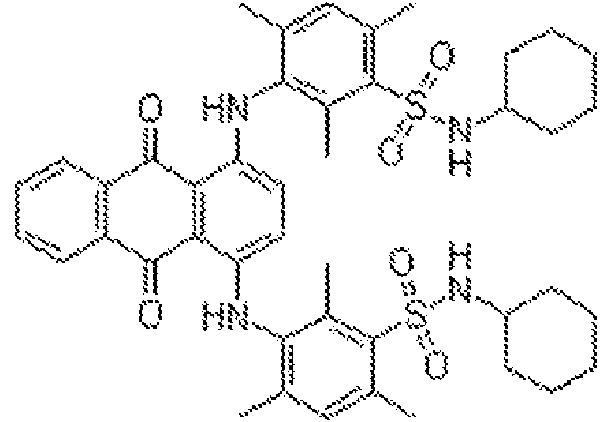
Solvente azul 97, también conocido como 1,4-bis[(2,6-dietil-4-metilfenil)amino]antraceno-9,10-diona, que tiene la siguiente estructura:Solvent Blue 97, also known as 1,4-bis [(2,6-diethyl-4-methylphenyl) amino] anthracene-9,10-dione, which has the following structure:

Solvente azul, también conocido como 1,4-bis[(4-n-butilfenil)aminoantraceno-9,10-diona, que tiene la siguiente estructura: Solvent blue, also known as 1,4-bis [(4-n-butylphenyl) aminoanthracene-9,10-dione, which has the following structure:
Solvente azul 122, también conocido como N-(4-((9,10-d¡h¡dro-4-h¡drox¡-9,10-d¡oxo-1-antril)am¡no)fen¡l)acetam¡da, que t¡ene la s¡gu¡ente estructura:Solvent blue 122, also known as N- (4 - ((9,10-d¡h¡dro-4-h¡drox¡-9,10-d¡oxo-1-anthryl) am¡no) phen ) acetamide, which has the following structure:

Solvente verde 28, tamb¡én conoc¡do como 1,4-b¡s[(4-n-but¡lfen¡l)am¡no-5,8-d¡h¡drox¡]antraceno-9,10-d¡ona, que t¡ene la s¡gu¡ente estructura:Green solvent 28, also known as 1,4-b¡s [(4-n-but¡lfen¡l) am¡no-5,8-d¡h¡drox¡] anthracene-9.10 -d¡ona, which has the following structure:

Solvente rojo 207, tamb¡én conoc¡do como 1,5-b¡s[(3-met¡lfen¡l)am¡no] antraceno-9,10-d¡ona, que t¡ene la s¡gu¡ente estructura:Solvent red 207, also known as 1,5-b¡s [(3-met¡lfen¡l) am¡no] anthracene-9,10-d¡one, which has the following Structure:

El compuesto de antraqu¡nona puede func¡onar como tóner de color. El color del polímero se puede ajustar usando uno o dos o más compuestos de antraqu¡nona. En algunas real¡zac¡ones, el polímero de pol¡(furand¡carbox¡lato de tr¡met¡leno) t¡ene un valor de color b* de menos de 10, por ejemplo menos de 3, como se determ¡na por espectrocolor¡metría. En algunas real¡zac¡ones, el valor de color L* del pol¡(furand¡carbox¡lato de tr¡met¡leno) es super¡or a 65, por ejemplo super¡or a 75.The anthraquinone compound can function as a colored toner. The color of the polymer can be adjusted using one or two or more anthraquinone compounds. In some embodiments, the poly (trimethylene furancarboxylate) polymer has a color value b * of less than 10, for example less than 3, as determined. na by spectrocolorimetry. In some embodiments, the L * color value of the poly (trimethylene furancarboxylate) is greater than 65, for example greater than 75.
El compuesto de antraqu¡nona tamb¡én puede func¡onar como un co-catal¡zador con el compuesto de z¡nc para mejorar la veloc¡dad de pol¡condensac¡ón. En una real¡zac¡ón, se descr¡be un método para aumentar la veloc¡dad de pol¡condensac¡ón en un proceso para preparar polímero de pol¡(furand¡carbox¡lato de tr¡met¡leno), comprend¡endo el método las etapas:The anthraquinone compound can also function as a co-catalyst with the znc compound to improve the rate of polycondensation. In one embodiment, a method for increasing the rate of polyocondensation in a process for preparing poly (trimethylene furancarboxylate) polymer is disclosed, comprising In the method the stages:
a) poner en contacto una mezcla a una temperatura en el ¡ntervalo de aprox¡madamente 120 °C a aprox¡madamente 220 °C para formar un prepolímero, a) contacting a mixture at a temperature in the range of about 120 ° C to about 220 ° C to form a prepolymer,
en el que la mezcla comprende dialquiléster del ácido furandicarboxílico, 1,3-propanodiol, un compuesto de zinc y un compuesto de antraquinona representado por la Estructura Awherein the mixture comprises furandicarboxylic acid dialkyl ester, 1,3-propanediol, a zinc compound, and an anthraquinone compound represented by Structure A

en el que cada R se selecciona independientemente del grupo que consiste en H, OH, alquilo C1-C6 , NHCOCH3 , SO2NHC6H11, y cada Q, Y y Z se selecciona independientemente de H, OH, NH2 y NHR', en el que R' es ciclohexilo o grupo arilo sustituido;wherein each R is independently selected from the group consisting of H, OH, C 1 -C 6 alkyl, NHCOCH 3 , SO 2 NHC 6 H 11 , and each Q, Y, and Z is independently selected from H, OH, NH 2 and NHR ', where R' is cyclohexyl or substituted aryl group;
en el que la relación molar del dialquiléster del ácido furandicarboxílico al 1,3-propanodiol está en el intervalo de 1:1,3 a 1:2,2; ywherein the molar ratio of the furandicarboxylic acid dialkyl ester to 1,3-propanediol is in the range of 1: 1.3 to 1: 2.2; Y
b) calentar el prepolímero a presión reducida hasta una temperatura en el intervalo de aproximadamente 220°C a aproximadamente 260°C para formar polímero de poli(furandicarboxilato de trimetileno).b) heating the prepolymer under reduced pressure to a temperature in the range of about 220 ° C to about 260 ° C to form poly (trimethylene furandicarboxylate) polymer.
El grupo arilo sustituido se selecciona del grupo que consiste en H, OH, alquilo C1-C6 , NHCOCH3 , y SO2NHC6H11. The substituted aryl group is selected from the group consisting of H, OH, C 1 -C 6 alkyl, NHCOCH 3 , and SO 2 NHC 6 H 11 .
Ya sea que la mezcla de la etapa a) comprenda o no un compuesto de antraquinona, en algunas realizaciones de los procesos descritos en la presente memoria, la mezcla de la etapa a) comprende además un compuesto de fósforo. La concentración de fósforo puede estar en el intervalo de aproximadamente 1 ppm a aproximadamente 50 ppm, basado en el peso total del polímero. Por ejemplo, la cantidad de fósforo puede ser 1 ppm, 2 ppm, 3, ppm, 4 ppm, 5 ppm, 6 ppm, 7 ppm, 8 ppm, 9 ppm, 10 ppm, 11 ppm, 12 ppm, 13 ppm, 14 ppm, 15 ppm, 16 ppm, 17 ppm, 18 ppm, 19 ppm, 20 ppm, 21 ppm, 22 ppm, 23 ppm, 24 ppm, 25 ppm, 26 ppm, 27 ppm, 28 ppm, 29 ppm, 30 ppm, 31 ppm, 32 ppm, 33 ppm, 34 ppm, 35 ppm, 36 ppm, 37 ppm, 38 ppm, 39 ppm, 40 ppm, 41 ppm, 42 ppm, 43 ppm, 44 ppm, 45 ppm, 46 ppm, 47 ppm, 48 ppm, 49 ppm o 50 ppm (o cualquier cantidad entre dos de estos valores). En una realización, la cantidad de fósforo puede ser de aproximadamente 1 ppm a aproximadamente 25 ppm. En otra realización, la cantidad de fósforo puede ser de aproximadamente 1 ppm a aproximadamente 10 ppm. En otra realización más, la cantidad de fósforo puede ser de aproximadamente 5 ppm a aproximadamente 20 ppm. En una realización, la mezcla de la etapa a) comprende además un compuesto de antraquinona como se describe en la presente memoria y un compuesto de fósforo. En otra realización, la mezcla de la etapa a) comprende además un compuesto de fósforo y ningún compuesto de antraquinona.Whether or not the mixture from step a) comprises an anthraquinone compound, in some embodiments of the processes described herein, the mixture from step a) further comprises a phosphorus compound. The phosphorus concentration can range from about 1 ppm to about 50 ppm, based on the total weight of the polymer. For example, the amount of phosphorus can be 1ppm, 2ppm, 3ppm, 4ppm, 5ppm, 6ppm, 7ppm, 8ppm, 9ppm, 10ppm, 11ppm, 12ppm, 13ppm, 14 ppm, 15 ppm, 16 ppm, 17 ppm, 18 ppm, 19 ppm, 20 ppm, 21 ppm, 22 ppm, 23 ppm, 24 ppm, 25 ppm, 26 ppm, 27 ppm, 28 ppm, 29 ppm, 30 ppm, 31ppm, 32ppm, 33ppm, 34ppm, 35ppm, 36ppm, 37ppm, 38ppm, 39ppm, 40ppm, 41ppm, 42ppm, 43ppm, 44ppm, 45ppm, 46ppm, 47ppm , 48 ppm, 49 ppm, or 50 ppm (or whatever amount between two of these values). In one embodiment, the amount of phosphorus can be from about 1 ppm to about 25 ppm. In another embodiment, the amount of phosphorus can be from about 1 ppm to about 10 ppm. In yet another embodiment, the amount of phosphorus can be from about 5 ppm to about 20 ppm. In one embodiment, the mixture from step a) further comprises an anthraquinone compound as described herein and a phosphorus compound. In another embodiment, the mixture of step a) further comprises a phosphorus compound and no anthraquinone compound.
Los compuestos de fósforo adecuados incluyen ácido fosfórico, ácido fosforoso, ácido polifosfórico, ésteres de fosfato tales como fosfato de trietilo, fosfato de tributilo, fosfato de trifenilo y mezclas de los mismos. En una realización, el compuesto de fósforo comprende ácido fosfórico. Los compuestos de fósforo se pueden obtener comercialmente. Suitable phosphorous compounds include phosphoric acid, phosphorous acid, polyphosphoric acid, phosphate esters such as triethyl phosphate, tributyl phosphate, triphenyl phosphate, and mixtures thereof. In one embodiment, the phosphorus compound comprises phosphoric acid. Phosphorus compounds are commercially available.
El compuesto de zinc, el compuesto de antraquinona y el compuesto de fósforo se pueden añadir en cualquier forma, por ejemplo como polvo o como lechada o solución en un disolvente tal como 1,3-propanodiol.The zinc compound, the anthraquinone compound and the phosphorous compound can be added in any form, for example as a powder or as a slurry or solution in a solvent such as 1,3-propanediol.
En una realización adicional, el proceso comprende además la etapa c) cristalizar el polímero de poli(furandicarboxilato de trimetileno) obtenido en la etapa b) a una temperatura en el intervalo de aproximadamente 110 °C a aproximadamente 130 °C para obtener polímero de poli(furandicarboxilato de trimetileno) cristalizado.. Los tiempos de cristalización típicos pueden estar en el intervalo de aproximadamente una hora a varias horas.In a further embodiment, the process further comprises step c) crystallizing the poly (trimethylene furandicarboxylate) polymer obtained in step b) at a temperature in the range of about 110 ° C to about 130 ° C to obtain polypropylene polymer. Crystallized (trimethylene furandicarboxylate). Typical crystallization times can range from about one hour to several hours.
En otra realización más, el proceso comprende además la etapa d) polimerizar el polímero de poli(furandicarboxilato de trimetileno) cristalizado en estado sólido a una temperatura por debajo del punto de fusión del polímero. Esta etapa se puede realizar para obtener un polímero de mayor peso molecular. Típicamente, en la etapa de polimerización en estado sólido, los granulados, gránulos, astillas o escamas del poli(furandicarboxilato de trimetileno) cristalizado se someten durante una cierta cantidad de tiempo a temperaturas elevadas entre 160 °C y por debajo de la temperatura de fusión del polímero en una tolva, un secador de tambor o un reactor de tubo vertical.In yet another embodiment, the process further comprises step d) polymerizing the solid state crystallized poly (trimethylene furandicarboxylate) polymer at a temperature below the melting point of the polymer. This stage it can be done to obtain a polymer with a higher molecular weight. Typically, in the solid state polymerization step, the granules, granules, chips or flakes of the crystallized poly (trimethylene furandicarboxylate) are subjected for a certain amount of time to elevated temperatures between 160 ° C and below the melting temperature. of the polymer in a hopper, drum dryer or riser tube reactor.
La mezcla de la etapa a) puede incluir opcionalmente un poli(alquilenéter)diol. El peso molecular promedio en número del poli(alquilenéter)diol puede estar en el intervalo de aproximadamente 250 a aproximadamente 3000 g/mol. En una realización, el poli(alquilenéter)diol (también conocido como un poli(alquilenéter)glicol o PAEG) está presente en la mezcla de la etapa a), y el polímero obtenido es un copolímero (también conocido como copoliéster). El copolímero comprende unidades de monómero de (furandicarboxilato de trimetileno) y poliéter poliol. Un ejemplo de un poli(alquilenéter)diol adecuado es el poli(tetrametilenglicol) (PTMEG).The mixture from step a) can optionally include a poly (alkylene ether) diol. The number average molecular weight of the poly (alkylene ether) diol can range from about 250 to about 3000 g / mol. In one embodiment, the poly (alkylene ether) diol (also known as a poly (alkylene ether) glycol or PAEG) is present in the mixture of step a), and the obtained polymer is a copolymer (also known as a copolyester). The copolymer comprises monomer units of (trimethylene furandicarboxylate) and polyether polyol. An example of a suitable poly (alkylene ether) diol is poly (tetramethylene glycol) (PTMEG).
Se puede preparar un copoliéster mediante un proceso de dos etapas, en el que primero se prepara un prepolímero a partir de PDO, PAEG y el dialquiléster del ácido furandicarboxílico, lo que da como resultado un oligómero con un resto de 2,5-furandicarboxilato dentro del esqueleto. Este producto intermedio es preferiblemente un éster compuesto por dos monómeros de diol (PDO y PAEG) y un monómero de dialquiléster de ácido furandicarboxílico. La polimerización en estado fundido de los prepolímeros en las condiciones de policondensación descritas en la presente memoria proporciona el copolímero. En el caso de que se utilice PTMEG como polialquileneterdiol, el copolímero resultante comprende un segmento blando de furano-PTMEG y un segmento duro de PTF.A copolyester can be prepared by a two-step process, in which a prepolymer is first prepared from PDO, PAEG, and the furandicarboxylic acid dialkyl ester, resulting in an oligomer with a 2,5-furandicarboxylate residue within of the skeleton. This intermediate product is preferably an ester composed of two diol monomers (PDO and PAEG) and a furandicarboxylic acid dialkyl ester monomer. Melt polymerization of the prepolymers under the polycondensation conditions described herein provides the copolymer. In the case where PTMEG is used as polyalkylene ether diol, the resulting copolymer comprises a soft segment of furan-PTMEG and a hard segment of PTF.
Alternativamente, se puede usar un poliésterdiol que tiene un peso molecular promedio en número en el intervalo de aproximadamente 250 a aproximadamente 3000 g/mol en lugar de PAEG, y el copolímero resultante comprende un segmento blando de furano-poliésterdiol y un segmento duro de PTF. El poliésterdiol es un producto de reacción de un ácido dicarboxílico y un diol. El poliésterdiol preferido se elabora utilizando diácido y diol de origen renovable, como ácido succínico, ácido furandicarboxílico o ácido sebácico, y el diol es etilenglicol, 1,3-propanodiol, 1,4-butanodiol o isosorbida.Alternatively, a polyesterdiol having a number average molecular weight in the range of about 250 to about 3000 g / mol can be used in place of PAEG, and the resulting copolymer comprises a soft segment of furan-polyesterdiol and a hard segment of PTF. . Polyesterdiol is a reaction product of a dicarboxylic acid and a diol. The preferred polyesterdiol is made using diacid and diol from renewable sources, such as succinic acid, furandicarboxylic acid, or sebacic acid, and the diol is ethylene glycol, 1,3-propanediol, 1,4-butanediol, or isosorbide.
El polímero y los copolímeros obtenidos mediante los procesos descritos en la presente memoria se pueden formar en películas o láminas directamente a partir de la masa fundida de polimerización. Como alternativa, las composiciones se pueden formar en una forma de fácil manejo (como granulados) a partir de la masa fundida, que luego se puede usar para formar una película o una lámina. Las láminas se pueden utilizar, por ejemplo, para la formación de letreros, acristalamientos (como en marquesinas de paradas de autobús, tragaluces o vehículos recreativos), pantallas, luces de automóviles y en artículos de termoformado.The polymer and copolymers obtained by the processes described herein can be formed into films or sheets directly from the polymerization melt. Alternatively, the compositions can be formed into a user-friendly form (as granules) from the melt, which can then be used to form a film or sheet. The sheets can be used, for example, for the formation of signs, glazing (as in bus stop canopies, skylights or RVs), displays, car lights and in thermoforming articles.
Alternativamente, los artículos que comprenden las composiciones descritas en la presente memoria son artículos moldeados, que pueden prepararse mediante cualquier proceso de moldeo convencional, tal como moldeo por compresión, moldeo por inyección, moldeo por extrusión, moldeo por soplado, moldeo por inyección-soplado, moldeo por inyección-estirado-soplado, moldeo por extrusión-soplado y similares. Los artículos también pueden formarse mediante combinaciones de dos o más de estos procesos, como por ejemplo cuando un núcleo formado por moldeo por compresión se sobremoldea mediante moldeo por inyección.Alternatively, the articles comprising the compositions described herein are molded articles, which can be prepared by any conventional molding process, such as compression molding, injection molding, extrusion molding, blow molding, injection-blow molding. , injection-stretch-blow molding, extrusion-blow molding and the like. Articles can also be formed by combinations of two or more of these processes, such as when a core formed by compression molding is overmolded by injection molding.
En particular, el polímero y los copolímeros son adecuados para fabricar:In particular, polymer and copolymers are suitable for making:
° Fibras para aplicaciones de ropa o pisosFibers for clothing or flooring applications
° películas mono y bi-orientadas y películas multicapa con otros polímeros;° mono and bi-oriented films and multilayer films with other polymers;
° películas adhesivas o retráctiles para su uso con productos alimenticios;° adhesive or shrink films for use with food products;
° Envases o recipientes de productos alimenticios termoformados, tanto monocapa como multicapa, como en recipientes para leche, yogur, carnes, bebidas y similares;° Containers or containers for thermoformed food products, both monolayer and multilayer, as well as containers for milk, yogurt, meats, beverages and the like;
° recubrimientos obtenidos usando el método de recubrimiento por extrusión o recubrimiento en polvo sobre sustratos que comprenden metales no limitados a tales como acero inoxidable, acero al carbono, aluminio, tales recubrimientos pueden incluir aglutinantes, agentes para controlar el flujo como sílice, alúmina° coatings obtained using extrusion coating or powder coating method on substrates comprising metals not limited to such as stainless steel, carbon steel, aluminum, such coatings may include binders, flow control agents such as silica, alumina
° laminados multicapa con soportes rígidos o flexibles como, por ejemplo, papel, plástico, aluminio o películas metálicas;° multilayer laminates with rigid or flexible supports such as paper, plastic, aluminum or metal films;
° perlas espumadas o espumables para la producción de piezas obtenidas por sinterización;° foamed or foamable beads for the production of parts obtained by sintering;
° productos espumados y semi-espumados, incluidos los bloques espumados formados con artículos pre-expandidos; y° foamed and semi-foamed products, including foamed blocks formed from pre-expanded articles; Y
° láminas de espuma, láminas de espuma termoformada y recipientes obtenidos de ellas para su uso en el envasado de productos alimenticios. ° foam sheets, thermoformed foam sheets and containers obtained from them for use in the packaging of food products.
EjemplosExamples
A menos que se indique específicamente lo contrario, todos los ingredientes están disponibles en Sigma-Aldrich Chemical Company, St. Louis, Missouri. A menos que se indique lo contrario, todos los materiales se utilizaron tal como se recibieron.Unless specifically stated otherwise, all ingredients are available from Sigma-Aldrich Chemical Company, St. Louis, Missouri. Unless otherwise stated, all materials were used as received.
El dimetiléster 2,5-furandicarboxílico (FDME) se obtuvo de Sarchem Laboratories Inc, Farmingdale, NJ.2,5-furandicarboxylic dimethyl ester (FDME) was obtained from Sarchem Laboratories Inc, Farmingdale, NJ.
El 1,3-propanodiol (BioPDO™) se obtuvo de DuPont Tate & Lyle LLC. La abreviatura "PDO" se utiliza en todos los ejemplos para este ingrediente.1,3-propanediol (BioPDO ™) was obtained from DuPont Tate & Lyle LLC. The abbreviation "PDO" is used in all examples for this ingredient.
El diacetato de zinc (anhidro), el dihidrato de diacetato de zinc, el ácido fosfórico (solución al 85%), el acetato de cobalto, el 1,4-butanodiol y el titanato de tetra-n-butilo (TBT) se obtuvieron de Sigma-Aldrich.Zinc diacetate (anhydrous), zinc diacetate dihydrate, phosphoric acid (85% solution), cobalt acetate, 1,4-butanediol and tetra-n-butyl titanate (TBT) were obtained by Sigma-Aldrich.
1,4-bis[(2,4,6-trimetilfenil)amino]antraceno-9,10-diona (disponible comercialmente como tóner de Optica™ global PRT blue-2 en dispersión) y los compuestos 3H-nafto[1,2,3-de]quinolina-2,7-diona, 3-metil-6-[(4-metilfenil)amino] (disponible comercialmente como dispersión de tóner de Optica™ global PRT red-2)) se obtuvieron de ColorMatrix, Berea, OH.1,4-bis [(2,4,6-trimethylphenyl) amino] anthracene-9,10-dione (commercially available as Optica ™ global PRT blue-2 dispersion toner) and the compounds 3H-naphtho [1,2 , 3-de] quinoline-2,7-dione, 3-methyl-6 - [(4-methylphenyl) amino] (commercially available as Optica ™ global PRT red-2 toner dispersion)) were obtained from ColorMatrix, Berea , OH.
Como se usa en la presente memoria, "Ej. Comp." significa ejemplo comparativo; "Ej." significa ejemplo, "ppm" significa partes por millón, "g" significa gramo(s); "kg" significa kilogramo(s); "mL" significa mililitro(s); "min" significa minuto(s); "h" significa hora(s); "mol" significa mol(es); "rpm" significa revoluciones por minuto.As used herein, "Comp. Ex." means comparative example; "Ex." means example, "ppm" means parts per million, "g" means gram (s); "kg" means kilogram (s); "mL" means milliliter (s); "min" means minute (s); "h" means hour (s); "mole" means mole (s); "rpm" means revolutions per minute.
Métodos de pruebaTest methods
Medida de colorColor measurement
Se utilizó un espectrocolorímetro Hunterlab COLORQUEST™ (Reston, Virginia) para medir el color. El color se mide en términos de la escala de color tri-estímulo, el CIE L*a*b*: el valor de color (L*) corresponde a la claridad u oscuridad de una muestra, el valor de color (a*) en una escala rojo-verde y el valor del color (b*) en una escala amarillo-azul. Los valores de color presentados son en general para los polímeros que se cristalizaron a 110 °C durante la noche en un horno al vacío. También se presentan los valores calculados del índice de amarillez (YI) de este instrumento.A Hunterlab COLORQUEST ™ spectrocolorimeter (Reston, Virginia) was used to measure color. Color is measured in terms of the tri-stimulus color scale, the CIE L * a * b *: the color value (L *) corresponds to the lightness or darkness of a sample, the color value (a *) on a red-green scale and the color value (b *) on a yellow-blue scale. The color values presented are in general for the polymers that were crystallized at 110 ° C overnight in a vacuum oven. The calculated values of the yellowness index (YI) of this instrument are also presented.
Cristalización isotérmicaIsothermal crystallization
Aproximadamente 2 a 3 mg de muestras de PTF se calentaron desde temperatura ambiente a 230 °C a una velocidad de calentamiento de 30 °C/min, se mantuvieron durante 3 minutos y luego se enfriaron a 30 °C/min a 0 °C para obtener PTF amorfo (templado en el instrumento DSC). Después las muestras templadas se calentaron rápidamente hasta una temperatura de cristalización de 110 °C a 120 °C y se mantuvieron allí durante 2-4 horas. Después se aplicó un solo experimento de calor a la muestra cristalizada para examinar la cristalinidad.Approximately 2 to 3 mg of PTF samples were heated from room temperature to 230 ° C at a heating rate of 30 ° C / min, held for 3 minutes, and then cooled to 30 ° C / min at 0 ° C to Obtain amorphous PTF (tempered on DSC instrument). The tempered samples were then rapidly heated to a crystallization temperature of 110 ° C to 120 ° C and held there for 2-4 hours. A single heat experiment was then applied to the crystallized sample to examine the crystallinity.
Peso molecular mediante cromatografía de exclusión por tamañoMolecular weight by size exclusion chromatography
Se proporcionó un sistema de cromatografía de exclusión por tamaño (SEC), Alliance 2695™ (Waters Corporation, Milford, MA), con un detector de índice de refracción diferencial Waters 2414™, un fotómetro de dispersión de luz de múltiples ángulos DAWN Heleos (Wyatt Technologies, Santa Barbara, CA) y un detector de viscosímetro capilar diferencial VISCOSTAR II™ (Wyatt). El software para la adquisición y reducción de datos fue ASTRA® versión 6.1 de Wyatt. Las columnas utilizadas fueron dos columnas de estireno-divinilbenceno Shodex GPC HFIP-806M™ con un límite de exclusión de 2 x 10⁷ y platos teóricos de 8.000/30 cm; y una columna Shodex GPC HFIP-804M™ de estirenodivinilbenceno con un límite de exclusión de 2 x 10⁵ y platos teóricos de 10.000/30 cm.A size exclusion chromatography (SEC) system, Alliance 2695 ™ (Waters Corporation, Milford, MA), with a Waters 2414 ™ differential refractive index detector, a DAWN Heleos multi-angle light scattering photometer ( Wyatt Technologies, Santa Barbara, CA) and a VISCOSTAR II ™ differential capillary viscometer detector (Wyatt). The software for data acquisition and reduction was ASTRA® version 6.1 from Wyatt. The columns used were two Shodex GPC HFIP-806M ™ styrene-divinylbenzene columns with an exclusion limit of 2 x 10 7 and theoretical plates of 8,000 / 30 cm; and a Shodex GPC HFIP-804M ™ column of styrenedivinylbenzene with an exclusion limit of 2 x 10 5 and theoretical plates of 10,000 / 30 cm.
La muestra se disolvió en 1,1,1,3,3,3-hexafluoro-2-propanol (HFIP) que contenía trifluoroacetato de sodio 0,01 M mezclando a temperatura ambiente con agitación moderada durante cuatro horas seguido de filtración a través de un filtro de PTFE de 0,45 pm. La concentración de la solución fue de alrededor de 2 mg/ml.The sample was dissolved in 1,1,1,3,3,3-hexafluoro-2-propanol (HFIP) containing 0.01 M sodium trifluoroacetate with mixing at room temperature with moderate stirring for four hours followed by filtration through a 0.45 pm PTFE filter. The concentration of the solution was around 2 mg / ml.
Los datos se tomaron con el cromatógrafo ajustado a 35 °C, con un caudal de 0,5 mL/min. El volumen de inyección fue de 100 pl. El tiempo de ejecución fue de 80 min. La reducción de datos se realizó incorporando datos de los tres detectores descritos anteriormente. Se emplearon ocho ángulos de dispersión con el detector de dispersión de luz. No se incluyeron estándares para la calibración de la columna en el procesamiento de datos. Se presenta el peso molecular promedio en peso (Mw) de los polímeros.The data were taken with the chromatograph set at 35 ° C, with a flow rate of 0.5 mL / min. The injection volume was 100 µl. The execution time was 80 min. Data reduction was performed by incorporating data from the three detectors described above. Eight scattering angles were used with the light scattering detector. Standards for column calibration were not included in the data processing. The weight average molecular weight (M w ) of the polymers is presented.
Peso molecular por viscosidad intrínsecaMolecular weight by intrinsic viscosity
La viscosidad intrínseca (IV) se determinó utilizando el método de IV equivalente de Goodyear R-103B, utilizando PET T-3, DUPONT™ SELAR® PT-X250, DUPONT™ SORONA® 2864 como estándares de calibración en un viscosímetro de flujo forzado VISCOTEK® modelo Y-501C. Se usó una mezcla 60/40 de fenol/1,1,2,2-tetracloroetano como disolvente para el polímero. Las muestras se prepararon añadiendo 0,15 g de resina en 30 ml de mezcla de disolventes y se agitó, la mezcla se calentó a 100°C durante 30 minutos, se enfrió a temperatura ambiente durante otros 30 minutos y se midió la viscosidad intrínseca de la solución. Intrinsic Viscosity (IV) was determined using the Goodyear R-103B Equivalent IV method, using PET T-3, DUPONT ™ SELAR® PT-X250, DUPONT ™ SORONA® 2864 as calibration standards on a VISCOTEK Forced Flow Viscometer ® model Y-501C. A 60/40 mixture of phenol / 1,1,2,2-tetrachloroethane was used as the solvent for the polymer. The samples were prepared by adding 0.15 g of resin to 30 ml of solvent mixture and stirring, the mixture was heated to 100 ° C for 30 minutes, cooled to room temperature for another 30 minutes and the intrinsic viscosity of the solution.
Índice de fluidez (MFI) o tasa de fluidez (MFR)Flow rate (MFI) or flow rate (MFR)
El índice de fluidez (MFI) es una medida de cuántos gramos de polímero fluyen a través de una matriz en diez minutos. Las tasas de fluidez para las resinas poliméricas de PTF secas se midieron usando un aparato de flujo (Plastómetro de extrusión, Tinium Olsen, Willow Grove, PA) a 210°C con una carga de 2160 g según la norma ASTM D1238. Se estableció una correlación entre MFR y IV para resinas poliméricas de PTF de pesos moleculares variados.Melt Index (MFI) is a measure of how many grams of polymer flow through a die in ten minutes. The flow rates for the dried PTF polymer resins were measured using a flow apparatus (Extrusion Plastometer, Tinium Olsen, Willow Grove, PA) at 210 ° C with a 2160 g load according to ASTM D1238. A correlation between MFR and IV was established for PTF polymeric resins of varying molecular weights.
Peso molecular promedio en número (Mn) y cuantificación del grupo terminal por 1H RMN (protón)Number average molecular weight (M n ) and quantification of the terminal group by 1H NMR (proton)
Los espectros de 1H RMN se recogieron utilizando una RMN de 700 MHz en muestras de aproximadamente 55 mg en 0,7 ml de 1,1,2,2-tetracloroetano-d2 (tce-d2) a 110 °C utilizando un tiempo de adquisición de 4,68 segundos, un pulso de 90 grados, y un retardo de reciclado de 30 segundos, y con 16 transitorios promediados.1H NMR spectra were collected using 700 MHz NMR in samples of approximately 55 mg in 0.7 ml of 1,1,2,2-tetrachloroethane-d2 (tce-d2) at 110 ° C using an acquisition time of 4.68 seconds, a pulse of 90 degrees, and a recycle delay of 30 seconds, and with 16 transients averaged.
Métodos de cálculo de 1H RMN1H NMR calculation methods
Las muestras se integraron y el porcentaje en moles se calculó como es estándar en la técnica. Las asignaciones de picos para el polímero de pTf se muestran a continuación en la Tabla 1.The samples were integrated and the mole percent calculated as is standard in the art. The peak assignments for the pTf polymer are shown below in Table 1.
Tabla 1Table 1

Método para determinar la cantidad total de ésteres diméricos cíclicos en poli(trimetilen-2,5-furandicarboxilato) mediante 1H RMNMethod for determining the total amount of cyclic dimeric esters in poly (trimethylene-2,5-furandicarboxylate) by 1H NMR
Como se muestra en la Tabla 1, los hidrógenos del anillo furano del dímero cíclico (56,89) y los hidrógenos del anillo furano del polímero PTF (57,2) tienen diferentes desplazamientos químicos. El porcentaje en peso de dímero cíclico se calculó usando las siguientes ecuaciones:As shown in Table 1, the furan ring hydrogens of the cyclic dimer (56.89) and the furan ring hydrogens of the PTF polymer (57.2) have different chemical shifts. The weight percent cyclic dimer was calculated using the following equations:
Peso molecular de dimero cíclicoCyclic dimer molecular weight
_ n i de hidrógenos de anillo furano de dímero cíclico * 392 _ nor from cyclic dimer furan ring hydrogens * 392
suma de n i de los extremos de polímerosum of n i of the polymer ends
% en peso de dimero cíclicowt% cyclic dimer
Peso molecular de dimero cíclico * 100 Cyclic dimer molecular weight * 100
suma de pesos moleculares del polímero y el dímero cíclicosum of molecular weights of polymer and cyclic dimer
ni = Valor integral normalizado ni = normalized integral value
Ejemplo 1Example 1
Prepolímero de 2,5-furandicarboxilato de politrimetileno (PTF) preparado usando catalizador de zincPolytrimethylene 2,5-furandicarboxylate (PTF) Prepolymer Prepared Using Zinc Catalyst
Las siguientes cantidades de los ingredientes se cargaron en un reactor de vidrio de tres cuellos de 3 L equipado con una entrada de nitrógeno, un condensador y un agitador mecánico: dimetiléster de 2,5-furandicarboxilato (FDME) (1,41 kg, 7,64 moles) y 1,3-propanodiol (0,873 kg, 11,47 moles). La relación molar de PDO a FDME fue de 1,5. El matraz se colocó en un baño de metal que se precalentó a una temperatura establecida de 160 °C. La mezcla de reacción se agitó usando un impulsor Ekato Paravisc a 100 rpm durante 10 minutos para obtener una solución homogénea en atmósfera de nitrógeno. Se añadió diacetato de zinc anhidro (0,779 g; 185 ppm de zinc basado en el peso del polímero) a la mezcla a esta temperatura establecida. La temperatura del baño de metal se fijó en 170 °C para iniciar la reacción de transesterificación y la primera gota del destilado condensado recogido se anotó como el inicio de la reacción (tiempo cero). La reacción se continuó a esta temperatura durante 30 min, la temperatura se elevó a 190°C y la reacción se continuó durante otros 30 min. En ese momento, se recogió la mayor parte del destilado (~545 ml) y la velocidad del destilado se redujo en este punto, lo que indica que la reacción está casi completa. El tiempo de transesterificación se anotó desde el momento en que se observó la primera gota de destilado de metanol hasta el punto en el que se recogió la cantidad teórica de destilado de metanol. Se inició una rampa de vacío mientras se detenía la purga de nitrógeno. La presión se redujo gradualmente desde la presión atmosférica hasta una baja presión final de ~0,2 mm de Hg a 0,4 mm de Hg absolutos durante un período de 1 a 1,5 horas y durante este tiempo la mayor parte del exceso de 1,3-propanodiol se recogió en una trampa. En esta etapa, la presión en el matraz se devolvió a la presión atmosférica bajo un flujo de nitrógeno y se eliminó el flash del baño de metal. El matraz se enfrió a temperatura ambiente y se recuperó el prepolímero del matraz.The following amounts of the ingredients were charged into a 3 L three neck glass reactor equipped with a nitrogen inlet, a condenser and a mechanical stirrer: 2,5-furandicarboxylate dimethyl ester (FDME) (1.41 kg, 7 , 64 moles) and 1,3-propanediol (0.873 kg, 11.47 moles). The molar ratio of PDO to FDME was 1.5. The flask was placed in a metal bath that was preheated to a set temperature of 160 ° C. The reaction mixture was stirred using an Ekato Paravisc impeller at 100 rpm for 10 minutes to obtain a homogeneous solution under nitrogen atmosphere. Anhydrous zinc diacetate (0.779 g; 185 ppm zinc based on polymer weight) was added to the mixture at this set temperature. The temperature of the metal bath was set at 170 ° C to start the transesterification reaction and the first drop of the collected condensed distillate was noted as the start of the reaction (time zero). The reaction was continued at this temperature for 30 min, the temperature was raised to 190 ° C, and the reaction was continued for another 30 min. At that time, most of the distillate was collected (~ 545 ml) and the distillate rate was reduced at this point, indicating that the reaction is almost complete. The transesterification time was noted from the time the first drop of methanol distillate was observed to the point where the theoretical amount of methanol distillate was collected. A vacuum ramp was started while the nitrogen purge was stopped. The pressure was gradually reduced from atmospheric pressure to a final low pressure of ~ 0.2 mm Hg to 0.4 mm Hg absolute over a period of 1 to 1.5 hours and during this time most of the excess was 1,3-propanediol was collected in a trap. At this stage, the pressure in the flask was returned to atmospheric pressure under a flow of nitrogen and the metal bath was removed from the flash. The flask was cooled to room temperature and the prepolymer was recovered from the flask.
El prepolímero recuperado se analizó mediante RMN de protón y las propiedades del prepolímero se enumeran en la Tabla 2.The recovered prepolymer was analyzed by proton NMR and the properties of the prepolymer are listed in Table 2.
Ejemplo comparativo AComparative Example A
Prepolímero de 2,5-furandicarboxilato de politrimetileno (PTF) preparado usando catalizador de titanioPolytrimethylene 2,5-furandicarboxylate (PTF) Prepolymer Prepared Using Titanium Catalyst
El prepolímero de PTF se preparó como se describe en el Ejemplo 1 pero usando TBT como un catalizador y las condiciones del proceso como se presentan en la Tabla 2.The PTF prepolymer was prepared as described in Example 1 but using TBT as a catalyst and process conditions as presented in Table 2.
Tabla 2Table 2
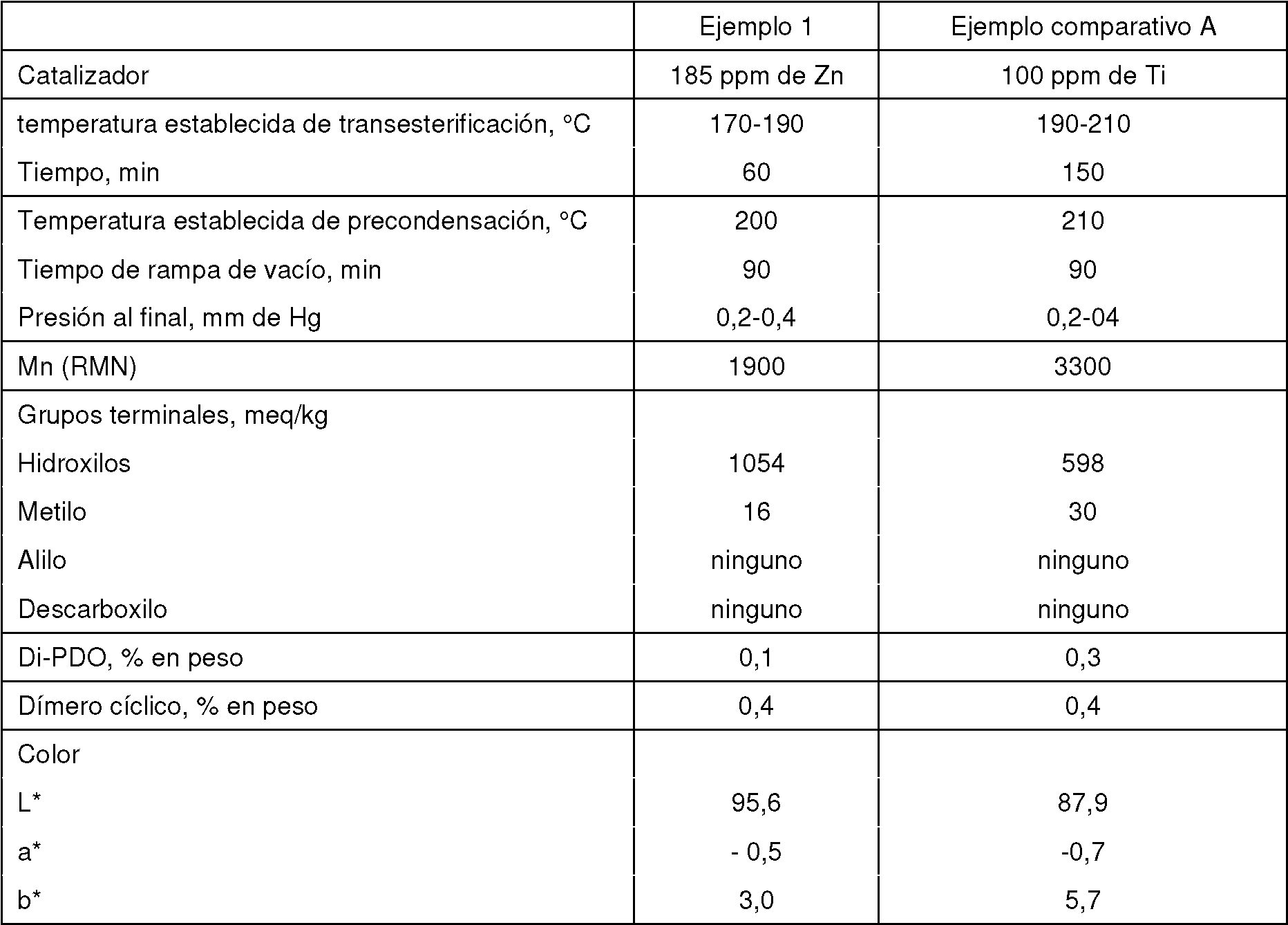
Las propiedades del prepolímero de PTF del ejemplo 1 indican que el catalizador de zinc es un catalizador de transesterificación muy eficaz con respecto al catalizador de titanio usado para preparar el prepolímero de PTF del ejemplo comparativo A. La reacción fue más rápida a una temperatura más suave. La cantidad de grupos terminales de metiléster en el prepolímero del ejemplo 1 fue menor que en el ejemplo comparativo A y probablemente podría reducirse más optimizando la relación molar, la cantidad de catalizador y la temperatura y el tiempo de transesterificación. El color del prepolímero, indicado por CIE L* y b*, fue significativamente mejor que el del prepolímero elaborado usando el catalizador de titanio.The properties of the PTF prepolymer of Example 1 indicate that the zinc catalyst is a very efficient transesterification catalyst over the titanium catalyst used to prepare the PTF prepolymer of Comparative Example A. The reaction was faster at a milder temperature . The amount of methyl ester end groups in the prepolymer of Example 1 was less than in Comparative Example A and could probably be further reduced by optimizing the molar ratio, the amount of catalyst and the transesterification temperature and time. The color of the prepolymer, indicated by CIE L * and b *, was significantly better than that of the prepolymer made using the titanium catalyst.
Ejemplo 2Example 2
Polímero de 2,5-furandicarboxilato de politrimetileno (PTF)Polytrimethylene 2,5-furandicarboxylate (PTF) polymer
Se cargaron las siguientes cantidades de los ingredientes en un reactor de vidrio de tres cuellos de 3 L: dimetiléster de 2,5-furandicarboxilato (FDME) (1,41 kg, 7,64 moles) y 1,3-propanodiol (0,873 kg, 11,47 moles). La relación molar de PDO a FDME fue de 1,5. El matraz se colocó en un baño de metal que se precalentó a una temperatura establecida de 160 °C. La mezcla de reacción se agitó usando un impulsor Ekato Paravisc a 100 rpm durante 10 minutos para obtener una solución homogénea en una atmósfera de nitrógeno. Se añadió dihidrato de diacetato de zinc (0,61 g; 130 ppm de zinc basado en el peso del polímero) a la mezcla a esta temperatura establecida. La temperatura del baño de metal se fijó en 170 °C para iniciar la reacción de transesterificación y se anotó la primera gota del destilado condensado recogido como el inicio de la reacción (tiempo cero). La reacción continuó a esta temperatura durante 30 minutos y luego la temperatura se elevó gradualmente a 190°C y la reacción continuó otros 35 minutos. En ese momento, se recogió la mayor parte del destilado (~545 ml) y la velocidad del destilado se redujo en este punto, lo que indica que la reacción está casi completa.The following amounts of the ingredients were charged into a 3 L three-neck glass reactor: 2,5-furanedicarboxylate dimethyl ester (FDME) (1.41 kg, 7.64 mol) and 1,3-propanediol (0.873 kg , 11.47 moles). The molar ratio of PDO to FDME was 1.5. The flask was placed in a metal bath that was preheated to a set temperature of 160 ° C. The reaction mixture was stirred using an Ekato Paravisc impeller at 100 rpm for 10 minutes to obtain a homogeneous solution under a nitrogen atmosphere. Zinc diacetate dihydrate (0.61 g; 130 ppm zinc based on polymer weight) was added to the mixture at this set temperature. The metal bath temperature was set at 170 ° C to start the transesterification reaction and the first drop of the collected condensed distillate was noted as the start of the reaction (time zero). The reaction continued at this temperature for 30 minutes and then the temperature gradually rose to 190 ° C and the reaction continued for another 35 minutes. At that time, most of the distillate (~ 545 ml) was collected and the distillate rate was reduced at this point, indicating that the reaction is almost complete.
Se inició una rampa de vacío mientras se detenía la purga de nitrógeno. La presión se redujo gradualmente desde la presión atmosférica hasta una baja presión final de 0,2 mm de Hg a 0,4 mm de Hg absolutos durante un período de 1 a 1,5 horas y durante este tiempo la mayor parte del 1,3-propanodiol en exceso se recogió en una trampa. La temperatura del baño de metal se elevó a 240 °C y la reacción de policondensación continuó en estas condiciones durante 2-4 horas. Durante este tiempo, se monitorizó el aumento del par motor a medida que se acumulaba el peso molecular del polímero, y la velocidad de mezcla se redujo gradualmente. Siempre que el valor de par en milivoltios (mV) alcanzó 60 mV, la velocidad de agitación se redujo de 100 a 80, luego a 60, luego a 40, luego a 20 rpm. Cuando no se observó un aumento rápido en el valor de par a 20 rpm, la reacción se terminó aumentando la presión a presión atmosférica bajo un flujo de nitrógeno y eliminando el flash del baño de metal. El matraz se enfrió a temperatura ambiente y se recuperó el polímero sólido del matraz.A vacuum ramp was started while the nitrogen purge was stopped. The pressure was gradually reduced from atmospheric pressure to a final low pressure of 0.2 mm Hg to 0.4 mm Hg absolute over a period of 1 to 1.5 hours and during this time most of 1.3 -Excess propanediol was collected in a trap. The temperature of the metal bath was raised to 240 ° C and the polycondensation reaction continued under these conditions for 2-4 hours. During this time, the increase in torque was monitored as the molecular weight of the polymer was built up, and the mixing speed was gradually reduced. Whenever the millivolt (mV) torque value reached 60 mV, the stirring speed was reduced from 100 to 80, then 60, then 40, then 20 rpm. When no rapid increase in torque value was observed at 20 rpm, the reaction was terminated by increasing the pressure to atmospheric pressure under a nitrogen flow and removing the flash from the metal bath. The flask was cooled to room temperature and the solid polymer was recovered from the flask.
El polímero recuperado se secó y se cristalizó a 110-120 °C durante la noche en un horno de vacío. Las propiedades del polímero final se presentan en la Tabla 3.The recovered polymer was dried and crystallized at 110-120 ° C overnight in a vacuum oven. The properties of the final polymer are presented in Table 3.
Ejemplo 3Example 3
El polímero se preparó como se describe en el ejemplo 2 usando acetato de zinc (anhidro) y catalizadores de acetato de cobalto. Las condiciones del proceso y las propiedades del polímero se presentan en la Tabla 3.The polymer was prepared as described in Example 2 using zinc acetate (anhydrous) and cobalt acetate catalysts. Process conditions and polymer properties are presented in Table 3.
Ejemplo 4Example 4
El polímero se preparó como se describe en el ejemplo 2, excepto que la reacción de policondensación se llevó a cabo en presencia de acetato de zinc anhidro y tóneres de color 1,4-bis[(2,4,6-trimetilfenil)amino]antraceno-9,10-diona ( " P R t blue-2") y 3H-nafto[1,2,3-de]quinolina-2,7-diona, 3-metil-6-[(4-metilfenil)amino] ("PRT red-2") que se añadieron después de la etapa de transesterificación. Las condiciones del proceso y las propiedades del polímero se presentan en la Tabla 3.The polymer was prepared as described in Example 2, except that the polycondensation reaction was carried out in the presence of anhydrous zinc acetate and 1,4-bis [(2,4,6-trimethylphenyl) amino] color toners. anthracene-9,10-dione ("PR t blue-2") and 3H-naphtho [1,2,3-de] quinoline-2,7-dione, 3-methyl-6 - [(4-methylphenyl) amino ] ("PRT red-2") that were added after the transesterification step. Process conditions and polymer properties are presented in Table 3.
Ejemplo 5Example 5
El polímero se preparó como se describe en el ejemplo 2 excepto que la reacción de policondensación se llevó a cabo en presencia de acetato de zinc anhidro y ácido fosfórico. El ácido fosfórico se añadió después de la etapa de transesterificación. Las condiciones del proceso y las propiedades del polímero se presentan en la Tabla 3.The polymer was prepared as described in Example 2 except that the polycondensation reaction was carried out in the presence of anhydrous zinc acetate and phosphoric acid. Phosphoric acid was added after the transesterification step. Process conditions and polymer properties are presented in Table 3.
Ejemplo 6Example 6
El polímero se preparó como se describe en el ejemplo 2 excepto que la reacción de policondensación se llevó a cabo en presencia de dihidrato de acetato de zinc, los compuestos de antraquinona azul y rojo y ácido fosfórico. Los compuestos de antraquinona y fósforo se añadieron después de la etapa de transesterificación. Las condiciones del proceso y las propiedades del polímero se presentan en la Tabla 3.The polymer was prepared as described in Example 2 except that the polycondensation reaction was carried out in the presence of zinc acetate dihydrate, the blue and red anthraquinone compounds, and phosphoric acid. The anthraquinone and phosphorus compounds were added after the transesterification step. Process conditions and polymer properties are presented in Table 3.
Ejemplo comparativo BComparative Example B
El polímero de PTF se preparó como se describe en el ejemplo 2 usando catalizador de titanato de tetrabutilo, y las condiciones del proceso y las propiedades del polímero se presentan en la Tabla 3. The PTF polymer was prepared as described in Example 2 using tetrabutyl titanate catalyst, and the process conditions and polymer properties are presented in Table 3.
Tabla 3Table 3

Los datos en la Tabla 3 indican claramente que el catalizador de zinc por sí mismo es un catalizador de polimerización muy eficaz para polímero de PTF (Ejemplo 2) sin tener ningún otro catalizador de polimerización. Cuando se compara con el catalizador de titanio (Ej. Comp. B), que es el catalizador de polimerización más eficaz conocido para el poliéster, se encuentra que el catalizador de zinc para el polímero de PTF es incluso más eficaz que el titanio. A pesar de la temperatura de transesterificación más baja, y el tiempo de transesterificación y policondensación, el peso molecular del polímero es mayor (16610 frente a 15080), lo que indica una actividad superior del catalizador de zinc en comparación con el titanio. Además, el polímero de PTF cristalizado obtenido mediante el uso de un catalizador de zinc tiene mejor color que un polímero a base de catalizador de titanio, ya que la blancura (L*) del polímero es mayor en más de 6 unidades y la amarillez (b*) es menor en 5 unidades.The data in Table 3 clearly indicates that the zinc catalyst by itself is a very effective polymerization catalyst for PTF polymer (Example 2) without having any other polymerization catalyst. When compared to titanium catalyst (Comp. Ex. B), which is the most effective polymerization catalyst known for polyester, zinc catalyst for PTF polymer is found to be even more effective than titanium. Despite the lower transesterification temperature, and the transesterification and polycondensation time, the molecular weight of the polymer is higher (16610 vs. 15080), indicating a higher activity of the zinc catalyst compared to titanium. Furthermore, the crystallized PTF polymer obtained by using a zinc catalyst has a better color than a polymer based on titanium catalyst, since the whiteness (L *) of the polymer is higher by more than 6 units and the yellowness ( b *) is less than 5 units.
Los resultados de color obtenidos para el polímero en el ejemplo 3 son sorprendentes ya que el tóner de cobalto convencional es uno de los tóneres más ampliamente utilizados para enmascarar el color amarillo del polímero de PET; sin embargo, en el ejemplo 3, el catalizador de cobalto no tuvo ningún impacto significativo sobre el color amarillo del polímero de PTF en comparación con el polímero en el ejemplo 2. El uso de un sistema de catalizador mixto ha dado como resultado un polímero que tiene un peso molecular ligeramente superior. The color results obtained for the polymer in Example 3 are surprising since conventional cobalt toner is one of the most widely used toners to mask the yellow color of PET polymer; however, in Example 3, the cobalt catalyst had no significant impact on the yellow color of the PTF polymer compared to the polymer in Example 2. The use of a mixed catalyst system has resulted in a polymer that it has a slightly higher molecular weight.
Los ejemplos 4-6 demuestran la eficacia del catalizador de zinc en presencia de tóneres y compuestos de fósforo: los tóneres de color ayudaron a reducir el tiempo de policondensación y el fósforo mejoró aún más el color del polímero. Examples 4-6 demonstrate the effectiveness of the zinc catalyst in the presence of toners and phosphorous compounds: the colored toners helped reduce the polycondensation time and the phosphor further enhanced the color of the polymer.
Ejemplo comparativo CComparative Example C
En un intento de fabricar furandicarboxilato de polibutileno usando acetato de zinc, la reacción de transesterificación se llevó a cabo como se describe en el ejemplo 1 con las siguientes cantidades de los ingredientes: FDME (1300 g; 7,05 moles), BDO (952,8 g; 10,59 moles) y acetato de zinc anhidro (120 ppm) durante 90 min a 170-210 °C. Se recogió un total de 915 ml de destilado, en lugar de 571 ml, que es la cantidad teórica de destilado de metanol. El destilado se analizó mediante RMN de protón y se encontró que contenía 52,8% en peso de metanol, 41,4% en peso de tetrahidrofurano, 4,2% en peso de 1,4-butanodiol y 1,6% en peso de FDME. Este ejemplo ilustra la ineficacia del acetato de zinc como catalizador en la síntesis de polímero de poli(2,5-furandicarboxilato de butileno) a partir de FDME y BDO. In an attempt to make polybutylene furandicarboxylate using zinc acetate, the transesterification reaction was carried out as described in Example 1 with the following amounts of the ingredients: FDME (1300 g; 7.05 moles), BDO (952 , 8 g, 10.59 moles) and anhydrous zinc acetate (120 ppm) for 90 min at 170-210 ° C. A total of 915 ml of distillate was collected, instead of 571 ml, which is the theoretical amount of methanol distillate. The distillate was analyzed by proton NMR and found to contain 52.8% by weight of methanol, 41.4% by weight of tetrahydrofuran, 4.2% by weight of 1,4-butanediol and 1.6% by weight by FDME. This example illustrates the ineffectiveness of zinc acetate as a catalyst in the synthesis of poly (butylene 2,5-furandicarboxylate) polymer from FDME and BDO.
Claims (15)


Applications Claiming Priority (2)
| Application Number | Priority Date | Filing Date | Title |
|---|---|---|---|
| US201762462948P | 2017-02-24 | 2017-02-24 | |
| PCT/US2018/019363 WO2018156859A1 (en) | 2017-02-24 | 2018-02-23 | Process for preparing poly(trimethylene furandicarboxylate) using zinc catalyst |
Publications (1)
| Publication Number | Publication Date |
|---|---|
| ES2880324T3 true ES2880324T3 (en) | 2021-11-24 |
Family
ID=61563558
Family Applications (1)
| Application Number | Title | Priority Date | Filing Date |
|---|---|---|---|
| ES18708880T Active ES2880324T3 (en) | 2017-02-24 | 2018-02-23 | Process for preparing poly (trimethylene furandicarboxylate) using zinc catalyst |
Country Status (10)
| Country | Link |
|---|---|
| US (3) | US20200017634A1 (en) |
| EP (2) | EP3585827B1 (en) |
| JP (2) | JP7204687B2 (en) |
| KR (2) | KR20230067711A (en) |
| CN (2) | CN110520459B (en) |
| AU (2) | AU2018225205A1 (en) |
| CA (1) | CA3054371A1 (en) |
| ES (1) | ES2880324T3 (en) |
| MX (1) | MX2019009974A (en) |
| WO (1) | WO2018156859A1 (en) |
Families Citing this family (2)
| Publication number | Priority date | Publication date | Assignee | Title |
|---|---|---|---|---|
| CN111116880B (en) * | 2020-01-17 | 2021-11-30 | 沈阳化工大学 | Full-bio-based thermoplastic polyester elastomer based on furan ring and preparation method thereof |
| CN117986551A (en) * | 2024-02-28 | 2024-05-07 | 华东理工大学 | A branched long carbon chain polyester elastomer based on biomass-based 2,5-furandicarboxylic acid and a preparation method thereof |
Family Cites Families (16)
| Publication number | Priority date | Publication date | Assignee | Title |
|---|---|---|---|---|
| JPS4843668B1 (en) * | 1968-12-03 | 1973-12-20 | ||
| WO1997018253A1 (en) * | 1995-11-13 | 1997-05-22 | Eastman Chemical Company | Thermally stable polyesters formed utilizing antimony compounds as catalysts |
| US5608031A (en) * | 1995-11-30 | 1997-03-04 | Eastman Chemical Company | Polyesters modified with 1,4-cyclohexaned imethanol having high clarity prepared utilizing an antimony containing catalyst/stabilizer system |
| CN1552754A (en) * | 2003-06-04 | 2004-12-08 | 中国石化集团天津石油化工公司 | Method for decreasing polycondensation reaction time in polyester production |
| JP4135581B2 (en) * | 2003-07-02 | 2008-08-20 | 三菱化学株式会社 | Method for producing organic toning agent-containing polyester |
| EP1593702B1 (en) * | 2004-05-05 | 2007-12-26 | Saudi Basic Industries Corporation | Process for the production of polyethylene terephthalate copolyester |
| JP2008239771A (en) * | 2007-03-27 | 2008-10-09 | Teijin Fibers Ltd | Method for continuously producing polyethylene terephthalate |
| JP5446121B2 (en) * | 2007-04-24 | 2014-03-19 | 三菱化学株式会社 | Polyester containing furan structure |
| CN101899145B (en) * | 2010-07-28 | 2012-07-11 | 江南大学 | A kind of preparation method of 2,5-furandicarboxylic acid base polyester |
| CA3061795C (en) * | 2011-10-24 | 2022-09-13 | Furanix Technologies B.V. | A process for preparing a polymer product having a 2,5-furandicarboxylate moiety within the polymer backbone to be used in bottle, film or fibre applications |
| WO2013149157A1 (en) * | 2012-03-30 | 2013-10-03 | E. I. Du Pont De Nemours And Company | Polyesters and fibers made therefrom |
| KR101969004B1 (en) * | 2012-06-05 | 2019-04-15 | 에스케이케미칼 주식회사 | Polyester resin and preparation method of the same |
| CN105849188B (en) * | 2013-12-20 | 2019-07-09 | 纳幕尔杜邦公司 | Nucleation crystallization of poly(1,3-propylene glycol 2,5-furandicarboxylate) (PTF) and its products |
| WO2015142181A1 (en) * | 2014-03-21 | 2015-09-24 | Furanix Technologies B.V. | Polyesters comprising 2,5-furandicarboxylate and saturated diol units having a high glass transition temperature |
| CN106432701A (en) * | 2016-09-14 | 2017-02-22 | 中国科学院宁波材料技术与工程研究所 | Bio-based unsaturated polyester as well as preparation method and application thereof |
| US20190309125A1 (en) * | 2016-10-14 | 2019-10-10 | E I Du Pont De Nemours And Company | Process for preparing poly (trimethylene furandicarboxylate) |
-
2018
- 2018-02-23 ES ES18708880T patent/ES2880324T3/en active Active
- 2018-02-23 CN CN201880025372.6A patent/CN110520459B/en active Active
- 2018-02-23 CA CA3054371A patent/CA3054371A1/en active Pending
- 2018-02-23 KR KR1020237015319A patent/KR20230067711A/en not_active Ceased
- 2018-02-23 KR KR1020197027760A patent/KR20190119112A/en not_active Ceased
- 2018-02-23 EP EP18708880.2A patent/EP3585827B1/en active Active
- 2018-02-23 US US16/485,940 patent/US20200017634A1/en not_active Abandoned
- 2018-02-23 CN CN202310079467.9A patent/CN116041675A/en active Pending
- 2018-02-23 WO PCT/US2018/019363 patent/WO2018156859A1/en not_active Ceased
- 2018-02-23 AU AU2018225205A patent/AU2018225205A1/en not_active Abandoned
- 2018-02-23 JP JP2019567502A patent/JP7204687B2/en active Active
- 2018-02-23 EP EP21155743.4A patent/EP3878886A1/en not_active Withdrawn
- 2018-02-23 MX MX2019009974A patent/MX2019009974A/en unknown
-
2021
- 2021-05-05 US US17/308,672 patent/US20210269589A1/en not_active Abandoned
-
2022
- 2022-12-27 JP JP2022209174A patent/JP2023036861A/en active Pending
-
2023
- 2023-04-21 US US18/137,822 patent/US20230257520A1/en not_active Abandoned
- 2023-11-28 AU AU2023274099A patent/AU2023274099A1/en active Pending
Also Published As
| Publication number | Publication date |
|---|---|
| CA3054371A1 (en) | 2018-08-30 |
| AU2023274099A1 (en) | 2023-12-14 |
| EP3585827B1 (en) | 2021-04-21 |
| US20230257520A1 (en) | 2023-08-17 |
| JP7204687B2 (en) | 2023-01-16 |
| KR20230067711A (en) | 2023-05-16 |
| WO2018156859A1 (en) | 2018-08-30 |
| US20210269589A1 (en) | 2021-09-02 |
| BR112019017619A2 (en) | 2020-03-24 |
| CN110520459A (en) | 2019-11-29 |
| JP2020508390A (en) | 2020-03-19 |
| CN116041675A (en) | 2023-05-02 |
| EP3585827A1 (en) | 2020-01-01 |
| EP3878886A1 (en) | 2021-09-15 |
| KR20190119112A (en) | 2019-10-21 |
| CN110520459B (en) | 2022-12-02 |
| JP2023036861A (en) | 2023-03-14 |
| AU2018225205A1 (en) | 2019-09-05 |
| MX2019009974A (en) | 2020-01-27 |
| US20200017634A1 (en) | 2020-01-16 |
Similar Documents
| Publication | Publication Date | Title |
|---|---|---|
| ES2962764T3 (en) | Procedure to prepare poly(trimethylene furandicarboxylate) | |
| AU2024202161A1 (en) | Process for preparing poly(alkylene furandicarboxylate) | |
| AU2023274099A1 (en) | Process for preparing poly(trimethylene furandicarboxylate) using zinc catalyst | |
| KR102589193B1 (en) | Biodegradable polyester copolymer comprising anhydrosugar alcohol and anhydrosugar alcohol based polycarbonate diol and preparation method thereof, and molded article comprising the same | |
| KR102589197B1 (en) | Biodegradable polyester copolymer comprising anhydrosugar alcohol based polycarbonate diol and preparation method thereof, and molded article comprising the same | |
| BR112019017619B1 (en) | PROCESS, POLYMER (TRIMETHYLENE FURANDICARBOXYLATE), COPOLYMER AND METHOD TO INCREASE THE RATE OF POLYCONDENSATION | |
| BR112019017611B1 (en) | PROCESS, POLY(TRIMETHYLENE FURANDICARBOXYLATE), POLY(ETHYLENE FURANDICARBOXYLATE) AND POLY(BUTYLENE FURANDICARBOXYLATE) |